ALBERT THE GREAT’S BOOK OF EIGHT CHAPTERS - Alberti Magni Liber Octo Capitulorum.
On the Philosophers’ Stone
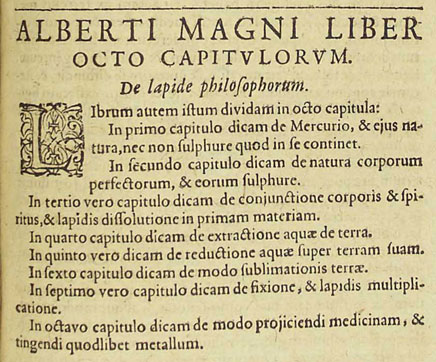
Translated to English from the book:
Theatrum chemicum, praecipuos selectorum auctorum tractatus de chemiae et lapidis philosophici antiquitate, veritate, iure, praestantia, & operationibus, continens: in gratiam verae chemiae, et medicinae chemicae studiosorum ... congestum, et in sex partes seu volumina digestum; singulis voluminibus, suo auctorum et librorum catalogo primis pagellis: rerum vero & verborum indice postremis annexo. Volumen quartum.
But I shall divide that same book into eight chapters:
In the first chapter I shall speak of Mercury, and of its nature, and also of the sulphur which is contained in it.
In the second chapter I shall speak of the nature of perfect bodies, and of their sulphur.
In the third chapter indeed I shall speak of the conjunction of body and spirit, and of the dissolution of the stone into first matter.
In the fourth chapter I shall speak of the extraction of water from earth.
In the fifth chapter I shall speak of the reduction of the water above its earth.
In the sixth chapter I shall speak of the manner of the sublimation of earth.
In the seventh chapter indeed I shall speak of fixation, and of the multiplication of the stone.
In the eighth chapter I shall speak of the manner of projecting the medicine, and of tinging whatever metal.
On Mercury and its nature, and also on the sulphur which is contained in it
Chapter 1
Quicksilver is cold and moist, and God created with it all minerals; and it is earthy, fleeing from fire, according as in fire it sometimes makes wonderful and lofty works; and it alone is a living spirit, and in the world there is nothing equal to it, and it is that which can perform such things as it itself performs. And it is that which enters every body, penetrates, washes, and excels it. It is the ferment for the bodies to which it is added, and then it will be the whole elixir unto redness and whiteness. It is perpetual water, the water of life, the virgin’s milk, the fountain, the alum, of which he who drinks does not die.
When it has been alive it has certain works; when dead, it has others, but the greatest works. It is a serpent luxuriating in itself, impregnating itself, giving birth in one day, slaying all metals by its venom. It flees from fire, but the wise by their arts have made it await fire, feeding it with its own earth until it awaits fire; and then it makes works and transformations. For as it is changed and altered, it changes; and as it tinges, it is tinged; and as it coagulates, it coagulates.
Therefore among all minerals the generation of quicksilver is to be preferred. For it is found in all minerals, and it has kinship with all. But it is made from an earthy mean and a watery one, or from a subtly living oil in a moderate degree, and from a very subtle spirit. From the watery-earthy it has ponderosity and an earthy motion, brightness, fluidity, and a silver color. For it goes out from the earth, slips back into the earth, and diffuses itself drop by drop, and again remains continually moist. From heat and spirit it is made fugitive, and it is mixed with all minerals, and clings firmly to whatever it adheres to; whence it is called the father of minerals and metals.
But quicksilver is clearly seen to have a substantial nature, like a monocolos, by the heaviness of its immense weight by which it outweighs gold, so long as it has remained in its own nature; and it is of a very strong composition and of a uniform nature, because it is not separated. But in no way are its parts permitted to be divided, because when the whole of its substance has received fire, or when it remains with it in the fire, it stands. Therefore in this is noted the necessary cause of perfection. For it alone suffices for the perfection of fixation in every grade, though with ignition; for because of the good adhesion of its parts, and the strength of its mixture, if its parts are in some manner thickened through fire, it does not thereafter permit itself to be corrupted. Nor by the fury of fire does it permit itself in the furnace to be separated or lifted up further.
For it does not suffer rarefaction of itself on account of its density and lack of adustion, which comes about through sulphuric burning, which it does not have. But quicksilver is manifestly perfect in all its operations. For it is free from burning and falsity, and when fixed it is effective in fusion. For indeed it has the tincture of redness, of most abundant perfection, of shining splendor, and it does not depart from the thing mixed with it until the end. It is also amiable and pleasing to metals, and the means for joining tinctures, because it is mixed with them through their least parts and naturally adheres to them in the depths, because it is of their very nature.
Yet when it is mixed with the Sun and Moon, it is mixed more easily, because it befalls it to partake of their pure nature, and then nothing is added to it except the Sun. From this surely the secret of the elixir is chiefly drawn, because Mercury receives into itself those things which are of its own nature, but refuses another thing, because it delights more in its own nature than in a foreign one. From this it clearly shines forth that those bodies are of greater perfection which contain more of Mercury, and those less perfect which contain less of it.
For since among minerals it holds the greatest kinship in nature, and God gave to it a substance and a property of substance such as it has happened to none of the things in nature to possess, because it alone is that which endures fire and is not overcome by it, but rather rests in it amicably, quiet and rejoicing. For when it alone becomes metal, it contains within itself the whole thing that we need for our magistery. Therefore it is manifest that quicksilver contains within itself a good sulphur, by which it is congealed into gold and silver according to the different mode of digestion, etc.
On the nature of perfect bodies and their sulphur
Chapter 2
Gold is the noblest of bodies, the lord of stones, king and head of all the others; it is not corrupted by earth, nor do burning things burn it, nor is it diminished in fire, nor altered in any way; rather it is improved in it, because in it there is a certain humidity of humors, and it is not altered in any way, since its complexion is tempered, and its nature is set in a right proportion of heat, coldness, moisture, and dryness. Nor is there in it anything superfluous, nor anything lacking.
For it is created from the most subtle, clear substance of living silver, and from a small quantity of the sulphur of the pure, the red, the fixed, the bright, and, changed into its own nature, tinging that same thing, namely the Mercury of gold, it holds the whole body, and is its ferment, the elixir of the white and the red; nor is it improved unless with itself, nor completed with another, just as dough is not completed without its own proper ferment.
Gold is a body enduring and remaining through ages of ages, and therefore the philosophers extolled it above all, magnified it, and spoke of it. For what the sun has in the heavens, that gold has among bodies, in the way that I understand it. For the sun, by its light and splendor, generates all growing things and perfects all fruits by the will of God.
For Hermes said that a true tincture is never made without the red stone.
Silver is a body less than gold, and its weight is less than the weight of gold; and it is of the parts of the moon in humidity, and in a moist place it is corrupted, and its vapor is sour. In fire it is diminished, and by sulphurs it is burned. Yet, except for gold, no body is better in it, or nearer to gold. For the interior parts of gold are the exterior parts of silver. And its nature is cold and dry, and it receives tincture.
Moreover, gold is a perfect and masculine body, without superfluity or diminution. Hence if by simple liquefaction in the earth it should perfect anything mixed with it, it would be the elixir unto redness. But silver is a body almost perfect and feminine, which, if by fusion it should perfect the imperfect, it likewise would be the elixir unto whiteness which it is not, because they are only perfect bodies.
If that perfection of theirs were communicable to imperfect things, would not imperfect and perfect things be perfected? But if they were more than perfect, whether twofold, fourfold, hundredfold, or thousandfold, then they would perfect the imperfect. And because nature operates in them simply, perfection in them is simple and inseparable and incommunicable, unless perhaps they should be reduced into their first state, that is, into fume with the volatile, because the vapor of volatile sulphur overcomes the vapor of a fixed body; and since a perfect body from purified quicksilver and from such red sulphur may be had, why should we not choose these as the material of our red elixir, and silver similarly as the material of the white elixir?
For by this simplicity these two bodies are perfected, without any ingenious cleansing, and so strongly digested and decocted by natural heat that we can scarcely work in them with our artificial fire. And although nature perfects something, yet it does not know how inwardly to cleanse or purge. For it works simply upon that which it has.
And indeed from the two sulphureous bodies for we say that sometimes in the substance of silver there is enclosed, in the beginning of its mixture, one substance supervening, but another foreign one, corrupting its nature.
And it must be noted most carefully that the conjunction of those two bodies is necessary in this art for the red and for the white. And there are two reasons: one is that gold is the nobler among metals, more compact, perfect, and fixed; yet if it is dissolved, it is separated into the smallest parts, and its spiritual and flying part departs from the fire like Mercury that is, its soul which is marvelous, and by reason of its good elemental balance. And then it has tincture without number, and so this tincture is called the red masculine sperm of heat.
But if silver is dissolved, it has no tincture; yet it is prone to receive that very tincture and to fix it in due temperament of heat and cold, and it is called the feminine seed, cold and dry; and the conjunction of these contains them. There is also another reason why the conjunction of those two bodies is necessary: because when gold is by itself, it is of most difficult fusion and liquefaction; but when they are joined together, they fuse easily with Mercury, and make consolidations tending toward gold.
Hence if in our stone there were only one of them, never through any magistery would the medicine easily flow, nor would it give tincture; and if it did give tincture, it would not tinge, unless it itself were only that which is not the receptacle of tincture. And our final secret is this: to have a medicine which may flow before fleeing Mercury. Therefore the conjunction of those two is necessary. For there was no body more worthy and more pure than the sun, or its shadow the moon, without which no tinging quicksilver is generated.
But he who, without that body of quicksilver, strives to tinge, proceeds blindly to practice, like an ass to hay. For gold gives goldenness; silver imparts whiteness. Therefore, if you know how to join quicksilver with the sun and the moon, you have come to the secret which is called the sulphur of the art. Therefore from those bodies is extracted a living sulphur, white or red, since in them is the purest substance of sulphur, by the skill of nature most highly purified.
And I advise that you work with nothing except Mercury, the Sun, and the Moon, since the whole benefit of this art consists in them. For whatever a man sows, this and no other thing does the female correspond to his sowing; and every tree brings forth fruit according to its own kind. Nature likewise is always wise, always striving toward perfection, since it always contains within itself its seed, that is, the seminal virtue in the seed. Therefore Avicenna says: if I did not see gold and silver, I would certainly say that alchemy was not an art in nature. But since I do see gold and silver, I see most certainly that alchemy is in nature.
Other bodies indeed are possible and workable, but they will not be good like those. Since they do not have medicine, it is impossible for them to give it; likewise they cannot fix what is not fixed, nor cleanse what is unclean. For that is not found in a thing which was not in it before, nor can anything give what it does not have.
For because your Mercury is converted from its own nature, it becomes one and the same with each of those things which are completed out of the planets: because with the good it becomes good, with the bad it becomes bad. If it is joined with lead, it will be lead; if with iron, it will be iron; and if it is joined with other bodies, it will be conformed to them.
But if it is joined with these two radiant bodies, it becomes a complete and perfect elixir, because Mercury is mixed with them, and is fixed through them by the highest skill a thing which comes by no means easily to the artist of stiff neck.
On the conjunction of body and spirit, and the dissolution of the stone into first matter, and its putrefaction
Chapter 3
Certainly every thing is made from that into which it is dissolved, or out of that. For ice is turned into water by means of heat. Therefore water existed first. But all metals are generated from Mercury, and into it they are dissolved. Therefore the first regimen of the stone is this: to dissolve, just as ice into quicksilver, so that it may be reduced into its first matter.
Now this whole work is done through quicksilver, and because it itself has the power to reduce the Sun and the Moon to its own nature, and to bring them back to first matter. But because quicksilver has in itself feculence and burning, and an aqueous substance without inflammation, it is necessary therefore to remove its superfluities and supply its deficiencies, if you should wish to make or create a complete medicine from it.
Its earthy feculence, however, must altogether be removed and cleansed by sublimation, lest it create a livid color in projection. And its aqueousness must likewise be removed, lest in the same way it render the whole matter fugitive in projection a property belonging to the substance of the medicine that must be avoided, not endured; and if one were to follow it and make with it, it would happen in them sometimes to create Saturn and Jupiter, and sometimes Venus, and sometimes Mars, which must necessarily come about from impurity. From it sometimes the Sun is created, sometimes the Moon, which must necessarily come about from purity.
Hence the Philosopher in the fourth book of the Meteora of this art mocked the Sophists, saying: “Let the craftsmen know that the species of metals may be changed in potency” which indeed is true, as the Philosopher writes “unless those species be reduced into their first matter.” And that matter is quicksilver, since it is itself the element of all fusible things; for then they are well changed into another form than they were before. For the species themselves are not changed, but the individuals of the species are changed, because the individuals themselves are subject to sensible actions, since among these things there are convertibles.
But the species of silver, which is argentness, is not changed into the species of gold, which is goldness, nor conversely, if the species of nature could not be changed; rather the individuals of the species are changed when they are reduced into their first matter. For when the form of that individual or of that thing has been corrupted and dissolved into first matter, then another form is rightly and even necessarily introduced, because the corruption of one thing is the generation of another.
And because matter can in no way be destroyed, since it remains under some form, when one form has been destroyed another form is immediately introduced for this operation, or for another disposition. For it must be noted that first matter is twofold, because one kind is proximate and another remote. The proximate matter is quicksilver. But the remote matter is water, because before quicksilver was, it was a kind of water. Yet the true principle of our work is the dissolution of the stone, by which the dissolved bodies are brought back to the nature of spirit, not because they are more fixed. For the solution of body is together with the coagulation of spirit.
Therefore suffer, sublime, and cook, grind, incinerate, and do not tire of reiterating this very thing, because the things which are imbibed are softened by water, and the more often they are repeated, the more they are softened, and the more the gross parts are subtilized, until they are hardened and divided by turns; because the spirit and body are kneaded together, and all things that are kneaded together are dissolved from the whole, and this kneading is done with excessive contrition through water, incineration, and roasting. For by the grinding of waters, and by roasting and fire, the bound and viscous parts that are in bodies are divided.
But bodies dissolved are reduced to the nature of spirit, and are never separated, just as neither water from water. For natural nature is altered, because fontal things and their fontal counterparts are joined together; but the subtle parts and the softened parts are not dissolved. Therefore I say most clearly that in the solution of the stone you must labor to separate its purer parts from the impure, and, the heavier parts having been cast aside, let the work be perfected with the lighter parts, because the intention of our work is nothing other than that the purest substance of Mercury be chosen out in those bodies, since the elixir is made only from them.
Now the first motion must be putrefaction; but there are many kinds of putrefaction and corruption, therefore I speak only of that kind which is used in our present purpose. The first natural principle is matter … material, as I said above. The second is heat moving that matter toward putrefaction. But the signs of perfect putrefaction are a black color, a fetid smell, and the matter’s subtle inward condition and dissolution; and this is the first Mercury. For heat acting in first moisture generates blackness, and indeed this blackness is the raven’s head; this is the beginning of the work.
Also note that ingress, submersion, connection, conjunction, complexion, composition, and commixture signify the same thing in this art. For when something is added, joined, converted, when it is mixed. For commixture is the union of commixible things through the smallest parts, that is, through an indivisible union confirmed there. You should also know firmly that the whole strength of this magistery, if it were not in putrefaction, then because it would not become putrid, it could not be dissolved nor melted down. And if it were not dissolved, it would come to nothing.
Likewise, know that in every body there are three dimensions and depths, and this is manifestly apparent from the body. And that which first lies beneath the face of our stone, so to speak, in its first creation, is white, and so it appears to the face. But because we say that it is cold and moist, because so it is, from which we conclude, why the stone, our stone is aqueous, because it is cold and moist. For such a disposition is said to be the manifest surface of the body. But breadth is that middle disposition by which one goes to the depth. And what is intermediate stands between depth and breadth, as between two extremes or contraries. And it is impossible to pass from contrary to contrary, or from extreme to extreme, except through a middle disposition, because our stone is of a cold and moist complexion.
If therefore we wish to make it pass into the middle disposition, it is necessary that the other quality be destroyed in it. But it is destroyed in it through putrefaction. For the cold and moist, by nature and through putrefaction, is inflamed, and its moisture is turned into the nature of dryness according to Asidus; and so there is made a passage to the middle disposition, which is coldness and dryness, and this is called the breadth, namely of water, because it holds from the cold and moist coldness, and from the hot and dry namely from fire dryness. But first by an inexisting heat, because the coldness remaining in the body, it passes to the contrary or extreme, destroying coldness and introducing heat; and this disposition is called the depth or hidden part of the body, as appears very well in the book of the Magistery of Aristotle.
He therefore who wishes to prosper in this art must chiefly compound that mineral admixture or secret, and first discover how to bring nature into nature, color into color. And the philosopher Lucas says in the Turba that in very many things we need nothing but the moon, and thus at every degree of our operations our thing is turned into another nature.
On the extraction of water from earth, and the reduction of water upon its earth
Chapters 4 & 5
After the matter has been putrefied for bringing about the union of body and spirit which nevertheless cannot be done unless in air, namely hot and moist and this is through sublimation, that is, what takes place in the resolution into oil, know then that our stone is divided by the magistery into two principal parts: namely into an upper part, which ascends upward, and into a lower part, which remains fixed. And yet these two parts agree in virtue, and therefore the Philosopher says: the upper is as the lower. And this division is necessary for accomplishing the marvels of this one thing, the stone; for the lower part is earth, which is called the nurse and ferment, and the upper part is soul, which vivifies the whole stone and makes it rise again.
Whence, once the separation has been made and the conjunction of the stone celebrated, many marvels are accomplished. And it must be noted that although our stone is said by some in the first operation to be divided into four parts, which are the four elements, as was said above, yet there are two principal parts: namely, one which ascends upward, which is said to be non-fixed; the other, which remains below, which is said to be fixed, or earth, or ferment, which nourishes and ferments the whole stone, as has been said.
But from that non-fixed part there must be had a good quantity, and it must be given to the stone, which has been made most clean without dregs, again and again by the magistery, until by subliming the power of the non-fixed spirit has borne the whole stone upward. And this is what the Philosopher says: it ascends from earth into heaven; afterward it must again be exalted above measure, with the element extracted from that same stone in the first operation.
The element is called the water of the stone, and it must be roasted in its subtlety as often as needed, until the whole stone descends again into the earth, and thus receives the upper power by subliming and the lower by descending, so that what is corporeal becomes spiritual by subliming, and what is spiritual becomes corporeal by descending; and thus you shall have the glory of the clarity of this world, and from you shall flee all obscurity, all poverty, and all sickness. For this composition of the stone cures every sickness, and this stone is the strength of all strength, because no strength in this world can be compared to the strength of this stone.
For it conquers every subtle sensible thing, penetrates every solid thing, passes through and overcomes it; in overcoming it converts quicksilver, which is subtle, into those bodies. It penetrates hard and solid things; for Morienus says that all blackness is nothing other than water extracted from earth, and this water standing above its own earth until it putrefies. And this water putrefies and is purified with the earth; when it has been cleansed, with the help of divinity the whole magistery is directed aright.
This water indeed contains within itself the soul of its body. That soul, I say, has itself in spirit in the manner of oil; and that soul is a tincture dissolved and carried in spirit, which some philosophers called white smoke. Therefore take from the white smoke, because the white smoke is the soul of dissolved and dead bodies, whose souls we draw forth from their bodies. For every body that lacks a soul is dark, and when the white smoke returns with the dead body into the body, and removes its blackness and uncleanness, because it consolidates the bodies into one and multiplies them, then its beauty appears, and its tincture in this operation.
And know firmly that if the white smoke is not strong, the art of alchemy does not exist. For Pythagoras says, speaking of the water of Mercury extracted from the stone, that is, from the earth of gold: “But this water is the sharpest vinegar, which makes pure gold to become spirit, without which neither whiteness, nor blackness, nor redness, nor rust can come to be.”
And when it is mixed with the body, it becomes one with it, and turns it into spirit, and colors it with a changeable color. The philosophers say that this water alone does all things, dissolves all things, congeals all things, and makes all things flow without any other aid. In it are wont to appear the colors … in the body in which is the tincture of that very body. Hence there is a difference between the tincture of water, namely of lunar water, and the tincture of oil, namely of solar water. For the tincture of water washes and cleanses, but the tincture of oil tinges and colors.
An example of this is that if a cloth is dyed in water, it is cleansed by it, because when it is dried the water departs, and the cloth remains in its own state and its former color, except that it is cleaner. The contrary is the case with oil: when a cloth is dyed in it, it is not separated from it, because of the fiery color, unless the whole cloth is destroyed. Therefore oil will be the likeness of the soul existing in the body, which cannot be extracted.
Join, therefore, the water above to its own earth, and grind them together persistently, then little by little imbibing, and decocting week by week, and afterward gently calcining, until the earth drinks up the fifth part of its own water. And know that the earth must be nourished. At first with a little water, and afterward with more, just as happens in the upbringing of children. Therefore grind the earth many times, and little by little imbibe it, from eight days to eight days, and decoct it, and afterward moderately calcine it in the fire; and do not grow weary of repeating this same thing, because the earth does not bear fruit without frequent irrigation.
For the body is the discontinuous element, because it is wholly deprived of the soul itself; hence, since it becomes dry and empty, it then very eagerly desires to drink its moist water. And trituration does not take place until the water becomes one with the earth; the same body profits nothing unless it becomes one. Therefore do not withdraw your hand from grinding and roasting, until the earth becomes white.
Take care not to imbibe the earth too much, except gradually, with long grinding after the drying of the earth, for in this there is weight everywhere. It must be noted that an excess of dryness or a superfluity of moisture corrupts the work; that is, so that you may know only to decoct by roasting as much as is required for dissolving and imbibing. Note that every time after the calcination of the earth, pour water upon it in due measure, neither too much nor too little: for if too much, there would be a sea of disturbance; but if too little, it would be burned into ashes.
For gently, and not excessively, from eight days to eight days, you shall irrigate the earth, decoct it, and calcine it, until it drinks its own water. Therefore continue the work many times, because although it be long, yet you will not see the tincture, nor perfection perfected, until the work itself is perfected. Therefore strive, when you have operated, to keep in mind all the signs that appear in each decoction, and to investigate their causes.
For there are three principal colors: black, white, and citrine. But when the perfect black departs, and not every incomplete blackness, the earth comes forth white by force of the fire in calcination. For just as heat acting in moisture generates blackness, so acting in dryness it generates whiteness.
Therefore if the earth is not white, steep it in its own water and calcine it again; and they take from it the whitened azoth and the fire-laton and the ob… purified from it. For its preparation is always with its like, and as was the clearness of the water, such will be the clearness of the earth; and the more it has been washed, the whiter it will be.
Hence another says: when you have found it already black, know first that this is the key of the stone; afterward indeed through putrefaction it grows red, not with the true redness, and it even becomes citrine. Of this some say: “the stone grows red, and grows citrine, and grows white, and grows coagulated before the true whiteness.” Hence another said: “dissolve it, and when it is coagulated, it is adorned with redness; before whiteness it even becomes green.” Therefore another thus says: “cook it until a green color appears, and already before whiteness the color of the peacock”; hence some say thus: “make it so that all the colors that can be imagined by man in this world appear before whiteness, and then true whiteness follows.”
Hence some say: when at the middle of decoction the pure eye appears, like the eye of a fish, its usefulness is to be awaited, and then know that the stone is in rightness and is coagulated. Another also says: when you find whiteness appear preeminently in the vessel, immediately think that in that whiteness the redness is hidden there and lies concealed, and then you ought not to extract it, but rather to cook it until the whole becomes red.
And yet between true whiteness and true redness there is citrinity, the color of yellow bile; of this it is said: after true whiteness you will come by the heat of the fire, increased, to citrinity. And another says: do not despise the ash, because God gives it liquefaction, and then at the end the King is crowned with a red diadem by the will of God.
Therefore you must temper this magistery. For composition is not without marriage and putrefaction. And marriage is to mingle the subtle with the gross, and putrefaction is to roast, water, and irrigate them, because they are mixed together intimately and become one, and there is no diversity of water mixed with water. Then indeed the subtle undertakes to retain itself, and the soul undertakes to struggle with the fire and to suffer it, and the spirit undertakes to descend into the bodies and to be poured out in them.
Now know that when you shall have mixed the body with moisture, and the heat of fire finds it, the moisture is turned upon the body and dissolves it, and then the spirit cannot go forth, because it has imbibed the fire and its flame. Yet this does not happen unless through equal parts, nor without good tempering and continuation, and long labor.
But the ancient philosophers imposed many names on our stone: they called it animal, gum, vitriol, blood, red urine because of its red color, and by infinitely many other names they called it. They also spoke of iron because of the impossibility of fusion, and they said this: for since a body without moisture is deprived of flowing by decoction, since it is moisture that would easily make it flow, it is necessary that the body, being dry, should not flow; whence they called it iron, because among other bodies iron is said to be the driest, just as that body is such through the privation of moisture which at first made it volatile since it is necessary that it remain fixed in this way. For not all fixed things are fixed through such a privation of moisture, which was called calcination by many philosophers.
Hence Geber says: Calcination is the purgation of a thing by fire, or the pulverization of the moisture of the consolidating part; and the cause of the invention of calcinations is the preparation of the spirit, so that they may be fixed more well. Therefore it is so: by the privation of moisture, the volatile becomes fixed and soft to hard, according to Geber, changing from nature into nature, and water in fire according to the natural ways, as in the Turba.
Likewise, there is an imitation of complexions: as of a cold and moist complexion into a hot and dry one, or of a phlegmatic complexion into a choleric one according to the physicians. Likewise the spiritual becomes corporeal according to Aristotle in the book on the perfection of the Magistery. Likewise, there is the liquefaction of sulphur according to Assidus. Likewise, there is the making manifest of what is hidden according to Rhasis in the book of three words.
For philosophers test themselves whether they have found that which was not existent in itself, corrupting moisture unless slowly, praising length of process and blaming haste. And at the beginning, as Moses says, there is a certain struggle of fire through the length of corrupting, cooking, putrefying, and thickening. For by the heat of the sun that is, by the gentle decoction of fire the thing is congealed, which in due proportion should be brought into the bath, because in the bath, by external heat, that is, by the least fire, it is putrefied, as Bolus says.
For if, after you have kindled the fire, redness comes before growth, it profits you nothing, because if you want whiteness, as Lucas says. For all the philosophers asserted that a gentle fire ought to be made, for the reasons mentioned above. For they inquire how we ought to govern it gently, until the sulphur becomes incombustible, wherefore the female must not be put in except in due mixture.
But the philosophers called this our thing Salamander, because just as the salamander lives only in fire, so our stone is nourished only by fire. Hence another also says: Unless the body should become soul, it will not suffer the fire. But he who can turn soul into body, and body into soul, and mix subtle spirits with it, tinges every body unto perfection.
On the manner of the sublimation of earth
Chapter 6
For Ascanius, the great Philosopher, says: In the dregs is that which you seek. Therefore let the feces be taken when they are drawn from the alembic, and let them be ground strongly, and imbibed with their own water, and let them be dried over a gentle fire or in the sun; and let this be done many times. For by such preparation that smoke is made fit for sublimation. Hence Geber says: by repeated trituration, imbibition, and roasting, the greater part of its aqueousness is removed, and the rest by sublimation.
Therefore let the aforesaid feces be taken and prepared for sublimation, mixing them first with a gentle fire, and afterward proportionally with a greater one, until that clean and white smoke ascends; and if it does not happen at first, let it be returned as often as needed upon the same feces until it does happen. And finally, without the feces that adhere, then one fixed part receives from them the diversity of the medicine, according to its different operation, so that sometimes from it you would create Saturn and Jupiter.
But no one ought to sublime earth for sophistic works; rather it ought to be sublimed for the elixir of our stone. And those things which are sublimed are sublimed in two ways: some by themselves, because they are spirits; others with others, because they are incorporated with spirits. Mercury, when it becomes spirit, is sublimed by itself.
Earthy matter, when it becomes calx, is not sublimed unless it is incorporated with Mercury. Therefore grind the calx, imbibe it with Mercury, and decoct until it becomes one body, and do not grow weary of repeating this very thing; because unless the body is made one and incorporated with Mercury, it does not ascend upward. Therefore it is necessary, as much as you can, to draw forth its soul and to strengthen it with Mercury until they become one.
For we do not perform sublimation except that we may reduce bodies to a subtle nature, so that they may become like spirits. And that the body may become light for bringing into all things, whether into the Moon. And we perform this sublimation so that we may reduce bodies into their first matter or nature, namely Mercury and sulphur. Therefore we perform this sublimation for three reasons. One is that the body may become spirit by a subtle nature. The second is that Mercury may be well incorporated with the calx. The third is that the whole may assume a red or white color.
Therefore when the calx is sublimed for the Moon with Mercury, it ought to be white and incinerated. When the calx is sublimed for the Sun, it ought to be repeatedly reddened; and Mercury, white with fire, the stone reddening, and the powder ought to be incinerated. For one does not operate well either for the Sun or for the Moon unless in this way and with that Mercury which you sublime, and in such a way you will not mix that thing for the Moon. For the calx of the Sun does not enter into the Moon, nor does the Moon enter into the Sun.
Do not therefore put red Mercury to the Moon, nor white to the Sun. But place each species with its own species, and set it upon a strong fire, and sublime it; and do not cast in that which remains of the dregs with that which ascends upward, but set each separately aside, because that which remains at the bottom you will again use for subliming, namely the incorporated Mercury, until the whole has ascended; otherwise you do not place it in the magistery.
And attend well that you must never proceed to the fusion of the aforesaid matter, or to the philosophical stone, unless you first sublime it, since the union of body and spirit does not take place except through sublimation. First the matter to be sublimed is matter is first to be made wax-like, so that by fixing the union may proceed more greatly, and from this a more fitting condition for commixture follows. But thus you shall make fixed matter volatile: take one part of fixed matter, and two parts of prepared Mercury, and let them first be well incorporated; afterward sublime it, and collect what has been sublimed, and upon that which remains at the bottom again, with new Mercury, grind it well with Mercury prepared in the aforesaid manner, until the whole has been sublimed.
For according to the Philosopher, quicksilver congeals the power of white, non-burning sulphur in silver, and that is an excellent thing, by which the alchemical art makes an elixir for silver. But note: if the sulphur shall have been most excellent, with clear redness, and if there has been in it the power of its non-burning fiery nature, it will be an excellent thing, so that from it there is made an elixir for gold. And a certain philosophy has handed down that first there is white sulphur for silver, and afterward red for gold. And nothing can become gold unless it first becomes silver.
For nothing can pass to the third degree unless it has first been in the first, and afterward in the second, because it does not pass from extreme to extreme except through a middle. Therefore nothing can become citrine through black, that is, from black something perfectly citrine, unless it has first been white, because citrine is composed from very red and very pure white; nor can white be made from citrine unless it has first been black. And gold cannot become silver unless it has first been corrupted and black, because better things cannot be made worse unless through their own corruption, since the generation of one thing is also the corruption of another.
Therefore he who wishes to convert gold into silver, and silver into gold because the sulphur of both, not burning, is in the silver itself white, and by a greater digestion of fire it can become red sulphur, because citrination is nothing other than complete digestion, nor is blackness anything other than whiteness. For heat acting in moisture first brings about blackness, and in dryness it brings about whiteness, but not citrination in white; and this same blackness, minimal redness, and afterward between white sulphur and red there is only that which from one matter of metals is fully purified and in a different manner decocted and digested.
Therefore Plato says that in silver there is white sulphur, just as in all gold there is red sulphur. And sulphur altogether is not white or red. But such sulphur is not found above the earth, as Avicenna says, except that which is drawn out from these bodies. And thus we prepare these subtle bodies, so that we may have from them sulphur and living quicksilver above the earth, from which beneath the earth gold and silver were sometimes produced.
These are shining bodies, in which there are coloring rays; they tinge the other bodies into true whiteness and redness, according to however the bodies shall have been prepared. The alembic and the cucurbit must be joined together in such a way that Mercury cannot go out, because it is not sublimed except by the force of air, and therefore there will be found in that place the smoke that flies out, and it will seek the upper place.
For the intention of the whole work is nothing else, unless it be sublimated, a stone noted in the chapters, which is called in Arabic Adrop, and in Latin plumbum vivum [living lead / quicksilver]. Know that this is the stone which philosophers have known, which has virtues above all the virtues of stones; and, as we have said, when it is placed in the philosophical vessel, it must be sublimed, and from such sublimation the stone is sublimed until it comes to the final purity of sublimation, and this is called the first order, or the first operation.
And these are Geber’s words, who placed the whole art in sublimation and reiteration. And know that this sublimation is not common, because in this sublimation all the aforesaid sublimations are left behind, which I set forth for you.
The first is purification, so that the most subtle and most pure substance may be drawn out.
The second is solution, so that the whole matter may be dissolved into water.
The third is putrefaction, as Morienus says: Nothing has ever in any way been animated, or brought to birth, nor grown, except after putrefaction and change of appearance.
Hence the Wise Man says: For all strength … and indeed he says that if it had not been putrid, it would not have been dissolved; therefore it was fitting that it be putrefied. Hence the philosophers say: The corruption of one thing is the generation of another.
The fourth is ablution, because that putrefied and filthy thing must be washed by ablution and cleansed from corruption and impurity. And they have spoken rightly. For the longer the water remains above the earth, the more the earth is cleansed and washed; so that ablution and ceration are the same thing.
The fifth is coagulation, namely making it so that the water, drying gently at the sun with the earth, may be mixed with it, and then be dried and coagulated and at last turned into powder. And this is prepared coagulation.
The sixth is calcination, whence you should know that a calcined thing is more fit than one not calcined. And it is simply near to fixation; hence there were many philosophers who called calcination fixation, and they spoke well.
For all these modes are in sublimation; therefore I say that he who sublimates perfectly accomplishes and performs the whole work, and know that this whole thing is perfected in one furnace and in one vessel. In this one sublimation are all those operations which we have mentioned, and the seven dispositions, each of which one who understands can perfect from them. Therefore do not be negligent in sublimation, because through sublimation perfection is achieved, and as the purification is, such also is the perfection.
Now I wish to show you what sublimation is.
Sublimation is the raising of the most subtle parts away from the gross parts, and finally the separation of the non-fixed parts from the fixed parts. The non-fixed parts are raised by smoke, that is, by vapor, because, as we have said, care must be taken that they do not flee away; rather, together with the fixed parts they are fixed and remain, and they offer a more rapid fusion to the grosser parts.
Understand that true sublimation is when we make a separation of the parts which are raised upward from those which remain below. Rather, we wish that in the end they come together by their own conjunction. For in our stone, after the first purification, which is perfected through solution, we find nothing diminished and nothing superfluous, because, as Geber says, the stone is to be sublimed until it comes to the final purity of sublimation; therefore Geber says: When one thing is joined to another, or one thing is extracted from another, then we ought to perform our sublimation.
Because of this, all those laborers were deceived who sublimed with the feces, and did not know what they were doing, or were ignorant what the stone of the philosophers was; and though they sublimed a hundred times, they did not perfect it, because they did not know the sublimation of the philosophers. Hence Geber says: For indeed there is one stone, one medicine, in which the whole magistery consists, to which we add no foreign thing, nor diminish anything, nor remove in preparation or operation anything superfluous. And the first purification is that which is perfected by sublimation.
Now I have shown you sufficiently that when you wish to make sublimation, you are to add nothing to our stone nor take anything away; rather, place the whole substance in our vessel, as we said in the first disposition, sealing the vessel tightly, and place it in the furnace, and cover it with ashes above and below, so that the two parts of the vessel are covered on both sides until the matter is dissolved, and afterwards minister with a gentle fire until the greater part is turned into powder, which will happen in thirty days.
And when those operations which we have spoken of have taken place namely sublimation, solution, distillation, descent, putrefaction, ablution, ceration, and calcination or fixation know that the philosophers said many such things, namely of whatever operation was mentioned above, so that the science may be understood more obscurely.
When our stone is in our vessel, and the matter feels our sun, it is immediately dissolved into water, so that it ascends on high even to the head of the vessel, and afterwards descends to the depth of the vessel. And know that our matter ascends by smoke and vapor, and the philosophers, seeing that matter ascend and descend, made a distinction among those operations, and it was their opinion that that which ascended should be called the first sublimation. Afterwards, seeing that same matter descend to the bottom and be turned into water, they judged in their hearts that this should be called the second sublimation.
Likewise, seeing such an ascent and descent converted into water, they said that this was distillation, which is the third mode. And seeing this being thickened, and turned into black earth, they judged that this thickening stood at first above the water; and so by letting it thicken little by little they saw the earth sink into the water and remain at the bottom under the water. Since that earth was black and feculent, they judged in their hearts that this operation should be called putrefaction, because it is the fifth mode.
Likewise, seeing a little further that the black and feculent earth, remaining for a long time under the water, in our sun lets go its black color and foul stench, which they called ablution.
Hence indeed Morienus says: Know that the whole magistery is nothing other than the extraction of water from earth; and with this is the sixth mode, which is coagulation.
Seeing further that everything was standing under the water, and growing, and that the water was diminished because of a temperate decoction, they said that this was perfect ceration, and that this was a new beginning. Hence the Philosopher says that the water is cerated and imbibed with the earth, and by temperate decoction is dried, and the whole matter is turned into earth. Hence the Philosopher says that this is its whole strength, if it has been turned into earth, and this is the seventh mode.
Likewise, seeing further that the whole matter was becoming earth, and that it was reduced to the solar substance which it had not been before, but was becoming fixed, seeing this, they said that this was the whole thing; because Plato said: Dissolve our stone, and afterward coagulate it; that is, turn it into earth, and do this with great caution, and you have almost the whole magistery; and this is called the eighth mode.
Hence indeed Plato said: Take our stone in thin plates, and put it in our vessel firmly closed, and by a gentle fire let it be thickened; afterwards let it be cooked by the heat of the sun until it is coagulated. And know that the whole magistery is nothing else than to make perfect solution and coagulation. Hence the Philosopher says: Dissolve and coagulate, and you shall have the whole operation and art.
And seeing still further that our matter, coagulated and thickened by stronger decoction, had become perfectly whitened and dried, whose whiteness was above all whiteness, they judged the matter to be calcined. And as they were saying among themselves, in the way we have named that most noble mode, seeing this whole thing they said that it was perfect calcination, and therefore they called that mode calcination, which is the mode.
For as often as you sublime any body with the addition of a sublimed spirit, so many times you may work a thousand parts in projection. For the more the body is exalted, the more it will avail. And if you can project upon a hundred, and a hundred upon a thousand, and a thousand upon ten thousand, and ten thousand upon a hundred thousand thousands, and a thousand thousands upon infinite thousands. See therefore what we have said, since all these things are necessary to praise. Indeed, for composing white and red sulphur, this suffices.
On fixation and the multiplication of the stone
Chapter 7
There follows the planting of powders, that they may bear fruit, and that their fruit may remain forever. And I shall teach how to fix the sublimed powders, so that they may be able to remain in fire and be added to and mixed with bodies. Now fixation is an adaptation of the fugitive thing to fire. But the cause for discovering it is this, that every tincture must be prepared in another thing by alteration, and not changed. It remains therefore, after the sublimation of the matter, to proceed to its fixation.
Now it is fixed thus: take that which has been sublimed, and divide it among cucurbits, or among urinals, according as the quantity of the matter requires. And fixation is made when the matter no longer ascends to the alembic, or, if you wish to test the fire more excellently, it at once appears or if you place upon it an iron plate from the body, it remains fixed and does not depart again. And divide it equally through the aforesaid urinals, place it upon a reverberatory furnace; this done, first apply a gentle fire round about for several days, until by such a gentle fire you see that it ascends no more, and thus strengthen the fire, and continue with such a stronger fire until you see that nothing is raised up; and thirdly give it the strongest fire, which you continue until the aforesaid matter becomes fixed.
And it must be known that spirit and soul are by no means united except in the white color, because then all the colors that can be imagined by a man in this world appear to you, and then they are brought together and perfect the work in one color, namely whiteness, and there all colors meet. For whitening is the beginning of the whole work and its permanence, nor is it then varied into diverse colors, except into red, in which is the final end.
But there is a cinereation which takes place in azure and red, and this is not called color. In decoction, however, after whiteness, you cannot go astray. For by gradually increasing the regimen of the fire, after true whiteness one comes to cinereation before redness, as was said before. And know that quicksilver and fire burn bodies, mortify them, and fix them in one regimen; and the more the bodies are ground and mixed, the more they are dissolved and attenuated.
And know that a body cannot tinge unless it is tinged, and unless the spirit is drawn out and lies hidden in the belly that is, buried and becomes body and soul from the spirit, which is of spiritual nature, and from which the colors appear. Hence the Philosopher says: I command you to make bodies not bodies, and incorporated bodies. For by this regimen the composite is purified, and that which is hidden in its nature is drawn forth. For unless the very bodies and bodily nature are dissolved until they become incorporeal namely a most subtle spirit you cannot draw out that most subtle and tincturing soul which lies hidden in the natural belly.
Likewise it must be noted that now the body, or earth, which remains standing, receiving tincture, is said to have greater power than its brothers, namely the soul and spirit. For it overcomes all things that are mixed with it and transmits them into its own color, and it is the spirit that bears the powers of the soul through the body. In like manner our brass, the more it is cooked, the more it is thickened, until it becomes what the envious now call the philosophers’ stone of metals.
Afterwards it is burned until it becomes like saffron or like burned blood; then, once incorporated, it is impressed, and it tinges true gold. For Pythagoras says: Our stone ought to be decocted with its own water, until the whole becomes most pure and almost spiritual; and then the conjunction of body and spirit becomes inseparable, and it becomes of permanent color, because the fugitive becomes without flight.
Likewise Pythagoras says that in Mercury and in sulphur all the elements ought thus to be purged that which is incombustible from fire, that which is inflammable from air, and that which is vaporable from water.
Likewise, remotenesses and nearnesses are in the thing. The aforesaid things are to be understood thus: namely, that those two spirits, quicksilver and sulphur, differ greatly both because of the impediments already mentioned and because of nature, since one moisture is subtle and mixed with earth, the other oily and viscous; and also because of the long decoction which directs, and this is remoteness. Nearness, however, is called completion, because after digestion the indissoluble union of both immediately comes to be.
But this decoction acts here upon the whole substance of Mercury, though especially it acts upon the corporeal substance, because then it dissolves the body and it becomes powder. Therefore it is necessary that the body of Mercury below, which contains that noble smoke, be continually dissolved into the most subtle state, corrupted, and entirely purged, so that it may be turned into a corporeal nature. And then our two spirits and bodies are subtilized and perfected inseparably and at once; and one receives the other, nor do they flee from the fire, nor are they burned by it, penetrating metals and strengthening them through an excellent heat, almost like the heat of a hen incubating her eggs, and especially at the beginning of the regimen.
For through such a slow heat every subtle force of quicksilver, and the superfluous moisture of the powder, and its gross citrinity, will be burned away; and the vaporable oiliness, which sulphur has by nature, is gradually raised up from the aforesaid oiliness, purged in its inward parts, and subtilized, whereby the body of Mercury is made subtle, as if of hidden power; and then the fire is increased somewhat.
And that said power is gathered and joined to its purified body, and then there is made of them an indissoluble despumation. In the first decoction it becomes black, and then it is said that it is rightly made. In the second decoction it becomes white, and in the third red.
Some make citrine whiteness appear by too great a haste, which can happen through the burning of fire, but then the body has not been purified nor reduced into corporeal nature. And therefore the hidden fleeing spirit is never mixed with the gross body, since it would at once fly out from the fire, when the burning of fire does not cease, which was in the extrinsic body, that is, in the artificial fire. For if the artificial heat exceeds too much, it destroys the moving of the inner heat, because the inner heat cannot draw to itself the radical moisture, whereby it may defend itself from the fire; nor is the spirit burned by the inner heat, of which Aristotle speaks most excellently in the book of the Meteorologica. And by altering and constringing through a continuous and gentle heat, the muddiness is consumed and the superabundant moisture evaporates these two having hindered the subtle dry-earthy and the radical watery principles, so that they could not wholly embrace each other.
And yet, when those two impediments are removed, there is place for true commixture, because it brings it about that that earthy thing is joined to the water which was radical to it, and is decocted externally until it is liquefied, and one is incorruptibly made with the other through all its parts, so that the least portion of earth is mixed with the least portion of water, so that there is no place in them where there is not a true commixture. Then the permanent water is imbibed, because in that decoction it becomes red and is tinged with true and perfect redness, and there is made the composition of male and female, because there is there no contrariety, but the female rejoices and is glad, received by the virtue of the male.
And afterward it must again chiefly be imbibed until the moistening takes place, until the earthy is made a formal mixture with the watery and is moistened by it, and is protected lest it be burned, and the body is converted into spirit forever he who can bring it to such an end shall be blessed forever.
Verse: “When my urine shall have been perfectly citrine, exalted above all things, then I devour the filth of the world.”
For it says that the inner heat causes the superabundant moisture to exhale, but if the fire should rage, it makes the work perish.
Note the regimen of the fire: if it is according to nature, it ought to be governed after the example of the four seasons. In the first season, namely winter, the earth conceives. In the second, namely spring, it brings forth herbs and flowers. In summer the fruits ripen. In autumn they are gathered. Hence in our work it is similar. In the first operation Mercury is mortified, and the whole body is turned into powder. In the third it conceives and is turned into another nature, whence in that decoction it becomes black. In the second it shows its whitening nature. In the third the fruits now appear, because then the redness appears, which is at the end of the work. In the fourth the fruits are ripened and are gathered from it. And let these things said on fixation suffice.
On the projection and tincture of metals
Chapter 8
From the promised end I have completed even to the great magistery, for making the most excellent white and red elixir. Here finally I shall speak of the manner of projection, which is the completion of the work, and the desired and awaited joy.
Now the white elixir whitens unto infinity, and leads whatever metal to perfect whiteness. But it must be known that one metal is further removed from perfection than another, and although any metal may be brought to perfection through the elixir, yet more easily that which is nearer than that which is more remote, and much more perfectly. And when we find a perfect metal, and one very near and close to perfection, we excuse ourselves from those very remote ones. Now which metals are very near or remote is found openly enough in many books.
And because the elixir supplies white or red, beyond nature it operates so greatly, it is not surprising that it is communicable to bodies, according as it is projected upon that which has been liquefied. It is also a weighty matter to project upon a thousand thousands, and there to make it present at once; therefore I shall hand down to you one more hidden secret.
One part is to be mixed with a thousand parts of a nearer body. And let this whole be placed in a vessel firmly open … and put into a furnace of philosophical fusion, first with a gentle fire and afterward always increased for three days, until it has been inseparably joined; and that is the work of three days. Then again and finally, projecting one part of whatever upon another thousand of each body that is near and neighboring, that is the work of one day, or hour, or minute.
And there is another manner of proceeding in this way: take one hundred parts of Mercury washed with salt and vinegar, and put it in a crucible upon the fire; and when it has begun to flow, add one part of your elixir prepared in the aforesaid way, project it upon the hundred parts of washed Mercury as I said, and the whole becomes medicine upon the washed Mercury. Then place one part of that congealed medicine upon a hundred parts of washed Mercury in a crucible boiling over the fire, and again the whole becomes medicine. Afterward place one part of that final congealed medicine upon a hundred parts of washed Mercury, and it will be gold or silver, in every judgment the best, according as the elixir has been prepared.
Likewise there is another mode of projection: place one part of the aforesaid medicine upon sixty parts of Mercury, and send it into some glass vessel, and lute the mouth of the vessel with lime so that it may not breathe. Then place it over ashes upon the fire for three days; if the Mercury is retained, know that then the medicine is perfect. And note that then all those sixty parts of Mercury become medicine and elixir for others; and by this manner, always increasing the Mercury, you will be able to test the excellence of the medicine, because sometimes one part converted into a hundred, sometimes into two hundred, sometimes into forty, sometimes into a thousand unto infinity; and all becomes medicine, whatever the medicine retains from Mercury.
But the mode of operation is this: project one part of the aforesaid medicine upon one hundred parts of leaf-gold, and make it friable, and the whole will become medicine; one part projected upon a hundred parts of any metal of the sun will convert it into the best sun, than which a better cannot be found. And if you project upon the moon in a similar way, it converts all bodies into moon.
And by the same method you will be able to convert sun and moon into Venus, Saturn, Jupiter, and Mars but for doing this, do not act by my counsel, and do not proceed.
But if the aforesaid medicine or elixir does not have ingress: take from that stone extracted in the first operation equal parts, and mix and incorporate them together upon marble; and if it seems good to you, mix them in a bath by distilling, that they may be joined together the better; afterward dry it in the vessel, receiving the water through the alembic if you can. But repeat this as often as necessary, namely by imbibing and incorporating and drying, until the aforesaid matter is well incorporated and united with the aforesaid prepared Mercury.
In this manner place it in urinals having a rounded bottom, and with a reverberatory cover set over them, give it the fire of a candle or of ashes by due degrees, as I demonstrated above; and when it seems to you that you should add to it a little of the aforesaid Mercury, do so, until the aforesaid matter is fixed and made thicker than wax; and thus you shall have the elixir or stone of the philosophers completed, which converts every imperfect body and Mercury into the sun and moon, than which a better cannot be found.
Therefore I say that the whole sum of the work is not this, nor that the stone is sublimed in the chapters noted; and with the infancy of the work, Assidus is deceived concerning that highest work of sublimation by one degree; and by corruption it is cleansed, and in purity, while it is dissolved with that very thing, its addition white, yellow, or red is sublimed until it reaches at last the final mode of sublimation, and finally becomes volatile. But after this it is fixed by the modes of fixation, until it rests in the sharpness of fire.
Then indeed, the fixed stone, with the non-fixed part brought back again, through the mode of solution and sublimation, you shall make the volatile fixed, and the fixed dissolved, and again the volatile fixed, until it may flow and be altered in the completion of a lunar or certain solar perfection, most precious above every price in the world.
Thanks be to God who created it, who is blessed unto the ages of ages. Amen.
Here ends the book of the eight chapters of Albert the Great.