On the Agreement of the Philosophers in the Stone - De concordantia philosophorum in lapide
Study the Art with Us Buy me CoffeeAlbertus Magnus on the Agreement of the Philosophers in the Stone - De concordantia philosophorum in lapide
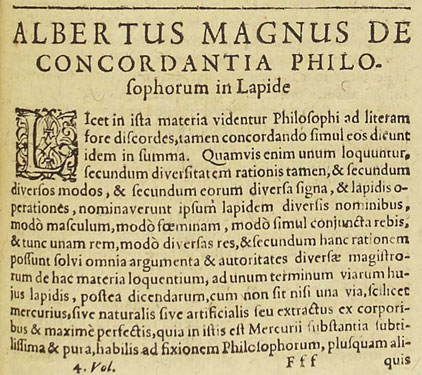
Translated to English from the book:
Theatrum chemicum, praecipuos selectorum auctorum tractatus de chemiae et lapidis philosophici antiquitate, veritate, iure, praestantia, & operationibus, continens: in gratiam verae chemiae, et medicinae chemicae studiosorum ... congestum, et in sex partes seu volumina digestum; singulis voluminibus, suo auctorum et librorum catalogo primis pagellis: rerum vero & verborum indice postremis annexo. Volumen quartum.
Although in this matter the Philosophers seem, to the letter, to be in disagreement, yet when brought into harmony they all say the same thing in substance. For although they speak of one thing, nevertheless according to diversity of meaning, and according to different modes, and according to their different signs and the operations of the stone, they have called that same stone by different names: now male, now female, now both together joined; and then one thing, now different things.
And according to this reasoning all the arguments and differing authorities of the masters speaking about this matter can be resolved to one end of the ways of this stone, of which it must be spoken afterward, since there is only one way, namely mercury, whether natural or artificial, or extracted from bodies, and especially from the most perfect ones, because in these there is the most subtle and pure substance of Mercury, fit for the fixation of the Philosophers, more than any mercury in the whole world, as will appear more broadly at the end through authorities; and yet afterward the authorities of the philosophers can be assigned to any term of the ways mentioned, and signify the same thing, and in the same manner.
For there are many ways, and they can be reduced to one intention. Yet from the different modes of applying fire, as the efficient cause, the administration of the operation is made stronger; and consequently the stone of the philosophers, according to appearance, receives different names, yet all tend to the same end: namely to sublimation and what is called sublimation. And to the end, which is called incineration or calcination, and is named by many other diverse names. From the repetition therefore of that operation, namely sublimation, and of its thickening, there naturally follows incineration or the fixation of the philosophers by the power of fire, either with the Moon alone, or with other things remaining, which nevertheless ought not to enter in, since all must tend to the same end. And from this, because of the speed of tending and the citation of the work, there results the goodness of the operation; and also, when the same ferment has been added, if one wishes to proceed further, increase can be made by virtue, as may be clear to one attentively considering the sayings of the philosophers.
Chapter One concerning the matter of the stone
Concerning this matter, therefore, something must be said in particular. Hence what some philosophers have wished, and almost all of them, namely that the stone of the philosophers in the beginning is or was the most subtle substance of mercury with earthly grossness, which hinders fixation and fusion the philosophers sought to draw it out from matter wholly purified, which is spoken of through sublimation, as is clear in Geber in his Summa, chapter on the Solar Medicine of the third order, where he says that mercury is noted as the stone in the chapters.
And in the chapter on Mercury he says that it is made from it and from that, and it is thus tinged. And he says: by means of separation you purify the part, you divide, and you place it upon dung. But concerning that Mercury the philosophers differ, as is clear in their books. For some have supposed that this Mercury is the mercury of the common sort, though not simply so, but purified by sublimation, or by certain other methods and revivification; and this as often as it becomes more pure from some earthly grossness, whether this is done in the common way or in the philosophical way namely because what is called Mercury becomes, by the fire, more tolerant and of equal quality.
For then by the continuance of the fire nature is converted within it, and the subtler part is separated upward in the vessel, concerning which the ancients at last speak in this way. Thus it happens that the whole Mercury, in its purest substance, is so brought forth, its earthly dregs remaining at the bottom to be cast away, as a certain philosopher says obscurely. Holding such a method of working, nothing is added to our stone, is added neither more nor less, except that we remove what is superfluous; and many sayings of the ancient philosophers, and authorities set down in the books of the philosophers, move them to hold this way, as is clear to those who examine well the books of the philosophers.
And first here it is intended to bring forward certain authors tending toward that way. For Senior says of the virtue of the philosophical stone: and if you consider the mode of its working in one way, whatever is said in our books about waters, sulphur, vinegar, salts, and such things, understand nothing else than our one divine thing, which, according to the difference of signs and preparations, is spoken of now as soul, now as sulphur; and do not attend to many things, although the philosophers say that it is made from things and compounded from three certain things, for this is said by way of similitude and figure, so that it may be spoken obscurely.
Likewise the same says: our stone of the philosophers, which is one thing, if other things participate with it than those which are from it, we do not call it our stone; just as all men participate with other things. And he says elsewhere: some indeed have posited sulphur.
Likewise, according to Aristotle, nothing is completed unless with a most subtle ferment or spirit. And this must be diligently considered. And as we have said, since its preparation is nothing but sublimation, and this is the sublimation and distillation and fixation of the philosophers, and incineration, because all these follow in nature through the sole regulation of fire, according to the requirement of the work and the degree or tolerance of the fire, concerning which I shall declare something in the special section below.
Likewise another philosopher says obscurely: all things that are found in this art at a dear price are useless. Nor should that be objected which is said in the book of the Seventy Precepts, that this thing is made in everything, since Senior here explains it thus: that in this thing are all powers, namely whiteness and redness. And Geber confirms this in his Summa, saying: because only in these is that from which it is drawn, and from this too they called this stone one thing, as a certain philosopher says, because in it alone is that which it needs, namely sulphur, salt, and elixir.
Likewise the philosophers say that this thing does not consist in a multiplicity of things. And they also say that those intending to labor in this art, if they proceed by the right path, work about one thing concerning our stone; and if you say they do not know, you err.
Likewise some say: from one thing, by one way, and one disposition, the whole magistery is perfected.
Likewise some say: lest you forget, in the work of one thing alone you are in need.
Likewise, do not let the plurality of compositions deceive you; many, speaking by way of figurations, have led many astray. For ours is one thing, in which is the tinging spirit that we seek, surpassing all natures; and therefore many philosophers have called this thing all things.
Likewise in the same place: many things not being added, but one unique thing alone perfects. And these are the words of the great speaker: Nature is delighted in nature, and nature contains nature, when the stone is ruled by it; and it draws from it every surpassing it. Many more authors agreeing in the same matter are here omitted.
Chapter Two
There are other philosophers who place the philosophical stone in Mercury, not the common sort, but extracted by skill from perfect metallic bodies, namely the Sun and the Moon. And they say that the method of extraction is such that the extracted bodies are so subtilized and changed into true mercury, similar to natural mercury, according to the true mode, as the perfect bodies are, being sublimed by method and art, namely with sharp waters and the water of ammoniac salt, which greatly subtilizes bodies. And by continuing this subtilization until the body becomes spiritual, mercurial, and volatile, they called that body thus dissolved or prepared Mercury, the stone of the philosophers. And then they continue with the methods of working, according as will afterward be said, until tincture comes forth from it, to be increased and multiplied without end.
And toward that way certain rational men are moved by this, namely because they say that no sulphur is in a perfect body except in the Sun, in which there is said to be the tincture of redness and whiteness; or also in the Moon, in which there is a white tincture, which by continuation of the fire would become red. Others, however, call the Mercury of bodies male and female Mercury. Others again take three parts of the male and five parts of the female, or even both mixed together with the male and female, that is, body and spirit, as some say, because of the swift mutual corruption of bodies rather than of a single sulphur. And then those bodies thus dissolved in living Mercury have in themselves a Mercury better than all natural mercury, and also better disposed for physical fixation, and therefore more perfect in effecting all things, and more quickly than all natural mercury, if one works according to the sayings of the philosophers previously written.
Nor is it fitting to bring forward all these views, because some have wished to place the philosophical stone in the subtilization, by strong waters, of perfect bodies, and even in the sublimation of the common sort, to cause the sulphurs to fly off or be raised up. And they wish thus to subtilize the body in reality, namely that it be sublimed and subtilized only so much that it becomes spiritual and easy of fusion, penetrating and tinging. Because thus, through such sublimation, perfect bodies are changed from nature into nature, and become incorporeal, until by strong fixation they generate things like themselves, as gold the Sun, silver the Moon, and so on without end.
And they say this is the perfection of any nature: that it can generate its like; but natural gold and the others cannot do this. And therefore they say the workman ought to begin where nature leaves off. And this is to make the philosophical tincture perfectly discovered by that most noble science and art.
Chapter Three, resolving the controversy of the aforesaid ways
The ways already mentioned tend only toward one way, namely toward the most noble substance of Mercury, or toward the body reduced to such subtility that it is judged to be the same thing; and this is confirmed by their authorities. For Geber says in his Summa of the Perfect Magistery, in the chapter on the sun and moon: “Through God, the sun is the tincture of redness, and the moon of whiteness.” And elsewhere in the same book he says: “It is necessary that the tincture be more subtil than the body from which it is drawn.” And Geber also says there that the tincture is in bodies and in Mercury.
In bodies, however, it is more difficult, for it is difficult to resolve perfect bodies, and those of strongest composition, so that they may be corrupted and joined to Mercury in subtility and penetration, as will be clear where Geber in his Summa of the Magistery says that the bodies from which tincture is drawn must be subtilized; and this cannot be achieved by the hard neck of art. But that which is in Mercury is made more perfectly and can be manifested more easily. And this is first because a longer labor is required in Mercury: because before natural Mercury is so prepared that it is reduced in purity and goodness to a likeness of the body reduced into Mercury, as has been said, a long time passes, and it needs long digestion with modes of subtilization, as will afterwards be said. And since much digestion and occultation contribute greatly to its perfection, therefore by consequence it needs more assistance of fire, and thus the tincture is wrought and generated most perfectly; and therefore it is said that in Mercury the tincture is easier, but not more perfect.
Likewise, toward that way, namely that the philosophical stone is made in bodies, Geber seems strongly to incline in the book on the investigation of the perfect magistery, where in practice he speaks of tinctures of the third order for white and red. For he says: “To make white, take the moon; and to make red, take the sun; dissolve them in strong water, and make them spirituals; then immediately sublimate them.” And this is our fixed body, dissolved in our fixed Mercury, etc. And there he also teaches how to govern it further by subliming and fixing, as we have handed down in our Summa.
Here, however, note that although Geber says that for the white one should take the moon, and for the red the sun, this is not because white and red tinctures are not in any body, as if in themselves mixed, or as if white were in the red body, and red tincture in the white, as appears from a certain philosopher saying: “Although our stone in its outward appearance is red or white, inwardly it is white if outwardly it is red.” And if it shall have been outwardly white, by the decoction of fire it will be red. And Plato says in the fourth book: “Turn the natures, and you will find what you seek.” Another says: “Make the hidden manifest, and the manifest hidden, and you will find the magistery.”
Likewise, toward the same way there makes for what a certain philosopher says obscurely unless you shall have made bodies incorporeal, and incorporeals corporeal, you have not yet found the rule of working.
Likewise Archelaus the philosopher says: conclude what you have begun in the perfecting, for unless before the imperfect is brought to completion you complete it, you will more quickly lose your life.
Likewise Hermes says in that treatise of his which is entitled On the Secrets of Hermes: If you consume the third part of your camel.
And Plato agrees with this in the fourth book, where he says: Gold must be led into vapor, and this cannot be done except in a triangular figure. And a certain Magister also holds this way, who made a Question concerning the truth of this art.
And the philosophers commonly say: our Mercury is not common Mercury, but you are to understand Mercury when it is elixir.
Likewise Senior says, and Calid the same: “For that gold comes forth from our gold.” And it is brass; and further the same Senior says: “O son, know how to make this our stone, brass or bronze, in which metals are to be understood.”
Likewise Senior says in the same place: “This is one thing which all philosophers have spoken of, and that one thing which suffices for you, and it is the matter of gold.” And again he says obscurely that it is the vilest of all things, because it is more excellent in nature. For gold is not vile by nature. Behold how the same Senior seems in his words to disagree, and other philosophers among themselves, as may be seen from the authorities both now and previously set down; yet all the philosophers nevertheless cry out: one thing, one vessel, one preparation, which is sublimation or subtilization, as we have called that operation, though according to the degrees of fire required there follow diverse operations, namely fixation, and the same thing is signified by different names, as was said before.
It remains, therefore, that one should rightly proceed to the concord of the philosophers. Concluding, then, as it seems to me, it must be said that all philosophers and their authorities agree in Mercury. Therefore the stone of the philosophers is Mercury. And this openly appears from their writings. Yet they seem to differ about whether it is to be understood as natural Mercury or extracted Mercury, as was said before.
Here it must be said that the authorities tending toward the way of natural Mercury are to be understood not as spoken by way of negation. Thus it is not that another extracted Mercury is not or cannot be the stone of the philosophers. But because such philosophers, making their investigation in a certain way of decoction, and because they found that natural Mercury is prepared in itself by art, did not wish men to expend money on costly things, since art can be found even in a cheaper thing, they set forth their authorities, namely that thing which is bought at a dear price, as was said before.
But those who placed the stone of the philosophers in bodies, and who could say these things not by denying the other view, did so because there is no doubt that they were tending toward the same way and intention, though by many methods, arts, and ways, one easier, another more difficult, one longer, another shorter; yet they always mean the same thing, and therefore in speaking thus they are to be understood with that intend that way, namely, that when one has obtained the Mercury of a perfect body, whether by resolving and subtilizing the perfect body, by sublimation, or by the operations of Mercury, that very thing in them, whether this very thing or this very matter, is in the world a more perfect thing and more fit for being perfected further, because it can generate its like from itself, and by its tincture, and also can be made in a shorter time, and with less difficulty in the manner of working, and with less possibility of error, as many have erred abundantly while working upon common Mercury, laboring for a long time at its preparation, namely the philosophical fixation of it; and some have been brought to the very end, so that if they had worked upon the matter of the perfect Mercury, they would have failed in nothing.
Indeed, the perfect is more quickly and further perfected, and is destroyed with more difficulty, and consequently one errs less in it, since nature rejoices in nature, and delights in it, and is befriended by it, as a certain philosopher says: among those possessing the symbol there is an easy passage, and this authority is natural in this art, which is one of the blessings of the unity of our stone.
For by this there have appeared many hidden ways, in which many have labored and been brought to the uttermost, and therefore they have denied the art to be true. And there are such as have labored, and still labor, in the conjunction of bodies and spirits by amalgamations and in waters, or by working bodies with bodies. And thus they have wished to convert body into spirit, and afterwards to bring together one body with spirit, or one spirit, or many things with one body, or even with both perfected, saying that tincture cannot be made except by the conjunction of marriage, namely of the Sun as male and the Moon as female, and Mercury as the middle thing joining their tinctures things which are spoken of by many authorities, which are written to the letter either obscurely, or enviously, or allegorically, so that they may be understood concerning distillations although there is one stone, as all cry out, which in itself has everything that it needs, though according to diverse signs in its preparation it is called by different names, as was written more diligently before in this treatise.
And that such men, who thus labor in the fixations of bodies and spirits for long times, have found nothing, is no wonder; because the less simple and the more compounded a thing is, the less symbolic it is in this art, and therefore the passage is more difficult. For when the due subtilization of fire is required, it can hardly happen in things of diverse natures tending to one thing, because if perhaps one thing should be fixed, another would become volatile; or when one thing were sublimed and subtilized, another perhaps would thicken, which ought to be sublimed, as is clear in the preceding precept already cited.
And yet it is quite true that the spirit joined with bodies, by solution in sharp waters, or in its own waters, whether with body, or in amalgamations, or by other methods, and thus those spirits being digested with perfect bodies, or through themselves, with solutions by roastings, or putrefactions, and again solutions with waters, salts, alums, and other devices, concerning which many methods are written in the books of Geber, and other books of the Investigation, concerning medicines of the first and second order, and in other practical books it must there be seen how spirits are fixed in bodies. And thus in particular they can well make some medicine of the first and second order. Thus also perfect augment can well be made. And thus imperfect bodies can also well be cleansed by their calcinations and solutions, and by the elevations of spirits, so that from the imperfect they may be converted into the perfect, according to those medicines of perfection, according to Hermes, Empedocles, and Gilgil, where they differ according to more and less, and not according to difference of specific form. But concerning these particular methods there is no intention to speak here; therefore, for the proposal, see other books on this matter, etc.
From these things, therefore, already spoken, it is clear that all philosophers agree in asserting that the stone of the philosophers is Mercury not the common sort, but ours. And indeed, whether that Mercury is natural, yet purified, and thus not the common but the philosophers’; or whether it be extracted from a body or from perfect bodies by whatever manner and by whatever methods; or whether by addition, for the sake of brevity of labor, provided that Mercury itself extracted from the body be subtle and not deprived of humidity, but pure, as a pure body sublimed into the likeness of Mercury, while the things added do not remain if so, then that very Mercury of the philosophers, with methods and fire as efficient cause, according to the modes and devices of Geber, who in this matter in a few words speaks so much truth, and with whom the greater part of the philosophers agree, can, if the instances of the work be perpetuated, become the true tincture of the philosophers; and thus it is clear.
Chapter Four, concerning the preparation of the stone and the regulation of the fire
Concerning the second principal point, namely the preparation of our stone, and the regulation of the fire, something else must be said in particular. Therefore, according to Geber and all the philosophers, as it seems to me, one must work in such a way that the stone, already known from the writings, be received into one glass vessel, like a gourd, or into a vessel set above another vessel, after the manner of a cucurbit and alembic without a nose, and joined together magisterially if they are worked in vessel upon vessel, as certain philosophers say, as I shall write later, so that it may not breathe, and that above all there be helped the work of philosophical sublimation that is, subtilization so that the stone may be perfectly subtilized into the utmost subtility and purity with the continuance of the work, and with the greater temperance or tolerance of the fire, continuously and successively toward the same work of subtilization, all things being continued.
And this is the cause of it, because the whole magistery, as all the philosophers will, is nothing unless in sublimation through the continuance and toleration of the fire. All the other operations follow naturally, namely, once the sublimation has been made, then inspissation and incineration, of some part; and from this there consequently follows fixation. And no one ought to doubt that if this happens through itself, by its own sublimation, fixation, and incineration through a greater fire, then afterward that same proper part, more than the parts not fixed, is fixed. Secondly, it is subtilized. Thirdly, it is again subtilized. And this is precisely the intention that Geber sets down: when it is made by the stone alone, and by fire alone, and in one vessel alone if it please, and thus the whole stone is perfected into tincture.
And you ought not to cavil at this because some have said it would be a help toward this if Mercury itself were so subtilized, since it is more homogeneous, and is of the strongest composition and spirituality of the Sun and Moon. If from this Mercury ought to be extracted and thus subtilized into Mercury, that is something very difficult.
And consequently it can lead the operator himself into error. I say first that although natural Mercury, whether that of the philosophers or the Mercury of perfect bodies, is of very strong composition, nevertheless by the continuation of fire some part is always separated by sublimation into another, in the manner of vapor. And that which cannot remain breathing in the vessel is thickened, and again descends. And again, by means of the regulation of the fire, namely a slow one, as the intention of the work requires, then some other part is made more subtil by sublimation, and so thereafter until the whole work is thus completed.
And this is the greater intention of the philosophers writing the truth in this art, although I may set down below some others among them not for this reason to deny them, since they nevertheless tend toward the same end of the philosophers in the way of working, though by other methods and devices of labor.
Chapter Five concerning perfect bodies
But concerning the second point, namely perfect bodies, as has already been touched on above, I confess that it is very difficult to digest bodies in such a way by themselves that they may be changed into the nature of Mercury or a mercurial nature; and perhaps the life of a man would not await such subtilization or perfectly completed subtility, although it is not impossible, because by the administration of fire namely the fire of heat and moisture, as in putrefaction even though they be of however strong a composition, they can still be altered, and consequently in Mercury be well subtilized.
Then from the length of time it is not unfitting to assert that a preparation may well be admitted with external things, namely salts and sharp waters, putrefactions and solutions, distillations and calcinations, and any others whatsoever, so that those same perfect bodies of the philosophers may be subtilized or prepared into the nature of Mercury, and then such things removed. And then afterwards bodies thus prepared, reduced to the subtility of Mercury, are called the stone of the philosophers, since then with that, as principally with one Mercury alone, just as with another, according to the saying of the philosophers, this is done in such a way and not by one mode only of proceeding.
And herein is the agreement of all the philosophers, as has also been sufficiently declared before from their sayings multiplied; but as to that part itself, namely the mode of subtilizing perfect bodies into the nature of Mercury, and not into living Mercury. For with such a resolution of bodies into living Mercury, there is one mode of working as in common Mercury, yet a preparation is made, and thus, as has been said, it is the philosophers’ stone in the sense stated before.
And some have accepted such a mode of working as is done in common Mercury, and have said that this method is Plato’s in the fourth book, and also agrees with the intention of Geber, as was said, and of other philosophers. For sometimes they say one must work thus: that they take a perfect body, such as the sun, and subtilize it with sharp waters, and convert it into little stones, and dissolve these in their dissolving liquor, and then by distilling congeal them, and this they call the work of subtilization. And as often as these solutions and congelations are repeated, the whole is subtilized into the nature of Mercury, so that it may be of easy fusion and penetration, and may tincture that matter.
Then afterwards again, holding it as a fixed part and ferment, they again cook four equal parts of the body in that same fusible Mercury and reduced into little stones, dissolving them by distillation, as before, continuing the labor until the whole matter is tinged, and thus it is made fit for being increased to infinity. And in this goodness, they say, one can proceed further.
Others, however, subtilize the perfect body in another way, namely by calcination, and then with aqua argenti, etc.; or with another dissolvent, by distillation and again by reiteration of the body; and by such means they subtilize and work it until those same bodies are totally converted into the nature of Mercury, which they call tincture.
Some indeed intend by the subtilization of bodies or of perfect bodies to make it with spirits, namely with Mercury sublimated or living, or with other base spirits, joining these spirits with bodies by decoction with sharp waters. And then from these spirits, or even simply by subliming, they say some part of the body is raised with the spirits; and by continuing this until they have converted a good part of the body into spirit.
And then by separation, with the regulation of a gentle fire, they take the subtler part of the sublimation, and leave another part below in the vessel; and afterwards, with a fixed part, again with the unfixed part, gently distilling a good quantity, they decoct until the part is again fixed and again converted into fixed earth, and continuing this until they fix a good part. And this they call the prepared earth of sulphur.
Then they again raise that earth with the unfixed part, in a good quantity, and again, until the whole is raised; and they reiterate, and by reiteration fix. And this they say to be tincture according to the saying of Geber, and also of Hermes in the Telemus, who says: You shall separate the earth from the fire, the subtle from the gross, gently, with great skill, and it ascends into heaven, until it retains the power of the lower and the upper.
And although these sayings of Hermes also agree thus well with the mode of the stone of the philosophers spoken of before, and with the mode of working already mentioned, nevertheless, to satisfy their opinion which does not seem unreasonable, since they also altogether aim at subtilization and mercurialization I say that such modes of working are also well to be sustained, provided, however, that in the work care is taken that in such subtilization of the body, or of the matter, the least possible quantity be lost, and that the whole be dissolved into its own nature.
For, as was said before, in whatever manner Mercury is subtilized, and by whatever way, provided that such preparations and decoctions are made according to the way and intention of the philosophers, of which it has been spoken before and will afterward be spoken more particularly in this treatise, then indeed there are many ways and modes tending to the same end, as was previously determined from the agreement of the philosophers concerning the stone of the philosophers.
Yet it is true that, as may be gathered from the sayings of the ancient philosophers, and from what is written in this treatise of mine, the philosophers were more inclined to the way that is in natural Mercury prepared, or in Mercury drawn from bodies or from a perfect body dissolved, than to those ways, or to those set down nearest above; because the ancient philosophers attended much more to the unity and uniformity of the thing and of the labor than to multiplicity, since in one thing there is greater unity and a stronger symbolism than in many; and consequently the labor is easier and less liable to error, provided, however, that the mode of fire and of preparation, which all the philosophers concealed, be rightly perfected.
Nevertheless, for the completion of this treatise concerning the intention of the philosophers’ stone and its way, by which the philosophers chiefly understood those sayings of theirs, and concerning the regulation according to some writings, considering the aforesaid stone of the philosophers, which in one thing, in one labor, consists, I propose to write again hereafter by consequence, approving such things by the authorities of the philosophers, and thus finally concluding this treatise.
Wherefore, since in the second principal part of this treatise something has been said concerning the preparation of our stone, now therefore speaking by way of conclusion, I say that it must be wholly asserted in only one way, namely in the mode of preparation of the stone, which the philosophers principally intended, that you cannot be harmed by too many writings, since the whole preparation of the stone consists in sublimation alone, that is, in subtilization.
And this operation, with the long continuance of the labor, and with assiduous persistence over the stone itself, and with the regulation of the fire, according to the intention of the work and the tolerance of our Mercury, completes and brings to fulfillment our whole magistery. And all the diverse operations written of, because of the different intentions of governing the stone itself, follow naturally: namely, after the stone has been sublimed, which is subtilization, there follows inspissation, and then incineration, then ceration, and our philosophical fixation, etc. And that you may better understand that end in philosophical fixation.
It must be known that one must especially beware lest the stone, by the tolerance of its fire, be deprived of its moisture; for then its moisture could never, or only with difficulty, be restored to it, and thus the whole work would be destroyed, as has also happened to many philosophers who have injured the stone badly, for which reason they even denied the art; and others likewise, who wished to deny the art among them, could not have understood this error, since they did not attend to what all the philosophers cry out, namely that their work is sublimation alone.
But they themselves purified and subtilized their stone in some way, and then intended fixation by means of the same sublimation and complete purification; and thus they fixed the stone only so far that they deprived it of moisture, and by this were brought to ruin, not observing that all the philosophers proclaim one work, of one labor, to which diverse signs follow according to the utility of the stone, and certain dispositions, which nevertheless consist in sublimation alone, the regulation of whose fire is the fire of sublimation; and from this there are worked diverse operations in the stone, now by way of sublimation, now by way of thickening, now by way of incineration; and after incineration, through the fire of its tolerance, there follows the hidden philosophical fixation.
And therefore philosophical fixation must in sum be understood thus: namely, that the stone is fixed, because at that time when it is fixed, the power of the subtilized part is fixed in the fixed and not in another. But such works avail in one way or in two, as was said before, and in one labor with one mode of administering the fire, first indeed by the work of the stone’s sublimation. And then by a medium fire of the greatest tolerance there follows the inspissation of the stone, and again further the incineration of another part, which by nature and by the continuation of the fire is more apt for fixation. Then consequently it is fixed by philosophical fixation, of which it was spoken above. And thus the whole work is continued in one labor until that thing, when the fire is afterwards increased, consists in its perfect magistery.
Yet here it must be noted that we should not be bitten by the envious because they have not properly written down the regulation by degrees of that fire. I say that it could not very well be determined in particular concerning such degrees and the proportion of the fire, nor could the philosophers fully write such things, although one has spoken more openly concerning this matter than another, leaving the rest to the industry and exercise of the workers; from which matters below, from the authorities of the philosophers speaking on this subject, other notable points can be well drawn forth.
Chapter Six, in which the whole regimen consists
Therefore it consists, as I am able to gather from the sayings of the philosophers, that the whole regimen of the degrees of fire and of the preparation of the stone in this matter is as follows: that our one stone, in one vessel as has been written, be held in a gentle fire be kept so that its subtler part may remain, and this for a good while in the fire, so that another work may not too quickly labor upon it, namely inspissation, which is afterwards imposed upon it by continued assiduity, until truly from the long continuance of the fire and the stone’s habituation in the fire you see that same part, by equality of the fire, begin to be thickened by nature.
And then strengthening such a fire a little, and thus continuing, until you see some part wish to be incinerated, then with a somewhat greater vigor of fire but not at the first operation, nor the second, by withdrawing from the violence of the fire some part, already incinerated of itself and naturally, because of the multitude of the other subtler parts, begins to be sublimed and to be changed into spirit. And thus again proceeding, as has been said, and this by a greater tolerance of fire, until those powders become sublimed and incinerated.
And you will find that for that work, which is the first fixation of the stone, through the long decoction of fire our stone itself comes to such a tolerance of fire, because so great a fire is required even in the second work and labor, after the assiduity of the stone’s sublimation first unto inspissation, and thus consequently to its incineration and fixation, that by continuing to urge it thus, until at last the whole stone, with sufficient purification of itself, by such a mode of governing the fire over the stone, readily presents with its own ignition fusion, and in the solar and lunar manner truly transmutes metals or Mercury with its own perfections and tests and this either according to the whole or according to a part.
And I say here that even according to a part it is not a matter of concern if your matter, though not wholly prepared, should remain in some regimen, namely in sublimation or incineration; and the reason is this: because this is a sign that the stone is not directed with haste, and this is useful. Therefore in the chief work one must beware lest the stone be thus hurried in some prior work, since the philosophers’ sublimation is of such a kind that, by continuing over the stone, what has not been raised remains below until the whole perfect magistery is completed, whose perfection is proved by projection upon spirit or body.
But if you shall have made the stone in the vessel so whitened and purified that it has pure whiteness, and then you shall see the stone so sublimed that it can penetrate into another thing to tinge it, and then by that penetration the stone is made fixed, so much so that it stands every test and judgment, then it suffices, and you have operated rightly. But if not, repeat again upon it the first work, and thus consequently as has been written, until it be done, and it will be, God cooperating.
But now you can consider that it is very erroneous to conduct the operation of the stone in such a way that, one operation having been done, one passes on to another and leaves the first. For the magistery is not in completion if it is not continued by many operations, and those who for this reason have been brought to ruin in this art could not repeat it again upon the same repeat the first work upon the same thing, and thus the whole business would be utterly destroyed.
Yet if you are careful about those things written to you concerning the regulation of the fire, and are not over-hasty in acting, the work can be less destroyed and can proceed well. But if in the first operation, or at the first turn, you do not attain what you seek, you can nevertheless, by continued labor, as I have written, make good the defect excellently not only make it good, but also by reiteration of the work again with the unfixed part, working as before, as Geber says in the last chapter, multiply the magistery of the stone by increasing it in goodness unto infinity.
Chapter Seven: The regimen of the stone proved by authorities
Now, according to my promise, I shall not omit to bring forward certain authorities of the ancients concerning the aforesaid regimen of the stone, as regards the fire and its preparation, committing the rest to the understanding of anyone reading the books of the philosophers.
For Senior says first, concerning the preparation of the stone and the regulation of the fire, that the preparation of our stone is difficult and especially hidden.
Likewise elsewhere he says: “The common crowd, though it has eyes, sleeps, for although it possesses the thing, it does not know its preparation,” etc.
Likewise the philosophers speaking of fire say: “That fire ought to be the heat of the Sun when it is in its house,” which they have called putrefaction.
Likewise in the same place: “Let the fire be the fire of a bath.”
Likewise in the Turba: “If the fire is stronger in whitening than is fitting, you temper that which is the tincture and the white, because it requires a lesser tolerance of fire than when the matter of the stone begins to be rectified by the assiduity of the fire; then, when the stone is worked to red, in the first work it requires only the degree of fire for the red, just as perhaps in the second work it is required in whitening.”
And in this a man must beware that he does not deny the stone before the time of perfect whitening; that is, although the tincture is perfected in the white regimen through the degrees of fire, which afterward tend to the red. And concerning this Rosarius cries out thus, saying: “Do not mix the white work into the red.”
These things, however, must chiefly be committed to the exercise of the worker. Likewise in the same place, concerning our stone, in a vessel placed above, a gentle fire must be made for forty days, because through it the corrupt humidities are drawn out. For the philosophers all commend the long duration of the work, and they blame haste and too great combustion, namely so much that the stone cannot return to its first work, and is thus destroyed altogether. Likewise in the same place it is said of our vinegar that care must be taken lest it be converted into smoke and perish by reason of the violence of the fire.
Likewise it is said in the Turba: “In our first work all things are blackened,” that is, when the first matter is as it were incinerated, it is not perfected. “In the second all things are whitened,” that is, in the second work the matter is disposed to greater whiteness, and clearness.
And thirdly one must wholly incinerate the whole composition, namely after the perfect whitening. Thus that which is not first wholly incinerated is never perfectly whitened, as was said before.
Likewise it is said there: Do not despise that blackness, for its sweat or liquefaction that is, sublimation or solution, which here is the same thing by a somewhat stronger application of fire returns to you. And thus in the fourth place the golden crown is perfected in the tincture.
Yet it must be known that some matter can, from blackness, become citrine, and sometimes red before whiteness; but this need not be regarded, since such things are not contained in the perfection, as has already been said, because then the red work is mixed with the white, which ought not to be done. Rather the degrees of fire should be so tempered by such action that one does not depart from the intention, as I have already written to you very carefully, and thus the work is directed from blackness to whiteness, so that the work may always remain faithful to its own principles.
Hence Hermes says, and it is also said in the Turba: In the beginning let the crude and fresh commixtures be taken, and let whichever elements are invisibly joined be commixed and ground, not by manual grinding, as is said in the Turba: when they are washed with water, then they conceive, then they are drawn out and nourished, so that offspring may be produced.
And immediately it adds: and know that this deposition occurs in putrefaction at the bottom of the vessel not by common putrefaction, but by incineration since the ancient philosophers nowhere set down anything concerning common putrefaction, or the distillation of waters, except very allegorically and figuratively, as concerning the upper air, that is, in the upper part of the vessel, or in the upper vessel, if one works in vessel over vessel, as will be seen in Senior, concerning which it is made clear below.
Likewise there it is said: Take things from their mineral sources, and exalt them to higher places, and place them on the tops of mountains, and reduce them again to their roots. And these are plain words written without any envy, confirmed by authority.
Some have wished to derive from this a method of working, namely that they convert Mercury into water by distillations, or with other things, or by itself, and distill it through an alembic, and water the earth lying at the bottom with that water, and thus convert the water into earth; and this they said must be continued in order to produce the perfect tincture.
Whatever may be done from this, whether universally or particularly, it does not seem to me to have been the intention of the ancient philosophers; although some proof of it does seem to be present, since it also proceeds through the subtilization of prepared Mercury and through its purification with moisture, toward natural fixation, yet according to the letter it does not seem to agree with the operation of those philosophers.
Since others say: our work is to digest the thing, and to convert it into water and vapor, and then again to inspissate it. Likewise it is of no advantage to us to sublime water from vapor, though many allege many other things.
Likewise the philosophers say in the Turba that the beginning of our work is that the stone be worked with a gentle fire, so that it may be made like a dead thing. And afterward its soul is restored to it; and thus it continues, because the soul becomes permanent in the fire.
Likewise, according to Geber, it is said that in its preparation a threefold fire is required. First, very gentle, so that the stone in subliming may not ascend, but only our vapor begin to be inspissated. Second, so that a part may be incinerated according to the methods written for you.
Likewise Senior commands that when the thing itself with its most fitting moisture is sufficiently purified, he speaks of natural Mercury, yet purified from earthliness, as the philosophers say, since another Mercury of the philosophers is thus made by the resolution of the perfect body, as was said; such purification is said to require less.
And Senior adds that then the stone must be divided into parts. He says this because, according to the opinion of those who work with powders or in a double vessel, or in vessel over vessel, thus the moist and certain matter can be digested, and according to the intention of the art and of the prepared fire the work can be completed more quickly. Yet the same operation tends to the same intention, namely to fix one part of the stone, and then with the unfixed part to subtilize it, as I wrote to you before, although all is done in one vessel and in one thing.
Therefore even with natural Mercury alone, just as also with artificial Mercury previously purified from earthliness, these things can each be done excellently. And of this operation Magister Archa in his book on the agreements of the philosophers inquired in such a way that purified Mercury should be taken.
I say the same is true and better as was said before concerning the Mercury of a perfect body, and of the most perfect body, namely of the Sun. And it is placed in its vessel, as was said concerning the Mercury of a perfect body, and it is cooked with a gentle fire, with itself alone in one vessel, until it be seen, and in its most subtle parts be dissolved into vapor like itself. And thus it is that then the vapor itself is inspissated. And thus the work is reiterated upon the stone itself, and continued according to the methods and modes of the ancient philosophers, and according to their sayings set down clearly for you by me in this treatise, until the whole work is completed in perfection by the persistence and continuation of the labor, and by its reiteration with the help of the Most High, whose name be blessed forever and ever.
Amen.
The End.