Assembly of the kingdom and voices of the most famous philosophers, from the Flood down to our time, concerning the highest secrets of Nature, especially concerning their Great Stone.
Listen Audio Book Study the Art with Us Buy me Coffee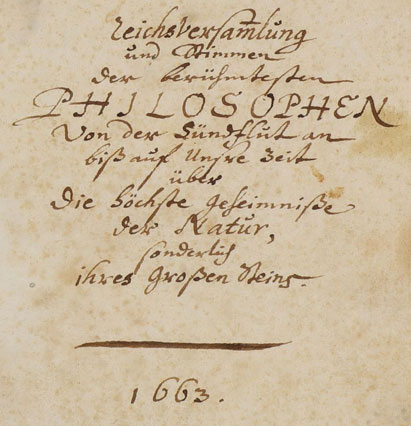
Assembly of the kingdom and voices of the most famous philosophers, from the Flood down to our time, concerning the highest secrets of Nature, especially concerning their Great Stone.
1663
"No godless, crude, spirit-like Roman sect."
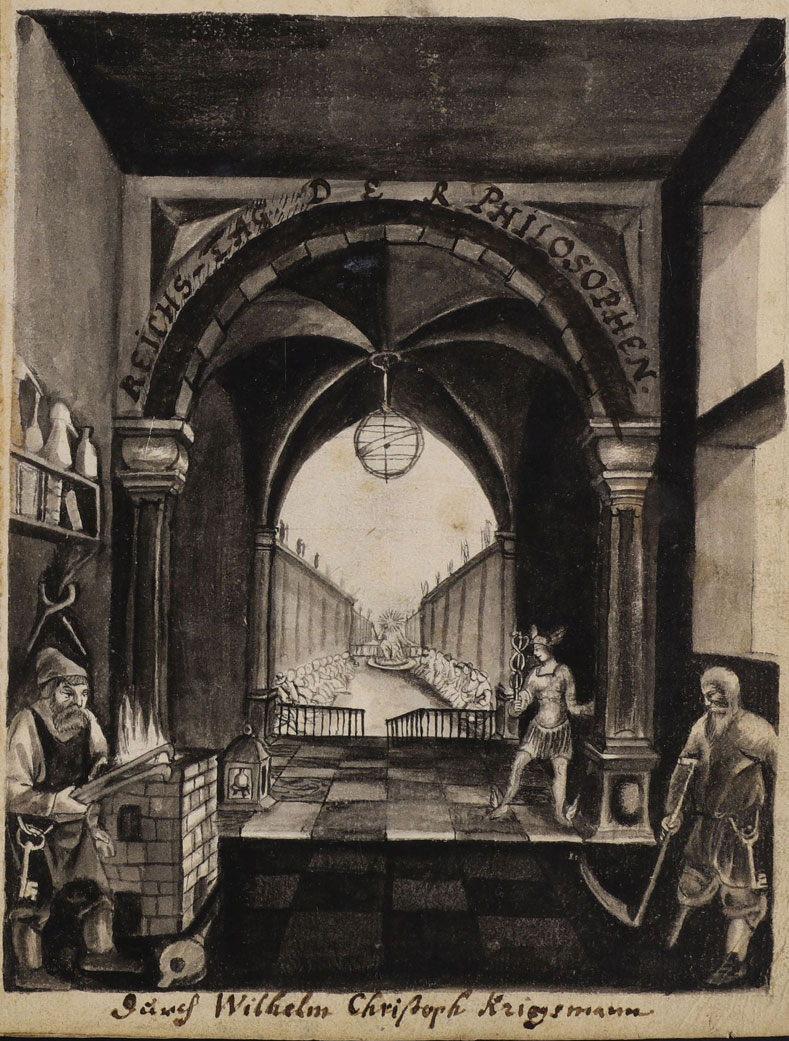
The kingdom/realm of the philosophers
By Wilhelm Christoph Kriegsmann
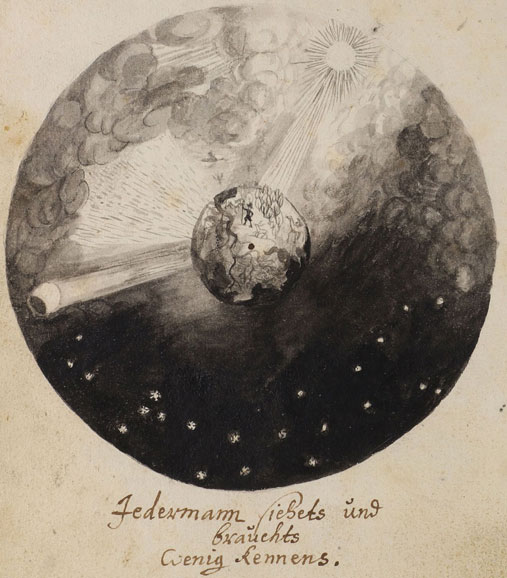
Everyone sees it and uses it; few know it.
Translated from the book:
Reichsversammlung und Stimmen der berühmtesten Philosophen von der Sündflut anbis auf unsre Zeit über die höchste Geheimnisse der Natur, sonderlich ihres großen Steins. 1663 [Кригсманн, Вильгельм Христоф. Собрание и голоса известнейших философов, начиная от всемирного потопа вплоть до нашего времени, о высочайших тайнах природы, особенно ее великого камня]
The philosophers’ wonderful ALCAHEST, the secret key to all Nature and to all treasures of wisdom, health, and riches.
Secretly described by Wilhelm Christoph Kriegsmann.
1. The sages before and after the Flood, through diligent investigation of Nature, perceived that there is something in the world which, by the ordinance of the Most High, gives life, growth, increase, and propagation to all meteorical, vegetable, animal, and mineral things; and that this same thing is driven from above, out of the revolving power of the heavens by the power of the Sun, Moon, and stars into the middle point of the earth, and from there, again by the power of the central heat, is driven upward into the air, and thus is moved without ceasing. They therefore regarded this as a universal World-Spirit, or bodily life of all things.
2. But since they saw that this Spiritus mundi, this World-Spirit, causes the composition and growth of all material things according to measure and circle, that is, according to a wonderful proportion, conclusion, and union, they concluded that the dissolution, separation, and purification of things could not be done in a better and more natural way than through such a World-Spirit.
3. Thereupon they began to consider how they might catch this fleeting bird of Hermes for so they often called it and keep it in their hands. After long search they finally found that Nature had prepared for it, in the earthly kingdom, a vessel or receptacle in which it could be kept well preserved; and that this vessel had in itself a wonderful power of attraction and fixity.
4. After further speculation and investigation, they became aware that everything depends on this: that they should bring the fugitive spirit together with its proper fixed vessel, the universal vessel of figures, and the universal fixed vessel of light-water, as it were, so that through this they might obtain a middle nature, which could send itself into all things. From this they saw that one must place the elements before it, until they have sufficiently obtained their power, long and much, and from this a fifth being would come forth.
This fifth being of the four elements they called by a secret name: the bodily World-Spirit. Otherwise, with a hidden name, they called it their Chaos, Tohu, or, according to the Arabic language, Al-cahest or Alcahest, which is such a thing that brings everything into a first matter; the Jungfrau’s Uranogea, Himmels-Luft; their solvens and menstruum universale; the little bird of Hermes; their dry water; their fire of the Maccabees; the key to Nature, etc.
5. It consists, however, that this wonderful philosophical solvent, or Alcahest, according to their teaching, consists of two parts: of a fiery water and of an airy earth. And its preparation is this:
Take the philosophers’ earth; make it very finely powdered. Wash it with philosophers’ sea-water, so pure that it is clean. Then dry it well. Wash and dry it often, until the longer the whiter it becomes.
Note well: the drying must be done in a very gentle heat, and all moisture which has been drawn out in the washing must be driven away. Then the earth assumes another nature and, in warmth, dissolves itself into water; but in cold it becomes ice. From this comes the philosophers’ fiery water.
Take philosophers’ sea-water in a vessel; drop out the fourth part, and evaporate three-fourths of it. Keep the flame beside it. Drop the three-fourths part, and work upon it so long until it becomes a beautiful rainbow-coloured earth. Dry it over a gentle fire, and you will have the philosophers’ airy earth.
Take the fiery water and the airy earth, likewise well triturated and finely powdered; unite them and grind them into a white matter like snow. If, in warmth and in all waters, it melts, and in the cold hardens and becomes icy, this is the wondrous solvent Alcahest, the fifth being: of fire, air, water, and earth. Of its use this is:
Take Alcahest, put into it whatever body you will; let it digest in warmth, and it dissolves itself in the twinkling of an eye and becomes wholly volatile. Distil gently; then the first matter of your body rises over the helm. Now you take the body that you want; the solvent remains behind and is very powerful, pure, and good as before.
In this way, with the addition of red corals or pure talc, the so highly praised coral tincture is made, which Buchner described, the talc tincture, etc.
Likewise with the addition of the true aurum potabile.
Likewise, take silver sublimated from tin: the noble white, and from red the white slime, and coagulate them according to the old process; thus you have the tincture of the physicians.
In sum: through this solvent one can extract and draw out from all things of the whole of Nature the being and property of things, and ripen everything that is possible for Nature and Art.
The philosophers speak unanimously:
1. The Art must follow Nature and imitate her.
2. Our Art does not consist in a multitude of things.
3. Our Art does not require great expenses.
4. The philosophers all have one materia prima.
5. One person reaches this matter sooner and more easily than another.
6. The philosophers all agree together in meaning, although they differ in words.
7. Where the philosophers seem to speak clearly, there they are obscure.
8. Whoever does not properly understand the birth of the metals is far from our Art.
9. Whoever does not observe the course of Nature will not understand our work.
10. One matter, one furnace, one fire, one vessel, one regimen these are in our work.
11. The materia prima of the philosophers is to be found everywhere.
Turba Philosophorum says:
I teach the wisdom, because without the living tincture you remain poor; yet in it is the virtue and power of the whole world.
In lead there is a living spirit, and this one should seek under the likeness of all similar bodies. Nothing is so like gold as lead.
Saturn is the ruler in whom all planets, metals, and the transmuted things are; this is the flowing one, so that one may find his enemy there. Therefore stir it upon a fire with good wine.
All similarities are in lead, but not in common lead. And you should not understand common lead by this, for it is not ours; but in our brittle and shining silver-glance, and watery one. In our lead there is gold and silver the power lies in this, that it may become from it but not visible white.
In the assembly of the philosophers, a question was once proposed concerning the secret stone and its preparation: where it should be found, since so many things had been wrongly brought forth about it. Finally, the youngest among the wise was asked, and an answer was expected from him as from the eldest. He answered: “I know the fiery regimen. All those before me have erred, and have kept silence for a time. At last one appeared; he is a true philosopher, and shall be our teacher above all.”
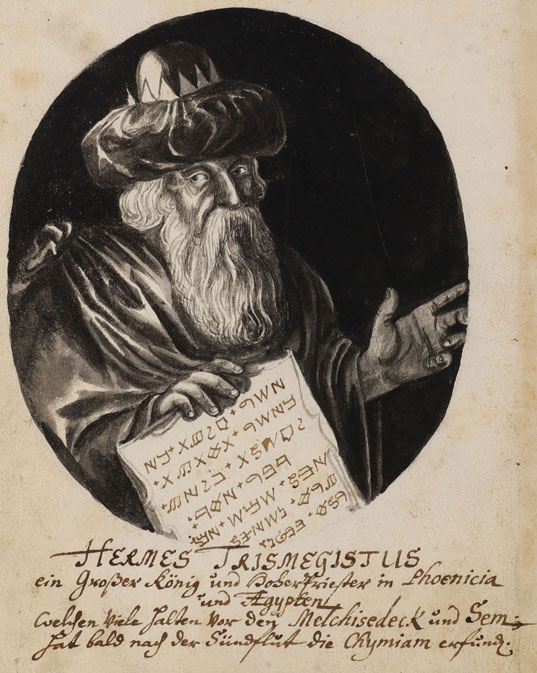
Hermes Trismegistus, a great king and high-priest in Phoenicia and Egypt, who many years before Melchizedek and Shem, soon after the Flood, invented Chymistry.
Tabula Smaragdina, as it was found in Arabic near Hebron beside Hermes.
Truly, without lies, certainly and in sure truth:
That which is below is as that which is above. And what is above is as that which is below, for accomplishing the wondrous work of one single thing.
That is: the upper and lower elements work together so that they bring forth one thing. So full of wonders it stands.
And as all things were from one thing through the word of the one God: so all things are born from this one thing by arrangement that is, through the ordering of Nature.
Its father is the Sun; its mother, the Moon. The wind carries it in its mother’s womb; its nurse is the Earth. This thing is the father, or origin, of all perfection in the whole world.
Its power is entire and fully united when it is changed into earth, or when it is placed into the earth.
Separate the earth from the fire, the subtle from the gross, gently, with great understanding.
It ascends from the earth into heaven, and descends again down into the earth, and takes to itself the power of the upper and lower things. Thus you will have the glory of the whole world; therefore all darkness and obscurity will flee from you.
This is the strongest strength of every strength; for it overcomes all subtle things and penetrates all thick and hard things. Thus the world was created.
Therefore the arrangements that is, the orderings of Nature and Art will be seen wonderfully, whose manner this is: therefore such a work must be established.
And therefore I am called Hermes Trismegistus, because I have three parts of the wisdom of the whole world. It is completed, what I have said concerning the operation of the Sun, or concerning the work of Chymistry.
Hermes, On the Generated Chaos:
The foremost cleansing of our Mercury is that one take it into the purest clarity, through the fire of stone-salt, so that it may be made as clear, pure, and fine as crystal.
The salt of metals is the philosophers’ stone.
Our stone is such a thing that, although it has no fire in itself, nevertheless our Mercury comes from it.
Our white Luna is not as useless as common Luna, for it is fusible.
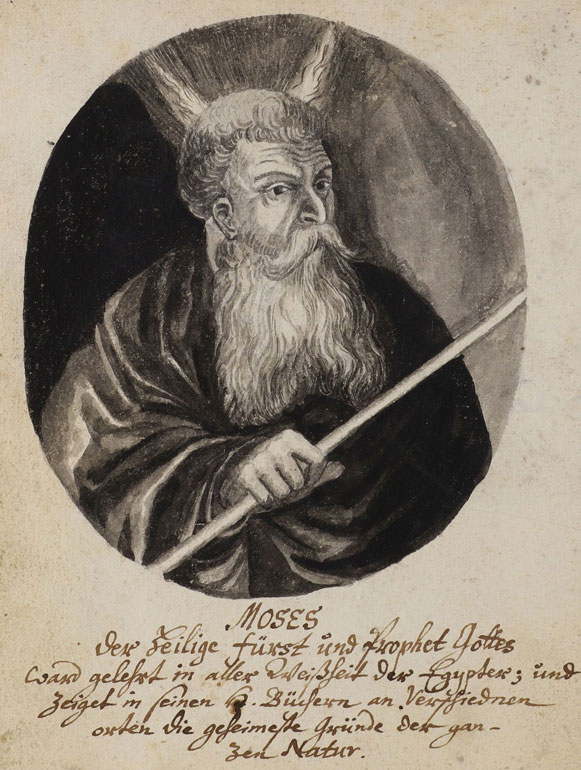
Moses, the holy prince and prophet of God, was learned in all the wisdom of the Egyptians, and in his five books shows to the understanding the most secret foundations of all Nature.
First Book of Moses, chapter 1.
In the beginning God created heaven and earth. And the earth was without form and void, and it was dark upon the deep, and the Spirit of God hovered upon the water. And God said: Let there be light, and there was light. And God saw that the light was good; then God separated the light from the darkness. And he called the light day, and the darkness night. Then out of evening and morning came the first day.
And God said: Let there be a firmament between the waters, and let it be a partition between the waters. Then God made the firmament, and divided the water under the firmament from the water above the firmament. And it happened so. And God called the firmament heaven. Then out of evening and morning came the second day.
And God said: Let the waters under heaven be gathered together into one place, so that the dry land may be seen. And it happened so. And God called the dry land earth, and the gathering of the waters he called sea. And God saw that it was good.
Chapter 2, verse 6–7
But a mist still did not yet rise from the earth and water the whole face of the land.
But a mist that is, a vapor went up from the earth and moistened all the land. And God the Lord made man from a lump of earth, and blew into his nose a living breath, and thus man became a living soul.
Chapter 27, verses 27–28
Jacob went near and kissed Isaac his father. Then he smelled the smell of his garments and blessed him, and said: “Behold, the smell of my son is like the smell of the field which the Lord has blessed. May God give you of the dew of heaven and of the fatness of the earth.”
Verse 39
Isaac said to Esau: “Behold, you shall have a fat dwelling upon the earth, and from the dew of heaven from above.”
Chapter 49, verse 25
Jacob spoke when he blessed Joseph: “From the Almighty you are blessed, with blessings from heaven above, with blessings from the deep that lies beneath.”
Fifth Book of Moses, chapter 33, verses 13–16
Moses spoke when he blessed Joseph’s tribe: “Your land lies in the blessing of the Lord. There are the noble fruits of heaven, of dew, and of the deep that lies beneath. There are the noble fruits of the sun, and the noble fruits of the moon. And of the best things of the ancient mountains, and of the hills forever and ever. And of the noble fruits of the earth and what is within it.”
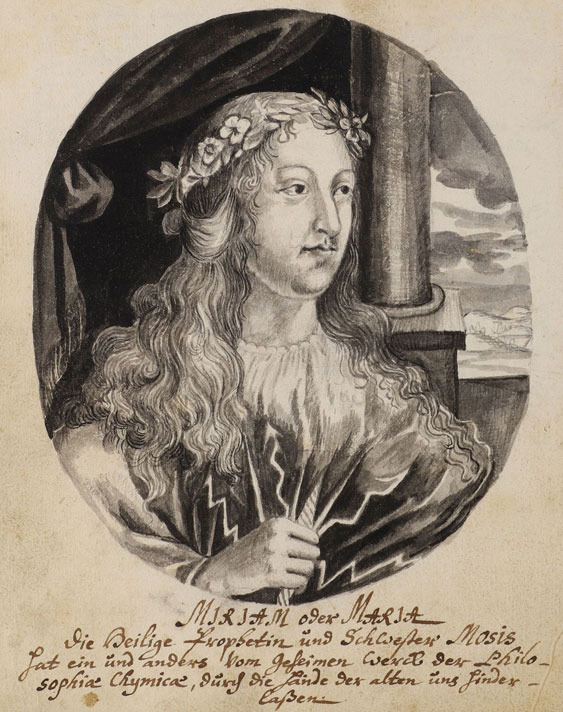
Miriam, or Maria, the holy prophetess and sister of Moses, gave one thing and another concerning the secret work of the Chymical Philosophy, through the hands of the ancients, to be found by us.
The Arabian philosophers, from whom we received the help and treasures of Lady Miriam, testify that they were able to find the great Stone of the sages within themselves, and that, with the help of a wonderful Olympian or heavenly fire, which, magnetically, draws together upon itself in a chosen small subject, they dissolved themselves quite finely into a silvery-white tincture, and raised it to a purple tincture. See her fine addition.
According to Count Bernard of Treviso, part 3:
Maria the Prophetess says: “Nature makes the metals from one, two, and threefold Mercury, which possesses its thick and finest excess, and its alterations. And through one with another they are made complete.”
Item, she says:
“Make fire: connect the conjunction, and color the spirits in it as the flowers do.”
In the Turba Philosophorum she says:
“The fixed or seed-bearing body is from the heart of lead; it is outwardly that which is in our lead. Fire teaches her to be wise, and find that it always remains in equal warmth and does not become hotter. She first takes on a great blackness.”
According to Morienus she says:
“When Laton with Azoth that is, with Mercury has been burned up, and the white things have been poured over it, so that a heat may be taken away, then all its darkness and heaviness are brought away from it, and it is thus transformed into white gold.
It is nothing other than that its darkness and its colour be taken away. Therefore its Azoth is, namely, its soul: when this is drawn out, then it colours it and makes it white. And Laton, conversely, rules over the Azoth, that is, the wine, and makes it red.”
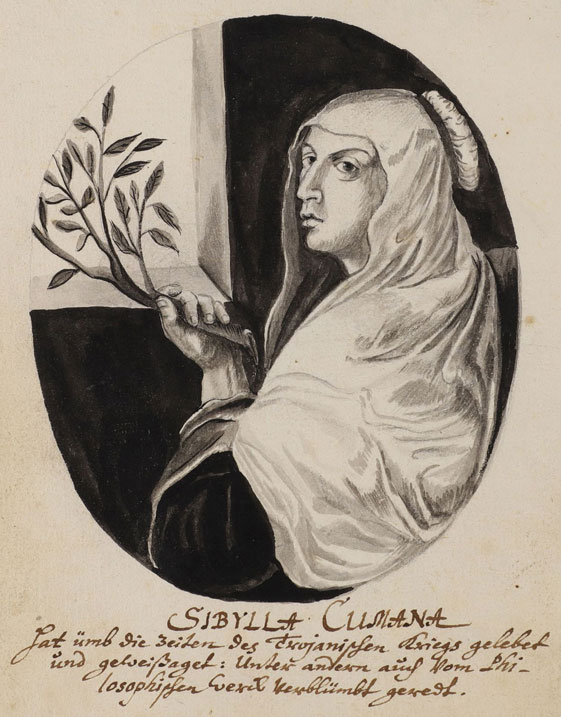
Sibylla Cumana foretold and prophesied around the time of the Trojan War. Among other things, she is also praised by philosophers.
The Cumaean Sibyl speaks to Aeneas, according to Virgil in the sixth book:
In a hidden tree there sits a golden branch, which has golden leaves and golden wood, and hides the whole forest. The shadows enclose it in hidden valleys. Nor will it ever be permitted to anyone to go into the hidden places of the inner kingdom, unless he first breaks off the golden branch from the tree.
If one tears off the one, another does not fail to grow in the same place, from the same golden metal, soon afterwards. Therefore seek it with your own eyes, and when you find it, break it off rightly with your hand.
It will gladly and easily follow you, if it belongs to you by fate. But if it does not, then it cannot be overcome by any force, however great; nor can one cut it off with iron.
Virgil explains this in another place:
Two doves, come down from heaven above, settled upon the green land. Then the hero recognized the swift birds of the mother, Venus, and followed their signs and their way.
They wandered along, then flew so far that one could still keep them in sight. But when they came to the foul-smelling mouth of the cavern, they quickly rose through the thin air and settled, as desired, upon a two-branched tree, through which the different gleam of gold shone among the branches.
As in winter-time the mistletoe appears and grows green with new foliage it is not sown from the tree itself and wraps the round trunk with yellow fruit: so the appearance of the branching gold was amid the dark holm-oak. Thus the golden leaves rustled in the gentle wind.
Aeneas quickly seized the branch and broke it off according to every wish, and brought it into the house of the prophetess Sibyl.
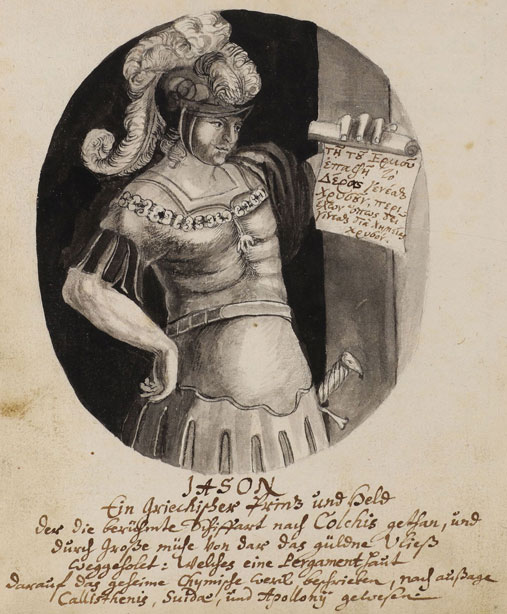
Jason, a Greek prince and hero, who undertook the famous voyage to Colchis and, with great effort, carried away from there the Golden Fleece.
The secret chymical work is written upon a parchment-skin concerning this, according to the statements of Callisthenes, Suidas, and Apollonius.
Concerning Jason’s effort and march in Colchis, Ovid writes in the seventh book of the Metamorphoses:
The morning redness had now taken possession of the shining heights, when the people of Colchis gathered upon the field of Mars and stood upon the royal heights. The king himself sat in the middle of them, clad in purple and distinguished by the ivory sceptre.
Behold, the oxen breathe out iron, fire, smoke, and vapour from their adamantine nostrils; the grass catches fire and burns from their breath, just as when a burning kiln, or when one sees loosened lumps of limestone thrown into warm water, so their inward parts, full of flame, boil, and the burnt throat burns.
Yet Jason goes up to them with a cheerful face. They turn their terrible gaze toward him as he comes, and their horns are shod with iron. They strike the sand with two-cleft hoofs and fill the place with roaring smoke. The Minyans grow cold with fear.
He goes forward and does not feel the fiery breath, for the charm has removed its force, and with bold hand he strokes their hanging dewlaps. He brings them under the yoke and compels them to pull the heavy plough.
The Colchians wonder; the sons of Greece shout and give him courage. Thereupon he takes the dragon’s teeth from his bronze helmet and sows them in the ploughed field.
The field receives the seed. There, once it was sprinkled with a name, new bodies arose from the serpent’s tooth-seed, and, like a child in its mother’s womb, the human form was enclosed within it, and it grew within and would not come to perfection until the full time; so, when a man has taken on a human image in the pregnant womb, he rises out of the field and brandishes his weapons. Thus the warrior is born together with his weapons.
And when the Greeks saw the men with their sharp swords going against Jason with the intention of seizing him, Medea herself was afraid, although she had made him fast and secure; and when she found him so alone, she grew pale and sat without blood in her young face, and although her herbs had no force, yet she helped him with secret art.
He throws a stone into their midst with great force, so that he turns the war away from himself, and onto the earth-born brothers. Immediately those born of the earth wound themselves inwardly and fall to the ground.
Now he still had to make the dragon sleep, which held the fleece with a crest, tongues, and three rows of teeth. He sprinkled the Lethean herb upon the gold-bearing tree, and after he had recited the words that make sleep, he made his eyes fall into deep slumber. Thereupon the golden fleece was carried away by Jason.
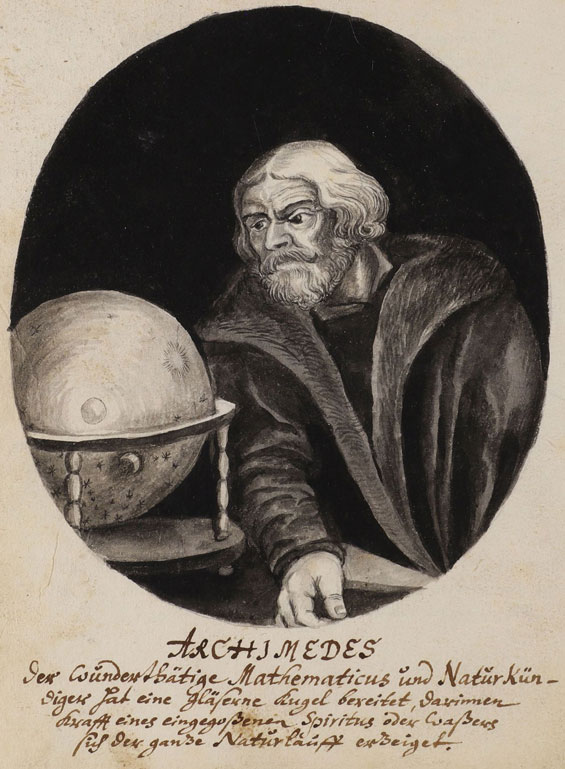
Archimedes, the wonderful mathematician and natural philosopher, prepared a glass sphere in which, by the power of an enclosed spirit of water, the whole course of Nature was shown.
On the glass sphere of Archimedes, the poet Claudian writes:
When Jupiter saw the heavens enclosed in a small glass and laughed, he said to the gods:
“Has human power, then, represented the course of things so finely? Now the work of my fingers is mocked in a fragile glass.
What the gods and Nature created by the power of time in heaven, the Syracusan old man has imitated by mathematical art.
An enclosed spirit serves the wandering stars, and a living impulse turns the false moon.
And now the bold work causes its own world to move, and a human law governs the stars.”
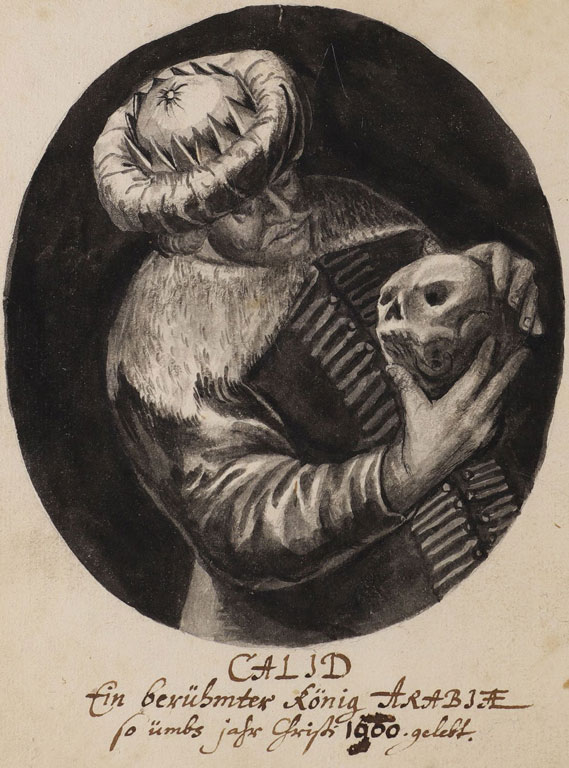
Chalid, a famous king of Arabia, lived around the year of Christ 1000.
Calid, according to Count Bernard, in the second part:
Know that we at the beginning of our work need nothing more than two matters, and one does not seek or grasp more than two, and no more enters into our magistery than two. And yet at the end they are found only as one. These two matters are the four elements. They have their power in their season and in closed steam. Therefore in the windy one are the two windy elements, according to their qualities, namely fire and air; and in the other, according to a dry and earthly steam, are the other two lower elements, namely water and earth.
When Calid says:
In our whole work Mercury and fire are enough in the middle and at the end; but in the beginning it is not so, for then it is not yet our Mercury.
Go, go to the mountains of India and into their caves, and take from them precious stones, white zarcon, in which its golden being is.
Nature enjoys Nature, Nature conquers Nature, Nature unites itself with Nature, Nature triumphs within Nature. Nature makes Nature white and red.
That is: like and like join themselves together.
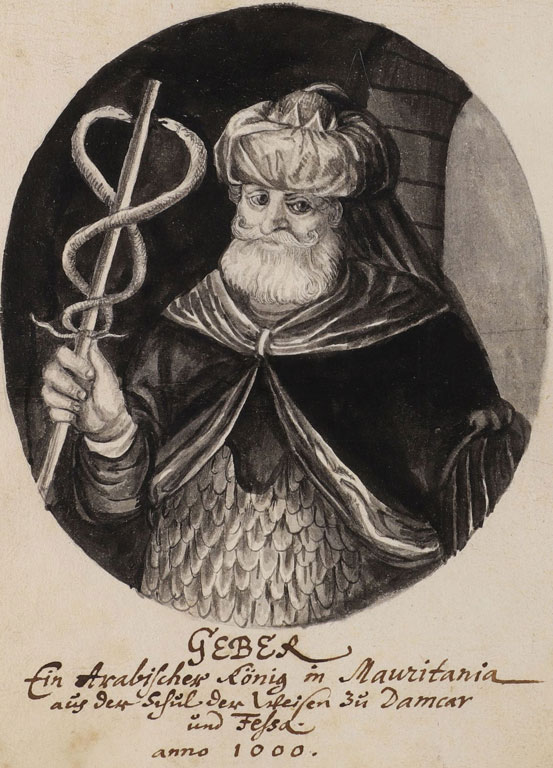
Geber, an Arabian king in Mauritania, from the line of the sages of Damar and Eshol. Year 1000.
Geber, the king, was so pleased by the discovery of a special metallic gold tincture, which some call the small philosophical stone, that he writes of it as follows:
When you know the quicksilver, the mastery of bringing things to perfection, you know that it is a thing of a fiery perfection, so that it overcomes the work of Nature.
From quicksilver alone the medicines become more easily and more quickly enough drawn forth.
But quicksilver is not so taken in its nature, but it has within itself a middle nature and a full-shining essence, which is a possibility. So, when it is governed by the power of fire, its property is not to be burned up, but before burning it must be drawn through subtle art.
Quicksilver has the nature that it either flees from the fire with its whole substance, or else remains whole in the fire.
For shortening the time, Gelber brings in an addition to his cross, of citron-yellow colour, namely a fully penetrative body.
I have investigated everything; but I have found nothing in fire except only the slimy moisture, which is a root of all metals.
Whoever does not understand the original foundations and causes of metallic growth, he is far from our Art. Therefore he must have a thorough foundation, from which he may ground his undertaking.
Here mercury must remain well closed up. Therefore do not let anyone approach who does not know how to improve it by art and who does not understand how to bring it into the work before you have dissolved it.
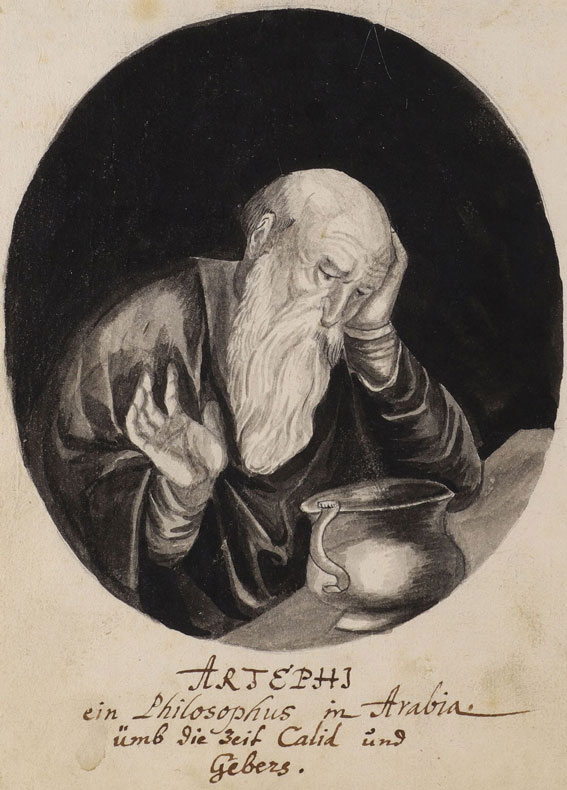
Artephius, a philosopher in Arabia, around the time of Calid and Geber.
Artephius, an excellent philosopher, among other things loved Art so much that he described his universal tincture with a wet fire, which is a wet secret.
Artephius says: Our water has in itself, and from itself, a golden power, and therefore the light of its brilliance.
Artephius like Roger Bacon has described the powers of animals and stones and all other matters, and thus all mysteries, according to Nature; and he boasts that he became more than 1000 years old.
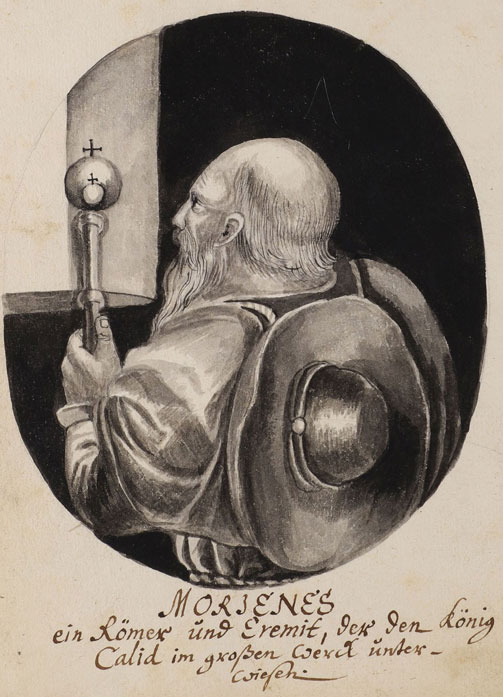
Morienus, a Roman and hermit, who instructed King Calid in the Great Work.
Morienus, when he had taught King Calid to prepare the universal thing, remained silent for thirty days, and afterwards he wrote to him the same instruction that he had taught.
He who has everything with himself therefore needs no foreign help.
All things that are made from our water are born from one thing and from one root.
Whoever knows how to lead the gold back so that it is no longer gold, that one is brought to a great secret.
The stone of the sages is nothing other than quicksilver, so it passes over into other quicksilver.
Make the body watery, so that the water may be united with it, and so that both may be brought into a single water.
Know that our Laton is red, but our brass white; and that it becomes white, and know that our water penetrates it and makes it translucent as itself, and that the fine vaporous fire burns and destroys everything.
If it is not finely and black, then it is not dissolved; but if it is not dissolved and unlocked, then it is not penetrated by the water and is not mixed enough, whereby then no union can follow. And without union nothing can be joined without mortification; but mortification cannot happen without alteration, and alteration cannot happen without composition and conjunction. And through this gradation our matter is worked according to the order of Nature, which in the same manner brings forth its effect.
The philosophers call their one work by many names. But whoever pays attention will see that these names are nothing other than the colours which arise in the composition; for because of this mastery it does not become different.
Therefore the poor have one thing like the rich, when it is thrown into the way and struck upon its dunghill with feet. And many have dug it out upon the dung-heaps, so that they might pull it out from there, and they have been deceived thereby.
“What shall I say much,” says the king, “about this thing, when it has already been said by itself? You are yourself in great misery; for from the fact that I know it better, one learns it.”
Fire and Azoth wash the Laton and take away its darkness and filth from it.
You should know that our impure body is lead, which is named by another name, Adrop.
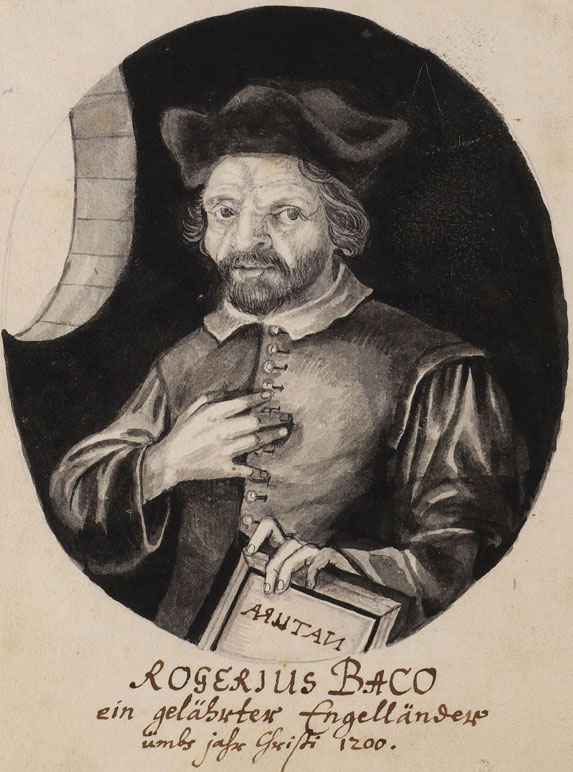
Rogerius Baco, a learned Englishman, around the year of Christ 1200.
Roger Bacon says: Nothing is dissolved from metals, nor is anything united with them unless the metals have first been brought back from the state of bodies, that is, transformed from their bodily nature into spirit.
Bacon teaches in his Speculum that one should dissolve a purified body, raise it up, and draw from it a water-like moisture. This is the mercurial water of the philosophers.
In minerals an incombustible moisture is found. When we follow Nature, we have a furnace of moisture like the mountains not too great, but with a steady heat so that the enclosed fire, when it rises, may be driven upward and become subtle. And the heat, as it is, must remain in its vessel, which is joined to the matter of the stone.
The vessel must be round, with a small neck, made of glass.
The fire must not touch the vessel, which holds the matter within itself; rather one must enclose it in another vessel, so that the steady heat may surround it on all sides, like a gentle dew.
The sages develop for their work a thing from which Nature has first begun the work, through the uniting and proportioned mingling of its living Mercury with an equal kind, in a strong vessel.
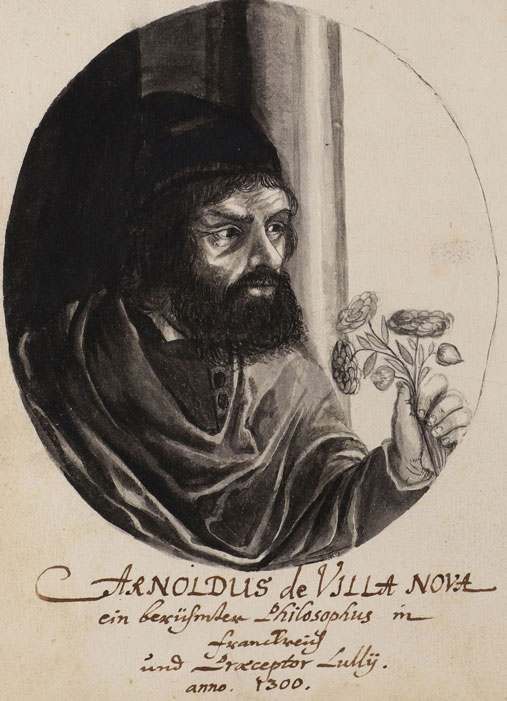
Arnoldus de Villa Nova, a famous philosopher in France and teacher of Lullius.
Year 1300.
Arnoldus, in the New Light:
I testify against you that such a possibility lies in the matter out of which I have made with my own hands the Elixir, which transforms lead into gold. This I have called by its proper name, and it is the Magnesia of the Philosophers, from which the philosophers have drawn gold without burning their bodies.
The Mercury of the philosophers is that in which Nature has worked a little, but which she has left in metallic form and brought into its own state; yet she has left it still imperfect.
Testament of Arnoldus
Our Stone arises from the earth and receives its perfect power in the fire. When it has been placed for twelve hours over very clear water, it becomes whitened. And, wonderfully, by this it is set in a mildly warm place and is dried away from its watery whiteness in twelve hours; and in its inner heat it is brought to its proper form.
Yet first one must draw out from its best part the innermost milk, and afterwards bring it into philosophical form. Through this it will be perfected. And if the work should break off too early at some other colour before the end, then at last a constant whiteness appears, in which its society is entrusted to it. Thus the fiery-shining royal colour will also be beautiful, and it will be a sign of the perfected work.
The fire of it must be like the winter sun in the sign of Aries. And note that the fire does not burn, unless it is brought upon a moderate warmth.
The gold and silver in our Stone are better than the common ones in their nature. Therefore gold and silver in our Stone are living and green, but common gold and silver are dead in comparison with our own.
Know finally that the inexperienced must not try to practise our high Art, or they will remain in the first error.
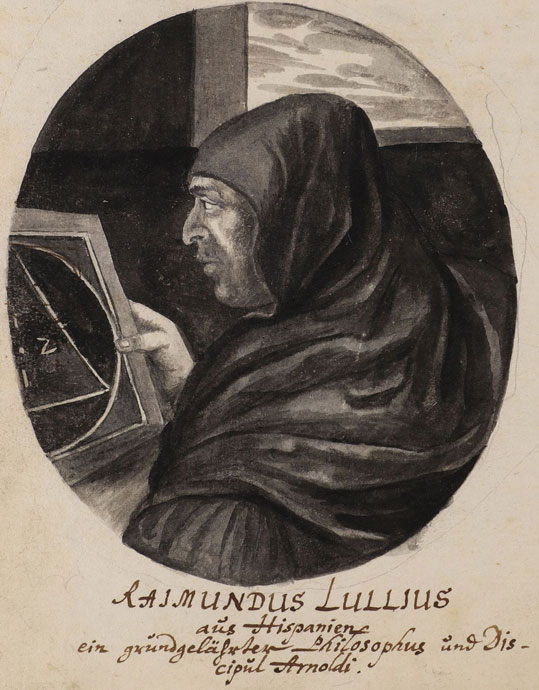
Raymundus Lullius, from Spain, a very learned philosopher and disciple of Arnoldus.
Lullius says: The broken body is placed in a distilling vessel and drawn off with slow fire by its spirit; thus you have in your vessel the one thing of our Mercury.
Our tinctures are drawn out of a small, unattractive thing, and no unsuitable thing takes on a bodily thing to itself, unless we ferment it with common gold.
From the lead of the philosophers a golden oil is drawn out; and when it is well purified, when the time comes that it is well mingled by its mercurial union and wiped clean, and when it burns red, then you will wish to prepare the white and the red in three days. And in the whole world there is no greater secret.
Testament of Lullius
1. In our Stone there is a single thing, without our adding anything to it, and nothing foreign. And that which is nearest to our Stone in secrecy is gold, silver, and the water of life. The water of life, however, is the soul and life of bodies; through it our Stone is made living and spiritual. Therefore it must be the means that binds the tincture, an incombustible oil, and it is called by countless names. There you have the matter of our Stone.
2. Our vessel is sealed together; then there are two vessels with their covers, of equal size, magnitude, and height, since one is black and the other has a red body. This long vessel climbs upward in the helm, and then, through cold, falls back down into the body.
3. Our furnace is the athanor and gives from the beginning to the end equal warmth, which enlivens the thing and ripens it, and draws it out of blackness.
One makes a furnace, small or large, according to the quantity of the matter, like a distilling furnace, with a bright part, so that it is only a little hole through which the warmth may lightly play.
4. Our fire, then, is prepared in this way: take horse dung and living lime, one part as much as the other; mix it well together. In our furnace set our vessel in the middle of it, close the furnace tightly, so that you may have a secret fire, without light and smoke.
5. Our whole preparation is a very wondrous art, so that in ten months it will be completed without further handling.
6. Our putrefaction is nothing other than a separation and grinding-together of the body; the more the putrefaction is opened, the more our stone takes on a power.
7. What has been written by so many about various stones, matters, vessels, furnaces, fires, handiworks, etc., belongs only to one preparation. This is to be understood only figuratively: that it, in the beginning, remains wholly as Saturn, and Luna becomes a mirror, and itself without God’s will may not be opened.
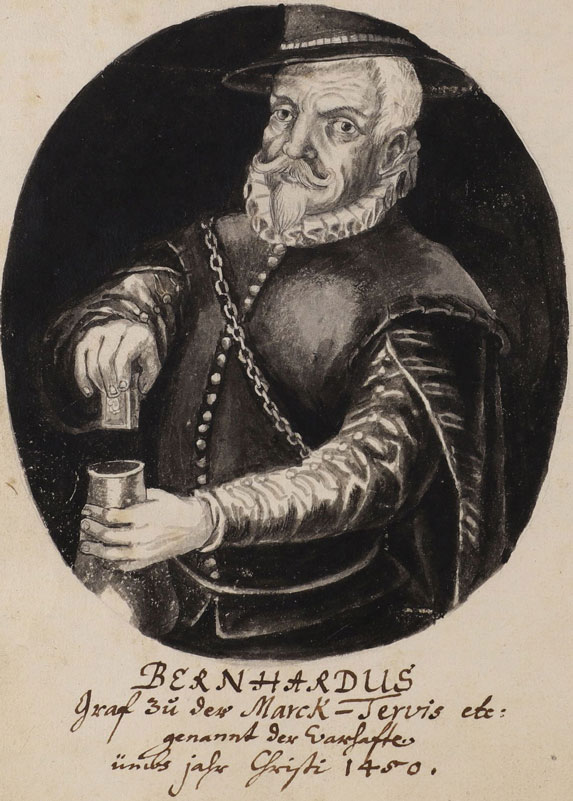
Bernhardus, Count of the March of Treviso, etc., called the Count, around the year of Christ 1450.
Let all sophistical subtleties remain, for the old man who said that our tincture is the one root, meant that the teachers of our Art call it one sulphur, one water, one magnesia, and that it is one argentum vivum, drawn out from the body, as from the body’s own life and blood; one water outside the body, which remains our own and is not mixed with any other thing, nor with its own nature, and neither receives nor absorbs anything without the body’s union with its own metallic nature. Therefore it is a water flowing from our seed.
For to our white work nothing is necessary except the one substance of mercury, which the Art unites to itself, congealing, tinting, white-shining, and perfecting it in its mercuriality.
The red water is nothing other than cleansed and fixed quicksilver, which has come from a pure mineral body.
In this Art there are no more than two spermatic matters of one root, one of which is water, namely, only from the single mercurial, viscous, and metallic substance.
The four elements or qualities of mercury are moved by Nature, so that they are mixed with one another and purified above and below. And through long time, the heat overcomes the humidity of mercury by its own fineness; and the wind or breath blows it away. Thus it travels farther with a great subtlety and goes into the body. Thereupon the heat of the mercury begins to increase and becomes subtle, and the work turns wholly to whiteness and makes it like silver. When its feet are not further widened, it begins to run more and more; and finally, when its feet are established, it becomes perfect gold.
This lead flows as long as it is in the fire, because the two qualities, its coldness and moisture, are not altered through heat and dryness, its sulphur-like part; the golden part is nothing other than a pure and clean fire, in mercury, and is purified inwardly, however great the fire upon it may be.
Leave to the fire what Nature, in the mineral, has placed as matter in which she works. In all, the clear and pure mercurial form and substance: where Mercury is, there is also sulphur. Therefore in this our Mercury a fixed, incombustible sulphur, which our work completes, is hidden and contained; and no other is required for it than pure mercurial substance.
We must not help Nature with our fire. Therefore know that fire does not increase by itself, and that one thing is not changed and transformed into another by another; but there must be a fire which unites itself with the other, and is not moved by the other.
Therefore make a vaporous, warm, steady, digesting fire: not too violent, but airy, subtle, light, nourishing, surrounding, altering, penetrating, and not burning. And upon the governing of the fire depends the whole Art.
I have put iron into horse dung, and it did not come out of it; therefore I have put it into horse dung without a medium. Then my matter sublimed and did not dissolve; but after I placed it into such a fire as I have told you, it pleased me well.
Therefore one must not determine concerning the thing wrongly, nor place the work foolishly upon the weight of sulphur, or the element fire, which is in Mercury.
I found in the field a little spring, beautiful and clear, surrounded by a stone, its colour bright, enclosed and girded around with an old hollow oak with walls around it. Above, the spring closes itself around the king; therefore it is a mother to him. The king, as he is, is originally made from the spring and from no other thing. When he bathes himself in the spring, he remains there 282 days.
The spring is clear as fine silver, of heavenly colour. The king is adorned with golden cloth and very long, surrounded by many diamonds. He is white and fleshy like blood.
Count Bernard set his golden cup into the spring and went away; he closed the spring, so that something of the vessel remained behind, etc.
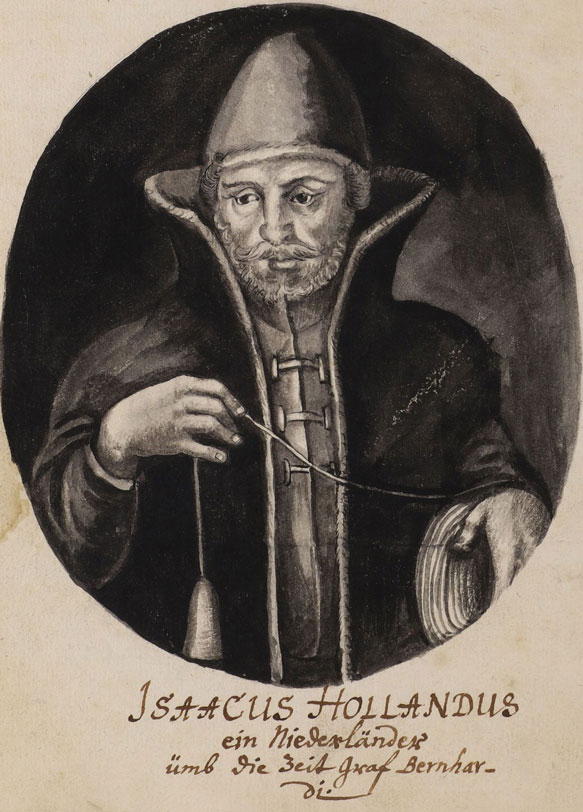
Isaacus Hollandus, a Netherlander, around the time of Count Bernard.
Isaac Holland says that it is well to consider that a metallic and Saturnine body is present, which one can easily colour and perfect, if one knows a right preparation that may be done cheaply.
You should know that the glass which is made through the help of lead from metals is like a clarified body; for the dross of the metal is drawn to the glass, which is an impure, unusable body. Beneath this remains the green essence of the metal hidden, which is incombustible and runs through the glassy body with its right colour.
When the glass of tin or copper has been washed, they are pure and clean; therefore they are no longer attacked by death, and are delivered from their filth. But where it is yellow, it is the nearest to gold, and its own invisible ones are pure and clean like silver. So if it is fixed, it is gold; so it is a red oil or tincture. But where lead is washed, it is silver.
Make the strong white and the dry wet. The old sages concealed these things under the planets, so that in their work it would be hard to grasp and understand how one should name them with plain words, since they finally confess that one should name it a moisture of the Sun and of the Moon, which indeed are the whole work’s matter and the work itself.
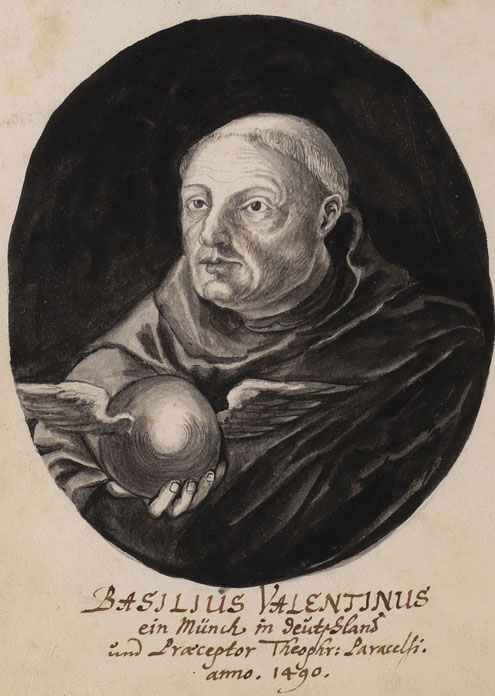
Basilius Valentinus, a monk in Germany and teacher of Theophrastus Paracelsus.
Year 1490.
In Basil, in the Keys:
When the matter comes to light, it is not hidden, and is to be found in all places. Children play with it in the street. It is cast away and has only a small value in everyone’s eyes.
For this reason, take the matter at once into the work. Wash away the blackness; distil, calcine, and make it beautiful. For whoever does this without danger has taken the cat by the neck.
And whoever has no metallic salt cannot make the philosophers’ mercury either. When you have calcined it enough, extract the salt; clarify it; let the vitriol shoot/crystallize, without corrosion. From this vitriol make further an oil or sharp water. Then first, in the beginning, dissolve the body.
The flying bird from midnight is the mighty spirit from the East; he pours from his throat. Make the spirit from midnight winged like the bird from midday, so that they become alike. When the spirit from midnight has received his bright feathers, and his wings are set in order, then both must go into the great Red Sea and come out again dry.
Our quicksilver is made from the purest little globule, through the very sharp Art: pure, subtle, clear, bright like a little spring, transparent like a crystal, without all impurity. Add to it one water of incombustible oil.
Silver is our opening; silver is our Stone; silver is our matter; and living silver is the knowledge of the Stone.
Our Stone is another extract than common gold, namely the matter itself. For the Stone of the sages is made from the Azoth of the sages, which is prepared from common distilled Azoth, by which the common distilled Azoth must be prepared into the spirit of wine and earth-water.
Look at all those who have written from the beginning of the world concerning metals; you will find that they all, with one voice and opinion, say that the first and last metal is one metal, namely the first metal, the far-spreading seed of metals, which alone, above all others, obtains and receives metallic qualities and properties; therefore it alone is serviceable and fruitful in metallic generation.
It has been called lead, gold, and gold-lead, because it is found not only in one flowing form, but also in the shining stone, and at the beginning, in its overflowing fullness, it has the first form from the planets. It takes on many other shapes and forms by art and wisdom.
The yellow and red middle, like Saturn and saffron, must not be separated from the child by resolution or dismissed; rather you will find in the hand a shining mineral, like a little mountain, out of the first matter of all metals, grown. This mineral, according to its preparation which is described by us, must be placed into a strong sublimation, and must not be brought onto the highest mountain with three-headed bole or brick-earth. Thus it rises up upon the highest mountain into a clear sublimate, white as alabaster or white lead, which in its time resolves itself into a very sharp and clear water; this brings your body, in a small while, completely into its first volatility. There the body becomes white with the purified spirit, etc.
The metals all have their beginning and birth from the power of this flying bird. This white spirit is the water of the philosophers, which has been hidden by me and by my ancestors; without it, the Stone of the sages, neither universally nor particularly, can accomplish anything. It is the key to their opening and closing, and it is the first mobile in the world, and is found and sought in every thing. In the tract concerning minerals I have said and spoken of it.
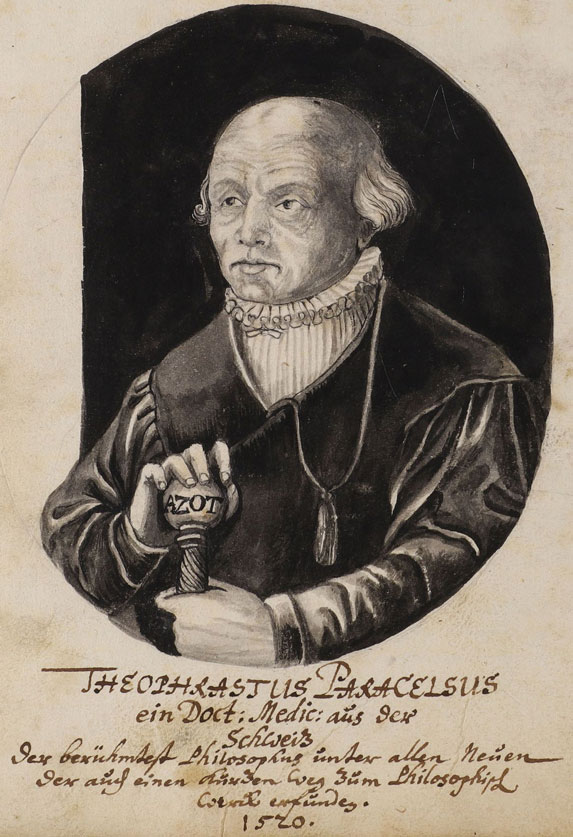
Theophrastus Paracelsus, a doctor of medicine from Switzerland, the most famous philosopher among all moderns, who discovered another way to the philosophical work.
1520.
Paracelsus, Book Vexat:
Thus Saturn speaks of his self-willed nature:
“They have sought many of their problems out of me, and have enclosed me, compelled by spiritual Art, with a leathern band; then, what they did not wish to have from me, I had to bind fast through myself. By this means they have often enough driven me through myself, and in the fiery trial they have attacked me with me, without the compulsion of the letters.
Gold and silver wanted to seek themselves through my water, and they followed the salt. My spirit is the water that purifies all foreign and strange bodies of my brothers; but my body is the earth. Therefore, what is in me becomes fastened upon the earth, and is made equal to a body.
I would not gladly have it that the worldly fools and impostors wished to carry on with me and with my matter. It would be much better if they would let me alone, that they would leave to me what is possible to me. They love all other arts of chymistry, and use only what is in me and may be drawn out of me.
The stone of the wise is in me; that is my water, with which I am washed. It washes and opens the spirits of the six metals, and gives white essence to the silver; that is, it promotes gold with its...
I say to you that you need nothing more than lead, the rose-coloured blood, and from nobles the white gluten the white slime which both, coagulated according to the old process, make the tincture of the physicians.
Have your fire in Hungary, and your coals over Istria.”
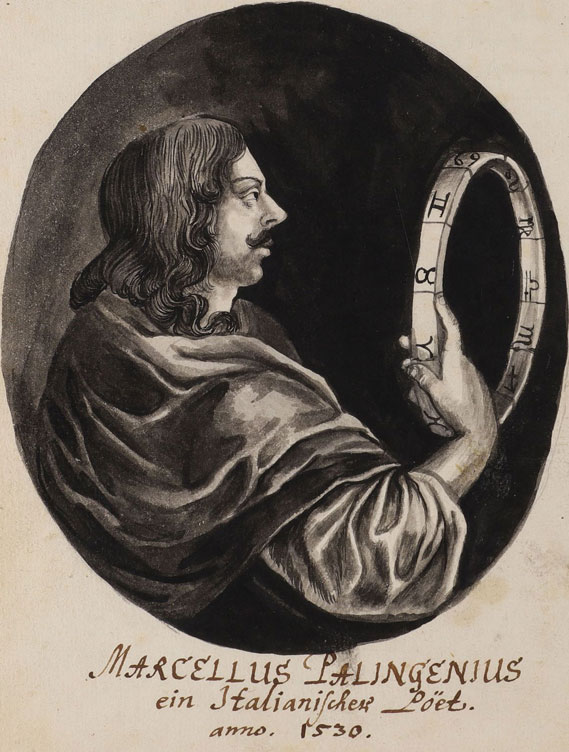
Marcellus Palingenius, an Italian poet.
Year 1530.
Palingenius writes, in Capricornus, of his zodiac concerning the Stone of the Sages:
Mercury seizes the volatile little body, draws it out of the spring of water from the heap, sets it in a glass, and commands that Vulcan boil it; and he ties his light foot to the gallows. When he has bound him in warm embraces, and when he shines out, he lets him become water.
Then a noble spirit shall rise out of Thetis’ body and through this flow, through all the members, penetrating the body altogether with black colour, and with a golden hue clothed, as the gleam of silver gives strength into the body, so that the Phoenix longs for and comes to perfection, which it once again received.
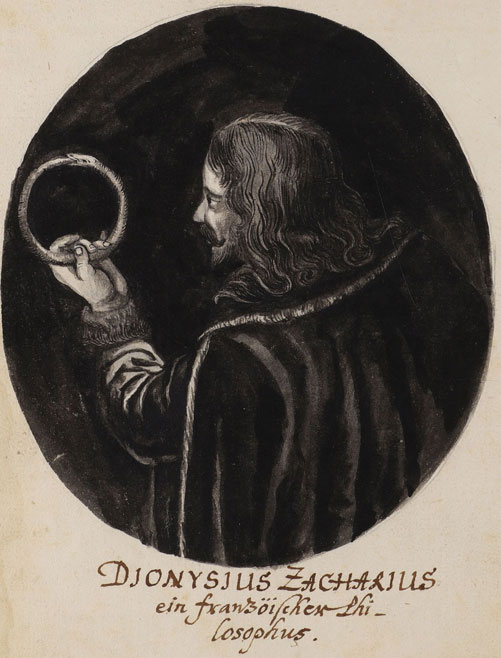
Dionysius Zacharius, a French philosopher.
Zacharius says: Everything that is ordained to perfection, and because of lack of nourishment has remained imperfect, can, through subsequent nourishment, be brought to perfection.
We should take just that matter by which Nature nourishes the metals in the earth.
It should generally be that one has no foreign water in the composition, for then the body does not compare itself with a thing that is unlike it, but only takes its own nature and property. And if a foreign thing is added to it, then in the end it would not be so firmly united.
Formerly a mountain-mine was bought from that time. Since one finds unnecessary silver and its ore, it is formed like lead. But they are finally recognized, and after the course of 50 years they digest it, so that it has produced very good silver.
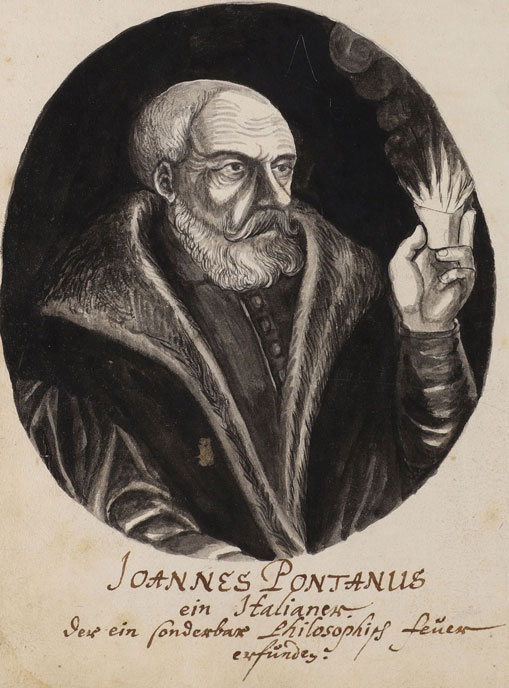
Joannes Pontanus, an Italian, who invented a special philosophical fire.
Pontanus records in a letter that he travelled through the whole world to discover the philosophical fire, for without that fire nothing in the Stone may be brought to completion. Yet he describes it thus with these words:
It is mineral.
It is vegetable.
It is a spirit, found in itself.
It is nevertheless found elsewhere than in the matter of the Stone.
Which fire it is, and how it is to be prepared, I leave to further inquiry.
It is certain that through the help of this fire the whole enclosed matter of the Stone is made into true tincture, without any other addition.
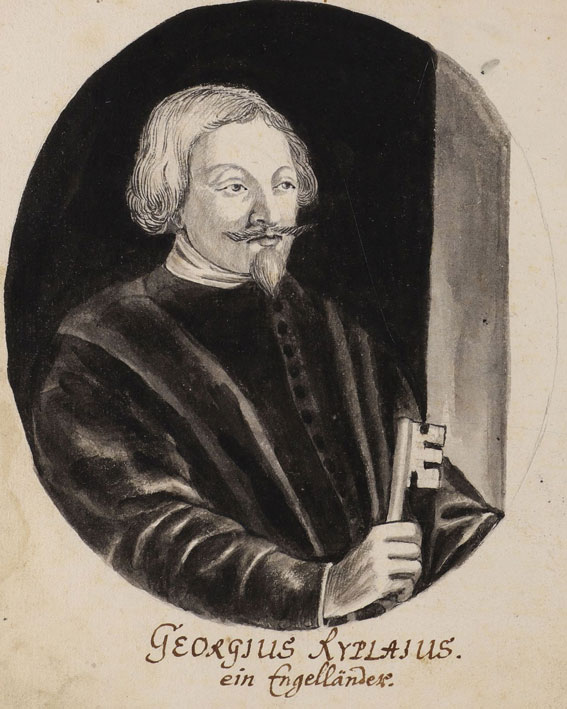
Georgius Ryplaius, an Englishman.
Ripley says: The first and highest metallic name is lead, which is called a pale body; it is nevertheless a living body, which carries the tinctural power in itself, shining from Sol and Luna, and gives splendour to the rest. For our sulphur and mercury can be found only in the imperfect metals.
The philosophers write that it is taken from its own ore, and is a viscous and oily water, thickly mingled with earth. When it is opened viscously and is again lifted up aloft, it receives the station and becomes the elixir in red fullness. And without this moist spirit the body of chemistry is commonly held to be a lie.
But I call it the body that one dissolves into gold; in which gold and silver are potentia non actu in power, not in act. That is: within it there is a future gold, which one cannot see. It has neither shape nor form of gold externally; yet when its inner love is aroused, by which body, spirit, and soul are united, the genuine gold and silver are brought forth. This dear first matter is slimy and thickened water in which the body is enclosed. From this body the red and white elixir are cut out. It is called Azoth, and by another name the lead of the philosophers.
Our gold is contained in mercury, which is there called living gold. The philosophers say that living gold is an oily, viscous thing, which has its spirit through its opposite. For the living gold consists of four natures and five things. Putrefy, therefore, its shell with warmth, and kill it totally with moisture; thus you will have a clear water that dissolves all bodies and mercury, and the smallest part of it is the place where your earth is dissolved.
Mercury speaks of itself: Throw me, after I have been dissolved into a clear silver-water, into the virginal milk; mix me with my red male, for in this he finds himself continually.
When you have brought a great quantity of our Sun and Moon together, draw the moisture fairly away by gentle fire, at 60 degrees. Then you will see your darling green.
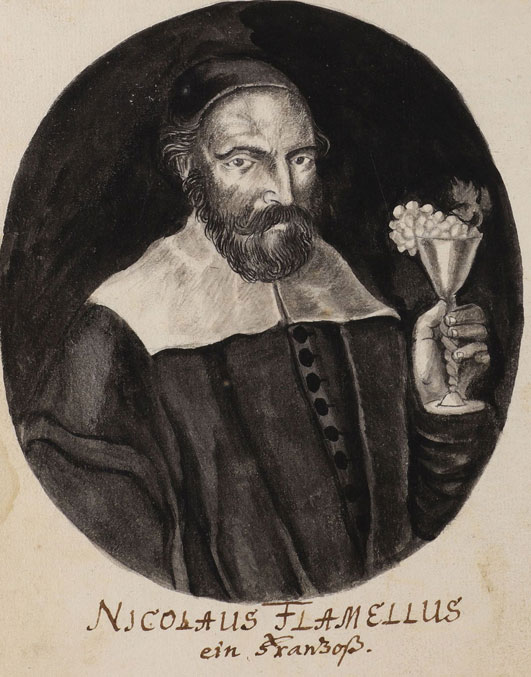
Nicolaus Flamellus, a Frenchman.
Flamel says: The Stone is made from all metals. In Luna you will find what the wise seek, in lead, tin, copper, sulphur. But I have found it in gold.
Yet it is most hidden in that mineral matter from which our Stone is most nearly made.
When the mercury of the metals is only a little raised and congealed, then there is also found with it a certain burning, pure, yellow sulphur, which brings an oily body beneath mercury by means of the forced seed the fatty sulphur and salt and shows how sulphur inclines to the lead-ore or lead-work, where one finds no quicksilver, therefore no good potable gold or silver. For the first tincture and the mercury is a mineral of Saturn, in which Nature has placed it.
In the earth grows a leaden matter, mercury congealed, which one should bring into the secret work, then dissolve; thus one finds the body very swiftly.
In the reduction of our work, only one single metal is found in the whole world, in which our mercury is dissolved. Saturn or lead is flesh and body; therefore it is called gold by the sages, and is also called gold. And, certainly, lead, if it is placed into a clean fire, is also gold. Thereby it receives its opening and is made visible, so that it may become like the substance of gold.
Show also a thing that you must seek a vegetable, Saturnine, royal and kingly, despoiled and mineral root or seed, which only sucks itself forth and shows the nearest way.
Why do we not take the pure body of Sol and Luna for our work? Answer: because Nature has brought itself to art in this, which one must not further improve with fire. Therefore their seed remains without growth. Therefore we take a body in which there is a pure sulphur and mercury, as in silver and gold, in which Nature has worked only a little, but has left it unfinished.
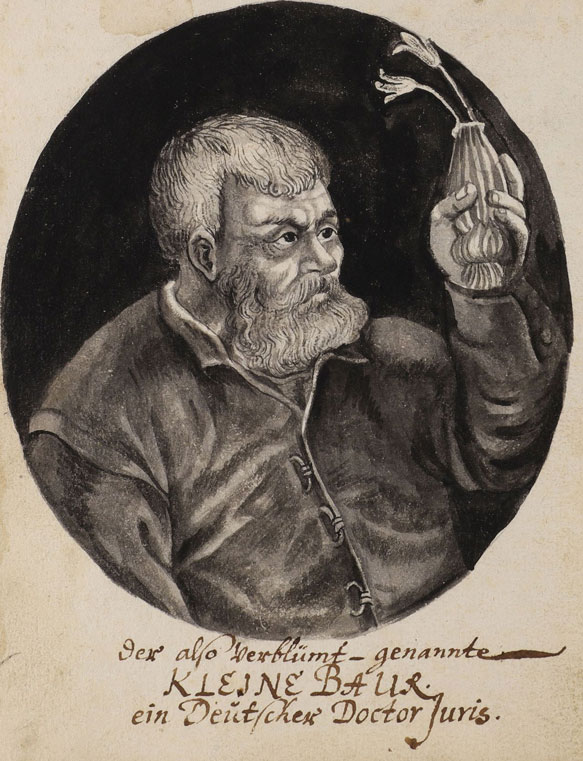
The so-called, very famous Kleine Baur (Great and Little Farmer), a German doctor of law.
Great Baur (Farmer) says: Truly, the tincture is nothing other in bodies than to raise and bring together again the spirits of Nature, because they are both of one nature. Only it is impossible to draw the tincture out of the bodies and to transfer it to the sick unless they are first opened.
The metallic form must be taken away and broken, and the soul, through long boiling and digesting, must be dissolved and coagulated, so that the green essence, or mercurial water, may be brought out into the crystalline salt of the metals, which is nothing other than a pure, clean sulphur that does not burn.
It should be understood, then, that in the mercurial water the salt is hidden; and when the water is brought to a good end and is easily transformed into the salt of the metals, it may again be made into water.
Many people let themselves imagine that, when they have Mercury of the philosophers, or the salt of the metals, they then have the first matter. No; it only becomes the first matter when the composition of man and woman has taken place.
Its own foundation is this: that from all metals, the matter of the Stone, or the Stone of the Philosophers, must be prepared; but only when it has first been brought into its ore. But as soon as it is brought into fiery burning, then the spirit went away.
I can do nothing with the corporal spirit that flows out of the metals, in order to bring it into an outward Venus, to the fiery Sun. It is not constant.
At the beginning stands the means of opening: that is, the vinegar, which is spirit of wine, vinegar of wine, salt of tartar, and other things. These are not to be rubbed upon another medium; they must not remain with it, but must be driven away again before the solution.
The matter of the metal, before it receives it, is like buttermilk. It foams like butter. Mathesius, in his mountain-postil, calls it a gate, which can be opened well with the hand. When one casts a little metallic salt into our water, it becomes like a white milk. If one pours it in more, it runs like butter.
Kleine Baur (Little Farmer) says: The beginning and property of all metals and minerals is in one thing: this is called Electrum minerale immaturum, Magnesia or Lunaria. This mineral root must be found by its own power, which it has received from fiery vapours. Then the white mercurial lily-sap must be pressed from it. It is tender and liquid, clinging in its upper part; and its name is Azoth or eagle’s glue. The sulphur-like, incombustible, fixed lily-sap first remains in the lower part, and must not be left below. It is called Laton or red gum.
When these two lilies are polished quite pure, and are enclosed in a crystalline vessel, then place them in a gentle glass-heat. Thus the white lily will soon spread itself out, and the red will eat itself firm. Therefore both will be brought into heaven by the wind, but from the wind they are brought down again, until they have assumed and taken on the work of dissolution. No one must govern it by art, for their two natures do not climb up at the same time, but only one at a time. Thus their continual nourishment acts.
When the flowers fall into the root, they are fat, movable, tough like gum, externally like honey, and are quickly sublimed according to the philosophers’ sublimation without foreign strange things, which hinder their growing powers and nature. Otherwise it is too small. Then wash them both cleanly. They bloom without addition of other saps, imperfectly, out of this fiery mountain.
After four parts of springtime, the work goes out: that is, it is hotter in dog-days than in spring.
As now the fiery vapours are loosed from the Stone, then our lead-bloom immediately becomes clearer. Yet before the white has been washed, the first work is still not prepared. For this I have washed it, after a little leaf from the white matter was noticed. I have treated it excellently, and have opened a superfluous, steel-like vessel. I lay a little of the little flower upon a hot sheet, and it at once flows and burns everything in the vessel.
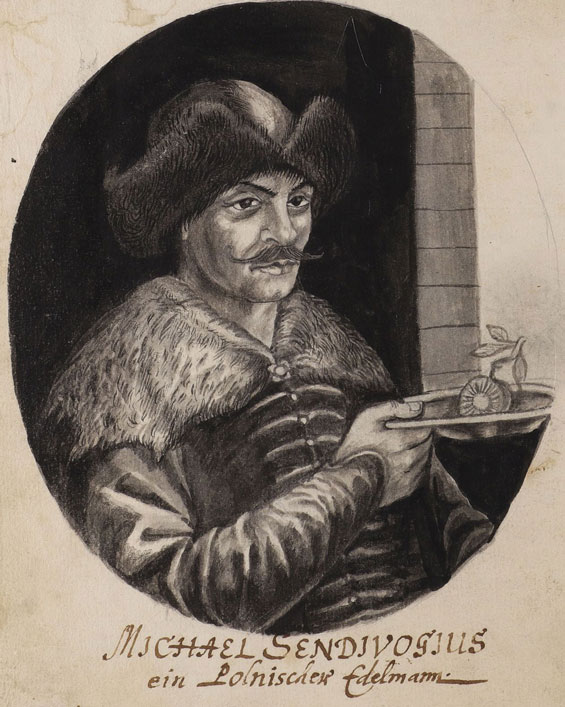
Michael Sendivogius, a Polish nobleman.
Sendivogius, in New Light:
When you wish to bring a metal further by the power of Nature than Nature has done, you must take a metallic Nature, and this in male and female; otherwise you accomplish nothing.
Note that you must not seek the seed-point of Nature in common metals, for there the common gold is dead. The metals, however, are living, and have spirit. Therefore one must not take them. But know that the life of metals is fire, only when they are still in their ores; they have their life from fire.
An ore of lead has another seed than gold, but it is false. It is, namely, seedy in lead and is found as gold. All waters are congealed by warmth when they are without spirit, and congealed by cold when they have a spirit. Understand therefore how to congeal the white water with warmth, and with it its spirit. Understand what is colder than gold: thus arrange it so that the spirit is separated from the water, so that it falls and receives a grain. Thus it attracts the fiery body and brings the spirit out of the height into the water, and they unite with one another. Then this conjunction becomes a double birth, which in form is like a transparent stone.
Therefore know that there is a great correspondence between Saturn and Luna. In the middle stands Sol.
There is a metal which has the power to destroy diamonds; then it is wholly in its water and its mother. Only one single thing, namely an indestructible thing, contains the seed of gold and silver, and will not be burned. But when I have uncovered it, it is called chalybs. When the gold first breathes therein, it receives its seed from it, and will bring forth fruit. Chalybs receives the spirit for itself and places it before the Father. The moon’s eye is the wife of its water. Therefore the seed-point receives its very bright appearance in its old state, and it draws it to itself and makes it pure and good through it.
It is also another chalybs, which resembles our magnet by itself, shaped by Nature, which can draw the wonderful power and virtue out of the rays of the Sun and Moon, so that many people have seen it, and it is the beginning of our work.
When it gives the old gold and silver of ours to be purified, so that it purifies and nourishes them, and finally, in strength and incombustibility, frees them; but in a watery digestion, before it comes so far, it must first be purified through itself.
The human body, or Adam, received life from the air, for into it God breathed a living spirit of life, which acts by day and night, near and far, through airy water. This, in our work, we call the first spirit, when it is congealed; it is better than the whole earth.
This is the water of our chaos, from which the philosophical sulphur is drawn, and through which all things are washed and nourished. Its mother-body is the centre of the Sun and Moon, both heavenly and earthly; and, although this chalybs is very lowly, it is our magnet. I call it chalybs, for it is a true magnet. This, then, is what Hermes chiefly means, when he says: “the wind carried it in its belly.”
I say that this visible thing is nothing other than our sea-water, which is congealed in Sol and Luna, and is drawn out of Sol and Luna by our chalybs through philosophical art, in a wondrous way, through a skillful hand.
When you wish to work in a third matter, then you will accomplish nothing. With this one thing, therefore, around this our one salt which is the Mercury work in herbs, animals, stones, minerals, gold, and our silver, which is covered over with the coarse Saturn.
I have said all of this clearly enough. Only, the extraction of our sal-ammoniac, or philosophical stone, from our sea-water, and the proper use of it, I have not clearly expressed. And God alone, the revealer of all secrets, shall reveal it.
It once came into the mind of a great man to give to this Stone the name Saturn, because Saturn, among the heathens, devoured and swallowed all gods and kings. And Theophilus Plato writes that Saturn devoured and swallowed the Sun’s child, and melted it into a warm water.
Saturn devours this water in all places, and no one can live without this water; it is also wondrously white, refined, but it is the best that was drawn out through the art of our chalybs, which is in the belly of Aries.
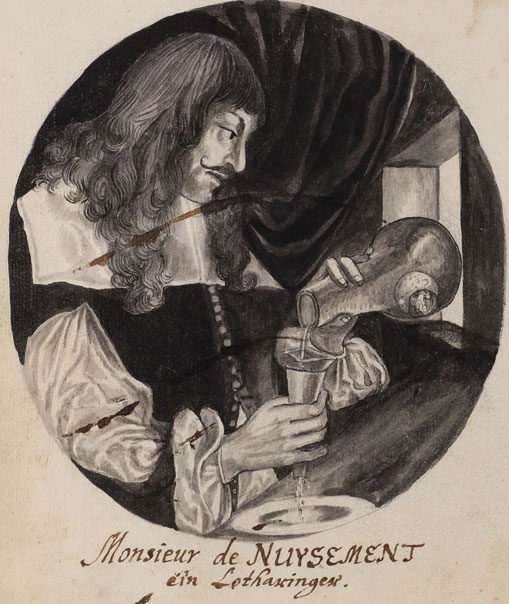
Monsieur de Nuysement, a Lotharingian.
Nuysement, on the salt of the philosophers:
Through experience and good indications in chymical art, enough is known to those who have made clear and uncovered that, in the matter of the Stone, gold and silver are dissolved in Nature, hidden in a liquid water, which gold and silver are harder than that which one commonly sees and takes with the hand. Yet this is lead.
The earth is impregnated by heaven and by the lower elements, and brings all fruits forth from itself. And in like manner the spiritus mundi, drawn out from it, when these are brought together in equal weight, is, as it were, the image and impression of the air; and from heaven’s powers there appear again, not the earthy crystalline little stones and shining little drops, but the spiritus that unites them altogether. Thus it again comes up anew.
At the centre of the earth is a virgin-earth and watery, fatty element; and that is the mother-earth. This virgin-earth is salt, in which I mean the spiritus, dissolved and made into a glass-mass. That is therefore, as it were, the moisture of the air.
To this virgin one may rightly give the name Uranogea “heaven-earth” because she is made into heaven from earth. Thus she has the powers of heaven in herself. Her bitterness, which comes from salt-pregnancy, because salt has taken bitterness, has in its body a sting/sharpness, which is perfectly necessary in opening. From it, along with its spirit only, and then through a special conjuncture, the true medicine of perfection is shown.
Fire and water are the two principal means that push purity from impurity.
To sublime, according to the true understanding of the philosophers, is nothing other than to complete according to Nature, and to lift a matter from imperfection to perfection.
But by this, among most of the philosophers, nothing else is indicated than this word of Bacon’s, where he writes that the sages take for their work a thing upon which Nature has begun the first work toward purification and proportionate union of the pure living Mercury with a sulphurous oil into a firm mass; which mass is understood and intended by this word of Bacon’s as such an untreated, unworked matter. This is the first universal spirit; hence I find in my little book whether one should know that I distinguish between father and mother, between the witness and the one witnessed, perhaps somewhat too much, and that it does not shine without this little light, so that I may recognize this ore as that from which it is extracted and purified.
Then this sage man has indicated the closest beginning of the mineral preparation for the preparation of the philosophers’ Stone; under that wild state, he has revealed to them the first metallic matter, as Nature has prepared it, gathered it together, and specified it. But I find that from the universal matter, so long as it is not yet specified, the first matter of this first metallic matter can properly be taken.
Through orderly dissolution and decomposition this thing shows the desired end, and through coagulation or hardening it again shows it below in the earth.
According to the opinion of all learned writers, Saturn is born among the metals, beneath all, the oldest and first-born, through the natural extraction and congealing of Mercury in the womb of earth; which, before all other metals, perishes and freezes against its own nature, because it has so much salt. From the salt come the biting and sharp effects.
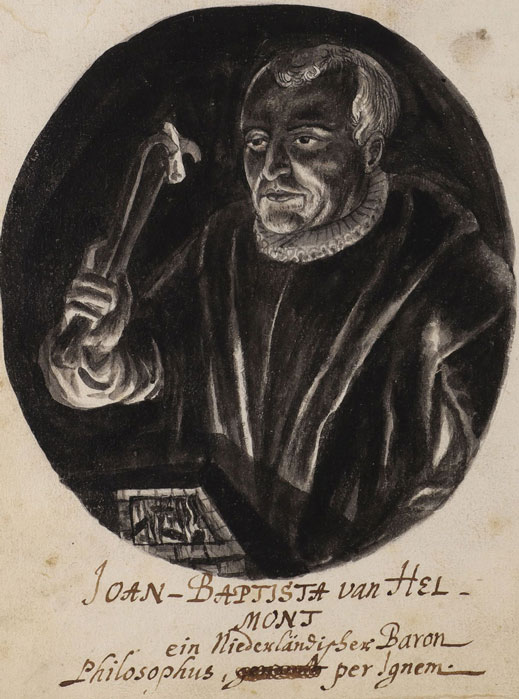
Joan-Baptista van Helmont, a Netherlandish baron, philosopher through fire.
Helmont, in his works:
I know a water, which, however, I cannot openly communicate, by whose means all vegetables can be reduced into one sap without any loss, and enclosed in their own faeces at the bottom of the glass. The residue, which settles, together with the alkaline salt, would be brought wholly into a transparent glass.
In the second book of the Macabees is found mention of a thick water, which caught a flash of fire, and yet perhaps is not wholly unlike our Alcahest.
I have poured, from one part ashes and an equal quantity of yellow water, into a well-luted glass vessel; it has lain several days in a warm bath. The whole mass was changed into two clear liquors, without coloured or green flame. When, with the second degree of fire, they were at the same time distilled through sand, and the vessel that had been set beneath received it, it was as if it had now been taken out of the molten furnace. Soon both vessels leapt asunder through the bath, both of the closed vessels at once; but the issuing liquor remained behind, entirely in one former weight and former power.
Through the ointment-like redness of fire, which is the Alcahest of Paracelsus, one can make an oil out of vegetable material. When it is poured upon his sublimated, salt-fixed earth, it changes it from the ground up, and a light remains in it, and what was before is held fast.
The single liquor Alcahest brings all tangible bodies of this whole world, perhaps first into their first being, without any diminution of powers, seed, or strength. But they are all brought and transformed through their own, implanted, inner yoke.
An angel gave me a glass vial in which was contained, with one word, “fire-water.” Its name was wholly simple, singular, indeclinable, imperishable, incorruptible, light-bearing, inexhaustible: Alcahest.
The highest and most blessed salt is that which reaches the last aim of purity and subtlety in Nature. That passes through everything and remains, in its action, unchanged; it shoots all other things forth, washes them, melts them, and makes all resistant matter fluid, like warm water does snow.
Likewise, its all-dissolving title, as destroyer of the Alcahest, is rightly attributed to it by all.
Therefore Paracelsus’s liquor Alcahest is pre-eminently an incorruptible, indestructible salt-water, and a circulating salt, which brings all tangible bodies into one liquor.
The chymical art prepares for its highest mastery a solvens universale, by which everything is brought back into its first being and gives back its innate powers, stripping off all their impurities.
Glauber, Works, Mineral Part, Part I:
There is found in Nature a wholly wonderful menstruum, without corrosive power, by which all vegetable, animal, mineral, and metallic things may be dissolved in a short time, radically, reduced into their first matter, and thus not only made into the most excellent simples and most effective medicines, but also delivered from the bitter things through which their bitterness is corrected, so that they may no longer make vomit or stool, but be changed into excellent restorative things. Therefore I hold the hindmost things first in a far better being.
And such a menstruum dissolves not only vegetables, animals, minerals, and metals, but unites all things with the bond of union and destruction. Of its power especially in which the most wonderful glass-salt is therefore one must take hard and thick glasses only, when one wishes to digest and dissolve something therein; otherwise all vessels are soon eaten through by it.
But it has also this great virtue: that it changes the body which it envelops into the first matter and makes good medicines from it, without causing any alteration in taste or colour, and not in a harmful way; rather, it always lifts the best part of the reduced body upward, and the faeces sink to the bottom, so that the menstruum always remains unaltered in the middle, and therefore may be used again many times.
In sum, it can do everything that can be done in the preparation of the most excellent medicines with small effort. And it may rightly be compared with Basil Valentine’s mercurial water, and with the Alcahest of Paracelsus and Helmont.
But it pleases me to speak of the fire of the Maccabees, which, after it had lain hidden in a little pit, was transformed, according to its recovery, into a thick water. It is an ever-burning fire, and it does not burn visibly. It is a living water, and no one finds the root of it. It is the soap of the sages, the Azoth of the philosophers, and the royal bath.
Miracle of the World.
For the third part of the philosophers’ menstruum, take the universal, non-corrosive nature, which through the power of fire becomes corrosive.
Concerning potable gold.
When one places a viscous mineral liquor in the sun, it is changed and turned into a dry, yellow-glittering thing. Therefore, Glauber believed that there is a suitable matrix wherein the sunbeam, as with the heat of the common fire, may take hold and coagulate livingly, just as the body of metals is generated in the earth.
Some have thought that the little bird of Hermes is to be understood as the lovely moon-radiance or fertile spring-rain, and they have grasped very wrongly. Therefore the experimenters set themselves to much work, with the meaning of drawing 100 pounds of gleaming moon-radiance into the meaning of this little bird. Yet they have found hardly a little salt, which salt is not the life of the little bird, but only a little earth of that body, and therefore is worth nothing except that Neptune has embraced it and has shown it a place in the sea. That is the little fish of Sendivogius, floating upward in the island of the wise.
All colours that are in the whole world are found in the shine which is in the air: the little bird of Hermes is air itself; a little rainbow in the air, a little heavenly green, a little gold, silver, coral, pearls, and precious stones, may be added to it in beautiful colours.
It is called salt, and it is sal mundi, the salt of the world. From it one can obtain all the colours. It is a green of the elements, and by Hermes it is called a little bird, which flies by day and night and does not become weary. Plato calls it the soul of the world. Sendivogius calls it a living fire in the air, and in the sea the little fish of Echeneis.
The aqua fortis is a wet and cold fire, and at the same time it is as hot as the dry and hot fire, when it is well applied; indeed, it does more than the dry and hot fire. But it requires an experienced artist. In it some of the old philosophers brought their universal medicine to completion by means of a wet fire, as is to be seen in Artephius and others, Basil and Paracelsus.
German book, second part.
Therefore the philosophers sought, from the nitrous sea, a secret water, a menstruum, the universal solvent, and great things have been accomplished with it; but they have kept it very secret, and only hints remain by which they indicate that Saturn, out of the sea, pours forth a secret water among rare monks.
Hidden description of the Philosophers’ Stone, according to the nearest way.
I look into the seven circles of heaven, grasp the uppermost with my thoughts, and stand with my feet upon the lowest. Since the little monk sees the outer light and grows weak and falls, and breaks a leg, I therefore make myself a salt and go slowly. This is, in my innermost salt, a balsam that helps me again.
But when I become radiant, a sweet lovely water comes from my pores like milk and honey; thus I recover myself to better strength. When the ape looks without deceit, the king gives the angel-flowers their colour from himself. And then they fall into the trees and make a darkness over the world, until the little monk breaks through again and becomes clear.
The night has passed; the sun gives its shine; heaven becomes pure fire. In these dark words is understood and revealed the treasure of the world.
Excellent description of the philosophers’ subject, wherein the spirit of the world appears particularly and visibly.
In its first being the spiritus mundi appears in an earthly, invisible and not specially perceptible body, in which it has enclosed itself. It heals all wounds and corruption in the human body; it gives good flesh again and destroys the foul, cleanses all foulness and all stench; it hopes for any place where it wishes, heals everything outward and inward.
In another being it appears to the face as a watery body, and at first in strong shining, for at first it has only its corruptions, but later, in its own hidden workings, it digests much more and, in every work in which it is placed, it manifests itself in common to all flowers and sweet aromatics. In its hidden Nature it is a firm balsam; it is useful to the sick and gives spirit again, for it drives poison from the heart and what has settled into the lungs, loosens it and heals it; and when the same thing is stopped and changed, it heals them most inwardly by its motion, cleanses the gall, improves the liver’s destruction; three times a dose of it, and there is fruit in a single hour.
In its third being it appears in its airy being and oily body, which is completely near to all its created liberty and freed in that, in which it works quite wonderfully.
Then it serves the young, so that their body remains in fine and clean condition and powerfully nourishes itself. When one generally takes a little into the hot belly, it does not allow melancholy to prevail, nor the gall to become burned; and it makes the blood prevail over the measure, therefore it must often be lessened.
The liver: it stops up and sets itself upon the veins; and where there is a limb for a wound, it brings the same again to its right measure. And when a virgin, before she comes to her inward maturity, that is, before she is in the water, has a broken eye, and all the days only a little of it is given to her, and held in the air and in light for nine months, then she regains her sight. And when in a limb something too much is overflowing, then it drives it on and dissolves it of itself, until it has set it down.
In its fourth being it appears in a fiery body, but through the power of all its created nature it is not entirely earthly. And according to its watery nature, and not enough broken into water, it yields much to spirits and tinctures, makes old people young again. And if one gives it into a todizer before its fire has fully absorbed, or before it has been given into wine, when it has reached through the skin of the stomach, then the same is again transformed back, and goes down to the foot. It drives out all superfluous moisture, consumes, makes the natural heat alive again in the liver, and when all the air of the fire is entirely used up, then it takes away the sickness of age, so that soul, spirit, and body are awakened, and therefore it is called elixir vitae.
In its fifth and last being it appears in a glorified and illuminated body that has no defect. Like Sun and Moon shining, in which it has all blessed powers and properties, which it possesses in the other beings, more beautiful and more wonderful; therefore it is called a natural work of miracles, because the old, cast-off and dried-up bodies of trees are applied to its root and become living, blossoming, and fruit-bearing. When it is united also with a human being, then it does not decay, but burns continually without lessening, and makes of every Christian the noblest stone of all colours, which are as good and noble as those drawn from the mountain-world, kings, and many other things that are not to be described to the ignorant. Thus, to all sensible bodies, it pours their powers especially into other things, so that in it alone all are found.
The bird-spirit is called, in its fiery nature, a salamander; in its airy nature, a kybrick; in its watery nature, azoth; in its earthly nature, alieochoph.
The End.