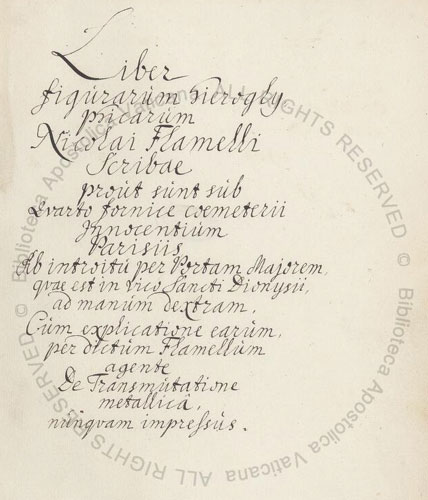
Book of Hieroglyphic Figures of Nicholas Flamel, scribe, formerly painted beneath the fourth arch of the cemetery of the Innocents, at Paris
Listen Audio Book Study the Art with Us Buy me CoffeeBook of Hieroglyphic Figures
of Nicholas Flamel,
scribe,
formerly painted beneath
the fourth arch of the cemetery
of the Innocents,
at Paris,
as may be seen through the older Vespasian copy,
which is in the famous Dionysian
monastery,
together with a most rare explanation,
by the said Flamel himself,
concerning the metallic transmutation,
now printed for the first time.
Translated from the Manuscript - Ross.903
Praise be forever to the Lord my God, who raises up one like me from vile dust, and makes joyful one who hopes in Him; who opens to believers, with the grace of His kindness, the overflowing springs, and places beneath their feet the turning circles of all earthly felicities.
In Him may our hope always be; in His fear our happiness; in His mercy our glory; in the expectation of our nature, and in our prayers, may our security be immovable.
And You, most powerful God, just as Your kindness has deigned on earth to open to me, Your unworthy servant, all the treasures and riches of the world, may it also please Your great clemency, when I shall no longer be counted among the number of the living, to open to me the heavenly treasures, and to permit me to behold Your divine countenance, whose majesty’s delights are inestimable, and whose glory has never entered into the heart of living man.
I ask this of You through our Lord Jesus Christ, Your beloved Son, who in the unity of the Holy Spirit lives and reigns with You forever and ever. Amen.
Explanation of the Hieroglyphic Figures,
written by me, Nicholas Flamel, scribe,
in the cemetery of the Innocents, under the fourth arch,
as one enters by the greater gate, in the square of St. Dionysii,
on the right hand, near the charnel-houses.
Preface
Although I, Nicholas Flamel, scribe, dwelling at Paris, in the year one thousand three hundred and ninety-nine, and remaining in my house, in my study, beside the chapel of Saint James of the Butchery, although I had learned much of the Latin language by the benefit of good parents, who nevertheless were poor, and who, after my death, were to be buried by my envious enemies as worthy men nevertheless, by the singular grace of God and by the most powerful blessing of the saints and holy ones of Paradise, especially of Saint James of Galicia, I did not neglect to search diligently through the monuments/writings of the philosophers, and to learn their hidden and concealed secrets.
Therefore nothing will be ungrateful in the monument of my life, which, in so great a benefit, I have received from the full and benevolent Lord Jesus Christ, either from this soul of mine, or at least from the full affection of my heart, with great thanks to the most gracious God, who never permitted the son of a just man to beg for bread, nor disappointed those hoping in His blessing.
When, therefore, I, Nicholas Flamel, scribe, after the death of my parents, was gaining my living in the art of writing, making inventories, adding up accounts, numbering and marking expenses ...
... expenses of funerals and anniversaries: there fell into my hands, for the price of two florins, a gilded book, very old and very large. It was not made of paper, nor of parchment, as other books are, but, as it seemed to me, it was made from the wonderful barks of tender trees.
Its cover was of very fine copper, wholly engraved with strange letters and figures; and, as far as I could judge, they seemed to be Greek characters, or those of some other similar ancient language. I indeed did not know how to read them; yet I knew that they were not musical notes, nor Latin or French letters, because of these we understand something.
As for the inside, its leaves were of bark, written with the greatest care, and written with an iron stylus in beautiful and very pure colored Latin letters. It contained three times seven leaves, which were numbered thus at the upper part of the leaf; and every seventh leaf was not written on, but painted.
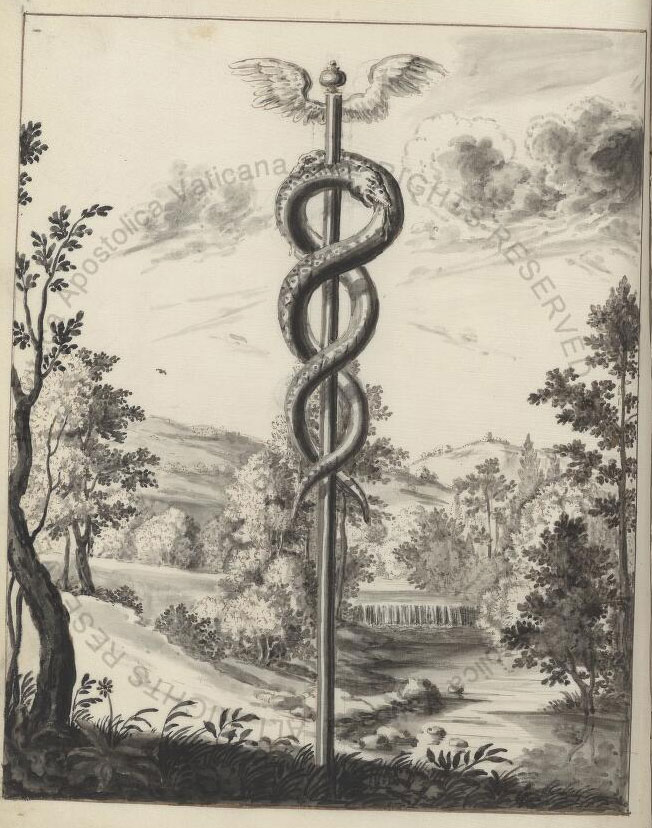
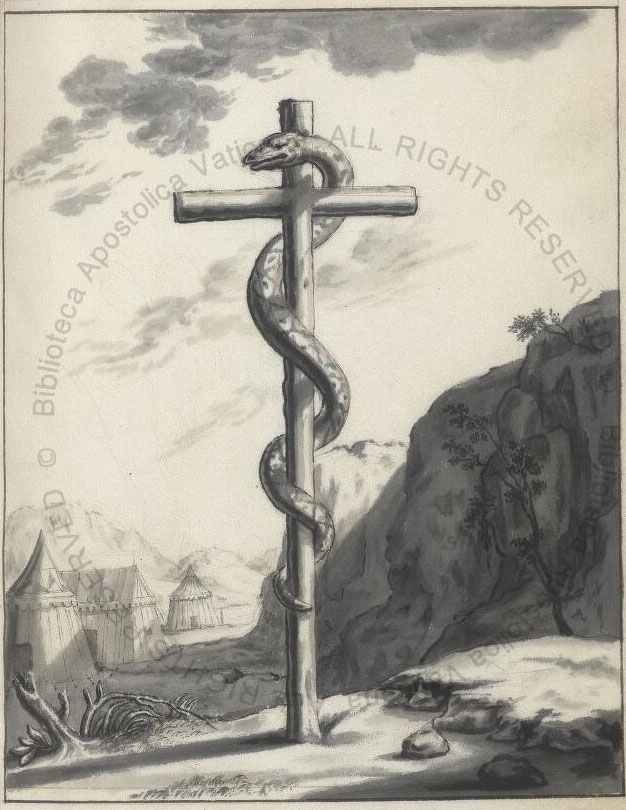
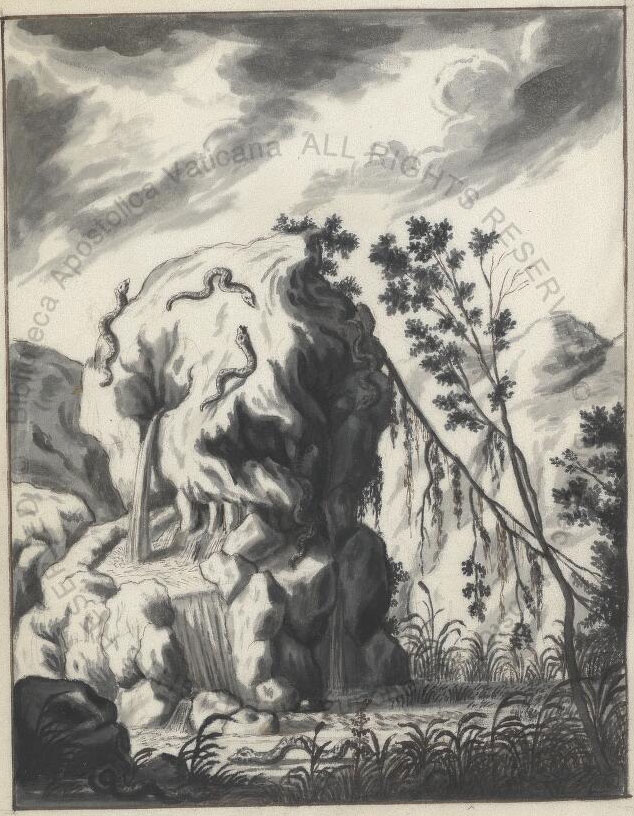
On the first seventh leaf there was a rod with two serpents devouring one another. On the second seventh leaf there was a cross, and a serpent crucified upon it. On the third there were painted deserts, through the middle of which flowed beautiful fountains, from which various serpents came forth, running here and there.
The first leaf was inscribed in large gilded capital letters:
ABRAHAM THE JEW, PRINCE, PRIEST, LEVITE, ASTROLOGER AND PHILOSOPHER, TO THE NATION OF THE JEWS, SCATTERED THROUGH GAUL BY THE WRATH OF GOD, GREETING.
After this it was full of curses and execrations, with this word “Charamathra,” which was often repeated there, against anyone who should wish to look into it, unless he were either a priest or a scribe.
He who had sold me this book did not know its value, nor did I know it when I bought it. I believe that it had been taken from the miserable Jews, or found hidden somewhere in the ancient dwellings of those people.
On the second leaf of the book, he consoled his nation, warning them to flee vices, and especially idolatry, awaiting with patient expectation the coming of the Messiah, who would conquer all the kings of the earth and would reign with his people in eternal glory. Without doubt he had been a very wise man.
On the third leaf, and on all the following written leaves, in order to help his captive nation to pay tribute to the Roman emperors and to do other things which I shall not mention, he taught them in common words the transmutation of metals. He painted the vessels at the side, taught the colors, and the whole method, except for the first agent, of which not even a single word was written.
But on the fourth and fifth leaves, as he said, he painted and represented it with the greatest art. Yet although it was painted and figured clearly enough and intelligibly, nevertheless no one could understand it unless he had been very experienced in their cabalistic traditions and had studied well in the books of the philosophers.
The fourth and fifth leaves, therefore, were without writing, but full of beautiful illuminated figures; and likewise the work was very skillful.
First he painted a winged young man, with sandals at his ankles, holding in his hand a caducean rod encircled by two serpents, with which he struck a helmet which covered his head.
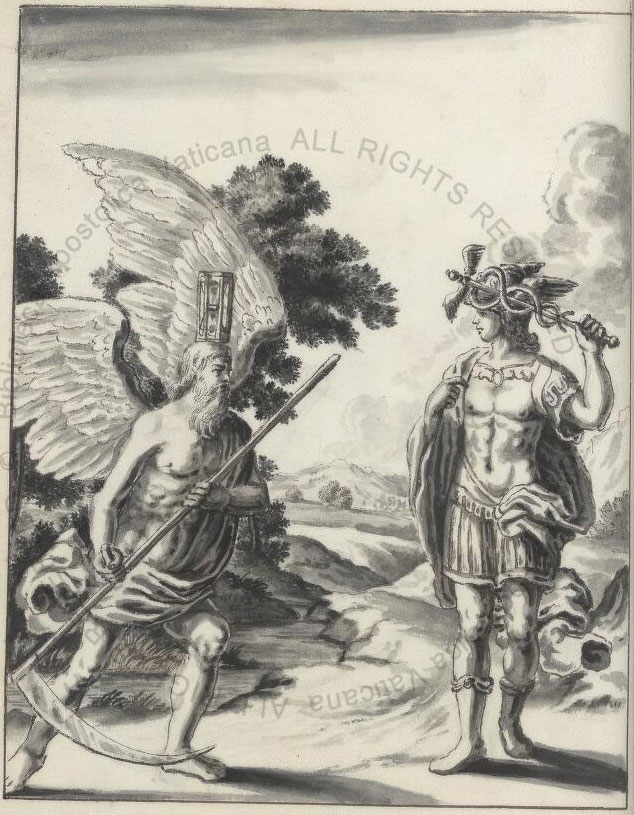
The second [figure] according to my simple understanding, it appeared to be Mercury, the god of the pagans. Opposite him there came running and flying with outspread wings an old man, having an hourglass fastened upon his head, and holding a sickle in his hand, like Death; with terrible and furious rage he wished to cut off the feet of Mercury.
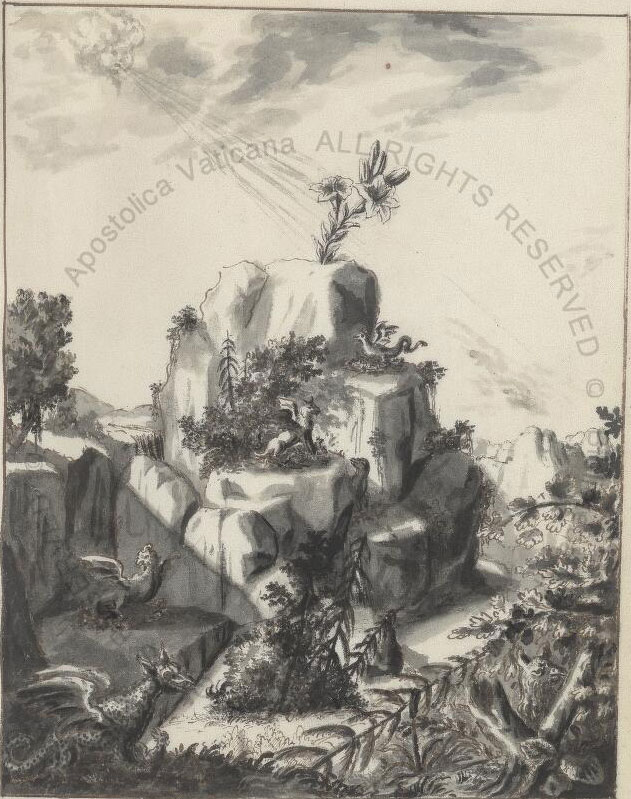
On the other side of the fourth leaf, he had painted, upon a very white mountain, a most beautiful flower, which the north wind shook violently. Its stalk was blue; its flowers were white and red; and its leaves shone like pure gold. Around it the dragons and griffins of the north were making their nests and habitations.
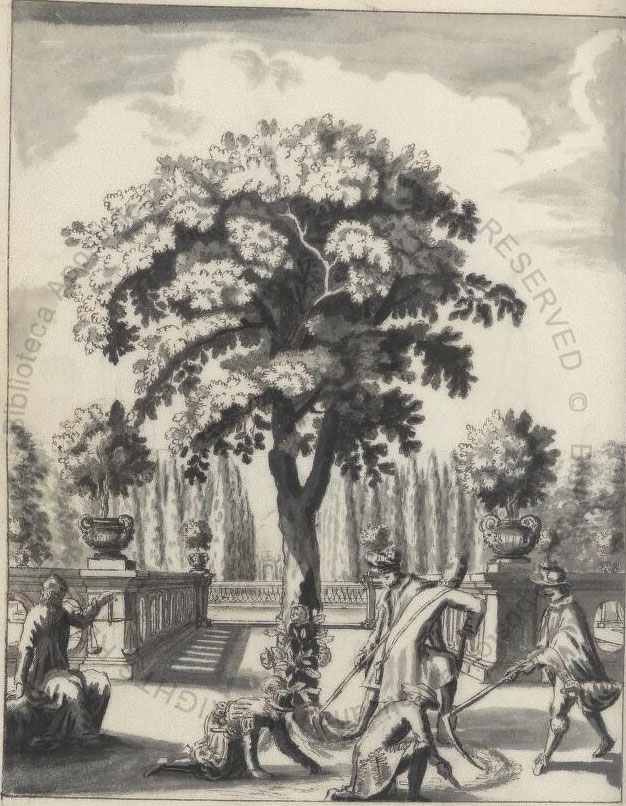
On the fifth leaf, in the middle of a beautiful garden, there was a flourishing rose-tree, rising toward a hollow oak; at its root there sprang forth a fountain of very white water, which was falling headlong into abysses, yet first passing through the hands of innumerable peoples, who were digging in the earth, seeking it. But because they were blind, no one recognized it, unless there was someone who considered its weight.
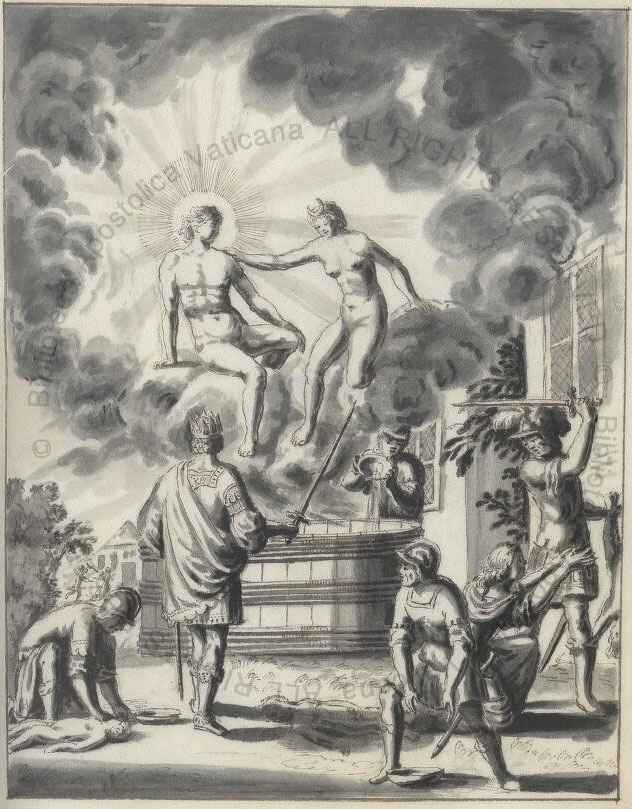
On the reverse of the fifth leaf there was a king holding a great sword in his hand, who ordered his soldiers to kill in his presence a great multitude of infants, whose mothers were weeping at the feet of the cruel armed men. And the blood of these infants was gathered by other soldiers and placed in a great vessel, in which the Sun and Moon came down from heaven to bathe.
And because this history represented the greater part of the work, therefore not only was it inscribed as the thirteenth and fourteenth figure among the hieroglyphic symbols, but I also placed in their cemetery the greater part of these very hieroglyphic symbols of the secret science.
Behold, although I had these first five leaves, yet I did not understand them, nor would I ever have been able to understand them, if I had not found their explanation in Latin on the other written leaves.
For this reason I would have been able to lose myself and to commit a greater evil than that which he, who had composed it, desired: namely, that all men should have one head, so that he might cut it off at one stroke.
When, therefore, I had with me that beautiful book, and I did not know what it contained, and now, understanding very well the operations which it taught, I did not know with what matter they were to be begun, this caused me a very great sadness, and brought me great sighing every day.
My wife, Perenelle, whom I loved as much as myself, and whom I had recently married, was looking at me with complete astonishment, and with a good heart asked me whether she could free me from these annoyances.
I could not hold my tongue, but told her everything, and showed her the very beautiful book itself, which, as soon as she saw it, she loved with the same love as I did, and looked upon it with great pleasure, admiring its beautiful covers, the engravings, images, and figures; yet she understood them no more than I did.
Nevertheless it was a great consolation to me to speak with her about them, and to ask what she thought should be done in order to obtain their interpretation.
Finally I had painted, as accurately as I could, within my house, all the figures and images of the fourth and fifth leaves, and showed them in Paris to many very learned clerks, who understood them no more than I did.
I told them, moreover, that these things had been found in a book which taught the Stone of the Philosophers; but the greater part of them mocked me, and laughed at me, and at the blessed Stone, except one, who was called Master Anselm, licentiate in medicine, and a man very studious of this science. He greatly desired to see the book, and did everything he could so that he might see it; but I always told him that I did not have it. Yet I made for him, with great skill, a drawing of the figures.
He said that the first image represented Time, devouring all things; and that six written leaves were needed, according to the number of six years, to perfect the Stone. From this he maintained that the meaning was obvious and not to be understood otherwise.
But when I answered him that this was not painted except to show and teach the first agent, as was written in the book, he answered that this six-year digestion was like a second agent.
Indeed, he said that the first agent was there depicted: namely, the white and heavy water, which without doubt was quicksilver, which cannot be fixed nor have its feet cut off that is, cannot have its volatility taken away unless by means of this long cooking in the purest blood of infants. In this blood the quicksilver, joined with gold and silver, first turns with them into one plant like the one painted there; afterwards, through corruption, into serpents; and after they have been completely dried and cooked by fire, they are reduced into a golden powder, which makes the Stone.
This was the reason why, for the space of twenty-one years, I made a thousand mistakes, not however with blood for that is wicked and villainous. For I found in my book that the philosophers called blood the mineral spirit which is in metals, especially in the Sun and Moon and Mercury, and to the joining of these I was continually intent.
Nevertheless, these interpretations were subtle interpretations, rather than true ones.
When, therefore, in my operations I never saw the signs appearing at the appointed time written in my book, I always had to begin again from the beginning. At last, having lost hope of ever understanding the figures, I made a vow to God and to Saint James of Galicia, for the purpose of seeking afterwards their interpretation from some Jewish priest in one of the synagogues of Spain.
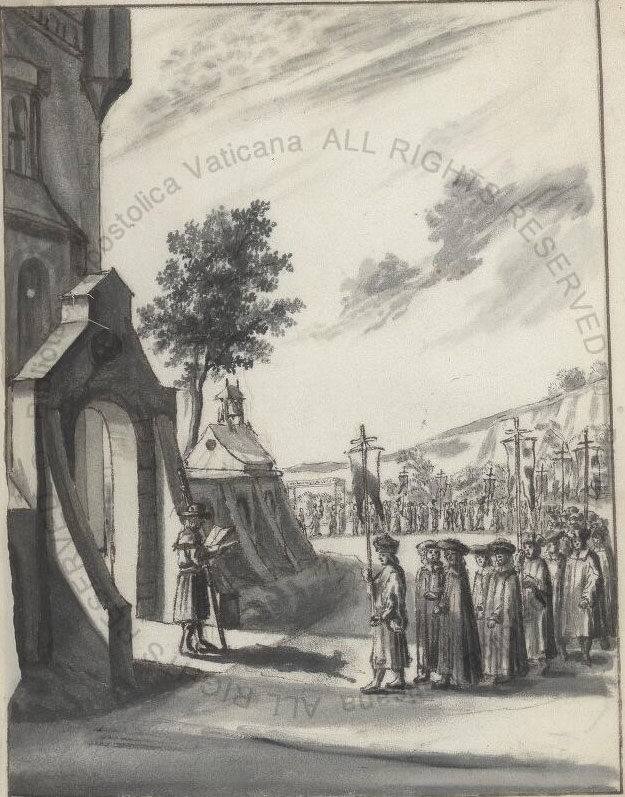
Therefore, with the consent of my wife Perenelle, and carrying with me the extract of the figures, I took the pilgrim’s staff and the pilgrim’s garb, in the same manner in which my image is seen outside, in the same porch under which I placed these hieroglyphic figures inside the cemetery. And I also had painted upon the wall, on one side, a procession, in which, according to order, all the colors of the Stone are represented, beginning and ending with this inscription in French:
“Moult plaist à Dieu procession,
s’elle est faite en dévotion.”
That is:
“A procession is very pleasing to God,
if it is made with devotion.”
The Procession Pleases God,
to whom true devotion is present.
In this way nearly the whole beginning of the book of King Hercules is set forth, which treats of the colors of the Stone, entitled The Iris or Rainbow, in these words: “The procession of King Nature will please God, if it is done with great industry,” which the greater clergy understand most clearly.
In this manner, therefore, with a pilgrim’s staff, I arrived at Mount Joy, and finally at Saint James, where, with great devotion, I fulfilled my vow. Having done this, on my return there came to me a certain merchant ...
... a merchant of Boulogne, who caused me to make the acquaintance of a physician by birth a Jew, but at that time a Christian, living in León. He was very learned in the sublime sciences, and was called Master Canches.
When I showed him the drawings of my figures, he received them with the greatest joy and admiration, and asked me whether I knew where the book was from which they had been copied. I answered him in Latin, in which he had asked me, that I hoped to obtain good news from him, if first he would explain the enigmas to me.
At that very moment, overcome with great and joyful hope, he began to explain to me the beginning. But in order to prove whether I knew where the book was, and that I might go to him again about it afterward, he asked me for certainly he had already been distinctly informed about the book, though he spoke as if of a thing which he fully supposed had perished whether I agreed to our returning together from our journey.
Therefore we passed through Oviedo, and from there came to Santander, where we boarded a ship to cross into France. Our voyage was quite prosperous; and, after we had reached France, he explained to me, most truly, the greater part of my figures, in which he showed, even to the points themselves, great mysteries a thing which seemed very wonderful to me.
But when we reached Orléans, this learned man fell very ill, afflicted by extreme vomiting, which still remained with him from those he had suffered at sea. He was in such fear lest I should leave him, that he could imagine nothing above me. And although I was always at his side, nevertheless he kept calling me continually.
At last he died on the seventh day of his illness, to my great sorrow.
I took care that he should be buried, better / more properly in the best manner that I could, in the church of the Holy Cross at Orléans, where he still rests. May God have his soul, because he died a good Christian.
And certainly, if I am not prevented by death, I shall give to that church some revenues, so that every day certain masses may be read there for his soul.
Whoever shall wish to see the manner of my arrival, and the joy of Perenelle, let him look upon us both, in this city of Paris, above the door of the chapel of Saint James of the Butchery, beside my house, where we are both painted from life.
I am painted giving thanks to Saint James of Galicia, and Perenelle at the feet of Saint John, whom she had so often invoked.
Thus at last, by the grace of God, and by the intercession of the most blessed Virgin, and by the blessings of Saint James and Saint John, I had what I desired: namely, the first principles.
Yet not the first preparation, which is a thing above all the world most difficult. But at last I also had this, after long errors of three years or more, during which time I did nothing else except study and work, as you will be able to see outside this arch, where I have placed processions. Under them, as it were, is the beginning of the book, where I can be seen painting, facing one way and the other, a column under the feet of Saint James and Saint John, praying to God, holding a rosary in my hand, reading attentively from a book, pondering the words of the philosophers, and proving the various operations which I understood from their words.
At last I found what I desired; and I immediately recognized it by its strong smell. Having this, I easily perfected the mastery. For after knowing the preparation of the first agents, and then following my book according to the letter, I could not have gone wrong except if I had wished to do so knowingly.
The first time that I made projection, I did it upon mercury, of which I converted about half a pound into pure silver, better than that which is drawn from the mines, as I have often tested and caused to be tested.
This was done on the seventeenth day of the moon, in the month of January, at about noon, in my house, with Perenelle alone present, in the year of the restoration of the human race one thousand three hundred and eighty-two.
And afterwards, following again my book word for word, I made it likewise with the red Stone, upon a similar quantity of mercury, again in my house, with Perenelle alone present, on the twenty-fifth day of the following April of the same year, at about five o’clock in the evening. I truly transmuted it into pure gold, better certainly than common gold, softer and more pliable.
Truly, I can affirm that I made it three times, with Perenelle understanding it as well as I did, because she helped me in the operations; and if she had wished to attempt it by herself, she would undoubtedly have perfected it even alone.
I had indeed enough when I had perfected it once; but I took very great delight and pleasure in contemplating, in the vessel, the marvellous works of Nature.
To show you how I performed it three times, you will see, in this arch, if you know how to recognize them, three furnaces like those which serve for our operations.
For a long time I feared that Perenelle could not keep herself from revealing to her relatives the secret of the treasure which we possessed, because extreme joy takes away the senses, just as extreme sadness does. But the great goodness of God not only blessed me with this, but the great goodness of God had not only heaped this blessing upon me, in giving me a chaste and prudent wife, but had also made her capable of reason, and more discreet and secret than other women commonly are.
Above all, she was very devout; therefore, considering that she was already advanced in age, and without hope of conceiving children, she began, like me, to think of God and to devote herself to works of mercy.
When I wrote these commentaries, in the year one thousand four hundred and thirteen, after the death of my faithful companion, which I shall mourn all the days of my life, she and I had already founded and endowed fourteen hospitals in this city of Paris; we had newly built three chapels; we had endowed seven churches with gifts and ample revenues, with many repairs in their cemeteries, beyond what we had already done at Boulogne, which is no less than that which we did in this city.
I shall not speak of the good works which we likewise performed for the poor in particular, chiefly for widows and orphans.
But if I were to name those to whom I gave such benefits, besides making the reward unpleasing to me, perhaps I would also displease those good persons whom God has blessed, and whom I would not wish to be compelled to act in any way concerning the rest of the world.
Therefore, when I was building these churches, cemeteries, and hospitals in this city, I determined to have painted, under the fourth arch of the cemetery of the Innocents, as one enters by the greater gate, and also in the church of Saint Denis, on the right hand, true and essential signs of this art, though under veils and coverings, in hieroglyphic signs, in imitation of those which are in the book of Abraham the Jew. These could represent two things, according to the capacity and knowledge of those contemplating them: first, the mysteries of our future resurrection and of the indubitable coming of the day of judgment and of the coming of the good Jesus, who will be judge for us miserable sinners a history which is very suitable for a cemetery.
They can also signify to those who are instructed in natural philosophy all the principal and necessary operations of the mastery.
These hieroglyphic figures are, as it were, two roads leading to the heavenly life. The first and more open sense teaches the sacred mysteries of our salvation, as I shall show below. The other sense teaches, to any man, however little experienced in this science of the Stone, the direct path of the work; and when such a man perceives the linear order, he changes them immediately and, having removed them from the other meaning, he takes and turns them away from this first sense.
Thus, having found a book, he cuts off from it the useless things; then he prays to God; and although he had once been evil, he will remain thereafter consoled by the grace and mercy which he has obtained from God, and by the depth of the divine riches and of the admirable works.
These are the causes which moved me to take care that these figures should be made in this way, and in this cemetery: so that, if anyone should obtain this inestimable good, he might think of me and, after my death, might pray for me one who am a sinner asking the generosity of God for me; and so that he might contain under himself the hidden talents of God, amend errors and presumptions, which are the vanities of the world, and rather work in charity toward his brothers, remembering that he has found this secret among the bones of the dead, with whom he too will soon be numbered.
And after this life, fleeting and transitory, he will celebrate the resurrection, and will give back to a just and terrible Judge the account of every idle and empty word.
Therefore, he who shall ponder my words well will recognize and understand the figures, provided he knows beforehand the first principles and the agents; for certainly he will find no trace or document, in these commentaries and figures by which he may perfect the Hermetic mastery, to the glory of God and the redemption of Clementia, Catherine, and Opportuna, Roman matrons, who adorned my churchyards, cemeteries, and hospitals, and above all the churchyard of the Innocents of this city, in whose cemetery he will behold these true demonstrations. Let him open his hand generously to the poor, the afflicted, the sick, widows, and forsaken orphans. Amen.
Theological Interpretations,
which can be given to these Hieroglyphics,
according to the sense of the author.
Chapter One
On the side of this churchyard of the Innocents, from the fourth arch, which is from the side of the churchyard, and toward one of the larger gates of Saint-Clair street, there is a black painted figure upon a wall, looking directly at the hieroglyphics, with this French inscription:
“Vide merveille, idée obscure.”
“See a marvel, an obscure idea.”
And likewise there are three plates of iron and copper, gilded, facing east, west, and south, on the arches of the same churchyard where the hieroglyphics are, on the other side of the cemetery. In these is represented the holy Passion and Resurrection of the Son of God.
This must not be interpreted otherwise than according to the common theological sense, except that it gives very great pleasure to the man who first cries out, beholding the admirable works of God in the transmutation of metals, figured under hieroglyphics; for he is as attentive in looking upon them as he is in seeing the sepulchres or corpses trembling on the day of judgment, rising from the tombs.
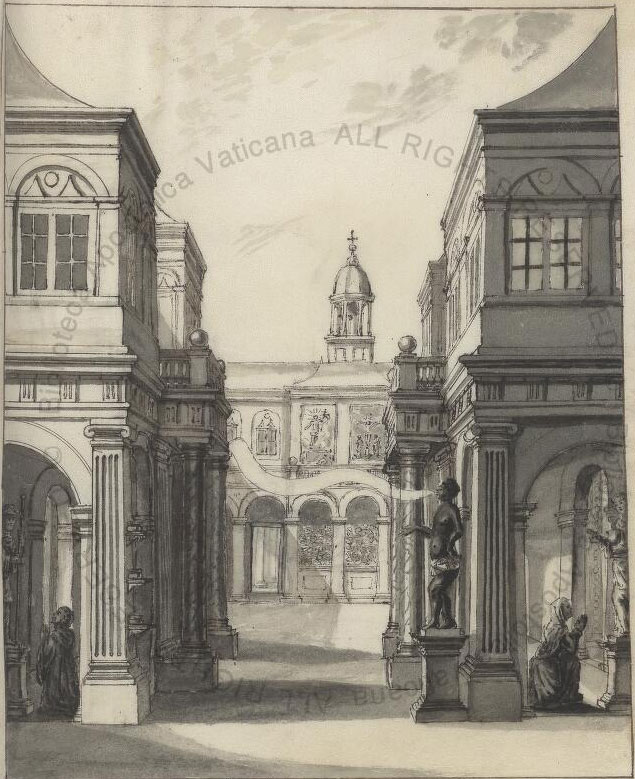
Nor must the rest be interpreted according to theology, since there is nothing further to say about the remaining part of the figures, in which, if you have taken away the inscriptions according to the sense which I have given to them, you will be able to apply better things, according to the philosophical sense.
There are also two similar vessels at the side of the figures of Saint Peter and Saint Paul, in which one sees a single N, which signifies Nicholas, and F. Flamel. For these vessels signify nothing except that I perfected the mastery three times with similar vessels.
You should also believe that I placed, in a certain little shield, the inscription and figures of the capitals of my name, believing that these interpretations are both true. Nor ought it to be interpreted in the theological sense, since the inscription running there is of this kind: Nicholas Flamel and Perenelle, his wife; because they signify nothing else except that we both gave this arch.
As for the third, fourth, and fifth tablet, according as it is written, namely how the other two were made, in which the Theological Sense is treated, with this same inscription running along them, it must be said only concerning the other things which are above.
Two dragons, one within the other, colored black and blue, in a black field that is, in a black color. Of these, the one has wings, the other has none.
These are the sins which by nature are joined together; for one takes its origin and birth from the other. Some of them can be easily driven away, because they come easily and burn up at every moment. But those which are not winged cannot be driven away at all, such as sin against the Holy Spirit.
It signifies, moreover, the greater part of the damned, who would rather be strangled by their own envy, which they had in this world, than by good works; that is, they wished to possess, in this world, a share in eternal blessedness.
Their black and blue color shows that their desires are like those hidden in the dark abyss of hell, which are plainly to be feared.
These two dragons can also wonderfully represent the legions of evil spirits, who continually prowl around and accuse us before the just Judge on the day of terrible judgment, and who seek nothing more than to accuse and destroy.
The man and woman, who are depicted next, colored orange in a dry and blue field, signify that man ought not to place his hope in this world; for the orange color denotes despair, or the abandoning of hope, as here. The colors are also dry and blue, over which they are painted, signifying that one ought to think about heavenly things that are to come.
The inscription of the man is: “Man, coming from the judgment of God.”
That of the woman: “Truly, that day will be terrible.”
As though it were saying: “Guard us from the dragons, which are sins; may God be merciful to us.”
Next, in a green field, are painted two men and one woman rising again, of whom one rises out of the tomb, the other two out of the earth. All three are white in color, with their hands raised from their eyes, and with a golden crown cleansing their head.
Above these are two angels, playing musical instruments, who will call the dead to the day of judgment.
For above these, two angels are the figure of our Lord Jesus Christ, holding the world in His hand. Upon His head, a crown is placed by an angel; and two other angels stand by him, saying in their scrolls:
“O Almighty Father, O good Jesus.”
On the right hand of the Savior is painted Saint Paul, holding a naked sword, with garments of white and yellow color, at whose feet there is a man, clothed in an orange robe marked with black and white, like myself in life, asking, with joined hands, the remission of his sins, and saying this, which is written there:
“Blot out the evils which I have done.”
On the other side, at the left, is Saint Peter with his key, in a reddish-yellow garment, placing his hand upon a woman clothed in an orange robe. This woman, kneeling, offers to him a scroll Perenelle, like her in life, with joined hands, saying:
“Christ, spare us, we beg thee.”
Behind her is an angel kneeling, with a scroll in which is read:
“Hail, Queen of the angels.”
And there is also an angel kneeling behind my image, on the side of Saint Paul, holding a scroll with the inscription:
“O everlasting King.”
All these things are clear according to the explanation of the resurrection and of the future judgment, and can easily be adapted to it.
It is also apparent that this arch was not painted except for its representation. Therefore it is not to be wondered at any more if, since many, both small and great, are ignorant, they have been able to attribute to it this interpretation.
After the three who have risen again come two angels, also of golden color, painted in a violet and blue field, saying in their scrolls:
“Arise, ye dead, and come to the judgment of my Lord.”
And this is likewise suited to the interpretation of the resurrection, as also are the second, fifth, and seventh figures, which are in the violet field, namely the man red or scarlet, holding the foot of a flying lion, also red or scarlet, and opening its mouth as though to devour the man.
This can also be the figure of an unhappy sinner, who, sleeping in the corruption of vices, dies without repentance and confession; who, on that dreadful day, without any doubt, will be handed over to the devil, pictured here under the form of a scarlet lion, seeking whom he may devour.
Philosophical Interpretations, according to the Hermetic Mastery.
Chapter Two
I desire with all my heart that he who seeks this secret of the wise, after considering these ideas about life and the future resurrection, should first turn them to his own benefit; and secondly, that he should be more prudent than before, and should examine and inquire into my figures, colors, and little scrolls.
But especially let him examine the scrolls; for in this art no common language is spoken. Afterwards let him ask himself why the figure of Saint Paul is on the right hand, where Saint Peter is usually painted, and why Saint Paul is clothed in white and yellow, and Saint Peter in red and yellow.
Likewise, why that man and woman, who are at the feet of each saint, are praying as if they were on the day of judgment, in which they are clothed in various colors, and are not naked nor in bones, as resurrected persons are.
Why, in that day of judgment, this man and woman have their feet before these saints; for they ought to be underneath on the earth, not in heaven.
Why the two orange-colored angels, who say in their scrolls: “Arise, ye dead, come to the judgment of my Lord,” are clothed in this color, and are outside their place, which is above in heaven, with the other two sounding instruments.
Why they are painted in a violet and blue field, but especially why their scroll, which speaks to the dead, ends in the open mouth of the flying red lion.
Therefore, after these and many similar questions which each person may ask himself, I wish him to open the eyes of his mind and to conclude that these things were not made without cause, and that under this veil there lies hidden some great secret, which he ought to pray God that he may become worthy to understand.
Afterwards he should believe that he has not understood these explanations of mine at all, unless he has seen and searched the books of the philosophers; and that those who are ignorant of metallic principles should not be called sons of this science. For if those who do not know the first agent presume to understand these figures clearly, they will certainly be deceived and will understand nothing from them.
Therefore let no one blame me if he does not understand me easily, for he will be more blameworthy than I, since he, not being initiated into these sacred and secret interpretations of the first agent which is the key opening the doors of all sciences nevertheless presumes to understand the more subtle concepts of the ancient philosophers, which are not written except for those who have already acquired knowledge of the principles, which are never put into any book by any man; for they are left by God, who reveals them, or teaches them by living voice, through the cabalistic tradition from some master, to whom in the same way many things have been entrusted.
Therefore, my son, I could call you blessed, because you have now come to the great sanctuary, and perhaps you are already full of this science elsewhere. May God permit you to learn and afterwards to work for His glory.
Listen to me, then, attentively. But if you are ignorant of the principles spoken of above, do not go further.
This vessel of the earth, in the form of a little treasury or coffer, is called by the philosophers the triple vessel; for it is a continuation of three vessels.
In these vessels there dwells the dragon, which is our work, and which is a little glass flask full of the products of art that is, of the foam of the red sea and of the fatness of mercurial wind which you see painted in the form of a writing-desk.
This vessel is opened at the top in order that the little vessel and flask may be placed within it; under this, through the opened door, the philosophical fire is administered, as you know.
Thus you have here a single vessel, and a triple vessel. The envious have called it a furnace, a sieve, dung, a bath, the matrix, a sphere, a green lion, a prison, a sepulchre, a stable, a vial, a cucurbit.
And I myself, in the philosophical summary which I composed four years and two months ago, at the end, named it the house and dwelling of the chicken, and called the ashes of the little vessel the chaff of the chicken.
Its common name is a furnace, which I would never have found if Abraham the Jew had not painted it with its fire proportioned, in which a great part of the secret consists.
For it is like the womb and matrix, containing the true natural heat, in order to animate our young king.
Unless this measured fire is made with skill says Calid the Persian, son of Sazichi if it is kindled with a sword, and if you do not know how to govern your vessel, the fire of the furnace shall deceive you. That is, if the fire itself catches hold of the vessel, it will strike you a blow, and will burn the flowers before they rise from the depths of their marrow; and they will come forth red before white, and then your operation will be destroyed.
Likewise, if you make too little fire, you will never see the end, because of the coldness of the natures, which will not have had enough movement to digest them together.
Therefore the heat of your fire in this vessel shall be, as the winter is said to be by the Rosary, according to the coldness, or as Diomedes says, according to the heat of the bird which begins to fly so gently from the sign of Aries even to the sign of Cancer.
But know that, from the beginning, the infant is full of cold phlegm and milk, and that too much heat is the enemy of the cold and moist nature of our embryo. And these two enemies, that is, the two elements, heat and cold, will never embrace one another perfectly, except little by little, and unless, first, for a long time, they dwell together in the middle tempering of their heat; and by long decoction in their humidity they are changed into an incombustible sulphur.
Therefore rule its gravities with equality and with natural proportion of heat, with subtle skill, so that, if you favor one more than another, those things which are naturally enemies may not compel you, through anger and dry choler, to sigh for a long time.
By the same temperate heat continue, and farther cherish them, and you must preserve them, namely from day to night, until winter that is, the time of the humidity of the matters has passed, because then they make peace and kiss one another with an eager hand, being heated together.
But if, even through a half-hour, they should lack fire, their natures will remain irreconcilable forever.
Therefore it is said in the book of the seventy precepts:
“Make their fire burn continually, without ceasing, and let no day be lacking in its bath.”
And Rasis says:
“The haste which draws forth too much fire always has the devil as its companion and error; for the golden bird, when it has reached Aries, hastens toward Cancer.”
And finally he concludes with these words:
“Then, therefore, some more flexible fire is fitting for you.”
For, just as this beautiful bird, that is, the air, flies from Libra toward Capricorn, which is long desired by you, so you will have the feared darkness, the tempered moisture, and the already-made fruit of the wise.
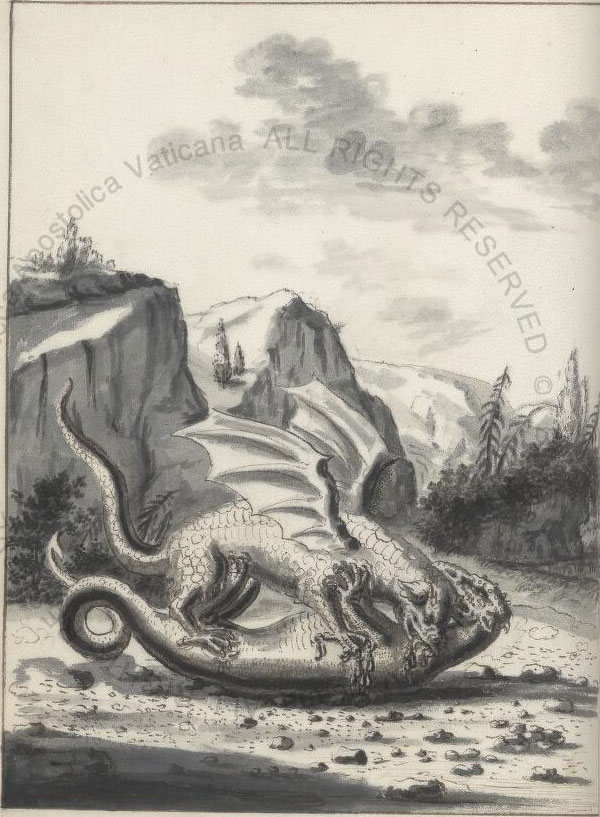
Two Dragons, of yellowish, blue, and black color,
in a field and campus.
Chapter Three
Contemplate well these two dragons, for they are the true principles of philosophy, which the sages have not dared to show to their own children.
He who is below, without wings, is called the fixed one, or the male. He who is above is the volatile one, or the black and obscure female, which for many months will receive domination.
The first is called sulphur, or heat and dryness. The latter is called mercury, or coldness and moisture.
These are the Sun and Moon, the mercurial spring and the sulphurous origin, which, through the continual fire of the king’s garments, are to be adorned in order to conquer; and, being united, afterwards they are changed into a true quintessence, and can overcome every solid, hard, and strong metal.
These are those serpents and dragons which the ancient Egyptians painted in a circular form, with the head biting the tail, to show that they had proceeded from one and the same thing, and that this thing alone is sufficient for itself, and is perfected in its own circulation.
These are those dragons which the ancient poets placed to guard, sleeplessly, the golden apples in the gardens of the Hesperides.
These are those upon which Jason, in the expedition of the Golden Fleece, poured the juice prepared for him by beautiful Medea; and of these the books of the philosophers are so full that there has ever been a philosopher who has not written about this thing: from the truthful Hermes Trismegistus, Orpheus, Pythagoras, Artephius, Morienus, and the others following after me.
These are those two serpents sent and given by Juno, that is, by metallic nature, which mighty Hercules that is, the wise man must strangle in his cradle; that is, he must conquer and kill them, so that, in the beginning of his work, they may be corrupted, crushed, and begotten.
These are the two serpents wrapped around the caduceus and rod of Mercury, by which he exercises his great power and transforms himself as he wishes.
He who shall kill one of them, says Haly, shall also kill the other; for one cannot die without his brother.
These are the ones which Avicenna calls the Corassene bitch and the Armenian dog. If these two are joined together in the vessel of the sepulchre, they bite one another cruelly, and by their great poison and furious rage they never leave one another from the moment when they have seized one another unless the cold prevents it until both, foaming with venom and mortal wounds, have been made bloody through all parts of the body, and at last, killing one another, are suffocated in their own poison, which after their death changes them into living and permanent water.
Before this, they lose through corruption and putrefaction their first natural forms, in order afterwards to take a new, better, and nobler one.
These are those two spermatic substances, masculine and feminine, described at the beginning of my philosophical summary, which are generated, as Rasis, Avicenna, and Abraham the Jew say, in the entrails of the earth, and from their operations are produced the four elements.
These are the radical moisture of metals, sulphur and mercury not the common ones which are sold by merchants and apothecaries, but those which give us those two beautiful and dear bodies which we love so much.
These two spermatic substances, says Democritus, are not found upon the living earth. Avicenna says the same, but adds: “They are gathered from dung, filth, and the rottenness of the Sun and Moon.”
Blessed are those who know how to gather them, because afterwards from them they make a triacle, which has power over every sorrow, sadness, illness, infirmity, and weakness; it fights powerfully against death, lengthens life by God’s permission up to its appointed time, triumphs over the miseries of this world, and loads man with its riches.
Of these two dragons, or metallic principles, I have spoken earlier in my summary, saying that the enemy will kindle his fire, and that, unless one is careful, there will appear in the air a venomous smoke and an evil-smelling flame, worse in smell and poison than the most poisonous serpent and dragon of Babylon.
The reason why I had these two spermatic substances painted for you under the form of dragons is because their stench is very great, like that of their poison. The exhalations which rise from the vessel are dark, black, blue, and yellowish, like those two dragons painted here. And the power of their venom, and of the bodies dissolved, is so poisonous that truly no greater poison is found in the world because by its force and stench it can mortify and kill every living thing.
The philosopher never perceives this stench, unless he breaks his vessels; but he judges and considers it only from the sight and change of colors, arising from the rottenness of his confection.
Therefore these colors signify putrefaction and generation, which is given to us through the mortification and dissolution of our bodies. This dissolution proceeds from external heat, with the help of the Pontic sharpness and the admirable virtue of the burning poison of our Mercury, which resolves and reduces into mere powder indeed, into impalpable powder that which it finds resisting itself.
Thus heat acts upon, and stirs up, the radical moisture of the metals, which the preceding agent had placed in blackness in the subject; because in the same matter it is always dissolved, corrupted, blackened, and prepares itself with them for generation.
For every corruption is generation, and therefore that blackness must always be desired.
And this is that black sail with which the ship of Theseus returned victorious from Crete, and which was the cause of the death of his father. Thus the father must die, so that from the ashes of that phoenix another may be reborn; and the son must be king.
Certainly, he who does not see this blackness at the beginning of his operations, during the days of the Stone, whatever other color he may see, he is plainly wandering from the mastery, and can no longer perfect it in that chaos.
For the operation does not proceed well unless there is putrefaction; because without putrefaction nothing is corrupted, nor generated, and consequently it cannot take the black color that comes from corruption, through which afterwards it must be nourished and multiplied.
Indeed, I tell you again that, even if you have worked upon the true matters, if at the beginning, after you have placed the confections in the philosophical egg that is, after a little time, after the fire has stirred them you do not see the head of the crow, the blackest blackness, you must begin again. For this fault is irreparable and cannot be corrected.
And chiefly there must be fear of an orange or half-red color; for if you see this at the beginning in your egg, without doubt you have burned or consumed the greenness and liveliness of the Stone.
The color which you ought to have must be wholly perfected in the space of this blackness, like that of these dragons, in the space of forty days.
Therefore let those separate themselves in time from those operations who have not found these essential signs, lest they redeem themselves from certain perdition.
Know also that in this art there is little or nothing so important as having this blackness; for it is not easily obtained, because from almost all things in the world, when joined with moisture, blackness comes forth. But you must have a blackness coming from perfect metallic bodies, which remains for a long space of time and is not lost except in the fifth month, and after that there follows the desired whiteness. When you have obtained this, you have much, but not all.
As for the blue and yellowish color, this means that the solution and putrefaction is not yet finished, and that the colors of our Mercury are not yet well mixed and putrefied with the rest.
Therefore this blackness, and these colors, clearly teach that, at the beginning, the matter and the compound begin to putrefy and to be dissolved into a powder finer than the atoms of the Sun, which afterwards are changed into permanent water.
This dissolution is called by the envious philosophers Death, Destruction, and Perdition, because the natures change their form; and from this have arisen so many allegories about the dead, tombs, and sepulchres.
By others it is called Calcination, Denudation, Separation, Trituration, Assation, because the compositions are changed and reduced into the smallest parts.
By others it is called Reduction into the First Matter, Mollification, Extraction, Commixture, Liquefaction, Conversion of the Elements, Subtiliation, Division, Humation, Impastation, Distillation, because the mixtures are liquefied, turned into seed, softened, and circulated in the flask.
By others it is called Putrefaction, Corruption, Cimmerian Shadows, Hell, Dragon, Generation, Ingression, Submersion, Complexion, Conjunction, and Impregnation, because the matter is black and watery, and the natures perfectly mingle and take hold of one another; for, when the heat of the Sun acts upon them, they are first changed into powder, or into a fatty and sticky water, which, receiving heat, flies upward into up to the head of the flask together with the smoke, that is, with the wind and air.
From there this water, extracted and liquefied from the compounds, returns back downward; and, descending, it reduces and dissolves as much of the remaining composition as it can, always acting in this way until all is made like black pitch, a very fat liquid.
Therefore this is called sublimation and volatilization, because it flies up into whiteness; and ascent and descent, because it ascends and descends in the cucurbit.
After some time the water begins to thicken and to coagulate more and more, and it becomes like the blackest pitch; and at last the body and earth appear, which the envious philosophers have called putrid earth. For then, because of the perfect putrefaction, it is natural, just as every other earth is, and breathes forth an odor like that of tombs filled with rottenness, and overloaded with this natural stench.
Hermes called this earth the earth of leaves; nevertheless, its most proper and true name is Laton, which must afterwards be whitened.
The ancient wise Cabalists described this earth in their Metamorphoses under the figure of the serpent of Mars, which had devoured the companions of Cadmus, from whom he himself was killed, being pierced with a lance against a hollow oak.
Note this well.
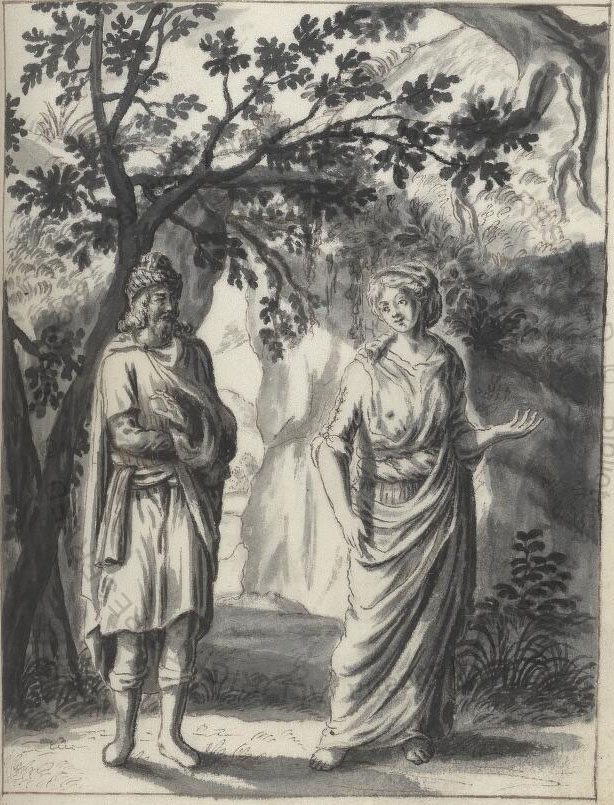
A man and woman clothed in orange robes,
upon a blue and azure field,
and concerning the scrolls.
Chapter Four
This man painted here expressly resembles me, as in life; and the woman naturally represents Perenelle.
There is no particular reason why we were painted so, for it was only necessary to represent male and female, to which our particular likeness was not necessary for the purpose of our work.
But it pleased the sculptor to place them in this way, as he also did above, under the same arch, at the feet of the figures of Saint Paul and Saint Peter, representing us in our youth. And likewise in other places namely, at the door of the chapel of Saint James of the Butchery, near my house, although there he made us both kneeling. And likewise, at the door of Saint Geneviève des Ardents, where you may see me.
Here, therefore, I had two bodies painted for you: one male, the other female, to show you that in this second operation you have two natures: namely, the masculine and the feminine.
I say that these two are perfectly conjoined, and that the one received from the other the beginning of similar conjoining; that is, heat and cold, dry and moist, begin to unite with one another, kindly and lovingly, and, through the mediation of the mediators of peace, gradually lay aside the qualities of the first chaos.
You know well what those mediators are between the hot and the cold, namely the moist; for to both of them it is common and connected: to the hot, namely, by its heat, and to the cold by its moisture.
For this reason, at the beginning, in the preceding operation, you converted all the confections into water through dissolution; afterward you caused the necessary water to coagulate, which was converted into this black, very black earth, in order to complete the whole peace.
For the earth, which is dry and moist, knowing also that it is wholly in agreement and harmony with the dry and the moist, which are enemies, pacifies them and plainly joins them together.
Do you not consider the most perfect mixture of all your elements, when you have first committed it into water, and now into earth? Afterwards I shall teach you other conversions also: into air, when everything has become white, and into fire, when everything has become most perfect purple-red.
Therefore you have here two matters joined together, of which one conceived from the other; and through this conception it has been converted into a masculine body, and the male into the female that is, they have made one single body, which is the androgyne of the ancients, which is also otherwise called the raven’s head and the converted elements.
In this manner I have painted for you here two natures, reconciled, which, if they are wisely ruled and governed, can form an embryo in the womb of the vessel, and afterwards bring forth a most powerful, invincible king.
and incorruptible, because it will be an admirable quintessence.
This is the principal end of this representation, and the more necessary one.
The other reason, which is also very notable, is that I had to paint here two bodies, because in this operation you must divide that which has been coagulated, in order afterward to provide one nourishment, one milk of life, to the little infant newly born, endowed by the living God with a vegetative soul.
This is a most wondrous and admirable secret, and perhaps, of all secrets, the easiest; but it will not be believed, and the wise will not show it to anyone unless he understands it, and has been made wise; and every man will be useful who contemplates a body like this, and this soul.
You must therefore cause two parts and portions of this coagulated body to be made: one of them will serve as Azoth, to wash and cleanse; the other, which is called Laton, or brass, must be whitened.
That which washes is the serpent Python, which, having taken its origin from the corruption of the slime of the earth from the flood of waters collected together, when all the confections were water must be killed and pierced by the arrows of the god Apollo, by the golden rays of the Sun, that is, by our fire, equal to the Sun.
That which washes, or rather these washings which must be continued with the other half, are the teeth of that serpent which the wise operator, the valiant Theseus, will sow in the same earth, from which soldiers will be born, who at last will destroy themselves, and will be resolved, by opposition, into the same nature of earth, leaving behind the deserved victories.
Concerning this, the writers have written so many times, and have repeated so many times:
Dissolve it by itself; coagulate it; it grows black; it grows white; it kills itself and gives itself life.
I took care to paint their field yellowish and blue, in order to show that now it begins to go out from the blackest blackness. For the yellowish-white color signifies that which shows us generation and life; and that the woman is black and obscure signifies that there is still some humidity, yielding to heat and dryness.
The man and woman are, for the greater part, of orange color, which signifies that our bodies or our body, which the sages in this place call Rebis do not yet have sufficient digestion, and that the moisture from which black, blue, and yellowish come is not yet fully overcome by dryness.
For dryness, predominating over all things, will be white; but when it has fought against humidity, it will itself be yellowish, as almost all things are according to these present colors.
Therefore you must cause the mixtures, in this generation, to be whitened. For Hermes says:
“Azoth and the fire wash Laton, and remove its obscurity.”
And in the same way:
“Whiten Laton, and break your books, lest your hearts be broken.”
For this is the composition of the whole work, etc., which must be whitened.
The woman has a white girdle, in the form of a scroll, around her body, to show that Rebis will begin to be whitened in the same way, acquiring the first whiteness in the circular form of this white girdle.
Scala Philosophorum - Senior the philosopher says:
“The sign of the first perfect whiteness is when you see a certain little circle of hair passing over the head, which appears around the matter, of a citrine/yellowish color. At the side of the vessel it is written in their scrolls:
“Man shall come to the judgment of God.”
And truly, as the woman says, “That day will be terrible.”
These are not words from Sacred Scripture, but at least they are set down according to the theological sense of the Last Judgment and the resurrection. For this reason I wished to put them there, so that they might serve to guard those who contemplate only the rough and more natural judgment, receiving the interpretation of the Resurrection; and likewise that they might serve those who, wishing to gather the parables of this science, are accustomed with the lynx-like eyes of contemplation to pass beyond visible objects to invisible things.
Man shall come to the judgment of God.
That is: it is necessary for this to come to perfect whiteness, so that it may be judged and purged from blackness and impurities, whitened and spiritualized.
That day will be terrible.
For then you will find, in the allegory of Aristotle:
“Horror possesses us, captives held in darkness and in the chains of nights, in the deepest heat of the sea and in the thickest darkness.”
All these things must pass before our King can be whitened, receiving life from death, so as to conquer all these enemies.
In order that I may still better teach you this whitening, which is a more difficult thing than all the rest, until you have gone astray from every path and afterwards have returned to the right road, I shall also give you this following tablet.
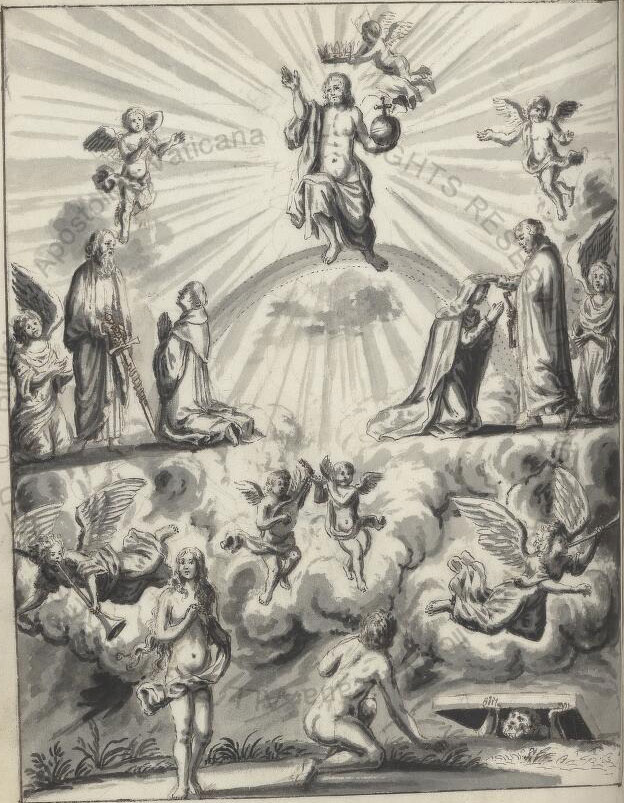
Figure of a man resembling Saint Paul,
clothed in a white and yellowish robe, with a golden border,
holding a naked sword;
at whose feet is a man kneeling, dressed in an orange-black-white robe,
holding a scroll.
Chapter Five
Observe well this man under the form of Saint Paul, clothed in a wholly white and yellowish robe. If you consider him carefully, he is turning his body in such a way that he seems to wish to seize the naked sword, either to cut off the head of this man, or to cut off some other thing from this man, who is kneeling at his feet, dressed in an orange, white, and black robe, and saying in his scroll:
“Blot out the evils which I have done.”
These words are to be understood according to the blackness. The term of the art is malum, because “evil” signifies blackness; and so you will often find in books the word malum taken for blackness, since blackness is regarded as evil.
But you must know what this man signifies, who receives the sword. I say, with the head to be cut off, namely of this man dressed in various colors and kneeling.
I have taken this figure from the book of Abraham, who is also painted with a figure like that of Hermes Trismegistus, beside a little old man who wishes to cut off his head. And there it is written:
“Cut off the head of the black man; cut off the head of the crow,”
which signifies, whiten our Laton. For the man has already previously used that [image] in these common hieroglyphic figures, saying:
“And in this grove there is a certain animal, wholly covered with blackness, whose head you must cut off. Then, when the blackness has disappeared, it puts on a most shining white color.”
It pleases me to make you understand what this blackness is called. It is called the head of the crow; when it has been taken away, at once the white color appears. Therefore, when clouds appear no more, this body will be called headless.
These are the proper words themselves. The same sense is also contained in the saying of the sages, when they say:
“Rejoice, when you see the king without a head.”
For this is when that blackness itself is cut off from him. They have also used the same circumlocution when, in order to signify the multiplication of the Stone, they invented the serpent Hydra, to whom, when one head was cut off, ten others were reborn.
For the Stone increases by its own powers up to ten, when the head of the crow is once cut off; when this blackness is destroyed and whitened, that is, when it is transformed into a new body.
Look, because the naked sword is surrounded by a black girdle, whose extremities do not entirely encircle it. This naked, shining sword is the Stone in whiteness, often described by the philosophers under this form.
Therefore, to arrive at this perfect and shining whiteness, you must understand the intertwinings of this black girdle, and follow that which is contained in the writing: that is, the quantity of imbibitions.
The two ends which partly surround the sword denote the beginning and the end. One must begin gently and sparingly, and afterwards proceed little by little, with the milk, as with the little infant newly born; lest its fire, as the authors say, be drowned.
Likewise one must act, continuing toward the end, when we see that our King is now sated and unwilling to drink, and no longer wishing to appear. The middle space, in these operations, is described by the five complete circuits or revolutions; namely, when our salamander lives by the fire, is nourished by the fire, and dwells in the midst of the fire or rather, it is fire itself and silver quicksilver, running through the midst of the fire, fearing nothing, must be given to it abundantly, so that it may encircle the whole matter virginally.
I have taken care to paint the black windings of the girdle, which are the imbibitions and, consequently, the blackenings; for fire joined with its proper moistness, as often as it is twofold, generates blackness. And since these five complete dissolutions show five times that this must plainly be done, you must understand that this ought to take place through five complete months, one month being assigned to each imbibition.
Therefore Haly Abenragel says:
“The cooking of things is perfected in three times fifty days.”
Certainly, if you count these few imbibitions, the beginning and the end, there will be seven; wherefore one of the most envious said:
“The head of our crow is leprous; therefore, whoever wishes to purge it must cause it to be submerged seven times in the Jordan, or in the river of regeneration, as the prophet commanded the leprous Naaman, the Syrian.”
By this he meant the beginning, which is not to be reckoned here, but is called the middle and the end; and this is also very short.
Therefore I have given you this tablet, to show that you must whiten my body, which, being bent on the knees, asks for nothing else.
For Nature always tends toward perfection; and you will accomplish this by the application of the virginal milk, and by the decoction of the matters with this milk, which, when dried upon this body, colors it with this same white-yellowish color, which is the color of the one who receives the sword. Into this color you must bring your body.
The garments of the figure of Saint Paul are richly lined, toward the border, with a golden and reddish-yellow color.
O son, praise God if you ever see this! For now you have obtained mercy from Heaven.
Then imbibe until the little infant is strong and robust, able to fight against water and fire. For when you have done this, you will do what Demagoras, Senior, and Haly call “putting the mother into the belly of the infant whom she had already borne.”
For they call the mother the Mercury of the philosophers, from which they make the imbibitions and fermentations; and the infant they call the body, in order to whiten it, to which that Mercury was given birth.
I have therefore given you these two figures to signify whitening. And you must need this place greatly; for here all have erred.
This operation is a labyrinth, because at one and the same time a thousand windings present themselves, and because one must proceed in an entirely contrary way from that in which the work had begun: namely, by coagulating what you previously dissolved, and by making earth from what was previously water.
When you have whitened it, you have overcome the enchanted bulls that breathed fire and smoke from their nostrils. Hercules cleansed the stable full of filth, rottenness, and blackness. Jason poured the juice upon the dragons of Colchis, and you have in your power the horn of Amalthea, which, although it is white, can fill you, all the time of your life, with glory, honor, and riches.
In order to obtain this, you must fight with the courage and in the manner of Hercules; for this Achelous, this moist river, which is blackness, and more powerful than virgins, must be overcome by you, since it will often change from one form into another, and even then you will have already perfected it; for the rest is without difficulty.
These transfigurations are particularly described in the Book of the Seven Egyptian Seals, where it is said, as also by all the authors, that before the Moon was taken away from the hand, there will be blackness; and then it will be whitened by force of the whitest marble; and the whole fulness will follow, and so forth.
Care, therefore, by these contraries, that is, by coagulating and liquefying all the bodies which you can imagine, often from themselves, often coagulating them; you shall labour among these diverse and contrary operations, which at the same time the vegetative soul, which is within them, makes to be yellowish, green, white, and red. But you must only intend the perfect whiteness of Saint Paul’s garment; and do not cease to boil and wash with the water, until these infinite colors are ended in an admirable citrine whiteness, like the garment of Saint Paul, which will in a short time become like the color of the naked sword.
Afterwards, through stronger and longer cooking, it will at last acquire the reddish-citrine color, and afterwards the perfect red color of the crimson lacquer, where it will rest in repose.
Note this well.
Do not forget here, in passing, that I warn you that the Moon does not have its original light here. Observe, therefore, the whitening imbibitions; for there is the greater difficulty. “Let Diana be crowned with the doves of Venus.” For in this place itself you would think you were going astray, and certainly Abraham the Jew would not have gone astray.
Therefore I have taken care to paint for you the figure that whitens: the naked sword, shining, with that color which is necessary. And this also is the figure which whitens.
In a green field, three men rising again and one woman,
perfectly white; above them, two angels,
and above those, the figure of the Savior coming to judge the world;
clothed in a perfectly yellowish-white robe.
Chapter Six
I took care to paint the field green, because in this decoction the mixtures become green and long preserve this color more than any other after the black. The greenness here particularly shows that our Stone has a vegetative soul, by which it was foretold, and which, by the industry of the art, has been converted into a true and pure germ, to germinate abundantly and, consequently, to produce infinite shoots.
O happy greenness! says the Rosary, which brings forth all things from itself, and causes them to sprout, grow, and multiply.
The three resurrected persons, clothed in shining whiteness, represent the Body, Soul, and Spirit of our white Stone. The philosophers usually use these terms in a figurative way, to hide the secret from the wicked.
They call the black, obscure, and dark earth, which we whiten, Body. They call Soul the other half divided from the body, which, by the will and power of God and Nature, gives to the body, through imbibitions and fermentations, a vegetative soul that is, the power to bud, grow, multiply, and whiten itself like a naked shining sword.
They call Spirit the tincturing and drying virtue, which, like a spirit, has power to penetrate all metallic things.
It would be too long if I should show you by what reasons they say this. Our Stone has, like a man’s body, soul and spirit. I wish only that you know that, just as a man endowed with soul, body, and spirit is nevertheless only one thing, so also you now have only one white confection, in which nevertheless are body, soul, and spirit, inseparably joined together.
After this, you can add the most powerful comparisons and explanations of body, soul, and spirit. But for the explanation of these things, those whom God has chosen to reveal them to may speak, those who fear and love Him, and who have lived in charity.
Here, therefore, I have had painted Body, Soul, and Spirit, all white, as if rising again, to show that the Sun, Moon, and Mercury have been raised again in this operation that is, they have been made aerial and whitened elements.
For before this we called blackness death, and, continuing the metaphor, we may afterwards call whiteness life, which does not come except in and through resurrection.
And just as I have shown to you two bodies above, I had painted here a body raising the stone of its sepulchre, in which it was enclosed. The soul, which could not be buried, unless it rose from the tomb, I therefore had painted around the sepulchre under the form of a woman with loosened hair. The spirit, which likewise cannot be buried, I had painted under the form of a man coming forth from the earth, also white.
All these are white: the blackness has been conquered, and they are afterwards incorruptible.
Now raise your eyes upward and look upon our King, coming, crowned and risen, above the clouds, having conquered darkness and humidity. Look upon him under the form of the Savior coming to judge the age/world, when He will join to Himself all pure and clean souls, driving away every unclean and impure thing, unlike the indignity of the chimerical figure of Capricorn.
And although I ask pardon for this kind of comparison from the holy Catholic and Apostolic Roman Church, and beg every faithful soul, nevertheless it will be necessary for me to say this through the continuation of our elixir:
You have here our white elixir, which will henceforth inseparably join to itself every pure metallic nature, transforming it into its own most pure, most argentine nature, rejecting the impure, foreign, and heterogeneous nature.
Blessed be God, who gives us this grace out of His great goodness, when we consider the sparkling and perfect whiteness, more shining than every compounded nature; and after the immortal soul, nobler than every other thing, whether animate or inanimate.
For this is that virginal milk, and our first silver, of which King David the Prophet says: “as white as snow,” purified and cleansed.
There is no need to interpret what the two angels signify, playing musical instruments above the heads of those who have risen again. For they are rather the spirits of God, singing the wonders of God in this miraculous operation, than the trumpeting angels who summon us to judgment.
For this reason, so that the difference might appear, I gave one a lute, and the other a shawm/trumpet; I did not give them trumpets, by which they are commonly depicted calling to judgment.
Likewise, to show that this is one of the three angels who are above the head of the whitened one, our King, of whom one crowns him, while the other two, standing beside him, say in their scrolls:
“O Almighty Father! O good Jesus!”
They attribute to him eternal thanks.
In a violet and blue field,
two angels of yellowish color,
and concerning their scrolls.
Chapter Seven
This violet and blue field means that, wishing to pass from the white Stone to the red, you must imbibe with a little new virginal milk of the Sun; so that these colors may come from the moisture of Mercury, which you had dried upon the Stone.
In this operation of rubefaction, although you imbibe, there is only a little blackness, but rather violet, blue, and the color of the peacock’s tail.
For our Stone is so triumphant in dryness that, as soon as Mercury touches it, by the nature of itself it rejoices, joins itself to it, and drinks it in greedily.
Therefore the blackness which comes from moisture cannot show itself except a little under these colors, violet and blue; because dryness, as has been said, will now dominate equally.
I had these two angels painted with wings, in order to show the two substances of your confections: the mercurial and the sulphurous, fixed equally with the volatile. After they have been made together in the same mixture, they fly together also into your vessel.
For in this operation the body is made wholly airy and spiritual, and from there it ascends into the air; and here it follows the spirit, which is always moved upon the fire. For they have been made of one and the same nature, a wholly spiritual compound, and a spiritual thing wholly corporeal, which, by the preceding operations, has been sublimated upon our marble.
Therefore they are changed into angels, that is, they are made spiritual and most subtle. For now they are true tinctures.
Therefore remember to begin the rubefaction by the application of yellowish-red Mercury; but a little is enough, and it is fitting that it be done only once or twice, with prior operations.
For this operation must be performed with dry fire, with dry sublimation, and with dry calcination.
Here you have a secret which I never found written down. God has granted it to me, though it is nevertheless suited to every wise man. May God grant that each man may know how to make gold at his own discretion; so that he may live this life in such a way, feeding a fat flock, and using the books and usury of the philosophers in imitation of the holy patriarchs, that he may know only that he was permitted by the first authors to labor on this thing by the divine command; so that each man may work equally as we do now. But each man must fear God, and let him not be an instrument of his abuse; for perhaps, because of wicked men, it would not be fitting to represent or write this except in obscure terms, although it is plainly enough clear to those to whom God will wish to reveal the secrets of Nature and bring forth the earth from its hidden depths.
It is enough to show this much, which will be of use to everyone to whom God grants knowledge of it, when he has at hand, as his own, the sign of Libra, illuminated by the Sun and Mercury in the month of October.
Here the angels are painted for you in orange color, so that you may know that your white compositions have been a little more digested and boiled than the preceding whiteness, and that the blackness of the violet and blue color has already been driven away from them by the fire.
For this orange color is composed from a beautiful golden citrine, which has already been expected for a long time, and from a certain remainder of violet and blue, which you have already partly destroyed. This orange color shows more fully that the natures are being digested, and little by little are being perfected by the grace of God.
You have in their scroll:
“Arise, ye dead, and come to the judgment of my Lord.”
I have wished rather to put this with regard to the theological sense than with regard to the other.
It ends in the mouth of the lion, very red, which was done to show that this generation must not be interrupted until the true purple-red appears, like the color of lacquer, and like the paint of the red lion except for multiplying it.
Figure of a man resembling Saint Peter,
clothed in a reddish-yellow robe,
holding a key in his right hand,
placing his left hand upon a woman kneeling at his feet,
clothed in an orange robe, holding a scroll.
Chapter Eight
Look upon this woman, clothed in an orange robe, resembling Perenelle in life, as she is pictured ad vivum, as though praying, with knees bent and joined hands, at the feet of a man holding a key in his right hand, who graciously listens to her and consequently extends his left hand over her.
You must know what this signifies. It is the Stone, asking in this operation two things from the mercurial Sun of the philosophers, by inward supplication: namely, multiplication, and a richer ornament, which it ought to obtain at the appointed time.
Likewise, this man, laying his hand upon her, grants this to her.
But why did I have a woman painted for you? I could indeed have had a man or an angel made, just as I did for the woman; but because now the natures have been spiritualized and made bodies masculine and feminine, I preferred here to represent a woman, so that you may judge that she asks these things rather than anything else, because these are more proper and natural to a woman.
Moreover, to show you that she asks for this multiplication, I had painted for you a man to whom Saint Peter is similar in form, holding a key, having the power of opening and closing, of binding and loosening.
The envious philosophers have never spoken of multiplication except under these common terms of the art:
Open. Close. Loosen. Bind.
They have said that to open and loosen is to make the body which is always hard and fixed soft, fluid, and flowing like water. To close and bind is, by stronger decoction, afterwards to coagulate it, and to bring it back again into the form of a body.
Therefore I have had painted for you here a man holding a key, to teach you that you must now open and close that is, multiply the germinating and growing natures.
For as often as you dissolve and fix, so often these natures will grow in quantity, quality, and virtue, and will be multiplied by ten, according to this number; so that, by this multiplication, they come first to ten, from this number to a hundred, from a hundred to a thousand, from a thousand to ten thousand, from ten thousand to a hundred thousand, from a hundred thousand to a million, and thus by the same operation onward without end. I have myself performed it three times. Praise be to God.
And when in this way your Elixir has been brought to infinity, one grain of it, falling upon a quantity of molten metal, deep and vast like the ocean, will tinge and convert it into the most perfect metal that is, into silver or gold, according as it has been imbibed or fermented driving away and forcefully expelling far from itself every impure, foreign matter, in the first coagulation (having been consumed in the first coagulation).
For the same reason, I had the man given a key, who is seen stretching out his hand. This signifies that the Stone asks to be opened and closed for multiplication.
For the same reason also, to show you that you must have compassion for the woman, when I gave the man a citrine-red garment, I gave the woman an orange-red one.
This was so that we should not go beyond the silence of Pythagoras.
And to signify the woman that is, our Stone asking for an ornament and color, the scroll of Saint Peter bears this inscription:
“Christ, spare us, we beseech thee.”
As if he were saying:
“Lord, be merciful to me, and do not allow him who has come this far to destroy all things by too much fire.”
It is true that hereafter I will no longer fear the enemies, and every fire will be almost equal for me; yet the vessel which contains it is always fragile. For it will break if it is heated excessively, and in breaking it will unhappily scatter me through the ashes.
Therefore consider your fire well, ruling it gently and with patience in this admirable quintessence. Open it, therefore, with fire yet with a kind of fire, but not too much.
And pray to the supreme Goodness that He not permit the wicked spirits, who guard the mines and treasures, to destroy your operation and bewitch your sight when you consider these in the present state of your natures and essences in this vessel.
In a violet and dark field,
a man with red-purple robes,
holding the foot of a winged lion,
of red lacquer color,
which appears to seize and carry off the man.
Chapter Nine
This violet and dark field declares that the Stone, through an entire decoction, has obtained the most beautiful garments, wholly citrine-red, which it had asked from Saint Peter, who is clothed with such a garment.
Because, after its perfect digestion signified by the complete citrinity it has left behind the old orange robe.
The red color of the winged lion, like pure and clear scarlet, or like the red grains of the pomegranate, shows that it is now perfected in all rectitude and equality.
It is like a lion devouring every metallic nature, and converting it into its own true substance, finer than pure gold itself, and purer than the purest mineral.
For it snatches man away from the valley of miseries that is, from the inconveniences of poverty and infirmities and raises him, with its wings, into glory, beyond the waters of Egypt, which are the common thoughts of mortals; making him despise the present life and riches, and meditate day and night on God and His saints, to dwell in the kingdom of Heaven, to drink the sweet waters of the fountains of Hope.
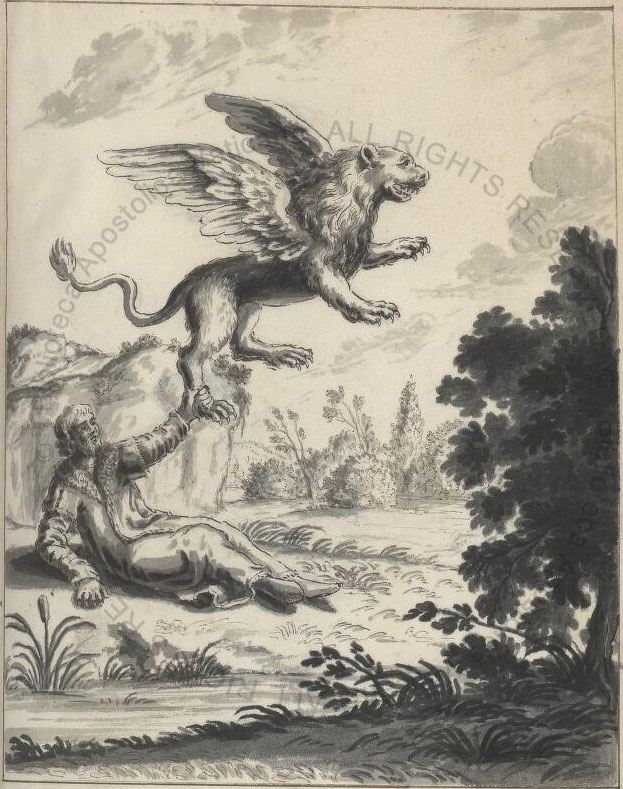
Praise be to God forever, who has given us grace to see this beautiful and wholly perfect purple color, this beautiful poppy-red color of the wild rock, this sparkling and gleaming Tyrian color, immune from change and alteration.
Into this color neither heaven itself nor the zodiac can obtain dominion or power; and the shining and dazzling splendor of its rays seems to communicate to man something celestial and to make him, when he contemplates and knows it, astonished, trembling, and quaking at the same time.
Lord, grant us grace, that we may use it well for the propagation of faith, for the benefit of our souls, and for the increase of the glory of Thy noble kingdom. Amen.
The End.