Book of Judgements or: Introduction - Liber introductorius
Listen Audio Book Study the Art with Us Buy me CoffeeHere begins the Introduction concerning the principles of judgments of Zahel the Ishmaelite.
Book of Judgements or: Introduction - Liber introductorius - Kitāb al-Aḥkām, Ch. 1
Written by Sahl ibn Bišr (Zahel)
Transcribed by: Lenka Jiroušková.
Transcribed from: Sahl ibn Bišr (Zahel), Introductorium de principiis iudiciorum, in: Ptolemy, Quadripartitum (Venice, 1519), ff. 111va–114rb.
Concerning the division of the signs and the triplicities. Chapter 1.
In the name of the pious and merciful God. Zahel, son of Ismael, said: Know that the signs are twelve, and of these six are masculine and six feminine. Aries, therefore, is a masculine sign among the signs of the day, and Taurus a feminine one among the signs of the night; and likewise a feminine succeeds a masculine, and a masculine a feminine, until the end of the signs.
And of these signs, six are directly ascending, that is, having a direct ascension; and six are tortuously ascending, that is, having a winding or crooked ascension. The directly ascending signs are from the beginning of Cancer to the end of Sagittarius, because the latitude of each of them is greater than its longitude, and they ascend in more than two equal hours; for this reason they are called directly ascending. The tortuously ascending signs are from the beginning of Capricorn to the end of Gemini, because the latitude of each of them is less than its longitude, and they ascend in less than two equal hours; for this reason they are called tortuously ascending.
And of these, four are called movable, namely Aries, Cancer, Libra, and Capricorn; and they are called movable because when the Sun enters the beginnings of those signs, the season is changed into the substance of the following season.
And four of them are fixed, namely Taurus, Leo, Scorpio, and Aquarius; and therefore they are called fixed, because when the Sun enters their degrees, the season is fixed in its state and does not change that is, if it was hot, it will be hot; if cold, it will be cold; if it was spring, it will be spring; and if it was autumn, it will be autumn.
And four of them are common, which in Arabic are called deue, and in Greek deyn, that is, “of two bodies”; these are Gemini, Virgo, Sagittarius, and Pisces. They are called common because when the Sun reaches their middle, the season is mixed, and the first half becomes hot and the other cold, or the first half cold and the other hot.
And some of them are called quadrupedal, namely Aries, Taurus, Leo, Capricorn, and the end of Sagittarius.
There are also among the signs some that are fiery, namely Aries, Leo, and Sagittarius; and this is the first triplicity. The second triplicity is earthy, and it signifies whatever is in the earth and is born from the earth, namely Taurus, Virgo, and Capricorn. The third triplicity is airy, and it signifies men and winds and whatever is in the air, namely Gemini, Libra, and Aquarius. The fourth is watery, and it signifies waters and whatever is in waters, namely Cancer, Scorpio, and Pisces.
And some of the signs are called dark, namely Libra and Capricorn. And there is a certain place in the signs which is called the burned place, and it is the end of Libra and the beginning of Scorpio.
And some of the signs have a half voice, namely Virgo, Capricorn, and Aquarius. And some of them have voices, namely Taurus, Aries, Gemini, Leo, Libra, and Sagittarius. And some of them do not have voices, namely Cancer, Scorpio, and Pisces.
And some are half or common in the generation of children, that is, they are neither entirely generative nor entirely sterile, namely Taurus, Gemini, and Aquarius. Some have many children, namely Cancer, Scorpio, and Pisces. Others, however, are sterile, namely Aries, Leo, Virgo, Libra, Sagittarius, and Capricorn.
And some of them signify mountains and rough places, namely Aries, Leo, and Sagittarius. And some signify habitable and flat places, that is, fields and cultivated lands, namely Taurus, Virgo, and Capricorn. Others signify sandy places, namely Gemini, Libra, and Aquarius. Others also signify moist and watery places, or those that are near water, namely Cancer, Scorpio, and Pisces.
Therefore, the fiery signs signify fire and every substance that pertains to it or is produced by it, and they signify nobles. The signs of seed signify the earth and everything that is raised up from the earth. The watery signs likewise signify moist places and every work that is done from moisture. And the signs that generate many children signify gatherings of men.
The triplicity of Aries, therefore, is hot and dry; from the humors it has red choler; and from the parts of the world, the East. The lords of this triplicity are the Sun by day and Jupiter by night, and their participant by day and by night is Saturn.
The triplicity of Taurus is cold and dry; from the humors, black choler; and from the parts of the world, the South. Its lords are Venus by day and the Moon by night, and their participant by day and by night is Mars.
The triplicity of Gemini is hot and moist; and from the humors, blood; and from the parts of the world, the West. The lords of this triplicity are Saturn by day and Mercury by night, and their participant by day and by night is Jupiter.
The triplicity of Cancer is cold and moist; from the humors, phlegm; from the parts of the world, the North. The lords of this triplicity are Venus by day and Mars by night, and their participant by day and by night is the Moon.
Chapter on the substances of the twelve signs, and what each sign signifies.
Know that for every interrogation or thing sought, we find a signification by which whatever good or evil may be present in that interrogation is signified, according to the methods which the sages have set forth concerning the signification of questions and of things from the substances of the twelve signs and from the natures of the seven planets, and from the places from which matters are taken just as the planets have their natures and significations which, God willing, we intend to recount.
¶ The First House of the Ascendant, and all that is in it, concerning interrogations and other matters from the twelve signs.
The first house, whose beginning rises or ascends in the East at the hour of the interrogation or of the nativity, or of the inception of any work, signifies life and death, because it is the ascendant of that life by which its life comes into the world when it goes forth from the womb of its mother. For this sign ascends from the lower part of the earth to its upper regions, and as it were from darkness into light; and likewise the one born came forth from the darkness of the womb into the light of this world, and from the narrowness of the womb into the breadth of the air. And the questioner reveals his interrogation from the secret of his heart; it shines forth and is laid open, which before was hidden. Therefore it signifies the body and life and every beginning and the movement of the body, and whatever comes from any accident, and the commencement or outcome of every thing, and everything movable, whether rational or otherwise, and the beginnings of all things.
¶ Concerning the Second House.
The second house, which does not behold the ascending sign, signifies the gathering of substance, the maintenance of life, the condition of servants, receipts and gifts.
¶ Concerning the Third House.
The third house is not entirely cadent from the ascendant; it signifies brothers and sisters, relatives and kinsfolk and their condition, patience also and counsel, faith and religion, disputes in sects, letters, embassies and envoys, journeys, and dreams.
¶ Concerning the Fourth House.
The fourth house is called the angle of the earth; it signifies fathers and their condition that is, origin and root lineage and prisons, lands and fields, villages and cities, every building and every roof and hidden thing, hidden treasures, death, and what will occur after death, namely what happens to the dead person: concerning burial, whether the dead is dug up or burned, or placed on a gibbet, or cast out in some place, and other things that happen to the dead. It also signifies their end, and houses and lands, that is, inheritances, and everything that is buried beneath the earth.
¶ Concerning the Fifth House.
The fifth house follows the angle of the earth and is the place of love, because it belongs to the triplicity and joy of the ascendant; and it signifies children and everything in which there is trust, envoys and gifts, honor and the seeking of women, friendships and friends, cities and the condition of their citizens, and the fruits of inheritance.
¶ Concerning the Sixth House.
The sixth house is cadent from the ascendant and does not behold it; it is a malignant place and signifies illnesses, both separable and inseparable, the causes of illnesses, servants and maidservants, injustices, and changes from place to place.
¶ Concerning the Seventh House.
The seventh house is the western angle; it signifies marriages and their affairs, battles and disputes, oppositions and agreements made between two parties, also the one who seeks and the one sought such as a fugitive or a thief and things lost and other similar matters; journeys and losses of goods and their causes. This sign is hostile to the ascendant, and every planet that is in it is opposed to the ascendant.
¶ Concerning the Eighth House.
The eighth house follows the western angle and signifies death, killing, deadly poisons, fear, inheritances from the dead, everything that has perished, toil and sorrow, wars and disputes, attendants or helpers of adversaries or of litigants, things entrusted for safekeeping, stewardship, slothfulness, and dispositions.
¶ Concerning the Ninth House.
The ninth house is cadent from the ascendant and signifies journeys and travels, the worship of the deity, all houses of religion, philosophy and foreknowledge of all things, the wisdom of the stars, divinations, letters, envoys and embassies, rumors, dreams, faith, divine wisdom, holiness and religion, all past and departing things, a man removed from his honor or office, matters of the world to come, and foreknowledge of future things.
¶ Concerning the Tenth House.
The tenth house is called the angle of heaven; it signifies the king or kingdom, exaltation and authority, glory and remembrance, the voice of praise, mothers, stolen or taken substance, judges, princes and overseers of works, and every mastery or profession.
¶ Concerning the Eleventh House.
The eleventh house follows the angle of heaven and signifies friends, trust and good fortune, the substance of the king and his revenues or tributes, his soldiers and attendants, the man who succeeds the king or chief ruler, and it signifies praise and children.
¶ Concerning the Twelfth House.
The twelfth house is cadent from the ascendant and does not behold it; it signifies enemies and labors, lamentations and sorrows, whisperings, deceit, envy and heated malevolence, journeys, wickedness, toil, prisons, and beasts.
Concerning the division of the circle and the dignities or strengths of the houses.
The places of the circle that are more dignified than all others and more praiseworthy, succeeding one another equally in strength, are distinguished as follows. The circle is divided into twelve signs, of which four are called angles, namely the ascending sign, the fourth, the seventh, and the tenth. These signs are like the angles of the heavens and signify whatever is present among things, that is, the presence of matters and strength in every affair.
And of these, four are called succeeding or following the angles, that is, those rising after them, namely the second, fifth, eighth, and eleventh. These signify everything that is to come, and whatever exists and follows from matters. And the remaining four are called cadent from the angles, which have withdrawn and fallen away from the angles; these are the third, sixth, ninth, and twelfth. These signify whatever has withdrawn and departed from matters by the will of God.
Of the strength of the places of the circle.
The strongest of all places of the circle is the ascendant, and this sign is more dignified than all the other signs; and the planet that is in it is stronger than all other planets, especially if that planet is in its own house, or in its exaltation, or triplicity, or term, or face. Next in strength follows the angle of heaven; then follows the western angle, that is, the seventh from the ascendant; then follows the angle of the earth, that is, the fourth from the ascendant.
After these, in strength, follows the eleventh house from the ascendant; after it, the fifth house; then the ninth. These seven places are more praiseworthy and stronger: the first place is better than the second, the second better than the third, and so on. And after these, choice is made from the signs that are recognized as good.
The third sign from the ascendant is chosen because it is the place of the joy of the Moon. Next comes the second place from the ascendant, because it rises after the ascendant.
But in the eighth sign from the ascendant there is impediment and great misfortune, because it is the house of death, and it does not behold the ascendant. The remaining signs of the circle, namely the sixth and the twelfth, are worse than all the other places and the most harmful; and every planet that is in these places will be of no benefit.
For the sixth sign from the ascendant is the place of infirmities and defects and of all diseases, separable and inseparable; it is cadent from the ascendant and does not behold it, and it is the place of the joy of Mars. And the twelfth from the ascendant is the place of enemies, toil, and sorrow; it is cadent from the ascendant and does not behold it, and it is the place of the joy of Saturn. For Saturn delights in lamentation, mourning, and tribulation.
And note that every sign beholds the third before it and the third after it, which is the eleventh; and this aspect is called sextile, because it holds the sixth part of the circle, that is, 60 degrees of the 360 degrees of the whole circle.
Likewise, a planet that is in the beginning of Aries beholds the one that is in Gemini before it, and the one that is in Aquarius after it. It also beholds the fourth before it and the fourth after it, which is the tenth; and this aspect is called the square, because it holds the fourth part of the circle, that is, 90 degrees.
It also beholds the fifth before it and the fifth after it, which is the ninth; and this aspect is called the trine, because it holds the third part of the circle, that is, 120 degrees. It also beholds the seventh by opposition; and this aspect is one of enmity. And if planets are in these signs, they are said to behold one another.
Concerning the aspects of the planets.
These are the aspects of the planets: conjunction, sextile, square, trine, and opposition. Conjunction is when two planets are joined in one sign, and there are twelve degrees between them or fewer; this is the limit of conjunction.
The sextile aspect is from the third sign and from the eleventh. The square aspect is from the fourth sign and the tenth. The trine aspect is from the fifth sign and the ninth. The opposing aspect is from the seventh sign.
Therefore, among these aspects, conjunction and opposition are the stronger; and these are of the strongest operation and of enmity, and they signify enemies who openly cause harm, and they signify contrarieties and participations. The square aspect is intermediate, that is, it does not fully reveal enmities.
And the second sextile aspect, that is, the one that occurs from the eleventh, is stronger than the first sextile aspect. And the second square aspect, that is, the one that occurs from the tenth, is stronger than the first square aspect. And among the trine aspects, the ninth house that is, the second trine is stronger than the first trine; and this aspect is called elevation, that is, higher.
The signs that do not behold one another, nor does any planet in them behold another, are these: the second, sixth, eighth, and twelfth signs. All the others, however, behold one another.
Concerning the effect and detriment of the planets.
Know that everything which the stars signify as to be done or not to be done happens in sixteen ways. These are called in Arabic alīchal, which in Latin means profectus (advancement or effect).
Alidber, that is deterioration.
Alctisal, that is conjunction.
Alinciraf, that is separation or disjunction of the planets from their conjunction.
Annael, that is translation.
Algenmee, that is gathering or collection, which is the better rendering.
Almane, that is restraint or prohibition.
Alcobol, that is reception.
Baiaralcobol, that is non-reception.
Balaacen, that is evacuation of course.
Airchad, that is return.
Dapha alchia, that is the striking of power.
Dapha aredir, that is the striking of dispersion and of nature.
Alcdetih, that is power or strength.
Adof, that is weakness.
Uvanuelhalcamar, that is the state of the Moon.
Explanation of alīchal (advancement)
Alīchal is when planets are in an angle or in a house succeeding an angle.
Alidber is when a planet is cadent from the angles.
Alictisal is when a light and swift planet seeks conjunction with another planet that is slower and heavier; and if the lighter planet has fewer degrees than the slower one, and continues moving toward it until it joins it, and is in such a degree by aspect. Mutatil that is, joined or glued together is the name given until it is separated from it by the space of one degree; then it is called inuersarif, that is, it is separated from it.
But if planets are joined in one sign, a planet is not said to be separated from the other until it has passed it by the space of half its orb, that is, of its light. For each planet has an orb of light and particular parts, and half of those parts are before the planet and the other half after it; when a planet has passed another through that space, it is then called separated from it.
The doctrine of the lights or orbs of the planets.
Know that the orb of light of the Sun is thirty degrees, of which half is before it namely fifteen degrees before the Sun and fifteen degrees behind. And when there are between the Sun and any planet degrees from one up to fifteen, then it casts its light upon it and is joined to it.
The light of the Moon is twelve degrees before and twelve behind. The light of Venus and Mercury each of them is seven degrees before and seven behind. By this quantity of light planets are joined to one another. The light of Saturn and Jupiter each of them is nine degrees before and nine behind. The light of Mars is eight degrees before and eight behind.
And when a planet beholds another and strikes its degree with its light, it is said to be joined to it; and if it does not strike it with its light, it is not called joined to it, but going toward conjunction until it begins to be joined to it. And if a planet is at the end of some sign, joined to none, and strikes another sign with its light, whichever planet is more dignified by that light will be joined to it, even if the planet in the first sign does not see it.
Explanation of recession or separation of the planets.
Recession or separation of the planets occurs when a lighter planet passes beyond a heavier one and begins to have more degrees, both in aspect and in conjunction. For aspect is from sign to sign, but conjunction is spoken of from degree to degree. And this doctrine is Messahalah, that is, “he whom God willed to be a master.”
Concerning the translation of light.
The translation of light from one planet to another is when a lighter planet separates from a heavier one and joins another; then it as it were joins them together and carries the nature of the first to the other to which it is joined.
An example of this is as follows: let Virgo be the ascendant, and let there be a question concerning marriage. Let the Moon be in the tenth degree of Gemini, Mercury in the eighth degree of Leo, and Jupiter in the thirteenth degree of Pisces. The lord of the ascendant, who was the significator of the question, looked upon Jupiter, who is the lord of the house of marriage, because he was in the eighth sign from it.
I therefore examined the Moon, whom I found in the tenth degree of Gemini, separated from Mercury and joined to Jupiter; for it carried the light between the two. And this signified the effect of the matter, namely the obtaining of the woman through the hands of envoys passing between the two.
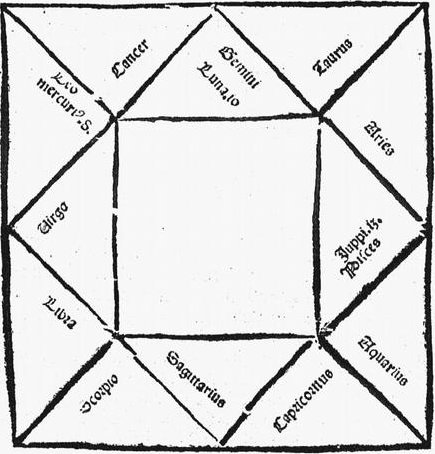
On the Conjunction (Collection) of the Light of the Planets.
The conjunction (collection) of light is when the lord of the ascendant and the lord of the thing asked about are joined to a heavier planet, which gathers their strength and their light, and receives their natures.
For example: a certain question was asked concerning a king whether he would obtain the kingdom or not. And the sign of Libra was ascending, whose lady is Venus; and Venus, who was the significator of the question, was in the tenth degree of the sign Aries. And the Moon, lady of the royal house (which signifies the kingdom), was in the twelfth degree of the sign Taurus; and they did not aspect one another. And Jupiter was in the fifteenth degree of the sign Cancer, in the angle of heaven, namely in the royal house. And the Moon and Venus were being joined to him.
Therefore Jupiter gathered the light that is, the rays of both in the place of the thing sought, that is, in the place of the kingdom. And this signifies the acquisition of the kingdom through the hands of some duke or bishop, or through the hands of some beloved man to whom both planets would gladly grant advancement.

On the Prohibition of Light, and how it occurs in three ways.
Almāna, that is, prohibition, occurs in three ways. One of these is called cutting off of the light, and this happens when between the lord of the ascendant and the lord of the thing sought there is some planet in fewer degrees than one of them, and it is joined with that one before a conjunction is made with the lord of the matter.
An example of this is as follows: let Virgo be ascending, and let a question be asked concerning marriage. Let Mercury, the lord of the ascendant, who is the significator of the questioner, be in the tenth degree of the sign Cancer; and let Jupiter, the lord of the seventh house, who is the significator of the bride, be in the fifteenth degree of the sign Pisces. And Mars was in the thirteenth degree of Aries.
Thus Mars cut off the light of Mercury from Jupiter; and Mars was in the eighth sign, namely the substance (goods) of the woman. This signified that the destruction of this matter would occur on account of the arrangement of the dowry.

¶ The second mode is when a lighter planet and a heavier one are both in the same sign, and a third planet is between them in that same sign, seeking conjunction with the heavier one. This third planet takes away the conjunction of the first.
An example of this is as follows: let Cancer be ascending, and let a question be asked concerning marriage. Let the Moon be in the eighth degree of Gemini, and Mars in the tenth degree of the same sign. Let Saturn be in the twelfth degree of it, ahead of Mars. Thus Mars separates the Moon from Saturn, takes away their conjunction, and destroys their cause.
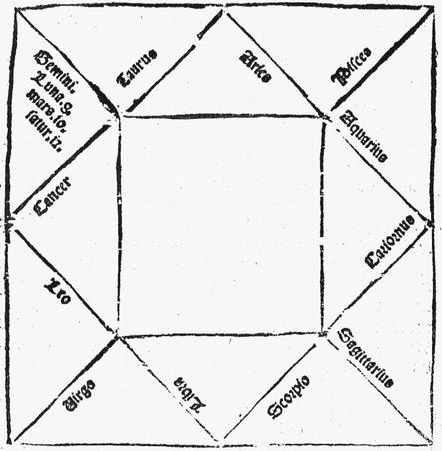
¶ The third mode is when a lighter planet is joined to a heavier planet in one sign, and another planet, which is also joined to that same heavier planet by aspect, is below the lighter one in degrees that is, in fewer degrees. The lighter planet, therefore, which is with the heavier one in the same sign, prohibits the conjunction of the other that aspects it. When it has passed on, then its conjunction will be true. This mode likewise prohibits causes and renders them ineffective, just as the preceding ones do.
An example of this is as follows: let Cancer be ascending, and let a question be asked concerning marriage. Let the Moon, the lady of the ascendant, who is the significatrix of the questioner, be in the fifteenth degree of Scorpio; and let Mars be in the eighteenth degree of Taurus, and Saturn in the twenty-third degree of the same Taurus. And Mars was above the degree of the Moon, that is, in more degrees; and therefore it cut off the aspect between the Moon and Saturn and prohibited their conjunction, because Mars was joined to Saturn in one sign, and this conjunction is stronger than a conjunction by aspect.
For an aspect does not destroy a conjunction, but a conjunction destroys an aspect; and an aspect does not cut off another aspect, but only prohibits the cause. A conjunction, however, cuts off an aspect. And sometimes one planet is joined to another, but before it reaches it, it is joined to another; and when it has been joined to that other, the former conjunction is destroyed.

Likewise, if a planet is joined to another planet in one sign and sends its disposition to another that is, it is joined by aspect to another planet which is in a different sign and after that conjunction by aspect it comes to the one with which it is in the same sign and is joined to it, then the judgment will be according to the planet which is with it in that same sign.
An example of this is as follows: let the Moon be in the tenth degree of Taurus, and Mars in the twentieth degree of the same Taurus. And let the Moon be joined to Venus by aspect before it is joined to Mars; and let Venus be in the fifteenth degree of Cancer. Although Venus is in fewer degrees, nevertheless the judgment is referred to Mars, because he is with the Moon in one sign; and such a conjunction is stronger than an aspect, as we have said.
This is the explanation of what we have said: that an aspect does not annul a conjunction, but a conjunction annuls an aspect.

On the Reception of the Planets.
Reception of the planets happens when a planet is joined to another planet from its own domicile or exaltation; then it receives it with good will and with perfect reception.
There is also another reception beneath this, that is, a lesser reception, namely when a planet is joined to a planet that is lord of its triplicity and term, or lord of the term and face that is, when it is joined to a planet which has in that place, among these lesser dignities, two or more; and then there will be true reception. But if it has only one, there will not be reception there. Therefore I say here that whatever differs from these is rejected by the skilled astrologer and is said to be nothing.
An example: let the Moon be in Aries and be joined to Mars, who is lord of Aries then Mars receives it, because it is in his house; or let it be joined to the Sun then the Sun receives it, because it is the house of the Sun’s exaltation; or let it be in Taurus and be joined to Venus; or in Gemini and be joined to Mercury: this is perfect reception.
Reception by triplicity is as follows: let the Moon be in Virgo, in the term of Venus, and be joined to Venus; and Venus is the lady of the Moon’s triplicity and lady of its term. Or let the Moon be in Gemini in the term of Saturn and be joined to Saturn: Saturn receives it, because he is lord of the triplicity and the term. And whenever the Moon or a planet is in such a likeness, it will be received.
This is the opinion of Māshā’allāh concerning reception by triplicity and term. And if the Moon, in such a condition, is joined to some planet, and that planet is joined to the lord of the house in which the Moon is, or to the lord of its exaltation, the Moon will be received. And if the Moon is void of course, and afterwards passes into another sign and is joined to the lord of the first sign or to the lord of its exaltation, the Moon will be received. But if it is joined to a planet which is not the lord of the first sign or the lord of its exaltation, that hinders it.
But these are the places in which there is no reception nor conjunction: namely, when the Moon or the lord of the ascendant is joined to a planet which has in the place of the Moon or of the lord of the ascendant no testimony, that is, no dignity at all then it does not acknowledge him nor receive him.
Likewise, if the Moon or the lord of the ascendant is joined to a planet in its descent (detriment/fall), it is as one who comes to him from the house of his enemies; and he does not receive him nor love him. An example of this is: let the Moon be in Aries and be joined to Saturn; or in Capricorn and be joined to Jupiter; or in Cancer and be joined to Mars; or in Libra and be joined to the Sun; or in Virgo and be joined to Venus; or in Pisces and be joined to Mercury.
And if any significator is in its descent, and is joined to a planet that has no power in the place of that significator namely domicile or exaltation you will regard it as nothing, as though to one seeking something there were given an unknown garment. And if a planet is joined to another planet in its descent, or if the very planet that is applying causes it to descend, it makes it descend and diminishes what will come to it from this.
On the course of a planet void.
The explanation of a void course is: when the Moon and its orb, or a planet, is void being as though in exile then it is said to be void of course; that is, when it is joined to no planet, or no planet is joined to it.
On the Explanation of Return (Reddition).
The explanation of return (redditus) is when a planet or the Moon is joined to a retrograde planet or to one under the rays of the Sun, and it gives back to it what it had received from it, and thus destroys the matter.
There is also another mode of return, judgment, and destruction: when the applying planet, that is, the lighter one, which is falling away from the ascendant, is joined to a heavier planet that is likewise falling. Then it gives back to it what it had received from it and destroys its disposition; and this signifies that the question itself will have neither beginning nor end.
An example of this is as follows: let Cancer be ascending, and let the Moon be in Sagittarius in the eleventh house, falling away from the ascendant, and be joined to Mars; and let Mars himself be in Gemini in the twelfth house from the ascendant, also falling. Then this signifies the destruction of the beginning of this question and of its end.
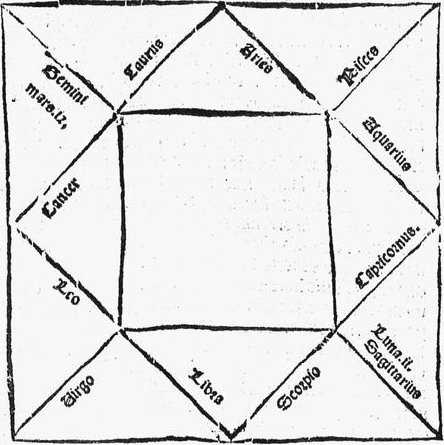
On the Explanation of Return (Reddition).
Another mode of return is when a lighter planet is joined in an angle, and is joined to a planet falling away from the ascendant. In this case the beginning of the matter belongs to the one that is joined, because the one that signifies the beginning of the matter was in an angle; but it will have no end, because its receiver who signifies the end of the matter was falling. The one that applies is the lighter planet, from whom the beginning of the matter comes; and the receiver is the heavier one, and is called the receiver of the disposition, while the lighter one is called the impeller (pulsator) of the disposition.
On the Impulse of Virtue.
The explanation of this is when a planet is joined to another from its own house, or from its triplicity, or from its exaltation, as in the following example: let the Moon be in Cancer or in Taurus and be joined to Jupiter or to another of the planets, and it impels its virtue to him, because it has impelled that is, committed its disposition from its house or exaltation. The others act similarly when they impel their disposition from their houses or exaltations.
On the Impulse of Disposition and Nature.
The impulse of disposition and of nature likewise occurs when a planet is joined to another planet from its house or exaltation, and impels its disposition or nature to it. An example of this is when the Moon or any of the planets is in Aries and is joined to Mars; or is in Gemini and is joined to Mercury. And when the Moon is in Taurus or in Cancer, it impels both namely virtue and disposition; but when it is not in these two signs, it nevertheless impels disposition.
On the Strength of the Planets.
The explanation of the strength of the planets by which they lack no opportunity or impediment to perfecting a matter when they have received and promised occurs in eleven ways.
1. When a planet is in a good place from the ascendant, namely in the angles or in the succedent houses of the angles, that is, in places that aspect the ascendant.
2. When a planet is in any of its own parts or dignities: in its house, or exaltation, or triplicity, or term, or face, or joy.
3. When it is direct.
4. When no malefic planet is with it that is, not in the same sign to which it is joined, nor aspecting it by opposition or by the square (fourth) aspect.
5. When it is not joined to a planet falling away from the ascendant, nor to a planet that is in its own descent, nor is itself in its descent.
6. When it is received.
7. When the superior masculine planets Saturn, Jupiter, and Mars are oriental, that is, appearing in the morning, emerging from under the Sun’s rays; and the feminine planets Venus, Mercury, and the Moon are occidental, that is, appearing in the evening.
8. When the planets are in their own light: that is, masculine planets by day and feminine planets by night.
9. When the planets are in fixed signs.
10. When the planets are in the heart of the Sun, with the Sun in the same degree; for then fortunes increase good fortune, and the evil of malefics is strengthened.
11. When masculine planets are in masculine quarters from the ascendant in the circle that is, moving directly from the Midheaven to the Ascendant, from the fourth to the seventh and feminine planets in feminine quarters, that is, moving from the seventh to the Midheaven and from the Ascendant to the fourth; and when masculine planets are in masculine signs and feminine planets in feminine signs.
These are the testimonies by which planets are strengthened and have no occasion that harms them in perfecting a matter, when they have received and promised.
On the Weakness of the Planets.
The weakness of the planets occurs in ten ways, and their impediment in nativities and interrogations:
1. When a planet is falling away from the angles and does not aspect the ascendant, that is, in the sixth or twelfth house.
2. When a planet is retrograde.
3. When it is under the rays of the Sun.
4. When it is joined to malefic planets by conjunction or opposition that is, when it is in the same sign with them, or in their seventh, or by the square (fourth) aspect.
5. When it is besieged between two malefics, that is, separating from one malefic and joining another.
6. When a planet is in its descent, or is joined to a planet that is in its descent.
7. When it is joined to a planet falling away from the ascendant, or is separated from a planet that was receiving it.
8. When a planet is in a house in which it has no testimony, that is, no dignity namely, when it is not in its house or exaltation or triplicity, and so forth and when it is peregrine, and already preceding the Sun, that is, before the Sun.
9. When a planet is with the Head or the Tail, if it has no latitude.
10. When planets hinder themselves, that is, when they are in opposition to their own houses, which is a certain impediment to them.
These, therefore, are the headings in which there is impediment or detriment of the planets, which occur in nativities (that is, interrogations) and in other works. Therefore observe these modes in the planet that receives the disposition and in the one that promises the matter.
On the Defects of the Moon and its being in a bad state.
The defects of the Moon, and its bad condition by which it brings harm to matters in every interrogation and in every beginning, occur in ten ways.
1. When the Moon is combust, under the rays of the Sun, not yet having passed twelve degrees; and likewise after that, though this is lighter.
2. When it is in the degrees of its descent, or joined to a planet in its descent.
3. When it is in opposition to the Sun within twelve degrees, not yet having come to the exact degree of opposition.
4. When it is joined to malefics or they aspect it by the square or by opposition, or when it is besieged between two malefics, separating from one and joining the other.
5. When it is with the Head or the Tail in one sign, and the distance between them is less than twelve degrees.
6. When it is in the sign that is the twelfth from its house, which sign is Gemini, or when it is at the end degrees of signs that are the terms of malefics.
7. When it is falling away from the angles, or joined to a planet falling away from the angles.
8. When it is in the via combusta, that is, at the end of Libra and the beginning of Scorpio.
9. When it is feral or void of course.
10. When it is slower in course, that is, when its equation diminishes, or when its light diminishes, which occurs at the end of the lunar month.
These are the aforesaid defects of the Moon and its impediments, under which no work ought to be begun that is, while the Moon is thus, no work should be started; nor is it praised in a nativity nor in a journey.
Know also the Moon’s increase and decrease of light that is, when it grows and when it diminishes. For when the Moon increases, that is, when it waxes, if Mars aspects it from the square or from the opposition, or is with it in the same sign, Mars hinders it, because it will then be hot. Conversely, if Saturn is with it when it diminishes, or aspects it by the square or by opposition, he hinders it; because when the Moon has more light that is, at the beginning of the month and is hot, Saturn does not hinder it, since he is cold, but Mars hinders it because he is hot. And when it has less light that is, at the end of the month it will be cold; then Mars does not hinder it, because he is hot, but Saturn hinders it, because he is cold.
And know that Saturn in diurnal nativities and in interrogations asked by day, and at the beginning of the month, and in masculine signs, hinders less; but at the end of the month and in feminine signs hinders more. Mars, at night and in feminine signs and at the end of the month, hinders less; but by day and at the beginning of the month and in masculine signs hinders more.
And no planet, nor the Moon, nor a sign is called impeded until malefics are with it or aspect it by the square, the opposition, or the tenth; nor is a planet or the ascendant called fortunate until the benefics are in its angles or in the angles of the ascendant.
On Besieged Planets.
The explanation of a besieged planet is this: when a planet is between two malefics, separated from one of them and joined to the other, without the casting of rays of another planet between them that is, so that no other planet casts its rays between them. And it is the stronger and worse if the separation and conjunction are within seven degrees or less.
An example is: let Mars be in the tenth degree of Cancer, and Saturn in the eighteenth degree of Aries, and the Moon in the thirteenth degree of Libra; and let the Moon be separating from Mars by the square aspect and joined to Saturn by opposition. Then the Moon will be besieged, because it is separated from the light of Mars and joined to the light of Saturn.
On a Planet in its Own Light.
A planet is said to be in its own light when, for example, Mars being nocturnal is a significator by night; and Saturn being diurnal is said to be in its own light by day.
On the Testimonies of the Planets.
The explanation of what is said about planets that have testimonies, parts, or dignities is this: if a planet is in its own house, or in its exaltation, or in its triplicity, or in its own term, or in its face, then it is prospering when it is in a sign in which it has testimonies.
On the Joys of the Planets.
The explanation of the joy of the planets occurs in four ways.
1. First, their joy is from the circle (i.e., the houses): Mercury rejoices in the ascendant, the Moon in the third, Venus rejoices in the fifth, Mars in the sixth, the Sun in the ninth, Jupiter in the eleventh, and Saturn rejoices in the twelfth.
2. Second, their joy comes from their strength in their own houses. For Saturn rejoices in Aquarius because it is a masculine sign; and Jupiter rejoices in Sagittarius; Mars in Scorpio; the Sun in Leo; Venus in Taurus; Mercury in Virgo; and the Moon rejoices in Cancer.
3. Third, because the diurnal planets rejoice when they are in the east that is, when they rise in the morning and the nocturnal planets rejoice when they appear in the evening in the western hemisphere.
4. They also have a fourth mode of joy: Saturn, Jupiter, and Mars rejoice when they are in the masculine part of the circle, which is from the Midheaven to the Ascendant, and from the fourth sign to the seventh. The Moon and Venus rejoice when they are in the feminine part, namely from the seventh to the Midheaven, and from the Ascendant to the angle of the earth, which is the fourth sign. Mercury, however, rejoices in both parts: when it is with the masculine planets, it rejoices in the masculine part; and when it is with the feminine, it rejoices in the feminine part, because of the differing nature of these planets and their houses.