A newly kindled, bright-burning Fire, or MERCURIAL Light, which is once again newly kindled for the despairing alchemists, by a well-known, yet unnamed, friend.
Listen Audio Book Study the Art with Us Buy me Coffeehttps://www.alchemy-texts.com/book/bright-burning-fire-or-mercurial-light/
A newly kindled,
bright-burning
Fire,
or
MERCURIAL
Light,
which
is once again newly
kindled for the despairing alchemists,
by a well-known, yet unnamed, friend.

Translated from the book:
Neue Sammlung von einigen alten und sehr rar gewordenen philosophisch und alchymistischen Schriften, als eine neue Fortsetzung des bekannten deutschen Theatri chymici .., Volume 3 - 1771
Neu-angezündt-hell-brennendes Feuer, oder Mercurial-Liecht, so denen verzagten Alchymisten aufs neue widerum angezündet wird / von einem wohl-bekandten, doch ungenanten Freund.
Preface
To the well-disposed reader.
After I, well-inclined reader, from my youth onward, both by an inborn inclination and through the occasion of my medical profession, had carried desire and love toward the chymical science, and therein not to boast had made no small progress, so far as concerns the curing of the human body, I also undertook, for the sake of Nature, as I imagined, to come to the foundation, whether by good opinion, or having been driven by a laudable curiosity, no less in metallic matters, and especially concerning the alteration of metals, to attempt something, namely almost fourteen whole years of unsparing diligence, upon that which rightly belongs to an honest coal-blower as one commonly calls the chymists by virtue of his office; and I found that, with no small expense, as well as sour toil and labor, the very least was allowed to be discovered, but in the end, instead of the hoped-for rich yield, nothing was obtained except an ens rationis, that is, the very least reality was found in it.
Now, just as it is the nature and property of many men to cry out as impossible whatever they cannot comprehend with their five senses, so I too presumed and indeed, after such long fruitless labor, as I found myself with great freedom to judge the far-famed wisdom of Nature according to the small measure of my vain understanding.
And I concluded not only within myself that there must be nothing at all in the world-renowned transmutation of metals, but also considered myself bound in conscience to bring such an indisputable truth, according to my opinion, to the knowledge and warning of my fellow-men out of Christian love to communicate; in which opinion I had put to paper a little tract under the title “The Juggler’s Pouch” (Gauckel-Täschner), containing the tricks and sleights of certain chymiasters of our times, whose whole gold-making consists in this: that they know how, without any sorcery, masterfully and imperceptibly to add dear natural gold to the other drugs in the crucible, and afterward to subtract again from the rubbish just as much as they had put into it meanwhile making their simple kitchen-blowers believe that this had been brought about by means of a chymical transmutation or multiplication.
With their purses, meanwhile, they also know how to put division into practice, and in this manner they know how to practise the four species of arithmetic in a special way perhaps the noblest of all, or at least the most profitable for them, but in a gallows-worthy manner.
Meanwhile, as I was now proceeding with the printing of this essay, it happened, by divine dispensation, that the imperial residence-city of Vienna was visited by the grievous plague, to which place, exercise the small talent granted me by God in such cases, I set out on my way with my little work, which was indeed not yet altogether finished.
But because of the blocked passes of various places, I was delayed there for three or more days.
Now, as according to my custom I inquired everywhere after arts, and asked after arts and artists, I came in the district above the Enns, or Upper Austria, to an old, aged, and quiet chymist, who had already spent many years in seeking the universal object of the chymists, or the Stone of the Philosophers.
And because I wanted to prove to him, by my supposed reasons, the impossibility of ever coming to a desired end in this matter, I at first drew his displeasure upon myself.
Yet afterward, since he perhaps noticed my sincere opinion, and that I too had let the chymical art become somewhat sour to me, he was as it were changed into sympathy, and he caused me to see several experiments, and also let me practise them with my own hand.
Their circumstances and evidence at last opened my eyes so that I had to confess: it is truly there is a chymical truth in Nature; and when this honest man thereupon asked me whether I still wished to maintain that all alchemists were deceivers, I took my chymical Juggler’s Pouch and tore it up before his eyes, for satisfaction of my committed error and hasty judgment; thanked God, and this same good friend, that he had caused me to see something real in chymistry.
Besides this, he reminded me that such a talent should not be so buried that it must die with him, but that some light from it should be left behind, for the comfort of many truth-loving successors.
Whereupon he, dear reader, delivered to me the present little tract, and permitted it to come to daylight, with the further promise that shortly another similar one should follow, together with the hieroglyphical figures; since, as he judged, the one would relate to the other, and both would be needed by each other.
I therefore communicate it sincerely, just as I received it; yet I ask the favorable reader, before he undertakes to read and understand it, with his thoughts, for about a little quarter-year, to go to school with a bread-baker, since even Nature herself may well take on something of fermentation, because this, for our art in which the Acidum has much to say as it were carries the key.
Then it may be hoped that it will be granted to him to see, with pleasure, the marriage of our pure virgin and our pure youth.
And in order to arrive at this more fittingly, a simple counsel will not be rejected, namely: that the artist should take the trouble to undertake the operation not only once, or in simple form, but several times.
The reason is that time, the weather, fire, and a hundred other accidents can easily bring an adverse working into a little work, which one afterward is accustomed to ascribe to Nature, and then to go on arguing toward an impossibility.
But this will not happen so easily by use of the path indicated.
For the rest, just as this little work is simple, and the operation likewise simple, so I have shown to the favorable reader the entrance of the little book, through this my no less simple reminder, asking that he would allow this to be dedicated to a desired effect, just as it proceeds from two sincere hearts that of the author and that of the one who prepared it for print.
the favorable reader’s
at all times
most willing servant,
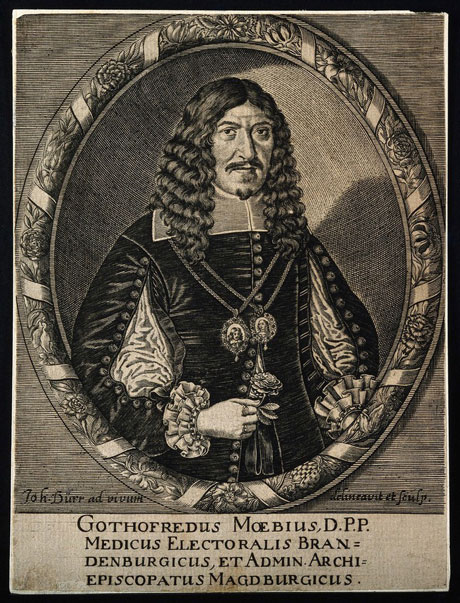
Gottfried Moebius (Gottfried Möbius), Med. Doct.
& Practicus Augustanus.
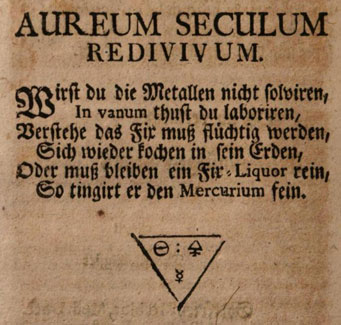
AUREUM SECULUM
REDIVIVUM.
The Golden Age
Revived.
If you will not dissolve the metals,
you labor in vain.
Understand that they must become volatile,
and again cook themselves into their earth;
or else there must remain a pure fixed liquor.
Thus it finely tinges the Mercury.
Whoever will work with the ancient Stone of the Wise, and find it with foundation, must before all things properly understand what the Nature of all creatures in the whole world actually is those which are both above and beneath the earth likewise, of what each body, whether it be vegetable, animal, or mineral, is composed, and what its principal foundation is; also through what, or by what, it is brought to its maturity and final perfection.
But before this, he should well look about him and learn what the Spiritus universalis Mundi the universal spirit of the world and the principles of all earthly things are, of which Flamel speaks, and describes it in this way, saying in the fifth leaf of his little chymical tract, etc.:
Whoever wishes to come thereto and find something good must go up onto the mountain of the Seven, where there is no plain, and from above look down upon the six, which one sees from afar.
On this high mountain one will find that triumphant and royal herb, which some philosophers have called mineral, others vegetable, and which is called Saturnian.
But one must leave off the boiling, and take the soup that is formed from it quite pure and clean; from this, then, the greatest part of the work can be made.
This is the true Mercurius Philosophorum the Mercury of the Philosophers which one should take.
Therefore note: all three kingdoms, principally at the beginning, consist in the pure, unstained world-spirit, which has not yet taken on any body.
It is called by the philosophers a Universal Mercury or Spiritus, which is, indeed, so capable that it can help bring back all things to what they were before; but by itself alone it cannot accomplish this.
Nor is there any single subject above or beneath the earth from which the Stone alone can be prepared; and let no one, whoever he may be, imagine that by this he will reach his intention.
The beginning of the labors of capricious people often appears to be in great hope, but little by little nothing at all comes of it.
Thus, even if someone had obtained, in an approximate and ignorant manner, the principal piece which is required above all things in the composition of the Stone, he still could accomplish nothing good with it, even if he should treat it as subtly and artfully as ever he wished.
I too am already in my twenty-fourth year, and by many deceivers and wicked men I have been maliciously cheated out of all that was mine.
The first stirred up a process-merchant against me and bravely emptied my purse; the second soon persuaded me now of this, now of that specificum or subjectum; the third brought the strangest fancies onto the path, by which an ignorant man one who did not know the arcanum of alchemy, or its true foundation, however learned and reasonable he might otherwise be could be masterfully deceived.
Now, if it were a glory that someone had had around him several principal deceivers, general babblers, and land-runners, and had given them bread, then in such cases I could count myself a patron; for in my too-trusting disposition I most often assured myself that I had the truest adept with me.
Yet some of them I came to know within a year, and some only after a longer time, as to what kind of birds of prey they were.
But among all those I had with me for two years one who surpassed the others in the superlative degree.
First, this man was of respectable person; secondly, well-spoken; thirdly, exceedingly well-read; fourthly, cunning and crafty, so that he could, as it were, laugh with half his face and weep with the other part.
Fifthly, shameless, furnished with false letters and seemingly lawful documents; in sum, such an arch-villain that I still scarcely believe this gallows-bird has his equal.
If I wished to describe his incomparable rogue’s-practice and most highly astonishing adventures in full, very many sheets of paper would have to be spoiled with it.
Concerning the fellows’ materials, then, from which one and another, according to his imagination, intended to prepare the Stone, there would be a heap of things to tell; yet I cannot entirely pass them by, but must report a little of them here, for warning and benefit to sincere lovers.
The above-mentioned great talker and spit-fox, among other things, wanted to maintain that dew and rainwater were the true subjectum.
He also brought forth many fantasies about this and wished to prove it.
But after a year and a half of fruitless labor, the process ended in mire, whereby time and costs were lost.
This fellow, together with his wife the lady gold-maker and five other persons who served him, I had upon my neck the whole time; but of the money which, besides what he gradually borrowed from me, he did not return, I say nothing.
Now, that I may proceed further and keep away from other gold-foxes who also, with the Hectica had conjured up, and had made my ducats and thalers, white and red, so exceedingly volatile that they became wholly irreducible I think of several more; among these same men there were again artful pouch-players and furnace-burners, who several times imagined for themselves other subjecta, indeed with such zeal that they let themselves be nearly beaten to death over them.
Among these were understood antimony, vitriol, all kinds of ore- and mountain-saps, as also sublimed auripigment.
Among these above-mentioned foul fishing-knaves there was also one who wanted to be, above all others, the most learned and experienced.
He often boasted that he would discover and bring to light everything that could ever be done in alchemy.
This same man persuaded me that, by means of butter of antimony (Butyrum Antimonii), one must draw out from all metals their hidden Mercury, color, and essence; and when this, by means of a subtle manual operation, had been digested into a crocus, then afterward it would permanently color the imperfect metals, and make them subtle and compact.
Now, as I awaited the end, which time extended into the second year, and afterward they wanted to tinge together, this imagined costly treasure did not succeed, and came to nothing at all.
Then this self-praising universalist and court-knave who, even during his acquaintance with me, had so bound me with his false tricks that I almost without his permission I dared not speak freely with anyone else, that he had cheated me along with myself.
This condition was now more than enough to make me weary, and I thought that if I had my expenses back again, and the money paid for this deceitful process which, nevertheless, had been several times found to be a substantial one I would let it be as it had already happened.
And because, besides this, he was an exceedingly bold flatterer, and an altogether shameless fellow, I nevertheless had to let him believe whether I liked it or not that the process was true and right, since it had failed only, according to his deceitful claim, through a very poor manual operation.
Beyond all this I still had to be glad that he was satisfied with me, although I had already consumed time, expenses, and money upon it for nearly two years.
Such occurrences still did not end there, nor did I stop there; rather, my desire to obtain the right and final goal at last moved me further.
I therefore spent new time and expenses upon it again, but resolved if God Almighty would otherwise grant me life and health for it to set for myself a certain term: how long I would still carry on this handiwork.
And if, beyond that, I should not attain my intention, then I would leave this profession entirely and give it good night.
After my resolution had thus been formed within me, there soon afterward came into the field, for excess, a brand-new gold-worm, who, after he had delivered his philosophical prelude and examination, declared that all those with whom I had labored for these twenty years had erred and had seduced me; for such a noble science consisted in an entirely different thing than people supposed.
He was sorry, he said, that I had been so cruelly misled, and that what was mine had been so miserably brought away; out of mercy and Christian compassion he wished to reveal to me the true truth and foundation of this most noble art.
Likewise, everything that I had lost during this exercise should be restored to me again.
Now I thought to myself: this is the right one; now the desired goal will at last be reached.
Therefore, in the name of God, in February of the year 1671, we began, and tormented the regulus of antimony for more than a year and a half with such wonderful fantasies that it would have been no wonder if we too had become regulus along with it.
Besides this, we also sublimed the cinnabar so often, imagining that it should finally remain quite fixed at the bottom of the glass.
Thirdly, for over six weeks we plagued the poor Mercury with the above-mentioned artificially impregnated regulus, imagining that we would thereby bring it into a pure, unstained, doubled Mercury, to bring it into a duplicated Mercury (Mercurius duplicatus), and then, with the previously mentioned cinnabar sublimed above the thirty-times, to make the philosophical conjunction, so that afterward the true metallic menstruum and vinegar might be prepared from it.
Who was more joyful than I, when I imagined: now this saying is fulfilled, namely, “In metals, with metals, and through metals, by the mercurial water”; and the art is correct now something honest must come from it, and the crown so long desired must be obtained.
But when this work and diligence had stretched almost into the third year, and during that time the most insensible, sweetest poverty had visited me several times, and I expected the blessed end with pains, at last the glass burst, and my charcoal-burner had to lose his life through its poisonous vapor.
Then my joy was out again, and the Lapis had once more been lost.
Over and besides these many deceptions, and the strangely experienced adventures, there would now still be many follies and weaknesses to recall; but for the sake of noble time I will omit mentioning them this time.
Let each one only examine himself who has lain sick with me in this hospital, and what has happened to him in such matters; then he will have to give me all the more credit for what I have here partly forgotten, and partly intentionally passed over with diligence.
After I had now performed these above-mentioned labors in alchemy, and my resolution mentioned above for the last appointed time had thereby been fulfilled, it occurred to me, before I would give up the handiwork wholly and entirely, finally to confer with other learned people who, to my knowledge, had also practised themselves for many years in alchemy, but at last had written contemptuously about it, so that I might nevertheless learn how their schoolmasters and gold-foxes had dealt with them.
But it came out unanimously that these same men had also gone through such classes, and that there was nothing in all alchemy which they had not though one more than another tried and done.
Thus they steadfastly remained, ex post facto, at this: consequently, everything must be wholly nothing but dreams and shadows; and especially, to make the Stone, it is merely a foolish poem of the idlers, whereby many thousands of people are wickedly seduced through their written false processes and printed books by which I too, during my search, had spent well over five hundred, together with the great expenses mentioned above.
Concerning this I now received the addition, namely the potion which among good friends is commonly called the St. John’s blessing.
This troubled me considerably, and my well-furnished laboratory became displeasing to me.
I considered, besides, how much I had gained from it during these twenty years namely and became exceedingly unwilling; I fell in with the above-mentioned learned men, among whom mostly physicians were included, and with them I, as it were, cursed the whole handiwork; I demolished my strange furnaces and vessels, which had cost me much money, and finally made the cross over it.
But so that I may not wholly and entirely frighten away the lovers and new beginners, I will here set before myself and indeed as far as is permitted me before God and the true art, and as my conscience, on account of the vow made concerning it, does not burden me to prove the contrary: that it nevertheless stands in the will of God and of Nature, and is true, that the metals can be improved and multiplied in a certain way.
It is unbelievable that the farmer’s little grain, which he has cast into the prepared soil, does not only become ripe in its time, but also multiplies itself two, three, and more stalks or ears many times over.
With this simple yet true example I wish the whole vegetable kingdom to be understood, and to have given the deep-minded man this for his further approval.
But if, on the other hand, I take away from the vegetables their seed whatever name it may have and shut it up all by itself in an empty glass or vessel, then nothing new will come from it in eternity, nor can any rebirth take place with it.
Why?
Its prepared field, or matrix, was lacking.
But if such a thing, by means of its Nature, rots therein, then a resurrection and rebirth would necessarily have to take place by it.
In the same manner it also has its process and condition with the animal kingdom, yet when it happens with one of its like kind namely, from one human being again a human being.
It also happens often enough that each kingdom brings forth at times a misbirth; yet this remains at least within the bounds of its appointed Nature, foreseen from eternity.
In the whole world one will never have heard or perceived that, in a natural way, from a piece of wood there became a living horse or ox; from an iron, a human being; and from a hard stone, a beautiful tulip or marigold.
Rather, each kind has begotten and brought forth its like; and what, according to divine order, is to happen, must keep this process and distinction.
But with the divine miracles and wonder-signs, it has a supernatural being, and belongs to God alone, as he who from his almightiness because he at the beginning made all things out of nothing can transform the natural kingdoms, and contrary things, and one thing into another can transmute one thing into another; but, on the other hand, a human being cannot do such a thing in a natural way.
In this same manner, such a wondrous event is said to have happened in Vienna, in the so-called spiritual treasury of His Imperial Majesty, which, according to the histories, is supposed to have happened in Hungary: that two loaves of bread were changed into a hard stone.
But no more has been permitted to man by his Creator than this: that he to whom God communicates such a particular grace knows how to help Nature, and to bring it further.
And because this noble science is hidden from the ass and the court-jester, the art is therefore not a lie; and it is not my fault that not every peasant, or puffed-up boaster, understands it.
Nor will it be revealed so easily to anyone as one imagines; nor will it be sold for little money, much less cheaply offered.
Also, this mystery will not be found, by way of a recipe, in any printed book, nor in any written process.
It is therefore impossible that a man should be able to study out that thing, even if he had all the philosophers’ books in his head.
Therefore it happens that the most learned and wittiest people and subjecta, after they have searched much in alchemy, spent time and expenses, yet found nothing, destroy the art and write against it.
For my part, I cannot blame them for this, since their eyes have not seen so much of the contrary, on account of which they also cannot believe such natural miracles.
It is indeed finally possible that someone, where there are many chambers and places, may come into the first, second, or third, and can open their locks; but it is still far from enough, and it is not enough to have two, three, or four, unless he also has the keys with which one can unlock the remaining three.
And so the seeker opens all seven chambers, and finds, then he stands first of all in thought, as to what he should do further.
By this one should understand weight and first preparation.
With these chambers I give a parable; but that philosopher calls them the seven seals, the writing of the Lord, which are not to be broken nor opened by unworthy boasters, but are to be communicated in due time to those called thereto by God.
Even if someone, since it is impossible, were to bring the compositions of the Stone before himself into experience, he would indeed have accomplished a great thing; yet it is by far still not enough, because the principal things namely their cleansing, weight, and fire are still lacking.
For in no chamber which is kept unclean is it wholesome to dwell therein.
On the other hand, it may now be asked: since such a Lapis is composed and begotten from several things, then consequently it could not be brought about from one single subjectum alone.
Yes, indeed, if this could be, many thousands of them would already have come thereto.
There is no subjectum, either beneath or above the earth, which has not long ago even a hundred and more years ago been artfully and acutely anatomized by the alchemists, and put together again; yet nevertheless, the thing which they sought has by no means been found.
Therefore mark well from this, that you will not complete your work by means of a gross material substance whether it be a vegetable, animal, or mineral thing alone.
A camel can sooner pass through the eye of a needle than this is possible.
There are also many thousands who imagine that, if only they could make the Mercury from all metals (Mercurium ex omnibus Metallis), they would afterward soon attain their desire.
But I say to you faithfully and honestly: you will accomplish absolutely nothing with it, since, with regard to the metals, Mercury can perform nothing different or greater toward your intention than the common one does.
Therefore do not torment yourself to force and bring forth Mercury out of the metals; rather, take the common one, which still has its virginal nature and complete power.
Bring it into its first matter, which it was before, before it came into the earth or into or had come together in the water, then you will have the right, true, and sincere materia, from which all metals in the earth have taken their first origin.
In this way you will be able, quite easily, to reduce it completely to the first matter according to Nature (ad primam materiam secundum naturam).
Begin there! Upon this hang the Law and the Prophets; there lies the hare in the pepper.
I assure you, and swear to you by God the Almighty, that this is the principal aim in the work, without which absolutely nothing can be accomplished.
This is that thing of which all old and new philosophers speak so much, when they write unanimously that it is only one single thing by which the Lapis can be prepared.
And because they have knowingly concealed the other composites, many thousands of people have been misled by it, because they have said that only one single thing is necessary for the work.
Therefore take heed to what I have preached openly to you: namely, that one subjectum is not enough, which would be sufficient for the perfection of the work; rather, the dying and the living must naturally exercise themselves with one another until the victory is won.
And if this metallic principal subject had not been created, there would never have been any philosopher who applied himself to the making of the Lapis Philosophorum, the philosophers’ Stone, in truth, nor would Raymundus Lullius or Flamellus have been able to establish and leave behind such notable memorials in the world.
Now you might ask me how this is to be done: by what means common quicksilver may be brought into its first sperma, or root.
If I wished to tell you this, you would soon understand it; perhaps, because of the simplicity required for it, you would even laugh at me for it.
But by means of the vow made before my Creator, a double lock has been laid upon my mouth from writing a recipe of it, and I have sworn silence.
Yet I will report something which no one before me has done, in order better to open the eyes of those successors who still remain in great error, and who lie in the hospital where I too was formerly sick.
Namely: when you take quicksilver in hand, as our foremost and principal subjectum, take very diligent care that you do not sublime it in the common way, nor boil, roast, and torment it with corrosive vitriolic things, and thereby burn up or spoil its noble spermatic nature.
For by such foolish proceedings you will bring it wholly out of its Nature, and actually deprive it of its life.
For this wonderful guest, or Terra Magnetica, requires an entirely different drink, wherein it may refresh itself, and by means of the same may prove its virtue in the composition that follows afterward, or in the chymical wedding.
But what is this to be for a drink?
You must pour upon it no separating-water, nor any other poisonous corrosive water; rather you shall take that one which I mentioned quite at the beginning, and which is to be found more fully on the fifty-fifth leaf of Flamel’s little tract.
With this you shall animate and awaken the one.
When you have now refreshed this one with it, then afterward you must also make yourself acquainted with four pure fiery spirits or virgins.
These afterward will take their brother who has refreshed himself with such a pleasant drink into their lap, and will gently let him rest therein for two years.
Now what these virgins are, you yourself may think further upon; for to speak of it more clearly is forbidden to me.
This, then, is the true composition of the Lapis Philosophorum, namely a marriage, whereby bride and bridegroom are bound together for eternity, so that afterward they can no more be confounded and separated by the hellish burning enemies.
My friend, I do not conceal this either; rather I will tell you what kinds of vessels and furnaces belong to this, our great chief principal work: likewise, what wondrous occurrences will show themselves during the time of the operation before and before the crowned king will assume you as his guardian so that you may afterward have some delight in such things.
Therefore I say in greatest truth: nothing else is needed to complete the work except one single furnace and only one vessel.
For our work knows nothing at all of such foolish furnaces, and all kinds of strangely formed vessels and fantasies, as also Mary’s baths (Marienbäder), which the ignorant use, and with which they only make expense for great lords and other lovers.
Rather, when once the poor simple preparatory work has been done which even an old woman can accomplish in a few days, in two or three earthen vessels then the compositum is made, afterward set in, well preserved, and commended to God Almighty.
As soon as our fallen ponderous sea, or centrally cold fire, begins to feel the outward warmth, then the two dragons begin to rise one with wings, the other without wings which are found in the aforesaid sea.
They become poisonous, angry, and begin to quarrel and fight, whereby the aforesaid, our ponderous water, is changed into a black Dead Sea, whose surging waves are afterward to be seen like little black raised mountains.
This battle they will now carry on until the sixth month, and nothing else is to be seen within except a black poison, which the aforesaid two dragons have brought about.
When this battle has now reached its end, they will transform themselves, together with their poison, into a black-green transparent water; and by means of the cruel combat they will enter into an eternal friendship and lasting peace.
Also, into a true sign of the continued love, finally everything will be changed, for three months long, into high-lovely green, with beautifully colored little flowers.
After this, in this transparent, emerald-like, glassy, heavy sea wherein the two dragons have strangled and drowned themselves you will continually see, for four months, the most beautiful and most lovely colors, which no painter can imitate.
Besides this, a figure will show itself above in the middle, appearing like a summer bird, which day and night will continually stir and move its wings.
Furthermore, this divine wonder-work will gradually coagulate itself into a thickness, and for three months, day and night indeed visibly will let certain suns be seen with unspeakable rays.
After this, from certain dull sun-rays the heavy mass will show itself like a white swan, or a bare sword.
Coppery or fiery-colored rays will also be seen now here, now there.
This wondrous Nature will last five months long.
Finally, this noble, shortened confection will, by means of three months’ time, bring itself together, and afterward twice transform itself into a reddish-brown, quite thick, heavy oleum.
When these wondrous natures have now carried their elemental course up to this point, you must not imagine that you have fully obtained the treasure.
No!
Rather, you must feed it anew with the bare serpent and its fiery dragon; and let it rest two months in gentle warmth.
Then, for the first time, you will be able to enjoy this jewel and use it like a swordsman his sword.
If you obtain this work, then you are helped with health and riches up to the appointed time of your life.
You may also no longer begin the work from the beginning, but afterward it is a matter of only a little time for you to multiply it again with the aforesaid serpent, both in quality and quantity.
What other miracles this Lapis performs, you will find sufficiently described in many places in the books of the true philosophers.
Therefore I do not consider it necessary to make many words about it in this my simple, yet sincere, little tract.
Moreover, besides this, you are permitted to ask whether this divine mystery and angelic work consists in many expenses or costs.
I tell you sincerely, upon the ground of truth, that the whole work apart from the laborant’s maintenance and coal can be paid for and prepared with twelve guilders.
It is also possible, should one wish to proceed only according to the most exact possibility, to pay for such matter together with the vessel with one thaler.
Yet who will be so simple, when he can work upon three pounds of it, and would wish to set only one lot to work considering all this, whether it be much or little, is labor and toil.
To be too greedy is also nothing.
In the year 1668, in France, I saw from my principal one who had reached the 92nd year of his age, and on the 23rd of January, in the year 1675, departed this world that he had set in a mass of 16 pounds, but that only 3 pounds of it succeeded for him, since it had indeed been done purely through and through one thing and preparation, but on the other hand had been divided into several parts.
Tell me, my friend, what is the cause of this?
For my part, I hold that it was thus God’s disposition and gracious will.
So now you see that the making of the Lapis does not stand in us, but in the will of the Almighty: when He wills, then it succeeds; otherwise not.
In this connection I remember a speech which a great lord and privy councillor of the Emperor once brought forth at his table, among other discussions: if he could make gold, then he would trust himself to become lord of the whole world.
Therefore he did not believe that it could be made with profit, as people claimed.
Such ambitious boasters, even if the mystery were revealed to them and the morsel were laid straight into their mouth since, to date, at least for several centuries past, no example exists that such a thing has happened would still come to no blessed end, for, as stated above, this stands solely and entirely in the blessing and will of God, and He gives it to whom He wills.
Therefore do not wonder, my friend, why among so many millions of people scarcely one obtains this science.
For first, whoever can do it tells no one else, neither for money nor friendship; he would rather let himself be strangled than that one should exemplify it sufficiently.
Secondly, it is a very great rarity if a friend who has served many years in the school of the cross and has been thoroughly tried and tested therein receives from a philosopher in his last dying breath that by which he is blessed and graced, and in this way comes to this knowledge otherwise, absolutely not.
Such a person afterward knows how hard and sour it is to come to it; he will deal with it cautiously all his life, and certainly will not cast pearls before swine.
From this small, yet honest and sincere little tract of mine although no philosopher has ever written so plainly, truly, and openly in German, but in their books only obscurities, hieroglyphical figures, fables, and honestly speaking confusions, you will indeed learn the mystery with difficulty, yet still sooner than from all the others which have ever been published in print for several hundred years past.
Nevertheless, do not neglect to read this several times diligently.
If God grants it to you, then the present description will open your mind and eyes, so that you will at least abandon all sophistical subtleties, put them away, and save yourself useless expenses.
Whoever works without salt accomplishes as much as one who wishes to shoot with a crossbow without a string.
Mark this well, and write this sentence into your heart.
Finally, since I have not adorned this little tract of mine with ornamental words, do not take it amiss of me; for my aim has not been to employ therein a lofty, learned style, but rather to describe the work here in the simplest way, just as I and my principal have worked it.
Therefore I wish you, from God Almighty, from my heart, much happiness and salvation therein. Amen.
SOLI DEO GLORIA.
To God alone be glory.