Cato Chemicus - The Chemical Cato or Cato the Chemist
Listen Audio Book Study the Art with Us Buy me CoffeeCATO CHEMICUS - “The Chemical Cato” or “Cato the Chemist.”
A treatise in which the characteristics of true and genuine Hermetic philosophy, and of false and sophistical pseudo-chemistry, and of the masters of both, are accurately delineated.
Hamburg,
at Gotthof Liebezeit’s,
printed with Brendeken’s letters,
in the year 1690.
By Johann Ludwig Hannemann
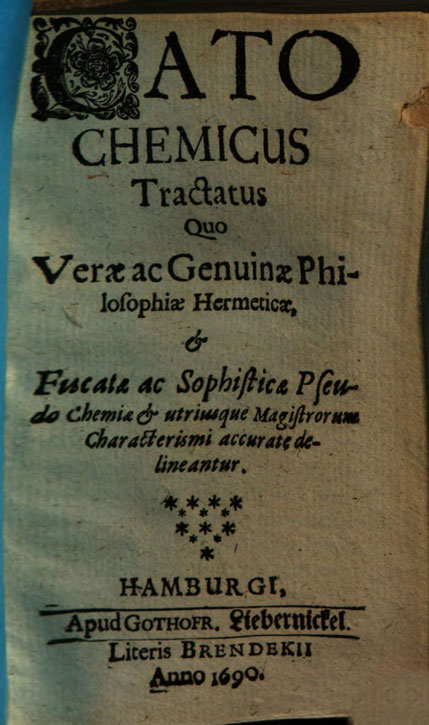
Translated from the book:
"Cato chemicus : tractatus quo verae ac genuinae philosophiae hermeticae et fucatae ac sophisticae pseudo-chemiae ... characterismi ... delineantur"
Of Cato Chemicus.
Chapter I.
On the origin of chemistry.
That the human mind has itself as something first and movable has been sufficiently discovered from the actions and meditations of men. For just as it is in continual and perpetual motion, so also the human mind no less finds no rest.
Therefore our soul, considered in itself, is not wrongly called a thinking thing; for just as no body can be conceived without extension, so not even the smallest point of time passes in which the soul does not think and is not irradiated by its influx.
There seems to be a double cause of this perpetual action arising in the soul: one metaphysical, the other physical. Let the latter be internal, the former external. Many things would have to be said about the origin, efficacy, and liturgy/operation of both, if the plan proposed permitted it.
Here we shall only restrict our discourse to the external cause, which seems to be expressed in this canon received from the schools: “Objects move the senses.”
And thus the senses understand: the external senses seem to perform the office of messengers, who present occurrences to the inner senses, that is, to memory and imagination. Those occurrences then give rise to meditations; and these meditations, for the most part, do not rest in bare speculation or contemplation, but according as nature’s instinct or inclination is, they begin to operate; and so those things that have been thought break forth into speech, either spoken or written, or else pass into artificial works. And those works are the more perfect, the subtler the intellect is.
From this occasion all sciences and arts were born, and daily they receive increase. To this same occasion chemistry, the queen of the arts, and next to theology in dignity and nobility, owes its origin.
This either is concerned with the analytical separation of bodies for its object is every natural sublunary body or it has regard only to chrysopoeia, the transformation of metals. True philosophers rightly boast of this latter, and it is the secret of secrets, upon which no one may rush with unwashed hands or with an impure mind.
And lest this divine art should still lie open indiscriminately to all, the hieroglyphic characters were first added by the Egyptians, among whom this art held the highest place, as Suidas testifies. They were invented so that they might enclose it, lest pearls be cast before swine.
Or sophists busy themselves around it; but these are to be regarded no differently than drones flying about a beehive. In this manner it is not an art, but mere imposture; and these are cinders, as it were, who, because they are ignorant of the true analysis and synthesis of metals, have so driven the art into hatred that for a long time it has been regarded as imposture and not without cause. For those sophists have deceived so many men, and have devised a thousand tricks and frauds by which they emptied even the treasuries of magnates of gold and silver.
It is pleasing, therefore, to set forth certain things concerning the operators of each art, that is, of the true and the false, for the caution of the sons of the art, and for the assertion/defense of true chemistry.
Chapter II.
On true chemistry.
The philosophers have a canon: “Contraries, when placed next to one another, shine forth more clearly.”
And this canon rightly deserves a place also in this consideration of chemistry; for how much should be attributed to chemistry would not be sufficiently evident unless we at the same time consider its opposite.
How elegant and most beautiful a creature light is would hardly be known unless its opposite, namely darkness, were known. Concerning the origin of opposites, many things would indeed have to be said, if it were permitted to avoid the charge of Manichaeism; for it should be noted in passing that the doctrine of the old Manichaeism is not sufficiently known to us. For the credibility of history depends very much on the incorrupt judgment and faithfulness of the historian. Thus also all such accounts and histories about the old heresies cannot be accepted without an opposing fear, while the doubt remains whether the facts are reviewed faithfully.
For it is certain that these narrators of heresies do not everywhere fulfill the trustworthiness of good historians, nor do they have the well-known characteristic marks of a good historian which such accounts deserve. But we shall not stir this Camarina.
Thus, therefore, true chemistry would not possess its proper value, dignity, nobility I would even say majesty if the imposture of the sophists were not also painted in its own colors.
But so that the sons of the art may know how much a wolf differs from a dog, we are going to sketch here some idea of each. Yet we rightly begin with true chemistry, whose characteristic marks are these, by which it is distinguished from the false.
1. It is most simple, and proportioned to the operations of nature.
It is called most simple because it is free from every composite thing, nor does it in any way go beyond the limits of its own simplicity.
2. It is proportioned to the operations of nature. And though this is most true and could be proved by a long discourse, yet we have spoken briefly concerning the sacrament, and still more for silence. For we do not wish to be guilty of breaking the Hermetic seal.
Note only this: the philosophers say, “Nature is delighted by nature.”
Nature has two architectonic spirits: heat and cold. And these two are the presidents in the art.
Nature has established her operations as conforming to the four parts of the year, which are winter, spring, summer, and autumn. And these parts of the year are present in the Great Philosophical Work: winter belongs to the raven’s head; spring to the dove or swan; summer to the citron apple; autumn to the dog-rose.
3. Nature tt is proportioned to the operations of nature with respect to the instruments or vessels.
Note: one way, one thing, one disposition, one act, one vessel for the completion of the Mastery.
4. It is proportioned to the operations of nature.
Nature does not suffer violence. Every violent thing destroys the Mastery of the philosophers.
Note: the philosopher will not surpass the tortoise by walking.
5. It is proportioned to the operations with respect to the matter.
Nature includes nothing in her bosom except the elements, and besides these, the vegetable, animal, and mineral. The artifice of adept philosophy is likewise, besides its own elements, nothing other than vegetable, animal, and mineral.
Note: Trinity in Unity, and Unity in Trinity. And the article concerning the Trinity stands firm against the Anti-Trinitarians, not by logical arguments, but by real arguments.
6. It is proportioned to the operations of nature with respect to the form of resurrection.
Nature in seeds which seem dead, pours life in; in adept philosophy the dead thing is also brought to life.
Note: there is Adrop and the Egyptian Phoenix. And thus the article of resurrection stands firm.
7. It is proportioned to the operations of nature with respect to mixture.
In the generation of things, nature mixes the moist with the dry, and cherishes Phoebus in the vessel of the earth. Art mixes the moist with the dry, and cherishes the philosophical Phoebus in its hidden philosophical vessel.
Note: Osiris, Isis, Typhon, and Vulcan.
8. It is proportioned to the operations of nature.
Nature turns that from which she wishes to generate something into slime. Adept philosophy putrefies, and turns its matter into its own slime.
Note: slime is the beginning of corruption, and the rudiment of generation.
9. It is proportioned to the operations of nature.
Nature, when the subject of generation has been exposed to the work, now dries it, now moistens it. Alchemy now dries and moistens its matter.
Note: bring rain back upon the earth that thirsts and is dry.
10. It is proportioned to the operations of nature.
Nature colors by degrees. And in the coloring of the dog-rose, redness is the completion of the colors. Alchemy also leads its mastery through diverse colors.
Note: in the Great Work there are four principal colors: black, white, yellow, red. The intentional colors are the peacock’s tail, the necks of doves and ducks, and the rainbow.
11. It is proportioned to the operations of nature.
Nature has her own time of generation. Observe the generation of the microcosm. The chymical art also has its own time of putrefaction, coagulation, washing, etc.
Note: Egypt and Persia, or Asia, Africa, America, Europe, Utopia, Mori.
12. It is proportioned to the operations of nature.
Nature, in the generation of a vegetable, does not receive a nearby animal matter. The chymical art likewise receives nothing foreign to its own kingdom into its work.
Note: God in Scripture forbids the mixing of species. In the spagyric art all things are mutually homogeneous with themselves.
13. It is proportioned to the operations of nature.
For the generation of the microcosm, nature requires the union of male and female. The spagyric art, in its work, has the likeness and image of both sexes.
Note: Gabritius and Beya.
14. It is proportioned to the operations of nature.
Nature does not make a leap. The chymical art does not make a leap.
Note:
1. Black.
2. White.
3. Yellow.
4. Red.
These colors follow one another in order, and one must not precede the other. Otherwise the work has a sad outcome.
15. It is proportioned to the operations of nature.
Nature, in completing and finishing her works, usually has a determined time in which they are finished.
The art of chemistry also has its great work measures by a certain measure of time.
16. It is proportioned to the operations of nature.
Nature has her physical fate. This seems to be fixed in number, weight, and measure, according to the saying of Solomon.
The Hermetic art also has its own Adrastean law, against which the operator will not sin; and it too has regard to number, weight, and measure.
Number: with respect to the vessels, with respect to the days, with respect to the degrees.
Weight: with respect to the matter, etc.
Measure: with respect to Chryses, Isis, Typhon, Vulcan, etc.
I would add more, but it is better to close the fountain.
Chapter III.
On the writers of true chemistry.
True chemistry, which according to its diagnostic signs, as in chapter 2, and the characteristic marks we have delineated, and indeed in vivid colors, also has its own writers. These we divide into two classes.
The first class comprises those authors to whom these signs/symbols are attributed, and to these alone trust is to be given:
1. The sun is accustomed to be the father of its spouse, and the white moon the mother; the third succeeds as governor.
2. Smoke embraces smoke, and the white herb growing upon the little mountains covers each head.
3. With the fiery medicine the shadow of the dense body must be stripped away.
4. Take this which is trodden underfoot in its dung-heaps; you will ascend without a ladder, but you will fall upon your head.
5. The eagle flying through the air, and the toad walking through the earth.
6. All agree in one, which is twofold.
7. The stone is obtained from the marriage of Gabritius and Beya.
8. From triangle and circle, as nature does, so art produces metals.
9. The body of the infant is produced from male and female comes forth into act.
10. Make an equalizing of the elements, and you will have it.
11. The stone, like an infant, must be nourished with virgin’s milk.
12. Saturn moistens the earth that bears the flower of the Sun and of the Moon.
13. Make the fixed volatile, and the volatile fixed, and you will have the whole Mastery, etc.
Certain learned men have collected the writings of several authors into certain volumes, such as:
1. Turba Philosophorum.
2. Theatrum Chimicum, of which there are six volumes.
3. Musaeum Chimicum.
4. Syntagma Harmoniae Chimicae Philosophicae.
5. The chymical collections of Janus Lacinius, published at Basel.
But lest I pass over Paracelsus: his works, printed at Basel in quarto in the year 1589, are to be valued highly, because of the expenses which you will never regret spending in buying them. Perhaps I shall give a guide to the writings of Paracelsus.
Besides the volumes reviewed, there are other writings which we do not now touch upon.
The second class comprises the moderns, among whom Espagnet and Trevisanus are leaders. Flamel, Ripley, etc., also deserve their own praise. Pantaleon is also an excellent writer, but he is wrapped in a Gordian knot; he rightly defends Sendivogius.
Two very new writers are the author of Aquila Thuringica - Aquilae Thuringicae and Helbig / Helbigius; no mention will be made here of others, so that these two may deservedly be preferred.
In the author of Aquila two errors were to be noted. The first was in this: that he established a double way, dry and moist. True chemistry knows only one single way.
Second: in the description of the matter he allows something human. The supplement added at the end belongs to another author not indeed an adept, but still a man of such sort whose wisdom I have known.
As for Helbig / Helbigium, he indeed we venerate as an excellent philosopher, but we do not acknowledge him as an adept, which is sufficiently clear from the context of his book.
His own Tessa pleases him in a wonderful way, but an anonymous writer has drawn out its true meaning. Yet we regret that it has found so meager a defender, to whom the gates to these mysteries are not open, as is clear from the judgment which this writer gives concerning Isaac Hollandus, whom he does not understand.
I do not wish to pass over Cassius, who wrote elegantly and learnedly On Gold, although he differs from us. This little work also pleased us, even though some things occur in it which are not written according to the rule of adept philosophy. Nevertheless, the student of adept philosophy will find in it things that can be of use and advantage to him.
The salt of the Hermetic art is described in it in vivid colors; it is called the salt of wisdom, but up to this point it is wrapped in a certain garment for those whose eyes are armed with the tunic of preconceived opinions; see our Microscope of Chemistry.
I had almost passed over the writing of Alipuli. It seems to be supposititious; it bears a fictitious name, because nothing occurs in it that savors of the nature or genius of the Arabs. What he relates in his commentary about the books of Hermes in the East is not unlike what is reported about the surviving books of Esdras. But I believe that both are opposed, though under a certain similarity.
The riddle concerning the tenth opening in man is equivalent to the word Tessa. But I reject the coarse precipitated Mercury.
Chapter IV.
On the aids of true chemistry.
Since, indeed, every work and undertaking is so constituted that without the necessary means and aids it is not easily brought to completion and indeed he would seem foolish who, about to undertake some work, did not first provide himself with the very necessary means and supports, and choose the best of each, who would not consider a sailor mad if he undertook a voyage to India without sails, rudder, nautical compass, and the necessary provisions?
No less will the student of adept philosophy fail to escape the charge of madness if, without aids very convenient and necessary, he should set his mind to attempt such a thing in chemistry. He will suffer the loss both of riches and of health.
But those aids which are required, and without which the work cannot be completed, are summed up briefly in the history of the expedition of Jason to the Golden Fleece; no expedition agrees more with the chymical operation than that one, as gold agrees with gold and milk with milk.
But we divide those aids into three classes.
The first class will describe those things which ought to precede the work.
The second will hand down those things which are necessary in the work itself.
The third will set forth those things which are required after the work is completed.
Before anyone undertakes the work, first he must carefully examine his own nature morally: whether those virtues are found in him which the adept philosophers proclaim useful and necessary for the work.
But lest I be too lengthy here, I will express them in three words:
“The fear of the Lord is the beginning of wisdom.”
“Love thy neighbor as thyself.”
“Alms wipe away sins.”
“All things to the greater glory of God.”
“To God alone be glory.”
“Blessed are the humble.”
“One must pray without ceasing.”
For that piety which shines forth in the adepts cannot be sufficiently proclaimed in words.
There is also this well-known proverb: “Chemistry either finds a pious man, or makes him pious.” This is not surprising, for this work is sacred. In it you see, as it were, living images of the creation of the world, of the forming of the microcosm, of the mystery of the most holy Triad, of the mystery of the Incarnation, of the mystery of the regeneration of the new man, of the mystery of the death of man, and finally of the resurrection.
Indeed, you will behold the delineated idea of the works of all universal nature. Whom would the contemplation of these admirable phenomena not make pious and upright?
Second is the reading of Scripture, as it is the ocean of all wisdom and the storehouse of understanding: “Search the Scriptures.” These must be turned over by hand night and day.
To this reading join the writings of Arndt - Arndii scripta, in which is the kernel of piety; and the writings of the Teutonic philosopher Boehme his works also, together with the writings of Sperber, should be at hand.
3. Let him study physics not that contemplative physics which wanders under the tyranny of the Peripatetics, but the true physics which the present age has corrected, and which we call experimental. A noble physical work is that which Espagnet wrote, etc.
4. Let the familiar writings of Paracelsus be available, which appeared at Basel in 1559, in quarto. Turn over and turn back without interruption the books of the adepts, among which Lacinius is among the chief; one book explains another. Do not spend time reading the sophists.
5. You must have the chymical operations thoroughly known and examined, so that you may know what they are: digestion, extraction, reduction, solution, putrefaction, coagulation, fixation and maturation, etc.; all which operations are understood philosophically, not sophistically.
The sophists are apes of this art, just as the Devil is the ape of God. Avoid them!
While you are engaged in the work, the greatest part of what I have just mentioned is necessary. Besides these, you must also be long-suffering, patient, slow, constantly diligent, and watchful.
Make haste slowly. All hasty things are from the Devil.
And in all things let the course of the four parts of the year be followed; let the beginning of the work be like winter, and so consequently then the work is women’s work and children’s play.
When the work is completed, remember: glory to God alone! Aid the needy; flee the pursuit of pride. Strive for humility in words and deeds, and beware lest you break the seal of silence. This secret is to be revealed to no one, not even to those born from us.
These are the lawful means and the aids of true chemistry. From these the sophists for the most part make a divorce. They do not seek nature in nature; rather, they bring force and injury upon her a savage injury.
Some, neglecting God, cry with blasphemous mouth: “If I cannot bend the powers above, I shall move Acheron.” And to this end they make a pact with the Devil. But truth is not in his power. Every good gift is from God, the Father of lights. He to whom God gives, has it.
The Devil, being once questioned by someone, is said to have answered: “Dissolve and coagulate; I am forbidden to say more.”
Besides the methods already reviewed, the trumpeters have invented another way of extorting this art from the hands of the adepts, not without shipwreck of piety and loss of due reverence toward the divine art. These people declare war on the adepts, and, unless they reveal the mystery of nature, threaten almost all kinds of evils.
But these brutish threats are lightning-flashes from a basin. They seem to represent a raging Hercules or Ajax, who promise themselves victory even against the gods.
But who would fear those fierce faces and threatening speeches? The same outcome awaits them as once awaited the Giants who made war against Jove.
Let these good men know, however, that adept philosophy is an ocean in which the dove walks and the elephant swims. But, as is plain, they flee for refuge to Helbig and Johann de Monte Hermetis.
As for the former: we do not in the least attack the consolation which he can give them. The other was mindful of the mysteries of nature, and remembered his oath, which he had made before God and Nature, not to reveal so great a secret rashly.
It is in the interest of the Hermetic art that this secret be revealed to no one except to him to whom God wishes to reveal it.
For one cannot be sufficiently astonished that these six hundred men for so many they confess to be in this sworn company call themselves Hermetics. In truth, in their writings there is neither trace nor footprint of the art; indeed, not even the rudiments of the art appear.
Chapter V.
On false chemistry.
We remove the veils, and up to this point we have considered the virgin betrothed to true philosophers; yet deflowered by none, and nevertheless the mother of many children, all of whom she has brought forth untouched and with the sacredness of virginity preserved.
We call chemistry a virgin, truly and deservedly, because the adepts treat her in a holy manner. She is a virgin and yet a mother, but of an admirable offspring. She is a hermaphroditic virgin, in whom there is each sex, and in each sex equally powerful and strong. By her stature she represents both a giant and a pygmy; this is enough for the wise.
To this Lucretia but nevertheless defiled by no Tarquin there is opposed the shameless Thais, who has her chastity for sale. And this is frantic chemistry pardon me, men, trumpeters, for borrowing this name from you.
This differs from true chemistry by innumerable parasangs:
1. True chemistry is known to few, and only to pious investigators of nature. But that frantic and insane beast rushes into the embraces of all, like a wanton harlot, submits herself to everyone, and brings forth horrible monsters.
2. True chemistry is humble and simple. That frantic one is proud, swollen and puffed up with boasting, manifold, variegated, and girded with a cloak dyed in a thousand colors.
3. True chemistry loves only either purple or the white robe, adorned with the insignia of the Sun and Moon. But frantic chemistry delights itself in the inconstant play of colors, is more changeable than Vertumnus himself, and, like a chameleon, changes colors at the pleasure of its servant rather, of its pig.
4. True chemistry has its head encircled with a golden crown, woven with the hair of her own offspring. Frantic chemistry has her head adorned with a crown in which there are more colors than in the necks of ducks and doves, and than in the peacock’s tail; among these shines the filth of colors.
5. True chemistry carries in her right hand the sign of antimony; frantic chemistry carries strong water.
6. True chemistry in her left hand kindles fire with water, these signs being united; frantic chemistry carries orpiment.
7. True chemistry has engraved on her breast the character of Mercury and sulphur; frantic chemistry has the characters of urine, vitriol, salt, and Mercury.
8. True chemistry walks upon a pavement on which these characters are inscribed: Sun, Moon, Venus, Jupiter, Saturn, Mars; salt-nitre, distilled vinegar, urine, water, fire, earth. Frantic chemistry does not have these signs under her feet, but they fly around her in the air, and merely show a shadow there through the refraction of rays.
Common Mercury sometimes mocks her in the common manner, sometimes flies away from her, and seems to play the part of a mime. Sophistical Mercury, from afar, follows her and asks for restoration to wholeness. Frantic chemistry looks back with a grim aspect, saying: “I do not know you!”
9. True chemistry advances with the step of a tortoise, composed toward majesty, and within the space of a year happily completes her course through her spheres, by which she ascends into her citadel. Frantic chemistry is wandering, itinerant, erratic; and in a labyrinth, from which no exit lies open, she runs and runs about, everywhere dragging Mercury along with herself, variegated with diverse colors like a fool in a play; and here and there, before her, he makes theatrical gestures.
10. True chemistry is followed by philosophers clothed in a purple mantle, carrying olive branches and victorious palms. Frantic chemistry is accompanied, surrounded, and besieged by soldiers, braggarts, goldsmiths, Vulcans, satyrs, ghosts, and black spirits.
11. True chemistry walks securely, free from all fear. Her right side piety encloses, her left charity; beneath her follows nature, an aged matron; grace divine yields to the lover of nature.
Frantic chemistry is timid, anxious, full of terror and trembling. Her companions and attendants are all armed; among them the trumpeters drag with them every apparatus of weapons, threatening those who meet them with fire, sword, wheel, and rope.
12. Around true chemistry shines the nourishing light of all natural creatures, most beautiful and her perpetual companion, never withdrawing from her side. Around frantic chemistry are darkness, clouds, horror, shadows, spectres; with all these are despair and dreadful, mingled furies.
13. True chemistry is silent, of few and simple words. Frantic chemistry is talkative, boastful, vainglorious, decked out, and of many words; from this her inconstancy shines forth everywhere.
14. True chemistry speaks clearly, humbly, and submissively; from her speech the nectar of honey-flowing eloquence distills.
Frantic chemistry is hoarse, horrible-sounding, barbarous.
15. True chemistry is intent upon two books: the book of Scripture and the book of Nature. Frantic chemistry, with a thousand books scattered around her and laid out in layers, watches over them and curiously turns through all the volumes; she rarely turns back over a book.
The porter of her books is the Mercury of the common people; and here he acts as interpreter and messenger, sometimes mixing in the Mercury of the sophists. He points the finger of frantic chemistry toward a place worthy of observation; but her finger always strikes the common Mercury, and the trumpeters utter dreadful curses and threaten with the lightning of anathema.
16. True chemistry generously grants to her worshippers health, long life, and an abundance of riches. Frantic chemistry takes away from her very loving servants both health and riches; she mocks them, and returns them needy and poor.
17. True chemistry adorns her authors with honor and glory. Frantic chemistry brands hers with infamy and disgrace, and drives them to a bad end or to the cross.
18. True chemistry teaches her authors shining sincerity, serpentine prudence, and dove-like simplicity. Frantic chemistry teaches her suitors cunning, deceit, fraud, fox-like craftiness, wolf-like greed, barbarous savagery, and the wildness of tigers and lions.
19. True chemistry never forces her way into the palaces of kings, princes, counts, and barons. Frantic chemistry often frequents the courts of kings and the magnates of the world; she even thrusts and pushes herself into the aforesaid places, and plays the part of a parasite.
20. Summary of summaries. True chemistry reigns as a lady and queen; frantic chemistry serves and waits as an attendant. Indeed, she is a maidservant and slave of the lowest sort, who is never dismissed by the hand.
Chapter VI.
On the diagnosis of frantic chemistry.
We shall look more closely and from nearer at this seven-headed monster.
1. Frantic chemistry, in its operations, is entirely contrary to nature: frantic chemistry dissolves before it unites. True chemistry first unites before it dissolves.
2. Frantic chemistry first wishes to bring forth before it has reduced. True chemistry first reduces its subject before it brings forth from it its suitable subject.
3. Frantic chemistry has many menstruums, and none suitable and homogeneous, with which it prepares its matter for the work. True chemistry has one menstruum, and a homogeneous one, with which it prepares its matter.
4. Frantic chemistry, because the menstruums which it uses are heterogeneous, is forced again to separate and wash them away from its matter. True chemistry unites its menstruum more and more with its matter, and admits no heterogeneous thing.
5. Frantic chemistry plays with the Mercury of the common people, and deceives others. True chemistry works in the Mercury of the philosophers and constantly perseveres. The Mercury of the common people is not even worthy to be looked at; only the Mercury of the philosophers is to be venerated, and not the Olympian/common one. How far apart are bronze and lupines!
6. Frantic chemistry does not recognize the true and suitable matter, neither according to its external appearance and color, much less according to its powers and qualities. True chemistry knows the matter outwardly and inwardly, according to all the enigmatic, parabolic, and hieroglyphic descriptions of the philosophers, which the symbols of the philosophers reviewed by us above briefly hand down.
Note, for the benefit of the sons of the art: unless it is brought back from air into earth, the work is not completed. Our slime first received the rudiment of its generation in the air. And Venus carried it in her womb.
But that wind is the breath of the stars; it leaves the dwelling-place of the air, and, with Iris present, is precipitated beneath the time of dawn.
7. Frantic chemistry mortifies the matter of the philosophers and cannot revive it. True chemistry also mortifies its matter, but can also vivify it. It pours the soul back into the body, into the corpse, into the dung-heap; into the corpse in which the raven dwells; into the corpse which the common people would cast out.
8. Frantic chemistry has no understanding of the philosophical slime, or esteems it at nothing. True chemistry recognizes the slime as the first principle of generation and corruption. And without slime the chymical art can do nothing. Make slime from water and water from slime, and you will have completed the mastery. But before this can happen, you will give each its dwelling-place in the air. Let the chymical slime be made, and it will be Olympian glass.
9. Frantic chemistry too long handles with the hands the matter of the sophists. True chemistry touches the matter, once prepared, only briefly, and indeed with the tips of the fingers.
10. Frantic chemistry treats the matter according to the custom of the Persians. True chemistry wishes to follow the inhabitants of the temperate earth.
11. Frantic chemistry, by the sun of the torrid zone, reduces the matter of the sophists to nothing. True chemistry, by the sun of the temperate zone, turns the body into a crude and formless chaos.
12. Frantic chemistry applies a dry fire to its work. True chemistry cooks and, by reducing, dissolves; and it brings forth by a moist fire.
Note: the fire of the philosophers is water.
13. Frantic chemistry cannot accomplish as much with a whole pound of its matter as true chemistry accomplishes with an atom of its matter.
14. Frantic chemistry values its matter according to quantity; true chemistry according to quality.
15. Frantic chemistry needs a whole pound of matter for its mastery. True chemistry completes the whole work with a few grains.
16. Frantic chemistry uses a matter in which there is no distinction of sex. True chemistry has a matter distinguished by sex.
17. Frantic chemistry only employs a matter whose proper nature is to suffer. True chemistry is concerned with a matter which acts by suffering, and suffers by acting.
18. The matter which frantic chemistry chooses requires the grinding of hands. True chemistry has a matter which grinds and rubs itself, reduces itself to ashes, and from the ashes revives itself. And this is the phoenix in Egypt, the toad in Europe, the eagle in America.
19. Frantic chemistry has a matter which is only mineral. True chemistry has a matter whose nature is vegetable, mineral, and animal.
Note: the matter of the Stone can indeed be drawn out of almost all metallic and mineral subjects; but truly it ought to be drawn only from the one suitable and homogeneous subject, without mixture of anything heterogeneous it must be; the other is of no value for the work.
20. Frantic chemistry chooses, with a doubtful mind, as the body for the work the common Mercury and the common Sun, since they are very far from the completion of the work. It corrupts, twists, and weakens the matter, and removes every generative or formative power.
This one cannot be restrained by any chains or bonds, but breaks the connection and flies away into the airs. It treats it in a wondrous manner, wearing and rubbing it with Stygian waters; but it is as far from radical dissolution as heaven is far from earth.
However the gold may be dissolved by the sophists, it can be brought back into its own substance. And thus these two dead bodies very far from being a body without soul and spirit, or the Mercury and Sun of the sophists cannot even be radically dissolved, much less reduced into philosophical slime.
What of hope remains in sophistical labors, since their object is mere heterogeneous bodies of the art, patched-together things, and does not have in itself Olympian antimony, much less Olympian sulphur?
Adept or true spagyria, with constant mind, assumes philosophical matter for the suitable matter: namely, the clearest philosophical water, of true Olympian origin. If the Olympian Sun is cast into this, it is immediately dissolved there into a slime which by no human industry can be reduced back into its former substance. And thus it passes through all the colors, until it proudly appears in a purple garment and wraps ignoble metals in a purple cloak.
Cassius, in his book On Gold, saw such a menstruum. Divine Hermetic art uses the Mercury and Sun of the common people only for projection. Therefore, however many of you are students of adept philosophy and chrysopoeia, set your hand to move it, do not believe the sophists who say that the matter of the work is the common Mercury and common Sun.
It is mere imposture, and the sophistical solution of common Mercury and common Sun. Nor do these dead bodies, deprived of their radical root, admit a philosophical radical dissolution.
21. Frantic chemistry often pours its common matter from vessel to vessel, and with it undertakes various false and sophistical processes. True spagyria, after it has philosophically prepared its matter, puts it into one vessel and perfects it in that vessel, unless perhaps by some accident it is broken. Thus the vessel required is one, and indeed one in number. This must be carefully noted; but observe that these things must be understood after the prior and above-mentioned philosophical preparation.
22. Frantic chemistry does not know the merely natural fire, much less the degrees of the fire, and it applies dry fire with the extrinsic fire. True spagyria uses a moist fire, which, as regards its extrinsic touch, is cold, but as regards its intrinsic nature is most hot and most burning. It gently and slowly dissolves the philosophical matter radically, provided that it is driven into action by the Olympian fire.
This is that true Typhon; it brings Isis and Osiris into one indissoluble body or system, which is the true image of eternity.
23. Frantic chemistry assumes matter which is actually what it is. True spagyria assumes Olympian matter, which is only potentially what it is, or is called matter in first act, not in second act. Hence it is also called chaos or hyle. And it is the Aristotelian first matter, or the simple matter of Sperber.
Against this the schools dispute even to hoarseness; and this matter, rejected by the schools, proscribed from the chairs, and attacked by reasonings true chemistry, though despised, assumes for its own work. But although it is considered of another sort, nevertheless it is of Olympian origin and of royal offspring.
Since no man can lack it, nor has anyone ever lacked it, nor will anyone be able to lack it, we shall not review more diagnostic signs.
Chapter VI.
On the prognosis of frantic chemistry.
From a well-known diagnosis, physicians can form a prognosis more happily.
In the preceding chapter we have drawn the diagnosis of frantic chemistry. The prognosis of frantic chemistry cannot be happy. For as the cause is, so is the effect. Frantic chemistry, having strayed entirely from the Royal Way into the labyrinth of vices and errors, we have proved this very thing at length in two chapters.
And what sort of outcome this vain labor usually has is testified by innumerable examples everywhere, passim and at hand.
What kind of tragedy was enacted with Kelley the Englishman is proved by the history written about him, which can be read in many books. There are many men of the same bran, and the practice of such men is the reason why chemistry, or true spagyria, has such a bad reputation.
Erasmus Roterodamus wrote a certain dialogue on the alchemist woman, in which he paints these drones and impostors in vivid colors and marks them with black charcoal. And truly they are worthy of no better eulogy, for they are cancers of the art.
These drones are more worthy of the chain of Mars than of the art. They have committed injury against God, from whose hand they wish to extort this Mastery, which is granted only to those who fear Him and despise the vanity of the world and empty glory; indeed, only to those whose profession is to worship God with a sincere and pure mind, and who are fragrant with charity toward their neighbor that is in no way feigned.
They have committed injury against nature, which, when they interpret it according to their preconceived opinions, they often do violence to it; and being disobedient toward it, they do not follow its guidance and light, but the dictate of their own false imagination. And in what way they depart from nature can be gathered elsewhere from chapter 6 of this little work.
They have committed injury against the divine art, which they have made so hateful to men that it is detested worse than dog and snake.
They have committed injury against their neighbor, whom they deceive in many ways, impose upon, and drain of gold and silver. They are worse than thieves, robbers, perjurers, and the whole rabble of criminals, and are worthy of equal punishment and kind of torment.
But they impose upon their neighbor either by selling false processes and demanding a great sum of money for them, which they afterward squander in taverns and cook-shops; or by writing books in which they claim to teach the chrysopoetic art, although in these very books there is absolutely nothing of sound or solid knowledge, and they stray from the principles of true orthodox chemistry.
I would gladly add a catalogue of such hissing ones; but if anyone carefully and accurately considers the diagnosis, he will easily recognize the difference between a true philosopher and a frantic sophist.
Finally, they have committed injury against themselves by all that fraudulent imposture. “To live honestly, to give each his own, to harm no one,” civil law commands. But they are wholly opposed to this rule.
What outcome of things therefore awaits them is sufficiently known. But before we put an end to this little work, we shall give some specimens of the fraud of these cinders, so that from the claw we may recognize the lion, and from the skin we may recognize the wolf.
Chapter VIII.
On the fraudulent tricks of frantic chemistry.
The very sharp Erasmus of Rotterdam, in his dialogue On the Alchemist, compressed these drones into a summary, and mentions certain deceits of that kind.
He paints the alchemist, or an impostor of this sort, in vivid colors. If we carefully note them, we shall easily avoid this kind of men, marked with black charcoal, and we shall beware of their imposture.
The trumpeters number among the drones and impostors the brothers of the Rosy Cross; but in truth they do a very great injury to this society of pious men, whose foundation is the fear of the Lord and charity toward one’s neighbor. Let this physical Mastery be their model.
That this society is called into doubt by many, and is taken for a fiction, is sufficiently known; especially because they bring nothing forth publicly, nor commend themselves to the learned world by any writing.
Many years ago they published the fame of their society, by which they invite men to their society. As for that writing, it contains nothing heretical that is opposed to orthodox religion.
Among other things, they acknowledge the magistracy as an order established by God, and confess that reverence and subjection are owed to it. Therefore it is clear from this that this society does not deny civil order, as the fanatics do, they also recommend piety; and this is what Sacred Scripture seriously inculcates.
Afterward there appeared a small German work entitled Echo of the Fraternity, which also seems to be the writing of a pious author. Some attribute it to Michael Maier.
And this author, in defense of the society which almost everyone attacks published a treatise called Silence after the Clamors.
Concerning this society there also exists the excellent judgment of a certain pastor, in which this question is decided: whether a Christian, with a good conscience, can give his name to this society? And the answer is affirmative.
But the Leiden theologians judge wrongly concerning the college of pious men. Hornbeck added this judgment at the end of his book, called Summa controversiarum.
But why say many things? Today the world is so disposed that impious men, devoted to worldly vanity renouncing it, and devoted to piety, are everywhere harassed with hatred and calumnies, and many unjust things are invented against them.
The Teutonic philosopher Jacob Boehme also experienced this slander, against whom contentious men sharpened their pens not so long ago.
Let us return to the Brothers of the Rosy Cross. Otto Helbig proposed twelve questions to them, which the Trumpeters answered in their second epistle. Many things could be said about their answer, if the plan of this undertaking permitted it; but let these little clouds pass from us. These problems have truly been proposed to them:
1. Whether chemistry was truly known to the Egyptians, and was practiced by them?
2. Whether gold, this compact body, can be radically dissolved by another menstruum?
3. Whether from gold there can be drawn out salt, sulphur, and Mercury, so that each principle can be shown separately in its own substance?
4. Whether true potable gold exists?
5. Whether potable Luna exists?
6. Whether the philosophers’ stone possesses all those virtues which the adepts themselves attribute to it?
7. Whether Weigel was an adept? And if so, whether his whole theology rests upon this foundation of philosophy?
8. Whether the resurrection of the dead can be asserted from chymical labors in such a way that an atheist may be convinced?
9. Whether that story is true which they spread abroad concerning the Emerald Tablet?
10. What should be thought of the treasures dug up by Paracelsus?
11. Whether the Argonautic expedition is a true history, or rather a certain hieroglyphic fable shadowing forth the confection of the philosophical stone?
12. What should be held concerning Elias Artista?
13. Why the ancients painted metals with these signs?
14. Whether Mercury elicited from the Sun is the Azoth of the philosophers?
14. Whether true chemistry can lack waters, strong waters, Stygian waters, royal waters, and this kind of corrosive liquors?
15. Whether a tincture of corals can be prepared, and whether it is of such efficacy as is commonly said?
16. Whether heaven, fire, air, and cold belong to the class of spirits?
17. Whether the Olympian alphabet has some foundation in the nature of things?
18. Whether it seems plausible and agreeable to truth that Pythagoras, by his doctrine of metempsychosis, understood the most secret mystery of the philosophers’ stone?
19. Whether in the East the Gymnosophists asserted the doctrine of Pythagorean metempsychosis? And whether this doctrine also extends to the soul of man?
20. Whether a vacuum is given in the nature of things?
21. Whether from antimony, bismuth, vitriol, common salt, hematite, and all minerals, running Mercury can be elicited or extracted?
These problems, with a friendly spirit, were proposed, and we ask for their solution with that humanity and benevolence with which they are proposed, though we shall not in return receive the sword of contention.
Let us therefore return from where we digressed. Let the sophists now come forth upon the stage.
The drones, with their masteries: Conrad, in a certain German treatise, gathered together into one little bundle, as it were, those tricks, frauds, and deceits of the sophists which they use. Michael Maier translated his words into Latin. That great defender of adept chemistry says in his examination of the drones:
“My friend, beware; follow the custom of my faithful warnings. If some Heliocantharus flies toward you, saying that he can and wishes to teach you the art of making silver and gold, do not give faith to just anyone. For the art is not so easy as anyone might dream. But if he promises it, let him first give you proof of his gold-making power, by which you may see the truth; you may admit him, but let him do it at his own expense. And do not trust him more than you yourself see.”
Look at his hands, and those of his companions; at the furnaces, instruments, tools, materials, and substances which he has used.
Do not care for, or value as gold, his great boasting and magnificent words which they know very well or the pompous and superb clothing of certain men, which among many people does not lack caution. Even if he swears, and calls God as witness with uplifted fingers, do not trust him on that account alone. For he who dares to value all honesty at a straw dares also to do something else.
Examine and test most diligently, by the balance, the water, the fire, the lead, quartation, and antimony, every least thing, whatever it may be, which he uses whether it be powder, water, oil, liquors, metals, such as silver, copper, lead, etc. and how much gold and silver they contain. Indeed, also inspect diligently the little wooden rods with which, while the work is being done in the fire, or while it is being separated by the cupel, he will mix it by stirring it around.
For those very rods have sometimes been soaked in sharp water containing dissolved silver or gold, so that, from their burning and from the reduction of the ash, no small gain is made. Therefore inspect carefully, he says, whether rods of that kind have silver and gold hidden in them; and whether the papers in which the materials are wrapped, and which are used for the small tests to be made by the cupel, have been written upon, or also marked with other stains.
For experience has found that the elements of letters have been dried with silver by means of calcined and blackened sulphur, or with calx of gold and strong water, sprinkled on and left almost dried; indeed, even the ink itself, of such a solution prepared from solutions of silver and gold may exist; sometimes also the paper itself has been found soaked and imbibed with the same solutions.
The same author adds that powders of coals soaked with water of solution, and materials poured in this way upon a tile, so that descent may occur as if by accident, do much for this matter.
It is also clear that small rods used for the liquefaction of metals, with a double bottom the upper one thin, the lower one thick inside which gold is hidden, and with an iron instrument above so that the gold may flow out, are known by such deceivers how to prepare and adapt to their uses.
Likewise, they sometimes macerate small seals in water of solution of silver and dry them; then, in place of the copper which they melt in them, they introduce much silver.
This was the very subtle imposture of a certain Jew. Another man, in a furnace of liquefaction, had a little iron or copper tube into which he had put gold powder, so that, when it was covered, he had fitted it in such a way that it could be seen by no one. Then he placed certain materials in the crucible under that little tube, with coals laid around them. When these were kindled, the gold ought to have flowed from the tube into the crucible, unless the trick had been prevented.
Examine very carefully those larger coals with which, in melting, he covers the crucible from above, lest they have holes and hollows, and hide gold which, from the fires, may flow down into the crucible.
Look also to see whether that little iron rod, with which he turns the materials in the hollowed crucible, is filled with gold.
So far the tricks by which impostors deceive and make fraud around vessels, tools, and other instruments have been detected.
How the materials are to be explored and examined, lest by their imposture they draw gold and silver from the purses of the rich, we shall now consider according to the mind of the same Conrad.
Lead, in which some silver or gold had been mixed by liquefaction, was also used by them; or else lead made into granules or little globules, which the one who had it in his possession used in place of another for liquefaction and examination by the cupel.
Another man introduced a deceit from silver-work in this manner: the impostor takes care that common brass be brought, which he cuts into small pieces. Meanwhile he has with him silver tinged with the color of brass which he knows how to do very well likewise cut into little pieces. He exchanges one for the other, hides the true brass in his little bag, mixes the other, silver one, with his sophistical materials, and puts it into the fire for generation and liquefaction; and afterward, separating it by the cinerarium, he finds silver made from brass.
There was also a “fox-powder,” as it was called, in which calx mixed with solutions of gold under black had been mixed. That deceiver had delivered it to an apothecary, and from there he bought a little of it on separate occasions, giving excellent tests beforehand. But because it was not tested in the proper way, very great men, too credulous, were deceived by this also.
Often amalgams of Saturn or Jupiter, which were supposed to be put into the fire while they were being dried, after washing with salt and gold, were exchanged in the linen cloth, and in their place amalgamated Sol or Luna was put, which he had prepared in the outer part of the linen.
Likewise the pseudo-chymist knows how to exchange similar glasses containing amalgamations of Saturn or Jupiter for other glasses containing amalgamations of Sol and Luna, which afterward are extracted.
In lifting the crucibles from the fire, when he takes hold of them, he can from the hollow of his hand imperceptibly throw in some silver or gold, just as jugglers throw the nut are accustomed to perform their tricks with a nutmeg.
Likewise, a little tube hidden under the sleeve, filled with filings of gold, has often been useful to these rogues.
These scarabs also are accustomed not only to bring injury and contempt upon the chymical art, but also upon metallic nature itself and upon natural chymistry, when from furnaces they spread their impostures into their metallic mines in this manner: they pour silver and gold dissolved in sharp waters into the tunnels and veins of minerals.
In this way, granulated silver or gold, shot from a small cannon into the passages of mineral veins so that it sticks in those places, shows rich veins and wealthy mines.
Indeed, gold reduced to powder or little straws, mixed with the sand of running streams, makes that sand gold-bearing.
Yet from this imposture only a small profit can come back to them, unless perhaps they persuade others that this is the true slime of gold, and therefore matter near to the philosophers’ stone.
The Trumpeters prattle certain things about the slime of gold, but none of them has seen this slime with his own eyes, nor has he stained his hands with it. For if they knew the slime of gold first by its diagnostic signs, then the veil of ignorance would be removed from their eyes.
Meanwhile, live long and content, you Trumpeters, with your Catholic slime. Our slime is Olympian. Note: from air it has slipped down into earth.
It has also very often happened that they have most shamelessly mixed calx of silver or gold into their sophistical powders; likewise, they have pulverized antimony fused with gold, and because outwardly there is no difference, they have used it deceitfully in place of common powdered antimony by making an exchange.
Happy is he who knows our Olympian antimony, from which our gold-bearing slime is prepared.
Also, be attentive to the hare’s foot, or brush, with which after the testing of their powder has been made, which contains neither silver nor gold they cover over the remaining powder, lest a darker calx of silver, or a purple calx of gold, be hidden among those hairs and fall into such a powder that contains nothing.
These rogues have advanced to such shamelessness that, as some of their society say, one of them had nails made, half gold and half iron; he skillfully blackened the golden part so that it seemed like iron. Then at last he put it into red water prepared for this purpose asserting that this color was that of the perfected tincture dissolved in it which washed away the blackness and showed the color of gold. Afterward he asserted that the iron nail, by the operative power of his tincture, had been transmuted into gold.
If they have, as they say, precipitated Mercury, examine it well, lest it be precipitated from the Sun, and lest something be substituted in its place.
A very recent author, who published the experiments of Dygby, teaches how to make such a sophistical precipitate. This book contains, besides sophistical processes and false menstruums, a few useful things.
Note: the more processes boast of being taken from the inscription of the great men of the world, the more suspect they are.
The sophists labor to win trust for their processes in two ways:
First, by saying that they come from the laboratories of princes, or that they were written down centuries ago and found among the ruins of ancient palaces, monasteries, and walls. These are always false.
Second, if the pseudo-chymist tries to make a projection of his supposed tincture into quicksilver, watch carefully that he does not, by sleight of hand, throw in some gold.
Formerly it has happened more than once that, instead of pure quicksilver, an amalgam of Sol or Luna was placed in the crucible; and when the quicksilver evaporated, silver or gold remained at the bottom. This was called transmuted.
Note: whether the gold which remains after evaporation in this way is artificial or natural can also be discerned; for one thing is better than the other, as Helvetius testifies in his Golden Calf.
Some also think that this artificial gold, mixed with silver, enters into it and converts it into gold.
Test very carefully the red liquor of antimony and gold, to see how much gold it contains, unless you wish to be deceived in this way. If by the common test you cannot make certain experiment of it, as though volatile gold had been rendered and mixed into it, then add the soul of Saturn and proceed well with bodies in this way.
The silver which was in the gilded thing, fused again and at another time mixed with gold in the pouring they knew how to use in place of fine silver, because it is especially useful for tests of gold.
They also make excellent tests of silver from Venus dissolved in strong water, in which some silver had first been dissolved.
Fine gold, which some know how to whiten, when whitened, gives by weight, touchstone, stylus, color, and quartation a good fixed Luna; and to this, by common lead, gradative cement, or cement of whitening, an excellent graduation is added.
They never warn people about artificial, very malleable, metallic, and translucent silver, which can be cut. Scarcely one in a hundred recognizes and no pseudo-chymist will admit that artificial silver is like translucent horn.
Certain persons affirm that this, when veiled, can easily make Venus fusible, and that hard whitenings, if they stand for some time with them in fusion, become malleable and silver-like and capable of producing silver.
Soak this metallic glass in Saturn, separate it by the cinerarium, and you will see how the matter stands.
You should understand that some have also used this horn-like silver as a white tincture, to be transmuted above the cupel with Saturn into Luna. In this way they mixed this tincture with Saturn; the Saturn vanished, while the fine silver remained. Nevertheless, it was called a transmutation of Saturn into Luna.
Hungarian gold also, when mixed with particles of lead of a paler color, is rendered so; then, after the lead is separated by cementation, it returns into Hungarian gold. And this is called by them transmuting Rhenish gold into Hungarian gold. Certain simpler people have been deceived by this.
Conrad continues: calcined gold mixed with bole, or red earth this is the Adamic earth itself from which they make then gold.
Pyrites, soaked in sharp water in which silver or gold has been dissolved, and dried until it turns greenish, gives the appearance of a golden vein in the mines themselves.
They very easily know how to coagulate quicksilver indeed, quicksilver amalgamated with silver or gold into excellent silver or gold.
They also tinge Luna into Sol by their sophistical impostures during fusion. But when the separation is made by the cinerarium, then Saturn himself puts off the yellow garment, and in quartation it is seen that that body is at least Luna. And the gold, at least, is only a tincture of color, not fixed.
Moreover, they exalt gold by graduation with Venus, until it corresponds to Venus in color. They dissolve the filings of this in water not too sharp, gently, to one half part and this among them is called extracting the soul of Venus and they put silver into it to be dissolved, from which they afterward separate gold. Afterward they say that, by the soul of Venus, they can make gold from silver.
There is also prepared such silver as gold, so that in the fire it becomes wholly volatile. By this test you may know whether their powders contain nothing of silver and gold, since no corporeal substance remains at the bottom.
Who would now think that this report is not most true? Hear what you should do: if such a thing is offered to you, imbibe it with the very soul of Saturn, and mix it with a swift flux made from equal parts of tartar and saltpetre, previously kindled then cast it into melted lead or silver, and it will not escape.
Then proceed as usual, and you will discover how this production of gold or silver stands.
From coins, groschen, and thalers plated with gold, silver is drawn out by cementation, so that they retain their outward figure; but in this way this is accomplished in such a way that it is scarcely worth the price of the labor, although in itself it is a subtle artifice without usefulness.
How much fraud and deception has happened, and still happens, with that otherwise good artifice by which from gold the purest substance and golden essence of the Salt, Sulphur, and Mercury of Sol is extracted all together, reduced to a small portion in the form of powder, and this is held to be the philosophers’ stone or another useful tincture; and in which as much silver is projected as there was gold from which it was extracted, and that Luna is tinged into Sol this is almost everywhere sufficiently known.
But since this happens without usefulness, indeed also with loss and expense, everyone will therefore be all the more on guard against it.
To extract sulphur from gold is not an ignoble experiment; but we lament that this very artifice is dishonored by their imposture. This art was known to Kelley, and also to Cornelius Agrippa. To the latter it brought exile and loss; to the former it brought only so much advantage that he could not free or redeem himself from the bond of debt contracted by another’s money. For the wretched man lived overwhelmed with poverty by this artifice.
This same artifice is perhaps that of the new adept; and if anyone were to give such counsel as the Italian Scot, the count, gave to Caesar concerning Kelley who, with this, made projections at Danzig this supposed adept would walk with Kelley at an equal pace.
But let that pass; he deserves a better fate because of his learning.
Note here in passing: sulphur can be extracted from gold, as we teach in this place; and Maier, in his Viatorium, records that a certain prince possessed Mercury also extracted from it. Whether what now remains is salt, I dare not say.
From these two extracts only this is proved: that these two actually are actually gold, and can be extracted from it by skilled artificers, although it is done without great profit.
Conrad also hands down this among other things: they add to copper less lead than is proper, and then separate it in the cupel, until Saturn has vanished and something of Venus remains. This they call Venus fixed in Saturn.
There still remains a pseudo-chymical imposture not greater than all, yet not the least namely that certain of them, by what means or ways is very well known to themselves, provided that they can sometimes give an account of them, have obtained something of a most perfect and great universal philosophical stone; others, however, have obtained something of another special tincture of Luna or Sol, which nevertheless had been prepared by others. With one part of it they have made projection usefully upon many things, and a true transmutation.
Besides this they add although most falsely, that they themselves prepared these most constant medicines of metals from beginning to end, and that they can and wish to make them again anew provided only that some thousands of thalers be counted out to them.
By these lies they procure for themselves great rewards and splendid benefits; and, in order to receive them, they must still be invited with enticements.
But when the stone or tincture which another made, and which they obtained in a marvelous way, sometimes even against conscience has been consumed, or rather often, which is to be lamented, most wickedly lost, then the chymical art itself of transmutation has reached its end.
If you have suffered yourself to be persuaded by their boasts that from the urine of a boy and a girl of 7, 8, 9, or 10 years who, during the whole time of collecting the urine, must be nourished on white bread alone and wine and from the best white wine, they wished and were bound to make the philosophers’ homunculus, by which, according to their account, you could come to the knowledge of every art; and this homunculus, seasoned with the arcanum of human blood, rose-water, and the best wine in a silver spoon, as they falsely say, would in due time give forth a voice, and would have to be drawn out skillfully from the glass, lest it fall back again to the bottom and perish, and return into the water of its first matter.
If, I say, you have been led to believe these things, see that they do not throw into the glass some small little bone made of ivory, as if it were human, and perhaps persuade you that a little man had indeed been there, but had perished through some negligence, so that at least the little bones remained, which would attest his presence.
It is ridiculous that they tell that he is a man of contracted shortness, of the height of a palm, usually clothed in a gown, a talar robe of velvet; that he sleeps enclosed in a little litter; that he sits at table on a red silken chair; that he speaks most wisely about all things, is of subtle discourse, and proves by the thing itself that he is the son of the philosophers.
And what kind of lies of this sort are these trifles, which were circulated a few years ago?
In these matters Conrad does not sufficiently follow the mind of Paracelsus and of others. These things which the philosophers say about their infant must be understood analogically and symbolically.
Hardly anything can be imagined in human, natural, or artificial action to which their philosophical Magistery is not likened, either wholly or in part.
Therefore the German had no reason to receive so sarcastically this allegorical fiction of the Paracelsian homunculus. For it is sufficiently known that the philosophers’ work, call their work the union of male and female: namely, that the male and the female he red, she white enter into an indissoluble matrimonial bond. He is called Gabritius, and she Beja. From this marriage or conjunction is born the infant, who is the philosophers’ stone.
Lastly, Conrad speaks in this way about the deceits concerning potable gold: concerning the impostures which pseudo-chymists practice with their false potable gold, as also with other sophistications, many things still could be said. But what is to be done? There are so many kinds of very wicked frauds that it is impossible to recognize them all, much less to recount them.
What good did it do that chymist with his sophistical potable gold made from oils of camphor, cloves, fennel seed, and vitriol who a few years ago was present at Prague, as appears from his book On Chymical Medicines can be seen.
Even today some men ought to consider their condition more honestly, and be silent with their sophistical potable gold, unless they had something better than this: they mix leaves of gold with salt of tartar, and over the fused spirit of wine they kindle it several times. Then they draw out with the spirit of wine a reddish color from it not from the gold, as they falsely think and assert, but from the salt of tartar and this red extract they falsely proclaim to be their potable gold.
Fraud of this kind accompanies men of this sort on every side.
Forgive me, kind reader, if I make a certain digression here. For it is known from the chymical writers how deceitfully some sell the tincture of antimony, and teach that it is to be made from antimony and salt of tartar mixed together. But who, I ask, is so unskilled as not to know that this red extract is only from the salt of tartar, and possesses nothing, or altogether very little, from the antimony?
Rectified spirit of wine poured upon salt of tartar gives a reddish tincture. The tincture of antimony must be prepared in another way, and with another menstruum; but let it suffice to have pointed a finger at this error.
Up to this point we have brought forward from Conrad the frauds and deceptions of the pseudo-chymists. To these we shall add one or another method of deception used by pseudo-chymists.
Anselmus Boethius, in his book On Gems, where he treats of the silver magnet, page 475, says: “That quicksilver attracts gold and silver to itself has long been known to spagyrists and pyrotechnists; indeed, chymical impostors, by knowledge of this thing, defraud many people.
For when they assert that parts of cinnabar can be transmuted into silver, they bury it with plates of silver, and call this cementing. Then the quicksilver, which lies hidden in the cinnabar, attracts to itself some portion of the silver. When the work is finished and this is recovered, they think that they have transmuted some part of the cinnabar, as I said. But they are deceived, since it has departed from the silver plates, and often more has been consumed by the fire than they extracted.
By a similar trick, says Boethius, they deceive when they place precipitated Mercury upon a golden dish and pour S.V. over it. When this is kindled and extinguished, the precipitated Mercury, from the heated substance, draws to itself some gold from the dish; it flees away from the dish without leaving any visible mark or stain. Afterward, when it is removed in the same form as before, it gives back as much gold as it had drawn.
Yet chymists deny that this has been drawn from the gold, asserting that it was generated from some portion of Mercury by the power of the gold acting upon it. But this is false, since only as much gold has departed as Mercury has attracted. Thus says Boethius.
Similarly Crollius, in his Basilica, after the description of potable gold, says:
“In this place I wish sincerely to warn the honest reader openly about certain impostures to be avoided. That powder of volatile gold can be imposed in various ways by malicious quacks, worthy of a very long letter, upon simple and unwary men.
It was once communicated to a certain philosopher under the appearance of sincerity and Pharisaic piety, by a hypocritical and serpentine man, most skillful at deceiving the mind of the ruler. This man mixed that powder after it had been shown to him by me, through the addition of triturated sulphur, and after he had been warned to send it out with a powerful stroke with his own impostures, unknown by face; and, to the loss of others and his own advantage, attempted among many people the multiplication of gold.
The same scoundrel, after he had understood from me Luna in common separatory water, and again thrown down by common water of solution, he poured in powder which, after being sweetened three or four times, afterward melted in a crucible at the fire, and after fusion took the form of a body.”
This unknown horn-like Luna, easily melting at a candle and at the fire, and cuttable with a knife, he mixed with other minerals and with lead; and by this notable imposture, after the examination by the cinerarium, he falsely asserted among many unwary persons that Saturn had been transmuted into Luna.
Up to this point we have had business with impostors.
Michael Maier reviews fifty-six kinds of evils of such drones; it is not pleasing to wash another man’s skin here, so let us turn ourselves to other things serving our purpose.
Chapter IX.
On the Mystery of the Philosophers’ Stone.
We shall now explain the nature of the most secret arcanum of the philosophers’ stone, of that Magistery, as something mystical, symbolizing with the revealed mysteries of universal theology.
But this meditation of ours, no doubt, will be seen as wondrous: namely, how the philosophers’ stone can symbolize with such great mysteries, which not only far transcend the grasp of the human mind, but also exceed the whole compass of universal nature, and surpass its virtue and power.
This meditation can especially be marked as heterodox, since this itself is established as symbolizing with the arcana of theology, concerning which it is still under dispute whether such a Stone exists in the nature of things. Indeed, from this very point this consideration may seem absurd, because Scripture commands only belief, and demands faith alone, and, on the contrary, to make reason captive.
But truly we shall answer these difficulties in a few words.
As to the first: we say that the philosophers’ stone and its preparation surpass human understanding in their own way. For all philosophers confess with one mouth and unanimous consent that in this Stone and in its preparation there are many things which cannot be penetrated by the sharpness of human wit, unless God opens the eyes of the mind.
And that this is true is proved by the fact that so many very acute philosophers have spent their labor in vain in finding it, although by the subtlety of their mind with which they examined this arcanum, they lost oil and labor, and found nothing.
How many men whose number cannot be wondered at from the family of doctors devote themselves to the investigation of this Magistery? What they gain is not worth even a rotten nut. Whole colleges and societies of wise men are frustrated in this labor of theirs without result, and meet a very unhappy end.
But how could this be possible, unless the Magistery were higher than human understanding? For otherwise men would not labor in vain to obtain it.
Through so many ages, in the expedition toward this golden fleece, there have been men most renowned, and indeed those who seemed to surpass and excel the rest in wisdom; yet they achieved nothing except empty smoke except that, by the benefit of the analysis of bodies, they experienced many things which are useful for uncovering the arcanum of physics and for healing the human body they bring some method and provide an occasion.
As to the second point, it must be admitted that if no such thing existed in the nature of things, which is established as symbolizing with the arcana of theology, then the crime of falsehood and evil doctrine would be committed.
But that fear is vain. So many trustworthy historians prove the existence of the philosophers’ stone in nature, and so many experiments affirm it, that whoever still denies this would seem like a blind man who, when suddenly deprived of the sight of the sun, would cry out that the flame of the sun had been extinguished and that all light had degenerated into darkness.
To the third point it is answered that faith is also required here. For there is no reasoning so subtle and sharp that it can draw out the etiology of the preparation and the powers of the Stone. But here too one must exclaim: This is the finger of God; indeed, the philosophers’ stone itself is of divine omnipotence, a concentrated little image, as it were a simulacrum, of divine power.
And because this whole universe, in its widest and deepest expansion, speaks and preaches of divine omnipotence and clemency, so also a tiny grain of this Stone, in its own way, can speak no less readily from its own fountain of divine omnipotence and immense mercy.
Therefore this Stone is the center of the gifts and virtues of the universe. Should it not therefore rightly be established as symbolizing with the articles of faith both with all those which we prove from the sole dictation of Sacred Scripture, and with those of which some proof can also be had from the works of nature and from sober reasonings of sound reason?
And that it is rightly established as symbolizing even with the articles of faith is clear from this: because the philosophers, in order to obtain it, seriously exhort everyone to piety and to all the theological virtues; and they remove from its possession those who live under the guilt of the gravest crimes and sins, and who oppose the Divine Law.
Thirdly, it is rightly said to symbolize, because it seems to convert its possessors thoroughly: from impious men into pious men, from evil men into good men, from vicious men into virtuous men. For they abhor the vanities of this world and empty glory, and are free from all envy and hatred toward their neighbor. They strive to know God more inwardly and his sacred things, and to dedicate themselves to love of neighbor.
And these are the things which theology chiefly commands; indeed, these are the things which seem to be the completion of the faith of Christians, the perfection of the man reborn in Christ, and finally the blessed enjoyment in heaven. Thus also they seem to shadow forth the state of the innocence of the first-created beings before the Fall, and even to represent the idea of eternal salvation.
Having set forth this preface, we shall contemplate the mystical nature of the Stone, symbolizing with the articles of faith; and we shall carry out this task with as much brevity as possible.
The work of creation, by which God founded the whole universe, is accurately expressed by the preparation of this Stone.
In the work of creation, at first there was a confused chaos, just as if there were no distinction of things. The earthly globe was so immersed in the waters that nowhere did a trace appear, and the waters also seemed to rule it, and as though they contained within themselves heaven and the seminal beginnings of all things. There was no light; all things were wrapped in shadows and darkness.
The work of the philosophers has itself in a like manner. In its beginning there is a dark chaos, and all things are so confused into one that no thing which constitutes the matter of the Stone can be discerned. The heaven of the philosophers is mixed with the waters, and the earth is immersed in the waters; and to this belong the dreadful darknesses, before the kindly light of the sun and moon gladdens and vivifies the operator.
Our chaos consists in the dry and the moist. The dry constitutes our earth; the moist makes our water and our heaven. The darkness or mist of the philosophers is black blacker than black, most black. It is also called the philosophical night; indeed, this black of ours resembles the palpable Egyptian darkness. Our black can even be touched: it tinges the hand black when touched. With these hands of mine I have handled it; with my eyes I have seen it.
When this black appears, the philosophers command us to rejoice, because it is the sign of philosophical solution and of the good union of the two into one mass. And this blackness rules in the philosophical work for as many days as there were darknesses before the creation of the army of the stars, whose leader is the sun and whose companion in rule is the moon. This day, that night precedes.
Light succeeded the darkness in the work of Creation before the sun existed. So also in the philosophical work, first there is light, and that desired whiteness, which afterward succeeds the blackness. Afterward, in the work of Creation, the sun was made by God, and this was, as it were, the completion of the heaven namely, of the sidereal heaven. So also the Sun, which is our desired purple, with which our Stone is clothed, is the final completion of the philosophical work.
I come now to the formation of man. Here God, from earth which seemed dead, brought forth that admirable form of the Microcosm, and into it God breathed the breath of lives. What God here does in the formation of man, this the archeus of nature does in the formation or confection of the philosophical Magistery: namely, into the earth, or philosophical slime, philosophically subdued, it introduces spirit and soul.
Hence that philosophical earth begins to live, and day by day to take increase until it has fully grown.
From this principle the philosophers compare their work with the generation of the Microcosm; and what analogy exists here with respect to the matter, the vessel, the heat, the cooking, the birth, and the time of bringing forth, cannot be told in brief speech.
From here I come to the article of resurrection; and this the process of the philosophical Magistery fully proves.
Just as upon every animal and plant there lies the necessity that at last they experience the sickle of death, and by this sickle are turned into dust and ashes through the way of corruption, so also the seed, before it germinates, putrefies; after putrefaction it revives and sprouts.
In the same way, in the philosophical work this first matter, as if dying, is dissolved dead into a black volatile earth, lighter than any powder. This black earth is called by the philosophers the corpse, whose color is dark, with a stench like that of a corpse that is, an intellectual stench, not a sensory one and the matter is almost corrupted, and seems deprived of all life, no otherwise than a plant-seed committed to the earth.
And that this corruption has truly taken place is proved by that black color appearing, and by the light black powder visible in the glass.
This powder, with the passage of time, revives and is, as it were, recalled into a new life, far nobler than the former life. And that this dead matter revives is proved by the various colors that appear though they are rather intentional than true.
Thus human bodies too, reduced to their own dust, will rise again into a life nobler than the former one, as the Egyptians, observing the metamorphosis in the philosophical work, fashioned their phoenix.
And so, properly speaking, nothing dies which does not also revive by dying. The things which the philosophers write about restoring the powder of plants, or ashes, into plants, are curious contemplations, and they prove the possibility of resurrection. But of all things, the work of the philosophers proves this article most evidently.
But it is pleasing to proceed to the higher mysteries of theology, which depend solely upon revelation. Our philosophical work shadows forth the mystery of the Holy Trinity.
In the Trinity there are three persons, but only one essence. Among these persons there is only a modal difference, not a real one; but one essence is constituted, indeed identified, so that these three persons have only one essence. The Father is God, the Son is God, the Holy Spirit is God; yet there are not three Gods, but one God, the Triune God.
The essence identifying the divine persons is, in the philosophical work, body, spirit, and soul: three distinct things, but one essence identifying things modally distinct among themselves essence, and identifying properties.
For example: the philosophical male is also the philosophical female, and conversely; the spirit is one thing identifying both, identifying the operations in all things. And this spirit, which is present in the triple identifying entity, is itself identified with each entity, so that in our work the patient acts by the same right and virtue, because the identifying spirit flows into the identified, or also into the identifying Entity, activates it, and perfects it.
From the mystery of the Trinity I proceed to the most secret arcanum of the incarnation of God, accomplished in an untouched virgin.
These two united natures, though they are two natures, nevertheless make only one person, so that although each nature has its own peculiar hypostasis or existence, yet here they do not make two persons, but one; just as those natures, though in infinite ways distinct from one another, are nevertheless so united in the virginal body that one person is made, yet with the properties of each nature preserved except that the divine nature communicates its own properties, which can be predicated of God, to the human nature. Thus those divine properties in the human nature are not identifying with the properties of the human nature in the divine, but are identified.
In the philosophical work there is also the union of two natures into one entity. These two natures differ from one another as the perfect and the imperfect, as the complete and the incomplete; yet, being united, the properties of each are mutually identifying and identified, no otherwise than in the union of the divine and human nature.
The bond of the diverse nature in the philosophical work also depends upon the virginal body; and the bond of these natures is so firm that no dissolution can ever take place, nor will there be any separation of the natures for eternity.
Thus there will also be a beautiful symbolization, and indeed in four articles of faith. It symbolizes and the Stone symbolizes with the Lord’s Supper, in whatever way the orthodox believe and assert it. Indeed, there is no theological dogma with which our Stone does not symbolize.
If we also examine the mystery of regeneration, and indeed according to the literal sense of Christ’s words to Nicodemus, the preparation of our philosophical Magistery represents and demonstrates this very regeneration itself, I say; indeed, our preparation, multiplication, and fermentation finally has a living image of a man converted and raised into the state of blessedness.
Why say many things? The laboring of our Stone is a certain metaphysics not verbal, but real; not scholastic, but experimental.
But I end, and I commend the kindly reader to our symbolic metaphysics, which, God willing, we shall communicate with the learned world.
To God alone be Glory.