The Compass of the Wise - Der Compass der Weisen
Listen Audio Book Study the Art with Us Buy me Coffeeof its translator,
Ms. Leone Muller,
who, though famous as a translator
ofrare andprecious texts, gave
it freely for the use of the Rosicrucian Order.
She did not live to see it published.
Compass ofthe Wise
Translation from the German by Llone Muller
SUPREME GRAND LODGE OF AMORC, INC.
First Edition, 1990.
Compass of the Wise Described by A Member
Of the Inner Constitution Of the Genuine and True
Free Masonry
A Dedication and Introduction
in which the history of this illustrious Order, from.the
beginning of its establishment, is clearly
reported t and the errors of some degenerated
French Freemasonic Lodges are exposed
by
Ketmia Vere.
Berlin and Leipzig.
By Christian Ulrich Ringmacher.
1779.
And the light shineth in the darkness; and the
darkness comprehended it not. --John chapter 1 verse 5.
Compass of the Wise.

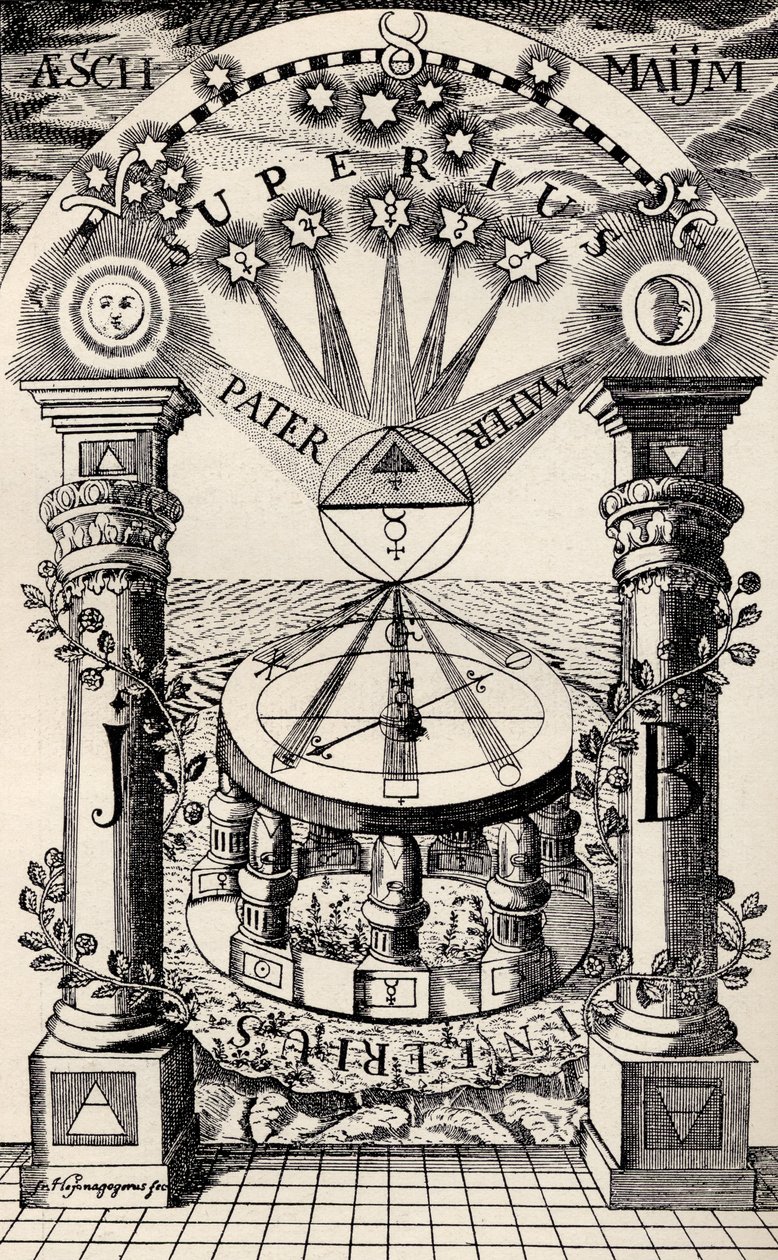
Translated from the book:
Der Compass der Weisen von einen Mitverwandten der innern Verfassung der aechten und rechten Freymaeureren beschrieben... von Ketmia Vere (i.e. Birkholz)
This work is in the "public domain in the United States of America, and possibly other nations. Within the United States, you may freely copy and distribute this work, as no entity (individual or corporate) has a copyright on the body of the work.
To all the Master-Wise at present staying in our dear fatherland, the German nation, to the Sons of Wisdom and true members of the most praiseworthy age-old Order of the authentic and tested Gold and Rosicrucians, this work is dedicated, most precious because of its thoroughness, clarity, and explicitness, in token of his lifelong most indebted gratefulness, also fraternal faithfulness, love, and activity, as a true Frater Roseae et Aureae Crucis.
The Publisher.
Unto you it is given to know the mystery of the kingdom of God:
but unto them that are without, all these things are done in parables. Mark 4:11
Right Reverend Supreme Superiors!
Reverend Most Wise Principals!
Worthy Dearest Brothers!
When I consider the unfathomable divine guidance by which
Providence has led me throughout my life, and reflect on the benefits
with which It has deemed to overwhelm me, the impulses of love, ardor,
purest devotion, and deepest gratitude stir within my heart for the
almighty Architect of the world. Although I have not seldom been
purified in my wandering by hard tests of the cross and have not always
walked on roses, I nevertheless recognize in them the wonderful ways of
eternal Wisdom which in Its sacred management saw fit to strew both
streets to the temple of the heavenly and the natural wisdom with
sharp thorns. The result has justified to my greatest happiness the
intentions of the self-sufficient Wisdom. On this sure Path, so proper
to our sacred Fraternity, It has opened to me the entrance to that
school which has been founded by the highest Wisdom and will last to
the end of time, propagated by incomparable caution and irreproachable
honesty.
Most praiseworthy Fathers! Through God, His fatherly kindness,
favorable inclination, and through a good friend, I have had the good
fortune to be admitted into the glorious palace of beautiful Nature in
a very unexpected way, without any merit of mine. They have shown me
the way to acquire wisdom, the art, and virtue, how to please God, and
how to serve our suffering fellowmen by good deeds. What in the world
could compare with these wonderful pursuits? What glistening sheen of
perishable worldly trifles, what splendid nothings of often very
unfairly conferred dignities can ever appear as beautiful and venerable
as just this wisdom, the possession of which far excels that of all
things in the world, which makes us friends of God and bestows on us
purity of the soul, long life, and such temporal goods as have neither
been extorted by injustice and fraud nor by profiteering and oppression
of our fellowmen, but have flown solely out of the inexhaustible source
of divine blessing?
How great must therefore be the duties of a true disciple of
Wisdom! Obedience, loyalty, secrecy, gratefulness toward the Most-High
and His adorable predestination, fear of God, and love of one's
fellowman must accompany him in all his actions, making his light and
the praise of the Creator visible and bright-shining. In addition to
the aforesaid virtues which the Brother must display, there is also
that unfailing remedy against the harmful suggestions of the chief
enemy of Wisdom and the soul, by which I mean praiseworthy activities.
To carry out my duty also in this regard and upon the express
order from high Superiors, I have dealt with the beautiful, thorough
and clear, hitherto secret writings of one of our worthy dear Brethren
who, although he has at present incurred a certain punishment
constitutional in our Order by his undutiful conduct, has nevertheless
so clearly discovered the great secret of the Philosophers' Stone,
according to the most ancient, best, and surest way of the Patriarchs,
Egyptians, and the other ancient oriental and southern countries, that
nothing like it has ever been seen. I have put his writings in order
from a rather faulty copy and provided them with notes and a preface in
which I have completely truthfully presented the history of our great
Order.
Should I have the good fortune of receiving the approval of my
Supreme and High Superiors, also that of my worthy Brethren, for this
work which I undertook for the honor of God and the edification of our
sacred fraternity, I would hope, because of the excellence of the work,
that it would have a far-reaching usefulness and serve to convince
today's natural scientists that their chemistry, built on the shallow
foundation of their mechanical philosophy, cannot possibly be true.
By reading it, the detestable sophists would lose all hope of breaking
through the doors of the palace of beautiful Nature with their mighty
assaults and so reverse the once-and-for-all firmly established laws of
motion. Simultaneously, some investigators, eager for knowledge of
natural secrets, would learn what to expect from that rabble and
thereby be saved from complete ruin.
Finally, my self-esteem makes me believe that at least a few of
our heretofore enemies of Wisdom might obtain a better and more
well-based idea of our purest and sacred intentions through the
preface, and after this recognition be forced, like Balaam in regard
Israel, bless instead of curse us as the friends of God. For it is
today necessary more than ever that the public be clearly convinced
both of the real existence and of the long duration of our sacred
fraternity, and no less of the integrity of our pure intentions, and
that many degenerated and misled Lodges be informed of the true goals
of the real and genuine Freemasonry and be inspired to seek the true
Light and the Lost Word in the sacred temple of Wisdom.
Behold, therefore, Most Reverend Supreme Superiors, Reverend Mos
Wise Superiors, Worthy dearest Brethren, with kind eyes the first
fruits of my purest offering of thanks. Continue to hold your father
hands full of blessings over me and vouchsafe me your protection.
Instruct me still further out of the supply of superabundant wisdom
with which God's generosity has anointed you as true priests of Natur
Correct the mistakes that have crept into my work, so that God and Hi
Wisdom be with us, unto Whose mighty protection I commend you, Most
Reverend Fathers, Worthy dearest Brethren, most devotedly, in pure fe
of God and love of our fellowmen, as a true Frater Roseae et Aureae
Crucis.
From my residence, on the 10th of the 1st month of 1778.
Ketmia Vere.
Preface.
Some time ago, when I was in the company of very fine, honorable,
and learned gentlemen in a coffeehouse of this place, I met there a man
who argued heatedly about the advantages of French Freemasonry, of
which he was a member. He spoke of nothing but profane individuals,
moles, blind ones, etc., which are the customary terms used by these
erring Brethren to compare others with themselves and to try to
humiliate them. In so doing, he often made use of the words Maitre
Ecossais, and the like. I listened patiently for a long time but
finally had enough of his boasting, so unbecoming to true Brethren.
I made a sign by which he could understand that I myself was a Master of
the Great Light and Lost Word, yes, a more advanced Scottish Master
than himself. And lo! All of a sudden there was a great silence.
He then approached me, asked me to come to his Lodge, and uttered no
further word. I replied with due courtesy that I was obliged to him
for his invitation but that I had not attended any of their assemblies
for several years. For although I had been an assiduous Freemason
after my admission, including that into French Lodges, I had
nevertheless changed my mind after realizing what little benefit could
be derived from their activities, irrespective of which I always have
the greatest esteem for the first three or English degrees. Also, I
told him, it was well known to me that one could not say with a clear
conscience that all systems agree in regard to the main points of
ethics, friendship, charity, and honesty; but neither could one say
that in their Lodges they carried on with such licentiousness as their
enemies accused them of. One would rather have to admit that in them
nothing was done against religion, the State, or morality, especially
in those organized according to the English model; one also could say
that occasionally interesting and instructive teachings came out of
them, yes, that even on St. John the Baptist's day considerable alms
were distributed among the poor of all three religions in London,
Amsterdam, Hamburg, and other Hanseatic towns. But as,
notwithstanding, the nonimportant, or at least the indifferent, mostly prevailed, yes, as even some, especially French Lodges, were
transformed into mere bacchanalia, I abstained completely from
them.
Nor will I speak of the many grotesque and ridiculous things
done with the so-called Maitre terrible and the like, which did not
agree with the required seriousness, and had without doubt been
introduced by some frivolous young Petits-Maitres and may
presumably have been the reason for the letter of that Swiss to M.
de Jussnonat, President of the Parliament of Grenoble, in which he
wrote among other things: that it was incomprehensible to him
how reasonable people could subject themselves to such unreasonable
customs. That he was greatly ashamed of his inquisitiveness, although
he had written a few works whose favorable reception by the world could
have made him proud. That he was nevertheless out of all danger, as in
order to practice humility he had only to say to himself: I am a
Freemason. That this thought was enough to diminish the good opinion
he might have of his intelligence.
However, as any rationally thinking man has the duty, like Cato,
the former Roman Censor, to justify his pastimes before the eyes of th
clever world just as he would his serious actions, and as it is
moreover ridiculous to engage in earnest in the learning of
insignificant things, in view of the great brevity of this life,
I believed that I could relax much more usefully from my work in the
company of such dear, learned, and reasonable gentlemen as those
present.
To this I would add, I continued, that although all Freemasons
still have their symbols and hieroglyphs, most of them no longer
understand the least bit of their true meaning, and that there could b
nothing more distressing than that. Even if some of them wish to
excuse this fact by saying that instead of the right meaning,
they nevertheless have another, connected with their pictures, which,
although it is not the true one, nonetheless serves them insofar as
they do not become so ridiculous as the above-quoted Swiss asserted, this excuse is inadequate.
A wrong concept is always a deception of
the intelligence, and to defend it stubbornly is an error combined with
stupidity and malice, which is not to be permitted. I myself have been
in love with these things for many years, but I could make neither head
nor tail of them, just like others, until I understood them correctly
in a different and special way through a special dispensation of divine
Providence.
Indeed, I became acquainted with the genuine and right Freemasons.
Although their number is rather small in comparison with the many
others, because they are very cautious in the acceptance of their
members, as few persons are found NB. who are worthy of it. Just
this must motivate them continually to praise the Supreme, Who has
elected them among so many others to be instruments of His generous
kindness toward men.
Here you have, gentlemen, a brief but substantial description. It
is totally according to truth, because the sacred fraternity of which
we are here speaking is most excellent in its foundation, since it has
the wisest men yes, even kings to thank for its origin and progress.
It is venerable because of its hoary age; glorious, because of the
faithfulness with which it has endured in constant purity up to our
times; sacred, because of its zeal in the promotion of divine honor;
pure in its ethics; unsullied in its principles and edifying in its
conduct of life. It is famous in its intention to acquire wisdom, art,
and virtue, and to please God and serve our fellowmen. It is no less
wise and ingenious in its organization; exact in the fulfillment of its
duties; right in the execution of its statutes; severe in the
punishment of its trespassers; kind in pardoning those who recognize
their mistakes. It is devout and witty in its assemblies; serious,
modest, and regular in its exercises; instructive in its dissertations;
sober and moderate in its entertainments; industrious in its works
destined for the benefit of the whole of mankind. Its assemblies are
devout, for they are opened with the praise of God and closed with it.
They are indeed the instruments of the generous goodness of God toward
men, for their usefulness extends to all members of the State.
Through their purified principles the farmer becomes more clever and
hardworking; the citizen becomes more calm and content; the soldier
more brave; the judge and civil servant more just and unselfish;
the courtier a Rivera and less devoted to trifles; the lawyer loses
through them his quarrelsomeness and love for hairsplitting; the
physician learns to take sure steps toward curing his patients with
unfailing good result; and finally, the philosopher can get from it the
exorcisms with which he can drive out the motley little ghosts of the
atoms and introduce all good, pure, and highly effective spirits into
natural science and philosophy.
I remember having heard, already many years ago, a simile from a
good friend which is incomparable. He said in fact that society
looked to him like an earthly paradise before which God had put a
cherub with a fiery sword. It was to keep those bold ones out who,
infected with all seven deadly sins, dared to approach the Tree
of Life planted there.
Finally, in regard to the erudition which this illustrious Order
displays, it is not subject to the least doubt, just as there is not
the least doubt about all its other advantages. You may reflect
yourselves on what so many wise men, who study day and night and
openheartedly communicate to each other their thoughts and experiences,
may achieve in the course of several millennia, both in the speculative
and the practical sciences, and that they must surpass all learned
societies that ever were, still are, and will be in the future.
Therefore, the eulogy given it by an unknown new author is in no way
too extensive or exaggerated. "Of you," he writes, "O you truly happy
ones, who have been able to connect the upper waters with the lower; of
you who have acquired the skill to wash the Earth with Fire, and to
burn it with Water, then to sublimate it; of you I say, all darkness
will flee and all kinds of honors and good fortune will accompany you
on earth. You have seen the nonwetting upper waters; you have touched
the Light with your hands; you have shown that you have knowledge to
compress the Air; you have learnt to perfection how to nourish the
Earth and to exalt it in Mercury, Salt, and Sulfur. You have
recognized the center and know how to extract from it the rays of light, and to dispel the darkness by this light and see new daylight.
To you Mercury was born, and the Moon is in your hands; it has been
born a second time and elevated into a worthier state. You have
admired the Sun in its redness and the Moon in its white gleam, and you
have contemplated all the stars in heaven in the darkness of the night.
What more shall I say? You have produced a Chaos and given it a form
which you have extracted from itself. Consequently, the prima
materia has been in your possession, which you only provided with a
much nobler form than the previous one, and you transmuted it into an
altogether more perfect form."
Your respected Society could have shared in all these blessings if
it had continued in its first faithfulness and purity; for it cannot be
denied that formerly and at the beginning all members were
philosophers. But things have since greatly changed.
The Master-Wise were greatly grieved to notice that in increasing the number of their
members, they did not also enlarge the number of the Wise, and they
therefore sought to confine themselves to narrow bounds. The Freemasons
were left their secret signs and customs, but gradually they were not
given the key to them, and soon the whole society no longer knew the
meaning of their customs. In the meantime, they have retained them,
and experience shows how wisely those Fathers acted by withdrawing the
secret from them."
You see, Most venerable Brother, what they have lost!
And because they never thought of returning and have to the
present not thrown themselves into the fatherly arms of kind Superiors,
except one single lodge which quietly enjoys the fruits of its probity,
they must still grope in the dark, and it is doubtful that they will
ever again behold the Light or find the Lost Word.
During my speech, all persons present had listened silently and
with great attention. At last they showed their approval by asking m
to give them an account of the origin, progress, and present conditio
of the Order. As I already knew so much about it, they did not doubt
that I would be able to satisfy them completely. Yes, they even
surmised that I myself was a member of it. I did not consider it
expedient or necessary to reply to this last conjecture but acted as
I had not heard it. After that, when the company had sat
down including the Brother Freemason, although with a rather sour
face I began as follows:
That Adam, the father of all of us, received the highest wisdom
the knowledge of God, Nature, and all created things directly from the
Creator, no person believing in God and His holy Word is likely to
doubt, but will accept as an infallible testimony of It that Adam,
owing to his full knowledge of all Nature and all substances, could
give every creature its name in such a way that it comprised its oute
and inner qualities most perfectly. Although this knowledge was
greatly diminished after the lamentable Fall, God nevertheless used the
service of the holy angels to refresh it in him, so that it should nc
be totally extinguished. They were his guardians, as a certain famous
author calls them. It is no less credible that this Patriarch
transmitted to his children the highest knowledge lost in large measure
through the Fall and learnt again through the pure spirits. The
columns of Seth are known, on which he is said to have recorded the
knowledge learnt from his father. The historian Josephus says
that he saw one of them. This is not so incredible as some historian
believe, who assert that the art of writing had not yet been invented
at that time. This is evidently wrong, as many learned men have prov
that the said art and its invention are to be ascribed to Adam
himself.
Enoch, who had also been heir to the patriarchal learning, was
called Adris by the Arabs, that is, teacher of secret knowledge, and he
is generally taken to be the first Hermes, whose name has the same
meaning in Greek. I pass by the others, just to speak briefly about
Noah. In his chest he preserved all the knowledge left after the Flood
and likely to come down to us; from whence it flowed on to his sons,
grandsons and other descendants, and through them and their children to
all peoples of the whole earth.
Noah's homeland was Armenia, where the line of his grandson
Arphaxad settled. Because that family did not take part in the foolish
construction of the tower of Babel, it kept to the purity of the
religion, ethics, and knowledge learned from its father and ancestor,
while in contrast, even at that time, various sophistries already began
to infiltrate into the house and school of Ham. About the middle of
the year of the world 1700 consequently not very long after the
Flood many members of that lineage left under the leadership of
Mizraim, grandson of Noah, and settled in a nearby part of Egypt which
could not be damaged by the frequent water which at that time had
flooded the said land. Their leader is called Menes by the profane
secular scribes, and he is precisely the man whom in later times
superstition counted among the gods under the name of Osiris, because
he himself and all his subjects were honest people, living according to
the law of Nature. I do not deny, though, that with them various false
doctrines may have smouldered under the ash, but they could not break
out on account of the strict supervision of the government, and only
really spread in much later times. For at the time Moses lived in
Egypt, one could see that the sophists and unbelievers completely
predominated at the court of the king, as is still the case today.
Menes chose as his spouse his own sister, which was not illicit in
those patriarchal times. In the Phoenician language, the language of
the Hamites, she was called Isha, that is, the Wife, because she was
the consort of the king. Out of this the Egyptians later coined the
word Isis and incorporated this woman, in addition to younger
Egyptians, into the number of the gods. She had very great
intelligence and wit and was also a lover of the sciences, especially
chemistry, medicine, natural science, and natural and spiritual magic.
As just at that time the famous Thoth was in the service of the king as
his first counselor, she used the opportunity to have him instruct her
in the above-mentioned sciences in which she succeeded so well through
the teaching of this learned man and her own hard work that she has
ever since been considered a very great sage by all peoples -but a
witch and sorceress by the vulgar mob. Her epitaph, a memorial of
great reliability, mentions this Hermetic instruction as something that
is to her credit. It reads as follows:
"I am the Queen of the whole land, instructed by Hermes."
The above-mentioned Thoth was called Taavt by the Phoenicians and
Hermes by the Greeks. In the series of famous men of this name he is
the second. He was the most learned man of his time and the author of
the famous Emerald Tablet, which is considered a kind of chemical Bible
among the Hermetic Philosophers. For aside from the fact that it was
written in Phoenician which had almost fallen into oblivion at
the time of the third Hermes and had been transformed into quite a
different dialect, namely the Egyptian it serves as a main reason for
the likelihood that it cannot be accredited to the younger Hermes.
Our elder Thoth was held in great esteem by King Menes. He was
entrusted by him with the most important affairs, and after the king's
death, he even became his successor in the kingdom under the name of
Athotes or Thoth the First. He was, as said, a superior man and quite
exceptionally experienced in the above sciences, so that he is also
shouted down as a magician and sorcerer by the profane, although he was
a pious, honest man who lived by the laws of Nature. Some authors
therefore rightly assert that after the Flood he was one of the first
who revealed to men (mainly, by all appearances, the Egyptians) the
knowledge of God and the secret of Nature.
It is here we have to look for the right time and origin of the
esteem in which the said people held those sciences and the
unbelievable height to which it rose in them. Yet it is also at this
point in history that we find the reason why the Masters of Wisdom of
this nation established their secret societies which later served as
the pattern after which other peoples organized theirs and which, by
the Grace of God, still continue today among the Christians as the true
Freemasons.
Some, yes most, scholars consider our Hermes the inventor of the
hieroglyphic letters, by which he concealed the principles of the
secret sciences from the eyes of the profane. To know these principles
was not useful to them, instead rather harmful, and they were only
allowed to be known by the Sons of Wisdom, as is customary in the
illustrious fraternity of which I am speaking. Those public monuments,
which comprised such wonderful things, caused the intelligent Greeks to
go to the wise Masters in Egypt, to be admitted there into the secret
societies and instructed in their school of philosophical wisdom.
The learned Jesuit Athanasius Kircher has greatly endeavored to prove this
in his Oedipus Aegyptiacus, which has been published in Rome in
four parts, in folio size, and deserves to be read.
Abraham the Jew, born in Chaldaea, belongs here too. His piety and
intimate dealings with God were beyond all doubt, according to the
testimony of the Holy Scripture; and his wisdom and great knowledge of
the secret natural science are testified to by very famous secular
writers, such as Eupolemus, Artabanus, Flavius Josephus, and Philo
Judaeus. He increased his knowledge during his travels in Egypt, and in
return showed them things they had not known before, so that he could
turn into a very useful teacher for the Phoenicians.
If the book Yetzirah were really by him, he would have to be considered a
strong Cabalist, because this book shows the greatness of its author.
The Aesch-Mezaraph and all others borrowed their alphabets from the
Notarikon and the Gematria from it.
At the time of this Patriarch there lived Zoroaster, a man for
whom I have an exceptionally high esteem. Those who believe that he
lived at the time of Darius Histaspis are greatly mistaken in my transcription. For as most scholars take him to be the founder of the fam
Magis, but those began to flourish there at least 1000 years before t
government of this king, anyone can see that this calculation cannot
right. Franz Patrizius quotes an old oracle which reads as
follows:
"I do not see him because a cloud is enveloping him, a dark clo
is surrounding him. Therefore none of the mortals can have seen the
great ruler, except a Chaldaean sprung from a higher tribe, to whom
course of the stars was known."
Our author believes that one can unhesitatingly understand
Abraham, who spoke with God and simultaneously was a great astrologe
and magus. And as Zoroaster's pure principles, concealed in the
Sadder and his other writings among the bad addenda which the later
infected magi and Neoplatonists appended to them, agree so precisely
with those of the patriarchal of the oldest Chaldaeans, it is not
unbelievable that he received them from the mouth of Abraham and
transmitted them to the first magi. This is even admitted by the
Gebers, and his philosophy has ever been admired as the purest among
that of all pagans, and considered as nothing but piety and divine
service supported by wisdom. Likewise, the illustrious
fraternity takes it to be the religion of Abraham and the Patriarchs
and the highest degree of natural-philosophical wisdom. It had also
been retained for many years by the magi themselves, those enemies of
every kind of idolatry and idols, even if they engaged in a certain veneration of the two great heavenly lights, the sun and the moon.
However, I suppose that in this there was more of a philosophical truth
than a punishable religious practice, for (if one would like to explain
the matter theologically) they considered them at most only prototypes
and containers under which God lay hidden, but in no way as something
divine. All these counting principles must have remained very deeply
rooted in them long after they had united with the Egyptian Brothers
and had accepted various errors into their religion. For Ostanes, who
accompanied the younger Xerxes in his campaign in Greece, advised this
king to destroy all the temples of the idols of the said conquered
people, which is a known fact. And the example of the three Magi, who
also were members of the sacred fraternity of Magi and the first
confessors of Christianity, confirms it.
Therefore, one does very great violence to honest Zoroaster if,
even when admitting his ethics as good and reasonable in most parts, he
is accused of catering to the voluptuousness of the oriental peoples
and of permitting incest without distinction and polygamy in
general. However, that could not be held too much against a man
who knew no other than the natural law. Abbot Bazin, although he
was not a great Church Father in matters concerning the honor of God,
is far fairer when he writes: "Zoroaster purified the cult of the sun
and taught them to adore but one God only, the creator of Sun and
Moon."
Of course it is quite possible that when Zoroaster came to Persia,
the populace, which is quite easily smitten by external appearances,
went too far in its devotion to created things and was therefore
punished by him while the wise among the people will hardly have
thought so. Remember what I said above about the philosophical
significance of this matter.
The fraternity lasted among the Magi as long as they themselves
lasted. However, whether it continued under the Gebers, I do not know.
I suppose that it still exists among today's Persians, and I believe
they got it from the Arabs. At least I have been told that even in our
time assemblies of the Superior Brethren are held in Persia.
I now come to Isaac and the blessing he gave to his son Jacob. It
is in Genesis 27:28 and reads as follows: "God give thee of the dew of
heaven, and the fatness of the earth." This glorious blessing has
abundantly flown down from the said patriarchal Brother to the entire
dearest fraternity, which also knows how to use it very well for the
honor of God and the benefit of our fellowmen. Just as that which the
blessed Jacob gave to his son Isaac in the following words found in
Genesis 49:11: "He will wash his garments in wine, and his clothes in
the blood of grapes." The individual who has been taught in the
School of the Wise what the wine is in which the clothes, namely the
substance of the blessed stone, are washed and who knows the blood of
the grapes from which the royal coat gets its color, will understand
that this was a particularly wonderful blessing, which also lies on the
fraternity so often praised by me, just like the preceding one.
Now I finally come to the Patriarch Joseph, a son of Jacob. He
was a very noble magus of the highest degree of the Superior Brethren.
For aside from the fact that he was a good interpreter of dreams, which
art without doubt belongs to magic, he also had a cup of which it
is said in Genesis 44:5 that he used it to prophesy. We read with
surprise what pitiable twaddle is put forth by some scholars about this
kind of prophesying, enough to make us feel sick about it. If these
people knew the power of the Philosophers' stone and how the metals are
magically constellated by it, they would not behave so stupidly. But
it is a good thing that the Sons of Wisdom know about it.
Moses, a commander-in-chief of the Israeli people, was such a
great man that it would be unfair not to deal with him in greater
detail. A learned French author portrays his greatness in a brief
statement that is completely in accord with truth. His beautiful words
are: "The life of this great man is a fabric of amazing events. From
the moment of his birth to the last hour of his life, yes, from all his
actions, one can rightly conclude that he knew the sciences and the
arts to as high a degree of perfection as Solomon.
This is not surprising, as he had been instructed by the Egyptian priests in the
loftiest parts of learning." He was born in Egypt and drawn by
Thermutis out of the Nile, into which his mother had thrown him to save
him from the wrath of the king. Thermutis was a daughter of King
Canchres, whom some take to be Busiris, of whose cruelty so much
is reported in history, or in the view of others, of the king whom
Manetho calls Ramses Miamun. She sheltered him and, after
he had grown up to a certain age, he was educated at the palace in all
the sciences of the Egyptians. Petavius puts the time of his
birth in the year 3143 of the Julian Period or in the year 2413
after the creation of the world. If this is true, he cannot possibly
have lived under Cenechres, who supposedly was Achenechres II, but only
in the year 3616 of this period, that is, in the year of the world
2876, as Ramses Miamun whom some consider the father of
Thermutis lived about the year 3635, that is, the year 2905 after the
creation of our earth. Consequently, Petavius would be mistaken by
about 460 years. However, we will not decide on this but be satisfied
to show here that Usserius [Archbishop James Ussher] who has
until now been considered the man who has most exactly measured the
chronology of the Holy Scripture names Ramses Miamun, and most others
follow suit.
As our Moses lived in Egypt, it seems that the first assemblies of
Brethren had been organized there and were known by the names of the
initiations. For although the Patriarchs and Masters of Wisdom had
kept together from the beginning of the world and had separated from
the great profane mass, it is nevertheless likely that only during the
lifetime of this commander-in-chief of the Israelis was the
disciplinary law of silence, established in Egypt and the desert of
Arabia, produced. Then, during and after the Babylonian captivity, the
alliance was consolidated in Syria; and at the time of Solomon and the
younger Hermes, the order of the classes and their divisions was
established.
But just as this highly important matter in time spread over the
whole globe and increased, it did not improve, but worsened, owing to
the arrogance of many mean persons. Therefore the whole fraternity was
reformed by seven Master-Wise in the 4th, 5th, and 6th centuries and
was finally given the present constitution. But so that the Superiors
could better hide their intentions and man's thirst for knowledge be
better satisfied, they established the three lowest classes of the so-called Freemasonry as a nursery toward higher knowledge with certain parabolical decorations.
Although those have in the course of
time become totally profaned and are almost unrecognizable, the most
suitable subjects must nevertheless be taken from their ranks by
fraternal legal procedures, and no one but a Master of the Shine of the
Light can attain to the degree of Juniorat of the Rosicrucians.
Here the Brother Freemason stirred again, saying: "Bravo! Now I
am also a Rose-Croix! Indeed, we also have in our right and genuine
fraternity an exalted degree of this name."
"By no means, my very reverend Brother," I replied. "You
cannot call yourself a Rosicrucian until you have found again the
Lost Word and have seen the Light itself. The name does not
matter, but the thing itself. Besides, there is nothing by which
so many venerable Lodges are deceived as much as by the so-called
higher degrees, which by themselves are nothing but the inventions
of idle heads."
Our Moses was undeniably a great alchymist. We read in Exodus
32:20 that he burnt the golden calf, ground it to powder, and
strewed it upon the water, and made the children of Israel drink of it.
This, however, is not possible without the help of the higher alchymy.
Even some famous exegetes of the Scriptures have noticed it, among whom
I will only mention Cornelius a Lapide who, as far as I remember,
speaks as follows in the interpretation of this passage: "He [Moses]
threw the golden calf into the fire together with the admixture of some
herbs, to melt it into a mass and burn it as it were to coal. And he
ground it finest . . . ." But, as may be seen, the good man had not
the slightest idea how gold has to be destroyed before it can be made
potable. If he had known that only a man who can catch cannon-shot is
able to accomplish the great secret, namely to destroy gold in such a
way that it is no longer gold, he would not have marched up with his
herbs.
Here the whole company began to laugh uproariously. Let the
hangman catch a cannon-shot, they said. "All this is nothing yet," I
replied. "They can provoke earthquakes, floods, heavy gales,
thunderstorms, etc., and enclose all these stirred-up mighty effects of
Nature in a small container." Here the laughter doubled. But after I
assured them upon my honor that this was so indeed, they were content.
And I pointed out to them the Sanhedrin of seventy wise
men established by the said lawgiver after the model of the Egyptian
fraternal assemblies upon whom God had poured His Spirit, so that
they like Esdras might explain the deep things of the night and the
secrets of His law in clear speech, and that this might bring both
spiritual and physical benefit." And this had been the first
Fraternity in Israel, which not only had to take care of the political
and governmental affairs but also had to show to the younger Brethren
the witnesses of natural-philosophical wisdom hidden in the divine Holy
Scripture, and to explain to them the caballistic-magical secrets
concealed in it.
The sister of Moses was called Maria, or in the Hebraic dialect
Miriam. She was a prophetess and exceedingly well acquainted with the
Hermetic sciences, as the book known under her name incontestably
testifies. Although the said writing is thought to be falsely
attributed to her by many scholars, and although it is also believable
that the Platonists of the Alexandrian guild interpolated much, we must
nevertheless remember that the Greeks considered it a genuine writing
for a long time, as may be seen in Georgius Synellus. Some credulous
Brethren have believed that this Miriam, no less than Isis, Cleopatra,
Taphnutia, and other chymical women, had been initiated Sisters in the
sacred society. However, this is not believable, as not a single
important writer mentions it.
As far as Solomon is concerned, there is not the slightest doubt
that he was the greatest among the Masters of Wisdom who ever lived.
Read Chapter VII of the Book of Wisdom without prejudice, and the
truth of what I have said will be evident. It shows that he had a sure
knowledge of all things and knew how the world had been made and the
art of the elements. He is also said to have known what was in
people's minds and everything secret, etc. All these are
characteristics of a perfect Hermeticist and natural and divinely
spiritual magus. To this may be added the Song of Songs of this holy
king, in which there are such traces of these sciences that whole
folios of chymico-magical commentaries could be written about it.
Consider in this regard what the Scripture itself says, how at
the time of this king there had been so much silver in Jerusalem that
the streets could have been paved with it. And here I cannot omit
reporting the interesting remark of old Herr Sonnefeld, namely,
that Solomon transmuted the enormous amount of silver left to him by
his father, King David, into gold which is not unbelievable,
considering how much of it he squandered, so to speak, in the
construction of that temple which astonished posterity and for which
the treasures of the still unknown Ophir would hardly have sufficed.
But so that I may also touch on some of the king's magic: It not
only appears from the Book of Wisdom cited by me that he had been
quite experienced in it, but also judging by the recognition of it by
all Oriental peoples. It may indeed be said that this aspect is
believed by the Arabs, Persians, Turks, and all other Moslems as such a
certain truth that nothing is met more frequently in their writings
than tales of the astounding power of the Solomonic sigills, talismans,
pentacles, and rings signed with the secret names of God. And
supposing that most of these tales were false, yet one cannot
understand essential properties of a thing that does not exist at all.
(Non entis nulla sunt praedicata.) In addition, I hope that no
Christian will be so impudent as to accuse this holy king of a secret
alliance with evil spirits. Even merely to think so would be
blasphemy.
The fraternity itself, where the said secret sciences were taught,
now went on continually, although it is probable that during the
Assyrian and Babylonian captivity assemblies were held very sparingly.
But as we nevertheless find that the Prophet Isaiah, Ezekiel, Daniel,
and others living at that time belonged to the Fraternity, we can
easily conclude that they had not been altogether interrupted.
Besides, the Fraternity then had its heyday, and as the Chaldaeans, who
were the Masters of Wisdom of those lands, had kept the natural
religion of the Patriarchs, including Cyrus who himself professed it
and loved the Jews, this is once again a reason for believing
that the Jews attended their assemblies.
In the Promised Land, however, the Brethren raised their heads
only after the Babylonian captivity. For we read in Book IV of Esdras
that he assembled the remaining Masters of Wisdom, seventy altogether,
who were to write down the cabalistic divine and natural truths in so
many books that they would be saved from oblivion. The holy author
himself gives us the best information on this, expressing the words
which the Lord had spoken to him as follows:
"Make public the twenty-four books that you wrote first and let
the worthy and the unworthy read them; but keep the seventy that were
written last, in order to give them to the wise among your people. For
in them is the spring of understanding, the fountain of wisdom, and the
river of knowledge." And I did so.
Here you see, therefore, gentlemen, the seventy wise men and
Principals of the secret Fraternity!
From what has been said, an unprejudiced mind will now learn to
recognize what kind of man this supreme commander of the Israeli
generalship was. Remember these two passages: In the first chapter of
Book IV, 14 and 39, Esdras speaks of a cup filled with a certain liquid
moisture which had the outer form of water but the color of fire.
By drinking of this fiery water his heart was filled with understanding,
so he says, and his chest swollen with wisdom, as it were. The
other passage (in II Maccabees 1, 19, and 20) reports that at that time
the fire buried under the altar of the temple was found again in the
form of a thick water in an old well, and with it the sacrifice was lit
anew.
The two above-mentioned passages require a Rosicrucian
explanation, because philosophical hairsplitting and conjectural
criticism are here not enough. But whoever knows the said
divine-magical fire, and knows how to use it in the fear of God, for
the glory of His most holy name, and no less for the benefit of his
fellowman, with fraternal intention, will be able to light a very
pleasing burnt offering to the Almighty every day.
When finally the kingdom of Judea and Israel gradually became
extinguished in its kings of the line of David and the Jewish land was
constantly overrun by the Syrians and other enemies, the Fraternity
spread among the Essenes and the Hellenic Jews in Egypt. This was an
association of wise men living especially austerely and blamelessly.
They were so secretive in their theological, caballistic, chymical, and
Hermetico-magical sciences that all of them preferred to suffer death
rather than divulge any of their natural secrets to nonmembers, far
less the hidden names of the angels, the foundation and cornerstone of
the Caballah. This is the true character of the Order, whose
members would rather submit to death and the most horrible tortures
than break their most solemnly made oath of secrecy.
As I noticed, however, that it was already very late, I asked the
company to be patient till the following day, and went home.
The following evening we met again and I continued as follows:
After telling you, gentlemen, enough of the origin, progress, and
constitution of the sacred Order among the Patriarchs, Israelites, and
Jews, I now hasten to get to the Egyptians, where the first base for
the regular organization of the secret societies must be sought. In
this country the latter were very closely linked with religion.
They were under the supervision of the priests, who were all philosophers,
and at first combined the patriarchal precepts with natural science in
pure simplicity, without wrapping them in the swaddling clothes of
poems and fables, thereby disfiguring them, which was only brought
about in later times through symbolic mythology. Meanwhile, the great
secret of the unity, omnipotence, infinity, goodness, justice, and
other qualities of a divine being, of the immortality of the soul, and
of an eternally lasting reward or punishment after death even
according to the known dogma of the transmigration of souls, such
transmigration having only a certain limited duration remained
untouched, ethics remained irreproachable, the philosophico-magical
secrets unadulterated.
The sophists and all enemies of wisdom in general were as hated by
the Fraternity of that place as they are still at present in Europe.
Yes, even at that time all those who were not initiated, that is,
admitted into the Fraternity, were called profanes. This was so not
only in Egypt and the Orient but also in Greece and even by the Romans,
although the latter only had sham Lodges where their occupations were
nothing but theological and philosophical puppet shows and their whole
royal art consisted in nothing but the construction of houses of cards
in their Lodges or secret assemblies while they were duping the
poor populace and, just like some degenerated French Masonic Lodges,
showing off with nothing but superficial knowledge.
That is why we find many inscriptions in Italy and France where the brief words
Procul estote Profani, or even only Procul Profani, with or
without a sphinx, the symbol of secrecy, are engraved and were
doubtlessly walled in at the entrance of the meeting place. With the
Egyptians, the genuine Sons of Wisdom, it was difficult to become a
member of the secret society, and a candidate had to submit to very
hard tests. Yes, the man who wished to ascend to the highest degrees
even had to be circumcised because the Egyptians did not permit
an uncircumcised individual to see the fine points of the hieroglyphs.
It cannot be denied that even at the time of Moses many sham
Lodges arose in Egypt and that there were many sophists at the court of
the Pharaoh; also that the divine-spiritual magic was terribly
disfigured by the pagan errors that had crept into religion. The foe
of the human race must have played coarse tricks on those children of
unbelief, especially as there is but a small step between the
spiritual-divine magic and sorcery, as we are taught by our Master-Wise
who know how to determine the bounds of these sciences quite exactly.
Since the Arabs, the new Chaldaeans, the Phoenicians, Indians, Chinese,
Persians, Scythians, Celts, Greeks, Romans, Etruscans, Germans, Gauls,
Hispanics, British, Cymbrians, Goths, Sarmatians, and other peoples
received their whole learning from the already corrupted Holy Adytis
(Adytis Sacris) of the Egyptians, it is not surprising that their
secret Fraternities were also stained with many errors until they
finally acquired a new shape through Christianity. But although our
Christian associates of today are undoubtedly the right and universal
heirs of all secret Egyptian sciences, for instance of astrology, the
the mathematics, Hermetic philosophy, and spiritual-divine magic,
will remain so till the end of time, nevertheless, after
Christianity had already completely spread, various societies which had
more or less fraternized with our illustrious Order united and secretly
endeavored to improve among themselves the sciences drawn from
precisely those Egyptian sources.
I will here only mention the Templars. Without discussing their
foundation, progress, and extermination, I will only note very briefly
that they had indeed been Hermetico-magical philosophers and had
acquired such immense wealth especially through this knowledge. They
were divided into five degrees or classes: 1) armor-bearers, 2)
knights, 3) lesser and 4) greater commanders-in-chief, and 5) priests.
The first two may be compared to the lower degrees of our sacred
Fraternity, the lesser commanders-in-chief with our lesser adepts, and
the greater with our greater adepts. The fifth class, however, was the
equivalent of our magi, in my opinion. Their above-mentioned great
wealth may have contributed to their destruction as much as the vices
imputed to them. For although they cannot be completely excused, as
some of them indulged in great vices, Louis Moinburg and other neutral
writers do not consider everything proven of which they were accused.
At least we may believe that the majority of them were not depraved and
that, accordingly, their complete destruction may have been promoted
more for political reasons and due to the instigation of some
courtiers. In Pietro Messia [Pedro Mexia], a Spaniard, we find
an especially striking example of a Templar who, as he was taken to the
place of execution, summoned Pope Clement V, who was looking out of a
window together with King Phillip the Fair of France, to appear before
the tribunal of God Almighty within forty days. This summons was
followed exactly, as the Pope died suddenly after forty days.
Although, to the best of my knowledge, no other writer has mentioned
it, some important discoveries will probably be made in the
not-too-distant future which have been unknown to the learned world
until now. But we will turn again to the Egyptians.
Even if we know little of the inner constitution and the courses
of instruction used, especially in those concerning the mysteries of
Isis and Osiris who, in the symbolic-philosophical mythology of that
people, signified nothing but the two component parts of things, namely
the volatile and the fixed, it is nevertheless known through oral
information preserved in the still flourishing schools of Wisdom that
in them originated the greatest secret of Nature, the Aesch-Majim,
that is, fiery water and watery fire. There also still exists an
excellent prayer which was used in their Lodges and was said at the
admission of Lucius Apuleius. He himself has left it for us in the
following words:
"The powers of Heaven are serving Thee, Hell is subject to Thee,
the universe revolves in Thy hands, Thy feet move on the immeasurable
abyss, the stars obey Thy voice, the celestial lights delight in Thy
omnipresence, the seasons return upon a sign from Thee, the elements
obey Thee."
In older times, when the patriarchal principles were still fresh
in their memories, the closing of the Lodge was probably done by the
triple call of 𐤀 haho, which was no other than the secret name of
God Joho or Jehovah. In later times, when superstition already
strongly prevailed, that name became identical with Housher, the
Egyptian name of Osiris. In the theological sense and in the Lodges it
never meant anything but the eternal, immortal Creator of heaven and
earth. It was considered the same as Emempht, the God of all gods, and
signified: Haussez les coeurs vers Dieu Lift up your hearts to God.
With the Greeks, the assemblies were always ended with the Phoenician
Koff-Omphèt, that is, "Be vigilant and pure," which is
almost the same.
As far as the ceremonial was concerned, it was always performed
with all pomp and show, because the ancient kings were friends of
Wisdom and its Sons, even students themselves. Therefore the
Fraternity was under their protection. Yes, in Persia no one could
attain to the royal dignity if he had not previously been instructed in
the School of Wisdom and risen to the degree of Magus. Darius
Histaspis deemed it such an honor to be a Magus that he wished to leave
the memory of it to posterity by his epitaph. Accordingly,
among those civilized pagans they could do publicly what they can
It would be desirable that this custom be still in
existence and that the education of royal children destined for the
crown be entrusted to no one but the true magi, that is, genuine
members of the sacred Fraternity. Equipped with wisdom, art, and
virtue in a very noble way, these Princes, when they ascended the
throne one day after first becoming worthy members and royal Brothers,
would not only have the advantage that their eyes would never be
blinded by harmful flatterers, but would also learn to recognize
everything according to its true worth, and this without effort, in
playing, so to speak. They would become true royal magi, like the
Persians, because they would know how to reconcile the conditions of
the natural things with those of the citizens, and could precisely
calculate their agreement and their deviation. They would be able to
organize their government with this end in view, and it would always be
a happy one, never lacking perfect contentment.
I do not speak of the abundance of temporal goods which could thereby be acquired without the
necessity of burdening their poor subjects with heavy taxes. Nor would
they have to seek in foreign nations that for which, unfortunately, the
Christian world to the shame of Christianity is striving after with
such senseless fury under all kinds of pretexts and by shedding streams
of their citizens' blood. Of course one could not expect a ruling
Brother to practice this art himself while leaving all other business
unattended, or by learning it by continually staying in
workshops there would be Brethren who would relieve him of this burden
with pleasure. He would only be required to pronounce sincerely these
words: "Fraternal Love, Protection, and Liberty," and to hold them
sacred; also, never to permit the enemies of Wisdom to change his mind.
unfortunately only do secretly and quietly among the Christian peoples.
In a solemn procession described to us by Clement of Alexandria,
they entered the temple of Nature: "First came the Singer who
used two books of Mercury, one of which contained the hymns to to the
gods; the other, however, the organization of the royal life. NB.
He was followed by the Caster of nativities. He was to constantly
recite the books of Hermes dealing with astrology. There were four of
them. Prominent in addition was the Holy Scribe. He had a feather on
his head but in his hand he carried a book which was undoubtedly the
Book of the Constitution, and a level. He had to understand thoroughly
the secret of hieroglyphic writing, and consequently was one other
than the secretary of the board of directors. He was followed by the
Decorator, who may well be compared to the Brother Guide or the
Wardens. Last in the procession came the Prophet, who was the director
of the sacred practices and the Master of the Chair."
The Greeks called these Masters "Hierophants," of whom the
archenemy of Hermetic philosophy, Hermann Conring, admits that
they understood the art of transmuting metals better than all other men
of the whole globe. These secret societies now continued to the time
of Diocletian, a sworn enemy of wisdom and its children.
Owing to his wrong statesmanship, he burnt all books dealing with
transmutation, for fear that the Egyptians might become arrogant with
such astounding riches and try to shake off the hard Roman yoke. For
the Romans preferred to rob others of their belongings at great cost
and bloodshed rather than make the possessors of the art and
simultaneously their own provinces happy by their kindness, clemency,
and indulgence. Despite this imprudent persecution, the obelisks and
other hieroglyphic chymical monuments remained largely unharmed,
through which the memory of Egyptian scholarship and the principles of
the sciences were transmitted to the society with which we are here
dealing.
Now I hope that my audience will have obtained an adequate idea of
the condition of the illustrious Order in Egypt. It is therefore only
fair that I also mention other peoples where it flourished more or
less, and first those who were led to other lands as seed-people.
(Genesis 10:13, 14) Read these words: "And Mizraim begat Ludim, and
Anamim, and Lehabim, and Naphtuhim and Pathrusim, and Casluhim (out of
whom came Philistim), and Caphtorim." But as the word Mizraim not only
signifies the grandson of Noah in the Holy Scripture, the first king in
Egypt, Menes, but sometimes also the land of Egypt itself, it is
certain that these sons of Menes are not only to be considered as
individual persons but as so many peoples that issued from the said
kingdom. The emigration must be very old indeed, although it hardly
goes beyond the age of Abraham and Joseph. For at the time of these
Patriarchs nothing was yet known about Osiris, Isis, Emempht, and
Phthas, who were yet known to the Ludim. When Abraham came to this
country, the natural law of the Patriarchs was still in full swing,
and although the city of On had already been built in honor of
the Sun at the time of Joseph, it was revered in no other way
than by its name Phre, meaning "Sun" in Egyptian.
At that time, nothing was yet known of deified men. To that must be added that the
philosophers of that era had not yet thought of forming a closed
fraternity, which custom, however, had without doubt been brought to
the Ludim from Egypt in addition to the sciences. Who these Ludim were
is explained by Bochart, who rightly takes them for the
Ethiopians. As already mentioned, they had the same symbolic divine
service as their ancestors. They used the hieroglyphic writing as did
those. Their priests, who with them were also noble philosophers just
as with the Egyptians, were divided into the same classes and had to be
circumcised and pure before being incorporated into the secret
fraternities. Their members were called "gymnosophists." The prankish
writer Philostratus and other credulous Greeks relate marvels of them,
which, however, are nothing but ridiculous little fairytales stemming
from their ignorance of the right power of Nature.
For it is quite certain that they shared their philosophical views with the Egyptians
and were very virtuous and actively charitable Wisemen who have always
been a credit to the Fraternity.
The second people mentioned by the author are the Anamim, whom
Bochart takes to be Libyans. It was a people about which little
can be said, as is the case with the Lehabim and the Naphtuhim. Those
who lived east of the province of Thebais were counted among the former.
They are referred to by the ancient writers as Egyptian Libyans. The
people living in the mountains at the extreme boundaries of Egypt are
counted among the latter. They can be as little separated from
the inhabitants of the original country as the Pathrusim, although they
may have had a slightly rougher way of living than those who lived on
the plains. It may even be that there were some among them who
had been accepted as members into one or another of the Lodges in their
homeland.
The Casluhim, the sixth people mentioned in the aforesaid passage,
are called Casluchis by Bochart. They resided in the province of
Colchis which comprised the present-day Mingrelia and Cabardia. It is
possible that they were taken there by Sesostris when he campaigned
against the Scythians and became master of their country as well as of
Cappadocia and Armenia. According to some historians, this Sesostris
lived at the time of Reboam, a son of the royal Brother Solomon and
king of Judah in the year 3700 of the Julian Period consequently in
the year 2970 after the Creation of the world. Some famous men take
him to be Sesack or Sesonchis, whom the angry God sent to the said
idolatrous Reboam to punish him because of his sacrilege.
But this assertion is quite wrong. Sesostris was not Sesack but that
Pharaoh who oppressed the children of Israel so terribly after the
death of Joseph, and whom some called Sesoosin, Sethon, or
Sesonchosin, saying that Amenophis was his father. And, of
course, this populating must have been done before Moses undertook his
exodus of God's people from Egypt; otherwise he could not have
mentioned it in his books. Consequently, Sesostris cannot have been
Sesack. Nevertheless, the most important ancient historians assure us
that no one else could be credited with the honor of conquering the
Scythians and introducing these seed-people into part of their
far-flung country. He was an excellent king, a zealous member,
and also protector of the Fraternity because he had been instructed by
the great and the younger Hermes themselves, as is known. Consequently,
we can easily assume that he took the Order, which was then on the full
rise, with him to the conquered lands.
This is confirmed by the fact that the Colchians had the same
religion, ethics, customs, sciences yes, even the same language as
the Egyptians. Like the latter, they used hieroglyphs, and they also
had their sacred Scribes. But what constitutes the greatest evidence
of their profound knowledge of the higher alchymy, left them by the
Egyptians, is that they possessed that Golden Fleece for the conquest
of which Jason and his Argonauts undertook the known and difficult
campaign and got it safely into his hands with the help of Medea,
daughter of Aetas (also known as Aeetes), king of Colchis.
This golden lambskin was a book in which the art of preparing the great Universal
of the world, with all its curative and transmuting powers, after the
manner learnt by their ancestors, was described in great detail. NB.
The said book was guarded by a fire-spitting dragon. Medea
taught Jason how to put the dragon to sleep, to prevent it from
spitting fire and giving off smoke. Thereupon Jason drowned it
in the hellish water, and he managed so well that he rejuvenated his
age-old and almost dead father Aeson. NB.
In memory of this campaign, Philippe le Bon, Duke of Burgundy, founded the Order of the Golden Fleece, which is quite chymical in its emblem (the chain with the flints) and in the colors of the members' clothes, as Hermann Fictuld has irrefutably proven in his Das Goldene Vlies. As those Dukes really knew the art and were members of that sacred Fraternity where they had learned the said science, I do not think that the Order of the Gold- and Rosicrucians would give offense to the supreme and high knights of the Golden Fleece were it to consider its members of the upper two degrees true ‘Toisonists,’ because they have that jewel in their possession which the greatest monarchs on earth are not ashamed of wearing around their necks.
So now we need only deal with the last two peoples--I mean the Philistines and the Caphtorim. It is known of the former that they endeavored more to scuffle constantly with the Israelites than to bother to probe natural secrets, just as did the latter, whom Bochart considers part of the inhabitants of Cappadocia. All these peoples considered water the origin of all created things. But what kind of water? Without doubt, that of the Chaos and its moist part, the ‘weaving-water of all created things separated by the divine Spirit moving upon it. It is from them that Thales and his disciples of the Ionic school had learned it, and it is also in conformity with the Word of God. For St. Peter writes in his second Epistle, chapter 3, verse 5: ‘For this they willingly are ignorant of, that by the word of God the heavens were of old, and the earth standing out of the water and in the water.’
The Arabs, the next neighbors of the Egyptians, in revering one God only stuck for a long time to the prescription of the natural law until they finally accepted the religion of Mohammed after various preceding pagan deviations from the law's first purity. It would seem that they did not begin to study the secret sciences seriously till they obtained the translations of the writings of Aristotle and other Greek scholars. Then they reached great heights in their Fraternities, and this at a time when everything in Europe was swamped with barbarism. Ibn-Sina (generally called Avicenna), Geber, Rasis, Mesue, etc., were all learned and worthy Brethren, due to whose efforts the high Order could spread to the remotest areas that were one with them in their belief, such as Fez, Morocco, Ostrahan, and Bucharan.
Regarding the vestiges of the Fraternity in this country, we find a very important passage in an old written copy of the Fama Fraternitatis about a Brother of the Golden Rose-croix who had traveled to that land. He relates that he came to the city of Damcar70 of which he had heard that the Wise of that place were accomplishing miracles, so to speak, and how they had discovered all the secrets of Nature. In the said place, he continued, the assemblaged Brethren had not received him like a stranger but like one for whom they had long been waiting; they called him by name, etc. This was the place, he said, where he had learned his physics and mathematics, which the world could easily enjoy if love were greater and envy less. NB.
From there he went to Fez where he met very great men among the Brethren, but their magic was not pure and even the Cabalah had been stained by their religion. The Mohammedan-philosophical Brethren had all been peripatetics, and as that system of learning is far better suited to the true knowledge of Nature than that in use today, it is not surprising that the greatest Hermeticists were philosophers of this guild. In contradistinction, the system of the small particles in the form of triangles, pyramids, snakes, circles, spheres, and vortices has never turned out a true alchymist, nor will it do so to the end of time.
The Chaldaeans were great men and had their general directorate and great Lodges in Babylonia. In that country there was Ur, called Ur-Cashdion in the Holy Scripture because the sacred fire was kept there, by which they understood partly the almighty Architect of the world, partly our secret philosophical fire. Today’s teachers of wisdom follow them by likewise considering Fire the first element. Zoroaster learned it from them, for in his philosophical views all things had their origin in Fire. By this, however, he did not understand the elementary fire that consumes everything, but the right lunary, mercurial, nourishing Fire of Nature.
That these Chaldaeans were a society, sect, or fraternity of Wisemen is even admitted by the profane scholars. There is even something secret in their name, because it is derived from the Greek equivalents for ‘poison’ and ‘I know.’ It means a knower of poisons. Behind this there is more than meets the eye, for whoever knows the meaning of the right poison is on the right way in the Hermetic philosophy and is a true Chaldaean.
Although everything said above is true, the Chaldaeans nevertheless deteriorated so much in the course of time that they established many sham Lodges, as still happens today (mark this!), whose members also called themselves Chaldaeans but were nothing but casters of horoscopes who, like the gypsies, drained people’s purses with fortune-telling. Some have confused the Sabeans--who stem from Saba, the son of Chu, originally lived in Chaldaea, and are identical with the Sabians or Zabians--with the above-mentioned. Others consider them Arabs. The true opinion of scholars is that those Sabeans were noble astronomers, but it is not known whether they lived in a fraternal association with the other Master-Wise.
From the Chaldaeans the Persian Magi received their tenets through Zoroaster. I have already dealt with the latter and will only add that these Magi were superior men who had the right character of the Wise, which includes discretion. At the same place I noted that they acquired great fame in all other subjects, and the Persians considered them experienced Wisemen and servants of the Deity. It once again confirms that with them, as with the Egyptians, theology was intimately connected with philosophy. The above virtue of discretion indicates that they had been perfect Adepts, which is also confirmed by an irrefutable proof: For Democritus, according to the testimony of Reinesius in Morhof’s book, writes that he traveled to Persia to the philosopher Sophar, to learn from him the secret alchymia.
The Phoenicians, who now follow, mostly engaged in commerce and navigation. Therefore it happened that they sailed all seas known at that time and ventured even on the ocean itself.
When they were driven off by Joshua, they were forced to move on. Some of them went to Greece, others to Spain and France, and still others to the African coast, where they built Carthage. Yes, some scholars assert, and wish to prove by reliable inscriptions that have been discovered, that they introduced the first inhabitants into America. Samuel Bochart deals in detail with this in his Phaleg und Canaan. Although commerce attracted their greatest attention, they nevertheless had their Fraternities, which were without doubt organized after the example of the Egyptians. Among their members they could count Zeno, Samuhilaton, Thales, and Moshus.
Whether they also established Lodges in France and Spain, or whether in this case priority has to be given to the Celtic Druids, has not yet been decided. I am inclined to believe the latter, for in my view the Phoenicians were not good Rosicrucians, and it is quite possible that God punished them because of their usury and terrible greed for gold, and handed them over to the Israelites. Consequently, there are only two Oriental peoples left, the Indians and their Brahmins and the Chinese, of whom it is worth writing.
The Indian Brahmins were also very great artists and investigators of the secrets of Nature and maybe they are still today. Some scholars believe that they are descendants of the children of Abraham, whom he begot with his second wife Kethura, and that the name Brahmins or Brahmans attests to it, such as Abrahamanes, meaning descendant of this Patriarch. Morhof concurs with this view. Others consider them a seed-people of the Egyptians. The view that they are descendants of Abraham and Kethura is not so absurd as some might think. This is confirmed by the fact that they revered the Sun much like the Chaldaeans, but their adoration in olden times was not so reprehensible as in later times when their thoughts moved ever further away from the original, i.e., God. An age-old prayer which the Brahmins used to recite at the sight of the sun is no mean proof of this statement. It is as follows:
‘O Thou (God) by whom the Sun is illuminated, illuminate my mind, so that my actions may be according to Thy Will.’
Just this Morhof believes, and I together with him, that it is impossible to deny that they possessed the higher alchymy, considering what is related of their goldwater, the Stone Panthaure, the griffins protecting the gold, and the Phoenix which can supposedly be found with them. But since it is almost impossible to acquire a perfect knowledge of Nature outside the system used by the illustrious Rosicrucian Order, it is quite believable that they had fraternized among themselves. It is only necessary to read Morhof’s above-cited book to become convinced of it. At least, this is what the Persians, their next-door neighbors, believe, for they relate of a certain Brahmin N. Padmanaba that he showed some black earth in a subterranean cavern to a laquais merchant of Damascus, whom he had grown fond of, simultaneously reciting two Turkish verses which contained the secret of the Philosophers’ Stone. The content of these verses is the following, word for word:
Give to the bride from the Orient
The son of the king of the Occident,
Of them a child will be born
Which will be the sultan of the beautiful face.
I will tell you, Padmanaba continued, the secret meaning:
Let the dry, adamic earth that comes from the Orient
be moistened by the wetness.
Out of this corruption the Philosophical Mercury will emerge,
which is omnipotent in Nature.
NB. and which will engender the Sun and the Moon, or make gold and silver. And when he mounts on his throne, all pebbles will be transmuted into diamonds and precious stones. In a silver container, in the corner of a room, there stood the water or the moisture used to
soak the dry earth. Finally, the Brahmin mentioned the following of the virtues of the Stone:
“The Earth is still more excellent and precious. It cures all kinds of diseases. If a completely emaciated patient, breathing his last, takes only one single grain of it, he will feel how his forces return; he will immediately recover and get up. It has still another virtue which I prefer to all the others. Whoever rubs his eyes with its juice, sees the spirits and has the power to command them.”
The sect of Lao-tse in China is also a Fraternity whose members practice the chymical art.
They consider it the right means for preparing an ointment and thereby eternal life itself.
Trigautius [Nicolaas Trigault], who reports this, adds that these men are counted among the saints by the Chinese, and that there are still today a great many printed as well as unprinted books about this matter extant in China. It is said that Emperor Hiaou was a great lover of this art and that every day he collected the purest dew in a copper basin, shaped like a human hand, in which he macerated and softened the pearls of eternal life.
But who can really imagine that these men seriously believed that there was a remedy in the world for driving death away? Therefore this alleged eternity is not to be understood as anything but a very long time, expressed in Oriental parlance, which power the Universal Medicine does indeed have. Regarding this, it is worth noting that the Chinese sages considered the number 9 as the most perfect of all, that is, as the end of all created things. By such cabalistic testimony, the Sons of Wisdom will immediately recognize these Chinese birds by their feathers.
In ancient Greece Orpheus and the philosophers of the Ionic school were seen as the first Brethren. The former had brought his fine science from Egypt and introduced the secret society into Greece in the manner customary in that country. As is well known, he had great experience in medicine, from which it follows without fail that he must also have been a chymist, for without the higher alchymy, medicine is nothing but charlatanism and the art of treating the sick for better or worse at random. The members of the Lodge of Orpheus
called themselves Orpheotelests and were quite good natural scientists, so that Burnet believes that the system which Orpheus brought from Egypt and practiced in his school is to be preferred to all others. It is not without reason that Jason took him along to Colchis, for as Jason was an old Egyptian Master who had from ancient times been as venerable as the Scottish Masters are with some Masonic lodges, although they do not know them at all in their true and natural form but only in that in which they are represented in their imagination he probably thought that Orpheus’ contribution would help him propagate his ideas all the sooner, which did indeed happen.
In the Ionic Fraternity, Thales of Miletus was, in my opinion, one of the highest magical Brethren. He, too, become a member of the Order in Egypt and had many in his Lodge, where the practices and transactions were organized completely like those of the Institute into which he had been accepted. Under his direction were some of the so-called sages then living in Greece as well as other famous men, such as for instance, Anaximenes, who was a very great physicist. And just as his former principal director, Thales, had recommended the investigation of the fiery water and the watery fire as the origin of all created things to the Masters under him, Anaximenes did the same, calling it the Philosophical Air, which is the same. The ancients have
left us the names and merits of some famous superiors who followed him, such as: Anaximander, Anaxagoras, Archelaus, etc., who all organized their theories in accordance with the fraternal concordance. Some modern natural scientists cannot comprehend this.
For when they read that one of them considered water, another fire, a third the Chaos, and finally yet another air as the origin of all things, they believed that those natural scientists were holding quite opposite views. By this, however, the Sons of Wisdom at once clearly see what kind of philosophers those are who are holding such views.
Pythagoras established his principal meeting place in Crotona after he had visited the Egyptians, Phoenicians, Arabs, Persians, Hebrews, etc., on the investigation of Thales, partly alone and partly in the latter’s company. He was also circumcised in Egypt, as is well known, in order to reach the highest degrees in the secret fraternities.
In Crotona everything looked quite Rosicrucian. His younger Brethren could not reach the higher degrees till they had practiced the law of silence for five years. Thereafter they still had to wait for a while to be granted admission to the secret proceedings. In addition, obedience and respect for the director-general prevailed to such an extent that it was impossible for them to go higher. As soon as Pythagoras gave them a general or particular instruction, they replied to the individual who found fault with it: “He said it,” and forthwith all arguing came to an end.
Some of his successors, Ocellus, Lukanus, Timaeus, Lokr(u)s, Empedocles, Apollonius of Tyana, Sallustius, Porphyry, etc., deviated somewhat from the pure teaching and gradually adopted such profane ways that they were considered nothing but sham Pythagoreans who could be compared somehow to some modern artificial and degenerated Freemasons. This corruption lasted till Rudolph Otrep, under which Fraternity name Robert Fludd was hidden, restored the said philosophy and brought it to light again in the old tradition, which the learned Jesuit Athanasius Kircher approved in many points in his Musurgie.
The same happened to Plato, whose Lodge flourished in Greece in Athens and was called the Academy. Although his Brethren lasted longer than the Pythagoreans, especially as long as his nephew Speusippus was Master of the Chair, Proclus, Plotinus, and others began to make some additions, until finally under the Ptolemies the Lodge in Alexandria in Egypt conceived a new Franche-Maconnerie, which was not worth a rap. Among the other learned Greeks, however, profanity had risen to its highest point, although Philalethes asserts “that Greece had not produced one philosopher who was not magical in some sentences, that is, that he did not philosophize in the manner of the Egyptian Brethren.”
True, he excludes from that number poor Aristotle out of hate, but meanwhile some of his tenets have been accepted, that of the fermentation, generation, and destruction, and finally that of the matter of which creatures consist, and their effective properties, such as matter and form. They have very great usefulness in the true natural science.
As I was trying to continue speaking, such a loud noise suddenly arose in the street that everybody left in fear. A large unit of the Duke’s guard had picked a quarrel with the garrison and caused such a slaughter that everybody took up arms and had plenty to do to quiet the uproar. I therefore had to delay the end of my account till the following day, when I continued as follows:
Regarding the Greeks, gentlemen, nothing is left for me but to speak about the society of the Eumolpids and the Mysteries of the Elysian Ceres. The former were an association of famous philosophers who not only applied themselves to theology but also to the true knowledge of Nature, as is testified to by Seneca. Morhof quotes from Michael Maier the laws and achievements of those assembled Hermetic magi and theologians, from which it is evident that they can quite rightly be considered members of the then Fraternity, that their mysteries agreed with those of Samothracians, and that they included theological as well as physical and Hermetic tenets. Macrobius should be read regarding some famous members of this Fraternity, for instance, Jason, Castor and Pollux, Hercules, and
Tarquinus, a son of Demarathus of Corinth. Read also Diodorus Siculus and the above-quoted Michael Maier. Those who wished to be instructed in the mysteries of Ceres, that is, to be accepted in the Fraternity, were taken to the temple of this goddess. The Hierophant, who was none other than the Master of the Chair, taught them as soon as they entered that they should adore the supreme God rather than that invented goddess driving the Triptolem about in a chariot drawn by dragons. It was the Supreme God, he said, who nourishes man and gave Ceres and the Triptolem the power to improve agriculture and have it held in high esteem.
The Hierophant or Eumolpid had to recite these verses: “Walk the path of justice, adore only the ruler of the world. He is the only one who arose out of himself, all creatures owe him their existence. He works through them and with them. No mortal eye has ever beheld Him.” This Fraternity was in no wise different from that of Isis and Osiris, of which I spoke above.
Among others of their laws, that one is remarkable which ordered that on assembly days four images had to be carried around: 1) That of God the Creator, which the Master of the Chair carried himself; 2) That of the Sun, which the torchbearer held in his arm; 3) That of the Moon, which the servant of the altar carried; and 4) That of Mercury, which the director of the sacred practices carried. The Eumolpid, who in my view was identical with the Hierophant, was wearing a golden key fastened to a tongue--a sign of secrecy. During the procession itself, a Hermetic chant was sung about a dragon, the father of the fire-spitting bull, and of the bull, the father of the dragon. By this a Son of
Wisdom can immediately see what sort of men those had been who were so
famous in olden times.
Moreover, Abbot Bazin concludes, those who asserted out
of exaggerated zeal that these secret assemblies had been nothing but
schools of the most horrible filth should be set right by the word
itself that is connected with the idea of initiation and which shows
that one has to begin a new life, and by the closing formula with which
the assembly was dismissed. The latter consisted in the two Phoenician
words: Koff-Omphet, that is, “Be vigilant and pure.” In this
connection, I remember a little joke. When many years ago, in our
neighboring Hamburg, Freemasonry gained so much ground, the clergymen
of all three religions opposed it strongly. Some compared it to the
mysteries of Ceres, and lo! what a disgrace they thought they had done
the Masons. But these good men did not know that they had thereby
shown more honor to the Freemasons than they had certainly intended to
do. Besides, there was as little filth with the latter as with the
former. There is nevertheless this difference, that the former, that
is, the Hierophants and those under them, not only perfectly
understood the innermost ceremonial but also the symbolic images and
even the treatises and works, which are yet unknown to this hour to
many venerable Masonic Lodges.
In regard to the Romans, there is little to be said on the
subject. They preferred to scuffle with half of the world and to
carry out the privileged trade of highway robbery with the greatest
pleasure, than to share in these splendid gifts of God. We have
already heard what an excellent statesman Diocletian had been in this
regard, and we could only wish that he had never had any successors.
Those Romans did indeed also celebrate the festivities of Ceres and
Bacchus both of whom were nothing but Isis and Osiris (the volatile
and the fixed). But they understood as little of their ceremonial and
the secret meaning of the images as the Freemasons do of theirs,
ãlthough, just like these, they called other honest people
profanes without knowing why and kept them from their meeting places.
If it had not been for the Etruscans, we would never have heard the
least bit of a Fraternity of very wise men in Italy. For (unlike this
Fraternity) although the association of soothsayers (collegium
Augurum) enjoyed high esteem with the Romans, nothing at all was heard
there of divine-spiritual magic, the angelic Cabalah, and natural
philosophy. They were rather fools and superstitious sophists who were
fooled by the fiend of the human race and in turn kept the people at
their beck and call. Smart people, however, despised them in their
hearts and laughed at them. Just as the Consul Cicero sometimes
criticized them severely in his wonderful book on the art of
soothsaying, and among other things, adds a good joke when he writes
that he cannot understand how one fortuneteller can look at another
without laughing.
In contradistinction, the Etruscans could rightly call themselves
Razi-Hinnos, that is, propagators of the secret sciences, for as
they came from Egypt and agreed on many points with the Persian Magi,
it is easy to guess in what their treatises, practices, and works
consisted. The Scotch Baron Thomas Dempster has written very well about
this in his excellent work De Hetruria regali, published in two
volumes in small folio in Florence, 1726.
But so as not to abuse the patience of my esteemed audience, I
will only touch briefly on the Celtic Druids, who concern us more
directly, and the northern bards. The former were in no way inferior
to the others in regard to the age or importance of their
investigations. Their teachings were identical with those of
the old Egyptians, Persians, and Chaldaeans and consisted chiefly of
theology and the secret natural sciences.
They were highly esteemed in Spain, France, Britain, and Germany, where their fraternities had
spread very far. Diodorus Siculus calls them theologians and
knowers of the divine Nature despite the fact that they had already
deviated from the royal road at that time. Their meetings took place
in the open air. Like the Persian Magi, they had neither temples nor
idols, and besides the great article of the unity of God, they believed
in the immortality of the soul. That they were also not
inexperienced in the Hermetic sciences is evident in Pliny who
calls them soothsayers and physicians. It is even more explicitly
related in Ammianus Marcellinus, who states expressly that they
had researched the highest and loftiest secrets of Nature. Their name
itself indicates that they were the custodians of nearly all secret
sciences, because the Celtic word Draou, from which Druid is
derived, actually means magician, which the learned crowd has
translated as sorcerer. The Sons of Wisdom are not concerned about
this, however, because they know what it means with them.
Johannes Heinrich von Falkenstein has collected wonderful things about
this secret society. He says among other things that the
Druids had been the most highly considered of all the priests of the
ancient Germans.” He proves this by statements of Strabo and
Diodorus Siculus. They were thought to understand Nature
perfectly and to know the will of the gods, with whom they had intimate
contact.
Who does not here see an exact image of our highest, wisest
Masters, to whom nothing is secret, who know everything Hermes,
Zoroaster, Solomon, and other great men of antiquity knew? And this is
so because they possess the natural magical Urim and Thummim, the
right Urismada, Ash-Jah, or the Fire of God, by which they can look
into the heart of all Nature, acquire the art, wisdom, and virtue,
please God, and serve men. By which holy expressions they can know the
almighty Architect of the world more intimately, love Him more
fervently, and become more closely connected with Him through this
knowledge and love. Yes, they can even be deemed worthy of special
instruction by the holy angels and other spirits, like the age-old
Patriarchs, and indeed in a much purer way and refined by the laws of
the Christian religion; whereas, the patriarchal theory preserved by
the Druids was corrupted by fantastic notions prevalent in later times.
What has been said above concerning the pristine patriarchal theory is
most emphatically confirmed by the fact that our magical Druids had
embroidered on their shoes the Pentalpha, a character which our
Christian-magical brother Paracelsus considers permissible and reliable
and thereby did not understand anything but the beginning and origin
of all things, that is, the one eternal God. For although the pagans
had many gods and believed in many, their philosophers nevertheless
agreed and taught that there is only one eternal divine Being.
The Druids, who were sagacious philosophers, represented It
hieroglyphically by this PENTALPHA, and it was their Symbolum
Salutis,” our Falkenstein writes at the same place, where he
quotes a long but remarkable passage from Minutius Felix, who has
wonderfully confirmed this sentence. When the Druids were admitted,
they had to swear that they would not divulge to anybody what they were
about to learn.
The place where the Druids instructed their students in theology
and medicine was either a cavern dug in the earth or formed there by
Nature, or a thick oak grove. “We find some of those in the
Nordgau, such as the Gottmannsloch on the Hoselberg, the Weisloch near
Hochlingen, etc. The latter is supposed to mean Antrum Vatum, the
Waldweisloch (hole of the forest sages). An hour and a half
from Sulzbach in the Upper Palatinate, there is a big hole in a rock, a
quarter of an hour in depth, called the Osterloch (Easter hole), where
the Druids formerly dwelled. Nearby there are two villages called
Druidsdorf and Drondorf or Drüidendorf (village of the Druids). In
this rock there is an opening called the church, so spacious and
immensely high is it. What else is this church but the temple of the
natural philosophy, where the Superiors of this religion and
Nature-priests gathered and secretly instructed their disciples.
By this my statement is once more corroborated, namely, that these people
had formerly belonged to our Fraternity, since its members of certain
degrees have since olden times been called ‘the Wise’ by all peoples,
and by the Grace of God are still called so for good reasons.
The said Druids enjoyed perfect tranquillity until the gentle Romans settled in this country. Under the emperor Claudius they were exterminated through mere religious hatred. It is incomprehensible how such a learned man as Chancellor Prechtl of St. Emram in Regensburg could pretend “that if one thoroughly considered the language, customs, and religion of the Celts, one could well believe that they had derived from the Latin-speaking peoples. The language of the Celts is similar to theirs,” he said, “except that it has been disfigured in many words. The constitution of the country resembled that which we have observed with the Romans and the Greeks, and their religion was identical with the Roman idolatry, except that the Celts gave their gods other names.”
With the permission of this brave scholar, whom I am holding in special esteem, I must show the reasons why I cannot share this view. For as far as the language is concerned, it has only a slight conformity with the Latin, but on the contrary has a great relationship with old German and the language of the Gauls before the Romans conquered that country. The learned men Hugo Grotius and Gottfried Wilhelm von Leibnitz have proven this irrefutably.
And supposing this language had been intermixed with some Latin words through association with the Romans, nevertheless it cannot be asserted that the former is derived from the latter, just as little as German can be said to stem from French because many words of French have crept into German owing to frequent dealings of the Germans with the French. If you wish to form an opinion about a people, you have to examine the stems and rootwords, as it then shows whether it is a native tongue or a derivative one. If this examination is conducted with the Celtic language, one can easily perceive that it is not derived from any other, but that, on the contrary, our old German language, just as we ourselves, comes from the Celto-Scythian, as Just. Ch. Dithmarl
has proven incontestably. One can just as little conclude that one
people descends from another because it has the same laws, customs, and
national structure. The natural law and its first principle, ‘what you
do not want others to do unto you, do not do unto them’ is written in
every man’s heart. Wars, travels, commerce, and association often
cause a people to adopt the laws of another which is yet very far
removed from it by origin.
Finally, in regard to religion, nothing could be as far from the
Roman religion as just this one. For although the Romans, just as the
Greeks, readily molded the divinities of foreign nations to fit their
preconceptions, nobody will seriously believe that the Celts, and with
them the Iberians, Gauls, Britons, and Germans, had borrowed their Deus
Endovelicus, Arminius, Cuzmann, Puster, Thor, Hertha, etc. from the
Latins. Indeed, Chancellor Prechtl himself admits that the
religion of the Druids originated in Phoenicia, and had nothing in
common with that of the Romans. He further admits that they had
retained the Persian fire-worship, of which the oft-mentioned Romans
had not the slightest understanding. Along with the Persians, they
derived this religious practice from Chaldaea, and therefore the author
is quite right to call them Chaldaean philosophers, whereby my
statement is once again confirmed. But I have already explained above
to what extent the Chaldaeans adored the fire and what the
philosophical meaning of it is. The Druids understood it in the same
way. All this is corroborated by Postellus [Guillaume Postel],
who writes: “What the Egyptians, the Magi, and the Chaldaeans taught,
all that was also taught by the Druids, and they were as old as the
former.” In addition, we can read what Otto Heurnius, J.C.
Frey, and the learned Benedictine Dom. Jac. Martin write
about them with great industry and discernment.
Finally, as far as the bards are concerned, almost nothing is known about them in this regard because they devoted themselves more to the poetic art. And although we find such things in the Icelandic Edda which was as it were the Bible of the midnight poets it was, without doubt, of Egyptian origin and may have included matters of deeper reflection.
But it is still uncertain whether the bards understood its secret meaning or if they assembled in a Fraternity in order to probe it. Meanwhile it is worth noting that the two pagan golden horns found near Tundern in Jutland are of such fine and high-grade gold that it is almost impossible for them to have been produced in any way other than by the arte.
Should it be true what a certain author assures us, namely that formerly there had been an important Fraternity in the North called Fost. Broeder Lav, i.e., Society of the Lawbrothers, a vestige of the Egyptians which had reached Denmark by an unknown accident, it would be evidence that this Order had flourished among them in a manner suitable to these peoples and their religion and customs.
Although most of the degenerated Masons want to compare the said Society with theirs, as it is at present, the contrary is evident by their own admission that these Lov-Broedere (as they are called in the Gothic dialect) were Hermetic philosophers, which can hardly be said of the former. Accordingly that Society, if it ever existed as a fraternity of philosophers, does not belong to the guild of those Freemasons, unless the latter, because of their first three degrees and as Masters of the Light and the Lost Word, belong to the Fraternity of the true Freemasons and its inner constitution and are lawfully subject to it. NB.
Be that as it may, the whole account appears suspicious to me. The death of Sivert and of yet another man is certainly not Masonic, even if I take this word only in its pagan sense. I will, therefore not make the least effort to deny their account.
This was the state of our praiseworthy Order before the salutary birth of our blessed Savior, when the greater part of the world struggled in the mud of pagan errors. But as soon as this eternal Light broke through, spreading over the darkness of human souls, it gradually drove it away by its heavenly brightness, like a brilliant sun, while before it had been shining only with a natural, moonlike gleam, even in the most wise individuals.
This Light, although faint, had nevertheless been able to convince those sagacious men of the truth of the principal and essential dogmas of religion. By the triple testimony of natural-philosophical wisdom in the animal, vegetable, and mineral realms, and their union in a quite simple essence, they recognized the indelible character of God in all creatures. Yes, they
even saw that for the restoration of the creature stained with the Curse, a mediator, namely the Blood of Nature or Sulfur, was required to unite component parts. Consequently, there must also exist a supernatural mediator capable of reuniting with God the soul distanced from God with his blood, as a heavenly Sulfur, so to speak. Therefore, when this property of the said divine mediator in the realm of Grace was known through the preaching of the Gospel, they were ready to accept it. The mob, on the other hand, who clung to the outer school of poetic fiction, had to be convinced almost exclusively through the power of miracles.
This then was the right point in time, when the newly converted Brethren paid their greatest attention to the improvement of their institute, so beautiful but marred by some pagan blemishes, so that it might come ever more in conformity with the fundamental truths they had embraced. But as this work was of the greatest importance, much effort was required to gather the Christian members of the illustrious Order spread in Asia, Africa, and Europe and to establish a sure and firm foundation upon which this new Christian temple of wisdom could be erected and last to the end of time. The latter was not realized until the 6th and 7th century of our Christian era, by seven wise Masters. Then such a wonderful structure arose such as human intelligence is unable to produce without divine assistance and which must appear as the greatest of all human inventions to those who know its inner organization.
However splendid this palace may be, however venerable its wise Superiors and other residents, however orderly, serious, and devoted their assemblies, however spiritual and instructive their practices, however excellent their proceedings, however useful their works and occupations to all States in general and to each of its members, however pure their customs, edifying their conduct of life, and however holy their intentions may be nonetheless, they never lacked enemies at any time. I will here not mention those great and mighty ones of this Earth who threw suspicion on innocent and useful subjects and made them punishable through wrong politics, and had them banished from
their sight to the greatest detriment of themselves and their
countries. Accordingly, I will only mention those quill-heroes
who intended to deal a blow to the illustrious Order with their
writings. But may the little will-o’-the-wisps flutter on.
Gabriel Naudé is the only one who deserves to be named. He dared to make
violent attacks on this Fraternity in his Instruction à la France
sur les Freres de la Rose-Croix (Paris: 1623, 8vo.). They did not
harm it, however, as it is still alive, thank God! On the other hand,
it has also been incomparably defended by very learned men, such as
Michael Maier and Robert Fludd in their Apologeticis pro fratribus
Rosae Crucis, and John Heydon in the treatise entitled The
Rosy-Crucian, infallibles Axiomata. This means: The infallible
axioms of the Rosicrucians, which was published in London in 1661 in
octavo and is highly praised by Morhof. In it he deals
repeatedly with cabalistic-magical secrets and the power of these
things with reference to the doctrine of spirits. The author
presumably elaborates so much on this in order that those who are
unable to distinguish between the natural spiritual-divine magic and
the diabolic should not perhaps get the laughable notion of considering
these good people magicians or sorcerers.
Just as the illustrious Order has no other intentions
than Christian and honest ones, namely the love of God and our
fellowmen, and just as the former as well as the latter is practiced as
well as possible, although in secret and to the extent that it can be
done without danger and detriment, it also commands all its members,
under the heaviest penalties of suspension or even total expulsion,
never to desire to undertake the least action against the State or its
ruler. Therefore, it is always most strongly impressed in all powers
conferred upon the special administrators to direct their special
attention to their subordinates in this regard. And this is so certain
as God has created heaven and earth, and has given our devoted homeland
a sovereign, namely His gloriously ruling Imperial Majesty Joseph II,
who attracts the hearts of all men in the world by his piety,
intelligence, and human kindness, and who, by his excellent qualities,
is worthiest to be the gracious protector of this praiseworthy Society
of public benefit.
Finally, I cannot understand where Herr Jo. Friedrich Bertram has heard publishing it as something well known and evident that which he writes in his Einleitung in die philosophischen Wissenschaften: “. . . that D. Valentinus Andreae, together with some other strange men, had been behind the curtain and tried, through the satyric-enigmatic writings published under the name of the Rosicrucians, to persuade people that the true wisdom cannot be found anywhere but in the living cognition of Jesus Christ, to which one could attain through sincere penitence. Whoever would join that Order would find golden mountains, namely, eternal salvation as promised by Christ.”
With this I concluded my account. It seemed that a large part of the persons present had enjoyed it, for some of the well-disposed shouted: “Happy the man who finds this wisdom, for a long life is at his right hand, and at his left there is wealth and honor.” The others, however, stuck to their preconceived opinions and asserted that it was unbelievable that a man as learned as Herr Bertram should have said such things if he had had no sufficient reason for doing so. My reply to this was quite brief, namely that the sufficient reason had already been banned for a long time from Herr Bertram’s philosophy. A speaker of the company now continued: “If this society really existed, it would probably be conspicuous and awe-inspiring by living in grand style, by the splendor of their clothes, jewels, coaches, horses, precious liveries, and many servants, footmen, servants in Hungarian outfits, Moors, hussars, court jesters, etc., seeking to obtain positions of privy councilor, golden chamberlain keys, ribbons, etc.”
I replied that the Sons of Wisdom by no means despised riches. They knew that they were a good thing on earth. But at the same time, they knew that wisdom was by far to be preferred, because it is of a glorious nobility, its essence being with God, and that the Lord of all things loves it. Consequently, all those things are not the main object that a Son of Wisdom must take into consideration but solely the endeavor to acquire wisdom, the art, and virtue, to please God and to serve his fellowman. But as nevertheless there were among them dukes, princes, counts, marquises, barons, noblemen, statemen, high and low officers, scholars of all faculties, it would be ridiculous if they were to move about like the Quakers, out of sheer stubbornness, and behave like cranks. They should rather be guided by their function and dignity in their outer conduct. But they have never lost sight of the fatherly admonition of the Masters of Wisdom to use a certain unaffected moderation, so that the enemies of wisdom should not find occasion to again incite jealousy and envy toward them.

O God! I thank Thee ceaselessly with all my heart, with all my soul, and with all my powers for all these great and palpable favors, begging Thee fervently and in full confidence, through the merits of Jesus Christ in Whom Thou hast hidden all the treasures of wisdom and knowledge, to let me attain at last to the accomplishment of this Great Work and the possession of the true heavenly Wisdom, which is only from Thee, Lord and God, and which has been at all times and before all times, so that I may, in my rapidly advancing age and in the time still left to me to live, know and praise Thee better, thereby to receive and nourish the true fire of love, please Thee and serve my fellowman and finally, at the conclusion of this troublesome life, rejoice with Thee in the heavenly Jerusalem.
But I know, O most merciful God, that I am unworthy of it. If Thou thinkest of the sins, O Lord, who can then pass the test? But in Thee there is mercy and abundant Grace. Therefore, have mercy on me, and at last give a hearing to my long and constant supplication. How long wilt Thou tarry to help me? Make haste, O Lord, hurry, for Thy honor and for my good and that of my fellowmen.
As you promise, O venerable Wise, in the Fama and Confessio published by you, no one will be deceived in his sincerity and hope who approaches you and seeks your association under the seal of silence. I therefore believe that I have already been admitted into your venerable, most holy Society, and that therefore the advice you have given me to declare myself more clearly is aimed at nothing but the airing of my great hesitation to reveal the mysteries of God to all and sundry Brethren without exception. I hereby comply with your advice and thus soothe my conscience.
With just this end in view, I will describe the divine vessel, the Materia, and the Fire, not sophistically but truly philosophically. It will be somewhat obscure to the profane or ignorant, but as clear as daylight to the true Wise.
“Suffer me a little, and I will shew thee that I have yet to speak on God’s behalf.” Job 36:2
This is the main purpose which the sacred order, into whose community the author of this little work is so very eager to be admitted, always bears in mind. Can there be anything greater? Can there be a more useful occupation than to contemplate the adorable Creator of beautiful Nature and all creatures by investigating them in the triple realm, that of animals, plants, and the subterranean creatures? This occupation not only opens our intelligence so as to obtain a deeper insight into the revealed truths, but it also directs our will which it must necessarily lead from admiration to love of such an almighty and kind being as the God who creates and sustains everything in the cycle of continual duration.
Psalm 8:1 reads: “O Lord our Lord, how excellent is thy name in all the earth! who hast set thy glory above the heavens.”
And to convince us all the more of it, the psalmist shouts as it were into our ears: “The heavens declare the glory of God; and the firmament showeth his handiwork.” (Psalms 19:1) as if to say: Through the knowledge of Nature and the creatures, we can attain to the knowledge of God. In his Epistle to the Romans, Paul gives us the well-meaning advice that we should recognize the invisible by the visible: Invisibilis ipsius (DEI) a creatura mundi, per ea, quae facta sunt, intellectu conspiciuntur. (Romans 1:20) For as we cannot see God in all His glory (Exodus 33:20), the All Highest gave Moses, who had begged Him to show Himself, the command to stand against the rock, put his hand out of the way or whatever other translations say about it and He would hold His hand above him, and then Moses would see what was behind Him, but he would not see His face. Here is where many interpreters of the Holy Scripture take “behind Him” to mean Nature, including her operations and properties. See Aloys Wienner, Splendor Lucis, oder Glanz des Lichts, Introduction, p. 23.
Even the intelligent pagans clearly recognized this truth through the natural Light that shone for them. I will only mention Consul Cicero, who writes as follows in his treatise De Haruspicina: quis est tam vecors, qui cum suspexerit in coelum, DEOS esse non sentiat?
This means: “Who will be so stupid that, when lifting his eyes to heaven, he does not sense the gloriously radiating Godhead in the creatures?” It would seem that Lactantius, the Christian Cicero, had this passage in mind and elaborated on it by his heavenly rhetoric when
Nemo est tam rudis, tam feris moribus, quin oculos suos in coelum tollens, tametsi nesciat, cujus DEI providentia regatur hoc omne quod cernitur, non aliquam tamen intelligat, ex ipsa rerum magnitudine, motu, dispositione, constantia, utilitate, pulchritudine, temperatione: Nec posse fieri quin id, quod mirabili ratione constat, consilio majori sit instructum.
This means: “Nobody can be so unrefined and of such uncouth morals that, by lifting his eyes to heaven, he does not recognize the essence of that God by Whose Providence everything he sees is governed, or doubt that there really is such a thing, and know this by the immense greatness of such things, their motion, disposition, permanence, usefulness, beauty, and relationship with one another. Consequently, it is impossible that that which exists in such a wonderful way should not have received its existence by a higher degree.”
Yes, the above-mentioned pagans even recognized from the testimony of natural-philosophical wisdom that this almighty Creator is one in essence and threefold in His Persons, which is so well known that it requires no proof. Now I do indeed know that several profane scholars totally reject everything Plato, Plotinus, etc., have written about the three hypostases, trying to turn them into pantheism, Spinozism, and other horrors.
Nor do I deny at all that the insufficiently clear explanation of this difficult subject, which was in any case impossible to give for lack of divine revelation, may have given rise to many errors by the younger Platonists of the Alexandrian school. But to believe that Hermes, Zoroaster, and other great men of remote antiquity were pantheists, I will not accept. In addition, the new Christian Platonists in Italy and England, such as Marsilio Ficino, Pico della Mirandola, Patritius, Henry More, and many others, have proven this tenet in favor of the intelligent ancients with their strongest arguments.
Yes, they have even asserted with the greatest probability that the said philosophers recognized, based on a genuine knowledge of Nature, that a mediator was absolutely necessary to wash off the curse cast on Nature and its creatures, and to change them back into the pure regenerated Light-form, as indicated in the Preface.
It would therefore be desirable that those who are seeking progress in theology not separate natural science from theology, as one greatly assists the other. Therefore the learned English Chancellor Francis Bacon of Verulam rightly calls natural philosophy verae fidei alimentum, i.e., nourishment for the true faith. (There is some truth in the idea that the neglect of the union of these two sciences has since olden times increasingly promoted the progress of various heresies.) We shall now hear how a great natural scientist of our illustrious Order judges this.
He is known as the author of Auream Catenam Homeri (The Golden Chain of Homer), and he writes in Chapter X: “It is precisely the chief cause of error that neither the mob nor the vapidly disputing theologians can attain to the cognition of God. They all squabble over God, and when the squabble is over, they themselves do not know and doubt if what they have quarreled about is true. And in addition they suppress the natural sciences under the pretext that they are forbidden magic and that one thereby blasphemes God and wishes to fathom Him; but they are blasphemers themselves. That is, then, the beginning and origin of all idolatry and heresy, which the theologians as well as the mob run after even more than mammon, always preaching away to God though they themselves do not believe and do not know what God is and who He is.”
True, some of the newer physicists have with very laudable intention directed their natural philosophy in such a way as to lead us through the creatures to the adorable Creator, on a ladder as it were. Among these, the treatise of Cardinal Robert Bellarmine, De Ascensione mentis in Deum, is very witty. Brockes’ Earthly Pleasure in God is quite pleasant to read and touching, and Baron von Wolf’s book, Absichten naturlicher Dinge (Intentions of Natural Things) is written very thoroughly. We are therefore much obliged to them. But if these men had had the true knowledge of Nature, as we find in the Sons of Wisdom and in those writings which are published by the said school among which the booklet Amor proximi is especially excellent they would have achieved much more.
Why is it that Johann Arndt’s book Von Wahren Christentum (True Christianity) has enjoyed everlasting fame among all coreligionists and is still famous? Because it is written in accord with the Concordance of the illustrious Fraternity. There are many like it, and it is desirable that they be read assiduously and with the intention of attaining wisdom, virtue, and the Art, so as to please God, discover Him in His hidden majestic nature, and thereby be stimulated to love one’s fellowman. The benefit would soon show and arouse in many the desire to be accepted into the number of the Sons of Wisdom and be instructed by the same spirit which prevails in this School of Wisdom. They would enjoy that advantage born of this knowledge which surpasses all other kinds of happiness, that is, purity of soul, a long life, and temporal goods.
No mortal dare take his worthiness for granted, no matter how saintly, piously, and justly he may live, because the knowledge of the true, natural, and higher alchemy is only given to man by absolute predestination so far as the highest work of the Universal Stone of the age-old Master-Wise is concerned. It says in the Turba that this work is too great to be experienced by reason alone, which is unable to reveal to us special inspiration or suggestion and with a single voice all Master-Wise agree.
Our old Hermes, in the Greater Rosarius, expressly writes of this Art that it is a secret preserved and kept by God for those who fear, love, and honor Him: “Know that this Art is a gift of the Holy Spirit and is given to none but him whom it pleases God to give it.” Although this is quite true, man can nevertheless do his share by approaching the divine throne of Grace in the recognition of his sins and their sincere repentance, and with a purified soul.
Then the Almighty (Who knows all hearts) will undoubtedly hear him and guide him through His Holy Spirit to the means for making such a beginning as he would never have thought of himself. “Know, my Son,” we read in Alphidius, “that you cannot have this Art until you have purified your mind and God sees that you have a sincere and loyal heart. For where God finds a loyal heart, He certainly reveals His Art.” Therefore, pray fervently with the Sons of Wisdom:
“Almighty, eternal God of all mercy, Who hast created all things by Thy word, and in Thy wisdom hast made man to walk in Thy Light, to serve Thee, and to praise Thy name forever and ever. Look at us with Thy merciful eyes, do not reject us from the number of Thy children and the bosom of Thy Grace. Give us the wisdom which is ever around Thy throne. Send it down to us from Thy holy heaven and the throne of Thy glory, to be with us and work with us, and lead us on the path of righteousness, so that we may live according to Thy holy Will and pleasure and be blessed with the highest wisdom through Jesus Christ, Amen!”
Then the merciful Father will not deny you His assistance.
But just as the All-Highest requires that a student eager to learn must himself work, besides achieving purity of the soul, honesty of intention, and praying, so He will sell His gifts only to those who work hard (Deus vendit sua dona laboribus). Hear what a great Master of the Art (Bernhard, Count of Marck and Tervis, known as Count Bernhard of Treviso) says about it: “There is no doubt that if your mind is fixed on God, if you love and trust Him and you ask Him for His wisdom while simultaneously working, you will obtain that noble treasure.”
And even so there have already been cases where this great wisdom fell into the hands of evil men, among whom there was that king of Tyrus in the Prophet Ezekiel, Chapter 28, whom some take to be the Hiram or Chiram who helped with the Solomonic temple by sending him construction equipment and skilled artists, including Hiram Abiff, the chief architect, so famous in our secret Fraternity. (See Aloys Wienner’s Splendor Lucis, oder Glanz des Lichts, Introduction, p. 23.) And even the great Theophrastus Paracelsus is counted among them.
The former was punished not because he practiced that art, and therefore should have spared his subjects and not burdened them with various taxes and tributes, but because he defiled the sanctuary by his many sins and the injustice of his management (namely, he misused those great gifts of God, Verse 18). This may be clearly seen in Verse 2, which reads: “Because thine heart is lifted up, and thou hast said, I am God, I sit in the seat of God, in the midst of the seas; yet thou art a man, and not God, though thou set thine heart as the heart of God.”
Of the latter it is known that he rose to the highest summit of the Art when still in his youth. Nevertheless, he did not reach a great age owing to his dissolute life. He was torn from this earthly life in his forty-eighth year although there are some who believe that he had to lose his life so soon due to a dose of pulverized diamonds. Even so, his short term of life was not ordained because of the inefficacy of his medicine, as Conrad and other envious physicians imagine, but as penalty for his vices.
If, therefore, the merciful and generous God occasionally bestows His splendid gifts on a scoundrel, it is done so that the cup of his sins should be filled to the brim, in order to improve him. For an old, well-known, and true saying states that if this Art falls upon a villain, he not seldom becomes pious; and if it falls upon a pious man, it turns him into a saint. Otherwise the proper way to attain to this glorious knowledge is through the direct or indirect revelation of it by the supreme Creator of Nature. “For to discover secrets by ourselves is an impossibility. We must either have the calling of God or the instruction of His servants, be they angels or men.” (See Philalethes in Alterthum der Magie, p. 35.) The matter, therefore, rests once and for all with what our greatest and worthiest Brother, King Solomon, directly illuminated by God, says: that wisdom rewards the saints NB. for all their work and guides them in strange ways.
He speaks to the saints; not to the crazy, mundane, ambitious men, but to the humble souls, surrendered to God, who behave according to the Concordance and the laws of the Fraternity and are convinced by the words of precisely the above-quoted Solomon that wisdom cannot enter a soul subject to sinning. Take note of this! NB.
You lovers of wisdom! If, therefore, you wish to be fortunate in your eagerness for knowledge and have your desire granted, combine the purity of your intentions with your prayer, cleanse your heart of pride, vanity, and the love of vain pomp and grandeur exceeding your rank, put your hand on the plow, work hard, at the right time, with the right means, in the right place. Then God will not fail to bestow His blessing on your work.
The right place which I mention here is that school of the true wisdom NB. which has been known for so many centuries by the name of the Gold- and Rosicrucians. Its teachers are the possessors of all natural secrets to which God has entrusted them with the keys and has consecrated them as priests of Nature. Only through these and their fatherly instruction can that wisdom be obtained of which the wise Solomon assures us “that a long life is found at its right hand, but riches and honor at its left.”
True, not all students reach the same degree of perfection as their teachers would, with fatherly love, wish for them, as their greater or lesser capability, their greater or lesser industry, their lack of the necessities of life, their occupational, business, random, and family troubles, and other circumstances put almost insurmountable difficulties in their path. Nevertheless, it will rarely happen that a member eager to learn, pious, and working positively as far as lies within his power will not acquire such knowledge as will keep him from the all-too-hard attacks of the two worst enemies of human life total poverty and disease.
Here I must mention the so common mistake of most of the profanes who, upon hearing of a Rosicrucian, cannot imagine him other than a perfect Adept. From this especially stems the great envy and jealousy they have for the said students of the most useful sciences.
For although it is incontestable that all Adepts who have been since the beginning, still are, and will be to the end of the world, belonged to this sacred Fraternity, it does not at all follow that all Rosicrucians are Adepts. Rather, Adepts are very rare birds, even within the illustrious Order itself. And it is therefore very unchristian to persecute almost to death those good, honest, and generally useful members of the State because of mere greed and hunger for gold, imagining that one day they could catch one of them, by whose destruction they hope to satisfy their thirst for gold, which is so insatiable and aimed at all evil intentions displeasing to God.
But I assure them, by the almighty Creator and Architect of this globe, that their efforts in this regard are vain and useless, because up to the present it has never happened, nor with divine assistance will it ever happen, that a true Brother, able to make alchemical projections, will ever betray the secrets of the high Order, no matter how much the fury of insatiable misers rage against him. Besides, the intention of our innocent Society is in no way the making of gold. For in not a single writing of the Fraternity, no matter how many of them might fall into the hands of mundane and witless men, will a single passage be found where the beginning apprentices are promised to be taught how to make gold.
Rather, this delusion is taken from them, should they be infected with it, straightway in the first Degree of the temple of wisdom. Instead, it is most earnestly inculcated into them that they must first seek the Kingdom of God and His righteousness.
They are told that the goal of our God-pleasing undertakings is none other than to acquire the Art, wisdom, and virtue, to please God and serve our fellowmen, that the way to reach the above-mentioned praiseworthy perfection consists chiefly in making their efforts solely for the honor of the praiseworthy Creator of beautiful nature and their better knowledge derived from the works of Creation. They will attain this, so they are told, by thoroughly learning the natural science, based on our infallible principles, thereby acquiring great insight into medicine, economics, horticulture, the true alchymy, and other sciences that are profitable and generally beneficial to mankind. Because of this and the sincere instruction of our Master-Wise, it is much easier for them than for a profane scholar, even the most incomparable one, to discover from time to time, by the Grace of God and our fraternal instruction, the most glorious truths, including the Art of the transmutation of metals. Meanwhile, these discoveries are considered nonessential matters by us and undeserved gifts of the generous Supreme Being. It is impressed on their possessors, under penalty of the greatest punishments and the divine curse, never to make the slightest abuse of them but use them for the honor of God, the benefit of the public, and the assistance of our poor, needy fellowmen. Remember it, you enemies of wisdom! And curb your foolish and vain spirit of persecution!
Who then would not wish from the bottom of his heart to be incorporated as a member into this sacred Fraternity, together with our unnamed author? This is not so difficult for a seeker filled with a purified and moderate thirst for knowledge who expresses his desire in the same way as our present author or is guided by God Himself, as some foolish half-scholars imagine. I myself can assure you by God Almighty and my honor that I worked a great deal for some twenty years, always hoping, but in vain, for a direct divine illumination or a human guide, till at last the heavenly Father heard my sighs and sent me a true friend whom I will all my life most gratefully honor, love, and pray for. He introduced me to the Temple of Wisdom, that is, our sacred order, where the scales fell from my eyes after a short stay, so that I now clearly recognize by the Grace of God what had been incomprehensible to me before. I do not doubt in any way that the same thing will happen to all who take this step with the same honest intention and with the same sincerity that had taken hold of my soul for which I wish them success with all my heart.
This is the truth, but it is also incontestable that it must be done through special divine Grace and calling. Then a person called can become a true elect. Remember it, you foolish scoffers, who are trying to make the credulous believe that the whole story of this praiseworthy Order is nothing but a fable. See Hubner’s Staats- und Zeitungslexikon, under the word “Rosenkreuzer” (Rosicrucians).
If at that time the author had known the illustrious Order other than through the Fama and Confessio, as he did subsequently, he would himself have found this fear to be superfluous. For although every member is required under oath not to withhold any secret of Nature from the illustrious Order, he is not under obligation to reveal to his fellow members of a lower degree things pertaining to a higher before they have progressed to it.
Yes, on the contrary, it is most strictly forbidden, because in this sacred Society everything is done in quite an orderly fashion, which is part of its inner beauty and a cause of its invincible stability and its duration of many years.
Qui sophistiche loquitur, odibilis est, et in omni re defraudabitur. This means: “Whoever speaks deceitfully is hated and will be cheated in everything.”
I suggest that the reader look again at what I said at the end of note 5. For certainly, a Brother who has reached that level of wisdom of which I spoke will not find the least obscurity in the present excellent writing, but everything will lie revealed and clear before his eyes, so that he will learn to recognize perfectly the three most difficult subjects of Hermetic philosophy, namely, the Vessel of Nature and the Art, also the Seal of Hermes, the Materia, and finally the Fire used by our Master-Wise to open their Materia and to draw back the most secret bolt of the splendid palace of Nature. For no one has yet written so beautifully and incomparably as the Right Reverend, but at present regretted, author of the present work.
PART 1
The Vessel of Nature and Art, and the Seal of Hermes.
§ 1.
Maria the prophetess [Maria Prophetissa] states, “The vessel is divine and hidden from the people by God’s wisdom, because the philosophers tell everything except what the Vas Hermetis [Hermetic Vessel] is.” This is one of those items about which the Wise never dared to write about, but which they revealed to their worthy Sons by word of mouth. For all depends on this, says an anonymous author. And it is necessary, says the trustworthy Purgmayer to know the constitution of the vessel by the nature of the Stone, for everything is born in a place appropriate to it. Thus metals are born in the boiling abdomen of the Earth, the child in the mother’s womb, the chicken in the eggshell. That is why all common glasses, flasks, vials, pots, and vessels are unsuitable for the Great Work, because they are incapable of carrying out the steps and grades of Nature and the Art at the same time.
With this Philalethes agrees when he writes: “You must take it for certain, that the vessel of Nature alone is useful to us in the Art.”
§ 2.
True, the Wise all say: Vas philosophorum, est aqua eorum, in illo enim sunt omnes operationes, scil. reductio, sublimatio, destillatio, solutio, calcinatio, fixatio tamquam in vase artificiali. That is: “The vessel of the Wise is their water in which all effects are produced as in an artificial appliance, such as reduction, sublimation, distillation, dissolution, calcination, and finally fixation.” It is also just as much in conformity with truth when they speak of water in the same terms as of the vessel. Without this latter, however, the former could not produce any of its effects, since the water must indeed be kept and contained in a vessel. Aquam ipsam vase quodam contineri, necesse est omnes fateantur, & hic rei cardo est. That is: “All must admit that it is necessary to keep the water”
itself in a container; the whole thing depends on this.” What kind of a wonderful vessel this is in which Nature accomplishes all these various works with the help of the Art, we shall learn from the mouth of the author of Das Geheimniss der Hermetischen Weltweisheit where he himself says that the Wise have veiled the vessel of the Art in a dark and occult description when they assert that it is composed now of three, now of two parts.
Pruggmayer does not contradict this at all, although he writes that the vessel is only one, namely, the vessel is the sole and glass container in the form of an oval and oblong little abdomen, which enables the united and separated Elements to move about in it and give birth to the Stone by reacting upon one another.
§ 3.
Michael Maier quotes Maria the prophetess, who describes the vessel most clearly, saying: “The whole secret lies in the Hermetic vessel, because that divine being has been hidden from the people by God’s wisdom, and those who are unaware of it do not know the foundation of truth because of their ignorance of the Hermetic vessel.” Maier continues: “That vessel, which the stoics kept hidden, is not the necromantic vessel, the vessel of the so-called necromancy, but it is the measure of your fire which is in the furnace or chest of your fire, whose flame is lead colored, this measure which adverse Elements have not moderated or tempered, as otherwise they would many times rise over the edge of the fire-chest.” The late Montesnyders says: “When in your philosophical vessel of the Elements one receives an addition by external things, especially the Air, it acts and overpowers the others. O magnum & nimis licite dictum, aut potius scriptum! Truly, an all-too-candid declaration, or rather written expression!”
§ 4.
But because there is talk of Nature and the vessel simultaneously, I too, like all Philosophers, follow the advice given us by the Son of Sendivogius: “Look how the mother preserves her fruit, the child, encloses, feeds, and sustains it between the waters Amnii and Corii until birth.” (NB. The Seal.) With this Philalethes completely agrees when he speaks of the Hermetic Seal as follows: “Consider man (the human being). Just as he is born of Nature, so our gold is ripened by the art of careful Nature. Consider, therefore, with how much care Nature closes the womb of a pregnant mother to prevent anything from being added to it, as otherwise the fruit would perish.”
I think I have now spoken enough of the vessel and its purpose. But as the one helps the cognition of the other, I will speak still more clearly, because I hope that I am in accord with the true Wise, as the aforementioned friends swear unanimously. I will therefore first cite the Greater Rosarius which said the following in clear words: “It is, however, the whole purpose (in the construction) of the vessel that it can be undone at the discretion of the Artist, and that its composition be artistic, without the least coating; then an escape of the Spirit cannot occur (that is, through Mercury and Lazumer). God indeed blinds the eyes of the unworthy and blocks their ears; otherwise everything would be revealed hereby.
Joannes Walchius says: “Some have made a bitumen or gum of Greek pitch, ground tile-dust, and intermixed calx.” Others have closed the neck by melting it with red-hot tongs but it did not help, because they did not know the Hermetic Seal which is alone appropriate. NB. Hermes claude. Laurentius Ventura writes as follows of the Philosophers’ Stone: “. . . that is why it is necessary that the vessel be closed most tightly, and with one closing only, not many. Therefore, close the vessel most thoroughly with the Hermetic Seal, so that nothing of it may go off in smoke. Ergo & audiendum nobis philosophum dicentem: accipe Vas & ignias, percute gladio, animamque recipe haec est clausura. That is, “We must therefore listen to what the Wise say: Take the vessel and make it red hot, cleave it with a sword, and take out the Soul; this is the closing.” Here the word Vas has a double meaning. An anonymous author also calls it a mussel. He writes: Percute testa, hanc malleo & in mille dissiliat partes. “Break the mussel with a hammer, and it will burst into a thousand pieces.” Should this hammer not perhaps be the rod of Moses, and the mussel the rock out of which the water flowed? Thus Mercury (the embodied one) will become as if dead, dispersed through the Earth. “Be not amazed that you must therefore bungle as you strike this stone evermore and you moreover wear out the vessel.”
§ 5.
Dearest Brothers, venerable men! Although I have spoken clearly enough, and only all too clearly, of the divine vessel, I think it necessary (so as to leave no doubt at all), because all the Wise shout: Vas sit unum, materia una, ignis unus, & furnus unus. That is: “One vessel, one substance, one fire, one furnace,” to quote Lully, who says in the Testamentum novissimum, Vas sit ex tribus frustis; Vas sit unicum, in quo omnes operationes fiunt. He says that the vessel consists of three parts; it is one only in which all operations take place. Further: Et semper non est forma unum solum modo, sed quaelibet medicina requirit suum vas proprium. That is: “And it is not always of one and the same shape, for every medicine requires its own vessel.”
At another place Lully writes as follows; ideo Fili! cum aqua praeparatur, indiget suo proprio vase facto, sicut superius; sicut medicina simplex & aer similiter, sic de aliis elementis & medicinis similiter. That is: “Therefore, my Son! when the water is being prepared it requires its own vessel which is made as indicated above, just like a simple medicine; and likewise the Air, and the same is required of the other Elements and other medicines.” In the same place we read: Noli successionem vel moram temporis propter defectum vasis aegre ferre, quia aliquando duo simul potes facere, aliquando tria, quod tamen non posses facere, si esses in penuria vasorum, quia omnia sunt unius formae, & illa forma sufficiat tibi. This means: “Do not begrudge the delays of time, as you can meanwhile prepare your vessel twice, sometimes three times, but you would be unable to do this if you had a scarcity of vessels, as all have one form only, and let this one form be sufficient to you.”
Lully expresses himself as follows when he speaks of the vessel under the enigmatic description of the furnace: Sic quod cum furnus cum suo operculo compositus fuerit, penitus unum respiraculum habeat, ut calor accensi ignis respirare possit, propter quod ignis naturae istum solum requirit furnum, & non alium. NB. & clausurae junctura hujus furni nostri Sigillum Hermetis, & sapientum dicitur, eo quod sapientibus solum notum est, & nunquam ab abliquo Philosophorum expressum, NB. sed in sapientia reservatur, quod communi sua potestate custodit.
This means, “After the furnace has been built with its cover, it is absolutely necessary for it to have an airhole so that the heat of the lit fire may breathe thereby. Therefore the nature of the fire [it would seem more correctly translated from the original Latin, ‘the fire of Nature, or the natural fire.’ Translator’s note] requires this furnace only and no other NB. and the closing of the joints of this furnace is called the Seal of Hermes and of the Wise, because it is known only to the Wise and it has not been expressly indicated by any of them, NB. but has only been kept hidden in the secret treasure-chest of philosophical wisdom.” In this paragraph of Lully three points are to be noted which seem to contradict one another, namely, the cover through which the lit fire can get a breath of air, and the closure of the joints with the Seal of Hermes. Whoever knows how to recognize these three points under the cover NB. knows the vessel, the Seal, and also the fire of Hermes.
§ 6.
But should it be that I have not written explicitly enough for a worthy student of Hermetic wisdom, and told him enough, I would send him, out of the kindness of my heart and true love of my fellowman, from this upper horizon to the antipodes, to consult Python, who is the standard-bearer of Hermes, but with the warning to take care lest the latter rub his eyes out too much. This then is the only vessel of which I have written so much and so variedly because I completely concur with Maria the prophetess: O divinum, o mysticum, o arduum, & facile instrumentum! “O divine, O secret, O difficult and easy instrument!” With this instrument all Hermetic works, which no Wise can avoid, are accomplished. With God’s help I, too, have drunk out of this bitter cup and reversed it. Now, follow my last advice and pray assiduously to God that He may also let us get hold of the right materia of the Wise.
PART 2.
Section 1
The True Materia, and How Many Kinds There Are of It
§ 1.1
So that we are not led astray when all the Wise assert by all that is holy that there is but one single material which accomplishes everything required by the Artist and Nature, we have to observe carefully that all of them together speak of the nearer but not of the remote or raw one. Denis Zacaire testifies to this in Michael Mayer, speaking thus: “That this is true is testified to by Anaxagoras of Clazomene, who says: ‘Our Sun is red and burning; it is linked to the nature of the White Soul and the Moon by means of the Spirit, although it is altogether nothing but the Mercury of the Wise.’” The anonymous author in the Hermetical Triumph writes as follows: “Finding the true materia is a great and important point which is the subject of our Work. To this end one has to puncture and tear open a thousand coarse linen cloths in which it is wrapped and kept. One must carefully distinguish it by its proper name from some hundred thousand strange designations by which the Wise have variously called it.”
§ 1.2
It is infinitely difficult and, without the guidance of a Master or the special Grace of God, impossible for a student to recognize it in the various reports of the Wise and to distinguish it for the use of the Artist and the bidding of Nature. Most of the seekers are generally so confused that they dare to seek the fireproof grain (granum fixum), the true fundamental and radical moisture, the blessed Stone, outside the mineral realm and God knows where. But that the latter must be mineral, and metallo-mineral, we shall hear. Reason especially teaches us that each realm has its own seed and innate primary essence; but here I will in no way be understood as speaking of the celestial inflowing power, formative of the Body (proprio astrali informativo).
§ 1.3
Sendivogius says: “You must take a metallic nature, and this in a male or a female quality, otherwise you will achieve nothing; for if you try to prepare a metal from plants, you will work in vain, just as you cannot produce wood out of a dog or some other animal.” Then Sendivogius writes in his Novi Luminis Tractatus alter de Sulphure as follows: “If you do not take the juice of the roots separated out of the metal, you will never achieve anything.” In the Via Veritatis unicae (Way of Truth) a genuine Philosopher writes the following words concerning this matter: “Therefore I assure you truthfully that as long as you do not understand the quality of the metallic bodies, just as long will you not understand the true alchymy or reach the right and natural transmutation of bodies.” Der Kleine Bauer says: “Further you should also know that whoever understands the origin of metals will well know that the materia of our Stone must also be metallic. NB. But it is no metal nor mineral but metal and mineral, and mineral and metal. For their nature is all in one thing, called: Electrum minerale immaturum, an immature mineral-composed being.”
§ 1.4
But how this one only thing is to be understood we shall learn further by now hearing what Raymond Lully says of it in the following words: “Because these primordial constituents are not naturally in an individual thing, as the majority believe in their error when they pretend that there exists in the world an indivisible thing supposedly having the power to change and transmute all metals in the world.” Theophrastus Paracelsus is of the same opinion as the above-mentioned authors as his well-known maxim indicates, which is:
Cum metallis, ex metallis, per metallicis & mineralis.
That is: “With metals, out of metals, by metals and minerals.” To this he adds, not without reason, the metallic Electrum. Electrum means something put together, composed (compositum), be it done through the Art or through Nature. NB. Whoever understands this truly knows the uncooked crude materia which the Philosophers must first take in hand.
§ 1.5
Theobaldus de Hoghelande says: “The compositum of the Wise is called a Stone, as the things out of which it is composed have a likeness with stones, and out of these the blessed Stone is prepared.” With this the Son of Sendivogius agrees completely. In Der Wasserstein der Weisen (Waterstone of the Wise) he writes:
“Its red substance is at first in the form of an ore from the ore clefts, and it is truly a stone because it is hard and dry, and it must be crushed and triturated like a stone, then dissolved into the first beginnings which Nature herself had at first combined; then dissolved, and finally again dried and boiled into a fireproof artificial Stone.”
In these few lines the author has taught the whole process of Nature and the Art, omitting however the manipulations. Therefore, at every beginning, the Artist must divide and grind this hard Stone, and after that divide it again with the Philosophical Hammer into the three first beginnings or magical Elements and restore it, so that a fourth something, which is the curse, be separated from outside, and it can thus be delivered up to Nature for its further inner lapidation. All the Wise assert this, saying that it would be impossible to reach the Prima Materia (i.e., Hyle primordiali) without opening up the hard bonds.
PART 2.
Section 2.
Further Continuation on This Materia and Its Dissolution
§ 2.1
The reduction, however, is done through the Art and through Nature. By means of the former, the raw material is ground and divided into three original constituents that is, Salt ⊖, Sulfur 🜍, and Mercury ☿. Remember, Hermes says: “First, there is the water which comes out of this Stone.”
The other reduction is done out of these three first beginnings, by their own movements which are putrefaction and the transition into the first or next materia, the latter being at all times the beginning of Nature. This is the materia of which Hermes says that that which is born of the black raven is the beginning and origin of the Art.
§ 2.2
Above, we have sufficiently learned that our materia must be metallic and mineral. Therefore Hermes speaks: De cavernis metallorum occultus est, qui est lapis venerabilis, colore splendidus, mens sublimis, & mare patens. This means: “In the caverns of the metals is he hidden who is the venerable Stone, of a brilliant color, the sublim spirit, and the far-extending sea.” The author of the ancient Duellum equestre (Chymical Duel) says the following: “God has created this ore for us, which we take as such, whose raw crude body we destroy, whose good inner kernel we collect, discarding what is superfluous, and of whose poison we prepare a medicine.”
The author of Theatrum Arcanum hermeticae philosophiae opus speaks as follows of the beginning of Nature: “There the first conjunction of man and woman takes place, the intermixing of the seeds, the putrefaction of the Elements, the dissolution into a consubstantial water, the eclipse of the Sun and the Moon in the Dragon’s Head. Finally, the whole world reverts to its previous confusion and dark abyss.” This first digestion is done through motion and a moderate heat, similar to the weak heat of the stomach, which contributes more toward putrefaction than toward birth.
In the second digestion, the Spirit of God floats upon the waters, and the separation of the waters from the waters is seen.”
These two incomparable Canons, which comprise the entire great work of the Creation and the conditions in the whole of Nature, about which Moses gives instruction, require a penetrating intelligence and clearly show that Lucifer, the Son of the Light and the Dawn, the first creature of God, had already fallen and was to be blamed for the confused Chaos of which we are speaking here. But who, O Lord, will be able to comprehend Thy great works? He to whom Thou givest the power to command the rocks and the mountains to rise and throw themselves into the great sea.
§ 2.3
Of this first Spirit, also called Ruach elsewhere, our Sendivogius has written most clearly, saying that the four Elements, in their first natural effect, drip a moist, heavy steam on the center of the Earth through the all-moving World Soul (as it were, through a Nature funnel), which vapor, he says, is the seed of the metals.
Senior says: “The highest vapor must be brought down to the lowest, and it is that divine water which descends, so to speak like a king, and finally rises from the dead and begins to live.”
Montesnyders says: “The Ruach of the Wise is a means for the conjunction of the Salt and the Sulfur.”
Rorate coeli de super, et nubes pluant justum.
That is: “Drop down, ye heavens, from above, and let the skies pour down righteousness.” Thus speaks the Prophet Isaiah in 45:8.
§ 2.4
As this point regarding the materia per se as one of the main pillars of alchymy and the most hidden secret of the whole Work, as Vogel says it is right that the question be answered as to how this hard and firmly bound together stone materia can be reduced to a liquid, seedlike fundamental nature. Boastful Paracelsus answers it by saying: Pingues adole verbenes. “Burn the fat vervain.” But consult also the garrulous Montesnyders, even if he tells it to you twenty times over. It is precisely that which I call below the “magical fire.” If you are now a real magus, you will not contradict this.
Such a reduction would be easy to achieve, I believe, if one were to knock against this hard rock with the staff of Moses. Why? A Philosopher rightly asks. Answer him like an unworthy student: “Because it is dual in its nature; therefore it also has a double power, namely, to open and to close.” At the same time I ask if he also knows why St. Peter has a double key to the door of heaven. “Remember,” says the Hermetical Triumph, on p. 142, “that the first and most worthy effect of the labor of the first Work is to turn the body into water.” So the reduction into water is to be made in such a way that everything turns into water and everything is destroyed by water, as the Holy Scripture says; just as at the end of the world everything is consumed by fire. Yes, indeed it is water, and much water at that, first the great sea in which the Philosophers catch their mysterious fish, and then the four main rivers of Eden.
§ 2.5
Sendomir von Siebenstern, in his book entitled Das Helle Licht, says of the Water of the Philosophers: “Water is water and remains water; from the heaven of the Wise it rains water, NB. the Philosophers’ Stone is the water of my tears.” Even so, the world does not esteem that water; its fire burns in the water. Make water from fire, and there will be a fiery water like salty seawater. For the Children (that is, of the Art) it is a living water which consumes body and soul into water, becomes evil-smelling, green, fallow, grey, and blue, like heavenly water. Digest, calcine, dissolve, putrefy the water and when it is made best, the subject of the whole Art will turn into water.
§ 2.6
Pythagoras says that one should know that the science of this Art is nothing but a vapor, and a rising of the Water, a union of Mercury and the magnet with the body. Another writes as follows: “Therefore the Philosophical Mercury is the Water which is taken from the mineral realm NB. with the assistance of the true Artist. It has two fountainheads, of which one is mineral, the other metallic; both, however, have a double aspect.”
What this double aspect is, Montesnyders explains as follows: “Mercury is the menstruum universale which is born twice out of Mercury: first, out of the lunar, then out of the solar (part of Mercury). This Mercury can rightly be called a double Mercury. The lunar Mercury can with less effort be driven out of the saturnine body and distilled.”
Lully agrees with this when he says: “You must know, Most Serene King! that the materia of our Stone, or of all philosophical and effective Stones which originate in the Art or are composed by it, is nothing but a metallic soul and our purified and sharpened menstruum, that celestial lunar water which the Wise call the ‘vegetable [or plant] Mercury’ and which stems from the red and the white wine.”
PART 2.
Section 3.
The Lead of the Wise, or the Philosophical Lead,
and the Two Kinds There Are of It.
§ 3.1
All Philosophers unanimously say that their prima materia is Saturn or lead. But one has to correctly distinguish what kind of Saturn they refer to; especially when they say with Hermes and other Philosophers that the doors of all the sciences are opened with lead. When they speak of the double Saturn and his black realm, they do not speak of the more remote but of the next materia. However, when they mention now a mineral, now a metal, they understand the remote or the raw material of the afore-mentioned Stone. Der Grosse Bauer speaks a great deal, and also very misleadingly, about its various places of birth. Pruggmayr is more frank, saying that we should take that which is easiest to dissolve. The sincere Montesnyders clearly indicates two Saturns, both of which are more mineral than metallic, and one of which must never have been in the fire and must generally be found where no metals can be found; the other, he says, is a cold fire which, as it were, opens the metals and brings them back into its nature, enabling the Artist to resolve them afterwards more easily and completely. And just as Basil Valentine exalts the latter in his Hermetical Triumph, zoroaster overwhelms the former with praise. ‘This Saturn,’ says Paracelsus, ‘has had the signature of the Great World from birth.’
§ 3.2
Sendomir von Siebenstern says: ‘At first God created a black clod of earth. He separated it into Light and Darkness, made day and night of them, and Moses wrote upon the instigation of the Holy Ghost: ‘In the beginning God created heaven and earth. And the earth was without form, and void. And the Spirit of God moved upon the face of the waters . . . .’ If you do not find such a clod of clay in the metallic realm, go to the minerals, for they are the beginnings.’ NB. If these are of no help, go straight to Saturn. He will give a strict order to Vulcan to grant your request. You will get a very brilliant rich mineral, the inner realm of which is gold and silver.’ In another passage he says, ‘It must be grey and black on the outside.’ In these words of Sendomir, it is not Saturn, as Saturn orders the surrender of the mineral, and yet it is Saturn. But the fact that Saturn gives orders to the black Vulcan proves what kind of Saturn it must be.
§ 3.3
Vergil writes very emphatically as follows:
Aeneid. 6.
This means: ‘Hear what you have to do first. In a shady tr
thickly covered with foliage, a golden branch lies hidden, leaf
and resembling slender willows. It is dedicated to the subterrane
Juno, and the whole forest covers it and the gloomy shadows
lock it in the dark valleys.’
Although this verse could be interpreted as pertaining to
putrefaction, its beginning has quite a different significance.
§ 3.4
In the preface to his work Sendomir writes: ‘Out of a red an
white earth the Artist can extract the four Elements without too :
trouble and augment them to whatever he likes, namely for the whi
the red, for himself, for the middle and the end, for the Great a
Lesser Work, for all Particulars, if the extraction is done by th
Philosophical hammer and ax. If you are being persecuted, hated
and envied, forget the dark clouds and let the thunderstorms roar
will not last long but when the Most High commands His wind to b.
from all sides, every trouble vanishes from your sight like smoke
steam, and then the sun of Grace will rise for you all the bright
‘Therefore, let there be fire, let there be lightning,
Let there be smoke, let there be steam,
The Highest will protect,
The Highest can fight . . . .
Especially as the seeker knows that God has put so many countless
good things into this single subject that aside from this single
subject there is none in all Nature with such a penetrating spirit as
this one. In this one alone the World Spirit is contained in such
abundance that other things can also be animated by it. In this one
alone is the Spirit that can also be called Ruach, which dissolves the
quite pure and fireproof gold and takes it along over the alembic.
Aside from it, nothing in the whole world can do that. Yes, be advised
in truth, by the God Who is truth Himself, NB. that without this spirit
the Elixir cannot be made either as a Particular or as a Universal. NB.
This spirit is precisely that fountainhead which welled up under the
thresholds of the altar on which burnt offerings were sacrificed to the
Highest.’
§ 3.5
The Son of Sendivogius speaks: ‘Be careful, therefore, and
consider the prime origin of this metallic subject, which Nature has
put into a metallic form but has left imperfect and incomplete, on
whose soft mountain you can all the easier dig a ditch from which you
can get a pontic water which surrounds the fountainhead and is
the only one Nature has produced as an easy water for cleansing by
washing.’ Regarding this, Sendomir von Siebenstern makes a very useful
suggestion, when he writes: ‘If you cannot find this mineral, NB. you
must turn the metals into minerals.’ Johann Baptist
Grosschedel completely agrees with this.
Lully says: ‘Let us therefore resort to the sulfur of Nature in the metals, for nothing
can be done without it.’ Regarding the seed of metals as the right
substance of the Stone, wherein it is hidden, we read: ‘you are sure to
know, Most Illustrious Prince, that the spirit of the metals is the
other part of our Stone, which must be extracted from the bodies of all
metals.’
§ 3.6
Here we shall now see what the other Saturn of the sincere
Montesnyders is, who says elsewhere: ‘The Philosophers have two
Elements in the magical Art, namely, two Saturns, but simultaneously
only two metals.’ Isaiah 54:11, 12, 13, 19 will allow us to
clearly recognize this Saturn. It is beautifully interpreted by a
certain Ehrd of Naxagoras. The words of the Prophet are:
O thou afflicted, tossed with tempest. Behold, I will
thy stones with fair colors [the German says, ‘in Puch’] and
thy foundations with sapphires.’ - Verse 11.
‘And I will make thy gates of carbuncles, and all thy
borders of pleasant stones.’ - Verse 12.
‘And all thy children shall be taught of the Lord.’ Verse 13.
‘Behold, I have created the smith that bloweth the coals
fire, and that bringeth forth an instrument for his work.’
Verse 16.
The author interprets Verse 12 by the original Hebrew tex
is very interesting: ‘NB. And I will make your female gold or
female suns (in the plural, as there is talk of several) more
brilliant, your doors shall be carbuncles . . . . These female
known only to the true Philosophers,’ as is the volatile and fireproof
gold of Basil Valentine.
§ 3.7
The wind has carried the fireproof son of the sun in its
and this is the fish without bones which swims about in the
philosophical sea,’ says the Son of Sendivogius. Here
Lully’s words apply: ‘My Son! As the substance out of which
quicksilver has been created, so it is said, is a small part
the first materia of metals, in which materia all three tools
(the revolutions of the wheel) etc. are hidden, so it is also
impossible to change the forms without reducing them to their
materia or nature.’ Further, he writes: ‘Both the ferment an
that which is to be fermented are prepared by the same operati
preparation, my son, consists first in reducing every body tha
reduced into its prima materia by separating it into things op
its nature.’ Now one can easily understand what are the fema
suns, what is Basil’s volatile and fireproof gold, what are th
boneless little fish swimming in the philosophical sea of the
Sendivogius, what are the small part and the prima materia of
or the first mercurial essence.
§ 3.8
Now we will hear further what the all-too-frank Montesnyders
states with absolute certainty about this raw materia, namely: ‘If gold
(i.e., the true philosophical gold) is amalgamated with a Mercury
of Saturn, the gold becomes porous, and the hell-fire can
better calcine the solid body; light the solar fire on all sides and
turn the body into ashes.’ This he also repeats in the appendix,
thereby indicating the common gold. Basil Valentine says: ‘Two
stars have been given to man, which are to lead him....’ I am telling
you truthfully that the Philosophers’ Stone is composed of two species
and bodies, which words the above-mentioned Naxagoras interprets
only too clearly in the Aureum Vellus, in concordance with
von Suchten and Geber.
PART 2.
Section 4.
Sulfur and Salt
§ 4.1
Hermes says in the Emerald Tablet: Sol est ejus conjugii Pater
et alba luna mater, tertius succedit, ut gubernator ignis. This means:
‘The sun is the father of this union, and the white moon is its mother;
the fire follows as its governor and third mediator.’ Maria the
prophetess says: Fumus complectitur fumum, et herba alba crescens super
monticulos, capit utrumque. This means: ‘One smoke encompasses the
other, and the white herb which grows upon the mountains encompasses
both.’ Thomas Norton says in Michael Maier’s work: ‘Dearest
Master! Teach me therefore, without withholding anything, whether our
materia is gold or Mercury, or gold and silver, or if these must all
three be taken . . . . Regarding this, many clever and subtle
questions have appeared; but you have not spoken about this matter
except in general terms; for you must take some of these things, others
from other.’ Norton then continues in the above-mentioned work:
‘On a certain day, I heard my teacher say that many patient and learned
men have found the White Stone with great effort and work; but there
are few, yes, hardly one in fifteen countries, who could say that he
possesses the Red one.’
§ 4.2
Avicenna, quoted by Maier, gives a clear interpretation of
this matter, saying: ‘Such a sulfur is not found on earth except in two
bodies, namely, gold and silver, and in one other thing NB. which is
that which is not revealed to any man but to him whom the Supreme
grants it. Although this sulfur is more perfect in gold, as it is more
digested and better cooked, it is not as frequent in ☉ Sol and ☾ Luna as in
this red body, in which it cannot be as perfect before it has been
boiled than afterwards.’ NB. This is only known to the Philosophers.
Maier writes as follows: ‘This Sulfur of the Wise
(Philosophical Sulfur) is said to be one the noblest secrets of the
Art, the investigation of which innumerable men, yes, almost all,
became tired. This sulfur lies hidden in ☉ Sol and ☾ Luna, and also in
another body, but which body is quite unknown and concealed.
§ 4.3
The Son of Sendivogius says: ‘There are many who imagine that
they have the precise preparation of the Philosophical Saturn; but
after they were tested by our red servant, it is hardly believable how
few were found who passed this test. Where do we find a book that would
give us sufficient instruction on this matter, since the Wise are
silent about this point and want to keep it secret. Just as our beloved
father has only left these few words for his successors instead of a
disclosure of this secret: one single thing which is intermixed with
the Philosophical Water.’
Whoever knows this Sulfur does not need to go far to extract the
rose-red blood of the lion of Paracelsus and the golden oil of Lully,
which he orders us to get from the Philosophical Lead, of which more
will be said at the end in Magni Operis Abbreviation (Abbreviation of
the Great Work). Truly, this Sulfur is one of the noblest arcana,
which is never revealed except by special ordinance of God, or by God’s
Will is only orally disclosed by the Philosophers by their true Sons,
as it also happened to me (The Most High be eternally thanked). It is
therefore very deeply hidden, due to God’s Will and command, yes, by
Nature herself, because this sulfur lies hidden under a thick and hard
rind. Yet, although it is evident and easy to find, it is generally
rejected by those who do not need it and who therefore despise it. It
is written in Psalms 113:22: Est enim lapis, quem reprobaverunt
aedificants, et factus est in Caput anguli. That is: ‘The stone which
the builders refused is become the head stone of the corner.
§ 4.4
How valuable and wonderful this rejected stone or Sulfur is, God
Himself tells us in the Prophet Isaiah 27:16: “Behold, I lay in Zion
for a foundation stone, a tried stone, a precious corner stone, a sure
foundation: he that believeth shall not make haste.” For indeed, this
stumbling block, this precious stone which is more valuable than gold
itself must be proven. NB. Yes, by the severest test of the tyrant
of this world it is torn from its mother, before it can be set
into the foundation of Zion, and yet the text says: ‘in fundamentum’
fundato, which amounts to saying that it has already been set into the
foundation. The latter, however, is to be understood to be the first
coarse material foundation. Finally, he advises the man who is a
believer, who knows and finds this Stone and is building the fortress
of Zion, to be patient and not make haste: Omnis enim festinatio ex
parte Diaboli est. This means: “All haste is of the devil.” In this
lies a great impediment.
If I had the good fortune of finding some day a worthy, true
student of Hermetic philosophy, I would sincerely advise him to seek
this Sulfur in the Cheiragogia Heliana as well as in the book
Aesch-Mezaraph. In my view, those are written most clearly
among all the authors of the world. The Cabala denudata
writes about this last book in the Zohar. Even so, you must
not imagine that you will find everything in it as clear, perfect, and
inclusive of all manipulations as you could wish.
§ 4.5
But so that I should do enough, as it is required of me, I will
quote some more very important sayings of the Philosophers, which will
completely compensate for the aforesaid deficiency (for a Wise).
Paracelsus says that this Sulfur is no burning sulfur because it
itself is fire, and it loves fire, especially sun-fire, but that it
becomes increasingly purified in the fire, and also gives a proof of
its tinging property in its raw state.
Basil Valentine says:
O Sun, king of this world,
Luna preserves your genus,
Mercury soon fuses you permanently.
Without Venus’ favor, you will
achieve nothing,
She has elected Mars as her husband.
May Jupiter’s grace not be lost,
So that Saturn, old and senile,
Be whitened in many colors.
Calls the green woman: O dear son,
Antimony, do come to my aid,
And noble Salt, help me prevent
The worms from consuming me.
Here indeed nothing is lacking. As is mentioned in Isaiah 54:16
and as is taught by Alexander von Suchten through his manipulation, you
would soon see what is called gold and silver.17 But a cold shudder
reminds me of the words of Count Bernard of Treviso: Deo, Philosophis
et aequitati vovi. That is: ‘I have made a vow to God, the Philosophers
and justice.’
§ 4.6
Furthermore, Basil Valentine says: ‘Yet, there is a red
spirit in me. I do not know what it is called. I received it from my
husband, the warlike Martin Lobesand, when I was still a
mineral.’ NB.
Hadrian from Mynsicht says in his Testament:
So that I may at last point out to you its proper name,
know that, to the ancients, it was in appearance the daughter of the seer
Chalchas, born from the greedy omen (or sign) ‘M I L V I’.
Now all the Wise say together with him that it lies in vitriol.
And indeed it is a vitriol, but what kind of vitriol? Friedrich
Geissler replies to this: ‘It is no vulgar, no Hungarian, no
Roman vitriol, but a philosophical artificial vitriol.’ Basil
Valentine nevertheless asserts that this vitriol is Venusian,
saying that Venus, namely copper, resembles those trees which expel
their resin sideways.
Here a big step in true magic would be taken in the metamorphoses
of Ovid where Vulcan catches his wife Venus in adultery with Mars,
could be interpreted correctly. But then one would have to know how to
use the above-mentioned cold fire, or the so-called amalgamate of
Mercury NB. with the gold of the late Montesnyders. In this
connection I remember what Montesnyders says of this Sulfur and vitriol
of Venus: that the Sulfur of gold is considerably improved by the
Sulfur of copper, for as the Red Lion feeds on the blood of the
Green Lion, thus becoming filled with blood and inflamed, just so gold
rejoices of, feeds on, and is strengthened by the tincture of copper
and iron. Therefore the Philosophers have not unjustly said: aurum non
tingit, nisi prius tingatur. This means, ‘Gold does not tinge, unless
it be previously tinged.’
§ 4.7
The said tincture, says Basil Valentine, is the king’s feudatory.
All this is enough, but only for those who know his volatile and fixed
gold, of which he so often speaks in his writings. Finally, as a
supplement, the good Basil says: ‘Iron and copper slag fills the
purse and the sack.’ Alexander von Suchten is not content with
this, but wants to have a third party. NB. Here it would be necessary
to carefully reflect on what Gottlob B., Montesnyder’s commentator, says
in his preface: Fulmen ad dura fortius. This means: ‘The ray must be
stronger on hard things than on soft ones’; or, ‘Hard things require
hard means, but soft ones, soft means.’ Then it would later be easier
to understand what the Son of the Cosmopolitan writes in the passage
where he speaks of the three realms:
All salts have no power whatever to tinge; they are only the
keys to the preparation of the Stone. They cannot do anything else. As
far as the metallic and mineral salts are concerned (I am now
speaking of something that you must rightly understand, that is, the
difference I make among the mineral salts), they are in no way to be
rejected or advised against for the tincture, since one cannot advise
against them in the composition.
§ 4.8
The Philosophers say: ‘If God had not created the salt, the
Philosophers’ Stone could not be made.’ Gratanus says: De omni re
potest fieri cinis, et de illo cinere Sal et de illo sale aqua
et de illa aqua Mercurius, et de illo Mercurio per diversas
operationes Sol. This means: ‘Of everything one can make ash, and
of this ash salt, and of this salt water, and of this water Mercury, and
of this Mercury gold by various operations.’ We must therefore well
distinguish between the kinds of salt of which the Philosophers speak,
whether of raw and uncooked or cooked salts. For they often give the
name Salt to everything, yes, even to the perfect Stone itself,
according to the known saying: Sal metallorum est Lapis philosophorum.
(‘The Salt of metals is the Philosophers’ Stone.’)
Regarding this, the Rosarius gives us a great speech, saying:
‘There are three Stones and three Salts of which the whole magistery
consists namely, a mineral, a vegetable, and an animal; and there are
three Waters, a solar, a lunar, and a mercurial. Mercury is an earth
mineral, the Moon a plant containing two colors, a white and a red one;
and finally the Sun ☉ is assigned to living creatures because it
comprises all three constituents. It is called the great prodigy and
the ammonia of the Wise; the Moon ☾ is called a plant because the
alkaline Salt is prepared with it; Mercury is called mineral because
common salt comes from it, which dissolves gold and silver and
transmutes the ore, (that is, the metallic Electrum of which the
materia of the Philosopher’s Stone consists) from corporeality into a
spiritual essence.’
With this Sir George Ripley completely agrees when he
writes: ‘Because I wish to teach you perfectly straight from the
beginning, so that you understand that there are three Mercuries which
are the key to the science and which Raymond Lully calls his Menstrua,
without which nothing can be achieved. Two of them are superficial, the
third is essential, namely gold and silver.
§ 4.9
Now enough has been said about this philosophical primordial
essence, which is in itself and at the beginning dual, also multiple,
according to the Artist’s Intention. Sunt duo, sunt tria, sunt quatuor
et unum. That is: ‘There are two, there are three, there are four, and
they are one.’ As far as the first matter in the work of Nature
is concerned, however, it must only be simple, that is, the verum
hyle primordiale, the true primordial intermixed essence, and
again the simple Mercury, nevertheless twice born of Mercury,
NB., so that it should result in a strong poetical water, the true
Universal Water, the Philosophical Mercury, and the sole root of the
whole Work, of Nature, and the Art. The whole philosophical truth
consists in the above-mentioned root. Whoever exactly understands this
foundation, that is, how it is constituted above and below, knows the
use and operation of this philosophical key which affects everything by
its bitter permeability. And with this I open and close my
Light, says the Son of Sendivogius.
PART 3.
Section 1.
Of Wet Fire or the Fiery Water and the Watery Fire.
§ 1.1
What is still left for me is the Fire, as the third point I
promised to explain. This point is the most difficult and artificial of
the whole Hermetic work, as Pontanus the Philosopher attests to
with these words: ‘Study therefore the Fire (ignis), for if I had
recognized it straight at the beginning, I would not have gone wrong
two hundred times in working with the materia.’ It is the most
important point, as we learn in the instructions of De arbore
solari by the words: ‘Know, therefore, that the greatest
secret of this Art lies in the Fire. Whoever knows how to govern
(regulate) it will attain to the perfection of the Work, because the
Fire and Azoth are sufficient.’ But because the word “fire” is all too
general and includes various kinds of it and there are many we need
to examine here what the Wise mean by their Fire NB. and which they
have and use in the Great Work. NB.
§ 1.2
Johannes a Meung (Jean de Meung) says in his Demonstratio
naturae: ‘I cook, dissolve, sublimate without a hammer, tongs,
files, without charcoal fumes and fire, without dung, or the deceptive
distilling flask of the sophists, for I have a celestial Fire
which awakens the elementary one according to whether the materia
requires a suitable or a harmful form.’ Likewise Nature says:
‘Wait a little, you who are boasting of being such a great Artist
and who endeavor to make potable gold by coal fire and Mary’s bath in
the alembics NB. just as if this were in accordance with the laws
of my science. Know that I am horrified at your infamy. Are you not
ashamed when contemplating my works? Have pity on yourself and
contemplate me, I beg of you!’ He then continues: ‘Do you now
really believe that I will tolerate that in your alembic, in which you
have earth and water, you can deride me at will with (artificial) fire
and heat because of your imagined white and red color? And that I
should make it appear at your discretion when and where you want it? Do
you then imagine that you can move heaven and infuse its
influence into your worthless work?
§ 1.3
Basil Valentine even rejects the very famous fire of lamps and
horse dung, considered a great secret by many. He writes, ‘Lampfire
with spirit of wine is of no use, and horse dung is ruinous.’ The
author of Arcanum hermeticae philosophiae opus (The Secret of
Hermetic Philosophy) says: ‘Oh, shun the fratricide from
whom the greatest danger comes in the Great Work.’ Pruggmayer
therefore writes as follows: ‘Every fire of coal, sand, ashes, lamps,
baths, and dung is unsuitable for the philosophical Work; and
untruthful and extremely improper for the philosophical operations.
Consequently, they must needs be avoided.’ For the philosophical fire
(as Johann de Meung very clearly proves) ‘must be cold and dry, warm
and moist. But neither the coal fire nor the fire of the water bath
[Mary’s bath] has these qualities.’ Flamel’s brief philosophical
concept describes this in the following words: ‘With this end in view,
the true Philosophers have always chosen none but the natural fire.’
Likewise the above-quoted Pontanus confirms this when
writing: ‘I have gone wrong two hundred times, although I knew the true
materia, in the manipulation and practice of this materia, before I
discovered its effect and use. The same mistake occurs in this Art if
that fire is not used which transmutes the whole materia into the true
Philosophers’ Stone. Therefore I am not surprised that so very many
have not achieved the Work. They err, have erred, and will err because
all the Philosophers, except one called Artephius, have not
disclosed the specific effective factor. But he did it for himself
alone (that is, enigmatically and in a secret manner, although very
briefly and therefore all the clearer than all other Philosophers
together). If I had not read Artephius and heard him speak, I would
never have achieved perfection in this Work.’
But so that we may rightly understand this Fire or proprium agens
(the right active factor), I will here quote what Munalus says in the
Turba: Nisi Igne res attenuetur, quousque illae cum illo ut
Spiritus ascendant, nihil tunc perfecistis. That is: ‘If you do not
thin these things so much by fire that they rise with it like a spirit,
you have not yet accomplished anything.’
§ 1.4
Regarding this rising of the spirits, the author of the
Hermetical Triumph speaks as follows: ‘Whoever knows how to
sublimate the Stone philosophically is fully justified in calling
himself a Philosopher, as he knows the Fire of the Wise, the
Philosophical Fire, which is the only tool capable of bringing about
the sublimation. No Philosopher has ever freely and frankly disclosed
this secret Fire, NB. and this powerful agens (active agent), which
causes all the wonders of the Art (except Artephius, as Pontanus says),
because the knowledge of this great secret is rather a gift from heaven
than a light lit by the powers of shrewd reflection and inference. That
is also why the Mysterium naturae naturantis et naturatae in scuto
Davidico proves and speaks: ‘Dearest Children! Whoever divulges
this secret, be he cursed and doomed.’ NB.
The Hermetical Triumph continues: ‘Without the
sublimation of the Stone, NB. the transmutation of the Elements and the
extraction of the beginnings are impossible, and this conversion which
makes water ▽ out of the earth ▽; air △ out of the water ▽; and
fire out of air △, is the only way in which our Mercury can be
made. Therefore apply yourselves diligently to the knowledge of this
secret fire, NB. which dissolves the Stone naturally and without force
and violence (namely, the putrefaction NB.), causing it to dissolve
into water in the philosophical sea of which it is written: ‘And the
Spirit of God moved upon the face of the waters.’ Genesis I, NB.,
through distillation, of which it is said in Isaiah 45:8: Rorate coeli
. . . . That is: ‘Drop down, ye heavens, from above, and let the skies
pour down righteousness . . . .’ This is caused by the rays of the gold
and silver, namely, through the combustion with water and ablution with
fire, as the Rosarius teaches truthfully. Because in this Great
Work, nothing occurs but a dissolution and coagulation, and thus the
fire unites with the water, and it takes place in the earth which rises
together with the fire. NB.
§ 1.5.
Over and above what has been said we will now hear how the
above-mentioned Artephius, so highly praised by Pontanus, describes
this proprium agens, and whether this description is right.
He says: ‘Antimony is a part of Saturn, and the saturnine antimony agrees with
Sol, and it contains the quick silver, wherein no metal goes down except
gold. For it alone is truly immersed and strengthened in the
antimonial-saturnine quick silver, and without such live silver no metal
can be made white; for it whitens the Laton, that is, gold, and it
turns the perfect Corpus into its first materia of a white color, and
brilliant like a mirror. I say, it dissolves the perfect body, which is
of its own nature, because that water is akin and agreeable to the
metals. It makes the gold white because it contains a white
quicksilver, etc., does not burn but dissolves, then coagulates into a
thick juice, etc., so that the same water makes the Corpus volatile,
etc., and stands above the water. Take the red foliated or beaten gold,
calcined through mercury, and put it into our antimonial-saturnine
mercurial vinegar and salarmiac (ammonia), as it is called, into a
large glass vessel, four fingers high or somewhat more, and let it
stand in moderate heat. You will see in a short time that it rises
like a moist oil and floats above like a membrane. Collect that, etc.
‘Therefore the whole secret of this antimonial occult Art is that
we thereby know how to extract the live silver that does not burn from
the body of Magnesia. This is the antimonial and mercurial
sublimate, that is, one has to extract from it an incombustible oil
which the living water has caused it to become, together with the
perfect body of the gold which is dissolved in it into a white and
thick substance, etc. But before this, gold will lose its sheen
in its putrefaction and dissolution in this water, will become dark and
black (nigrum, nigrius, nigro), the black will become blacker than
black, and soon a white color in a white substance will float on top of
it. This means whitening the Red Lion, sublimating it
philosophically and turning it into its materia, that is, a white
sulfur and a fixed quicksilver. Thus the perfect body receives its life
in the water, becomes alive and spiritual, and augments in its kind
like other things.’
Here, indeed, Artephius speaks for himself, or for the
Philosophers, as Pontanus says, because he does not publicly name the
Philosophical Saturn as well as its prior reduction and conversion into
water. Secondly, because he only speaks of the dissolution of the gold,
which is shown by his addition of the sal ammoniac (scil. per
stomachum struthionis per aquilae acritudinem, fortificato) namely, ‘by
the ostrich stomach strengthened by the sharpness of the eagle.’
Concerning the other part, that is, the dissolution of silver, it is
said: Simplicem Struthionis stomachum foemina requirit.
This means: ‘The woman, namely the Moon or silver, requires a simple ostrich
stomach.’ About this he keeps silent, however, NB. thus making the
seeker believe that there is only one dissolution and thereby leading
him astray.
‘Take the double work of Art, which has been thus purified by the
experienced hand of the Artist, especially so as to enable you to
direct the continuation of your Work in the right way.’ The Son
of Sendivogius says: ‘The dissolution takes place within itself,
by itself, without any other thing, always in its own blood; for the
wind has carried the fireproof Son of the Sun in its belly, who swims
about in the philosophical sea like a fish without legs.’ Lully
writes: ‘Gold and silver are dissolved in things that are radically
homogeneous with them.’
§ 1.6
Theophrastus Paracelsus, in Explicatio tincturae physicorum
says: ‘Kill the Martem with the spear.’ Artephius calls the
water arising from it or the agens (active factor) now ‘vinegar,
now quicksilver, now oil, now sulfur, now spirit, now corpus, now
volatile, now fixed. This is in fact true, but successively so,
everything little by little and not immediately at the beginning of the
Work,’ as he seems to make the reader understand, thereby confusing the
beginning students. Moreover, he orders them to separate and operate by
hand, which however is solely the function and operation of Nature.
Nevertheless, this sincere author has shown what is in Moses the Spirit
of the Lord which moved upon the face of the waters, what is the
Volatile et Fixum of Lully, the little Bird of Hermes, the Goose of
Hermogenes, the fish Echineis, the sea and the philosophical fish, the
lunary water of life, the Mercury of the Wise, what is Keter [Kether?],
Pneuma, the World Spirit, the Spirit Ruach (these four are the most
frequently discussed), the Ruach Elohim, the Superior and Inferior of
Hermes, and thus the true and properly active in this Work and the
whole of the active Nature. He has clearly indicated all this and also
where it is to be found.
To conclude my statement concerning the natural fire, I will once
again quote Sendomir von Siebenstern who says: ‘See the fire, and you
will find fire; light a fire, add fire to fire, cook fire in fire,
throw spirit, soul, and body into the fire, and you have dead and
living fire which turns into red, black, yellow, and white fire. Bear
your children in the fire, feed and give them to drink in the fire,
then they will live and die in the fire, and are fire, and will remain
fire, Luna and Sol all turn into fire, heaven and earth will pass away
in fire, and there will be a fourfold philosophical fire.’ NB.
I must say one more thing about the natural fire, philosophically but clearly,
that is, that the wrath of God is the first fire (but this is known
only to the true Wise), and through this fire the fall of Lucifer must
be manifested at every beginning.
The movements of Nature are the second fire, which had been
started by the Spirit of the Lord which moved upon the waters, by the
separation of the water from the waters immediately after the primitive
condition of the Chaos, continuing through the rotation of the Elements
until the great Sabbath, where the perfect calm and the right
perfection prevailed in the first triangle (△), which is the true
character of the perfect fire, whose three sides are perfectly equal.
It is thereby not only in the mystical and magical sense the most
perfect earthly work, as is the Philosophers’ Stone, but also the
natural celestial essence, the supreme Mysterium, which God, the Father
of Nature, is Himself.
PART 3.
Section 2.
Of Artificial Fire.
§ 2.1
Consequently, the artificial fire is by no means to be rejected or
dispensed with in the philosophical work, because it is the mainspring
of the natural fire and must take the latter successively and by
degrees to the goal. For if Nature did not need the external fire,
all unripe metals would necessarily become pure gold and already be
gold to some extent. By this single philosophical axiom, ‘Ignis omnis
digerit, ignis omnia perficit,’ says Pruggmayr, it is clearly proven
that the Philosophers ordain both fires, because one digests, the other
executes. But do not infer from this that I hereby admit the material
coal fire which I rejected above, thus contradicting myself. No, not
at all! Because I reject it again as above, as being highly harmful and
therefore to be strictly avoided. NB. Now it is easy to guess from my
ambiguous words what kind of fire I have in mind. One author says
that one of the fires burns and consumes, the other burns and augments,
and that between these two there exists the greatest sympathy, just as
between the celestial and earthly Sun regarding gold. Another
writer says: ‘If you wish to be a Philosopher and probe the rotation of
Nature, you must also be an astronomer.’
§ 2.2
It is necessary to know that astronomy is required for the Great
Work and that the Philosophers recognize four seasons in the Work.
This is so because the stone is like a field cultivated and cared for by the
Wise, into which Nature and the Art sow the seed which is supposed to
bring its fruit. And just as these four seasons are required for the
perfect fruitage, so the Stone also has its winter, when cold and
humidity prevail; its spring, when the philosophical seed germinates;
its summer, when its fruit ripens and is getting ready to increase; and
finally, its fall, when the perfect fruit comforts and cheers the Wise.
The most suitable season must also be used for this Work. Some
Philosophers indicate this time plainly, that is, March. Denis Zacaire
says that he began his work at Easter and brought it to a happy end in one year.
Michael Maier, in Symbola aureae mensae duodecim nationum, and Johann Daniel Mylius, in Basilica chymica & philosophica, say that the right time is spring, when day and night are equal in March, and the Sun and Moon conjoin, or when the Sun and Moon are in the sign of the Ram at the Dragon’s Head. The Cosmopolite states that the most suitable time for philosophical work is when all live, sentient, and growing things appear, animated by a fire, as it were. By a clever allegory, comparing the three celestial signs of Aries, Taurus, and Gemini, he lets us recognize the three months of spring.
§ 2.3
In addition, a Philosopher must carefully probe the properties of
the Great World in his astronomy, also of the earth and air, to enable
him to promote the four qualities of the inner philosophical
fire which fire is hot and dry, cold and moist with the same
properties of the external artificial fire, if he does not wish to
choke the aforesaid qualities one after another.
Lully says:
‘When we speak of the celestial power, understand thereby that common
fire which must set the plant mainspring in motion and forms and seals
the inner constitution of our materia, insofar as the latter is rightly
formed by the common fire in regard to its nature. It is governed by a
wise treatment in moisture in regard to the celestial power.
Therefore, we will act philosophically inasmuch as it is required to do
so in our magistery. If, therefore, my Son, you wish to sublimate our
Mercury, you must first separate its Elements in such a way that
its mainspring, in which its quality consists, cannot feel the
external fire.’
§ 2.4
Michael Maier says that care must be taken that Vulcan does not
allow the solar heat, which is anyhow dry and hot, to get the upper
hand too much, and that it is therefore advisable to begin the work
when a not too rough north wind is blowing, taking its rise from the
high mountains, so that the strong heat of this divine fire may
decrease a little and the pleasant westerlies may bring with them due
moderation of the cold and heat, moisture and dryness.
Therefore some opine that it is good to begin this Work when the Sun enters Taurus or,
in the view of others, Aquarius (because these two celestial signs are
generally found at equal distance from the meridian). This is all done
to mitigate the excessively strong heat.
‘Should someone get into this Elysian landscape by chance, he will
see these two rise and go down like a married couple in love, so to
speak. Even so, nothing is born of them, unless they are
conjoined in a regular marriage. These conjoined married people already
lie together at a place where the soft spring breezes or the
rain-bearing west and south winds are felt when it is quite warm, so
that the said bridal couple may experience some relief. For if their
bedroom does not get some moderate heat, the seed will either dry from
too strong a heat or be hindered in its fertilizing power by too much
cold. The bedroom is a green lawn in the open air, which is there for
the pleasure of the newlyweds. Therefore, the joy of the Philosophers
develops and is born after the required time of the pregnancy.’
Raymond Lully writes variedly and in more than forty places
about this fire, which should be well remembered. For instance:
‘Therefore, many true believers have been infatuated and deceived,
as their notes and depraved interpretations show, namely, the Epistle of
Demoshiels, the Rabbi Abrahali, who believed that our sublimation was
performed in the dry, that is, with an external fire, or in the moist,
with an external imbibition. There are not a few others who rejected
the sublimation with the fire against Nature. Therefore we say that
there is no generation and corruption of forms, although it is true
that they might have understood that the natural fire cannot be aroused
without that which is against Nature. Likewise, Kesv, Marabh, and
others professed to perform our sublimation to its great
detriment through various external operations which had never been
used in the true Philosophy.
My Son! Remove, therefore, all volatile moisture with the natural
fire, but without calcination.’
‘Son! You know why the new and younger Philosophers are deficient in the knowledge of the natural properties, that is, more so in the strengthening of the natural power
than in the purification of the destroyed materia; because they do not
know how to make invigorating medicines that depend more on the form
than on the substance. For they do not know how to extract the
medicinal materia from the destroyed things, NB. which contain the
materia with all its inherent celestial power, NB. through the complete
course of Nature, by a mild decoction of the Sun and the stars.
For it is necessary that the natural power, which is the heat, the
governor of Nature, be helped by the power of the fifth essence
(quintessence) in the mingling with the finest medicinal materia,
which has been pulled out of its corruption by the virtue of a good
intellect. That is what a good Philosopher must have if he wants to
understand the operation according to which every natural metal is to
be treated, the goal of which is the preservation of its inherent
power, by which it is to operate.
‘They are deceived because they totally ignore the strength of the
bound-together bodies, by which the active power is bound in its
materia till the gradually ascending celestial heat can overcome
the power of the ligatures. Therefore the said power is released and it
flees from the burning fire which is its deadly enemy, and the
materia is left behind powerless. The reason why the power recedes from
the fire is that its substance, or its body, was not exhaled
simultaneously before it was given a fire exceeding the measure of the
strength of its ligatures. The strengthening power is preserved and
extracted by the common fire, simultaneously used with the natural
fire, in which is contained the celestial power which you must also
likewise seek.’
Lully continues: ‘Therefore I exhort you, my Son, not to use
an uncertain Art instead of the truth recognized and taught, and not to
use the burning fire as a tool. The power that imparts its property is
governed by a method of procedure which is given the Artist together
with a certain discernment for it. And therefore, do whatever you do
prudently. Out of the composed, make something simple; of the heavy,
something light; soften the hard, and sweeten the bitter, and you will
have perfection in addition to the knowledge of that instrument which
is governed by the formative power, infused into it by the upper part.
And it is the place and the determined (locus et locatum),
because it is generated in its place by infusion, as every species has
received something special determined for it due to the celestial
properties which have been infused or have flowed into the materia
through the rays of the stars. Yet, whatever the celestial elementary
power does in the vessels of Nature, it also does precisely this in the
vessels of the Art, if only they are formed in the likeness of the
natural ones. And what Nature can do with the heat of the Sun, it can
likewise do by the heat of the fire, but it must be so tempered that it
does not exceed the moving and formative power; because we perceive in
all things that have been putrefied and destroyed the influence and
strong action of the stars, and that they receive their determination
from that thing with which the materia agrees. Because this celestial
power is general, it receives its determination through the power of
its subjects in the mixed things. Therefore, when it is infused into a
mineral materia, it soon gets a mineral determination from a mineral
and not from a vegetable or animal materia.’
‘Mark,’ we further read, ‘that only the natural fire, which has
been strengthened by fresh natural fire, corresponds to our view;
because the unnatural fire is harmful, whereas the natural
fire contains the active power. The unnatural fire drives the
spirit away to such an extent that it cannot find a place to rest or an
air space to breathe.’
Lully states further: ‘It is not surprising that you have the
power of this watery fire in your heart, as it is the leader and
governor of the whole of Nature. This essential fire burns common
gold more than the elementary fire, which the common fire is unable to
do. Therefore we instruct you to make your masterpiece in the warmest
days there are.’
§ 2.5
In the same Vademecum Lully again speaks differently of
the fire, which might easily mislead an inexperienced person, namely:
‘Nature does not wish to be coerced. Therefore, separate her
perspiration by a very slow fire, and try to obtain one of our
Mercuries, in the form of a white water’ NB. (which are the main keys
and the bath of regeneration) which are the ablution and purification
of our Stone and all of Nature. ‘For this is one of the principal
secrets of the Art and of Nature, by which you will rectify the
Dragon and reach the great secret of Arabia, because the Dragon
would otherwise be lost and run great risk in the Dead Sea. Now you
know the difference between strong and small heat, and the cold.’
‘Note that the spiritual property that left the body must not be
consumed by an all too great heat, as it would be unable to return to
its body by this means.’ Therefore, when you operate with a strong
fire, the said spirit, which is exposed to life and death, is
separated, and everything will escape to the realm of its sphere. Do
not divulge this to anyone, unless it be revealed to him by inspiration
coupled with a sharp intellect.’
Lully then continues: ‘If, therefore, Son, you wish to
sublimate our Mercury, you must first separate its Elements in such a
way that its instrument (its mainspring, driving mechanism) in which
lies its property, cannot feel the external heat but only that fire
which is applied to it against Nature, to enable it to gradually
destroy its Elements: till our Hawk or bird of pray
recovers its feathers and can fly again.’ The above-quoted author
further says (in Compendium animae) that the vessel must now be
buried in the earth, now suspended in the air, now be put directly, now
indirectly in the rays of the Sun, so that the rays can penetrate
through the bottle filled with water.
§ 2.6
All these words of Lully, as with his other words concerning the
fire, show as clearly as daylight what the artificial external fire is
which must help the natural one at all levels, like a mainspring,
without which the wheel of Nature cannot revolve. We must therefore not
be led astray when Lully says at the places indicated that the
third decoction (a distinction has to be made between a decoction of
the Artist and that of Nature’s third one) must be done with ordinary
fire in a furnace called Tripus Athanor, while he speaks quite
differently in his Elucidatio Testamenti, namely: ‘There is
only one furnace, called Athanor, whose interpretation means an
immortal fire, because it has a fire ever continuing at the same
grade.’ And below in the same chapter he states that the furnace must
have only one air-hole, so that the heat of the lit fire can breathe,
and the closing of the seams of this furnace is done by the Sigillum
Hermetis et sapientum, the Hermetic Seal of the Wise, because it is
known only to the Wise and has never been disclosed by any Philosopher
but has been kept secret under the power of the general law of
secrecy.’ This is a complete and remarkable description of the
philosophical divine vessel, of which Maria the prophetess and other
Philosophers have spoken, but whose grade of fire is not always
the same, nor can it be. This is attested to by the author of the
Theatrum arcanum hermeticae philosophiae opus in his
philosophical work, when he writes: ‘The furnace of the secrets is
called Athanor, because of the immortal or everlasting fire which it
preserves continually. It is called everlasting, although it sometimes
keeps its heat uneven.’ It would seem that this writer has another kind
of Athanor in mind; but be it one or another, the natural fire and the
natural-artificial fire cannot last forever at the same grade, even if
one were to use the natural fire alone by itself.
PART 3.
Last Section.
Which is a repetition of various subjects already casually
referred to above, but especially comprising the right dissolution, the
setting of the Work into the philosophical furnace, its desiccation,
maturation, augmentation, and abbreviation.
§ 1.
Although I have fully and superabundantly fulfilled my promise, as
far as my present circumstances permit, by my description of the
philosophical vessel, materia, and fire, I will nevertheless complete
this work, as much as time allows, and again combine my double materia,
of whose difference I have sufficiently spoken above, after turning it
from a hard body into an easily liquefiable substance, after I
purified, sublimated, putrefied, distilled, and congealed it, extracted
one Element after another, perfected it through all four circles.
Lully writes: ‘Therefore we tell you that the Stone is not made
unless it is dissolved four times.’ Consequently, I will lead Gabritius
and Beya to the bridal bed, so that they may give birth to a son,
who is much more splendid than his ancestors and a king and ruler of
the whole world and the whole Nature, called ‘the World Universal’ by
the Wise.
According to a statement by the late Montesnyders, the
Universale generalissimum must be born of a double Mercury,
animated and doubled by a solar Sulfur, also congealed with the fixed
Salt of gold and, in addition, quantitatively and qualitatively
augmented ad infinitum with two other sulfurs. The quality, as life, is
nourished by Sulfur; the quantity is augmented by the aforesaid
Mercury.
The weight of Nature must be taken into consideration with
all these. Natura non est pondus sed mensura. ‘Nature is not the
weight but the measure.’ The Artist, however, must add his weight to
that of Nature. Isaac Hollandus says: ‘If you wish to bind or
congeal, you must add three parts of the fixed to one part of the
volatile. But if you wish to make volatile, you must take three parts
of the spirit to one part of the fixed. For it is just as easy
for three parts of the fixed to bind one part of the volatile; so that
three parts of the volatile carry with them one part of the fixed.’
§ 2.
Mercury, of which Montesnyders speaks, has a double nature and is
therefore called Hermaphrodite. He has two parents, or originates in
two other Mercuries, of which one is red, the other white. Lunaria is
the white Mercury; the strongest wine vinegar of Lully is the red.
This white Mercury is the bath of the Moon, the red Mercury is the bath
of the Sun. To determine these two Mercuries better, nourish them with
some flesh of their sex. The blood of the innocent children, that is,
the spirits of the bodies, is the bath in which ☉ Sol and ☽ Luna bathe.
Lully says: ‘Know that Mercury must be sublimated either by a
white or a red metal, and that the dissolution cannot be done except in
its own blood and its own vessel.’ Now at last we can understand
what this writer means, saying: ‘Our child has two fathers and
two mothers, and because it is precious, it is nourished in the fire
out of its whole substance, and it will never die.’
From a different point of view, Michael Maier gives the
philosophical child three fathers: Tresque patres fuerint magni simul
Orionis.
Finally, I lock this bride and bridegroom in a clear room,
surrounded by spiritual warmth, in our philosophical natural vessel,
whereupon I write with Morienus: Omnes qui omnia secum habent, alieno
auxilio nullatenus indigent. That is: ‘All those who have everything
about themselves need no other or foreign help.’ Go secretly away with
him, and leave the Work of Nature alone, but do not forget that this
newborn has to be nourished with fresh and proper food, so that he may
grow and increase.
§ 3.
After completing my lengthy discourse, I must nevertheless admit
with all Philosophers that the whole Work is nothing but a softening
and hardening, a solution and coagulation. According to the testimony
of all the Wise, the whole science consists in these two, especially in
the dissolution, which is the most difficult of the whole Work, and
which is triple. The first, that of the corporis crudi, the gross
body; the second, that of the philosophical Earth; and the third, in
the multiplication.
With regard to the first dissolution, one has to know that it is
the beginning of the Work. The Wise have called it by many names.
Alchindus says: ‘Know, ye Wise Men! that nothing is kept so
secret by the Philosophers as the beginning, and the secret of the Art,
NB. which is the most difficult and stands for nothing but the
destruction of the body and the latter’s being turned into spirit.’
The second solution of the metallic Earth is double, namely that
of the fireproof metallic body of the foliated Earth, or the
philosophical Sulfur. The dissolution of the fireproof body is the
pregnancy of our Earth with the stellar lights, with the flesh of her
sex, of which I have spoken above, because they melt in Mercury
like wax in the fire. The solvent remains inseparably with the
dissolved, says Count Bernard of Treviso, for they unite with the
water radically and by an inseparable union, both according to weight
and to property.
This is so because the solvent is homogeneous with the
dissolved and consists of precisely the same materia but with the
difference that the body is fixed, fully cooked, and complete, while
the nature of the water is imperfect and volatile. The
dissolution of the foliated Earth is done if one wishes to prepare the
red and fixed juice of lilies in addition to the white and volatile
one.
Finally, the third dissolution is the augmentation of the Stone,
when it is dissolved into its first water and again made perfect in the
philosophical manner. Count Bernard says: ‘Nor must this work be
augmented or multiplied by anything that is not like its first
disposition.’
§ 4.
Regarding the multiplication, I will in addition quote what Oswald
Crollius advises in his Der Hermetische Wunderbaum.
First he says: ‘In this care has to be taken to give this living
child metallic nourishment, to accustom it also to earthly food and
thereby have commerce with its friends. Otherwise there would be cause
for worry because, as it is so highly prepared, it wanders through the
highest regions of heaven and the firmament. But if, as soon as it
receives life, a bit is put in its mouth that is composed of two
natures, of cold and warm, wet and dry, volatile and fixed parts, it
can be tamed by the master all the sooner and in a much shorter
time. This is the first part of how metals and minerals are to be
regenerated and, like the kernel, newly created and born, so as to
obtain a thousandfold fruit from them.’
The second part involves a still much higher and mightier Work, that is to say, “a really supernatural Work, namely, how this regenerated metal can be augmented and surpassed, etc.” But you must know that this preparator, which is to destroy again our heavenly and regenerated metal, cannot be the previous one but must be a much higher power and essence if it is to overcome and kill this spiritual child and throw it into the outermost and deepest place of the world, namely, into its first essence in which it originated.
The first key does not open the doors; it must be another. The reason is that the first key had been spiritual, a clarified, pure, double spirit, which could easily subdue the metallic Corpus and master it, because spirit is more than a Corpus. But because this Corpus has become a spirit that penetrates all things, destroys and changes them and has more power to act than the key had before, with what will you conquer it?
Here an Art is required, here intelligence and wisdom must not be lacking. Therefore, another preparator is here required to subdue this Corpus, not the first but another. If the first was natural, this one must be supernatural. If the first was celestial, this one must be supercelestial.
“Take care, therefore, to undo this hard knot, else it will happen to you as it has happened to many who did indeed know the regeneration but not the multiplication, much less achieve it. But if you recognize this key through the inspiration of God the Holy Spirit, you will not have an earthly but a heavenly fire, which overcomes the regenerated fire by its brightness just as the outshines and destroys a light and a torch, not acting gently or slowly but fast, instantaneously, fiery, red like a carbuncle, regenerates it, brightens and lightens it to awaken many thousand souls and forms, to circulate within itself and combine with itself, so that out of this regenerated metallic fire a celestial one can be prepared with a multiple regeneration, a supercelestial one. In this way the augmentation in virtue, in power, with the effect of transmuting 1000 times 1000 parts, is to be understood and prepared.”
“Now hear the other part of this preparation. If your heart is filled with so much desire for the transmutation that you also wish to see the tincture grow in quantity and increase like the grass in the fields, it must be done differently, as I said, and I will give you an example. If one part of the tincture had tinged 100 parts, you will see and perceive that each part tinges 1000 parts, and this can be done by you without end.”
Now the third part of the other part will be communicated and shown to you as a secret, namely, how and in what form this regenerated Corpus can be augmented successively, not only in quantity or power but also in one attempt. Then you will see the capability of Nature, and how a grain of mustard seed can result in such a great amount that it cannot be spoken, and in addition each will bring you a thousandfold fruit. You achieve this due to the fact that first the quantity must precede and the Virtus, the power must follow, that is, you must first make your projection at the rate of 1 part to 1000.
Then open those parts with your continual fire and heavenly key, and proceed with the reduction and retrogradation till the lowest is again uppermost, and the Circulus rotationis vel multiplicationis, the circle of the rotation or multiplications, has run its course. Now you will have 100 parts to your tincture, of which one part has tinged 1000 times 1000 parts, and so forth with the next augmentation, and thus without end.”
“Know one more thing in this connection: When such a high tincture has reached such a high multiplication and requires one more such Plusquamperfection, it will despise the imperfect metals and consider them unworthy to intermix with. What will you do with it then? I ask you. You see that the tincture has been correctly prepared, the ingress or the inceration which is supposed to result from the Art has been properly given, but no transmutation follows. Therefore, use some means.
For instance, just as before the Hermaphrodite had been the means to unite the form with the materia, or the soul with the body, you must also have a means for uniting the Plusquamperfect with the imperfect. The perfectum, namely the ☉ Sol, is the means which will make friends between the heavenly and the earthly, and cause the tincture to accomplish its operation in the metals.
Before this, you will notice that in the course of the opening, there occurs a dark blackness, caused by the means of the putrefaction. Then, before the Aurora (dawn) really begins to rise, the rainbow will appear, and after that the diamond shine will come, which reaches from the rise to the setting like lightning. After this, the bloody leonine heart is illuminated, matured by the sweetness of the spiritual Eagle and still more so by the constant △ Fire and astral impression, NB. and is finally compelled by Vulcan with the brilliance of heaven NB.
Thus the most remote is thrown into the next, and the next is thrown into the most remote, and the highest comes to the lowest, and the lowest will make, prepare, and enter into a union with the highest through the matrimonium coeli (celestial marriage). Thus the uppermost virtues are retained and mastered by the lowest. Likewise, the lowest are impregnated and transmuted by the uppermost through the seed and origin which flow from both cells of the deepest region, springing from it
like balsam from the fountain. With such means, O Artist, you can reach the highest and the lowest, thus putting an end to your research and securing the treasure.’
§ 5.
Now nothing is left to me but to speak of the Magni Operis Abbreviation (Abbreviation of the Great Work), for which I once again resort to the great Raymond Lully, who writes as follows: ‘From the philosophical lead a certain gold-colored oil is extracted, or something like it, which, if you sublimate the mineral, vegetable, or mixed Stone three or four times after its first fixation, will relieve you of every work of dissolution and coagulation. The reason is that this is the secret oil which makes the medicine penetrating, pleasant, and compatible with all things, and increases its effect beyond measure, so much that there is nothing in the world like it.
Therefore, I am speaking about such wonders as would seem unbelievable to the ancient Philosophers, namely, if you know how to use this oil correctly and how to separate it from its moisture, and you work in the above-mentioned manner of intermixing, you can prepare the Stone in 30 days. This, however, is not necessary with the plant stones per se, because their dissolutions and coagulations are quickly done. But if their sublimation were made in the aforesaid way, I believe that the power of the Stones’ tincture would be greatly increased.’
Regarding this Abbreviation of Lully’s I have nothing else to say except that the separation of the moisture of this oil, of which he is here speaking, just as its extraction, should not be done in any other way except by means of the philosophical resolution and sublimation, so that the raw and hard bodies become liquid, separated, and volatile. This is confirmed by Janus Lacinius, speaking as follows: ‘If, therefore, it causes ☉ Sol and ☽ Luna to grow, it is clear that this happens through their dissolution. Consequently, it (that is, the plant Menstrum or water of life) dissolves the bodies, which must indeed before be calcined, dissolved, and brought back into the nature of the spirits in a natural way then he calls them “foliated.”’
Therefore Lully also says that the whole processing of the minerals consists of two waters: what does not evaporate in the fire is called a Body or Stone. One of the waters makes the Body or Stone volatile, the other congeals it and congeals itself with it.
§ 6.
At the end of this text Lully says: ‘while the dissolutions are done quickly, I believe the tincture would spread farther if they were sublimated.’ He himself interprets this passage by saying elsewhere: “The procedure is the following: Take ☉ Sol and ☽ Luna after they have been dissolved and putrefied, without separating their Elements and without circulating them, till they are fireproof, which is as clear as daylight and the greatest difference in the short and the long way.”
Ripley says: “You need not bother about the Earth, provided it is fixed. But no Philosopher will contradict that the difference in the Earth or the ferment also makes a difference in the whole Work or the Stone, especially in the tincture.”
Paracelsus writes: “Therefore I say, take the rose-colored blood of the Lion and the lime of the Eagle. When you have united them, coagulate both according to the old process, and you will have the philosophical tincture.”
§ 7.
Here I must still quote what Alexander von Suchten writes about the physical tincture: “To make the dissolution with Calid, the son of Jazich, is nothing else but to turn the innermost of things outward, and in such a way that what is secret becomes manifest.” That is why he says, “The opinion of Theophrastus [Paracelsus] does not imply anything else but that you make two out of one, NB. or if you have taken the two things, which one finds differently constituted by Nature, let go of the old method of procedure.
Only remove the Lion’s blood, that is, pierce its heart with its own sharp spear (for every dissolution is done in its own blood) or, as Bernard [of Treviso] says: ‘Kill the king with his own poisonous water.’ In plain language, ‘just extract from the Earth her tincture or arcanum, and the blood, the brilliance of the sun, and the dry spirit will come out together in one attempt. It is just as good as if you were distilling for a long time, and it is true that in a few hours, by such an extraction or dissolution, just that is accomplished, NB. which is otherwise accomplished in half a year by following the distillation of the ancient Philosophers.’
But you must understand me here. Here I do not speak of the second dissolution of the Earth but of the first dissolution of the raw and uncooked body, though what happens in such a dissolution or extraction cannot be told here in detail. But we read: Whoever wants to reach the great sea must first pass through narrow streams (which here means the fixed receding streamlets), that is, to the wonderful city which is full of everything good, of which Ezra speaks. It is supposed, however, to have only a narrow footpath, on which only a human being can walk, and it is therefore dangerous, as on one side there is fire, on the other water namely, arisen from water, and fire.
We must not forget Bernard of Treviso when he says: “The king never appears unless the Fontina draws him.” From the above quotes it is quite clear that Raymond Lully and Paracelsus are in complete agreement and that both knew the short way. Likewise Theophrastus says in another passage: “You will have the shorter way to the acquisition of the treasure of the Red Lion if you have learned astronomy and alchymy at the same time, as it is explained in the revelation of Hermes; of which astronomy I have sufficiently spoken elsewhere.”
Use the Sun for the Sun, and the Sun’s heat from above,
And dissolve the Sun by the moving Sun of the Earth.
And this alone the Sun of the physicists thus dissolved,
Upon a heavy fire thou pourest; and thence the Stone will be made.
“Belly of the Sun of the solid Earth, and warmth of the Sun overhead
Thus dissolvest thou the Sun through the moving Sun of the Earth
And establish this dissolved Sun-Earth with the Sun of the Wise,
Upon a heavy fire; thus will grow the Stone therefrom.”
In conclusion of this whole work, I may say with Janus Lacinius: “But we, who do not so much hunger for gold, have enough with this one Epistle of Raymond Lully, and leave the Great Work or Elixir to those of great intelligence, unless the good God ordains differently.” To Whom be praise, honor, and thanks in all eternity.
Epilogue.
Come now, you dear Friends, venerable Fathers! You Artists about whom God said through the Prophet that he has created you to blow on the coal fire, so that you may produce your materia for the Work. Come with me to the sacred inwardly vaulted temple of Divine Wisdom.
Ask and knock; God will hear you and command Nature, His true housekeeper, to allow you to open the covered trapdoors of the temple; to give you her double key. But walk gingerly, lest you defile this sacred ground, and bow down in all humility, lest you color your silver-grey hair with the royal purple hanging above. If you do not do so, you will regret it.
Carry your double sacrifice, one after the other, to the altar erected in the center by the Art. Take the tinder from Prometheus and burn carefully, in the name of Him Who appeared to Moses in a fiery column, with a double or doubly strong fire, so that the flames may rise and you can move heaven and earth to help you through thick smoke. But withdraw quickly, so that you are not caught by the strong thunderstorm, when the earth, as you know, is destroyed with trembling, smoke and lightning, fog and rain, after which the mountains precipitate themselves into the abyss of the sea. Withdraw and do not look back! Remember how Lot’s wife was changed into a pillar of salt!
Close the floodgates with caution, so that when the sluices open, the waters under the altar and thresholds gather and cover the entrance with mud, to prevent the seething and crackling flood from doing harm. But do not forget to purify the ashes of the victim and to clean the sumps, and leave the rest to kind Nature, this cautious priestess, till she calls you in clear and dry weather, when the Moon and the Sun are shining. Here, speak as follows:
“Come Holy Ghost, replenish the hearts of Thy faithful, and enkindle in them the fire of Thy divine love.”
“Send forth Thy Spirit, and they shall be created. And Thou wilt renew the face of the earth.”
The sacrifice of praise shall glorify (honor) Me, and there is the way by which I will show him the salvation of God.
The End.