Concordance of the Philosophers and Practice described in figurative form
Study the Art with Us Buy me CoffeeCONCORDANCE OF THE PHILOSOPHERS,
AND PRACTICE DESCRIBED IN FIGURATIVE FORM,
wherein may be seen the degrees and limits of the practice of that divine Magistery, and of the most true composition of natural philosophy,
by which every diminished thing is brought back to the true solar [state], and to the lunar [state], newly increased.
At Brescia, at the press of Pietro Maria Marchetti, 1599.
PROEM (Preface).
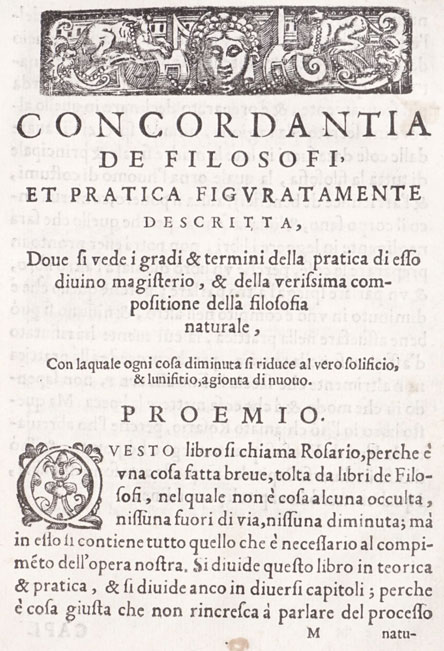
Extracted and Translated to English from the book:
Della tramutatione metallica sogni tre / di Gio. Battista Nazari Bresciano ; nel primo de quali si tratta della falsa tramutatione sofistica ; nel secondo della vtile tramutatione detta reale vsuale ; nel terzo della diuina tramutatione detta reale filosofica ; aggiontoui di nuouo la Concordanza de filosofi, & loro prattica ; nellaquale, si vede i gradi, & termini de esso diuino magistero, & della verissima compositione della filosofia naturale, con laquale ogni cosa diminuta si riduce al vero solificio, & lunificio ; con un copioso indice per ciascun sogno de gli auttori, & dell'opere c'banno sopra di ciò trattato
I have called this book a Rosary, because it is a brief thing, taken from the books of the Philosophers, in which nothing at all is hidden, nothing out of the way, nothing diminished; rather, in it is contained everything that is necessary for the completion of our work. This book is divided into theory and practice, and it is also divided into diverse chapters; because it is a right and fitting thing that it does not refuse to speak of the process of the natural and sublime things, and of him who will wish to treat of their sublime effect; because then the service of blessed Nature, and the intention, proceeds along the natural way, and the value of this same study is regarded more surely, and is prepared to decline into that secret order of reason.
Let no one disdain to inquire into the things brought to light: the final and principal mother of all philosophy, which adorns man with customs (virtues), and enriches him with benefits, helps the poor, likewise preserves the body in health, and praises health. For he who is negligent in reading books will not be ready to prepare things, because one book declares the other book, and one discourse explains the other discourse; because what is diminished in one is completed in the other. And no one can become well practiced in practice whose mind has refused to toil in theory; for he proceeds to practice no otherwise than an ass to supper, not knowing in what manner, and what to put into his mouth.
But I have called this book a Rosary, because I have abridged it from the books of the Philosophers as best I could, and I have divided it into diverse chapters. In this art there are two books, which I shall set down in chapters in order.
CHAPTERS OF THE FIRST BOOK of the Rosary of the Philosophers
1. The manner of the generation of metals. (Chap. I)
2. That quicksilver is the medicine of metals. (Chap. II)
3. That foreign sulphur i.e., the vulgar sulphur is the cause of the imperfection of metals. (Chap. III)
4. That only quicksilver is the perfection of metals. (Chap. IV)
5. That quicksilver contains within itself its sulphur. (Chap. V)
6. That the philosophers’ stone is one only. (Chap. VI)
7. From what things the philosophers’ stone falls/comes to be. (Chap. VII)
8. That our work upon the first matter of metals is difficult. (Chap. VIII)
9. What the first philosophical work is. (Chap. IX)
10. What thing the stone is, and what need it has. (Chap. X)
On the manner of the generation of metals. Chapter 1.
It is questioned whether all things which by nature are apt to be liquefied are naturally of the substance of quicksilver and sulphur; because it is proper to quicksilver to be congealed by the heat, or vapour, of sulphur; for every dry thing naturally drinks in its moisture. By the vapour, therefore, of sulphur, quicksilver is congealed to its earthy, subtle, aerial, and digested substance by the first mixture united with it afterwards raised by the operation of heat, decocted and digested, until it has a sulphureous virtue to congeal quicksilver.
But quicksilver, in its first root, is composed of white earth, exceedingly subtle and sulphureous, greatly mingled with clear water, until it becomes one single substance, which does not rest upon a level surface, because it is homogeneous in nature: for either it remains wholly fixed in the fire, or else it all flies from it in smoke, being incombustible and aerial; and this is the sign of perfection. And therefore, when afterwards it runs into the sulphureous earth, being heated it ascends above, because it is of its nature to sublime by heat; but by continual sublimation it is purified too much, it is cooked, and it becomes thick; and little by little it congeals into white and red sulphur. This sulphur is dissolved many times, and then it is congealed by quicksilver from that which has been sublimed and made wax-like by the operation of heat, until, scarcely in a thousand years, successively by the work of Nature, it is congealed into perfect metal. And this is what the metals do in the mineral vessels by means of Nature herself. Therefore one must imitate Nature in these operations, whoever wishes, from imperfect things, to make the more perfect medicine.
(Marginal note: “What quicksilver is in its root.”)
That quicksilver is the medicine of all metals. Chapter 2.
Aristotle says that quicksilver is the element of all things apt to be liquefied; because all things apt to be liquefied, when they are bound together, are converted into it and are mingled with it, because it is of the substance of those things although those bodies are different in their composition from quicksilver according as it has been pure or impure from foul sulphur foreign to it. For quicksilver is made from true sulphur which does not burn; because, as the Philosopher has said, the white sulphur which does not burn congeals Mercury into good Luna (silver), and that is a very good thing, which those who work alchemy can take and convert into good silver. But if the sulphur, pure, clean, and excellent, shall be bright with a redness, and in that then it will be the virtue of the sulphureous “igneity” that does not burn, and it will be a most good thing, which the alchemists can take to make the Sun; for the quicksilver will be of good substance, and the impure sulphur, which burns, will convert the same quicksilver into copper; and if the quicksilver should be stony, foul, earthy, and the sulphur foul, it will make from it iron. But tin seems to have good and pure quicksilver; yet its sulphur is bad and not well mixed. Lead has quicksilver that is coarse and bad and heavy, and its sulphur is bad of bad savor and fetid of weak virtue; therefore it does not congeal well. These are the precise words of Aristotle in the fourth book of the Meteors, to which natural philosopher one ought to give credence in all natural things, and not to fables, nor to lying works wholly far from the works of nature; and he who believes lies loses the secret of the philosophers.
That foreign sulphur, or the vulgar sulphur, is the cause of the imperfection of all metals. Chapter 3.
Mark, then, the words and the meanings, because all the truth of this science must be taken from the things already said by the philosophers: for from vanity it arises that there is a double superfluity of body one included in the depth of quicksilver, which supervenes at the beginning of its mixture; the second outside of nature, and corruptible. Of these, the one is removed with toil; the other cannot be taken away by any contrivance of artifice. Therefore the combustible sulphureity is removed by the calcination of fire, or else it is taken away from bodies; and this is because it holds back the quicksilver, and offends it with the addition which is of its nature refusing the other by exposing it to the fire which thing infects it; and therefore it is amenable and pliable to its nature.
Quicksilver is more “familiar” to quicksilver, and more makes it its friend, after gold, after silver; and for this reason it remains that these two participate more in its nature. But the other bodies have not so much conformity with it, because they have within them foreign sulphur earthy, foul, and fetid; therefore we may truly say that they participate less in nature, because they are corrupt, fetid, and combustible. And this comes about because sulphur, in a certain manner, is prepared by artifice: it always burns and has been burned; and from the blackness in every work therefore Avicenna also says that it does not enter into our magistery, because it is not of quicksilver, nor of the substance of quicksilver, nor of its perfection always infecting it, blackening it, and corrupting it. It remains therefore that,
Side note: Quicksilver, and why quicksilver is most perfect of all bodies.
and is most safe from burning: because those bodies are burned away the more, the more they partake of and possess of its nature. Hence it is plain that a great quantity of quicksilver is the cause of perfection in bodies, and much sulphureity is the cause of corruption namely, that some burn more and some less, according to the trial of fire: so that those which are of a more sulphureous quantity burn more, and those which are of less burn less.
Side note: Sulphur has in itself two causes of corruption: namely, the inflammable substance, and the earthy, muddy substance.
By the first it makes Nature “stand,” because it always burns and has been burned, and it gives blackness in every work; but by the second it has neither fusion nor ingress, because if it should become fixed it hinders fusion nor is it ever fixed unless first it be calcined; and when it is calcined, in no way does it melt in artifice, because it is reduced into an earthy substance.
That only quicksilver is the perfection of all metals. Chapter 4.
But this does not happen in quicksilver: for it is fixed without being converted into earth; whereas [other things] are likewise fixed with their conversion into earth because, by hastening to their fixation (which is done by precipitation), they are fixed and are converted into earth; and then, by a subsequent sublimation of that which another time is made, it is likewise fixed, and is not converted into earth, but rather into metallic fusion.
And this happens because it has a viscous and dense substance of which its constriction is a sign together with the imbibition and commixture with things of its own kind: hence the manifest viscosity that is found in it, and its great adhesiveness. And that it has a dense substance anyone would plainly see, even if he had but one eye only, by the heaviness of its great weight; for it weighs more than gold when it is in its own nature.
But it is of a very strong composition and of a uniform nature, because it is not divided into parts nor in any way allows itself to be divided because either it remains in the fire with its whole substance, or else it departs from the fire with its whole substance.
For these reasons, therefore, it follows that quicksilver can be fixed without its radical moisture being consumed, and without its being converted into earth; and therefore in it is noted the true cause of perfection, because it alone suffices for the perfection of fusion in every degree both with “infocation” and without “infocation” because, by the good strength of the adhering parts of its mixture, if in any manner the parts of it are made thick by the fire, Fire does not allow it to be corrupted any further, nor does it permit that it fly off in smoke on entering a furious flame; because, by reason of its density, it does not endure being rarefied, and because it lacks adustion (burning), which comes from sulphureity something which it does not have. This has been sufficiently proved above.
The sulphur which is dry, heavy earth we say is a corruption of perfection; because, if it becomes fixed, it hinders true fusion, as is seen in iron, which does not melt, because it is known to have fixed sulphur in it. But if it does not become fixed, it hinders true fusion, or else it anticipates it, or else it is corrupted by the fire: it burns and evaporates, as is seen in lead and other imperfect bodies. And therefore sulphur is not of the virtue of our Art, nor of its perfection, because it hinders perfection in all its works.
But Mercury, in all its operations, is manifestly most perfect and most praiseworthy: because it preserves from burning, is effective for fusion when it is fixed, and it tinctures with redness of most abundant perfection and of most beautiful splendour; and it does not depart from the mixture so long as it is there. And it is friendly and placable with metals, and a means of conjoining the tinctures, because it mingles with them with every smallest thing; and it also naturally remains in the depth, because it is of their nature. Yet it mingles easily with the Sun and with the Moon, because they partake more of its nature; nevertheless, it will not take anything into itself there, except the Sun.
From this, then, arises a very great secret: that Mercury receives into itself that which will be of its own nature, and refuses what is alien, because it rejoices more in what is of its nature than in what is foreign. Hence it is plainly seen that those bodies have greater perfection which contain more Mercury, and those have less which contain less.
I therefore praise the glorious Maker of all things blessed, excellent, and most high who out of a vile thing has created a precious one, inasmuch as He has set in Nature, among minerals, a very great symbol, and has given it a substance and a property of substance which no other thing in Nature possesses: for it alone overcomes fire and is not overcome by fire, but rather rejoices, resting in it amicably; because it alone, being metallic, contains within itself all that we have need of in our Magistery since all other things, being combustible, yield to the fire and vanish into sparks …
That quicksilver contains within itself its sulphur. Chapter 5.
It is manifest, then, that quicksilver contains within itself its good, fixed sulphur, by which it is congealed into gold or silver, according to the diverse manner of disposing it. For, according to the Philosopher, if quicksilver be made pure, the virtue of the white sulphur that does not burn will congeal it into silver; and that is an excellent thing, that the Alchemists make by artifice the elixir for silver.
But if the sulphur be excellent bright with redness and in that there be the virtue of the igneity which simply does not burn, it will be an excellent thing, whereby the elixir for gold is made. And the Philosopher has well given the white to silver, and afterwards the red to gold; because gold cannot be made if first silver be not made: for there is no passage from one extreme to the other except by the mean. One cannot, therefore, make a passage from black to perfect citrine if it does not first become white; because the citrine is compounded of much white and of little red. Nor can one pass from citrine to white if it be not first black.
And because gold cannot be made silver unless it be first destroyed and corrupted since what is better cannot be made worse except by corruption of itself; for the generation of one is the corruption of the other therefore he who seeks to convert gold into silver, seeks also to convert silver into gold. For the sulphur that does not burn, being white, can make silver by a greater digestion; the red sulphur can make gold, because the citrination is nothing else than completed digestion; nor is whiteness anything else than the removal of blackness.
For heat working in the moist first makes blackness; working in the dry it makes whiteness; and in the white, citrinity. And this may be seen in the calcination of lead, which is turned into black ash, then into white, then into a very citrine or reddish [state]. Thus the white or red sulphur is had from a matter of metals fully purified, yet digested and cooked in a diverse manner. Therefore the Philosopher says that in all silver there is the white sulphur, as in all gold there is the red sulphur.
But such sulphur is not found upon the earth, as Avicenna says, except in these two bodies; and therefore we prepare these two bodies subtly, so that we may have the sulphur and the quicksilver of that matter above the earth, of which gold and silver are made beneath the earth. For these bodies are shining, in which are the rays that dye the other bodies with true whiteness or redness, according as they have been prepared; because by our magistery the perfect body is made youthful, and the imperfect is made perfect, without the administration of any other foreign thing.
Gold therefore, being more precious than the other metals, is a tincture of redness which dyes and transforms every body; but silver is a tincture of perfect whiteness which dyes the other bodies; because with those bodies namely Sun and Moon Mercury is mixed and fixed, by them, with the greatest ingenuity, which the artificer does not understand, who makes of it so hard a thing.
That the Philosophers’ Stone is one only. Chapter 6.
It is needful, then, that the inquirer of this science have a steadfast will in the work; no one, in this manner, ought to presume to attempt it. For our Art is not made in the multitude of things, but in one only; because the Lapis is one one medicine to which no foreign thing is added, nor is it diminished, save only that the superfluous things are removed.
For all the internal sulphur that is, the vulgar or quicksilver, is foreign, because it is destructive of itself, or corruptible; but on the contrary, that which is not foreign is that which, by our magistery, can be converted into gold and silver. Therefore nothing is fitting to the thing except what is nearer to it by its nature; for man is not generated from man except man, nor from other animals except those like unto them; because every thing that is generated follows the like of him that generates.
Let us therefore use the true nature, because it is not amended except in its own nature, to which no alien thing is joined. Therefore introduce neither powder, nor water, nor any thing; for diverse natures do not amend. Our Lapis does not enter into anything, nor does anything enter into it, except what is made from it; for if foreign things be added, it is forthwith corrupted, and it does not become that which is sought to be made.
Therefore from corporal things most fitting in nature it is necessary to gather the medicine. Hence it is needful that that same medicine be agreeable with those in nature, and that it signify greatly in the depth with them, so that what is diminished may be able to be made perfect. And although Mercury is mingled, it first flees by its least parts; but Mercury does not congeal any body that is not in its nature, nor does the ferment, except that even Mercury itself heals the sick bodies, because in the assay it separates from them; for gross things do not agree well with simple things, and still less do simple things with gross. And therefore it is necessary that that medicine be of a more subtle substance, and of a more liquid fusion than the bodies themselves, and of a greater fixation and retention than quicksilver has in its own nature.
From what things the Philosophical Stone is drawn. Chapter 7.
It may therefore, with reason, be inquired from what things chiefly this our Medicine may be made. To which, answering, we say: that it is drawn from those things in which it is found. And it is so in bodies, as in quicksilver according to nature, they being found of one single nature; but in bodies more difficultly, and in Mercury itself more easily, yet not more perfectly. And this happens because there is found no body more worthy than the Sun, nor more pure; or else than its shadow, that is, the Moon without which there is generated no quicksilver that can tinge. And he who strives to tinge without this quicksilver, proceeds blindly to practice, like an ass to supper.
Nature hath given the colour of gold to gold, and the colour of silver to silver. He therefore that makes quicksilver to be tinged with the Sun and with the Moon, hath come to the secret which is called white sulphur, most excellent for silver; which, when it is made red, will make a sulphur most excellent for gold. From those bodies, therefore, is drawn the sulphur, most white and red, there being in them a substance of sulphur most pure, purified by the skill of Nature; which, according to Albert, is clearer and subtler, because in its purification Art is weaker than Nature, nor does it attain it, though it labour greatly.
And because its father is the Sun and its mother the Moon therefore from those bodies, with their sulphur (or prepared arsenic), our Medicine is drawn. Likewise, from the bodies of the Sun it may be drawn; but from quicksilver alone it is found more easily, and more nearly, and more perfectly seeing it is the father of all these luminaries and of all things apt to be liquefied. For of it all things are made, and therefore in it all things are resolved; because Nature embraces its own nature more amicably, and rejoices more with that than with a strange one. For in it there is the facility of drawing out the subtle substance, it already having the substance in act.
It remains therefore that our Medicine is a substance most pure and most subtle, which has its origin from the matter of quicksilver, and is created from it; yet it is not the matter of quicksilver in its own nature, nor is it the whole of its substance, but has been a part of it yet not that which it is now. When our Lapis is made simply of quicksilver, although it be made a part of it, it is because it enlightens it, and defends it from burning, and preserves it which is the cause of perfection. Therefore the Medicine is made from the sole cause of every generation, both in bodies and in the substance of quicksilver itself; and so one goes on investigating the substance of the precious Lapis: I therefore counsel thee that thou work not except with Mercury and Sun to the Sun, and with Mercury and Moon to the Moon; because all the benefit of this Art consists only in these.
That it is an impossible thing to make the Stone from the sole substance of metals without [their] matter. Chapter 8.
And therefore, if we would begin our work in the first matter of Nature, it would be most long and difficult; and there would also be required a great and almost infinite expense to do it. And when at last, with a most difficult artifice, the Stone of the nature of metals should be made, nevertheless the philosophical work would not be finished; yea, the philosophy would not yet have begun: because it is necessary that the Philosophers’ Stone be able to draw from Nature two bodies, before from that it may make the perfect elixir.
For it is necessary that that which is the elixir be more purified and digested than gold or silver, because the elixir must convert into gold or silver all other bodies that are imperfect, or of diminished perfection which they cannot do; because, if they were to depart from their perfection into another, they would be imperfect; for they cannot tinge beyond what they extend. And for this reason the operation is done in our Lapis, that it may improve its tincture beyond what is in its nature; and that the elixir may be made, according to the allegory of the wise, compounded of a limpid species, condiment, antidote, medicine, and purgation of all bodies that must be purged, and transformed into true solific and lunific [bodies].
But the modern operators, ill-doing, believe the end of the work to be reached when they begin the work: for they have wrought so much that their work is of the nature of metals; therefore they believe they have completed the perfect elixir. But when they make the projection, they find nothing at all; and so they cease from working where they ought to begin.
What is the first philosophical operation. Chapter 9.
The work of the philosophers is to dissolve the Lapis in its Mercury, so that it may be reduced to the first matter; whence the Philosopher, in the fourth book of the Meteors, mocks the sophistical alchemists of this Art, saying that the species cannot be transmuted which likewise is true unless the species themselves (as he adds) return into their first matter: which first matter is quicksilver, it being the element of all metals; because then indeed they are changed into another form than they had before not the species (kinds), but the individuals of the species. For individuals are subject to sensible actions, because in themselves they are corruptible; but the species, because they are universal, are not subject to sensible actions, and therefore are not in themselves corruptible. Therefore the species of silver, which is silver-ness, is not changed into the species of gold, which is gold-ness, nor contrariwise; for in truth the species cannot be changed, but only the individuals of the species are changed, when they are brought back to their first matter.
For when the form of this or that individual shall be corrupted and dissolved, it is changed into the first matter, and necessarily another form is introduced; because corruption is one thing with the introduction of another. And know this: no matter can be so destroyed that it does not remain under some form; wherefore, one form being destroyed, another is immediately introduced, disposed to this operation or to another.
Therefore (saith the Philosopher) whatsoever need thou hast, if thou wilt work, thou must first toil in the solution and sublimation of the two Luminaries, because the first degree of the operation is to make quicksilver of them. Mark therefore the words, and note the mysteries: because in this work it is declared what the Lapis is, the beginning of its work being the dissolution of it. Therefore it must be sublimed, fixed, and calcined, so that at last it may be dissolved into quicksilver which is contrary to the Philosophers; wherefore the Philosophers also say, that unless bodies be made incorporeal, that is, no bodies, that is, volatile, on the contrary you work nothing at all.
The true beginning therefore of our work is the dissolution of the Lapis; for bodies being dissolved are reduced to the first nature of spirits (if not, because they are more fixed), for the spirits are sublimed with it; because the solution of the body is made by the congealment of the spirit, and the congealment of the spirit is made by the solution of the body. For then the body is mingled with the spirit, and one body is made with it, and they are never separated no more than water mixed with water. For then all are reduced to their first homogeneous nature; and the first homogeneity of metals is quicksilver. When therefore they are dissolved into the same homogeneity, they are joined together and are never separated; because then the one and the other works in its companion like unto itself.
And therefore Aristotle says that the Alchemists cannot truly transmute metallic bodies unless first they be reduced to their first matter; because then they are indeed reduced into another form than they had before for against this reason stands not: namely, that when one form is destroyed, another is immediately introduced. As we see in the works of husbandmen, who make lime from stones, and glass from ashes; so much more piously doth the wise man, by his study, by means of the Magistery, to corrupt these bodies by the natural magistery, or by our artifice; and to introduce into them a new form: for the intention of our operation is nothing else, but that the most pure substance of Mercury be drawn out and chosen in these bodies; because the Elixir consisteth only in that, and not in any other thing.
What the Stone is, and what it needeth in the operation, that it may be a perfect Elixir. Chapter 10.
THIS then is our famous Stone; because there is no passage made from extreme to extreme, but by the mean.
Now the extremes of our Stone are these: on the first side, Quicksilver; on the second, the Elixir perfected. For the means betwixt these, some are more purified, decocted, and digested; and those are the better, and nearer unto the work (which, I think, thou knowest). Err not therefore in this: for if a man sow these things, he shall also reap them; because the seed answereth unto its seed, and every tree bringeth forth its own fruit, according to its kind.
Nature is wise, and desireth always to make itself perfect, because it hath ever within itself its increase. Therefore Avicenna saith, If I did not see gold and silver, I would certainly say that Alchymy is not a true art. And although this our Stone contain in itself so much tincture, naturally, as is created from any thing into a subtle body; nevertheless, of itself alone it would have no motion, to be a perfect Elixir, unless it be moved by art and operation. And therefore divers arts have been found out by divers Philosophers, that by artifice there might be perfected that which nature hath left imperfect; because nature inclineth unto its perfection.
Work therefore prudently, and not at random: know the natures of the Stone, and the strengths, and what Stone is friend to another Stone, or enemy; see that thou understand what it can do. And before thou make it gross, make it subtle; lighten that which is weighty; smooth the rough; soften the hard; make the bitter sweet; and thou shalt have the whole magistery.
Know also, that of its operations some are the medicines of gold, with which it is meet to communicate with silver in some things, and to differ in some others: for in the beginning of the operation, the work of gold and of silver agreeth in all things; but they disagree in the manner of fermentation, because the ferment of the work of silver is silver. Do therefore every species with its own species, and every kind within its own kind: for the work of the white seeketh to make white, and the work of the red to make red. Therefore mingle not the work of one Stone, with the work of another stone; for thou wouldst commit a great error if thou didst otherwise. The other bodies indeed may work, yet they will not do so well as those; for they cannot give the medicine which they have not. For it is impossible to fix that which is not fixed, or to cleanse the unclean; because there is not found in a thing that which hath not first been in it, nor can any man give what he hath not. Therefore, although thou mightest do it, yet thou hast need of it; for in these thou canst not have that which is of greater temperance and of less dryness. If thou have need to use those, it behoveth first that thou convert them into the likeness of two perfect bodies; which will never be done, unless the Sun and the Moon, conjoined into one body, be cast upon them.
Side note: Mercury doth the very same thing with the planet that it embraceth.
For Mercury, being by its nature convertible, becometh the same with each one, with that planet wherewith it is joined: if it be conjoined with lead, it will become lead; if with iron, it will become iron; and if with other bodies, it will become like unto them. But if it be conjoined with these two rays, it becometh a perfect elixir. Therefore one must not operate save with this noble matter; for things are not made by any reasoning, but only according to their nature. Whosoever therefore seeketh from nature that which is not found in her, it is madness and loss of labour. Eat not of the child whose mother suffereth the monthly flux; for if thou eat it, thou and thy work shall become leprous. But eat a piece of fat flesh, and thou shalt have gold and silver as much as thou wilt; and seek not from nature that which is not in her, for thou wouldst weary thy mind in vain. These things are taken from Morienus, a true doctor and philosopher.
Accounting as nothing the gain that cometh thereby, if thou do well, yet thou shalt do well to make the ointment of sulphur and blanquetto; for the thing whose head is red, the feet white, and the eyes black, is the Magistery. Understand what I say; for all these things are truly most true, which never any philosopher hath taught better.
Chapters of the Second Book of the Rosary of Philosophers
1. Of the perfect investigation of the Physical Stone.
2. Of the government (regimen) of the Stone.
3. In what manner Mercury is to be purified.
4. Of the inhumation (burial) of the Stone.
5. Of the recapitulation of the first government.
6. Of the second government, which is to wash it.
7. Of the division of the Stone by the four Elements.
8. Of washing the water.
9. Of washing the air.
10. In what manner the oil is drawn from every thing.
11. What difference there is between water and oil.
12. Of washing the fire and the earth.
13. Of the cause of washing according to Plato.
14. Of the third government, which is to reduce.
15. Of the manner of reducing the water upon the earth.
16. Of the manner of subliming and whitening the earth.
17. How the white sulphur is made red.
18. Of the recapitulation of the third government.
19. Of the fourth government, which is to fix; and that fixed white ferment is necessary for fixing.
20. That the weight of the ferment ought to exceed the weight of the sulphur, or else be equal.
21. What the usefulness (utilities) of the Magistery are.
22. In what manner we must observe the quantity of each.
23. In what manner the elements must be corrected, and in what manner the fusion of the medicine is obtained.
24. Of observing the weights in the fission.
25. Of the fission of the Elixir in the composition to the white.
26. Of bringing the air over the white elixir.
27. Of the iteration (repetition) of the white elixir.
28. Of the composition of the red elixir.
29. Of the multiplication of the medicines.
30. In what manner the solution and the sublimation are to be understood.
31. Of the manner of making the projection.
32. Of the recapitulation of the whole magistery.
On the perfect investigation of the Physical Stone. Chapter 1.
Thus it is manifest that the operation of the Medicine is an operation of Nature, and that the same Medicine is the natural Medicine: because the Medicine is composed solely by Nature; and it is certain of every thing, that it is such as that into which it is resolved. For ice is converted into water by means of heat; therefore it is a clear matter that it was first water, before it was ice. So likewise every our Stone is resolved into argent vive (living silver, quicksilver) by our Magistery; therefore it was first argent vive. But the manner of converting it into argent vive is a conversion into its first root: for to convert Nature is to turn the elements in a circle.
(Of the conversion of the elements among themselves.)
Now the elements, by their own aptitude, are convertible one into another; and therefore they are generated, corrupted, and altered among themselves. Convert therefore the elements, and thou shalt find that which thou seekest: because our operation is nothing else but a change of natures, and an amicable commixture of the cold with the hot, and of the moist with the dry.
But the dry is not converted into the moist, unless it first be made cold, that is, water; nor is the cold converted into the hot, unless it first be made moist: because there is no passing from extremes, but by the mean. Earth is not converted into air, unless it be first converted into water; because air and water are the middle elements; fire and earth are the extreme elements. But air is near to fire, as earth is near to water; and therefore water is contrary to fire, and earth to air: because water is cold and moist; fire hot and dry; earth cold and dry; air hot and moist. And thus water and air agree in moisture; fire and earth in dryness; and therefore the one is converted into the other, and likewise the contrary: wherefore they are converted immediately, and afterward, more slowly, they separate again from one another.
But contrariwise, air, earth, fire, and water are not converted among themselves, unless first fire be converted into air, and earth into water. If therefore the dry be converted into cold, and the cold into moist, and the moist into hot, and the hot into dry, then shalt thou have the whole Magistery.
Now the ways of the government of their conversions are four principal: namely, to dissolve, to wash, to reduce, and to fix.
(Four are the ways of the government by which they are converted among themselves.)
To dissolve is to make the gross thing simple, and to subtilize it.
To wash is to make the dark clear and shining.
To reduce is to bring the moist into the dry.
To fix is to fix the volatile upon the fixed body.
To dissolve is to divide the bodies, and to make the matter, that is, the first nature.
To wash is to moisten and to distil, and to calcine.
To reduce is to incerate, to fatten, or to impregnate.
To fix is to coagulate.
By the first, Nature is changed inwardly; by the second, outwardly; by the third, above; by the fourth, beneath.
Of the first governing of the Stone, which is to dissolve. Chapter 2.
To dissolve the dry gross Stone into quick-silver, that it may be reduced into its first matter, is done only with quick-silver; because it alone can reduce the Sun and the Moon unto their own nature, or first matter. But because quick-silver hath in it a certain dry, earthy, and burnable substance (without inflammation) and also wateryness, it is necessary to take away the superfluous things, and to supply those that are not there, if we would make the Medicine perfect: therefore one must wholly remove the earthy feculency by sublimation, to the end that, in the projection, the moist do not make heat, nor the wateryness of it. Likewise it behoveth to preserve the fugitive substance of it, as touching the Medicine, whose property is to cleanse, and to defend from burning, and to make it fixed; and therefore it cometh to pass, by the diversity of the Medicine according to its diverse purgation, that sometimes of it is made Saturn, sometimes Jove, sometimes Venus, sometimes Mars; which must needs proceed from impurity.
In what manner one purifieth and purgeth Mercury. Chapter 3.
Devise therefore to remove from Mercury his earthy and superfluous substance, and to sublime it once or twice with glass and salt, until it take his most white substance; but when it shall ascend most white, cast it into boiling water, until it return into quick-silver: then take away the water from it, and work with it; for it is no good thing to work with it, unless first it be purged in this manner. Wherefore Avicenna saith, the first thing that one ought to begin to do, is to sublime Mercury; then dissolve it, so that it return into its first matter, and sublime it all: then, in this clean Mercury, put the clean bodies, weighed with equal weight; but mingle not the white body with the red, nor the red with the white; but dissolve each apart by itself, because the white water is for whitening, the red for making red. Therefore thou shalt not mingle the water of one Stone with the water of another, or with another Stone; for thou wouldst commit a great error, and thou wouldst be blind if thou didst otherwise. Then grind it once after another, and imbibe it, and make it to cook in Balneum Mariae; afterwards distil through felt until it pass; but gather apart the black which standeth above, because that is the oil, and the true sign of the dissolution; because those which is dissolved is come to the end of sublimity; wherefore it separateth it self from the lower parts, ascending upward, and going into the high places as a body of gold. But dissolve it warily, that it fly not away in smoke: and what thou dost in the White, do also in the Red; for this Medicine in essence is but one, and likewise it is one in the manner of working: nevertheless in the Red there is an addition of the citrine colour, because it is made a most cleansed substance of the fixed Sulphur.
Yet there is a difference betwixt the Solar Medicine and the Lunar; because the Lunar containeth the Solar, but not contrariwise: for the Lunar hath need of Sulphur most pure and most white, even as the Solar hath need of the Red. These two bodies suffice, because they resemble that which is sought; but thou must labour in the solution, sublimation, and subtiliation of them, because they are strong, and have need of long preparation, and continual operation: that first they be calcin’d, and then dissolv’d; for when they have been calcin’d they dissolve more easily, because the heat of the fire, piercing the parts of the body, maketh the water enter after it, and so more easily it is made fit to dissolve them.
But if thou shalt calcine the gross body (which is also dissoluble), set it apart; and that which remaineth in the felt, take it up cautiously, lest it be lost in smoke and the Magistery perish. Wherefore, seeing this is a thing difficult to do, it is expedient to dissolve the gross bodies with the water alone, that is, with the Quick-silver (argent vivo) without calcination: because this is the safer, though it be slower in the operation. Be not careful therefore to draw forth the Tincture in haste, nor to seek to do the work hastily; for hurrying is the first error that is made in this Art, because it burneth up all things: for if thou make much fire in the beginning of the mixture, it will bring damage to the tinctures, because the Medicines are burnt by over-great heat; wherefore the verse saith:
Scatter the thing taken first by a part fit enough;
Draw it out gently; thus beat the mass that is made.
Do this not in haste, but end it in order of time;
The white of urine disposeth the members by ruin.
Endure therefore patiently: make it into powder, make it to be boiled, repeat it; and let it not grieve thee to repeat the same thing: because the things that are imbued are softened with the water; and the more thou shalt triturate, so much the more thou shalt soften; and the more thou shalt soften, so much the more shalt thou subtilize the gross parts, until they be united and be not divided one from another: for then the spirits are kneaded together with the bodies; and all things that are kneaded do dissolve; and kneading is done by much trituration and by roasting: for by triturating, and waxing, and roasting, the parts bound with the viscousness of the water are divided (which viscousness is found in bodies); but the bodies when dissolved are reduced unto the nature of spirit, and they mingle and are not separated, as water mingled with water; because Nature rejoiceth because the bridegroom is joined with the bride; but those things which are not dissolved have no subtle parts, unless you soften them; therefore one must labour in the dissolution of the Stone, that is, by separating from it the purer parts, so that the heavier parts being taken away, the work may be done with the lighter.
Of the inhumation of the Stone. Chapter 4.
When the Stone is dissolved, take it all, and set it upon a temperate heat, that it may putrefy and be digested the better; that is, for one month of the Philosophers, namely for thirty days; because the burning-up (adustion) in animals is taken away by inhumation and decoction. Cause it therefore to be fully cocted, so that it boil together with a gentle fire, and return into its first matter, and be living silver (quicksilver).
This being done, that saying of Aristotle in the fourth book of the Meteors is resolved, when he saith: Let the Alchymists know, that the species of things cannot be transmuted; which is true, if first they be not reduced into their first matter: and then they are changed into another form which they were not before; not the species, but indeed the individuals of the species are changed; because they are corruptible, and subject to sensible actions; for matter cannot in any manner be so destroyed, that it remain not always under some form. Wherefore, the first form of the body being loosed in Mercury, immediately another new form is introduced; the form of it being corrupted; which form, in colour, is black; in smell, stinking; and in touch, subtle and discontinuous: and this is the sign of the perfect solution of bodies. For heat working in the moist first begetteth blackness; which blackness is the Raven’s head: but it is the beginning of our work, which is to dissolve our Stone in Mercury, or in mercurial water; now it hath the first government of the work.
Of the recapitulation of the first government. Chapter 5.
Now I will briefly declare the whole manner of the dissolution: Sublime therefore the Mercury; afterwards dissolve it; afterwards incorporate it with the washed earth, and fire; and likewise cause it to be cocted until it return to its first matter: and this is done, to the end we may have the Sulphur and the Mercury of that matter whereof gold and silver were made under the earth. For if it become true Sulphur and living silver, we may of them make gold and silver; but this magistery is not but for the rich, and for Princes; and he that hath this, hath an eternal treasure. In it therefore three things must be sought, to wit, the subtle wit of the workman, it sufficeth, the work of the hands, and the choice of the will; which thing requireth riches, wisdom, and books.
Of the second governing, which is to wash. Chapter 6.
The second governing of the Stone is, to wash the black, corrupted, and stinking matter, that it may become very bright, clear, and without filth; which cannot be done without the division of the elements, and the distillation of the waters, and the dissolution of the Stone: for of the elements, two are “lapideous,” and two “watery.” The lapideous are fire and earth, because they are dry; the watery are air and water, because they are moist. Fire eateth that which is in the outward parts, because it consumeth and wasteth the foulness of the waters by distillation, and maketh them subtle by lightening the air; it also lesseneth the grossness of the Stone by calcination, and devoureth the saltness of its sulphureity. Therefore our Stone is divided into four elements, that it may become more subtle, and may be washed more from its uncleannesses, and afterward be joined more firmly. But nothing is ever born, or groweth, or is made living, unless after putrefaction; therefore they must putrefy, that, being more digested, they may separate the better: for if the thing be not made putrefied, it cannot be melted nor dissolved; and if it be not dissolved, it will be brought to nothing.
Of the division of the Stone by the four elements. Chapter 7.
Take therefore the Stone so corrupted, and divide it by liquefaction into the four elements with distillation; first with a gentle fire, equal and continual, and take its water; then little by little increase the fire, until it take the air mingled with the fire; but that which remaineth burnt in the bottom is black and dry earth; and thou must make the distillation of the water in Balneum Mariae (a bain-marie), because the subtlest parts of the Stone, drawing near without heat to the nature of simple wateriness, with that will be distilled. But the air and the fire are distilled through ashes, because, by sustaining their inflaming, the heat and the grosser earthy parts are carried up. The separation therefore that is made with water, not sustaining the inflaming, is better than that which is made through ashes. In this manner shalt thou divide the four elements; for it behoveth to draw the water from its humid substance, and not from the other, because in it is the greater tincture. But of the earth thou needest not take care what substance it be, provided the substance be white and fixed. The earth is dried and fixed; but the water cleanseth and washeth; the air and the fire tinge and make to run: yet it behoveth that there be much water and much air, because the multitude of the tincture will be as great as the multitude of the air.
Therefore, in all your works, strive to surpass the Mercury in the mixture, so that thou mayest have air enough; for if with that alone thou canst make the work perfect, thou shalt be an investigator of a most precious perfection surpassing Nature. But know firmly that, of all the chapters of this most precious Art, the expense exceedeth not the price of the medicines themselves, of fifty reals of silver, reckoning from the first operation; nevertheless it behoveth that the same medicine be long roasted upon the fire and be nourished: thus is the child nourished at the breasts.
Washing the Water. Chapter 8.
When thou shalt have the elements, as hath been said, wash them separately; that is, the water and the air, distilling seven times, and strongly calcining the fire and the earth. Yet thou shalt distil the water and the air apart, because the air is better than the water; albeit the water washeth and whiteneth the earth. And thou shalt make the marriage of the tinctures: and the air tingeth the earth, and infuseth into it the soul and maketh it sensible. Wherefore it is necessary that the air and the water be cleansed from foulness, and made safe from burning, until their tincture be taken; for if they be burnt, they are deprived of their effect.
And if they be not made to cook in dung, therefore the inhumation in dung, set in between the distillations, profiteth much, that one may the better attain the sign of perfect washing; which sign is a splendour and crystalline serenity without feces, if perchance they be not white. But the feces of the water which thou shalt make in every washing (that is, in each distillation in turn) set apart, and put them again into the black earth gathered above. But keep apart the water distilled seven times, because it is the dissolutive Mercurial water of the Philosophers, which maketh the marriage, and the water of life that washeth latten. And as thou hast made the white water, so shalt thou make the red; for they have the same manner of washing and a like effect save that the white water is to make white, and the red to make red. Therefore thou shalt not mingle the one with the other; for it will be an error if thou do otherwise.
Washing the Air. Chapter 9.
Afterward separate the air from the fire by distillation; for that which is distilled is the purest air, but that which remaineth at the bottom is dry fire. Consider therefore what I have said, to the end that thou work the moist Stone with water and earth only, and that thou use the dry Stone with fire and air only.
…the air and the oil, the tincture, the gold, the Soul of the Philosophers, and the ointment with which the whole Magistery is made. Understand therefore that fire is distilled with air, because they agree together in heat; and not with water, because water fleeth from fire, for they are contrary the one to the other. Therefore distil the air with the fire, because it is the tinged water, and its tincture is the fire; for it is a body, and the air carrieth the fire with the spirit. If therefore thou shalt mingle the Stone with the fire, straightway it will be red, and will ever grow bitter; whatsoever then thou wouldest make red, thou shalt make it with the fire of the Stone, and it shall be ever red.
How the oil is drawn out of every thing. Chapter 10.
Put therefore upon the substance of the body from which thou wouldest draw the oil, so much most pure Mercury that it stand above it four fingers (or more, which is better). Then kindle underneath a gentle fire, until thou shalt see its oil, that is, the air, ascend little by little, or rise up above the Mercury. Gather it carefully, and keep it by itself.
If the Mercury lessen, add unto it more, clean and warm, and set it again to digest; this shalt thou do continually, until thou hast taken its oil, and there remain nothing that is not dissolved.
Distil then the whole by an alembic seven times; for its washing is the same as the washing of water: thus, by moistening and distilling the moisture, it must be done until it be brought unto crystalline clearness, without dregs, if by chance they be not white. The signs hereof are: a thicker drop, with less colour, yet more intense, and an airy lightness, so that, if thou mix it with the aforesaid water, it will swim above.
And keep by itself the air thus washed, because it is oil, tincture, gold, soul, and the Philosophers’ ointment: which colour eth, tinctureth, fixeth, and maketh to flow; and it tinctureth every blade quenched three times therein into gold or silver, according as it shall be white or red.
Mingle not therefore the oil of gold with the oil of silver, nor contrariwise: for the white oil belongeth unto whitening, and the red unto making red. Therefore, if the oil of those bodies be much, the tincture also will be much; for the multitude of the tincture shall be as great as the multitude of the oil.
Chapter 11 What difference there is between the water and the oil
There is a difference between the tincture of the water and that of the oil, because water only washes and cleanses, whereas oil dyes and colours.
An example of this is: if a cloth is dipped in water, it is cleaned by it; and when the cloth dries, the water departs, and the cloth remains in its former state and colour except that it is cleaner.
The contrary happens with oil: for if a cloth is dyed in it, it is not separated from it by the heat of the fire, or of the air, unless the whole thing is destroyed; nor can the oil be separated from the cloth itself, except by washing it out and drying it with fire.
But water is the spirit that draws this soul out of bodies; and when the soul is drawn out of those bodies, it remains in that same spirit, because the spirit keeps its place.
The soul, therefore, is a tincture dissolved in that same spirit, and carried in the same way that dyers carry their tincture with water upon cloth. Then the water departs by drying, and the tincture remains fixed in the cloth by reason of its oiliness.
So then: where there is water, there is spirit in which the tincture of the air is carried; and when it is brought down upon the white foliated earth, the spiritual water immediately dries, and there remains in the body the soul, which is the tincture of the air.
The spirit, therefore, retains the soul, just as the soul retains the body; for the soul is not in the body except by means of the spirit. But when they are joined, they never separate, because the spirit holds the soul, just as the soul holds the earth.
Hence Hermes commanded that the souls should be sought in the Stone, because they are in it: therefore do not be worse at seeking them, nor slow seeing that they do not flee from you; but if they flee, do not take them with the falcon; rather, they are to be retained by fugitives. And this, therefore, is our coagulation, because it retains that which flees.
“Female,” therefore, is the soul in the white foliated earth, because it holds it; because when it shall ascend from earth into heaven, and again descend to earth, it will take up the virtue of things inferior and superior.
Do not, however, mix the oil of gold with the oil of silver, nor the contrary.
Chapter 12 On washing the fire and the earth (beginning)
You shall gather up the dregs that the oil makes each time, and you shall set them again with the fire; because they are of the nature of fire, and they retain the blackness that is, the redness which must be ground with the first water, and burned gently, until it becomes wholly a powder, deprived of the moisture of the air; because thus it is necessary to join the dregs also of the water with the earth, with kindled fire, and to calcine strongly, until it be under white moisture; therefore calcine the fire with fire, and the earth with earth, until it be made clean and deprived of blackness: but that which shall ascend from the fire is red oil, and that which shall ascend from the earth is precious white oil; because the oil which is separated from bodies the later, is held the more precious. Proceed therefore with all things in their time, and keep each of them separately, part by part.
Of the recapitulation of the second government. Chapter 13.
It is needful therefore, according to Plato, that thou exercise thyself (according to thy power) about the separation of the oils, and to wash the water and the air by distillation, and to burn the earth by calcination, until there remain nothing of the soul in the body, so that it be not perceived in the operation; the sign whereof shall be, when nothing shall evaporate from the body: if a little thereof be laid upon a heated blade, then it shall be appropriated; under the name of spirit, subtle, pure, and appropriated; under the name of soul, which tingeth the clear (or bright) and is appropriated; under the name of body, somewhat white and dry.
In none of our operation is the water necessary, unless it be white; nor the oil, unless it be white, or somewhat citrine; nor the fire, unless it be red; nor the earth, unless it be pale, or somewhat white. But if thou shalt thus prepare the elements, the earth shall be apt to dissolve, the water effectual to digest, and the oil (in which the fire is carried superabundantly) to tinge.
But if thou have not such elements, it is a sign of error: therefore amend the error; because it is nearer to the operation to make the preparation in that which thou hast, than to begin a new work. Keep therefore the washed elements in a sealed vessel, each apart, and chiefly the oil, because the air consumeth it by the nearness of its nature; and write upon them all, that thou mayest remember the virtues, the names, and the colours, lest thou take one for another when thou workest, and the work be corrupted: and let these things suffice for the perfect washing of the elements.
Of the third government, which is to reduce. Chapter 14.
The third government of the stone is to reduce the moist water upon the dry earth, that it may recover the lost humidity; but since the earth is of two bodies and two elements, dry, hard, and stony, that is, the fire and the earth, they agree in dryness, and therefore they must be prepared together, because they have the same preparation. Join therefore the grossness of the fire with the earth, after thou hast drawn forth the air from it; and prepare them together to shorten the time, and also that the mixture may be good, so that the preparation be not confounded, and that the one may well tinge the other, and that they burn not in the struggle of the fire. Wherefore to prepare them together is the safer course, and the nearer; but their preparation is this: that they receive greater humidity, because a calcined body is discontinuous, being wholly deprived of the aqueous part; and therefore, being naked, void, and full of thirst, it readily drinks in its watery moisture.
Of the manner of bringing the water back upon the earth. Chapter 15
You shall therefore first pour in the water, grinding it each time, and then lightly calcining, until the earth shall have drunk the fiftieth part of its water. And know that it behoveth first that the earth be nourished with a little water, and afterwards with more, as is seen in the rearing of a child. Therefore grind the earth much, and little by little moisten it with the water; from eight days to eight days cause it to cook in dung, and then calcine it moderately in the fire. And do not weary to repeat this thing many times, because the earth bringeth forth no fruit unless it be often watered. And if the trituration be not good, until the water become one and the same thing with the earth, the body profiteth nothing.
Therefore take not thy hand from the tribulation of the trituration that is, from the grinding and drying until the water become dry, and be dried out by the white earth; for the drying, with strong trituration and drying, maketh the earth white. Yet take heed that thou moisten the earth only little by little, and supply it little by little with long trituration; then repeat the drying. Afterward the weight must be noted in this, so that too much dryness or superfluous moisture in administering corrupt it not: that is, that by roasting thou cause it to cook as much as the dissolution hath added; and by moistening thou dissolvest as much as the roasting hath lacked.
Therefore every time after the calcination of the earth, pour water upon it temperately that is, neither much nor little; for if it be much, it will become a sea of disturbance; if it be little, it will burn into ash. Therefore thou shalt water the earth gently and not hastily; from eight days to eight days thou shalt cause it to cook in dung and calcine it, until it drink the fiftieth part of the water. And note that after the moistening it must be inhumed for seven days.
Repeat therefore the work many times, although it be long, because thou shalt not see the tincture nor perfect profit until it be completed. Study therefore, when thou workest in every operation, to remember in thy mind all the signs that shall appear in every decoction, and to seek out the causes of them; for three are in the colors black, white, and citrine when the earth comes forth: the blackness is imperfect; when it is black, it is complete. Therefore, little by little you shall strengthen the fire in the calcination, until the earth comes out white from the strength of the fire; because just as heat working in the moist produces blackness, so working in the dry it produces whiteness. Therefore, if the earth shall not be white, grind it with water, and then calcine it, and repeat again; because it absorbs, and fire (washing the latten) and they remove the darkness from it. For its preparation is always done with water; and therefore, as the water is clear, so the earth is clear; and the more the earth shall be washed, the more it will be white. By much repetition, therefore, of the imbibition, with strong trituration, and with frequent roasting, the greater part of the “wateriness” of the mercury is removed namely, of the aqueousness the residue of which likewise is removed by repeating the sublimation.
The manner of subliming and whitening the earth, from the recapitulation of the whole magistery. Chapter 16.
When the earth shall have drawn out of the water the fiftieth part of itself, quickly sublime it with as strong a fire as you can, until it rises upwards in the form of a most white powder; and when you see the earth very white like snow, and almost like dead powder sticking to the sides of the aludel, then repeat the sublimation without the dregs that remain below; because the fixed part of it would stay fastened there, and would become fixed with the dregs, and by no art or contrivance could it ever be separated from them. But the powder that rises above from the dregs is ash drawn from ash and earth, sublimed and ennobled; whereas that which remains below is ash inferior to all other ashes, which is despised and condemned, like dregs and foam. Therefore make distinction between what is clear and limpid and that; because when the whitest (like snow) rises, it will be finished. You shall therefore gather it carefully, so that it does not fly off in smoke; because it is the sought-for good namely, the leafy white earth which congeals that which can be congealed, and which cleanses the arsenic, and the white sulphur, which Aristotle says is an excellent thing, which the Alchemists can receive in order to make silver with it. Therefore work with it for the Moon, because it is a finished thing; and in this manner the white sulphur that does not burn will be made.
How the white sulphur is made red. Chapter 17
And you will take the red sulphur to make gold, dissolve the white sulphur gathered from above in rose-water by constriction, imbibition, and good decoction; and dissolve it so that it congeals into a congealed stone. Then dissolve it once again in rose-water and sublimate everything with a very strong fire, because the manner of the artifice gilds the work, directs it, and accommodates every thing to the similitude of powder. That which ascends from above is the whitest sulphur, and that which remains at the bottom beneath is the red sulphur, deeply scarlet; and this, according to Aristotle, is the best sulphur, which does not burn, red and clear. From this the Alchemists make gold, and by this one converts living silver by artifice, according to Aristotle, into most true gold.
From these things therefore it is seen manifestly, as the philosophers have said the truth, that which appears to fools impossible, namely that the stone is one sulphur, one medicine, one disposition, one sole operation, and one vessel for making the white sulphur and the red at the same time. Seeing therefore that all the investigators of this art, when they see the said whiteness appear in the vessel, are astonished that the redness should be hidden in that whiteness; and in that case it is not necessary to draw out that redness, but to cook so long that everything becomes red.
Thus in the morning, when I see that my urine is white, I immediately know that I have slept little, and I return to bed; and when I have slept a little more, the urine becomes citrine, because citrination is not done unless digestion has been completed. And this is the most true composition of white and red sulphur that does not burn, with which, by means of the fourth regimen, the perfect elixir is accomplished, to make perfect every imperfect thing into true solar and magnificent [substance].
On the recapitulation of the third regimen, when the earth is sublimated. Chapter 18
One must sublimate the earth to make the work of the sulphurs; but it must be sublimated in order to make our perfect elixir. And those things that are sublimated, in what manner they are sublimated: either of themselves, because they are spirits, or with others, because they are incorporated with spirits. For mercury, being a spirit, sublimates of itself; but our earth, being calcined, is not sublimated unless it is incorporated with mercury converted.
You will therefore calcine it, and imbibe it with Mercury, and cause it to be cooked so long that it becomes one single body; and do not increase it by repeating this very many times, because if the body is not incorporated with the Mercury it will not ascend upward. Therefore it is necessary that, as much as you are able, you make the matter subtle and strongly united with the Mercury, until it becomes one single body; because we do not make sublimation except to reduce the bodies into subtle matter, that is, to what the spirits do; and because the body becomes light and is reduced in every thing, whether of Sol or of Luna. And we make this sublimation in order to reduce the bodies to their first matter, that is, into Mercury and Sulphur.
We therefore make this sublimation for three causes: but one, in order that the body may become spirit, of subtle matter and nature; the second is, that the Mercury may be well incorporated with the calcination; the third is, that everything may take on the white or red color. Because when the calcination is sublimated to Luna, it ought to be white, and the Mercury likewise white; and when the calcination is sublimated to Sol, it ought to be red, and the Mercury likewise red, heated by the fire; and the powder ought to be waxed, because otherwise it does not operate well to make either Sol or Luna.
Therefore do not mix one calcination with the Mercury which you sublimate to make Sol, because the heat of Sol does not enter into Luna, nor that of Luna into Sol. Therefore you shall not put red Mercury with white, nor white with red; but put each species with its own species, and set it to the kindled fire, and sublimate everything. And do not mix what remains below with what ascends above, but put each aside separately; because what remains at the bottom you will repeat in sublimating for the incorporation of the Mercury, until everything ascends; otherwise do not put it into the magistery.
The alembic in which you sublimate the Mercury must be of glass, and the mouth of the vitreous earth, of which the mouth of the bottom must be wide, so that the Mercury may be able to ascend more freely; but the alembic must be joined to the mouth in such a manner that the Mercury cannot escape, because if the Mercury is not sublimated but escapes by smoke, it will find a place fit to fly away in fumes, and you will lose the magistery. Therefore see what we have said, because all the words are necessary and worthy of praise; and these things suffice for the completion of the white and red sulphur.
Of the fourth regimen, which is to fix, and that the ferment fixed is necessary to fix. Chapter 19
The fourth regimen of the Stone is to fix the white and red sulphur upon the fixed body; that is, the white sulphur is fixed upon silver, and the red sulphur is fixed upon gold; because according to Pythagoras, he who does not congeal living silver, extracted from bodies, into white sulphur that can endure the fire, finds no way at all to whiteness; and he who does not congeal the said living silver into red sulphur that can endure the fire, he finds no way at all to redness. Therefore do not weary the body so much with these high things, to which you cannot attain when you do not know how to do these things; for you err.
Work therefore prudently, and do not do it because without the ferment you will not succeed either in Sol or in Luna; but it is another thing which does not stand without and in the course of nature, if you do not cause it to descend into the body which you have prepared from the beginning, that is, Sol and Luna. Conjoin it therefore with that, so that it may generate like to itself, and so that that elixir which you compound may be made.
And when it shall be conjoined with its body, it does not cease to work in the other until it converts it all; therefore when you wish to ferment, mix the sulphur with the body, so that it may all become ferment; because the ferment will reduce our sulphur to its own nature, colour, and taste in every way. Yet the ferment for making the white will be white, and for making the red will be red, which is manifest; because if you put the ferment of silver with the sulphur of gold, it will reduce it to its nature, but not to its colour. Likewise, if you put the ferment of gold with the sulphur of silver, it will convert it not to its nature, but to its colour. And for the contrary, therefore do not mix the ferment of one sulphur with the sulphur of the other; because the ferment of gold is gold, that of silver is silver; and note that there are no other ferments upon the earth, because it never fixes that which has never been fixed.
That the weight of the ferment must exceed the weight of the sulphur, or be equal. Chapter 20
First, in every fermentation one must note the weight of the one and of the other, so that the volatile sum of the sulphur does not exceed the sum of its body; otherwise the bond of the fixity will be converted into flight of unfixed spirit. Whence Plato says: if the pure sulphur is cast upon the multitude of the body, so that it may have the power, as soon as it is cast upon it, it converts it at once into powder, whose colour will be like that of the body upon which the spirit is cast, that is, of gold or of silver.
I will therefore speak below of the weights of all; but because sulphurs cannot enter into bodies unless by means of water, the water being the mediator between the sulphur and the ferment, in every disposition you will first put (as Avicenna says) the earth, because it is near to the ferment; secondarily you will put the water, because it is near to the earth. Third you will put the air, because it is near to the water. Fourth you will put the fire, because it is near to the air; but you will not put the fire in the white elixir, because the elixir to the white is accomplished with three elements in which there is no fire; but the Red makes use of all four wheels: therefore open and shut, dissolve and bind, wash and dry; because water is the means of joining together the tinctures of those, that is, of oil, air, and fire. And now I say a philosophical word: if thou puttest in the oil first, mortify it in the earth, so that the water may enter into it; but if thou puttest in the water, and then the oil, it will stand above the water; but if thou puttest the water, and then the earth, the water will be heavier than the earth. Fix therefore the water with the earth, so that it may adhere unto it. If thou hast killed one of the four, all are dead; if one have more soul than another, it is worth nothing. Appropriate therefore the ferment, which is the soul, before the fermentation; let it be a calcined powder, subtle and hardened; because if thou dost not prepare the ferment well, thy magistery is of no value at all.
What the utilities (uses) of the magisteries are. Chapter 21
If thou dost not divide the Stone by the four elements, it cannot be conjoined with the body; and if thou dost not mix of the same body with that upon which thou wilt make the projection in elixir, the body will not take colour as it ought. And if thou dost not sublimate all that thou puttest into the elixir, it will be gold and silver in act (i.e., in the state of ordinary gold and silver). And if thou dost not prepare thy body, it will not endure the fire; and if thou takest not heed in hardening and softening, the gold and the silver will not be fit to operate.
Therefore the calx that is put into the elixir must be sublimated, so that it be wholly simple and living. But when thou wouldst make the projection of the elixir, thou shalt make the calx of that matter which shall be the body upon which thou wilt make the projection, and there put the ferment, as I have said above: if it be gold, of gold; if it be silver, of silver. For the sponfalition is nothing else but that thou conjoin the ferment with the body whereof I speak these are the white and the red sulphur of which it hath been spoken namely, upon which thou wilt make the projection of the elixir.
And note that the elixirs are more simple than those which must be made of the Stone and of the body; and the ferment which thou mixest in the elixir must be a powder sublimated two or three times; because as many times as thou shalt sublimate any body with the mixture of the sublimated spirit, so many times shalt thou gain a thousand parts in the projection. Therefore, the more thou lightenest thy body, the better shalt thou have it so that thou mayest make the projection of one weight upon a hundred, and of a hundred upon a thousand, and of a thousand upon ten thousand, and of ten thousand upon a hundred thousand, and of a thousand thousand upon ten numbers, and so unto infinity.
How we must discern the quantity of each thing. Chapter 22
When thou wilt prepare our Stone, know there is in it of the water, of the air, of the fire, and of the earth; and when it shall be calcined, in it there will be greater heat, greater dryness, less coldness, and less humidity. When it shall be prepared, in it there will be greater heat, less dryness, less humidity, and less coldness.
When thou wouldst convert it, do as much as thou shalt have been able, for of its first nature in every regimen; for if thou do it not, the work is worth nothing. Therefore, when it is rolled (riuelta), it returns to less coldness, to less humidity, to less heat, and to less dryness. But when it is washed, it returns to greater humidity, to less coldness, to greater heat, and to greater dryness. But when it is reduced, it returns to greater dryness, and to less heat, to greater coldness, and to less humidity. And when it is fixed, it returns to greater heat, to less humidity, to less coldness, and to greater dryness; because in the fixing of the Stone we add prepared Mercury, warm and moist, beyond that which it would naturally have before its solution.
Understand this reversion, solution, or difference of the Stone, from difference to difference; and why these things are done, and in what manner: every thing that is changed whether it is changed for the better, or for the worse, or into something like itself if it is changed into something like itself, nothing is gained; if it is changed for the worse, then there is harm; if for the better, there is profit. Convert therefore the Stone from good to better, and the elixir will be completed.
How the elements must be corrected, and how the fusion of the medicine that does not flee is acquired. Chapter 23
In the conjunction of the Stone, attend to three principal colours: first the black, then the white, and after that the red. Observe therefore diligently that thy body does not become red before the blackness, and that the tincture does not perish by combustion; but if it becomes red before the blackness, amend the error by cooking everything together in the white water, until it be converted into blackness; thus also shalt thou do if it becomes red before the blackness.
Do not despise therefore the decoction of imbibition, because it takes away the combustion and restores the humidity that was lost; but if the medicine does not mix together, amend it with the dissolution of that which returns, and with the commingling of both solutions, by which, with its entrance, it joins with that in every smallest part; but this solution is not accomplished by water, nor by common water, but in mercurial water, and it is likewise accomplished by dissolution.
Fusion is easy in things that cannot be melted, so that they may enter more openly and thus be completed; namely, we calcine the medicine so that it may dissolve sooner, and we dissolve it so that the figure and the ends may be better cleansed, and that thereby the bodies may take a stronger impression of entrance, and so that there may be easier fusion of the matter by multiplied repetition of the solution of the non-inflammable spirits upon it, that is, of air and of mercurial water not fixed; or by the multiplied repetition of the solution of the medicine which does not melt.
And therefore take good heed to give fusion to the medicine that does not melt: dissolve also the body of the ferment, whether white or red, whose intention is to be changed by it and altered; and dissolve also the medicine, that is, the elixir, and likewise the white earth or the red, whose intention is to enter with alteration.
Yet it will not make the solution of all these parts, but of some, because the solution of some is not that of others, and they do not return in moisture; they remove the salts of the sulphur. Therefore, one body after another is imbibed, until it melts most perfectly upon an enflamed plate; for by these artifices and devices it is necessary that the medicine be mixed, be melted, and also enter perfectly with completion of alteration.
But if the metal which thou must convert with the medicine shall not have sufficient colour, add a little more of the medicine. But if there shall be too little colour in the Sol (gold), because Luna cannot be too white, put less medicine there, and more of the metal which is to be converted.
But if the medicine has not remained well (that is, if it fails) through defect of fusion, aid it by repeating the solution and the congelation; and with the multiplied solution, the fixed part does not rise above the fixed part; until it rests because of the harshness of the fire, and does not flee from the sharp fire.
If it melts more heavily, which is through defect of ceration, help it with oil, that is, with the air, dropping drop by drop upon the gentle fire until it melts like wax. For when thou makest it waxy, mix more of the hot and moist thing than of the cold and dry; and when thou fixest, mix more of the cold and dry thing than of the hot and moist.
Therefore understand the things which I say, because the perfection of this work is the permutation of nature.
On observing the weights in fixation. Chapter 24
Since all things are made to one determined end, and under one certain disposition, therefore it is necessary to observe the weight of every thing, and the measure in every work. Look therefore in the commixture of the elixir, and seek to operate there wisely, so that thou mayest know how much thou oughtest to put of water, of air, of earth, and of fire; for if thou do otherwise, the work will be corrupted: because if thou puttest more earth than is needful, or if thou seekest earth in the elixir, thou wilt mortify the soul; and if thou puttest therein more of it, it will become too humid, and they will not be fixed. In like manner it happens with water; for if thou puttest in it more or less, it will do the like harm: if it be more, it will make it humid; if less, it will make it dry and hard. Likewise with air: if there be more or less of it, it will do the like harm; if it be more, it will give too much colour; if less, it will not have colour.
Fire also in the Stone will do the like harm, because if it be more, it will burn; if less, it will not dry all the humidity, and the water must be dried in it by heating. Nevertheless do not put fire into the white, and I speak of all the elixirs. Therefore in every place one must note the weight, lest by too much dryness or superfluity of humours the magistery be corrupted. But one must always put the ferment according to the increase of equality; because no error will harm, if thou always returnest to that weight.
Everything therefore that in the elixir is more heavy is more stable by its weight, and takes on the name of earth; not even the ferment, because with it the sulphur is conjoined, takes the name of earth: but those things that are sublimed, and also fly, acquire the name of water and of air. When therefore thou conjoinest such things so that they be fixed into earth if it be for the white it is necessary that there be more earth in it than of any other element; otherwise the earth will not be made spirit, but will fly away in smoke. But that which I do more according to reason and measure of equality thanks be to God if there be one weight and a half of air, there must be two weights of water, and three weights of earth lacking a fourth part; and the ferment of the earth must be three times as much as the white sulphur, so that if there be one weight of white sulphur, there be three weights of ferment.
Therefore, as much as there shall be of air and of water, so much must there be of earth that is, three weights of earth lacking a fourth part, two of water, one of air, and half a weight of fire. I say therefore briefly, so that thou mayest understand: to Luna put three weights of earth, that is, fermented lacking a fourth part; two of water, and one and a half of air; and the elixir will be completed. But to Sol, being hotter than Luna, there must be two weights of earth, three of water, and as much of air, and one weight and a half weight of fire, because one weight of fire is half a weight of water; nor in this is there addition or diminution: for if there be much water and little fire, the fire is quenched; and likewise if there be much earth and little fire. But it is contrary with air, because air nourishes fire, as water nourishes earth; for fire lives by air, and air lives by the benefit of water, and water by the benefit of earth.
Fix therefore the water in the earth, so that the air may be able to fix itself in the water; for if thou hast slain the water, all are dead. But water is not fixed without earth; because no fruit is ever born without seed, and when the seed dies, it is said that it gives the fruit. Therefore, the earth being fixed, it retains with it and fixes the other elements.
But water, being cold and moist, surrounds the earth and constrains it, and holds it; because cold and moist are constrainers of dryness. Yet it quickly receives the impression and quickly leaves it; but the dry receives the impression heavily, and with difficulty leaves it. Therefore, when the moist and the dry are tempered one with another, the dry receives from the moist by the constriction of the parts, or by their continuance the easy taking of the impression; and the moist receives from the dry that which holds the impression firm, and which endures every fire. Hence, by this, the moist hinders the dry from its separation, and the dry hinders the moist from its flowingness.
But air surrounds the water and clarifies it; or it strengthens the earth and tinges it, or fixes it, so that it may be fit for extension and fusion. But fire ripens the whole compound: it makes it subtle, it makes it red, it mingles the air, it consolidates it, it constrains the coldness of the earth and of the water, so that they may return to the equality of a sound complexion.
The heavy elements therefore, such as earth and water, help more toward fixation and tincture. Therefore do not eat unless thou drink; but eat one thing after another according to reason, because greater heat makes the body more swift than it ought. Be neither prodigal nor covetous, but keep the weights moderate according to the equal and unequal complexion. Understand therefore the things which I have said, because I have left nothing that is not true.
On the fixation of the elixir in the composition for the white, and on the reduction of the water. Chapter 25
First cleanse the body before thou puttest in the soul; because if the body is not well washed, it does not retain the spirit. Therefore drink after eating, and do not eat after drinking; otherwise thou wilt make the belly moist and it will not receive dryness. Fix therefore well, mix well, and tinge well, and thus thou shalt have the whole magistery.
Therefore take three parts of most pure Luna, filed very finely, with double of its white Mercury, grinding all together strongly in a porphyry mortar, until the Mercury receives the filing and becomes like butter, so that there is found no more filing. Then wash it strongly with vinegar and prepared common salt, until the vinegar comes forth pure and clear; then wash the salt with sweet and clear water and dry it at the fire. Afterwards add one part of the aforesaid sublimed and congealed white sulphur, grinding everything together until it almost all returns into one body.
Then incere it with one part of it, that is, of its water, and set it to sublimate, increasing always the fire little by little, until all that is volatile is sublimated. Take it down when it is cooled; and that which shall have flown to the sides of the vessel, together with some part of its water, reduce it upon its own feces beneath, grinding, imbibing, and roasting until it becomes like a paste; then return it to sublimate.
Thus continually repeat the contrition, imbibition, roasting, and sublimation, always increasing the fire, until the earth is fixed, with double of water, and nothing sublimates from it. And always reduce what ascends upon that which remains fixed below, until everything is fixed from the bottom; because when sulphur is fixed, it coagulates, and the coagulative power naturally congeals its Mercury through frequent sublimation, that is, through the repetition of sublimation upon itself.
The example of this is water and earth: when water is mixed with earth, the earth absorbs the water by its dryness and disperses it by its density, and makes it like itself by its grossness; because every dry thing naturally desires its own moisture, and this happens continually in its parts. Therefore it is necessary, by experience of this science, to know fully the virtues of nature, and to rely firmly upon them; because nature is sufficient unto thee and unto itself, and likewise in everything that it needs for its own perfection of itself. For being sagacious, it is also solicitous in the creation of its body, of which solicitude there is no end. It is enough to dispose nature wisely from without, because she will dispose sufficiently from within by the operation of herself; because her motions are grounded in herself in the best and most certain manner that one can imagine, as is seen from the creation of whatever thing is generated. And therefore the delay and preparation must be in the master philosophers and operators; because nature cannot omit her motion, unless she be hindered by the contrary.
For there is a certain time in which she must grow great (conceive), must bring forth, must nourish, and must operate. Wherefore, when thou shalt have the earth grown great, wait for the birth; and when she shall have brought forth the little son, nourish him until he can endure every fire; and then thou shalt be able to make the projection of it.
On the reduction of the air upon the elixir, for the white. Chapter 26
When therefore the water shall be fixed, grind it, and imbibe it with a dewy imbibition with a part of its air; and set it to sublimate, making at first a gentle fire, then vigorous, until by continual repetition of the sublimation everything is fixed from below.
Then, for one day and one night, make the fire vigorous; on the second day and second night still more vigorous; on the third day and third night most vigorous, like a melting fire. For in this manner the air will be fixed with the water and with the earth; because nature rejoices in nature, and nature teaches nature to fight against the fire that is combustible of itself; because he who meets that which flees makes it lose its flight, for the bird that has wings is held down below in the earth by the bird without wings.
On the incineration (ceration) of the white elixir. Chapter 27
Take therefore one dram of crystalline plate (lama cristallina), which thou shalt find clear at the bottom, and wax it with the last ceration, dropping upon it drop by drop in a small crucible over a gentle fire, of its aforesaid white air, until it melts like wax without smoke. Then test it upon the enflamed plate: if it shall run most perfectly like wax, it will be cerated; but if it does not, reduce it again to cerate, dropping upon it drop by drop of its white oil, until it melts like wax without smoke.
And this is the precept of all the philosophers: that when thou shalt have fixed by sublimations the part of the earth that is most fixed, thou shalt repeat the sublimation of the part that remains not fixed upon that which is fixed, until it likewise is fixed. Then prove it upon the fire: if it gives a good fusion, then thou hast repeated the sublimation sufficiently. But if not, repeat upon that, one time after another, the sublimation of the part not fixed, until it melts quickly like wax without smoke. Then take it out and let it cool, because the elixir is completed precious beyond price which converts every imperfect body, to infinity, into true solar and lunar [metal].
Cast therefore one weight of that upon a thousand parts of Mercury washed with salt and vinegar, and it will make the pure Luna better than that of the mine. Likewise, if projection be made of it upon any imperfect bodies, to transmute them into true silver, I have therefore taught.
Having taught the modes of the composition of this most true elixir with finished speech unto which, by means of those, one may undoubtedly arrive it is therefore necessary that one exercise oneself solely in those modes and devices of regimen, and thou shalt find its virtue in truth; which thou wouldst not think could be done of itself, nor miraculously, but it is done by art in the operation. Work therefore what thou wilt, because I cannot give thee anything else, save this counsel.
On the composition of the red elixir. Chapter 28
In the same manner make the red elixir for Sol, as the white for Luna: for every white thing, put a red thing. And in place of the filing of Luna, put the filing of Sol; and the water of Mercury made red first by the fire of the Stone; because in the work of the Stone, nothing red will enter unless the red [principle enters], just as in the white work nothing enters unless the white.
For the addition of the solar medicine which does not burn is the prepared red sulphur, in a fixing and calcining manner, in the third part of the ferment prepared with industry. Administer the thing perfectly by way of dissolution and of multiplied sublimation, with much repetition, until the part not fixed is fixed below together with the fixed part; because the manner of this fixation and solution is done by repetition of the part that remains not fixed, sublimating it ingeniously with the fixed part, and conjoining by the smallest parts, until it be united with it; and by being repeated with it, it will be fixed, until it stands firm.
And when they shall be dry, make of it three parts of its rose-water, and sublimate in this manner, again and again, with that, until it be fixed below. And set it for one day and one night in a most gentle fire, so that it may be better purified and be fixed in that. Then take it out, and cerate it in the crucible upon a soft fire with its red oil, dropping drop by drop until it melts like wax without smoke, remaining with it, and penetrating profoundly, and tinging, and remaining.
Cast therefore one weight of it upon a thousand parts of Luna and of Mercury washed with salt and vinegar, and it will make most true Sol in every assay, and much better than that of the mine; because the gold and the silver of the elixir exceed the gold and the silver of the mine in all their properties. Wherefore the philosophers say that the gold and the silver of those are not the gold or the common silver, because there is made a great addition in the tincture, and by perseverance in the fire, and in the properties of many utilities to drive away every infirmity.
On the multiplication of the medicine. Chapter 29
But if these medicines, when they shall be fixed, and thou hast given them their white or red oils, until they become liquid like wax, thou shalt dissolve them in their white or red Mercury, until it becomes clear water; and after thou hast congealed them in gentle decoction, and with their oils, and thus once again upon the fire thou hast cerated them until they become liquid, very quickly their virtue will be doubled in the projection. And if, when they are dissolved, thou shalt distil them at least once, their virtues will increase to a hundred.
But the manner of multiplying the medicines is this: that thou dissolve each of those spirits in its water by imbibition, one by one; afterwards separate the oil of them by distillation. First thou shalt have the water, then the oil, then the fire; and the earth will remain below. Reduce therefore the water by sublimation upon the earth, until it drinks all the water and is fixed with it; then imbibe it with oil and with tincture, until it is fixed in that, and melts like wax. Cast it therefore upon whatever body thou wilt, and of it as much as thou wilt; for it multiplies its tincture twofold: and if one part of it at first converts a hundred parts with its bodies, at the second it converts a thousand, at the third ten thousand, at the fourth a hundred thousand, at the fifth a thousand thousand, into true solar and lunar [metal].
Wherefore it is to be noted that the more the medicine is dissolved and sublimed and congealed, it operates so much the better and more abundantly; because in every one of its imbibitions and sublimations it acquires ten in the projection. Therefore there is no annoyance in the repetition of the solution, of the sublimation, and of the coagulation; because by those the medicine is digested better, is made one, is fixed, and operates more perfectly.
How we must understand solution, sublimation, and coagulation. Chapter 30
But do not think that I teach here the solution in order that the elixir may be reduced into water, but that thou mayest make it as subtle as thou canst, and divide its parts that are conjoined in fixation, and convert its dry into moist, and the gross into simple. For the work of solution was found out for subliming, and not for any other thing.
Wherefore the conjunction of bodies with spirits is made by dissolution and not by sublimation; because bodies have need only of sublimation, so that they may be conjoined the better with spirits; and the sublimation of those is the dissolution in water. For distillation brings the Stone from power into act, because it makes it wholly subtle; whence, the body being wholly subtilized, the spirit is universally conjoined with it, and is not separated by any sort of device.
For the confirmation of spirits with bodies is made when bodies are made so subtle that they can retain the spirits; and therefore he who can separate the bodies with the first sublimation attains an excellent end, because the whole intention of the operator must be in the conjunction of the spirits with the bodies. And the conjunction of spirits is made when the bodies are subtilized, like the spirits; and the bodies are made subtle by dissolution, grinding, and roasting of them with the spirits.
Understand therefore the things which I have said, because all is useful, and there is nothing superfluous in my words; and if thou shalt not understand, read again many times, that thou mayest understand the whole. See and understand, and according to this work; for thou shalt find that all the things said are conformable to the truth. Therefore, if thou wilt not despise them, thy labour will not be without fruit. Wherefore, if thou shalt not understand the things written in truth, blame not me, but thine own ignorance; for thou art ill-fortuned, like him to whom never anything good happens, or is granted.
Of the manner of making the projection. Chapter 31
But because it is a hard thing to melt together the parts of a thousand thousands, when thou wilt make the projection, thou shalt do it in this manner.
Take a hundred parts of Mercury washed with salt and vinegar, and put it into the crucible upon the fire; and when it shall begin to boil, put one part of thy elixir prepared in the aforesaid manner upon a hundred parts of that washed Mercury, and it will all become medicine upon other washed Mercury; afterwards cast the first part of this medicine congealed upon a hundred parts of washed Mercury in the crucible that boils upon the fire, and it will again all become medicine. Then put one part of this medicine, lastly congealed, upon a hundred parts of washed Mercury, and it will become all gold or silver in every assay, according as the first elixir shall be red or white; that is, prepared and compounded as hath been said.
And this is the Rosary of the Philosophers, which bears roses fragrant as much red as white. I have briefly gathered it from their books; which has nothing superfluous or diminished, to make to infinity the true solar and lunar [metal], according as the elixir shall be prepared. Thus it has also an effective virtue above all other medicines of physicians, to heal every infirmity, as well in hot infirmities as in cold; because it is of an occult and subtle nature: it preserves health, strengthens the spirit, and of an old man makes a young one; and it drives away all the infirmities of those. It casts out the poison from the heart, it moistens the arteries, it dissolves the things contained in the lung, and it consolidates when it is ulcerated; it cleanses the blood, it purges the things contained in the spiritual parts, and it preserves them clean and neat. And if the infirmity should be of a month, it heals it in one day; if it should be of a year, it heals it in twelve days; but if it should be of long time, it heals it in a month, and not immediately.
This medicine must be sought above all other medicines and riches of the world, because he that has it has an incomparable treasure.
On the recapitulation of the whole magistery. Chapter 32
Since the regimens of all this work have been treated as was needful, with all their sufficient causes, it remains briefly, in order to hold it in memory, to recapitulate the whole under brevity of words.
I say therefore that the end of the intention of the whole work is: that the Stone, known in the chapters, and with constancy of the work, be continued upon the same work of the sublimation of the first grade, so that it may be cleansed from corruptibility and purged from impurity; finally, with that which is dissolved, by the addition of it (white or red), it be reduced until it comes to the ultimate matter of sublimity; and at last it becomes volatile; afterwards it is fixed by the modes of fixation, until it comes to rest in the harshness of the fire.
Finally thou shalt make the Stone fixed with the conserved part not fixed, by way of solution and volatile sublimation; and the volatile thou shalt make fixed, and the fixed thou shalt make dissolved, and once again volatile; and once again the volatile thou shalt make fixed, until it be melted, and be altered into a solar and lunar completion, sure; and in this is accomplished.
This is the most precious secret, which is of incomparable price above every secret of this world, and is the treasure of all Philosophers. Therefore exercise yourselves in it with all insistence of labour, especially with the length of much meditation; because by that you shall find the completed elixir, and without that you shall never find it.
The ways of it I have given above fully, not under an enigma, but speaking plainly; because I call God to witness that I have not found better in the books of all the Philosophers and wise men, nor anything more perfect in this art, than this brevity written above yet very long for those who understand.
And when you have this book, put it into your bosom, and reveal it to no one, and do not offer it into the hands of the impious; because it fully contains the secret of all the secrets of the Philosophers. For so precious a pearl ought not to be given to swine, nor to the unworthy, because it is the gift of God.
Therefore you who have this book, restrain your lips with your fingers, being children of the Philosophers, keeping secretly the Rosary of the Philosophers, so that you may worthily be, and be called, of the number of the ancient wise men.
The End.