Concordance of the Philosophers - Concordantiarum Philosophorum de Lapide Philosophorum Tractatus utilis, ab Anonimo Olim Philosopho conscriptus.
Study the Art with Us Buy me CoffeeCONCORDANCE OF THE PHILOSOPHERS - Concordantiarum Philosophorum de Lapide Philosophorum Tractatus utilis, ab Anonimo Olim Philosopho conscriptus.
A useful treatise concerning the Stone of the Philosophers, formerly written by an anonymous philosopher.
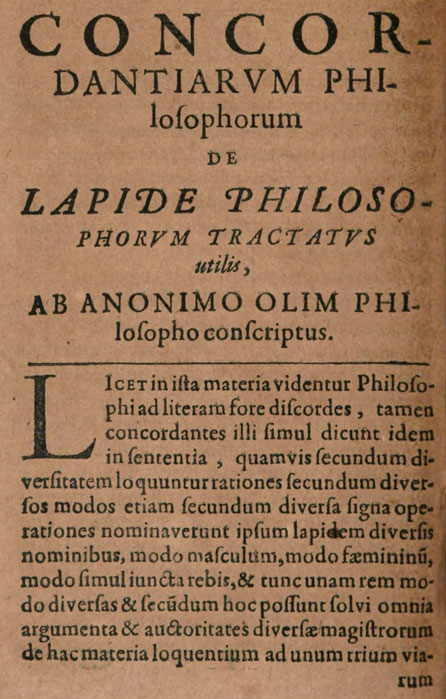
Translated from the book:
Syntagma harmoniae chymico-philosophicae, sive philosophorum antiquorum consentientium ... nondum in lucem publicam editorum, collectum et distributum in certas decades, studio et industria Johannis Rhenani ...
Although in this matter the Philosophers seem to disagree according to the letter, nevertheless, when they are brought into concord, they all say the same thing in meaning; although, according to diversity, they speak their reasons according to diverse modes, and also, according to diverse signs and operations, they have named this Stone by diverse names: sometimes masculine, sometimes feminine, sometimes by things joined together.
And then they speak of one thing in diverse ways; and according to this, all the arguments and diverse authorities of the masters speaking about this matter can be resolved into one way of truth of this Stone, to be described afterward. Yet there is only one way, namely natural or artificial Mercury, that is, extracted from bodies, and especially from the perfect ones, because in these is the most subtle and pure substance of Mercury, capable of the fixation of the Philosophers and of all their works more than any other mercury in the whole world, as will appear more clearly by the authorities.
And therefore, to any one of the three ways to be described afterward, the authorities of the Philosophers can very well be applied, and can signify the same thing in the same way. For there are many ways, and there can be many ways, toward the same intention. Yet, from the diverse modes of preparations and from the administration of fire as the efficient cause, the operation arises; and consequently the Stone of the Philosophers has diverse names according to appearance. Nevertheless, all tend to the same end, namely to subtiliation, which is called sublimation, and to fixation, which is called incineration or calcination, and is called by many other diverse names.
Therefore, from the repetition of that operation, namely of sublimation and of its thickening, which incineration naturally follows, or the fixation of the Philosophers, together with skill in the preparation of the fire, with one thing alone, or with other helping things which nevertheless ought not to enter into it tending to the same end, and because of the speed of the work and the attraction, the goodness of the work results.
And with the same thing placed in service, if it pleases one to proceed further in weight, it can be done by increasing the goodness, as the aforesaid Philosophers as is sufficiently clear to one considering the Philosophers. There follows concerning the matter in particular, and something must be said about it.
First, indeed, some Philosophers wish and because all the ancient Philosophers, in the beginning of their work, said that the matter was the most subtle substance of Mercury, without earthiness, which would hinder fusion and fixation that from it the whole purified thing is drawn out by sublimation.
Thus Geber says in the Summa, in the chapter on the medicine of the third solar order, where he says: “Take the Stone noted in the chapters,” and in the chapter on Mercury he says that from it is made, and is called, the tincture.
He also says, by the mode of separation, that you should divide the purest part by itself and place it separately. And from this Mercury the Philosophers have been diversified, as is clear to one reading their books.
Some have placed this common Mercury; yet not simply, but purified by sublimation, or vivified by other methods. And this so often that it becomes purer, without any earthiness whether this is done in the common way, or in the vulgar way, or also in the philosophical way according as Mercury is held in the fire of its tolerance and equality.
For then, by the continuity of fire upon it, the natures are converted in it, and the subtler part is separated, elevated into the upper vessel; and its earthiness will remain like dregs at the bottom. About this, below, when speaking of that way, it will be said in such a way that the whole Mercury is raised into a purest substance, and its earthiness will remain at the bottom, to be rejected.
As a certain Philosopher says in the Turba, holding such a mode of working for our Stone: We add nothing nor diminish anything, but remove superfluities. And many sayings of certain Philosophers, and many authorities placed in the books of the Philosophers, move us to hold this way. These are clear enough to anyone looking into their books. And for the present I intend to insert here some authorities tending toward that way.
For the elder, concerning the truth of the Stone of the Philosophers and the one mode of working upon it, says: “Son, consider that whatever is said in our books concerning waters, sulphur, vinegar, and salts, you should understand nothing except one divine thing, which, according to the diversities of signs and preparations, is now called soul, vinegar, sulphur.”
And he adds: “Do not aim at many things, although the Philosophers say that it is made from things, and that the thing is compounded from things; all this has been said by similitude, as will be said below.” And the same man says: “Our Stone, which is one thing, if nevertheless it shared in something else, we would not have said that it is from it, any more than we would say that our Stone is made from men, because all men participate with other things.”
And he says further: “Some indeed have placed sulphur.”
Likewise, according to Aristotle: nothing is completed except with subtilized ferment. And thus there is subtiliation, distillation, fixation of the Philosophers, and inceration, because all these things follow one another in nature, through the sole regimen of fire, according to the need of the labor and the degree of fire according to its tolerance. Concerning this I shall explain more particularly below.
Likewise another Philosopher says in the Turba: “Every thing which is bought at a dear price is found useless in this art; nor ought it to hinder that it is said in the book of the seven precepts that this thing is in every thing, since that elder expounds it thus: that in this thing are all powers, namely whiteness and redness.”
And Geber confirms this in his Summa, saying: “Only in this is that from which it is drawn.”
And from this they called this Stone one thing, as a certain Philosopher says: “In this alone is everything that it needs, as sulphur, salts, and tincture.”
And they say that this thing does not consist in a multitude of things; and they also say that those intending to labor in this art, if they proceed by the straight path, work about one thing, namely our Stone. But if you say you do not know it, you are wandering.
Likewise in the same place: “Do not forget that in this work you need only one thing; truly, do not concern yourself with a composition of many things, of which many envious men speak figuratively. For our truth is one, in which is the tinging spirit which we seek, surpassing all natures.”
And therefore many Philosophers have called this thing all things; and in the same place it is not in need of many things, but only one thing. And it is completed.
Thus the words of the Master: “Nature rejoices in nature, and nature contains nature, which the wise man governs by itself and extracts from it every nature surpassing nature.”
You will find many authorities concerning this matter in the books of the ancients; and therefore the things aforesaid are sufficient for this part.
There are also some Philosophers who place the Stone of the Philosophers in Mercury not only the common Mercury, but that extracted by skill from perfect metallic bodies, such as Sun or Moon and this they say this mode exists and is made through perfect bodies, so that those bodies are subtilized and converted into true Mercury, similar to the natural one.
According to one mode, perfect bodies are to be subtilized by methods and means, namely by sharp waters and by the water of eagle-salt, which is called sal ammoniac; this greatly subtilizes bodies. And by continuing this subtilization in such a way that the body becomes spiritual, mercurial, and volatile, they called that body, thus dissolved or prepared, Mercury and the Stone of the Philosophers.
And then they worked with it according to the modes of labor to be described later, until from it there was made a tincture capable of being increased infinitely. And they are moved to this way by such a reasonable motive, saying that there is no doubt that in a perfect body, namely the Sun, there is a white and red tincture; or also in the Moon, in which there is a white tincture, and by continuation of fire it becomes red.
But others take one part of Mercury; others, three parts of the male and five parts of the female; or both joined similarly, male and female, as some say, because of the swifter corruption of similar bodies than of one alone. And then, when the body is thus dissolved into quicksilver, they have in themselves a Mercury purer than every natural one, and also a magistery disposed for physical fixation. And from there all things are done more perfectly and more quickly than in natural Mercury, if they work according to the sayings of the Philosophers to be written afterward.
And it is not unsuitable to assert, as those wish who place the Stone in the subtilization in waters, or of perfect bodies, and not in the common sublimation, but in raising it upward, and thus subtilizing the body so that it becomes spiritual, easily entering into fusion and tinging.
Therefore, by such sublimation, perfect bodies are changed from nature into nature, and become incorporeal, until, by roasting, they can generate what is like themselves: as gold generates Sun, Moon generates silver, and so on to infinity.
And they say that this belongs to the perfection of any nature whatever: that it can generate its own like. But nature cannot do this by itself; and therefore they say that the artificer begins where nature leaves off perfection. And thus that philosophical tincture was discovered by that most noble secret art.
These ways already mentioned, though tending to one end, namely to the most noble mercurial substance or to a body subtilized so much that it is judged to be the same thing are confirmed by these authorities.
For Geber says in the Summa of the Perfect Magistery, in the chapter on the Sun and Moon: “By God, the Sun is the tincture of redness, and the Moon of whiteness.”
And elsewhere in the same book he says: “The tincture must be subtler than the bodies from which it can be drawn.”
And the same Geber says that the tincture is in bodies and in Mercury, in these words: “In bodies it can be more difficult, and in Mercury more easily and more perfectly.” And the reason can be this: because it is difficult to dissolve perfect bodies, which are of the strongest composition, in such a way that they may be compared with Mercury in subtlety and penetration, as will be clear.
Likewise, in the Summa of the Perfect Magistery, he says thus: “Bodies indeed, from which the tincture is drawn, are hard-necked to subtilize.” But that it is done more perfectly in Mercury can be evident for a longer time, because a longer labor is required in natural Mercury before it is prepared to such a degree.
For if, in purity, and reduced to a body similar to Mercury, as has been said, much time passes, and it needs long digestion with the modes of sublimation, as will be said afterward. Wherefore, and because from this, by much digestion with the modes of sublimation, as will be said afterward, it needs to be brought to its perfection, it also receives more from fire; and thus the tincture is generated most perfectly. And therefore he said that the tincture would be more easily and more perfectly in Mercury.
Likewise, toward this way namely that the Stone of the Philosophers is in bodies the intention of Geber himself seems very strong in his book which he wrote On the Investigation of the Magistery, speaking in part. He says, in the chapter on the tincture of the third order: “For the white, take the Moon; for the red, take the Sun; and dissolve in strong water, and make little stones. For then,” he says, “from this is our fixed body dissolved into our fixed Mercury, which you will rule further by subliming and fixing, as we have handed down in our Summa.”
Here only note that although Geber says, “for the white, take the Moon; and for the red, the Sun,” by this he does not wish to deny that both tinctures are also present well enough in each body by itself, just as in their mixtures; or also the tincture of the white in the white, and of the red in the red, as is clear through a certain Philosopher saying that, although our Stone is white in what is manifest, in what is hidden it is red; and the reverse is brought about by decoction of the fire.
And Plato, in the Fourths, adds: “Convert the natures of things, and you will find what you seek.”
Likewise another says thus: “Make the hidden manifest, and the manifest hidden, and you will find the magistery.”
To this way belongs what the Philosopher says in the Turba: “Unless you make bodies incorporeal, and incorporeal things bodies, you have not yet found the rule of working.”
Likewise Arsitanus the Philosopher says: “I advise you to begin from the perfect bodies; for before you could perfect the imperfect to such a degree, you would sooner lack life.”
Likewise Hermes says in one of his treatises, which is entitled On the Hidden Things of Hermes: “If you consume three parts of your camels.”
Plato himself agrees with him in the book On the Fourths, saying: “Gold must be led into vapor; and if this cannot be done in a circular figure, let it be done in a quadrangular one.”
And a certain master holds this way, who made an inquiry concerning the diversity of this art. And the Philosophers fittingly say: “Our Mercury is not the Mercury of the common people, but of the wise.”
But they understand this concerning Mercury insofar as it is the elixir.
Likewise the elder says: “If you have melted the white body, let it be received by that mode of the work; but in gold, leave it.”
Likewise Calid says: “Philosophers of the past and future could not make gold without gold.” And he himself adds: “That gold comes forth from our gold, and it is bronze.”
And the same elder further says: “O, if you knew this Stone of ours, the bronze in which the metals are submerged.”
And again he says in the same place: “Every thing of the Philosophers is that which has in itself the whole of what it needs, and is the mother of gold.”
And also in the Turba: that it is more excellent than nature, and cheaper than all things; only gold is not cheaper than nature.
Behold how the elder, by his own words, seems to disagree, and how other Philosophers disagree among themselves, as can be seen from the authorities written above; while nevertheless all cry out that there is one thing, one vessel, one preparation, which is sublimation. And according to the degrees required by the fire, diverse operations follow this one operation, namely fixation; and the same thing receives diverse names, as was said before.
Now therefore we must not undeservedly come to the concordance of the Philosophers.
Therefore, by way of conclusion, it seems it must be said that all the Philosophers and their authorities agree in this: that the Philosophical Stone is always Mercury. And this is openly clear from the authorities of the same men written above, and to readers of their books it can appear most evidently. Yet they seem to disagree concerning natural and extracted Mercury, as has been said.
Therefore it must first be said that authorities tending toward the way of natural Mercury are to be understood and spoken not by way of denial, as though another extracted Mercury is not also, or cannot be, the Stone of the Philosophers; but because such Philosophers found the science also by investigating the method of decoction in natural Mercury itself alone, and so that men should not spend expenses on more precious things, since it can also be well found in a cheaper thing.
The authorities of these men, namely: “Every thing which is bought for a dear price,” etc., and as was said above, could be used for them.
But those who have placed the Stone in bodies have also placed it there, not by denying the other way, since no one ought to doubt that there are several methods, skills, and ways toward the same path and intention one easier, another more difficult; one longer, another shorter. They always mean the same thing.
And therefore, speaking in this way, they understood that, once the Mercury of the perfect body has been obtained, or once it has been dissolved and subtilized into the most subtle operation of Mercury, that Mercury, or that thing, is certainly cleaner, more perfect, and more suitable for further perfection; because it can generate from itself what is like itself, and a tincture can also be made from it in a shorter time.
And there will be less difficulty in the manner of working and in the fire; nor can one go wrong so easily as many have erred while working with common Mercury, bringing its preparation namely fixation through long periods, almost to the extreme, which perhaps would not have happened to them if they had labored in the perfection of Mercury from bodies.
Since, therefore, what is perfect is perfected further more quickly, and is destroyed with more difficulty, consequently there is less error in it, since nature rejoices in nature, and is glad and friendly with it.
A certain Philosopher says: “For those who have the symbol, the passage is easy.”
And this is a noble authority in this art, concerning the unity of our blessed Stone; for by it are excluded many ways in which many labor, in the conjunctions of bodies and spirits through amalgams and waters, etc.; or bodies with bodies, by laboring with bodies, and wished to turn a body into spirit, and afterwards at the same time to fix one body with spirit, or one spirit, or several with a body, or with both perfect bodies, saying that the tincture cannot be made except with the conjunction of marriage: namely, of the Sun as the man, of the Moon as the woman, and of Mercury as the mediator joining the tincture.
These things are said through many authorities which are written perhaps according to the letter, or enviously, or allegorically, as about distillations, etc.
Since there is one Stone, as all cry out, which has in itself the whole of what it needs, and which is called in diverse ways according to the diverse signs in its preparation, as I wrote to you more diligently before in that treatise.
And it is no wonder that those who labor in this way for long periods in bodies of bodies, and of spirits, find nothing. For the less simple and the more composite a thing is, the less “symbol” there is in it; and therefore the passage is more difficult. For, since subtilization is required, the due fire can with great difficulty be applied to things of diverse natures tending toward one thing; because perhaps while one thing is being fixed, another would become volatile; or while one is being subtilized, another perhaps would be thickened, which ought to be subtilized, as is already clear from the preceding authority cited.
Nevertheless, it is quite true that spirits joined to bodies through solutions in sharp waters with the body in amalgams, or by other methods, and thus the spirits themselves digested with perfect bodies, or by themselves with solutions, through roastings or putrefactions, and again through solutions with waters and salts, alums, and other devices concerning which many devices are written in the books of Geber and others, in On Investigation, concerning medicines of the first and second order, and in other practical books to be seen there these spirits are fixed in bodies.
And thus they can indeed accomplish something well in particular works, in the medicine of the first and second order; even perfect augmentations may be well made, and imperfect bodies can well be cleansed by their calcinations and solutions, and by the roastings of spirits, which are converted from imperfection to perfection with the metals themselves.
According to Hermes, Empedocles, and the seals, these metals do not differ except according to greater and lesser degree, and not according to difference and form of species.
But concerning these particular methods, it does not belong much to the present purpose. Therefore see other books concerning this matter.
From these aforesaid writings it is evidently clear that all the Philosophers agree in asserting that their Stone is Mercury not common Mercury, but ours; whether that Mercury is natural and so purified, and this will not be common Mercury but the Mercury of the Philosophers; or whether it is made from a body, or even extracted from perfect bodies, by whatever method and by whatever devices, either by itself or with additions for the shortening of the labor provided only that this Mercury extracted from the body becomes subtle and is not deprived of its moisture, but is a pure body subtilized into the likeness of Mercury, provided only that the additions do not remain.
But then let this subtle Mercury of the Philosophers itself be prepared with devices and with fire as the efficient cause, according to the methods and devices of Geber, who in a few words stated the whole truth of this, and of other Philosophers agreeing with him, with the urgency of the work. And let it be prepared so that from it a true physical tincture can be made.
And by this, answer can be made to the authorities written from here onward in the books of the Philosophers, which the attentive reader will commonly be able to apply to those placed here.
There follows:
Concerning the second principal matter, namely, concerning the preparation of our Stone and the regimen of the fire in particular, something must be explained with the authorities of the ancients.
And in this matter the first mode is chiefly to be observed. Geber sets it down in his Summa in few and true words.
Therefore, as it seems to me, according to all the Philosophers one must work thus: let the Stone, now well known from the things written above, be taken and prepared in one glass vessel, without another; or in a vessel above which there is another vessel in the manner of a cucurbit and alembic, yet without a nose, that is, a blind alembic; and let them be joined masterfully.
If you work with a vessel above a vessel, as certain Philosophers say, as will appear clearly afterwards, in such a way that it does not breathe out and so that the work of philosophical sublimation is raised above it, which is of subtilization, so that it may be perfectly subtilized, in such a way that it comes to the utmost purity. And this is done by the urgency of the work, and by the greater tolerance of the fire, continuously and successively, in the manner of sublimation, by long continuing the work of sublimation.
The cause is this: because the whole magistery, as all the Philosophers wish, is only in subtilization through the continuation of fire. And by the tolerance of fire all the other properties naturally follow, namely: when subtilization has been made, thickening follows; and then incineration of at least some part; and consequently fixation follows from that.
And there ought to be no doubt that, by sublimation alone, fixation and incineration happen by a greater fire, as will be said afterwards.
The same part, because of the parts not fixed, is again sublimed; and this is again fixed; and again it is sublimed according to the aforesaid intention of Geber. And with this alone the Stone alone, the fire alone, and its one vessel alone, if it pleases the whole Stone is perfected into tincture.
And you should not be moved by the fact that some suppose helpers to be necessary for this, so that this Mercury itself may be thus subtilized, since it is of a homogeneous and very strong composition; especially the Sun and Moon, if Mercury must be extracted from the whole of them, and so subtilized into Mercury. This would be very difficult, and consequently could lead the operator to an extreme.
I say first: although natural Mercury, or even the Mercury of the Philosophers, namely of perfect bodies, is of very strong composition, nevertheless through the continuation of fire some part is always separated from another by subtilization, in the manner almost of vapor; and that which cannot breathe in the vessel is thickened, and again descends. And thus, by means of the due regimen of fire, namely a slow fire, as the intention of the operation requires, it subtilizes some other and subtler part; and so onward, until the whole work is completed.
This is the intention of the Philosophers who have written the truth about this art. Yet by this the other ways, of which we shall set down some below, are not denied, since nevertheless they tend to the same end of the Philosophers in the mode of working, although by other and different methods and devices of working.
But concerning the second, namely concerning perfect bodies, as was done above, I confess that it is very difficult for such bodies to be subtilized and digested by themselves in such a way that they are converted into the nature of Mercury; and perhaps the life of a man would not wait for such a sublimation by itself.
Nevertheless, since it is not impossible that whatever is generable is corruptible and alterable indeed, in itself, and consequently by artifice and by the administration of fire, namely by the heat of fire and putrefaction even something of however strong a composition can be altered, and consequently can be well subtilized into Mercury.
Yet, because of such length of time, it is not unsuitable to assert how preparations with foreign things may well be admitted: namely with salts and sharp waters, putrefactions, solutions, roastings, calcinations, and any other things, so that those perfect bodies themselves, which are the bodies of the Philosophers, may be turned into Mercury, are subtilized, or prepared into the nature of Mercury; and then such foreign things are removed. And this, only then, when the bodies have been prepared to such a subtilization of Mercury, is called the Stone of the Philosophers. With this, as with the beginning, namely with quicksilver, according to the sayings of the Philosophers, one must proceed in the same way as with another; and not otherwise, nor except by one single method.
And this is the concordance of all the Philosophers, as has also been declared earlier, and sufficiently many times, from their own sayings.
But as to this part namely, the second, concerning the manner of subtilizing perfect bodies into the nature of Mercury there is one mode of working, as in common Mercury, yet prepared so that it is called the Mercury of the Philosophers, as was said before.
Some have begun such a mode of working, and have said that it is according to the intention of the Philosophers, namely of Plato in the Fourths; and it also agrees with the intention of Geber, as has been said, and of other Philosophers. For they intend, namely, that labor should be done upon itself.
For they take perfect bodies, such as the Sun, and subtilize it with sharp waters; and they turn it into little stones, and dissolve these in dung. Then, by roasting, they congeal it; and they call that work subtilization. And they repeat the solutions and congealings so often until this whole thing is subtilized into the nature of Mercury, so that it may flow by easy fusion and may tinge the matter it enters.
Then again, as a fixed part and ferment, they take it again with four parts of the body dissolved into its Mercury, that is, reduced into little stones. By roasting, they dissolve it, working continually as before, until again the matter tinges; and they say that one can proceed to infinity in increase, and also in goodness.
Others, however, subtilize the perfect body in another way: namely by calcination, and with the water of sal ammoniac, or another solvent; and then, by roasting and by repeating the work again, they labor in such a way, similarly subtilizing, until those bodies are in the nature of Mercury, by which they are converted into a perfect tincture.
But certain men intend to make this subtilization with sharp waters by decoction with sublimed or living Mercury, or with other spirits, by joining them with the body. And then, from those spirits themselves or even simply by subliming they say that some part of the body is elevated with the spirits; and they continue until they have a good part of the body thus converted into spirit.
And then, by separation with a gentle fire, they take the upper part by subliming it upward; another part, they say, remains at the bottom. This fixed part they again decoct with the unfixed part, in good quantity, or with the part slightly roasted, until again the part is fixed and converted into fixed earth. They continue this until they fix a good part, and they say that the earth is sufficiently prepared and then they again elevate that earth with a quantity of the unfixed part; and this again until the whole is elevated. And thus they fix it repeatedly; and when this has been repeated four times, they say that it will be a tincture according to the sayings of Geber, and also of Hermes in the Thelesin, saying:
“You shall separate the earth from the fire, the subtle from the gross, gently and with great skill. It ascends into heaven, and each returns into earth, until it receives the power of the superior and the inferior.”
Although these sayings of Hermes can also agree well with the mode of the Philosophers’ Stone spoken of before, and with the mode of working upon it, as was said earlier, namely concerning the Mercury of the Philosophers.
Therefore, to satisfy their opinion which does not seem irrational, since it is also wholly directed toward the sublimation of Mercury and toward mercuriality I say that such modes of working may well be accepted, provided that in such labor one takes care that the bodies, in such subtilization, are not burned, or that the matter is not dried too much and stripped wholly of its own nature. For, as was said before, whatever bodies, or Mercury, are subtilized, even by whatever way, provided that such preparations and decoctions are made according to the way of the Philosophers and their intention concerning which it was spoken before, and as is said in the preceding parts of this treatise then it is well.
For there are several ways and modes tending to the same end, as was previously determined concerning the concordances of the Philosophers in their Stone.
Yet it is true that insufficient the sayings of the Philosophers, and the writings in this treatise of mine, are more inclined toward the way which is in prepared natural Mercury, or in quicksilver extracted from bodies, than toward those ways just now described. For the ancient Philosophers tend more toward the unity and uniformity of the thing and of the labor than toward those ways just described, and also more than toward multiplicity; since in one thing there is greater unity and a stronger symbol, that is, uniformity, than in many things. Consequently the labor is easier and less liable to error, provided only that the mode of fire and preparation, which all the Philosophers have greatly hidden, is duly carried out.
Nevertheless, for the completion of this treatise concerning the intention of the Stone of the Philosophers and its way by which the sayings of the Philosophers are chiefly understood and concerning its regimen according to certain useful writings to be considered in the Stone of the Philosophers itself, which consists in one single thing and in one labor, I propose to write again; and consequently, approving such things by the authorities of the Philosophers, I shall then finally conclude this treatise.
Therefore, just as in the second principal part of this treatise something has been said concerning the preparation of our Stone, now I say conclusively and wholly that it must be asserted only in the mode of preparation of the Stone, concerning which the Philosophers chiefly intend, so far as you can now know from my writings; of which the whole preparation of this Stone consists in sublimation alone. And through this operation, by the long duration of labor, with assiduity and persevering effort upon the aforesaid Stone, and by the regimen of fire according to the intention of the work and the tolerance of our Mercury, our whole magistery is completed.
And all the diverse operations written down because of the diverse intention of ruling this Stone follow naturally: for after sublimation comes thickening, and then incineration, and then ceration, and our physical fixation.
And so that you may better understand that term, “physical fixation,” know that one must take the greatest care that the Stone, through the tolerance of its fire, not be deprived of its moisture; because then its own moisture could rarely, or never, be restored to it, and thus the whole work would be destroyed. This has happened to many Philosophers, even those already knowing the Stone well.
For this reason they denied the art, and also found other ways to be erroneous which they wished to deny as art, not considering that all the Philosophers cry out that their work is sublimation.
But they themselves subtilized and purified the Stone known to them in some way, and then aimed at fixation, after sublimation and completed purification had been abandoned. And again they fixed the Stone, because they deprived it of moisture; and through this they were led to an extreme, not noticing that all the Philosophers cry out: one body, one labor, which diverse signs follow; and according to the usefulness of the Stone, other diverse dispositions are assigned to it. Yet these consist in sublimation alone, according to the regimen of the fire, from which the operator has diverse operations in the Stone: now subtiliation, now thickening, now incineration by fire according to its tolerance; and hidden physical fixation follows.
And therefore physical fixation is to be considered most carefully, namely in this way: that the Stone, at the time in which it is fixed, should not lose the power of subtilization of the fixed part for fixing the unfixed part.
And so such works are done in one vessel, or in two, as was said before, and in one labor, with the mode of administering the fire to the work: first, the sublimation of the Stone; secondly, by greater tolerance of the fire, thickening; and after this, incineration of that part which by nature, and by the continuation of fire and by the open magistery, is then fixed by consequent physical fixation, of which it was spoken above.
And the whole work is continued in one labor until, with the signs to be described afterward, the thing itself consists in the perfect magistery.
Yet here it must be noted so that it may be clear to the envious why I have not also written the regimen according to the properties of the degrees of this fire itself in detail I say that it cannot be very specifically determined concerning such degrees and proportions of fire; nor could any Philosophers do this so fully, although one has spoken more than another concerning such matter. For the rest depends on industry and practice of those who are working, to whom it has been entrusted; from the authorities of the Philosophers speaking below concerning this matter, some of the nobler things can be drawn out.
For it consists, as far as I can consider from the sayings of the Philosophers, in this: the whole regimen of the fire, according to the degrees and preparation in that Stone itself since our Stone is one, in one vessel is written thus.
Let it be held and subtilized with a slow fire; let part of it be separated. And this is to be done for a good time under such a fire, so that another work of labor, namely thickening upon it, is not applied too quickly, until by length of time and by the assiduity of the fire you see that part thickened by the equality of the fire according to nature.
Then, by continually strengthening such a moderate fire, until you see some part wishing to be incinerated, then use a greater strength of fire yet not departing from the first work, nor from the second by the violence of fire since some part is now incinerated by itself and naturally, because of the multiplication of the other subtle parts.
Such a part must be subtilized again, and one must proceed again continually, as has been said; and this by a greater tolerance of fire, until this happens many times, namely by subliming, incinerating, etc.
And you will find that this work is first of fixation through a long decoction of the Stone in the fire. Our Stone itself will come to such a tolerance of fire that so great a fire is required in the second work and labor upon the assiduation of the Stone, as at first was required for thickening; and so consequently concerning incineration and fixation.
And this by continually governing it in this way, until finally the whole Stone, with sufficient preparation of itself which is purification by such a method of governing the fire over the Stone shows easy fusion with its ignition, and transmutes metals, or Mercury, into true solar and lunar perfection, with proofs and examinations.
And this according to the whole or according to a part. And I say this notably: “or according to a part,” because it is not a care or concern if your whole unprepared matter is not prepared to such a degree. Indeed, it does no harm if some part of it has remained in some regimen, namely in sublimation or in incineration.
And the reason is that this is a sign that the Stone has not been directed too swiftly; and this is safer. Indeed, one must take the greatest care that the Stone is not digested so swiftly that, in some way, it is deprived of a previous work or of earlier works. For the sublimation of the Philosophers must be continued over the Stone for so long, because it is not only elevation upward, but also remaining below; and in this, when completed, the whole magistery is perfected.
Test it by projection upon a body. If you find that the Stone is whitened and purified to such a degree that it has pure whiteness, and then you see that the Stone is so whitened and subtilized that it penetrates to the nature of the thing to be tinged, then, when penetration has been made, because the Stone is fixed to such a degree that the thing examined passes all judgments, then you have worked sufficiently.
But if not, repeat upon it the first work itself, and so consequently, as has been written, until it is done; and it will be, with God cooperating.
Behold, now it can be confirmed that it is very erroneous for the operation of the Stone to be so conducted that one operation is directed toward another and the first is abandoned. For if the magistery is not complete, as happens to many, who on account of this are led to an extreme, it is not possible in this art to repeat upon it the first work; and thus the business would be totally destroyed.
But if, according to what I have said about the regimen of the fire, which I have written for you, you have changed it well and carefully, it cannot destroy the work to such a degree. But if you do not find it at the first source, you can nevertheless, through the assiduity of the work, as I have written, very well reform your defect.
And therefore, not only for fulfilling or reforming, but also for exercising the work again with the unfixed part, as by laboring in the earlier work, you can perfect it, as Geber says in the last chapter of his Summa: that the magistery of the Stone can be multiplied infinitely in increase and goodness.
Now I shall not omit to insert some authorities from the sayings of the ancients placed above, concerning the regimen of the Stone, which pertains to the preparation of its fire; and I leave this to the diligence of each reader in the books of the Philosophers.
For the elder says first, concerning the preparation of the Stone and its regimen of fire, thus: “The preparation of our Stone is difficult, and most hidden.”
Likewise in the same place he says: “The common people, having eyes, sleep for although he has it with him, he does not know its preparation.”
Likewise, the Philosophers say concerning fire that this fire must be the heat of the Sun, when it is in its state; and therefore they called it putrefaction.
Likewise in the same place: “If your fire is of the baths.”
Likewise in the Turba: “Let your fire in whitening be gentle; and at the time when the tincture is made white, a greater tolerance of fire is required. For when that matter of the Stone begins to be reddened by the continual insistence of the labor itself, then, when the Stone is worked to the red, the first work requires the same degree of fire in the red as perhaps the third work of whitening required.”
And in this a man ought to be cautious: that he does not water the Stone before the time of perfect whitening, until the perfect tincture is in the white regimen, with the degrees of fire which look toward the red. Concerning this Rosarius cries out, saying: “Do not mix the work of the white with the red.”
Yet these things must especially be entrusted to the practice of those who labor.
Likewise in the same place: “A gentle fire is to be made for our Stone placed in its vessel for forty days, because by it the corrupting moistures are extracted.”
For he commends the length of the work, and censures speed and combustion, namely so great that the Stone cannot return to its first work and be perfected in the whole.
Likewise in the same place: concerning our vinegar, one must beware lest it be converted into smoke and perish because of the vehemence of the fire.
Likewise in the Turba he says: “In our work, first all things are blackened, namely when the matter is incinerated; it is not yet perfect. In the second, all things are whitened, that is, in the second work the matter is disposed toward whiteness and clarity. Thirdly, the whole composition must be incinerated, always with perfect whitening, so that the body is not totally incinerated unless it has first been perfectly whitened, as was said before.”
Likewise it is said in the same place: “Do not despise the ash. For again its sweat or liquefaction that is, sublimation or solution, which here is the same thing is returned to itself by a stronger expression of fire. And with this fourth fire the crown and tincture are perfected.”
It must be known that sometimes, after blackness, the matter becomes citrine; sometimes it becomes red before whiteness. This is not to be cared about, yet in such a way that that, or such things, do not contain perfection, as has already been said, because the red would be mixed with the white, which ought not to happen. But the degrees, once such an action has been seen, must therefore be moderated, so that one does not depart from the intention which I have already written to you most plainly: to direct the work from blackness to whiteness, so that the work may always be able to return to its principles.
Whence Hermes says, and simply in the Turba: “Let crude and fresh mixtures be received at the beginning; and let them be purified and mixed, until the elements are joined together with one another and are ground together” not by the rubbing of the hands, as above in the Turba, but let them be washed with the water which they then receive.
Then let them be extracted and nourished, so that it becomes a “genitum,” and he adds: and know that this dispensation is made in putrefaction at the bottom of the vessel not with the putrefaction of the common people, but through incineration, since the ancient Philosophers nowhere set down anything concerning putrefaction or the distillation of waters, except perhaps allegorically and figuratively.
But the “genitum” is made in the air, that is, in the upper part of the vessel, if one works with a vessel above a vessel, as the elder seems to think; concerning this it is clear below.
Likewise in the same place it is said: take things from their minerals, and exalt them to the higher places of the mountains, and bury them on the summit of the mountains, and reduce them upon the root.
And these are plain words, written without any envy. From this authority certain men wished to draw out that way of working: they converted purified Mercury into water by roastings, or compelled it with other things or by itself, and distilled it through an alembic; and they watered the earth at the bottom with the water. And thus they converted water into earth, and they said that this must be continued until a perfect tincture was completed.
Whatever may be true of this in the last and previous matters, this does not seem to me to have been the intention of the ancient Philosophers, although nevertheless I do not seem to disapprove that way anywhere, since they also proceed through the preparation of Mercury by prepared sublimation, by purification, and by fixation of its natural moisture. Yet according to the letter this does not seem to agree with the operation of the Philosophers, since others say: “Our water is not common water, or rainwater.” And by this is solved what the Philosophers said: “It is necessary to divide our bronze, and to convert it into water, and into vapor, and again to thicken it.”
Likewise: “It does not benefit you that the water be sublimed from vapor.” And many such things can be alleged allegorically.
Likewise the Philosophers say in the Turba that the beginning of our operation is that the Stone be worked with a gentle fire, so that it may likewise be made dead, and that first its soul be restored to it; and this is to be continued until the soul remains permanent in the fire.
Likewise, according to Geber, in its preparation a threefold fire is required: first, a very gentle one, so that the substance of the Stone does not ascend, but only vapor. Secondly, so that some substance ascends, and the vapor begins to thicken. Thirdly, so that a part is incinerated according to the said magistery.
Likewise the elder commands that, when the thing is one, to which we add nothing and from which we take nothing away, it is sufficiently purified. He speaks here of Mercury, naturally purified from earthiness, that is, as I say, the Mercury of the Philosophers.
Since the other Mercury of the Philosophers is made, namely by the dissolution of a perfect body, as has been said, it is said to need such purification less.
And the elder adds that then the Stone must be divided into parts. He says this according to the opinion of those who work in many vessels, or in a double vessel, or in a vessel above a vessel, so that the matter may be digested better and more certainly, and prepared according to the intention of the artificer and of the fire, and the work may be completed more quickly.
Yet the same operation tends to the same intention: namely, to fix part of the Stone, and then to subtilize it with the unfixed part, as I wrote to you before. Although, nevertheless, in one vessel and with one thing namely natural Mercury, sublimed and artificially purified from earthiness each of these things can be done best.
And the master of this operation was Antonius, in the book of his Concordances of the Philosophers, saying thus:
“Let purified Mercury be taken.” I say that the same thing is also better, as was said before concerning the Mercury of the perfect body, and rather of the most perfect body, namely of the Sun. And let it be placed in its vessel, as has been said, and let it be dissolved into most subtle parts, like vapor. And when that vapor is then thickened, let the work upon that Stone be repeated and continued according to the devices and methods of the ancient Philosophers, and clearly according to my doctrine written to you in this treatise, until the whole work, by perseverance and continuation, and by repetition of itself with the help of the Most High, is completed.
May His name be blessed for ages of ages.
Amen.
ANONYMOUS TREATISE
There follows a special doctrine, which speaks very expressly concerning the preparation of the Stone.
In this book, indeed, which begins: “Bodies submerged in Mercury through a suitable putrefaction will be turned back into quicksilver, which was first expressed; and afterwards the metallic kinds, projected into it while putrid, will be multiplied and will grow immutably.”
But the manner of acting is such, according to the manner of nature.
Our quicksilver and the power of the white and red sulphur, congealed or thickened without burning, must first be cleansed from every superfluity which can be removed by skill. And this skill is washing or sublimation, which is done thus:
Let one pound of quicksilver be placed, and let all its “humanity” fly away that is, the superfluity which is accidentally in it, by which our work would be corrupted. Do not omit this, otherwise you would labor in vain.
And after the whole watery and undigested part, which is too volatile, has been made and is of the disposition and love with fire, and not surpassing its own nature and radical fixation, let there be a tempered substance between the fixed and the unfixed, opened in it for the completion of our work.
Likewise, let the seed or ferment be most cleanly purged, of which one part will suffice for seven parts of the purged Stone. Therefore let the amalgamation and conjunction of both be sufficient.
Then afterwards let the whole amalgamated matter be placed in a very strong glass vessel with a narrow neck, or in an earthen vessel well glazed. If that vessel is not suitable, let the vessel be placed at a slow fire between / among ashes, as you know.
It is called a slow fire because it fixes the Stone, which nothing can overcome; and the regimen of fire ought to be such that lead would remain continually melted in it.
For by such a regimen you will have, up to 24 days, the completed putrefaction. Its sign is the blackness of the matter, approved for this purpose.
After this you will have the second sign, which is redness through the aforesaid regimen of fire, lasting for 53 days. Again, in those days it will be perfectly completed.
The third sign will be greenness in heat; in that fire all the same will be completed in 70 days.
Between the third and fourth sign there will appear all the colors that can be imagined; and then the new magistery is the union of spirit, soul, and body. For together they rule over all things, and each one previously by itself under its own sign: but in the first sign the body will rule, in the second sign the spirit, in the third the soul.
At the time of conjunction, increase the regimen of the fire moderately, and the completion will be entirely in 70 days.
And after this there will come over it the fourth sign, which will be useful whiteness; and it passes with an increase through 54 days, and this is the sign of the completion of whiteness, which we have spoken of. And then the operation is complete.
If afterwards you continue the regimen with an increase of fire, you will see, between the fourth and fifth day, discolored ashes. Let them then be dear to you, and do not despise them; for God will restore liquefaction to them, by infusing spirit without fire into the fiery fire. And you will see, when God wills, there will be a sign at the fourth degree, richly and most splendidly adorned with redness. If you understand this chapter, then you can labor in the art.
The dissolved body, that is, Mercury, is soul and spirit. Understand this thus: dissolve the body into water and Mercury, and reduce it, once dissolved, into sublimed air, that is, into subtilized Mercury. And increase this subtilized air, and afterwards coagulate it, and you will have found it.
Again, put earth into water, that is, the body into Mercury, which is the water of metals; and put that water into air, that is, into subtilized Mercury; and mix it with the dissolved air, and mingle the air with fire, and the fire with earth; and afterwards coagulate the whole, and it is complete, as before.
NOTE: When the body has been dissolved, and Mercury amalgamated with it has rectified it by subtilization for Hermes says that every dissolved body will be a perfect body therefore he says: dissolve the bodies and sublime the spirits, and imbibe the subtilized spirits with the dissolved bodies; for the dissolved bodies will be coagulated by the subtilized spirits.
Or, as he says: calcine the bodies, dissolve the spirits, and grind the calcined bodies with the dissolved spirits. For the bodies will be illuminated by the waters of the spirits, and the art is easy in operation.
Thus you have the whole foundation, if you understand.
END OF THE FIRST DECADE.