De conservatione sanitatis - Tyrocaesar
Jenkyn Gwynne
The translation into the English tongue of the epistle that Aristotle wrote to the great Emperor Alexander, entitled De conservatione sanitatis, and taken from an Arabic book called Tyrocaesar, translated into Latin by one Joannes Hispanus, a famous scholar.
1569
From Wellcome Medical Historical Library MS. 71, folios 2–22
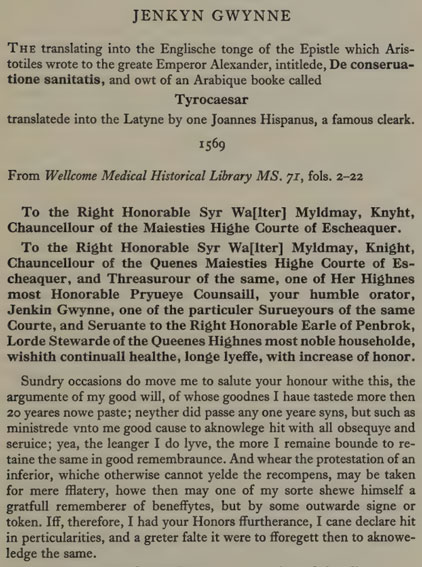
To the Right Honourable Sir Walter Mildmay, Knight, Chancellor of Her Majesty’s High Court of Exchequer, and Treasurer of the same, one of Her Highness’s most honourable Privy Council, your humble petitioner, Jenkin Gwynne, one of the particular surveyors of the same Court, and servant to the Right Honourable Earl of Pembroke, Lord Steward of the Queen’s Highness’s most noble household, wishes continual health, long life, and increase of honour.
Many reasons move me to greet your honour with this, as a sign of my goodwill, of whose goodness I have had experience for more than twenty years now past. Nor has any year gone by since then in which such things were not done for me as gave me good cause to acknowledge it with all obedience and service. Indeed, the longer I live, the more I remain bound to retain the same in grateful remembrance. And whereas the profession of one so lowly as I am, which otherwise cannot yield any recompense, may be taken for mere flattery, how else may one of my condition show himself a thankful rememberer of benefits except by some outward sign or token? If, therefore, I had the means your Honour has granted me, I could declare it in particulars, and it would be a greater fault to forget than to acknowledge the same.
Your recent illness, Right Honourable Sir, gave me the opportunity to discharge both my debt and my duty. For to the sick, every comforting word is a likely remedy. And on this basis, I began to consider within myself how I might fulfil my long-desired affection toward Your Honour. And behold, among certain old books I found, written in an old text, the transcript of the Epistle that Aristotle wrote to the great Emperor Alexander, entitled De conservatione sanitatis, and taken from an Arabic book called Tyrocæsar, translated into Latin by one Joannes Hispanus, a famous scholar. This greatly encouraged me to venture to translate the same into the English tongue, in the full trust that Your Honour, adorned with a gentle name, would with gentleness and affability deign to accept the good lore of Aristotle, though offered by one simple and unlearned.
To this there was also added something not unconnected to the matter, as the sequel shows. And finding that nothing on earth more vividly resembles the image of God in man than the foreknowledge and prescience of things yet to come, and that man, taking pleasure in this, is never satisfied until he attains his own centre, which is God, as it is written, “For man lacks earthly things, yet longs for heavenly ones, because heaven and earth are his knot and bond,” I have therefore in the latter part of this writing, concerning the destruction of the See of Rome, the defection and revolt against the Empire, spoken of by the holy Apostle in 2 Thessalonians, chapter 2, the coming of Antichrist, the liberty and conversion of the Jews, certain other mysteries in natural magic, and finally the period of periods, that is, the last end of the world. In these Your Honour shall see various probable conjectures and reasonable authorities touching the same. And the treatment of the matter shows that I am only a gatherer of other men’s works: the authority is theirs, the credit or discredit belongs to those whose words and judgments I cite; the order and imperfection I claim as my own share. And yet my pains were the greater because my desire was great and my skill too slight to deal with so weighty a matter and with so honourable a councillor as yourself.
Therefore I present the matter to your worthiness as a confused chaos. Your Honour may shape its body and substance into some fitting proportion. And it is true that there is not written so ill a book that it is not worth reading to some end or other. And it is also fitting sometimes to give heed to the unlearned; and it would be the writer’s fault not to write, rather than the reader’s fault not to read, especially when a fool differs from a wise man not by visiting learning.
To Your Honour, and to no one else, I have written this. To Your Honour I commit both the correction of my writing and the interpretation of my sincere intention, which was to preserve your health by good diet and by the reading of pleasant and worthy conjectures concerning the matters mentioned before. And of Your Honour I most humbly beg pardon for my boldness. And if anything imperfect is found in this work, let it be attributed to human imperfection, and let not what is useful in it therefore be condemned.
For good things are not to be blamed because of one thing badly said, nor bad things to be praised because of one thing well said; for sometimes Thersites keeps watch while Ulysses sleeps.
Your Honour’s most humble servant at command,
1569
Jenkyn Gwynne
O Alexander, monarch and emperor of the universal world, consider that, as concerns your body, you are as subject to corruption as other men are. And because by reason of hot and cold humours you are liable to many ailments, for the avoiding of which I have determined to write to Your Grace certain rules, very profitable and necessary, drawn from the secrets of Nature and the inward parts of Physic, and such as may content Your Grace, since it is not fitting for so mighty a prince to make all his complaints and diseases known to every physician. If therefore Your Magnificence observes this discipline and example, Your Grace shall have no need of a physician, except when accidental wounds requiring surgery may occur, and in such cases he may help.
I therefore beseech Your Grace that, immediately when you rise from sleep and natural rest, you do not fail to walk and to comb your head, and also to extend and stretch your limbs. For the stretching of the limbs gives strength to the body, and the combing of the head draws farther out the fumes and vapours which, while you slept, rose up from the stomach to the head.
Then I declare that it is wholesome to wash your hands in summer with cold water, for cold water restrains the natural heat so that it remains in its proper place, preventing it from spreading further, whereby a better appetite for daily meals is stirred up and encouraged.
Then, accordingly, it is a principal rule to be clothed in fine and honourable garments, for such garments gladden the mind, and the nourishing virtue takes pleasure in the beauty and use of robes.
I also advise that you rub your teeth and jaws with wholesome, pleasant, and aromatic roots, whose properties are to dry up raw and moist humours. Such roots are very beneficial: they strengthen the teeth, cleanse the mouth, thin the phlegm, make the tongue more eloquent, the voice clearer, and finally promote a good stomach and appetite.
Also, to perfume and fumigate the mouth and nostrils with substances suitable to the season of the year is very necessary for the preservation of health. By such means, the passages and openings of the brain are opened, the arms made stronger, the neck made fuller, the face more beautiful, the senses quicker, and consequently hoarseness and white hairs, which are accidents of old age, are held back and kept away.
And following from this, the use of sweet ointments is agreeable to Nature. By good scents the mind is refreshed, and the soul of man, being thereby comforted, causes the blood to rejoice and run through all the veins, to the comfort of the limbs. To this you must add an electuary of rhubarb and aloes; by this phlegm is driven from the mouth of the stomach, the heat of the body is stirred up, wind is expelled, and sweet breath and good taste are produced.
Then, to sit with the noble and wise, and to speak of wisdom and virtue in a manner suitable to the time and place; to keep to accustomed mealtimes; and to use moderate exercise for the body are commendable, and very natural for the preservation of health. For from these many benefits arise for the helping of nature: such as the expelling of wind, the warming of the stomach, the closing of the bodily passages, the dissolving of superfluous humours, and finally the digestion of foods, which then descend into a boiling and proper stomach.
And as a principal rule I warn Your Grace to pay careful attention to the differences among the meats served at your table, and therefore to begin your meal with one good dish of light digestion, if that may be allowed; but to make mixtures of many kinds of meats, heavy and fine foods together is not to be allowed, especially the eating of heavy meats after delicate ones. Rather, the heavier meat should be received first into the lower part of the stomach, because the lower part of the stomach, being nearer the liver, has more heat and strength than the upper part at the mouth of the stomach, and therefore makes for a more equal digestion.
And do not in any way neglect to eat while your appetite still remains, for an excess of food narrows the passage of the stomach, and the food remaining in the lower part of the stomach is not digested. In the same way, beware of excessive drinking and carousing, and drink no water upon your food, unless you are accustomed to do so; for water after meat cools the stomach, quenches the natural heat, confuses the food, and causes hindrance in digestion, than which nothing is more harmful to the health of man. But if the heat of your stomach is such that you cannot refrain from drinking water, then in such extremity let the water be cold, and drink only a small quantity of it.
Furthermore, after dinner to lie down upon a suitable soft couch, and then to rest moderately, and to take a gentle nap, is not against the rule of physic; but to sleep before dinner wastes the body and makes it lean and meagre, and dries up the blood and natural moisture. Thus, sleep after meat refreshes and nourishes it.
And among the number of these natural precepts, take note that at no time should you heap one meal upon another, but rather refrain from eating until the stomach has been purged and well emptied of the former foods received. You shall know this clearly by your appetite, and by the subtlety of the savour descending into the mouth, which diet, if you will observe, shall support your vitality. But if, contrary to this discipline, you eat again before the former meal is digested, then your food shall find the natural heat frozen. On the other hand, if you take your food in due need and with appetite, then the food you take shall find the natural heat like a kindled fire.
Therefore, just as you ought not to eat without appetite, so neither ought you to refrain from food when you do have desire for it. For by such abstinence the stomach becomes filled with evil humours, which it draws from the superfluities of the body, and by them the brain is troubled with a most wicked vapour, and the stomach made raw, so that it cannot perform its natural office.
And having by these few precepts prescribed an order of diet to Your Magnificence, there yet remains a due consideration to be made of the four seasons of the year: Spring, Summer, Autumn, and Winter.
Therefore, just as spring, which we call ver, is hot and moist, and by it the air is temperate and the blood stirred, so also foods of that complexion, agreeable to that season, are suitable to be eaten, such as chickens, quails, newly laid eggs, the wild lettuce called by the Latins Scariola, and goat’s milk; and at no time is it more fitting to let blood. The motions of the body, together with the use of Venus, purgings, bathings, laxatives, and spiced and artificial drinks, accord well with this season, springtime. And whatever disorders may arise by means of former medicines, the spring, through its moisture, for the most part corrects and remedies.
Then summer, which follows by nature, is hot and dry. In this season red choler is engendered. Beware, therefore, during that season, of all things that are of hot and dry complexion, namely great heat, hot drinks, but especially surfeits, for these things already mentioned do quench the natural heat. Also, throughout the summer, such foods should be used as are of cold and moist complexion, such as veal, vinegar, cucumbers, fattened chickens, and fruits that are sour in taste, such as crab-apples and pomegranates, and the like. And during the summer season Dame Venus may be spared, and she may be permitted to look upon her glass or mirror, by which privilege she may pamper herself for the service of winter.
The summer being ended, autumn presents itself upon the stage with its cold and dry complexion, stirring up black choler, an imp of its own kind. During all this season, eat no choleric meats. And in particular, Venus, purgations, and bathings are most unsuitable.
For thereby you may better receive winter with its cold and hoary blasts, which by nature is cold and moist, in which season, concerning your meats and drinks, the diet must be altered altogether. For in winter your foods ought to be of hot complexion, such as pigeons, the flesh of the male goat called by the Latins carnes castratitiae, hot pies, and rather roasted than boiled food, figs, nuts, good claret wine, and hot electuaries. Purgations and laxatives are not suitable, nor bloodletting, except in cases of necessity. But Venus, for fear of her malice and of her frowning aspect, may well be admitted and called back. And more food may be eaten with less danger, because digestion is strong.
To this add joy, mirth, and comfort, honour, and hope of glory, joined with musical harmony, the reading of good books, the use of fine garments, and good company, for these make the body fat, strong, and moist. But to eat little, to drink much, to keep long watch, sulphurous baths, frequent bloodletting, excessive sexual indulgence, fear, and sorrow dry out and weaken the body.
Beware therefore, O Alexander, most victorious prince, of these previously mentioned things, and observe the former precious rules and admonitions, and with all carefulness preserve your natural heat. For as long as temperate heat remains within a man, and his moisture does not exceed measure, man remains in perfect health. By these two the natural heat is refreshed, and without doubt the life of every living creature is prolonged. Man therefore grows old in two ways: one naturally, proceeding from dryness, which destroys and conquers nature; the other accidentally, that is, by sicknesses, and it proceeds from most harmful causes.
I found, Right Honourable Sir, a piece of the said epistle translated into English by some ancient learned man whose name I could not discover, and I thought it good to place it here for the clearer understanding of Aristotle’s meaning. The copy was falsified and corrupted by the malice of time, which by little and little draws all things down into oblivion. And the said verse, containing the said epistle, follows in this manner:
Natural philosophers all agreed as one:
The physician is Nature’s servant.
And now, Right Honourable Sir, having ended the epistle in prose, and also in verse, wherein the matter ought to be considered more than the mere observation of the exact number of syllables, it may be said that those verses are not rare but common, and therefore not worthy to be presented to your honour, since nothing is precious that is not also common. To that I answer, for my part, that I find the said verses very ancient, and also rare, full of wit and sincerity, and therefore not to be reproved, unless perhaps the critic himself cannot show the like by his own invention.
A further question may also arise: whether any man can at all times observe the before-mentioned and prescribed diet, and, if not, then Aristotle wrote in vain. To this I say that the observance of the said rules must necessarily be very profitable for man’s health. Although I do grant that it would be too great a task for any man always to be tied to such observances, take note of what Roger Bacon the friar wrote in his book De admirabili potestate Artis et Naturae, namely:
It is impossible for health to be preserved in all respects exactly as the rule of health requires, with perfect moderation, because neither the rich nor the poor, neither the wise nor the foolish, nor even physicians themselves, can perfectly carry out this regimen in themselves or in others. Nevertheless, wise men have devised ways not only against defects in regimen, but also against the corruption of the body, so that man may not be reduced to the life of Adam or Artephius, but that his life may be prolonged to a hundred years, or more, and the sufferings of old age delayed beyond common expectation.
This tends in effect to mean that wise men have found within the limits of nature reasonable means to maintain an even balance in man’s body. And that agrees well with the definition of philosophy and physic. Thus:
Philosophy is the study of wisdom concerning divine and human things. Philosophy is a certain understanding of things that are and are seen, and of those that are and are not seen. And physic is the knowledge of the natural body in motion, its causes, effects, and accidents.
Then it follows, by good consequence, that philosophy and physic aim at a certain knowledge of the natural effects, causes, and conditions of man’s body. But experience teaches us that there are certain diseases which our physicians declare incurable, such as leprosy, the falling sickness, inveterate gout, and the like, and therefore it may seem that the former definition is false. But that must not be granted, for the imperfection lies not in the science, but in the ignorant physician, who rushes into practice before he has become a complete theoretician, omitting to search out and seek the kernel, sap, and seed that are hidden in the philosophers’ tree. Against such men Arnaldus of Villanova openly cries out in this manner:
Fortune has brought me into the midst of things, and there I found three teachings worthy of a prince: one teaches how to distinguish fairness from foulness, justice from injustice; another teaches how to preserve the healthy in health and restore health to the sick. And because men most often find this in books of medical science only imperfectly, and therefore, following its operations, are often accustomed to err because of defects in the teaching and because its understanding is hidden.
See, Right Honourable Sir, how Arnold whom Chaucer in the Canon’s Yeoman’s Tale calls the great scholar is not afraid to accuse our physicians of ignorance, further affirming that the certainty of physic was never set forth in writing in such a way that it may be understood by every student, or by even one among a thousand. To this Aristotle also agrees, saying:
The breaker of the heavenly seal, who reveals the secrets of nature and art, and many evils follow the man who discloses secrets, for he lessens the majesty of things when he makes hidden matters public.
And again our countryman says that the secrets of nature are not handed down in goat-skins and sheep-skins so that anyone may understand them. To this Raymund also agrees as follows:
Few come to knowledge of such a thing, because the physicians and philosophers of our time desire nothing but money, and therefore God by no means wills to grant this to them.
Many similar testimonies might be brought forth from ancient and modern writings, were it not unnecessary to stand upon the proof of that which daily experience teaches us. The philosophers therefore all conclude that there is left by God among men one heavenly medicine, which prolongs a man’s life and preserves him from all diseases, and from the signs and messengers of old age, until the time appointed by Almighty God, which no man can pass beyond, as it is written: “You have fixed my bounds, which I cannot go beyond. The days of man are short, and their number is with you.” Then it would be a fantastical thing to seek perpetual continuance for man’s body, since there is no help or means to rescue anyone from the finger of God, as even the heathen themselves confess:
Death comes even to rocks and marbles.
And now again, for the better proof of this necessary and most certain medicine: Dioscorides has these words: “It is possible that there are certain medicines which prevent a man from the swiftness of old age, and from the coldness and dryness of the limbs, so that by them the life of man is prolonged.” And also Haly Regalis, in the Book of the Operations of Simple Medicines, Canon 2, says: “There is one medicine which sets and orders every complexion according to the measure it deserves.” The noble English philosopher Joannes Garlandius, who lived in the year of Our Lord 1240, was not ignorant of this when he wrote in this manner:
“There is a certain water of life, most perfectly rectified, which preserves the body and is curative against all sicknesses; and to this water nothing foreign is added, but all superfluities are removed from it: it overcomes every subtle thing and penetrates every solid thing.”
And Hippocrates was of this same opinion in his aphorisms, where these words are found:
“There is also something heavenly, which the physician himself ought to foresee; and if he has so much grace and prudence, he becomes admirable and exceedingly wonderful, prevents the danger of things, and by applying fitting aid makes health more tolerable.”
And John Damascene, in his book on simple medicines, comes to a similar conclusion as follows: “No cause is to be sought except from heaven,” calling this medicine heavenly because of its purity. To this Raymund bears like witness:
“And this medicine,” he says, “can avert future danger from bodies, because it expels all corruptibility from which sickness is wont to arise, and restores unequal humours to balance, and furthermore, Wonderful is the wisdom of the master who knows this nature, because when this nature performs such works in medicine, they seem like miracles.”
And Pliny makes mention that the Emperor Octavian asked a certain old man, who was very advanced in years yet very youthful in appearance, how he had preserved himself, and his answer was, “I used oil outwardly, and mead inwardly,” by which words he meant the medicine now being discussed. And the great scholar Arnold expounded those words as follows: “This saying has a hidden meaning.” We also find a similar account: in the time of King Ostus, king of Sicily, a certain labourer, digging in the field, found a golden vessel with a certain liquor in it. He drank from it, and thereby was restored to his former strength, wonderfully changed in mind and body, and, though he had been a herdsman, was appointed one of the king’s officers.
The noble prince Barnard, Earl of Frauerense, made use of this divine medicine, as he himself reports in these following words:
“I have used this medicine in cases of falling sickness, dropsy, consumption, phthisis, colic, lientery, melancholy, and indeed in every disease that would take too long to recount, and I would never have believed this medicine to possess such powers had I not seen and proved them.”
And Euonymus writes that lately at Padua, not far from Venice, there was found an earthen pot with this hexastich written upon it in the following form:
Do not touch the sacred gift of Pluto, thieves;
unknown to you is that which lies hidden in this urn.
For the elements, shut up and worked by heavy labour,
are enclosed under this little vessel by mighty Olibius;
let the guardian add to himself the fruitful horn in abundance,
lest the reward of so great a liquor perish in neglect.
And thus it was rendered into English by an Oxford man:
This is sacred, thieves, beware that ye touch it not;
known it is unto you all, this that is hidden in the pot.
For the elements, shut up and digested with much labour,
are in this small vessel by great Olibius indeed.
Plenty with the fruitful horn, as a guard, be thou present,
lest the price of this most excellent liquor perish.
And within that pot there was a little pot, with the following inscription:
Away from here, most wicked thieves:
why do you send out your greedy eyes?
Away from here, together with your winged and wand-bearing Mercury:
the greatest one makes this a sacred gift to great Pluto.
Thus translated into English:
Away from here, you mighty thieves; go elsewhere and depart.
What do you seek with your prying eyes? Why do you stare and spy?
Away with your hated Mercury, and with his rod as well.
This is sacred, dedicated by the greatest one to great Pluto.
And it would be both too tedious and unnecessary here to set forth what Bartholomeus Amantius, Hemolaus, Democritus, Appianus, Trismegistus, Merlin, Socrates, Plato, Trithemius, Paracelsus, Agrippa, and indeed the whole company of philosophers have written on this matter, and against whom certain young men object, making much of the little knowledge they have, and shaping this argument: Whatever is intended to be changed must needs itself be changed.
For example, we nourish our bodies by eating and drinking; yet likewise by eating and drinking we also destroy them, though invisibly and without our knowing it, by means of the unequal natures of the sustenance we receive. And again this is another of their maxims: Continuous dissolution requires continuous restoration; otherwise, they say whose judgments are mostly mistaken we would be immortal.
For health is nothing other than a good disposition of the body, by which the same body performs or undergoes some natural action or passion without any notable harm. And because different men have different constitutions, it is not possible to find two men in all the world of exactly equal complexion in every degree. Therefore it follows that different men require different regimens. This is gathered from Galen, whose words are these: Since the rule of health must be fitted to similar things, and since the constitutions of different men are different, it follows that the rule must also vary according to that difference.
Then how can it be that one medicine should cure all men, all ages, and all diseases? This unconquerable argument and Gordian knot may be answered thus, and that without difficulty, as the proverb says: A like thing added to its like makes the like greater, and nothing which has no inclination toward a thing can be preserved by something of a like nature.
Therefore, if any substance or nature has a contrary operation, and disposes itself according to the matter it finds, and is varied according to the nature of the patient, then the former argument is completely overthrown. For example, the sun by its heat softens wax and hardens clay; yet the proper act of the sun is only one, and it works according to the object into which it is infused.
I am therefore persuaded that this medicine I mean is raised to such simplicity and purity, and has such an affinity to this or that complexion, and is made of the four elements, as Olibius did it, that in it the four elements are actively settled with all their several powers, as in the eye of the basilisk. And as heaven sometimes exerts upon us cold, and sometimes heat, dryness, and moisture, so this medicine does the same by having applied to it certain herbs, stones, and minerals proper to the stars of this heavenly medicine, and which increase the virtue of every simple joined to it a thousandfold. For it restores the primary qualities, that is, the first elements, when they decline from their natural symmetry, and repairs weakened actions, sinful humours, and the causes of corruption, whether arising inwardly or outwardly, reducing them to their proper nature.
For Aristotle says that the elements of natural things are purest in their own centres. Therefore, if from them you take their heterogeneous parts, which they have accidentally, then their purest homogeneous part that is, their seed, spirit, and soul will remain. Then, to conclude, the philosophers’ medicine is nothing other than a multiplication of natural heat in a durable and permanent substance. And by this, I trust, the former grave argument of our common schoolmen is more than sufficiently answered.
Then it still remains to know how this medicine is to be obtained, and whereof it is made; otherwise all the foregoing commendation may seem to be nothing but a heap of fruitless words, for the beginning and the means always exist for the sake of the end alone, and the hope of reward is the comfort of labour. To this my answer shall be:
I was never so expert a jeweller as to put myself forward in such matters:
my eyes were not so clear among philosophers, nor like Plato’s or Socrates’;
except that the prince of philosophers, Aristotle, wrote to King Alexander
of these secrets, their great marvel and working.
Nevertheless, as far as my sincerity is concerned, I will not be unwilling to impart to Your Honour what the aforesaid Arnold declares, namely that the materials are found in the bowels of the earth, adding further that all the secret lies in their preparation. And I swear that whatever is sought can be found only in the seed of the Sun and of Mercury. Therefore study the preparation, and be assured that it is the gift of God. If the God of His mercies grants it to you, then you shall be more than Aristotle was happy. And this Your Honour may take as the first principle:
Every one of those born draws from his progenitor a familiar spirit or demon, just as he draws human nature. And when these are cast out by the virtue of holy baptism, by the Christian faith, and by devout prayer, it is most certain that the Holy Spirit will come. And whoever has obtained this grace foresees future things and rejoices in prescience, with God’s permission. For frequent meditation and exercise restore human knowledge and make it better, especially when the grace of God is granted, because the mind, endowed with spiritual understanding, is perfectly purified. Concerning prudence and judgment, let a man practice discourse within himself and keep the matter of study in memory; and Saint Bernard himself bears witness to something of this kind. In the end, he said that no time did he better perceive than when he slept, and because of his great abstinence he approached food as though it were torment. Whatever he learned from the Holy Scriptures, especially in woods and fields by meditation and prayer, he drew in; nor, he said, had he any other masters than oaks and beeches. Moreover, we have a similar testimony of Saint Anthony, whom the Emperor Constantine especially loved. Though Anthony neither knew letters nor admired them, he possessed a good mind without the writings of the ancients, and praised and preached true blessedness in the worship of God. He said, and so taught, that every man ought to purge his soul, that he may be able to behold and possess knowledge of future things, God Himself declaring such foresight. The same Anthony comforted Didymus of Alexandria, who was blind, with these noble words: “Do not grieve, O Didymus, over that in which you are deprived of bodily eyes, those eyes that mice and flies also possess; but rejoice, for you have those eyes which the angels have, by which God is seen, and by which the great light of knowledge is kindled in you.”
And finally, Right Honourable Sir, do not make common the secrets of nature, but take note of the words of God to Esdras, book 4, chapter 14, as follows: “Books were written in forty days, four hundred and twenty in number; and when the forty days were completed, the Most High spoke, saying: The first things that you have written, publish openly, to be read by the worthy and the unworthy alike; but keep the last seventy, to deliver them only to the wise among your people, for in them are the vein of understanding, the fountain of wisdom, and the stream of knowledge.”
Do not therefore profane the mysteries of God, lest by your own negligence you make yourself incapable of the grace that our Saviour Christ most freely offers. For eye has not seen, nor ear heard, nor has it entered into the heart of man, the things which the Lord has prepared for those who love Him to whom be praise, honour, and glory for all eternity. Amen.
The End