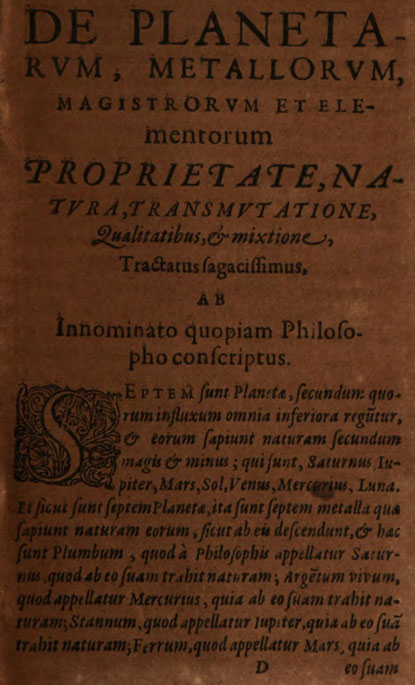
Concerning the Property, Nature, Transmutation, Qualities, and Mixture of the Planets, Metals, Magisters, and Elements - De Planetarum, metallorum, magistrorum, & elementorum proprietate, natura, transmutatione, qualitatibus & mixtione.
Study the Art with Us Buy me CoffeeCONCERNING THE PROPERTY, NATURE,
TRANSMUTATION, QUALITIES, AND MIXTURE
OF THE PLANETS, METALS, MAGISTERS,
AND ELEMENTS,
De Planetarum, metallorum, magistrorum, & elementorum proprietate, natura, transmutatione, qualitatibus & mixtione.
a most sagacious treatise,
written by a certain unnamed Philosopher.
Translated from the book:
Syntagma harmoniae chymico-philosophicae, sive philosophorum antiquorum consentientium ... nondum in lucem publicam editorum, collectum et distributum in certas decades, studio et industria Johannis Rhenani ...
There are seven planets, according to whose influence all inferior things are ruled; and they receive their nature from them, more or less, according as they are: Saturn, Jupiter, Mars, Sun, Venus, Mercury, Moon.
And just as there are seven planets, so there are seven metals which receive their nature from them, as they descend from them. And these are:
Lead, which by the Philosophers is called Saturn, because it draws its nature from him;
Quicksilver, which is called Mercury, because it draws its nature from him;
Tin, which is called Jupiter, because it draws its nature from him;
Iron, which is called Mars, because from him it draws its nature from him;
Copper, which is called Venus, because it draws its nature from her;
Gold, which is called the Sun, because it draws its nature from him;
Silver, which is called the Moon, because it draws its nature from her.
Therefore you, who wish to transmute the natures of metals, or to convert the nature of one into the nature of another, consider the nature of the planets. When it is fully known, you will be able to know what things will be necessary for you for the transmutation and coloring of metals.
And note that there are seven magisters, which have the power to make a great transmutation of metals, and have the power to give color, namely whiteness and redness, porosity and fixation.
And certainly these magisters are:
Sal ammoniac, which has something of human blood and of common salt, as will be said more fully below;
Gem-salt, which is of crystalline color;
Salt of nitre, which is made from nitre and sal alembrot;
Alkali salt, which is made from gem-salt and nitre well ground;
And this glass-makers use for the fusions of glass, because it works effectively;
Common salt, which is made from seawater or salt-water;
Sal alembrot, which is made from the juices of three herbs.
And that is the magister of magisters. For it does wondrous things, because from quicksilver it makes good silver and purest gold.
And enough now have we seen how many planets there are, how many metals, and how many magisters. Now it remains to see their nature.
And first: Saturn is cold and moist, white with a certain darkness, fixed with a certain softness and much heaviness; and from this planet lead draws its nature.
Therefore lead is cold, moist, white but dark, fixed, and not porous.
We have now told you the nature of lead simply; this we shall show you by degrees
Lead is cold in the third degree, moist in the second, white in the second, fixed in the second.
And note that there are only four degrees in the nature of metals, according to Hermes, father of the Philosophers.
Mercury is moist and cold, with a certain dryness; yet it is white, liquid, soft, weighty. From it quicksilver draws its nature, which by its nature is cold and moist, white, liquid, very weighty, and has the power to give dryness to every thing having life, whether it be vegetable or sensible. And know that it is cold in the fourth degree, moist in the third, white in the first, weighty in the fourth.
Mars is iron, which is cold in the first degree, dry in the third, white in the third.
Sol is gold, which by its nature is hot and moist in the third degree, saffron-colored in the first, fixed and weighty in the fourth.
Venus is bronze, or copper, which is hot in the third degree, dry in the first, porous in the third, of mixed color, having the weight of bronze.
Jupiter is tin, which is cold and dry in the first degree, porous in the third, and fixed.
Luna is cold and moist, porous, white, and by her nature quickly movable. From her silver has its nature, which is cold and weighty in the third degree, moist in the first, white in the fourth; it has common weight.
We have seen the natures of the planets and of the metals. Now let us see the natures of the seven magisters, with which the nature of all metals can be preserved, destroyed, and converted into another nature, more or less. They also have the power to give, preserve, and remove whiteness, and every other color suitable to our metals.
They also have the power and virtue of giving, preserving, and removing porosity; and consequently of imparting fixation and removing impurity.
They also have the power to give, preserve, and drive away coldness, moisture, dryness, and heat and this more or less.
We have seen the power and virtue of the seven magisters in general. Now we shall see them individually, distinguishing each one.
And first know that sal ammoniac, by its nature, is hot and dry in the first degree, porous in the third, white in the fourth; and it has the power to lessen heavy weight, and to reduce the metals themselves to weight.
Gem-salt is hot in the first degree, moist in the third, white in the fourth, fixed in the third, not porous; and it has the power to give greater weight. From this the wise man ought to understand that it has the power of giving moisture, heat, whiteness, fixation, and greater weight to metals not having weight, according to Hermes.
Salt of nitre is hot and dry in the first degree, white in the middle of the first, porous in the fourth; and it has the power to lighten weight.
Alkali salt is hot in the middle of the first degree, moist in the third, white in the first, fixed in the second; and it has the power to lighten weight. Therefore take it according to the power which it has in the degrees of its nature.
Common salt is hot and dry; and because it does not work much in transmutation and coloration, therefore I shall not describe its nature to you any further.
Alkali salt is hot and dry, and dark in the first degree, weighty in the fourth. Consider from this, therefore, that all the aforesaid things can give to the metal that which it does not have.
Sal alembrot, which is the magister of magisters, is by its nature hot and moist, not porous, fixed, weighty, white inwardly and red outwardly. And know that by itself it coagulates quicksilver, retains it, and converts it into firm silver and purest gold, if eight parts of it are added to any given part.
We have seen the natures of the planets, metals, and magisters. Now let us see their offices; and first, the transmutation of the first planet that is, of Saturn into silver and gold; and first how it is transmuted into the best silver.
And if you wish to work perfectly, consider the natures of both, and see diligently whether their natures agree in some things, etc. Consider also in what things they disagree.
And certainly they agree in coldness and moisture, and in whiteness namely; but they disagree in weight, fixation, whiteness, and porosity, because Saturn is white with darkness, while Luna is white with brightness.
Therefore, after you have seen the agreements and disagreements, reduce the disagreements to agreement, and thus you will have the best silver, than which no better is found.
And if you ask who are the magisters that can do this, I answer that you can know them from what was said above. But if from this you do not understand, I shall describe them for you more clearly.
Consider what magister it is that has the virtue of reducing heavy weight to common weight; and certainly this is salt of nitre. And that which has the power to give porosity is sal ammoniac. Whiteness also is given with the same sal ammoniac; and thus, after those magisters have been placed with lead, good silver is made.
But for this, so that you may know how to conduct the work perfectly and investigate perfection, know that in whatever degree nature is lacking in what you desire it to have, you must place an eighth part of that magister which has the power to give that nature.
This must be understood in the transmutations of all metals, both generally and individually.
The medicine composed for this has been invented so that you may look to the different sharpnesses and temperaments; and for composing it, one must know the virtues of things in their degrees.
For we say that fire, according as it is in mixture, is hot in the fourth degree and dry in the third. And because its heat is in the first place, it is clear that nothing is hotter than it; and that dryness is secondarily in it is clear, because if there were as much dryness in it as heat, then it would dry as quickly as it heats, which does not happen.
And water is cold in the fourth degree and moist in the third degree; because even if it tends toward the contrary, so that it can be heated, nevertheless it cannot be congealed while its coldness remains, and thus it is colder than it is moist.
Air is, first, moist in the fourth degree, and hot in the middle of the third, because moisture overcomes heat.
Earth is, first, dry in the fourth degree, secondarily cold in the middle of the third. And thus there is the circulation of all the elements.
Fire pours heat into air; air pours its moisture, rarefied by heat, into water; water sends its coldness into earth by drying it with the heat of air; and earth, being dried, pours its cold, moistened, and heated dryness into air. Thus fire recovers its heat, remitted through the pre-qualities of the other elements; air likewise its moisture, water its coldness, earth its dryness, etc.
According to that mixture, the mixture of the elements is made.
Therefore fire is in water, because it exists in air existing in earth; and water is in fire, because it exists in earth existing in fire; and earth is in air, because it exists in fire existing in air. And so their mixture is transmutable into any proportion whatever, and at last into the temperament which we seek.
Gold is most temperate, and yet it declines toward heat and dryness in the middle of the first degree. For this reason it does not yield to fire, namely through medicine, desiring to be wholly equalized in nature.
Silver has one part of earth, half a part of water, a fourth part of air, and an eighth part of fire. Whence it is cold in the third degree and moist in the second; there are two parts of Mercury and a third part of sulphur.
Lead has two parts of earth, one and a half parts of water, a fourth part of air, and half a part of fire; of Mercury there are two and a half parts, of sulphur one and a half parts; and it is cold in the fourth degree and moist in the third.
Tin has one part of water, a third part of earth, a fourth part of air, an eighth part of fire; of Mercury there are two and a half parts, of sulphur one and a half parts; it is of a moist and cold complexion.
Copper has one part of fire, half a part of air, a fourth part of earth, a fourth part of water; of sulphur there are two parts, of Mercury one; it is of a hot and dry complexion.
Iron has two parts of fire, a fourth part of air, half a part of earth, and a third part of water; of sulphur it has two parts, of Mercury one; it is of a hot and dry complexion.
Now learn how to compose metals, if you are industrious.
Mercury is moist in the fourth degree, and cold in the middle of the fourth; and sulphur is hot at the end of the third, and dry at the end of the fourth, except five minutes.
And note that here we divide a degree into sixty minutes, in order to equalize the fractions.
Arsenic is hot at the end of the fourth degree, dry in the middle of the third.
Sal ammoniac is hot and dry in the middle of the fourth, except four minutes.
Calx of gold is medium, but it declines toward heat and dryness in the middle of the first degree, like gold.
Calx of silver is hot and dry in the second degree.
Calx of copper is in the third.
Calx of iron is in the middle of the fourth.
Calx of lead is in the middle of the third.
Calx of tin is in the first degree of the second.
Calx of mercury, sublimed nine times, is dry in the fourth, hot in the third.
When the elements have been separated and reduced to their simplicities, as far as possible, then one must proceed to the mixture.
It may seem that from fire and water there arises the middle, and from air and earth; but it is not so, because the secondary qualities are not in the degree of the primary ones. Therefore, in the equalization of the elements there is a double way.
One way is that you preserve the first qualities, and reduce the second qualities to the same degree in which the first are. Thus fire, which is dry at the end of the third degree, you reduce to the end of the fourth.
The other way is more apparent, yet it is the same: that you preserve the first qualities, and wholly destroy the second ones; as the dry is destroyed in fire, so that only the hot remains. Since one degree has sixty minutes, four degrees have two hundred and forty minutes.
Therefore I speak thus of equalizing fire. Fire is hot in the fourth, dry at the end of the third. The minutes of heat are two hundred and forty; the minutes of dryness one hundred and eighty. Therefore sixty minutes are lacking of dryness in the fourth degree.
If we wish to restore that to dryness in the fourth degree, which is earth for earth is dry in the fourth and cold in the middle of the third since sixty minutes are lacking to me, we place sixty of earth; and those sixty are dry in the fourth degree, and cold in the middle of the third. Because any part of a degree can, in the same degree, take thirty from fire, mix them together, and see what results: for as thirty stands to the second degree, so sixty stands to the fourth.
Therefore temper two degrees of coldness, add also fifteen minutes of fire, and then half of the third degree will be tempered. Add that to the fire, and you will have dryness in the fourth degree, just as heat is in the fourth, from the equalization of earth.
Now I come to earth.
Earth is cold in the middle of the third degree, and dry in the fourth. The minutes of the coldness of earth are one hundred and fifty; of dryness, two hundred and forty. Ninety minutes are lacking from coldness.
Mix ninety minutes of earth with ninety minutes of water, and you will have water cold in the fourth, and dry in coldness. Remove that dryness; put thirty minutes of water, and then it is neither dry, nor moist, nor hot, but cold in the fourth degree, because thirty minutes of the fourth put the first degree into temperament. Mix that water with earth, and you will have earth cold and dry in the fourth degree.
Concerning the equalization of water.
Water is equalized thus: sixty minutes of moisture are lacking. Therefore take sixty from air, two hundred and thirty from earth, and fifteen from water, as I said concerning fire; and add that equalized thing to unequalized water, and you will have water cold and moist in the fourth degree.
Concerning the equalization of air.
To equalize air, take ninety minutes of unequalized fire, and ninety of air, and thirty of fire, and you will have the proposed result.
This is one way of equalizing the elements. There is also another way: that you preserve the first qualities, and destroy the second qualities; proceed thus:
To sixty parts of earth put thirty and fifteen of fire. Then its heat is nothing, and its dryness remains in the fourth degree.
Thus concerning fire: take sixty of fire and mix it with sixty of air, and it will be hot in the fourth degree. It reduces heat from the middle of the third degree to its fourth degree. Moisture in the fourth, added to dryness in the third, makes it moist in the first degree. Correct it with dry earth; add only fifteen of dry earth, and it will destroy that moisture, because such a middle weight of the second degree of fire reduces it to temperament.
Thus a fourth part of the middle reduces it; and so with the other contraries. And thus you will have only heat.
Take sixty of water and sixty of earth, and add fifteen of water, and you will have coldness.
Take sixty of air and sixty of water, and add fifteen of fire, and you will have only moisture.
Having these things well fixed in your mind, you have the proportion of mixtures. But one thing is left: namely, that you know how to convert anything into anything, that is, fire into water, just as the elements, reduced to possible simplicities, are mixed together.
Therefore add fire in the fourth degree to water in the fourth degree, and it will be tempered. Whatever is then added will be of the same mixture: so, if water is added to this tempered thing, it will be water. And this is one cause of the multiplication of medicine.
And thus, from the equalized mixture of the elements, there arises one incorruptible fifth essence, since there is neither action nor passion among them; and thus it endures, which is gold, otherwise called my principal invention.
Concerning similar qualities that lessen one another.
Hot in the fourth
Hot in the third
= Hot by forty-five minutes of the fourth.
Hot in the fourth
Hot in the second
= Hot in the middle of the fourth.
Moist in the third
Hot in the first
= Hot in the middle of the first.
Hot in the fourth
Hot in the first
= Hot by 45 minutes of the fourth.
Hot in the third
Hot in the second
= Hot by 45 minutes of the third.
Hot in the second
Hot in the first
= Hot by 45 minutes of the second.
Concerning contrary qualities.
Hot in the fourth
Cold in the fourth
= Tempered.
Hot in the fourth
Cold in the second
= Hot in the second.
Concerning qualities that blunt or dull one another.
Moist in the fourth
Hot in the fourth
= Tempered.
Moist in the fourth
Hot in the third
= Hot by 45 minutes of the third.
Moist in the fourth
Hot in the second
= Hot in the middle of the second.
Moist in the fourth
Hot in the first
= Hot by 15 minutes of the first.
Moist in the third
Hot in the second
= Hot by 45 minutes of the second.
Concerning qualities that increase.
Dry in the fourth
Hot in the fourth
= Tempered.
Dry in the fourth
Hot in the third
= Hot by 45 minutes of the fourth.
Dry in the fourth
Hot in the second
= Hot in the middle of the third.
Dry in the fourth
Hot in the first
= Hot by 15 minutes of the second.
Dry in the third
Hot in the second
= Hot by 45 minutes of the third.
Dry in the third
Hot in the first
= Hot in the middle of the second.
Dry in the second
Hot in the first
= Hot by 45 minutes of the second.
Similar qualities are lessened according to minutes, but remain in the more intense degree.
Contrary qualities are lessened according to degrees, and are named from the greater quality in degree.
Qualities that blunt one another hold their strength according to the more intense degree, and the degree of remission is lessened according to minutes.
Qualities that increase remain weaker according to minutes, and retain their own degree.
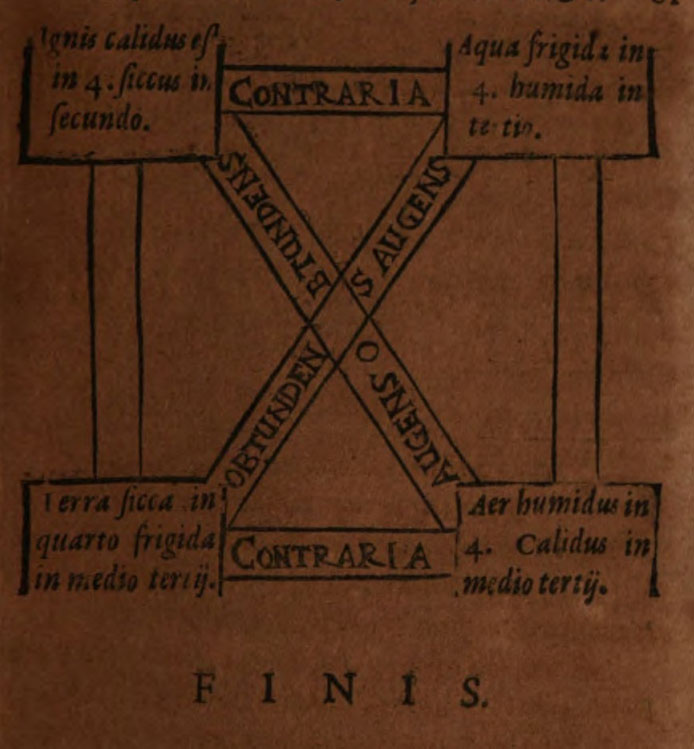
Fire is hot in the fourth degree, dry in the second.
Water is cold in the fourth degree, moist in the third.
Earth is dry in the fourth degree, cold in the middle of the third.
Air is moist in the fourth degree, hot in the middle of the third.
[Central labels:]
Contraries.
Blunting qualities.
Increasing qualities.
Blunting qualities.
Contraries.
END.