Book Concerning the Principles of Nature, and the Art of Alchemy - De Principiis naturae, & arte alchymics
Study the Art with Us Buy me Coffeehttps://www.alchemy-texts.com/book/de-principiis-naturae-arte-alchymics/
BOOK CONCERNING THE PRINCIPLES
OF NATURE, AND THE ART
OF ALCHEMY,
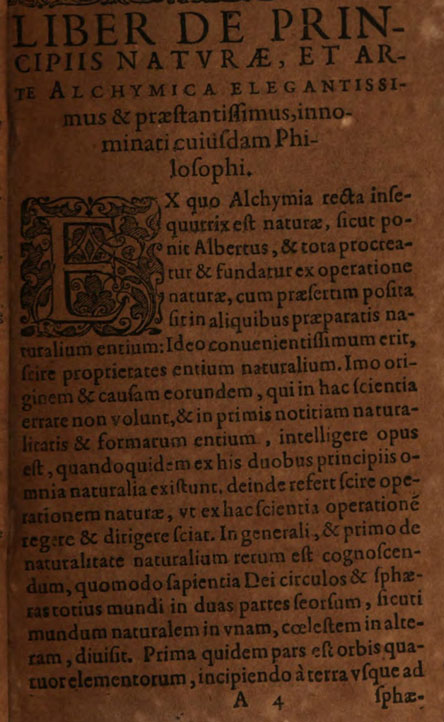
De Principiis naturae, & arte alchymics, Anonymi.
most elegant and most excellent,
by a certain unnamed Philosopher.
Translated from the book:
Syntagma harmoniae chymico-philosophicae, sive philosophorum antiquorum consentientium ... nondum in lucem publicam editorum, collectum et distributum in certas decades, studio et industria Johannis Rhenani ...
Since true Alchemy is the investigator of nature, as Albertus states, and since it is wholly produced and founded upon the operation of nature especially since it consists in certain prepared natural entities therefore it will be most fitting to know the properties of natural entities.
Indeed, those who do not wish to err in this science must know the origin and cause of these same things; and, first of all, it is necessary to understand the knowledge of natural things and of the forms of entities, since all natural things arise from these two principles. Then it is necessary to know the operation of nature, so that from this science one may know how to rule and direct the operation.
In general, and first, concerning the naturalness of natural things, it must be known how the wisdom of God divided the circles and spheres of the whole world into two separate parts: namely, the natural world into one part, and the celestial world into the other.
The first part is indeed the sphere of the four elements, beginning from the earth up to the sphere of the Moon, in which the other part of the world begins by ascending, even up to the starry heaven. Thus the first world was created in common matter.
So the wisdom of God created unformed matter, concerning which the philosophers and doctors of Sacred Scripture write many things; and He further divided that matter into four parts, forming each one in particular with coldness, heat, dryness, and moisture, so that these properties and forms such as heat and cold are contrary by nature and cannot exist together.
Therefore, in the aforesaid matter, they were separately divided into four parts, which are called the four elements, so that, through mediation, the coldness of heat might be joined, and the moisture of dryness; and therefore it was brought about that all natural things could consequently exist in naturalness from the conjunction of the four elements.
And therefore the four elements were created on account of the naturalness of all things, because every thing has its natural being from the mixture and conjunction of the four elements. This is not to be understood as though each of the elements were joined to another by itself, because naturally one rejects the place of another; but one is, by heat, compressed, drawn, and sublimed into another, in such a way that we do not find a simple and pure element without admixture of another.
Hence, indeed, we do not find earth so dried that it does not contain moisture within itself; nor do we find water in which there is not some earthiness, as is discerned by distilling water. Indeed, earth is very rarely without intrinsic heat, and it is and it must be considered how in every thing it is visibly so, that is, to the eyes: namely, that heat, that is, fire, is enclosed in earth, and air in water. But in what way these things are so made, it is not very important to know here.
But only this much we ought to know: that nature, from the beginning, prepares the common matter of things from the conjunction of the four elements; and the more subtle, more active, and more capable this matter is, the more it fits, digests, and prepares it for some form. The nearer it is to its form, the sooner the form of the thing appears.
Just as an artisan, at the beginning of his work, taking up rough material, works an image out of it; and the more subtly he adapts, removes, and makes the material active, the more the image appears. And when the material has been prepared, with the superfluous parts removed, then also the form of the prepared thing appears.
Thus the form is brought forth and extracted together with the cleansing of the matter from superfluities. In the same way nature also acts. First, it brings forth suitable matter from the four elements, and applies its operation to this matter, until it moves and separates the impurity and the superfluous parts, and prepares the matter so subtle and active that the form of the thing appears and exists perfectly.
But when the matter still retains a stain or impurity, then the form of the thing does not appear perfectly or wholly, but is soiled by such impurity.
Thus all the forms of natural things are brought forth from pre-existing matter; and every natural thing, whether it be animal, vegetable, or mineral, has its first matter receives from the elements, from which, consequently, the form is then brought forth.
Thus all things are included in these three kinds: either they are things that sprout, as all plants, trees, and herbs; or they are things that neither sprout nor grow outward, as all stones and minerals and these are called metallic things. And each of these three is divided into many various parts.
Thus, among animal things there are men, lions, bears, sheep, oxen, etc. So also the nature of vegetable things is divided into many parts: for some are vine, some wheat, some apple or pear, pear-trees or apple-trees, etc. In like manner metallic things have been multiplied: for some are stones, and some are minerals, etc.
And just as things are multiplied or divided, so they have various matters; and such a manifold naturalness comes from a manifold conjunction of the elements. Perhaps five parts of earth, three parts of water, two parts of air, and one of fire are joined together; or in another composition there are joined six parts of water, four parts of earth, one part of fire, and three parts of air and so concerning each individual thing.
In other things it is done otherwise; and such elements, unequally joinable, are innumerable. Thus also innumerable are their parts and the matters of all things. And such a conjunction of the elements, according to the proper proportion of each thing, is known only to nature; for she alone knows the certain measure, according as it is fitting for the matter of things to take from each element. And when she has attained the right proportion, through the mediation of her operations, in the prepared and common matter, then the form and essence of the thing appears.
But for such an operation, and intention, and final purpose, and fitting preparation of the elements, the influences and virtues of the stars and planets are much required, because those virtues help nature to operate, to join, and to unite the elements, just as art does in the artisan that is, by which he brings forth the figure and causes the form to be made, according as the image is formed in the matter from the matter of the craftsman’s heart.
Likewise it is in matter: if influences are lacking for the matter to receive the form of fishes, then they help to join, prepare, and fit the elements, so that from such conjunction and union the form and essence of fishes may appear.
But if the influences and celestial virtues of the form of gold are present, nature operates, with these as mediators, upon such a composition of the elements, until the elements are united in such a way that, from such substance and essence, gold arises; just as every particular proportion of the elements, having received a special aspect, brings forth its forms and essence.
Just as an accumulation of many different things may make many species and forms gathered together, and yet is united and joined with the elements, so that the perfected forms, for which the influences or virtues of the stars descending from the higher regions into the matter were serving, may come forth.
Then the operation of nature ceases, because it has brought its intention all the way to its end; just as the artisan ceases when he has brought forth the form of the thing which he had retained in his heart to bring forth in the matter.
Thus nature always operates through the influences and stellar virtues, which are the seeds of forms, because through such virtues the matter is inclined toward a form similar to the virtues. But when the form has been prepared and drawn forth from the matter, through the mediation of the virtues, then nature ceases, and works no further toward producing this form, since it has been prepared and completed.
But such a thing then receives increase or decrease, according as nature works in it; thus the thing becomes capable of increase or decrease.
And such influences of the stars are called the virtues of the seminality of form. And therefore, since there are in general three naturalities of things namely, animal, or things that sprout forth; likewise vegetable and metallic similarly there are three influences of seminality and of the virtue of forms: namely animal, vegetable, and metallic.
Concerning these virtues it will consequently be necessary to know a few things.
The formal virtue and seminal force descends first from the higher regions to the elements; then from the elements they come forth to the general naturalness of things, and are enclosed and preserved in them, so that they help from within to bring forth the natural form, as was stated above.
And these virtues descend through the rays of the stars as through their own proper roads, descending into the lower world that is, to the four elements and they are especially gathered together in and upon the earth, because the earth is the middle of the elements, in which all the rays of the stars are accumulated.
The earth, drawing with itself the seminal powers of the forms of all things, is collected and gathered together, as though all the lines of a circle were joined together in one point; and if the rays of the stars are accumulated in the earth, drawing with them the seminal powers of the forms of all things. Therefore they come together chiefly in the earth, more than in the other elements.
For this reason Albertus says, in the book On the Properties of the Elements, chapter twenty-four:
Since the earth is the center and point of the whole world, and in it all the rays of the stars or of the starry heaven come together, therefore it conceives many figures, influences, and virtues, by the mediation of which it produces things of many and various forms; and no other element does this.
Therefore, before the other elements, the earth is called the matter of all things: because it conceives the seeds of all things and the virtues descending from the higher regions. Indeed, day by day it is filled with these virtues while the heavens are moved.
Therefore Saint Augustine says, in the third book On the Holy Trinity, in the chapter on the original cause:
This world is pregnant with the causes of vegetable things, just as a mother is pregnant with offspring.
And again in the same place:
All things that arise, and especially that are created in the conjunctions of the elements, are brought forth only at the due time and maturity.
In this way all natural things, through the mediation of the seminal force, are enclosed in the elements.
Therefore Saint Augustine says in the book previously noted, in the chapter concerning minerals, that those things which are to be made with certain arts, in certain bodily elements of this world, are hidden in secret forms of all things; and these grow forth bodily and visibly. And these seeds, from their origin, are nothing other than the influences of the celestial virtues descending from the higher regions.
To capture these virtues, especially those of metals, the philosopher Raymond Lull devised certain waters to be prepared and placed beneath the earth, in which these virtues ought to be received and deposited. For it is the property of celestial virtues and of the seminal powers of things that, when they descend into the earth, they are moved, and move certain active spirits to procure and increase them, by condensing and preparing for themselves these spirits as a seat and support, as Raymond again says.
And if by art we can prepare a suitable and active spirit that is, a subtle matter for these virtues, and bury such a thing in the earth, then they are more quickly drawn and seized by those active spirits, in which they ought to place themselves, than if they drew or seized the aforesaid virtues from prepared spirits. For, as Raymond says, such spirits and subtle matter, placed in the earth, attract the virtues coming from above farther than two shots of one crossbow would reach.
Just as a magnet attracts iron, so by these instruments the mineral virtues coming from above are captured.
And again, in the same place, Raymond says that these virtues, captured in water which he teaches how to make have the power to coagulate common mercury into good silver without any fire.
And they are of great and very great virtues if they are captured in another and subtle matter.
But how this water is prepared, Raymond himself sets forth in the book concerning precious stones, which I shall not place here.
But it must be known that he himself has taken the celestial virtues and the seminal powers of forms in these waters, as by the opposition of the Moon of the month; this has been touched upon in a general discourse, in what way all natural things have their essence and substance from a twofold proportion, namely of matter and of form.
Matter proceeds from the elements; but form draws its origin from the celestial virtues, in such a way that, through these as mediators, form is drawn forth from the matter of the elements.
Whence the Master Ferrarensis says: the elements, or the matter proceeding from the elements, are as it were the instrument of nature and of the celestial virtues. And the subtler such matters of the elements are, in which the aforesaid virtues have placed themselves, the more strongly these virtues operate through them; and this is called “activated matter” in Alchemy.
The spirits that are captured because of the virtues which are in them and if here we must speak only of Alchemy, which transmutes metals into gold, excluding the natural properties of all other things therefore we must know only the naturalness of gold, and the virtues of the form of gold, and also their hindrance, because from these two gold is produced.
Therefore a special discourse follows concerning the origin and being of metals.
CONCERNING THE PRINCIPLES OF NATURE
CONCERNING PRECIOUS STONES
Albertus says in the third chapter on stones: Since nature is the beginning and origin of art, therefore it will first be most fitting to know the beginning and natural generation of metals.
In the same way Geber, King of Spain, says in the first chapter of his Summa: If anyone does not know the beginning or origin of nature, and at the same time does not know the naturalness and formal virtue of gold, he is very far removed from our art, because he does not have the root upon which he may found his intention.
And again, in the same place, he says: He who does not know the origin of the manner of generation of metals, according to the intention of nature, although he may know the beginning, cannot reach the end of this science, because this art, as Ferrarensis says in chapter 27, consists in the recognition of the matter of gold and the operation of nature.
Thus art can imitate nature in such an operation as far as it is able. For Albertus says in the first chapter of the book on metals: the matter of stones, from which stones are formed, is not much separated from the elements; that is, no transmutation of the elements namely of water and earth, which are the matter of stones has been made, as Albertus himself sets forth in chapter 20 of the first book: in one degree, viscosity and earthy moisture are the matter of stones.
Thus coarse stones are generated from earth mixed with viscous moisture. But the transparency of stones is their matter mixed with water, somewhat with subtle and active earth, so that a perfect mingling of water and earth has not yet been made, as happens in the matter of metals.
And therefore Albertus says: just as, for the generation of animal bodies, a mingling of certain vapors precedes the matter, so, as a preliminary to their forms, there is required a mingling of sulphur and mercury.
For this reason the Philosophers say and all Alchemists agree that metals are nothing other than a subtle vapor released from quicksilver, together with a sulphurous substance, by the mediation of tempered heat in the deepest caverns of the mineral earth. These vapors contain a moisture which surpasses all moistures; and such moisture is tempered and condensed by means of the very fine dryness of the earth into one mass.
And this tempered heat, by composing, mixing, dissolving, and subliming these vapors, is converted to the place of extraction, which contains such moisture. It digests and subtilizes it, and condenses it; and such moisture is the cause of fusibility in metals, and in the end it is transmuted into gold or into another metal.
Such vapors are drawn from quicksilver and sulphur; and in this way quicksilver and sulphur come together for metals, so that from them vapors arise, from which metals are then coagulated.
Therefore it must consequently be known, as Geber, King of Spain, says in his Summa: sulphur is nothing other than the fatness of earth, cooked, hardened, and condensed in its mine by tempered heat.
But quicksilver, as Ferrarensis says in chapter 25, is heavy water mixed with white earth, very subtly mingled and digested, until the moisture is united and thoroughly mixed with the dryness of the earth, so that they are equally transmuted. And from this quicksilver is made, as Aristotle says; this is the common matter of all metals.
But it is required that it be mixed with sulphur, as the mines of all metals plainly indicate. Sulphur agrees with the operation of all metals, because in all minerals and mines sulphur is found, although in some mines sulphur and quicksilver are found separately. And for this reason, as nature indicates from what things metals are generated, nevertheless the composition of these things is required in the generation of metals.
Therefore all ores from which metals proceed give off a sulphurous stench; and this is a sign that these two, sulphur and quicksilver, come together in generation yet distinctly, so that sulphur assists as an actor, and quicksilver as the matter receiving the action of sulphur.
It must be known that sulphur and quicksilver come together in the generation of metals in a similar way as the male and female seed. For the male seed contains a natural active virtue, which it has received from the man as mediator, which acts upon the woman’s blood, in which the other seed is mixed through the union of man and woman. For in the woman, as the natural philosophers state, blood comes together in the procreation of a child; with this the man’s seed is mixed, and then from this blood, through the mediation of its active virtue and natural heat, the heart operates, and imparts to the heart its generative virtue, which is similar to all, the whole virtue which it received from the male seed.
Then that seed, brought to completion through the male seed, produces the generation of the man by action, because the heart, consequently, can generate all the other members through the mediation of the seminal force, which it has received most closely from the male seed, without the presence of the seed.
Therefore the seed of the man is separated by the heart, composed from the blood of the woman, through its active power, leaving there only the secondary essence of the formal virtue imparted to it, through which afterwards the heart acts and perfects the other members and the whole substance of the man.
And thus the seed of the man does not enter into the substance of the fetus, so that the fetus is created from the seed of the man, but from the blood of the woman, into which the seed of the man is introduced, together with its active virtue; and from this it is then separated, just as the artisan is separated from the work in which he perfects his intention.
Therefore the seed of the man is to be considered only as the actor, and the blood of the woman as receiving such action and suffering from it; through this mediation it receives or conceives the active virtue for the other members. And therefore Aristotle says in the book On Animals, chapter 19: “The man gives the form and the beginning of operation; the woman gives the body and the matter.”
So it is similarly with sulphur and quicksilver: quicksilver is the matter of metals, and sulphur is the male seed acting upon the quicksilver. For sulphur contains the hidden and secret metallic virtue, through which, and by its natural heat, it digests and generates, or excites, in the quicksilver its own active and subtle sulphur and virtue, which is the first virtue and generatrix of gold.
Then the foreign sulphur is separated that is, the quicksilver with its own virtue is sent forth, and sulphur, without the aid of coarse sulphur, perfects and forms gold; and this subtle sulphurousness is likened to the heart.
The form and tincture of gold, which all the Philosophers have sought, is that of which Rasis speaks in the Book of the Light of Lights, saying in the first chapter:
“The tincture is in the stone as the heart is in the animal.”
For when, with the foreign sulphur, it has introduced its virtue, by first exciting the active power of the quicksilver itself, then perfecting and strengthening it, the coarse sulphurousness is then separated from it.
Therefore, in all mines of metals, sulphurous stones are found; and thus sulphur contains the metallic nature and virtue. Therefore the Alchemists treat much concerning it, and this because of the virtue by whose mediation the quicksilver is hardened and congealed, as is evident, because by its smoke or vapor, and by that of lead itself, quicksilver is hardened.
Therefore the philosopher Aristotle says in the fourth chapter of the book of impressions:
“Sulphur is the proper hardening and coagulating substance of quicksilver; and this proceeds from the virtue conceived in the earth, which descends from the stars above into the earth.”
Yet it must be known that, just as there are two sulphurs, so there are two tinctures and metallic virtues: namely, one of coarse sulphur, and the other of subtle sulphur. Although these two sulphurs coagulate and tinge quicksilver into metals, nevertheless the coarse sulphur tinges and coagulates quicksilver imperfectly, because it is impure and bad. Therefore it has an impure tincture.
For this reason Geber, King of Spain, sets down the tincture of sulphur, of coarse sulphur in his Summa. But subtle sulphur, clean and active, tinges perfectly, because it is clean. Therefore it has a clean tincture.
Thus it is clear that sulphur is the agent of metals, and quicksilver the matter from which the forms of metals are produced. And meanwhile the external agent remains with the matter, not having the perfect metal.
Therefore, in all imperfect metals sulphurousness is found. But if the coarse sulphurousness is separated, this is a perfect metal. For this reason, in gold no impure sulphur is found, because it is perfect only.
Now it has been shown clearly from what things nature produces metals: namely, that it is from sulphur and quicksilver from sulphur as from the seed and the agent, which is finally separated, like an artisan withdrawing himself when he has perfected his work; and from quicksilver as from the matter, which remains and gives the body.
Consequently, the Alchemists say and especially Geber in his Summa, in the chapter on the creation of metals that nature works metals from sulphur and quicksilver.
Likewise Ferrarius says, in the question on Alchemy, chapter 25: nature, from the beginning of the generation of metals, takes up water, viscous and mixed with white sulphurous earth, very subtle, and by digesting, hardening, compressing, and uniting the moisture of the water with dryness, until from them a substance comes forth, which is called caro “flesh.”
And that is the proper and immediate matter of metals, from which, consequently, all metals have their origin, substance, and essence they have.
And if nature creates pure quicksilver in clean matter, and such quicksilver escapes the operation of nature because of too much heat, by which it is compelled to ascend, or if for some other cause it ascends, then it will not be a metal, but will remain quicksilver that is, for the convenience of the art, when nature studiously indicates the matter of gold, because such quicksilver is the immediate matter of gold and of metals.
And if such quicksilver does not escape the operation of nature, but remains, and no obstacle comes upon it, then by the operation of nature it is resolved into vapor, digested and decocted by tempered heat in a higher place, by subliming and often washing with the water of the mine, purifying and coloring it through such decoction with the color of sulphur, finally freeing it from every impure sulphurousness, so that it may come forth pure and clean.
And then it is transmuted into gold, when it has been cleansed to the highest purity; and in such a completion all sulphur, as Ferrarius says in chapter 26, immediately informs that pure quicksilver with the form of gold, because the intention of nature is nothing other than to make gold from such pure quicksilver, as from the proper matter of gold.
And this sulphurousness remains excluded from the substance of gold, only in so far as nature has digested, decocted, and prepared such quicksilver by means of sulphur.
But when such decoction and digestion has been perfectly completed, then nature, by its own power and strength, from the subtle sulphurousness itself, in such digestion or decoction given to it, being excited and brought in, it is fixed; and in this way alone the purest quicksilver, without any coarse sulphurousness, is fixed into gold. In this way the first mode of the natural generation of gold is clear.
And if the quicksilver receives any impurities, or if some obstacle or defect comes upon it through excessive heat, or through weakness of fire, or through an impure place, or if the matter that is, the quicksilver mixed with sulphurousness has been coarse and unclean, or if some other inconvenience and obstacle has occurred which nature cannot consume, separate, and decoct, then gold is not made from it.
Meanwhile such impurity remains in it; but instead there is made silver, copper, tin, lead, or iron.
It must be known that, according as the impurity has been greater or equal, or according as there is more or less decoction, imperfect metals are therefore found to have, one more than another, sulphurousness and impurity.
And it must be known that although such impurity and hidden sulphur are mixed with the quicksilver, nevertheless that hidden sulphurousness of the quicksilver is not harmful; and so such quicksilver is burned by such sulphur. For only sulphur is burned by the combustion of the quicksilver, because it has been mixed with it in imperfect metals.
Therefore such quicksilver, existing in imperfect metals, does not receive combustion, but remains unburned, fleeing and smoking away from the fire. And this is the sign of the truth and incombustibility of quicksilver: because in cinnabar, consisting of sulphur and quicksilver, when it is reduced, there is found only as much quicksilver as had been placed into the sign of its combustion; and this combustion and deficiency of the imperfect metals is on the part of the material sulphur, and not of the quicksilver.
And therefore, through such quicksilver, nature continually acts in the imperfect metals to bring gold to completion from these.
And if we wish to consider the right intention of nature, it is clear that she is always inclined toward the highest thing. And since gold, among the other metals, is the most perfect and best, if nature could not perfect it from quicksilver because of obstacles that occurred, she perfects something else which she can: from one kind of quicksilver, silver; from another, copper or tin; likewise according as there was much or little of the obstacle.
Yet, although these metals are imperfect, and nature does not intend that they should remain in such a form for they were not produced for that form, but for the form of gold therefore nature does not cease from acting upon those imperfect metals, so long as they remain in the earth. Rather, she acts day by day, removing and decocting such an obstacle, until at last they are reduced to quicksilver and are digested again.
And this is evident: for they are found mixed in the mine, so that gold or silver is found in the ore of lead, tin, or copper. Sometimes also imperfect silver is found in the mines, which, if it has its own time, until it is perfected by decoction in the earth.
But when imperfect metals have been ordained by nature into such a form, without doubt they are left behind in such a form, and would not be reduced through it into gold; yet this does not happen.
Therefore all metals contain a naturalness through which they can come forth into gold.
Thus the other generation of gold is clear. For there are two generations of gold: one, namely, from quicksilver which has not been changed into an imperfect metal; the other from imperfect metals, that is, from quicksilver enclosed in those imperfect metals.
Thus, at first, because of an accident, it had been made into an impure and imperfect metal; and nature continually acts upon it from day to day, until the pure quicksilver is extracted and reduced into gold.
And in these two generations of gold there is one final disposition, although they are distinguished in the middle. That is to say, such generations do not agree in the middle of the work, but only in the end; because in the first generation, from pure quicksilver, nature does not need so much labor as in the other that is, in the generation of gold from imperfect metals.
Yet all these agree in the first species of the first matter, because in both generations it is required that the matter be pure, and that pure quicksilver be made, from which first the form of gold is produced.
In this way there is one end of the two generations, one manner, and they agree in the purification of quicksilver from all sulphurousness; because this is the end and conclusion in the decoction of gold: when the matter is stripped and cleansed from every burning sulphurousness, so that clean quicksilver comes forth, then the form of gold is given to it, not only in this way is the substance of the purest quicksilver capable of receiving the form of gold; but the matter, by nature abundantly present in quicksilver and in all imperfect metals, is preserved mixed with sulphur and impurity.
This impurity, by means of art, we cannot remove by digestion and decoction from these imperfect metals for the making of gold, as nature does; because our life would not continue so long for that, nor are the temperance of the heat, nor the other causes serving nature, known to us.
Therefore we cannot equally imitate nature in the operation of gold, since by nature the superfluous matter of gold is reserved in contrary matter in all imperfect metals and in quicksilver. In all these, the matter already exists prepared and made fit for the form of gold, except that the superfluous sulphurousness must be removed.
And for preparing the prepared form, and for preparing the form, nature has given us many different sulphurousnesses, spirits, and active matters, which include the metallic virtue and the seminal power useful to the form of gold: namely, in sulphur, sal petrae, alum, marcasite, antimony among metals, and other stones; also in some vegetable things, from which metallic virtues are drawn.
And the way of works has been shown to us by nature; and art, drawn out and devised, is appointed for imitating nature, so that through it one may perfect those things which nature could not perfect imitating her as far as possible. And by means of these prepared things aforesaid, philosophers have established and given many different ways for perfecting imperfect metals, so that in part some things follow, from which sound doctrine and the greatest subtlety can be drawn for perfecting the effect.
Now let us approach the art. And it must be noted that, although art imitates nature, nevertheless it cannot imitate her in every way and in all parts. And especially in the generation of gold it does not imitate her, because nature generates gold from quicksilver, or from imperfect metals, by removing their impure sulphurousness.
Art cannot do the first, since it does not have, nor can it have, such digestion and tempered heat for quicksilver. Nor can it do the second, because it is inconvenient for man to wait so long until it removes the impure sulphurousness from imperfect metals, as nature does.
And if art can imitate nature in every way and as much as possible, nevertheless it imitates her only in some parts, so far as it can.
Therefore there are some who, not being able to remove the sulphurousness from the imperfect metals themselves, make a tincture or medicine. For those who do not remove the impure sulphurousness of quicksilver and of imperfect metals, but only hide and cover such impurity, making the appearance of gold or silver, do what is false and forbidden by all the Philosophers.
Therefore those who tinge the whole substance of imperfect metals, as though nothing impure were removed from them, are deceivers, because bad sulphur remains in them; but gold must not contain sulphur in itself.
Still others attempt to purge imperfect metals entirely from their sulphurousness or sulphur with certain salivated waters and with alums. And Geber sets down many things concerning such purgation of metals in his Summa. But even then it is imperfect, because it cannot be that an imperfect metal is purged into the form of gold, since subtle matter is lacking in them.
And therefore the Master says, in the text of Alchemy, chapter one:
“All the orders of medicines which Geber sets down are fallible, except the third order which Geber sets down, and which removes from the imperfect metals themselves all sulphur, by tinging them into perfect natural gold.”
And there are still others, consequently following nature, who make true tinctures for quicksilver and imperfect metals, which totally remove the impure sulphur and introduce the form of gold. And these are manifold in manner, as follows.
One way is this: some only strengthen the power of silver or gold in their own proper substances. Thus they do not first extract a most active nature to strengthen it, but they receive gold or silver in its own substance and strengthen it with spirits. And this is done in two ways.
Some take one part of sal petrae, one part of alum, and distill off the phlegm until strong and dissolving spirits ascend. To these they add fresh, clean, and clear distilled water, driving the spirits into it by a very strong fire. When the weights have been received, they make many spirits.
Then they take other spirits, namely spirits of wine well purified and subtly distilled through the bath, or otherwise; and of these they take four ounces to one pound of aqua fortis, placing them in a large cucurbit; they close it with an alembic placed above, and set it in cold water, and boil it until it ceases to boil. Then, placing the cucurbit in a bath, they distill the water, so that the spirits still remain moist.
Then they pour back upon them the water previously extracted, and act as before; and they repeat this seven times, always distilling with a weak fire, until it no longer wishes to distill, but remains in the bottom, lying like oil.
This oil is placed in a glass vessel, which is called a matrix, and it has a shape like a triangular cross, having, according to its breadth, a palm and a half, and according to its length, only one palm. They enclose it with the seal of Hermes, allowing these spirits to ascend into the point of one part.
Then they turn the glass, and again allow them to ascend into the other point; and they do this until they no longer ascend, but remain in the bottom. And such spirits, they say, coagulate a certain mercury.
And they do this because, as the Philosopher says in the fourth book of the Meteors: metallic bodies have conceived certain metallic virtues, and so also have the minerals, namely vitriol, alum, saltpeter, and many other things proceeding from the earth, and certainly all things containing sulphurousness. For in sulphur there is a metallic virtue, which coagulates quicksilver.
And such things have much of the metallic virtues; and because of the virtues which their spirits have, they are received. And the subtler these spirits are, the more strongly they act, and the greater virtues they have.
For a certain Philosopher says and it is manifest truth that these things, in their natural condition, include such virtues. Yet when they are purified and extracted from their natural condition, then they are made a hundred times stronger.
Therefore the active spirits are separated from their grossness, and are further prepared more subtly than when they were first extracted.
But that these spirits serve Alchemy, and especially the mineral media such as vitriol and saltpeter Albertus sets down in the fifth book On Minerals, chapter one, where he says:
“The nature of the media of metals must be considered most diligently by those who labor to transmute one metal into another, because in these lies the greatest art.”
And this is because their spirits have sulphurousness when they are turned. And thus sulphurousness, or oiliness, bears metallic virtues, because sulphurousness, as was stated above, coagulates metals.
Therefore it is a sign that metallic virtues are infused into them, which they conceived in the earth. From this a secret follows.
But concerning wine: since from it a burning oiliness is extracted, therefore it participates with sulphur, and in this there is truly a very great virtue of metallic nature, which it drew and conceived from the earth. And if that oiliness, like those spirits, is much more active than other things, therefore their virtues are much more active than those of other things.
Yet it must be known that these spirits, as the text of Alchemy says and it is true which come from vegetable and animal things, do not benefit Alchemy, existing in a vegetable nature; but it is required that, through manifold purification and distillation, they come into a metallic nature, and then they serve it.
Therefore there is only one stone and one foundation necessary to the art, namely the metallic virtue. Although sometimes vegetable or animal things are received, nevertheless they do not remain in a vegetable or animal nature, but are transmuted into a metallic and sulphurous nature, which contains metallic power.
For this reason Ferrarensis said, in chapter 20 of his questions: it is impossible to coagulate quicksilver without sulphur, or without some other thing having a sulphurous nature; because sulphur is the coagulating substance of quicksilver. And if there are sulphurousnesses in wine, since it is burning, therefore a metallic nature is in it.
For this reason there are some who work with wine and gold or silver. From wine they draw its most active spirit, strengthening with it the virtue of gold, so that the spirits may be fixed with it, through which afterwards the tincture of gold is extended and multiplied.
And certainly, between the spirit of wine and the spirit of gold there is the greatest agreement or participation, since both are of a hot nature. Therefore the spirits of wine are inseparably fixed with gold.
But still it must be noted that the spirits of the media of metals, namely of vitriol, etc., are of coarser fixation and of greater agreement with gold, since they arise, as it were, from one source namely, from the mines of metals than the spirits of wine, which come from vegetable nature, although the spirits of wine are more active and more subtle, things.
Therefore some compose their spirits, so that the spirits of vitriol are joined with the spirits of wine, so that one may become thickened with the other, and they may be more easily united with gold.
Yet certainly it is required by anyone who wishes to work in these matters that he receive the strongest spirits and the purest things; so that the spirits, before they are fixed with gold or silver, may be purified in the best way.
Therefore it is useful that the strongest, clear, pure, and sweet wine, of good odor, be taken, to which the subtlest spirits are reduced, removed from every watery quality; with these the spirits of the metals are purified, and their dregs; and that they be separated again, and all the four elements purified, and at last rectified. Then indeed they have a true and right operation.
But how such an operation is done, I pass over, because the text of Alchemy and the collection of metals sets it down concerning this. There, anyone looking into the writings with very profound understanding can perceive the contents.
Thus it has been written above, how some strengthen gold by means of spirits in which metallic virtues have been infused, without dissolution and separation of the gold, not extracting the active substance of gold.
But first I shall say how gold is strengthened in extracted substance.
THERE FOLLOWS HOW GOLD IS STRENGTHENED
in extracted substance.
And although the celestial virtues, the seminal powers, and above all the metallic virtues, act through the matter of things of lower existing things, as through their instruments; and the more active the matter is, the more actively, more subtly, and more strongly they act in the most active substance of gold, although it remains with the gold in its own being.
For this reason there are some Alchemists who begin their works most profoundly, placing before themselves the virtue of gold and of wine, and of its seminality, reducing it into its root and origin, as it was before, or into that with which it first began its being. For with those things from which a thing arises, with those it bears its origin; for wheat takes its origin and growth from root and seed.
Therefore, when it must generate, it is required that it be reduced into its own root. And this is done through putrefaction, because through it the thing is reduced into its root; and through putrefaction the virtue of wheat is resolved and gathered in the earth into a root. And through the root it receives many virtues from the earth, which it attracts according to the requirement of its nature; and in this way the virtue is strengthened, and at last it bears more fruits.
Therefore it is set down in the Gospel: unless the grain of wheat, falling into the earth, has died, it remains alone; but if it has died, it brings forth much fruit.
For this reason it is required that every thing die, and through its own nature be reduced into its root, and attain the seminal power, if at least it ought to bear fruit. For by means of the root and seminal force it continually attracts and receives powers from the earth, and other virtues, through which its like is extended; and this cannot happen while the thing remains and encloses its seed in its own coarse substance, but in putrefaction it attracts from the earth and receives many seminal virtues and powers. And in this way the seminality and virtue of gold are required for receiving other very great metallic virtues, so that it may be strengthened and reduced into its root and foundation, from which it first had its origin, in order that afterwards it may receive other virtues and powers.
And this root is nothing else, as was set down above concerning the generation of metals, than a moist and fatty vaporousness, collected from two natures: quicksilver and sulphur.
For this reason some Alchemists calcine gold, and imbibe it with certain oils or spirits, until they extract that active nature of gold, which they then afterwards decoct and imbibe with certain active metallic spirits, which they fix with it, until its seminality is most greatly strengthened and reduced into a tincture.
And such an operation is nothing other than as if the seed of a man, which is of great virtue, were taken back again within the body of the man, and there afterwards, if it were suitable, were decocted and digested in all the members. Then it would receive more spirits, and its seminal force would be extended so much that from it a man much stronger than otherwise would be begotten.
And it would be possible that the power and virtue of the seed would be so increased that from it a very great man would be made, if only sufficient natural power were added to it.
In the same way, the Philosophers extracted the most active matter of gold which they enclosed and dissolved in glass vessels with active spirits and metallic virtues, coagulating and dissolving, until that matter received much of the virtues of those spirits. From that time they fixed it, and it tinged very greatly the other imperfect metals and quicksilver.
And this active matter of gold is called in Alchemy the Mercury of the Philosophers, which all the Philosophers seek.
Although there are many ways by which gold is increased, nevertheless this is the best way: that gold be reduced into the most active state, that is, into its own mercury, by which nature is rightly imitated, as was set down above. For nature takes quicksilver mixed with sulphur, decocts it together, until at last the whole coarse sulphurousness is separated, and only pure and clean quicksilver remains.
This is then formed into gold, just as nature gives the form of gold only to the purest quicksilver.
Likewise we must introduce the virtue and formal seminality into the purest quicksilver and into its most subtle substance; because such a subtle substance is capable of the form of gold, and of the virtues and spirits from which the form of gold has its origin.
And therefore Geber takes quicksilver, and teaches how from it to draw the most active substance, so that it may be prepared to the best degree.
Yet it must be known that such mercury wholly prepared by nature; indeed, the whole active, more active, and subtler substance already exists in gold than we ourselves can prepare it.
And therefore Ferrarensis says in chapter 26:
Those who wish to imitate nature must not take quicksilver alone, nor sulphur alone, but quicksilver and sulphur mixed together not the sulphur and quicksilver of the common sort, but that compound and mixture of them which has been most excellently prepared and digested with the most gentle liquefaction. And that is nothing other than gold, because in it the most active and best union of sulphur and quicksilver has been made. Otherwise it could by no means be done as nature does it, because nature made such a union of the most active quicksilver and sulphur for the production of gold, or for the conception of the form of gold.
Likewise, such a union is made for the benefit of the art, for the increase of virtue, by those who place themselves into such an active matter and draw from the spirits, so that the form of gold may introduce itself.
Therefore Senior says: the ancient Philosophers made the tincture from gold, because it itself is a fixed and permanent substance.
And therefore Avicenna says: such sulphur, from which nature works gold beneath the earth, we do not have above the earth unless it exists in gold or silver.
Therefore Geber says in his Summa: such mercury is drawn from two things, namely from perfect metals and from quicksilver, yet more perfectly from metals.
Therefore the best mercury is made from gold, because it itself is the right mine of the art and of tincture. And this mercury is called the root and beginning of the tincture and of the art.
Therefore Geber says in the Summa, chapter 1:
“He who does not know the origin of nature is very far removed from this art.”
And consequently this must be known: that this mercury, at the end of its preparation, appears white, although before, in its extraction, many different colors appear.
Just as in the generation of fruits, before they are ripe, colors appear in them green, saffron-yellow, and others and at last, when they become mature, they attain their own proper color, which they also preserve. In the same way it happens in the extraction of active mercury: when it is sought, many colors appear before the end. But at last its own proper color appears, which is white.
For, as Geber says, it is proper to sulphur to color with a saffron color; therefore gold is of a saffron color. But when the sulphur is hidden, and the quicksilver is made manifest, then it is of a white color.
Therefore the white color is proper to it, because it is the purest quicksilver. For this reason Rasis says: whiteness and crystalline clearness are signs of its completion.
Therefore it must be observed that when mercury blossoms forth from gold, then that color is the sign of the origin, blossoming, and germination of that mercury; because in this way gold is driven back into its own root, and comes to its first foundation, from which it first had its origin, and is reduced into its own root, like vegetable things.
And this is what is meant: gold, when it is sown, is corrupted, germinates, and flowers, so that it may bear fruit. And such mercury is called the open stone of the Philosophers.
And when it arises, it is required that the greatest diligence and care be used, lest it flee away and perish. Therefore it must immediately be placed for fixation, so that it may be preserved; because when it has been prepared and is not immediately fixed, then it flees and perishes.
For it itself is the matter from which the tincture comes, which receives the virtues of gold. Let there be no negligence in its fermentation with its body.
Ovid sets this forth concerning a certain old man who wished to grow young: he ordered that he be cut and divided into parts, and decocted until he should be perfectly decocted, and no further; then his members would again be joined and united, and he would grow young. But when the keeper fell asleep at the time of the perfect decoction, that man’s members were resolved into vapor, and he was not brought back alive.
And this signifies nothing other than the operation and decoction of gold, so that it may be reduced into its root that is, into its own mercury because it itself is capable of the virtue of the spirits.
And when this mercury has been returned and extracted, if it is not immediately preserved and fixed, but is further decocted and driven on, then it flees and perishes, even if its determined time of perfect decoction is not awaited. Then it is of no value.
Therefore the greatest diligence must be applied at the time of its preparation; for just as it is in nature, so likewise it is in art.
And if, through nature, mercury is not well prepared, gold is not made from it; so likewise, if mercury is not well prepared from gold, then no tincture is made.
For we see this in the decoction of all other things: when they are perfectly decocted, and if they are not removed from the fire, then they are burned and perish; but when they are not perfectly decocted, they are also worth nothing.
And therefore in this work one must observe the perfect sign of this mercury. And this is nothing other than when it appears in its whiteness, purity, and cleanness. This the Philosophers call the first matter of the stone that is, the first matter from which the tincture is made.
For then the first matter has been made clean, simple, and without any admixture; and thus the elements have been separated and set apart from one another. That is, the gold has come to the most active state and has been reduced into its first root, in which it is able to conceive and attract other very great virtues and spirits.
In the same way wheat, in order that it may bear fruit, is reduced into its root by means of earthly putrefaction; through this root it is made capable of receiving from the earth the virtues of expansion. And if it remains uncorrupted, then it does not receive virtues, nor is it increased.
It is similar with gold: while it remains uncorrupted in its own substance, and until it is corrupted, it does not receive virtues and seminal powers, because it is not fit and inclined to receive such virtues.
But when it is reduced to the first matter and to the most active nature, then it receives virtues and participates with vegetable things.
And therefore Thales says:
“This stone arises like a germinating thing.”
Therefore it will not yet be anything else than what it was at first, provided at least that a true and certain tincture is to be made. It must have the active substance of mercury, very well prepared into the matter of its degree and essence, as it was, which nature forms in the earth.
So likewise, when nature has most actively perfected mercury, then it pours into it the form of gold.
Therefore we must have active mercury, and into this we must pour and restore tincture to it; or else we must receive it from quicksilver, or from gold, or from whatever thing such active matter may come. It is required that it be subtle, clear, clean, and pure, just as it was in the beginning, when nature had brought the form of gold into it.
And therefore the first book of the Stoics says:
“In the subtlety of our art, let us make the matter, so that we may bring forth a similar thing, as it was before from the beginning, freed from every adverse transmutation.”
That is, so that it may be a simple thing separated from the earthy substance of the elements not that it would be a thing without elements, but a thing most subtly prepared.
And therefore Plato says:
“Our operation is not altogether similar to the operation of nature, because nature makes compound and natural things from simple things, as from the elements. But we, on the contrary, when we make simple things from compounds, as from gold, separate the active thing and nature, from which we then make a composite thing, that is, the tincture.”
And this simple and extracted thing is here called “matter.” And therefore active mercury is a thing which nature did not perfect, because she did not make from it a tincture, but only gave it form, beyond which she could not lead it into tincture, because she could not give it a form suitable for tincture. But man can do this by means of art. And this thing is called the true moon preceding the sun; that is, gold is adorned with gold.
For this moon is that mercury. It is adorned and informed with gold, as will briefly be set down in what follows, because the gold itself is the soul of that mercury.
Concerning this Senior writes, saying:
“The sun rises in the waxing moon.”
And this mercury is called the dead body, which is revived by the addition of its soul. And this is the woman to whom the man is joined. Concerning this Rasis sets down in the Book of the Light of Lights, saying:
“The red servant took a white woman.”
And it must be noted beforehand that the thing is made much more active and subtler, so that its form may be restored to it, when it has thus been cleansed and subtilized from every earthiness, than when it retained earthiness.
The same method is here. But if gold is reduced into this active mercury, and its form is given to it, then it is made most active and subtle for penetrating.
And this has been said concerning one part, namely concerning the matter of gold, which is rightly called the Mercury of the Philosophers, which is the medium for joining the tincture. Concerning this Geber sets down many things in his Summa; and if this is done, the whole work is most easily completed.
And therefore it is called the open stone.
Now one must speak of the hidden stone, which is called its form and soul.
The aforesaid mercury has been made fugitive; therefore it is required that it be fixed and stabilized.
Likewise, having been made, it has been made dead and taken away from the soul; for it itself is matter. Therefore let us restore to it form and soul, so that it may be made living and stabilized.
And therefore Plato says:
“Matter would flow on infinitely, unless form came beforehand and restrained the flow.”
Therefore the proper form must be added to this matter. And it must be known that such a form is nothing other than gold.
Although the matter spoken of above, in relation to gold, may suitably be called form or soul, and gold in itself may be called matter and body; yet because this matter is more active than gold, here this active matter is called body or matter. And the body of gold is called form and soul.
For, as Rasis says, the body is form, but the spirit is matter. And he speaks well, because matter does not have its own being without form; just as that active matter does not have its own being and permanence except from the body of gold.
Therefore the body and gold are, as it were, the bond and form of the aforesaid mercury.
And therefore Hermes says:
“Without the red stone, no true tincture is made.”
Likewise Geber says thus:
“No metal is submerged in mercury except gold.”
But he ought to say: in the aforesaid mercury, gold is liquefied and submerged, if a tincture must be made from it.
And again he says in his Summa:
“With gold the spirits are mixed and are fixed by the subtlety of the art.”
Morienus also says:
“The work is not brought to its end until gold and silver are joined.”
And by “silver” he signifies the mercury mentioned before.
And this is what Rasis means, saying:
“The red servant,” as above, etc.
This also is what Virgil means in the sixth book of the Aeneid, in one fable, where he sets down how Aeneas and the Sibyl approached the little branch; and when the middle part of the branch was plucked, then it always grew again.
And this is the golden bough, which Ovid and many poets hid beneath the jokes of their expressions.
Such gold and such art is called the ferment, which perfects the tincture. And certainly in it the whole art lies hidden, because it is the body retaining the soul.
For just as the soul cannot show its powers except in the body, so the tincture is not perfected without the addition of the body.
Therefore, immediately, when this matter has been extracted, arisen, and appeared, it must be reduced to the body and ferment, because with it it is stabilized, so that it may not flee away and may be fixed.
And this is what Plato means, saying in the fourth book of the Stoics:
“To this body let the soul be joined, from which it came, and not to another; because it has no life except through its own body.”
Just as paste does not wish to be fermented with something foreign, but with its own nature, so the aforesaid mercury is not fermented with anything other than its own body.
And therefore Hermes says:
“The ferment of gold is nothing other than gold.”
Although the first matter is white, nevertheless it is of a golden nature, because it proceeds from gold, and in the end it is transmuted into the redness of saffron when the ferment is added to it.
And these are those two elements which are joined into one, namely the moist and the dry.
The moist is that active mercury extracted from gold, which has been made fugitive and flowing; and this is done by the first operation.
But the dry is the body and ferment, by whose mediation we fix, capture, and preserve the aforesaid mercury.
And this body is called the hidden stone, because none of the Philosophers could wonder enough where this came from: that the aforesaid fugitive mercury should attract and render fugitive the body placed with it; and, on the contrary, that the fixed body should draw back the fugitive mercury and preserve it forever so that it would not flee. For they are of one nature; therefore they are united.
Therefore that body is called the hidden stone, which alone bears the active powers and virtues that are not perceived by the senses, unless they are captured only through the aforesaid pure and extracted mercury, which is placed over these virtues.
And Geber speaks of this, saying:
“Mercury cannot have a saffron color except with the admixture of the thing that tinges it, which is known only to nature.”
Note, then, that he means gold, because it secretly contains the whole tincture. And therefore elsewhere he says:
“For gold is the perfect tincture.”
And Hermes says this:
“This is the blessed stone; without its mixture with the open stones that is, without the whole tincture of the aforesaid mercury it perishes.”
And this blessed stone is the heart, form, and tincture of gold, which all the Philosophers seek.
Concerning this Hermes writes, saying:
“Even at the end of this age, heaven and earth are joined together,”
understanding by heaven and earth the two aforesaid entities.
And this work is divided into two parts; that is, it has two parts. The first part concerns the preparation of mercury; the second concerns the fixation and fermentation of that mercury, because then the true union of the elements is made, because the acting thing and the passive virtue are rightly joined, and these are united together.
And therefore, when such things are compounded and rightly prepared as is fitting, and placed in glass with tempered heat, then nature acts by itself.
Just as nature works the form in natural matter beneath the earth, so also it works in glass upon the matter set before it and prepared. For when the matter is the foundation of the origin, if it is then rightly disposed, it is sufficient for the operations and for conceiving the form of the thing to which the matter has been ordained, just as it is always present for the influences and operations of the stars.
And therefore art is only preparation: the preparer and fitter of the matter. But nature afterwards works the form in such matter as is fitting. Thus from the two aforesaid things there is produced only one substance, tinging metals into gold, so that such a substance is called the true and right soul and form of gold; and this is necessary.
For this reason Plato placed certain separated forms, where they thought that only this form was to be joined, through alchemy, to its matter that is, to the most subtle matters existing in imperfect metals. Yet that form does not receive the metals totally, but only the most subtle and purest matter which is suitable to gold, leaving behind the other hidden matter.
And therefore the intention of the alchemists is not to make gold, but they intend only to make a thing higher than gold, namely the tincture, which is in action as the form of gold. And this form is also called the ferment in respect to imperfect metals, although gold is ferment in respect to the aforesaid extracted mercury.
And this mercury and its ferment are of one nature, because the body penetrates the mercury and is united with it, so that the ferment is made spiritual, subtle, and active, like mercury; and they are united as water mixed with water.
Thus what was hidden in the body is made manifest, and what was manifest is hidden, in the same way that melted wax is of one nature with hard wax, and, conversely, hard wax with liquid wax.
And from these two one coagulum has been made, in a similar way as a coagulum of milk coagulates only into cheese those parts of the milk which are of the nature of cheese, and does not coagulate all the milk into cheese, but only certain parts.
The tincture does not coagulate all the parts of imperfect metals, but only those which agree with gold, and which alone it tinges into gold. These parts are nothing other than pure quicksilver; the remaining parts it does not tinge.
Likewise it must be known that, in a similar way, clean and pure quicksilver is coagulated; that is gold and perfect metal. But if sulphur alone is congealed, it remains wholly dead. When, however, sulphur and quicksilver are congealed together, that is an imperfect metal; and such sulphur is stripped away and separated from those imperfect metals, if at least it ought to be done.
And just as nature removes such sulphur in its mines from those imperfect metals over a long time, so art by means of tincture, does this in a short time.
And imperfect metals participate with gold, namely through their properties in which they agree with it; for just as gold is malleable and fusible, so also the other imperfect metals are. And this is the sign of their nearness.
And the more closely things agree, the more freely they are mixed, united, and received. For it is evident that the other metals flow together with gold into one compound, which other things such as stones, woods, and herbs do not do. And this is a certain sign of the nearness of nature between gold and the other metals.
And therefore art teaches how to transmute imperfect metals into gold, but not other things, such as stones, etc., because of the great difference between the nature of gold and their nature.
Indeed, the transmutation of these things would be very great and miraculous, if they were reduced into such matter as could receive the tincture and form of gold. And if that matter were not found prepared in the imperfect metals themselves, the art itself would be altogether powerless.
But since it has such matter prepared by nature in those imperfect metals, therefore the art is possible, through which, and by nature as mediator, we can prepare the form and matter of those metals from certain spirits, in which the metallic virtues are present, in the manner described above.
And let what has been said be a general instruction for ingenious and true Alchemists, who, through the subtleties and trials of the principles of the art, will without doubt find the truth in their operations, if they understand well the above-mentioned articles and lay them to heart.
Amen.