In Turbam Philosophorum Sermo unus Anonymi - A single discourse on the Turba Philosophorum
Listen Audio Book Study the Art with Us Buy me CoffeeA DISCOURSE UPON THE TURBA PHILOSOPHORUM, BY AN ANONYMOUS AUTHOR
In Turbam Philosophorum Sermo unus Anonymi - A single discourse on the Turba Philosophorum, by an anonymous.
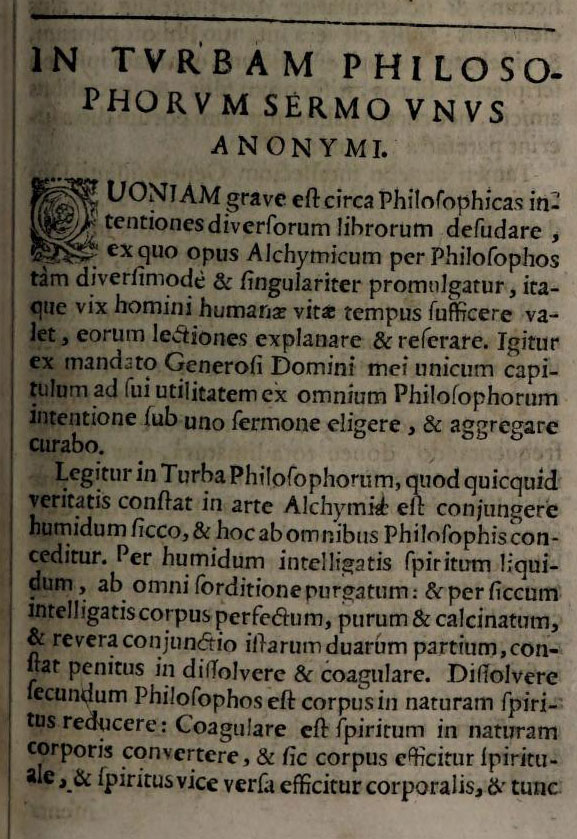
Translated from the book:
Bibliotheca chemica curiosa, seu rerum ad alchemiam pertinentium thesaurus instructissimus 1702
Since it is a burdensome task to toil through the philosophical intentions of various books, inasmuch as the alchemical work is set forth by the philosophers in such diverse and singular ways that a man’s lifetime can scarcely suffice to explain and unravel their readings, therefore, at the command of my noble lord, I shall take care, for his benefit, to choose and gather under one discourse a single chapter drawn from the intention of all the philosophers.
It is read in the Turba Philosophorum that whatever truth there is in the art of alchemy consists in joining the moist to the dry; and this is granted by all the philosophers. By the moist you are to understand the liquid spirit, purged from all filth; and by the dry you are to understand the perfect body, pure and calcined. And in truth, the conjunction of these two parts wholly consists in dissolving and coagulating.
To dissolve, according to the philosophers, is to bring the body back into the nature of spirit; to coagulate is to convert the spirit into the nature of body, and thus the body becomes spiritual, and the spirit in turn becomes corporeal.
Thus are fulfilled the sayings of the Philosophers, where they say: “Let the fixed become volatile, and the volatile fixed, and so by the grace of God you will obtain the whole magistery.” And God knows that this dissolution can never take place without a transmutation of the elements.
Hence you read in the Turba Philosophorum: “Change the elements, and you will find what you seek.”
And since surely the conversion of the elements is nothing else than to transmute the nature of one element into that of another element, the philosophers say that in every thing created under heaven there are four elements in being, though not in appearance; and they say that without the four elements no thing can come into existence. Yet in different things different elements are predominant; and so likewise it is in our Stone.
Our Stone, as the Philosophers say, is composed of body and spirit.
The bodies that belong to the composition of the Stone are gold and silver; and it is certain that in those bodies fire and earth are more abundant than air and water. In gold indeed these elements rule before the others; it contains within itself redness, or rather yellowness, and is in itself a hot and dry body, yet not too hot, since the element that abounds in gold is earth, which is cold and dry, and therefore tempers the gold, otherwise the yellowness of gold would be wholly changed into redness.
And thus [silver] is a cold body, in itself somewhat moist and dry, since fire and water in silver are, as it were, watery portions, and at least the water somewhat exceeds the fire. Therefore silver is judged by the Philosophers to be a cold and moist body; and if the water in the body of silver were converted into yellowness, then that body would be nearer to the nature of gold than of silver.
Moreover it is observed that in the spirit of our Stone water and air rule above the other elements; yet water surpasses air, and so the spirit cannot of its own power rest in the harshness of fire, since water, as is well enough known, is always contrary to fire.
The reason is, because they are altogether at variance in their elemental qualities: for fire is hot and dry, water is cold and moist; and thus it is plainly evident that two elements rule in the spirit of our Stone, namely water and air.
Therefore let the craftsmen of alchemy know that it is impossible to bring forth a true medicine from body alone without spirit; and conversely it is impossible to bring forth a true medicine from spirit alone without bodies. The reason is that, however the body may have been prepared, it cannot of itself, by its own power, acquire flexibility; nor can the spirit, however it be prepared by itself, be changed from its own nature, nor be perfectly fixed without the mediation of a body. And it is necessary that the medicine be flexible, living, capable of tinging, and enduring which it can in no way be or become without a due tempering of the elements.
And without doubt that tempering of the elements can never come about without the conjunction of body and spirit; for through their conjunction the defect of the elements is made good, both on the side of the body and on the side of the spirit, and thus the body becomes spiritual and the spirit corporeal.
So far we have spoken of the definitions of the elements, both as regards the body and as regards the spirit, in order that from this the due effect may follow for attaining the true medicine. Now let us consider the transmutation of the elements when it ought to take place that the corporeal becomes spiritual and the spiritual corporeal; and in truth the whole of Alchemy labours toward that intention, and therefore it is very necessary for everyone who wishes to work [in this art] to know all these things, since our pursuit of the whole art undoubtedly consists in the knowledge of the transmutation of the elements.
Transmutation of the elements
There are four elements, namely water, earth, air and fire. Water is cold and moist, earth cold and dry, air hot and moist, fire hot and dry; and each kind of these elements has its place in another and an inclination toward another, although each of them is contrary to another, in part or in whole. Earth has no place except in water, nor water except in earth; and yet they do not agree in one genus, they disagree in their qualities, that is, in moistness and dryness, since earth is moist and dry, but water cold and moist.
Fire likewise has no proper place except in air, and conversely; and these elements agree in one quality, but disagree in moistness and dryness, since air is hot and moist, fire hot and dry. Therefore it seems, as Morienus said, that earth lives from water and fire lives from air; and indeed water appears to share with earth in one quality, namely coldness, and with the other element in another, namely moistness. Therefore it is clear that water mediates between earth and air; likewise air seems mediates between earth and air. Air also seems to participate with water in moistness and with fire in heat; therefore air intermediates water and fire.
Fire likewise seems to participate with air in heat and with earth in dryness; therefore fire intermediates air and earth. Earth also seems to participate with fire in dryness and with water in coldness; therefore earth intermediates fire and water. And so it is clear that each element intermediates another, and that no element can be changed into the nature of another element, since it is its contrary, unless it is first changed into the element that stands between it and its contrary.
Thus, if anyone wishes to make fire out of water by ascending which element is altogether contrary to it, since water is a cold and moist element, but fire hot and dry he must first make the water into air, which is the intermediate element. Therefore the coldness of the water must be changed into heat or warmth, and then immediately the water is converted into air, which is the element intermediate between water and fire; for as soon as the coldness of the water is changed into heat, then as soon as the coldness of the water is changed into heat, then immediately the water is converted into air; then the moistness of the water must be changed into dryness, and so the water is converted into the element contrary to itself, which is fire.
And the reverse must be done, if a man wishes to make water out of fire by descending: thus the heat of the fire must likewise be changed into coldness, and then fire becomes earth, which is the element mediating between fire and water on the other side in the descent; then the dryness of fire must be changed into moistness, and so the element of fire passes into the element of water, which is contrary to it.
If any craftsman wishes to change earth into air by ascending, or air into earth by descending, he must first cause earth to become water and air to become fire; and thus, by the power of the mediating element, each kind of element can be changed into another.
And certainly no treatise of the authors is found such as is set forth here; for those authors who speak more openly about the transmutation of the elements, such as Phaebus, Geber, Morienus, Senior, Calid, Albertus the Great, King Marcus, and Arnold of Villanova.
And they also say: if some craftsman wishes to make air out of earth, which is the element contrary to it, he must first cause the moist to act upon the dry, and then earth is converted into the nature of water, which is the element mediating between earth and air in the descending order. Next he must cause the hot to act upon the cold, so that the cold becomes hot and the moist becomes dry, as has been said; and thus earth, which is cold and dry, will be converted into air, which is hot and moist.
And if anyone wishes to make earth out of air by descending degrees, he must first cause the dry to act upon the moist, and then air becomes fire, which, passing round in a circle from the other side, is the element mediating between air and earth; then the cold must act upon the hot, and so air passes into earth, which is the element contrary to it.
And thus it is to be understood also of the other two [elements]: for when water must pass into the nature of fire, the hot must first act upon the cold, and thus water passes into air, which is the element mediating between water and fire by ascending degrees; then it is necessary that the dry must act upon the moist, and thus water passes into the nature of fire.
And if fire must be converted into water, the cold must act upon the hot, and so fire will be converted into earth, which is the element mediating between fire and water, by descending degrees; then the moist must act upon the dry, so that the dry becomes moist, and thus fire passes into the nature of water, which is the element contrary to it.
And thus it is clear how an element must be changed into the element contrary to itself: it must absolutely pass through that one element which is intermediate between it and its contrary. Therefore it appears that each of the elements has in itself four qualities, two active ones, which act upon its contrary element. If the element is cold and dry, like earth, then it must act upon the hot and moist, as upon air; and in like manner, through its dry passive qualities, it must suffer its contrary acting upon it in respect of that which is cold and dry. And so, in a circular fashion, the same is to be understood of the other elements.
And this is the true intention of the Philosophers; and it seemed to them that enough had been said, since they wrote books only for their sons and special friends, and took no care whether their sayings were made public or not.
Nevertheless I will enlarge my most noble Lord’s understanding about the transmutation of the elements, according to that which I have experienced; and I wish to show you the truest transmutations of the elements, without any obscurity. They are done in this way:
Take, of the purified spirit prepared by way of sublimation, two or three parts, and of the filing of a perfect body one part. Amalgamate them, grinding them often, and rubbing them upon a stone, decocting in a bath with fire, and repeat this from time to time until all the filing, which is the substance of the body, has been converted into flowing Mercury, which is the substance of the Spirit.
Behold, if you will consider this carefully, it will plainly appear to you from this that here there is a transmutation of two elements. For I remember that I said at the beginning of this chapter that two elements rule in perfect bodies, namely fire and earth; and I said that in the spirit two elements are dominant, namely air and water. Now it is seen that by the skill of the art the body is made spirit, and thus it is clear that the nature of fire and earth, which were ruling in the body, is brought into subjection are the elements that rule in the spirit; and thus the first transmutation is brought to perfection, namely of the two elements that ruled in the body into the nature of the other elements that abound in the spirit; and this is the first operation.
Then, by frequent grinding, and by putrefying that amalgam under horse-dung from the eighth to the eighth day, always meanwhile placing it under the horse-dung for putrefaction, continuing this regimen until all the matter has been turned into blackness, or into a black powder (which has been clearly spoken of for your understanding). And this black matter must be like powder, subtle to the touch, black in colour and foul in smell; and so you will obtain the transmutation of the two elements which abound in the body, and thus the corporeal becomes spiritual, and conversely.
And beyond doubt those elements, being thus digested, are altered, and allow themselves, by the skill of art, to be separated from one another and, conversely, to be united; but the union must be brought about by means of the ferment of a new prepared body. And this is the true natural transmutation of the elements, and the true conjunction of the moist and the dry. But far be it that this chapter should be divulged, or come to be commonly known; for then the true art in itself would be as easy as it really is, since study would cease, and pride and envy would rule, and many other evils besides.
You have therefore how the moist is to be joined to the dry after the manner of the transmutation of the elements, according to the two regimens, namely to dissolve and to coagulate, by which the art is brought to its completion: so that the body may be made spirit by dissolution, and from the power of the spirit it may acquire for itself fluidity; and that the spirit, from the body, may acquire fixity. And without doubt in this conclusion consists the perfection of the whole work.