Concerning the Philosophers’ Stone according to the true mode of formation, Efferarius the Monk writes to a certain apostolic man.
Study the Art with Us Buy me CoffeeConcerning the Philosophers’ Stone according to the true mode of formation,
Efferarius the Monk writes to a certain apostolic man.
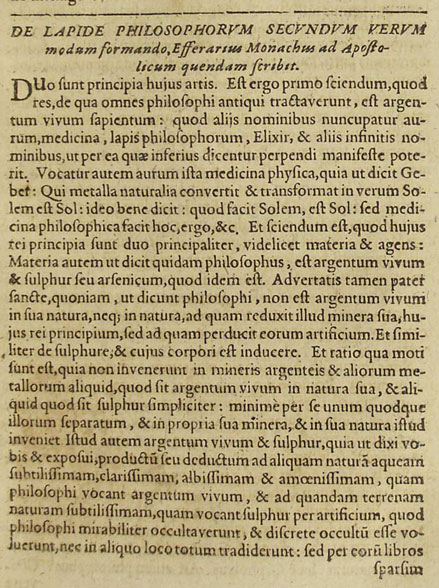
Translated to English from the book:
Theatrum chemicum, praecipuos selectorum auctorum tractatus de chemiae et lapidis philosophici antiquitate, veritate, iure, praestantia, & operationibus, continens: in gratiam verae chemiae, et medicinae chemicae studiosorum ... congestum, et in sex partes seu volumina digestum; singulis voluminibus, suo auctorum et librorum catalogo primis pagellis: rerum vero & verborum indice postremis annexo. Volumen tertium.
There are two principles of this art. Therefore it is first to be known that the thing concerning which all the ancient philosophers have treated is wise quicksilver; this is called by other names gold, medicine, the philosophers’ stone, elixir, and by countless other names, as may plainly be perceived from those things which are said below.
But this medicine is called gold in a physical sense, because, as Geber says: That which converts and transforms the natural metals into true Sol is Sol; therefore he says that it makes Sol, and is Sol; for philosophical medicine does this, therefore, etc.
And it must be known that of this thing there are principally two principles, namely matter and agent. But the matter, as a certain philosopher says, is quicksilver and sulphur, or arsenic, which is the same thing. Yet, having been advised, it is plainly evident that, as the philosophers say, it is not quicksilver in its own nature, nor in the nature to which the mine, its first principle, has reduced it, but to which their art has brought it. And similarly concerning sulphur, and that whose body it is introduced into.
And the reason why they are moved to speak thus is because they did not find in the mines of silver and of other metals anything which is quicksilver in its own nature, and likewise nothing which is simply sulphur; at least not one of those things separated out, which one finds in its own mine and in its own nature.
But that quicksilver and sulphur, which, as I said, I have shown you and expounded, are produced or led forth into a certain most subtle, most clear, most white, and most pleasing watery nature, which the philosophers call quicksilver; and into a certain earthly nature, most subtle, which by art they call sulphur. This the philosophers wondrously concealed, and willed it to be hidden apart, nor did they hand over the whole matter in any one place, but throughout their books, they distributed it piecemeal and in parts. Concerning which art, holy father, I intend to set forth nothing, because it would be impossible for you to try it by experience, nor would it be expedient for you to make trial of it through someone else. It would also be lengthy to recount all the things that are necessary in the said art. Moreover, the aforesaid artifice is lengthy and dangerous and most laborious, and very perilous for the inexperienced.
But it must be noted that the philosophers, by that quicksilver and that sulphur, meant one thing. And indeed it is so, that it is one thing, and from one thing it has proceeded, as I explained to you elsewhere. That it is one thing he shows by this: because sometimes naming the said quicksilver sulphur, and calling sulphur quicksilver, and altogether at once quicksilver and sulphur. But that it is only one thing all the philosophers say in many places.
For Lucas says: For many things we have no need, but of one only. And Effric says: You know the foundation of this art, because many have perished, while it was but one thing. And Diomedes says: Nature is to be reverently imitated, because nature is not amended in its own nature; to it no alien thing is to be introduced. And Bocosen says: Beware lest any alien thing be introduced. For, as Geber said above, in a plurality of things our art is superfluous. And Astanus says: Nature is but one, which surpasses all things. Likewise Pythagoras: It is called by all names, whose name is one and the same. And many others say similar things, which it would take long to recount, in order to show and demonstrate that it is one thing alone, upon whose action nature itself is founded in this operation.
Which thing, as I said above, is quicksilver and sulphur, which I have shown to you. But one may ask: Why then have the philosophers named that thing, if it is one and not many, by all names, and compared it to all things? To this they assign several reasons.
For Diomedes says: They did this so that the unskilled and ignorant might not know that thing. Likewise Morienus: The envious multiplied the names, and led posterity astray. But he calls them envious because they begrudged that this knowledge should come to others rather than remain with themselves.
Likewise Pythagoras: They called that thing by many names because of the excellence of its nature. But Bonellus says: They multiply the names because in the operation of this thing as many colors appear as can be devised in the world; and thus they diversified its names according to the diverse colors. In operation it contains all the elements; therefore they named that thing by the name of whatever elemental thing they pleased.
But because in this thing there are four elements, Orpholeus said: Know that in our magistery it is fitting to mix the pure, crude, sincere, and true elements over the fire, and to beware of the intensification of the fire until the elements are joined together and made complete among themselves. The elements therefore are diligently cooked by a light fire, are made glad, and are converted into foreign natures: thus Orpholeus.
The philosopher also says: Convert the elements, and you will find what you seek.
But to convert the elements, as a certain other man says, is to make the moist dry, and the dry moist, and the fleeing fixed. Therefore you have, by this, that in this one thing there are four elements, which are visibly seen and naturally extracted; and therefore the philosophers call that water four bodies and four natures.
For Hermes says: That water is a heavenly nature, which, existing in bodily things, separates the elements according to their region, and composing them again reduces them into one. Likewise Nimidus says: It is a perfect composite in all four elements.
Now this multiplication of names was the cause of the error of those who worked upon unsuitable matter, as in salts, alums, urines, dung, human blood, sulphur, and natural quicksilver, in marcasites, and in many other things, not knowing that there cannot be found in a thing that which is not in it, as Geber says; nor understanding that the philosophers spoke in their sayings by similitude and metaphor, thinking that this most precious and most secret art was to be revealed wholly to no one.
Concerning this water, or rather concerning this thing, many things are found written by the philosophers, which it would be too long to recount. Therefore you have that there are the material principles of this thing, or its material cause, which is called the medicine of the philosophers, namely quicksilver and sulphur. It remains consequently to determine the efficient cause.
The efficient cause, or that which moves this matter itself to corruption, is heat, which is the moving instrument to putrefaction, and there is no other agent in the world. And this is what the philosopher Alphidius said: Know, my son, that the active substance in this whole world is one, namely heat. For apart from heat there is no motion or action; for, I say, heat is the cause of the disposition of matter; yet there are many degrees of heat or fire.
And it must also be seen what sort of fire it is, and in what degree it is. Certainly that fire is the fire of horse dung heat. Hence Alphidius says: Cook with that fire which I show you; and hide it in moist horse dung, which is the wise fire, namely moist and obscure; which fire is hot in the first degree and moist in the second.
Concerning this heat all the philosophers have spoken under words of error and metaphor. Hence they have compared it with the heat of the sun, and with the natural heat of a healthy man. For Messeg says: A thing is congealed by the heat of the sun. Hence beginners are deceived, who use diverse fires, not understanding the words of the philosophers, and being ignorant that the generations and procreations of natural things are brought about only by a most temperate and equal heat, and not by an excessive one.
The manner of mixing
After these natural principles of this thing, it must next be seen concerning the manner of their mixing, or conception, with one another.
But it must be known that the material principles of this thing, upon which nature founds its action in its marvelous operation, are sulphur and quicksilver, as has been said. Now the union of these with one another is of a most strong composition and of a uniform substance. And this is so because they are united through the smallest parts, so that none of their parts can in dissolution leave the other; rather, each flows, each is dissolved, because of the union of their form, when they have been brought together through the smallest parts, by an equal acting heat in their nature, according to the requirement of their quintessence.
Yet it must be noted that the aforesaid sulphur and quicksilver are converted into an earthly nature, and from both of these earthly natures there is dissolved a very subtle smoke, multiplied by heat in the vessel. And this twofold smoke is the immediate matter of metals, or of medicines, or of the philosophers’ stone. By smoke and by temperate heat, in the vessel of its decoction or digesting, it is converted into the nature of that same earth; and therefore it receives a certain fixation, whereby the flowing water dissolves through the sponginess of its vessel, and is made viscous uniformly in it; and through union all the elements come to be according to due natural proportion, and are mixed in their smallest parts, although they make a uniform mixture through successive decoction, and that very prolonged, and most temperate, in their vessel, until they thicken and harden, and become medicine, or metal, or the philosophers’ stone.
Hence Morienus says: The disposition of the wise and the change of natures is the marvelous commixture, by a subtle disposition, of those natures of hot, cold, moist, and dry; and it is the one argument of the wise.
Note however that ingression, imbibition, fixation, connection, inspissation, conjunction, complexio, composition, and mixture, because they themselves gather all other things together through division, all mean the same thing. And all these are one and the same according to Democritus.
Mixture is the mingling together of things that can be mixed, that is, of the elements; for these are the first principles of every composite thing. Nor do you take mixture according to the manifest and occult nature of the thing mixed, but according as the elements themselves are known to be mixed in its composition. Hence Hermes says: Understand, son, the knowledge of the four elements, which by their patience are in their hidden manifestation. For their hidden revelation is by no means signified, nor accomplished, until their colors have passed through.
Likewise note that “through the smallest parts” means through indivisibles. For that is the smallest thing which is indivisible; for if it could be divided, it would not be the smallest. But it is clear that through the smallest particles of the body itself, that is, through indivisibles, the mixture of the elements takes place; for an element is a simple thing and the smallest particle of that body itself.
Concerning the effects of the principles
It follows that we must explain the effects of the aforesaid principles, namely of quicksilver and sulphur. Therefore, for the clearer understanding of these, it must be noted that in the operation of this thing several degrees are considered.
For Lucas says in the Turba: We have no need of many things, but of one only; and that one thing works in every degree according to natural truth. Now these degrees are according to the different proportions of the mingling of the elements which occur in its operation. And each operation, according to its own degree, and according to the order which nature observes in the course and continuation of its generation, the philosophers have called by the name of some metal.
For they called the first degree of its operation iron or Mars;
the second degree, copper or Venus;
the third, lead or Saturn;
the fourth, tin or Jupiter;
the fifth, silver or Luna;
the sixth degree, gold or Sol.
And for this reason they metaphorically named its metals by other names also, and all this in order to conceal their knowledge.
These, however, insofar as they are generated from those same first principles, namely from one first matter, which is quicksilver and sulphur, are called and are the effects of the said principles, namely of sulphur and quicksilver. And concerning each of the aforesaid things in particular, the philosophers treated by defining them according to their diverse properties, each according to itself, because they had in themselves a different composition or generation in their creation or production.
Yet it must be noted that the philosophers sometimes, by naming that which they call gold, mean iron or lead, and so with the others. And likewise, conversely, they call iron or lead, and the rest, gold. And this is with respect to diverse considerations: because insofar as the dissolution and corruption of one thing is the generation or cause of another, the effect is in its cause. Hence they said that gold is iron, and so with the rest.
Note the cause of the error of those who work upon natural metals, namely by calcining, dissolving, and congealing them, believing that from those things they can produce the medicine of the philosophers, because the philosophers say that from iron, lead, and the rest, gold is generated, and that that thing, which they call gold or the medicine of gold, is generated from the dissolution or corruption of the other metals. For in the same operation all the said metals are generated and corrupted, and from these gold is generated.
Hence also they said that iron, and so likewise the others, is gold, because in some manner the cause is its effect. By the same considerations they also communicate among themselves the names of the other metals, insofar as the corruption of one is the generation of another.
But it must be noted that the philosophers call all these metals quicksilver and sulphur, because they themselves are made and generated from them.
But the philosophers called the aforesaid generations of metals complexions; yet all are unequal except gold and silver. And for this reason they also said that silver is unequal in respect of gold. But they said that only the complexion, or perfection, of gold is equal, and the philosophers sought no other of the aforesaid complexions or generations except that alone which they call equal, namely that of gold.
Concerning this Johanninus says: That elemental commixture is that which, when the body is moderated, is called incorruptible. And note that he says when moderated, namely by the moderation of the four natures, that is, of heat, cold, moisture, and dryness; for when one of these natures does not exceed another, then the body is called equal, because one is only present in as much quantity as another.
Likewise it is called incorruptible, that is, sound and free from every cause of corruption. And note that what makes this tin or lead itself gold, or the medicine of gold, is this. Hence Geber says: Tin is most pure lead, and in it there is equality of fixation or of the spirituality of the two component things, namely of quicksilver and sulphur, not equality of quantity; because in the mixture quicksilver prevails.
Likewise Hermes and the Sons of the Philosophers [say]: There are seven bodies. Concerning which note that gold is not first in the way of generation, but in the intention of nature; because nature always seeks that which is better, nobler, and more perfect, and intends that. Or else it is called first in nobility and dignity.
Gold is first among them and their best head and chief, because until the earth is corrupted, it is not burned by a burning thing, nor is it altered by water, because its complexion is temperate, its nature set aright in hot and cold, dry and moist, and there is in it nothing superfluous nor deficient. And therefore the philosophers praised and magnified it and said: For in bodies, namely metallic ones, it has gold in the same way that the stars have the sun.
But there still remain to be determined the artificial principles of this thing which we seek. Note that these modes are called artificial principles, although they are natural, because nature works them by means of their ministry and artifice. And these are the modes of its operation, by means of which this thing which we seek is generated and led into actual being.
And there is one mode, sublimation; another mode, descent; the third, distillation; the fourth, calcination; the fifth, solution; the sixth, congelation; the seventh, fixation; the eighth, iteration; and similar others are said to be infinite. These modes indeed, although they are different in account with respect to one another, are nevertheless the same in the thing itself.
For sometimes the philosophers, considering their matter, which when it is in its vessel and feels the sun and heat in the containing thing exhales or evaporates in the form of a very subtle vapor, and rises upward into the head of the vessel, called such a rising sublimation. Afterwards, seeing that such matter, which had risen, descends to the bottom of the vessel, they called it distillation or descent.
Further, seeing that this same matter of theirs became thickened, blackened, and gave off a bad smell, they called it putrefaction. Seeing the black or dusky color and the evil odor afterward depart over a long time, and a certain whiteness come, like the color of ashes, they called it incineration or whitening.
Therefore Morienus says: The whole magistery is nothing other than the extraction of water from earth, and of water above the earth, with diminution, until it is putrefied. And this earth putrefies with the water, and when it has been cleansed by the help of its regent, it perfects the whole magistery.
Further, seeing the earth mixed with its water, and the water gradually diminish because of the temperate decoction, and the earth increase, they all said that this was perfect ceration. Hence the philosopher says: When the earth is cerated with water, imbibed, and dried by the temperate decoction of the heat of the sun, the whole matter is turned into earth. Whence the same says: This is the whole, if it is truly in the earth.
Likewise, seeing that the whole matter came in a certain way to dissipation, and that in some manner it was reduced to a solid substance, and that it no longer flowed, but rather stood firm, they said that this was perfect congelation. Plato says: Dissolve our stone, and afterwards congeal it with great caution, as has been shown to you, and you will have almost the whole magistery. Likewise elsewhere: Take our stone and place it in a vessel, and with a gentle fire until it is broken up; and afterwards cook it at the heat of the sun until it is congealed; and know that the whole magistery is nothing other than to bring about the dissolution of the thing, and a perfect and natural congelation: thus Plato. Likewise: Dissolve and congeal, and thus you know the whole magistery.
Likewise, seeing the aforesaid matter perfectly congealed and thickened, in such a way that it no longer dissolved at all into water nor into smoke, they said that it was truly fixed, because by that same congelation and thickening, or fusion, on account of the greater decoction of heat, they saw it come to a perfect drying and whitening; and because that whiteness was above all whitenesses, they said that this was perfect calcination.
Likewise, seeing this matter stand in the fire of heat and be changed into infinite colors, because this could not happen except through the dissolution of the matter, they called that dissolution solution; for in that dissolution the elements are loosened, and visibly act and undergo change; and therefore the philosophers called the said elements spouses.
Wherefore beginners err shamefully, who believe that the physical medicine is created from another thing, whereas the philosophers say, and the Sons of the Alchemical Art, that all those who believe in dissolutions, sublimations, conjunctions, separations, congelations, preparations, triturations, and other such deceptions, are deluded.
And thus some, when teaching, call one gold ours, another water our water, which is also called very sharp vinegar; another calls our dissolution and congelation, which is done with a gentle fire; another our putrefaction; another something else volatile, or the spirit of something else, though it is plainly from our quicksilver and sulphur; another calls it our alum or our salt, which in its whiteness when compounded is called the flower of white salt; another calls it our egg, or our blood, or human blood; another something else extracted from a vegetable thing, or from man, or from a brute animal, as though it were useful or fitting for you in our operation.
For in this they are perhaps deceived, because there are as many names of our stone as there are things. For when they hear many philosophers saying that it does not arise from man, nor from brute animals, nor from vegetables, they do not understand the likenesses, and so, wandering, seek other false applications by such sayings, by which they deserve to be called deceivers themselves.
And they are also silent, believing that our work is made from the powder of the brute animal basilisk. For in this they perhaps err, because the philosophers say that our stone has an odor like the odor of sepulchres. And therefore they perhaps believe it to be the basilisk, because that is said to be a most foul-smelling animal.
But if you find that this thing of ours is nourished like an infant in the womb, as certain philosophers say, they hand this down by way of similitude, not with regard to the quantity of time, but with regard to the slowness of the decoction; because the thing is congealed by temperate heat. And when they say that the egg is nourished by nourishment, all these things are as you see, and so forth.
Note that the whole Magistery, and the whole intention of the philosophers, is nothing other than to divide, to cleanse, and to congeal. And again: all perfection is nothing other than to dissolve perfectly and to congeal. Note that the whole regimen consists in fire and heat. The whole perfection is nothing other than to convert the elements.
The whole regimen is nothing other than to cook, and to dry, to roast on thin plates, to file, to cut with shears, to crush, to putrefy, to incinerate, to water, to separate, to divide, to cleanse, to whiten, to rubify, to dissolve, to leaf out, to cerate, to mix together, to heat, to pound, to sift, to irrigate, to moisten, to inflame, to imbibe, to impregnate, to dry out, to decoct, to sublimate, to pour, to smite with a fiery sword, to strike with a hammer, to prepare the animal from the body, to pour forth, to convert body into spirit and spirit into body, to cook, to impregnate, to sublime, to congeal, to descend, to calcine, to dissolve, to corrupt, to coagulate: all this is one whole thing and not another, except to distill in fiery heat, in a gourd vessel and alembic.
And this is held as a great secret in this art, whence the verse:
Since the thing is one, the vessel one, the one cooking alone,
Apart from this solution there is no other medicine.
This is the general rule of the philosophers: for they say that there is no inspissation of anything moist, unless first there is made from the moist part a most subtle exhalation; nor does it happen first in a similar way from the moist part of the coarser parts there is a subtiliation; yet it happens if in the composition or commixture the moist prevails over the dry, and there is a true mixture of the dry and the moist, so that the moist is tempered by the dry, and the dry by the moist. And this does not happen except through a long commixture of a viscous moisture and subtle earth through their smallest parts, although the moist itself becomes the same with the dry, and the dry the same with the moist. And the resolution or exhalation of this subtle vapor or smoke does not occur suddenly, but little by little and over a long time. And the reason of this is evident: because the substance of the principles and of nature is uniform.
For if the resolution of the superfluous moisture were to happen suddenly, since the moist would not differ from the dry because of their strong mixture with one another to be resolved, then surely the moist would be resolved into the dry, on account of the strong union they have with one another. Therefore the resolution of the viscous moist, being subtle, into smoke, if prolonged and equal, is the cause of the thickening or composition of metals.
Here ends.