The Treasury of Philosophy - Thesaurus Philosophiae.
by Efferarius the Monk.
1659
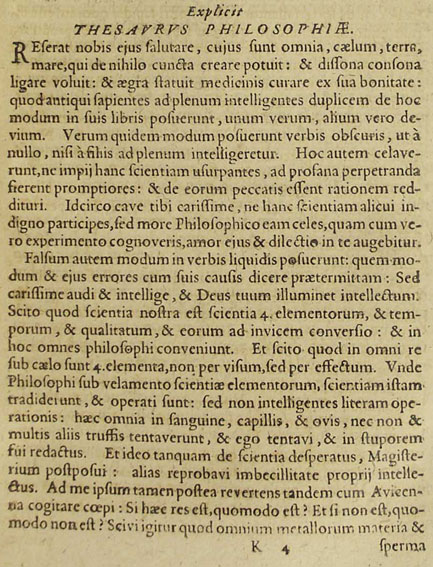
Translated to English from the book:
Theatrum chemicum, praecipuos selectorum auctorum tractatus de chemiae et lapidis philosophici antiquitate, veritate, iure, praestantia, & operationibus, continens: in gratiam verae chemiae, et medicinae chemicae studiosorum ... congestum, et in sex partes seu volumina digestum; singulis voluminibus, suo auctorum et librorum catalogo primis pagellis: rerum vero & verborum indice postremis annexo. Volumen tertium.
He offered us his salvation, whose are all things, heaven, earth, and sea, who could create all things from nothing and willed to bind together discordant things; and by his goodness he established that the sick should be cured by medicines.
Wherefore the ancient wise men, fully understanding this, set down in their books a twofold mode concerning it, one true, the other indeed erroneous. But they set down the true mode in obscure words, so that it might be fully understood by no one except the sons [of the art]. But they concealed it lest the impious, misusing this knowledge, should become the readier to perpetrate profane things, and should be required to give account for their sins.
Therefore, beware, my dearest, lest you make anyone unworthy a sharer in this knowledge; but rather conceal it in the philosophical manner, than, when you have learned it by true experience, let its love and delight in you be increased.
But they set forth the false mode in plain words, and I pass over to speak of that mode and its errors together with their causes. But listen, dearest, and understand, and may God enlighten your intellect.
Know that our science is the science of the four elements, and of times, and of qualities, and of their conversion into one another; and in this all the philosophers agree. And know that in every thing under heaven there are four elements, not in appearance, but in effect. Hence the philosophers, under the veil of the science of the elements, handed down that knowledge and worked by it; but those not understanding the letter of the operation attempted these things in blood, hair, and eggs, and in many other things besides, and I too tried them, and was reduced to stupefaction.
And therefore, as one despairing of the science, I abandoned the Magistery; indeed I reproached the weakness of my own understanding. But afterwards, returning again to the same matter, I at last began to reflect with Avicenna: If this thing exists, how does it exist?
And if it does not exist, how is it not? Therefore I knew that the matter of all metals and the seed of all metals is Mercury, cooked and thickened in the belly of the earth by sulphureous heat; and by its cooking, and according to the variety of sulphur and the diversity of its multiplied forms, diverse metals are produced in the earth. For their first matter is one and the same; they differ only by accidental action, and by a greater or lesser decoction, temperate or intemperate, burning or not burning: on this all the philosophers agree.
It is certain, moreover, that every thing is either from water or from that which is resolved into water; for ice is converted into water by means of heat. Therefore it is clear that first it was water; and since all metals are converted into Mercury, therefore they were first from Mercury. But the manner of converting them into Mercury I shall show below.
This being supposed, the saying of Aristotle in the fourth book of the Meteorics is solved: Let the alchemical artists know, therefore, that the species of metals cannot be changed. And this is true, unless they are reduced, as is fitting, to their first matter.
Now their reduction is easy and possible with respect to one another; for everything that grows and is born is multiplied, as is clear in all plants and trees and animals: for from one grain a thousand grains are produced; from one tree a thousand saplings proceed; and from one man the whole race of men is propagated. Just as each thing is increased in its own species, so likewise a metal can consequently by itself increase its own metal.
And it makes no difference, as Aristotle says, whether these things are done in natural organs or in artificial ones. All metals are indeed born and grow in the earth: therefore it is possible that augmentation and multiplication be made in them, and that indeed unto infinity. But this cannot be done except through that which is most perfect in the line of metals. The perfection of the generation of those metals is their complete medicine, which is the elixir of the philosophers.
But it is not possible to arrive at this elixir except by a mean. See the nature of the mean, in which there is always the containing of the extremes. Now the extremes were sulphur and Mercury, and the complete elixir. From those things, therefore, which are more purified, cooked, and digested from them, those are better and more perfect, and also nearer [to the goal].
O dearest one, do not go astray; for whatever a man sows, that shall he also reap. By now it is sufficiently clear what the stone is, and what its medicine is, to which nothing foreign is added, but only what is superfluous is removed; because things do not agree with it, nor are those things nearer to it by nature.
Now therefore, dearest one, I explain the sayings of the philosophers and the obscure words of the wise hidden in parables, so that you may understand the words of the philosophers and affirm their truths more fully.
Therefore the first thing which the philosophers called solution, which is the foundation of the art, Maria says thus: Join gum with gum in true matrimony, and make them like flowing water.
Rosinus the philosopher says:
Unless you turn bodies into incorporeal things, you labor in vain.
Likewise Parmenides, treating of this solution, says in the Turba: Certain men, hearing of this solution, think that it can be done without its body, with which it is joined and made one permanent thing. For the philosophers’ solution is not the dissolving of a cloud into water, but the solution or conversion of the body into water, from which they were first created, namely into Mercury, just as ice is converted into liquid water from that which it formerly was.
Behold, then, by God’s grace, one element, which is water, and the reduction of its body into liquid water. According to the saying, that from water earth is made by gentle decoction often repeated, until blackness predominates. For as Avicenna says in the title On Humors: Heat acting in a moist body first generates blackness, as may be seen in lime as it is commonly made.
Therefore Menabdes says: I command posterity to make bodies non-bodies by dissolution, and incorporeal bodies by gentle decoction; in which, all the while, care must be taken lest the spirit be turned into smoke and vanish through too great a fire.
Hence Maria says: Keep it, and beware lest anything flee into smoke. And let the measure of the heat be the warmth of the sun in the month of July, so that by gentle and long decoction the water may be thickened and become black earth.
Thus you have another element, which is earth.
The third saying which follows is the cleansing of the earth.
Hence Morienus says: This earth putrefies and is cleansed with its water; and when it has been cleansed, by God’s help the whole magistery is directed.
Hermes likewise says: Azoth and fire wash the laton, and take away its blackness. Therefore the philosopher says: Whiten the laton, and hide your books, lest your hearts be broken.
For this is indeed the composition of all wisdom, and also the third part of the whole work.
Read therefore, as it is said in the Turba, dry up the moist thing, that is, the black earth with its water, and cook it until it becomes white. Thus you have by itself water and earth, and earth whitened with water.
The fourth saying is that the water, when it has been thickened and coagulated with the earth, rises by sublimation. Thus you have earth, water, and air.
And this is what the philosopher says: Whiten it, and with a gentle fire sublime it, until from it there comes forth the spirit which you find in it, which is called the bird, or the ashes of Hermes.
Hence Morienus also says: Do not despise the ashes; for they are the diadem of your heart, and enduring ashes. And in the book of the Turba it is said: Increase the regimen of the fire; and through the whitening you will arrive at incineration, which is called calcined earth, which is of the nature of fire.
And thus in the aforesaid proportions you have the four elements, namely water dissolved, earth whitened, air sublimed, fire calcined.
Concerning these four elements Aristotle also says in the book On the Regimen of Principles to Alexander: When you shall have water from air, and air from fire, and fire from earth, then you shall have the full art of philosophy.
And here is the end of the first composition, as Morienus says.
Now let us pass to the second composition, which has to inspire, tinge, and vivify the first composition.
Hence the philosopher Calid says: No one ever could, or afterwards will be able, to tinge the foliated earth except with gold. Therefore Hermes commands, saying: Sow your gold in the white foliated earth, which by calcination has been made fiery, subtle, and airy.
Therefore in that earth we sow gold as seed when we impose upon it the tincture of gold. But gold can never perfectly tinge another body except itself; certainly this cannot be unless it be perfected by art.
Hence Raymund says: Although this our stone already in itself contains a natural tincture, for in the body of magnesia it is created and is perfect, yet it does not have in itself perfection by art and operation.
Geber says in the Radical Operation: For this operation is made so that the tincture of gold may be improved in gold beyond what it is in its own nature; and also that there may be made an Elixir, according to the allegory of the wise, that is, a condiment composed from clear species, an antidote and medicine for curing, purging, and transforming all bodies into true lunary and solar substance.
But we need only gold, and not another body, hear Hermes saying: Its father, that is, of the first composition, is Sol; its mother, Luna. The father is hot and dry, generating tincture; its mother is cold and moist, begetting and nourishing. Therefore Sol is by itself, and Luna by itself, of a most difficult fusion. And when they are joined in the manner in which solder is joined to gold, they are poured out together.
Therefore Maria says: Take the projected body, or the shining little hill, which is not seized by putrefaction, and grind it with the weights that comprehend the tincture of the spirit, and bring it near the fire, and it all quickly melts, if above with the projected flower it has its Luna.
Therefore if in our stone there were only one of those two, although it would easily be medicine, it would not give tincture. And if it were to give it, it would not tinge except insofar as it itself existed; and the rest, like Mercury, would fly away in smoke, because in it there would not be a receptacle of tincture.
But this is our final secret: to have a medicine which flows before the fleeing Mercury. Therefore the conjunction of those colors is necessary in our work. For Geber says: In the perfect magistery the precious medicine of metals is gold; for it is the tincture of redness transforming every body. It is the ferment converting the whole mass to its own nature. It is also the soul joining spirit with body; for just as the human body without the soul is dead and immobile, so too the unclean body without ferment, which is its soul, is earthly and without vegetation.
For the ferment of the prepared body converts the whole mass into its own nature. And ferment is not appropriated except to Sol and Luna among the planets; because just as Sol and Luna rule the other planets, so also these two bodies rule over the other metallic bodies, which are conformed and converted into the nature of the aforesaid two; and therefore it is called ferment. For without it the grains are not improved.
For Raymund says: But you will not be able to improve this unless it is first subtilized by art and operation.
Therefore Hermes says: Son, extract its shadow according to its ratio. Therefore the preparation and subtilization of the ferment is necessary for us, just as it is in leaven; for however much is required for the creation of a perfect thing, yet not so much is required for the operation, but first a little has been added and can be added more afterward, and even more; thus it happens in our stone.
Take therefore the fourth part of it, this being one part of the ferment, and three parts of the imperfect body. Dissolve the ferment in an equal amount of its water of Mercury. Cook it with an exceedingly gentle fire, and coagulate that ferment, so that it may become like the imperfect body; and with the mouth of the vessel closed, in the same way and order as has been said, let it be prepared.
This Hermes prescribes, saying: Dearest one, at the beginning of the fresh work, mingle the parts of the waters of permission most gently, and bury them until they settle, and let there be conception in them at the bottom of the vessel, and let the generations of the things begotten be made in the air.
Morienus also says: Make in the beginning of your work that your redness may take hold of the white smoke in a strong vessel, by firm conjunction without the exhalation of the spirit, and this is the fifth saying.
The sixth saying is that you join the fourth part of the subtilized ferment with three parts of the whitened earth, and imbibe it with its water, and as before cook and repeat this as often as needed until the two bodies become one without diversity of color.
Whence Morienus says: When the white body has been calcined, cast into it the fourth part of its ferment of gold; for gold is like the ferment of bread, which converts the whole mass into its own nature. Therefore cook it in its water until it becomes one thing, and one white body.
Therefore, as Maria says: Strike the air of it, congeal it, and it will be one body. And that is the secret of Scalies: Then the ferment is introduced into its body, which is its soul.
And this is what Morienus says: Unless you cleanse the unclean body, and restore it to whiteness, and put into it its soul, you will direct nothing in this Magistery. Therefore the commixture of the ferment must be made with the changed body, and not with the unclean body.
For as Galius says in the perfect Magistery: Stones do not receive one another, unless both have first been cleansed. For body does not receive spirit, nor spirit body, so that the spiritual might become corporeal, or the corporeal spiritual, unless first they have been most perfectly purged of every uncleanness.
But when they are thus cleansed, body and spirit at once embrace one another, and from them one perfect operation comes forth, because they have been altered in nature, and the coarse things have been made subtle.
Astanus also says this in the Turba: Spirits are not joined to bodies until they have been perfectly stripped of uncleannesses cleansed. And in the hour of conjunction the greatest miracles appear. Then the imperfect body is colored with a firm coloration through the mediation of the ferment, because that ferment is the soul of the imperfect body. And through the mediation of the spirit, the soul is joined with the body, and together with them it is converted into the color of the ferment and becomes one with them.
This, therefore, is the elixir, as Avicenna says to Asem the philosopher, which tinges with its own tincture and is submerged in its own oil and fixed in its own calx; whose soul we find as quicksilver in minerals, and its oil as sulphur or arsenic in minerals, and its calx as calx in minerals.
But the work is in truth better, more abundant, and more subtle in this way: that the white is completed in three [rotations], in which there is no fire; and the yellow in four turning wheels.
Concerning these wheels Maria also says: In this school there are nothing but miracles; for four stones enter into it, and its regimen is true.
From what has been said, therefore, it is plain to the subtle understanding or attentive observer that the philosophers spoke truly in their obscure words. For they say: Our stone is from the four elements; and they compared it to the elements. And first, because the four elements are in it in quality.
Hence Rasis says: All things that are hidden under the lower globe of the moon are established by workmanship from smoke, participating in the four elements, yet not in appearance, but in effect. For the stone is one thing alone, only one substance, one root, and one nature.
Hermes says: Begin in the name of the Lord, and know the nature of the stone. For it is from the root of its matter, because it is in the same and from the same; nor does anything enter into it beyond that which did not arise from it. A foreign thing does not suit a thing, except that which is nearer to it by its own nature; for each thing loves its own like.
Therefore Plato says: One substance, and one essence: in this one are hot, cold, moist, and dry. Therefore it is called the lesser world, because from it, and through one thing, in it, and with it, all metals come to be.
It is also that labor whose branches, flowers, and fruits are from it and through it; it itself is wholly similar. Nothing produces a thing unless it be similar to itself in its own species. Thus this thing is one and the same, and whatever comes from it is one and the same, and not diverse.
Now the philosophers named this stone by the name of every bodily thing and every species. Hence Pythagoras: It is called by all names, whose proper name is only one. Whence the verse:
This one thing is called Luna by all names.
And Pheras says: Dismiss the plurality of obscure names. Nature indeed is one, and surpasses all things; nor do the true things of nature amend that thing. But truly it is one nature alone, which makes itself germinate.
Therefore, as Diomedes says: Let us reverently use nature, because nature is not amended except by its own nature; into it do not wish to introduce any foreign powder, nor any thing, nor does a different thing amend that thing; for it itself makes itself germinate.
Maria, however, says: That which brings forth the white thing and the moist calx, which are one from one, are the roots of this art. And the philosophers named that thing by many and all names, though it is only one single thing, as Morienus says.
I tell you the truth: nothing else has led the moderns into error except the multitude of names. But every wise man knew that these names were nothing other than the colors appearing in the conjunction. And thus you will not go astray in the way of this work, although the philosophers have multiplied the said thing and its names; yet they do not understand unless they perceive the one thing, and the one way of operating, and the one way of heat (or color).
And note that this diversity of colors does not appear in our stone except in the conjunction of the soul with the body, as Morienus says: Only once does the force of fire in it bring forth diverse colors.
The philosophers said that the stone consists of body, soul, and spirit. And they speak truly. For they called the imperfect body body, the ferment soul, and the water spirit; and rightly so. For the imperfect body in itself is a heavy and infirm body, and dead. But the water is the spirit purging the body, subtilizing it, and whitening it. The ferment is the soul, which gives life to the imperfect body, which it did not previously have, and brings it into a better form.
The body is Venus and feminine.
The spirit is Mercury and masculine.
The soul is Sol and Luna.
The body must be liquefied into its first matter, which is Mercury, as our Morienus says. Mercury is not obtained except from bodies liquefied by no common liquefaction, but only by that which endures until the spouses are united in true marriage, and indeed joined together; and this continues as far as the whiteness.
And note that the whole body is liquefied when blackness appears in the decoction.
Hence Bonellus says: When you see the blackness of that water begin to appear, know that the body has already been liquefied. Then cook it in the water over a gentle fire, until it is dried together with its vapor, and there is made the thing which is introduced into it from its own body.
But the spirit converts the subtilized body into itself and penetrates it; therefore it is called permanent water and water of life. Hence Mundus says in the Turba: Mercury is permanent water, without which nothing is made. For its power is spiritual, blood made liquid, whereby that thing with the body is turned into spirit, and mixed mutually with itself, and reduced into one according to the virtue of virtues; the body is made incorporeal spirit, and the spirit is turned into tinctured body, just as blood is turned.
For everything that has spirit has blood also, and blood is the natural humor strengthening nature. And therefore, the more it is decocted and washed in its own humor, the more pure and better it will appear.
But as Morienus says: There is nothing that can remove its shadow from the laton except azoth, when it is decocted in it, until it restores it colored and white, as were the occult things of the philosophers. For then indeed it expects its good, that it may be strengthened by its ferment.
Now note that the ferment is the fixed soul of the stone, tinging, vivifying, and bringing it to completion.
Hence Maria says: The fixed body is from the matter of Saturn, comprehending the digestion of tinctures, and containing the wisdom of the sages, without which this Magistery never comes to effect, until Sol and Luna are joined together in one body.
For the whole artificium of this art, as Euclides says, is in Sol and Mercury; for when they are joined into one, they possess an infinite tincture. For in the work one seeks a redder color than blood.
Indeed a little of this color infused into a great quantity of white converts that great quantity into a citrine color, as you may experience if you cast blood into milk or into water.
Therefore, as Josephus says: Mix fire and water, and there shall be four; then make them one, and you will attain that which you seek. For then body becomes non-body, weak over a not-weak fire, and there shall be peace over it.
Now the preparation of these things from beginning to end is only one, because it manifests tincture in projection, and it is itself the mediatrix between contraries, and it is itself likewise the beginning, middle, and end. He who understands it apprehends wisdom.
Certain philosophers also said: Unless you turn bodies into non-bodies, and incorporeal things into bodies, you will not find the rule of truth; and they speak truly. For first the body becomes water, and thus the corporeal becomes incorporeal, that is, spirit; then in the conjunction of spirit the water becomes body.
Therefore Hermes says: Convert the natures, and you will find what you seek; and this is true. For in our Magistery first we make the coarse subtle, that is, from body water; afterwards indeed we make the moist dry, that is, from water earth; and thus we convert the natures, because we make from the corporeal the spiritual, and from the spiritual the corporeal.
And this is what Senior says: It is the conversion of the bodies aforesaid into their state, from thing into thing, from infinity into potency, from grossness into thinness, from body into spirituality, just as the seed of a man is converted in the womb of a woman by natural conversion from thing into thing, until from there a perfect man is formed, from whom was its root and beginning; nor is any division made from this or from its root.
For, as Aristotle says: Every generation is from things agreeing in nature. And this is true, especially in metallic generations. Therefore the philosophers say: Do not make anything foreign enter into it neither powder, nor water, nor any other thing; because if anything foreign enters into it, it corrupts and destroys it.
Hence a certain Arabian king says: Water is not joined with the similitude of its sulphur except in that which is from it. Then we make that which is above as that which is below, that is, that the spirit becomes body, and the body spirit, just as it is in the beginning of our operation, as in sublimation: that which is below becomes as that which is above, and all is turned into earth.
Therefore Hermes says: That which is above is by sublimation, that which is below by descension; and that which is below by consolidation is as that which is above by ascension, for accomplishing the miracles of the one thing: water and earth have the lower place; air and fire rise above; water and earth conceive and nourish; air and fire act and join together.
And thus these four agree in our stone, as Senior says: The four elements in our stone are purified, because in it there is fixed water, and quiet air, and resting earth, and fire surrounding all things; and in this contrariety there is agreement. And these four natures in it, and from it, and through it, are generated. Therefore it is evident from what has been said before that our stone is of the four elements.
Therefore the philosophers said: Our stone has body, spirit, and soul. Yet all three are said to be from one nature, and one thing with one water from one root; and indeed they speak truly. For our whole Magistery is done with our water, and from it, and by it all necessary things are made. For it dissolves the bodies, not by the common dissolution, as the ignorant hand down, as though they were converted into cloud-water, but by the true philosophical solution, so that they are converted into the water from which they were in the beginning.
Hence Socrates says: The secret of any thing and of life is water: it dissolves the body into spirit, and from the dead it makes the living. It is also the sharpest vinegar, which softens and dissolves all things. Therefore grind our stone with the sharpest vinegar, until it is thickened; yet cautiously, lest the vinegar be turned into smoke and the whole perish.
Likewise this same water calcines bodies and reduces them into earth. The same also blackens bodies, whitens and reddens them; the same is transformed into ash, is pulverized, and enters into them.
According to what King Marchos says: Our water dissolves bodies, congeals them, and blackens them; and it washes every body and removes from it all blackness, and tinges every black thing and makes it white, and tinges every white thing and makes it red, and vivifies all the dead unto perpetual life. Therefore they magnified this water, exalted it, and said that it is the lady of all things, nor is there found another thing performing its operations.
Morienus likewise says that Azoth and fire wash the laton, cleansing it, and altogether take away its obscurity. But laton is the unclean body; Azoth indeed is Mercury.
And this water joins together the diverse bodies, prepared in the aforesaid manner for such conjunction, so that fire by its power cannot separate them. It makes a marriage between the body and the ferment, and changes each of them into another, and defends them from the burning of fire.
For the calcined and whitened earth, when it seeks the higher places, becomes spiritual and airy. And that which is spiritual and airy is incorruptible and penetrative.
Hence Hermes says: The water of air existing between heaven and earth is the life of every thing; for it is itself the mediatrix between fire and water by its heat and moisture. Therefore the water receives air; for the air itself receives fire, because it is near to fire by heat and near to water by moisture; therefore it makes a marriage between male and female.
For every spirit consists in the subtlety of the foliated air. For every vegetable animal draws spirit and life from air. Therefore fire through air vivifies the dead, makes marriage, and protects the compound from the burning of fire.
Therefore the philosophers said: Convert water into air, that it may become life; life, however, with life, because it is the life and spirit of that into which it has entered.
Therefore our water sublimes bodies, not by the common sublimation, which idiots understand, believing that to sublime is merely to ascend upward. Hence they take calcined bodies and mix them with sublimed spirits, such as sulphur and Mercury joined with sal ammoniac, and by strong fire they make sublimation, so that the bodies ascend in smoke with the spirits, and then they say that the spirits and bodies are sublimed and excellently purified from their superfluities; but they are deceived, because thereby they afterward recover them more impure than they were before.
For art is weaker than nature. Hence Albertus says in the book On Minerals: Since two foreign humors from the substance of sulphur are purified by artifice and by the ingenuity of nature, they cannot be better purged or purified by art. For the artifice of nature is more certain and more subtle than every art.
Therefore our sublimation is not to ascend upward, but the sublimation of the philosophers is to make from a small and humble thing, or base and corrupted thing, something great, lofty, and pure. Hence when we say: He has been sublimed to the episcopate, this is: he has been promoted to the rank of dignity. Thus we say that bodies are sublimed, that is, subtilized and translated into another nature.
Whence to sublime is the same as to subtilize, which our whole water does. Hence Morienus says: The water from the dead body in which there is no soul removes the foul odor; and when it has whitened the soul and sublimed it and preserved the body, it removes from it obscurity and every evil smell.
Albidus also says: Take the things from their mines, and sublime them to their higher places, and send them to the tops of their mountains, and reduce them to their roots.
To sublime, therefore, is to make a gross thing subtle.
Hence Hermes says: Sublime the subtle from the gross gently and with great skill. For the earth ascends into heaven and again descends into earth, and receives the power of the upper thing for penetrating by subtility, and of the lower thing for remaining by gravity.
Thus therefore understand the sublimation of the philosophers, because many are deceived in this. Likewise our water vivifies bodies and mortifies them, leads them to setting and brings them back to rising. The same causes black colors to appear in mortification, while it is being converted into earth in putrefaction. Afterwards many colors appear, and various ones before the whitening, of all of which the end is that stable whiteness.
For it is as the grain of wheat falling into the earth, which, unless it has first died, remains alone. Thus the seeds of all things springing from the earth are changed and putrefy until corruption enters upon them; then, germinating, they increase like those from which they had their root. So our water is nourished, putrefies, and is corrupted; then it germinates, rises again, and vivifies itself.
Therefore Calidus says: When I saw the water congeal itself, then I was made certain that the true thing is as is related. Therefore cook it with its body until its moisture is dried up by fire, and it becomes dry, until you see that you have gathered its spirit from it, and that it has made a mansion in the root of its element. And this will be when, after you have mortified it, you have decocted the white body; then it will be spiritual water, able to convert natures into other natures; then it will vivify and cause the dead bodies to germinate.
Likewise, our water is the mother of diverse wondrous colors. For through it the diversity of colors appears, and this is chiefly in the mixture of the water with the prepared and fermented body; for then infinite colors appear, as many as can be imagined. For then the spirit is joined with the body and soul: indeed the spirit is the place of the soul, and the soul extracted from the bodies is the tincture of the water.
Hence Senior says: This is the water that, carrying its tincture dissolved in the body, bears it, just as the tincture of cloth is carried upon a garment. Then the water recedes by drying, and its tincture remains by impression.
Similarly it is with the water of the soul, in which the tincture is borne, which they reduce upon their white, foliated earth as it becomes dry. This water Hermes called the gold of thorns and flowers and saffron, because it tinges the calcined earth of them. Hence he also said: Sow your gold in the foliated earth. Then the spiritual water recedes, and in the body the soul remains, which is the tincture of Sol; for it is like a subtle smoke, insensible, not appearing in its effect.
But its action is the manifestation of colors, and fire is generated from fire and nourished in fire, and is the daughter of fire. Therefore it must be brought back into the fire, that it may not fear the fire, just as a child is brought back to the mother’s breasts.
Some also called our stone white bronze. Hence Lucas and Eximius in the Turba say: Know, all who seek science, that no tincture is made except from our white bronze. For our bronze is not common bronze; common bronze is corrupted and infects everything upon which it is placed. But the bronze of the philosophers perfects and whitens that which is associated with it.
Therefore Plato says: All gold is bronze, but not all bronze is gold. For in nature gold is assimilated to bronze in weight and touch; but in the nature of bronze there is not that which is in the nature of gold, except corruption in earth and abiding in patience, in fire and abiding in the sea. Therefore our bronze has body, soul, and spirit; and those three are one, for spirit, body, and soul are one, because all these are from one and of one and with one, which is its root.
Therefore the philosophers’ bronze is their elixir, complete and perfect from spirit, body, and soul. Thus the philosophers named the stone by diverse names, so that it might be manifest to the wise and hidden from beginners. But by whatever name it is called, it is always one and the same, and from the same thing.
Hence Merculinus says these verses:
This stone is hidden, and buried in the deepest fountain,
Vile and cast out, foul with smoke or dung;
One and the same stone has all names in itself,
Whence Morienus, full of God, wisely spoke.
This stone is not a stone, but an animal that may be generated;
And this stone is a bird, and not a stone, or this bird is so.
This stone is a mass, a branch, and the offspring of Saturn;
This stone is Jupiter, Mars, Sol, Venus, and the stone is
Winged, and Luna more shining than all, one.
Now silver, now gold, now an element,
Now water, now snow, now blood, now sanguine, now chrysoline,
Now virgin’s milk, now sea-water, or sharp vinegar,
Now urine in the belly of one confessing,
Now the gem of salt, musk, or common salt,
The first orpiment, setting the first element in place,
Now the sea purified with purified sulphur;
Thus they transpose it, because they did not wish to reveal what they knew.
And thus the wise man is figured, lest he be deceived,
And that what is treated by the wise be not distributed to fools.
Likewise, as Morienus says: Our stone and the confection of its magistery is likened in order to the creation of man. For first there is coitus, second conception, third gestation, fourth birth, fifth the pursuit of nourishment.
O dearest one, understand these words of Morienus, and you will not err from the truth.
Open therefore your eyes and see that the sperm of the philosophers is living water, while the earth is the imperfect body; which earth is rightly called mother, because it is the mother of all the elements. Therefore when the sperm of Mercury is joined with the earth of the imperfect body, then it is called coitus; for then the earth of the body is dissolved in the water of the sperm, and they remain one without division.
Hence Hali says: The solution of the body and coagulation are two, but they have one operation; because the spirit is not coagulated unless with the solution of the body; and body and soul, when they are joined, each acts upon the other in a similar manner.
For example, when earth is joined with water, the water with its own moisture and power begins to dissolve it; for it makes it more subtle than it was before, and restores it to itself as like to itself; because water is more subtle than earth. In like manner the soul does in the body, and in the same way the water is thickened with the earth and made like the earth in density, because the earth is thicker than the water.
Therefore, between the solution of the body and the coagulation of the spirit there is no difference of time, nor is there a different work in any part, so that one thing should be done without another, just as there is no different part of time between water and earth in their conjunction; which is known if one be conjoined or separated from the other in their operations. Just as the seed of the man is not separated from the seed of the woman in the hour of their coitus, so also their end is one, one thing made, and one and the same operation is perceived in those two together.
Therefore Merculinus calls the mixing of things coitus and begetting:
The seeds are mixed, as milk, which when mingled grows white.
The second is conception, when the earth is dissolved into black powder, and begins to retain somewhat of the dry Mercury; for then the male acts in the female, that is, Azoth in the earth.
Therefore Arisleus says: Males do not beget with one another, nor do females conceive. For generation is from males and females, and especially from those mutually agreeing with one another. For when females are brought to their males, nature rejoices and true generation occurs. But nature joined to a foreign nature, being unfit, produces no truth of seed.
Therefore join your son Gabricus, dearer to you than all your sons, with his sister Beya, who is a bright, gentle, and tender maiden. Gabricus is the male, and Beya the female, who gives him everything that is from her. And although Gabricus is hotter than Beya, yet no generation takes place unless Gabricus lies with Beya; for unless Beya ascends above Gabricus and encloses him in her womb, so that nothing at all of him can be seen, and unless she embraces Gabricus with so much love that she conceives him wholly into her own nature and divides him into diverse parts this is what Merculinus says:
That which had been as milk, by conception is changed into blood;
The pale things grow black, the red things are diffused in blackness.
The third is pregnancy, because the earth is whitened. For when water rules, the earth grows and is multiplied, and from there the new offspring’s growth is generated. Then it is necessary for the black earth to be washed and whitened by hot fire.
Hence Hali says: Take that which has descended to the bottom of the vessel, and wash it with hot fire until its blackness is removed, and its thickness recedes, and cause from it the added moistures to fly away, until it becomes a very white calx in which there will be no stain; for then the earth is purified for receiving the soul.
Therefore Merculinus [says]:
Confirming the changed thing, pregnancy promises the blessed state;
Those that are well purified are bound in the peace of concord.
The fourth is birth, when the ferment is joined to the whitened earth, so that they become one in substance and color. For then our stone is born into everlasting life, because then the spirit is joined to the body through the mediation of the soul.
And this indeed is the composition which, as Hali says, is accomplished with putrefaction and marriage. And marriage is to mingle the subtle with the gross, or the spirit with the body, and to mingle the soul with the body.
Putrefaction, however, is to moisten, to grind, and to irrigate, while they are most gently mixed and made one. And it does not happen in them through any diversity or separation of water from water; then its spirit is joined to retain the subtle, and the soul is joined to fight with the fire and to suffer it, and the spirit, most alienated from the bodies, is joined to the bodies and suffers with them.
Therefore Merculinus says:
As much as is made pregnant, produce it born from dung;
To the born life is given; to the unborn life is denied.
The fifth is nourishment, because the extracted fetus is nourished only with milk and fire, little by little and gradually, while it is small. And the more it grows, the more it is strengthened, and is brought into youth; and having arrived at that, it subsists and suffices to itself. And so you ought to do in this operation, knowing that without heat nothing is ever generated, and that too intense a heat causes ruin. And a cold bath makes the compound flee, but with a temperate and gentle bath, and a slight fire, the corrupting humidities are drawn out of the bodies.
Therefore Merculinus says:
Then nourish it, when you perceive the birth;
Fire masters water, the furnace supplies nourishment:
Hence even our newborn stone is named.
Hence Plato says in the book of the Turba: Honor the king coming from the fire, crowned with a diadem, and illuminate him continually until he arrives at perfect age. And do not burn him, nor make him flee by burning him with too much fire; for if you provoke him to wrath, he withdraws his regimen from us. His father is Sol, but his mother Luna, whom the wind carried in its belly; and the earth is his nurse. But nourish him with milk, that is, with the sperm from which he was from the beginning. Therefore imbibe him often, little by little, with the water of Mercury, until he drinks what suffices him.
Then, as Hali says, the body will be the cause of retaining the tincture, and the tincture will be the cause of retaining the color, and the color will be the cause of manifesting the tincture, in which is the light and life of nature. Hence this is the right way, brief, the highest perfection of the thing, and the preservation of the whole magistery.
O dearest friend, singularly beloved, through those things which have been said you can easily understand obscure words, and you know that all things in this matter agree, that there is no magistery except that which I have spoken of.
For now you have the solution of the body, and its reduction to first matter. Then you have its conversion into earth. Thereafter the whitening of the black earth, and its raising into air: because then, by the distillation of the humidity found in it, that which ascends becomes airy, and the earth remains calcined, and then it is of the nature of fire. And you have their conversion into one another, and it receives such increase, the usefulness of which is greater than can be comprehended by any reasoning. Amen.
The End.