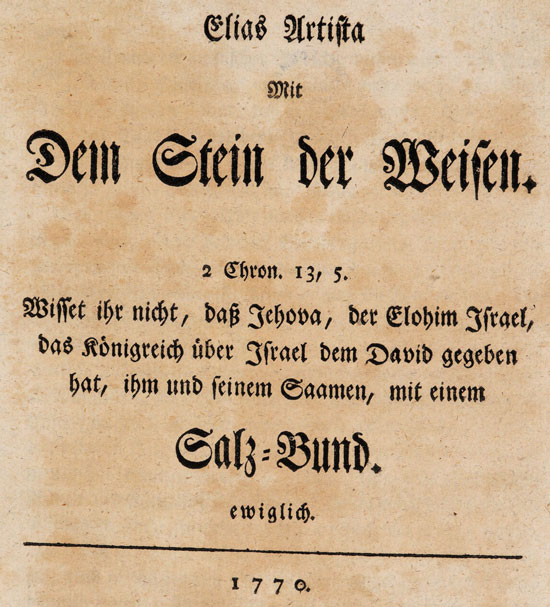
Elias Artista
With the Stone of the Wise.
2 Chron. 13, 5.
Do you not know that Jehovah, the Elohim of Israel, has given the kingdom over Israel to David, to him and his seed, with a covenant of salt, for ever.
1770
Translated from the book:
Elias Artista Mit Dem Stein der Weisen. 2 Chron. 13, 5. Wisset ihr nicht, daß Jehova, der Elohim Israel, das Königreich über Israel dem David gegeben hat, ihm und seinem Saamen, mit einem Salz-Bund. ewiglich
According to NDB and BBKL, the work was written by Johann Daniel Müller (pseud.: Elias Artista).
Preface
The connoisseurs of chymical writings will know that Paracelsus, Philaletha, and perhaps others besides, have written of Elias Artista that he would come. God’s Word says that Elias will come shortly before the Last Day, and will restore all things again and set them right. (Malachi 4:5; Matthew 17:11; Mark 9:11.)
But what is Elias to set right and restore? Surely nothing else than the doctrine of wisdom in the whole Word of God in its true sense, as this must be taken away from the Baal-priests in their false teaching, whose end he must make. All secret and hidden wisdom is originally from Jesus Christ, our God, and from Father Adam, who at the beginning of the world wrote with his own hand the books of the Word of God, and also the books of other hidden arts and sciences, such as astrology, alchymy and the like, when he walked upon this our earth as a true man, as has been shown elsewhere.
But he has written everything in images, riddles and parables, which in the time hitherto of the outward church have been led into erroneous and false doctrines; and this it is that Elias is to restore and set right again, for before the end of this our great earth everything is yet to be made manifest: there is nothing hidden that shall not be made manifest, nor anything secret that shall not be found out and brought to light. Luke 8:17.
Since now all hidden wisdom comes from God, so also the hitherto so concealed art of the Philosopher’s Stone comes from God, who at the beginning of the world described this art in images and riddles. And because Elias is again to restore and reveal everything in its true sense, he must also set forth the images and riddles of the Stone of the Wise in their true meaning, and make known the Stone of the Wise and its preparation, which is done in this book. Paracelsus in particular has recognized that this is to happen before the end; therefore he has called the man through whom it takes place “Elias Artista,” that is, Elias the artist, by which name it shall also remain, and for this reason I call this book Elias Artista.
But let no one think that this revelation of the Stone takes place in order that it might bring profit to men by making gold and silver! Oh no; for these idols of the earth will, with the now approaching Last Day and terrible judgment, come to a complete end, and will in future no longer exist why then should one wish to make gold and silver? So too no one will save his gold and silver on that Day of the Lord, but each one will cast away his golden and silver idols. Isaiah 31:7. Therefore this revelation of the Stone of the Wise has for its purpose only the unveiling of the hidden wisdom of God in the images and riddles is the aim, because now the time has come when everything hidden is to be known and made manifest.
Further, the revelation of the natural Stone of the Wise is to be for Elias a sign that God has appointed him to reveal the heavenly cornerstone, Jesus Christ, before the eyes of all nations, to whom Jesus Christ all nations are to submit themselves and in whom they are to believe. Everything eternal has its signature in the temporal, and thus the Stone of the Wise, among all bodily things, is the highest signature and likeness of the spiritual Stone, Jesus Christ. Because, therefore, Elias must reveal the true Jesus before the nations of the world, he must also know His signature; and the revelation of the Stone of the Wise must be His signature, by which one may also outwardly recognize him as Elias.
Elias and Moses are with Christ in His transfiguration on the mountain; but His transfiguration is His present revelation, and Moses and Elias are entirely one. Of Moses we read that he was instructed in all the wisdom of the Egyptians. Acts 7:22. In the end all the prophets come together into a single person, into One, who is Elias; for the Law and the Prophets, in the external doctrine of the letter, go no further than to Elias. Matt. 11:13. All these things have been shown especially in the Book of the World; here we are only to take note of the matter of the Stone. Elias is therefore also the Daniel of whom it is said that he had been instructed in the wisdom of the Chaldeans.
By this external art and wisdom are also meant, and this is the knowledge of the Philosopher’s Stone, which, out of all outward secret arts, is the single and highest image of the spiritual Stone, Jesus Christ. Therefore Moses and Elias must possess this art, and for this reason this book is also to be for me at the same time a testimony that I am Elias.
Chapter 1
On the Prima Materia of all things
§. 1.
Paracelsus writes, in his day, that he is the monarch of wonders and of secrets, and said: “The monarchy has come upon me; follow me!” In his time he could say this with truth, for he was one of the greatest sages that have existed. But now Elias says: “The monarchy has come upon me; follow me!” I shall speak from a wholly different school than all the adepts who have been before me have spoken and written.
I will let each man retain what is good in him, but I will not let their chaff pass for wheat. They say in general that the prima materia of the Philosopher’s Stone is the prima materia of all things; but in this they speak like a blind man about colours. I will first show the prima materia of all things, and afterwards we will then see the prima materia of the Stone.
Since nothing can be or be made without Nature, and all things must of necessity be in Nature, I must first say what Nature is. I do not wish to hide the secrets, but will investigate from the very beginning of creation. I will not pass by the truth, for God has given me wisdom to speak, and according to such a gift of wisdom to think rightly. In return He has given me a knowledge of things in such a way that I know how the world was made, and the power of the elements. (Wisdom, ch. 6 and 7.)
Nature
§. 2.
Nature is an ever-living and self-moving being, which consists in four chief qualities or properties, which are called fire, air, water and earth. But we must not confine ourselves only to the notion of the coarse elements, for these are only the shell and the gross offspring of the true elements, which are pure spirit and life.
The element Earth is a contracting, hard, thick and body-forming property of Nature, and is the encloser and totality of all the other elements. It is the ground and cause of all salts, which therefore are also contracting, sharp and body-forming. Therefore the element Earth, together with the Salt, is the principal ground and basis of Nature, in which all her powers are together in which all lie gathered together, and therefore Salt is also the chief subject of the Stone, as we shall see in what follows.
The element Air is set in opposition to the element Earth, just as their chymical signs stand opposed to one another. It is the expanding, out-driving, penetrating and subtilizing property of Nature, which resists and restrains the contracting, thickening and hard-making of the element Earth, so that Nature does not stand still nor stiffen in death, but remains an ever-living and self-moving being. The two elements Air and Earth make up body and life; for as Salt, or the element Earth, is the body of all things, so Air is the life of all things. The Air, or Aether of Omnipotence, is therefore also the other part of the Philosopher’s Stone, and it consists wholly of Air and Salt, and nothing else is added to it.
The element Fire is the warming and drying property of Nature, and is most closely akin to Air; it makes its property known in movement, because all movement produces warmth and heat, and it also helps to strengthen the movement.
The element Water is set in opposition to Fire, just as their chymical signs stand opposed to one another. It is the appeasing, softening and beneficent property of Nature, which restrains the property of Fire so that it does not kindle itself in rage, in a sharp, biting, consuming, hot and drying quality. It pacifies and produces quiet rest, and thus, together with Earth, is set in opposition to the restless movement of the two upper elements, Fire and Air. Fire therefore belongs to Air; hence the Air is the fire in the Philosopher’s Stone, and no other fire may be applied to it, as we shall see later.
§. 3.
These four elements, or four chief properties of Nature, stand with one another in an inseparable bond; they strive with one another, these four elements, or four chief properties of Nature, stand with one another in an inseparable bond; they strive with one another, seek and desire one another, move and drive one another, and taken all together make up one single living and ever-moving Nature, which is the life of the world.
None of these properties can be without the other, for otherwise there would be an end of Nature, just as there is also an end of all temporal natures when one of these four properties exalts itself too much and suppresses the other, so that the latter must break, whereupon the outward life comes to an end. This, then, is the description of Nature, and it is correct.
There is no living and self-moving being without these four properties or four elements. If something is to be, and is to have a definite essence and being, then it must consist of definite properties which constitute its essence and being; and that is Nature in the four aforesaid elements. Nature therefore consists in properties of amenity or receptivity, in that one affects and touches the other, from which the understanding spirit is then born, which is conscious of a thing and, in the five senses or in divers ways, perceives what is in its nature and essence.
Without Nature nothing can be created, and out of nothing comes nothing. This is a firm truth; and whoever wishes to deny it, let him show me a single thing that has been made without Nature and out of nothing, and I will praise him. The turns of phrase in Scripture about bringing something out of nothing are wrongly understood. They only mean this much: that a particular being is brought forth out of a universal being, and a subsequent one out of that which preceded.
Sixty years ago I too was not yet; but that out of which I have come to be already existed, namely the Nature of the world and my parents. Therefore I have not come into being out of nothing, and no thing in the world has ever come into being out of nothing; rather one has proceeded out of another. But Scripture says of God: “From Him and through Him are all things.” (Rom. 11:36.) But God is no “nothing”; therefore no thing has ever been created out of nothing.
§. 4.
Since now all things have gone forth out of God, and yet nothing can be or be created without Nature, God Himself must also be a Nature. And because no Nature can be without the four elements, the four elements must also be in God. The four living things or beasts in the Apocalypse, and the four wheels in Ezekiel before the throne, or in the throne of God, are in the eternal being of God nothing else than the four eternal elements in the eternal Nature.
If anyone will not believe this, let him tell me what they are. And if anyone will not admit that the being of God also stands in a Nature with four elements, then let him at least tell me what God is, and whether He is not a living and self-moving being. But can such a being be without the four chief properties of Nature? And does not the Word of God also ascribe a Nature to our God when it says that we are to become partakers of the divine Nature?
God is therefore Nature, and for this reason there is a temporal and an eternal Nature, in that there are various temporal chief Natures of the world which are all at the same time meant by the name “God,” and yet for all that the one is not the other. Is not even the devil called by the name “god,” namely the god of this world? 2 Cor. 4:4. Are we not all also subject to the general Nature of the world as to a god, and do not all outward things have their being and life from the outward Nature of the world? In order that I may be able to show the harmony of the Philosopher’s Stone with the whole world, I will first briefly set forth creation here.
The Mystery of God with the Creation of the World
§ 5.
One may picture to oneself the eternal Nature of God before the creation of this world as our air, which is spread out over the whole circle of the earth, and in which our lower nature is also contained. This eternal Nature, which is thus spread through the whole world, is the eternal being of God.
The purpose of creation was that this eternal divine being wished to introduce itself, with its eternal powers, into so many multiplying human creatures. To this end He fashioned Himself into a human image and form, and for this the Nature of God, spread through this whole world, worked together, just as even now the whole Nature of the world must co-operate in the forming of every single human being.
This first creature, or this first thing created of all creation, was Jesus Christ, our Father Adam, and that is the personal God. Col. 1:15; 1 John 5:20. The essence of God spread throughout the whole world remained what it was, only that the personal God walks in this universal essence; for this Father had given all power and authority to the Son.
This was the creation in the eternal Nature, in which, however, no more than this single creature, this God-man, could be created. But as for us human beings, there was no other possibility that we could be created in multitude except in a temporal Nature, and in a Nature which had to be in utmost imperfection, just as we have hitherto been begotten in such a Nature. For this God undertook three principal outward creations in this world, which are the following.
§ 6.
The first outward creation was the creation of the fixed stars and of the pure angels. This was the spreading-forth of the powers of God with stars and angels, in the number in which He wished to create human beings.
The second outward creation was the creation of the planets, among which our earth was also included, for it is one of those of the six world-bodies that run around the sun, but at that time it was still in the very purest condition.
The third outward creation was the six-day creation of our earth into an even more outward condition, and this creation concerned only the lower world, which extends as far as the circle of the moon and no farther. On the first day Nature was created as it still is today above the firmament of our clouds, up to the circle of the moon. On the second day an even more outward Nature was created, namely the Nature above our earth up to the firmament of the clouds, where the clouds and the rain begin to be generated. On the third day there was further created a bodily being, and the earth which already existed.
From these three days of creation the Nature of the first day, which also encircled the body of the earth, was entirely changed into a fiery Nature, and this is the satanic Nature, which was also let forth over our earth, and over us, for the ruin of the earth, whereas it had previously extended only as far as the firmament of our clouds, and no farther. Eph. 2:2. This Satan was unavoidably necessary for the creation of mankind, because the contrary of Nature had to be brought forth upon the earth, without which the propagation of men would not have been possible.
§ 7.
This is the very brief description of creation, of which one finds everything thoroughly proved and described in the Book of the World; for our present purpose this may suffice, in order to be able to show the harmony of the Philosopher’s Stone with the creation of the world. The outward world had to have three chief creations before the multiplication of the human race could take place; and these three chief creations, in each of which an entire Nature of the world, though only within its own sphere, was created this is what first laid the foundation for the further creation of human beings.
And just so the preparation of the Philosopher’s Stone also has three revolutions in the preliminary work, in which first the foundation of the Stone is laid; and then, in the subsequent work, there follows only the multiplication or increase of the same in power.
But the preparation of the Philosopher’s Stone is a new creation, a new birth out of the lower, perishable [nature] into the higher and spiritual; whereas the afore-described creation of the world went from the upper into the lower. Since, then, the Stone is a new birth, it is also in Nature the most perfect image of Jesus Christ, the spiritual cornerstone.
§ 8.
Into all these creations Jesus Christ, our Father Adam, has personally entered, and in each He has assumed such a Nature as is in it, so that man has in himself all the chief Natures of the world, which from Adam have been propagated to his children, and after him from one man to another. These Natures lie within one another in man, so that one is a covering over the other, and the coarse body is the outermost covering over all the others.
As it is now in man, so it is also with the Natures in the world, as with the Natures or essences of God, where likewise one lies in another; and thus the single Nature of God is also in the Nature upon earth and in every human being, but hidden deep within, as under various coverings or different Natures.
Into corruption the holy essence of God does not enter; but when now the renewal of Nature upon earth comes, and the satanic Nature is bound and cast out, then the holy power of God will penetrate all beings and Natures upon earth. This is then the new birth of the world, which again, through the three great principal stages, retreats out of all that is temporal back into the Eternal, as it first proceeded from it; and of this the preparation of the Philosopher’s Stone is the true and perfect image.
§ 9.
One nature of the world has gone forth by creation out of another, and all together are called by the name God, just as all the natures in a man are called by the name man.
Yet just as the coarse body is not the true man, so too the outward nature-god is not the holy only God. Nevertheless we live and move in God; for with the outer man we live in the outer nature-god, and from him we are born, and without him we can neither live nor be. But with the inner man we live in the one God, have been formed out of Him, and cannot have any spiritual or divine life in us without Him.
Since now everything is made out of Nature, and Nature is the beginning of all things, yet there are nevertheless different natures and beginnings; so there is by no means one and the same prima materia of things. And now we can seek the prima materia of the Stone, where we shall see that it is in no way the same as the prima materia out of which man has been created, as some adepts have chattered at random, without themselves understanding what they were saying.
The prima materia of the Stone is not higher, nor of any higher essence, than the outer air and the coarse salt; for out of these it is made, and out of nothing else, as we shall see in what follows. The prima materia is also described by the adepts as a chaos in which everything lay mixed together in a confused manner, out of which God then created things in order. But this confused chaos existed only in the brains of these people and nowhere else. All things have gone forth out of God, and God was no confused chaos. Every higher nature was the prima materia or chaos of the lower nature that followed next after it, and had previously already been created in order before the latter came, and was no confused chaos.
In the riddles of wisdom there are indeed such images of a chaos, but in truth no adept has understood them in their real meaning. When a preceding nature has been set into activity for the creation of another, then the properties of the former must come into contrariety and into a confusion, whereby a subsequent nature is formed. But as soon as this latter was there, so soon did the properties of nature again pass into tempering and rest, both in the first and in the second; for it is only in the act of creation that there is confusion and unrest. Since hitherto there has always been a creating, our nature upon earth has also always been a certain chaos, in which the higher powers that flowed into it lay mixed together with the properties of the lower nature, and out of this creaturely beings have then been created. In this way there was a chaos out of which things were made, and in no other way. In creation itself nature at once forms itself into order, as we see in the plants and in the forming of a child in the mother’s womb.
§ 10.
Paracelsus calls the prima materia of all things the great mystery, and says: it was not comprehensible, and had no property, no colour, nor elementary nature, was in no kind of being nor likeness, and the elements were first created out of it. That one might well call a chaotic description of the chaos! If it was without being, without property, without colour, without likeness and without elementary nature, then it was a non ens, a nothing. The elements must be there beforehand before anything can be created, for the elements constitute nature; and without nature there is nothing, and out of nothing comes nothing. This description of the chaos of his is a nothing; thus he has indeed described it rightly, for it was likewise no chaos, and so his description agrees with the chaos.
Paracelsus was one of the greatest sages, and I adduce this not in order to depreciate him, but only to show how in past times even the best men have mixed much chaff into their doctrines, and that one must not rely on them in all things. But if this is so with such great men, what will it be then with other adepts who, compared with Paracelsus, were but children?
Our air is, in a certain sense, a chaos in which the powers of all things, of all herbs and fruits, lie confused together, without one being able to say: this or that is grain, wood, metal, or herb. Yet for all that, one must not place such a confused chaos at the beginning of the world, as though the world itself with all things had been made out of it.
The prima materia of the Philosopher’s Stone is, as has been said, nothing else than salt and air, and it extends no further. Therefore the Philosopher’s Stone serves only the outward life of the air and the body for health; indeed, it cannot even preserve that when the term of a man’s life is come, for all adepts have nevertheless had to die.
The Second Chapter
Proof that the Philosopher’s Stone is made out of air and salt, namely out of tartar and saltpetre.
§ 1.
Since everything in Nature stands in the four elements and is made out of them, and Nature must be living and active if it is to make anything and even to improve it, so the matter of the Philosopher’s Stone must likewise be so constituted that it is Nature living and can be living and active in it.
This it cannot be in ores or minerals and metals, for these are dead to the life of Nature, have no further connection with it, and therefore can no longer grow. But in salt the living Nature can be and gain entrance, when the spirit of the world can be attracted through the salt; and one can draw so much of it that it coagulates into a fiery water, and fills whole shells full of such water.
Everything that is brought forth upon earth is brought forth through two, and stands in two: as life and body, out of the upper and the lower, out of a subtle and a coarse, out of an acting and a suffering [passive], out of man and woman, and out of heaven and earth. Who can deny this? Now if the Philosopher’s Stone is to be the most perfect image of the All, then it too must have two parts which clearly distinguish themselves from one another, are evident to the eyes, and yet can nevertheless be united together in equal measure, like man and woman, or like heaven and earth.
§ 2.
The number 2, which is most clearly visible to every rational creature, is spirit and body, or life and body. Now the air is the life of all things, and salt is the body of all things. Burn all bodily things, and in the ash a salt will remain, which is the ground of corporeality, and indeed the enduring ground, which lasts longer than the coarse dark matter. Therefore salt also appears white; but the white colour is the image of heaven, and for this reason salt is to be regarded as a heavenly earth in contrast to the coarse black matter.
In salt the element Earth has the upper hand, as has already been shown, because it produces and preserves corporeality. For this reason it is also the enveloping and containing thing of the whole living Nature, since the body indeed encloses the life within itself.
Since now salt is the body of all things, as one sees that all corporeal things have a salt in them, salt is therefore universal, or common, to all things; and because air is also the life of all things, both of vegetables and of minerals, it likewise is common, or universal, to all things. For this reason the Philosopher’s Stone is called a universal stone and a universal medicine, and therefore it can be nothing other than salt and air, since no other two things can be found which together are common to all things in the world.
With these two constituents we have now, as it were, hidden in them everything, the whole of Nature in each thing: the upper and the lower, heaven and earth, life and a salt-body. From this the Art must of necessity be able to make the noblest and best thing on earth, indeed a new heaven and a new earth; for when heaven is united with earth, and God with the creature, nothing else can come forth but pure blessing and good. Let a man think and ponder whither he will, he will find nothing in the whole of Nature that is more essential and necessary than air and salt; for without air no life could be, and without salt no body could be nor subsist.
But because salts are many and of various kinds, and one might therefore still be in doubt which salt one ought to take, it must now also be shown that it must be tartar-salt and saltpetre.
Tartar, or wine-stone salt
§ 3.
The hermetic fundamental rule in the Philosopher’s Stone runs thus: what is above is like what is below, and what is below is like what is above; and from the union of both there come forth the wonders of a single thing, or in a single one.
Above is heaven and life, and below is the earth and the body, both of which we have previously shown to be, in due measure, found in air and salt. This fundamental rule teaches us, first, that one must have two things which one must unite together into one. Everyone who wishes to make the Stone must therefore first consider whether he really has two things, what these are, and how they are to be united into one.
Secondly, this rule teaches us that we must look to the great world with its Above and Below, and take two things which the Nature of the world itself makes and gives. These, as said, we have in air and in salt. But because Nature gives many kinds of salts, and the Philosopher’s Stone requires a most perfect Nature for its matter, we must look among all salts for the most perfect, which from above has the most perfect origin; and this is tartar-salt.
Wine is the most perfect water that the Nature of the world itself gives and makes, and from wine comes the tartar itself, for the juice of the grape comes immediately out of the fiery spirit of the air, and therefore so too does the tartar-salt; and thus, of all salts, none is more closely related to what is above than this one except for saltpetre, of which more will be said later. And so of no other salt can one say with greater truth than of this: what is below is like that which is above.
It is therefore also the most perfect of all salts, because wine serves human nature itself for nourishment and strengthening. Man is the most perfect creature, and that which serves for his strengthening and preservation must of necessity be more perfect than other things which do not enter into union with human nature; for this reason also, on this ground, no salt is so perfect as tartar.
§ 4.
The order of creation bears witness to us that the bodily has arisen out of the spiritual, and the coarse out of the subtle.
The Dry earth has come into being through separation from the water, that is, through being set apart from the moist, watery kind; and we still see today that the world-spirit thickens itself in rain-water: but if one lets this stand, an earth settles out – that is the salt. In just the same way the world-spirit thickens itself in the juice of the grape, and from this fiery water of Nature the tartar separates itself. Now, in so far as wine is more perfect than rain-water, and in so far as tartar is produced in a more perfect way than any other salt, just so much more perfect is it also than all other salts.
Since wine is the most powerful juice of the world-spirit, and its origin is universal to all things, tartar-salt must therefore be a precious salt, and must be related to all things in a nearer degree than other salts, and must therefore be, of all given powers, the most wholesome universal medicine, because wine is so closely akin to human nature and strengthens it. But those are fools who, because of this close kinship of wine with human nature, want to make the Philosopher’s Stone out of the dung and urine of a man who drinks much wine. Human nature takes the good power of the wine into itself, and thrusts the filth of it out again through the urine and other natural excretions. How then will such dirt-philosophers make a Philosopher’s Stone which is to contain in itself the best of heaven and the best of earth out of the stench and uncleanness that Nature herself spews out of herself?
Tartar-salt is an immediate earth out of the most fiery air-water, and this fiery origin no other salts possess. It must also be of a drier nature than all the others. It is a dryness that comes out of a fiery water of Nature; it is a dry fire that comes out of water. Since now the preparation of the Philosopher’s Stone is a reversal and tempering of the elements, wherein dry and moist with one another must strive with one another until they come into equality and temper; thus tartar is the most suitable, and a certain subject which, in the Stone, takes the place of the dry earth. It is the best and most perfect salt of the lower nature, for it is the dry ground of the earth which has separated and parted itself from the fiery water of Nature.
Saltpetre
§ 5.
Now we have both the Above and the Below quite certain, and can of both, on the ground of truth, say: what is above is like that which is below, and what is below is like that which is above. But now we must also look to the following words, namely: that from the union of both there come forth the wonders of a single thing.
Union requires a likeness of natures; for like gladly joins with like, and one of such natures delights in the other, just as a youth and a maiden are very eager to unite with one another.
The likeness of the natures we already have in air and tartar-salt. But because the tartar is dry, heavy, and nearest to the element earth, and has separated itself from its mother, that is, from air and water, indeed lies separated from the air in the third degree, it no longer has any connection with the air as the life of the world, and is contrary to it in quality; for it, as the lower, is dry and heavy, whereas the upper, as air, is moist and volatile.
The union of both must therefore, naturally, be brought about through Art; for if no art were required for it, then all things would of themselves become a Philosopher’s Stone.
Since now the two parts no longer have any connection with one another in the life of the world, it follows that Art must add something to the tartar, which lies in death, so that this dead youth may again obtain a desire for his bride, and so that this dead Adam may again receive a longing for Christ as for life. But what is to be added to the tartar must be contrary neither to it nor to the air in their natural kind. Therefore one must seek a middle salt which is just as nearly akin to the air as the tartar is to the earth.
When this is united with the tartar, it makes the tartar apt again to long for the air, to draw itself toward it and to be able to unite with it. Now this is saltpetre; for it is an air-salt, and often of itself attaches from the air to walls or to other places of the earth that seem thin or porous to it. In comparison with other salts, saltpetre is to be regarded as a volatile salt, and it loves so greatly to unite with the air that it very easily becomes moist and wet from it. For this reason materialists who deal in saltpetre do not like to store it in damp places, lest it attract [moisture] and become wet.
§ 6.
If saltpetre alone were taken, it would not suffice for the bodily part of the Stone, because it has too little of the fixedness of the element earth, and in its nature agrees more with the moist than with the dry. But tartar alone, taken by itself, would also not be suitable, because it lies too much in grim death and hell, and is separated from the life of the world. In the divine books of wisdom hell is also called Tartarus. And just as the satanic nature in its formation has turned itself away and separated itself from the spiritual light and life, so too has cream-of-tartar separated itself entirely from the wine with which Christ compares Himself, and has become to human nature a grim essence, whereas wine is its strengthening.
Just as the satanic nature, or the hellish Tartarus, has hitherto had to serve for the creation and creaturely bringing-forth of the children of men, and has also had the upper hand upon earth, so likewise must tartar-salt serve for the Philosopher’s Stone, and must help in the preliminary work to form its bodily and creaturely part; and of the tartar there must also be the most, more than of the saltpetre.
When tartar and saltpetre are melted together over a charcoal fire, the tartar is by the saltpetre made desirous of the air, and its mouth is, as it were, opened so that it can again hunger after its origin from which it has come, and draw the air to itself. When both have been melted together and allowed to cool, it becomes a white salt, hard like a stone. It has, however, become so eager after the air that even in a room, standing on the table, it soon, little by little, draws the world-spirit to itself into a quantity of clear water and coagulates it. Such a water is, however, of no use either for health or for the Stone, but is harmful to both; yet from it one can already see the power for tinging, in that a few drops of such water, put into white wine, colour the wine blood-red.
§ 7.
We now have, then, that which is required for the Philosopher’s Stone. We have the best from heaven, namely life, and we also have the best from the earth, namely the body. From the conjunction of both, the best thing in the world must of necessity be able to be made, if only the processes are rightly ordered accordingly.
These, therefore, are the three principles of the Philosopher’s Stone: salt, sulphur and mercury that is, saltpetre, tartar and the world-spirit and there are absolutely no others.
This I testify I do this with complete certainty, just as I have borne witness with complete certainty to the spiritual Stone, Jesus Christ, and not out of delusion or whim-chasing. If a god were to say to me, “That is not Jesus Christ of whom you have written,” then I would answer him: “And you are not God; in you I desire to have no part for all eternity.”
In just the same way, if an adept were to say to me, “That is not the Philosopher’s Stone which you have described,” then I would say to him: “You are a liar and a deceiver, and an arch-ignoramus who does not even know the things in which he lives and moves, which themselves make up a part of his being and without which he cannot exist.”
I do not wish to prove the Philosopher’s Stone in such a way that I would set some made gold before a man and say: “This is your syllogism. Overthrow this proof for me!” No; wisdom is no sword and bow with which I should press all opponents and perhaps many of the true adepts as well into such a strait that they would not know which way to turn. In this chapter I have proved the principles of the Stone only out of the bare ground of Nature; now, in the following chapter, I also wish to set them forth from the testimonies of the adepts and other wise men.
The Third Chapter
Proof from the testimonies of the chymical philosophers that saltpetre, tartar and air constitute the Philosopher’s Stone.
§ 1.
When many people see one and the selfsame thing, it is all the more certain. He who sees aright with his own eyes indeed has no need of other people’s eyes, and other people’s eyes can also help him nothing if he does not see himself. Yet they can lead him out of the land of darkness into the land where light is. And since good company is good upon the way, I will also set down the testimonies of the wise, which indeed more than one adept has had in his mouth without rightly understanding them himself; then no doubt will remain about the matter of the Stone.
But first I will merely remind the reader that in this present writing, under the word tartar which belongs to the Stone, I always understand the tartar-crystals.
The highly enlightened Paulus Felgenhauer, who indeed, as he says, was no adept in the working, yet was a man of ever-increasing knowledge of Nature, has the following discourse concerning salt:
The expressed and bodily-made Word (namely the poured-out and created Nature) through which the world has been created is a salt; for salt is the concentrated centre of all the elements, a coagulated and won chamajim, and is a bodily word of creation. When the salt, in its spiritual vessel and receptacle, is attracted by a pure air, it becomes water, for it is a coagulated water, and water is a dissolved salt. One may well say that salt in creation is the best and the good, indeed the all in all. Nothing can endure in the fire except the salt, out of which afterwards a new heaven and a new earth will arise. Sulphur is a bodily fire; salt makes it endure in the fire. In salt much secrecy lies hidden; and whoever does not know what lies in the salt, in which is the power of all things, will know little of Nature.
Likewise, concerning saltpetre:
The tree of the knowledge of good and evil is, in its essence, a marvellous saltpetre of contrariety, which, where something breaks or divides itself, is hellish and heavenly, evil and good.
Here one should remember that tartarus is compared to the hellish essence, and the air to the heavenly. Since now saltpetre is the middle between the two and takes part in both sides, it is rightly compared with the tree of the knowledge of good and evil.
Further he says:
“The cold watery fire is the spirit of saltpetre, a spiritual water out of the salt, which at the same time has heat and cold in itself. Saltpetre is a marvellous salt that has no equal, and there is a great mystery hidden in it, more than one might believe. But the grim, terrible hell that is in the saltpetre must, in its devouring and consuming fire, be overcome, strangled, swallowed up and transformed into the blessed heaven. When this has become a heavenly water, then a new birth from above, out of water and spirit, can take place. Here a great medicine lies hidden, etc.”
And finally:
“The time is near when everything must be made manifest. Even if we ourselves have not yet prepared it with our hands, still the Spirit of Wisdom may and can teach us all things.”
§ 2.
There has never been a man in the world who has written more and more circumstantially about Elias than this Felgenhauer; and he has described him as very near and soon to come, and also very particularly many of his operations, as well as that the fleshly Christ of the Christian churches must be entirely done away with, as one can read in his little book Postillon.
Concerning salt he also says further: “When Elias comes, he will tell you more about the salt.”
The Aurea catena Homeri says on page 6: “The philosophers have directed us to that place where the Spiritus Mundi is found most abundantly, best and healthiest in concentrated form.”
By this there is quite palpably pointed to air and salt, for one can nowhere encounter the world-spirit in a more concentrated form than in salt. For brevity’s sake I will only set down the names of the books or of the authors without indicating the page-numbers, since in the different editions these are not always the same, and besides the dicta are well known to lovers of chymical writings.
Jean d’Espagne says:
“Seek a matter in which the Spiritus Mundi is most abundantly present and can be most easily obtained.”
That is to say: seek a salt, for without that one cannot have the world-spirit. If you cannot find such in the metallic realm, then go to the minerals. If these also will not assist you, then go to Saturn; he will give command to Vulcan to grant your request.
With metals and minerals nothing is to be done. The Saturn of the wise is saltpetre, and the Vulcan is tartar, which through Saturn, or saltpetre, is made apt to attract the world-spirit, and thus Saturn gives order to Vulcan.
§ 3.
Aurea catena:
“Salt is the mother of attraction and desires the male. Salt and saltpetre forge everything in the world. Tartar is the salt, or the mother of attraction, and desires the male, that is the saltpetre; then these two together forge everything.”
Soliloquium:
“He who works in this art without salt is like one who would shoot with a bow without a string.”
Philaletha, Magia Adamica:
“In Nature there is a peculiar spirit which unites itself with matter, namely with salt. There is a chain in Nature through which the upper and invisible natures, or spiritual elements, descend and dwell with the matter and ennoble and multiply it. Salt is the chain; for in the air also there is salt, and one salt attracts the other when it is made apt for it.”
This beautiful matter namely the higher spiritual matter, of which he speaks on p. 101: “it never lets itself be forced, but yields only to love,” by which is meant the like natures that attract one another. “By violence it cannot be caught. It is the universal matter and magnesia, the seed of the world. Its body is, in a certain sense, incorruptible; the common elements cannot destroy it, nor does it unite essentially with them.”
That is: with the coarse earth one cannot catch the world-spirit. “It is a water that does not make the hands wet, for the world-spirit does not make the hands wet. It is a seed which Nature herself draws out of the elements. It is not in man’s power to make this seed; it is already there, and one need only take it where Nature has left it behind, namely in the salt, which has been made apt for attracting it. Now you must consider with yourselves where Nature offers this seed, namely in the salt; and yet many are so foolish that they do not know how they ought to work.”
§ 4.
Likewise: “The substance which we first take into our hands is mineral – that is saltpetre – ‘of the kinship of Mercury, that is, of the air, and it is a child of Saturn,’ because saltpetre, as the Saturn of the wise, causes the air to be drawn down. ‘It is a single body in the earth that is very closely akin to Mercury, and is of Saturn’s race.’” – All this concerns saltpetre.
The three parts of the Stone – namely saltpetre, tartar and air – are compared with the three kingdoms, in that tartar corresponds to the vegetable kingdom, because it comes from wine, which together with the vine belongs among the vegetables; the air corresponds to the animal kingdom, because men and beasts live from the air; and thus saltpetre is a likeness of the mineral kingdom.
Saltpetre is therefore the mineral substance which must first be taken in hand, because tartar cannot attract the air without it. According to these three parts they also figure their Stone as the mineral, the vegetable and the animal Stone, and yet it is always one and the very same.
Item: “One nature refreshes the other, one overcomes the other, one rules the other. Nature is not improved except in its own nature. By all comparisons nothing else is indicated than the likeness of kind, and that one must take a salt in order to attract the air. Since now the salt really does attract the air, it must also be of like nature with the air; like shape must go into its like.”
Sendivogius says: “In the air there is a hidden food of life, which by night is called dew and by day a thinned water, namely the air – an invisible spirit, scattered everywhere, ruling and filling the whole earth. For when the world-spirit is rightly dried into and coagulated upon the salt, then the Stone is in its perfection. O holy and wonderful Nature, who dost not let thy disciples go astray!”
§ 5.
Gloria Mundi: “Salt is the fire and the dryness” – which is properly the tartar. Fire coagulates, and its nature is warm and dry. God’s power and wisdom are to be recognized in the salt. Whoever can dissolve and coagulate the same knows the secrecy of the art.
The lower salt is dissolved, and the upper, as the air, is coagulated. It is called the common Luna. When things are considered as acting and suffering, then the lower matter is called Luna or the Moon, and the air is the Sun. But when things are considered as moist and dry, then it is the reverse; for then the air is the moist Moon, and the salt is the Sun.
Here, however, the chief reference is said with respect to the matter. To this one must pay heed in the chymical books, otherwise one will often not know what they mean.
Further: “If you would become rich, then prepare it so that it becomes sweet.”
The matter that has been used up to the end in the preliminary work is also called the Moon, which then in the subsequent work becomes sweet. “When one boils the spirits therein, they are justified” – that is, in the subsequent work every forty days only a little fresh air is let in, which then dries upon the matter and raises it ever more into the spiritual nature; and this is what is called “boiling the spirits.”
“Salt is the soul of the earths; it coagulates all things and is called Reiß.” Reiß means a thing out of two, and it is tartar and saltpetre. If now you wish to coagulate, then what is to be coagulated must be the third, namely the air; and so the principles of this Stone are very beautifully expressed in these sayings.
These are further indicated in the following words: “It is a stone, salt and corpus, and is the key of the whole art.” In the salt there are two salts, namely saltpetre and tartar; these kill and coagulate the Mercury, that is, the air. These two salts are now sulphur and humidum radicale; for tartar is sulphur or brimstone, which has the dry fire, and saltpetre is the humidum radicale. “All this is born in the most subtle earth of the wind” – that is, after the melting in the preparation, the salt is laid upon fine flour, under whose dust it draws the air to itself and is then quickly shut up; thus the thing is born, and thus it becomes the Stone of the Philosophers. This is the one thing out of which everything is made, because in it are all four elements.
This is a fine description, in which there is also wisdom, and no leading astray to false matter. Many other adepts, however, were godless, worthless chatterers, who had not a grain of wisdom nor a spark of the fear of God; hence in their books, many other adepts, however, were godless, worthless chatterers, who had not a grain of wisdom nor a spark of the fear of God; therefore they have filled their books with worthless talk and seductive things, for which they will have to be judged.
§ 6.
Raymundus: “The earth is pure in its centre and cannot be consumed in the fire. In the centre of the earth there is a virginal earth, namely salt, the true element through which Nature has been created; from this you are to understand what you must take.”
All bodily things have in their inmost ground a salt which remains behind in the ashes and is not burnt with the coarse matter in the fire, for it can be lixiviated out of the ashes. By these words it is therefore indicated that one must take a salt which, in the Stone, takes the place of the earth. And this he calls a virginal earth.
Salt also, according to its nature, actually endures in the fire when it is put into the melting-crucible. Since now water defends a thing against the fire so that it is not consumed, it follows that the true element Water, or the fundamental moisture, must likewise be contained in the salt, and this is particularly in saltpetre, which in the passage cited from Gloria Mundi is also called the humidum radicale. Moreover, all the elements are in salt, and none can be without the other; and because they are present in salt in so excellent a way beyond other things, it also endures longer in the fire than other things, and therefore the Philosopher’s Stone must be constituted out of salt.
The earth and the sea together make up the globe, and taken together are the single subject upon which the higher natures of heaven work. In just the same way tartar stands in place of the earth, and saltpetre in place of the sea; and both must be together if they are to constitute the subject upon which the world-spirit works and is to make the Philosopher’s Stone.
Therefore I will place the Philosopher’s Stone into the harmony of the whole world, and that shall be to me a testimony that I have described it correctly.
§ 7.
Yet there is still a further mystery in salt, in respect of its fire-resistant nature, of which salt is only an image. Salt is the ground of all corporeity. But there is also another bodily essence in the coarse earth and in the bodies of men, which is shining and transparent, and is nevertheless still the temporal essence of the earths and of our bodies.
When now Babylon shall have fallen, then the kingdom of the Messiah will come, which lasts thirty years. When all these are at an end, the satanic nature, which until then is still above the earth but imprisoned, will in one single instant be driven into the interior of the earth and shut up there; and in this imprisonment all coarse corporeity on the earth and in the human bodies will consume itself, for it is the fire of the Last Judgment, through which everything that is upon the earth must pass.
In this fire the true corporeity of the earths and of human bodies endures, and the coarse essence remains only in the fire; and this is then the truly original earth or corporeity, of whose endurance in the fire the fire-resistance of salt is an image and outward testimony.
When the Philosopher’s Stone has been prepared, then its salt has first been brought into this fire-resistant mode, and it transforms all base metals into the fire-resistant grade of gold, into the highest grade of metallic nature; and this is then the true image and essential testimony in outward nature of the restoration and renewal of all things that have fallen under the curse to their first state of perfection.
Therefore the Philosopher’s Stone and its salt is the most perfect and essential likeness in the whole of nature of Jesus Christ, the Saviour and Restorer of all things.
§ 8.
Likewise, Raymundus:
“Nature works and makes only the thing, and not you. Therefore prepare for yourself a matter into which Nature, the air, has been introduced.”
If Nature alone performs it, then it is no cooking over a charcoal fire, for there man truly has work enough; but here one has nothing to do except to prepare the matter and lead the air into it, then close the vessel and let it stand.
“The venerable Nature lies in the depths. If you know well how to rule her, she will appear to you in a clear light in the form of a white earth”
that is to say, one will take a salt in which alone she can be encountered.
“What the elemental and heavenly forces effect in their natural vessels, that they also effect in vessels which are made by art”
namely in the prepared salt-matter.
Here we see likewise how one must have the air, as the powers of heaven, in a vessel, and how it is that which works and makes the Philosopher’s Stone, and not the charcoal fire.
§ 9.
Turba Philosophorum:
“The first beginning of the lower things is ‘one in one and from one,’ namely the saltpetre in the tartar when they have been melted together, and this is a pure white virgin, a pure white salt. Without this nothing can be brought about either by art or by nature.
This is the woman of the stars; for tartar and saltpetre are the woman which receives within itself the upper influences of the air. He who does not know this will never attain the art.
This virgin is the centre of the earth, the woman of the upper. These two, in their mingling, let forth a seed from themselves, whose issue, however, is invisible and is accomplished in a secret silence. That is, one must have a salt which attracts the air, whose union and commixture one indeed one neither sees nor hears; and the wise also accomplished it in a secret silence and said nothing about it.
Item: “Only the light alone – that is, the air, which is life and light – can be increased, because it comes from the first fountain of begetting and multiplication.
When this is added to a body, as to salt, it exalts and improves the same according to its kind. The light itself shows us the way to its own dwelling, namely to the salt, when the salt attracts the air.”
All these things point us to the living Nature of the world; and thus the Philosopher’s Stone is also a signpost which points us to the living God in the Nature of the world, in whom we live and move and are, and who also makes all things. The living Nature of the world, which, outside Himself, is the creator and maker of all outward things, this also makes the Philosopher’s Stone.
But that many men have not been able to understand these testimonies of the wise, and, in spite of this plain signpost to the life of the world, have nevertheless fallen into such wretched sophistries with charcoal-fire operations in minerals and all sorts of other things – this has been caused by blindness toward God and toward all Nature, and toward the manner of the creating and making of all things, and by the fact that they did not seek the Lord, whether they might perhaps feel and find Him; for He is not far from any one of us, for in Him we live and move and are, and we are His offspring. Acts 17:27.
§ 10.
Faber: “Since the Philosopher’s Stone is the fifth essence or quintessence of heaven and of all the elements, it can have no other body, nor be prepared by Nature with any other body, than from the body of salt” – that is, the bodily matter of the Stone must be salt. “Salt is for generation and and capable of bringing forth all things, which is not so with other bodies. By such sayings one is referred only to salt.”
Item: “Our matter is the dragon which eats its own tail, that is, the spirit. The dragon, that is the salt, draws its own tail, that is the air, after itself. Thus this matter draws the fugitive moisture to itself, so that it penetrates the pores of the earth, that is, of the salt, and supplies it with nourishment, for this spirit is the universal food of all things. The dragon devours its own moisture.”
These beautiful images are from the most ancient wisdom and have afterwards been carried over in this way into the chymical books. The dragon is also one with the whale that swallowed Jonah, and with hell, into which Christ went and from which He must also heal us again of the hellish nature.
Tartarus is called hell, and it is likewise a grimly devouring being, just as the satanic nature is described. As now the tartar swallows the spirit of the world into itself and thereby is changed out of its grim nature into a sweet being, so shall man and also the whole nature upon earth now be healed from the dragon-nature, when the Spirit shall come upon all flesh and the holy essence of God shall penetrate the whole of nature upon earth with power.
Item: “The prima materia, namely the air, is as it were a vapour; for when a thing is to become out of nothing, that same nothing must draw together namely, the air must enter into the salt and must become a thing, a tangible matter in which dry and moist are united. The salt is dry and the air is moist, and both must come together. One should attract the air with salt; this is the whole matter that he wishes to say with these words.”
Geber: “Our stone says: the mother who generated me is again begotten by me.” That is, the salt comes forth out of the air as from its mother, and now this mother is again begotten or attracted by the salt.
“At first she shall rule over me, for at first the air together with the moisture rules; but afterwards I shall rule over her, because I soon become a persecutor of my mother when I have learned the flowing from her. Yet she nourishes me like a pious mother until I have come to perfection.”
In the preliminary work the moisture still has much power; in the subsequent work, however, dryness increases more and more, the salt devours the air ever more, whereby it becomes ever higher and more volatile, and it is ever more nourished by the air until it is perfected.
Dornaus: “In salt all the elements have their seat and dwelling, as in their proper habitation. Every thing has in itself a certain indestructible power, which is the great medicine, if only it is freed from its bonds and from its black prison; this can be done through the spirit of the world.”
Item: The lower elements which are in the salt are of the same substance as heaven also is, that is, the air itself, and are distinguished from one another only as acting and suffering, as man and woman, as pure and impure, etc. And although the elements are called ‘suffering’, this is only in respect to heaven, that is, to the air, which is the more active. In themselves, however, the elements below are also active. Generation can take place neither from heaven, that is, from the man, alone, nor from the elements, or from the woman, alone, but only in the union of both.
Everyone who knows how to unite the dear transfigured heaven that lies in the body, that is, in the salt, with the imperishable spagyric heaven, namely with the air, will make the short life sound and will renew it through the miracle of a single thing; for the dear adorned heaven is of one kind with the conjoined imperishable heaven of one and the same substance.
When therefore, through the likeness of the substance, it is increased and strengthened, then it gains the victory over the perishable, by which it had previously been oppressed.
That is: when the power that lies in the salt is strengthened through the air, it gets the upper hand over the sharp, biting nature of the salt and makes it sweet. Just so it is in us men and in the whole of Nature upon earth: when our weakened power for the good is strengthened by the holy essence of God, then our sick nature is healed, and it obtains the imperishable being under which it had hitherto been oppressed.
And thus the preparation of the Stone, especially in the subsequent work, is an essential image of the renewal of all things through Jesus Christ. God, as Nature, Himself makes the Stone and translates the matter out of the curse into the blessing. By this He shows us what He wills to do with all creatures.
Our God has already, through Adam, described and left behind to us much concerning the preparation of the Philosopher’s Stone, as we shall see in what follows; and thereby He has set before our eyes a manifest example of the possibility that He can renew all things again and restore them out of the curse into the blessing, so that we should firmly believe in Him and trust and build upon His promises.
For this purpose is now, at the end, the revelation of the Stone given, and it has happened for our good, we who are to live to see His kingdom upon earth in the last days.
§ 11.
Likewise, Dornaus: The workshop of Nature’s smith is in the centre of the earth, that is, in the salt, where the lower natural fire first has its beginning of motion and operation, namely when the air has entered into the salt. This happens in just the same way as a fire arises when steel and stone are strongly rubbed against one another; for thus saltpetre and tartar rub themselves one against the other when they are melted together in the crucible, whereby the matter is made apt to attract the air.
“The stars are the hammers of this smith,” namely the air in which the higher powers are; “and the wind is the bellows,” because the higher powers come with the air. Thus it goes on in the Stone, and just so does heaven with all the stars work upon the earth and bring forth all things. Therefore the Philosopher’s Stone is also a teacher for us, which teaches us how all things on earth are effected through the starry heaven, and how heaven makes everything.
Item: “In the centre of the earth there lies also a sun hidden,” namely the salt, whose sun is at times also gold. “When this is violently struck by its kinsman, the wind, then it exercises its fiery art in its fiery workshop, and takes hold of what is in the centre of the earth and breaks forth out of the subterranean place.” By this we are directed to the salt, into which the air is to go.
Item: “Our water does not make the hands wet,” for it is the air, and it is from the nature of the body that has been calcined, and from the nature of the spirit that goes forth from it, and it is the life of all things that are in the whole world. “The salt is, as it were, torn apart by the world-spirit,” this is the philosophers’ calcination, and also their solution, whereby the inner power of the salt is loosened and unites itself with the world-spirit. The opened whole mass is then also called their water, as will be said below.
Item: “A subtle saltpetre makes the earth” – that is, the tartar – “fruitful, for it is the life of the earth,” since tartar without saltpetre does not attract the air. “In just the same way the artist must know how to moisten his matter with such a dew, so much as the weight of Nature requires, for it must receive very little air. Nature herself it is that, with the help of art, brings about the perfect union of the two substances, impregnates itself with the astral seed, that is, with the air, if only the artist sets it into its proper disposition.”
It is born of itself, after it has loved and impregnated itself, and it takes on of itself a new birth, like the phoenix from the ashes. Blessed be God from heaven, who has created Nature in the salt.
§ 12.
To the salt we are pointed in all the dicta, and here we also see that saltpetre must be present with it, because it is to make the earth fruitful. This fruitfulness refers to the enlivening by the air, which tartar in itself does not possess. The fitting-together of the matter is then all the work; everything further goes on of itself. God in Nature does it; He Himself does and accomplishes everything, and the worker with his charcoal fire brings nothing right to pass, whereas the good is wrought by God alone. So also it is the holy God alone who works the good in us, and we do nothing in it except dispose ourselves so that He can work in us.
“Philosophical Letter.” – “In the sulphur, namely in the tartar, is the metallic power which coagulates the Mercury, that is, the air. From the wine a delicacy is drawn which burns.” – With the wine tartar is indicated as the sulphur; therefore he says further of this delicacy of the wine: “This is like unto sulphur,” namely, the tartar is the sulphur, and is indeed in great strength of metallic nature, which it has especially drawn to itself out of the earth. The earth itself is also the tartar.
Sendivogius: “The saltpetre of the earth is like a calcined tartar, which with its dryness draws the air to itself. Such a power has the saltpetre of the earth to draw the air to itself, for it also once was air and is united with the fatness of the earth.”
In the earth, in tartar, there dwells the fire; it is cold and dry, its outer part is fixed, the inner part volatile.
Here he names, with much wisdom and skill, all three parts of the Stone; for his nitre of the earth is saltpetre and tartar melted together, and then the tartar attracts the air. But it is the saltpetre that causes the tartar to attract the air; therefore he says once again: such a power has the saltpetre of the earth, to draw the air to itself. Saltpetre, to be sure, was at first also air, but here it is as saltpetre united with the fixedness of the earth, that is, with tartar, and precisely on that account the tartar attracts the air.
The tartar is fixed and serves to give shape to the air. But when, through the air, it has been transformed into the spiritual nature, then its inner part has been turned outward, and then it is called volatile. Hence the philosophers say that one should make the volatile, namely the air, fixed, and make the fixed volatile.
Further he says: ‘In the earth is the hellish fire, and this fire is kindled by the primum mobile, by air. Therefore the earth has communion with the fire, which is its inmost part; and it is also purified only through fire, that is, through its inmost.’ With the word “hell” he indicates the tartar, for hell is also called Tartarus, and tartar is likewise the earth; therefore in tartar is the hellish fire.
§ 13.
Item: ‘It is impossible to coagulate Mercury without the Sulphur, that is tartar. Because for that reason wine has a certain sulphureity, metallic nature is also in it, because it burns. Under the spirit of wine and of gold there is indeed a great harmony.’ With the wine tartar is again meant, which must bind the air and coagulate it; and thus we have testimonies enough from the philosophers that one must absolutely [take] tartar for the Stone.
The great Farmer (Bauer) also says, on p. 53: “It lies in the wine-cask.”
Tartar is likewise the Wise men’s own gold; therefore Sendivogius says that the spirit of wine has a great harmony with gold. And thus they indicate the materials of the Stone only very cautiously, discursively, and in parables. But whoever holds to Nature and to what is possible in her, and looks to a living, working Nature in air and salt, and does not fall upon dead materials, metals, etc., which are used only as likenesses, such a one has indeed had instruction enough from learned philosophical books.
Item, Anonymus: “The philosophical gold is pure sulphur,” that is, tartar. “It is the true gold-tincture, and in it lies the comforting fire and the fixing power. It is the solar gold, the true son of the sun, and it is the true artist of Nature, through whom the sympathetic forces reveal themselves and through whom all attractions take place. It is known that from gold, from tartar, no gunpowder is made which explodes of itself, for tartar binds the air downward, because it is of the nature of gold. Gunpowder, however, which is made from saltpetre, drives the air upward, for saltpetre is mercurial; that is, saltpetre loosens tartar so that it can draw the air upward over itself. Therefore one must well know the rapport, sympathy and antipathy of things which they have toward one another.” Here the two parts, saltpetre and tartar, are very beautifully indicated.
§ 14.
Item: “Gold is of three kinds. First, common gold, which is of no use for our work, but is taken only as a likeness. Secondly, astral gold, namely the air, which is a fiery substance, a continual outflow of from the stars, which we breathe in every moment.
Third, the elementary gold, namely the salt, which is the purest and firmest part of the elements and of all things compounded out of them. All bodily things have this gold in themselves. These last two kinds of gold alone are contained in our Stone, and the elementary gold draws the astral gold to itself, and both become one tincture.
The one thing which is the subject of our Stone has its like nowhere in the world, and is of such worth that few can afford its cost. The practice is the hardest thing in the whole world in a good work, not with respect to the labour itself, but with respect to the difficulty of learning it from books, for which a firm knowledge of Nature and a special grace and gift of God are required.
Item: Our art is not accomplished in many things, but only in body and spirit. The dissolution of the spirit, that is, of the power in the salt, takes place only in its own blood, namely in air.
§ 15.
Basil Valentine in the Fourth Key: “At the end of the world the world will be judged through fire, and everything must through fire become ashes, out of which the Phoenix will at last again bring forth its young; for in such ashes there truly lies the right Tartarus, which must be extinguished, and after its solution the first lock of the royal chamber can be opened,” etc.
Without salt our work cannot easily be done, for the preservation of all things is effected by the bare salt alone. Salt is of no use unless its inmost part has been drawn out of it; for it is the spirit alone that gives power and life, the bare body can contribute nothing to it.
These sayings point us, in general, to the salt, because in the burning of things the salt remains behind in the ashes. He names the tartar expressly. But the bare body of the salt does not accomplish it; rather, the spirit of the world must be brought into it, which then brings the salt itself into the spiritual nature. And how beautifully all this represents the renewal of all things, in that we are enlivened and wrought upon by the Holy Spirit of God. Then we obtain the white garments, the white colour of the salt, which comes forth again out of the ashes of the previous corruption.
Then the phoenix, which was with the blessing of God at the beginning of the world, will again bring forth its young, and we shall, through the Spirit of life, be loosed from the bonds of the ranks of the dead in which we have hitherto been bound in the hellish Tartarus of this time. The first lock of the royal palace will be opened with the eternal kingdom of Jesus Christ, and we shall be the true disciples of Christ, the salt of the earth, which endures in all fire, because its inmost part has been brought out. For it is the Spirit of the eternal God alone who gives power and life.
Item: “The salt of tartar has a strong effect. The spirit lies in the Mercury, the colour seek in the Sulphur, namely in the tartar, and the coagulation in the salt; then you have three things which can again beget a perfect thing.”
With these words he indicates that the Stone consists of three things.
Item: “The vegetable stone (lapis vegetabilis) is found in wine, as in the noblest substance of all growing things” – by which he means only the tartar. “The spirit of wine has a marvellous property; for without it no true tincture of the Sun can be extracted, nor a true potable gold be made. But few know how to prepare the spirit of wine correctly, still fewer how to fathom its property.” All this is meant of tartar.
Tartar is taken in place of gold, tartar and saltpetre in place of the vine-stock, and the air in place of the wine. In the mineral kingdom gold is the noblest; in the vegetable kingdom it is wine; and in the animal kingdom it is man. All this rests upon the deepest ground of Nature, and these likenesses of the parts of the Stone to such things come down to us from our father Adam, and were not first invented by later men.
§ 16.
Item: “Tartar-salt is not set down in the book of minerals, but is begotten from a vegetable seed, yet it has received from its Creator such a power that it has a wondrous love and affinity for the metals. For a long time yet no wise master will be born who will be able to learn to explore all its secret. But to make the Philosopher’s Stone out of it cannot come to pass, for it is vegetable.”
In this speech he has plainly made known tartar as one part of the Stone, namely to him who has understanding. This, however, he was of course obliged again to cover with the last words, that the Philosopher’s Stone is not made out of it; for it was not permitted to any possessor of the Stone to uncover its parts, because a curse had been laid upon whoever revealed the Stone.
Thus, when they speak of the materials of the Stone and name them, they had to do it with great caution, mixing in other discourse, or speaking of some other matter and at the same time naming the parts of the Stone. But when they spoke of the Stone itself, they did not name its parts otherwise than under images. When he says that the Stone is not to be made out of tartar, he is also right; for from tartar taken by itself it is indeed not to be made.
In just the same way the philosophers reject all alkalis and saline solutions, although they possess so many speak so much of them in other places, and place everything in them. By rejecting, however, they mean the seeking of them in corrosive waters and the treatment of such things with charcoal fire. In this sense all such is to be rejected, and it is the way of true wisdom to do so. The New Testament also rejects the things of the Old Testament, but thereby it does not reject their true meaning, only the outward erroneous things; and it is just the same with the riddles concerning the Philosopher’s Stone.
§ 17.
Concerning saltpetre, the worthy and excellent Basil Valentine says:
“Two elements are to be found in me in greatest measure, fire and air; but water and earth are in me in the least degree.
Therefore I am fiery, burning and volatile, for a subtle spirit is enclosed within me. With Mercury, that is, with the air, I am entirely in accord and to be compared. Inwardly I am hot, outwardly cold. My greatest enemy is common sulphur, namely tartar, and yet he is my best friend; for when I am purified through him and cleansed through the fire, then I quiet all the heat of the body within and without, and am the best medicine against the most highly poisonous sickness of the pestilence, etc.
My bride is a joyful kingdom, the air, which is the wise man’s Venus; when I am united with her in friendship, and our bridal-bed in marriage is so arranged that we both sweat well, then the subtle [spirit] casts all impurity out from us, so that we leave behind children with riches.”
The discourse is about saltpetre, which is here introduced as speaking. His wife is the air (Luft), and the sheath is the tartar-salt in which they hold their bridal-bed, because the air can only then be attracted when the saltpetre is in the tartar. In this figure there is wisdom and understanding, and wisdom is the loveliness which in such images it is contained.
All the things that I have cited up to now have their wisdom, and each has it according to its measure and its kind. If one reads them slowly and with attention, and then at the same time directs one’s thoughts to the living divine essence of the world, both inwardly and outwardly, and especially to the workings of God in ourselves, then one finds much edification, and much doctrine and instruction in them.
Concerning the Philosopher’s Stone it is always said that it is the Spirit who works everything and makes everything perfect. In this one must not shut one’s thoughts up only in the vessel in which the Stone is made, but must, with one’s thoughts, go into the whole ground, into the life of Nature and of the world, inwardly and outwardly; and when one considers and reflects on everything and seeks to learn, one will see how the spirit of the world moves and enlivens all outward things upon the earth; how heaven is the life of the earth and of its creatures; how we live and float in this outward God, and yet how also the holy God is deeply present in the outward being and quickens our souls; how His Spirit plants itself into our nature, just as the world-spirit plants itself into the salt of the Stone and there becomes bodily; and how the single essence of God in His children becomes man, reconciles His powers, and how He wills with His eternal power to turn Himself from the inner to the outer and renew all things, so that the lower world, before its end, may yet be presented in its divine glory, after it has for so long been subjected to the tartarean fury of the satanic nature.
Upon such a work and operation of the Spirit one should look in the matter of the Philosopher’s Stone, and not upon what is bodily, upon gold and silver. But because men have fixed their eyes upon these goods and have sought after them, and have forsaken the origin, the living fountain of life, and have forgotten the God in whom they lived and drew breath, therefore they have not found the true Philosopher’s Stone, but have found what they were seeking, namely bodily things, which are devoted to the curse and to destruction, and in these they have toiled with sophistries, with singeing and burning by charcoal-fire, in order to make the Philosopher’s Stone.
How could the Spirit of Life have been present in such things?
How was it possible that men could be so utterly blinded that they wanted to seek life among the dead, and heaven in hell?
To make gold and silver is therefore not the purpose of the Philosopher’s Stone, but rather that through it one should recognize the Saviour and Restorer of all that is lost. Its revelation in this book is the herald of the Last Day, when all the goods of the earth, together with silver and gold, shall be cast down from their heights.
All riches, and all worldly governments and outward religions shall be crushed; and thus the Philosopher’s Stone, in this its revelation, brings the message that the cornerstone Jesus Christ, our rock on which we have been built, our only God, is on the way to bind the hellish Tartarus, to cast out all uncleanness together with all the godless, and to redeem his own, together with his creation of the lower world, from the curse.
Our God himself described this Philosopher’s Stone at the beginning of the world in his images and riddles, and said to it: Go forth to the end, and present thyself openly, and cry with a loud voice and say: I, the natural Stone of Wisdom, announce the coming of Him who has made me and all things.
Behold, he comes, and his reward is with him, and his recompense before him! The beginning comes into the end, eternity comes into time! Make way, make way, and depart, all gods and rulers of the earth, for the eternal King of Glory will enter in.
The Fourth Chapter.
On the names of the materials of the Stone, and of the Fire and Water of the Wise.
§. 1.
The preparation of the Philosopher’s Stone requires from the very beginning a precisely measured proportion of the materials in relation to one another, which must be observed absolutely; otherwise no true agens and patiens, and therefore no proper government of the work, can be expected. And it cannot be otherwise; for since the whole work consists in a living, working being of the world-spirit, this must dissolve the salty matter, and yet must again be bound, coagulated, and, as it were, slain by the salt.
Hence it naturally follows that, if one takes too much saltpetre, the air must thereby be too strongly and too abundantly attracted; and if there is too much air, then it can, in accordance with nature, no longer be bound by the tartar, but the moist nature gains the upper hand, and the salt becomes wet, whereby the work is spoiled.
There must above all be a precisely measured proportion of the materials one to another; and because the wise, in the composition, call these parts by certain names, I will first explain these names here.
Three Principles
The Stone has three parts, which are first called the three Principia.
Saltpetre is sal, Luna, moon, silver.
Tartar is sulphur, Sol, sun, gold, and is the fixed part of the Stone.
The air is Mercurius, quicksilver, or argentum vivum, and is the volatile part of the Stone.
Saltpetre is the middle substance, yet it participates more in the volatile part of the Stone than in the fixed.
Two Dragons.
When the Stone is taken as two parts, namely as volatile and as fixed, they are called two dragons, of which one has wings and the other none, and which fight with one another.
Steel and Magnet.
§. 2.
This designation is used especially by Sendivogius and Philaletha. The steel is the saltpetre, which must prepare the tartar so that it attracts the air and thus strikes out the fire. The magnet is therefore the tartar, for a magnet is attracting, and it is the tartar that attracts the air.
Philaletha says: “Our steel is the true key of the work, without which the fire of the furnace can by no art be kindled.” The air makes in the matter the fire that is to become strong. But without the saltpetre the air cannot come into the tartar; therefore it is the steel that strikes out the fire. Further he says:
“He is the ore (minera) of the gold, the lower secret fire, a compendium of the upper powers in the lower.” “The gold is the tartar which lies beneath the saltpetre, as the gold lies in its ore; for in this sulphureous ore the gold must grow up into its strength. He produces in the tartar the attraction of the air; therefore he is the lower secret fire and a summary of the upper powers in the lower.”
“The magnet,” he says, is the ore of the steel of the wise. It is the tartar in which the saltpetre is, just as in an ore, just as tartar lies in the saltpetre. By these words it is indicated that they, fused together, lie one in the other.
Further he says of the magnet: “It has a hidden centre, which has an excess of salt, which salt is the menstruum in the circle of the moon, whereby the gold can be calcined.”
Tartar is therefore first a magnet only when it has the saltpetre within itself and attracts the air. Moreover, the air together with the saltpetre is that salt, or menstruum of the moon, by which the gold, which is tartar itself, is calcined, for that very reason it has this salt in itself.
§. 3.
Tartar is also called the red man and the king, but the saltpetre with the air is called the white woman and the queen. Likewise, tartar is the lion, and the saltpetre with the air is the eagle, with which the lion must fight and which he must overcome. Thus in these matters saltpetre has a designation together with the air, which is also quite natural, since it is most closely related to the air.
Therefore, when fire is spoken of, which is in truth the air, the saltpetre is also meant as the fire. The fire should not be too strong, that is, the air should not come too much to the matter. But if in the first fusion too much saltpetre is taken, this happens precisely because too much air comes. Therefore from the very beginning the saltpetre, as the fire, must be taken in moderation, and for this reason Philaletha also says that it is the lower secret fire.
But the fire of the philosophers is also their water, and fire and water are with them one. This is so on the ground of nature, because this fire comes from heaven and is a fiery water, or a watery fire.
In the same way the word Schamajim, “heaven,” is so called, which is from fire and water; and thus heaven is called a fiery water, or a watery fire. And just as under “fire” saltpetre is also understood, so likewise under “water” saltpetre is at the same time understood. Of both we wish to hear the philosophers.
The Fire of the Wise
§ 4.
Allanius: “Our fire is twofold, dry and moist. The dry fire is elementary and is in the body, namely in the saltpetre; but the moist fire is in the mercury, in the air. Here one should note that in the subsequent work the fire is often taken to mean the dry fire, and in the preliminary work the fire is taken to mean the moist fire, because in the preliminary work the moisture has more power than in the subsequent work.
They also call these their dry and their moist way in the work; and often one has shifted to the dry way and the other to the moist, and both are in the right, according as one is looking to the preliminary or to the subsequent work. By such confusing they have made a labyrinth for the fools and the unworthy, so that they should not slip into this paradise-garden of wisdom. This was the sword of the cherub moving to and fro before Paradise, which could be interpreted and turned thus and otherwise.”
Philaletha: “The fire with which we corrupt and circulate is in the water. It is the fire of our water.” This is to be understood of both saltpetre and the air.
Item: “The water has an active sulphur in itself.” This is the saltpetre in which the tartar works.
Item. Know that our fire is the inner fire of the sulphur of your water, which accomplishes the whole work. This is the saltpetre, which is also the water, and in which likewise the tartar, as the sulphur, is contained.
This fire of the saltpetre does everything, and everything depends on this being taken from the beginning in the right proportion; for if too much of it is taken, then all is ruined.
Item. The preparation of this our fire is effected by art. All four elements are together in a single vessel, namely fire, air, water and earth, and without this there is no fire.
Therefore there is no coal-fire with the philosophers’ stone, but the spirit of the world that is brought into the matter is the fire, and in it are all four elements.
This heavenly fire arouses the elements and awakens them to operation. This is the inward and only agent in our art. It is, in truth, a very simple and if one were to speak openly a ridiculous secret; and yet the wise open their chaos with this fire.
If someone were told: “Take one part saltpetre and two parts tartar and melt them together,” then any fool would be able to do that; and thus in the bodily handling of the Stone there is no wisdom, and the most foolish man could make it.
But in the causes why things must be made in this way, and which lie in the spirit and life of God and of the world to recognise these, therein lies wisdom.
Item. The acting principle, as the air, is the warmth and the fire of the wise. This is the moving instrument; there is no other working thing in the world. When this warmth is gone, there is no movement. One must hide it in moist dung, for our fire is contained in our spiritual dung-puddle. The matter is likened to the dung, and the saltpetre in this matter must thus be prepared or proportioned so that the fire can be preserved.
This is the fire of the wise, and it must be gentle. This warmth is compared with the warmth of the sun, because by the sun’s warmth all things are congealed and brought to their proper season. As the sun brings everything to ripeness, so the fire that is brought into the matter through the saltpetre brings the whole mass to perfection; therefore this comparison with the sun is made. Thus the unwise are deceived, who use different and other fires, and do not understand the words of the wise.
§ 5.
Albertus: “If thou knowest how to join fire to fire and Mercury to Mercury, then thou hast enough.” He who knows rightly how to join the air to the saltpetre, he joins fire to fire. Now when one rotation is finished, the whole mass that has been enlivened with air is also called a Mercury, to which, however, still more air or Mercury must be added. Whoever then knows in this way to set Mercury to Mercury, and likewise fire to fire, has enough.
Item: “One must beware of strong fire.” By this it is to be prevented that one does not take too much saltpetre in the first melting together, and then also does not have to let it attract too much more in the further preparation. “To transform the elements is to dry the moist and to moisten the dry, or to make the volatile fixed and the fixed volatile”; that is, the spirit of the world, namely the moist and volatile, must be dried into the salt and be made fixed, whereby then the salt becomes, as it were, moist and volatile.
For this it is absolutely necessary that the air, as the moist, be not too abundant, otherwise it cannot dry into the salt, and then the salt too does not become volatile, nor is it transformed into the spiritual nature. Therefore he further says: “One must take heed that the moist do not gain the upper hand over the dry, for otherwise the work would be struck with the hammer of death and remain standing still without movement, because the dryness would have lost its power and could not act against the moist.
Rosarius: “Our water is stronger than common fire, because it makes from the bodies a clear spirit, which common fire cannot do. In the water of the wise the quintessence alone lies hidden, which betters everything.”
Water and fire are one, as has already been said above, and it is the world-spirit in the matter. O, how is everything improved solely by the living Spirit of God! He is stronger than all, and can so fill our souls and bodies with spirit that one might think everything were nothing but pure spirit and God. This we shall experience in time.
§ 6.
Hermes: “The fire of the wise, which we have shown, is their water, and that is a fire and is no fire. It is a fire of nature, as man has a fire in his body, which yet is also no fire, namely no coal-fire.
Item: The heavenly fiery spirit is the fire which the wise seek. This water or fire we divide into two parts. With the first we corrupt, and make the matter duly prepared, in the fore-work; and with the other we nourish and multiply the Stone, in the after-work.
“This after-work, which consists in seven rotations, is the multiplication of the wise, and there is no other. In this Dipelius has especially betrayed himself in his writings, that he was an ignorant deceiver; and thus before wisdom no one has been able to hide himself.”
Thomas: “Our whole magistery is brought about solely through the governance of the fire, for we do nothing therein, but rather the power of a well-governed fire makes our Stone with less toil and cost, if only, namely, one takes the proportion with the saltpetre rightly at the beginning.
“For when our Stone has once been dissolved into the first fire, then it calcines, sublimates and distils itself by the power of a well-proportioned fire, and makes itself complete in a single vessel, without any other manual labour.”
This is to be understood of each rotation, in which the work, according to its disposition, perfects itself in its own degree. In the fore-work there are three rotations, each of ninety days, and in the after-work seven, each of forty days, as we shall see in what follows.
§ 7.
Pontanus: “Our fire is mineral, namely the saltpetre; it is equal, ever continuing, and does not smoke, unless it be very strongly stirred up. It has the sulphur, that is, the tartar, in itself, and dissolves everything.”
Rosarius: “I command all seekers of the art, in the beginning to make a gentle fire, until peace has been made between fire and water. The fire must always be mild until the water has coagulated.”
Here the air is taken as the water, and the fire is the saltpetre, of which there must not be too much, otherwise the air cannot dry into the salt or be coagulated upon it; for too much saltpetre causes too much drawing of air. On the beginning everything depends; for if it is not hit aright there, all is spoiled, even though otherwise everything else were quite correct.
Item: The philosophical little spring is the beginning and foundation of the art, namely the saltpetre under the tartar, for thereby the air comes. It is the beginning and the end, the totum esse, and of things done.
The matter, or the sophic subject, is found in the earth as a concentrated water and fire. That is, the saltpetre which is water and fire is in the tartar.
Riplaeus: ‘Make a fire in your glass which burns the body more than the elementary fire,’ namely than coal-fire.
§ 8
Philaletha: ‘You must not think that the increase of the fire consists in blowing up the coals; no, truly, it is a subtle inward fire that we have. It is the inner fire of the sulphur of your water, which accomplishes the whole work. The saltpetre is fire and water, and beneath it the tartar is as the sulphur. The government of the fire is a straight decoction from the beginning to the end of the work, and the whole mastery consists in vapour and steam, because the spirit is regarded as a subtle vapour.’
Item: ‘With the secret sulphur that is in our water, which we divide quite exactly at the beginning, we open our body. The sulphur or tartar is in the water or saltpetre, and thereby the air is attracted and the matter opened. For this fire can do such things as no other fire can do.’
Item: ‘You will not divide the elements if you have not wisely apportioned your materials at the beginning of the work. Well begun is half done.’ Thus everywhere it is testified that everything depends on the beginning.
Item: ‘Do not care so much for the fire of your athanor as for your inward fire. Seek the same in the house of Aries,’ in the saltpetre, ‘and draw it from the depth of Saturn,’ from the air. ‘Let Mercury be the go-between, and your, let Mercury be the go-between, and let the doves of Diana be the token,’ the tartar which figures Mercury or the air, and is itself thereby made volatile; then they are the doves which bring the olive-leaf in their mouth and proclaim that the waters are dried up.
The Ram is the house of Mars, and Mars has the fire; therefore the saltpetre is the Ram. Since now the saltpetre makes the beginning in the work, and is the first substance which one is to take in hand, as we have seen above, they also say: “One should begin in March, when the sun goes into the Ram, so one will find it in the wine-month,” that is, in the tartar.
Item: “Our water is our vessel, and in the same our furnace dwelleth in a hidden manner, whose firing must be moderate, that the whole work be not destroyed.
In this water lies our secret; thus also is the fabric of the secret furnace founded in the composition of the water. In the knowledge of this are hidden all our fires, all weights, and all governings. You must beware that you err not in the
very first beginning. All this turns upon the right proportion of the saltpetre, how much of it one shall take at the beginning, and that one hit upon the right.”
§ 9.
Brunnen der Wissenschaft - Fountain of Science: “When we speak of our vessel, we mean our water.
When of the fire, we likewise mean our water, because the saltpetre is both fire and water; and when we dispute about the furnace, we mean to say nothing special or separated from the water. It is therefore one vessel, one furnace, one fire, and all these are one, namely water, that is, saltpetre.
All these sayings concerning the fire of the wise bear witness that one must not have any coal-fire, as indeed they also say: ‘Our fire does not burn the hands, and our water does not make the hands wet.’
The chemists who work with coal-fire can apply not a single saying of all these to their work; therefore their labour has been in vain. Coal-fire is the kindled wrath in nature and is consuming and destroying, but not nourishing, as the fire of the wise is.
Even if someone were to work with the world-spirit and wanted to add coal-fire to it, he would spoil everything, because such a heat makes moist smoke and vapour, and would bring the world-spirit in the vessel out of its natural condition and ruin it, whereas nature itself in the world-spirit and in its free operation is to accomplish the matter. Moreover, the world-spirit cannot be bound by artificial heat, but must be bound by nature itself, which lies in the contracting properties of the salt.
On the Water of the Wise
§ 10.
Just as little as the wise will have a real fire, just so little do they wish to have a real water. Their water is spiritual, as is their fire. They wish to raise their matter to a spiritual nature, and for that spirit is required, not body. It is the spirit that perfects it; the flesh, or the bodily being of the water, is of no use. The words that are spoken concerning this are spirit and are life.
If one lets the prepared salt stand long in the air, it draws to itself so much air that the matter becomes wet and gets much water. Yet, however fiery this water is, it is no longer of any great use in the philosophers’ stone, for it no longer has the force and penetrative power that the spirit has, because it has become body.
A body is not so penetrative as a spirit, as everyone will understand and believe. Now something bodily cannot help another bodily thing; rather, that which is to help toward perfection must itself be perfect and spirit. It is also certain and true that, in the begetting and forming of the matter, spirit and body separate from one another, each into its own nature and condition, just as soul and body.
And although in the bodily being there is still spirit and life, yet this is as if in a prison, bound so that it cannot work together in its strength and power. Under such a condition there would therefore first be need of a means to free the spirit itself in the water from its bonds, in order to be able to raise the matter of the Stone into a spiritual nature.
But whence should one take such a thing, and how should one do it to it?
Therefore it is absolutely necessary that the world-spirit should not turn itself toward the vicinity of the waters; for then the penetrating power of the spirit would withdraw, shut itself up and separate. If it were to become even in the least degree moist, it would have attracted too much; the moisture would have overcome the dryness, and the dryness could no longer act against it. Its mutually working properties would then no longer be present, and no new birth could occur. This ground is unshakable and true, and for this reason the Wise will have no real or bodily water, as we shall now hear from their testimonies.
§ 11.
Philaletha: “The work of those is lost who take such waters as make the hands wet, for such are of no use in our art. Preserve the calcined moisture together with the fatness, otherwise you will go astray. Some make corrosive waters in which they wish to dissolve the metals, but it is in vain.”
Riplaeus: Solution is a cause of coagulation, for the dissolution of the body causes the spirit to be coagulated.
We also dissolve in a water which does not make the hands wet.
Mark well: the more of your earth and the less of the water there is, the better will your solution be. Dryness must always have the upper hand; then the air is rightly dried into the salt, and the salt is all the better dissolved. It follows from this that in the first composition one must take less saltpetre than tartar.
Item: ‘Dissolve what nature has previously bound, and transform your essential Mercury into wind and not into water. Without this nothing will come of your work. Dryness must bring the moisture to fixedness, and the moisture, the air, must make the earth volatile; otherwise from these thus tempered things there must arise a mediocrity.’
De Lapis: ‘The first operation after the composition in our work is the solution; and the solution of the body happens at the same time as the coagulation of the spirit, and the coagulation of the spirit happens at the same time as the solution of the body.’
All these sayings, however many of them there may be, can be applied to this subject and working of the Stone; therefore one can be without any doubt that this is the Stone and no other, and that the work is also correct. The spirit must, as spirit, be coagulated upon the salt; therefore it must not become a water.
§ 12.
Geber: ‘If Mercury loses its fluid mercurial form, that is, when it condenses itself into water, then it is rendered useless and loses its dissolving nature. This Mercury is called a water, but on that account it is still no bodily water, but a fluid moisture.’
‘The whole preparation of the Stone of the Wise is nothing else than to dry the spirit of the world into the salt, so that it becomes bodily in the salt.’
When this happens, the salt becomes, as it were, pure spirit and is raised into the spiritual, penetrative nature. It is exactly as with the divine Spirit and Being in man: the more the Spirit of God imprints and plants itself in us, the more we become partakers of the divine nature and receive a divine impulse, mind, and will. This is the incarnation of Christ in us, that God as the Word becomes flesh in us.
God also calls Himself and His Spirit a water of life, and says: “I will pour water upon the thirsty, and streams upon the dry ground. I will pour out my Spirit upon thy seed, and my blessing upon thy offspring.” Just as now, with respect to the one essence of God, this is no bodily water, but Spirit, which is only called a water in this way, so it is also with respect to the outward idol or outward nature, where the world-spirit is likewise no bodily water and must not become such, but must unite itself as spirit with the salt. There is nothing higher nor more powerful than God or Spirit.
When therefore the spirit of the world is united with the salt, this is like an incarnation, to which all power in heaven and on earth is given. For this reason the stone of the wise is the most perfect image of the spiritual stone Jesus Christ, and therefore it has so great a power. Whoever considers all this cannot doubt that the stone described here in this book is the true Lapis Philosophorum; and he can also understand that these testimonies of the wise concerning their water and its drying into the matter are true.
§ 13.
Geber: “They are in error who think to obtain from Mercury, that is, from the air, a clear transparent water, and from the same to make many wonderful things.”
Granted, however, that they did contrive such a water, it would still be of no use for our work.”
Item:
“It is and can be no water which can dissolve the metallic species, that is, the matter of the Stone (which they call their metals) with a natural remaining-behind, except only that which stays with them in their matter and form, and which can again be coagulated out of them; nor does any other water belong to the bodies for their dissolution than that which remains with them. But this is done by Mercury, which is a seed.”
“The spirit that is called a water is to remain, in the form of the spirit, with the matter of the salt, and is not to thicken itself into water. It is the spirit alone which, as spirit, can unite itself with the matter, and yet remains spirit; but bodily water cannot become one with it and yet remain water. No chemist will be able to apply all these things to his false processes; but the wise have not spoken them into the wind, and here they can all be applied: therefore this is the true Lapis Philosophorum. The air must therefore remain spirit, as the seed from which the water grows.”
“Whoever therefore with our divine water dissolves the body, and therewith nourishes and multiplies it, will not go astray. For that which there nourishes and multiplies, namely in power, becomes one thing with the matter. This water dissolves and multiplies the bodies in power, and the bodies coagulate this water again.”
Item:
“Our dissolving Mercury dissolves the corpus, sets the spirits in motion, cleanses the bodies, and draws forth their hidden natures. It is a dry vapour, and thus no bodily water; it readily attracts the fire that is, it does not subsist as spirit when the fire is made too strong with the saltpetre.
It has a great power to penetrate and to dissolve the bodies.
Its preparation is the greatest secrecy of Nature, and if God does not help in the knowledge of it, it can never be learned from books.
Item. “The dissolving Mercury dissolves the gold, as also the tartar, into a water of its own kind, even as it itself is.”
§ 14
Hermes, the Philosopher: “When the Mercury begins to blossom out of the gold” that is, when the matter in the grinding draws the air to itself “then this is a sign of its flowering and of its going forth; for then the gold has again come to its first root, namely, the matter again comes into fellowship and conjunction with the air.
This Mercury is called the manifest Stone of the Wise, which is still also outside the vessel, and for it one must have great care and diligence, so that, as soon as it rises, one sets it to fixation and holds it, that it may not fly away and vanish. For as soon as it is prepared, when the salt has been pounded and has attracted [the air], and one does not immediately fix it, it flies away. Therefore one gives it figure with its body, that is, with other fixed gold, which is tartar.
The matter is this: when tartar and saltpetre have been melted together and it has been poured out, then, as soon as it has become only cold and hard, it must be ground to a fine meal, during which grinding it draws in air; and one must hasten, so that it does not get too much air. To this ground stuff one then adds more bare tartar, which is called the ferment, and with this one shuts it up in the vessel and lets it stand at rest. In the further course of the process one will see the rest.
This is what Neda teaches concerning the old wise man who wished to rejuvenate himself, in that he was again to let himself be divided and boiled, until his perfect cooking and no further.
But since the keeper concealed the time of the perfect cooking then death came into his limbs, and they did not become living again, for he had boiled too long, that is, had drawn too much air. And this means nothing else than the cooking and preparation of the gold, to bring it again into its root and into Mercury.
When therefore this Mercury comes, and one does not fix it at once, it comes to nothing and goes away. Therefore one must take great pains in the preparation of this Mercury; and that means to unite gold and silver and the red servant and the white woman, and to drown the gold, the tartar, in the Mercury.
This is the golden bough: if one breaks it off, that is, if one breaks off the attracting of the air, it does not grow again. It is now the golden stream which Oidivius concealed. This gold, the tartar, is called the ferment, and in this the whole art is hidden. Therefore, as soon as the matter has been drawn out, as soon as one grinds the matter and it has attracted the Mercury into itself, one must add to it such ferment and body; for thereby one keeps and fixes it so that it does not fly away.
Thus this work has two parts: the first is the preparation of the Mercury, and the second its preservation, fixation, and fermentation; and this happens with the nature of the gold, that is, with tartar. These are the two elements which one joins together as moist and dry.
The Mercury, when it has been drawn out, is moist, fluid, and volatile; the dry, however, is the body and the ferment with which we keep and fix the Mercury. This body is called the hidden stone. The body has the power hidden in itself which is drawn out of it through the Mercury. In this way now the right conjunction of the elements, of the acting and the suffering, takes place; and thus nature herself does everything, while the artist only prepares the layering of the matter and assists nature. Therefore take the clear body, the air, as it is found on the mountains, and then at once take it with the tartar-ferment, just as it is found in that same hour.
§ 15.
This description of the ferment is made with prudence and understanding. It indicates sufficiently what the ferment is, and how one must at once use it in the first preparation; and yet it is so concealed that no sophist has been able to see what the ferment of the wise is. This above all had to be kept hidden, and it was a special bolt before this garden of Paradise, so that even if a man came upon the right matter and also upon the way of working it, if he did not know this ferment, then all was in vain.
Thus in all things it is with this Stone as with Christ; and with all those who have found Him He has had to be tried in the fire. Even when someone has come to the true knowledge of the matter, then first “the oxen have stood upon the mountain,” not knowing what was to be done with it.
Many have spent four to ten years in all kinds of experiments before they reached their aim and, little by little, discovered one thing after another. Whoever was firm and well grounded in the truth of the knowledge that it is impossible that there should be any other matter for the Stone of the Wise than this one, he held out and remained with it, even though ever so much failed him, and let himself not be led astray, neither by his failed experiments nor by other seeming sophistries.
But whoever was not firm in himself in the knowledge of things, he also cast the matter away again when it once failed him and did not at once bring him gold. He cast away the Life of the world, and chose for himself death in minerals or other dead things.
Just so it is with Jesus Christ in His revelation. This revelation of Jesus Christ has come into the hands of various men have received it.
Some have completely rejected it, just as many have done with the matter of the Stone. Others have accepted it with delight, but at the slightest temptation, when Jesus did not come with all His goods at the imagined time, they rejected Him. What was the cause? Nothing else than that they had no truth in themselves, and therefore could not, with conviction, recognize and perceive the divinity of the doctrines in the revelation of Christ.
For this reason a small circumstance of time led them astray, and they looked to the moment and not to the essence of the matter. Had God at once carried them in His hands into His kingdom, and given them all His goods, then, according to the matter of the Philosophers’ Stone, everyone’s purse would have been filled with gold and silver, as though neither Jesus Christ in His revelation nor His likeness had been hidden from anyone.
O how secretly do men run about in the shadow of death! How hard it is fully to know the life of the world, both the spiritual and the natural, which is the Stone! O thou fair wisdom from the Paradise of God, how dost thou hide thyself from the unworthy, and how dost thou hang a veil before thy face, so that they do not see thee, even when thou settest thyself right before their eyes! Paradise has in these times withdrawn and hides itself. And even when it appears, it appears only in the spirit, and whoever has not eyes of the spirit does not see it.
Therefore the Stone of the Wise, which is a fruit out of Paradise from our father Adam, has likewise at all times had to pass through this world in hiddenness, and the world was not to see it. Just so the revelation of Jesus Christ, as the fruit out of the Paradise of God, has now been on earth thirteen years, and yet has remained hidden from the world. It has presented itself together with the Stone, and both have come into many hands, and yet have hidden themselves before their eyes, so that they have not been able to recognize what they are, whence they come, nor whither they go, except with a few who have held out in the trial.
Behold, thus is the Wisdom from the Paradise of our God! She goes about and seeks who is worthy of her. And when she finds one, she chastens and proves him with all manner of temptations and doubts; and when she has proved him enough, and finds that he stands firm in the fire and is worthy of her, then she bestows on him all her treasures of Paradise.
“He that overcometh shall inherit all things, and shall eat of the tree of life which is in the midst of the Paradise of my God.”
§ 16.
Further concerning our Stone.
Raymundus: The lively substance is the matter of our branch. If this were congealed, that is, if the world-spirit were condensed into great moisture and were changed in the body of the mother as a child in the womb, then the branch would remain without a soul and would thereafter have no pulse nor any movement of breathing.
Therefore you must know what you are to do with it, and must recognize upon what sort of earth you must gather it, namely upon the tartar; for there lies all the power and virtue of our Stone.
Coagulate therefore the volatile moisture into its earth, into the tartar-ferment; and as for the tartar at the melting, it must be taken in its right proportion, only not too little. It either rises up and moistens together as it goes, or it remains together in the bottom; and this takes place in the first creation or formation of the Stone.
Send this spirit into the Orient, into the hot tartar, where it was by nature born. For if it does not turn back and is not laid into its own earth, it goes away into another land and dies.
The world-spirit must remain with the salt and become one with it, but must not separate itself from it again by moisture; and thus it becomes clear from all the sayings of the philosophers, that the preparation of the Stone of the Wise is nothing else than drying the world-spirit into the salt.
Gloria Mundi: “If you wish to work our Stone, you must walk with it and catch it in the air before it comes down to the earth and evaporates.”
That is: one must take only the spirit, and not wait too long while it is being attracted, until it draws too much to itself and then condenses into coarse moisture. “But as soon as it comes out of the sea” – out of the air – “and wants to fall to the earth, then be immediately at hand and shut it into your vessel, so that it does not escape you.”
One can put the ferment at once into the mortar in which it is ground, and while it is being ground it attracts the air.
§ 17.
Philaletha: “You should know that our water is indeed composed of many things, and yet is only a single thing, made out of different things which are of one essence. For our water there is required, first, fire,” that is, saltpetre. “Secondly, there is required a vegetable moisture of Saturnia,” that is, tartar. “And thirdly there is required the bath of Mercury,” that is, air.
Here we see that the whole mass animated with air is also called a water. The tartar is from wine, that is, from the vegetable realm, and is called Saturnia because it already has the saltpetre in itself.
Item: “This water is our king’s sister and consort. It is our sea and hidden fountain, out of which the gold has been naturally created. In its presence it unites itself with the gold. This is our sea, which has its ebb and flow. Whoever has prepared this water has nothing further to do than to put into it the pure body, the tartar-ferment, in the right measure, to close the vessel shut it and let it stand thus.
This water, in which the whole secret consists, although it is a single thing, is nevertheless not simple, but a composite water, namely from the vessel and from the fire of the wise, to which a third is added, namely the bond.
Saltpetre is the water, and is the sister and spouse of tartar, which is the king. Both are also the king; and Mercury, or the air, is the water, and thus taken together they are the water, as the hidden fountain. He makes use of the number three of this water, and yet mentions the ferment in addition, as the pure body or band.
Item: This is the permanent water, which, however, cannot be called permanent unless it remains with its body. This is the bride of gold and beloved of it. This water is the living gold, and it is also the vessel, in so far as our king is contained therein; and it is the furnace, in so far as the fiery power is within it. This crude and volatile Mercury, or this water, is mingled with the stony and pure sulphur, the tartar, whereby both are improved. Thereafter one continues, in the repetitions, as one has begun, and leads heaven so often over the earth until the body draws the spirit to itself and both are figured together.
The matter, or whole mass, is the gold and the king, and Mercury or air is the water, which must remain with the body. Thus also the tartar-ferment is the gold and the king, and the whole mass animated with air is the water which must become one with the ferment. The crude Mercury or the air is united with the prepared salt, which then taken together is also the water, and this water is united with the ripe and fixed sulphur, that is, with the tartar-ferment, and this is then repeated.
§ 18.
This manner of calling different things by one and the same name comes from the wisdom of God, and the very same happens also in the Word of God. The Spirit of God, or Jesus Christ, is distinct from corrupted men, just as the world-spirit in itself is distinct from the salt. But when the Spirit of Christ comes into man, then He becomes the life and quickens him; then the believers are also called Christ, just as the salt is also called water when it has the spirit of the world in it.
Just so it is in the wisdom concerning what kind of essence the Philosophers’ Stone is. The believer has within himself the Spirit of the eternal God, just as the spirit in the Stone works upon its salty body and sets it into its own nature, so that its body becomes like pure spirit; and in like manner the one Spirit of God will hereafter work in all men and in the whole nature upon earth, so that there will be only one spirit and body, all pure spirit.
Then there will be another heart, mind, and disposition. Then the water of life will unite itself with the gold of the King, that is, with the outer nature, which shall rule in divine power. Then men will, through this Spirit, be made kings and priests. Then will be the wedding of the Lamb, where the Spirit will be espoused with the matter. Then the Spirit of God will remain with the matter, and there will be a tabernacle of God with men upon the earth, and God will dwell in them. There the Spirit of God is the abiding water of eternal life which remains with the matter; therefore there is no sickness, and no death and dying there any more.
Of this the Stone is the essential image, in that it takes away all sickness and heals it; therefore it is the fruit out of the Paradise of God, for only in Paradise is there no sickness and no death. Such things the Stone of the Wise teaches us and points us toward, but not toward gold and silver.
A man may have the Philosophers’ Stone and yet be outside the life of the holy God. What would the Stone of the Wise and all its gold and silver made thereby now help someone, if he himself were not inwardly one with the Spirit of the only God?
Would it not be foolishness that he had tinged so many dead metals and had forgotten his own self?
The Stone comes from the Paradise of God and points men back to Paradise. Therefore we should secretly direct our eyes to the now-approaching Paradise of God, when the whole nature upon earth will be a field of blessing of the wisdom of God, and we should pray God that He will let us have a share in it and not exclude us. This should be our desire, and not to furnish ourselves with the king’s money, with gold and silver.
From its revelation and fellowship, however, the scoffers of the proclamation of the Last Day should see that God does not lack means to bring the present government of unrighteousness to an end; for this Stone too must strike and grind to powder the whole image of the dominions and constitutions upon earth.
§ 19.
Philaletha: “Be concerned with our water and its preparation, because from it Nature makes our most secret Stone, without any other help, save for the addition of the perfect body, namely the tartar-ferment.
A perfect body is called the tartar, because it is the very easiest part of the Stone. Here he indicates the ferment quite particularly, which one must still add to the matter that attracts the air.
But the fools are satisfied with the perfect have been dazzled by the perfect body and have wanted to take gold as the ferment.
Item. “The art applies to the raw, cold and moist Mercury in order to dissolve the ripe gold, and out of both, by mixture and secret composition, it makes a Mercury which is drawn out of the red servant, and which one calls the Water of Life; and this water does not make the hands wet. Let all your diligence be directed solely to bringing this Mercury into being.”
First the tartar contained in the molten mass comes to the Mercury, as to the air; then the tartar-ferment comes to this animated mass as a gold which is dissolved therein. When the rotation of ninety days is ended, then the whole mass is likewise a Mercury, to which again its tartar-ferment or gold is added, and thus what follows is always a double Mercury in comparison with the preceding.
Item, Philaletha: “Calcination is to be done by the Mercury,” namely through the matter animated with air, as the threefold water. “When this is set in the due proportion to the gold, as to the tartar-ferment, then it reaches it, makes it red, and by its inner warmth it awakens the warmth of the gold, which then works into the moisture and dries it up. This is the true key of the work, namely by elevating the unripe to make the ripe red again.”
These words refer solely to the ferment which one must add, as one can plainly see. The proportion of the materials must remain. If therefore at the end of a rotation a new ferment is to be added, it naturally follows that as much of the mass as there is of the Mercury must be removed as is equal to the ferment that is to be added to it. Therefore he says that one must set the Mercury in the proper proportion to the gold.
§ 20.
Philaletha: “The Mercury must first be brought into being. Then the fire of the furnace must not be too strong, but must be regulated according to the measure of the furnace. If only you proportion your materials well and compound them together, you need not further trouble yourself how you are to make the fire.”
If the materials have been rightly proportioned at the beginning, and if they have then attracted the air, the Mercury is prepared and a threefold water is made. When then the ferment has been added to it and the matter has been shut up in the vessel, the fire of the furnace is also right and not too strong, and one need no longer concern oneself about the fire. Let anyone apply this once to his fire-fussing with coal-fire.
Item: “Our Stone has two parts. The body, which is sulphur and red ore, namely tartar; and the water, which is unripe Mercury and the white ore, that is, the air and the matter animated with air. Our body, the tartar, accomplishes everything, but not before it has been moistened with our water, namely with our water which no one has ever seen except a true philosopher.
Fools must draw off many waters, namely such as make the hands wet. But our water is the life of all things, and with it you must content yourself. It is a nitre-water, which outwardly is no Mercury, but in its heart is a pure, hellish fire.
It is the Mercury which the sun, when it comes into March, scatters through all places into the saltpetre; this you must gather in the wine-month, in the tartar, where it is certainly found ripe, and it is the best treasure of the world.”
The two parts of the Stone are here the tartar-ferment and the matter animated with air, as the threefold water. Both are, at the beginning of the work, two principal parts, which are certainly distinct from one another which are distinct from one another, and although one may have the one, yet as to the ferment one is still blind.
This is the body which must accomplish everything, yet not without the water. This water is nitre-water, for the saltpetre must open the fountain. Mercury is the air which is attracted; but this happens through the tartar, therefore Mercury is inwardly the pure hellish fire. Saltpetre makes the beginning of this fountain, therefore the beginning takes place in March, in Aries, which is the sign of Mars, who makes the fire.
But saltpetre alone cannot give this water; rather, tartar is the chief Mercury thereto, therefore Mercury is found in the wine-month, when it is ripe to be found as a fully ripe grain.
Thus the threefold water is here, in the first part, quite properly described in all its members. Therefore the ferment, you see, is a special part. O dear Philaletha, you were a truly wise and prudent man, for the things are here properly named and yet with much understanding concealed.
§ 21.
Riplaeus: “You must know that there are three Mercuries, which are the key of this science; and these Raymundus also calls his three menstruums. Of these two are outward or superficial, but the third is essentially of the Sun and of the Moon.”
These three Mercuries or three menstruums are the aforesaid threefold water. Saltpetre and tartar are outward or superficial; and the third, which is born from both or attracted out of them, is the air, which is essentially of the Sun as of the tartar, and of the Moon as of the saltpetre.
Philaletha, who wrote an explanation upon the twelve gates of Riplaeus, says about these words: “There are in our Mercury three mercurial substances, which may well be called menstruums”.
One substance, as the largest part, may be called the body of the water, namely the tartar; the second is the middle soul, which the philosophers, without any doubtful speech, call the child of Saturn, namely saltpetre; the last is a fiery form, which is the blood of Cadmus, that is, the air or world-spirit.
Moreover Philaletha compares these three Mercuries with the three repetitions in the fore-work, in that at the end of each of them the whole mass is again called a Mercury. By this he again veils what Riplaeus states plainly; and this is the manner of the doctrine of wisdom from our father Adam onward, that a numerical figure is now applied to this, now to that thing, whenever they stand under one and the same number, as it is also in the Word of God.
§ 22.
Elsewhere Philaletha says: “The Stone is made from one thing, and from four mercurial substances.”
If one takes the threefold water, and then the ferment, which is likewise a Mercury and must become one with them, then they are four, and these are then one single thing. The three repetitions of the fore-work and the after-work, taken together as one, also make four.
The threefold water, which is also called a Mercury, is also called a hermaphrodite, which is of male and female sex. The tartar is the man, the saltpetre is the woman, and from both is the Mercury; therefore it is so named. One subsequent rotation is also more perfect than the preceding one, and in the after-work the mass is more perfect than in the fore-work.
In this sense the philosophers also speak of an imperfect and a perfect hermaphrodite, and under one and the same name they often indicate different things.
Under the name Stone they sometimes speak of the fore-work, sometimes of the after-work; and this leads the ignorant astray, because they are not accustomed to pay attention to the likenesses and comparisons of the one with the other.
It is exactly the same with the Word of God, which often expresses quite contrary things under one and the same name, as is evident from the names Jerusalem, vineyard, vine, indeed from all the names of the Word of God, and even from the name of God Himself; for not always is the same thing meant under one name, since the wine in the cup of Babylon and the wine as the blood of Christ are things that stand straight opposite to one another.
But the content of the matter, and the opposition of the one against the other, soon give understanding, if only one takes heed to it.
Now since the wise themselves have often thrown everything together, and the unwise have mixed themselves in among them, nevertheless the good content of the matter and the natural possibility of things, with good reflection and consideration, soon let one recognize what is meant whether the discourse concerns the upper or the lower, the volatile or the fixed, the moist or the dry, the fore-work or the after-work.
Those who have truly been wise Philalethes, Riplaeus, Basilius, Dornæus, Paracelsus and many others besides have in their writings for the most part observed the rules of wisdom in the chemical rules which arise of themselves from the beginning of the world.
But a great crowd of revilers are not worth the reading: there is not a spark of wisdom in them, and the figures they have invented fit together as little as a fist to an eye.
Nevertheless they imagined it must pass for wisdom because they knew how to make the Stone.
How in fact some have come to the Stone I leave undecided; but this much I say with certainty: that downright godless, conscienceless villains have been among them, who have filled their books with ungodly, irresponsible things to lead others astray, and have often written that one should take this or that in the name of God and of His Holy Spirit, and yet they were plainly false and seducing things.
Villains of this sort, as also the arch-deceiver Hermicultus, Jügel, and all such land- and people-cheaters, are now to be brought before the judgement of God, and they shall answer why they have acted thus, and who sent them to teach, seeing they themselves had as yet learned nothing. In short, it shall be repaid to them according as they have dealt with the Body of Life, on which they might have stayed themselves; for the Stone of the wisdom of God, which they have defiled and dishonoured with knavery and deceit, shall judge them.
The Fifth Chapter
On the first preparation and proportion of the parts of the materials of the Stone.
§ 1.
Since the parts that belong to the Stone are distinguished into dry and moist, fixed and volatile, it follows of necessity that the parts must also have their required measured proportion; otherwise no orderly effect, according to the laws of Nature, could possibly ensue.
Now the proportion of the parts of the Stone is threefold, inward and outward. The inward proportion is used in the first melting together of the saltpetre and the tartar, and is as 1 to 2, namely one part saltpetre and two parts tartar; for the saltpetre makes the fire and is of a moist nature together with the Mercury as the air, whereas the dryness must remain lord and is to bind the Mercury; thus it naturally follows that there must be more tartar than saltpetre, for the fire is not to be too strong.
The outer proportion is used with the ferment, and is also one part to two parts, but reversed, namely one part tartar as ferment, and two parts of the matter animated with air. This again is quite natural; for since the matter animated with air is taken as the spirit or Mercury in relation to the ferment, and the spirit is to dissolve the body, that is, the ferment, perfect it and transmute it into its own nature, there must be more of the spirit than of the body, as the philosophers also say.
With respect to the inner proportion there must be less of the spirit, and with respect to the outer proportion there must be more of the spirit. This difference is the extreme and final labyrinth in which a seeker must wander about until he can find his way out, and more than one has had to go astray in it for several years.
The inner proportion the wise have hidden most of all; of the outer they speak more, because that still helps no one so long as he does not yet have the other. Of both let us now hear the philosophers.
§ 2.
Philaletha: “The secret of the philosophical arsenic. I have taken one part of the fiery dragon that is saltpetre and two parts of the magnetic body, namely tartar, and have melted them together in a strong fire; thus in the first smelting there have been made about eight ounces of the true arsenic.”
This is the first fusion, which he also expressly calls the first; the eight ounces mean nothing, for one may take more or less, and he wishes only to indicate the first preparation, which must also be carried out in a strong fire, as he indicates.
No one has ever revealed more than this Philaletha; but he has again so skilfully concealed it that no one has been able to find the secret so easily, and in this case it was permitted that they should mix in all sorts of other things, in order to keep away the unworthy.
The fiery dragon is the saltpetre, because it makes the fire, as has been shown in the previous chapter. The magnetic body, however, is the tartar, because through the saltpetre it has been put into a great capacity for attracting the air. The fused mass is then called the arsenicum, which, considered by itself alone and without the Mercury or the air, is compared to a poison, which is to be turned into its opposite by the Mercury in the work.
§ 3.
Philaletha: “Take of our fiery dragon, which has in its belly the steel of the wise hidden, four parts, and of our magnet nine parts; mix them together by our strong Vulcan in the form of a mineral water, upon which a scum will float remove it.
Throw away the shell and choose the nut. Purify it to the finest through fire and salt, which will be easy to do when Saturn beholds his form in the mirror of Mars.”
This also is the inner proportion or first preparation over the coal-fire. For the fiery dragon or saltpetre he has four parts, and for the magnet or tartar nine parts, which is still somewhat more tartar than two parts to one part of saltpetre.
This is all the safer; but the more tartar there is, the stronger must the coal-fire also be, otherwise it cannot be brought into flux. Therefore he adds a strong Vulcan to it as well. The saltpetre makes the flux, for which reason he calls it a mineral water. It also boils up very violently and gives an impure scum, which must be consumed away, and it must become quite clear; therefore he says that one should remove the scum and choose the nut.
All this is shown as faithfully as can be; but here he leaves out the outer proportion with the ferment. If one were to do only this and proceed in this way, all would nevertheless be in vain; for the ferment must accomplish the chief part, although in other places he has described it sufficiently, yet in such a manner that no man should recognize it as the ferment.
The “three times boiling” are the three repetitions in the fore-work, which he only touches on here, but elsewhere speaks more of.
What Philaletha here says of the mineral water, that one must throw away the scum and take the nut, Paracelsus says with other words, namely that one must take only the blood of the red lion and the glow of the white eagle; for the tartar is the red lion, and the saltpetre is the white eagle.
§ 4.
Basilius. This godly wise man says: “A woman is a half body, and the man likewise,” by which he points to the two materials, saltpetre and tartar. “Too much moist and too much dry is harmful.
Therefore, for the attainment of the desired goal, a certain measure or proportion must be observed in the composition of the philosophical, liquorous essence, so that the greater be not too powerful for the lesser, nor the lesser too weak for the greater.”
In the work of the Stone itself, the greater is the matter animated with air, but the lesser is the tartar-ferment. If now in the first fusion too much saltpetre is taken, then later in the work the greater becomes too mighty over the lesser, that is, over the tartar-ferment, from which the moisture takes and gets the upper hand, and the tartar can no longer bind the Mercury. In order now to keep the right measure, he says:
“A two-fold fiery man must be fed with a white swan. These must be compacted together and at the same time made living again.”
The fiery man is the tartar, which must be two-fold, or two parts. The one, as the white swan, is saltpetre. These two are to be compacted together, which takes place in the melting together over a strong fire. Thereafter they draw the air to themselves, and in the working of the Stone they are again made living through the air.
This is the first preparation over the coal-fire, where he now says nothing of the ferment and of the outer proportion, but only of the successful progress of the matter in the work, once this beginning has been rightly made. The outer proportion follows immediately afterwards; but first we will note the continuation of his words here.
He says:
“The air from the four quarters of the world must occupy three parts of the enclosed dwelling of the fiery man, so that the swan-song may be heard and perform its ballet.”
When the matter has been melted and has attracted air, it is the fiery man and must be shut up in a vessel, which is then the dwelling of the fiery man. This glass must, in relation to the matter enclosed in it, be so large that three parts are empty and one part is filled with the matter. The three parts fill themselves with air, which during the time of one rotation works upon the matter in the glass, dissolves or opens it, and must itself dry into it; and thus the air has three parts of the dwelling within it. With these words he has therefore also indicated the proportion of the vessel to the matter, which we shall further consider afterwards.
When the things are thus arranged, then the swan-song can be heard in its ballet; that is, the saltpetre and the Mercury must succumb, and the tartar keeps the upper hand together with the dryness. Then the roasted swan becomes a food for the king, that is, for the tartar; and the fiery king will greatly love the lovely voice of the queen, that is, of the air and the saltpetre, and will take her to himself for great love’s sake and feed her into himself, until both vanish and go into one single body.
This was first a discourse about the working of the materials in the vessel; now he describes the outer proportion when he says: one says that in the third combats the upper ones could subdue and overcome the lower ones, especially if they have room to exercise their malice, and therefore one must not allow the glass more empty space than is fitting.
Thereupon he now sets before us the true ground, how a double body must come, called Solstitium, namely two parts of the animated matter, and then a single wind as one part of tartar-ferment. These will roar greatly and move from east and south. And when both have become stunned, and their movement has ceased, and the air has become a water, then you may safely trust that out of a spiritual there will become a bodily [thing], and that the number will rule, through the four seasons of the year, in the fourth heaven, and will complete its course in the lowest dwelling of Pallas and stand its highest examination, after the seven planets have fully accomplished their rule; and thus the seven that have gone forth have subdued and consumed the third.
The year of the whole Stone, from beginning to end, has three repetitions in the fore-work, which are three seasons of the year in which it is fermented; and the whole after-work, in which there is no further addition with fermenting, is the fourth season and the fourth heaven.
The first rotation in the fore-work is the winter, which is cold and moist;
the second is the spring, when the fire of nature begins to grow;
the third is the summer, when heat and dryness are complete;
and the after-work is the autumn, when in the seven repetitions there is always harvesting, and the seven planets bring their rule to perfection.
In this way Basilius has designated all three measures the inner, the outer, and the measure of the vessel in relation to the matter in this single figure. These two, Philaletha and Basilius, are the only ones known to me who have made the inner proportion, together with the outer, recognisable; all the others have only given the outer proportion, under which the inner very often lies in reversed fashion, since it is always one to two. Hence also Albertus says: To make the philosophical egg, the final proportion is a “sexilateral”, that is, one and a half, which is one to two; but on this one must keep silence until one can derive the one from the other.
The outer proportion
§ 5.
Philaletha: “Take one part of the sun” – that is, tartar – “and two parts of the moon” – that is, the matter animated with air – “which makes three parts of the body; to these add four parts of Mercury, which is by one part more spiritual than bodily.”
The matter animated with air, as the threefold water, is also taken as three Mercuries, and the air in the empty space of the glass is the fourth. These must come to the tartar-ferment and become one with it.
The body consists of three parts, namely of the ferment and the two parts of the animated matter, which is also the spiritual part in comparison with the ferment is to be considered, and thus one part of the spiritual is more than of the bodily, which in this sense is taken as the ferment.
That this division, however, must refer to the outer proportion of the ferment in relation to the animated matter is shown by the fact that Mercury is mentioned here; for in the first or inner proportion there is as yet no Mercury, which is to be noted in all the following testimonies concerning the proportion.
Item, Philaletha: “To prepare the water. Let the most subtle vapour, the air, circulate so long until the soul of each [part], leaving behind the coarse matter, unites with the other and looks out from the tops of the mountain; but do not let it remain there so long that it coagulates, for that would mean a sea. This takes place for the opening of the melted matter, and the time must not be so long that too much air is attracted, which would then coagulate into a great moisture.
This coarse matter of the spirit must remain behind, and only the soul of each is to unite with the other, and with the ferment one must shut it up,” which he then describes as follows:
“Of the child of Saturn take two parts, namely of the matter animated with air;
of Cadmus take one part, that is the tartar-ferment.
Let these cleanse themselves so long until the metallic part appears pure, and this will take place in the fourth repetition.”
The fore-work has three repetitions with three ferments, and the after-work is the fourth repetition, in which there is no addition of matter, but it has seven openings of the vessel in order to admit fresh world-spirit or air; and it is in this fourth repetition that the true purification and perfection first occur.
Therefore he also says in this same place: “At the least it must be conducted three to seven times through water and fire.” These are the three repetitions in the fore-work and the seven in the after-work, which stand over against one another as water and may be compared with water and fire, for in the fore-work the moist nature is still powerful.
Item:
“Take purified and well-beaten gold, one part” – the tartar-ferment –
“and of the Mercury two parts,” that is, of the matter animated with air.
“Mix them together, etc.”
Item:
“See to it that your body,” the tartar-ferment,
“is made very subtle and fine, and then join it with two parts of its water,”
that is, with the matter animated with air.
Sendivogius:
“Take of our gold one grain,” as tartar-ferment,
“and of our silver two grains,” the matter animated with air,
“and then put them into our fire.”
Albertus Magnus:
“Take two parts saltpetre and one part calcined vitriol, and make from it an aqua fortis.”
Bad Mercurii:
“Take of the perfect body one part,” the tartar-ferment,
“and of our arsenic, which takes the place of the woman, two parts,”
that is, of the molten and air-animated matter.
“Make everything subtle and put it into the philosophical vessel and boil it well;
for through this distillation the body is dissolved, and both die and become alive again.”
Proportion of the vessel to the matter
§ 6.
Since, with regard to the solution of the body by the spirit, that which dissolves must be stronger than that which is to be dissolved, it is according to nature that the air in the empty part of the glass must have a larger space within it than the matter which is to be dissolved. Therefore there must also be a proportion of the vessel to the matter, and this, according to the testimony of the philosophers, is as follows:
Baterkerz:
“Take careful heed that, with regard to your matter, three parts of the vessel remain empty, and only the fourth part be filled with matter.”
Hermogenes:
“Take the Azoth, put it into a vessel, of which only the fourth part shall be filled.”
Item:
“The weight is the point of points, and is the chief and most important truth of the art, wherein all the wise agree.
Therefore take the Azoth, the golden water, the Mercury of the wise, and put it into a vial, so that only the fourth part of the glass is filled.”
These names “Azoth”, “golden water” and “Mercury of the wise” may well be given to the whole mass, for in the after-work it truly is such a thing. But the space in the glass must be the same in the fore-work and in the after-work.
Yet they gladly take the condition of the matter in the after-work in order to indicate the size of the empty space in the glass, which also serves at the same time for the covering.
Proof from nature:
“Take the argentum vivum which is mixed with its active sulphur, that is, the matter animated with air which is mingled with the ferment. Put it all into a single vessel, into an oven that is buried to a third part. The tartar, as the third part, indeed has its proper seat, being, as it were, inhumed by the other two parts; but the third number can also be applied to the empty space in the glass.”
Senior:
“Take one part of ore and three parts of water. Or amalgamate three parts of Mercury with one part of gold.”
Here the whole matter is the ore and also the gold; but the empty space in the glass, filled with air, is the Mercury and also the water, of which there are to be three parts.
Cadmon in the Turba:
“Of the right body take one part, namely of the whole matter; and three parts of the air, which are in the empty space of the glass.
“One should put an ounce or a little more into the flask, but certainly not more, otherwise the cooking would not be finished in three years.”
“If one takes one and a half or two ounces into a glass carafe, that is also enough, and one can of course set on as many glasses as one wishes. It is also natural that, if there lay too much matter one above another, the spirit could not circulate so well through it as when there is not so much of it.”
Hermetic Epistle:
“When this work is completed” that is, the preparation “then pour over this ensouled body three parts of spiritus volatilis,” which is the air in the empty space of the vessel, “so that the greater part of the volatile may overcome the lesser and fixed part, and may draw it with itself into the air, lift and exalt it; and this is our true exaltation, and our child born in the air.”
Here one can quite literally grasp with one’s hands that by the three parts reference is made to the empty space in the glass, to the solution and exaltation of the whole matter. In this consideration the spirit, which is here called the greater part of the volatile, is to overcome and gain the upper hand over the lesser part, namely the matter. This consideration must necessarily be different from that when the wise say that the volatile and moist should not rule, but the fixed and dry.
Raymundus:
“Take the fourth part ferment, namely the whole matter, which indeed is also the ferment of the spirit, and three parts of the perfect body. Dissolve the ferment in an equal water of Mercury, and boil it with a gentle fire.”
Here even the air is taken as the perfect body; and that this is meant is shown by the fact that it is to dissolve the ferment, that is, the whole matter, and indeed into an equal water of Mercury namely, the matter is to be raised into a spiritual mode by the air; therefore the three parts of the perfect body are nothing else than the three parts of the empty space in the vessel, filled with air.
These three parts of air some also call three parts of pure gold, as likewise does the Water-stone of the Wise. Others again take it for an impure body which is to be tinged and purified with the ferment, that is, with the matter with all of these one must not concern oneself with the names, but only look to the numbers.
Sendivogius: “Take the philosophical menstruum and put it into a vessel, so that three parts are empty and one part is filled with the matter.”
Dornaus: “In the weighing one must go on into infinity with two weights, of which the one is one pound, but the other three pounds.”
With regard to the increase of the power of the Stone one goes through the whole process likewise, from the beginning on into infinity, and the three weights of Nature are: one part matter and three parts air in the empty space of the glass.
Dicta Allani: “Take three parts of Mercury and one part of thin-beaten gold.” Here the whole matter is taken to be the thin-beaten gold.
Paracelsus: “Take Mercury which has been seven times cleansed through saltpetre and alum, three pounds, and of sal-ammoniac, formerly sublimed from bright cream-of-tartar salt, one pound.”
Here he indicates both the fore-work and the after-work with their three and seven repetitions, and also the three parts of air in the vessel to one part of matter a measure that must remain the same in all repetitions.
The Water-Stone of the Wise
§ 7.
This again has its particular notions; yet I will set them down here, so that one may see how all the chemical books of the Adepts into one in the rules of proportion, and all of them can be resolved by the proportions here explained.
This author says:
Take of the aforesaid watery matter two parts, namely the fore-work and the after-work, and from the same again three distinct parts, the three repetitions in the fore-work, in which also each time two parts of the watery matter are set to one part of ferment.
Keep those two parts diligently and preserve them – this is done by means of the ferment. The ferment he indicates with the words where he says that one must add a pure body of gold as a ferment, namely one to twelve. These words are also found differently in different books, and in themselves do not belong to the proportion. But if one takes the threefold watery matter as ferment, then there are four parts, and these, taken three times in the three repetitions, make twelve. This twelfth number may be hinted at thereby, and nothing more.
The proportion of the ferment to the watery matter itself, however, he gives in the following verses:
Seven and three are set apart,
Here none goes beyond the half;
In sum, upon this number’s worth
All things rest upon this earth.
The three and the seven are the fore- and after-work. The “half” is the ferment, for one to two is the proportion on which the whole Stone is built. Further he says:
“When now you have put both together, water and gold, unequal parts, into a dissolving dish, then let them stand.”
The gold is the ferment, and that is the “half” meant in the verses, namely the half taken over against the watery matter; therefore they are two unequal parts. This is to be taken before the first rotation, and now he further says, before the second [rotation]:
“Then take from the three parts of water again one part; that is, do the same again in the second rotation.”
Further:
“When this has been done, then take the remaining third part that has been kept back, and add it afterwards, yet not all at once, but at seven different times.”
This is the third fermentation; and when this has taken place, nothing more is done to the matter, but the after-work with its number of seven follows. By this he wishes to indicate that the number seven is here just as necessary to be considered as with the preceding parts.
The proportion of the vessel to the matter he gives in the following words:
“Therefore one shall take of the oft-mentioned matter or medicine one part. To this there shall be added three parts of the best and noblest gold. Take then of the very purest gold six parts and put them into glasses, and of this fiery sulphur one part,” that is, one part of the whole matter.
This is that author’s riddle, from which certainly no man will have learned anything; it has served more for covering than for teaching. Many also interpret this proportion to mean that one should set it in the melting fire for three days and three nights, and by this only the three rotations are to be understood.
§ 8.
Riplaeus. He says:
“Make, with Mercury that has been subtilized as much as is needful, one part of Sol and two parts of Luna subtle, until all together becomes like a mash. Then make the Mercury four against the Sun and two against the Moon. And thus your work must be begun in the figure of the Trinity: three parts of the body and three parts of the spirit, and, for the sake of the unity, one part of the spiritual substance more than of the bodily.”
The molten matter which attracts the air is two parts Luna, and the ferment is one part Sol. These are pounded and mixed together, whereby the air is attracted, and thus Mercury, gold, and silver are prepared together. Since silver is twice as much as gold, Mercury also is twice as much against gold as against silver, namely four against gold and two against silver; for if Mercury is two in respect of the animated body, then he must be four in respect of the ferment, since that is only half as much as the body.
Yet everything stands in a ternary. The animated matter together with the ferment is, as the whole body, a ternary, because two parts are silver and one part is gold. Likewise there are three parts of air in the empty space of the glass, and thus there are three parts of the body and three parts of the spirit. The matter animated with air is also called the spiritual substance, in contrast to the ferment, which is to be regarded as the body; and thus the spiritual substance has one part more than the bodily. It is quite natural that all these parts must be taken in different ways of consideration; for if the spiritual is to have three parts and the bodily also three parts, then the spiritual cannot have one part more than the bodily.
Philaletha says in his explanation of these words:
“Take your body, which without any doubtful speech is well-purified and subtilised gold, one part, namely tartar; and of our water, which without doubtful meaning is animated Mercury, which we for distinction call our Luna, two parts, and mix it together into an amalgam.”
Further, Riplaeus says:
“But Bacon took three parts of the spirit to one part of the body, for the sake of which I watched many nights before I knew it; and both are right, take whichever you please.” The whole mass in the glass is the one part of the body, over against three parts of air in the empty part of the glass. With these two outer proportions – namely that of the ferment to the ensouled matter, and that of the whole matter to the vessel – the philosophers make much play, and this was also a special lock upon this art; for when proportion is spoken of, one would think that only one single thing were meant, and yet it is not one and the same.
Further:
If also the water is equal in proportion to the earth, with a due measure of warmth, then from it there will spring forth a good new growth, white and red. Kill the living, and make the dead living. Make the Trinity into unity without resistance. This is the safest and best proportion, for the less there is of the spiritual part, the better the solution will be. But if you were to do it with too much water, then your earth would be drowned and everything would be spoiled. Never suffocate your earth with the water.
These equal parts, earth and water, are precisely what, earlier, were the three parts spirit and three parts body. In number they are both equal, because both stand in the threefold number, but they are not equal in quantity. When such three parts are in the matter and also in the empty space of the glass, and when then the fire is right, namely that the inner proportion also has been hit, then a new growth must come from it. This threefold number above and below is to become one, without resistance, and from this it follows that the equal parts, earth and water, are not meant literally according to the letter: for the less there is of the spiritual part, that is, of the water, the better the solution is, and one should never take too much of the water, that is, it should never draw too much air. Therefore the equality of water and earth must indeed have another meaning. This is only a lusus ingenii with the numbers of the proportions, in that they mix the one into the other, and make various reflections with the comparisons of the one with the other; and so long as one has not thoroughly grasped and understood this, one has nothing but harm, sorrow and affliction as reward for all one’s trouble.
Item, Riplaeus:
“You must take of the white woman three parts, and of the red man one part; or two parts against one part, according to Raymundus; or four to one, according to Allanox; or three to one. Of your composition make the ferment, which must be gold or silver, the fourth part.”
Three to one is always the proportion of the three parts of air in the vessel to one part of the matter; but it is also the threefold water to the one ferment, therefore this proportion is mentioned twice here. Two parts to one part is the regular proportion of two parts of the ensouled matter to one part of ferment. Four parts to one is nothing else than the three parts of air in the vessel, together with the ensouled matter taken as one part, which together make four, against the single part of ferment. And three to one is the whole matter against the ferment as the fourth part; for the matter is the ferment of the spirit, and this ferment is silver from the beginning of the after-work until the end of the third rotation, when the tincture out of silver is finished. From then on until the end the matter is the ferment of gold, because at the end the gold-tincture is there.
§ 9.
Rhasis:
“Our Stone has its name in common with the Creator of the world, who is a Trinity and yet One. Hence Hermes says: The confidence of the philosophers stands in two things, to which they add the third. The same philosophers have also called it an odd, or uneven, number.”
The number three is the banner and ensign of the Stone of the Wise, and the Stone bears the name of the Creator of the world. Our God, Jesus Christ, calls Himself a stone, the cornerstone and touch-stone; yet for that reason He is not a stone, but He is the only God, and His single essence and Spirit in all nature and creature. In just the same way He has left to us this Stone of the Wise, and has given it His own name, the name Stone; and truly, this also is a cornerstone in outward nature, and a touch-stone on which it is tried who is a wise man and who a fool. But it is not therefore a stone because many fools have already dashed their heads against it; rather, it is the life of the world, and the outward spirit of every creature.
The whole world, taken as a whole, stands in three chief natural principles, or three chief creations of the outer world; and our inner world represents everything, in the image of the whole, with three different natural characters. Since the Stone bears the name of the Creator of the world, it stands first in the number three, and in a threefold three: namely, with the triad in the three principles of our matter; and with the triad in the three parts of the air in the vessel over against the matter; and with the triad in the three repetitions of the fore-work, in which the Stone is first fashioned, before in the after-work it is delivered from all imperfection. Three times three is nine, and the number nine is the number of conclusion.
With the conclusion of this time this Stone, the fruit of Paradise, will show itself openly before the eyes of all the world, and will cry with a clear voice: “Come here to me, you prisoners of my Father, and inherit the kingdom that has been prepared for you from the beginning of the world.” Hitherto you have stood in three dispensations of the Church, shut up, like the Stone in three rotations of the fore-work; now you are to enter into the seventh time, into the fore-court of eternity and the everlasting kingdom of Jesus Christ, in which you shall at last be made perfectly complete, like the purest gold. O blessed is he who has a share in this resurrection from the dead; and O what a pity for him who must here stand by and look on, even though the whole world with all its kingdoms were his own, which he would here have to leave behind entirely!
O thou Stone, thou Stone! O my Lord and my God, my Jesus Christ, my father Adam, what shall we say before thee, and what shall I say! Now the Stone lies here before my eyes and before the eyes of you all, of which God says, Zech. 6, 12:
“Behold, there is a man whose name is Branch (one that grows); for under him it shall grow, and he shall build the temple of the Lord. Yea, he, he shall build the temple of the Lord, and he shall bear the glory, and shall sit and rule upon his throne, and shall be priest upon his throne, and the counsel of peace shall be between them both,”
namely, between the two Churches under the two Testaments.
Chap. 3, 8:
Hear now, O Joshua, thou high priest, thou teaching-office of the Church under the name of Jesus, in thy filthy garments, thou and thy friends that sit before thee, who are in thy doctrine; for they are a wonder, and for a wonder shall they be turned upside-down. For behold, I will bring forth my servant Branch. For behold, upon the stone that I have laid before Joshua’s face” which at the end has been laid before the face of the true Joshua, and afterwards shall also be laid before thee, outward Joshua “upon this one stone are seven eyes. Behold, I will open its opening, saith Jehovah Zebaoth, and I will remove the iniquity of this land in one day.
Here lies the natural stone before your eyes, as the living image of the spiritual Stone, our only Jesus, as the banner and ensign of his heart. Here it stands as the herald of truth, and calls all those whom God has created for his glory. The fore-work is at an end with the three dispensations of the outward Church, and man’s handiwork shall cease. The time of the wedding of the supper of the Lamb is come with the seventh time, when one ought to rest from the work of one’s hands, and when one should open the door only to the Spirit, that He may enter in, and make us perfect, and prepare us for the complete passage out of all the coarse bodily being of this time into the true Jerusalem of nothing but shining bodies, like bright crystal and the purest precious stones.
§ 10.
The confidence of the philosophers rests upon two things, to which they add the third. Saltpetre and tartar are the two things, to which the Spirit comes as the third. In like manner the world stands in the threefold number, and the Church in three dispensations. But God has had regard in all this to the end, and has enclosed the Church under the two Testaments, which are as tartar and saltpetre. Upon these two Testaments all true wise men place their confidence, and they add the third, namely the Spirit in the Lord Jesus Christ. This Spirit then translates the two Testaments out of the curse of the letter into the blessing of the true meaning of the Law.
O thou Stone, thou Stone, thou wonder of my God, begotten in the eternal Paradise!
Breathe upon my spirit, thou two-fold Stone, and send into my soul the higher powers through thy spirits of light, who stand before thy throne, that I may rightly describe thee; for my spirit longs to describe thee within and without.
The harmony of the Stone in its parts with the world, with the Church, and in the end with Jesus Christ, the Saviour and Restorer of all things.
§ 11.
Tartar resembles the O., or Old Testament, and saltpetre resembles the N., or New Testament, and Mercury resembles the Spirit of God, which has worked its way through in the outward Church, until at the end it has now arisen in the D.C., that is, in the Revelation of Christ, and has corrected all that came later, and has again restored [things] into the state of the first glory of the world.
Tartar is called the sun, and saltpetre is called the moon; just so the A. is the sun and the N. the moon. Tartar is called the lion, and saltpetre the eagle. In like manner the A. is the lion and the N. the eagle, which also has been joined with the eagle of the Roman Empire. The man is tartar and A., the woman is saltpetre and N. Tartar and A. have the colour red as their sign, and saltpetre and N. have the colour white.
Tartar is the chief ground and the chief substance in the Stone, and it must found, ferment, and fix all things, and is therefore also taken double in the first laying of the foundation of the Stone. In like manner the A. is the ground when the new doctrine is to be formed with the new Church. But saltpetre still makes the beginning of the operation, and brings the Spirit into the tartar. Even so was the name of Jesus in the N., and the Spirit of Revelation passed over into the Christian Church. In the Christian Church the New Testaments are together, but from the A. there have been the fewest teachings in the Christian Church. Just so, in the fore-work, the tartar-ferment is only half of the mass animated with air, which is compared with silver and saltpetre. Nevertheless the doctrines of the A. have had to bear witness to the doctrine of the N. concerning Christ, through the genealogies and the prophets; in like manner also must tartar serve as ferment, and the mass must subsist.
And just as in the fore-work tartar is always added right up to its end, whereby everything becomes a pure tartar-ground in which the saltpetrous nature lies submerged; so likewise has the Spirit of Revelation in the Christian Church caused devout souls, for a long time now, to enjoy the A. more and more, and has many images, by which the doctrines of the Old Testament have been ever more and more revealed in their true sense in the Christian Church, until now, at the end of the fore-work of the outward Church, the doctrine of Jesus Christ has fully gone forth out of the Old Testament, whereby all the doctrines of the New Testament are submerged into the true doctrine of the Old.
And just as the spirit passes out of the saltpetre into the tartar, and the saltpetre is the beginning of the new life in the matter of the Stone, so too the Spirit comes, with the doctrine of Jesus Christ, out of the Christian Church; and the name of Jesus, which is in the New Testament, enters into the true sense of the Old, and shows itself in our true Adam as the true Jesus Christ. Adam appears in Jesus Christ, just as tartar appears in the spirit of the life of the world, which has come through the saltpetre. And this is the sign and herald that Adam, out of the outward, useless nature, shall hereafter be seen in Jesus Christ, the holy God, in the true glory. For the fore-work of this time is the time of the outward Church, when it has been outward only; but the after-work is the seventh time, when, through the Spirit of life out of God, he is to be translated and exalted into his highest perfection. All this takes its beginning in the Christian Church, which, with the name of Jesus, has the ground and beginning of the universal Church, yet out of the true doctrine of the Old Testament.
The harmony of the Stone with the whole world
§ 12.
The whole world stands in three chief natures: with the fixed stars, the planets, and our lower world. The lower world alone stands in three chief natures, which are: the nature above the clouds, the nature beneath the clouds, and the nature in the four elements upon earth and seas and in their creatures. These divisions lie before the eyes of all the world; they are there in their essence, and need only to be perceived and understood.
But whoever still cannot see or comprehend this will nevertheless be able to see what he can grasp with his hands, namely that all great corporeal things on earth are likewise divided into three kingdoms: into the mineral, the vegetable, and the animal kingdom. The Church likewise stands in three dispensations, and man in three chief parts: body, soul, and spirit. Just so the Stone has the number three in its three principles, the three-foldness in the air in the vessel, and in the composition of the materials, and in the three rotations.
There are also four chief natures of the outer world, if the satanic nature – which has nevertheless had to serve in the work of creation – is included; and there are four elements which constitute nature. There are also four principal religions in the Church, and our earth has divided itself into four main parts of the world. In just the same way the Stone has four parts, when the tartar-ferment is taken together with the triple water.
If this now-mentioned fourfold number of the Stone is taken three times according to the three rotations in the preliminary work, then there are twelve parts which constitute the whole Stone in its preparation; and they are essentially present, and are not mere notions, for the four parts in each rotation are essentially there, and in the one they differ in strength from the other. Likewise the whole heaven, or the whole circumference of the world, is divided into twelve celestial signs, and nature itself has twelve semitones in music. Therefore the twelve heavenly signs are also contained in the riddles of the sages concerning the Stone.
The world also has seven planets; nature has seven tones or degrees in music, within which those aforesaid twelve semitones lie; and it has also seven metals in the corporeal things upon earth. In just the same way the Stone has the seven repetitions in the after-work. The numbers three, four, seven, twelve are the chief numbers of nature, which arise out of the four elements and the three stages of its separation, namely that from fire comes air, from air comes water, and from water comes earth, are three stages, no more and no fewer. From these three and four, however, there arises seven through addition and twelve through multiplication.
Nature stands in four elements, and out of her and through her the whole world with all things has been made. From her come these numbers, three, four, seven, twelve; and in these numbers stand the whole world, the whole Church, and also the Stone of the Wise.
The world is further taken in the number two, as the upper and the lower world, and likewise in time, as the present world and Church and the future world and Church. In the same way the Stone is taken in the number two, as the upper and the lower part, as the spiritual and the bodily, or as the volatile and the fixed. And just as the lower part of the world stands in one globe composed of two, namely sea and earth, upon which all the operations of heaven descend, so the lower part of the Stone also consists of two, namely saltpetre and tartar, upon which all the operations of the spirit of the world go.
The world in all its parts is only one single thing, as one single body in many members; and likewise the Stone in all its parts is only one single thing, and at the end the parts will be united into one in such a way that no divisibility can any longer be perceived, and then the spirit of the world with the matter becomes as one single thing.
And as the present world and the future world stand opposed to one another, so likewise is the Stone in the preparatory work and in the after-work; and likewise the outer Church and the future universal Church, where all shall be one shepherd and one flock. And just as in the after-work the world-spirit is most intimately united with the matter, so also will the Holy God in His holy being most intimately unite Himself with human beings in their bodies and souls, just as He says:
“I will betroth Myself to thee for eternity.
I will betroth myself to you in righteousness and in judgment,
in grace and in mercy. Yes, in faith I will betroth myself to you,
and you shall know Jehovah.” (Hosea 2, 19.)
And elsewhere: “I will dwell in them, and they shall be my people,
and I, God with them, will be their God.”
Thus the world stands together with the Stone in four, in three, in two,
and in one; and likewise also the Church.
The numbers one, two, three, four, taken together make ten, in which all the parts are brought together into the one eternal One, just like the Stone, which with its three rotations in the preliminary work and seven in the after-work has the number ten, and in this number its fulfillment and perfection rests.
The harmony of the size of the parts of the Stone with the world in its parts.
§ 13.
There is nothing in the world without a natural ground and cause such as it is; therefore the magnitudes of the circles and divisions of the world are also not without ground and cause such as they are.
These causes lie in the nature of the four elements themselves, which cannot be otherwise than they are. When we consider the parts of the world, we find more of the higher and subtler than of the lower and coarser, and we find exactly the same in the Stone.
There is more sea-water than dry land; and likewise there is more of the watery matter in the Stone than of the tartar-ferment. The sphere of air is larger than the sphere of the corporeal earth; and in the same way the empty space in the glass, filled with air, is larger than the corporeal matter of the Stone.
But if one compares the Stone with the whole world, then tartar corresponds to the whole lower world; the body imbued with air corresponds to the planetary space outside to our lower circle; and the empty space in the glass that is filled with air is like the sphere of the fixed stars.
These are no empty speculations or images without substance, but are pure reality and the very essence itself. For we see both in the world and in the Stone that of the higher, more perfect and more subtle there is more than of the lower, more imperfect and coarser, and that the higher occupies a greater room than the lower. We see that the higher is more operative than the lower, and that the higher is the life and motion of the lower. We see that the higher is more perfect than the lower, and that the lower must be bettered and perfected by the higher.
All this is thus grounded in the Godhead and in Nature, and cannot be otherwise than it is, for otherwise nothing, not even the holy God Himself, could subsist. For if the higher and more perfect were not greater and mightier than the lower and imperfect, then blessing and good could not pass from the higher into the lower. The perfect must help that which lies in imperfection; therefore it must be greater and more mighty. The perfect must also set bounds to the corruption in the imperfect, how far it shall go; therefore it must be mightier, and together with the pure natures must have a wider compass in being, in order that it may keep the corruption in the lower within its limits, and in its own time be able wholly to root it out.
The whole world works in all these its parts together with one another as one, and the earth is the point upon which all the operations of the whole world are directed, for the bringing forth of all that which God wills to have created. For for the sake of creating the parts of the world have been made, and our earth is the lower world, which God has chosen for creating, and has for such an end placed it in such imperfection, because the making of man in multitude could not come to pass in perfection.
The principal parts in which the world has been set into such parts also has the Stone been set. In both there are, indeed, two main divisions: the upper and the lower, man and woman, through which all things are brought forth.
In the great world the higher forces descend into the lower powers, and the lower nature binds, coagulates, and condenses also the higher forces; thus even the hellish Tartarus, the satanic nature, must be helped along.
So likewise are the higher powers of the Air conveyed into the inner part of the Stone through fermentation, and are coagulated therein. And as these powers of the Air improve and elevate the outer matter itself, so it happens also within, namely because the parts of the Stone are placed into their right proportion, so that none corrupts the other, and the circle of the Stone may be closed from the influence of the outer Air, wherein the corruption through endless alterations lies; for thus will God elevate and refine the whole lower Nature, when He shall set the parts of Earth and Sea, together with the Air-circle, into a new and better proportion one against the other, and shall bind the satanic nature.
The Philosopher’s Stone, therefore, is the most perfect image and likeness of the Creation and formation of the world, of the Church, and of all things; and it is likewise the figure of the restoration and restitution of all things into their first glory, in which they were originally created.
Herein the Stone calls unto us and says: “Behold, this is our God, for whom we have waited, and He will save us. This is the Lord Jehovah, for whom we have waited, that we may rejoice and be glad in His salvation; for the hand of Jehovah resteth upon this mountain” (Isaiah 25:9).
And again: “Behold, I make all things new!” And He said unto me: “Write, for these words are true and faithful.” (Apocalypse 21:5)
“Behold, the tabernacle of God is with men, and He will dwell with them, and they shall be His people, himself, God with them, will be their God. And God will wipe away all tears from their eyes, and death shall be no more, nor sorrow, nor crying, nor shall there be any more pain; for the former things have passed away.”
See, this is what the Stone, which comes out of the paradise of God, teaches us! And that it comes out of the original paradise and from our God Himself, and that He has noted down the preparation of it and described it in images and riddles, this is proved by the parts and their proportions to one another. What man would have wanted, and could have been able, to make this division, if not the Creator of the world alone? How should a man ever have come upon the thought that such a high and uncorrupted heavenly being must be made out of the materials of the Stone? How should he have hit upon the proportion of the one to the other?
Whence should he have taken the reasons, that just so and so much space in the glass must remain empty; why there must be three repetitions in the preliminary work with three ferments, and seven repetitions in the later work without any addition? These are all utterly impossible things, and they could not arise in any man’s heart and thoughts who had never heard anything of them.
The arrangement of the parts a man could as little make, as he could put the sea and the earth and the firmament of air into another proportion, in order thereby to restore paradise upon earth.
Just as men in general can form no conception of the renewal of all things that is now approaching, and especially as the Christian Church cannot even believe it when it is already told to her – just as, moreover, her school-theologians for the most part do not believe that there is a stone of the wise, although they have already heard and read of it – even so, still less could a man ever have let the thought arise within himself that one might make such a new heaven and earth out of the materials of the Stone, and that one must proportion them in such and such a way to one another.
Therefore this art of making the Philosopher’s Stone comes from our God and father Adam himself. As the world has been made, so also has the Stone been made; and just as the world could not have been made otherwise than it has in truth been made, so too the Stone cannot be made in any other way than as it is here described, and there is only a single way to make it. There is but one God, and so also only one Stone. The Creator who made the world has also formed the constitution of the Stone in its parts according to the very same law by which He made the world. Therefore the Stone bears the name of the Creator of the world.
It is not only the world as it stands before our eyes and as it is described, with so many planets, suns, moons no, all this exists only in the Stone of the Wise. Who can deny this Stone and say, “That is not it,” since it stands in the very figure of the creation of the world? Never yet has any adept been able to show such a harmony of the Stone with the creation of the world, with the whole fabric of the universe, with the whole Church and with Jesus Christ, as has been done in this book; and the mystery of the Stone has never yet been revealed to anyone in its whole breadth.
But if, in spite of all this, some sophist should think to cry out against it and say, “This is not the Philosopher’s Stone,” then let this his first utterance serve as a sign that he understands nothing, that he is no adept, but lies buried only in sophistical opinions. Moreover, it befits an honest man not to reject or censure a matter before he has first properly and rightly tested it and found it to be false.
In short, this Stone is, in its revelation, the herald who proclaims the future of its Lord who has created it. Whoever will not pay heed to this, let him do so on his own account.
The Sixth Chapter.
The preparation of the Philosophers’ Stone
in the fore-work and after-work.
Process of the Stone.
§. 1.
One takes two parts of tartar crystals, and one part of pure saltpetre, or Indian saltpetre. One lets them melt together and well fuse in a crucible over a strong charcoal fire. One pours it out into a clean mortar; then one has a white salt which now attracts the air. As soon as it has become hard, so that one can pound it, one proceeds as follows: First one has at hand glass caravines (flasks) which are so large that, when one puts an ounce and a half of the pounded matter into them, then only the fourth part of the vessel is filled, and three parts remain empty; this one can first try with mere tartar alone. One must also have tartar well and finely beaten to a soft meal, at hand as a ferment.
If now, for example, one is to put nine quent into a caravine, then one pounds six quent of the melted mass to a very fine meal, and mixes three quent of mere pounded tartar crystals well under it as ferment, and one does not delay with this. Then one closes it into the vessel and secures it well with a stopper and wax around it, so that not the least bit of air can further come to it; and this composition one lets stand quietly for ninety days.
At the end of ninety days one opens it, and removes three quent from the mass, and again [adds] three quent of merely of pounded tartar-crystals as ferment. One mixes it well together, closes it again, and lets it stand once more for ninety days.
When these ninety days are ended, one opens it again and gives it yet a third ferment, and does everything as before. When it has again stood for ninety days, the fore-work is finished, and no more tartar is added.
At the end of these last ninety days one merely opens the glass, so that the empty space in it may fill itself with fresh air, and then closes it again at once. This is left to stand thus for forty days, at the end of which one opens it again and closes it again. In this way one does the same seven times, each time for forty days.
When it has passed three times forty days, or three rotations, one has the universal medicine in its first degree and the tincture for silver; but at the end of the seventh rotation one has it for gold, after the pattern of the seven churches in the Apocalypse, where to the third church the white stone is promised and to the seventh the gold.
In the fore-work the Stone is first naturally created and formed upon a threefold foundation, and indeed in nine months, like a child in its mother’s womb. In the after-work, however, it is as it were born again and transferred into the true life of the spirit, for which again nine months are required, so that the whole preparation amounts to eighteen months, just as the Church under the name of Jesus, in the outer and inner true doctrine taken together, has eighteen centuries.
Is then the Stone not the true image of Jesus Christ? Is it not his likeness and counterpart in outward nature? Is it not, in its creation and formation, like the creation of the world, of the Church, and of man? Indeed it is; therefore it is the stone with seven eyes which Jehovah laid before the face of Joshua, as an outward visible testimony that He would likewise give him the spiritual Stone, Jesus Christ, together with has set before his eyes the mystery of the creation of the world, of the forming of the Church, and of the restoration of all things.
§. 2.
This little recipe is therefore the whole matter of the great mystery of the Philosophers’ Stone. It is true, to outward eyes it is without beauty, and whoever looks only at the shell of things will not readily be able to believe that this is the Stone of the Wise. Yet it has pleased the Most High thus to hide the highest and best under an unseemly form.
Himself, as the spiritual Stone, He has concealed under the name Adam; but the natural stone He has laid and hidden in these insignificant things, as a testimony that He rejects what in this world appears high and shines, and on the contrary chooses what appears low and despised. Who would believe, looking at tartar in its grey coat, that so glorious a thing is in it? And who will be able to believe that our father Adam is the true Jesus Christ, the only true God and the eternal Life, unless he have spiritual eyes of true understanding from the divine light?
But do we not read of Jesus Christ that He was despised in the state of His humiliation? As Adam He was upon earth in the state of His humiliation, and no one regarded Him. Can it be otherwise with the Messiah at the end? Just so is the composition of the Stone, in this its state of humiliation, despised, although it is already animated and quickened with the spirit of the world.
A fool who cannot see with the inner eyes of understanding and cannot direct his sight to the spiritual natures will mock it. But exactly so it is with Jesus Christ and His spiritual congregation of believers. Outwardly they seem the worst of people, and inwardly they are the loveliest brides for they are quickened by the Holy Spirit, as the subject of the Stone is quickened by the spirit of the world.
§. 3.
Of this twofold Stone God says in Isaiah, chap. 28, 16:
“Behold, I lay in Zion a foundation-stone, a tried stone, a precious corner-stone, founded, founded, in both Testaments. Whoever believeth shall not make haste.”
Likewise, chap. 8, 14: “He shall be for a stone of stumbling and for a rock of offence to the two houses of Israel, under the Old and the New, yea for a snare and for a fall to the citizens of Jerusalem,” that is, to the Christian Church especially, “so that many shall stumble at it, fall, be broken, be ensnared and taken. Bind up the testimony, seal the law among my disciples.”
He that believeth does not run hastily in his judgments, and lets neither the spirit of the world fall so quickly and vehemently upon the matter of the Stone, nor his own spirit upon condemning such things as he does not yet rightly know; for right healthy eyes are needed in order with understanding to see and to discern both Stones. He does not judge of Jesus Christ according to what the outward letter says of Him, which is only the coarse material shell of Him; and thus he does not judge of the Stone according to the appearance of the matter, but according to the inner essence of the Stone, and according to the inner sense of the Spirit in the Word of God.
But both, the letter-theologians and the chemical charcoal-burners, have been over-hasty, and have looked to that which is highly shining and glittering, to gold and silver, the life of this world; but they have passed it by. In itself, indeed, that has condemned no one, if only he were otherwise upright and pious; for blindness had to befall the whole Israel of all peoples. But all this divided itself into two parts: into pious, honest people, and into deceivers.
The wooden, scholastic learned men and wranglers did not know that there is a Holy Spirit who works in the hearts of believers, but called such things enthusiasm and quackery, and deceived the people with their dead teachings of the letter.
But the deceitful chemical charcoal-burners, such as Fictuld, Jugel and their like, did not know that there is a spirit of the world which alone makes the Philosophers’ Stone; instead they wished to make it with their coal-fire, and went about to lie to men and to deceive them.
This kind of theologians and chemists shall retain their sin, and it shall not be forgiven. They will be numbered among those who now reject the revelation of Jesus Christ, stumble at it, become confounded and taken captive, and deny the true God, the Rock from which they all have come.
I have already said that the purpose of the Stone is not to make gold and silver, although it does also do this, and in former times one could use it for that with profit. I do not wish to teach how to make gold, for to what would that help on the now so near-approaching day of the Lord? Rather I wish to uncover its mystery, both in order to smite thereby the idols of gold and silver and to make these metals of no account, and also to prove from the Stone the secrets of God in nature, and to bring to light what God wishes to teach us through the Philosophers’ Stone.
But that one may further see that this is the true Philosophers’ Stone, we will now hear the doctrines of the wise concerning its preparation.
§ 4.
The manner of teaching in the pictures and riddles about the preparation of the Stone is that they often take the fore-work and the after-work together into one, and in the after-work speak of things that are to be understood of the fore-work, or in the fore-work say what is meant of the after-work.
This was a veil in order to hide the matter, and yet it was an instruction for one and another, so that from considering the possibility of things they might learn what was intended. This same manner of teaching is also in God’s Word, where the creation is described as a single creation, and yet it was more than one creation; but in the description there lies a certain secret guide, which teaches us to distinguish one thing from another and to set each in its place. So it is also with the riddles of the Stone.
Basil Valentine describes the fore-work in his First Key under the name of the cleansing of the matter, and says:
“The crown of the king shall be of pure gold, and a spiritual bride shall be wedded to him.”
That is, the tartar shall be wedded with the spirit of the world, and this is to be done in the fore-work.
“Therefore, if thou wilt know according to our words, then take the spiritual grey wolf, the saltpetre, which, because of its name, is compared with the warlike Mars, since it makes the fire, but by birth is a child of the old Saturn and is possessed with great hunger. Cast before him the body of the king, the tartar, that he may have his food from it.”
This is the fusion on the charcoal fire, where one also sees how the two throttle and tear one another.
“And when he has devoured the king, then make a great fire, which afterwards comes to pass through the attraction of the air, and cast the wolf therein, that he may be completely burned up; then the king will be delivered, because the tartar must conquer the moisture. When this has happened three times, then the lion, that is, the tartar, has overcome the wolf, and there is nothing more in him to consume. And then our body is perfect for the beginning of our work”
that is, for the beginning of the after-work, which the philosophers call their work alone, because in the fore-work also for no one can work who does not yet rightly possess the matter within, and therefore is not yet a philosophical adept.
Further:
“And know that this alone is the right way, which is fit to cleanse our body; for the Lion, that is, the tartar, cleanses itself through the blood of the Wolf, through the air which, by means of the saltpetre, comes into the tartar; and this bloody tincture rejoices wonderfully with the tincture of the Lion, for the blood of them both is closely akin, because the wine, from which the tartar is, comes out of the air; and when the Lion has satisfied himself, his spirit has become stronger.”
Here he has therefore described the fore-work in its repetitions; but the ferment is not included, for such are the chemical riddles, that they name one thing in this place, another in another place, and do not readily mention everything together, but commonly leave something out. From this passage we may also see that the Wise, under the cleansing of their matters, understand the fore-work itself. This must first go before, before one will begin the work of the Wise which is properly the after-work. The after-work Basil Valentine indicates with the following words:
“Six cities does the king traverse in the heavenly firmament, but in the seventh he keeps his seat,”
which are the seven repetitions, at which one must let it end and not go further;
“for the royal palace is there hung round with golden pieces,”
because there the tincture for gold is finished.
“If thou now understandest what I speak, then with this first key thou hast opened the first lock.”
He has thereby indeed not yet unlocked everything, for the ferment is still lacking, and also the time of one rotation.
§ 5.
They also call the fore-work a dissolution, or a bringing back of the gold into its first matter; and of this Philaletha speaks as follows:
“By the power of our water the gold is dissolved and comes again into its first matter, namely into air, in which the shut-up life becomes free and loose, and receives the life of the out-flowing Mercury, which is to the gold, that is, to the tartar, exactly what the field is to the grain of wheat; for in the air the tartar grows in strength as the wheat-corn in the field.”
This same Philaletha also calls the fore-work a work in common gold, because the tartar can be common to any man; but not that gold which is in the after-work, which they call our gold, or philosophical gold. He says:
“If thou wilt work with our Mercury and with common gold, thou wilt in 150 days obtain our gold. For when thou dividest the common gold by means of our Mercury into its elements and then unitest them again with one another, the whole mass, through the mediation of the fire, will become our gold. If thou turnest the wheel three times, thou wilt find our gold. Riplaeus teaches thee in the chapter on Calcination to turn the wheel three times, where he speaks expressly of common gold.”
The 150 days are the whole fore-work, and are taken as an image from the Flood, because in the first work the moist nature rules more than in the last. But the three times turning of the wheel are the three rotations, in which the tartar is dissolved into the spiritual nature, which is the division and recomposition of the elements. In these sayings only the three rotations are indicated, but not the time how long a rotation is to last. This he points out, in both the fore- and after-work, in another discourse as follows:
“When thou hast prepared our Mercury and our gold” which is the fore-work “then shut them up in our vessel, and govern them with our fire; so wilt thou within forty days see the whole matter turned into a dark substance.”
By this he only indicates the time of one rotation in the after-work, but keeps silent that this must happen seven times. He also hints at this before the ninety days of one rotation in the fore-work, which now immediately follow; and thus this glorious man has disclosed everything down to the smallest hair, and yet with such prudence and wisdom that one must rejoice and take delight in it, and which nevertheless has hung a thick veil before the eyes of all those who were not to come to this mystery. Of the ninety days of one rotation in the fore-work he says the following:
“But if thou hast not yet recognised the mystery of our gold” that is, the after-work “in its full breadth, but hast obtained the knowledge of our Mercury, namely, when one knows that one must attract the world-spirit with the salt, then take one part of well-purified common gold, and three parts of our most shining Mercury. This is the whole mass in relation to the three parts of air in the empty space of the glass, and it is also the tartar-ferment in relation to the threefold water, that is, the matter animated with air.”
Of this he further says:
“Put them together, as said above, and set them in the fire, so that its sweat may circulate for ninety days and nights; then thou wilt see that the common gold has been changed by the Mercury into our gold.”
Here again he indicates only the time of one rotation, but keeps silent that it must happen three times; for these three times he has indicated by the threefold turning of the wheel. This wise man has had an altogether exceptional skill in revealing things, and yet also in hanging a thick veil over them before the eyes of the inexperienced. Further he says:
“This sulphur is our sulphur,” namely the mass at the end of the fore-work, “but it does not yet tinge; and believe me, many philosophers have worked in this way and have attained the truth. But you must not imagine, when you have obtained this sulphur, that you then already have the Stone, but only its true matter.”
Very lovely is this man’s wisdom, for by it he indicates the end of the fore-work, and yet in such a manner that the inexperienced could not but think that here the very first beginning of the Work must start.
§ 6.
Item: “If you work in common gold” the fore-work “this is in truth not our Work, and yet it will at its appointed time lead you straight to our Work. But when you work in common gold, take good care that you bring about the marriage of Venus with great diligence; that is, Desire, as the Venus of the Wise, must rightly unite itself with the matter and enter into it. Then repeat the work with that Mercury which is called the Virgin’s Milk.”
This same Philaletha indicates the whole preparation of the Stone and the time thereof as follows:
“If you work in the Mercury that I have described, and in the purest common gold, with a suitable fire, you will find our gold within seven, or at most nine, months, and our silver in five months; and that is the true definite time for preparing this sulphur; and if you take it for our Work itself, you are still in error. Nevertheless, from this stage and by repeated labour, with only a gentle fire, you will obtain the true Elixir, and all this in one and a half years, with God’s help, to whom be glory for ever.”
The nine months are the true time of the fore-work. The seven months and also the five mean nothing, but are only companions of the number nine, in order somewhat to veil it, and not to name it too plainly by itself. That this is the end of the fore-work follows from the ninety days and the threefold turning of the wheel, which, in the words of Riplaeus, he expressly calls the work in common gold; but the ninety days, taken three times, are nine months.
The mass brought thus far he calls the sulphur that has become finished, the stone that has become finished, which, however, still does not tinge, and the prepared gold of the Wise, since it has been brought into its first matter.
But then he says: “When thou hast prepared our gold, shut it up for forty days,” etc.; and here he says that from this, through repeated labour, within one and a half years one attained the true Elixir. One and a half year are twice nine months; and the forty days taken seven times in the after-work likewise make nine months, which, together with the nine months in the fore-work, make up the eighteen months, or one and a half years.
In this way this excellent man has described and stated everything quite exactly, and yet nevertheless has veiled it with fair, lovely wisdom. None has spoken more clearly than he; but to say the matter yet more clearly was permitted to no one, for what should have come of it if the making of gold and silver had become generally known?
The world could not have continued in the constitution in which it was to continue and had to continue; for we were to, and had to, stand under the curse and under the idols. The gold- and silver-idols had to rule; for if these metals had not had this worth, they could not have held together the bond of human society, since still one man must lend a helping hand to another for the sake of money.
Therefore, before Elias, no one was allowed to reveal the Stone; but Elias must do it, because with him this world and this time are to come to an end, and all idols are to be exterminated.
The fore-work, when brought to its end, the Wise therefore call their gold; and this gold they often confuse with the actual gold at the end, in order again to veil the matter. Hence Philaletha also says further:
“Know then, that this alone makes the books hard to understand, because they all treat in manifold ways of one and the same regimen; and when they speak of one work, they teach the regimen of the other in which net I was long entangled before I could free my feet from the snare.”
Of the Eagles of the Wise
§ 7.
The Wise also divide their work into three, seven, nine, and ten eagles. Their eagle, however, as the bird of Hermes, is Mercury, that is, Desire. In the fore-work there are three eagles, which together with the seven in the after-work make ten eagles. And because three parts of air must be in the empty space of the vessel, it must, in the fore-work, be taken three times three, namely nine eagles.
The three in the fore-work and the seven in the after-work, which together make ten, taken three times make thirty; and these are the ninety days in which the true wine of the Wise is prepared, as they often teach. But the last seven repetitions, taken three times, are the twenty-one rotations or revolutions of which some also speak.
Some say moreover that the work is done in three days, or also in three months, by which they mean the three rotations in the first work. Others say in four months, in that the after-work is taken together with it as one. Yet others say in seven, nine, or ten days, which, in the manner spoken of above, are connected with the eagles is meant.
Others say it is accomplished in forty or also in ninety days, which is the time of the rotations; and thus they teach in many ways with numbers concerning one and the self-same thing, and yet thereby distinguish fore-work and after-work from one another. The true doctrine of the secret wisdom also teaches with numbers, and so it is also in God’s Word, from which we may plainly recognise that the doctrine of the Philosophers’ Stone has one and the same origin with the Word of God.
§ 8.
Of the eagles Philaletha says:
“The Mercury of the Wise is the bird of Hermes. But when the Wise speak of their eagle in the plural number, they set the number from three to ten, namely three in the first work and seven in the other.”
He solves this riddle thus:
“One shall take of the fiery dragon, saltpetre, four parts; of the magnet, tartar, nine parts; and melt these together, which is the work upon the charcoal fire. This is to be purified three times, which are the three rotations in the fore-work. Then,” he says, “after many things mixed in to cover it, when the moon shines in his full light that is, when the fore-work, which is called the moist moon, is at an end then give him feathers, that is, make it volatile in the after-work. Repeat this seven times, then shalt thou come to rest.”
Behold with what lovely wisdom this man has described the whole work!
Of the whole work he says:
“I swear to thee, by faith and loyalty, if this were made openly known by day, then even fools would mock at the art; for when one knows this, namely the procedure, then it is all nothing but a work of women and a play of children, that is, mere cooking. Therefore have the Wise hidden this mystery in the highest and most artful manner, and only believe firmly that we likewise have done so.”
Oh yes, dear Philaletha, thou hast indeed with much wisdom and prudence hidden it, and yet revealed it! Here we also see this man’s confession, that it is a poor, uncomely thing, of which one would not think that it should be the Philosophers’ Stone. The fools who would fain be over-wise, and have only lofty and glittering things in their heads, would only have laughed at it.
When Philaletha distinguishes the first and the second Work from one another, or compares both with each other, he also calls the first the regimen of Mercury, because it is more moist than dry. The mass of the fore-work brought to its end is also called the lead, or the Saturn, because afterwards, without any further addition, it attracts the air, perfects itself, and, as it were, is changed from lead into gold. When this mass comes into the after-work, Philaletha calls it the regimen of Saturn, and says:
“Thou must know that our lead is royal, for all gold is therein. It is the Letein, in which the soul of the gold is united with the Mercury.”
The Fontina of Count Bernhard
§ 9.
It is pleasant to the eyes to behold the light of the sun; for the sun of wisdom is manifold and yet one, as one sees in the riddles of the Philosophers’ Stone, where each man, according to the gift of his wisdom, has endeavoured to portray one and the self-same thing under many different images.
The air which is added to the matter in the after-work is also called the grave of the king; and this work they likewise at the beginning name Saturn. Count Bernhard, however, calls the after-work, in regard to the air, the Fontina, into which the king should go in order to bathe himself; and he calls the matter of the stone the little golden booklet, which he let fall into the Fontina, for the mass brought to its end in the fore-work is their gold, which goes into this Fontina in the after-work.
He says:
“When one has begun to awaken the heat in this bath of the Fontina, in order to bathe the king, then he must remain forty days in prison.”
These are the forty days of a rotation, which he further hints at with the following words:
“When the king has gone into the bath, he has taken off his garment woven with little golden leaves, and has given it to Saturn, who has kept it for forty days.”
The golden garment is the matter itself, and the first rotation in the after-work they call Saturn, from which there are seven up to the Sun, which at the end signifies the gold. He also says:
“The whole time during which the king remains in the bath is 282 days, which are seven times forty days.”
Likewise he says:
“When the king has resolved to go into the bath, he dismisses all his courtiers and all strangers, and goes alone into the Fontina; and no one may approach it except he alone and his keeper. And this keeper is a very poor man, and even the very simplest man on earth can perform this office of his, for he does nothing more than warm the bath.”
That the king goes into the bath so entirely alone and without strangers, by this he indicates that in the after-work no addition is made to the matter, and that it goes only into the air-bath. The watcher who warms the bath is the artist himself, who at the end of each rotation opens the glass so that fresh air may enter. This opening and closing again could indeed be carried out by the very simplest man on earth. Further he says:
“When the king has gone into the Fontina and has been shut in by the keeper, he no longer appears until after 120 days, when he comes forth very bright and shining.”
These are the three times forty days, whereby he indicates the time up to the white tincture on silver. The king’s not appearing any more until then means only that one should not, and may not, take out the matter for any use or employment before that time. Further:
“When the king goes into the bath, he takes off his golden garment and gives it to his first chamberlain, Saturn, who has kept it for forty days. Thereafter he takes off his velvet garment and gives it to his second chamberlain, Jupiter, who keeps it for twenty days. This one gives it to the Moon, and then the king is altogether in his pure snow-white shirt.”
The forty days are the time of one rotation, and by Saturn, as the highest planet, which stands farthest from the sun, the first rotation is indicated; by Jupiter the second, and by the Moon the third, where the tincture on silver appears, and this is the king’s snow-white shirt. The twenty days with Jupiter signify nothing and serve only for concealment. But the Moon denotes the white tincture, for apart from this the Moon cannot, according to any astronomical division, be set in such degrees.
Further:
“As soon as the white shirt is present, four of the planets can rejoice and enjoy great riches, if they will; for the four metals which stand beneath silver can be changed into silver, if one wishes to employ the tincture thereto. But it is more advantageous to let the mass stand until the gold-tincture; therefore he says further: ‘Yet in this way they possess only half the kingdom, and had better still wait for the future outcome, that they may with the royal crown of their lord might be crowned, that is, that they might become gold.’”
He also says:
“During this time no physician, nor any other person, may enter.”
By this he indicates that before the white tincture one does not yet possess the universal medicine.
§ 10.
This is Bernhard’s riddle, over which a thousand seekers one after another have in vain broken their heads. He has finely described the after-work and given much instruction therein, but of the first preparation and fore-work he has said nothing at all; thus for the inexperienced nothing at all was yet said. And whoever has taken this Fontina of Bernhard for the whole process of the Stone has been deceived. But whoever for that reason has taken it for nothing at all has likewise been deceived; for a sophist who, as is his wont, could not apply these things to his own sophistries, and yet in his opinion had worked at the Stone, must necessarily have formed the notion that these things were put down as if they were good for nothing, solely for the sake of concealment.
It therefore remains always true that a special gift of God has been necessary in order to learn the Philosophers’ Stone from books – namely, a particular gift of God in regard to nature; for one must have had a talent in natural understanding in order to grasp allegorical and symbolical discourses. Where this was lacking, all seeking was in vain, even though the man were the most pious; for many saints, endowed with great and eminent gifts of the Holy Spirit, have in vain searched after this secret – of whom the highly-enlightened Christoph Schütz may stand as an example before all, who worked with sophistries over the charcoal-fire right up to his death and found nothing.
On the other hand, others have had more knowledge of it who were not worthy that the earth should bear them, such a one as the author of the book under the title House of Light was.
This thief made a blasphemous mockery of the great and lofty revelations of Jacob Böhme, the prince of all philosophers of former times from the beginning of the world, of whom he says in the aforesaid book: In England people know nothing of such enthusiastic revelations. Such a devil was this man!
Basilius
§ 11.
Basilius says in the seventh Key:
“If thou wilt be a true caretaker of thy work, then take the spiritual water over which the Spirit of God moved in the beginning, namely the ensouled matter in the fore-work, and shut before it the gates of the fortress with the tartar-ferment; for the heavenly city is from thence besieged by earthly enemies, and thy heaven, that is, the matter animated with air, must, through three bulwarks and walls, have firm protection – these are the three ferments in the fore-work.
When this has been accomplished, then kindle the light of wisdom and seek the lost groat in the after-work, and let illumination be given so far as is necessary, namely seven times – which he does not say here, but in the eleventh Key he speaks of it under a meaningful and clever figure as follows:
‘There was a glorious man, called Orpheus, in the land of the morning – that is the tartar – who was very rich. This man had taken to wife his sister Eurydice, that is, the saltpetre. But because he had gotten no heirs and had therefore prayed, there came to him a flying man, Mercury. He told him that he should take the blood from his right side, and the blood from his wife’s left side, and the blood of his parents, namely of the air, and unite them together – which takes place in the fore-work.
Then he should let this compound pass through the globe of the seven wise masters, which are the seven rotations which are the rotations of the after-work,
“then would the new-born, the mighty one, be fed and given to drink with his own blood, and he would have many heirs.”
In such images one sees the wisdom, and such men have written usefully.
Item:
“The salt of cream of tartar figures strongly, especially when the heat from the living lime, from the ensouled matter, has been united with it.”
Hereby he indicates that one must ferment with tartar, or tartar-crystals, and that this must be done three times; this he lets us recognize in the following words:
“When the spirit of the common salt is united with the spirit of wine, and for the third time is carried over with it, it becomes sweet and loses its sharpness.”
Item:
“From antimony also, with the addition of the flying dragon, an oil is made; when this has been rectified the third time, then it is prepared and heals all injuries.”
By all this only the three rotations are indicated.
Item:
“The living lime, the salt-matter ensouled with air, is strengthened, made more fiery and more burning, by the pure, unadulterated spirit of wine, which is often poured anew upon it; afterwards the white salt from tartar is rubbed in beneath, then thou obtainest a very hellish spirit, under which much art lies buried and concealed.”
By these words he means only that one must ferment with tartar.
Basilius’s antimony belongs to the saltpetre and volatile part of the Stone, of which he says in the twelfth Key:
“The purification of the gold, that is, of the tartar, takes place through the antimony, which is very nearly akin to the gold. The sulphur of the antimony could cleanse the gold of its soul and exalt it to a very high degree. And likewise the gold could in a shorter time better and fix its soul for the antimony. But the purification of the gold three times through the antimony.”
These are the three rotations in the fore-work.
Item:
“Each is always the magnet of the other. Mercury is the first magnet, and first shows its magnetic power toward the sulphur and the soul. Afterwards it again shows its magnetic power toward the salt, which it draws pure out of its earth. Sulphur, soul, and salt are three things, and they are the matter in the three rotations, from which the world-spirit draws out and dissolves the power.”
When now the process is further completed in the after-work, and the composition is undertaken according to right order and measure, so that the spirit and the salt together are placed in the philosophical furnace, then this heavenly spirit again strives, in magnetic fashion, to seek out its own watery-fiery water, and attracts it to itself, so that this also becomes again a magnet, and seizes the spirit, draws it to itself, and through a true union brings it together with itself into the highest coagulation and firmest steadfastness.
In all this he teaches only that the world-spirit and the salt must be exactly united with one another, that this is the business of the Stone, and that the world-spirit must accomplish the matter both in the fore-work and in the after-work. Hereby he also indicates the forty days of one rotation in the after-work; and thus Basilius has described the whole matter of the Stone very beautifully, only noting one part here and another there. How else could they act, seeing they had to conceal the Stone?
§ 12.
Riplaeus says that they made three calces, when he says:
We make an unbaked black, white, and red calx, or our basis is accomplished through three degrees, soft, and supple as wax, else they are of no use. These are the three rotations in the fore-work, in which the threefold foundation of the Stone is laid. They are also the whole fore-work, as the black calx, the white tincture as the white calx, and the red tincture as the red calx. In such matters the Wise speak only out of the doctrine of numbers and look to the numbers and parts of the Stone, so that one need not always pay heed to the words, for in the Stone one sees no other colour than a white salt. By the blackness they indicate dryness, and also chiefly the fore-work, because this, in comparison with the after-work, is like the black and dead earth.
Aristenus in the Turba: “Boil it moist,” in the fore-work, “until the hidden nature appears. And when you see this, then moisten it seven times,” in the after-work, “with the remaining water.”
Pandulphus: “Take the white world,” that is, the matter of the fore-work brought to its end, “which is the greatest secret, in which the red tincture lies. Moisten it seven times; from this there will result a stone of purple colour” – this is the after-work.
Belus in the Turba: “Between the magnet and iron there is a great kinship. This kinship and mingling with them is accomplished, generally, in a hundred days.” Iron is saltpetre, which is ascribed to Mars, and it is also the body animated with air, and the magnet is the tartar-ferment. The hundred days indicate approximately the time of one rotation in the fore-work, for too many days never do harm.
“Take the water which you have divided into two parts,” for fore- and after-work, “and lay one part of it to the stone, to melt and to cook with it,” in the fore-work; “but keep the other, in order thereby to cleanse the burnt matter and its companions. Moisten the stone seven times, and cleanse it until it is torn apart and becomes earth, which takes place in forty days.”
Here the seven rotations are indicated, and also the forty days of each one clearly.
Pandulphus: “One should note that the Philosopher calls the fermented Stone the white world,” that is, the completed fore-work. “Thereafter one is to moisten the body seven times. The whole water that one needs for the whole work is divided into three parts. With the ore one employs one third for putrefaction – this is the whole fore-work. The other two thirds are sufficient for nourishment, when they are poured over it seven times. The other two parts therefore come into the after-work for the white and red tincture; and thus we see that they also take the threefold number of the Stone in this way.”
Theophilus: “Divide the poison into two equal parts, into fore-work and after-work. With the one part melt the ore, with the other grind it. Of the elixir two parts are to be for seven,” that is, “for the white and red tincture; or three parts to one, for the three repetitions in the single fore-work; or again three parts of the threefold water to one part ferment.”
One must, however, hold that the philosophers therefore command the water to be divided into two parts, in order to indicate that one must, after the fermentation, moisten the elixir with just as much water as it required in the fermentation; that is, the glass in the fore-work is to have just as large an air-space as in the after-work. (Although some here draw another conclusion and teach only three parts in number, by which only the three rotations of the fore-work are meant.) And that thereafter it must be moistened and nourished with seven changes, in those parts or quantities in which the ore has been dissolved, namely with three parts of air in the vessel. ‘When this indicated proportion has thus, through seven changes, been brought to the elixir, then the elixir is ripe and timely for tinging.
But if the vessel [to open] that, conclude from the most natural reason.
You are by no means to open the vessel earlier than when you wish to ferment.
When therefore the philosophers say that one must open the glass altogether “to the end,” this is to be understood as: to the end of one rotation, for each rotation must also bring its stone to completion.
§ 13.
All true philosophers agree that the Stone is formed in nine months, like a child in its mother’s womb, and is born into the world in the tenth month; yet these nine months are both in the fore-work and in the after-work.
Senior adds to this formation seven days, ten days, seventeen days, four-and-twenty days, and forty days, in various divisions, in which man would be coagulated, and in which the members and nerves would be formed. The forty days are the time of one rotation in the after-work. But if they are taken merely according to the doctrine of numbers, then they are also the forty weeks in the fore-work, as also the forty weeks in the after-work.
All these numbers, however, taken together, make eight times ninety, which contain within themselves the time of one rotation in the fore-work. Each rotation must have its own complete formation, and all taken together likewise make up one whole formation; and thus the number forty, ninety, and also the whole, are contained in this time of formation.
Senior says: From the fortieth day it begins to draw nearer to birth; for at the end of a forty-day period in the after-work one gives it fresh nourishment, and so also at the end of the forty weeks of the fore-work. Further: The soul begins from the blood, and becomes hard, and the child grows, and gradually becomes hard and gains a form. And when the nine months are fulfilled, then it is torn away from the place into which it had previously been inserted that is, the fore-work has an end and it ascends to the breast of its mother [of the woman], into the after-work, and there it becomes a crown and receives its nourishment, after it has come from the mother’s womb.
And this shall be said concerning the preparation of the Stone.
The seven days are also the seven rotations, the ten days are the ten eagles, the seventeen days are seven and ten taken together, and the four-and-twenty days are the double number twelve, which lies hidden in the matter both of the after- and of the fore-work. One can easily see that this is only a doctrine of numbers, which is hidden in the Stone in various ways; for otherwise the seven, ten, seventeen, and four-and-twenty days have nothing to do in the Stone.
§ 14.
Item: “Congeal the earth with heavy water.” This, however, is to take place in the first composition and conjunction, namely in the fore-work; and then another water follows for the after-work, where he says: “I say, however, that the sulphur-water is the living water drawn from the lead of the ore. This water melts and congeals everything; for first, through red-melting, it has made and separated everything into layers, and afterwards it congeals it again. Fella is an invented name of the sulphur-water. Whoever can, in forty days, putrefy a body with the same until it is altered by boiling, makes a tinging poison.”
In all this the doctrine of numbers is the main point, that one should look to the numbers and parts; for otherwise there is nothing at all in these words. The two waters are the fore- and after-work, and the forty days are the time of one rotation in the after-work, and thus they are also the whole with forty weeks.
Rhasis: “The Spirit hovered over the waters,” in the matter, “and this Spirit has all things and makes all things. Therefore our Stone is water. This water is the beginning of our work, which no other precedes; and there are three earths, as Senior says, there are three conjunctions, three rotations in the fore-work, and the time up to the white tincture and up to the red tincture is with the fore-work likewise three.”
Item:
“Mary speaks marvels, because she says everything in few words. With two gums she figures, at bottom, the volatile, namely with tartar and saltpetre, and this both in the fore- and in the after-work. In three hours she binds three powers and makes the end, in the three rotations and in the three periods of the fore-work, the white and the red tincture, in which the three parts of air in the glass are bound. Mary binds the light of the dew in three hours. The daughter of Pluto, the matter, makes the bond of love, and rejoices over the roasted seed, over the coagulated air, which through the three and with them has been united together.”
§ 15.
In such a manner the philosophers teach by numbers; and because all these so manifold representations can be quite unforcedly resolved in this Stone, this alone is already proof enough that the Stone described in this book is the true Philosophers’ Stone.
There will be no one, whatever matter he may have worked on, who can apply this whole agreement of all philosophers to his own matter; and no one may think that it is only idle sword-play with all such numbers. God has made all things in number, measure, and weight.
Now since the Philosophers’ Stone is to be and indeed is the most perfect image of the Godhead, of the whole world, and of the whole Church, how should it not also have its numbers, measures, and divisions? I do not, however, adduce all these things solely in order to prove that this is the true Philosophers’ Stone for that has been sufficiently shown with little enough but rather to set forth the manifold wisdom of God, which God has laid into the children of men, and to set it forth openly, while yet each one shall retain his due praise.
Wisdom has her pillars, and these lie in such numbers and divisions wherein the Philosophers’ Stone and the whole world stand. These pillars show in the end who has built upon wisdom, and how much wisdom he has had, be it much or little. By this one recognises the good and the false books on chymy or alchymy; for before wisdom no one can hide himself. She brings all things to the light, that it may become manifest what each thing has been, and from what it has grown.
§ 16.
To the three-ness of the Stone points also the book under the title The Book of the Three Words; for the Stone, like the creation of the world, is a book of three words, and must also become in us the book of the whole creation, wherein we ought to learn the life and essence of things, so that at last we might once come forth out of the death of our wretched letter-learning and learn to know Him in whom we live and move, and in whose hand our breath is.
Hermes: “Set the man together with the woman in their own moisture; for without man and woman no child is begotten.”
And Rosarius says: “Let it stand forty days, or even longer, according to the quantity of the matter that is in the glass.”
This all philosophers say in general; for a generative operation has its time in which it is accomplished and comes to an end.
Mundus in the Turba says: “Set it into putrefaction for forty days; that is forty weeks, a day being understood for a week – that is nine months, or more, according to the greatness of the matter.”
Without man and woman no child is begotten; wherever something is begotten there must be a generative power. But no one can beget anything, be it what it will, not even a louse, let alone a useful and good thing; rather, it is God alone who sits enthroned, who begets and makes all things, and God is Nature, namely, the outer God is the outer Nature.
Therefore Nature must of necessity beget the Stone of the Wise. And since nothing can be begotten without two, man and woman, there must also be two principal subjects for it, which are the world-spirit and the salt, the Above and the Below. If one were now to set a generative power into the coal-fire, what should come of it? Does Nature then need coal-fire for her begetting? Terrible blindness!
But since every generative operation has its time in which it is accomplished, as one sees in all things, so too must the Stone of the Wise have its precisely measured time. Is it not a great wonder that, like a human being, it has forty weeks or nine months, and also forty days in the rotation in the last work, wherein true life and spirit are brought into the Stone, and again also forty weeks in the whole after-work?
Where is there a greater wonder among all created things than man? Is not man the very true image of God? Therefore let me also call the Stone, which is fashioned in the number of man, a wonder, and let it be to me the image and likeness of the essence of all essences and of our holy God and Father Jesus Christ!
Let it be to me the herald who, by his revelation, announces to us that Jehovah will reveal his holy arm before all flesh, and that we all, both small and great, shall come to know him.
Yea, come, Lord Jesus, Amen.
§ 17.
Methodius: “In forty days the work is brought to completion for the White, and in ninety days the work is brought to completion for the Red, and these are the proper times for so great a perfection.”
Here the days of all the two rotations in the first and the second work are quite clearly indicated, yet still wisely hidden from him who does not stand upon the way of the doctrine of wisdom in the comparisons.
The first work is here compared with the red, as with copper, because in it the properties of nature have more to contend with one another than in the second work; this contention is ascribed to Mars, for there the saltpetre has not yet overcome and devoured everything. The second work, however, is compared with the white, as with the colour of heaven. The forty days are set before the ninety days, as it is the manner of the doctrine of wisdom to put the last first where it is needful.
This was here again a veil, so that the inexperienced man might, under the “Red,” overlook the red tincture at the end; and thus this passage was completely shut off, and the cherub stood in its place.
You must know that in this master-work there must be two operations, or two productions, the first and the second work, which are so joined together that when one of them is completed the other begins. Its first disposition is just so as the other.
This is a testimony that the proportion of the matter to the vessel must be the same in the first and in the second work, and that at each fermentation one must take away just as much as one adds with the ferment.
Item: “Three there are that fill up and constitute our elixir. The first joins together,” in the first work; “the other two make the medicine,” the white and the red tincture in the second work. Again a testimony that the number three is also to hold good in this way. “But when now this medicine is again resolved and in every respect directed as before, then there shall be no end of its tincture.” These are only the determinations concerning the after-work; for these are the multiplication of the Stone, which, however, may not be driven beyond the number three. Such sayings were also again a pair of spectacles set before the sophists, who imagined that the Stone could be continually multiplied once it had been completely finished.
That is nothing; for for example, at the end of the seventh rotation one would have to take out the whole mass and give it on the fire a body of quicksilver, letting both run together, with which one could afterwards tinge – otherwise it would indeed spoil the air. One could not shut it up again, because then it would come into an eighth rotation, in which in any case it would have to perish. Whatever one wished to use for medicine would have to be put into wine.
Item: “With the first water Sun and Moon, tartar and saltpetre, are calcined, so that the bodies may be opened, in order that the second water, in the second work, may enter them so much the better. The ferment is the fourth part of our ore. The matter occupies the fourth part of the space in the glass.”
Arnoldus: “There are three fountains from which our Stone is drawn, and God has created three noble Mercuries. One is mineral – saltpetre; the second is vegetable and is in wine – tartar; and the third is animal – air. From these three the living Mercury is enticed forth, whom the Wise seek, and who has the four elements in himself.” A clear testimony concerning the materials of the Stone.
Item: “The water of Mercury with which we dissolve must be pure, and it must be made only from the purified dragon – tartar. Now the dragon is purified when one elevates him three times and then makes him living.” These are the three rotations in the first work, and also the first work together with the two tinctures in the last work.
§ 18.
Philaletha:
“The gold tartar needs no special purification; but Mercury requires an inward and essential purification, which consists in the gradual addition of sulphur, little by little, according to the number of the eagles; then he is purified from the very ground.”
A testimony that in the rotations of the first work one must add tartar as ferment, for the sulphur is tartar.
Item. Of the eagles he says:
“Know, however, that from the seventh to the tenth Mercury is made better and better and more active, because at each uniting he is strengthened by our true sulphur. But if one exceeds the number of these improvements, he becomes too fiery, and instead of dissolving the body he will coagulate himself into moisture.”
From seven to ten there are three, and these three are the three repetitions in the first work, when one must add sulphur or tartar.
Of the progress of the work he says:
“You must boil this stone with the very same water, in the very same proportion, and with the very same regimen.”
A proof that one must always keep the proportion of the matter to the vessel, and also each time add just as much ferment.
Item.
“Our Stone is made from one single root and from two mercurial substances. First, there is the body, which is Sol, tartar; secondly, there is the water of Mercury, the air; and thirdly, there is in the same, besides its mercurial nature, a spiritual seed of sulphur, which is the secret fire, saltpetre.
The body is the red earth, which does not increase without the heavenly power. The spirit is the soul of our air, or the chameleon, which also consists of a twofold composition, of tartar and saltpetre, which draw the air, and yet are made into one, though distinct.
The soul is the bond of Mercury in short, without it our fire is never to be seen; for without saltpetre no air comes into the matter. This is the true material steel of the Wise, because saltpetre must strike the fire out in the matter.”
Item:
You should know for certain that although Mercury arms the gold – that is, the tartar – yet it does not alter it in the way the so-called philosophers imagine. For if you do not cook it with an intelligible degree of fire, that is, if from the very beginning the proportion of tartar and saltpetre is not correct, then after the lapse of a year you will take out again the very same gold in its first condition, if you have not rightly united it with Mercury, even though you have in fact put them together.
That is: if at the first fusion on the charcoal fire one takes too much saltpetre, it also attracts too much air, so that the tartar-ferment is too weak against the moisture. The air has become too thick and corporeal, and thus the subtle spirit of the air cannot unite with the subtle power of the tartar, and the tartar-ferment remains by itself and does not unite with the matter ensouled by air into one spirit and substance, although a combination of the two has taken place, because it has not been rightly made.
The correct proportioning at the beginning, together with the tartar-ferment, is the Sigillum Hermetis. Whoever does not do this correctly has no letter and seal that he will attain anything.
§ 19.
Dornäus:
“Make of man and woman a circle, that is, melt tartar and saltpetre together into one.
Out of the circle make a square, that is, let the two fused ones attract air; then they are three, and then give them the tartar-ferment, thus it is a square of four.
Out of the square make a triangle, that is, make the three repetitions in the fore-work; and finally again a circle, then you have the Stone – that is, let it remain one single thing in the after-work, and unite spirit and matter into one, so you have the Stone.”
Trithemius expresses this matter as follows:
“Every wonder-working operation which remains within the bounds of nature rises up from unity, through duality, into triplicity, and is brought back again from quaternity, through triplicity, into unity. Reject the duality, and bring the triplicity, by means of the quaternity, back into unity, and you have the Art.”
From the unity one must go, by means of two matters, into the number three; that is, one must melt saltpetre and tartar together so that they attract the air – then one has the triad. To this triad one must add the tartar-ferment, then one has the quaternity.
With this quaternity one goes, through the triad of the three rotations in the first work, back again into the unity, namely into the after-work, in which the matter always remains one single thing.
Thus the duality of tartar and saltpetre is removed or rejected, for in themselves they do not yet make the Stone; rather, by means of them one seeks the air: then one has the triad, and this, through the tartar-ferment, one brings by way of the quaternity back into the unity and binds it together into one – then one has the Art.
See then, the Stone of the Wise is a subject for thousands of wise reflections, and no adept had any need to fill his writings with idle chatter. Yet some have done so, and have not brought a single grain of true wisdom into their smearing.
Therefore, in its manifestation, the Stone shall judge them as knavish servants who have used the pound entrusted to them not for good, but, in their ill-will, for the evil and harm of their neighbour, so that on the Day of the Lord they will be no more saved by the Stone than those mere mouth-Christians will be saved by their Christ.
But that the Stone here described is the judge and the true Stone, this shall be shown to him by all the testimonies of the adepts cited in this book, which all open themselves up, through this Stone, in an entirely natural and perfect manner, to bring to a conclusion and make intelligible something no other subject, nor any other work of the sophists, will ever accomplish.
§ 20.
Riplaeus:
“First make the reversal of thy elements, and before all things turn thy earth into water, thy water into air, and thy air into fire.”
These are the three degrees of the transmutation of the elements from below upward, whereby the dissolution of the matter in the three repetitions is to be understood. And now he continues:
“In this manner turn thy wheel back again, and change the fire into water and the air into earth, otherwise thou workest in vain. For thus is the Stone brought into equality, in that out of the four contrary natures one is made. When now it has circulated three times, having thus gone round three times, then thy basis will be completely finished down to the very foundation. Distil not, and in no wise move thy glass from beginning to end, for otherwise thy work cannot be brought to completion.”
The earth is tartar and the saltpetre is water. When, in the first melting together, tartar and saltpetre are fused, then the earth is turned into water. Thereafter it draws air to itself, and the water is turned into air. When furthermore the ferment is added and the matter is shut up in the vessel, then the air is turned into fire.
Now it must go downwards again from above, and the upper must be turned into the lower and unite with it and improve it; therefore the contrary elements are mingled, as fire into water and air into earth. When this takes place three times, then only is the basis, or threefold foundation of tartar, laid and the Stone created; but now it must in the last work be born again, and must first itself be tinged by the Spirit of the World. Therefore the Wise say:
“Our Stone does not tinge until it has first been tinged.”
§ 21.
All perfection lies in unity, and all imperfection lies in the division of the elements into four. In the Stone this four-number is essential; for tartar, saltpetre, air, and, with these, the ferment are four. These must be brought into one; then the Stone rests in the number ten, just as from one, two, three, four, by their uniting together, the number ten arises.
If one gives the first rotation ten at its end, then in the second there come a hundred, and in the third a thousand. These are no empty words, but substance and truth: for at the end of one rotation the power must have increased tenfold, in comparison with what it was at the beginning, solely on the ground of unity, in that the aforesaid four parts come together in power into one.
When now this tenfold perfection from the first rotation is set into the second, it must again increase tenfold in power, and that is a hundred. But this, again set into the third rotation, has at its end a thousand. This is the highest number; therefore the fore-work may not have more than three rotations, and here the Stone must rest in the thousand-number, and in the after-work must increase in the thousand-number through the seven degrees of Nature’s bringing-to-birth. Thus the first rotation in the second work brings a thousand times a thousand, that is 1,000,000; and the second brings 1,000,000,000,000, and so on, each time with just so many noughts added again.
Moreover, the property of the numbers also bears witness that the Stone here described is the true Stone of the Wisdom of God, and that it is the true image of the great All of all things. Since now our Lord and God calls Himself a Stone, and to this wonder-creature has imparted His own name and calls it a Stone, so He has also with it the same name Christus, that is, an Anointed One; for it is anointed with the Spirit of the life of the world anointed. And He has given it the name Saviour, for it heals all diseases.
Therefore it is the essential image of Jesus Christ, the Saviour of the world and Restorer of all things. For just as outward Nature upon earth is called by the name God, so the Stone likewise has the same name with Jesus Christ.
In the Church the first dispensation of the heathen Church bears the character of the number ten. The A has the number one hundred, and the N in the name Jesus has the number one thousand. At the end of this thousand-number Gog and Magog come and wish to destroy the holy city (Rev.).
But the fire from heaven shall consume them; for with the thousand-number it shall remain, and there shall be found neither a two-thousand-year nor another thousand-number; rather, in the thousand-number the Church of the saints under the name of Jesus shall have its rest.
And in this thousand-number it shall increase and spread itself among all peoples. For this our God, Jesus Christ Himself, reveals Himself, and also sets forth His image, the Stone of the Wise, openly. For the fore-work of this time has an end, and the Stone passes over into the unity of rest in the after-work, wherein all images in Jesus Christ are brought together under one single Head.
There our increase in the power of God goes forward in the thousand-number, and we go from strength to strength, from power to power, until we come to God in the true single Zion, from one brightness to another, as by the Spirit of the Lord. Amen.”
Chapter Seven
The Tabula Hermetis
§ 1.
The Tabula Hermetis has been written by the finger of God, just as He also wrote the two Testaments, as shall here be made clear. It is a brief compendium of the whole work of the Stone, of the whole creation, and of the whole Church of God upon earth, three taken together in one; therefore it says at the end of it: “And therefore I am called Hermes Trismegistus, because I possess the three parts of the wisdom of the whole world.”
The doctrine of the Philosopher’s Stone is allegorical and figurative, like the Word of God, and is not to be understood according to the letter; and this is at the same time a proof that it has the same origin as the Word of God and comes forth from one and the self-same One. That it is, however, figurative is attested by all the sophists who, taking metals, minerals and other things besides according to the letter, have sought the Philosopher’s Stone in them, but have found nothing.
Now since Elias is to come before the Last Day and is to restore all doctrines that have come from God again to their true sense, in which our God has written them, he must also restore the doctrines concerning the Philosopher’s Stone; and therefore this Tabula Hermetis too is here to be set forth in its true meaning.
The Stone has the same name as our God, and Elias likewise has the same name as our God, Christ Jesus. God reveals Himself, and He reveals Himself through that which His Name is and which bears His Name; therefore He reveals Himself through Elias, and Elias must reveal both Him Himself and His image in outward nature, the Philosopher’s Stone.
He must reveal and set forth the creation of the world, the preparation of the Stone, and the formation of the Church inwardly and outwardly; and this three-fold wisdom will here be seen in a brief compendium.
§. 2.
“Truly, without lies, certain, and in the most veritable sense: that which is below is like that which is above, and that which is above is like that which is below, to obtain the wonders of one single Thing.”
There is an eternal Nature in four eternal elements, and there is an outer temporal nature in four temporal elements. There is a nature of the upper world with the starry heaven, and there is a nature of the lower world. Everywhere Nature stands in four elements and has the same divisions in the numbers. What is below is like what is above, and what is above is like what is below. This God has thus made to this end, that the wonders of the One may be attained: miraculous works wrought in human creatures of the one God, whom He has, in the preliminary labour of this time, created as creatures.
This wonder is now, on earth, to be brought to perfection, in that the upper is to be united with the lower, and the eternal with the temporal, into one. Then shall the eternal God, the single Nature, live, work, and spring forth in verdure in the outward nature of the temporal God, and the inner man in the outer man; and then shall men behold the wonders of the One.
Now the perfection and goodness of the Eternal and Upper are not in the lower and temporal; otherwise it would not be needful that the upper should still have to be united with the lower, in order to make the lower more perfect and to work wonders therein.
But the nature in the four elements is above exactly as it is below; for the water keeps above its gentle quality as below, and so it is with all the elements. Since now the Eternal and Upper is mightier in power than the temporal and lower, what power and might shall then come into the lower nature upon earth and into all men, when both are united together into one? What wonders of the One shall there then be!
This the Stone shows us in the union of its parts, namely of the upper and the lower. What in the Stone is above is also below, namely one entire nature in four elements. These lie in the salt, and in the air likewise they lie. The salt too has at first been air, and has come forth out of the air through the thickening and coagulation of nature, just as all that is visible has arisen and proceeded out of the invisible, and all bodily things have sprung and come forth out of the spiritual.
Therefore that which is below is like that which is above, namely in the natural manner; yet in gross and in subtle, and as more outward and more inward, they are distinguished, and as yet the good that is in the upper is not in the lower. But now it is to be united into one, and then shall one see the power of the inner and upper in the outward and lower, of which the Stone shows us the matter in an image. What is the raw matter of the Stone in comparison with what it is in its perfection?
So also, what are we now, in comparison with what we shall hereafter be? No eye nor ear has seen nor heard it, and it has never entered into any man’s heart what God has prepared for His own for the time to come. The Stone can best teach it us in a likeness, in that its raw matter is good for nothing, even as we now are not; and yet afterwards it is the most glorious and mighty thing in the world, which penetrates and betters all things: so also shall we.
And just as the Stone does not at once, at the beginning of the after-work, possess such high power, but in a mighty manner increases therein little by little unto the thousandfold number; so shall it also be with us now after the fall of Babel, in that we shall not at once be in the great perfection, into which we shall at length, step by step, and from one power unto another, come.
The Church and doctrine also have an Upper and a Lower, an Inner and an Outer. The A. is above, the N. is below, and the one is like the other: outwardly it is Babel, and inwardly it is Christ; and the inner doctrine is likewise that same Word of God which also the outer doctrine is. When the A. with the N., and the inner with the outer letter, come into one single sense, then a wondrous doctrine arises out of this union.
§ 3.
“Even as all things have been created from one alone, by the will and command of this One, in the fore-thought; so do all things spring forth from one single thing, by disposition, and through a uniting conjunction.”
Just as the whole creation in the beginning of the world, with the various chief natures of the world, was created by one only God, through the will and command of this One, who is Jesus Christ, our Father Adam, who has brought forth the whole outward world in fore-thought, when He considered and pondered what would be required for this or for that, and to what this or that should serve; even so have all things hitherto sprung from one only God and from one only world, by ordering and by a conjoining union of the natures in their operations, in that the one had to work into the other, and the Upper into the Lower: so that our earth and our airy heaven, yea even the whole planetary heaven with the course of the planets, has been so arranged that all things hitherto existing upon earth could be created.
But all this was only the creaturely creation in the duality, just as the tartar-ferment in the Stone works with its ensouled heaven in the duality. Yet even as these, at the end of their operation, become one, and both unite into one, arrangement and conjunction; thus will God also now, at the end, make such an ordering in heaven and on earth, that the Upper may be united with the Lower, and the Inner with the Newer [outer].
Then shall all things rest, and shall be nourished and ever more strengthened with the Spirit and life of God, like the Stone in the after-work, when it is but one single thing and no longer stands in any twofold number with the ferment, but is nourished and strengthened only as a single one by the single Spirit of the world.
In the Church likewise everything is the Word of God, written among all peoples by the one God and Father of us all; and therefrom have all religions hitherto arisen, through the ordering in the letter of the Word of God, which our God Himself has made. But this was only the outward work, which was done in the number two. There was an inner and an outer Church, which were not both of one mind, and the outer religions were not one either, but divided.
The Upper, as the A., was not one with the Lower as the N. Therefore God now makes such an ordering with the D. C., that the A. and N. come into one, into a single sense of the Spirit, whereby the uniting conjunction of all peoples into one doctrine, and into one faith in one God, takes place. Then shall there be rest and peace upon earth. Man will have rest and peace in himself, and will no more feel in himself a twofold will, one according to the flesh and the other according to the Spirit; but the Inner and Eternal will penetrate the Newer and Temporal, and will tinge it into its own nature, impulse, and will, just as the world-spirit in the Stone transposes the bodily essence of the Stone into its spiritual kind, although it still remains a bodily and corporeal being.
All this is from the One alone through fore-thought. The one God has considered yet other beginnings, whereby all this might be brought to fulfilment. This is now compared with the Stone, where one must likewise consider what is needful for the Stone, and how one has to dispose the things, and that an ordering must be made whereby the uniting conjunction may come to pass.
To ponder is also to imagine, in that one thing goes over into another, or that one meditates and thinks upon this and that. Thus has God thought upon more, other natures of the world, which should imagine themselves into one another, or enter into and work within one another, and into which He would also enter with His eternal Being, in order to accomplish that which was His chief aim; and thus various natures of the world have been appointed for the bringing-forth of things, even as there are various things in the Stone which, with their whole operation, must produce that which one desires and wills to have with the Stone.
The outer world first had to be created in its three principal natures before the propagation or creation of the human race could take place; and just so one must first also have the three principal parts of the Stone, salt, tartar and air, before one can make the Stone. And as the three principal natures of the world are of one and the same kind in the four elements, and differ only as an upper and a lower, as a more subtle and pure, and as a coarser and more impure; even so are also the parts of the Stone of one and the same nature and kind, and differ only as subtle and gross, as upper and lower, and they themselves belong to the nature of the world and have it in themselves.
Just as now all things, through this ordering of the three principal natures of the world and through a uniting conjunction of the same, in that they must work into one another and yet each in its own degree, have sprung forth and are brought forth; just so does also everything that one desires of the Stone arise, through the ordering of the three parts of the Stone and through a conjoining union of them. And all this springs from the one Mercurius or world-spirit, from which all lower things, and especially salt and tartar, proceed in a yet nearer degree.
§ 4.
The Sun is his father, the Moon his mother;
the Wind has carried him in his belly;
his nurse is the Earth.
This is the father of all perfection of the whole world.
His power is perfect when he is changed into earth.
In the Stone the tartar is the Sun and the father, and the saltpetre is the Moon and the mother. They are called father and mother because they beget or draw to themselves the air. The wind, as the air, bears this spirit or Stone in its body. Its nurse is the Earth as the salt, for therein it is strengthened in power and virtue, so that it is mightier than it was in the bare air; for by the assumption of a body it becomes more substantial and higher – just as man also is higher when he is a creaturely being than is the mere hovering power in nature out of which he has been made.
This is the father of all perfection of the whole world. It is the most perfect being of all outward beings of the world hitherto, because the elements are in it in equality, which until now has been so in no thing upon earth; therefore it is an image of the world to come, wherein there is no more sickness, dying, nor corruption.
Its power is perfect when it is changed into earth; that is, when the spirit of the world is turned into one with the matter and becomes bodily in it. This is the matter with respect to the Stone; but the Stone is not yet the father of all perfection of the whole world: that is God Himself, as we shall now further see.
Before the creation, God was nothing else than the single nature in the whole compass which the world now occupies; but through the creation of man the divine Being willed to introduce itself into a greater glory than before was. To this end the being of the single nature of God first formed itself into a human image, and indeed in the midst of the world, which is the Sun; and that was our Father Adam, the personal God Jesus Christ.
This One carried the creating further down into the lower nature upon earth, wherein the propagation of man was to take place. He Himself entered into the creating, and ruled and ordered it, while He created the general nature of the world. All has come forth out of God, and most especially men; therefore He first had to be Himself a man, that men might come forth out of God as out of a man. He begat His children, and the general nature of the world had to help to form them; and thus one man had to proceed from another, and yet the nature of the world had to create them in cooperation with human nature. Hereby the nature of the world planted itself into man, and the essence of God became in every man a man.
Thus through the creating the eternal powers of God have gone forth out of the spiritual and hidden into a bodily and more manifest being. When all this shall be accomplished, then all is perfect, and God is the Father of all perfection of the whole world. Thus the spiritual Stone Jesus Christ is perfect in all His members; for in His universal essence of the world He has been changed into bodily human creatures, although the essence of the world also remains outside man what it is; yet in man it is in a greater power and glory than outside man. Now the world is divided into the eternal and the temporal, and into the upper and the lower. The eternal and the upper is the Father of this Stone of the human race, and the temporal and the lower is the mother in whom the creating takes place.
The wind, or the universal Spirit and essence of God, bears him in its body and enters into man in his formation. Hereby the essence of nature is, as it were, strengthened in the creaturely being of man and hardened into a mighty, intelligible being; and this takes place in the lower nature upon earth. When this has come to pass, then the divine essence is become a spiritual, heavenly earth and corporeity, and Jesus Christ, our Father Adam, is the Father of all perfections of the whole world, because all this has come to be through Him and out of Him.
This is the full sense of these words, and thus God likens Himself to the Stone of the Wise; and the mystery of God is grasped together with the mystery of the Stone in one and the same words. Therefore the Philosopher’s Stone is no thing made from dead metals, minerals, or other things on a charcoal fire; for with such things God does not compare Himself, but rather with the life of the outward world, out of which the Stone is.
The sun rules and works chiefly in the upper world, and the moon is the ruler of the lower world. Through the upper and the lower world all things are made; therefore the sun and moon are also the father and the mother of all this.
In the Church the A. is the sun and the father of the true doctrine in the D. C. and in the universal Church, and the N., under the name of Jesus, is the moon and the mother; for the two Testaments are the father and mother of the true doctrine of wisdom, which at the end will be born out of them, and beneath which the universal Church shall bow and shall honour this father and mother. The Christian Church is also the mother out of whom the D. C. is born.
The wind, namely the Holy Spirit, has borne this Stone in His body, and the earth of the Christian Church is its nurse, in which the Spirit of Revelation has long been, and now goes forth from it. Its power is perfect when the believers of all peoples have entered into the Christian Church and doctrine, which is compared to the earth. This Stone, as the doctrine in the D. C., is the father of all perfection, before all other doctrines on the whole earth.
§ 5.
You shalt separate the earth from the fire, and the subtle from the gross, very gently and with great understanding. It ascends from the earth up to heaven, and from heaven again down to the earth, and obtains the power of the Above and the Below.
The fire of the Stone is the air, and from this one must obtain the dry, which is the earth, but one must not have the coarse moisture. Therefore the subtle must be separated from the gross, and one must have a subtle, dry spirit, which is to be brought about very gently and with great understanding. Gently it must be done, because the likeness of the natures, of the materials and of the spirit must be present, that they may gladly join together.
And with great understanding it must be done, because one must thoroughly know what materials are required for the Stone. One must know that it is the upper and the lower, air and salt; this indeed one knows from the words, but one does not yet know the materials, nor does one yet know what must be first, what one must take, what the proportion of the matter is, what is word and what is after-work, what the “rotationes” and their times are. To know all this certainly belongs to understanding; but that is still not the great understanding, for that reaches to more and higher things than to the Stone of the Wise.
It ascends from the earth toward heaven, and from heaven again to the earth; for the salt-magnet draws itself upward toward the air, and the air goes downward toward the salt. And in the glass the power in the tartar is dissolved and rises above itself, and the spirit of the air unites with it and enters into the salt and becomes one with it; and thus it attains the power of the Above and the Below, and the upper is united with the lower and transforms the lower into its spiritual nature. Thus the new birth of the Stone takes place, and in just the same way it must take place in man and in the Church.
We are all grown up in blindness and darkness and in a natural, corrupted mind; and through suffering and tribulation we must be made hungry after God, like the matter of the Stone in the melting-crucible, whereby it becomes hungry after the air.
Then the desire and longing of our souls mount upwards, and God’s Spirit descends downward and plants itself more and more into our being. The Word of God is a good means hereunto, for it is like a ladder of heaven on which one may ascend and descend unto God. There one learns to separate the subtle from the gross, the pure from the impure, the right from the wrong. Hereby our spiritual body is prepared, and God becomes Man in us, who in His time also separates the subtle from the gross in us, and translates us into clearness. Then the Stone is finished in us. The invisible and unknowable Being of God has become knowable to us.
Every human being stands in a peculiar, bounded and enclosed being in spirit, soul and body, wherein with his soul, which stands in the middle, he can in a comprehensible and perceptible manner, in contemplative thoughts, both descend into his own bodily being and ascend into his spirit, and can thereby also pass over, in meditation, into the whole Being of God and into his brethren, and have a thousand joys and delights, which a merely hovering power of nature in its simple being cannot have; and thus we may from this gather the purpose of creation.
In the Church and doctrine we ought to separate the subtle and spiritual from the coarse letter. Therefore God says to Jeremiah, ch. 15, v. 19: If thou return, then will I bring thee again; thou shalt stand before my face; and if thou take forth the precious from the vile, or draw it out, thou shalt be as my mouth.
We ought with the name of Jesus to ascend from the letter-earth N. into the heaven and spiritual sense of the A., that we may behold and know the true Jesus Christ in the A.; then we should with this again descend into the N., so that we may rightly understand His doctrines and sayings, and shall perceive the power of the truth of the Spirit from the A. and the N., and from the Spirit and the letter, found together united in one single sense.
But before the Church do this, she must be put into a crucible of great tribulations, that she may obtain a hunger after God and His Word, and may search and learn to separate the subtle from the coarse letter. In the midst of these things God Himself will separate the ungodly, as the coarse refuse of the human race, and will remove them from off the earth. Then only shall the ascending and descending of the Spirit rightly take place, and we shall be made perfect, and soul and body shall be tinged with the Spirit of life as with God.
When then, at the end of the universal Church, the coarse bodily being is separated from the subtle being of our bodies, our bodies will subsist, like a tincture, in the last fire of separation, and shall suffer no pain therefrom, whereas the coarse being will be consumed by the fire.
§. 6.
Thus shalt thou have all the glory of the whole world, and all ignorance and impotence shall depart from thee. This is the strongest strength of all strength, for it overcometh all subtlety and penetrateth all that is solid.
This is by no means, in its full sense, meant of the Stone of the Wise, but only in part of it, as in an image. The Stone of the Wise has hitherto indeed been the most precious thing among all temporal things upon earth, and its medicine took away infirmity in sicknesses. It hath also the strongest and most subtle spiritual nature among all outward things, and it penetrateth into the metals for their improvement.
Yet for all that it is by no means as yet the strongest strength of all strength, and it doth not penetrate every solid thing. The adepts likewise by no means possessed all the glory of the world, but often had to live in great persecutions and snares. Still much less was all ignorance and incapacity had departed from them; for the very wisest among them were in very many things still just as blind as other men, although in some matters they had great wisdom.
Many of them, however, had no wisdom at all, as their writings bear witness, but were only proud, puffed-up chatterers, who repeated these things out of the Tabula Hermetis without understanding what was meant thereby. Thus Hermogenes writes: if one were to take a grain of the medicine of the Stone, the understanding would be opened to a man in all things, and all ignorance and lack of understanding would flee away. Likewise, one could set up pillars in the air on which one might see whatever one wished, and much more besides. Yet with all his medicine he neither understood nor could see that in the end he himself would be brought to light as a chatterer who knew nothing.
In the same way many have boastfully said that in their Stone they could behold the creation of the world and the creation of Adam; but they have understood just as much of the creation of the world as a blind man does of colour. Such people have indeed been a shame and dishonour to the Stone of the Wise; therefore it is right and just that through them the Stone in turn is brought again into shame and mockery.
Thus, the things mentioned above concerning the natural Stone do not hold good for the adepts of earlier times; rather, they apply to the spiritual Stone in the true doctrine. To him who should find this, all the glory of this world has been promised; and yet the natural Stone is not excluded, for it too has been found by the blessed, and so here both, the spiritual Stone of Jesus Christ and the natural Stone, are meant together in one. The Messiah, and all who shall be with Him in the world to come, will possess all the glory of the whole world, and all ignorance and incapacity will depart from them, for the whole nature upon earth will itself be a Stone of blessing, which suffers neither sickness nor corruption, because it will be penetrated by the holy Being of God.
This Stone is the strongest strength of all strength; for it ever increases in force and might, and will pierce through all subtlety and also all that is solid, so that even the subtle satanic nature together with all gross corporeity will have to give way; for it can loose the gates of death and the strong bonds of hell. Whoever only attains and experiences the first beginning of this glory, he also obtains the very greatest glory of the world; for he goes ever from one glory into another, and he that now overcometh shall inherit all.
In the Church and in doctrine the doctrine of the D. C. is this Stone. The outward religions and doctrines were also stones, and were very strong; but this is the strongest strength of all strength, and it overcometh all subtlety and all the best of the falsely famed art and wisdom of this world. All ignorance and incapacity must depart from it. And whosoever findeth this Stone has to expect all the glory of the whole world; for he is the Solomon of the last time.
§. 7.
Thus has the world been created, and therefore strange conjunctions have taken place, and many kinds of wonders, to work in this manner, are and will be wrought. And I shall therefore be called Hermes Trismegistus, because I possess the three parts of the wisdom of the whole world. It is fulfilled what I have said concerning the work of the suns.
The creation of the world, both the original creation and the creating that has gone on hitherto, as also the new creation now to come, is the chief purport of this Tabula Hermetis; for here we are directed to the creation of the world.
The Stone of the Wise is also at the same time meant under this, because it stands in the form of the creation of the world. The world has had three outward principal creations, and the Stone has, in the first work of its foundation, three rotations.
Thus the Stone bears witness that the world has indeed had such three creations, and that I have rightly described the creation of the world. But the creation, in return, also testifies again that this is the true Stone of the Wise, because in its preparation it stands only in the form of the creation of the world. It has the three parts of air in the empty space of the vessel, and it has the three parts in the matter inspired with air, as also the three rotations; and thus it also stands in the form of the Church in the three dispensations.
These three God with the world, the Church, and the Stone belong together as one in this Tabula Hermetis; therefore it is also said: I shall therefore be called Hermes Trismegistus, because I have the three parts of the wisdom of the whole world. Hermes means an interpreter, a speaker, and Trismegistus means a threefold one, or thrice-one.
Therefore the Tabula Hermetis must have a threefold exposition, because it speaks of three things; and to this there also belongs a threefold wisdom, namely the wisdom of the Word of God in its true sense, from which then flows the wisdom of the knowledge of Jesus Christ and of the creation of the world, and thirdly the wisdom of the Stone of the Wise. Whoever has these three together is Hermes at the end of the world.
The words “thus has the world been created” prove, first of all, that no man, but God Himself, has written this Tabula; for before me no man has known the mystery of Christ and of the creation of the world, which two belong together in one: how then could he have said, “thus has the world been created”?
But if someone had known it, then God’s Word would not be true, which says that the mystery of Christ from the beginning of the world has been hidden, and should only at the end, together with all mysteries be made manifest. Yet it is also evident and sufficiently well known that no one has ever recognized the true Jesus Christ and the true sense of the Word of God; therefore no one has recognized the mystery of creation, and for this reason no man, but God Himself, has written the Tabula Hermetis.
Secondly, these words prove that all the adepts who in their writings have asserted that one could behold the creation of the world from the Stone I say that all of them have merely parroted these words of Hermes, and that they have all understood just as much of the mystery of creation as the very simplest peasant, and not a hair more. For what do they wish to see in this salt? Nothing but that the spirit of the world unfolds itself, and, as it were, passes from the invisible into the visible and takes on a body. But this the most simple man can see from creation itself, namely that the visible things have come forth out of the invisible; and thus the adept had nothing at all in advance of the simpleton.
The three principal creations of the world, and the manner in which matters stand with Adam, no man before me has recognized. Indeed, people did not even know the three dispensations of the Church, for the heathen were regarded as being without God and without the Word of God. What then could the adepts have seen in the Stone concerning creation? Absolutely nothing. For he who has his wisdom in the Spirit sees in the Stone no more than one sees in any building-stone.
Thirdly, if the Stone is made in the same way as the world has been created, this is also a proof that the Stone of the Wise is not made with charcoal-fire, for the world has not been cooked in a charcoal-fire. Thus you see that Elias Artista goes about in an altogether different language from all the other adepts who lived before him; and so it must be, for he must needs distinguish himself from others by something.
The true mystery of creation consisteth in the number three; for one must know that there have been three principal creations, and to what end or for what cause it hath had so to be. When one first knoweth this, then one seeth it also in the Stone, but not before.
Therefore this Tabula Hermetis was made and kept in store before Elias Artista, that he might shew therefrom the creation and the whole structure of the world, and likewise the renewing and restoration of all things; and that he might shew the harmony which it hath with Jesus Christ, and how it cometh from Him, being His image and likeness in outward nature, so that men might also therefrom perceive that God hath made and sent Elias to reveal the true Jesus Christ unto all peoples.
More generally, however, one may see from the Stone that in like manner the Spirit of the world taketh unto itself a body and maketh itself bodily; that God likewise, through His creation, becometh Man in every man; that we may find the powers of God in nature and in man, wherefore we are of His being and offspring, Acts 17.
Yet this also have the adepts never rightly understood. Through the many created natures of the world, which must work and flow into one another, strange unions have come to pass, and to work in this manner many wonders have been wrought. For the creaturely generation of men, good and evil had to co-operate, and also the satanic nature, which had to furnish the contrary that is needful for creating. It was wonder enough that in this wise human creatures were made. But now, at the end, in the return of creation out of the curse into the blessing, we shall first behold the true wonders.
Of this the Stone is a likeness unto us, in that through the marvellous disposition of its parts and their working into one another there is brought forth so wonderful a Stone, which taketh away all diseases and changeth the base metals into gold. Gold is the king among the metals; and even so will Christ hereafter make the lowly, the poor, and the wretched to be kings and priests in His kingdom.
The three parts of the wisdom of the whole world, namely the aforesaid three-fold wisdom, is the Sun; for the doctrine of the Church is also a Sun. Therefore the conclusion of this Tabula is: It is fulfilled, what I have said of the work of the Suns. This one may truly say; for the mystery of the creation of the world has been described, the mystery of the Church in its three dispensations has been described, and the Stone of the Wise has been described; therefore the work of the Sun is now fulfilled.
The Sun itself is also a great mystery, in that the solar building has six circling planets within itself. It is the throne for the government of the world, and there our God and Father Adam, Jesus Christ, dwelleth and ruleth all things. This, too, has been written in the Book of the World; and so the work of the Sun is also in this respect completed or fulfilled, namely, it is fulfilled what has been said of it.
Now since God has promised to him who attained this threefold Stone of the Wise all the glory of the whole world, such glory cannot now be far off; and I hold God to His promise and look for it, because He has given me the three parts of the wisdom of the whole world, and therefore I also call myself
Hermes Trismegistus.
The Eighth Chapter
Of the Stone with respect to the Planets and Metals.
§ 1.
Since the Stone of the Wise is a true image of the whole world, which still ever stands in the creating, and whereas the planets are the chief driving powers in creation; thus the parts of the Stone are also assigned to the planets, and also to the metals, and so the Stone likewise shows the seven pillars on which the wisdom of God has built the house of the world. Prov. 9, 1.
The moon is the chief ruler of our lower world, for it runs around our earth, and through it and its circuit the higher powers are led down to the earth. In the Stone the tartar is the earth, and the moon is the saltpetre, and through the saltpetre the world-spirit must also be brought into the tartar. From this single consideration one can already see that the parts of the Stone are not assigned to the planets without a natural ground.
There are in fact only two bodily parts, the saltpetre and the tartar, which are like man and woman, who then beget the child as the third, namely the air. The tartar is the sun in the Stone, and it is also the earth. In the structure of the world the sun stands in the centre and is the centre of all life and all light. But the earth also has a centre within the world-building, namely the middle circle among the planetary circles, and it is the centre for creation, because upon the earth all things are created.
The tartar is compared with two centres, with the centre of life and with the centre of hell and of death. This it also has essentially in itself; for with the air the centre of life is unlocked in it, whereas before it is death. And just as it is now compared with the two centres of the world, so it is also twofold in the Stone: namely, it is in the matter animated with air, and it comes once more as the ferment added thereto. When the air is in the tartar, then there is a sun in the earth, and the upper is in the lower, or heaven in the earth.
Therefore the tartar is the ground and principal subject of the whole Stone, and this hell is a cause and a foundation of the kingdom of heaven. The sun has the sign of the lion; therefore the tartar is also called the lion, who must fight with the eagle and overcome him.
§ 2.
The saltpetre is in the Stone the Moon; and just as Sun and Moon are the two great lights and chief rulers of the whole world, so tartar and saltpetre are the two main pillars of the whole Stone, which bear and govern the whole work.
The Moon in the heavens is a middle-nature between the other planets and our earth, and through it the influences of heaven are conveyed to the earth; in like manner saltpetre is a middle-nature between the tartar and the air, and through it the air comes into the tartar. The Moon is of moist nature and is akin to the element of water; likewise saltpetre is of moist nature, and is to the tartar as the water is to the earth.
Saltpetre, however, has still two other planets to which it is compared, namely Saturn and Mars. Saturn is fashioned according to the element earth, and so saltpetre also has an earthly character, otherwise it could not unite itself with the tartar. But Mars is according to the element fire, and so saltpetre makes the natural fire in the Stone.
These two planets are called the evil planets, which spoil all things, and this they indeed do, but only in their outflow, in our lower nature. Therefore in the first melting-together not too much saltpetre may be taken, else everything will be spoiled; for, by reason of the attractive nature of Saturn, it then draws to itself too much air, and then the fire of Mars becomes too strong.
§ 3.
The two great lights, Sun and Moon, have the two foremost metals, gold and silver; and just as Sun and Moon are the chief rulers of the whole world, so also are gold and silver the chief rulers in human society, for money rules the whole world. And just as the Sun rules over the planets and over all the host of stars, which altogether are its light, which all alike have their light from the sun alone; but the moon rules only our earth, as the lowest and most imperfect body of the world.
Likewise also silver rules chiefly in buying and selling of small things, and the poor have only silver for their defence; but gold is used for great matters, for great disbursements, and is also only with the great and the rich.
The sun has its exaltation in the spring equinox, the moon has its sign in the summer solstice, Saturn has his exaltation in the autumn equinox, and Mars has his exaltation in the winter solstice. These are the four cardinal signs in heaven, which make for us the four seasons; and these four planets, which are assigned to tartar and saltpetre, have their power in the four chief and corner houses of heaven, on which everything depends. And in like manner everything in the Stone depends on tartar and saltpetre; for in their right proportion to one another stands the whole government of the Stone, just as in sun and moon and the four corner houses of heaven stands the whole government of the world.
§ 4.
The sun has its exaltation in Aries, which is the sign of Mars; and in like manner tartar is exalted and brought into the life of the world through the saltpetre, to which Mars is assigned because of the fire. The moon has its exaltation in Taurus, the sign of Venus; but Venus is the air in the Philosophers’ Stone, and in like manner the moon, that is, the saltpetre, is exalted in the air.
The sun is the temperature and equality of all the elements, and is the open point of eternity into the outer world. In like manner in the sun, as in the tartar, all four elements must be brought into temperature and equality; then is heaven upon the earth, and the point of the earth stands in the point of the sun.
The third part of the Stone is the air, and it is compared with the planet Mercury.
Mercury is of a cheerful nature, according to the element air, and he has his exaltation or elevation in his own earthly sign, Virgo.
In like manner the air in the Stone has its exaltation when it is changed into earth and dried up; for its power is perfect when it is transformed into earth, as the Tabula Hermetis says.
But the air in the Stone is also assigned to Venus, because of the watery nature of the air. Therefore not too much saltpetre may be taken, otherwise the watery nature becomes too strong, and the marriage of Venus cannot be accomplished, that is, the air cannot be dried.
The two planets Mercury and Venus are two lower planets in heaven, yet they are the upper part of the Stone, namely the air.
By contrast, the Sun is an upper planet, but the tartar is the very lowest part of the Stone.
Saltpetre has the two upper planets, Saturn and Mars, and one lower planet, the Moon.
Therefore it has more share in the upper part of the Stone than in the lower, just as Basil says that it has more share in the two upper elements, fire and air, than in the lower, water and earth.
Since now dryness ought to rule, while moisture should still remain, it follows that one must not take too much saltpetre.
The parts of the Stone are therefore compared with the planets, not with regard to what they are in the beginning, but to what they are to become in the end. Hence a reversal of the parts and of the elements is required, so that the upper parts of the Stone are changed into the lower, and the lower into the upper. Then the new world is created, as the first was created in the beginning.
It is restored out of the curse into the blessing, just as God will now also bring about a reversal upon earth, and will restore all things again out of the curse into the blessing; and thus it is the Preparation of the Stone is chiefly the image of the restoration of all things through Jesus Christ.
Of the mineral kingdom.
§ 5.
The animal kingdom has the life endowed with understanding, from animare, to live, to ensoul; the vegetable kingdom has the growing life, from vegetare, to sprout forth, to be vigorous; and the mineral kingdom is grim death, in which there is neither life nor growth, and which is cut off from the life of the world, so that it can never again be joined with it, so that for these dead things nothing else remains than their destruction.
Therefore the Philosopher’s Stone also cannot be made out of metals or the hard minerals; for the life of the world must make the Philosopher’s Stone, this new creation, and that life is cut off from such hard things, stiffened in death. The chemists say that the metals do grow, but it is not true that death is life; and Elias Artista turns everything for you upside-down, the lowest uppermost and the uppermost lowest.
If the mineral kingdom grew, then indeed it would be one with the vegetable kingdom and would need no proper and particular name of its own. No stone nor metal grows any more, but as at the beginning of the world, in the creation of the earth, they were compressed together by the harsh wrath, so they still lie there.
They are the murdered life, or the murdered forces of living nature; and according as these forces had stood much or little in life and light, when in the making of the coarse earth they were in conflict and were suddenly pressed together into death, according to this there came into being a metallic ore, a rock, or whatever it may be.
§ 6.
There are indeed petrifications even today, because the wrath of Nature is still present; but as soon as a thing has hardened and become stone, it grows no more. If rocks, stones, ores and metals did grow, then the diameter of the earth must, from the beginning of the world until now, have become disproportionately greater. Yet we see that it always remains of one and the same size, and rocks or stones which were seen sixty years ago have not become larger; therefore the mineral kingdom does not grow.
Some even write that all metals are predestined to the degree of gold, and that if they were left quietly in their mines and not dug out, they would finally become gold. Experience, however, teaches that this is not true; for the iron mines remain always iron, and have not become gold, although from the beginning of the world they have had time enough to grow.
Nature has everywhere divided herself into her degrees, and one degree was not to be the other. “That which is below is also as that which is above,” says the Tabula Hermetis; and as there are above seven planets, so there are below seven metals. And just as Saturn is not to be the sun, so lead also is not to be gold. Wheat is not to be rye, and peas neither of the two; so it is also with the metals.
The most ancient doctrines of wisdom, in the riddles of the Stone of the Wise, do indeed speak of a growth of the metals; but thereby they mean their matter under their metals, which grows in power. This the Adepti have thus parroted after them, just as they have also parroted the words about the Stone, “Thus was the world created.” Yet they knew just as little how it stood with the creation of the world as they knew how it stands with the growth of the metals.
§ 7.
Thus the metals and minerals do not grow, because they are cut off from the life of the world, and therefore the Stone also cannot be made out of them. But out of the salt it can be made, because this can again be joined with the life of the world. Therefore the philosophers ought, from their own matter, to have convinced themselves that the metals and rocks are dead things which cannot grow. Why then can they not make the Stone out of metals, since the bodily nature of the latter, before all other things, was of one kind with the nature of the Stone? What is the cause here?
Nothing else than the death of the metals, and the fact that they could not again be united with the life of the world, which alone must amend things; for what fellowship has death with life, or light with darkness?
The chemists have been so blinded by the Philosopher’s Stone that they could not see the clear light of day, and have therefore taught that death is life, or that metals, rocks, and stones grow. So it goes when one looks at bodily, dead, yet shining things, and not at the spirit of life! The bodily metals and all the hard rocks and stones have arisen out of the strong movement of the satanic nature in the making of the coarse earth, whereby the powers of nature have been pressed together into grim death; and thus it is the Devil who has made gold and silver, and not the holy God.
And just as the kingdoms of this world have been given over to the Devil, as the god of this world, so also gold and silver have been his instruments by which he has ruled upon earth. The fundamental nature of the metals is the nature above our earth, up to the cloud-bastion, wherein also the Devil has hitherto held his dominion (Eph. 2, 2). Is it then anything strange that these golden and silver idols have likewise ruled upon earth?
Death was at our windows forced its way in, and dead metals ruled upon earth.
Men took death for life; for when a hungry man gave up a dead piece of silver plate, they gave him life in return, with food or drink. Is it not a misery upon earth that we cannot live without death and the Devil?
Therefore all this belongs to the realm and government of the Devil; but in the kingdom of Christ gold and silver shall have no more worth. Gold and silver were the Devil’s best weapons and tools, and man honoured them without knowing why. He esteemed them as the best thing, whereas in regard to use they were the worst; for from iron one could at least make knives, axes, and other indispensably necessary things, but not from gold and silver.
Money was the idol-god of the nations; and whoever possessed this god was highly honoured and adored, but whoever did not have it was despised. Was that now from the holy God, or from the Devil? War, murder, and death were therefore carried on in honour of this god. Gold was not the chariot of the sun, but the chariot of Pluto. It was his weapon and banner, his helmet and standard.
Behold, thus ruled the god of this world! Thus ruled the idols that had been made out of the curse and out of the blindness of Satan! But the holy God will execute vengeance and punishment upon all the gods of Egypt, and will deliver Israel out of all his distress.
These things I have wished to add here concerning the mineral kingdom, in order to show how we have lived both in natural philosophy and in theology in much blindness and error, and how utterly vain all has been that men have undertaken in such matters with respect to the Stone of the Wise, and how there is, and can be, no other stone than that which I have described in this book.
The Stone is now sufficiently described; and, as I have already said, I have not described it in order to teach men how to make gold, but to cast down these idols of the earth, now that also the idols of religion are being overthrown.
There will not be so much time left to finish the Stone; for the storm from the Lord will come, when gold and silver will deliver no one. May the holy God help every upright man to save his soul; then he has everything that the heart can wish and desire.
The Ninth Chapter
Of the Stone of the Wise out of God’s Word.
§ 1.
Although God’s Word does not expressly teach how to make the Stone of the Wise, yet it is nevertheless also hiddenly contained therein. The third congregation in the Apocalypse has the Stone of the Wise for a promise, and the seventh has the gold, as has already been noted. But the number seven is, in the Stone, the after-work, and is compared with the seventh time, the rest of the Church; hence also with all seven congregations there are promises for the overcomers.
Now since with this seventh time the Stone of the Wise is likewise to be brought to manifestation, as we shall see in what follows, so by the third and seventh congregation the white and the red tincture are at the same time indicated.
The time hitherto is also Esau, and the time to come is Jacob with the blessing. 4 Esra 6:9. Jacob his father blessed and said: God give thee of the dew of heaven and of the fatness of the earth, and plenty of corn and wine. Gen. 27:27–28. This is the blessing of the future time in the whole of nature upon earth.
But since God has the secrets of nature also together with his Word, and the Stone of the Wise is the likeness of the renewal of creation, therefore it too is contained in such words, especially inasmuch as one can, as it were, lay one’s hands upon it therein.
For the dew of heaven is the air, and the fatness of the earth is the salt. Corn and wine also refer to this, inasmuch as the tartar is from the wine. No earth has any fatness where there is no salt. From this fatness comes the growth, and that is from the salt, as the salt itself bears witness when it is scattered upon dry places, whereupon the grass grows from the ashes.
But that with the dew of heaven and the fatness of the earth a special blessing is meant, is easy to understand; for hitherto there has also been dew, and yet the earth has lain under the curse and not under the blessing. Jacob is also the Messiah at the end, Isa. 49, 6. And the Messiah must reveal the spiritual Stone, Jesus Christ, and also the natural one; therefore He must know the same also, and for this reason it is likewise contained in these words.
§ 2.
Joseph is Christ, and the true doctrine is the Joseph whom his brethren sold, and who will reveal himself to them all, together with our father Adam, with great weeping, in fear and in a dear time; and as one person he is in the end also the Messiah with the true doctrine.
We see his blessing in Deut. 33, 13 in the following words:
“Blessed of Jehovah be his land, with the precious things of heaven, with the dew, and with the deep that coucheth beneath; and with the precious fruits brought forth by the sun, and with the precious things put forth by the moon, and with the chief things of the ancient mountains, and with the precious things of the everlasting hills.”
His land is the future time, which shall be in blessing. The “precious things of heaven” signify that heaven will bestow its very best influences upon the earth, quite otherwise than in this time. The dew is the renewed world-time. The “deep” is the earth, upon which hitherto there has been a hell of corruption, which, like the Salt will be reversed and transformed into pure blessing.
The sun and the moon will exercise their most powerful influences upon the earth.
The morning-mountains, which were with the great blessing at the beginning of the world, will come again at the end, together with the everlasting hills, where there shall be an eternal life without death and dying.
In the doctrine the sun is the A, and the moon the Ω, from which, at the end, the precious thing is given to Joseph as their true son, together with the heavenly wisdom. Who then is the Head of the morning-mountains but our Lord and God, from whom all such blessing comes?
Under this blessing the natural Philosopher’s Stone is also included, as the best from heaven and the best from the earth, which is air and salt; for at the end the work of God also has its fulfilment in outward natural things, wherever it can be.
§ 3.
Of the salt Christ says, Luke 14:34: “Salt is a good thing;” and Matthew 5:14: “Ye are the salt of the earth.” Likewise Mark 9:50: “Have salt in yourselves, and have peace one with another.”
Salt therefore is a good thing; and since the Philosopher’s Stone is also a good thing, it cannot be made without salt. When the disciples of Christ are the salt of the earth, this is to be understood of His Spirit, which is to be in them, as the spirit of the world is in the salt of the Stone. Where the Spirit of Christ is, there is also peace.
Therefore peace will come upon the whole earth when His Spirit comes upon all flesh.
This peace is with the Messiah, and the Messiah reveals the Philosopher’s Stone; therefore Scripture says that God gave David the kingdom over Israel with a covenant of salt for ever, and thus one must also infer from this that it is David.
The outward things are not taken without a natural ground as images of the eternal things; for all that is new and temporal is an image of the inner and the eternal. Therefore the salt is an image of the spiritual Stone; in itself, however, it is the natural Stone itself.
The spiritual Stone is to smite the idols of religion and the spiritual government, and the natural Stone is to smite the idol of money and the worldly government, whose image also had the head of gold and the breast and arms of silver. Dan. 2:32.
The image is twofold, therefore the Stone that smites the image must also be twofold; and for this reason God has decreed that He Himself and the Stone, His likeness, shall be revealed at the same time.
§ 4.
The natural Stone, by its being revealed, is to bear witness that our father Adam is the spiritual Stone, Jesus Christ. This is the cornerstone to which the believers of all peoples shall come, as to the living Stone, which indeed has been rejected by men, namely the Stone of the true doctrine, but with God is chosen and precious. So do you also build yourselves up as living stones into a spiritual building, into a holy and royal priesthood, to offer spiritual sacrifices which are acceptable to God through Jesus Christ.
1 Peter 2:4.
“All your meat-offerings shalt thou season with salt, and thou shalt not suffer the salt of the covenant of thy God to be lacking from thy meat-offering: with all thine offerings thou shalt offer salt.”
Leviticus 2:13.
All your worship is to consist in nothing but the true doctrine, and in spirit and in truth, and not in outward religious things; and your heart is to be seasoned with the Spirit of the law of Jesus Christ, as the salt of the Stone is with the spirit of the world.
The true doctrine is the Stone, or the salt, with which Elisha healed the waters at Jericho, namely the doctrine of the Christian Church concerning Jesus Christ, which had become bitter.
The true doctrine is thus called by one and the same name with the Spirit of Christ, and is meant under the salt, which indeed cannot be otherwise, since no true doctrine can be without the Spirit of Christ. The outward false doctrine and false Church are therefore also called a salt that has become foolish, tasteless, which one is to cast on the dung-heap and trample under foot. Whoever at the end remains standing in it and looks back, goes down with the Sodom of the Christian Church and becomes a pillar of salt in Tartarean wrath. Therefore Christ says of the days of His coming: Remember Lot’s wife. Luke 17:32.
When the salt has become foolish, that is, tasteless, watery, with what shall one season it again? I have done thus: when a salt of mine has become wet and has lost the hunger to draw in the world-spirit, I have thrown it into the fire and strongly burnt it out; then it has become good and hungry again.
Just so will God do with the Church. He will cast it into the furnace of great tribulation and burn it out in anguish, so that men may again obtain a hunger after God and His Word, and may seek the salt of the true doctrine. But whoever even thereby still cannot be made sober will be cast into the hellish fire; for everything must be salted and tried with fire. Mark 9:49.
Salt is therefore a good thing when it is animated with the Spirit of life, and the true disciples of Christ are called the salt of the earth when they are endowed with the true doctrine and with the Spirit of Christ. Then they are also stones, and the true Jesus Christ is the cornerstone, who works all true life, salvation, and peace upon earth. The natural Stone, His image, must therefore also be a salt; and if it is to make the bodily life sound and healthy, it must have in itself the spirit of the world, whereon the outward life depends and by which it is maintained in life; for like goes only into its like.
The Fire of the Stone
§ 5.
Just as the air is the life and the power of the Stone, so it is also its fire, which melts and purifies it. Of the heavenly fire God’s Word speaks much, and says that it has kindled and consumed the sacrifices. When Elias makes his sacrifice, then this heavenly fire comes and brings all outward doctrines and matters of faith to an end; for he is the angel of whom we read, Mal. 3: “But who may abide the day of his coming? and who shall stand when he appeareth? For he is like a refiner’s fire, and like fullers’ soap.
And he shall sit as a refiner and purifier of silver: and he shall purify the sons of Levi, and purge them as gold and silver, that they may offer unto the LORD an offering in righteousness. Then shall the offering of Judah and Jerusalem be pleasant unto the LORD, as in the days of old, and as in former years.”
The gold and silver are here the image of the doctrines of the Old and of the New [Testament]. But if one is to recognise from the image that which is signified by the image, one must also know what the image itself is, in order that one may show the likeness between image and antitype. The Philosopher’s Stone is the image of Jesus Christ, the spiritual Stone, and it has pleased God that this Stone also should be shown and known to us in its image. Therefore Elias must also know and understand the Philosopher’s Stone. Who then shall be able to stand here with his doctrine, when he thus melts and purifies? Assuredly neither chemist nor theologian; and the philosophers and the theologians shall be melted and purified together. Then shall the light of truth and righteousness shine, and the lost piece of silver shall be found again.
§ 6.
The fire of the Philosophers’ Stone is a heavenly fire, because it is the spirit of the world, and it is the image of the holy fire of heaven, that is, of the Holy Spirit of God, who will cleanse and renew the whole outward nature. The holy, single essence of God is otherwise compared not to a fire but to a light; yet because there is no light without fire, and because the fire unites and consumes both, it is also called a fire which purifies outward nature and devours what is impure.
So long as the fire finds an object, it is consuming; and when at last everything is consumed, it ceases. Thus also is the holy fire of God in judgment against all that stands opposed to Him. But when the evil is consumed, then it is no longer consuming but nourishing, like the fire in the Stone in the after–work.
The Word of God, in its true sense, is likewise such a fire. “Is not my word like fire, saith Jehovah, and like a hammer that breaketh the rock in pieces?” Jer. 23:29. Does it not shatter the false rock, the outward Christ, and is not this to be rooted out? Dan. 9. For our Rock, the true Jesus Christ, is not as their rock, but their vine of doctrine is from the vine of Sodom. Is it not so that their rock has sold them, and Jehovah has given them over thither?
Deut. 32:30–31. Behold the Rock, the true Jesus Christ, our father Adam, from whom ye are hewn, and the well from which ye are dug! Isa. 51:1. Are we not all come forth from this rock and well? therefore let us look thither! Are we not, with our eternal being, from the eternal God? and are we not, with our outward life and spirit, from the outward world-spirit? Have we not been digged out of this manifold well? therefore your outward letter-rock is not the true Jesus Christ.
Christ says, I am the vine, and ye are the branches. Just as he, together with his disciples, is called the salt of the earth, and the Philosophers’ Stone is also a salt, so he now also calls himself the vine, even as the chief salt in the Stone is from the wine, namely tartar. The true doctrine of the true Jesus Christ is the true vine; but the outward doctrine of the Christian Church is from the vine of Sodom.
In just the same way, the true Philosophers’ Stone is that which is made from the wine-salt, and everything else from which one would make the Stone is from the doctrine of Sodom.
Now see how Elias sits and melts, and rides upon a chariot of pure fire, and with his witnesses from whose mouth fire goes out! Are you chemists not just as mad as those who wanted to cook the Stone in a coal-fire? You parsons and you other religionists, who cling to head and pope, will you not love me will you not truly love Christ as I do? The parson and the chemist go with Pluto into hell, and would like to cook the angel Michael therein. What then becomes of the lovely, gentle and sweet essence, in which the natures ought sweetly to enter into one another? The coal-fire and the evil words awaken the sharp, biting quality; whence then should temperature and sweetness come?
§ 7.
All outward things on earth lie in corruption, and thus also the matter from which the Stone is to be made. Were there an uncorrupted matter, it would already be the Stone, and one would not first have to make the Stone out of it. But if a matter is now to be improved, then one must introduce into it something that is nobler, better and more perfect than it, and which must be living; for a dead thing cannot help another dead thing.
If, then, one wants to work at all in dead metals, minerals, and the like, which can no longer have any connection with the life of the world, what will, and can one introduce into them? And how should one be able to do it by means of a coal-fire, which utterly kills and destroys all that lives, increases, and improves? But if something is to be introduced into a thing whereby it is to be bettered, it must be life and spirit, namely the life of the world, from which all things have come forth.
O true Stone, thou life of my soul! if thou didst not quicken and amend me, what could be found among all things that might help me? So also with the matter of the Stone and with the world-spirit. It is made out of the four elements and through the four elements into a salt; therefore it also heals all diseases, because there is no disease which does not arise from the exaltation of one element and the depression of another, whereas it again sets the four elements in equality, because they have been brought into equality in it. It is common to all things without distinction, since all things in nature stand in the four elements.
In just the same way the true Jesus Christ is common to all peoples on earth; for they have all come forth out of Him and are His children. Therefore He will also set all four chief religions, together with the four elements in nature on earth, in equality and in a universal peace.
§ 8.
Arise, Zion, become light; for thy light cometh, and the glory of Jehovah riseth upon thee. Darkness covereth the earth, and gross darkness the nations; but upon thee Jehovah shall arise, and His glory shall be seen upon thee. Isa. 60, 1.
The true Stone has been found; therefore with it there comes also the glory of the whole world. Not the glory that comes from gold and silver, but that which is out of spirit and power and exalts the lowly and despised – not as the spirit in the Stone exalts the corrupted matter. The Stone comes to humble the high, and to smite gold and silver, and to make them like dung in the street, that the great ones should be trodden under foot.
He comes to proclaim glad tidings to the wretched, to bind up the broken-hearted, to proclaim liberty to the captives, and to loosen those that are bound; to proclaim the acceptable year of Jehovah and the day of vengeance of our God, to comfort all that mourn; to grant that to the mourners in Zion there should be given beauty instead of ashes, the oil of joy instead of mourning, a garment of praise instead of a stricken spirit, that they may be called trees of righteousness, a planting of Jehovah, to the praise of Him.
At the end we read and hear back into the beginning:
“That which was from the beginning, which we have seen with our eyes, which we have looked upon, and our hands have handled, of the Word of life” – namely of the spiritual Stone and of the natural Stone – “that declare we unto you. For the life was manifested, and we have seen, and bear witness, and declare unto you that eternal life, which was with the Father and was manifested unto us.” 1 John 1.
The life of the world has been manifested to us, that life which is eternal, which at the beginning of the world was with our father Adam upon earth – a life that is eternal, without death and dying. This have the eyes of our spirit seen, and we declare to you that it will now come again, that ye also may have fellowship with us; and our fellowship is with the Father, with our father Adam, and with his Son Jesus Christ, who is Elias.
§ 9.
In the beginning was the Word, and the Word was with God, and God was the Word. The same was in the beginning with God. All things were made by Him, and without Him was not anything made that was made.
In Him was the life, and the life was the light of men. The light shines in the darkness, and the darkness has not comprehended it. John 1.
In the Word was the life; but the life is nature, and indeed chiefly as it stands in equality of the elements, wherein it is eternal. This Word of life was in the beginning with God, namely with our father Adam, and he himself also was the Word, for he was indeed nature and had, out of the universal nature, been formed into such a divine person. The universal divine essence formed itself into this person, and thus the personal God Himself was the Word, and His universal essence, spread abroad in the whole world, was also called the Word, which in the beginning was with God.
All things were made through the same, namely through the personal God and through the nature of the world; and without the same nothing has been made that is made, not even the Stone of the Wise. In Him was the life, and the life was the light of men.
Is this not the nature of the world, in which our life stands, both the temporal and the eternal? But the light shines in the darkness, and the darkness has not comprehended it. We swim like the fishes in this water or sea of the Godhead and do not know what the water is. We are all made out of the nature of the world and live therein, and it is the life of all men. The universal Word has made itself in each thing into that which the thing is.
But this one must now divide into the temporal and the eternal. Our outward life hangs upon the life of the outward nature of the world, and likewise our inward life hangs upon the inward essence of God; and that same universal essence of God hangs upon the personal God who rules over all. Thus the salvation and the life of our souls depend upon our God Jesus Christ.
The light shines in the darkness, that is, the life lives therein. The inner shines into the outer, and the upper into the lower, the inner, but the lower and outward darkness has no understanding of it.
The life of the world makes the Stone, and is the life in the Stone; but man, in the darkness, does not comprehend it.
§ 10.
There was a man sent from God, whose name was John – that is, Elias Artista; this man came for a witness, to bear witness of the Light, that all through him might believe. He bears witness of the inner and outer light, of the spiritual and natural Stone, of temporal nature and of eternal nature. But who believes our preaching, since darkness and gloom have covered the nations?
This is the true Light, which enlightens every man that comes into this world. It was in the world, and the world was made by it, and the world knew it not. The inner nature makes in man the light in his conscience, and shows him what is good and evil, right or wrong; and the outer nature gives him his outward understanding and light. That which shines in us, and by which we were made, this men do not know. That is rightly called: darkness covers the earth.
Now this light of the doctrine of Christ comes to His own, into the Christian Church which is called by the name of Jesus; but His own do not receive it. Those, however, who receive it, to them is given power to become the children of God, even to them that believe on His revealed name – who are born not of the outer letter-doctrine, nor of blood, nor of the will of the flesh, nor of the will of a man, but of God.
Mark that this is meant of the doctrine; for without flesh and blood and the will of a man no one is born. True doctrine and the inward Spirit of Christ make the children of God, and not outward religion and teaching, nor outward birth.
The Word was made flesh and dwelt among us; and we beheld His glory, a glory as of the Only-begotten from the Father, full of grace and truth.
The personal God became flesh, or a man, in the beginning of the world; but then He did not dwell among us, and He has never personally dwelt among us, therefore the chief sense is another. The Messiah at the end is the Son of God, who in His future kingdom hath the glory of the whole world. In Him the Word is made flesh, and hath manifested itself in Him in its whole breadth to be such.
In this manifestation we behold His glory, which in time to come shall be in the whole of nature upon earth; for the Word shall also become flesh in all men, and shall reveal itself in all with power, Spirit, and blessing, so that all may be only-begotten from the Father that is, the peoples out of all peoples of the world from the beginning, who are therefore chosen to this glory upon earth, and who shall be full of grace and truth.
And just as now the Word thus becomes flesh in man, so that also the outward flesh of man shall no more be mortal and corruptible (this being the true and proper appearing of Christ in the flesh), even so shall also the Word, as the world-spirit, become flesh in the Philosophers’ Stone, and shall become bodily in the salt; therefore there arises from it so glorious a being, which is the image of the future glory in the whole of nature upon earth.
§ 11.
John beareth witness of these things which he hath seen; and he saw one like unto the Son of Man, in the midst of seven candlesticks, with seven stars in His right hand, and a two-edged sword going out of His mouth, whose countenance was as the sun shineth in his strength. He hath seen how our God Jesus Christ dwelleth in the sun, with in the midst of a seven-fold number of planets, where He has the seven stars, by which He rules the whole world, in His hand.
And he saw a Son of Man who has all this upon earth in His hand and sets it forth openly, and out of whose mouth there goes a two-edged sword out of the two Testaments. And he saw the Stone of the Wise in its seven-fold number, that it is the image of the whole world.
This twofold Stone is the golden lampstand with the seven lamps, of which God speaks in Zechariah, chap. 4: This is the word of Jehovah unto Zerubbabel (that is, unto Elias), saying: Not by army, and not by might, but by my Spirit, saith Jehovah Sabaoth. Who art thou, O great mountain, thou spiritual and worldly government? Before Zerubbabel thou shalt become a plain, and he shall bring forth the head-stone thereof, and they shall cry: Grace, yea, grace unto it!
He is the Star of whom Balaam says, Num. 24:17: I shall see him, but not now; I shall behold him, but not nigh. There shall arise a Star out of Jacob, and a Sceptre shall spring out of Israel, which shall smite all the princes of Moab and destroy all the children of Seth. Alas, who shall live when the Lord brings such a thing to pass?
He is the Stone with seven eyes, which was laid before the face of Joshua, Zech. 3. And He is Joseph with the blessing of his father, where he spoke: Joseph is a fruitful bough, a fruitful bough by a well. The archers have sorely grieved him, and shot at him, and hated him. But his bow abode in strength, and the arms of his hands were made strong by the Mighty One of Jacob; from thence is the Shepherd, the Stone of Israel; by the strong God of thy father, who shall help thee, and by Shaddai, who shall bless thee with blessings of heaven above, blessings of the deep that lieth under, blessings of the breasts and of the womb.
The blessings of thy father are mightier than the blessings of my forefathers, unto the utmost bound of the everlasting hills. Gen. 49.
The Tenth Chapter.
Of the Hiddenness and Revelation of the Stone.
§ 1.
God saith: Bind up the testimony, seal the law among my disciples. Isa. 8, 16.
Item: Give not that which is holy unto the dogs, neither cast ye your pearls before swine, lest they trample them under their feet, and turn again and rend you. Matt. 7, 6.
The mysteries should and must, in the time of the hitherto corrupted world, be kept hidden, in order that the seven vials of wrath might accomplish their work, and that there could first, in creaturely fashion, be created that which was to be created under them. Thus both the spiritual and the worldly or natural Stone have from the beginning of the world had to be kept concealed; and herein also the natural Stone is the true image of the spiritual Stone, Jesus Christ.
But inasmuch as the spiritual Stone is so much higher than the natural, so much the more was He utterly hidden from all men upon earth. He has, by the images and riddles of Scripture written by Himself, so covered and concealed Himself, that it has at no time lain within any man’s power to know Him, until it pleased Him to reveal Himself by His Spirit.
Therefore saith the Spirit, Cant. 8, 4: I charge you, O daughters of Jerusalem, that ye stir not up my love, should stir it up or awaken it, until it pleased Him Himself. With the images and riddles of the Word of God the Spirit had adjured us sufficiently that we could not awaken Him until it pleased Him Himself.
Jerusalem is the Christian Church, and in it the hidden wisdom has wished to be unveiled, yet not before it pleased her herself.
But the natural Stone has become known to many, because in its being it does not at all stand so high as the being of the spiritual Stone. Nevertheless, since it is the image of the spiritual Stone, it has yet been revealed only to a few, who had to keep it very secret; and it has never in any land or in any place become publicly known, for great penalties were laid upon whoever should reveal it.
So it had to be, and could not be otherwise; for since the world, of necessity, had to be subjected to much earthly nature, and the power of Satan had to be given to it, the Stone of the Wise must not become generally known, otherwise gold and silver would have had no value.
For although these metals of the Devil were his weapons and instruments, by which he set up and established his kingdom, yet they served at the same time also to preserve the bond of human society, so that one had to serve another for the sake of money – which otherwise would not have happened, since love in the corrupted times had grown cold and died out. Thus God has nevertheless done all things well, and has set bounds to Satan, although out of necessity and to our ruin He gave us over into his power for the sake of earthly goods.
§ 2.
The testimony was therefore proclaimed, and the law of God was sealed up in its true sense. The pious adepts were restrained by the Spirit of God from casting these pearls before swine; and even if the Stone should fall into the hands of evil men has come into wicked men’s hands, the Devil has held them back, so that they have not revealed it, in order that such a thing might cause him no hindrance in his kingdom.
This, too, has come about quite naturally; for had anyone made the Stone common, he could not have had the advantage from it that he thus had; and so covetousness, envy, and jealousy have also served to keep the Stone concealed.
But as greatly as God Himself had adjured us, by the images and riddles of His Word, that we should not awaken the hidden wisdom until it pleased Him Himself, yet the Spirit sighed very sore in the believers to find the Beloved. Therefore the Spirit says, Cant. 5:8: I charge you, O daughters of Jerusalem, if ye find my Friend, tell Him that I am sick of love.
To such seekers God has indeed often revealed great mysteries, yet still under certain veils. And the Spirit nevertheless drove them also, that they might not write and disclose plainly even that which they knew, but in such matters wrote again under veiled speeches and images.
I have experienced this myself at my beginning, when first the riddles of the Word of God were opened to me, and I did not yet know to what such a revelation should tend. Great anxieties did I suffer thereby, and for all the world I would have told no man anything of it; and so also with the Stone. But this ban and curse was taken from me, in that it was given me to know to what it was to serve.
Therefore I hide nothing any more, and the Spirit drives to reveal all things. For although the pearls must here also be cast before the swine, yet this comes to pass only to this end, that in the body of the dragon they must become pitch, whereof he must burst asunder. Hereby Israel shall be redeemed, and these redeemed ones are the disciples of Christ, to whom He says: Unto you it is given to know the mystery of the kingdom of God; but unto them that are without, in the outward Church, all these things happen in parables. Mark 4:11.
§ 3.
The mystery of Christ was known to no single soul in past times, and so, in regard to that, there was no hiding among the holy souls. Otherwise, however, there was a general impulse to conceal the magical things and the Philosopher’s Stone, because such things were not to be made manifest until Christ should be revealed. For the Stone’s sake great curses have therefore been laid upon anyone who should reveal it. I do not have the books at hand in order to set these out, but I will nevertheless insert here what I have of this.
The author of the Chemical Confession of Faith, a man of great gifts of the Spirit and great illuminations, says:
“The full mysteries may not be written down, on pain of sudden death. Such a one would be a traitor to God.”
Likewise Jacob Böhme says:
“Everything is small, and the art quite simple, etc. But the wisdom in it is great, and the very greatest mystery. It is not fitting to break God’s seal, for a fiery mountain lies before it; for which reason I withdraw myself from it, and must wait to see whether it is God’s will; how then should I teach others about it at length?”
Item:
“Concerning the philosophical work of the Tincture, one must not go about it so openly; the seal of God lies before it, of which, as to its true ground, one must keep silence, on a certain penalty, unless one knows that it will not be misused. Nor has anyone the power to attain to it, unless he be beforehand himself that which he seeks in it. No science helps, unless one man puts the Tincture into another’s hands.”
Item:
Why should the earthly mystery, before its time, stand bare before the magi who have understood magic, to their judgment? The world is not worthy of it, nor is it worthy of the number of souls of the mystery. Therefore God has hidden it from us, in order that the earthly mystery may accomplish all its wonders in us, and that all the vials of the wrath of God should be poured out in us.
How should any man presume to reveal such mysteries without the mystery’s own consent? Truly, man walks round about the mystery from without; but if he comes within, then he also has the will of the mystery. Every number reveals itself in its own aeon. No creature has authority to reveal it; for even he who has it may not do so, otherwise he steps out of the magical order and becomes an ass to the mystery.
Therefore the prophets, and Christ also, have spoken in parables, in magical fashion; and even today no one may speak otherwise who is capable of the mystery, unless there be a special purpose of God; the number must stand open, as with Daniel, who clearly indicates the time of Christ he had the command. It is strictly forbidden to the children of God, in whom grace is to be revealed, to cast the little pearl before the swine, on pain of a certain punishment.
§ 4.
The mysteries had to remain absolutely hidden, because this course of time of corruption had to be. The holy God willed it so; otherwise it would not have happened. And since God thus willed it, the holy souls also could have no other will than that which God had, for God works also the willing.
But the Devil likewise took care that they might not be revealed; and to this end the high schools had to serve him, whose wise men did not believe that there is a Philosopher’s Stone, nor even that there is a Holy Spirit. Acts 19:2. These had to help the god of this world to build his kingdom, and had to serve him also in this way, that they trumpeted abroad that there was no Philosopher’s Stone at all, and warned men against searching after it.
They rejected those who held anything of it; and thus they too had to help, that the mysteries must remain concealed. Such was the state of things with the hiddenness of the Philosopher’s Stone.
Of the Revelation of the Stone
§ 5.
As regards its revelation at the end, this is attested both by God’s Word and also by certain wise men, whose testimonies, so far as they are known to me, I wish here to recount. Paracelsus, the afore-mentioned author of the Chemical Confession of Faith, who calls himself Gurraeus, and Philalethes have written of it especially.
Of Paracelsus there is said to be a book under the title De Elia Adventu, from which one may gather that it treats of the dreadful future coming of Elias; this book, however, has never come into my hands, and so I do not know what may perhaps be contained in it concerning this matter. That he has written of Elias Artista is well known. The following writing, however, has been circulated under his name, and in it a deep matter is contained.
He says:
“I shall not be left in my grave, but they will lay me again out of my grave toward the morning.”
By “Art” he here means the Art itself, which is not to remain in the grave of hiddenness. Further he says:
“At that very time there will come a yellow lion from midnight, who will follow after the eagle, and in time surpass him, and he will obtain power over all Europe and over a part of Asia and Africa.”
The yellow lion is the D. C. that comes from midnight, who follows the eagle of the Christian Church and of the Roman Empire in government, and not merely gains a part of the world, but brings the whole earth under himself. He took this lion to be an outward king, as I too did at first, and did not understand that it was I myself with the D. C.
Further he says:
This lion will at first have much toil before he brings the eagle with his claws out of the realm; and before this comes to pass, there would be great confusions in all lands.
A great fire would arise (the Mäusim’s fire), and under it great destruction would come to pass. But God would stand by and help the righteous, and there should remain a little spark of righteousness, which would grow great, so that men would receive it with great fear; and what was dead would become living again. The enemies of Christ would show themselves mighty, and would bring with them so great a devastation that it would gain the appearance as though it were altogether over with us.
But when the enemy should stand in his greatest good fortune, then would God, through a little house which should follow after the lion from midnight, root out the cruelty of the enemy together with his clergy. When now the lion should obtain the sceptre of the eagle, then everyone would look to him and follow him. This one would be mighty in deeds and dignities, and the subjects who do not now know him would receive him with great joy.”
Further, he speaks of three great treasures, at one of which his tincture also should be, which are to be found at that same time; and by all this nothing else is meant than the revelation of the doctrine of wisdom and of the Stone of the Wise. Concerning this he says further:
“The great treasure would fall to the lot of the lion from midnight. When he had then finished his course and had made the claws of the eagle blunt, then would peace and unity come everywhere. But beforehand God would send signs, so that the forerunning messengers should announce the coming of the Lord. Then (says he) men will first bethink themselves who I, Theophrastus, have been.”
From this prophecy it is evident that the Tincture is to be found and to become quite manifest, and indeed at the time of the last great tumult upon earth.
Guruwasser. – This glorious man says:
“In Christ there has been restored all that was lost. And the great image of Nebuchadnezzar, which divided itself over the whole world, etc., must be smitten by the wisdom from heaven; and that a stone at that time shall be torn from the mountain without hands, which is to smite the image – that is this Stone which is here explained in the true way, and through the divine wisdom from above. And this people which is here indicated is the royal people who are all born of God. John 1. With such Christians will God at that time set up a kingdom from heaven, which shall not come upon any other people, etc. etc.”
Of the preparation of the Stone he says:
“One sees the fair dawn rise upon the renewed earth, how the beautiful radiance of God breaks forth, and the sun shines seven times brighter than before. If one goes farther, one sees paradise standing open and budding forth in its beauty.”
These are true similitudes from wisdom.
Again, p. 29, he says:
“That the Stone in the image also signifies the jubilee or year of liberty, the time of refreshing before the face of the Lord, when all that had been sold, indebted, and pledged should be remitted, and each should again attain to his rightful inheritance, to the true image of God in the new birth, etc. etc. But all who would refuse this should come to a miserable end. For there shall come a deliverance from above, not through the power of men nor their prudence, but men shall learn to know the almighty hand of God from above.”
Again:
God will bring it to pass that men, through great power, shall rise up against one another, in order that the impenitent may be brought into the hall of judgment; and it shall come to pass that those who trust in their great might and imagine to bring all things under themselves, who yet they will have to learn that God goes foremost in the battle and gives the victory to whom He will.
The times are near when the Lord will judge and execute righteousness for every one, and will set all things straight and level as a plain field; and all offences must cease, and the word of the Lord will be taught pure and clear, without the least fiction. They shall all be taught of God, and shall by the Holy Spirit be led and driven into all truth.
Item: ‘God has the victory in His hand and gives it to whom He will, in order that God may at last thereby remove the mischief of the whole world, and ever restore what was lost, and that all knees must bow in the name of Jesus. Until then God must not cease from His judgments, until all is accomplished and rest is found for all creatures.’
Item: ‘The time is near when the radiance of God in nature shall break forth in the wisdom which will exalt her children and bring them to honour, etc. The Lord Himself will be judge between the pious and the godless. Then shall the noble ripe fruits of the sun and of the moon be given, namely of gold and of silver, so abundantly that one will find gold instead of brass and silver instead of iron’ (Deut. 33; Isa. 60). ‘Of this, however, no impenitent man shall have joy, for the people of the Lord shall be nothing but righteous.’
Item: ‘From now on the Lord will not withdraw His hand from executing His judgments upon the impenitent world, until it is turned upside down from the very foundation and a new creation is set forth, in which true rest and peace shall be, without buying and selling.’
Item: ‘The light of nature is hidden under a great darkness, under the seven forms of nature, and sealed in the seven planets. If now the light is to be brought forth, and the light instead of the darkness is to be made manifest in man, then must both for salvation, and in nature, the Stone of the Wise must be made, and the same must be unsealed from its corrupted impurity; thus must the darkness in the seven planets be unsealed, and the light must, instead of the darkness, be made manifest in man.”
Item:
“God will send before Him a devouring fire, etc. He will Himself take charge of His flock. At that time He will speedily accomplish this. Here a gracious year of release is proclaimed, and also a year of judgment. Let every one take warning as he will.”
Item:
“Then shall all care for sustenance cease, and all poverty shall depart, and there shall be no more sorrow. For God will wipe away all tears from their eyes, and will pour down blessing in full abundance, as soon as His spiritual house shall have been built.
Then shall the wisdom from above enlighten all things, so that one shall discern all the depths of wisdom here below upon earth through the wisdom from above; and the secret hidden treasures in the nature of the golden and silver realms (namely the Philosopher’s Stone) shall be revealed, all of which has been promised to the
kingdom of God and is to be given to it.”
Item:
“Oh that all magistracy, of high and of low estate, might be so governed by God as to help Him to build His congregation, to protect and to preserve it! Oh that God would mightily work this in their souls, that they might perceive that all their authority is given them from God, that they should apply it to the honour of God, to the end that we might at last become one single people and the kingdoms of our Lord Christ, and should not fall upon any other people.
Then also has it been promised that the Stone shall be torn from the mountain without hands; it shall smite the image of human thoughts, so that all shall be ground together and pass away as the wind drives away the chaff.
And the Stone shall fill the world, that is, the knowledge of the Lord is to be spread abroad in the whole world. And this Stone is to be their blessing in the bodily realm, which is torn down from heaven without hands. Hereby he points to the Philosopher’s Stone, which comes without hands out of the air.
Those men are the mountains of God who stand before God in His wisdom. From them the Stone is to be found, which is the single power of the Wise Stone, which flows forth out of the wisdom of the living Stone, who is Christ in the divine wisdom, so that thus the Stone is found.
These last words make it clear enough that the Philosopher’s Stone is to be found in the revelation of Jesus Christ, and together with Jesus Christ is to be brought forth into manifestation; and to this end this book also is dedicated. Now since the Spirit in this man has pointed to both stones, the spiritual and the natural, that they are together to come into the open, and since the spiritual Stone is now present, the natural Stone must also be present; and both must be the true stones, the one being an image of the other, therefore they must necessarily stand in an agreement.
No one who has any feeling for the inner man and any knowledge of nature will misrecognize this. But as for those who are outside, one troubles oneself here not at all about them, for they have no share in either the spiritual or the natural Stone.
§ 7.
Philalethes. – This awakened, lively spirit, who was the true forerunner of Elias Artista, and who of all the wise has revealed the most about the Stone, says the following concerning its revelation at the end:
“Wisdom preserves itself in everlasting honour. Oh that once more gold and silver might be esteemed as little as dung! This great idol, hitherto worshipped by the whole world! then we who know this mystery would not have to be so hidden, we who, with sorrow and sighing, must hold it for certain that the curse of Cain lies upon us; namely, that we are, as it were, driven out from the face of the Lord, and from the pleasant fellowship which we once had with our friends.
Now, however, we are driven about as if possessed by restless spirits, and can remain in safety in no place, and must often complain with Cain against God: ‘Behold, whoever finds me will kill me.’
From these complaints we can see that the adepts of former times did by no means possess the glory of the whole world promised in the Tabula Hermetis, and that therefore something else must be meant thereby, namely the D. C. Yet the revelation and discovery of the Philosopher’s Stone must be connected with it, so that the literal sense also, in regard to the Stone of the Wise, may be fulfilled.
One may perhaps see from the complaints here quoted how gold and silver have been the Devil’s tools and weapons; for it is certain that such adepts have at all times been in danger of their lives merely on account of gold and silver, because the very greatest men have stood nearest to these dead metals, and have not shrunk from murdering men for their sake. But the true good that comes from God no one drags to himself with such violence.
We see therein also the mark of the forerunner of Elias Artista in this Philalethes, that the Spirit in him is so zealous against this metallic idol, wherein he is at one with my spirit: for I am so zealous against these accursed vessels of the Devil that I am stirred to wrath in my spirit when I consider, and must see and feel every day, that I cannot live without the accursed god of this world and all his infamous idols; and that he is honoured and worshipped who has these idols, while he who has them not is despised and cast down, though he had all the wisdom of the whole world. Therefore I also will yet take vengeance on this Belial and on all his governments, that all creatures shall be know how to speak of it.
But the Philosopher’s Stone itself I will set upon its heights, upon the mountains of Paradise where our God has created it; for it is the image of our God and of His whole created world. And just as God now wishes to communicate Himself to all men on earth, and it is His manner to share Himself with all that He has, so this Stone also, as His image and likeness, is to be shared with all, in order that gold and silver may lose their value and no one esteem them any more. Thus will I break in pieces the sceptre of the god of this world, with which he has reigned, and will say: “Down from thy throne, for the Son of Man will sit upon it!”
§ 8.
Further says Philalethes:
“Elias Artista is already born, and already glorious things are being preached concerning the city of God. I should hardly be mistaken: I possess more riches than the whole world, but I may not use them, because the wicked knaves lie in wait for me with cunning.
I am justly indignant, and abhor this idolatry of gold and silver, whose value, splendour, and vanity the world so highly prizes. Ah, this shameful thing! Ah, this empty nothing! I confess that it pains me from the bottom of my heart that we all, as fugitives, must wander through the whole world, as it were banished from the face of the Lord. In so far as gold and silver are God’s creatures, we hold them in honour; but not in so far as they have been worshipped by the Israelitish people and by the world. Therefore let them, like the brazen serpent, be ground to powder. I hope and expect that in a few years money will be invalid, and that this support of the antichristian beast will fall to the ground.
The people rage, the heathen are furious, and hold the whole world of earth to be a god. Shall these things perchance accompany our so long expected, and shortly approaching, redemption?”
When the new Jerusalem shall be full of gold in its streets, the gates be built of whole and most precious stones, and the tree of life in the midst of Paradise
offer its leaves for the healing of the heathen already I see in spirit that we adepts from the four corners of the earth shall come together again and shall praise the Lord our God.
My heart murmurs unheard-of things, and my spirit swells in my heart for the welfare of the whole Israel of God.
This therefore I send forth into the world as a letter of message, that it may not be said that nothing has been written sufficiently for the world.
My book shall be the forerunner Elias, who prepares the way for the Lord!
Oh that I might be able to set up the Art at every field-boundary in the whole world, so that when gold, silver, and precious stones were to be had in superfluity, no man would esteem them highly any more, but only virtue, for the sake of its lovely nature,
would be held in honour.
Now this honest Philalethes has had his wish and expectation fulfilled;
for now the Stone is ready, bare and uncovered, to run through all lands;
and whoever would hinder its course and will not let it be made manifest
will be as one busy trying to hold water in a sieve.
It shall run forth in order to make the high ones low
and the lowly high, the rich poor and the poor rich,
that all heights may be brought down,
and all the proud may learn to bend and walk softly;
for Jehovah alone will be high in the last days.
Proof from God’s Word that the Philosopher’s Stone is to be revealed in the last time.
§ 9.
We read in 2 Maccabees 1 that the Jews at Jerusalem wrote to the Jews in Egypt and reported to them in what great distress they had been: how their gates had been burnt, and how innocent blood had been shed; how God had nevertheless delivered them out of this their greatest distress, and how they had given Him thanks for it, and that they wished to keep the feast of the cleansing of the Temple in the month Kislev.
They therefore admonished the Jews in Egypt that they should keep this feast at the same time with them, just as one kept the day on which Nehemiah had found the fire, and when he had built the Temple and the altar and had again offered sacrifice.
A Jew is called one who confesses God and His Word. The Jews at Jerusalem are the believing Christians, whom God will now, in the coming great distress, preserve and leave remaining. And the Jews in Egypt are the believers among other peoples outside the Christian Church. But the religious condition of the Christian Church will be compared and described by the last great ruler Antichrist.
The Temple and altar, however, will be built again and cleansed by Nehemiah, that is, by Elias, through the doctrine of the D. C. The believing Christians whom God has called to His kingdom, these He also leads into this doctrine, and with this doctrine they cleanse the Temple of the Church and of doctrine under the name of Jesus. Those whom God first brings into this doctrine are they who have gone forth out of the Egypt of the outward Church and doctrine, and are in Jerusalem.
These admonish others who are still in the outward Church and doctrine, that they also should keep this feast, and enter into the doctrine of the D. C. In the North this matter takes its beginning, and then goes further, through the whole Christian Church, to all believing Christians whom God has called. These are then altogether again the first in regard to the other peoples, who are then as the Jews in Egypt, and are also invited through the D. C. to cleanse everywhere the Temple of the Church of God from outward doctrines and articles of belief, to cleanse, and to enter into the faith of the true Jesus Christ, our God, and father Adam, which is the covenant of God that He made with Abraham, Isaac, and Jacob, that is, with the Word of God in the three dispensations of the Church, and through this Word with the believers in the same; and this Word He has promised to fulfil toward those who are faithful. Therefore the Jews at Jerusalem say to the others:
God bless you, and remember His covenant, which He has promised to Abraham, Isaac, and Jacob, His faithful servants. And give you an upright heart, that ye may remain firm and constant in His law, and not cast it away, as the Antichrist of the Christian Church with his learned men has done.
And grant you that ye may be diligent in His commandments, and comfort you through Nehemiah, for Nehemiah meaneth a Comforter. May He hear your prayer, and be gracious unto you, and not leave you in distress. Thus do we continually pray for you.
We have written unto you in our sorest need, when Jason and his faction, the ruler Antichrist and his adherents, fell away from the Holy Land and from the kingdom, that is, from the Church and doctrine under the name of Jesus, and burned our gates and shed innocent blood. Then we prayed, and the Lord heard us, etc. We therefore give God due thanks, that He hath delivered us out of so great a distress, wherein we had to defend ourselves against so mighty a king.
For God has driven our enemies out of the holy city, even unto Persia, that is, into scattering. There the king with his invincible host was strangled in the temple of Nane, by the craft of the priests of Nane.
For when Antiochus came thither with his friends to the goddess Diana, as though he would woo her, and would take all the gold out of the temple for a marriage-gift; and when the priests of Nane brought it forth, and he with certain of them had gone into the chapel, they shut the church behind him, and cast him, and all who were with him, to death with stones. Afterwards they hewed him in pieces and threw them out. God be for ever praised, that He has thus removed the ungodly.
§. 10.
The goddess Diana of Ephesus is the doctrine of the outward Christian Church, and the priests of Nane are the doctrines of the D. C. These priests have opened to Antichrist the temple of the Church, and have shown him that matters are not as the doctrines of the Church are, as God’s Word in the letter says.
Thereupon he has set himself in the temple of God, would wed the Christian Church as the goddess Diana, and would himself be priest and king at once, and takes away the money with the goods of the Church. But the priests of Nane shut the door behind him, and stone him to death with the stones of the true doctrine.
The people looses God from the yoke of rulers, lets the bridle fall from them, and brings it to pass that they must all alike perish; for upon the mountains of Israel, in the matters of doctrine and of faith, Gog with his whole host shall fall and be destroyed. Behold, this is Antiochus, the tyrant, and not the former king in Syria, whose name is used only as an image of this matter!
This downfall of the rulers of the Christian Church together with their whole following shall all peoples see. Here they shall behold the strong hand of God, as He brings to ruin all that will set itself against the D. C. This is made known to them, and they are admonished to keep this feast with them also, to cleanse their church-temple, and to acknowledge and confess Jesus Christ as the only God and Father of us all.
§. 11.
They are to observe and celebrate it in the same way as one celebrates the day when Nehemiah found the fire, when he built the new temple and altar for the universal Church in the D. C.
The fire is the true doctrine of the hidden wisdom in the Word of God; for God gave to Moses the true inner law out of the fire. The opposite element to fire is water, and thus the outward doctrines are, as the contrary, the waters of Babylon and the waters of the flood of sin and perdition, as also the waters of the sea which Moses divided, so that Israel might pass over on dry ground, upon the inner true doctrine, which is a dry fire, into the future land of blessing.
This doctrine is a fire, and it is also a water, but a dry water, just as the water in the Stone of the Wise is a dry water. Under this fire which Nehemiah found, the Stone of the Wise is therefore indicated at the same time; for God resolved to hand over to David the kingdom over Israel with a covenant of salt.
The Stone of the Wise, as the image of Jesus Christ in nature upon earth, is to help confirm that He, the true Jesus Christ, is the true God and creator of the world, who in this doctrine and with this stone is revealed, taught, and explained. Therefore the nations are to celebrate this feast as one celebrates the day of the D. C., when Nehemiah found the fire. The fire is the true wisdom in the images and riddles of the Word of God, and whoever possesses these has also the Stone of the Wise, for he understands the riddles in which the Stone is described.
§ 12.
Concerning this fire it is further said, verse 19: when our fathers were led away into Persia namely, when they were brought into the captivity of the outward doctrine, into dispersion then the priests hid the fire from the altar in a deep, dry pit, as the spirit of the world [is hidden] in the dry salt, and kept it there so that no one might discover it; and the place itself was unknown.
It was hidden in the images and riddles, and no one recognized the place of true wisdom. But when, after many years, Nehemiah, according to the will of God, was released and sent home again by the king of the outward doctrine, he sent the descendants of those priests who had hidden the fire namely the true teachers who follow the outward doctrine that they should seek it again. But, as they have reported to us, they did not find a fire, but a thick water.
God’s Word is a well of living water, but only for those who bring the Spirit along with it; apart from that it is no such well. Likewise the salt that has a dry ground is a well for those who know how to join to it the spirit of the world. This twofold fountain has been so covered with images and riddles that no one has been able to find the place.
Many indeed have found the natural Stone, yet not in its harmony with God, with creation, with the whole world and with the Church, and they have also not been allowed to reveal it. But the spiritual Stone has never yet been found by any man on earth, until, after many years, at the end of the days, both have been found together.
The natural Stone, however, is here expressed by the dry or thick water as naturally as can be; for the body ensouled with the world-spirit is both the water and the fire of the Stone, which is dry and does not make the hands wet and also does not burn. By this dry water it is also indicated that these things are not to be found in the way one reads them in the outward letter.
§ 13.
Further it says that Nehemiah commanded them to draw such water and to pour it upon the wood and the sacrifice. When they had done this, and the time came that previously, with clouds, the sun, which had previously been covered with clouds, again appeared; then a great fire was kindled, at which all wondered. Then the priests and the people began to pray, until the sacrifice had been consumed.
This water is the true doctrine of the wisdom of God, and it is also the fire from heaven in the time of Elijah, which devours all outward sacrifices and matters of belief. This true doctrine is likewise the sun which for a long time has been covered with the clouds of images and figures, but which has now risen again. What a great fire this will give, you shall soon see, and you will marvel at it. Of this Christ says:
“I am come to send fire on the earth; and how I wish that it were already kindled! But I have a baptism to be baptized with; and how am I straitened till it be accomplished!” (Luke 12:49).
From Nehemiah’s prayer one can also clearly see that this matter belongs to the end, and to the utmost distress at the coming of Christ for judgment. It reads as follows:
“Lord, our God, Thou who hast created all things, and art fearful in might, strong and righteous and merciful, and Thou alone art the true King and Mighty One – that is, the true Christ – Thou who alone givest all gifts, who alone art righteous, almighty and eternal, who deliverest Israel out of all evil, who hast chosen our fathers and hast sanctified them:
Receive the sacrifice for all Thy people Israel, and preserve and sanctify Thine inheritance.
Gather us again out of the dispersion, deliver those who must serve among the heathen, look upon the despised, before whom all men shrink in horror, that the heathen may learn that Thou art our God.
Punish those who oppress us and, in great arrogance, heap all shame upon us.
Plant Thy work again in Thy holy place, as Moses has said.”
From these words one may plainly see that the gathering of the believers out of all nations into one flock under the one shepherd Jesus Christ, our father Adam, is here meant, and that the heathen also are to be brought to the knowledge that this One is our God. One may also see how this profanation is now held in contempt, but God will yet cause it to be exposed.
§ 14.
In the second chapter we read that the prophet Jeremiah commanded the captives who were being led away that they should take the fire with them, namely, that they should carry with them the true doctrine with the mysteries in the Word of God, although it was already veiled from them.
Likewise, he had given them the Law and had commanded them that they should by no means forget the commandments of the Lord, and that they should also take with them the Tabernacle of the Testimony and the Ark, all of which is nothing else than the hidden wisdom in the Word of God. When they had thereupon come to a mountain on which Moses had been, Jeremiah, he says, found a cave in which he hid the tabernacle, the ark, and the altar of the incense-offering.
The cave is the image in the New Testament of Christ, in whom the Spirit of Wisdom has hidden the mysteries. Some had sought the opening of the cave, but they could not find it. Then Jeremiah told them that no man should ever find or know the place, namely, that the mystery of Christ should remain concealed until the Lord should gather His people and be gracious unto them.
Then the Lord would reveal it to them, and one would behold the glory of the Lord in a cloud, as He had appeared in the times of Moses, and as Solomon had entreated Him that He would sanctify the place.
This is exactly the same as the foregoing, and is the revelation of the spiritual and the natural Stone. He who has eyes will see how both are to be manifested together.
I therefore also join both together into one, namely this book with another, concerning the spiritual Stone, under the title: Abraham the Blessing of all Nations, in which the whole history of Abraham from beginning to end, likewise The Twelve Tribes of Israel and the blessing of Jacob over the twelve tribes, Gen. 48–49, is explained. In it there is also contained the chronology of the world, with the whole circle of time, the numbers of the times, and the prophetic numbers of Daniel.
This book, which is already printed, is to go forth together with this Elias Artista; and I hereby bear witness before God and every rational creature that this twofold Stone is the true Stone of the wisdom of God. If there be another stone, let him come and grind this one to powder, if he can. If our common forefather Adam is not the true Jesus Christ and the true personal God in human form, then let another come and grind me to powder, when if he has so much power; and let these two books never see the light of day nor come into the hands of the children of men.
For I will know absolutely nothing of any other God, and desire in eternity to have no share in any other.
If God’s Word is not true in this sense as I have explained it by divine revelation, then there is no truth in it and it is not God’s Word; for the entire sacred history has been cut off at its root in Abraham.
But if it is God’s Word which our God and Father Adam wrote at the beginning of the world, as I have testified, then let those who have interpreted this revelation calculate for themselves what they have earned as wages; namely, those who think themselves enlightened, clever, and wise, and with their own judgment want to comprehend everything and to judge it. However, I do not concern myself about them, and they shall know that this twofold Stone is for the Stone what it is said to be, as we read in Job 28:16.
To the honest men among the learned, however, one must consider what has been done from youth up in our cultivated religious world: namely, men have taught about Christ and about faith and doctrine falsely. For this very reason the Jew, the Turk, and the heathen – that is, also the downright unbelievers – all have a reckoning with the nations, such that it is altogether impossible that the Christians could ever become one.
But since, according to this present testimony, everything is to become one flock under one sole shepherd, Christ Jesus, it follows clearly that all such religious images in the minds of all men must be broken, and that the mind must then be shaped and formed according to the true doctrine of the Word of God.
This cannot be done in a moment, but requires some time. Every craftsman must also have his time for his work, just as long as the hidden wisdom in the Word of God, which has been concealed from the beginning of the world, is to remain hidden until the last time, and therefore must first be learned.
No one should therefore rush into these things, nor deem himself a judge and master over them, before he has properly examined and studied them; otherwise it will cost his soul dearly. Likewise, all those who would want to hinder the course and use of these two books and would forbid that which God has wished to make manifest – such people must not be allowed to hinder what man must come to know, and it will certainly not remain hidden.
You, however, who wish to do it, from king to peasant, hear what God says: “You both, the house of Israel and the house of Judah, despise me. You deny Jehovah, the revealed true Jesus Christ, and say: That is not he, and things will not go so ill with us that the Last Day should come upon us. (Jer. 5, 12.)
Ye, I say, search your wisdom, your power and your ability, whether ye will be able to root me out together with this twofold Stone. Let this be the sign whether this matter be of God or not: for I will go to ruin, or else everything that opposeth itself to me shall go to ruin; and now let all the world see where the true God is, and where the true Word of God is!
God is my witness that I desire the destruction of not a single man, but their good. And may God crush also that spark in me which seeketh its own honour and not the honour of God.
I cannot escape this revelation, and it is burden and trouble enough to me, so that I would rather be again a herdsman of cattle such as I was in my youth. But whoever will be malicious and scornful against these things, with him I have no mercy at all, but go in the spirit of judgment with fire and flame against him, until he shall be destroyed from the face of the earth; and be it one man or the whole world, it is all one to me, for I will fulfil my office in nature upon earth, whereunto God hath created me, according to my best knowledge and ability, and say yet once more, for the conclusion of this book:
Know ye not that Jehovah, the Elohim of Israel,
hath given the kingdom over Israel unto David,
unto him and to his seed,
by a covenant of salt,
for ever?
Written in the days of the revelation of Jesus Christ.
Elias.