An Entrance into the true and unheard of Physics elucidated and enlarged by two epistles
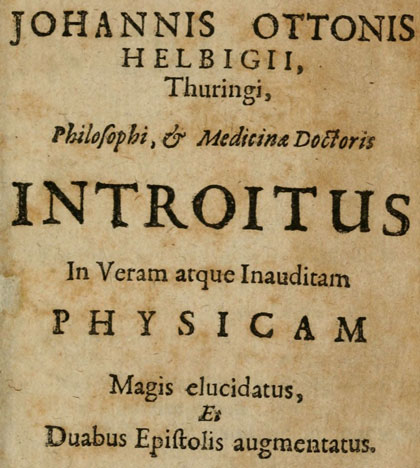
Listen Audio Book Study the Art with Us Buy me CoffeeJohannis Ottonis Helbigii,
Thuringi,
Philosophi, & Medicinae Doctoris
Entrance
into the true and unheard-of
Physics
more fully explained,
and
augmented by two epistles.
The Entrance of Johann Otto Helbig, a Thuringian, philosopher and doctor of medicine, into the true and unheard-of physics, more fully elucidated and enlarged by two epistles.
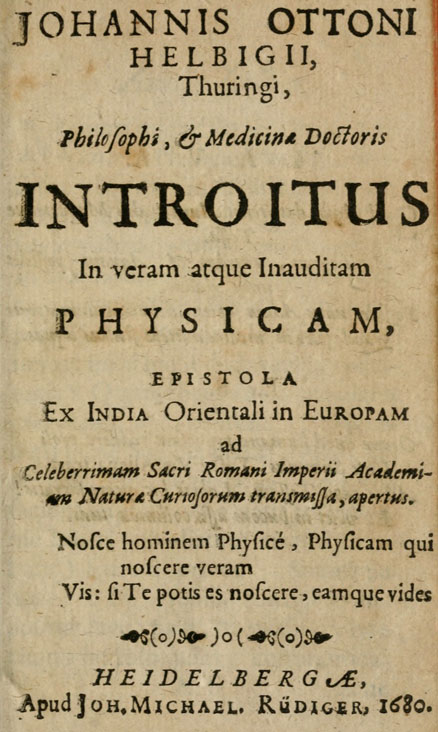
John Otto Helbig,
of Thuringia,
philosopher and doctor of medicine,
An Entrance
into the true and unheard-of
Physics,
an epistle
sent openly from the East Indies into Europe
to the most celebrated Academy of the Curious in Nature
of the Holy Roman Empire.
“Know man physically, you who wish to know true physics;
if you are able to know yourself, you also see it.”
Heidelberg,
printed by Johann Michael Rüdiger, 1680.
I.A.V.A.
Salt gives water; air holds it; and the magnet draws earth.
But one Adam possesses earth, air, and water.
One wise Adam possesses it, but hiddenly and openly,
he who is accustomed to send forth leaping waters into the midst.
E.S.T.
The Most High wills that whatever can render mankind more precious to be brought forth;
an Tessa alien force holds the power of the earth.
Air takes up the earth. Seek here with consecrated lips,
and the white dove desires to fly into your mouths.
Contents:
1. Entrance into the true and unheard-of Physics
2. THE FOREIGN FORCE OF TESSA - A Replying Epistle
3. Epistle to the author of the preceding little book, which is entitled THE FOREIGN FORCE OF TESSA
4. Epistle written at the command of intimate friends to the Brotherhood of the Rosy Cross.
5. Defense of the Entrance into the True and Unheard-of Physics
Translated to English from the book:
Johannis Ottoni Helbigii, Thuringi, philosophi & medicinae doctoris, Introitus in veram atque inauditam physicam : epistola ex India orientali in Europam ad celeberrimam Sacri Romani Imperii Academiam naturae Curiosorum transmissa, apertus
Friendly Reader,
Here you have that entrance into true physics, once sent from India, explained more fully in certain passages. Whether it will suit your palate, or not, matters little. I wrote for the honor of God and for truth useful to one’s neighbor; and I set forth no words which most clear and repeated experience had not spoken to me. Therefore the popular breeze does not stir my mind.
Yet if you read this little book, I ask that you read with no prejudice whatever; otherwise, by doing so, you yourself will be deprived of the desired fruits, and you will rob me of the joy of having brought help to one who was wandering astray.
As soon as, by the grace of God, an end shall have been put to these journeys of mine, and whatever rest is granted to a mind eager for inquiry, I shall communicate of the true and unheard-of physics, as I have promised.
Meanwhile, make use of these present things; and insist upon the track of Jesus Christ, the universal fountain of true wisdom, if you desire to have both the name and the reality of a philosopher.
HELBIGIUS
Entrance
into the true and unheard-of
Physics
It is altogether shameful, most noble Sir, that those who corrupt natural science are either deterred from this royal road, or, having already entered upon it, are held back by greater hindrances than the various opinions of various and famous men.
Each one of these, once he has conceived his own view, although he may afterward discover its falsehoods, strives stubbornly to defend it; and never has any mortal set forth anything so base and hateful to the world, but that it has been surrounded and aided by the praise of some persons.
Of these, ignorance makes one part guiltless; the other part friendship and a fondness for novelty excuse. Hence so many diversities of doctrines and so many wavering principles of physics.
One recognizes five elements: heaven, fire, air, water, and earth. Another, having embraced the latter four, rejects the first. A third swears by air, water, and earth. Not a few also among the moderns have subsisted on water, or on fire. The active and the passive creature are cherished: there are husband and wife; innate heat with radical moisture is touched with the eyes and hands, as they say. Sulphur and Mercury suffice for certain crowds; and very many, with salt added, make up the perfect triad. Acid too and alkali, the newest principles of the newest men, have so possessed their candidates to the end that, with ears and eyes almost deafened and blinded by the force of effervescence and acridity, they are able to perceive nothing beyond their own doctrines.
Innumerable volumes are brought forth, which all, if you take away the offspring of Paracelsus, Helmont, Verulam, Descartes, and a few others from the company, stray from the same string.
So great indeed is the variety of books in which physics revels, that, if one inspects more attentively, everywhere there appear infinite repetitions of the same thing, different methods of treatment, and insinuations already preoccupied by prior invention: at first sight all things seem numerous; but once examination is made, few are found.
Books are enlarged by innumerable commentaries, are reduced into compendia; by these and by explanations men form their own judgments and their own praises; they are translated into foreign tongues; fixed places in the schools are publicly assigned to books by printed editions; and booksellers, gaping for profit, open a thousand other paths for those itching to write, paths which it wearies one to count. So it happens that from such a circulation of controversies nothing else is produced than Cimmerian darknesses and corruptions of philosophy.
These considerations imposed spurs upon me, timidly entering the prisons of physics, so that I might move my feet more briskly, if, swifter and surer than the rest, I should desire to be endowed with the hidden prize of nature.
I began with chemistry; greatly assisted by medicine, I was assisted in practice; and I firmly believed that I was treading the blessed path well.
But vanity of vanities! I was seeking light from darkness, wisdom from the world. I marveled with head uplifted, while, thinking that I lived beyond the hazard of all doubt, I was on the contrary overthrowing everything.
For although my Agent and Patient, my Fire and Water, Sulphur and Mercury, together with their mediators Air and Salt, soothed the ears of my hearers, yet they utterly ensnared and ruinously strangled me myself.
It was useless here to draw creatures, denying themselves to such a leader, by the powers either of rhetoric or of logic. The things were too strong for my principles, as though they mocked their relegation to hidden qualities. At last experience resisted the endeavor of my thoughts, weakened the doctrine, attacked it, overthrew it. The fiction lay there, alas, conquered; and Logic together with Rhetoric, terrified, undertook one inexcusable flight.
Here I was alone and a beggar: robbed by my own possessions, I was repudiating the unjust resources of others. In no place in the world did I perceive any help.
What, then, was the counsel in so desperate a matter?
With most humble prayers I was supplicating heaven. Night and day labor, together with constant exercise of judgment, accompanied an unquiet heart in its inquiry. I was learning to despise worldly things; I was purging my breast of self-love; and I held in burning prayers nothing more than this: to love God above all things, and my neighbor as myself.
Now made more certain that the eternal and universal Agent, the almighty Spirit of God, demands hearts of this kind in which He may dwell, and that He may by the eternal Light of Truth shine upon those darknesses now grown thick.
Falling upon my face before God, I poured out sighs: with tears I made known my weakness, nakedness, and ignorance; and again and again from the inmost depths of my breast I kept asking, until through His infinite mercy He heard me.
And I was illuminated by the light of the Eternal Spirit of the Eternal One, so that, as in a clear mirror, I might discern the true beginning, middle, and end of Nature.
The divine power of the eternal and universal Agent was openly revealed.
I beheld the first, simple, and created matter of all things, watery, continuous in oval form, hanging in its place, and wrapped in the Spirit of God.
That mass, however great it was, was motionless, cold, dark, and empty. But by the divine word FIAT, an efflux of the uncreated Agent was infused, by which the hyle lived and was moved.
First there withdrew a most pure fiery being (which, after time, we may truly call the ethereal soul) and then the highest oval little globe, and also the grossest dregs or lees; of these, the one surrounded Chaos, and the remainder, in the travail of matter (the firmament not yet having been made), served in place of light.
That to be a divine brightness, because of the most beautiful perfection of light, and the true and ineffable glory of the blessed, I turned over in my mind with joyful reflection, this very thing admonishing me.
The lower part, on the contrary, and the condemned dregs of hyle, were so abominable, murky, and dreadful, that neither could the celebrated light penetrate them, nor could the eye behold that spectacle without terror.
When these had been separated, the rest was divided into three parts: namely into the thick, the middle, and the subtle. The thick rushed downward, the subtle flew upward, and the middle and greatest part remained in its own place.
The subtle and upper water was now assigned a dwelling and habitation in the higher regions. The thick substance, still weighed down in the depths by the middle waters, remained at rest. But a further motion and separation caused such a flowing down of the middle water that the thick part, now made visible, settled in the midst of the middle water.
Scarcely had this been done when innumerable forms of herbs, shrubs, and trees, acquiring their due size, powers, flowers, fruits, and seeds, immediately began to come forth.
From the purest light of the upper water were made the two greater luminaries and many of the lesser, which, shining with incomparable brilliance, made the lower and thick water wonder of wonders dry.
The middle region gave forth various animals, rejoicing in the sky above and in the green places below; and especially the four-footed beasts increased the number of living creatures.
Thus at last the whole world though I include much in little abounded, together with the whole triad of waters, in powers and life.
At length the special animal, Man, our prototype, was added, formed from the best juice of the three waters, yet still lacking motion: into whose head, through the nostrils, the Supreme Craftsman afterward breathed something of that shining and eternal water which later I called the soul of the waters from above.
Thus man, the noblest of creatures, formed from the choicest richness of the higher and lower things, thus came to be, thus began life.
Therefore also, full of glory and power, he held a place between the higher and lower realms, so that by both he might be nourished and preserved.
Lastly, the Spirit of God fixed the attractive power the universal magnet as a lock in a certain dark and moist cavern of the upper region.
By its power, from the upper and lower body of the first and inseparable matter, something wholly similar was generated: partly for the greater glory and benefit of man, partly for the perpetual remembrance of the finished creation.
I looked, I approached, and I took from it a portion; eagerly I tested it, and behold, the very same operations returned, compelled by the motion of separation.
Again the Water of Light and of Darkness; the upper, middle, and lower water in which, when I had cleansed them of darkness, I had not neglected the Light, because of its highest subtlety, as being again joinable; and when I had reduced the three separated parts into one dry thing, I beheld with my eyes a new world, regenerated and made clear; being certain that that great blessing of power and glory, bestowed by God upon men, is especially demonstrable from this cavern.
I wondered at the place and the site, captivated, because here there stood before the eyes the thing which the wise seek everywhere.
I was thinking of the silence of Harpocrates, anxious with fear, lest, by opening the mystery to the world, I should be compelled to render an account to the Spirit of God.
Yet, because it was not hidden from me that there were very many upright and faithful men besides, and because I too would gladly, according to the will of the Almighty, give back to them in return from my own gift, for this reason I resolved to disclose briefly to you, most noble sirs, by this epistle to all who pray devoutly together and labor unweariedly the true, simple, and indubitable principle of nature, and moreover the elements, principles, things, and causes hitherto believed by no one else; not at all doubting that this true novelty and new truth will one day come into the keeping of your Academy of Seekers.
But if, contrary to my expectation, I should find hostile minds, which by setting my youth in opposition may be unwilling to hear the beginnings of our undertaking, I care nothing.
In truth, having once recognized it through divine mercy, I shall stand with Truth, and against the whole world of natural philosophers, so long as the spirit rules these limbs, I shall defend it tirelessly and clearly.
Act now, friends, so that you may oppose it not merely with words, with hateful citation of authors mostly obscure to readers, and with barren discourse, but with things weighty and worthy of the seriousness of this doctrine.
Then I shall count it as accepted, and I shall leave no stone unturned in my true and unheard-of physics, both theoretical and practical, to satisfy those who inquire more closely.
Therefore, by the grace of God, I say that the universe descends from one single, simple, and created element, namely viscous water, which, separated by divine motion, displayed myriads of forms.
From this arose the first principles of all later things the most subtle and the grossest, light and darkness, passing over into another condition namely the subtle, the middle, and the gross, commonly called air, water, and earth.
Thus the first matter was not, as the ignorant put it, a confused chaos, but viscous water, which by divine command was separated into subtle, middle, and gross. The subtle and the gross were set in their places above and below, and the middle water, the greatest part, remained in fluidity.
Although no longer any one of the three is viscous, nevertheless all are such that the middle, joined with the subtle and the gross through the ordered motion of nature, always brings back in the production of things the first and only element again namely, viscous water.
Dry water, that is, earth, is after the manner of a most universal magnet, which everywhere and always attracts, contains, and by continuous motion draws not only the fluid thing, that is, water, but also the volatile, that is, air; and this motion, which is present in all three, produces various creatures.
In this motion, or act, air is joined again radically with water; and by the subtlety of the air, only so much of the earth is dissolved into a thick and very tenacious liquor as suffices for generation.
In production, earth gives the body, air the soul, and water the spirit; this spirit then further provides growth and nourishment.
Thus all things proceed from the three waters, which, joined together, exhibit one first, radical, and fruitful Water.
But in such motion and production, again that which from this matter of the three waters, matter namely viscous water is not required for the new and imagined body of nature, is separated: the subtle superfluity becomes subtler air, the middle becomes water, and the gross returns into denser earth. Thus it comes about that neither air, nor water, nor earth is ever diminished by so many generations.
For, even apart from this, it is a principle plainly set forth among sound natural philosophers that earth naturally passes into water, water into air, air through the earth that draws it back into water, and water into earth; and that all produced things in their end again become earth, water, and air, and that not even the smallest part can perish.
For the preservation of the whole universe of things, the most wise Majesty uses circulating Nature, which begins where it ends, which makes the gross subtle and the subtle gross.
For this motion there is no need of burning fire, nor of angels, according to the dreams of some. Rather, His uncreated, eternal, and omnipotent Spirit is the universal Agent: infused heat, fire, light, and power; and also the oft-stirred waters.
The waters can do nothing other than suffer and go where they are led.
Air and earth, in relation to the middle water, are like branches in a tree: parts of the element, not elements. (For that principal, or elemental, water kept for the most part the form of elementary, or viscous, water, except that it was thinner and clearer. Therefore water deserves the name of element more than air and earth.) And easily, both by itself and by art, earth and air are transmuted into flowing water.
Wherefore that philosopher erred greatly through fire because of ignorance of our magnet, when he denied the reduction of air into water. This indeed does not happen through violent condensation or compression of the air, but by the power of the most universal and all-universal Magnet, of the earth and of our TESSA, with a gentle embrace.
The common doctrine concerning the elements is altogether false, imagining air and earth to be entities by nature wholly different and contrary to one another. The much-sung battle of the elements is a fable. They err, who [say that] innate heat, the universal natural Agent, and all things akin to these, are designated by those terms.
They have gone blind who have asserted that fire is an element.
For it corrupts, destroys, and kills. But in the production of a thing, it is fitting that the element be gentle, receptive, and suited for generation not destructive, not exercising tyranny, not deadly.
The chemists indeed by the word fire understand not a blazing and destructive fire, but whatever imagined thing it may be balsam, innate heat, sulphur, center, and acid universally acting, warming, nourishing, digesting, and penetrating into the innermost essences of things. I deny that this is fire in either sense.
The latter, which they adorn with so many names, and because of its excellent power proclaim to be an element, is not an element, nor a kind of first matter, nor fire; but rather the Salt of Nature, the first product of the waters, a second matter.
And the former loses the name of the element of fire on account of its corrosive and destructive acidity; for the element, being gentle, receptive, and fit for generation, is least of all appropriate to it.
We shall therefore treat first of its essence, and afterward of the explanation of the other principles, as they are called.
We define fire, then, as the motion of the preternatural Salt of Nature, which is stirred up either by a vehement external motion of things, or by an internal motion of fermentation, whereby those things grow hot, and its nobler and more mature part of the Water the Salt of Nature is driven into such a fury that, unable to endure confused motion and excessive exaltation, it bursts forth violently, and sometimes like lightning.
I say that this fire is produced from bodies in two ways: by external motion, and by vehement internal motion.
Examples of external motion are: when flint is struck with iron, or stones with stones; among the Europeans; and among our Indians, when the very hard and thick canes called bamboo are vigorously rubbed, they give forth sparks, especially because of the abundance of salt.
It is customary for turners, by means of oak wood hard and fatty, by the violent turning of another piece of wood, to burn it, and thus to produce here and there a blackened charcoal-like surface for ornament’s sake.
From hair made greasy by long-standing sweat, most especially at the illustrious school at Porta, when as a youth I was still applying myself there to letters, I saw sparks fly out when a narrow comb, drawn through the hair by a strong and rapid hand, was used; which at first seemed a marvel to some professors less learned in physics.
Examples of this preternatural motion through fermentation appear when daily in hay, grain, herbs, and other acidifying things, as a certain occurrence shown to us last year from the seaport made clear.
A chief ship, returning from the island of Sumatra laden with pepper, was utterly destroyed by a flame kindled through fermentation from the spices themselves.
The matter of fire, once set in motion, is the Salt of Nature, carried into an excessive preternatural state, exalted too much, degenerated, and made acid and corrosive.
What salt is is shown both by its nature and nourishment, and by its dissolution. It is nourished by fatty and oily things: fatty and oily substances are saline, and by an easy operation the whole substance of any oil distilled can be changed into salt.
Likewise, in the coagulation and dissolution of flames, nothing arises except salt and earth.
Its corrosiveness and acidity are widely evident to the learned. For when it closely touches bodies, it infects their saline and central virtue like a poison, drives it mad, and brings it to the ruin of the whole compound.
But in its use, when the proper manner and interval of place are observed, it brings very great usefulness to man.
Whom God, the greatest Craftsman, made small and like Himself before the world, and also made fire that is, preternatural motion for the aid of human work and art has granted. For he lacks the use of the divine and supernatural Agent, and cannot command it.
By fire we stir up, we move, and we bring waters reduced to a nobler degree. But it is not able to furnish the natural and homogeneous dissolution of things.
And therefore by it we do not attain true knowledge even of Nature, whatever the whole band of chemists may boast.
It does give experience, but one obscure, confused, and filled with false opinions, unless, enlightened by the Spirit of God, we have first truly known the beginning, middle, and end of Nature, and especially the Magnet of the Aerial World and the cavern of our world, the one unique thing.
Once this has been attained, pyrotechnics brings the greatest aid to physics and confirms us in the delight of our labors.
It is not surprising, therefore, that chemists, seeking the principles of things through fire, stray so far from the royal road.
For they seek not simple things, but things altered by violent fire, and by various operations they acquire a form wholly removed from their own.
In the animal and vegetable kingdoms, they call the oily and flammable substance Sulphur, the watery and spirituous substance Mercury, and the dregs, or caput mortuum, Salt.
In minerals, running mercury and burning sulphur are taken as principles; and under all these they wish fire, water, air, and earth to be understood.
But we shall show, by examining this doctrine more clearly and at greater length, that the poor distillers wander as far from heaven as possible.
Sulphur and Mercury are fictitious principles, and in dissolution there is nothing else than Salt and Water, whether I wish to investigate their mineral, animal, or vegetable kingdom.
For the water, spirit, and oil of the former, together with the earth and finally the ashes, with Salt joining them, are turned back into the primitive water.
So also in metals and minerals whose whole substance, by our art, becomes Salt and Water; and by no universal dissolution, nor by dissolution through air, does Mercury or Sulphur come forth from it though these, if they were truly principles, would necessarily have to appear.
But I have found that Mercury, produced by me from animals, minerals, and metals, is either newly generated at that time from the parts of the animal, mineral, metal, and added materials, or else, as something foreign, merely inhering in and adhering to the bodies.
Of the former, putrefaction, tartar, and the vine have produced by far the most; of the latter, the violence of fire.
But from tartar alone, and likewise from salts, direct observation has taught that running mercury can be made; and that what clings to mineral bodies as something foreign is easily separated by fire.
From clay and fatty earths we have learned to produce minerals and metals in diverse ways; these, however, were not there before in actual form, but only potentially, and we obtained them from the conjunction of rich earth with an addition.
At Halle in Saxony, in the house of the most noble and most excellent man, Dr. Johann Sibold, physician and counselor of the most serene August, Archbishop of Magdeburg and Duke of Saxony, and my close friend, in the year 1675, in his presence, I took a mineral of vitriol and sulphur, from Hesse, if memory does not fail me, and, following your Hermetic Baldwin, I subjected the immature Electrum of Paracelsus with curiosity to a calcining fire. When it had been calcined for some hours, I put the powder into a glass vessel, poured over it distilled vinegar in excess, and applied the heat of digestion.
Then after some days there appeared innumerable little granules of running mercury, which played both on the surface of the menstruum and of the mineral, the glass already being warm. But when it had been well cooled, they sought the bottom and withdrew themselves from our sight.
Hence it is sufficiently clear that Mercury was not actually present in the mineral as a principle. For, being most volatile, it would have flown off when the body was being so strongly pressed by the fire of calcination.
Therefore, either it came forth from the mineral alone by a new generation, or it was composed from the conjunction of the salt of the vinegar and the mineral.
I do not add the reasons and causes for this; for whichever of the two you may wish whether it was generated from the mineral alone, or from the addition proves the nonexistence of a mercurial principle.
Let the chemist extract with a true menstruum, without violent fire, by putrefaction, calcination, reverberation, and digestion, running mercury from animals, metals, or other things, just as from the proper mines of mercury, and he will then be a great Apollo. But by nature and by art this is impossible.
Gold and silver themselves are often peacefully dissolved by the air of our magnet, without fire and corrosive; so that by no artisan, unless he be skilled in philosophical art and that with great expenditure of labor and time could they be brought back into metals by a new regeneration.
But truly, besides salt and water, dissolved and putrefied bodies have yielded nothing. Nor does anything from there come before the eyes that I could, with other men, designate by the special name of sulphur.
Although indeed an incombustible tincture, and from the remaining metals and minerals a tincture oily, and sometimes combustible essence, I may have separated; yet by a further labor of motion they all put on the most beautiful garment of Salt.
Therefore all those go astray and teach falsehood as truth who suppose that Mercury and Sulphur inhere radically and actually in the centers of all bodies throughout the universe as soul and spirit.
The minerals themselves, if they dream of vulgar principles if they wish the oils and spirits of bodies to stand for Mercury and Sulphur experience has found that it is Salt.
Today the foundations of the chemists collapse, foundations esteemed for more than a thousand years by uncertain imagination. They perish, and perish justly by way of punishment, because by their deceitful cries they have ruined an innumerable multitude of men and have drawn them away, at first sight all too easily, from the right investigation of nature.
Sulphur has consumed the wealth of many. Running Mercury has made many flee from home and country, and run wretchedly elsewhere.
Now there remains the inquiry into the third, namely Salt.
I do not in the least diminish its glory, force, and virtue; rather, as the truest center of the principles air, water, and earth generated from the whole circumference, I exalt it with the highest praises while I breathe.
In this it is that the wise inquire. Here is Salt, the most noble helper of the true natural philosophers, present in all things. It opens and shuts. It shines in the air; it illumines earth and water with the equal rays of its light. It is the first and the last of Nature’s offspring. O blessed essence of things! O worldly welfare of men, never enough celebrated in the writings of the wise!
Here is that Mercury and Sulphur sought by the chemists: a most pure substance, penetrating, illuminating, and constituting. Yet I do not here mean kitchen salt, sea salt, calcined salt, volatilized salt, or anything else produced by the aid of fire.
But that most noble grain of maturity and excellence belonging to each thing, endowed from the subtlety of the principles as a soul for lower things, we designate by the name SALT OF NATURE.
This primigenial Salt is not corrosive, not sharp, in some things scarcely perceptibly astringent; it is supremely penetrating, illuminating, opening, dissolving, and, when you follow out its process and natural motion, digesting, coagulating, and maturing.
It is not the universal, active, and eternal being which I have called the Will of God and the supernatural but a part of each thing, acquired from the center of the watery triad, and so ennobled and matured through continuous motion that it rightly deserves the title of soul, essence, and SALT OF NATURE.
It is present throughout the whole universe; yet in one place in greater quantity and quality than in another, and the access to it is easier in one thing than in another.
In the three kingdoms of Nature which, setting aside the old and commonplace division of the learned, we set forth as these three: the lower (lying beneath the feet of men), the middle (the animal), and the upper (that which is above us and in which we live) in the lower kingdom it is present sufficiently indeed, but in immature, gross, and impure things it is so enveloped that unless another kingdom helps by removing this wearisome impediment, you could not draw out and display its pure essence in a hundred years, or perhaps ever.
The upper kingdom abounds richly in the most noble thing; yet because of the distance of its place and its inaccessibility, the Most High has given a Magnet, by means of which the Adepts and humble investigators of divine works, from the stars and from all higher things, are able to draw something of Salt and essence and turn it to use.
The middle kingdom, as the most excellent, is thus able to furnish the greatest part of the SALT OF NATURE, drawn both from itself and from the upper and lower realms.
I would indeed wish now to open the whole mystery of Nature in a single word, were not time and place putting a bridle on us. Yet, holding my mouth closed with the finger, I shall indicate in a few words, as far as may be, the chief, nearest, and specific seat of the SALT OF NATURE.
This is in the middle kingdom; I call it THE CAVERN, THE HOUSE OF SADNESS AND OF JOY.
The magnet dwells there, its own magnet, is called Chaos and Hyle, and rejoices in so great a fertility of the SALT OF NATURE as no body in the whole world possesses.
It is looked upon by very many; yet, because of its clammy garment and its lead-colored foulness, it is held cheap, and when cast out is sometimes rejected with disgust. It is obtained with labor, but at no cost. Once acquired, it suffices forever.
The firstborn Salt of Nature, when drawn out from the custody of the Magnet, purified, and applied to another subject, is stirred by the heat of motion and becomes again an agent; that is, it dissolves the baser, crude, and gross part of the transmuted water (for example, metals and minerals, which are transformed by the motion of water), opens for itself a lock of Salt like its own, enters in, and helps that grain of essence to have greater authority over the remainder.
For example, gold, radically dissolved by this Salt acting as a menstruum, is ennobled by the power of this and its own essence which is the same Salt stirred up by the motion of external heat, and is exalted to such a degree that, common maturation in crude earth being surpassed, it produces a seed which, when infused into lesser and less mature metals, advances them by that illumination to the excellence of common gold.
From this Salt there comes the universal Menstruum, the water of Nature centrally coagulated, the Vitriol of the Microcosm, the Mercury of the Philosophers, which so many thousands of men have anxiously sought because of its fertility. And yet up to now it has become known to few.
From this comes the field in which gold serves as seed. From this comes the earth, its soil, which opens the seed, dissolves it, putrefies it, and renders it fit for bringing forth fruit.
By Thy immense grace, merciful God and Father, the matter has not been unknown to me: its Salt, essence, has been known. Known too is the field made double. I beheld the naked white Salt of Nature without impure garments. I saw the field with the seed, and I saw the fruits mighty in power. But this belongs to another matter, not to our present work.
For I myself, although by God’s mercy I possess the rich SALT and KEY OF NATURE, am nevertheless shut out from those golden apples of the Hesperides.
In the preparation of this treasure, first the useless is cast away from the useful, the useful is purified, and it is separated into three parts. Namely, the greater part flies upward and seeks the higher regions; the middle part flows; and the lesser part remains below, as if dead. Until, the residue of filth having been removed, the upper part, through the middle, exalts the lower; and the three united, with gold added, ripen it and endue it with infinite fertility.
And here is, most noble sirs, that Salt which, as the first product or, according to the customary manner of speaking, the second principle I have briefly set forth before you by reason and experience.
At last we shall see in a few words, if you have understood Nature better and more inwardly, and likewise our new physics, what judgment is to be made concerning acid and alkali, those things which by their effervescence and acrimony have troubled the whole choir of the learned.
But I shall begin with the following experiment:
Having understood and received, by the grace of God, the SALT OF NATURE, I exercised it in marvelous ways: not only so that I might acquire those things of which the ancients made mention, but also so that new things, and things hitherto unheard of because of the ignorance of very many, might become known to me.
In it I variously reversed the due stages of Nature; I handled the simple and the compound together with other things; until at length, in one operation, from the simple SALT OF NATURE I first received an acidic matter only, then afterward an igneous, corrosive, and destructive one.
Greatly astonished at this, I pursued the inquiry with further labor, and the hidden alkaline mass also came into view. When these two had been separated and purified separately for a small portion of the purest SALT OF NATURE had, through the degeneration described above, passed over into earthy dregs I joined them together again, and, the weight of the former particle having been lost, I perceived a nobler Salt than before.
This, and other experiments like it, taught me that acid and alkali are not principles, but degenerate entities of Nature; and that the SALT OF NATURE, hindered in its motions and stages, or else accelerated too much, degenerates more or less and is divided into two preternatural things, namely alkali and acid. These, when purified and reunited by our art, restore one single regenerated body.
But Tachenius, though curious in other matters, was ignorant of this very experiment, because it proceeded from the obscurity of our magnet and of the Salt of Nature.
For in the whole universe of waters there is no body, except the magnet of our cavern, from which a man can draw forth the true, simple, and unchanged SALT OF NATURE, without preternatural separation into acid and alkali.
All other bodies, whatever are born, refuse to do this same thing, unless, by the violence of fire, they are compelled to cast out what lies hidden under the form of acid and alkali.
The SALT OF NATURE, by divine ordinance, passes into the gross and the subtle; in the latter it becomes acid; in the former, alkali has its seat. Both are wretched and broken, and can be healed by no means other than a radical reunion.
Hence, when one is mixed with the other, there is so great an appetite for coming together that, as if maddened, they penetrate their crude shells and embrace one another mutually. In this act the still crude watery shell, sometimes because of excessive motion and compression, necessarily boils up and takes on another form. And so acid and alkali, degenerate entities and wanderers from the ordinary ways of Nature, pass back into the royal road and into a better body.
The preternatural character of acid became evident to me by the following experiment: I dissolved silver in the SALT OF NATURE and committed it to heat in a well-sealed glass, believing that from it there would emerge a metal far more perfect, nobler, and regenerated; but, because the thing was not well observed, the SALT OF NATURE together with the silver degenerated into a certain mineral acid, sulphureous, and never before seen by me.
From iron, a magnet; from lead, a mineral not unlike antimony; and from these and other things I produced running mercury and vitriol, such as is common.
All minerals, the lower metals, even lead together with mineral dregs, and also many vegetable things, are found to be acidic; and all these are either immature or degenerate.
Medical practice has always shown me that all diseases are acidic, all wounds acidic; against these I employ, from particular remedies, fixed and volatile alkalis, as the one true panacea, for aid.
Even to surgeons most of whom have scarcely looked upon the gates of Nature it is made clear by obscure reasoning through experience that acidic wounds must be treated with fatty, oily, and gummy things, whenever they wish to heal them successfully and fill their purses.
My mind urges me here bitterly to touch upon the inexcusable error of physicians: physicians, gentlemen, who prescribe syrups, crude herbs dried over a long time, their decoctions, powders, and many infusions in a thousand ways, and by ingenious method prepare them, and give them to the sick who often suffer more from the nausea than from the disease itself in the hope of recovering health.
What, pray, does a pound of an herb lose of its virtue by being boiled? What dregs remain in the sugar? What does the infusion yield? When, even by the best art of the chemists and by the true dissolution of bodies, we can scarcely draw out a very little of the radical Salt, in which alone the virtue of things resides. Do they not sell dregs for wine, bark for the kernel, vice for virtue? Do they not thus defraud the miserable crowd of sick people who so greatly beg for help? What is thrown away would certainly profit much more if it were retained.
Why then do they not prepare Salt, oil, and spirit, the phlegms having been removed, in place of syrups, decoctions, and infusions? Why do they not compound them into one most efficacious body? Three grains of a concentrated medicine of this kind exert more power in healing than a pound of powdered herbs.
There is no need of a pharmacopoeia, nor of so great a stock of medicaments. The most excellent art of healing consists in a few rules and a few remedies.
The humors are long since laughed out of court by sensible men; laughable too are the complexions, laughable the temperaments, laughable the hundred other childish notions of certain physicians. There is but one disease, and one antidote.
But enough of this. For our reformed medicine, if it please God, will in due time open things which until now have lain hidden under the dust of the earth.
For the present I have chiefly endeavored to prove that acid and alkali are not principles, but rather degenerate Salt of Nature, and something separated preternaturally from it.
A fuller account of Nature and of this doctrine, and the very experience itself, my unheard-of physics, both theoretical and practical, which is soon to be communicated to the European world, will present with the clearest demonstrations.
Beyond these matters, out of love for one’s neighbor, we append an unknown arcanum concerning salt, that very thing, namely, most desirable to all cultivators of chemistry and medicine: the true and gentle volatilization of the graver and calcined salts.
Where it should briefly be noted that no salt in Nature is naturally fixed, but that every salt is volatile in a certain degree, and that what we possess as fixed has been excessively dried, burned, and mortified by the fire of calcination.
Therefore let what has been lost be restored, and let what has been corrupted be set right by air, according to the following universal method:
Take salt, calcined or naturally heavy; dissolve it in water; soak a new unglazed earthen pot to saturation with the weak lye; and, by evaporating the water over the fire, separate the salt joined with it. Thus the fixed salt enters into the pores of the pot; and the pot, being exposed to the air, is corrected by the air, so that it comes out from the vessel and, volatilized like wool, clings to the outer surface of the pot. When this has been scraped off, it is sublimed by a few operations.
Or by a particular method:
Take calcined salt of tartar, as much as you wish; pour on distilled vinegar of wine; place it in digestion, until all the salt is dissolved in the vinegar.
Then digest the vinegar with the dissolved salt by the philosophical month (40 days); after the digestion, draw off the vinegar, and then at the bottom a crystalline salt will be left, almost transparent. Sweeten it, dissolve it in distilled rainwater, and by filtering it again and again cleanse it of its feces, so that you may obtain a salt exceedingly clear and very white, from which by repeated cohobation in a B.V. distill the S.V. from the phlegms by experiment. Digest again for a month with S.V. Finally, by a stronger heat of sand, the S.V. having first been removed, it is sublimed; and you will behold, with pleasant eyes, the volatile salt of tartar clinging to the sides of the glass.
Or by an easier way:
Take 1 pound of common yellow sulphur; half a pound of salt of tartar, or of another calcined salt; let the former melt over a gentle fire in an earthen pan; let the latter, reduced to the finest powder, be added, always stirring with a wooden spatula in the flowing sulphur, and let it be heated over coals until the mass, or hepar, acquires the tenacity of pitch. Pour the mass into a wooden vessel slightly moistened, and while it is still hot pound it in a warm mortar, crush it, and add a sufficient quantity of spirit of wine so that in the glass the spirit stands above the material by the breadth of two fingers which will soon extract the tincture of sulphur. Draw this off; and from the tincture and ashes, treated with a strong fire, you will in a few hours obtain the Salt of Tartar, corrected by the acidic salt of sulphur and made volatile.
Elsewhere, being a friend to brevity, I pass over other methods.
In the meantime, make happy use of the secrets revealed to you; and with open brow receive from a friend this entrance into the mysteries of Nature.
To this, resting upon a new foundation, apply your own meditations and experiments. I am quite certain that thus you will arrive far more quickly and easily at the hidden arcana of Nature.
Once more I repeat: viscous water is the simple and unique element of all things; the true, sole, and undoubted principles are air, water, and earth. Yet even so, this triad of principles can produce absolutely nothing unless in unity. From the element there is produced from the principles the firstborn or the center, is Salt; whose body, so to speak, is found more in earth, whose spirit more in water, and whose soul more in air. Into a thousand forms Salt can be transmuted, provided the stages of Nature’s motion are observed.
Do not seek this Salt of metals, vegetables, and animals anywhere other than in the air; in the air, I say, which circles about our heads.
God gives the Magnet, by which it is most easily attracted, freely and in its crude state; and He grants it to be known by those who seek the principle of Wisdom in love and fear of the Three-in-One Majesty.
Our magnet is animal, vegetable, and mineral: it is not earth, dew, mist, rain, flint, nitre, mercury, salt, a mineral, or a metal; nor the excrement of animals, however much these things may be worked upon by the most experienced men with skill and art. But it is, through the true God, THE FOREIGN FORCE OF OUR TESSA.
The mere and childish opinions concerning the spirit of the world are set forth in your appended miscellanies.
The writings of Nuysement and Nietner are erroneous. A false magnet, by which even Hermes Trismegistus himself is by no means to be envied (as he is commonly held), is glorified in the treatise On the Gold of Aura.
Whoever he may be, he lies the author of Semiramis’ Tomb, which, had I wished to seal it with columns, not as Cyrus, ambitious and greedy, but as a philosopher with mature judgment, weary of the dreams and frauds of theorists, and finding them in no way sufficient for a philosopher, I might have had completed.
With face, I swear, suffused with shame, that college of men of such great fame and authority, by mixing into their writings the trifling notes of certain curious persons, scenic falsehoods, and useless conjectures, and by raising them to heaven with praise, committed a deplorable deed.
Moreover, you understand the second epistle according to the true literal sense, not tropically or enigmatically; nor do you have my meaning obscure and shadowed. I call a spade a spade; and what I wished to say openly, I have said plainly; what I preferred to keep silent, I have preferred to keep silent.
Greatly entreated for the sake of many friends some of whom are great lights of Germany I have written these matters in a humble style.
At length, to all of you, most noble sirs, but especially to those most renowned members of the Academy of the Curious, Mr. Dr. Volckamer, chief physician of the republic of Nuremberg; Mr. Dr. Franco, professor at Heidelberg, my dearest friends; and Mr. Dr. Wedel, professor at Jena and chief physician to the most serene dukes of Saxe-Gotha and Saxe-Weimar, my kinsman I impart my greetings most courteously, and conclude with the following saying:
That I do not judge it insulting to disagree with any author, however great or ancient; and thus it would not trouble me if anyone should disagree with me, provided he teaches what is more correct, even if he be an unlearned man.
From the Museum of Batavia, on the island of Great Java in the East Indies, at the end of the year 1678.
To the most celebrated Academy,
your devoted admirer,
HELBIGIUS
FINIS.
THE FOREIGN FORCE
OF TESSA.
or
A Replying Epistle,
commenting hermetically and explaining
the same things
contained in the Helbigian writing entitled
An Entrance into the True and Unheard-of Physics,
first published at Batavia in the East Indies in the year 1678,
and afterward indeed printed at Hamburg in the present year,
containing the words
of BARTH,
now at HEIDELBERG,
printed by Samuel Ammon,
in the year 1680.
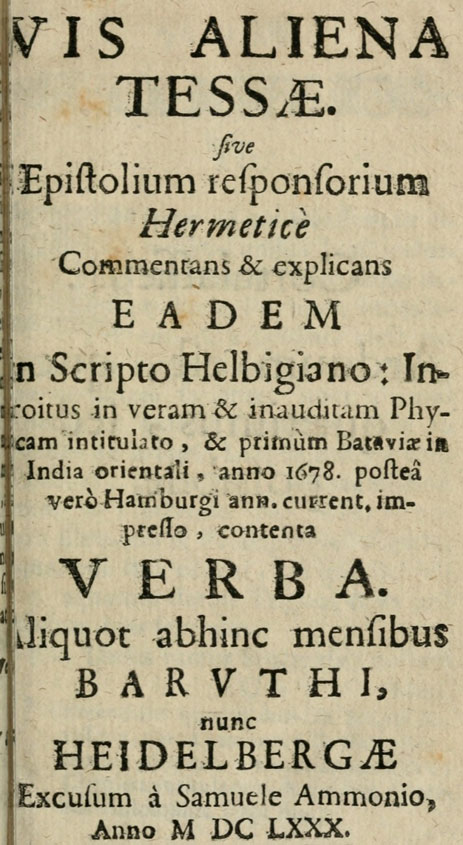
The Foreign Force of Tessa, or a reply-epistle, commenting on and explaining in a Hermetic manner the same matters contained in Helbig’s work entitled An Entrance into the True and Unheard-of Physics, first issued at Batavia in the East Indies in 1678, and later printed at Hamburg in the present year; containing the words of Barth, now at Heidelberg, printed by Samuel Ammon, 1680.
Cortalassæus:
What we seek is difficult, but possible.
The little treatise transcribed and sent to me some months ago, entitled An Entrance into the True and Unheard-of Physics, and published by Doctor Helbig, affected me with no small joy, making me more certain that some new Adept had arisen, and indeed one approaching my own opinion on the point of the matter of the Stone, and on other similar things.
For just as in my own little treatise I have taught sufficiently what that matter is, as well as the philosophical elements and principles, so likewise Doctor Helbig himself establishes a triad of waters, and from one separated he makes the remaining two.
(foot note: Those two very recent writings also agree: one namely published by Mr. Gothofredus Moebius; the other entitled Cabala Chymica; and indeed if they be taken in the highest philosophical sense.)
§ 2. We are of one opinion: certainly that the Spirit of the World is or was anything other than wind and air, nor that it is a confused Chaos, and likewise in other similar matters, as I have said.
§ 3. But I cannot accept the opinion concerning the elements, namely that water alone is the one element, while air and earth are only parts of the same; nor even that fire is at least a supernatural motion.
For air, although it may be the most subtle water, as Helbig himself maintains, is nevertheless the principle of the stars, the sun, the moon, and the constellations. And earth is the true principle, and respectively the generative source, of all animals, vegetables, and minerals; therefore they are elements.
Nor does it matter that the other two have been separated and produced from water, since man also is born and generated from man, and yet he does not become merely a part of man, but is equally made and called a man, just like the one from whom he was born and generated.
That fire exists in stones, iron, steel, etc., the example brought forward by Helbig himself teaches and demonstrates; otherwise it would by no means arise from the striking together of one and another, by no means strike it out; whereby it is sufficiently proved that fire lies hidden in the elements, since such minerals are generated from them, and especially from water. And it is plainly established that every end corresponds to its principle. Mariners too observe this when waves of the sea strike against the ship and by night appear like hoarfrost; from this they judge that fire is in the water.
§ 4. Dr. Helbig denies that the philosophical principle which they call sulphur is an element, a kind of first matter, fire, etc. Yet he expressly professes that it is the Salt of Nature. But what else is this Salt here than water altered by art into the form of fire? Therefore it is an element; and, as the universal fire of Nature strengthening, preserving, and digesting, it is rightly also called the form of the stone, because it gives form to it and imparts to it the power of tinging. Hence: Our stone does not tinge unless it be tinged.
§ 5. A distinction must indeed be made between the element and the elemented thing, between universal and particular fire; yet neither of them is at least a supernatural motion, but by a motion either natural or supernatural they are led into act and effect, so that they appear visibly and flame forth, etc.
§ 6. Moreover, why, I ask, is only one element posited, when the very wisdom of Solomon, and other sacred writings as well, establish and approve a plurality of elements? Wherefore I have judged it more useful for the Hermetic Republic to retain and at the same time explain the terms and at times the metaphors of the philosophers, than to invent new things and more obscure ones.
§ 7. I myself do not believe Nuysement’s opinion to be true in certain points, as appears from what has been said above and likewise from my own little treatise; yet I do not think that his writings, being learned and ingenious, ought to be wholly rejected. Rather, to them and also to those of Bernhard, Count Trevisan, Antonius de Abbatia, Kelley, Hollandus, and others I owe this praise: that from them, both in theory and in practice, I perceived no small amount of light. For by searching those writings and noting, among other things, the names of antimony, vitriol, mercury, moon, sun, fire, sulphur, etc., and likewise by observing in practice the forms of the said minerals and metals, and in medicine attending to the effects described by the authors, I judged that I had advanced by the royal road, where otherwise I might perhaps have known neither defect nor progress.
And I say what is most true: I have never found the true philosophers to disagree in the foundations of the art, although they differ in terms terms which they nevertheless often use only comparatively and entertain various opinions in secondary matters.
But above all, those who have written in this age wish by the Spirit of the World as is known even to any beginner to indicate the universal matter and that of the Stone. And our author himself teaches that the animal, vegetable, and mineral salt that is, the universal salt must be sought in the air.
In the air, I say, which is sometimes called by the philosophers the earth flying above our heads, the container being taken for the thing contained.
Finally, I say nothing of the fact that our already-cited author, though singular in his own way, has borrowed the term Magnet from the sayings of the philosophers, among others.
§ 8. These things having been premised which indeed have grown beyond my intention, and thus perhaps are useless and superfluous, since you understand sufficiently the terms and metaphors of the philosophers, and since in Hermetic philosophy it is not the words nor the syllables, but the sense and the things, that must be observed and considered let us come to the aim and the matter itself.
Therefore, as to those words contained in Helbig’s writing, namely TESSA and vis aliena TESSÆ, and what concerns them: first, when the very learned P.H.G.D.M.O., distinguished especially by his knowledge of many languages, above all Eastern ones, was asked by me on this point, he replied that the word TESSA in Arabic means “he has hidden”, and indeed can mean nothing else than the highest Arcanum, or that philosophical principle spoken of above, which is also called sea, sun, oil, etc. Theophrastus teaches that it is of great power and the true Spirit of Salt; with which Helbig himself agrees, when he professes, as was said above, that this principle is the Salt of Nature.
Moreover, by this word TESSA he seems to signify that earth of which mention was made above, as the following words indicate, namely:
THE FOREIGN FORCE
OF TESSA
§ 9. But that this [as a second thing] also denotes the philosophical principle, and indeed the key of the art, I gather among other things from these words of Helbig, when he says:
Our magnet is animal, vegetable, and mineral: not earth, rain, flint, nitre, mercury, salt, a mineral, or a metal; not vegetable, not the excrement of animals, however much they may be worked upon even by the most experienced men with skill and art but it is, through the true God, the foreign force of our Tessa. And these two principles together with the earth (the philosophical earth) constitute the whole and perfect triad, and through their conjunction the Stone itself.
All these things are confirmed by Helbig’s own discussion concerning the reduction of air into water, in the following words:
“Wherefore that philosopher erred greatly through fire because of ignorance of our Magnet, when he denied the reduction of air into water. This indeed does not happen through violent condensation or compression of it, but by the power of the most universal Magnet, of the Earth and of our Tessa, with a gentle embrace,” etc.
To this also belongs the following ancient philosophical saying:
“The woman binds the man, and the man binds the woman, and from both of them grows a son who is not like his parents.”
And likewise that saying of the African (cited by the son of Sendivogius):
“We must join two things, when the philosophers have compared conjunction to marriage, from whose embrace there results the golden water.”
§ 11. And indeed this water is the best medicine of all though of the second order namely the Salt of Nature, which is perfected from Salt, through Salt, and with Salt. Yet the medicine of the third order, which alone truly and repeatedly tinges as I briefly noted in my little treatise, and as that most subtle Geber affirms is nothing other than Salt.
§ 12. I believe, however, that Helbig, by the invention of these terms and expressions, wished to show what sort of philosopher he was; by no means thinking that for this reason he ought to be blamed, since he has treated our subject and its perfection not only in the passage already cited, but also elsewhere, with sufficient aptness, clarity, and force though he does not deny that these things may be difficult for many to understand.
§ 13. Therefore that saying of Theophrastus seems not to be false:
“To whom God gives the grace to know this arcanum,
to him He also gives the grace to conceal it.”
§ 14. As for the other matters, and especially those which he brings forward concerning creation and the soul, these in turn do not belong to my present purpose; since in my own writing they seem contrary, I refer the reader to that writing and to my little treatise, trusting that in these points, as in others, I have written the truth, and that Holy Scripture stands in support of my opinion.
Yet I do not at all intend, either in these matters or in those mentioned above, to reproach Dr. Helbig, whom rather I honor as a Hermetic philosopher and a true possessor of that arcanum.
I rejoice no less, however, that we have been born in Europe and in our Germany by the grace of God, and that we have not had to await that truth from India.
But finally, as I said above, although all philosophers wish by the Spirit of the World to indicate the universal matter and that of the Stone, still, to speak the truth, I cannot approve Helbig’s discourse on this matter appended at the end of his epistle.
As regards the treatise of Nuysement, I have already set forth my judgment above. And although, in the way it is spoken of by Nietner and Balduinus, the Spirit of the World is not the true universal matter and matter of the Stone, yet it is an arcanum of Nature. Wherefore I do not think that their writings though in prejudice against other graver men ought to be wholly despised, nor that they should be called shameless lies. Besides, it does not become a philosopher to assail one who errs with injury, but rather to help him.
These are the things which, for the satisfying of your desire, I wished, could, and ought at this time to comment upon very briefly concerning the words of Helbig cited above. Farewell, etc.
In the month of February, 1680.
The candid author of the Philosophy of the Phoenix.
Let no space be left empty; for the confirmation and explanation of those things which have been said and cited above concerning the conjunction and perfection of the Stone, we have thought fit to append the following.
As regards our conjunction, there is a twofold manner of joining: one moist, the other dry. And just as the male seed is at once and in one act cast into the womb, and is there shut up in a moment until the bringing forth and birth of the fruit, so also the matter must proceed in our work: in it we join two waters, the sulphur of gold, and likewise its mercury, soul and body, sun and moon, male and female, two seeds, two quicksilvers; from these is made the living Mercury, and from that the Philosophers’ Stone.
for receiving its moisture,
then at once you take the spirit, the soul,
and the life,
and bring them into this earth.
For what is earth without seed?
And what is a body deprived of soul?
Therefore observe and take note:
Mercury is brought back
into its mother from which it came;
cast it back into the same, and it will be convenient for you.
The seed will dissolve the earth,
and the earth will coagulate the seed.
There follows the Process
Written indeed in imitation of the philosophers, though its key can be easily understood not only from the preceding epistle, but especially from the often-mentioned little treatise.
Take:
Virgin Mercury
Native cinnabar
in the proportion of one part to two,
or three to four.
Mix them, and place them in a closed vessel in the athanor.
Cook with a gentle fire until the peacock’s tail appears.
Take:
Mercury of antimony
Oil of vitriol
Cook, grind, and sublime, until
the upper becomes like the lower,
and the lower like the upper.
Soli Deo Gloria!
Glory to God alone!
J. O. Helbig’s
Epistle
to the author of the preceding little book,
which is entitled
THE FOREIGN FORCE
OF TESSA,
Mr. W. F. I. Con. B.
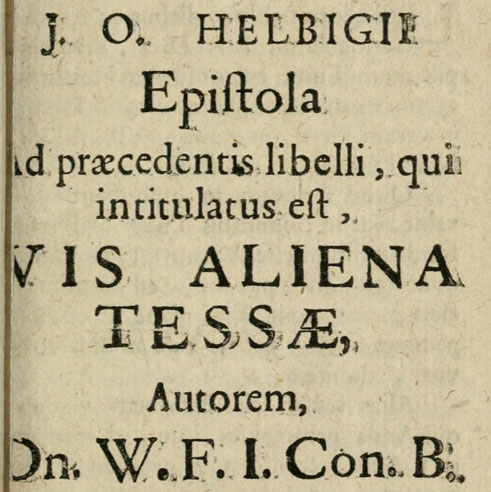
The Epistle of J. O. Helbig to the author of the preceding little book entitled The Foreign Force of Tessa, Mr. W. F. I. Con. B.
Dn. W.F.I. Con. B.
Most noble and most distinguished sir,
A few days ago, having returned, thanks be to God, from Africa into Germany, I received your reply-epistle, commenting hermetically and explaining my words in the Entrance into the True Physics: THE FOREIGN FORCE OF OUR TESSA.
That writing pleased me greatly in certain respects; especially because you hold that water is the foundation in physics. That knowledge has so far fallen to but few. But whether the first and elemental water is plainly known to you, I much doubt, unless perhaps through your favor toward me.
Otherwise perhaps you may have seen that circulation by which the principal water, or elemental water, together with air and earth, always comes together in Nature into the first and elemental water (viscous water) for the production of things especially of the apples of the Hesperides; and that the element itself again passes into three principles by ordered motion.
I grant you the airy principle of the stars, the air [as principle] of the stars, and water and earth [as principles] of animals, vegetables, and minerals.
I grant you the airy principle of the stars, and water and earth as the principle of animals, vegetables, and minerals. But since they were separated from viscous water, or because viscous water in that [first state] passed into them by the motion of the divine light, they cannot, since they ought to be called the offspring of the earlier created matter, be called elements, but only principles, or secondary principles.
But generation can be compared very fittingly the generation of man from the viscous seed of man can be compared with the generation of the Salt of Nature from the viscous seed of the principles. Concerning that Salt, however, perhaps there is no disagreement between us.
The same: In stones, iron, etc.
A distinction must be made between potential fire and actual fire. Your words referred to the potential, mine to the actual. And that a potency toward fire, or potential fire, inheres in all creatures, I by no means wished to deny. Yet this must be observed, that such a potency toward fire never comes into act except by motion, and indeed by violent motion, which is preternatural. Here there is nothing further to reject or to explain more fully.
The cause of the sparkling sea around a ship, which I have seen more than a thousand times, is the violent motion of Salt in the foaming brine, and the effervescing motion stirred up by the ship’s course pressing too much; whereby the lower part of the ship, and sometimes the water itself touching the ship, become warm.
§. 4. Altered matter is not the same as it was before alteration. For alteration gives another form. And therefore the altered thing, together with the prior form, first also loses the prior name loses it. For example, an herb, which consists of altered water, can no longer bear the name of water.
The word supernatural concerning fire, which you say I used in citing my passages when I should have said preternatural, is perhaps a printer’s error; therefore it should be disregarded.
§. 6. Moreover, why, I ask, etc. As regards Holy Scripture, I do not think it was given to us for demonstrating the foundations of physics. And therefore I plainly do not wish my proofs of doctrine in natural things to be taken from it. Yet since you bring forward the book of Wisdom proposing a plurality of elements, and likewise other unnamed places of the Bible, we shall presently see whether there is anything in them that agrees more with you than with me.
It will, however, have to be sought from the Greek text, where in Wisdom 7:18 there is read ἐνέργεια στοιχείων, which in the Latin sounding version is commonly rendered the power, or effective force, of the elements. But what exactly the word στοιχείων signifies is still in dispute among many. Aristotle, Metaphysics, book 5 Metaphysics, book 5, the whole third chapter, when unfolding this word, says that στοιχεῖον (element, first part, basic constituent) can also be called that which is one, and small or very small, and yet useful for many things.
In Budæus, στοιχεῖα (elements, separated parts) are divided or separated parts. And the Syriac interpreter at Wisdom 7:18 renders ἐνεργειῶν στοιχείων (the workings/powers of the elements) as the power of the heavenly spheres. In the Greek Testament στοιχείων (of the elements / rudiments) is read seven times; five times it is explained as rudiment, element, beginning. Twice, namely in the later Epistle of Peter, chapter 3, it is taken variously and distinguished from heaven and earth. Among the Septuagint interpreters it occurs nowhere else.
But if we look back to the origin, we shall perhaps trace its signification to στοῖχος (row, rank, order, sequence). Thus, by analogy of termination, it seems to denote that in which, or from which, an ordered progression begins, or an ordered progression itself. The exact force of this word cannot be expressed more precisely, although the primitive root and termination is from εἶον (going, proceeding), whence it is derived.
If therefore we believe Budæus, and στοιχεῖα (elements, parts) are things separated or divided, what more is needed? Would not the thing divided or separated be the viscous water, Chaos, or Element? Of these στοιχεῖα (elements / parts) air, water, and earth come into being after separation; and from the conjunction of these στοιχείων (elements / parts) the thing again appears in unity, such as it was before separation, which before such conjunction had been divided into parts.
If we follow Aristotle teaching that στοιχεῖον (element, basic constituent) is also said of that which is one and small, or very small, and yet useful for many things, it accords well with my opinion. For each one of the στοιχείοις (elements / constituents) air, water, earth is indeed small; but in its one and simple essence it is small, or very little, ἐνεργείας ἕνεκα (for the sake of efficacy / by reason of its power). For in Nature, air alone, water alone, or earth alone is able to produce nothing sensitive or vegetative. But one joined in due order with the other two is at once useful for many things, indeed for all things. What the Syriac interpreter means when he renders στοιχεῖα (elements) as the heavenly spheres whether by these he understands the planets or something else, and why Peter also distinguished στοιχεῖα (elements) from heaven and earth, I do not inquire here. And the analogical signification, that in which, or from which, there is an ordered progression, or an ordered progression itself, strongly supports my doctrine.
For before the separation of the viscous water, the first matter, or element, there was not present in nature its ordered progression or ordered progress. It truly began only after the separation of the element into three principles, in relation to the viscous water, the element, and the principling principle after the principles, or the principled principles; or, to speak better, after the ἀποκάλυψιν (unveiling, revelation) of elemental unity in the natural trinity, in the principles, or from the principles, air, water, and earth. And this order still remains in those very things, if united in threefold unity, for the producing of myriads of forms, as they proceed continually and orderly.
I do not think any other mystery lies hidden in this word. And although, according to common usage simply for rudiment, beginning, and principle; yet this does not oppose me. For I too have imposed, and now impose, on air, water, and earth the name of principles, or στοιχεῖα (elements). But because all creatures are or are produced from viscosity, or from viscous water, and are again resolved by nature and art into it, viscous water, or the viscosity of water, is always separated, and is separated into three air, water, and earth in that viscous water, in which the three often-mentioned principles potentially always exist and never do not exist; and because it is that alone from which they alone come forth, I have wished to designate that alone by the name of Element.
Not that I have any quarrel, or am eager to dispute, about words; rather I have only exhibited a greater and clearer distinction in the use of terms between obscure matter and revealed matter. But whereas you yourself think that the first matter of creation was water, and that from this all the rest were produced (see your Philosophia Phoenicis, theoretical part 2), it will truly be the same to me whether you wish to adorn air and earth with the name of element, or principle, or by some other word. Provided only that this often-repeated point be granted you: that viscous water is the matter of air, water, and earth, from which or A-quâ. From what has been said, therefore, about the word στοιχεῖον (element) and the places of sacred Scripture, you will see plainly enough that they are neither witnesses for our doctrines in natural things, nor, even if they were, could they destroy that which I have wished to advance concerning the unity of the element and the trinity of the principles from the element.
§ 8. You have not touched the sense of TESSA and of the foreign force of our TESSA with a sharp needle. For you would have found something else, if you had read through my little treatise many times and without prejudice. Yet I do not reject your opinion and explanation, certainly in one respect learned and excellent.
§ 14. It does not become a philosopher to assail one who errs with injury, etc. Here you rebuke me because of an injury, as though thoughtlessly brought against one who errs. But where, and whom, my friend, have I injured? Certainly your words have grieved me.
Because I am a lover of Truth, free from slanders and private interests, I solemnly declare that I have set myself this end before the learned. But as for the fact that I called the writings of certain men lies, and that the diligence of the inquisitive collectors of the curious German college, displeasing both to those colleges and to me, moved me, there were weighty causes. And the expression, which seems harsh, flowed forth from the too great ardor stirred up by love and knowledge of the truth; and I can scarcely believe that one illumined by the clear light of truth could wholly avoid it.
If we are to act according to that harshness which is assumed, not granted the great number of learned men would sin by softness, and would refuse to speak the truth, which they are more often convinced of. For men are too greatly esteemed, too greatly feared; and by this the race of such men is sometimes withdrawn from the best course, and it is asked of one to conceal the side of Truth, and of another, of men of standing publicly contradicting the Truth, to maintain the favor of the crowd. But this rule of state, though common among many of our most weighty men, must be rejected by me. By practicing dissimulation and concealing the truth, to preserve peace is dishonorable, and destructive to conscience. Naked truth is best set forth in such a way that anyone may be able to look upon it. Such was the passion of my mind in writing: a private passion of fiery love for the truth, which all worthy men do not disdain.
And you too, because in your judgment of injuries you have too rashly accused me, confess that Nuysement, Balduinus, and the author of the Tomb of Semiramis did something of this kind: that, to use common speech, they presented a particular arcanum of Nature, or a particular spirit of the world, as if it were the universal mystery and spirit of the philosophers. If therefore they are not such as they wish to be thought; if they speak otherwise than they think; if finally they teach what they do not know, do they not deceive their neighbor? should they not deservedly be marked with the brand of liars, that they may more easily be avoided?
Moreover, when writers refuse to hear the Truth from another, it is necessary that they themselves speak the Truth. Otherwise men are well known to be wandering, who, casting away pride, hate error more bitterly than the devil, and sincerely profess to help according to their ability, and I have always been, and still am, most ready to do so.
At length, most honored sir, although while commenting you have not, I think, fully grasped the goal I set before you, yet since strength fails, even a commendable will is to be praised. And so, with a sincere mind, I give you the greatest and most due thanks, that you were willing to deem my writing worthy of your labor, and I again offer myself, and the good will of my friends, to you with my whole heart for every office of kindness.
The grace and charity of our Lord Jesus Christ be with us. Amen.
The 18th day of November, 1680.
HELBIGIUS.
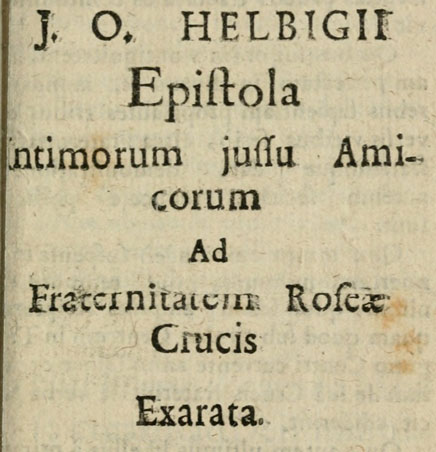
J. O. Helbig’s
Epistle
written at the command
of intimate friends
to the
Brotherhood of the Rosy Cross.
Written out.
Among other writings of this fruitful age, many years ago a certain Brotherhood of the Rosy Cross communicated to the curious world a few little treatises.
In these they professed the antiquity of their order and the perfect wisdom they displayed in divine and worldly matters through three different voices, and, by a clear demonstration given of the fraternity and the brethren, promised to bring back the golden age.
Yet all these things afterward hung so much in suspense that in so long a time they wrote nothing further, so far as I know, except that which, under the title Centrum in Trigono Centri currente, printed at Ulm, they published from the words of their Brotherhood of the Cross.
But since the last little book differs greatly from the first letters, a certain unknown college of curious and humble investigators of true Nature has only now, as was fitting and allowed, begun to entertain a doubt concerning the Brethren of the Rosy Cross to seek out, if they are able, and to test their spirit in Christian charity.
Therefore to me, their friend, they ordered that a letter, in which several weighty questions were written, be sent to them through the press. Which task I gladly undertook, and wished to append the following to my former little book:
You, Brethren of the Rosy Cross, if you are in the world, and such as you wish to be thought, for the hidden God and the living gold, deign to answer candidly and kindly, for my friends and for me, the following questions:
1. Why is man said by Moses to have been created in the likeness and image of God?
2. Why did God breathe into man through the nostrils the breath of lives?
3. Why did God say that it was not good for man to be alone, and yet after the removal of that not-good solitude the condition of Adam’s posterity became by far the worst?
4. Where is the most precious and the vilest water found?
5. Where is the most precious and the vilest air?
6. Where is the most precious and the vilest earth?
7. What is the most grievous disease?
How does it come to be?
What, and from where, is the best medicine?
8. What does this chemical sign, ▽ Water, signify in Kabbalah?
What does this chemical sign, ⊖ Salt, wish to declare in Kabbalah?
How is this sign of chemistry, ☿ Mercury, explained through Kabbalah?
We desire a truly clearer solution of these twelve questions, such as humble possessors of TESSA understand. Therefore, for the sake of your Brotherhood, a periphrastic, arithmetical, anagrammatic key, with chemical characters or some other method, must be applied to the hidden lock of this mystic gate: yet in such a way that the place of the most precious and vilest water and earth, and of the most precious and vilest air, which you find near yourselves, be named clearly and without any trope.
Nor do I think that these things which, because of the omniscience of your Brotherhood, could scarcely be formed from your imagination into a common and proper expression are to be explained and taught. This favor I propose from my friends through my littleness, and I beg you in your heartfelt kindness. As a sweet gift, delivering these things to your most keen sense of smell and taste, I once more humbly ask that you deign soon to answer our hope.
So that my friends may be more certain that if you exist, it would bring me great joy, and I could readily detect them before you, most wise men, in secret. Farewell. The grace and charity of our Lord Jesus Christ be with us all. Written on the 19th day of November, 1680.
To your Brotherhood,
your most humble servant,
HELBIGIUS.
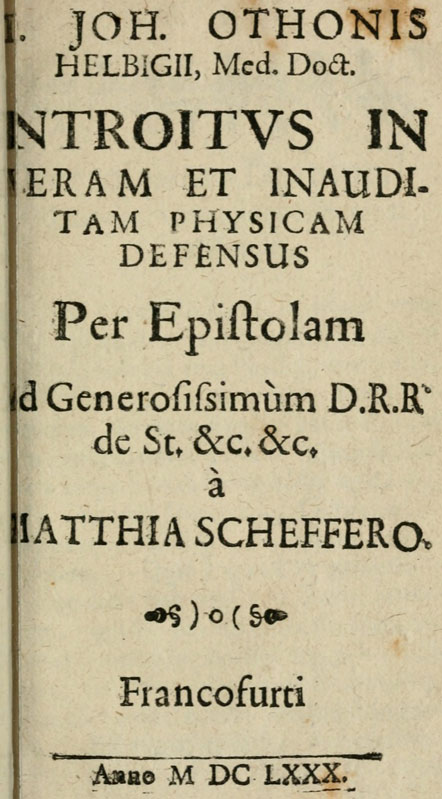
Joh. Othonis Helbig, Doctor of Medicine,
Defense of the Entrance into the True and Unheard-of Physics,
by way of an epistle
to the most noble D. R. R. de St., etc., etc.,
by Matthia Scheffer.
At Frankfurt.
In the year 1680.
Most noble sir,
sir and godfather to be eternally honored,
I do not believe that any age of the world has labored so earnestly to demonstrate the certain and true foundations of physics as the present one. The English Society for this cause strains every nerve. The curious Academy of the Roman Empire does the same without ceasing. The learned colleges of the Danes, the French, and the Italians do not yield an inch.
Why is this? Because from private persons so many come forth into the forum, who think that they alone can accomplish that task which the great number of learned men here and there, with reason and experience united, have not yet been able to bring into act.
But among these, in my judgment, there is not the least fortunate, Dr. Johannes Otto Helbig, Doctor of Medicine, who from the city of Batavia in the East Indies has sent us a neat little treatise entitled An Entrance into the True and Unheard-of Physics. After I had read this writing and well weighed it in the balance of reason and experience, it pleased me greatly.
Therefore I could not restrain myself from communicating to you, most learned sir and especially curious in physics, not only this Entrance, etc., but also a certain anonymous reply-epistle, commenting hermetically and explaining Tessa and the foreign force of Tessa, words contained in the Helbigian pages, and at the same time my more extended judgment on the matter.
What sort of things these seem to you, I humbly ask that you, by the admirable keenness of your divine intellect, may judge without reluctance, and either confirm me or bring me back from error.
§ 1. From the epistolary title of the anonymous writer the beginning for me is this: He who promises to comment hermetically and explain the words of Helbig’s writing, as also in the closing clause of the epistle ought to have done, could have done, wished to do, and did, congratulates himself, while he has in fact added to me the trifles of commentary and explanation, and far less of Hermetic science than his writing promises. It is hard to explain what has not been understood; harder still to wish to comment; but hardest of all to promise impossibilities. For what Helbig’s TESSA is, and what its foreign force is, he has not touched in a single word of his whole discourse. Thus he is shown to be frivolous, who does not stand by his promises, nor is it in his power to perform them.
That good anonymous man could not imagine that there existed in the world, or rather in Germany, anyone equal to him in knowledge, who could defend Dr. Helbig, or overthrow him. He himself wanders into error by misconstruing Dr. Helbig’s opinion, which he sets forth under the following title:
§ 2. Whether water is the one sole element, and air and earth its parts? he reports badly: in general he says that Helbig made fire in the elements to be a supernatural motion, although he had described it as preternatural. He therefore seems not to know that supernaturality differs very greatly from preternaturality.
§ 3. Therefore he does not seem to dispute demonstratively when he argues thus: air, although the most subtle water, is nevertheless the principle of the stars, the sun, the moon, and the stars; and earth is the true principle and the respective generatrix of all animals, vegetables, and minerals; therefore they are elements. But he does not notice that that which comes from something else is not that from which it comes. For in physics element and principle differ, as first thing and thing elemented, cause and effect. Air, water, and earth were made, or separated, from something else, namely from that first and one sole element, the viscous water, first created. But whatever has already been created, separated, and produced from another thing is not an element. And air and earth, by the anonymous writer’s own confession, were separated and produced from water. Therefore they are not elements. For Chaos, created by God, once the first creation had been made, was elemented, namely into air, water, and earth, separated; and therefore these, as elemented things, were posterior to their element.
§ 4. Moreover, Dr. Helbig denies that air and earth are produced from water, but affirms that viscous water is separated into them. From this it will be clear to every philosopher that one thing is to be produced, another to be separated; since separation leaves the parts of the thing remaining, but production shows forth a substance produced. Therefore the explanation of the principles is to be understood. Air, water, and earth are principles separated from one element, namely from viscous water, which when joined together again is called the element.
For if by the imagination of nature air, water, and earth are united for the production of anything, there is always made from these three waters, or principles, one viscous water, or element. This could be shown by innumerable examples. And thus the saying of the anonymous writer in the proposition is true:
That every end should answer to its principle.
It will be known to barbers and shearers that every animal and vegetable thing in its end goes back to viscosity. Whoever has observed in an animal generating, and in a vegetable bearing seed, the viscosity of the seed, will have no doubt of the matter of the truth.
It is very well known to me by practice that all metals and minerals in their final dissolution become once again a viscous matter. There are likewise some who, by an inviolable argument of reason and experience, are not ashamed to refer the excrement of the stars falling to earth (commonly called Sternschnuppen) from the viscosity of matter, which they carry before them, to their first element. And thus everything natural, whether begotten and produced from its element, or separated from it, is always reducible to its own primordial viscous matter. For the element from which elemented things are made is determined again into an element like itself, and that to infinity. Therefore, lest elemented things be confused with elements, the elemented thing must be distinguished from the element.
§ 5. Nor does it stand in the way, continues the anonymous writer, that the other two are separated and produced from water, since man also is born and generated from man, and yet he does not become merely a part of man, but is equally made and called a man, just like the one from whom he was born and generated.
I do indeed marvel at the childish wit of the anonymous writer. For the example and comparison here brought forward from the generation of man is wholly inept. For the separation of principles and the generation of man do not agree in one third thing. Who is there that does not know that to separate one whole into three, so that nothing remains over, is one thing, but to produce and generate from the most subtle essence of some whole a most subtle seed, so that the begetter remains uncorrupted and unchanged, is far another? Therefore to be begotten is very different from being separated.
Nor is it necessary for me to add that at the time when seed is separated from man by venereal motion, the seed cannot be called a man; nor the seed of an herb, at the time when it is sown, an herb; since even a peasant knows the difference between seed and that which is produced or begotten from the seed, and affirms that man and herb come to be from their seed only after a long interval of time.
§ 6. In stones, iron, steel, etc., that there is fire, and that this is thus proved, fire lies hidden in the elements, since such minerals are generated from them, and especially from water, is the assumption of the anonymous author. For when did Dr. Helbig ever deny that in metals and minerals there is potential fire? But who does not recognize that that which is in act is one thing, and that which is in potency in some thing another? That potential fire is present in metals or minerals is sufficiently clear from this: because fire is produced from the central salt of stone and iron by vehement and disordered motion. It does not follow from this that something is present in the thing in act which is present in potency; otherwise we should deny God and Nature. For in every good there is evil in potency. Thus also quicksilver lies hidden potentially in all animals, and yet not in act, except contingently through art. From the good angels the evil and worst one fell, because evil was potentially in the good; otherwise a good angel could not have become evil. Therefore he will be foolish, indeed more than foolish, who from this potential evil will declare good angels to be evil
because from those very good beings the Devil became evil in act. That the consequence from potency to act has no force is dictated by reason itself. Therefore to confuse potential fire, which lies hidden in the elements, with actual fire, is the thoughtlessness of the anonymous writer. For potential fire plainly is no fire, because act and potency are not together. Nor does he prove that minerals are generated from the elements, especially water, by the force of potential fire, this being posited, not conceived. Potential fire is never transferred of itself, nor from its principle into act, unless an external motion be applied, or an internal motion, and indeed violent and disordered ones.
§ 7. And it is plainly established, we add, that every end should answer to its principle. True, I grant it. But I do not see that this canon fits this place. For although fire may appear from steel, etc., yet that fire is not the end of its principle, or that on account of which steel exists; since its production comes about by a disordered motion, and such a dissolution of steel is not homogeneous.
Nor does it follow: fire is from steel, steel from water, therefore fire was in water. If this were valid, by the same method we should conclude from sin that the Devil committed it by a disordered motion of his own light, otherwise called pride that sin, namely that which is in the creature, was in effect also in God, as in the efficient cause of the creature. For the Devil is an angel created good by God; but evil was in him potentially while he was still a good angel, for he could become evil. Who, because the Devil actually fell into malice, will claim that the angels are evil, and consequently that primary sin was or is in God? As this statement cannot stand without blasphemy, so that one cannot stand in nature without folly.
The anonymous writer adds an experiment, that sailors have observed the waters of the sea to be inflamed, as though from the waves of the sea striking ships and appearing by night like sparks, they inferred that there is fire in water. I reply: either the sailors themselves, or the sailors did not rightly observe the cause of the splendor of the brine. The fiery gleams of the sea, or the sparkling sea, do not appear from the ordinary waves, but from the violent striking of the water against the ship and the rubbing of the ship against the water, whereby the sea-salt is moved too much and, boiling up, is driven as if into fury; this is known by those who sail. For heat and splendor in such water are absent when the violence of the oars ceases, nor do they ever otherwise proceed into act. Therefore fire in sea-salt is only potential, never actual in calm water.
§ 8. The anonymous writer accuses Dr. Helbig, because he denies that sulphur, the philosophical principle, is an element, a certain first matter, fire, etc., and yet expressly professes it to be the Salt of Nature; whereas salt is nothing other than water altered by art into the form of fire; therefore sulphur must be an element.
You are holding laughter, friends! The dullness of his inference casts shame upon him. Sulphur, he says, is altered Salt of Nature. The Salt of Nature is water altered by art into the form of fire. Therefore, because sulphur is from salt, salt from fire, and fire from water, sulphur most certainly is an element. Therefore the stick stands in the corner! Therefore they differ altogether, to be from an element and to be an element; or, if you prefer, unaltered matter and altered matter. For alteration gives another quality, to which before it there was no argument.
For example: the Devil is a good angel altered; therefore the Devil is a good angel. Disease is health altered; therefore disease is health. It is childish to argue thus. For when sweet and constituting water is altered into caustic and destructive fire, it wholly becomes deadly and utterly degenerate, in which state it cannot be, nor be called, an element.
§ 9. That worn philosophical saying, Our stone does not tinge unless it be tinged, does not confirm the opinion of the anonymous writer. For it signifies nothing else than that the stone, unless duly prepared, does not tinge metals, except gold, which is the most pure sulphur of metals calling it the most pure, must first be tinged, that is, be fermented with it.
§ 10. The anonymous writer adds: a distinction must indeed be made between element and elemented thing; between universal and particular fire; but ours is at least a supernatural motion; though by motion, either natural or supernatural, it is brought into act and effect, as appears when they are seen, blaze up, etc.
This truly says nothing. For the author himself has never proved that fire is an element, nor has he ever been able to distinguish between universal and particular fire, or between the element and what is elemented by it. Moreover Dr. Helbig, when fire burns or flames, considers it only as fire and as a preternatural motion; but he considers its burning and flaming essence as matter thus brought preternaturally into act and effect, so that it appears caustic to the senses. Next, Dr. Helbig never used the expression supernatural motion, since supernatural differs greatly from preternatural and disordered, as was noticed above.
§ 11. The anonymous writer continues:
Why is only one element posited?, although the very wisdom of Solomon and other sacred writings establish and approve a plurality of elements.
But this is the device of those who strive to extricate themselves by ἀμηχανία (helplessness, lack of means, perplexity). When it happens that they cannot prove their point by learned reasoning, they retreat either to occult qualities or to the authority of some weighty author. Thus the anonymous writer seeks a refuge and asylum in the sacred writings and in the book of the wisdom of Solomon, although in the Church of Christ it is held ἀπόκρυφον (apocryphal, hidden, not canonical), and from these he seeks to obtain a plurality of elements, but in truth to confound their unity; which, in my judgment, is not the part of a learned man or a philosopher.
Especially since the sacred writings expound not the bodily nature of physics, but the salvation of the soul to believers. Therefore by no truly learned man is Holy Scripture regarded as the infallible foundation and argument of physics, but of faith. For in natural matters the sacred page very often speaks according to common opinion. Nor indeed should the victor’s palm be offered to the anonymous writer by this excuse, since he boasts that the sacred writings stand wholly on the side of his opinion, when Holy Scripture itself [stands with] the opinion of The Helbigian opinion concerning the unity of the elements does not oppose, but presupposes.
Saint Peter, 2 Epistle, chapter 3, verse 10, says στοιχεῖα καυσούμενα λυθήσονται (the elements, being burned, shall be dissolved): by which he designates not the number of the elements, but the nature of the elements from the event of dissolution, and in the final dissolution he places heaven itself after the elements, as though separated from them; since heaven itself (namely the ethereal heaven) is not an element, but an elemented thing made by separation from the element. Hence he establishes that by the preternatural, disordered, and vehement motion unto fiery actualization and the burning of the whole universe, the superior and inferior potencies will necessarily undergo dissolution at the last judgment of God.
Now that dissolution shows that the Apostle speaks not of elements, but of elemented things; since dissolution belongs not to elements, but to elemented things. For what is dissolved by burning passes into an altered form, indeed into a worse one, namely a destructive one, by a preternatural and disordered motion, which is not the act of the element, but of the elemented thing its vehement act.
Meanwhile the very word στοιχεῖα (elements), that is, elements, by reason of its etymology and usage in Holy Scripture, is for the most part of improper and metaphorical signification, as no theologian will deny; therefore it proves plurality less than it rejects unity, since nowhere in the sacred writings is it used for the true principle of the creation of the universe, but in every place for things potential, arisen from the first principle or element. Therefore what the sacred writings neither prove nor argue, the glorious anonymous writer cannot draw from them as the foundation of the plurality of elements.
I likewise said that Scripture presupposes the unity of the elements. On this same point let the Apostle Peter be heard, 2 Epistle, chapter 3, verse 5: γῆ ἐξ ὕδατος καὶ δι’ ὕδατος συνεστῶσα (the earth standing out of the water and through the water), constituted by the word of God. By these words the Apostle hints at nothing else than that water is the first matter, or elemental matter, and therefore the only one, which Dr. Helbig calls viscous, from which and through which the earth and the other elemented things subsist by the word of God. And although grave theologians, not distinguishing the principles of nature, may call this water, confounding that first water with the water of the flood, which Peter subjoins, by a mixed sense; nevertheless, in the matter from which and through which the earth formerly subsisted, Helbig’s opinion of the unity of the element clearly enough presupposes that there was one only and unique water, or element. But the water which in the flood, by increasing into a quantity of particular waters, brought destruction upon living flesh on the earth, is not, nor was it, that first water (called by the philosophers viscous) from which and through which the earth formerly subsisted; for in the flood water the earth did not subsist, but perished.
§ 12. It is of the same flour, I say, that which the anonymous writer subjoins: Wherefore I judged it more expedient for the Hermetic Republic, retaining the terms and sometimes the metaphors of the philosophers, to explain them at the same time, rather than to devise new and more obscure ones. But the terms of the philosophers, and their metaphorical denominations of Hermetic things, mislead not only students, but the very doctors of Hermetic science themselves, and entangle the erring in errors, so that to extricate themselves from these they can scarcely do so, is obvious.
Therefore Dr. Helbig, led by the love of truth and of his neighbor, endeavors by new terms, and indeed by terms of proper signification and designation of the natural thing, to lead the host of the erring to the knowledge of the true truth, lest so many and so great torrents of time and expenses provoke those desirous of descending into the wrestling-school of the chemical art to the ruin of many men’s life and soul; which would be more of infamy than glory. Wherefore Dr. Helbig is judged to benefit the Hermetic Republic more than the anonymous writer, since it is better to devise new and proper terms than to cling unhappily in doubtful explanation to the tropes of the philosophers.
§ 13. The anonymous writer does not approve every opinion of Nuysement, nor indeed reject every one. His writings are learned and ingenious in certain parts, in which perhaps he seems to agree with your judgment. But if the principles of Lotharingia and those of Dr. Helbig contradicted one another equally, Nuysement would have had no standing whatever.
Bernardi Comitis Trevisani the truth is not suspect. Isaac Hollandus in very extensive writings has disclosed many things which restore philosophical truth, by the example only of his little treatise on the Stone of Urine; in it he openly calls the Matter urine, and clearly demonstrates the truth to the wise.
But if the anonymous writer had truly perceived that by the operations of metals and minerals described in the books cited he was proceeding on the royal road, credit would have remained with him. For a multitude of labors in minerals brings no utility to the Hermetic philosopher, than that he may clearly see that he has always erred most grievously.
§ 14. The word TESSA, although it seems to be Arabic, and in that language could signify it stripped or it deprived, nevertheless appears to me rather cabalistic, whose individual letters, I know, contain an individual meaning.
Helbig’s magnet is the central salt, which, although it was in the earth, is nevertheless apprehended above the earth. Its taste is vitriolic; its outer color white, its inner, like gold, red; and by the philosophers it is called magnet, sulphur, male, central salt, central, dragon, lion, vitriol of the microcosm, the fixed, etc.
Tessa is the astral salt, or the essence of air. Its taste is in some manner mercurial, yet sweet; its color white like silver; its substance transparent and crystalline; and by the philosophers it is called Mercury, steel, female, astral salt, eagle, dove, white arsenic, feathery alum, philosophical antimony, the eagle’s glue, moon, volatile, white faun, etc.
It is attracted and coagulated by the magnet through a gentle motion. The letters of the word signify the manner of attracting and coagulating.
Moreover magnet and steel, central and astral salt, lion and eagle, upper and lower, are for the philosophers one and the same matter; which Dr. Helbig calls TESSA, and twice, for certain reasons, the foreign force of TESSA.
§ 15. At length the anonymous writer is displeased that Dr. Helbig had been justly stirred to anger against the lies of certain authors; and he says that it does not become a philosopher to assail one who errs with injury, but rather to help him. He accuses that he called the writings of graver men lies and obscene.
To this too I am compelled to answer on behalf of Dr. Helbig: Dr. Helbig did not use the word to lie of Nietner, Nuysement, and Balduinus; rather he only said that their writings, insofar as they point to the universal spirit of the world, are erroneous; and that Balduinus, as also the Tomb of Semiramis, had so boldly asserted in their writings that the purified truth concerning the Philosophers’ Stone is contained therein, which nevertheless does not agree with the truth in any way whatever. Hence many, deceived by them, spent most costly expenses and found from them nothing of the thing desired.
If therefore they had written I think that this airy spirit or salt is the matter of the Stone, the warning of the anonymous writer would have had its place; but in fact by their it is they have sold falsehood for truth. Therefore no one will deny that they are to be treated as liars and deceivers.
Nor is Balduinus’s method of attraction an arcanum, as the author judges. For country folk know, lime, or alkali in lime, to attract from the air a sweet and nitrous salt. Why then, if anyone truly deceives a philosopher, do you think it wrong to warn one’s neighbor that he beware of books that stink with lying, insofar as they pretend to smell of Hermetic wisdom?
Are not those same graver men, whose authority the anonymous writer vindicates, worthy of graver punishments, because they were the cause that many, relying with infallible confidence on the wisdom, gravity, and authority of the curious college, and giving highest praise before all the world to the falsehoods of others such as Balduinus, the Tomb of Semiramis, the author of the positions on the spirit of the world, etc. have uselessly consumed their money with time?
These things having been sifted in the sieve of reason and experience, it is fitting that I set an end to the epistle, commending myself and my own, and especially little R. J., to your nobility, known to me by better report, for all the days of life.
Given from my study at Heidelberg, 25 July 1680.
Your nobility’s
most humble servant
and godfather,
MATTHIAS SCHEFFER.