The Fountain of Wisdom and Knowledge of Nature
Listen Audio Book Study the Art with Us Buy me CoffeeFountain of Wisdom
and Knowledge of Nature,
from which those lovers who thirst after the secrets of Nature may, at their pleasure, draw the true Water of the Wise;
Advised and opened by an incomparable Philosopher,
by Anonymus from Schwartzfuß.
Psalm 65, v. 10.
The river ELOHIM is full of water.
Psalm 46, v. 5.
There is a river; its little streams make glad the city of ELOHIM.
Genesis 2, v. 10.
A river goes out of Eden to water Paradise.
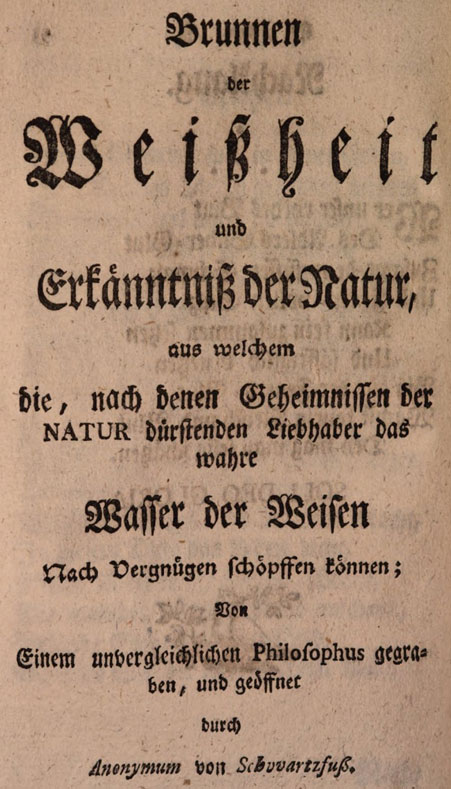
Extracted and Translated to English from the book:
Drey curieuse chymische tractätlein, das erste, betitult: Güldene rose, [das ist, einfältige beschreibung des allergrössesten, von dem allmächtigsten schopffer himmels und der erden Jehovah in die natur gelegten, und dessen freunden unhd auserwählten zugetheilten geheimnisses, als speigels der göttlichen und natürlichen weissheit.] Das andere Brunn der weisheit und erkänntnis der natur, von einem unvergleichlichen philosopho gegraben. Das dritte Blut der natur, [oder: Entdeckung des allergeheimsten schatzes derer weisen, seyende nichts anders, als der rothe lebens-safft davon alle geschöpfe nach dem willen des Allmächtigen herstammen, erhalten und fortgepflanzet werden.]
A. & Ω.
Chapter 1.
What the Fountain of the Wise is.
1. The Fountain of Wisdom has its origin from God alone; for it is a universal efflux, a breathing forth of divine power, a ray that illumines the heavens, pours itself into all the realms of this world, and nourishes and preserves them.
2. This Fountain is, by Nature, first conducted into the Astral realm, and gives to all the stars their nourishment, without which they can neither subsist, nor to the remaining might be helpful to the creatures through their influence.
3. The Astral Realm is therefore, as it were, the first recipient of this Fountain, which descendeth down from the high height of the Most High.
4. But from the Stars it betaketh itself into the Air; from the Air into the Water; out of the Water it stealeth into the Earth; from the Earth it ascendeth again toward Heaven.
5. Hence it is very well concluded, that Heaven is the Source and Place of gathering of this Fountain; but Air and Water are as Channels, through which it is led unto the Earth as unto its Mother, and from thence again unto Heaven as unto its Father.
6. And although this Fountain descendeth even unto the middle-point of the Earth, yet it cometh forth again, as it were, steaming upward, and moisteneth the whole surface of the Earth.
7. If this Fountain were not, then would the whole Creation lie as dead and unfruitful: for all Stars, Beasts, Plants, Minerals, and Metals are by it nourished and preserved.
8. This Fountain hath no less power and worthiness, when it resteth in the middle-point of the Earth, than when it sitteth in the heart of Heaven; yea, when it ruleth and governeth over all the Heavens.
9. Whence it appeareth to be true, that that which is above is even as that which is beneath.
10. This Fountain is sought by all men, but found by very few; it floateth before all eyes, and is not known: all drink of it, but the fewest become wise thereby.
11. This Fountain, as it were, driveth a commerce with the Higher and the Lower; for it leadeth souls down into Hell, and again bringeth them forth.
12. It is the beginning of life and of death, the soul of the Elements; for it adorneth the world, and distinguishest the species in Nature, that one may see what they are in truth, and what they can do; otherwise the world would remain and be as a mingled lump.
13. The Wise have called this Fountain by many names, yet have thereby greatly hidden it, only for this cause, that these little pearls might not come before the swine’s snout.
14. Moved by fear of God and by love, I say that this Fountain is nothing other than the Humidum radicale primigenium of every creature in the whole world.
15. This Humidum radicale primigenium is the essence of all natural things; and when it has been formed by the Light or by astral influence, it then brings forth nobler kinds, as may be seen from the following chapter.
Chapter 2.
How manifold this Fountain is
1. There are four universal kinds, in which our Fountain lieth hidden; for everything that is in the world is either astral, or animal, or vegetable, or mineral. These four kinds comprehend all things within themselves.
2. The astral Humidum radicale primigenium proceedeth solely from the efflux of the power of the Most High, surpasseth all other realms by reason of the super-celestial light, and ruleth over them.
3. The animal Humidum radicale primigenium consisteth of the fixed moisture of the elements and of the subtle, heavenly ray, consists more of the heavenly-created Light, than of the fixed moisture of the lower Elements.
4. Therefore all animals also have more of a heavenly nature than plants and minerals; and for that reason their powers and faculties are much more wondrous; and all this is on account of the Light and heavenly Spirit dwelling within them.
5. For Heaven is far stronger and more full of growth in animals; whereas the fixed moisture of the Elements in them is rarer, more subtle, and not of so tough and viscous a kind as in plants and minerals.
6. Plants generally have much fixed, airy and watery original root-moisture, which is impregnated with the heavenly subtle Light; from which they attain this visible growth and lasting power, by which they live, remain long, or endure; and from which all their powers proceed, and by which they are also distinguished.
7. Just as there are as many kinds of Light in Heaven, so likewise many different species are found among animals, plants, and minerals.
8. The Humidum radicale Primigenium of the mineral [kingdom] is nothing else than that moist essence from which all minerals consist, endure, and by means of which they flow continually in the fire.
9. This their Humidum radicale is more of a very fat, tough, viscous, earthy and watery moisture, compounded out of airy parts, and afterwards united with the heavenly light, or ray of the stars.
10. This mineral moisture is, per antonomasiam (i.e. by way of eminence), called a true and lawful Fountain of the Wise, because they alone seek it, and with all their powers strive after it, in order to accomplish wondrous things by it.
11. The firm moisture of the elements, which is found everywhere and united with the heavenly light, is the seed, or the purest part of each element, which it casts and lays down in the centre of the earth.
12. In this centre the power of Nature (which is called the Archaeus) mingles these seeds together among themselves; and the heavenly light awakens the vapours and drives them up and down; so that, as they ascend and descend, they become bodies; but from the heavenly light, which lies hidden and rests in their centre, they receive the true distinction.
13. From this seed arise, by nature, all fountains chiefly, however, that of the Wise, which (as has been said) is of many kinds.
14. Yet all creatures of the four kingdoms draw from this one and most-high fountain all that they need; for from an Uncreated and Eternal they take their origin, and by the same are they also nourished and preserved: for the Spirit of the Most High is in all things: if one takes that away from them, then they perish.
Chapter 3.
How the Fountain of the Wise becomes animal.
1. The Fountain of the Wise, in the beginning of its origin, is the seed of all the elements and of Heaven; and therefore this seed is common to all four kingdoms of the world, so that everything can come forth from it.
2. But when the light and heavenly power which is in this seed has attenuated (made more subtle) the seed of all the elements and brought it to a certain subtle degree; then Nature brings forth from such seed, and from its own radical moisture, an animal, which is called an insect; such as the fly, the Mollendieb (mole-cricket), frog, toad, etc.
3. For these insects are not generated in an orderly manner, but arise solely from the universal [seed], and through the power of the implanted light of Heaven, out of a seed brought to a certain degree of perfection.
4. And it does not hinder that also the perfect animals spring from the universal seed things, take the same away, so they pass off.
Chapter 3.
How the Fountain of the Wise becomes animal.
1.
The Fountain of the Wise, at the beginning of its origin, is the seed of all the Elements and of Heaven; and thereafter this seed is common to all four kingdoms of the world; thus, everything can be generated from it.
2.
But when the light and the heavenly power which is in this seed has attenuated the seeds of all the Elements and brought them to a certain subtle degree; then Nature brings forth from such a seed, and from its own radical moisture, an animal, which is called an insect; such as the fly, moth, frog, crab, etc.
3.
For these insects are not generated in an orderly manner, but arise solely from the universal [seed], and through the power of the implanted light of Heaven, from the seed brought to a certain degree of perfection.
4.
And this does not hinder that even the more perfect animals arise from the universal seed, but rather this has been ordained in the beginning of Creation by the almighty hand of God; and these animals have thereafter received from God the power to multiply themselves through their own seed, which they will also retain until the end of the world. And here the divine blessing accords very well: Be fruitful and multiply. For this word has given to all perfect animals the power to multiply themselves within themselves.
5.
It is therefore impossible that perfect animals, differentiated into male and female, should be brought forth solely from the power of the heavenly universal seed. For this cannot happen in a natural way; otherwise God the Lord would not have created man and woman, as is to be seen in all kinds of animals.
6.
But man, because he is the last among all perfect animals, was not in need only of divine assistance for the attainment of his perfection; rather, he also required a specially created light, which was poured in from outside into the seed particularly disposed for this purpose, by the power of which he could attain so high a perfection, and for which reason he was so greatly distinguished from the other animals.
7.
It is therefore true that the Fountain of the Wise attains the animal degree partly from a power implanted within itself, which it received from the light and the heavenly Spirit; partly by reason of divine omnipotence, which God implanted in it and communicated to it in the beginning of Creation; partly by reason of a special created light, which it has received through and within the Creation by divine infusion, by virtue of which it is raised to the final degree of a sensitive and rational soul.
Chapter 4.
How the Fountain of the Wise becomes vegetable.
1.
Our fountain, or Humidum radicale Mundi (the radical moisture of the world), can very easily attain to the degree of vegetable perfection; for it is, in and of itself, vegetable.
2.
For if it did not have the power to grow green, to bloom, and to grow, how would it then be able to communicate such power to other things? For this fountain grows green of itself, and brings forth all plants, and has no need of a mover, because it moves itself to this operation of growth.
3.
But the spirit of the heavenly light prepares and mixes the pure seeds of the elements together in a special manner, in order thereby to bring forth plants; and through its particular influence it mixes something into it, which causes the different kinds of plants.
4.
For from so many different stars our fountain also receives so many different powers, to drive forth this or that plant; and the astral influence, as it were, informs our fountain.
5.
Accordingly, as has been said, the difference of the stars causes the difference of the plants: therefore no little herb is found on earth that does not have its star in heaven.
6.
For in heaven there are innumerable and particular stars, which bring forth, nourish, and preserve different and particular herbs; the more powerful this special astral force is, the more abundantly this or that herb grows.
7.
And it is no wonder that in one place or another a greater quantity of herbs grows than in another, for this proceeds from the astral spirit, which determines our fountain to this or that form.
8.
Therefore the constellations specify our fountain, that is, the fixed moisture of the elements, which materially constitutes our fountain.
9.
But the heavenly and astral spirit is the form of that fixed moisture of the elements, which brings to it the special determination.
10.
But since this form is manifold, because of the so various influence of the stars, our fountain also brings forth by reason of the many forms thus impressed into it many kinds of plants.
11.
The seeds of the plants always retain the specification once received; indeed the seeds are, as it were, children of the stars; therefore they always keep the likeness of their father, together with his powers.
12.
And no plant is to be found that does not have its seed if not an outward seed, yet an inward one: for even the peasants know how, by rolled-together leaves of plants which otherwise bear no seed, to draw forth their natural seed in the winter-time.
13.
As indeed it is more than true that many herbs grow and thrive without previously sown or otherwise present seed: for the radical moisture is, in putrefaction, sharpened (acuiert) and informed solely by, as it were, the spirit of a star, so that a new herb may spring forth.
14.
We therefore conclude that our fountain, or the fixed moisture of all the elements, is, through the heavenly spirit of the light and the influence of the stars, specified, impregnated, and truly determined for the bringing-forth of manifold plants.
Chapter 5.
How the Fountain of the Wise becomes mineral.
1.
Our fountain appears of itself to become mineral, because it is born in the center of the earth, and there assumes far more an earthly and mineral essence than anything else.
2.
Yet it is to be believed that, because it lies hidden in the center of the earth, it is wholly indifferent and not yet specified, until it is actuated by the heavenly spirit and informed or determined toward this or that mineral.
3.
It is, however, actuated by this same spirit, in that it is especially set into such a condition as the metals require for their birth.
4.
For since each star has such a power to inform our fountain accordingly, so that it may bring forth that to which it has been disposed; for example: the Sun has power to dispose in all four kingdoms; but when it intends to generate an animal, it disposes especially the humidum of the animal, and according to this disposition it brings forth the animal form of the humidum thus disposed.
5.
But in the growth of vegetables it indeed disposes the very same matter, yet quite differently always according to the need and form of the very thing which it is occupied to produce from our fixed humidum.
6.
The Sun likewise also holds the same process in the generation of metals and minerals; and thus the Sun and stars bring forth manifold things, all according to the differing influence and disposition which they introduce into our fountain.
7.
And it is to be noted that, when one has endeavoured to generate gold in the earth by means of the Sun, one must make our Mercury that is, our fountain more earthy and more dry than airy and watery.
8.
This disposed substance, and impregnated with the first qualities, purifies itself to the highest degree by sublimation and continual “cooking” in a closed vessel, and gradually converts what is earthy into an incombustible red sulphur.
9.
This sulphur thereafter consumes its moisture, fixes and hardens it completely, so that they can never again be separated from one another; and thus the humidum is, through the redness of the sulphur, coloured, fixed, and perfected into permanent gold, which has its greatest joy in the midst of the fire.
10.
Thus the stars now dispose our universal fountain, through their particular power, to all kinds of sorts of metals and minerals.
11.
For when they make our fountain more earthy and watery than fiery and airy, then our fountain is sufficiently specified for the generation of all kinds of minerals.
12.
But the minerals vary and, as it were, change, when the earthy and moist is sharpened (gezieret) with particular qualities, which happens through purification, cooking, and fixation.
13.
Finally, it is to be known that our fountain becomes mineral when the seed of water and of earth predominates over the seeds of the other elements; for thereby our fountain is made fixed, viscous, and heavy in weight.
Chapter 6.
How the Fountain of the Wise becomes gold.
1.
The sunbeams penetrating inward to the center of the earth, with their subtle power, pierce through the fixed moisture of the elements which lies hidden there, make it living, sharpen it (witzend), sublime it, and cleanse it of all excrements.
2.
This purified, sublimed, and, as it were, shut up into a firm chamber moisture of the elements is then for a thousand years continually “cooked”; but at last it is coagulated and fixed into an earthly, sulphurous substance; it is beautifully red and incombustible, and [word unclear in print: für] and volatile; it gives off solar rays from itself, which men dig out, and by fire reduce into gold.
3.
This free matter Nature cannot again dissolve with the most pure Mercury, i.e. our fountain, nor can she further cleanse it of all impurity; otherwise, if she could do that, she would of herself and alone bring to light the dearest treasure of Nature and Art.
4.
Therefore, for this, a clever master’s hand is required, whereby Nature may be helped; and therefore Nature also cries without ceasing: Help me, so will I help thee.
5.
Nature can indeed generate gold, but she is not able to regenerate the gold and to perfect it into a super-perfection still less to transform it into the gold of the Wise; from which the difference between common gold and sophic gold is made evident.
6.
For Nature makes natural gold without any assistance of Art; but the Wise take this same matter of Nature, and by Art lead it to a state of super-perfection.
7.
If therefore twofold gold is found one of Nature, the other of the Wise then both are of one essence and origin, since they spring and grow out of one fountain; but in different kind and manner, and toward different final ends; for natural gold is in need of the gold of the Wise, but not the contrary.
8.
How and in what manner Nature transforms our fountain into natural gold has been sufficiently taught in what precedes.
Chapter 7.
How the Fountain of the Wise becomes silver.
1.
Our fountain, made living and operative by the spirit of the heavenly light since by its inner and inborn, as also natural, warmth of the earth and of the place in which it is enclosed, it is digested and “cooked” finally attains the perfection of a white, shining, and fusible earth.
2.
Nature cooks this more and more, and fixes it for so long until it is transformed into perfect silver, together with the separation of all excrements. This is the true finishing and composition of silver, generated by Nature through and out of our fountain.
3.
Our fountain attains its full determination properly and truly not from the influencing Moon, but this arises solely through continual cooking; for if this matter were cooked longer, it would become pure gold, and at this point Nature rests, because she cannot proceed further.
4.
But the influx of the planets and stars can do no more in this work than that it awakens the inner warmth of the matter and brings it into motion, whereby it is cooked and made ripe.
5.
A perfect and wholly completed cooking generates gold; but an imperfect one [generates] silver.
6.
Our fountain has seven stages in its cooking, through which it must be guided: in the first stage quicksilver arises; in the second lead; in the third tin; in the fourth copper; the fifth yields iron; the sixth silver; the seventh and last, as the most perfect stage of all, yields gold.
7.
Yet I do not deny that the particular influences of the sun, moon, and stars should not contribute something special concerning the powers of the metals; only this is a hidden and inner operation, and happens in the first composition of our Mercury, but not in its cooking.
8.
For in the cooking all constellations come together and are united with the fixed moisture of the elements, since the strong and mighty spirit of light [comes] over the matter and disposes it, so that this or that metal must come to be from it.
9.
But once the matter has been disposed, it is daily transformed from a noble form into an even nobler one, until it reaches the last, which is gold.
10.
A splendid example is given us by the continual cooking of our fountain by the Wise, which is carried out in a closed vessel.
11.
For the matter begins at first to become black, and herein for five months imitates the raw fixed moisture of Saturn; thereafter, under continued cooking, it becomes grey-white, and likens itself to Jupiter; then it becomes green-red, and takes on all manner of colors, which represent the qualities of Mars and Venus; finally everything becomes snow-white, showing the purest essence and quality of silver.
12.
This white matter is the true, free, and fluid “Nature-sulphur,” by whose help Nature generates silver in the earth.
13.
This sulphur, when it is often dissolved, coagulated, and cooked in our fountain, then attains a very high degree of perfection, so that one part of it transforms innumerably many other parts of less perfect metals into the most pure silver.
14.
It is therefore concluded that our fountain, by mere cooking, [attains] the true perfection of the purest silver; and this cooking is nothing other than an expulsion of the radical moisture, which is thereby transformed into a white, fluid, and fusible earth.
Chapter 8.
How the Fountain of the Wise becomes iron.
1.
Nature uses no other way or manner in the generation of iron than as she works with other metals and minerals; thus she does so here also with iron.
2.
For she takes the fixed moisture of all the elements, which is made operative by the heavenly [spirit], and cooks it in stony vessels, leads it through putrefaction; and because no proper separation of the unclean, stinking, earthly sulphur takes place, therefore, with continued cooking, an iron-like mass comes from it.
3.
Nature cannot separate this unclean sulphur, still less separate other excrements, solely for want of time; for to cook and purify the perfect metals a long time is required, because the warmth of the earth, as also the inner [warmth] of the metals, by which they are matured, is very slight and gentle.
4.
Although Nature, even without our assistance, strives to separate off the sulphurous and combustible excrements, she is nevertheless hindered by men, so that she cannot attain her goal; for the necessity of iron, as it were, compels men to tear the matter, not yet perfectly worked out, from the earth before its time, to melt it, and to apply it to their uses.
5.
Thus this impure metal cannot in any way be purified and extracted from its filth, except through the addition of the white and red sulphur of the Wise; for as soon as such is added to it, the iron is at once transformed into gold or silver something which Nature cannot accomplish in a thousand years.
6.
From this it is made clear that Art, which follows Nature in all things, completes such things much sooner by labor than Nature [does], when she is not supported by Art; for Art transmutes this same matter in five months’ time into iron; in seven months into silver; and in nine months into gold.
7.
These, however, are not common metals, but [the metals] of the Wise, which have no fellowship with the common [metals]; for the common metals are dead, but those of the Wise are living, full of power, and grow up to the very highest perfection.
8.
Thus it has been sufficiently proved in what way the iron is born from our fountain, which is the father of all metals and their true mother, and that this our fountain brings forth, nourishes, and preserves everything.
Chapter 9.
How the Fountain of the Wise becomes copper.
1.
Our fountain, impregnated by the influence of the heavenly Venus, after a proper putrefaction, comes forth and is transformed into a dark green-blue earth, which, when it is strongly melted, yields copper.
2.
In this copper some gold is always found, and this because, when the fixed metallic moisture is cooked by natural digestion, certain particles are found worked out to so high a degree that, when they are separated from the copper, they are good gold. And if this green earth were not dug out before its time, it would, after further digestion endured, be transformed into gold.
3.
But the great desire of men to have copper hinders Nature’s working, so that she cannot generate a perfect metal.
4.
For the green and blue colors are the proper and inborn colors of the red, unripe sulphur; if this had attained its maturity, then instead of copper gold would have come from it.
5.
This is plainly to be perceived in the work of the Wise, in that it, through the cooking, comes to perfection: for the matter of the Wise becomes first green and blue, before it finally attains the perfect and blood-red redness.
6.
Likewise the metals in the earth take on manifold colors; in particular, however, they become green and blue before they attain the perfection of the sulphur.
7.
And it is a great marvel that Nature accomplishes in a glass the very same work, by help of Art, which she performs by her own power in the womb of the earth.
8.
And therefore know that all the operations which occur in the Sophic [work] are not to be ascribed to Art, but rather to Nature; yet they are attributed to the Sophists [i.e., the Wise/Philosophers], because by their ordering Nature accomplishes such things.
Chapter 10.
How the Fountain of the Wise becomes tin.
1.
Tin has the same origin as the other metals. For when our fountain, through continual natural cooking, has been brought to a dark grey-white and shining earth, and yet is heaped over with the foul spirits of its Mercury, and is taken and melted before its time, then it yields a metal that creaks between the teeth.
2.
This creaking is caused solely by the foul and not sufficiently purified and “cooked-out” mercurial spirit.
3.
Tin has much white, but unclean, sulphur; for although it is indeed white, it still cannot reach the highest summit of perfection because of its crudeness.
4.
For in such crudeness the uncleanness lies hidden, as a sign of imperfection.
5.
Tin’s creaking cannot be removed by any art say what one will; for tin’s rawness can, by understanding, be subdued and improved; and this is done through the white sophic sulphur.
6.
For this white sulphur devours all uncleanness and crudeness of tin and makes the purest silver out of it.
7.
Nor are those to be listened to who claim that one can make and draw the Mercury of the Wise out of tin; for the metals are rather generated out of our fountain and Mercury, than that our Mercury should be born from them.
8.
And know that Nature brings forth our fountain solely out of the most subtle elements and the spirit of light, and mixes it at the end very bodily, from which thereafter Nature produces animals, herbs, and minerals.
9.
And indeed, if the Mercury of the Wise could be made from tin, then one would have to say that an effect produces its cause, and that the son is earlier than the father which is absurd.
10.
Therefore remain assured that the Mercury of the Wise cannot be made from any metal.
11.
So likewise very little is to be made of the opinion of those who say that in gold and silver the Mercury of the Wise is found; because the Wise in their writings do not speak of common gold and silver, but of another kind, which is not common.
12.
And although in common metals the Mercurius Sophorum is in some manner hidden, yet it is nevertheless, as it is, and in the way it is, not the Mercury of the Wise, for this one is living, but that one dead; and this is enough concerning the impossible reduction of the Mercury of the Wise from tin and other metals.
Chapter 11.
How the Fountain of the Wise becomes lead.
1.
Nature uses for the generation of lead nothing else than our fountain, i.e. our Mercury.
2.
For she takes the fixed moisture of all the elements, which is mingled with the heavenly, life-giving spirit of light, and mixes it with all manner of heterogeneous, earthly and sulphurous moistures, and shuts it up in the caverns of the earth, cooks and digests the matter a long time.
3.
When then, through putrefaction, everything has been united with one another, she cooks it, without separating off the unclean, so long until everything becomes a black-shining and heavy earth, from which afterwards, with a small fire, the lead is melted.
4.
But this earth of lead is not the true matter of the Stone of the Wise, by which the base metals are transformed into gold and silver; for common lead does not have such perfection that from it the white and red sulphur of the Wise could be prepared, because all this is in lead very raw and imperfect, so that it cannot be sharpened (ausgetiget) by anything except the tincture itself.
5.
Since our Stone is prepared solely out of our fountain, from which common lead differs widely, our Mercury is therefore not common lead, but is a father of the same.
6.
And although our fountain or Mercury is indeed called “lead,” yet the Wise always understand our fountain by it, from which alone our elixir is prepared. For our Saturn, or fountain when it dissolves its magnesia or earth, from which it springs, then through gentle fire coagulates again, and brings everything into one, so that a black, heavy earth results from it then this composite is called the lead of the Wise.
7.
He who can make this lead, to him all chymia stands open; for hidden therein lies the gold and silver of the Wise, i.e. the white and red sulphur, which transforms all base metals into gold and silver.
8.
Of this lead or Saturn the wise poets have written much; for they sing: Saturn devours all his children that is, the sulphur consumes everything that lies hidden in this matter, and shuts it up in its belly, digests and cooks it until its maturity.
9.
Jupiter, seeing such things, cuts off the testicles of Saturn, as his father, with a sharp sickle, and casts them into the sea. For the white sulphur, which appears after the blackness in our cooking, destroys, through its penetrating power which is called a sickle the manly power of the black sulphur, called Saturn, and casts it into the sea; that is, the black sulphur is dissolved and changed into a sea, from which fair Venus is born, which is the green color.
10.
This Jupiter, or white sulphur, Saturn seeks to devour; but instead of it he swallows the stone set before him, which he must then spew out again upon Helicon, where it is set up for mortals as a sign.
11.
Our Saturn undertakes to devour the whiteness that comes forth after the blackness, that is, to dissolve it; and thus it is changed into a stone, which Saturn indeed devours, but in continual cooking must spew out again.
12.
Thus our dissolved matter is coagulated into a white stone, which is to be dissolved again; and in this manner Saturn always devours, in Jove’s stead, a stone, which he spews out upon Helicon; that is: finally our blessed stone comes forth from it, which is made holy by wisdom.
13.
From this our Jupiter and Latona are born Apollo and Diana; which is the very last and perfect cooking, in which the white and red sulphur, i.e. Apollo and Diana, attain the plusquamperfection.
14.
From this one sees that our Saturn, or lead, is a father of all the gods, since all metals arise from it.
Chapter 12.
How the Fountain of the Wise becomes quicksilver.
1.
Between our fountain and common quicksilver there is a great sympathy indeed such that by many they are held to be one thing; but they err: for our fountain is a father of common quicksilver, which is far different from our fountain.
2.
For our fountain generates everything and makes it living; common quicksilver destroys, corrupts, and kills everything.
3.
Our fountain is fiery and warm; but common quicksilver is moist and cold.
4.
Our fountain is, by gentle distillation, converted into a spirit and also into a free body; but common quicksilver is a mere spirit, and in distillation can [be turned] into a no watery spirit, but rises up bodily, without changing itself.
5.
The spirit extracted from our fountain is fiery and pontic (sea-like), penetrating, and so subtle that it dissolves and kills all metals; but common quicksilver cannot be made into such a spirit; therefore it also cannot dissolve and kill the metals. It does indeed at first hide itself in their belly, but in gentle fire it leaves them behind unchanged.
6.
Our fountain dissolves, coagulates, and makes itself, without the addition of other things; but common quicksilver does not do all this: it also does not coagulate without the addition of other species.
7.
Our fountain has in its inmost a free salt, white and red indeed it is altogether a salt, and wells up out of a salty cave; but common quicksilver is nothing but a running metal, and if one wishes to make a salt from it, one must hasten with it to putrefaction and to death.
8.
Our fountain is rich in gold and silver in its nearest power (potentia proxima), and by mere cooking is brought ad actum ultimum (to the ultimate act), which does not at all apply to common quicksilver.
9.
Our fountain, without addition, by mere cooking becomes the elixir or tincture of the Wise; but from common quicksilver such a thing is neither to be expected nor to be attained.
10.
In our fountain all metals are found potentialiter (in potency), because it is the nearest seed from which the common metals and even common quicksilver itself grow something which cannot be said of common quicksilver.
11.
Our fountain makes in the earth all kinds of stones, noble and base, which common quicksilver leaves well enough alone.
12.
Nature herself shuts our fountain up in the caverns of the earth, and sets it together with a very subtle and pure earth, cooks and digests it, as with other metals, until from it there comes a dark-black earth that is red-shining, which one calls mineral and natural cinnabar, from which, with gentle fire, the running quicksilver is distilled.
13.
Yes, from this mercurial mineral or cinnabar ore, by the natural warmth, vapors are sublimed, which run together on cold places and present the running common quicksilver.
14.
Thus also, besides this, in many places on the surface of the earth common quicksilver is found, which sublimes from the mineral hidden in the earth, and from the nightly cold, as also from the heavenly dew, conglomerates and becomes running.
Chapter 13.
How our fountain becomes known and revealed to the Wise.
1.
Our fountain must be made from two saline substances, which nevertheless spring from one root; otherwise it can by no means come before us and be recognized.
2.
These two saline essences, under gentle fire, give a very fiery spirit, which has countless names.
3.
When this spirit has been drawn off from them, they remain behind as a dead earth, because they have lost their spirit through distillation.
4.
But if one gives this dead earth its spirit back again, it dissolves again under the gentlest fire, and from it there comes a blood-red liquor, which under continual cooking becomes redder and redder, then quite black, and at last thick and fixed.
5.
The said dead earth, before it is set together again with its spirit, has also received very many names from the Wise, which may be sought out in their own writings.
6.
When this spirit has once been united with its body through due cooking, it cannot be separated again, but remain always together.
7.
For through longer, continued cooking they finally become fixed and fire-enduring; and although they flow in the fire, they do not smoke away from it.
8.
Thus our matter has a twofold name, yet it springs from one root.
9.
It is mineral, and by Nature brought into a mineral form, yet left imperfect; it is easily fusible, and consists of a volatile and a fixed [part]. When these are duly set together, they putrefy, and then become perfect.
10.
For when they are cooked, they take on all manner of colors, such as black, white, and red; but after the redness attained, they are not transformed back again.
11.
This matter, after it has become perfectly white, or has attained perfect redness and fixity, then tinges all base metals into the best silver and gold.
12.
By these marks our fountain has been made manifest; and to this it is yet to be added, that the volatile part is of a very sour taste, of a penetrating nature, and of a pontic quality.
Chapter 14.
That our fountain, in order to attain its perfection, has need of common gold and silver.
1.
Without gold and silver our fountain cannot come to perfection. Yet this gold and silver are not common dug-up gold or silver, but something else, which nevertheless is not foreign to our fountain nor contrary to it.
2.
For the gold and silver which contribute to the perfection of our fountain are born in the womb of our fountain, and are the free part of our fountain, of a twofold distinction, white and red: the white is called silver, the red gold.
3.
Therefore it is more than true that our fountain cannot, without gold and silver, attain perfection; for gold and silver are its free and abiding part, which can, shall, and must fix the volatile.
4.
This is that part of which it is said:
Dissolve the free [part], and let it fly artificially;
Fix the volatile, that it must lie still.
5.
For this is the gold which is to be dissolved and transformed into a spirit by its own spirit.
6.
This cannot be said of common gold; for how would you obtain the spirit of common gold, so that with the same you could dissolve common gold and transform it into a spirit by its spirit? And this is also to be understood of common silver.
7.
But where we speak of gold and silver, there is always to be understood that which is born in our fountain and already planted in it.
8.
The heavenly spirit of the sun, when it is united with the fixed moisture of the elements, then by its warmth fixes and coagulates this same fixed moisture, and makes a special salt from it; which salt appropriates to itself the qualities and powers of the heavenly light, and strives to become and be like its father; therefore the Wise call it gold, though in truth, in its essence, it is salt, and has the nature of salt.
9.
Thus also the silver in our fountain is not common silver, but the salt hidden in our fountain; yet on account of its power and virtue it is called silver.
10.
And yet it is only a single and not a twofold salt, one of which would be gold and the other silver no! but this one single salt is, in certain respects, called gold or silver.
11.
For when our salt attains the highest whiteness, we call it silver; but if it comes to the highest redness, we call it gold. Without this gold and silver our fountain cannot subsist. But to common gold and silver, what has been said can no longer be applied.
12.
For although the Wise, in the fermentation of their stone, have need of some common gold whereby the Stone of the Wise is so far determined that it changes base metals into gold yet it does not therefore follow that common gold makes our Stone perfect.
13.
Our Stone, for a blessing, makes common gold and silver much more perfect; for without our Stone even what is otherwise perfect gold is imperfect and unfruitful. But when it is combined with our Stone, it becomes living and fruitful, and can then, from its perfection, communicate something to the other metals.
14.
Many strive to dissolve common gold and to bring it into a true essence; but it is in vain, and not necessary even once to think of it.
15.
But there is another solution, which is truly natural and is effected by its own parts; for Solvens and Solutum are of one and the same substance, therefore they dissolve themselves radically, and unite naturally.
16. This Solution one must seek, and not the common one: For our Solvent, our Gold, our Silver, although they seem to be three, yet they are one, and rest in one single Essence.
17. No obstinate person understands this: For when he hears such a thing, he immediately falls into error both as concerns the preparation of the Matter, and also the governance of the Fire, the forming of the Furnace, the raising of the Vessel wherein the Matter is to be boiled, and likewise the apportioning of the Weight.
18. For the light-full power and operation of our Matter is itself our Weight: Whoever does not know and understand all this, will truly err.
Chapter 15.
How much of its Gold and Silver our Fountain needs for its perfection.
1. Nature has no weight in the generation of the metals: for she has only one single Matter, in which she works.
2. But in the preparation of our Fountain, everyone is admonished to investigate the Weight: Since our Fountain consists of two materials, whereof the one is Male, the other Female, consist, then must one indeed, in the joining together, have regard unto the Weight: For out of the Conjunction of this Man and Maid our Fountain is born.
3. But unto this serveth not every weight, but such an one as hath its necessary Determination.
4. Know therefore, that of both Materials equal parts ought to be taken in the celebration of our first Matrimony: but in the other Matrimony, where the Volatile is added unto the Fixed, the Weight must also be especially observed.
5. For the Fixed part must be solved, and by means of the Volatile be made into Water; therefore must there be more of the Volatile than of the Fixed in this Solution and Conjunction.
6. Some take ten parts of the Volatile to one part of the Fixed; some seven; some three; and herein the weight is diverse: yet it sufficeth to take so much volatile Water as the solution of the fixed part requireth.
7. Much Water dissolveth quickly, but the Coagulation followeth more slowly; whereupon the unknowing fall into desperation, because they understand not the nature of this Work, and yet see that the Work doth not coagulate in the appointed time.
8. I have taken much Water; but after the Solution I have again abstracted the superfluous, and God hath richly blessed my Work.
9. But there is yet another weight which is used in the multiplication, for moistening the white and red work, which is done by our highly-rectified fountain; and in this case one must be very cautious with the weight: therefore it may be poured over only a paper’s thickness, and this must then be repeated as often as need be, until the Stone has drunk its fill and has become perfectly white and red.
10. In this operation Art does not follow Nature; for Art has need of a certain weight; but Nature is itself its own weight, for it takes as much as is necessary; the rest it thrusts away from itself, and keeps it or uses it for other works, for Nature has nothing useless or superfluous: what does not serve this, is good for the other.
11. In conclusion, know that you ought to be intent on nothing more than to obtain our fountain (to which not only this little tract serves you, but also the foregoing one, called “Lehr-Säge der Weisheit und Chymie - The Teaching of Wisdom and Alchemy,” together with the third, entitled “Das Bier der Natur - Nature’s Brew,” which likewise give abundant instruction and explanation), for this fountain comprehends the whole Sophic work within itself, accomplishes the same, and also corrects and improves every error that might be committed; therefore this fountain is held in such high esteem, because one needs neither fire, nor furnace, nor vessel; for our fountain is all of this, if indeed you understand it rightly.
The End.