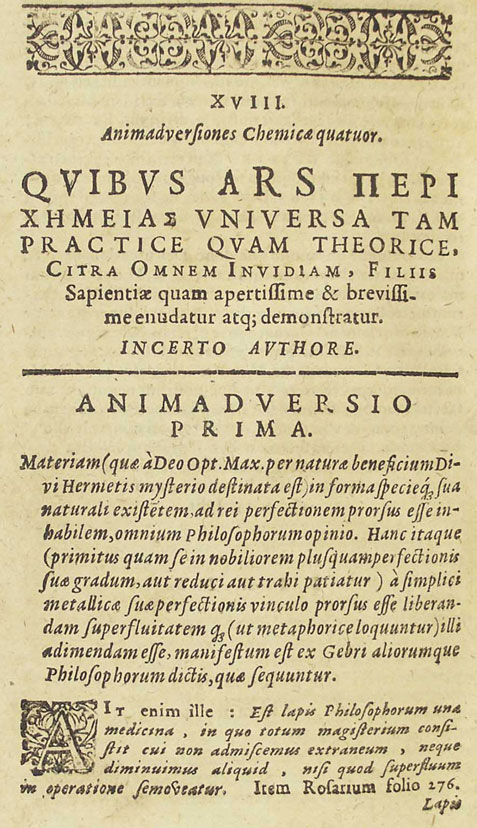
Four Chymical Observations In which the Art of Chemistry, universal both in practice and in theory, without any envy, is very openly and very briefly laid open and demonstrated to the Sons of Wisdom.
Listen Audio Book Study the Art with Us Buy me CoffeeFour Chymical Observations.
In which the Art of Chemistry, universal both in practice and in theory,
without any envy, is very openly and very briefly laid open and demonstrated to the Sons of Wisdom.
Animadversiones chemicae quatuor quibus ars περι χημειασ universa, tam practice quam theorice enudatur
By an uncertain author.
Translated to English from the book:
Theatrum chemicum, praecipuos selectorum auctorum tractatus de chemiae et lapidis philosophici antiquitate, veritate, iure, praestantia, & operationibus, continens: in gratiam verae chemiae, et medicinae chemicae studiosorum ... congestum, et in sex partes seu volumina digestum; singulis voluminibus, suo auctorum et librorum catalogo primis pagellis: rerum vero & verborum indice postremis annexo. Volumen quintum.
FIRST OBSERVATION
The material (which by the benefit of nature ordained by God, the Best and Greatest, for the divine mystery of Hermes, exists in its own natural form and species) is, in the opinion of all the philosophers, altogether unsuitable for its perfection. And therefore this, since it suffers either to be reduced or drawn first into a more noble state than that of its own perfection, must be altogether freed from the bond of its metallic perfection, [and] the superfluity belonging to it (to speak metaphorically) must be removed from it, as is clear from the sayings of Geber and of other philosophers which follow.
For thus he says:
“It is the stone, one medicine of the philosophers, in which the whole mastery consists; to it we add nothing extraneous, nor do we diminish anything, except that which is superfluous in the operation is removed.”
Likewise, the Rosarium, folio 276.
For the Philosophical Stone is created in the end of nature, and by the Most High God, and nothing more is to be added to it, unless that which is superfluous in it be removed. Nor did Maro mean less by this, when he made known that what is superfluous must be taken away, as may be seen in Book VI of the Aeneid. Thus he sings:
Receive first what before all must be borne forth,
the golden bough with leaves and pliant stem, etc.
But the hidden places do not grant entrance before
one has plucked from the tree its golden-haired offspring, etc.
No less also the manuscript Aerarium Philosophorum expresses these things more openly than the rest, in Book I, chapter 2, with these words: Let no one be admitted to this work unless he have the key of the philosophers and understand what is meant among the philosophers by REMOVING THE SUPERFLUOUS. For, unless the form be corrupted, the body cannot seek the spirit, nor can it put on a nobler form.
No less fitting to this purpose is the opinion of that venerable man and philosopher Bernard of Treviso, who is quoted thus:
Although metals are nothing other than quicksilver congealed by degrees through decoctions, yet they are not therefore our stone while they are in metallic form; for it is impossible for one and the same matter to have two forms. With what reason, then, could you say that it is itself the stone (which ought to have a form proper and intermediate between metal and mercury), unless first it be corrupted and that one form be taken away?
Likewise Alchindes, Book II, chapter 1, in that work to which he gave the title Speculum Lucis, speaks thus:
Know, O sons of the wise, that nothing at all is hidden from the philosophers except one certain secret of the art, which is a most difficult matter, and signifies nothing else than to destroy the body and turn it into spirit.
Hence Arnold of Villanova, in his little book which he entitled Flos florum, spoke very well:
And indeed they believe that from solid bodies they may draw forth the medicine, and prepare it by calcining, dissolving, and congealing, and then projecting it upon bodies, and they are deceived. And their error is this: because they do not receive their seed, but rather the body, as it is in its own nature.
To these things the venerable Bernard of Treviso replies in these words:
Leave the metals alone, and from them let your entrance be.
Certainly the most learned Johann Aurelius Augurellus also agrees with this, who in Book I of his Chrysopoeia openly describes the loosening of the spirit from its bonds:
Finally, though it be held bound even in tawny gold,
let him apply the hand of art, that he may loose the bonds,
and restore to it its own powers and strength.
Likewise in the golden little handbook, Book III, chapter 5, Aristhaeus, a most outstanding philosopher of the Greeks, says:
Although our stone outwardly becomes dead, yet inwardly it has life. And therefore it needs no other thing, except that which is collected among the philosophers as precious, and which among the common crowd is held cheap and cast away.
And these are words clear enough, in which there is no riddle.
Likewise Hermes Trismegistus, in Book I of his Apocalypse of the Sun and Moon, speaks thus:
And do not wish, my son, to understand this of vulgar mercury, but of our pure mercurial substance, which is neither living nor dead, but extracted from the body of our king when stripped bare, partaking of the two extremities, namely mercury and sulphur, etc.
Very well suited here is the following opinion of Bernard of Treviso:
Common bodies by nature alone, when reduced to their minerals, are dead, so that they cannot perfect the imperfect. But when through art they are brought to the septenary, denary, or even duodenary multiplication of their perfection, then at last they tinge to infinity.
Likewise in another place:
For we receive this body too just as nature has created it.
To these sayings correspond the golden verses of Johann Aurelius, described in Book II of his Chrysopoeia:
For indeed you must by no means assume this great thing;
the task is to render the mass fit for use.
This is the work, this is the labor here; in this are exercised
the vain cares of craftsmen, etc.
And Theophrastus Paracelsus also speaks excellently to this purpose in his little book on the philosophical stone, to which he gave the title Manuale, in these words:
Since one must follow nature and use natural medicine, one sees that among all things that which is most like the human body must be chosen as medicine. Thus it does not seem to me at all to be denied, but rather affirmed, that metallic arcana have a very great suitability to the human body. Likewise the perfect metals, on account of their perfection, and especially because of the radical moisture in them, etc.
And a little later he adds:
And so it also happens in the philosophical stone, that when you wish to make it by its right art (which you may well learn from the circumstances indicated), you must also remove from it its superfluities, etc.
Likewise [this is taught] in the manuscript book whose title is The Lily Expelled from Thorns, chapter 16. Likewise Johann Aurelius Augurellus in the first little poem of his Chrysopoeia. And Nicolas Flamel of Paris designates the same thing very plainly in his French verses. Alphidius also speaks of this stripping and flaying in Book 3, etc. No less does that appear in the divine Hermes spoken of in the second of the first two figures of his book, which is entitled The Apocalypse of the Sun and Moon, which I first heard at Colle from Medici, from Marsilio Ficino, together with a certain book (which Ficino had written on the mystery of the golden fleece, and had also dedicated to Cosimo), having been brought thence, communicated, and afterwards come into the hands of the Most Serene Duke of Florence.
But the noble man Laurentius Guicciardini, my mother’s kinsman, having obtained permission to copy this, though with much labor, and by whose authority I came to possess the same, offered it here, in its proper form, to R.D.V., as though [it were] a treasury of rare and complete philosophy. Its images, however, distinguished by their proper colors and arrangements, and painted by me (not touched by another’s hand) as well as I could, since they clung firmly enough to my mind, I wished to communicate to the same R.D.V.
But to the matter: thus it is clear that by the removal of accidents, the taking away of sulphureity, and the corruption of form (which are the same thing), the philosophers signify nothing other than the stripping of the body and its death, by which its simple metallic perfection, which hinders the intention of the philosophers, is removed, so that the matter may be transformed into a nobler form.
SECOND OBSERVATION
That this body, once stripped of the firm and solid bond of its superfluity, must be reduced into a volatile spirit or mercurial substance of very white color and of the most subtle penetration, may easily be gathered from the unanimous agreement of the philosophers, whose sayings follow.
To this certainly corresponds very well the most excellent statement of Morienus the Roman philosopher, set down in the Rosary of the Philosophers, folio 410, in these words:
And surely there would not have been white smoke unless there had been gold, where alchemy would not have existed.
To this Mundus the Philosopher also speaks most aptly in the Turba, folio 126:
But I say that unless you kindle the matter with fire, so that it may ascend like a spirit, you will not perfect it. Therefore here is the spirit fleeing the fire, and the smoke, weighty, which when it enters the body penetrates the whole and is colored by nature.
Geber, Book II of his Summa, chapter 99:
Therefore we say that the intention of the whole work is smoke; for unless it smoke, your lapis will in no way at all be able to come to perfection.
Then later Geber says, when speaking of the beginning of the work and of what must be done before the work of sublimation having migrated, and by this it is cleansed from the corrupting superfluity; and this indeed is the perfection of sublimation, namely, that the stone may be subtilized by it until it attains the utmost purity of subtility, and at last becomes wholly volatile.
Likewise in the same book, chapter 45:
Therefore be not negligent in its preparation (which is done by sublimation), for such as the cleansing shall be, such also shall the perfection be.
Likewise:
Make the fixed volatile and the volatile fixed.
And let them dissolve, and make that which flies to endure.
Most openly and clearly this volatilization is also indicated by that most excellent philosopher Johann Aurelius Augurellus of Rimini, in the third book of his Chrysopoeia, folio (if I rightly remember) 58:
When you have first arranged these things, you will kindle the fire,
and the swift heat from the closed furnace will strike them.
The vessel, straight below, compels the whole to endure the fire,
and by a certain property the species, moistened with its own liquid,
grows golden, who would believe it? yet the skillful see this,
and the salt, carried upward from the deep, adheres;
meanwhile you may perceive a pale citrine color to appear here,
although before that it had been a weighty and dense mass,
soft, volatile, light, and of rare appearance,
which, though dyed, also came with snowy whiteness
from its beginning, etc.
Likewise the Rosarium, folio 287, brings forward a saying most suitable to this purpose:
Our gold is not the gold of the common people, and our silver is not the silver of the common people. But I call that gold which by the power of fire ascends to the higher places. And truly that gold is not common gold. For the common crowd would not believe that it could ascend upward because of its fixation.
Likewise Raymund says:
For the body in this art is a metallic spirit in which lies the mineral virtue of spirits; and metals are from that from which first every stone is composed. But the said spirit is called the mineral virtue in which the nature of metals rests. And every stone is compounded from the spirit of metals. And that spirit, by the consideration of chemists, is called mercury, because the first and proper nature considered in this art is the first matter of metals. Afterwards the said spirit is sublimed by sublimation through three degrees of fire, and is converted into a leafy earth, which is called the fifth essence and the earth of metals. And by some philosophers it is called living silver, or mercury, or sulphur of nature. Likewise: again, the extraction of our gold is the first work, until from the body nothing remains and there remains in the body that which does not ascend with the moist spirit, etc.
Likewise Hermes, Book 6, chapter 10: “The Work of the Sun.” He says:
Whiten the bronze, and with fire sublime it; for thus you will draw out the spirit that is hidden within it. Do not be weary in doing this, for it is the diadem of thy heart, and the permanent ash, the crown of victory, and the coagulum of milk. Here the ash is extracted from the ashes, and [this is] the seed of the philosophers, the white leafy earth, in which gold must be sown. Extract the gold from the radiant shadow and the darkness that kills it namely, from the coagulation of the bronze. And sow that gold-seed in the white leafy earth. And that gold is not the gold of the common people, but is the soul of gold, from which the gold of the leafy earth is born.
This also the volatilization of the body is made clear by Theophrastus Paracelsus, at the end of his Manual, in his Praxis concerning Electrum: he makes the soul to be turned [or transformed], when he teaches not only this, but also in the preparation preceding it, as he expressly sets forth in the following words, how a spiritual matter, once fixed, is to be reduced as though into its own “wife,” into whose concord (as he calls it) it is to be brought back:
Then thou wilt see how it proceeds ever further, more and more, by sublimation. And when thou now hast the sign, so thou shalt sublime; and then the electrum is changed in the manner of the highest eagle, and with less toil is brought and transmuted this is what we seek to use as our medicine.
No less does the third figure of his Apocalypse of Hermes hint at this same “palm” (i.e. this same point).
But from this volatilized golden species, and from new mercurial powers and practices (which the philosophers metaphorically call water), it is necessary to assert that the beginning of the work is [made] setting aside empty triflers whose opinions are brought forward.
In the Consilium of the Sun and Moon: “Thus all the work is accomplished with celestial water.”
Likewise the Rosarium, folio 287:
For the water of the Sun and Moon is volatile; its body is fixed.
Likewise Johann Dumbleus, a notable philosopher, and Alchindus:
This is that secret of the Art: to know that celestial water, because from it is the beginning of the Art.
Likewise Arnold of Villanova, in the book entitled Flos Florum:
And our stone, as certain philosophers say, is from one thing alone; and truly they speak truly, for the whole mastery is made with our water, and from it, and through it.
Likewise the Rosarium, folio 230, if I rightly remember:
Therefore water is that which whitens and makes red. Water is that which kills and makes alive. Water is that which burns and makes white. Water is that which dissolves and coagulates. Water is that which putrefies, and afterwards makes new things to germinate and to grow.
Likewise the Consilium of the Sun and Moon, folio 276:
Because this water does all things: through it things are dissolved, coagulated, and perfected, etc.
This most excellent [thing / statement] the following opinion of the philosophers, which corresponds very well here for the confirmation of the things aforesaid and embraces the whole sum of the work, R.D.V. will not disdain to inspect.
For so says Dardanus the Persian in the Turba, folio 15. Likewise Alphidius in the fourth part of his handwritten treatise entitled, Book 7, The Seals of the Secrets of the Art, near the end, chapter 1. Likewise Plato, chapter 2 of his Furnace. Likewise Johann Dumbleus in his codex, written on virgin parchment in letters of gold, presented by the same man to Philip the Good, most illustrious Duke of Burgundy and Flanders, and first founder of the Order of the Golden Fleece. Thus they all speak:
No one ought to begin the study of this art unless this Water be known to him: for its virtue is spiritual blood. And therefore among the philosophers it is called permanent water. But when it is broken together with the body, it turns that body into spirit, because when these are mixed together they are changed one into another and serve one another. The body incorporates the spirit: here indeed the body turns into spirit. And know that everything which has spirit has blood also. Therefore these are most true arcana.
These words are indeed brief, yet in them the beginning and the end of the theoretical art are comprehended.
And Nicolas Flamel of Paris also indicates this no less philosophically, in his verses written in French, which he published concerning the philosophical stone, in these words:
But leave the mark aside; one must
pure and clean, from these ashes,
better to understand this guide,
for from it thou canst well make
the greatest part of thy work
and suspend the rest that follows from it.
But by what names they designated this [water], enough is clear from their writings. For they called it: Azoth; the Earth of Margarites; the Snow of White Brass; heavenly water; the Mercury of Virgins; and the unknown [thing].
Again: white earth, whitened sulphur, the moon at full, very sharp vinegar, the resurrected body, white lead.
Again: Beya and Helya, the exalted eagle, and moist spirit.
But of what species and form this volatile mercurial substance, or water of the philosophers, was, that most excellent poet Joan. Aurelius Augurellus, in Book 2 of his Chrysopoeia, made known in the following verses:
Think not that it is the water of the immense sea or of the clouds,
or liquid moisture like that of a flowing spring, which thou seekest in vain;
nor indeed that which, as thou must remember, moistens with its own powers of Venus, for dry indeed
but this powder puts forth an outer appearance, while inwardly
the moisture hidden in the depths of gold melts.
What that gold truly was is clear from the following [authorities]. And first from the venerable man Bernard of Treviso, who says in these words:
They say that a certain water is our water, which is permanent; and unless it be joined to its own nature, it makes nothing else except that which is of the unity of its own nature.
But what its nature was, the saying of the divine Hermes, set down in the Book of the Sun, clearly shows. For he says:
That which is the secret of each and every thing is one water, and this water is fit to receive nourishment in men and in other things. And in this water is the greatest secret: for it is the water which in wheat becomes grain, and in the olive becomes oil, and in certain trees [becomes] diverse fruits. And water is the principle of generation.
To this corresponds very well his own statement in Book I of his Apocalypse, chapter 7, concerning the Sun. For he says:
Because there is a great difference between our gross, subtle, pure, and impure spirit, and common mercury. Our spirit is moist and hot, but common mercury is cold and moist. For ours is liquefied by fire, and from it is the beginning of the art.
THIRD OBSERVATION
Finally, this [substance], reduced to the nature of a most subtle and very white spirit, and being now stripped bare and lacking its former form, must henceforth be so taken up by the skill of art that it may acquire a property far greater than before, of its primitive metallic seed, as is plainly established from the testimony of the philosophers that follows.
But what this concordant spermatic commixture is, by which it must be brought back to the first form of metals and to the Mercury of the philosophers that is, into active and passive, masculine and feminine, agent and patient, mercurial and sulphureous power and nature being divided and converted by the skill of art, will be made clear from what follows.
And first, the venerable man Trevisan teaches thus:
And you may consider that in this art there are no more than two spermatic materials, of one and the same root, substance and essence; namely, mercurial, solar, viscous and dry, which is joined to nothing in this world except to a body.
Likewise in another place:
Likewise Morienus and Aaron: Our sulphur (they say) is not common, but fixed and volatile, of the nature of mercury, and not of any other water.
Likewise he says in another place:
Likewise the king Aros, most excellent and most learned, says: Our medicine is from two things of one essence, namely from the union of mercurial fixed and non-fixed natures, spiritual and corporeal, cold and moist, hot and dry, and it cannot be from anything else whatever.
Likewise Morfoleus the Arab speaks very aptly to this purpose in the Turba, folio 47:
Moreover they have said that every body is dissolved when it is mixed with its spirit, and without doubt it becomes spiritual. And every spirit is altered and colored by bodies, in which the coloring color and the constant tincture consist. Blessed therefore be the name of Him who has taught His elect to turn body into spirit.
And R.D.V. will not disdain to inquire diligently into this sentence as a confirmation of the things aforesaid. For Arnold of Villanova says in the treatise entitled Flos florum:
In our magistery we first make the gross subtle, that is, from the body water; and afterwards from such water dryness, that is, from water moist earth, that is, dry. And thus we convert the natures, and make from body or bodily thing a spiritual thing, as has been said. And we make that which is above like that which is below, and conversely.
Whence Hermes [says]:
It is true, and without lie, most true, that what is above is like that which is below, and what is below is like that which is above, etc.
All these things indeed are to be referred to the figure of the Tabula Smaragdina, representing two species of one form, of which one contains the tail of the other; one is described above with a whitish color, the other below and elsewhere with a red color.
FOURTH OBSERVATION
But what those two spermatic qualities of one substance and root are that must be joined together, and under what sign of color they appear, and lastly what proportion of weight must be observed in these things, the citations of the most excellent philosophers which follow will show; and they will occupy the place of our fourth observation.
Africanus in the Turba, folio 29:
Thus it is necessary to join those two, whom the philosophers have compared to husband and wife and from whose embrace there results golden water.
Likewise the Rosarium, folio 267:
Join therefore our most reddish servant to his sweet-smelling sister, and between them a son shall be born, who is not to be likened to his parents.
Likewise the venerable man Bernard of Treviso, and Alsimelch the Arab, in his book entitled The Matrimonial Mystery, speak most openly to this purpose:
Join the red man to his white wife, in a round bed, surrounded with fire; and there also let him be warmed with continual heat, until there be made the conjunction of the man with the philosophical and not the vulgar water: that is, in this there is at once everything that is required for its perfection; then at last that conjunction is called the first matter of the stone, and not otherwise. For in itself it contains the white fixed nature and also the spiritual nature, adorned with a most noble fixedness.
Certainly these are golden words.
Likewise in another place:
Truth itself has shown before your eyes that it is necessary for the masculine body to be made more than perfect by art imitating nature.
Senior and Assiduus in the book of the Conjunction of the Sun and Moon, folio 149, speak thus:
The stone must be set in its vessel without defect, in winter, summer, autumn, and spring, and in all the days of the year.
For, as Senior says:
And make it clean, having a clean blessing.
For from the most mighty male and female there is begotten a most noble offspring; and to this seed no foreign admixture is fitting; and there comes forth the whitest matter of gold and silver from the purest mercury and incombustible sulphur.
Likewise Arnold of Villanova, in his letter to the King of Naples, sets forth the whole theoretical art most plainly in these words:
And this is one of the evident signs for recognizing the stone itself, if you understand well. The composite, or the mixed thing, is seen in the first operation to be divided in two manners: first corporeally, secondly spiritually; and one comes forth from the other, and one improves the other. And the philosophers call one masculine and the other feminine.
This agrees with the opinion of Bernard of Treviso as set forth in his allegorical Praxis, in these words:
He asked at last of what kind the king was. He answered that he was from the fountain, which being such as it is, makes [the thing] such, without requiring any other water.
Likewise Theophrastus, in his Manual, openly hints at this hermaphroditic concord in these words:
And this is such a matter, the perfect stone, and needs no preparation but only one thing, which stands in a concord and would willingly be helped.
And a little later:
Take the man, who is forged by Vulcan alone; that is, a whole work.
“Because it does not stand in its concord; and so long as it is so, it is to be reckoned as only half, until a woman is mixed with it, which is equal to it,” etc.
Nevertheless Nicolas Flamel figuratively demonstrated this: partly by two dragons, partly by parabolic sayings, but more openly by two lions of the same kind of which one, winged, of a very white color like a griffin, devours the other, unwinged and painted red, and was seen to swallow it down.
These [figures] may be seen painted in their proper colors, and adorned with gold and azure, in the hospital of Saint Vincent at Paris, between the arches of the gate upon the curved wall most suitably indeed indicating this metamorphosis of the marriage.
I hear, however, that such figures have now all been extinguished and erased, perhaps by the design of those who conceal mysteries, moved by envy, lest anything of that sort, useful for spectators, be communicated.
Such pictures are also to be seen in the castle of Horsten, which is said to be three miles’ distance from Louvain. Likewise in the church of that village, which is nearer the castle, above the principal arch at the curve of the church roof where (as the lady of that castle has more than once related to me) they are said to have been painted by a certain Amelricus Boot, a nobleman of Russia.
Here it is said that the secret of the Art was obtained by a certain young man, who, passing through (making a journey that way), was receiving a stipend from that nobleman. After some time they entered into friendship, so that he was brought to the Art itself, and faithfully declared the way of the stone aright.
I have even seen to this day such furnaces in his wine-cellar, fifty steps deep. They are also seen somewhere at Vilvorde, in the church at the curve of the choir, painted there by a certain nobleman from Burgundy, referring to a sort of Trinity (according to the art of nature).
Moreover, at Cologne, in the buildings in which I was born (to which my parents, because of the plague, fled from Liège), not far from the church of Saint Severinus, there is a tower everywhere furnished with figures of this kind, spread as it were over every wall figures which my father caused to be painted, not because of the philosophy of the figures, but because of the elegance of the colors and of the art of painting.
From these things (for I have gathered them from Persia, having myself made certain things, as far as I was able if now I do not fail in trustworthiness), let R.D.V. make a judgment.
And since the greater part of those things clings to my mind, if I can render any service pleasing to R.D.V. in communicating these matters, I will not cease to paint the principal ones (as far as lies in me) and to offer them to the same Reverend Lordship.
I say the principal ones, namely those whose authors, after death, have plainly either as indications of their light, or as tokens after death, and as monuments and testimonies left behind, as those mentioned above have done.
Flamel, a man of lowly origin and a Parisian scrivener, built the Hospital of Saint Vincent, and every year adorned it with many golden “flayings” (i.e. stripping-images). Amelricus de Boot (whom they say was a man of simple lineage, yet upright and noble) took care that that very strong castle be built in the water itself, or in a lake of immense depth. He built the church of that village and donated many thousands for alms, as all who dwell in the surrounding region testify. The chapel in which he is buried (which is sacred to the Blessed Mary) is everywhere covered with pure gold and azure-blue; and the history of the Blessed Virgin is seen painted on the leaves there in these two colors, etc.
He who arranged for the aforementioned things to be painted in the tower was Kirchberich, buried elsewhere in Germany; his tomb is said to be made from brass gilded most excellently, around the edge of which, in a circle, these characters are written:
Kirchberich, ten-toothed, toothless, and gray-haired,
again grows black, becomes toothy, grows young here he rests.
But enough of these things for now.
So that at last we may finish the fourth part of our observation, there remain to be brought forward certain sayings of the philosophers that express the rule of proportion and weight that must be observed in this work.
Thus Parmenides, folio 81, says:
And if the smoke is fleeing and the fixed [substance] is joined to it, when both have been mixed together, the surface is whitened and its interior is whitened.
Furthermore, know that there must be ten [parts] upon one, and that our sulphur alone binds and colors all bodies.
Likewise in the book called the Consilium of the Sun and Moon, folio 188:
If the parts are sooner or later consumed, the body of the bronze is later dissolved; for more quickly are nine parts acted upon than six or seven; but fewer parts are dried more quickly than many, and are fixed more quickly.
In the same book, folio 188: Gratianus:
For we cannot work with our own hands upon mercury, but with ten “species,” which in this our work we call our hands namely, nine parts of water and the tenth of bronze.
In the same book, folio 198:
Or it is called Decambar, from Deca, which is ten, and Bar, that is, son: as though “son of ten,” namely of the ten species of the art namely nine of Margarites and the tenth of bronze.
In the same book, folio 145, if I remember correctly:
Then send [it] away from the white moist nine parts, so that the tenth part may be of bronze. In the same book, if I remember rightly, in that place:
Let Azoth indeed rule over the vessel, and let it make it reddish, with nine eagles, that is, with nine parts of water, the volatile tincture of our bronze. And it must be sublimed in that vessel until everything is whitened.
Whence Rasis [says]:
The substance of all things is made equal to the tenth part; but if you wish to make the whole thing volatile, it is necessary that nine tenths of its substance be made from the substance of water.
Likewise Moses in the Turba, not mindful of number [i.e. not disregarding it], says:
Join first nine parts of vinegar, for these are the eagles which have sharp claws, mortifying the body and drawing out its soul, which is the tincture of our bronze.
In the Book of the Sun and Moon, folio 94:
And afterwards cool the whole unguent, so that there be nine parts of ointments and one part of bronze.
And later in the same book:
Assiduus the philosopher, investigating everything, says: I have found two substances, namely the agent and the patient; and behold, the agent is always one, but the patient is several. From which I have noted that in this work, except for one, there are two substances, namely male and female. Moreover, the male is singular, but the female is plural. And note that the weight of the art is double, namely the common [weight], in which there is not one part of bronze, but nine and the tenth part.
Certainly these are golden words, and not the least manifest.
These things are also confirmed by the sayings of many philosophers, by the fourth and fifth figures of the divine Hermes in his Apocalypse. Likewise also by the nine eagles depicted in the Tabula Smaragdina.
We have described above, in our Second Observation, the properties of the colors and form of that water, as of the first part of the work. But of that bronze and body, by which the permanent water is made, we add certain powers and names:
The red lion, in Theophrastus;
Bronze, in Lato and Cummi Hermes;
The red egg, in Artephius;
Red smoke, in Morienus;
Mercury making red, in Stella;
The fatness of the Sun, in Raymund;
The fixed body, mercurial sulphur, the father of the Sun, Decambar, in Alphidius;
The red Leto, the reddening servant, the red king, in Bernard of Treviso.
And in the end it commonly calls itself by the names Dicitur and Gabritius, male seed, phoenix.
And thus Arnold of Villanova, in his book entitled Flos Florum, strengthens and conclusively confirms the sayings both of the aforesaid philosophers and of our four observations, in these words:
The first word is the reduction of bodies into living silver [quicksilver]. And this is what the philosophers have called reduction, which is the foundation of the art. The saying of the philosophers [is]: Unless you shall have dissolved the bodies, you labor in vain.
Then, when Parmenides treats of solution in the book of the Turba, he said:
If they had read and understood this book, they would know that water is permanent, which, without its own body by which it is joined and made one cannot be permanent.
Hence Morienus very well said:
Whatever you do with this water, if it is not fermented, it does not exist.
And now at last it appears conclusively that a preparation and disposition of this kind are required before the matter, exalted by the aforesaid labors, becomes fit to be brought to a more-than-perfect state, and before it is truly called by the philosophers the subject or mercury. This is first made manifest in Hermes.
Likewise in the third book of the Treasury of the Philosophers, chapter 4. Then in the book entitled The Sound of the Trumpet, folio 573. Likewise in the second book of Alphidius, chapter 20. Likewise in the second part of the Turba Philosophorum, folio 222. No less also in the Summa of Plato, second page, in these words:
Because in vitrification, adaptation, and aptness, there cannot be a fixed time, unless according as the artist works well.
Then the sayings of two most excellent philosophers confirm this.
And first, of the venerable man Bernard of Treviso, speaking thus:
For Calib and Aros say: In our whole work mercury and fire are sufficient for thee in the middle and at the end; but in the beginning the matter is not so: for indeed it is not our mercury which is very easy to understand.
Then Geber, in these words:
Because in the operation of our magistery we do not need more than a single vessel, a single furnace, and a single disposition; which understand after the first preparation of the stone.
The End.