BOOK CALLED “NEW LIGHT”
PROEM
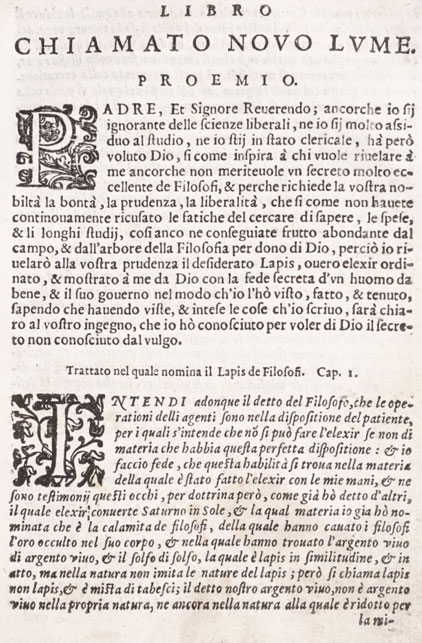
Translated to English from the book:
Della tramutatione metallica sogni tre / di Gio. Battista Nazari Bresciano ; nel primo de quali si tratta della falsa tramutatione sofistica ; nel secondo della vtile tramutatione detta reale vsuale ; nel terzo della diuina tramutatione detta reale filosofica ; aggiontoui di nuouo la Concordanza de filosofi, & loro prattica ; nellaquale, si vede i gradi, & termini de esso diuino magistero, & della verissima compositione della filosofia naturale, con laquale ogni cosa diminuta si riduce al vero solificio, & lunificio ; con un copioso indice per ciascun sogno de gli auttori, & dell'opere c'banno sopra di ciò trattato
Father, and Reverend Lord: although I am ignorant of the liberal sciences, nor am I very assiduous in study, nor have I been in the clerical estate; yet God has willed just as He inspires whomever He wills to reveal to me (though unworthy) a very excellent secret of the Philosophers. And because your nobility requires goodness, prudence, and liberality; and because you have not continually refused the labours of seeking to know, the expenses, and the long studies so that you have also gathered abundant fruit from the field and from the tree of Philosophy by the gift of God therefore I will reveal to your prudence the desired Lapis, that is, the ordered elixir, shown to me by God through the secret faith of a good man, and its regimen in the manner that I have seen it done and kept; knowing that, having seen and understood the things that I write, it will be clear to your understanding that, by the will of God, I have known the secret not known to the common people.
Treatise in which the Philosophers’ Stone is named. Chapter 1
Understand therefore the saying of the Philosopher: that the operations of agents are in the disposition of the patient; by which it is understood that one cannot make the elixir except from a matter that has this perfect disposition. And I give assurance that this aptitude is found in the matter from which the elixir has been made with my own hands; and these eyes are witnesses of it not by doctrine, however, as I have already said of others.
This elixir converts Saturn into Sol; and that matter I have already named, namely that it is the calamity of the Philosophers, from which the philosophers have extracted the hidden gold in its body, and in which they have found the living silver. [It is] of living silver, and the sulphur of sulphur: which is the Stone in likeness and in act, but in nature it does not imitate the natures of the Stone. Therefore it is called stone and not stone, and it is mixed with dregs. This our living silver is not living silver in its own nature, nor yet in the nature to which it is reduced by the minera; but our living silver, in the nature to which our artifice reduces it, this is our copper, from which the true tincture is made; from which is made the marriage of chabrichim, and of the veya, in which is the King with his wife. And these things that amend them are in the same copper, as will be made more clearly manifest by the proof of the operation.
This is the spirit with which we tinge, and it is the body of which one speaks in the Turba; and this way which is called living silver is not made from bodies liquefied by common liquefaction, but from that which endures so long as the husband and wife are joined in true marriage, that is, until the whiteness.
This is the stone which is found on the tops of mountains, and it is rightly called mineral. It is also said that it is animal, because it has a soul; therefore it is said in the Turba: the copper has the body, and the soul like man. Likewise, everything that has spirit has also blood. Likewise it is called spirit that is, living silver, bearer of the virtues of the soul that is, sulphur for the body; and copper, that is, calamita, or earth, which when made spiritual is called gold, which was hidden in the body of the calamita. Therefore it is said: the little son draws his shadow from the ray.
And it is also manifest that one can apply the soul to it, because it shows some virtues of the soul: because it moves and is moved, it is agent and patient. Yet it is said in the Turba that it is a nature in which thou art eminent above all things; and in what manner the sulphurs [work], and the very strong vinegar that has made the gold be pure spirit; and when it is mixed with the body, it makes one and the same thing with that, and converts it into spirit.
Therefore, it is said that it is animal. Therefore I say that it is also something vegetable, and rightly so, because in the operation it will vegetate from virtue to virtue, subtilizing itself and purifying itself, and improving itself in its colours, until it acquires the desired redness, in which is perfection, and until it takes on the virtue of penetrating and of tinging. But many who err do not know this animal herbelcrocos, or vegetable saffron stone, nourished in the mountains, and it is sold openly for a very small price.
Here follows the cleansing of the Stone, before it is put into the decoction.
Chapter 2
In this work which I have shown to your understanding pure, clean, pleasant, and sincere there is shown a right [and] fitting accommodation into thin plates; because it is purged by the liquefaction of fire from mineral grossness; and by the modes of levigation it is made subtle in some sulphureities left by the adustion, and earthy matters; and [it is] mixed with subtle union; and being exhaled of certain humidities that corrupt, of which in such a subtiliation there are two signs: one which is the citrine spirit, not hard, made into stone, which has some clarity; and the other which remains at the bottom of the vessel made of subtle earth, and black.
But take heed of this: that if in that elevation it be done well, there is found a certain thing which remains within, which must be taken out by force and raised above the volatile, and must be restored to the part which remains of that which has already been raised, until everything becomes fugitive. And then the aforesaid black earth remains from both of them in the aforesaid hard stone, most citrine, already converted. But do not content yourselves with the aforesaid volatility until you find that the whole mass of the aforesaid stone, raised with the fire, has returned into its vessel, continuing by the same means, keeping the degrees of the aforesaid fire, in such a way that there remains nothing at all in the depth, neither clean nor foul. But when it has thus been raised most perfectly, it will be fulfilled in the perfection of the philosophical work, which Scripture commands, saying: Wisely and with great ingenuity it ascends from the earth into Heaven.
Know likewise that when it is mixed with the body, it makes one same thing with it, and converts it into spirit; and Geber commands the same in the chapter on the medicine of the third order. And all philosophers call this isteço, and that work is called by the philosophers Ablution, through which it is made subtle, because in the elevation the one ascends in smoke, or in the appearance of smoke; and because it also liquefies this matter while it ascends, it is clear that it is of the nature of hot water, because it liquefies and congeals by cold; and when it is stripped of the superfluity, it washes, it is imbibed with its own water, that is, with the aforesaid spirit which proceeds from the isteço germ. This therefore is philosophical dissolution, which is done by fire.
There follows the decoction of the first degree up to whiteness. Chapter 3.
VESSEL. Therefore, having made it round and spiritual, which converts copper into four, it enters into the tempered bath, by which the body becomes gentle, and which contains the light fire, which consumes the humidities that corrupt. One must therefore make a furnace of such a disposition that in it a slow fire is made, which cannot be increased. And the vessel which contains the matter must be of glass covered with iron, in a vessel of the same form cut through the middle. And the vessel must be a cubit long, narrow at the top, so that the narrowness does not permit the spirit to go out, and the length precipitates the fumes; if it happens that some of them are raised, and they consume among themselves the humidities that corrupt, of whatever form, and the vessel must seek the path of the Lily, and not the letter; and the heat must surround the vessel on all sides, so that there may be equality of heat on all sides; otherwise one would say in vain that it is a bath. And at the top of the furnace there must be an opening, through which a round and long piece of glass must pass, which closes the opening of the said vessel; by touching this piece one knows whether the matter is cooking with suitable heat.
And if by chance some smoke should appear to rise in the aforesaid vessel, it must not be allowed to escape, since it is thus disposed; even though the vessel should remain open. Yet Geber says that never does one truly separate from the other, although to the sight they seem superficially to separate; nor can one exist without the other, because their spirits are tempered by the way of perfect nature, inasmuch as they do not separate the one from the other. And in this degree of heat the matter becomes black, because heat working in the humid makes blackness. Yet it is said in the Turba that, when you see blackness floating upon the water, you must know that the body is liquefied. Likewise, in the first operation all things become black; but this fruit therefore is produced so that one may beware of too much fire, because heat shut inside causes death and separates the composite; and therefore one must proceed with tempered fire. Thus it is cooked in such a manner that it nourishes a little milk, and in this all things convene; this also is shown in practice by the diversity of colors which are contained under the black color.
Of the degree of the fire, when blackness is seen. Chapter 4.
WHEN everything is black, continue the fire of the same degree until the whiteness hidden in its womb is seen, because thus one approaches the end. But it is to be noted that in the same blackness many colors appear, of which the philosophers make no mention, because sometimes everything becomes green, sometimes livid, sometimes of a violet color; sometimes even on one side of the vessel it is green, on the other it is black; or livid within and green outside.
Yet all these colors are comprehended under black, because in them there is contained no essential perfection. Therefore the philosophers name only three colors among the principal ones, namely the white, the black, and the red, which are called the virtues of the soul. But in the Turba it is said: honor the King and his wife, and do not burn them, so that you do not put them to flight with too much fire; because you do not know when you will have need of these same, correcting the King and his consort, let them be cooked so that they become black, then white, then red; finally, that which dyes becomes poison.
Likewise, the white stone is made by the combustion and moisture, that is, by liquefaction; by the water it is said that mortification follows, which is seen in blackness at the first appearance; in which mortification the spirits are joined and they dry out, because if the bodies do not dry out, the colors of the soul are not seen, which are called blackness and cloud. Likewise, the loadstone, when it whitens, does not let the spirit flee, because nature contains nature. Therefore the humidity, which cured the blackness in the decoction, is shown to have become dry when one begins to see the white color; because I have seen, in the transmutation of blackness, a dark whiteness before it became perfect whiteness, which is commonly called the brown color; which brownness then becomes true whiteness.
And while this brownness endured, my master broke the vessel, and the stone, and looked at it within and without, and found it brown on the outside, and within there was still the blackness; and he told me the cause of this to be that the parts of the matter, adhering to the sides of the vessel, had felt more heat close by, which had not made the matter in the middle; and therefore they had sooner begun to transmute in the color. And he told me that this brownness appeared because the whiteness was being drawn out from the womb of its blackness, as is said in the Turba; because when you shall see it, you will know that its whiteness is hidden in the womb of the blackness which is first seen; and then it is necessary that you beware that blackness, that most subtle blackness of it.
And do not marvel that until now I call this matter stone; because know that, as long as the whiteness lasts, and even though the redness has come before it, for a long time it remains hard, and remains in the form of a strong mass, until with the continuation of the decoction it begins of itself to dissolve and to rise somewhat.
There follows the decoction of the second degree, up to redness. Chapter 5.
WHEN, therefore, this stone has thus left behind the blackness, the degree of the fire is changed, and it is put into another furnace of a more subtle disposition, in which a stronger decoction is made, heating the vessel and the matter round about; and there it must be made to cook, because then it takes on true whiteness, with which, in the same place, it is cooked so long that the whiteness, being transmuted, seems to acquire redness. But care must be taken that this fire be not more intense than what befits its degree; because in that white color the body and the spirit are truly conjoined; and if the decoction were made excessive beyond what is due to its degree, being united they would separate. Therefore it is said in the Turba: cook cautiously, so that they do not turn into smoke.
But they become citrine when, from the white color, they are transmuted into red; and the citrine color is a mean between the white and the red. It is necessary, therefore, that this come before the true redness. And of this practice the philosophers have spoken, saying that the spirit and the soul do not unite except in the white color; because then all the colors that can be imagined in the world are seen and are fixed, and then they come together into one color only, namely whiteness; because whitening is the foundation of the whole work. Nor does it change into diverse colors that is, true ones except into the red, in which is the final end; because the citrination which is made between the white and the red ought not to be called a color in perfection. And all these things that I have said are proved, which also experience of the work has shown me to be true.
There follows the decoction of the third degree up to calcination. Chapter 6.
WHEN it begins to become red, it is set to cook in another furnace, giving it a stronger degree of fire, until it is truly red within and without; of which it is a sign when it breaks up and rises, as was said above of which things the Turba speaks. But after the whiteness you cannot go wrong; because, if the fire is increased after the whiteness, before the redness one arrives at incineration. Likewise, seeing that outstanding whiteness, think that the redness is hidden in that whiteness.
Then it is necessary to take it out, but cooking it until everything becomes red. And if there remains doubt because the whiteness is caused from the womb of the blackness, and not the redness from the whiteness (although the red is made by cooking), I declare it to you in this manner: because while the blackness lasts, the matter remains and is humid by its nature; which humidity shows that it dries up when the whiteness appears; and never does the whiteness appear until the humidities which corrupt are entirely consumed. Therefore, for these two causes, it may be said that the whiteness is caused from the blackness; and while it is made red, nothing is spoiled, but it is only cooked. And in the strong decoction the red color is seen unchangeable, in which is perfection. Yet it is said in the Turba: from the composite converted into red spirit the beginning of the world is made. Likewise, the spirit that dyes and vivifies is introduced; and then, since the corrupting humidity has departed, it is nourished no more, because it has come to the whiteness. Appearing therefore, this red color, nature shows its hidden perfection.
There follows the calcination, in which it is embraced: the last degree of the elixir, and then the spirit is truly made a true permanent body, and a fugitive fugitive. Chapter 7.
AFTER this matter, which has the red color, begins to break up and to rise, it is set to calcine by a strong flame reverberating in the earthen vessel, in which the fire is comprised in a fixed degree, and it is made truly permanent and with a most perfect fixation. Therefore Geber says in the chapter on calcination, that spirits are calcined until they make fixation, and they dissolve better.
And likewise, in the chapter on the medicine of the third order, it begins to calcine it; and the fire, when it calcines, must stand in vigor until it makes powder to the touch impalpable, and which has very great redness. Yet in the Turba it is said thus: know that when it is ash, it mixes very well, because that ash receives the spirit, and that moisture is shut in by reason of the inner fire, until it takes the color of saffron, or of dry and burned blood, or of pomegranate syrup. Likewise, when the water has entered the body, it converts it into earth, then into powder, or ash. If you wish to make proof of the perfection, take it with the hand: if you find the water impalpable, the thing goes well; if not, return to repeat. But this very red impalpable ash rises of itself; it also increases in the manner of a ferment, and it separates from that in the calcination…
The aforesaid black earth, most subtle and transparent, which is at the bottom of the vessel, is found beneath the said red powder. Wherefore my master told me that one sees the perfection of the fixation consists in this, for two causes: one, because by the fixation and by the fire of the calcination, a small quantity of this elixir is introduced upon a great quantity of the body that is not permanent; and when projection is made with it, it confirms in those the fixation of gold, which it would not do if the fixation in it did not abound. The other cause is because the aforesaid black earth, in the calcination, separates from the mixture, which otherwise throughout the whole work had been inseparable by reason of the most strong union; and therefore it has been necessary to separate it by a most vigorous artifice; and if it were to remain mixed, by reason of its impurity it would hinder the entrance of the pure matter.
There follows the ash made fusible by calcination, and the repeatable stone, which is the completed elixir. Chapter 8.
BUT this ash is without fixation; yet in what manner does it enter in order to dye? Certainly from it there is restored the liquefaction, or sweat, in the manner taught by the philosophers. What manner then is this? Is it perhaps to dissolve in water? Certainly not; because the philosophers do not concern themselves with waters that cling to him who touches them and that wet, as it is said in the Turba. But those who begin and who feel the water have thought that it is common water; yet if they had read our books, they would know that the water is permanent. In what manner then is it truly water, which does not stick to him who touches it, but runs over the surface, not moistening as quicksilver does? Who shall make this water? He who knows how to make glass; because this matter is nothing else than that which wills of itself to be added to itself, because it contains in itself all the things it has need of. And if the things that I have said are well considered, you will know that from this ash one has the red stone, of an intense color, somewhat transparent, brittle, with little labor fusible, penetrating, entering, and dyeing with perpetual citrination; one weight of which converts a hundred thousand weights and more of Saturn into Sol. But the subtlety consists in the manner of making the projection, which, if it be not known, the elixir that one has profits not by itself.
Conclusion of the whole Epistle. Chapter 9.
THEREFORE, Father, do not marvel if in this work many err; for I swear to thee that I have never seen any man, save my Master, who applied his work to the due matter; but they strive after impossible things in the matters, as if they believed that of a dog a man might be generated. What wonder then is it if they become liars in their works? For in the practice of the work there remain many most subtle doubts concerning the Stone; but believe truly that the philosophers have placed the truth in their books: yet after the death of him that writes, his writings are ill understood; which nevertheless, if he were alive, he would expound speculatively with words, and would verify them by the effect of the work.
But I have set forth to thy prudence, in every point, the whole work; and I have proved certain things said by the philosophers, although I have alleged but few of them, and not without cause: because I presume that thou hast shut up in thy breast all the writings of the philosophers; and thus I doubt not that thou shouldest apply everything to my sayings, even as I, by the experience which I have seen, understand the writings of the wise, which otherwise I should not have understood.
I have therefore written but few things, persuading myself that thou knowest the foundation; and therefore thou wilt easily attain the intention of this work. And it sufficeth me that to thee alone my understanding be made manifest, and that this truth may not depart with me out of this world. For reverence of thy paternity I have brought forth this light upon that matter, because among the others of this world I have, according to my judgment, chosen thee for the most worthy; and may the most high God make thee arrive at the end desired.
The End.