A New Light Kindled in Phosphors, or a Physico-Chemical Exercise, on the cause of light in phosphors, both natural and artificial
Study the Art with Us Buy me Coffeehttps://www.alchemy-texts.com/book/lumen-novum-phosphoris-accensum/
A NEW LIGHT
KINDLED IN PHOSPHORS,
or
A PHYSICO-CHEMICAL EXERCISE,
on the cause of light in phosphors, both natural and artificial,
written
at the invitation of the most celebrated Royal Academy at Bordeaux in France,
by
JOANNES HENR. COHAUSEN, M.D. - Johann Heinrich Cohausen
physician to the Most Reverend and Most Serene Prince and Bishop of Münster and Paderborn,
D. D. FRANCISCUS ARNOLDI,
chief court physician of Ahusen.
Amsterdam,
printed by Joannem Oosterwyk,
1717.
Translated from the book:
Lumen novum phosphoris accensum, sive exercitatio physico-chymica, de causa lucis in phosphoris tam naturalibus quam artificialibus ... / a Ioanne Henr. Cohausen ...
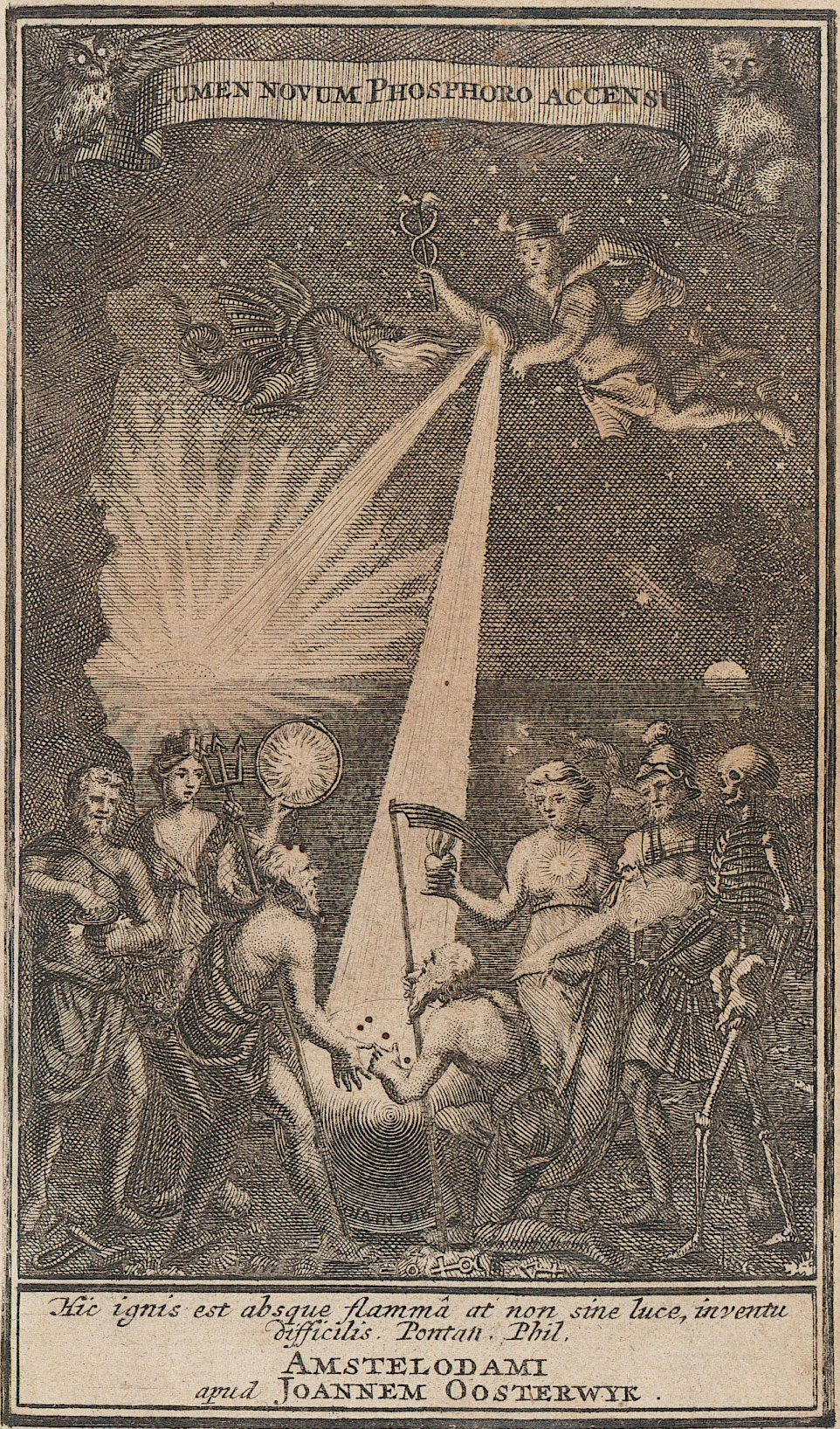
A NEW LIGHT OF THE KINDLED PHOSPHOR
This fire is without flame, yet not without light, and difficult to discover.
Pontanus the Philosopher.
At Amsterdam, by Joannem Oosterwyk.
A small thing the world is, unless there is in it that by which the whole world may be understood. Certain sacred matters are not delivered all at once: Eleusis preserves something to show again to those who return. The nature of things does not disclose its mysteries all at once. We think ourselves initiated; yet we linger in its vestibule. Those secrets do not stand open indiscriminately, nor to all alike: they are shut up, withdrawn in an inner sanctuary. Of these things one age looks upon one part, another age another, which is to come after us. When therefore shall these things be brought to our knowledge? Late indeed, mighty things come, even when diligent effort does not cease.
“What,” you ask, “will be the reward of the work, than which none is greater?” The knowledge of nature. For the investigation of this subject has in itself nothing more beautiful, though it will have much usefulness, than that it detains a man by the magnificence of its object, and is cherished not for payment, but for wonder.
Seneca, Natural Questions
most consummate in learning,
most keen in judgment,
and incomparable in the investigation and experience of physical things,
established for the advancement of the knowledge of nature,
under the founders
and under the protection of the Most Serene Duke de la Force,
to the most illustrious lord president,
and to the most magnificent, most ample, and most excellent
dean, senior,
and to the other most grave professors of the College of Aquitaine, greeting,
and most devoted veneration, with most humble respect,
from the author.
MOST SERENE DUKE;
MOST ILLUSTRIOUS, MAGNIFICENT,
MOST AMPLE, AND MOST EXCELLENT LORDS.
The present dissertation on the nature and essence of phosphors, both natural and artificial, written by me, a German-Saxon, not without the prompting of Minerva, I could neither wish, nor, if I wished, could I rightly dedicate and offer to any others than to you, the greatest patrons of learning; since it is owed to none more than to you, who in the previous year proposed to the learned world this most difficult subject concerning the light of phosphors, to be cultivated and brought to completion, and who, concerning the same, about the month of May having set the closing date, you appointed yourselves examiners and judges, and, a prize for the labor having also been established, you decreed that you would be the awarders and remunerators of him who should most exactly bring that task to completion.
This indeed is the chief reason why, having sent this writing from the farthest border of Westphalia, dedicated to your most serene and illustrious name, I have desired to enter the literary contest opened by you, while I am about to attempt a race together with the others running toward the same goal.
Nevertheless, another reason also, no less fitting for the undertaking, or rather for my boldness in it, has urged me. Namely, since perhaps there will be no small number of rivals striving for this prize, among whom there will not be lacking those who would scarcely deign to cast their eyes upon this little treatise itself, would dare to assume for themselves the office of Aristarchus, so that there, where by the weight of your very sharp judgment, if not this very inquiry concerning phosphors, at least the author’s effort in a most obscure matter might deservedly appear approved, they, relying on nights not suited to them for posing as critics, might heap reproaches upon it, and perhaps also abstain from sarcasms.
For I foresee, and my mind does not fail me as a prophet, that there will be some to whom it will smile less under the raised eyebrows of censoriousness that I have also attempted to penetrate the inner shrines of a loftier philosophy, and to append a supplement concerning Hermetic phosphors. Yet your authority and your most equitable stroke of judgment will easily restrain such men.
For, unless my conjecture also deceives me, I judge that no other goal has been set before your lynx-eyed Academy in searching out the hidden things of nature, than that through the investigation of noctilucent things and of the admirable light found in them, a readier passage may be opened through the most obscure windings of the more hidden philosophy to the very inner chamber of Light itself, while nature’s light shines forth and, as it were, shows the way, so that it may be disclosed more and more.
Receive therefore, most illustrious counsellors of nature and restorers and defenders of the arts and sciences, with that kindness which is proper to you, this small work, a certain little portion of natural philosophy. Hang it upon the most exact balance of your most keen judgment, and, because it is of slight weight, add to it the weight of your most grave authority and reckoning. However the lot may fall, I shall venerate your judgment with the devotion that is its due. For I know that most holy truth holds the first place among you, and the desire of seeking it out, of advancing it, and of establishing it, has its seat among you equally with truth itself.
I have published this public specimen of careful inquiry, not out of some vain presumption or little desire for glory, but from an inborn longing to investigate the secrets of nature.
May Almighty God cause your Academy, so celebrated throughout the whole world, to flourish perpetually, and preserve its Most Serene Protector, President, and all its members in very long-lasting safety and enduring happiness.
Given at Vreden in Westphalia, on the Ides of April, 1717.
Of the Most Serene Duke, the Protector, the most illustrious Lords President, Dean, and the rest of the assessors,
the most devoted servant and admirer,
J. H. Cohausen, Doctor
PREFACE TO THE READER
Never had it even entered my mind to put pen to paper with the intention of polishing what has hitherto been left to others in writing, as also those things which, though indeed committed to paper, have not yet been brought to light, and to busy myself with this new and very difficult investigation concerning phosphors, unless the published proposal and decree of the most celebrated Academy of Bordeaux in France, concerning the conferring of a prize of honor upon him who should most thoroughly uncover their nature and causes, had communicated to me, as a most powerful stimulus, through my close friend and companion of the Muses, the most learned Mr. Henricus Grasperus of Amsterdam, this exceedingly obscure subject concerning noctilucent things judging it worthy, in which the powers of my little talent might be exercised.
And although I was occupied with many other affairs of a different duty, I nevertheless girded myself the more willingly for this task, because that light of the phosphor seemed likely to offer a torch, not only for discerning the most entangled essence of light, but also for searching out the greater mysteries of that protophysical light. For I had long thought it must be asserted against those who believed that phosphors afforded no use beyond a certain delight to the sight.
This subject, surely, of explaining the light in the phosphor is a most weighty matter, indeed most difficult and even most sublime. For although nothing is clearer than light itself, yet nothing is found more obscure than its nature and essence, so that it is easier to behold it with the eyes than to investigate it with the understanding. Light illumines all things, but not itself.
Whence no one of the ancients, through all the spinous subtleties of logic, through the history of faculties, temperaments, putrefactions, through the scales and degrees of the four elements and qualities, were able to bring it forth into the light. Hence it truly pleased men of great genius Grimaldi, Vossius, Riccioli, Bullialdus, Aquilonius, Kircher, Hevelius, and not a few others to illustrate it according to their own ideas, and no less to debate it with the keenest controversies and disputations, so that thus light might shine upon light.
Yet from their investigations, since I found for the most part more of Peripatetic speculation than of solid physical practice in them, I thought that in this matter nothing should be taken away from the physico-chemical method; but rather, following the traces of the Hermetic philosophers leading to the Royal Palace of the Sun, I should begin the thread of the discourse from the very origin of primordial light, through phosphors both natural and artificial phosphors, wherever they might lead, and at last to conclude in that ultimate light of the sages themselves.
For if even night gives indication to night, much more does light give light to knowledge. For just as Bartholomaeus Anglicus says: “Light multiplies itself by begetting, and light begets light, and the light begotten at once begets light succeeding it.” So the knowledge of one thing brings forth another, unless we are like night-birds going blind in the full light of things naturally and plainly knowable, among which we rightly place light itself in the first rank.
If we discern all things by light, who but a blind man, once the quiddity of light is known, would not see very many other things in nature that are otherwise most obscure? If nothing is seen without light, who would aspire to the summit of luminous philosophy without a lamp, that is, without the manifestation and revelation of light itself?
Who knows in all things the spirit of life, and the very formal principle of things themselves, unless he has known the light of nature?
The very keen and, in the investigation of natural things, most penetrating Academy of Bordeaux surely does not ignore what in light lies naturally hidden, what has hitherto been sought, what has been discovered by many, and how much still remains in it that we do not know. Hence, by a public invitation to the investigation of phosphors and by the offering of a prize, it has most prudently summoned physicists everywhere on earth, men most experienced by far, to some inquiry into light.
And if I, a German-Saxon, have dared to join myself to them in this matter, perhaps not a few from the most lively nation of the French, whose noses are keener than those of the rest, will judge it rash. Yet it is not unknown how Icarus met his fate when he melted his waxen wings at the torch of the sun.
I do not fail to know the fable of the satyr deceived by the brilliant light of the fire. Nor have I looked only once, with both physical and moral reflection, upon the destruction of the moths rashly flying toward the light of the candle. But do these things call me back from my attempt and purpose? Certainly not. The shining ray of our immortal mind, illuminated alike by the splendor of light and by the light of nature, could be dimmed, but not extinguished.
The force and lightning of fire consumed Pliny; yet no such fate is to be feared for the lamp of Cleanthes and Hermes. I would seem rash to no one because I undertake the labor of searching out such hidden mysteries of light: for that saying of Seneca has always been before my eyes:
“It is better to inquire concerning the thing itself than merely to wonder.”
And surely what prudent man would turn into a fault my searching into that created being which is most simple in itself, yet most manifold in efficacy, most mobile, of altogether penetrating power, most perfectible, most communicable, which is the principle and origin of all natural motion, than which nothing more useful, nothing more beautiful, nothing swifter, nothing more powerful is found?
I know these things to be great, and greater than my powers; yet I know also that this hidden light, both celestial and terrestrial, is sometimes revealed by divine good pleasure to the tireless searchers of nature, according to that saying of Job: “He hides light in his hands, and commands it to come again. He announces concerning it to his friend that it is his possession, and that he can kindle it.”
Even in small things the Author of Light reveals great things. Even the humblest glowworm kindles light in the darkness.
Therefore, whether this treatise will please the minds of all alike, whether it be suited to common understanding, or clear to discerning eyes, is another matter. Let him profit from it who wishes, or who is able. I resolved to obey the decree of the most curious Academy to satisfy the request of a friend, to serve the desires of the curious, but above all, and most chiefly, of the supreme and eternal Light; which “made darkness its hiding-place,” and veiled the splendor of its infinite glory and ineffable majesty, as though with a garment of cloud and gloomy darkness, in the image also of the darkness of created light, so that it should rather be marveled at and adored than rashly searched into, and so that from the creature, though far most noble, one might be led to the knowledge of its immense Creator.
To Him, for the ineffable benefit of light, be eternal thanksgiving, honor, and glory.
And you, friendly Reader, while you enjoy mortal light, aspire to that eternal light; and while with impartial eye you behold the scene of light laid open by me, lift up your mind to that incomprehensible abyss of Light.
“Come, let us adore the Lord, to whom all things live!”
most skilled,
most renowned,
Mr. Johann Heinrich Cohausen,
most excellent leader of the chymiatrists.
While you write of light, your name, Lux, will carry itself through the world,
to the regions of dawn and of sunset alike.
For he who has himself kindled new lights for Light,
being a phosphor, how could he remain hidden in darkness?
If only the matters you treat are weighed in a scale sufficiently just,
the honor joined by right to your reward will remain.
If Hermes himself were judge, the palm would be given to you...
These things are owed to you, with Descartes as judge.
If the judgment is entrusted to the spagyrists, you will triumph,
and whatever judges they may wish, you will be the victor.
I hear, unless I am mistaken, the doctors say: “No one
has explained the phosphoric light more clearly.”
Sung for his friend by
Henr. Grasper
T.M.A.D.
TO
THE MOST ESTEEMED MAN,
Mr. HENRICUS COHAUSEN,
a most subtle doctor of philosophy,
most skilled in chemistry,
most expert physician,
most worthy chief physician
of the Most Reverend and Most Illustrious Prince and Bishop
of Münster and Paderborn,
D. D. FRANCISCI ARNOLDI,
On his writing On the Cause of Light in the Phosphor,
an epigrammatic enigma.
You are the light of lights, most renowned sir, renowned in the world
of medicine, renowned by phosphoric light.
God made two great lights, and added you as a mighty third,
that you too might be a great light of wisdom.
The number three is mystical, rich in mysteries,
and every perfect good is found in three.
You are threefold in name, and likewise threefold in omen everywhere.
All things shine in threes: body, mind, and spirit.
Happy is he who has been able to know the causes of things,
and he who grasps these three he shall be blessed.
The serpent, the beginning, the superadded rule, which is ever
of light, both gives and nourishes its own light.
Desiderius Worstius, M.D.
TO ZOILUS
You who are unworthy to behold the lights, yield, envious one:
this Cohaus is wholly radiant, a true phosphor.
H. H.
Public Professor
SUMMARY OF THE PHYSICO-CHEMICAL EXERCISE ON THE CAUSE OF LIGHT IN PHOSPHORS
INTRODUCTION
§ I. The origin of primordial light is explained.
§ II. Light is found both in the elements and in elemental bodies.
§ III. The nature of light and fire is explained according to the hypotheses of more recent writers.
PART I
SECTION I
On the phosphors of the elements,
or on light and fire in air, water, and earth.
§ I. On phosphors and pyrophors in the air, or on luminous and fiery meteors.
§ II. The noctilucent sea, or on the light of the sea and its cause.
§ III. Light in the earth, or on the phosphors of minerals, stones, gems, and the causes of their light.
PART I
SECTION II
On the natural phosphors of the animal and vegetable kingdom
SUBSECTION I
On the phosphors of animals
§ I. On the light of human beings and its origin and cause.
§ II. On the light of brute animals and its origin and cause.
§ III. On animals that see by night, whether their eyes are phosphors.
§ IV. On noctilucent insects.
SUBSECTION II
On the natural phosphors in the vegetable kingdom
§ I. On herbs and roots naturally shining by night.
§ II. On the cause of nocturnal splendor in rotten wood.
PART II
Setting forth phosphors and pyrophors prepared by chemical art.
SECTION I
On artificial phosphors and noctilucents
§ I. On the origin of the invention, or the first occasional cause, of artificial phosphors.
§ II. On the Bolognian light-bearing stone, and the causes of the light in it.
§ III. On aerial noctilucence, or the phosphor from urine, its phenomena, effects, and causes.
§ IV. On flashing noctilucence, and the cause of its flashing.
§ V. On the luminous magnet, or Baldwin’s phosphor, and the cause of the light in it.
PART II
SECTION II
On artificial pyrophors and the mercurial phosphor
§ I. On the fecal pyrophor, and the cause of the fire and light in it.
§ II. On the sacred pyrophor of the Maccabees.
§ III. On the artificial vegetable phosphor and pyrophor.
§ IV. On the mercurial phosphor, both common and philosophical.
§ V. On the usefulness and use of phosphors.
PHYSICO-CHEMICAL EXERCISE ON PHOSPHORS
PART III
On Hermetic phosphors
§ I. It is proved that a philosophical Hermetic phosphor exists.
§ II. The origin and cause of the light in Hermetic phosphors are investigated.
§ III. The prime-material subject of the Hermetic phosphor is elucidated.
§ IV. And finally, aphorisms illustrating the nature of protophysical light.
PHYSICO-CHEMICAL EXERCISE
Congratulatory verses of certain friends
to the celebrated and most learned author.
To the most renowned and most accomplished
Dr. Dr. Cohausen,
untiring searcher of nature,
greatest hero of philosophers,
on his new and rare work
on the causes of light in the phosphor,
a word of praise.
While I turn over in my mind the many labors of little men,
astonishment fills our breasts.
Some seek riches, and the wealth of Croesus and the Medes,
and whatever the Indian now possesses.
Others, while their hearts contend for Bacchus, follow after cups.
And those men seek nothing but empty pleasures.
Thus each man’s own desire draws and lures him on; but you, a hero shining amid darkness,
leave these things to the blind.
Dear Cohaus, it is right to follow the attendants of Hermes,
and thus to restore again the head of Hermes.
While he climbs the heights and wearies Mars and Jupiter,
clear lights appear for him before the rest.
He gladly joins battle and strikes down death;
and even in darkness he delights to shed light.
This phosphor is certainly more precious than all gold,
and it will bring to you and to the learned many great advantages.
The most renowned author gives the clear cause of light
to the sages, such as had never before been given.
By this end your fame kindles its lights,
and though rewards may fail, that honor will remain.
Now Cohaus applauds, all Germany applauds,
and I sing these trophies, worthy along with the rest.
Abelus Vogel
Doctor of Philosophy and Medicine
PHYSICO-CHEMICAL EXERCISE
ON THE CAUSE OF LIGHT
IN PHOSPHORS
INTRODUCTION
Indeed, the most ingenious mythology of the ancients signifies that most beautiful Psyche, born of heaven, having been married to Cupid, the most mighty son of Jupiter, and made fruitful, filled the whole world with the fecundity of innumerable offspring. This fable becomes history if by Psyche you understand the element of water or the moist nature, and by Cupid the primordial light and fire. For before the origin of light, earth and water were void and empty, barren of generation, because all things were mere abyss and darkness. But after, through the word of Almighty Jehovah, LET THERE BE, the primordial light, separated from chaos, shone forth, and into the bosom and inward parts of each there flowed forth out, filling them with its fiery power, and immediately there arose an overflowing fecundity of all kinds of producers in the threefold kingdom of nature. First matter, or Psyche, still unformed and barren, remained solitary and not yet married to Light, as though awaiting its male; but as soon as she was inflamed by the fiery Spirit of Light and made fruitful by its act and operation, she was made the mother of manifold and innumerable offspring.
For this is the great marriage of water with fire, of spirit with body, of light with matter. Where water suffers, fire acts and moves; and thus the one has itself after the manner of matter, the other after the manner of form. From this come generations no less marvelous than innumerable, in earth and sea without end, indeed even in the air itself, every day, so that luminous and fiery meteors are observed.
This Psyche, existing everywhere in the bodies of the world, draws to herself Cupid, that is, the universal Light, receives him into herself and is joined to him; hence come sympathy and magnetism. Light itself, everywhere flowing and influencing, is carried with most rapid motion through the whole universe, until it finds the body it loves, and in it pores proportioned and fitted to itself, by which it may insinuate itself, join itself intimately, unite itself, inhabit it as its chosen dwelling, move it, preserve it, and also produce operations and motions that correspond to the size, shape, and proportion of that body itself; which even the phosphors themselves clearly enough show in the dark. Thus here, partly according to the great Descartes, partly according to the greatest Hermes, and partly according to other common physico-chemical hypotheses, I shall try to set the matter forth, accommodating myself to the reader’s differing capacity.
But lest obscurity and confusion should arise in light itself for all knowledge is light, just as ignorance is darkness we shall divide this exercise into three sections. The first treats of purely natural phosphors, to which nothing of human art is added; the second of those prepared artificially by chemical art; the third, by way of supplement, treats very briefly of the more sublime Hermetic noctilucents.
In order that all these things may shine forth more clearly, we premise this introduction to the investigation of phosphoric light as altogether necessary, in which we shall discuss the origin, nature, and essence of light and fire. For the nature and cause of materials, whether natural or artificial, that shine by night will not easily be known unless that by reason of which they are such be first exactly understood. For phosphors and noctilucent things are in part animate, in part inanimate, differ in various ways, both in their manner of shining and in the causes of their light, and it will be necessary to distinguish these carefully.
Examine them one by one, and you will find that rotten wood shines in one way, the glowworm in another, the Bolognian stone in another. Far be it from us to assign an equal essence of light in man and in beetles. One kind of light is that which the blood of man or beast, vitally illuminated, not infrequently pours forth in its emanations and excrements; another is that which the foaming bubbles of the sea scatter, showing their brightness by night. An animal rejoicing in vital light shines in one way; flesh passing through putrefaction into the ultimate matter of such things shines in another. Thus, as elsewhere, so here also, where several agents produce the same result, there is not the same or an equal account in all the agents.
Therefore you will scarcely assign some one universal cause of light in all noctilucent things, except that with respect to every light motion is the efficient cause, while materially, in very many cases, sulphur or a fatty and inflammable matter concurs. But the case is otherwise with living things, in which, as Helmont says, there are as many different kinds of vital lights as there are species of living creatures. By light all things live; indeed all life is light, just as death is the ceasing of light and thus fishes too live by light, and insects as well; indeed there are even some that shine by night. Yet many things gleam and shine which are far removed from formal light, since formal light differs in its whole kind from ignitable light. From this we easily gather that a preface concerning the nature of light and fire is necessary before we proceed to explain the light of phosphors, whether artificial or natural.
CHAPTER I
The origin of primordial light is explained.
When before the first production of the fabric of the world heaven and earth were still wrapped in confused chaos, and darkness alone ruled over the face of the abyss, then that saying of Hermes was true: “That which is below is like that which is above, and that which is above is like that which is below.”
But it pleased the supreme Founder of nature, according to the archetype of the work eternally held in the divine mind, to draw forth the whole mass hidden in the dark abyss, to set it in order, and to assign to each nature and element its own bed, station, and office. And when this was to be done by motion and could not be accomplished, He first willed to bring forth a certain principle or agent of motion for the whole universe. This was light itself, which, at the commanding voice LET THERE BE LIGHT, immediately appeared, and with its luminous circumference, like a border, encompassed on every side the dark face of the abyss and by its revolution established the first day.
I do not dispute here whether that Fiat pertains to creation, or to the bringing forth of light from heaven and earth already created. Nor do I inquire whether that matter which, because of its ineffable splendor and transparency, the Creator Himself called Light, was some most subtle and most active water separated by the almighty word, or rather a most subtle portion of earth kindled in a shining vapor. For it pleases philosophers that ancient chaos was a certain subtle and dark vapor, or a certain moist darkness, resembling a thin smoke of shadows.
I am not ignorant that both opinions have their defenders. Much less do I ask whether that Fiat was addressed by God to some angel as the first mover, as some think, and whether light was wrought by him; or whether rather, by the command of the Creator alone, the heaven having been rarefied through motion, the globe likewise of earth and water, being very violently agitated, conceived fire by rarefaction.
Whence by means of the most swift motion of the masses of first matter, having been rarefied, raised up, divided, and all things set in order, they were separated out from the first chaos. This indeed is the more common opinion of physicists. Yet some hold that, once this division had been accomplished through light, that light itself wholly ceased and entirely perished, and that in its place, stead, and office the sun succeeded.
Why I subscribe less to this latter view is due to the excellence of Light, that noblest of creatures, to which the Creator Himself gave the praise that it was good. For it is not probable that so excellent a thing was afterwards destroyed; rather, as others maintain, it is more likely that, once the darkness had been altogether conquered and driven down toward the center, it was gathered into the shining and most noble globe of the sun, of singular greatness and form, so that the more contracted the light was, the more efficacious it became and the more powerfully it might shoot forth its rays; and also so that created Light, the nearest image of divine glory, proceeding from the uncreated Unity through unity into creatures, might be poured into it, and there, as in its proper dwelling-place, being preserved, might be the author of all motion, light, and heat in the sublunary world.
For it is far from the case that the primal Light afterward perished again; rather, its some portion or spark of it was received by all created things, especially living ones, as Robert Fludd fittingly suggests in this matter:
“In animals there is a hidden fire, manifestly governing the actions of life and sense. In plants there is a certain luminous soul, delighting about their centers and causing vegetation and multiplication without end. In minerals also there is a spark of splendor, advancing them toward the goal of perfection.”
From that supernatural light, created on the first day, therefore arise the macrocosm of the heavens and the differences of the bodies existing in them for they are distinguished by purity, simplicity, and dignity. Indeed, even that sea of the first chaos itself still today, as a kind of eternal image of the primeval light gathered in the sun and refracted through the moon, displays its power in its ebbing and flowing by day and by night, and even shows this same power manifestly beneath the darkness, as we shall show below.
This luminous nature, so near to the spiritual and, as it were, a formal principle, had been created by the Architectonic Spirit of the World so that, as the cause of motion, light, and heat, it might illuminate another material principle water and shadowy earth and move and rarefy what was motionless and dense, rarefy it; far be it therefore to believe that it perished.
The solar body, created on the fourth day, received into itself and concentrated all the rays of that light first created and still scattered abroad through heaven during the first three days of creation, by a certain magnetic property. Thus, although in itself, as a body most dense, the sun is pure light, yet by its most rapid circular motion and rotation from east to west, proceeding immediately from the action of the primordial light, its gathered rays are nothing but fire, and the whole substance of ether around the globe of the sun is kindled with an invisible flame.
Therefore the sun’s mobility, swiftness in motion, subtlety and penetrative power, and its vital efficacy flowing into all sublunary things so that nothing is more useful, nothing fuller of power, nothing more beautiful, or more uniform in its essence must be attributed to the primordial light alone gathered together in the sun.
For just as at the first appearance of primordial light before which matter, lacking its agent, was motionless in one and the same state it was necessary that the shadows and the dark substance lying hidden in the abyss be moved, so that each element might receive its own place, station, and function, so still today, for the preservation of the universe and of all things within it, this motion of Light in the sun is required, lest all things fall back again into the ancient Chaos. This heavenly Light is truly the fire of nature and the preserver of the world, and therefore it not unfittingly receives the glorious name the soul of the world and the universal spirit, which the haters of the twin philosophy vainly reject.
That most subtle matter of the world itself, which passes through and fills the interstices of all bodies, according to Descartes, is nothing other than this essence of primordial Light, consisting of the finest, most volatile, and most efficacious particles of fire, which among the ancients was already called aithēr, from a word meaning to shine and to kindle, as Blaise de Vigenère explains.
And it is all the same by what name we call this luminous essence, provided that we acknowledge this first mover in the dark abyss as still residing in the sun, as though in the heart of the universe, and as the fountain and proximate cause of life in all things; nor only in the sun, but also as more or less hidden in all the bodies of the world, as is already evident. For although it most often lies hidden as if shut up beneath darkness in the bosom of matter, yet in certain things, when the matter is more strongly stirred and rarefied, it sometimes shines forth; indeed in not a few things, because of this special disposition, it comes forth of itself and little by little grows stronger from repeated emissions, as I shall presently show when I first set forth the ubiquity of light.
CHAPTER II
Light is found both in the elements and in elemental bodies.
The most wise Architect of the world, who willed light to be present at the creation of things, afterward ordained that same light, gathered into the globe of the sun and again diffused in the generation and propagation of all mixed bodies, should henceforth preside over them as it were, as the mover and proximate cause of life, as we have already said.
From that torch of the luminous world, moreover, all other bodies borrow light, so that whatever partakes more of light may also be said to partake more of the nature and power of the sun.
All individual natures conceal within themselves a spark of light, which stirs and brings into act the active seminal power. For unless in their generation they had received some portion of light, and, as it were, a subtle tincture mixed into them, they would not prove fit to receive the more powerful solar light for their propagation and preservation.
For fire is perfectly united to fire, and light to light, according to the philosophical axiom: nature seeks nature, embraces it, retains it, increases it, perfects it, and so forth.
Indeed, the soul of all living things except only the human soul, which is a ray of supercelestial Light proceeding immediately from the Father of Lights is nothing other than rays of that heavenly Light which breathes life into all things, or a certain secondary light kindled from the First. Thus even the ancients called the sun a kind of universal form, or the form of forms. Nor does Aristotle himself seem to have been ignorant of this, where he writes:
“Light gives to all things form, beauty, and being, without which no matter can be manifested or known, but remains hidden and, as it were, in potency.”
As we have already proved above by the example of the earth before the informing of light, it was empty and void. Wherever spontaneous heat, natural motion, and life are found, there also light, the mover of the other elements indeed the principle of motion, action, and life itself is lodged, and constitutes that innate warmth of animals, plants, and minerals, and is the true fire of nature, which, even if it does not everywhere show itself by outward splendor, ought not therefore to be denied.
Or else the density and opacity of the matter or the opacity of bodies shuts it in and keeps its rays plunged more deeply, and a stronger light, or that of the sun, withdraws them from sight unless a more violent motion be added, which gathers them together as it were into fire. Rhases speaks elegantly on this:
“That light,” he says, “is contained and enclosed in the center of all composite elemental things, where, covered and clothed with very many enveloping wrappings heaped together, it remains; so that it is not easy to come to it except through a careful separation brought about by fire in proper degrees. This, because practical men know it better than speculative philosophers, he calls the clear, crystalline, and splendid virgin earth.”
Therefore every creature has received from that being, the most simple, most worthy, and most noble of all, some share as a native gift; so that not wrongly did the philosophers call this light, or fire of nature, all things in all things.
That Spirit which moved over the primordial waters imparted to them that fiery vigor and, as it were, life, was wholly luminous indeed the formal and masculine principle of light which filled the whole matter of the universe with light, and the tincture of the luminous Spirit left nothing unpenetrated, as that very sea gives testimony, over which the Spirit once brooded.
Light is, as it were, the soul of the air, by which it is moved and is made fit for sustaining the vital light of animals. The essence of light is so intimate to the air that many physicists hold that it shines in it even by night, although the sun is absent. For even if that light does not shine visibly for us at night, it is still present invisibly, insofar as it shines in itself, a paradox which we shall discuss more fully below. In this sense, therefore, light is said to be everywhere, that is, in every place and in every thing placed there: invisibly in opaque bodies, visibly in bright and shining ones. Take light away from the air, and it will no longer be a fluid body, but would stiffen into an immobile mass, because, being composed of the matter of the third element, it would congeal.
But shall we truly deprive the earth, although it is most opaque, of this portion of primordial light? Certainly the greatest blindness in nature would convict such a view. He who says that the earth lacks light and spirit openly declares himself false, since the philosophers obtained light from the earth. Where spirit is, there is motion; where sulphur and salt are, who would doubt there also the existence of light? Hear the incomparable philosopher Brother Basil Valentine speaking:
“The life of the earth brings forth all things generated from it. He who says that the earth is dead does not speak the truth for the dead can communicate nothing to the living, and growth in dead things comes to an end, because the spirit of life has fled away. Therefore spirit and life and the animating soul are in the earth, dwelling in it and receiving their powers from the heavens and the stars. For all herbs, trees, and roots, indeed all metals and minerals, receive virtue, increase, and nourishment from the spirit of the earth; for spirit is life, which is sustained from the stars and then in turn sustains other things.”
Thus this great philosopher of the light in nature. But whoever should say that this life-giving spirit of the earth lacks light is blind in natural things. That light is also found beneath the earth, even in the deepest shafts of mines, will become clear below, where we shall speak of those meteors.
Therefore light is all things in all things. But what say you to this, Descartes? Your hypothesis certainly favors this position. For if the matter of the fruitful element, or ether, penetrates the pores of all bodies, and this consists of pure little globules, the spaces between which are necessarily filled by the matter of the first element, whose most rapid motion constitutes fire and light, it plainly follows that light is in all things and through all things. But perhaps this speculation will not please the chemical philosopher, who is a craftsman by sense and believes what he touches and sees. Let us therefore speak to such men in grosser Minerva.
There is in all things a certain Salt, which is nothing other than potential fire, or, as the philosophers speak, earthly water impregnated with fire. For it is generated from the sun, and as its dowry receives light rooted in incombustible sulphur. Hence many have believed that for producing light continuously no material is more suitable than salt, as we shall say in its place. The sun’s fire and light will clothe themselves in nothing but salt and sulphur, from which they can by art be recovered and concentrated. They say the first key of the royal Sun is that sulphur and salt. Or rather, the salt itself from ashes which King Geber long ago taught is produced from every burnt thing even if the creature be fiery, yet originally acknowledges the Sun as its father, insofar as it is generated from sulphur compacted with volatile salt and liquefied through fire.
Yet both principles partake of light, which, when concentrated, become burning fire. And therefore, what is to be noted by the sons of wisdom is that, in order to disclose the physical light more clearly, the first mystics of nature used the word salt for several reasons, but chiefly because transparency in its substance requires such a subject, utterly excluding from its practice anything opaque. Hence the second proposition laid down by the crowd of philosophers runs thus: “Every sublimable thing which clings to the sides of the vessel, preventing the appearance of anything foreign in the vessel, is remote from and unsuitable to this work.”
Salt, however, is a body most highly transparent, and well suited for receiving, transmitting, and even retaining light within itself. Therefore they wish to reduce their bodies into a saline form. For earthly bodies are like lanterns of stone or wood, through which the enclosed light cannot diffuse itself. But make the body transparent, and that luminous soul of the thing which is within will shine forth as through a lantern of horn or glass and will constitute the Hermetic phosphor, as we shall explain in the third section.
Yet perhaps even these things, sought from the more hidden shrines of the loftier philosophy, do not suit everyone’s palate. For very few attain by understanding, much less by sight, that immortal fire, that ineffable light of all nature hidden in the sun both earthly and heavenly, indeed concealed in all the subjects of the world since even the Adepts themselves would not have believed it, had they not seen it. Hence, in place of these things, other things, which our more common physics teaches, shall be brought forward by us for illustrating the light of phosphors. Establishing this as a corollary: that the Heaven of Hermes, the Ether of Descartes, the Light and Spirit of the Sun are everywhere and in all things; so that Lagella did not judge so absurdly as Fortunio Liceti thought, when he held that light is a heavenly quality and a fiery substance, shared by all things that shine in the dark.
CHAPTER III
The nature of Light and Fire is explained according to the hypotheses of the moderns.
The nature of light and fire, although open to our eyes, is nevertheless so obscure that no description of it has yet been given so evident as to make it shine forth in such a way that even one blind from birth could form for himself a true idea of them and know what fire or light is.
A certain man blind from birth, as the most subtle Englishman John Locke relates, though otherwise a most singular lover of learning, greatly tormented himself with considering visible objects, constantly consulting books that were read to him, and also ordinary friends, so that he might understand what light and color are.
At last, when he had at some time formed for himself a certain idea of these things, he declared with great confidence that he understood what the color scarlet was. A friend asked what it was. He replied: it is something like the sound of a trumpet.
Thus in the obscurity of natural things, strange ideas of concepts deceive us, whose innermost essence it is scarcely possible to penetrate and infallibly uncover. I myself indeed fear the fate of this blind man; for although nature’s kindness was not denied me, nor the use of eyes, nor of light-giving fire, I still doubt whether I can explain both of them so clearly to a child, either to satisfy myself or others.
For hitherto none of the authors not even the most subtle Descartes or Gassendi has formed such ideas concerning light as would suffice, by explaining its admirable nature and the astonishing phenomena everywhere attending it, for the full satisfaction of the human mind.
Do not therefore expect from me here things clearer than the noonday light, and beyond every hazard of doubt or fear of error; but at least things probable, which the investigation of phosphors suggests, and which the nature of these things, attentively considered, seems thoroughly to confirm.
Therefore we shall consider the causes, properties, and differences of light and fire according to the positions that have been set forth.
Light and fire differ in various ways, and light differs from light, and fire from fire, both in origin and in the nature of their effects. Light is ordained for the generation and preservation of things; fire for death and ruin. Hence the fabric of the universe began from light, and will someday perish by fire. They seem indeed to agree in splendor, swiftness, subtlety, and penetrating force; yet they differ in their circumstances and in their different manner of subsisting. Fire needs sulphurous fuel for its preservation; light needs none, though lumen does need the continual cherishing of light.
Light is a most simple being, and signifies only the exceedingly swift motion of the particles of the first element within it, and indeed expanded, whence come heat and lumen. The Cartesians indeed prefer to ascribe this to the impulse of the second element, or of the ethereal globules, upon the matter of the first element with its most rapid motion; but for us, who follow chemical philosophy, it is more pleasing, under the guidance of Hermes, to derive light in itself from the motion of the first elements, so that for chemical operations we may provide a clearer and more sensible torch.
Fire, however, signifies the same motion of light, but gathered and concentrated in another thing, namely in a mass of earthly particles, this motion of light becoming more frequent there. Hence, for dry, burning, or flaming fire, matter must not be conceived as some absolutely simple matter, constituting by its own bare nature some single essence such as an element is supposed to be; but only as a certain product from concentrated light, or from the matter of the first element together with particles of the third element, or earthy combustible particles floating in it, that is, so disposed, packed together, and again separated, that they obey the most rapid motion of the first element or of light.
Two things therefore are required for fire: inflammable particles, that is, matter fit to undergo such a most vehement fiery motion, as the material principle capable of ignition; and light itself, supremely mobile and concentrable, as the formal principle of igniting. For so long as the particles are most dry and subtle, and, as others require, fatty and sulphurous, are not agitated by such a motion of light, or, as the followers of Descartes speak, are not on every side girded and penetrated by the matter of the first element, there is no actual fire; yet when these two necessarily concur in a mixture, fire arises.
From this, moreover, we can form absolutely no other prior physical conception, unless we prefer to indulge the useless Peripatetic notions concerning the substance or accident of fire and light.
This doctrine is clearly proved by the phosphor prepared from urine, in which the phlogistic particles, expanded and moved very swiftly or, according to the Cartesians, still girt about by ethereal globules at least shine. But when driven most swiftly, or when, the ethereal bodies having been expelled, they rush together more violently, they blaze into flame. This phosphor is actually cold here because of the repose of the phlogistic principle, or rather because the light enclosed within its constricted pores has a lesser motion; but it grows hot and bursts into flame if, those particles being widened by rubbing, the luminous particles, having been brought together, are moved most rapidly against one another.
Many chemical experiments prove the same thing, in which motion alone, when most vehement, produces fire not that motion itself is fire, but at least its instrument. Even if from this there were neither fire nor heat, nor any power to conceive them, Plato himself already recognized this, as we gather from an elegant passage in the Theaetetus: “The fire and heat which generate and govern other things are themselves produced from impact and friction; for this too is motion.”
Thus likewise no bodies are luminous apart from motion. The skin of a cat or dog does not shine in the dark unless, by rubbing, the sulphurous effluvia of the skin and the luminous animal spirit itself are driven into a stronger agitation.
Nor do those phosphors themselves, enclosed in a vial, shine unless in themselves indeed there is luminous matter, but a motion suited to the nature of the phosphor is also stirred up, whether by the rest of the particles that are actually shining, or by the air, or even by light admitted for the nature of the phosphor; if this motion is wholly taken away because the mobile particles are either suppressed or fixed, they cease to shine.
Therefore, just as light, when concentrated and moved more strongly, produces fire, so fire, when rarefied, produces light. But the particles of light, at least when reduced into a narrow space though not compacted, generate heat or invisible fire. I shall explain this more clearly. Light and fire are thus, as it were, mutually concause of one another. For they follow one another according to the various modification of each. Fiery motion exists as the most rapid author of another motion, namely of luminous motion, the swiftest of all motions in the universe for in a single moment it is vibrated from heaven to earth, and from a kindled torch across many miles.
The Cartesians ingeniously conceive this to happen insofar as the matter of the first element presses and drives the ether or heavenly globules existing in the air. And up to this point no explanation more plausible in speculation has yet been found. For it is also found in practice that that fiery motion, if it be associated or communicated with suitably disposed materials communicates the same effect of mobility or, as others would have it, of subtlety and rarefaction that is, it produces light. For since fire strives to penetrate all things, that is, to impart its motion to all things, it thus either kindles those that are capable of it, or at least illuminates them by making them follow its most rapid motion.
This again is proved by the Bolognian Stone and Baldwin’s nitrous phosphor, in which, when exposed to the sun or to fire, fiery motion produces the motion of light in the most mobile particles. Their light, however, lasts only so long as the motion of those particles endures; and because that motion soon ceases, the light likewise falls away, unless it is stirred up anew by a fresh fiery or luminous motion. These two phosphors are affected more by light than by fire, because they have been stripped of the coarser inflammable sulphur, as will be shown below.
And thus fire behaves when it produces light. Although it is not made from the true essence of light, it nevertheless is likewise a product of light, namely as though the ultimate effect of its action, immediately resulting from the motion of concentrated light and of matter brought together. This fervor of light stirred up within itself is properly the element of fire, such as is seen in the sun, which in the abstract is nothing but light and heat, and therefore constitutes that innate warmth of animals which is necessary for life. Although in fishes and insects that motion of light toward heat is not necessary to the same degree for the function of life, nor even in them is it so intense, even though inflammable matter is present, that actual fire should arise. For vital light excludes actual fire.
From these things you may easily gather how greatly our common fire differs from the solar. The latter indeed needs no nourishment. Nor is it true, as Pliny wrote, that sulphurous earthly exhalations are carried into the upper region of the air, there to be completed by full concoction and digestion into pure and bright light, and thus to furnish nourishment to the sun and the other stars. It takes in no more and no less. For its light and heat are always equal in it, although to us they seem stronger or weaker according to its approach and withdrawal, and according to the directness or obliquity of its rays, or even according to the position and nature of places.
It is the life of preservation and of things. Hence many have believed it to be the heart of the fabric of the world, because it pours forth life-giving heat into the world. It is added that, just as light comes from the motion of the sun, so in turn from the act and action of that light all motion in nature depends, and this is the parent of heat, generating, cherishing, and nourishing all things. The light of the sun is the first mover, which moves and brings into act the light implanted in every creature. And this is what the practical philosophers so often repeat.
Hence the wise Alphidius says:
“Know, my son, that the acting substance in this whole world is one, namely heat, or light, or fire.”
When these are taken away, there is absolutely no motion in nature, as is clear from that chaotic matter of the world itself, in which before the existence of primordial light there was no motion, no action, no separation.
But if we consider our common fire, we find in it all things contrary, since it cannot subsist without nourishment, improperly so called; it does not burn, nor illuminate, but lives on another’s prey and on the ruin of things. It always tends to a further degree, never satisfied by any fuel. It is the death of things, and, as the most acute Lull says, the tyrant of the world. For it is destined to reduce all things to cinders, it destroys the seminal powers of things, extinguishes the Archeus, the entelechy, and all innate light. Hence the light of the sun and our fire differ very greatly.
The light of the sun is indeed the true, real, and essential life-giving power of the sun, the marrow and soul of all things, has as its companion that which mingles itself with mixtures of things, and therefore is so sought by philosophers for sustaining, cherishing, and preserving the fire of our life.
But the fire of a kindled torch indeed renders the neighboring surrounding air transparent and bright, in the same way of driving the ethereal globules as the sun does; indeed it diffuses visible light even by night to a very great distance, insofar as that small force of the flame is sufficient to drive the ether strongly enough, so that by that impulse the filaments of the optic nerve are affected. But this light is wholly without the energy of all vital powers, indeed plainly idle and barren, and in comparison with solar light a dead shadow.
There is also another difference to be noted here. The rays of the sun are nothing but fiery corpuscles or globules, which are separated by the sun’s inward motion and are sent down into the bodies of the universe heavy with the spirit and light of the sun. These fiery corpuscles shake the yielding substance of the ether, and by striking its globules, as they were breaking apart into innumerable smallest particles, constitute light.
But when thus dispersed, they can again by nature or by art be collected, gathered together, and by most swift motion be dashed together and may produce visible fire, indeed exceedingly destructive, because the particles of the third element are thus swept together into one most violent motion. As the Digby experiment shows, by the concentration and embodiment of the sun’s rays, which can penetrate gold dust, the heaviest and most solid of all bodies.
Let those who wish dispute with the Peripatetics whether light is a substance or an accident, or with the Helmontians whether it is a middle being between substance and accident, and, as it were, an ambiguous thing between bodily and spiritual things. I do not involve myself in this dispute, for I believe that Light is material, and yet, like a spirit, exercises a power penetrating the most solid bodies.
And unless Light were something material and corporeal, let those who explain it in that way show how it is received by phosphors, retained for a long time, and at last poured forth again in darkness; from which opinion, however, we altogether dissent.
Nor do we wish here to stir up quibbles about the differences between light and lumen for we use these terms interchangeably. We know that light is in the shining sun and in fire, lumen in the illuminated subject; that light remains in the luminous thing, while lumen goes forth from light.
According to the author of the Physicae restitutae - Restored Physics, by light one should understand simply the primary act of a luminous body, and by lumen the secondary act which flows from the first.
From what has thus far been gathered partly from Cartesian philosophy and partly drawn from the sources of philosophical chemistry concerning fire and light I think it will not be difficult for readers, unless wholly dull, to form in their minds certain not obscure ideas of the nature of both. Especially since they daily observe with their very own eyes their motions, actions, and effects, not being blind to nature.
But there still remains another conception of Light, more difficult by far, which scarcely or only rarely falls under sight, and with respect to which almost all of us are no otherwise situated than the blind. Concerning this light there are various speculations among philosophers. First I shall set forth that of the Hermetics, according to whom this light dwells in darkness and never comes forth into view except under a dark veil, so that it is a type of that supreme, eternal, and inaccessible Light which dwells in sheer darkness: “And He made darkness His hiding place.”
Concerning this, Sendivogius says: “Nature has its own light, which is not perceptible to our eyes. The shadow of nature is a body to our eyes. But if the light of nature shines upon anyone, straightway the cloud is removed from his eyes, and without hindrance he can behold the point of our magnet corresponding to the center of both luminaries, namely of the sun and the earth; for the light of nature penetrates and lays open inward things.”
But because these matters are commonly regarded by the learned masters of science as mere trifles or fables, I refrain from saying more of them here, since in the third section, on Hermetic phosphors, there will be a fuller treatment of that matter.
Robert Fludd, that paradoxical philosopher, places a certain light in the air, always indeed clear and luminous in itself, yet for the most part invisible to our eyes. He says: “Light shines through itself and in itself alone, but in other things only accidentally, namely by communicating light and splendor to those bodies that are found suitably disposed for illumination.” From this hypothesis he derives the light of noctilucent things, and also the illumination of the air itself, which he writes to be only light dispersed and attenuated in the air, and because of its rarity invisible in manifestation.
He thought, for example, that from a lighted candle the light dispersed in the air is heaped up and gathered together. “For,” he says, “it is a magnetic and marvelous property of light that with one spark of it an infinity is drawn to itself.”
P. Borellus writes that a certain substance lies hidden in stone, indeed much subtler than highly rectified aqua vitae, retaining a heavenly nature, which is daily kindled by the sun and thus makes the light of day. He believes that this light, or essence thus kindled, is retained for some time in certain things and thus shines by night. But I have not yet succeeded in assenting to this other man’s opinion.
Much more profoundly and penetratingly that most renowned beacon of our science, Helmont, investigates this light. He assigns even to the night its own peculiar light, far different from the light of the sun, and of an ethereal, not fiery, nature. He holds that this light ought to derive its origin from the moon, since it is unfitting that the sun’s light should rule the night or shine in the night. But he maintains that there is altogether one kind of light, and another mode of that light being poured forth in the moon, than that by which at other times the moon reflects the light of the sun; thus the moon possesses a light of its own for God created two luminaries, that they might shine upon the earth and rule the day and the night which it diffuses abroad even beyond the hemisphere of air, water, and earth.
Although this light is imperceptible to our eyes, yet it truly exists, and by its benefit nocturnal animals clearly perceive all things, as may be seen in his treatise under the title On the Origin of Forms, and also below in our Section I of Part II, Chapter III. Once this light is granted, it is easy to give an account of various marvelous visions otherwise difficult to explain.
And this much preliminarily concerning the nature of fire and light in general is sufficient; the very course of the present Exercise will itself provide what is needed in explaining each phosphor in particular. But first we shall show, as it were practically and plainly, that which we have already asserted speculatively: that fire and light are present in those three great wombs of the world and receptacles of created things which we call the Elements; and from there we shall proceed in order to the threefold kingdom of nature and to the natural phosphors conspicuous within them.
PART I
SECTION I
On the phosphors of the elements,
or
On light and fire in air, water, and earth.
The essence and nature of the elements have in every age stirred marvelous ideas in the human understanding, since, according to the various hypotheses of the sciences and systems of doctrines, they have been considered in different ways. For the Egyptian Hermes, father of philosophers, investigated the elements in one way; Aristotle in another; Descartes in another. Each imagined something peculiar to himself in the elements. Yet in this almost all seem to agree: that they recognized fire and light to be present in all things.
This they first observed here in the air, by some scarcely as an element, by others in its quality as a thing far more noble than an element. Hence Raymond Lull calls it the luminous and spiritual chaos of creatures.
Therefore all material lights their nourishment being withdrawn, just as the vital lights of animals, when life ceases, are not extinguished, but depart into the air as into their native country and are there preserved so several have believed.
Hence Sendivogius concludes his ingenious doctrine concerning air thus:
“Let it suffice for us to say that this element is most worthy, in which there is the seed and vital spirit, or the dwelling-place of the soul of every creature.”
Although these things contained in the air do not present themselves to human eyes in visible form, it cannot therefore be denied that they exist. For who has ever seen in the chaos of the air the innumerable seeds of things flying there, and especially of aerial fruits? Who has observed the aerial ideas of phantasms and so many causes of apparitions? Who, according to Holy Scripture, has seen the hidden treasures in it from which the winds come forth? Likewise the forms of rain, snow, hail, and storms, implanted in the air by the Author of nature, which in their own places and seasons attain maturity, are altogether invisible beforehand. Are they therefore not existent?
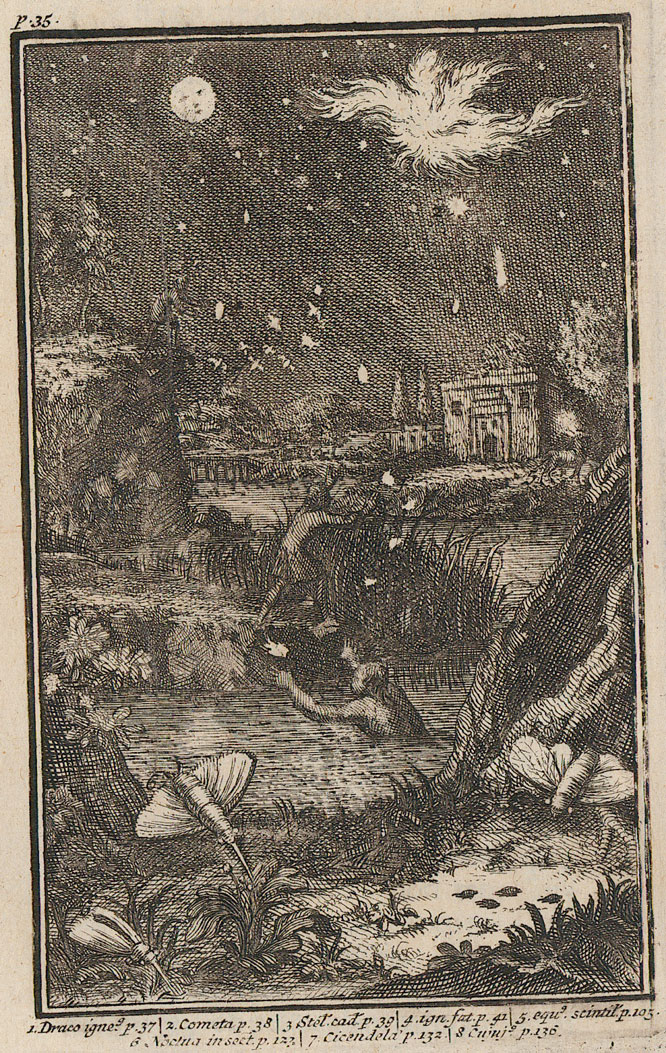
1. Fiery dragon
2. Comet
3. Falling star
4. Ignis fatuus
5. Shining waters
6. Noctilucent insect
7. Glowworm
8. Luminous rotten wood
The same reasoning holds with air, which, together with the other elements, is not so much simple as pregnant with the varied offspring of things. Marsh water provides an example. Although to the senses it appears wholly simple and homogeneous because of its transparent nature, yet to sight it admitting it everywhere; yet the heat of the sun truly discloses again various new infecta and heterogeneous bodies, and sometimes even green herbs clothing the whole surface.
I once distilled, by a seventh rectification, the most subtle spirit of May dew, clear like crystal and polluted by no earthy dregs; yet slow digestion in the vaporous bath revealed in it a most elegant green capillary moss, as I have already mentioned in my Benthemocrene. I omit innumerable observations of this kind, from which it is plainly evident that in philosophy the argument does not hold: that thing is not seen, therefore it does not exist. Since even Holy Scripture puts it beyond doubt that visible things are produced from invisible ones.
Let us now apply these statements to light itself, invisible in the air, yet often showing itself by its effects, as we shall presently see.
CHAPTER I
On phosphors and pyrophors in the air,
or
On luminous and fiery meteors.
The commonly received opinion is that the matter of meteors consists of various exhalations.
The commonly received opinion is that the matter of meteors consists of various hot and dry exhalations, raised by the force of heat from the earth into the cloud, which, once kindled, receive the form of light and fire and thus produce various flashes and meteors. The human mind has now rested in this doctrine of meteors for so many ages. To this the ancients added antiperistasis in the cold cloud as a kind of midwife; the moderns added the mutual friction of collected particles as the cause of the fire.
But this account did not satisfy the philosophers of the last age, who began to doubt all ancient doctrines. For even when those instruments are granted, the same question still returns: whence comes that light and fire? As Fromundus asks: “Tell me, from what cause does steel produce sparks by friction?” For the causes of things were not to be confused, nor was the dignity of the formal and efficient cause to be assigned to an instrument.
Thus more recent thinkers have attempted to explain the matter otherwise. Their foundation consists in what Fludd carefully notes ought to be observed: that the hidden thing namely the greatest spiritual part of the air is light, the air itself being nothing other than a living soul animating and stirring all things everywhere according to its will. He adds that the hidden or inward part of the air, which dwells in its center, is pure fire, and its manifest or outward part is a certain moist substance, covering and enclosing that hidden light no otherwise than the body does the soul, or a dense cloud does lightning.
For the central substance of the air is pure fire, which God, in the first creation, when He said LET THERE BE LIGHT, breathed into the whole worldly spirit. Therefore, by putting off its moist garment, or by making the hidden manifest and the manifest hidden, the moist invisible air is changed into visible fire.
Thus he philosophizes very cleverly, which many approve, and from this principle he derives luminous and fiery meteors namely, flashes and lightning from the hidden air gathered together, and from it more tightly contracted, visibly fiery meteors: ignis fatuus, beams, goats, fiery dragons, and the like.
Nor is this opinion so paradoxical that other most excellent men did not also subscribe to it. The very acute restorer of ancient philosophy, Marcus Marci of Kronland, after he had overthrown that old opinion about exhalations kindled in a cloud by a certain heap of arguments, concludes thus:
“Therefore, since those things which are sublimed from the earth cannot furnish the matter of fiery meteors, it remains that we say it is contained in the air itself, so that these are as it were aerial plants from invisible principle into that form, just as it is agreed that in the ether itself new stars have sometimes arisen such as that in Cassiopeia, which for two years shone with a size and brightness equal to Venus. I refer the reader to that most curious author himself.”
Fludd proceeds according to his own hypothesis which indeed, if examined more carefully, will be found not greatly different from the Cartesian one calling ether a kind of fiery air, or a spirit mixed with fire. Although the appearance of this most pure air cannot be discerned by us in its diffuse and subtle nature, yet when, by physical causes, or sometimes even hyperphysical ones, namely by the command of the Almighty, it is gathered into a mass, it becomes visible, and indeed sometimes in the appearance and form of a light-bearing star, which they call a comet. He defines it thus:
“A visible aerial body, animated and inspired by a shining and flashing spirit.”
Or:
“A part of the ether contracted and condensed, the luminous spirit of the world operating, from which it acquires a shining and fiery form.”
This definition exactly expresses the nature of a phosphor, and is itself not obscurely illustrated from the description of the ancients. For they define it as nothing other than a subtle exhalation, not inflammable, but shining from the light of the sun and stars incorporated within it.
And all the more so since they add that exhalations of this kind are generated in the bowels of the earth, whence without doubt they are of a sulphureo-nitrous nature and imitate Baldwin’s phosphor.
The Roman philosopher speaks elegantly of the phenomena of nocturnal light, still adhering to the ancient opinion concerning meteors:
“The night is never without spectacles of this sort. The earth exhales many and various things throughout the world: some moist, some dry, some gleaming, some fit for conceiving fires. It is necessary that among the great multitude of little bodies which the earth throws off and drives upward, some reach the clouds as nourishment for fires, which can burn not only when gathered together, but also when struck by the rays of the sun.”
Of these, therefore, I shall now recount some which seem capable of being referred partly to the class of phosphors. Meteors which they call falling stars may be numbered among them, whose substance is not so much kindled, as they would have it, but rather, like a phosphor, receiving the light of stellar rays, represents as it were a true star fallen from the sky. Yet this image, while in its course through the middle region of the air laden with various fruits, suddenly slips away with destructive ruin, its harmony having been altered. This matter, raised aloft, viscous and slippery, and compacted in the manner of frogs’ spawn whether it be such from its first origin, or whether having arisen from a foreign mixture in the atmosphere it has become such is seen obscurely transparent and marked with many very tiny spots (such as Fludd and others found more than once), by which it seems rendered more fit for receiving and returning the rays of light; whether indeed this happens, as some would have it, in the manner of a mirror, or rather, as I think, in the manner of a phosphor.
Such shadows are also observed in the lunar body. If we understand this with a grain of salt, it will not be absurd to hold that the moon is a phosphor, shining indeed with its own light, yet not except as first excited by the light of the sun, just as we see in the Bolognian Stone and in Baldwin’s noctiluca. For the moon is not illuminated by some mere reflection after the manner of a mirror, but by the kindling of its own light, nor is it an opaque body but a lucid one; yet it is not endowed with such energy of light as would enable it to transmit that light for illuminating the sublunary world unless it were kindled by the sun. Compare Helmont, On the Origin of Forms, where he expressly proves that there is a proper light in the moon, although our eye does not discern it, and I refer the reader to him, for the sake of avoiding prolixity.
Among luminous-fiery meteors belongs that fire which they call foolish fire, though it ought rather to be called wandering or walking fire. The more common opinion refers it to the pyrophors, and holds that its matter is indeed a sticky and fatty exhalation set aflame. For it is chiefly observed around marshes, sewers, and swampy places, as also in cemeteries, near gallows, and places made infamous by the punishment of criminals, where thick sulphureous vapors are supplied in abundance.
Nor is it so improbable that these may be kindled by the mutual collision, rubbing, or friction of particles, together with the varying motion of the air; or even, as others think, that they are sometimes kindled by the rays of the sun and in darkness display the light that by day is overpowered.
Yet meanwhile the opinion of Helmont, attested by his own experience, is not paradoxical: that this fire is merely kindled light, or a shining exhalation without fire and heat. For it does not burn to the touch, nor does it kindle inflammable things, because its light is cold and very different from every other light.
Such also are Helena, Castor, and Pollux, fiery meteors upon the yardarms of ships are accustomed to cling, as also that fire called Lambens, fastened to the hairs of animals, which nevertheless do not set their subjects on fire or burn them. Thus, if we say that such things are phosphors, and especially that in them a little flame like that of the urinary phosphor is gathered and shines, we shall not be altogether mistaken.
Yet just as this too is sometimes inflamed by a stronger motion, so neither do we deny that particles of such nitroso-sulphureous vapors, meeting together and, as it were, rubbed against one another by the motion of the air or of the most subtle ether, may grow hot and so conceive fire and light. Nor does Descartes himself differ from this way of thinking, holding that these fires, as well as others, are kindled both in the lowest and in the higher regions of the air, if a subtle and penetrating exhalation, salty in nature and also sharing something of a fatty and sulphureous nature, enters into pores. This, beyond doubt, he drew from chemical experiments, in which it is shown before the eyes that nitroso-saline spirits mixed and confused with the most subtle sulphureous spirits are moved most swiftly and burst forth into flame.
That frequent experiment discovered by me also confirms this elegantly. Lunar salt prepared with spirit of nitre, mixed with the ethereal spirit of turpentine in an open glass vessel, set in sand or ashes moderately warmed, at once a violent effervescence and flame at once arose, which most swiftly consumed all the silver, leaving only very black ashes. A most worthy experiment for investigation, which revealed to me a notable secret in chemistry.
This opinion is far nearer the truth than that of the very celebrated Christian Langius, who writes that the ignis fatuus is nothing else than a certain swarm of many little worms, of a race not very unlike gnats, showing by night a light or flame, which because of the instability of its motion is now seen to advance, now to follow, now to dart sideways, now to sink down. And he thinks those insects rejoice in the benefit of a luminous spirit and of vital sulphur; from which he judged it confirmed that even rotten and decayed woods shine because of the dwelling in them of such countless tiny worm-like inhabitants sharing in the spirit of light.
For it is impossible to believe that a thing wholly dead and containing nothing living in itself could shine by night. From this hypothesis, moreover, he concludes that the sparks leaping out by night from the combed hairs of animals are nothing else than little gnats rejoicing manifestly in the spirit of light and the sulphur of life, which invisibly grow upon and cling to the hairs.
But who here can refrain from laughter? What consequence is this? Glowworms are given as sparkling by night, therefore whatever sparkles and flashes by night is made up of glowworms or shining little worms? Martinus Szent-Ivany, a Jesuit priest, reports that on the island of Tenerife, among the Fortunate Isles, a mountain appears which even to those viewing it from afar directs the roads by its splendor, like a fire that shines yet does not burn. That noctilucent mountain surely would be the native land and dwelling-place of glowworms.
If it is impossible for a thing wholly dead to shine by night, then the Bolognian stone, Baldwin’s phosphor, and the aerial noctiluca must necessarily either live or be composed purely of shining little worms. What an absurdity! It would be no wonder if the supporters of animated pathology and physics had also maintained that fire itself, and even the stars shining in the darkness, consist of a heap of shining little worms. But such notions are clearly trifles, contrary to knowledge and the investigation of natural things.
Whether therefore, according to Fludd, it comes from the hidden and inward part of the air bursting forth outwardly, or according to Descartes from the matter of the first element lodged within the intervals of the heavenly globules, and moved with the utmost swiftness, and variously colliding and being driven or finally, according to the practical chemists, you derive luminous and fiery meteors from the mutual conflict and effervescence of particles of aerial-terrestrial saltpeter and sulphur, it is all one.
For if those exhalations truly at last burst forth into flame, from whatever source it proceeds, they will belong to the pyrophors; but if, struck at least by the impulse of the most subtle ether, they emit light, though in a fiery color, they will have to be reckoned among the phosphors. For thus even the lunar body at its rising appears fiery, and islands very far off in the sea are seen from a distance as fiery. Thus the Bolognian Stone itself, when kindled, reproduces the color of a burning coal, though not its nature. So also licking fire pours forth a harmless light, not true fire, which the Mantuan poet elegantly describes on the head of Iulus:
Behold, a light crest was seen from the top of Iulus’ head
to pour forth light, and with harmless touch
a soft flame to lick his hair
and feed about his temples.
Perhaps also to this class should be referred various phenomena of living light and fire formerly seen by night in the sky, such as that which, in the previous year 1726, on the 11th day of March, was by many seen by many peoples, especially in England, not without fear and horror, as a heavenly fiery meteor, concerning which some have already published their opinions. Whether a probable one, I do not wish here to discuss.
It was seen that heaven and earth burned in the time of P. Africanus and Laelius as consuls. Mount Albanus was seen to burn by night in the time of C. Caecilius and Cn. Papirius as consuls. A light shone in the Gallican camps in the great night in the time of C. Marius and Q. Lutatius as consuls. But these are older examples.
Among more recent ones, memorable is that torch or flying lamp, celebrated in the writings of very illustrious men, which after sunset on the 31st day of March 1576, under a dark but almost serene sky, appeared by an unexpected light in Italy, especially at Rome, Florence, Bologna, and Venice, and also in Germany at Trier; and, appearing like a full moon, it rose with a progressive motion toward the south, afterward drew behind it a tail, sending forth on every side rays of almost three diameters of the same kind, and, turning toward the winter west, advanced into a great extension toward the south, and there vanished into a certain cloud with a great thunderclap.
Whoever desires the judgments of very learned men concerning the appearance, place, and cause of its generation, let him read the epistolary dissertation of Petrus M. Cavina, mathematician of Faenza, once written to the most celebrated Antonio Maliabechi. There the curious reader will find many suitable things concerning the explanation of the recent aerial phenomenon, which the narrowness of these pages forbids me to transfer here.
I repeat, however, what that most ingenious man adds on the question whether phenomena of this sort portend anything:
“Many such things, having been seen with impunity by men throughout the course of so many ages, ought even now to lessen the fear of future danger; since historians write that scarcely any calamity to the human race has followed upon these spectacles.”
This he confirms by many observations and examples. For the generation of meteors of this fiery kind is for the most part natural. For just as ignes fatui are nothing but several portions here and there through the atmosphere of kindled sulphureous gas, so likewise a great mass of sulphureo-saline-nitrous particles can either be kindled like a pyrophor, or at least, like a phosphor, shine with flashes when illuminated.
On the other hand, that splendid nocturnal flying lamp seems rather to belong among the aerial phosphors, which in the year 1683, on the 22nd day of August, in many places of Germany astonished the eyes of mortals, appearing of a size equal to the full moon, but with a brightness superior.
For it shone more brightly than the full moon itself, and through the air along which its course was made, it illuminated streets and approaches. Let the curious see its description in the very learned observation of Georg Caspar Kirchmaier, from which likewise I do not wish to repeat anything, except the prognostic of meteors of this kind, plainly contrary to the opinion of Cavina:
“For by natural causes and effects indeed the Deity most often signifies preternatural events.”
And this he tries to prove by examples and by the testimonies of famous authors. Thus it comes about that conjectures among men concerning future contingencies are always uncertain, and that infallible knowledge belongs only to the Governor of nature. Poets, who, inspired at times by an Apolline spirit as if from the tripod, or rather with a certain poetic license, love to foretell future events, for the most part add disastrous outcomes to phenomena of this kind. Hence Lucan elegantly says:
The dark nights beheld unknown stars,
and the sky burning with flames, and torches flying through the heavens,
slanting fires by morning, and the comet’s trembling mane,
and that star changing kingdoms upon the earth.
Among the rest, our Helmont deserves to be read on this subject in the Tumulo pestis - The Tomb of the Plague, who, although he declares the sky to be free and harmless with respect to our plague, and proves this by arguments not altogether to be despised, nevertheless grants that the heavens announce things to come, since even the stars themselves were created for signs, and the heavens declare the glory of God, and the firmament shows forth the works of the Lord’s hands.
But this is not the place to treat that matter more fully, lest from light we slip into the deepest darkness of ignorance by which future events are surrounded. Therefore let us pass from air to water.
CHAPTER II
The Noctilucent Sea
or
On the Light of the Sea and its Cause
The most ancient sea of the world, both internal and external for after the Flood it received such a division, whereas before it was continuous and undivided greater than the immense terrestrial globe, is still a certain image, as it were, of that primordial abyss, as I said above, and a Chaos in which are contained the seeds of marvelous productions, indeed of the whole mineral kingdom.
We also recalled that by the almighty word that by the Fiat the most beautiful and most powerful light was brought forth out of the very womb of the waters. For since in the beginning, together with heaven and earth, nothing but water was understood by many to have been created, therefore the Hebrews themselves in their own tongue call it Esch- and Maym, or Schamaim, that is, fiery water, from which the first light was separated.
That light indeed was divided off and withdrawn from the waters of the shadowy abyss, yet not so wholly that these grosser waters did not retain for themselves some not small portion of it, like a kind of magnet, by which they are afterward able also to receive and unite to themselves the most subtle particles of heavenly and ethereal light, as will soon be shown by many examples.
That luminous and life-giving Spirit, which was borne over the waters, willed also to adorn them with light and animate them with vital spirit. For just as, when He flew upon the wings of the winds, He left in the air a full light of power, so also when He brooded over the waters, as many interpreters of Holy Scripture explain it, He still more filled this His chosen dwelling-place with light. Here philosophers bid us note that emphatic term brooding.
For just as a hen brooding over eggs imparts heat and a vital spirit, so the architectonic Spirit brooding over the waters or the sea abundantly poured light into it abundantly together with spirit. From this it received the privilege that even to this day in many places it flashes with manifest light by night; which, before we set forth its cause, must be demonstrated to those who might doubt its truth, either from not having sailed the sea, or from not being versed in the writings of celebrated authors.
Let us therefore bring forward the authorities of those who became known through voyages over various oceans of the world, and still more through their fame for learning in the republic of letters. That indefatigable traveler of the terrestrial globe, Monsieur de Monconys, testifies as an eyewitness that the water of the sea emits much light, and that the greater part of the fish illuminate the night; indeed even the clothes themselves, when wet and laid aside at night by sea-fishermen, give forth a light like lit candles.
The most illustrious phoenix of learned men, Varro, writes that sea-water beaten strongly by oars and driven into foam which the Spaniards call the sea-lung when stirred, shines and flashes.
Everhard Georg Rumphius, councillor in the island of Ambon, a learned German and curious scholar, in letters sent from the same island to the fortress of Victoria to the excellent Christian Menzel, reported that the great sea, which surrounds the Banda Islands, thirty miles toward the east, twice each year namely in June and August shines by night so brightly that it glitters like snow. The reason for this we shall soon see.
The praised Menzel also testifies that if, by night under a clear sky, in the open sea as in the Atlantic even the lightest things are thrown in, or even the tiniest drops are cast, silver sparks at once shine forth in the sea; indeed he often observed flames in sea-water at night when a storm was approaching.
Thomas Bartholin, the great investigator of animal light, writes from his own observation that the Adriatic and Mediterranean seas sparkle. He himself drew from the sea a glittering alga, and by touching nearby things with the splendor infused into it, communicated to them something like the light of stars.
These testimonies of most celebrated men sufficiently prove that the sea shines.
Nor does only the sea shine, but also a very great part of the things contained in it, of which likewise I shall first bring forward some examples before descending to the causes of the light itself. Curious observers have noticed the effect of light in a great many oysters, especially by night, as Monconys testifies, and also in the head of a fish which calls the Esquillete, and also in another fish which he calls the moon of the sea, as likewise in the dactylus, which is a kind of shellfish, he observed.
Concerning this the very acute philosopher Michael Maier writes as follows:
“When another light is removed in darkness, it shines with a bright splendor in the mouths of those that eat it, in their hands, on the ground, on clothing, and in the falling drops, so that that nature seems also to be in the juice which it has in the body. In this, therefore, the property and color of the moon plainly appear, namely a silvery brightness, as in the moon, or a gleam of the sun or of gold.”
Concerning the fish Lucerna he likewise writes:
“Its fiery tongue, stretched forth, shines on calm nights as if by its own little torch.”
I shall not recount what D. Auzout reported about the shining little worms of oysters, nor what Dr. Deale, the Englishman, reported about the light of mackerel, nor what Sachsius, the phosphor of the curious in nature, reported about the light born together with the crab. For it is common to many kinds of fish to shine in darkness, so that even the eyes of the very well-known herrings or sprats shine in the dark, and in the British Ocean, shoals of fish swimming in very dense companies betray themselves to fishermen at night by a kind of squamous splendor, as Conrad Gesner once noted.
From these things briefly adduced it is sufficiently established that in the sea and in fishes there is an effect of light; the more obscure cause is not yet clear. I shall set forth the opinions of others before my own.
The much-praised Rumphius conjectures that the sea there is noctilucent because almost all the islands surrounding Ambon, as far as nearby New Guinea, abound in mines of sulphur, to which alum and plumosum are always companions. He persuades himself that that aluminous sulphur exhales certain vapors which, when mixed with the waters of the sea, render them shining by night. He expects from the Leopoldine Society, to which he communicated this observation, that the mystery of such light might be explained from chemical secrets.
Yet the added scholion of the excellent president did not reveal its reason, which can easily be gathered from what has been said in this place. For that very curious man judges on this foundation namely from the sulphureo-aluminous spirit mixed back into salt water that noctilucent water can be prepared. Nor indeed is this absurd, since from modern experiments on phosphors it is evident that such a thing can be produced not without salt and sulphur, and that alum itself also contributes very much to the separating out of particles of light, as will be clear from the fecal pyrophorus.
There are some, however, who are not so anxious to investigate how and whence the sea and fishes shine, but only for what final cause. Therefore, since according to the common proverb God and nature do nothing in vain, they judge that this was established solely for that purpose, and as a great benefit, namely that the inhabitants of the sea dwelling in its darksome depths might by this innate or domestic lamp more safely both seek food and rescue themselves from the snares of enemies.
Whether this conjecture satisfies curious investigators of natural things, I greatly doubt, since daylight at least suffices for fishes as for other living creatures in seeking food, for which from the darksome bottom of the sea not everywhere certainly such as that they may roam into the upper regions of the waters illuminated by the sun.
But that one fish devours another, this is rather an ordinance of nature, and is abundantly compensated by the inexhausted fruitfulness of the sea in fishes, by the continuous propagation of myriads of every species whatsoever. And why should this benefit be thought to have been bestowed on marine fishes alone, and not also on the inhabitants of rivers, since these too have their food to digest and their nocturnal ambushers? Unless one should say that these also see by night, which I do not know whether anyone has hitherto discovered.
Now therefore, that I may establish what I think, I lay down this proposition of mine:
THE LIGHT OF THE SEA, and of Fishes, comes from Salt.
This indeed will seem paradoxical to many; yet it is most true, and I shall gradually show it to be a foundation of all the more secret philosophy. If you remove the salt from the sea, you will find nothing in it shining. Sea-water deprived of it no longer shines; nor even do the waters of the swiftest rivers, lacking salt, shine when violently shaken by a great splash or by the wheels of mills, as we observe. Therefore that is rightly held to be the cause of a thing which, when present, produces it, and when removed, takes it away.
If you wish to see light in salt, pour sal ammoniac upon quicklime. The volatile urinous spirit flies off; then strike this hardened mass by night with a strong hammer, and by the blow it will give forth fire. The experiment is made easier if iron rods are crusted over with this salt melted in a crucible; these, when struck hard with a hammer, will give fiery sparks.
This experiment indeed belongs now to the preparations of the older chemists, who in this product sought fusible or liquefiable salt for the transmutations of metals, I know not by what vain labor; but the light and fire manifested in it are of a more recent discovery, the praise of which is due first to the excellent and most ingenious Homberg. The very expert L’Émerius indeed judged that this light arises from certain volatile corpuscles of sal ammoniac fixed with quicklime; yet this is less probable, since it is clear that the volatile spirit, freed by the agency of the alkali of the lime from the bond of the fixed salt, flies away into the air.
Rather, they may rightly derive this cause of fire and light from common salt, sulphureous and unctuous, joined by fusion with quicklime, likewise a sulphureous salt. For when this is violently struck, it is driven into motion, just as the waves of the sea, stirred by oars, scatter light and sparks. That very swiftly mobile fiery particles remain hidden in quicklime, no one doubts; but that sulphur also lies hidden in common salt will perhaps not be known or admitted by everyone. Yet among chemical philosophers today this is plainly beyond controversy. Their authority and experience since every craftsman in his own art requires belief under oath must here either be accepted, or refuted by contrary experiments; for reason has no place here.
Therefore the whole sea abounds in a lucid earth, whose principle is sea-salt, and whose essence enters into, penetrates, and tinges the very substance of fishes or shellfish, whatever they may be, from which fundamentally arises the light of all those that shine by night.
The floor of the sea is bituminous, and sea-salt also is sulphureous and bituminous. Both were discovered in it, and extracted from it no less by chemical art than by unhappy fate, by the most famous Joachim Becher, that great investigator in subterranean physics of the true principles of nature, whom I too gladly follow. In many places he asserts and proves that living, burning sulphur is contained in it and can be drawn forth, and therefore that sea-salt consists of water and sulphur, to which is added that it is very bitter.
In the Alphabetum Minerale he confirms the same by experiments most worthy of consideration, and concludes:
“It is clear and certain that from common sulphur common salt can be drawn, and from common salt common sulphur can be drawn; from common sulphur quicksilver, and from common salt arsenic.”
A marvelous metamorphosis of things! But from that sulphur separated from salt, from its ineffable splendor, and from that source, both quicksilver and pearls, and whatever is splendid, may draw their splendor, as he confirms in a special dissertation On the Chained Center of the World.
How much, then, the hidden analysis of things is disclosed by chemical analysis! At this, indeed, Momus laughs and objects: sea-salt does not burn; therefore it is not endowed with a sulphureous nature. A fine consequence indeed! Hear Becher’s answer:
“The species of sulphurs,” he says, “are of different natures: some burn and shine, and are combustible; others shine and are incombustible, as the sea itself, especially the Adriatic, or even, as he says, human urine itself shows. Likewise water also, or much more its salty substance, which is clothed with sulphur, exists as something very different, according to its purity, thinness, and sulphur.”
Thus Becher. These things will gradually become clearer from frequent examples. Experience itself can convince anyone that sea-water does not extinguish fires, but increases them, which must be attributed to its sulphur and bitumen.
“But whence,” says the mock chemist, “is there sulphur in sea-salt?” Here indeed lies the knot, here the leap. But I repeat what was said above concerning the sea, once the receptacle of primeval light, and concerning the mysterious gift of light bestowed by the luminous Spirit formerly brooding over the sea I have recalled more mysteriously. Here now I act rather as a Hermetic physicist.
I say, therefore, that sea-salt, as to its origin, is rather heavenly than earthly. For whether, speaking in the Cartesian way, you suppose that the solar rays and the heavenly and luminous matter of the stars, when they fall into the sea, are not driven back but submerged, and that thus salt is generated which is water mixed with fire, and fire clothed in the body of salt, shining in the sea and giving light to its inhabitants or whether, in Hermetic phraseology, you hold the coagulated rays of salt to be the very sulphur of salt, you will not differ greatly from me, for I account it the son of the sun, and believe that it is generated when the rays of solar light, truly sulphureous, most subtle and moved with the utmost swiftness, encounter that ethereal mercury dwelling in the virginal earth of salt (with which the whole ocean abounds), are attracted to it by a kind of magnetism, adhere to it, enter into it, and are thus embodied.
What has been inculcated so many times and in so many ways by the sages of nature is understood, or at least attended to, by very few. For men are unwilling to believe. This salt, generated by the sun, is the root of the whole mineral tree, the foundation of the vegetable kingdom, the firmament of the animal, whence all the light and splendor that are seen in metals and minerals originally flows down.
For salt, which is nothing but sulphur and fire, is as it were a central sun, without which no generation of minerals takes place, as will appear more fully in the following chapter. Salt is the grandfather of common mercury, and the brother of the sun, or terrestrial gold of salt, inasmuch as it is the son of the sun, since the Adepts maintain that in it the rays of luminous sulphur are coagulated together with the other component principles.
Hence he will not doubt that the most subtle parts of the very heavy golden body are so thoroughly penetrative that among the bodies of the geocosm they have no equals, as is clear from many experiments of chemistry. Let the sons of science note this kinship of sun, salt, gold, and mercury, which the investigators of nature in later times did not suspect, whence also for them arose the axiom: “Nothing is more useful than sun and salt.”
This theory accords more with genuine and most ancient philosophy and protophysics than that very subtle notion concerning the polymorphous configuration of the smallest particles. For it depends on this, if I should say with Descartes that the sea therefore shines because, while the flexible particles of sea-water remain mutually entangled among themselves, other rigid and light particles, driven out by the impulse of one or another motion are shaken out from a drop, and, vibrating like little spikes, easily drive out from the neighborhood globules of the second element, and thus produce light would there arise from this anything of physical light by which we could come to know the arcane of marine light in nature?
But if I were to assert that the light of the sea, of fishes, and of whatever shines in the ocean, indeed also in the mineral kingdom, comes from the sulphureous salt of the sea, from which the fruitfulness of the sea is so great and all the cimelia of nature in it are generated, would not the wiser chemist be given not only a subtler speculation but also an actual practice, through instituting very many experiments with salt, and would not matter, handle, and occasion be furnished him to draw forth this sulphur and submit that light itself to his eyes and feel it with his hands?
Great indeed is Descartes, whose ingenious hypotheses explain very elegantly many phenomena of art, as I myself sometimes showed before the eye in my Hermes Cartesianus, for I write what I have seen. But for chemical fumes and the lamp of Hermes, the speculative Descartes accomplishes nothing. The wise love the most subtle matter of the world as something visible and palpable; they love the heavenly globules, but such as are not unseen by the eyes. Ideas of the elements are of no use for the business of the practical philosopher, for whom the bond of the elements is sought as dissolved and restored before the eyes.
Therefore, all you who go to investigate the secrets of nature, go to the sea, especially the Mediterranean: there indeed, as the common proverb has it, you will cease to pray, but you will also cease to labor. Above all, if you wish to be fishermen and to draw out either the echeneis, which delays even the courses of ships, masts, and towers; or to haul from the net, or with a golden hook, those two wondrous little fishes, very fat, shining by night with silvery flames, from which the philosophers draw that oily and fatty noctilucent water.
Happy are those to whom God and nature have granted, by the magnet of salt, which is implanted in sea-water, to embody the rays of the sun and to change light into perpetual fire! But let others go on here; I, standing on the shore, do not board this sea, fearing shoals and shipwreck.
CHAPTER III
LIGHT IN THE EARTH,
or on the phosphors of minerals, stones, gems, and the causes of their light.
So that the shadow may yield to terrestrial light, and the hidden light of minerals may shine forth more clearly, the generation of the mineral tree, whose root I have called sea-salt, now comes to be briefly described here.
The salty water of the sea, swollen with the vital sulphur of the sun and stars, passing through the bituminous bottom of the sea, penetrates by perpetual circulation into the bowels of the earth, where that salt, variously cooked, digested, subtilized, mixed and decomposed, is brought forth either into sulphurs, or vitriols, or mercury (for the earth, lying hidden in the salty substance of the sea, is the one mercurial principle and the principle of mercurifying), or into metals.
That very salt conceals within itself the sulphur which converts water into mineral nature, and therefore is found to be of a hermaphroditic character, namely both saline and sulphureous, volatile and cold at the circumference, hot and fixed at the center. Which things, since from the protophys are made clear in my protophysical writings, I pass over them here with quick step.
Therefore the mineral saline-sulphureous seed, arising from the inner principle of dissolved salt, ascends in the form of vapors and wanders through the wombs of the earth, where it makes manifest meteors or flashes (which the Germans call Witterungen), the motion of the ether in those exhalations kindling the light.
And if indeed these luminous evaporations are gathered and joined together in a white porous stone, transparent, of a saline and vitrifiable nature, as if in the third principle of metals, they harden into a true metallic mixed body (thus that light, formerly manifest, is hidden), and receive increase from new inhaled flashes of the same sort.
But if that sulphureous earth, or that accretive third principle, is wanting to them or fails, then this very vapor, inhaling in excessive abundance, as homogeneous and primeval, again destroys and dissolves the metals already generated, and thus produces quicksilver, in which likewise that light is shut up, yet still more free and more abundant because of the lack of bonds; whence also its body is maintained in perpetual mobility by this light, as had to be noted above, so that the Mercurial Phosphor may also below better disclose the cause to be investigated.
From these things it is by no means obscurely established that the very same cause of light is present both in the sea and in the subterranean kingdom. It is no wonder, since the light of metals flashes forth in their generation from coruscations, which itself belongs to the nature of phosphors, gleaming and sparkling by night.
I have on my side the most celebrated Cassius, in his little book On Gold, small in bulk but of great weight and truly golden, in which he asserts that those luminous fires and mountain exhalations are very like phosphors, and especially that a shining material separated from sulphur and arsenic sends forth from itself innumerable rays resembling the flashes of mines. He adds that a similar substance may indeed be obtained from human urine, but shining more feebly and weakly, although what is especially to be noted it also smells of arsenic.
I have traced sea-salt as the cause of light; but if anyone does not know that arsenic itself is a sulphur decomposed from sea-salt, let him go to Becher’s Subterranean Physics, from which he will easily learn these great marvels of nature. For a twofold sulphur is found in salt, mercurial and arsenical: the former contributes more to light, the latter to fire as the nearer principle; whence from the former is produced the philosophical mercury or lunar phosphor, and from the latter the liquor Alcahest or fire-water.
Oh, how marvelous is the process of nature in the generation of metals, where the Creator willed that light and fire should be present as their witnesses, indeed almost as their very form itself! For the begetter and father of lights, when He separated light from darkness, willed that these also should be absent from every living creature or from whatever moves vitally, so that all things principiate might bear witness to their own principle.
I shall not speak here of the other metals, especially Mars and Venus, in which sulphur, light, and fire are shown by physicists to reside. Concerning the light of quicksilver, we have spoken sufficiently in the chapter on the Mercurial Phosphor. But the dignity and majesty of gold alone since philosophers judge that the principle of life, namely the heavenly implanted fire, lies hidden in it will here claim for itself a brief discussion.
I shall not rehearse why the name and character of the sun, that heavenly original of that terrestrial sun, gold, were already attributed to it by the most ancient chemists, a point which the most famous Borrichius more fully expounds against Conringius, that denier of Hermes. I shall only repeat this doctrine of the philosophers: that the sun is the father of gold, and therefore that this also, as a true son, to partake of the nature of its father, that is, of his light. What the Stagirite said of man, that they rightly said of gold. Gold, that is, the seed of gold, generates gold, besides this also, that which is the first mover of all things. But I showed at the beginning that this is nothing other than light.
Nor do I know whether anyone has explained this more elegantly than the much-praised Cassius, when he philosophically argues that the principle of metals, especially of gold, is a mercurial spirit coagulated with sulphureous particles, which is nothing other than a certain species of light veiled in a most pure ethereal body; and therefore it is also made visible by flashes in the depths of mountains, since it is always occupied under the form of light in organizing the wombs of metals, until those wombs are rendered fit for the reception of it as of a kind of light and of the actions descending from light although this matter is in no way evident to the senses except through its effects, not merely to reason.
Just as we cannot perceive by the senses the magnetic life in a magnet (if it be allowed thus to call it), although its attractive force upon iron, especially its direction toward the north, meets our eyes every day, so by the same reasoning the life of metals, though in a certain respect, is the flow of native fire, and that flow is the emission of actual rays. But in gold there is a flow of fire far purer and subtler than in the other metals or in other things, so that from this point of view it is even called astral.
Read as many genuine masters of the Hermetic School as you please: all with one voice profess that gold is the pure fire of the sun, fixed and coagulated. Hence, for those who have meditated on perpetual light, it is certain that, if it can be given or ever aroused, it can be produced from no other subject in the world than from gold itself; concerning which more will be said in the third section on Hermetic phosphors.
Therefore in gold the form of solar light is sealed up “for it is the object of the influences of the most beautiful solar star,” as Henricus de Rochas elegantly says because of which gold is the hottest of all metals, being generated from the spiritual substance of the sun itself according to the Symmistae of nature.
Helmont thought that in gold there are ineffable planetary powers, namely of its own star, if it has been reduced into the nature of salt or sulphur; and although I explain this more fully in my Ecstatic Helmont, yet here I would have it understood in this way. This metallic light, in the most subtle sulphur and salt, is immediately rooted in its subjects as in an inherence in which, when they are vindicated into freedom, the bursting light exercises planetary powers; that is, by its mere aspect it imitates the heavenly sun, penetrating and affecting the sensitive spirit of man, or the Archeus. Or, to speak yet more clearly: solar light, unfolded and raised out of the body of gold, penetrates our vital light in the manner of a formal light, because it acts with a formal liberty and freedom, whereby those two lights penetrate and insinuate themselves into one another at a point. For light kindles light, penetrates it, and increases it.
This is the one and only reason why, when it is radically loosed in gold and reduced into the nature of light and fire, it becomes capable of preserving the vital fire of animals, indeed even of vegetables, and of reanimating it when suppressed.
Others indeed explain this otherwise, but no one has referred that effect more clearly or more truly than Helmont, to salt and to the free sulphur of the sun. For both are originally drawn from the sun and salt. The very ingenious Denstonius would seem to have asserted the same thing, only with a change of words, in his Pansophia Encheiretica, where in § 98 he writes:
“Light, so abundant in metals and likewise elsewhere in sublunary bodies, if it could be brought into motion so that it should unfold the metallic idea, namely the saline-sulphureous one, once the viscosity of the water had been cast off wonderful! how great a medicine it is for all animals!”
And in §49: in gold there is abundant light, and indeed wrapped up in the most subtle sulphur and salt, mutually tempered with the earthy substance and aqueous viscosity, and desiring to burst forth, so that by its mere appearance it may imitate the heavenly sun, strengthen and refresh the sensitive soul. What then, if the structure of the whole body be so disposed by art that the particles of gold can mingle with the particles of the human body, and thus light may come to meet light, and restore and strengthen that which has been lost from the body so as to produce a more vigorous motion, once the excrements have been purged away what sort of medicine shall we expect that to be? Thus Denstonius.
And these are those, as Helmont says, hidden lights of the metals, emblems of the stars, which indicate with anticipatory testimony, and are wont to shine by night on mountains bearing mines.
Let us pass on to night-shining stones, for in them too, by the witness of Scripture, there is great virtue, and especially light made more manifest by the transparency of the bodies, although even this contributes nothing to the nature of a phosphor. But before we bring forward certain exotic stones partaking of the nature of a phosphor, it is fitting first to set forth a certain admirable stone which in darkness shines in the dark an elegant matter, no less ingenious than the enigmatic Dialogue of Brutus and Philiater, whose author is that great Fernelius of Amiens, who keenly teaches and establishes that we admire and investigate rare and foreign things, but hold cheap and do not even deem worthy of inquiry things domestic and lying before our eyes. For who wonders or inquires how and why sparks lie hidden in flint? Simply because the stone is regarded as base and vile, although by its nature it is most precious and in natural dignity yields not to the noblest gems, to which human pride and the imagination of lovers alone have added so much price.
Let us therefore listen a little to these Amiens interlocutors, among whom nothing pleases except novelty, and only corpuscular philosophy finds favor. They no longer deign to cast so much as a single glance upon the writings of this excellent philosopher; and I doubt whether they do not suffer too often even in the commonest things the fate of Brutus.
Philiater. Though serious matters be set aside, let me jest with you a little more politely. Lately a certain friend of mine brought from India a little stone wonderfully luminous, which glows all over as if kindled with a marvelous splendor of light, and casting forth rays fills the surrounding air on every side with brightness.
It is impatient of the earth, and by that very impulse immediately flies upward into the air. Nor indeed can it be confined in a narrow place, but must be held in an ample and free space. In it there is the highest purity, a smoky brightness undefiled by any filth or stain, no fixed shape, but something inconstant and changeable at every moment. Although it is by far most beautiful to behold, it nevertheless does not permit itself to be touched, and if you press upon it too long, it strikes sharply. If anything is taken from it, it becomes no smaller. He said moreover that its power is useful for very many things, and at the same time exceedingly necessary.”
Brutus. Do you think to amuse yourself with me by means of insane fables and certain Oedipal riddles?
Philiater. I am inventing no fables. If I could place the thing before you, you would confess by the witness of your eyes that it is most true.
Brutus. But it must be some new kind of little bird.
Philiater. Nothing of that sort, but a thing wholly inanimate and mute.
Brutus. I hear of a strange and marvelous thing, whose effect must surely be thought some hidden property of something else. But has no name at all been given to it?
Philiater. Fire, flame.
Brutus. I am caught, and indeed I strongly suspected some deceit underneath.”
Philiater. Why do you charge me with deceit or vanity? I am reporting something most true.
Brutus. Yet something most vile and utterly trampled underfoot; and in this one thing you especially deceived me, that you said it had been brought from India.
Philiater. So then, if India alone produced something of this sort, rare and costly, all men would surely admire and praise its hidden properties; but now, because it is common and can be had for little, it is therefore held in contempt and of no value? If, as Avicenna rightly states, fire were very difficult to discover, and were brought to us from remote and unknown regions, we should marvel more at its power and property than at all other things, and its effects would draw us into admiration far more than those of the magnet. So say they, whose discourse anyone may read continued in that place. Let us make an end of criticism.
So it is. We admire and esteem exotic things, and those born under a foreign sun. What is native and lies before us at home we neglect and do not deem worthy of inquiry; and yet in these there sometimes lies more excellence and power than in six hundred other things sought beyond the sea. Is this not made clear by a more evident induction than by that very primal subject of the philosophers, which is found almost everywhere, and both the poor man and the rich man alike indeed, the Adepts affirm with one voice that it may be had at home by all at slight cost, and yet abroad, in things for the most part costly, it is sought with labor not infrequently by those who either do not know, or do not wish to believe, the ubiquity of solar light in all things.
It must not be concealed that the philosophers themselves first brought in these obscurities, when, as that man of Amiens says, they veiled both this fire and its matter certainly no very rare thing with so great a cloud of riddles that they plunged the chemists, miserably blinded in place of Juno, into error. But another destiny also belongs to men, who judge nothing worthy of investigation except what they themselves have seen, and indeed think that nothing can be given, or even exist, which they do not know how to comprehend within the narrow bounds of their own understanding.
Such a fate was once suffered even by the Bolognian Stone itself, placed by some among learned trifles and fictions, because its light was either not seen by them, or, amidst various unsuccessful attempts, was not produced. This happened especially since it is generally agreed that the whole science of natural things is full of fables, particularly from those writers on natural magic, so that many things, and especially those most often extolled with praises, are counted among experiments that do not succeed.
There is indeed no doubt that such stories have crept into the history of stones, especially of those shining by night. For who would free from all doubt that stone of Aelian, shining at night like a flame, which a stork is said to have cast into the bosom of Heraclides’ Tarentine wife as the reward for a kindness, because, when its leg had been broken, she had cured it the year before?
Who again will prove true what Thuanus relates in his history, in the Frankfurt edition, since he does not read it in the first edition, and therefore some there doubt it? “When King Henry II was in Bologne in Gaul, there was brought to him from the East Indies by an unknown man, but, as appeared, of barbarous manners, a stone of wondrous appearance and nature, namely flashing marvelously with light and splendor; and, as if wholly burning, it shone with incredible brightness, and, casting rays on every side, filled the surrounding air very widely with a glow scarcely tolerable to the eyes.”
Who will make it certain that in the heads of dragons and basilisks (concerning whose existence there is still dispute among natural philosophers) there are found night-shining gems, such as Rumphius records in his letter to Menzel to be diligently sought by the magnates of India?
But truly, if one is thus to doubt even of all things, and to call into question the trustworthiness of whatever writers might make it suspect.
For although some wish to call into doubt the nocturnal splendor of gems, and even Boëtius de Boodt and Johannes de Laet, the most celebrated investigators of precious stones, reject as fictitious and rashly bruited about the claim that diamonds from the East Indies, when handled by rubbing with the hands or garments, emit light and darting rays in the dark, yet that great counsellor of nature, Robert Boyle, proved it not only through Vartomannus, Garzias ab Horto, physician-in-chief to the king of the Indies, and the Italian writer Benvenuto Cellini, as eyewitnesses, but also by his own demonstration before the Royal Society in Gresham College. Let his observations on the Claytonian diamond shining in darkness be read.
In his very elegant Treatise on the Origin and Virtues of Gems, he testifies that he once possessed a diamond which, when restored by somewhat more than lukewarm water, shone in the dark. This is the more credible since Albertus Magnus also testifies that a carbuncle shines in darkness like a coal, when it has been submerged in pure, clear water, in a glass vessel, clean and polished. For the motion of the gem by water not much warmer than lukewarm seems, no otherwise than air or light in artificial phosphors, to excite the luminous ether in the diamond.
Conrad Gesner writes that Catherine, Queen of England and wife of Henry VIII, possessed such a gem in a ring, shining in the dark. Although others generally declare this to have been a carbuncle, anthrax, or pyropus. He writes that it shines in darkness with a likeness to fire, sending forth a brighter flame from the male stone, a weaker one from the female, and diffusing splendor from its whole body so says that tireless investigator of natural things, Jonstonus.
A certain species of carbuncle is, as Encelius thought, the lychnites stone, especially the Indian kind, which Pliny himself says is a dimmer carbuncle; Georgius Agricola, however, writes that it burns with a fiery color, whence it is also called lychnis, because it is like the flame of lamps. By this some understand that Greek stone Asterius, concerning which Gesner thus gives the Greek verses of Dionysius Afer word for word:
“The beautiful stone Asterius is born, and it gleams
Like a star, and like lychnis in lamp-like splendor.”
Fortunius Licetus, a most curious man, but also, as some write, too much given to popular reports, relates that Galilaeus Galilei, the Roman philosopher, and J. Caesar La Galla saw little stones enclosed in a wooden box, which through the closed windows shone like burning coals.
From the things already brought forward it is now not obscure that not everything told about natural night-shining stones is to be reckoned among fables. Yet even this report of Licetus others esteem with no better mark, though not without some plausible reason. If conjecture has any place here, those stones may have been artificial, and true phosphors all the more rare because the art of preparing them was not yet known at that time, or at least in that place.
For what prevents little stones, transparent like gems, from taking on or enclosing the light of a phosphor whether infused into the pores of crystal (for experience teaches that these peculiar fumes of minerals also dye them with the color of ruby), or by means of another more porous body with looser substance and luminous matter, or hidden within the hollow of double stones (as they are wont to make spurious carbuncles), or finally set beneath diamonds or other transparent gems in a ring, in the place which they call the foil?
I do not doubt that from metallic glasses, easily meltable in fire, little stones can be prepared, and that the matter of a phosphor can be inserted into them and enclosed therein. Indeed, if there is given a menstruum in no way corrosive, which can also enter the pores of whole stones and draw out a tincture from them as is done in sapphires by fire alone I do not see what should prevent a luminous tincture of some phosphor from likewise being introduced into them, so that, even if not always, yet at least for a notable time, they might scatter a marvelous splendor in the dark for reasons scarcely to be believed.
These speculations of mine, however, I willingly submit to the judgment of others, or rather to experiments, by no means selling them as indubitable truth, although they derive very much probability from the things now being said.
For, to draw out the true and genuine cause of light in such night-shining gems, there must be recalled to memory the things we have already set forth concerning the light of metals and minerals arising from exhalations, and as originally dependent on the sulphureous salt of the sea. For if it has already been demonstrated by others that the transparency of gems, whether transparent or opaque, their primeval liquidity, and their tinctures or colors in them, arise from the most subtle exhalations of metallic and mineral embryos as Boyle has also sufficiently demonstrated, it now plainly follows that those fiery and luminous coruscations of metals, which we explained at the beginning, while everywhere seeking a matrix, whenever they find nothing but a vitrifiable earth, may at times seize upon water purified and impregnated with a petrifying spirit, and fix it by coagulation, and likewise shut themselves up within it, since its already coagulated pores can transmit and emit light especially if the most subtle peculiar matter of the world, though in a manner scarcely explicable, passes through it.
Therefore night-shining gems are true phosphors, and they consist of a twofold principle. First, from transparent water, impregnated with a petrifying ferment or, if you prefer, from a vitrifiable earth, or originally fusible, but afterwards perpetually fixable because of the mixture of the petrifying and metallic spirits mutually penetrating one another. Otherwise they would be fusible in fire just as the metals themselves are, since what is liquefied in the case of metals is not stone. For unless they partook of both natures, they could not obtain that fixity and constancy in fire, which in vain you would seek in crystals unpenetrated by any vapor of embryonic metal.
Hence, secondly, they consist indeed from a metallic tincture, but from a luminous and fiery vapor as well from that spirit, of which the former contributes color, the latter the nocturnal splendor. Our doctrine is confirmed from this.
Brought to this state of nature, namely by means of a metallic tincture, whether golden or silver-like, not only may gems most perfect be produced by no means yielding to natural ones in power and fixity, indeed far surpassing them, as all the Adepts testify but also gems shining at night like fire, as Isaac Hollandus testifies (whose words we shall quote in Section 3), can be made. This sufficiently teaches both the process of the art and the very genesis and mixture of such shining gems. For art effects nothing in the production of a thing otherwise purely natural, unless it imitates with the utmost exactness the very process of nature, the mistress. For, as Sendivogius warns, it does not know how to manufacture the seeds of metals and minerals, but only takes what nature has already prepared elsewhere and duly applies it. And thus nature acts, thus art, and conversely.
Therefore vitrifiable earths are true magnets, both of heavenly light immediately and of subterranean light mediately, and thus true dwelling places of primeval light, as much for the generation of metals as of precious stones, provided that in these there also be added the lapidifying spirit.
For if, while this remains the metallic light could be separated from the gems, they could, like metals, be melted down and reduced at will into various forms indeed even extended under the hammer after the example of that once malleable glass, which seems to have been nothing other than some sort of semi-metal, or metallized glass, or else metal rendered transparent through the pellucid matter of glass. Writers suppose the art of making it has perished among lost things, though we believe it could easily be recalled by means of the genuine tinctures of metals, if only their preparation and discovery were as easy.
All this is not so difficult to conceive, though two things still seem to require proof:
1. That the bodies of gems contain within themselves the exhalations of metals that tinge them, once these have been fixed in them.
2. That they receive and retain the flashing light of metals.
The first point is sufficiently shown by Boyle and certain more recent writers who have treated of the nature of gems, to whom I add what Michael Maier wrote in the Septimana Philosophica, a treatise indeed enigmatic, but most full of the secrets of nature:
“The garnet,” he says, “persists in fire, and is reddish, and naturally contains within itself the seeds of gold. By these properties, if it enters into metals, and heaviness is added, I know not what of true tincture is lacking in it.
Admirable is the nature of this little stone above all the rest. The vapor of gold is fixed in it, and the red color which is present is the cloak of its tincture. Nature has engraved in it the insignia of her own arms, and has left in it the trace of her foot. We have seen Emperor Rudolf II of blessed memory precipitate common mercury by means of this. It is the part of the artist to add coagulation with fixation and ingress to it, and the tincture will be perfect.” Thus he.
Although this last point is reached by a very long-sought path, yet this most skillful author in the more hidden chemistry proves by it that the tinctures of metals are enclosed in precious stones, although others maintain that in the garnet there is rather the soul of Mars than of the Sun. Meanwhile what he suggests is most true. The embryo of immature gold (for he calls it a vapor) wanders very widely outside its own matrix, and everywhere nature permits it to seek out for itself a proportioned and suitable sponge to which it may cleave, one destined for it by nature understand by this the white vitrifiable earth or the third principle of metal.
But when it does not find that, it joins itself to whatever lies at hand, especially indeed to various stones, and to gems, and even, as though forgetful of its own strength, to very base earths, muds, and sands, as the experiments of modern chemists have shown before the eyes of the incredulous. Convinced by this experience, that great Albertus certainly did not hesitate to pronounce:
“There is no thing composed of the four elements in which gold is not found naturally in its highest subtilization.”
This doctrine has already been developed more fully by others.
To prove the second point, namely that gems receive and retain the flashing light of metals, those abortions of gems make it clear namely crystalline earthy-stony concretions, tinged (Flüsse und Drüsen), which, when grossly pulverized, in their bare and very slight incandescence display the light of a phosphor, though only once, if they shine out altogether. For the light of metals, not having obtained a firm and constant seat in such earthy minerals, returns by a more violent fiery motion to its homeland, whence it is not brought back with falcons, as Villanovanus says elsewhere in a figurative sense.
Thus experiment shows that the ore of emerald, when crushed, lightly calcined, and placed upon a silver or copper plate over burning coals, gives a spectacle not unpleasing of light and splendor, whitish with a bluish cast, a spectacle, though brief and fleeting. He calls it the emerald phosphor.
That this concrete nature is sulphureous (for sulphur is the matrix of light) was lately shown by the most celebrated Georgius Ernestus Stahl, professor at Halle, to whom I refer.
Do not now wonder at nature, ignorant of the architectonic power, why Helmont called such gems, whether transparent or opaque, polished mirrors, in which the ray of the vital spirit of man, once received, and refreshed by their natural gift and light, is easily strengthened and reflected through the whole body, so that they become perpetual amulets, acting merely by the force of influence and direction, without any evaporation or emission of vapors, and therefore their powers are not diminished.
My Ecstatic Helmont treats of these things more fully, at the sixty-second sensation of my Doctor. Here at least it helps me not a little that it should not be accounted absurd, from the mind of Descartes, to suppose that the most subtle ether, modified by the variously shaped and tinged pores of gems with a singular flux, and as it were kindled by their inner light, by its return from them and by its approach, contact, or passage into neighboring bodies, produces marvelous and enduring impressions, because of the light both in the gems, nor because of any defect of the ether passing through them if only the Doctor’s hypothesis of a most subtle and truly ethereal substance be true. But these things are by the way.
Finally, by way of corollary, from all these things I conclude: since the light of metals and minerals arises from the sulphureous salt of the sea, and this constitutes the splendor of gem-phosphors, it follows that the light of these also descends from the sea, and by a further regress from the sun, and thus at last, in an ordered genealogical series as it were, from the primeval light itself.
Which was to be demonstrated.
PART I
SECTION II
On the NATURAL PHOSPHORS
of the Animal and Vegetable Kingdom.
SUBSECTION I.
On the Phosphors of Animals.
Having happily emerged from the subterranean region or mineral kingdom, glittering with flashing light, we discern that we are placed in the animal kingdom. Here we must presently pass into a new light, but not less surrounded with darkness than before, if we are to go through it with unerring eyes and attentive mind.
Everywhere we are poured into light and move in light; indeed we carry that very light about with us within, so that, if we observe those phenomena of light which often occur around man, who could believe that a living man inwardly either wholly burns, or at least shines?
Although indeed this light does not always manifest itself in every man, nevertheless it is absent in none, and at no time. If man is the compendium of the greater world, as the philosophers thought when calling him the microcosm, this is proved especially from the fact that he too is not without luminous and fiery meteors not only a microcosmic heaven and air, but also water and earth. As to this last point, the Section on Artificial Phosphors will make it clear; the former, however, will appear from the following chapter.
CHAPTER I
On the Light of Man, and its Origin and Cause.
Before we uncover the origin of human light, first, according to the method we have already begun, that we may satisfy the curious, we shall bring forward a few examples out of the innumerable ones not unpleasant to read. Among them the first should certainly be that which is the most ancient of all, and not the least paradoxical, strengthened, as I know, by Scripture or Tradition, which Robert Fludd adduces but perhaps more ingeniously than truly or demonstratively, namely that the image of our first parent Adam, while living in Paradise before the fall, shone everywhere with light, splendid, and flashing with the glory of the divine light dwelling in him. He offers no other reason for this than that Adam had been a vessel fashioned by the finger of God the Father of lights from His own light. A noble speculation!
For before the body was darkened by the transgression of the divine law, the immortal mind, created in the image of God, shone forth more clearly as a luminous formal substance. For the first man approached more nearly to the incomprehensible light of his Creator, enjoying His presence and vision, to which even the slightest approximation imparts an ineffable splendor even to mortal man as was seen in Moses, returning from the mountain, whose face so shone that the Israelites could not look upon it.
Oh, how great a splendor shall someday accrue to our immortal light in the light of glory, in the blessed vision of the eternal and immense Light!
At one time Helmont, in an ecstatic rapture, beheld an image of his own mind, indeed in human shape, but pure light, whose whole homogeneous substance he was actively perceiving: a spiritual and crystalline substance, shining with its own splendor, yet wrapped with a cloudy outer part, as it were a husk of its own (which indicated the body), from which one could not distinguish whether it had any splendor of its own, because of the surpassing brightness of the crystalline spirit enclosed within. But for the crystal itself, its seal was an ineffable Light so reflected that the crystal itself was incomprehensible. This Helmont saw.
We, who in this mortality cannot conceive by any perception of the intellect or by any proper idea the image of God and the formal light of life in the mind, turn ourselves to physics, and to those purely material luminous substantial forms on which these phenomena of animal nature depend, while in the homeland of lights we await by true faith and hope some day a perfect knowledge of that formal substance.
Nowhere have I read that the whole man shines naturally and displays himself as a phosphor, except in the mountains of Peru and Chile, the highest in the whole world, where travelers seem wholly fiery, and no less so horses and beasts of burden. This Father Alphonsus D’Ovale, Procurator of the Province of Chile of the Society of Jesus, an eyewitness, reported to the illustrious Kircher, making that journey several times, as he noted more fully in the Treatise on Light and Shadow and also in the Subterranean World. The reason does not seem obscure.
Fatty or sulphureous exhalations, both of men and of beasts of burden, pressed out by the motion of the traveling body, being more violently stirred up by the exceedingly subtle and tenuous air of those mountains, and being subtilized by the motion and friction, are easily kindled. Although this is the commoner opinion and easier to conceive, yet, when all things are weighed more exactly, it is not without difficulties; especially as to how the atmosphere, laden with so many sulphureous effluvia (for the whole province abounds in metals, and is especially most rich in gold, swelling with exhalation from its richest mines), though heavy and ready to be inflamed, should nourish no fire in any combustible and inflammable matter. For fire and flame cannot exist or even be conceived without combustible matter present to receive their effect, unless that fire must be supposed to be at least of another nature than our common fire.
Those who make it similar to the flame of ignited spirit of wine do not satisfy the matter; for even that, once wholly freed from its phlegm, catches fire and burns. That dreadful meteor of the microcosm gives testimony to this in the case of the Parisian woman, who, after long swallowing spirit of wine, conceived such burning in her body, and her inward parts were so set on fire, that when, about the evening hours, she was resting in a straw bed, she had lain down to sleep, a flame bursting forth on every side, she was miserably burned all into smoke and ashes, except for the skull and the tips of the fingers, as is reported by D. Matth. Iacobaei in the Medical Acts of Copenhagen.
Shall we therefore think that the most subtle ether of those mountains, driven and as it were perfumed by the exhalations both of minerals and of animals, rather imitates a phosphor and presents the appearance of fire, than is itself true fire? For that mountain of the island of Tenerife, of which in the former section, chapter 1, though wholly like fire, nevertheless shines without fire. And the flashing exhalations of minerals themselves, and the effluvia of men, though they appear as a fiery flame, lack actual fire.
So Kircher relates that whenever he entered the subterranean crypt at Rome, flames like torch-flames burst forth from the heads of the sweating companions. Very many examples of this phenomenon from the writings of the ancients might be added here, if it were worth the trouble.
Livy testifies from antiquity that when L. Mantio, leader of two armies, was addressing his troops, a flame shone forth from his head, striking fear not in him himself indeed, but in the soldier standing around him. In like manner also writers report of Alexander the Great that commonly, in the heat of battle, sparks flashed from his head and eyes, and sometimes when he had been surrounded in India by great danger, he blazed forth in such a way that, to the barbarians looking on, he seemed to pour out light. Ovid elegantly described such a phenomenon in this distich:
Then his father gave a sign, when his head was touched
with flaming fire, and a fiery crest burned in his hair.
But perhaps someone may think these should less be referred to phosphors, because the nature of those is only to shine by night, whereas these meteors of Mantius, Alexander, and many others like them are seen even by day, and therefore cannot properly come under the name of night-shiners. Of such appearances of light issuing from various parts of men such as the hair, head, teeth, tongue, eyes, chest, belly, limbs, etc. the very famous Bartholinus has recounted many fully and expressly, which it would clearly be superfluous to repeat here.
I answer that, although the authorities do not add the precise time of day or night at which they shone, it is nevertheless more probable that this happened at night rather than by day. Since a fainter light and flame of this sort is suppressed by daylight, but by night shines forth more vividly and actively, and therefore they, which are without actual fire, do not thereby lose their nature at all. For that reason, because the moon is also visible by day, it is not therefore deprived of its own nocturnal light, nor to be removed from the number of the night-shining stars, nor does it cease to imitate the nature of a phosphor. Let me therefore add yet one or two examples for the investigation of causes.
Cardan relates that for thirteen years it continually happened to a certain monk of the Carmelite order, that whenever he drew his cowl back to the occiput, sparks of fire burst from his hair. Because of ignorance of causes at that time, this was thought among men to be reckoned as a miracle.
Castro reports of Cassandra, a noble matron of Verona, that, after recovery from a hypochondriac illness, if she lightly rubbed her arms with a linen cloth, sparks, as if struck out from flint, often with a crackling sound, were drawn by her hands through the sleeve of her garment, and traces were seen as it were of a tailed ray; and this symptom lasted for a whole year elsewhere, until she died.
Concerning the occasion of this phenomenon, the most learned author published a very curious treatise on licking fire. And what need is there to heap up more examples? of hair shining by night, of the garments of a young man conspicuous with remarkable light, of urine in the very act of emission flashing brightly, and many other examples of the same sort, which Menzelius, Camerarius, and Reiselius, most excellent and diligent investigators of nature, have reported in the observations of the Ephemerides of the Curious of Germany.
It remains therefore now to inquire into the cause of this animal light and fire. This cause, both with the ancients Democritus, Epicurus, Laërtius, Plato and with the more recent writers Descartes, Gassendi, Hogeland, Willis we seek in the vital little flame, that is, according to my hypothesis, in the light innate in man, as you shall understand at once. But first there must be set before this the authority of our medicine, recognizing this vital fire, under the great dictator Hippocrates:
“Fire,” he says, “from the mixed and stirred humor arranges and disposes the body according to nature.”
There he elegantly derives fire from motion. And in the book De corde he expressly names it “innate fire,” and in book I De arte “connatural fire.”
We shall not dispute here whether that fire or little flame is kindled in the heart of man, or in the blood itself, since I acknowledge it to be only vital light, not actual fire, but only fire in nearest potency, residing in sulphureous matter capable of being kindled when the requisite conditions are present.
For since the spirit of life, which we carry about with us, being luminous, refers back to the source of solar light, from which we derive originally, it is not actually fire; but it can easily become fire by its concentration and by a stronger motion in inflammable matter.
This animal light, kindled in the blood only vitally and not materially, by its motion excites and preserves such heat and such motion of humors and spirits as are necessary for the act and operations of life; yet it does not actually burn and blaze, unless, by a more rapid agitation or concussion of sulphureous particles, it bursts forth outwardly in the form of light, and sometimes even of flaming sparks, as we have already shown concerning the microcosmic phosphors.
That light, although it is of a heavenly or solar nature, is nevertheless rooted in matter; and at the very beginning of life it is kindled from the vital light of the parents, just as one lamp is lit from another lamp, and is propagated into life.
I say that it is rooted in matter, not because it needs fuel, as common opinion has believed fire does, but because it cannot subsist unless in its particles most swiftly moving, namely the volatile sulphureo-saline ones, from whose motion, stirred up by light, vital heat arises in things fluid and solid alike.
For as to its essence, and insofar as light is vital, it needs nourishment no more than the sun itself. But those particles do need to be continually supplied from the chyle, not so that some devouring flame may be fed by them, but so that the fluids of the body in which the light inheres may be made firm and sustained.
For just as the life of plants cannot subsist by the light of the sun alone without earthy juice, their bodily nourishment, so neither can the life of animals endure without the due restoration or preservation of fluids and solids. Although it has more than once been observed that vital light has lasted even for a very long time without external aliments a thing which some indeed ascribe to miracle yet nothing prevents its sometimes happening naturally also, if one considers the life of certain animals persisting for a very long time even without nourishment. Compare what we discussed on this matter in our Decade of Curious Physical-Medical Essays on the Prolongation of Life.
Life therefore is the light of man, both supernaturally and physically. And this life, or light, is in man wholly active, and the producer of all actions, both natural and preternatural, as Helmont sufficiently solidly demonstrated. Therefore this too will be the efficient cause of those luminous and fiery meteors in the microcosm, and indeed in the manner which I have already explained sufficiently and more than sufficiently; if this does not satisfy anyone, let him produce and prove a better and truer explanation, and Phyllis shall have her own suitor.
Here there occur two very curious paradoxes, one sacred, the other profane, from which light seems to arise according to these principles. The first I shall only mention, leaving its judgment and decision to the theologians; the second I shall myself decide.
The first is that which Betto reports expressly in his treatise On the Origin and Nature of Blood, and which Weber and Bartholinus repeat from him: namely, that those fiery tongues settling upon the heads of the Apostles were nothing other than vital light, or the spirit of life, beyond the powers of nature set ablaze by divine charity, kindled and, in the manner of flames with a pyramidal point, harmlessly licking their heads. The sacred text says: “And there appeared unto them cloven tongues like as of fire, and it sat upon each of them.” (Acts 2:3)
The other belongs to medico-physics, concerning which it will be permitted us to give our own judgment. Ernestus Burggravius likewise sets this forth very expressly, and from a supposition of the lamp or little flame of life, he promises an artificial vital lamp, which burns as long as the man lives, and is extinguished when he dies, and by the variety of its color, splendor, and motion becomes a most certain indicator of health or sickness.
He prescribes its preparation from human blood drawn from the veins, digested for the space of forty days, distilled nine times, and rectified from all phlegm. With this substance, he says, a lamp is to be continually supplied, which burns so long as that man lives from whom the blood was taken, and at the very moment and hour in which he dies, it breathes out and is extinguished.
Beguinus and others tried to explain this process in a somewhat more open style, and to facilitate it by certain manuals, I know not what. Indeed it had to be handed down as some obscure sacred mystery, lest the author should be publicly convicted of falsehood and deceit. For no one has yet been found who made the experiment with a successful result, neither he himself nor anyone else.
That lamp has burned in Burggravius’s brain, nourished by vain ideas. Light and the vital little flame do not exist outside the body with blood drawn out of it. For even in the man himself, unless it remains continuous within him and in uninterrupted motion, it is at once extinguished.
“The discontinuity of the light,” says Helmont, “is the cause why in one moment all the power of the brain perishes.” This is witnessed by those who are suffocated or fainting, who, because light has suddenly been denied them, grow pale and cold like the dead.
But let us grant that the vital light goes out together with the blood though this is most absurd, since if that were so it would still necessarily continue to live. Who could conceive how, after that digestion of forty days, and after nine distillations by fire, and what is more, through the whole course of so many years thereafter, it should remain perpetual? Or could any greater paradox be devised than that a little flame kindled from blood something which, by the hypothesis, can only be effected by solar fire should be nourished from the substance of that same blood remaining in the body from which it had been taken, even across the longest intervals of place, as he asserts?
Perhaps that tiny flame, kindled for example here in Westphalia, drives the most subtle ether or the heavenly globules nearest to it, so that they make an impression upon the mass of blood abiding in Rome, and thereby give warning that nourishment or fuel is to be sent back to the lamp.
But away with such trifles. The author would have woven a far cleverer tale if he had only maintained that such a biolychnion was a phosphor, which, needing no material nourishment at all, might subsist by light alone, magnetically drawn through the ether from its own source, provided that the particular light of a man had commerce with that universal light. Much more plausibly still might that writer on sympathy, Rettray, establish his notions in this way he who tries to persuade others (as if the whole learned world were a child) that the spirit of the blood, at least when preserved in a glass vessel, shows the health or sickness of the person from whom it was taken, though he be far away, becoming troubled in various ways if that person is ill, losing its brightness, and the contrary if he is well. But let them fashion their fictions. Let us return to serious matters.
I shall therefore frame for myself a certain objection, curious enough: If life consists in light, and with life all light perishes, how is it nonetheless possible that in corpses a little flame appears? For Bartholinus is a witness that a flame burst forth from the ventricle of a dissected corpse; and observations inserted in the Ephemerides of the Curious of Germany prove that this was also observed at Lyon in France and at Pisa in the anatomical theatre. Indeed Andreas Vulparius of Bologna, professor of anatomy, as J. J. Pisanus reports in a note upon those observations, happened upon a method by which such a flame could be found not only in the stomach of animals, but also in the intestines, always available to curious investigators of nature.
I myself shall give the answer. That flame is due not to the vital light, which has already departed and vanished, but to fatty and sulphureous exhalations, kindled either by the nitre of the air through a stronger compression (in which the rationale of the experiment consists), or else as not seldom happens in anatomical dissections by the approach of a wax taper or a lit candle. It should be accounted no otherwise than those belly-creakings themselves, which, being rich in sulphur, are inflamed when a light is brought near. In these it would be foolish to seek the vital light; although philosophers are not wanting who place it even in the excrements themselves, an opinion to which I have not hitherto adhered.
Flame everywhere presupposes particles of the third element, especially unctuous and sulphureous ones, set in very rapid motion by the matter of the first element, as we showed above. But that ignition arises either, according to Descartes, from the heavenly globules themselves more strongly driven in this experiment into the interstices of the powders, or more chemically from the more violent impulse of nitre from the air. But if anyone should like to say that the excrements themselves also, as things cast out from the circuit of life, retain still some character of light, or if the words of Oribasius of the Leopoldine Society are to be trusted, that they are rather separated off as abscesses from the nitro-sulphureous spirits of animal life, and thus easily re-kindled, I would not greatly oppose them, provided only he should teach me the manner of their separation more exactly; for that the vital spirits, or the vital light, partake of sulphur, no one has yet persuaded me.
Although I myself grant and maintain that the luminous and fiery meteors of the microcosm depend on the salino-sulphureous particles exhaled, stirred strongly by light, and carried away by its impetus, and on that account all the arguments of Gualtherus Needham against the little flame of the heart, so anxiously contrived, fall of themselves. We shall carry our sails farther.
CHAPTER II
On the Light of Brute Animals and its Origin and Cause.
Since in brute animals, as in man, the principle of life is the same, their motions and circulation of humors are similar to their vital light, and the principles of the mixture of blood are alike; indeed, since the nature of their soul or form is luminous, as Espagnet says that similar luminous and fiery meteors are also observed in them; consequently, the cause of these must necessarily be the same, so that a separate treatment of them might perhaps seem superfluous, were it not that at the same time many curious things worthy of notice occur here, and especially certain causes of light not yet brought forward.
I begin with quadrupeds. But about fishes, of which I think I have spoken enough above, I shall add nothing further. I shall proceed by examples, appending to each its own explanation if anything peculiar should arise; otherwise they must be explained according to our common hypothesis, already sufficiently confirmed in the preceding pages.
First, then, let there be brought forward here that horse of Scaliger, famous in Calabria for use in warfare, which, when rubbed with a currycomb in the dark, was always seen to shoot forth sparks. To this may be joined the fierce horse of Tiberius Caesar, not seldom belching flame from its head. These two are enough, lest we become too horse-like here.
That brightness under darkness, rivaling light and flame, and that most rapid flash in fierce horses, together with the swiftest motion of light and spirits like lightning, must be ascribed to the very great abundance of sulphureous corpuscles in this animal, which readily follows from this. Hence the most elegant Mantuan poet calls them:
“Breathing fire from their nostrils from an ethereal seed.”
To this motion of light is owing that
“the loud-hoofed steed stands and, fierce, champeth the foaming bit.”
To this also is owing that, as Claudian elegantly sings:
“As soon as the horse burns beneath the spurs,
his wide nostrils grow hot with fire, he does not feel the sands
beneath his hoof, and from his shaken mane sparks are scattered into the air;
his trappings are troubled, he fumes with frothy bites,
panting, sweating blood-red drops.”
Whoever does not understand this motion of light in the horse, if he says that it must be attributed to the more rapid agitation of fiery spirits exhaling through open pores, certainly says the same thing, though in different words.
We need not fear to add dogs and cats to horses, since in both, when the hairs are stroked by the hand from tail toward head, shining effluvia often burst forth in the dark. This spectacle can be seen through all the winter nights in a warm room, and no less in dogs from the cold in returning into a warm room, the same thing happens at the same time. At the house of the excellent Mr. Camerarius in Capri (if it is permitted to mention this animal among them), the hairs, frozen by intense cold against their natural direction and violently shaken, were throwing off great and splendid flames with a crackling sound.
The color observed in such sparks bursting forth from the hair of animals when strongly rubbed is a bluish-white, such as the Phosphorus also exhibits; and the odor which this phenomenon gives off is plainly similar to its odor. From this it is clear that the cause of this phenomenon and of the phosphor is altogether the same, and that the material of both is alike.
For just as with urine many sulphureo-saline portions, fallen away from the subject of vital light, are cast out, from which the urinary phosphor or aerial night-light is constituted, so likewise with sweat or with a fatty exhalable matter which indeed is dissipated by heat, but under cold is retained within the hairs or fur, especially if they are foul and dirty (for in these the experiment succeeds more readily) it is condensed like the viscous matter of ignes fatui. Then many nitro-sulphureous particles are secreted through the pores of the skin, which by the motion of combing or rubbing emit light or sparks, as is gathered from what was explained more fully in the preceding chapter.
Therefore I do not wish to linger longer on these matters here, since we reserve the discussion of the night-shining eyes of animals for the following chapter. But here that white hen of Scaliger occurs to me, which shone by night in a tree and in its whole body exhibited a wondrous phosphor. For that reason it deserves a digression. For hens, or birds, are more rarely seen to shine by night. Unless someone wishes to bring forward into the middle that bird of Johannes Baptista Porta, found only by report in the Hercynian forest of Germany, whose feathers he writes shine in the manner of fire, so that by their splendor travelers through the innumerable windings of those wildernesses might guide the doubtful course of their journeys. He does not name the bird. I think it was unknown to him. Gesner adds that it appears rarely. And since no one writes that he saw it alive, but Johannes Aventinus remembers that he saw at least a painted image of it, we leave that bird to be inquired into by others. We shall examine our own little hen.
We call a man of rare good fortune the son of a white hen, and indeed it is permitted to call this phosphor most rare, otherwise seen by no one. Scaliger does not recount the circumstances whether that hen shone in the tree only once or always whence it is most difficult to render a judgment about it that is beyond dispute an irrefragable explanation.
Otherwise, that something intensely white, like snow, should shine by night is nothing new, and its cause must be sought from night-light, concentrated and reflected (of which above, and more fully in the following chapter). Let us therefore discuss something else, not infrequently seen indeed, yet most worthy of report and investigation.
Albertus Magnus saw a hen’s egg shining very brightly by night. The most famous father Paullini, well known in the learned world for his medico-historical writings, saw as he himself reports several hens’ eggs in a nest glowing with so bright a light that he could conveniently make out and distinguish dishes, platters, and other kitchen utensils. Truly wondrous is the nature of this phosphor! Since neither he nor anyone else has hitherto given the reason for these things, I shall try to draw it out from nature’s hidden recesses.
There must therefore be considered a certain singular experiment of Helmont. He prepared silk by a preparation of this sort, that it received the light of the sun and, in its absence, under the densest darkness, poured it forth again; and by a renewed exposure to the daytime sun, though clouded, it drew in light again.
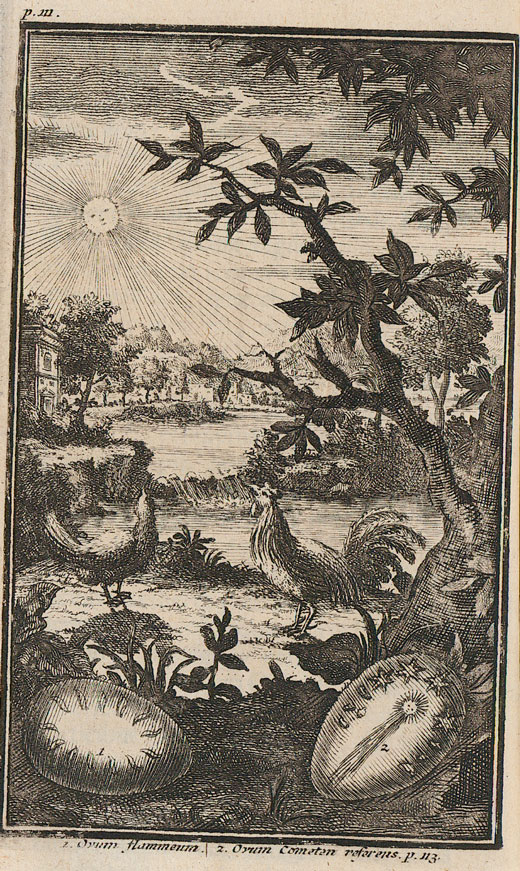
1. A flaming egg.
2. An egg resembling a comet. See page 113.
In what does this phosphor differ from the Bolognian light-bearing stone, except that this one is made from a calcareous stone, while that one is made from such a texture as that grain had taken on which, however, that little tale, that the hen of Albertus Magnus and Paullini had devoured it, shows to be a wholly inconstant phenomenon. The Ephemerides of Germany teach that at one time gold filings, separated out of some peculiar grain devoured in the stomachs of hens, were found; from which it does not follow that this can or ought to happen from every grain, or in all hens. Rare cases do not impose necessity on the events of natural things.
Then too the imagination of the hen itself, perhaps frightened by some definite light, may have impressed this appearance of light upon the egg. Of this one may doubt less, if one recalls to mind what the excellent Eberhardus Gozelius reports: that in different houses of the inhabitants of Ulm it happened that very many eggs of different hens were found marked with the image of the sun scattering thirteen little flames from itself (the same number being observed in all), as though impressed by a carved seal. He adds that among them one gave forth such a splendor that the woman who saw it was greatly terrified and removed it from the nest. And this was shown to very many curious inquirers.
These eggs did not appear all at one and the same time, but some about the feast of St. James, others in the month of August, others in September were said to have been laid. Enough of these rarer phenomena, which prove nothing concerning other eggs. Yet the explanation which the aforementioned observer himself gives is curious and ingenious. He says that the cause of these eggs marked with a sun and little flames lay partly in the cock, Jupiter’s bird, which every morning fixes its eyes upon the golden light of the world and salutes it with its song, and, when it mates with the hen, imprints this character together with the male principle; and partly in the hen herself, holding the luminaries fixed in her sunlike eyes, and being able, through a very strong imagination, to draw their image into herself.
A fine explanation indeed. Yet it can scarcely be explained how the imagination of a brute animal could transplant the appearance of visible light into eggs. It is certain, however, that hens, like women, suffer effects from the womb, and are strongly affected in imagination. Besides one or two physical experiments, a frequent history in very similar matter proves this, which Sebastianus Schefferus communicated to Salomon Reiselius.
A hen, in the morning hour, at the same time when, because of the sun’s defect, there appeared over the bed of the threshing-floor a lunar eclipse plainly visible, soon afterward laid an egg upon whose shell that very eclipse was represented as though engraved by a seal; and just as eclipses are elsewhere painted in their proper colors, so here the image of the moon was seen in the upper part, and in the lower the eclipse was placed. Thus the disturbed imagination of the hen herself marvel at the power of nature! impressed this image upon the egg already being formed in her ovary. Innumerable examples prove this. I will add one more.
In the year 1680, at Rome, on the 14th of December, on the Capitol, in the house of a certain chief minister, a hen laid an egg, as Antonio Magliobecchio reported in letters sent to the Curious of Germany, on whose shell she displayed, together with other stars, a comet gazing terribly at the head of Andromeda at that very point of time. The Ephemerides communicate the figure in that place, and Nicolaus Blegnyus also gives another somewhat different one. But let us return from where we have digressed.
The egg is a wonderful work of nature indeed a household prodigy which, because it is encountered every day, no one any longer marvels at. Although it very rarely produces a phosphor, still it contains within itself a vital light, which even by the mere moderate external heat, though not from an animate source as the Egyptian ovens bear witness when concentrated, is brought into the act of life itself.
But what then? Shall we say that not only life but also death is luminous? If in living things light comes from the vital light, whence then comes this light in the dead? For it has not rarely been found that dead animals themselves, or their flesh, have shone. Examples of this kind from beef, lamb, and mutton are found among writers on physical matters. Their light was observed by Bartholinus to be so great that at night all things were illuminated as clearly as if candles had been lit. The flesh of a wether shone by night in Borellus. Various meats in the cellar of the monastery of Corbie shone by night, as Paullini records. Innumerable such examples I pass over, so that I may rather investigate the cause.
But how? Shall I recall again the image of life in death, and with Langius bring forward little worms shining by night as inhabitants of those meats at supper? Or shall I accuse glowworms, flying in by open windows at night and fixing themselves in dense swarms upon the flesh and its fat, or clinging together like a swarm of bees, with Paullini, as the cause of this light? Or could the eyes of the wool-workers, merchants, or even cooks have been so dim that such densely gathered companies of glowworms escaped them?
Perhaps, according to some in Borellus, a certain peculiar night-shining plant, but what kind? one which those animals had eaten. But whom do such speculations satisfy? Borellus himself judged far more ingeniously: that certain viscid membranes retained for some time the light of the sun, imprisoned in them after the manner of the Bolognian stone. Yet there is a great difference between a stone made most dry by calcination and membranes that are viscid and fatty. Still, he reasoned very well concerning viscosity and reflection.
For the light of living animals especially adheres in the hairs because of viscid foulness. And the light of oysters, according to Paulus Zacchius, resides only in a viscid humor; and according to Bartholinus, the light of beef and lamb was noted in fatty membranes, just as ignis fatuus for the most part wanders in marshy and greasy places.
If therefore conjecture has any place here for who will claim exact knowledge in this matter? the mode of its production is the same as in those wandering little flames: the subject of such borrowed light is an unctuous-sulphureous matter, in which, because of the surrounding atmosphere, swollen with very many nitrous particles (such as abound in underground cellars, shambles, and kitchens on account of the frequent corruptions or dissolutions of mixed bodies in those places), the matter of the first element, being more strongly stirred does not indeed burst forth into fire, but manifests itself as light.
Whether now that light bursts forth from the collision of the heavenly globules in the interstices of the tiniest corpuscles; or whether, according to Fludd, it comes forth gathered from the center of the air under observation; or whether it depends on a remnant left from the vital light once impressed, and still in some way continuing through the certain motion of the most subtle particles; or finally whether it proceeds from the flesh, gradually passing through putrefaction into the ultimate matter of salts, and already producing a new vital light insofar as by corruption it tends toward another generation each of these explanations may have its place according to the different conditions of places. Let the reader be free, in a matter of very obscure cause, to adhere to whatever opinion he pleases, since no cause free from every doubt has yet been discovered or is likely to be discovered.
CHAPTER III
On animals that see by night: do their eyes have the nature of a phosphor?
Since every vision takes place in light, and nothing seems to be seen unless illuminated by light, this is a very difficult question, by whose benefit many animals that see at night discern the objects set before them. It is agreed that wolves, goats, dormice, cats, and horses, whose eyes are pale-gray, as well as night-wandering birds, can see in the dark. Indeed, although the golden beam of the sun and its daughter light, most beautiful day, are especially said to be dedicated to human sight, there nevertheless are and have been among men some for whom night was by no means wholly dark. Tiberius at times saw all things clearly by night. The eyes of Marius and Sulla were sharp-sighted in darkness. Historians testify of the philosopher Asclepiodorus that he used to write and read by night without a lamp. The same is reported of Scaliger and Casaubon, both asserting it of themselves. Indeed Borellus and Bartholinus also knew several persons who could see by night when the moon was not shining, though neither they nor others assigned any cause for it except one very obscure, doubtful, and uncertain.
It will be worthwhile briefly to recount the chief opinions of authors on this matter and to weigh the judgments of others, to whichever above the rest the palm should be given. In the end it will appear which opinion I profess.
First let the Cartesians explain their view; for one who objects to them does not do so frivolously: if the ethereal globules are driven at night by some illuminant, wherein lies the account of light consists, and by what means vision is effected, how then do men and brute animals see by night? They extricate themselves from this difficulty without much trouble, by saying that living creatures which see by night not only receive light from without, but also emit it from themselves and illuminate the objects before them.
This opinion indeed seems on the one hand fair and probable, but on the other is beset with very great difficulties. They explain the matter in this way. The ethereal globules are driven by a certain fiery spirit which animals emit from their eyes. For from them there continually go forth certain corpuscles, swiftly and strongly moved, which drive the celestial matter diffused through the air; so that in this respect the eyes of animals have the function of an illuminant. They add a comparison. Light thus produced and reflected from objects toward the eyes of animals, with a certain modification, determines animals to their vision, no otherwise than a blind man by means of a staff distinguishes the bodies before him, insofar as the motion of the staff caused by the blind man himself, but with a certain modification beaten back from resisting bodies toward his hand, is fitted sufficiently to determine him. Thus animals, by rays indeed caused by a certain fiery spirit and emitted from the eyes, and with a certain modification reflected back from objects, are determined to their seeing.
This opinion, though clothed in new garments, does not differ much from that of Hipparchus in Plutarch, nor from that of Plato. The former held that rays stretched out from each eye and, with their extremities as with hands, grasped bodies placed outside the eyes, and that this grasping produced sight. The latter thought that the thing seen was known by sight through a light emitted from the eyes, when that emitted light met the light of bodies in the surrounding air.
Yet both these views have been sufficiently refuted by those who have shown that the senses are not acts of emission but of reception; and it would be far too long to repeat their arguments here.
Meanwhile, there still remains some probability in the opinion of the Cartesians, namely that light streams forth from the eyes of night-seers toward objects. For the very famous Dr. Tackius, once physician at Darmstadt, writes in a letter to D. Salomon Reisel, that when he had at one time applied himself with intense meditations to composing a funeral oration, and twilight was coming on, already inclining into night, a flame suddenly burst forth from his eyes onto a sheet of white paper placed beneath, and it was illuminated so brightly that the use of that light still for two whole lines before it vanished. He adds that he was so troubled by the flashing of that appearing flame, repeatedly darting from his eyes, that he was often not permitted to be alone with himself.
So too Thomas Willis is reported to have told of a certain exceedingly ingenious man of hotter brain, who after a rather larger draught of wine could read letters clearly even under dark night. Willis gives this as the cause: that by the abundance of spirituous liquor the agitation of the parts is intensified and increased, and the sulphureous nourishment is supplied more copiously; and in hot, living blood there is truly a fire, having its own properties, affections, and accidents, although its splendor, being exceedingly subtle, is not perceived by our sight.
For who, he says, under the bright light of day sees glowing red-hot iron, or glittering glowworms, or ignes fatui, or rotten wood, indeed even the stars themselves? To this is added that in man the gleam of that very subtle little flame is subdued for the preservation of life by the mingled corpuscles of the blood, and especially by a stronger light, namely that of the immortal soul; yet when freed from these, and issuing outside the body under the form, as it were, of an exhalation, it not seldom blazes forth.
This is confirmed by the fact that in some persons, when the blood is hot and vaporous has known in the aforesaid persons, when in the evening, as they were going to bed, they took off their undergarments near the fire or lamp, they flashed out an unexpected and glowing flame.
Such, indeed, are their arguments, drawn from an ingenious manner of production and from examples, which nevertheless do not satisfy others at all. No one denies that a light is naturally implanted in the eyes. Hence that ineffable swiftness of the optic spirits passing through the nerves of vision and ministering to sight. But this light shines within; it does not diffuse itself without, nor does it illuminate the medium by which animals may perfectly discern more distant objects and note their swiftest motions. Helmont proves this by direct observation. Set a mirror before the eyes of animals that see by night, in the deepest darkness, and you will find in it no reflection of light though even the ray of a very faint candle, many paces distant, is produced in a mirror placed in the corner of a dark room. Therefore nothing goes out from the eyes that illuminates objects or has the function of an illuminant.
Add also that, according to Willis’s claim, the gleam of the vital little flame is so exceedingly subtle that in the light of day it is not perceived, just as glowing iron, glowworms, or ignis fatuus are not perceived at least so that this very light ought to become manifest by night. For in vain is recourse made even to a light that is itself invisible. It is true, however, that under a more intense agitation of the spirits for example in anger the eyes often seem to sparkle, and when the eyes are violently struck, condensed luminous particles produce the appearance of falling sparks, namely by a repercussion directed on every side toward the crystalline tunic. Yet those rays are never visible either to one striking or being struck, nor are they so great that, issuing forth, they could be perceived to illuminate objects.
Even in lovers there is an intense light in the eyes because of love; whence Virgil:
“For she gradually consumed his strength, and the woman burned him by her gaze.”
Hence also Plato in Pollux places “light-bearing eyes” among the marks of beauty. And Sidonius says more elegantly:
“The eyes poured forth rays; their color was fiery,
yet it was not burning heat.”
From these things, however, no light is communicated to the objects seen, although those Platonic eyes shine with a specious phosphoric light.
These opinions being therefore rejected, Helmont and Fludd assign a peculiar night-light, which ought to arise from the moon alone, by the benefit of which their objects, even more distant ones, may be seen by nocturnal animals (or beneath the earth, as he first maintained), although that light of the sun is perceptible to night-seers.
For suppose whatever disposition you please in their eyes; indeed suppose in them a singular inborn light: yet two things would still necessarily be required for an animal to be a night-seer, so long as it is not established by direct experience that distant objects are illuminated by something going out from the eyes would it not rather have to be held that there is some definite light of the night, which both illumines those objects and is perceived by the eyes because of a certain texture? First I shall render this probable by a notable instance; then I shall add something from the very conformation of the eyes in night-seeing animals.
It is altogether wonderful that there are also given certain night insects of most destructive swiftness, of which four chief kinds are enumerated by the excellent Menzelius. These suck nectar from the tubes of honeysuckle flowers, breathing out sweet fragrance in the night. And among them one kind does not settle upon the flower, but, marvellously, poised in the air while flying, clings to it by the motion of its wings, most swift beyond others, and so takes its nourishment from the flowers. It could hardly be doubted that it rejoices in a most exact sight, if one considers that it is scarcely possible to catch that creature either with the hands or with a little net, even when servants are called in to help, as repeated experience testifies. For, a little sooner than can be told, it vanishes from before all eyes more swiftly than the east wind, and returns again with the same speed whenever it perceives all things quiet and without motion.
Indeed, it enjoys very large eye-sockets for the size of its little body, as you may see from the delineation cited above. But do fiery rays perhaps also burst forth from them, which render so distinctly visible the leaves and flowers of the honeysuckle, and likewise their tubes, and not less clearly the very ambushers and nets set in their way, that they avoid capture with such speed and, when those withdraw, immediately return? Surely so great an emission of light would make even this little creature itself visible to men by night, after the manner of other phosphors; yet no one would discern them in darkness unless they were illuminated by their own light. What is emitted from them, therefore, is carried back to the eyes and impresses an impulse upon the flaming retina, wherein the act of seeing consists.
Would it not rather be the case that, by the peculiar light of the night itself, these tubes of flowers become visible to this nocturnal little creature, which, hanging in the air like a swift swallow, sucks with its outstretched proboscis objects, affected by that very light, are not conveyed indiscriminately to all eyes. Thus, what we had next to investigate, it will plainly be necessary to posit, is a particular disposition and structure of their eyes, so that they may serve for receiving night-light rather than daylight.
A striking example is the wonderful conformation of the eyes in the owl, and especially its notable nictitating membrane, plainly of similar configuration and magnitude to that seen in the eyes of goats, which, if we believe Pliny, see by night no less than the owl does. There is also the very great clearness and prominence of the humors, especially the vitreous humor; likewise the crystalline humor is placed nearer to the pupil. The eyes themselves are set within, close to the brain, whose size they almost exceed. Moreover they are immobile; and they represent neither an elliptical shape, as human eyes do, nor a round one, as others describe, but are like a globe hollowed out in the middle on both sides by a turning-tool, with a sort of circular section of the portions removed, as it is depicted by Severinus in the Zootomia.
No less worthy of consideration are the eyes of cats, which, because they especially delight in and use that nocturnal light derived from the moon, according to Helmont have pupils that reproduce the very phases of the moon at different times. For the pupil is enlarged in full moons, contracted when the moon wanes, and changed from a circular shape into a lunar, sickle-like one. This certainly shows there to be a correspondence between the eyes of cats and the moon. Whence that arises, there is no need to explain further here; it is enough from these things clearly to gather that in night-seeing animals there is a peculiar structure of the humors and membranes in the eyes, designed for the use of nocturnal light; because of the lack of this in other animals, that light remains no less imperceptible to them than it does ordinarily to men.
But if at times, preternaturally, as happened to the above-mentioned Tackius, sparks burst forth from the eyes, somewhat illuminating nearby objects, this contributes nothing to the natural condition, and especially nothing to distant objects. We may indeed grant that the eyes of animals, which shine and glitter at night, as is clear from many accounts, have in them the nature of a phosphor, and, as Gesner says, perhaps some humor such as is found in glowworms; yet it has not yet been established that by its aid any distant things whatsoever are seen, but only nearby ones.
And from this there now results the third opinion, namely, that the eyes of certain night-seeing animals are properly speaking phosphors, whether indeed they have that brightness innate in themselves which is most probable, as writers testify concerning the eyes of the sea-calf, the hyena, the kite or milvus, whom for that reason they call a little lamp or whether they retain for a while the light of the sun drawn in during the daytime. From this latter point they wish to make it plausible that, after a fixed gaze at the sun, even when the eyes are shut or turned away from the sun, a light is still seen for some time.
Yet the Cartesians explain this in the following way. Since light consists in the motion of very subtle matter, that strong impulse impressed by the most vigorous rays of the sun on the filaments of the retina easily persists for some small time, even though, with the eyes either closed or turned away, the solar rays no longer act. Thus we also observe that, if anyone with open eyes suddenly glimpses the disk of the sun as it were for a moment in passing, he immediately contracts and retains for some time its image in the eye under the form not so much of light as of a tawny or rather rounded spot. This must be attributed solely to the motion impressed upon the retina.
And in the same way the retention of solar light in the eyes of the owl, the bat, and other animals that shun the light, to whom the sight of the sun is especially harmful and troublesome can hardly have any place. Therefore the former opinion, of a light innate in the eyes, deserves the palm.
Although it is exceedingly difficult to determine wherein that consists, unless you admit a singularly fashioned structure of the eyes, as we have already said of the owl and the cat, and as the most skillful investigator of corpses and truly lynx-eyed man, Dr. Philippus Jacobus Hartmann, professor at Regiomontium, testifies concerning seals: namely, that their flashing eyes owe it to a peculiar white tunic between the choroid and the amphiblestroid (and he found one not unlike it in cats as well). From this it is sufficiently clear that both the structure of the organ and its indwelling luminous spirit make the eyes phosphors.
And these are the chief opinions found among authors, though shaped by me rather more fully on either side. To these I shall now briefly add my own judgment. I judge that these opinions can easily be reconciled indeed ought to be combined if the true account of nocturnal vision is to be given. First of all, with Helmont, one must posit a certain light shining only at night, not of a fiery but of an ethereal nature, which nevertheless does not shine by itself for others, nor illumines any objects and renders them visible, except when, through the homogeneous light implanted in the eyes of certain animals or, if you prefer the Cartesian view, through a fiery spirit it is moved, driven, and reflected back from objects toward the eyes. This is clear enough from the fact that to others, who are deprived of such a native light of the eyes, that light of night does not fall under sight.
This is elegantly confirmed by the example of Tiberius. Some write that he saw at night as clearly as by day; but this often arose because one author copied from another and merely repeated the story without attending to the circumstances of the phenomenon itself. Suetonius himself, in his life, recounts it somewhat differently in these words:
“With very large eyes, and what was marvelous even seeing at night and in darkness, but only for a short while, and then, as soon as they had begun to be opened, failing again.”
Understand this thus: Tiberius, restored by sleep and with the fiery spirit gathered in his eyes, when waking could for a short time discern in the night; but when that soon grew weary, he again, like other men, became dim-sighted and saw nothing in the dark. Therefore the ethereal light of the air, or the most subtle matter of the world enclosed in ether, profited him no further, as soon as its impulsive cause namely the fiery spirit of the eyes failed. From this it is sufficiently concluded that the first requisite is necessary, namely the light of the eyes themselves, whether that be innate because of the peculiar disposition of the organ, or whether it sometimes supervenes accidentally from a stronger agitation and quasi-kindling of the spirits, as happens in morbid causes.
But the necessity of the other requisite, namely a night-light in the ether, is equally proved from this: the light implanted in the eyes alone does not make an animal a night-seer, because, as has already been shown above, it is not carried outside the eyes and toward objects, especially distant ones. This, in sum, is my whole opinion: joining together the doctrine of Helmont and Fludd with the Cartesian one. Yet I do not adhere to it so firmly that I would not always readily abandon it, if I were taught by someone more sagacious a better and clearer account and method of nocturnal vision.
CHAPTER IV
On Night-Shining Insects
We proceed to the kingdom of insects, in which, among the three esteemed classes of nature, there is a greater number than among all the other living things.
The vilest creature is an insect, and yet very many of them surpass the structures of bodies in marvelousness truly they would be accounted prodigious futures, if nature had added size to them.
How stupendous an animal the gnat would be, if it attained the size and height of an ostrich! If the various kinds of caterpillars were greater in bulk, they would rival the serpents of India and far surpass them in deformity. If night-shining flies were equal to eagles, with what dreadful fires would the air flash by night in many places, so that there would no longer be any need of the fables of fiery dragons! In very many insects there is a fearful appearance, as the armed eye detects; and in many too there is no inelegant variety of colors, especially in the tribe of butterflies, in whom nothing is lacking for the increase of nature’s marvel, except size alone.
Indeed, even without that, they are as it were sheer prodigies of nature. For if motion and sense were in the tiniest mite, how exceedingly small must their organs and instruments be! What optic nerves are to be seen, most keenly, in the smallest gnat! What a little brain! What a little heart! See this, atheist, and deny God He who shines forth as greatest even in the very least things! O the wisdom in these brute creatures, indeed even in the vilest insects!
Far more wonderful is it that even the vilest insect contains within itself a spark of nature’s fire or a ray of heavenly light, and shines, surpassing the most precious thing in all nature. Bartholinus and Theodorus Schenckius observed even the tiniest little worms to radiate with this native light. Truly it is marvelous that such tiny animalcules should possess something beyond the form of elemental mixture, namely a vital light, which originally descends from the universal light. For the sun is the chief former of such creatures, and to its light the soul of worms and insects owes itself.
Even the lowliest little worm of the earth bears witness to the supreme Creator and Father of lights, so that proud man vainly claims for himself alone the title of microcosm, which, as a certain philosopher says, belongs even to the vilest little worm.
No night-shining creature is better known than the glowworm, whose luminous particle makes its whole worm-like body visible in the dark. Robert Fludd reckoned it among those bodies which, because of the perfection of their complete substance, naturally attract and retain the rays of the sun, which he thought happens because of a certain implanted spirit of the Quintessence. But how the perfection and purification of that substance is present in the glowworm has place in this part, he does not explain. And who can explain it? That spirit of the Quintessence is also fictitious, unless he understood it to mean light. He was mistaken in supposing that this insect draws in and retains the solar rays.
The excellent Elias Camerarius explains the matter more acutely, and refers it to the very structure of the little body itself: namely, to those semicircular compartments and indeed to the lower parts of the body, as seen under a yellowish, polished microscope, furnished with shining whiteness and crystalline, glittering hairs, and he assigns the cause to the repercussion of the rays of light serving there. Yet he does not add how this could have place in darkness. For the repercussion of rays of light is vainly supposed where there are none at night.
When the luminous flies are explained as flying on summer nights and, by moving their wings, shaking out little sparkling fires, they still reflect no light at all, since with no light present they shed no light-rays. Nor does Suidas rightly advise that this be ascribed to a polished color or brightness: for how should the incidence and reflection of light have place in darkness in things in which under the sun and by day nothing at all is noticed?
This opinion therefore falls together with the former one. For one must either say that the light of night, to be reflected, is drawn in and retained by glowworms during the day, or that peculiar ethereal light of the night is to be gathered together and concentrated in the little body of the glowworm, specially disposed for this purpose for we readily grant that this structure contributes very much to the vibration of light so that it may be made visible. Let that opinion please whoever wishes.
Another explanation pleases me more: that I regard that light of the glowworm as a native gift, or rather the very vital light of the insect itself (for when life departs and ceases, it ceases to shine), inhering in a certain juice which in that place stands in the stead of blood. For more careful inspection proves that the glowworm possesses a ringed belly, divided into many segments, at the end of which two little drops are seen, translucent and fiery. By the natural motion of these, corresponding no doubt to the systole and diastole of the heart and arteries, it now sends forth light and appears bright, now withdraws it and grows dark.
As soon, however, as the motion and expansion of that vital liquid ceases in the dying little creature, its light or effect is also at once completely extinguished and in a moment goes out. From this it is sufficiently clear how vain was that attempt of the writers on natural magic, and how empty the promise, who before phosphors were yet known claimed that from the tails of glowworms, well crushed, and after fourteen days under dung after a period of putrefaction and then distillation, they promised a night-shining milk, illuminating the air, by which letters might even be read and written. Yet that experiment succeeded easily enough with other modern phosphors prepared from inanimate matter. But if for this animal phosphor the structure of the body is required, how could that structure, once wholly destroyed by crushing and putrefaction, continue the light?
And thus much briefly on this wing-sheathed luminous insect, which is also called nitedula and pygolampis, and by the Italians bissola fuogola and lusarvola.
I shall not linger here to enumerate many other more familiar night-shining insects, among which is reckoned that which they call the scolopendra, and the Germans Nassel, shining in the dark in such a way that, if you were to look at it when coiled up, you would think it a particle of glowing coal, because the same account applies to all of them.
To these likewise are to be referred those shining flies mentioned by Levinus Hulsius, of which in his seventh voyage to Guinea he thus relates: the Dutch once saw something in the countryside by night shining and sparkling, whereupon they ran up and tied it in a cloth, through which it shone through, as if they were fiery coals. They showed them to the Ethiopians, who indeed marveled, being ignorant what it was.
But when day came, it was seen to be small flies, like cantharides, but black as pitch. This final phenomenon proves that neither color itself whether white, as in the glowworm, or, as here, very black contributes anything to the essence of light in phosphors. For this reason I have transferred this report, otherwise of small moment, to this place.
But there is another night-shining creature worthy of report, about which authors write marvelous things. Gonzalus de Oviedo, and from him Vigenère, relate that in Hispaniola and the islands round about there is a certain flying little creature, called Cocuio, reaching the size of a scarab, and furnished with four wings, two upper ones firm and hard, two lower ones softer; its eyes shine like lit candles, so that wherever it goes it illumines the air and sheds light from itself in such a way that it may be seen from far off, and in a dark room one may read and write by it just as at high noon.
On this matter I require the judgment of readers; greater things are added still. Three such little creatures joined together in woods or fields on a dark night cast a greater light than a torch or a lit lamp, visible for more than a mile. For this splendor is noted not only in the eyes, but also in the outspread wings and in the underparts, and it serves the Indians in place of a lamp or lighted candle at supper, and for other nightly labors and household business; but when the little creature dies, it is extinguished at once. So they say.
The most curious Eusebius Nierembergius, and from him Martinus Szent-Ivani, describe this same insect with other circumstances, and under the name Cuiuii. In Hispaniola and the other islands of the Ocean there are given mosquitoes of very diverse kinds in greatest abundance, some of which nearly attain the size of bees, generated from that damp heat which predominates in those islands and from the abundance of marshy places, and they create the greatest annoyances for the inhabitants in their houses, bedrooms, and beds.
Against this plague, therefore, wondrous nature has given this remedy: namely those charming hunters of gnats, the Cuiujos, very well fitted in many ways, which, just as cats are for mice, are born to root out their breed. They are said to be worms somewhat smaller than bats; if one of them, caught by the inhabitants, is released in a closed room, it immediately with headlong flight flies about the whole room seeking mosquitoes, and searches out and clears every corner, the bed-curtains, and the other parts of the chamber which mosquitoes are accustomed to fill.
Provident nature therefore assigned to this little creature four most shining lanterns: two in place of eyes, and two hidden under covers, which it shows at the time when, after the wing-cases of the beetle-like shell are opened, it catches the air with its thin wings. We do indeed see many flies and worms shine by night, but nature has increased this power of shining in these little creatures.
To those who go about through dark rooms the Cujuii serve the inhabitants as lamps: they sup, weave, and lead dances by their light. For as many eyes as each Cujuius opens, so many candle-flames does the guest enjoy. They also read and write by that light. For this light remains vigorous in the Cujuiio as long as it has wherewith to feed itself. But once the mosquitoes have been cleansed out or driven away, it begins to fail from hunger. Therefore the islanders, when they see its light begin to grow faint, open the window so that it may be let out and seek food for itself.
Others add that the whole entrails of these little creatures, or flying worms, are luminous, being plainly full and as it were drunk with light, and that the skin of the belly is transparent; and therefore while they are flying, or while their wings are folded back, they make their splendor tremble.
At the first coming on of night they appear and fill the mountains and fields with lights, as though candles were being lit, for they do not rise very high into the air. When one Cujujio is caught, many are caught. For they fly together to the place where they see one of their kind taken. The light and brilliance that are in them, when the creature dies and its native moisture dries up, must likewise perish.
This is the very brief natural history of the Cujujii, most worthy indeed to be investigated especially by the keenest searchers into phosphors. For what do our natural or artificial night-lights possess in comparison with the splendor of this little creature? Truly little or nothing. For hitherto men have sought in vain such substitutes for household lights as might serve in place of lamps or lanterns for illuminating our domestic labors by night.
But who will determine not so much by certain knowledge as by conjecture the composition of parts, not only solid (for when their whole structure is destroyed by death, all light perishes), but also fluid and mobile, in this Indian scarab, and the fire innate in it? This winged worm seems before all other mixed bodies in the world to claim for itself the greatest kinship with the primal light, who would say that it has received a primeval portion of light in its composition, without incurring the reader’s laughter? And to what end? Perhaps that in this way God might wisely provide the Indians with a necessary light by night, since in that kingdom the abundance of the vegetable and animal realms might lack oils and combustible fats.
For as regards the catching of mosquitoes, cats too, though they do not shine, could have accomplished that by day or even by night just like cats. If you favor Gassendi, explain how from so tiny a little body, through so wide a space of air, luminous particles are cast forth and carried more than a whole mile and farther, bodily, without the presence of any fire. If, following Descartes, you explain that propagation of light on every side and to so great a distance through the motion and impulse of the ether or of the celestial matter, most fluid, set in motion by the matter of the first element existing in this little creature, then indeed the effect may easily be conceived, but not yet the cause namely, whence in that tiny body comes that force or abundance of the first element which moves and drives all the surrounding matter within so vast a space so powerfully that so great an illumination results as to make the night almost like full noon.
The novelties concerning the exceedingly fluid heavenly globules and of their matter, which could be conveyed by mutual and immediate contact, and consequently by the easy motion of all things, may perhaps explain how illuminating light is spread, but not the nature and energy of that first impelling principle.
But can anyone of sound mind judge that the pores of the body of this little beetle are so fashioned that they admit only the matter of the first element? If, however, someone should say that the soul of this insect itself is the vital light of the little creature, the author of the most rapid and intense motions in its fluids, and perhaps also in its solids, endowed with a peculiar structure, which imitates the light of the sun, indeed even emanates originally from it, and is, according to Helmont, a certain peculiar species of vital light implanted by the Creator for its own ends such an answer would not displease me, nor perhaps others either.
If you ask why the nature of light is to shine and that of fire to burn, you may likewise ask why this host of night-shining creatures, whose easy prince is the Cujujus, gives light. You, whoever you are that are sharp-sighted in nature, inquire. But remember that you do not know His work.
Whatever finally you may establish here concerning this light, you will always obtain thick darkness at the first beginning, so that you must confess that nothing is more obscure than the essence of light. This at least is certain: that a bright portion of the sun, even in the vilest creatures, in worms, in insects and insects are inhabited by it; and that, if it does not shine forth equally from all and come into view, the reason must be sought either in the scantiness of the light, or in the weakening of its motion, or in the density of the containing body, or finally in some unsuitability of its texture and structure. Unless, with some men, the physicist is not ashamed to retreat here to the inscrutable will of the Creator, as to a common asylum of ignorance.
Let me therefore add still my own conjecture, and pursue the physical cause a little more deeply. It is clear from the natural history of this little creature given above that the Cujujus are nourished and live upon mosquitoes alone, and that if these fail them, they too languish and lose the power of shining. But those mosquitoes on these oceanic islands are produced from the warmth and moist heat of the surrounding sea and marshes, or rather from a certain fermental feculence. Now let us recall what we set forth above concerning the light of the sea, and especially concerning the sea surrounding the Ambon Islands, and concerning the aluminous sulphur mixed with the salt waters there, or the cause of marine light, from Rumphius.
If we combine these things by physical reasoning, nothing prevents us from arguing that these island mosquitoes also arise from material of that sort that they are generated from a sulphureous, or nitrous, or aluminous matter, and that for the most part, when they pass over as food to the Cujujii, in the peculiar stomach of these creatures that most splendid light and true natural phosphor is elaborated; and that the little creature itself, further animated by a vital light, constitutes so great an intension sphere of light as the little lamp of any other night-shining thing, whether natural or artificial, does not attain.
Whoever is not yet pleased with this cause, let him produce a better one. We would rather choose here to act the disciple than the doctor, embracing that saying of Scaliger:
To wish not to know, what the greatest Master does not wish you to know, is learned ignorance.
SUBSECTION II
On Natural Phosphors in the Vegetable Kingdom
Having surveyed the marine, mineral, and animal kingdoms, we now pass to the vegetable one, by far the most delightful garden of nature, to behold, with curious eye, I know not what lights of the earth solar and lunar, and other nocturnal ones most eagerly desired. This kingdom yields to none of the others in admirable productions; rather, by the bounty of heaven and of the sun, from its own rich fullness and abundance it draws forth and brings forth, as from a horn, things in so vast a heap and with such wondrous variety that here too, everywhere, the open image of hidden Divinity shines forth.
Why then should not they too sometimes exhibit that light, whose common use they likewise enjoy? Why should not some one out of so many thousands of plants possess a brilliance among nocturnal phosphors? Wood shines when dissolved by putrefaction and tending already to its final matter, from which all hope of fresh regermination has been cut off; why then should not rather a vegetable, still endowed with the soul of its kind, and daily receiving the kindly rays of the sun, sometimes bring forth some specimen of the light hidden and laid up within itself?
Conrad Gesner does not seem to have doubted this, believing that it may come to pass that, just as among other natural things some shine only by night, so also certain herbs though still unknown to us may shine during the night. Yet he adds, still unknown to us not without reason. For since neither in his age nor in the ages before, nor even in our own, although botanists have been exceedingly curious in investigating and describing both the structures of plants and their wondrous phenomena, anyone has observed and recorded any vegetable phosphors, except those whose names have been handed down to us by the ancients men often too greedy for marvels, or else antiquity listening too much to the traditions of the Magi and superstition, which, if it had any certain vegetable matter at all, attached to it a great many fables.
We shall not cling to those. Yet we shall bring forward here the names of certain herbs that in antiquity were held to be night-shining, although about their actual existence nothing certain is yet established, and we shall add our own judgment.
CHAPTER I
On herbs and roots naturally shining by night
It must first be noted that the plants once deemed worthy of this title were designated not from some proper virtue derived from their inner powers, but at least from light or splendor among the Greeks; that is, in the assigning of names to things, they were indicated by an appellation most ready at hand, so that even from this the suspicion is not plainly lacking that the invention is fabulous.
What, in actual truth, does that herb so much praised by Pliny, Nyctegretos or Nyctilops, possess besides the name, since up to this day it has been seen by no one? And what splendor of light does that Aelian Aglaophotis possess, save in its name alone?
To this class there seems chiefly to belong that most fabulous fiction of Josephus, Baaras, which indeed takes its name from Baar, because that signifies to burn; but it sends forth no fiery sparkle by night, unless perhaps by satanic illusion, nor does it produce miracles except those boasted of by that same author.
To the same reckoning also seem to pertain those plants of Democritus: Thalassegle, that is, a herb shining in waters; and Selene, that is, moon, growing on Mount Apesantus near the river Inachus in the region of Argos, and believed to be born from the moon’s spittle or moisture fallen to the earth. All these are either walking along with fables, or else, with metaphors, portentous only in name and nothing more in reality.
Lunaria gives further proof, which others also call the star of the earth, endowed with as many magical and alchemical virtues as it has distinct species. It is said to enclose in darkness a seed in a round little pod, which opens by night and receives the rays of the moon, so that it appears like a shining star. This, unless it be parabolic for the primaterial being, a phosphor pregnant with metallic seed by night, that is, in blackness, opens and is disclosed, and receives the moon’s rays that is, the whiteness of smoke and splendor is certainly a fiction. Gesner examined with the greatest diligence all the species of lunaria, which he also depicts graphically not from his own sight, but from the sufficiently full reports of others; yet he testifies that of all those he knew, none shines at night. Therefore we do not think it worthwhile to investigate the causes of things whose very existence is still doubtful.
Meanwhile, however, although these things are entangled with many fables, we still do not exclude from the number of beings some lights of this sort whether the herbs themselves shine, or the air diffused around them, or rather a vapor, proper to certain places or exhaled by the plants themselves, kindled like ignis fatuus. Nor is it impossible that the herbs themselves, as still endowed with a more proper life than minerals, may shine, either by possessing an innate light, or by naturally attracting and pouring back the solar rays.
For even in the seeds of plants, in the words of Espagnet, God has hidden a secret spirit, the author of generation, marked with a specific character, which is altogether celestial and a ray of ethereal light.
There could also be another particular cause underlying a night-shining plant of this kind.
For let us suppose it to be true, as is reported from Aelian, that in the depths of the ocean there grows from a certain kind of seaweed or marine wrack (which they call marine myrica and marine aglaophotis) an easy fiery splendor of it, sparkling as it were in the darkness. Then both its nature and its brightness together might be derived from the sulphureous arsenical part of sea-salt, if one takes into consideration those things which we set forth above at length concerning the salt of the sea.
They tell that sea-dogs [sea-creatures, likely seals or sea-dogs in the old sense], drawn by the fiery outward splendor in this marine myrica as though by the hope of some unexpected gain, hasten toward it, but, partly sprinkled by its poison, partly having devoured it and drawn it also through their gills, they die and float, and so fall as prey to experienced men, who know then to gather from their mouth and other parts a secondary poison.
But these accounts are already rather ancient; let us add one or two more recent ones.
Seyfridus, in his Medulla mirabilium naturalium, relates that on the island of Ceylon, on Adam’s Peak (Pico d’Adam), there is a tree that shines by night; Szent-Ivani reports it to be not of medium size, but rather thickset, of small leaf and wrinkled, of a dusty color, with ash-gray bark, and to flash in such a way as to drive away the darkness. Yet the report about it, and the vain persuasion of the islanders, is marvelous. They believe their country to have been Paradise, whence they call the summit of that mountain the Peak of Adam, and say that the imprint of his foot is expressed there, and that there he did penance. This last point is deservedly reckoned among the many other fables of that people.
Rumphius, already several times praised above, records that the Chinese Gin-sen, or the Japanese Nisi, gradually sends its root above the ground so that it may drink the dew, and then shines with a certain star-like light. Therefore those who seek that root are accustomed to smear a piece of wood with slaked lime and carry it to the place where they perceive the light, so that by daylight they may recognize it shining and dig it up.
A similar method of finding and digging up is said by the ancients to have been observed in Cynospastus, which by day lies hidden unknown among the other herbs being triflingly said not to differ from them in color or appearance even in the least but by night was marked by a fiery splendor flashing like a star, with a sign fixed at its roots, so that it might be found exactly at night.
That phenomenon of nocturnal light in that very famous herb of the Chinese contributed greatly to its value, so that from great Chinese grandees it was at times redeemed for hundreds of imperial coins, and treasured like a household god, being held as a most noble remedy for preserving vital light and for dispelling the darkness of many most grievous diseases.
It is noted, however, that its root, while still fixed in the earth, shines from the dew it has drawn in; for once dried out it emits no light at all. Just the contrary is said of the root of Nyctegretis: when dug up after the spring equinox and dried for thirty days in the moonlight, it is said to shine by night.
It is remarkable that they did not add their own fictions here too, or at least their sleepless hopes; and likewise that the alchemists transferred this root to their own wares, seeking the soul of the world and the universal spirit in the dew. For is not the root of Nisi also lunaria? Is it not a magnet of universal light? Is not the most subtle matter of the world hidden in the life-giving nectar of dew, and its living sulphur stirred into light?
But let us leave these empty phantasms of light, and in a matter otherwise most serious the fantasies of madmen. It was not to one root alone of Gin-sen that the greed of merchants attached its hyperbole, so that to an exotic thing indeed but not so much more than all the rest a universal remedy they might assign a higher price; hence others too are not without reason inclined to doubt this alleged light would wish to do so. For how many of the modern botanists are there to whom even a single phosphor has occurred in so immense an abundance of vegetable things, without any aid of art? For that artificial phosphors can be prepared from them in more than one way will be shown in the following section.
But why, in the animal monarchy, natural phosphors are observed more frequently than in the vegetable, the reason may be that the forms of animals possess far more of that outstanding luminous-fiery power drawn from the secrets of heaven and of the solar treasury, whence, by the order of creation, they have followed the sun. Vegetables, however, have yielded precedence to them. Hence they refer to their own ancient beginnings of life not that much of luminous air and ether was received, because, lacking sense and animal motion, they did not require so great a quantity of solar light for the motion of vegetation.
CHAPTER II
The cause of nocturnal splendor in rotten wood.
“The glow of a decayed stump and rotting timber, silver-like by night, moves and strikes the sight.”
These are the words of Giovanni Battista Porta. And the thing is very well known, though the effect still belongs to a cause most obscure. To investigate it better, one must first set forth the old age and decay of trees.
At last Saturn too lays his sickle even to trees of greatest longevity. They dry up with age, their moisture failing, their nourishment being cut off because the little channels are by then wholly blocked and stopped. A fat sulphureous humor is likewise present in wood, fit for kindling and apt for ignition. But this too is in the end exhausted by the course of years, from which there soon arises rottenness, with the watery humor now alone predominant, still binding the earthy parts together as with a kind of glue. When that too is at length consumed away, solidity and firmness perish, and caries, the extreme wasting of trees, succeeds.
These are the final fates of an aging tree. Whence then comes that beloved light, with the sulphur already spent? Is it perhaps that, when through putrefaction the mixed body is dissolved and the principles are parted, the vital soul of the wood, or its formal ethereal principle, now set in its last extremity for flight, takes leave of its dwelling with this final light? But that has long since burst forth, slipped away, and vanished unless it is still retained by some viscosity or unctuosity of the salty or sulphureous matter dissolved from the wood, you might perhaps say that it is for some little while retained.
Or perhaps do you say that in that caries there dwell innumerable little worms, invisible indeed, but shining? For, says Father Athanasius Kircher, everything rotten by its own nature generates worms. But this proposition is universally false; and no one has yet seen that splendid offspring of worms, though equipped with eyes strong enough to detect the tiniest things.
Or perhaps you say that rotten wood shines because it has pores so narrow that they admit only the particles of the first element? But caries itself, and the consumption of the radical moisture, have made the texture of the corrupted wood looser and the pores larger, so that they admit rather more abundantly the globules of the second element; indeed it would not shine unless it admitted them.
Or has wood dissolved by putrefaction in which its native light has passed into its own chaos, and in which nothing but death and darkness reign in the desolated matter acquired the nature of a luminous magnet, so that it might pour forth only a borrowed and alien light? Just as calcination alone, by driving out from the Bolognian stone its grosser and more earthy sulphur, gives it such a modification of texture that it receives light previously neglected: so perhaps likewise putrefaction by loosening the bond of the particles and setting the subtler ones in motion, disposes the wood, otherwise not shining, so that it may shine from the prey of captured light.
Robert Fludd seems to have favored this opinion, reasoning thus: we see that rotten woods, whose greater part is air or spirit, as is clear from their floating upon waters, invisibly attract to themselves by night the light diffused through the air, and are seized by a most eager desire of receiving a luminous form, which indeed before they had been affected by this putrefaction they could by no means exhibit. In like manner, he says, the scales of certain fishes do the same thing; for because of their moisture, easily putrefying by the heat of the air, they render the invisible light manifest by a certain magnetic force.
So far he. Where, according to the hypothesis set forth above namely that there is given in darkness a diffused light, not indeed perceptible to us, but perceptible to certain animals, and certainly capable of being concentrated in suitably disposed subjects this easily and readily supplies a cause of this light. Nor is it altogether without plausibility. For putrefaction also induces splendor in urine, and in philosophical matter it is only through putrefaction that nature brings forth the natural light which is the most difficult matter of the whole art even though in both cases it flashes forth from an internal principle of light brought outward.
For there is a great difference in light, both in the mode of being kindled and in the mode of shining: one shines by an innate light, either spread out of itself or drawn forth by art; another by an adventitious light; another by a reflected light; another again by the motion and collision of sulphureous particles; another finally by a vital light.
Thus the tree of Ceylon, so long as it lives, shines; but ordinary wood does not shine except when dead. In living things, however, it can happen through animal life, indeed it often does happen, that the elements of a dissolved corpse, through corruption, are prepared for a new generation, so that the heavenly virtue flowing in again kindles in those mixed and bound materials the faint light of a new form, which at length, when the powers of these are strengthened, shines forth and completes the fresh mixed body.
I prove this not by a casual, but by a very notable observation, namely the generation of worms, and successively of flies, from the flowers of elder, when subjected to distillation, in my Helmontius Ecstaticus, to which for brevity’s sake I refer the reader.
In some mixed bodies, however, the innate light is so weak that it quickly fails when life is spent, and does not proceed to a new generation. But these belong to another discussion, and pertain to formal lights.
From the causes set forth above, let each man choose whichever he thinks the better, or suppose with happier ingenuity. We do not wish to detain our readers any longer upon the wandering light of rotten wood, in comparison with our most noble artificial phosphors, conspicuous to the whole learned world, for whose sake chiefly this Exercise was undertaken.
In Phosphorus of Causes, Part II, page 157.
Part II of the Physico-Chymical Exercise concerning Phosphors, setting forth phosphors and pyrophors prepared by the chymical art.
Section I.
Concerning artificial phosphors and night-shining lights.
Thus far, following the light of nature, we have come to the very workshop of chymical Vulcan, where we shall behold new kindled lights, worthy of the curious eye both of the mind and of the body. These are placed in the first court of the chymical palace, and they illuminate only its entrance-hall. To this entrance, those who are admitted easily and at will are enlightened by rays that are not obscure.
But in its more inward recesses there shine night-shining torches of a higher order; to the spectacle of these no one is admitted, unless that pyrotechnic art, which stands before the doors of the hall, [admits him] an eager key-bearer, should open the locked doors, and, as doorkeeper, should draw back the bolt for those who seek entrance; and this only after a sign has first been given to him from the light of the throne. Without this, those who try to look through the lattices of the windows, struck down by darkness, fall from the veil, or wander about, promising great things without foundation. What sort of men these are, Helmont, our ecstatic master, has sufficiently explained.
Therefore we shall remain here for a little while in this first entrance, and in the consideration of common night-shining lights we shall feed the eyes and the mind, accustoming them to a more delicate and weaker light, lest afterward, when those more sublime lights are also to be beheld, they be utterly darkened.
Chapter I.
On the origin of the invention, or the first occasional cause, of artificial phosphors.
Helmont truly wrote that chymistry brings forth things which otherwise would never exist or be possessed in nature. This is clear both from his innumerable productions and from the very invention of phosphors, of which chymistry alone is the midwife: the wondrous mother of so many new inventions in the world.
This mother’s followers, while with the greatest zeal and untiring labor they sought, by means of fire and, as it were, water, the treasures of nature, namely either some universal medicine, or what is usually the principal aim the metamorphosis of metals, in their primary intention; just as they often fell upon various other experiments foreign to their aim, so also they came upon the phosphors themselves by a merely chance accident. It will be neither useless nor unpleasant to set this beforehand before the curious reader here.
We shall begin from the most famous Bolognian Stone, night-shining by art alone, which chance first discovered. It is nothing perfect, nor is it today, nor formerly was it, a new thing that even a filthy shoemaker, a stinking tanner, a foul-smelling baker, or a scabious tailor, and disciples rather than masters of other professions, should, with unwashed hands, as they say, most foolishly strive and labor to embrace the most beautiful daughter of wisdom.
Among that tribe was Vincentius Casciarolus, a citizen of Bologna, but a deserter of his own profession, and a fugitive from his workshop to vain chrysopoeia. This man, seeming to himself to know more than his last or his shoe, happened to observe in the Bolognian Stone both weight and an abundance of sulphur; from this arose a suspicion in him that there was a solar nature in it and, thinking that a quantity of gold, or even the nearest matter of the Philosophers’ Stone itself, lay hidden in it, he undertook various trials. He was already, in hope, richer than Croesus, and all stones were ideally passing over into the purest gold.
Yet when this came forth into the open with no success, the same narrowness of household means remained at home, and the same shoemaker, who had already dreamed himself a prince, gave birth, from a fantasy pregnant with gold, to a transmuting stone; but by an unhappy or rather a happy miscarriage, he brought forth only a night-shining stone.
A Herculean experiment indeed: if not profit-bearing, at least light-bearing.
Wretched alchemists! While for many years indeed often through the whole course of life with fantastic ideas of gold-bearing conceptions, or rather with clouds, swollen with hope of gain and pride, they torture the brain most afflicted, and weary the hands with more than asinine labors, they are plainly like those poor little men who sometimes, in sleep, abound in an abundance of all things, and feast among so many delights of banquets; but, when that sleep is driven away, being again most poor, and groaning with thirst and hunger, lament what I remember is expressed not inelegantly in the proverb once joined to me for thought:
The greatest part of men, deceived by vain sleep,
while Morpheus pours forth empty dreams through the gates of ivory,
either sees, or thinks it sees, the deceitful gifts of fortune through shadows,
and, frustrated, stretches out its arms to grasp fleeing joys in an embrace.
Or, cheerful among tables, it drinks foaming cups,
and in delights far away keeps hunger from the banquet.
But as soon as they awake, so that the mockeries of sleep flee away,
at once the same face marks them with hunger,
and thirst burns beneath the innermost throat,
and vile poverty wanders about the house.
Yet, for all the mockeries, vexations, and vain labors which they have endured, they at least deserve this much praise and thanks: that they have discovered very many useful by-products for the world. In this way the first praise for this phosphoric invention is owed to the shoemaker, as Licetus and Potier testify.
And indeed not only the rude crowd of artisans, but often also those who otherwise seem to themselves most wise, and very cautious and circumspect investigators of natural things, suffer these fates. This very thing gave birth, for another man, to the phosphor from urine.
Ignorance of the Hermetic idiom, even among those who cling to the literal meaning, has also produced remarkable by-products, and very many fruitless and often most foolish labors. The history of the most ancient Morienus the Roman will give an example.
The most curious King Calid, an investigator of the Philosophers’ Stone if ever there was one questioned him with the greatest importunity:
“In what place, or in what mine, is this thing sought, until it is found?”
To this Morienus fell silent, with his brow lowered, thinking for a long time what he should answer the king. At last he raised himself up and said:
“O king of things, I confess to you that this thing, by divine command, is rather perfected in its own creation; for everything that is created by God cannot exist perfectly without it.”
King Calid urges that this be explained, as did also the others who were present before him. At last Morienus said to them:
“O sons of wisdom, know that God, the most high Creator, blessed, created the world out of four unlike elements, and placed man among those elements as the greatest ornament.”
At this King Calid, very impatient, said:
“Add for me still further an explanation of how he spoke about this matter.”
Morienus answered:
“Why should I report many things to you? For this thing will be drawn out from you; and its mine, too, you possess. For among you they find it, and, that I may confess more truly, they receive it from you. When you have proved this, love and delight for it will be increased in you, and you will know that this remains true and indubitable.”
Thus they spoke. From this discourse, man himself that admirable animal, and, as it were, the whole of nature’s compendium, was stubbornly maintained by them to have been declared, not obscurely but most clearly, as the mine of the philosophical subject. And therefore they thought that it was to be sought in various parts of him, both solid ones for example, hair, nails, and so forth and fluid ones: blood, menstrual fluid, and, above all, the detestable genital liquor, from which more than one of the Neoterics also promised a phosphor.
At first, urine itself pleased very many people, because countless enigmas of the Philosophers could easily be twisted toward it, and fairly ingenious speculations could be formed from the chamber-pot. In it, they persuaded themselves, most certainly lay hidden that microcosmic limbus, or viscous globe of earth, of Brother Basil, emerging from a certain water, which he writes that he has within himself, whatever is necessary for the completion of the work. And therefore they did not cease to putrefy urine, distil it, sublime it, and make from it various spirits, salts, and oils, indeed even animal stones.
Among their number was also a certain very famous alchemist at Hamburg, by name Brandt, about forty years ago; and, what is more, he too was intoxicated with the same hope of the philosophical secret. He wickedly sought it in urine with much and varied labor, and conceived this secret he kept for himself in place of the greatest arcanum, namely lest the first-material subject of the Philosophers should become known to the unworthy.
He thought that the sun of the adepts was now, at any moment, about to rise for him; but in its place there at last unexpectedly shone upon him a certain foolish fire, namely this night-shining substance. He concealed its preparation all the more because he now judged himself nearer to the philosophical fire; so much so, indeed, that he wished to reveal it to no mortal, but to carry it with him into the tomb.
Meanwhile every hope of riches conceived from it was slipping away. Therefore, for the sake at least of some profit, or of recovering his expenses, he divided little portions of this phosphor, prepared by him, into small vessels and immersed them in water for preservation. From time to time he offered them to nobles, demanding money for them, unless they gave it of their own accord.
One such offering was made by him to a certain Most Serene Prince, whose son’s tutor I became about thirty years ago, when I was still at that time a candidate of medicine. From this there was given to me an occasion of making various experiments with the same substance at that time experiments rather playful than serious.
When this man died not a participant among the adepts, but among unfortunate alchemists and when the phosphor was, as it were, buried together with him, it was not a serious or difficult matter for other very experienced practitioners of chymistry to revive it again in some manner. For the very famous Kunckel and Daniel Krafft disclosed it publicly, with easy understanding and without envy, and Boyle and Lémery further illustrated it with their observations.
Not that these very prudent men, following the example of their predecessor or first inventor, sought in it a money-making stone; rather, they judged that the experiment itself, at least in itself, was not unworthy of curious investigation, so that it might become known to the learned world.
For they were not ignorant of Paracelsus’s sarcasm against such coin-makers:
“Is boys’ urine also distilled in the mines of metals? Who brings human blood into the subterranean veins of gold? Or what Archeus breathes and exhales there? It is foolish to employ in the process of art things which nature does not use in her own process.”
And this is the brief history of the phosphor made from urine.
But while error dragged along error, this phosphor also begot another phosphor or rather, a pyrophorus. They did not consider, perhaps some chymist who seemed to himself more acute was saying, that those distillers of urine held the subject of the Philosophers to be something composite: one thing indeed, yet made from two things, differing not in species but in number, and therefore remembered almost as a double thing.
They called the thing a twofold matter. What, then, was the business of those men with urine alone? The very human dregs must also be called to take part in the labor, so that, from the marriage of dung and urine, the bright son of the Sun might be generated, illuminating all things.
The Philosophers themselves called this thing Rebis, of which one reads in Haimon’s Epistle concerning the four philosophical stones, when he treats of the center assumed for himself: “he will see the reddish ray of the rising Sun, shining and gleaming with the true light of brightness.” And he adds that, in the distillation of dregs, there come forth most foul-smelling dregs; and, he says, “these dregs are the fire and sulphur of the Philosophers.”
That you may believe these things to be beyond doubt, hear Haimon himself pointing out where this mine is to be found:
“Go secretly and sadly, with great silence, and approach the hind parts of the world” that is, the lower part, as Theodorus Mundanus explains “and you will hear thunder sounding” perhaps, hold your nose, the rumblings of a growling belly “you will feel the wind blowing” cracklings and farting noises “and you will see hail and rain falling upon the earth” dung and urine “and this is the thing which you seek, and which by its power surpasses all stones of mineral mountains in the artifice of alchemy.”
O acute philosopher, by Pollux! O ridiculous wisdom of a raving wisdom’s pupils! But do not receive the good man with laughter. Others found light in urine; he also found fire in dung.
Perhaps he had learned this from the treatise of an anonymous author, On the Operation of the Animal Stone, where he says:
“Know that there is a sulphurous fire in this stone, in which fire the spirit of the Quintessence lies hidden and dwells. And we have seen the aforesaid inflammable fire in this stone itself, and therefore we testify to this.”
What could be clearer than this authority of an adept philosopher, to which experience itself also gives its vote? Urine and human dung are of the same stock, and are the noble pair of brothers and the true microcosmic Rebis, in which light and fire flash forth, like the ray of lightning from a cloud.
Do not envy the man for the treasure which he sought in them with so much sweat. Here the labor is worthy of its own reward.
But truly this alchemist was the genuine brother of Sendivogius, who tried to fix mercury with pig-dung. He turns human feces over and over, putrefies them strange that he did not take dung from the most ancient sewers and latrines, as a paste already very well thickened with urine, fermented, and sublimed, and therefore thickened with sulphur and most fertile distils it, calcines it, and swears by Jove that it is the Stone, and that he now holds in his hand the nearest matter of the Stone.
For the calcined dregs of these feces, exposed to the open air, conceive the most subtle matter of the world, as tinder does, and are kindled with a sudden flame. And this is the pyrophorus, concerning which the more recent experiments will be set forth in the second section of this part.
Meanwhile, you who investigate the secrets of nature, and perhaps walk the same road with this petty chymist, hear the speech of Richard the Englishman not, indeed, very civil according to the present manner of writing, yet serious and truthful:
“Most reverend brothers, come to the way of truth, you who are ignorant of it, because it is for your own sake that I have resolved to sweat and labor, turning over the sayings of the wise, from which truth can be drawn out. Do not come to the works casually or rashly because of what is written: ‘Take this or that’; that means dung, and make dung. Know that this art was secretly handed down by the Philosophers because of its nobility, and do not suppose that it is for sale in the marketplace, or to be sold, bought, and purchased, as your books, filled with many falsities, contain. One man buys, another sells. You say to me ‘dung,’ and I will teach you filth; thus one man, befouled with dung, befouls another, and the whole world exists as if entirely befouled with dung.” Thus he speaks candidly, and without asking pardon. Arnaldus of Villanova subscribes to him with these verses:
He who seeks the secret of the Philosophers in dung
loses his own expenses, and his time and labor.
It remains now to investigate the origin of the phosphor, or luminous stone, of Baldwin. It is prepared from nitre, namely from its spirit concentrated in chalk and fixed by a four-day calcination, as we shall show below in several places.
Alchemy also stood as midwife at its first rise or birth, whether you consider the matter from which it was made, or its first inventor. The matter, as I have said, is nitre or saltpetre, which by many has received the splendid and specious titles of “Catholic salt,” “coagulated spirit of the world,” “magnesia and steel of the Philosophers,” “fiery dragon,” “stony serpent,” indeed even “mercury of the Philosophers” itself. And therefore it has been regarded by no few men of whom Glauber was the standard-bearer in our age as the one and genuine subject of the Hermetic art; yet by countless others too, especially by the anonymous Anti-Glauber, by the son of Sendivogius, author of The Philosophical Knot, and by the very celebrated Andrea Cnoeffel, both by living voice and by written arguments, by the trumpet of sufficiently effective arguments, they proclaim it.
I will not here be their arbiter or judge, because in my Protophysical writings, soon to be published, the sentence has already been passed, strengthened by the firmest reasons for deciding the matter.
I only wish to indicate this here: because among the more recent writers, especially Sendivogius and Peter Faber of Montpellier, the philosophical subject was pointed out under the analogy and name of common nitre; and in its fountain were sought both the sophic mercury and the alkahestine liquor. This was done long ago by countless others, and especially by Christian Adolf Baldwin himself, the inventor of this phosphor from it. On account of his singular gifts in the more hidden philosophy, and his merits toward the chymical commonwealth, the Academy of the Curious in Nature of the Holy Roman Empire gave him the surname Hermes.
How diligently he crowned this subject with efforts and labors is sufficiently gathered from his most curious treatise On Golden Gold, which strongly smells of a more hidden wisdom, or at least of his study of it; although Ludovicus Hannemann passed a less fair judgment on him as is the fate of books and declared him unworthy, after he had been inserted into the fifth volume of the German Ephemerides, because, he said, there was nothing learned in it, but only mere phantasies of the mind. But this otherwise very learned man made these judgments too hastily; for in his own sufficiently eccentric commentaries on The Arcanum of Hermetic Philosophy, he himself has shown how far he is removed from that man’s knowledge, and even from the true knowledge of the first-material subject, although elsewhere he wished to kindle his Pharos to Gold-bearing Ophir.
I mention this not because I would assign to common nitre, along with those men, this royal dignity in the kingdom of the Sun, but so that the little book of a most deserving man may receive an encomium at least worthy of his honors.
Therefore this Baldwin is the first inventor of the phosphor, which he did not hesitate to call also Hermetic though from prejudice and an erroneous supposition when, in the distillation of chalk with spirit of nitre, he first discovered a not inelegant light. Perhaps he believed it to be the very dawn of the Philosophers, going before the horizontal Sun.
Whatever the case may be, and I do not dispute it in this place, this light in nitre is most worthy of consideration. Its origin we shall examine below; and now we conclude this chapter on the origin of phosphors.
Chapter II.
On the Bolognian light-bearing stone, and on the causes of the light in it.
The origin of the Bolognian phosphor has now been made clear. We shall not here describe at length the stone itself, its many differences, and the marks of its goodness, lest we perform again, by unnecessary labor, what has already long since been done by Potier, Licetus, Menzelius, and others.
This will be the value of our work: to see whether we can illuminate, with a clearer light, the very dense darkness still spread around the causes of this light, and the various clouds of opinions. For this seems to be the aim set before us by the most illustrious Academy; and toward this aim, beyond doubt, the most experienced men will take their bearings with me. It will be enough, at least, to have directed the arrow along with them, even if perhaps it does not strike the center before the others. It will be the judge’s task to direct lynx-like eyes, so that he may give the fairest judgment concerning all things.
Therefore the Bolognian stone, duly prepared by proper calcination, after previous exposure to light, pours forth this light in a dark place like a living coal, as experience and all who have ever possessed it bear witness.
But if the Roman philosopher had seen it, he would have recognized in it no light, but only brightness. For he says: “There is a difference between brightness and light, since the latter certainly has its own origin, but the former shines from another.”
According to this saying, in the phosphor made from urine there would have to be called light, but in the Bolognian stone only brightness, since this latter shines with borrowed light, according to the common opinion, while the former glows with its own. I apply to both what he immediately adds:
“This one, because it has been struck by a flash coming from without, will at once cast a thick shadow upon whatever stands in its way; but that one is illuminated by its own light.”
Namely, when it is obstructed, so that the stone cannot draw in the luminous air, or at least the outward brightness from fire, it is wholly shadow. But the urinary phosphor needs only air, and not even luminous air; hence it is also called an aerial night-shining substance.
This name, for the sake of distinction, we shall retain hereafter; and we shall use the terms lumen, lux, and splendor light, light-source, and brightness promiscuously, without attending to the tricks of the scholastics.
There is not one single opinion about the principle in which this power of shining is rooted in the stone. Four kinds of it are commonly assigned; and in these there are many heterogeneous particles, which cannot be adapted for receiving light. Yet to others, the good and shorter by calcination, are given the attractive power for receiving light. The distinguished Mr. Lémery, whose opinion is certainly of great weight in this discussion, teaches though, with the leave of the learned, I wish first to say this that at least the external parts fixed to the stone by calcination receive, through calcination, the power of shining.
On the other hand, the distinguished Mr. Hoffmann, a very celebrated professor of the Academy of Halle, a great Argus in chymistry, testifies that it was observed at a later time that, by repeated calcination, even the whole stone is calcined; and when, by the burning fire, it has become of an almost perfectly complete nature, it casts off from its whole deeper substance, and as it were sweats out upon the surface, certain efflorescences resembling very small grains of dew. In these especially resides the power of conceiving and retaining light, without the permission of any other thing.
It is beyond doubt that the Bolognian stone is packed with foul sulphur; when this has been exhausted by calcination, the stone is rendered so spongy, or rather porous, that it becomes, as it were, a luminous magnet. This is the commoner opinion. Yet from this it is not yet clear what that disposition is in the calcined stone, what modification of its texture, by which, though opaque in itself, it can be exposed to the luminous air while the sun is above the horizon and shine forth. For countless sulphurous substances, though calcined in the same way, do not produce a similar effect.
Nothing, indeed, is easier to say than that the most subtle first matter of the element enters together into the pores of the stone prepared in this way, and, being detained in them for some time, produces light. But how will this satisfy an investigator of physical things who does not cling merely to the bark? For this is a begging of the principle, and the same obscurity returns: why should that most subtle matter enter a calcined stone, and not rather a crude one, since the latter too has very tiny pores? Calcination teaches that these pores are narrower in the crude stone than in the calcined one, because it introduces a looser texture into things.
If someone should answer to this that light is not produced by the matter of the first element unless globules of the second element are driven through it, and that these globules are admitted into the pores of the calcined stone more readily and more abundantly than into those of the crude stone, he seems to say something, but not everything; for the same argument returns concerning other things calcined in the same way, yet not shining.
Not very different from this opinion is that of the very celebrated Licetus, who maintains that within the pores of the calcined stone a vaporous residual air, illuminated, is the cause of the light.
But Helmont has already sufficiently demonstrated that light is not immediately in the air. And how could such vaporous air I believe he meant to say air filled with vapors be the subject of light, to which vapors would rather be opposed, unless perhaps he thought that they behave like combustible smoke, and that just as smoke receives flame from fire, so this vaporous air draws light from light?
To excuse the man as far as I can, I believe that by “vaporous air” he understood sulphurous exhalations remaining within the pores of the calcined stone. Yet even this does not explain the matter more clearly, however varied a manner of becoming we may assign to them.
Montalbano certainly supposed such things in it, because he held that sulphurous and fiery effluvia go forth from it, and that, because of their nature akin to light and fire, they are kindled by the surrounding light and draw in light. What inconveniences this emanation of effluvia from a luminous thing carries with it, we have already declared elsewhere. Therefore the conceptions of these distinguished men will scarcely satisfy a physicist.
The distinguished Mr. Menzel puts forward heat, hidden in the subject, as the essential cause of light. But how this can have place universally in all night-shining things, who will explain? A fish shines, a worm shines, a stone shines; but what actual heat lies hidden in these things, I do not know. For potential heat is not sufficient, since whatever actually shines ought, even according to such an opinion, actually to grow warm. Yet there are innumerable things potentially hot which nevertheless do not shine. Therefore this wonderful phenomenon of light must be explained in a far different way, and for that reason the nature of the calcined stone must first be investigated more deeply. We shall now see how this inquiry has been made by the moderns.
It is a known postulate of the more recent physics that sulphur is the matrix of light, and therefore that whatever burns or shines partakes of a sulphurous nature. Doubtless relying on this foundation, Lémery assigned, as the cause of the light, the sulphur of the stone, more exalted by calcination and rendered mobile and subtle. Since no opinion seen thus far is more plausible than this, many have therefore subscribed to it. The very experienced man will therefore permit these matters to be called back to scrutiny, not from a desire to contradict, but from love of physical truth.
Therefore, in order to draw out the nature of the light in the Bolognian Stone, he sets up a comparison between this stone and the aerial night-shining substance, and says that in the stone the sulphur is more subtle and more exalted than in the night-shining substance, because the latter shines by means of air, whereas the former only is kindled, or stirred up so as to shine, by light alone, which is far more subtle.
Yet this will be shown to be not very probable, if I set forth my own postulate, which is directly opposite to this. It is this: in the urinary phosphor, sulphur is found far more abundant, more volatile, more subtle, and more mobile than in the Bolognian Stone. Hence by the motion of friction alone it catches fire; but the stone, because of the small amount of sulphur, and because of the depression produced by calcination for it has been changed into a nature more earthy and fixed cannot aspire to this.
The particles of sulphur, concentrated in greater quantity in the night-shining substance, break forth into little flames at a lighter motion; but the small and depressed sulphur of the stone neither burns nor sets on fire. Rather, because it lacks light of its own, it necessarily has to be increased and excited by another light. The night-shining substance does not need this, because it already possesses an indwelling light; hence it requires only air, and indeed not even illuminated air. Without that air, however, the stone is mere shadow and diffuses no light from itself.
It does not follow: “By the motion alone of the most subtle matter, namely of daylight, the stone is kindled so that it shines; but the thicker air makes no impression upon it; therefore its sulphur is more subtle and exalted.”
Here a great difference must be attended to. It is not the role of air to illuminate, but of light. Air can cause matter to bring forth light, if it possesses any light shut up within it; but it cannot pour forth light where it possesses none.
The night-shining substance does not shine because it receives light from the air, but because, by means of the air, it merely brings its own light into act. Next, the activity and energy of light is greater than that of air. Hence the stone needs the former rather than the latter for the dilation and motion of its grosser sulphur; for, because of its fixed earthiness, this sulphur can never be brought so far, even when a combustible substance is added, that it catches fire like the former merely from the motion of air.
Therefore an external light renders the stone luminous, not because its sulphur, as Lémery supposes, is more exalted or purified from the grosser parts, but because it lacks sufficiently active internal light. For this reason it needs a stronger mover than air is, namely the matter of the first element, or ether already luminous that is, most strongly moved and impelled by light so that what is in the ether itself may be stirred into a similar motion; and this is light.
For what he himself freely grants that not even the whole air of the world is capable of moving the particles of the stone rapidly enough for them to be inflamed by Hercules, this does not prove their exaltation and subtlety. On the contrary, the urinary phosphor does not demand another’s light, because it overflows with its own. That is, it already has within itself the whole motion of the volatile substance; a very little air, even unilluminated air, is enough for it to be stirred up and increased, and thus to shine.
For here it contains the formal principle of fire and light, participating very largely in rarefied and expanded sulphur; and because this is alike in all parts, even the internal ones, it therefore shines and burns throughout.
But the Bolognian stone, lacking such abundance and energy of sulphur, at least possesses certain adhering particles on the surface, left over from sulphur, which are affected by light. Therefore it is not kindled by light as coal is by fire; for coal contains combustible sulphur, a matter uniquely destined for sustaining fire, such as is not found in the calcined stone.
Hence Menzel, by his own experience, confirms that the more the stone is purified and freed from sulphur, the more it shines.
This supposed exaltation and abundance of sulphur will more easily collapse when the phenomena which occur around the stone are considered. It is established by experience that its being kindled is scarcely possible unless the Sun is above the horizon; yet the light kindled for it by the Sun within a short time is again dissipated; this sufficiently proves the small quantity of luminous sulphur and the more difficult motion of it.
Next, with what certainty could the cause of the light be sought from the abundance or exaltation of sulphur, or be made clear from it, when it is granted that sulphurs far more subtle, exalted, and rarefied are found in alcoholized spirits and ethereal oils, which nevertheless do not shine, although the internal motion of the particles in them is incomparably more intense than in the light-bearing stone?
The light of the Sun itself, when directly looked at, striking the stone, is so far from giving it greater light that, as experience testifies, it even in part deprives it of light. This is a sufficiently clear sign that the patient is not proportioned to so great an agent, and that the small quantity of luminous sulphur cannot withstand so intense a light; for in this way the Sun also extinguishes the light of a candle.
But on a day less clear, or when the Sun is already declining toward setting, or is covered by clouds, a lesser light works upon it, because there is a greater proportion between the weak sulphur of the stone suited to rays that are depressed rather than exalted, and to fewer rather than abundant rays.
But the aerial night-shining substance, with a certain modification, is inflamed by a sudden and dreadful fire at the immediate sight of the Sun; this proves the presence of a most highly exalted sulphur.
I would grant that the sulphur in the stone is delicate, as the author calls it, if by that he understands it to be exceedingly weak. For even the smallest surrounding circumstance can place an obstacle before its light. This is proved by the crushing of the stone, or by calcining it in an iron mortar, whereby every power of shining in the future is removed; because even the tiniest atoms of iron, communicated in this way, introduce a different modification from that which is suited to the motion of light. For the sulphurs of metals, which are also lights, being more active and more powerful than the sulphurs of minerals, depress or extinguish their weak light.
The very preparation of the stone contradicts the postulate of the most excellent man. For why must its calcination necessarily be drawn out over a space of ten or twelve, indeed, according to Mr. Hoffmann’s testimony, sometimes twenty-four hours? And what kind of sulphur will exalt the stone to such a degree, when it dissipates the volatile particles and concentrates the more fixed ones? I know that the sulphurs of minerals and metals are exalted by long-lasting fire. But that is a far different operation from the open flame of calcination, as the more sublime Protophysics teaches. And what sulphur so volatile and so exalted could have been able to remain for so many hours under the martyrdom of Vulcan’s tyranny?
In the inner parts indeed, in the very bowels of the stone, where perhaps some sulphur remains, no light, nor any aptitude for receiving light, is observed. But where the sulphur has departed and gone out, there the light could have entered in turn. No argument, and no experiment, makes plausible that fluttering and agitation of sulphurous particles around the surface of the stone which the very experienced man has proposed.
As he says: “These sulphurous particles continually flit about at the surface of the stone.” Would this not require a perpetual emanation of effluvia? And from where would there come for the calcined stone that inexhaustible fountain, or at least a sore of vapors enduring for so many years, as observations teach? The author himself foresaw this obstacle well enough; therefore, to excuse the necessary exhaustion of effluvia in a short time, he writes by a new paradox that, after a few of them have dissipated, others fall back and re-enter into their pores to produce light always, until all the sulphur has evaporated.
Let us hear his words, elegant in speculation:
“It disperses somewhat; but the greater part falls back and re-enters into its pores, in order always to produce light, until all the sulphur has evaporated.”
O wondrous whirlpool of effluvia! Who will imagine for himself by what magnet, or by what impulse, the material particles exhaled from a shining stone return from their own atmosphere to their proper source?
Affix to paper, with egg white, the atoms adhering to the surface of the Bolognian stone, which are especially light-bearing. Exposed to light, this paper will receive light to be poured forth again in darkness not once only, but even if the experiment is repeated many times.
What exhalation of atoms from atoms, what fluttering about, what return of atoms into atoms, what dissipation of sulphur can here be conceived?
It is true: at last, after a space of three or four years, through repeated exposures so many times each day, the power of shining in the stone grows weary. Not because the sulphur has been exhaled, or because it no longer returns into its pores, but because, by that very frequent exposure and by the beating of the luminous ether, either a loss of those atoms adhering to the surface has been produced, or because, through that frequent entrance and exit of light, the texture of the pores has been so altered that thereafter the luminous ether can either be admitted or received into it less well, or cannot be duly moved unless by a new calcination, as experience teaches, it receives again its former modification, never however so perfectly as before.
For no one is ignorant that even a very slight change of the surface can hinder or alter the incidence and reflection of light. Yet it is not impossible, if there is room for conjecture, to discover a longer-lasting circulation of such luminous motion in a liquid phosphor, by means of glass shaped in a peculiar way, in which the little cloud that the flashing light throws out could be driven back again to its source. Such an artifice perhaps existed in the ever-burning lamps of the ancients, which were nothing other than phosphors. We shall speak of these below in several places.
Finally, so that we may not draw out the thread of contradiction too far: the distinguished Lémery argues for exalted sulphur from the fact that the light of the stone is more lively than that of the night-shining substance, and from this he conjectures that its sulphur is also purer. Yet he himself immediately states the contrary, asserting that it is surrounded by so great a quantity of earth that it cannot extend itself like the other, nor attach itself to paper in order to excite fire.
From this, again, it follows that, because of this ready ignition, the sulphur of the urinary phosphor is more exalted and more freed from grosser particles. Likewise, this very volatility of it, and its easy flight by exhalation, unless it is kept in the cold, while that of the other, kept at least in a dry box, remains constant for several years, bears witness to this.
But that liveliness, or fiery redness, comes from elsewhere. For where the fiery motion is in a gross thing, and at the same time darkness or blackness is present, there the form is rendered intensely red, as in a glowing coal, which the Bolognian Stone resembles. Where the substance of sulphur is more dilated, there the color is rendered saffron-yellow, as in the smoke of burning wood. Finally, where it is still more dilated and highly rarefied, there it appears white, and sometimes pale-yellow, as in the air.
From all these things it is clearly established that the Bolognian Stone has lost the greatest part of its sulphur, and that what it has retained is depressed and very little exalted; but that the night-shining substance is pregnant with a far more excellent sulphur, more volatile, more rarefied, and also more abundant. This was what had to be proved against the distinguished Lémery.
I see, therefore, that you now eagerly expect what cause of light in the Bolognian Stone must be deduced from all these things. If the essence of light consists in motion, it is sufficiently clear that there must exist in the stone particles that are extremely mobile and active, which move and expand themselves at the light of the Sun, and thus produce light; but they are also such that, because this is done for a shorter time, and usually fades away again within half a quarter of an hour, they return again to their former state, or rest, unless they are stirred into motion by a new light.
For to say that the stone, like some kind of luminous magnet, attracts light, retains it for some time, and sends it back, is something easily said but with difficulty proved, since we observe every day that, when the source of light is suppressed or removed, this light too is extinguished as quickly as possible, and is preserved only by the continual feeding of light.
By this it is sufficiently shown that light does not consist in luminous effluvia going out from the light. For example, if such effluvia, abundantly diffused through the air by a burning torch, are supposed, then, when that torch is extinguished, it would not be necessary for the light to perish immediately and in a moment; rather, the air, illuminated by those effluvia present in it, could remain illuminated even after the lamp had been removed or extinguished, since effects already produced and separated do not die when the cause perishes.
From these things I think it is clear that luminous effluvia are not separated from light in such a way that they enter and possess the stone.
What, then, I ask, will those very mobile particles be? We have already excluded Lémery’s sulphurous ones. Are they perhaps fiery little bodies left in the stone from calcination?
But how shall we conceive these outside the action or presence of fire? For sublimary fire is not an absolute entity subsisting by itself, but only a motion of particles of the third element, depending on the motion of the first.
Therefore the matter seems to have to be explained by another manner of becoming, which we have already partly indicated above. Namely, this stone, through calcination and especially through liberation from the grosser sulphur, receives such a texture I shall soon explain what sort of texture it is that it transmits ether peculiarly modified. This ether, from the luminous ether poured around it, easily obtains such an impulse and motion as it receives here from the light itself, or from the matter of the first element; and it retains this motion for a short time too, even though that external ether has already ceased to be moved.
For just as the celestial globules A, moved by light, move the contiguous globules B and C with an equal motion so that they too shine, so the external etherial globules surrounding the stone, already luminous, move in the same way the inward globules, since they too are contiguous, so that they likewise shine.
Yet this motion, because it is weak, soon grows weary, unless it receives an impulse from fresh light. Nevertheless, it does not do so as quickly as, in an open and free atmosphere, the motion of ether illuminated by light usually disappears when this light is withdrawn, it is dissipated, because it reaches into the pores of a body peculiarly formed.
I shall now also show this physically. For nothing prevents us from assigning a physico-chymical cause of the light, but a Cartesian manner of its production, of which, however, the former cause must here be the consequence. For the speculation about the internal ether in the stone becoming luminous because of the impulse of the external shining ether would be useless, unless a reason were given why, in this stone rather than in any other calcined stone whatever, the ether passing through it receives a luminous motion.
Therefore the natural constitution of the principles in the stone must be weighed. It is not only composed of very much gross and foul sulphur, as all the writers praised above have noted concerning it, but also what scarcely anyone among them has sufficiently observed of a certain peculiar earthy nitrous salt, which by calcination, and as it were by deflagration with that same sulphur, passes into a salt so sharply caustic that even from it a psilothrum can be prepared.
Such a fixed salt, as it were arsenical, and not simply sulphur, constitutes this phosphor; because, as to its origin, it draws its lineage remotely from bright marine salt, and likewise proximately from bright nitre.
For just as the acid of nitre is salino-sulphurous fixed in the alkaline body of chalk produces Baldwin’s phosphor, so the acid-sulphurous salt of the Bolognian Stone, together with its own alkali, passes into a salino-earthy body. In this body, once the superfluous, abundant, and clouding sulphur has been separated off, the salt, coming forth, displays an innate spark of light, stirred up by external light, and presents it to be seen in darkness.
Its caustic nature sufficiently bears witness to this internal fire. So, in this respect, even this stone itself should be said to shine not so much by external light as by internal light, although it requires, for its excitation, not simply air, but light, just as light is kindled by light.
This luminous salt consists of particles that are more fixed, and also of many earthly ones; hence in a short time it loses the motion impressed upon it by light, and thus ceases to shine. Yet the intrinsic power of shining remains, to be brought into act more often by the motion of light, until at last, through various injuries of the elements, it is entirely wearied out unless, by a new calcination, other particles again disentangled from the earthy dregs revive the light-bearing virtue.
And this cause seems more probable than Lémery’s. For calcination subdues, depresses, and drives away sulphurs; but salts it disentangles, sharpens, and exalts so that this power of shining again must be sought from the salt rather than from the sulphur of the calcined stone, although, according to various hypotheses, this easily admits a different explanation, as has sufficiently become clear from what was deduced above, and will appear more fully from those things which we shall bring forward concerning Baldwin’s nitrous phosphor.
Chapter III.
On the aerial night-shining substance, or phosphor from urine: its phenomena, effects, and causes.
Human urine, although it is a very vile excrement, has nevertheless for many ages been held in such value by chymists seeking I know not what arcana in it, that Becher did not hesitate to write:
“Nature has so solicitously provided for human life, that every man, on whatever day, if he is healthy, gives back so much urine, whose substance, if it is rightly prepared and applied, is of such value for feeding him on that day, that it should be a matter for grief that a single drop of urine falls upon the earth.”
It is certain that urine is a material very well suited for drawing out and composing from it various things not unworthy of esteem and price. Who does not know how noble its salt is whether Helmont knows of anything subtler in the whole nature of things, is known to those who remember; for he says: “The salt of urine has nothing like itself in the whole system of nature.”
How wonderful is its coagulating spirit, which constricts and coagulates even the most subtle spirit of wine! And how wonderfully, on the other hand, is the Duelech of the same spirit dissolved by the contrary power! I pass over in silence the various ammoniacal salts of astonishing energy that may be prepared from it.
Yet the aerial night-shining substance, or that most celebrated phosphor, a new creature by fire, seems certainly not to deserve the last place among the miracles of art and nature. For although the Ephemerides of the Physicians testify that urine, too, recently emitted, has more than once shone at night an observation which perhaps was not the last occasion for the search for light in it nevertheless that little light, observed in such a chance case, in no way approached the very clear light of our phosphor.
This night-shining substance is an admirable concrete, which is prepared from the above-mentioned first inventor, Brandt; and the state of that which I formerly possessed was liquid, though not with its own liquidity, but with another’s. It was a powder always to be kept in water, in a closed glass vessel, lest, when air was admitted, it should all be consumed by exhaling. When that vessel was opened, and even by the slightest movement it was perceived, it emitted a bluish little flame. At other times, while it remained unmoved, after a quiet of some hours, it sank to the bottom, in color resembling gray sulphur, and leaving yellowness to the liquid.
When the glass vessel was moved, the thick part, remixed with the thin part, smeared whatever it touched, even very lightly; in darkness it shone as if kindled by fire. Faces, hair, and beard, when thus tinged, burned without harm, presenting the form of a dreadful specter. Letters traced on paper with this liquid glittered elegantly in the dark.
All these things at that time were a rare spectacle; today, however, they are very well known among the curious, and are made illustrious by very many other experiments of greater importance. For the curious diligence of later men added very many things which were not known to that inventor.
For after Boyle, Kunckel, Lémery, Albinus, and others had illustrated this night-shining substance with their commentaries, this matter has indeed been so thoroughly exhausted that it seems not easy for anything to be added unless perhaps concerning the cause of light in it, the various manner of doubting and philosophizing, which they seem to have neglected. No doubt for this reason it came into the mind of the most illustrious Academy to assign this task, to be completed by comparing it with the experiments of modern philosophy especially since today liberty of thinking and deciding in philosophy is left to each person; this liberty, therefore, I shall also claim for myself here.
First, then, its nature must be investigated, so that we may explain its phenomena more clearly. The night-shining substance, as I said, is a creature of fire and an admirable concrete: not because Vulcan creates its material principles, but because he unites those same principles already contained in urine by a peculiar bond, and reduces them into that state of volatility, so that they are fit to be moved by the kindling celestial globules of the most subtle matter of the world, and thus to emit light.
Here, above all, that putrefaction of urine which is placed before distillation deserves to be considered. For since its sulphur is very viscous and entangled, it needs a key for its loosening and expansion. This key is no other than its own volatile salt, which, freed from its bonds by means of putrefaction, also dilates, rarefies, and renders luminous the sulphur.
From this, not without a secret, it becomes clear how excellent and necessary putrefaction is in unlocking and volatilizing the sulphur of mixtures, although the resolving key itself must also be especially attended to. For just as, as we shall say below, in the fecal pyrophorus, alum, by interrupting it, brings about that separation and dilation of the sulphur by a shorter path; so in the night-shining substance the fixed salt of urine, volatilized for the most part by putrefaction, resolves, attenuates, dilates, and rarefies the sulphur, so that, when exposed to air, or to the globules of the second element, it soon produces a luminous motion indeed, by a stronger agitation or friction, a fiery one.
For then its very slender particles, being seized most swiftly like lightning, inflame themselves and burn up whatever lies in their way.
As long as the phlogistic principle rests within the pores, as if compressed or collapsed, the night-shining substance is actually cold; but it grows hot and breaks forth into a little flame if, by rubbing, it is moved through the dilation of those pores.
From this experiment it is already most clearly established that fire which was our postulate in the introductory section depends, in its coming-to-be, on the most rapid motion of sulphurous particles; since, apart from that motion, the night-shining substance does not burn, but is mere light and cold fire.
Hence we shall now add the reason why the night-shining substance shines only when air is admitted, although this has already been made sufficiently clear from what has been said. Namely, since light consists, as we have already shown, in the motion and impulse of the celestial globules by the matter of the first element, it follows that when air is excluded and these globules are prevented from swifter motion, that motion too ceases.
That light and fire are excited by motion is confirmed, among other things, by Borelli’s curious experiment. By it, it is established that iron under the hammer not only grows hot, but becomes so incandescent that it turns completely red and burning, just as if it had come out of the most violent fire; and by the force of blows it glows and suddenly kindles sulphur.
For if steel of the thickness of the little finger is placed on an anvil, and is struck everywhere by frequent blows, now on one side, now on the other, the curious observer of this matter will see, after a few blows, this flash of light and fire especially in darkness, which exalts the gleam of light and fire.
Therefore the night-shining matter is a sulphurous earth, resolved and volatilized by the volatile salt of urine through the medium of putrefaction. This is proved first from the fact that it is dissolved only in an oily liquor, as in a homogeneous menstruum, but not in an acid or watery one. For experience teaches that this luminous concrete is dissolved quite readily in oil of cloves and cinnamon, and still more quickly in ethereal spirit of turpentine, and that it forms a liquid phosphor; but by spirit of wine it is left untouched, although this spirit imbibes some of its luminous particles visible in a dark place. It is likewise dissolved in the thicker oil of turpentine, but it scarcely shines.
The reason is that the fatter and grosser particles hinder the motion of the sulphur, entangling too much the luminous volatile salt. This solution in very subtle, or most highly rarefied, little oils abundantly teaches that the nature of this concrete is likewise sulphurous and very highly rarefied.
This is further confirmed by the fact that it is multiplied by volatile oils, especially by camphor. For all of this is rendered very luminous; but, what is remarkable, it loses its inflammative power, or conceives no fire, although it is most strongly agitated. This experiment is brought forward by Dr. Friedrich Hoffmann, and, as he says, has not yet been recorded by others.
The reason is this: camphor, by its own unctuousness, too much envelops the volatile salt of this concrete; hence, between this salt and its own sulphur, that most rapid motion of the particles necessary for producing fire is necessarily prevented. For by rubbing or agitation, the volatile salt, because of the interposed unctuous little bodies of camphor, cannot collide rapidly with the sulphur. I judge this reason more probable than Lémery’s opinion, namely that in camphor there is contained a kind of salt which fixes the sulphur of the phosphor, and prevents it from conceiving fire. This is especially so since he does not explain how the fixation of a volatile sulphur is produced by a volatile little oil, nor what that kind of salt may be. Reduce camphor with strong water, or with spirit of nitre, into an oil; mix this with the phosphoric concrete, and take up a new experiment.
The salino-volatile nature of this night-shining mixture is proved secondly from its ready flight and escape in an open vessel. For it follows the motion of free air, as all will-o’-the-wisps also usually do, and it carries away with itself the bright sparks of light into that universal luminous chaos, or “air,” as Lull calls it.
That sulphurous volatile salt has an elastic nature, and is like light concentrated by art. When it is not prevented, it seeks its own expansion in every direction, because of the impression of motion once received from fire.
Because of this natural dilation of itself, the night-shining substance not only shines, but also illuminates objects placed within a certain sphere of activity; for it is the nature of light to shine not for itself, but for others.
Nor do I doubt that some definite method could be found by which this light might be so intensified that by it, as by that of a candle, one could write, read, and perform any household business at night.
Such an artifice, indeed, I have heard from a trustworthy person, was known; but concerning the composition itself I could learn nothing, except that quicksilver had been mixed in. The very construction of the vessel, and the modification of the night-shining concrete, so that it should neither be dissipated nor thrown down to the bottom, would certainly contribute very much.
Furthermore, that proposition of Becher confirms the salino-sulphurous nature of the night-shining substance, when he states that nothing burns, even if it is fat, unless saline particles intervene, which bring about burning, so that sulphur is resolved into air and the air is rarefied.
Thus, therefore, the night-shining substance too, since it is salino-fatty, burns when the sulphurous particles have been rarefied by these more rapidly moved particles. I think this is now sufficiently evident; for in the preceding chapter I set up a parallel between this substance and the Bolognian stone, from which it was clear that the night-shining substance is not a luminous magnet that is, it does not attract some external light, for in order to shine it does not require fire, or luminous ether previously shining upon it, but overflows with its own light, which, in order to shine, requires only motion from the air.
Therefore I think these things need no further clarification. Wherefore I shall add another paradox, which, so that it may be more clearly understood, I wish the reader to remember those things which we have already sufficiently set forth above concerning the light of sea salt.
For such a salt, or even spring salt which is the same thing, since this too is derived from the sea is contained materially in urine, compounded in it from the foods taken in. I know indeed that the urine of those who use no salt is naturally salty; but whether from that urine a phosphor can be prepared so readily and always with certainty, I would not say.
This common salt indeed, add also the salt from vegetables that have been eaten through the mingling of animal volatile salt, under the labor of digestion, from ferments, with the vital light of man acting, is variously acted upon; and when it has circulated with the cycle of the humors, at last it is again separated with the urine, and, as it were, regenerated. From this it is believed to have received more excellent powers, not only for chymical labors, but also in medical operations.
What if, therefore, I describe our phosphor chymically as a sulphur of sea salt, or even of any other salt, unlocked by an animal volatile salt which formerly also was vitally illuminated in the blood by means of the ferment of putrefaction, exalted, and brought to the highest summit of volatility? So, under these circumstances, this concrete, admirable indeed, deserves further consideration, and various application to other things especially metallic ones, by experimental application.
For to stick fast in naked amazement at this light belongs to night, not to the nature of a lynx. At least let it stir the mind of those who meditate on deeper things: why did that great Parisian disciple of Lully thrust urine forward as the philosophical subject, protesting his own candor, and at the same time more than Harpocratically instilling the silence of the Eleusinian mystery?
He says that in urine there resides an animal heaven, perhaps because it shines. The spirit separated from it he freely calls the animated flower and sulphur of nature, and the dregs left behind animal earth. He joins these principles together, sharpens one with the other, and exalts all things into a salt, which he calls most precious.
That this is his animal heaven and what else is it but a phosphor? But, O Parisian, where is your fidelity? Is this the fatherly affection by which you wish the son of the art to be bound, under penalty of divine displeasure, not to reveal this practice to a novice?
Let the salt prepared as the sulphur of urine shine: is it therefore the heaven of the Philosophers, in which the moon radiates like the Sun? Let it shine, indeed let it burn: is that, therefore, the sophic fire of nature, which, by burning up the bodies of metals, perfects their souls? Or is it in Diana’s urine that there is the bath, the boy of the Sun, and the Trevisan fountain, into which the king enters and thus becomes the redeemer of all his brothers?
You sons of the art, do not believe this most envious philosopher, who has thrust upon you a sign for the thing signified, and mere darknesses for light.
The resolution, expansion, and exaltation of metallic sulphur by means of a mercurial salt, through genuine putrefaction, is the greatest arcanum of the Hermetic art. This has been shadowed forth in some way in the distillation of urine and in the process of the phosphor, and nothing more has been revealed besides.
For this proposition is without deceit: the universal sulphur, opened, rarefied, and set in motion by means of its own highly elastic volatile urinous salt, is that mercury from mercury, sulphur from sulphur, and doubled sulphur; and if the light of the Sun is added to it, there emerges the true phosphor of Hermes, which is so much in the desire and love of the Philosophers.
But I ought not give the reader a clearer explanation of this matter. For I am constrained only to give the causes of light in the common night-shining substance; and I shall now try to explain its still most famous phenomenon, under the special title of the flashing night-shining substance.
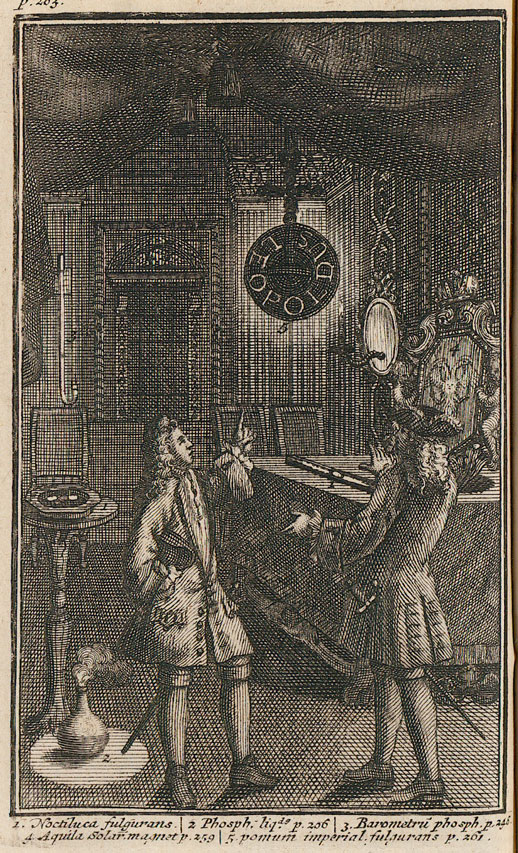
Noctiluca fulgurans “the flashing night-shining substance”
Phosph. liq. p. 206 “liquid phosphor, page 206”
Barometri phosph. p. 246 “phosphoric barometer, page 246”
Aquila solis magnet. p. 259 “the magnetic eagle of the sun, page 259”
Pontum imperial. fulgurans p. 261 “the flashing imperial Pontus, page 261”
Chapter IV.
On the flashing night-shining substance, and the cause of its flashing.
This does not differ from the preceding phosphor in matter and nature, but only in state and phenomenon; for the former appears in liquid form, while this one appears in solid form. In color and hardness it resembles yellow amber, not entirely transparent, but dark. The above-praised Daniel Krafft first discovered it, and a particular accident revealed to him this phenomenon of flashing.
He had enclosed the luminous matter which he had discovered in a hermetically sealed vial, so that, because of its rarity, he might show it in the court of Berlin to the most serene Elector. When he had come there, he opened the glass and placed the removed matter upon blue paper. There, when the candles had been removed, it shone like the glowworm or firefly that flies through the air on summer nights, not without the astonishment of the spectators, because at that time this night-shining substance had not yet become known.
Then the craftsman enclosed a grain of the matter in an oblong glass like a little pipe, open at both ends, and stopped up each opening with Spanish wax, in such a way that the enclosed particle remained in the middle of the glass tube. It did not shine in the same way as when placed outside the glass on paper; rather, at short intervals, it emitted flashes from itself toward each end, filling the whole glass with them, as if shaking those waxen barriers, and seeming indignant at being confined in so narrow a space.
This power of flashing, thus discovered by accident, struck not only the spectators but also the craftsman himself with astonishment. The case was communicated by the distinguished Mr. Johann Sigismund Elsholtz to the Academy of the Curious in Nature.
The little pills of Kunckel’s light display nearly the same spectacle: by friction they acquire a sparkling light and elegantly express an undulation of star-like light.
The cause of this flashing cannot be very obscure to one who remembers what we said above concerning the reciprocation of light in fireflies. The matter of the first element residing in the phosphor, naturally elastic, is the principle of that motion in which the sparkling consists; this is a kind of systole and diastole, that is, a contraction and expansion. In the diastole of the phosphoric matter, which produces the flashing, the light is intensified and flashes forth, because the sulphur is rarefied and expanded.
That the enclosed particle remained in the middle of the glass tube. It did not shine in the same way as when placed outside the glass on paper; rather, at short intervals, it emitted flashes from itself toward each end, filling the whole glass with them, as if shaking those waxen barriers, and seeming indignant at being confined in so narrow a space.
This power of flashing, thus discovered by accident, struck not only the spectators but also the craftsman himself with astonishment. The case was communicated by the distinguished Mr. Johann Sigismund Elsholtz to the Academy of the Curious in Nature.
The little pills of Kunckel’s light display nearly the same spectacle: by friction they acquire a sparkling light and elegantly express an undulation of star-like light.
The cause of this flashing cannot be very obscure to one who remembers what we said above concerning the reciprocation of light in fireflies. The matter of the first element residing in the phosphor, naturally elastic, is the principle of that motion in which the sparkling consists; this is a kind of systole and diastole, that is, a contraction and expansion. In the diastole of the phosphoric matter, which produces the flashing, the light is intensified and flashes forth, because the sulphur is rarefied and expanded.
Moreover, there is another method of displaying the flashing night-shining substance, which, however, tends rather toward its destruction.
A particle of phosphoric matter is thrown into very highly rectified oil of vitriol, with half as much water added. This mixture grows strongly hot, catches fire, smokes, and shoots out flashing sparks of light in the dark; and although it cools, for a long time it produces the same effect when the vial is moved, though more weakly.
The reason is this: the more fixed particles of the oil of vitriol, by which it easily fixes even the most volatile spirits and fleeting sulphurs, hold the imprisoned light-bearing atoms as though under a yoke, so that they can only put themselves forth through a certain impetuous and almost elastic motion. This causes those darts of light, which are nothing other than an interrupted flow of light.
Behold a type of the protophysical phosphor, in whose elaboration the fixed holds back the volatile, and the volatile lifts up the fixed by reciprocal struggle, until they acquire a homogeneous motion and either remain together or fly away together. Thus, from the commonly visible phenomena of things, we are led to the causes of the most hidden things.
Kirchmajer, very well versed in the investigation of natural things, compares the flash of the night-shining substance to that flickering of flame which occurs in summer weather when clouds impregnated with sulphur and salt are dispersed, “when there is weather-lightning,” so that the summer air flashes.
He adds that it is an elegant spectacle if a double small glass retort, exactly closed, is set opposite it, imbued with light-bearing matter; and that nothing more beautiful can be devised, so far as this is concerned. Before the flame flashes forth, a blue smoke precedes it, driven by the light, as a mist is driven away by the Sun; and this is most often restored again by some motion. It receives only as much as it has flashed out.
From this he elegantly seeks the adequate cause of lightning and aerial flashing. For when he mentions a cloud pregnant with sulphur and salt, he has indeed touched the very foundation of the matter, since in the flashing night-shining substance itself these two, as I have explained, joined together produce a plainly similar effect.
And this is concerning the night-shining substance which appears in a dry form. Yet it is also observed to vibrate rays when enclosed in liquid for its preservation, if the liquid is moved; for then the shining particles, which swim in the liquid, because of their volatility easily put themselves forth. But if they are submerged, they disappear again as if dead.
Concerning both kinds of night-shining substance, namely both in liquid and dry form, the most eloquent author adds these notes:
Note VIII. A substance first soaked with the liquid of gunpowder displays a most ravenous flame, burning in the midst of waves, and is inflammable by the Sun alone.
Note XIII. In dry form, like yellowish-white amber, not unlike the horned moon, it has a very strongly united power; so that if even one grain is sprinkled upon a pound of gunpowder, it immediately sets fire to wood, wooden things, linen, and very violently injures objects placed before it.
By these experiments my opinion concerning the salino-sulphurous nature of this concrete is confirmed.
Meanwhile this also must be added: it is useful to know the secrets of nature, but detestable to abuse them for the destruction of mankind. Such artifices of pyrotechnics were already known three hundred years ago to the very famous English philosopher Roger Bacon, as is gathered from his treatise On the Power of Art and Nature, but they were suppressed in silence because of the wickedness of criminals.
The explanation of the experiment is this. The whole night-shining substance, being as sulphurous as it is, acts as tinder or as a fiery magnet. The solar rays contain fiery little bodies; what wonder, then, if, when this threefold sulphur comes together, so swift and dreadful a fire is produced, which is not extinguished even under water? For the unctuousness of the sulphur in the phosphor prevents the entrance of water into the pores; and those four mixed things, namely the sulphur and volatile salt of the night-shining substance, and the sulphur and stony salt of gunpowder, constitute a mass like naphtha burning in waters, and capable of being kindled not at least by a nearby fire, but even by the most distant Sun, indeed even by motion alone. A dreadful pyrophorus! That it may remain unknown to wicked men, it is better to add nothing, but rather to proceed to other phenomena of light.
Chapter V.
On the luminous magnet, or Baldwin’s phosphor, and the cause of the light in it.
Christian Adolf Baldwin, believing the stony salt to be the most universal matter of the Philosophers, when he was putting study and labor into making the alcahest from it, after the distillation had been completed, found that the cooled glass retort shone within like red-hot iron, and so produced the luminous stone.
He had dissolved a sufficient quantity of chalk in spirit of nitre; from this, when the spirit had been drawn off, it left a body on the surface clothed with yellowness. When this body, from the light of the Sun whether the day was cloudy or clear or even from the light of a burning candle, had within a few minutes or hours attracted that brightness, it appeared in a dark place wholly fiery and sparkling. He called it the Hermetic phosphor, or luminous magnet, and communicated this invention of his to the learned world. We shall now discuss it briefly, especially since we differ from the author himself concerning the cause of this light.
Therefore the operation itself must first be considered, and also the native character of the subject from which it is made. The matter of this phosphor is nitre, which is generated from a highly volatile acid of earth others prefer to say of air mixed with an igneo-luminous or phlogistic substance. And therefore it is truly an inflammable sulphur, whatever some may say against this because it is not kindled by itself without the addition of combustible matter. Thus it contains in itself the material cause of light.
Hence, as Olaus Borrichius testifies, from nitre cooked for a long time at Prague in the workshop of a certain chymist, there came forth a body shining in the dark and preserving its brightness for some time in a cold vessel: an experiment, by Hercules, more noble than Baldwin’s own.
But chalk, or any other alkaline body, contributes nothing of itself to this light, except that it drinks in from the spirit that luminous sulphur and, as if concentrated, incorporates it into itself, so that in its pores, widened by calcination, the motion of the luminous ether may become freer.
Baldwin himself sufficiently proved the presence of luminous sulphur in this concrete against Kirchmajer, who denied it, by this fact alone: if it is lightly touched with a feather or a straw, even without any previous attraction of light, it emits certain sparks. This also proves that there is in it a true substantial internal light, and sufficiently indicates the manner in which its light comes to be.
But a due and moderate calcination is required, so that this luminous sulphur of nitre, now received into the chalky body, may be more expanded, and may withdraw itself from its middle portion toward the outer rind or border. This is what the aforesaid yellowness indicates, which alone shines. For its inner parts, just as with the Bolognian stone, do not shine.
That abstraction, or distillation, and some calcination, fastens the igneo-luminous particles, or particles mobile by light, in the circumference of the chalk, and so disposes them that the luminous ether can afterward move them.
With these things thus supposed, the attraction of light from the sun, fire, or a burning candle, according to the common opinion held by all up to now as the cause of the light, seems not to be admitted, since this attraction has been proved by no one, nor is it even probable. Rather, it must be maintained that the luminous sulphur which lies hidden in this concrete, as has been shown, and which because of its rest does not put itself forth for, as I have also said, it reveals itself by motion is stirred into motion by the impulse of the luminous ether, so that it likewise moves the neighboring celestial globules in the pores of the chalk, and thus diffuses light.
This continues until the motion impressed upon the luminous sulphur gradually ceases; yet in the same way it may often be renewed, indeed even continued for a very long time, if the preparation has been properly made. Thus experience taught Baldwin that even phosphors prepared by him still existed after five years with their powers intact that is, that they still shone. This most strongly contradicts the postulate of Kirchmajer and Lémery, who accuse the attractive power of light of being less durable, and define it as lasting only a few days.
Clearly both erred in their supposition. They did not know that the phosphor has an indwelling light, which they sought in vain from some external light. For, as experience also taught the author it does not need another’s light in order to shine. Even when placed upon a warm furnace, the phosphor began to radiate in a room lacking light. This again plainly proves that not light simply, but only motion, is required for the actualization of this luminous sulphur.
The phosphor does not cease to shine because the light attracted into it goes out again from it, but because the luminous sulphur loses the motion it has received. For unless motion is supposed here also, in which the nature of light consists, you will with difficulty explain how this light differs from any other light, though it is certainly of a different nature.
For what hooks, I ask, or cords are there in this artificial concrete or, lest I use sarcasm, what sort of magnet is there which attracts light? I would rather say that light, permeating all things, is imbibed by the phosphor; for even in this glass-enclosed substance, light penetrating the pores of the glass gives brightness.
Therefore it seems beyond all doubt that this phosphor shines by its own sulphur implanted within it, but excited into motion by light, or even, as I have said, by heat. For fire is enclosed in the center of nitre; it lies hidden beneath its body as if under ashes, but when drawn out and breathed upon by Vulcan, it casts and spreads its brightness.
This is shown not only by that phosphor, not only by that Borrichian phosphor of which I spoke before, but also by another, prepared by the very curious and very experienced Francesco Vigani of Verona by a far different method, as he testifies.
He takes the dead head of aqua fortis distilled in the usual way from Roman vitriol-colcothar and common nitre in another preparation he adds common salt and quicklime and with rainwater extracts the salt, filters it, crystallizes it, grinds it upon marble, and places it in a retort. He then pours back upon it the said aqua fortis, distilling and cohobating it until the whole ascends into the receiver. In this way a night-shining substance is obtained, like fire.
He adds that, in the same way, a luminous salt is made, with which a moistened beard shines in the darkness like fire, by the addition of a certain most subtle spirit known to few.
Likewise Isaac Hollandus, from the dead head of a particular aqua fortis of which salt of nitre makes up the greatest part when this is mixed again with an equal quantity of new nitre, distils a red water shining by day and by night. From this it becomes clear that in nitre itself, as in the Sun of these phosphors, there is an innate principle of light, and that it does not come from elsewhere by attraction. For these waters do not shine by previous exposure to light.
This will appear more clearly to one who considers the nature of these waters. In them there is a very swift motion of the matter of the first element, which is among the celestial globules poured in great abundance into these liquors, so that their swiftness constitutes, as it were, a liquid fire. For the particles of the third element since strong waters also contain very much rarefied earth most readily follow their motion.
The exhaling fumes prove the rapidity of the motion; the very sharp motion impressed upon the sensory fibers by these earthy particles floating in the matter of the first element shows a fiery motion. These particles, when another sulphurous matter is added, and with very strong agitation, easily break forth into true fire, as my experiment mentioned above concerning the crystals of Luna demonstrates. But when moved less rapidly and deprived of fiery nourishment, they at least show light in the dark.
Therefore these phosphors prepared from nitre, and shining again at any time without any exposure to light, render sufficiently doubtful that supposed preceding attraction of light in Baldwin’s nitrous concrete. That phosphor, even when exposed to the light of a cloudy day, begins to shine, but with a plainly fiery brightness. Therefore, if light is in the same phosphor by attraction, and if this light was in the air, why, since the air’s light is pale or white, does that light appear wholly fiery and sparkling?
How does light which is attracted within a few minutes or hours, remain preserved for a rather long time in the phosphor without the nourishment of light, when it is agreed that, once any light is removed or extinguished, light also perishes in the air or ether in a moment, and never subsists elsewhere without it? Who will explain what this retainer of light is, what this magnetism is? Until all these things are clearly demonstrated, the manner of the production of light explained by me will be more probable.
But what of the Hermetics themselves regarding these matters? Or rather, what of those who follow their camp? What is, among them, the origin of luminous sulphur in nitre? For according to the guidance of Cartesius, they do not like to cling to bare speculations.
I shall say a few things. Michael Sendivogius, more acute than the rest, teaches that the celestial Sun has a correspondence with the central Sun so he calls the salt of the earth and has the power and virtue of distilling its rays into the earth. For heat is easily joined to heat, and salt to salt.
He then states that the salt of nitre behaves in the earth like calcined tartar, and is nothing other than air joined to the fatness of the earth; and, because of its own dryness, it again attracts air to itself, as its nourishment and increase. But in the air there is the force of life from the celestial Sun, which joins itself with the salt of nitre of the earth.
Thus, therefore, the air in it is resolved into water; and the more abundantly the solar rays strike, the greater quantity of salt of nitre is generated. Hence, consequently, a greater abundance of grain and vegetables grows.
From this philosophy of Sendivogius it follows, not obscurely, that the salt of nitre of the earth is generated from the solar rays, or at least draws from them its force of life and fatness, that is, its native light and fire. Thus the Cosmopolite describes the nature and origin of the salt of our vegetable nitre, from which Baldwin’s phosphor is prepared, while under its analogy he nevertheless shadows forth the philosophical saltpetre.
The very celebrated Otto Tachenius follows the tracks of this, and says that the son of the Sun loves the sister of alkali. He explains it thus: the acid vital spirit, whose father is the Sun, and which dwells in the air, and is itself the light and fire of the Sun, is fixed in the fatness of the earth by the solar rays into alkali. This alkali, in turn, desires to be satiated by the acid vital spirit from the air into a salt, which is then called the nitre of the earth.
Therefore, if from the Sun as from a fountain there flows down a natural fat acid and vital light which in reality are the same thing, but are distinguished by office and from this fatty acid nitre is made, generated by nature through the influence of the Sun without the help of science or art, then it is already most clearly that nitre is the son of the Sun, and that it must share in the quality, disposition, and property of its parent, namely in light.
These things are certainly elegant. But he adds Hippocrates, who sighs over the ignorance of those who boast among the ignorant that they know: “Men have not learned to consider obscure things from manifest ones.”
Therefore attention must be paid to the distinction between common nitre and philosophical nitre. For although it can be said of nitre that it has the Sun as father, who bestowed upon it a fiery and red spirit; and that it has light as mother, which chose for it a white and cold body; and that the wind carried it in its womb, I would not wish anyone to persuade himself that this is the solar and lunar Urano-Gea of the ancient sages. The adepts will testify that I write true things.
Meanwhile, in common vegetable saltpetre there also lie hidden great mysteries of nature. Whoever is wise will not shrink from a deeper investigation of them, especially in what way and how much it is distant and different from the nitre, or sal ammoniac, of the Philosophers.
PART II.
SECTION II.
Concerning artificial pyrophori and the mercurial phosphor.
In Phaedrus, a cock, finding a remarkable jewel in a dung-heap, burst out in complaint instead of joy:
“You lie in a place unworthy of you,” he says; “what a thing!
Oh, if anyone greedy for your value had seen you,
you would long ago have returned to the highest splendor.
What I have found, I to whom food is far more desirable,
can be of no profit either to you or to me.”
The most precious jewel is cast into a filthy refuse-place; and, as Mahomet the Philosopher says, “it is trodden underfoot in filthy places; and fools often dig, so that they may extract it, and they do not find it.” Book De finitinonum.
The Hermetico-Spagyric Garden, in the second emblematic table, represents Job lying in the dung, to whom an angel offers a shining star, with the motto of Masara the Philosopher: “The uncleanness of the stone makes men despise it, and not set it apart.”
Thus the philosophers complain that the most precious subject of the Hermetic art, hidden away among dung, is trampled underfoot and neglected by the ignorant, because they do not know its virtue and value. But put aside complaints. A certain cock, having been well searched for, at last found light and fire in dung and in excrements. This discovered treasure pleased many so much that it was even offered to the Royal Academy of Sciences, as I shall now show.
CHAPTER I.
Concerning the fecal pyrophorus, and the cause of the light and fire in it.
Here again it is necessary to ask pardon of the reader, since, when we are about to deal with practice, we must speak of dung. A Parisian, by the name of Lyonnet, seeking in horse-dung I know not what remedy or secret, and distilling it mixed with alum, found that the dead head, when exposed to the open air, caught fire and burst into flames. For he had destined this for surgery, namely for curing malignant ulcers.
This fiery phenomenon, most worthy of consideration, scarcely obtained any reflection from its discoverer, since, in matters of natural knowledge he was not so much practiced; but it obtained a greater investigation when, through a report first communicated to the most illustrious gentlemen Polinière, Réaumur, and Homberg, members of the Royal Society of Paris, and then through a description, it became known.
The illustrious Homberg, reflecting here with that skill which he had in detecting chemical secrets, judged that for the composition of this pyrophorus nothing was required except that an inflammable oily matter be joined to a mineral salt; and, reflecting that nothing is contained in excrements except the matter of foods, immediately, by a new invention through analogy, he thoroughly combined with alum various edible substances that is, to two or three parts of alum, one part of these: for example flour, or sugar, or honey, or animal blood, or egg-yolks, or similar materials and put them, powdered, into a well-dried earthen pan and then into a matrass.
He placed this in a furnace, covered it with sand, and put fire beneath it until the vessel became white-hot, the mouth being only lightly stopped with paper. He left it thus for a quarter of an hour; afterward he drew it away from the fire, tightly closed the mouth of the matrass, and allowed it to grow entirely cold. The result did not disappoint his hope, for the sought pyrophorus exposed itself to the air.
Then Polinière found a method of preserving it in glass vessels well closed with a glass stopper. Whoever wishes may seek the whole process from the History of the aforementioned Academy, in the year 1711.
This at least is worthy of mention: that the excellent Mr. Homberg, in order to institute a chemical analysis of fecal matter, hired four robust men, young and of sound health, whom he kept outside the garden and the house, where he stayed with them for three months. He did not allow them to go out, nor did he permit them to take any food or drink without his knowledge or against his will.
Was not the discovery worthy of such a cost and such circumspection? And why not? There is in the human stomach a wonderful solvent, as it were an alkahest: namely, a ferment that volatilizes all things and reduces them, as it were, to a primordial juice. Nor is there any doubt that, according to the nature of the foods, of eating and drinking, the excrements themselves also differ greatly; so that they will be one way from bread alone, another way from flesh alone, and another way from a mixture of both.
And who does not know also that, by reason of the stomach digesting, and of the specific ferment in each creature, the same food, in different kinds of animals, produces feces very different from one another? For “puppies smell one way, pigs another,” as the proverb says; and their excrements smell otherwise after bread has been eaten.
Thus, with these things considered, the industry of a very experienced man, even in a matter however vile, is by no means to be blamed.
Such, then, is this pyrophorus. Before we descend to its explanation, I do not think it should be passed over in silence that this process of Lyconnet is not of so very recent an invention, since among the philosophers of fire it was already a practice of very ancient use to treat human refuse which they think to be the Adamic earth by various methods in Vulcanic workshops, as I have already mentioned such experiments in the ninth decade of my Curious Inquiry concerning the Prolonging of Life.
Here, however, you will wonder whether that great Roscius of Chemistry, Joachim Becher, was not one of the unfortunate workmen of fate, after so many conceptions and labors, useless in the particular transmutation of metals, and at last fell down even to the urine and excrements of man, as is shown from many passages of his writings; so that he was not afraid to say: “Indeed, the deeper mysteries of animal earth exist, which it would be unlawful and sacrilegious to publish without distinction.”
O love of Pluto, by what enchantment do you strike through the eyes and minds of the artists! There is surely no doubt that he also accomplished not a little labor in these matters. For in the Concordance of the Mercuries of the Moon he says, not obscurely, from the process described, you may gather that he at some time not, I think, constantly was of the opinion that from human dregs the fetid water of Raymond Lull, or the great putrid menstruum reduced by threefold reaction into mercurial water, might be prepared.
He mixes horse-dung sap and urine sap, calcined horse-dung and salt of tartar others also add sap of wine and of distilled vinegar. From these he distills a volatile salt and oil, and cohobates it so many times until also a fixed salt, or dead head, at the end comes forth like butter, shining at night, showing a deceitful glow of fire, and giving splendor to things anointed with it.
Yet it became clear that this product agreed rather with an airy night-light than with this airy pyrophorus of the French. I pass over several processes of this kind from this matter, once held in the place of a great secret, but not worth transcribing here even for a broken nutshell. At least they belong to useless curiosity.
Nevertheless, it will not be unworthy of a natural philosopher here to search out the causes of that fire which, when air approaches, bursts forth so suddenly. Especially since experience teaches that many chemical materials are given which, even when kept in a closed vessel for a hundred years, show not even a single spark; but this one, even after a century, when opened, soon breaks forth into fire. Some think, not unsuitably, that the perpetual lamps of the ancients were of this kind, as we shall say below. Becher testifies that martial regulus, which by its whole nature is fiery, if it is melted with tartar in a closed vessel, can be preserved without kindling; but when powdered and exposed to the air, it catches fire and burns.
The pyrophorus, or what is the same thing, the dead head of horse-dung, abounds in sulfur, made extremely expanded and rarefied by that treatment in the fire. For unless it were exceedingly rarefiable, it would not be kindled, since whatever burns must grow rare and be resolved into atoms. Therefore alum also is added in the preparation, so that the particles may be separated and expanded, just as the earthy part of alum separates salts and prevents them from flowing in the distillation of acid spirits.
The fatty corpuscles of this rarefied sulfur, extremely mobile and gathered together in the pyrophorus, are driven into a very swift motion by the approach of heavenly globules; they burst forth all together, and thus are kindled. For fire, says Willis, is nothing other than a kind of torrent of particles of sulfur flowing together at once and flying away conjointly. I do not wish to have nitrous particles everywhere in the air, hidden in the air and coming here to meet the sulfurous particles, to be brought in as part of the cause. Nor shall I call upon fiery corpuscles either, recently joined to the fatty parts of the excrement under calcination and violently compressed, but returning to impetuous motion when the air approaches.
Since in the dead head itself there are also saline-volatile particles, which, when more rapidly struck together with the rarefied sulfurous particles, can produce this effect, as I have already proved at the beginning by my experiment with the lunar pyrophorus. For in vain do we multiply causes without necessity. But he whom one cause does not satisfy may, with my permission, refer this fiery motion in the excrements to several causes joined together.
It would be worth the labor to carry out the same process with the feces of various other animals, and to examine whether they would exert an equal effect; for from this no small light could emerge for detecting the nature of this fire and of its cause. For example, the dung of pigeons is considered to be of so fiery a nature that writers report that, by it being kindled even by the sun alone, damage has been brought upon roofs.
Since I do not yet have a sufficiently certain cause of this, I shall not investigate it here; but, with the reader’s permission, I pass from this physical pyrophorus to another far more curious one whether natural, whether theologians will judge it natural or miraculous. I shall therefore set apart a special digression for it.
CHAPTER II.
Concerning the Sacred Pyrophorus of the Maccabees.
Since the philosophers call the subject of their Hermetic art “all things in all things,” as I have already mentioned elsewhere, and affirm that it is found everywhere, this has repeatedly carried many away from their judgment: those whom the blind desire for the chrysopoetic stone has maddened, and who have in fact taken this literally, and have searched for its traces in all the things of the world. Indeed, they have done so to such a degree that now nothing has been invented by the older poets, or sung in a more obscure way, which they do not imagine to have been understood concerning this stone of theirs.
Holy Scripture itself is twisted toward these fantasies, so that some have already made Moses, because he burned the golden calf, into an alchemist; Job into an adept; and Solomon himself, in the Song of Songs, into a Hermetic philosopher. And the little dust of Esdras, and the cornerstone which the builders rejected, and the white apocalyptic stone which no one knows except him who receives it, and countless other things likewise according to them, belong to alchemy. To these they also refer that fiery water of the Maccabees, which they reckon to be an invention of the chemical art, because they do not doubt that among the ancient Hebrews also, and especially among their priests, prophets, and patriarchs, the practice of this art flourished through mutual traditions.
I shall briefly review the history. During the persecution in Persia, the priests took the fire from the altar and hid it in a valley, in a deep and dry well. After many years, when Nehemiah had been sent by the king of Persia, the descendants of the priests who had hidden the fire were sent to look for it. They did not find fire, but thick water. Nehemiah ordered them to draw it up and bring it to him, and to sprinkle with it the sacrifices and the wood, and the things that had been laid upon it.
The time came when the sun shone out, and a great fire was kindled. When the sacrifice had been completed, Nehemiah ordered the larger stones to be drenched with the water that remained, and from them a flame was kindled; but it was consumed by the light shining back from the altar.
Afterward the same experiment was repeated successfully in the presence of the king of the Persians. Let the sacred text itself be examined, the irrefutable witness of the thing performed. Was this thick, viscous water perhaps of the nature of a night-shining substance, flaming by motion alone, and by the sun even when very far away, able to be kindled, as we showed above, so that it seems perfectly to imitate it? For it caught fire when the sun shone back upon it. Or did it imitate the pyrophorus, which, being preserved from the open air for a very long time, remains as it is, but, when air is admitted, bursts into flame?
“The fire-water of the Maccabees” for so, with the philosophers, we may rightly call that liquid had lain hidden for many years in a deep and dry well without flame, yet at once it was kindled by the rays of the sun. Certainly the analogy is elegant on both sides.
I am not unaware that here the theologians take refuge in a miracle, although St. Ambrose, discoursing on this water of the Levites, writes that this fire was perpetual. Yet there are also some among the natural philosophers who assert that the device was entirely natural. Thus Blaise de Vigenère, in his treatise on fire and salt assuredly taken from the innermost marrow of the chemical art relates that a certain matter had been brought, through artificial degrees of fire, to such a point that, enclosed in a glass vial and, for the sake of keeping out all air, protected with a Hermetic seal, it could be preserved unharmed at the bottom of the sea for a thousand years, as he says; and after so great a space of time, or even a longer one if desired, when opened and air admitted, a fire would be found within, which would make a sulfurated straw’s flame appear.
From this he concludes that the sacred fire of the Levites, hidden in the bottom of the well, was of such a nature that, after seventy years had passed, having been changed into that thick and white water, it conceived flame from the rays of the sun.
Since this is not inconsistent with what can happen naturally, he thinks it is vain to refer it to miracles. For Becher also testifies that there is a liquid, which he calls the fiery magnet of the philosophers, which, enclosed in glass, persists in this way even for a hundred years, and yet, when it is opened, soon bursts forth into fire. Concerning this, under the title “On the Perennial Light of the Ancients,” there will soon be more.
Whatever the case may be and I do not judge myself competent to decide it in this place it is certain that a great analogy intervened between it and our modern phosphori and pyrophori, and with that thick and white fire-water itself of the philosophers.
I myself have come to know a certain new phosphoric magnetic salt, which from this exercise, I think, has become sufficiently known to the ingenious reader; and it can, by an easy manipulation, be so disposed that from the air it draws to itself its own proper and connatural sulfur, and becomes wholly fiery, so that the seminal spirit of metals which lies hidden in it is aroused, and is rendered fit to be separated from its virgin earth, so that it may have entered into the radical sulfur of gold, and thus may constitute a pyrophorus of impure metals, burning the sulfurs of the metals in such a way as that fire of the Maccabees consumed the wood and the sacrifices. He who can grasp this, let him grasp it: let him be a diligent observer and hunter of nature.
It is a great slowness of intellect to refer effects in nature, whose causes are rather obscure, either to miracles or sometimes even to diabolical tricks and illusions. If that saying of Servius is true “Certainly, among the ancients, altars were not kindled by art, but they drew forth divine fire by prayers, which kindled the altars” then it was rightly to be regarded as a miracle; just as in Sacred Scripture there are undoubted examples of such heavenly fire consuming sacrifices.
But whether the pyrophoric water of the Maccabees was of such a nature, one may consider uncertain, since at least, from the manner of its happening, it did not exceed the powers of nature. Nor indeed are all things that are read there as astonishing to be relegated to miracles.
Saint Augustine says elegantly: “Some are limits of human things, others signs of divine powers; some are things which happen naturally, others which happen wonderfully; although God is present to nature, that it may be, and nature is not lacking to miracles.”
This is clear from another example of Holy Scripture. Gideon, with only three hundred men, carried empty jars, in which there were lamps in the middle, and when they were broken he destroyed the whole army of the Midianites by a wonderful stratagem.
Roger Bacon the Englishman refers this to the power of art, and stated that in the empty little vessels there were terrifying lamps, made by a singular artifice, which, when those vessels were broken, scattered “leaping fire with an ineffable crash.” Or perhaps the lamps enclosed in those jars contained pyrophoric matter, which, when the vessels were broken and air admitted, blazed up into a terrifying fire; for the text says: “when they had broken the pitchers, they held the lamps in their left hands.”
That this could happen naturally is certain; whether it actually did happen I shall not dispute. At least it is beyond doubt that a singular disposition of the Divine Power concurred. If once, when phosphorus was still unknown to the world, a whole army had smeared its face and clothes with a night-shining substance, and thus had rushed at night, all fiery, upon the enemy, would not the enemy likewise, confused, shouting, and howling, have fled along with those Midianites? For in this way, with flames encircling the body on every side, one could easily fashion oneself into a demon or a terrifying specter. Nothing, indeed, is more suitable than these phosphors for displaying the appearances of specters.
This was already known to that man among the Boeotians’ king of Scotland, Kenneth, who by this stratagem conquered the Picts, by whom he had been defeated. At night he sent into the sleeping princes of his army servants clothed in shining scales, and holding in their hands spears made from rotten branches that shone at night. These servants urged them to enter the battle bravely, saying that they had been sent by God as pledges of victory. The princes believed they were angels, and, having attacked the Picts with courage, cut them down to extermination.
The history of the Indian scarab, whose account we gave above, is added on this occasion by Chieza, in part 2, chapter 30 of his Persian History, who calls it Coculium. He writes that it shines over its whole body, but especially in the eyes, which, huge in comparison with the little body, pour out so much light that people are accustomed to read and write by it.
It sparkles with the light of four little stars; if anyone anoints his hands and face with their fat, he appears as a burning and fearsome specter. Yet this seems to require, for this little animal after death, nourishment for all its power of shining, and it also seems contrary to our own opinion.
But we do not wish to set these things forth at greater length as matters to be known rather than practiced, lest anyone think that we approve the abuse of natural things.
But here there opens itself most widely a field for curious investigation: whether true phosphoric and pyrophoric specters are also given; whether that nocturnal light, seen for five nights in succession by Prince Ludovico Vallesio and his most illustrious wife while they were lying in bed under the lower canopy, with no lamps present, as Gassendi relates, was a specter, and the effect of goblins or spirits, by whose infestation that chamber of the hospital at Marseilles was infamous.
The phenomena of this monstrous apparition, and what Gassendi thought about them, can be read in that very place. For the ill-timed censure of a certain Aristarchus frightens me away from inquiring into these matters here at greater length, lest this Exercise suffer the same fate as my Historical-Physical Miscellany did a year ago. In the first chapter of that work, when I maintained that the central essence of things is preserved in the ashes of burned bodies, and tried to prove this both by various physical experiments and by little histories from Clauder, König, Plater, and other very trustworthy men who seriously report such specter-like apparitions, and also by the ecstatic vision of the prophet Buziades himself, the French compiler of the Journal des Savants did not fail to publish a certain summary of it in the vernacular language in the month of January of the year 1716, to communicate it to the learned world, adding to these accounts of mine however related with the sufficiently approved trustworthiness of others a biting and childish title: “Childish Tales.”
It seems that that man, whoever he is, the author, doubts the existence of specters, or the apparition of souls, so that he considers the examples brought forward by trustworthy writers concerning the occasional return of the dead to the living to be of no better value than childish little stories.
But this is not the place to answer him as he deserves. Therefore I send him back to Delrio’s Magical Investigations, book II, question XXVI, and the six following sections, in which he sufficiently and clearly shows and proves that the souls or spirits of the dead appear to the living. I mention this only in passing, lest here I either stir up hornets, or myself, through these specters, stray too far from my purpose.
I add only one irrefutable testimony from Sacred Scripture: “And the tombs were opened, and many bodies of the saints who had slept arose. And coming out of the tombs after his resurrection, they came into the holy city, and appeared to many.”
Are these too “childish tales”? But whoever thinks that specters, along with Nonnemnius, are nothing other than the vital spirits of men still remaining after death in the air; or whoever regards any lights that appear not rarely in cemeteries or around places of execution, and belong to will-o’-the-wisps, as a genuine specter-like apparition to him we willingly grant that he tells not only childish tales, but also old wives’ fables. These we now dismiss, returning to our pyrophori.
CHAPTER III.
Concerning the artificial vegetable phosphor and pyrophorus.
What must be determined concerning the merely natural phosphors of the vegetable kingdom I have already shown sufficiently in the second subdivision. There now remain the artificial ones, whose existence is the easier to establish, the greater the power of art is in bringing out and increasing the innate light of natural things.
I think no physicist will deny that this exists also in plants, especially in their seeds; for, as the poet sings:
“Fiery vigor is in them, and a heavenly origin
in the seeds.”
“In the seeds of things,” says Don Janus Espagnetus, “there is a great abundance of radical moisture in which a certain spark of heavenly fire is held, as though in its own food, which in a suitable womb performs all things necessary for generation.”
But plants, especially hot ones, are believed to partake of this fire more than the rest. Hence not without mystery Lull, Paracelsus, and his fellow disciple Ripley hinted that their lunar substance was to be sought in very hot herbs in ranunculus, euphorbium, pyrethrum, anacardium, squill, and the like. This was not because the Lullian spirit of wine may be sharpened by them, or because the mercurial phosphor of the sophists could or ought to be prepared from them, but so that the sons of the art might understand that, without a sulfur that is especially hot and fiery, that substance is not prepared.
Meanwhile, however, nothing prevents common phosphors from being made from these plants, such as Mr. Johann Ludwig Hannemann promises from herbs swollen with any sulfur or caustic salt for example, mustard, seed of nasturtium, and the herb flamula indeed, from all hot herbs capable, as his phrase has it, of nourishing and strengthening the shining balsam of our life, or the little flame of the heart.
But that their seeds are more suitable for this purpose is shown by the first portion of the primeval light, the principle in them of all vegetation, increase, and the cause of multiplication, persisting even through the intermediate life into the ultimate things. For unless the light created together with it were moved by the power of solar light in the vegetable seed, there would be neither vegetation nor fruit-bearing.
But it is necessary that, by the preceding natural putrefaction of the seed which art imitates in preparing from it artificial phosphors and pyrophori that light and fire be claimed into freedom. For thus, in wood, through natural putrefaction, the light in the final life of the wood comes forth into view; and in the airy night-shining substance, after the corruption of urine, the artificial light emerges.
Let what Ovid wrote about the origin of primordial light have a place here:
“The fiery force, being arched, and without the weight of heaven,
flashed forth, and chose for itself a place in the highest citadel.”
But especially cereal seeds, above all rye and wheat, provide the most suitable matter for pyrophori, as experience has now testified more than once. Wheat is clearly of a fiery, indeed solar, nature; hence also it was called by the Greeks pyros, and by some the most perfect temple and palace of the vegetable kingdom.
Bread prepared from it yields a wonderful pyrophorus in distillation it furnished to the very celebrated Tackius. He had several times distilled wheaten bread prepared with May dew, without added ferment, by which otherwise breads are leavened, and without feces; and after he had distilled the elements in order, and had exposed the dead head, still pregnant with much oil, to the air, suddenly, like a hair, a very thin smoke rose from it. When he checked this, a little afterward the smokes were multiplied from other places also, as if from its pores.
When, at the sight of these, he was now afraid of a fire, and was considering in what way smokes from mountains are stirred up by the fire of nature, behold, the dead head, previously cold, burst into a very high flame merely by contact with the air, and it lasted for an hour and more. As witness of this he brought forward the eyewitness, the illustrious Lord Georg Ernst, Count of Erbach.
But there is no reason for doubting here, for the same thing had long before happened to Robert Fludd in the distillation of bread. It will not be troublesome to bring here his own very words from the treatise On the Anatomy of Bread:
“After my final distillation,” he says, “I removed this dead head from there, which I found in some manner cold, and, as it seemed to me, deprived of the heat of fire. But when this fecal earth had been placed upon wooden boards and had drawn air to itself, after five hours had passed it began suddenly to burn in such a way that, unless it had been discovered and extinguished by watchful care, its flame would have set the place and the house on fire.”
He teaches, moreover, that in its preparation the form of the bread must first be broken down through corruption, and that its whole body, by means of putrefaction, must be reduced into a viscous substance, so that in this way all the elements may be claimed back into freedom.
When all these things have been considered, the origin and cause of the pyrophorus from human excrements is easily made clear. For these contain in abundance putrefied and corrupted bread; and the drunk wheat-beers themselves, together with urine, communicate sulfurous matter abundantly to these. Indeed, the aforementioned de Fluctibus derives that very salt which is found in human urine, and is purged from the blood-mass through the kidneys, from eaten bread.
And this seems all the more probable, since experience confirms that a night-shining substance is prepared more readily from the urine of those who drink beer than from the urine of wine-drinkers. And therefore it would be most worthy of investigation whether the urine of a water-drinker, abstaining from bread and cereals, or whether also that of a horse or cow drinking only water and eating hay, gives a phosphor. I commend that experiment to those who have more leisure than I do, because it would contribute very much to detecting the origin and cause of the fire in this pyrophorus.
Therefore, in foundation, or with respect to the matter, the fecal pyrophorus and the bread-pyrophorus agree; and both have putrefaction sent before them, by which the fiery vegetable sulfur is opened. Yet this putrefaction, completed in the human body, is far subtler than any external artificial one; and therefore it also renders the pyrophorus more fiery, and more quickly inflammable at the approach of air.
But that the vegetable sulfur of wheat is partly from the sun is beyond doubt. Hence also its spirit, very highly rectified, is observed to exercise a singular magnetism with the sun; when exposed to its rays, it is imbued with a heavenly tincture, and passes from the most limpid crystalline form into the likeness of a ruby. Indeed, because of its natural heat acquired from the sun, together with the newly assumed tincture, it ascends of itself into the head of the alembic in the color of a most brilliant ruby, without any violence of elemental fire; Tackius and Fludd write that they experienced this.
These are not to be despised as miracles of nature, of which bread contains more and greater ones, our daily bread, to which the Creator has most abundantly imparted such a blessing that it is not only transubstantiated into human blood and animal nature, and so nourishes and preserves man, but also contains very many remedies for preserving and healing him or rather, contains the matter, truly blessed by God, for preparing them.
Among these is also counted that very famous Aroph of Paracelsus; that is, as the divided syllables indicate, the aroma of the philosophers.
For, according to the testimony of the previously mentioned Fludd and Tackius, after the stench and after the corruptible elements had been separated, there was so great a fragrance in the bread that it surpassed the odor and sweetness of all the spices that exist in the world. Fludd says that its ether, or quintessence, although with respect to simplicity it is close to fire, nevertheless has in its own nature such efficacy and virtue of the sweetest fragrance that, if the sun had touched it, he still perceived it two or three days afterward.
But it must also be noted as he himself warns that under that process of the pyrophorus from bread he mystically concealed a certain greater secret; hence he concludes with these words: “If the reader has rightly understood me in these things that have now been said, he will indeed perceive that, under this type of discourse of mine, I have concealed, in the manner of the mystics the earth truly damned, and Lucifer fallen, in these things which have now been said, and that under a sensible veil I have explained a matter of great moment.”
But far be it, for that reason, to proceed with some men to such madness as to think that the philosophers’ stone can be made from bread a thing which was never the mind of Sir Thomas Aquinas, as some suppose. To change a stone into bread is a miracle, which the most cunning Satan demanded from our Savior as proof of divinity. To change bread into a common stone, or into a stony form, is within the power of natural petrifying waters; but to wish to convert the same bread into a gold-making stone is the height of madness.
Let it be enough for the curious that the fire in this salt has here been demonstrated. For the candidates of the more sublime Medicine, I shall now set forth a richer dish.
CHAPTER IV.
Concerning the mercurial phosphor, both common and philosophical.
At last also that astonishing being of the mineral kingdom, which because of its color received the name of “silver,” and because of its mobility the name “living,” must be referred among the phosphoric subjects, if anything else is most worthy of consideration. It is a metallic water, containing abundant light enclosed within it; yet this light does not shine forth of itself from its body though, on the surface, it is especially fit for the reflection of light. For its almost innumerable little surfaces have the nature of a mirror; indeed, they are true mirrors, reflecting the rays of light that come upon them not inwardly, but outwardly and all at once. Within, however, it is most dark, because it is most dense; and it does not shine forth of itself unless it is aided by art.
The very celebrated Bernoulli, in the Acts of the Royal Academy of Sciences, gives testimony from this source that very purified mercury shone inside a glass tube sealed with the Hermetic seal. From this a new invention arose: the making of phosphorescent barometers. Concerning these Mr. Johann Friedrich Weidler published an exercise, though I have not yet been able to obtain it by any diligence, and therefore I cannot add more here about his observations.
Indeed, the manner in which this happens is not difficult to see from Cartesian principles: that the matter of the first element, by far the subtlest, throws itself abundantly into the very tiny interstices of the densest mercurial body, which consists of mere little globules; and that, on the most polished mirror-like surface of the mercury, by reflecting, it fabricates that light is fashioned. Yet from this scarcely anyone will explain the radical cause of light in quicksilver, since this perhaps satisfies an ideal speculator, but not a real physicist.
For surely, if we wish to be more open to the truth to speak in Cartesian phrase mercury therefore shines because it admits abundantly, and perhaps also transmits in a peculiar way, the subtlest matter of the world. What else is this to say, than that mercury therefore shines because it contains the principle of light? This is merely a change of phrase.
But why it enjoys this privilege of transmitting the subtlest matter of the world in such a way that it shines forth also with nocturnal splendor in a peculiar manner no one has so far made mention of this. And indeed the common causes of light in the phosphor here utterly grow weak.
For who here will bring forth onto the stage sulfur, otherwise held to be the matrix of light? The fellow-initiates of nature indeed testify that mercury has its own sulfur, both external and internal; but neither of these is so easily unfolded and drawn out, if we believe the adepts, that it may emerge into light.
Who, in the case of very purified mercury, in a glass tube, with the air thicker air having been evacuated and non-existent, will take refuge in sulfurous-fatty exhalations, such as not rarely concur for the light of other phosphors? It is certain that mercurial light differs by nature from the sparkling light of fatty subjects, and that it is not rooted in expanded sulfur, since it manifests and renders itself visible without any common purification customarily used for phosphorescent barometers. Therefore it must be drawn out most deeply from the well of natural causes, or from the original source of mercury itself.
Here, therefore, one must call back to memory what we established above: that sea-salt, pregnant with sulfurous salt, naturally shines; and that mercury is the pure essence of sea-salt itself, and contains a sulfurous salt wholly analogous to the sulfur of common salt, from which it too drew its origin, through the distillation of sea-salt in the caverns of the earth, and through sublimation and mixture with a certain subtle earth, which brought opacity into it.
And this is the hypothesis and doctrine of the very acute Becher. From it follows that there can be given a singular artifice by which it may be brought about that mercury, displaying the nature of its mother, may also show her light-bearing splendor. This can be done, not improbably, by a twofold way: namely, either by separating some part of that opaque earth from the mercury perhaps when some portion has been deposited by purification, it shines in the tube or by attenuating and rarefying it; or even, through decomposition, by adding to it more transparent earth, or luminous salt.
For it is Becher’s experience that common salt has entered into mercury, and that this mercury is increased from it, and that, when increased, it often tends toward a transparent, indeed a luminous, aqueousness; and it will be pleasing here to rely upon his testimony.
And this method of addition is far easier than that method of subtraction, since mercury is a most homogeneous being, and a substance hitherto indivisible into heterogeneous parts.
I shall explain this by a rather coarse comparison. A luminous concretion of the night-shining substance, dissolved in subtle oil, is mixed with purified quicksilver, and it makes the mixture likewise luminous, and in darkness almost fiery. In this mixture, however, the mercury itself contributes nothing except perhaps that, by the very bright surface of its little globules, it intensifies the light.
So, in a manner far more hidden and truly philosophical, the luminous sulfur of salt can be introduced into the mixture of mercury, so that its innate central light, being stirred up, may emerge together with it. For this is the genuine method by which also that elegant aphorism of Maxwell aims, one that knows a more hidden philosophy:
“He who can draw light out of things by means of light, or multiply light by light, has learned how to add the universal vital spirit to the particular vital spirit, and through this addition to produce wonderful things.”
But I have already said what that luminous salt is, and the philosopher will easily recognize it. There are some who make great efforts around mercury with the volatile salt of urine, or of tartar, or even with the animal phosphor, in order to draw its internal sulfur to the surface; but we are sufficiently warned by the adepts that these attempts are plainly fruitless.
Granted, you introduce a luminous salt of urine into quicksilver will it therefore be the phosphor of the philosophers, or the lunar substance? Dress a peasant in royal clothing: will he therefore become a king? Mix phosphor with an ointment made from apples, and it will serve for anointing parts of the body to produce a fiery splendor; will, therefore, the juice of apples become a phosphor?
In the same way, will salt of urine exalt the sulfur of mercury or of gold, so that from these there may arise an illuminating sulfur? I know that many have been in that error, and also the Englishman Starkey, who thought that the liquor Alkahest could be prepared from urine. But here it is of a more sublime origin, together with its uterine brother, the mercury of the wise.
I shall therefore make a digression here, and, concerning the genuine mercurial phosphors, I shall set forth a discussion according to the meaning of certain philosophers.
Cornelius Alvetanus, an Englishman a name, unless I am mistaken, fictitious, of a masked philosopher proposes to Elizabeth, Queen of the English, a method of putrefying both luminaries, the Sun and the Moon conjoined, by the benefit of a certain philosophical oil, and of reducing them into flowing mercury. To this he adds these words:
“Here there is to be seen a wonderful secret of nature. For gold is stripped of its body and is resolved into its own quicksilver, which shines as if it were a star, whose splendor our eyes could not endure if we wished to look upon it longer. Soon afterward follows the quicksilver of the silver itself, which has been applied only in place of a ferment. This quicksilver will shine with no lesser splendor, except that its brightness is more pale, while the other is reddish. Truly a delightful spectacle. The gleaming of these will be most pleasant to behold. Yet I confess there is no one who could look upon this without being wholly filled with awe.”
Thus he speaks. But concerning the method itself he adds nothing except what is utterly obscure, indeed sophistical, so that these are merely words without the soul of things. But far more learned and more ingenious is Becher’s reasoning concerning the preparation of Luciferian Mercury. For it contains very subtle speculations founded on chemical principles and taken from the parables of the Hermetic writers; therefore it will not be entirely useless to repeat them here in a brief summary, with our own critical judgment added.
There are four preparations of quicksilver I speak according to Becher’s opinion and from each preparation there results a different mercury in perfection.
The first consists in essential decomposition, when the greater, more perfect, and more subtle Sun, according to Basilian terms that is, the golden opacity, namely gold or physical sulfur is introduced into quicksilver; and it becomes the Mercury of the Philosophers, which has the nature of a hermaphrodite, and by itself, without any other substance, is perfected not only into gold but also into a tincture.
The second is made through the essential dissolution of decomposed mercury, when the metallic Sun is extracted from Mercury, which they call the spoil. For Mercury is nothing other than some metal reduced into fluidity by the first saline mercurifying being. When this is separated, a transparent liquid is produced, which, because it finds its friend nowhere except in its own mate, it does not return to its former condition; but the bodies with which it is mixed, because of its gravity and penetration, it dissolves and separates into parts according to their quantity, and it is called Alkahest. This Mercury is, as a widow: unmarried, it rejects all marriages of ferment, finding no body worthy for itself to wed. Therefore it remains immortal and incorruptible.
The third preparation is concerned with the simple state of Mercury before every composition of it. Mercury is taken before it has experienced any mineral or metallic Sun, and before it has been specified by that; and it is a shining virgin liquor, but not a burning one. This has the character of an untouched virgin, because it has never lain with any; and that admirable saline sulfur, virginal, pearly, shining, and luminous, comes forth, and acts only by irradiating metals. From this the true phosphor of the wise is prepared.
The fourth preparation exhibits a certain stinking menstruum, which has the character of a harlot. For the philosophers also recognize it as such, because, although it has prostituted itself with many and has therefore undergone reaction, it is nevertheless made pregnant by none. This is a mercurial liquor, yet not virginal, not mineral, not metallic, but merely harlot-like, or intermediate between the two. Namely, when Mercury, with no metallic Sun yet admitted, in its virginal form, has not indeed undergone decomposition, but has undergone reaction with other things yet not mineral ones and hence acts short of reaction and is most nearly disposed toward mercurifying. This, in the mines, becomes the arsenical sulfur of sea-salt, and by the touch of a certain light mineral it inclines into the decomposed form of hydrargyrum. Therefore those three are mercuries of the virgin, and by no means the common quicksilver, from which alone the Alkahest is made when the metallic Sun has been removed.
This now is that crossroads of chemistry, full of thorn-bushes and winding paths, which, without a sure guide, leads most certainly into trackless places and inextricable labyrinths. I shall stretch out Ariadne’s thread.
As to the first: it is certain that the Mercury of the Philosophers is generated by the essential decomposition of salt and sulfur, from which a liquor is made, homogeneous, having the appearance of quicksilver, but much more splendid not its nature. It radically penetrates gold, dissolves it, putrefies it, and exalts it in virtue more than a thousandfold; and with it it passes into one plainly homogeneous being, which by itself, without any other addition, suffices for producing the gold-making elixir, as I have set forth more fully by arguments in the Protophysics. But beware here that you understand this as the common quicksilver of the vulgar, however it may at last be prepared. For by no means does it become philosophical, nor by any artifice does it admit within itself the metallic Sun, or golden sulfur, radically and inseparably, for the reasons known from Lull and brought forward by me in the cited treatise.
In the second preparation, or in the essential resolution of decomposed mercurial substance, it seems, at first appearance from the outside, as if the liquor Alkahest resulted through the destruction of common quicksilver that is, through the separation of the metal which, like a spoil once seized, it has reduced into fluidity. But since that metal is perpetually inseparable from that first fluidifying or mercurifying liquor, it is clear that this speculation is vain; and so here again the common Mercury of the vulgar has no place.
For if we believe Helmont, mercury, at least pure mercury, plainly rejects all duality; that is, the nature of Mercury includes perfect homogeneity. Once the composition of Mercury has been made, art does not know how to return to the destruction of that composed thing. But the reason for immortality in “mercury is,” says Helmont, “that its seed and fruit, in the constitution of mercury, are now one and the same mercury in mercury. Nor does nature know how to discover a mode of destruction in so homogeneous a thing, where the seed has escaped the fruit by a most perfect and innate union; since nature cannot penetrate in order to divide where there is no mode or heterogeneity.”
Therefore let the play of subtle fantasy cease here. The Alkahest cannot be prepared from common Mercury by the separation of the metal, as I shall show more fully elsewhere. And if that mercurial being exists elsewhere before it has taken up the metallic Sun as Becher himself confesses in the preparation and indeed in a plainly virginal state, what need is there to unravel common Mercury back into its principles, which is naturally impossible forever? Indeed, if Mercury were divisible into heterogeneous parts, chemical art would not be true.
Again Helmont speaks elegantly: “In mercury, nature cannot destroy the seed, which cannot die, nor be separated from its own matter. Nor can it die through the sublunary machines of this age.”
Therefore, far be it to seek that philosophical, shining, virginal liquor whose preparation he mentioned third in common Mercury.
The fourth preparation contains a very subtle phantom, and is only a true specter of philosophy, not a real appearance in nature.
Becher supposes that this virginal Mercury seizes, in the mines, the arsenical sulfur of sea-salt, and so is constituted in a neutral state: that it is not a virgin, for it has already married arsenical sulfur; that it is not mineral, because it has not yet been impregnated by any metal, since by the touch of such a metal it is changed into common hydrargyrum; but that it is harlot-like, because it has an appetite for all metals, though it has not yet had copulation with them.
And from this Mercury, disposed as closely as possible toward mercurifying, he thinks that stinking menstruum is prepared, or that fetid water of Hermes, about which there is so great a rumor among the philosophers, especially in Lull, than whom no one described this solvent more sincerely and more openly.
I shall add a certain reality to Becher’s specter. This virginal Mercury is nothing other than the first being of sea-salt, which differs essentially nothing from those saline-mercurial exhalations, or mineral meteors, flashing within the earth and sometimes above the earth, which are in reality married to arsenical sulfur. Otherwise, indeed, the first-material light of metals would not conceal itself in them, nor would they contribute anything afterward to dispelling the darkness of imperfect metals.
But here it must be noted: since that saline-sulfurous liquor, prepared by nature, could not up to now be obtained by any artifice, that first saline-mercurial being can be obtained by art from elsewhere, and can be married to that arsenical sulfur. For, as Sendivogius says, “our mercury is sharpened by sulfur; otherwise it would be of no use.”
But that very saline being itself, according to the same author, “is that which has the keys to the infernal prisons, where bound sulfur lies.” And then from that sulfurous Mercury, yet truly still virginal for it is destitute of every metallic seed the stinking menstruum of the philosophers is prepared, which, illuminated by the light of the Sun, brings forth the genuine phosphor and pyrophorus of the philosophers.
But those who try to draw it out from common Mercury would sooner drag the sun down from heaven than obtain light in the purest nakedness of the Virgin. This will become clearer from the third section; therefore I have pushed this chapter to its borders and final place, so that it might, like a preliminary lamp, illuminate the way to the entrance of the Kingdom of the Sun, toward which we now turn with hasty step provided at least that, concerning of the phosphors and their use, we first set down something here.
CHAPTER V.
Concerning the usefulness and use of phosphors.
If knowledge were not the companion of curiosity about phosphors, and if this did not have plainly some utility, every treatment of them could seem fruitless. For who would consider a thing worthy of investigation if it had absolutely no fruit? Therefore here some things must be added concerning their use and usefulness, perhaps not read or noted by everyone.
For phosphors do not serve only for the bare delight of the eyes, as Poterius seems to have believed; they can also be directed to a higher purpose, which the most illustrious Academy also seemed to intend, and at which, as far as I could, I have tried to aim in this exercise.
First of all, the nature of phosphor, once thoroughly known, lights no obscure lamp for perceiving more clearly the essence of light itself. For from its light Helmont’s postulates, once seen by many as so paradoxical, can be proved quite evidently: namely, that light is a being subsisting in an immeasurable place immediately, and that it has no other being of inherence except that it is placed in itself; that it is separable from a luminous creature; that it is not immediately in the air; that it has no subsistence in the air except by the continual nourishing of light; but that in phosphor it finds a fitting retainer, and persists in it for some time; that light and fire depend effectively on motion alone; and many other things that are opposed to the Peripatetic schools.
Meteorology, from the light of phosphors, judges more certainly concerning the nature of ignes fatui, flying dragons, and other meteors, both luminous and fiery.
Pyrotechnics, by means of them, makes horrible and most ravenous fires, burning and destroying all things with enormous devastation as has already become known in part from the things occasionally brought forward above and also makes things intended for playful recreation; for example, it represents lightning-flashes in the air if alcohol of wine, impregnated with phosphor, and poured into water, is scattered into the air at night.
Useful curiosity also knows how to prepare from these things the emblems of various fiery images shining at night. The glory of their first invention is due to Baldwin. And not only from the Bolognian stone, but also from other phosphors of different nature, elegant images of the highest world for magnates have been displayed as spectacles to any curious makers of pyrotechnic art; some of these perhaps it will not be displeasing to review here.
A very skillful man had made a “magnetic solar eagle,” dedicated to the great and divine Caesar Leopold, on the occasion of his wedding celebrated at Passau in the year 1676 with the most august Magdalena Eleonora Theresia.
It was an octagonal mirror, made by chemico-physical art, upon which was the image of the imperial double-headed crowned eagle. On its breast it bore the Sun with the two letters L and M bound together in a knot, these being the visible signs of the names of both most august imperial majesties, Leopold and Magdalena.
It displayed two other letters, as if two lower rostra, E and T, by which the remaining august names, Eleonora Theresia, were designated. The scepter and the sword armed its claws. The heaven which it looked upon was marked with golden stars.
This eagle, at any time of day, by magnetic force drew the fire of the Sun from the air, so that in the dark it appeared wholly aflame in a wonderful manner. That mirror was set into a silver-gilt case, on which these verses were engraved:
“The gleaming eagle of the flame-vomiting Sun
draws gold,
and the Sun of empire draws you, O Leopold.”
This invention, offered to His Caesarean Majesty, found such favor that it was brought into his treasury, and was most magnificently rewarded with a splendid golden necklace bearing the image of Caesar. Thus the phosphor became a sun to its author, pouring back perpetual splendor upon his name, and illuminating his own household gods with golden rays, as he himself says in the Curious Hermes.
I dedicated a similar light-bearing eagle, the emblem of the Polish kingdom, and, to show it as peace-bearing, carrying a palm and laurel in its claws, with its head adorned by a royal diadem encircled by a many-colored rainbow, to John III, King of Poland, with these words written from an anagram:
JOHN III, King of Poland,
Peaceful, by pure anagram:
“Here, from a new ending, the Sun of Peace shines before gold.”
Having experienced there a fortune equal to that which the other had in Austria, this image too, by special favor, deserved a golden necklace bearing a golden image. Thus the luminous magnet won for itself the generosity of Caesar and king attracted generosity. Both devices were constructed with the author’s Hermetic phosphor, or nitre, which can easily be imitated, as occasion requires, in various emblems of this kind, shaped according to the subject.
At another time he made from his own urine a night-shining substance, and with this made THE FLASHING IMPERIAL APPLE, which he dedicated to the same most sacred Majesty in gratitude for the previously mentioned munificence.
It was a huge hollow glass globe, conspicuous with a cross, entirely gilded, except that the most august name LEOPOLD written around it shone through, by emitting the fire which was contained within. This globe, when placed in darkness, flashed continually through the letters of the Name, as if with flames breaking out. Nor was this seen only once or twice in the day, but as often as it was looked at, even at night.
By this fiery symbol the most eloquent author made clear his wish: that the imperial orb of which the apple is the emblem together with the greatest LEOPOLD, might shine not only in peace, cherishing and protecting all his faithful subjects, but also, in war especially, might flash forth to the terror of foreign enemies.
I now pass over the same author’s Vertumnus fiery and very curious, prepared from a mineral matrix grown together with metallic stones. If a little of it, after being calcined, is put into a hermetically sealed vial and set upon hot ashes, it easily burns and shines for an entire day without smoke. From it he drew many miracles of nature, and began more than forty experiments.
I pass over his glass little sphere, elegantly supported by a gilded foot, which, whether placed at the ear or hung from a woman’s neck between the breasts so that it might feel heat, shone so much in the dark that it was thought to be a little ball of iron made white-hot.
Likewise elegant was the experiment prepared from the magnetic fire of philosophical magnetism, and all the more wonderful because that fire or light of the human body can be so powerful as to excite and kindle the fire hidden in a magnet.
These experiments of light-bearing physics are sufficient as an example, to construct many similar things, on occasion, by curiosity certainly not useless for we have heard that the favor of kings and golden gifts are attracted by them no less than the light itself.
Concerning gems that give light and flash at night, to be made by means of phosphors, I have already brought forward my ideas above.
Moreover, divine Hygieia does not lack something that she may hope for from the singular advantages of phosphors.
I shall not now say that a remedy for urinary stones can be prepared from calcined Bolognian stone, for this is trivial and common; but this deserves experiment, which the excellent Hoffmann writes: that already in England certain persons had begun to use the penetrating fire of the night-shining substance in place of medicine, in habitual epilepsy and in gout, not without success.
It has long since been acknowledged among chemical physicians that fiery salt of urine, impregnated with mineral or metallic sulfur, is a sublime medicine. How much is to be expected from the fire of nitre, especially the philosophical one, as a fomentation of native heat and for extinguishing the fires of the gravest diseases, those who have known this Hermetic salt are not ignorant. But so that others also, who have not yet crossed this Rubicon, may understand how far it differs from the common one, let them consult the new chemical light of the Cosmopolite, clearer than all the rest.
From this likewise it will not be obscure, at least to an intelligent person, what hope for the more sublime chemistry may be gained from phosphors. The following report of Dr. Cassius illustrates this, very curious and not unworthy of reflection. Speaking of the calcination of gold, he afterward, when he had related that he had once seen, at a friend’s house, a glass vessel full of Mercury, entirely transparent, like a clear and very heavy liquor, in which gold sank down like ice in hot water, under a form somewhat darkened, while the liquor meanwhile was imbued with no notable tincture, he adds that there are calcinations analogous to this which are made with phosphors and with luminous, sparkling materials of this kind.
The continual application of these, directed toward thin plates of gold or silver in glasses suited to this purpose, with the air not excluded, is capable of gently calling forth the spirit of the Sun or Moon.
He further testifies that there came into his hands a certain structure of a saline body, fashioned from the aforementioned luminous particles cohering together in leaf-like layers. Its hidden action upon the most solid body of gold operated in such a way that, if it was held above a gold plate heated moderately at the distance of a hand’s breadth, the whole gold became reddened. The same operation succeeded above silver in the same way, but with the color changed into yellow.
He did not indeed reveal the preparation of this luminous salt; but there is no doubt that, from a peculiar flashing sulfur entering the pores of metals opened by fire it was produced. For who would think that this very swift light of phosphor is either inactive or idle, if it is properly applied to passive things, since in many things it contains a fire of nature rivaling the philosophical fire?
Thus, not so absurdly, it came into the mind of some men to attempt the maturation of metals with these things. Here, before the rest, it is worthy of notice what the very practiced man in chemistry, Mr. Gerard Gorisius, reported in the Triumphant Mercury, published this year. These are his words:
“Another craftsman in my laboratory, before my eyes, from a golden ducat which weighed one drachm, by means of phosphor, sublimed one and a half drachms of flowers of gold, which tinged one and a half ounces of silver into the most absolute gold.”
If this phosphor provided that the transmutation was true was not skillful from matter, then without doubt it was skillful from a Hermetic source. For gold, which in the opinion of the philosophers is wholly sulfur, having been duly penetrated with lunar salt, which is the true Hermetic phosphor, and having entered sublimated into silver, has been fusible, penetrating, fixing, and consequently transmuting. No prudent person would expect this from fecal or urinary phosphor. Yet concerning nitre there are great things among many there is greater expectation. Hence Baldwin supposes that that yellow or tawny matter of his phosphor attracts and scatters the rays of the Sun in the darkness, and that it is nothing other than the sulfur of nitre or rather, celestial fire driven together into the center which, even without any previous rubbing, gives off sparks by gentle rubbing alone.
Therefore, if anyone were able to imbue this sulfur which he calls the soul of the world and the blood of nature with a golden or silver ferment, and to fix it by the happiness of art, he judges without doubt that he would possess that supreme and priceless secret, sought for so many ages, and likened to lightning.
This will be clear to anyone who has carefully read the works of Peter Faber of Montpellier, the true Vertumnus of alchemy, from whom Baldwin drew it; for he sought the philosophical light, now in common mercury, now in antimony, now in marl, now in dew and nitre, and in other subjects. Yet the greatest part of his works is sophistical.
Isaac Holland, with his red night-shining water, induces the tincture of the fixed Moon into the Sun, and tinges all white metals with a golden color.
Finally, there still remains another usefulness to be hoped for from phosphors: namely, the reduction of lamps into a perpetual light, which already have long since been counted among lost things. Not that we believe with the common crowd that such lamps truly burned for so many ages, being lit by some incombustible oil; but because we may think that this light lasted in a far different way, and indeed without actual fire.
For the nature of fire, carefully considered, implies that when it burns in a vessel wholly closed and the air excluded and, as must be supposed, with an incombustible matter providing nourishment nevertheless that matter cannot conceive fire because of its fixity and density, which stands in the way of rarefaction and prevents it, so that the most rapid motion of the first element, entirely necessary for the natural subsistence and preservation of fire, may continue.
There are indeed innumerable accounts of lamps of this kind, but all very imperfect, and only with the claim that they were brought forth enclosed, but when air was admitted they were extinguished. Thus Hermolaus Barbarus, Franciscus Maturantius, and others reported the lamp found in the tomb of Tullia, Cicero’s daughter, burning for more or less 1,550 years; and some copied it from others.
But as if fire ought to last in a closed little pot, and, contrary to all experience, be extinguished when air was admitted!
These two circumstances, for the most part are added by those inventors and describers of perpetual lamps. Yet these things are so far from giving credibility to such accounts that they rather lessen it, and teach that this light had a nature plainly other than fiery.
I would grant that little vessels were found in underground monuments, from which, when broken by accident or curiosity, a fiery brilliance burst forth and soon was extinguished again. I would also grant that glass vials were given in which, while they were still intact, a fiery light shone through. Thus Giovanni Battista Porta relates that, in his own time, in the tomb of a certain Roman, on the island of Nisida in the Bay of Naples, a vial was found in which a lamp was still burning; yet when it was broken and had seen the air, it was immediately extinguished.
Does it therefore follow that, in those vessels from which a little flame burst forth when they were broken, fire had always previously been burning, or that in those vessels which transmitted light, fire was present? Since the former phenomenon could easily have happened according to the experiment of Vigenère and Becher brought forward above: that matter can be prepared which remains unmoved for ages in a closed vessel, but when that vessel is opened at once catches flame, and shortly afterward is extinguished again because of the small quantity of matter.
This is also proved by the French the pyrophorus described above. Becher confirms the possibility of the matter by a twofold experiment: a physical and a mechanical one.
The physical one is this. As soon as spirit of wine and oil of vitriol, both well rectified, are poured together, they catch fire; this fire is extinguished when the vessel is stopped up, and is kindled again when it is opened.
The mechanical one is such as this. If someone places a tinderbox, prepared by such an artifice that, by the manner of a spring, it strikes fire from flint, into a little vessel with such an arrangement that, when the lid is opened, fire is struck at the same time, then certainly, after the greatest length of time, if someone unexpectedly opens the little vessel, he will find fire. Yet it would be foolish to state that this fire had always been burning in that vessel.
That matter suited for kindling fire can be kept for a very long time in a closed vessel before it is set alight is proved by an experiment brought forward by Blaise de Vigenère, Athanasius Kircher, and also Fortunio Liceti, which is as follows.
Take spirituous wine; add nitre and camphor. Then, after the little vessel has been set upon coals, place it in a chest or repository which admits no air except through the opening of a little valve, about the width of the back of a knife, so that the fire may not be extinguished. When evaporation has taken place, take out the little vessel with tongs remove it, and close the little valve of the repository well, so that nothing may breathe out from it.
If, after a long time even after twenty or thirty years have passed you put a lit wax candle into this repository, provided that no air has been let in, or that the enclosed vapor has not escaped through cracks, you will see countless little fires trembling and leaping.
Therefore it could have been possible, and it was known to learned antiquity, more practiced in the secrets of fires than we think, that there was an artifice for preparing a certain matter in such a way that, enclosed fictitiously, even after many centuries of years, when returned to the open air, it might exhibit a specimen of fire, or a kind of symbol of the soul’s immortality, for later posterity.
As to the later observed phenomenon of light in little glass vessels, who does not plainly see the signs of phosphors? For it is one thing to shine like phosphor, another to burn like fire. For although for that also some rarefaction and motion of matter is required, nevertheless the air enclosed in such a vessel can suffice for a certain quantity of it, so that the light once kindled may endure through very long spaces of years.
Thus a certain illustrious Frenchman records that at Valence in Dauphiné, in the year 1653, among the monuments of ancient tombs, there was found a liquor enclosed in a glass flask, a liquor in which a certain light was circulating. Yet the possessor of the vessel, through an excessive curiosity that was eager to know, broke it and poured it out.
I dare certainly to conjecture that this was a phosphor, whose light, admitted through the glass by the ether and thus, as it were, refracted by the light, shone forth; but when the grosser air broke in more freely, it was extinguished. In the same way, urinary phosphor enclosed in Boyle’s vessel, with the air drawn out, is found to shoot forth light very vividly; but when air is at once and abundantly admitted, it is extinguished.
From all these things the reader will easily conclude what my opinion tends toward: namely, that the sepulchral fire of the ancients had either the nature of a pyrophorus, which, when the little vessel was broken and opened, seemed to burst forth but was soon extinguished again; or of a phosphor, which spread light for so long, not from burning fire, but from shining matter.
Although today it is difficult, indeed impossible, to determine from what things antiquity drew or prepared it. Yet Peter Maria Caneparius thinks that these sepulchral phosphors were made from human urine, Roman vitriol, and river stones.
It is nevertheless certain, when the unstable light of our common phosphors and pyrophors prepared from these things is considered a light which could scarcely have endured for so many ages that others have therefore rightly suspected materials of longer duration.
That precious liquor of Olibius, found in the year of Christ 1500 near Ateste, a municipality of Padua, in an ancient tomb, enclosed in another earthen urn and in a clay vessel, was found with this inscription, among other things:
“For Maximus Olibius enclosed the elements, digested
by heavy labor,
under this small vessel.”
And it sufficiently indicates a matter of much nobler descent, and an artifice of more sublime preparation. Concerning these at least a few things since we have promised them here and there in this treatise it will be our duty to add.
As far as the matter itself is concerned, in vain do we seek an incombustible oil for feeding a perpetual light. For for those eternal hearths, hitherto proved by no one, there is no need of that at all. Licetus indeed thinks that the lamps were filled with that oil only once, so that once lit they would not require a new pouring-in of liquid; but he has sufficiently failed in indicating its nature and origin indicating, since the requisites which it demands namely, a slow material, a viscous thickness, a humor that does not evaporate, and a sincere, homogeneous, pure substance of the material are not sufficient, nor do they determine either the subject of the preparation or the manner of it.
His whole intention tends to this: that gold or amianthus should be chosen for the incombustible wick, and that, as the material, a perpetual oil should be drawn from that same amianthus. But since that perpetual light of the ancients did not consist of fire, but was either a Phosphorus or a Pyrophorus, as we have already explained, we have need of neither of them.
Indeed, six hundred funeral lamps have been found, in which no trace of either was discovered. For among the Gentiles it was also customary to add at least such empty lamps to the ashes or bones, as though they were testifying that some vital light would one day be rekindled for them.
As for the wick, indeed, if in the nature of things a device of perpetual fire could exist, made from amianthus, it would easily perform the function of being inconsumable. But the incombustible oil which is pretended to be obtained from it has never existed, since it does not contain an oily fatness, as food for fire, in the body of which it consists; and let us suppose that such a thing could be drawn out, that substance will either not be inflammable, and consequently will not burn; or it will be inflammable, and necessarily cannot be perpetual. For it will have to be rarefiable in its atoms, so that it may follow the fiery motion; and therefore it will be exhalable, and thus in no way inconsumable.
Nor does the method alleged by Porta solve this knot, although he pretends that he has taught by it the secret of perpetual fire. He wishes a liquor, the nourishment of flame, to be enclosed in a vessel hermetically sealed, and in it to be kindled, through the mediation of a mirror or fire, by singular industry and skill.
When this has been done, he argues thus: “It is not extinguished, since air can nowhere be admitted, filling up the empty space of the vessel; or the nourishment is continually dissolved into smoke; this, since it cannot be dissolved into air, passes into oil, and is kindled again. Thus, by a perpetual flow, it will supply nourishment.” He adds: “You have heard the principles. Examine them, work upon them, test them.”
So many words, so many paradoxes: namely, that fire is kindled in a closed vessel; that it burns without any admitted air; that smoke from the kindled oil returns again into the same oil; and many other absurd consequences follow from these.
What we have said about amianthus, the same must also be concluded about an incombustible fatness to be extracted from gold, according to the speculations of certain persons it must be concluded, since gold contains such a thing in itself by itself. But if the nature of things does not reject such a secret of eternal fire, I would judge that it must be sought in Salt, especially for Phosphorus and Pyrophorus.
For it is not impossible, from it, by chemical art, to draw forth a certain moist, viscous-fat, non-combustible substance. Hope of this is given to me by a certain Salt, prepared by me with great industry of art, which has been in both mediate and immediate contact with fire, and is meltable like tallow, and yet is by no means consumed; rather, when cooled, it solidifies again in the original form of salt.
Meanwhile, however, when even tallow has been added to it, it exhales flame exceedingly, and increases its fiery brightness. Thus Baldinus did not write badly: “In Salt, as in a fixed universal spirit, there is a certain incombustible thing, or a secret element of fire.”
And perhaps by such a flaming Salt the sulphurs could be rendered incombustible, for preparing a lamp burning, not indeed with a perpetual flame, but at least with a more lasting one for Becher also testifies that there is an oil of which a few pounds would suffice to keep a lamp burning for a whole year.
What persuades me to believe this is that metallic lamp found at Rome in the year 1696, at the famous boundary-stone of Titus Vespasian, full of powdered matter, with a very subtle tow, as if of amianthus, condensed; with which an experiment was often made in the academy by the excellent Ciampini, librarian of the most eminent Cardinal Ottoboni, to the astonishment of the spectators. For as often as it was lit, it burned, yet without consumption.
But if, as they report, it had always burned from the time of the said Emperor, it must be regarded as the only one concerning which this could up to now have been said with certainty. It presents the form of the head and face of a man, hanging from a little chain with a hook.
Franciscus Ficoroni, antiquary in the city, and provider of antiquities to be shown to foreigners arriving from external nations, dedicated an impression of it to the most illustrious Don Marco Antonio Borghese, Prince of Rossano.
In this lamp there is no oil; but for feeding the fire there is a substance kneaded into asbestine threads without doubt saline-sulphureous and fixed which, when lit, resembles melted oil, and when extinguished, a saline body.
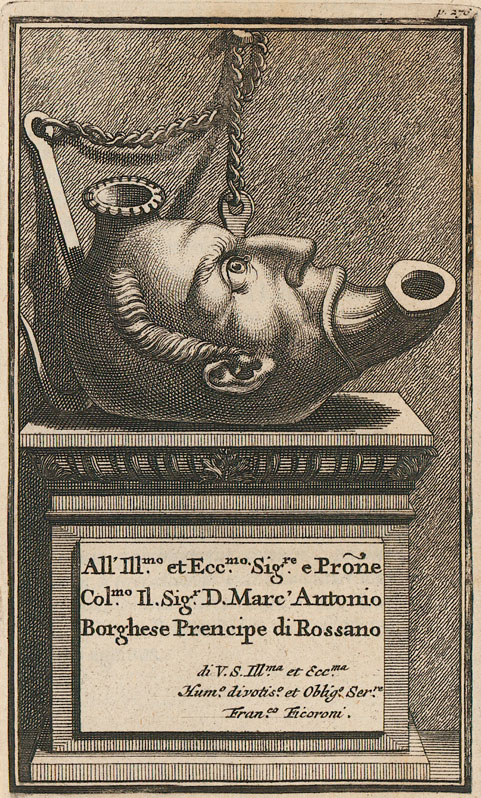
Such a secret perhaps was also known to the abbot Trithemius of Spanheim, who is said to have prepared such a lamp for Emperor Maximilian I and to have been given six thousand coronati. Although the process attributed to him by Korndorffer and others, from glass of antimony and sulphur, do not touch the mark. Let whoever wishes believe it and try it: I have little confidence in these things.
The saying of the very ingenious Italian Moscardi makes me smile: “As those lights burned eternally, so eternally do these leave the mind doubtful.”
But by what method the Phosphori of perpetual light were prepared by the most ancient Philosophers, the Third Part will now sufficiently indicate to the curious. Those who have been initiated in these studies will recognize Harmony, daughter of Mars and Venus, wife of Cadmus, whose clothing and solemn entrance between Phoebus and Pallas Martianus Capella describes, where, as soon as she had entered and the harmonies of the same sphere had sounded, all those things which Discord had made pleasing by her sweetness fell silent, like mute things; and then Jupiter himself and the celestial gods, having recognized the grandeur of the higher melody, which was poured forth in honor of a certain SECRET FIRE and UNSOAKABLE FLAME, revered the intimate and paternal song, and all the intelligences, little by little, rose up into veneration beyond the world.
Of this SECRET FIRE we shall now treat in the following Part.
Physico-Chemical Exercise on Phosphors, Part III.
On Hermetic Phosphors.
Adolphus, a philosopher known to the students of the more secret chemistry, while he was travelling through the world in order to investigate the mysteries of nature and of art, on a certain night, after leaving an inn, thought of entering a certain subterranean cave. In it, wearied from his journey, hungry, and sleepy, he fell asleep.
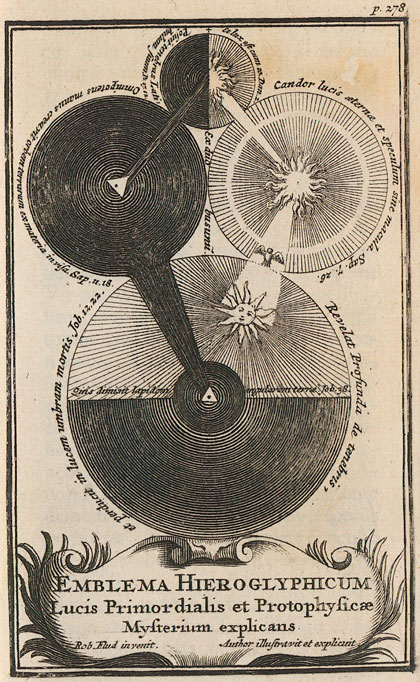
Awakened in the middle of the night, and occupied with various thoughts concerning the wonderful works of God and the miseries of men, he hears a noise in the cave. From this, being greatly anxious, he implores the help of God; and presently he observes, far from himself, a small light in the hidden parts of the cave. This light, gradually increased, came nearer; and there appeared to him a man of wonderful form, transparent like air, so that he could see all his inner parts: indeed, his brain like crystalline water, always moving itself like a cloud, and his heart red like a carbuncle; and the rest also his viscera and intestines, his lungs, liver, stomach, and bladder pure and transparent like glass, so that he did not know how to express its purity and clarity in words.
That man, approaching, said: “Adolphus, follow me; I shall show you those things which have been prepared for you, so that you may pass from darkness into light.”
Adolphus follows into the inner parts of the cave, and, considering everything very attentively, sees, set into the royal crown which the transparent man was wearing, a brilliant red star, whose rays penetrated his whole body and breast.
From his heart to his brain, and conversely, a certain mobile vapor was continually rising. At last that man struck the wall with a great crash, and withdrew himself from his eyes, so that again great darkness, solitude, and his former fear struck the mind of Adolphus.
Only when the sun had risen, having lit a wax candle, he searched through the inner recesses of the cave. There, in the wall that had been struck, he found a leaden chest; and in it, when it was opened, a book, on whose pages of beechwood leaves were inscribed a parabolic figure concerning Adam, and a single Voice revealing the whole secret.
From these he immediately learned many wonderful things, and the universal mystery of that sealed book of nature, and thus the Divine, the Name with the highest praises.
Whether this story is history or a parable matters little. That Phosphoric Genius, in a very dark cave, in the middle of a gloomy night, led Adolphus by means of light into the knowledge of hidden things.
And I seem to have seen, through the light of our Phosphorus and through its guidance as of a good genius, as the light of art and nature began to shine, a certain secret. For I saw in the noctilucent matter a crystalline water always moving itself like a mist or cloud, and a heart red like a carbuncle indeed, like the rising light-bearer.
For it is pure fire, or, according to the words of this author: “In the bosom of the cloud, immortal sulphur.” For the Hermetic Phosphorus is water, and the water of the Philosophers is fire, or water flowing forth from fire.
Concerning this, a few things must now be discussed. Not, indeed, so that these things may be made known indiscriminately to every reader. Certainly not. Nor is this necessary, nor is it my intention. It will be enough for those who, with the aid of Cleanthes’ lamp and Hermes’ torch, have somewhat overcome the Cimmerian darkness of nature’s cave, and have been led out of the cave of Trophonius into the light, to judge and estimate these things.
For I do not wish this Part to be essential to the preceding treatise, but only a certain supplement dedicated to the curious alone, who pursue these mysteries.
Namely, so that from the doctrine of nature and creatures the infinite Creator may be known, not without wonder and adoration, as Cornelius Drebbel admonishes. He, having searched into the elements, contemplated the crystalline spirit of the earth in the manner of a kind of mist, the soul tinctured as if with blood, and the body stable and subdued like crystal.
He saw the spirit fighting against the body. When at last it had overcome it, one thing was made from both. The body served the soul, and was a stable dwelling-place for it. The spirit raised up the body and the soul; the soul added an ornament both to the spirit and to the body by its own purple color, and almost, as he says, celestial.
Thus he observed with his eyes destruction, resurrection, and immortality; and, being made more and more a lover of most wise nature, he became a worshipper of his Creator.
Behold a vision parallel to that Adolphine vision. A similar thing has happened to many others, and also to Brother Basil Valentine, when he exclaimed:
“Blessed is he whose eyes are opened, so that he may see the light which was formerly obscure to him! It has been done by Divine Goodness, so that it has been granted to men that two stars have arisen for seeking true and profound wisdom. Look upon them, O mortal man, and walk toward their brightness, because there wisdom will be found.”
Chapter I.
It is proved that there is a Philosophico-Hermetic Phosphorus.
We have examined the Phosphors which are darknesses in comparison with that noctiluca which shines in the Philosophical world. This shines for the rarest artist.
The most ingenious Philaletha gives the reason: “The darknesses,” he says, “have in themselves the light of a false fire, by which the inhabitants of those places think themselves wonderfully illuminated; but when the light of nature has once reached their stations, it reveals the extreme darkness in which only an imaginary light has shone, like that of a false fire and of glowworms, at least shining in the dark. Yet this makes their eyes so tender that they neglect the written light of the lamp of nature, and neither look within, nor are they able to endure the truly wise lunar light. For whatever is truly light reveals their darknesses. And yet their darknesses cannot comprehend the light.”
So it is. Countless artists are for the most part seduced by a false fire, because they do not know the Sun by day and the Moon by night, as the most illustrious Espagnetus says of this light.
They delight in common Phosphors, which they pursue with useless labor in place of the fire of the wise. Therefore I have said that it was necessary here to furnish such persons with some kind of torch, which might in some measure illuminate the very obscure way to the hall of light.
I shall first demonstrate that there is a light in the Philosophical subject, for this reason called Lunaria; then I shall show that there is a Hermetic Phosphorus. But since the former point has not been granted to me, I shall bring forward the authorities of the Adepts, and shall rely on their faith which, whoever wishes to render it suspected, should take care not to do the greatest injury to most excellent men.
I shall bring forward some sayings by which they wished this to be indicated, and then also their own experiences, which are usually the most approved of all proofs, and surpass every syllogism.
There is no need to heap together a great mass of testimonies. A few are sufficient, where you may easily gather six hundred. Brother Basil Valentine confirms these things already previously alleged by him:
“Our light is the light of wisdom, which shines in the darkness, and yet does not burn. For our sulphur does not burn, and yet shines widely.”
Avicenna instructs the son of Aboali thus:
“This is the force of the most subtle sulphur, pure and simple, fiery but not burning, which is called the lunar light, because it is the form and splendor of all metals, and illuminates all bodies, since it is the light and tincture that illustrates and perfects every body.”
Hence even King Geber confesses with an oath:
“By God most high, it itself illuminates every body, because it is light from light and tincture.”
The most elegant and likewise most faithful author of the Philosophical Mine adds his testimony:
“When our Philosophical chaos has been set down, sons, study to draw light from it; and this light is nothing other than our sun, which rises white and ruddy on the horizon of the Philosophical hemisphere.”
But I omit innumerable sayings of the Wise of this kind, because some people could judge these to be parabolic; rather, I proceed to their real experience.
Baldinus, already often mentioned, writes that he has preserved among his papers a writing of a certain Adept, D. D. B., in which it is read:
“When gold has been dissolved in the Philosophical menstruum, the menstruum changes nothing at all in color. But by night it presented the appearance of a most ardent or most luminous light, so that at its brightness not only could all things be seen and very clearly distinguished, but even the smallest characters could be read and written, just as if someone had lit candles placed here and there.”
What could be more evident than this testimony?
Isaac Hollandus, surely one of the rarest men, if there ever was another, the Phoenix of the Philosophers of Batavia, writes thus concerning the stone made by him:
“It is a stone of exceedingly remarkable power, for it shines at night, so that there is no need of candles. But no other light can be joined to it; and therefore the stone and medicine is noble. Hold it as a great secret.”
From the books of this great and proved artist anyone may gather that Phosphors are not a new invention, but were already known to some persons before our age.
Indeed, he also prepared a common noctiluca from caput mortuum of aqua fortis, volatilized with that same aqua fortis itself, concerning which he says:
“Believe me in good faith: from this water I saw wonderful things, and I myself also made wonderful things. I reduced this water to a red crystalline stone, which gave out light at night, so that frequent table-companions could hold their banquet by it.”
What again could be clearer than this testimony of an Adept Philosopher?
Trismosinus, in the book Ganginiveron, or the book of the nine tinctures, prepares from graduated vitriol, digested to redness, an oil which shines at night and makes day in the darkness he asserts.
Indeed, Johannes Segerus Weidenfeld most plainly believes and hands down as beyond doubt that whatever fermented menstruums of the Philosophers that is, those which contain the dissolved sulphurs of metals shine by night, and therefore are perpetual lights. This, however, must be understood with a very great grain of salt.
A certain author, moreover, the possessor of this secret too, in an alchemical treatise likewise offers, unasked, a most brilliant testimony. Hear his words:
“Now it is fitting to describe the Elixir to you. After the operation, let it be of the most lucid fraction, that is, having a clear and serene light, and the red splendor of fire. When the Elixir is prolonged, a sight will be made in it, like a carbuncle in the darkness.”
For anyone for whom these things are not sufficient, nothing is sufficient. For they prove very clearly what was proposed: that there is a lunaria, and that there is a Phosphorus of the Philosophers.
But let monstrous fables and the trifles of false philosophers be far from us, while we relate the true miracles of lower nature. To these I do not know whether that relation in the Chymical Cabala of the Ark of the Secret should be counted if it is not parabolical, then at least hyperbolical namely, that the matter of the Philosophers, joined to its incombustible vegetable spirit, becomes a lamp in which eternal fire and the virtue of the Most High of the highest star of eternal wisdom dwells; and this fire becomes inconsumable, shining night and day, surpassing the sun, moon, stars, carbuncles, and every kind of fire in splendor.
And if a few drops of the blessed Philosophical oil, distilled from this mine, are instilled into the seven metals melted by fire in a crucible, then in a darkened heated room there will be an appearance of the firmament and of all the planets, moving in their circles, with the greatest splendor; and also the separation of light from darkness, and a marvelous representation of all things created in the first Hexaemeron, if the same oil is poured into rainwater.
Let fables be absent, I say, while we treat serious things. Such claims, closely akin to trifles, have long since stamped an indelible mark of infamy upon a science otherwise most noble.
Let the Hermetic Phosphorus shine, but not more clearly than the Sun and Moon. What connection do the seven planets have with the seven metals, so that, as if the sky had been taken down, they should appear in a dark bedroom, while the metals are flowing in fire? Perhaps their splendor and brightness may excite them, if you except gold and silver, the impure sulphurs flashing out when that oil has been instilled; but will they therefore produce the figures of the seven stars? And why, in rainwater, should this represent the primordial state of the globe the metamorphosis of the terrestrial globe, and from it the drawing forth of light and of the other creatures once the ineffable work of the Creator alone? I would not deny that the very protophysical work of the sensible and supercelestial world can be a kind of image; but those cabalistic phenomena are to be judged as the mockeries of a deceiving genius, or rather of a wandering imagination.
False philosophers, as it were, build for themselves a theater, in which they imagine that they see wonderful scenes of things, rather than actually see them, so that they may nourish their own hopes and stir up those of others.
Yet that excellent spectacle of light, which, according to the account of the very celebrated Morhof, happened to a certain honest man, and one most worthy of trust, while he was studying letters at Louvain, when a certain Burgundian showed it to him, is worthy of mention, and contains nothing absurd.
This man had invited him into his museum, for the sake of seeing a singular work of art. There, the windows having been covered so that external light would not hinder it, he brought forth a certain glass vessel with a narrow mouth, full of a very pure liquor, into which a golden thread had been inserted.
When a lamp was merely brought near to the thread, suddenly a light arose, as if they were standing in the midst of the sun; and a scent of incredible sweetness filled the whole museum. Afterwards, when the flame was suppressed he dismissed his guest, but under the pledge of sworn silence.
From this experiment you may gather two things.
First: that odor, filling the whole room, and therefore necessarily depending on effluvia, sufficiently proves the rarefaction and volatility of that oil or sulphur capable of being kindled; so that it did not have the nature of perpetual fire, although without doubt it had been extracted from the mine of the Philosophical Lunaria. Those who have learned to distinguish the different states and orders of that matter will know the reason.
Second: that such an exuberance of intense light proves that this liquor was truly Philosophical, and drawn from the First Luminous Principle; so that it is not strange that such an ineffable light shone forth. For, as Maxwell says: “From the first luminous principle, by distillation often repeated and by various circulation, it is extracted in wonderful ways by the skilled magus.”
Therefore this Burgundian lamp could belong to the genuine Phosphors, although it was kindled by actual fire. I have already proved above, by my own experience, that the sulphur of fused Philosophical Salt intensifies its motion in fire into a luminous one.
Here I raise my mind: if such a light exists in a creature, and indeed an artificial one, O incomprehensible Majesty of God, what will your light be! In how great a light shall we dwell, we who shall someday behold you, the inexhaustible abyss of light, among the blessed, in the homeland of the blessed! May the Most High grant it!
Chapter II.
The origin and cause of the light in Hermetic Phosphors is investigated.
Can that which flowed from the First Luminous Principle fail to overflow with light? Can the genuine son of the Sun and the Moon, regenerated and brought up by the artist in fire, fail to share in the brilliance and lightning-flash of its parents? Can that which is the purest sulphur of nature indeed, the Essential Fire itself, or tincture immediately born from light fail to be a Phosphorus?
For my part, I do not doubt it, since I am not ignorant that sulphur lies hidden in the Philosophical mine, first volatile, then also fixed. Walchius testifies the same from his own experience, writing that it sometimes catches fire in the work like a flame, as also the Count of Treviso says concerning his royal fountain, which at the beginning he declares to be capable of being set on fire, not without danger.
This happens at the beginning of all pyrophors, before the sulphur is radically joined to the fixed, incombustible sulphur. But do not therefore suspect that this is ordinary sulphur. For it is nothing but a certain ethereal spirit, attracted by its white magnet drawn and coagulated. But that magnet is the proper vessel of nature not the womb, but the very mother of light.
The ancient Philosophers have written many things about it, and the more recent writers also not a few; to them, for the sake of brevity, I refer. Among our chymiatrists, D. Cassius also seems to have known its nature very well, when he writes emphatically in this way:
“What if that material so multiplicative of itself, from the most subtle, most penetrating, and most expansive substance of the world and again most capable of active concentration such as is in light, or one not very unlike it, should be hoped for? That such a certain thing lies hidden in all things, and can be called forth especially from metallic things, is at least known to those more experienced.”
Elegantly, indeed, and most truly said. He adds the theory of the practice itself:
“If, therefore, to this ethereal spirit fine indeed, and most subtle, most penetrating, luminous entrance into gold could be granted, so that by it, as by a gentle and soft fire, that gold might be slowly and very sweetly penetrated, and might be dissolved by itself into a liquor; not indeed into a mercurial liquor, but into a juicy, most subtle, seminal substance, fit for its own multiplication: that key of art, that artificial fire of the Philosophers, that magnet of gold, and true steel of gold I also say, to have found the true Hermetic Phosphorus.”
For from gold which according to the Adepts is wholly sulphur, but most fixed dissolved by a certain most luminous Salt, namely one in which the rays of the Sun are hidden, as though by its own proper metallic radical moisture, through the due process of art, there arises by the way of regeneration a glorified, incorruptible body, which, as Rhases says, possesses an indescribable splendor.
This composite of Salt and Sun constitutes that exuberant Mercury of the Philosophers that is, full of the fire or sulphur of nature in which Cyrenaeus Philaletha writes that the Mystery of perpetual light lies hidden, and testifies that he has seen it. No one has written more clearly about physical light up to now, as has become evident from my protophysical work.
From this fountain, without doubt, was drawn that Phosphoric stone which Fredericus Gallus saw with a certain anchorite, Father Michael, descended from the most noble family of the Trauttmansdorffs, as he records in the description of his journey.
Its color, he says, was that of Bohemian garnet, but its chief gift was splendor. You would have believed it to be a lamp burning in glass. O great spectacle! But to how many mortals in the world has it been seen?
This hieroglyphically shows to Emperor Maximilian that which Dee of London says: “Out of a hundred sincerely philosophical myriads, and out of the countless myriads of the promiscuous multitude of men, we must expect this one single, most blessed offspring.”
If, therefore, you perhaps say that the Hermetic Phosphorus is so rare and scarce in the world, for what purpose, or for whom, will this commentary about it be useful? Since what exists so very rarely upon the earth can scarcely be placed among the number of beings.
But will the investigation of so excellent a thing therefore not be useful? Or at least the scrutiny and inquiry into its nature how it exists, if it ever exists? It is enough that it can exist, and that it has already existed many times; and today no one doubts this any longer, unless he clings to experience cut short from reason alone which Aristotle somewhere calls weakness of mind.
No one, so far as I know, has yet written about Hermetic Phosphors; therefore no one will blame me for having added this supplement, at least for the curious, to the other common noctilucas, unless he is plainly a hater of Philosophical chymistry.
Ludovicus Lazarelli writes that the Philosophers, in order to know this secret of nature, at times separated themselves from all human company, entered caves, and in woods and mountains they dwelt Morienus the Roman Hermit is, among others, a witness to this.
So that, if they sought it out by cleverness and labor, today a nearer path lies open to us through our Phosphors, both natural and artificial, for arriving at some knowledge of it, at least of a subject most deeply obscure.
And what such light is not brought forward except for the wholly nocturnal light of nature? I judge that investigator of this Mystery fortunate who, although he has not yet perfectly known its genuine subject, at least is not ignorant of what it is not.
Fortunate is the artist who has known that light is the purest thing of all nature the Philosophers call it “the pure thing of nature” par excellence most subtle, most active; and that therefore this noctilucent carbuncle of art and nature is not to be sought in the foulest excrements and the various filths of the world.
For even this knowledge alone renders him safe from innumerable errors. Therefore the author of the treatise The Ray from the Shadow, a most acute Adept, faithfully warns:
“We wish to make corporeal the ray of the sun, and we wish to extract this root from the thing where, by the benefit of nature, it is congealed without specification. We wish the seed of gold, and we seek it even in its own dung.”
But let us return from this digression to the path.
I conclude from what has been briefly deduced that the Hermetic Phosphorus therefore shines because it is brought forth from the First Luminous Principle; because it becomes the son of the Sun and of fire; because it contains a sulphur essentially luminous; and because, finally, it possesses a body rising again from death and glorified, whose property it is to shine naturally.
Thus Isaac Hollandus also testifies concerning the very Quintessence of Honey which nevertheless differs from the Mercury and sulphur of the Wise as earth differs from heaven when it has been reduced into a glorified crystalline body: that it shines in the darkness in such a way that someone can read by its light.
Although in reality this too, since it is prepared by the way of corruption and regeneration, ought rightly to be referred to the Hermetic Phosphors.
Hence it has not been ineptly nor foolishly, as the haters of science think, handed down and written by the adepts of phosphors of this kind, that from that admirable process of art the mystery of the resurrection and clarification of bodies is so evidently seen, that it is impossible for a Hermetic Philosopher to be an atheist and impious man; since this Philosophy, unless it finds a good man, certainly makes one.
Therefore I exclaim with Isaiah:
“O Lord, your dead shall live; my slain shall rise again. Awake and sing you who dwell in the dust, praise, because the dew of light is your dew.”
Chapter III.
The first-material subject of the Hermetic Phosphorus is explained.
I now return at last, near the end, to what I stated at the beginning: that light is the form and essence of all things, from which that luminous sulphur of nature consists, which the Philosophers also call the simple fire of nature, and which they wish to be nothing other than the coagulated spirit of the Sun.
Although this, in its universality or generality, is still undetermined everywhere as we have demonstrated concerning air, water, and earth nevertheless it must be sought in elemental subjects, in which, according to Sendivogius, it exists, but does not appear until it pleases the artist.
Yet it is by far most difficult to choose without error those subjects proper to this lucid spirit, of which nature recognizes only two. For Lullius himself confesses that each mine is of a different kind, and that one is better than another. Ignorance of these produces everywhere such great darkness on the path of Hermes and to the student of physical light, who is it unknown?
And what ignes fatui, not lightly flashing, do not lead very many away into pathless places? I shall show this by at least one example, where six hundred are available.
Behold the fiery dragon flying under this night, which, if you can capture it, Brother Basil Valentine testifies that you have attained something great in the chemical air. But what is it? He himself names it the fiery and burning spirit of wine.
Who, then, will doubt? For is not the most highly rectified spirit of wine pure sulphur and light, and the most subtle Essence swollen with fire and light? So indeed countless people believe. Hence the excellent Rosinus Lentilius seems to himself to have hinted at a great mystery, when he speaks emphatically in this way:
“Let philosophical chemists stretch out their finger toward the light in Mercury and Urine, and let them investigate whether they can also find something luminous in Wine. The wise will understand me.”
But let them truly understand and discover the light in wine, just as others have found it in Mercury and Urine: it is necessary that experience should at last teach them, as it taught others in both those things, that in Wine and its spirit they have foolishly pursued an ignis fatuus. If they are wise, they will correct their error even from this false fire itself. Here it shines, but it does not burn, it does not scorch. The spirit of wine, if it possesses any light, has it joined to fire and burning.
But what do the Professors of Philosophy more seriously admonish than that the sons of art should learn to distinguish inflammable spirits from non-inflammable ones; phlogistic sulphur from incombustible sulphur; vegetable sulphur from mineral sulphur; and the particular from the universal?
Lullian wine differs by infinite stages from common wine; and no less does the fiery spirit of wine differ from the fire and light of the Wise. Far be it from anyone to recognize that former as their purest aether. I confess that in the fiery spirit of wine there is an excellent and most subtle sulphur; but it is vegetable, not mercurial-metallic.
But that ethereal spirit, celebrated under the name of the Philosophical one, the already-mentioned Philosopher candidly defines as a mercurial spirit coagulated together with sulphur. This they call their Lunaria, as the immediate subject of the Hermetic Phosphorus, their unctuous sulphur, their inextinguishable lamp, and their immortal fire.
From what has gone before, this has already become quite clear. Yet I shall repeat it once more in other words. Light is generally everywhere, but in that state or modification which is suited to Philosophy, it is in only two subjects of the world, or rather, if you consider the thing exactly, and the species, not the number, it is found in one subject, from which, and from no other, it can be taken; and it can be reduced into such a moisture which, indeed, in its flowing and silvery form resembles Mercury, yet is not truly Mercury, but only a Mercurial moisture, called by some the first being of Mercury, and by others rather its middle substance.
And in that disposition it is the radical principle of metals; if the fixed sulphur of Sol is united with it, there arises the true Phosphorus of the Wise, the forerunner of the horizontal Sun.
Anaxagoras of Clazomenae indicates this clearly enough in these words:
“Our Sun is red and burning, which is joined to the spirit of the white soul and of the nature of the Moon by a mediator; although the whole thing is indeed nothing else than the quicksilver of the Philosophers.”
Others call this Phosphorus the Star of the Sun, and make it similar in brilliance to sulphur kindled in the flame of fire. To it this saying of Pindar can be applied:
“Gold, refined by fire, reveals all splendors.”
But since this is not the place to set forth all these things more clearly, and since in my Protophysical work I have sufficiently untangled that sulphur lying hidden in the fiery Dragon and to be extracted by a homogeneous magnet has been made, I shall not add more at this time, except the following few aphorisms on protochymical light, on the advice of Sendivogius:
“If you wish to practise your Philosophy in an old-womanish way, say commonly: Come and see, for now the water has been divided, and the sulphur has gone out; it will return white, and will congeal the waters.”
He said many things in few words, so that one may admire the whiteness of the man. At least I shall add this: that the Phosphorus of the Philosophers is that polar star which is fashioned from the doubled cross, and constitutes their ✠, or sal armoniac.
Behold the enigma, which, when solved, will first open the entrance to the closed palace of the King:
From the doubled cross this star is formed,
the seal of the Magnet and of the Steel,
and the lighthouse of the artists.
The mystical Cross gives the symbols
of marvelous things,
without which the summit of sophic art
is not touched.
O happy is whoever has the little signs of the cross
of the true Matter,
which Pontus and Aether give!
But take note. The character ✠ (cross) is composed of the golden horizontal line and the magnetic polar line; and when these cut the circle into four parts, they present the mystical figure of the center of the world joined to heaven, and indicate the green copper of the Philosophers, Θ (🜔 Salt).
But the Cross itself, hieroglyphically, is nothing other than LVX Light. For even the three letters L. V. X. themselves are perfectly contained in the figure ✠ (cross), so that it is shown that one cannot arrive at the light of the Adepts except through the cross, both the physico-mystical one already indicated above, and the moral one that is, through labors and vexations, which give understanding.
Chapter IV and Last.
Aphorisms illustrating the nature of light protophysically.
As the end is witnessed by its beginning, so in light, from which we began this treatise, we shall also end it; so that, since we have proceeded through so many lights, both natural and artificial, we may finally also subsist in light itself.
I know that the house of Hermes, as it is called by the inhabitants of the hall of light, is a Daedalian labyrinth or rather the portico of Pluto in which darkness grown old will scarcely admit the slight light which I have brought so far. For although perhaps some brightness may arise from it around its first atrium, yet, because it is passed through by few paths, scarcely a spark of it will gleam.
I know also the crowd of bats gathered, even in its very vestibule, with attentive nests: natives of obscurity, who, because they neither have light in themselves nor love it, will attempt to fly at and extinguish the light brought forth by me; or at least, like the people of the Atlantics who, because they themselves are black and love the darkness of night, bark at the sun when it rises and pursue it with a thousand curses they will look upon this Phosphorus of mine, if my conjecture does not deceive me, with bat-like eyes, and will attack it with sarcastic hisses.
Yet, not delaying over the envy and murmurs of these Tenebriones, I shall here append a certain lamp, shining at least with a very slender light, and illuminating, if nothing else, the first threshold of the Philosophical Vestibule and the mystical emblem placed at the frontispiece of this book.
1. Light dwells originally in all things, and is joined to the innermost essence of things, but especially to air and sea. From these a doubled mine is extracted; and because it rejoices in most subtle light, it itself it can penetrate and illuminate the very center of the earth.
2. But in order that you may obtain this mine, it is necessary to draw and concentrate light from the rays of the sun and moon by the magnet, or Philosophical steel. For in this way the spirit and living fire of nature is obtained, which constitutes the true Mercurial Phosphorus; contemplate its generation, mystically sketched in the Emblem.
3. Namely, in the heart of Venus there lies hidden a flame, which flashes forth when her breast is opened. For although Venus was born from the sea, nevertheless she encloses within her entrails the true fire of Gehenna, because she has a most burning sulphur, which she magnetically draws to herself from Mars, whom they call the red servant.
4. It is necessary, however, that Rhea, goddess of the earth, who bears the everlasting lamp, should show you the dwelling-place of Mars. For the Philosophers note that fire dwells in air, air in water, and finally water in earth; whence in this earth the fire must necessarily be sought but in a lucid and fiery earth. For it is impossible that without Mars you should excite the fire of Venus and obtain the signed star of the Philosophers, which is their genuine light-bearer. But Mars, or steel, says Philaletha, is the true key of the work, without which the fire of the lamp can be kindled by no art.
5. But Lucifer himself is Mercury, generated in the air by the sun and moon; and, sending their concentrated rays down into the earthly globe, whatever part of the globe he touches, he illuminates with light and fills with fire. Note the Limbus, which surrounds the orb through the middle; for here he separates light from darkness.
6. For although that Lucifer-Mercury is marked with the light and fire of the sun, yet he lies hidden under night in darkness, from which he must be dug out. The night of our Emblem is full of mystery: while the moon there inclines toward setting, the sun rises. Let the purple of dawn, of the rising sun, be your sign.
7. See the concentrated rays of the sun descending to the dark globe of the earth. If you say that these rays have been attracted, you will already truly know the Magnet and the Magnesia; but if you judge that they have poured of their own accord from the fullest subject of light into that globe, you will then no longer be ignorant of their center in the earth.
According to that saying of Sendivogius: “I have said that the heavenly sun has correspondence with the central sun; for the heavenly sun and moon have a peculiar power and virtue of distilling through their rays into the earth.”
8. Observe in our mystical type the fiery Vulcan, and, when the heart is kindled, Venus; it is the same whether you understand the red husband and the white wife as the parents of the hermaphroditic offspring for from one alone one is not generated or whether you conceive the virtue of generation and multiplication in a certain vital fire.
For who would judge the supernatural son of the Sun to be dead? Yet this must not be neglected: that Death, while the fire is still gleaming and now expiring in the torch, clearly indicates the necessity of corruption and putrefaction in Philosophy.
9. Now let others follow the wandering ignes fatui beneath the night; let owls and bats delight in darkness, or rather in a light visible only beneath it. We shall observe the ray of the rising Sun, without which the Phosphorus is not kindled and does not begin to shine not as night-blind men, not as Atlantics, but as sons of the Sun.
Let the light-fleeing ones jest. Finally, I address you, candidates of Physical Light, with Joannes Aurelius Augurellus:
Therefore come, behold this light
removed from darkness,
O mortals, and turn your steps away
from the blind path.
I now leave you the freedom to judge whether these entities which I have brought forward are real, or whether they are merely speculative emblematic ideas.
I also permit the students of truth to investigate, believe, reject, correct, as they wish, whatever I have brought forward in this exercise concerning these Phosphors of threefold kind provided they bring forward better, clearer, truer documents of light.
If anyone, placed in the clearer sphere of the Adept light, should recognize that I have not in all things reached the goal set before me, let him remember that saying of the great Scaliger to Cardanus:
“In a slight light we see dimly; in a moderate one we are half-blind; in a greater one we are blind; in the greatest, we are insane.”
Immortal thanks be to the heavenly Deity and Light for the illumination granted to me; and may that Light, by the rays of its own divine grace, turn away from us all darkness, blindness, and madness.
To that Sun be honor and glory,
from whose light every light shines;
without whom the shining things are dark;
from whom the darknesses shine,
and the gloomy image of night.
FINIS.