Moses Golden Calf, together with the Magical–Astral–Philosophical especially the Cabalistic Fire
Listen Audio Book Study the Art with Us Buy me CoffeeMOSES’ Golden Calf,
together with the Magical–Astral–Philosophical
especially the Cabalistic
Fire;
by means of which latter
Moses, the man of God, ground this golden calf to powder, strewed it upon the water,
and gave it to the children of Israel to drink.
Part I.
In the year 1722.
Written by Lamberd Alard.
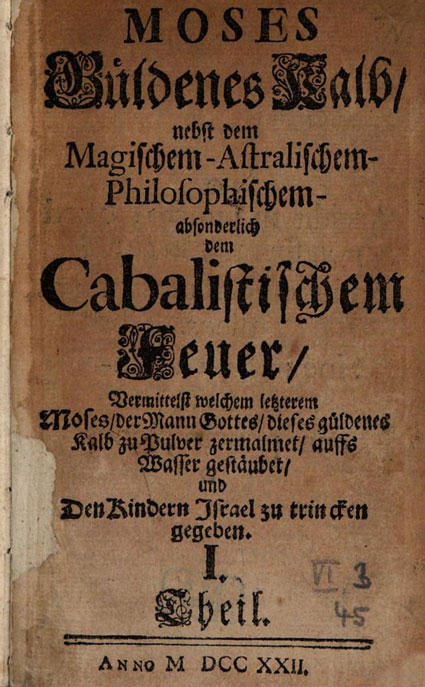
Translated from the book:
Moses Güldenes Kalb nebst dem Magischem-Astralischem-Philosophischem- absonderlich dem Cabalistischem Feuer, Vermittelst welchem letzterem Moses, der Mann Gottes, dieses güldenes Kalb zu Pulver zermalmet, auffs Wasser gestäubet, und Den Kindern Israel zu trincken gegeben - Tom 1
It happens in a moment what is not hoped for in a year!
A year is a circle returning into itself.
Without a point, O is empty;
with a point, it is full ☉.
According to the common saying, not everything is gold that looks like gold; for what is upright (true) and good gold, and is meant to be so, must endure the touchstone and the blow of the hammer in its malleability; and when it passes the assay/quarter-test (die Qvart) it is found to be upright and good.
On the other hand, daily experience also shows this: even when the gold is ever so genuine, ever so noble, and ever so good, many especially the inexperienced will nevertheless not wish to regard, recognize, or accept such gold as genuine, good, and true.
For how many a one is to be found among the gold-beaters, when he catches sight of gold, who because it has only seven times been poured through antimony (Antimonium) and has been beaten into thin leaf-gold, and because this or that is gilded or coated with it cannot grasp whether, on account of its high color, it is true and real gold, or what it is thereof is to be made of it? One need only go, in the side-aisles of the inner choir of the altar-space in St. Mary’s Church in the famous Free Imperial and Hanseatic city of Lübeck; there one finds, as an everlasting memorial, many paintings gilded and over-painted with gold, which thousands of people take to be true and real gold, and still less wish to recognize otherwise.
And what once served as a distinguishing mark, formerly not so many years ago in St. Michael’s Church in the city of Lüneburg, at the golden panel: namely that the small piece of good ducat-gold that was set in the corner of this golden panel, in comparison with the rest of the gold on the whole panel, had no other appearance than brass beside good and real gold.
More examples could be mentioned; yet let it remain at this: that all gold which is twenty-four carats, even if (as is said) it is pure, yet if it is not found to pass the “Qvart” test, is not good and upright gold; but that which passes the Qvart is and remains good and upright gold.
Whence, then, comes this great difference, that one gold in color is not so high and so noble as another? that Nordic or Swedish gold is paler than Hungarian, and that Hungarian gold is not so high in color as the West-Indian gold, and so on further the Hebrews give us the decision in this, especially the Kabbalists, when they mention in their writings particularly in their treatise called Esch-Mzoreph (i.e. “the burning/combustion of fire”) that one finds in Nature a sevenfold gold, according to the course and manner of the seven planets:
the first is aurum Saturni (gold of Saturn),
the second aurum Jovis (gold of Jupiter),
the third aurum Martis (gold of Mars),
the fourth aurum Veneris (gold of Venus),
the fifth aurum Mercurii (gold of Mercury),
the sixth aurum Lunae (gold of the Moon),
and the seventh aurum auri, or rather aurum aurae, so called from aura as the highest, best, and noblest among all kinds of gold: that which is found either native (in the solid), or smelted from gold-ores, in gold-mountains and mines.
One spares space, and does not wish to burden the reader with superfluous reading of these pages; otherwise one could cite proof enough for all that has been alleged from the authority of the Hebrews, Egyptians, and Chaldeans, if opportunity allowed and if one were skilled in the language. Let whoever wishes look up what the Hebrews write on this matter, especially:
Pardes Rimmonim, treatise 23, chapter 27, and treatise 10, chapter 3;
Sahar, section 4.
Trumah, fol. 66, cap. 203.
Vajechi, fol. 132, cap. 524.
Pekude, fol. 160.
Ki Tissa, fol. 182, cap. 328.
Jethro, fol. 41, cap. 161.
Trumah, fol. 62, cap. 246.
fol. 65 & 60, but especially:
Esch-Mezareph, cap. 2.
But a quite different kind of gold is found outside the mines and works, in the laboratory of those who not only recognize Nature in her fundamental pillars, but also understand the transmutation of the baser metals into the noblest and best gold, and can also set it forth in practice: namely that gold which when it has been made by the tincture of the seventh rotation far surpasses all other gold that is found in mines and works, in its color, hue, and goodness.
However, this gold very seldom comes before human eyes; yet not so very long ago one drew forth, in the famous Free Imperial and commercial city of Hamburg, something of the kind although it was not made by the tincture of the seventh rotation, but by one of the lower (rotations) to view; which, as was found, on the touchstone/assay (“gvardy”), to be above four-and-twenty carats; and so much the more, in its color and fineness (“bonitet”), it surpassed all other gold, both in and outside the mines.
Many a peasant or husbandman, as the common saying has it, picks up a stone from the field and throws it at a cow and yet oftentimes such an outwardly insignificant stone is ten, a hundred, indeed often a thousand times more worth than the cow itself. The cause is very easy to guess from Nature’s tokens, observed out in the open field: such stones are often found in which not only diamonds grow, but in which diamonds have truly been found.
And who does not know who has read the Oriental travel-descriptions that the best diamonds in those oriental lands are very often found out in the open field, which, as to their outward appearance, seem quite rough and insignificant, like the other common stones lying in the field, and yet are genuine and good?
But the space of this writing is granted, one could therefore add here a certain occurrence, which happened about forty years ago, and not long before my own time, with an East-India sailor in Amsterdam: this man, quite certainly, had brought such rough gold-stones in his mattress, together with sand, and had given them to one of his comrades; but he soon after, upon his landing in Amsterdam, departed this life, and had to leave them behind in his old mattress or under-bed!
And the same kind of circumstance also occurred with that sort of gold which is found as well above as under the earth, in the mines: one recalls a certain report of a reliable and credible eminent citizen in the royal residence-city of Copenhagen, that an East-India sailor arrived there with ballast, and that, by order of the gentlemen Directors (Interessenten) of the East-India Company, the ballast carried in his ship was dumped out on the strand of the harbor; but when, after a few days, a good connoisseur passed by the place where this ballast had been brought and discharged, he was greatly astonished at it that one had thrown away so great a treasure out of ignorance with the assurance that this cargo of ballast was of the very greatest of the greatest importance, and greater than anyone could ever imagine since such ballast had been nothing other than the purest, finest, and best gold.
And after he had been instructed to take it up from there, it was arranged that he should carefully set aside a good portion of it for himself so that even to me, about twenty years ago, something of it was presented.
And who is there that can or will believe that in Holstein, as well as in other places on the high land, quite gold-bearing stones are found in such great quantity, which could yield as much gold yearly as the mines in Norway and Sweden!
If, then, it stands thus with gold in and upon the earth, what wonder is it if astral, magical-philosophical, and cabalistic gold is recognized by men still less at all although its goodness and dignity are so much more noble and higher than the heaven is removed from the earth; for as the best gold in and upon the earth, by the unanimous confession of all who know Nature and are experienced in the art, is and remains nothing else than a pure, well-cooked, fine “Fixer,” that is, a fire-constant sulphur, so is and remains the astral–magical–philosophical and cabalistic gold likewise nothing else than an over-pure, over-fine, and over-fixed Fixer, and indeed a more-than-fire-constant sulphur; and as the gold in and upon the earth can and may be destroyed by kitchen-fire and glow, so this gold can still less be thrown upon a like fire and be destroyed rather it rules over all fire here below upon earth, and flows, like a golden oil, in the strongest stream of fire.
The highest virtue of the gold in and upon the earth is a fixed, fire-constant green; from it, in the appointed manner, the gold- and ruby-red color springs and arises. But this is found in the astral–magical–philosophical and cabalistic gold or sulphur so frequently and so abundantly, that it not only has enough for itself, but can also share with other metals to their benefit indeed abundantly into infinitely thousands of parts.
When we have therefore, in this first part of this writing, to consider Moses’ golden calf, it is indeed most of all the first question: of what matter this golden calf was made by Aaron, the high priest in Israel? And since the text says that it was made from the golden earrings of the Israelite women, the further question is proper: What sort of gold was that? And then, in the following parts: What kind of fire was it by which Moses, the man of God, burned this golden calf, so that it was made into such a gold-powder that it floated upon the water and became drinkable, so that the children of Israel could drink it?
That it is a certain and established doctrine, that in Nature such a fire is found, by which the gold that grows in and upon the earth can be made into such a powder as does not sink, as other gold does that has been separated by Aquam Regis (royal water), but rather floats like an oil upon the water, is undisputed; and in the following parts it will be treated of more fully. At the same time, for proof that gold can become soluble and drinkable, by communication of the following parts all this shall be set forth visibly before the eyes shall be set forth visibly before the eyes, when the true and real aurum potabile Hermetis (Hermes’ potable gold) comes to appear before the world, so that everyone may see it with his eyes and handle it with his hands:
“For gold takes its origin from the air’s origin; and from that from which something has its existence and its first origin, by that too it is dissolved this is a philosophical axiom.“
But since gold, from air, together with mercury, sulphur, and salt, has its existence and origin (namely) a most pure and fixed sulphur therefore it is also dissolved by air and by the air’s salt; as witness Clavao, p. 223. Lange, in the preface to Tilemann, confirms it by experiment; likewise in the Epistle to Nat. Cur. p. 19, saying: The true dissolution of gold cannot be made except by the salt of the air, as the catholic (universal) dissolvent.
But first we shall examine the gold from which Aaron made and fashioned the golden calf.
In the 32nd chapter of Exodus, one sees, passing by, the word זָהָב (zahav), which the late Luther has translated in the German tongue by the German word: gold, or golden.
In the 2nd chapter of Genesis, verses 10, 11, 12, it is written Moses (says):
“And a river went out of Eden to water the garden, and from there it was parted into four chief waters. The first is called Pishon; it flows around the whole land of Havilah, and there one finds gold.” (Where again, in the original text, the word זָהָב (zahav) is found.)
And of the gold of that land Moses further says: it is excellent / precious; the word טוֹב (tov) stands in the original text, which Luther not without cause rendered by the German word “köstlich” (“precious,” “choice”).
I, for my part, am wholly of the opinion that one may, in the thing itself and in the physical matter, accept the ancient teachers of the Church of the Old Testament without blame; and thus one finds concerning the word זָהָב this remark recorded:
Zohar, section Trumah, fol. 66, chap. 263:
“This is that gold which shines and dazzles the eyes.”
Esch Mezareph, chap. 2, on the word זָהָב:
“Now I will introduce you into the hidden matter of gold, and will show you the treasures of Shelemiah (Nehemiah 13:13), namely the perfection of the stones. Come! See!”
Further.
Here is the Salt of Nature and of Art, whose number is less than 10, the symbol of the perfection of the Tora. This is that gold to which the name of the Tetragram is attributed. Exodus 32:5, in the story of the calf, (that it must be ground to pieces and the water sprinkled therewith), ibid., v. 20; where afterward you will see seven kinds of gold, in the work itself, following one another as in a series. Namely: (1) simple gold, which you may perhaps call זָהָב; for it is truly gold, although not dug out of the earth nor destroyed by the violence of fire, but living, emerging from the waves, sometimes of a black color, sometimes yellow, often also peacock-like, in the waters returning of its own accord.”
But since the space of this writing does not allow it, one would take it ill, because the book Esch-Mezareph is not in everyone’s hands, to insert here this noteworthy whole passage from the Esch-Mezareph; yet let us at last further examine the word טוֹב (tov), which Luther and indeed not without cause translated by the German word “köstlich” (“precious”); since the word טוֹב in and of itself means “good,” and Moses says: the gold of the land is precious:
טוֹב that is: Good.
Pardes, tract. 23, chap. 9.
טוֹב has the meaning of “shining light,” according to Exod. 30:7.
Zohar, Canticle of Canticles: The name “good” is applied to the primordial light.
Zohar, section Trumah: the place has the name “good” (טוֹב) when it contains all things within itself, etc.
From which report it then appears what the women among the Israelites wore as golden earrings, and what sort of gold it was: namely truly good gold, yet a much nobler and higher gold than what one nowadays commonly obtains from the gold-mines and works and now has in use a gold full of light, life, and golden power: Simple gold, true gold, although not dug out of the earth, nor destroyed by the violence of fire, but living the sun of nature and of art. (aurum simplex, vera aurum, quamvis è terra non effossum, nec ignis violentia destructum, sed vivum, sol naturae & artis).
Out of Egypt came this people Israel who does not know what to say of Egypt and the glory of that land, who has read the history of that land? especially that the Egyptian priests were Magi, and that they had magical fire in use, as well for their sacrifices as also ad scientias naturales & physicas (for the natural and physical sciences). Who then will doubt, since the female sex, besides, still has the kind and nature from her ancestress/mother (the daughters) have inherited from their mother Eve in themselves, that they are curious, and wish to know, and are eager to learn something should they then not also have, on occasion, picked up and seized this knowledge from the Egyptians and their priests?
From this since it is written of Moses that he was instructed in all Egyptian wisdom (it follows) that this sex itself prepared such a gold as was the very best gold, full of light, power, and life, and wore the same in remembrance as an ornament upon their body but especially, and indeed not without cause, upon their ears; since likewise auris (ear) comes from aura (breeze/air), just as the word aurum (gold) takes its name from aura.
Whoever can, and has the time, leisure, and opportunity, may read further in Athanasius Kircher’s Oedipus Chymicus, and other such authors besides.
The End.