A Most Elegant Book on the Philosophers Stone - De Lapide Philosophorum Liber Elegantisimus
Study the Art with Us Buy me CoffeeA Most Elegant Book on the Philosophers Stone - De Lapide Philosophorum Liber Elegantisimus
A most elegant book, written by John Saure, monk of Tournai.
De Lapide Philosophorum Liber Elegantisimus, conscriptus Aioane Saure Monacho Tornayense.
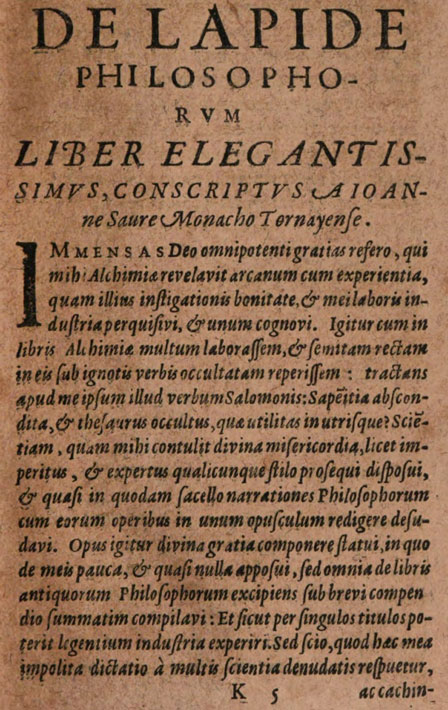
Translated from the book:
Syntagma harmoniae chymico-philosophicae, sive philosophorum antiquorum consentientium ... nondum in lucem publicam editorum, collectum et distributum in certas decades, studio et industria Johannis Rhenani ...
I give immense thanks to Almighty God, who revealed to me the secret of Alchemy through experience; which, by the goodness of His prompting and by the industry of my labor, I sought out and knew as one thing.
Therefore, since I had labored much in the books of Alchemy, and had found the right path hidden in them under unknown words, I considered within myself that saying of Solomon: “Hidden wisdom and a concealed treasure what usefulness is there in either?” Therefore the knowledge which divine mercy gave to me, though I am unskilled, and yet in some measure experienced, I resolved to pursue in writing; and, as though in a certain little bundle, to gather the sayings of the Philosophers together with their works into one little book.
Therefore, by divine grace, I determined to compose a work in which I set forth little from myself, and almost nothing; but, taking all things from the books of the ancient Philosophers, I have compiled them summarily under a brief compendium.
And just as you will be able to learn by the separate titles through the diligence of reading, so you will also test it by experience.
But I know that this unpolished discourse of mine will be rejected by many who are stripped of knowledge, and by the cackling of frogs.
They will also be indignant against me, asking why I, an idiot and one knowing little, have preferred to study so high a thing under such obscurity of art and volume. To them I answer this one thing: that just as more profit is obtained from sterile earth by its own ploughshare than from the price of any metal or stone, so also to men not fully learned this art, moderately tested, is far more profitable than if it is set forth in philosophical and poetic speech.
For, whatever it may be, apart from refined discourses, I have deemed myself worthy in some part to give to men unworthy an understanding of this art. But now it must be diligently considered what the principles of this art are, what its progress is, and what its end is; and we have undertaken this work for your edification. Yet if anything has been omitted here, let the reader know that it has been reserved for another work.
Therefore, if anyone desires to know the author’s name, let him attend to the first letters of the thirty-four words of the following verses, and let him deign to pray for his sins.
Whence the verse:
In the coverings Azoth has a cloud in the new Ethelia;
thus they are the arts, the King wishes to be healed equally.
The mouth, shining white, kills; Hestra foaming venom;
then the odor, the red work shines, Ycar is born there.
All the works of divine goodness are circular, and perfect toward Him from whom they came forth, by spherical rotation. From the beginning, before His creation, He set His own nature before all things in four. From these He made simple bodies, from which afterwards He established living bodies also.
But of mixed things He made some intellectual, some sensitive, and some only vegetative. The intellectual things indeed all, from the rarity of the elements He created for Himself; and therefore our heart is restless until we come to Him. For every rarity of the elements ascends to fire, which is above the stars. Therefore we, created by Him, deservedly tend upward to God as to our beginning.
But all sensitive things, and likewise vegetative things, composed from the thickness of the elements, are distinguished into diverse species; whence, when they are dissolved by death, they are not undeservedly turned back into earth and water, as to their mother. For the thickness of the elements naturally tends downward to its center, namely, the earth.
Yet the nature of all constant things has a certain limit of magnitude and increase, so that in its own species it may increase its like; and some of their parts are dissimilar, as from flesh, blood, and bones, or from wood, bark, and leaves.
But those things which are made of dissimilar parts possess in themselves their own seed, from which they multiply and grow, fixed to the earth, as vines among shrubs. But those things which are made of similar parts do not multiply unless they are reduced to their first matter.
Wherefore the Philosopher says: “Let the knowers of the art of alchemy know,” etc.
Therefore, all bodies consisting, both perfect and imperfect, from the beginning of creation, are composed from four principles; and these four are the elements of nature: air, fire, earth, and water, which Almighty God coagulated, mixed together, and completed in peace.
For in these four elements the secret of the Philosophers is hidden, of which two, namely earth and water, have only force and appearance; but the other two, namely fire and air, are neither seen nor touched except in the first elements.
But when these four elements have been joined and perfectly mixed, and altered and extracted from their natures they become something else. Hence it is evident that all variable things are generated similarly through the elements, and are naturally transmuted.
Whence the Rosary says: simple generation and natural transmutation are the operation of the elements. But it is necessary that the elements be of one genus, not diverse; otherwise they would not have action and passion toward one another. For, as Aristotle says, there is no true generation except from things agreeing in nature.
Therefore do not seek in nature what is not in it, because things exist only according to their nature. The elder-tree never brings forth pears, nor the bramble pomegranates; nor do we ever gather grapes from thorns, or figs from thistles. For things bring forth only what is similar to themselves, nor does anything bear fruit except its own fruits.
Therefore it is necessary that our medicine be especially taken from those things in which it chiefly consists, leaving aside salts and alums and other common things, from which many try fruitlessly to draw out the medicine. For neither salts nor alums enter into our magistery; but the Philosophers named salts and alums and the other places of the elements, as Theophilus says.
But you, who desire to make the Elixir wisely and usefully, know the mineral roots, making your work from them, because, as Geber says, you will find the end of the thing in the veins of the earth.
For sulphur and mercury, which are the roots and natural principles upon which nature founds her action in minerals and in the caverns of the earth, are a viscous water and a stinking spirit, running through the passages and entrails of the earth. And from them arises a vapor, which is the matter of metals; united by a most temperate heat, ascending, and reverberating upon its own earth, as is more fully clear in the book of Geber.
Until, through temperate decoction in the course of thousands of years, a certain natural fixation is made there, and metal is made.
In like manner, from gold, which is our sulphur, reduced into mercury by mercury which is called thickened water, and united with its own earth by temperate decoction there arises a vapor from the veins of its own earth, that is, from itself. Afterwards this is turned into a most subtle water, which is called soul, spirit, and tincture, as will be clear in what follows.
And when that water has been reduced back into earth, from which it came out, and again from every side has made a certain fixation there through its own veins, the Elixir is completed.
And thus art works, in a short space, by human ingenuity, more than nature works in the circles of thousands of years. And yet we do not act, but nature does; nor do we change things, but nature does; we are only the administrators.
Whence Medus says in the Turba: although our Stone contains in itself tincture naturally, created perfectly in the earth, nevertheless it has no motion by itself so as to become an element, unless it is moved by art.
Therefore let us choose natural and closely related minerals, according to the words of Aristotle in the fourth book of the Meteors: since nature has produced all metallic bodies from the vapor of sulphur and mercury; and you will find no Philosopher disagreeing from this.
It is expedient, therefore, that you know the principles of the art and the principal roots, because he who does not know the principles will not find the right end.
Hence Geber says at the beginning of his book: he who has been ignorant of natural principles in himself is very far removed from the art, because he does not have the true root upon which to found his operation.
Likewise in another place: it is necessary that our art be discovered by the ingenuity of nature, and that the natural principles and the foundations of nature be subtly investigated.
And yet, although he may know its principles, he cannot follow nature in all things, as the same Geber says in the first chapter, when he says:
Most beloved son, we reveal a secret to you because in this matter those craftsmen err who desire to imitate nature in all its properties and differences.
Therefore, having briefly set these things beforehand as a prelude, let us come to the artificial works of the operation.
Many call into doubt the Stone of the Philosophers, who ask what it is, how it is made, or from what it is made, since it is openly named by none of the Philosophers. In this they have babbled diverse things, although truth consists in one thing alone.
But without doubt, and without any error, we say that this Stone, which is the root of the art and the secret of God, concerning which all the wise have treated, and which has stripped many bare and made them foolish forever, is nothing other than male and female, Sun and Moon, heat and cold, sulphur and mercury.
Having passed over this degree, seek another stone, and foolishly consume your money and bring sadness upon your soul: for what you sow, this also you shall reap.
And because this Stone is divided into two parts, as was said before, we shall say a few things concerning its first part, that is, gold; and that without it our work is not made, we shall prove by the sayings of the Philosophers.
For Aristotle says: Among all things of the world, gold is worth the most, and it is the ferment of the white and the red; without it the work is by no means completed.
Likewise Hermes says: There is no true tincture except from our bronze, that is, gold; because all gold is bronze, but not all bronze is gold; just as all gold is sulphur, but not all sulphur is gold, because in it there is something of the corruption of sulphur. Indeed, the truest sulphur is proved true in it.
When in this work it has been whitened, it performs the operation of white sulphur, congealing mercury and converting it into the desired gold.
Therefore use the nobler member, that is, gold, because it is the genus of genera and the form of forms. For it is first and last among metals, as the Sun among the stars.
But it must be chosen in that noble member which is homogeneous with both luminaries of the world, that is, with the Sun and the Moon.
The subtle spirit hidden and covered in that noble member is homogeneous; without it the work is not perfected.
Hence Rasis says: gold does not tinge itself until the hidden spirit is extracted and becomes wholly spiritual.
Therefore do no work except with that which is truly lucid, and the purest light gold which by its own light illuminates all the luminaries, and by its power drives out the darkness of night; that is, the superfluities of mercury and of other imperfect bodies, when it has been projected upon them.
Hence Geber says in the chapter on the essence and procreation of the Sun: its radiating splendor shines forth, and from its clearest and cleanest substance it radiates and illuminates not only by day, but also in darkness.
Likewise Pandulphus in the Turba: Know, brothers, that no body is more precious and purer than the Sun; for, he says, the ruby has in effect the virtue of all precious stones, just as the Sun has in itself the virtue of all ductile stones. For it contains in itself every metal, tinges them, and vivifies them. It is nobler than they, because it is the lord of stones, the noblest, the head of bodies, and the best of them.
Its nature is of equal quality, and in it the four elemental natures are complete without increase or diminution.
For in it nature has as many parts of heat as of coldness, as of dryness as of moisture. For it is not corrupted by air, nor by water, nor by earth; nor does fire diminish it, but rather moistens, rectifies, and adorns it, because its complexion is tempered and its nature upright.
Therefore the better stone of the mercurial stones is that one which is more cooked, and nearest to fire.
The second part of our Stone is called Mercury, which by many Philosophers is itself named the Stone. Hence a certain wise man, when speaking of it, says: “This is the stone that is not a stone, without which nature never operates anything; for it receives the work, directs it, and from it every color appears; its name is quicksilver.”
Rosinus says of it: “The work can be created from it, because it surpasses every nature. It is friendly to metals, and the medium for joining tinctures, because it receives into itself what is of its own nature, but rejects the alien, because it is uniform in substance in all its parts.”
This Stone, however, is called by the Philosophers mineral or natural, vegetable or herbal, animal or vital, factitious or artificial.
It is called mineral or natural because it is generated in mines and is the matter of all metals; or because projection is made upon it, and it is converted into metal.
It is called vegetable or herbal because, from the juice of three herbs joined in equal proportion, after it has stood in moist heat for twenty-four days, the Stone will flow forth and emanate, of the same color and virtue as the mineral. The mercurial herbs are sea-purslane, which makes milk, and celandine.
It is called animal or vital because, from it alone, without any addition, after its elements have been separated and again mixed in equal weight, and then placed in a glass vessel with a small breathing-hole in the fire of the sages, within three months horrible worms are produced, each one of which will devour its companion, until only one remains. If mercury is wisely added to this one, it grows to the size of a toad, whose form is terrible; and by itself it is an Elixir upon Saturn and Jove, etc. Or it is called the animal Stone, because it is made from an animated thing, namely, man. For in old latrines it is found from the putrefaction of moist dung, and with a glass vessel, subtly arranged, it is collected.
Therefore the Philosophers have said: our Stone is found in every man, and is of the vilest thing, and of the rarest price.
Hence Pythagoras says: this Stone is not an animal stone, because it is lawful to beget it.
Likewise Vincentius says that what is cast away into the dung-hill is vile, and thrown before the eyes of every ignorant man.
Likewise in the book which is called The Mirror of Alchemy: this Stone is cast into the roads and is found in dung-hills; it contains in itself the four elements, and rules over them.
And this Stone is also called factitious or artificial, because it is investigated by the ingenuity of man.
Some make Mercury from lead in this way: they melt lead seven times, and each time they submerge it with dissolved sal ammoniac. Afterwards they take three pounds of this solution, and one pound of glassy salt, half a pound of borax, and mix the whole; and they put it under the fire of the sages for forty natural days. And mercury is made, and there is no difference between it and natural mercury, except that it does not enter into our magistery like the mineral one.
Behold, if you have been among those who, as Plato says, have gone beyond the limit of animality, the declaration of the Stone of the Philosophers is enough for you.
Therefore know the clean from the unclean, because nothing gives what it does not have. The clean is a being empty of alterations; the unclean is a diverse thing, joined together from contrary parts, easily susceptible to corruption.
Therefore do not put into your work any foreign thing; nor let anything enter into our Stone which is not born from it, neither from its part nor from the whole. But if any foreign thing is added, it is immediately corrupted, and what is sought from it will not be made.
For you will purge the citrine body by burning with fire, and you will find it purified, if it is from flowers. And after it has been well purged, beat it very thinly; then make it into very small plates, or very thin leaves, and reserve it.
But the white liquor has two superfluities, which must necessarily be removed from it: namely, a superfluous foul earthiness, which is an impediment to fusion; and a fugitive moisture, which is an impediment to fixation.
The foul earthiness is destroyed in this way: put it in a marble or wooden mortar, and add as much clean and dry common salt, and a moderate amount of vinegar. Stir it strongly in a circle until almost nothing of the liquor appears, and the salt is well blackened.
Afterwards wash the whole with clear water until the salt is dissolved into the water. Then pour off that turbid water, and add salt and vinegar to the white liquor as before. Again wash with clear water as before, and do this many times, until the white liquor becomes clear like a mirror and of a heavenly color.
The last time, put it into a fine linen cloth, doubled or tripled, and press it two or three times into a clean glass vessel, or a glazed vessel, until it is dry.
The proportion of the parts is this: twenty-four hours are a natural day; add one to these, and they become twenty-five. And this is wisdom.
Geber says, Book 2, chapter 4: Nothing is submerged in Mercury except the Sun; it is fixed, and is a tincture of exuberant redness of renewal, shining with splendor.
Likewise, Book 4, chapter 8: In your works, strive to overcome quicksilver in mixture.
Likewise Rosarius says: bodies are of greater perfection when they contain more quicksilver. For Rosinus says that the wise concealed nothing except weight and quantities; and this we can know by this: that no one thing agrees with another in weights.
Therefore it is a great error, because although the medicine may be well prepared and well mixed, unless the quantities of the things are just according to reason, you have lost everything as to truth and final completion.
And this we see in examination: when a body is transmuted, it is placed in the ash-vessel, because there it is consumed and destroyed, sooner or later, according as it approaches equality more or less. And if the proportions are rightly according to reason, it will never be corrupted.
Therefore no one except a wise man can here transmute, who does all things according to reason, true subtlety, and natural understanding.
Curclides, a most wise man, advised us to work in nothing except in the Sun and Mercury, which, joined together, constitute the Stone of the Philosophers.
Hence Rosinus says: the white and the red proceed from one root, and they spring up with no body of another kind intervening; that is, from the Sun.
Yet the Sun itself, without Mercury, is deprived of effect, because true generation is made only from matter and form.
It is fitting for you to know this: that no stone, nor gem, nor any other thing, except this Stone, is suitable for this work. But you need it, insofar as you labor to repeat the solution of the citrine body, reducing it to its first nature.
Hence Rosinus says: We dissolve gold, indeed, so that we may reduce it into its former nature, that is, Mercury. But when there are about one hundred, by which this is done, they have in themselves every tincture that endures fire.
Wherefore Rosinus says in the Gates of Secrets: Make a marriage between the red man and the white wife, and you will have the whole magistery.
Likewise Merlin says:
If the white woman is married to the red husband,
they soon embrace, and embracing they conceive.
Through themselves they are dissolved, and through themselves also perfected,
so that the two who had been, become as though one body.
And certainly our solution is nothing else than that the body be converted into moisture, and that in it the matter of quicksilver be revealed, without which the sulphurous saltinesses are diminished.
Therefore, unless our bronze is destroyed, washed, and sparingly and wisely governed, drawn out from its thickness, and turned into a thin spirit, you labor in vain.
Hence in the Mirror of Alchemy: the first word of this work is the reduction of the body into water, that is, into quicksilver. And this is what the Philosophers called solution, which is the foundation of the whole art. And make that body one of manifest liquefaction and hidden subtilization; this solution is gradually accomplished by grinding.
Wherefore Rosinus says: the disposition of our Stone is that it be put continually into the vessel and cooked until the whole rises dissolved.
Concerning this it is said in the Mirror of the Philosophers: the philosophical Stone rises from a vile thing into a most precious treasure; that is, from sperm, gold, in the matrix, mercury, projected by coitus, that is, by conjunction.
Likewise he truly says: when it is composed with its like and mercurized, it will be a purging germ. For the soul, spirit, and tincture can then be extracted from them by temperate fire.
Hence Aristotle says: let the artificers of Alchemy know that species cannot be transmuted unless they are reduced to the earlier matter.
Likewise Geber says: from mercury alone the whole must be made; because when Sol is reduced to its first origin by mercury nature embraces its own nature.
And then there is in it an ease of extraction, and subtlety of that substance, since it already has in actuality a most subtle substance.
Wherefore Alkides the Philosopher says: take things from their own mines, and exalt them to their own roots.
Likewise the Light of Lights says: unless one casts down redness with whiteness, he will come badly to the splendor of redness.
Likewise Rasis says, chapter 70: he who knows how to convert the Sun into the Moon, knows how to convert the Moon into the Sun.
Hence Pandulphus says in the Turba: he who wisely brings forth the venom from the Sun and its shadow has reached the greatest secret.
Likewise, without the Sun and its shadow, no tinging venom is generated; and he who tries to make the tinging venom in another way does not come to the end, but, wandering, falls into that place where sadness remains.
The vessel of our Stone is one, in which the whole magistery is completed. It is a cucurbit with an alembic, subtle and rounded above and below, flat without roughness, not too high; its bottom should be round in the manner of an egg, or of a urinal, with smooth walls, so that what must be sublimed may ascend and descend through it more freely. Let the vessel be of such size that the medicine occupies a fourth part.
And note that no other material is suitable for the vessel than double glass, because it is a bright and transparent body, lacking pores, and showing the colors that appear in the work; through pores, of course, the species could successively be drawn out and vanish.
Let it also be well suited to the ingenuity of the work, so that nothing can be seen through it.
Hence Lucas the Philosopher says: let the vessel be strongly closed with wisdom, so that nothing can go out or enter; for if its flower goes out, or if foreign moisture enters, the whole work will be deprived of its effect.
And although it is said many times by the Philosophers, “put it in the vessel and close it firmly,” nevertheless it is enough to put it in once and close it, until you have completed the whole magistery, which is still greater than the evil is.
Hence Rosinus says: Guard it wisely; keep it enclosed, surrounded with dew. Take every precaution that its flower does not go out into smoke.
Likewise in the Mirror of Alchemy: let the Stone of the Philosophers remain whole in the vessel, closed, until it drinks its own moisture and, nourished by the permanent heat of fire, becomes white.
Likewise in the book called Breviloquium: just as in a natural egg there are three things, namely shell, white, and yolk, so in the Stone of the Philosophers there are three things corresponding to those three: namely, the glass vessel for the shell, the white liquor for the white, and the citrine body for the yolk.
And just as from the yolk and the white a bird is made by the small heat of the mother, while the shell remains whole until the chick comes out, so in every way in the Stone of the Philosophers, from the citrine and white liquor, by means of temperate heat, the bird of Hermes is made, while our vessel remains closed and is never opened until its perfection.
Therefore guard the vessel diligently, closed wisely with the clay of the Philosophers, lest the spirit go out.
Therefore Rosinus says: Preserve your vessel and its binding, so that it may be powerful in preserving the spirit.
Likewise in another place: close the vessel diligently; do not hasten, nor cease from the work.
Likewise, beware lest its moisture go out from the vessel and the work perish. For Socrates says: grind it with very sharp vinegar, and cook it until it thickens; and beware lest the vinegar be turned into smoke and perish.
The Philosophers in their books have set down a double fire: dry and moist. They called the dry fire common fire, of whatever combustible thing. They called the moist fire hot horse dung, in which, while moisture remains, it retains heat; and when the moisture is consumed, the heat ceases to be, and its heat does not remain unless a small quantity, namely for five or six days; but its heat can be preserved by sprinkling urine mixed with salt upon it several times.
Concerning these things Phares the Philosopher says: the fire of the horse’s belly has this property: it does not destroy the fetus, but increases it because of its moisture.
Likewise Senior the Philosopher says: let the sepulcher be guarded, and let the woman be buried with her man in the horse’s belly, until they are joined of their own accord.
Likewise Allidenus the Philosopher says: it is necessary to hide the medicine in the moist dung of horses, which is the fire of the wise. For the fire of that dung is moist, warm, and dark, having moisture within itself and a blessed light.
Therefore no other thing in the world is likened to it, except the natural fire of the healthy human body, and the secret shore of the sea not fully burned.
The blood of man and the blood of a red grape are our fire; the regimen of these is such: the medicine for the white must be placed in moist fire until the completion of the whiteness appearing in the vessel. For it is a gentle fire of moisture.
Hence Pandulphus the Philosopher says: know, brothers, that the body is dissolved with the spirit, to which it is joined by the gentlest decoction, and becomes spiritual with it.
Likewise Astanus the Philosopher says: the fire of the salvation of the species is permitted.
Excessive heat does not equalize the elements, but rather disperses the moisture and destroys all things.
Therefore Rosinus says: be especially careful in sublimation and liquefaction not to increase the fire so much that the water rises to the top of the vessel; because if it does so, rejoicing in its coldness, it will adhere there, and thus you will not be able to perfect the operation of the elements of sulphur, because each one of them must be rotated spherically; that is, the Philosophers have been pressed down and raised up by only a temperate, inspired fire, and perfective of mixing.
Therefore Bululphus the Philosopher says: a gentle fire, which by many is called a white fire, is the greatest operation of the elements.
Likewise Rosinus says: burn our bronze with fire, as in the nursing of eggs, until the body is destroyed and the tincture is extracted. For by the gentle decoction of fire the water is congealed, and corrupting moisture is drawn out, and the burning of dryness is prevented.
Likewise, the whole benefit of this work is in the tempering of the fire. Therefore always beware of too great a fire, lest you come to solution before the time; for this leads to desperation.
Wherefore Rosinus says: beware of the intensity of the fire, because if it is increased before the time, it becomes red before the proper term, which is not useful.
And to show, as it were, the certain time of cooking, he says: the solution of the body and the coagulation of the spirit are made by gentle decoction of fire and moist putrefaction for forty days.
Hear also Orseltus saying: know that at the beginning of mixing you must place in the vessel raw, pleasant, sincere, and now rightly prepared elements over a gentle fire, and beware of the intensity of fire until the elements are joined.
Biolellus says: through tempered heat the body becomes sweet and suitable.
Be constant of will in your work, and do not presume to try now this, now that, because our art is not perfected in a multitude of things. For there is one Stone, one medicine, one regimen, and one disposition of it. For the whole magistery begins in one way, and is also finished in one way.
Yet the Philosophers have applied many artificial terms to hide the truth of their art, and they have continued them as: to cook, to mix, to sublime, to roast, to wax, to coagulate, to water, to putrefy, to whiten, and to redden. Yet one of these is this: only to dissolve and coagulate, that is, to cook and not to be weary.
Therefore Rosinus says: cook without intermission, without interruption; do not hasten, nor cease from the work, nor seek to enter upon a sophistical goal of the work, but intend only the completion of the Sun.
Likewise Rosinus says: it is most sound advice that you put the work in only once, and do not leave the work shortened.
Likewise he says: be long-suffering in the regimen; close the vessel strongly; do not cease, because no generation of things is made except through continual motion, exclusion of air, and tempered heat.
When you are in the work, strive to keep in mind all the signs which appear in each decoction, for they are necessary to the artificer for the completion of the whole work.
For it is supremely necessary to continue the work, especially up to whiteness. Therefore it follows that if the composite is ruled otherwise than it ought, it is immediately extinguished.
For Rosinus says: the disposition of our Stone is one, and it is that it be placed in its vessel and cooked continually, until the whole rises dissolved, as Hermes says: cook, cook, and again cook, and do not be weary.
Therefore, when all things have been arranged as was said before, let the vessel with the medicine be placed in moist fire, so that half of it is outside, in such a way that it can be looked at every day; and within forty days the surface of the medicine will appear black, like liquid pitch. And this is the sign that the citrine thing has truly been converted into Mercury.
Bonellus says: when you see its blackness appear, know then that that body has been liquefied. And this indeed is what Rosinus says: the disposition of our Stone is one, as above.
Likewise in another place: continue over it the temperate bath until it is dissolved into impalpable water, and the whole tincture comes forth in the color of blackness, which is the sign of solution.
Likewise Lucas the Philosopher says: when you see, he says, the blackness of that water threatening everywhere, know then that the body has been liquefied.
The Philosophers called this blackening the first conjunction, because then the male is joined to the female, and it is the sign of perfect mixture.
Yet not the whole tincture is extracted at once; rather, it comes forth little by little, until it is completed over a long time. And what is dissolved always seeks the upper parts, though what settles becomes greater. From this, namely, what becomes spiritual within the vessel rises upward; but what is thick and gross remains below in the vessel.
This blackness is called by many names, such as soul, fire, cloud, raven’s head, coal, oil, tincture of redness, shadow of the Sun, black bronze, water of sulphur, and many other names. And that blackness joins the spirit with the body.
Wherefore Rosinus says: by the continued regimen of fire, in the number of forty days, both will become permanent water covered with blackness. This blackness, if it is duly governed, will not remain beyond forty days.
Concerning the color of blackness Plato also says: as long as blackness appears, the hidden female rules, because she herself is the first force of our Stone; for unless it becomes black, it will not become white nor red.
Likewise, first in our work all things are blackened; secondly they are whitened; thirdly, through greater intensification, the composite must be turned to ash.
Hence it is written in the book which is variously called Cu. Cu., in the first part, which is called putrefaction: our whole Stone becomes black, that is, black earth through the extraction of its moisture. In this blackness whiteness is hidden; and when that moisture has been poured back upon its blackness, and by gentle roasting has been fixed with its earth, it becomes white, and in that whiteness redness is hidden. And when it has been decocted with an increase of fire, its earth is turned into redness, as will be taught later.
Now let us proceed. Let us return to the black Stone, continually enclosed in its vessel. Therefore let the vessel stand continually in moist fire until the white color appears white, in the manner of the whitest salt; and in color, according to the Philosophers, it is called arsenic and sal ammoniac, without which, according to them, nothing useful is done in our work.
But when intense whiteness appears, the perfect conjunction and indissoluble coupling of the parts of the Stone is made. And then the saying of Hermes is completed, when he says: “That which is above is as that which is below, and conversely, for accomplishing the miracles of one thing.”
But Phiares says: seeing whiteness coming over in the vessel, be certain that redness is hidden in that whiteness.
But before it becomes white, many colors will appear. Therefore Diomedes says: cook the male and the vapor until both are coagulated into dryness. For unless it is dry, diverse colors will scarcely appear, because the black always rules with the moist.
But when the dry begins to ascend, then it gives forth diverse colors. Indeed, in many ways it will be moved by turns from color to color, until it comes to its whiteness.
Likewise Zinon says: all the colors of the world will appear in it when the blackened moisture has been dried. But do not concern yourself with those colors, because they are not true colors. For it will often become citrine, often be dried, and liquefy before whiteness.
Yet the spirit is not fixed with the body except with the white color.
For Astanus says: between blackness and whiteness all the colors that can be imagined will appear; because of their diversity the Philosophers have given different names, almost innumerable. Some did this through envy; the cause of the operation of the diverse colors in the Medicine is the gradual distension of that blackness.
Since blackness and whiteness are the extreme colors, all other colors are intermediate. Therefore, whenever some degree of that blackness descends, another color, and another, appears, until it comes to the other extreme, namely whiteness.
Because of the ascent and descent in the medicine, Hermes the Philosopher says: it ascends from earth into heaven, and again descends from heaven into earth, and receives the power of the superior and the inferior.
And note that if, between blackness and whiteness, a red or citrine color appears, do not concern yourself with them; for they are not permanent, but unstable, because no permanent and perfect redness can be made unless whiteness has first been made.
Hence Rosinus says: no one can pass from the first to the third except through the second. From this it is clear that whiteness must always be awaited, since it is the completion of the whole work; nor will it be changed into the true color except into red.
Now you have learned how to make the white; now it will be necessary to make the red. For the white matter and the red matter do not differ from one another in any essence, except in this: that the red medicine needs greater subtlety, longer digestion, and a hotter fire in its regimen. And this is because what is the end of the operation of the white is the beginning of the operation of the red; and what has been completed in one has been begun in the other. Therefore, unless you first whiten this medicine, you will not be able to make true red. But now let us briefly say how it is done.
The medicine for the red must first be placed in our moist fire until the white color appears, as was said before. Afterwards the vessel is taken out of the moist fire and placed in an earthen pot half full of sifted ashes moistened with water, so that the glass vessel with the medicine may be in the ashes up to the middle; and beneath the earthen pot let there be a slow, temperate, and continuous fire. Yet the heat of this dry fire is at least twice greater than the heat of the moist fire.
And by the benefit of this heat the white medicine receives the tincture of redness. Indeed, you cannot go wrong if you continue the dry fire as you have continued it.
Hence Rosinus says: with dry fire and dry calcination, decoct it until it becomes like cinnabar; afterward add to it neither water, nor oil, nor vinegar, nor any other thing, until it is decocted to complete redness.
And certainly, the more red it becomes, the more it is worth; and the more it is cooked, the more red it is. Therefore the more red it is, the more precious it is. And so burn it with dry fire without fear.
Hence Eximenus the Philosopher says: in the red furnace cook the white until it is clothed with purple beauty. Do not cease, although redness may seem somewhat slow to appear. For, with the fire increased, as I have said, after the white, from the first colors you will have the red. Yet between those colors a citrine color will appear; but its color is not stable, because after it the perfect red will not delay long in appearing. When it comes, be certain that your work is completed.
For Hermes says: between the white and the red only one color will appear, namely citrine; but it varies according to more and less.
Likewise Mary says: when you have the true white, then the deceitful citrine, and afterwards the perfect red, then you have the glory of the brightness of the whole world.
Our medicine, that is, the Elixir, is multiplied in two ways: by solution and by fermentation.
By solution in two ways, namely by solution of heat or by solution of rarity.
The solution of heat is that you take the medicine placed in a glass vessel and bury it in our moist fire for seven days, or longer, until the medicine is dissolved into water without turbulence.
The solution of rarity is that you suspend the glass vessel with the medicine in an earthen pot, whose mouth is narrow, in which water boils; and let the mouth of the vessel be closed, so that by the vapor of the boiling water rising, the medicine may be dissolved.
But note that that boiling water must not touch the glass vessel with the medicine by a space of three fingers. And this solution may perhaps be done in one day, or in twenty-three.
Let the medicine be removed from the fire to be cooled, fixed, congealed, hardened, or dried. And thus let it be dissolved many times, because the more often it has been dissolved again, the more perfect it will be.
Hence Bonellus says: when the thing is burned, and repetition is made many times, it becomes better than it was at the beginning; and such a solution is the subtilization of the medicine, and its virtual subtilization.
Therefore, as often as it has been subtilized, so often it will receive greater virtue, and a more intense tincture; and it tinges more abundantly, and profits better, and converts more.
Hence in the fourth solution it receives so great a virtue and tincture that one part will be worth more than a thousand parts of cleansed mercury, so that it converts it into Sun or Moon better than what is produced from the earth.
Hence Rosinus says: the goodness of multiplication does not depend except on the multiplied repetition of the sublimation and fixation of the perfected medicine; for the more often the order of this completion is repeated, the more its excellence is increased.
For the more often you sublime and dissolve the perfected solution, so many times will you gain in every projection; that is, over a thousand: so that if at first it fell upon a thousand, the second time it will fall upon ten thousand, the third upon a hundred thousand, the fourth upon a thousand thousand, the fifth upon infinity.
For Merodius says: know for certain that the more our Stone is dissolved and coagulated, the more the spirit and soul are joined together and retained by it; and by this the tincture is multiplied each time.
Likewise, in another way the medicine is multiplied by ferment; and the ferment for the white is pure Moon, and the ferment for the red is pure Sun.
Therefore let one part of the medicine be projected upon twenty or forty parts of the ferment, and the whole will become medicine. Let it be placed over the fire in a glass vessel, and let it be closed so that air may neither enter nor go out. Let it be dissolved and subtilized as often as you wish, just as you did with the first medicine; and one part of the medicine will receive as much virtue as one part of the first had.
Hence Rosinus says: now we have completed our medicine in the hot and the moist, as it also had a temperate condition; whence whatever is added to it will be of the same complexion as that to which it is added.
Therefore join it so that it may generate its like. Yet you must not join it with any other thing so that it may be converted to itself, except with that from which it was at the beginning of its solution; that is, to espouse and join that earth revived, and revived by its own soul, through the mixture of its first body from which it arose.
Likewise in the book called The Saving Gem: the white work needs a white ferment; when it has been whitened, it is also a white ferment; and when it is reddened, it is the ferment of redness.
And just as that earth is the ferment of the ferment, because when it is joined to the Moon, the whole will be a medicine for projection upon Mercury and upon every imperfect metallic body toward Moon; and when the red is joined to the Sun, it will be a medicine for projection upon Mercury and upon Moon toward Sun.
For the soul, spirit, and tincture can then be extracted from them by temperate fire.
Hence Rosinus says: let the artificers of alchemy know that species cannot truly be transmuted unless they are reduced to their former materia.
Likewise Geber says: everything must be made from Mercury alone. For when Sol is reduced to its first origin, nature embraces its own proper nature; and in it there is ease of extracting that subtle, fusible substance, since it already has this most subtle substance in actuality.
Likewise, without the Sun and its shadow, no tinging venom is generated.
And he who tries to make the tinging venom in another way has already fallen, wandering, into that place where sadness remains for him.
Likewise Aristotle says, chapter 25, On Stones: upon solution put solution, and upon solution desiccation, and put the whole to the fire. Guard the smoke carefully, lest anything flee from it; remain near the vessel and watch, and marvel how it will be moved from color to color, in less than one hour of the day, until it reaches the goal of whiteness or redness. For it is very quickly liquefied in fire and congealed in air, because the smoke, when it feels the fire, will penetrate into the body, and the spirit will be constrained into the dry; and there will be one fixed, clear body, white or red.
Then remove the fire, allowing it to cool, because one part of this over a thousand will heal the body, converting it into the best Sun or Moon, according as the Elixir has been prepared.
Therefore it is clear that whoever does not coagulate quicksilver, enduring the fire, and does not join it to mere Mercury, has entered upon no way to the white.
And whoever does not make quicksilver wholly red, and sustaining the fire, and does not join it to mere gold, has entered upon no way to the red.
For in this way, through solution and fermentation, the medicine can be multiplied to infinity.
And note that the Elixir most quickly gives fusion like wax; whence it is said that every given thing is best. Yet a well-prepared Elixir ought to liquefy upon a glowing plate or coal, and to flow like wax. What you do in the white, do also in the red, because the operation of both is one and the same, both in multiplication and in projection, as Geber the Philosopher attests, Book 5, chapter 21.
There are three orders of medicines.
The medicine of the first order is that which, when projected upon imperfect bodies, does not remove their corruption, nor tinge them from imperfection; but the tincture recedes in the examination.
The medicine of the second order, when projected upon imperfect bodies, tinges them in the examination with the required tincture; but not every corruption of the bodies is wholly removed by such a medicine.
The medicine of the third order is that which, when projected upon imperfect bodies, removes all their corruption and reduces the corrupted mineral into an incorrupt mineral.
But, leaving aside the first two, let us briefly say something certain about the projection of this medicine.
The perfect medicine is projected upon a thousand, or upon more, according as the medicine has been dissolved and subtilized. But if so small a quantity were projected upon so great a quantity, because of its smallness it would fail before its virtue were perfected.
Therefore the Philosophers made their projection in a different way; but this way is better:
Let one part be projected upon a hundred parts of prepared mercury, and the whole will become medicine, and it is called the second medicine.
And each part of the second is projected upon a hundred parts of cleansed mercury, and the whole will be medicine, and it is called the third medicine, and it will be almost ten thousand.
Likewise each part of that third medicine is projected upon a hundred parts of prepared Mercury, and they will become a thousand thousand, and the whole will be the best Moon or Sun.
And note that the second medicine and the third can only be dissolved, subtilized, and sublimed insofar as they receive greater virtue; and thus it can be multiplied to infinity.
Make projection thus: first multiplying ten into ten, and they will be 5 and 5 in a hundred, a hundred thousand, and it is not a number. That is to say: put one of them upon ten, and one of them upon a hundred, and they will be a thousand; and so with the rest.
But how projection is to be made: thus, place it over the fire in a little sealed vessel; and if the spirit tempests, cast in the elixir, as has been said, stirring well. And when the elixir has quickly liquefied and has been mixed with the body or with the spirit, remove it from the fire, and by the grace of God you will have gold or silver, according as the elixir has been prepared.
And it must be noted that the more fusible the minerals are, the more the medicine will be worth upon them. Therefore, since Mercury is more easily liquefied than any other body, the medicine will be worth more upon it, and will convert, perfect, and tinge more of its parts than of any other body, according to their easier or more difficult fusion.
The End.