Necessary Instruction On Gold-Making
Listen Audio Book Study the Art with Us Buy me Coffeehttps://www.alchemy-texts.com/book/necessary-instruction-on-gold-making/
Wilhelm Freiherr von Schroedern
Necessary Instruction
On Gold-Making,
for the Buccinators, or those who call themselves
Hermetic Confederates,
for friendly information concerning their three epistles.
1721
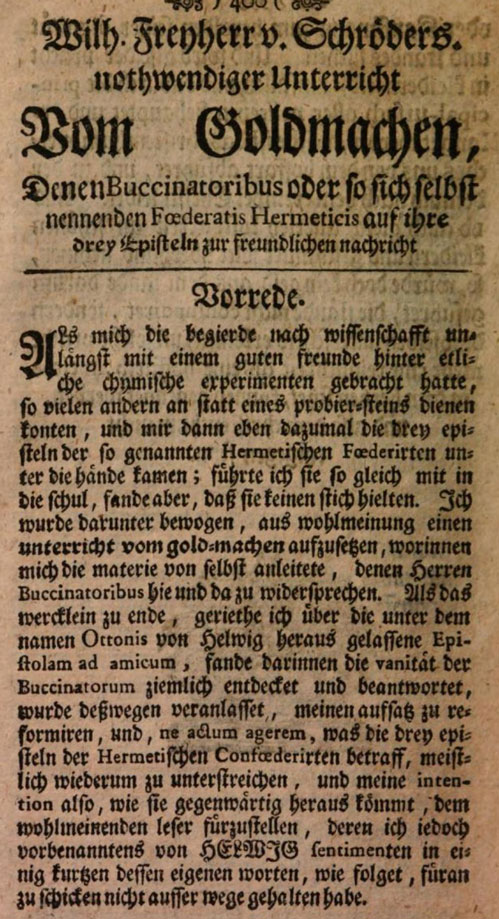
Translated from the book:
Fürstliche schatz- und rent-cammer nebst seinem tractat vom goldmachen wie auch vom ministrissimo oder ober-staatsbedienten
Foreword.
When the desire for knowledge had long ago led me, together with a good friend, to make certain chemical experiments, which could serve many others instead of a touchstone; and just at that time the three epistles of the so-called Hermetic Confederates came into my hands, I at once brought them with me into the school, but found that they did not hold firm.
I was moved thereby, out of good intention, to compose an instruction concerning gold-making, in which the matter itself instructed me to contradict these gentlemen Buccinators here and there. When that little work was finished, I came upon the Epistola ad amicum published under the name of Otto von Helwig; and therein I found the vanity of the Buccinators rather well uncovered and answered.
For that reason I was prompted to reform my essay, and, so that I might not be doing what had already been done, to suppress, for the most part, what concerned the three epistles of the Hermetic Confederates, and thus to present my intention, as it now comes forth, to the well-disposed reader. Yet I have not considered it out of place to send before it, in a few words of Helwig’s sentiments concerning this matter, as follows.
JUDGMENT
of Dr. Otto de Helwig
concerning the Hermetic Duumvirs,
Confederates.
In that long discourse there occurs no deceit, nor anything of any importance by which I could suspect that the Duumvirs Hermetici rightly deserve the title of adepts, or of the science which they call Hermetic, with which they have so often adorned themselves in many places.
I acknowledge them to be learned men, of much reading, skilled in various languages, yet strangers to the true foundation of philosophy. And although I envy no one the Hermetic name, nevertheless I do not believe that they have the least right to it in this matter, nor that any illumination of Hermetic philosophy is to be expected from them in this respect, especially since they are utterly ignorant of the kernel of the very brief Emerald Tablet, etc.
If they are men of sincere heart and of respected authority, as being attached to public offices, I pity their fate, by which they are carried away into such vain labors.
Mystery, I advise, indeed do not make,
Where clearly the matter is named;
For that makes many of them greatly err,
Who confuse that very thing which is clear,
And seek from the deep to bring forth
What lies openly before their door.
Necessary Instruction
On Gold-Making
CAP. I.
Whether it is true that a Philosophers’ Stone or a tincture has ever been found in the world? And whether gold or silver can possibly be brought about by some means of art?
1.
For three years now, certain persons, one after another, have issued in print three trumpeting epistles (Epistolas Buccinatorias), which claim to know the art of making the Philosophers’ Stone, thank God. In the first of these they presume to swear the adepts to this: that those adepts should clearly and without reserve lay before them the mystery, with all its circumstances.
If this were not done within three years, counting from the 1st of January 1681, then they wished to draw six hundred others also into their alliance, to reveal to them the secret of the art, and each of these was to labor and make experiments according to their secret direction.
After this had been pursued in such a manner for three years one after another, and yet the truth of the art had still not thereby been laid before their eyes, they then wished to prostitute the whole Hermetic profession in star-meretrices that is, among star-harlots and to sing and say before the whole world that it was, in one word, in a word, that the whole Hermetic philosophy was invented and lied.
But the reason why the adepts should allow themselves to be forced by these two confederated gentlemen into such an extraordinary revelation of the arcanum, they state thus: because they, the confederates, understand the theory of the art as well as any adept, whoever he may be.
But since their higher occupations did not allow them to apply themselves at present to its practice, and yet every adept, from their meaningful writings, could easily recognize them and their knowledge in the Hermetic art, they therefore wished to have left to those same adepts peace or the sword one of the two to choose, whichever of the two would be at their service.
Now, since such a harsh and, for Hermetic philosophy, dangerous declaration of war was doubtless to be read by many adepts, but no one could find from it that this duumvirate possessed even a crumb of the true Hermetic art, whether theoretically or practically; and since no one wished to appear who would deem their epistle worthy of an answer, still less who would come forth to reveal anything therefore these gentlemen brought out their second epistle as a long-suffering admonition to the sons of the art, with a repeated threat already on the title-page in these words:
“For the adepts should consider in good time what concerns the Hermetic Republic,” etc.
But since the adepts wished to trouble themselves as little with this warning as with the former one, the confederates, in the third epistle, proclaimed the full rupture, a weakness which I would by no means have expected from such learned people.
2. For the confederated gentlemen will indeed, hopefully, have so much natural light that they recognize how little, or rather how very much nothing at all, it matters to a philosopher whether one person or another believes, or does not believe, that the art is true or not. For the multitude of the ignorant and of those who despise it has at all times been so great in the world, still is, and will be in the future, that it can neither add to nor take away anything from the universal human condition, whether there be a few more or fewer of them, and whether they set themselves against the art with words or writings.
Whether now our learned people who advise the art would let themselves be counted among such people, I would gladly, out of neighborly love, doubt; and rather hope that they will better recollect themselves, let their fury fall away with time, and leave the arcana of Hermetic philosophy unwritten as vain things; which, for my part, may remain left to their reason and their own modesty.
3. But our often-mentioned gentlemen desirous of the art will know, whenever it pleases them, how to inform themselves from one or another writing whether they find themselves deceived in their philosophy or not, and whether such things, according to their words, proceed from natural principles rightly penetrated. For many would have arrived at solid knowledge, had they not already thought that they knew; and I fear their collected processes will be an empty straw, with which, even if 600 others were to thresh upon it, in the end it would nevertheless be said:
When labor is spent at a loss, mortal poverty increases.
4. Much less need the confederated gentlemen be concerned that it might be ill received of them if they should open to others their abyss of Hermetic wisdom, whether allegorically or clearly and plainly. Let them speak, if they please, to heaven and earth; it will be all the same to us. Especially since anyone can sufficiently learn from their epistles that, in the Hermetic art, as far as the Philosophers’ Stone and its preparation are concerned, they have forgotten little.
5. My intention is not to contradict others, nor to involve myself in a dispute of words, for which I also have no time left; and where testimonies of things are present, there is no need of words. What I write, I have seen with my own eyes, partly made with my own hands, and partly I am still occupied in making and imitating.
6. In the other two kingdoms, as they are commonly called according to school-style, namely in the vegetable kingdom and the animal kingdom, multiplication is not found in the seed alone; for who else could one man beget and generate another, or animals be multiplied, or for what purpose would the farmer sow seed upon the field, from which also as Christ also says, Luke 8, that it bears hundredfold fruit.
Rather, we also know how to increase the powers of this seed in the aforesaid vegetable and animal kingdoms by human arts, in such a way that nature by herself, without the aid of art, would not be sufficiently capable of doing the same. For in the vegetable kingdom, since it is no longer a secret that seeds or kernels are grafted into certain soils and lyes, then dried again, and thrown into the field, by which means such seed is then increased in its power, so that from it many times more fruits grow.
Likewise, no less in the animal kingdom, the understanding physician knows, by experimented means, especially through the true coral-tincture, or through an oil made from vitriol, how to augment the natural generative power of man for generation; and the diligent housewife is diligent to mix the food for her hens with such things, so that they may lay all the more eggs.
Indeed, men, through their art, have come so far in helping nature that they also know how to shorten the birth-time, or the ripening of the seed; as, for example, when, by means of ashes from bean-straw, they force the petrified seed out of the earth in a few hours, which otherwise requires almost as many weeks’ time.
And although these two kingdoms seem to have something special from God in this respect, whereby their blessing expressed in the first creation, or the privilege of multiplication: namely, that the seeds of animals and plants lie open and visible, and can be separated from the whole body in a distinct form.
Yet art has not been satisfied with this, but in both kingdoms has searched out the seed diffused through the whole body, and has not wished to make use of the seeds produced by nature, such as marjoram-seed, sage-seed, and the like, in order to continue the multiplication of such kinds of herbs. Therefore it has destroyed the herbs, etc., or, by means of the extracted and prepared alkali, has produced the very same production and effect of seed, when it has carefully thrown it into the earth, and has made such herbs grow as if it had sown and planted the common seed, which otherwise an overripe herb gives of itself.
In the animal kingdom likewise, no less, through a careful destruction of the bodies, and clarification of their fixed salt, and through an exact, repeated conjunction of the spirit first drawn out, they have generated again living bodies and creatures of the very form and property as that from which this preparation was originally made.
And I truly stand in doubt, and have reason to doubt, whether something similar may not also lie hidden in nature in the generation of man. Why, then, should we wish to deny such properties, which are known to us in these two kingdoms are present, also in the mineral kingdom? And why should we not believe that, just as a metallic seed, separated and specially produced by nature, is found although in another form and manner than in the animal and vegetable kingdoms so also there is a diffused seed in the metals, which becomes manifest through the reduction of metals, even though such generative powers lie sealed up in iron and stony walls, and sunk into the abyss of the poisoned sea?
And it will indeed be true and remain true:
that in gold there are seeds of gold,
although, being hidden, they withdraw from sight.
And we see in examples from the vegetable and animal kingdoms that nature does not wish to bind herself only to one mode of generation and production of its like, provided only that art will offer her its hand; indeed, that she has also permitted art to improve the species which nature produces, yes, even to transform one thing into another.
But I am delaying too long in this philosophy, and it seems to me it would be too difficult an undertaking to make all the ignorant sufficiently informed, and in this matter to make them understand by a philosophical manner of proof. Therefore I fall back again upon the art of gold, or, as it is commonly called, upon gold-making.
7. As regards the truth and reality of gold-making by art, I am entirely assured of it. Many splendid and experienced men have confirmed it through their writings. But because the art is surrounded with so many thorns and thistles, and therefore is strange and hidden, such philosophers are also little believed.
Indeed, I know well that even if I were to maintain the possibility and reality of the transmutation of metals by all the grounds of philosophy, as well as I could, it would nevertheless bear little fruit, as has happened to others before me. For such writings give only a few of the most reasonable persons occasion to investigate the art. But to the others they seem like empty chatter, which, according to their school-principles, speaks of a new impossible thing.
8. Therefore, in order to prove the reality of the tinctures, I find no more suitable means than the examples of those who have possessed this science. But the possibility of gold-making I wish to demonstrate by an experiment which is in everyone’s power, immediately to imitate and to learn from.
I do not wish to mention that not long ago there was a project among certain artists, in order to stop the mouths of all contradictors at once: namely, to have a considerable quantity of gold tinged publicly before all the world, by an unknown person, in a distinguished imperial city, and to invite beforehand the most eminent courts in and outside Germany to inspect such an act.
For although this had been arranged in such a way that no danger from it was to be feared by anyone, and yet the truth of the art would have been proven for eternity would have remained proven, the proposal nevertheless has not yet been able to please entirely. Yet who knows what may be expected in the future?
And although this kind of testing does not belong to learned people, but to peasants, who carry their understanding only in their two eyes, still I will now act as a very simple man and make known the truth of gold-making through well-known examples; under which name of gold-making, at the present day almost everywhere in the world, the secret Hermetic Philosophy is understood.
9. What is found written concerning Theophrastus Paracelsus, and what is reported of him, lies open before everyone. But that Raymundus Lullius made for King Henry in England a great portion of gold, with which he was to wage war against the heathen and recover the Holy Land this is attested no less by the English histories than by Raymund’s own complaint-writing against the said king, because that king, contrary to the intention and promise, used it only in Christianity to shed blood.
This is also witnessed by the rose-nobles still circulating in the world, which were struck from such gold multiplied by Raymund.
10. But why do we trouble ourselves to fetch examples from ancient times and from foreign lands? Whoever wishes to doubt should go to Dresden in Meissen, and there look at the so-called Gold House look at it, have himself informed what was worked therein in the times of Elector Augustus and Mother Anna, and ask from where the splendid, costly buildings in that region came.
Whoever wishes to assure himself of the truth, let him inquire after the above-mentioned Elector’s chemical acts and journals; then he will find in the secret chamber-chancery a quantity of writings in the Elector’s own hand, and otherwise whole volumes, wherein the tincture-powders made from time to time, and the quantity of gold delivered week by week, are to be found properly recorded.
On the contrary, in the common account-chamber, which otherwise had to provide for all expenses, not one groschen, much less any considerable, namable, required sum, is shown to have been taken from it for so many notable buildings, such as the so-called stable, the Augustusburg, etc.; but rather it came from the secret chamber, just as this chamber had received it from the gold-house.
11. That Baron Chaos at Vienna in Austria possessed a tincture, and with it made projection before Emperor Ferdinand III; that also, for this reason, the baronial dignity and the Hungarian office of Chamber-Count were conferred upon him by His Majesty, is a matter known throughout all Germany.
But the above-mentioned Chaos himself did not make his tincture; rather, it came to him from a Count von Mannsfeld, general at Raab in Hungary, who had obtained it from another person had caused to be prepared. With this, when he had traveled to Saxony on business, that person became so ill at Prague that he had to leave both himself and the tincture there.
Meanwhile the artist died. The tincture came into Chaos’s hands, since he had been ordered to search in Prague, among the things left behind by the count, for this very tincture according to the described marks. But he put this tincture into his own bag, and gave his lord another little glass of the same shape and outward appearance as the one in which the tincture had been, pretending that he had found nothing else.
With this stolen tincture he afterward came to Emperor Ferdinand, and made various projections. But for Count von Mannsfeld all his good plans with the tincture came to misfortune.
From the above-mentioned projection there still lies a golden penny in the Imperial Art and Treasury Chamber, whose stamp expressly and with unmistakable words attests the truth of the transmutation of its matter, from quicksilver into gold, before the most highly mentioned Emperor.
12. The projections which were made with the tincture of Wenzel, well known at Vienna, both before His Imperial Majesty now reigning and before others, and that he was thereby made Freiherr von Rheinburg and chief mint-master in the Kingdom of Bohemia, are still in such fresh memory that they need only be mentioned it is almost unnecessary. And although the aforesaid Rheinburg could make the tincture just as little as Chaos could, and although afterward, in the undertaking and presentation of similar work, many unequal and disreputable things occurred, nevertheless all this can prejudice neither the truth of the tincture nor the projections.
13. What Doctor Schweitzer, or Helvetius, at The Hague in Holland, showed me himself long ago, and also reports in his book, which he named Vitulus Aureus concerning the result that happened to him is open to everyone to read therein.
14. Baron von Wagnerreck, who died at Ems only last year, had a tincture of which one philosophical grain four common grains tinged seven lots of imperfect metal into gold, and therefore one part tinged four hundred and twenty parts.
The whole city of Prague can bear witness to this: many intelligent and distinguished people, to whom he allowed this to be seen without hesitation; no less also both F. F. Gn. Gn. at P. and O., who can give testimony of something rather more than mere eyewitness. The aforesaid von Wagnerreck traveled about a year and a half ago to Vienna, where he died of dropsy, but meanwhile he corresponded with a learned man in Moravia, D. Herdott, with whom for a long time he had maintained a very confidential friendship, and had let him see the tincture and its power, also wishing had intended, in the renewed preparation of it, to make use of that same man’s hand and help; for this purpose he had promised to give him a small quintel of tincture. During this work, however, Herr von Wagnerreck, as mentioned, went to Vienna.
The correspondence between the two went through a solicitor, to whom the letters of both sides were enclosed, being their custom to find correspondence from one another regularly with every post. Once Herr von Wagnerreck sent the solicitor for letters; but because the solicitor had traveled somewhat, his wife delivered to him an unopened packet that had come to her address and had not yet been opened, with the remark that undoubtedly the usual letters to Herr von Wagnerreck were inside it, and therefore he should break it open.
In it he found a letter from D. H. addressed to a high place, together with an enclosed sheet attached separately, with a few additional lines to the solicitor, saying that the open letter should be read, sealed, and sent without delay to the proper place, and thereby the great interest of both of them should be observed.
Now D. H., on account of Herr von Wagnerreck’s approaching death, was anxious about the tincture, and undoubtedly, out of love and devotion toward his emperor and territorial prince, wished rather to grant it to him than to a stranger.
The solicitor reported the whole affair to the above-mentioned high place, explaining how the deceased B. v. W. had in a certain box, which he made recognizable from certain signs, and in a little box of such and such a shape had kept 24 lots of tincture. He wanted this to be simply revealed to His Imperial Majesty, so that action might be taken in good time, and so that, in the event of the owner’s death, such a treasure might not perhaps be carried away.
How violently von W. became indignant on perceiving this may easily be imagined; there were also immediately to be seen curses uttered against D. H., and strong words of reproach. He at once put his affairs in another order, hurried with a sick body from Vienna to His Princely Grace at P., in whom he at that time had placed great confidence, and who also sent him his own brother and personal barber.
In their company to which also the old Father Wagnerreck, of the Society of Jesus, formerly princely confessor and then rector at Steyr, who, as a member of the ordinary congregation of the Society of Jesus at Vienna, had been staying there, joined himself he had himself carried up the Danube with three ships.
When the danger of death increased, His Princely Grace himself came to meet him as far as Enns, held his last conversation with him, and he soon afterward died at the named place.
But I have always, even to this hour, held this tincture rather for a particular than for a universal work, for reasons upon which the blessed Herr von Wagnerreck himself did not reflect:
1. because it did not tinge all metals, but only silver and lead;
2. because in the tincture of lead, not its whole body is transmuted, but only a brittle mass, pierced through with veins or threads of gold, which springs apart at the slightest blow of the hammer; only afterward, in cupellation, does it yield its quantity of gold.
The aforesaid tincture is indeed worked in some manner by the universal method, in that a mercurial water is united with the sulfur of Sol, and, with the degrees of fire being observed, the colors appear from black into white, yellow, and red. But in the subsequent work, and when the materials are compounded, the mercurial water as often as it has done its part is poured off and fresh water poured on again, until the matter has been brought to the highest fixity, the sign of which is the highest fiery color, and when the water remains standing upon it without taking on any smell or taste.
Likewise, after its preparation this tincture needs no fermentation with the body of Sol, but performs its operation without further preparation as soon as one philosophical grain, wrapped in waxed paper and made into a little wax-ball, is thrown upon seven lots of the largest, red-hot and fluid metal, so that it must immediately shine; the crucible is then quickly covered with a large coal, kept in the fire for half a quarter of an hour, afterward poured out and cupelled.
By contrast, the universal work must first be fermented beforehand.
Finally, one can stop the work on this tincture without harm as often as one wishes, provided only that in the meantime, the glass is kept in a moist place.
Other philosophical universal works, however, as soon as they are enclosed in the philosophical egg, must be perfected by continuous labor from the beginning to the end, with the solvent once poured on, or the mercurial water.
The Wagnerreck oven is an athanor, or lazy-heat furnace, so arranged that beside the tower, inside which the coals are, the furnace stands divided into three different stories. Into the lowest story the tube reaches, through which the heat goes out of the tower into the furnace; and it is separated from the middle story by a floor of brick or iron.
In the middle of this floor is a hole, upon which, according to the required degree of fire, different little plates with four or more vents are laid; and the holes of these plates are of unequal size in the middle, in order thereby to govern the degrees of fire. The third story contains the cupel within itself.
It must indeed be a poor philosopher who, when he has the matter, does not know how to find the furnace for observing the degrees of fire. Basil says: Whoever has the matter will surely make himself a furnace; whoever has flour can also find the bake-oven.
However, since the universal furnace invented by an imperial high official, namely Freiherr von Schellenberg, as he calls it, is convenient for many others and has its own special usefulness, I have therefore, with the kind permission of the well-mentioned Herr high official with permission, had it drawn and described at the end of this little tract. But to the matter.
15. What need is there to take the dead as witnesses, when there are still enough living persons at hand, some of them my good friends, and some of them otherwise known to me? Yet it is fitting for me not to divulge their secrets.
I know one among them who, only a few years ago, was still a poor wretch, but is now quite another man. Frankfurt and Augsburg will be able to tell of the gold brought by him into silver. I did not formerly believe him to be experienced in the science. I would still not believe it, had I not, on the occasion of the Turkish war, been assured of it by another person. But people commonly do not know how to use their good fortune except according to the measure of their natural capacity and their talent.
16. It is also not unknown, but fresh in everyone’s memory, in what manner a Netherlander a goldsmith by his art, called by report stayed for a long time in Vienna before the siege of Vienna, who fixed from one pound of quicksilver eight lots of good fine silver.
The man’s name was Sommer; and since this gives occasion to remember him, I can write nothing other than the truth, which I myself saw and had under my hands, concerning the matter.
His art consisted in this: he took one pound of Mercury and coagulated it the same Mercury with distilled vinegar, salt, and verdigris, etc., according to common usage, in an iron pan.
He pressed this coagulate through leather; then twenty lots remained behind, and twelve lots of Mercury passed through the leather.
He took these twenty lots of coagulate, added to them verdigris, pitch-coal, and something of his medicine, mixed it together, put it into a crucible, over which another crucible had been luted, and cemented it for half an hour.
After this he took away the upper crucible, melted the mass, cast into the flux tinned copper, and allowed it thus to melt for half an hour. Afterward it was poured out, and yielded thirteen lots of eight-lot silver, which I cupelled and obtained 7 lots 3 quintels of fine silver. This silver was so malleable as gold, so that by its malleability everyone could distinguish it from common silver.
In this fixation of Mercury this was further to be observed: that when it was worked on a large scale, with 20 and 30 pounds, the silver was somewhat less and of lower quality; for example, instead of the 7¾ lots, about 7 lots, and somewhat more or less.
I made the assay of this with my own hands. As for the medicine, I saw it in two forms. The first, which he gave to Herr Bischiffen at Neustadt, was a grey powder, which I dissolved in common water and found to consist of three parts salts and one part of a white, fixed, metallic substance.
The other was a red, fixed stone or glass, which he delivered to the Imperial Commissaries.
His calculation showed that one lot of medicine cost 12 kreuzers, and for one pound of Mercury he used 1½ lots. The time needed to prepare it was sixteen hours, in which one person could work up 25 pounds.
I saw the operation of making the medicine performed in 16 hours, in a strong fire, under the open sky because of the poisonous smell. The medicine consisted of a fixed arsenic, which I found had been made from a crucible in which the first flux had been done with borax; otherwise, according to my conjecture, the fixation may have come from the spirit of Venus, or verdigris, and from Saturn.
For although the medicine was made in 16 hours, his obligation to His Imperial Majesty was nevertheless no otherwise than to inform someone within 4 weeks, so that thereafter he should be able to do it as well as he himself. Since, however, the art could undoubtedly be understood in two or three lessons, the remaining time must necessarily have been intended for undertaking such preparation.
His proposal to His Imperial Majesty was at first that the fifth part of the annual profit should belong to him, but in return the work should be begun with a considerable quantity; this, however, seemed to require far too much. Upon this, other projects were made.
But because Sommer insisted beforehand on communicating his arcanum neither to one nor to another, before and until he had received his assurance from Her Imperial Majesty herself.
But when, on account of this, suspicion and suspicion of fraud arose, the matter was therefore reported to Her Imperial Majesty in such a way that she finally permitted the man to be dismissed.
But since everyone is aware of this Sommer’s previous arrest and imprisonment in Vienna, I must also state the cause of it, and what condition the matter had, which was as follows:
This Sommer came before the plague-time, through a special fatality which I now omit to relate for the sake of brevity to Vienna, to Herr Bishop von Neustadt, Collonitsch, who at that time was also Chamber-President in Hungary. He made Sommer mint-master at Pressburg in Hungary; and when, during such contagion, lack of money came upon him, he excused himself, as he said, in order to escape hunger, by having a sum of two-groschen pieces coined from his made silver.
For this he was accused and arrested as a false coiner. And although his struck coin, in the examination and assay made by the wardens deputed for this, was found to be almost better in quality than the ordinary coin of that kind, nevertheless this could neither free nor excuse him, because it was not permitted to him, without express order, to coin or cause coin to be struck according to his own pleasure.
Yet this Sommer was kept well in his arrest maintained and cared for, from which he finally escaped with the help of others and fled into the Empire. From there he immediately wrote and petitioned Her Imperial Majesty for a safe-conduct, promising to present himself and to prove in fact what he had declared. Upon this Her Imperial Majesty most graciously had the safe-conduct granted to Sommer.
Sommer also came afterward to Vienna; and then everything happened with him as I have previously reported. But in the end, because of his caprice and obstinacy, no more notice was taken of him, and he was dismissed.
17. Finally, at this time in Moravia there is also a certain person who, with a cementation of seven hours after, by a preceding other cementation, the silver had been deprived of its remaining moisture, as they call it transformed almost a third part of that silver into durable gold.
I myself made the assay with the cement, and after a prior strict examination of the cement had been made, I cemented the silver; and I found that the truth was without falsity, and that in one mark of this cemented silver there was somewhat more than thirty-eight ducats in gold.
But because the gold came out somewhat paler and of lower quality than 24-carat gold, the Jews would not pay the weight of one ducat higher than three gulden, since otherwise, according to the proper value, it should have been seven groschen more. After all this, I do not see how those who doubt the art can oppose the art so strongly, since the truth of transmutation, or the preparation of gold and silver from imperfect metals, can be shown better by the examples already cited; and these I could, if it were necessary, enlarge with many others.
18. But in order that I may do still something more, I will illuminate and demonstrate the possibility of gold-making by a special experiment.
Recipe: Take fine tin 1 libra; Hungarian copper 2 librae, or according to this proportion, as much as you wish. Melt them together and granulate them according to the art, as is usual. To this take ⅛ sublimated mercury, mix it diligently together, so that, when shaken, it may come in the retort as if layer upon layer.
Place it in a dry bath, so that one may always see the operation of the fire and of nature. Distill the Mercury over into a receiver with water placed before it; then you will see the matter in the retort flow together like a gum, which gum in the light is fluid like wax and burns.
Put this matter into lead and cupel it; then you will find a pure body. Separate this in aqua fortis, and it lets fall somewhat little gold.
The Luna has become half volatile, from which volatilization of Luna something may be learned.
I could tell the reader something good from this experiment and prove it, but I have nothing more here than the bare possibility of gold-making, although no profit is in it to show therein, with which, until time itself gives understanding, one must be content.
19. For the rest, I ask only that the common, well-known tin-silver experiment be made. Take finely filed silver, 1 part; common tin, cut into long pieces, of the thickness of straw-stalks or somewhat thicker, equal part. Put it into a flask, with a helmet upon it; set it in sand; give fire from above and afterward below, until the Mercury passes over. Take it out; then the Luna, according to the common opinion, will have been transformed into a dead calx.
By contrast, the pieces of tin lie whole, but blackish, in the glass; and if they are melted, a special kind of silver will be found. Now let someone tell me how this Pythagorean transmigration of the silver is to be understood. The appearance is there; to this I wished to refer the reader.
Chapter 2.
Concerning those who have written about the Philosophers’ Stone, especially concerning the Fraternity of the Rosy Cross.
1. There is nothing easier in the world than to write about the Philosophers’ Stone. For just as the Jews write shamelessly about the future of their Messiah, and about the delicious meal which will then be given, so people can write shamelessly about a matter which is incomprehensible to human science, and therefore, as a supernatural, must be grasped only by faith. Thus people also write about the Philosophers’ Stone at random, and every fool sets forth the foolishness of another fool according to his own lack of understanding.
For because the matter of the universal Stone and the work are an imitation of the generation of all those things which are born, therefore let a man write as he wishes: if it rhymes, then it must be so; and where it does not rhyme, then it must be called enigmatic speech. Thus it is true that one may lie and write without shame about the monarchy of the Jewish Messiah and about the Philosophers’ Stone as one pleases.
For this is so far true that even the adepts themselves cannot be found out from it, since their operation is not one and the same, and their matter also differs in substance. Therefore so many absurdities are brought forward about the Philosophers’ Stone that the Buccinators are not unjustly angered by it.
2. For these reasons it is truly difficult to distinguish a true philosopher from the sophists. Whoever wishes may undertake it, as my following chapter will further show. For one philosopher does not know exactly what another knows; nor does one write like another. For every bird sings according as its beak has grown.
3. I also do not know what I should say and judge concerning the Brothers of the Rosy Cross.
I must believe that, in their beginning, they owe something to certain understanding philosophers experienced in nature; but I am of the opinion that afterward all sorts of gypsy-rabble made use of such titles, and deceived honest people and I know this more than too well.
About twenty years ago, in England, I knew one named John Heyde, who had written an entire history of the Brothers of the Rosy Cross in a large volume, and called himself servant of God and secretary of nature. He miserably led astray many distinguished people, and in time died wretchedly, although his books are still carried about everywhere even now.
4. In sum: in choosing the books of the philosophers, because of the fraud attached to them, I know neither how to advise nor how to help. For it is and remains true:
Whoever knows something can perfect himself from the books of the philosophers; but whoever knows nothing will scarcely learn much from them.
For the philosophical style is this: they conceal the prima materia, and relate the process enigmatically; and so that an experienced laborant may not learn the matter from the working, they immediately insert a common operation with aqua fortis, sublimates, and spirits of wine, etc.; and what is spoken philosophically, they explain by a common operation.
At one time they speak of the remote matter of the Stone, namely of the crude matter; at another time, of the proximate matter, that is, the prepared matter; and so they mix the matters together, by which they make and confuse the seeker; therefore believe the philosophers’ headings, but trust nothing to their preparations.
For when they speak apart, there is deception behind it. But when they speak enigmatically, then think upon it.
I would know no better method to recommend for reading such authors than that which Herr Daniel Richter, formerly privy councillor at Darmstadt, set forth in his Thesaurus Oratoriae, newly published at Nuremberg, concerning the reading of authors in general. Whoever will follow it, let him be recommended to it, even though at first it may seem somewhat difficult.
I could say much about its usefulness, since in my youth I myself had that author as my teacher therein, for which I still thank him; for one knows no other way to untangle oneself from the confused writings of the philosophers.
The clearest writers are Raimundus Lullius and Brother Basilius Valentinus; but one must read all their writings, and see how the vitriol and the spirit of Mercury are to be brought from one single matter.
Basilius, in all his writings, has named the true most universal matter by name in only one single place. And whoever takes it will nevertheless be deceived, because he has concealed the signs of the matters and the distinction in choosing it; without which, to know the matter is of no use, whether it appears to be of one kind before human eyes.
5. When you have the matter, and know how to make the spirit of Mercury, then you need nothing more. For Bernhardus Trevisanus teaches the rest clearly, and almost more than clearly, provided only that his matter has come into your hands. For otherwise every matter requires a different separation, purification, and operation, which to an ignorant man must necessarily seem strange.
Chapter 3.
How the ancient wise men came upon the thought that metals could be ripened, and how they proceeded in the work so that they found the first matter.
1. One says: the title of discovery is often the better part of discovery. Thus, since gold and silver are ripened by nature under the earth and by such long cooking, it is little to be wondered at how men came upon the thought that by art one could shorten nature’s path and bring gold and silver to completion above the earth in so much shorter a time.
Only, ancient philosophy had its beginning from speculation, just as today’s experimental philosophy has its origin from experiments. Therefore the ancient philosophers carefully observed and examined the generation of metals in the earth and found that all metals take their origin from Mercury. But because, in operation, they found that Mercury too was already a coagulated metal, they therefore sought to investigate the spirit of Mercury, as its beginning.
For this reason they undertook to make reductions, but these would not rightly go forward. Therefore they ran back again to nature, and asked counsel of the Archaeus, which revealed its hidden powers at a distance from the center of the earth, and directed them to the surface of the earth, where they sought and found the most universal thing of metals; from this they made the spirit of Mercury with little effort, and afterward prepared the tincture.
For they found that the unripe could destroy the perfect and change it into its own nature; both of which, afterward, by the benefit of heat, could be brought to true maturity without the admixture of any impurity, and could be raised into a medicine. This then happily succeeded.
2. Since the seeds and essential forms of all things have their dependence upon the starry heaven, and therefore the metals also are generated in the earth from the rays of the stars, as from their formal part, the philosophers examined the generation of all metals, namely in what manner they consist from water inspired by an internal form.
For the rays of the stars, especially of the sun and moon, shine upon the globe of the earth without ceasing, and penetrate into it by means of air and water, and come together in the center of the earth. From there they make an equal repercussion back through the whole earth-ground; but in passing through they inspirit the water and make from it a salty being, which afterward further contracts itself into a heavy, flowing substance, which is quicksilver, and is rightly called the first metal.
This quicksilver is driven onward and cooked by the constant warmth of the earth, which has been caused by the stars, until at last gold and silver are made from it. But because this proceeds slowly, very little of these metals is found.
3. But the generation of metals begins in the center of the earth and ends on its surface. Therefore, the farther the minerals are from the center, the less metal they yield. For they are not only removed from the Archaeus in the center, but also the air from outside, which penetrates into the earth, disturbs the coagulation and maturation.
Therefore the minerals which lie at the surface and are exposed are unripe and volatile. According to this philosophy the ancient wise men proceeded, and in the unripe they sought the death of the metals, and knew:
Ripen the crude, and make the mature crude.
Therefore take that which is despised and worthless before the eyes of men, and leave lying what others esteem highly.
Now let the gentlemen Buccinators see how badly they understand and explain the word vilissima materia “the most vile matter.”
Chapter 4.
What the most universal matter is, from which the Philosophers’ Stone is made.
1. This is the Gordian knot upon which the laborants remain hanging. For the philosophers have all concealed the matter, just as the fox buries his urine, so that no one may make use of it or find it.
For this reason some people fall into such absurdities that they seek this matter in urine, also in human dung; others in hair, in dew, in moss upon roofs, in the foam upon waters and marsh-pools, in all kinds of minerals and salts, in mountain-cinnabar, in common cinnabar, in the starry regulus of antimony, and in other things.
It is true that Basilius Valentinus names the matter openly in one place, and says: “Take,” etc. But because he conceals the diagnostic signs in choosing the matter, one will still go wrong in it.
For I know some who have the matter and work in it; but because they have not brought it into its proper elevation, nothing comes of it. To this the little peasant aims when he says: Many go around the mountain and lie in wait, etc.
2. But the greatest misfortune which befalls the sons of the art and those seeking the art consists in two causes. The first is that everything written concerning the Philosophers’ Stone and its matters, together with the preparation are spoken and written about are general propositions, which signify and express the generation of things; and because they can be said of all things, everyone therefore interprets and applies them to the matter which he has in hand.
For such philosophical speeches fit all subjects of nature. This is truly a great cause why those seeking the art cannot come to the right matter; concerning this the gentlemen Buccinators, in Epistle 3, § 5, do not complain unjustly.
3. The other cause is that not all philosophers have made their Stone and the tincture from the most universal matter; therefore one tincture is not so high and good as another, nor does each one tinge all metals into one thing in the same way as another without difference. This axiom I wish to have once more recommended most highly to everyone.
For this is a great stone of offense. Therefore one writer does not write like another concerning the matter of his Stone, although those seeking the art try by the hair to draw everything to this, to make one agree with the other, and to make a concordance.
4. Concerning the most universal matter, from which Raimundus Lullius, Bernhardus Comes Trevisanus, and Basilius Valentinus made their Stone, and of which alone it can be said: “all things in one and from one,” it is most properly called immature Electrum.
For the art is to begin where nature leaves off; this is the clearest thing that the philosophers ever wrote concerning the matter of the Stone.
And although there are already many wondrous opinions in the world concerning the matter of the Philosophers’ Stone, yet this is one of the most plausible: when the aerial philosophers seek such a thing in the air, and establish the spirit of the world, which they call the salt of air, as the true and sole matter of the Stone, and compound it with the fixed salt of the earth. This doctrine they have made impressive by adorning it with so many splendid parables and with so many artfully invented words.
For they know how to maintain the foundation of their doctrine both from the writings of the ancient philosophers and also by good rational conclusions.
For my part, as one who in chemical and alchemical matters does not presume to establish a negative position, I will not contradict them, since so many wonderful operations of nature are known to me which, even in the Turba Philosophorum, were formerly held to be absolute impossibilities.
For who is there who can determine the powers and effects of nature?
Therefore I will not set myself against those who, with regard to the transmutation of metals, have good thoughts on this subject. For it is certain that this is a universal spirit, which sends itself into all matrices, and from which everything that exists has its being and becoming.
Thus I can also readily admit that the philosophers, when they have written of the matter of the Stone, have in part expressed this spirit, as a remote matter of their blessed Stone, with somewhat obscure and dark words.
For what else does it mean when they write: “The poor man has it as well as the rich man. Adam brought it with him from Paradise,” and there is more of this kind to write since such words may be applied rather to this universal spirit than to urine or anything else of that kind, because urine is only an excrement, whereas this is a pure, subtle, life-giving and nourishing spirit.
Moreover, the virtue of this salt, or salt-spirit, is sufficiently known to me in plants, animals, and minerals; and perhaps others know how to do still more with it than I know.
This spirit of the world is captured either in the form of water or in the form of salt, in fair, bright, clear weather, either by means of certain glass vessels applied to the heat, or by bellows; also by certain mixtures of metals, likewise by certain magnets prepared for this purpose, from mummy, blood, minerals, and ashes, etc.; or by burning mirrors, both by day and by night. Afterward it is purified, which purification is a masterpiece; for the signs of purity must be very well observed, and afterward it multiplies itself within itself to infinity.
I could write whole histories of these operations; but especially I know, by a secret manual operation, how this salt it may precipitate itself, without addition of even the very least thing, from any pure rain-water or dew-water in great quantity. I say I will leave aside the causes of this, lest I disturb anyone’s good thoughts concerning this subject.
But I fear it might take rather long to bring from such a remote matter the more-than-perfection of our medicine, or of the metals, to completion. I must indeed confess that the aforesaid spirit of the world occupied me greatly for some few days. And indeed I had my thoughts as to whether perhaps this spirit of the world, in the exaltation of the virtue of the elixir, might be especially useful for the prolongation of life.
The causes of this conception are too wide-ranging, and also not necessary to set down here. Therefore I leave this aerial matter aside for this time, until I become better accustomed to the air.
5. Yet another sect of those seeking the art is found, who, with no less foundation, seek and establish the most universal matter in human sputum, or in human spittle and, with pardon, in snot and they know how to interpret very skillfully the sayings of the philosophers in this direction, especially that of Morienus: “It is in you, O king, what you seek,” etc.
But they also make various experiments and demonstrations with this matter, by which they wish to prove the operations in the philosophical work of the elixir. For they distill from it a spirit which dissolves gold, after which distillation a red earth remains behind for them, which is supposed to be the Adamic earth. They say that the disgusting stench which occurs in the purification of this matter is the stench, like that of dead graves, about which the philosophers have written.
Likewise, by applying such matter to different subjects, they can perform such wondrous operations that they swear this alone, and nothing else, is the matter of the Stone. Now I gladly acknowledge that these excrements, such as spittle, snot, and pus, are wondrous subjects.
But whether a Philosophers’ Stone can be made from them, I leave to those to care for, and in good keeping, who make such a matter, as a great secret, the foundation of their art, labor, and work. For my part, I find it to be nothing other than a urinosum a urinous substance. And since the urinola allow many effects to be seen from themselves, this matter is therefore also to be counted among them.
6. But there is another matter in which the spirit of the world, in the mineral kingdom, has more deeply sunk itself, and where, being unspecified, it stands in a wholly free spiritual operation and in a complete course toward becoming a metal, yet has never been either a metal or a mineral, although it is imbued with a mineral form.
And this is our matter not imaginary, but true and confirmed by experiments.
7. The gentlemen Buccinators, Epistle 2, § 32, call the matter Blato, Zlato, that is, the mud of gold, and they speak the truth. But I find, § 6–7, that they understand nothing less than the true lute/mud, since not the least quality which they there attribute, from the abyss of their wisdom, to the mud, agrees with the true philosophical mud.
8. Therefore take the matter which Basilius Valentinus names expressly, and see that it is an immature electrum; then you cannot err in choosing the matter, and the operation will teach itself.
Without Mercury nothing can be done in the art; therefore direct all your thoughts toward Mercury.
For in Mercury is whatever the wise have sought.
For nothing in the world has such power to destroy metals as Mercury alone. But it is not the common Mercury, but our spirit of Mercury; although by means of common Mercury our spirit of Mercury is multiplied infinitely.
For our spirit of Mercury transforms common Mercury into its own nature, just as it also transforms gold and all metals into its own nature, because it is the first being of metals.
I could cite the writings of the philosophers on this, but I do not know what use it would serve. This is the fountain of Bernard, which flows down from a beautiful seven-rayed star, and is prepared from a highly purified heavenly vitriol.
This matter must be taken in its elevation. For there are certain signs by which both vegetable things and mineral things must be sought.
Grass, if it is overripe, gives no good nourishment.
9. Therefore seek this matter in an open, unclosed thing, early in the morning toward daybreak. Do not misunderstand these words, although the great and understanding men of this world do not esteem such a thing, and throw it away. Take the shell, and leave them the kernel; test it by fire and water, and the smoke and the smell will teach you what you may hope from your matter.
The color is beautiful, and shows its royal garment, that beneath it something lies hidden. Follow it until you can see the star of the wise; for this is the infallible sign of the coming happiness. Yet I warn you that you must not allow yourself to be misled by a false star, as happened to Herr Doctor Herdott through the star of antimony.
For not all stars show the right way, but only the one which comes from the Orient, and which has not fallen upon the earth, but remains standing directly above the house in which the King of this world was born.
Our matter is generated by the rays of the Sun and Moon, and consists of water which has not yet been inspired by an internal form.
Therefore, because I was never born,
They chose me to be king;
For if my mother had borne me,
Then my crown would have been lost.
It is indeed true that no one esteems me,
Because nothing is made from me;
Yet I am held in very high esteem there,
Where one makes the Stone of the Wise.
Chapter 5.
On the Preparation of the Spirit of Mercury.
1. Jodocus von Rhe has described, in his process, the extraction of the Mercurial Spirit almost clearly.
For take our nitrum of the wise, or philosophical vitriol, which is as heavy as lead, but without taste and sharpness. Extract from it the central salt, and make from it a turbid, slimy water. Rectify it by a philosophical manual operation, so that it becomes beautifully transparent.
With this extract its own sulphurous soul. Beware, for it is the greatest poison. Rectify it from its dregs; then the Spirit of Mercury is ready, and Basilius’s liquid key has been obtained: namely, a very bright, crystal-clear water, which is heavier than lead in weight, and in color appears highly golden-yellow.
In this Spirit of Mercury all metals melt like ice in water; yes, common Mercury decays and resolves itself radically in it, and this water is multiplied infinitely by common Mercury.
2. The preparation of this Spirit of Mercury is the greatest secret of the philosophers; for they all keep silent about it. And although I too write about it somewhat darkly and only superficially, yet it will nevertheless be clear enough to the one who, from the preceding chapter, has learned the true most universal matter, since the matter itself shows what must be done with it.
I call it, in the most proper vocabulary, a Spirit of Mercury, which others have expressed differently under many concealed names.
But because, in the preparation of this Spirit of Mercury, the whole preliminary work is completed, one must therefore be diligent and pay close attention to the work, which can happily be brought to an end within the space of two months.
ENIGMA.
I am the wolf who devours everything;
I thirst for the blood of my children.
Therefore people call me the child-eater,
By which name the world knows me.
I eat, I tear apart, I bring to ruin,
And give life again;
For nothing can live without me,
And what dies, that I kill.
In me everything must be buried
That wishes to have life again.
Everything that lives calls me father,
And is daily fed through me.
Yet no one knows how to obtain me
Until he has taken the coat from me;
Therefore it seldom happens
That a man can once behold me.
Chapter 6.
Concerning other tinctures which are not made from the above-mentioned most universal matter.
1. Not all philosophers have come to the highest step of philosophy; and among them some have remained near it, some far from it, yet nevertheless they have obtained a tincture.
Some of them, indeed those who rose nearest to the highest step of perfection, remained in the teaching of the philosophers without wavering, and from an immature electrum obtained both the Spirit of Mercury and the seed of gold, through long toil and work, great costs, and immeasurable patience. For this purpose they prepared all kinds of menstruums.
But because it was not the true electrum, they had to reach their intention by a roundabout way; although such tinctures were by no means to be compared with the most universal one. The reason for this was that in these electra the metallic seed was indeed still open, but nevertheless already specified. Therefore it could not act so freely and be brought into operation.
2. Others wished to correct this error. Therefore they took a matrix of vitriol, which by no art could shoot into vitriol, and purified it by certain very artificial manual operations. Then they drew out a Spirit of Mercury, which all proceeded without special difficulty; they fermented this with the soul of Sol, and at last obtained a tincture, which, however, tinged very little, and they continued the operation for more than four years. Afterward they sought to help it by trituration, but even so they have not yet come to any end.
The cause that it gave so little result is the specified salt which is in the vitriolic liquor and causes an impure coagulation.
3. The third kind of those who sought to make tinctures, and who also came to a fortunate end in their way, considered that a universal Mercury would be required for the generation of all things, and that such a Mercury must be hidden in all things. They sought it in the most perfect creature of God, namely in man, and made a menstruum from urine, which they found had great power and effect upon metals.
They strengthened this menstruum with spirit of wine, also with salt of tartar and other things, and by this means brought about so many wondrous things that from this sect of philosophers arose all confusion in chemistry and alchemy.
For since every day, from this hermaphroditic composition, monstrous births came forth, the laborants fell in love with these new and unknown things, remained hanging upon them, and thereby the course of true chemistry was interrupted; and the laborants fell from one operation into another, from which they produced innumerably many curious, but few real, things.
But those who the preparation of the urine, and its rectification, understood well, brought about a considerable tincture with the sulphur of Sol and Mercury.
In sum:
Whoever wishes to make a tincture must first prepare for himself a mercurial menstruum, which can destroy the perfect metals, extract their sulphur, and transform itself with them into one matter and one chaos.
For the conjunction of Sol and Luna does not take place except after their corruption.
4. This mercurial menstruum can universally be drawn most easily and most perfectly from the first being of Mercury, or from the slime, as has often been indicated; from this afterward a most universal tinging substance is prepared.
But those who wish to bring forth such a Spirit of Mercury from another immature electrum always make use, in the work, of the spirit of air, or also of a running Mercury, and mostly of one that has been made from bodies.
In conclusion: although I know how to purify common Mercury in such a way that it does everything which the Mercuries of bodies are accustomed to do, and which carries all metallic bodies indiscriminately with itself over the helm, and transmutes them into true running Mercury this Mercury they acquire, by means of the vaporous metallic moisture, by somewhat destroying it, and thus obtain a mercurial spirit through great labor and long time.
The same nature also belongs to the urinous substances. For nothing which is more similar and more closely related to metallic Mercury than the urinous substances. I now wonder at this so much the less, since it is true of which I do not doubt what some have written: that metals can be made from animals without any mineral addition.
For my part, I have always contradicted those sects which write that the three kingdoms are so different that none can be transformed into another. As I already showed more than twelve years ago to a good friend, now deceased, Sir Chevalier Robert Moray, in the Royal Laboratory at London, how easily the mineral and metallic salts can be transformed into urinous substances.
Yet here it must be noted that the urinous substances destroy the metals and transform them either into an irreducible liquor, or into living running Mercury, according to the understanding of the laborant; and this is the principle from which the tinging and transmuting power springs.
These urinous substances are prepared either by themselves, or mixed with the aqua fortis. According as one knows how to arrange his matters, so he will obtain either universally or particularly, much, something little, or nothing at all.
5. But in such operations one must take care:
1. that one does not undertake destructive calcinations, and, in the resolution of bodies, destroy the Mercury;
2. that all matters are purified well, and indeed always carefully purified;
3. that everything be well rectified.
But rectification and purification are two of the least sciences and manual operations in chemistry.
All these labors proceed through the composition of the three principles; for this reason nothing is to be cast away from the matters except the feces. From the rest one must prepare salt, sulphur, and Mercury, which, according to their composition, produce a new generation.
There may indeed be many other ways to make tinctures; but who wishes to search out nature and set her boundaries? What I have written here I have taken from the common practice which, in operation, I saw with a good friend, and about which I was further informed by him; partly also from what I have made myself with my own hands.
Chapter 7.
Concerning particulars, and whether it is true that no true particular is given except from the universal.
1. The gentlemen Buccinators write in their Epistle 3, § 73, very sensibly and rightly:
“Some philosophers have discovered matters of diverse species, by whose dissolution and purification, and also by long digestion continued even to fixation, they obtained tinctures rivaling the Hermetic Stone.”
And this could be proven: that such matter is one indeed in genus, but not in species, which is then also accepted by the particularists, who thereby understand cementations, imbibitions, sublimations, digestions, etc., which are usually carried out both by the dry and the wet way.
It is true: when someone has the Spirit of Mercury, he can easily make particulars, which are the best, easiest, and richest. But if we understand the universal root strictly, then many particulars have been prepared by those who have not even seen the universal slime; this is clearly proven in the example of a person in Moravia, of whom I spoke above, who nevertheless had a rich particular.
Yet it is true that the power of attracting and communicating the solar sulphur comes from nothing other than the mercurial spirit, which lies hidden in all bodies, and through which all metallic particulars are brought about. For the Mercury of the Philosophers lets itself be perceived and seen in many forms and in just as many powers.
And just as the operations differ particularly and universally, so a practical philosopher, after he has a matter in hand, will recognize Mercury now in this form, now in another. When he has recognized it from its working in his labors, and knows that it is the true Mercury, then he describes it freely and with such a garment as that in which it appeared to him.
Christ appeared to Mary in the form of a gardener; to the two who were going to Emmaus, to the disciples in the form of a wanderer; for those in the garden, for these upon the country road.
Hence it is that the philosophers have written so differently; and it seems to me that Herr Helwig attacks Panthaleon somewhat too harshly when he reproaches him concerning the Mercury of the Philosophers sold by him at Nuremberg.
For although I do not know this Panthaleon familiarly, yet I do know his doings and conduct, his wealth gathered in a short time, his lordships, and finally, concerning his silver when, how much, and where it was sold more than perhaps anyone else can know.
Therefore, to remain within the proper terms: just as Mercury clothes itself differently and works differently, so I admit that some of Panthaleon’s Mercury was left to Herr Dr. Volckamer at Nuremberg. But whether this was precisely that which he had hoped for and intended with it, I do not know, for the reasons already stated.
So much I know certainly about Panthaleon and his work: he has a preparation of running Mercury. This Mercury, thus prepared, he puts into an iron little box, sets it in strong heat in sand for 40 days, where the Mercury remains in running form, beautiful, bright, and clear.
Then he puts it, in a certain quantity, together with a certain salt and with silver made from this very Mercury, into a phial, in the same degree of fire as in the iron box, sealed for another forty days. During this time it coagulates and, like a heavenly…
heaven-stone, afterward is melted and thereby becomes Luna.
I received the iron box with the Mercury from the fire, as well as the silver in the form of a heaven-stone in the phial, immediately after the Turkish siege had passed, and I still keep it in my hands.
Because Panthaleon was able to bring into effect from his Mercury, prepared in this way, what no common Mercury can accomplish, he calls it Mercury of the Philosophers. I cannot deny him this; for such a Mercury of his does something which can be attributed to no other except a true Mercury: namely, it heats itself and makes itself into the perfect metal of silver.
But whether it is the naked and unclothed Mercury that is another question. And I do not doubt that, if Herr Dr. Volckamer had known the use of this Mercury as Panthaleon did, he himself would have had to judge it to be a Philosophical Mercury.
If someone wished to pay me a thousand Reichsthalers for one pound of it, I would not do so; yet, as I believe, not so much value is to be expected from it.
2. But that would be seeking too far, if we wished to point it in that direction and say that the matter or root is always one and the same, from which alone, universally and particularly, something real in the art of gold must and can be performed.
But I do believe that most adepts mean this: that there is no other way than that each one has his own, and therefore they cry and call out:
they cry: there is no matter except one and one alone.
The late Freiherr von Wagnerreck was so deeply immersed in this opinion that, as with him, without this, an unfriendly, singular obstinacy was present, all had to be called and remain fools by him who spoke of another method of practicing, and of another matter, than that which agreed with his own.
By this perhaps the learned Doctor Herdott was also made hostile against Philalethes.
3. Without a mercurial medium, it is difficult to accomplish anything, either particularly or universally. For the Mercuries must be impregnated with a pure solar sulphur, which sulphur is taken from those bodies that contain the sulphur of Sol in themselves.
But let no one be surprised here if I count the sweet salts among the mercurial menstruums. Here prick up your ears, Pamphilus: the cause you must study from the preceding third chapter, § 2; and when you understand it, you will be spared much labor.
Concerning the solar sulphur, the easiest way to obtain such a sulphur is in conjunction with a certain menstruum from a certain immature electrum a method which the person lately mentioned in Moravia now has.
Others extract the tinctures with urinous menstruums, as Isaacus Hollandus did. Others combine the aqua fortes with certain minerals, and distill from them strong waters which are full of the sulphur of Sol.
With such aqua fortes they make a sublimate, with sulphurous additions, or they dissolve Luna in it. Others make salts and imbibe them with such aqua fortes; with these they cement Luna and come to their goal.
4. But the art in all particulars rests in this:
1. That the sulphurs be drawn from the destroyed bodies; otherwise only arsenical, wild sulphurs come forth, which do nothing and are of no use.
2. That the sulphurs be most highly purified and separated from all earthiness.
3. That all spirits even if they are corrosive spirits be prepared from well-purified materials, and that the spirits be most exactly separated from all phlegm.
4. That Luna be rightly prepared, and that at the same time it be observed whether perhaps it is better when the silver is alloyed with gold.
5. That one know which matter requires a digestion, or which requires a cementation, and which is better corrected in flux or in lead, and other such things.
5. Among all labors, the cementations are the most difficult. For there is no one in the world who may call himself a master in cementing. The reason is that every matter and every composition requires another degree of fire, which, because of the hidden qualities of bodies and matters, can only be found by conjecture.
6. The surest particulars are those which, in digestion are ripened by the wet way, through digestion, in the conjunction of two liquors. But because such solutions for the most part precipitate one another, this work is very troublesome to the laborants.
But there is a vegetable from which a spirit is distilled; when this spirit is mixed with corrosive menstruums, it in no way weakens their virtues, but prevents one from precipitating the other. I have tested this in many cases, yet I do not know whether it works in all.
Thus I also know most of the matters which give a urinous spirit: such as the human skull, human bones, stag’s horn, and the like, distilled in an open fire at the extreme degree of fire into a pleasant-smelling spirit, without any burnt empyreumatic smell; and in such a way that the body passes over almost entirely. With this spirit wondrous solutions of bodies can be made, which do not precipitate one another.
7. It is highly necessary in such particulars to know how to exalt the sulphurs; this happens quite easily by means of a certain mercurial mineral. Otherwise it is good, in particular works, to know how to reduce the costs; for commonly in such labors many superfluous things are done, as I found in the Moravian particular mentioned above.
Therefore an understanding chemist should learn to concentrate the labors; to this also belong the precipitation of gold and silver to bring closer together, so that time and costs may be saved in cupelling and separating.
Chapter 8.
Concerning the virtues which are attributed to the universal elixir.
1. There are many beautiful things which are brought about by the art of fire and by the help of nature, and are indiscriminately attributed to the Philosophers’ Stone.
For some think that the Philosophers’ Stone must be able to do everything, although sometimes, by other lesser means, things are done which the Stone cannot do.
Here I will mention no particulars which I can perform with common herbs, and which otherwise might nevertheless be attributed to the Philosophers’ Stone.
How long have people held the opinion that red glass could be made only by the elixir? Yet now it is almost common and known that it is also prepared without the elixir, as has only recently been clearly described, with all manual operations, in a little tract called Sol sine veste and printed at -----.
On this occasion I must report that, just as the sulphur of Sol is found in many other metals and minerals just as well as in gold itself, so the author of that little tract, or others, should not be surprised if someone can also give glass the ruby or red color without gold.
Whoever wishes to attempt such things should make Make a red sulphur of Venus, and use it; then he will soon be able to help himself.
In the same experiment of the precipitation of gold with Jove, there is also a great error: people think that Sol has been made irreducible through this precipitation; whereas only the mixing with Jove is the cause of the destruction. And if the Jupiter is beaten off from it with nitre, then you will find your gold corporeally as before. I have only wished to remind the reader of this here in passing.
2. As far as I know, I was the first who, about 15 years ago, presented to the King in England a drinking-glass of such red glass, which I myself had made. For at that time such red glass had otherwise been shown by no one.
It may be that one or another philosopher can apply his tincture to something which others are ignorant of doing. But this I know certainly: that one tincture has different effects than another. As for Wagnerreck’s tincture, I do not know that it was used for the human body; but I ascribe this to his ignorance.
I do not hold the malleability of glass to be impossible, since I know that, in my time at Amsterdam, a good friend made an aqua fortis which stood for several years and was not used. But when he once cleared out his laboratory and, among other things, wished to move this glass elsewhere he reached into the glass with his fingers and found that it could be bent and twisted. But as soon as the aqua fortis was out of it, the glass gradually hardened again.
This good friend could not determine how the aqua fortis had been made. Thus it seems that some fools who have written about the Philosophers’ Stone, and yet have never seen it with their eyes, much less made it, have attributed to it all rare and unknown operations, although it is a great matter to know the virtues which the elixir has in itself.
My good friend in England, Herr Robert Boyle, informed me that several hundred virtues which the Philosophers’ Stone could perform had been communicated to him, which knowledge he held as highly as the arcanum of the preparation of the Stone itself.
But let this remain once for all: one medicine, or one Stone, works differently from another. For example, those who make their menstruum from the spirit of urine encounter in their work many strange effects, such as concerning the perpetual light and the like, which other, and indeed much subtler, tinctures cannot bring about.
Therefore the writers on tincture come and write together from books what they find; they add, besides, their own imagination in excess, and everything must be and remain true. Thus they wish to persuade the world that the tincture makes the old young, the black white, and has power to transform darkness itself into light.
But then since, although this blessed elixir must necessarily possess many great and heavenly virtues, yet every possessor of the blessed Stone does not know them; and where he has heard something of them, he lacks the mode of applying it, which can be learned only through faithful information from a good friend.
Yet it also remains true that many write more about the matter than is actually contained in it, whereby the art is made suspicious and contemptible.
3. There are some who ascribe many and great virtues in medicine to the crude matter of the Philosophical Stone. With regard to my own matter, I have sufficiently good cause to believe this for the most part. It is not yet very long since, in Germany, the use of such matter began to be taken into consideration by certain physicians; but now they begin to write great things about it.
In England likewise, such matter is exalted by some above all other medicines. Yet no one knows what he has in hand, and they undertake preparations with it by which they spoil more than they improve.
If they took the crude matter and remained with it, they would accomplish more, provided they understood the diagnostic signs in choosing the matter. For without this it is the same as if they knew nothing. For not to know a thing, or not to know it rightly, is all one.
In England the matter is dear and rare; in Germany.
Chapter 9.
On the use of the elixir in the human body.
1. The common and usual way of using the elixir, or the tincture, for the human body is this: that the tincture, prepared for the first time, is extracted and circulated with spirit or essence of wine most highly ensified; this then is an exceedingly powerful and great medicine in the human body.
2. Others, however, prepare the tincture in no other way than particularly for this or that body; namely, that they prepare from the blood of that person whose health is sought a menstruum, with which they dissolve, extract, and circulate the tincture. By this means such power and effect have been perceived in this tincture that the philosophers had sufficient cause to write great things about it.
EPILOGUE.
This little is what I wished, with a hasty pen, to report in passing to the lovers of the art concerning gold-making. I know that I have written much in few words; and it is all the same to me what one person or another may judge of it.
Concerning the composition of the elixir and its work, which the philosophers, especially Arnaldus de Villa Nova, describe with so many operations with the titles of putrefaction, digestion, inceration, etc., have made wide-ranging and difficult, I have thought it unnecessary to report much, since Bernhardus Trevisanus and the little book Spes mea in agno have described such work clearly enough. I wished only to give instruction concerning that which is not to be found in others.
With this I make an end.