A New Inquiry Heliophilus of Percis, philosopher-chemist, to the lovers of chemistry, greeting
Study the Art with Us Buy me CoffeeA New Inquiry
Heliophilus of Percis, philosopher-chemist, to the lovers of chemistry, greeting.
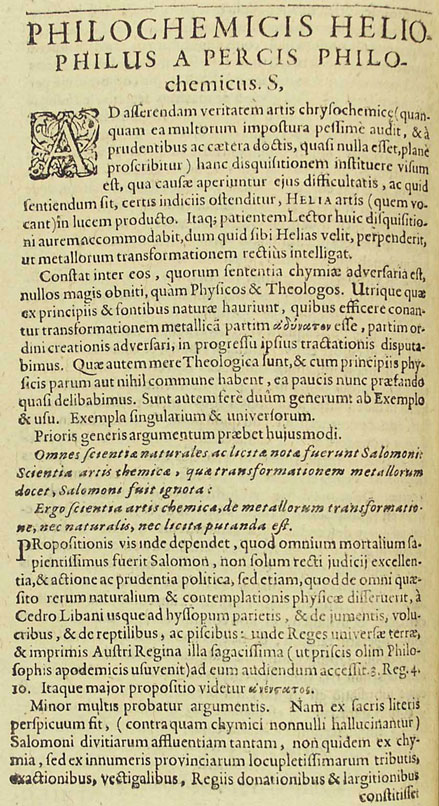
Translated to English from the book:
Theatrum chemicum, praecipuos selectorum auctorum tractatus de chemiae et lapidis philosophici antiquitate, veritate, iure, praestantia, & operationibus, continens: in gratiam verae chemiae, et medicinae chemicae studiosorum ... congestum, et in sex partes seu volumina digestum; singulis voluminibus, suo auctorum et librorum catalogo primis pagellis: rerum vero & verborum indice postremis annexo. Volumen quartum.
Since the truth of the chrysochemical art so ill-spoken of because of the imposture of many, and by prudent and otherwise learned men utterly proscribed as though it did not exist at all must be defended, it has seemed good to undertake this inquiry, in which the causes of that difficulty are opened up, and what ought to be thought of it is shown by sure indications, once the Helias of the art (as they call it) has been brought to light. Therefore the patient reader will lend an ear to this inquiry, while he considers what this Helias means, so that he may understand more rightly the transformation of metals.
It is agreed among those whose judgment is hostile to chemistry that no men oppose it more strongly than physicists and theologians. What each side draws from the principles and fountains of nature by which they try to prove that metallic transformation is partly impossible, and partly contrary to the order of creation we shall dispute in the course of the treatment itself. But those matters which are purely theological, and have little or nothing in common with physical principles, we shall now touch upon briefly, as by way of preface. These are of almost two kinds: from example and from use. Examples of particulars and of universals.
The argument of the former kind is of this sort:
All natural and lawful sciences were known to Solomon;
The science of the chemical art, which teaches the transformation of metals, was unknown to Solomon;
Therefore the science of the chemical art concerning the transformation of metals is to be considered neither natural nor lawful.
The force of the proposition depends on this: that Solomon was the wisest of all mortals, not only in the excellence of sound judgment, and in action and political prudence, but also because he discoursed concerning every inquiry into natural things and physical contemplation, from the cedar of Lebanon even to the hyssop of the wall, and concerning beasts, birds, creeping things, and fishes; whence the kings of the whole earth, and especially that most sagacious Queen of the South (as in former times it befell traveling philosophers), came to hear him. 3 Kings [1 Kings] 4:10. Therefore the major proposition seems unassailable.
The minor is proved by many arguments. For from the sacred writings it is clear (contrary to what certain chemists mistakenly imagine) that the abundance of Solomon’s riches consisted not indeed from chemistry, but from the tributes, levies, revenues, royal gifts, and largesses of countless and most wealthy provinces very abundantly; but especially from the gold of Ophir and the revenues of Tarshish.
For such was the abundance of silver that it was reckoned of little worth, so much so that formerly it was like stones, as Hierosolym [Jerusalem] itself reports. 3 Kings 10. But if this abundance of gold had been available at home, or could have been prepared by any chemical art, why would there have been sought those three-year voyages over perilous seas? Why would the price of lives have been risked for the price of earthly treasure, which it would have been lawful to have at home for nothing? Thus indeed in 2 Paralipomenon 20 we read that the ships shattered under Josaphat by divine judgment. It follows therefore that Chymia was vanity, and consequently neither natural nor lawful.
We reply to the major proposition that it cannot be admitted simply, but must be understood with a condition. For it depends on the circumstance of the choice and wish, namely that Solomon asked of God neither glory, nor riches, nor the lives of his enemies, nor long life for himself, but wisdom for governing the people. Therefore if God, besides wisdom, also added glory and riches, as happened to no king, yet not thereby is the gift of wisdom rendered different in kind, nor are riches added to wisdom itself. For that wisdom was not acquired by study of disciplines and ordinary instruction, but was plainly God-given, and bestowed beyond the common course. But riches were added in the common manner of earthly possession, from taxes and tributes, and from gold imported from elsewhere together with King Hiram.
But if Solomon had sought riches in place of wisdom, who does not see that God would have shown himself singularly magnificent in giving them, and would have adorned him with such and so great wisdom? Therefore the argument is not so much dissolved as turned back. Hence it appears that some conceivable way exists, and one not repugnant to the divine ordinance, by which gold and silver may be increased, not in the common way, but through an excellent knowledge, God-given, not diabolical, multiplied, I say, after Solomon’s example, if the conditions of his wish be fulfilled. Yet this knowledge and its manner of attainment has until now been almost unknown, and even today is open to very few.
And from this it may sufficiently be understood why, from fossils and metallic things, even though their difference from vegetables and animals be clearly expressed, their multiplication is not thereby denied. But if anyone doubts whether there exists, by God’s gift, an excellent knowledge of metallic things, by which gold and silver may be multiplied, this certainly does not oppose the order of nature, but follows from the order of nature itself, since multiplication is accustomed to occur in vegetables. If the rationale of this has not immediately been made manifest by God through men, one may rightly investigate it by following the footprints of nature. For whatever in this art is undertaken beyond the order and manner of nature, we acknowledge to be utterly vain and inconceivable; and we avow, detest, and reject such things.
Yet here some object and say that man cannot add a cubit to his stature, nor make a single hair white or black, as in Matthew 5 and 6, and Luke 12. If therefore that least is the smallest thing, and cannot be furnished by us, how shall we transmute metals?
The answer is easy: this indeed is enough for our purpose to say that by swearing by our head, or by anxious thought, we cannot do anything of that kind by our own power and strength. Yet by natural medicaments nothing forbids hair from being made white by art; indeed not contrary to nature, but according to the order and powers of nature itself, as is well known to physicians and barbers. Similar to this is what those say who oppose chemistry in God’s name: since God created all things in their own order and according to their proper kind, if they wish, they may be changed into a better kind.
Indeed, by the same reasoning would it not be lawful to graft pears upon apple trees, or to bring wild trees into the garden, or by art to produce out-of-season fruits, or from the silkworm to bring forth the butterfly, and other such varied secrets of nature? Here we profess again and again that nothing is to be attempted against the order of nature. But if nature herself, by her own motion, transmutes metals, as iron into copper, wood into stones, and the like, why should it not also be lawful by an art that imitates nature to assist that process by corrupting the form of one metal, and by nature’s motion and due means producing from a baser metal one more precious if that can be done?
Another argument from a universal example is of this sort:
If there were any artificial chrysochemical operation, rightly so called, some vestige of it ought to be able to be drawn from the Scriptures, or out of all antiquity.
But no such thing exists. Therefore, etc.
We answer: Scripture was not given to us by God so that it should teach in detail what kinds of gain are lawful; rather, it hands down these general principles: that nothing is to be obtained without labor; nothing without the blessing of God (which most chemists perhaps seek less than they ought); that no one is knowingly to be defrauded; that no means contrary to the law of God and charity are to be attempted; finally, that not only the possession of riches, but their abuse and the corruption of the mind, are to be condemned, as pernicious and contrary to God, etc.
Now even if nothing concerning natural chemistry falls under these heads, and even if it certainly conflicts with Scripture, it does not follow that it is excluded from lawful means of gain, although in Scripture there may be no clearer example or testimony of it in particular. Indeed, although the patriarchs and others who were rich are read to have been wealthy not from chemistry, but from elsewhere, it still cannot be said from this that the matter was unknown to all antiquity. And even if nowhere at all were there any testimony or trace of chemistry, it still would not thereby follow that there was no such art, or that for this reason it is in itself unlawful. Therefore the whole connection is weak.
But we shall nevertheless answer the minor premise. Since Scripture employs not only metallic comparisons with care, but God himself often makes mention of metallic things, and even of gems, it sufficiently appears that the study of these things, insofar as they are led by nature, are pursued, cannot in any way be blamed. As for the comparisons, certainly St. Paul, in 1 Corinthians 3, speaks of gold, silver, and precious stones, which are not burned up. For they remain in the fire, while all the other things metals, wood, hay, and stubble pass away into smoke, being proposed under the name of combustible things. This comparison indeed, made from purification by lead, just as also in Isaiah 1, concerning refining, when he says, “I will turn my hand upon thee, and I will purge away all thy dross,” theologians commonly do not understand; thus in many other passages they stop midway and cling only to the bark.
But what is to be said of Moses, instructed in all the wisdom of the Egyptians, Heb. 7 [rather Acts 7:22 is likely meant], although it is judged by some that the riches of Christ were greater than the treasures of the Egyptians, Heb. 11? For the ancients testify (as Suidas is the author) that in the time of Diocletian there was among the Egyptians a certain Chrysopeia; and Aurelius Augustinellus reports that, under the Roman Empire, Diocletian sought to destroy that art, warned by the Sibyls, if I am not much mistaken. Although indeed concerning chemistry in particular nothing appears in Moses, yet by God’s command he both made and cast the bronze serpent; and as for the golden calf, by God’s command he burned it and ground it down so completely that he gave it to the people to drink in water, Exodus 32. Let those who can explain how gold may be made drinkable by burning consider this.
Then again, when the Magi came to Christ the King and offered gold, frankincense, and myrrh to the King, man, and God, it is not without reason that they are understood to have been natural philosophers, and men skilled and experienced in their gifts; just as the Arabs are said to have especially cultivated this chrysochemical science, of whom some monuments still remain. But meanwhile, nothing in these points is yet clear concerning metallic transmutation.
Let us proceed, therefore, to see whether we may derive anything from the Holy Scriptures concerning the tincture of the philosophers, not unlike that, from which it is evident that there exists something more precious than gold, yet of a gold-making nature. In Revelation 21:18 it is said that “the holy city was pure gold, like clear glass,” whereby, spoken by way of comparison, the highest excellence of the heavenly Jerusalem is denoted. From this such an argument is drawn:
If there is gold, and if it is so transparent as glass,
therefore there is something which is in substance and nature golden, transparent like glass, and which denotes the highest degree of glory.
The antecedent is true, and therefore the consequent also. Nor should we wish the Holy Spirit to have borrowed a comparison from vain, childish, and fabricated things, where the most precious and truest realities were to be described. But such pellucid gold as glass, which expresses the splendor of the glory of the Highest, exists in the philosophers’ tincture, and is thus described by Paracelsus, Metamorphosis, book 9:
“Our tincture of gold” (he says) which contains in itself the astrum of gold, is a fixed substance, an incorruptible essence, a most true balsam whose powder is like saffron, but throughout the whole body of the astrum ruddy, fusible, in the manner of resin, translucent like crystal, fragile like glass, and of exceeding weight. Let no one refer this to glassmakers, or to common goldsmiths, who dye vitrified gold with a purple color. Rather, let us all look to the highest summit of glory, which in this place of Scripture is expressed, and consequently understand that by no other thing than that gold-making tincture superabundant, clarified, a red fixed substance is the meaning here shadowed forth.
And since in this we introduce nothing contrary to nature, and all other metals vanish in the fire more quickly than gold, while gold itself is most enduring in the fire, and therefore the simple limit of metallic perfection, it is lawful indeed to tend from less perfect things to more perfect, and thus to the highest brightness of the philosophical powder, in which there is not simple perfection, but perfection multiplied in power such as is in the red tincture, namely that golden, crystallizing substance, perfecting all imperfect things, composed from the Mercury of Nature and the female gold. The way is universal. Therefore we rightly deny the conclusion which infers that the artificial chrysochemical art is either nonexistent or unlawful, not only because of the weakness of the major proposition, but also because of ignorance of the supposition, as has already been declared.
It remains that we come to use; from which the theologians bring forward arguments of this sort:
No one can serve two masters, God and Mammon.
Therefore it is not lawful for Christians to devote themselves to chrysochemistry.
I answer: these things are not simply opposed to one another in themselves, but only with respect to abuse, and insofar as these two are made contrary by men. Otherwise it would be lawful for no Christians to be rich. We do not therefore serve both God and Mammon when we do not sink our soul and heart into corruptible treasures, but apply them to good and just uses for our neighbors. It is an evil and unjust thing to heap up wealth; and it is especially evil when acquired badly, or held badly, most of all when promised badly as is today most commonly the case throughout the whole world.
Hence the Apostle, 1 Timothy 6, says:
“But they that will be rich fall into temptation and a snare, and into many foolish and hurtful lusts, which drown men in destruction and perdition. For the love of money is the root of all evils; which while some coveted after, they have erred from the faith, and pierced themselves through with many sorrows.”
This commonly happened to the pseudo-chemists: because they were unable to investigate the secrets of Nature through themselves, they gave themselves over to evil arts, or even unlawful and diabolical means, promising themselves thereby the attainment of what they sought whose end is according to their works. Yet the same Apostle does not remove every use of riches, nor forbid every study of acquiring wealth with the blessing of God. For he adds:
“Charge those who are rich in this world, that they be not high-minded, nor place their hope in uncertain riches, but in the living God, who gives us all things abundantly to enjoy, and the rest that follows.”
Ruffus presses on, and urges us with the words of Solomon, praying thus:
“Give me neither poverty nor riches; feed me with food convenient for me: lest perhaps, being filled, I deny thee, and say, Who is the Lord?”
Proverbs 30, etc.
Therefore, for us too abundance of riches through chrysochemistry could scarcely be useful. We answer: we are not indeed wiser than Solomon, and if we know Solomon to have abused even the greatest riches, which God granted him beyond all kings, rich in the common sense, then human nature is surely rash and insolent enough. Yet still in those words the abuse, not the use, is censured; and we know that the Patriarchs gloried in God for riches given to them, and that this was no otherwise the case than that each one’s mind was rightly disposed. But I do certainly believe this to have been the cause, that until now chrysochemistry has not yet come into the common hands of the faithful, but has almost remained in the hands of Egyptians and unbelievers.
It must, however, be observed that the times are distinct, and just as the Apostle says in 1 Corinthians 7:
“This I say, brethren, because the time is short: it remaineth, that both they that have wives be as though they had none; and they that weep, as though they wept not; and they that rejoice, as though they rejoiced not; and they that buy, as though they possessed not; and they that use this world, as not abusing it.”
So according to the diversity of times it must be determined that these things may happen differently and differently. Certainly Paul himself says in Philippians 4:
“I know both how to be abased, and I know how to abound; everywhere and in all things I am instructed, both to be full and to be hungry, both to abound and to suffer need.”
And our Lord Jesus Christ, who for our sake, though rich, became poor, that we through his poverty might be made rich namely with spiritual riches (2 Corinthians 8) in his need was sustained by the treasures of the Magi, as a fugitive in Egypt, and afterwards in the rest of his life by pious matrons and women. What therefore prevents the same from happening to the pious, that they may be sustained by some excellent wealth through the God-given chrysochemical art, at the time when Antichrist shall close the catastrophe of the tragedy? But more on these things shall be said in the progress of the judgment and inquiry concerning Helia.
Therefore we deny that artificial chrysochemistry is in itself unlawful or non-natural for a Christian man, and accordingly deny that it is nothing at all which was the thing to be demonstrated.
These few things I wished to set forth beforehand, friendly reader, in order to repel the little cries of those who mutter much through ignorance not, I say, through envy concerning matters they do not understand, being steeped in these colors. But do thou meanwhile prefer those who know right reason and the competent before the incompetent.
Farewell.