JOHN FRANCIS PICO,
Lord of Mirandola and Concordia,
De Auro - ON GOLD,
THREE BOOKS.
A truly golden work, in which, concerning gold, there is discussed both its valuing, its preparation/production, and its use ingeniously and learnedly.
With a most useful and very pleasant (engaging) explanation of many secrets, both of Philosophy and of the Medical faculty.
With privilege.
“Wisdom is a man’s silver” - “A man’s wisdom [is] silver.”
At Venice,
at the shop of Giovanni Battista Somasco.
1586.
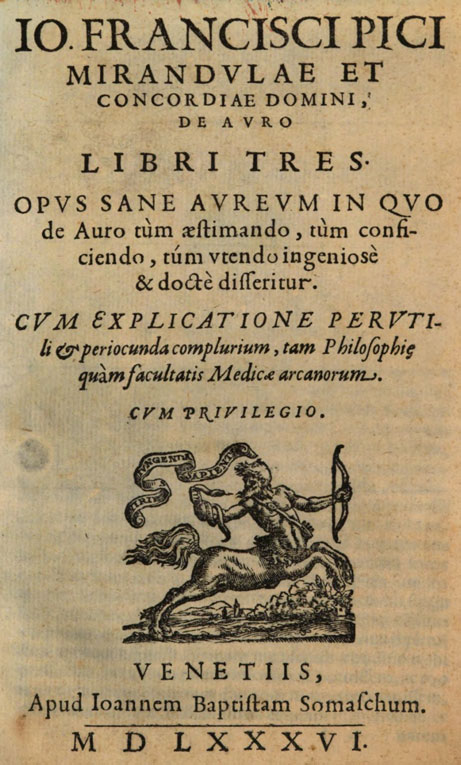
Translated to English from the book:
Io. Francisci Pici Mirandulae... De auro libri tres ... : Cum explicatione perutili [et] pericunda complurium, tam philosophi[a]e quàm facultatis medicae arcanorum
To the most illustrious Prince, and the most eminent Cardinal of the Holy Roman Church,
ALOYSIUS OF ESTE (Atestinus).
CAESAR CAPRILIUS
wishes perpetual happiness.
Very often, when I have reflected in my mind, most illustrious Prelate, upon the heap (the great accumulation) of your merits toward me, I have begun to think with myself how I might offer you something outstanding and splendid, by which I might, so far as it could be done, respond to the greatness of so many kindnesses. But indeed I perceived that it would be not only difficult, but very difficult.
For it has not slipped from my memory how much humanity and benevolence you showed me while the illustrious Eleonora, your dearest sister, was alive she who was to me a most loving patroness. I am not unmindful of your most generous spirit when you wished to adorn me with the singular dignity of a canonry. Nor, finally, have I forgotten the words, full of love and charity, which you spoke with me after her death.
Would that my aged condition had allowed me to live under your patronage and to die [there]; I certainly would never have refused so divine a gift, nor would I have withdrawn from your side, both because and because how deservedly I observed and how, in loving you, I should show it plainly to you yielding to no one before all; but I will not pass over in silence the services and kindnesses by which you have pursued not only everyone, but me in particular, when, coming to Rome and to Tivoli on account of your anointing, together with the Most Illustrious Bentivoglio, you reached the house of the aedile Tiburtinus. There we found you recovering from a serious illness, but still somewhat weak in bed.
First of all, with cheerful countenance and a kindly spirit as is always your manner you received and entertained me; then, when the others were departing, you at once ordered me to be recalled to you, and you made me sit beside your bed; where for a full hour you spoke words what look, what expression and what you deigned to promise me, it is not easy to relate.
There were present likewise the Most Illustrious Bentivoglio; and both while they were with you, and when they had withdrawn from you, with what generosity and liberality on your part and on the part of all your chief noblemen, we were received. Among these was present the most illustrious Ptolemy, great steward; the reverend Manzoli, Bishop of Reggio, a man worthy [of his office]. Very illustrious men: Hercules and Octavius of Este; Tassoni, Knight of Rome; Coloredius, commander; Madius, knight; the Most Illustrious Giliolius Pugnatius; Zochius; Lombardinius; Bonaciolius; and several others, who, because of the splendor of their virtue and the integrity of their character, are most renowned among all.
All these things cling so deeply even now in the innermost part of my heart that no time ever, and no forgetfulness ever, can erase so great a favor from my memory.
Moreover, the honors bestowed by you, and that most splendid banquet prepared at your expense at Rome in your very magnificent house at Monte Giordano while, with your favor, the most illustrious Giovanni Bentivoglio, a young man of outstanding hope and of the highest virtue, was created a knight of Milite [the military order]; where, in place of reclining, on the other side, at the upper table, the most illustrious orator, who in the person of the most illustrious Praefectus was performing the office of commander of the Militean soldiery after him the other heroes and most illustrious men [reclined]. But on the other side, we young candidates also though not without reluctance were commanded to recline in the same most distinguished company.
Finally, in a lower place, they ordered me to sit, as one who was the organ (instrument) of greater honor, favor, and humanity, and a man most illustrious; where the cupbearer, the chief steward of the banquet (architriclinus), and several other most noble young men were serving.
How many kinds of dishes there were; what and how great ornaments, prepared by men most skilled in that art; what precious wines; what fruits and sweetmeats; in what order they were arranged, and with what pomp they were set out if I should wish to recount these one by one, my speech would be too long, and I should not be found free from a certain display, in the eyes of some men, of great things. Yet that fault has always been far from me; therefore I will return to the point from which I have digressed.
For so many singular benefits bestowed upon me by you, what thanks shall I render? What shall I repay? I have no “Arabian treasures”; no gems; no gold; no riches though you have no need of these, since in the abundance of wealth you are second to no one.
What shall I do? Behold, I offer you a work whose title is On Gold a truly golden work which once John Francis Pico of Mirandola and Concordia compiled and dedicated to his wife: a man truly most learned, and in his age easily a prince in every kind of doctrine and science.
After Pico had departed this life, the most illustrious lady Julia, his daughter and formerly the wife of the most illustrious Sigismondo Malatesta entrusted it to me, some years later, to be read through; and when she too departed this life, it was perhaps left with me.
But I, knowing that I was not the lawful heir, and clearly perceiving how much usefulness and pleasure it would bring both by the elegance of its words and the weight of its thoughts if it should come forth into the sight of men, began to consider lest it lie too long in darkness.
Therefore, having regard to the public benefit and to the reputation of so great a man, I took care that it should be printed; and I did this the more willingly because I feared that, if perchance after the course of my life it should fall into the hands of some ignorant person, he might falsely and shamelessly ascribe it to himself, and arrogate it to himself as though it were the product of the labors and vigils of so great and so illustrious a man.
And so, although I was pressed by many affairs, nevertheless whatever time was granted I gladly spent in reviewing and correcting it. For it abounded in very many errors partly from the side of the writer, while the author was dictating the work, and partly from undue carelessness applied to its keeping.
Many pages had been altered in their proper order, so that the true sense could scarcely be drawn out by any skillful conjecture; yet at last I perceived it, and with whatever diligence I could, I labored so that it might come forth into the light as corrected as possible.
Therefore, since there is nothing else in me whereby I might in any way satisfy at least in part the greatness of your services toward me and of your merits, I have resolved to offer this little gift as a token of my mindful devotion toward you; which I thought might perhaps be pleasing to you, since you are most keen both in investigating the secrets of nature, and most adorned in every kind of virtue.
On this account, although I see before me a very wide field, so that a speech could not fail anyone, I have nevertheless judged it better to be silent than to say little. For so many are the virtues and praises that are yours, that they cannot be proclaimed without injustice; and in recounting them there would be no less labor than if someone wished to number the stars or the waves of the sea.
For who would not say that your favor toward me which by your singular humanity and clemency you have extended far beyond my deserts should be made known? Therefore receive this little gift with a cheerful countenance; for indeed, while it lay hidden with me, I always wished that it should be published under your name not that you should defend it from the biting of detractors, since it is easily protected by itself from the ignorant and from those who understand least the powers of Nature and the excellence of the art; but that, like a new and most beautiful bride, adorned with many gifts, it might go forth under your guidance to its nuptials.
Thus either no one with an impudent tongue will dare to assail it with curses, lest he somehow injure you also, whom all observe and venerate; or if someone perchance God forbid should bark at it, more easily under your name and auspices it will protect itself, and many, because of your most eminent dignity and outstanding virtue, will take up its defense.
Ferrara, on the fifteenth day before the Kalends of January
(15 December), 1596.
TABLE OF THE CHAPTERS
which are contained in this volume.
BOOK ONE
1. Why gold was held in such esteem among the ancients. Ch. I … 1
2. That gold ought not to be so highly valued, in proportion to the usefulness of nature. Ch. II … 4
3. The estimation (value) of gold does not depend on medicine. Ch. III … 5
4. The nobility of gold does not depend on its being drinkable. Ch. IV … 11
5. The purity of gold and its durability are not the proper cause of its being valued. Ch. V … 14
6. Splendor is not the cause why gold surpasses other metals in price. Ch. VI … 16
7. The nobility of gold does not depend on the sacred Scriptures. Ch. VII … 19
8. The nobility of gold does not depend on winning the favor of a pregnant woman. Ch. VIII … 20
BOOK TWO
1. Whether gold can be made by art, and whether it should be called by the name of an art. Ch. I … 23
2. The origin and progress of this art. Ch. II … 23
3. Whether this art is lawful or not; and what princes and interpreters have thought. Ch. III … 32
4. In making gold by art, what is to be thought according to natural philosophy. Ch. IV … 40
5. That gold can be made by art. Ch. V … 48
6. An explanation of the opinion of St. Thomas Aquinas concerning the making of gold. Ch. VI … 51
7. That gold made by art can be more perfect than natural gold. Ch. VII … 55
8. Five methods of making gold, better than the natural [way]. Ch. VIII … 64
9. In order that gold may be made by art, it is not necessary to have a deep knowledge of philosophy. Ch. IX … 72
10. That gold can be made more easily today than formerly: where cinnabar, red-lead, and other things are discussed. Ch. X … 77
BOOK THREE
1. Ancient experiments in making gold by art. Ch. I … 91
2. Experiments of our own time in making gold. Ch. II … 101
3. A refutation of those who disparage the art of making gold. Ch. III … 108
4. That the name “divine” belongs to those skilled in making gold. Ch. IV … 113
5. That gold made by art ought not to be called counterfeit, but truly and properly natural. Ch. V … 116
6. The author’s admonition to those who devote their labor to the chemical art together with a resolution of the question why there are very many professors of this art. Ch. VI … 124
THE END.
JOHN FRANCIS [PICO], OF MIRANDOLA,
LORD OF CONCORDIA,
COUNT,
ON GOLD.
Book One.
GOLD was not always, from the very first beginnings of the ages themselves, indeed from the beginning of its discovery so highly valued by the common agreement of nations, that it should be measured above other things.
Chapter 1.
Gold, which once was so greatly prized, but which now we see is commonly made [so], for what cause it has entered into human minds with so extraordinary an esteem and has fixed itself there so stubbornly has often come into my mind, so that I might know it more exactly by disputing (arguing it out). Hence therefore it seemed worthwhile to take up this care, and to seek those rather superficial matters: so that it might be said that I drew the name of gold in the Latin tongue from the ancient authors, as if it were rightly to be said ab aure tedis (“from wearying the minds”), and that by the zeal of guarding this [name] it is as though, among the Greeks, it plainly deserved to be suspected: since, from ἀπὸ τοῦ αὑρεῖν (apo tou heurein, “from finding/discovering”), the name was led down, inasmuch as, before other things, it was carefully sought after; and hence the term gold would have its origin.
In another respect, although gold might perhaps seem useful, yet in no way is it necessary by its own nature; but only by the agreement of mortals did the mind proceed to desire it beyond measure namely, as truth itself must be held.
And first of all it must be recalled that gold was not always preferred to other things not only to other metals, but even to other outward goods by the common agreement of nations. For that either an open, or a silent conspiracy of all ages to judge that it ought to be put before other things which are called “external,” was by no means persuasive to me.
For there is no mention of gold among the earliest beginnings of mankind; and the most ancient monuments of letters report that men lived through very many ages without gold.
Nor were there lacking those who wrote that, a little before the Trojan times, gold was discovered by Aeacus, and silver by an “Indian” king of Scythia; and those who reported that [gold] was received from Thoas, from Aeacus, and from Erichthonius; and those who attributed it to the Sun; and those who attributed it to Vulcan; and those who [said it was discovered] by Chrysos whose opinion Hippocrates is said to have been, being thought to have been surnamed from the discoverer of τὸν χρυσόν (that is, “gold”).
They also knew that it is handed down to memory that gold was not in use in Europe, and much less is it established that it was [there] before the times of Cadmus the Phoenician.
What of this as well: that while the Greeks and their authors were flourishing all Greece scraped together gold (so Athenaeus reports) in order that the head of Apollo of Amyclae might be gilded.
And gold was at the same time of such rarity and such dearness in the time of King Philip, that he thought himself fortunate if he had golden bowls (phialae), and those indeed small ones rather, which he might hide under his pillow if what Duris of Samos has written in the true memorials of letters is true (and Pliny records this), when [Philip] was being reproached for [turning things] into a golden cup.
He asserted that among the Greeks only that metal was prized which they had even forbidden by laws to use, it is plainly known from the histories that Sparta, so long as it had no gold or silver money, was flourishing and growing; but that it declined and was corrupted when, under Lysander, after booty had been taken, it admitted gold.
Plato is added [as a witness], who in his laws forbade anyone in private to possess gold; and he likewise had published the same concerning silver. And it occurred to that man (Plato), perhaps, that in Greece the use of silver and gold was once very rare, and that it was customary to see it only in temples.
And indeed it began to become common through Greece only in tripods and small images, which first the Lydian kings Gyges and Croesus, and afterwards the Sicilian tyrants, had possessed; soon after, when the Phoenicians were populating Delphi, this metal also in some manner began to become common through Greece.
Nor did it fail to come into my mind toward diminishing the estimation of gold that among the Hebrews the abundance of this metal was found earlier, and in a more excellent gold. Now true Josephus, in the seventh and in the eleventh [book] of the Antiquities, has reported that it is handed down in histories that Spartacus in Italy, in his camps, had forbidden that anyone should have gold or silver.
And after the countless courses of so many ages had passed, among certain peoples of Asia and Africa it has been the case that some have regarded gold as of little worth, others as of no worth at all. And in India which is thought most rich in gold if we make mention of that part which Alexander of Macedon conquered, we learn from the Greek writers of his deeds that there was no gold, although by direct inquiry the king himself found so much gold that they could scarcely carry it away thirty thousand mules’ loads.
Let us gather therefore that mortals agreed among themselves that they should value gold more highly, even though it is not established why they came to this agreement, nor is it always fixed and certain; and [let us gather] that it has not been the case that among all nations universally it pleased them that gold should be the measure of other things.
THAT GOLD OUGHT NOT TO BE SO HIGHLY VALUED
from the usefulness of the thing sought from nature.
Chapter 2.
But now I was leading toward the argument by which they have tried to persuade the common sort of men that gold is most useful to mortals. For at once they would object iron itself, without which agriculture does not stand, and no art no less necessary than that can be carried on; and, as Xenophon says, [iron is] the mother and nurse of all arts.
Nor indeed is building sufficiently carried out, nor is navigation at all maintained, to say nothing of military matters: although these things harm those by whom they are done, yet this iron immediately obtained our approval; but gold is harmful and another saying has been uttered, not unlike it: that in wars iron is more acceptable than gold.
Next to this would be added that most true saying: that gold is to be shunned by the best men, and that it has been found for the ruin of life; and then he would recall and marvel at former antiquity, and at the same time be indignant that earlier ages honored gold, when it is mocked by the tale of Midas, for whom absolutely no solid mass of wealth gathered up could serve for life a mass of gold would have profited him.
Moreover, the powerful cause of exchange in common dealings was not that gold should be so highly valued, since the most ancient kings used to stamp (coin) not gold and silver, but bronze, and they report that the inventor of this thing was Saturn from whom also the treasury (aerarium) has been named, as Caecilius Cyprianus has thought; although others write that the chief originator of stamping coin was Janus, the equal and guest of Saturn: for he, inasmuch as that practice was his, impressed [its] mark upon coins.
Among the Romans also, at first there was an established mark on bronze; afterwards on silver; and a few years later on gold when indeed Servius, the first of the seven kings of the Romans, stamped a mark on bronze; and the consul Fabius first [stamped] silver, and soon gold also was stamped.
THAT THE PRE-EMINENT VALUE OF GOLD DOES NOT DEPEND ON MEDICINE.
Chapter 3.
Indeed, from the medical faculty there were brought against me (against my own position) certain common arguments (reasonings); and from joy, and from the abundance of money, it was asserted that bodily health, long drawn out (i.e., longevity), is also derived; and [it was asserted] for my side as well from the same faculty, contrary [arguments] since that joy is only so long-lasting while you possess golden money, until suddenly the mind can provide itself with some other thing that pleases it, when money has been spent; but this belongs rather to imagination, and to thought, and to the mind itself, properly in the temperament of the body, which the coarse matter of it makes difficult.
To this is added that many things are said to be more beneficial to the temperament of human bodies; and even by the more ancient physicians they are praised as more able to restore life and to produce strength things of which we become possessed far more easily and at far less expense.
For no metals nourish, as has been received among the older Peripatetics. For they cannot be digested so as to be turned into flesh and blood.
And this has been proved by the experience of those who, struck by the tumults of wars and the devastation of regions, hiding themselves in underground caves, swallowed folded gold coins like a kind of pill into the belly. Soon afterwards they found them again, by their weight and by their color. And if perhaps anything of them was lost by being swallowed, it was by their natural heat yet only a little although otherwise it would have been an excellent remedy for life.
You would judge this [to be true] from the Jews, when Jerusalem was being besieged, [of those] fleeing to Titus Caesar: if gold were digested so that it nourished those who swallow it, for they were cut open by the most greedy Assyrians and Arabians, so that they might find in their entrails the gold which before they had hidden in their belly.
And the number of these [victims] was so great that in one night the intestines of two thousand men were cut, the author of which thing is Josephus, the confirmer [of it] Egesippus: therefore, for those wretches, the gold coins were being stored up in their belly as in a chest, they were being alleged for enduring hunger, since they had been spread through the whole body and had been modified, like the rest, in the manner of foods.
What then? Gold neither delights by smell, nor nourishes by taste those vapors which are drawn from human bodies called by physicians “spirits” since all metals are unpleasant in taste, and even have, as it were, a sulphurous odor; and therefore they cannot in any way not be harmful to those who lie sick so far from it that they should by their soothing keep the soul from departing.
There is the opinion of the great Albert (widely circulated): that the tastes and odors of all metals are in some way foul; and although in gold there is the least smell, so also there is the least stench, because of the mingled sulphur in its temperament, by reason of the subtlety of its essence. Yet there are things which help the healthy and the sick not only by smell but more by taste, and which are sold at a lower price than gold.
Since, moreover, I had brought to mind that Pliny once wrote that gold leaf was commonly applied, and also to infants, against poisons, so that they might harm less, and that it brought some help to certain others this too did not escape my memory: that many things are written by that same Pliny (though he seeks to be a great prejudice to us) that the blamings of gold are more fully set down than its praises.
Nor did he fail to commit to his pages that there is, in gold, a certain vital power; and I recalled above all the conclusion first handed down by him for the cause of digging [metals] is medicine from which afterwards gold is certainly not excluded from among other things, since it became the perpetual custom to do that this was done on the strength of authority. He cites Varro whose lifetime nevertheless, and who (being especially eminent in medical material) [shows that] Dioscorides produced no experiments of any medicine from gold.
I said that Dioscorides lived in the age of Varro, following the common opinion and the records of Suidas; and if there are those who prefer that Dioscorides lived in the time of Pliny because of the mention of Liemus Bassus, I would have them observe that Dioscorides also lived in the time of Arry (i.e. under Ares/Areios), to whom he dedicates the book On Simple Medicine I mean Ares, not that one whose “aspiration” Catullus mocks; nor that one who, as the most bitter enemy of our religion, most shamelessly hurled blasphemies against Christ the Lord; but that one who was likewise Alexandrian, and who was held in great honor by Augustus Caesar after the victory that had been won over Antony and Cleopatra.
But whether Dioscorides was earlier than Pliny seems to matter little. Varro, to be sure, is joined to the triumviral proscription; and Dioscorides himself flourished under Antony the triumvir, from whom thereafter Greek (rendered into Latin in a “barbarous” way) received the materia medica. And therefore we give the same credit to the earlier opinion as to the later whether, in Pliny, the mention of Dioscorides is of one older, or of one near in time, or of one of the same age.
This Dioscorides indeed was a man of his century: he handed down many remedies in their proper chapters for quicksilver, for bronze, for iron, for lead not for gold. And indeed he scarcely even mentions quicksilver (hydrargyros) for this reason: that, if it were false (counterfeit), it would do harm, and would harm by a bad might bring remedies, and this [belongs] among the matters to be treated in the materia medica.
But when he speaks of poisons, he says that pure wine in which glowing gold has been quenched is opposed [to poisons]; yet he does not say that this is a remedy proper to gold, but that it is a common remedy belonging to silver, iron, and iron scale (scoria ferri), which have that same power. And Paulus Aegineta, when he treats of poisons, accepts this.
Galen, long younger than Dioscorides, and neither when he speaks of the power of simple medicines, nor of their composition, mentions gold, as I recall. Nor am I unaware that Nicander of Colophon sang in the Alexipharmaca that gold or silver is beneficial; yet whether because he was a poet, or because he was not held in such esteem as Dioscorides and Galen, his testimony is not such that in this matter it should be cited as lawful (authoritative).
And as for what he wrote “silver and gold show worth” (ἀργύριον καὶ χρυσὸν … ἰσχύειν/ὠφελεῖν, sense: “to be of use”) it seems to have little weight; for he indicates only that a liquid becomes turbid from metal, and that the same [liquid] is drunk. Yet I would not deny that gold has some medical power; but how small a portion, I ask, would that be if we compare it with the innumerable things in which there is power of healing and of driving out poison? The same judgment, of course, applies to silver.
But if it contributes neither to medicine nor to pleasure, whence, I ask, comes that vast hoard of yours whether of golden vessels or of silver ones gathered through labors everywhere? For nobility seems to be signified by a table furnished with silver vessels. But Vitruvius, in the eighth book, speaking about waters, [says] with reference to lime when he has recalled it, and has shown it, [namely] that there is a fault in lead, and therefore that water should be brought through its pipes, he plainly adds that one ought to beware of a silvery taste.
And although those who had tables set with silver vessels nevertheless confessed that, for the integrity of taste, they used earthenware; with whom certainly many princes of our age agree who, after putting aside for table-use silver vessels, and mixing-bowls, and dishes, provide for themselves, for the cleanliness of their courses, earthen vessels brought from India, Ethiopia, [and] Egypt. And if those are lacking, they prefer Prusian ones joined from Bithynia, although they are not born of potters as parents (as he sang of Agathocles), who for that reason preferred Samian vessels to silver ones.
The triumvir Antony too who, being the author, did not use in all his excessive desires anything except gold seems to show that he did not long for the “taste” of gold, but rather rejected it.
The trophies of Nero, which he used to clothe his nobler four-footed beasts with gold, seem to do the same.
Nor am I unaware that the Arab physicians have committed to writings that gold, although it does not nourish, yet it gladdens the eyes.
And I add also that imaginary power, already explained by reason: yet is so much therefore to be done, that it should measure all things? Shall we believe that it brings help to the trembling of the heart by some natural reason of usefulness? For it does not follow as we were saying before that those words of Nicander are not seen to be vain.
Chapter 4.
That the principal nobility of gold does not depend on potable gold.
I do not decide this matter dogmatically, but by disputing I shall pursue it thoroughly: since potable gold is said by some to be useful for removing all diseases, for preserving health, and even for prolonging life as far as the natural powers allow.
Yet I, in order that I may not seem to deny this outright, shall allow that this may be asserted by those who, through skill in disputation, are able to draw the matter into controversy; for they perhaps say that it is sufficiently agreed among those who administer gold as a drink, that gold itself is not properly drunk, but rather a more subtle and purer portion of it, designated by a certain name of essence.
But as to that so-called Quinta Essentia of the superior bodies, since there are many fierce battles fought among the greatest leaders of philosophy whose followers are still contending over to whom victory should be granted it is certain that neither the Platonic nor the Peripatetic schools agree, whose chief authorities seem rather to hold that there is no fifth nature at all, than that it should be admitted.
Nor indeed, unless five suppositions are granted each of which is difficult to justify, and which, if placed in the heavens, are not conceded can it be allowed that things which are under the heavens are composed from such a substance.
For whether it be from honey, or from sulphur, or from quicksilver (hydrargyrum), or from the water of distilled wine, or from some secret earth, or rather from some most noble kind of “calcining” (agent), thinned through many filtrations/straining processes if they have gathered potable gold in this way, they will admit that a more subtle power is thereby drawn off.
But they will not agree that the Quinta Essentia is drawn off; and if they should wish to extort it from elementary effects, which they will declare cannot be found in it, an answer will be ready at hand: namely, that they are striving to put forward an appearance for the thing itself, and that they ascribe effects arising from diverse causes running together, fused into one and as it were “refracted” which other things also could bring forth.
Next, even if they should grant this freely to the Peripatetics, how will they not at once proclaim the Peripatetic doctrine namely, that living creatures do not live from metals?
But, as physicians who quarrel among themselves leave the dispute to be settled later, so they will assert that whatever methods have been devised up to this day for making potable gold, do not concern the drinking of gold as gold.
For it is plain that they are accustomed to reduce gold to ashes, or, if they prefer the term, to a calx and that by many methods so that, if one should wish, to restore it to its former form is either in no way possible, or possible only with difficulty, especially if the moisture has departed; yet if you remove that moisture thoroughly, the gold remains.
It is a decree of Aristotle and Theophrastus that in all metals there is a certain liquor/moisture so present that by it their nature is constituted, and that by this they are plainly distinguished from the nature of stones.
Therefore they will add: gold is not drunk, but rather a portion of that thing which was gold, dissolved in a foreign liquor to which (liquor) the power which is present in softening and attenuating the calx of gold, to draw out something from it that can be drunk just as they also promise this in the case of gems, which nevertheless cannot properly be drunk, as no one is ignorant.
And if the defenders should say that gold is also liquefied in other ways, I do not deny that they would be opponents; yet they would assert that this is done either by waters that consume, with the addition of salts of various kinds, or by biting (corrosive) juices, so that the force is, as it were, driven into the gold and carried away not by its own nature, which nature had freely bestowed upon it; and thus one must strive to constitute human nourishment more sincerely according to nature, rather than to acquire that which is not natural.
For if in the nature of gold you should suppose that it contains a power of nourishment, it would not be suitable for nutrition, as has already been shown by experience. But if that power is mixed with the nature of the liquid, then even by the judge’s own admission it will no longer be gold.
For it is evident that a liquid is administered which has flowed drop by drop from glass vessels, while vapors, carried upward by the heat of fire, are turned back into water and are collected again; and the medicinal power is sought from what remains.
But if it is permitted to drink either gold or gems, why is it not also permitted to drink excrements, since those who drink wine drawn off alone from a varied heap of refuse would thereby be enriched by that service?
I shall therefore gather the cause of those who wish to defend potable gold which I myself would rather collect and that it may indeed be excellent for the smoothness of our bodies and of others, especially since it sufficiently appears that Antony, our surgeon, in past years treated a matron from the forum of Cornelius relates that he restored a woman, lying at the point of death, within a few days to her former health, by potable gold alone; which he had received from his own father Nicolaus, whose mention occurs in the third book of that discipline which he composed, concerning matters to be treated more fully in those larger volumes that are inscribed On Remedies against Poisons, and are even now pressed under the anvil. But if gold, once collected, is even given to be drunk for health’s sake, perhaps from this there has flowed such great nobility of gold, and such hunger and madness for acquiring it?
Since a single pound of this metal, dissolved into a humor, can heal not only a king but a whole region, and since among a thousand myriads of mortals scarcely fifteen men are found who seek potable gold, and among these scarcely two who know how to prepare the golden potion and those too are rare.
THAT THE PURITY AND DURABILITY OF GOLD PROPERLY ARE NOT A CAUSE WHY IT SHOULD BE MADE BY MEN.
Chapter 5.
But if it be believed that purity chiefly gives authority to gold, we must consider that in this matter there lies a deception. For although gold indeed soils and stains less perhaps than other metals, yet it still stains, and it contaminates those things that are touched by it because of sulphur, which is not only in it by quality, is mixed not merely by quality, but by its very substance, as Albertus has handed down in his writings, and as experience itself confirms. Hence perhaps the Egyptians, under the name of Hermes, expressed gold as sulphur.
For what sulphur is purer than gold? Thus that Roman prince feared that it might be counterfeited, as he perceived, and therefore preferred that it should be preserved in perfection, and first stripped gold of its parts, and shut off for all metals the way into commerce.
Its durability is indeed celebrated; yet let the mind consider that stones are more enduring, and are held at a greater price, which neither feel the file nor the fire, nor admit any corrosion at all, nor stain those who touch them, things which cannot be avoided if they are handled for a long time.
But foundations are not laid with gold, but with stones; for is not this common to all metals? And since therefore they were received into the use of coinage, so that they might serve in exchanges as pledges, after gold in this matter was formerly bronze, and later silver, gold seems to have drawn away from these both their favor and their utility.
For we know, as we previously established from the monuments of letters, that bronze at Rome was first stamped under King Servius, and that the Roman people used silver indeed when it was stamped, about six hundred years after the founding of the city, before the war with Pyrrhus.
But when under the consulship of Fabius a mark was imposed on that metal, soon after also on gold, more than sixty years having elapsed, the same people had already subdued Carthage and were ruling over other nations so that silver tribute was paid, not gold, in order that not the durability of the metal alone, but its use might be the cause; since both stamped bronze and stamped silver were held to be more durable even among foreign nations.
Thus the Transalpine Gauls, under the common name of silver, expressed coined money; gold being valued less by the prince of philosophers, Plato, namely he who imposed such a law upon the state which he was founding, that it should not make use of precious coinage yet not so much that it might be despised by other peoples, as lest madness should arise from hoarding gold and silver.
And from this perhaps arose that Lyric saying, that gold is both useless and the chief material of evil.
THAT BRILLIANCE IS NOT THE CAUSE WHY GOLD IS VALUED ABOVE OTHER THINGS,
whether because it delights the eyes, or because they are not injured and dilated by it.
Chapter 6.
But they say that the color of gold delights the eyes. Pliny denies this, and prefers silver to it in brightness, since it is more like daylight and to military fires, because it shines farther and more clearly. Nor does he judge that gold, by likeness to the stars, is to be preferred to other metals, since even in gems and other things that color is not precious, save only insofar as it approaches the color of the dawn, from which it pleased them to give the name of gold and to prefer it above all things.
But why he believed this to have arisen from the cause of its name, when he could easily have learned without displeasing good authorities from the language of the Sabines, who said that aurum was a word transferred by the change of a single letter; whatever the case may be, Pliny judged silver more pleasing to the eyes than gold, which opinion, though he could not prove it in fact by what he wrote, yet he plainly maintained as a censure.
For he produced this argument: that gold is surpassed in weight by lead as later experiments have protested; and when he considered that a very small amount of gold is lost by use, he could remember the attrition of fingers, and that gold coin is consumed, and that what is minimal is not nothing.
There were also those who held that gold suffers no harm from fire; he refutes them by the authority of Aristotle in the third book of the Meteorologica yet that authority is either not solid, or not rightly understood. For it is proved by experiment that gold loses weight in fire, and this has been handed down most strongly by writings of long duration, and has also been confirmed in our own age: that gold, when placed in fire mixed with dust not only by townsmen, but by rustics and even their wives can be seen to waste away.
It has also been discovered that gold is stolen from the human body, especially by frequent handling, and that its shining color is drawn off, and can never be restored once removed, the golden color remaining in the powder into which it has been cast, from which, when applied, the ruddy brilliance has departed.
But that which is spread thin by beating and woven into sheets, this gold shares in common with silver. Finally, lest I dwell too long on what cannot be denied: that which is so solid in its base that from it nations might draw strong reasons for desiring gold so exceedingly, and for seeking it with such avidity, that some therefore thrust themselves into excavated mountains; some descend into the deepest caverns, which they call pits; others strive to gather its fragments from rivers; others sail to the furthest regions of India, or along the scorched shores of Ethiopia, or by the west wind navigate toward the dawn to the antipodes.
Nor indeed do they seek this so that they may prepare for themselves either obrizum gold, as the Greeks now use the term, or gold once refined at Colophon, or such as is now customary at Lutetia of the Parisians; but rather the crude body of gold and its coarse material. Therefore it is no wonder if human greed ignorant of the nature of each thing finds no satisfaction. Hence there arises so great a desire to possess it, when its use is not so great as its price, by which now the greatest part of mankind measures all things, and so that they would not enclose even divine matters within the same measure.
THAT THE CHIEF NOBILITY OF GOLD DOES NOT DEPEND UPON THE SACRED SCRIPTURES.
Chapter 7.
But neither does the value of estimation depend upon the Sacred Scriptures; for although we read that durability is divinely prescribed therein, and that many things made of pure gold ought to be used for the worship of the temple and for solemn ceremonies. Likewise we know that it is sung by the Prophet: gold shall be given to him from Arabia.
Yet we must remember what we have already indicated above on the testimony of Josephus: that there is something better than gold, from which Solomon made for the Temple between the spoils of David vessels which Scripture records were called the great sea; and that Ezra restored, after the storm of Xerxes, to the guardians of the treasury from the order of priests, certain bronze vessels, which weighed twelve talents and were judged better than gold.
We must also not be ignorant that in mystical veils, wisdom is signified by gold in the Sacred Scriptures, eloquence by silver, and the light of understanding is compared to gold gold being more splendid insofar as it admits less earthly dross, like that gold which is said in Scripture to be born in Arabia, naturally pure, without the use of any fire, and therefore called apyron, as Diodorus records.
Nor are these matters now debated, since it is certain that God is goodness bears witness to itself, as Chrysostom has remarked, with regard to human weakness in many matters which pertain to the common use of nations. What then? That even from the Scriptures we often find the estimation of gold rejected and reproved: thus among the prophet Hosea they made gold into idols for themselves; thus the Apostle Peter calls gold and silver corruptible things; thus James writes that gold contracts rust.
Therefore it rightly follows that this ought not to produce a trivial admiration in the minds of those who are just judges of things. Hence so great a desire arises, when by its own nature either there is no utility in it, or a small one, or at least not a great one since in other things there are found those which are common with gold, and by many things which gold measures, it is itself excellently surpassed.
THAT THE NOBILITY OF GOLD DOES NOT DEPEND UPON GAINING FAVOR OR GRACE.
Chapter 8.
Who is there of such mind as to believe that the seekers of gold ever gained favor by the possession of it? For it is indeed reported in monuments, but in trifles made from gold which has not endured fire that ointments are accustomed to be prepared, whose use might compare the favor of the great to those who are crowned with the heliotrope herb by their largess; so that it might be said of me that it therefore seems that favor is not gained by the possession of gold, whereas envy is rather stirred up by the piling-up of golden sums and heaps.
From this it follows that love and goodwill are propagated only so far as such possessions are absent. Besides this, since the minds of mortals are most strongly fastened to vanities, it happens that that golden ointment is believed to be made, so that the knowledge of its artifice whether from antiquity or from our own age causes gold to be sought for this reason: whether, namely, one might find someone crowned with the heliotrope herb, and anointed with a fire-proof metallic unguent, begging favor among the people and in royal courts.
Hence therefore such a great desire for gold has arisen that men are driven by no evident cause, except that some silent and less necessary thing, placed among them, and would that it were not joined with a destructive conspiracy leads them to place gold itself before all other things. Nor are they content with Dalmatian caves or hollow caverns, nor with flowing rivers of golden sands; nor even with those navigations by which, even in Solomon’s time, gold was sought. Rather they take care that it be produced by art in houses themselves; and for artificial gold they often undertake labors not fewer, nor lighter, than for voyages to distant nations and for most wars.
For we see that most people labor not only with their hands, so that by metallurgical operations gold may appear when fire is applied, but also that they search out innumerable compositions, or examine singular doctrines pleasing to philosophers, so that they may fabricate gold-bearing powders and stones or, as the common saying goes, that there may be mines, whether they should be called metallic in the Latin sense, or vegetable, that is, derived from herbs and plants; or animal, that is, drawn from living creatures; or mixed, compounded from two or three sources; or fused from a common substance, whether aerial or terrestrial whence they have said that metals, plants, and animals have their origin.
For indeed we hear that there still lives among men a man who has boasted of this art, who has claimed to have read eight hundred volumes concerning it, and moreover to have examined countless treatises, so that the number of compositions is extended to thirty-seven thousand certainly not so that by its possession he might gain favor, but so that, by collecting what pleased him, he might heap up those things from which the sum of his desires would be made up.
So great is the desire of possessing gold among mortals, that it is driven by causes either none at all, or weak ones, rather than by the bare and silent condition of miserable mankind, which I confess.
IOANNES FRANCISCUS PISCUS
Count of Mirandola and Concordia
ON GOLD
Book Two
WHAT IS TO BE DONE, AND WHAT IS TO BE AVOIDED,
and likewise concerning the art which is called gold.
Chapter 1.
Up to this point, the discussion has concerned the estimation of gold; now it must turn to the art by which it may be produced, for among the learned and the unlearned alike it is commonly debated whether this can or cannot be done. This question has given rise to many disputes, by which, according to their strength, men have tried either to remove dangers or to allay them, both in general and in particular; not piecemeal, nor by petty calculations of usefulness, but in a manner worthy of no small importance.
For it concerns the commonwealth of mankind that there be no uncertainty in matters that are handled publicly, and that are set before the eyes of all.
First, therefore, we shall set forth the name itself, then its origin, and finally the power of the art, as it has been treated far and wide through the various schools of literary learning.
The art, therefore, of making gold, called by the Greeks Chrysopoeia, is also designated among the Latins by the same word; but when the scope is extended to metals in general, it is called by the Greeks Chemia, which the Arabs for the most part followed and named Alchimia. The Greeks, however, define Chemia as the art of preparing gold and silver.
For although other metals are also produced by it, yet the name has been obtained chiefly and especially from the nobler ones, so that it is afterwards called both Argyropoeia and Chrysopoeia. Some have thought that Chemia should be named from juices (χυμοί), to which opinion Hermolaus the Barbarian seems to assent; but the truer derivation is from melting, that is, from the final operation of the art itself.
And indeed the Greek letter Χ, which among the Latins is often rendered by a long sound, seems to the inexperienced to give rise to the term refusoria (smelting), so that the art may rightly be called metallic.
This is sufficiently established by the fact that those are called metallarii, and are counted useful to the commonwealth, under the civil laws, who are accustomed to undertake the work of preparing gold and silver by labor that proceeds by revelation of operation, under the common name of metal, by which a wider range of legal interpretations is comprehended, as they have preferred. To these it has also seemed proper to designate gold coins by the name aes, as Ulpian wrote.
But if some think that the name alchemy has been introduced without any rational derivation, they suppose it so named merely by arbitrary usage; from which it came to pass that Erasmus, a man widely versed in letters, published a mocking dialogue, the title of which is Alchimia. In this dialogue, however, he seems to have followed the judgment of the common crowd rather than knowledge.
He therefore acknowledged this point as one commonly accepted among the Arabs, and rejected the interpretation that the word should include the aspiration which ought to have been enclosed, whether the term were derived from melting or from the preparation of juices. Nor do I marvel less indeed, I marvel far more at Erasmus, who wrote on this subject, and yet avoided the true name, and devised a certain foolish and artificial term.
ON THE ORIGIN AND PROGRESS OF THE ART ITSELF.
Chapter 2.
The origin of the art, Vincent of Beauvais traces back to the first parent of the human race, and through various transmissions conveys it to certain others, even to apostolic and dominical persons, from whom many things are said to have been handed down. Others preferred Hermes Trismegistus as the chief authority of the chemical faculty, saying that the principle of the Stone was written on certain tablets and discovered at the city of Hebron.
Nor were there lacking those who wrote that it was revealed in the desert of Sinai to a certain Hebrew man, yet only in a general way, for the purpose of constructing the tabernacle of the covenant.
But as far as I have been able to gather from Greek and Latin authors, I find that the art is indeed most ancient, yet a little before the Trojan War, so far as the most ancient times of the Greeks permit its mention to be indicated beneath the veils of fables and enigmas. Thus the golden fleece of Eurystheus, wickedly covetous of gold, is interpreted by Michael Psellus; thus the voyage of Jason to Colchis is explained by Suidas, so that it signifies not a golden hide, but a ram’s skin, by which the faculty of making gold was described something the Argonauts sought.
Nor has it escaped me that Varro wished this to be attributed to the fleeces of sheep. Strabo, however, says that fleeces of sheep were spread out, by means of which fragments of gold were collected from flowing waters. Yet they preferred to understand it as a skin, not as fleece, and not as the shaggy hide of sheep, the more ancient Greeks among whom are Charax and Apollonius and later the interpreters and historians of the Colchian voyage; and in narrating the matter more fully, it sufficiently shows at present, from the experiments related by many authorities, that under the fabulous covering of the golden fleece there was signified the description of gold made by art.
Thus also the ram of Atreus; for so speak the Greek tragic poets and the Latins, among whom Cicero makes mention of it; Seneca, however, names not a ram, but a lamb. Thus indeed some interpret that the lamb of Atreus ought to be called a ram, in order that they may insinuate to readers the described power of making gold.
For it is written that the riches of Atreus and of Pelops were derived from metals Callisthenes of Olynthus, a disciple and kinsman of Aristotle, whose riches some wish to have been derived from the ruin of Persia, following the example of Varro; others, from a silver vessel in which an emblem was set, so that this ἀργόν that is, the lamb was contained within itself.
But whether the art of making gold was transmitted to the Greeks from their own authorities, or whether it came from the Persians, the Egyptians, or other nations nearer to the rising sun, I do not think it has been sufficiently ascertained. Yet that Hostanes among the Persians, and Hermes among the Egyptians, produced writings on chemical matters, is handed down by memory; and that the study of chrysopoeia persisted in Egypt, from which great wealth was prepared for use, is evident even down to the times of Diocletian, as is clear from Greek records, in which the deeds of Diocletian and Maximian are also contained.
This is likewise allowed to be seen in two ways in the collections of Suidas; and in the same manner I find that Democritus was regarded among the Greeks as a chief authority of the chemical faculty, having travelled in the East among the Egyptians, Persians, and Indians, and having learned many things there.
Indeed Hippocrates admired Democritus; Thimus also praised him; Plato did not dare to assail him him whom Celsus rightly calls a man of great renown. From this arose the Democritean sect, which is also called Abderite. Among the interpreters of Aristotle, Michael Psellus not only makes mention of it, but he writes that his arcana were revealed by God. For after Rhetoric, History, Physics, and Mathematics, he also wrote on Chemistry, and likewise on Medicine, which he dedicated to the Emperor Constantine.
Olympiodorus of Alexandria, both a Platonist and an interpreter of Aristotle, also wrote on Chemistry. Heliodorus likewise wrote to the Emperor Theodosius; Stephanus wrote to Heraclius Caesar, as did Africanus, Synesius, Theophilus, and others besides; and also Zosimus of Alexandria, the philosopher himself, who composed thirty-two books on the art.
The precepts of all these writers are commonly referred back plainly to Democritus, who was a most keen investigator of nature and benefited greatly from his long life. For having lived more than a hundred years, he discovered many things which the common crowd of scholars concealed; and he wrote his precepts obscurely, not indeed in such a way that a man skilled in chemistry might wish them to be seen openly, but rather so that the precepts of the art might be known only to friends, and remain unknown to the vulgar.
And therefore he altered names, so that only those who might otherwise understand them could discover them.
From this it is not difficult to marvel against Hermolaus, a barbarous man otherwise deserving of letters, that he condemned this manner of writing solely in the Democritean school, and attributed it either to malice or to arrogance, when he might have remembered that even from Homer onward, names have been imposed on things in different ways some higher, some lower to use expressions deliberately, and for the ancients of the nations not to employ the same words that the common crowd is accustomed to use; nor indeed would it have been easy to recall this, except for one who had certainly read him, who beyond doubt was most worthy of praise and pre-eminent in every sect, and who among philosophers was held to excel the others so that they might conceal their doctrines.
Thus among the Pythagoreans, and especially among the Heracliteans, for they made use of silence and symbols; as Plato writes in enigmas, and those who sought an explanation of the enigmas were answered by enigmas in turn.
Plato also bound his doctrines together with very many veils, imitating even the Palestinian Syrians, whose custom, according to Jerome, was to use parables, so that they might weave a thread of riddles, by which even the barbarian might be refuted unless from it there be drawn some handle for defense, which that man did not publish in order to correct it as a corollary, if he had noted anything more carefully. So great did those ancient cultivators of wisdom judge the arcana of philosophy to be, that they made use of profane disguises, lest they should at any rate become known to the multitude.
But when Greece was depopulated, and after the decline of the Roman Empire, Italy laid waste by the frequent devastations of barbarian peoples, and when the letters and sciences were taken up by the Moors and Arabs, many volumes of the chemical art were translated into their language as well; from these, even those Moors themselves especially those who inhabited Baetica compiled books, and did not refuse either labor or expense.
Hence Avicenna and Rhazes, and Geber, and finally a whole multitude of Arab philosophers, produced volumes on chemical matters; which after some time Vincent and Albert the Great, and very many others, followed. But indeed the reputation attached to this faculty had already almost failed, so far as its written authority was concerned, until Arnald of Villanova, leaving aside all earlier Spanish writers, and afterward Raymond of Majorca, both by many books, and by new discoveries, and by public experiments, raised up a matter now almost fallen into decay, and restored it to the splendor it had possessed some centuries earlier.
From this it came about that anyone who was even a little more learned, and who had engaged in disputations among the Peripatetics on meteorological matters, or was somewhat more curious in exploring the nature of things, or a little more eager for the making of gold, judged that there was no lack of opportunity for himself to undertake the work of the transmutation of metals, either to learn it or to teach it although among the more recent followers of Aristotle, who disputed about the art, apart from Timon, you would find but few.
But as for those who attempted to strengthen the art by finished experiments and to present it with numbers already far exceeding what was common, you would plainly discover a multitude surpassing measure; for such was the rush of people that the matter descended even to the most unskilled. Hence empty and irrational notions were everywhere displayed; and for that reason doubt began to arise whether the art was a true one, or an imposture that the promise of making gold by art ought to be censured, since from vain promises losses of inheritances were brought about; and from such losses it was not very difficult to fall into the crime of counterfeiting coinage.
For which reason Hermolaus was at one time forbidden among the Venetians as an author, lest anyone should attempt to make gold; for the same reasons, among those who pronounce judgment on morals according to the Christian rite, many disputations are held concerning things lawful and unlawful, asking whether this faculty is to be forbidden or admitted.
And as it often happens that when either the professors of some art or doctrine, or those who practice some otherwise lawful occupation, begin to increase excessively in number, thus formerly the rhetoricians fled from Lacedaemon, thus they were expelled from Rome, not only rhetoricians, but also philosophers and physicians so it is doubtful not only whether the study itself ought to be counted among concealed pursuits, but also whether the work itself, as the Greeks say, is cheirourgikē or surgery / the surgical art.
But if it could be done, so that the art would carry out a complete work in the making of gold, that would be proper to the priesthood of the censors; but for natural philosophers it would be useful that the gold not be artificial, but only such as accords with nature and is adapted to human use.
Hence physicians inquired whether the matter were of such a kind, or whether it were approved by experiments of which the eyes, not the ears, would be witnesses, so that both princes and the unlearned alike might be taught by sight rather than by report; concerning these matters and others more fully pertaining to them, we shall hereafter dispute point by point.
Whether the art itself be lawful or unlawful?
What princes, and founders of laws and canons, what interpreters, what theologians, and what the common people judged concerning the matter of gold-making.
Chapter 3.
PRINCES, the founders of laws, and the interpreters of civil laws and of ecclesiastical canons, and likewise those to whom it has seemed good, from feigned laws and theological doctrines, to shape rules suited to the judgments of conscience these men, when they discovered by diverse reports of differing matters that diverse opinions were held concerning the making of gold, and when they perceived this and referred it to written records, first treated of the princes and founders, and afterward of the interpreters.
Among William of Mende, bishop, and in his appendices, under the title of a work celebrated for its legal subtlety, the legitimate and true art of making gold is judged to be useful to the commonwealth; this opinion John confirmed, and Oldradus, and Nicholas of Palermo, and others likewise, as legal consultants and interpreters of the canons.
They persuaded those Valentinian laws, earlier placed in the Code of Justinian, where metals are treated of laws which were neither rightly understood by ordinary interpreters, nor clearly grasped by later ones; this is shown in this very book, where mention is made of experiments, by which perhaps Accursius of Florence was persuaded, who glosses thus he applied himself to the civil laws; yet those who have read through them perceive that his own commentaries concerning the mastery of the art are evident to me.
For he was not content merely to approve the art carefully, but he also set forth its precepts, always under a subscribed name, not otherwise than if he were interpreting the Pandects. Angelus Clavasinus, in his Summa, detests the art, which although he seems to treat it lightly he nevertheless appears rather to assail than to refute. This same man, a principal author of his order, who is called Rosella, and who afterward explained Angelus’s Summa in its extreme form, thus appears to judge the art not to have been impugned by him, so that he who practices it is not to be regarded among the wicked.
On the other hand, with many arguments John of Liguria, and Silvester of the Order of Preachers, in the books of their Summae, entitled with the letter A, attack Clavasinus, and with the greatest openness refute his arguments.
Thomas Cajetan, both in his Summula and in his theological commentaries, maintained the judgment in favor of the truth of the art, in the manner in which the Summa was composed a little after Dithmar; but the celebrated theologians Albert and Thomas gave authority to the art by their writings, although in explaining Thomas’s opinion among his interpreters some disagreement arose, which, as far as could be done, has been recalled by us to concord in its proper place. Albert the Great, however, although he wrote many things concerning the transmutation of metals and accepted the art, nevertheless brought forward one principal argument among many.
First, those are mistaken who deny that the species of metals can be changed; and Aristotle refuted them, which also was to be conceded to Avicenna. Next, by the same authors, the change is referred back to the first matter of metals, which by the aid of art is brought back into a different species.
Finally, Albert concludes after long enough progress that workers in metals advance in the manner of medical arts; of which that path is more probable, by whose guidance sulphur and living silver are purified, and the fitting mixture of them is prepared; by whose powers, as he himself uses the proper words, the species of every metal is introduced. And at length he writes that living silver is brought to hardness, and thereafter the diverse forms of metals.
Saint Thomas, in the Summa Theologica, second part, second volume, affirms the truth of chemistry, which he did not assert in the second book of the commentary on the Sentences; therefore in this matter he appears in many ways to have varied, as will be made clearer in its proper place, when his opinion is openly interpreted.
As far as the present question is concerned, Silvester, a follower of Thomas, is of the same opinion, that gold can be made by art; in which opinion John did not remain. But Cajetan, in his Summula, determines that the art itself, provided it lacks fraud, is not to be held illicit of itself, nor is the selling of a thing produced by art to be numbered among sins, if the sale is properly made for what the thing itself is, but in his commentaries on the Summa Theologiae of St Thomas, he writes that the art is indeed possible, yet either not human, or else that it has a principle beyond man; since, after the wise have considered the matter, nothing differs concerning the power of the art, as happens also in other questions when they are sharply debated.
In this matter, however, some wonder at the fact that, relying upon the truth of the art and the authority and reasoning of divine Thomas, they have judged it possible for man.
And indeed the reasoning of Thomas himself convinces this point: that if it is admitted, why should it not be human, if princes and wise men, consulted by them, are able to exercise it? Why should it be above man? For are there not princes and wise men to be reckoned among men?
Plato nevertheless expected this in every way for the happiness of republics: namely, either that princes should give themselves to philosophy, or that philosophers should administer the republic. But Caietan can defend this matter against calumny on this ground: that princes are rare who penetrate the things of nature, and that a great part of those who devote themselves to chemistry lack the resources of princes; therefore they cannot pursue experiments unless the wealth of princes is supplied to them, since such experiments require great expense.
This calumny, however, had already been escaped by Giovanni Pico della Mirandola, when, after consulting his brother Antonio, on whether gold could be made by art, he replied to the one consulting him that it could indeed be done, but with the greatest difficulty. Nor is there any doubt left to Saint Thomas, in his theology, which death overtook before he could resolve it fully, decided that the art of making gold should be admitted all the more, inasmuch as greater things can be produced by art than gold, as we have said, in the preceding discussion; and he likewise decided this in his commentaries on Severinus’ book On the Trinity, where he affirms that the art is legitimate and, in natural philosophy, subordinate, as more learned men speak. Read, besides that, the book of St Thomas On the Art of Metals itself, if the author is not falsely named; for he appears legitimate by this very confirmation, since Albert attests this in his mention of it, as is reported by Reginald as his teacher, to whom it is also evident that Thomas himself entrusted many things. Read also the commentaries on Thomas’ opinions concerning the making of gold and silver.
Many, however, do not sufficiently understand the name of chemistry, as indeed it seems to me; rather, some, either confused or drawing it forth from their own insufficiently instructed fancy, I know not how, have brought it about that the name of alchemy has been assigned only to base rabble, lest madness be introduced into writings concerning that subject, which we previously discussed.
But what Erasmus wrote is indeed decisive, if anyone (I repeat his very words) practices alchemy without the permission of a prince: very many will not tolerate that art, being excessively devoted to it, and far fewer are those who are capable of its works through long-lasting experiments; for they first demand a learned man and that man a prince.
For many Princes under a supreme ruler, many under kings, of whom most are unwilling in the least to be subject to the Roman Prince himself, then ask whether that prince, whoever he might be, would wish by his private edict to abolish the laws of the earlier Caesars, now published for so many centuries, in which matters concerning metals are determined.
Finally, they argue that an edict ought to be promulgated throughout all provinces and, once promulgated, to be received by custom and confirmed; otherwise it would be regarded among antiquated and void measures. They add that the separation effected by chemistry, which truly imitates gold and silver, is acknowledged of which John, a Pope of that name the second, in his twentieth book makes mention.
Alligerius of Etruria also mentions it, who likewise inquires into that transformation of metals by the unlearned and illiterate, and finally into that which, either by outstanding learning or by certain experiments, plainly produces silver and gold either from their principles or from imperfect metals; which it is unjust to forbid, as certain doctors of theology and interpreters of canon law contend, on the basis of an unjust definition of law since a law must be considered unjust when that which is foreign is seized away, when that which greatly benefits many is prohibited, forbidden, rejected.
For what could be alleged, grounded either in justice or in honesty, that you should restrain hands prepared and equipped for their own and others’ advantage, so that they may profit, so that they may aid, so that they may bring benefit to mankind, when power has been given to men by divine authority; and if it does not agree with that authority, then under the name of abuse of power, it will plainly and altogether be pronounced by those skilled in letters, beyond all controversy, to be destroyed.
So that no mention may be thought to have been made of those who have subjected these matters to civil laws, unless they were willing to be subject only under prescribed conditions.
These things were demanded and required by Erasmus; unless perhaps it was judged that he put them forward more in jest than seriously, and that he pretended or fabricated several names, or a fable, by which he might make friends of the art of making gold laugh, and expose overly credulous impostors of whom there is a great multitude, and even greater than is thought who believe that laws themselves are able to be deceived and put to sleep, and who might also expect that a question handled by him could be resolved by some other authority at least; since indeed in that book, to whose glosses Accursius applied himself, it is written that it must be publicly granted for the advantage of princes that they restrain the makers of gold, who they are; but that in private matters they may even tolerate them, provided they conduct their business cautiously and with moderation.
But the edition of John XXII is of that kind which, because among the seven legitimate volumes it was not received as a member of the juridical body, but remains outside and is called an extravagance, nevertheless does not reject the art itself: for those who rashly wish to use it as an argument, and who accept it, may be warned at the very threshold this is in the rubric of the edict for it prescribes concerning the crime of fraud, whereas we are speaking of the true art, which cannot be charged under the name of falsity, nor dragged before tribunals; as is determined in Accursius, in William, and in others who rightly followed them; especially in that place where the crime of falsification is treated.
For unless falsity is detected either in the material or in the form, nothing can be inflicted under the name of punishment; as Baldus noted in the customs of feudal law, when mention is made of regalia. But manifestly in that very decree provision is made against lying impostors and false artificers, and the sentence of the pontiff is directed against them, when it is written that poor alchemists are to be punished, who do not produce riches, and likewise to dissemble falsity, so that at last they may assert that what does not exist in the nature of things is true gold or silver by sophistical transmutation.
Therefore they are compelled only to restore public losses to the purses of the poor, insofar as they have sold or delivered anything false or fictitious in payment; but those who procure adulterated coinage from gold itself not true gold, but what is called sophistical are also ordered to forfeit their goods, and to be committed to prison. This is the substance of that edict concerning false, not true, artifices, as we have set it forth according to its very prescribed words.
IT DEPENDS, however, not on the edicts of princes, nor on the interpreters of laws and canons, nor on those who from the sayings of others have carved out their own pages and have pronounced judgments concerning human morals; but on the principles of natural philosophy, whether anything at all can be made universally by art which nature elsewhere promises. That is, whether the same form, substance, and essence can arise from diverse beginnings, and whether it may come to be.
There also arises the question concerning the change of form, disputed by very many philosophers: whether species can be changed and promiscuously altered. But the discussion concerning the making of gold in particular was born from Aristotle’s Meteorological books, which indeed are variously handled, nor do they so present themselves as to be judged with clarity by sharp minds, so that certain and unshaken doctrines may be drawn from them.
Hence there have been those who have attacked the art; against whom Avicenna most openly resisted, and likewise Geber resisted, and many others; although Avicenna denies that a species can be changed entirely, yet he grants that it can be reduced to common matter that forms may be introduced; but as to what concerns Aristotle, beyond the fact that he did not make an exact mention of this matter, namely in the books which are thought to be legitimate as his, for there are some things omitted which favor the art according to the Aristotelian order besides this, I say, he certainly indicated that metals are not generated in the same way as those things which he discusses in the Meteorologica, asserting that these arise chiefly from moist vapors, just as from very dry ones stones, sulphur, and sandarac are generated, a certain proportion being observed with respect to those which are not produced in the caverns of the earth, but are formed in the lofty region of the air.
And for this reason they are named from the Greek word meteora, for there he wished clouds and rains to grow together from the moist, and winds, lightnings, thunderbolts, and in general the rest to be condensed from the dry and fiery; although he was able to discern no difference among these, except this one.
Yet surely he gave them no clear indication in his books for expressing an exact doctrine concerning them, since indeed among the very beginnings he says that the question must be doubted; and Alexander, his interpreter, teaches that the things which Aristotle handles in this work are difficult to know.
Olympiodorus also judged them to be exceedingly obscure, so that from this one may easily perceive how one must judge in either way concerning the Aristotelian doctrine, and likewise apprehend the difficulty of the chemical faculty; since Aristotle himself, a great man in letters, hesitated and differed from himself, and seemed to touch certain matters only as if upon the surface, which seemed to cling to the nature of those things that are to be perceived; yet it can be drawn over to Theophrastus, which, when the dispute is ended, may be able to fit.
For although he writes in the book On Stones that he differed indeed concerning metals, and that everything whatever has perished through the lapse of time, yet he nevertheless said that all things are composed from water, just as stones are from earth; whence those words of his: “ὕδατος μὲν τὰ μεταλλευόμενα καθάπερ ἄργυρος καὶ χρυσός” - “Those things that are mined are from water, such as silver and gold.” and then he sufficiently indicated that gold is accustomed to be produced by skilled artificers. For he relates a matter recorded in memory concerning cinnabar by the Athenian Callias, when he thought that gold could be made. For unless he had hoped that gold could be drawn from that scarlet sand, there is no reason why he would have placed hope in cinnabar.
For it is known that there is a sand which is called Chrysamos; is gold accustomed to be produced thus? just as it is accustomed to be produced from the veins of mines, which also, if rightly understood according to the civil laws, is plainly manifest. Wherefore we shall seem, in the progress of this work, to instruct the less experienced, that although Callias did not attain gold, he nevertheless undoubtedly obtained a beginning of gold.
Since indeed among skilled artificers it is agreed that in cinnabar the principles of silver and of gold lie hidden. Nor can we conjecture anything different from the teaching of Callisthenes, and from Theophrastus himself, and Aristotle the teacher, that metals are able to be converted among themselves, since they assign to them one and the same form; which Callisthenes himself has maintained, and which Galen readily admits, that they differ only by accident, by certain reasonings he has argued that, if that book of Galen is genuine, it ought not to be regarded as a spurious one.
But for my part, in order that I may agree with this reasoning of Callisthenes in the matter, manifold experience has also brought it about: by one and the same drug I have produced gold separately and silver separately in different grains; and likewise, at the same time, I have often observed both gold and silver together, at the same time and by the same drug; and if at any time I found that what lay dissolved from gold by that liquor which the common people call ‘parting water’ (aqua partiens), it was clearly established, by making the experiment, that it contained much gold. But concerning experiments, it will be treated more carefully in its proper place.
Vincent of Burgundy he who compiled very great volumes on almost every literary subject when he treats of nature, asserts that he has known the true art, not only that gold is separated, but rather that by it (as he thinks it is done) it is made; and perhaps he himself was moved by experience of the thing, as one who had discovered that it lies hidden in the other metals.
And many others indeed maintain, not only that it is separated (which cannot be denied), but also that it is generated and made; with arguments plainly drawn from the storehouse of philosophy. I for my part know that among the Greeks, an interpreter of Aristotle was Michael Psellus, who, led by many arguments, asserted that gold can be made by art from what is not gold; and, if I remember correctly, he set forth six ways of doing it.
The more recent writers have indeed thought that gold can be made, but by another method as we shall show a little later. Moreover, many of the Peripatetics tend toward that opinion, there are those who are of the opinion that gold can be made by art, although both difficulty and dangers are thereby incurred; among which number is Timon, in the last question on the third book of Aristotle’s Meteorology. The doubt has been increased for some by the term species and form, which philosophers are wont to take in a varying sense; and, so far as this matter is concerned, they are accustomed to speak of the species to be changed by art in a threefold way:
For there are some who say that the species is not changed, but that in each single thing there is something first (which some call the individual) contained under the species, since certain things are accustomed to arise both from the very principles of the species and also from elsewhere just as with certain living creatures, whose origin is not only from the male and the female, but also from elsewhere yet that origin you would distinguish neither by sight nor by any sense. Therefore, whether things that are generated from copulation, and those that arise even from corrupt things, differ in species or not at all, has been a customary doubt among philosophers.
Some of them, as they do not admit the first principles when removed, so they cannot deny the proximate ones such as I remember I have read in Galen, whether that man of Pergamum was the expositor of Hippocrates, or another of the same name that when a chick is brought forth from an egg, it is produced not only by the hen’s incubation, but also by the warmth of women’s breasts, and by the heat of horse-dung.
There are those who wish the question to be understood both by the operation of art alone, and also by an operation of nature mixed in; and by that distinction they reconcile the dispute; and they themselves, from time to time, also separate “species,” so that something can be changed, insofar as these things pertain to form only, the matter remaining, which indeed is the office of art an aid to nature, yet doing nothing of itself, to which (therefore) art is said to be handmaid.
Nor do they judge it in the least absurd, if it be said (and maintained), that by those words this is meant: that the matter is changed together with the form, so that it becomes another thing wholly and entirely which certainly is not admitted by the wise to be possible, either by art or by nature; since that is a thing proper to the power of God alone.
Therefore, when gold is made from silver or from some other metal, they either say that an individual is made, or (as they prefer) that a species is made; yet they wish the matter to remain, and the form to be changed, since the matter which previously was under the form of silver is afterwards found under the form of gold.
Thus only a part of the species is said to be changed if, with the school of the Peripatetics (and especially with Saint Thomas, and with those who have been held the nobler among the moderns), we accept that a species consists of matter and form; although there have not been lacking among philosophers those who, when they say “species,” wish the form alone to be understood.
It can also be said that nothing is changed absolutely, because one part departs and another part is joined sometimes, namely, when, from that very matter which was occupied, the form departs; and this we perceive most frequently, when, after foods have been consumed, their form perishes, and the matter is altered through digestion.
Moreover, I have sometimes read among the jurists that “species” is taken in another sense, when it is written that the species is not changed, if from tin and lead for example, that gold is made: for a genus seems to be taken in place of a species, unless perhaps there is held to be only one species of metals there, so that copper, lead, tin, and silver are placed under one perfect species of gold, unto whose chief degree the other metals may be able to ascend.
Whoever should wish to defend this could not be refuted either by the Greek etymology of the word metal, or by any strong reasoning; so far is it from being cast out of the schools of philosophers. For that opinion is said to have been received from Calisthenes (of whom we spoke above); which, if we accept, we must reject those who ascribe to the several planets several forms of metals among whom I reckon Johannes, and those whom he followed in expounding Aristotle where, in that place, he brought forth that vanity which a thousand eyes have turned away from, and two thousand hands have hissed down: namely, that iron does not melt.
But in truth it is clear that the “planetary” men have already been rejected by experience itself, since at one and the same time, and with one and the same medicine (as we related before), it has happened that gold and silver are produced together sometimes from one grain, sometimes from different ones so that the astrologers can dream nothing that might patronize this matter by a conjunction of the Sun and Jupiter; for it comes to pass daily under the most various configurations of those planets.
But since the vanity of astrologers has been refuted once by Johannes Pico, my uncle, and often by me, I am unwilling to rail at it further. Yet whoever would maintain Calisthenes’ opinion could, without difficulty, answer Albertus’ contrary opinion set before us, and one that is much magnified, which has been handed down among Josephus, is committed to memory: that glass is turned into metals, and that this kind of sand was very abundant in Ptolemy’s time. Nor does Galen deny, in the operation of simple medicines, the power of glassy sand and of golden sand to be at once changed; but he says that those which are generated in the same place or in one very near are metallic, or of the same nature, or are most easily converted plainly into another.
But since this question depends wholly upon species and form, which must be discerned, therefore concerning the distinctions of forms and of species it must first be inquired and determined.
Which work is arduous and proper to the highest philosophy, as no one who is more than moderately learned is ignorant. I remember also that in works of lighter labor I have touched upon this very matter, as one exceedingly difficult; for in examining the doctrine of the vanity of the Gentiles and of Christian truth, in the theorems which I wrote concerning human perfection, whoever should wish to compare these things would altogether permit himself to wander forth, and as it were to enter a labyrinth of nature.
For indeed, as poets have sung, the Maeander has as many windings as it has channels suddenly rising, and it will never have an end under human judgments.
Therefore, these things having been set aside, and reduced to a more common understanding, let it be shown briefly how gold, at least in part, may be obtained by one who should desire to have it; what is fitting to be done in the counsel of the schools of philosophers. But I, for my part, will endeavor to supply to you the powers of my intellect, first to reduce matters to what is plain.
I shall endeavor to bring to light those things which many suppose to be broken and rough; then the experiments, by which I have been taught to write these matters, I shall convert as far as possible into their outlines, and into shadows rather than into colors and light, and by brief propositions I shall set forth the business as concisely as I am able. For thus far it has been related what concerning the power of art and concerning the mutation of species, others, and indeed not a few, have variously decreed.
WHAT MAY BE DONE BY ART, SO THAT IT MAY BE GOLD.
Chapter 5.
Whether the nature of human things ought rightly to be contemplated is to be held as doubtful, since by man the elements are changed, which under the lunar globe come together in a sincere manner; they are also called stocks or stems, and sometimes living beings, by the varied mixture of which it is possible by the same man much more easily for metals to be transmuted. We see openly air being made from fire and from water, and from these also earth, by the benefit of art.
We see plants produced by art which were not living before, and likewise their natures to be mixed and varied. We see also that by the mere change of place this happens, that from surrounding water and surrounding air a soft herb is made into stone, to which the name coral is given. Many have seen and have handed down in writings that from the flow of mountain water, from the sprinkling of lake water, the skins of animals and flesh are turned into stone they are changed.
We see also willows and elms, their leaves turned into tufa. We read that bees are produced, and hornets, if the industry of man has been applied to bovine and equine flesh. We read also in the sacred writings that the skins of kids, marked with diverse colors, and writings inscribed upon them, after the passage of many years, were recognized to have been animals fashioned by the magicians of Egypt.
Moreover, who is there that forbids the same thing to be possible in the same form of the thing, which philosophers call substantial by a common term, from diverse principles, even from different kinds, to be brought into matter?
For does not the form of fire daily provide the greatest proof of this matter? (I do not speak of heat, lest the disproved and exploded opinion of Alexander of Aphrodisias should produce ambiguity, but of the true form, which perhaps takes its name from substance itself and from species.)
Surely this form of fire, now one and now another, likewise introduces into matter the fire of the same species; and the sun itself does not promise by species alone, but equally by genus, diverse things, whenever indeed by the repercussion of solar rays which are not elementary but celestial and are held to be such sublunary things, however, are kindled, burn, and are converted. If this happens on the surface of the earth, why could it not happen in either case? That is, in subterranean caverns and in purer air? You will perhaps say that the form of gold is more perfect than the form of fire; this would be displeasing to me, nor without reason: because fire is not a simple element of such a kind, that you may therefore set gold before it, which is mixed from the elements.
For no pure element can be corrupted, as is accepted in the schools of Aristotle; but if fire should persevere, it would persevere from itself, unless nourishment should fail it why then should it not be more perfect than gold? Or are we mortal beings, above whom no one may argue to the contrary? For who, even a little more learned, does not know that all nations are in need of fire?
Which indeed, although it is a natural thing and necessary, nevertheless it is made in many ways: for example, by nature from lightning in the air and from the repercussion also of the solar rays; by art from the striking together of solid bodies and by various fomentations. Hence fire is held among all sublunary forms to possess admirable and very many properties, as Theophrastus relates in his book On Fire, which book, within the bounds of my youth, I translated from Greek into Latin, but did not publish, because the exemplar was defective and incomplete. Moreover, concerning fire itself, it is certain that all nations have employed it.
But there have indeed been, as we said before, and it is manifestly evident at present, many peoples who do not use gold, just as there is no coin either of gold or of silver. As once among the Spartans; for indeed among them it was not permitted in that way by the laws of Lycurgus, who even forbade walls and cities, choosing rather that Lacedaemon be naked to wars, which nevertheless at another time was and was considered the chief of Greece.
Which if you strive to prefer gold to fire, then you will assert that the forms of gold, brought forth by art from the bosom of nature, are more perfect such as we read in the sacred writings, implanted in matter by the mystery of the magi, to whom, namely, nature has been made subservient; for the rational soul is in every respect more excellent than gold. Therefore Augustine admits that forms which surpass every body can be brought forth by the instruments of natural things; to whose authority Thomas gave assent, and, using the same reasoning likewise, in the second volume of the second part of the Summa Theologica, he did not deny that true gold can be made by art; and, if it be true, that it is lawful for it to be sold.
THE OPINION OF THOMAS AQUINAS CONCERNING THE MAKING OF GOLD IS SET FORTH.
Chapter 6.
But it occurs opportunely that we should declare the opinion of Saint Thomas, which his interpreters have distorted. For in the commentary on the Sentences of the Fathers, he seems to deny art; but in the Summa Theologica he proves it. Therefore some, who are thought to reconcile for him contrary senses, have applied themselves to it; but most have not done enough. Whether they have satisfied the matter, let readers judge. I, indeed, do not assent, first of all, to John Lycurgus, who excluded the form of gold from art, for the sake of nobility; and therefore the art of making gold has excluded.
For Thomas admits, as we have said, a more perfect form: this is the rational soul, by whose powers the Magi have presented themselves as effectors of natural things by their instruments. Nor am I moved by this either, that they do not know how to find artifices which properly act, which properly suffer.
Since they are not ignorant that the work is by heat and by moisture, and by many vapors, by which nature is wont to transmute metals. Add that what he seemed to deny when young, Thomas steadily affirmed after a long time; that is, when he composed the Summa of Theology, as the last testament of his opinions.
Nor am I moved either by that by which Lycurgus Silvester, agreeing with Peter Gomat, supposed that Saint Thomas, in the second commentary, when he spoke of imperfect artifices, but in the theological Summa of perfect ones, granted to the latter and denied power to the former. For mention was of the art of making, not of the artificers; which art, since it makes use of the ministry and instruments of nature, can be led to perfection by all by whom it can be exercised, whether they be incorporeal spirits or men, whether taught naturally or beyond nature.
For the variety of ministers does not take away the art, nor does it lessen it, though nature strives by her own powers; but sometimes it both helps nature and surpasses her.
For even if philosophers often accuse nature of fault on account of the stubbornness of refractory matter, yet nature is to be ruled standing by under an intelligence, and having been willed by a mind set apart; and yet much more often they confess the errors of art to have happened, when not in such a way did the occasion of resisting matter thrust itself in, but after rules for effecting things had been laid down and prescribed for correction; by which reasoning, if a man should not have abused them, only this was left, that he should err, as even nature herself, if any errors should have intervened, corrects them.
Therefore, since nature supplies the arts themselves, and art itself in turn sets itself upon nature, if that one, or indeed others, in some manner be subjected to an intelligence, it can sometimes be made more quickly, by the skill of art aiding nature, than is done by nature itself; and also sometimes more steadily in turning sublunary matter, as we infer by the example of gold itself, concerning which we are disputing.
What forbids men to impress that form in other metals, by the benefit of the sun and of fire? a form which only in the natural workshops in the beds of the earth is ground out; for either from sulphur and silver is gold made, as it pleased Democritus and very many, as also has often been shown to me by manifold experience; or else it can also be effected from other vapors, provided they be purer, and be held to be such, once their dregs have nevertheless been removed, and they have been fused into one nature; or else from some water not known, which Theophrastus mentions but does not express; or rather from that water which is said to have been received by Democritus, called lixivia, with which lime is mixed not that lime, I say, which Albertus attacks; for it is a different one, which the one cited was by Democritus, and indeed “lixa” was used by the ancients for the water of ashes; whence lixae among the army, and elixae (boiled meats) even among the common people.
Or else by that word Democritus signifies “silver” by an enigma, or “metal dissolved into water,” which can be called the first matter of metals, even with the Peripatetics assenting, whose leader also handed down that saying, ὕδατος γὰρ ἄρχει (“for it is from water that it begins”); so that from the dregs of the same, or from other kinds of things which nature has hidden most deeply in the recesses of the earth, gold is made why should not the same thing be effected by men from the same things?
Could they not imitate the heat of the sun, as far as nature shall have permitted? although I should judge this least necessary.
For neither are those to be heard as philosophers who are angry, who keep saying that gold is generated only by the heat of the sun; as though the heat of the sun were not the universal cause of things which are generated and corrupted in the sublunary machine this heat, indeed, which pours out its powers as much in caves of the mountains and subterranean caverns as on the plains of the earth; as though in the hidden passages of the earth there were not a fire by which the vapor of sulphur is stirred up, the evident companion and foster-child of gold; which fire not only Sicily’s Aetna and the neighboring island reveal, but it is itself manifest in very many mountains of Europe and in the Apennine.
Moreover, those who hold the art ingeniously in the common matter impose the proper forms of metals, the former forms having been driven out; and they bring it about not as only in that way not by the consuming action of waters, nor by the power of diverse kinds of salts, nor by the faculties of oils of differing conditions; but they sometimes attempt, by an art devised with subtlety, to propagate gold itself of its own kind, to which there are sometimes mixed even the first beginnings, marked-out principles, of gold itself; and in this manner they strive to change metals and stones, and, attempting to melt powders together, by these means they accomplish much gold from a small thing, which thing has the name elixir, and among the philosophers of the Arabs it is so called; the Latins have called it a medicine, following the Greeks, among whom it is agreed that it is called [a “drug/medicine”], which name Psellus often uses.
THAT GOLD MADE BY ART CAN BE MORE PERFECT THAN NATIVE GOLD.
Chapter 7.
By these methods, therefore, we try to draw forth a form from the bosom of nature itself a form which indeed they were able to seek out and investigate from the Asturians, the Callaeci, and the other miners of gold and silver; inasmuch as, to those men, even while they were incidentally engaged in other things, it was possible, as it were from afar, to make a conjecture concerning the generation of metals, while they were gathering them; not to mention those who are said to have searched the beds of rivers of Hermes, of Tagis, of Pactolus, and of others, and to have measured the shores of the Atlantic sea, so that among the pebbles they might pour out / variegate they gather grains of gold; not only indeed by the labors given (to them), but also doing something else, and at the command, as most say. But the wiser maintain that divine providence, often indeed hidden, yet always just, brings about the transmutation of metals among very many mortals.
For I have accepted that silver is made, when a medicine for horses was being sought, in which silver was mixed with other things, for the most part.
I saw also silver made and gold, when neither was being hoped for. I have also read that an ancient art of making gold was handed down by a revelation of a supernal spirit; and in my own age I have not read, but have heard, that the same thing happened; which, when I am treating of experiments, I shall indicate more openly: likewise that by the deceits of demons it could sometimes be done, as I suspect; I am moved by what has been handed down in writings long ago, that demons revealed medical remedies by dreams in various temples, as I remember I have more fully related, when I was refuting superstitious observances, and especially in the books which I wrote concerning the foreknowledge of things, and also in my commentaries on my hymns; but antiquity has admitted many things which now are held to be medical precepts with a like superstition, provided only that it has handed them down to posterity by true monuments of writings.
Indeed, it is reported that in the temple of Aesculapius, burned writings restored the art; and it is handed down that Hippocrates received the precepts of medicine through sleep, and committed them to memory.
For demons can also disclose true things, although it is by no means lawful for that to be cared for; but in effect indeed after men, by striving for truth, can discover it; not in so far as a demonic revelation is to be received, but in so far as the effect itself is a useful thing, and true of itself by its own nature, and is plainly to be referred to God as to the first author of all truth and of every good; since God knows how to draw forth good things even from the wicked deeds of men and of demons, so great is He in an ineffable kindness: by which at length it is taught, by the authority and reasoning of the Apostle Paul, that what we are, what we move, what we live, ought to be carried back to what is received.
Therefore I would not think, as in another part, that the power of making gold was at any time revealed by wicked demons; reason sufficiently persuades me that they would not reveal it to men unless to the wicked, or to those whom they would have persuaded, by infusing wickedness: but divine justice does not permit that those men should pour out vigor of mind joined with power into the destruction of the human race. Which reasoning seems made more probable by common experience, since they have even imparted golden (things) to their sectaries in shameful games, of which we spoke in the threefold dialogue whose name is Strix.
We shall therefore hold it as received from good spirits, if anything has been revealed concerning the singular truth of the art, by some privilege; but it is easier to ascribe it to doctrine and experience. For when different persons, in different ways, gather (results) from various experiments, they could learn many things by the skill of art; for neither in one place, nor in one, not in one way only does nature promise gold.
Albert, writing of himself, saw among river-sands impure gold born, mixed with stones, in the manner of little veins; and not long afterward he saw native gold among sands to be better, of which thing he assigns two causes. One (cause) he held to be a greater parity of sulphur among hot and dry sands, which are more frequently turned over, and more often washed, and likewise (washed) by the earth; which is the same as “silvered wine,” which indeed the frequent washing of the river both washed and rendered finer and purer.
He wished the other cause to be the obstruction of the channels, when heat, shut in, is rolled together in the bottom and banks in sediment, and is concocted for drawing forth a nobler substance of gold; and he had mention of these things when he was speaking of the places in which metals are generated.
But I, truly, have found that gold gathered from the course of a river is said, among me, to be very bright indeed and separated with very small filings. Which, when for that reason I had thought it to be most pure gold, upon making a trial it was found to have much silver mixed with it. Albert likewise soon, when he speaks of the nature of gold, says that a grain has been found which exceeded the weight of many pounds.
He is the same by the name centum marcharum; but that barbarous name signifies eight units, so that the grain which they weighed was eight times a hundred units. He relates also that in Germany mountain-gold was found in such a storm, which, while it was being cooked out, was less consumed than the others was being consumed, yet it was of worse value, because of newness, as he reports, than certainly for the cause (just mentioned); since Pliny had omitted it, he being a subtler (writer), who nevertheless had plainly cited very many gatherings of gold from the filings of rivers, as in the Tagus of Hispania, the Padus of Italy, the Hebrus of Thrace, the Pactolus of Asia, the Ganges of India; nor had he produced any absolutely pure gold, but (gold) as it runs, worn down and polished. Nor did he keep silent either about the pits of wells and the collapses of mountains. Nor did he pass over the channels of Gaul and of Italy, and that gold clings in the marble gravel, and is, as it were, drawn out through little veins.
Therefore even those who in the hollows of mountains, in the banks of rivers, and on the shores of the sea, seek gold from these sources those same men, doing other things as well, could have learned from the craftsmen: and to search out nature itself, then to imitate the generative heat now by fire half-buried, now slow, now sharp and in that way to test the powers of art joined with nature; and at length, by many experiments, as though from a generative womb, to bring forth the offspring of true gold, and as it were to act as midwives; and by often doing so, not to be ignorant of an art which is said not only to imitate nature, but plainly to perfect it: so that from this it may not seem absurd that what is brought forward by many as already done and I do not deny it is to be able, by the help of nature, to make gold by art; gold more perfect than native gold, certainly in color; and the authority of Albert has persuaded (this), and experience shows it among many, and also the writings published by the philosopher Psellus, which teach that by art there can be made gold can be made more perfect: (gold) of the filings of crumbs, and of the crumbs of Pactolus; and, that I may use his words, χρυσὸν δέτερον τῶν τοῦ Πακτώλου ψιμυθίων (“a gold different from the flakes/dust of Pactolus”).
Moreover, if among that gold which is dug out from the hidden recesses of the earth there is found a distinction, so that one is judged more precious than another, which would not be so unless Pliny had related it, and Albert and Diodorus also, as we were saying among the beginnings; yet the sacred writings first asserted it, whose testimony we know: that the gold of India is more excellent than the rest. If some distinction is found in the work of nature, why must it be denied in the works of art? which not only surpasses in a more perfect art, but even in a better and more active nature, sometimes surpasses nature itself by refining it, as we said before, and we have found it in colors, in flavors, and likewise in many things.
Indeed it is written in sacred Genesis that in the land of Havilah but in the Septuagint and the common Vulgate edition it is left doubtful whether it be in India gold is born, and that the gold of that land is the best; if we stand by the Latin translation of καλόν (“good/beautiful”), which the interpreters of the Septuagint rendered from the Hebrew context; and although it might be better interpreted as “good” rather than “beautiful,” you certainly do not escape a comparison, unless you would rather confess that it is not good and very beautiful gold, (that is) the gold which is generated in other provinces. For what is the cause that gold is said to be there by excellence, and “good gold,” unless elsewhere there is not good gold, or it is not endowed with that goodness by which the gold of Havilah excels?
But by comparison it cannot be doubted to be called the best and the good the same thing likewise you will not deny to be said by comparison, since in the substance of its own kind it is referred to that (gold) which is not endowed with the same goodness. Therefore it is necessary for us to gather a distinction of gold in nature a distinction, I say, either of species or of degree; which distinction is not to be denied either in art itself, if art be compared with art, nor in that art which contends with nature.
There is also at hand the testimony of Pliny, calling (some) gold “excellent,” and that Caius Caesar had made such (gold) from orpiment; concerning which matter, in its place, it has been handed down to memory more fully by the same author: that in all gold there is silver, of varying weight elsewhere a tenth part, elsewhere a ninth, elsewhere an eighth; elsewhere a fifth; which portion constitutes electrum, resistant to poison. From these things many distinctions of gold are produced. Add that in other metals gold is present purer in one place, more impure in another.
What then? that in metallic things gold is present in this way, as by the testimony of the great Albert it is found in the human skulls and in the surrounding hairs. Gold too has been found in partridges’ little stomachs in my time, whether that (gold) while it was seen on the surface of the earth was swallowed down like grains, or whether it is generated by the hidden power of edible things, to which from the earth the beginnings of gold have been communicated especially in the greater mountains by the noble power of herbs since indeed not far from Lake Fucinus, in a certain part of Alba, I observed those partridges to differ, while I was still almost a boy serving in the army there, not without amazement at the cause; then I was ignorant, nor did I sufficiently search it out up to this day; perhaps I should have found it out, although I conjecture that it depends on the principles of gold both because nothing forbids that what is hidden in caverns of the earth may sometimes also be found on the surface, and because there can be in the herbs themselves and roots a power, so to speak, of making-gold, unless perhaps it cannot; and because like things have been seen also in four-footed living creatures: for men worthy of belief relate that they saw, in the mountains of Crete, ibexes whose teeth were suffused with a golden color, especially in that part which projects from the gums and touches the herbs, whose fame on Ida in Crete is much sung. I pass over its nature (that) gold which Greece calls obrizon, although it pleased Isidore and the Latin followers that it is a Latin word, which shines in splendor.
Nor is it far from a true likeness, drawn from Pliny, who wrote that the gold which, like fire, is red in color, they call obrizum; but those who have gone through the Greek letters among whom Hermolaus, a man of natural ability would rather that the Greek word be taken as if from ὄβριος: that is, “tender, soft, delicate”; or else, as it comes into my mind, perhaps εὔριζον, which proceeds from the best shoot, and so springs up from a legitimate root; or else you may prefer it to be nature compared (i.e. surpassing), or art surpassing nature.
The Hebrews have, in place of obrizo, what the interpreters of the Septuagint rendered sometimes as the name of a place, sometimes as a word which you may translate into Latin as “most pure”; and sometimes also they have not shrunk even from that name which properly answers to “most pure”; and perhaps that very thing is what antiquity, with Diodorus as author, called apyron: gold dug out from the little hills of Arabia, melted by no fire, with a color so bright that it makes the precious stones enclosed in gold itself shine more brilliantly; as was shown above incidentally from a note, where mention was made of Psellus, and where it is said of the gold of Arabia. For besides the other meanings, it can belong to the excellence of that metal, as is proved from this: that by it the mind is lifted up to the highest summit of wisdom, which, under the name of gold, is mystically indicated as being pointed out.
Therefore nature promises gold in various ways; art also, sometimes the handmaid of nature, sometimes her rival, and by the help of nature herself and by its own strength, is accustomed to bring it forth in various ways.
For very many are deceived who do not rightly estimate the power of art since they think it is so subject to natural faculty that they do not judge it worthy of the name “nature,” in which, however, it chiefly excels. For nature is endowed with a certain knowledge, since it is a habit of the mind, vigorous by reason and intelligent, by whose office it rules and disposes nature, mute and destitute of inward reason; and, among ruling and moderating, when it imitates it, then it emulates, then it surpasses.
Add to this that among the praises of nature that also is sometimes counted: that it imitates art thus in figures naturally delineated in marble; thus in the gem of Polycrates; and in very many other things it is plainly found; thus also as a witty poet has related, that nature produced native arches by imitation of art, in those verses, at the end of which is: “Antrum nemorale recessu arte laboratum” (“a woodland cave wrought by art in its recess”). Nature, by her own ingenuity, had imitated art.
For with pumice-stone and with light tufa she had produced arches. But concerning the power of art, a little later; only let this much be gathered in this place: that those who go on denying that art can aspire to making gold are so much the more to be rebuked unless in vain they strive with so little reason and against the fact; and so far is it from being impossible, that it can even be strong enough, by the help of nature and by the addition of diligence, to surpass mute nature.
IN WHAT WAYS GOLD CAN BE GENERATED BY ART, WHICH CAN ALSO, IN MANY OTHER THINGS, SURPASS NATURE, DESTITUTE OF THE INDUSTRY OF ART.
Chapter 8.
Art surpasses in preparing chrysopoeia, so that by the help of nature it may, by the benefit of art, surpass nature itself when it is deficient. Not only in brightness, as we have said, but also in the swiftness of producing it which will become manifest while the experiments are being narrated. It surpasses also thus, so that by many methods it attains this; for in five ways the kinds of gold can be made by art.
First, when a metal is drawn out from a metal, as when silver is drawn out from copper, which I remember I have seen. For often in other metals there lie hidden numbers (i.e., portions), and especially silver in gold. And the contrary happens, that gold is found hidden in silver; it is also concealed by lead and copper things not at all more perfect than metal.
Next, by the composition of metallic things, gold is prepared those things to which, following a barbarous appellation, the common people have given the name “minerals”; for in those metallic things there are principles of gold, and especially the wine in silver, and in sulphur which does not feel fire; which I do not deny that I have also seen.
Thirdly, gold is made from the seed of gold; by “seed” I call the prolific power: for in each natural thing there is implanted a certain natural force, as it were, that it may propagate itself.
Fourthly, from copper, which is more perfect than gold, gold is prepared; yet that thing is not compounded without the seed of gold, nor without other principles which are suited to generation.
In this matter the outstanding genius of the philosophers was something to be admired as a marvelous artifice, since indeed they choose equal parts of the thing for making gold, so that they differ in nature not by much by which proportion they correspond both to the elements and to the heavens; whether, in the Peripatetic manner, they constitute that as a “fifth essence,” or, as most (do), fire in the Platonic manner; and they join also the seeds of gold and of mercury (hydrargyrum), so that, just as sublunary things joined to heaven and the elements as though by universal causes, and also by the particular seeds of things, are propagated; so they themselves use, from those seeds of nature, and of metals and metallic things, a most abundant fruitfulness toward gold and silver.
But this manner is both general and an effecter of great things; the three (ways) which we narrated before are called particular. The fifth is called that which, once the earlier and more ignoble form of the metal has been destroyed, introduces into metallic matter a later and more powerful form. The first mode is of the least profit, the second the smallest, the third mediocre, and the fifth great, and the fourth the greatest.
Nor is it to be wondered at, what we said before, that art, by the benefit of nature, surpasses nature even in other things which contribute to making gold we see art render to nature a service, and nature to art a service: since in water, in oil, in salts prepared by art itself, wonderful powers to God are known to be in them; since to those very things water, and salt, and oil equaling the powers which nature has given is not granted. Therefore they are greatly deceived who think that art cannot aspire to that to which nature tends, so that therefore what is native and produced by nature’s own genius must always be held higher and more perfect, if it be compared with what art labors at.
For we do not will that the powers of nature, compared, should be by themselves and perhaps set against the powers of art; but we say that art can be compounded with nature, relying on the gifts of nature (so to speak), and thus to be compounded with nature, which (as we said) is naked and inert, and thus to be compounded, so that art may sometimes be more excellent, and be seen (to be so). And what wonder, since art also is not deprived of the privilege of nature art, which indeed, as we said, is to be reckoned even by the name of “nature”: namely, nature not deaf, but intelligent, discerning, and making progress.
We perceive this in houses, in garments, in every manner of life: that everything would be utterly rough and unpolished, if the art of the human mind this is, as it were, the instrument of the better nature, as of the noblest living thing had not come to it; by whose industry it has come about that those who once lay hidden in caves and the dens of mountains, now live forth namely, having been dug out and fashioned into vaulted dwellings many generations after a few weeks; not in huts only, but in palaces; that those who were covered with the leaves of trees, who were wrapped in rude skins of animals, are clothed in woolen and linen garments made only by art; that those who fed on raw vegetables, on wild milk, on bloody flesh, being furnished with foods for health and not for unseemly pleasure, are nourished by the benefit of that same art.
Finally, if you survey all things, you will find that perfect art that is, wisdom, the nature of man surpasses mute nature which is subject to it. From which things it is gathered that it is no sign of stupidity that what is labored at for a hundred years should be completed in a few days, and even in a few hours, by the ministry of art itself: thus medicine has been increased and strengthened; thus philosophy has obtained its powers; and it has greatly served theology, since the contemplation of nature by man’s relying on ingenuity, and with its powers and capacities strengthened by experience, (man) has searched out the powers of sublunary things of herbs, shrubs, stones, animals the knowledge of which has stirred the human race to admiration, and has led it to consider the secrets of divine providence. Many things too are opened up by art as the ages advance things which, because in ancient times they were not seen by those who did not perceive the matter with their own eyes, can scarcely be believed.
Antiquity once marveled that in certain springs there was a petrifying force, when they beheld little streams of water running down which, after a long time, by continual irrigation had imparted a stony nature to herbs and turfs.
And I too marveled, when I had not only often read this, but had also once seen it in the regions of Italy, when I was making a journey through the valley of Telina from the bank of Lake Larius toward the Rhaetian Alps. But my wonder ceased after I beheld not now bundles of ferns, or elm-leaves turned into tufa by a year’s soaking but, almost in the blink of an eye, iron, silver, and gold turned into a liquid.
Add to this the marvelous and peculiar properties of waters themselves waters which have been compounded only a few centuries ago since one devours iron, another gold, another silver. I pass over that common and very well-known (process) by which silver is separated from gold; (and I pass over) those waters which nature has poured forth, and which both the Poet in his fifteenth book and the compiler of Natural History in the twenty-first volume bring forward. For no wonder could now come into my mind besides this unless the reader should judge that it is not merely a paradox, but an impossibility.
I would fear that I had seen a water which I drank, and which (as I suppose) could do no harm, yet which when poured upon mercury alone has a power to lift it up on high; a power that is not found even in the sharpest and most consuming waters. But upon salt, which river-water and well-water dissolve, there is absolutely no such power. And these, indeed, are gifts of art, traced out by the ingenuity of the chemists an art whose notable mark also is this: that it has both looked into and touched that theological point, which mute Nature (whether from afar, and as it were through a lattice) is said to intimate by dim hints; namely, that an admirable palingenesis of natural things can be made in a short time, without any new miracle of the Supreme Power; which, when it has once come to pass, cannot be doubted of even by stubborn minds.
He, therefore, who from thence holds the eternal [truth], in the twinkling of an eye, has seen palingenesis; and [has seen] also this namely, that grosser bodies are governed by most subtle ones, and these again by spirits the more subtle: so that a far greater force is altogether in the most subtle and thinnest spirit than in a body of vast bulk. And this can, by an example, be ready at hand for all.
Let a man, if he has the means, put both alum and its salt (which sweats out of baked bricks), ten thousand pounds’ weight of them, upon a single little plate of silver, so as to dissolve it into water: it will never be dissolved, even though it has been pressed by so great weights for ten years.
Let him set a little vial of the subtler vapours that have flowed out from those same things, and as much silver which was the solid form of the fluid shall put on the nature of a moisture: this is not the work of Nature, but of Art handling Nature; and that not with a various and skipping wit, but with a settled and firm tenour, so that the variety of the effect cannot be brought into question by unskilful men; as it fell out formerly to the learned and skilful writers, Pliny, Seneca, and Vitruvius, when they discoursed of the water Styx, the work being of Nature, not of Art; for one said that water did gnaw and fret away, another that it did congeal, another that it did distil: these things are plainly contrary, and agree not in the least.
Put therefore oyl under it; whereby the metals themselves are pierced inmost, whereby they grow loose, whereby they waste away, whereby they are melted, and whereby both within and even in the skin they are tinged and coloured.
Neither will I be silent of the manifold making of salt, by which the sea-salt is so exceeded; the salt called Mitanus, and the sandy salt, known to antiquity; so that by salt it self made by art, any thing whatsoever (if I may so speak) may be made saltish.
But that is done out of things which do in no wise seem to burn; even out of things so hot and obnoxious to fire; as, that I deny not but I have seen salt drawn from sulphur, a despiser of flame, and with an excellent splendour so shining, and so white, that it cannot deservedly be compared with that which the Greek writers of Alexander the Macedonian’s acts report to have been wont to be sent as a gift by the priests of the oracle of Hammon, which was; and even within these few days (as thou knowest) by my command there was made a salt as fair to the sight as sweet in taste, from an herb, whereof the pastures of my Lordship Ferrara, and especially the territory bordering that of Mantua, report this.
For when foreign shepherds were paying me a tax from it, as from a thing by which help was brought to the fields from their flocks, I reflected that the salt which the grass, by its taste, recalled was the cause of health; and thus, while the Po is kept within its accustomed banks so that it does not flood the neighboring fields, it presents to us a supply not to be despised, more fair and more pleasant than mountain-salt and sea-salt; and, for metallic things also (if my conjecture does not deceive me) more convenient.
I have found by art, in a very short space of time, a power altogether penetrating, drying, and burning, by whose onset the former form of a metal is broken up; and when that form has been broken up, another can easily be introduced and generated by the service of the same art and with the aid of nature.
And although someone may say that nature, though mute, is ruled by an intelligence that does not err, yet it cannot on the other hand be denied that more help toward establishing the thing is brought in when the mind of man too, instructed by art and confirmed by practice, has lent its assistance.
Far greater things are seen, even before writings are read namely, that metals are made indiscriminately by human workmanship in a few days, although nature does not produce them except after the course of many years.
Therefore Michael Psellus, writing in a few pages the art which he had undertaken to be examined first in the balance of philosophy, is received as endowed (as Strabo relates) with a certain natural power, so that the transmuting power of the fount does not receive the natures of metals into one or the other form by the benefit of art forms of which he recounts many.
Otherwise, as the same man thinks, the matter would not have been undertaken unless a certain honest force, he who had given the precept, had compelled it.
NECESSARY NOT TO BE, THAT A MAN SKILLED IN MAKING GOLD BY ART SHOULD HAVE PURSUED A DEEP AND ABSTRUSE KNOWLEDGE OF A MORE SUBTLE PHILOSOPHY.
Chapter 9.
Nor are those to be listened to who say it is necessary that we thoroughly know the proportion of the first elements, and of the qualities that are difficult for them, for the making of gold: for men have been found who have thus talked fables; since nothing of what nature promises would be known to us, if it were necessary first to have known the first beginnings of those things: for to that point neither sense reaches, nor does reason penetrate except by certain conjectures, for the most part uncertain, and wavering to either side.
But it is not necessary either that the skilled artificer in making gold should have had leisure to search into even abstruse causes: it is enough, if of his own accord he always offers himself as a servant of nature ever generating and bringing forth something so far as it has been commanded to him from above it is granted thus: the midwife doth not inquire into the nature of the child in the womb, which she wholly knoweth not, but she bestoweth her pains upon the woman that laboureth.
So the husbandman likewise, though he send forth his mind to the knowledge of the qualities of wheat and barley, yet when he hath committed the seeds of those crops to the earth, when he hath harrowed and cherished them, he expecteth not in vain the reward of his labour; to wit, a numerous issue, and an offspring abounding with all increase.
The same man also, when he falleth upon grafting, though unskilful, knoweth not what is the nature of either tree which he commiteth to Nature, nor what fashion the graft hath, nor by what means the bark is softened (how curiously soever it be sought in books); yet, wedges being driven in, and the eyes being inserted, he beholdeth the young progeny shooting forth, wherefrom flowers and fruits are produced.
What then? Man himself, whom Aristotle hath written to beget man together with the Sun, bringeth up children from seed: yet not always; for out of an hundred, yea out of a thousand copulations, scarce one sometimes is not frustrate; yet, that it may be held certain, and that it may also be numerous, he nevertheless knoweth not the nature of his own seed; which is neither fully known to philosophers, nor to physicians, who have long since been wrangling among themselves whether it be that which superflueth from nourishment, or whether it flow from the brain, or from the whole body, or from some other place.
Shall it therefore be cast from the land into the sea? And doth the woman also pour forth any seed? which, though it be uncertain, yea wholly unknown to her, yet she is not for that cause disappointed of offspring; but if his seed be fruitful, and have received it in its proper places, the woman is not barren, and the other duties concur, as well of the acting man, as the patient woman is needful to the same effect, an infant is conceived by the very order of nature, and in due time is brought forth into the light: even so, in the art of making gold, and in all its instruments, it is to be considered that the most excellent workings come to pass in like manner.
Neither is it necessary that artificers should thoroughly know all the kinds and species of metallic things, to which the common sort have given the name of “minerals.” For even nature herself doth scarcely know throughly those native things which are hidden in the caverns of the earth so great is their diversity, so wide and so deeply unsearchable their number.
But it is enough to have learned, by experiments, the nearer affinities of natures; it is enough to have well understood the ordinances of mutation (or change). Yet we do not deny that those artificers are to be accounted the wiser, who have searched out the nature of the efficient causes: so that they may know how, in the common matter of the elements, to imprint the proper form of gold; or also, after that very common matter hath been possessed by the form of some baser metal, to cure it (as it were), and to have learned to heal it like a physician so that they can drive out the former form, and thrust it down from the seat which it hath seized; and can discern the ways of those interposing impediments, by which they may from time to time set the nobler form in its own seat, which it seeketh.
Such were those few of the more ancient sort, who knew that there are in metals certain hidden seeds for multiplying themselves: which Aristotle also is manifestly seen to have written in the second book Of the Generation of Animals, when he assigneth the cause of prolific seed in natural things, and affirmeth that it is received, not from fire, nor with such a power; yet it is in that warm principle which is contained in the seed, and is frothy which men express by the word spirit and in which there is a nature answering, by proportion, to the elements of the stars. Therefore it pleased me to set beneath the Greek words of Aristotle, which have been translated into Latin in diverse ways:
"For in the seed there exists something which makes it generative, namely the so-called heat. This heat is not fire, nor does it have such a power; rather it is that which is taken up in the seed, and in the foamy substance, namely the pneuma. And the nature in the pneuma is analogous to the element of the stars."
For this cause wise artificers, with all study and diligence, have laboured to possess this nature, drawn forth from metals. And many among the Peripatetics even gave it the name of the Fifth Essence, that they might hold it for a universal cause.
And as the heaven is a general cause, so they also endeavoured to bring the earthy matter into a powder, like lime well burnt; and afterwards they prepared divers kinds of salt and of oil, of strong virtue; and they strove to drive the more flowing matter into water: but the subtler part into the thinnest vapours, and into air and fire, in emulation of their power.
But this, as we have said, is not necessary for all artificers, that they should have thoroughly known these things. Therefore we are content, at the beginning of our enigmas, with a verse, which (if any thing can be certain to thee) shall be certain to him that performs this without an enigma:
“At first, the hidden causes and the seeds of things
He that holds these, let him indeed be the highest and best
Among artificers; yet it is not needful to have known them.
So many things yet not so many for you that first you should fly over the heights of heaven,
and through the lofty regions with mighty wings;
then soon thereafter, descending into the great womb of the mother,
you should creep, to behold the bridal-chambers, the offspring and descendants
of sulphur and of living silver (quicksilver) in blind darkness.
Believe me: it is enough for you to have kept hold of the powers that are near at hand
to make one thing out of two, which depends upon the rising.”
And the things that follow must be seen there; but so far as pertains to the purpose of the present disputation, let it suffice that artisans do not be ignorant of what we have related; let it suffice to hold firmly certain secrets and the weights of things that are not commonly known, and the varieties of vessels by which the work is prepared of which the master is experience, taught by nature’s aid concerning which Albert once spoke when he was treating of the places where metals are generated.
Although the moderns have discovered far more, and have prepared vessels also, nature being their guide and industry their help, very greatly supported by experiments: they have learned gentle heats and keen flames as well, and the proper time for applying and removing the fire. They have also prepared suitable receptacles, whether of glass or of earthenware greatly aided by a new material found in the caverns of the earth, which lay hidden from antiquity.
THAT GOLD IS MORE EASILY MADE IN OUR AGE
than it was possible for those earlier ages to do, in which many and serious things were written against the detractors of the Art, and even against some outstanding writers, concerning cinnabar, quicksilver, and most other matters of that kind.
Chapter 10.
But whether in matters it can be more easily made in our time to produce gold than among the ancients: for they indeed handled the matter more simply, and used those things which now are used by few, but by others and indeed by very many quite differently; nevertheless, among them there was the use of certain metallic things, of which there is not a sufficiently sincere knowledge among our craftsmen today; for the cause of this word is obscure, since although some think that they themselves possess it, they are greatly deceived.
I, however, if I am not mistaken, do not doubt that at least three things are to be found to which this name can properly belong. Pyrite, which some suppose to be nothing (as certain people think), is what is commonly called marcasite. Sandarac, I think, is not known unless it be that which is brought to me from Venice and is called by the name of red sulphur.
Cinnabar, when you speak of it, who does not think of the Arabian Bucasis, to say that it is a composition contrived from living silver and sulphur? yet it differs from true cinnabar by a great distance, as Leon of Synnia teaches, and in color there is scarcely any resemblance in the thing itself, as is made manifest in its proper place.
Who showed chrysocolla to the ancients craftsmen and masters of making gold, I declare that natural chrysocolla not that which Pliny teaches, nor that which Galen indicates I would not say has been discovered, nor that it has been made known by them. For what its use itself is, is not easy to establish; nevertheless, we nowadays have far more of it, not only brought from distant regions, but found within Italy itself.
For many metallic things are drawn out of the caverns of the earth, of which the ancients were not aware. I think this happens almost daily, and it must be affirmed on the basis of testimonies not to be rejected, that there are diverse mixtures of metallic things, in which various colors are found and tastes are produced by them, indicating various effects clearly through the accidents that accompany them; and indeed they are now open to us in greater abundance and are sold at a lower price nor is this to be wondered at.
For this reason, in ancient times, by decree of the Romans, the Italian mines were spared; for although many things are imported from elsewhere and supplied in abundance which serve the matter with the greatest effect, nevertheless very many things are born and compounded here, as I have said, which antiquity did not know.
Calcantum, for example, when they spoke of it, they produced the matter with few operations; nor is there any mention among them of alum, by the rubbing of which a blue color appears, and by its smell it grows pale. Calcite is of a greenish appearance, and sapphire-like, and variegated, in which, just as the color, so also the power is very far different from sulphur; since when they said ἀπύρον (“fireless”), this is not a sign of inexperience, for perhaps the ancients were progressing further.
You now see Apyron, by its own nature, shines with a color as though glowing, like amber; it shows violet, white, ashen, green, yellow, black, and reddish hues, so that it appears, with a flame-like color, to vie with red ochre. Other things besides this since neither Greek nor Latin vocabularies suffice here I would scarcely venture, nor without seriousness, to assert that among Aristotle one may find mention made by name of some other thing, namely σαναράκην καὶ ὥχραν καὶ μίλτον καὶ θείον, and a little later κιννάβαριν is brought forward in the midst, as if it were a stone not that cinnabar whose composition from living silver and sulphur Bucasis the Arab is thought to have invented; nor even that which they assert to be made from the combat of dragons and elephants in India but that which is dug from the caverns of the earth and was imported from Africa; although you may know that even in Italy it was rare at that time.
They have left it written that it existed in the age of Augustus, and Dioscorides and Vitruvius [mention it], of whom the one treated it for its medical faculty, the other for its use in painting, distinguishing it among metallic things.
Now those things are and are called metallic which are found in the mines of metals; for from these, as Theophrastus is the author, arise chrysocolla, cyanos, ochre, minium, and sandarac. Yet chrysocolla and cyanos are sandy; ochre and minium are earthy; but sandarac truly, and arsenicon (for he names it by this term), which others call arsenic, are powdery.
He has handed down to memory nothing to distinguish these among themselves; from which place it is not to be concluded that faith is to be taken away from the writers, of certain things, some of which are known by names that are otherwise sufficiently famous, and particularly in the description of ochre, and of very many others besides.
First, Theophrastus teaches that ochre differs in no way from arsenic. Pliny, however, far otherwise who is also most open in other matters for since Pliny counted chrysocolla, sulphur, and cinnabar, he also wished minium itself to be the same, and to be called by the Greeks miltos and cinnabar.
But although this very opinion is rightly rejected, you will certainly find that miltos is one thing and cinnabar another, both in Aristotle and in Theophrastus, and also in Galen, who likewise mentions another Lemnian miltos, which is that earth resistant to poisons, of which he says that twenty thousand little lumps are received as sacred by the priest, when the fillet is applied in Lemnos.
But besides these, you will indeed find miltos clearly different from cinnabar among other outstanding writers on natural things, some of whom name it not κιννάβαριν but κιννάβαρι, and he indicates two species of it. Theophrastus says that one is natural, born in Iberia and Colchis; the other artificially prepared, not from living silver and sulphur, but from scarlet sand, which Callias of Athens, ninety years earlier, was the first to devise, while he hoped to draw gold from it.
From which matter you will perceive that Pliny’s error is not simple, but manifold. For he teaches that minium is prepared by Callias, taking it for cinnabar, on the authority of Theophrastus, who nevertheless most clearly distinguishes the one from the other, and likewise distinguishes minium from cinnabar, he makes the words of cinnabar. Moreover, he himself writes that cinnabar is sandy, whereas Theophrastus says it is stone-like, and speaks in his own manner, following the usage which Aristotle had previously handed down, through these words:
τὰ δὲ κιναβάρια ἐκ τῶν τήξεων γίγνονται, οὐκ ἐκ κιννάβαρι
(“But cinnabars come into being from meltings, not from cinnabar itself.”).
Moreover, minium, which Dioscorides calls ἀμίλιον (“amilion”), Pliny teaches to be produced in Ephesus, of which matter there is not a single word in the mention made by Theophrastus. For Theophrastus writes that cinnabar is made by art in Ephesus, and as he himself says κατεργασία (“artificial working / manufacture”), just as in Colchis and Iberia cinnabar is produced by the fountain of nature. To the same effect he adds the word αὐτόφυες (“self-generated / naturally produced”): cinnabar is thus shown to be artificial in Ephesus, natural among the Iberians and Colchians.
But minium, he does not say that it is produced from lead, nor that it imitates the natural color of cinnabar, but that its origin lies in the deepest recesses of the earth. Nevertheless, he distinguishes two kinds of minium, one which is produced by itself, the other which is produced by art whence those words of his:
ἔστι δὲ ὥσπερ καὶ μίλτος, μὲν αὐτόματος, ἡ δὲ τεχνική
(“And just as with miltos, one kind is self-generated, and the other artificial.”).
To this Theophrastus adds that cinnabar is very hard, indeed stone-like, which he himself says can be plainly perceived by touch and by the eyes. Miltos, however, he teaches to resemble ochre in the species of earthy nature, which is why we also marvel that Hermolaus, if he had been a careful editor of Dioscorides, did not correct the errors of Pliny, which he wished, in his own way, to defend by a Plinian chastisement.
Finally, Theophrastus himself thus far enumerates the modes of cinnabar making no mention at all of dragons and of elephants’ blood, which Pliny cites under the name of cinnabar, and which earlier Dioscorides had rejected as different from true cinnabar something which (as I think) Bucasis, or some other earlier writer, wished to imitate, and could by no means do so, having attained the color only in some measure and not wholly.
For artificial cinnabar carries its redness on the surface, whereas natural cinnabar bears it in the inward substance, much more splendid; and it represents blood more strongly whence the opinion arose that blood comes from the combat of dragons and elephants, whether the origin of that matter was some story of the thing, or a fable.
Add this too: that natural cinnabar, when it is burnt, is more brilliant and purer; the artificial is more cloudy, from which, I say, nothing remains. There remains, from that which nature has produced, a thing in which you may see little specks of silver sparkle; but in the artificial there are certain more frequent little streaks of quicksilver.
For I would not separate living silver from quicksilver in Pliny’s manner he thinking this one artificial and that one natural against Dioscorides, who calls it by the same name; both because the artificial is made from minium, and because nature brings it forth in a twofold way: when it hangs from the vaulted roofs of the silver-mines, where it thickens into drops; and when it is also gathered of itself from the mines.
Therefore, a great error of Pliny (as it seems to me) is detected from this an error at times also censured by others since he divided it into two kinds, inasmuch as he thought that one kind only was from stone: for, as he says, its “blister” (vomica) of eternal liquid, which since it is the poison of all things; but since he thought that this comes from elsewhere, therefore in Dioscorides and other writers of good name hydrargyros is the same thing as living silver (argentum vivum), but in Pliny it is not the same.
For the Greeks indeed called that “silver water”, from its watery nature and its color and its flowing liquid; the Latins called it “living” from its very motion; and he himself too seems not to be sufficiently consistent in this matter.
Therefore Pliny, when he uses the name hydrargyrum, and says that only silver is gilded by it, has sufficiently shown that he does not distinguish it from living silver, which alone craftsmen use when they restore gilded vessels from mere silvers. And the same also was used (who denies it?) by those whom Vitruvius mentions in the seventh [book].
Moreover, he writes that living silver is made from fragments of marble, when craftsmen melt it down, after the smoke of the fire has settled, being raised again by vapor and who doubts that they likewise used the same [substance]? they who draw it out not only from minium and marble, but from all metals. In which matter antiquity is even surpassed by later times: for now, from every metal and indeed not with the greatest difficulty either living silver, or if you prefer to call it hydrargyron, is extracted; and not only from metal, but from very many metallic things, so that from these an occasion for wonder is provided: namely, that Galen, a man so great in letters and so practiced in experiments, judged that hydrargyron is not born, but is made. For when he was speaking about the power of simple medicines, these are his words:
οὐκ ἐστὶ τῶν αὐτοφυῶν φαρμάκων, ἀλλὰ τῶν σκευαζομένων
(“It is not among the self-generated drugs, but among those that are prepared/made.”)
It is not among those drugs (pharmaca) which are born of their own accord, but among those which are prepared. Moreover, neither in Vincent nor in Albert who were the first among learned men, after the Greeks and Arabs, to make mention of things of this sort can one read of a collection of such matters as numerous as that heap of things which now exists, whose use is among the makers of gold and silver.
For Albert, in his writings, after the nature of metals, has reported that almost eight kinds are to be numbered salt, atramentum (ink/black vitriol), alum, arsenic in which he included auripigment, which, indeed, ought especially to be called by that name. For Vitruvius writes thus: “auripigment, which in Greek is called arsenicon, is mined in Pontus.”
Dioscorides, a man of his age, judged that it was not of that goodness, but rather of a paler golden color; and that the best quality was that which was produced in Mysia of the Hellespont.
Yet he used one and the same term both of auripigment and of arsenic a usage which after Vitruvius Celsus and Pliny also employed. A third kind, which is white, the Arabs, and also the Latin physicians, and Albert, have reported; nor have there been lacking those who have said it is not white, but of a middle color which, if they wished it to be understood of that very substance, is refuted by what Albert has handed down, not only in meaning, but even in authority.
To these things he also cites marcasite, namely black tuchia, although that is not among those works of nature, but of art. But marcasite, known even to the ancients (as has been said), is found to be nothing other than that which Dioscorides and Galen called pyrites; and it is reported, on the authority received from Democritus, that these occur in a golden, and silvery, and coppery color; I add also in a tinny and leaden one although they call pyrites the coppery one seem to be designated in medicines.
But as for tuchia, there are those who have wished it to be restored in place of cadmia. Lastly, Albert mentions electrum; which, however, if nature has produced it, must be reckoned among metals; but if art has brought it forth, it is not to be counted among those things which are dug out from the deepest caves.
But now those things are numbered among them which miners bring forth into the light for the preparing of gold so that you can scarcely recount them within a short space of time. For besides that white arsenic, to which they have given the name from crystal, and tuchia, which, although by some is even called by this name among the Greeks, and besides cadmia which antiquity spoke of there are many kinds of marcasite, of which perhaps [the ancients] did not even make mention; and many kinds of calchantum, as was related above, unknown to the ancients; and many kinds of sulphur.
Add also many kinds of talch, and many kinds of antimony, never cited among the ancients; and if there are any which you may wish to place beneath stibium, none (as I think) are distinguished either by clear authority or by sound reasoning.
Add to these many kinds of alum, which antiquity has handed down neither in name nor in effect, while yet it offers marvelous support for making gold. I shall now put into writing what I was taught by experience a few days ago: that a certain rust-colored cinnabar was shown to me, of which, since there is no mention at all among the ancients, I would not have believed that it even existed yet I assert that it was not discovered by me, nor do I affirm it as something searched out; for who finds what he does not seek?
But who seeks what in who has ever heard that it is among the things of nature? That substance, at any rate, I have found by many conjectures to be placed under cinnabar, if it exists at all, and to be reckoned among metallic things: its weight is heavy; its color at first glance is somewhat blackish and ashy, and if it is rubbed, it remains so; but if it is burnt, it shows redness.
Moreover, of the sulphur which is in it, the bluish part departs first with the flame; then that which belongs to living silver wholly vanishes; the remaining part of the sulphur is stubborn and a despiser of flame. But if, indeed, it is plunged into the vapors of waters that consume liquid, the opposite happens.
For the sulphurous portion is dissolved into the water with great force so far is it from resisting the fiery liquid; but the portion of living silver resists, which, scarcely absorbed at all, remains white at the bottom of the vessel. I have related a remarkable matter, which, as I conjecture, antiquity did not know; and although it also worked at making gold itself, as was said before, yet it used fewer things.
Furthermore, by calcination (to use Albert’s words), by sublimation, by distillation, and by the other operations of which either none at all, or none explained, existed among the ancient makers of gold very many things are undertaken by the craftsmen of our time. For to them there is granted, on the authority of the same writer, the elixir, whose name, taken over by borrowing from the Arabic writers, the Latins express as “medicine”; and it is agreed that it penetrates the former species of metals so that it can corrupt them in such a way that, when only the common matter has been left behind, there results by the endeavor of art not the same, but a different species of metal.
He also teaches, while treating of vessels, that an artifice can be [applied] by fire, which whatever metal you wish [to bring] into the color of gold, and if I may express his very words perhaps into a more beautiful one, if there be a noble elixir, in this the craftsman has erred in nothing. But those can more easily protect the art from this point, who would defend only one form in metals, and not at all if no safeguard were to remain for those who would wish to defend several forms, being not content with those which Albert admits.
For his reasonings respond to a more searching thought: namely, that he does not put these forward as perfect, but as in a certain manner begun, which he admits in the first matter of things that are generable and corruptible.
But if these matters are more subtle and are held to be such as they seem in this place to be handled so much has been brought forward here that not only may the common people, bound by their opinions, recognize that there are various ways of guarding the art, but also that there are more ways available, by which the ancient craftsmen made use; and that they can much more easily complete [the work] who strive to overthrow the gold-making art without sound reasoning, than those who defend it with its proper seat, with lawful title, and with the long prescription of time.
For from those things which we have spoken of, they may have learned not in one way only, but in many ways that gold can be made, and much more conveniently than it was practiced in former ages; for those things which were formerly known could be composed, and the industry of art has grown with long use.
Then, as they turned the same thing over, skill brought it forth with excellent intellects; for which reason they ought by right to be defended from slanders to the more troublesome detractors of the chemical faculty, who even if they are not, in the same number, among the more subtle of nature hold fast to causes, and are not capable of those reasonings which philosophers have searched out with the keenest precision, yet nevertheless cannot deny, for each thing according to its measure, that there are endowments of the divine goodness, which pours forth its gifts, and that these can be strengthened by art so that they bring forth like things.
Nor again can they deny experiments not unlike [these]: as when a small odor, breathed from far away, intercepts wide intervals by a kind of leavening, raising an enormous mass of flour into a swelling; as when the presence of a magnet joins iron to itself; as when the very smallest [thing] of the living creature echeneis brings ships to a halt; as when a small portion of infected vapor is brought in, by which many thousands of men perish of pestilence.
For why, if we have narrated that by contact itself and, as I might say, by a certain almost gaze of virtue and power things are changed, are led, and are brought back, which, unless they had been perceived by the very sense, no one of mortals would previously have thought [possible] why would they deny that metals can be changed? when sense bears witness, and reason does not cry out against it.
Let them consider also why, if anyone has ever been able, by his study and his labor, to learn something little by little, a great load of meat is held fast and made immovable by a small fish; why an immense heap of flour is raised by a little leaven; why by the tiniest scented thing the whole house abounds in fragrance and garments are perfumed; why no machine draws iron, and it hangs in the air, when the present magnet?
Why does a thin and invisible vapor have power to infect regions and their inhabitants, and to bring ruin? For although very many things have been disputed concerning primary qualities, intermediate, proper, supreme, innate, unknown, so that philosophers might arrive at a knowledge of hidden things of this sort so that, as many heads as there have been, we read almost as many opinions nevertheless nothing else has been discovered up to this day by which the mind can in any way rest, than that a thing becomes that to which it is assigned; and that there exists what is called the mutual friendship and enmity of things, and, as the Greeks call it, sympathia (“sympathy,” “natural affinity”), which indeed is abstruse, and a certain nature of things that is ungrasped.
Nor is it to be spoken otherwise, when, by a small quantity of the juice of one herb or of several herbs, living silver (argentum vivum) is fixed and hardened; when likewise hydrargyros, if it is wholly stripped of its power by fire, is changed either into silver or into gold; or when, by the finest crumbs of salt and alum, or by diverse kinds of oils or waters, or by other things not commonly known, that happens.
Indeed, since art is so wide-ranging and its consideration so broadly extended on every side, it omits nothing elemental, nothing of those things which are composed from elements; it composes again, it separates, it joins, it draws forth, and turns this and that whatever it undertakes to be worked upon so that it may vary it, so that it may renew it, so that it may perfect it, whether it has been produced in subterranean caves, or upon the surface of the earth it comes to the thing which it has set before itself to be perfected.
Among theologians there has been a debated question: whether to create, that is, whether the power of making something from nothing belongs to God alone, as proper to Him and assigned to divine omnipotence, or whether it can be communicated to a created thing by the Creator Himself. And there have formerly been opinions expressed on both sides; but however one may judge concerning creation, no one doubts that a power has been communicated either to nature or to art which is the greater, because it receives a later form after the earlier one has been removed.
For what nature is said to accomplish in a hundred years, art brings about in half an hour, and often in the hundredth part of an hour. I myself have seen an experienced friend showing it to me more than once a metal dissolved in less than a tenth of an hour, in such a way that sulphur sought the higher place, and quicksilver the lower. I saw the former form of the metal wholly destroyed, and suddenly a new golden form imposed by the skill of art; nature alone does not do this.
This is what art, furnished with its own benefit, accomplishes; antiquity did not do so this is clearly seen from ancient books but it required a longer interval of time. Later generations have imitated and plainly emulated nature, since it happens every day that food is most swiftly changed into blood and flesh, whether by cooking, or by any other means whatsoever.
For there are various opinions handed down from antiquity concerning nutrition. We have touched upon only this one point here: namely, the most excellent method of changing metals. The others we indicate in higher disputations, which, since they have been treated above, it is by no means fitting to repeat at greater length.
JOHN FRANCIS
PICO OF MIRANDOLA,
Count, Lord of Concord.
ON GOLD.
Book Three.
ON THE ANCIENT EXPERIMENTS
concerning the making of gold by the chemical art.
Chapter 1.
We shall show, in the first book concerning the estimation of gold, that no cause can be found which is effective for persuading us that gold ought to be made only by chance, rather than that it should be measured by true universals, according to the various opinions put forward by authors of differing abilities.
Next, we shall prove from the principles of philosophy and even from theology lending its support that by art gold can indeed be made.
Thirdly, having in hand both ancient and more recent experiments, and having examined them thoroughly, we shall show that gold has in fact been made, and that it is made even now.
We shall also add the most sound warnings concerning this matter, lest abuse and disgrace should arise through rash error.
It is, moreover, most certain and most firmly established, and confirmed by public consensus, that gold has at times been produced in reality, both by art and by the industry of men; and that, if we trace matters back to the most ancient times, the first man is said to have been a master of this art, namely Vicentius Bellovacensis, as we stated among the beginnings; and that through those who were nearest to him, Moses, down to the apostolic dominion, and even into his own times, the matter has been handed down among the Greeks.
This we have also indicated: that the Argonauts did not sail to the region of Colchis for any other reason, nor is it poetically said that Jason carried away into Greece the golden fleece from the house of King Aeëtes, but rather that it was a book composed from the skin of a ram, by which it was known in what ways gold could be made through the chemical art.
And therefore it was not without reason that the ancients called that Phrygian fleece a “golden skin,” on account of its power to produce gold.
That this is so is easily seen both in common writings and in more hidden books; for among Suidas, monuments highly commended by antiquity itself have been handed down to posterity, though in a few words; but more obscurely in Apollonius, in the second Argonautic, where he says that the Phrygian fleece was golden because it had been placed by Mercury.
In that place the Greek narrator writes that by the contact of Mercury the skin of the ram was made gold, by which it can be seen what chemistry can effect by art. For his words are these:
“ἐν ἐπαφῇ τοῦ Ἑρμοῦ τὸ δέρμα τοῦ κριοῦ γενέσθαι χρυσοῦν”
“By the contact of Hermes, the skin of the ram came to be golden.”
But Charax, most clearly, handed down to memory not so much a history as a noble philosophy, that the Argonauts sailed not to obtain the skin of a ram as an animal, but not indeed the hide of an animal, but the method of the preparation of gold, as he himself says, περὶ ἀλχημείας (“concerning alchemy”); that this is a membrane containing the art, Eustathius himself indicates in his commentary on the Geography of Dionysius of Libya.
And what of the fact that it passed even into a proverb, namely “the golden fleece,” since certain writers, when they wished to convey teachings about base matters, did not conceal the doctrine of the preparation of gold beneath mere coverings of fables, but understood the hide of the ram to contain the written doctrine of making gold, which was kept in the house of King Aeëtes?
Yet they also wished that the method should be indicated and symbolically marked under the names of the Dragon and Mercury; since it is well known among professors of the chemical art that quick-silver (that is, living silver) is also signified by the name of Mercury, and likewise by the word Dragon.
Therefore gold is said to be made by the contact of Mercury, and a watchful Dragon is said to have been placed as guardian of the golden skin. We also read in the Orphic verses that the rape of the golden fleece took place beneath a tree which held up the Phrygian hide in a meadow, in which many things that are believed to be produced by fermenting silver wine were openly seen.
Nor were there only shrubs and herbs, but also calcantia, that is, inks that do not burn, or even do burn, so that the metallic art might be distinguished from the vocabulary of herbs. And thus antiquity signified not only a fable in place of a book, but a book by the name of the golden fleece, by which the gold-making art was taught.
Nor is it far from the resemblance of truth that, among the ancients, Chrysopoeia, that is, the making of gold, was written compositions of the golden skin, and designated by the name of the lamb or the ram. From this it appears that Ovid the poet derived the name of the golden tree, because fruits are brought forth from a tree, just as effects are produced from written compositions, which exist in books; and this also seems to have reference here, since gold was owed to a small skin.
Nor were there lacking those who held that the riches of Tantalus were brought about and acquired by chemical compositions written upon the skins of lambs; from which the kingdom of Pelops’ son, and of the Pelopidae, was propagated far and wide, so that it does not seem absurd if Thyestes, the younger son of Pelops, was ignorant of this matter namely, the composition for making gold inscribed on the skin of a lamb which Atreus, the elder son, had kept among his secrets; and hence Thyestes, expelled and violated by the wife of his brother, from which both hatreds and the most bloody slaughters arose, as tragedies often recall this affair.
Although under a dark veil, both the most ancient poets, and Cicero, Seneca, and Papirius, and even what has been handed down to us above by the authority of Callisthenes, declare that the riches of the Pelopidae arose not from fleeces or revenues, but truly from metals, though now grown obscure through extreme antiquity.
Nor shall we delay to say that this art, propagated from the Phrygians and Greeks to other nations, was especially cultivated by the Egyptians, most devoted to the study of wisdom; among whom, in the time of Diocletian, the ability to make gold was just as public as the ability to cultivate the land; and that even down to the time of Constantine, it was transmitted and brought forth with imperial authority, so that at that time the philosopher Michael Psellus composed, in the Greek tongue, an elegant little book on the making of gold.
Someone perhaps will say: why then does not the art itself exist, which is said once to have existed publicly? I will answer (to omit many things that might be replied): why does not the art of dyeing garments purple exist once famous not only in Tyre and Sidon, but celebrated throughout the whole world?
It exists nowhere now; nor is that oyster recognized by craftsmen, from whose blood the color was prepared. The material for making gold is at hand, and the capability exists in many places, even if it had utterly perished in Egypt. Moreover, even in Latium there was not lacking formerly a method of producing gold; for there exists the testimony of Pliny in the thirty-third book of his Natural History, who taught that there is one method of making gold from auripigment (orpiment), which was dug in Syria for painters, of a color like gold at the surface of the earth.
“Gaius,” he says, “ordered a great weight to be melted down, and plainly made excellent gold, but of such small weight that it suffered loss.” Pliny records this notable fact that gold was made by art from orpiment alone and he says that it was produced by technique, of which matter he perhaps could have been an eyewitness. For he had lived in the age of the earlier Caesars, and his account reaches not only to the reign of Gaius, nor only to Claudius, who reigned after Gaius, but even to Vespasian. For he served in the army with Germanicus Caesar and committed to memory the deeds done by him, and also [mentions] Claudius his son, who succeeded to his nephew Gaius from his brother Germanicus he was in authority.
And that Messalina also, who was shameless toward him, saw this, when she was exhibiting public spectacles. Pliny the Younger also affirmed that he wrote under Nero as well, and indicated the title of his work, and that he wrote the Natural History under Vespasian. But Gaius perceived a loss perhaps because there was a smaller supply than was necessary, and a greater expense for transporting and conveying the orpiment to Rome than the profit, if so great a mass had to be brought in, as Onesicritus writes was found in Carmania and if he had examined the Egyptian methods, which under Diocletian, whose severity we mentioned above, is recorded in Greek monuments to have been formidable.
For Diocletian Caesar, when he had afflicted the Egyptians with inhuman and cruel treatment, fearing lest by the art of making gold in which they were powerful they might gather wealth and attempt rebellion, ordered that all books of the chemical art be sought out and burned.
This may be seen in Suidas, in the tenth book of the Collectanea of Elements. After Diocletian, there was so great a method of making gold, not from orpiment but from golden sand, that it was publicly carried on by those who possessed the art provided only that they paid certain golden scruples to the treasury. For which reason those earlier laws were set down in the Code of Justinian under the title concerning miners and metals.
This sand is called by the Greeks chrysamos, and by the Spaniards and Latins balux, as is sufficiently clear from the civil laws and from Pliny not to speak of the ridiculous glosses of Accursius on the barbarous words balaca and chrysamos.
Accursius. A certain man of our own time, otherwise diligent and learned, thinks that one should read not Chrysamo but Chrysomon, and he interprets it as “the vessel by which gold is melted down”; but the name of that vessel is Chrysale. Indeed, even in Plautus, and now commonly put forward with the three letters transposed, [this reading occurs].
But Chrysamon, beyond all doubt, ought to be read: this is “golden sand,” which indeed was not mined, but was gathered from the seashore; and from it, by certain mixtures, gold was produced. Concerning this, those two earlier laws make their decrees; the remaining [laws] are to be understood of mines which, from the order of the words and from the difference of the tax (as the law itself says), can easily be discerned by the rule.
For the chemists owed a few scruples [of gold], but the miners owed a tenth part to Caesar’s treasury this kind of making gold by chemical art. Psellus first brought it forth out of seven [things], teaching that there is a certain marine, littoral sand, which is called “golden” from its color, and by some is called “golden sand”; whose words are these:
“ἄμμος ἥδε ἐστὶ παραλία χρυσῖτις καλουμένη ἀπὸ τοῦ χρώματος, οἱ δὲ τοῦτο αὐτὸ χρύσαμον ὀνομάζουσιν.”
“This sand is a shore(-sand), called ‘golden’ from its color; and some call this very thing ‘chrysamon’.”
Galen also, when he distinguishes the powers of simple medicines, introducing a further discussion, makes mention of chrysitis and agryritodos; then he speaks of “golden sand,” and he recalls how profits are inferred by inspection from the quantity so that from this, in the thing itself, you may detect some distinction between balux and chrysamon a distinction, because for Pliny the “scrapings” (small filings) are truly bits of that gold which was called balux.
But chrysamos, even if it consists of very tiny grains, is not itself golden; it is only of a golden color, and from it gold was prepared by much roasting and by various mixtures. Otherwise it would not have cost so little for the miners to be entered on Caesar’s rolls; from this, Psellus himself taught how to extract gold, and he set down in writing five or six other preparations as well.
Yet he professed this with many protestations, as if he did it constrained by some honorable force; whence those words of his:
δέσποτα (O master), σὺ ἐμὸς δυνάστης (you are my ruler), τῆς ἐμῆς ψυχῆς τυραννίς (the tyranny over my soul).
Even now there exists Albert’s testimony from experiments, which he had read, asserting that by art gold can be made since he assented to that common and, as it seemed, legitimate maxim (for so it appeared): that one ought to trust each person skilled in his own art. What more? He even brought forward not only the experiments of others, but his own as well.
For, distinguishing [a matter] concerning “wine” from silver, when he had said that it is the material substance of all metals, in which by the power of sulphur that digests and burns in there is conceived both the “offspring” of silver and of gold, like the monthly humor of women, he added that, when it begins to approach its proper form, it first clings in little nodules, then little by little becomes firm and is converted.
Albert saw this not in the caverns of the earth and hidden retreats of nature for he relates that he never penetrated there with a band of miners but either at home, or in the open air; otherwise he would not have had leisure to observe it, among the ruinous falls of mountains.
For he was neither so senseless nor so forgetful of himself that, plunged into the deepest abyss, he would have wished to remain there so long, enjoying no light, with but a small hope of return so that he might be witness of the marriages of quicksilver and sulphur, which perhaps are celebrated even only once in a hundred years, so that he might learn how they lie in their beds. For there exists the testimony and experiment, published in writings, of Arnaldus, the noble philosopher and physician, in the legal records and additions of Guglielmus (who obtained for himself the surname “Speculator”).
For he writes that Arnaldus himself who is extolled there with wondrous praises submitted at Rome to every assay the little rods of gold which he had produced; and this is mentioned under the title concerning the crime of forgery.
Nor is it likely that every water by which gold is separated from silver is a most certain means of testing gold, and by all reckonings an effective argument, even if its use existed at that time. But certainly the test by fire was not lacking: in which, if it is burned seven times, counterfeit gold vanishes as is reported by Albert, who nevertheless was older enough than Arnaldus.
But, lest I should reach the men of our own time before [speaking of] the Balearic Raymond Lull, a man famous by many works, I shall relate the testimony of Albert of Cologne, of the Order of Minors, about himself.
For when he had written a volume on the fifth essence of sublunary species, and by what methods it could be extracted from almost each individual thing, he bound himself that he could if only he had wished show the reader at last by what means it might be granted him, from those teachings, to arrive at this: that in the blink of an eye imperfect metals might be changed into silver and gold. And he affirms that the understanding of this matter was revealed to him only in an intellectual way, while he was being kept in an old prison.
Or else, lest he should sell it, he protested [“by decrees from his own mouth / by his own spoken declarations”], so that (as he says) he called the “common evangelical men” by which name he designated those of the Order truly subject to the institutes of Saint Francis that, lest, stirred up by an evil demon, they should fall into alchemical operations; because none of the philosophers in his books has opened the truth plainly, but has veiled it in incomprehensible parables.
Therefore, he says, it is not granted that anyone should reach those lofty secrets of the chemical faculty, unless through the highest contemplation and a most holy life, by which his mind has been joined to God something which he asserted had been conceded to very few.
EXPERIMENTS OF OUR OWN AGE
in making gold, where many things [are said] concerning the excellence of the chemical faculty.
Chapter 2.
It is most certain not only by hearsay, but by sight also and it is confirmed by many living persons, and even by my own [experience], that in my own age it has been done, by the art of metallic conversion, that both silver and gold are very often [produced], and not by one single composition only, but by very many. Nor am I moved to prove this by the volumes which I read a little while ago, and which are dedicated to Leo the Supreme Pontiff, which seem to indicate the true art; so much so, indeed, that they deny experiments so that another of the authors, who wrote a book in verse, thus began:
The gold-bearing art, according to my small powers of mind,
Sought by us and obtained after a long time,
And thus he also enclosed within himself another chrysopeia,
Singing (so another Jason),
“I have brought down the golden fleece from fortunate Colchis.”
For poets easily write what is very like the truth in place of the truth and all the more so because that man sufficiently showed (in the manner of poets) that he was writing “as a poet,” at the end of that former volume, when he made mention of the horn gate and the ivory gate.
Many historians also, in this matter, are not to be reckoned among eyewitness witnesses, to be classed among eyewitnesses such as that man seems to me to be, who left in a certain great and bulky volume of his, three or four compositions for fixing quick silver and for producing gold. But let us dismiss these matters.
I shall relate first what has come to me by hearsay, and then what is most certain to me by sight. A few years ago there died Nicolaus of Mirandola, a priest of the Order of Minors, an old man known to us, and of upright life, free from crime; and besides this, a man of much abstinence and much solitude; and one who, both living and dead, has been held among his brethren to be of great holiness, and a شریک (participant) of divine revelations some of which, sent to me into Germany through you, you can easily remember and in which the war was foretold that was brought upon the Venetians under Pope Julius V.
This man, at Bologna, made silver, and at Carpi made gold by art, as many testify; he also did it at Jerusalem, where for many years, for religion’s sake, he prolonged his stay as a superior of his order among men; and there he said that he had made gold, and told it to me with his own mouth there is still living one who can attest it.
Antonius too, a surgeon of Mirandola, his nephew through his brother, recently told me that his uncle freely and candidly confessed to him that he thoroughly knew the art of making gold; and he showed a book written in the man’s own hand on diverse matters, in which both by the reasoning, and by the testimony of a companion, and even by two experiments I learned that the art of making gold was there indeed noted down for him.
But for others, with the interposition of many things, even under oblique expressions, plainly disguised [under such oblique expressions].
Moreover, among mortals in our own age there was Apollinaris, a priest of the Order of Preachers, a man of good repute, who did not hesitate to affirm to his friends that he steadily possessed more than twenty methods by which he produced true gold.
Nor did those who had devoted themselves to matters pertaining to religion where they were more willing to spend their time for the soul’s sake have anything else [in view] than this: that, in the matter of new discoveries of metallic transmutations, they judged (and not without reason) that these would be of more use to the common good than to be daily engaged in literary battles, wrangling with philosophers.
For it seemed perhaps that this belonged properly to philosophy and to medicine, of which they themselves had previously been professors. They had read in Aristotle that the generation of one thing is the corruption of another; yet they had read that this does not happen universally, but in particular cases; they had also read that the elements are mixed, and that the things which are compounded from them are changed into the elements.
They knew that God and Nature had made nothing in vain. They held it as established that man is constituted as the chief of the lower nature; and that by human ingenuity there can be brought about, through nature, what would never come about by nature’s own spontaneous course, if nature were without human ingenuity.
This is seen in the grafting of trees, in painting, in medicine, in almost every task of life. If this is obvious, why should it have to be obscure in metals especially since they are bound together by so great a fellowship, that one thing often lies hidden, as it were, in the number of another?
They knew that the careful nature of ingenious minds ought to aim at this: that one should not be content merely to have known the things of nature in general and in common, but to aspire from one’s own source to knowledge, which is taught piece by piece; and (as the senses are the judges) that those “circular” disputations wander in uncertainty, and that those who devote themselves to them too much are accustomed to cultivate their imaginings in place of truth; but that what lies open to sense, and is confirmed by the public confessions of men, can come forth from the art of chemistry for human society as a great and outstanding benefit, by which relief is brought in many ways to the want of mortals.
Since, indeed, many remedies for wounds and diseases have been discovered, prepared by art from various kinds of oil “as the common talk of the alchemists goes” to whom the judgment of the physicians (of Mesue) refers those persons, for whom very much of wholesome oil is looked for; and likewise very many antidotes (alexipharmaca), which depend on many things mixed together among themselves and on much cooking, are known by the rough and by the learned alike to be prepared by them. Finally, gold is produced as well, and by its abundance the wretched poverty of the poor has sometimes been relieved.
But to return to the experiments from which I have digressed: there was written at Rome, in a public church (I do not know whether it has been removed because of a recent disaster), an epitaph for one who gathered gold from lead. There was, a few years ago, at Venice, a man who by the public testimony of many most noble men out of a very small thing, which did not exceed the quantity of a grain of pepper, made a sufficiently great weight of gold from quicksilver (vivum argentum).
There was, in my own territory, a man who, by three testimonies, turned an ounce of quicksilver, from a thing equal in size to a grain of wheat, into most approved silver, and as for gold: from those who saw it and spoke with me about it, I heard indeed that he had carefully observed the conversion of the thing, and that the medicine was ash-colored, by which the transmutation was effected.
I come now to those things which have lain open to our own eyes without any doubt. There lives to this day a man known and friendly to me, who more than sixty times, with his own hands, has made gold and silver from metallic substances in my presence; and he has achieved this not by one way only, but by many.
I saw also, in the preparation of a metallic water in which neither silver nor gold, nor again sulphur, nor the “gold-making mercury” (hydragiron auri) were at first put in by command silver and at the same time gold produced; but not in such quantity that it could be done frequently, for the profit was less than the expense.
I saw also that, as I have often reported among the first beginnings of the work, both silver and gold came forth of themselves, and that scattered grains of those [metals] were hidden in the silver in no small amount of gold. I saw a water by whose power, from copper, a very small amount of silver could nevertheless be extracted.
And this is one method, as we said before, of making gold and silver; but it is not to be valued highly, since from imperfect metals that is made which was imperfect; but when truly gold is made not from metals, but from metallic substances, a utility is produced that is somewhat greater.
But to experience this thing as true and yet various often happens; and there is another [man], as we think, still among the living, and indeed it is not certain that he dwells among them, from whom, whenever it pleased him, gold was produced from his little furnaces, at small expense, to a days; and he sold it publicly in shops as most pure gold, being moved rather by the benefit of art and nature than by want for he had wealth enough in good measure, though he greatly abounded in the industry of his art.
It has come down to this point in our own time: only a short while before, there died a man of whose means there was no lack to sustain the condition of a person of semi-noble rank; in whose hands you saw copper converted into silver, and certain gold made from the juice of some herb or fruit, and by the power of a very strong fire adding its force into that metal.
I will not omit to relate what some poor man told me: that by quietness he had obtained [this art], and that he would soon prove it by the work itself when he was anxious in mind, and did not well understand where to turn for enduring hunger.
For he was pressed by the very great dearness of provisions; he was pressed by another man’s money; he was pressed by a great number of children. He handed himself over to Sopor (Sleep), and he composed a certain “heavenly catalogue of saints,” written down, which teaches the art of making gold by enigmas; then he learned to distinguish a certain water, which he would use for producing gold.
By this method he made gold first from himself, yet not of great weight, but such that he thereby prepared relief for his family’s hunger. From iron also he made gold twice; from orpiment (auripigmentum) three or four times. And by the experiment he made it clear to me that the gold-bearing art is not vain, but true.
And afterwards, in gratitude of mind, he set forth those enigmas a little later in verses of hexameter some of which I quoted above as a preface, which and I added an epilogue, where I even discussed in the verses themselves who is truly rich.
I saw another man who, in two ways, would turn quicksilver into true silver, to which gold was mixed. I saw that, from cinnabar, with certain things added, once the silver and gold had been separated out, gold was made together with gold, and at the same time silver [was made].
I saw that, from pure cinnabar, by the simple admixture of a certain oil, gold and silver were produced, though of small moment. I saw often quicksilver, even that which had been drawn out from lead and copper, transformed both into silver and into gold.
Finally, in recent days I myself took it in with my eyes, and handled with my hands, gold which while I looked on was made from silver within about the space of an hour, with no prior conversion of the silver either into quicksilver or into water, that is, into the first matter of metals; so that by the thing itself those are refuted by experience who, although they defend the art of transmuting metals, nevertheless slander those who maintain that this can be done unless the metal which is to be transmuted is first reduced to the common matter of metals.
A WARNING TO THOSE WHO IMPRUDENTLY
decry the craftsmen of making gold, for whom above others nature bears witness with fruits, and the mouths of philosophers agree likewise.
Chapter 3.
But since these examples, by their reasoning and by their manifold and common agreement, were flourishing, I thought that I too, as others have done, should practice [the matter], and should do enough of it in part; and that what I know to be most certain I should disclose, for the clearing away of the darkness of many. For indeed I could not restrain myself, so as not to write something both for your sake and by way of admonition against those who rashly embrace the opinion of men whom they do not understand.
Therefore I shall seem to myself to have done a work worthy of the price, if, having been thus admonished by me, they cease (as they say) to contend, and thereafter to assert that what they themselves do not know cannot be known by others; and which is worse and more detestable to treat as guilty of crime, or to mock outright as though suspected of madness, men who either rightly attempt the art of making gold, or practice it skillfully.
And it is no less worthy of compassion than of laughter to ascribe to an evil demon that which should be ascribed to God, the author of all truth; which should be ascribed to good spirits; which should be ascribed to nature; which should be ascribed to art; which should be ascribed to industry.
For what is it that ought to be called into doubt, if the power and action of a demon is brought forward into the discussion, in matters of chemical experiment, by someone not unskilled in the more sublime [studies], and not ignorant of letters. Such men so restrain these revilers, that even that part of the art from which they themselves were born is set down as doubtful.
If a demon could previously have been changed into a form not of Amphitryon, but of a husband would anyone on that account have judged that the wife of a man, who gave service for children, was [really] another’s?
The story is well known concerning the conception of Alexander of Macedon, and of King Seleucus, and long afterwards of Merlin; and in many ways among our theologians, both the older and the newer, it has been handed down in writings about the demons called succubi and incubi.
Shall then uprightness be made to suffer slander, and be led into reproach and deceit, if sanity is attacked by the art of medicine since a demon can mingle himself in, and bring forth remedies useful for diseases or wounds, and do many other things?
Some of these things we recall, and we also [treat] of them in those dialogues whose title is Strix, sive de ludificatione daemonum (“The Witch, or On the Delusion/Mockery of Demons”) to pass over the decrees of Hippocrates, chief of physicians, of which Apollo, the false god of the gentiles, was held the author from antiquity (having published many oracles), and to have delivered demonic “decrees” in a collected form.
That Hippocrates, from the temple of Aesculapius after it had been burned, as we said above, is recorded to have produced them and handed them down to memory; yet among us the use of those decrees is only so far as they are held to be true. Since the supreme and best God is the first author of all truth.
Therefore let the revilers learn to be rebuked by Aristotle, who, after seeing but little, formed his opinion. Let them learn from the jurists to condemn as reckless those who judge a whole law not fully understood. Let them learn that Annas was violently condemned, and that Claudius Caesar is mocked he who decided lawsuits after hearing only one side, and often decided before the other [side could speak].
They may grant, indeed, that gold can be made by experience without the more subtle knowledge of letters; but that one cannot be a complete professor of the chemical art in every respect, who has not thoroughly mastered natural philosophy, and has not reduced to experiments of sense those things which very many are driven about by in wandering speculation things which, I say, though often handled and often “confirmed,” are nevertheless never found by the benefit of experiments, time and again.
Why should I ascribe the name “philosopher” to a man who has seen certain books of philosophical disputation, but is wholly ignorant of herbs, fruits, metals, stones, and their powers of their mixtures and transformations?
More justly does the title of philosopher belong to him who first knows the primary things of nature generally; then by parts has thoroughly examined the powers of sublunary and subterranean “seeds” (germs); so that from this he perceives the concord and harmony of lower things, and presently understands generation and destruction; and ascends into admiration of the divine majesty, which grants to man not only that he may recognize things hidden and shut up in the bowels of the earth, but that he may even establish [them] at home, by his own service and help to nature; and therefore he can aid mortals in many ways, both in the good things of the body and in outward matters, with ease.
But shall he who has held these things be forestalled by so talkative disputers how much is the body but the shadow of the body? how much truth is there in changing and in the operations of distillers?
For if he surpasses in deeds the words if it is better to do great things than to speak more truly does the name of philosopher belong to such a man; and much more excellently does he deserve to be called a true assessor of things, than he who shows the matter and sets it before the eyes of those who rely only on their imaginations, or on the common places of dialectical skill, or on metaphysical conceptions, so that they may seem to know something never sure, always doubtful, always occupied with transferred arguments.
To this man indeed the ancients would have assigned the name sophist; but to the other the antiquity of the wise would have granted [the name], with the Peripatetics not protesting whose doctrines fall back upon sense, from which they strive to bring forth their proofs: by that same sense the men skilled in the chemical faculty, persevering, bring it forth against an opposing adversary, and prepare victory for themselves from it. Therefore you will find it said among the Greeks not rashly, nor without reason, nor without inclination, that such men are wise, and that their decrees are so named.
Among the Arabs, however, even their instruments and also the lute (the clay/loam) which the professors of chemistry are accustomed to use have been endowed with the title of wisdom; and both the unlearned and the skilled craftsmen know this having been taught by those whom we have named indeed all those who practice the mechanical or instrumental arts.
For it is already well known (for who is there who does not know it?) among men with whom we have lived now for many centuries that it has been agreed that gold should measure all external things, which the Peripatetics have called “goods,” or “advantages.” And what is more to be wondered at: a great many mortals expose their own body no small part of it to the peril of death for the sake of obtaining gold.
So that I may pass over those impious men, wholly forgetful of themselves, who even put their soul after gold: gold which indeed the wicked abuse, but the good and well-ordered use rightly; and if it has been sent down to them from heaven this most rare gift it is fitting that they should give the greatest thanks to God, and (so far as can be done) make acknowledgment of it.
Thus they ought not at all however rich, however powerful to be beholden to the envious Whether the name of “rich man,” as used by outsiders, truly belongs by right to those skilled in making gold by the chemical art.
Chapter 4.
Surely among the ancients there was no small question handled by philosophers, orators, and poets who was a rich man, and how he ought to be styled: as when that saying was made about Crassus, “Or are you alone rich?”
For there was one man who reckoned as rich him who was endowed with divine philosophy alone; but there were also those who counted rich the man with a rich estate, and the man rich in money laid out at interest. Nor were there lacking those who judged rich the man rich in clothing, and the man rich in gold.
But he who should call that man properly rich who, first, was imbued with the religion of Christ; then excelled in the sound health of mind and body; and finally was furnished with the power of making silver and gold would by no means seem improbable. For he who lacks the chief goods of the soul is altogether the poorest; so far is he from being rich.
Nor does the mere name [of rich] rightly belong, by common judgment, to him who is afflicted with bodily misery, and is again and again always in want of the desired health; and he who will not have security from war will always hang upon the nod of princes; and he who busies himself abroad with trade will ever dread either robbers or the angry sea; and he who relies on the wealth of the countryside will very often fear a weathering harmful to the crops; but he who pursues dishonest gains and lends at interest they are burdened with base anxieties of mind; moreover, because they use ill what was given for good to men rightly instructed, they are also tormented by the inward consciousness of their own wrongdoing. How then can they be counted among the truly rich, when even riches prepared by ancestors can very easily be taken away, and kingdoms and principalities are often changed?
No one is unaware that even a beggar, sustained by crusts of bread, still retains that art which resides in the mind of a sound man what he has once learned. Who will take away what he has understood? Who will forbid him, wherever on earth he may be, provided fire is at hand and the proper liquids or powders are not lacking, from producing gold for himself?
Indeed, it is certain that many thousands of men German and Pannonian princes among them have drawn from the deepest caverns of mountains that which even Spain scarcely prepares for herself in three years with a great fleet, when ships departing from the ports of Baetica and Lusitania fear the Atlantic and Indian waves, and seek out unknown regions rich in gold.
But the master of the golden art both obtains it with lesser expense and prepares it with greater profit, and within a few days, either at home or in an inn, content with small means and often with less assistance of servants than is needed to cook a meal accomplishes the thing itself which we said before was signified by golden and silver riddles in verse:
“Rich in fields, rich in embroidered clothing and halls,
In purple and in royal power, a man is never by my judgment rich;
Nor is he rich who trusts in a ship amid winter seas,
Across the Atlantic sea, despising North-wind and South,
he will carry treasures even from the richly-colored Indies.
But that man is rich, to whom from high Olympus
the eternal Father grants to pray with favorable wishes
whatever mortals can [rightly] possess, while the light of reason is sound
one imbued with faith, and with a sound mind in a sound body.
He has a mind which even outward advantages,
which seemed comforts,
are not counted as “goods,” according to Chrysippus;
but he is fenced about with the best things.
Yet since the greatest part of humankind
(alas, wretched!) always measures itself by silver and gold,
that man is indeed now commonly thought richer
the chest is credited as such
who enjoys a full store and abounds in both metals,
and sends away from his house the coins he has taken in, as another’s,
so that, by reckoning, into kingdoms, with the ledger opened,
he may multiply the total, and join new interest to new profits
by which princes and the grasping populace are plundered, and are drowned
in the wave of the sea, and are swept away by unjust wars.
This man, for me, will always be “rich”; yet more so is he of the furnaces,
who draws from his own fires a weight of silver and of gold,
surpassing what a hundredfold monthly interest could yield each year,
without crooked deceit, without force, without wicked fraud;
relying on small expense, and in a few days,
a profit which neither kings nor peoples nor enemies
can take away from their brother; nor can the vast sea’s mercilessness
(its wreckage of the shore) [take it away]: for he turns yellow earth into gold,
however he pleases himself alone conscious [of the secret]…
So that it may sufficiently appear from this what pertains to outward things:
that man easily possesses all such things who possesses the art of making gold
just as, in the fable, antiquity cast that Pandora’s box into a cask,
and set forth in vain that tale of her “all-giftedness” (πανδωρία).
That gold produced artificially is not of such a kind that it should not lawfully be sold; rather, it is more likely to be genuine and pure, and not inferior to native and fossil [gold], but often better.
Chapter 5.
Even this would bring very great benefit to mortals, if gold made by art should in some measure supply help either to the sick or relief to the poor since it is known to all who are acquainted with the more learned writings that gold is produced by art.
If this is true, then its essence and specific nature are altogether the same so far as is recognized for common use with that gold which is either drawn from the caverns of the earth or gathered from the sands of rivers; and that it possesses the same common properties and powers which belong to gold dug from mines.
For this is the declared judgment of metallurgists: that they strove to reconcile differing opinions on this point since some granted that gold could be made by art, others denied it. For never, apart from its own qualities and proper attributes and powers, properties are found in bodily nature, and not in the mere knowledge of some essence; for we could never arrive at nature if those properties were removed.
Therefore Aristotle judged that these same conditions although many and various are designated by one name (these are now called accidents) for recognizing what a thing is, namely its nature, must be observed.
But if gold made by art possesses the same essence, it will consequently possess the same qualities as that gold which nature has produced; and thus it will be altogether of the same value, and it will be lawful to esteem and sell it at the same price.
All those things which we have called accidents even if certain of them, or even many, should be absent according to the judgment of those skilled in testing gold since they are not required for integrity, could not on that account bear the mark of falsity.
Although indeed those who dispute about morals wish that artificial gold or silver should be called fictitious or sophistical, and that it should not be lawful to sell it except at such a price as corresponds to the cost of making it nevertheless, since one thing presents itself to the first appearance and another lies hidden within, the matter is full of danger.
Therefore I would never readily give assent, with hands and feet, to their opinion lest perhaps I might support men less prudent, a great number of whom are openly deceived among mortals.
There is added to this that a path would be opened to fraudulent persons for false and clandestine coinage through the making of gold and silver, which is called sophistical.
But by no means must it be concluded from this that different indeed are the offices for making and coining metals; and different arts are employed, and they are such as prepare the material for one another: since one goes before, the other follows.
Nevertheless, impostors seem to find an easier path for fraud and wicked deception those namely who already possess false metal than those who attempt to corrupt genuine metal by mixture of something inferior.
Yet the advantage of this art must never be increased for evil men. For this reason perhaps the great Albertus, although he left behind the art by which metals are changed as though it were true, nevertheless judged it false because many craftsmen counterfeit only the colors of gold or silver, who, when they have imparted the yellow of gold or the whiteness of silver to baser metals, rejoice as though they had attained the art, and plainly deceive buyers.
Yet it can also be established to prudent men that if the gold is truly gold even though made artificially and not native provided it is not fictitious, false, or sophistical, it can be employed for mixtures, for antidotal medicines, for decoctions of waters, no less than that which is said to be dug from the hidden chambers of the earth and often even more usefully although the principle is marked otherwise, or designated by this very name by certain authorities.
Since much lies hidden here, I will attempt to explain the matter more broadly. For indeed those more recent writers who nevertheless knew how to make gold were unwilling to pass on the art of making it to friends and relatives, lest it be abused namely, that artificial gold or silver, or anything else that might be harmful, be misused if it were abused, it would take on a harmful nature.
For he would have heard that famous saying that the lawful weight of living silver (quicksilver) mixed with silver brings about a swift and double death and he could easily have read certain books asserting that the natural properties of native gold especially its power of bringing cheerfulness and of resisting leprosy are not found in artificial gold. Against these claims Timon argued well in disputation on meteorological matters, though he wrongly admitted astrological images as aids for producing gold.
But I would free those who labor under this suspicion from all fear. For if it is true that gold made by art possesses the true essence of gold, then all the accidents that follow from nature flow from it as well, as we showed before. Therefore it will also bring cheerfulness, provided these are parts of gold; and it will resist leprosy, if that pertains to gold.
But perhaps you will say that into the gold which art prepares there also enter quicksilver, and silver, and other poisonous things. I would answer that even from those same harmful things in the seats of the earth gold is generated.
Next, I would add that gold can be made by art in many ways, not by one alone. I would further add that those poisonous substances which are sometimes employed to complete the art do not pertain to the essence of the thing produced, but are reckoned among the instruments of transmutation.
And I will add this also: that quicksilver, when it is reduced either into solid silver or into gold, ceases to be quicksilver; thus its deadly property is removed its harmful property is removed whether that property had arisen from some hidden quality, or, as pleased Albert, from a manifest cause namely because it had congealed from cold and moisture.
For if it does not surpass the degree of coldness and moisture, it is judged not to harm the nerves; although there are some who contend that quicksilver is not cold in power but hot in nature, and that from its effect it can easily be defended by certain other qualities.
Nor indeed are not very many transformations performed, by which all things that are called poisonous are purified by the benefit of fire and take on another form and another nature. This indeed also happens in subterranean chambers, where sulphur, copper, and quicksilver come together for bringing forth the substance of gold.
And although among those who think contrariwise this is held to be most wholesome, nevertheless the things from which it was made, before they were changed and had obtained a different nature, were reckoned among harmful substances by those same authorities unless you would say that in the kingdom of nature there are prepared certain antidotes (alexipharmaca) which art lacks.
But I say: who indeed is he who has fully examined nature itself, when gold appears? Who can question the midwives of nature what they are able to harm according to rule, what they remove, what they repel, which things are free from every suspicion, which are admitted as suitable for the work before it begins, which are expelled in preparing it, or after it has been completed so that these things may be confirmed by examples of animals; which are taken safely, and by which they are not harmed; another cause lies in the manner of cooking and transmuting by various methods, proceeding from the differing nature of the living thing.
And again we may use examples of poisonous things which, by certain mixtures and preparations, turn out wholesome as is plainly established in theriacs and very many antidotes.
And the contrary also happens: that from wholesome things they become harmful, with no external noxious quality added as appears in the example of a hen’s egg, which, if raw, produces nausea in very many persons; if gently cooked, it becomes suitable for nourishment and wonderfully healthful; but if it has been hardened through too great fire, it is counted among harmful foods, especially among delicacies.
For the difficulty arises not only from the varied mixture of things from which varied natures and proper qualities result but also from cooking, whether excessive or insufficient. Hence artificial gold is not distinguished from natural gold by human knowledge; otherwise it could neither exist nor be spoken of as of the same species, if by diverse accidents, which lead to the knowledge of the underlying subject, it were recognized whereas in truth it is not distinguished, since there is no danger, therefore no cause of danger.
For gold which you see being cooked in a crucible, glowing red, struck, drawn out into the finest filings, plunged into boiling-hot water do you know for certain whether it has been dug from the bowels of the earth, or made by the art of man?
Add that in antiquity gold was at times produced by art otherwise the art would not have been known among most people but it was gathered from all places would have been exposed and brought forth by the agreement of all unless indeed some living man were found who claimed for himself the art in eight hundred just volumes, and besides had handed down more than thirty thousand precepts as, they say, was done in ancient times which we have now also proved by experiments.
What reason or argument have you by which you may distinguish artificial from natural gold? Surely not a mark or impressed sign since antiquity so marked gold that in our age it indicated the gold of the treasury of princes, and sent it to public workshops to be assayed. Not color for the touchstone, as a good and very rare judge among similar colors, gives judgment as neutral between them. Not weight since the balance does not differ from the exact measure. Not softness or hardness since each, when beaten and worked, does not resist differently. Not effect for what you may rightly ascribe to gold eaten or drunk cannot with certainty be assigned to one thing alone rather than another, since many things are commonly taken together for producing some effect; and if diverse effects arise, you will not safely assign that diversity to the nature of the thing unless you have first thoroughly understood the different natures of those things that were combined together.
For never will that fail which is attributed to one to be attributed also to another and that attribution will extend itself more widely, the greater the mixture or the more numerous the heap of ingredients.
Therefore, unless you know how to distinguish true gold, which you have obtained by the birth of nature, from that which the industry of art has produced for you, you will never properly for us gold. For either everything must be held harmful which is said to be unwholesome, though it is not so as we have seen a lawful test or everything must be judged wholesome if it is gold, insofar as gold is said to agree with the nature of man; or everything must be considered doubtful if you cannot distinguish the one from the other whether by the Lydian stone (touchstone), or by assay, or finally by that water whose name is taken from separation, because it separates gold from silver, and thus does not permit them to be confused with one another.
What then? Even if something is wholesome, yet if it is that which serves as a public mark and sign in commonwealth matters and in buying and selling, it must be regarded as unwholesome. For copper is mixed in, as the Heraclean stone makes a colored indication of it. There are also mixed in not a few other things even an artificial and very sharp salt, which under a false name is called ammoniac, and likewise a nitre at times and also that of silver whose name is derived from the fact that it is raised by sublimation by the cooking together of all which the force is contracted.
For who does not know that the rust and scale of copper harm the stomach? and besides the other pernicious things we have mentioned, whose use lies in heightening the golden brightness of coins among moneyers and goldsmiths; for they make gold, pale by its own nature, appear more shining and they corrupt it.
And concerning wholesomeness enough has now been said; let us next point out the method of the art and refute the false opinion of the common people.
A Manifold Admonition to Those Who Devote Their Effort to Making Gold by Chemistry, and Together with It the Commonly Asked Question Why Very Many Remain Poor Who Apply Themselves to the Dissolution of Gold-bearing Matter.
Chapter 6. and last.
But those who seek gold by art we wish to be warned lest they give themselves over to experiments beyond their means, and lest on that account they abandon more certain studies, and lest they promise great riches to themselves, and aspire to principalities and kingdoms in vain hope. For God does not grant all men a slender fortune (as the common saying goes): some delight in glory, others practice trade, others obtain rule and sovereignty, others abound in great wealth. Nor has He willed that all who apply themselves to the study of letters should equal or surpass the glory of the ancients. No otherwise must it be judged in this matter: that such things are great, difficult, and rare since God distributes His gifts according to His own will, not ours.
For if those who prepare gold and seek to change metals were to imagine vain or harmful things, if they should promise themselves too much, and build castles in the air (as the proverb says), they may easily recognize that they are being deceived and misled both by themselves and by the fraud of wicked spirits and men by the deceitful wickedness of men.
I remember that it was once taught to a certain learned man by a friend to whom, as it was said, a divine oracle had been given that he would not obtain the faculty of making gold, if he should use it for pride, or for harming others; but that it would be granted if, being master of it, he should turn out sound in mind and body.
Another man told me that once from fixed silver which is called living silver he had made true silver by means of juices and the leaves of herbs, and that he had sold it to skilled men expert in the examination of metallic truth; yet that afterward he had employed the same leaves in vain, and what he had once perfected he was never able to accomplish again although he had often attempted to perfect it.
Another, known to me, who is still living, and who about fifteen times had produced silver and gold by art, afterward lost that art; and having received an oracle in sleep, he understood that this had happened through a fault of an ungrateful mind so that from this also we confirm the truth of the Apostolic saying: neither he who plants nor he who waters is anything, but God gives the increase.
A certain person related to me that he had once made gold from silver in great quantity; but when he attempted the same thing a second time, he indeed made it yet always in a very small amount so that he judged the loss to be greater than the profit.
It came into his mind that he might escape the loss if, not from silver but from copper a metal of better condition he should attempt to obtain it; and thus, relying on firm conjectures, he made the trial although in that matter it happened, by strange turns, that what he hoped to obtain did not at all result.
Sometimes the matter proves empty the matter sometimes because of various intervening causes yet of such a condition that one might plainly recognize that the impediments arise from elsewhere than from human power.
The same thing was affirmed by a friend who had himself received this art by experience namely, that when he had many times made most excellent silver from cinnabar, he afterward, though applying himself to the work with greater diligence, was always disappointed in the outcome yet the reasons for the failure remained confirmed.
For in those things which are dug out from the caverns of the earth which are especially necessary for you also you will sometimes see even aborted births appear in natural inquiries, as Seneca relates; just as in our bodies, so in those moistures defects are often conceived, when either a blow, or disturbance of place, or poison, or cold, or heat corrupts nature whether from excess or defect of fire and through the fault of the operator, or lack of skill, or negligence and likewise through the manifold contrivances of a malicious demon.
But even if all things should flow as you wish, and yet God should not add His gift to your labors, then in time you will make the loss evident which indeed we remember having sung in our riddles, yet without obscurity of the enigma:
So long as nature keeps her perpetual course,
So long as the hand of the artist, so long as the mind has not strayed,
For she is accustomed to produce very many marvels,
Sometimes oppressed by too great heat of fires,
Sometimes deficient by too little so that coldness in great measure…
The Mother is accustomed to bear her offspring in her own womb,
And the artist is wont by different paths of iron
To go astray the mind worn out too much, intent on harsh labor,
And from this the weary hand departs from the straight road.
Yet all these things you would seek in vain beforehand,
Unless the Almighty will without whom all things are always vain,
Both the endeavors of nature and of art together nor can they
Stand firm in any matter, whether life or strength.
And sometimes the evil Demon thrusts himself in
And disturbs all things unless he be restrained by Heaven.
For I remember I remember that blackness was changed into brightness,
In the order of nature being transformed and already the metal
Fled from the sight the shining thing is no falsehood
And with lime the conquering flame stretched into the air;
By small fires and by a scant breath of vapor
It suddenly vanished, dissolved into thin winds.
I wondered, and at once searched the cause with Heaven’s help,
When light shone upon the mind and drove away the mist.
For the sign of the Cross put to flight the mockeries of the black fiend,
And the matter was renewed in former vigor
So great is the honor that is ours, and so great the power of the King,
Who from on high saved the human race by the wood,
Who stands favorable to the world, and enriches the captive.
You will add more for yourself if you endure of either metal
Of Illyria, than what the Roman caverns have given you,
Or what Asturias has dug from its caves in Galicia,
Nor after this will you wonder at the gold of the Phrygian king.
Therefore not without use do I repeat what I said before for the ignorant cannot be sufficiently taught, nor the stubborn warned too much without profit. Not without reason, I say, is it repeated so that the detractors of this art may not fill everything here with slander.
For in like manner you would not prudently condemn either agriculture or medicine on account of a harvest sometimes failing in the field, or because the sick sometimes die since these depend not upon art alone, but chiefly upon nature and divine decree. Thus you should not abhor the making of gold and silver on account of effects that are sometimes fruitless or less abundant. For the precepts of the art are not eternal, nor are they established in all cases by fixed measure.
Why then do you not slander the necessary and primary art of agriculture when its return is sometimes empty? Or why do you not reject the useful faculty no less ancient of healing human bodies, when it does not always profit? Surely because the promised results are often frustrated by diverse causes as the learned and most worthy writer on the arts, Cornelius, teaches.
For he says: just as agriculture promises food for bodies, and medicine health for the sick not that it guarantees food or health absolutely, but that it most prudently promises them even though the results are sometimes frustrated so likewise the professor of the chemical art promises gold and silver.
Or was he more confident in making gold than Hippocrates was in restoring failing health whose principle is: experience is full to be free from danger. For indeed even poultices do not always produce the benefits which antiquity wrote they would; nor do simple medicines always perform what they promise. Nor do even the colleges of physicians prevent a patient from dying, though they always stand ready to act and yet the people still run to them for health.
Add that only a few attain that highest summit the making of gold in great weight with small expense. For this is granted as a most rare gift by the bounty of God and therefore even if many intervene, you will produce much gold with much profit. What does it matter if only a few have done it? For this much pertains to speculation alone that it be recognized as true that metals are transformed among themselves.
But toward riches and the great effects of things even if you should be able to prepare gold by excellent methods it contributes nothing. For there are those who can scarcely bear the expenses; there are those who fear losses; there are those who have no fixed and settled order, but a changeable one so that from this you may easily resolve the common question which the crowd repeatedly asks.
Why is it that very many, who do not deny that gold can be made, fail in the execution ready at hand? Either they produce little gold; or if much, then with very great expense; or their experiments vary so that what often happens does not continue in a steady course.
Or fear of a too severe Prince and of the most greedy rulers disturbs them; or a suitable place is lacking; or proper partnership and service are not at hand. I omit also the fault of many foolish credulity joined with ignorance and the wickedness of deceitful craftsmen who must be avoided by which things also you cannot even by right sprinkle reproaches upon the art; but what is strange in this? that from furnaces profit sometimes does not arise, but often losses since even in mines this frequently happens in our own time, and likewise in former ages.
Hence that ancient reproach of Demetrius Phalereus against those who search for gold through the caverns of the earth is false namely, that they put forward uncertain things as if they were certain, and that those who investigate do not obtain the results they claim, but lose what they possessed.
But truly, that all things you prepare with great zeal and great expense, and which you desire with all your wishes, should not succeed unless divine decree be present otherwise you will labor in vain this may be seen even in the works of nature itself: since in conceptions and in the origins of mortals, because of various conditions the sterility of women and the unfitness of the male there can be very many causes by which abortion happens; and besides these, the purpose of the divine will is required, that the child who lay hidden in the womb may come forth into the light.
How much more must the same be acknowledged in the effects of art: for in the highest degree no art rests upon a conjunction that is always fixed and immovable; nor is any so certain and unshaken that it is not in large part subject to the change of matter and indeed wholly subject to the divine will.
Therefore, let this be a safeguard to you in making gold that you beware of every deception of mind and every greed of desire. For you do not know whether what is granted to you is given for your benefit or for punishment and often consider that saying of Augustine less true than elegant as a saying:
That God in His favor denies many things which, when angered, He grants.
Therefore first I give immortal thanks to God, and I refer whatever may be accomplished to Him; then with all modesty I receive this heavenly gift, and use it holily and piously, to the honor and glory of the Most Holy Trinity who is the one God and for the benefit both of myself and of other men.
Finish.