On the Chymical Art - De arte Chymica
Listen Audio Book Study the Art with Us Buy me Coffeehttps://www.alchemy-texts.com/book/on-the-chymical-art-de-arte-chymica/
GUIDO DE MONTANOR
ON THE CHYMICAL ART - De arte Chymica, Guidonis de Montan
Written by Guido de Montanor
Translated from the book:
Syntagma harmoniae chymico-philosophicae, sive philosophorum antiquorum consentientium ... nondum in lucem publicam editorum, collectum et distributum in certas decades, studio et industria Johannis Rhenani ...
Guido de Montanor, a true philosopher, authentic, and endowed with abundant experience in chymistry whom very many have falsely asserted to have been a Greek, though without doubt he was by birth a Frenchman not only wrote the present treatise on the Philosopher’s Stone, in which he most completely demonstrates, in every respect, the preeminent doctrine of the Stone itself and the possession of the blessed Stone to true philosophers; but he also left behind another certain book concerning the Chymical Art, which before this year we published in the German language, for the good of our compatriots may it be fortunate and auspicious.
In that book it can also be clearly seen with how much industry, and with how much labor, he applied himself to this art, and with what spirit he benefited others who love God and are watchful over this art. For he teaches there not only the practice of the first work, but also the whole manner of operation, under the covering of words.
Moreover, both in the Ladder of the Philosophers, which is circulated under the name of an unnamed Philosopher, the author is conjectured to have been him, both from other things and especially from Ripley, who seems to have borrowed very many things from him, especially in the fourth gate, the fifth, and others, where he has made mention of our man.
CHAPTER I.
The Method of Purifying Mercury.
The method, then, for removing its superfluous earthy substance is this: sublime it once or twice with glass and saltpeter, until its substance is sublimed very white. But when the very white substance has ascended, throw it into boiling water until it returns again into quicksilver.
Remove the water from it and work with it, because it is not good to work with it in anything unless it has first been cleansed in this way.
Whence Avicenna says: the first thing which you must do in the work is that you sublime mercury; afterwards dissolve it, so that it may return to its first nature, and sublime the whole of it.
Then, into this clean mercury, mix clean bodies, balanced however by equal weight in the scales.
Nevertheless, do not mix the white body with the red, nor the red with the white; but dissolve each one separately. For white water is for whitening, and green or red water is for reddening. Therefore do not mix the water of one stone with another stone, because you would greatly err if you did so.
But grind these things in turn, imbibe them, decoct them in the Bath of Mary, and distill through a filter until the whole of it passes through the cloth. Always collect separately what you find black, because that is the oil and the sign of true dissolution.
For whatever is dissolved reaches the upper end. Therefore it is separated from the lower things, namely, by ascending into vapor, and it seeks higher places, like an airy body.
Therefore guard it, lest it fly away into smoke.
What you do in the white work, you will also do in the red work, because this medicine is one in essence, and similar in its manner of acting. Yet there is an addition of citrine color in the red work, which is perfected from the purest substance of fixed sulphur.
There is, however, a difference between the lunar medicine and the solar one: the latter contains in itself red sulphur, but the former does not, because it needs the cleanest white sulphur, just as this red one needs red sulphur.
These two bodies will suffice you, because what you seek will be assimilated to them. But you will need to labor in their solution, sublimation, and subtilization. They are strong, and therefore they need long preparation and continual operation: first they are calcined, and afterwards dissolved. For when they have been calcined, they are more easily dissolved, because the heat of the fire, penetrating the parts of the body, makes the water able to enter it; and thus it is more receptive of dissolution, etc.
CHAPTER II.
Concerning the natural principles from which liquefiable things are generated.
Note that minerals are four spirits and seven bodies.
The four spirits are: quicksilver, sulphur, arsenic, and sal ammoniac.
And they are called spirits because they flee from the fire.
The bodies are seven, which are quite suitably called by the names of the planets, namely: Sun, Moon, etc.
But the virtue of the planet Mercury, mixing with the viscous water of sulphur, makes quicksilver.
For when it is asked what the Stone of the Philosophers is, I answer and say: it is a stone and not a stone, hot and moist in the fourth degree.
It is generated in the earth, as it were flowing water; and it is viscous water inspissated in the entrails of the earth, subtle, of earthy substance, through tempered sulphurous heat, and united with such a strong union through the smallest parts, until the moist is tempered by the dry, and the dry by the moist, equally.
Therefore, when the stone which is not a stone has been placed upon some flat surface, it has no rest, but easily flees away; nor can it adhere to the thing touching it, because of its viscous, sulphurous, black, and dreggy dryness, combustible without flame.
And that stone is more moist than dry, and more cold than hot in actuality. And in some books it is found that it is cold and moist in the fourth degree.
And the cause of its weight is its great moisture, which the dry, earthy, sulphurous viscosity has tempered; and it is made living in the entrails of the earth through tempered heat, until it is transmuted into the form of a soft, flowing body, having no rest, because of its coldness, and because of the moisture of its great weight, united and enclosed within its viscous dryness.
And that this stone is hot and moist is proved from its effect, because it dissolves it cuts into and penetrates; and the whiteness of the same stone comes from the clearness of its moisture and from the whiteness of its subtle dryness, which is in it; and also from the admixture of air, which is with it and in it.
Its manifest part is white because of coldness and moisture; and its hidden part is red, because it is hot and dry. And its substance is good and most excellent for the operation, receiving colors.
Experienced masters have tested it through their magistery.
This stone, according to all the Philosophers, is deservedly called living gold and living silver.
CHAPTER III.
Concerning the Matter of the Elixir.
Now let us return to the matter of the Elixir that must be chosen.
Since it has been sufficiently known that all liquefiable things are generated from Mercury and Sulphur, and that their purity and impurity perfect and corrupt them, and that no impure thing can adhere to liquefiable things, nor make impression upon them, because they have been compounded or created from those very things.
For from the aforesaid two, namely sulphur and mercury, all liquefiable things are generated; and nothing adheres to them, nor is joined to them, nor transmutes them, except what has taken its origin from them.
And thus by right we must take mercury and sulphur as the matter of our stone, since no liquefiable thing is generated either from mercury by itself, or from sulphur by itself alone, but from the commixture of both.
Therefore our matter must be chosen from the commixture of both.
But our final secret is most excellent, and more than mineral. Since it must be made from a mineral thing, let the nearer and more closely related thing be chosen.
Suppose that we should choose mercury itself and sulphur in their own nature, just as they are. We would have to mix them proportionally but the human mind does not know the proper proportion and afterwards decoct them until coagulation into a solid mass. Therefore we are excused from receiving these two in their own proper nature, namely mercury and sulphur, since we do not know their due proportion, and since we find bodies in which we find the aforesaid proportion coagulated in the proper manner.
Hold this secret, therefore, and note that all liquefiable things are naturally made from quicksilver and the substance of its sulphur; for it is proper to quicksilver that it be coagulated by heat, or by the vapor of sulphur, because every dry thing naturally drinks up its moist thing.
Therefore the vapor of sulphur coagulating quicksilver is from its earthy, subtle, airy substance, digested by the action of heat, afterwards elevated, decocted, and digested, until it has the sulphurous power to coagulate quicksilver.
Quicksilver, in its first root, is composed of very subtle white earth, sulphurous, strongly mixed with clear water, until it becomes one substance not resting on a flat surface, and homogeneous in nature; because either it remains fixed in the fire, or flies away from it into smoke, since it is incombustible and airy. And this is the sign of perfection.
And therefore, when afterwards with sulphurous earth flows down, but when heated it ascends upward, because it is of its nature to be sublimed by heat.
Nevertheless, through continual sublimation, it is greatly purified, decocted, and thickened, and is gradually coagulated into white and red sulphur. This is dissolved and coagulated many times through the inceration of quicksilver and the decoction of fire, until, scarcely in thousands of years, by the work of nature, it is coagulated into a perfect metal.
CHAPTER V.
Concerning the First Matter.
I say that first matter is taken in two ways.
One is the primordial matter, namely, water, which existed before there was heaven or earth, as is said in the Book of Genesis: “The earth was without form and void, and the Spirit of the Lord was borne over the waters.” And it is said there that God made the firmament in the midst of the waters, and divided the waters from the waters. And water existed before heaven and earth. And thus water was the primordial matter of all things.
But the remaining primeval matter in this art is called the first matter of mineral bodies, which is viscous water in the entrails of the earth, that is, meeting and united in the veins, with such a union that the moist is held by the dry, and the dry by the moist, in equal disposition.
That viscous water was created from that primordial water by the power of God. And from this viscous water all mineral bodies had their beginning, matter, and form.
CHAPTER V.
Concerning the Operation of the Elements.
What is the operation of the elements?
I say that simple generation and natural transmutation is the operation of the elements. Therefore Aristotle says that every corruptible body is either an element, or composed from elements. But the generation of every composite thing is made from the four simple elements.
Therefore it is necessary that our stone, reduced to the first origin of its sulphur and mercury, be divided into the elements; because otherwise it cannot be purified, nor joined together, since its smallest parts cannot enter unless the body has been divided into its smallest parts. But when it has been well purified, it is again joined together, and the Elixir which we seek is produced.
For experiment destroys its specific form, introducing a new species.
Hence, after the division of the elements, nothing is seen or touched from them except earth and water, whose operation is visibly known. But the others, air and fire, are neither seen nor touched; neither their places, nor their operation, nor their force is seen except in the former elements, that is, earth and water, because fire always changes colors by decocting.
For the elements, diligently cooked, are rotated into one another, and are converted into foreign natures, that is, colors: because what is liquefied becomes not liquefied; the moist becomes dry; and the thick body becomes a thin fleeing spirit; and the fleeing spirit formally cooked, fighting against the fire.
Indeed, the confection of this stone is not the operation of hands, but the changing of natures, and the wondrous joining of those same natures: of the hot with the cold, and of the moist with the dry, by a subtle disposition, that is, by fire.
And the Philosopher says that these four complexions are called the hidden bodies of our stone. Of these, some are active substances, that is, masculine; and some are passive, that is, feminine. Heat and dryness are active substances; coldness and moisture are passive substances.
These four complexions of our stone are also called the four elements, the four qualities, and the four natures.
From these four natures that is, bodies any wise natural philosopher can artificially extract one nature, surpassing all the other natures. This is truly the spiritual nature, to which the highest Trinity has given power, which fire does not overcome, but in which it rests amicably.
For this very nature is the truth of this work among all who investigate the science of alchemy.
But when that nature has been liquefied with its bodies, that is, with the complexions, it performs a most lofty operation.
And note that God created all things in the beginning. First He created man from the mud of the earth, so that man was created from earth by the power of God; and from that mass Adam was the first man. And from Adam, the most high Creator created and extracted Eve; and from Adam and Eve sons and daughters are procreated.
CHAPTER VI.
Concerning the Ferment of the Stone.
What is the ferment of our stone?
Know for certain that the body is the ferment of the spirit, and the spirit is the ferment of the body, without which neither blackness, nor whiteness, nor redness can be made.
And this spirit is called the Sun of the Philosophers, solar water, arsenic, and moon.
And when the body is whitened, it is likewise called the Sun of the Philosophers and incombustible sulphur.
Hence Hermes bears witness that no one ever could, or hereafter will be able, to tinge the sun that is, the earth except with the sun, that is, with solar water; nor will he be able to make the sun that is, the venom except from the sun, that is, from the elements. And this is their tinging sun, which we have remembered, which is generated proceeding from the Stone of the Philosophers.
We indeed honor it with the name “Sun,” because our spirit is not amended without it. For without the sun and its shadow, no tinging venom is generated; because body does not act upon body, nor spirit upon spirit, since form does not receive impression from form, nor matter from matter.
For like does not act upon its like, nor suffer from it, nor is either of them more worthy than the other. Therefore neither acts upon the other, because equal will have no dominion over equal.
Nevertheless, the body receives impression from the spirit, as matter from form. Hence they are born apt for each other, to suffer and to act.
But the body tinges, and the spirit penetrates. Yet the body does not tinge unless it is tinged, because a thick earthly thing does not enter, nor does it tinge, because of its coarseness. Nevertheless, that which is thin and airy enters and tinges.
Therefore the sun does not tinge except itself, until its hidden spirit is extracted from its belly, and it becomes wholly spiritual.
Indeed, we dissolve the sun so that it may be reduced to its former nature; that is, so that it may truly become sulphur and quicksilver. For then we can best make from it the Moon and the Sun, when it has been converted into their nature. And therefore the whole must be washed and decocted, so that it may become true sulphur and quicksilver.
For these, according to the Philosophers, are the proper matter of all liquefiable things.
And certainly our solution is nothing else than that the body be turned back into moisture, and that in it the nature of quicksilver be revealed, and that its sulphurous saltinesses be diminished; but not that it be turned back into water, as certain fools have thought.
For it would be turned back into that, and then it would be dry by force, and not by nature, in the manner of salts and alums. And if it were then liquefied by fire, it would be converted into glass. But that is ferment, therefore it is their intention.
Our solution, then, is that you hand over Gabricus and Beya into marriage. He, indeed, immediately dies when he lies with Beya, and he is transferred into her nature. Then, after many days have passed, he ascends above Beya, transferring her into his own body.
And although Beya is a woman, nevertheless she amends Gabricus, because he is from her. And although Gabricus may be dearer than Beya, nevertheless we know that he cannot exist without her, because there is no fitting generation except from male and female.
Therefore join our red servant to his fragrant sister, and together they will beget the art.
Verse:
If the white woman is married to the red husband,
soon they embrace; and, embracing, they conceive.
Through themselves they are dissolved, and through themselves also perfected,
so that the two which they had been become, as it were, one body.
As human seed, first born from blood,
drawn from the reins, taken from the moisture of the matrix,
joined in the feminine with the feminine seed, as if into one;
from this seed the conception of things is made.
But after they have been placed in their closed vessel, cook them most diligently, continually, at the fire, until it becomes a brothy, joined-together mixture.
For from natural principles it is clear that every thing whose root is water and earth is dissolved and becomes flowing. And certainly, according to the Philosopher, earth becomes water when the qualities of water overcome it; and water becomes earth when the qualities of earth overcome it, because earth is generated from the thickening of water.
Thus the solution of the body is the congelation of the spirit, and the congelation of the spirit is the solution of the body. For they have one operation: one is not dissolved unless the other is congealed.
Yet from the rotation of the heavens, fortunate and unfortunate things germinate in the lands. Therefore, at the beginning of your work, assist the solution by the Moon, and the coagulation by the Sun. For the effects will appear from this, because the lower thing is pressed down; yet the higher things help, for they rule over the lower things.
Verse:
Destroy the captured thing first by means of a thing sufficiently apt;
gently extracted, thus grind the mass that has been made.
But be long-suffering in the regimen; close the vessel firmly. Do not hasten, nor cease from the work, because no generation and corruption of them takes place except through continual motion, excluded air, and tempered heat.
And an example of this is the virtue of women: when they have conceived, immediately the womb is closed, and by the heat and moisture of the blood the fetus is generated. It never receives any foreign breaths until it has been born.
Thus, therefore, let our stone remain continually shut in the vessel, until it has drunk its moisture, and, nourished perfectly by the heat of fire, becomes white. For then it is born, and thereafter the sharp breaths do not harm it.
Therefore it is especially necessary to continue the operation, to moderate the fire, to exclude the air, and above all to continue until whiteness.
Therefore burn our bronze with gentle fire, like a nurse of eggs, until its body is destroyed and the tincture is extracted. But it is not extracted all at once; rather, little by little it comes forth every day, until, after a long time, it is completed. And what is dissolved always seeks the upper parts, until what settles becomes greater.
Therefore always beware of too great a fire, lest you come to solution before the necessary time; for this leads to a remote retortion, depriving the work according to the operation and motion. For intense heat destroys the composite, and coldness drives it away. But gentle heat nourishes and preserves.
Therefore, if you can, grind it in a tempered bath with fire, and not with hands; wash it with the moisture of its own water, so that its fiery virtue may not be hardened, nor its sulphurous substance burned. For it first comes forth when, by separation, it becomes lighter and worthier for operation; and this is done by the virtue of the other elements.
Continue over it the bath with a temperate fire, until it is dissolved into an impalpable water, and the tincture comes forth in the color of blackness, which is the sign of solution. For the heat of fire in the moist first generates blackness, and in the white, citrinity, as is seen in lead when men make minium from it.
Therefore rule it continually with moist fire. Do not hasten, nor cease from the work, until the body is destroyed and becomes powder. For whatever part of the powder has become spiritual rises upward; but what is thick and coarse remains below in the vessel.
Therefore, unless you have turned all things into spiritual powder, you have not yet ground them. Therefore cook it afterwards until they are converted and become the nature of powder.
And this indeed is the grinding of decoction, not of the hands; it must all be done by gentle decoction, moist putrefaction, continual grinding, by fire, not by hands. For we do not need grinding by hands.
Indeed, Alkien does this, and through it the work is perfected, because Alkien is earth. Certainly, just as Alkien in man, by its own nearest virtue, always clarifies and divides, as it knows how, and nourishes, so also nature is sagacious and sufficient for itself in all things that it needs.
Indeed, it is from its burden that it converts earth into water, and water into earth, according to the different composition. First, indeed water tries to dissolve earth, so that it may have its subtle nature in its own manner.
Secondly, earth will coagulate water, so that it may sustain fire with itself. And this is the solution of the body and the coagulation of the spirit, by the gentle decoction of fire for 150 days.
And perhaps whiteness will appear in 70 days. But the first is better, because it signifies the temperance of the fire and the goodness of the preparation.
Yet nothing acts upon gold except quicksilver, because it is commixable and penetrating. But it blackens, consumes, and torments the body itself, because it is made from its own nature.
But that which blackens is that which opens the door to the fugitive, and the non-fugitive turns with the fugitives.
Yet in tormenting, it does not torment with harm or corruption, but with union and usefulness. For if its torments were harmful, injurious, and unsuitable, it would not be embraced by it, nor would it draw out its colors, which we call the water of sulphur.
But because it first blackens, we have said that it is the key of the work, since it is not done without blackness. For this is the tincture which we seek, with which we may tinge in any body; and it had formerly been hidden in its bronze, just as the soul is in the human body.
Therefore unless our bronze is destroyed, imbued, and ground, and ruled sparingly and diligently, until it is drawn out from its thickness and turned into a thin and impalpable spirit, the labor is in vain.
For unless bodies are turned into incorporeal things, and incorporeal things into bodies, the rule of the work has not yet been found.
And this is because we cannot extract that most subtle soul, having all tincture in itself, from its body, unless it is first destroyed and turned into a thin, impalpable spirit.
Nor is the body dissolved, having constricted parts, except by fire and water. But our water is a fire, burning the body more than fire does. Therefore he who rules it sparingly extracts from it a nature surpassing every nature.
Be therefore constant in the operation, patiently continuing the decoction in all its stages, until the whole tincture comes forth over the water in a black color. And when you see blackness appearing upon that water everywhere, know then that the body has been liquefied.
Then it is necessary to continue a gentle fire over it, until it conceives a cloud, which brings forth darkness. For the intention of the Philosophers is that the body, now dissolved into black powder, should give forth its water, and the whole should become one water.
But if you ask how powder becomes water, know that this powder is nothing but water of the air, dissolved by the heat of sulphurous fire; by right, therefore, water receives water as its own proper nature.
Therefore, unless each thing is turned into water, you will in no way come to perfection; because it is never fitting to use one thing with another in mixture, grinding, and the whole regimen, unless that alone remains as permanent water.
Again note: for its force is spiritual blood, without which nothing is done. But it is converted into body, and that same body itself is turned into spirit. For just as things mixed together with one another, and reduced into one, mutually they are changed into one another. For the body incorporates the spirit, but the spirit turns the body into spirit, just as blood tinged with blood.
For everything that has spirit also has blood. Therefore it is necessary that the blackness standing out from its water be continually occupied with gentle fire, until it is sunk down into its own water, and water becomes water; that is, until the whole becomes one water.
But when water is mixed with another water, then water embraces water, so that they cannot be separated from one another.
Beginners, however, hearing of “water,” think that it is the water of the clouds. But if they had reason, they would know that this water is permanent water; yet without its own body, with which it has been dissolved and made one permanent thing, it cannot exist.
This water the Philosophers have called the water of the Sun, fiery venom, and by many other good names.
Therefore, when we possess this water, having a sulphurous form, we must mix it with our vinegar, so that its blackness may be destroyed.
Therefore return the coal to its water, so that it may be extinguished in it, and the conception of things may take place.
Therefore preserve the vessel and its binding, so that it may be powerful in the preservation of the spirit. For the water which before was in the air will dwell in the earth, and thus it will not be able to flee.
Therefore return it then to the upper things, and send it suitably through its own limits; then join it to its previously chosen body by part, and by art, wherever the body shall be, they will be gathered together and united, because water follows earth, just as iron follows the magnet.
For water ascends without violence and descends without violence to moisten the earth and to cleanse the blackness.
Verse:
No fruit ever rises without a body;
in it, while it dies, the seed is said to give fruit.
Thus food in the stomach, received within by warmth,
separates every pure part and gathers it through the members.
Ferment, being changed, opens a gap for purgation;
from this the menstrual matter feeds, until its exit is obtained.
CHAPTER VII.
Concerning the Furnace and the Vessel, which is the Nest of the Philosophers.
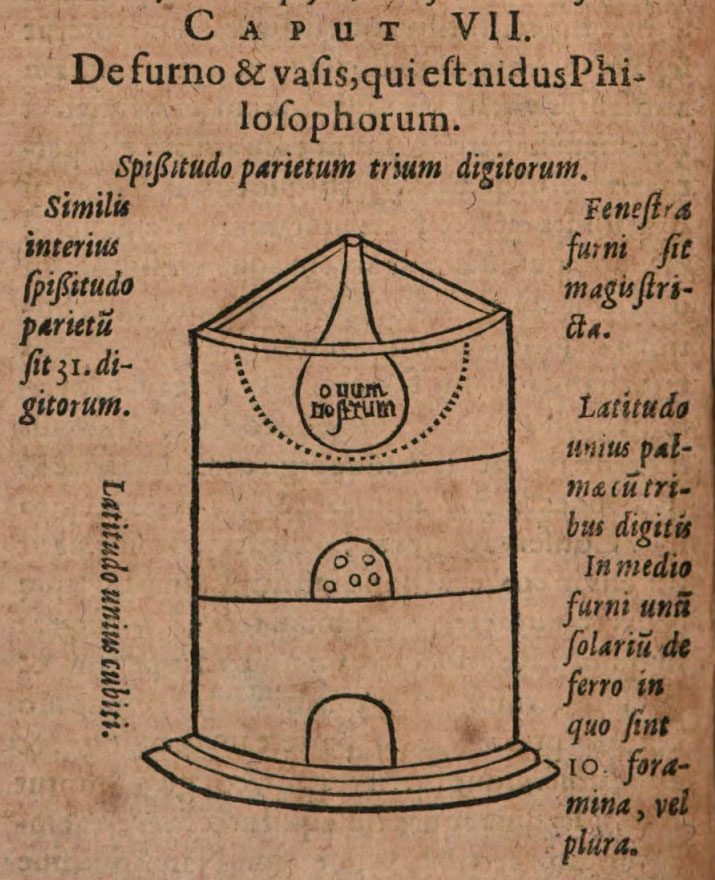
The thickness of the three walls: three fingers.
Let the thickness of the walls inside be similar: 31 fingers.
Let the window of the furnace be made narrower.
The width of one palm, with three fingers.
In the middle of the furnace let there be one iron plate, in which there are 10 little holes, or more.
The height of one cubit.
[Text inside the vessel/egg in the diagram]
Philosophical egg.
What is the Philosophical Nest?
I say that it is deservedly called the Philosophical Nest. Now let us see what sort of place is required for the generation of liquefiable things.
It is clearly perceived that the place of minerals is where, in the bottom of the mountain, there is an equalizing heat, enduring, whose nature is always to ascend; and in ascending it dries and coagulates everywhere the viscous water hidden in the belly and veins of the earth into quicksilver. And fatness from the heated earth everywhere flows and runs, and from it sulphur is generated.
And wherever in the veins of the earth the vapor of that sulphur, from the fatness of the earth, as has been said, meets the vapor of quicksilver, as has been said, from the thickness of mineral water, there, through heat in the mountain, it is begotten, and, by enduring, in a long time, according to different diversities, different liquefiable things are generated.
And it is chiefly to be noted that the mineral mountain outwardly is everywhere stony and firmly closed; for if the heat were able to go out, liquefiable things would never be produced at all.
Therefore it remains, if we wish to imitate nature, that the furnace must be made in such a way that the fire placed in it, when it rises, finds no exit, and that the heat may reverberate upon our egg, firmly closed within itself.
We have now declared the construction of our furnace and its proper proportion.
Know also that the egg of the Philosophers is our perfect stone, having a mineral, vegetable, and animal nature.
It is called mineral stone because it is collected from the earth like a mineral, and is the mother of all liquefiable things.
But it is called herbal or vegetable because it is made from the juices of three herbs equally joined together, whose names are said below, after they have stood in hot horse dung for ten days. I saw Mercury flow forth of the same color and virtue as the mineral; and these are the mercurial herbs: sea purslane, which makes white milk, and celandine, from whose mercury, thus flowing out, no difference is found from white Mercury.
Therefore that stone is also a stone from vegetables. Therefore the Philosophers have said: our stone is found in every place and at every time, and is trodden underfoot.
But it is called an animal stone, first, because when the elements of this mercury have been separated and joined together in equal weight, with nothing else added, in a strong glass vessel with a small breathing-hole, and placed in soft horse dung of gentle heat, within three months there are produced the worms of the Philosophers, that is, horrible colors, one of which devours another, until one single worm remains, like a toad, which feeds moderately and grows to the size of a toad, whose form will be terrible.
And this animal, by itself, is the Elixir upon Jove and Saturn. Therefore this stone is animal.
And note that according to the mineral is made its projection, and it is converted into a liquefiable thing. Therefore let no one doubt that this mercury is the stone, which mortifies itself, rises again and vivifies itself, and turns itself into Sun and Moon with the addition of the ferment.
In an egg there are three things: namely, shell, white, and yolk. So in the stone there are three things corresponding to these three: namely, the glass vessel for the shell, the white liquor for the albumen, and the citrine body for the yolk.
The second reason is because, just as from albumen and yolk a bird is made, and without those two by means of the mother’s temperate heat, the shell remaining whole until the chick comes out.
So it is in all respects with the Stone of the Philosophers. For from the white liquor and the citrine body, by means of temperate heat, the bird of Hermes is made, while the vessel remains closed and is never opened until its perfect completion.
The third reason is that, just as from eggs oil is made, which is the tincture of citrinity, so from the Stone of the Philosophers oil is made, which is the tincture of citrinity and redness.
And just as in the mines heat does not immediately touch the matter of sulphur and quicksilver for the earth of the mountain is interposed everywhere so also fire or heat must not immediately touch the vessel containing the aforesaid matter. But it must be placed in another closed vessel, so that around the matter, above and below and on every side, it may be better and more openly surrounded, and the heat may be tempered.
Hence in the book called Light of Lights it is said that our mercury must be composed in a triple vessel.
Yet the superfluous things joined to that philosophical mercury are removed in the operation, and the absent things are supplied by the aid of this art.
But the fitting arrangement of our vessel is that it be placed, with the matter contained in it, over our furnace in an intervening dish, so that two parts of the vessel are uncovered above, and the third is uncovered among the ashes in the aforesaid dish; and beneath the vessel there should be ashes to the thickness of two fingers. Let the vessel sit straight and level, and let the ashes be well pressed around it.
When this has been completed, let our lamp be lit with common fire and placed in the furnace under the dish and rule it prudently, and thus, what you seek, without doubt you will find graciously.
CHAPTER VIII.
Concerning the Philosophical Clay.
What is the Philosophical Clay?
I say that the Philosophical Clay is called our clay, the bond of Solomon, and the seal of Hermes.
Therefore Hermes says: seal well the mouth of the vessel with our seal, so that it cannot breathe.
For the spirit is ready to flee when it is struck by heat.
Briefly, then, I tell you that our vessel can be sealed with nothing except with glass alone; this is the subtle secret of the Philosophers.
Know for certain that the Philosophers called the first tincture lead. The second tincture, namely its blackness obtained with decoction, they called Moon.
The third tincture, when it putrefies, they called bronze.
The fourth tincture, when the moisture of the sublimed living gold that is, distilled is poured upon it, they called putrefaction, and after the departure of blackness.
When the citrine color appears, they called it gold.
The fifth tincture they named burnt bronze, red lead, gold-flower, and ferment of gold.
The sixth tincture they called the purple Sun.
And the seventh they called the fiery tinging venom; and when the venom is made white like marble, the tinctures and colors now approach, and it does not permit them to flee from the fire.
Alabar is bronze, and it is the first work and is called magnesia.
And the second alabar is the white body, because minerals, that is, stones from the mines, cannot enter into bodies nor tinge them; but the dissolving bronze-like venom tinges them, as when it is submerged in bodies, etc.
When it is asked what the spirit hidden in sulphur and arsenic is, in the solution and putrefaction of the body of the Stone of the Philosophers, this must be understood, if you discuss the matters of philosophy, etc.
It is necessary that there be two principal beginnings which we use, namely, male and female, in which also the four elements are understood to agree in a certain way. This male and this female together beget our Stone.
And although sulphur is the male in this place, by the will of nature it receives the white form of the woman, and suffers by it.
If you have known the bronze of the Philosophers, then know that in that sulphur is hidden living gold, which we have extracted from our whitened bronze.
But by sublimed arsenic understand the daughter and wife of sulphur, and the viper, which kills her husband and shuts him up in her belly, etc.
From all the accidental colors and true essences that are sought out from the matter of the Stone, you can know the manner of acting in this way.
As many colors, so many names.
And another Philosopher says: according to the different colors appearing in the work, its names are diversified.
Therefore in the first decoction of our Stone, which is called putrefaction, our whole Stone becomes black. Hence a certain Philosopher says: when you find it black, know that in that blackness whiteness is hidden; and then you must extract it most subtly from its blackness.
Hence another says: when you find it now black, know that this blackness is the key of the work of our Stone.
But after putrefaction it grows red not with true redness, but rather it grows citrine. Concerning this someone says: it is often made citrine, and often grows red, and often liquefies, and more often is coagulated before true whiteness.
Hence another also says: it dissolves itself, coagulates itself, mortifies itself and vivifies itself; it blackens itself, whitens itself, and adorns itself with redness.
Before whiteness it becomes green. Hence another says: cook it until the green-born thing appears to you, which is its soul.
And another philosopher says: know indeed that in that greenness the soul rules.
The peacock’s color also appears before whiteness. Hence a certain Philosopher says: know that all colors which can today be imagined in the world appear before true whiteness, and then intense whiteness follows as true whiteness.
Hence someone says: when pure Laton is decocted so long that it shines like the eyes of fishes, its usefulness is to be awaited. And know that then our Stone is coagulated into roundness.
Another also says thus: when you find whiteness standing out above all things in the vessel, be assured that in that whiteness redness is hidden; and then you must not extract it, but rather cook it until it becomes red.
For certainly the end of our work is of the white, and the beginning of our work is of the red. Yet between whiteness and redness there is a certain ash-color, of a coarse color, concerning which it is said thus: after true whiteness, by increasing the fire, one comes to the ash-color.
And another says: do not despise the ash-color, because then it restores liquefaction. And then our thing will be crowned with the red diadem, by the will of God.
But when the Stone is rightly altered, that is, distilled, its body becomes black and dark, like extinguished coal. But the spirit that is taken away is liquid and white, like water in color. And the color of the soul is red.
The soul is again restored to the spirit of its body; it lives and rejoices, because the dead, when they rise again, will be living forever.
CHAPTER IX.
Concerning the Purification of Mercury and of the Body.
Son of doctrine, know for certain that Aconet has two superfluities, which must necessarily be removed from it.
It has a foul earthiness, which is an impediment to fixation. These two superfluities are utterly destroyed through the work of sublimation of the first degree, that is, of the order.
But the foul earth must be entirely removed and cleansed by this kind of sublimation, lest it create a livid color in projection, and in the same way a fugitive sharpness of itself.
But lest it make the whole matter fugitive in projection, it is necessary to preserve the middle substance of it, whose property it is to cleanse, and to defend from burning, and also to make the unfixed fixed.
And therefore it happens from the diversity of this medicine according to its different purification, that sometimes Saturn is created from it, sometimes Jove, sometimes Venus, sometimes Mars; and this necessarily happens from impurity. From it sometimes the Sun is created, sometimes the Moon; and this necessarily comes about from purity.
Therefore the method for removing its superfluous earthy substance is this: sublime it once or twice from vitriol and salt, until its very white, sublimed substance rises. But when the very white substance ascends, throw it into boiling water until it returns into quicksilver. Afterwards remove the water from it and work with it, because it is not good to work with it unless it has first been prepared in this way.
Therefore he said: the best manner of all preparation is to remove superfluities and to supply what is lacking. Thus both whole and corrupted things are recalled to their proper state.
And this indeed is: that you sublime Mercury very much from dry things that in no way agree with it, until it has received a heavenly color.
First, therefore, make Aconet begin to be sublimed; afterwards dissolve it, so that it may return into its first matter. And again sublime the whole.
Then into that clean Aconet, sublimed and dissolved, put clean bodies, balanced however in equal weight on the scales.
Nevertheless beware especially, in its cleansing, of depriving it of its own virtue, lest the force of its active power be suffocated in another thing. For the seeds of all things born from the earth are not multiplied nor do they grow if their generative power is taken away by some foreign heat; so certainly that nature will not be multiplied unless it is prepared in the proper manner.
Therefore do not take up that matter unless it is clean, pure, raw, pleasant, flowing, sincere, and right. But if you do otherwise, nothing will succeed, and its addition is better purified through fermentation.
Likewise, if you wish to have the intention, dissolve in it what is bound. For the first degree of its preparation is that it become Mercury; and this does not happen until you make it lunar by the guidance of water and the perpetual motion of heat, according to the manner of human generation.
Note well also that the foul earthiness of Mercury can thus be destroyed without any sublimation.
Put as much of it as you wish in a marble mortar, and just as much salt, and a moderate amount of vinegar; and stir strongly with a pestle until the salt is blackened. Afterwards wash it with pure and clear water, and pour the whole through a thin linen cloth, so that the water may pass out and the white liquor remain.
Then clean the mortar, and put back the white liquor with salt and vinegar; stir and wash as before. And when this has been done a third and final time, put the white liquor into a clean, thin linen cloth doubled or tripled, and press the white liquor into a glass vessel, or a clean glazed vessel. Do this many times, until the mercury becomes clear and dry, like a mirror of heavenly color.
Its fugitive moisture is consumed by the heat of fire in the operation. But you will purge the body through the ash-color, or by the burning of fire; or you will find it purged, if it is from flowers. And after you have it purged, grind it very finely and divide it most subtly; or take its filings, cleansed and purged from every other thing, and dissolve them over the fire with mercury, as gilders do. And thus you will have one part of the Stone well cleansed and purged.
And know for certain that common sublimation is nothing other than separating the subtle parts from the gross parts. And this must be done with a slow fire. For if we made the separation with a violent fire, the gross parts would ascend with the subtle ones, and so it would not be as it ought.
END.