The Chemical Charioteer, or The Palm of Theosophy - Auriga Chemicus, sive Theospohiae Palmarium
Study the Art with Us Buy me CoffeeThe Chemical Charioteer,
or
The Palm of Theosophy, - Auriga Chemicus, sive Theospohiae Palmarium
composed by an anonymous ancient philosopher, most skilled in chymical matters.
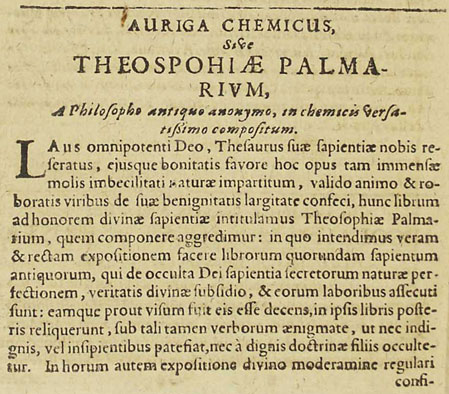
Translated to English from the book:
Theatrum chemicum, praecipuos selectorum auctorum tractatus de chemiae et lapidis philosophici antiquitate, veritate, iure, praestantia, & operationibus, continens: in gratiam verae chemiae, et medicinae chemicae studiosorum ... congestum, et in sex partes seu volumina digestum; singulis voluminibus, suo auctorum et librorum catalogo primis pagellis: rerum vero & verborum indice postremis annexo. Volumen tertium.
Thanks be to almighty God, by whose treasury of wisdom this work has been brought back to us, and by the favor of whose goodness this work, imparted to the weakness of nature in so vast a mass, has been completed with a strong mind and the robust powers of His generous bounty. Therefore we now undertake to compose the little book entitled The Palm of Theosophy, in honor of divine wisdom, in which we intend to make a true and right exposition of certain books of the ancient wise men, who by the perfection of the secrets of nature’s hidden wisdom, under the guidance of divine truth, attained it by their labors.
And because it seemed fitting to them, they left this [teaching] in those books under such riddling words that it might not be laid open to the unworthy or to the inexperienced, nor hidden from sons worthy of the doctrine. But in the exposition of these things, by divine moderation, we trust, and we do not exceed lawful bounds, and in due order attain what is fitting according to propriety.
But lest the volume of this our work be extended into an immeasurable size, we do not intend to undertake the exposition of all the books which those men who attained the said science by diverse paths composed, although many of them can tend toward one intention. Rather, we pursue our course by expounding only the writings of those ancients, in whose works especially and most familiarly this science seems to have been bestowed and revealed by the bountiful hand of divine generosity; and they appear to agree in the operation and composition of our elixir or penetrating poison, tinging and perfecting bodies, which is compounded from our Magnesia, our permanent water, and our ferment, or our air.
Because of the goodness of this work, and its operative power, and unity, and the invariability of its tincture and exalted principle, the philosophers chose it for themselves among their other works as something proper and special, and they laid down their figurations concerning it, and spoke of it in diverse manners. Yet, hidden in signification though they were, in this they remained in agreement.
Of these, before the Flood, the first were Seth, his sons, and their disciples. After the Flood, however, Hermes Trismegistus, the head of the philosophers; then Moses, and Maria his sister; after them King Hercules, Stephanus, Astanus, Belinus, Solomon, Democritus, and Rosinus. Then others, from whose sayings the Book of the Turba was composed, such as Pythagoras, Socrates, Plato, Zeno, and others, whose sayings were written in that same Book of the Turba. And finally many others were followers of these, who described books in this way of the work, or were mentioned in some part of their books, such as Morienus, King Calid, Miruendus, Alphidius, Alexander, Rasis, Avicenna, Virgilius, Geber, and certain others.
From their sayings, as need shall require, we shall bring forward testimony for the truth, for the fuller exposition and proof of those things which we narrate in this book. And indeed, although we reject vain boasting, we do not deny that just as we ourselves, so also other wise men of subtle understanding, even without the support of this book, could perceive and attain the intention of perfection from the books of the aforesaid philosophers. Yet they would reach it more perfectly by persevering and constant repetition of reading and by frequent practice of experience, if means for operating were supplied to them and this were not denied them by God. For we ourselves describe in this little book nothing else than what has flowed forth from the fountain of wisdom of those philosophers.
And so we desire that, through this our labor, the science and truth of the wisdom of the ancients to whom the powers of knowledge properly belonged may be preserved incorrupt from the ignorance of the ignorant and the shafts of detractors; and that its followers, with divine help, may become more truthful. For if they are not ungrateful to God, and if they understand with reason this exposition which we make, and persevere in the work may be able to attain the fruit of this truth.
We have therefore arranged this book in brief propositions in the text, and to each proposition we shall add a sufficient commentary, strengthening the meaning by the authorities of the aforesaid philosophers, not without adding some small contribution of our own knowledge, in those things which seemed necessary to us. And we give this book the title The Palm of Theosophy, because in some way it brings back the name of the author and expounds to us the secret of the wisdom of God.
Moreover, we think it worthy to order our little book in this sequence: first, that we treat of our Elixir, whether it is made from one thing or from many. Second, of the matter of the components of the Elixir. Third, of the mode and regimen of compounding and perfecting it. Fourth, of its utility and fruit, both in metals and in men. Therefore, giving praise to God and asking His help, let us undertake the first proposition, which is such as follows.
First Proposition
The Elixir of the philosophers, tinging bodies with an unchangeable tincture and most truly perfecting them in all respects, is compounded from one thing alone.
This first proposition seems to be proved by the sayings of many philosophers, especially of those who are cited in the book of the Turba. Among these, Eximenus in the ninth discourse says: Know, men of pure mind, that no true tincture is made unless from our bronze. Again: Do not therefore destroy your souls and your money. Parmenides in the Turba, discourse 11: Know that the envious have in many ways treated of many waters and broths, bodies, stones, and metals; but leave these things aside, and make gold, coin, and coinage of gold from this our bronze.
Lucas, discourse 12: Because one thing does that which many things operate, you have no need of many things, but of one thing; and that one thing is turned in every degree of our works into another nature.
Lethis, discourse 15: Know that the investigators of this art are stronger and more sublime among the philosophers; but among beginners there is something cheaper than all things, which nevertheless we seek.
Bonellus in the Turba, discourse 36: Know, all investigators of this science, that the whole work and regimen is nothing other than water.
Proposition II
On the contrary, this Elixir is not made from one most simple thing, but is compounded from many things.
This proposition seems contrary to the first. But the disagreement of this proposition and of some others following it with the first, as to the resolution of consistency, we refer to the eighth proposition; among the sayings of the wise we shall bring forward.
Bonellus, discourse 36, cited just above, says: The envious call this composition, when it is in its true blackness, sufficiently black. Rosinus, question 48: No stone is generated in art except this one, which the philosophers have composed from their own things. Likewise question 42: Unless there is something contained in the two most subtle things which makes peace, they perish and flee the fire.
Proposition III
It follows, however, that our Elixir is compounded from two things at least, since it was said before that it is composite.
This third proposition, although with those following up to the sixth it seems contrary to the first, will be reconciled a little later in the commentary on the eighth. Now let the sayings of the philosophers show this by way of confirmation.
Aristeus in the Turba, discourse 10: Take the body which I have shown you, and roast it on thin plates, and impose upon it our water, which is afterwards governed by permanent water. Diomedes, discourse 29: Join then the hot male with his red daughter, the wife of his odoriferous son. Zeno, discourse 35, seems to show this openly, saying: I signify to you that the art requires two natures, not indeed one precious without the vile, nor the vile without the precious. Zeno, discourse 26: Then the Elixir is composed from moist and dry.
Proposition IV
Moreover, it is desired that it be composed from three things.
Parmenides, discourse 5: Therefore leave aside the manifold superfluity, and take quicksilver, and congeal it in the body of magnesia, or in tombac, or in sulphur that does not burn; which three, however, are the same thing. And make that nature white, and impose our bronze.
Proposition V
That the Elixir is composed from four things.
Menaldus in the Turba, discourse 25: Know that this bronze, which I commanded you to govern, is those four bodies themselves. Dardaris, discourse 43: The sulphurs are souls, which were hidden in the four bodies; when they were extinguished they naturally joined one another and tinged one another.
Proposition VI
Likewise that it is composed from several and many things.
Zeno, discourse 26: This poison, however, is like nativity and life, because it is soul, and, extracted from many things, is placed upon coins. Bonellus, discourse 49: It must be noted that the clean water, which is the sulphur of all of them, is not from sulphur alone, but is received as composed from many things, which, made one sulphur, were from many sulphurs.
Proposition VII
Finally, it is said that the composition of this Elixir is made from all things.
Aristeus in discourse 51: Take quicksilver from the flower of bronze, which they have also called the water of our bronze, and the fiery poison extracted from all things, and a little later. And know, all investigators of this art, that every body is dissolved with the spirit with which it is mixed, and that all spirits are altered by bodies.
Proposition VIII
The reduction of the disagreement of the aforesaid sayings into harmony, and their right determination, by which it is concluded that our tinging Elixir is constituted from a composition of several or of many things.
To prove this proposition, in agreement with the preceding ones, we say that our Elixir is not constituted from one thing alone, but from the composition of several things, because before their composition they are of diverse species and are called by diverse names. But after they have been mingled together according to their regimen, they are so united with one another that they become one new substance, and are called by one name.
An example may be taken from other composite things. For when some antidote is perfected by art from diverse herbs, gems, liquids, and many other kinds of things, which in themselves singly are called by diverse and proper names, once the confection has been completed, there results from its various components a certain new species, which is called by one new name.
Similarly, bread is compounded from water and the mixing of flour, yet it is called bread. The same is seen in the building of a house, which consists of stones, lime, wood, bricks, and other such things; yet it is called by one name only, House.
And thus an example can be given from many things. So also the philosophers in our work, from the composition whence our Elixir proceeds, although they made it from many things, called it by one single new name, Magnesia, because it is a great thing in which there is the greatest arcanum.
Astanus, discourse 42: The philosophers, when they had prepared the things and joined together the coadapted spouses, lit with them the golden water.
The philosopher in the Turba, discourse 73: The first composition, namely the body of magnesia, is made from many things; although one thing has come to be, thereafter by one name, which the ancients called Albar aes.
And from all the aforesaid things the proof and resolution of the six propositions set forth above is sufficiently and more than sufficiently evident to the understanding, just as also of the doubt of the seventh proposition.
And thus there follows proposition 9.
Proposition IX
Although indeed it is evident that the elixir is composed from many things, yet its root and foundation is our bronze, which by its regimen must be brought to the elixir; for without regimen nothing is altered.
This proposition is the beginning of the demonstration of the species from which the elixir is made, because regimen is necessary. Hear Eximenus, discourse 8: Know that no true tincture is made except from our bronze. Therefore do not destroy your souls and your money, nor bring sadness upon your hearts, but I add for you as foundation that, unless you make the aforesaid bronze white in truth, and from it coins among the vile, and afterwards red, you are nothing.
Bonus, discourse 37: This, however, is our bronze, which the philosophers commanded to be washed with perennial water. Constans, discourse 28: And know that if you receive anything other than our bronze and irrigate it with our water, it will profit you nothing.
Proposition X
Therefore the true regimen of this our bronze is that it become poison, or rust tinging [things].
Mundus, discourse 48: The ancients indeed thought that he who turns gold into poison has already arrived at the goal, who truly lacks nothing in himself. Anaxagoras, discourse 54: He who can turn gold into rust and poison has already found the goal.
Proposition XI
Rust, or poison tinging things, is not made from the aforesaid our bronze unless it is tinged.
This proposition is certain and probable both by reasoning and by the frequent authorities. The reasoning is this: because, although our bronze can scarcely be corrupted by any common regimen unless it is led back into its own altered state, yet when it has been purified by the testing of fires, it does not tinge with a greater tincture; for its whole color is necessary for its own perfection, and by its own color it cannot color anything beyond itself while remaining in its own nature without diminution of its color, so that, mixed with another, it diminishes from its own color and therefore there is no profit.
Therefore, while it remains in its own nature, it remains thus unless it be governed by such a regimen that it may be tinged with a more intense color, one exceeding that color which it has perfectly while it remains in its own nature. And this regimen must be such that it becomes a powder, which, because of the multitude of its more intense color, becomes almost black, like the color of burnt blood, or of Tyrian or purple dye.
And then, because of the excess of its color, a very small part of it, admixed to the great body of a lesser white luminary, tinges it to the sufficiency of the color of a true greater luminary, with transmutation and with an invariable and fixed tincture through its own virtue and fixation, which it acquired from the regimen and from the tinging things.
Monarchus in the Turba, discourse 25: That bronze does not color except color; because that which is colored colors, etc.
Proposition XII
This bronze also is the body of the Elixir, as ferment is in dough.
Hermes says thus in the seventh treatise: Likewise, just as gold among bodies contains every dry body and vivifies it, so too this bronze is the ferment of the Elixir, without which it is never accomplished, just as dough is not leavened without ferment.
Proposition XIII
Therefore our bronze is tinged, and the poison or rust is generated namely permanent water, or quicksilver from Cambar, or quicksilver from the male, or the thing called by respectable names, and the bride made visible, who is to be mixed and nourished by regimen.
All these things that are said to tinge our bronze, although they are called by diverse names, are the same thing: namely our water composed from our things and perfected by its regimen, whose regimen, by the will of God, is plain enough. And that our bronze is tinged, hear Parmenides, discourse 2: Know that gold is turned into rust by permanent water. Mosius, discourse 44: The quicksilver which tinges gold is the quicksilver of Cambar.
Proposition XIV
Again, by the action of fire this our bronze is tinged.
Hermes in the third treatise: And this tincture remains red like Ramses; but our son the King took the tincture from the fire.
Proposition XV
From the aforesaid it is concluded that our tinging Elixir is composed from our bronze and our permanent water, and by the regimen of fire is brought to an intense virtue of tinging and altering, with perfect completion added.
It is certain that whoever does not complete this composition of our permanent water and its regimen with our bronze will not obtain the intended result from them; otherwise, laboring, he wearies himself in vain. For Constans, discourse 20, says: If you irrigate with ours, it profits you nothing. But if our water irrigates our bronze, you will find all the things spoken by us.
Proposition XVI
And because the said permanent water, without the tincture of our bronze, is of no value at all, it is fitting first to demonstrate, so far as possible, its composition and regimen.
Pythagoras, discourse 28: Certain men, having books, read and so long as this composition is matured, knowing certainly that nothing of the work is emitted.
Proposition XVII
For the making of this our permanent water, the composition is twofold, yet it must be brought to unity, so that it may become one.
The philosopher, discourse 12: The composition is twofold. For one is moist; the other indeed is wholly dry. Therefore let them be cooked until they become one, and are called the good of many names of men.
Proposition XVIII
The first composition, however, is made from dry things alone, which is called the body of Magnesia, or the whiteness of bronze, or the lead of bronze, and sulphur, and the bronze of magnesia, and our money, and our gold, etc. The second composition, however, is made from the aforesaid dry things with the moist thing, which is called Magnesia; although nevertheless one thing is put for another.
Rosinus, question 8: Consider therefore upon these things which are found in the books of the philosophers: our bronze, our money, our gold or our lead, our magnesia these are nothing else than that bronze brought to you, in which nevertheless that thing is, because they seek it from it. Likewise their lead or plumbum, which is their Magnesia, becomes the money, which is their body. Therefore the bronze is composite, which nevertheless becomes the money.
Proposition XIX
This first composition, which we have said to be of dry things, and which is called the body of Magnesia, is a composition of four bodies, or of four elements.
Monaldus, discourse 25: Know that this bronze, which I ordered you to govern, is those four bodies themselves. Democritus in the allegory, distinction 19: And no tincture is made except from bodies joined together.
Proposition XX
These four bodies are called sulphurs of the earth.
Dardaris, discourse 44: The sulphurs are souls, which were hidden in the four bodies.
Proposition XXI
And from these four bodies, or elements, in the composition of the body of Magnesia, an equal proportion ought to be applied.
The allegory of the wise, distinction 1: If you place the medicines equally, you do not feel error; but if you add or diminish, you tend toward correction.
Proposition XXII
The second composition, which we have said is of dry things with the moist, is quicksilver joined with the body of Magnesia itself; and this composition itself is called Magnesia.
Parmenides, discourse 11: Therefore leave aside the manifold superfluity, and take quicksilver congealed in the body of Magnesia; or in kenkel, or in sulphur that does not burn. In the Book of Allegories, distinction 12: Quicksilver is the spirit which wishes to be contained in the body of Magnesia; but the body of Magnesia is that body which they dissolve, so that in it they may compound spirit, which is likewise spirit and body.
Proposition XXIII
The intention of this commixture is that the spirit be coagulated in the body, and the body itself be dissolved into spirit, and the whole become one, which is called Magnesia. And this is to make bodies incorporeal and incorporeal things corporeal.
Astanus, discourse 42: Stir up war between bronze and quicksilver, because they strive to perish, and are first corrupted, inasmuch as the bronze, conceiving quicksilver, congeals it; but the quicksilver, conceiving bronze, dissolves it.
Proposition XXIV
The perfection, however, of this mixture is accomplished by the regimen of decoction, trituration, and ablution. By the benefit of this regimen the body’s visible benefit is suffered; and its uncleanness is cleansed and washed away; and its fiery subtlety, hidden in its belly, which before was the soul, is tinctured in the other, and in the other spirit the hidden thing is washed.
It is necessary to mix that very thing with fiery poison, and to putrefy it, and diligently grind it until it becomes spirit, hidden in another spirit. Plato, discourse 2: For spirit separated from body, and hidden in another spirit, each becomes fleeing.
Proposition XXV
And therefore the old son admonishes the foresaid one that you should give to the fire the fire and the azoth sufficient for yourself, since quicksilver burns bodies, and subtilizes, and reduces their grossness to subtlety.
Monaldus, discourse 25: Know that quicksilver is the fire burning bodies, mortifying them, and constraining them by one regimen.
Proposition XXVI
This same quicksilver also in this commixture is called fiery poison, because its fire is diffused through the body of Magnesia, just as poison through the human body.
Allegory, distinction 5: Fiery poison is the coined water not yet perfected.
Proposition XXVII
Therefore it is necessary to persist in the aforesaid regimen unto the culmination of this distillation, until the body in the aforesaid spirit has been so subtilized and dissolved that it becomes incorporeal without touch, both by nature light, and impalpable to the senses and to the sight of the brain. When this has been done, it must be exalted through the fire and called our air, before our bronze is created.
Astanus, discourse 42: This bronze, which the philosophers, when they had prepared the things and joined together the spouses fitted to one another, had united, from them there ascends the golden water. Mundus, discourse 47: Unless you continue the work without fire, even though the spirits ascend, they come to nothing.
Proposition XXVIII
This sublimation must be made with a gentle fire, so that the purified subtlety of the composite, which is the tinging soul, may be exalted into the smoke or to the summit of the vessel, while the earthly grossness, which hinders the tincture and the ingress, remains in the bottom of Tubal.
Monaldus, discourse 25: Know that the body cannot tinge itself unless its spirit be extracted and hidden in its belly, because what is earthly does not tinge itself; but that which is of a subtle nature passes into the body and colors it.
Proposition XXIX
Now this sublimed thing is the quicksilver of Cambar, and the permanent water, and gum and urine, which, as we said above, tinge our bronze, and which for that reason bears many other names; and in the sublimation is the completion of the first part of our work. But the second work is that our bronze itself be tinged solely by this water into tinging rust, by its regimen.
Astanus, discourse 66: Rust is the second work, which is made by gold alone.
Proposition XXX
Now the beginning of this regimen is to divide the aforesaid permanent water into two equal parts. With one part the due portion of our bronze is mixed, so that in it it may be dissolved and turned into earth; but the second is kept for the watering of the dry thing.
Hence Theophilus, discourse 22: Divide the poison into two equal parts, of which one part liquefies the bronze; but keep the other for grinding and imbibing. Cerus, discourse 23: When you divide the water into two parts, the first will be for liquefying and cooking the body; the second, however, for cleansing the burnt thing, and their filthy soots, which have become one. Nichorus, discourse 33: For it is necessary to burn our bronze with the other part, and then to imbibe the residual waters seven times.
Proposition XXXI
The proportion of mingling our bronze itself is by the said equal proportion, namely one to three.
Mundus, discourse 34: Take from the gum of the animal of most intense whiteness one part, and from the fish’s gall one part, and from the white of an egg one part; and from the body of the gum, without which it cannot be amended, one part. Mix these portions. Likewise the same: Take from the white body one part, but from the true Magnesia three parts.
Proposition XXXII
And at the most, two to seven.
Theophilus, discourse 22: That for which it is necessary for you to produce thin plates and to cook with the later part of the poison, two to seven.
Proposition XXXIII
But for the easier commixture of our bronze itself with the aforesaid water, we must first reduce the bronze itself into thin plates, then mingle them with the said water, and cook in it until they are dissolved and become one.
Aristeus, discourse 19: Take therefore the body which I have shown you, and roast it into thin plates. Then impose the water of our sea upon it, which afterwards is permanent water. Then apply a gentle fire until the plates are broken down and become water.
Proposition XXXIV
This composition must be placed in a glass vessel.
Existus in the Turba, discourse 37: Leave it in its glass vessel for forty days.
Proposition XXXV
In this regimen several colors will appear: first black, second white, third saffron-colored, finally descending into a more intense redness. But concerning these colors and their perfection, which all occur in order, we shall speak in their proper propositions.
Diomedes, discourse 29: Cook them therefore until they become black; then white; then red; then the poison becomes tinging.
Proposition XXXVI
But because unless our work is first whitened we cannot make it red, it is necessary first, by the degree of the first regimen, to bring it to the white, or to the color of coins.
Fritis, discourse 15: Know that the beginning of the whole work is whiteness, to which redness succeeds; then the perfection of the work.
Proposition XXXVII
Therefore the said composition must be cooked in its vessel with a gentle fire for forty or forty-two days, until the body is liquefied.
Aristeus, discourse 19: Then apply a gentle fire until the plates are broken down and become water. Mundus, discourse 18: Mix these portions; cook for forty days. Pandulphus, discourse 21: Therefore prudently cook these four for forty days.
Proposition XXXVIII
In this same decoction, however, it is necessary, before the aforesaid whiteness appears, for blackness to appear first, which by its nature is blackness.
Pandulphus, discourse 21: Then cook little by little, but inspect by drawing out; if it has become black. Bonellus, discourse 37: Seeing blackness to be put into that water, know that the body has already been liquefied.
Proposition XXXIX
The said blackness must be purified with salty, sour, or sweet waters, and by trituration washed away, until it becomes like liquefied coin.
Bonellus, discourse 37: Wash it, and strip it of blackness.
Proposition XL
After the removal of the blackness, the whiteness already spoken of begins to appear; meanwhile it is necessary to cook it until it becomes like a white coin or a white stone, like marble, or like salt, in its brightness and flashing.
Lucas, discourse 12: Roast it therefore for seven days until it becomes like shining marble. Philiorus, discourse 15: If you cook it well, and remove the blackness, it is turned into a stone, and becomes a coin of most intense whiteness. Theophilus, discourse 22: Cook for forty days until the white flower and the flower of salt appear in its brightness and flashing.
Proposition XLI
This stone is called by the philosophers Aiar, or the stone of Borichus, or the Attic stone.
Theophilus, discourse 22: Hence the philosophers called it boricum. Pandulphus, discourse 21: You ought to know the beginning of this stone, which is the Attic stone. Lucas, discourse 22: And know that when it is coagulated, we call it Aiar.
Proposition XLII
And indeed up to this point it is necessary to keep the fire gentle.
Lucas, discourse 12: And thus let it appear gentle in whitening, until it is coagulated.
Proposition XLIII
It must be observed in the aforesaid decoctions that the vessel always remain most carefully closed, lest the spirit flee, but rather be coagulated in it.
Lucas, discourse 12: Beware lest anything go out of the vessel; but coagulate the moisture in the vessel. Mundus, discourse 16: Observe therefore the vessel, lest the composite smoke out and flee.
Proposition XLIV
Yet in the aforesaid decoctions the whole moisture in the commixture is not retained or coagulated, but one part, or two out of its three parts, is separated, which may be kept for the second Combar.
Hermes in the Allegories says, distinction 6: But if you consume the third part of your Camels, two thirds being left, you have already come to the goal. Balgus in the Turba, discourse 50: I notify you that in this decoction of the coin the weight of the third part of the water is consumed; but the residue becomes wind, the spirit of the second Combar.
Proposition XLV
But after the said composition has been coagulated by the aforesaid regimen, and grows into a white dry stone, or coin, and shining like marble, it is necessary to kindle the fire so that it may be turned into earth, or a saffron-colored ash, or somewhat reddish.
Pythagoras, discourse 13: Break the lime and the marble. Socrates, discourse 16: Cook with the most intense fire until the subtlety of the body is hardened. Batolius, discourse 24: Cook it until it is coagulated; then grind it until it becomes saffron, a color like gold.
Proposition XLVI
This trituration, however, must be done not by the hands, but by fire alone, strong as we have said.
Zeno, discourse 35: And know that it is not done except by very strong decoction and continual trituration, by fire and not by hands.
Proposition XLVII
But with the aforesaid stone, as has been said, somewhat turned into colored earth, it is necessary to imbibe that earth with the second part of the aforesaid water; yet not by applying the whole water at once, but at several times at least seven. And at every imbibition cook it until the waters are dried in it, and hidden colors manifestly appear in them.
Coris, discourse 25: Imbibe it seven times, whatever is said. Gregorius, discourse 27: It is necessary, when you see the good shining stone, and by grinding turn it into earth, and let it have some redness; then taking the residual water, which the envious ordered you to divide into two parts, and after you have imbibed it many times, hidden colors will appear to you in that body.
Nicarus, discourse 33: It is necessary for us to imbibe the residual water seven times, until it has drunk the whole water, and, all the moisture having been dried up, it is turned into dry earth.
Proposition XLVIII
The aforesaid earth easily drinks the potable water.
Socrates, discourse 16: And know that when it has become dry, it quickly drinks the residue of its moisture; because that is the consumed lead.
Proposition XLIX
The time of all these imbibitions is one hundred and fifty days; and according to this circle, in seven imbibitions twenty-one days are plainly seen in each portion.
Hermes, in the first of the seven treatises, says: Know that the juice of the vine of the wise is extracted in one hundred and fifty [days]; whose number is completed at the end of thirty. Rosinus, question 18: Cook the boric coin until it is turned into powder, and imbibe it with vinegar, and cook until the vinegar fails throughout one hundred and fifty [days].
Proposition L
By these repetitions indeed of the imbibitions and decoctions, the work is adorned with diverse steps and colors; and according to the intention of the colors it is called by diverse names.
Existus, discourse 38: Do this many times, until the parts of the water perish, and colors appear. Mundus, discourse 62: We name our Tyrian at each degree of regeneration by the name of its own color. Seeing it dry, cook and imbibe it again and again until it takes on the aforesaid color, so that it becomes gold. Then reiterate it and it becomes all gold. Then repeat it again and it becomes gold of Tyrian color.
Proposition LI
From these imbibitions it happens that the ash is moistened and sweetened.
Azaracus, discourse 57: Mixing the ash with water, cook it again until that ash is liquefied; then cook it and imbibe it seven times with permanent water, until the sweet composition is made from the raw bronze; and imbibe it whenever it has become moist.
Proposition LII
An imbibition is also made whenever [one uses] the said ash by the water which had ascended from it in the work of petrification, and by the aforesaid reason of division.
Aristeus, discourse 19: Imbibe Ethelia, or its water, which came forth from it. Mundus, discourse 14: Take the moisture which it cast out, and little by little impose it upon it. Diomedes, discourse 29: Return to it its own sweat, and again give it nourishment.
Proposition LIII
But from excess of fire in the work of the said imbibitions it must be carefully guarded, lest the soul flee from the ash; rather let it remain and be fixed in it.
Diomedes, discourse 29: Return to it its own sweat, and again give it nourishment, and establish its kingdom; and beware lest it flee with those things being burned by too much fire.
Proposition LIV
When the said imbibitions and decoctions of one hundred and fifty days have been finished, afterward it must be cooked with an intense fire for forty days for the completion of the color and the perfection of its decoction, so that the impalpable spiritual powder of Tyrian or purple color, or burnt [color], may appear, which is the perfection of the intention.
Sobosses, discourse 24: And do not cease to cook and dry until it is imbued with all its moisture. Then leave it for certain days in its vessel until the most precious Tyrian color appears above.
Proposition LV
This same powder of the Elixir, or the poison of the philosophers, is that which tinges the imposed coin and turns them into perfect gold, with God’s help.
Barsen, discourse 30: And what comes into perfection tinges every body. Mundus, discourse 47: Because the philosophers’ poison brings it about that it tinges every body.
Proposition LVI
And its tincture will not then be deficient through fire or through the assay, but it will be invariable and firm, and according to the quality [required].
Arisuberes, discourse 14: When the poison penetrates the body, it colors it with an invariable color. Likewise: From sulphur mixed with sulphur there is made a most precious color, which is not varied nor flees from the fire.
Proposition LVII
The cause, however, of this effect is that, because of its virtue and acquired property, both from nature and from art, it is able, by the help of heat, to separate from bodies even homogeneous superfluity. For by its subtlety it penetrates by the smallest parts, and disjoins and destroys the corruptible part, leaving only the incorrupt substance of perfection. And by the same cause, if it is taken inwardly in a fitting body, all superfluities of humors surrounding the diseased members are brought into equality, and the imperfect health is preserved. This indeed is the gift of God and the secret of the philosophers, which kings and others seeking it will scarcely find, unless it be divinely bestowed upon some good men.
Barsen, discourse 25: Yet kings, in seeking this, do not find it unless God grants it to some. Rosinus, question 10: No one can investigate those things which they have set forth obscurely unto the truth, unless God inspiring, or someone teaching. Likewise the same, question 13: Because God is lavish to His prophets and elect.
Proposition LVIII
Whoever therefore shall have understood the aforesaid things by reason, let him rejoice among the sons of wisdom, let him render many praises to God, and let him give thanks for so great a benefit. But whoever has not attained their understanding, whether by his own judgment, or his ignorance, or his sin, let him know this to have happened: that he ought to impute it not to us, but to himself.
Diomedes, discourse 29: If you understand, investigators of this science, you are blessed; but now I bring to an end what I ought, and briefly. And if you are ignorant, God has hidden the truth from you. Do not therefore rebuke the wise, but yourselves. For if God should make in you a faithful mind, He would surely inspire the truth.
Let us therefore render manifold thanks to divine wisdom, which, opening its secrets to us, has granted those things, approved by the strong sayings of the philosophers, to be set forth through the course of this our description, so far as it was permitted, in Theosophy without envy. May whose name be praised unto the ages of ages. Amen.
The End.