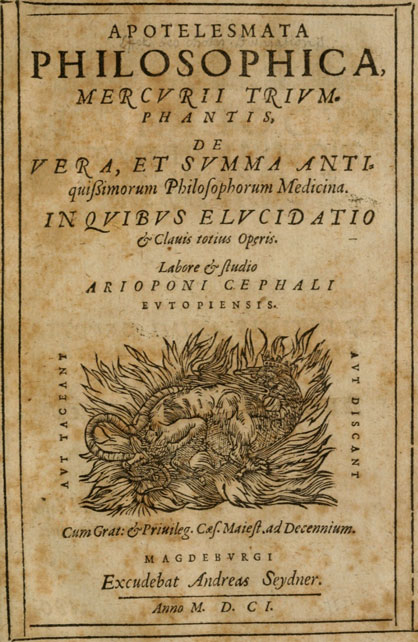
PHILOSOPHICAL RESULTS,
OF THE THREEFOLD MERCURY,
MADE MANIFEST,
CONCERNING
THE TRUE AND HIGHEST
QUINTESSENCE
OF THE MEDICINE OF PHILOSOPHERS,
AN UNDOUBTED EXPLICATION
AND KEY OF THE WHOLE WORK.
By the labor and study
of ARIOPONUS CEPHALUS,
of Eutopia.
NATURE CONCEALS
ART DISCOVERS
With Grace and Privilege of His Imperial Majesty
for ten years.
AT MAGDEBURG,
Printed by Andreas Seydner.
In the Year 1601.
TO RUDOLPH II,
ROMAN EMPEROR,
MOST INVINCIBLE,
EVER AUGUST.
FROM THE INMOST RECESSES
OF A MOST DEVOTED MIND,
AS A TOKEN OF MOST HUMBLE OBEDIENCE.
HE DEDICATES, CONSECRATES,
AND SUBMITS (THIS WORK).
M. C. M. D.,
the least of those who practice philosophy.
APOTELESMA
OF THE PHILOSOPHICAL, TRIUMPHANT, THREEFOLD MERCURY.
CONCERNING THE SUPREME MEDICINE
BOOK 1.
APOTELESMA I
MOST ABUNDANT
Translated to English from the book:
Apotelesmata philosophica Mercvrii trivmphantis : de vera et svmma antiquissimorum philosophorum medicina : in qvibvs elvcidatio & clauis totius operis / labore & studio Arioponi Cephali Evtopiensis
1.
God, in the beginning, created Heaven and Earth: but the first [thing] was a certain unformed, confused Essence, which the Philosophers call the Mother and the First Matter of the World, or Chaos and Hyle.
2.
This the Best and Greatest, the almighty Creator, created out of Nothing.
3.
Namely, by the Word commanding, and by the Spirit fostering.
4.
For God is the beginning of all things, and the first of causes.
5.
Whose image is universal Nature.
6.
What is produced (the thing begotten) has the savor/character of the Nature of its producer.
7.
For this visible world was formed and fashioned after the pattern of that intelligible world.
8.
But all things were made by the most free will of God providing, foreseeing, and governing.
9.
And just as God created all things out of Nothing (not out of any pre-existing matter), contrary to all the laws of Reason and of Nature; so likewise no created thing can in any way return again into Nothing, unless this be done by the singular omnipotence of God, contrary to all the laws of Reason and of Nature.
10.
Hence the admirable powers of things can be drawn out by us, and true metamorphoses can be brought about provided only that we skillfully handle and investigate Nature according to the art of Chemistry, [in] the Magistery.
11.
Now in the universe of things there are two kinds of waters: the Superior and the Inferior.
12.
The inferior things are warmed, cherished, and preserved by the motion and light of the superior [things].
13.
The courses of the Sun and Moon; their risings and settings; their labors; their delight and fixed seasons whence impressions are made in the lower bodies, and seminal rays proceed.
14.
By the heavenly fire cherishing all things and not consuming [them].
15.
Hence [comes] the wondrous connection, continuity, influence, and sympathy of natural things of the Inferior with the Superior.
16.
This is the Homeric chain; these are Plato’s rings; this is the combination of things.
17.
This is the true Real Cabala, not that vulgar alphabetic one.
18.
For whatever is in the world has, with something else, order, correspondence, and conformity.
19.
Thus the Inferior things are certainly in the Superior, and the Superior in the Inferior, after a certain manner; and they are mutually coordinated to each other agreeing or conformable.
20.
Therefore, through these things whether existing separately in Nature, or previously lying hidden seminally in the wombs of Nature [there is] UNION AND ACTUATION so that nothing more wonderful can naturally be brought about than any mortal can believe.
21.
Nature works from the disposition of her own power and origin, as Nature of herself proceeds.
22.
She needs only a very small help of Art.
23.
The agreement of Nature itself and the best Harmony teach this.
24.
He therefore who knows how to choose the matter that is set before him and most ready to suffer [to be worked upon], and the agent most strong he produces more excellent and more powerful effects.
25.
God, the Author of all things, being free from all those [things], and far above all, greatly excels by His Majesty.
26.
His Essence is distinguished in three Persons.
27.
The forming (fashioning) of the divine mind in other created things.
28.
The propagation and preservation of species and individuals.
29.
The essence of GOD can be expressed by no image, name, figure, appearance, form, or body.
30.
Yet by His own virtue He is present in all created things, and insinuates Himself into our minds.
31.
For He is Brightness and infinite Bounty, fiery Love, Light inaccessible and scarcely conceivable an illuminating splendor and surpassing radiance; a burning flash, surpassing all understanding.
32.
Great mysteries are in Numbers; hence the Pythagorean Cabala is most full of the greatest secrets of Nature.
33.
All things are in GOD, as numbers are in Unity, and all the lines of a circle [are] in the Center.
34.
The powers of the members of the human body [come] from the Soul.
35.
Unity is the fountain and origin of all numbers.
36.
And God is one, as the Soul and Unity [are one].
37.
All human things are fragile and perishable.
38.
God, ever like Himself, is not changed.
39.
At the same time He cherishes, guards, and sustains all things that are ours.
40.
God, ineffable and unnameable, is marked in Nature as a Trigram, in the Law as a Tetragram, and in Grace as a Pentagram.
41.
God dwells in eternal light, having in Himself an unutterable splendor.
42.
Light is a quality wholly formal and a simple act, or the first form.
43.
The power of this first and principal form, namely LIGHT, is such that without it all other forms can do nothing.
44.
As the heavenly [things] are more formal than the earthly, so they are also more actual.
45.
The Soul of the world is the middle Nature.
46.
But this Soul of the world dwells chiefly in the Sun.
47.
A thing has as much of Light in itself, as it also has of Divinity.
48.
For this cause Plato called the Sun the visible Son of GOD, and Dionysius [called it] the visible statue (image) of God.
49.
And according to Orpheus, the Sun is the eye of the world, which breathes into all things heat, light, and life.
50.
Hence whatever good we have (as Iamblichus says), we have from the Sun either from the Sun alone, or from the Sun through other things.
51.
Therefore the Soul of the World is founded and placed in the Sun, as that which, filling the whole globe of the Sun, pours forth its rays on every side through all things as though a Spirit distributing life, sense, and motion to the whole universe, and penetrating all beings.
52.
When the soul departs, all the offices (functions) of the body grow faint.
53.
And Heraclitus calls the Sun the fountain of heavenly light; which being taken away, he says, all things become dark.
54.
The Sun is the Heart of Heaven; just as in the human body the heart is the spring of vital spirit and blood, imparting motion and vigor to all the other members.
55.
In the Sun, therefore, is the vegetation and preservation of all things.
56.
The effects of the Sun are various: its light is a simple act.
57.
Under the kingdom and dominion of the Sun are the remaining planets.
58.
The heat of the Sun is life-giving: by its approach all things flourish; by its withdrawal they wither and die.
59.
So likewise it is with the Sun in metals, just as with the Sun among the stars.
60.
For the purest of metals is Gold, in which the splendor of the Sun and the ray of the heavenly fire is present.
61.
Therefore we set before you the Sun Gold and the heart of man, to be considered according to the laws of Magical Anatomy and Philosophical Pyronomy.
APOTELESMA
OF THE PHILOSOPHERS’ TRIUMPHANT MERCURY.
CONCERNING THE SUPREME MEDICINE.
BOOK 2.
APOTELESMA.
1.
The first and common cause of all metals is a sulphureous vapor and Mercury, or Quicksilver.
2.
But the difference of metals is according to the purity or impurity namely, of the sulphur and of the divine (heavenly) mercury.
3.
The efficient causes of the generation of metals are Nature and Art.
4.
Art imitates Nature, and supplies her defect, corrects, purges, helps and advances [her] indeed even overcomes Nature.
5.
There are two kinds of philosophants (workers/philosophers): some [work] upon elemental natures, under the sphere of the Moon, in the common way they inquire; but others, far more splendid, and under the truer name of Philosophers, search out the more secret mysteries of Nature: these enter into Nature’s innermost shrines and her sanctuary.
6.
The method and cause of the operations is threefold.
7.
The inferior bodies are to be brought to the nature and perfection of the superior bodies.
8.
But in a far different way than some of the philosophers have falsely supposed.
9.
Although Sulphur and Mercury are the root and matter of metals, yet they must be brought to another nature.
10.
But that bond by which Sulphur and Mercury, in due proportion, are joined together, is most hidden, and lies concealed.
11. (NB.)
Therefore neither the mercury of the vulgar, nor common sulphur, is to be held for the matter of the Stone; but rather that which is from them the purest thing, namely, the seed.
12.
The vegetable nature must be considered, and from it the process of this art must be attended to.
13.
Therefore, in this art, the seeds of things must be sought from the more perfect bodies.
14.
Then that earth, prepared by art, must be impregnated [therewith], and as is fitting digested by a gentle and continual heat, until, those seeds being duly matured and concocted, a renewed form show itself, and the inferior bodies attain and are reduced to a heavenly disposition and vigor.
15.
This art of Philosophy is to be founded and exercised from the secret counsel and inspiration of GOD.
16.
For they saw that animal and vegetable things propagate by a certain innate and internal spirit of their own, and produce something like themselves by diverse motions of alteration.
17.
And although the seeds of all things born of the earth often languish through some collapse, Nature nevertheless knows how to restore them by her own innate power and spirit.
18.
This spirit, or nature truly generative and prolific, to reside even in metals, the ancients most skilled in the nature of things found out; and likewise also in other vegetables.
19.
And indeed, by a law and appointment given from the common nature.
20.
But that generative spirit in metals, since it is imbibed with its own thicker matter, mass or slime, must be separated, refined, and purged by a secret sublimation, an emolliation (softening) or philosophical regimen.
21.
For thus, when the obstacle is removed, the kindred spirit, in its connatural seat namely in the innate radical moisture is cherished, retained, and preserved as a seminal virtue in metals.
22.
Hence the Philosophers undertook to bring light, beauty, and brightness of the more Perfect into the inferior bodies.
23.
Since their difference is nothing else than according to a greater or lesser digestion of themselves, or a mixture of burning sulphur.
24. (NB.)
Mercury is the universal matter of all metals and the first cause; and likewise of Gold, which must be reduced to its first nature.
25.
Since this reduction cannot be done with excessive difficulty, therefore the transmutation of metals is easy and possible.
26.
Only let care be taken lest the inner form of Gold be dispersed by an unskilful operation, but rather retained.
27.
And thus the purification of Nature from its slime is rightly attempted and accomplished.
28.
Whence also the Stone takes its name from its effect, because it is called “transmuting.”
29.
Thus indeed by the industry of Art it is necessary that Nature’s defects be supplied, since Nature by her own disposition ever tends, labors, and strives toward her perfection.
30.
But many and various philosophers have used enigmatic coverings and figures.
31. (NB.)
Now there are two principal parts of the Stone: one is the earthly Salt of the Philosophers, without which nothing is accomplished.
32. (NB.)
For in this earth the Sulphur of the Philosophers is most pure, in which Nature has placed her seed.
33.
But it is necessary that in the Stone there be, in respect of color, weight, and all the other elements, a complete adequation, after the manner of Gold.
34.
But they say that in Gold, as the most perfect metal, all the other metals are [contained] after their manner.
35.
All things, according to the temperament and complexion of their own nature, beget something like themselves.
36.
But Nature, purified by the industry and magistery of the operator, brings forth.
37.
The other part of the Stone is the living Mercury of the Philosophers.
38.
Without this Stone Nature works nothing.
39. (NB.)
So also without the Sun and Mercury we do not work.
40.
That Mercury is of such efficacy and virtue, that no other thing is [so] in the whole world.
41.
Hence not without reason is this celebrated concerning it: “In Mercury is whatever the wise seek.”
42.
The Sun and Mercury constitute one Stone.
43.
These two are bodies dead of themselves; and they do nothing and beget nothing, except what is administered to them by the magistery of Art.
44.
Mercury, by dissolving the seed of Gold, conceives; it carries it in its womb, and at length brings it forth and sends it out into the air Mercury meanwhile remaining a virgin, and that virgin also a mother, preserving the honor of virginity, while the Body shines forth in purity.
45.
This art is revealed to none, unless to him to whom GOD has willed to reveal it.
46.
From this art there is knowledge of almost all things; and in this Stone the Nature of all things shines forth.
47.
For it is as it were a lesser world, in which are the four Elements; and above these the Quinta Essentia, which they call the Soul, the middle Nature.
48.
This Soul, the middle Nature, is in this work, and through the whole [of it], in this philosophical operation.
49.
The begetting of things is as far as to the highest bounds of the world, from which it both begins and ceases.
50.
Therefore the investigation of it ought deservedly to be most highly commended to all students of truth.
51.
But the slanderers and the ignorant whom the philosophers call foolish are to be excluded from these so divine banquets, as being unworthy of the secret; and, as men raving, they are wholly to be left to their enthusiastic and fantastic dreams.
52.
For this is the one most precious Pearl and the Minerva of hidden Philosophy.
53.
That Minerva was the daughter of Jupiter, and was born from the very head of Jupiter.
54.
For when Vulcan had opened Jupiter’s head with an iron axe, armed Minerva sprang forth from his brain.
55.
This Minerva, therefore and this union of all things surpasses all estimation.
APOTELESMA
OF THE PHILOSOPHERS’ TRIUMPHANT MERCURY.
CONCERNING THE SUPREME MEDICINE.
BOOK 3.
APOTELESMA.
1.
Nature is a certain seminal force of divinity implanted in things, begetting like from like.
2.
Nature also is a living, heavenly, invisible fire, or vital vigor, heat-giving the germination and greenness (verdure) of all things.
3.
By which all things are generated, sprout, and flourish.
4.
Nature is also defined as the principle of motion.
5.
For when motion is unknown, Nature is unknown, which is found in continual motion.
6.
The kinds (species) of its motion are six and most well known, which every sincere philosopher must before all things thoroughly consider.
7.
The Soul of the World is busied in the generation and preservation of things.
8.
All souls must be referred to one Soul of the World; and all the planets to the one Sun, as the King of all which all the more hidden philosophers strive to prove in the Supreme Work.
9.
For indeed all things tend to one End; and from the same beginning it is; and all things are full of the same [principle] in this philosophical work.
10.
Nature likewise is the bond, and the most subtle tie and ligament of the Elements.
11.
This brings about the mixture of the elements among themselves, which gives to all things that are born their form, by which they differ from the rest.
12.
Which, although of itself it is free from all color, weight, and quality; yet it partakes of all these, so that it exists as the mother of those things.
13.
Nature therefore is intelligible, formable, genial the first physical Being and as it were the hand and finger of God, by whose authorship and workmanship all things are brought forth into the light; and it is itself, as it were, a most pure lamp of inaccessible light, which by the ray of its own vigor infuses into all things a breathable spirit of soul and life.
14.
Thus Nature (for it is the image of Him) is an invisible fire, or a fiery vigor, by which all things are multiplied.
15.
Heat brings forth and produces all things in universal Nature.
16.
And the power of the Decree (command), concerning multiplication and the fruitfulness of its kind, diffuses itself through the whole universe.
17.
Hence Nature is prolific, and its greenness (verdure) is in propagating.
18.
And this is the Cabalists’ green line, which encircles the universe.
19.
Which, by a certain motion of its own, through the successive degrees of alteration and augmentation, does not cease until at the highest boundary of the world, where it stands at rest in its own end.
20.
This we call the Soul of the World, supported by the authority of the Platonists, the Arabs, and the Chaldeans.
21.
Yet let there be far from us all superstition and idolatrous worship; the honor and glory of that one GOD being held fast, which He gives to no other.
22.
Nevertheless we judge the pagans worthy of pardon, who led astray and having erred rather from ignorance than from malice because the light of truth had not yet arisen for them.
23.
But we, in this kind of studies, follow the experience and industry of the bee: gathering honey with its most fragrant juice from the flowers, and choosing the best, while separating from the bad and bringing only what is useful.
24.
Those forewarnings and auspices of Nature show themselves here and there in the heaven, in the air, and in various meteors.
25. (NB.)
Hence the gold-bearing [things] draw their seeds; hence also perpetual springs have their origin in their flowing forth.
26.
Yet let there be far from us the error and false invention of the astrologers, who assign to the stars their own particular spirit and genius.
27.
But we hold, with the more ancient philosophers, that the human soul is a certain divine particle of the Soul.
28.
Which God Himself has expressed in us as certain seeds and an imprint (effigiation) of His mind.
29.
By a not unlike reasoning: as an Echo, by the reverberation of the air, sends back its voice from afar; by which it expresses, as it were, a vegetative soul.
30.
Thus secondary causes are driven on by the First, whence they partake of their motion and communicate it to the rest secondarily.
31.
Nor otherwise: to our souls there have certainly been assigned heavenly guards some watchmen of spirits and angels.
32.
Although God Himself chiefly exercises and carries out His fatherly care with vigilance.
33.
This the courses of the heavens teach: the risings and settings of the stars, the fixed seasons, and other things likewise.
34.
Which need no other art and industry than that which they possess of themselves.
35.
And here all the opinions and trifles of certain astrologers how vain and most vain fall to the ground.
36.
For they are to be ascribed to GOD alone, as the Author of the universe; and to Nature, and to His Law lest they dare to feign such things in created things.
37.
But that which here we call the Stone is a tincting Spirit invisible, impalpable, beyond all reach of sense which indeed another, outward Spirit expresses externally.
38.
And in this manner, and so far, it comes under our sight and touch; yet the ancients have left it to us in diverse coverings and enigmas.
39.
This Spirit is the Fifth, set apart above the Four: the very bond of the Elements, their jointure, nexus, mean and tie, by which Sulphur and Mercury are closely united into one Geogamic Body.
40.
But since that bond lies hidden in the most secret place, and is invisible, as being a Spirit, the philosophers call it in which they strive to investigate and inquire into in the most perfect body of Gold.
41.
From it, indeed, the seminal, generative nature is to be drawn forth, which is the divine fire of Nature, or the Soul, the middle nature; the Spirit of the World; the gift of the Tincture; and the noble germ.
42.
This therefore they fit to the Tincture, cleansing it, and rendering it free from all filth and polished.
43.
And thus, by an infinite increase and multiplication, they establish the power of its own genius, and strengthen its beauty.
44.
But as man is said [to consist] of Body, Soul, and Spirit, so also [is] the Stone.
45. (NB.)
The Spirit is the life of the Soul; the Soul is the life of the Spirit; the Spirit and the Soul are the life of the Body.
46.
For since the Soul and the Body are extremes, they need a middle namely, something which is as it were not Body, but as it were a Soul; or as it were not Soul, but as it were a Body by which, namely, the Soul is joined to the Body.
47.
Such a medium is the Spirit, by whose benefit that augmentation comes to pass.
48.
For the Spirit is the knot and bond of the Soul and the Body; and thus the chariot and vehicle of the Soul is the Spirit.
49.
Such a Spirit therefore is necessarily required in this art as the medium, by which the heavenly souls may be in the grosser body, and their wondrous gifts be bestowed.
50.
Thus you have in one body all the seeds of acting Nature, and the power and efficacy of generation in this our Stone.
51.
For those three Body, Soul, and Spirit constitute the Stone for you.
52.
Yet under these three, the four Elements of the body are also comprehended Unity, as it were, in their own covenant and frame.
53.
And so the Quaternary rests in the sacred Ternary.
54.
Which I thus demonstrate and prove: for Water is Spirit, and likewise Air; and from both of them results Fire, the middle Spirit. But Earth is not likewise Spirit, but Body, and the holding-vessel (retinaculum), matter, and receptacle of the other elements.
55.
Since therefore Gold is a body most strongly compacted and most firmly consolidated in Nature, hence it comes to pass that such a bond, medium, and tie by which it is coagulated and made concrete cannot be had from it easily, unless by resolution.
56.
But although you can dissolve that by art, here is the labor, on which the whole hinge of the business turns.
57.
Here lies the secret of the art hidden, which things must be attempted cautiously.
58.
And this is that solution, concerning which that Encomium is given that it raises the poor man from the dust, and makes him equal with kings.
59.
Therefore this, before all things, must be attended to by the sincere philosopher.
60.
For by this the body is cleansed from all its slime, and is dissolved; and the Earth is separated from its dregs.
61.
For the impurities are separated, and the inner Earth is purified.
62.
Which Nature itself cannot do by itself, since it acts only simply.
63.
It is the work of Art by mastery and industry.
64.
Thus, the secrets and things far removed once all uncleanness and filth that clung to them, which had first been an impediment to the Tincture, are removed open themselves most fruitfully: the begetting of things in their seed, and [each] begets and brings forth its like.
65.
For by the Spirit there is made the propagation of what is like itself, since every spirit is the author of generation.
66.
Therefore this Spirit if anyone knows how to separate it most greatly from the other elements, and to divide it rightly so that it be in an intense form will be held among mortals in sufficient esteem and honor.
67.
For then this Spirit will be able to profit us exceedingly.
68.
But when it is immersed in the body, and held fast by matter that is too gross and very tenacious, it can in no way break forth into its act and power of generation.
69.
Therefore it must be loosed from the bonds of the body, so that freely when the impediments are removed its heavenly and prolific virtue may shine forth.
70.
For then it is increased in strength and acquires its summits, and becomes a hundred thousand times more powerful than it was before in its own nature.
71.
Thus Gold also though it is dead is enlivened and made spiritual; that is, it is reduced into its first nature: namely, into the Spirit of Water and the vapor of Earth.
72. (NB.)
From these seeds Sulphur and Mercury draw their origin; whence comes the fruitful propagation and generation of all other metals.
73.
But that solution is said to be perfect, if the Spirit and the Soul of Gold have been separated, and its bond has been undone.
74.
But the temperament of Gold, since it is most perfect in all its parts, and most just in proportion, and in the highest equal balancing of the Hot, the Cold, the Moist, and the Dry: therefore, that it may be corrupted and loosed from so strong a bond while the preservation of its form remains this work, this labor, is the task here.
75.
It is therefore necessary that in the Elements there be dissension, a sundering, strife and discord: by which, when they are brought together, the solution and mortification of the Body is made; and when the old is thoroughly washed away and shaken off, a new Nature newly arises.
76.
In this manner, by the same rule, is that Egyptian bird the Phoenix said to be re-seeded.
77.
So also the Elements having cast off their old pallor and filth, and shaken it off grow green again, as if renewed in a kind of youth; and Nature, the old skins being laid aside, shines forth more glad in her new ones.
78.
But in this Magistery of Solution and Separation, first of all heed must be given to the Workman: lest the seed of Nature be harmed and overturned; and lest the power of generation, and its inward form, be slain, burnt up, scattered, or lost in any way since, once it has fled away and has been consumed, it can plainly effect nothing.
79.
But suddenly, as though by poison, all hope of the work being destroyed, it will stagger at the very end and vanish away.
80.
This is the sincere and solid Philosophy, concerning Solution and Physical Analysis, oppressed by so many shadows and so many trifles, everywhere profaned by the foolish madness of the vulgar.
81.
But the Solution is threefold: one of the crude Body; the second of the Earth, which is fitted and suitable for this work and nourishes the seeds of things; the third is that of Augmentation.
82.
In each of these, and in this threefoldness, three things are to be duly observed: weight, measure of time, and also the fire all with moderation.
83.
When therefore we know the weight of Mercury and of Gold, the measure of time, and the governance of the fire, by which the Solution is perfected, it is sufficient.
84.
Then the Signs will openly show themselves, whether you have operated rightly or wrongly.
85.
And the days, the months, and the years of the Philosophers are to be carefully noted.
86.
For in three days it will indeed give a proof, which can either make you rejoice or be sad.
87.
Therefore three days and two nights are given to you for performing the Philosophical Work. But you, who strive to be a son of philosophical truth, fervently pray God, that the last this is, the third day may shine forth for you in the Red.
88.
Likewise you will note three Keys of Wisdom: namely, Solution, Conjunction, and Fixation.
89.
And we also affirm two other Keys: one, of opening the body, that is, of dissolving; the other, of closing the same, that is, of fixing.
90.
Which two, by their power, figure and present to us the Stone.
91.
Meanwhile I say nothing of the black Head of the Crow, by whose false and empty emergence very many poor wretches have been snatched into error, and most exceedingly led astray.
The Triumphant Achievements of the Philosophers’ Mercury
On the Supreme Medicine
Book 4.
The Accomplishment
1.
The use and practice of this our work is the very restoring and renewing of Nature.
2.
Therefore here every kind of salts, all alumens, and the use of other exotic things ceases, and none of these are of any moment to us here.
3.
Whether you dissolve or whether you sublime, by common helps and uses since all common operations are, for this Art, impertinent and adulterate.
4.
Vain also are all those things which, in that fruitless work of reddenings, whitenings, and encrustations, have been spent by the common Alchymists and impostors of the Art.
5.
Now the highest points and chief summits of this Art are two.
6.
The first point is concerning Solution and Separation.
7.
The second is concerning Conjunction and Fixation, wherein also (is treated) Augmentation.
8.
But six Philosophical Operations are numbered, namely: Composition, Putrefaction, Solution, Division, Cleansing, Union or Perfection.
9.
Which, by a shorter way, thou shalt attempt thus: let no less than the twelfth part of Mercury be taken. And in its due proportion with the dissolved body, let the first Solution be made; and thus the great power of Gold is melted and brought down (made subtle).
10.
But it is needful that the Mercury be purified by a Salt specially prepared for that purpose, so that its most subtle and middle substance may be obtained.
11.
Of this purified Water, let several parts be well mixed with one part of the purest Gold, beaten out into leaves or little plates (foils).
12.
Afterward let it be placed in a suitable glass vessel with a shorter and more slender neck. Let it stand in ashes up to the surface of the water.
13.
And let fire and heat be applied in a geometrical proportion of equilibrium.
14.
Until from the Mercurial water itself there comes forth a certain earth, with a subtle spirit of vapours.
15.
How this is to be prepared is for the Philosopher to consider.
16.
This is called the floating Venus in the water of Mercury.
17.
And this is that Aphrodite begotten from the sea: for Jupiter, being angry, cut off with a sharp sickle the genitals of his father Saturn and cast them into the sea; whence Venus was born.
18.
Here the aura of Sulphur, in its varicoloured appearance, after the manner of the rainbow, is to be seen in pure and flowing water.
19.
For the whole property of Sulphur is expressed and prefigured by the rainbow.
20.
For the Iris is not seen unless the Sun be shining; and when the Sun setteth, the Iris also is hidden; which likewise is the forerunner of rains, and was appointed by God for a sign of grace: and many other Mysteries lie hidden under the image of the Iris.
21.
But when Venus is drawn forth, thou shalt take the water in which is the Soul of the Sun, or Mercury; and thou shalt distil it with a gentle fire, so that the moments between the falling of the little drops may be counted. Thus shalt thou have the living Water, which from its effect is so called.
22.
For it restoreth inanimate bodies by its quickening touch, and is endued with a double power and seed of Nature.
23.
For it is composed of two natures, namely, of Spirit and Soul.
24.
The Spirit is the chariot of the Soul, and its vehicle and bridle.
25.
This Water is called by many names: as most sharp vinegar, Luna, the Female, seed or the female menses, Heaven, Mercury.
26.
But the Body is called Sulphur, Sol, the Male, the masculine seed, Earth, and Mercury.
27.
Which, when they are purified by distilling, the Mercury is cleansed from its foul washings, and is freed from its filth.
28.
And thus Lucifer is said to be cast down and to fall from Heaven: and his Soul shineth forth in the light.
29.
So first there was evil in Heaven: but when Lucifer had fallen and was thrust down, the aether, being cleansed from all his stain, was purified; and the other Angels were confirmed in their throne.
30.
In these things, the first part of the Practice hath hitherto been, namely, in Solution and Separation. There followeth the second part, far more sublime and more divine than the former, which is concerning Conjunction, Fixation, and Augmentation.
31.
But this part is most secret, and chiefly difficult; inasmuch as it is to frame an inanimate body into the likeness of a living thing.
32.
Wherein the work of GOD, not of man, is attempted: namely, to join the Soul to the Spirit, this to the Soul; and again those two (that is to say, the Spirit and the Soul) to bring it back into a Body, so that, being filled with sinews and a soul, it may receive strength in the fire.
33.
But who shall give a soul to the Stone, or shall quicken Metal? Surely this Arcanum will not be penetrated except by an Artificer of most subtle wit, and of no dull understanding.
34.
For thou must know exactly how much belongeth to the Soul, how much to the Spirit, and how much to the Body, that in due proportion thou mayest rightly conjoin and connect the homogeneous natures.
35.
Thou shalt therefore be said to conjoin two Waters, Superior and Inferior, Sulphur and Mercury, Soul and Body, Sol and Luna, Male and Female, the two seeds, Heaven and Earth, and the two living silvers.
36.
Of these two is made the true living Mercury, not that of the Philosophasters, who, understanding these things from common Mercury, are miserably deceived.
37.
For this is that Mercury of the Philosophers, which, in its triumphant degree and manner, may be said: in which all metals are contained.
38.
It is called the Hermaphrodite, the Female and the Male together, in the very Marriage of the Soul and of the Body, waxing hot with either sex.
39.
Here is that Phoenix, who is himself the begetter of himself.
40.
Hail, O vein full, by the gift of GOD, for me: thou givest to recline at the feasts of the gods.
41.
Hence dependeth the true Solution and Putrefaction of the Philosophers, whilst the Earth dissolveth itself by its connate Spirit.
42.
For the Body is dissolved in a most subtle Air. For Heat and Moisture by their own power dissolve the body, because the Soul in the middle, in the Glass, and Nature, by their chief dominion, bring forth a blackish colour; which they call the Head of the Crow, and the Black Sun.
43.
Hence three Circles, and three Suns: namely, the White, the Red, and this Black Sun shalt thou mark.
44.
After blackness all the Colours of the World arise, which at length in true Whiteness, as in a Centre, do rest.
45.
White and Black are the extreme Colours, between which the middle ones are manifold and various.
46.
Hence we call it the white Stone, the white Sun, the full Moon, the white Earth, white Lime, the Salt of metals, calcined Earth.
47.
Thus also it is called living Earth, white Sulphur, and living [Sulphur], when the Soul is now brought into the Body, the impediment being removed; that is, all its foulness being cleansed away.
48.
But the Earth is not only aerial, but also fiery.
49.
But the Fire of Nature is to be waited for.
50.
Now the solution of the Earth is made by an artificial Fire in a way far shorter, and in a space of time much less, than by the natural Fire.
51.
Here thou must rightly observe the moderation of the Fire, and how various the Fire is, and what strength it hath.
52.
The Philosophers call their Fire Baths, horse-dung, and the Sun.
53.
And the Stone must be cooked in a threefold Vessel, lest it draw a fire too strong; but such as is like the heat of a hen when she sitteth upon eggs.
54.
With which heat the Dragon, that is, the golden Earth, is mortified, and stripped of all the Elements.
55.
Afterward it is again quickened, all those things having now been received and cleansed.
56.
Thus the Dragon first casteth out all foulness and black poisons, and now receiveth whiteness throughout his whole individual body, after the manner of a Swan.
57.
And Heaven descendeth into Earth; hence the sublimation of the Earth is made, and from Heaven and Earth one thing.
58.
Then the Stone, when it hath contracted a fixed whiteness, there will be another World, and another life, far more excellent than the former.
59.
For then Earth is the Heaven of the Soul, and the Soul is the Heaven of the Earth or of the Body.
60.
But the Soul is purified by the Spirit, and by the same [is purified] the Body.
61.
And unless the Soul and the Body be conjoined, there will be a perpetual strife and discord of the Elements among themselves.
62.
So that it is permitted to behold all those things beautifully in a certain Dialogue of Spirit, Soul, and Body.
63.
After the opening of the Sun and of the Moon, it shutteth up the same, and coagulateth in the very marriage of the Sun and Moon.
64.
That the Sun should first pass into the Moon, and then the Moon into the Sun, is altogether necessary.
65.
Yet this is not done suddenly, but by little and little.
66.
Hence therefore thou understandest, when in the Moon the Sun ought to be made full, and the heat of Phoebus to be raised.
67.
When the Moon is kindled by the heat of Phoebus, then it is a token of the shining Sun; yet before that brightness springeth up, there goeth before an exceeding-desired citrine dawn, which by its first light sheweth the rising of the Sun.
68.
But there are two intermediate impediments, namely, Venus and Mercury; which being taken away, there is made a wonderful and inseparable conjunction of the Sun and Moon.
69.
Then the Moon shall no longer suffer any failing of light, but the Sun and the Moon shall shine with their own proper light.
70.
Here, with happy omen, the last day of the former World ariseth; after which there will be another life and another World, far more sublime than the former, where either unchangeable Light, or else Darkness, with pitch burning, is perpetual.
71.
For the Fire descendeth from Heaven, and again ascendeth, and bringeth and tingeeth imperfect things unto their full perfection.
APOTELESMATUM
of the Philosophers’ Mercury
Triumphant.
OF THE HIGHEST MEDICINE
BOOK 5.
APOTELESMA
1.
After therefore the Stone hath contracted a whitish colour, it doth not yet sustain full and ripe years for begetting.
2.
It still needeth supports, juice, and nourishment added upon it, that it may be able to multiply itself by its own seed.
3.
The ancient Philosophers, working at least under the guidance of Nature, did begin their labour auspiciously from the twin Waters.
4.
But one part they kept reserved, which might give redness upon the fire.
5.
Others afterward were wholly taken up in the Red, so that in a more eminent degree it might prevail by its supreme virtue.
6.
Which labour they renewed, and repeated many times.
7.
All things [are done] with a greater fire and industrious work, by degrees.
8.
They add to the Moon of the spirits of Jove and Saturn; and thus, by Philosophical sublimation, and by the lunar seed, they attempt and accomplish augmentation.
9.
Then also they moisten the Stone with the seed of the Sun, with other noble spirits of Venus and Mars, and cause it to redden.
10.
For the inferior Philosophical bodies have hidden much tincture within themselves.
11.
Which bodies are called spirits and boys. And thus the boys are said to play with the Stone.
12.
As also the urine of boys of four years, that is, of the four inferior bodies.
13.
Behold the most strong water of the Philosophers, which dissolveth gold.
14.
And the Stone of the Philosophers is from Gold and Nature, whose virtue is most efficacious, and whose use in Medicine is greatest.
15.
And there is another Stone, not equally strong in virtue, in which there is only the Root, and the Sulphur of Gold and of Silver.
16.
Which Sulphur gathereth to itself by its spirits, through the inferior bodies, and by its fixed weights.
17.
One truly is joined to three; or two to seven being added: and thus two sulphurs are weighed to seven spirits in due proportion: hence ariseth the mystical number of nine.
18.
The third Stone is from the Sulphur of all metals, whose spirit is employed in its own Tincture.
19.
For it is the Spirit that multiplieth, not the Body: and the Stone is the Spirit of Tincture, that is, tinging, and a certain most strong spiritual power and fiery vigour, which by its penetrating impression entereth the bodies of metals.
20.
Which Stone is nourished by a fire by day and by night, and by iteration of the work draweth to itself its increases.
21.
For the more thou repeatest the work, and dissolvest the Sun, so much the more thou tingest.
22.
But when thou hast anointed the Sun and the Moon, thou shalt also join the boys; that is, the inferior bodies, the Sun predominating over them.
23.
The greatest power of the Sun is strength, efficacy, and effect, most efficacious above all other bodies.
24.
But because all these things are mystical, the ancient Philosophers were wont to hide them in various enigmas, according to that precept of Plato: that the Arts, in order that they may lie hid, do increase by their enigmas.
25.
Hence the frequent fables of the Poets, the five years’ silence of Pythagoras, and the oracles of the Egyptians, lest the most noble gem of this Wisdom should be cast before swine and suitors.
26.
Hence thou shalt note the Aquiline Egg which the Scarab breaks.
27.
For the Eagle is a violent and cruel bird.
28.
The Scarab, on the contrary, being of a constant and cheerful spirit, lacketh neither strength nor wit, though inglorious in its dung.
29.
For the Aquiline Egg also falleth out of the bosom of Jove down to the earth, and is broken.
30.
Therefore this workmanship of the Scarab is chiefly to be observed.
31.
Together with it, the most subtle fumes are to be brought forth.
32.
That we may have the dissolved Aquiline Egg.
33.
Consider more attentively the white and the yolk of this dissolved egg.
34.
And, by rolling and unrolling, dispose them, as the Scarabs do conglomerate their pellets.
35.
Thus, being wrapped in the white, in the very yolky liquor, there is made a great metamorphosis of this egg.
36.
From which most sure and most profitable artifice the most excellent Medicine doth at length arise.
37.
That the Stone is everywhere: in the mountain and in the caverns; in the highest, in the middle, and in the lowest.
38.
And in every thing, or in Nature, the Stone is present: though one thing be nearer to it than another.
39.
For perfect bodies do quicken the imperfect with their bonds, that in one league they may endure and remain under the fire.
40.
And for this cause the Stone is called a woman’s work, and the play of boys.
41.
The woman here is called Earth, and also Mercury, who perfecteth this work: but the boys are the inferior bodies.
42.
For three Elements do play with the Earth by a certain property of their own.
43.
And so they do augment the Stone.
44.
How this Work of the Stone is compared to the Creation of the World, of Man, and of Nature.
45.
Here is the graphic description of the Philosophic Virgin, with birds flying upward and downward. Hermes in his chair, and other things are noted, what they signify.
46.
Such Venus, when Paris had seen, he preferred her to Juno and Pallas.
47.
Likewise the Allegory of Merlin, and the King’s Bath, is set forth.
48.
There is also another royal way.
49.
Where the Stone is rubbed and seasoned with Salt, and is melted with the Sun over the fire: hence, when once the same with the Salts already known is dissolved, the same operations are again undertaken, and thence its best face shineth forth.
50.
And now in its virtue Mercury exulteth and triumpheth.
51.
Afterward is noted the graphic description of the Stone, or of Nature itself, in a certain old man.
52.
Where the School of Hermes is opened: the golden book of precious study, work, and immortal virtue is set forth.
53.
The King’s Fountain and the description thereof, together with the furnace; where the time of the washing, and the delay, while the King is in the bath, is expressed.
54.
Likewise the end, the degree, the space, the moderation, and the season are at length to be noted by thee.
55.
Thus Art supplieth the defect of Nature.
56.
For the whole process of the Work, with its adjuncts and attributes, consisteth in Colour, Fire, Time, Order, Regimen, Weight, and in due Matter and Method.
57.
In the Sun therefore all the powers of Nature, as in a receptacle and perennial fountain, are hidden: and the Sun, most bountiful, through the whole of Nature, scattereth and infuseth his rays.
58.
But especially the power of the Sun shineth in the Stone.
59.
For since in every natural thing there is in it a Spirit, much more shall it be in Gold and in the Stone, which helpeth and restoreth Nature labouring under defect.
60.
For every generative and seminal virtue is in that Spirit.
61. And the virtue of the Soul of the World is spread abroad through all things by it.
62.
Since nothing is found in the whole World that lacketh a spark of its virtue.
63.
By this Spirit every hidden property is propagated into inferior things.
64.
Therefore we can hunt out the Spirit of the World and of the Sun in all things; but chiefly in Gold, wherein it is most of all, and which hath drunk in most of it.
65.
For those things in which that Spirit is less sunk into the body, and the matter is less compacted, do also act more powerfully and more perfectly, and also do more readily generate their like.
66.
All the other remaining bodies and metals have contributed something to this one Sun, or to the Stone.
67.
The Sun hath communicated to this its own gifts; whence it hath a fiery and penetrating Nature.
68.
Jupiter hath added to it a just temperament, equal through all the Elements.
69.
All the highest things are in Gold, so that no corruption can invade it, nor can either Fire or Water enter it and diminish it, since the body is most perfect.
70.
For in the composition of the Stone, and in Gold, the four Elements meet together. For there all the Elements are equalized by a true equality, according to all the possibility of Nature.
71.
Hence wonderful effects spring forth to thee from that Stone; for it restoreth an inward vigour through all the members. The humours of the whole body, by a certain marvellous temperament, it preserveth in harmony, and retaineth Nature itself in its being.
72.
There is added its Solution, Depuration, Exaltation, and long nourishment in the fire; whence it hath wholly acquired an astral and heavenly power, since it is pure, and most pure, as it were the very form of Gold.
73.
And this form, among all the forms of the world, is not only a most excellent Quality, but also a Quantity, because it hath some body conformable thereto.
74.
Hence the power and efficacy of true potable Gold, which the Stone is for us, may easily be esteemed.
75.
The dose of it is in the weight of a grain of mustard-seed.
76.
For an elemental or material virtue, that it may do much, requireth also much matter: but a formal [virtue] in the least quantity can do very much.
77.
For the Soul indeed is also the form of every thing, and of each thing’s species specific, hath far more, and more excellent, virtues and operations, than either the body itself or the matter of the same thing.
78.
And we doubt not that this same body is to be referred to that which is said to be analogous, or to answer by proportion, to the element of the Stars.
79.
A more compendious way of making the Stone may also be so exhibited, which some call the lesser Work.
80.
A precious leafed and filed [metal] is compounded with the masculine Mercury in a twelvefold proportion; to which thou shalt apply fire, so that over the Mercury Venus may swim.
81.
The Mercury dissolveth the body: from it thou shalt draw forth that which is pure. Which is one part of the Work.
82.
Afterward thou shalt put the Sulphur in glass without water, and thou shalt distil the Soul of the Moon with the water of its body, so that the Sulphur in one and the same glass vial is joined [therewith].
83.
That so by many times drawing it up and down it may purge itself, and be cleansed most thoroughly, until Venus imbibe her own water, and wholly conceive under the White, and shine forth like unto a Star.
84.
Which is the digestion and operation unto the White Elixir.
85.
Then followeth the third part of the Work, which is the resoluting of the body, the citrination under a greater fire, and the fixation unto the Red Elixir.
86.
A shorter way: Dissolve the body, to which add Sulphur, and cleanse it from all its filth: sublime the Spirit, and add that Spirit to the Sulphur, that it may imbue and inebriate it in Gold.
87.
For thus the Spirit and the Sulphur do kindly unite one with another.
88.
From which the mastery of the whole Art and Work appeareth.
89.
For it is altogether necessary to have Mercury and the Sulphur of Gold.
90.
The Spirit tingeth; but to the Sulphur it communicateth weight, and maketh it equal to the measure of the body, which by its own coagula it bindeth, conquereth, and maketh.
91.
For in Venus of our Gold the universal arcanum of Nature lieth hid.
92.
And indeed the most skilful in this philosophy do freely confess that this same is their coagulum.
93.
In which are hidden all the most secret Mysteries of this Mastery.
94.
Therefore, the coagulum being cleansed, the impediments and spots ceasing, begin the tincture with a happy omen.
95.
For the cloth is made clean and fit by washing, to receive the tincture into itself.
96.
Thus also the Sulphur of Nature is not prepared, unless first it be washed with water.
97.
For to wash, that is, this washing with water, is nothing else than to dissolve, that is, Solution.
98.
For he that dissolveth, washeth and cleanseth, and contrariwise.
99.
But by water here understand Mercury, by which there is made a lustration from all foulness.
100.
Thus Mercury is called the key opening the body, and the whitening Sulphur.
101.
For thus all and every obstacle is removed, while imbibing the tincture; which are an eternal death, and never seek Heaven.
102.
Whence these so great Mysteries of Nature do yet more clearly lie open.
103.
Which things we leave to the Philosophants to consider, and to be searched out by the judgements; as also very many other things in these Apotelesmata.
104.
Neither is the sacred science of the Stone any other thing than the cleansing of Nature or of the Earth, which is done by means of Water.
105.
That being now obtained, and rightly performed, all further darkness and want depart.
THE END OF THE APOTELESMATA
OF MERCURY TRIUMPHANT.
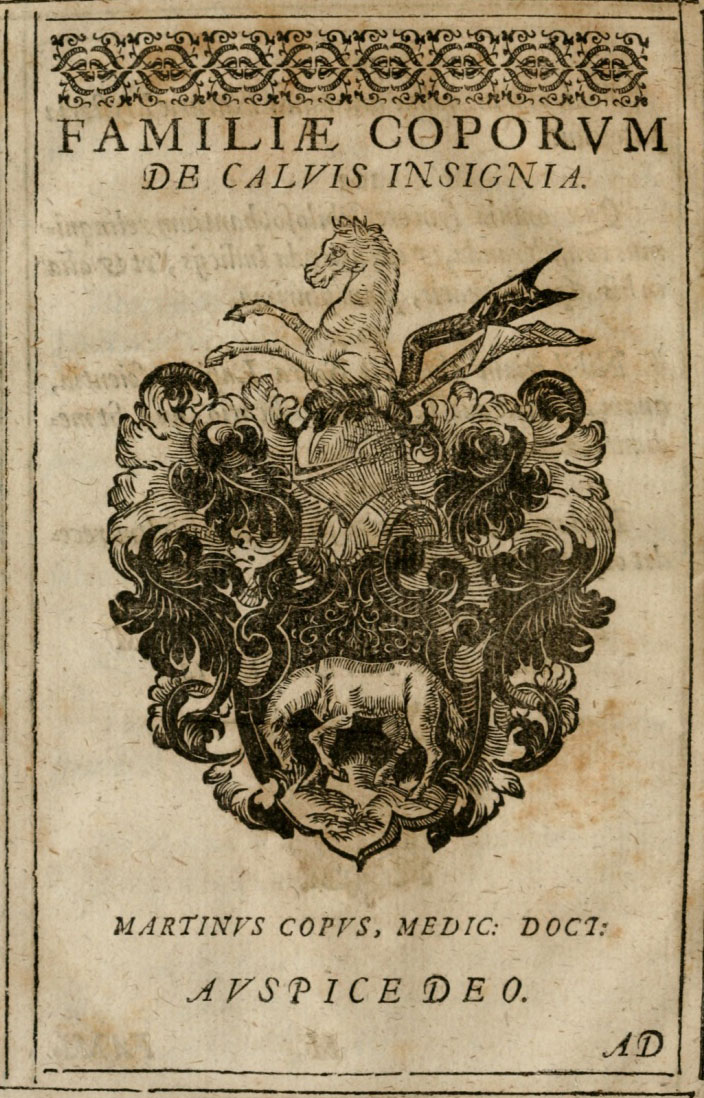
THE COPUS FAMILY
CONCERNING BALD INSIGNIA (i.e., coats of arms).
MARTINUS COPUS, Doctor of Medicine.
UNDER GOD’S AUSPICES.
AD
Of the Copus Family
Concerning Bald Insignia
Pegasus, when he flies with his winged heel through the airs,
unlocks waters from the pure fountain of Wisdom.
For what is trodden under foot beneath the many-coloured rosary
bears in Green and in White the tokens of honour:
thence they seek the counsels of Wisdom, that Gold may shine;
Germany, disclosed by the triple yoke.
For brightness bears the dark face of the shield, that it may be
wondered at; the white horse, the snowy bearer of the sign.
A joyful work of Art, and the secret things of Wisdom smile again;
a horse anoints one with a double Sarmatian [tribute/brand]:
which little nail marks for thee the race, and reports thy fame
Parthenope and the flower of Wisdom, Genetta, relates.
A Parenetic (Exhortatory) Piece
To the most renowned and most learned man, Dr. Martin Copus, Doctor of both medicines, leader in the more secret philosophy, and most excellent chief physician his friend, to be honoured.
A Poem
of Henricus Bolschenius, J.C.
Side note: “The fable of Proteus.” “The consent of the Philosophers.” “The origin of Arts & Philosophy.”
Therefore what hath driven thee, most prudent counsellor,
to draw back from what thou hast undertaken? And shall a wicked buffoon
dare to prate against the sacred Art, which Chemistry
the fruitful abundance of things enricheth with her own bounteous gifts,
and unfoldeth from the citadel of the Gods? As once (so runs the tale) Proteus,
from a little casket, by theft took away the force of the heavenly flame,
and freely, sharing it with the minds of men, scattered far and wide
the ethereal breath of the Divine; whereby he filled every place
with fragrance, and hallowed his own house with the fire of flame
to himself a kindly power of Godhead by which the offspring received itself
into the assembly of Wisdom.
Hence good Arts have grown: who would dare to call them false,
which proceeded from the gods’ unlocked little sparks? That madness departs,
and the wrath of the Erinyes: Nemesis herself, glutted with her own grief,
draws on, through all, the obsequies of punishments, under the cruel lash.
But to the Arts their honour is due, and rewards belong to the worthy
to men whom their fame bears through the open heaven.
Of whose number, if I turn and turn again the writings writings marked and notable
thy name returns to my mind among them, as an equal.
In like manner both of wit and study, while thou unfoldest the ancient writings of the Wise out of darkness into light, thou countest not the labour ungrateful; thou cuttest the knots asunder, and shewest forth the Art unto Heaven, and settest it manifest in the light.
Side note: Simile.
As when a wandering star in a pilgrim’s region of ways, to one that erreth, shining with its face and shewing the path, is joined as guide, unto the threshold of a feast before unknown: here, when the open way is entered, the darkness little by little now withdraweth from the passage; and to him it sheweth, by the fore-going way, the city which he seeketh.
Side note: The star of the Magi going before.
So the fatal star shewed to the Magi the cradle and rising of the twice-born King, while they follow the unknown tracks at the admonition of the Deity; and unto the very courts of God, with bent foot, they bring forth their glad gifts.
Side note: Application of the likeness.
Such is thy star, opened to us by noble writings; and a guiding light, born in the midst of darkness, marketh out our journey: under such a leader we happily come to the courts of the feast, and to Wisdom’s inner retreat. We taste the rays of light brought near; yet, under God’s auspice, we gather them in measure; and, with divine favour, we unroll what hidden images of things lie concealed.
When thus, from Wisdom’s long despised precepts, there burneth an ungrateful brood of wasps, and they dare to go against the Deity as if they were eternal and with complaint bewail their own wishes;
Side note: Congratulation.
Therefore we worthily give thanks for thy studies, and for her whom, by shewing us the way with thy countenance, and by the auspice-signs of the Deity, we enter with happy light and guidance.
With Pallas’ aid, that the Roman state may flourish, and return anew with its own flower unto its kingdoms like as
Side note: A likeness from a tree.
a tree, which the winds with their whirlwind drive; imminent in its own summit, and shaken in its leaves, while, below, the battles of the North-wind practise the wrath of their blasts:
but when the sky hath sent a calmer face, and the breezes are laid, it is able now to stand, and anew a tree truly to flourish; and with its top, by Heaven’s command, it striveth upward.
Side note: Diocletian, in the year of Christ 290, a most bitter enemy of the Christian and chemical profession. The times of Charles V.
Not otherwise, while most fair Wisdom in gardens measures out the likeness of a Tree, and the sacred Palm, glad in her kindly boughs, unfolds it lavish too in her gifts:
She suffers the force of raging Boreas, the harsh blasts, against her;
which Aeolus, with his band conspired, that upon Wisdom the garden
might be overthrown by a savage whirlwind; and with a heavy top, as it were,
drive the thunderbolt unless Jupiter should check his wrath:
here suddenly all turns to the better; her thing is whole for the Muses.
Straightway the Zephyrs rise; now also the Favonian breezes:
Grace smiles; and from the northern quarter she brings
Hope of Wisdom serene, and by better studies promises a spring;
and the Fates, from exile, are received from a foreign host.
A barbarian, for as indeed by force he scatters the altars,
and the torch of books, the Soldier takes away with flame, and the sword;
with flashing steel he strikes the face of Pallas,
and hastens to cut the green branches of the Palm:
by the wound thus made, the offspring begotten of Wisdom, under the breezes,
breaks forth; and by death draws seed again:
a fierce plant like Hydra’s progeny from blood
is brought forth in numberless offspring, and grows.
Charles, at the time when he bore the sceptres of Empire,
the Fifth, and with his immense strength spread through the world,
showed his power: here the Tree of Pallas
put forth a few branches, under a faithful covering.
For as happy was the shade of the tree, so was that fellowship of the Wise:
to none was its palm denied.
Here first the fame of Cop carried it through all the sky,
conspicuous of Empire; from Wisdom’s leaf discovered:
to this man a golden bough extends itself, and offers leaves;
whom Chemistry first embraced beneath the vines;
and he lifts up the palm where the Sun is rising; he salutes
Phoebus from Ocean, as he lifts up his head at sunrise;
he hides and sets. The Helvetian, who as a light of speech
shines forth Rotterdam, awakened by the western waves stands out; and
Side note: Georgius Copus of Calw, M.D., a member of the household and intimate of Paracelsus.
And mighty in Latin speech, and eloquent with the pen,
he held in great honour the man, and honoured one conspicuous
for civic virtue; and he repaid in turn, by mutual services of the right hand,
in writings, and by the faithful use of his heart:
In that he might share his cares, and the labour of his works
excellent, illustrious (Paracelsus being witness) the second part,
to this man he deservedly ascribes; and he bids his praises be rendered
to him, a man distinguished for piety and faith,
toward Cecrops’ palm, and the ancient praise of virtue.
When his vigilant zeal in the art has tested Albert,
Albert than whom none is greater in virtue, nor in mouth
(if any faith is to be given to Wisdom, and favour to the Muses),
under his auspices he stood; and the matter, whole and entire, remains the same:
the work endures by his helps, and by the glad gift of his favour.
For by patronage the scattered Muses, long oppressed,
beneath the happy shade of the tree, he shelters the arts.
Here is a guardian of good things, and once the honour of the arts was his:
O how his masters of old shone forth in their honour!
Trampled beneath the common foot, and rejoicing in no avenger,
they cannot enjoy themselves; as we are allowed to labour in exile, nor does any honour
remain for the birds of Wisdom, as though its things were lost
among the enticements of affairs, nor love, nor the grace of the Muses.
Few indeed has Honesty, descending into the shrines of waters,
been able to press the path of Wisdom with straight shoots.
Yet in Albert’s case remember this: that favour abides with them,
when given to studies, while the generous bounty of the Prince himself,
and of Friendship, adorns every Muse.
Therefore Copus is held in honour: as the pearl shines in gold,
so does his whole host excel in price and worth:
thus he lives amid delights, while he handles Chemistry,
things hidden, which though sought out by the studies of those before
have been dug up, yet to none under the open gates of light,
beneath the northern quarter of the sun. One has taken one, and one
the central point, which many find inextricable,
Side note:
From Paracelsus himself, and from other most excellent chemists of his age Paracelsus’ teachers he received the preparations of medicines.
The liberality and magnificence of Albert the Cardinal, Archbishop of Magdeburg and Halberstadt, Elector of Mainz, toward learned men.
Gregor. Copus of Calw, M.D., and physician to the Elector of Mainz.
Side note: An excellent chymist.
Worn out with art, yet he left nothing useless behind.
Here here he breaks into the knot, and with a flashing point
he splits the sacred web, with the edge and keenness of the mind,
and he passed on to that goal which none may lawfully reach:
the secrets that Nature holds, and the hidden dens and dwellings
that inhabit the inner recess of Wisdom (Sophia).
This fertile part Nature has shut off from common use;
yet it brings back many counsels for human life
things that lay concealed before, buried and swallowed up in darkness.
Therefore, to the gods we rightly give thanks for such a gift, and for the use
of light among the wise. Accept this vow,
O highest God: and let those after us read with joy
these ancient things observed, and linger over them in love
when by no other method they could see salvation,
nor with their own mind draw out a remedy for the body,
two consolations of an afflicted life.
Side note: In this age, chymistry flourishes.
And now, for nearly ten times he had completed the course of years,
while the sun ten times renewed his own returning round,
as light and shadow alternated in turn
the race of men, and the toil of works within those spaces run:
so that, as things are driven onward, new fates come forth from others,
and a new lot from another cause, and one funeral weighs out another;
so that the number of the born is matched with human slaughters
lest perhaps death, and the inability to return,
should bring upon mortal affairs the last ruin in their allotted fate.
Therefore Nature again and again thrusts out buds in new clusters,
and, always busy, is ever in action;
she persists in her own vigor, nor fails with years,
though drained by her own. But she carries the work through,
and longs to enjoy a just end; and she turns it over and says
that what she has brought forth, at last she sends out into the airs of heaven:
thus she begets the arts; and from others again she renews
studies that once lay half-dead.
When Minerva is fruitful in her own bosom,
let her fill up the succession of descendants
and (grant) a happy year rich in fruits.
Side note: The Copus family has been renowned and devoted to medicine and chymistry for a hundred years already.
[Margin note] Nature is always at work, and the arts are propagated.
[Martin Copus, the father, Doctor of Medicine.]
And let him rule the fields with harvests flourishing through his studies.
Therefore let a good offspring spring from a good father’s sowing;
and the descendant too follows these pursuits, with fortunate star
pursuing them wherever the world’s circle lies
both the parents’ desire and their precept, with death drawing near;
the vow of his mind, which by his own right, and by the name of heir,
he fits to himself from the art; and, not degenerate in that very practice,
he applies it so that, with wasting sickness driven back and taken away,
he may restore many to better life, and, when their fates are running out,
prolong them by a living draught from Wisdom’s medicine.
When Antimony, or even a little spark of reduced powder,
dissolvable into a tear (a drop), drinks up every poison,
and by wondrous art drives off the plague (infection) when it has been put to flight
by that example, most learned man, I judge that the praise and images of your ancestors
should rightly be followed by you, and the illustrious footprints of your fathers;
for through them the marks of virtues and living forms in image shine forth,
painted in the heir; and the name of ancestors desires to be read by posterity,
even late, and to enjoy the titles and honors of this very name,
in its offspring: so that what had been taken away by a fragile lot
may live again after the funeral rites; and the name may grow green from the shades,
and fame, through lineage, may pass on into everlasting years.
Therefore, what you can by art both the succession and your ancestral line demand
enter upon it; and do not cease, once you have grasped your aims,
to bear them under the eyes of princes: let no lowly fame follow from this.
Nor will the Thracian Orpheus defeat me with his keen song:
I shall follow your deeds with song and with tuneful art
this art of Wisdom, adorned with fitting measures never untouched by me;
and I shall fashion your likenesses in my tongue.
Let the image of a fatherland of virtue come to mind:
while Charles bore the scepters of so wide an Empire,
how I adorned (it) with monuments of praises arms too, and the use
of arms, in the manner of leaders, or in the knightly order.
[Antimony and other preparations; a most healthful medicine.]
[Digression to Dr. Martin Copus, physician.]
[Exhortation to help and to continue those studies.]
[Charles V: liberality and magnificence toward this family. Year 1521.]
The arms / device of the Copus family of Calvis
Side note: “The Neapolitan horse.”
The house has left its banners to be borne aloft,
So that the younger ones, mindful of these things, may in ancestral honour,
By equal fortune and equal works, grow along their forefathers’ tracks.
And that thou mayst have it nearer seest thou how the Horse,
With panting breast, strives up beyond the sky;
His neck the snowy whiteness lifts; and the little twig,
With helmeted glory, is borne aloft, as from a double train
He poises himself into the air.
While the black-woven trappings shine and glitter with their own splendour.
Yet on the shield, cast down upon the grass, he feeds,
And round about, with green and milk-white youth,
The flowers come into bloom now with snowy, now with ruddy
Growth of diverse colours and fair in the likeness of their form:
I deem them to be of Parthenope, the immortal gift
Of pious Genetta, which Caesar once offered, sacred to the Muses.
Copus, led by devotion, and (moving) beyond the holy art,
That Chemistry which a divine profession practises, so that it surpasses
Every work of human art; and as far as it lifts itself with lofty crest,
So it clings by its roots fixed deep in Nature
And descends only to the lowest kingdoms, and to places fertile with darkening shades.
Here the Horse marks for thee the glory of the palm that shall endure
Which comes through sacred art: both the mean and the measure,
The beginning and the end. Sated Pleasure herself nods favour,
And of her own accord unfolds her rewards rich in bounteous gifts
And in a gift of the gods.
Side note: “Glory from chemical studies.”
For thou seest what secrets lie hidden in Nature’s deep bosom.
What marvels the horn of the crow may bear,
This watchful experience teaches by manifold and varied use
Which the holy wisdom of the Sophists reveals to thee,
The divine wisdom that, once the wrappings of Cecrops are taken away, is made plain.
Side note: “Masteries and marvels: the stag’s horn.”
The supreme Aristotle, whenever he marvels at these heights of things,
Stands amazed, and, his mind astonished, is held fast
When, from the horned beasts, to this one alone there flows, as it were,
A certain appointed office of horn; and (thereby) remedies for human life
Side note: The Stag’s Tear (Agrippa).
Side note: Orpheus.
Side note: Radical moisture.
Side note: On the wonders of the stag.
Side note: The mystery of the Stag’s Tear.
They surely give warmth, whenever, being dissolved, they melt
Into a stream; and from its tear the Mystic power overflows.
For the Spirit of the World is impressed in this, and it bestows it,
And, the delays of fleeing life being taken away,
By this gift it suspends the breath of life from the decay of years;
And it makes men immune, and different from the heavenly nature,
And from the hidden virtue of the pole: after it has sent down
Its ray into the lowest bodies, and stamped them with Jove; another
Influence, not unlike the genius of Nature, and in increase.
For the radical moisture, which is nourished in it,
In the strength of its density increases its beauty; so that it,
With a rich embrace, cherishes it; and with its fomentation and time
Strengthens the powers, ever and again, with greening youth.
A step nearer to Nature than if any grace from metals,
By useful art, is turned into human members,
To lighten wasting by which the body is often restored.
For here a virtue easily puts on analogous forms,
And by a sure rule varies fastened to its own marrow,
Something vegetative, and to the ruling Desire.
But since the work of Art lies hidden in the inner recess
Of Wisdom, it will give you signs by what guidance
You may accomplish such things, and be able, happily, to rest from use.
For the stag, when from the dark lairs of the serpent it scents
The poison with its keen nostril, longs to plunge its horns
In a wholesome spring, and to drive out through all its members
The poison it has swallowed: then, its veins being burst, the ulcers melt away.
And as it ranges everywhere in copious sweat,
The breathings the souls, with one consent, draw in: there every
Poison, as if wash’d away, it lays down by the power it has received;
It begins, like one born anew, to bloom and grow green; and old age’s
Losses it lifts by vigor, and makes whole the years as they run their course,
When for it, in its Tear, the Mystic vein is loosed,
And its fury is dissolved. Hence the glory of so great a deed is laid open.
What shall I relate of the stag that from the bone it sprouts again within
The Stag’s mouth in the inward parts of the heart? like ivory, in the manner of cartilage, within the heart.
Does it lay open and clearly disclose the hidden secrets of Nature?
When it is shown in the form of a Cross, sacred to the whole mystic world, once it is dissolved its great power comes forth.
Side note: The Elk’s hoof.
So the elk’s hoof also will give you many things: it draws out the wholesome juices which the medicine of our life seeks, when its Fifth Essence has been set in motion by its own flowing streams.
Side note: Dissolution of ivory.
Thus too you see, by wondrous art, the solid moisture of ivory drawn out from the body what the seventh coal, cooking it by fire, has made to yield, both oil and water when the Fifth Essence, loosened from its caverns, calls forth outside the rich juice that was panting within.
Side note: The Magistery of the Unicorn.
This also works by the Unicorn’s method: the divine power of a deep Magistery which it bears in the inner substance of its horn.
When it is dissolved, it rains down healthful juices when expressed, and calls out all its strength for the preserving of the human soul in its station, according as mankind’s condition requires.
Side note: Medicine of Electrum.
Who can tell how many remedies of electrum flow from its bounteous store? It holds many an incurable ulcer in the joints, which casts off every help of the physician; this it eases by a silent art, and at the same time stops the dreadful torments of pains, and by its aid raises up the worn-out limbs.
The power of little stones, of corals, of pearls, of margarites (pearls).
How great a virtue is planted in noble little stones plainly seen in their bodies and proofs, published by long use, bear witness: how it is in corals, the offspring of gems, and in crystals with their inward parts dissolved; and how, in the deepest bosom, the likeness that pearls carry is displayed beyond art. Nor do works of so great a Magistery shine otherwise, when, glad (as it were), the deep seeds of Nature unburden themselves wondrous to tell
Side note: The power of Hannibal.
as when Hannibal by boldness broke through the rigid rocks, while the Italian land and his strength stirred him onward; by no other example than if your ingenious mind and your laborious virtue had not broken the Alps.
It is not easy to overcome the ascent, and to conquer pathless ways.
For those things that remain crude do not serve you as “bodies”; and, while they are not yet fit for such great magisteries, they promise you a crafty face of works, but no use of medicine. In vain you strive that, by fire, they should at last melt like the stomach of the ostrich since you wrongly turn stones and metals to the use of the human body, in an inert stomach.
Therefore there is need of other means, and of a mistress Art, so that the work of so great an art may be fitted to mankind by the right use of a medicine. For, while the bodies have not yet been made free from their prison by a just solution, they cannot be of wholesome use to you.
Otherwise, it is as if stones or raw fragments of metals should enter your body, and every office of the body should fall into ruin; and now the spirit, glad, should depart from the shadows to its stars, and the sad corpse should mourn.
Passing over the other things, which learned Minerva has hidden from so many by the torches of the stars, and has fastened a rich form upon the metals yet pressed down by an obscure seed, and known to few born under a mortal lot
For the things given to Mercury, and to the Sun, and the glory of the Moon; those given to Mars and Venus; the repute and practice of healing; and whatever flourish enclosed in the veins of antimony, by the nature of the Tincture and by the star of wise light these I gladly leave to others after me to be remembered.
But I shall follow the whole race of salts; nor in these brief lines shall I touch the mystic things already known, but shall unfold greater matters of an art so lofty, as divine which has been shut away from the race of the ancients, and which Minerva once promised to bring back from the mines (without use being made of it), lest the mysteries of Art lie hidden in the shadows.
And since you are able to enter upon the work, and to display your names how bright and awakened they are when you, perhaps, open such sacred things to the Brunonian leader.
Not without praise of you, let Codrus’ guts be burst
he who, with his own fortunes set aside, boasts the stages to his Muses.
For you hold your studies, and your works, and the toil of works,
with their proper end and measure, and light, and use:
which, while they perhaps lie hidden from others, those men, over the work,
drag on an ungrateful labour without fruit, and in mid-course grow weary,
as the pole of a wagon lies when the axle has been torn away.
An analogical introduction in Salts, and a Key to the more secret parts of the Art. Here all show themselves in the form of the operations.
In the kind of Salts there is a certain introduction toward the very
image of the Stone, which the Progymnasmata mark out:
these things are for you, and as it were a sacred Key, to the very palaces
of the Sages hidden, inhabited in secret, in shadows.
For here all the works unfold themselves under one form,
and such things as, by their own nature, differ in no respect at all,
when, by an endeavour drawn from Wisdom, they practise the labour
by Art, upon the glad increase of the metals:
while things are made perfect, the imperfect bodies, by their own restraint, are held down,
and forms break forth under a differing fashion of contrivance,
and thrust out their new seeds from their inborn nature.
A wondrous work and wondrous arts upon those auspices of labours,
from the very womb of Nature bringing forth:
which of itself brings forth, if at any time it is helped in bold attempts,
cheerful and industrious in its own ways; so that it never, slothful, grows dull
in the active virtue of itself, and in propagation, and in age.
For three things constitute the things produced by a generating power
in the order of Nature: so also in Salts. A Spirit is in them;
for as it is within, the vigour of the Soul, glad in its gift, runs through all the limbs
of the body with living force, and, like an airy breath,
acting, mingles the powers spread through the whole body.
They who know such things such as the ancient secrets of the philosophers,
and what they teach will see all these things made plain to them in the light,
which before were shaded over by Wisdom’s hidden veil.
Side note: Nature desires the work of Art.
But those Salts, long shut away, shine forth in their own way,
made Magisteries of Wisdom; and, as far as the aether is from the deepest
space of earth, so far do they compress (confine) things to what is common.
Side note: Three in Salts: Spirit, Soul, Body.
Side note: Here hidden things are made manifest.
These matters belong to the Salts; nor does so great a grace arise from them, that a woman’s work, plainly unequal to the attempt, could in the least essay it, and hold firm above art.
For what was lower here bears its mass above the ether; it is carried up from the inferior degree, and above it thrives under auspices; and in both members its power remains.
So greatly does the Magistery stand out, from the lofty heaven;
Side note: And they are far removed from other kinds of Salts.
Side note: Here the lower becomes the higher.
Side note: It is a divine revelation.
even as Proteus from the heavenly casket brought forth a god by little fires to the human race, and consecrated the art with eternal auspices, by a happy use of light.
There are other things; but to set down their names would be long, and I omit it.
To you the hidden force of its bright medicine is not unknown by what star of the Sun, as guide, by what horizon it shines forth.
Side note: The Sun’s guiding star; the secret of the horizon; etc.
Nor is it hidden how, while the Elixirs in other forms display their first “entities,” they strive to unfold; and though they have not yet been baptized and borne under their own names, yet everywhere, by a sure omen of the medicine, they stand forth as excellent opening their secrets with rare and hidden words:
not for the common crowd of the rabble, but published for those of equestrian blood, of most illustrious birth, a royal offspring of the gods;
and those things which, found clear for you in the embrace of the ancients, by your prince, were not unknown to the old sages of these I shall set no bounds, nor place the names.
Side note: And other Elixirs and first Entities, infinite in number and in name.
Side note: Not a bypath, but a royal road.
When the long-standing vows of Mainz, and Albert’s favor, return vows by which the Duke of Saxony’s grandsire, proven in this art, burns; by which he, stirred with such noble impulses of Nature, greater even than his years, strives with all the desire of his mind, by deserving, to surpass the illustrious glory of his father’s art
then Fame, flying through the open ether, after death bears the renown of his life; praise for the grandsire, and for the father his honor flourishes, and for the race of grandsons as it is born again, into love of the fatherland’s virtue.
Give heed to these things with pious heart, Copus, and turn them over much within your breast
Side note: A repetition of what went before, and the munificence of heroes.
Exhortation to Dr. Martin Copus, physician.
Duke Henry Julius of Brunswick.
Rudolf II, Roman Emperor: zeal and munificence toward these studies.
With heart and spirit, turn willingly to arts so glorious:
so you lift high the hope of your stock,
and by renowned studies fulfil the honour of your forefathers.
The virtue, too, of Duke Henry Julius of Brunswick
rival of mighty deeds by its own impulses drives you to those arts,
and of itself calls you onward. You, devout, surpass your vows,
and by skill you carry through labour that is grateful.
Perhaps he also will perceive rewards and honours
some for Aesculapius, and his prizes for Maro
while piety, as helmsman, bears God with honour.
While I speak, the favour of the unconquered Caesar of itself
moves forth in the midst; Wisdom with immense kindness
kindles those studies. His breast, to be revered for its majesty,
stands open to proclaim honours worthy of the Muses,
to wear titles in active service, and the splendid ornament of his own.
The Parthenopaean Horse (the Neapolitan steed), while by the gift
of illustrious ancestors he raises Caesar’s shield,
and completes his fame above the ether,
his glory dedicated to the world stands, from Copus,
in the studies of Wisdom; increased by honours, it endures through time.
“Passers-by pass on.”
“He who does not grasp, does not grasp; he grasps he who does.”
The End.