Preface of Master Albertus Magnus, Bishop of Regensburg, concerning Alchemy - Magistri Alberti Magni Episcopi Ratisbonensis, de Alchemia Praefatio
Study the Art with Us Buy me CoffeePreface of Master Albertus Magnus, Bishop of Regensburg, concerning Alchemy.
Magistri Alberti Magni Episcopi Ratisbonensis, de Alchemia Praefatio.
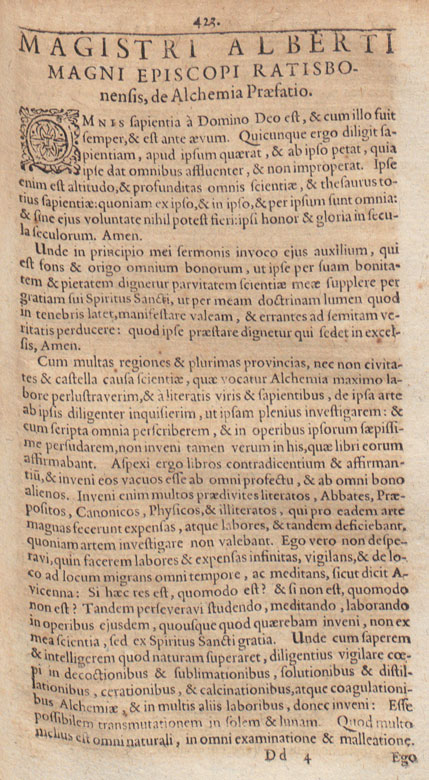
Translated to English from the book:
Theatrum chemicum, praecipuos selectorum auctorum tractatus de chemiae et lapidis philosophici antiquitate, veritate, iure, praestantia, & operationibus, continens: in gratiam verae chemiae, et medicinae chemicae studiosorum ... congestum, et in sex partes seu volumina digestum; singulis voluminibus, suo auctorum et librorum catalogo primis pagellis: rerum vero & verborum indice postremis annexo. Volumen secundum.
All wisdom is from the Lord God, and was always with Him, and is before the world. Whoever therefore loves wisdom, let him seek it with Him, and ask it from Him, because He gives to all abundantly and does not reproach. For He Himself is the height and the depth of all knowledge, and the treasure of all wisdom: since from Him, and in Him, and through Him are all things; and without His will nothing can be done: to Him be honor and glory for ages of ages. Amen.
Therefore at the beginning of my discourse I call upon His help, who is the fountain and origin of all good things, that He Himself through His goodness and mercy may deign to supply the smallness of my knowledge by the grace of His Holy Spirit, so that through my teaching I may be able to make manifest the light which lies hidden in darkness, and to lead the wandering onto the path of truth: which may He deign to grant, He who sits on high. Amen.
Since I had traveled through many regions and very many provinces, and likewise cities and castles, on account of the knowledge which is called Alchemy, with the greatest labor, and had diligently inquired from learned and wise men concerning that art, in order that I might investigate it more fully; and since I had gone through all writings, and had very often busied myself in their works, yet I did not find the truth in those things which their books asserted. Therefore I examined the books of those contradicting and those affirming, and I found them to be empty of all profit and devoid of all good. For I found many very wealthy learned men, abbots, provosts, canons, physicians, and unlearned men, who for that same art made great expenses and labors, and at length failed, because they were not able to discover the art.
But I did not despair that I should undertake infinite labors and expenses, keeping watch, and moving from place to place at all times, and meditating, as Avicenna says: If this thing is, how is it? And if it is not, how is it not? At length I persevered, studying, meditating, laboring in the operations of the same, until I found what I was seeking, not from my own knowledge, but from the grace of the Holy Spirit. Hence, when I knew and understood that it surpassed nature, I began to watch more diligently over the decoctions and sublimations, solutions and distillations, cerations and calcinations, and also the coagulations of Alchemy, and in many other labors, until I found that the transmutation into sun and moon is possible. Which is much better than everything natural, in every examination and hammering.
I, indeed the least of philosophers, intend to write for my companions and friends the true art, easy and unfailing: yet in such a way that, though seeing, they may not see, and though hearing, may not understand. Therefore I ask and adjure you by the Creator of the world, that you conceal that little book from all foolish persons. For to you the secret is revealed, while from others I shut away the Secret of secrets, because of the envy that attends this noble science. For fools so fail in it, that they cannot attain to it; hence they fall away from it, and cannot believe it possible to be created; and therefore they envy those who work in it, and say that they are deceivers. Beware, therefore, lest in this operation you reveal any of our secret to anyone. Again I warn you, that you be cautious, and persevere in the operations, and do not grow weary, knowing that after your operation great profit will follow.
Concerning various errors
Now, however, I shall briefly and simply instruct you in this little work of mine how you ought to approach the labor of so great a work. Yet first I shall show you all the deviations and errors, and the stumbling-blocks of this art, in which many, and indeed almost all, go astray.
For I have seen some who, although with great diligence they performed certain sublimations, were not able to proceed further, because they did not have the foundation. I have seen others too, who had a good beginning, but because of too much drinking and other vanities, were not able to complete the work. I have seen others who made the decoction, distillation, and sublimation well; but because of too great prolongation of the work, they left the work imperfect. I have also seen others who had the true art, and labored diligently in the operations, but in the sublimations lost the spirits because of vessels too porous; whence they doubted, and did not further pursue the art. I have also seen others who, wishing to discover the art, not willing to wait for the appointed time, made the sublimations, distillations, and solutions too hastily; and therefore they found the spirits corrupted and rust-colored, and the waters loosened and distilled, turbid: wherefore they too doubted.
I have seen very many as well, who with diligence undertook the work, and at last failed, because they had not the means needed for the sublimation; whence this verse:
When labor is joined with loss, mortal want increases;
Though you know much, without money you will be nothing.
Hence this art is of no avail to the poor, because it requires at least the expenses of two years. And if it should happen to err in the work, the prolonging is greater, which cannot be remedied except by one experienced in many matters.
I have seen others who made the sublimations pure and good up to five sublimations; and when they were not able to make more, they falsified the matter and whitened Venus, adding a certain quantity or a sixth part of silver, and thus they deceived themselves and others. I saw others who sublimed the spirits and pretended, wishing with them to tinge Venus or Mars; and when they produced no perfection, because they had no ingress, they fell into doubt. I likewise saw certain men who had fixed spirits, and with oil being added they cerated them, until they had ingress into bodies; yet adding some part of silver, they thus made Venus white, which was like silver in hammering and testing, and in whiteness, and which endured the test up to the final examination, and yet it was not perfect, because Venus was not calcined nor purged of its corruption. Hence Aristotle says: I do not believe that metal can be transformed unless it is reduced into its first matter, that is, into a calx by the burning of fire; and then this is possible.
I saw, however, other wise men, who fully sublimed spirits and powders and fixed them, prepared solutions and distillations from powders, afterwards coagulated them, and afterwards calcined the metals, whitened the bodies to whiteness, reddened them to redness, afterwards reduced the calx into a solid mass, and with it tinged silver and gold, which were better than every natural thing in every testing and hammering. Therefore, seeing all to err, I have now resolved to write the true and proven operations, and the best of all the philosophers, in which I labored and became experienced; and I write nothing else, except what my eyes have seen.
Whence metals arise
Alchemy is an art invented by Alchimus, and it is called by the Greeks archyma, which in Latin is massa (“mass”). For through this art metals are brought back to perfection, which in the mines are corrupted and imperfect. And it must be noted that metals differ among themselves only accidentally in form, not essentially: therefore the removal of accidental qualities in metals is possible. Hence it is possible through art to constitute a new body, because all kinds of metals are generated in the earth from sulphur and quicksilver mixed together, or also because of foul earth.
For just as a child in its mother’s womb is sometimes corrupted contrary to nature because of the infirmity of the place accidentally, and by corruption, although the seed may have been clean, nevertheless the child comes forth leprous and unclean because of the corruption of the womb: so it is in metals, which are corrupted either by corrupted sulphur or by foul earth; and hence arises the difference among all metals, by which they differ among themselves.
For when pure red sulphur meets quicksilver in the earth, then gold is generated in a short or long time, according to the subtlety or decoction of nature and of the sulphur itself. But when pure white sulphur meets quicksilver in clean earth, from that silver is generated, which differs from gold in this: that the sulphur in gold was red, in silver white. But when the sulphur red, corrupted, and burning, meets quicksilver in the earth, from that copper is generated; and it differs from gold only in this, that in gold it was not corrupted. But when white sulphur, corrupted and burning, meets quicksilver in the earth, from that tin is generated; and because it crackles between the teeth, and has a quick liquefaction, this is because the quicksilver was not well mixed with the sulphur. But when white sulphur, corrupted and burning, meets quicksilver in foul earth, from that iron is generated. When black and corrupted sulphur meets quicksilver, from that lead is generated, concerning which Aristotle says that lead is leprous gold. Enough has been said of the origin of metals, and how they differ among themselves by accidental form, and not by essential form. It remains now to consider the proofs of the philosophers and their authorities, by which they prove this art to be true, so that we may meet those others who contradict and say that it is not true.
That the art of alchemy is proved to be true
Therefore there are some who contradict, and very many indeed, and chiefly those who understand nothing of the art, nor know the natures of metals, nor know what is their intrinsic or extrinsic matter, nor their dimensions and properties. Against these, then, when they object the words of Aristotle saying: Let the alchemists know that the species of things cannot be changed it must be answered that he said this of those who believe and wish to transubstantiate metals while they are still corrupted; which indeed can hardly be done.
Let them therefore hear the words of Aristotle which follow: When experience destroys the form of the species, and this especially in metals. And this is true, when some metal is calcined, and from it there is made ash and calx, which is ground and washed, and cerated with sharp waters until it becomes white and living; and thus through calcinations and various medicines they lose the corrupt and combustible moisture, and acquire an airy moisture enlivening the body itself; and the purified calx is reduced into a solid mass, which mass can receive tincture, white and red. Hence Hermes says: The spirits entering bodies cannot enter unless they are purified, and made fit, and by a gentle water. Aristotle says: I do not believe that metals can be transubstantiated unless they are reduced to their first matter, that is, unless they are cleansed from their corruption by the addition of fire.
Against those who still contradict and do not believe, it is best to oppose the evidence, because what we say and what we have seen we prove by receiving species in different forms at different times: as is clear in arsenic, which is red, and by decoction and by subtlety it was black, by sublimation it was white, yet always the same. And perhaps someone might say that such species are easily able to be transmuted from color into color, but in metals this is impossible. To this I reply from evident reason, through diverse proofs and evidences, their error being completely destroyed. For we see azure generated from silver, which is called transmarine; yet since this by nature becomes perfect, lacking all corruption, it seems easier, and is the destruction of an accidental quality rather than of an essential one. For we see copper receive a citron-yellow color from the calamine stone, although neither of them is perfect, neither the copper nor the calamine stone, because in both there is fire. We also see that from tin litharge is made, and from tin by excessive decoction it is turned into the color of gold; yet that it may be possible to be converted into the species of silver, since it is of its nature. We also see iron converted into quicksilver, which seems impossible to some; and why this is possible I have already stated above, because all metals are generated from quicksilver and sulphur: whence, since quicksilver is the origin of all metals, it is also possible that iron may be reduced into quicksilver.
Is it not so, for example, that liquid water in wintertime, through excessive cold, is hardened and becomes ice, and that the ice is dissolved by the heat of the sun and becomes water as before? So it is with quicksilver wherever it is in the earth, and if sulphur is there, then those two are coagulated together, and through temperate decoction over a long time they are hardened and become a mineral stone, from which metal is drawn.
We also see that from lead ceruse is made, from ceruse minium, and from minium lead. Behold, it has now been sufficiently and manifestly proved how species are changed from color into color, even to a third or fourth form. Hence there is in no way any room for doubt that corrupted metals can be reduced to health by their medicines. Now therefore the foundation of the art is possible, as we have said above.
For if above we had built upon hay, or wood, or straw, fire would consume all. Therefore we must find stones which fire does not destroy nor corrupt: then we shall be secure from every disturbance. And it must be known that those things which we have spoken of concerning the impediments of the art, and its principle, and the postulates of the same, have therefore been set forth so that the art may be established as true, etc.
Now it must be seen how it is to be done, and at what time, and in what place. And first it is necessary to set down the precepts. Therefore the first precept is that the artificer of this art be silent and secret, and reveal his secret to no one, because it cannot by any reasoning be further made manifest: knowing for certain that if many knew it, it could in no way be sustained; for it would be divulged, and when divulged it would be reckoned falsehood, and thus it would fall into ruin, and the work would remain imperfect.
The second precept is that the artificer should have a place and a special house apart separate from men, in which there are two or three rooms wherein the operations for subliming, making solutions, and making distillations are carried out, as I shall teach more fully.
The third precept is that he observe the time in which the work ought to be done, and the hours of sublimations, solutions, and distillations: for sublimations are not successful in winter; but solutions and calcinations can be done at all times: all these things, however, I shall teach plainly in the operations.
The fourth is that the artificer of this art be steadfast and constant in the operations, and not hasty, but persevering unto the end. For if he begins and does not persevere, he loses both the thing and the time.
The fifth is that he work according to the ordinance of the art: first in triturations, second in sublimations, third in fixations, fourth in calcinations, fifth in solutions, sixth in distillations, seventh in coagulations; and thus in order. But if he wishes to tinge before sublimation, and to coagulate, and to dissolve before distillation, he loses the flowers of the powders: for when they have been projected, they retain nothing from them, but they fly back most swiftly. Likewise, if he wishes to tinge with fixed powders which are not dissolved nor distilled, they do not enter nor are they mingled with bodies.
The sixth is that all vessels in which medicines, or waters, or oils are to be placed, whether they are to stand in the fire or not, ought to be of glass, or glass-coated. For if sharp waters are placed in copper vessels, they become green therefrom; but if in an iron vessel, they are blackened and infected; if in a leaden vessel, they are thickened and corrupted; if in an earthen vessel, they penetrate and all things are destroyed.
The seventh is that you must beware above all not to introduce yourself into these operations among princes or powerful men, because of two evils. For if you should admit yourself to them, then from time to time they will demand from you and say, ‘Master, how does it succeed for you? When shall we see something good?’ And not being willing to await the end of the work, they say that it is nothing, that it is a fraud, etc., and then you will have the greatest vexation. And if in the end you should not attain a good result, you will acquire their perpetual indignation by this. But if you should attain a good result in the end, they will think perpetually that you have more, nor will they permit you to depart; and thus you will be ensnared by the words of your own mouth, and entangled in your own sayings.
The eighth precept is that he admit no one into the operations who does not have sufficient means at the least, and who can procure all things that are necessary for the art, and not only what is useful. And if he admitted such a one, and the expenses should fail, then he would stop, and lose all things.
What furnaces are necessary, and of what sort, and how many
Now it must be seen how the furnaces are made, and which, and how many are necessary. And for this it must be known that furnaces ought to be made according to the quantity of the work. For if the things are sufficient for you, and if you wish to begin the great work, then larger ones must be constructed for it. But if your quantity is small, you shall construct little furnaces according to the quantity of powders and medicines. Yet I wish to set forth the doctrine of furnaces, and their size according to what is suitable both for the rich and for the poor. Therefore first something must be said concerning the philosophical furnace. Let the furnace be set near a wall, where the wind can have access; but let the furnace stand away from the wall by the length of an arm, in this manner. Let a pit be made in the earth to the depth of a cubit, and to the width of two spans or a little more, which is to be lined round about with potter’s clay, upon which a wall is to be built all around of the same clay.
On the quality or quantity of the furnace.
Take common clay, and to four parts add a fifth part of potter’s clay, and grind it very well, and add a little sand, and grind it again (some purposely add horse dung, or at least water in which that dung has been dissolved); this done, make a wall, as I said, over the pit, to the height of two feet, or a little less, and to the thickness of one span, and permit it to dry; and then let there be a wheel made of potter’s clay, which can endure a strong fire, and which is perforated on every side, having fifty or sixty holes, according to the size of the wheel, narrow above after the fashion of a finger, but broader below, so that the ash may be able to fall down more freely. Also below in the earth let there be made a passage through the earth and the wall, before the wheel is set on; and let it be narrow near the pit, but outside the wall wider, almost to the breadth of one span, so that the wind may be able to enter. And this passage ought to be lined with clay. This done, let the wheel be set on, so that the wider part of the holes may be underneath. And then again let a wall be made upon the wall and the wheel, to the thickness of a span. But let the wall be in height above the wheel one cubit. And let the furnace have an opening in the middle above the wheel, where the coals may be put in. But above let it have an opening where the calcining vessels may be placed; and that opening is afterwards to be covered with a cover fitted to it. The furnace also is to have below (elsewhere above) four or five small holes of the breadth of three fingers. And this is the form of the furnace.
Moreover, it must be known that above the wheel you ought to place a tripod made of clay, upon which the calcining vessels are to be set, so that coals may be placed underneath.
How many and what kinds the subliming furnaces are, and whence.
Now it must be seen concerning the little subliming furnaces, which at the least ought to be two or four, and let them be made in all respects with a wheel and a passage, and with a passage and holes, like the philosophical furnace, except that they ought not to be of so great a capacity; and they ought to be only such that one person may be able to manage them all.
What the distillatory furnaces are like.
The little distillatory furnaces are to be made thus: let them be made as above of clay; let a round wall be made above the ground of the thickness of four fingers, but of the breadth of three palms; and let it have around it four openings, each of the width of three fingers. But the furnace is to be wider above than below, in this way, as the figure shows. Of these furnaces only one or two are made, which are sufficient for distilling. The vessels, however, suited to these little furnaces are different: some for distilling, others for calcining, others for coagulating; the form of which we shall set down at the end of the book. You will find them in the Heaven of the Philosophers of Ulstad, etc.
On the glassmakers’ furnace.
The furnace of the glassmakers is made, with the rest, at the end, which is sufficiently necessary for vitrifying.
How vessels are to be vitrified.
Take whatever vessel you wish to vitrify, namely a vessel of well-fired clay, and smear it well with minium, moderately. Take water, and mix in lees of beer or wine, to the amount of a tenth part of the water, and mix in dung, and afterward add as much minium as you wish, and mix the dung well, and smear the vessel with it within by means of a brush and with the hand, or let it dry; and when it is dried, put it into the furnace, turning the hollow part downward, so that it may lie upon two strong iron supports, which are placed in the middle of the furnace. And if you wish to put in several vessels, it is better if you close the mouth of the furnace with a stone and clay, and make a slow fire at first, for the space of six hours; afterward strengthen the fire, until you see the minium flow like wax. Then cease, and let it grow cold, and then open it, and you will find your vessel very well vitrified. Note this, however: minium made from ceruse is ten times better than that ceruse from which minium is made from lead ashes. The doctrine of furnaces having been given, we must now speak of spirits and medicines.
That there are four spirits of metals which tinge.
It must therefore be known that there are four spirits of metals, namely Mercury, sulphur, auripigment, or arsenic, and sal ammoniac. For these four spirits tinge metals into white and red, that is, in the manner of the Sun and the Moon; yet not by themselves, unless they are first prepared for this with diverse medicines, and unless, when they have escaped the fire and when they stink in the fire, they perform marvelous works.
For they make Mars or Jupiter into Luna, Venus or Saturn into Sol. And, to speak briefly, all metals are transubstantiated into Sol and Luna, which in almost all natural things works in all operations, except that iron of alchemy is not drawn by the adamant; and alchemical gold does not gladden the heart of man, nor heal leprosy, and a wound made by it swells up, which does not happen from natural gold. But in all its other operations, namely hammering and color, it endures in the assay. From these four spirits is made the tincture which is called in Arabic Elixir, and in Latin ferment.
What Elixir is, and in what way the masses of metals are transubstantiated by these four spirits.
But Elixir is an Arabic name, while in Latin it signifies ferment, because just as bread is fermented and raised by good ferment, so the masses of metals are transubstantiated by these four spirits into white and red, and especially by Mercury, because it is itself the source and origin of all metals.
On the kinds of medicines and their names.
Now concerning the other spirits and medicines, what they are and by what names they are called, this is to be understood: namely, common salt, alkali salt, nitre salt, borax salt, sugary alum, feather alum, tartar, atrament, verdigris, lapis calaminaris, copperas, tutia, cinnabar, minium, ceruse, hens’ eggs, eggshells, vinegar, urine, cadmia, marcasite, magnet, and many others of the like kind, with which in this book we have no need to deal. These do not tinge, but they are helpful to the spirits so that they may be prepared more quickly and dissolved more quickly; and with some of them are made the calxes of metals, and they acquire a moisture correcting the bodies themselves. But how these are prepared, and where they are found, and calcined, and dissolved, and distilled, we shall set forth in the following sections in due order.
What Mercury is, and whence it is born.
But Mercury is a viscous water in the bowels of the earth, united by a most temperate heat to a subtle earthy substance in such equal proportion; therefore it flees easily on a flat surface, and because of its watery nature it does not adhere, although it has the substance of viscosity, on account of its own dryness, which governs it and does not permit it to adhere. It is also the matter of metals, together with sulphur; likewise it is a red stone from which quicksilver is extracted, and it is found in the mountains, especially in many western places in great quantity. Its nature is cold and moist, and it is the source of all metals, and from it all are generated, as was said above. It grows together with all metals, and is mixed with iron, and by means of it every metal can in the end be gilded. Moreover, quicksilver with sulphur and sal ammoniac, when sublimed it is turned into a shining red powder; and when again used in the fire, it returns to a moist and flowing substance.
What sulphur is, what it does, and where it is found.
Sulphur, indeed, is the fatness of the earth in the mineral of the earth, thickened by temperate cooking; and although it hardens, yet it becomes thick; and when it has become hardened, it is called sulphur. It has a very strong operation, and is of uniform substance in all its parts; and therefore no oil is extracted from it by distillation, as from other things that easily yield oils, but by boiling sulphur itself in sharp waters. It is found in the earth, sometimes in mountains, sometimes in marshes; and it is also manifold, namely white, red, green, citron-colored, black; and also a certain dead kind. Living sulphur is that which is extracted from the earth, pure and clean, and it is of use against scabies. But dead sulphur is that which is smoke in reeds, and is found in apothecaries’ shops. Moreover, sulphur has an igneous nature, it itself is liquefied like gum, and is wholly smoke.
What auripigment is, and whence it is born.
Auripigment is a mineral stone, and thus it is formed: dung of birds remains in the caverns of the earth and by long decoction is changed into the substance of auripigment. There is in it a twofold viscosity: one subtle, the other gross. One is removed by washing and boiling it in urine, the other by sublimation, as shall be said below. Moreover, auripigment is hot, burning, and whitens. Auripigment sublimed caused copper to boil in silver in the tenth part; that is, if upon salt-gem four parts, with two parts of sal ammoniac added for the work, you place the upper upon the lower: and so, having now the third transmutation, you will see what is desired.
What arsenic is.
Arsenic is of a subtle matter, having the color of sulphur, and it is a red stone; its nature is like that of auripigment, except that this one is white and red; it is easily sublimed. For it is whitened in two ways, namely by decoction and sublimation.
That sal ammoniac is twofold.
Sal ammoniac is twofold, namely natural and artificial. Natural is that which is found in the earth in a double form, namely white and red; yet each of these is extracted from a hard and stony mineral, having a very salty vapor, its nature being hot and dry. It is also cleansing, purifying, and subtilizing. The artificial is better than the natural in our work, and it is nobler than all salts, and it converts mercury into water, when it is ground and triturated with it, and is put into some moist place for dissolving; and with it iron and lead are dissolved. It is itself also that oil which the dryness of fire congeals. Its nature is hot and moist, and it is the subtle spirit of the elixir; for in the end it is neither dissolved nor enters in.
And it must be known that by it bodies are not whitened, nor reddened, nor transubstantiated as by the other spirits; but it gives entrance to the others, and purges and cleanses bodies from blackness: then it leaves the spirits there with the bodies permitted, and aids them, and afterward withdraws. Moreover, the water of sal ammoniac, whether sublimed or not, but filtered, or the spirits sublimed through cloth, gives ingress to any calcined body into another molten body; and if that calcined thing be often imbued in it, and afterwards congealed, and at last pulverized and dissolved, whence crocus of iron prepared in this manner gives to silver the best tincture of gold.
What common salt avails for, and how it is prepared.
Common salt is the key-bearer of this art, because it closes and opens all things, and without it no work of alchemy can be perfected. But prepare it thus: Take as much of it as you wish, and dissolve it in a mortar with hot moving water until it is dissolved; then strain it through a thick cloth into a linen vessel, and what remains at the bottom, again dissolve with hot water, as before, until all is dissolved. Then boil that water in a glass vessel, or one of lead, or of copper, until the water vanishes and the salt is brought back into its former state. Then take that salt and put it into a new pot in the furnace of calcination (the pot ought to be closed) and dry it very well, and keep it thus until you teach in what manner you ought to dissolve and distill it.
Moreover, iron ought not to be calcined in metal, because it is not good; but let it be placed spread out in an earthen or leaden vessel, as Geber says in the book of the Investigation of Perfection, in the first part. Dissolve the salt in hot water; filter the dissolved matter through a filter; congeal the filtered matter in a suitable vessel with a slow fire. Others afterwards place it in the furnace of calcination, or upon cloths, and dry it very well, and keep it.
The water of the salt of this book.
But the dissolving of salt is done thus: Take salt of Poitou, and grind it very fine in a copper mortar; afterward fill four sheep bladders, and tie them by the neck with a cord so that they do not breathe. Afterwards have a cauldron full of rainwater, and place a rod across the cauldron, from which you may hang your bladders, and submerge them in the water up to the neck, and leave them there for one natural day; then take out the water which you find within, and strain it, and that which is not dissolved put back in the cauldron for another day as before, and do this so often until all the salt be dissolved into water; afterward distill and congeal it. Afterwards put the congealed matter in an earthen pot over a fire of coals kindled on every side, yet well luted first, and then leave it in the fire or furnace until the fire is extinguished; and after it has grown cold, open your salt, which will be like metal; and this is done seven times, and not less.
What use alkali salt has, and how it is prepared.
Alkali salt is that which pertains to this art itself, and when it is well prepared, then it dissolves all the calxes of bodies into a soft solution. Its nature is hot and moist. It is made thus: Take ashes of rotten oak in great quantity, or the proper clavelated ashes which are used for washing cloths, and grind them very finely, and take a sixth part of quicklime, and mix it with dung, and place a very thick cloth over a vat, and upon that put the ash mixed with lime, as much as the cloth can hold, and pour boiling water over it, and strain it into lye until you have extracted all the bitterness; and then cast that layer away, and put another, and do with it as before. But when you have all the water, let it remain in the same vessel, and distill it through a filter; then boil it in a cauldron until the water vanishes and there is no smoke; then let it cool, and there will be a hard stone, which is called alkali, that is, the dregs of bitterness. And then take this salt, and put it into a pot up to the middle, and place it uncovered in a furnace, and give it at first a gentle fire until, boiling, it does not swell up (for six hours); afterward give it a stronger fire until all grows red and melts like wax. Then remove it with forceps into another pot at once, because if you delay at all, you will not be able to pour it out, because it will quickly harden. And then you will have white alkali salt. Put it in a glass vessel in a hot and dry place, because if you put it in a moist place, it will dissolve.
Moreover, alkali salt is made in another way thus: Take from the ash of a certain herb which is called soda, and grind it well, and boil it in a pot with water, and make it pass through a stocking, as was said above, if you please. Then distill it through a filter; afterward put it into a new earthen pot, and with a gentle fire first congeal it; then increase the fire until it is well congealed; then it is placed in a clean and dry place.
The oil of the salt which is called alkali alum is alum, or else clavelated ash, or made from it. Feather alum: grind it and dissolve it in three pounds of distilled urine-water, then distill it again through a new filter, then congeal it white, afterward grind it upon marble; then upon another marble with distilled vinegar, and put that alum, ground, upon the upper marble, inclining the marble to one side, so that clear water may fall into a glass vessel, and the earthy dregs may remain upon the marble in white earth; and this is done in a cold and dewy place, and they are placed in a well-stoppered glass vessel. You may congeal this water in a very gentle moist heat, and with it the spirit is fixed by alum, and with this water calcined bodies are washed.
What common salt avails for, and how it is prepared.
Take as much alum as you wish, and put it into a pot up to the middle or less, and close the vessel, and place it in the furnace, and first give it a gentle fire, and afterward a stronger one, and let it dry for a whole day in such a fire; afterward take it out when it has grown cold, and you will find alum whiter than snow, which preserve, because from it white water is made upon a marble stone in a cold and moist place.
Moreover, in the manner spoken of, you will be able to dissolve any alum in water, either by grinding it with a little sublimed sal ammoniac, or by putting it for dissolving upon marble, as in dung, or in the vapor of hot water, or otherwise.
How atrament is reddened and dissolved in water.
Atrament is a black earth, having a sulphurous odor when it is burned in the fire; by calcination its black color is changed into red, which thereafter it never loses. Take as much triturated atrament as you wish, and put it into a pot up to the middle or thereabout, and close it with a lid, and lute the joints with clay, and when it is dried put it into the furnace of calcination, and give it first a gentle fire for three hours, afterward a stronger one for three hours, until the whole pot grows red, and in such heat let it remain for a day and a night, and take care that it does not liquefy; afterward let it cool and remove it, then you will have red atrament, which is called the flower of atrament. Preserve it therefore, for when it is dissolved in water, then spirits and bodies are reddened by it with a red color, which they never lose. A note is added at the head above concerning alum.
Feather alum is prepared thus: Grind it very fine, and boil it in purified urine, and add so much urine-water that it stands above the alum by two fingers, and boil until the alum is dissolved in the water; afterwards distill through a filter, then congeal and dry between two earthen pans over a gentle fire. In this way you ought to dry things which you cannot dry in the sun, if they are spirits, because their drying is something else, and it is done thus: Put them in a vessel closed on every side, except above, where there is a small hole of the quantity of a pea, and put the vessel with the material into the furnace to dry when the bread has been taken out, or when it has become somewhat warmer, and leave it there through the whole night, and in the morning you will find them dry. And this preparation is called desiccation.
Seek in Aristotle On the Perfect Mastery:
How tartar is prepared, so that oil may be made from it by which calxes are dissolved.
Tartar is a thing that is of great value for that art, and it is prepared thus: Take crude tartar of red or white wine, and fill a pot with it, and close it; afterward put it into the furnace, and give it at first a gentle fire, afterward a stronger one. Do this for three days and nights, so that the pot becomes red; afterward take it out and preserve it, and I shall teach how oil is made from it, since with it you may dissolve all the calxes of bodies and spirits in water, and it is itself one of the retinacula. Moreover, it is not good to fill the pot in a strong fire, and this I have learned by many trials.
How verdigris is made, and how it is reddened, and how above all it avails for that art.
Verdigris is made thus: Plates of copper, first anointed with sal ammoniac and honey dissolved together, are hung over the vapors of strong vinegar in a strong pot, and let it be very well closed in some manner, and let it be placed in a warm place, so that the vinegar may evaporate, and let it remain thus for three weeks, or four; afterward open it, and you will find verdigris adhering to the plates, which scrape off and preserve, and again suspend the plates over the vinegar as before, until they are wholly converted into verdigris. Afterward calcine it over a suitable fire in all respects, as I taught concerning atrament, and it will be of a red color, which will never be destroyed; and when it is dissolved in water, with it bodies and spirits are reddened with a perpetual color. And it is itself one of the retinacula of spirits, and in its water many secrets are contained.
Moreover, verdigris is made thus: Take one pound of the filings of Venus, of vitriol and sal ammoniac, half a pound of each; of all these make a paste with strong vinegar, put it in a glass vessel in horse dung: there it putrefies and becomes noble verdigris.
Flower. Take a very clean little pan of copper, and suspend it over very sharp vinegar, and expose it motionless to the sun; after fourteen days open it, and remove the little pan itself, gather the flower, and make it very clean.
Note what Geber says in the book Of Furnaces, in the chapter Lunae, that Venus ought to be purged and dissolved, and from it is extracted a most pure sulphur, tinging and fixed.
How cinnabar is made, and from what.
Cinnabar is a noble thing, which pertains to the art, and is called sulphur; and it is made from quicksilver and sulphur, thus: Take two parts of Mercury and a third part of sulphur, and grind them after the manner of vermilion, and put them into a glass vessel having a long neck, and lute it well everywhere with clay to the thickness of one finger, and when it is dried place it upon a tripod, and stop the mouth of the vessel well, and give it a gentle fire for nearly half a day; afterward strengthen the fire more, and let it remain thus for a whole day, until you see red smoke come out above; then let it cool, take it out, and break the vessel, and you will find fixed cinnabar, good. Therefore practice it, and you will find the truth.
And note that when the living substance in the cinnabar is still present, so that the vessel begins above to sweat, open it very cautiously, and you will see a saffron-colored smoke exhale, which after a short time will be transformed into the red color of living cinnabar; afterward take a spoon and put it into a little flask, and take it out, and you will see. If enough has been done, then let it cool.
Moreover, first Mercury is washed with ashes and salt, and through a rare cloth. Likewise also sulphur is boiled in urine and vinegar, yielding a cloud above, and afterwards it can be dried, namely first for one day in vinegar, and secondly it is decocted in urine. But I have seen in writings thus: Take two parts of Mercury, three parts of sulphur, four parts of sal ammoniac. These are Hermes’.
How and from what azure is made.
Although azure is not necessary in our art, yet I shall set down the doctrine concerning it. Take two parts of Mercury, and a third part of sulphur, and a fourth part of sal ammoniac; grind these as I taught concerning cinnabar, and place them in a glass vessel. Do in all things as for cinnabar; and when you see blue smoke through the glass, then enough has been done. And when it has cooled, break the vessel, and you will find noble azure. Then grind it upon a stone with fine water, and you will have a costly substance from it.
Moreover, some say that the glass vessel ought to remain open until the moisture of the material has been exhaled above by the fire. I saw in a certain treatise concerning the weights of azure thus: two weights of Mercury, eight of sulphur, and four of sal ammoniac. Again, I saw in another treatise: put one weight of sal ammoniac, twice as much living sulphur, three times as much Mercury; let the luted vessel be placed in dung for three days, afterward decoct it, as above in Hermes.
There is yet another method: Take one pound of Mercury, four ounces of sulphur, two ounces of sal ammoniac; grind and sublime, and there will be made ultramarine azure with a gentle fire.
Another method: Take two drachms of Mercury, four drachms of living sulphur, three drachms of sal ammoniac.
Another: Take two parts of Mercury, a third part of sulphur, and an eighth part of sal ammoniac; let them be pulverized and placed in a luted glass vessel having a narrow neck; let a moderate fire be given for half a day, and then a strong one, and let the opening be luted; and if a bluer smoke has come out, it is enough, etc.
Elsewhere: 22 weights of Mercury, 8 of sulphur, 4 of sal ammoniac, and let it be done in all respects as with sulphur.
How ceruse is made, and from what.
Ceruse is made thus: Take plates of lead, and suspend them over the vapors of strong vinegar in a strong pot, and close the vessel, and put it in a warm place, and in all respects do as I taught concerning verdigris, and you will find ceruse adhering to the plates, which collect and preserve until you have a great quantity, and from it make minium.
How minium is made from ceruse.
Minium is made from ceruse thus: Grind the ceruse well upon a stone with water, and make from it as it were little cakes, and put it into a strong vessel formed after the manner of a basin, having neither roundness nor length, but first place a great pot upon a stone, raised up on two walls of clay, of the height of one span, and upon them place the pot, so that the bottom of the pot is above one wall only, but the bottom above the other; and then put the vessel with the ceruse in the middle of the pot, and cover it with another vessel fitted to it, and at first give it a gentle fire, and afterward a stronger one, for half a day; then let it cool, and you will find the ceruse somewhat reddened. Again do it as before, grinding for half a day; then take it out, and you will find good minium.
How minium is made from the ashes of lead.
Take a pot and place it upon two walls, as I taught above, and put in lead, and give it a strong fire. When it has been melted, have a long iron spoon with which you may stir it continually, and it will quickly be reduced to ashes. And do this continually until it is reduced to ashes. Then, when it has cooled, take out through a linen cloth, or through a thick sieve, what remains; throw it again into the pot, stirring as before, until all is brought back into a subtle powder, which, once again sifted, grind again upon a stone with water, and in all respects do with it as I taught concerning ceruse, grinding, heating, until you have minium.
Moreover, minium is also made thus: Take five or six pounds of Saturn in any pot, and make the bottom very hot, and move an iron rod within until it all comes into powder, and let it rest for two hours; then temper it in urine, and put it for three hours over the fire in a very hot pot for the eighth part of one hour; let the fire afterward be gradually diminished, then it will have a red color. And afterward it is necessary to grind it again upon a grindstone, and again put it into the tubes, and leave it there for a day at a suitable gentle fire; and it is done.
Another way: Take a third part of gem-salt, two parts of red arsenic, and as much quicksilver, and you will mix them together, and make minium from it.
What sublimation is, and in how many ways it may be done.
Sublimation, however, is the raising by fire of a dry thing with adhesion to its vessel. But sublimation ought to be diversified according to the diversity of the spirits to be sublimed. For some sublimation is done with kindling, as with marcasite, magnesia, and tutia; some with a moderate kindling, as with Mercury and arsenic; some with a slow fire, as with sulphur. There is also a certain sublimation of Mercury, namely that there be a stripping away of its earthiness and a changing of its watery nature. Now the device for separating superfluous earth is often to mix with things those with which they have affinity, and not others; and to reiterate the sublimation itself more often. And of this sort are lime, eggshells, white marble, very finely ground glass, and every sort of prepared salt. By some of these indeed they are cleansed, by others not, unless they have been brought into the perfection of a body; but rather they corrupt them, because they all have sulphureity, and when such things rise with it in sublimation, they corrupt the work. And therefore, if you sublime from tin or lead, you are able to accomplish its sublimation with ingredients of this kind. Therefore sublimation through those with which it does not agree is better; but it would be better with those with which it does agree, if sulphureity did not oppose it.
But the manner of removing the watery nature is this: when it is mixed with the calxes with which it ought to be sublimed, let it be ground and mixed with them until nothing of it appears, and over a gentle fire let the watery nature be removed; and when it recedes, and the watery nature of Mercury recedes, as in the following sublimations of spirits I shall teach.
What calcination is, and in how many ways it is done.
Calcination, however, is the pulverization by fire of any thing through the removal of the moisture that consolidates its parts. But bodies are calcined to their perfection diminished. Yet calcinations are different. Bodies are calcined so that the sulphureity there within, defective and corrupting, may be removed; for all sulphureity from whatever re-adductive thing is burned away, which could not be removed without calcination. For by it, especially in soft bodies, they are hardened, but more manifestly impressed, and more quickly hardened. But the cause of calcining spirits is that they may be fixed better and dissolved more quickly in water, because every kind of calcined thing is fixed, and more easily sublimed, than if it were not calcined. Therefore soft bodies by fire can easily be calcined; but hard bodies by a violent fire, as I shall teach at the end.
Moreover, Luna is calcined thus: Take one ounce of purified Luna, or more, as much as you wish, from which make thin plates like the nails of a hand, and a third part of common salt, prepared and calcined by the common preparation, and a fourth part of sublimed Mercury, and make a powder from the said Mercury and common salt, both ground together. Afterwards arrange the said plates in the sublimatory, placing first a layer of the said powder, and secondly a layer of the said plates, and let them be layered successively; then make the sublimation with a slow fire until all the moisture of the said mixed things has vanished. Then close the opening well, and increase the fire for a natural day; and take care not to remove the vessel from the fire immediately, but let it cool for three hours, and do not open the vessel until it is cold, lest the spirits exhale. And when the vessel has grown cold, remove it, and extract the sublimed Mercury, clear and crystalline, and set it aside. Afterwards take out your Luna, half-calcined with the common salt left behind, and grind the salt and the half-calcined Luna together upon a hard stone, if it can be done. If it cannot be ground, put it into a little glass vessel, and with boiling waters separate out all the salt until you no longer taste any saltness on the tongue. Then dry the remaining calx at the bottom of the hard stone, and calcine it again with new salt and sublimed Mercury fifteen times or six times. And in every single calcination wash the calx of Luna until you no longer taste any saltness on the tongue; and your calcined Luna becomes very white and very pure, like the rays of the stars, in such a way that if you melt part of the said calx with borax, or nitre, or with good alkali salt, you will find your Luna converted into white gold.
What coagulation is, and for what it is done.
Coagulation, however, is the reduction of a liquefiable thing into a solid mass through the removal of moisture. But the cause of discovering it is the hardening of Mercury, and the ablution, after its watery nature has been admitted, of medicines that have been dissolved. Mercury, however, is coagulated by the frequent precipitation of it with violence into the harshness of fire. But the harshness of fire removes its watery nature, and this is done in a long and narrow vessel.
What fixation is, and by what methods bodies are fixed.
Fixation is the fitting of a thing fleeing from fire so that it may endure. But the cause of discovering it is that every tincture and every alteration may be made perpetual in another thing and not changed; for bodies are fixed, their perfection having been diminished by calcination, when they are dissolved from volatile and corrupting sulphureity. Sulphur and arsenic, however, are fixed in two ways: one way by repeated sublimation upon other things, until they become fixed. Spirits are also fixed in another way, namely with the waters of metals, or with the oil of tartar, as I shall say below.
Moreover: Take sublimed Mercury and sal ammoniac, equal parts; sublime them seven times, or until they melt; then at the bottom there will remain a stone. Grind that and dissolve it in a moist place, and it becomes water; when that water imbibes metallic arsenic, then dissolve it with distilled vinegar, and distill it seven times, or congeal it and dissolve it, and it becomes stone.
Metallic arsenic, however, is made by melting it with two parts of white soap and one of arsenic. Another way is found in the Book of Furnaces of Geber, and it is this: Sublime Mercury, or sulphur, or prepared arsenic, or several of these together with salt of tartar, or saltpetre, or sal ammoniac, and do this so many times until they become fixed; then extract the salt with hot water.
What solution is, and in how many ways it is done.
Solution, however, is the dissolving in water of any calcined thing. But the cause of its discovery is that what was intrinsic may become extrinsic, and conversely; and so that it may become suitable for distilling; for thus every corruption of it is purified. Now solution is done either by heat and moisture, or by cold and moisture, as I shall teach below.
Moreover, some dissolve a thing after it has been calcined, with as much by weight of sulphur in a closed crucible, with water or lemon juice.
What distillation is, and how, and why.
Distillation, however, is the raising of watery vapors in its vessel. It is diversified, however, because some is done without fire, some with fire; and of those done with fire, two kinds are found. For some are done by elevation, like that which is done by an alembic; some by descent, as those which are done by a tube, and by fire with vessels placed above, etc. But the cause of the generation of every such distillation is the purification of liquids from their dregs. For we see that a thing distilled becomes purer.
The special cause of pure water is the imbibing of spirits and of purified medicines: thus, when we imbibe them with water, we have pure things, which could not have been left by their solution, because they can infect our medicines and purified spirits. But the cause of the discovery of distillation by descent through a tube is the extraction of pure oil in its own nature, when by ascent the oil could not have combustion in its own nature, as happens in petroleum. The cause of invented distillation by a filter, however, is the subtlety of wateriness.
Moreover, Mercury is sublimed thus: Take one ounce of dried vitriol, and of common salt calcined beforehand, let them be pulverized and mixed together; then let one ounce of Mercury be added little by little, and grind them together mutually, sprinkling on a little distilled vinegar so that it may be strengthened better, or what is better, a little strong water, because by that it is strengthened better; afterward it may be put into the sublimatory. And if the sublimatory is of glass, let it be done with ashes in between, and let the lute be made of powdered chalk mixed with flour tempered with the white of eggs. And if the sublimatory is earthen, let it be made over coals, and let the lute be made of clay, quicklime with horse dung, with salt water, and paper very well soaked.
What ceration is, and how it is done.
Ceration, however, is the softening of a thing not fusible and dry. From this it is clear that the cause of its discovery is that what did not have fusion by privation may be softened in a body by alteration (that is, by ceration), so that it may flow and have ingress. Some have thought that ceration ought to be done with liquid oils and waters, but that is erroneous; for in nothing is total humidity found better than in sulphur and arsenic. The manner of ceration by these is that the sublimation of them is multiplied as often as upon the thing to be cerated, until, finding humidity in it, they produce a good fusion. Yet this is not done before their perfect cleansing from every corrupting thing. But it seems to me better that their oils be first fixed by oil of tartar, and with those oils every proper ceration is made; and this concerning these things is sufficient.
Moreover, ceration is indeed necessary in all elixirs, whether of spirits, of stones, or of bodies; in this all the philosophers agree. The method of ceration is such: let the body be cerated until it appears soft like wax, and swims upon water. Dissolve it in a flask over dung, afterwards distill it seven times, and remove the dregs, because there is much blackness. Then place it in a little furnace. If there are signs of transmutation, if a little of that elixir afterward melted in a crucible over the fire should be poured in, it is good. If not, return to the regimen.
How you shall prepare Mercury, and whiten it upon snow.
Take one pound of Mercury, and grind it upon a stone thus: Take calx of eggshells, or calx of white marble, or verdigris, and put some of it upon the stone, and pour strong vinegar over it, and grind it into a paste. Afterwards add a little Mercury, and grind until nothing appears, and again add a little Mercury and grind it together as before, and add a little sal ammoniac; or grind all together until the Mercury no longer appears. Then from this make little lumps in the manner of small cakes, and place them in a vessel until nothing appears. Then make from it little cakes, and put them into a vessel made in the manner of a dish, and place it to dry in a furnace moderately heated, lest by too great heat the Mercury evaporate.
There is made of Mercury one pound; of calx one pound. Of sal ammoniac let there be such a measure that there is always only as much as of the calx and as much as of the Mercury; and it ought to be ground until nothing of the Mercury appears. But when it has been well dried, grind it again as before with vinegar until it no longer appears, and put it to dry. But this is the sign of perfect trituration: when a very little of it, moistened with saliva, on a silver coin does not adhere to the Mercury thence arising; but if it does adhere, it has not yet been well ground.
But when enough has been done, grind it very finely with some drying substance, and place it in the sublimatory, setting the cover on above. Yet this must not be omitted, when you have dusted the medicine, that you smooth its surface evenly as though combing it with a feather. And thus let the vessel be closed with clay at the joining of the vessels, very well luted so that they do not breathe, and let it be placed upon the furnace of sublimation. First give it a gentle fire for half a day, until that moisture has evaporated, which you will be able to test by placing a plate above, until it is dried. When it has been dried, close it well with clay, and give it a stronger fire, and at the end a very strong one; and let it cool during the night. In the morning open it, and whatever of it was living will appear in the upper part of the sublimatory; but the other part will lie upon the dregs like snow, pulverizable around the inner walls of the lower vessel, sometimes in the upper vessel. Gather that and preserve it; grind the living part as before with the dregs, and sublime until you have it wholly dead and pulverizable, and thus grind and sublime it as many times until you have it wholly dead and pulverizable.
Then add nothing further except some liquor, because it would at once recover its liveliness, and your labor would be in vain. Then take one part of the salt prepared as I taught, well pure and dried, add half a part of sublimed Mercury, and mix them together by hand, and put it into a vessel for subliming, and smooth the top and close it, and sublime as before. In the morning take it out, and collect what has been sublimed, and test whether anything remains upon the dregs. If something remains, note this: take of the dregs, as much as there is of it, and a little salt, and put it upon coals; if it fumes, then a second time sublime the same as before for a day, and afterward collect very carefully all those sublimed matters; and a third time with new salt put it to be sublimed. And if it is done as before, you will find it exceedingly whitened. Then test whether anything still remains on the dregs; and if anything remains, sublime until you have the whole. Then take new salt again, and do as before four times or more until fixation, and preserve it.
Moreover, it is also excellently calcined with talc. Master Joides Meun in his great work also adds verdigris, which nevertheless is against Geber in the chapter on the sublimation of Mercury; for he says that it ought to be sublimed with those things which do not have sulphureity, etc. The method of subliming Mercury in Rasis in the Book of Divination, chapter 23, or 70: Take one part of gem-salt, another part of Egyptian atrament, which you grind well. Then add as much quicksilver as those are, and let the whole be ground well together; then let it be placed in the bottom of a sublimatory, parchment [being there], and over it let there be placed a sifted gem-salt, upon which the medicine is set above, after it has been dried, so that no moisture remains in it; and let a fire be kindled beneath it, at first little by little. Then let it be increased until the quicksilver is sublimed. Afterwards grind it very well, and sublime it. And if at first the head of the sublimatory has been too wide, afterward let it be made narrower successively and with a longer neck, until it returns to the breadth of the palm of a hand. For it is sublimed like crystal in parts of the sublimatory above. But from that which is above the dish there is not made a stone, but a white powder; and this is done seven times. If, therefore, it is fixed over the fire and tabular in appearance, it is good; if not, repeat the sublimation with atrament and salt, and let the head above be made narrow; for it runs (as it has been said) and makes a little tablet, and pure silver.
If you have sublimed Mercury several times, in each time you ought to mix a fifth part of dregs. If you sublime with vitriol and salt, as above, they ought to be sharp.
The lute with which the joinings are closed is made from ashes, clay, and common salt dissolved in urine. Some use egg white and quicklime.
How sulphur is dissolved, whitened, and fixed.
First sulphur is boiled in strong vinegar for a whole day, and it is first well ground, removing the cloud that floats above. Afterwards let it dry, and grind it, and put with it an equal amount of alum prepared as I taught, and cast it into a vessel for subliming as with Mercury, making sure that not so great a fire is to be made as with Mercury, but sublime it with a moderate and gentle fire for a whole day. In the morning take it out, and you will find it sublimed and black. Sublime it a second time, and it will be white. Sublime it a third time and add salt, and it will be most white. Repeat its sublimation a third and fourth time, or until fixation, and preserve it.
Moreover, it is sublimed as arsenic is, but it requires a greater and longer decoction.
How auripigment is whitened.
You ought to grind and boil auripigment one day in vinegar, and another day in urine. Afterwards add to it as much iron soot, and mix it well together; afterward sublime it, doing in all things as I taught concerning sulphur, and it will be white.
Moreover, auripigment is called yellow arsenic. Auripigment prepared with vinegar and salt, when it is preserved, becomes exalted; for as much as to purity, nothing is better, as Rasis says also of white: salt above all prepares it.
How arsenic is whitened.
But arsenic is of the same nature as auripigment, yet it is not necessary for it to be boiled. Therefore grind it well and imbibe it with strong vinegar (Roger says distilled vinegar, as may be seen where he speaks of the calcination of bodies), and grind and wash and dry it repeatedly; and then it may be kept in powder, because it is suited for calcining bodies. But if you wish to sublime it, grind it well by itself, and add to it as much iron soot, and sublime it seven times or more in all respects as I taught concerning Mercury, and it will be whiter than snow.
How sal ammoniac is prepared.
Sal ammoniac is sublimed thus: grind it well with an equal amount of common salt, well prepared, free from all moisture, and put it on for subliming with a gentle fire for three hours, afterward with a strong fire for a day. In the morning take it out, and preserve what has been sublimed, and in all respects do as I taught concerning Mercury; with the same things (in snowy whitenesses) sublime it twice or thrice, and preserve it separately.
Moreover, with prepared common salt dissolved, cerate the sal ammoniac, and after the ceration dry it; and do this repeatedly, cerating and drying, until the sal ammoniac receives as much of the water of the salt as it itself is. Then use it. Sal ammoniac dissolved in vinegar and distilled through a filter, and dried in the sun, add an equal amount of burnt salt in a dish and warm ashes, and let them be ground together; after that let it be imbibed and sublimed, and it will be sufficiently prepared for every disposition, which is tested if it melts without smoke upon a heated plate. This is Roger Bacon’s method. Others sublime it with gem-salt; but that salt ought to be very well dried before the fire, and with the sal ammoniac very subtly ground. Others sublime it with common salt and prepared talc, both very finely ground, and placed around the sublimatory, and it is well sublimed four or five times.
Preparation of sal ammoniac according to Rasis.
Take crystalline sal ammoniac, grind it with as much urine soot and nitre salt, and sublime it (put parchment in the bottom of the sublimatory, and over it a layer of sifted salt), and after the sublimation boil it afterward in tubes in water; it is dissolved. Distill it, or dissolve it in a bladder, or in horse dung above water, and distill it, and work with it.
To dissolve fixed sal ammoniac is difficult; therefore imbibe it with vinegar, and when it has been buried in dung it is dissolved; distill it. And take care that you do not distill away the whole water, but only as much as you wish of the spirit to be dissolved, etc.
Of what material the fire is made.
The doctrine concerning the sublimation of spirits having been given, now the material of the fire is to be considered. Therefore I say that fire ought to be of coals, for a twofold reason: first, because there is less labor in procuring coals than wood; second, because wood gives much smoke, and because of the smoke the vessels cannot be well regarded, and the vessels are split by the heat, from the color of the fire, as often happens when the clay is not good, and when the vessels have not been well fired; and when they split, there will at once be a white smoke, which is easily seen above the fire, which is made of coals; and when the vessels smoke, they must immediately be removed from the fire, otherwise the sublimation would be lost. Hence care must be taken that this does not happen.
Note that the upper vessel, namely the alembic, ought to be of glass; but the lower truly need not be. The medicine also is wont sometimes to harden in the little dish, so that it cannot be sublimed; therefore one must not despair, but it ought to be ground a second time and a little more dregs added, and it is to be sublimed more subtly, and it will be well sublimed.
On the fixation of spirits, chapter added.
Fixation of sulphur: Pulverize it, and bind it in a linen cloth, and boil it in water with quicklime, first putting the lime into the vessel up to the middle, and filling the remainder with common water, and arrange it so that the little sack does not touch the bottom of the vessel, but lies in the middle, namely by tying it above and below and adding a small stone so that it may hang down and boil thus for 24 hours, or thereabout, always pouring hot water on top whenever the water fails. Then take out your sulphur, and boil it in fresh water so that it may be purged of the lime, and it is done.
A very strong water for fixing every spirit. First rectify the water of the hidden white stone, namely four pounds with one pound of calx of eggshells, by burying and distilling, and do this often. Then into that water, namely into one pound and a half, put two ounces of common salt prepared in the second degree, and two ounces of alkali salt very well prepared, and one ounce of sal ammoniac sublimed four times, and one ounce of feather alum coagulated after its own preparation; and let all these salts be dissolved in that water, and with that it fixes all spirits in doubled cucurbits, the vessels being well luted. This is Arnold’s teaching.
Yet with those salts there is much distillation and sublimation and frequent reduction, and in the water from them there is the distilled solution, and this is done with the spirits and without those doubled vessels. And sometimes in the seventh sublimation the spirit is fixed with the water by the power of the salts in the bottom of the cucurbit, as a plate sustaining ignition; and sometimes in the fourth sublimation the water was fixed for the fourth part of itself, and it was necessary to add another, so that the fixation of the spirit might be completed.
Some say that by placing sublimed Mercury upon a plate of tin or iron in a cellar it is at once turned into water, than which by dissolutions and coagulations the matter is more easily fixed. Water drawn off from egg whites, and then rectified with calx of eggshells, feather alum, and sal ammoniac, one ounce each, is the greatest fixative of spirits above all waters, as will be set forth below.
Mercury also is fixed in this manner. Grind sublimed Mercury in a mortar with tartar and crude common salt, and then sublime it; and again grind and sublime, and continue up to ten times or more, renewing in each grinding the salt and tartar; and thence Mercury is fixed.
Mercury is also fixed in doubled cucurbits in one day with oil of tartar poured over it, making a gentle fire for the first two hours, afterwards strengthening it continuously for a day, until no liquid rises, which is tested by uncovering the cucurbit, or by opening the little hole, or by placing a little twig of hazel above to test whether there is still liquid at the bottom; for if it becomes hard, then it is fixed. But if it does not, strengthen the fire for three hours, afterwards let it cool, take it out, grind it, imbibe it, and cook it seven times.
Water of Mercury: Take equal parts of sal ammoniac and sea foam, grind them well, and spread them in one cucurbit, and put quicksilver over them, and whatever remains from it wrap up and distill it with a weak fire. And first white water will be distilled, which is of no use; afterwards strengthen the fire a little, and the water of quicksilver will be distilled, whether it was at first living, or sublimed. All fixed salts fix Mercury, and likewise fixed sal ammoniac by subliming together, until the Mercury is melted. Mercury is also fixed with alkali salt, and with the calx of bodies, or with both, and this in a temperate fire, and in a vessel suitable for this; for a temperate fire preserves moisture for fusion, but an excessive one disturbs fusion, that is, hinders it.
Mercury can be fixed by subliming between two well-sealed little dishes, turning them alternately, and placing the lower dish above and the upper below fourteen or fifteen times, and then it is fixed. Some say that this ought to be done in an iron vessel, and that this method depends on the ordering of the fire.
If you wish to make fixed sublimed spirits, dissolve the calxes of bodies with the water of sal ammoniac, and imbibe them with this water, because they will be fixed; for by reason of the calx the spirits are fixed, as Bacon says.
Fixation of sal ammoniac: Smear quicklime with egg white, and make four crucibles, and enclose within them sal ammoniac finely broken, and surround it with the said paste, and dry it. Afterwards make for it another coating from simple lute, and dry it, and bury it in hot ashes for two days and nights, and it will smoke. Then dissolve it in warm water, and if you wish, strain it and congeal it, and it will be pure.
Here begins to open and teach the secrets of this art.
I have taught you to gather various flowers full of fragrant perfumes and of good things, in which the vanity and beauty of this worldly glory shine forth, such as the flower of the bean, the rosebushes, and the lily of the valleys. Rejoice therefore, young man, in your youth, and gather flowers, because He introduced you into the garden of Paradise. Therefore make for yourself from them a crown upon your head, that you may rejoice and be delighted in the delights of this world. Open therefore your bosom to yourself; now I shall make you understand the secrets of this art, and what for a long time was hidden, I shall now make manifest in the light. Above, therefore, I taught you to sublime and gather their flowers; now indeed I shall teach you to plant them, so that they may bring forth much fruit, and that their fruit may remain forever. I shall teach you to fix sublimed powders, so that they may remain in the fire and may be joined to bodies, and may remain and endure; and this in two ways.
Here he teaches how to fix powders, so that they may be mixed with bodies.
Take therefore of whichever of these you wish one or two pounds, without anything else at all, and put it into a vessel for fixation, which is made upon holes from good clay of the glassmakers, to the thickness of a finger, and not vitrified, and close the seams with good clay, namely the lute of wisdom. This having been done, place it upon the furnace of sublimation, and give it fire for a whole day. And if it is summer, let the quantity of fire be like that for sublimed Mercury after midday; but in the morning, this done, turn over that which is above and beneath. Do this at least twice; then open it and see whether the powder is fixed in this manner: Put a little of it upon coals; if it gives smoke, it is not yet fixed; but if it does not smoke, then it is fixed. And this is the sign of every spirit.
But if it is not fixed, put it back upon the furnace, close the vessel itself as before, and give it fire for five days, or until you hear a sound in the vessel, like little stones falling, which often happens when it is too dried out (elsewhere it is said, for proof, let it be poured upon a heated plate and let it run, or if it does not smoke). The second method is by imbibition of oil of tartar. And it is done thus: Take sublimed arsenic, or sulphur, or auripigment, and grind it upon a stone with oil of tartar until the whole becomes liquid. Afterwards put it into a glass flask, and place it in sifted ashes, well passed through a sieve, and set the vessel with the ashes upon the furnace of distillation, and at first give it a very gentle fire, as if scarcely warming, lest the vessel break. Afterwards, when the glass is heated, make the fire greater, and thus dry the medicine in an open vessel. If you wish to do it better, it is fitting that above the alembic you place a receiver, taking the water distilled from it, because it is of great value.
When the medicine has been dried, break the vessel, because in another way you will not be able to remove it, and you will find powders hardened like stone. Grind that well as before, distilling oil over it again; then break the glass again, and take it out, and grind it well, and put it into another little flask, and place it in warm horse dung for seven days, and then it will be dissolved in water. Then put the vessel in warm ashes and cook it with a gentle fire until it hardens, and you will have fixed spirits, and it will be a firm and enduring tincture. Therefore cast one part of this powder upon fifty parts of calcined Mars, or Venus, and it will be good in every hammering and assay.
In what manner, by one method, spirits are dissolved into water.
Spirits are also dissolved in two ways: in one way, as I taught, with oil of tartar; but after the seventh congealment it ought to be put upon a marble stone in a very damp cellar, so that, the stone being inclined, whatever it dissolves may immediately descend into a glass vessel placed beneath.
In another way spirits are dissolved in water, namely by the water of sal ammoniac, which is made thus: Put it, or whatever other prepared salt, upon a stone in the pit of resolution, or in a glass cellar, and it is immediately dissolved into water. With this water grind the sublimed powders that are to be dissolved.
Note this: after Mercury has been sublimed, it must never be mixed with any liquor, unless with the water of common salt, or of sal ammoniac, or with oil of tartar. Therefore grind the powder with this water seven times, and dry it each time. Afterwards put the ground powder upon a stone, and without doubt it will quickly be dissolved into water, which you may keep for distilling. Calcined bodies, however, are dissolved in the same way as spirits, namely flower of copper and flower of atrament, concerning which in all respects it is to be done as I taught concerning spirits, and in whatever way it is to be distilled.
Moreover, Rasis (I refer this to the beginning of the chapter) says that salt is necessary for every solution.
Rasis. The oil of the eagle is made thus: Take one pound of sal ammoniac, and grind it upon a stone with as much urine as suffices for the manner of a paste. Then make a layer, first of common lime, second of sal ammoniac, third of lime; and upon the sal ammoniac place calx of eggshells in small quantity, and put it to the fire for melting. And when it has melted, take it from the fire and place it upon a stone, and dissolve the oil within four days, and put it into a glass vessel and preserve it.
Some, mixing sal ammoniac, egg white, and lime, make an apple-shaped mass, and, luting and drying it, fix it in the fire.
Quicksilver, however, is never dissolved until first something is added to it: good salt, dried and ground, or alkali, and extinguish it seven times; afterwards revive it with hot water, and then dissolve it. And unless you do so, it will not dissolve.
Rasis: Let the water of sal ammoniac sublimed three or four times be taken, and let sublimed Mercury be imbibed with this water little by little; and after each imbibition dry it in the sun, or over a weak fire. Then close the mouth of the vessel very firmly, and put it in dung, and leave it there for seven days; if it is not dissolved, renew the dung for seven days, until the water becomes clear.
Oil for cerating: Take one part sal ammoniac, one part common salt, and two parts quicklime not extinguished, with a little pig dung, and put it in a glass vessel and distill it over a gentle fire; and how much and when the distillation is complete, put it back again for distilling, and this is the white oil for cerating the elixir, and for sweetening, and for softening the calxes of metals, and all things which serve for the white work; but this ought not to be here.
Water of Mercury is made for one ounce of Mercury with two ounces of strong water, made from two parts of feather alum or feather alum purified, and another part of saltpetre. Another way is done thus: Coagulate sublimed Mercury by melting it seven or eight times upon tin, each time covering the crucible above it, until the smoke departs and it is made black, or the color of oil. Then grind it very well upon marble with a little water of sal ammoniac, and put it in dung; and when it has been dissolved, distill it, either through a filter or in a distillation. And with this water elixir is made with calx of Luna, and sublimed arsenic, and the white oil of the philosophers.
Dissolution of Sulphur: Take one pound of purified white ammoniac (sublimed), and as much of distilled white vinegar as equals five parts of sulphur, and put it in dung, changing it always every third day. Rasis. You have at length in Aristotle On Perfection, in the chapter On the Separation of Sulphur. Amizadir: one part urine soot, three parts sea-foam, two of salt, one part urine, grind in a vessel, add living silver as much as is sufficient. Then little by little apply heat and a small vessel for putrefaction; when clear water remains, preserve it for the necessary work. Burial is always necessary, likewise mud also for four days, changing it until what you seek is perceived by the eye. But after that, they say, the dissolution of the body is made for a greater work; therefore note: Mercury dissolved a second or third time by feather alum, upon marble in a dewy or humid place, is dissolved by itself; and I believe it is better if it be placed with the crude matter.
How spirits are reddened into red water.
Now it must be seen how spirits are reddened. Therefore take the red water of atrament distilled, and with it imbibe the fixed spirits which you wish to redden, grinding, imbibing, drying seven times, and then put them to dissolve upon a stone, and they are dissolved into a most ruby-red water.
Moreover, that red water must be distilled through a distillatory, unless it be that whose color is fixed over the fire; others, however, are distilled white.
How water is distilled in a twofold manner.
Distillation is done thus: put whatever water you wish to distill into a vessel of distillation, and place the vessel in ashes above, and distill; and this is done by heat and dryness. But if you wish to distill by heat and moisture, put the water into a vessel in which ashes have first been, as if into a warm bath over the furnace of distillation, and put the aforesaid water into it, and above it the glass, and fix it so that it does not incline to any side, but stands upright. And take great care in this work that you never put a cold glass into hot water, nor the reverse, otherwise it would break and you would lose your labor. And note that when you ought to remove the vessel, you should let it cool together with the water, once the distillation has been made. You must also beware in distillation that the water does not boil in the distillation. And by this doctrine of distillation preserve all waters: keep all this whole instruction which you have found in the doctrine and form.
Moreover, Water of bodies: Take equal parts of calx of Sol or Luna, and of sal ammoniac sublimed, and grind them together upon a stone. Then let the sal ammoniac be sublimed from the calx of the bodies, and grind it again seven times, subliming. Then put it upon the stone for dissolving. Some, however, before they sublime, imbibe the material and grind it with water of dissolved borax; and they do this seven times.
For dissolving bodies into water: Grind calcined bodies with equal parts of sal ammoniac and calx of eggshells; then put them into a glass flask over a gentle fire, until the whole becomes a mass. Let it cool, and break the flask; then pulverize it, and put the powder in the place of dissolution. Thus also sublimed spirits can be dissolved in water upon marble, or in dung, renewing it seven times. But if you wish to reduce them into their bodies, congeal with a gentle fire, and melt when it is fit.
Gold calcined with salt is dissolved by very sharp vinegar into a red water.
For distilling oil.
The distillation which is made by descent through a tube is such: Take a strong vessel made in such a form, and put in ashes, or roots, or wood, or stones, from which you wish to distill oil, and make a pit in the earth, and in that vessel place a vessel hollowed out below, and above let there be a vessel with a tube, and close it well so that it does not breathe, and let it dry. Then stop the vessel below with earth. Afterwards make above a gentle fire for one hour, then a stronger one, increasing the fire from hour to hour until a whole half-day has passed, and let it cool, and preserve the water and the distilled oil.
How the coagulation of all waters is done.
Now the coagulation of all waters is done by heat and dryness. Therefore put the water which you wish to dry into a glass vessel having a narrow neck, and place it in ashes over a gentle fire, and within six hours it will coagulate into a white or red plate.
How Sol and Luna are calcined.
Something must be seen concerning the calcinations of all metals. And first concerning the calcination of Sol and Luna. Therefore take filings, of whichever of them you wish, and take them out, placed in vinegar, after nine days, and grind the dried matter into powder. Afterwards sprinkle with water of sal ammoniac, grinding and drying, six times; and then put it upon a stone, as I taught for dissolving, and distill it, and preserve it. And note this, that the waters of Sol ought to be put to red water, and the waters of Luna to white.
On the cucurbit.
A cucurbit is a vessel which ought to stand in water, and indeed be fastened at the joint, in the hot bath, so that it may not move. Nor ought the cucurbit to touch the bottom, for it would break; and when the water is diminished, warm water should be poured in, not cold, because the vessel would break.
How the other metals are calcined.
Take plates and heat them; afterward anoint them with salt-water, because salt corrodes all corrupt moisture which is in bodies, and place there a strong vessel fashioned in this manner; and fill it with the plates, and place it in the furnace of calcination upon a tripod, and put coals above, and make a strong fire, and let the furnace be closed. And when they have grown red, let the fire be extinguished, yet not so that they melt. And let them remain in such heat until they are destroyed by the fire. In the morning take them out, and rub and preserve what has been calcined, and what remains, again anoint with salt-water, doing so until it is calcined.
Moreover, the calcination of Sol and Luna is done by amalgamation, if you wish, with equal parts of Mercury and common salt, placing them over a gentle fire and stirring continually until the Mercury flies away. Then wash with lukewarm water, and distill through a filter, and you will find your whole body reduced into calx. The calcination of Sol and Luna, and of other bodies, is found in Aristotle On the Perfect Mastery. Likewise, a twofold calcination of Sol and Luna is found in the book of Brother Roger Bacon, which is entitled On the Mode of Composing Medicine by the Waterying of the Elements, in the chapter On the Calcination of Bodies, where he also sets down the calcinations of other bodies.
Calcination of gold.
Melt it, and make from it very thin plates, and fill an iron crucible, and cover it, and let it melt with common salt, or with a little prepared sal ammoniac, and with vinegar of pomegranate, because by the sharpness of the salts and vinegar it is ground into powder. Then put it into a bread oven for a day and a night, and take out a red citron-colored calx, than which there is none equal.
Calcination of silver.
Melt it, and make from it plates, and fill an iron crucible; then put into the crucible a little common salt, prepared and ground, until it is full. Cover it and melt it, because it is quickly melted by the benefit of the salt. Afterwards grind it, because it is also well ground by the salt, and put it into a bread oven for a day and a night, and take out the calx of Luna, than which there is none equal.
Calcination of lead. Melt lead, and quench it in water of common salt and very sharp white vinegar, so that the salt is somewhat prepared and dissolved. Afterwards quench the melted lead in this water forty times. Then put it (ground) into a sealed pot, unbaked and luted with clay. Dry it in a bread oven for a day and a night. In the morning take out a calx of snow-white color, heavy as salt.
Calcination of tin. Melt it and quench it ten times in water of common salt dissolved in very sharp white vinegar, mixed with two ounces of honey. Then grind it and put it in a pot in a bread oven for a day and a night. Take out the calx of Luna.
Calcination of iron. Grind it and imbibe it with water of common salt and vinegar of soap and pomegranate, in which the salt is dissolved, and dry it ten times in ashes. Afterwards let there be spread above it with strong grinding so much water as to the measure of five fingers, and put it under dung for ten days, and it is dissolved. Afterwards congeal the water for one day, and it is tinged; then grind it and put it into a bread oven for one day and one night, and you will have a red calx like blood. And it is the calx of Sol, which is called crocus of iron.
Calcination of copper. Make plates of copper, suspend them in strong vinegar with little fastenings in a pot set in dung for ten days. Take them out and scrape off what you find, and do this until the plates are consumed. Then wash with vinegar, and rub gently; and when you see the water of the vinegar very green, strain it through a cloth, and throw away the dregs, which are its gross part. Then let it settle and strain it, and take the subtle part of the verdigris. The calcination of quicksilver is set down in the chapter on Sublimation.
How you shall calcine the plates of Venus.
Cut the plates of Venus to the breadth of coins, and smear the filings with salt-water, and place one layer at the bottom of a crucible. But first wrap them, and roll them on both sides with prepared arsenic together with vinegar, and thus place them in layers one upon another until the vessel is filled, and close it with clay so that it does not breathe, and let it dry. Then put it in the furnace of calcination, and let it remain there well for four hours, so that the whole little vessel becomes thoroughly red. Yet take care lest Venus melt and liquefy from too great heat, which often happens. Afterwards let it cool, and take it out, and you will find it all destroyed. Thus grind it well in a mortar or on a stone. Therefore preserve the powder, but smear again the residue which has not been calcined, and calcine it better.
Moreover, the washing of red copper is this: let it be altered with half its amount of auripigment, then let it be washed. It must be made pure, and make it descend until it descends, so that it is white as silver and soft, and from it. If it does not happen thus, grind it and wash it, and make it descend until it is perfected.
How the calx of bodies is reduced into a solid mass. Seek also in Geber’s Book of Furnaces.
The reduction, indeed, of the calx of bodies into a solid mass is done thus: Take the calx of whatever metal you wish, and grind it very well upon a stone. Afterwards wash it with hot water two or three times and cast away the troubled part. When the pure water has settled down, then it is enough. Then dry it, grind it very well, and add to it water of feather alum mixed with water of common salt, and grind it strongly, and imbibe it with that water, imbibing and drying as often as necessary until the calx becomes living and white (and this for the white work), and thus all sulphureous accidents are removed from it, which it had contracted in the earth. Afterwards grind it again with alkali water, and when it has been dried, put it into a little vessel, namely a crucible, and close it well with clay, and make a small hole in one side, so that the mass may come out when it has melted. And place it in the furnace, and blow the fire strongly so that it may quickly melt. And when it has been melted, open the hole, and pour the material into an iron channel, where there is tallow beneath poured in, and you will see a white mass, and you will rejoice. And this mass can receive a white or red tincture, because it is cleansed from all corruption.
But if you wish to work for the red, imbibe the calxes of metals with red water and flower of copper, or with that made from minium, and do in all respects as was said above; finally with alkali water, and pour it out as I taught, and it will be a red mass, and you will rejoice.
Moreover, some dissolve nitre and alum in vinegar, and with that, washing, remove the blackness of the calx. Others reduce Venus thus: Take alkali salt, nitre salt, and dissolve them in the urine of boys, and with this smear the calx of Venus, and put it over a gentle fire until it is somewhat dried; afterwards strengthen the fire until it is reduced. Then quench it in common oil four times, and you will have Venus similar to Luna, or at least fixed. The calx of Venus, however, is made by cementing with common salt until it can be ground and washed.
Here he begins first to operate.
Take therefore, in the name of God the Father, one part of white Mercury, and a second part of sulphur, and a third part of arsenic, and mix all these together, and add half a part of silver-water. Put this into a glass vessel, and heat it above with a glowing iron, until the glass liquefies and congeals. Then put it in ashes over the fire, and congeal it. And when it has been congealed, it will be a fixed tincture, entering by a middle coagulation, joining, uniting, and persevering. Therefore put one part of this tincture upon one hundred parts of purified iron or copper, and it will always be good without doubt, in every hammering and assay, and it will endure forever.
Moreover, note this, that the tincture ought to be dissolved, and to the calcined body, and is converted into water; and when the waters are mixed, they are never afterward separated from one another, just as a little red wine greatly tinges water. I have seen other treatises where this chapter was not present, but only the following.
How from all the things aforesaid Sol and Luna are perfected.
Take one part of sublimed and fixed Mercury, and another of fixed arsenic, and a third part of the calx of Luna, which grind well upon a stone, and imbibe it with the water of sal ammoniac, and grind this three or four times, imbibing and drying, as above. And put it similarly to be dissolved, and preserve what is dissolved. And when it is not dissolved, grind it better, and add a little sal ammoniac, and thus it is wholly dissolved.
But when the whole has been dissolved, put it to be distilled, and it will all be distilled, as I taught, in hot water. Take care, however, that you do not place it in ashes for distilling, because for the greater part it would be hardened, and it would have to be dissolved again as before. But when the whole has been distilled, put it into a glass cucurbit and coagulate it, and it will be a white substance, hard and transparent in the manner of crystal, melting over the fire like wax, entering and remaining.
Therefore put one part of it upon a hundred parts of any purified and calcined metal, and it will always be good. Yet take care that you do not tinge with it any unpurified metal, because the tincture could vanish after two or three assays.
Additions. In Aristotle’s book On the Perfect Mastery it is said: Sublime Mercury and calcine it, which I think is the same thing as fix it; for that which cannot be calcined unless it is first made fixed, if it is not fixed, cannot be dissolved.
Toward the end some say that some white oil of the philosophers ought to be added for cerating that medicine. If the fixed spirit cannot enter, add some of its like not yet fixed, and dissolve and congeal it, and it will enter, etc. Thus also, if a calcined body cannot be reduced into body, add some of its like that is smoking, and it will be reduced.
The Egg of the Philosophers is divided into four parts, each of which has one nature; then compose it equally and proportionally, so that there may be in it no division nor repugnance, and you will have what you proposed, the Lord granting it. This method is universal; but I shall divide it for you into special operations. Therefore it is divided into four, and from these two methods are made at the end of corruption.
When therefore you have water from air, and earth from fire, and fire from earth, then you have it. Therefore dispose the airy substance by discretion, and dispose the earthy substance by moisture and heat, until they agree and are conjoined, and do not differ nor become divided. And then add to it two operative virtues, namely water and fire, and then the work is completed; for if you should mix water, it becomes Luna; if you join fire, it will redden, the Lord granting it.
The End.