Song by Rigino Danielli about the Philosopher's Stone
This version of Rigino Danielli's Song on the Philosopher's Stone is taken from O. Zenatti, Una canzone capodistriana del secolo XIV sulla pietra filosofale (A Capodistrian Song of the 14th Century on the Philosopher's Stone ), which first appeared in Archivio storico per Trieste, l'Istria e il Trentino (Historical Archive for Trieste, Istria and Trentino) , Rome-Florence 1890, vol. 4 pp. 81-117, now available on this same site.
Rigino Danielli's song is certainly one of the most exemplified compositions in the alchemical manuscript tradition in the Italian language. In addition to the manuscript versions reported and compared by Zenatti, we have recently re-proposed the variants of two versions (the M S. VII-G-70 and the VIII-D- 20 of the Biblioteca Nazionale Vittorio Emanuele III of Naples) in our Di alcuni componimenti di materia alchemica in rima volgare , in AA. VV., Alchimia, edited by Massimo Marra and Andrea de Pascalis (Mimesis 2007).
As for the printed versions, three are known. The first is in an incunabulum containing the Summa Perfectionis geberiana, published in Venice in 1475:
Summa perfectionis Magisteri, liber trium verborum, Epistola Alexandri M., Geberi liber investigationis magisterii, Carmina latina et fr. De Asculo, Fratris Eliae et anonymi carmina italica.
The second is in Della trasmutatione metallica sogni tre by Giovan Battista Nazari from Brescia , in the edition by Francesco and Pier Maria Marchetti of 1572 and in the subsequent one of 1599. Both in this edition and in the previous one, the text, compared with the most complete manuscript tradition, is missing the last two stanzas.
The third and rarest printed version is instead in a pamphlet entitled Canzone di Rigino Danieli Justinopolitano in which all the philosophy, the art of the precious pencil of philosophers, is discussed, with all the necessary warnings… and a very lucid and useful exposition of the same by Casparo Ottaviani Cantù, in Padua, in the Penada printing house, 1710.
As regards an updated general biography on Italian alchemical poetry, we refer to the indications of our cited Di alcuni componimenti….
Massimo Marra
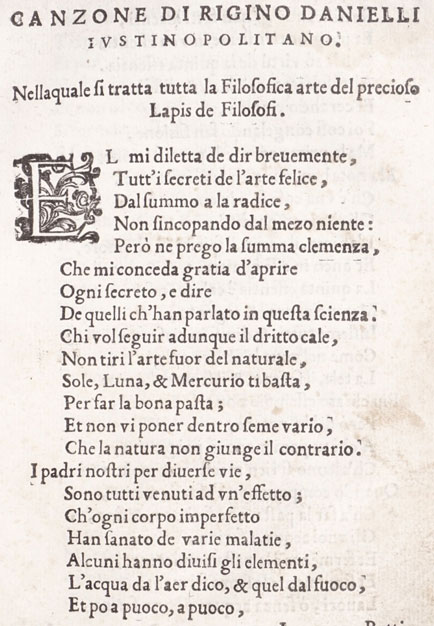
I.
The one who loves me, I will briefly explain
All the secrets of the happy art,
From the highest to the root.
Without skipping anything in the middle;
I pray for the highest mercy
To grant me grace to open
Every secret revealed
By those who have spoken in this science.
Whoever wants to follow the right path,
Should not turn the art away from nature:
Sun, Moon, and Mercury are enough
To make the good paste;
And do not put in a variety of seeds,
For nature does not join the contrary.
II.
Our ancestors, through various ways,
Have all arrived at one effect,
For every imperfect body
They have healed through various maladies.
Some have separated the elements,
The water from the air, I say, and that from the fire;
Then, little by little,
They have refined them, making them shining;
Then they have united them in one essence
With the power of the fifth essence;
Some sublimate, calcine, and dissolve,
Then by searching, resolve,
And by coagulating, they make fixation:
But the first work is putrefaction.
III.
But note well, that you must not be in error,
For it is one thing in which the aforementioned elements
Are fixed,
The soul, the body, the spirit, and the humor;
Still, in it, four, three, one,
The fifth essence, lime, and ferment,
Mercury, gold, and silver,
All together and each divided,
As in the egg, the white with the yolk,
The web, the skin, and the seed of the rooster:
I would know a clearer example to find in you;
Therefore, you must note
Where you place your hands and practical things,
For some hold themselves as masters, but they are very shallow.
IV
When composing, do not forget
That to make the dough good and fine,
You need water and flour,
And leaven to make it rise.
Similarly, if you work without leaven,
Without water or flour,
Our medicine will fail,
And you will find your hands full of wind.
And to bring every darkness into light:
Our mercury is not that of the common folk;
Not made from dead things but from the living,
Completes this divine
And holy medicine, which brings back
Every imperfect body to true light.
V
Some take the rotating stone,
And without further division,
Place it in a vessel
Well-sealed with a burning seal;
And here it is cooked until it is perfect.
But note well the goal:
For the volcano holds all the effect,
And all the art is done in a single vessel
With slow heat in one furnace:
Here it is sublimated, solved, and distilled,
Washed, descends and humbles,
Encased, putrefied, calcined, and fixed;
Here it dies and resurrects itself.
VI
Our stone is of animated matter,
Precious, sweet, and gentle,
But still in price, it is low,
Considering the hidden virtue.
I do not say this so you forget
The time in which many were deceived,
And also others failed,
Making the workers sad and slow:
The shortest time is nine months,
As attested by the courteous philosophers,
It also shows many colors
Like a field of flowers,
But then, in the blackness, every color fades;
At the end, it shows whiteness.
VII
Then, through further decoction,
It all turns into gold,
With such beautiful work
That it brings joy to every sane mind.
Another sign will also show you
If your decoction is finished:
That is, if it smokes or crackles,
Or remains still without any disturbance.
I also speak of projection,
In which many people have failed:
When it no longer smokes or makes a sound,
Be cautious and wise,
And make sure no medicine
Is placed unless it’s on the Sun and Moon.
VIII
But because a little piece is placed over a thousand,
If your elixir is perfect,
Be discreet,
And do not hold what I say in contempt.
Take a dram of the medicine
And a dram of pure mercury,
And place it in the bottom
Of the burning furnace:
Then, when the servant begins to fry,
Smoking, place the elixir inside,
And it all transforms into medicine,
I mean perfect and fine,
From which you will throw a piece over a hundred,
And you will find joy in your work.
IX
Our ancients, to conceal this art,
Spread it across various volumes:
Some call it Gumi,
Others Mercury, Sulfur, Jupiter, and Mars;
Some call it a certain metal,
Others the name of planets,
And each places in it
Various names, even Risagallo,
Ovum capili, Lapis Mineralis,
Adhebesi, Rebis, Lapis Herbalis,
Arsenic and Orpiment and Dragon,
And Sal armoniaco,
Copper oxide, Basilisk and Blood,
Laton, Azoth, Zernech, Chilbrith, and Serpent.
X
For these various names, many workers are deceived;
Some take that which
Is better left silent,
And they follow their concepts.
Some do the de-albation
With Risagallo, tartar, and lime,
And make metallina
With egg white and other things they place in it.
Others take orpiment,
Some take arsenic, and nothing happens;
Some take the four elements;
Some are content
With some filing of metals;
Some use borax, alum, or salts.
XI
I say that for these names, many renowned and careful wise men are deceived,
For these names are written
For different colors and various effects.
Therefore, do not depart from nature,
For the seed you sow,
You shall reap the fruit;
For every animal produces its own similar creature.
Take pure mercury then,
(And here you miss the measure and the weight),
And give it the most perfect ferment,
I speak of gold or silver;
For whoever sows beans or peas
Cannot reap wheat or pulses.
XII
Some seek poisonous herbs,
The tora, oleander, and lunaria,
According to how their mind varies
Here and there towards different things;
Some work with human seed,
One takes talcum, another blood,
Manure, one takes a buffalo and snake,
Another takes exuded sap, Roman vitriol;
Some use cantharides, some feather alum.
I could not count them all in sum,
For it would be a great volume and much trouble
To recount all the deceptions
And the trickery they do so much:
Therefore, I say that I have already tried it.
XIII. – Some dissolve two healthy bodies In strong water; some amalgamate, And some whiten them, Making bronze from copper for bells; Some make a distillate, others sublime, One distills through a still, another through felt, One creates tin solder, Another makes the finest marks from the material; Some dye with brimstone and salamander, And use apples, figs, and chicken feathers; One joins saffron, another Roman vitriol: Thus, with an insane head And such sophistic and deceptive operations, They make the art seem vile and deceitful.
XIV. – Be very cautious of excessive heat: Oil, charcoal, and some soot are enough; And ensure the paste Is never devoid of living mercury. Too much heat will vitrify; Too much moisture turns it into slime: Therefore, govern the dragon As it needs to drink and eat; And do not be tired of putrefaction, For all the work gives great remedy. But excessive heat does not serve you As nature does with egg shells, elephant’s teeth, And only certain rubies, balsams, and diamonds.
XV. – Once this sweet manna is complete It not only transforms metals, But also removes and expels all grievous diseases From human bodies; Once the disease is expelled, it is defended So that it does not return in the future, And makes the person secure, As long as they live, to remain happy and healthy. It preserves health and youth; Without sin, it grants great wealth; It preserves the natural heat And the vital spirit Above all medicines of Avicenna, Galen, Hippocrates, and Damascus.
XVI. – I do not know whether I should mention the vessels and the weight,
Because I have searched many times over five lustrums
In both new and ancient
Books from various parts of the world,
With much effort, expense, and sorrow,
Once, and only once, I found of vessels
And the true weight of the base,
Over a span of more than 25 years.
The vessel is the flask of Latona,
And the planets give you the weight;
The former in its form, and the latter in numerology,
And this is not sophistry:
It is also described with true figures,
The vessel, the matter, and the measure.
XVII. – Almighty God, who sees all things,
By whom nothing is good or evil,
Who cannot fail,
You have rescued us from the lowest depths;
You have redeemed all things by your Word,
Through the Holy Spirit and the grace of charity;
You, the Deity,
Have clothed yourself in our humanity!
If the Virgin already gave birth, it is not surprising,
That she denied the evil lineage of the Hebrews.
You, who can do all things, make me worthy
By the sign of passion,
That I may not die through the father's stain of sin,
But complete this work, a gift from God.
XVIII. – This song, spread across the world,
To all who have a noble heart,
And say that it is humble,
If they want to see the depths of this art;
And do not let their thoughts fall into vain things,
Do not think to make a new world,
Nor search for the skin in the egg,
But exalt the Christian faith;
For God, who sees all our secrets,
Always aids the perfect thought,
And if anyone wants my name to be known,
Say: the one who sends me here,
From Justinopoli, is our faithful
Professor of Grammar, Daniele.
Praise to the Most High.
Song (Canzone) of Rigino Danielli of Justinopolis,
Second Version extracted from the book:
"Della tramutatione metallica sogni tre / di Gio. Battista Nazari Bresciano ; nel primo de quali si tratta della falsa tramutatione sofistica ; nel secondo della vtile tramutatione detta reale vsuale ; nel terzo della diuina tramutatione detta reale filosofica ; aggiontoui di nuouo la Concordanza de filosofi, & loro prattica ; nellaquale, si vede i gradi, & termini de esso diuino magistero, & della verissima compositione della filosofia naturale, con laquale ogni cosa diminuta si riduce al vero solificio, & lunificio ; con un copioso indice per ciascun sogno de gli auttori, & dell'opere c'banno sopra di ciò trattato"
Translated by Mitko Janeski.
It pleases me to speak briefly
all the secrets of the blessed art,
from the summit to the root,
leaving out nothing in the middle.
Yet I beg the highest clemency
to grant me the grace to open
every secret, and to tell
of those things that have been spoken of in this science.
Whoever, then, would follow the right path,
let him not draw the Art outside of Nature:
Sun, Moon, and Mercury are enough for you
to make the good paste;
and do not put within it varied seed,
for Nature cannot join the contrary.
Our fathers, by diverse ways,
have all come to one effect:
that every imperfect body
they have healed of various maladies.
Some have separated the elements
water from air, I mean, and that from fire
and then, little by little, little by little,
By rectifying, they have made them shining,
and then joined them together into one essence,
with the virtue of the quintessence.
Others sublimate, calcine, and dissolve,
and by waxing, they make them turn again;
then by congealing they make a division;
but the first work is putrefaction.
But note well, so that you be not in error,
that there is one single thing in which are all
the aforesaid elements:
the soul, the body, the spirit, and the moisture;
and also in it are four, three, and one.
The quintessence is a calx with ferment:
Mercury, gold, and silver
all together, and distinct in each,
as in the egg, the white with the yolk,
the membrane, the shell, and the seed of the cock.
I can find for you no clearer example;
yet you must take note
to whom you set your hand, and then practice,
for some hold themselves masters, and are much erring.
When you compound, let it not pass from your mind
that to make a paste that is good and fine
it needs water and flour,
and leaven suitable for the paste;
and likewise, if without leaven
you work, or without water, or good flour,
Our medicine,
you will find, is full of wind;
and, in laughter, every darkness turns to lightning.
Our Mercury is not that of the common crowd;
and I do not say a dead thing, but truly a divine one.
This divine form
is a wholesome medicine, which brings
every imperfect body to true light.
Some take the stone newly made,
and without making it into another division,
they put it into a vessel,
well sealed with a burning seal;
then setting it in its gentle bed,
they cook it there until it is perfect.
But note well the goal:
that in Vulcan lies the whole effect,
and the whole art is done in a little vessel,
with slow fire, and only in a small furnace;
here it is sublimed, dissolved, and distilled;
it rises, descends, is humbled;
it is waxed, putrefied, calcined, and fixed;
here it is killed, and is raised again by itself.
Our stone is said to be ensouled,
and precious, and gentle, and noble;
yet in its price it is cheap,
if one considers the hidden virtue:
it will not do, however, unless you remember
Of the time, in which many are deceived,
and also other defects,
which make the workers sad and slow.
The least time is of nine months,
so many of these Philosophers’ courtesies.
It still shows many colors,
like a meadow of flowers;
but then, into black, every color turns,
and near the end it shows whiteness.
Then, by the more distant decoction,
it becomes all as of a golden color,
with a fair laurel,
which gives gladness to every sound mind.
Another sign yet makes it manifest
whether your decoction is finished:
the smokiness has gone out,
and it remains firm, without any other grinding.
I will also speak of the projection,
which has already failed very many persons:
when it does not smoke, and makes no more movement,
make sure you are skilled and learned,
and see well that you put no medicine
upon anything but Sun or Moon.
But because one falls a step above a thousand,
and the more your elixir is perfect,
see that you are discreet,
and do not hold what I say as vile,
Take one drachm of the Medicine,
and ten drachms of purified Mercury,
and put it at the bottom,
in the burning fire within the furnace;
and when the iron begins to flee,
smoking, put into it the elixir,
and all is converted into medicine
I say perfect and fine
of which cast one part upon a hundred,
and you will find that work to be satisfying.
Our ancients, to conceal that art,
have described it in diverse volumes;
and some call it “gum,”
and some Mercury, Sulphur, Jupiter, or Mars;
some call it by each metal,
some then by the name of planets;
and each of them sets down
diverse names even for the crucible:
egg of hair, mineral stone,
adbesi, rebis, herbal stone,
arsenic, orpiment, and dragon;
and some call it sal ammoniac,
and copperas, basilisk, and blood;
laton, azoch, ernech, chibrith, and angue.
By these various names many are deceived;
many workers have taken for that
what is said because silence is fair,
And they go on following their own conceits:
Some make the whitening,
with crucible, tartar, and calx,
and they make a metallic [thing];
one puts in egg-white;
another takes orpiment;
and another arsenic, and I say no more;
and some take the four elements;
some are content
with certain filings of metals
some with borax, alum, or salts.
I say: by these names they are deceived,
and many idiots, and foolish, and shortsighted men,
who have written these names
for diverse colors and various effects;
yet do not depart from Nature:
whatever seed it is that you sow,
such fruit you will gather;
for every animal makes like offspring.
Take, then, Mercury, pure and clean;
but here you lack the mixture and the weight,
and the most perfect ferment
I mean of gold or of silver;
for he who sows beans, or even beans again,
cannot gather wheat or peas.
Some take poisonous herbs
the tora, the oleander, the lunaria,
According as the mind varies,
so it falls now to this, now to diverse things:
Some work the human seed;
some take talc, some hair, or blood;
some dung, toad, or serpents;
some take sulphur, or Roman vitriol;
some cinnabar; some the light of lead.
I could not sing of all in the sum,
for it would make great volumes and great toil,
to recount the deceits
and the knaveries that they do in abundance
and I say it, for I have already tried it.
Others dissolve two bodies
in aqua fortis, some by amalgamating;
some by whitening
make of copper “Campanian bronze”;
some make a descensory, some sublimate;
some distil through the alembic, and some through felt;
some make of tin pewter,
and some make their estimate in marcasite;
some dye with tutty or calamine,
and honey, figs, and hens’ feathers;
some add saffron, or Roman vitriol,
thus with mad cap,
with such sophistical and deceitful practice,
they make the Art seem vile and lying.
Beware greatly of excessive fire,
Oil and coals then you will come down to dung;
and see that the paste
is never deprived of the living Mercury.
Too much fire makes it “glassify”;
too much moisture turns it to a lake.
Therefore govern the dragon,
as it has need to drink and to eat;
and let it not be tedious to putrefy,
for the whole work gives a great remedy.
Yet too much fire is of no use to you,
for it does not make the natural things:
the shell of the egg, and elephants’ teeth;
the Sun rubies, balas-rubies, and diamonds.
When this sweet manna is completed,
it not only [perfects] the bodies of metals,
but it removes all grievous evils,
and drives from the body every spasm.
After it has driven out the disease, it defends it,
so that it returns no more in time to come,
and it makes the man secure
as long as he lives, and without being seized;
and it preserves health and youth;
without sin it gives great riches;
it preserves also the natural heat
and the vital spirit,
above every medicine of Galen,
Avicenna, Hippocrates, and Damascene.
I know not whether I ought to tell the vessel, or the weight;
for, since I have been through more than five lustrums
in new and in old books,
through diverse parts of the world,
with many labors, expenses, and troubles,
only once at last did I find concerning the vessels,
and the weight, truly the foundation,
in the space of more than five-and-twenty years.
The vessel is the daughter of Latona,
and the planets likewise give you the weight.
That one in its form, and this in its reckoning.
This is no sophism,
but rather described in a true figure:
the vessel, the matter, and the measure.
THE END.
This version of Rigino Danielli's Song on the Philosopher's Stone is taken from O. Zenatti, Una canzone capodistriana del secolo XIV sulla pietra filosofale (A Capodistrian Song of the 14th Century on the Philosopher's Stone ), which first appeared in Archivio storico per Trieste, l'Istria e il Trentino (Historical Archive for Trieste, Istria and Trentino) , Rome-Florence 1890, vol. 4 pp. 81-117, now available on this same site.
Rigino Danielli's song is certainly one of the most exemplified compositions in the alchemical manuscript tradition in the Italian language. In addition to the manuscript versions reported and compared by Zenatti, we have recently re-proposed the variants of two versions (the M S. VII-G-70 and the VIII-D- 20 of the Biblioteca Nazionale Vittorio Emanuele III of Naples) in our Di alcuni componimenti di materia alchemica in rima volgare , in AA. VV., Alchimia, edited by Massimo Marra and Andrea de Pascalis (Mimesis 2007).
As for the printed versions, three are known. The first is in an incunabulum containing the Summa Perfectionis geberiana, published in Venice in 1475:
Summa perfectionis Magisteri, liber trium verborum, Epistola Alexandri M., Geberi liber investigationis magisterii, Carmina latina et fr. De Asculo, Fratris Eliae et anonymi carmina italica.
The second is in Della trasmutatione metallica sogni tre by Giovan Battista Nazari from Brescia , in the edition by Francesco and Pier Maria Marchetti of 1572 and in the subsequent one of 1599. Both in this edition and in the previous one, the text, compared with the most complete manuscript tradition, is missing the last two stanzas.
The third and rarest printed version is instead in a pamphlet entitled Canzone di Rigino Danieli Justinopolitano in which all the philosophy, the art of the precious pencil of philosophers, is discussed, with all the necessary warnings… and a very lucid and useful exposition of the same by Casparo Ottaviani Cantù, in Padua, in the Penada printing house, 1710.
As regards an updated general biography on Italian alchemical poetry, we refer to the indications of our cited Di alcuni componimenti….
Massimo Marra
I.
The one who loves me, I will briefly explain
All the secrets of the happy art,
From the highest to the root.
Without skipping anything in the middle;
I pray for the highest mercy
To grant me grace to open
Every secret revealed
By those who have spoken in this science.
Whoever wants to follow the right path,
Should not turn the art away from nature:
Sun, Moon, and Mercury are enough
To make the good paste;
And do not put in a variety of seeds,
For nature does not join the contrary.
II.
Our ancestors, through various ways,
Have all arrived at one effect,
For every imperfect body
They have healed through various maladies.
Some have separated the elements,
The water from the air, I say, and that from the fire;
Then, little by little,
They have refined them, making them shining;
Then they have united them in one essence
With the power of the fifth essence;
Some sublimate, calcine, and dissolve,
Then by searching, resolve,
And by coagulating, they make fixation:
But the first work is putrefaction.
III.
But note well, that you must not be in error,
For it is one thing in which the aforementioned elements
Are fixed,
The soul, the body, the spirit, and the humor;
Still, in it, four, three, one,
The fifth essence, lime, and ferment,
Mercury, gold, and silver,
All together and each divided,
As in the egg, the white with the yolk,
The web, the skin, and the seed of the rooster:
I would know a clearer example to find in you;
Therefore, you must note
Where you place your hands and practical things,
For some hold themselves as masters, but they are very shallow.
IV
When composing, do not forget
That to make the dough good and fine,
You need water and flour,
And leaven to make it rise.
Similarly, if you work without leaven,
Without water or flour,
Our medicine will fail,
And you will find your hands full of wind.
And to bring every darkness into light:
Our mercury is not that of the common folk;
Not made from dead things but from the living,
Completes this divine
And holy medicine, which brings back
Every imperfect body to true light.
V
Some take the rotating stone,
And without further division,
Place it in a vessel
Well-sealed with a burning seal;
And here it is cooked until it is perfect.
But note well the goal:
For the volcano holds all the effect,
And all the art is done in a single vessel
With slow heat in one furnace:
Here it is sublimated, solved, and distilled,
Washed, descends and humbles,
Encased, putrefied, calcined, and fixed;
Here it dies and resurrects itself.
VI
Our stone is of animated matter,
Precious, sweet, and gentle,
But still in price, it is low,
Considering the hidden virtue.
I do not say this so you forget
The time in which many were deceived,
And also others failed,
Making the workers sad and slow:
The shortest time is nine months,
As attested by the courteous philosophers,
It also shows many colors
Like a field of flowers,
But then, in the blackness, every color fades;
At the end, it shows whiteness.
VII
Then, through further decoction,
It all turns into gold,
With such beautiful work
That it brings joy to every sane mind.
Another sign will also show you
If your decoction is finished:
That is, if it smokes or crackles,
Or remains still without any disturbance.
I also speak of projection,
In which many people have failed:
When it no longer smokes or makes a sound,
Be cautious and wise,
And make sure no medicine
Is placed unless it’s on the Sun and Moon.
VIII
But because a little piece is placed over a thousand,
If your elixir is perfect,
Be discreet,
And do not hold what I say in contempt.
Take a dram of the medicine
And a dram of pure mercury,
And place it in the bottom
Of the burning furnace:
Then, when the servant begins to fry,
Smoking, place the elixir inside,
And it all transforms into medicine,
I mean perfect and fine,
From which you will throw a piece over a hundred,
And you will find joy in your work.
IX
Our ancients, to conceal this art,
Spread it across various volumes:
Some call it Gumi,
Others Mercury, Sulfur, Jupiter, and Mars;
Some call it a certain metal,
Others the name of planets,
And each places in it
Various names, even Risagallo,
Ovum capili, Lapis Mineralis,
Adhebesi, Rebis, Lapis Herbalis,
Arsenic and Orpiment and Dragon,
And Sal armoniaco,
Copper oxide, Basilisk and Blood,
Laton, Azoth, Zernech, Chilbrith, and Serpent.
X
For these various names, many workers are deceived;
Some take that which
Is better left silent,
And they follow their concepts.
Some do the de-albation
With Risagallo, tartar, and lime,
And make metallina
With egg white and other things they place in it.
Others take orpiment,
Some take arsenic, and nothing happens;
Some take the four elements;
Some are content
With some filing of metals;
Some use borax, alum, or salts.
XI
I say that for these names, many renowned and careful wise men are deceived,
For these names are written
For different colors and various effects.
Therefore, do not depart from nature,
For the seed you sow,
You shall reap the fruit;
For every animal produces its own similar creature.
Take pure mercury then,
(And here you miss the measure and the weight),
And give it the most perfect ferment,
I speak of gold or silver;
For whoever sows beans or peas
Cannot reap wheat or pulses.
XII
Some seek poisonous herbs,
The tora, oleander, and lunaria,
According to how their mind varies
Here and there towards different things;
Some work with human seed,
One takes talcum, another blood,
Manure, one takes a buffalo and snake,
Another takes exuded sap, Roman vitriol;
Some use cantharides, some feather alum.
I could not count them all in sum,
For it would be a great volume and much trouble
To recount all the deceptions
And the trickery they do so much:
Therefore, I say that I have already tried it.
XIII. – Some dissolve two healthy bodies In strong water; some amalgamate, And some whiten them, Making bronze from copper for bells; Some make a distillate, others sublime, One distills through a still, another through felt, One creates tin solder, Another makes the finest marks from the material; Some dye with brimstone and salamander, And use apples, figs, and chicken feathers; One joins saffron, another Roman vitriol: Thus, with an insane head And such sophistic and deceptive operations, They make the art seem vile and deceitful.
XIV. – Be very cautious of excessive heat: Oil, charcoal, and some soot are enough; And ensure the paste Is never devoid of living mercury. Too much heat will vitrify; Too much moisture turns it into slime: Therefore, govern the dragon As it needs to drink and eat; And do not be tired of putrefaction, For all the work gives great remedy. But excessive heat does not serve you As nature does with egg shells, elephant’s teeth, And only certain rubies, balsams, and diamonds.
XV. – Once this sweet manna is complete It not only transforms metals, But also removes and expels all grievous diseases From human bodies; Once the disease is expelled, it is defended So that it does not return in the future, And makes the person secure, As long as they live, to remain happy and healthy. It preserves health and youth; Without sin, it grants great wealth; It preserves the natural heat And the vital spirit Above all medicines of Avicenna, Galen, Hippocrates, and Damascus.
XVI. – I do not know whether I should mention the vessels and the weight,
Because I have searched many times over five lustrums
In both new and ancient
Books from various parts of the world,
With much effort, expense, and sorrow,
Once, and only once, I found of vessels
And the true weight of the base,
Over a span of more than 25 years.
The vessel is the flask of Latona,
And the planets give you the weight;
The former in its form, and the latter in numerology,
And this is not sophistry:
It is also described with true figures,
The vessel, the matter, and the measure.
XVII. – Almighty God, who sees all things,
By whom nothing is good or evil,
Who cannot fail,
You have rescued us from the lowest depths;
You have redeemed all things by your Word,
Through the Holy Spirit and the grace of charity;
You, the Deity,
Have clothed yourself in our humanity!
If the Virgin already gave birth, it is not surprising,
That she denied the evil lineage of the Hebrews.
You, who can do all things, make me worthy
By the sign of passion,
That I may not die through the father's stain of sin,
But complete this work, a gift from God.
XVIII. – This song, spread across the world,
To all who have a noble heart,
And say that it is humble,
If they want to see the depths of this art;
And do not let their thoughts fall into vain things,
Do not think to make a new world,
Nor search for the skin in the egg,
But exalt the Christian faith;
For God, who sees all our secrets,
Always aids the perfect thought,
And if anyone wants my name to be known,
Say: the one who sends me here,
From Justinopoli, is our faithful
Professor of Grammar, Daniele.
Praise to the Most High.
Song (Canzone) of Rigino Danielli of Justinopolis,
in which the whole philosophical art of the precious Philosopher’s Stone is treated.
Second Version extracted from the book:
"Della tramutatione metallica sogni tre / di Gio. Battista Nazari Bresciano ; nel primo de quali si tratta della falsa tramutatione sofistica ; nel secondo della vtile tramutatione detta reale vsuale ; nel terzo della diuina tramutatione detta reale filosofica ; aggiontoui di nuouo la Concordanza de filosofi, & loro prattica ; nellaquale, si vede i gradi, & termini de esso diuino magistero, & della verissima compositione della filosofia naturale, con laquale ogni cosa diminuta si riduce al vero solificio, & lunificio ; con un copioso indice per ciascun sogno de gli auttori, & dell'opere c'banno sopra di ciò trattato"
Translated by Mitko Janeski.
It pleases me to speak briefly
all the secrets of the blessed art,
from the summit to the root,
leaving out nothing in the middle.
Yet I beg the highest clemency
to grant me the grace to open
every secret, and to tell
of those things that have been spoken of in this science.
Whoever, then, would follow the right path,
let him not draw the Art outside of Nature:
Sun, Moon, and Mercury are enough for you
to make the good paste;
and do not put within it varied seed,
for Nature cannot join the contrary.
Our fathers, by diverse ways,
have all come to one effect:
that every imperfect body
they have healed of various maladies.
Some have separated the elements
water from air, I mean, and that from fire
and then, little by little, little by little,
By rectifying, they have made them shining,
and then joined them together into one essence,
with the virtue of the quintessence.
Others sublimate, calcine, and dissolve,
and by waxing, they make them turn again;
then by congealing they make a division;
but the first work is putrefaction.
But note well, so that you be not in error,
that there is one single thing in which are all
the aforesaid elements:
the soul, the body, the spirit, and the moisture;
and also in it are four, three, and one.
The quintessence is a calx with ferment:
Mercury, gold, and silver
all together, and distinct in each,
as in the egg, the white with the yolk,
the membrane, the shell, and the seed of the cock.
I can find for you no clearer example;
yet you must take note
to whom you set your hand, and then practice,
for some hold themselves masters, and are much erring.
When you compound, let it not pass from your mind
that to make a paste that is good and fine
it needs water and flour,
and leaven suitable for the paste;
and likewise, if without leaven
you work, or without water, or good flour,
Our medicine,
you will find, is full of wind;
and, in laughter, every darkness turns to lightning.
Our Mercury is not that of the common crowd;
and I do not say a dead thing, but truly a divine one.
This divine form
is a wholesome medicine, which brings
every imperfect body to true light.
Some take the stone newly made,
and without making it into another division,
they put it into a vessel,
well sealed with a burning seal;
then setting it in its gentle bed,
they cook it there until it is perfect.
But note well the goal:
that in Vulcan lies the whole effect,
and the whole art is done in a little vessel,
with slow fire, and only in a small furnace;
here it is sublimed, dissolved, and distilled;
it rises, descends, is humbled;
it is waxed, putrefied, calcined, and fixed;
here it is killed, and is raised again by itself.
Our stone is said to be ensouled,
and precious, and gentle, and noble;
yet in its price it is cheap,
if one considers the hidden virtue:
it will not do, however, unless you remember
Of the time, in which many are deceived,
and also other defects,
which make the workers sad and slow.
The least time is of nine months,
so many of these Philosophers’ courtesies.
It still shows many colors,
like a meadow of flowers;
but then, into black, every color turns,
and near the end it shows whiteness.
Then, by the more distant decoction,
it becomes all as of a golden color,
with a fair laurel,
which gives gladness to every sound mind.
Another sign yet makes it manifest
whether your decoction is finished:
the smokiness has gone out,
and it remains firm, without any other grinding.
I will also speak of the projection,
which has already failed very many persons:
when it does not smoke, and makes no more movement,
make sure you are skilled and learned,
and see well that you put no medicine
upon anything but Sun or Moon.
But because one falls a step above a thousand,
and the more your elixir is perfect,
see that you are discreet,
and do not hold what I say as vile,
Take one drachm of the Medicine,
and ten drachms of purified Mercury,
and put it at the bottom,
in the burning fire within the furnace;
and when the iron begins to flee,
smoking, put into it the elixir,
and all is converted into medicine
I say perfect and fine
of which cast one part upon a hundred,
and you will find that work to be satisfying.
Our ancients, to conceal that art,
have described it in diverse volumes;
and some call it “gum,”
and some Mercury, Sulphur, Jupiter, or Mars;
some call it by each metal,
some then by the name of planets;
and each of them sets down
diverse names even for the crucible:
egg of hair, mineral stone,
adbesi, rebis, herbal stone,
arsenic, orpiment, and dragon;
and some call it sal ammoniac,
and copperas, basilisk, and blood;
laton, azoch, ernech, chibrith, and angue.
By these various names many are deceived;
many workers have taken for that
what is said because silence is fair,
And they go on following their own conceits:
Some make the whitening,
with crucible, tartar, and calx,
and they make a metallic [thing];
one puts in egg-white;
another takes orpiment;
and another arsenic, and I say no more;
and some take the four elements;
some are content
with certain filings of metals
some with borax, alum, or salts.
I say: by these names they are deceived,
and many idiots, and foolish, and shortsighted men,
who have written these names
for diverse colors and various effects;
yet do not depart from Nature:
whatever seed it is that you sow,
such fruit you will gather;
for every animal makes like offspring.
Take, then, Mercury, pure and clean;
but here you lack the mixture and the weight,
and the most perfect ferment
I mean of gold or of silver;
for he who sows beans, or even beans again,
cannot gather wheat or peas.
Some take poisonous herbs
the tora, the oleander, the lunaria,
According as the mind varies,
so it falls now to this, now to diverse things:
Some work the human seed;
some take talc, some hair, or blood;
some dung, toad, or serpents;
some take sulphur, or Roman vitriol;
some cinnabar; some the light of lead.
I could not sing of all in the sum,
for it would make great volumes and great toil,
to recount the deceits
and the knaveries that they do in abundance
and I say it, for I have already tried it.
Others dissolve two bodies
in aqua fortis, some by amalgamating;
some by whitening
make of copper “Campanian bronze”;
some make a descensory, some sublimate;
some distil through the alembic, and some through felt;
some make of tin pewter,
and some make their estimate in marcasite;
some dye with tutty or calamine,
and honey, figs, and hens’ feathers;
some add saffron, or Roman vitriol,
thus with mad cap,
with such sophistical and deceitful practice,
they make the Art seem vile and lying.
Beware greatly of excessive fire,
Oil and coals then you will come down to dung;
and see that the paste
is never deprived of the living Mercury.
Too much fire makes it “glassify”;
too much moisture turns it to a lake.
Therefore govern the dragon,
as it has need to drink and to eat;
and let it not be tedious to putrefy,
for the whole work gives a great remedy.
Yet too much fire is of no use to you,
for it does not make the natural things:
the shell of the egg, and elephants’ teeth;
the Sun rubies, balas-rubies, and diamonds.
When this sweet manna is completed,
it not only [perfects] the bodies of metals,
but it removes all grievous evils,
and drives from the body every spasm.
After it has driven out the disease, it defends it,
so that it returns no more in time to come,
and it makes the man secure
as long as he lives, and without being seized;
and it preserves health and youth;
without sin it gives great riches;
it preserves also the natural heat
and the vital spirit,
above every medicine of Galen,
Avicenna, Hippocrates, and Damascene.
I know not whether I ought to tell the vessel, or the weight;
for, since I have been through more than five lustrums
in new and in old books,
through diverse parts of the world,
with many labors, expenses, and troubles,
only once at last did I find concerning the vessels,
and the weight, truly the foundation,
in the space of more than five-and-twenty years.
The vessel is the daughter of Latona,
and the planets likewise give you the weight.
That one in its form, and this in its reckoning.
This is no sophism,
but rather described in a true figure:
the vessel, the matter, and the measure.
THE END.