אור נגה
SPLENDOR LUCIS,
or
Radiance (Splendour) of the Light.
A brief
physico-kabbalistic interpretation
of the greatest mystery of nature,
commonly called
LAPIS PHILOSOPHORUM
(the Philosopher’s Stone).
Drawn from the Hebrew original text of Holy Scripture
by
ALOYSIO WIENNER,
Noble of Sonnenfels,
teacher (master) of various Oriental languages at the most ancient
and most renowned University of Vienna, and
private professor/lecturer.
ויהיה אור לבנה כאור החמה כי אור החמה יהיה שבעתים (ישעי׳ ל׳ כ״ו) לשגה
לידת הגן אל יתכון:
“And the light of the moon shall be like the light of the sun, and the light of the sun
shall be sevenfold - (Isaiah 30:26)”
“The birth of the garden shall not be established.”
Newly published again
by
ADAMAH BOOZ.
With an appendix.
Frankfurt and Leipzig,
at A. E. Böhme, 1785.
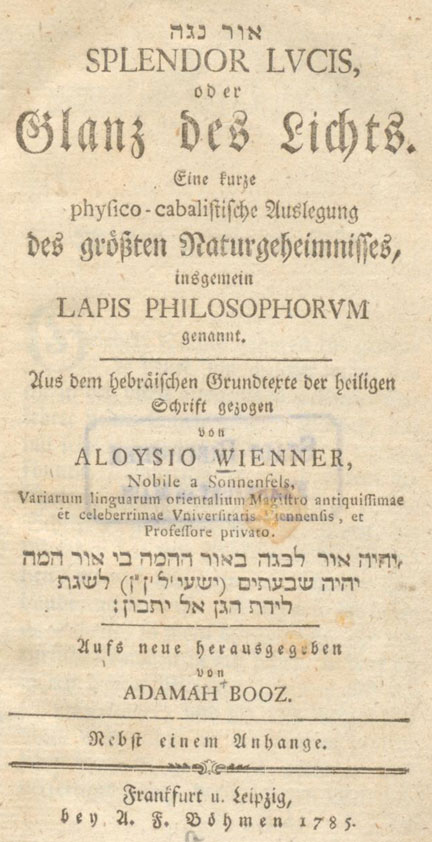
Translated from German book:
Splendor Lvcis, oder Glanz des Lichts : Eine kurze physico-cabalistische Auslegung des größten Naturgeheimnisses, insgemein Lapis Philosophorvm genannt. Aus dem hebräischen Grundtexte der heiligen Schrift gezogen von Aloysio Wienner, Nobile a Sonnenfels, ... Aufs neue herausgegeben von Adamah Booz. Nebst einem Anhange
To the Kindly Disposed Reader
Learned matters belong to learned people, for whose sake such things are published in the world. Learned people seek learned books, so that from them they may become all the more learned.
It is beyond dispute that no book more learned than the divine Holy Scripture is to be found. For wisdom has truth as its foundation, upon which it, as the fairest building, is built.
If, then, Holy Scripture contains within itself both divine and natural wisdom, then I may indeed, with this little work (which is grounded upon that same Scripture, and which according to my small knowledge of the most ancient Hebrew tongue I have gathered together and prepared), present to the learned world to step before the eyes; in order to faithfully communicate to others the particular light that I have obtained in this science, in the hope that those who possess a greater light than I in this matter may thereby be spurred on to let such light likewise increase for me, and for other faithful lovers of the Art.
Therefore, everyone is kindly asked to go through this little tract of mine carefully; whereupon I do not doubt that in many places the light of truth will dawn upon him, and thus my work will find the desired approval, which may win for me the reader’s valuable goodwill.
Farewell, and rejoice! (Vale et fruere!)
Introduction
Blessed be GOD MOST HIGH, who created heaven and earth. (Gen. XIV:19.)
Blessed be GOD our REDEEMER, the Lord God of Hosts; his name is: the Holy One of Israel. (Isa. XLVII:4.)
Blessed be GOD, the SPIRIT, JEHOVAH. (Isa. IV:13.) (as cited in the book)
Blessed be JEHOVAH our God; GOD is one. (Deut. VI:4.)
He created man in his own image; in the image of God created he him. (Gen. I:27.)
He has distinguished him from other irrational animals by the understanding of his immortal soul; he has given him the commandments of God, and the Law of Moses on Mount Sinai.
Yes, finally, the law of grace, of which the prophet Isaiah (II:3) foretold: “For out of Zion shall the law go forth.”
כי מציון תצא תורה (“For from Zion shall the Torah go forth.”)
Namely, through the second Person, Jesus of Nazareth, who has redeemed us and made us children of God, with the addition that we should walk in his ways, on the way of life and of light, which is the divine will.
Of this the great apostle and evangelist John speaks thus (1:12–13): “But as many as received him, to them he gave power to become children of God, who are born of God.”
Now such a will comes to pass in us through knowledge; that is: when we have divine knowledge, we also seek to bring our own will into agreement with the divine will.
Christ Jesus our Saviour teaches us the same in a prayer, namely where he says: “Our Father, who art in heaven, hallowed, etc.; thy kingdom come …” the true, proper knowledge or contemplation of God, which the theologians call the visio beatifica “Thy will be done,” etc.
Through knowledge it comes to pass that we carry out the divine will. The great royal prophet David likewise gives us to understand this, when he says to his son (1 Chronicles 28:9): “Know the God of thy father, and serve him.”
Ah! At and over this command I remained astonished; I asked myself: How can I know this divine omnipotence, whose form no man can see and live?
“Thou canst not see my face; for no man shall see me and live.” (Exod. 33:20.)
The infinite attributes of God likewise cannot be comprehended with a finite human understanding, neither to comprehend nor to fathom. I sought comfort with this same royal prophet David, and found it likewise in this speculation, sighing: (Psalm 8:1)
“O LORD! how wondrous is thy name over the whole earth; for thy glory is above the heavens.”
Yet he comforted me, in that he, as it were, gave me the answer in (Psalm 19:1–2):
“The heavens declare the glory of God, and the firmament shows forth the work of his hands.”
As though he wished to say: Through the knowledge of nature and of the creature we can attain to the knowledge of God.
But even more do the golden words of the great apostle of the world, Paul, satisfy me, in the Epistle to the Romans (1:20), where his enlightened spirit speaks thus:
“Invisibilia enim ipsius (DEI) a creatura mundi, per ea, quae facta sunt, intellectu conspiciuntur.”
That is: Through what is visible we must recognize what is invisible.
And this is confirmed by what God himself said to Moses, (Exod. 33:23), in these words:
“And I will take away my hand, and thou shalt see what is behind me; but my face shall not be seen.”
All who, by means of this “hindmost part,” have understood the more sublime interpretations of Holy Scripture namely Nature together with its workings and properties have, following this finger-pointing, in order to arrive at divine knowledge, turned themselves to the physical or natural sciences, which I, in their entire compass, divided into various classes, among which the vera Philosophia was my sole aim and concern. But where to find it, I sought with all diligence to inquire of all manner of learned men.
Since, however, I did not know how to find the way thereto, and was seized with a very troubled heart and mind, behold there stepped forth a man in royal adornment, greeted me with the kiss of peace (schelomo), showed me a book, and said:
“Here you have a song which I have composed; take time and consider it well: thus you will find the way to true philosophy.”
I asked him, falling on my knees: “What must I do, that I may rightly understand the sense of this song?”
He then spoke to me thus: “Know that Abraham, my most ancient grandfather, left behind a book called Jezirah; in it you will find a number which was dearest to him, and which I also have adopted in my proverbs. Take this concentrated number, single and doubled; draw from the doubled one a single number then you have that which you seek, and have found all in all, and you will understand my song.”
After this parabolic instruction of the wise king, I took counsel with myself, and took so much trouble to discover the number, that at last I found this book Jezirah. I sought the beloved number of the ancient patriarch, and found in the 4th chapter, §4, these words: “Therefore he (that is, God) has preferred the number seven above all things that are under heaven.
I doubled this number; thus I obtained 14 as the result. I counted this number over a hundred times, and did not know what might be meant by it, until at last it occurred to me that זהב (zahab), gold, has this very number.
I reflected further and found: if from this attained number (namely 14) I make one (understand: if I add it together, or “concentrate” it), then I obtain as the result 5 (for 4 and 1 is 5).
I pursued this with great diligence; then it occurred to me: the Quinta Essentia is to be understood by this. And since Sol bears a circle with a central sign, this wise man has unmistakably meant by the doubled number the circle (gold), and by the concentrated or single number the centrum (the Quintessence).
At this I was indeed glad; yet I still did not know what meaning the simple 7 might have.
And as I now went about wholly sunk in these thoughts, I met a Job, who led his daughter by the hand. He asked me the reason why I was pondering thus. I answered this patient man that I had been referred by a wise Solomon, in a riddle, to a beloved number 7, which, however, I did not understand.
This dear old man replied to me thereupon: “I also love this number, and therefore (pointing to his daughter) I have also named my dearest, fairest, and youngest daughter after this number is called קרן הבוך (Keren habuch).
Then for the first time the light dawned on me. I found that a precious stone bears the same name פוך (understand: Puch), which in the greater number is 106, but in the small number (that is, when it is concentrated into a small number) yields 7.
I considered the entire name of this maiden, and found seven letters. At last it occurred to me that something else might still be hidden behind this name nor was I mistaken; for when I placed other “points” (vowel-points) under this name, as can be seen here, and instead of קרן הבוך (Keren Habuch) read קרן הבהך (Koran habuch), i.e. “it has become illuminated and shining,” then the Puch came forth.
I thanked the dear old man and went away from him, in order to reflect better on the matter. I applied myself to Holy Scripture, went through the walks of the patriarchs and prophets, and found among various vestigia (traces) that they possessed this science; and I was on the point of gathering such passages of Scripture together and interpreting them in a physico-kabbalistic manner, when a voice addressed me thus:
“What do you intend to do? Do you not know that the Doctores Ecclesiae and interpretes sacrae scripturae have understood it in another sense? How do you presume to interpret such things as natural matters?”
I collected myself and replied:
“It is very well known to me that our holy teachers of the Church take Holy Scripture either in the historical sense, or in the mystical (spiritual) sense, interpreted.
I do not in the least contest this interpretation either; rather I venerate it with mouth and heart as a holy interpretation used by Christ and the apostles themselves. I hold such a thing to be a rule (guideline) of the true faith; these modi explanandi vel interpretandi sacram scripturam are called by the theologians universal.
But among the modi explanandi, the theologians also allow three others, as particular ones. See Sixtus Senensis, Bibliotheca sancta, p. 171, book 3. Namely: Elementaris, or cabalisticus, physicus, and propheticus; accordingly, such a mode of exposition is expressly permitted to me by the Christian-Catholic Church.
I pursued my work with the greatest diligence: I went through Holy Scripture as it is given in its mother tongue (Hebrew), together with the Chaldaic interpreter (Targum); and I have explained cabalistically-and-physically those of the first persons whom I found to be possessors of the Art, and from this have described the greatest secret of Nature, namely the Magisterium Hermeticum.
In this, as examples, the learned men have preceded me among the Hebrews, such as: Philo Judaeus, Josephus Flavius, Clemens Alexandrinus, Hieronymus, Picus de Mirandola; and among the Latins especially Vincentius Belluacensis in the Speculum naturale.
Therefore I say to those theologians, with the most excellently learned Michael P. to Xiphilinus, Patriarch of Constantinople, in Michael Maier, book 3 of the Aureae Mensae:
“To thee more excellent and higher things have been entrusted; but I lie upon the earth, and am a contemplator of nature,” etc.
That is: To you more noble and higher things have been entrusted; but I lie upon the earth and am a beholder of Nature.
I therefore wish to set my hand to the work, to kindle a light for you, my kindly reader, in the hope that it may yield to the pious an אור נגה (Or Nogah), i.e. a Splendorem Lucis (“splendour of light”), and lead you into the garden of Paradise, which likewise is signified by the words אור נגה (Or Nogah) when they are altered by an anagram.
For from the word אור (Or) there arises the word ראו (Reu), and from the word נגה (Nogah) the word הגן (Hagon), that is: “See the garden.”
Finally, you will also find in the little word אור (Or) which in the original language is written with three letters, namely: א (Alef), which means as much as A; ו (Waw), which is a W; and ר (Resh), which indicates an R the letters that begin my name, A and W; but the R, which closes the word, is also the ending of my name.
May the Most High grant me the grace of the Holy Spirit, that I may kindle this light to God’s honour and my neighbour’s benefit, may be able to kindle. “The wise man hears and increases wisdom.” (Prov. 1:5.)
I therefore request all who are truly skilled in this ancient (Hebrew) language should it be found that I have erred anywhere to be willing to remind me of it without hesitation.
But if one who is inexperienced in this language should stumble upon it, and wish to judge from afar, let him know that I would not consider it worth the effort to take up the pen against his opinion or presumptuous “apology” (self-justification), in order to refute it.
Finally, every scholar into whose hands this work of mine shall come is kindly asked above all to go through my tables very carefully, so that he may be instructed about the meaning of the greater, smaller, and middle number.
With this I recommend myself to the kindly reader’s continued goodwill.
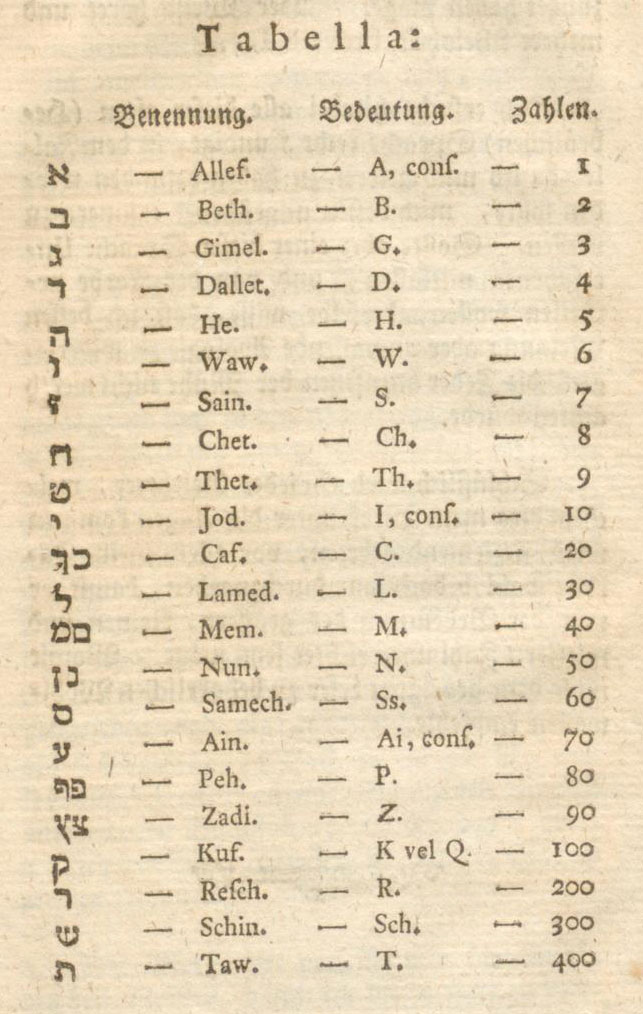
Note (Notandum):
1. That the so-called great, middle, and small numbers occurring in the present book have the following meaning:
2. A great number is called that from which nothing is taken away, and which is left in its full value.
For example: Jod is 10, and Caf is 20. If you add these, the sum is 30, and it remains 30.
3. A middle number is when, e.g., the digits are set together/added up: Ain, Chet, Theth, i.e. 70, 8, 9. Add these and you get 87; set this 87 “one over the other,” thus 8 / 7, and you get 15, which is the middle number.
The small or concentrated number is when you take, e.g., the above 15 and add it together, or set it one over the other, thus 1 / 5, and you get 6. This number can now no longer be diminished, since it consists of only one digit.
Second example:
Resch, Zadi, He have in their own number 295 (which is called the great number). Set these over one another, thus 2 / 9 / 5, and you get 16, which is called the middle number. Now set this 16 again over one another, thus 1 / 6, and you get 7, which is called the small number.
Third:
פוך (Puch), i.e. the matter which in Hebrew is written only with the letters Pe, Waw, Caf, has in its great number 106. For Pe is 80, Caf is 20, and Waw is 6; set these over one another, thus 1 / 0 / 6, and you obtain 7, which is called the small number.
Fourth:
זהב (Sahab), i.e. gold (which in Hebrew is written only with 3 letters, namely Sain, He, Beth), has in its great number 14 (for Sain is 7, He is 5, Beth is 2); set these over one another, thus 1 / 4, and you obtain 5, which is the small number.
Otherwise note that, according to the two examples given above, the Materia Philosophica leads to the number 7, and Sahab, i.e. gold, has the number 14; from this latter, however, the small number 5 is produced, which signifies the Quintessence, and is the centrum (center) of the mastery/art.
which is divided into fourteen (XIV) chapters, namely according to the number of the adepts, whose vestigia (traces) are to be found in Holy Scripture, and which I call the golden chain, of which the first link, or
Chapter I - is Hermes.
The II chapter - is called Abraham.
The III chapter - is called Isaac.
The IV chapter - is dedicated to Jacob.
In the V chapter - Judah, the son of Jacob, will present himself.
The VI. chapter - sets forth Moses.
In the VII chapter - Bezalel appears.
In the VIII chapter - the king David reports/appears
In the IX chapter - Solomon, the wise king, is presented, and his Song of Songs is interpreted.
The X chapter - is adorned with Isaiah the prophet.
In the XI chapter - a king of Tyre steps forth.
In the XII chapter - an Ezra appears.
In the XIII chapter - Job presents himself; and, just as in the preceding [chapters] it happens
In the XIV chapter - the beauty of Job’s daughter Keren (Koran) Hapuch (Ha puch) is chiefly praised.
Whereupon there follows a brief description of the philosophical Saturn, wherein the Materia Lapidis Philosophorum (the matter of the Philosopher’s Stone), together with all its names and its characteristics, is explained, described, and confirmed by the most excellent philosophers.
First Chapter
Which is the great Hermes.
Hermes Trismegistus, after whom the whole Art and Science is named, is indeed already known to all devoted pupils of this philosophy, and various learned men have written enough about him men beside whom I consider myself too insignificant to place myself.
Yet I cannot leave untouched here what the P. Athanasius Kircher, incomparably experienced both in the mathematical sciences and in Oriental languages (even though in his Mundus Subterraneus he holds this Art in contempt), sets forth in his Oedipus Aegyptiacus, tome II, part 2, class 10, as follows:
That there was known to the first human beings an art of making gold that is, either to draw gold out of all things, or to transform one metal into another and first and since it was communicated only to kings, then to the heads of families not indeed in writing, but only orally it is certain that no one, unless he were altogether a stranger to the histories, could doubt this.
But this Art has been buried by those who know it in a deep silence, so that the most secret treasury of Nature might not be discovered by the ignorant rabble, and so that the common being might not thereby be plunged into the utmost ruin, and the whole realm drawn into complete destruction.
Therefore it was not without cause that the prudent Mercury, foreseeing the great harm and calamity that would arise from it, has just as he wraps that most excellent part of world-wisdom which deals with God, the angels, and the world in the darkest symbols, so as not to make it common also quite rightly withheld this science (which, among those who consider the structure of this sublunary and subterranean world, is the most secret and most excellent) from the reading of the unworthy, and hidden it under hieroglyphic riddles.
From this it is evident that the Art must be…; and since this Hermes has his seat in Egypt, and in a well-known manner the Tabula Smaragdina (Emerald Tablet) is derived from him; therefore there is no doubt that this art was common in Egypt, and that Abraham (to whom I now turn) obtained the art from there.
Second Chapter
Abraham, the most chosen among the patriarchs whom God the Lord called His friend by virtue of his book Jezirah (which is ascribed to him) was one of the greatest Cabalists and philosophers of nature.
Eupolemus, an ancient author in Eusebius, Praeparatio Evangelica IX, 17, writes the following words about him:
“Abraham, who was born at Ur in Babylonia, after he had surpassed all in wisdom, invented astrology and other Chaldaean magical sciences, also the revolution (course) of the sun and moon, and other similar sciences, and taught them to the Phoenicians.”
The same is confirmed by Artabanus in the said Eusebius; likewise by Josephus Flavius and Philo Judaeus.
They add that Abraham learned and perfectly understood all the Egyptian arts in Egypt. And since it is known that Hermes had his seat in Egypt, and the Egyptians themselves have this art practised it down to the time of Emperor Diocletian; thus, without doubt, Abraham too learned the same among other things.
I also find an indication of this in the divine Holy Scripture, namely Genesis 13:2, with the following words:
“But Abraham was very rich in livestock, in silver, and in gold.”
Concerning this, the said Holy Scripture does not report that he brought such wealth with him into Egypt; rather it first mentions it only after he had come out of Egypt so that it is not difficult for me to conclude that he obtained such riches through the art learned in Egypt.
In this opinion I am further confirmed by what is said of him in Genesis 17:5: namely that he was called Abram, but through the divine blessing was named Abraham. The verse runs thus:
“And your name shall no more be Abram, but you shall be called Abraham.”
Likewise the name of his wife Sarai was changed by God (v. 15), and God said to Abraham:
“Sarai, your wife, you shall not call Sarai any more; for Sarah is her name.”
Whereupon the blessing of fruitfulness follows in verse 16 with these words:
“And I will bless her, and will give you a son by her; yea, I will bless her, and she shall become nations; kings of peoples shall come from her.”
Here I take into consideration all interpreters of Holy Scripture, as to what the alteration of the two names actually means, and what significance the addition of the letter ה (He) has.
If I turn myself to the Rabbis, I see that they likewise speculate about this; and after they have sufficiently reflected upon it, I receive an answer which, indeed, might seem to some quite fine, yet in truth answers almost nothing, and consists in this:
Namely, the Rabbis answered me: that God had taken the last letter of שרי (Sarai), which is י (Jod), and which has the number 10, and from it made two ה (Hehin), of which each is 5; and that He gave one ה (He) to Abraham, and the other ה (He) to Sarai, in place of the י (Jod), so that she should be called, instead of שרי (Sarai), שרה (Sarah). See Midrash Bereshit Rabbah, chap. 47.
This answer, then, is composed of the following reasons:
1. For Abraham, God added the ה (He) from Sarah; whereas, according to the opinion of the Rabbis, the ה (He) had previously been taken away from Sarai; therefore the name of Sarai was changed, and afterward the ה (He) had to be given to Abraham.
2. The Rabbis themselves admit indeed most learned men of God agree in this and every person skilled in the Hebrew language will find in the very root, that Sarai, through the addition of the ה (He) had been blessed. Now since his blessing is without multiplication, or increase; but the name of Sarai (if the Rabbis’ opinion were to take place) would have been diminished seeing that previously it contained a י (Yod), which makes two הין (Hehin), included within itself, and now would have only a ה (He); it follows of itself from this, that this ה (He) would have been its increase, and thus also its blessing which runs contrary to the truth.
3) If in this way Abraham had received the ה (He) not from God, but from his wife Sarai; whereas the original text expressly says that God, and not Sarai, gave it to him.
4) Therefore the question arises: What, then, was improved for this pair by the addition of the ה (He)? Since this question has not yet been explained by the Rabbis’ answer, I will, dear reader, disclose to you my opinion about it:
Namely, this divine blessing was the great secret of Nature, which the Most High imparted to Abraham, and which is indicated by the addition of the ה (He), as follows: Abraham, before he received the ה (He) from God, had only four letters in his name, but through the addition he obtained the fifth. His name previously had 243 in the great number, and 9 in the small number; but through the addition of the ה (He) it has 248 in the great number, 14 in the middle number, and 5 in the smaller.
The addition itself was that the ה (He) is 5. All of this points to the Quinta Essentia which God bestowed upon him; just as Sarai, through this very addition of the ה (He), was likewise assigned the fifth number, that is: the Quinta Essentia, which properly is the Lapis Philosophorum; whereby this pious pair, in their old age, obtained fruitfulness, according to the 16th verse: “And I will give thee a son by her,” etc.
That such a tincture has also been ad metalla (i.e. directed to the metals) is to be seen from the 5th, 15th, and 16th verses (where such an addition of the ה (He) together with the blessing is described); for since each of these verses in the original language consists of 14 words, so זהב (Sahab), gold, which has 14 as its number as my table shows signifies, namely, the transmutation of other metals into gold.
Thus I encounter Abraham engaged in the works of this art at Genesis XXI, 23, where the following words stand: “And he (Abraham) planted a tree in Beersheba (Well of Seven), and there called on the name of Jehovah, the everlasting God.”
What do I see here? Did Abraham who was so rich in servants himself play the gardener? Did this so God-fearing man never call upon the name of God as he does here? Did he also at any other time call upon Him at another place to pray, as here at the planting? I hold that something must be hidden under this: the tree which Abraham planted is, in the original thirdly, contrary to the usage and custom of the Hebrews, it is not called אילן (ilan “tree”) see Buxtorf under the root אילן but here the word (Eschel) stands; this has 331 in the great number and 7 in the small number, which indicates the Materia Philosophorum, namely Puch, which likewise has 7 in the small number (see the Table): which Abraham planted in the Well of Seven (understand: the seven philosophical metals), and which he neither wished nor was able to have his servants plant; from which matter he took the ferment, namely זהב (zahab) gold, which the 14 letters in the verse show you, and they read thus:
ויטע אשל בבאר שבע (Vajita Eschel, Bibeer Scheva),
that is: “And he planted a tree at the Well of Seven.”
Who should find it difficult, from this, to conclude that the Fontina Bernhardi is here indicated, according to the plain letter? For although Abraham here set a tree, nevertheless by this the already-prepared tincture is to be understood (since it had already become of a vegetable nature, so that it could multiply itself). Upon obtaining this great secret, Abraham then called upon the name Jehovah, the eternal God, with greater knowledge and fervor, as follows in the verse. The actual preservation of the tincture is further confirmed by Genesis 24:1 with the following words: “And Jehovah blessed Abraham in all things.” This “in all” stands in the original language is described in the original language with the word בכל (Bacol); ב (ba) means “in”; כל (col) means “all / everything.” כל (col) has, in the great number, 50, and in the small number 5, which indicates that Abraham was blessed by God with the Quinta Essentia (Fifth Essence), which is all in all. Enough said.
Whoever desires to know more of this, let him go through the book Jezirah; then Abraham’s strength in the Kabbalah and in philosophy will come to light things which I here leave untouched for the present. Yet if, in the event that this present book should find approval with the favorable reader, I reserve to myself to report more of it in the second part (in which I have undertaken to treat, theologically, of the knowledge of God in the spiritual and supernatural sense).
I therefore conclude the present chapter with Abraham’s own saying: “For this reason He (God) loved the number seven in all things that are under heaven.” See Jezirah, ch. 4, § 4; and I turn myself to the third chapter, which I dedicate to Isaac, as follows.
Third Chapter.
Isaac was a desired sacrifice of the Lord. Of this second patriarch the divine Holy Scripture says, Gen. XXV, 28: “And Isaac loved Esau, because he ate of his venison; but Rebekah loved Jacob.”
What do we see here? This great and pious man of God is supposed to love an Esau (a wicked man) more than a Jacob (a pious man), and that on account of eating; yet Rebekah is supposed to have more understanding and to love Jacob? Let us listen here to what the Rabbis say about it:
Rabbi Salomon Jzhaki says: Isaac was mistaken about Esau; for Esau had spoken to his father all manner of pious sayings; he supported this opinion with the words: כי ציד בפיו (Ki Zaid Befif), that is: for he hunted with his mouth namely, he deceived his father with his mouth.
But, my dear Rabbis, do you hold the holy man to be so simple-minded that he could discern the disposition of his two sons less well than Rebekah could recognize it? Where, then, was the Spirit (of God), with which he was endowed without doubt like other patriarchs?
We wish to consider the blessing which Isaac gave to his two sons. Gen. XXVII, 3 the old father, no longer seeing, says to his son Esau: “Take your bow, and go out into the field, catch some game, and make me food, so that I may bless you before my death.” Now it is known that Jacob came before him and received the paternal blessing with the following words: “And God give you of the dew of heaven,” and of the fatness of the earth.” When, however, Esau came and demanded the paternal blessing, the father dismissed him in the following manner: he had given the blessing to Jacob, as is to be seen in verse 33. Yet, notwithstanding this, after much weeping the father granted him according to the content of verse 39 a blessing in these words:
“Behold, the fatness of the earth shall be your dwelling, and the dew of heaven from above.”
Now I have come upon yet one author who took this circumstance into consideration; and it is, in truth, worthy of admiration,
1. that Esau so hated Jacob on account of the blessing which, by a crafty manner, had been taken from him beforehand, that he even sought to take his life although the father had bestowed upon them both an equal blessing, for he blessed each with the dew of heaven and the fatness of the earth.
2. Secondly, it is to be regarded as something particular, that Esau (who otherwise was a wicked man) valued the paternal blessing so highly, and that he was supposed to have become so very enraged at the loss inflicted upon him through Jacob.
3. Thirdly, Isaac’s answer is no less strange, when he says: He has given the blessing to Jacob as if it could not have been possible that God should bestow the blessing twice.
4. Fourthly: does indeed deserve the alteration of the blessing also deserves consideration. For he previously blessed Jacob first with the dew of heaven, and afterwards with the fatness of the earth; whereas he previously blessed Esau first with the fatness of the earth, and afterwards with the dew of heaven.
Kind reader, if you wish to know the cause of this, and the error of Isaac, in regard to the great difference between the two blessings, then hear what I will here unfold to you cabalistically: the name עשו (Esau) has, in its great number, 376, but in the small number 7; for 3 and 7 are 10, and 10 and 6 are 16; finally 1 and 6 are 7.
The aged father believed that Esau (by virtue of the number of his name, which is equal to the number of the materia philosophica) had been appointed by God for this blessing (namely, to possess the Art), and therefore he loved Esau, and wished, by means of the blessing, to impart the Art to him by which he would at the same time bring him to a better knowledge of God (which this great secret produces), and make of an evil man a pious one.
But since Jacob came before Esau, and received the Art, the father blessed him thus: “May God give thee of the dew, and of the fatness.” The word מטל (Mital), “of the dew,” has 79 in the great number, 16 in the middle, and 7 in the small number; it indicates the Materia, see the table. The word ומשמני (Umiſchmane) “and of the fatness,” has in the great number 446, in the middle 14, thereby indicating the זהב (Sahab) “gold-number,” namely the ferment. The father blesses Esau, and puts the fatness first with the word: משמנה (Miſchmane), and attaches the ו (u) (which in Hebrew signifies and) to the word Mital, whence comes ומטל (Umital); since then each has a different number: thus משמנה (Miſchmane) has 440 in the great, and 8 in the small number; the word ומטל (Umital), on the other hand, now makes 81 in the great, 13 in the middle, and finally 4 in the small number.
Since now this mysterious sense falls away, and Esau’s blessing is understood only more simply and in the literal sense et proprio, Esau indeed has cause to weep over the treasure taken from him by his brother. But that Jacob truly possessed such science and art as well, I shall set forth more fully in the following two chapters.
Fourth Chapter.
Jacob, the third Patriarch, who, in order to escape the hatred of his brother, fled into Laban’s house, to Paden-Aram, after he had served Laban 14 years, received as his reward the two daughters, Liam and Rachel; with the first also immediately at the begining, at first she bore children, whose firstborn was Reuben, who brought his mother the דודאים (Dudaim) mandrake herb from the field to the house. Rachel, now desiring this, asked her sister Leah for some of these dudaim, or mandrakes; whereupon Leah said: Is it not enough that you have taken my husband will you also take my son’s mandrakes? But Rachel answered her as follows: Jacob shall lie with you tonight in exchange for your son’s mandrakes. All this we find in Genesis 30:14–15.
But could it really be taken ad litteram and believed, that the dearly loved Rachel would have been willing to give her husband over to Leah for the sake of a few flowers since in verse 1 it is to be seen that she contended so strongly with her sister, and even spoke to Jacob thus: Give me children, or else I must die.
Should not Jacob also have called Rachel to account about this bargain that had been made that she valued him so little, and had traded him away for a few mandrakes?
What the rabbis give in answer on this, I do not wish to make burdensome for the kindly reader even once; rather I will refer him instead to that which is found in the Midrash Bres, as I have for the present referred you to Bereschith Rabba, ch. 12, and then to Schir ha-Schirim Rabba, p. 32. Yet before I properly answer the above question, I find it necessary to explain what root the word Mandragorae has in the Hebrew since in the original text it is called דודאים (Dudaim).
דודאים (Dudaim) is derived from דוד (Dod); see Kimchi, and likewise Buxtorf, under the root דוד (Dod). The ending ים (im) denotes the plural.
The herb is, in itself, saturnine and well known to apothecaries; therefore I hold that by the Dudaim, or mandrakes, one ought to understand the tincture which has been made from the Magnesia saturnina which, indeed, the cabalistic root also indicates.
For דוד (Dod) has, in its number, 14 namely the זהב (Sahab) gold-number (aurum potabile) which Reuben brought; whose name likewise indicates the matter (for ראובן (Reuben) has in the great number 259, in the middle 16, and in the small 7): understand this of the materia philosophica, or that the Magnesia saturnina has produced the aurum potabile.
Rachel, who intended to make herself fruitful by this, certainly had cause to yield up her sister’s single night; and Jacob also could hardly interpret such a thing ill of her, since it was done with the intention of begetting children; therefore he did not call her to account for it.
With which state of things it cannot be hard for you that to understand what is said by the wise Solomon, Cant. VII, 14: הדודאים נתנו ריח (Hadudaim Natnu-Reach), etc.; that is: The דודאים (Dudaim), or mandrakes, give forth their scent by which, namely, our labores are to be understood, and the Magnesia saturnina, which (as the Philosophers testify) during the work gives off a pleasant smell.
Moreover, that Jacob imparted the Art, in his blessing, to his son Judah as royal progenitor, and appointed him heir to this divine science, the following chapter will show more fully.
Fifth Chapter.
Judah, the royal progenitor and origin of our Saviour Jesus Christ namely, the forefather of the Virgin Mother Mary has (as I shall demonstrate) received this Art from his father in the blessing, as it were per testamentum (by way of a testament). Holy Scripture says that he, Judah, was blessed with the words of the 49th chapter, verses 8, 9, 10, 11, and 12; upon which a very learned author, by name אש מזרת (Esch Mezaret), who likewise applies the text of Holy Scripture to this Art, applies the 9th verse for this purpose. But I have chosen for my use verses 11 and 12 (whose content is very strange). They read as follows:
After the bestowal of power over his brethren, and the foretelling of the coming of the true Messiah, the dying father Jacob blessed his son Judah in this manner:
“He binds his colt to the vineyard, and his she-ass, O my son, to the vine-stock;
his garment shall he wash in wine, and his cloak in the blood of grapes;
his eyes shall be redder (more beautiful) than wine, and his teeth whiter than milk.”
The more glorious and pleasing this blessing appears to the eyes when taken cabalistically and physically, the stranger it will seem to try to bring it ad litteram into a clear and intelligible sense.
It is unnecessary here to raise any doubts for you; since anyone, upon these words and the meaning of their wondrous allegory, will find enough to doubt.
The splendor of this mystical sense strikes my eyes; my thoughts are wholly taken up with it; yea, my heart is refreshed in considering what a royal gift this dear old father Jacob has here left behind to his royal son Judah.
Now note well the proper sense:
The vineyard, of which mention is made in the 11th verse, and which in the original tongue is called גפן (Gephen), contains in its great number 133, but in the small 7, and points to the matter I have so often repeated.
Likewise the vine-stock, which also stands in the said verse and in the original tongue is called לשרקה (Lischrekah) this word comprises in the great number 635, and in the middle 14, indicating זהב (Sahab), gold, namely the ferment.
The she-ass is called אתנו (Atono); it has in the great number 457, in the middle 16, and in the small 7; it indicates the matter.
NB. Here Jacob has purposely left out the ו״ו (Waw) between the ת״ו (Taw) and the נ״ן (Nun) in the word אתנו (Atono); otherwise it would have to be written אטונו (Atoono). But if that were added, the great number would be 463, the middle 13, and the small 4; and thus the mystery would no longer be understood therein. אתנו (Atono) arises from the root אטון (Aton), which in the Chaldean tongue means an oven. See Buxtorf, Lexicon, under the root אטון (Aton).
Further, in the verse above wine is called יין (Jain), which word has in the great number 70, and in the small 7, signifying the matter.
The garment stands in the original language לבושו (Lebuscheo), and in the great number it counts 338, but in the middle 14; זהב (Sahab), the number of gold namely the ferment is thereby indicated.
The blood, which in the same verse is called ובדם (Ubadam), gives 52 in the great number, and 7 in the small namely again indicating the matter.
The mantle is here called סותו (Sutoh), which in the great number makes 471, in the middle 12, in the small however 3; and it signifies the three pure principles, compounded and coagulated: 🜔 Salt, 🜍 Sulphur, and ☿ Mercury, or (to speak better according to Hermetic philosophy): corpus, spiritum et animam, i.e. body, spirit, and soul; and therefore, in an emendation of the word סותו (Sutoh), the ה (He) has been set in place of the ו (Waw), whereas otherwise the pronoun ו (o), i.e. “his” in the masculine gender, is written with ו (Waw). See Aben Ezra on the cited verse.
Furthermore, my dearest reader, if you are versed in philosophical books, it will not be unknown to you that the philosophers, in their work, think also of a youth and also of an old man. What then is the foal (Füllen) mentioned in the 11th verse, עירה (Jiroh), to be understood as something young (juvenis, or Philosophorum infans) the rejuvenated, brought back again, or the matter reduced into the first being (in primum ens reducta)?
How delightfully now does the 11th verse sound in the original language, thus reading: אסרי לבנו (Oie …), to the vine (lagephen): He binds to the vineyard; that is, to the matter reduced into the primum ens, or the Mercury of the Philosophers יריח (Jiroh), the colt, i.e. the philosophical youth; or the 🜍 Sulphur of the Philosophers ולשרקה בני (Ullischreka Beni), i.e. ‘and to the vine-stock, O my son!’ by which understand the ferment, or the Sulphur of the Philosophers.
Conversely: אתנו (Atono), i.e. ‘his she-ass’ by which understand the matter, or the old woman, namely the base of Saturn. See Fil. Ariad. Bats.-Dorf. NB. that this “she-ass” is grey, as is attested by the concordance of the Philosophers:
כבס ביין (Kibes Bjain), i.e. ‘He will wash in wine’; in the materia: לבושו (Lebuscho), i.e. ‘his garment’ understand the ferment: he will wash (dissolve) the gold in the universal or radical solvent (solviren).
ובדם ענבים סותו (Ubadam Anabim Sutoh), i.e. ‘and in the blood of grapes, his cloak’ understand: when, in this blood of the matter (sanguis leonis viridis, see Basilius Valentinus), the dissolved ferment remains inseparably, then he has the three pure principles, which are indicated by the word סותו (Sutoh), or else (thereby) the Philosophers’ Stone, which will appear as in verse 12:
חכלילי עינים מיין (Chachlile Enaim Miain), i.e. ‘his eyes will be redder than wine’ understand: the red tincture, yellow-red;
ולבן שנים מחלב (Ulleben Schinaim Michaleb), i.e. ‘and his teeth whiter than milk’ meaning the white tincture.
O great mystery! O great gift! O royal adornment! Not without cause has this Patriarch immediately after the prophecy of the coming of our blessed Redeemer disclosed this infinitely great secret and royal treasure, together with its materia and its labours; because the materia gives us a foreshadowing of the cross of our Redeemer in its guiding sign or character, and through this masterpiece one can attain the knowledge of other divine mysteries.
If you, my kindly reader, will go through this little work, and especially this chapter, more often, then the former fog will vanish for you, and the radiance of clear sunlight will arise.
Sixth Chapter
Moses, the great prophet, who first beheld the light of the world in Egypt, was brought up at Pharaoh’s court and instructed in all the sciences of the Egyptians; therefore it is quite easy for me to prove that he possessed this divine art in full. As proof I here point to the plain words of the holy Protomartyr Stephen, who in the Acts of the Apostles, ch. VII, v. 22, speaks of him in his sermon as follows: “Eruditus est Moses omni sapientia Aegyptiorum,” that is: Moses was instructed in all the wisdom of the Egyptians.
But that the Egyptians this, no one will be able to deny that he possessed treasure and wisdom. Paullus Diaconus bears witness to this in the Life of Diocletian Caesar with these words:
“After the Emperor Diocletian had besieged for eight months in Alexandria in Egypt the prince, or commander of the Egyptians, Achilles, and at last had utterly brought him to ruin, he caused all books which treated of the chymical art to be carefully sought out and burned, so that, by a treasury filled again from that source, and by recovering the longed-for riches, they might not resist the Romans and deceive them anew.”
The same is confirmed by Suidas under the word Chemia, where he writes thus:
“Chemia is an art to make gold and silver; the books of it Diocletian had sought out and burned. Because the Egyptians had risen up against Diocletian, he dealt with them very harshly and strictly. At that same time he also had the books of chemia, written by the Egyptians for making gold and silver, gathered together and burned, so that the Egyptians might not gather treasures from this art and rely upon superfluous riches, and thereafter be able to rebel against the Romans.”
This is also attested by Orosius, and it happened in the year of Christ 296, about which time approximately the Alexandrian Egyptian Zosar, the teacher of Morienus, lived.
Further proofs of the Egyptians’ experience in this art are found in Olai Borrichius’ Tractatus de ortu et progressu Chemiae; likewise in his Hermetis et Aegyptiorum sapientia vindicata; in Michael Maier’s Symbola aureae mensae; and in the incomparable Pico della Mirandola’s Tractatus de auro.
The same I also find in the Midrash Bamidbar Rabbah, ch. 12, namely an indication of it, to wit: Zahab (gold). Paruaim Rabbi Simon, the son of Lakisch, says: this gold has been likened to the blood of the Parim (bulls/steers). Some, however, say it has borne fruit, that is to say: it has multiplied itself. The Emperor Diocletian had of it a diner, i.e. a certain current Roman coin, of weight.
If, then, it lies clear in daylight that the Egyptians truly possessed the art, even up to the year of Christ 296; and if Moses, according to the testimony of holy Stephen, was instructed in all the wisdom of the Egyptians: who would then doubt that Moses too was instructed in chemia, as in the greatest wisdom at the pharaonic court? Above all this, I want to prove such a thing from the Mosaic books. But before I proceed to that, I can, my dear reader, I do not wish to leave you uninformed how it is that, although the Patriarchs and Prophets Moses and others have been adepts, they nevertheless have never made use of this Medicina except by a preceding divine command, as you will perceive from what follows.
How bitter the waters at Marah were is shown by the name of that place, which for that reason is called מָרָה (Marah), that is, “bitter.” How wonderfully, on the other hand, Moses sweetened them at God’s command, we see in Exodus XV, 25, where the text runs thus: “And he (Moses) cried unto God, and God showed him a piece of wood, and he cast it into the waters, and the waters were made sweet; there He set for them a statute and an ordinance, and there He proved them.”
That this text is true in the literal and historical sense is not to be doubted in the least; but that it can also be understood physico-cabalistically, the following reasons show. For:
1. The verse says: God showed him a wood; therefore not all woods could be good for sweetening the water, and it is thus remarkable that God chose precisely this wood for it.
2. I would indeed like to hear the opinion of someone truly knowledgeable, wherein the testing mentioned in the text might have consisted.
3. The Holy Scripture who says, in the 26th verse, that God promised Moses that, if he would walk in His ways, he should be delivered from all the diseases of Egypt.
Why, then, to Moses alone? And what connection did this have with the sweetening of the water? Hear my non-authoritative thoughts on the one as well as on the other.
That this wood, which in the original tongue is called עץ (Etz), signifies something other than common wood, is not to be doubted at all, and is here to be understood parabolically. For wood, in the vegetable kingdom, signifies growth; but the matter of the metals promotes growth and fruitfulness; therefore the wood is taken to mean the matter.
Moreover this עץ (Etz), i.e. “wood,” has the number 160 in the greater reckoning, 16 in the middle, and 7 in the lesser. Namely: by means of our matter, God indicates to Moses that he should sweeten the waters; but because Moses knew how to prepare the medicine, and also already knew the matter, yet without a special divine command would do nothing, therefore he was sufficiently tried inasmuch as he rather endured the talk of the people that pressed upon him and murmured, than sought to make himself great by his art; wherefore God, as it were, granted him the blessing to this effect: that he, Moses, should be freed from all diseases, and should remain relieved of the necessity of having to use this medicine.
As I continue to go through the life of Moses, I come upon a very strange deed, by which he showed the whole world a true adept. This consisted in the burning of the golden calf in the wilderness; and although very many learned men have described such a wondrous deed, and have tried to gloss over the burning in various ways, yet all must admit that it was accomplished by chemical art.
For brevity’s sake I will cite only a single author here namely, one of the most learned commentators on Holy Scripture, the Venerable Cornelius a Lapide. In his commentary on Exodus 32:20 he says as follows: He threw the golden calf into the fire, with the addition of certain herbs, so that it would melt into a mass and, as it were, be burned down into charcoal; and he ground it to the very finest powder.
These words lead me to suppose that this profound theologian must have read in the ancient authors that there is an herb to be found (called Moly in Homer) which has the power to dissolve gold and all metals radically, and to transform them either into a liquor, or into dust and powder just as this can happen when the quintessence is taken away from gold by means of the matter.
But that the herb Moly is not to be taken in the literal sense, but in the tropical (figurative) one; and that by it my inestimable Puch, or the Magnesia saturnina, is to be understood you will find sufficiently proved in my fourteenth chapter by the unanimous authority of the philosophers. I will also point out to you a very learned rabbi, by name Rabi Abraham Aban Esra, who concurs with this opinion: namely, that the burning of the golden calf was accomplished by means of a material which was able to take away from gold its quinta essentia. See Makor Chochmach in the text: “And he burned the calf.”
I can all the less be mistaken in my thoughts, since the original text clearly contains that he made the gold דק (Dack), i.e. rubbed it down to the finest powder. Now the word דק (Dack) has, in the great number, 104, and in the small, 5, and thus indicates that he withdrew from the gold its quinta essentia.
This is further proved by what follows in the original text: וישק את בני ישראל (Wajaschek et Benee Israel), i.e. “and he gave the children of Israel to drink of it.” The word וישק (Wajaschek), i.e. “and he gave to drink,” indicates a feminine gender, whereas “the children of Israel” are masculine.
The golden calf, which is called עגל (Egel), i.e. “calf,” is masculine in gender.
(see Buxtorf’s Hebrew Lexicon under its roots).
What, then, would the feminine gender be here, if one does not allow that such a golden calf was burned up by our matter, the magnesia saturnina which is of the feminine gender, because the philosophers, with respect to 🜍 Sulphur, regard it as the female seed and thus mixed in; which Moses wished to intimate to us by the word וישק (Wajaschek).
To conclude this chapter, I must also cite here Exodus XXV:37, 40, where the lampstand of the tabernacle is described. Here the divine command reads thus:
“And thou shalt make seven lamps for it, and thou shalt set up its lamps, so that they may give light opposite [in front]. Look to it, and make them according to the pattern, as it was shown thee on the mountain.”
The strange constitution of this lampstand gives me occasion for various reflections:
Did God perhaps show and set before Moses, on Mount Sinai, a lampstand? Here NB. I cannot refrain from noting that if I were to translate the word בהר (Bahar) correctly into German, it would mean ‘in the mountain’; for ‘on the mountain’ is said in Hebrew על הר (Al hahar).
And why then 2) did God prescribe exactly seven lamps in the tabernacle to be lighted?
3) Is there likewise something special to be considered in the ordering of this work: God commanded that there should be three lamps on each side, and that two and two should be joined together with a knop (knob/boss), and then one should be set upright in the middle.
Thus God who ordains nothing without a cause has surely intended something particular by this.
Many highly learned men such as Philo Judaeus, Nicolaus de Lyra, and others maintain that by the Tabernacle the whole world, or the macrocosm, was represented; with which I indeed agree. Hence it is very easy to conclude that God did not conceal from Moses the greatest secret of Nature; which, however, He presented to him (as follows) by means of the candlestick.
In my second part I shall set forth for you the secret from this Tabernacle by way of a figure, and by the candlestick I shall not withhold the Most Holy Trinity, which Moses upon Mount Sinai, through divine grace, was brought to the knowledge of theologically, or in the mystical sense yet here I shall not withhold it in the physico-cabalistic sense: namely, how God showed Moses the materia philosophica (NB.) upon the mountain, which comprehends within itself the philosophical metallic properties, which, as is well known, are composed two and two, and also three and three, namely three red and three white; and then Sol and Luna are our fixed (metals), Mars and Venus our red, Jupiter and Saturn our white metals; but Mercurius is the metallic water, above which every other light since they spring from it has had to rise (see Bernhard). Moreover it is to be noted that מנורה (Menora), i.e. candlestick / lampstand, has in the great number 295, in the middle 16, and in the small 7; and thus represents our Matter.
Seventh Chapter.
Here appears a בצלאל (Bezellel), who, according to the common letter, was a goldsmith. But in a quite special manner his craft is described, and his birth is indicated, Exod. XXXI, 2, 3, 4: Behold, I have called by name Bezellel, the son of Uri, the son of Chur, of the tribe of Judah; and I have filled him with the Spirit of God, in wisdom, in prudence, in all workmanship, to devise inventions, to work in gold and silver, and in every work.
We see here a divine worker in gold, who had need of the Spirit of God for his work although Moses had set everything forth (already).
We shall look at him a little more closely: his name is described in a particular manner. It is customary among the Hebrews to state the name of each man’s father (as here with Ahibab, who is called the son of Achilamach), but not the grandfather’s unless something special is meant by it.
The very learned Olaus Borricchius, in his Conspectus Scriptorum Chemicorum, was not wrong to take this wise Bezellel for an ordinary gold-worker; yet he held that such a man need not have had to buy his gold, but could very well have made enough of it himself. I am of the same opinion as the said author, and therefore make the following remark.
The name Bezellel in Hebrew properly consists of two words, namely: בצלאל (Bezel-el), that is, “in the shadow of God.” בצל (Bezel) has in the great number 122, and in the small 5, thereby indicating the Quinta Essentia. אל (El) is God, because he received it through God’s inspiration. The materia philosophica is understood through the name of his grandfather. For חור (Chur) has in the great number 214, and in the small 7; thus it is the number of the aforesaid matter.
I must here add a short genealogy of our Bezellel: he was a son of Uri, the son of Chur, the son of Caleb, who had been married to Maria Prophetissa, and with her begot Chur, as may be seen in Midrash Shemot Rabbah, ch. 31. Since Maria Prophetissa, as is well known, possessed the Art, it is not difficult to suppose that she gave her son the name Chur on account of the Materia; and likewise that this Art passed from her to her grandson, our Bezalel. Caleb was a son of Hezron, son of Perez, son of Judah.
Since, moreover, as I have shown above in the fifth chapter, Judah received the Art through his father’s blessing, so it may well be that it likewise came by tradition down to our Bezalel.
I find here another matter to treat of; therefore I close this chapter, and turn to King David, who sprang from this tribe.
Eighth Chapter
David, who from being a shepherd was anointed king by Samuel the prophet, and who lived piously according to the will of God, at last also received from God a prophetic spirit, and in it he composed his Psalms to God’s praise and glory, his skill in the Art I cannot pass over here.
Who would not be set into the highest astonishment, when one hears what great riches the same man possessed within himself, although his land was so small as the Jewish (land), and had its own mining-works; as is described in 1 Paralipomenon XXIX, 2–4, where the text runs thus:
“And with all my strength have I prepared for the house of my God: gold for that which is to be gold, silver, etc.; onyx-stones, and set (inlaid) stones, puch and the like three thousand centners of gold, and seven thousand centners of refined silver, to cover the walls of the house.”
If I calculate this great treasure together, it amounts to 222,800,000 fl. an unbelievable sum. Therefore many learned men have here been moved to reflection, and have fallen into the same opinion with me: that David must have understood the Art of making ☉ Sol and ☽ Luna themselves. Yet I may add further: that he left behind the Lapidem Philosophorum already prepared, whereby the whole difficulty is removed.
It is needless to repeat the texts already cited above; but since from this it is clear that David had silver prepared for the covering of the walls, we will see with what such walls were covered: in 2 Paralipomenon III we find that all the walls covered with his gold by Solomon, and with his silver. Should the son perhaps not have carried out the father’s command?
The Jewish rabbis have likewise made their reflections on this, as may be seen in Midrash Bamidbar Rabbah, ch. 12. But their answer raises even greater doubts. They say: David did not leave behind silver, but gold; yet he did leave something they call silver (in Hebrew כסף kesef), which they say is so named because it shames / puts to shame ordinary gold just as may also be inferred from the word כסף (kesef). This amounts to a sum of 640,000,000 florins, which is far more considerable than the previous one.
But we will look further at the cited text; thus we will find that David left behind stones filled with “puch” for the building, yet I do not find that they were used in the construction. Nor is it to be presumed that Solomon would have used such things elsewhere after they had been consecrated to God. The objection, however, is entirely removed if I say: David understood the Art, and by it gathered the great treasure.
This tincture he left to his son Solomon, namely those “puch-stones” that were filled with its ferment and had attained their fixation.
By means of this he has Solomon transmuted the silver left by his father; therefore we find that the very same quantity which David left behind in silver and gold was, by Solomon, used up in gold alone for the covering of the walls of the Temple. Let everyone who has a Bible look it up; he will find it exactly so, and not otherwise. Consider now, dear reader, how David applied his wealth not to his own advantage, but solely to the honour and glory of the Most High.
Moreover, I cannot here pass over the 104th chapter in the Psalms, wherein likewise an indication of this Art is given in the cabalistic sense; and just as I have here proved the Materia by the clear letter, so will I also further prove it cabalistically by unforced numbers. Yet I will here cite a very pretty text, whose content is as follows: After David has spoken of the whole work of Creation, he adds in the 15th verse: “And wine rejoiceth man’s heart; that he may make his face cheerful with oil.” That David did not mean his ordinary wine is made clear from what follows, where he speaks of sun, moon, and the whole firmament, which has but a poor connection with wine. But if one takes the wine, which is called יין (Jain), in our interprets the matter thus: for יין (Jain, “wine”) has in the great number 70, and in the small number 7; and likewise the heart, called לבב (Lebab), has 34 in the great number and 7 in the small thus it has the number of the Puch (book). Therefore sun and moon have a great connection with the foregoing subject; which the author of the Aurorae consurgens, in the 6th chapter, confirms with these words:
“From this it is evident that the philosophical gold is not common gold, neither in color nor in substance; therefore it is said that it rejoices the heart of man.”
Ninth Chapter.
Solomon, to whom, at his birth, God through the prophet Nathan gave the name (Jadid-Jah, i.e. ‘the beloved of God,’ as may be seen in 2 Samuel XII, 25), was according to the testimony of Holy Scripture the wisest of all men who were before him, and who shall come after him. Therefore one would have to deny the whole Art if one wished to say that he did not possess it; and consequently there would have had to be several other people in the world which it would be absurd to say against the tenor of Holy Scripture, which cannot lie there.
When I read the Book of Proverbs, I find Solomon speaking of Wisdom in chapter III, verse 16, thus: “Length of days is in her right hand, and in her left hand riches and honor.” Here he praises Wisdom and ascribes to her all praise. Yet he could not have meant anything else by it than this divine Art and Science; for otherwise nothing else is to be found in the world to which these two qualities could be attributed.
I also find in his Canticum Canticorum (Song of Songs) an indication of this Art; and although it is not to be doubted that this wise king took it in a theological sense, still no one can deny that he also, by means of something earthly, prefigured that theological meaning. Thus it will be all the more permissible for me to point out the highest secret of Nature, in order thereby to set forth that understanding all the more clearly.
Solomon’s
Song of Songs concerning the Physical Tincture.
“If you do not know (O you fairest among women), then go forth in the footsteps of the sheep, and pasture your little kids beside the shepherds’ tents.”
If I were to look at the footsteps of the sheep a hundred times, I still would not know who the fairest of women is. Therefore this strange allegory must be considered, for it cannot be meant in the literal sense; rather it is my opinion that this wise man here wishes to point out to you the materia cruda philosophica (the raw philosophical matter), and for that reason addresses you with a question: whether the fairest among women (understand: the matter) is not known to you? and at the same time he also answers you.
The basic text, translated into German, reads thus: “Go forth in the heels (tracks) of the sheep.” In Hebrew the word stands: צאי (Zei), “go,” which can also mean “to draw out / pull forth.” (Thus Solomon means to say: one should, between ע (Ain) and צ (Zade), ordine alphabetico, draw out the letter פ (Peh) ) namely as follows:
“Heels,” by which one should understand the footprints, he calls עקב (Ekeb). This word begins with the letter ע (Ain). “Of the sheep,” which in the basic text stands as צאן (Zeon), begins with a צ (Zade). If now, according to Solomon’s instruction, between these two initial letters of the two words עקב (Ekeb) and צאן (Zeon) that is, between ע (Ain) and צ (Zade) I draw out the middle letter, which is פ (Peh), according to the order of the Hebrew alphabet (for the order is ע, פ, צ (Ain, Peh, Zade)), as also, when I, if I follow this order, then פ (Peh) is the heel, namely the hind part of the letter צ (Zade).
If I now take this פ (Peh) and “graze” it upon the shepherds’ camp (here Solomon means: one should set the letter פ (Peh) upon the shepherds’ camp that is, metaphorically, upon the literae accentuatae et quiescentes, namely ו (Waw) and כ (Kaf), which are contained in the words שכן (Schachan) and רעה (Roe) “to graze,” i.e. “to set”), that is: if I set it upon the following letters, which he indicates by the words משכנות הרעים (Mischkenot haraim) “in the camp of the shepherd,” namely in the name of the shepherd, which is called רעה (Roe) then, according to the orthography, the Waw, called quiescens, rests there.
The root (radix) of the word משכנות (Mischkenot) is שכן (Schachan). This word has its accent upon the כ (Kaf) (accentuato); for the accent is placed under the Kaf. And if I draw out these letters namely ו and כ (Waw and Kaf) from the words שכן (Schachan) and רעה (Roe), then I have פ, ו, כ (Peh, Waw, Kaf), namely:
פוך (Puch) that is the matter, or “the fairest among women,” that is, that which makes women beautiful and adorns them, and with which Jezebel adorned her eyes (2 Kings IX, 30). And Jeremiah (IV, 30) also looks upon it with pain, that women adorn their eyes with puch.
Now let us see, whether Solomon means that only one matter, or several, are to be assumed.
He explains this, Chap. VI, verses 7 and 8, thus:
“There are sixty queens, and eighty concubines, and maidens without number;
but my dove, my perfect one, is one;
she is the only one of her mother, she is the chosen one of her that bore her.
The daughters saw her, and called her blessed;
the queens and the concubines praised her.”
But here, I say, one must only consider in a reasonable way, what the wise King intended to say.
He cannot have meant his own wives, for he had 700 wives and 300 concubines, as may be seen in 1 Kings XI, 3.
Likewise he says in the 8th verse: “she is the only one of her mother that bore her” as if the others could not also have borne children.
Before I explain this, you must know: that every metal and mineral has its idea in the archetypal mind (in mente archetypa), and (to speak properly cabalistically) in the ten Sefiroth, and indeed in the following manner:
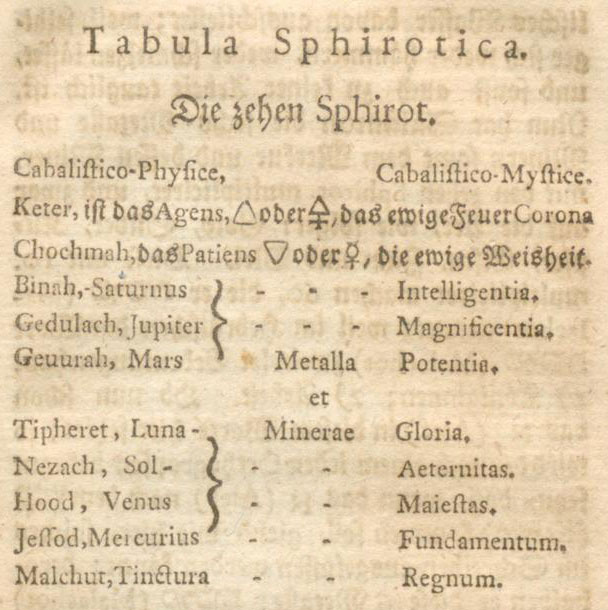
Tabula Sphirotica.
The ten Sefiroth.
Cabalistic–Physical Cabalistic–Mystical
Keter is the agens, △ Fire or 🜍 Sulphur the eternal fiery crown (Corona)
Chochmah the patiens, ▽ Water or ☿ Mercury eternal Wisdom
Binah - Saturn } - Intelligence (Intelligentia)
Gedulach - Jupiter } - Metals and Minerals Magnificence (Magnificentia)
Gevurah - Mars } Power (Potentia)
Tipheret - Moon } Glory (Gloria)
Nezach - Sun } Eternity (Aeternitas)
Hood - Venus } Majesty (Maiestas)
Jesod - Mercury - Foundation (Fundamentum)
Malchut - Tincture - Kingdom (Regnum)
Just as this is explained at length by the highly learned Esch-Mezaref, and the reason for each meaning is given, in which I am almost entirely of the same opinion with him, and depart from him only a little.
But whoever considers and understands both opinions accurately, will without doubt agree with me.
It will be known to everyone, that Bernhardus Comes Trevisanus accepts only six metals, and Mercury as a metallic water he excludes from these; because it can neither be hammered nor melted, and in any case is fit for no kind of work.
Now Solomon has multiplied the six metals and minerals, together with Mercury ☿ and Mercury’s minerals, by the ten Sefirot, and in the following manner, namely: gold, silver, copper, iron, tin, and lead. These, multiplied by 10, make 60, which he calls מלכות (Malachot); because in Hebrew the word מלכות (Malachot) has two meanings: (1) queens; (2) work/labor.
And although the א (Alef) is missing here in this word, every orthographer will nevertheless know that, when the א (Alef) ought to come after the קמץ (Kamez) as here it may be omitted in writing. Therefore he calls these six metals מלכות (Malachot), because they are serviceable for work.
The metallic minerals (of which there are six), together with Mercury (☿) and its mineral (making eight), he calls concubines, because such are imperfect. These, too, he multiplies by the ten Sefirot, whereby 80 results.
Likewise the lesser minerals (mineralia minora) he calls young maidens, because they have in them no fixed grain at all, and are innumerable. All these the wise king rejects from further generation except for one, which is not included in the aforementioned number; this one he chooses, and says of it in the 8th verse: “But one is my dove, my perfect (here I understand a certain mineral, which has also been named here more than once), a single one to her mother, who has brought her forth for a further birth. The daughters, queens, and concubines because they can be exalted through her praise and commend her. I need not hesitate to set all the foregoing before everyone as something beyond doubt, since I can further maintain that he even describes the matter itself and its form, as may be seen in 1:6: “Look upon me, though I am dark-brown; for the sun has discoloured me; the children of my mother have abused me; they have made me a keeper of the vineyards; but my own vineyard have I not kept.”
Who, then, does not understand that this text speaks of the matter of our masterpiece? For it cannot fall more pleasantly upon the ear than when it is understood in this sense. The wise king says: “Do not look upon me contemptuously, though I am somewhat blackish.” שזפתני השמש בני (ScheSaptani Haschemesch Benee), that is: “For the sun has discoloured me; the children …” From these three words take the first letters; understand from the first word the first two, and from each of the other two words, from the first letters there comes out the word זהב (Schelahab), i.e. gold.
After this there follows again the word אמי (Jmi), i.e. mother; understand: I am the mother of gold.
Further, take the first letters of the following words:
אמי נחרו בי שמוני נטררה את הכרמים כרמי שלי לא נטרתי
(Jmi Nichru Bi Samuni Noterah et Hacaramin Carmi schli lo natarti)
i.e.: The children of my mother were enraged against me; they made me a keeper of the vineyards; but mine own vineyard have I not kept.
Thus thou gettest these words:
אבן שנאה כשלון (Eben Sneah Cischlon), i.e. a hated/assailed stone of stumbling (that is, a certain mineral, which is also a stone).
Further, the vineyards are here called כרמים (Caramim); and if I now divide this word thus, כר מים (Car maim), then it means: the thick, viscous waters, of which our Matter is the keeper.
We will seek further, whether he doth not also speak of the Ferment, and what the same may be.
This is asked by him at V, 10, and answered in the 11th verse. The question runs thus: What is thy beloved above another beloved, O thou fairest among women? The answer is as follows: My beloved is shining (white) and red, chosen out of ten thousand.
“Beloved” is here called דוד (Dod), which in its number yields 14, namely the זהב (Sahab) gold-number. The Wise man means to say: when gold becomes transparent and rejuvenated an infant of the philosophers then this is the dearest, the fairest among women, namely the materia philosophorum.
He confirms this by what he reports in II, 8: “The voice of my beloved behold, he comes, leaping upon the mountains and skipping upon the hills.” The words “behold, he comes” are in Hebrew: הנה זה בא (hinne se ba). The first letters of these three words namely ה (Heh), ז (Sain), ב (Bet) are the letters of זהב (Sahab), i.e. gold. Understand this: Solomon has indeed placed ה (Heh) before ז (Sain), and thus set the Sain in the middle, namely: he has turned the outer part inward, and brought the inner part outward which happens in the philosophical work; understand: when gold has been made volatile, and leaps upon the Olympian mountains.
I must further point out to you, in another place, the hidden meaning of our matter namely III, 10: “In the midst he has set love.” If now, from the first word תוכו (Tocho), that is, “in the midst,” you take the two middle letters namely ו (Waw) and כ (Caf) and from the last two words taken together, namely אהבה (Ahaba / Ahavah, “love”)
היצר אהבה (Razup Ahabah) that is: he has set love. If you take out the first middle letter, which is פ (Pe), then you have the materia, namely: Puch (stibium / eye-paint).
So that you may not think that what was mentioned above is only my own invention, I will prove it to you by the authority of distinguished authors. Hear what the incomparably learned Father Athanasius Kircher writes, in his Oedipus Aegyptiacus, Tom. II, Part 2, cl. 10, c. 2, concerning Solomon’s great wealth, when he reports:
“It is the question, whence Solomon obtained so great a quantity of gold and silver? And to this he answers: I hold it for certain, that at that time there was in use an art perhaps unknown in our times by which, from all earthly parts, gold and silver, and likewise other metals, might be drawn forth with the greatest ease; and that this knowledge was, little by little, handed down by tradition from former centuries and kept in continual practice; partly by others, but chiefly through Solomon’s wisdom of which the Rabbis report, when they comment on this passage proving by many conjectures: that he [Solomon] knew all veins of gold and silver, and all hidden golden and silvery mixtures in all earthly parts, “[gold and silver] veins, and all hidden golden and silvery mixtures in all earthly parts, even in the poorest sand,” have been known to him.
In agreement with this, the very learned Michael Maier, in his Symbola Aureae Mensae, book II, p. 64, reports of Solomon as follows:
Very many say that Solomon, the King of Israel, a son of David, possessed the perfect wisdom of Chymistry, and that for these reasons: First, because he desired and obtained wisdom from God; therefore he became the wisest of all men. Yet his wisdom would not have been so perfect without the science of Chymistry, as the most excellent of all arts. Since, then, perfect wisdom was bestowed upon Solomon such as other chymists have not been able to surpass with their operations it is clear from this that he was as experienced in Chymistry as any other. Secondly, because he is praised not only as the wisest, but also as the richest of all kings; for since he chose wisdom above all riches, it is plain that he became wise and rich, and that his riches likewise sprang from wisdom which is a true proverb.
Therefore Solomon is held to have been the most experienced in Chymistry; because he was the wisest and the richest, and caused so extraordinary an abundance of gold and silver in Jerusalem.
To this is added a third cause: namely, where the wise King describeth true Wisdom, having health in the right hand, and riches in the left. Which description, as it is applied by every one unto Chymistry, so likewise it cannot, by any truly learned man (unless by one that obstinately resisteth the truth) be appropriated unto any other thing.
Lastly, I will that my oft-mentioned seventh number be commended by Solomon himself, and proved by his own words, Proverbs IX. 1, where he saith: “Wisdom hath built her an house, and hath planted (or hewn out) seven pillars therein.”
Tenth Chapter.
Isaiah, the Prophet, who sprang from a kingly stock, who describeth the heavenly Jerusalem, and adorneth the same with diverse precious treasures, the be
He, having promised it to the believers, has also not set aside the preciousness of our Work as an excuse, nor forgotten this treasure. I prove this by the plain letter of the text, which reads as follows: LIV, 11.
“Thou afflicted one, tossed with tempest and not comforted: behold, I will set thy stones in Puch, and will found thee with sapphires.”
Ah! the Prophet gives a fine comfort, if it is rightly understood; but it turns out absurd when it is taken in the common sense. For:
1. I would not know what it should mean that the stones should be of Puch thereby they would have nothing more than before. For Puch is often mentioned in the Bible, because women used it for painting (their eyes).
2. It is to be wondered at that this Puch is here placed among the precious stones (such as sapphires and carbuncles), as follows in the 12th verse.
3. It is strange in this text that the Prophet wishes to set the foundation of it and to lay it with sapphires. If, then, the stone Puch were a common, and not at all precious stone, it would seem, in the literal sense, absurd that the foundation should be laid of precious sapphires, and the inferior should be set upon it.
Many learned men have taken this into consideration, and, since they can go no further, some say: by the stone Puch there would understood it of rubies; which, however, throughout the whole Scripture are called אָדָם (Odem).
Others say: it is a very precious stone; yet they did not know what kind of one it might be. See the Lexicon Hebraicum of Buxtorf, at the root Puch. But it is to be wondered at, that the otherwise learned Buxtorf sets the authority of the Targum (i.e. the Chaldaean interpreter) on that side, which expounds the present Puch just as that with which Jezebel (2 Kings IX, 30) painted her eyes; and interprets the word Ledicha, that is, our Matter.
But I will further set before thee the 16th verse of the said chapter, which indeed is of a special, strange content, and runs thus:
“Behold, I have created the smith, that bloweth the coal-fire, and bringeth forth his instrument; and I have created a destroyer to wound.”
Thou dear and pleasant comfort! Here one may well say that a true riddle is to be found. Yet I will not suffer thee long to remain in thy pondering, nor let thee break thy head over it. This divine Prophet has most certainly here understood by the stone Puch the Lapis Philosophorum, which is made out of the stone Puch, and for which a coal-fire is required; and this is yet more confirmed by the words: “I will thee with, to found (it) upon sapphires; for foundation in Hebrew is called: יסוד (Jessod). But by this word the ☿ Mercury is indicated, which has its idea or root in the 9th Sphirah, as may be seen in my Tabula Sphirotica in the preceding chapter.
That he nevertheless names sapphires is to be noted: for sapphires are blue stones; but blue, among the colours, signifies steadfastness, and thus I understand by it a fire-resisting stone, or a tincture.
By the words: “a destroyer to be subdued” there is also indicated the ☿ Mercury Philosophorum, which subdues the king, or the beast that tears the king’s heart out of his body. See Basil. Valentin. Without such an operation it is almost impossible to attain this secret.
This is now a great and inexpressible comfort. To confirm this, the Prophet speaks plainly of transmutation in chap. LX, 17, thus: “Instead of copper I will bring thee gold, and instead of iron, silver.”
Eleventh Chapter.
The name of the king of Tyre (to whom the Prophet Ezekiel was sent by God) is indeed not named in Holy Scripture; the Jewish rabbins hold however, that this was that very Chiram, king of Tyre, who helped to build Solomon’s Temple. Now the Temple of Solomon stood 410 years, until the Babylonians destroyed it. The prophet Ezekiel prophesied in Babylon. If, therefore, this king helped to build the Temple, then he must have lived about 500 years. I will let that pass.
Nevertheless, I find this king in Holy Scripture described as very rich, and with particular noteworthy things reported of him, so that I must wholly hold that he was one of the greatest natural philosophers, and that he possessed this great secret of nature although to his own ruin; as is expressly contained in the prophecy that occurred because of him, in Ezekiel 28:3–4, 12–14, and 18.
Verse 3: “Behold, thou art wiser than Daniel, and there is no secret hidden from thee.”
Verse 4: “By thy wisdom and by thy understanding thou hast gotten thee riches, and hast gotten gold and silver into thy treasures.”
Verse 12: Thus saith God the Lord: “Thou art the seal of perfection, full of wisdom, and perfect in beauty.”
Verse 13: “Thou hast been in Eden, the garden of God; thou wast adorned with every precious stone.”
Verse 14: “Thou wast as a cherub that stretcheth out, and covereth; I have set thee upon the holy mountain of God, and thou hast walked up and down in the midst of the fiery stones.
Verse 18. Through thy manifold sins, and through the unrighteousness of thy dealing, thou hast defiled thy sanctuary; therefore will I bring forth a fire from the midst of thee, which shall devour thee.
According to the aforesaid literal sense, it is now beyond dispute that the King of Tyre himself made the gold and silver. Yet we will look a little more narrowly into his description, and view the wisdom ascribed unto him with a magnifying-glass. Was it not something wondrous, which God caused to be spoken of him: that he had been in the divine Paradise being a man? What moreover are we to understand by the various precious stones? Likewise, what is said in the 14th verse: Thou wast as a Cherub that stretcheth himself out. Thou hast walked in the midst of the fiery stones. Such praise hath not Moses received so much as once.
The fiery stones, in this place, are likewise something strange; and his sanctuary also, which he possessed, is in like manner something particular.
Ah, how dreadful is the resolution of the foregoing points to hear, whilst I, to that end…
I cannot conceal, in the end, that the King of Tyre so great an Adept, and one who had attained so high a knowledge of God fell through his pride, and lost all divine gifts and grace.
This king possessed the Tincture, which is here called the Garden of Paradise, and which, by its power, contains within itself the virtue of all precious stones. This was the fiery stone, or Lapis ignis, as the philosophers call it; this was the Crub (NB. כרוב (Crub) has, in the great number, 228, in the middle 12, and in the small 3; signifying the united three principia: corpus, spiritus, and anima body, spirit, and soul) that stretcheth itself out.
By means of his Tincture he was also able to make all precious stones.
O great loss! How hast thou, King of Tyre, fallen into Lucifer’s sin? Let every man take this for an example, that he may not use the gifts of God for his eternal ruin. I now turn to Ezra, who applies them better, as follows.
Twelfth Chapter.
Ezra, a priest of God, who led the Jewish people from Babylon back to Jerusalem, was a very learned scribe, as may be seen in Ezra VII, 6.
I find that this man either understood the transmutation itself, or at least possessed two vessels that had been transmuted. For the original text of the book, where it describes the gold and silver which he brought to Jerusalem (VIII, 26–27), runs thus:
“And I weighed into their hands silver, 650 centners; vessels of silver, 100 centners; gold, 100 centners; twenty golden cups, 1000 talents; and two vessels of brass/bronze (Erz), shining, precious, like gold.”
Within this total of gold and silver, which Ezra handed to those who were appointed for it, the two vessels of Erz are something noteworthy. For if these had been of common Erz, it would not have been worth the trouble to mention them; still less would they have been described with such extraordinary words namely, shining, precious, like gold. But since they were ex aere in aurum transmutato, that is, from bronze transmuted into gold, from an ore changed into gold (which transmutation was effected through the matter פוך (Puch)), as may be gathered also from the words חמודר כזאב (Chamudor Casahab), i.e. “shining, like gold.” For כזאב (Casahab) has, in the great number, 34, and in the small, 7 (signifying our oft-adduced Matter); therefore such vessels are here, among other things, rightly cited by him and reckoned, I would indeed have liked here to mention at length something about the fire found in the form of water (which cannot be unknown to the learned in Scripture); but silence is imposed upon me, and after I have only briefly shown that even in Ezra traces of the Art are to be found, I proceed to the Thirteenth Chapter.
Thirteenth Chapter
Job, so well known and praised by all men, or according to the original text better called איוב (Ijob), stands forth, by reason of his name, his history, his begotten children, and in general the whole course of his life, as one of the Adepts.
Among scholars a dispute has arisen: whether ever a Job has been in the world, or whether his entire book is not a mere parable, as the rabbis hold it to be. See Talmud, Tractate Baba Barra p. 17. But I do not intend to enter into that, nor to decide this question. It is enough for me that no one can deny that the Book of Job is set before us human beings as a moral lesson, in order thereby to plant patience within us. We will go through this a little, and consider Job’s temptations; thus we shall find very many circumstances are found which give us cause for various doubts. We therefore chiefly wish to inform ourselves about his history, in which we shall encounter enough strange things.
Job had, before his trial, seven sons and three daughters (whose names are not mentioned), and great wealth. Satan pursued him; and after he had now brought Job to lose all that belonged to him, Job at last received the message that the storm-wind had struck the house at the corners, overturned it, and killed his sons. (NB. Of the death of his daughters nothing is thought here, since the daughters were in the same house with their brothers.) Job bore this with patience.
Satan, who sought to torment him still more, finally struck him with the intention of making him impatient. His three friends undertook (in order to comfort him) to travel from their dwelling-place and visited him. After many disputes among all four, God Himself moved Job to patience, and finally healed him. He offered a sacrifice of seven bulls and seven rams, and God blessed him so that he received double of everything he had before.
Finally, the Book of Job concludes with these words: And there were to him seven sons (whose names are again not mentioned) and three daughters. NB, whose names were: the first Jemima, the second Keziah, and the third Keren-Happuch. But in the whole land no women were found so beautiful as Job’s daughters; and their father gave them an inheritance among their brothers, and Job lived after this 140 years, and saw his children and grandchildren to the fourth generation.
From this story, the following questions now arise:
1) Why are Job’s sons, both before his trial and also afterward, never named, whereas the daughters are specified by name?
2) The messenger announced to him the death of his sons through the collapse of the house; but concerning the daughters (who, as is seen in Holy Scripture, were guests at their eldest brother’s house) not a word is reported, whether they died or remained alive.
3) Job is said to have received everything double; yet it is not seen that he had 14 sons, but in the end only 7 sons; and likewise not 6, but only 3 daughters, as in the beginning, did he receive.
4) It does not say in the verse that children were born to him afterward, but rather it is said: “And there were to him …” If, now, according to the report of the messenger, the sons had died through the falling down of the house, then their birth would have had to be reported.
5) Why are the names of the daughters placed at the end, and not at the beginning; and what is meant by their so highly praised beauty?
6) Why, then, should Job have appointed the daughters because of their beauty (contrary to the custom of that time) as heirs together with the brothers?
7) Are not, furthermore, his daughters called “women / wives”, and yet it is not reported whom they married?
8) Why is Job’s life, which he led afterward, described, but of his whole age nothing is reported?
9) Are the wonderful names of his daughters especially to be observed?
10) Is the sacrifice to be considered which Job offered: why precisely rams and bulls, and why precisely seven of them?
I answer the above questions all at once, by telling you that Job was a possessor of the Art, which is even indicated by his own name. If from this name איוב (Job) the two extrema, namely the first and last letter, are removed, and these are joined together, then it is: אב (Ab), that is, Father, which has the number 3.
The remainder, or the letters left over in his name, are: י (Jod) and ו (Waw). These have 16 in number, and produce the square of the quaternary (Quadratum Quaternarii), since 4 times 4 is 16 as also the four “Daletin” (דלתין), thus: ╬, or the four elements, indicate.
The aforesaid אב (Ab), which has 3 in number, signifies first the three principles, thus: Δ Fire, and through the word itself, which properly speaking, “Father,” himself, is signified by the circle O (which is the father of all perfection). If you now put everything together thus:
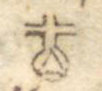 , then you have the signum, or mark, of the Matter.
I also want to answer the above questions all individually. But first we shall at once go through the whole history:
The Father, understand: the Matter, has produced 7 sons (the 7 metals) and 3 daughters (the 3 principles).
Satan (the Salts: Sal , or according to Basilius Valentinus, that wolf which devours the king and then again spits him out) has brought him the message that the corners of the house have collapsed through the storm, that is: from the name איוב (Job) the two letters, namely the first and the last, have been taken away; the separation has taken place.
The square of 16 (as mentioned above) has now been uncovered, and the Matter has entered into putrefaction; whereby the 7 philosophical metals have died, but not the three daughters, namely the 3 principles.
After he had been comforted by God, that he had obtained the tincture, then he again had his 7 sons (the power of the 7 planets in the tincture) and the three daughters (the three united principles), which are no longer virgins, but women / wives (because of the philosophical union), who are very beautiful; and therefore it could not be otherwise than that the daughters, the praiseworthy three united principles, have received their inheritance-share together with their brothers, the 7 metals, or the seven planetary powers.
For these reasons he names the first daughter: ימימה (Jamimah), that is, the time, the philosophical days.
The second: קציעה (Keziah), that is, a splendid spice, indicating the good fragrance.
The third, according to the materia philosophica, namely: קרן הפוך (Keren Hapuch), that is, it has been illumined, or has become shining, the Puch.
I could indeed describe to you an operation, which is likewise to be understood under this; but I am not permitted to babble out of the school.
Job now lived 140 years after this. Now the middle number of 140, which is 14, indicates the aurum potabile, namely the repeated: זהב (Sahab / Zahab), or the gold-number.
He saw children and grandchildren up to the fourth generation (the 4th augmentation).
Because Job had now obtained this great secret, he brought a sacrifice of 7 bulls and 7 rams; for the Matter, as already mentioned, leads to the number 7, and belongs under the following two heavenly signs: Taurus (Bull) and Aries (Ram); as that philosopher says: He has come upon an island, and has encountered a bull and a ram, grazed by two boys.
Although I have now answered you sufficiently for all questions, I still want to give you, for further confirmation, all of this his own, Job’s his own words from his book, also from one place and another, at which this divine Art, partly with concealed, partly with unconcealed words, is treated of, to explain.
But before I proceed to that, I ask every learned man, whether in the following texts the Chemistry is not described in the literal and proper sense?
You, my fanciful little wise-man! who have hammered together those books which speak of lute (sealing/claying of vessels), knowing as much of the whole Art as the peasant knows of mathematics, and who hold them in greater honor than Holy Scripture I beg you, leave off your foolishness, and listen to the divine word of Job XXVIII, 1, where, after he has praised what is good and rejected the wicked, he speaks thus:
“For silver has its origin, and there is a place for gold where it is gathered together.”
Understand from this that gold consists of a ☿ Mercury, which gathers together in the mines, and coagulates.
Further, Verse 2: “Iron is taken from the earth, and the stone when it is melted brings forth ore.”
He means to say: that Mars and Venus carry with them an earthy impurity; therefore it is brought into flow by strong fire.
Verse 3. He has appointed a time for darkness, and he observes the end of all things; also the stone of darkness and the shadow of death.
He means to say: the Matter, which outwardly resembles the shadow of death; but its darkness comes to an end.
Further, Verse 5. A land from which bread comes, and in its depth it is transformed as by fire.
Thus it is to be understood: that the Matter is taken out of the earth, where the fire is; not however (according to the opinion of the conceited philosophers) out of the meteors.
Likewise, Verse 6. A place where the stones are sapphires, in which there is gold-dust.
Here, under the form of sapphire, the ☿ Mercurius Philosophorum is presented, which has the uncountable gold within it.
In the same way, Verse 11. But wisdom where shall it be found, and where is the place of understanding?
Here he speaks very mysteriously. In the 9th chapter I told you that in חכמה (Chochmah), which properly signifies wisdom, and here in the most fundamental there stands the…
Mercurius Philosophorum. In בינה (Binah), which indicates the understanding, and which is likewise mentioned here, Saturn has his idea. Therefore he speaks by way of inquiry where the Mercurius Philosophorum is to be found, and gives the answer to this: if you know where the understanding, namely the Saturnus philosophorum, is to be found, then this will likewise be made known to you; to which he further declares the praise in verses 15, 16, and 17, that such wisdom, the Mercurius Philosophorum, is to be compared with gold, or silver, and precious stones.
Who now does not understand quite clearly that there is being spoken of a metallic root, and of its unspecified, as also animal and vegetable matter? It would indeed be easy for me to cite more such passages, but in order to avoid prolixity I pass them by, and turn myself to Job’s daughter, who is named by 7 letters.
Fourteenth Chapter
This chapter I have dedicated to my dearest dove and pleasant bride, the daughter of Job, the beautiful Keren Hapuch. My heart becomes full of joy, since I make mention of your virtue. This is the bride for whom the whole world sighs.
My beloved! allow me to say that to those who do not know you, you are a venomous serpent. (For according to the unanimous agreement of the philosophers, the materia cruda is a poisonous mineral; therefore it is also by them sometimes called a serpent, sometimes a poisonous dragon.) נחש (Nachasch), i.e. serpent, has in the great number 358, in the middle 16, and in the small 7; which is the number of the Matter.
But even this serves to your praise; for as wicked as you may appear, you cast such pleasant and blessed glances upon those who wish to deal with you.
You are a lovely Adamic daughter. אדמה (Adamah) is in Hebrew earth. This word, Adamah, has in its great number 50, which is the same as that of כל (Col), omne (“all”), and at the same time [you are] a daughter of Job (see the 13th chapter). The wind is your mother, which has carried you, but has not borne you. The old Saturn is indeed your father, yet he is obedient to you, and stands beneath you. See Tab. Sphirotica.
You are high, but also low: you do not raise yourself up, but wish to be raised up through others.
You are perfect like a circle; yes, if I am to speak proper German, your beginning and end are the same; your middle number shows ╬, namely the 4 Daletim, or 4 times 4; but your small number leads the number of the 7 pillars of wisdom.
Your name is פוך (Puch) among the Hebrews; the Chaldeans have called you צדידה (Zadida); the …
The Syrians have given you the name: כחל (Cahol), which is also your name in Arabic. Therefore the Menstruum universale has been called Alcohol; for Al means of; Cahol means the Matter, namely: of the Matter; which properly is the Mercurius Philosophorum.
The Rabbis have entitled you שׁרק (Schrack); yet I want to call you כל (Col), omne, or: All.
Before I now describe you completely, I must first speak of the whole Mundo subterraneo, namely of the metallic, or mineral kingdom, how the Most High has ordered the arrangement of their birth; and at the same time, since many learned men have not been ashamed to write against this Art and to impugn the possibility of the transmutation of metals, I wish to set forth the truth of this Art not only from Holy Scripture (as has already been done above), but also from natural philosophy, so clearly as in broad daylight, that no one unless he stubbornly wishes to contradict the course of nature and reason may still have the slightest doubt about it.
Before I proceed to the matter, I want first to lay before everyone the following basic principles for consideration:
It is incontrovertible that all bodies in all three kingdoms are corpora mixta (mixed bodies), yet with this difference: that in the animal and vegetable kingdoms the bodies consist of parts that are dissimilar, and of organs beyond measure; whereas in the mineral kingdom, the bodies are only simply mixed (simpliciter mixta), and consist of similar parts, and differ only according to elemental mixture.
Such mixed bodies now consist of the four elements, namely: fire, air, water, and earth; therefore they also have four qualities within themselves, namely: warmth, coldness, moisture, and dryness.
Aristotle holds that in all three kingdoms there is one and the same prima materia, and that bodies are distinguished only by the substantial form (formam substantialem); therefore such prima materia, as soon as it is informed by a form, is called secondary matter (materia secunda).
For all bodies, or physical substances (corpora or substantiae physicae), because they are composed of prima materia and substantial form, yes even the elements themselves, as they now exist in nature outside of mixture (extra mixtionem), are already secondary matter, because the Aristotelian prima materia, without any substantial or accidental form, according to the doctrine of the Peripatetics, is considered by an abstraction of the mind (per abstractionem mentis), and thus is a pure being of reason (ens rationis).
Therefore the Hermetic philosopher does not draw this Aristotelian prima matter into his consideration, but remains only with the secondary matter, and from that, through Art, draws out his prima matter.
But he considers this matter in a twofold manner, namely: with respect to nature and to art (respectu naturae et artis). With respect to nature he distinguishes the matter into remote, middle, and proximate (materiam remotam, mediam et proximam).
Since my intention here is to treat of minerals and metals, I will describe their materia remota, media, and proxima.
The first consists of the powers and qualities of the elements, and of the influences of heaven and the stars, which are poured down from the sky and from the stars into the earth. When these penetrate into the veins of the earth, there arises from them a tough, slimy matter, which is then called the media.
This slimy substance, after it has long circulated within the earth by ascending and descending, is thinned by heat and thickened by cold, and through repeated resolution and coagulation is brought into a metallic and mercurial nature, which is the proximate matter of metals (materia proxima metallorum), and is one and the same in all metals.
Therefore experience shows that metals, when smelted, mix with one another, so completely that if one melts, under a hundredweight of lead, only a quintchen of gold, and likewise the reverse, the assayer finds in every grain of the mass the metal that has been added; because their proximate matter is of one and the same essence, and from that from which gold is made, the other metals are also generated, and they differ only accidentally, but not as to species.
Thus that supposed argument falls apart, namely: Una species nequit mutari in aliam;
(“One species cannot be changed into another;”), but metals differ in species; therefore one cannot be changed into another. But the minor premise in this syllogism is found to be false, since the metals differ only according to greater or lesser digestion or concoction, and thus differ only accidentally.
From this it is clearly to be concluded that the proximate matter, insofar as it is not hindered by the accidents, is capable of becoming gold.
Enough now of the material cause with respect to nature; concerning the matter with respect to Art there would still be much to say; yet from what precedes and what follows, more may be taken from it. But I will report the main point to you in two words: Where Nature has ceased to work in the perfect and imperfect, there Art must begin.
Now let us consider the efficient cause, which consists of heat and cold. For heat thins the matter or vapors, moves them so that they ascend and descend; then the pure vapors, through cold, are formed into gold and silver. But if they are impure, then so far as they penetrate into soft and porous earth they are coagulated, together with their impurity, into imperfect metals. But if, however, they sink down into hard stone, such as quartz, hornstone (chert/flint), and the like, they, because they, through the narrow pores of these hard stones, they cannot bring through with them the earthy and sulphurous impurities that they carry along partly because of the nature of the place, partly because of the purity of the matter [they are] formed into gold or silver; which the mining experts and mineralogists know through experience.
Everything is recognized by its properties. Now among the metals we find different properties; and namely in gold, even if it is often melted, we see that it nevertheless never decreases in weight, and thus is fire-resistant. Silver, to be sure, is also fire-resistant; yet in melting it loses a very small amount of weight. Copper and iron, on the other hand, are very harsh-smelling, and unstable in fire, so that as often as one melts them, they lose much in weight, since much of it becomes slag.
Tin and lead are easily fusible and at the same time very unstable in fire; the cause of this is: because, whereas gold carries with it nothing foreign or impure, but its proximate metallic matter, i.e. the radical moisture and dryness (humidum und siccum radicale), are united in the smallest and most subtle atoms, or minimal particles (atomis / particulis minimis), in such a way that none of the one can any longer be separated from the other; thus the moist preserves the dry from combustibility; but on the other hand the dry prevents the moist, so that it does not in the fire be consumed away; as is to be understood also of silver, according to more or less.
On the contrary, with Venus and Mars, the dry (as the greater part) cannot be protected by the humidum (as the smaller part) from combustibility; but with Jupiter and Saturn, the humidum predominates, and thus cannot be consumed by the siccum, so that the humidum does not flee away from it in the fire. In this difference consists the formal cause (caussa formalis) of the perfect and imperfect metals.
If the artist wishes to make the imperfect bodies perfect, it is not to be believed that he would give them that which they do not have; but rather that he would set that which they do have into a perfect state. And this happens in the following manner:
He takes a pure perfect body, dissolves it into its like, or into a homogeneous still raw matter, yet of its own kind, and thereby brings forth a new efficient cause (caussam efficientem); by which it happens that the dissolved perfect body spreads itself through the raw and unripe matter, and, because of the superiority of the former, the latter is reduced into the proximate matter (materiam proximam).
These two matters, since no accidents, or impurities, come to them, are placed in a closed vessel, by means of the continual outward fire, which [serves] as their inward fire promotes the working, thus exalts it, so that through its fiery property it can produce a new efficient cause (caussam efficientem).
For since previously in natural generation gold has been brought to maturity and perfection out of a pure mercurial vapor, as its proximate matter (materia proxima), by a purely potential fire, or sulphur, it is easy to understand that the same, through Hermetic Art and its operations, namely: solution, coagulation, fixation, or decoction, by which it is again dissolved, coagulated, cooked, and formed anew, the sulphur that has come to maturity, or the previously potential fire brought into act, now actual fire, can exalt its proximate matter far more highly, and bring it into a far greater power of fire, and make it capable that this thus exalted power of fire 🜍 Sulphur, or the form of gold may separate the proximate matter contained in the imperfect metals from their impurity, and bring the hidden potential fire within it from potency into act, that is, into actuality, and thus be able to transmute it into gold, in this manner:
When an imperfect body, burdened with impurities, is melted in the fire, or brought into flow, and a particle of the perfected tincture is added to it, then a new reaction arises from this exalted moving efficient cause (exaltata causa movente), by which, from this imperfect body, its accidentally attached, separates those impurities, and in it seizes the proximate matter, mixes itself most intimately with it, awakens its potential power of fire, and transforms it into gold.
According to the Aristotelian principle: Ignis vel calor congregat homogenea, et disgregat heterogenea, that is: by the Δ Fire, or heat, the homogeneous, or things of the same essence, are gathered together; and the heterogeneous, that is, contrary things, are separated and set apart.
Since now the tinctura physica contains within itself a 100, 1000, indeed a tenfold thousandfold fire, with respect to decretion and repeated multiplication (respectu decretionis et reiteratae multiplicationis), it is easy to understand that, when it is applied to the imperfect metals (as happens in projection), it gathers together the homogeneous, that is, the mercurial parts, mixing and uniting itself with them most intimately; but on the other hand it separates away the heterogeneous, i.e. dregs, slags, and impurities (feces, scorias et impuritates).
But it is not to be understood here that the whole imperfect metal is transmuted into gold, but only so much as it contains within itself, by weight, of the proximate matter; for the impurity becomes slag. Therefore the artists have commonly taken for projection such bodies as carry with them the greatest amount of the proximate matter, such as tin, lead, and mercury; more rarely copper and iron, since these contain the least of it within themselves.
And thus enough has been said concerning the possibility of the transmutation of metals, against those who deny the Art, who mock it as something vain.
Now, in order to return again to my intention, I proceed further to the mineral kingdom. But why I describe only the regnum minerale, the cause of that will be indicated to you by my description itself.
No learned man can object to me that the Lord’s Word, at the creation of the world, created everything in pairs, namely male and female, as may be seen in Genesis 1. Since now such also happened in the vegetable kingdom, Holy Scripture explains to me this same passage, verses 11 and 12, where God the Lord thus says:
“Let the earth bring forth grass, herb yielding seed, and fruit-trees which bear fruit after their kind, in which their seed is upon the earth; and it was so. And the earth brought forth grass, herb yielding seed after its kind, and trees bearing fruit, in which their seed was after its kind,” etc.
When I observe the content of this text, I see something quite particular in the creation of the vegetables, which I in the creation of the other creatures is not found, namely: nowhere is it repeated that the will of the Creator happened as it does here. In most cases it only says: “and it was so.” But here it is also repeated, namely that the earth brought forth: grass, herb, and fruit-trees, which were seeded according to their kind.
I therefore take from this occasion to believe, and to be led to the thought, that the succus terrae, the sperma foemininum, or the female seed of the plants or growths in the vegetable kingdom, is here meant; and therefore the repetition occurs: because the vegetable kingdom, in its female part, participates in the earth, namely in its sap, as all natural philosophers must unanimously admit.
We therefore see that also in this kingdom, for generation, the male and female are ordained, and the earth namely its sap gives forth the female.
Since now this female has two husbands, namely: a vegetable and a mineral one; that is: just as this sap of the earth opens up, nourishes, and multiplies the vegetable seed, that is, its vegetable man, or semen masculinum, it likewise is able, as a semen foemininum or menstruum radicale, to open up and multiply a metal, or the semen masculinum in the mineral kingdom radically.
I will discuss this further.
But before I show this in detail, I cannot leave unmentioned that, where the creation of things is spoken of, the word למינו (Lemino), i.e. “after its kind,” is added each time; namely: that God created every thing according to its kind, and placed the seed within it, so that it should multiply and increase according to its kind, in order that no disorder might arise in nature and creature, which the Lord God hates.
Therefore He commands in Leviticus XIX, 19, that one should not sow כלאים (Kilaim), that is: a mixture.
Ah! how many are there who, to their own harm, outside the order of nature, search in all manner of materials in the animal and vegetable kingdoms yes, so far that, oh how falsely! they blow into glass flasks the breath which they call Spiritum Mundi, distil and sublime the gathered phlegms, from which they finally produce a volatile salt, from which they want to make a universal, or radical menstruum, in order to open up gold with it. Others take honey; still others, herbs, and more such foolish things.
If this were possible, then truly there would be a great confusion and disorder in nature, which would directly run contrary to the divine word למינו (Lemino), i.e. “after its kind.”
The philosophers show us a quite different path. They tell us:
We should only follow Nature, and imitate her ourselves. Consider, you philosopher who would work against Nature! how Nature has been created by the wise God (who knows more than you and I), whether everything has not been created according to its kind.
If they were atheists, then it might sooner be forgiven them; but that Christians proceed in this way is entirely and utterly inexcusable.
I return again to my principal purpose, and point you to the word: למינו (Lemino), i.e. that every thing [is] according to its kind, which the philosophers above all recommend; for they forbid the heterogeneous, and command us to take the homogeneous for the work.
But what is a heterogeneous thing other than something against the kind? And what is a homogeneous thing other than something of the same kind?
Now is dew, which is a vegetable being, homogeneous with gold, for it is supposed to yield its menstruum? Is children’s urine, human excrement, lamb’s fat, bats, human excrements, etc., which are animal things, of the same kind with gold?
Here some put forward: “All three kingdoms have one root and one origin;” but they err greatly. For under heaven you see with your eyes that each kingdom has its own special root. If you understand the Kabbalah, then you will also undoubtedly know that everything and anything that is above heaven has its special root (radicem), or (to philosophize in today’s manner) has its special idea in the mens archetypa.
At the very least you admit that every metal has its planet. You seek to make gold, so you must also confess that gold has its influence from the Sun; therefore, if you have need of bats and other unspecified subjects, you must want to have such from the Sun, in order to be assured that such are of a solar kind.
However, my dear one! first learn what that axiom or principle means: “Everything is from one root,” they would say. Understand: everything comes from God. But you must not take this materially, but spiritually, to which your understanding and mine are not sufficient.
Meanwhile look only upon the great structure of the world, how differently everything is divided and ordered, and that nowhere does any confusion occur. But you do not want to direct yourself according to this, nor understand God Himself more.
O pitiable fancy! Only listen to the true philosophers, when they say: Nothing foreign comes into our work from the beginning to the end; nothing foreign understand, nothing heterogeneous, or against the kind. For if they did not mean this, then they would have to be punished as liars since everyone knows that the workpiece is prepared out of the Mercurius Philosophorum, and also that, at the very least with respect to the last, at the end a ferment, namely gold, must be added thereto, in which all philosophers agree.
Now if the Mercurius were not homogeneous with gold, then indeed something foreign would be present.
The ferment, or gold, is a metal, or of a metallic kind; the tincture or the lapis (stone), since the metals are to be changed or improved by it, must therefore be of a metallic kind; and consequently all vegetable and animal things are of a contrary kind and are foreign things, respectu fermenti et tincturae.
Therefore, if the Mercurius Philosophorum, as the solvens radicale, is to dissolve gold from the root, or if your tincture prepared according to your caprice (I do not know, from what sort of adventurous matter) is to mix or unite per intima with gold as its ferment, then it is necessary that the Mercurius Philosophorum, and the matter out of which it is extracted, be homogeneous, or of the same namely metallic kind; as all philosophers affirm.
But I know what is in your head: you find in Homer the herb Moly (which however is better named Molybdena); yet know that this is only brought forward as a comparison. For Moly, or Molybdena, is a Saturnine herb, in Latin solanum, in German called Nachtschatten (“nightshade”); see the Lexicon Herbarium of Franckenau, which herb taken metaphorically, which signifies the true crude matter (veram materiam crudem), which likewise is of a Saturnine nature; therefore Homer understood such things by it.
(The Homeric herb Moly is described in Reuchlin, Book III De Cabala, as follows: Although the root of the herb Moly tends toward blackness, its flower nevertheless shines forth white, like milk. When men have found these things out, it seems to them that they are able to drive away all misery, and to have attained a blessed end of their desire in this world.)
If you do not believe me, then read Roger Bacon’s Speculum, chapter 3, where he reports the like foolishness of such people in this manner:
“Therefore it is to be wondered at, that a skillful man grounds his intention upon animal and vegetable things, which are far removed, where one nevertheless finds mineral things, which are much nearer; thus it is also by no means to be believed that a single philosopher has placed the Art in the aforesaid far-removed things unless it be only by way of comparison.”
As Basilius Valentinus says: Flee from things that are combustible; for our Stone and its matter are safe from every danger of fire.
If I were to name to you a certain book, you would find what this Moly for to be mineral; but that is forbidden to me.
I write to you clearly enough. If you therefore do not set your own stubbornness aside, then you certainly cannot be helped.
Now I must also dispute a little with those people who, like the Babylonians in their confusion, want to climb up into Heaven and fetch down from above an unspecified matter, and to take it from there.
The Jewish Rabbis in the Talmud say: There were some of those who were at the building of the Babylonian Tower who became apes, because they wanted to imitate everything God did. Ah! how many would have to become apes in the chemical sophists’ tower-building! They likewise want to ape the Lord God: they want to prepare so great a Work out of nothing; yet it is enough for them, alas, to their own harm, which they bring upon themselves through their mere obstinate stubbornness.
So that they may recognize their error all the more easily, I will present their own argument, so that its refutation may come to light all the more clearly.
They say: the Tincture must be used universally, as well in the animal as in the vegetable and mineral kingdoms; therefore the matter from which the Work is prepared must also be universal, namely without specification.
They are strengthened in their error by the saying of that philosopher in Helvetius, where he as was asked: From what was the Masterpiece prepared?
and answered: It was prepared from a heavenly salt.
Therefore they take manna, snow, thunder-rain water, hail, and other similar Egyptian plagues, or so-called meteors, and from these they seek to prepare a heavenly salt.
Now this indeed sounds pleasant to the ears, and such people are readily regarded by the idiots as great philosophers. But those who reflect upon the matter better than they do, find the falsity of this charming saying plainly before their eyes; for these pseudo-philosophers themselves pretend that their supposed heavenly salt should yield a universal menstruum, which could radically dissolve gold.
Nor can they excuse themselves to me from the charge, that if they wish to use their so-called heavenly salt upon metals (ad metalla), they must add to it a ferment, or a body of gold, so that it may become ad metalla or, better said, become specific and corporeal in a metallic nature.
Now, according to their opinion, if they wanted to use their salt coeleste as a medicine for the human body (pro Medicina ad corpus humanum), then likewise they would have to take either a human being, or some other animal, as a ferment, so that it might likewise have its specification in this kingdom.
But, my dear Philosopher! you have an unspecified matter, and you can also be certain that such a thing will remain unspecified for all eternity; for this namely, to bring the Universal Spirit into a specification, God has reserved that to Himself alone through Nature.
Know therefore, that our Matter may indeed truly be called a heavenly salt; yet one must take it from the metallic root, that is: you must know how to reduce the matter to the first being (ad primum ens), so that you may draw forth the intended heavenly salt from it which you will never be able to bring forth out of meteors.
For your imagined heavenly salt is nothing else than a fine nitrum. If you do not believe it, then distil it, and you will obtain a spirit of nitrum (Spiritus Nitri), which in all its power can do nothing other than the common one.
If you therefore seek this, then you may just take an ordinary nitrum, and thus you can spare yourself the great expense and toil, and also the many kinds of nonsense such as catching rainwater, sun-dew, and the like.
I recognize indeed that the true philosophers direct you toward the Magnesia Saturnina, just as in the Dyade Chemica Tripartita, in the first Treatise concerning the Philosophical Stone, p. 27.
Richardus, ch. 1, says: That from no thing can something be drawn out which is not within it; thus you should also be content to ponder the matter further; but you want to set up all processes merely as recipes.
That would indeed be a fine Adept, who has obtained the secret by communication, and otherwise from the whole of Nature, just like that peasant (who boasted of a sermon, but when one asked him from what matter it consisted, he answered: he had understood nothing of it).
Does such a man deserve to be called a true knower of the Art?
Indeed it requires something far different than merely being able to say:
“I have worked in this or that matter,” and yet have produced nothing.
Have you, however, beforehand even examined whether that which you are seeking might be possible to bring forth?
You have only followed your process that was found in an old wall, merely because it was found there without even being assured in the least that it is possible to bring forth something by it.
Is that how an Adept proceeds?
I now turn to those who work in Salts.
Tell me: what do you want from Lot’s wife?
You torment the poor salts, and demand from them what they themselves do not have.
Their power consists only in this: to corrode metals, but not to dissolve them radically.
You have indeed heard it spoken plainly, yet you do not know in which village.
You read: Sal metallorum est lapis philosophorum (“The salt of metals is the Philosopher’s Stone”), but you do not know that this does not mean the common salts, which are far removed from the metallic nature.
They certainly have their effect in the vegetable kingdom; which is made clear by daily experience.
For when a field will not bear fruit, the farmer takes salt and sprinkles it with it, and afterwards it brings forth more fruit.
I do not need to warn you much about this you will already have experienced it, if you have melted the Luna cornuam (“horned Moon”).
But above all, I cannot conceal from you that the salts are not useful for our Magistery, but are heterogeneous and foreign things, or contrary to the kind; they serve only so far as a hoe and a wedge by which a tree is felled.
For although the tree has been felled by the hoe and the wedge, yet neither the one nor the other remains with the tree quod bene notandum (“which is well to be noted”).
Moreover, observe what Geber says in the book On Fire, chapter 19:
“Strive to dissolve Sun and Moon in their dry water, which the common man calls Mercury.”
Further, what Arnold(us) says in the book On the Preservation of Youth:
“But that which does not have its like in the preservation of youth is the salt from the mine.”
Further: The whole science of its preparation is that it is to be reduced into a pure and drinkable water, together with those things that likewise have the same property with it.
When I look around further, I find people who are not so mad, who, namely, want to force out their matter from common sulphur, from vitriol, and from similar mineralibus minoribus (“lesser minerals”).
But these should only consider how earthy things are generated upon the surface of the earth; then they would very easily recognize whether such things can be useful for their intention or not.
Far be it from me, my dear reader, to describe any recipe or process; rather, my intention is only to lead you away from errors and onto the right path.
Therefore, indeed: Woe! For here one finds many errors which nevertheless appear similar to the truth; do not allow yourself to be seduced by them.
The mineralibus minoribus have nothing themselves; therefore they can also communicate nothing to others.
They consist for the most part of an acid, and of an earthy alkaline or metallic base, which most often arises from mineral vapors and their repercussion (reverberation / back-striking).
When such a thing finds an acidum (acid), it coagulates together with the acid, and in the end it becomes either a sulphur, vitriol, or alum, according to the strength of the acid, and according to the nature of the base that comes from it as is demonstrated in experimental chemistry.
For the acid is almost everywhere the same.
You can easily find the proof of this:
Take sulphur, and from it make an oleum per campanam (an oil by the bell / bell-shaped apparatus). Put into this oil iron or copper, to dissolve it; then you can obtain Vitriolum Martis (Vitriol of Mars / iron vitriol) of Mars or of Venus, and thus you have changed sulphur into vitriol.
If you use the oleum sulphuris per se (“oil of sulphur by itself”), then you will find the same virtue/power that the oleum vitrioli has; and this is proof enough.
Furthermore: vitriol, or sulphur which are almost all one and the same thing arises from the repercussion (reverberation / back-striking) of the vapors of the earth.
Of this you can make a proof in the following way:
For you find, indeed, a blue, a green, and a white vitriol:
the blue is Venereal (of Venus),
the green is Martial (of Mars),
the white, however, is Saturnine (of Saturn).
Now since it is well known that the metals are sunk much deeper in the earth than the lesser minerals, it necessarily follows that these latter must arise from the little portion of metal from which they participate, by means of the back-striking / repercussion of the metallic vapors;
for otherwise I would not know whence the metallic essence should come.
Now the question is: which part is good?
The acidum is a corrosive, which is of no use in the Work, but rather does harm.
The metallic part is copper, iron, or tin, which cannot itself be fixed, much less can it communicate anything to another.
Moreover, it is not to be denied that the oleum vitrioli performs very good services in the anatomia metallorum (the “anatomy” / analytical opening of metals), just as the Alchymia denudata reports.
But as to the main work, however, I warn you not to choose any of the aforesaid mineralibus minoribus as the Matter.
I want to go one step deeper under the earth. There indeed I meet with that which my soul loves more dearly, yet which is also the most despised. Her companions are preferred to her by all who seek among the mineralibus.
But I assure you: if they knew her intrinsically, they would let go of the Rothgüldener, Rothgüldengolder, Saxon bismuth, the Nagy-Bánya silver and gold ores, gold-slimes, glaser, native cinnabar, fine gold, and pyrites of gold and silver, as well as various quartzes, and many other such things besides.
What, then, do those desire who search among these mineralibus? I have often heard with my own ears that they seek only a raw and unripe sulphur solis, which they wish to purify and bring to a tincture. This intention sounds good, fine, and pleasing; but such a mineral is not to be obtained.
Many a materialist, or such a vault-/mine-servant, when he sees a mineral that glitters a little, says: “Oh! if this or that man were alive, or were here present, he would certainly pay for 1 Pfund of this ore gladly 1 Thaler or ducat.” But I tell you: I would not give a single groschen toward the Work for it.
Examine only a little your best matter: ask any knowledgeable miner whether “Rothgüldenerz” is not almost native silver, and “Rothgüldengolderz” a native gold. The arsenic that is in it has turned this into a glass (vitrum) and you yourself can do that quite easily, yet without benefit and with harm; for it is well known that arsenic is a robber.
Now tell me: what part do you desire from this matter? The arsenic without doubt you yourself know that it is unfit for the principal work; for which reason everyone who loves his life must be warned. Consequently you will necessarily seek the gold or silver from this matter which you do indeed find; but what kind is it? Certainly nothing other than the ordinary. What, then, do you have to hope for from this, since you do not intend to work per anatomiam metallorum (though in that case even the ordinary would be much more useful to you), because no arsenic is present there.
Secondly I ask you since you are seeking a sulphur solis vel Lunae how do you know that such a thing is to be found in this or that ore? Perhaps none is in it. If you say that you find gold in it when you smelt it, then I reply to you that such a thing is not immature, but has already come to perfection, has been brought to maturity.
If you obtain gold or silver, you are still not thereby assured that you will also obtain a sulphur solis vel Lunae; for you must know that, where gold and silver grow in the mines, other metals at the same time are likewise generated. Let us only ask the Philosophers, whether, even if you truly had an unripe sulphur solis, you could accomplish anything with your work?
Do they not speak with one voice: Fac fixum volatile, et volatile fixum, or, which is the same: Solve et coagula. All unripe sulphurs, or such as have not yet attained their perfection, are in any case volatile; therefore one must not first make them “volatile,” but rather fix them.
But what does this mean: Fac fixum volatile? My dear friend! you are indeed on the right storey, but not in the right room. You must take a matter which has a mercurial and golden property, not indeed in act, but in potency, and Saturnine; which is neither dear nor far to fetch; and which I shall set before you in the following parable (wherein no work is spoken of superfluously), to take.
If you understand what is meant by this, then it is granted you from the heart. For the present, however, I must bring you off the wrong path, so that you do not take the philosophical axiom Qui non laborat in Venere et Marte, non est peritus in arte in an improper sense; for by Venus and Mars none other are meant than the philosophical Venus and Mars set forth.
Consider only namely, what Venus and Mars consist of: of an earthy, fixed sulphur (therefore they are not easily fusible/fluid), of an impure salt, on account of which they tarnish/blacken so quickly, and of a metallic mercury, which in the earth has been mixed by vapours, and has sunk into a porous gravel/stone (kies) and coagulated there. This likewise happens with Jupiter and Saturn, which carry less sulphur and salt with them.
Now I ask every reasonable person whether he can produce his golden mercury from this this which, although it is a metallic mercury, is nevertheless burdened with so many impurities; whereas Geber, Avicenna, and Lullius say that the Work requires the purest mercurial substance.
But if you believe you can purify such a thing, then hear what Geber says about it: By this we have, through a true discovery, found a remarkable kind of two secrets; namely, the one: that there are three causes of the corruption of every imperfect metal by fire. The first of these is: that the combustible sulphur, enclosed in its inmost being, when kindled by a strong fire, diminishes the whole substance of the body, drives it off in smoke, and finally consumes it, however good its quicksilver may be, etc. See the Summa, ch. 63.
From all this it is therefore clear that one ought not to work in the common Mars and Venus, nor in Jupiter and Saturn. If you now ask me what is properly to be understood by my Pitch, and whether it is not antimony then I answer you: truly it is nothing else; yet not the common antimony, but the philosophical antimony, or lead.
Now hear the parable promised to you above:
A mother bore seven sons and one daughter; among them three namely two sons and the one daughter came into the world at one and the same time. These separated from one another, and one of them, when he had become perfect, was clothed in royal purple. This one took his twin-brother as a runner into his court.
The sister, after she had beheld her beauty, disguised herself in a common dress and put on a grey smock, so that she might not be recognized by those unworthy of her beauty. This fair woman, who was called by name Pitch, was, in her peasant clothing, treated quite contemptuously and compelled to all peasant work; at times she had to run after rest, where yet it ought to have been held in greater esteem, than that one should have employed it for such like services.
But it fell out, that once the Runner went through that place where his Sister was. He observed the hidden, lovely form of this maiden, and her agreeablenesses took him captive. After he had spoken to her, and desired to marry her, the fair Puch consented to his desire. The Runner reported this marriage he had concluded to his King and Brother, and invited him likewise to the wedding.
Now when this bridal pair were joined together, after they had eaten a couple of doves and bathed in the Nymphs’ bath, and at last undressed themselves and went to bed; behold, then they recognised one another that they were one flesh and blood, of one kind and constitution; whereby they were moved to weeping, and embraced one another so firmly that they became inseparable and one.
In the morning the Runner appeared, to tell this to his King and Brother. He said: I am now Mother and Son, Sister and Brother, Man and Wife, and yet have but one body; I am two, and yet but one; yet I renounce neither; I will remain Man and Wife so long, until a Stronger can drive this from me.
The King was frightened at such speech; yet since he too was still unmarried, he fell in love with the fair form of his Runner, and sought to persuade him that he should renounce his manly part and remain with the womanly.
Now when the Runner consented herein, and took the name Lunaria (though by some she was called the White Woman), he embraced and caressed the King. Thereupon the King’s heart melted through inward love; and behold, the Centre spread its rays abroad within this circle: the Woman overcame her Husband and subdued him; out of the three there became One, which was also Two and Three, and at the same time contained Four within itself.
But when the people became aware of this, they took counsel how they might bring their King back again out of the power of his Wife; and therefore resolved to shut her up in a tower, and to torment her with fire so long, until she should release her Husband from her dominion. She was brought into the tower, that sentence might be executed upon her. As soon as she found herself therein, she escaped and fled up toward Heaven; but was soon cast down to the ground again by a great storm and tempest that arose.
then a voice sounded: “Thou shalt be under the man’s power, and he shall rule over thee.” The sun was lost, and darkness overspread the earth, and it became evening of the first day.
And when it began to dawn, the earth burst asunder, and mountain and valley were made by a dreadful earthquake; and there appeared a man clothed in linen, and his loins were girded with the very best gold, and his body was like a hyacinth, and his eyes like burning torches; and it was evening and morning of the second day.
After some time there was seen between the feet of this white man a sapphire-form; the earth was clothed with grass, and fruit-trees came forth, each after its kind; and it was evening and morning of the third day.
A voice of joy sounded: “Let there be two lights in the firmament, sun and moon, together with the stars, to shine by day and by night,” and so it was; and it was evening and morning of the fourth day.
The sun arose upon the earth; the king came in the fairest raiment, adorned with purple; he was far more glorious than before. The queen ruled with him in equal glory, and she begat many children of their own likeness.
O wonder upon wonder! 2, 3, 4, and yet only One; Mother; two Sons; Daughter; Sister; Brother; Man and Wife; and all together yet only one body.
Thereafter everything was governed by them with gentleness, and they shared their glory with their other brethren.
O blessed Star! in which this Mother was born. (כוכב) (Kochab) that is: Star, and at the same time the name of the Mother.
O beauty above all beauties! thou art the beginning of the metallic nature, and the
END.