3 Books - Substances of Metals, Accidental Properties of Metals, Metals Individually
Listen Audio Book Study the Art with Us Buy me Coffee
Contents:
1. The Substances of Metals
2. Tract 2 - Accidental Properties of Metals
3. The Metals Individually
by Albertus Magnus
THE SUBSTANCES OF METALS
It is time to take up, next in order, an inquiry into the nature of metals, now that the nature of stones has been investigated; for it is in stones that the production of metals frequently takes place, as if the substance of stones were, so to speak, a place peculiarly suitable for the production of metals. In [writing] this as well as the preceding books, I have not seen the treatise of Aristotle, save for some excerpts, for which I have inquired assiduously in different parts of the world. Therefore I shall state, in a manner which can be supported by reasoning, either what has been handed down by philosophers or what I have found out by my own observations. For at one time I became a wanderer, making long journeys to mining districts, so that I could learn by observation the nature of metals. And for the same reason I have inquired into the transmutations of metals in alchemy, so as to learn from this, too, something of their nature and accidental properties.
For this is the best and surest method of investigation, because then each thing is understood with reference to its own particular cause, and there is very little doubt about its accidental properties. This is not difficult to learn, just as the science of stones is not difficult to investigate; since their causes are obvious, and their bodies are not varied but homeomerous throughout, and not like other bodies which, on account of their varied character, cannot be completely investigated by anatomizing them. We place the treatise on metals after that on stones because, as we have said, stone is almost always found to be the place where metals are produced.
For I myself have seen pure gold found in very hard stone, and I have seen gold mixed with the substance of the stone. And similarly I have seen silver mixed with stone, and also pure in another stone, as if it were a vein running through the stone but distinct from its substance. And I have made similar observations regarding iron and copper and tin and lead; but these I have never seen distinct from the substance of the stone; but I am assured by men experienced in such matters that [these metals] are frequently found distinct from the substance of the stone, just as grains of gold are found in sands.
As to the transmutation of these bodies and the change of one into another, this is to be determined not by natural science but by the art called alchemy. Likewise, in what places and mountains [metals] may be discovered, and by what indications, are matters partly for natural science and partly for the science of magic called treasure-finding. Therefore the signs by which these places that produce metals may be recognized we shall mention below; and as to the other method of discovery, we shall [omit] it, because that science depends not upon [scientific] demonstrations but upon experience in the occult and the supernatural.
We shall proceed here in just the same way as in the book on the nature of stones, first inquiring into whatever things common to the nature of all metals seem to need inquiry; and with this we shall complete the third of our books on minerals.
In the fourth [book] we shall investigate the metals individually, all seven kinds of them; and with that we shall complete the science of minerals, which are the first homeomerous mixed bodies in nature, as we have stated at the end of the Meteorology.
And finally we shall say something about the nature of [minerals that are] intermediates [between stones and metals]. And with them we shall complete our whole plan for this science of minerals.
For there is no doubt that the nature of stone is less far removed from the elements than the nature of metals [is]. That is why [stones] seem to be made by an easier mixture, and the materials in them seem to be elements that have been somehow acted upon by each other. But this is not so with metals; for as in animal bodies there must be beforehand a blending of humours in the material, so in the same way, before the blending of the forms of metals, there must be a purification of Sulphur and Quicksilver, and perhaps of salt and orpiment and alum and some other things. For this reason the science of stones most certainly precedes the science of metals; and it seems suitable that we, too, should follow this natural order.
According to the art already set forth in the Meteorology, we know that the primary material of all liquefiable things is Water. For every liquefiable substance, so long as it is liquid, seeks to be bounded by something else, having no boundary of its own. We have given this explanation of the moist in the second book of Generation and Corruption. Therefore, every liquefiable thing is such simply because of the moisture that is bound up in it; once it is melted and exhibits its own peculiar behaviour and properties, this is recognized in its name, when it is said to be moist or liquid, since it has demonstrably been liquefied.
For it must be that everything that is fluid and seeks an external boundary to contain it has the same cause; that is, essentially and primarily it tends to be bounded by something else and not by itself: and this is [what] moisture [is], as has been determined elsewhere. Thus all liquefiable substances are fluid because of the large amount of watery moisture incorporated in them.
Moreover, we have shown in the second book [of Generation and Corruption] and in the Meteorology that anything that is hardened by cold has Water as its primary material. And there is no doubt that metals are hardened by the cold of Water; and therefore a moist humour will be the material of all of them. And for this reason Aristotle, foremost of the Peripatetics, says in the fifth book of the Metaphysics that the material of all liquefiable things is one that is, Water.
We know from what has been proved in the Meteorology that watery moisture is easily converted into vapour. This is shown by alchemical experiments: because if Water, or things that contain simple watery moisture whether natural and inherent or foreign and added is evaporated in an alembic placed over a slow fire, by the action of gentle heat, the Water distils from it and dry [material] is left behind. But we see that metals retain their moisture even in hot fires.
Therefore the moist materials of metals cannot be simple Water, but rather [Water] which has been to some extent acted upon by other elements. But if we consider the [kinds of] moisture which are difficult to separate from things that naturally contain them, we find that they are all unctuous and viscous; because, just as has been shown in the Meteorology, their parts are connected like [the links of] a chain and cannot easily be torn apart.
And therefore, since the moisture in metals is not torn out of them, even by strong heating, this, too, must be unctuous. Evidence of this is that all the radical moisture on which the natural heat of animals depends is unctuous; and certainly wise nature would provide this just because it is difficult to separate and difficult to dry out.
For nature intends it to last for a long time in the individual and for ever in the species. And for this reason [nature] decreed a moisture of this sort as nourishment for the vital heat. Therefore, since the moisture of metals likewise seems to be inseparable, even in a heat that liquefies them, undoubtedly the moisture which is the material of metals will be unctuous.
But we see further that what is unctuous in oil and all fat is easily inflammable and is active in burning things with which it is joined.
And we see that the Fire does not leave these things until they are consumed, as we observe with oil in lamps and the radical moisture in fevers. But we do not see anything of the sort in the moisture of metals; and therefore it may seem to some people that perhaps the moisture of metals is not unctuous. But to all objections of this sort we reply with what we have already said in the fourth book on Meteorology namely that in many things there are two kinds of unctuousness.
One of these is, as it were, extrinsic, very subtle, having mingled with it nothing that yields any sediment or ash; and [the other] is not inflammable, but is intrinsic, fast-rooted in the thing itself so that it cannot be torn out and driven off by fire. We have given as an example of this the liquor distilled from wine, in which there is one sort of unctuousness that is light and inflammable, easily distilled and, as it were, accidental. The other sort is mixed with the whole substance of the liquor itself, and is not separable from it except by the destruction of its very substance; and this is not combustible. And it is the same in all things produced by nature.
Evidence of this is what we see done in the art of alchemy, which is, of all arts, the best imitator of nature. For since [alchemy] has observed that there is no better way of making the yellow elixir than with sulphur, and has also observed in sulphur an unctuousness which is so intensely active in burning that it burns all metals, and in burning blackens all those on which it is cast while molten [therefore alchemy] recommends that sulphur be washed in acid solutions and cooked until no more yellow water comes out of it, and that these solutions be sublimed until all the unctuousness capable of burning has been removed, so that there remains only as much subtle unctuousness as [can] endure the fire without being reduced to ash.
Therefore there must be an abundance of similar unctuous moisture in the materials of metals produced by nature; and this is the cause of their malleability and fusibility. This is expressly stated by the authorities, Avicenna and Hermes and many others, men of great experience in the nature of metals.
Furthermore, in all kinds of metals we see that when liquefied they do not wet anything on which they are poured out, and they do not stay still [that is, they roll about] on a flat surface, and do not spread out completely over it, as we see almost all watery, unctuous moisture do for instance, water, wine, beer, or oil.
For all these, if poured out on stone, earth, or wood, when they find a flat surface wet it and spread out over it. But molten metals do none of these things; they do not adhere to anything that touches them, nor do they spread out completely; but rather they are solid in some respects and fluid in others.
And therefore a subtle, unctuous moisture cannot be the only material in them, but it must be completely mixed with subtle Earth, which prevents it from adhering to anything that touches it, or from being completely fluid, but [makes it] stick together like globules; because the subtle Earth everywhere in it seizes upon the moisture and, by gluing it together, as it were, holds it fast, providing it with a boundary, in so far as to prevent it from adhering to anything except itself.
And the moisture, wherever it is present, draws the earthy dryness out of itself, so that it flows and runs on a flat surface. But if the earthy dryness were not everywhere protected by the moisture, it would be burnt up at once by a fire that causes liquefaction, and would become rough and scaly just as in iron the fire finds out all the dry earthiness that is not covered by moisture and makes it scaly. And it is the same with nearly all metals.
It is clear, therefore, that the primary material of metals is an unctuous, subtle moisture, which is incorporated and thoroughly mixed with subtle Earth, so that large amounts of the two are combined, not merely with, but actually in, each other.
This chapter appears like a digression, anticipating in part the discussion of fusibility and malleability in III, ii, 1–2; but the emphasis here is on differences between metals and stones (as treated in I, i, 2–3). The ideas in this chapter are taken from Meteor. IV, which defines three kinds of changes brought about by heat: (1) pepansis, natural digestion, ripening, or maturing (as of fruit), ascribed to the gentle action of internal heat; (2) epsesis (Greek hepsesis), boiling or steaming by moist heat; (3) optesis, roasting or baking by dry heat.
On this [basis], going still further, we may easily answer a question that is often asked Why is stone not fusible, but copper and other metals are? And furthermore why is stone broken into little pieces and reduced to a calx, through fire alone, which does not happen to metal at all? The answer to this is easy: for stone contains more Earth, but this is not everywhere protected by moisture, nor is the moisture in it so unctuous as that in metals; and therefore, when it is placed in a roasting-hot fire (igne optetico), the watery moisture vanishes and the stone is reduced to a calx.
And since dryness predominates over moisture in stone, the stone breaks up completely into little pieces; while, on the other hand, in metals moisture predominates over dryness, and the metal will be liquefied. And this is likewise the reason why stone is not malleable, but metals are.
Actually metals have a great deal of unctuous moisture, which most strongly binds the earthy parts to itself, as by hooked bonds; and when a hammer blow displaces the watery part, which always tends to yield to anything that touches it, as we have said in the book on Generation and Corruption and in the Meteorology, [the watery part], resisting any separation, strongly draws the earthy part along with it; and so [the metal] is drawn out without losing its continuity, and not broken up, because of the viscosity and good, firm mixture of the earthy with the unctuous watery [parts]. But in stone dryness predominates, resisting anything that touches it, and it does not yield; and since it is a property of what is dry to be broken, it cannot yield to a hammer blow, but is shattered and reduced to fragments.
But the earthiness which is floating and absorbed in the moisture of metals is very subtle; and it is not destroyed nor completely forced out of the moisture, as occurs with extreme cold; rather it is digested, as it were, and ripened by gentle heat, and neither boiled by [moist heat] nor roasted by dry heat, as Averroes says. For the cold moisture is peculiar to itself and not foreign; and therefore it is so thoroughly cooked and digested as to become a natural part of it; so that the dryness runs and flows along with the moisture, and the moisture is held fast in the earthy dryness: just as Empedocles speaks of the joining of related heads and necks.
But if it were digested by [moist heat], as some unskilful alchemists say, undoubtedly there would be moisture outside as well as inside, and almost all the [inside] moisture would be drawn out of it. But the opposite would be the case if it were digested by roasting, as some other people have unreasonably said; for then it would not be affected on the outside by moisture, but would have a little moisture left only inside it. Evidence of this is that metals which are not fully digested but suffer from a sort of rawness are found to be either scaly, like iron and copper; or imperfect, like lead; or else they have a ‘stuttering’ mixture, like tin. These things will be made clear in the following [chapters].
What Avicenna said, both in his work, The Physical [Stone] and in the Letter on Alchemy which he wrote to Hazen the philosopher, does not disagree with the statements made here. For he says in both these books that Quicksilver and Sulphur are the material of all metals. For the moisture of which we have spoken, mingled with earthiness, as we have said, is the immediate material of Quicksilver; and the unctuous substance which we have described is the peculiar and essential material of Sulphur.
Hermes and some others seem to say that metals are made up of all the elements, and this certainly cannot be denied. But nevertheless, the material of things is not defined merely by the constituents that happen to be present in them, but by those that are most abundant.
But the strangest and most ridiculous of all opinions is that attributed to Democritus in some alchemical works namely that calx and lixivium are the material of metals. But if calx were the material since calx [quicklime] itself is made by burning, and when mixed with water hardens like cement then metal would become as hard as stone, and would be capable of being broken to pieces, but not of being liquefied; and moreover, on the application of fire, a metal would undoubtedly be hardened, as we see in [the case of] cement, rather than liquefied.
And if lixivium means a sharp water, as the alchemists explain, which removes from a calx the saltiness and sharpness [formed by] burning, as the alchemists demonstrate with their solutions, then [the statement] that this water is the material of metals cannot be correct: because calx is an earthy substance; but according to what is reported in the Meteorology we know that everything earthy, when it is burnt, has its pores contracted and closed; and calx, being of this sort, the entrance of Water into the interior of the calx is hindered, so that it never becomes well and firmly consolidated. This is why, if cement is attacked by fire, its moisture easily vanishes and it becomes powdery and falls out of a wall.
Thus the statement of Democritus about the material of metals does not fit [the facts]. He was misled by insufficient evidence: for he saw that the elixir best for luna, that is, silver, began by taking in calx and cerusa, and therefore he believed that there was something of the same kind in the physical and natural material of metallic bodies. This is not really necessary: for art has need of many things which nature does not need. But art does not need calx and cerusa except for producing proper hardness and colour; but nature accomplishes this in suitable material by digestion alone. For we
have shown in the Meteorology that all digestion or gentle heating causes solidification and thickening of the materials that have been cooked and digested, without anything from outside being added to them in the process.
But a certain Gilgil, of Moorish Seville, which has now been returned to the Spaniards, in his Secrets, seems to prove that fused ash is the material of metals. He offers this unconvincing argument: we see that by intense roasting by dry heat, ash is liquefied into glass, which hardens by cold and liquefies by dry heat, just like metal. Therefore it will be obvious that their material is the same, for things that show the same behaviour in hardening and liquefying seem to have the same kind of material, as the teaching of the Meteorology shows, he claims.
Moreover, we do not see earthiness made subtle, divided, and mixed with moisture, except by the extreme force of Fire, which makes it subtle and divides it so that it may be mixed with moisture: this is the behaviour of the earthiness that is burnt to ash in the moisture of metals. And therefore it seems to him that earthy ash is the special material of metals. And this, he says, is why all metals sink in water: for they would not do this, he says, if unctuous moisture were predominant in them, as it is said to be. Furthermore, Gilgil adds, anything that contains unctuous moisture can be burnt up by Fire, as wood is; but not a single one of the metals can be set on fire or burnt up; and therefore [metal] does not appear to have unctuous moisture as its material. Therefore, he asserts, [metals] have earthy ash fused with watery moisture.
These arguments are unconvincing and stupid; for Gilgil himself was a mechanic and not a philosopher, and, relying too much on the mechanical [operations of] alchemy, he dared to make wrong statements about natural science. That he is quite wrong is clear from what is said in the Meteorology about ashes. For there it is said that when water is poured upon ashes they do not retain it, because they are completely porous and allow the moisture that is taken in to escape.
Therefore, if ash were the material of metals, it could never be stuck together by any moisture in them. Furthermore, we see that when fire acts on ashes the moisture distilled through them becomes yellow or red; and therefore, if ash were the special material of metal, [fire] would impart a yellow or red colour to it; but we can prove by secret doctrine [that is, alchemy] that this is not so.
We deny, then, that the material that enters into the being of glass is ash. It is, instead, moisture of that very pure sort which is radical and intrinsic in whatever is burnt to [make the] ash. It could not be completely extracted by the force of the fire that burnt it, but if the fire is extremely hot it flows out on the hearth as a frit. This is moisture that has been very intensely acted upon by dryness, as we have explained in the science of stones. Therefore the material of liquefiable things both the primary and the final material is of one and the same kind, that is, moisture.
And if anyone were to say that [the material] cannot be mixed unless it is finely divided, it must be stated that, once [the constituents are] freed, it is not the burning but the mixing that [brings about] the union of miscible things with each other, so that the most minute [portion of] Earth is mingled with the most minute [portion of] Water, and vice versa; and the largest [amount of] each with the largest [amount of] the other, and yet in such a way that neither one is separated from particles of its own kind.
For one part of Earth is never found separated from the rest of the Earth, nor of Water separated from the rest of the Water. But this [occurs] in such a way that a large amount of one is so combined with [any amount], large or small, of the other that, as I have said, neither one is ever separated from the substance of its own kind. And this is what Gilgil did not understand.
As to what he says about metals sinking in Water, that is not satisfactory: the reason for this is not that there is an excessively great amount of dry, earthy ash in metals, but rather that the Earth is incorporated with the moisture and the pores are closed up [excluding] Air, because of the moisture. And this is why they all sink in Water.
Nor is his statement correct, about the unctuous moisture of things that can be burnt up by Fire. For in our Physics we have shown that what is oily and unctuous may be separated from such material and there will remain behind a subtle moisture that can [not] be burnt up by fire.
Let this, then, be an abbreviated account of the material of metals.
Let us discuss the efficient cause in this way: on superficial consideration it appears that for all metals it is cold that brings them to their perfect specific form. It is by [cold] that they grow firm and solidify, and their solidification and firmness seem to bring them into being, while fusion dissolves and destroys them. Evidence of this is that in many or in all metals something is separated from their substance when they are fused. But nothing at all is lost from them when they solidify.
And for this reason many people declare that cold alone, which solidifies them, is the productive cause in metals. Moreover, in things that take on the specific form of life, there is nothing that limits and changes the material so as to produce its form, except heat; and therefore it may appear that it is the same with metals. And this appears all the more [probable], since metals retain their identity whether they are molten or solid. But if it were cold that conferred the specific form, metals would lose their identity except when solid and hardened.
It seems, therefore, that cold is not the cause of the production of metals. Furthermore, hardening and solidification are phenomena of matter that happen in the same sense (non aequivoce) to many things, which are nevertheless of different specific forms and different natures; but there is no one substantial form that can in this way fit different things. From this and similar [arguments] it is established beyond doubt that cold does not impart specific form to metals. And yet certain philosophers, who have not thought deeply about the nature of metals, believe [this].
But since the material of all metals is moisture containing in it well-digested subtle Earth, which on being burnt gives off an odour of very foul-smelling Sulphur; and since Sulphur is not produced except by heat, then it must be that heat, digesting and converting Earth and Water and mixing them together, is the cause that transmutes the material. And therefore heat will be the cause of the production of metals.
Moreover, it has been stated in the Meteorology that what thickens a fluid and makes it grow firm is heat that digests it; and it is established that since the original material of what we call metals is Water, [the fact that] it has something earthy mixed with it makes it grow firm and thicken into a metallic mixture. And this, as is clear from what has been said, is [the effect of] heat. Therefore heat must be the cause of the production of metals.
Furthermore, we have often shown in the preceding books that the cause of mixing is heat. For according to their own natural motions, one element separates from another. For although Water of itself moves downwards, it moves upwards with respect to Earth; and Earth moves downwards with respect to Water. But since, then, it is not cold but heat that imparts a motion to the Earth in Water, so that it may be taken up and held fast, it must be heat that is the cause of the production of metals.
But on further consideration it will appear that heat alone cannot be the cause of their production; for as we have said in the book on the production of stones, undoubtedly if heat alone were the cause, it could [not] act continuously without drying out the natural moisture and burning up the Earth. But we see that [the process] stops with the specific form of a metal. And therefore the heat itself must be merely the instrument directed towards an end which is the form of a metal without turning aside in its operation.
Furthermore, we find that many arts have been discovered, each of them carrying out its operations by means of an instrument adapted to the purpose. Thus cooks study boiling and roasting, and so with all others who attempt to convert materials by [other processes of] digestion.
And it must be the same in nature, since [nature] in her operations, as in everything else, is more certain and more direct than any art. So undoubtedly there is a formative power in nature, poured into the stars of heaven, and this [power] guides towards a specific form the heat that digests the material of metals. For as we have said elsewhere, this heat has its right direction and formative power from the Moving Intelligence, and its efficacy from the power of light and heat emanating from the light of the starry sphere and from the power that separates things that are alike from things that are different [that is,] the power of Fire.
For these three things are necessary where material is shaped into a specific form: first, the unsuitable materials must be consumed by the heat of Fire, which digests them; [for], there must be digestion, the combination, by their own natural heat, of the opposed passive properties [moisture and dryness]; and finally, when these have been removed from the material, the material must have a boundary imposed upon it, and be perfected in its specific form.
And it is heat that has the power of doing this; but it would not have the power of imposing a boundary at all, except for the power of the boundary itself that is, of the form, which is the boundary. And therefore the formative power must guide and control the heat that imposes the boundary.
But this form is not the form produced in the material: therefore it must be the form of the First Cause that gives forms to all things in nature. And this cause is the Mover of the sphere, bringing forth natural forms through the motion of heaven and the qualities of the elements: just as the artisan brings forth the forms of his art through the use of axe and hammer. And for this reason Aristotle says that the work of nature is like that of art, where a house comes from [the idea of] a house [in the mind of the builder], and health from [the idea of] health by the reactions of heat and cold in the mind of the physician.
This, then, is the particular cause that produces metals.
The essential form in all things is what gives them being, and in metals it seems to be something different from mere solidification; because [metals] are, as we have said, of the same number and kind, even when molten. For molten gold is still gold, and the same [is true of] silver and other metals.
And this form, especially in metals, some people say, is the numerical proportion of earthly and heavenly powers. In certain alchemical books ascribed to Plato, number or numerical proportion is called the form of a metal; and he postulates this proportion in the powers of the constituent elements, for he would produce everything from the proportion of earthly and heavenly powers. Now the power of Earth is cold and dry, but the power of heaven, according to his story, is that of the seven planets.
Therefore if there is more of the power of Earth, according to its three properties [dryness, coldness and heaviness] than of [the power of] the planets, which send out light and nobility, then the result will be dark-coloured, heavy, and cold, as lead is. But if there is more of the heavenly power, and less of the potentiality of Earth, [the result] will be very bright and indestructible and somewhat more compact, and because it is compact, necessarily heavy; and in so far as this, or its opposite [is true], the proportion is said to be that constituting the specific form of gold. And in the same way, he says, the other [metals] are formed.
For this reason they call the seven kinds of metals by the names of the seven planets: naming lead, Saturn; tin, Jupiter; iron, Mars; and gold, the Sun (Sol); copper, Venus; quicksilver, Mercury; and silver, the Moon (Luna); and declare that by the different numbers in their composition they acquire the constitutions of the seven planets.
Hermes, indeed, seems to have been the author of this opinion, although Plato later followed him in it. And the alchemists seem to have taken it from them, declaring that precious stones have the power of the [fixed] stars and constellations, and the seven kinds of metals have their forms from the seven planets of the lower spheres; and thus the powers of the heavens are first in producing results on earth, making the planets, as it were, secondary [in importance].
In support of this declaration they say what is indeed true that the heavenly sphere imparts motion to Earth, and this is the reason why things produced from Earth are so varied in their shapes and so numerous, as compared with things produced in any of the other elements. And Father Hermes Trismegistus seems to confirm this opinion when he says, ‘Earth is the mother of metals and Heaven their father’ and ‘Earth is impregnated with them in mountains, fields, and plains, and in waters’, and everywhere else.
But we have understood this opinion to mean that the proportion of the powers of the elements that is, both active [hot and cold] and passive [dry and moist] is the predisposing cause of the substantial form, just as [it is] in everything else; since form is what is conferred by the formative and active principles, which are the primary active and formative powers in matter, as we have said in the science of stones.
As to the attribution of the kinds of metals to the planets rather than to the other stars this is said because stones are stable and the forms that they assume on hardening are attributed to the fixed stars and constellations, which keep their places and figures perpetually.
By place I do not mean the position of a star in the sphere, since that changes for all stars, but rather its position in a constellation, with reference to other stars; for example, there are two bright stars, one in the Horn of the Ram (Aries) and the other called the Knee of Perseus, which are found in all seasons at the same linear distance from each other; and the same [is true of] other stars, for otherwise the constellations of heaven would be destroyed. Thus stones are found to be of the same constitution and shape as long as they endure.
But metals have, as it were, a variable behaviour (erraticum motum), being sometimes fluid and sometimes solid. And since their material is liquid, and liquid has a variable behaviour, it seems to have something in common with the planets; and the powers of the planets infused into the powers of the elements confer the specific form. And these powers, thus caused and infused, shape the specific form, in agreement with the forms of metals. In just the same way the formative power in the seed of animals is in agreement with the form conferred by reproduction, and similarly, the form of an art agrees with the artifact.
And in this way what the Platonists say is true: for in this way the First Cause sowed the seed of all forms and species and entrusted the perfecting of it to the fixed stars and planets, as is told in the Timaeus. And this is the reason why the number and properties and specific forms of the metals are held to agree with the planets. For we know from what is reported in the First Philosophy of Aristotle that all things are produced from suitable material: although it may not be entirely suitable to the Idea, Form, and Purpose. And in this way all spontaneous generation can be reduced to natural generation.
As to what Avicenna seems to say and some people falsely attribute this to Aristotle namely, that sometimes an earthy force produces forms of this sort: it is not known what this earthy force is, if it has only the potentialities of Earth; for it acts by means of other [elements, too].
For we know that what confers form has something in common with that [form], inasmuch as Aristotle says that the soul is in the seed, just as the artisan is in the artifact. But the philosopher [Avicenna] calls this earthy force simply ‘an earthy force in the place where metals are produced’. Yet it contains within itself heavenly powers, in the way we have explained, although perhaps it must be admitted that an earthy force that acts by cold and dryness [must act] in another way to harden moisture by thickening it [until it has] the nature and conformation of Earth.
But in no way can dryness and cold be said to cause a strong and tenacious mixture such as we know exists in the material of metals. Furthermore, the earthy force, thus defined, agrees only with the specific form of Earth, and therefore it would not confer the form of [another] element; because it is certain and proved that everything is produced by a related cause, which is figuratively called by the same name (aequivocata). This is so in all production of stones and metals, for stone is never produced from stone, nor metal from metal. And if it is said that one stone conceives another, yet it is not to be thought of as being produced by its own seed, but rather from some other material, whatever it may be unless perhaps there is something intermediate between stone and plant, just as there are many things intermediate between plant and animal, such as the sponge, sea-cucumber, etc.
Alchemy is the art of arts, the science of sciences, discovered by Alchinus. And chimia in Greek means massa in Latin. By this art metals which are imperfect in their ores are brought to perfection, from corruption to incorruption.
For just as a child in its mother’s body, because of the corruption of a womb that is diseased and corrupt, although the sperm was healthy, becomes leprous and corrupt, so it is in metals, which are corrupted by nature, from corrupt sulphur or in fetid water. Because nature intended to make gold (sol) and silver (luna), in the place where they originated, but was unable to do so. And therefore metals are actually corrupt, as was said above.
The experience of the alchemists, however, here confronts us with two grave doubts. For they seem to say that the specific form of gold is the sole form of metals, and that every other metal is incomplete that is, it is on the way towards the specific form of gold, just as anything incomplete is on the way towards perfection.
And for this reason metals which in their material have not the form of gold must be ‘diseased’; and [the alchemists] try to find a medicine which they call elixir, by means of which they may remove the diseases of metals in their blending and ingredients; and thus they speak of ‘bringing out’ the specific form of gold. And for this [purpose] they invent many different methods for compounding and blending this elixir, so that it may penetrate and attack the metal, and remain [unaffected] in the fire, and impart colour, solidity, and weight.
Therefore we must make some inquiry here into these [methods]. For if the statements of these authors are true, then undoubtedly there will be only one form of metal [that is, gold], and all other metals suffer from ‘under-cooking’ (molynsis), and are like abortions of nature which have not yet attained their proper specific shape. And accordingly, if this is found to be truly proved, we need not labour [the question] whether the different kinds of metals are transmutable by alchemy or not: for according to this [view], no metal has any specific form except gold, which alchemy does not transmute.
Callisthenes, a prominent [upholder] of this opinion, says that alchemy is the science that confers upon inferior metals the nobility of the superior ones. In order to discuss this question properly I have examined many alchemical books, and I have found them lacking in [evidence] and proof, merely relying on authorities, and concealing their meaning in metaphorical language, which has never been the custom in philosophy. Avicenna is the only one who seems to approach a rational [attempt], though a meagre one, towards the solution of the above question, enlightening us a little.
As to the statement that the specific form of gold is the only form of metals, this is their reasoning: things composed of the same constituents mixed in the same way seem to have only one form. Now since, as Plato says, forms are given to matter according to its capacity; and since, as we have said earlier, things have their origin in suitable material, therefore it is impossible that anything made from the same materials mixed in the same way should show many different specific forms.
But all metals are mixtures of subtle sulphurous Earth with a radical moisture from which the oily part and the superfluous wateriness have been separated, as has been shown earlier. It seems, therefore, that there is only one specific form corresponding to this set of conditions. Moreover, it is found by experience that by means of the elixir copper turns to silver, and lead to gold, and iron likewise to silver. It appears, then, that they are the same in material and consequently have only one form, which, as it were, perfects the pre-existing material.
Moreover, they seem to differ only in accidental properties that is, in colour, taste, weight, greater or lesser compactness and these accidental properties depend only on their material. From these and similar [arguments], then, [the alchemists] arrive at their opinion, and say that the specific form of all metals is one and the same, but the diseases of the material are many.
But the opposite of this seems [to be true]. For there is no reason why the material in any natural thing should be stable in nature, if it were not perfected by a substantial form. But we see that silver is stable, and tin, and likewise other metals; and therefore they seem to be perfected by substantial forms.
Moreover, if the properties and passive qualities of things are different, their substances must be different. And the passive qualities of metals their colours, odours, and sounds [when struck] are altogether different; and it cannot be said that these accidental qualities are common to them all; although they are always and everywhere alike in all metal of one and the same nature.
And therefore the substances and specific forms [of different metals] must be different. Moreover, if the fact that things are compounded of the same materials requires their specific forms to be the same, then everything that is produced would be of one and the same specific form, because everything is produced from the elements.
It is obvious, then, that this reasoning based upon the constituent elements is unsound. For the varied forms of things are attributed to the varied proportions of their constituents; and in metals there are variations both in the constituents and in the blending, as we shall demonstrate below, when we speak of the metals individually.
And as to the experiments which [the alchemists] bring forward, not enough proof is offered: because it is not certain whether [their procedure] induces the colour, weight, and odour of silver and gold, by means of whatever is added to and penetrates into copper and lead, or whether it induces the actual substance of silver and gold.
And Callisthenes ought to have supplied proof that it would induce the actual substance of gold. But even if we admit that perhaps it does induce the substance of gold, still this does not satisfactorily prove that there is only one specific form of metals.
For by calcination, sublimation, distillation, and other operations by which the alchemists cause the elixir to penetrate into the material of metals, it may be possible to destroy the specific forms of metals that originally were in their material: and then the material that is left, being in a general sense metallic, but not the material of any specific metal, can, with the help of art, be reduced to another specific form, just as seeds are helped by ploughing and sowing, or nature is helped by the efforts of the physician.
It is obvious from this that we are by no means forced to think that there is only one specific form for all metals; for we find that the places where they are produced, and their constituents, and their passive qualities, all differ widely; and that this is the result of accident is by no means certain. For, as we have just now stated, these accidental qualities are not common to all [metals], but they themselves indicate substantial differences by which they are produced in the material of metals.
Hermes and Gilgil and Empedocles and almost all that group of alchemists seem to defend an opinion which is opposed to this. For they say that in any metal whatever there are several specific forms and natures, postulating one that is occult and one that is manifest, or one inside and another outside, or one in the depths and another on the surface like those who speak of the ‘latency’ of forms, and say that ‘all things contain all things’, as Anaxagoras believed.
For they say that lead is gold inside and lead outside; but gold, on the other hand, is gold outside, on the surface, but inside, in the depths, it is lead. And copper and silver are related to each other in the same way, and so is almost any metal at all to any other. And this seems a strange statement.
For a homeomerous substance has the same specific form, inside and outside, occult and manifest, in the depths and on the surface. And it is established that metals are included in the [group] of homeomerous things.
Thus what [these alchemists] say seems to be quite absurd. Furthermore, they say that they do not use the terms ‘inside’ and ‘outside’, and the rest, with reference to the situation of parts in the whole, but rather with reference to the properties and natures of ‘dominants’ and ‘subordinates’; for a ‘dominant’ encloses and conceals whatever it dominates. And accordingly, they state exactly the thought of Anaxagoras namely, that all metals are in all metals, and identification is made according to the ‘dominant’ one.
Moreover, we know that gold is not burnt by fire, but lead is, especially if sprinkled with sulphur; but if this statement of theirs were true then when fire is applied to lead, [the lead] ought to be burnt up, and the occult gold in it ought to be left.
But we do not see this happen. And similarly, silver is protected by lead from being burnt; but then, if the lead were completely consumed, the silver that was in the lead ought to be left, according to what they say unless perhaps there is in any metal an infinite amount of every other metal, as Anaxagoras said. But in that case, none of them could be completely consumed by fire.
But we have disproved this at the beginning of our Physics. Besides, if we admit that this is true, it would never be possible to burn away the visible metal by fire, so that the occult [metal] could be freed and made manifest. And then the whole study of alchemy would be in vain. Therefore this statement is not in agreement with the scientific reasoning which we have established in all our books.
But perhaps they say this because of the close relationship among the metals, which [depends] on their materials. For lead contains superfluous watery moisture and has a sort of combustible fatness, and an earthiness that is not well blended with the Water, nor yet well purified.
[And all this] is consistent with [the fact that] sometimes, through the industry of wise men, by means of fire, the superfluous watery moisture is extracted from it by evaporation, and all the fatty oiliness in it is burnt up, and the sulphurous earthiness in it is purified by sublimation, and the vapours are blended in some container that condenses earthy vapour with radical moisture into a good, firm mixture; and by the force of heat, the moisture is changed to a yellow colour, and then it has the lustrous colour of gold. For this way of art is like the way of nature, as we shall explain later.
But even though this may be true, nevertheless it is no reason for saying that lead is gold ‘in the depths’; because, granting that it is gold which thus [comes out] shining from lead, yet we already know that these transmutations completely destroy the lead. Therefore, since the specific form was that of lead, the specific form of gold was never simultaneously present in the same material.
And this will appear all the more true, if what comes from the lead is not proved to be gold. Perhaps it is something like gold, but not [real] gold; because art alone cannot confer substantial form.
Besides, we have rarely or never found an alchemist, as we have said, who [could] perform the whole [process]. Instead, by means of the yellow elixir he produces the colour of gold, and by means of the white elixir, a colour similar to silver, attempting to make the colour remain fast in the fire and penetrate throughout the whole metal, just as a spiritual substance is put into the material of a medicine. And by this sort of operation a yellow colour can be induced, leaving the substance of the metal unchanged. So again, [it is clear that] there are not several forms of metals present in each other.
These, then, and the like, are the arguments against the statements of those who say that the specific form of any metal whatever is present in any other.
On the basis of all the foregoing [arguments], we are now able to consider the truth of the statement which some ascribe to Aristotle, although in truth it was made by Avicenna namely, ‘Let practitioners of alchemy know that they cannot transmute one form of metal into another, but only make something similar, as when they colour a red [metal] with yellow, so that it may appear to be gold; or whiten it until it is similar to silver’, or gold or whatever substance they want.
As to the rest, that is, ‘that the specific differences between metals may be removed by some clever method, I [Avicenna] do not believe it is possible. But it is not impossible to remove accidental properties, or to diminish the steps between them’ this is the opinion of Avicenna, which he expressed to Hasen, a philosopher distinguished in natural and mathematical sciences.
But Avicenna in his [Letter to Hasen on] Alchemy says that he found [trivial] the counterarguments of those who, in their alchemical [books,]
denied the transmutation of metals. And for this reason he himself adds that ‘specific forms are not transmuted, unless perhaps they are first reduced to prime matter (materia prima)’ the [indeterminate] matter of [all] metals and then, with the help of art, developed into the specific form of the metal they want.
But then we must say that skilful alchemists proceed as skilful physicians do: for skilful physicians, by means of cleansing remedies clear out the corrupt or easily corruptible matter that is preventing good health for good health is the end which the physician has in mind and then, by strengthening nature, they aid the power of nature, directing it so as to bring about natural health.
For thus undoubtedly health will be produced by nature, as the efficient cause; and also by art, as the means and instrument. And we shall say that skilful alchemists proceed in entirely the same way in transmuting metals.
For first, they cleanse thoroughly the material of quicksilver and sulphur, which, as we shall see, are present in metals. And when it is clean, they strengthen the elemental and celestial powers in the material, according to the proportions of the mixture in the metal that they intend to produce. And then nature itself performs the work, and not art, except as the instrument, aiding and hastening the process, as we have said. And so they appear to produce and make real gold and real silver.
For whatever the elemental and celestial powers produce in natural vessels they also produce in artificial vessels, provided the artificial [vessels] are formed just like the natural [ones]. And whatever nature produces by the heat of the sun and stars, art also produces by the heat of fire, provided the fire is tempered so as not to be stronger than the self-moving formative power in the metals; for there is a celestial power mixed with it in the beginning, which may be deflected towards one result or another by the help of art.
For the celestial power is widespread, and its effects are determined by the powers of whatever it acts upon in mixtures. For this is the way we see the celestial powers acting in the whole of creation, especially in things produced from putrefaction. For in these we see the powers of the stars influencing the powers in the material so as to produce something for which it is suitable.
And alchemy also proceeds in this way, that is, destroying one substance by removing its specific form, and with the help of what is in the material producing the specific form of another [substance]. And this is because, of all the operations of alchemy, the best is that which begins in the same way as nature, for instance with the cleansing of sulphur by boiling and sublimation, and the cleansing of quicksilver, and the thorough mixing of these with the material of metal; for in these, by their powers, the specific form of every metal is induced.
But those who colour [metals] white with white, or yellow with yellow [colouring], leaving the specific form of the original metal unchanged in material without doubt they are deceivers, and do not make real gold and real silver.
And yet they nearly all follow this method, completely or partly. For this reason I have had tests made on some alchemical gold, and likewise silver, that came into my possession; and it endured six or seven firings, but then, all at once, on further firing, it was consumed and lost and reduced to a sort of dross.
All this, then, is our account of the nature and specific form of metals in general.
Now we must add something about the places where metals are produced, since the place has a great effect on metals, as it does on stones, as we have already said.
We have seen pure gold formed in the sands of rivers in different countries, and in our own country both in the Rhine and the Elbe. We know also that in our own country and that of the Slavs gold is found formed in stones in two ways: the first way is that it seems to be incorporated with the whole stone, and the stone has the character of topasion which is not transparent, or of golden marchasita; and [the gold] is extracted from the stone after roasting, [by crushing it] in a mill made of large and very hard flintstones, and by burning it in the burning heat of a strong fire.
Also we have seen gold formed in stone, not incorporated with the whole stone, but as a sort of vein traversing all or part of the substance of the stone; and this is torn out of the stone by digging and purified by fire.
And we have found silver formed in four ways, and perhaps it is formed in still more ways in other countries. But these four ways we have found in Teutonia; for I myself have found it incorporated with the whole stone from which it is separated by roasting, crushing, and fire, as has been explained for gold incorporated with stone.
I myself have also found it as a sort of vein extending throughout the substance of the stone; and this was somewhat purer, but still had some stony calx mixed with it. And it is found in earth as a sort of vein purer than any found in stone; for in the place called Freiberg which means ‘Free Mountain’ it is sometimes found as soft as a firm mush; and this is the purest and best kind of silver, having very little slag, as if it had been purified by the industry of nature.
Iron, too, is found incorporated with stones; and it is also found in watery earth like grains of millet. It has much slag, and is purified by many strong hot fires, which force it to distil out of the substance of the earth or stone, with the very bowels of which it seems to be united.
Copper is also found in veins in stones; and that which is at the place called Goslar is the purest and best, and is incorporated with the whole substance of the stone, so that the whole stone is like golden marchasita; and that which is deeper down is better because it is purer.
Lead and tin are found incorporated with stones, and quicksilver is found running out in the same places.
And when the stones are fired, sulphur oozes out, especially from stones containing copper, like those in the place called Goslar.
The natural scientist seeks to understand the cause of all these things; and, as we have said in the science of stones, the place produces things located in that place because of the properties of heaven poured into them by the rays of the stars.
For as Ptolemy says, in no place does any of the elements receive so much of the rays of all the stars as in Earth, because [Earth] is the invisible centre of the whole heavenly sphere; and the power of the rays is strongest where they all converge; and therefore Earth is productive of many wonderful things.
In order to know the cause of all the things that are produced, we must understand that real metal is not formed except by the natural sublimation of moisture and Earth, such as has been described above. For in such a place, where earthy and watery materials are first mixed together, much that is impure is mixed with the pure, but the impure is of no use in the formation of metal.
And from the hollow places containing such a mixture the force of the rising fume opens out pores, large or small, many or few, according to the nature of the [surrounding] stone or earth; and in these [pores] the rising fume or vapour spreads out for a long time and is concentrated and reflected; and since it contains the more subtle part of the mixed material it hardens in those channels, and is mixed together as vapour in the pores, and is converted into metal of the same kind as the vapour.
And evidence of this is that in all such veins the [outside] is smoky and ignoble; and if the metal is incorporated with the whole stone, the upper part is full of slag, and useless, while the inside is better and more noble.
The reason for this is undoubtedly that [the part of] the material which is set on fire and burns and blazes ascends higher up and is incinerated, like a sort of slag and ashes; and therefore it is found to be rather dry and friable and brittle. But that which is concentrated in the bowels of the stone is thoroughly mixed together and not burnt; and thus it is solidified by a gentle, slow heat, and afterwards hardened by the cold of the earth.
And if the surrounding place is compact and not porous, then the vapour makes one passage, or two, or more, according to its force and quantity; and according to the softness of the place, the vapour either makes a passage through it or fails to do so, fills it, and is converted into metal. For it has great power of penetration.
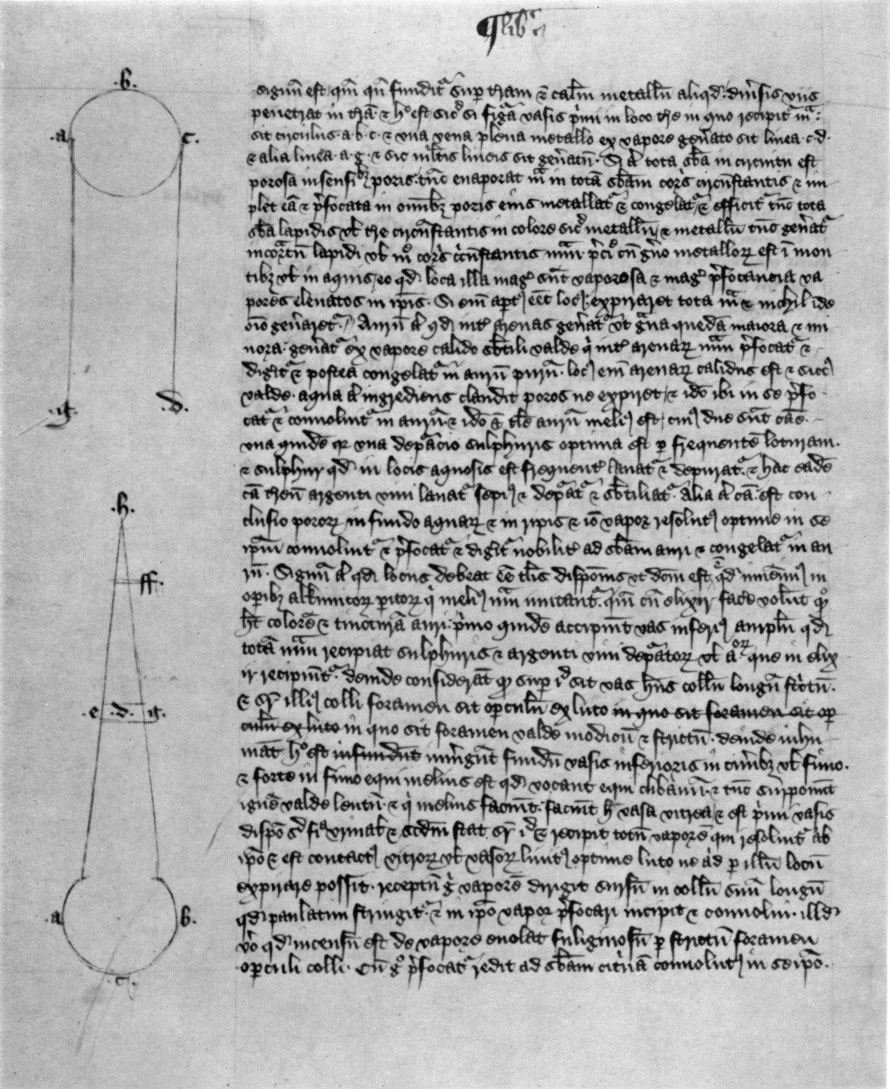
Evidence of this is that when hot metal is poured out on earth it penetrates by different ways into the earth. This is like the figure of the vessel [Plate II]: the first place in which the metal is received is the circle ABC, and one vein full of metal from the vapour is the line CD, and another is the line AG, and in the same way it is formed along many lines.
But if the whole substance round about is filled with minute pores, then the material evaporates into the whole substance of the surrounding body and fills it; and being concentrated in all its pores, is converted into metal and hardens. And then the whole substance of the surrounding earth is coloured like metal, and then metal is formed incorporated with the surrounding stone or material. [This happens] especially if the formation of metals occurs in mountains or waters, because these places are more full of vapours and more active in concentrating the rising vapours. For if the place were wide open all the material would escape and nothing at all would be formed from it.
But gold which is formed in sands, as a kind of grains, larger or smaller, is formed from a hot and very subtle vapour, concentrated and digested in the midst of the sandy material, and afterwards hardened into gold. For a sandy place is very hot and dry; but water getting in closes the pores so that [the vapour] can not escape; and thus it is concentrated upon itself and converted into gold.
And therefore this kind of gold is better. And there are two reasons for this: one is that the best way of purifying Sulphur is by repeated washing, and the Sulphur in watery places is repeatedly washed and purified; and for the same reason the earthy Quicksilver is often washed and purified and rendered more subtle. Another reason is the closing of the pores underneath the water along the banks; and thus the dispersed vapour is well-compressed and condensed, and is digested nobly into the substance of gold, and hardens into gold.
Evidence that the place must be arranged as we have described it is to be found in the operations of those skilful alchemists who are the best imitators of nature. When they wish to make the elixir which is to have the colour and tincture of gold, first they take a lower vessel big enough to hold the materials of well-purified sulphur and quicksilver or other things which they put into the elixir. Next they arrange it so that on the top of this there may be a vessel having a long, narrow neck; and over the opening of this neck is a cover of clay in which is a very small, narrow opening.
Next they inhume that is, they immerse the bottom of the lower vessel in ashes or dung, or better in [a pan of] horse-dung, which they call equi cibanum, and then they apply a very gentle fire. The better operators make these vessels of glass; and the character of the first vessel is like a urinal, and the second stands on top of it and receives all the vapour which rises from it.
And the contact of the two glasses or vessels is well sealed with lute so that nothing can escape; and therefore it directs the vapour it receives upwards into its long, gradually tapering neck. And there the vapour begins to be concentrated and compressed; and what is burnt out of the vapour flies up like soot through the narrow opening of the cover on top of the neck. Therefore, since it is concentrated and compressed upon itself, it is converted into a yellow substance; and this, collected afterwards, tinges any metal you like to the colour of gold, or even to a more beautiful colour if it be the noble elixir, in which the maker has committed no mistake. The figure of the vessels is like this [Plate II]: the lower vessel is ABCD, the upper vessel EFG, and the cover H.
It will be the same in nature. And therefore it is clear why almost all formation of metal should be found diffused through veins and pores, which are like the neck of the place where the vapour is concentrated and compressed. But the formation is easier in the substance of stone, and in stony places, because they are solidly enclosed on all sides.
This, then, is our account of the places where metals are produced. Why it is that sometimes metal is found which is soft will be determined later on better than here. And therefore we here conclude our account of the substantial cause of metals.
TRACTATE 2
The title of this tractate is printed by Borgnet as De actionibus metallorum, but it should be (as in the 1518 edition) De accidentibus metallorum, ‘on the accidental properties of metals’, like the corresponding tractate (I, ii) on stones De accidentibus lapidum; and the present chapter begins with a statement about ‘accidentals’.
Fusion and solidification are here explained in terms of the constitution of metals, as set forth in III, i. Heating activates an intrinsic liquidity which Aristotle called Water, and the Arabs Quicksilver. Later chapters develop more fully the theory that the greater the amount of Quicksilver in a metal, the more easily it melts.
We must now take note of whatever accidental properties occur spontaneously in metals, such as their being liquefiable and malleable, and their colours, tastes, and odours, and their ability to be consumed by fire, and whatever other such properties appear spontaneously in them.
But the liquefiability of metals is somewhat different from that of other things that become liquid, for such things become liquid and flow, and their parts separate from each other as for example, wax, salt, and the like, whether they are liquefied by dry heat or by moist cold. But in metals the moisture is not separated from the dryness, but is dissolved in it; and, being so dissolved, it moves about there as if it had been swallowed by the Earth and were moving about in its bowels.
And on this account Hermes said, ‘The Mother of metal is Earth, that carries it in her belly’. And this is the reason why [molten] metal does not adhere to or moisten anything that touches it; because earthy dryness prevents its from moistening or adhering. But the moisture prevents the dryness from standing still. Thus each acts upon, and is acted upon by, the other.
But when the metal is rather poorly mixed, because neither one is contained in the other, then the earthy part is burned up in the fire and the moisture evaporates and does not quench the earthiness, defending it from the fire; and the earthiness does not hold fast the moisture, preventing it from evaporating.
Such a metal in liquefying gives off much [smoke], and is bad-smelling because of the bad smell of the Sulphur; and it leaves much slag and dross, because of the burning of its Earth. But if [its constituents] were very pure and perfectly mixed, the moisture would not evaporate perceptibly, and the Earth in it would not burn; and therefore it would give off very little smoke, and that not bad-smelling, and like gold, it would have almost no dross.
But the solidification [of metals] is less different [from that of other substances] than their liquefaction [is]. For their solidification is [caused] by the pressure of the cold acting within the dryness; and the moisture [no matter] whether it is pure and radical moisture, or impure and superfluous, whether well- or ill-mixed is compressed in exactly the same way, and is hidden in the interior and held fast, so that it cannot enter into the patches of dry earth.
And the same [is true of] those metals that are not liquefiable by dry heat, but only softened, like [iron]. For softening comes about only through the dissolving of the moisture so that it begins to move about within the dryness in the bowels of which it is contained.
But metals that have what Aristotle calls a ‘stuttering’ mixture, like tin the more they are liquefied the drier and more brittle they [become], because their moist parts fly away and what is left is dry and not well stuck together, and therefore it breaks more quickly. It is called a ‘stuttering’ mixture because the mixing attains the proper proportion in some parts and not in others; but of real union, so to speak, there is very little. [It is] just like a man who stutters, being able to say some words and not others.
And because [such metals] are not completely mixed, therefore when they are liquefied they easily evaporate; since the parts, being poorly attached, let go of each other, and then the moisture does not protect the dryness from catching fire, and the dryness does not keep the moisture from running away and evaporating.
Evidence of what we have said is that solid lead and tin, if left lying for a while, become scaly outside and greyish, or perhaps black after a long time. This happens, undoubtedly, for two reasons: one [reason] is that when the moisture is forced by cold into the inside, it leaves the outside earthy and dry, and this produces a greyish colour. The second [reason] is that the small amount of moisture that is on the outside evaporates because of the heat of the surrounding Air, and this again leaves greyish Earth that colours the surface.
And this is the reason, too, why lead cannot be welded to lead when the edges of two [pieces] are liquefied by a white-hot iron, unless the hard surface is scraped beforehand to remove the dry Earth that keeps [the edges] from sticking together; because the sticking of one to the other is [accomplished] by the power of the moisture, which flows [from one] into the other, and not by the power of the dryness, which remains fixed.
But even then they will not stick together unless, after scraping, they are rubbed with soap or something else unctuous and fatty. And this is because the Quicksilver in the lead contains unctuous moisture, as has often been said; and therefore it will not adhere to a surface except through having something in common (symbolum) with its nature. But copper sticks iron together, and molten silver is best of all, for sticking metals together. And the reason is that the Quicksilver in these [metals] is good and subtle and pure, and it sticks things together because of its viscous moisture. For, being such as it is, because it is related to, and has something in common with, their nature, it penetrates into the things that are to be joined and at once holds them firmly.
This, then, is our account of the liquefiability and solidification of metals. For we have discussed the nature of liquefiable things in general in the Meteorology.
Metals seem to be the only things that are malleable, showing greater and better malleability than anything else. The cause of malleability is what has been said above: namely, moisture that is enclosed in dryness but not completely bound. For when this moisture is released by the expulsion of the chilling cold that binds it, then [the Earth] floats in [it] just as even iron and stones float [in Quicksilver], and do not sink, because of the boiling motion and thickness of the metallic moisture.
But even when the moisture is bound by chilling cold, nevertheless it is still present. And when the metal is hammered [the moisture] makes it yield to its surroundings, and by so yielding is drawn out without losing its continuity. But metals differ very greatly in their capacity to be acted upon in this way. Gold is the most malleable of all; and after that, silver; then, very pure copper; and then iron; and lead and tin are much less [malleable].
Gold can be drawn out to the greatest extent, so that thin sheets are made, which are spun with silk or placed on pictures. And it can be drawn out even further if silver is placed on the gold, in the proportion of six to one. For example, if on four marks of silver one-sixth [as much] gold is placed, or even less, then the gold is drawn out as much as the whole of the silver can be; so that [the gold] is no longer seen except as a colour on the silver.
But if the thin sheets are melted, [the metal] does not appear to be gold at all, but entirely silver. But if gold is beaten by itself, without being placed on silver, it cannot be drawn out so much, because it cannot bear the blows of the hammers without being perforated; but silver placed upon it protects it from the blows. And the cause is certainly the subtle moisture which absorbs dryness; for this moisture yields not by separating from adjacent parts but by drawing them along with it; and thus yielding without losing its continuity, it is drawn out more and more.
But some metals are less malleable, and this happens for one of two reasons: for either their moisture is too gross and impure, so that it is not so capable of expanding; or else they suffer from a ‘stuttering’ mixture, so that when drawn out one part separates from the part near by, and is pulled away from it by the hammer blows.
And therefore this is a way of proving that an error has been made in the operation of alchemists; for because of the great admixture of yellow or white substances with the Quicksilver in the compounding of what they call the elixir, dryness [enters] into the moisture in their metals, but they are not strongly united and thoroughly blended.
And therefore the metals made by alchemists are very frequently broken when they are drawn out by hammering; unless the alchemists imitate nature successfully and accomplish the work of nature, as we have said before. For when metals are mixed together, for instance tin and copper, or any others, because of their ‘stuttering’ mixture they lose their malleability and break when beaten with a hammer. For they are not really blended but only put together, and one enters into the other only in so far as to colour it.
This, then, is the cause of malleability.
It is not difficult to reach a conclusion about the colours of metals, for three colours are found in them to a greater or lesser degree. One of these is common to all, and this is a shining lustre, like light incorporated in a coloured body. The second, which is white, is possessed by several metals to a greater or lesser degree: the whitest is silver; then tin; then, third, lead; and last, iron. The third colour is yellow or reddish, and gold has this to the highest degree; after this, copper, but the colour of copper tends towards a brownish black.
But let us assume here what has been proved in The Senses that colour is the boundary of a limited transparency. Thus any body in which the condensed transparency is clear and pure has lustre incorporated, as it were, with its colour. For transparency when condensed [is bright] and lustrous, since its density retains the light, of which it is the appointed limit, just as potentiality receives the appropriate actuality. Therefore, a shining lustre will be common to all metals, because of the subtle, watery [material] which is limited by a boundary and condensed in them.
And the more subtle, pure, and dense the Water that any metal contains, the more shining and brilliant it will be when polished; because without polishing, one part casts a shadow on another, and more or less prevents it from shining. For this reason, gold has the brightest lustre of all; and next, silver; but iron, when very well purified, is said by the alchemists to contain something of silver and to be very close to it; and therefore when it is polished it shines like a mirror.
A mirror is caused by moisture which is solidified and is capable of taking a good polish; and it receives images because it is moist, and holds and retains them because it is solid (terminatum); for it would not retain them in this way, if the moisture were not incorporated [in it] and limited by a boundary.
This is why Air does not retain such images, although it receives them; because Air exists as a spirit [that is, a vapour or gas], and receives such things in the manner of a spirit; and having no boundary, it does not focus them into one place and shape, as is necessary for reproducing them, but acts only as a medium through which the images pass, and not as a limiting boundary that gives them being.
The white colour in metals is caused by moisture bound by an earthiness that is [clean], subtle, and well-digested; for this is extremely white, like the appearance of quicklime (calx). This is present in nearly all metals. But whenever metals contain an earthiness that is dirty and impure, or burnt Earth, they become either greyish, like clay, or else black, like burnt Earth, as is seen in soot.
Lead, therefore, always tends towards a greyish colour, because its earthiness is dirty though not burnt. And tin is not so greyish as lead, because it is not so dirty. But silver always shines with whiteness because its earthiness is [clean], subtle, and well-digested. But iron, because the earthiness in it is burnt, is sooty and black.
And for the same reason, [iron] is always subject to rust; and the cause of this is merely that it contains burnt Earth; for what putrefaction is to moist [things], rust is to iron. For when the moisture is removed, what is left is parched, dry, and burnt, and is reduced to ashes.
Evidence of this is that iron is especially affected by rust if something burning is thrown upon it such as salt, sulphur, orpiment, or the like. But silver does not turn to rust but rather to an azure colour, because of the great transparency in it, which produces the sapphire-blue of good azure.
And for this reason Hermes, leader and father of alchemy, says that if thin plates of silver are smeared with salt of Ammon and vinegar, and suspended over an alembic that is, a sort of vessel then the silver plates change into the colour of azure. And then, if the plates are reduced to ash with sulphur, so as to become powder, and then stirred with vinegar and zeruph that is, a kind of herb the azure will be fermented and perfected.
But it is true that many things burn silver that do not burn gold, because [in silver] the earthiness and moisture are less well purified and blended [than in gold]. Therefore, if boiling or very hot sulphur is sprinkled on it, silver is blackened, because the earthiness in it is burned. And when silver is cooked with salt and [tartar] it is whitened and purified at once, because such penetrating [substances] attack the earthiness and separate the burnt part from it; and the remainder, which is purer, becomes whiter.
The yellow colour in metals is caused by the Sulphur, which colours them; for heat, violently cooking the moisture mixed with earthiness, converts it to a [yellow] or reddish colour, as is seen in the science of urines, and in alchemical operations; and in red or reddish lixivia; and in yellow bile; and likewise in honey and gall, which have been strongly digested by heat.
If, then, both the earthy and the watery materials are very pure, the heat in them cannot separate them so as to burn them up, but only digests and alters their colour to a shining yellow, this is the cause of the colour of gold. And therefore [gold] is not burnt if sulphur is thrown upon it.
But if the earthiness is impure and not well blended, then the heat that digests and blends it will burn it, and it will become yellow; but after a little while it will tend towards a sooty blackness, as is [the case] with copper. This is why all ancient images and vessels of copper are blackened. And sulphur thrown on hot copper burns it very violently; for [copper] contains earthiness that has been burnt yet is [still] capable of burning, as we have said; and this is not sufficiently well blended with the moisture.
So much, then, for our account of the colours of metals.
The tastes and odours of metals must be considered together, because odour is a sort of consequence of taste. It is generally true of all metals that, because of the sulphurous substance they contain, their tastes have a certain sharpness.
Although this is admittedly least evident in lead and tin, yet even in these it is proved by [the fact that] water that has been running or standing for a long time in pipes of lead or tin becomes very irritating to the bowels or internal organs. About copper and [iron] there is no doubt, for these are hot, especially copper, which contains a burnt substance; and so [does] iron, to some extent. And this is why their odours have a certain sharpness.
Again, it is generally true that the tastes and odours of all metals are somewhat foul, because of that same sulphurous substance in them, of which we have spoken. But they are more or less foul according to the badness of the Sulphur in them. For in gold there is very little foul odour, since its Sulphur has absolutely no badness, because it is subtle, and is only unctuous enough to combine well, and is thoroughly blended, as we shall show later.
Moreover, because it is so uniformly combined and compact, it gives off little vapour; and for the same reason, too, it has little odour or almost none. But silver contains Earth that is not [actually] burnt but is capable of being burnt; and therefore [silver] gives off more vapour and has more odour than gold, though much less than copper. And in comparison with copper, silver has a sweet taste and a sweet odour, though with a slight flavour of Sulphur. And gold is even sweeter, though it changes the taste [of things] only a little, almost imperceptibly. But [the taste and odour of] iron are earthy, and only slightly tinged with Sulphur; and those of lead and tin are very dull, because they contain so much Water.
But when metals are dissolved, their tastes are considered to be more dependent on the vapour of their odours, since taste is a consequence of the combination itself, rather than of the constituents that are combined; because the constituents sometimes have entirely different tastes from the combination. And therefore, in some respects, the vapour and constitution of a metal can hardly be learned from its odour and taste.
Among all metals, copper is most active in giving off vapour; and after this, iron. And for this reason these metals completely spoil the taste of waters which are in contact with their ores. And so water coming out of the earth where there is much copper is extremely bitter and loathsome as it is in the place called Goslar, where the water is made so bitter that nothing can live in it.
And evidence of this is that if wine or any other liquid except water is poured into a brazen vessel, it is immediately spoilt, with such a loathsome bitter taste that it can hardly be drunk. But water is not immediately spoilt, so as to change its taste, because the natural coldness of Water prevents the formation of vapour. But if the water stands there for a long time, and especially deep down in the earth where heat is confined and continually causes the ores to give off vapour, then water, too, has its taste and odour spoilt.
There is, then, in comparison with all kinds of stones, a taste and odour peculiar to metals. Some stones, indeed, give off vapours and odours; but these are not really stones, but things like ‘tears’ and gums, such as kacabre and gagates (jet), as we have said in the books on stones. But all the same there is a foul taste and a foul odour [characteristic] of metals; even though one [metal] is said to have a sweet or some other kind of odour, in comparison to another.
These odours and vapours are extremely dry. And therefore they are applied to watery eyes and are very injurious to the chest. Evidence of this is that when the miners go into the mines they cover their mouths and noses with two or three layers of cloth so that their breathing may not be too much injured by the vapour for this is where the greatest damage is done, as we have said.
So much, then, for our account of the tastes and odours of metals.
Among accidental properties of metals that are very indicative of their substance is the ability or inability to be consumed or burnt. And we must now learn the causes of this, and what differences there are in the natures of metals. We know that Water is not one of the things that can be consumed in this way; but things that [can be] have a very unctuous moisture mixed with earthy substance. And we know that Sulphur is extremely unctuous and earthy, but Quicksilver is watery with very subtle earthiness.
We know, therefore, that the ability of metals to be burnt is [due to] the Sulphur, and not to the Quicksilver by itself. Furthermore, we also know that in anything that contains very unctuous moisture mixed with earthiness, the moisture is of three kinds. One of these is extremely airy and fiery, adhering to the surface, as a consequence of the [upward] motion of those elements [Fire and Air], so that they always rise to the surface of things in which they are mixed and combined.
The second, close beneath this, contains more wateriness floating about among the parts of the thing. The third has its moisture firmly rooted and immersed in the parts and bounded in the combination; and therefore this is the only one that is not easily separated from the combination, unless the thing is totally destroyed. And therefore this must be the nature of Sulphur.
And for this reason the more skilful alchemists recommend that the [first] two kinds of moisture be removed from sulphur by means of penetrating solutions like vinegar, and sour milk, and goats’ whey, and water of chickpeas and boys’ urine; and also by boiling and sublimation repeated several times in an alembic.
For one of these [moistures] certainly does not withstand fire; and since it is able to be consumed when it is set on fire, it consumes the substance of the metal; and therefore it is not only useless for the purpose but even harmful. And the second is very volatile and evaporates in the fire; and therefore this, too, is of no use for the purpose in the plans of alchemists. But the third remains deeply rooted and intrinsic, and so this is useful for the purpose.
And the same considerations must be applied to the Quicksilver, which is the other element in metals. For when this is pure, with its earthy substance well washed and subtle, and strongly bound by mixing with watery moisture; and likewise when its watery moisture is neither too much nor too little, but just the right amount for the combining power of the Earth in it then each protects the other from the fire, as we have often said. For then the earthiness binds the moisture fast, and does not let it evaporate, and the moisture quenches the earthiness, and does not let it catch fire.
But if the earthiness is dirty, or there is too much of it, or too little, in proportion to the moisture; or even if there is just the right amount, but it is not strongly bound in the mixture then it catches fire and is consumed, and burns the substance of the metal. And likewise if the moisture has not been digested in a manner suitable for combining into metal, and is not well bound; or if there is too much or too little then it must necessarily vanish by evaporation, and the substance of the metal will be left dry and ready to be consumed.
It is according to all this that we must consider the ability of metals to be consumed. For a metal is able to be consumed when any one of these [conditions] is present, and the more so when several of them occur together.
Therefore gold that is pure and good because the condition of both its constituents that is, of its Sulphur and Quicksilver is so excellent, is least consumed; and whatever things consume other metals do not consume it, but only purify it such as salt and brick dust, and sulphur, and arsenic, and the like.
Silver is somewhat inferior [to gold], because its Sulphur contains some wateriness, and so [does] its Quicksilver. And therefore when this wateriness evaporates, the silver at first begins to be blackened, and then to be burnt by burning substances, such as sulphur and [arsenic], and other things that have been mentioned, and many more which alchemists use.
But copper is very much burnt, because it does not have its Sulphur well bound in the wateriness of its Quicksilver, and it has too much earthiness; and therefore it is very easily consumed by burning. And I myself have seen at Copper Mountain that pieces of green wood propped up against the copper ore are at once consumed, because of the abundance of Sulphur and fattiness exuding from the copper ore. Iron is also burnt to a red colour, because earthiness predominates in it and this catches fire. In tin and lead the Quicksilver is not well cleansed of clayey, fatty substance, and also it is too watery; and therefore as the watery part evaporates in the fire, the clayey, unctuous substance in them is burnt.
This, then, is our account of the ability or inability of metals to be consumed by burning.
An additional statement should now be made: one thing that is common to all metals is that their materials are closely related. We know, from what has been determined in the science of Generation and Corruption, that among [things] having a common property in their material, powers, and potentialities, the transmutation of any one into another is easy. And this is the reason for the assertion of many philosophers whose father is Hermes Trismegistus, called the prophet of philosophers that the production of the metals is cyclical, from each other, just as the production of the elements is cyclical. And this seems to me very true.
For when, in matter, the properties that are nearest together and farthest apart are still not separated by very much, as is clear from previous [chapters], the differences among them result from the parts of both [kinds of] materials the well-purified and digested, and the impure and undigested. And so it happens that everything impure and undigested is purified and digested, if the natural powers of digestion prevail.
Otherwise, it happens that everything that is digested suffers from imperfect cooking (molynsis), or from an admixture of undigested material, or perhaps insufficient heat to solidify it. Therefore it happens that the materials that are closest to the elements are transmuted into each other; and since such transmutation [of the elements] occurs, the metals must be capable of being transmuted into each other. And thus it happens that the production of metals is cyclical, from each other.
Experience shows that this [is the case], both in the operations of nature and in the techniques of art. As to natural processes, I have learned, by what I have seen with my own eyes, that a vein flowing from a single source was in one part pure gold, and in another silver having a stony calx mixed with it.
And miners and smeltermen have told me that this very frequently happens; and therefore they are sorry when they have found gold, for the gold is near the source, and then the vein fails. Then I myself, making a careful examination, found that the kind of vessel in which the mineral was converted into gold differed from that in which it was converted into silver. For the vessel containing the gold was a very
hard stone one of the kind from which fire is struck with steel and it had the gold [pure] and not incorporated with the stone, but enclosed in a hollow within it, and there was a little burnt earth between the stony part and the gold. And the stone opened out with a passage into the silver vein, traversing a black stone that was not very hard but earthy; and the black stone was fissile, the kind of stone from which slates are made for building houses.
This proves, however, that from a single place which was the vessel of the mineral matter both [gold and silver] evaporated, and a difference in the purification and digestion had been responsible for the difference in the kind of metal.
And what artisans have learned by experience is also the practice of alchemists who, if they work with nature, transform the specific form of one metal into another, in the way already described. Thus it is, then, not improbable that there is a cyclical production of metals from each other; and in this metals are unique, occupying a special position between elements and mixed bodies. But let it not escape us that in all things produced cyclically from each other, the transformation is easier between those that have more properties in common.
And that is really why gold is made more easily from silver than from any other metal. For only its colour and weight need to be changed, and this is easily done; for if its substance is more compacted, its weight will be increased as its Water is decreased; and an increase in good, yellow Sulphur will result in a change of colour. And it is the same with other [metals], too.
This, then, is our account of the passive [or accidental] properties common to all metals.
BOOK 4
A SINGLE TRACTATE
OUR plan now demands that we describe the metals individually, which could not be done until after we had determined the reasons for their natures and their accidental properties. For speculation proceeds from the general down to the particular elements, as has been determined at the beginning of the Physics.
In speaking, then, of the metals individually, we shall first touch upon those things that are, as it were, universal in metals, like their Father and Mother, as the writers on alchemy metaphorically say: for Sulphur is, so to speak, the Father and Quicksilver the Mother; or, to put it more accurately, we may say that in the constitution of metals Sulphur is like the substance of the male semen and Quicksilver like the menstrual fluid that is coagulated into the substance of the embryo.
As to the substance and origin of Sulphur, then, it is to be noted that since it liquefies by dry heat and congeals by cold, it must contain Water, as has been determined in the book on Meteorology. But since it is brittle and can be pulverized by crushing, it must contain an earthy substance that is very dry. Since it is easily inflammable and sticky, it must contain oily and viscous [substances], the oily to make it inflammable and the viscous to make it sticky; and its flame is very smoky, with a colour almost sapphire-blue tinged with black.
But from these [properties] we know that it is made up, as it were, of four substances, or at least three. For since it is active in penetration and attraction, as Avicenna says in his [book on] medical simples, it must contain a fiery substance, and for this reason it is pronounced hot and dry in the fourth degree.
And since it is easily inflammable, it must contain an airy substance. And since it is liquefied by dry heat, it must contain a moist watery substance. And since it can be pulverized and boiled dry, its substance must be earthy. And all these substances are so abundant in it that they are obvious and distinct in its active and passive properties.
But as we have said in the preceding [book], it must have three [kinds of] moisture two extrinsic and one intrinsic and this need not be repeated here. But one observation must be added: its smoke indicates that the earthy substance in it is able to catch fire easily and be consumed; and its foul odour indicates that it is very poorly digested and not limited by a [firm] boundary; indeed, by violent heat, [it is destroyed], instead of being digested and completed.
And this incompleteness makes it capable of being a universal material of all the elements. But if it were perfected into one definite, completed form, then certainly it would not be capable of being changed into other things, unless this [completed form] were first removed. But as it is, because of its incompleteness, it is capable of being changed into everything, just like the seeds and so on, from which natural things are produced. And therefore wise nature provides abundant Sulphur in any place where metals are produced. And since Sulphur is hot, it will necessarily be active in opening up and solidifying any moisture that touches it.
And since it is dry, it will be sharp, since heat and dryness are sharp. And therefore it will have the power of impressing its seal and form upon things, rather than of receiving [impressions]. And on this account it is given the position of Father and of male semen, by Hermes Trismegistus.
But it must be observed that whatever is hot and dry is joined with something moist and cold in one combination, and this combination is hermaphrodite, as is seen in plants, which everywhere both fertilize and are fertilized. But Sulphur is not really such a substance because it does not produce anything in its own substance, and it is not the ‘Father’ except [in the sense] that the male, out of his own substance, produces [offspring] in something else that is, in menstrual blood and that is the way Sulphur acts upon Quicksilver, but does not produce anything at all in itself.
The colour [of sulphur] is yellow and sometimes white, or rather straw-coloured, that is, like the whiteness of wheat straw. The cause of this is heat, which accompanies the moisture and changes it to a yellow colour; and so sulphur seems to be what results [from this process] in the bowels of the earth.
For when earthiness is mixed with much wateriness, and there is heat that cooks it just as in the bodies of animals food is mixed with digestive juice, and its froth boiling up on the surface is changed into yellow bile so it seems that Sulphur is like the froth of what is mixed together in the bowels of the earth. And that is why it is yellow, dry, and hot, although if it is more thoroughly cooked and more earthy it appears paler yellow, tending towards the white of straw.
Sulphur is divided into ‘live’ sulphur and ‘fused’ sulphur. ‘Live’ sulphur is just as it is taken out of the earth. That which is not ‘live’ but ‘fused’ has been melted afterwards. The only difference between them is in their accidental properties. And some is also found [with a colour] tending perhaps towards red or perhaps towards black; and this is because of burning heat that predominates in it.
So much, then, for what we have determined about the nature of Sulphur.
Quicksilver contains two principal substances, according to all natural scientists. One of these is Water, the other, Earth, as has often been said. And its earthy [substance] contains some Sulphur, although there are some alchemical writers who say that its substance is entirely watery.
And they say that this watery substance is thickened by the heat of Sulphur, but that, nevertheless, in itself it is nothing but Water. But this is quite impossible, for we have already determined, in the Meteorology that Water by itself is not thickened, except by cold that changes it into Earth; but it is not at all capable of being boiled dry by heat. Moreover, we know from the principles of natural science that [Quicksilver] does not stick to anything that touches it, as Water does, because [Quicksilver] has subtle Earth in it.
And it is so strongly combined that if it is sublimed by itself in a glass vessel with a long neck, it always remains the same, however often the sublimation [is repeated], without becoming drier or harder, unless there is an orifice by which it may escape. And Quicksilver is to the material substance of metals as the menstrual fluid is to the embryo: out of it, by the force of the Sulphur that digests and burns it, all metals are produced. And when it begins to be changed into a specific form, at first it becomes lumpy, and then gradually it begins to solidify and be changed [into metal].
There are different [kinds of] quicksilver, since some is extracted from its own ores and is found ‘live’, and some is extracted by roasting from the stone in which it is produced, just as silver or gold is extracted from stone. And on account of its sharpness it is said to be a kind of poison. It is cold and moist to the second degree, and for this reason it causes loosening of the sinews and paralysis; and it kills lice and nits and other things that are produced from filth in the pores.
Quicksilver sublimed with sulphur and salt of Ammon is changed to a shining red powder, and if roasted in the fire again, it changes back to a moist, fluid substance. And perhaps that which is concentrated in the neck of the vessel called an alutel in which the sublimation is carried out is changed into something like stone, coloured like alabaster; and if this is afterwards roasted in the fire, it changes back again to quicksilver. But there are also different [kinds of] Quicksilver which appear more obviously in the metals [made from them] than in Quicksilver itself such as dirty or pure, and other [kinds] which have been listed above.
And a remarkable thing about this material is that, however often it is sublimed by itself, there is never any powder left behind in the bottom of the vessel; and when it returns to the specific form of Quicksilver there is no loss, so to speak, in its weight. And this undoubtedly happens because of the very firm combination of its earthy with its watery substance.
For the viscous moisture holds the earthiness so firmly that, in evaporating, it takes it along with it into the neck of the alutel; and being concentrated there its spirit returns to the same specific form. But in the bottom [of the vessel] it does [not] harden, or change in colour, weight, taste, or odour.
It is nevertheless volatile in the fire, and becomes incorporated with metals whenever it is mixed with them. And on this account Hermes calls it [a spirit] like Sulphur. But Avicenna says that its whiteness is due to wateriness and subtle Earth, cooked together with Air which, taken up as a spirit, is present in its mixture.
All this has been said so that it may be understood that Quicksilver is nothing but the matter in metals, since it undoubtedly suffers complete dissolution by means of sharp waters, either natural or artificial. And after such dissolution it is capable of mixing with other substances and imparts colour to them. And by the force and vapour of Sulphur it is congealed and brought to the hardness and specific form of the various metals. And therefore, since it is saturated by dryness and earthiness, it is held fast and cannot escape in the fire from the substance with which it is mixed.
This, then, is our account of Quicksilver.
Avicenna say that molten lead undoubtedly seems to be Quicksilver. As to the constitution of lead, therefore, its substance is believed [to contain] a large amount of Quicksilver in proportion to its Sulphur; and perhaps only a little of the actual substance of Sulphur enters into the constitution of lead, but a great deal of its quality. And this by its own heat cooks the material and changes it into the specific form of lead, just as a small amount of the substance of rennet curdles a large amount of milk.
The Quicksilver of lead is not of good quality, but watery and dirty; and therefore the wateriness easily evaporates in the fire, and an earthy powder is left, as a sort of ash remaining from the clayey substance of the lead.
And since, as we have said, there is in lead a force of Sulphur, its vapour dries out the Quicksilver just as the vapour of Sulphur does. For it is not possible that two substances should produce the same effect in the same way, except by means of the same thing which is in them [both]. We have already explained why lead has a greyish colour.
The effect of lead is cold and constricting, and it has a special power over sexual lust and nocturnal emissions, if a circle is made of it, two fingers wide, and worn around the loins and [anointed] with camphor. But care must be taken lest the lead, by its coldness contracting the material [below] too forcibly drive it upwards into the head, and cause madness or epilepsy; and care must also be taken lest it cause paralysis of the lower limbs, and unconsciousness. This, then, is the nature of lead in its constitution and effects.
And Hermes, who has proved much about the transmutations of metals, in his Alchemy reports that, if plates of lead are suspended over a vessel containing much strong vinegar, so that the vapour of the vinegar is continually in contact with the lead plates, the vapour will condense and destroy the substance of the lead, and change it into a powder that has a white colour and is called cerusa.
But if vinegar is poured over the same lead plate, it becomes white and, on the other hand, the power of the vinegar is destroyed. The reason for this is surely that, although the substance of vinegar is dull on account of its coldness, it is nevertheless sharp in its action, because it is the remains of a sort of Fire that has arisen from it, just as ash is the remains of Fire in wood.
And by means of this sharpness, therefore, it penetrates into the substance of the lead, when the lead has been disintegrated, and washes away the dirt from the congealed Quicksilver in it, and causes [the Quicksilver] to rise to the surface of the plate like grains of millet, which then grow whiter because they are more thoroughly purified.
Moreover, Hermes also reports that lead, if roasted with something that burns it, such as sulphur and arsenic especially, produces a sublimate of a dark vermilion, that is, red colour, which [becomes] yellow if the fire is hotter and stronger. But if this substance is calcined with vinegar and dried out, it changes back to the white colour of cerusa.
And the reason for this transmutation is that really it has Sulphur and Quicksilver, as we have said, in the substance of which it is composed. For when sulphur is heated and cooled again, it becomes red. Evidence of this is [the fact] that manufacturers of minium (cinnabar) make it by subliming sulphur with quicksilver. But lead because it is dirtier [produces] a dark colour; but when the fire is made stronger, the original dirtiness is consumed and the colour grows lighter.
And since Sulphur is burnt more than Quicksilver in a long-continued fire, the red colour due to the earthy burnt Sulphur becomes paler and is modified by the white of the Quicksilver that is still present; and the result is a yellow colour that is like white penetrating red and modifying its redness.
But nevertheless Hermes believes that if a still stronger fire is applied to all these, and they are strongly roasted in the fire, the whole substance of the Sulphur is consumed, and the force of the vinegar is destroyed by evaporation; and then, from the above-mentioned powders, the substance of the lead returns to what it was at first; but it is not of the same weight and purity, nor of the same quality, as at first.
Nor must we omit to say that, as we have already stated, lead contains much wateriness and is poorly mixed; and therefore in the refining of other metals it protects them from the fire as for example silver and gold are protected by lead when they are refined. And hence some unskilful men say that lead has the ability to bring together things that are alike and to separate things that are different.
And the reason for their mistake is that, when lead is fused together with gold or silver, the silver runs together in one place, and the stones, if any are present, in another, and the lead in still another. But they are mistaken: for this bringing together and separation is due not to the lead but to the heat of Fire, as we have shown in the fourth book of Meteorology.
And lead in itself does not purify silver except by accident; for it is the heat of Fire, in itself, that purifies it, by bringing together pure substances and separating impure [ones], as has been said. But since silver is moist and Fire is dry, the heat of the Fire would be repelled by the silver if there were not something to unite them that is, the lead; for as it becomes hot, its own moisture serves, as it were, to boil, digest, and purify the silver.
Lead is very heavy because its substance is clayey and moist, with the parts firmly compacted, although they are soft, since they are not well-digested, because of imperfect cooking (molynsis), as has been shown previously.
What is to be determined about TIN is almost the same as about lead. For these metals have specific forms that are very closely related, and there is little difference between them except that tin is whiter and purer.
And the reason for this can only be the reason assigned by the philosophers before our time that its [Quick]silver is cleaner than that of lead, and perhaps it contains only a little Sulphur, and is cooked into the specific form of metal by the power and vapour of Sulphur rather than by much of the actual substance of Sulphur in its mixture.
It has a very ‘stuttering’ constitution; and the reason for this may be the complete dissolution of the Quicksilver by some kind of solvent vapour, or the effect of a solution of sharp water, which separates the parts. But I say vapours, not Water through which Quicksilver has passed after it received its specific form, but rather [vapours] which enter into the very substance of the Quicksilver.
For such wateriness, once formed in it, is not very viscous; and it makes the earthy parts mixed with it become stiff, so that they do not mix well and stick together. For anything that is stiff and hardened on the surface does not mix well with anything else and is not capable of becoming continuously joined to anything near by. This, then, we must consider to be the cause of its ‘stuttering’ mixture. But since [tin] is itself ‘stuttering’, it makes all metals with which it is mixed ‘stuttering’, too, and takes away their malleability, as Hermes says; and when it is itself drawn out, it is quickly and easily broken.
This metal is also like lead in that neither of them is subject to rust; but rather, if exposed to destructive substances, or even spontaneously, they develop a sort of dinginess and dirtiness; but lead [does so] more than tin. They are also alike in that neither of them by itself gives out much sound [when struck].
The reason for the first [of these characteristics] is that [these metals] do not contain any hot, watery moisture, or else it is not very sharp, so as to destroy the earthy material in them and change it into rust. For rust is nothing but burnt earthiness.
And the reason for the second [characteristic] is their softness and moisture; because anything soft and moist, if it is struck, yields by shrinking into itself, and therefore does not send back from its entire surface the air, which is the cause of sound, as is pointed out in the science of The Soul. Tin, however, gives out more sound than lead. And since it has a dull sound, tin tempers things that have a sharp sound, such as copper, silver, and gold, and makes their note deeper. And therefore tin is mixed with copper in the melt for bells.
As to what Hermes says in his Alchemy that tin, because of its excessive dryness, causes bodies with which it is mixed to be fragile and destroys their malleability this is understood in the way already explained, namely, that by a sharp vapour or solution the earthy parts of it are dried out. Otherwise the statement would not be true, for we see that [tin] is softer than any other metal.
And they say that cast tin quickly decays, and that lead remains unchanged or even increases, both in the open air and underground. And I believe this is probable, since it seems to agree with experience.
The reason for this has already been assigned in The Heavens; for the cause of the destruction of the elements is that they move into each other’s [places]; and when the bond holding them is not strong, one element escapes from the other. Now it has already been stated that tin is poorly mixed, and this is the reason why it is damaged by Fire; and if it is removed from the place where it originated, it is destroyed more rapidly than other metals.
But lead is very gross in its substance, and by absorbing dew and rain, it gradually makes a mineral moisture which it converts into itself; and therefore, in the course of time, it sometimes increases.
Two [kinds of] tin are found, namely a harder and drier kind which comes from England or Britain, and a somewhat softer kind which is found more abundantly in parts of Germany.
And now we have said enough about the nature of tin.
NEXT we shall speak of SILVER, because in colour it seems to belong with the metals already discussed. For since we do not understand the nature of a compound until we know of what and how many things and in what manner it is compounded, we must inquire into the nature of silver.
And from what has already been said, we have ascertained that Quicksilver enters into the composition of silver, because silver has the same colour and, when liquefied, the same accidental [properties as Quicksilver]; for then it will not adhere to anything that touches it and it will roll about on a surface, but not spread out all over it, like water, oil, wine or any other liquid.
These three [characteristics] we have seen to be present primarily in Quicksilver; and therefore if they are also present in liquefied silver, they must be due to the Quicksilver that enters into the composition of its substance.
And since silver is extremely bright, with a shining whiteness, and is capable of taking a high polish, the proportion of Quicksilver it contains must be well digested and purified and mixed with extremely subtle material. And it also has [the characteristic] that, although its odour is foul, it is not so foul as [that of] other metals we have already discussed.
And we know from what has been said that both Sulphur and Quicksilver and anything else at all which, because of its constitution, is moist and liquefiable by Fire contains three [kinds of] moisture, just like living things, plants and animals. One [kind of] moisture is thick and undigested, rising to the surface like grease, fat, or oil; and it is this that makes things inflammable.
And the second is like the phlegmatic humour that moistens the parts of things, but does not contribute to reproduction or growth. And the third is the radical moisture saturating the essential parts of a thing; and because of this moisture the parts [of things] are firm, and grow, and are nourished.
We have found that silver is hard and dry. And therefore it must have been thoroughly cleansed of the two superfluous [kinds of] moisture, and the subtlety of the third is responsible for its excellent mixture.
And when [the fire is] strongly blown, silver has a sulphurous odour; therefore it must have some of the substance and quality of Sulphur, for it is the heat of Sulphur that causes fermentation and digestion into the specific form of a metal.
Of the substance of Sulphur, indeed, it has only a little, for the Sulphur does not even colour it; but of the power and quality of Sulphur it has a great deal, since it is by the heat [of Sulphur] that the two [kinds of] moisture mentioned above have been consumed and the third well mixed with subtle, earthy material.
For the heat and vapour of Sulphur, and especially of Sulphur that is well purified and sublimed, whiten things very much, and by digestion make them subtle and mix them thoroughly and strongly; because even from the substance of Sulphur the two extraneous [kinds of] moisture have been removed by the skill of nature, which is more certain and subtle than any art of the alchemists, and therefore has the most certain effect.
Having, then, the nature of Quicksilver, since it is a metal developed out of the purest Quicksilver by the heat of purified Sulphur into a shining specific form, therefore it must necessarily be white and have a high lustre. And, as has been said, it is well dried out and this is why it makes a ringing sound [when struck], which it would not [do] if it were soaked with superfluous moisture.
And [the fact] that it is well digested gives it the power to act as it does; for it is found to be cold in effect, because of the abundance of Quicksilver in it; but because its moisture is so well digested and subtle, filings of it, even if ground up with other things or in mixtures, strengthen the breathing and [are effective for] palpitations of the heart.
But a remarkable thing which we have mentioned before is that the best kind of this metal is found in the earth as a soft, thick mush. The cause of this is surely the abundance of Quicksilver that was in those places; and when the third [kind of] moisture was separated, [going] into the composition of the silver, the other two were left in the dirty material round about.
And this soft, lumpy, whiteness indicates that none of the superfluous, undigested moisture was taken up into the nature of the silver. And therefore, when this is placed in the fire it immediately evaporates into its natural moisture as it softens, and the moisture from the substance of the silver begins to grow firm, and when it is placed in the air and cooled, it congeals and is silver.
And the litharge from this moist silver is better than any other litharge for the white elixir in alchemy, because this litharge is from a moisture that has a tendency to [become] silver, and is potentially silver, just as fat is potentially an animal. And silver is purified in the fire with lead and then, by roasting, the lead evaporates and the dross is separated from the silver, as we have said above.
[But] when [silver] is found incorporated with stone, then it must be ground in a mill and crushed fine, both the stony substance and the silver. For when the parts are crushed fine and divided, one is more easily separated from another, and then the stony substance does not burn the silver.
But I must not pass over in silence the fact that sometimes in Teutonia [silver] is found which is very firm and dry and almost pure; and this in our own time has occurred in two ways.
One way it was found was as a column standing up under the earth, dried out and very tough and flexible. The other way it was found was extending under the earth like strings; and the quantity of this was as great as of that found in the form of a column.
And the cause of these shapes was merely the differences in the places that acted as vessels in which the vapour was concentrated and converted into the material of silver.
And the cause of its viscosity and capacity for being consumed in the fire was that, although the superfluous moisture had for the most part evaporated, yet some extrinsic moisture was still adhering to the substance of the silver, just as the extrinsic moisture of phlegm adheres to the members [in a living body], softening and loosening them; and when this is purified by fire, it makes the substance of the silver extremely pure.
But sulphur burns silver when it is sprinkled upon it in a molten condition; and the blackening of the silver shows that it is burnt by the sulphur, as we have said above. For sulphur, because of its affinity for the nature of metal, burns it; but it does not induce much burning in other things such as wood and stone, even if sprinkled upon them in a flaming condition.
This, then, is our account of the nature of silver.
METALS that are red in colour are different in their mixture from those already discussed, as we have shown when we were treating of the colours of metals. And iron has its own peculiar character, apart from the other metals.
Let us therefore now discuss the constitution of COPPER, assuming what has already been demonstrated, that all metals are composed of Sulphur and Quicksilver. Let us assume, then, that the Quicksilver is good, not full of dross and dirt, but still not completely cleansed of extraneous moisture; and that the substance of the Sulphur is full of dross, burning hot and partly burnt, and in this condition it is mixed with the Quicksilver, both in substance and in quality.
Then undoubtedly it changes the Quicksilver to a red colour; and because neither [the Sulphur nor the Quicksilver] is sufficiently subtle, they cannot be well mixed. And this will make copper, which is not at all well mixed, since much dross is separated from it, and it evaporates greatly in the fire.
For when the Sulphur is partly burnt out, then some parts of the Quicksilver are better purified than others and the superfluous moisture in them is consumed; and in those parts it will appear to have veins of gold. But in other parts where it is less well digested it will be scaly and ignoble and earthy because it has been burnt.
And we have found these differences clearly in the copper found in Teutonia at the place called Goslar. And therefore this copper is reckoned better than any other, because it has veins of gold mixed with it. And it is not improbable that the Sulphur in that copper is mixed with a certain quantity of arsenicum; and for this reason the Sulphur of that metal is rendered more burning hot than that of other [metals].
Now, therefore, we understand the material of copper; it is a metal having rather more Quicksilver that it ought to have, which has been converted into a red form by mixture with burning Sulphur. Why the nature of Sulphur is burning hot has been satisfactorily explained earlier.
And arsenicum, when calcined, changes from red to black; but afterwards, if sublimed in an aludel which is a covered vessel with a long neck, as we have often said it again becomes white as snow. And if such calcination and sublimation are repeated a number of times it becomes extremely white and very sharp.
And because of its sharpness, [arsenicum] added during the fusion of copper penetrates into it and changes it to a shining white. But if the copper stands for a long time on the fire, the arsenicum evaporates, and then the copper returns to its original colour, as is easily proved in [books on] alchemy.
But those who carry on much work with copper in our region that is, in Paris and Cologne and other places where I have been and seen this tested by experience convert copper into brass (aurichalcum) by means of the powder of a stone called calamina. And when this stone evaporates there still remains a dark lustre, approaching the appearance of gold.
And to make it paler in colour, and so more like the yellow of gold, they mix in a little tin; but because of this, brass loses the malleability of copper. And those who wish to deceive and to produce a lustre like gold ‘bind’ the stone so that it may remain longer in the copper on the fire, and not evaporate from it so quickly. And the ‘binding’ [is done] with ‘oil of glass’.
They take fragments of glass, crushed and sprinkled into the crucible on the copper after the calamina is put in; and then the glass that has been put in floats on the top of the copper and does not allow the power of the stone to evaporate, but reflects the vapour of the stone down into the copper.
And in this way the copper is thoroughly purified for a long time and the drossy material in it is burnt up. But after a while the oil of glass evaporates, and then the power of the stone evaporates, too; but the brass is made much more brilliant than it would have been without it. And anyone who wishes to make it still more like gold repeats these purifications by roasting with oil of glass several times, and in place of tin, puts in silver and mixes it with the brass.
And it becomes such a brilliant yellow that many people believe it to be gold, though actually it is only a kind of copper.
But Hermes says that if powdered tutty is mixed with molten copper either white tutty or red it changes the copper to the colour of gold. What tutty is will be explained in the following book, where ‘intermediates’ are treated. But it is enough [to say] here that the burning heat of tutty consumes the earthiness and purges the superfluous moisture out of the copper; and so then it will be more beautiful.
But the power of tutty, too, evaporates if it stands for a long time on the fire; and therefore, unless some remedy is used, the tutty will evaporate and the copper will regain its original colour.
Hermes also says and experience agrees that if copper sprinkled with salt is placed over vinegar or the urine of a pure young boy, the power of the urine or vinegar will penetrate into the substance of the copper and change it to a green colour. Or, again, if copper alone is placed over pressed out [grapes from the vintage], the mere vapour of wine will change it to a fine brilliant green colour. But orpiment or arsenicum, especially if burnt, brought into contact with this colour, destroys its greenness by thickening it, and turns it to a greyish, earthy colour that is almost opaque.
The cause [of these changes] is easily seen from what has been said. For salt is active in opening [things], and therefore opens the substance of the copper, especially if it has been beaten into thin plates; and then the sharp vapour of the vinegar or urine, derived from the excessive burning of the Sulphur [in it], burns the copper; and therefore the combined moisture and light earthiness that is burnt in it takes on a green colour, just like the hottest and worst yellow bile (cholera), which medical men compare to copper rust [verdigris].
But since, in the first [case, that is, the making of brass], the vapour [of calamina or tutty] is not so sharp as the vapour of wine [combined with copper in making green pigments] it makes the red less intense, and therefore the brilliant colour of gold remains. But orpiment is intensely hot and therefore when it comes in contact with things coloured in this way [that is, copper greens], the slight amount of moisture present is burnt up; and what remains is earthy and opaque in just the same way as yellow bile when it is burnt leaves a black ash [with the] accidental [properties] of black bile, according to the experience of medicine.
So much, then, for our account of the nature and effects of copper.
TO this we must add something about the nature of GOLD which, according to Hermes, is the only metal that is not ‘diseased’ for neither of its constituent materials is imperfect or inharmoniously mixed.
Although, like the other metals, it is made up of Sulphur and Quicksilver, its Sulphur is extremely bright and clean, purified by the most thorough washing, so that it contains absolutely no unctuousness capable of being consumed by fire, and no watery moisture or phlegm capable of evaporating; and perhaps it has been several times sublimed in hollow places beneath a solid surface, and digested by harmonious heat that carries out the process of ripening called pepansis.
And the earthy substance incorporated in the Sulphur is clean and extremely subtle, dispersed as vapour throughout the whole substance of the radical moisture of the Sulphur itself. Therefore the result is that the heat in this Sulphur is just right for combining, in no way departing from a harmonious mixture. And this acts as the male power in the constitution of gold.
And similarly its Quicksilver has two substances which are extremely clean, and the third substance in it, which has been made subtle by heat, and is not merely finely divided matter but actually vapour, is the most subtle Earth that has been sublimed perhaps several times in hollows underground, by the influence of the vivifying heat of the sun and stars. And similarly the watery material, too, has been made subtle by the same method of oft-repeated sublimation. And since both are present in this state, [the mixture] becomes extremely subtle.
For certainly these are mixed together by the effects of heat and of the arrangement of the place that concentrates and reflects the vapour back upon itself, so that the constituents are united in the mixture by a very strong bond.
But the Sulphur enters into the constitution of gold not merely as a quality but also as a substance; and since its substance is subtle, it penetrates everywhere throughout the Quicksilver, and in solidifying it also imparts colour; and since both have been made very subtle and changed into the form of the upper elements [Air and Fire], which in the nature of their transparency are like the perpetual body [Ether], both will have great transparency.
And when the numerous parts of the material are thickened they will pack firmly together; for this is [one] of the properties of a subtle substance, that on being packed together by thickening, it will have a very large number of parts in a very small space. And this transparency, being so compressed, causes the yellow colour; and the fine division [of the material] causes the very great solidity; and the packing together of many parts in a small space or place causes the weight, as is proved by what has been demonstrated by reasoning in The Heavens.
And the result of this consolidation and harmonious mixing together is that gold has very little vapour, or none, and therefore almost no odour. For although odour is not essentially a smoky evaporation, nevertheless a strong odour frequently accompanies smoky evaporation.
And so the result is that gold is the most indestructible of all metals, and it withstands the fire best because its mixture is the most firmly combined. For smoky evaporation sometimes indicates that bodies are being destroyed; and there is a little of this in silver and more in copper.
And these facts supply the reason why some things burn silver that do not burn gold, such as sulphur, arsenicum, and certain other [things]. For the cause of such behaviour is the mixing, so that all its earthiness is within the moisture that protects it from the fire, and all its moisture is within the earthiness that keeps it from flying away by evaporation. This close union Plato calls
‘an agreement’ (foedus), and Empedocles ‘a gluing together of related things’ (collam germanorum). And the harmonious mixture of gold is the reason why it is warm and moist, and is prescribed for tremors of the heart and for black bile which causes melancholy, especially for [the disorder] that makes a man talk to himself when he is alone. It is prescribed for these afflictions either ground up with other things having the same power, or taken by itself as a powder.
Its solidity is the reason why it does not easily stain bodies that it touches, and therefore it is worn in rings and other ornaments. For silver stains a little and the other metals a great deal; and this happens because the unctuous moisture is not completely separated from them; and with this is mixed some burnt earthiness that stains like the soot of an unctuous body.
And the great purity of its material is the reason why [gold] is very rarely found mingled with any other body, but always, so to speak, pure; for if it were mixed with anything else, it could not retain such purity, and then it would degenerate into copper; and on the other hand it is very rarely found incorporated with stones.
And for this reason, again, it is frequently found as little grains of sand; for anything of such great purity must occur only in small quantity, raised up out of the material and, as it were, evaporated; and therefore it is widely dispersed. But still there was recently found a nugget weighing a hundred marks.
From all this it is clear, again, why these two metals, that is, gold and silver, have the special property of aiding and comforting the [human] constitution; and why they were adopted as material for coinage by the wise men of old times; for they are more durable and more noble than the other metals.
The substances that purify gold are sharp and extremely dry, such as salt, especially sea salt, and the soot of substances that are unctuous but dry, and brick dust. When gold is to be purified, an earthenware pot is made in the shape of a cucurbita or scutella, and over this a similar one is placed, and they are cemented together with the stiff clay the alchemists call ‘lute of wisdom’ (lutum sapientiae).
In the upper one there are many holes by which the vapour and smoke can escape. And next the gold is beaten out in thin, short sheets and arranged in the vessel in such a way that each layer of [gold] sheets has above and below it [a layer of] powder made of soot, salt, and finely ground brick mixed together.
And it is cooked in a hot fire until it is extremely pure and the ignoble substances in it are consumed. The ‘lute of wisdom’ of which the pots are made is composed of ground-up pottery, remixed and baked; for such a vessel, when placed in the fire, does not shrink perceptibly in the fire. There are other ways of preparing ‘lute of wisdom’ in alchemy, but let this, which is used by goldworkers, be sufficient.
This, then, is the method of purifying gold, and nothing is burnt away in it except ignoble material. And for this reason Hermes aptly says in his Alchemy: ‘Sulphur itself, because of a certain affinity by which all metals are closely related to it, burns and reduces them all to ash, except only gold; for the pores [of gold] are tightly closed and cannot be opened’.
At the present time the most abundant supply of gold comes from the kingdom of Bohemia; and recently in [Westphalia] in Teutonia, in the place called [Korbach], gold has been found in a certain mountain; and this [gold] loses less during purification than any other kind. Yet it is valued at a lower price than any other kind, and the reason for this is surely only that it is new and its value has not yet been proved by the buyers.
It must be remembered, too, that gold is found of a sort of yellow-saffron colour, and becomes redder on cooking, because the material principle [Quicksilver], which is white, is consumed more than the formal principle [Sulphur], which is red.
And on this account alchemists wishing to make gold seek for the red elixir, which they call the ‘medicine’ and they seek to have four [properties] in it: it must impart colour, and be penetrating, and be indestructible in the fire, and be firmly consolidated. And this they call the ‘Red of the Sun’ (sol, gold).
And in the elixir for silver they seek [the ability to impart] a white colour, to penetrate, to be fixed in the fire, and to be very subtle. And this they call the ‘White of the Moon’ (luna, silver). And on this account Hermes says: ‘This’ is the root on which all alchemists depend: the medicine of the Sun is red, that of the Moon is white.’ And the shining white and saffron-red [elixirs] open up the gold, but a kind of cooking is needed so that it may absorb a [little] redness.
Everything said so far throws some light on the reason why most of the alchemists assert that, from every substance composed of the elements, they are able to extract three substances, namely, oil, glass, and gold.
For it is clear from what has often been stated that there is a sort of fattiness in everything composed of the elements, which surrounds its parts; and since this is viscous, when the moisture of Water vanishes, [the fattiness] distils out of a substance set on fire and roasted; and by baking it is driven into the interior where it is protected longer from the fire.
In every substance, too, there is a radical moisture mixed with subtle Earth, so that each holds fast to the other; and when this [mixture] is strongly heated, by subliming itself in the internal pores of the body when the external openings have been closed up by burning, it is divided, as it were, into two parts; the more gross and watery [part] floats about in the substance and by a very strong fire is fused into molten glass, and on cooling hardens into glass; but the purer [part], sublimed by heat, becomes saffron-yellow and is fused into molten gold, which hardens on cooling.
This is especially true of human hair, for this contains more of the mineral power, especially if it has been cut from the head. Why this is so is irrelevant here but is to be explained in the science of Animals. Evidence of this is that in my own time a human skull was found and seen to have many bits of gold dust embedded between the teeth of the sutures in the top of the cranium.
For almost everywhere gold is found, as we have said, in the form of dust or grains. And the reason for this is that the material is subtle, and it is driven out and sublimed. Evidence of this is that [gold] is found [that looks] like hardened droplets. For in the pores of the natural vessels the concentrated vapour is repeatedly doubled back upon itself and converted into fluid which takes [the form of] rounded drops.
And if sometimes they are hollow, elongated, and [look] as if they were made up of smaller ones, this is because in the neck of the natural vessel the vapour is not converted or hardened all at once, but a bit at a time; and thus a second [drop] is added to the first, and sometimes a third to the other two, just as happens in the formation of hail.
This is our account, in general terms, of the nature of gold, according to natural science.
FINALLY, there must be some account of IRON. This is more ignoble than the other metals, which are liquefiable; and it cannot be liquefied like wax, but is liquefiable only in that it can be softened. And it is made up of Quicksilver that is very earthy, heavy, dirty, and impure, and of earthy, impure Sulphur that by its power converts the Quicksilver to the specific form of iron.
And therefore iron is very scaly, and it rusts easily because of the burning of its Sulphur; and it makes a stain black as soot on anything that it touches. And perhaps the earthy substance of its Sulphur is like atramentum, and that is why [iron] filings impart blackness to ink. And also it is not cleansed of unctuous moisture, and therefore it burns easily.
Evidence of this is that anything fatty applied to it, like soap or pitch, opens it up so that tin poured over it penetrates into its substance. But after this penetration it becomes so brittle that it cannot be worked.
The burning of the earthy substance in it is proved by the great amount of slag that is separated from it; and especially by the fact that it is frequently found as black grains in earth. And consequently it is clear why it is not liquefied like other metals, but only softened. For the cause of this is its earthiness. And thus Hermes aptly says: ‘The reason for the slow liquefaction of iron is that it has too much earthiness in its parts preventing its fusion’.
But nevertheless, in a great fire, especially if sprinkled with sand and sulphur, it is distilled and purified. Because of its great hardness it has come to be used for making instruments such as hammers and anvils, by means of which the other metals are beaten out. And because of its dryness, sharp edges of it are strong, and therefore it is suitable for cutting and piercing things that have to be cut and pierced.
Hermes also says of it that Quicksilver, which makes it almost as white as silver, penetrates its substance, on cooking with sulphur and tartar, that is, [wine-]stone. Sulphur, because of its burning force, and because of its incomplete state is called by Hermes the ‘never-sleeping’ (pervigil) and the ‘waylayer’ (insidiator) of all metals.
Quicksilver, however, does not remain long in [iron] over the fire, but escapes from it, just as it does from the other metals, with which it mixes easily because it has a natural similarity to them, unless by great skill it is fixed and held fast. And because of its fugitive moisture, Hermes calls [Quicksilver] the ‘runaway slave’ (servus fugitivus).
Since, as explained above, [iron] is dry and burnt, it is effective in soothing weakness of the spleen and stomach; and therefore those who have such ills are ordered to drink wine and water in which white hot iron has been quenched.
STEEL is not a different specific form of metal from iron: it is merely the more subtle and watery part of iron extracted by distillation; and therefore it is harder and firmer [than iron], because of the force of the fire and the fine division of its parts, which become harder when heated.
And it is whiter because more earthiness has been removed from it. But when it gets too hard, it breaks and shatters at a blow, because it is too much dried out. But different kinds of water produce different degrees of hardening. For this reason smiths search out special waters for quenching the iron from which they make swords. For when iron is made white hot
and plunged into water it is hardened because the heat flees from the cold of the water into the interior of the iron and burns up the moist material in it; and as [the moisture] is consumed, the steel becomes harder and harder.
Let this, then, be all that we have to say about iron, and about the other metals, either individually or collectively.
The End.
1. The Substances of Metals
2. Tract 2 - Accidental Properties of Metals
3. The Metals Individually
BOOK 3 - METALS IN GENERAL
by Albertus Magnus
TRACTATE 1
THE SUBSTANCES OF METALS
CHAPTER 1: THE PLAN OF THE BOOK AND THE ORDER OF THINGS TO BE DISCUSSED
It is time to take up, next in order, an inquiry into the nature of metals, now that the nature of stones has been investigated; for it is in stones that the production of metals frequently takes place, as if the substance of stones were, so to speak, a place peculiarly suitable for the production of metals. In [writing] this as well as the preceding books, I have not seen the treatise of Aristotle, save for some excerpts, for which I have inquired assiduously in different parts of the world. Therefore I shall state, in a manner which can be supported by reasoning, either what has been handed down by philosophers or what I have found out by my own observations. For at one time I became a wanderer, making long journeys to mining districts, so that I could learn by observation the nature of metals. And for the same reason I have inquired into the transmutations of metals in alchemy, so as to learn from this, too, something of their nature and accidental properties.
For this is the best and surest method of investigation, because then each thing is understood with reference to its own particular cause, and there is very little doubt about its accidental properties. This is not difficult to learn, just as the science of stones is not difficult to investigate; since their causes are obvious, and their bodies are not varied but homeomerous throughout, and not like other bodies which, on account of their varied character, cannot be completely investigated by anatomizing them. We place the treatise on metals after that on stones because, as we have said, stone is almost always found to be the place where metals are produced.
For I myself have seen pure gold found in very hard stone, and I have seen gold mixed with the substance of the stone. And similarly I have seen silver mixed with stone, and also pure in another stone, as if it were a vein running through the stone but distinct from its substance. And I have made similar observations regarding iron and copper and tin and lead; but these I have never seen distinct from the substance of the stone; but I am assured by men experienced in such matters that [these metals] are frequently found distinct from the substance of the stone, just as grains of gold are found in sands.
As to the transmutation of these bodies and the change of one into another, this is to be determined not by natural science but by the art called alchemy. Likewise, in what places and mountains [metals] may be discovered, and by what indications, are matters partly for natural science and partly for the science of magic called treasure-finding. Therefore the signs by which these places that produce metals may be recognized we shall mention below; and as to the other method of discovery, we shall [omit] it, because that science depends not upon [scientific] demonstrations but upon experience in the occult and the supernatural.
We shall proceed here in just the same way as in the book on the nature of stones, first inquiring into whatever things common to the nature of all metals seem to need inquiry; and with this we shall complete the third of our books on minerals.
In the fourth [book] we shall investigate the metals individually, all seven kinds of them; and with that we shall complete the science of minerals, which are the first homeomerous mixed bodies in nature, as we have stated at the end of the Meteorology.
And finally we shall say something about the nature of [minerals that are] intermediates [between stones and metals]. And with them we shall complete our whole plan for this science of minerals.
For there is no doubt that the nature of stone is less far removed from the elements than the nature of metals [is]. That is why [stones] seem to be made by an easier mixture, and the materials in them seem to be elements that have been somehow acted upon by each other. But this is not so with metals; for as in animal bodies there must be beforehand a blending of humours in the material, so in the same way, before the blending of the forms of metals, there must be a purification of Sulphur and Quicksilver, and perhaps of salt and orpiment and alum and some other things. For this reason the science of stones most certainly precedes the science of metals; and it seems suitable that we, too, should follow this natural order.
CHAPTER 2: THE SPECIAL MATERIAL OF METALS
According to the art already set forth in the Meteorology, we know that the primary material of all liquefiable things is Water. For every liquefiable substance, so long as it is liquid, seeks to be bounded by something else, having no boundary of its own. We have given this explanation of the moist in the second book of Generation and Corruption. Therefore, every liquefiable thing is such simply because of the moisture that is bound up in it; once it is melted and exhibits its own peculiar behaviour and properties, this is recognized in its name, when it is said to be moist or liquid, since it has demonstrably been liquefied.
For it must be that everything that is fluid and seeks an external boundary to contain it has the same cause; that is, essentially and primarily it tends to be bounded by something else and not by itself: and this is [what] moisture [is], as has been determined elsewhere. Thus all liquefiable substances are fluid because of the large amount of watery moisture incorporated in them.
Moreover, we have shown in the second book [of Generation and Corruption] and in the Meteorology that anything that is hardened by cold has Water as its primary material. And there is no doubt that metals are hardened by the cold of Water; and therefore a moist humour will be the material of all of them. And for this reason Aristotle, foremost of the Peripatetics, says in the fifth book of the Metaphysics that the material of all liquefiable things is one that is, Water.
We know from what has been proved in the Meteorology that watery moisture is easily converted into vapour. This is shown by alchemical experiments: because if Water, or things that contain simple watery moisture whether natural and inherent or foreign and added is evaporated in an alembic placed over a slow fire, by the action of gentle heat, the Water distils from it and dry [material] is left behind. But we see that metals retain their moisture even in hot fires.
Therefore the moist materials of metals cannot be simple Water, but rather [Water] which has been to some extent acted upon by other elements. But if we consider the [kinds of] moisture which are difficult to separate from things that naturally contain them, we find that they are all unctuous and viscous; because, just as has been shown in the Meteorology, their parts are connected like [the links of] a chain and cannot easily be torn apart.
And therefore, since the moisture in metals is not torn out of them, even by strong heating, this, too, must be unctuous. Evidence of this is that all the radical moisture on which the natural heat of animals depends is unctuous; and certainly wise nature would provide this just because it is difficult to separate and difficult to dry out.
For nature intends it to last for a long time in the individual and for ever in the species. And for this reason [nature] decreed a moisture of this sort as nourishment for the vital heat. Therefore, since the moisture of metals likewise seems to be inseparable, even in a heat that liquefies them, undoubtedly the moisture which is the material of metals will be unctuous.
But we see further that what is unctuous in oil and all fat is easily inflammable and is active in burning things with which it is joined.
And we see that the Fire does not leave these things until they are consumed, as we observe with oil in lamps and the radical moisture in fevers. But we do not see anything of the sort in the moisture of metals; and therefore it may seem to some people that perhaps the moisture of metals is not unctuous. But to all objections of this sort we reply with what we have already said in the fourth book on Meteorology namely that in many things there are two kinds of unctuousness.
One of these is, as it were, extrinsic, very subtle, having mingled with it nothing that yields any sediment or ash; and [the other] is not inflammable, but is intrinsic, fast-rooted in the thing itself so that it cannot be torn out and driven off by fire. We have given as an example of this the liquor distilled from wine, in which there is one sort of unctuousness that is light and inflammable, easily distilled and, as it were, accidental. The other sort is mixed with the whole substance of the liquor itself, and is not separable from it except by the destruction of its very substance; and this is not combustible. And it is the same in all things produced by nature.
Evidence of this is what we see done in the art of alchemy, which is, of all arts, the best imitator of nature. For since [alchemy] has observed that there is no better way of making the yellow elixir than with sulphur, and has also observed in sulphur an unctuousness which is so intensely active in burning that it burns all metals, and in burning blackens all those on which it is cast while molten [therefore alchemy] recommends that sulphur be washed in acid solutions and cooked until no more yellow water comes out of it, and that these solutions be sublimed until all the unctuousness capable of burning has been removed, so that there remains only as much subtle unctuousness as [can] endure the fire without being reduced to ash.
Therefore there must be an abundance of similar unctuous moisture in the materials of metals produced by nature; and this is the cause of their malleability and fusibility. This is expressly stated by the authorities, Avicenna and Hermes and many others, men of great experience in the nature of metals.
Furthermore, in all kinds of metals we see that when liquefied they do not wet anything on which they are poured out, and they do not stay still [that is, they roll about] on a flat surface, and do not spread out completely over it, as we see almost all watery, unctuous moisture do for instance, water, wine, beer, or oil.
For all these, if poured out on stone, earth, or wood, when they find a flat surface wet it and spread out over it. But molten metals do none of these things; they do not adhere to anything that touches them, nor do they spread out completely; but rather they are solid in some respects and fluid in others.
And therefore a subtle, unctuous moisture cannot be the only material in them, but it must be completely mixed with subtle Earth, which prevents it from adhering to anything that touches it, or from being completely fluid, but [makes it] stick together like globules; because the subtle Earth everywhere in it seizes upon the moisture and, by gluing it together, as it were, holds it fast, providing it with a boundary, in so far as to prevent it from adhering to anything except itself.
And the moisture, wherever it is present, draws the earthy dryness out of itself, so that it flows and runs on a flat surface. But if the earthy dryness were not everywhere protected by the moisture, it would be burnt up at once by a fire that causes liquefaction, and would become rough and scaly just as in iron the fire finds out all the dry earthiness that is not covered by moisture and makes it scaly. And it is the same with nearly all metals.
It is clear, therefore, that the primary material of metals is an unctuous, subtle moisture, which is incorporated and thoroughly mixed with subtle Earth, so that large amounts of the two are combined, not merely with, but actually in, each other.
CHAPTER 3: IN CONNEXION WITH THE PRECEDING: WHY STONE IS NOT MALLEABLE AND FUSIBLE LIKE METALS
This chapter appears like a digression, anticipating in part the discussion of fusibility and malleability in III, ii, 1–2; but the emphasis here is on differences between metals and stones (as treated in I, i, 2–3). The ideas in this chapter are taken from Meteor. IV, which defines three kinds of changes brought about by heat: (1) pepansis, natural digestion, ripening, or maturing (as of fruit), ascribed to the gentle action of internal heat; (2) epsesis (Greek hepsesis), boiling or steaming by moist heat; (3) optesis, roasting or baking by dry heat.
On this [basis], going still further, we may easily answer a question that is often asked Why is stone not fusible, but copper and other metals are? And furthermore why is stone broken into little pieces and reduced to a calx, through fire alone, which does not happen to metal at all? The answer to this is easy: for stone contains more Earth, but this is not everywhere protected by moisture, nor is the moisture in it so unctuous as that in metals; and therefore, when it is placed in a roasting-hot fire (igne optetico), the watery moisture vanishes and the stone is reduced to a calx.
And since dryness predominates over moisture in stone, the stone breaks up completely into little pieces; while, on the other hand, in metals moisture predominates over dryness, and the metal will be liquefied. And this is likewise the reason why stone is not malleable, but metals are.
Actually metals have a great deal of unctuous moisture, which most strongly binds the earthy parts to itself, as by hooked bonds; and when a hammer blow displaces the watery part, which always tends to yield to anything that touches it, as we have said in the book on Generation and Corruption and in the Meteorology, [the watery part], resisting any separation, strongly draws the earthy part along with it; and so [the metal] is drawn out without losing its continuity, and not broken up, because of the viscosity and good, firm mixture of the earthy with the unctuous watery [parts]. But in stone dryness predominates, resisting anything that touches it, and it does not yield; and since it is a property of what is dry to be broken, it cannot yield to a hammer blow, but is shattered and reduced to fragments.
But the earthiness which is floating and absorbed in the moisture of metals is very subtle; and it is not destroyed nor completely forced out of the moisture, as occurs with extreme cold; rather it is digested, as it were, and ripened by gentle heat, and neither boiled by [moist heat] nor roasted by dry heat, as Averroes says. For the cold moisture is peculiar to itself and not foreign; and therefore it is so thoroughly cooked and digested as to become a natural part of it; so that the dryness runs and flows along with the moisture, and the moisture is held fast in the earthy dryness: just as Empedocles speaks of the joining of related heads and necks.
But if it were digested by [moist heat], as some unskilful alchemists say, undoubtedly there would be moisture outside as well as inside, and almost all the [inside] moisture would be drawn out of it. But the opposite would be the case if it were digested by roasting, as some other people have unreasonably said; for then it would not be affected on the outside by moisture, but would have a little moisture left only inside it. Evidence of this is that metals which are not fully digested but suffer from a sort of rawness are found to be either scaly, like iron and copper; or imperfect, like lead; or else they have a ‘stuttering’ mixture, like tin. These things will be made clear in the following [chapters].
CHAPTER 4: THE OPINIONS OF THE ANCIENTS ABOUT THE MATERIAL OF METALS
What Avicenna said, both in his work, The Physical [Stone] and in the Letter on Alchemy which he wrote to Hazen the philosopher, does not disagree with the statements made here. For he says in both these books that Quicksilver and Sulphur are the material of all metals. For the moisture of which we have spoken, mingled with earthiness, as we have said, is the immediate material of Quicksilver; and the unctuous substance which we have described is the peculiar and essential material of Sulphur.
Hermes and some others seem to say that metals are made up of all the elements, and this certainly cannot be denied. But nevertheless, the material of things is not defined merely by the constituents that happen to be present in them, but by those that are most abundant.
But the strangest and most ridiculous of all opinions is that attributed to Democritus in some alchemical works namely that calx and lixivium are the material of metals. But if calx were the material since calx [quicklime] itself is made by burning, and when mixed with water hardens like cement then metal would become as hard as stone, and would be capable of being broken to pieces, but not of being liquefied; and moreover, on the application of fire, a metal would undoubtedly be hardened, as we see in [the case of] cement, rather than liquefied.
And if lixivium means a sharp water, as the alchemists explain, which removes from a calx the saltiness and sharpness [formed by] burning, as the alchemists demonstrate with their solutions, then [the statement] that this water is the material of metals cannot be correct: because calx is an earthy substance; but according to what is reported in the Meteorology we know that everything earthy, when it is burnt, has its pores contracted and closed; and calx, being of this sort, the entrance of Water into the interior of the calx is hindered, so that it never becomes well and firmly consolidated. This is why, if cement is attacked by fire, its moisture easily vanishes and it becomes powdery and falls out of a wall.
Thus the statement of Democritus about the material of metals does not fit [the facts]. He was misled by insufficient evidence: for he saw that the elixir best for luna, that is, silver, began by taking in calx and cerusa, and therefore he believed that there was something of the same kind in the physical and natural material of metallic bodies. This is not really necessary: for art has need of many things which nature does not need. But art does not need calx and cerusa except for producing proper hardness and colour; but nature accomplishes this in suitable material by digestion alone. For we
have shown in the Meteorology that all digestion or gentle heating causes solidification and thickening of the materials that have been cooked and digested, without anything from outside being added to them in the process.
But a certain Gilgil, of Moorish Seville, which has now been returned to the Spaniards, in his Secrets, seems to prove that fused ash is the material of metals. He offers this unconvincing argument: we see that by intense roasting by dry heat, ash is liquefied into glass, which hardens by cold and liquefies by dry heat, just like metal. Therefore it will be obvious that their material is the same, for things that show the same behaviour in hardening and liquefying seem to have the same kind of material, as the teaching of the Meteorology shows, he claims.
Moreover, we do not see earthiness made subtle, divided, and mixed with moisture, except by the extreme force of Fire, which makes it subtle and divides it so that it may be mixed with moisture: this is the behaviour of the earthiness that is burnt to ash in the moisture of metals. And therefore it seems to him that earthy ash is the special material of metals. And this, he says, is why all metals sink in water: for they would not do this, he says, if unctuous moisture were predominant in them, as it is said to be. Furthermore, Gilgil adds, anything that contains unctuous moisture can be burnt up by Fire, as wood is; but not a single one of the metals can be set on fire or burnt up; and therefore [metal] does not appear to have unctuous moisture as its material. Therefore, he asserts, [metals] have earthy ash fused with watery moisture.
These arguments are unconvincing and stupid; for Gilgil himself was a mechanic and not a philosopher, and, relying too much on the mechanical [operations of] alchemy, he dared to make wrong statements about natural science. That he is quite wrong is clear from what is said in the Meteorology about ashes. For there it is said that when water is poured upon ashes they do not retain it, because they are completely porous and allow the moisture that is taken in to escape.
Therefore, if ash were the material of metals, it could never be stuck together by any moisture in them. Furthermore, we see that when fire acts on ashes the moisture distilled through them becomes yellow or red; and therefore, if ash were the special material of metal, [fire] would impart a yellow or red colour to it; but we can prove by secret doctrine [that is, alchemy] that this is not so.
We deny, then, that the material that enters into the being of glass is ash. It is, instead, moisture of that very pure sort which is radical and intrinsic in whatever is burnt to [make the] ash. It could not be completely extracted by the force of the fire that burnt it, but if the fire is extremely hot it flows out on the hearth as a frit. This is moisture that has been very intensely acted upon by dryness, as we have explained in the science of stones. Therefore the material of liquefiable things both the primary and the final material is of one and the same kind, that is, moisture.
And if anyone were to say that [the material] cannot be mixed unless it is finely divided, it must be stated that, once [the constituents are] freed, it is not the burning but the mixing that [brings about] the union of miscible things with each other, so that the most minute [portion of] Earth is mingled with the most minute [portion of] Water, and vice versa; and the largest [amount of] each with the largest [amount of] the other, and yet in such a way that neither one is separated from particles of its own kind.
For one part of Earth is never found separated from the rest of the Earth, nor of Water separated from the rest of the Water. But this [occurs] in such a way that a large amount of one is so combined with [any amount], large or small, of the other that, as I have said, neither one is ever separated from the substance of its own kind. And this is what Gilgil did not understand.
As to what he says about metals sinking in Water, that is not satisfactory: the reason for this is not that there is an excessively great amount of dry, earthy ash in metals, but rather that the Earth is incorporated with the moisture and the pores are closed up [excluding] Air, because of the moisture. And this is why they all sink in Water.
Nor is his statement correct, about the unctuous moisture of things that can be burnt up by Fire. For in our Physics we have shown that what is oily and unctuous may be separated from such material and there will remain behind a subtle moisture that can [not] be burnt up by fire.
Let this, then, be an abbreviated account of the material of metals.
CHAPTER 5: THE EFFICIENT CAUSE AND THE PRODUCTION OF METALS IN GENERAL
Let us discuss the efficient cause in this way: on superficial consideration it appears that for all metals it is cold that brings them to their perfect specific form. It is by [cold] that they grow firm and solidify, and their solidification and firmness seem to bring them into being, while fusion dissolves and destroys them. Evidence of this is that in many or in all metals something is separated from their substance when they are fused. But nothing at all is lost from them when they solidify.
And for this reason many people declare that cold alone, which solidifies them, is the productive cause in metals. Moreover, in things that take on the specific form of life, there is nothing that limits and changes the material so as to produce its form, except heat; and therefore it may appear that it is the same with metals. And this appears all the more [probable], since metals retain their identity whether they are molten or solid. But if it were cold that conferred the specific form, metals would lose their identity except when solid and hardened.
It seems, therefore, that cold is not the cause of the production of metals. Furthermore, hardening and solidification are phenomena of matter that happen in the same sense (non aequivoce) to many things, which are nevertheless of different specific forms and different natures; but there is no one substantial form that can in this way fit different things. From this and similar [arguments] it is established beyond doubt that cold does not impart specific form to metals. And yet certain philosophers, who have not thought deeply about the nature of metals, believe [this].
But since the material of all metals is moisture containing in it well-digested subtle Earth, which on being burnt gives off an odour of very foul-smelling Sulphur; and since Sulphur is not produced except by heat, then it must be that heat, digesting and converting Earth and Water and mixing them together, is the cause that transmutes the material. And therefore heat will be the cause of the production of metals.
Moreover, it has been stated in the Meteorology that what thickens a fluid and makes it grow firm is heat that digests it; and it is established that since the original material of what we call metals is Water, [the fact that] it has something earthy mixed with it makes it grow firm and thicken into a metallic mixture. And this, as is clear from what has been said, is [the effect of] heat. Therefore heat must be the cause of the production of metals.
Furthermore, we have often shown in the preceding books that the cause of mixing is heat. For according to their own natural motions, one element separates from another. For although Water of itself moves downwards, it moves upwards with respect to Earth; and Earth moves downwards with respect to Water. But since, then, it is not cold but heat that imparts a motion to the Earth in Water, so that it may be taken up and held fast, it must be heat that is the cause of the production of metals.
But on further consideration it will appear that heat alone cannot be the cause of their production; for as we have said in the book on the production of stones, undoubtedly if heat alone were the cause, it could [not] act continuously without drying out the natural moisture and burning up the Earth. But we see that [the process] stops with the specific form of a metal. And therefore the heat itself must be merely the instrument directed towards an end which is the form of a metal without turning aside in its operation.
Furthermore, we find that many arts have been discovered, each of them carrying out its operations by means of an instrument adapted to the purpose. Thus cooks study boiling and roasting, and so with all others who attempt to convert materials by [other processes of] digestion.
And it must be the same in nature, since [nature] in her operations, as in everything else, is more certain and more direct than any art. So undoubtedly there is a formative power in nature, poured into the stars of heaven, and this [power] guides towards a specific form the heat that digests the material of metals. For as we have said elsewhere, this heat has its right direction and formative power from the Moving Intelligence, and its efficacy from the power of light and heat emanating from the light of the starry sphere and from the power that separates things that are alike from things that are different [that is,] the power of Fire.
For these three things are necessary where material is shaped into a specific form: first, the unsuitable materials must be consumed by the heat of Fire, which digests them; [for], there must be digestion, the combination, by their own natural heat, of the opposed passive properties [moisture and dryness]; and finally, when these have been removed from the material, the material must have a boundary imposed upon it, and be perfected in its specific form.
And it is heat that has the power of doing this; but it would not have the power of imposing a boundary at all, except for the power of the boundary itself that is, of the form, which is the boundary. And therefore the formative power must guide and control the heat that imposes the boundary.
But this form is not the form produced in the material: therefore it must be the form of the First Cause that gives forms to all things in nature. And this cause is the Mover of the sphere, bringing forth natural forms through the motion of heaven and the qualities of the elements: just as the artisan brings forth the forms of his art through the use of axe and hammer. And for this reason Aristotle says that the work of nature is like that of art, where a house comes from [the idea of] a house [in the mind of the builder], and health from [the idea of] health by the reactions of heat and cold in the mind of the physician.
This, then, is the particular cause that produces metals.
CHAPTER 6: THE ESSENTIAL FORM OF METALS
The essential form in all things is what gives them being, and in metals it seems to be something different from mere solidification; because [metals] are, as we have said, of the same number and kind, even when molten. For molten gold is still gold, and the same [is true of] silver and other metals.
And this form, especially in metals, some people say, is the numerical proportion of earthly and heavenly powers. In certain alchemical books ascribed to Plato, number or numerical proportion is called the form of a metal; and he postulates this proportion in the powers of the constituent elements, for he would produce everything from the proportion of earthly and heavenly powers. Now the power of Earth is cold and dry, but the power of heaven, according to his story, is that of the seven planets.
Therefore if there is more of the power of Earth, according to its three properties [dryness, coldness and heaviness] than of [the power of] the planets, which send out light and nobility, then the result will be dark-coloured, heavy, and cold, as lead is. But if there is more of the heavenly power, and less of the potentiality of Earth, [the result] will be very bright and indestructible and somewhat more compact, and because it is compact, necessarily heavy; and in so far as this, or its opposite [is true], the proportion is said to be that constituting the specific form of gold. And in the same way, he says, the other [metals] are formed.
For this reason they call the seven kinds of metals by the names of the seven planets: naming lead, Saturn; tin, Jupiter; iron, Mars; and gold, the Sun (Sol); copper, Venus; quicksilver, Mercury; and silver, the Moon (Luna); and declare that by the different numbers in their composition they acquire the constitutions of the seven planets.
Hermes, indeed, seems to have been the author of this opinion, although Plato later followed him in it. And the alchemists seem to have taken it from them, declaring that precious stones have the power of the [fixed] stars and constellations, and the seven kinds of metals have their forms from the seven planets of the lower spheres; and thus the powers of the heavens are first in producing results on earth, making the planets, as it were, secondary [in importance].
In support of this declaration they say what is indeed true that the heavenly sphere imparts motion to Earth, and this is the reason why things produced from Earth are so varied in their shapes and so numerous, as compared with things produced in any of the other elements. And Father Hermes Trismegistus seems to confirm this opinion when he says, ‘Earth is the mother of metals and Heaven their father’ and ‘Earth is impregnated with them in mountains, fields, and plains, and in waters’, and everywhere else.
But we have understood this opinion to mean that the proportion of the powers of the elements that is, both active [hot and cold] and passive [dry and moist] is the predisposing cause of the substantial form, just as [it is] in everything else; since form is what is conferred by the formative and active principles, which are the primary active and formative powers in matter, as we have said in the science of stones.
As to the attribution of the kinds of metals to the planets rather than to the other stars this is said because stones are stable and the forms that they assume on hardening are attributed to the fixed stars and constellations, which keep their places and figures perpetually.
By place I do not mean the position of a star in the sphere, since that changes for all stars, but rather its position in a constellation, with reference to other stars; for example, there are two bright stars, one in the Horn of the Ram (Aries) and the other called the Knee of Perseus, which are found in all seasons at the same linear distance from each other; and the same [is true of] other stars, for otherwise the constellations of heaven would be destroyed. Thus stones are found to be of the same constitution and shape as long as they endure.
But metals have, as it were, a variable behaviour (erraticum motum), being sometimes fluid and sometimes solid. And since their material is liquid, and liquid has a variable behaviour, it seems to have something in common with the planets; and the powers of the planets infused into the powers of the elements confer the specific form. And these powers, thus caused and infused, shape the specific form, in agreement with the forms of metals. In just the same way the formative power in the seed of animals is in agreement with the form conferred by reproduction, and similarly, the form of an art agrees with the artifact.
And in this way what the Platonists say is true: for in this way the First Cause sowed the seed of all forms and species and entrusted the perfecting of it to the fixed stars and planets, as is told in the Timaeus. And this is the reason why the number and properties and specific forms of the metals are held to agree with the planets. For we know from what is reported in the First Philosophy of Aristotle that all things are produced from suitable material: although it may not be entirely suitable to the Idea, Form, and Purpose. And in this way all spontaneous generation can be reduced to natural generation.
As to what Avicenna seems to say and some people falsely attribute this to Aristotle namely, that sometimes an earthy force produces forms of this sort: it is not known what this earthy force is, if it has only the potentialities of Earth; for it acts by means of other [elements, too].
For we know that what confers form has something in common with that [form], inasmuch as Aristotle says that the soul is in the seed, just as the artisan is in the artifact. But the philosopher [Avicenna] calls this earthy force simply ‘an earthy force in the place where metals are produced’. Yet it contains within itself heavenly powers, in the way we have explained, although perhaps it must be admitted that an earthy force that acts by cold and dryness [must act] in another way to harden moisture by thickening it [until it has] the nature and conformation of Earth.
But in no way can dryness and cold be said to cause a strong and tenacious mixture such as we know exists in the material of metals. Furthermore, the earthy force, thus defined, agrees only with the specific form of Earth, and therefore it would not confer the form of [another] element; because it is certain and proved that everything is produced by a related cause, which is figuratively called by the same name (aequivocata). This is so in all production of stones and metals, for stone is never produced from stone, nor metal from metal. And if it is said that one stone conceives another, yet it is not to be thought of as being produced by its own seed, but rather from some other material, whatever it may be unless perhaps there is something intermediate between stone and plant, just as there are many things intermediate between plant and animal, such as the sponge, sea-cucumber, etc.
CHAPTER 7: THE OPINION OF CALLISTHENES, WHO POSTULATED ONLY ONE FORM OF METAL
Alchemy is the art of arts, the science of sciences, discovered by Alchinus. And chimia in Greek means massa in Latin. By this art metals which are imperfect in their ores are brought to perfection, from corruption to incorruption.
For just as a child in its mother’s body, because of the corruption of a womb that is diseased and corrupt, although the sperm was healthy, becomes leprous and corrupt, so it is in metals, which are corrupted by nature, from corrupt sulphur or in fetid water. Because nature intended to make gold (sol) and silver (luna), in the place where they originated, but was unable to do so. And therefore metals are actually corrupt, as was said above.
The experience of the alchemists, however, here confronts us with two grave doubts. For they seem to say that the specific form of gold is the sole form of metals, and that every other metal is incomplete that is, it is on the way towards the specific form of gold, just as anything incomplete is on the way towards perfection.
And for this reason metals which in their material have not the form of gold must be ‘diseased’; and [the alchemists] try to find a medicine which they call elixir, by means of which they may remove the diseases of metals in their blending and ingredients; and thus they speak of ‘bringing out’ the specific form of gold. And for this [purpose] they invent many different methods for compounding and blending this elixir, so that it may penetrate and attack the metal, and remain [unaffected] in the fire, and impart colour, solidity, and weight.
Therefore we must make some inquiry here into these [methods]. For if the statements of these authors are true, then undoubtedly there will be only one form of metal [that is, gold], and all other metals suffer from ‘under-cooking’ (molynsis), and are like abortions of nature which have not yet attained their proper specific shape. And accordingly, if this is found to be truly proved, we need not labour [the question] whether the different kinds of metals are transmutable by alchemy or not: for according to this [view], no metal has any specific form except gold, which alchemy does not transmute.
Callisthenes, a prominent [upholder] of this opinion, says that alchemy is the science that confers upon inferior metals the nobility of the superior ones. In order to discuss this question properly I have examined many alchemical books, and I have found them lacking in [evidence] and proof, merely relying on authorities, and concealing their meaning in metaphorical language, which has never been the custom in philosophy. Avicenna is the only one who seems to approach a rational [attempt], though a meagre one, towards the solution of the above question, enlightening us a little.
As to the statement that the specific form of gold is the only form of metals, this is their reasoning: things composed of the same constituents mixed in the same way seem to have only one form. Now since, as Plato says, forms are given to matter according to its capacity; and since, as we have said earlier, things have their origin in suitable material, therefore it is impossible that anything made from the same materials mixed in the same way should show many different specific forms.
But all metals are mixtures of subtle sulphurous Earth with a radical moisture from which the oily part and the superfluous wateriness have been separated, as has been shown earlier. It seems, therefore, that there is only one specific form corresponding to this set of conditions. Moreover, it is found by experience that by means of the elixir copper turns to silver, and lead to gold, and iron likewise to silver. It appears, then, that they are the same in material and consequently have only one form, which, as it were, perfects the pre-existing material.
Moreover, they seem to differ only in accidental properties that is, in colour, taste, weight, greater or lesser compactness and these accidental properties depend only on their material. From these and similar [arguments], then, [the alchemists] arrive at their opinion, and say that the specific form of all metals is one and the same, but the diseases of the material are many.
But the opposite of this seems [to be true]. For there is no reason why the material in any natural thing should be stable in nature, if it were not perfected by a substantial form. But we see that silver is stable, and tin, and likewise other metals; and therefore they seem to be perfected by substantial forms.
Moreover, if the properties and passive qualities of things are different, their substances must be different. And the passive qualities of metals their colours, odours, and sounds [when struck] are altogether different; and it cannot be said that these accidental qualities are common to them all; although they are always and everywhere alike in all metal of one and the same nature.
And therefore the substances and specific forms [of different metals] must be different. Moreover, if the fact that things are compounded of the same materials requires their specific forms to be the same, then everything that is produced would be of one and the same specific form, because everything is produced from the elements.
It is obvious, then, that this reasoning based upon the constituent elements is unsound. For the varied forms of things are attributed to the varied proportions of their constituents; and in metals there are variations both in the constituents and in the blending, as we shall demonstrate below, when we speak of the metals individually.
And as to the experiments which [the alchemists] bring forward, not enough proof is offered: because it is not certain whether [their procedure] induces the colour, weight, and odour of silver and gold, by means of whatever is added to and penetrates into copper and lead, or whether it induces the actual substance of silver and gold.
And Callisthenes ought to have supplied proof that it would induce the actual substance of gold. But even if we admit that perhaps it does induce the substance of gold, still this does not satisfactorily prove that there is only one specific form of metals.
For by calcination, sublimation, distillation, and other operations by which the alchemists cause the elixir to penetrate into the material of metals, it may be possible to destroy the specific forms of metals that originally were in their material: and then the material that is left, being in a general sense metallic, but not the material of any specific metal, can, with the help of art, be reduced to another specific form, just as seeds are helped by ploughing and sowing, or nature is helped by the efforts of the physician.
It is obvious from this that we are by no means forced to think that there is only one specific form for all metals; for we find that the places where they are produced, and their constituents, and their passive qualities, all differ widely; and that this is the result of accident is by no means certain. For, as we have just now stated, these accidental qualities are not common to all [metals], but they themselves indicate substantial differences by which they are produced in the material of metals.
CHAPTER 8: THE OPINION OF HERMES AND OTHER PHILOSOPHERS WHO SAY THAT IN ANY METAL THERE ARE SEVERAL FORMS
Hermes and Gilgil and Empedocles and almost all that group of alchemists seem to defend an opinion which is opposed to this. For they say that in any metal whatever there are several specific forms and natures, postulating one that is occult and one that is manifest, or one inside and another outside, or one in the depths and another on the surface like those who speak of the ‘latency’ of forms, and say that ‘all things contain all things’, as Anaxagoras believed.
For they say that lead is gold inside and lead outside; but gold, on the other hand, is gold outside, on the surface, but inside, in the depths, it is lead. And copper and silver are related to each other in the same way, and so is almost any metal at all to any other. And this seems a strange statement.
For a homeomerous substance has the same specific form, inside and outside, occult and manifest, in the depths and on the surface. And it is established that metals are included in the [group] of homeomerous things.
Thus what [these alchemists] say seems to be quite absurd. Furthermore, they say that they do not use the terms ‘inside’ and ‘outside’, and the rest, with reference to the situation of parts in the whole, but rather with reference to the properties and natures of ‘dominants’ and ‘subordinates’; for a ‘dominant’ encloses and conceals whatever it dominates. And accordingly, they state exactly the thought of Anaxagoras namely, that all metals are in all metals, and identification is made according to the ‘dominant’ one.
Moreover, we know that gold is not burnt by fire, but lead is, especially if sprinkled with sulphur; but if this statement of theirs were true then when fire is applied to lead, [the lead] ought to be burnt up, and the occult gold in it ought to be left.
But we do not see this happen. And similarly, silver is protected by lead from being burnt; but then, if the lead were completely consumed, the silver that was in the lead ought to be left, according to what they say unless perhaps there is in any metal an infinite amount of every other metal, as Anaxagoras said. But in that case, none of them could be completely consumed by fire.
But we have disproved this at the beginning of our Physics. Besides, if we admit that this is true, it would never be possible to burn away the visible metal by fire, so that the occult [metal] could be freed and made manifest. And then the whole study of alchemy would be in vain. Therefore this statement is not in agreement with the scientific reasoning which we have established in all our books.
But perhaps they say this because of the close relationship among the metals, which [depends] on their materials. For lead contains superfluous watery moisture and has a sort of combustible fatness, and an earthiness that is not well blended with the Water, nor yet well purified.
[And all this] is consistent with [the fact that] sometimes, through the industry of wise men, by means of fire, the superfluous watery moisture is extracted from it by evaporation, and all the fatty oiliness in it is burnt up, and the sulphurous earthiness in it is purified by sublimation, and the vapours are blended in some container that condenses earthy vapour with radical moisture into a good, firm mixture; and by the force of heat, the moisture is changed to a yellow colour, and then it has the lustrous colour of gold. For this way of art is like the way of nature, as we shall explain later.
But even though this may be true, nevertheless it is no reason for saying that lead is gold ‘in the depths’; because, granting that it is gold which thus [comes out] shining from lead, yet we already know that these transmutations completely destroy the lead. Therefore, since the specific form was that of lead, the specific form of gold was never simultaneously present in the same material.
And this will appear all the more true, if what comes from the lead is not proved to be gold. Perhaps it is something like gold, but not [real] gold; because art alone cannot confer substantial form.
Besides, we have rarely or never found an alchemist, as we have said, who [could] perform the whole [process]. Instead, by means of the yellow elixir he produces the colour of gold, and by means of the white elixir, a colour similar to silver, attempting to make the colour remain fast in the fire and penetrate throughout the whole metal, just as a spiritual substance is put into the material of a medicine. And by this sort of operation a yellow colour can be induced, leaving the substance of the metal unchanged. So again, [it is clear that] there are not several forms of metals present in each other.
These, then, and the like, are the arguments against the statements of those who say that the specific form of any metal whatever is present in any other.
CHAPTER 9: WHETHER ONE FORM OF METAL CAN BE TRANSMUTED INTO ANOTHER, AS THE ALCHEMISTS SAY.
On the basis of all the foregoing [arguments], we are now able to consider the truth of the statement which some ascribe to Aristotle, although in truth it was made by Avicenna namely, ‘Let practitioners of alchemy know that they cannot transmute one form of metal into another, but only make something similar, as when they colour a red [metal] with yellow, so that it may appear to be gold; or whiten it until it is similar to silver’, or gold or whatever substance they want.
As to the rest, that is, ‘that the specific differences between metals may be removed by some clever method, I [Avicenna] do not believe it is possible. But it is not impossible to remove accidental properties, or to diminish the steps between them’ this is the opinion of Avicenna, which he expressed to Hasen, a philosopher distinguished in natural and mathematical sciences.
But Avicenna in his [Letter to Hasen on] Alchemy says that he found [trivial] the counterarguments of those who, in their alchemical [books,]
denied the transmutation of metals. And for this reason he himself adds that ‘specific forms are not transmuted, unless perhaps they are first reduced to prime matter (materia prima)’ the [indeterminate] matter of [all] metals and then, with the help of art, developed into the specific form of the metal they want.
But then we must say that skilful alchemists proceed as skilful physicians do: for skilful physicians, by means of cleansing remedies clear out the corrupt or easily corruptible matter that is preventing good health for good health is the end which the physician has in mind and then, by strengthening nature, they aid the power of nature, directing it so as to bring about natural health.
For thus undoubtedly health will be produced by nature, as the efficient cause; and also by art, as the means and instrument. And we shall say that skilful alchemists proceed in entirely the same way in transmuting metals.
For first, they cleanse thoroughly the material of quicksilver and sulphur, which, as we shall see, are present in metals. And when it is clean, they strengthen the elemental and celestial powers in the material, according to the proportions of the mixture in the metal that they intend to produce. And then nature itself performs the work, and not art, except as the instrument, aiding and hastening the process, as we have said. And so they appear to produce and make real gold and real silver.
For whatever the elemental and celestial powers produce in natural vessels they also produce in artificial vessels, provided the artificial [vessels] are formed just like the natural [ones]. And whatever nature produces by the heat of the sun and stars, art also produces by the heat of fire, provided the fire is tempered so as not to be stronger than the self-moving formative power in the metals; for there is a celestial power mixed with it in the beginning, which may be deflected towards one result or another by the help of art.
For the celestial power is widespread, and its effects are determined by the powers of whatever it acts upon in mixtures. For this is the way we see the celestial powers acting in the whole of creation, especially in things produced from putrefaction. For in these we see the powers of the stars influencing the powers in the material so as to produce something for which it is suitable.
And alchemy also proceeds in this way, that is, destroying one substance by removing its specific form, and with the help of what is in the material producing the specific form of another [substance]. And this is because, of all the operations of alchemy, the best is that which begins in the same way as nature, for instance with the cleansing of sulphur by boiling and sublimation, and the cleansing of quicksilver, and the thorough mixing of these with the material of metal; for in these, by their powers, the specific form of every metal is induced.
But those who colour [metals] white with white, or yellow with yellow [colouring], leaving the specific form of the original metal unchanged in material without doubt they are deceivers, and do not make real gold and real silver.
And yet they nearly all follow this method, completely or partly. For this reason I have had tests made on some alchemical gold, and likewise silver, that came into my possession; and it endured six or seven firings, but then, all at once, on further firing, it was consumed and lost and reduced to a sort of dross.
All this, then, is our account of the nature and specific form of metals in general.
CHAPTER 10: THE PLACES WHERE METALS ARE PRODUCED
Now we must add something about the places where metals are produced, since the place has a great effect on metals, as it does on stones, as we have already said.
We have seen pure gold formed in the sands of rivers in different countries, and in our own country both in the Rhine and the Elbe. We know also that in our own country and that of the Slavs gold is found formed in stones in two ways: the first way is that it seems to be incorporated with the whole stone, and the stone has the character of topasion which is not transparent, or of golden marchasita; and [the gold] is extracted from the stone after roasting, [by crushing it] in a mill made of large and very hard flintstones, and by burning it in the burning heat of a strong fire.
Also we have seen gold formed in stone, not incorporated with the whole stone, but as a sort of vein traversing all or part of the substance of the stone; and this is torn out of the stone by digging and purified by fire.
And we have found silver formed in four ways, and perhaps it is formed in still more ways in other countries. But these four ways we have found in Teutonia; for I myself have found it incorporated with the whole stone from which it is separated by roasting, crushing, and fire, as has been explained for gold incorporated with stone.
I myself have also found it as a sort of vein extending throughout the substance of the stone; and this was somewhat purer, but still had some stony calx mixed with it. And it is found in earth as a sort of vein purer than any found in stone; for in the place called Freiberg which means ‘Free Mountain’ it is sometimes found as soft as a firm mush; and this is the purest and best kind of silver, having very little slag, as if it had been purified by the industry of nature.
Iron, too, is found incorporated with stones; and it is also found in watery earth like grains of millet. It has much slag, and is purified by many strong hot fires, which force it to distil out of the substance of the earth or stone, with the very bowels of which it seems to be united.
Copper is also found in veins in stones; and that which is at the place called Goslar is the purest and best, and is incorporated with the whole substance of the stone, so that the whole stone is like golden marchasita; and that which is deeper down is better because it is purer.
Lead and tin are found incorporated with stones, and quicksilver is found running out in the same places.
And when the stones are fired, sulphur oozes out, especially from stones containing copper, like those in the place called Goslar.
The natural scientist seeks to understand the cause of all these things; and, as we have said in the science of stones, the place produces things located in that place because of the properties of heaven poured into them by the rays of the stars.
For as Ptolemy says, in no place does any of the elements receive so much of the rays of all the stars as in Earth, because [Earth] is the invisible centre of the whole heavenly sphere; and the power of the rays is strongest where they all converge; and therefore Earth is productive of many wonderful things.
In order to know the cause of all the things that are produced, we must understand that real metal is not formed except by the natural sublimation of moisture and Earth, such as has been described above. For in such a place, where earthy and watery materials are first mixed together, much that is impure is mixed with the pure, but the impure is of no use in the formation of metal.
And from the hollow places containing such a mixture the force of the rising fume opens out pores, large or small, many or few, according to the nature of the [surrounding] stone or earth; and in these [pores] the rising fume or vapour spreads out for a long time and is concentrated and reflected; and since it contains the more subtle part of the mixed material it hardens in those channels, and is mixed together as vapour in the pores, and is converted into metal of the same kind as the vapour.
And evidence of this is that in all such veins the [outside] is smoky and ignoble; and if the metal is incorporated with the whole stone, the upper part is full of slag, and useless, while the inside is better and more noble.
The reason for this is undoubtedly that [the part of] the material which is set on fire and burns and blazes ascends higher up and is incinerated, like a sort of slag and ashes; and therefore it is found to be rather dry and friable and brittle. But that which is concentrated in the bowels of the stone is thoroughly mixed together and not burnt; and thus it is solidified by a gentle, slow heat, and afterwards hardened by the cold of the earth.
And if the surrounding place is compact and not porous, then the vapour makes one passage, or two, or more, according to its force and quantity; and according to the softness of the place, the vapour either makes a passage through it or fails to do so, fills it, and is converted into metal. For it has great power of penetration.
Evidence of this is that when hot metal is poured out on earth it penetrates by different ways into the earth. This is like the figure of the vessel [Plate II]: the first place in which the metal is received is the circle ABC, and one vein full of metal from the vapour is the line CD, and another is the line AG, and in the same way it is formed along many lines.
But if the whole substance round about is filled with minute pores, then the material evaporates into the whole substance of the surrounding body and fills it; and being concentrated in all its pores, is converted into metal and hardens. And then the whole substance of the surrounding earth is coloured like metal, and then metal is formed incorporated with the surrounding stone or material. [This happens] especially if the formation of metals occurs in mountains or waters, because these places are more full of vapours and more active in concentrating the rising vapours. For if the place were wide open all the material would escape and nothing at all would be formed from it.
But gold which is formed in sands, as a kind of grains, larger or smaller, is formed from a hot and very subtle vapour, concentrated and digested in the midst of the sandy material, and afterwards hardened into gold. For a sandy place is very hot and dry; but water getting in closes the pores so that [the vapour] can not escape; and thus it is concentrated upon itself and converted into gold.
And therefore this kind of gold is better. And there are two reasons for this: one is that the best way of purifying Sulphur is by repeated washing, and the Sulphur in watery places is repeatedly washed and purified; and for the same reason the earthy Quicksilver is often washed and purified and rendered more subtle. Another reason is the closing of the pores underneath the water along the banks; and thus the dispersed vapour is well-compressed and condensed, and is digested nobly into the substance of gold, and hardens into gold.
Evidence that the place must be arranged as we have described it is to be found in the operations of those skilful alchemists who are the best imitators of nature. When they wish to make the elixir which is to have the colour and tincture of gold, first they take a lower vessel big enough to hold the materials of well-purified sulphur and quicksilver or other things which they put into the elixir. Next they arrange it so that on the top of this there may be a vessel having a long, narrow neck; and over the opening of this neck is a cover of clay in which is a very small, narrow opening.
Next they inhume that is, they immerse the bottom of the lower vessel in ashes or dung, or better in [a pan of] horse-dung, which they call equi cibanum, and then they apply a very gentle fire. The better operators make these vessels of glass; and the character of the first vessel is like a urinal, and the second stands on top of it and receives all the vapour which rises from it.
And the contact of the two glasses or vessels is well sealed with lute so that nothing can escape; and therefore it directs the vapour it receives upwards into its long, gradually tapering neck. And there the vapour begins to be concentrated and compressed; and what is burnt out of the vapour flies up like soot through the narrow opening of the cover on top of the neck. Therefore, since it is concentrated and compressed upon itself, it is converted into a yellow substance; and this, collected afterwards, tinges any metal you like to the colour of gold, or even to a more beautiful colour if it be the noble elixir, in which the maker has committed no mistake. The figure of the vessels is like this [Plate II]: the lower vessel is ABCD, the upper vessel EFG, and the cover H.
It will be the same in nature. And therefore it is clear why almost all formation of metal should be found diffused through veins and pores, which are like the neck of the place where the vapour is concentrated and compressed. But the formation is easier in the substance of stone, and in stony places, because they are solidly enclosed on all sides.
This, then, is our account of the places where metals are produced. Why it is that sometimes metal is found which is soft will be determined later on better than here. And therefore we here conclude our account of the substantial cause of metals.
TRACTATE 2
THE [ACCIDENTAL PROPERTIES] OF METALS
CHAPTER 1: THE SOLIDIFICATION AND LIQUEFACTION OF METALS
The title of this tractate is printed by Borgnet as De actionibus metallorum, but it should be (as in the 1518 edition) De accidentibus metallorum, ‘on the accidental properties of metals’, like the corresponding tractate (I, ii) on stones De accidentibus lapidum; and the present chapter begins with a statement about ‘accidentals’.
Fusion and solidification are here explained in terms of the constitution of metals, as set forth in III, i. Heating activates an intrinsic liquidity which Aristotle called Water, and the Arabs Quicksilver. Later chapters develop more fully the theory that the greater the amount of Quicksilver in a metal, the more easily it melts.
We must now take note of whatever accidental properties occur spontaneously in metals, such as their being liquefiable and malleable, and their colours, tastes, and odours, and their ability to be consumed by fire, and whatever other such properties appear spontaneously in them.
But the liquefiability of metals is somewhat different from that of other things that become liquid, for such things become liquid and flow, and their parts separate from each other as for example, wax, salt, and the like, whether they are liquefied by dry heat or by moist cold. But in metals the moisture is not separated from the dryness, but is dissolved in it; and, being so dissolved, it moves about there as if it had been swallowed by the Earth and were moving about in its bowels.
And on this account Hermes said, ‘The Mother of metal is Earth, that carries it in her belly’. And this is the reason why [molten] metal does not adhere to or moisten anything that touches it; because earthy dryness prevents its from moistening or adhering. But the moisture prevents the dryness from standing still. Thus each acts upon, and is acted upon by, the other.
But when the metal is rather poorly mixed, because neither one is contained in the other, then the earthy part is burned up in the fire and the moisture evaporates and does not quench the earthiness, defending it from the fire; and the earthiness does not hold fast the moisture, preventing it from evaporating.
Such a metal in liquefying gives off much [smoke], and is bad-smelling because of the bad smell of the Sulphur; and it leaves much slag and dross, because of the burning of its Earth. But if [its constituents] were very pure and perfectly mixed, the moisture would not evaporate perceptibly, and the Earth in it would not burn; and therefore it would give off very little smoke, and that not bad-smelling, and like gold, it would have almost no dross.
But the solidification [of metals] is less different [from that of other substances] than their liquefaction [is]. For their solidification is [caused] by the pressure of the cold acting within the dryness; and the moisture [no matter] whether it is pure and radical moisture, or impure and superfluous, whether well- or ill-mixed is compressed in exactly the same way, and is hidden in the interior and held fast, so that it cannot enter into the patches of dry earth.
And the same [is true of] those metals that are not liquefiable by dry heat, but only softened, like [iron]. For softening comes about only through the dissolving of the moisture so that it begins to move about within the dryness in the bowels of which it is contained.
But metals that have what Aristotle calls a ‘stuttering’ mixture, like tin the more they are liquefied the drier and more brittle they [become], because their moist parts fly away and what is left is dry and not well stuck together, and therefore it breaks more quickly. It is called a ‘stuttering’ mixture because the mixing attains the proper proportion in some parts and not in others; but of real union, so to speak, there is very little. [It is] just like a man who stutters, being able to say some words and not others.
And because [such metals] are not completely mixed, therefore when they are liquefied they easily evaporate; since the parts, being poorly attached, let go of each other, and then the moisture does not protect the dryness from catching fire, and the dryness does not keep the moisture from running away and evaporating.
Evidence of what we have said is that solid lead and tin, if left lying for a while, become scaly outside and greyish, or perhaps black after a long time. This happens, undoubtedly, for two reasons: one [reason] is that when the moisture is forced by cold into the inside, it leaves the outside earthy and dry, and this produces a greyish colour. The second [reason] is that the small amount of moisture that is on the outside evaporates because of the heat of the surrounding Air, and this again leaves greyish Earth that colours the surface.
And this is the reason, too, why lead cannot be welded to lead when the edges of two [pieces] are liquefied by a white-hot iron, unless the hard surface is scraped beforehand to remove the dry Earth that keeps [the edges] from sticking together; because the sticking of one to the other is [accomplished] by the power of the moisture, which flows [from one] into the other, and not by the power of the dryness, which remains fixed.
But even then they will not stick together unless, after scraping, they are rubbed with soap or something else unctuous and fatty. And this is because the Quicksilver in the lead contains unctuous moisture, as has often been said; and therefore it will not adhere to a surface except through having something in common (symbolum) with its nature. But copper sticks iron together, and molten silver is best of all, for sticking metals together. And the reason is that the Quicksilver in these [metals] is good and subtle and pure, and it sticks things together because of its viscous moisture. For, being such as it is, because it is related to, and has something in common with, their nature, it penetrates into the things that are to be joined and at once holds them firmly.
This, then, is our account of the liquefiability and solidification of metals. For we have discussed the nature of liquefiable things in general in the Meteorology.
CHAPTER 2: THE MALLEABILITY OF METALS
Metals seem to be the only things that are malleable, showing greater and better malleability than anything else. The cause of malleability is what has been said above: namely, moisture that is enclosed in dryness but not completely bound. For when this moisture is released by the expulsion of the chilling cold that binds it, then [the Earth] floats in [it] just as even iron and stones float [in Quicksilver], and do not sink, because of the boiling motion and thickness of the metallic moisture.
But even when the moisture is bound by chilling cold, nevertheless it is still present. And when the metal is hammered [the moisture] makes it yield to its surroundings, and by so yielding is drawn out without losing its continuity. But metals differ very greatly in their capacity to be acted upon in this way. Gold is the most malleable of all; and after that, silver; then, very pure copper; and then iron; and lead and tin are much less [malleable].
Gold can be drawn out to the greatest extent, so that thin sheets are made, which are spun with silk or placed on pictures. And it can be drawn out even further if silver is placed on the gold, in the proportion of six to one. For example, if on four marks of silver one-sixth [as much] gold is placed, or even less, then the gold is drawn out as much as the whole of the silver can be; so that [the gold] is no longer seen except as a colour on the silver.
But if the thin sheets are melted, [the metal] does not appear to be gold at all, but entirely silver. But if gold is beaten by itself, without being placed on silver, it cannot be drawn out so much, because it cannot bear the blows of the hammers without being perforated; but silver placed upon it protects it from the blows. And the cause is certainly the subtle moisture which absorbs dryness; for this moisture yields not by separating from adjacent parts but by drawing them along with it; and thus yielding without losing its continuity, it is drawn out more and more.
But some metals are less malleable, and this happens for one of two reasons: for either their moisture is too gross and impure, so that it is not so capable of expanding; or else they suffer from a ‘stuttering’ mixture, so that when drawn out one part separates from the part near by, and is pulled away from it by the hammer blows.
And therefore this is a way of proving that an error has been made in the operation of alchemists; for because of the great admixture of yellow or white substances with the Quicksilver in the compounding of what they call the elixir, dryness [enters] into the moisture in their metals, but they are not strongly united and thoroughly blended.
And therefore the metals made by alchemists are very frequently broken when they are drawn out by hammering; unless the alchemists imitate nature successfully and accomplish the work of nature, as we have said before. For when metals are mixed together, for instance tin and copper, or any others, because of their ‘stuttering’ mixture they lose their malleability and break when beaten with a hammer. For they are not really blended but only put together, and one enters into the other only in so far as to colour it.
This, then, is the cause of malleability.
CHAPTER 3: THE COLOUR OF METALS
It is not difficult to reach a conclusion about the colours of metals, for three colours are found in them to a greater or lesser degree. One of these is common to all, and this is a shining lustre, like light incorporated in a coloured body. The second, which is white, is possessed by several metals to a greater or lesser degree: the whitest is silver; then tin; then, third, lead; and last, iron. The third colour is yellow or reddish, and gold has this to the highest degree; after this, copper, but the colour of copper tends towards a brownish black.
But let us assume here what has been proved in The Senses that colour is the boundary of a limited transparency. Thus any body in which the condensed transparency is clear and pure has lustre incorporated, as it were, with its colour. For transparency when condensed [is bright] and lustrous, since its density retains the light, of which it is the appointed limit, just as potentiality receives the appropriate actuality. Therefore, a shining lustre will be common to all metals, because of the subtle, watery [material] which is limited by a boundary and condensed in them.
And the more subtle, pure, and dense the Water that any metal contains, the more shining and brilliant it will be when polished; because without polishing, one part casts a shadow on another, and more or less prevents it from shining. For this reason, gold has the brightest lustre of all; and next, silver; but iron, when very well purified, is said by the alchemists to contain something of silver and to be very close to it; and therefore when it is polished it shines like a mirror.
A mirror is caused by moisture which is solidified and is capable of taking a good polish; and it receives images because it is moist, and holds and retains them because it is solid (terminatum); for it would not retain them in this way, if the moisture were not incorporated [in it] and limited by a boundary.
This is why Air does not retain such images, although it receives them; because Air exists as a spirit [that is, a vapour or gas], and receives such things in the manner of a spirit; and having no boundary, it does not focus them into one place and shape, as is necessary for reproducing them, but acts only as a medium through which the images pass, and not as a limiting boundary that gives them being.
The white colour in metals is caused by moisture bound by an earthiness that is [clean], subtle, and well-digested; for this is extremely white, like the appearance of quicklime (calx). This is present in nearly all metals. But whenever metals contain an earthiness that is dirty and impure, or burnt Earth, they become either greyish, like clay, or else black, like burnt Earth, as is seen in soot.
Lead, therefore, always tends towards a greyish colour, because its earthiness is dirty though not burnt. And tin is not so greyish as lead, because it is not so dirty. But silver always shines with whiteness because its earthiness is [clean], subtle, and well-digested. But iron, because the earthiness in it is burnt, is sooty and black.
And for the same reason, [iron] is always subject to rust; and the cause of this is merely that it contains burnt Earth; for what putrefaction is to moist [things], rust is to iron. For when the moisture is removed, what is left is parched, dry, and burnt, and is reduced to ashes.
Evidence of this is that iron is especially affected by rust if something burning is thrown upon it such as salt, sulphur, orpiment, or the like. But silver does not turn to rust but rather to an azure colour, because of the great transparency in it, which produces the sapphire-blue of good azure.
And for this reason Hermes, leader and father of alchemy, says that if thin plates of silver are smeared with salt of Ammon and vinegar, and suspended over an alembic that is, a sort of vessel then the silver plates change into the colour of azure. And then, if the plates are reduced to ash with sulphur, so as to become powder, and then stirred with vinegar and zeruph that is, a kind of herb the azure will be fermented and perfected.
But it is true that many things burn silver that do not burn gold, because [in silver] the earthiness and moisture are less well purified and blended [than in gold]. Therefore, if boiling or very hot sulphur is sprinkled on it, silver is blackened, because the earthiness in it is burned. And when silver is cooked with salt and [tartar] it is whitened and purified at once, because such penetrating [substances] attack the earthiness and separate the burnt part from it; and the remainder, which is purer, becomes whiter.
The yellow colour in metals is caused by the Sulphur, which colours them; for heat, violently cooking the moisture mixed with earthiness, converts it to a [yellow] or reddish colour, as is seen in the science of urines, and in alchemical operations; and in red or reddish lixivia; and in yellow bile; and likewise in honey and gall, which have been strongly digested by heat.
If, then, both the earthy and the watery materials are very pure, the heat in them cannot separate them so as to burn them up, but only digests and alters their colour to a shining yellow, this is the cause of the colour of gold. And therefore [gold] is not burnt if sulphur is thrown upon it.
But if the earthiness is impure and not well blended, then the heat that digests and blends it will burn it, and it will become yellow; but after a little while it will tend towards a sooty blackness, as is [the case] with copper. This is why all ancient images and vessels of copper are blackened. And sulphur thrown on hot copper burns it very violently; for [copper] contains earthiness that has been burnt yet is [still] capable of burning, as we have said; and this is not sufficiently well blended with the moisture.
So much, then, for our account of the colours of metals.
CHAPTER 4: THE TASTES AND ODOURS OF METALS
The tastes and odours of metals must be considered together, because odour is a sort of consequence of taste. It is generally true of all metals that, because of the sulphurous substance they contain, their tastes have a certain sharpness.
Although this is admittedly least evident in lead and tin, yet even in these it is proved by [the fact that] water that has been running or standing for a long time in pipes of lead or tin becomes very irritating to the bowels or internal organs. About copper and [iron] there is no doubt, for these are hot, especially copper, which contains a burnt substance; and so [does] iron, to some extent. And this is why their odours have a certain sharpness.
Again, it is generally true that the tastes and odours of all metals are somewhat foul, because of that same sulphurous substance in them, of which we have spoken. But they are more or less foul according to the badness of the Sulphur in them. For in gold there is very little foul odour, since its Sulphur has absolutely no badness, because it is subtle, and is only unctuous enough to combine well, and is thoroughly blended, as we shall show later.
Moreover, because it is so uniformly combined and compact, it gives off little vapour; and for the same reason, too, it has little odour or almost none. But silver contains Earth that is not [actually] burnt but is capable of being burnt; and therefore [silver] gives off more vapour and has more odour than gold, though much less than copper. And in comparison with copper, silver has a sweet taste and a sweet odour, though with a slight flavour of Sulphur. And gold is even sweeter, though it changes the taste [of things] only a little, almost imperceptibly. But [the taste and odour of] iron are earthy, and only slightly tinged with Sulphur; and those of lead and tin are very dull, because they contain so much Water.
But when metals are dissolved, their tastes are considered to be more dependent on the vapour of their odours, since taste is a consequence of the combination itself, rather than of the constituents that are combined; because the constituents sometimes have entirely different tastes from the combination. And therefore, in some respects, the vapour and constitution of a metal can hardly be learned from its odour and taste.
Among all metals, copper is most active in giving off vapour; and after this, iron. And for this reason these metals completely spoil the taste of waters which are in contact with their ores. And so water coming out of the earth where there is much copper is extremely bitter and loathsome as it is in the place called Goslar, where the water is made so bitter that nothing can live in it.
And evidence of this is that if wine or any other liquid except water is poured into a brazen vessel, it is immediately spoilt, with such a loathsome bitter taste that it can hardly be drunk. But water is not immediately spoilt, so as to change its taste, because the natural coldness of Water prevents the formation of vapour. But if the water stands there for a long time, and especially deep down in the earth where heat is confined and continually causes the ores to give off vapour, then water, too, has its taste and odour spoilt.
There is, then, in comparison with all kinds of stones, a taste and odour peculiar to metals. Some stones, indeed, give off vapours and odours; but these are not really stones, but things like ‘tears’ and gums, such as kacabre and gagates (jet), as we have said in the books on stones. But all the same there is a foul taste and a foul odour [characteristic] of metals; even though one [metal] is said to have a sweet or some other kind of odour, in comparison to another.
These odours and vapours are extremely dry. And therefore they are applied to watery eyes and are very injurious to the chest. Evidence of this is that when the miners go into the mines they cover their mouths and noses with two or three layers of cloth so that their breathing may not be too much injured by the vapour for this is where the greatest damage is done, as we have said.
So much, then, for our account of the tastes and odours of metals.
CHAPTER 5: THE ABILITY OR INABILITY OF METALS TO BE CONSUMED BY BURNING
Among accidental properties of metals that are very indicative of their substance is the ability or inability to be consumed or burnt. And we must now learn the causes of this, and what differences there are in the natures of metals. We know that Water is not one of the things that can be consumed in this way; but things that [can be] have a very unctuous moisture mixed with earthy substance. And we know that Sulphur is extremely unctuous and earthy, but Quicksilver is watery with very subtle earthiness.
We know, therefore, that the ability of metals to be burnt is [due to] the Sulphur, and not to the Quicksilver by itself. Furthermore, we also know that in anything that contains very unctuous moisture mixed with earthiness, the moisture is of three kinds. One of these is extremely airy and fiery, adhering to the surface, as a consequence of the [upward] motion of those elements [Fire and Air], so that they always rise to the surface of things in which they are mixed and combined.
The second, close beneath this, contains more wateriness floating about among the parts of the thing. The third has its moisture firmly rooted and immersed in the parts and bounded in the combination; and therefore this is the only one that is not easily separated from the combination, unless the thing is totally destroyed. And therefore this must be the nature of Sulphur.
And for this reason the more skilful alchemists recommend that the [first] two kinds of moisture be removed from sulphur by means of penetrating solutions like vinegar, and sour milk, and goats’ whey, and water of chickpeas and boys’ urine; and also by boiling and sublimation repeated several times in an alembic.
For one of these [moistures] certainly does not withstand fire; and since it is able to be consumed when it is set on fire, it consumes the substance of the metal; and therefore it is not only useless for the purpose but even harmful. And the second is very volatile and evaporates in the fire; and therefore this, too, is of no use for the purpose in the plans of alchemists. But the third remains deeply rooted and intrinsic, and so this is useful for the purpose.
And the same considerations must be applied to the Quicksilver, which is the other element in metals. For when this is pure, with its earthy substance well washed and subtle, and strongly bound by mixing with watery moisture; and likewise when its watery moisture is neither too much nor too little, but just the right amount for the combining power of the Earth in it then each protects the other from the fire, as we have often said. For then the earthiness binds the moisture fast, and does not let it evaporate, and the moisture quenches the earthiness, and does not let it catch fire.
But if the earthiness is dirty, or there is too much of it, or too little, in proportion to the moisture; or even if there is just the right amount, but it is not strongly bound in the mixture then it catches fire and is consumed, and burns the substance of the metal. And likewise if the moisture has not been digested in a manner suitable for combining into metal, and is not well bound; or if there is too much or too little then it must necessarily vanish by evaporation, and the substance of the metal will be left dry and ready to be consumed.
It is according to all this that we must consider the ability of metals to be consumed. For a metal is able to be consumed when any one of these [conditions] is present, and the more so when several of them occur together.
Therefore gold that is pure and good because the condition of both its constituents that is, of its Sulphur and Quicksilver is so excellent, is least consumed; and whatever things consume other metals do not consume it, but only purify it such as salt and brick dust, and sulphur, and arsenic, and the like.
Silver is somewhat inferior [to gold], because its Sulphur contains some wateriness, and so [does] its Quicksilver. And therefore when this wateriness evaporates, the silver at first begins to be blackened, and then to be burnt by burning substances, such as sulphur and [arsenic], and other things that have been mentioned, and many more which alchemists use.
But copper is very much burnt, because it does not have its Sulphur well bound in the wateriness of its Quicksilver, and it has too much earthiness; and therefore it is very easily consumed by burning. And I myself have seen at Copper Mountain that pieces of green wood propped up against the copper ore are at once consumed, because of the abundance of Sulphur and fattiness exuding from the copper ore. Iron is also burnt to a red colour, because earthiness predominates in it and this catches fire. In tin and lead the Quicksilver is not well cleansed of clayey, fatty substance, and also it is too watery; and therefore as the watery part evaporates in the fire, the clayey, unctuous substance in them is burnt.
This, then, is our account of the ability or inability of metals to be consumed by burning.
CHAPTER 6: THAT THERE IS A CYCLICAL PRODUCTION OF METALS FROM EACH OTHER
An additional statement should now be made: one thing that is common to all metals is that their materials are closely related. We know, from what has been determined in the science of Generation and Corruption, that among [things] having a common property in their material, powers, and potentialities, the transmutation of any one into another is easy. And this is the reason for the assertion of many philosophers whose father is Hermes Trismegistus, called the prophet of philosophers that the production of the metals is cyclical, from each other, just as the production of the elements is cyclical. And this seems to me very true.
For when, in matter, the properties that are nearest together and farthest apart are still not separated by very much, as is clear from previous [chapters], the differences among them result from the parts of both [kinds of] materials the well-purified and digested, and the impure and undigested. And so it happens that everything impure and undigested is purified and digested, if the natural powers of digestion prevail.
Otherwise, it happens that everything that is digested suffers from imperfect cooking (molynsis), or from an admixture of undigested material, or perhaps insufficient heat to solidify it. Therefore it happens that the materials that are closest to the elements are transmuted into each other; and since such transmutation [of the elements] occurs, the metals must be capable of being transmuted into each other. And thus it happens that the production of metals is cyclical, from each other.
Experience shows that this [is the case], both in the operations of nature and in the techniques of art. As to natural processes, I have learned, by what I have seen with my own eyes, that a vein flowing from a single source was in one part pure gold, and in another silver having a stony calx mixed with it.
And miners and smeltermen have told me that this very frequently happens; and therefore they are sorry when they have found gold, for the gold is near the source, and then the vein fails. Then I myself, making a careful examination, found that the kind of vessel in which the mineral was converted into gold differed from that in which it was converted into silver. For the vessel containing the gold was a very
hard stone one of the kind from which fire is struck with steel and it had the gold [pure] and not incorporated with the stone, but enclosed in a hollow within it, and there was a little burnt earth between the stony part and the gold. And the stone opened out with a passage into the silver vein, traversing a black stone that was not very hard but earthy; and the black stone was fissile, the kind of stone from which slates are made for building houses.
This proves, however, that from a single place which was the vessel of the mineral matter both [gold and silver] evaporated, and a difference in the purification and digestion had been responsible for the difference in the kind of metal.
And what artisans have learned by experience is also the practice of alchemists who, if they work with nature, transform the specific form of one metal into another, in the way already described. Thus it is, then, not improbable that there is a cyclical production of metals from each other; and in this metals are unique, occupying a special position between elements and mixed bodies. But let it not escape us that in all things produced cyclically from each other, the transformation is easier between those that have more properties in common.
And that is really why gold is made more easily from silver than from any other metal. For only its colour and weight need to be changed, and this is easily done; for if its substance is more compacted, its weight will be increased as its Water is decreased; and an increase in good, yellow Sulphur will result in a change of colour. And it is the same with other [metals], too.
This, then, is our account of the passive [or accidental] properties common to all metals.
BOOK 4
THE METALS INDIVIDUALLY
A SINGLE TRACTATE
CHAPTER 1: THOSE THINGS THAT ARE, AS IT WERE, UNIVERSAL IN METALS, LIKE THEIR FATHER AND MOTHER, THAT IS, SULPHUR AND QUICKSILVER
OUR plan now demands that we describe the metals individually, which could not be done until after we had determined the reasons for their natures and their accidental properties. For speculation proceeds from the general down to the particular elements, as has been determined at the beginning of the Physics.
In speaking, then, of the metals individually, we shall first touch upon those things that are, as it were, universal in metals, like their Father and Mother, as the writers on alchemy metaphorically say: for Sulphur is, so to speak, the Father and Quicksilver the Mother; or, to put it more accurately, we may say that in the constitution of metals Sulphur is like the substance of the male semen and Quicksilver like the menstrual fluid that is coagulated into the substance of the embryo.
As to the substance and origin of Sulphur, then, it is to be noted that since it liquefies by dry heat and congeals by cold, it must contain Water, as has been determined in the book on Meteorology. But since it is brittle and can be pulverized by crushing, it must contain an earthy substance that is very dry. Since it is easily inflammable and sticky, it must contain oily and viscous [substances], the oily to make it inflammable and the viscous to make it sticky; and its flame is very smoky, with a colour almost sapphire-blue tinged with black.
But from these [properties] we know that it is made up, as it were, of four substances, or at least three. For since it is active in penetration and attraction, as Avicenna says in his [book on] medical simples, it must contain a fiery substance, and for this reason it is pronounced hot and dry in the fourth degree.
And since it is easily inflammable, it must contain an airy substance. And since it is liquefied by dry heat, it must contain a moist watery substance. And since it can be pulverized and boiled dry, its substance must be earthy. And all these substances are so abundant in it that they are obvious and distinct in its active and passive properties.
But as we have said in the preceding [book], it must have three [kinds of] moisture two extrinsic and one intrinsic and this need not be repeated here. But one observation must be added: its smoke indicates that the earthy substance in it is able to catch fire easily and be consumed; and its foul odour indicates that it is very poorly digested and not limited by a [firm] boundary; indeed, by violent heat, [it is destroyed], instead of being digested and completed.
And this incompleteness makes it capable of being a universal material of all the elements. But if it were perfected into one definite, completed form, then certainly it would not be capable of being changed into other things, unless this [completed form] were first removed. But as it is, because of its incompleteness, it is capable of being changed into everything, just like the seeds and so on, from which natural things are produced. And therefore wise nature provides abundant Sulphur in any place where metals are produced. And since Sulphur is hot, it will necessarily be active in opening up and solidifying any moisture that touches it.
And since it is dry, it will be sharp, since heat and dryness are sharp. And therefore it will have the power of impressing its seal and form upon things, rather than of receiving [impressions]. And on this account it is given the position of Father and of male semen, by Hermes Trismegistus.
But it must be observed that whatever is hot and dry is joined with something moist and cold in one combination, and this combination is hermaphrodite, as is seen in plants, which everywhere both fertilize and are fertilized. But Sulphur is not really such a substance because it does not produce anything in its own substance, and it is not the ‘Father’ except [in the sense] that the male, out of his own substance, produces [offspring] in something else that is, in menstrual blood and that is the way Sulphur acts upon Quicksilver, but does not produce anything at all in itself.
The colour [of sulphur] is yellow and sometimes white, or rather straw-coloured, that is, like the whiteness of wheat straw. The cause of this is heat, which accompanies the moisture and changes it to a yellow colour; and so sulphur seems to be what results [from this process] in the bowels of the earth.
For when earthiness is mixed with much wateriness, and there is heat that cooks it just as in the bodies of animals food is mixed with digestive juice, and its froth boiling up on the surface is changed into yellow bile so it seems that Sulphur is like the froth of what is mixed together in the bowels of the earth. And that is why it is yellow, dry, and hot, although if it is more thoroughly cooked and more earthy it appears paler yellow, tending towards the white of straw.
Sulphur is divided into ‘live’ sulphur and ‘fused’ sulphur. ‘Live’ sulphur is just as it is taken out of the earth. That which is not ‘live’ but ‘fused’ has been melted afterwards. The only difference between them is in their accidental properties. And some is also found [with a colour] tending perhaps towards red or perhaps towards black; and this is because of burning heat that predominates in it.
So much, then, for what we have determined about the nature of Sulphur.
CHAPTER 2: THE NATURE OF QUICKSILVER
Quicksilver contains two principal substances, according to all natural scientists. One of these is Water, the other, Earth, as has often been said. And its earthy [substance] contains some Sulphur, although there are some alchemical writers who say that its substance is entirely watery.
And they say that this watery substance is thickened by the heat of Sulphur, but that, nevertheless, in itself it is nothing but Water. But this is quite impossible, for we have already determined, in the Meteorology that Water by itself is not thickened, except by cold that changes it into Earth; but it is not at all capable of being boiled dry by heat. Moreover, we know from the principles of natural science that [Quicksilver] does not stick to anything that touches it, as Water does, because [Quicksilver] has subtle Earth in it.
And it is so strongly combined that if it is sublimed by itself in a glass vessel with a long neck, it always remains the same, however often the sublimation [is repeated], without becoming drier or harder, unless there is an orifice by which it may escape. And Quicksilver is to the material substance of metals as the menstrual fluid is to the embryo: out of it, by the force of the Sulphur that digests and burns it, all metals are produced. And when it begins to be changed into a specific form, at first it becomes lumpy, and then gradually it begins to solidify and be changed [into metal].
There are different [kinds of] quicksilver, since some is extracted from its own ores and is found ‘live’, and some is extracted by roasting from the stone in which it is produced, just as silver or gold is extracted from stone. And on account of its sharpness it is said to be a kind of poison. It is cold and moist to the second degree, and for this reason it causes loosening of the sinews and paralysis; and it kills lice and nits and other things that are produced from filth in the pores.
Quicksilver sublimed with sulphur and salt of Ammon is changed to a shining red powder, and if roasted in the fire again, it changes back to a moist, fluid substance. And perhaps that which is concentrated in the neck of the vessel called an alutel in which the sublimation is carried out is changed into something like stone, coloured like alabaster; and if this is afterwards roasted in the fire, it changes back again to quicksilver. But there are also different [kinds of] Quicksilver which appear more obviously in the metals [made from them] than in Quicksilver itself such as dirty or pure, and other [kinds] which have been listed above.
And a remarkable thing about this material is that, however often it is sublimed by itself, there is never any powder left behind in the bottom of the vessel; and when it returns to the specific form of Quicksilver there is no loss, so to speak, in its weight. And this undoubtedly happens because of the very firm combination of its earthy with its watery substance.
For the viscous moisture holds the earthiness so firmly that, in evaporating, it takes it along with it into the neck of the alutel; and being concentrated there its spirit returns to the same specific form. But in the bottom [of the vessel] it does [not] harden, or change in colour, weight, taste, or odour.
It is nevertheless volatile in the fire, and becomes incorporated with metals whenever it is mixed with them. And on this account Hermes calls it [a spirit] like Sulphur. But Avicenna says that its whiteness is due to wateriness and subtle Earth, cooked together with Air which, taken up as a spirit, is present in its mixture.
All this has been said so that it may be understood that Quicksilver is nothing but the matter in metals, since it undoubtedly suffers complete dissolution by means of sharp waters, either natural or artificial. And after such dissolution it is capable of mixing with other substances and imparts colour to them. And by the force and vapour of Sulphur it is congealed and brought to the hardness and specific form of the various metals. And therefore, since it is saturated by dryness and earthiness, it is held fast and cannot escape in the fire from the substance with which it is mixed.
This, then, is our account of Quicksilver.
CHAPTER 3: THE NATURE OF LEAD
Avicenna say that molten lead undoubtedly seems to be Quicksilver. As to the constitution of lead, therefore, its substance is believed [to contain] a large amount of Quicksilver in proportion to its Sulphur; and perhaps only a little of the actual substance of Sulphur enters into the constitution of lead, but a great deal of its quality. And this by its own heat cooks the material and changes it into the specific form of lead, just as a small amount of the substance of rennet curdles a large amount of milk.
The Quicksilver of lead is not of good quality, but watery and dirty; and therefore the wateriness easily evaporates in the fire, and an earthy powder is left, as a sort of ash remaining from the clayey substance of the lead.
And since, as we have said, there is in lead a force of Sulphur, its vapour dries out the Quicksilver just as the vapour of Sulphur does. For it is not possible that two substances should produce the same effect in the same way, except by means of the same thing which is in them [both]. We have already explained why lead has a greyish colour.
The effect of lead is cold and constricting, and it has a special power over sexual lust and nocturnal emissions, if a circle is made of it, two fingers wide, and worn around the loins and [anointed] with camphor. But care must be taken lest the lead, by its coldness contracting the material [below] too forcibly drive it upwards into the head, and cause madness or epilepsy; and care must also be taken lest it cause paralysis of the lower limbs, and unconsciousness. This, then, is the nature of lead in its constitution and effects.
And Hermes, who has proved much about the transmutations of metals, in his Alchemy reports that, if plates of lead are suspended over a vessel containing much strong vinegar, so that the vapour of the vinegar is continually in contact with the lead plates, the vapour will condense and destroy the substance of the lead, and change it into a powder that has a white colour and is called cerusa.
But if vinegar is poured over the same lead plate, it becomes white and, on the other hand, the power of the vinegar is destroyed. The reason for this is surely that, although the substance of vinegar is dull on account of its coldness, it is nevertheless sharp in its action, because it is the remains of a sort of Fire that has arisen from it, just as ash is the remains of Fire in wood.
And by means of this sharpness, therefore, it penetrates into the substance of the lead, when the lead has been disintegrated, and washes away the dirt from the congealed Quicksilver in it, and causes [the Quicksilver] to rise to the surface of the plate like grains of millet, which then grow whiter because they are more thoroughly purified.
Moreover, Hermes also reports that lead, if roasted with something that burns it, such as sulphur and arsenic especially, produces a sublimate of a dark vermilion, that is, red colour, which [becomes] yellow if the fire is hotter and stronger. But if this substance is calcined with vinegar and dried out, it changes back to the white colour of cerusa.
And the reason for this transmutation is that really it has Sulphur and Quicksilver, as we have said, in the substance of which it is composed. For when sulphur is heated and cooled again, it becomes red. Evidence of this is [the fact] that manufacturers of minium (cinnabar) make it by subliming sulphur with quicksilver. But lead because it is dirtier [produces] a dark colour; but when the fire is made stronger, the original dirtiness is consumed and the colour grows lighter.
And since Sulphur is burnt more than Quicksilver in a long-continued fire, the red colour due to the earthy burnt Sulphur becomes paler and is modified by the white of the Quicksilver that is still present; and the result is a yellow colour that is like white penetrating red and modifying its redness.
But nevertheless Hermes believes that if a still stronger fire is applied to all these, and they are strongly roasted in the fire, the whole substance of the Sulphur is consumed, and the force of the vinegar is destroyed by evaporation; and then, from the above-mentioned powders, the substance of the lead returns to what it was at first; but it is not of the same weight and purity, nor of the same quality, as at first.
Nor must we omit to say that, as we have already stated, lead contains much wateriness and is poorly mixed; and therefore in the refining of other metals it protects them from the fire as for example silver and gold are protected by lead when they are refined. And hence some unskilful men say that lead has the ability to bring together things that are alike and to separate things that are different.
And the reason for their mistake is that, when lead is fused together with gold or silver, the silver runs together in one place, and the stones, if any are present, in another, and the lead in still another. But they are mistaken: for this bringing together and separation is due not to the lead but to the heat of Fire, as we have shown in the fourth book of Meteorology.
And lead in itself does not purify silver except by accident; for it is the heat of Fire, in itself, that purifies it, by bringing together pure substances and separating impure [ones], as has been said. But since silver is moist and Fire is dry, the heat of the Fire would be repelled by the silver if there were not something to unite them that is, the lead; for as it becomes hot, its own moisture serves, as it were, to boil, digest, and purify the silver.
Lead is very heavy because its substance is clayey and moist, with the parts firmly compacted, although they are soft, since they are not well-digested, because of imperfect cooking (molynsis), as has been shown previously.
CHAPTER 4: THE NATURE AND PROPERTIES OF TIN
What is to be determined about TIN is almost the same as about lead. For these metals have specific forms that are very closely related, and there is little difference between them except that tin is whiter and purer.
And the reason for this can only be the reason assigned by the philosophers before our time that its [Quick]silver is cleaner than that of lead, and perhaps it contains only a little Sulphur, and is cooked into the specific form of metal by the power and vapour of Sulphur rather than by much of the actual substance of Sulphur in its mixture.
It has a very ‘stuttering’ constitution; and the reason for this may be the complete dissolution of the Quicksilver by some kind of solvent vapour, or the effect of a solution of sharp water, which separates the parts. But I say vapours, not Water through which Quicksilver has passed after it received its specific form, but rather [vapours] which enter into the very substance of the Quicksilver.
For such wateriness, once formed in it, is not very viscous; and it makes the earthy parts mixed with it become stiff, so that they do not mix well and stick together. For anything that is stiff and hardened on the surface does not mix well with anything else and is not capable of becoming continuously joined to anything near by. This, then, we must consider to be the cause of its ‘stuttering’ mixture. But since [tin] is itself ‘stuttering’, it makes all metals with which it is mixed ‘stuttering’, too, and takes away their malleability, as Hermes says; and when it is itself drawn out, it is quickly and easily broken.
This metal is also like lead in that neither of them is subject to rust; but rather, if exposed to destructive substances, or even spontaneously, they develop a sort of dinginess and dirtiness; but lead [does so] more than tin. They are also alike in that neither of them by itself gives out much sound [when struck].
The reason for the first [of these characteristics] is that [these metals] do not contain any hot, watery moisture, or else it is not very sharp, so as to destroy the earthy material in them and change it into rust. For rust is nothing but burnt earthiness.
And the reason for the second [characteristic] is their softness and moisture; because anything soft and moist, if it is struck, yields by shrinking into itself, and therefore does not send back from its entire surface the air, which is the cause of sound, as is pointed out in the science of The Soul. Tin, however, gives out more sound than lead. And since it has a dull sound, tin tempers things that have a sharp sound, such as copper, silver, and gold, and makes their note deeper. And therefore tin is mixed with copper in the melt for bells.
As to what Hermes says in his Alchemy that tin, because of its excessive dryness, causes bodies with which it is mixed to be fragile and destroys their malleability this is understood in the way already explained, namely, that by a sharp vapour or solution the earthy parts of it are dried out. Otherwise the statement would not be true, for we see that [tin] is softer than any other metal.
And they say that cast tin quickly decays, and that lead remains unchanged or even increases, both in the open air and underground. And I believe this is probable, since it seems to agree with experience.
The reason for this has already been assigned in The Heavens; for the cause of the destruction of the elements is that they move into each other’s [places]; and when the bond holding them is not strong, one element escapes from the other. Now it has already been stated that tin is poorly mixed, and this is the reason why it is damaged by Fire; and if it is removed from the place where it originated, it is destroyed more rapidly than other metals.
But lead is very gross in its substance, and by absorbing dew and rain, it gradually makes a mineral moisture which it converts into itself; and therefore, in the course of time, it sometimes increases.
Two [kinds of] tin are found, namely a harder and drier kind which comes from England or Britain, and a somewhat softer kind which is found more abundantly in parts of Germany.
And now we have said enough about the nature of tin.
CHAPTER 5: THE NATURE AND CONSTITUTION OF SILVER
NEXT we shall speak of SILVER, because in colour it seems to belong with the metals already discussed. For since we do not understand the nature of a compound until we know of what and how many things and in what manner it is compounded, we must inquire into the nature of silver.
And from what has already been said, we have ascertained that Quicksilver enters into the composition of silver, because silver has the same colour and, when liquefied, the same accidental [properties as Quicksilver]; for then it will not adhere to anything that touches it and it will roll about on a surface, but not spread out all over it, like water, oil, wine or any other liquid.
These three [characteristics] we have seen to be present primarily in Quicksilver; and therefore if they are also present in liquefied silver, they must be due to the Quicksilver that enters into the composition of its substance.
And since silver is extremely bright, with a shining whiteness, and is capable of taking a high polish, the proportion of Quicksilver it contains must be well digested and purified and mixed with extremely subtle material. And it also has [the characteristic] that, although its odour is foul, it is not so foul as [that of] other metals we have already discussed.
And we know from what has been said that both Sulphur and Quicksilver and anything else at all which, because of its constitution, is moist and liquefiable by Fire contains three [kinds of] moisture, just like living things, plants and animals. One [kind of] moisture is thick and undigested, rising to the surface like grease, fat, or oil; and it is this that makes things inflammable.
And the second is like the phlegmatic humour that moistens the parts of things, but does not contribute to reproduction or growth. And the third is the radical moisture saturating the essential parts of a thing; and because of this moisture the parts [of things] are firm, and grow, and are nourished.
We have found that silver is hard and dry. And therefore it must have been thoroughly cleansed of the two superfluous [kinds of] moisture, and the subtlety of the third is responsible for its excellent mixture.
And when [the fire is] strongly blown, silver has a sulphurous odour; therefore it must have some of the substance and quality of Sulphur, for it is the heat of Sulphur that causes fermentation and digestion into the specific form of a metal.
Of the substance of Sulphur, indeed, it has only a little, for the Sulphur does not even colour it; but of the power and quality of Sulphur it has a great deal, since it is by the heat [of Sulphur] that the two [kinds of] moisture mentioned above have been consumed and the third well mixed with subtle, earthy material.
For the heat and vapour of Sulphur, and especially of Sulphur that is well purified and sublimed, whiten things very much, and by digestion make them subtle and mix them thoroughly and strongly; because even from the substance of Sulphur the two extraneous [kinds of] moisture have been removed by the skill of nature, which is more certain and subtle than any art of the alchemists, and therefore has the most certain effect.
Having, then, the nature of Quicksilver, since it is a metal developed out of the purest Quicksilver by the heat of purified Sulphur into a shining specific form, therefore it must necessarily be white and have a high lustre. And, as has been said, it is well dried out and this is why it makes a ringing sound [when struck], which it would not [do] if it were soaked with superfluous moisture.
And [the fact] that it is well digested gives it the power to act as it does; for it is found to be cold in effect, because of the abundance of Quicksilver in it; but because its moisture is so well digested and subtle, filings of it, even if ground up with other things or in mixtures, strengthen the breathing and [are effective for] palpitations of the heart.
But a remarkable thing which we have mentioned before is that the best kind of this metal is found in the earth as a soft, thick mush. The cause of this is surely the abundance of Quicksilver that was in those places; and when the third [kind of] moisture was separated, [going] into the composition of the silver, the other two were left in the dirty material round about.
And this soft, lumpy, whiteness indicates that none of the superfluous, undigested moisture was taken up into the nature of the silver. And therefore, when this is placed in the fire it immediately evaporates into its natural moisture as it softens, and the moisture from the substance of the silver begins to grow firm, and when it is placed in the air and cooled, it congeals and is silver.
And the litharge from this moist silver is better than any other litharge for the white elixir in alchemy, because this litharge is from a moisture that has a tendency to [become] silver, and is potentially silver, just as fat is potentially an animal. And silver is purified in the fire with lead and then, by roasting, the lead evaporates and the dross is separated from the silver, as we have said above.
[But] when [silver] is found incorporated with stone, then it must be ground in a mill and crushed fine, both the stony substance and the silver. For when the parts are crushed fine and divided, one is more easily separated from another, and then the stony substance does not burn the silver.
But I must not pass over in silence the fact that sometimes in Teutonia [silver] is found which is very firm and dry and almost pure; and this in our own time has occurred in two ways.
One way it was found was as a column standing up under the earth, dried out and very tough and flexible. The other way it was found was extending under the earth like strings; and the quantity of this was as great as of that found in the form of a column.
And the cause of these shapes was merely the differences in the places that acted as vessels in which the vapour was concentrated and converted into the material of silver.
And the cause of its viscosity and capacity for being consumed in the fire was that, although the superfluous moisture had for the most part evaporated, yet some extrinsic moisture was still adhering to the substance of the silver, just as the extrinsic moisture of phlegm adheres to the members [in a living body], softening and loosening them; and when this is purified by fire, it makes the substance of the silver extremely pure.
But sulphur burns silver when it is sprinkled upon it in a molten condition; and the blackening of the silver shows that it is burnt by the sulphur, as we have said above. For sulphur, because of its affinity for the nature of metal, burns it; but it does not induce much burning in other things such as wood and stone, even if sprinkled upon them in a flaming condition.
This, then, is our account of the nature of silver.
CHAPTER 6: THE NATURE AND MIXTURE OF COPPER
METALS that are red in colour are different in their mixture from those already discussed, as we have shown when we were treating of the colours of metals. And iron has its own peculiar character, apart from the other metals.
Let us therefore now discuss the constitution of COPPER, assuming what has already been demonstrated, that all metals are composed of Sulphur and Quicksilver. Let us assume, then, that the Quicksilver is good, not full of dross and dirt, but still not completely cleansed of extraneous moisture; and that the substance of the Sulphur is full of dross, burning hot and partly burnt, and in this condition it is mixed with the Quicksilver, both in substance and in quality.
Then undoubtedly it changes the Quicksilver to a red colour; and because neither [the Sulphur nor the Quicksilver] is sufficiently subtle, they cannot be well mixed. And this will make copper, which is not at all well mixed, since much dross is separated from it, and it evaporates greatly in the fire.
For when the Sulphur is partly burnt out, then some parts of the Quicksilver are better purified than others and the superfluous moisture in them is consumed; and in those parts it will appear to have veins of gold. But in other parts where it is less well digested it will be scaly and ignoble and earthy because it has been burnt.
And we have found these differences clearly in the copper found in Teutonia at the place called Goslar. And therefore this copper is reckoned better than any other, because it has veins of gold mixed with it. And it is not improbable that the Sulphur in that copper is mixed with a certain quantity of arsenicum; and for this reason the Sulphur of that metal is rendered more burning hot than that of other [metals].
Now, therefore, we understand the material of copper; it is a metal having rather more Quicksilver that it ought to have, which has been converted into a red form by mixture with burning Sulphur. Why the nature of Sulphur is burning hot has been satisfactorily explained earlier.
And arsenicum, when calcined, changes from red to black; but afterwards, if sublimed in an aludel which is a covered vessel with a long neck, as we have often said it again becomes white as snow. And if such calcination and sublimation are repeated a number of times it becomes extremely white and very sharp.
And because of its sharpness, [arsenicum] added during the fusion of copper penetrates into it and changes it to a shining white. But if the copper stands for a long time on the fire, the arsenicum evaporates, and then the copper returns to its original colour, as is easily proved in [books on] alchemy.
But those who carry on much work with copper in our region that is, in Paris and Cologne and other places where I have been and seen this tested by experience convert copper into brass (aurichalcum) by means of the powder of a stone called calamina. And when this stone evaporates there still remains a dark lustre, approaching the appearance of gold.
And to make it paler in colour, and so more like the yellow of gold, they mix in a little tin; but because of this, brass loses the malleability of copper. And those who wish to deceive and to produce a lustre like gold ‘bind’ the stone so that it may remain longer in the copper on the fire, and not evaporate from it so quickly. And the ‘binding’ [is done] with ‘oil of glass’.
They take fragments of glass, crushed and sprinkled into the crucible on the copper after the calamina is put in; and then the glass that has been put in floats on the top of the copper and does not allow the power of the stone to evaporate, but reflects the vapour of the stone down into the copper.
And in this way the copper is thoroughly purified for a long time and the drossy material in it is burnt up. But after a while the oil of glass evaporates, and then the power of the stone evaporates, too; but the brass is made much more brilliant than it would have been without it. And anyone who wishes to make it still more like gold repeats these purifications by roasting with oil of glass several times, and in place of tin, puts in silver and mixes it with the brass.
And it becomes such a brilliant yellow that many people believe it to be gold, though actually it is only a kind of copper.
But Hermes says that if powdered tutty is mixed with molten copper either white tutty or red it changes the copper to the colour of gold. What tutty is will be explained in the following book, where ‘intermediates’ are treated. But it is enough [to say] here that the burning heat of tutty consumes the earthiness and purges the superfluous moisture out of the copper; and so then it will be more beautiful.
But the power of tutty, too, evaporates if it stands for a long time on the fire; and therefore, unless some remedy is used, the tutty will evaporate and the copper will regain its original colour.
Hermes also says and experience agrees that if copper sprinkled with salt is placed over vinegar or the urine of a pure young boy, the power of the urine or vinegar will penetrate into the substance of the copper and change it to a green colour. Or, again, if copper alone is placed over pressed out [grapes from the vintage], the mere vapour of wine will change it to a fine brilliant green colour. But orpiment or arsenicum, especially if burnt, brought into contact with this colour, destroys its greenness by thickening it, and turns it to a greyish, earthy colour that is almost opaque.
The cause [of these changes] is easily seen from what has been said. For salt is active in opening [things], and therefore opens the substance of the copper, especially if it has been beaten into thin plates; and then the sharp vapour of the vinegar or urine, derived from the excessive burning of the Sulphur [in it], burns the copper; and therefore the combined moisture and light earthiness that is burnt in it takes on a green colour, just like the hottest and worst yellow bile (cholera), which medical men compare to copper rust [verdigris].
But since, in the first [case, that is, the making of brass], the vapour [of calamina or tutty] is not so sharp as the vapour of wine [combined with copper in making green pigments] it makes the red less intense, and therefore the brilliant colour of gold remains. But orpiment is intensely hot and therefore when it comes in contact with things coloured in this way [that is, copper greens], the slight amount of moisture present is burnt up; and what remains is earthy and opaque in just the same way as yellow bile when it is burnt leaves a black ash [with the] accidental [properties] of black bile, according to the experience of medicine.
So much, then, for our account of the nature and effects of copper.
CHAPTER 7: THE NATURE AND MIXTURE OF GOLD
TO this we must add something about the nature of GOLD which, according to Hermes, is the only metal that is not ‘diseased’ for neither of its constituent materials is imperfect or inharmoniously mixed.
Although, like the other metals, it is made up of Sulphur and Quicksilver, its Sulphur is extremely bright and clean, purified by the most thorough washing, so that it contains absolutely no unctuousness capable of being consumed by fire, and no watery moisture or phlegm capable of evaporating; and perhaps it has been several times sublimed in hollow places beneath a solid surface, and digested by harmonious heat that carries out the process of ripening called pepansis.
And the earthy substance incorporated in the Sulphur is clean and extremely subtle, dispersed as vapour throughout the whole substance of the radical moisture of the Sulphur itself. Therefore the result is that the heat in this Sulphur is just right for combining, in no way departing from a harmonious mixture. And this acts as the male power in the constitution of gold.
And similarly its Quicksilver has two substances which are extremely clean, and the third substance in it, which has been made subtle by heat, and is not merely finely divided matter but actually vapour, is the most subtle Earth that has been sublimed perhaps several times in hollows underground, by the influence of the vivifying heat of the sun and stars. And similarly the watery material, too, has been made subtle by the same method of oft-repeated sublimation. And since both are present in this state, [the mixture] becomes extremely subtle.
For certainly these are mixed together by the effects of heat and of the arrangement of the place that concentrates and reflects the vapour back upon itself, so that the constituents are united in the mixture by a very strong bond.
But the Sulphur enters into the constitution of gold not merely as a quality but also as a substance; and since its substance is subtle, it penetrates everywhere throughout the Quicksilver, and in solidifying it also imparts colour; and since both have been made very subtle and changed into the form of the upper elements [Air and Fire], which in the nature of their transparency are like the perpetual body [Ether], both will have great transparency.
And when the numerous parts of the material are thickened they will pack firmly together; for this is [one] of the properties of a subtle substance, that on being packed together by thickening, it will have a very large number of parts in a very small space. And this transparency, being so compressed, causes the yellow colour; and the fine division [of the material] causes the very great solidity; and the packing together of many parts in a small space or place causes the weight, as is proved by what has been demonstrated by reasoning in The Heavens.
And the result of this consolidation and harmonious mixing together is that gold has very little vapour, or none, and therefore almost no odour. For although odour is not essentially a smoky evaporation, nevertheless a strong odour frequently accompanies smoky evaporation.
And so the result is that gold is the most indestructible of all metals, and it withstands the fire best because its mixture is the most firmly combined. For smoky evaporation sometimes indicates that bodies are being destroyed; and there is a little of this in silver and more in copper.
And these facts supply the reason why some things burn silver that do not burn gold, such as sulphur, arsenicum, and certain other [things]. For the cause of such behaviour is the mixing, so that all its earthiness is within the moisture that protects it from the fire, and all its moisture is within the earthiness that keeps it from flying away by evaporation. This close union Plato calls
‘an agreement’ (foedus), and Empedocles ‘a gluing together of related things’ (collam germanorum). And the harmonious mixture of gold is the reason why it is warm and moist, and is prescribed for tremors of the heart and for black bile which causes melancholy, especially for [the disorder] that makes a man talk to himself when he is alone. It is prescribed for these afflictions either ground up with other things having the same power, or taken by itself as a powder.
Its solidity is the reason why it does not easily stain bodies that it touches, and therefore it is worn in rings and other ornaments. For silver stains a little and the other metals a great deal; and this happens because the unctuous moisture is not completely separated from them; and with this is mixed some burnt earthiness that stains like the soot of an unctuous body.
And the great purity of its material is the reason why [gold] is very rarely found mingled with any other body, but always, so to speak, pure; for if it were mixed with anything else, it could not retain such purity, and then it would degenerate into copper; and on the other hand it is very rarely found incorporated with stones.
And for this reason, again, it is frequently found as little grains of sand; for anything of such great purity must occur only in small quantity, raised up out of the material and, as it were, evaporated; and therefore it is widely dispersed. But still there was recently found a nugget weighing a hundred marks.
From all this it is clear, again, why these two metals, that is, gold and silver, have the special property of aiding and comforting the [human] constitution; and why they were adopted as material for coinage by the wise men of old times; for they are more durable and more noble than the other metals.
The substances that purify gold are sharp and extremely dry, such as salt, especially sea salt, and the soot of substances that are unctuous but dry, and brick dust. When gold is to be purified, an earthenware pot is made in the shape of a cucurbita or scutella, and over this a similar one is placed, and they are cemented together with the stiff clay the alchemists call ‘lute of wisdom’ (lutum sapientiae).
In the upper one there are many holes by which the vapour and smoke can escape. And next the gold is beaten out in thin, short sheets and arranged in the vessel in such a way that each layer of [gold] sheets has above and below it [a layer of] powder made of soot, salt, and finely ground brick mixed together.
And it is cooked in a hot fire until it is extremely pure and the ignoble substances in it are consumed. The ‘lute of wisdom’ of which the pots are made is composed of ground-up pottery, remixed and baked; for such a vessel, when placed in the fire, does not shrink perceptibly in the fire. There are other ways of preparing ‘lute of wisdom’ in alchemy, but let this, which is used by goldworkers, be sufficient.
This, then, is the method of purifying gold, and nothing is burnt away in it except ignoble material. And for this reason Hermes aptly says in his Alchemy: ‘Sulphur itself, because of a certain affinity by which all metals are closely related to it, burns and reduces them all to ash, except only gold; for the pores [of gold] are tightly closed and cannot be opened’.
At the present time the most abundant supply of gold comes from the kingdom of Bohemia; and recently in [Westphalia] in Teutonia, in the place called [Korbach], gold has been found in a certain mountain; and this [gold] loses less during purification than any other kind. Yet it is valued at a lower price than any other kind, and the reason for this is surely only that it is new and its value has not yet been proved by the buyers.
It must be remembered, too, that gold is found of a sort of yellow-saffron colour, and becomes redder on cooking, because the material principle [Quicksilver], which is white, is consumed more than the formal principle [Sulphur], which is red.
And on this account alchemists wishing to make gold seek for the red elixir, which they call the ‘medicine’ and they seek to have four [properties] in it: it must impart colour, and be penetrating, and be indestructible in the fire, and be firmly consolidated. And this they call the ‘Red of the Sun’ (sol, gold).
And in the elixir for silver they seek [the ability to impart] a white colour, to penetrate, to be fixed in the fire, and to be very subtle. And this they call the ‘White of the Moon’ (luna, silver). And on this account Hermes says: ‘This’ is the root on which all alchemists depend: the medicine of the Sun is red, that of the Moon is white.’ And the shining white and saffron-red [elixirs] open up the gold, but a kind of cooking is needed so that it may absorb a [little] redness.
Everything said so far throws some light on the reason why most of the alchemists assert that, from every substance composed of the elements, they are able to extract three substances, namely, oil, glass, and gold.
For it is clear from what has often been stated that there is a sort of fattiness in everything composed of the elements, which surrounds its parts; and since this is viscous, when the moisture of Water vanishes, [the fattiness] distils out of a substance set on fire and roasted; and by baking it is driven into the interior where it is protected longer from the fire.
In every substance, too, there is a radical moisture mixed with subtle Earth, so that each holds fast to the other; and when this [mixture] is strongly heated, by subliming itself in the internal pores of the body when the external openings have been closed up by burning, it is divided, as it were, into two parts; the more gross and watery [part] floats about in the substance and by a very strong fire is fused into molten glass, and on cooling hardens into glass; but the purer [part], sublimed by heat, becomes saffron-yellow and is fused into molten gold, which hardens on cooling.
This is especially true of human hair, for this contains more of the mineral power, especially if it has been cut from the head. Why this is so is irrelevant here but is to be explained in the science of Animals. Evidence of this is that in my own time a human skull was found and seen to have many bits of gold dust embedded between the teeth of the sutures in the top of the cranium.
For almost everywhere gold is found, as we have said, in the form of dust or grains. And the reason for this is that the material is subtle, and it is driven out and sublimed. Evidence of this is that [gold] is found [that looks] like hardened droplets. For in the pores of the natural vessels the concentrated vapour is repeatedly doubled back upon itself and converted into fluid which takes [the form of] rounded drops.
And if sometimes they are hollow, elongated, and [look] as if they were made up of smaller ones, this is because in the neck of the natural vessel the vapour is not converted or hardened all at once, but a bit at a time; and thus a second [drop] is added to the first, and sometimes a third to the other two, just as happens in the formation of hail.
This is our account, in general terms, of the nature of gold, according to natural science.
CHAPTER 8: THE NATURE AND MIXTURE OF IRON
FINALLY, there must be some account of IRON. This is more ignoble than the other metals, which are liquefiable; and it cannot be liquefied like wax, but is liquefiable only in that it can be softened. And it is made up of Quicksilver that is very earthy, heavy, dirty, and impure, and of earthy, impure Sulphur that by its power converts the Quicksilver to the specific form of iron.
And therefore iron is very scaly, and it rusts easily because of the burning of its Sulphur; and it makes a stain black as soot on anything that it touches. And perhaps the earthy substance of its Sulphur is like atramentum, and that is why [iron] filings impart blackness to ink. And also it is not cleansed of unctuous moisture, and therefore it burns easily.
Evidence of this is that anything fatty applied to it, like soap or pitch, opens it up so that tin poured over it penetrates into its substance. But after this penetration it becomes so brittle that it cannot be worked.
The burning of the earthy substance in it is proved by the great amount of slag that is separated from it; and especially by the fact that it is frequently found as black grains in earth. And consequently it is clear why it is not liquefied like other metals, but only softened. For the cause of this is its earthiness. And thus Hermes aptly says: ‘The reason for the slow liquefaction of iron is that it has too much earthiness in its parts preventing its fusion’.
But nevertheless, in a great fire, especially if sprinkled with sand and sulphur, it is distilled and purified. Because of its great hardness it has come to be used for making instruments such as hammers and anvils, by means of which the other metals are beaten out. And because of its dryness, sharp edges of it are strong, and therefore it is suitable for cutting and piercing things that have to be cut and pierced.
Hermes also says of it that Quicksilver, which makes it almost as white as silver, penetrates its substance, on cooking with sulphur and tartar, that is, [wine-]stone. Sulphur, because of its burning force, and because of its incomplete state is called by Hermes the ‘never-sleeping’ (pervigil) and the ‘waylayer’ (insidiator) of all metals.
Quicksilver, however, does not remain long in [iron] over the fire, but escapes from it, just as it does from the other metals, with which it mixes easily because it has a natural similarity to them, unless by great skill it is fixed and held fast. And because of its fugitive moisture, Hermes calls [Quicksilver] the ‘runaway slave’ (servus fugitivus).
Since, as explained above, [iron] is dry and burnt, it is effective in soothing weakness of the spleen and stomach; and therefore those who have such ills are ordered to drink wine and water in which white hot iron has been quenched.
STEEL is not a different specific form of metal from iron: it is merely the more subtle and watery part of iron extracted by distillation; and therefore it is harder and firmer [than iron], because of the force of the fire and the fine division of its parts, which become harder when heated.
And it is whiter because more earthiness has been removed from it. But when it gets too hard, it breaks and shatters at a blow, because it is too much dried out. But different kinds of water produce different degrees of hardening. For this reason smiths search out special waters for quenching the iron from which they make swords. For when iron is made white hot
and plunged into water it is hardened because the heat flees from the cold of the water into the interior of the iron and burns up the moist material in it; and as [the moisture] is consumed, the steel becomes harder and harder.
Let this, then, be all that we have to say about iron, and about the other metals, either individually or collectively.
The End.