Tables of sacred-profane Pantosophy, brought into an art by Armandus Lullius
Study the Art with Us Buy me Coffeehttps://www.alchemy-texts.com/book/tables-of-sacred-profane-pantosophy-armandus-lullius/
Tables of sacred-profane Pantosophy, brought into an art by Armandus Lullius, now improved and enriched, with a synoptic introduction to the same, by W. Chr. Kriegsmann.
Speyer,
printed by Matthäus Metzger, at the Senatorial Press.
Year 1670.
Translated from the book:
Pantosophiae sacro-profanae a Raymundo Lullio in artem redactae nunc elimatae ac locupletatae tabula cum synoptica in another introductione.
To the most serene prince Ludwig VI, Landgrave of Hesse, etc., a wise prince, given to Germany as an ornament of the age; to my most gracious lord, I, W. Chr. Kriegsmann, dutifully dedicate the Pantosophic Table, with its introduction.
A certain singular thing, and, as I think, by your princely countenance not unworthy to be offered to you, most serene Prince, my most gracious Lord: the Lullian Art, that celebrated art moderator of all knowable things, forced into a compendium.
To what extent this is to be esteemed in itself, let the Caesars, Popes, Princes, and very many from the number of the most illustrious men speak for me against those detractors: theologians, jurists, physicians, philosophers, and philologists, whose studies in this Art are extant.
But what I have newly contributed in adorning it must rather be judged by those to whom the recesses of the Lullian invention are known, and to whom the laborious commentaries of the interpreters have been examined.
But especially for two reasons I bring this summary of the chief points of this art, fashioned into a most serene table. First, so that those things which among the great men of the Roman Church were considered to be of value, may now also come to a prince devoted to the Augustan Confession, under whose auspices it may henceforth serve the Gospel.
Secondly, since our German language has hitherto lacked a solid method of philosophizing, one could hope from this art that, by the authority of a prince powerful in Germany and in the use of letters, there might arise one who would bring so great an ornament to the language of the fatherland.
He would surely win no less favour from posterity than Charles the Great once did, that tutelary god, as it were, of the Teutonic language, and than the princes and lords of our own age, who bring forth fruit through whom it began to shine forth more freed and bound together, with barbarism laid aside.
Therefore, you who were born to adorn Germany, and who favour and protect the studies of wisdom, suffer, most serene Prince, that I devoutly appoint you as great patron of this Lullian Art, so that, displayed thus to the world under your auspices, it may shine far and wide, and may at some time pour much light upon the Church and the schools, and also upon civil and common life.
Thus may you live and flourish long, most dear to God and to your country.
Written at Hartemberg, on the 10th day of March, in the year 1670.
W. Chr. Kriegsmann’s Introduction to the Pantosophic Table of the Lullian Art.
Chapter I.
The beginnings and progress of the Art.
1. When, about the fourth century from now, around the year of Christ 1300, everything had been thoroughly examined by the scholastic doctors, and there was hardly anything left except for the arguments of things to be converted into mere secondary notions, so that every more solid method of philosophizing had almost perished, there arose a certain Raymund Lull, a Majorcan monk of the Order of Preachers, who, by the guidance of heavenly light, was about to bring forth an art already breathing after the work of real wisdom he invented an art for disputing and discerning solidly about any matter whatsoever and reaching its truth, passing over, for the most part, the confused conceptualizations of the scholastics.
2. Afterwards, the art found very many admirers of itself, and also no smaller number of haters. And after struggling with these for a long time, it finally prevailed as victor, so that, confirmed by the privileges and bulls of Caesars and Popes, it publicly triumphed over all the ill-disposed, especially with the approval of the Council of Trent added, and with the judgment of very many learned men, who devoted manifold labour to expounding and illustrating it, as their various commentaries testify.
3. Among those who most recently made the said Art worth showing to the world, deservedly to be named by us is the man above all praise, Athanasius Kircher, that great architect of wondrous works. He, under the sacred auspices of the divine Ferdinand III and Leopold, Caesars, lately published a splendid volume under the title The Great Art of Knowing, or the Combinatory Art, in which he strove to disentangle the Lullian invention and to render it richer with new additions with an elegant attempt, and one most worthy of so great an author.
4. When that work came into our hands, it served as an incitement that we, who have long favoured the Lullian art, should meditate, according to the slightness of our judgment, on certain things which might serve to illustrate it. Hence there was born for us the Pantosophic Table, embracing the principles of the art synoptically, by which, once instructed, you may be able to penetrate into everything knowable.
But how you ought to take it and transfer it to use, we shall now set forth briefly and by way of compendium, deferring its more diffuse exposition to another time and to a fixed plan.
Chapter II.
What the Lullian art is, and what it promises.
You may fittingly call the Lullian art Pantosophy: for it is an ingenious and wonderful epitome of all Hermetic, Pythagorean, Platonic, Aristotelian, and Scholastic philosophy, and also of sacred Mosaic, Prophetic, and Christian philosophy, both of the Old and of the New Testament; by the benefit of which all things may be investigated, and you may be able to respond learnedly and eloquently to any questions of any argument whatever.
2. The principles on which it rests are so arranged that nothing has ever been said or written rationally, nor is anything said or written even today, which does not appear to be formed from them, and which cannot be reduced back to them. Therefore, so far is it from obstructing the Peripatetic philosophy received up to now which is the delusion of certain ill-disposed men that rather it strengthens it on every side, reconciling the Lyceum, the Academy, and the Stoa, and recalling all things to the sacred sources, whence all wisdom first flowed forth, in former ages, to the Phoenician, Egyptian, Greek, Arab, Roman, and other nations.
3. But the Lullian art also has this distinguished and singular quality: that it can rightly be handed down and learned in any language, not only with the aid of the Greek or Latin tongue. Interpreters, indeed, have so far devoted themselves to these two languages with such devotion that, for outsiders, it has been almost impossible to advance toward the temple of Wisdom, much less to enter it, except by the peace and aid of those languages. For this reason, Germany, it is fitting that we congratulate ourselves: for, under the guidance of this art, if she wishes, she will learn to philosophize; and she, who once contended with Greece and Italy for primacy, will yield only to the sluggishness or maliciousness of detractors, unless she prefers to believe those who dare the truth.
4. “But,” you say, “this art is joined with great difficulty, and demands a pupil already very skilled in all disciplines.”
But I judge thus: any young man of clever talent, or a boy anticipating his youthful years by the sagacity of his disposition, is a suitable hearer of it, even if he comes poor in Latin and in the disciplines. For the art itself supplies and gradually instills whatever is necessary to be known, so that, once you have found a faithful teacher in other subsidiary matters, you will not be in want.
Yet if you have previously worked in good arts and sciences, you will without doubt reach the goal more quickly. The whole difference lies in this: here, in particular things, one must search out universals; there, in universals, one must search out particulars.
5. The remaining things which can be discovered under the guidance of this art I omit for the present. I wonder at one thing deservedly: that the pantosophist Kircher, while he brought the account of languages to the same exact rule, discovered a method of reducing all languages to unity and of communicating with all nations of the whole world, as he says, by reciprocal exchange of letters. And he is rightly to be asked, for the glory of the sciences and of languages, since he was born for this, whether he might wish at some time to aid the republic of letters by this wonderful device.
Chapter III.
The principles of the Art briefly set forth.
1. Whatever can ever fall under question, or be investigated by the inquiry of the mind, all this is directed by ten interrogative signs, which Lull calls the rules of questioning. These are also the sources of answers to the things asked, as the first edge of the Table shows. A fuller exposition of this is to be sought from the Great Art of Lull.
2. Then, whatever occurs in the nature of things, whether it is a real being or conceived by the mind, all this is contained in the next edge of the Subjects, resulting from the right division of beings,
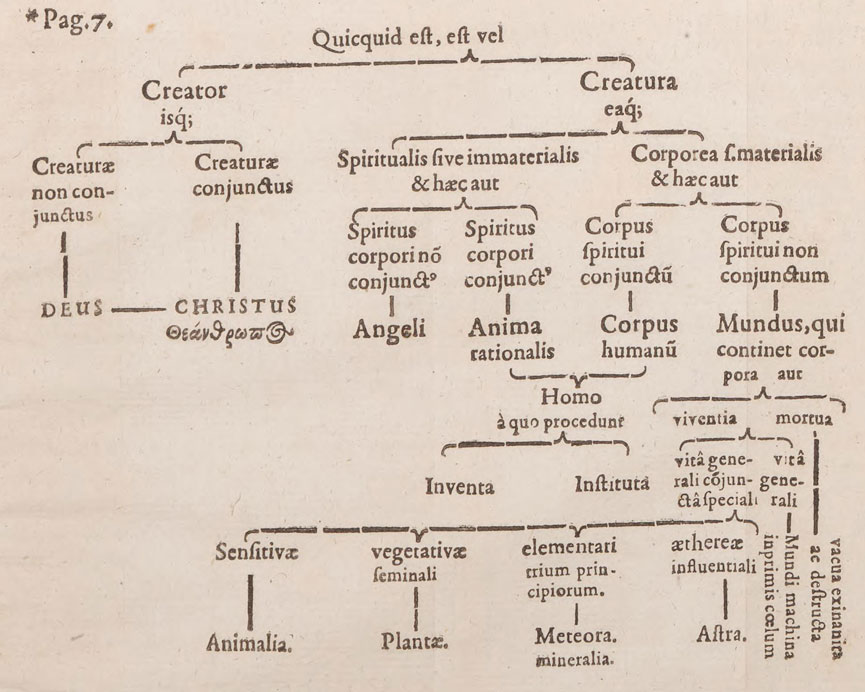
Whatever exists, is either:
Creator
that is:
Unjoined creature
- God
or
Joined creature
- Christ
God-man
Creature
and this is either:
Spiritual, or immaterial, and this either:
Spirit not joined to a body
- Angels
or
Spirit joined to a body
- Rational soul
Corporeal, or material, and this either:
Body joined to spirit
- Human body
or
Body not joined to spirit
- The world, which contains bodies
From the rational soul and the human body comes:
Man
From whom proceed either:
Things invented
or
Things instituted
The things proceeding from man are:
Sensitive
- Animals
Vegetative / seminal
- Plants
Of the elementary principles
- Meteors, minerals
The world contains bodies, and these are either:
Living
or
Dead
Living bodies are either:
Joined to general and special life
- Aethereal / influential bodies
- The stars
or
Joined to general life
- The machine of the world, the heavens and all things
Dead bodies are:
Deprived of life
- Empty elements, and destroyed things resulting from the division of beings, which we give here as varying a little from the Lullian division.
See the diagram.
3. And since everything that is said or denied of any subject is predicated of it either absolutely or relatively, the following border expresses the absolute predicates of things, and the next one the relative predicates, so that there is nothing in the thing itself, nor anything attributed by our mind, which is not included within these compartments.
And indeed we have substituted the number ten in place of Lull’s number nine, with some principles transferred elsewhere and new ones added, which seemed to be lacking.
4. But since these things could seem too general, in order that knowledge of particulars might proceed more skilfully, after the series of virtues and vices there have been placed on the next border a hundred forms, assigned in ten decades according to just as many disciplines. This is not exactly according to the order and prescription of Lull, yet neither is it contrary to his meaning, since the forms of his art are retained either expressly or implicitly, only arranged more conveniently and enlarged with other necessary ones. All of them must be reduced by distinct concepts to the general principles of the Art, and thus applied to the proposed matter.
5. Finally, the last border of the Table supplies the chief factual things, which reasoning would otherwise not know: the history of the world and of its inhabitants, arranged under one hundred names of things, persons, times, and places. Once these are known a little more explicitly, they can be drawn out and adorned at will by the connection of the principles.
6. From these things, since it is now clear that all signs for asking questions, all subjects of the universe, and all predicates of things are proposed in the Lullian art, there should also be no doubt concerning its breadth, by which it embraces everything knowable and offers it to be known by gifted students, provided that they learn to see special things within general things.
Chapter IV.
The combination of the principles.
1. The chief work of the Lullian art is concerned with the combination of the principles, which always produces new and ever new concepts, and supplies to the intellect an unlimited power of knowing and suggests matter for thought, so that there is absolutely nothing which does not lie hidden and does not appear under this combination. Therefore these things must first be learned well.
2. Lull, having successfully accomplished this matter, devised four figures, which must be repeated by us in order.
The first consists of absolute predicates, and any one of them is joined to any other by the reciprocal conversion of terms. For example: “great goodness,” “lasting goodness,” “glorious goodness,” etc.; and reciprocally: “good greatness,” “good duration,” “good glory,” etc.; or in this manner: “in goodness there is greatness,” “in greatness there is goodness,” etc.
The second contains relative predicates, which are to be combined among themselves in the same way. For example: “different order,” “ordered difference,” etc.; “in order there is difference,” “in difference there is order.” “In concord there is no contrariety”; “in contrariety there is no concord,” etc.
The third is made up of absolute and relative predicates, so that these may be predicated of those, and those in turn of these, affirmatively or negatively. For example: “goodness is ordered”; “order is good”; or, “in goodness there is order”; “in order there is goodness,” etc.
The fourth is threefold, of one or the other, or is born from predicates of each kind, and he established such a combination. For example: “goodness is great and lasting”; “goodness is great and differing”; “ordered difference is concordant”; “ordered difference is good,” etc. Or: “in the greatness of goodness there is duration”; “in the difference of order there is concord,” etc.
3. Furthermore, to predicates combined with one another in this way, Lull joins subjects through all the figures. For example: “God is good, great, eternal,” etc.; “God is the God of order, of difference,” etc.; “the goodness of God is great,” etc.; “the goodness of the world is not eternal,” etc.
4. Finally, by adding interrogative signs to subjects or predicates, he produces a new kind of combination. For example: “Whether God exists”; “what God is”; “of what God is”; etc.; “whether goodness is great”; “what differing goodness is,” etc.; “whether the world is eternal,” etc.
5. These various combinations, as I have said, beget various concepts, various questions, and various arguments for proving or disproving, and finally a perfect knowledge of the proposed matter. Hence Lull is almost wholly concerned with properly inculcating this. His Great Art speaks of this, in which, after the four figures have been handed down he teaches how to empty the third, that is, to draw out the implicit combinations; and how to multiply the fourth, that is, to increase it with new combinations; then how to mix the principles with the rules, that is, to join them with predicates and interrogative signs; how to bring subjects to the principles and rules, and also apply forms to them; and finally how to frame and solve combined questions, etc.
Thus you may rightly judge that the nature of any matter whatsoever can be explored by this combinatory device, if it is brought out through the principles and rules of the art.
Chapter V.
A survey of special things in these general things, and of these general things in them.
1. Lull has handed down, in the Great Art, general things concerning any predicate and subject, and likewise concerning most forms, together with questions and answers for each one. For the sake of brevity we refer curious readers to that work; now we shall take pains to indicate briefly what special things ought to be contemplated in these general things. For this very thing is the chief point in the whole art, worthy of having very much study spent upon it.
2. Our Lull treated this matter at length in Part X of the Great Art, which deals with application; but, to confess the truth, he carried it out by so straightened a device that he left scarcely any clear trace of the true method. I think this also happened because men of very sharp judgment have stumbled here in doubt, not understanding in what way the knowledge of general principles leads to the solid investigation of particular things.
3. Here, before all else, we commend especially that gradual ascent and descent so often mentioned by Lull, especially in the exposition of the figures, where he teaches:
First, that each principle is to be considered by itself and in its own most general state.
Second, that one principle is to be contracted to another, and so made subordinate to it.
Third, that this is to be joined to singular things, so that it becomes most particular. For example: under the most general goodness, which is a principle of the Art, you constitute “great goodness,” “lasting goodness,” and so on, as more special things; then under these subordinate things, “great goodness”, great or lasting, of God, of the world, of Peter, and so on. Thus you will descend step by step from the general to the special; and you will ascend again from this to that.
4. Behold the chief foundation of the method; once this has been laid, you can safely proceed to other things. It may seem slight and of little importance, but what it accomplishes I shall teach in a single present example.
You have goodness, greatness, duration, and so on, as most general principles. Contract them, and you have “great lasting goodness,” or “the greatest lasting goodness,” that is, “eternal goodness,” which is more special than goodness, greatness, and duration in general, but more general than any goodness of individual things.
Let the question be formed: “Is there given a goodness so great that it is eternal?” The reasoning of the principles persuades that it must be answered affirmatively. For what is goodness? Goodness is being insofar as it is good. What is greatness? Being insofar as goodness is great. What is eternity? Being insofar as goodness and greatness are eternal.
Here you see most clearly that a goodness is given so great that it is eternal. These are the general things. Now let us descend to special and singular things.
It is asked “Is the world eternal?”
Consider this special question as proposed within the general one, and you will see that the sense is: “Is the goodness of the world so great that it is eternal?”
Contemplate a little through the reasoning of the principles, and you will perceive that you must answer not affirmatively, but negatively. For what is eternally great goodness? It is immense, infinite goodness, admitting evil nowhere and never. Apply this to the world, and you will discern that it does not agree with it, since the world also abounds in evil. Therefore you will pronounce negatively that the world is not eternal.
5. Now it must further be observed that Lull often insists that general forms for example goodness, greatness, and so on contain in their own intrinsic complex three special things: the efficient, the effected, and the act of effecting. For example: the thing making good, the thing made good, and the act of making good; the thing making great, the thing made great, and the act of making great, and so on.
These are most rightly called essential correlatives, intrinsically constituting the forms. And they are so joined together, being related to one another, that it is impossible for one to be removed without the rest perishing at the same time, and without that form itself at last vanishing altogether; since it cannot exist without them. For example, if you remove the thing made great, you also remove the thing making great and the act of making great, since the first cannot stand without these; and thus greatness itself falls, which is nothing without these correlatives.
But note this well here: if you intend to define forms, and likewise any efficacies, essentially, you can enter on no better path than if, proceeding through the correlatives, you say, for example, that goodness is a being or form by which a good thing, that is, the thing making good, acts, by making good, upon the good thing, that is, the thing made good; or, substituting equivalent terms for the sake of preparing a more elegant form: goodness is the being of a formal thing which, having perfection, communicates it to another thing to be produced or perfected, and so on.
And this, indeed, is the second point which must be observed by those who are going to inspect special things in general things.
6. There now follows a third point in this matter, namely the reduction of other terms to the principles of the art. Those who undertake to hunt for special things in general things ought to know this reduction very well, as a matter of great importance. And in my judgment there is one chief reason why even great men even men have pursued the art with great difficulty, consists in this: that they have less skilfully recalled other terms to the Lullian principles, with their concepts confused in a remarkable way; whence it was impossible for them not to go astray.
But so that we may also give counsel to the disciples of the Art in this part, we advise them to weigh well what is said by this or that term, and which and how many concepts of the principles of the Art it involves. For in this way you will easily recognize whether it is general or special, and you will build up the sequence of reasoning.
Chapter VI.
The practice of the Art.
1. We have now given the method and manner of learning and exercising the Art through the benefit of our Table. At the beginning, you should impress upon memory the series of the principles; then you should carefully consider the definitions and the terms reduced to them everywhere; next, you should attempt the combination according to the prescribed rule, and draw out the general questions; finally, you should learn to derive forms in order through the principles and rules, each according to your proposed subject and you will approach the Art by your own effort, lacking a living teacher.
2. With this laid down, you will treat any proposed question in this way: you will seek it in the Table according to all its terms; you will substitute clearer Lullian terms in place of those that are less explicit, so that a more general sense, suited to the Lullian style, may emerge. Then, after the terms have been freed from every ambiguity, you will determine what is properly being asked. Then you will examine their nature through the definitions handed down in the Table, also joining other principles through combination, and their definitions, in order to form new and ever new concepts. Finally, by considering the concord or contrariety of these concepts and terms of the question, and by weighing the force of the interrogative signs, you will discover what must be answered.
3. If you are to pursue the method of demonstration, which is the chief thing in this art, you must consider the cause, constitution, and effect of the matter; and this with the help of the principles, by which you may thus investigate the triple account through because through equivalence; and through because you may complete the proof.
4. The multiplication of reasons toward the same conclusion is placed in the combination and reduction of terms. Therefore, whoever knows this will not be ignorant of that multiplication, especially if he has mastered Lull’s fourth figure and the several thousand chambers of the Great Table that spring from it.
5. The rest will be taught by frequent exercise and by the prudent reading of Lull, whose soul is simplicity descending into the highest subtlety, even to such an extent that it often surely makes doubtful whether it surpasses the very sharp disputations of Plato, Aristotle, and their interpreters.
6. Our Art is very friendly to Plato’s dialogic style, and, clothed in it, it produces its beauty especially well. Yet for that reason it does not shrink from Aristotelian plainness, nor does it reject rhetorical dignity, being by nature suited to sustain any manner of speaking; and it is the most favourable nurse of the arts of disputing and discoursing.
Chapter VII.
Some examples, and first among them this one.
In place of a conclusion, we shall add certain examples which may make our statements and precepts clear. First, in Platonic style, we shall weave this together dialogically in this way:
Question: Whether God exists?
Speakers: the Artist and the Atheist.
Artist: Do you grant that eternity exists?
Atheist: What if I deny it?
Artist: You would also deny that this world exists.
Atheist: I was not going there.
Artist: But the existence of the world demonstrates that eternity exists.
Atheist: How so?
Artist: Either this world existed from eternity, or it began newly, when previously it had not existed. Choose which you wish to assert.
Atheist: Rather the latter, lest by assuming eternity first I should be forced to concede it.
Artist: But in this way also you concede eternity to me.
Atheist: We shall see.
Artist: What, then, do you think this world was before it existed?
Atheist: Nothing.
Artist: Nothing, Therefore, when the world existed, nothing brought forth its own real being.
Atheist: I am stuck.
Artist: Therefore grant that eternity preceded the world newly produced.
Atheist: So that I may not be absurd, I grant it.
Artist: Since you have granted eternity to me, also grant that an eternal being exists.
Atheist: By what argument?
Artist: Do you not see that it is impossible for an entity abstracted from being to be given, and yet that there should not be a being, composed of that entity?
Atheist: I assent.
Artist: Now therefore recognize from this God, that eternal being, which preceded the world newly produced. But let us proceed to other things. You cannot deny that eternity is infinite duration.
Atheist: Nor do I deny it.
Artist: This infinite duration does not lack essential goodness.
Atheist: Good.
Artist: And by communicating itself, it will produce good from eternity into eternity, through an infinitely good duration.
Atheist: If it is good, it acts well; if infinite, infinitely.
Artist: Therefore here you have God: an eternal being, infinitely good, the eternal producer of infinite good. But come, let us go on. Greatness belongs to eternity.
Atheist: So it is.
Artist: And that greatness is immense.
Atheist: I confess it.
Artist: Thus, therefore, to eternal being, immensity being attributed, God will be established for us as immense; and in the same way I shall easily demonstrate that all divine attributes belong to the eternal being.
Atheist: Bring together into a few words the things that remain to be said.
Artist: Since there is given an eternal being, infinitely good, immense, omnipotent, living, wise, willing, true, glorious, which preceded the beginning of the world and of time, will you not be solidly convinced from this that it is truly God?
Atheist: Conquered, I give up.
Chapter VIII.
Second example.
It will prove by Lullian arguments that God is one.
Argument 1. That essence is supremely good which is above every good. Therefore God, supremely good, will be above every good. But if there were now several supremely good essences, God would not be above every good; for above the highest there is nothing higher. From this it is necessarily concluded that God is one in essence.
Argument 2. If there are several gods, there are several infinite essences. For God is an infinite essence. But it is impossible for there to be several infinite essences, for one of them would be outside another. And since “infinite” is said of what cannot be measured, it would follow that the measure of one essence would not measure the other, and thus neither would prevail over the other; for this reason neither would be infinite, since there is nothing outside the infinite. Hence it now follows necessarily that God is one in essence.
Argument 3. In God, goodness, greatness, and eternity are one in essence. Therefore, since divine goodness, because of its highest dignity, does not allow another highest good beside itself, nor does the infinite greatness of God admit another infinite greatness apart from itself, it follows that divine eternity also cannot sustain an equal; from which it becomes clear that there are not several Godheads.
Argument 4. It is impossible for there to be several omnipotent beings. For either the power of one would exceed the power of another, and thus there would not be essentially several omnipotent beings, but only one; or the power of one is not the power of another, and thus the omnipotences are different. But by this reasoning none will be omnipotent, since none can do the things which another can do. Therefore it follows that God is one in essence, etc.
Chapter IX.
Third example.
He will dispute in a friendly way with Father Kircher about Purgatory.
That there is a Purgatory, that is, a certain third place beyond the kingdom of heaven and hell, a receptacle of souls to be purified, the distinguished Kircher tries to show, by the help of the Lullian Art, through the context of Holy Scripture, in the Great Art, volume 2, page 424. Among other things, he argues from the power of Christ’s words:
“Whoever shall speak evil against the Son of Man, it shall be forgiven him; but whoever speaks against the Holy Spirit, it shall not be forgiven him, neither in this age nor in the age to come,”
in this way:
If some sin is given so grave that its remission cannot be obtained in the age to come, therefore there will be some sin less grave, whose remission is granted in the age to come.
He adds: “Hence, by right and deservedly, Augustine, City of God, book 21, chapter 24, and also Saint Gregory and Bernard declare that Purgatory must be understood by this; for if it is not to be understood in the stated sense, why did Christ say this?”
So far Father Kircher.
To this, passing over other things, we answer: the Lullian Art, as the investigator of truth, is so far from establishing Purgatory from Christ’s saying that it rather overturns it. For one may argue to the contrary in Lullian fashion thus:
If Purgatory is granted, then there is granted a retribution for sins which is neither temporal nor eternal; and thus justice lasts neither finitely nor infinitely.
But the latter cannot be; therefore neither can the former.
The major premise is proved: Purgatory is established by its defenders outside this world, and thus outside this age, when they allege for this, with the distinguished Kircher, the cited words of Christ, drawing “the future age” to Purgatory.
Therefore now Purgatory would not be subject to the times of the world, especially because time is defined by the motion of the heavens, by days, nights, hours, and so on; and these do not fall into Purgatory, outside this age. Nor indeed does Purgatory belong to eternity, since it is believed that it will cease. Therefore its punishment will be neither temporal nor eternal; consequently, neither finite nor infinite will be the act of justice inflicting it, which is impossible.
Chapter X.
Fourth example.
Question: Whether the Earth is moved.
Motion, according to Lull’s opinion, belongs to the genus of appetite. Therefore the meaning of the question is:
Whether the earthly globe is carried around in a circle by natural appetite?
Let the proposition be set down: The Earth is moved in a circle. And let it be concluded:
If the Earth is moved in a circle, it is moved thus by natural appetite. But the Earth is not moved thus by natural appetite. Therefore it is not moved in a circle.
The major premise is clear from the nature of the principles of the Art.
The minor premise is proved: natural appetite is rooted in the substance of the Earth; and if this appetite is to be carried in a circle, then every part of the Earth, which is of the same substance as the whole, would be carried in a circle by the impulse of Nature. But this does not happen, as we learn by experience. Therefore the Earth is not moved circularly by natural appetite.
But let it be supposed that this circular motion, which is indeed perpetual, comes to the Earth from elsewhere, and that it is beyond, or contrary to, its natural appetite; then you will be able to argue:
If the Earth is moved incessantly beyond and against its own natural appetite, then it plainly lacks glory, or natural rest; and consequently it lacks essence, and so it is a non-being. But this is absurd. Therefore so is the former.
The consequence is proved: glory is an essential principle; when it is lacking, goodness is lacking, greatness is lacking, and all the other things are lacking. Consequently the essence itself of the thing is lacking, which is good, great, and glorious.
Therefore, since the globe of the Earth is carried in a circle neither by the appetite of nature nor against appetite, it is clear that there is no circular motion of it.
Aristotle proves in this way that the Earth is not moved in a circle, in Book 2 of On the Heavens, chapter 14:
If the Earth is moved in a circle, the order of the world cannot be perpetual. But according to the Timaeus, the order of the world is perpetual. Therefore the Earth is not moved in a circle.
The major premise is proved: the motion of the Earth in a circle, belonging to the order of the world, would be violent. But nothing violent is perpetual.
Otherwise:
In simple bodies, the motion of the parts and of the whole is the same. But the individual parts of the Earth are carried by a straight motion toward the middle of the universe, and not in a circle. Therefore the whole Earth also, if it is moved from its place, would be carried straight toward the middle of the universe, not in a circle.
Let these Aristotelian arguments be compared with the Lullian ones, and let judgment be made whether they agree, and which ones press more strongly.
Let these examples suffice for the present to illustrate the Art. If someone has properly weighed them against our Table, he will perhaps gain more progress from it in a shorter time than if, wandering through the vast volumes of commentators, he wished to spend his labour there.
Clearer things with God and with time.