The Ark of the Most Skillful Secret, concerning the highest mysteries of Nature - Arca Arcani Artificiosissimi De Summis Naturae Mysteriis
Listen Audio Book Study the Art with Us Buy me CoffeeThe Ark of the Most Skillful Secret, concerning the highest mysteries of Nature, by Johannes Grasseus, otherwise Chortalasseus, Doctor of Laws, Syndic of the city of Strasbourg, and distinguished philosopher of our age,
Arca Arcani Artificiosissimi De Summis Naturae Mysteriis
constructed
from his Greater and Lesser Rosary, and from his Physical Round of Nature described through the Cabalistic-Chemical Vision.
For the benefit of the Sons of the Art, and as a testimony to the truth of the wondrous works of God.
Blessing be from Him who is the Beginning
and the End.
Contents:
1. First Part
2. The Lily among Thorns - Lilium Inter Spinas
3. The Practice of the Author Johannes Grasseus, Doctor of Both Laws, Syndic of Strasbourg, which he called Chortalasseum.
4. The Physical Round of Nature, by the Cabalistic-Chemical Vision
Translated to English from the book:
Jo. Jacobi Mangeti ... Bibliotheca chemica curiosa, seu rerum ad alchemiam pertinentium thesaurus instructissimus: quo non tantum artis auriferae ... verum etiam tractatus omnes virorum ... ad quorum omnium illustrationem additae sunt quamplurimae figurae aeneae. Tomus primus [-secundus] / Tomus secundus. - 1702
The holy Apostle James says, chapter 1: “Every good gift and every perfect gift comes down from above, from the Father of lights, with whom there is no change nor shadow of alteration.”
Paul likewise says, 1 Cor. 3: “I planted, Apollo watered, but God gave the increase.”
Alanus says: “Son Philopon, give your whole self to God and to the Art, and this will profit you from God, who is the source of all things, and from the Art, if you possess it.”
Alphidius: “My son, if you desire to attain the Art, first let there not be lacking in you a pure mind and heart toward God, and let them be pleasing; if you see God favorable and your mind open to good will, you ought to give thanks for the grace that you are permitted to know such an art.”
Dionysius Zacharias, fol. 69: “This you ought to know first of all: do not impatiently oppose the sayings of the philosophers, but rather put your hand to the work, bringing with you understanding and grace from God; for this art is acquired neither by fortune nor by chance, but by effort and by proper means. Means too are then to be employed.”
King Hermes and philosopher, in the Book of the Unity of Essence: “Direct your whole mind to God, who is one, and He will suddenly raise up the wings of your intellect; and brighter rays and innumerable flashes of His fair splendors will shine into you, and another marvelous light beyond all lights, and the actions of the world hitherto hidden, will appear to you before the time of your death, and you will behold your glorified body.
You will renew your soul and obtain an understanding of the kingdom of all kings and of God, and you will celebrate with beautiful hymns the glory of the most lovely God and the Word of the Father, whom He has loved so exceedingly; and with your heart and your whole soul you will adore and love Him, and by admiring, glorifying, and praising so great a treasure, you will at length become a partaker of the divine communion and, through abundant grace, bear fruits in abundance. To Him be praise and honor forever and ever. Amen.”
I have inserted these testimonies here at the threshold, not as though I trusted solely in my own endeavor, whatever I have produced by means of it. For before all things they are to be referred to God, since the human mind is His gift, and since God created the soul of man as the mirror of things above and below, in which the Divine Essence is discerned. This matter is the Mercury of life, without which no herb is green, nor has any power. See Clangor: Buc., fol. 475, princ. fol. 468, at the end fol. 247.
Therefore, my friend and brother in Jesus Christ, whoever you may be, if moved by Christian charity and revering God, you read the writings of the philosophers, not of the sophists, and with patient labor behold marvelous things, then, if you are such a one, do not be envious, and do not wish me, treading silently with modest feet, to be without your divine trust. Faithfully cherish our friendship, if you do not wish to be deprived of your little secret birds. Therefore I have undertaken this work for you, whose reason in these newest times is restored to its cause.
The most mighty and most wise King Geber, chapter 1, part 1, of the Sum of Perfection, writes thus: “Whoever does not understand the principles or causes of metallic production is excluded from our art, because he does not have the radical foundation upon which he may build the certainty of his undertaking.”
This the most renowned philosopher Arnold of Villa Nova confirms with very frequent words: “He who does not understand the simple and natural root of minerals and their composition, does not understand and does not know the natural principles of metallic production; and so it follows that he is ignorant even of the art itself.” As the most practical philosopher and great master Aristotle says, he does not attain the end of the work.
Therefore these sayings of wise men, set down as foundations and admonitions for our purpose, make [the point clear]. For in that place he speaks of the blessed Stone’s our matter, as Rosarius Major, fol. 219, explains: namely, that every error has arisen from this, because the true origin and foundation of the Stone is sought in the very Stone itself and kept hidden; although whoever does not know the true principle never arrives at the proper end. For if a man seeks what is not so, he will find what is false and will be ignorant of what is true.
Hence those who seek the true foundation elsewhere are always held in doubt, nor can God’s custom teach them by any other means.
Therefore, since all philosophers, each and every one who desired to prepare the mystery of this divine art, generally advise that before all things one should attend to the fire, how nature makes use of it, from what natural things it generates and produces the metallic root, and how the artist ought to imitate nature as her ape: for the true parts of the Art are to have already prepared in due order its essential principles in the fundamental source, which nature herself has made; nor indeed should the artist make them outside of her, as we say, since nature is not a teacher but a servant, and ought to minister and assist him.
For nature in the earth ought no more to separate the pure from the impure than the artist makes outside the earth, unless by the necessary and stinking sulphur of fetid nastiness pressed down into the kernel of the liver, as appears in its consequences. Therefore this ought to be observed here from the admonitions of the philosophers, that when nature is said to generate metals in the earth, one must imitate her completely in the same manner. All the philosophers indeed cry out that nature is fire, but each thing produces a like thing, whereas the contrary has another mode.
Hence King Hermes, philosopher, says: “No thing foreign, which is not from the matter of metals themselves or compounded from it, can have power for making or transmuting metals.”
Likewise Count Bernard testifies, fol. 20: “Every sublimable thing has its own proper sulphur, and from this it is nourished, and by the sulphur of the female sulphur it is multiplied; and not by anything else.” And fol. 21: “Likewise metals are multiplied from their own female sulphur.”
Concerning the most artful secret in general.
Here I have judged that the whole matter should be treated generally, before I speak of this thing and of its requisite matters in particular, and afterward in special form according to the plan of my undertaking. For thus from general principles the more special things are more easily understood.
Now in this secret divine and in the summary of the description of this art which is the mystery of natural philosophy, chiefly three things must be considered: first, the subject; then, as happy matter, the chaos of the philosophers, called impure, which nature has brought forth for metallic formation, yet has left impure, which the artist should purify and cleanse by his labor. For just as external heat works together with internal heat, and the internal metallic heat flies off, nor can it be acquired in bodies, because it can be seen in all metals, and all those things are dead then, because their vital fire has been taken away in the fire, whence the weak and feeble are outside their own bounds.
The whole first operation of fire, therefore, or composition, is nothing else than that the sublimated matter be made subject to sublimation, as we say, since Hermes says that spirit makes the spirit volatile.
On this account the philosophers, through imperfection, distinguish various heads from that action, so that purification, sublimation, solution, cleansing, subtilization which are all nothing else in the foundation than when the fire is made purer and the body in the philosophers’ water is reduced to its metallic nature and dissolved serve for the external mutation, beauty, purity, virtue, and excellence of the body (for they previously had separated from their spirit what gold and silver had distinctively) until they surpass common gold and silver.
When Mercury, purified in this way, has been composed with its sulphur in a proportion suitable to metals, then its Mercury or the earth joined with it takes the place of the earth in watery subtilization, since in truth that earth, through the nature and properties of water, absorbs and lives.
Therefore this earth, ascending and descending in the nearest water of the philosophers, and striving to become thick and fixed in all kinds of fire, can remain permanent in every sort of flame; because then it becomes, since it receives its own primary properties. For indeed a very great part of the mysteries consists in the solution of the body in water (from which every possible composition is afterward made).
The philosophers have called this putrefaction the corruption of the new crow, the end of which is the circular transmutation of metals, as Zacharias says, fol. 78. Moreover, the corruption of one is the generation of another, chiefly because by such putrefaction or corruption, generation and smoke alike draw from one and the same principle and origin. All things are shown from one root or arise from one root.
The Stone is indeed born from the Stone, yet nevertheless not from it in the way many of our gold-practitioners have experienced. For our gold, composed by conjunction, is formed in the womb of Mercury. Then it becomes the proximate matter from so precious a sulphur.
The proximate matter namely when nature first lifts the required parts into the earth and the natural active moisture, which from both sides, or from each parent in the composition and conjugal union of them, is raised aloft: for this radical moisture alone, or the vapor of body and spirit, are the essential parts of the Stone. Add that from two natures a third cannot be born unless the operation of agent and patient be joined together.
From this there follows without any doubt that the subject or matter of the Elixir, or of the highest Medicine, which can transmute imperfect metals and make them perfect, must be extracted and brought forth from simple things, which derive their origin from the fountains and springs of the first minerals. Nor can this subject be drawn forth from any thing in the whole world other than from the mineral matter alone from which all metals arise. But from what thing metals have their principle will become clear in the special account of the generation of metals.
All the philosophers’ consensus and voluntary resolve is this, and their deepest inward intention: that simple elements be taken, mixed, and joined with a mild moist heat, so that from another there may be made, at the proper moment, the work already often spoken of.
“Take therefore the purified, very clear, and nearest matters, the best, both metallic and exalted, distilled with perpetual sharp vinegar and reduced to their roots, from which those roots are prepared; and when by the invention of one thing and the rebuilding of the matter they are united, then the philosophers speak of sublimations and of their special application.”
Whoever therefore desires to prepare the work with skill and fruit must first know the root of minerals. For from this indeed he ought to perfect the smoky work, because the knowledge of the origin of bodies and of the nature and efficacy of that thing renders this matter easy.
Hence the medicine of tincture, which is drawn from things probable because nature first leads them into metallic form, and because they agree with nature and, by fitting conformity, can be conveniently and in the first place joined to it, as is sufficiently and clearly shown in the philosophers’ sayings that follow.
Therefore no tincture can be found either in waters or in bodies or in salts and natural spirits, because one nature cannot complete the properties of one body, except that which the aforesaid tincture has from the body for difficulty or from the spirits for easier and more proximate operation, not however for the perfect transmutation of imperfect bodies. For our white and red tincture (by reason of the ferment appropriate to both kinds, which in our Mercury is added from its own root and foundation) is of this sort.
Hence Morienus says that the white work and likewise the red work must be perfected by one thing alone, and that this one Stone is enough for both operations. For by a long decoction in one vessel the white stone, fixed in its combustible matter, must be slowly and gradually digested and perfected; inwardly chiefly observing the form of the great Elixir in potency and virtue, proximate to the matter in which that virtue is planted by nature.
Therefore note this sign: that in the second operation no foreign thing is added to the powders of the Stone when they are conjoined. Zacharias, fol. 103: “Nothing suits this thing better than that which is near to it and of its own nature and affinity. And therefore if anything is to be added to the former operation, that is not what you should understand, lest the form and operation be hindered.
For by no means can fire be generated from snow, nor can anything other than its own nature and properties receive the mutation in its proper nature. Nature does not rejoice in her own nature unless she delights in and has appetite for her own nature as proper to herself.”
Nature is accustomed to complete, and by this means to conjoin, rule, strengthen, generate, promote, join, reclaim, retain, renew, increase, whiten, redden, and exalt her proper nature and substance; which Bernard Count Trevisan and the other philosophers testify.
Therefore it is necessary that the crude, impure, and earthly parts of the element by which they are burnt and corrupted be completely removed by preparation and separation, and that the pure sublimated matter alone remain wholly. Otherwise the metallic body cannot be released from that impurity, which prevents it from being raised into a higher virtue and dissolved.
It is therefore necessary that the metallic form be removed by slow digestion, solution, and coagulation, as far as its being, namely as far as its essence, which Mercury possesses, and as far as the subtle and most noble metallic matter, be converted into such a pure metallic form.
This is nothing else than pure and incombustible sulphur, which nourishes that fire which is pure and natural heat, into whose humidity it is suffused and prepared by very gentle means, having its own properties, so that the parts to be joined together may be made natural.
Thus it acquires waters in itself by the smallest means, and by inseparable permission and union it is made dense, digests contraries, confirms what is proper to itself, and turns the unsuitable into usefulness.
This is that caution which the philosophers urge: that the outer be turned into the inner, and the inner into the outer, that by art we may have the thing, that is, when the crude earthly combustible parts have been burnt away, the pure parts appear in the external matter, and that they may be removed by the singular industry of art.
And from the interior, clear and pure, from the principle and first root, nature once left free through the separation of many contrary things is at length brought forth. For the interior had been hidden away.
And what appears outwardly is, as it were, useless and a rejection. This operation is easily effected by the guidance of art, because any thing is always nourished by its own like and is strengthened by its opposite. For the one process of contrary things, since they are opposed to one another, is accomplished and brought out the more quickly and the more clearly.
The art of philosophy can have no one peculiar way, as many suppose, by which a new gold or silver may be made in any manner whatever, since art often thinks to generate gold from common gold. The artist must do nothing else than, by the influence of Sun and Moon, as the philosophers of Sun and Moon say, elicit from his own Mercury the proportion of the work, and move nature in the solution of the composite, and by artificial fire incite the internal fire and recall life from death.
In the artificial decoction of the imperfect body the work is then accomplished, when external moving heat is preserved in such proportion that the power and virtue of the internal heat either suffer no defect or else something superfluous, whence we call it the white sulphur.
For if the least heat is wanting, the smoke of life flies away and the body, left dead, has, through such diminution, a lesser just heat, and by vegetation does not receive the life of motion. But if the smoke is set on fire and pure sulphureous fire and incombustibles obtain fixation, then light can rightly be called the splendor and form of metals, which perfects all bodies, which, unless the artist apprehends it, by multiplying error, before he attains the top of the art, perishes.
For man does not come to confession unless the hidden be made manifest and the elements be converted.
Hence Hermes says: “It is the hidden spirit which vivifies dead metals, and because it is natural fire, it cannot be seen unless it be manifested and indicated by the Spirit of God or by a living man.”
Therefore the error of art proceeds from this, because only one way leads to the art.
For whatever is good, says Rosarius, ought to be prepared by one way only, and although one way has many circumstances and intermediate stages before the composition, yet by one letter, and after the conjunction, nature ought again to be led to its end and to the goal appointed by God. The more simply the artist proceeds in this work, the better and more safely he acts.
For nature acts simply and in the straight way, which the artist ought to imitate. But the contrary is evil, if he suffers error by a multiplied way and without end. For first an unsuitable salt is introduced into this work; many errors and inconveniences also arise from a foreign and contrary thing, because an operation is undertaken against nature, which each man ought to avoid, since he labors in vanity.
The perfect Elixir has the power to tinge perfect metals with a white tincture unto perfection; and by a most powerful form and by the operation of a single thing alone, when the matter of imperfect metals, known and proximate in its smoke, is joined and united with it, it fixes and perfects them, and it tinges and burns them by the greatest and most powerful fire so as to remain fixed and permanent.
This tincture is the true one, both of men and of metals: by this indeed metals are transmuted, and men are exhilarated and renewed. Nor can God make any other medicine, because by the same means and from things of the same kind the infirmities of the human body may be driven away and man preserved in perfect health. Into the knowledge of this medicine very few physicians of this age have come, although many inquire after the true thing by mere rumor and are persuaded by it.
It is not convenient to work upon our matter before it has been prepared, as was said above. For preparation is the secret of our art. But this preparation belongs to the active thing, by which the matter is led to the summit of perfection and to the end of smoke. What is led to completion by the aforesaid operation receives light and conjoined heat. For if heat is lacking, then both motion and activity lie hidden in that thing, as may be seen in eggs chilled by birds withdrawn.
And because everything natural has its own artificial operation, it has and ought to have a duration of time, by which in a short interval of time the appointed end of smoke is attained in due order; nor can any thing work further when its form of smoke has been completed. Therefore, when the aforesaid form has been completed, then motion itself and the active thing are complete; thus the active thing or working smoke is separated from matter after the thing has been brought into potency.
Therefore every body must in the same way be prepared and purified from its crudeness and impurity by sublimation, until the spirit, the soul, and the body themselves are fixed, and thus become permanent along with fixed bodies.
For the ancients say: unless you make bodies non-bodies and spiritual, and spirits corporeal, you will have no way in this art toward honor. What else is this, than that what is spirit be made dense and light, and what is light be made spirit and weighty?
Hence the great King Hermes says: “The crude must be made subtil, and the spirit restored.” One thing is easily judged from another: that which is tenuous and light, and fiery, since it is both weight and crude, requires that which is to descend by weight, unless first it be joined with living things; and conversely, things turned toward the upper regions are, in their foundations, held by the lower, unless by the force of the heavier and cruder parts.
For the body is not without spirit, but spirit is dissolved in the body. Thus body and spirit act and suffer mutually upon one another; it is fitting that bodies first be fixed and volatile in just weight and wisely composed, yet on this condition, that spirits first, by sublimation, be rendered more subtile by the grade of smoke and by fire than by solution and repeated coagulation, and that such a mixture be made as is of fire with water, or of water with fire, whose union is so great that it can be separated by no violent fire. The artist ought to have a good knowledge of the grade of fire, how the rule of fire is to be applied from the beginning to the end of the work, lest he labor in vain concerning it, of which we now speak.
As to projection, all Magi and philosophers unanimously teach us that no projection can be made upon any imperfect metal unless it first be purified, incerated, and reduced to smoke; and that no increase must be made in the tincture itself, since the smoke of sulphur is hindered by accidental causes, but rather that some little draught be prudently administered to the metal.
For the whole intention and direct aim of the art is that the perfection of imperfect metals should proceed by the tincture of some metal of its own kind (for all metals are extracted from a metallic root and body), and not indeed from other things, except those which derive their origin from purest sulphur and Mercury as substances.
This indeed can be found and demonstrated in all metals, because in all metals it can be shown that their first matter is one and the same in virtue, and that the transmutation of one into another is therefore easier. Yet a certain difference is found in the purification and digestion of some, since one is more, another less purified by nature, digested, and cooked.
Hence, when some metal must be purged and, if not sufficiently digested, must be more fully digested, then all accidental and impure parts are reduced, so that by the grades of preparation they are separated from it, and its pure substantial part remains, which by itself is fit, and is able by practice and by transmutation of another metal’s smoke to form and perfect that metal. Thus by the operations of things the smoke is perfected in prepared and patient subjects.
Moreover, it must be observed that in that thing three requisites were necessary for the perfection of the Stone, in which the whole mastery of the art and the whole power are rightly and suitably prepared.
The first is Sol, which in itself contains the color of the red sulphur, and is red incombustible sulphur.
The second is Luna, or pure white and incombustible sulphur, dominating the sulphur. This is explained in Clangor Buccinae, fol. 484, in the chapter on the Moon’s fugitive sulphur, and the Stone, in which our Mercury is contained. In it is found both natures, white and red. And this is the foundation of the whole art, in which our Mercury is the earth, whatever it may produce in other metals.
The third is the Stone, which is the mediator between the two foregoing, and contains the nature of both in its enclosure. For the Stone of Mercury embraces both natures, as has been said.
But these metallic species were hidden from the ignorant and unworthy, lest they should err blindly and invisibly in regard to this mystery, because the fire of the thing was not shown to them, but remained hidden from them; therefore Sol and Luna, being one body, must be reduced by the artist, according to his will, to their smoke, which lives from eternity in itself.
For this smoke is given by almighty God as temporal to man, and is ruled by His hand, nor does it appear to everyone that wills; although sometimes it is manifested by the acumen of the spirit, by devout prayers, diligence, and continual cultivation and meditation, or by faithful imagination and manifestation in a dream.
Thus that good which by the grace of God one has well merited in part, is without doubt at last conferred upon the diligent minister of God, who goes forth toward the praise of God and is inflamed with a right desire, that he may keep his life more uprightly and according to God’s plan. For many are called to this office, but in me, by further grace, various manifestations have been bestowed.
To God alone be thanks for so many wonderful and continued graces. And whoever has read the old books and the right intellect of the wise, and in them has rightly understood the methodical theory and diligently searched out the principles and mysteries of this art, will find it manifest, not hidden, and will appear to himself not in a counterfeit but in truth.
May the eternal God, by His good gift, grant to him also the proximate faculty of knowing His name, and may the Christian Church use that man to the benefit of itself and of its neighbors.
Amen.
On the Special Foundation of the Secret
Now the principal points follow, in which the true foundation is manifested, by which one must proceed to the smoke. This is easy, and not difficult, although it is otherwise thought. For up to this point the whole matter has been treated hitherto in a general way out of general necessity; now a special and fundamental proof of it with instruction is required.
Therefore, first the generation of minerals and of metals must necessarily be set forth, from which, by what follows, the true matter and subject of the Philosophical Stone, together with its surrounding requisites and all things depending upon them, are declared. For this matter must chiefly be described and set out from these things: what in particular is generated from matter in the womb of the earth, and what among metals and other things takes its origin there, which every true philosopher and artist is bound to know. All philosophers indeed cry out that nature is fire.
Before, however, I begin to explain this, the philosophers have divided mineral things into a threefold class. From these things mineral major things, namely metals, are made, which, being still in their Chaos and in their hidden roots, are afterwards brought to fruitfulness by Theophrastus in the workshop of nature; and thus, by the force of fire, are matured and led into metal.
The middle mineral things are marcasites and all other things in which some metallic splendor can be seen, but they are not yet metal, although after a long time they lie hidden in the earth, nor are they perfected unless they receive the principle of sulphur and mercury from those things from which they have taken their principle.
The third class, however, is called defective things. Of the lesser kinds there are mineralia minora, false stones, such as alum, nitre, and every sort of earth in which no metallic form or splendor can be observed. This distinction was necessary on account of the nature of minerals and because of the common use of the name.
Now it follows that an explanation of the generation of metals is necessary, whose imitator the artist ought to be, since every thing produces its like, which appears in all living things.
Hence it follows that metals have a root, matter, and foundation from which they are made; otherwise they would not be homogeneous or of one blood. Experience and the philosophers testify to this.
For there is no metal, except that before it was lead; every silver was previously lead; every gold was first silver or lead, as Count Trevisan teaches, fol. 3122, concerning the generation of metals, saying that from prime lead, as he says, first silver, then copper, finally iron and gold are generated, because nature only makes copper and iron when the impurity of the former has induced the cause, as in a generation of waters; and in this one should trust the doctrine of the paragraph cited above.
Dionysius Zacharias also teaches this, fol. 92, by saying that from lead, when well cooked and matured into open metalline subtility, there is found in the form of the immature mineral of lead a good minute silver in the same place, or a silver-colored body infused and quadrangularly digested by furnaces; and thus good silver is dug out in the same place.
Marvelous indeed do these things appear, because lead was previously silver, but lead again seems rather metal itself yet this is not to be understood otherwise, nor are the sayings to be rejected, but rather nature, with time, has come forth from impurity, as experience itself has shown. Likewise internal Mercury, salt, and the sulphur of Saturn, as regards beauty, purity, and goodness, exceed those of Luna and Sol, as will be shown below.
But that all metals derive their origin from one root, the true philosophers, who were possessors of the Stone, attest and abundantly declare; and in this matter greater faith must be given to the Magi and philosophers than to the logicians and, as is often believed, to the artificers.
For the Magi and philosophers are to be trusted in this matter, as Rex Geber and Clangor Buccinae say, fol. 473: “Concerning the second truth of sulphur and its multiplication, various matter proceeds in the earth; for their first matter is one and the same, nor do metals differ, except accidentally, by a condition of temperate or intemperate heat and sulphur, with which they have been endowed in the womb of the earth.”
Therefore the author of the philosophers’ Turba also agrees with this. As to how this is to be understood, in the chapter De metallis, how nature is delighted by a compounded thing, it is said.
Turba, Ph. fol. 576, says that the philosophers have had sublimations and coagulations, as the lower bodies of the planets, when by their own force they were able to be joined in the firmament, in external happy splendor, light, and purity, which was even then as much as possible.
This is so, because in the foundations of the womb metallic bodies exhibited their own proper great or gentle coction of interior life, and because it is one and the same origin and principle of Mercury. This is the reason why the philosophers’ Turba, fol. 610, says that Mercury does not will all metals to be one.
Hence the philosophers use plurality, when they say: “Metals, metals, metals”; when they ought to say “one metal,” or “from this metal.” Indeed, they always speak thus: “This metal, from metals, of metals,” yet not to the point of confusion. Bernardus also says in a parable, and the others say the same, that all metals are from one fountain, that is, from Mercury; but they have not all deserved equal excellence, as appears.
It would be too long to bring forward all the authorities and proofs. Therefore let the reader inquire into the passages cited: Trevisan, fol. 44; Flamel, fol. 119 at the end; Arnold, in Rosarius, fol. 399 and fol. 411; Master Degenhardus, in his treatise on the Stone, fol. 116; Hollandus, in the vegetable book, point of Saturn, fol. 112; Bernhardus Agn., fol. 29; Turba, fol. 277; Clangor Buccinae, fol. 437; B. Agn., fol. 109; Turba, 117. The second [truth] has these testimonies. The thing itself, in truth, thus certainly has it.
Now it must be said from what thing and by what means nature generates metal in the womb of the earth. It must be known, therefore, that nature has led into the earth two things and veins which distill certain waters, both clear and turbid. In metals, however, not even temperate waters are perceived, but false sharp waters are found to be distilled.
Therefore, while those waters distill, for everything heavy descends downward, sulphureous vapors ascend from the center of the earth to meet them. If therefore those waters are false yet pure and clear, and the sulphureous vapors are pure, and the metals are impregnated by their meeting, nature generates something pure; but if purity is lacking, it generates something impure because nature, in perfecting, often arrives at perfection after a thousand years, if either because of the impurity of false water, or because of the impurity of impure sulphur vapors.
When these two are enclosed together in lax and loose places, then from these there arises a moist spirit and a thick vaporous grease by the operation of natural heat, which takes its seat in a dry place (or, as others say, in the point of fire), and from that vapor a mucilaginous and unctuous matter is taken in the inward parts of the earth, which Mathesius GUR calls white butter, because butter may be spread and poured forth, and because it lies hidden above the earth and can be handled. They have called this matter GUR; the Sophists can scarcely ever discover it, though they can do no other than prepare it, because they are ignorant of the nature and intention of the fire. Nor indeed can marcasite be made in any other way, and likewise metal.
This matter can afterwards, by long, gentle, and vaporous coction of nature, be converted into metallic form and into its mass, and its first metallic form is leaden matter, which always contains a grain of fixed silver or of Luna, or of Sol hidden within it, which grows inwardly and receives increase, and is brought to the perfection proper to Luna or Sol.
Hence Flamel, fol. 118, says: “Those things are seen in the philosophical Saturn, in which nothing of lead is found, from which a grain of silver or gold cannot be extracted.”
Count Trevisan likewise sufficiently testifies the same, fol. 31 and 32, where he sets metals in the order of their generation and assigns lead the first place, but not the second, as may be seen in the books of the philosophers referred to there.
Now since my intention is to prove the generation of metals to myself, as was said above, I refer to Clangor Buccinae, fol. 437. For every hour metals are compounded from Mercury and sulphur and are converted in the earth into substance.
From these two, a subtle and pure vapor flees forth and by the benefit of heat generates metals, which in the pores of the earth are digested by this heat and cooked, until that matter loses its terrestrial substance and nature and at last acquires fixation. In this way (as is the abiding dwelling-place in the workshop of nature) it matures into metallic nature. The most practical philosopher Flamel writes this, fol. 152. It is certain that no foreign thing can perfect and transmute imperfect metals.
Hence they themselves also ought deservedly to be transmuted, who in this art endeavor to effect anything from animals or vegetables, since they ought to have only mineral things joined by kinship of nature. For from these two alone, sulphur and Mercury, all metals are generated.
Nor indeed ought this to seem doubtful here, that from two things, sulphur and Mercury, this is firmly and without omission so. For in Mercurial water salt is hidden, and by an easy operation that water can be converted into the salt of metals, and near salt into water. Besides, false opinion must be removed: that metals are generated from a vitrified water and sulphureous vapor.
Therefore see on this matter Semita Semitae in the Turba, fol. 473, where it is taught: “Attend and understand: Mercury, the son of all imperfect metals in the womb of the earth, is cooked and digested by sulphureous heat and vapor, and by reason of the sulphureous vapor one is fixed, and from these metals are generated whether pure or impure although their first matter is one and the same; and for this reason they differ only in that one is cooked more or less than another, and is advanced more or less by sulphureous vapor. By this reasoning they have their generation, in which all philosophers agree.”
It would be too long to cite the very many testimonies of the philosophers confirming this agreement, since all agree in this matter, as may be seen in Bernard in the passages cited, and likewise in the Turba, fol. 495, 556, 476; Flamel, fol. 183; Clangor Buccinae, fol. 473; Albertus, in his Verbum abbreviatum, fol. 569, at the end, and fol. 31, 32, 40, 44; Master Degenhardus, fol. 122; Richardus, fol. 127; Rosinum, fol. 278; Arnold, in the same, fol. 475, at the end; Turba, 138, 159, 160; Flamel, fol. 152.
In the same places all testify: spirit, soul, sulphur, and Mercury. In this Hermetic Antimony, concerning the metals and the Philosophers’ Stone, it is said that all metals come from these things. And whoever has the secret of the philosophers and of all the ancients about the metals will find, from the agreement of all their opinions, that all metals are generated from sulphur and Mercury, as is clear from the matter itself and from certainty.
Since, therefore, I have sufficiently declared and proved the mode, place, and properties from which nature generates metals, and what every artist must know about them, it follows that I must now explain the true and right matter, and that what still remains inwardly hidden in nature ought to be sought and brought forth by imitation of nature. For in this work every flesh and every strange essence and edifice are lacking.
Here, however, someone may object and say: “Indeed the matter has been indicated and can now be extracted, if this is the true matter.” And it may also be so, if metals can be multiplied by that which belongs to them. But because many have erred in this question from too broad an explanation of the matter, by God’s help and on the foundations already laid, we wish first to declare and demonstrate that foundation.
The most wise Arnold of Villanova, in the Flos Florum, sets down this invincible argument for the proof in these words: “Whatever grows increases from that which it saw in other things. If therefore metals grow, it follows that they can also be multiplied by another.”
And this is confirmed by experience concerning the aforesaid things, namely that in the mineral pit, if the earth be watered again, they commit themselves to growth and nature. To this sacred page agrees. For almighty God Himself in the work of creation created all things capable of multiplication by His word, saying in Genesis 1: ‘Increase and multiply.’ Whatever therefore is of a like nature is multiplied in like things, from which no one ought to doubt that the Philosophers’ Stone also is multiplied.”
Dionysius, fol. 78, writes thus: “Whatever belongs to perfection is predestined, and by coction the defect of the imperfect is manifested, yet by sulphureous coction it is led to perfection. For imperfect metals are led to perfection by a most perfect coction.”
Therefore, even by continuous coction, the individual is led to perfection and to a profound digestion. This argument chiefly pertains to our purpose, since that thing which in nature itself was perfect was produced, and whatever defect it had, as the artist by purgations and coctions supplied that defect.
The Turba likewise confirms the certainty of this argument concerning transmutations, that is, concerning tinctures. On this matter Aristotle, book 4 of the Meteorologica, and Zacharias, fol. 79, and Count Bernard of Treviso, and Albertus Magnus, and Avicenna, say this: “No alchemy can transmute metals among themselves unless it first reduce them into first matter.
But the reduction into first matter is possible and easy, whence transmutation also is possible and easy.” Since therefore concerning reduction into matter I have now added the first things here, let my Rosaries likewise, and my treatises concerning this matter, suffice, and those of others of the books of other philosophers are referred to there; to those I refer you, but especially to Count Bernard, fols. 17, 19.
This doctrine is certainly worthy of special note. Many excellent men in this matter, erring, think that they have the first matter, when they have the philosophical Mercury or the salt of metals. For the first matter is not yet made from first matter, with the conjunction of man and woman.
Count Bernard says this, fol. 21, and again fol. 22, at the beginning, where he says: “Then at last, not before, the first matter is said to be made.”
Hence it is evident that this is understood of all the metals, as may be seen in the Turba, fols. 415, 394. For before all things it belongs to nature, and from good grounds, to animals and vegetables as to things foreign and works contrary and useless to be rejected: nor indeed should our subject be rightly set among minerals, since all metals in the mineral vein from their own smoke are brought forth through the middle matter and are purged, until at last they are thickened and in no way are drawn forth by the smoke itself.
Now since, as was said above, mineral things are threefold major, middle, and minor it is asked from which of these the matter of our thing ought to be drawn, before I come to the thing itself, since by our matter or metallic mine the metallic thing and its true course must be demonstrated and proved, because every thing produces its like, and every like thing ought to be finitely related, whereas the contrary ought not. The philosophers speak of it in various ways by true naming and description.
Flamel speaks of these things, fol. 152, at the end, and says this chiefly must be hidden: that the matter of the Stone must be made from fire, partly hidden, partly manifest; partly from mean matter, and as it were from the midst of impurity; and in many places he depends on this point. Clangor Buccinae, fol. 428, and the two Tractatus from his book on operations, make this clear.
See also Arnold of Villanova in the Rosarium, fol. 404; likewise Zacharias, fols. 43, 91, 92, 150. “There are,” he says, “certain minerals in nature, which by an operation of this sort, when they have been purified, cooked, and digested, become more suitable and better fitted for their neighboring things, as you too, friend, will know. For when nature has done this, God says to me that I have not labored in vain.”
Besides, this too should be considered, that from all metals nothing can be made except the philosophers’ Stone, especially while it still lies hidden in the mine, although by the force of fire it is cooked, and with the spirit it either may be left dead or may be made alive.
King Rosarius says, fol. 209: “The Stone often is this matter, which in fire is never ingested. Therefore, since with corporeal spirit, which has flown off from metals, there appears in the elements one hidden part, and since in this tincture there is fixed only that which is able to become volatile spirit: nonetheless this possibility is seen in the spirit itself. If therefore in the things taken up it be done perfectly, this whole thing becomes exalted by art. But the defect is because that metals are bound by certain bonds and are less than most pure and dissoluble.”
Therefore the proximate philosophers chose an easier and more expedient way, and those matters which more readily receive the beginning of solution, in which the most abundant generative and multiplicative being lies hidden, and by so much they come the more quickly to the end.
For since the matter in all metals is one and the same, or in whose resolution the one confirms the other, no imitation of matter worked by art could attain my purpose before four, five, or six years (perhaps seven), because that same matter is obtained both in a short and in a long time. Avicenna, the most renowned of philosophers, is said to have treated this matter, fol. 433, in these words: “It is known that one metal is more easily made from another.”
Likewise the Turba, fol. 404, at the end: “I say that all metals have gold and silver inwardly, except that whoever does not have this art does not know it.” Flamel, fol. 120, speaks much more clearly: “Since the Stone can be made from all metals by fire, also in Luna,” he says, “and if you wish to seek it in her, certainly also in lead, tin, and copper; therefore the same authors have wished it to be in gold (not in common gold, understand), because they did not see all things being received by fire.”
Count Trevisan agrees with this distinction among metals, fol. 16, at the end, in these words: “By all minerals understand the middle and minor minerals also, and likewise metals alone.
Hence the greatest part of the artificers do not understand this calling, though it comprehends every distinction. When metals are transmuted by fire, and by smoke are reduced into a smoky metallic form, then they are alone.
For the spirit of smoke by fire either improves or kills them. Besides, one body is very seldom found prepared from another metal’s smoke, because Venus and Luna gladly follow their own.
Likewise Luna and Saturn similarly follow Luna and gold.” These bodies, however, from the later vexation of art, while one body is added to another Venus to Luna, Saturn to Luna, Luna to Sol at last remain metals powerless, weakened, and dead, if only Sol does not by its smoke of sublimation possess them by merit; for then only are those things said to be, because body, soul, and spirit are no longer more united, for the body leaves behind its spirit, and the soul too is made weak and unfit, and unable to effect anything by itself.
We must therefore approach the proper smoke. Concerning the threefold division among minerals it was said above, of majors, minors, and middles: “The minors are false things, because they are not possible from them; for they are only false.” Nor are the middle minerals possible, because they have two principles, as marcasites, and nothing metallic is made from them unless the metals themselves, after the life has been separated from them, are made ready, as Count Trevisan says.
But someone will say here: “All these are minerals which produce metals; but which of them,” he will say to me, “since they are nearest and most suitable, make our material matter or the philosophers’ Mercury, from which we may be able to obtain it?” The philosophers solve this question themselves, when they say that we ought to receive such a mineral or matter in which nature seems to have proceeded to metal, and which nature, having led it into metallic form and splendor, nevertheless has left imperfect.
Such a matter, therefore, must be taken. Above, concerning the generation of metals, it was said: “Nature first seeks lead as mineral,” as the Count writes, “first Saturn, and then Jupiter.” Whoever wishes can doubt this.
Therefore I intend to prove my proposition and declare the true proximate matter, unless perhaps he wishes to call that into doubt in advance. If only your eyes and windows of mind be open, and you understand well; for what hinders my argument, if in the treatise on the Rosary you could see this, since anyone can quickly grasp that thing?
But here the lucid truth can be made more clearly will be able to flow forth more clearly. May God make you peaceable, lest you disclose this to anyone else, or to one unworthy. Amen.
Above, in the proposed preliminaries, I showed that the Stone must be drawn only from the metallic root that produces gold, and that the body must be metallic, if it is to produce its like, restore impure metals, amend what is false, and tinge them; because this doctrine itself makes that matter plain, and this thing is not sought in animals and vegetables by favor. Although our Stone is also in animals and vegetables.
For when it is dissolved in water they call it vegetable water, because it makes the vegetable body grow. It also has animal being, as Zacharias and others explain. And this is the way and method by which it must be sought out from metals and from vegetables, though they are dead, because their spiritual substance, or their tincture by which they ought to tinge, has perished. For one body requires another body in order to transmute and to tinge it; but the spirit can easily clothe itself with another body, or at least with one less akin.
But what that metallic root ought to be is proved from the Rosarius Major, fol. 231. It is the Mercury of the philosophers, in which nature labored little, or in metallic form and species produced it and left it imperfect.
Likewise Rosarius, fol. 252: “Our Mercury does not in any way abide in fire, until from its first operation to the end it has endured, and has been placed in metallic nature, and has left it imperfect.”
Likewise fol. 394: “This happens because it is metallic, in itself containing whatever is necessary for the work.”
Clangor Buccinae, fol. 476. The same philosophers in the Turba: “By tempered heat and by the action of metallic virtue, subtle matter is indeed extracted by fire.”
This is the philosophers’ sublimation, as Hermes says: “The crude must be made subtle, and the spirit restored.” The terrestrial matter, if bruised and well purified, becomes the Elixir and medicine in general for men, fruits, trees, metals, and herbs, by which metals are transmuted.
It would be too long to bring in here all the authorities and testimonies from which this is inferred; only a few I cite, so that the rest may be sought out and read.
Arnold in the Rosarium, fol. 405; Flamel, fol. 137; Clangor, fol. 475; Flamel, fol. 141; Semita, from the Turba, fol. 155, fol. 433. We add the following.
Count Trevisan, fol. 21 and 35: “These things are sufficient for removing all doubt and for confirming that the matter of the Stone has a metallic form and species; for it must be dissolved and brought into one. Since it is a metallic body, it must tinge; and therefore by physical sublimation, brought into spirituality, it has the power to transcorporeate and to tinge bodies.”
On the Consensus of the Philosophers
Now follow the agreements by which I prove that that which is called smoke is proximate to the Stone, namely our matter. And although by one name some call one thing proximate, another another:
1. First, however, I shall recite a text by which the eye of the understanding is opened a thousandfold by divine mercy, for him who reads it exactly in Flamel, fol. 118. “When the metallic Mercury in the beginning has somewhat congealed, then at once there remains a fixed grain of gold, because from the two female bodies (fat sulphur and salt) our truest Mercury is produced and generated, since it is seen in mines of lead, in which no lead is found from which some grain of gold and silver cannot be drawn.”
2. “For the first congelation of Mercury is the mineral of Saturn, into which nature has placed gold.” Count Bernard testifies this, fol. 31. This removes all doubt and error, if one can but verify this in its perfection and condition: that this grain is produced in its own Mercury, and in no way from the mine is it to be taken. For if by violence of fire it is extracted and converted into silver, it will be of no further worth.
For no metal is made except by fire in its workshop, whether it is Mercury, from which smoke is generated by preparation, or whether it is that which is contained in the immature smoke in the tree described, which must perish and have no nourishment unless it can imitate Mercury. For a tree bears fruit; but such fruit is not prepared unless it has some nourishment in the tree.
This text, however, has perplexed many, because they do not understand that simple thing which by God’s grace it has been my purpose to make known, from which the true foundation of this thing is sought. For all the philosophers write that such a matter must be taken in which nature has begun and proceeded into metallic form by fire, but has left it imperfect.
This is also said in this place. “For the first metallic form is lead,” which Count Trevisan testifies likewise; yet lead is not common lead, but it has in it fire and a hidden spirit or living virtue, which has perished. For copper also has in a certain respect the same thing in its smoke and tincture, yet not permanently.
This is the root: that nature first leads the body into metallic nature and leaves it imperfect. Our possibility is therefore this: the tincture is seen in the same things, if at first they have been enclosed and left for the artist, or if they have been exalted by art. This spirit is hidden in the same body in which the Luna of the Luna lies hidden; in this way also in false metal it can be nourished.”
3. Hence Hermes says: “Its father is the red Sun; its mother indeed is the white Moon.” But not the common Moon and not the common white Luna: understand our Luna. This is enough; and from no lesser thing can this be demonstrated. From this the metallic form must be sought and separated, though it may be brought forth only through the smallest amount of water and permitted to descend into the deep. Because I have said so many things, I shall be brief here. Since then in the resolution of the body the matter had thus to be prepared, I spoke of smoke.
4. “Now all the texts agree that the Stone’s proximate matter is lead.” So also Flamel, fol. 120: “Leaden matter grows in the earth; when Mercury is congealed, there we must seek conjunction; thence it must be set free, if its weight is found.” Otherwise there is a difficulty. “This leaden matter is enclosed in a vessel and there must be purified, for then indeed by fire its weight can be judged, so long as it is still impure and impossible to pronounce anything of it.”
Likewise, in the Abbreviatio operis nostri, it is said throughout that nothing other than our Luna can enter, in which our Mercury is able to be abundant. “Saturn is lead, ponderous and soft, akin to gold; and gold is cooked as lead, and lead, because it is not yet swallowed up, is akin to gold.” He says that by solution it must be brought into one and clarified again, when it is able to become a clear substance of gold.
5. Hence Clangor Buccinae, fol. 502, says: “Mineral nature can have the form of leprosy and dropsy” as Naaman the Syrian had, in 4 Kings, where he wished to wash himself in the Jordan, so that he might be cleansed of his native impurity.
6. Flamel, fol. 119: “Therefore ascend the mountain, namely the vegetable, Saturnian, and leaden region, and become familiar with that mineral root or herb, which in this text he only names dark and obscure things.” In this text he calls our matter a mountain, because in it is the governance and mother; for from it and through it gold is generated, as was said above.
7. But let us hear also what Paracelsus means when he says his own matter is fixed. In the Book of Vexation, fol. 38, where Saturn is said to be his proper living matter: “All metals are in their examination associated with their excrements, and are destroyed by the spirit.”
For what they have by themselves they cannot attribute to this matter. But because they do not wish to have it, this must be done. “For six brothers are spiritual, and therefore, as often as they pass through bodies (that is, are proved by fire), they are joined with the body, except the two golds and silver, which are purified by my water and restored to liberty.
But my spirit is that water which makes all hard and congealed bodies of my brothers soft, since it is the body of my earth and of all that I comprehend and enclose, assimilated to the earth and converted into a body. Nor is this anything other than to know and believe that in me is hidden that which is possible.
Better, therefore, is this my work, inasmuch as that which in me is possible is in every alchemy to be sought, and from it, with operation, utility can be obtained. The Stone of coldness is in me, and from water with its spirit I make a body congealed from metals and in the same substance corporal. This is Sol and Luna moving forward. This text is to be explained thus: that it is not generated from common lead, which is not yet understood.”
8. There is frequently a wonderful text from Theophrastus manuscript, where he says: “I say to you, from the seventh bitter seed of the seed, or from the bitter field, receive” Here it is understood that the light is led forth from the bath and is implanted by nature into that which contains its contrary; purge, and thus you shall have the mystery.
9. Arnold of Villanova, in the place cited, fol. 477, says: “I promise you such nobility of matter as I myself have obtained by my own hands, whose eyes are opened by the benefit given me above my friends, when I conceived the Elixir by a certain doctrine, because I transformed lead into gold. This I name to you from the philosophers’ great work, and because the philosophers extracted latent gold. These things agree with the things said above.”
10. Master Degenhardus of the Augustinian Order of Monks, in his book De Lapide philosophorum, says in this way: “The earth, inasmuch as it is nourished by all things, is assimilated to those things, and in it all things lie hidden together. Therefore the philosophers did not hide all tinctures in vain.
Its virtue is to adorn all nobles. It is the spirit of the Holy Ghost, lying hidden in the philosopher’s stone, yet disclosed only to the wise. And this is the philosophers’ lead, which the wise call their most splendid white dove, in which all the mastery of the metals conflicts. This is that wise king whom the Queen of Sheba, clothed in white, visited and loved, than whom no man is wiser. No man has anything from it unless he makes it white.”
The author at the end of his treatise says: “Certainly he is a wise man, who is able to know the nature of lead.” But truly it must be said that since with common white lead and lead itself, fire lies in the metals, the unskilled speak idly. All the philosophers agree that in Saturn there is that which is dissolved and opened more easily, and that it was done by an easy method. Therefore the kernel is to be taken out and the husk cast away.
11. The Dialogus Philosophiae explains this excellently, fol. 14, 16: “Not that must be taken from which metals are produced, but that which is extracted from metals, because the same is in it, which is hidden in the inner metal.” The Turba also explains this rightly when it proposes the tree. “For just as a tree must be planted not in earth but in water, and from it the seed or kernel of the tree receives its branches, which nature in turn joins together.”
Ripley too, in the Axiomata, fol. 179, says: “The evil composition is with lead, and therefore we also call it lead. Its property of splendor is perfected from Sol and Luna.”
12. Hermes the Great King and father of the philosophers, in the book on the General Chaos, cap. 10, fol. 268, and no. 14, says: “Our principal Mercury is purified by its own virtue and by help, from the leaden and rustic darkness and form, so that it becomes clear and shining like transparent crystal.” It is certain, therefore, that when the metallic form is removed, it becomes spiritual substance, of which we speak in the solution.
13. Dionysius Zacharias, fol. 92, says: “We must take and ought to take the same matter from which nature composes metals in the earth,” as Count Bernard declares. Nature makes the first leaden matter, in which the most proximate way to the thing approaches, because it has the properties and conditions. These things are too difficult and must be referred back.
14. Flamel testifies this, fol. 153, 154, asking: “Why then do we not take the pure bodies of Sol and Luna for our work?”
He answers: “For this reason: because nature has brought them to compacted perfection, so that they conquer fire. But we take that body in which sulphur and Mercury are found first, whether in gold or in silver, in which nature has labored a little, but has left it imperfect.” He means, therefore, that we ought to take such bodies as are not complete; but Sol and Luna are complete, and therefore they are in their own grade. Several things may be seen in them, in which they explain the matter excellently well.
In this place it must be noted that the philosophers often speak in the plural number.
For example: “bodies, metals, of metals,” and not “body, metal,” etc. This is also so because, as beginners say, every metal comes from one root, as has been shown above; and from these metals they are taken before they enter into fire, and still lie in their offspring, and universal nature can first bring them forth from these.
15. Hence Roger Bacon and Flamel, fol. 251, say: “Nothing metallic adheres, nor does anything common become transformed, unless with that, or from that, from which it proceeds,” as was said above. It would be too long to set forth all the texts and testimonies explaining this simplicity, since the matter itself appears in practice.
16. Rasis says: “Everything secret is in lead, but not in common lead,” for he adds: “You must not understand common lead simply, in which each thing is from our black and friable litharge you are to understand.
In our lead there is gold and silver in potency, not yet visibly. This is plainly clear from what has been said, because our Luna is made from it, and is made manifest in practice, although it is not seen with the bodily eyes, since they are one. But when its spirit is separated from the body, then the body of Luna is left behind as most beautiful silver in the assay. All gold has silver in itself, nor indeed is any snow found without silver, nor is any silver easily found without gold; in the same way our Luna or silver is here demonstrated. Therefore, by the smoke-operation, it can easily be brought to its highest perfection.
17. Maria the Prophetess, sister of Moses, in the Turba, fol. 322, says: “It is a fixed and permanent body if it is lead; and it is inward, because in our lead it lies hidden, just as was said above, since in Saturn fire not yet expert and a certain grain of Sol or Luna propagated in female form occurs.”
Hence the Rosarius, fol. 265, says: “Our Sol or Luna, or hidden fixed body, is like the soul in man’s body, or like fire in wood or stone.”
19. Aurora Consurgens, in the Turba, fol. 220: “Behold the condition of our white lead (that is, because by solution it becomes such white lead), this I show you. If you know this, then you will be a stronger man and greater than the ancients.”
20. By these words he wishes to indicate that after composition it can most easily be so, which Count Bernard testifies, fol. 3: “Our work is indeed simple and easy, and if by words I should open it to you, and by the thing itself show you gold, you would not believe them.”
21. Zacharias likewise says: “If the philosophers observed the right order in the matter, it can be added in one day or one hour, so noble and easy is that matter.” Therefore the wise man must consider that, since God placed His most excellent works in so vile a matter, He could also place so much in higher things. For God has had smoke in humble things, lest the rich reckon it among precious things; and those who name gold think of this, but they do not see nor know the vile gold.
22. Turba, part 1, fol. 221: “In lead lives death, and hidden in death is the secret of smoke,” as the philosopher says. “Nothing is nearer to gold than lead.”
Because this is more clearly said: “Gold lies hidden in dead lead; but when it is dead, and impurities are admitted by solution and it is vivified, then in its own simile it rejoices, if it is joined with that; for there is in it a hidden wax in which every daughter and first-born son lies concealed. If gold be added to it, gold is obtained; if green or white copper, then copper too comes forth.”
23. This the Rosarius testifies, fol. 319; the Turba, fol. 406 in Ros. 41; the Turba, fol. 56: “As Sol is Sol, so Luna is Luna, as Venus is Venus.”
24. But since every genus puts on forms, it is clear from Flamel, fol. 168, where he says: “Mercury introduces all forms, just as wax receives all figures.”
25. Turba, fol. 39: “In our earth there were three eyes, East and West,” and in them our Saturn was hidden, which is the white metallic salt.
26. Likewise Turba, part 1: “Our camel carries seven fumes in number. Among the philosophers, indeed, Sol and Luna are also Jupiter, our Mars and Venus in our Mercury. But Saturn is the best, in whom all things lie hidden and are coagulated. Here are hail, cultivation, and a marvelous generation, by which the host can be rightly made.”
Likewise even a cask full of good wine. This can be done clearly and fittingly, indeed smoke can also be added by fire. For it lies hidden in the cask of wine. This is that first wine, that is, the spirit of wine.
Vinegar likewise is the salt of tartar, and many other things too, although in another way. Therefore smoke, since it does not belong with the matter, must not be separated from it, because by solution the white is separated from the white.
27. Arnold in the Flos Florum, fol. 471, at the end: “Metals are not generated except from their own seed,” from which this is said to be drawn.
28. But let us see what the first metal is. Count Trevisan teaches this, fol. 31, 32. The Turba, fol. 389, in part: “Our old man, who lives by death, is in truth the perfect sentiment of our science, because in it are the perfect compositions of nature, the earth, water, fire, and air, which are in Saturn.
Through it the wise prepare the gates, and through it they open the gates of the planets.” Hermes and the ancients have also said this, and it is clearly said to be possible.
29. Rosarium, fol. 394: “Blessed is God the Creator of all things, who created vile and smoky things, and because that thing is metallic, He contains it, because it pertains to the whole work.”
In this place it is said: “Our least smoke must be in Saturn, because in it nature planted the first metallic form,” as has been demonstrated above by many things.
30. Arnold in the book on universal chaos, repeated, in the Aurora Consurgens and in the Turba, fol. 203: “The seed of our science must be drawn from the metallic body, which has the most powerful smoke of all metals in itself; but that inner tincture, in which all metals are hidden, is our proximate matter.”
31. The following text is as clear as midday light. Master Degenhardus, Lullius, and Mathesius in Sarepta write: “The matter, before it is led into the metallic form and before it is converted into white coagulated butter, because they call it butter, when in the mines of lead or Saturn nature has prepared it, is there found. If such matter can be prepared by nature, then surely it has a sign of itself, which is not only its true matter, but even its green matter can be observed.”
Hence, by the grace of God, I have learned to prepare smoke by hand, and from one and the same matter, first black, then red, then white.
Hence the philosophers call it virgin’s milk; if something of metallic salt be added in watery measure, it becomes like dregs, and in truth it can be made thick like butter, and can be poured like thick grease. Of this matter you would have no doubt, if God helping I should demonstrate it to you.
32. Johannes Chrysippus, that distinguished philosopher, whom I once looked upon while alive, says this: “Hands are required for medicine and for the field, and not merely to have them for good; so also the philosophers demand hands for the imperfect, but not for precious and perfect metals.
Therefore the matter of the Magnet must be named more especially, which in the Chaldaic tongue signifies lead entire, which must be taken in such a state that it is already prepared by nature, and has not yet been greatly altered by human hands, much less violently by fire.”
33. Hermes says: “In metals the whole science consists, fixed not in the perfect, but in the imperfect.”
34. Ripley in the Axiomata, fol. 8: Do not wish to have dealings with deceivers. For Sulphur and Mercury are found in no other metals except in imperfect metals.
35. Clangor Buccinae, fol. 475: “If you ask what medicine ought to generate metal, I shall tell you: in those metals which do not lack it.”
36. Rosarium, fol. 379: “It is Saturn which differs in its members. Ego” (that is, Sol) “is smoke, which can pour itself into the rest, and if it can be composed, it is greatly worthily called smoke and water and fire, since I have extracted smoke and fire from my Saturnine part.
Hence it is clearly evident that gold proceeds in it and from Saturn.”
Likewise Rosarium Major, fol. 382: “And because Saturn is called by the Hebrews from vessels or pipes, this is our medicine.”
In this place inquiry is made both concerning the matter and concerning the solution, and especially about Saturn, or about our smoke, when it has been purified in water, and in the final solution at length introduced into water, in which salt and metals adhere like crystals, although it can also be reduced into powder or into outstanding brilliance. The manner of proving this must be drawn from what is written on solution.
37. Marsaresanus says: “Impurity is in the first metal. Our first metal (that is, our Saturn or our smoke which nature makes) has much light in itself; hence it follows that men despise it, because they think they can take nothing from it.”
38. Turba, fols. 254, 155: “The Stone of the wise is the metallic earth and every impure thing and every pure thing, because in it our inward Sol, Luna, and Mercury lie hidden.”
39. Isaac Hollandus, in the Book of Minerals, where he treats of our Saturn, says: “Above all, know and understand that the metallic Saturnine body is hidden, and can easily be dissolved and putrefied, which serves by a new preparation, and by which our smoke is made from impure body and lead.”
40. Turba, fol. 268: “Concerning the mineral of lead, all things are in it by our principal fire.”
41. Rosarium, 230: “I say to you that when our smoke is extracted from the mineral of lead, all things lie hidden in it.”
Likewise: “A spirit of silver can be composed from the mineral of lead; that is, our white lead, free from every stain and impurity.”
This is also added: “Our Luna is found in this, in the mineral of lead, and white lunar lead is extracted from it.” But when it is from the lunar body extracted into our nature, it must not yet be said that Luna is completed, but rather that the feminine of Venus and Mars is enclosed in it, since it wants the liquid body, the spirit of life and silver, and Luna cannot delight in beautiful things when it is dead.
42. “For our white Luna, of which Hermes speaks, is not the common species of Luna,” fol. 273. “Our water draws that Luna from the mineral of lead, and our smoke from that smoke.”
43. Turba, Philosoph., fol. 85: “The son of wisdom knows that from common lead no tincture comes, because in it is all virtue and efficacy of its inner cause, and because common men understand all things only according to the common matter, and judge merely the common and vulgar lead. But the wise know that all metals, as long as they are not brought into the fire, are dead and smoke-like.”
44. Hence Hermes says: “Our Stone is such a thing that no other fire is lacking to it except that Mercury from which it takes origin.” From this many things can be made clear.
45. Theophrastus in the manual calls the other mineral Electrum immature. The artificial electrum is the mass composed by art from all metals, about which he writes an entire book. But this electrum is that thing which nature has planted from the seed of all metals and left imperfect in metallic nature.
Hence he calls it immature electrum. But that all metals arise from this lead is already clear from what has been said above. Concerning this, Count Bernard, fols. 31 and 32, is to be read.
It would be too long to cite hundreds of texts from the philosophers; but it is not necessary, since proofs are chosen from them. Whoever now seeks proofs and authorities and readings can obtain them. This lead is the true matter of the Philosophers’ Stone, for from it all metals proceed and grow.
Now let us come nearer to the matter itself, and let us speak of proximate matter. Some philosophers indeed have existed who, from two drachms, by lesser operations, have made a whole pound.
46. Clangor Buccinae, fol. 378, testifies that “in a great weight there lies what is predestined. For nature in one part has more Mercury than nitre, and has cooked one matter more than another, from which it easily concludes. But in later things, in which nature has exercised her posterior powers, it has not yet attained the end, although there is no small difficulty in excluding it.”
47. Concerning this Flamel, fol. 152: “This is chiefly the hidden thing from which the proximate smoke of the thing ought and can be made.”
Arnold of Villanova in his Rosarium, fol. 404, explains it: “There are certain middle matters, which are more suitable to nature than others, and are better and more fitly cooked and digested than the lesser things, and are nearer to operation.”
I have put down certain matters here, whose known signs prove almost all things; yet places are also named by which they may be acquired, and perhaps by too easy a proof they may grow cheap to you. Therefore, dearest brother in Christ, I exhort you: in this instruction follow nature, so that you may render the divine judgment before your eyes and not give occasion for abuse, and so that you may have this mystery in silence.
For these things are arcana: the Ark indeed signifies that in which things to be concealed from false men are to be guarded. If you would make use of these things through divine and blessed experience, and if your purpose has been good, your vows will be fulfilled.
Other points are also clearly described. Of the silence I have no doubt. Otherwise God will not favor your purpose, nor true faith, nor the delights of secret things. It is enough if from the writings of the philosophers you understand that our matter is lead, lead, litharge, and our lead remaining unmoved, which all agree in one.
Although others might have had proximate matter, attained perhaps by very remote preparation, it would nevertheless be with greater labor. One matter indeed has more Mercurial spirit of metallic salt than another, as I have said, for the smoke of the thing to be collected.
A material of very small value was found in the Valley of Saint Joachim, which the local people call pondus. A hundred pounds of it do not contain more than three or four ounces of silver, but only dim and lead-like parts. Yet this must be done, because the nearer it is said to be to silver, the nearer it is to the work, since in it nature has labored much and fixed it with a greater measure toward composition.
Note therefore this:

Another kind of matter, which the former passage mentions, is found at Elkusch in Poland, and elsewhere in a place thirteen miles distant from Cracow, where there is the King’s silver mine, and which is better and has silver more fixed than the former, and nearer to the work. Its sign is this:
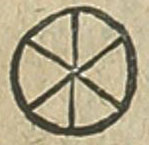
And in the lead mine, and also in the silver mine, that splendor is called there Friburgi, in the mine. This indeed is pure, and rich in many grains of Luna and in vegetative silver; and it is called Lunaria. This is the former matter mentioned above, and it is pure, but is rarely found, and is marked by this sign:

The fourth [kind], surpassing the aforesaid in goodness and purity, is found on the borders of Hungary near the town of Klobuck, in the hidden workshop of the citizens.
The magistrate himself opened it to them there, whence a citizen of Klobuck told me: “Klobuck, my houses have uncovered it for me. They call it silver-lead, and its sign is this:

The fifth is leaden soldium, but not in fire. It was found in the city of Villach, which is easy of solution, and excellent for the lunar work, and rich. It is marked by this sign:
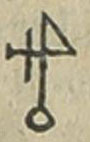
I say that that is the same thing as luna dum. It is easily dissolved.
The sixth and best, so far as is known to me, is found in the mine of Mihla, but rarely in this age, although that little bag could perhaps still be had, and, as its living voice testifies, the sculpture in its incision is in lead.
A hundred pounds of it contain either thirteen or eleven ounces of silver. From this matter one pound and eleven ounces of Mercury are obtained, although Clangor writes that from one pound only two drachms are got, yet he prefers the least value of silver-bearing lead.
Another glassy green matter (the mine of Luna is called so) can also be had, which is rich in silver; yet it does not receive sculpture and incision, but rather there is found there another thing of this place, which admits sculpture and imperfection, because it cannot be distinguished from white lead. Its sign is this, and it is easy of solution, and again cannot be distinguished from white lead:

Thus then, my friend, you have instruction not only from concordance, but also from the true sayings of the philosophers. May the eternal God grant that you use it to His glory and to the profit of your neighbor.
But how one ought now further to proceed in this is taught in the second part. No one can solve this treasure unless he says with Solomon in the book of Wisdom, chapter 7, that silver in comparison with wisdom is as worthless sand.
Besides these, other things also are shown concerning the matter called Gur, and concerning the first matter.
There is no doubt that this is the pondus. I indeed have had such experience of this thing that (if it were lawful) I could demonstrate it by the thing itself as performed. But this may not be done. Thus, my friend, you have a perfect treatise concerning matter, as to which all the philosophers unanimously agree. For I have also invited you to have and to examine the books of the philosophers on this very matter.
For I could demonstrate the whole operation itself. In this matter the best agreement of the philosophers lies hidden. For the truth in metals only lies concealed, as Count Trevisan, fol. 14 and 16, Rosarius, fol. 56, Flamel, fol. 147, and Reuchlin, de verbo mirifico, fol. 100, say. The eye-proof of truth is the agreement of the philosophers.
“The foundation of the liar is discord, in which he has acquired.” But if these testimonies are not sufficient for him, let him lose both oil and labor.
When now the branch has grown enough that you may accomplish the matter and the roots, then this treatise must be handed over into the hands of others. But because you do not yet understand it, although the smoke of fire will afterwards be explained more fully, be diligent in collecting from others also what concerns this matter. Praise, honor, and glory be to Him who lives from eternity to eternity. Amen. Pray to God, study, and labor, and God Himself will help you.
Glory to God alone.
SECOND PART
The Lily among Thorns - Lilium Inter Spinas
King Solomon of the wise, chapter 7: “He granted me the prudence I desired in prayer, and the spirit of wisdom came upon me; and I preferred her before scepters and thrones, and I esteemed riches as nothing in comparison with her; nor did I compare any precious stone with her.
Likewise all gold in comparison with her is as a little sand, and silver shall be counted as clay in her sight.”
Hence the light of all health and form and love has for me some little light, whose splendor is never extinguished.
Since then to me there has also happened such a good thing, and such immense riches of adventures, I commend the inexhaustible treasure to men, if they will, together with friendship with God, and the gifts of doctrine.
And the divine vapor is the fountain of divine power and the scepter of the omnipotent.
The old proverb says: after clouds comes Phoebus, and after the harvest joy follows the reaping.
So it has happened here also.
For after almost twenty years, and similarly after I had undertaken the new foundation of the work, so that I might not have merely a simple example of smoke but a complete knowledge of it, I had nothing happier; and therefore many of our philosophers wrote their books with smoke confused, now calling it a gift, now waters, now earth, and attributing to it several titles, because they had handled the matter only little, and moreover because they had not completed it.
For my delight and joy were not in poison and arrows, but in gold and silver prepared for conversation.
Then at last I poured out my soul full of the perfume, lest I should condemn my talent; I wept with many tears.
I poured out my prayers before Him who lives forever and ever, and said: “O God, if Thou wilt mix Thy very fruitful smoke with my prayers and with my sighs, so that by Thy most excellent majesty I may become worthy to set before the true mirror the way to life, to teach and to show the truth.”
Meanwhile Zacharias says, and many philosophers likewise although at the beginning he erred, yet at length he came to the end of the work happily, and was a consolation to me.
At length then my mind, being in doubt from many reflections, spoke thus: “To God almighty, to us poor sinners, who in these times live in calamities, this secret smoke has been granted to conceal.
Yet by many reflections and doubts I have at last come to this conclusion: those who have had this secret before us were sinners also, and this gift was not obtained by their merit, but by grace.
Therefore it is likewise granted to others also, if they are pious and God-fearing, and if this gift ought to be communicated to them by the gifts of God.”
Turning this over in my mind, I considered the philosopher-magi and our kings, but especially Count Trevisan, with heartfelt devotion, for when I had read his writings frequently, I could not grasp the foundation of so great a smoke.
When at last the difficult hours and the place where the matter ought to be sought, and the rays of fire and the force of operation lying hidden in it, came to my observation, my spirit was struck.
For first my mind was led, and then at length the eyes of my mind were opened, and I was in that house in which those things were, and I could clearly see and understand what I had so greatly desired.
Rejoicing, I gave perpetual thanks to God and prayed Him with tears that He might enlighten me further in the remaining manner of the work.
Thus the acquired matter is more easily attained (although many wish to have it by colors) and the nearer, not the more remote, may be reached.
For another says that they can best go to one gathering-place, as George Ripley teaches, fol. 120, and in the end of his words, fol. 150.
This is the hidden foundation of the work, and it is to be drawn from a mineral which ought to be very near.
On a journey, a certain peasant showed me two mountains standing opposite, clothed in a long grey mantle, with yellow necks, white bodies, and red eyes, around the neck and the body, but around the feet and the hands green.
[On the way of my journey, a certain rustic old man met me between two mountains, clothed in a long grey mantle, bearing above it a black veil, girt about the neck with a white veil, girded about the body with a yellow garment, and shod with red buskins.]
After I had greeted him and drawn near to him, I noticed that he was carrying in his hand two starry flowers with seven rays and was looking at them attentively, of which one was white, the other red in color.
They were indeed graceful in appearance, bright in color, pleasant in smell, and sweet in taste.
One was of the female sex, the other of the male; and yet they arose from one root and from the influence of the planets.
Question 1. Proposed by Rusticus.
I asked therefore what ought to be thought of those flowers, or what could be done with them.
He replied: “I knew both of them well, but because they were fixed and had two distinct natures, I was ignorant.”
Rusticus asked in turn whether anyone had conducted me into this place.
For there was need here of a very powerful inquirer, but such a one as might be both worthy and bound.
When I first began to wander through those winding ways, I saw how softly the article of my labour pleased them.
I wished to hide this, lest it should happen to me, and lest what had been predestined should come to this point; and I obtained this firm faith by pious prayers.
But although by labour, sufferings, and tribulations I was such a worker, some said that I would not be able by any means to do this, nor make this great mystery in silence.
Since therefore I had so much confidence in these divine counsels, by permission of the divine name I open to you what can happen after the conjunction of these two flowers: the first matter of all metals is made, and that very swiftly.
Of this read Count Bernard, fol. 45, almost at the end of the second part of his book, where he calls those two flowers red man and white woman.
The philosophers always write of the matter in grave causes, so that before the ignorant they hide the root of their matter; but they have sought a second matter, which is the crude and smoky subject of the Stone, although first from their hands you must extract from it the man and the woman, whereby at length it is made first matter, which now I wish faithfully to reveal to you.
Question 2. Proposed by Rusticus.
I wondered at these discourses, since I too rejoiced much in smoky things, and therefore I said: “My friend, this wisdom is found with thee, which I myself could not see to be simple, nor afterward could I believe it, while so many deceivers answered me.
Hence it happened that the whole world went astray from me, for my external form failed me in many ways.
But now at last, through old age and grey hair, through a splendid cataract, and through the ruby within the red little globe, they have come to me, although the alchemists themselves had hidden it so, that they might not think it could be understood, whence metals derive their origin.”
Question 3. Are these two flowers medicinal?
To this I answer: some have also asked me whether these flowers are medicinal in this state.
To which I reply: they are indeed medicinal, but the great virtue of them shows itself more fully afterward.
Since these flowers still cling to their root, they have much poison.
Therefore it is necessary first to sublimate their root (as I have already indicated to you), away from things foreign and harsh, so that, their vigour and nature declining, what otherwise is of no value may then never again grow from the addition of other things, and the poison of that mountain may cease.
Nor, if they are well prepared, will they fall beneath the constellations of the planets, if those rustic flowers in their wondrous place (as I think) had not come hither, nor had I known such mysteries.
Question 4. Proposed by Rusticus.
Do these flowers grow together?
To this I answer, dearest friend, for the sake of the matter of the narrative: yes, these two flowers do indeed grow together, and whoever is able to understand the reason of this thing, in this point especially he can confess the art.
For in this matter, though at another time, the philosophers have spoken but few words.
To this some of the learned reply, and they answer at last in puzzles: “With great desire you see these things” (I do not say “you ask them,” but “a manifold instruction has been given me by thee”), “let this now suffice, that this Stone is angular, and that it impels many.”
Many indeed are those who move the true matter, yet they know not the operation.
Nothing hinders me from bringing forward that same chart again in this place at this time; yet if it be lawful I shall reveal it to you here.
To your goodwill I respond with the greatest thanks, and I say with joy: I awaited the day with great longing, and no intervening delay.
I returned again to the aforesaid place, where I found the rustic waiting for me, and with his own hands handling and saluting those two flowers, and I respectfully offered him my services as a neighbor.
But he truly declared himself mindful of me, and said that in fact he wished to speak more openly to me there concerning that thing, if only he might have God propitious.
Then, being urged onward, he said: “If then you are my friend, nay rather, if you are to become my friend, then here bow down, and with God’s help perform what I now command you.”
And when I had done this, he said: “Hear me, my son: from the beginning repeat my discourse, and I will teach you the whole process perfectly, together with all its surrounding requisites; but as you attend to my discourse, and as you observe the precious pearls that must be hung on the mouth, lest the hidden woman be brought in to the end of your world, and lest you be led into the labyrinth of Demetrius’ errors, do not believe me.
Rather believe the gift of God, and the alchemy of God.”
But let us see in the green place, and in the chilly air, and in the thick and hidden shade, whether God can give, not indeed through any other thing, unless what helps in the green place lies quiet in the green.
Without doubt, among the philosophers, magi, and our own, that cry is lawful: imitate nature.
From this this observation arises.
Whoever wishes to work in this art must first know the metallic principles, generation, difference, friendship, and enmity.
I tell you that all things are born from one root and differ only by odor; because one is purer than another, and because one is cooked, another not.
All the books of the philosophers testify this, in which these flowers of the philosophers are described, and are not set down among wanderers and processes alien to them.
Therefore he who desires to receive the cause and foundation of this thing must not refuse to read their books.
For whoever wishes to penetrate their inner usefulness, must take up the labor of making mention of them all, which would be far too long, because until you have fully entered into the matter, you will not be able to understand it.
Then speak more familiarly with yourself, then know better, and honor and love them more greatly than now, and no separation shall ever be between us.
Moreover, I wish you to know that whoever understands the origin of metals understands this also: that the stone must be a metallic matter.
But it is not a metal, nor a mine; of metal and mine, and of mine and metals.
For the nature of all these is in one thing, which is called Electrum immature, Magnesia, or Lunaria.
And this is the reason why philosophers speak in the plural number: “metals, of metals, in metals.”
Nor can it be made clearer, because the matter is still hidden from you.
For some cannot yet endure this, because some approach this thing from afar, some more nearly, who yet do not make it easy; nor does the composition of flowers proceed as with my flowers.
This mineral root is prepared little by little in those flowers, stained through pores and by poisonous force, until the light of the Mercurial lilies is at last expressed from them, a very subtle and very easy thing in the lower part, which all who seek this name Azoth and the eagle’s gluten.
The red sulphur and incombustible thing of the lilies they seek in the lower part.
This the Latins and Leo Rubens have called thus.
Behold, then, I have now explained my opinion to you as far as I possess it; do not seek more from me, for it is forbidden to hand on further explanation.
Yet pray diligently to God, and first also understand this: what the philosophers have not dared, and how one of them changes himself into all forms and loves all the planets, with which he is joined, nor can he ever be driven forth by the planets.
It is fitting that the nature and the fundamental properties of their flowers be described more precisely, unless perhaps some man’s heart and sense are too slow to enter in.
You see these flowers hanging from a simple root, of diverse color, and always one joined to another, whose whole cause is to hide their diversity.
Therefore the mode of their cooking and the reason why from these two flowers, joined together and inseparable, the most complete fruit grows, which concerns God, is not fitting for me to add in full.
Besides this, there is also another face of the matter, namely the unequal face of the feminine lilies, with the red one greatly unequal to the white one, and that in secret wisdom they have had their own weight and their own measure, or pondus.
The ancients do not err in this by the smallest amount, and they always wrote of this weight by weight and of the female by plural.
Hence Count Bernard says: “The earthly power must be resolved, and by the profitable action of the agent widened in another matter.”
Do you understand this?
I answer: to him who understands many things, this is little labor.
Since therefore the two lilies must be perceived by you as excessive, then you must proceed from their properties and nature.
But you must do this in mediocre heat and color; otherwise the feminine lilies exhale like vapor, and the work is lost.
Question 5. Proposed by Rusticus.
On the Terms of the Philosophers
To this I replied: “Thou hast made mention to me of the two lilies, though the philosophers do not so speak, but only by terms.
In Mercury and Azoth are all the things which wise men seek.
The philosophers also have said this of the three elements, namely salt, sulphur, and mercury.
More often they say two, namely body, soul, and spirit, though by this they do not mean three things.
For this reason my son has moved me to answer those things which I had not yet said concerning the terms of the philosophers.
But yet in this there is something which is rightly said.
Since they speak only of one thing, namely the salt of metals of the philosophers, I say that from it come the two flowers, which are body and soul.
Third is the marriage of both, the spirit evidently, which is made from the power of both, since water is made from them, as in Moses it is read, Genesis 1.
Thus these things are done; indeed from two lilies I say:
Take therefore those two lilies, well purified, and in a crystalline vessel dissolve them in a gentle bath; put not in too strong a fire, and from the white lily at length the whiteness will spread, and the red lily will be extracted from it and enclosed in its nature; but the red lily acts outwardly with the white one by familiar smoke, and in the cold sends forth its odor, whence the lilies arise.
For one must yield to the other, or to contrary qualities, until they come to a middle point; and in the sky a great blackness grows from them.
Then some storm-winds descend, and by ascending and descending they are frozen in the earth and grow quiet in the depths, and yet in the bath they are not led by one alone, but by the smell of both lilies together, until both smoke-tinctures ascend at once.
If therefore the odor of the flowers never withdraws itself from one or the other of these two, since they go into peace in so great a love and friendship as into an eternal union they are perfected in union.
Then by the ordinance of their union the whole firmament is stirred, while Sol and Luna are held fast.
And what says the most lofty little peasant concerning the flowers?
Could God set in the air His rainbow of many colors, and create it from love in the ignited one?
I do not doubt that God is favorable, and that He allows this in them: that those two flowers, united in one odor, ought thereupon to be dissolved and loosened.
When a little time has passed, you will give Luna of a ruddy color in the conception, and after the color has been deposited, you will clearly see the whiteness in the color.
But Sol can still remain some time hidden in Luna, or can be seen by an opposite order.
No keen sight of the eyes or mind can observe the planets in Luna so long as you cannot transmute Luna constantly by benefit of the splendor of Luna; but when the spirit is joined with Sol, and the heat is intended for this, if Luna can darken the splendor of Sol, then she can likewise hide Sol, because the impurity of the other planets is poured around her, and most often she is tinged from bloody smoke with a ruddy color.
But since with Sol and in such humility and by divine ordinance they have accepted these things, and in their like manner remain always in kingdom and rule, and from this also rejoice and give humble thanks, and to the highest coction is given that by which they may be adorned with so much beauty, and hence may appear worthy of the divine name in praise.
Behold now, without any doubt, your labor and the thing are free and wholly full of understanding.
Give thanks to your God and my Creator, and what I have begun and brought to completion in silence, in common with you, I hope and trust will be accepted by God in your devout breast, and by the influences of the ancient gift you will see more abundantly.
And having commended this little work to you, you will no longer be in doubt at all of what the rustic answered to me and received.
Therefore I give him the greatest thanks, and I ought indeed to ask him whether anything of this work still remains to be asked, or whether the art is finished, and whether to all that I asked he answered with one mind.
Know that the virtue of these two lilies is this: they can renew and multiply bodies, and in a thousand parts increase in power, and at length they unite, which, if it were, then the woman would conceive first in the upper part of the earth, the husband would afterwards become Luna; then the serotinous red things would again appear, whose progress of work would proceed as much from their conjunction as from the gift of God.
The nature of these two flowers likewise makes pearls and gems, and especially all those things which concern the further knowledge of God and long life, except that what I now bring forth to you from them pertains to all kinds of maladies.
But concerning the virtues of their flowers I say nothing in secret, since as regards the complement of the work and what must be rendered from the many other properties and surrounding conditions, now even the philosophers themselves can scarcely furnish you with a sufficient share.
For my discourses are not yet complete; yet if by divine permission you desire them, I shall continue.
Now it remains truly to be said to you, yet meanwhile await my return and my being sent back from other occupations.
Having finished this discourse, I said to the old man: “Dearest brother and excellent friend, these sayings of yours are so learned and so ingenious that, because of your manifold merit, it should be permitted me to tell the rustic simply what you are, since besides the death of fruits you know the Latin tongue exceedingly well.”
Question 6. Proposed by the Rustic.
On the Rustic’s Philosophical Teaching.
“Say, in what university,” said he, “have you learned these things?
For never yet have I seen you come to the highest degree.”
The rustic, smiling, replied: “What moves thee to ask this?
For I say to thee that in the university thou hast made so many advances, in them all true philosophy is found.
I marvel,” said he, “at your foolishness, since year by year I have been thought among my contemporaries to be one to be sought out and found.
Yet I have a mean philosophy, to which belong the world, heaven, firmament, and trembling earth, and all living things.
Therefore I said to you before that the hidden one is adorned with gold, agates, emeralds, and rubies; but this grey pallor is cast for this cause before the magnates, who can seize and gather me, and hide me in secret.”
Question 7. Proposed by the Rustic.
On Academic Philosophy.
“To this,” I replied, “what is the cause that these philosophers and not your philosophers, upon whose stipend they investigate, have obtained this philosophy?”
But he said: “Many have had this cause for saying that, but they do not deserve it, if for their own smoke’s sake they do all words, because they suffer no entrance; therefore these with their children and grandchildren have no other God, because they stain youth with sophistications, and always card wool by carding, and, when the disputation is finished, one professor succeeds another, and they profit in nothing save empty opinion.
Beware therefore of those useless and venomous planters of propositions.
In them there is much shouting, and they ignore the kernel itself.
This is best: what they do, let the youth learn first grammar or law; all else is subject to vanity.
If doctors are admitted to magistracies, perhaps they are true in philosophy and in practice; but when they have at last attained some degree, they lead themselves into saying something for their own dignity.
Hence it comes that true philosophy is veiled under false appearance, execution, and quarrels.
Yet it ought to be called the wisdom of God, and against the world.
For God did not will it to be revealed in the grave judgment of wisdom and under a renowned name, but that our mystery, its virtue, and its hidden arcana should triumph by another cause.
“But let us not make them less than we ought; nor do we lack their writings, nor is it necessary to inquire greedily after their books.
To his words I answered thus: ‘Alas, dearest rustic, and true author of these opinions, I too once was, and am still in part, carried beyond measure through too much learning among pseudo-philosophers, who in evil fashion have piled up so much.
But let what you have said of this matter suffice.’
The rustic said, ‘And let me return to my place and time.’
I said, ‘I do not stop you, dearest brother and friend, abruptly and with difficulty; but to one more question, answering your petition with petition, as is the custom, then I shall be content, and shall give thanks as great as I can for all your faithful instruction.’
To this he was disposed in mind; for he could do nothing unless such questioning were present in him, and in explaining it he had himself as he was; but when he was answering, it had been forbidden me to speak.
Yet let me speak.
Question 8.
On the Government of Fire and the More Immediate Matter.
Here all the wise philosophers affirm that the artist must constantly attend to the direction of the fire.
For it ought not to be unequal; moreover, it must be sought on both sides, when the more immediate matter of the Stone is being prepared, from which, in its specific form, a fire of this sort must be extracted on both sides.
Although the matter in general is scarcely known to me, yet from the reason of the former point I scarcely doubt it.
Clangor indeed writes that from two drachms one pound can be extracted, by which the work may be perfected, though certainly this would be little.
But I think that by this means, if several raw materials were prepared most excellently, more may be obtained.
Yet in this I see what the better part says: not so much to investigate and labor as to direct the mind.
And this work is called the lily among thorns.
You will not so easily perceive this lily, unless you take away the smokes little by little by diligent labor, until at length that most excellent matter has to be handled, and then it may be possible to use the fruit.
And although in place of one question I have proposed two, yet to the other I also answer in this place.
Turn your mind to the four parts, and consider well, and afterward divide the work among them in the second operation, of which the books of the wise are full.
The King says that in the dog-days the heat of the sun is strong, and likewise in spring; and in hibernal time it is much more intense than in summer.
You can say this too.
Therefore, my friend, much is still hidden from you in the books and sayings of the philosophers.
Do not command me too much.
It is good to understand what is done.
Many things from this fire are not lawful to say.
But if it is your lot that the first course of operations befit you, which has been brought together here, and which in truth it is, then I shall be able richly to restore your middle damage and sufficiently to instruct you for your support.
On the More Immediate Particular [Matter], namely Saturn’s Smoke.
Behold, under this my grey mantle, beneath the green little garment, if you strike it with fiery stones, red iron, and the red eagle, rather than with dust, then my splendor will be the richer, because from pure Luna it ought to emit brightness, which, when it is changed into Sol through lotons, and in its secret paths this one has obtained, may perhaps in eight days be made a sign.
This gift seemed to a certain magnate (though in this work he labored beyond measure) to shine from small smokes; and indeed more richly could he shine.
For this memory of it I give thanks to God.
Behold, a rustic came to me in an instant, but he departed from that mountain-place two hours away, where the smokes flourished and were manifest, and when I wished to seize their bodies and detain them, behold, at my feet in the assembly of those present, I heard some books on the matter of the Stone, both crude and true, speaking in a clear voice.
From those two labors you see what I then saw.
And therefore I proceed thus in truth: I give most humble thanks to God, and His praise, who lives from eternity to eternity, and I pray that His wisdom, as before, may illumine my mind more fully, so that I may be made a participant in this most precious smoke, and may promise from it both great glory to His Name, the advantage of the Christian Church, and especially the use of the poor and of my neighbor.
Thus, my dearest friend, you have the foundation of smoke and of the most precious lilies, together with all their circumstances, handed down to you.
Therefore be imitators of these things, of good and holy purpose; avoid sophists, fear God, and you will not so often labor in vain, but you will see the wonders of God, whose name be praised and blessed from eternity to eternity.
Amen.
Happily completed in the castle of the Sun, Axhaffz, in the year of salvation 1598, old style.
The Practice of the Author Johannes Grasseus, Doctor of Both Laws, Syndic of Strasbourg, which he called Chortalasseum.
Since therefore we have given thanks and celebrated with all our heart the grace of revelation to the eternal and almighty God, creator of all things, and have now praised my fecund matter (which at first I could scarcely believe), and at last, with joy, have brought forth that which I had so greatly desired, and whose cause for many years I held in doubt and fear, this matter must now be committed to the more profound confidences of truth, so that no external specific form may be predicated of it, and so that it may by no means be common and should not have to be perfected in so common a way.
Many, indeed, have told me of their foolishness, because God had bestowed such an external matter upon them in grave causes, so that poor and rich alike might be able to acquire it, and that they need not complain that God had granted it to the rich only, and by part to the poor as though He had not given it equally.
Yet since the rich are not moved by that, nor believe so much, as appears from the Rosarius Major, fol. 248, if we do not now seek our matter itself in such a way, then it may be more conveniently found by poor and rich alike.
This matter, namely, is more in the power of the poor than of the rich, because it can be found well hidden in its house with joy, singing in the street of the Canticles, where it is said, chapter 7, Wisdom of Solomon: “God our God can do all things.” Sad things, however, are for me now before joy, because it has been sufficient to communicate a part of this smoke to the rustic, and after much deliberation I have considered that the administration of the whole work can be had more easily.
Concerning the charcoal therefore (which this particular work requires in great quantity) I took good care, and furnaces having been built, I acquired within a few weeks a sufficient store of charcoal. This ought not to stir up envy in holy Christians, though from this arose gossip and quarrels among the neighbors by the burning and kindling of the mediums, who complained among their acquaintances and friends, and at the work then begun there was, by false conjecture, a rumor to be had.
And by my legal faculty (I, a Doctor of Laws, speaking of the holiday), I could sufficiently support my life by it.
But with a good conscience in that practice of law I greatly doubted for myself.
Blacksmiths and goldsmiths were troubling me, because by annual charity I had been the author of making charcoal, since from the exemption of the charcoal-burners complaint was made before the magistrate that I could not carry out the offices.
They said that no customary contribution had been made to the magistracy. What more could I do, after that so great a handling of coals had been forbidden me by the magistrates?
In short, in this matter to maintain my furnaces, to defend my country, and if I should have been seen to take up some subterranean work of dissolution, they would have needed to inquire into my intention, which even my own household could not have known.
This tribulation, this burning and other inconveniences, lasted up to the point of weariness, so that grief already increased in order, because I had no knowledge of this whole mystery, nor could the work be brought forward. Thus it happened, and it was fitting. Then I considered that hitherto I had not followed the will of God with a truthful mind. For when these things had happened, we must withdraw and be silent.
Count Trevisan says that the whole work of the Universal One can scarcely be perfected in two years because of the causes of various hindrances which can in fact lead to this; and therefore we must entrust it to the will of God.
On my journey, a conversation with a certain rich man was offered me, who wanted to hand down to me other works and writings. He had collected various kinds of minerals, but besides those the philosophical things I did not find through him.
In the rest, however, all were entangled with common Mercury, gold, animals, cinnabar, and other useless books; the business was such that everyone erred, because they did not follow nature. If truly nature is not followed and the respondents are not questioned, a thousand men do not err the less.
Yet one gift only must be understood, and each thing must be diligently examined, and only then entered upon. Reduced to my homeland and made secure there, friends often invited me to places where they showed things effective in power and action, to which I took up the work, answering little.
I do not say that I did this through worldly affairs, and elsewhere in the world no spot ought to have been joined to me. If you had seen many of these hours, you would have judged much otherwise about this. Besides, many other things have happened, which you permit and repay with a united mind and complete. Nor shall I be troublesome to you in discussing charcoal, because I do not have that work.
Yet when you hear these admirable and secret sayings, and when in these things you have what belongs to the matter, then I shall go further. I, a man led by deep silence, brought forth the gift and service, and by this action I pray the eternal God on bended knees before my desk that, if the work thus begun is truly of Him, He Himself would bring it to completion in the direction of the most precious and difficult art.
Yet while this work was being written, and all the philosophers’ writings were being cast into the hearth together with the keys of the art and the administration of fire, error could easily be committed and the matter destroyed.
And the odors and the strengths of burnt vegetables which by prudence were with me, and caution, lest I should take up any damage in the impurities Theophrastus wished in his manual.
At length all things succeeded by the divine will. Then the stone-bearing vapors, those newly-perfumed flowers of which I had spoken with certainty to the rustic, little by little also began to appear. First the white flower appeared; then the red one, for the smoke had not yet attained its growing degree.
But I perceived the form of the white flower slowly and sweetly, such as I had never grasped in other things; therefore I was rejoicing. The remaining leaf, as a burning blade laid upon me, dwelt there in flux and movement, from which I recognized that there was in it the will of the feminine. Likewise by prudence I almost composed it with the ruby, which indeed permits every fire, and by perseverance I mastered it.
Therefore, although from these two lilies I had many adversities, of which here I say nothing, yet their study, their easy dissolution, the memory of the rustic too, and the great ingenuity of the magnate admiring the instruction, and the amicable conjunction of the two lilies, and in their conjunction some marvels observed, I could include in a crystalline vessel and commit to gentle heat. When Sol began to shine and to spread itself as though the whole water had flowed over the grasses in the morning time, as by the bright tear of Luna, in truth by the reverberation of fiery heat then, fixing my eyes upon the matter, I observed the lily comprehended from white to red and hidden, yet one leaf of it appeared more abundantly.
Yet that hiddenness could not long remain, for our little ruby lily, being hotter and drier, but the white one colder and moister, were in conflict. Since the splendor of Sol with red lily and the woman’s robe strove to come forth from the broad womb, and yet because of its own redness it could not, none the less they fought among themselves and at the same time were borne into the upper regions, and the storm-winds of their odors drove them.
Then both of them (for the root of the vegetables was laid back in the lower matter) remained there together, where they then deserved the name of the matter of the Stone and of metals. Thereafter darkness began to flee. Sol, Luna, and Luna more than the magi, at a certain time took on curvature, concerning which Count Trevisan read. When the darkness of a different-colored rainbow, which was a grateful sign to me, appeared to me, of which the rustic had spoken, then it was a herald of a joyful and happy end.
But when Luna began to shine a little, though not yet clearly, Sol little by little emitted somewhat stronger rays into it; then Luna became full and clear, and all four planets were discerned beneath it as though clear pearls and fruits. They rejoiced at this. For by the purification of all things in Luna they are able to change their splendor and nature.
This the count calls, in the parable, the woman clothed in the sun. But when the third degree of fire was brought in, fruits of every kind, like a better cornel, citron, chrysocolla after the pleasantacinth, and cyanthus began to flourish, which in a short space of time were shaped like little apples from the ruby earth, and at length were coagulated into a bright shining carbuncle, which illuminates all dark things with the fullness of its own color in a very short time.
After this, when projection had previously been made upon certain metals purified for the beginning, and when with much joy I had been delighted by it, even a very small quantity of our Stone could more quickly tinge and transmute every kind of metal, so that one part could transmute a thousand parts of metal; and when, by the grace of God, we wished to make still another projection, and a projection’s foundation could better and more easily be made, and when I had already set the seal to the fire, behold, my dearest rustic came from the shut gate, by whose coming I was trembling on account of the advent of the smoky smoke, but of many-colored garments he was clothed, and so I could not recognize that smoke, whence fear of art and astonishment had suddenly arisen.
Yet he, humanely rising up, said this: “Do not fear, dearest brother, for you have God favorable, and that spirit which the world cannot receive. Behold now, as I promised at my departure, I return, that I may instruct you further in these and other more lofty and secret wonders” (for hitherto it had been only the beginning).
Why then does my mind shrink? Behold, it is an easy thing, and if you will do it, prepare the Stone, because the eternal God has ordained it by grave causes, so that you may rightly understand the Stone, and may attain the highest perfection.
This is Adam, Solomon, Hermes, Theophrastus, and the Wise Men, whom you must imitate, and imploring with great reverence and fear, you must bow the knee to know and understand the possibility.
What Zacharias, who prepared the Stone very wisely, says, he sets forth in these words: “Our medicine is a science as divine as it is natural; and therefore in the second operation it has hitherto been impossible to human beings, however studious and industrious, even though they be most wise, unless they be philosophers divinely inspired, and chiefly inspired by God.”
They say this, because in it all things are rare and experiential. Therefore let your promises satisfy me henceforth, and hereafter other doctrines, some indeed now lawful to me and permitted, I shall show you more fundamentally, when afterwards there shall be occasion of proof, and when by God’s grace I shall be able to seek out the prices of smoke, so that your work may be brought by blessing to that one thing in which all treasure lies.
For then, as Solomon says in Wisdom chapters 7 and 8, your mind ought to be joined to greater wisdom. For the eternal God wishes that His precious things be compared with no others; and as He said to others, so also to them He freely gives, who with all their heart desire that gift in God’s honor, for their own proper health, and for the use of their neighbors and of the poor, and who grow in piety and holiness before God.
But as for your projection, if indeed I were to instruct you imprudently concerning it, fear might arise; for before projection the metals must be prepared by added and adhering powders, and by no other means. But how projection ought to be made is set forth at length in the books of the philosophers.
Thus it was done: the smoke having been received, I placed it in a seal, sprinkled upon it the powder of purification, and with a bent iron extracted abundant red combustible sulphur from the fetid smoke; and from this, while pure Venus was present, I brought forth the color of light, white-golden.
By this done, in a moment the tincture penetrated the whole body of Venus, and in a most excellent and better way transformed it into its natural Ungaric [Hungarian] gold. At this I was seized with wonder and joy, and I gave the greatest thanks. After this he also taught me other purgations of metals, which in part he wished to show.
And often he added another instruction, saying: “Alas, I wish further to tell you, that with the fixed white stone all gems are made, the splendors of white, namely diamonds, white sapphires, emeralds, pearls, and other like things you can make.
But with the yellow [stone], chiefly when it reddens, yellow gems, such as hyacinths, yellow diamonds, topazes; but with the red stone, carbuncles, rubies, garnets, which long surpass the eastern [gems] in nobility, virtue, and excellence. All these I could make with my own hand. In this I have sometimes committed some error.
Now therefore I wished that this wondrous mystery should be disclosed. For in these things there is hidden, not fear, but joy, because God has placed such great virtue and nature in them. Conceive therefore,” he said in reply, “dearest friend and brother, believe this, and let me speak and see such marvelous things, and for them I give thanks to God, because He has made and confirmed me with so great a utility and faith.
But if he himself would entrust the earth to me, then after preparing first seven female matters, and upon each female preparing the planetary characters and their signs, from the particular constellation of those requirements, and afterward from their composition in a seal, so that I might cofix one matter, then the seven forms of our smoke would distill.
When this was done, a splendid vapor of smoke from the seal was poured forth, and a great trembling took hold of me, because of the splendor brought out of them. I saw these secrets and arcana together with the motion and appearance of all the planets enclosed; and I observed that the second of them, which was first among those above, surpassed all the others and was not fit to descend. Never would I have believed so many and so great things in this hidden Stone, nor did I see them with my own eyes.
Hence I readily grant that men trained in intellect can be raised up from it, because they can attain such excellent things in dead matters.”
Besides this, the rustic told me many other mysteries too. Likewise, concerning the number of the philosophers who had possessed the Stone, I say they had knowledge of it, and that from the beginning my familiar companion also had been pursuing it. Likewise, in nine continuous days and nights I burned nine drops on each day; and then I understood what had been handed down to me, and what I was to suffer.
Many marvelous things have happened to me, of which I myself have seen more than by human addition with my own eyes. Experience itself had given me the place. But if you ask what in that wondrous and hidden purification happened to me, and then what effects and virtues of our blessed Stone were afterwards promised by many, I will say this: since all the philosophers’ sayings are equivocal and enigmata, by which they touch these matters ambiguously, they must be unfolded and declared.
Then also there was a philosopher, in whom the foundation was, Adam, as you see, and he could as a philosopher of the first order much more quickly attain the end. This defect, however, and the crude matter, the first solution, and the true composition, as you hear, are the truth. Certain philosophers have prepared the Stone in 378 days, and others in 30, and have brought it happily to the end.
After these discourses, in a very heavy rain I filled a large cask, and by putrefaction I began; then I made from cohabitation clear water and a somewhat brownish water, and from it in a vessel, from a fire made under it, I drew off the most pure red oil of blessing and of incombustibles, like a certain drop of red wine; and also, as if in the first day of creation, darkness succeeding, by three lights having been sent down, and then again by two drops the darkness having vanished, they were separated from the light.
At length, with three, four, five, and six drops having been added, all those things which in the first day of creation seemed admirable and marvelous to God Himself again appeared, surrounded with excellent and ineffable splendors and circumstances; and because I had seen all these things by Divine decree, it was also permitted to me to reveal the explanation of the lilies, though differently.
Hence it is that, as King Hermes says on the Emerald Table: “Thus the world was created.” My son, behold thy God, signifying by these how great are thy mysteries, and that which, living from eternity, is full of heart and worthy of praise.
To Him, dearest brother, henceforth even now I command thee with reverence, not to reveal the greater arcana, which I have not yet disclosed to thee in mandates. But now God, with all thy heart, has commanded me to reveal still more to thee. Therefore I shall now point out much else to thee. This for the present is enough.
Now also I keep my promises to you concerning the effects of our inexhaustible Stone, namely what its power is, and how in medicine it proceeds rightly, and helps one’s neighbor, the poor, and the sick.
But let us therefore return to that which I said, wherein this mystery stands. First I shall say something of the foundation of the three principles, and then I shall come to the matter.
Attend therefore diligently: since, just as there is only one eternal, omnipotent God, through whom all things are, and still subsist, and yet nevertheless there are three distinct persons, so it is also to be known that God ordained the Stone in the likeness of Himself, and that all things must consist in unity; although in this one there are two visible things, of which one is volatile, the other fixed and permanent. One is animal, or endowed with a soul; the other corporeal, or one white, the other red; but the third is hidden and virtually posited and ordained.
Hence it follows that all things which have substance must originate from one and the same thing, and be made threefold in one; and that these must in turn be composed into one again; otherwise they are contrary to their own intention and do not issue well.
And these indeed properly are body, soul, and spirit. But the ternary, and the aquatic salt, are Sulphur and Mercury, which three are yet one thing, just as smoke is one in its subject; so also in man there are body, soul, and spirit; and as in God, Father, Son, and Holy Spirit, so there are in all things Father, Mother, Son.
Hence it is that, since righteous and almighty God has demonstrated to all men the quality and necessity of these things, first smoke must consist of smoke, and similitude of smoke create smoke.
Therefore, just as man is made son in respect of God’s image, namely Adam, and not Eve; so also from the whole Adam, not from the son, nor from Eve. Thus, I say, from one single Adam, that is, from the son, there are three faces: father, mother, and son.
This same thing is understood in all creatures. For the earth was made the mother of all four-footed beasts, of trees, of flowers, and of grasses; but before then, from the beginning, there was nothing of these, namely except earth, and [it was] in the earth.
Thus, when God had first prepared that matter, He said: “Let the earth bring forth herbs, grass, and fruit-bearing trees,” and then smoke had sex and fruit and seed-making power.
If therefore, I say, from one single earth these things are made, namely earth, seed, and smoke, which bear fruit and from which fruits are made, then by the preparation there are made three distinct things, and they are reduced to one from which they arose, in this manner: all fruits return into the earth and are reduced to one, just as man is; for from one body earth is made again.
For God says: “Thou art earth, and into earth thou shalt return.” You see therefore how every created thing is reduced back to that from which it was assumed, namely to its first matter, and at length through its smoke is returned to God, that is, to that which first came forth by the Word, namely to the great mystery, where all things remain in unity and are contained and conjoined in one thing, namely in God Himself.
Whatever therefore is separated from Him, has gone beyond the bounds of His divine ordination; that is devilish. But because in part it happened with the first man and the first Lucifer through pride, and because man also, through contempt of the Divine transgression, became an earthly creature by curse, which befell man himself through the woman.
Yet man is restored again to grace, since God made Himself one substance, and through the shedding of Christ’s precious Blood and through projection He interceded. By nature man partakes of the Divine, because God breathed into Adam and us a soul from His own essence, or a certain divine smoke, which, as I said, was indeed led astray by Satan, yet through Christ God and man were restored.
What grace therefore the devil, who sinned and through pride seduced man against the Divine Majesty, could not hinder, this has happened by God’s permission: that all men might admire His omnipotent and ineffable mercy, while He wills all things to be brought by His ordination unto His eternity.
Hence it is that all those err most grievously who, working against smoke and the ordination of the Stone in our work, labor in our nature, which indeed can be changed from silver, copper, iron, and other metals into gold, but [only] after separation and rejection of them, because that which ought to enter them must first be made.
For the hindrance is that the smoke is first impure and dull, but the good which is in it ought to appear in its own charity more openly. For nature, since God subjected it to corruption because of man’s curse, willed this defect in order to correct.
Therefore nature, with its suitable medicine, which the artist can minister to smoke more than the philosopher in books before perfection, can work, if he is artist and philosopher.
Every dead thing in the end is cast into its smoke, health and sickness alike; for every thing from that from which it has nature and properties draws health or sickness.
Man himself is an example of this. For when he consumes external smoke-substance, and the earth and the filth of the earth are made more subtle, and every earthly creature extracted from them, whence also man is called a microcosm, if by eating the fruits of his mother earth he contracts health or disease. Mars and all nobler things are fruits of his herbs, by which man is nourished for his sustenance, both interiorly and exteriorly. And conversely the same thing must be understood.
Certainly it is thus for us, as is agreed, that nothing is nearer to the nature of things for man because of harmony, and more akin, than metals, especially the purer ones, namely gold and silver, which are said to endure splendor and fixation against the fire. For these are things which the other metals do not do: iron contracts rust, copper into vitriol, but lead into quicksilver; at length all things turn into smoke in fire, though not all remain permanent in fire.
From this it is easy to conclude only the aforesaid things one can conclude that the spirit or tincture lies hidden in them, and that permanence and virtue are preserved in this, and that from them one may work in other things. One and the same thing is of such nobility, which, being like to the human body, nature has desired to preserve so greatly (and what it can infuse so profoundly) that nothing purer exists.
For all these things are in a point; that universal way by which herbs, roots, and humors may easily and swiftly putrefy and in the least degree be compared. Yet all these things are not to be understood according to the letter, but with philosophy in mind, just as the first givers of principles understood them.
Hence it follows that gold and silver, by true natural and fitting preparation, and by reducing their inward smoke, are to be made similar to the stars of Sol and Luna, which with their brightness illuminate day and night and the upper and lower firmament.
Without the brightness of these luminaries all creatures would lose their light and splendor and perish utterly into darkness; nor can this happen by the other five planets, namely Mars, Venus, Mercury, Saturn, and Jupiter, or by other fixed and wandering stars, however much they may be able to preserve by their powers.
From this you can easily conclude that no imperfect metals namely iron, copper, quicksilver, lead, and tin with all their auxiliaries (except one, which contains in itself the properties of all things), nor any other things whatsoever, generally speaking, by whatever name they are called, can be devised for medicine or for transmutation from a lower to a higher grade, or from imperfection to perfection and purity, nor can they perform or accomplish anything.
For there must be one light, one necessary thing: a medicine against diseases, more noble and far better than the things from which diseases arise. Therefore the cure or transmutation of metals must be sought only in red Sol and in white Luna, and by no means in any other things.
What the most practical Hermes proposes to us in an example must be found by you. The first man, Adam, was made from earth; and God made a living man from him. But because by sin and disease the body and soul were made mortal, and because through the ordinance and command of God they were perfected, yet afterward, since the command had been transgressed, sin and disease were imposed on body and soul, so that now we poor mortals, and the creatures over which we had dominion, are subjected.
For from our own mother earth, namely the sons who are our brothers, and who are of one nature and substance, we perish, are confounded, and are at length devoured. Yet in truth from generation and from nature and property there is still in men smoke, as there was before; but by reason of frailty and because we are subject to death, and because from our first perfection many thousands of parts have been lost, scarcely do men remain any longer in that former smoke in which the first man was constituted and confirmed.
Hence it is that our first parents, in ordering the Most High God, may now have had this medicine, namely the philosophers’ tincture, for the preservation of long life and against diseases, and that by asking the Most High as suppliants this secret may be sought, although it must be revealed to you in part and partly still be worked out; therefore the Most High has been pleased to reveal it to you. But someone may object and ask what is the cause of this sympathy, love, and friendship which metals have with men, animals, and herbs, since flesh and bones differ from metals as much as the whole sky, and are unlike and distinct.
Yet the answer will be easy, if someone will compare well the original generation of men and of metals with one another. For man is not from impure earth, as the unlearned suppose, but is created by almighty God from the purest and most subtle earth. Believe me certainly in this, if you will, that God willed for such a work that it should be made in His image, and that His divine essence should breathe a spark and ray.
He did not wish to make [man] from common earth, but willed to take the most subtle earth and add it beyond measure, when by a threefold resolution of principles the earth was made ready in its causes; but these are easier to be done than the compounds of red earth.
The rest is wanting.
The End.
CABALISTIC FIGURE
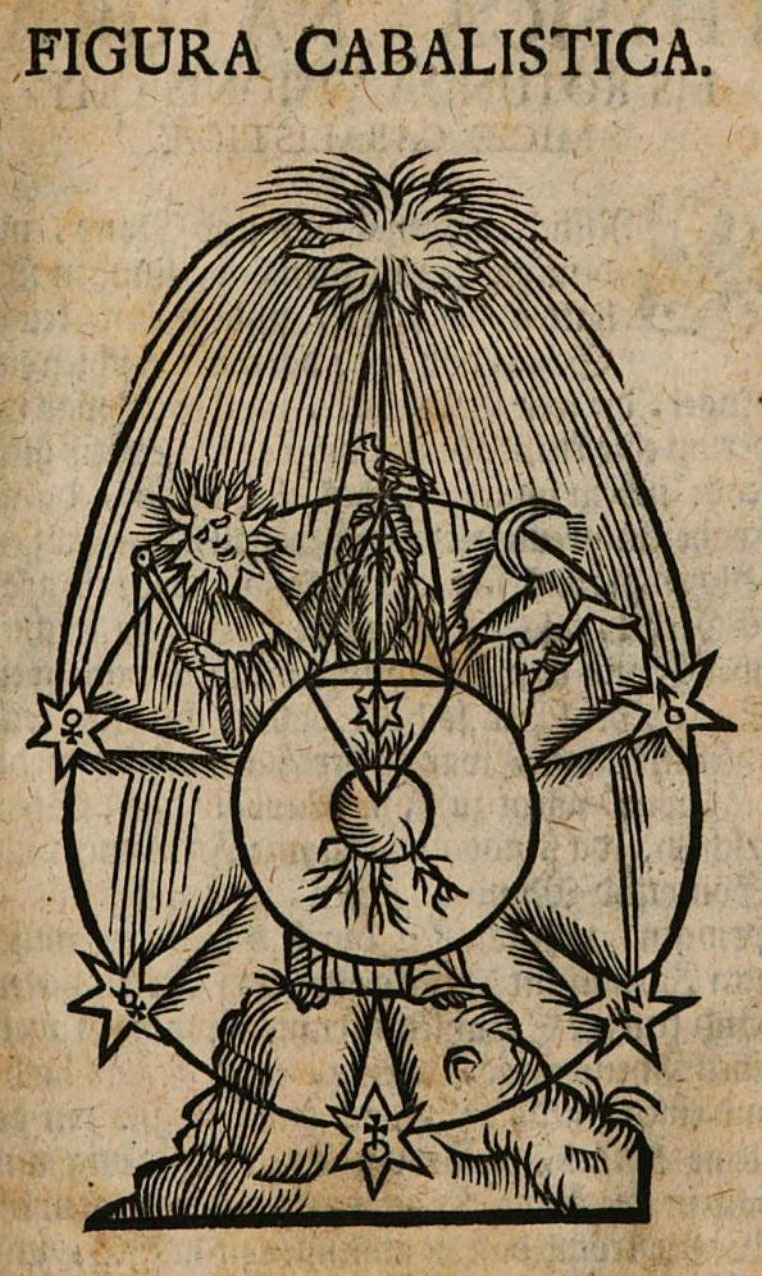
The Physical Round of Nature, by the Cabalistic-Chemical Vision
At first Sol and Luna appeared together with the whole firmament, having a certain degree, but giving forth no color. Beneath them the globe likewise appeared, with earth. In the center of this globe there was a small hollow globe, whitened and adorned with colors, as it were with lines.
In the midst of this there was a horrible blackness with a great blackness, and it had a marvelous splendor of fiery brightness, which greatly affected me. Likewise an image appeared, conceived from the stars, and a star above Sol, Luna, and the Firmament, whose splendor was of such brightness that, with my eyes fixed inward, I could not bear it because of the redness of the red Sol.
First, when Sol and Luna began to act and to receive one another, the aforesaid star seemed to cast its rays from outside the firmament in various manners: some in greater number, some fewer; some also seemed to cast only half of their part upon the globe, while another part of these little rays it received from our globe.
Those rays, which entered the globe divided, were moving the waters, making [them], and inwardly they were shaping folds. The remaining rays went out, and a great globe seemed to live in the midst by their efficacy, and to bring forth all kinds of trees and fruits, and also animals and men walking about.
That part of the rays, however, which had entered that little globe, once it had been divided, began to move that little sea within, and thereupon it began to boil, and a white, clear, and pure vapor in the form of a star rose up into the highest tree and to the root of the herbs, and spread itself.
Then from that globe and from the little sea, trees first began to grow, and thereafter every kind of tree and herb, and around the circumference of the great globe; and when they had reached that point, behold, two white stony mountains arose from each globe and appeared.
Meanwhile the herbs and trees seemed to continue growing, until at last the mountains likewise seemed to bear flowers of every kind and color, and they were clothed with red, green, and white flames; and the right-hand mountains were transparent and small, the left truly greater, but not transparent.
Meanwhile that lower and greater star kept sending forth more rays, by whose benefit more and more herbs and trees always increased. At length a voice was heard, as of a clear and strong trumpet: “Blessed be God, who created this star, and wished to call it the star of wisdom and the eternal light.”
EXPLANATION OF THE VISION
The great globe is the earth, from which every generation of fruits grows, through the waters and the moistures descending into it. In the middle of it, that is, in its common corporeal aspect, I have already told you some time ago what it does there, and from what origin all minerals take their beginning, and by what element it receives the firmament from heaven, and you see it above the earth indeed cast forth into heaven, just as with luminaries from the earth our heart embraces the heavens, and the changing succession of times supports the years and the days.
But because the star, according to our firm belief, is God Himself, and in this most weighty matter: for it is a divine creature, endowed with so great a virtue that, just as all things in heaven are brought forth by their proper virtue, so too by its origin they are led forth.
That star, which you see, and whose virtue moves heaven and earth, is not a star properly so called, but by a certain human likeness, since by its own weakness no bodily creature can be seen or comprehended by bodily eyes; it is nothing else than the invisible and external fire nearest to God, and beyond all the heavens.
It is the beginning, that is, power, form, life, virtue, and preservation of all things in heaven, above, and in earth, and motion, perpetual, not by nature, but by the Lord of nature, who rules nature and all its powers, and in His smoke, all things in all things. Therefore that star is called wisdom and eternal light.
Hence it follows that this light in itself cannot be changed, nor can anything else be joined with it; for afterward wisdom and the foundation of wisdom lie hidden in it.
I have words lacking by which I may express the virtue and power hidden in it, because although I ought to do so, yet impossibility hinders me, and because this mystery cannot be unfolded by me so that other men may understand its virtue through this light. Yet this does not belong to the intellect of men, as if all had equal lights of this virtue. God, who is Lord of all, leads [each] to the knowledge of His works, and in that [light] demonstrates Himself as omnipotent.
QUESTION 1.
What then is that virtue of this star? Or what does it wish for itself, that other things are ordered through it, and, as was said above, that by its rays the earth produces fruits?
RESPONSE
Almighty God, in all His works, is the image or prefiguration of things that ought to appear in time to come. Hence it is that, after He had created heaven, earth, and all creatures, leaves, grasses, herbs, beasts, and men, He said: “Increase and multiply.”
By this word that invisible fire received its beginning and impression (just as heaven and earth also received an astral property), so that it might impel nature to complete the work left to itself. And by this means He gave to the Sun, and to its beneficence, to the Moon, and to all the stars, not only a constant splendor, but also an active power and seed, from which all earthly things draw their origin, and by which they are conceived in the earth as in a certain womb, which has an attractive power like that of a magnet drawing iron.
And just as the firmament first drew to itself its form, namely the eternal Light, so the earth likewise drew to itself from the firmament its form which must be noted though that form had previously been the matter of the star.
But if God had not uttered these words, all herbs would have perished in a short time, animals would have been dead, and heaven would have availed nothing, if this smoke had not in a brief time given life from the omnipotence and wisdom of God. And although this fire was effectual in the first creation, and the eternal smoke of the world both quickening and warming, yet it was fitting that the creature should show obedience to its creator, and should receive from Him by degrees its nature and the courses of creatures, proceeding with its operations.
For when this smoke had first been brought forth by the Word, the activity of the incombustible thing and the living fire passed into the bowels of nature, and by increasing its impression nature received the active motion. Then at last it fulfilled the strength of motion, and the attractive property was given from heaven and the firmament. Then in all creatures living propagation advanced more strongly by degrees.
This is the reason why Sol, Luna, the stars, and all dead things were created, lest they should immediately decline again to destruction, because they had been created too swiftly, unless they were confirmed in a fixed place by the divine word.
Thus from God proceeding, Sol is for purging as if for quickening; Luna and the stars accepted the feminine seeds three days before defect, for relaxing and enkindling the light. By the efficacy of their words it is received that they invisibly and gently pour down throughout all appointed days the rays and stars in the firmament, which preserve the firmament like life and soul in a place of preservation from corruption.
These rays of Sol, Luna, and the stars are the seeds, that is, their smoke, which by reason of living fire enkindles the female in nature and transforms it. But the seed is the life-giving thing for vegetating and multiplying, that is, to be understood as conferring innumerable numbers upon a like kind by this virtue is multiplied by this virtue.
This commixture is made in heaven; the seed is there a living fire or soul, prepared by another form and by other stars; and with so great a terrestrial power it is brought down into the earth as into a mother, and is there distributed invisibly, and at length from day to day reaches the center of the earth. But in descending much of this feminine part remains above in the earth; for only a little descends to the center.
Yet from this feminine the increase of many things proceeds, from which all kinds of herbs, trees, and fruits are produced, nature cooperating, since the volatile and material spiritual body has taken on celestial influences.
This is therefore the form of that which I said before: that when heaven has first come, suitable matter is sought for it, and when it finds it, its multiplied corporeal body is united with it, as previously it had descended from heaven in its spirituality, in which the fire and tincture, by means of the star, formed its own proper form; and hence evident fruits, great and small, of every kind are produced. For no thing grows in the earth unless before the star has prepared it and has been shaped by it.
But because certain men are found in one climate and not in another, and because the ratio of heaven itself consists in two poles and in all the stars fixed upon them, around which heaven revolves, and we cannot proceed otherwise from one to another: the stars which depend upon them have their fixed places, because in the star their place is such.
Since therefore one part of heaven seeks no part of another heaven, the roundness of heaven and the mediating earth introduce impossibility, since the star-seed of one place cannot fall into another place and confer [its virtue there], because it cannot fall perpendicularly from it.
From this you may conclude that a woman in Ethiopia cannot be made white, nor in Sweden black, on account of the distance of the stars. This indeed is true, and because men cannot bring an herb or a feminine seed from its own star into another place, transplant it, and make it grow, since also the quality is ineffable, latent in spiritual fire, multiplied; and the digesting of the feminine successor is opposed to this.
But whatever grows prosperously in some happy place and is thus produced in no other way, its defect has this reason: because the matter there is fittingly destroyed, since there is in the vegetative [thing] but a weak aid of generations.
For an herb growing in Arabia cannot grow in Germany, because its prior digestion, which is its proper nature, is not there. And conversely, an herb growing in Germany does not grow in Arabia, because there the places burn, and nothing returns there.
Thus therefore it is plainly manifest how vegetables, herbs, and trees receive their benefit, having their influences, and because men are born there, they are nourished there, and poisons are also produced there. Now let us proceed further, and inquire in what way another thing governs and renders man fruitful.
On the Generation of Man and of Animals
It is asked of what sort the generation of man and of every kind of living creature is, and what the reason of it is. For as soon as the male and female semina are mingled in mixture, another animal or man is produced from them, which is so valid that, as vessels, the stars themselves can perpetually draw matter thence for the form.
Then, I say, with the injection of the male, together with the injection of the female into matter, the vegetative motion succeeds, and the male form, acting as with seminal seed, is mingled with it, and from it and from man or animal the form is generated, which the star at that time imprints and pollinates. When therefore the body is prepared, another injection follows, namely of astral matter, spiritual and firmamental, through which one common life is produced.
What then does the appearance of the stars exhibit at that time, when to man or beast the cogitation and reason of the external form have fallen out? Indeed, as in a dog, Jupiter has its animal brute, or as a dog has the lion, crocodile, and so each according to its own brute kind.
Hence it is that the good father sometimes has a bad son, and conversely the bad father a good son.
From this comes the demonstration of those who wish to judge, from physiognomy or face and from the forms of members, the nature of men and their turning. It is so, because indeed each man has his own reason of form and a thinking soul. Most often also another evil befalls them, namely an injection of the stars into the animal soul, because according to the first injection it does not agree, and has not its own property. Such a confused thing, the irascibility and will of them, can be strong, although the human and humble form of the body is such as may be perceived also in brute animals.
Although the eyes, the subtle members of the body, and likewise the soul of man now and then can perceive this, yet man cannot thereby fully know it, because they suppose something else to be firm. For the diversity of places and times makes this easy: one man is so in one place, another otherwise in another, and at one time wrathful and humble, because it comes from the diverse climates of the stars and of the lands.
For when man’s mind, placed in accord with heaven, is impressed, such horror often arises from the contrary, that his will is hindered, and the body, although some inconvenient thing be added. If therefore another reason appears, which rules man and impels his intention, we have the animal in man, and whatever another wills.
Now the true smoke of man and of animal is perpetual, and all creatures are made nobler and more excellent by it, because this corporeal and astral body from God omnipotent is the spirit of both, namely the most prudent soul, and for this cause, since nature herself is to remain in eternal duration by this reason not only on earth, but also in heaven, that smoke can be made suitable to heaven and can rule it.
Therefore nature, when it had received these foundations from God and had been completed, rejoiced. For here is man’s rule, not outside himself, but in the body, the soul having been predestined, and the divine spirit corresponding to the face of man within him.
This is man, which God the Creator willed to be His son, which unless evil forbids and unless man should not himself will it, ought to be generated by every virtue; for by this command all heaven receives and is gathered together in him, and by this command no man ought to repent, nor flee from any complexity into which man inclines, admits, and incurs all occasions.
Nor can God make man fruitful without a command concerning it and without the inclination of the stars; nor, unless there be command, does He make man merely man; heaven can no longer be judged on the newest day by any man, but by their form, age, and in God Himself, who rejects these things.
Therefore men say that from these there come the sons of Venus, or of Sol, or of Mars, when in them there is no error of rationality, but this is from the stars, which contribute to nativity and to making a thing. Such things the alchemist ought firmly to know.
“I am the son of God by many, because I have but one son, handed down to me; but I, with blood, cloak, and inheritance, could redeem the evil of the inferiors.”
Thus he who has deserved well the honor of these things is called noble. Ethnici and astrologers have had these foundations from the stars, and have followed them. But you, O men and Christians, ought not to think so brutally of them, nor suppose that God has imposed any grave thing upon you.
QUESTION 2.
On Astronomy
If therefore astronomy must be altogether rejected, and the noble art of astronomy, if anyone wishes to observe its uses, has become greatly corrupted, then each of those things must be explained. Besides, the true calculation has perished, since the astrologers of today have abandoned that which Ptolemy left in his writings.
But what must be understood is not lacking, since the heavens still continue, although their virtue and efficacy are now diminished. Whoever therefore, by method of astronomy, wishes as they say to know or to see, not as an ethnic but as an author of life, concerning times, years, and dispositions, not however as some desire, by magical superstition and other things against Christian teaching: this is not from the will of God, but depends on human merit.
Although some province may have a better ascendant, and the inhabitants may in no respect deviate, and may act against life by divine command, examples of this nevertheless occur also in divine history, such as Sodom and Gomorrah, to whom neither good nor evil planets profited, because by their sins and God’s punishment no star in the heavens could benefit them.
There are many examples of these things in sacred letters; therefore man must attend to and receive the Lord’s admonition. For Daniel and Joseph interpreted the same things by divine prudence. But whoever attributes to the stars what is subject to them in human nature, so that God may make a man or a brute beast by their power, has occasion to err, if he does not have expert fortune and help above and beyond them. But God willed this to happen, that man might be subject to and delighted in them.
Elsewhere too, concerning herbs and other things, by gathering the influence and efficacy of the stars, I confess error arises, if anyone handles the business of astronomy, so that the stars tell herbs and diseases.
The Egyptians said that if you wish to choose some herb and receive a good cure from the earth, you must dig its root, strip its leaves, and plant it in the earth in the same female manner under the same stars and same hour, and from this good earth and good seed there grows more quickly and germinates one of those sown things.
You see, however, that in the same earth and the same place, though each place be near, this does not happen. Astronomy must teach the man the sure day and the time of the collection of the seed, in which one exceeds another from two female things, and one, receiving increase, increases another. You see, therefore, that from a certain time there is agreement by the stars and by the stars’ opinion itself, if that be pure.
The ancients indeed had the understanding of true astronomy, but by length of time it has been corrupted and falsified, so that every simple thing fruitful according to astronomy ought truly to be judged by a simple method. Yet that has not been sufficiently accepted.
For if anyone has true astronomy, that star is the one in it to which you ought to attend, when a beneficent planet ascends, namely its smoke, and when its planet and its feminine descend, if exalted: then some herb or anything else in that one life, when it is most efficacious, ought to be gathered and lifted up; it has no relation to the heavens, but rather to the properties of those herbs, to their own autumn and station, in which that herb, by its own smoke, was made fit and excellent.
Behold, this is the best astronomy. If, in the lower hemisphere and in the station of time, you know beforehand the exaltation of the planets, when and what planet’s herb is to be gathered, you may lawfully observe it by signs and exaltation in its subjects.
Besides these things, another and greater matter is gathered from astronomy. For when the conjunction and exaltation of certain planets is observed, all things generated by them metals, minerals, herbs, gems, and stones are united under heaven with them; and these things, entering into such bodies, increase and exalt their virtues, and by them not only the diseases of men are spiritually cured (when they are suspended by proper sigils about the neck), but the moving force is also there. This indeed, in natural magic, is to be admired and can almost not be made possible.
But the reason why this operation can be done at the point of conjunctions of planets and stars is worthy of observation. Every matter seeks a new form; hence it is that, when first the conjunction of planets comes, this celestial, spiritual, and material matter desires to be imbued with every form.
And because by attraction they draw in their own nature, fire, and celestial smoke, whence afterward they cause life at the fitting moment, and are drawn to themselves, and when joined, they mingle by their mode and are united to the earth, which is considered as the mother of the celestial part, it is from this that those bodies are similarly drawn into ornaments, and from that, when the two conjunctions occur at a point of time, all vegetables, animals, and minerals take their origin.
If therefore such rays fall upon waters or woods, which before answer to the matter, then the powers of such smoke spiritually flow into them, and they become the cause of greater virtue.
If, then, you have beforehand by this conjunction, through the mediation of astronomy, the herbs, stones, and metals and also the vegetables which have the influence of the stars and take their nature and complexion, and if by your fitting touch you affect them, then not into the earth, but into such bodies (for like rejoices in like) the ingredient which the stars and herbs and nature seek is brought. Any philosopher or chemist ought to know this by experience. Do wisely.
On the Generation of Minerals and of Vegetables
Since it was also said above that the seed of the stars or of the firmament must fall into the center of the earth, and that the little globe, as it were the body of the earth, asks for it, it must be known that by the rays of the stars descending so deeply, many subtler and more spiritual things are introduced, which otherwise they could not bring in.
These rays descending through the earth (just as water percolates through sand in purifying), the reason of whose purgation is this: all things created, because of the first man’s transgression of the divine command, were made liable to a curse, whence it happened that the stars also, like you and all men, teem with impurity.
Hence it comes about that when the rays are sent into the earth, thicker spirits from this seed of the foundation remain on the earth’s surface; from them every kind of herb is produced, and some animal is affected, and various diseases arise thence.
But the subtler and purer spirits, passing through the middle of the earth like our spirits, conserve the earth and strengthen it in its powers, and indeed more and better than what remains on the circumference; because in the circumference and in that center all circumferences’ powers can be called one, although in the circumference they are different. An example of this is man, in whose middle the soul resides, and the spirit, power, and motion.
Likewise in the herb there lies hidden the celestial fire and an innumerable multiplication of seed; but the rest is under a covering of virtue at the root only.
The same reasoning holds here also. For in corporeal water and in the earth, as the yolk in the egg lies in the middle, and, as I said, being endowed with smoky and very subtle powers of earth, when it receives from this subject as much as it is able, it has nothing of the earth itself, but from the feminine seed it is multiplied in the feminine itself, and the powers of its multiplication, and because by the union of fire in it with God it is conceived, it has the firmament and its own motion in the feminine.
This may be evident from a rustic example. If you take one stone, and from its two sides as much of the true thing as you please, and sow wheat in this germinating earth, and after it has grown larger, do so, the earth indeed will have nothing [of its own], but will first be found to have weight, whence by the wheat, by the firmament, by increase, and by its own motion it is made manifest, by whose benefit it grows, is renewed, and by multiplication is strengthened.
Nor does this subject suffer any diminution either, although metals grow from it, yet nothing within nevertheless dies. The same is the case with men born, and afterward dead and again alive. Thus from one sea many waters flow forth, and from them certain minerals descend, and into them their places in turn succeed, from which, when they are in the earth, bodies are made there, from which the bark must be left behind; but the soul or their virtue yields, and from that from which it was born it is drawn and rejoices in it.
Therefore no defect appears here in the water, however much it assumes from the dregs, since they fall into the earth and become earth and form, which their causes endure. Nor does this avail for the thing unless some man, some animal, be turned to it; nor can it be drawn into his cognition, unless my moral teachings and God be present to this work and aid in these ordinances. Therefore do not suppose that you may rejoice concerning others more than concerning this.
QUESTION 3.
On Corporeal Water
Since in the explanation of the globe I wished to turn aside to the earth only a little, and noted the little globe as corporeal water, you teach me concerning this.
RESPONSE
The cause of this name is that the thing with its proper name might so much the more strike your mind and move you. For this has its reason, because water is the mother of things, as it were. For this reason that water is called earth compared with every body; because it has the reason of every crust and is the matrix. And with this name I wished you to consider more deeply the whole body.
When therefore the purged seed of fire in the form of a mineral is cast into the bosom of the earth, then the life of minerals and metals, and their union, is thus ordained, and that celestial and immortal thing receives a mortal body from the earthly body, and matter, which light desired to be its cup and appetite; yet because in this it cannot be made similar to itself, it is joined with it, and whatever can sufficiently of both increase at that moment, as with branches, leaves, and horns, grows from the seed.
Thus the strength of all the herb lies latent in its root. The same is seen in trees too, and the same in the feminine for the multiplication predestined to be generated. For just as various herbs are produced from various feminine principles, so also one feminine produces another, and since it follows the condition of the feminine seed, and in its own matter has a suitable external thing which it attracts.
Thus by the conjunction of the stars it takes the same butter of them and, by the potency of the fires, all celestial generation; then from every kind of fruit there are produced in the earth and in the stars things so small and weak that this one feminine of vegetables and minerals does not suffice them, whence from smoke and the joined strength of herbs and minerals there arises their smoke, and the contrary. Just as one herb grows in one place, and a tree [in another], so also various minerals in one place arise, and because they are born from separate flowers, they come forth.
Furthermore, it must be known that this same celestial corporeal spirit is clear, pure, and from the best stars, and therefore clear matter, and that in the center of the earth it becomes like itself, clear and white and transparent, just as a most subtle little plant grows, clear and transparent, and its little leaves are made like flowers among the herbs, whose little plant’s flower is first hidden, but then against the hidden nature it grows into a clear, transparent, and pure feminine.
In this way every gem is born, and, once its proper form is conceived, is tinged and encircled by no property more than by that which, in the mount and in the polished affination, you saw depicted for yourself at the end.
QUESTION 4.
On Gems
If this is so, it must therefore be concluded that gems ought to be found in every place, because they are drawn to the earth by their own curve of circuit; yet experience teaches how they are found here, but not found there.
RESPONSE
These feminine principles fall in greater number in hotter regions. Therefore, where Sol is in the degree of smoky heat, and this is conceived (as from Sol and the planets), and from those few stars proceeds a powerful feminine seed, and by the heat of Sol it is so purged beforehand that it arrives at the matter of smoke in the center of the earth, it brings forth very excellent things.
And although Sol in one and the same place sends forth its splendor into another place also, yet on account of the cold region between Sol and earth, it cannot attain to such clarification, nor, even if it is clarified, is it sufficient for this in such a place, because such a thing cannot be produced in that place.
For the digestion of the feminine seed in hotter regions is fitting. This is so because, after the seed from Sol and the other stars is first poured into the air and then into the earth, which in that place is hot and suited to attract and to purge what has laid aside all its impurity, and because a suitable material has been found there, it can grow and be produced more quickly.
Thus by the intention and continual smoky heat of Sol the earth is heated; thence are the best stones, which in the womb of the world grow and are found. Although in Germany stones also are found in those places, and some precious stones too, yet they are not similar to ours. For the Oriental and Southern part of the world produces all nobler things than the Northern. Note that Hungarian gold surpasses Arabian gold; Rhenish [gold], however, surpasses Hungarian.
Likewise oriental fruits surpass occidental. No one can deny this, since natural Hungarian gold is made more noble than Arabian, because of the previous digestion, and because the feminine seed there is clearer, nor can it at length be more mature.
To these sayings I add a further demonstration: if Sol, exalted in its own house, in clear temperate sky, can in this way pour its feminine in; and if all this comes about by the mode of exaltation and by its rays through the air, and part through sulphur into the inner parts, and part into the center of the earth, then in that divided region namely the purer part and the clarified part, and the cleansed smoky part its matter is joined together and infected in such a way that carbuncles are produced.
Some other part also, of lesser value, when joined with the moon, adheres and grows rubies; at length it also produces the purple Arabian gold, because the pre-digested moisture in gems makes them transparent. Beyond these, the natural force of the rubicund sulphur makes the Arabian gold; yet from this the best Hungarian is made, beyond all else, and next to this I praise the Arabian sulphur.
But this matter is to be understood thus, because from those portions of the thing which Sol and the stars leave over upon the earth, the best and most excellent herbs are produced, from which too the noble Alchamed is made, which the Arabs have called Alkanna.
This herb chiefly makes the greatest profect in effects. This herb, growing tall, produces flowers of red and golden color, and in itself there is oily fatness, and it is well known to the Armenian peoples. But from certain other aforesaid parts of the feminine, which remain above the earth, there are produced gamahæ in stones, ignoble herbs, and all those things which from their root had first been prepared.
But from that feminine part which remains in the air, when the matter of smoke is there referred, and then falls into the earth, a sweet thing is produced, which the Romans call rubigota, of which no cognition is necessary here.
Up to this point the virtue of the rays has been sufficiently shown. But when some planet, by conjunction, makes its own trigon with other planets and changes figure, and enters into its own sign, then the seeds fall differently from before; hence it is that such various fruits are produced.
For Sol in exaltation has conjunction with Mars, from which greater carbuncles arise, but with a darker redness of tincture; but from the impure and dusky redness lesser rubies are begotten, and the same reasoning has place in the other planets.
In cold regions stones and metals grow, which in the hot are not found. An example is clear in crystals, which in a cold place have their work and there are more clear, whose origin is nothing else than that from a mineral water in which Saturn is generated by means of its smoky ascension.
If, however, in a clear sky with Luna Saturn has its conjunction in exaltation, you will have fair, bright, white, and pure crystals; but if Saturn is conjoined with Mars in cloudy sky, you will have different crystals. The same reasoning holds for other colors too, which depend upon the conjunction of the planets, though such things are ineffable and their experience impossible for you.
Among us also sapphires, garnets, unions, corallaries, and the stones which they call Calcedonii, from the aforesaid causes, take the dominion and conjunction of the planets; yet they are not in every way like the Oriental ones.
And enough has been said thus far concerning the generation of gems, in which many things occur because of the deceivers and the ignorant of the perfect, and because he who wishes to be a perfect physician leaves aside the rest, though from here those things are to be gathered.
Here it must be noted that the purer the corporeal and spiritual seed, and the more excellent its stars, which are the cause of it, the fewer gems are found; for in this part nature is blind. But concerning the purer [part] I do not speak here, not of that which is so prepared by pure gold as it is crystal, and therefore also may be called diamond.
In these gems there lies a notable virtue. Fire indeed and celestial soul are mixed in carbuncles and in lightly preceding rubies by preparation above the others of all creatures. Since the seed of Luna falling wishes to make sapphire, and that of Venus emerald, it seeks similar matter for itself in the earth; and when united with it, in growing it proves itself to belong to composition, its own branches, that is, the openings and veins of flowers, being brought forth into the earth such as are vitriol, antimony, sulphur, marcasite, and talc.
In these the pure, tender, subtle flower is found just like powder dispersed, much more excellent in substance than smoke or metal itself, from which it first took origin.
For these roses, lavenders, and canaries and other fragrant herbs, having odor, still smell of that, and when they are distilled again, when they are opened from those things, or rendered more subtle, that flower of ours is much greater, more excellent, and more powerful in its virtue than metal-smoke.
QUESTION 5.
On the Flower of Metals and the First Being
It is asked whether this flower is the first Being, of which Theophrastus writes such wonderful things.
RESPONSE
Indeed, it ought not rightly to be so called in the true sense. For marcasites are not first beings, nor are they that which Theophrastus says ought to be extracted from them by sublimation and distillation; but only the feminine principle, or the ultimate spiritual Being of metals or minerals, can be so called, in which the first Being of its fiery celestial smoke lies hidden, joined with its own subject.
This is the preparatory work, and not only that which can be obtained from them by sublimation as the flowers of metals and minerals, and from acids; for from the impure and shattered minerals and from them the first Being must be extracted in them only afterward, in so far as it can easily be obtained from their metals.
For that in them is still soft, delicate, pure, and volatile smoke dispersed in its fiery subject, but in metal itself it is thickened and fixed. As therefore by distillation, as by an easier way, you can extract the smell of lavender from lavenders, as I said above, and perceive its fragrant odor, which, if you should seek in the compacted and ultimate matter of the lavenders, you could extract with more difficulty, because the thing itself is more bound there: so too you see that in this spiritual and ultimate Being of metals (which is in a certain way feminine because it does this) there lies a magical latent virtue, because that Being in its own metal can easily be made like itself; but in metal it is obtained with more difficulty, and not otherwise than by diligent preparation, which is worthy to be noted.
Therefore, since such a terminus of its effect is obtained, if the superior air is contracted into body and the metal is fecundated by its own feminine from heaven and by the stars of its own nature, and if nature so performs its office that it cannot rise men to a higher degree: behold, this is the generation of minerals and metals, and this is that of which elsewhere I have given some instruction.
QUESTION 6.
On the Astral or Celestial Seed
It is not undeservedly asked whether in metals the celestial feminine seed is equal, that is, whether in one it is equal as in another; and whether by the reason of fire and by stronger metals it can be extracted from them in smoke, or (which is easier) from their first smoke so as to avoid smoke itself.
RESPONSE
You ought to understand rightly what I formerly indicated to you on this matter. For I said that the celestial heaven above is of another nature, when in it the eternal planets have their conjunction, as in a kind of attractive matter (as is reputed of the earth in regard to fire) from the stars above, and that by living fire and by the action of this fire it is drawn into nature, and is in nature or form as though by the attracting virtue of the firmament, as was said above in the first question.
From this, which was said, it is further declared: if the spiritual body of the conjunction of the planets is cold, then this fire or the cold planet also was of such a nature. For this fire, according to the complexions of the subjects, and according to the thing to which it is applied, accordingly also understands the possibility and nature of life in the other conjunctions.
Hence it is that in other conjunctions light also and the completion of life are to be understood. But as for nobility, this is among creatures so much the nobler in it as the life of celestial fire is more noble.
If therefore the body of the principal thing is earthy, and the stars gave to it a crude origin, they then also allotted to it their like matter. And hence all the adjuncts stones, sand, marbles are generated.
Sand indeed differs scarcely at all from common stone. But stones, and the stones of minerals and herbs, contain in themselves that place which the gods had ordained for good herbs, and they were then impeded by their own spirit. This is the cause why the best mines of minerals are found among the highest mountains, and near the best herbs lavender grows.
And when by burning the oak herb has grown high, and has put forth branches in the air, and has divided its veins, because men’s eyes cannot well perceive the powers of the air, though they can well perceive them in the air by their experience: thus minerals too have their ages, and they divide themselves into the earth, into lofty places, and extend late. In this way mountains and valleys bring forth.
Such indeed are trees, excelsa and robusta, from which a sign and a required distinction is sought; so such an herb has powerful smoke and extends itself, and by attraction ought to ascend from the center of the earth into the earthly world. Thus far enough on the origin of mountains and valleys.
But as regards the origin of minerals, it must be known from this that gems, minerals, and the stars themselves grow late, and that many have erred in this matter, because no place can grow from itself unless from the transfusion of Mercury into sulphurous veins, and unless in those veins it coagulates into metal, because then smoke exists in them, unless perhaps by a divine mode of multiplication this is prevented. For metal in its matter never was smoke; much less is Mercury itself sulphur.
Mercury is brought into Mercury’s planet, and by its own smoke minerals are made, and according to the nature of the conjunctions of its planet with another planet silver is made from smoke. For among the other planets Mercury is the most movable, and in any planet into whose nature it is transmuted by conjunction, it institutes fruitfulness in the zodiac from which dominion it went forth. Metals indeed are born fruitfully from the dominion of some planet, and yet they obtain some intermediary quality.
Hence from that conjunction silver of various color is brought forth: white, tawny, grey, black, some clearer metal, some rougher according as it has its body transformed in the nature of the other planets. For just as Mercury’s planet can easily be changed into silver or quicksilver in another metal, so also silver can easily be converted into another metal.
But first there must be produced by the conjunction of some planet that in which metal is converted. For example: when the conjunction of Mercury with Sol takes place, from that conjunction there is born a tree, in whose seed there is spiritual solarity in living silver, whence such living silver can easily be transmuted into gold in the work, because this is understood from all the others.
In this living silver, however, a varied experience is required from some magisters, as he says, if they wish to have and to understand this thing. If they wish to transmute living silver by hand, and if of silver or of some other [metal], when nature has previously brought that forth, and afterward converts it into gold, this does not follow from every body. For spirit must conquer not with body, but with spirit, by force and by that which is more strongly purified than itself.
In the beginning, by good fortune, you held Mercury, the origin of conjunction, in this way: Sol was from Mercury and Mars, and Mercury ruled over Sol and Mars. From this Mercury in the end must be nourished, and in it metal must be converted.
Your labor will be easy if Mercury alone, or Sol from Mars, may assist the work with its own virtues. Another Mercury, if you should wish to transmute it, will not be of the lunar [kind] and jovial, as it was, because it has not performed a happy effect; for when the spirit of Sol will have been able to preside, from this your error and folly are perceived.
As for sulphur, concerning the generation of metals, I said above that the angelic [principle] also must contribute; and that which is venereal is that which, from heaven descending, the ancients wished to call sulphur on account of the celestial and astral property, in which its dominion lies.
Hence it is deservedly called incombustible. From another sulphur a metal can afterward be made, if its fruits and metallic virtue have been bestowed, and can then be extracted. The best, however, is Arabian and Hungarian, which is very rich in rubies, carbuncles, and garnets, and contains that sulphur.
This blood-like, ruby, and translucent thing, its substance being prepared, is rather a form than a metallic matter. The other sulphurs that arise from the stars are of various kinds, not all as if [they were] the excrements of metals, and are variegated, as black, green, yellow, white, and tawny, according to the property and nature of the stars, as the ancients taught in the generation of metals, though no one has better understood these things. Therefore, since metals have their growth and beginning, it follows that they are multiplied likewise.
Now there is a third error of the ancients, who affirm that gold is incorruptible, which opinion is false, because in quality it has in itself life and death, and gold itself receives its life from the smoke which receives [it]. If therefore gold does not produce fruits either by nature or by art, when experience teaches the contrary, it deceives the reader.
For gold dies, sees the end, and perishes, as all things in the world do. But since minerals grow in the course of a long time, they also perish in the course of a long time. Since it is not quickly grown, so neither is it quickly deficient, whose testimonies are many: herb, Mars, Jupiter, Saturn, Venus, and so on, iron and silver have life and are at last corrupted as though by death. Men indeed, because of the brevity of life, cannot observe the mortification of gold; and therefore gold has been regarded as immortal and incorruptible.
Now follows the refutation of a third error of the ancients concerning gold, of which they write that it requires a thousand years before it is matured. Yet this can by no means be proved. The inhabitants of Spain, Gaul, and Italy say that these things grow there very quickly; but in Poland, Sweden, Denmark, and Germany, and in Arabia and India, much more quickly.
Thus minerals in one place are quicker than in another, and yet all are of one age, and, as I said before, each has its own age and firmament. Thus every metal is also feminized in its own true way and grows from them, but in autumn it bears fruit, and in winter the fruit falls and perishes, whence from this no one can suppose a certain fixed time, though some age of gold does pass.
Moreover there is still one thing by which our demonstrators are refuted, who, as if they were learned men, write that one metal is changed in the earth into another; but this is false. For just as an apple is not made by itself into a pear, so in the earth gold cannot be made from silver. Yet when herbs are transplanted, there is indeed found some singular genus which nature has not produced.
Likewise when silver is transplanted, a stone is indeed found from it, which is not therefore gold, although it has a certain metallic property. Therefore one must beware of such errors; for whatever does not communicate anything of itself to another, in the same way as one herb communicates nothing to another, although they have one common matter, since one matter appears earthly, another watery and corporeal, another more subtle, and since the form of them is dissimilar, this must be observed.
QUESTION 7.
On the Maturation of Metals and on Volatile Gold
It is notorious and manifest that by art from vile minerals, which hardly have anything metallic in them, gold and silver are made or obtained; from which it is concluded that such vile metals are changed into gold and silver.
Then, again, metals are transmuted in the earth into one another, and it is impossible, they say, for art in lead, tin, or copper to do what in them gold or silver does, because art is imitatrix of nature and can do nothing else than what nature had earlier prefigured, unless alchemy were false and unprofitable.
RESPONSE
It is indeed true and possible that from certain minerals, which have neither gold nor silver in them, and in which, once examination has been made, none is found, gold and silver may be elicited; but from this it must not be inferred, as you suppose. For, as I said above, with good things, gold and silver-bearing herbs also grow vile, and are sown from the same [source], just as copper, iron, tin, lead, vitriol, and antimony are.
This herb sooner comes to nitre, because it is called the herb of gold and silver, from which they can more quickly be corrupted. But when the minerals of Venus, Mars, Jupiter, and Saturn are taken, and not only the flowers of Sol and Luna, but also the feminine are comprehended, then, when by the proper order of examination they are subjected, gold is at last drawn out more richly from them; but if they are not thus subjected, they show nothing of gold, for the flower has its virtue because it is the very thing violently released from the feminine, deeply hidden.
When, moreover, these minerals are digested with warm bodies and fixed species from the conjunction of Sol such as antimony, vitriol with Sol, and similar things and are matured, then not a small thing is found in them.
For these species do not mature gold, but rather immature metals, namely lead, tin, sulphur, and iron, are transmuted, because they still have in their flowers are dissolved, converted into gold and silver, and then are introduced into their true smoke; there, in a short space of time, the flower is matured, and from Adam is reduced to the middle, where Nature by infirmity and feebleness had long occupied herself in digestion and in preparing this.
For this reason the minerals of immature smoke have their smoke and, when they are of greater quantity, when Nature in them is more perfected, and when in the good species the greater diligence of the work is employed for maturation, and such things have affinity with generation, because they have kinship with Sol and Luna, or because that thing is better and sulphureous, then, when the flower of Sol is already present, that smoke in such sulphureous mineral species is tinged.
In this operation, however, the natural and perfect heat required for right digestion and tempering must be attended to. For although by much mineral smoke and life one thing is first brought to perfection, yet the work must be done with singular diligence and intelligence. For many, indeed, in scant quantity and by one operation of smoke found no great fruit, but in great and sufficient quantity of operation they found none at all plainly.
The cause of this was that not only the mineral smoke, which they had held back, and very thick and crude, profited the minerals by being too much reduced and dissolved, but also they had overpowered what ought to have digested a greater quantity of matter; whence they made the fire so much the stronger. Thus it happened that if the minerals had been in one place, in another there was plainly no useful fire.
Hence that material mine is common and vulgar, and brought more harm than benefit, if it is proceeded with without prudence. Many indeed have been persuaded that if more be extracted from fixed minerals than from volatile ones, it is rightly said; but it is not rightly understood.
For however much of volatile smoke there is, if the mineral lacks the flower of Sol and Luna, or if by addition you do not find in it some of them, neither Sol nor Luna is found in it, but only a certain mineral thing joined to it although much digestion and alteration may have wearied it.
If this maturation of the mineral is understood more easily to yield redness, and if the art of minerals, as the ancients also thought, demonstrates by art and reason that its mineral smoke is transmuted above and against nature, nature cannot do this without hands and feet, nor can things so far apart make good one another.
Now I pass to the other part of this seventh question, namely whether the transmutation of metals is impossible by art, because metals are said to be transmuted among themselves in the womb of the earth. But this often turns out to be altogether an error among the most perfect.
A metal still in the earth is nourished by its own stock and stem, and sustained by its own root and nourishment; and therefore in such metal nothing smokes, or its nature can scarcely be drawn forth, as long as it still adheres firmly there; but when it has been cut off, then at last it expects nourishment, when it eagerly attracts from Sol or Luna or from another flower of metals, if it is composed in them, then this seed, as spirit and body of the metallic thing drawn from nature, and though not yet brought to perfection, is nevertheless sometimes led to the worse, sometimes to the better.
This must be observed more seriously: when the first mineral is plucked away in some manner from its stock, then Nature is subjected and can no longer grow, nor come to the end of human aid and maturation.
Thereafter all metals rejoice that they arise from one and the same source, although from a differing matter, which nevertheless because of its purity in metals is different.
For the nobler the form, the nobler the matter too; and as the form is varied, so also there must be various matters. As therefore the pure is mixed from the pure, and the impure excrements are removed from impure matter and first purged, then, when they are so mixed, from them fruits of every kind arise.
Thus art also says: if you prepare a pure form, and if after a projection into impure metal the pure form sees impure matter, that metal becomes impure. Thus if the true form is rightly advanced through the steps of preparation, as I taught, and if in it there is multiplication, then it has both force and power; and if the form of imperfect metal is renewed from its mineral excrements, but the whole sublimative virtue is renewed and from it the best metal is transmuted into living metal, as into Jupiter or Sol, although a form has in many ways made them imperfect and excellent in itself for multiplication, and there is so much potency of form over body that living metal is made perfect by its projection and is endowed with greater purity of form, and can even conquer perfect bodies, namely silver in lead and tin then you can have total lucent generation in tin.
Moreover, because gems, metals, and minerals have one and the same origin, and because from metals, when well and lawfully prepared, clarified, and purified, gems of every kind are naturally made, and because from every part of smoke and from more excellent preparers, if subtilized and prepared, they can be made, it follows that when the metals have first been whitened by addition and remain in their body, then likewise from any vitriol, antimony, sulphur, salt, and from natural salt, because they have the condition of metals, you can confer and prepare gems and from any metal vitriol, antimony, sulphur, and salt; though among these vitriol of Venus, Sol, Saturn, and Mars are to be taken, but antimony of Sol, and likewise sulphur and salt truly are. For from every mineral there is formed living silver, as I said above.
Furthermore, it must be known that from any gem, metal, or mineral it is possible to prepare false herbs or trees, by reason of nature; and from this there is made an animal tree. Every animal and vegetable, indeed, makes false things, sulphur, vitriol, and metal, and at length all kinds of precious stones. Not without wonder indeed is it that few men even now turn to animals.
I saw one example of these things, which is from wine, and since wine belongs to the number of vegetable things, it was made from a salt which is placed among minerals, namely from the Salt of Saturn.
If you had thoroughly searched out and followed through this work, then from this Saturn you could have gone further and made Sol, Luna, Mars, Jupiter, Mercury, Venus, Saturn, and finally precious stones as well. If you wished, you could also produce tartars, and from the salt of wine, from the vine the grape, and from the grape the vine, and thus proceed on to the first end.
If you wish, indeed, that from Saturn by transmutation its smoke should be made, and from another or from any genus of herb or from any animal whatever, or a homunculus (be silent!), and yet from arena make this possible you do not understand what ought to be done.
From this process, therefore, and from this possibility, much more can be disclosed to you. For from the vitriol of Venus, or of Mars, in a short time vitriol of Sol or Luna may always be made; and from the antimony of Saturn, antimony of Sol, and from another such like thing, if man is endowed by nature in some way, all things are possible, though not beyond the stars. For nature consists in this, that when by nature things are impossible, by the work of nature they are made possible.
Take an example from man: one mundus contains the whole world India, Spain, and Italy. Heaven, however, can do this only in northern regions, which it cannot in the southern.
Rufus says that nature in the East does what it cannot in the West, and conversely: that it makes an herb in India which in Norway cannot be prepared and produced; because by the same reason it is impossible to make a man into a firmament from one, or to make a stone from one material, which nature could otherwise never bring forth above wood. The most excellent matter and form of this kind, and how it can give such heat, are not to be found by us.
Hence also, if a man in Germany, Sweden, Poland, should wish to make Arabian gold, and vice versa to make Rhenish gold from Arabia, he cannot do it, because it is impossible to nature. This is why these things are confessed among themselves, because God made all things from one, and from that particular one He willed to make all things common, and from that common one to reduce all things to one.
Another says that God constituted all things from one lobe. From this also it comes that, where one sees such virtues, and where they first appeared in the first man, which among all things can be received only into one, the Spirit by the ordinance of God is led thereto, who received his wisdom from that one, and to whom above all the numbers of the elect it was revealed. From the number of these, King Solomon was endowed with divine wisdom, which, as through a medium, eventually came to me.
Hence Adolfus Magnus confessed to me that he was altogether ignorant of this. Thus Lullius, Hermes, and others alike think, although they touch on the origin.
QUESTION 8.
Who was Adolfus Magnus?
RESPONSE
He was one to whom no equal was found, from whose actions and effects I received something liquidly. Above, indeed, and sufficiently, I proved that gold and the other metals can by no means be found by simple mineral action, unless they have perfection; that is, the seed, and not death.
But when the seed, with perfect maturity, has come to an end and all the herb has fallen away, then that plurality of herbs begins to vanish and to be destroyed. If within one herb the seed falls into the earth, there it dies and is corrupted, and by its own property again creates from the matrix the same thing from which it arose, namely corporeal water.
If indeed the earth is too subtle, so that when falling it cannot penetrate and reach its own origin, it can fail. This is so in herbs whose seed from the air is not hindered from reaching the earth.
But if it falls upon a stone and perishes, it accomplishes nothing there, just as also this does in wood; although it can be prevented in the earth by an indicated art, yet it cannot proceed further there, nor be moved onward, and time forbids it to perish.
The earth (as those phantastic men first, and Aristotle chiefly, supposed) does not produce metal from itself, as though it were a flat thing; but if a seed falls, it must be led to its origin, or it must reach the mercurial veins, in which it may sow itself, and from there again grow and be led back.
This phantastic opinion is therefore too strong. For just as an herb cannot grow without earth, so neither can any metal out of earth alone, except perhaps common living silver, if it be sown beforehand in the earth; nor can it grow, as daily experience abundantly testifies.
Now it is to be supposed that sometimes the rays of the stars descend in such manner as is their nature, and indeed in metals, stones, and minerals, because when directed to their smoke, they are introduced entirely into it, and joined with it more intimately, whence arise gamahes, which by their influence are acquired with such impress.
Hence it is that in stones, in herbs, in metals, and in gems various figures are found, which however have no such effigy as demonstrates singular virtue and power, which is to be noted. It must also be known that these same gamahes, if their subject and earthy covering are consumed, and lifted up to the summit, yet are not dissolved.
But when from them a seed adheres, it is green, and from them it has its own nourishment and moisture, and the other things which properly belong to its influence grow, repel, and dry up.
But if dry dust receives the descending powers, and because by this the acquisition of greenness is retained, no other sign can succeed in the green subject, because growth itself makes that from its own signature.
Thus enough has been said concerning the deaths of minerals and how multiplication may happen, because when their seed has fallen and been crushed through waters subterranean, they are driven out and hidden within the mountains.
From this, however, gold and silver are wont to be extracted by washings. It is clear that this is nothing else than collapsed seed. Of this kind are gold, white lead, iron, and copper, because all are female from collapsed seed.
But this multiplication cannot in this way impede the seed of minerals, just as it has place in the multiplication of vegetables; for metals, gems, and all kinds of minerals have roots, because they grow like herbs, though no multiplication follows from them; and therefore all cultivation is denied to them.
This is a sufficient and general instruction as to how animals, vegetables, and minerals grow and are multiplied. In your time, you and Cautior witnessed this too, and especially by declaration and explanation, that I have not been able to produce the science of all these things. To this I answer: many thanks be to you for this most benevolent instruction, and because in these by proceeding more cautiously.
Yet I ask above all these things, since you have added them before, and at my request, and have shown me at so high a price what is vile in that vapor, which from mixed and conjoined spiritual, corporeal, and mineral earth is raised from the center of the earth.
To this question, though more healing to the earth, you can scarcely reply. “You have the whole foundation of nature; wait for the time, and whatever else you perceive is to be received with greater understanding; for in my instruction you have not perceived enough, nor need you ask that which belongs to this.”
At length he answered me thus: “I trust not to reveal thy stipulation to the unworthy, otherwise I should suffer a double punishment. Yet what I have granted to thee, and shown thee in figure, pertains to the operation of nature, and progression and instruction permit it to be asked.”
By comparison, since among animals, vegetables, and minerals many things happen, and since the true knowledge of transmutation, and the knowledge of the Most High and of the infinite, is difficult, and since nature in respect of the work is weak, although it has impossible seed, and since the multitude of men cannot show what man can show; then it seems impossible and fabulous that one can by subtle guidance and the smoke of man acquire the true first matter of metals, and from the center of the earth draw the heart, and that origins and ends should be impossible and fabulous, though one may also acquire the eternal fire.
This false opinion too has always been imbibed by those who wished to make the extraction of metals through wine and to make spirit from this very subject through smoke, since nevertheless the spirit of wine for this subject is far too weak; for it is absurd that the incombustible should be sought through the combustible. But when the spirit of wine is altered, then it is no longer spirit of wine, but something more subtle; then at last it can effect smoke.
If you ask whence it may have such alteration, you must know that all vegetables, through a certain lower impression, and by influences received in the center of the earth, contain in themselves an occult subtlety, which, although it may have fled entirely into the heavens, yet by its own skill and by superior influence it can produce smoky work. In sum, attention here is needed, and the sharpness of understanding, that you may well collect and understand what has been taught above.
After the invisible fire and the powers of the motion of all things had received the attractive property of the firmament, and when by the same order and conjunction this was done, a certain spiritual corporeity came into being, and such a spiritual body first began to be conjoined and to undergo change, and in the body in general I call it water and earth, from which all gems, minerals, and metals take their smoke.
Then by the power and efficacy of the spirit there arose a great motion and a trembling quality in the waters, so that they became warm and boiling, and the vapor, excited and made subtler, reduced its spiritual part, from which the gems wished to arise. And in like manner, when this water became warm and began to go into vapor, the better part of the water rose into vapor, but the flower-like part was again dissolved into water, and descending again gave rise to smoke.
From this it came about that one part, partaking of liquid form and spiritual body, was turned into the best gems; but the dreggy part in the metals, because it could not conquer form, remained in the subtle heights of the earth-channels, purified itself by the water as in a little bath, left behind the dregs and other foulness in the earth, and by its own weight sank to the bottom, and from there again returned to the origin.
But the subtler vapor, as it advanced in its course, was more and more refined, and by means of earth and natural heat was at length brought to perfection; from this come the roots of vegetables (which have their own attractive power), and they so incline from the earth, and by their bending draw [nourishment] up from the earth.
If, however, the spiritual vapor in its visible qualities becomes sweet, and has introduced itself into all the parts of the herbs (and is joined with the subtler smoke of the herb, which yet remains in it), from this also the hotter spirit desires to partake of body.
Some herbs are said to have a greater attractive force than others, concerning which the principal judgment lies in this: that this [vapor] not only is more powerful, but also has a subtler and more subtle species.
Hence it is that, since the smoke of the vapor leaves to the other herbs a great amount of moisture in the waters, the remaining part is left behind in the vegetables. For just as vapor is hidden in the roots of herbs, passes into the earth, and in men and animals there is a living attractive force, so it is also hidden in them invisibly.
Now enough has been said. Since there are certain vegetative and animal things that must be taken, it must be asked also whether that one [part] should not be rejected, because it differs from others; because what is in them is of greater virtue, and because the purer thing can from vapor make like pores.
For the subtle guidance toward red water is made from a body of two animals and vegetables, and yet by conjunction with mineral smoke and water, and afterward the mineral spirit by a great distinction remains, not the remaining [part].
But just as in a small quantity of water there can be vapor and virtue, and mercurial light and heat, so in this there is a spirit of animal and vegetable smoke, or a vapor of it, which is to be introduced there, that similar things may be made from it.
This indeed happens when the vegetative spirit or the incorruptibility of the animal smoke begins to fail, and an incorruptible and immortal thing is made. This is the clear thing, and they know all pores. This is therefore the true first matter of gems and metals.
Here at last, I repeat, there is not only the first matter, but also the triple extraction and the first gemmating nature. Therefore God is to be praised unto eternity, who has done us such grace that I have been able to make this known, and likewise to exercise understanding in it, that this subtle smoke in the earth might be able to be discovered.
I proceed further in this first matter. Here therefore a certain light shines, and by incombustible spirit and glowing carbuncle (not common coal), and by gold and silver and all minerals and gems in their smoke, and by ice in water and hot moisture, we may distinguish and renew it.
For this reason: when the attractive spirit, which is their lucerna, has its eternal and living light from the stars dwelling in wisdom, and that incorruptible light can be seen in a flame, and likewise Sol, Luna, the stars, carbuncles, and all fires have and keep their splendor, you may then perceive with your eyes this same perfection of the firmament in itself.
For man himself, and every creature, when the divine gift has been given, and when profound heaven, earth, and the hidden [things] in the earth are made manifest, can in a brief space of hours know much, though it took a very long time to be made and perfected, and because its subtlety long is you will have the living things of the upper and lower [worlds].
Attend now carefully to my words, for these things have been revealed to me in very few [places]. First animate the heart, with the rest of the members. Just as the heart in man is the noblest member, and yet is nothing other than the soul’s dwelling-place and feet, so too this corporeal water has the heart of the earth, and all the virtue of the earth is contained in it.
In the same way, when the husk is removed, the whole apple-seed is seen to be in the pippin; for from the kernel both tree and fruit can be made, while from the apple itself alone, once the kernel is taken away, neither can be. In the same way, too, this water is all full of life and of all the life of the earth.
This water has a soul of its own, not another’s. Animals and spirits indeed have smoke, but not their soul from another, nor are metals produced from it, but rather a corporeal soul from a little fiery carbuncle.
Behold, now you have in vegetables the pure carbuncular soul, at least of the green body; for although it cannot burn, yet I say that you have its soul. From no other soul, moreover, can another soul descend, which comes about through subtle preparation and purgation, just as per saltum [by a leap]; yet from this a thing not yet produced is made. This is the pure Christian soul, to whose matter a like spirit returns, which is this matter.
I have already spoken of the form, though I should say more of it. The highest planet is hot, that is, the immortal eternal light, which is never kindled in empty places, but is a lamp of eternal life, and because it is subjected to the stars, it kindles itself and makes them kindle, and it does not accept smoke from nature, from Sol, or from the feminine carbuncle, red or white, as was said above.
Since therefore carbuncles have no power of making gold by hand, and from them neither living smoke nor fire can be drawn, and yet the carbuncle is thus prepared, this is the second soul.
Hence in the second operation you have the soul, and in the third this [same] thing grows greater. This no longer adds anything in the infinite; but in the receptacle, as in the soul itself, or in lead, if it is to be conferred into gold, there will be a very splendid, celestial, and pure light. What is then to be sought here?
Surely nature itself, not the lord, which exceeds the limits of its own [office]; but by the comparison of the stars and of the luminaries the matter and form are already exalted, because the philosophers have never extracted anything pure from the receptacle and the center of the earth.
Hence Hermes rightly says: “This is the glory of the whole world, the strong fortitude of all lights, and the universal thing of all subtility.”
By this medicine you can make the first vegetables fruitful, and sterile trees likewise fertile, and convert vinegar into honey, as well as all herbs that are lifted up by the stars, so that they may produce their fruits around a tree in the course of one year in greater number and size.
Likewise, from an evil tree you can make a good one, and from an exalted and putrid tree a flourishing one; from bitter apples, sweet ones; from pears, apples; and vice versa from cedars, pears. Likewise you can transmute herbs and trees into one another.
Then all imperfect metals into perfect, and into carbuncles and rubies, emeralds and gems, may be converted, and gold and silver may lawfully be produced by multiplication from them, one part from a hundred parts, a hundred from a thousand, a thousand from a hundred thousand, and so forth.
Thirdly, [you can] free men from every disease, restore youth, and make old age long. The mind of man, and his thoughts, may be changed for the better and the more pious, and by this something great may be done.
What of these effects do you think? Never yet, concerning this smoke, were there such things as are spoken of here; for only a few are known, since Hermes’ words have not yet been sufficiently explained.
Thus far concerning natural things; now let us proceed to supernatural things. This is the key to the arcana of heaven and earth, that is, that you may be able to penetrate to the center and profundity of the earth. All mountains, valleys, leaves, grains, herbs, men, and all earthly things, insofar as you see through glass, are manifest to you.
The courses and exercises of all things, and the hidden things that lie concealed, appear manifest. All things humble themselves; all powers, heaven and earth together, all spirits obey you, and you know the whole track of nature in its innermost. All the things that God allows to be experienced are present. This is to create a world, and to possess its powers.
Whoever therefore would inquire here into the modes and reasons of all things, let him say: these are supernatural and magical, and indeed divine. If fortune favor you, and if nature be present, you will attain the desired end; these supernatural things will be given to you.
From these present and greater things which I have taught you, and from the whole thing itself, you can easily judge what cautious modesty and prudence are required of you in these matters.
When I revolved these things in my mind, and had long listened to their incitation, I thought I saw above a certain mysterious stone, and when I contemplated the vision in the deep valley, I observed a certain old and savage friend, clothed in hidden garments; and while around me, as I was walking, there stood a certain long-bearded old man beside the smoke, and I was comparing another little gnome walking silently along one rule, who seemed to stretch out a globe before him, and whose stature seemed to grow the more as the globe advanced toward a lofty building.
The middle body seemed prepared at length, and to have touched somehow the little house and the sun therein. This finally stood near the center of the earth, a cinereous globe, as if round with cinnabar; then a certain man spoke to me unexpectedly out of the little house: “The earth is made and its multiplication in its own superficies through the height of the globe, and by the column and by its middle all the way to the firmament, and by the head of the highest star, and by great outcry exclaiming, in these words he broke in upon me. This is one of the four by three absconded [things].”
Thereafter two lines led to the highest star of the globe, which the transverse line bound in a triangle. Then when triangular tops had been turned from the center by the courses of those circles, one of these tops came to rest upon the center, but another signified the dove, which he called the distinction and vivification of spirit.
The mode of those angles, however, he said was such that when the two angles of the aforesaid triangle were joined and the flaming line in the triangle was bound together, so it was.
From the lower part, however, the star, being broken through by smoke, had four intermeeting quadrangles in the middle which contained it; from this star, as it were blood-red, both heat and clearness were emitted, and they so cooled my eye by the action of force that I could scarcely hold it within.
For a threefold circle of clearness seemed to be spread around, of which the first and nearest was tawny, another red, but the third was blood-red with a certain redness. The splendor of the summit of this star was also truly and the higher stars of Sol and Luna would emit their light, and would introduce a blood-red color; and the earth too would lose its greenness, and all things would be tinged with a ruddy color.
While this was happening, fire from that star was multiplied, and with all its force it touched the globe, so that the species of Sol, Luna, heaven, and earth seemed never to remain.
Thereafter that star, as it were, spread itself upon the whole world or upon a certain mirror, in which a new white transparent globe appeared, and reflected green and tawny greenness, when Sol was hidden, and with the whole firmament there appeared no thing at all around by gyration.
Here at last a voice cried out, saying: “Praised be God, because the malice of the workman is expelled, and the truth made manifest. Rejoice, son, because an end has been made of darkness; Sol will no more be hidden” (and shall shine for you forever, nor shall he ever again be darkened for you, who made this). To this revelation I gave my principal colophon.
This figure must be called smoke, because in it the signification of the whole work is contained. In this there lies the secret of all secrets, as much in natural things as in supernatural, which seize every man. But if you are good and pious enough to be the workman, and place your confidence in God, you will acquire all these things.
So far as art can long imitate nature, now also what the final of that secret and this philosophers’ stone is, we say. Although the common philosophers, in their astonishment at the very thing, have written certain books about this matter, and have translated them into the German tongue, yet because the smoke itself is not yet fully understood, it will become plain to you.
Therefore let each man here take warning: here you must add what is true concerning smoke, so that you may rightly understand and append the other things that the philosophers have written.
A Clear Explanation of the Philosophers’ Stone
When therefore certain men ask what the philosophers’ stone is, the answer is this: the philosophers’ stone is the microcosm made by regeneration, in which the power of the upper and lower stars is excavated into its middle, and there fixed.
For since one part is from the vivifying center of heaven, which is smoke and incomprehensible fire, and gives life, law, motion, virtue, and substance to heaven, stars, planets, and all the elements; but another part is in the deepest and most pellucid center, namely corporeal water, which attributes to the earth life, virtue, and operation:
From these two widely distant centers, in which all the virtues of the world are, by the mediation of art the spiritual hermaphrodite is joined and bound to the celestial center; then the soul, body, and spirit of the stone are conjoined, in which the virtues of the upper and lower heaven are enclosed, and thence directed toward generation.
This is therefore the microcosm, and far more perfect than the world, and deservedly may be called the macrocosm according to its nature.
For in this most excellent mystery of the world, and in it its body, soul, and spirit, and a soul purely regenerated, and in a certain way the celestial thing itself, are taken from the higher center and from the inferior center of the body.
Truly the body, soul, and the power of life are one thing; yet the soul and spirit are of two kinds, the third being as it were the smoke of the body itself already most pure. Whatever its body may be, its center is from earth, or from corporeal water; but truly its center is from the soul as from eternal light and smoke.
Finally, spirit is the center of the soul, from astral spirit and firmamental smoke. Whoever therefore wishes to obtain the powers and virtues of smoke must dissolve the ultimate stone into its first matter, for regeneration and perfection of light must be brought about.
For the matter which smoke prepares by common solution and coagulation, and from this work then brings forth, is not itself regeneration, but only purgation, which is exalted and lifted up from something from its own body; but from another thing it is made in the old [state] from death, corruption being removed and fixed.
But this solution is not water, but celestial and incombustible elemental fire and life dominate in it, and then they are joined with the first matter, whether it be vegetable, mineral, or whatever, and from this they begin again to proceed to life; and because by its virtue it can purge the other dead members, and bring forward its potency into act, it makes the dead body grow red again and vivifies it, with soul and spirit in it, from which flowers and powers afterward ascend into other things, and at length attain the first and truest perfection.
For if the body is first deprived of its soul and purified, and then joined again, then the dead body is no longer dead, but it becomes a living body, and because in every clarity it shines, and in every weakness no corruption is found, but it is immortal, celestial soul, most clear, and of manifold multiplied virtues.
Hence it comes that generation is nothing else than corruption of the imperfect, restitution of the incorruptible, restoration of life, renewal of elemental virtue, and celestial saturation; and at length the tearing out of the mass of indigence, the stirring up of goodness, the reimpregnation of elements, and the death and mortification of immortality and of celestial smoke.
For just as in the old man there was natural corruption, death, and an impure body, that, all powers holding dominion, animal smoke might make use of its own virtue: so in the new renewed body of soul and spirit, in which life lies hidden, there shines the clarified body, and in glory, dignity, power, and virtue it reigns illuminating, and it is able to do all marvelous things.
Regeneration therefore consists in three things. First, indeed, in the mortification of bodies, since through this in matter the first matter and smoke must be resolved, with all vegetation, and sleep in it; then the excrements must be shaken out into act.
And when by regeneration soul and spirit are admitted, then in the body and spirit there follows purification, namely when the excrements in it and the impure and corruptible elements are shaken out, and in their place the invisible are concealed, and their own noble elemental constitution [is established].
Thirdly, in conjunction with the pure body its own soul and spirit are infused unto vivification are infused, and these three things are made one by union, clarification, permanence, and the possession of equal virtue.
Hence Hermes is said to have spoken of it: “Make the soul one,” and of the soul itself, in these words: “Dissolve and coagulate, and understand the whole method of the philosophical work.”
The cause of this regeneration is this: because, on account of the horrible Adamic Fall, the earth, and even the elements, suffered together with the upper and lower parts of the world from the curse and corruption of the world, and therefore even vegetables and minerals, and all things animal by nature, lose that smoke and vital force, so that they cannot by nature return to their lost perfection, nor can they easily obtain regeneration.
Since therefore philosophical regeneration is nothing other than purgation and separation from good and evil, before all things that smoke, in which life lies hidden, and which fecundates spirit, and at length body, must be sought out from their dead and dried-up things.
And this is necessary, so that soul, spirit, and body, as corrupt natures, may then be separated, and yet in the philosophical operation neither soul nor body altogether perish.
For if the soul were completely dissolved, some sort of body would at once be made sterile, once added to it (for body is also changed into this symbol), because whatever is done daily without obeying body, soul, and spirit, is done not unto life but unto death, because that in the soul there is regenerated life rather than an external life, and by this body it combats death.
Therefore soul and body joined together bring forth life, and the soul itself regenerates that which is sought by us, so that from it we obtain something which by spiritual sublimation is said to be done, namely a universal medicine from the body; the spirit, made corporeal, becomes body again. The same is judged of spirit.
Hence in this, whatever is regenerated is no longer a common spirit, but made incorruptible and spiritual in itself. Then the whole philosophical work is nothing other than a new heaven and a new earth, and the heaven seeks after heaven through the smoke of heaven, and earth likewise, proceeding according to their order, to be made and placed in heaven.
This God observed in creation itself. For in the beginning, when God created heaven and earth, nothing else was seen than first matter, in which heaven and earth had all their activity, and the earth, rolled up with darkness, with the abyss comprehended, and the earth empty in the depth of the waters, without virtue and without life.
From this afterward God made atoms of light, as it were certain vapors, and smoke or water dissolved for the first things of the earth and smoke.
Above these things His spirit moved upon the purest and upper part of the waters, and by warming that part He conferred upon it the spirit of the Lord, while the earth below and darkness as it were hindered it and rejected the dead part.
Then that superior and more efficacious part, and that part of the waters which was fitted to attract, was by the preparation of the Spirit of the Lord made into the first heaven. The Spirit of the Lord moved upon the waters, namely upon the upper and better part, and left the lower part, mixed and ineffective and in a sense dead, in the shadow of darkness.
By this first collocation of all creatures one status and life was instituted, and therefore the Spirit of the Lord moved all things to fruitfulness, fecundity, and to the perfection of life by His merit.
After all things had been perfected and purified and matured in this way, the Spirit of the Lord moving through this solution and bringing them to the perfection of life continued to preserve this true subtilizing separation.
For God Himself then, by the command of His almighty Word, from that first solution clarified the most subtile thing, vivified it, purified it, and made in it a more than crystalline clarity and the splendor of the higher [realm] than before, because of its incomprehensible splendor and ineffable opacity.
He willed that light to be called the first water. For what merit has water, which in all creatures is the matter of every substance and of all life and sensation, and from whose outflow all lower things are conserved and recreated, and likewise all other lower waters have both form and operation?
And the first place after God is fittingly assigned to it, because by the influences of heaven and stars and planets it preserves all the elements and lower bodies with their virtues and motions. From this light those separations into various degrees were subsequently made, for the creation of angels, of souls, and of the preservation of the lower world.
This light is also called the empyrean heaven by God’s ordinance, and likewise the higher world, or the invisible created thing; there is no doubt that Plato, with his Ideas, gathered this from that light, in which the whole visible world is contained, and from which, as from a luminous creature, God rules and preserves.
Now there follows another separation, namely the triple division from the triple difference of the waters: the higher, the middle, and the lower, which signify animate water, spirit, and body, and all three spiritual things, comprehended in an incomprehensible way in the light, as they were first in nature.
For by the command of the Divine Word the light received the proximate known upper water before the first waters, and by the second order according to the superior order the proximate fecund one; and afterward from the lower and grosser water in the lowest region the body was made manifest, from which waters whatsoever the creatures are, in their separations, are born.
The upper water is that crystalline heaven, which, once the light had been received, easily received immortal and living influence as into a picture, and impressed it into form; then the upper water is as it were the type and exemplar of the expressed light, the first fire, in whose pattern all creatures are made, and which, as light, can form angels, and set forth their life and virtues; and afterward by the multiplication of souls of inferior things it can subsist in them, and can rightly be called the good heaven, because this superior water is the living water of all souls (I say the setting in order), and from diverse grades and modes those things are diffused, and it is as it were spiritual, living, and invisible water, which does not flow into inferior elemental bodies.
Hence it is that in the Hebrew tongue the fire of heaven is called Maim or Schemajim, that is, the water of fire. The middle water by separation in the visible heavens, namely in the spheres of the planets, was the first divine mobile, from whose individual circles their essences, that is, the seven planets, were afterwards extracted and separated by their own orders; and the lower circles were then made, just as some are held to be bound together by their own proper motions and united spheres.
This middle water, and the lower too, being of middle nature, having their own soul and spirit, then received the spirit in themselves according to the nature of the stars.
Hence it is that the superior and inferior waters, separating themselves, are in Genesis so set down, namely because through God’s interposition, through the light and the superior water together with the inferior and corporeal water, it was possible to unite, which through no body can agree with the middle spiritual soul.
Hence the light, pressing into the middle waters from above, which are of a corporeal and spiritual nature, in which the spiritual body is suffocated, because at length, according to the condition of its own nature and properties, it flows down into the lower water, and there body is made adequate and similar to body, and spirits to spirits.
For as the waters are invisible, so in visible water there lie hidden similar things, and as the water itself is incomprehensible, so in spirit the fiery water is understood as invisible water.
The lower water is corporeal, in the four elements, and from the parts of those waters every distribution in vegetables and animals is made. Fire, in relation to light, is only water; the earth was pure in the solution itself, and so too was water; but now it is coagulated water, whence at first Adam’s clear, transparent, lucid, immaculate, and pure life came forth, and life in animals; and because corruption in it can still exist, it contains only an occult water in its pure body, although outwardly it appears as something impure and dark, like coagulated water.
For the lower waters can nevertheless be made into something more perfect (immortal), because in them virtues had been suffocated and held captive, made subject to curse and corruption, and liable to death and damnation.
Therefore whoever knows how rightly to separate the immortal from the mortal and corruptible, and to reduce the incorruptible into the ancient smoke, is to be imitated after God in the creation of the world, and comes to the desired end.
1. From the things said above there first arise triple forms and matter, triple actions and passions, a triple soul and spirit and triple body, a threefold middle state of the superior, middle, and inferior, and per consequens triple separations and influences.
2. Then too it follows that such a union by separation of pure from impure must be made, after the dregs and the form and splendor of the lower elements have been washed away and whitened from their essence.
3. Third, because even in the solution itself that earth alone remains, the abyss or darkness is removed, the condemned earth is left behind, but living earth remains with its spiritual water purified from defect.
4. Because the highest and purest is joined with the lowest and impure without the intervention of middles.
5. Because the best and chief part of the waters is spiritual, and is led upward, our artificial waters which must also be volatile and spiritual can easily be made, because the eternal Spirit first placed the principles and first matter of the world in the waters, and afterward according to order all superior creatures came, and at last by His own hand all stars.
For in the beginning there was nothing but the impure creature, which nevertheless in God was all good, that is, beautiful, admirable, clear, pure, useful, living, powerful, fruitful, and full of virtue, and having a mutual knowledge of all things, and influence and influx, whence they also could be transmuted into one another.
For this reason the Holy Spirit is called by all creatures water, because in the foundation too they are only water, from which all bodies may be drawn, dissolved, purified, united, and in smoke made first to be reduced and also brought into one fire; otherwise in the water nothing can be carried out correctly, unless in first smoke it may come to perfection.
But what I affirm here about manifold water is this: confess that in much work the true and inward water lies hidden there, and that it must be known to us.
Hence the Holy Spirit, according to its own law and order, must be imitated by the philosopher in the philosophical work, and the body must be brought back into its true solution, that is, into its smoke-water from which it had its origin, and converted.
Yet the work must be done with caution, namely that that water must not be some elemental or corruptible water, nor a middle or sterile thing, but such as the spirit governs, and which in substance, life, and virtue has communion with the superior and inferior world, and is such as receives from light and superior water and from the inferior elementals both augmentation and virtue, and receives from nature and its proper planet as many influential gifts as nature has made itself fit to receive, and as much as nature, when joined with them, can receive in itself by that threefold state.
Secondly, just as in the macrocosm the foliated liquor once endured, and was hatched and nourished by the Spirit of the Lord, and was afterward prepared and subtilized: so too in philosophical transmutation smoke must be placed, and by a hot moist spirit it must be ruled and corrupted, that it may receive a true spirit by incubation and that its body and spirit may rightly unite with one another.
Thirdly, just as almighty God could cause the maturation of the waters, introduce separations, and divide the waters into four parts into light, superior, middle, and inferior water in which the whole superior and inferior world, whatever it produces, is contained and founded, and from which all things are generated and made fruitful: so the philosopher too in some way must divide all smoke into four parts, as it were the four columns of a building made by art, into light, and into superior, middle, and inferior.
Light is form, living status, efficacious virtue, and the splendor of the soul; or the incomprehensible celestial fire. The superior water, however, is body, as it were the eternal soul, and its seat and dwelling, or the invisible air; but through conjunction and union with the inferior it becomes lucid, clear, crystalline, and most pure, and thus becomes soul and exists.
The middle water is, with respect to the inferior, form, but with respect to matter it is spirit and, with respect to body, soul: that is, the living power, form, and essence of the inferiors. Corporeal water, as it were the form of inferior air, is led down into spirit; but by reason of spirit, living water and true water are what are above.
Thus the superior light with its crystalline water is poured into the inferior, and the middle confects the body; this, I say, irradiates, illuminates, and clarifies, and is led into the rays of life, and what was dead already begins to live again, and to be full of life and glory and truth and clarity.
The inferior water is body and true matter, in which all the superior virtues are contained according to their mode.
Hence it is understood that, when form is separated, the invisible outflow of every superior water, which first remains in corporeal waters and is poured into them, then remains also as permanent and fixed smoke in its own matter.
But because the lower elemental waters had before become smoky by reason of Adam’s sin, and because smoke, when matured too soon, declined, and because it joined with extreme impurity by the purity of smoke, therefore all inferior things are mixed with their animals and spirits and with the corrupting middles.
Now, around all this, what reason there is in these three parts namely soul, spirit, and body for impurity to be separated and for first smoke to be retained pure and powerful, while smoke is to be avoided as necessary, and what must be seen in this, and what other things must be separated, and how from the impurity of the lower [part] the superior part must first be reduced into its full state and then united again and assimilated in its first [principle], indeed into the better than they were before, are joined together, which Saint Moses calls to color the ruby and to guard it.
It is difficult to add the circumstances of this body, since it even brings forth a thousand fruits of the philosophers, because it is celestial, spiritual, and full of soul, and nothing else than the most pure glass of light, and the abyss of all powers and of all things. For in all the moments of appearing it remains most beautiful and most practical for things alone, and is always made and inclined to appear, because the superior and inferior feminine seed receives innumerable multiplications; therefore it is not inclined to receive, but to give, and in it heaven and earth are made one thing.
The End.