The Heavenly SUBJECT of the Stone of the Wise, which has been badly misunderstood by the unlearned and therefore uselessly rejected, is herewith philosophically vindicated and explained.
Study the Art with Us Buy me CoffeeThe
Heavenly
SUBJECT
of the Stone
of the Wise,
which has been badly misunderstood by the unlearned
and therefore uselessly rejected,
is herewith philosophically vindicated
and explained.
Together with
two curious and useful
writings
concerning
the Stone of the Wise.
Imprint
Leipzig,
To be found at Groschuff’s bookshop,
1710.
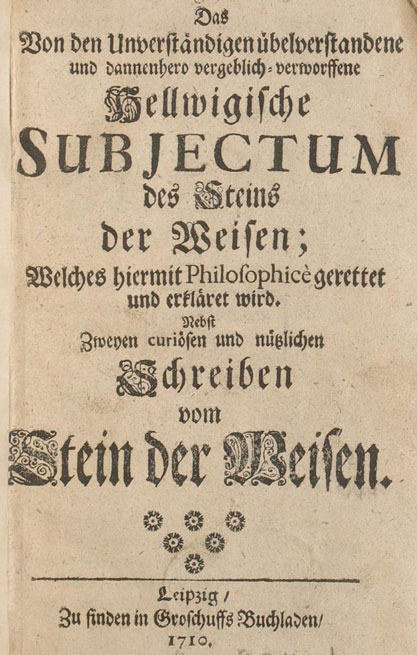
Translated from German book:
Das Von den Unverständigen übelverstandene und dannenhero vergeblich-verworffene Hellwigische Subjectum des Steins der Weisen; Welches hiermit Philosophicè gerettet und erkläret wird : Nebst Zweyen curiösen und nützlichen Schreiben vom Stein der Weisen
Book Contents:
1. The Heavenly SUBJECT of the Stone of the Wise
2. Book from Johann Otto Hellwig
- What, properly speaking, is the Philosophers’ Stone?
- Wherein does its material consist, and how must it be prepared?
- What should one think of those laborants and gold-seekers commonly called alchemists at princely courts?
3. A friendly letter from an adept of Hermetic science and art, addressed to the so-called Federated Hermetic Duumvirs, concerning their writings, which were sent from England to Frankfurt a few months ago.
4. Auro Mercuriali, Mercurio coagulado that is, Mercurial Gold
Some readers of the Baron Helmontian writings have satisfied themselves that from them they have recognized the materia of the Philosophers’ Stone what it is namely:
“The saliva of a man, joined with air, attracted by an aerial magnet.”
(Saliva hominis conjuncta cum aere per magnetem aereum attracto,)
insofar as they sufficiently make such their opinion understood in writings and in spoken conversations.
But even if they have been able easily to conjecture and conclude such a thing from the indications of the treatises published by him, yet it stands thus: that they have rashly precipitated themselves with their judgment, and have not observed what l’Espagnet, in his Arcanum Operae Philosophiae Hermeticae, Chapter 9, left behind as an upright warning:
Let the lover of truth handle few authors, but of the best reputation and of tried faith; let him regard what is easier to understand as the more suspect especially in mystical names and in secret operations, for truth is concealed in obscurities; nor do the Philosophers write more deceitfully than openly, nor more truly than obscurely.
And Geber says: When we have spoken openly, we have said nothing.
And in the ‘Riddle of the Stone of the Wise,’ in the Preface:
Read and study, O learned men, in this science; penetrate into their secret and hidden understanding, and do not halt at the literal understanding of their words.
And in the Hermetic Triumph, pages 98–99:
When the philosophers speak affirmatively, and thereby with plain, simple words concerning a certain subject, then one may surely believe that those who will hold fast to the literal understanding of their words will, without doubt, find themselves deceived.
The philosophers know no surer means of concealing their science from the unworthy and of revealing it to the worthy than explanation by likenesses and comparisons in the essential points of their art.
Therefore Artephius says:
This art is entirely cabalistic, to the understanding of which one must have a kind of revelation from above.
Because the greatest sharpness of understanding, without the assistance of a faithful friend, is not sufficient for a possessor of this great light, not sufficiently to disentangle the True and the False from one another.
Thus it is as good as impossible that one should, by the mere assistance of books and by labor, be able to arrive at the knowledge of the Matter, and still much less at the understanding of so singular a handicraft, so simple, so natural, and so very easy, as it always can and may be.
Therefore the Harmonic Triumph, the Rosarium Magnum Philosophorum, says, page 219. Note well:
In the art of our Magistery nothing has been concealed by the philosophers except the secret of the art, which it is not permitted to reveal to everyone; for if this were done, he would be cursed and would incur the indignation of the Lord, and would die of apoplexy.
Wherefore every error in the art arises from this, that they do not accept the due Matter.
From this one sees that what they conceal must be nothing other than the true matter alone.
How then could such premature judges reasonably and properly presume that the late Baron was the only philosopher who propagated the matter of the art in so forbidden a manner? Or that he just as his antagonist himself, the Cato Chymicus, chapter 3, has nevertheless venerated him as an outstanding philosopher should yet not be held for an adept, should seriously believe that out of mere saliva, or urine, or hair, or other excrements, heaven and earth could be produced, since it is a postulate and general position of the philosophers that the first matter of the Stone is one and the same with the first matter of all things?
Aula Lucis, p. 19.
One may indeed well consider what the allegorical Preface of the Riddle of the Stone of the Wise recalls with upright warning, p. 12, in these words:
But see to it carefully that you do not fall into the error of those who believe that this is the common dew; also (NB) nothing of all that which is clearly named in the books of the philosophers.
And shortly thereafter this thoughtful and excellent philosophical Preface continues as follows:
And know that that which you must have is a bodily spirit; for there is the root of the life of all things, which takes its being from heaven, from the earth, and from the elements.
Finally, it is (NB) the earthly cave of which Basilius makes mention
(here one sees that this agrees exactly with the Helmontian Introduction, concerning the spelunca obscura et humida attractiva superioris, that is, the true philosophical magnet philosophical [work], page 14.
The report occurs (as may also be seen from the following words) in his foreword, where he wishes to give you to recognize this secret beginning of the Work, or this single spermatic matter of the Wise, saying:
As concerns the seminal power of the metals, I wish that you should understand it thus: First, the heavenly influence, at God’s command, ascends into the heights and mixes itself with the powers and properties of the stars, and from this combined mingling forms a third, earthly cave. Thus the beginning of our seed is made, and such is its first generation, whereby it can give sufficient testimony of its kind.
Dear reader, pause here and weigh these words well.
Thus far the Preface.
But if someone should object: the late Baron nevertheless does not name the common saliva so plainly, but conceals it under the phrase Vis aliena Tessæ; therefore one could not conclude that this belongs among the open utterances, with which the philosophers have sought to deceive the incautious readers, etc.
So it is nevertheless to be answered to this, that this is already open enough to be reckoned as an aperta locutio, if one, through the resolution of this phrase is found, namely that it is an anagram, reading: Essentia salis; which the readers, as experience teaches, have until now been able quite easily to decipher just as easily as they have previously drawn the Vitriolum out of the anagram Vultimori, Viromulti, Lorrivium, etc., and have also been deceived thereby, as mentioned above.
Thus the aforesaid anagram (Vis aliena Tessæ) belongs among those things easy to understand, against which the above-mentioned Espagnet warns the inquirers of the Art, as being suspect.
Among the things easy to understand belongs also Antimony, which Johannes de Monte Snyder, in his Metamorphosis Planetarum, as also in his Medicina Universalis, on almost all pages, indeed does not name Antimony by its name, but everywhere designates it by its character (♁) not only through all the planets, but also by the representation of all manner of figures, setting it before the reader’s eyes and admonishing him, so that he may find it with little effort.
But if now the reader remains fixed on the letters, he deserves the just reproach which Doctor Heinrich Khunrath of Leipzig gives him in his Hylialistic, Primaterial, Catholic Chaos, page 119 and following:
It is noteworthy what a certain philosopher, C. D. M. A. S., in his thorough Refutation of J. Rud. Glauber, sets forth, in that he brings his deceptive sophistical artifices to light and recalls many good points, after Glauber had appealed to Paracelsus, setting down the following words:
Paracelsus and other philosophers have often employed florid modes of speech which are not always nor in every present case to be interpreted and understood according to the letters; but rather, by their discourses, they often wish to indicate only the relationship and property of a thing, which the unlearned overhear and from this carry away quid pro quo, unum pro alio whereas they ought rather to consider that by such florid speeches and interpretations the philosophers wish to indicate that the unlearned, as unworthy of such sciences, are not to be admitted thereto, but rather are to be kept away from them in every manner.
Thus far the Anonymous, the Refuter of Glauber.
In the same vein the upright philosopher Albertus Beyer also very well admonishes, in his Explanation of Count Bernhard, which he treats in the form of a dialogue between Albertus and Georgius, after he has emphatically demonstrated that the common aqua fortis and aqua regis made from vitriol, nitre, sal ammoniac, etc., are not the Fontina Bernhardi nor the Aqua Philosophica, Albertus says.
But why then, says Lull, Geber, the Rosarium minor, and others, do they answer concerning vitriol and nitre? Georgius replies: My Albert, you are not sufficiently instructed in these matters according to the philosophical opinion.
For Petrus Bonus of Ferrara, in his Margarita Novella, chapter 10, speaks thus:
“For the philosophers have written these things with subtle parables, saying one thing and understanding another, so that they may seduce fools and turn them away from the truth; and those who do not understand work only according to the sound of the writing, and in the end find nothing of the truth and marvel. And afterward, believing that they act rightly, they change the receptacles and multiply and extend them into infinity. But the philosophers desire only one thing, and in that one they all mutually understand one another.”
And Avicenna, in the Book of Definitions, definition 8, says:
“I did not say vitriol as vitriol, but as something re-calcined and dry, just as we signify by sal ammoniac.”
From these chosen words you may easily understand that there is a very different meaning in the philosophical modes of speech, by which indeed the greatest part are concerned and led astray;
as indeed Bernhard, in the third part of his Chymia, says: that when he sits together with other philosophers, they most of all dispute about this how and in what manner they may sufficiently conceal the art of the Philosophers’ Stone Thus far Albert Beyer.
Cyrenaeus Philaletha, in his Explanation of the First Six Aphorisms of Ripley, indeed says, page 387: It would be without praise to report of him and to proceed as though someone were upright; how far, however, such his so highly extolled uprightness extends, will appear from that which he confesses of himself, together with other adepts, page 27:
“Since we write already for the illumination of a son of the Art, so do we nevertheless also write for the ruinous blinding of all such owls and bats, which can neither look upon the light of the sun nor endure the splendor of our moon. To such we set forth many deceits, which accord with their foolish fantasies. To the greedy we show an easy path without costs, one that does not require much time; to the lazy book-wise, a game without wearisome labor; to the unstable and heedless, swiftly many-fold false distinctions which words he also repeats on page 381, saying:
Know that this is a truly Cabalistic Art, and we busy ourselves to describe it in such a manner as we know that it agrees, in one place and another, with every imagination.
Bernhard, in his Preface, says:
And I tell you this: that whoever opens his eyes should come to this and also understand it rightly; that such a person would be ashamed of the circuitous ways which he employs therein, since it is so very easy and well to do, that if I were to show it to you you would scarcely believe it to be so easy a way.
Therefore (NB) all those who have possessed it have concealed such an Art with words, and described and indicated it in so very strange a manner; for they everywhere feared that one might understand it too quickly.
And further below in the same Preface he says: truly you will feel the use of such an Art well yourself, and you should sufficiently not only defend it, but also help to conceal it and in the third part he says: Therefore modesty will not permit that I should set it forth plainly and more clearly, for I have already done too much of that. I also know, if you seek it with diligence, that you will attain such an Art through, would find God’s hanging judgment out of this book; and then you would judge and say that I could not have shown it to you more dangerously, for it has already happened.
I also know that if you were thus to understand it as I do, and had made the hinted-at Stone, and should then write of it, you would, on account of the lightness and yet nobility of the Art, therefore keep silent about this fine way rather than write and show it more dangerously.
Now since, then, the nature of the matter is so constituted that it necessarily requires an adept thereto, to whom it is impossible to divulge the Art, so I do not know why, among all philosophers, the late Baron alone should have been so extraordinarily faithful-hearted that in his public writings he would have bound the Art, ad litteram, to the noses of every blockhead who comes upon them to read just as they interpret him.
No, my friend; consider only the words which you read in Physica Curiosa, chapter 10, concerning the magnet, where he thus says:
Here the reader will, beyond all doubt, come to know how and in what manner the human vitriol of the universal Spirit-Salt attracts; that it becomes visible, tangible, and turns into a Mercury because upon this the Art about the matter by which one may most readily attain the masterwork of the metals.
But with this I cannot satisfy everyone, for I do not know everyone; and the clear disclosure of such a mystery is given only to a few trusted friends. Here you have his confession plainly: that he was not inclined, through his writings, to teach the reader the way to arrive at the matter.
How then will you pretend that he, in earnest and ad litteram, held saliva, or urine, or tears, or mucus, or I know not what of human excrements, to be the matter of the Stone?
But if indeed he so conducted his style that the reader could easily have been led thereby onto one of these excrements, then it follows from his own cited words that he (NB) intended thereby to persuade the unwary of something else, since he had such an intention already beforehand, as he himself confesses when, in chapter 11, he speaks of his Tessa that he did not take it in the same sense in his other writings, in order to push the unworthy a bar before the Art, so that they might not grasp the matter too quickly.
If now he had the intention toward the unworthy of a
Translator Note: Book jumps from Page 14 until Page 17.
…to set a bolt before the Art.
How then can you arrive at the suspicion that he would have opened wide the door to the Art for unworthy readers by the divulgation of the Matter which is the only thing that, according to the testimony of the philosophers cited above from the Rosarium, p. 219, has been kept hidden, and upon which the entire Art depends?
Passages of this kind will be found more frequently in his writings, if one were willing to take the time to search them out and to apply the requisite diligence.
One therefore sees that those who interpret the Helwigian material here ad litteram have not understood the language of the Hermetic philosophers, and therefore ought not to have passed judgment on matters they did not understand.
But if they are adepts themselves who attribute such an opinion to him, then it is no wonder; for they too have taken his words ad litteram out of human conformity for they too are men, as the Cosmopolite reports in his Treatise on Sulphur, in the conclusion:
“Nor can all things be comprehended in such a manner, nor can one person suffice for all.”
He thereupon gives an example from Albertus Magnus, who wrote that in his time, in the grave of a certain person gold was found between the teeth of a dead man, and by this the saying of Morienus ‘and this matter, O King, is extracted from you’ (& haec materia, Rex, à te extrahitur) was confirmed; but this (he adds) is erroneous, for Morienus wished this to be understood philosophically.
Indeed! But if Morienus understood it philosophically, why could not Albertus Magnus also have understood his assertion philosophically? As indeed it cannot be understood otherwise than that he meant the man not in the vulgar sense, but the philosophical man, namely the matter of the Stone putrefied in the philosophical vessel, and proposed this as a riddle.
Therefore Sendivogius, with his comparison since he wished to set up Albertus as an example of an erring philosopher has thereby presented himself as such an example.
It is no wonder that this happens even among philosophers; for when they encounter a book, they do not take the time and effort to read the writing through often, to compare all its passages diligently, and to seek out the hidden meaning as the still unknowing must necessarily do. For the adepts know the Art without this; therefore such an error does not arise from ignorance, but from carelessness toward the author’s words, so that it is to be understood thus: At times even good Homer nods.
This the adepts too may well have experienced, insofar as they may have taken Hellwig’s words, out of such a haste, according to the letter (ad literam), etc.
Yet one thing more is to be remembered concerning the assertion of the late Lord Baron, at which they so greatly take offense and quarrel: namely, that one can transform the three kingdoms animal, vegetable, and mineral one into another, and that he has also often practiced this in the presence of various high-ranking persons, etc.
So much is to be known, that this is nothing new, for the Centrum Naturae Concentratum alleges this just as many physicians themselves, who most vehemently oppose such an assertion, thereby contradict themselves and refute themselves ipso facto, when they administer minerals to their patients.
See what Via Veritatis also thoughtfully recalls here: namely, that all things have been divided into three natures. Although, says the philosopher himself, the three natures are bodily distinguished namely vegetable, animal, and mineral yet they are elemental, or in the hidden state, sprung from one single substance; they all have one single root, since they all arise from the green and growing, which by the ancients has been called, for the sake of explanation, prima materia or hyle; and on the following pages he says concerning the vegetable and the animal, that their essence is not so cooked together with the liquor as the metallic moisture is cooked together with the essence; and likewise the union of the liquor with the essence is not metallic, but rather purely vegetable, which is consumed in a black smoke, having been given forth.
But after the essence, through Nature, has entered into the cooking, it does not remain vegetable, but becomes also metallic, and is now consumed by the common fire in a white smoke…
Thus far Via Veritatis, since the philosopher expressly says that from a vegetable a mineral is produced.
Basilius Valentinus, in his Microcosm, expounds at length concerning a cow, which eats vegetables, from which an animal substance is produced, namely milk; and again, from this animal substance, when it is consumed, it putrefies in the stomach and becomes dung, with which one manures the field, and from which wheat or other grain namely a vegetable is again brought forth.
Aula Lucis, in the conclusion, speaks of the glass vessel of Saturn, or the Hermetic vessel, page 36, as follows:
In a word: without this matrix you will never coagulate the matter, nor (NB) bring it into a mineral complex.
Thus one sees that, since the artist is to bring the matter into a mineral complex, it must necessarily be presupposed that, before it is brought thereto, it must previously have been either of a vegetable or of an animal complexion.
Now you say: it has been neither of these two complexions, but rather in a catholic state, and afterward is specified through the vessel of Hermes; and this comes to what Count Bernhard reports in another place:
“If anyone goes astray even a little, before he reaches the goal, many paths present themselves here and there as deviations; but whoever once directs himself into the straight step and perseveres therein, will finally arrive at that place to which he intended to go.”
Answer: Well said but this is false, namely that the catholic hyle has neither animal nor vegetable complexion before it is brought to the mineral.
For potentially it has all three complexions within itself, and according to the Bolognese enigmatical epitaph it is the good Elia, Lelia, Crispis not indeed in act, and especially of one of them in particular, but rather all in potency.
Therefore Lullius says in his Testament, chapter prior 3, circa finem:
“And by the other philosophers it has been called possibility, because it has no form actually, but indeed contains every form through possibility within itself, as though enclosed like those who are silent without hearing, or who do not see and yet cannot see on account of darkness. And thus it must be understood, this matter itself, as if understanding nothing of itself; and therefore it is written that it itself is the form of the world.”
Thus it is to be understood that the late Lord Baron’s Hyle was in potency a human matter, although he sometimes on account of the unworthy kept silent that it is at the same time also vegetable and mineral; just as he expressly confesses and recalls such in Cur. Phys., chapter de Mercurio & Vitriolo, and thus from an animal and vegetable matter makes a mineral as indeed I myself did some years ago, but afterward did not wish to take up again.
And from the allegory of Count Bernhard cited above, it is known to everyone that before one comes upon the wrong path, the first indifferent path does not lead to one single byway only, but to all so many as there may be equally; until I step onto one of the same [by-ways]; for then I do not come upon the other wrong paths, but rather I return again to the first way, which goes before all the paths of division.”
Now you say: “But Bernhard forbids this.”
Answer: He forbids it in the labor of the Philosophical Work; but Baron Hellwig, when he wished to prepare the master-piece of the Wise, did not strive to bring the mineral complex into an animal or vegetable one, but rather proceeded along the path of mineral nature.
If, however, one wished to change one kingdom into another, then this would indeed have been an entirely separate work, which does not pertain to the Philosophical Work, but rather surpasses it, and is far more worthy of wonder. And such people who do not even properly understand the minus and the vilius, namely the transmutation of metals ought rightly to refrain and be ashamed to judge and reject the maius and the sublimius, which they understand even less than the former.
They should consider what Physica Naturalis Rotunda Visionis Chimicae Cabalisticae says in the opened casket of the greatest secrets of Nature, quaest. 7.
Now know further that it is possible from any kind of seed, metal, or mineral to make a salt; and from the salt, however, an herb or tree, according to its kind; and likewise further, from this herb or tree, an animal and a sentient creature.
Likewise again, conversely, you can from any animal make a vegetable; from the vegetable a salt, sulphur, vitriol, etc.; and further from this a metal; and finally from it all kinds of precious stones.
This seems to me a great thing, which yet only few people have experienced and become aware of.
A proof of this is seen in that wine, which is a vegetable growth, is given a salt; then it is reckoned among the minerals, and further this becomes Saturnine salt.
See, if you had reflected on this and rightly followed the matter, you would again from this Saturn or wine have been able to proceed further and make gold, silver, iron, tin, quicksilver, copper, etc., and finally all kinds of precious stones; or, if you had rightly willed it, you could bring forth again and make a tartar; from the salt, a wine; from the wine, a grape; from the grape, a vine; and thus all the way back to the very end of its beginning.
If you had so willed, you could from Saturn, through its transformation, have made another herb, of whatever kind you wished; an animal, of whatever sort and kind; then a human being or a homunculus (yet such a one would not have had a true soul).
Furthermore, you may also consider how great this Art is, and how far it extends, for you are able to make from vitriol ♀ Venus, ♂ Mars in a short time ☉ Sol, ☽ Luna, and likewise from ♁ Antimony, ♄ Saturn, ☉ Sol, etc., and to transform one thing into another according to your pleasure.
This discourse they should diligently reflect upon and learn rightly to understand; this is one point.
Secondly, it is known and acknowledged among all philosophers and hermetic writers that they understand one and the same thing now in one sense, now in another now properly, now allegorically; at times they speak of gold and mean philosophical gold, at times of gold and mean vulgar gold, in order to deceive the unworthy.
This should be applied to our present case, so that we may see how our author himself interprets his own words. This is shown in his “Introitus ad veram & inauditam Physicam,” page 32, where he says:
In the three kingdoms of nature, which (after rejecting the old and deficient division of the letter-learned) are these three: the lower (subject to the feet of men), the middle (animal), and the upper (which is above us and in which we expound.
Here we now have the sense, how the author wished the three kingdoms to be understood, namely as the three parts in the philosophical work. What wonder, then, is it that he transmutes one part into another?
The same thought is also put forward by Robertus de Fluctibus in Theologia Cabalistica et Physica utriusque mundi, distinction Port. I, part 2, book I, chapters 10 and 11, where he explains at length, under the allegory of heaven and earth, the philosophers’ work, and its two kingdoms, that is, parts and places, and the mutations of the one into the other which indeed deserves to be opened and read; yet to present the whole discourse here would become far too lengthy.
I therefore wish here only briefly to adduce what the Great Rosary reports on this matter, so that the customary style of the philosophers in this regard, as it must likewise have been usual with our author, may be clearly shown.
Rosarium Philosophorum, page 242:
There are three stones, and there are three salts, from which the whole magistery consists: namely, the mineral, the vegetal, and the animal. And there are three waters, namely the Solar, the Lunar, and the Mercurial. The Sun is mineral; the Moon is vegetal, because it receives within itself two colors, whiteness and redness.
And the Sol (☉) is animal, because it receives three things namely constriction, whiteness, and redness and it is called the great animal. And Sal Armon(…)/Armen(…) is made from it itself. And the Moon ☽ is called a plant, and Sal arc(…) is made from it itself. Mercury ☿, however, is called the mineral stone, and from it common salt is made.
Likewise, when the philosophers saw the thing of this Art dissolved, they called it Sal Armeniacum (Sal Ammoniac) p. 249. We use the true nature, since nature does not amend nature, except within its own nature.
And immediately after this: There are three principal Philosophers’ Stones, namely mineral, animal, and vegetable. The mineral, vegetable, and animal stone threefold in name, but one in being. Whoever considers this will confess that our Author, in this matter too, agrees most amicably with all the philosophers.
What was reported above and with regard to the saying of the Cosmopolite, “Whatever is, is made by fire,” (Conclusion 12 of the treatises) has been included under the rubbing/grinding of the philosophical matter: and by grinding it is made; therefore the △ Fire is made. From this, let the investigator of the Art infer something about all the operations and labors in the Philosophical Work of which mention is made by the score in the philosophers’ books - whatever names they may bear.
…have been said, as they will have it. For as I can comprehend under the general rule of the Cosmopolita the operation of gr attachation / rubbing (reiben), so likewise can I, with the same fitness and right, comprehend under it subliming, calcining, filtering, descending, and all other operations.
Wherefore let him remember the Via Veritatis alleged above, which, even unto loathing, it inculcateth throughout the whole Treatise: that all and every thing is done by the Natural Cooking; and it addeth the epithet (Natural) to distinguish it from the vulgar doings in the slovenly kitchens of sophisters and coal-blowers.
Of which I will not further speak at superfluous length (lest I be troublesome), but herewith conclude promising (God willing) to set forth more hereafter.
To conclude these lines: I have (as may be seen on the title) two curious letters, one from Joh. Ott. Lib. Bar. de Hellwig, Knight of Great Britain, and Counsellor to His Royal Majesty of Denmark, of blessed memory; who at the time when he wrote this epistle was Councillor and Physician-in-Ordinary to the Elector Palatine, and also Public Professor of the University of Heidelberg; and then yet another curious epistle to append [them]; such epistles must indeed have already been in print some twenty years ago, but now are no longer to be obtained.
Since, however, in these two epistles there are to be found fine, curious, and useful things, I have thought to give the well-disposed reader a pleasure by appending them here especially since such epistles, as mentioned before, are very scarce, or cannot be gotten anymore.
Of Johann Otto Hellwig,
Doctor of Philosophy and Medicine; physician-in-ordinary and court councillor to the Electoral Highness of the Palatinate, and also public professor at Heidelberg.
A brief reply
to the following three questions:
I.
What, properly speaking, is the Philosophers’ Stone?
II.
Wherein does its material consist, and how must it be prepared?
III.
What should one think of those laborants and gold-seekers commonly called alchemists at princely courts?
To his beloved friend, C. T. S., Doctor.
Psalm 127, v. 3.
It is in vain that ye rise early, and thereafter sit
until deep in the night; for to his
friends God gives it, as it were,
in sleep.
LEIPZIG,
To be found at Groschuff’s bookshop,
1710.
Thorough answer to the first question: What the Lapis Philosophorum (Philosophers’ Stone) actually is?
Noble, rigorous, and highly learned most honored sir and friend, etc.
Although the three questions put to me are very difficult, and reach into the deepest secrets of Nature: yet, since God has, by grace, bestowed on me a talent therein, and has commanded me to use it in service of my erring neighbour especially of good friends I will, so far as my understanding and the shortness of time permit, now answer accordingly:
First question: What is the Lapis Philosophorum?
Many thousands of alchemists seek what they do not know; and, on the other hand, they “know” that they seek nothing at all. They strive, at great expense and with much labour, after the so-called Stone of the Wise, and do not know what sort of thing it is indeed, even the very name of it, and the reason for that name, remains unknown to them.
If one knows only a thing’s name and do not understand it, is it not then the very greatest folly to seek one’s own misfortune in so unknown a search?
To be sure, among men of state and court there are likewise many who, through striving after high offices of honour, have hoped to “win for themselves” a gold-making stone in politics, and have more than once, for that reason, squandered their welfare, honour, and life. Yet these very murderers of their welfare, honour, and life are more excusable than our alchemists, because they understand the court and the ratio status (reason of state) tolerably well, and see many of their own rank attain the desired end; so that they lack nothing except the right preparatory knowledge.
For if they knew how to seize opportunity, as their nearest materia, with the magnet of understanding; how to dissolve radically the hard ore of their doubt; how to separate thoughtlessness from timidity; how to keep their eagerness for service circulating without ceasing; and how to desist from the many proud sublimations, by which the spirits are sharply corrupted and made corrosive then they would at last surely arrive at the wished-for coagulation and fixation of their hope, and would not so often [they] are ruined either by the strong fire of wrath and headlong haste, or by the coldness of unfaithfulness and negligence.
But our laboratory-men are, indeed, wholly innocent for they understand not only the work of their art, but also the matter itself, and do not know what it is they would make.
I have with diligence searched out all follies in the world among Christians, Jews, heathens, and Mahometans so that by the knowledge of them I might the better guard myself against them; yet I swear: among those so-called ‘understanding’ persons I have found none greater than the toilsome and costly labour of gold-making.
This is the hidden centre of all follies; and whoever is engaged therein may with truth boast that he has begun to fashion the very masterpiece of madness, and is a right philosophus.
What is more wide-ranging than Nature? What is harder than the full knowledge of her? And yet every one imagines that he can find her centre, and out of it prepare the masterpiece of chymistry.
Is there any handicraft so base and despised, that a man of merely moderate reason would dare to undertake it therein, without having previously his instruction, or the due labour, to make the master-piece by degrees?
“Labour by degrees,” say I: for although a man do work, yet if in his handicraft he doth not proceed from the lesser to the greater (à minori ad majus), he shall never become a master.
A painter and an image-carver may, for many thousands of rix-dollars, smear about colours and cut up ivory; yet they shall never make a master-piece, unless they can first bring forth mean and ordinary pictures.
And in Nature men would make Gold, when they know not how to prepare the coarse, base, and far meaner metals. Judge here with a free mind, whether the workman will not sooner lose gold (i.e. his money), health, time, and understanding, than ever find such a thing.
From one extreme to the other a man cannot possibly come without a mean. Now ignorance in the generation of metals and the making of gold are two extremes.
Here followeth a merry conclusion for so many covetous people. Other labourers say, to remove from themselves the suspicion of covetousness, that they desire only an universal medicine; but their undertaking is as bad as the others. For how dare such louts / knaves presume, who to seek the Universal Medicine, since in the art of physic they are the greatest ignorants.
And because they do not know wherein even a slight sickness consisteth (to say nothing of the greatest), how then will they prepare the highest medicine? If all that are greedy of Chymistry would but consider this, and without gold-lust would well weigh the matter before they begin, I am assured one would not meet with so many phantasts in the world.
To spoil coals, vessels, metals, and minerals is no art; neither is it by the true Masters accounted any labour belonging to the Art, though it should last fifty years. To light upon something good by chance in an ill work, is also nothing, when it is prepared without set purpose; but to make quicksilver, lead, copper, tin, out of mere air-water, and not to extract them out of earth this I would first hold in chymistry for such a young man’s work, as might in time (by God’s grace) make a man of understanding a master.
The Ancients have called this master-piece the Philosophers’ Stone. About this name many have broken their heads. One thinketh so because it looketh like a stone; another, because it can endure, and (like a precious stone).
I do not deny it: many have made various interpretations, and yet have not hit upon the right one. But I, my lord, will herewith disclose to you the truth and the full explanation. The Wise have called this masterwork their Stone because many thousands both low and great fools have smashed their heads against it. For this Stone lies before the little door of the exceedingly splendid temple of Wisdom and Riches, into which no one can fully enter unless he has lifted away this heavy Stone. Yet this is impossible, on account of its metallic heaviness, unless after long waiting, humble entreaty, and an endured examination one is helped inwardly by the priests of Nature, or is strengthened immediately by God, like Samson.
Nevertheless, so many attempt to master this Stone by force this Stone which, the Wise say, has been placed by God’s permission before the door of Nature, Wisdom, and temporal riches and to press into the temple not for Wisdom’s sake, but for riches. But since their strength is too weak for this burden, they very often slip in the midst of the earnest and they wear themselves out with foot-work, and in the end they strike their heads against this Stone, and their small understanding is dashed to pieces in the false way.
Therefore, for the unwise and fools it is truly a stone of stumbling and offence. And let this be shown here sufficiently: that the seekers of the Stone of the Wise, up to now because of the all-too-great secrecy of the quiet priests of Nature have not known what this Stone is, and why it is so called.
Another question
Now I proceed forthwith to the second question, which is as follows: What is the materia of the master-work of the Wise, and how must it be prepared? This, my lord and friend, is much asked. Therefore I will not answer it here now as fully at length as perhaps your desire has been; yet I will explain it in some measure. I say, then: the remote matter of this master-work is air; the nearer is a sweet salt-water drawn from the air; the nearest is a snow-white “earth” prepared out of water; the next, lastly, the Mercury that springs from the double-salts of this earth.
Now although innumerable kinds of devices have been invented whereby learned and gold-greedy folk have sought to draw to themselves and to catch the essence of the air and the little bird that hovers therein, yet they have squandered toil, time, and expense; for, because the understanding of the true magnet necessary hereunto has been wholly lacking to them (as some have indeed seen), they have laughed the work to scorn, and mocked the Air-Philosophy.
But their opinion is false, and their ignorance does not take away the truth of the science and art. If a judicious physician, without prejudice, will give his thoughts to this matter, assuredly he will be on my side. For how is it possible that such people should attain what they wish, if first they cannot do what they ought? The reward is everywhere according to the works.
They desire to catch the best, sweet, and universal spirit, the living salt and light of the world, and to present it a dead house. They wish, with sharpness, the greatest lovely things, and with a calcined bone, fiery alkali, and spoiled/corrupted stones, draw to themselves the soul of the air. One catches birds (among which that of Hermes is reckoned) not with cudgels, but with pleasant whistling, with good sweet grains, and with their like namely, other birds.
The Spirit of God, which is shining, lovely, and glorious, is not sucked in by a dark, stinking, and sharply-burning soul; rather it must be taken hold of by a friendly, humble, and lovely soul. One catches a thing best with its like.
When the common spirit of the air comes into arsenical matter, it changes itself into that property, and serves Napellus as nourishment just as it does the rose.
Therefore the magnet belonging to this master-work must be the best, the loveliest, and the most glorious full of life and spirit, full of light and sweet salt one that has never smelled the burning fire, and has never tasted the rough earth.
Briefly: it is born out of the air itself by Nature, in a wondrous yet common and well-known way always generated, found everywhere and at all times, nourished by the sun, and watered by the moon. This this, my lord and friend permits/causes a God-devoted, so that the worker’s hope is not lost, but rather (it) gives him in the form of a sweet and heavy mercurial, or saturnine, water the skill and the seed (i.e., the power of generation) of the upper and the lower forces. Such a thing can be had everywhere, and at all times in the hottest summer as well as in the harshest winter; only that at one time it is richer than at another.
I have never seen this materia for sale, and yet one can obtain it for nothing, by sea and by land.
Its preparation, up to the completion of the Mercury, is threefold: first into a snow-white powder, without smell or taste; second into two salts and a moisture; third out of three pieces into a Mercury. Its power is wonderful in every form and preparation.
In its rough being it already shuts out (separates) the finest gold “radically,” and brings it into a fermentation, so that it works like a leaven like sour-dough as my dear friend Dr. Andreas Steiger, court hospital-physician and town physician at Heidelberg, and Simon Korn, the true friend of us both, have many times seen from me.
Its power in the art of medicine is great, and does what other remedies cannot accomplish.
Its knowledge is the key to all Nature; and from it, as from a centre, one may look out into all the circumferences.
But with expenses and much money nothing is to be accomplished here. For God sells His good gifts to His own for prayer and labour, not for money.
Thus far have I come by my own work. What besides I have told my Lord, read, and with my own hands done sundry times, hath proceeded from the labours (laboribus) of another master and friend. I have never pursued Nature in order to gain riches, but to attain wisdom; and since God therein hath, out of grace, granted me what I asked, I am not minded to make for myself any further superfluous toil, care, and unrest, but to take joyful contentment in the knowledge of the Stone of the Wise, even without the possession thereof.”
Third Question
“Lastly, as touching the third question proposed unto me, the same is easy to resolve; because nothing else is asked therein than this:
What, then, are we to think of those laboratory-men and gold-seekers commonly called Alchemists at princes’ courts?”
For this is certain: that the prince or great lord, merely for hope of making gold, lets the laboratory-man spoil and ruin at great cost so many and such fair things: metals, minerals, vegetables, animals, furnaces, coals, and vessels.
Now if the labourer understandeth not the gold-making (as in truth, all his life long, he is possessed of no one requisite for this art, save only a strong will, which like Icarus flying with waxy wings toward the mineral Sun at last plungeth him into the sea of despair), then is he nothing useful to his lord; and his lord is nothing to him, unless he can truly assure himself of that art which he hath so often falsely sworn to.
For the sake of expense, no Philosopher ought to go unto great lords. Poor folk can get the materia lapidis more easily and better than princes. A whole pound of the Mercurius Philosophorum, from the beginning unto the end of its complete preparation, costeth not above one “Kopffstück” (a single coin); great sums of money are here in vain: for the cheap preparation of the rough matter yieldeth so much of its “aurum virgineum” without the adding of any metal or mineral by time and labour, as the artist, which the artist needs for his fermentation. If meanwhile he lacks the means of living, and by reason of poverty cannot await the happy end of his master-work, then he nevertheless possesses the universal matter, which, with a plain and simple preparation, yields excellent medicines, and among the best a true aurum & argentum potabile (drinkable gold and silver) and a thorough gold-tincture.
What small portion of gold or silver for this purpose will his patient who desires to be made well refuse to give beforehand? And once he is become half a dozen, or a whole dozen, thalers rich, then afterward (if he walk uprightly in his ways) the daily bread will never fail in his house.
Tailoring is but a mean handicraft; yet what prince would be so foolish as to entrust a golden piece to a person who understood nothing of making clothes except what he had read and heard of it, so that he might make from it a fine woman’s garment? And yet men believe so many fools, that some fellow who with his medical art cannot cure even a common quotidian fever, and in the true improvement of metals has never accomplished anything, should be able to invent a universal medicine and a gold-making means to set him on his way; he is as poor as Irus, and his lord hopes, by means of him, to become a Crœsus.
If the laboratory-men could improve the lixivial salts (salia lixiva) or fixed alkalis (alcalia fixa) without any addition, and make them living, spiritual, and volatile; if they could radically dissolve gold without ebullition, and produce metals out of bare air, sine ulla additione (and all this without expense) then I would think something of them; and then there would still be hope that at last, by such works (which in chemistry are but boys’ work / apprentice-work), they might become masters, or at least journeymen.
But apprentice-work is too base for the laboratory-men of great lords: with them everything must be handled with gold and silver. And what gives not superfluous money, but wisdom, is not regarded in court-laboratories. There one seeks only gold the laborant from the lord, and the lord from the laborant and in most places one esteems wisdom (out of whose temple, nevertheless, the true door to riches goes forth) little or not at all.
Whoever truly possesses this Art, or possesses it as an undoubted science, will never reveal it to a prince or great lord, unless he is not through long conversation with the same man, having so exactly searched out his disposition, that he would hold him more as his Christian, sincere, and constant friend than as a gracious lord. And only in this way could the knowledge of the center of Nature (Natur-centri) come to a prince.
A true “priest of Nature” can offer Nature her sacrifice without gold, flames, or fire; and she also does not speak with him through a burning fire, but rather they make use between themselves of a very subtle fire, without any corrosive, which dwells in the same mine/pit as the true matter.
But the artist separates it, puts his matter into the vessel, and hangs it in the strong, glorious, and sweetly penetrating fire, where separation and coagulation can take place in one glass. When this fire is once properly kindled, it works for some months, without one needing to look to it; afterwards one gives it a new motion.
For the masterpiece of chemistry is Gold, Mercury, and Fire, from one single mine and matter; and nothing is added to it except the hidden athanor and the vessel.
Where then are the laborants with their strange ovens, utensils, costly and poisonous operations? Where are the great lords now, with so many thousands of ducats squandered?
Nota bene. Every work is simple in itself, and has no need of long-windedness, nor of many compliments. Most laborants are downright enemies of Nature: they torment her everywhere with their devil the flaming fire and (I believe) would even, if it were possible, drive her to Hell.
“Accursed hunger for gold what dost thou not force mortal hearts to do?”
Therefore let everyone, as much as may be, beware of this folly and frenzy, and keep his brain well guarded, lest at last such a gold-worm creep into it and breed unrest.
The universality of their “universal” consists in the general and total ruin of understanding, honour, and goods. And the particulars are therefore the less to be feared, because they still leave a part “in the kitchen” (partem in culina).
Let every friend laugh to scorn this pernicious sect, and beware of the black-artists (since they mostly look like chimney-sweeps) as he would of the Devil. If once such a louse gets into one’s fur, you may be sure he will not be rid of it unless it has first swallowed up a portion of his sweat and blood.
She will give him “red” as profit, and find a thousand hiding-holes, whereby she withdraws herself from the hands that are cruel against her by means of his thorough and (seemingly) wise disguising speeches.
N.B. All materials in the whole world can be defended as the universal, although one is better than another; and the authors may be turned and twisted like waxes noses. All laboratory-men find in the Geber, the Turba, and whatever else those dreadful books are called, their delight just as well as the vine-dressers do in the Bible.
The understanding of the true matter God does not give out of books; and they are useful to no man, unless one can judge and set them right oneself without flattery by undoubted demonstrations. Shall such men be judges of our work? O misery! then all is, because of their darkness, in vain.
Men read there with a preconceived opinion; and once our understanding has, as it were, caught up vitriol or mercury by chance, then all the sayings (dicta) appear clear or, in the interpretation, look “vitriolic,” or “mercurial.” What one likes to hear is soon believed. Thus did a Dutch carpenter in the East Indies flatter himself that he would assuredly become General-Director of so many Dutch kingdoms and territories there…
…because another ship’s chief carpenter (Schiffs-Ober-Zimmermann), through good fortune and brave conduct in a sea-battle when the other officers were shot dead had at last attained so high a post, after a long time, in his old age. He supposed his understanding was no less than the other’s, and held his own person up to the mirror as more excellent and more worthy of regard than the other’s; yet he died in a miserable condition.
If anyone has time and money to spare in his calling, let him turn the time to the service of God and to the knowledge of himself, but the money to the poor; then will he gather treasures in his mind and in heaven, where neither moth nor rust consumes, and where thieves neither seek nor carry away.
One has more than enough occasion to contemplate God’s wondrous works, and therefore ought not to submit himself to such deceitful labor especially since a thaler in the purse is better than a thousand in uncertain hope. With this I conclude, because time and my affairs do not permit me to be more diffuse. The grace and love of our Lord Jesus Christ be with us all!
What God will not grant through prayer and labor,
No man will be able to obtain with money!
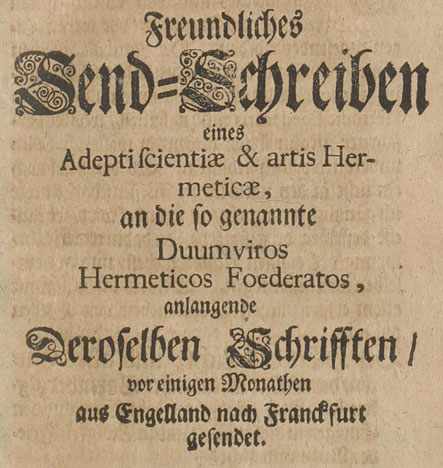
A friendly letter
from
an adept of Hermetic science and art,
addressed to the so-called
Federated Hermetic Duumvirs,
concerning
their writings,
which were sent
from England to Frankfurt
a few months ago.
Learned Reader!
I present to you, as a New Year’s gift, a letter (a missive) which was sent to me a few days ago by a good friend from Frankfurt. The contents of it have seemed to me worthy to be shared with the world; and to begrudge the so-called Duumviri Hermetici Foederati what an experienced man wished to bestow on them, I have considered irresponsible. If, through this, a light is kindled for you in the natural sciences as I fully suppose use it in such a way that by it you may seek the origin of the eternal Light, and may walk in it. This I wish you, together with all beneficial well-being, from my heart.
The Lord of Light and of all good, the God of infinite mercy, be gracious to you and grant you and yours, in this world and in eternity, peace, rest, and light!
My friendly greeting first,
learned dear sirs, etc.
Not yet two months have passed since, in my whole life, I arrived in London for the first time, the world-renowned capital city of the English realm. For almost twenty years I have lived outside Europe and have spent all that time in Africa and Asia amid both hardship and pleasure. An unfortunate accident led me out of Europe; a fortunate opportunity brought me back in again. And meanwhile the events ordered in accordance with God’s will and in their regular course have often, in my opinion, let me feel the extraordinary effects of a severe influence. Although the desired end now seems to be missing altogether, and though I find the last enjoyment on the quiet shore of rest, I can, with thoughtful eyes of the mind, look back upon the wild sea of the world, in which I have so often met with misfortune and suffered shipwreck.
But I had scarcely arrived here in London, when, in my lodging on the very first evening, I made the acquaintance of a French nobleman (who had translated into French, corrected by the famous Mr. Robert Boyle, and put into print, an Introicium ad veram Physicam printed in Latin in Batavia in the East Indies by an English knight, Sir von Helwig), namely Monsieur le Page de Comershill, in particular.
**The French politeness ** consisting, in my judgment, in a heap of selected and unnecessary pomp-words, together with such and so many truly ridiculous bodily gestures, by which this people makes itself necessary in familiar company with other folk will doubtless not be unknown to you. And just such things kept me, that same evening, in the presence of the aforesaid nobleman longer than I would otherwise be accustomed to do, given my manner of living. After much back-and-forth talk about various curiosities of the world which the said Monsieur le Page had viewed, with fairly good observation, in its two parts, Europe and America our conversation turned to mines, and from these to the improvement of metals.
I, who entrust the knowledge of my person to very few people as being one who has much experience in such matters, nevertheless behaved then as a pupil; and although the entire conversation gave me little advantage toward greater learning, it did instruct me concerning many writings which, for some years past, had been issued in public print for the advancement of natural wisdom by valiant, or at least good-hearted, people.
I saw your three Epistolae Buccinatoriae the next day, and at the same time, in Sir von Helwig’s little tract, his judgment: that, in order to please a friend, he had composed based on your second letter, addressed to him and to Johann von Berge Hermetis and had first made public in the Latin tongue at Amsterdam, through the bookseller Janson van Waesberge, for everyone.
Whereupon I resolved, as soon as my affairs had been somewhat arranged for a half-year stay here, to send to you, beloved friends, a well-meant letter of reminder, to finish it.
Now, after attaining leisure, I would gladly have set down my thoughts in Latin; but time has spoiled for me both my fluency and readiness in this and other European languages, which I formerly understood well; and besides the Oriental and Arabic tongues I have scarcely kept even my mother tongue, High German, in more than moderate use.
In Fez, a royal and very pleasant city in Barbary, I lived for six years, served great lords with the art of medicine and the healing of wounds (in which the Africans and Asians are very inexperienced), and this work brought me because my knowledge or good fortune was greater than that of the inhabitants considerable wealth and the unbelievable favor of the nobility.
Natural science then protected my Christianity and preserved for me more freedom than is allowed to a native under a higher government. I soon learned African (the old Punic language) and Arabic; and when I could speak them as necessity required, I made my way, together with other learned men, into the high schools, among which two rich and splendid colleges were held in high esteem above others.
Here I found various brave philosophers, respectable mathematicians, and very experienced experts in the stars, quite different from the way Europe commonly judges these Africans; among whom all, in my opinion, the most excellent of them was one named Adulem Halcora Zaraiga, from the kingdom of Morocco, a public professor of physics, of good life and agreeable manners. In this man’s company I spent many hours, and his teachings and demonstrations were of no small benefit to me.
Above all I applied myself to the so-called metallic chemistry, whose goal is supposed to be the alteration and improvement of ore, with indescribable eagerness from the very beginning. Adulem, seeing my inclination toward such an art, loved me more and more for our like-mindedness in it, and at last, after I had gained his confidence, he led a Christian such as I into the general assemblies of the chemists.
These are now held almost daily toward evening, and these artists and gold-seekers come in great numbers to their promenade-place before the unbelievably great Temple Carven, just as in London or Amsterdam the merchants gather together on the Exchange. The dispute in speech is there sometimes very fierce, and each one thinks his own material is better than another’s.
They hold the writings of Geber in high esteem, and next to these the books left behind by Artagreinim the Babylonian; otherwise they have few chemical authors if I do not except the Magaari and Hamethea, whom, however, they do not particularly value.
Since I now, by the healing of the sick and otherwise, had acquired some 1000 ducats in ready money, and jewels, I or rather my money also joined a certain company which, in a short time, claimed it would make the Lapis Philosophorum (the Philosophers’ Stone). I remained in it for two years, and finally, after losing about 3000 Reichsthaler, I separated again from my fellow “brothers.” During all that time I did not see a single probability of success, and therefore I was glad that my imprudence in such dealings had not brought me to greater harm and complete ruin.
In many others I noticed the same misfortune; and since they experienced the “change” sooner in themselves and in their condition than in the metals, I therefore kept the rest of my money in safety, lined my purse anew, and in the sixth year obtained from the city governor, through a sum of money, permission to travel.
The governor of Tezze, a prominent city of the kingdom of Fez, had, in his illness (from which he had lately recovered), made a vow to make pilgrimage to Mecca and Medina, the two Arabian cities famed for the way of Mahomet. He was also setting out thither with much people and holy men, by favor of the journey.
I was known to many gentlemen who knew of my exceedingly great desire to travel farther and farther, and to whom I had rendered notable services with the art of medicine so I was recommended to his care; and I also set out with them for Arabia, I traveled on to Aden, and after that to Mocha, from where I made my way on an English ship to Surat, and from that kingdom, with good opportunities and the support and advance of Europeans, I went on into Persia and various other Asian lands.
And although, with the Arabic and Portuguese language which I had formerly learned in Europe I could get along well enough in this part of the world, I also learned Persian within two years, and in the Hindustani tongue, in the following time, I became fairly proficient.
At the court of the great Mogul I spent four years; I then traveled from the kingdom of Coromandel with the Dutch to Batavia, and from that Dutch East-Indian capital city onward to China. I then returned again as far as the mainland of India, and spent the remaining time in such regions.
In this part of the world there was, in it, a place not far from the great river Ganges, which, after my misfortunes and in consideration of my services, made me fortunate. And here I found a man who possessed, perhaps, the great secret of nature, called the Lapis Philosophorum of which most seekers in Christendom and Africa have left almost nothing but dreams and shadows behind.
Through this I learned so much of his good heart and familiar friendship as I needed in order to make the Stone of the Wise, and afterward I prepared this powder of life and purest essence of the world, one part of which turned more than 10,000 parts of lead into gold, after I had once erred, but the second time succeeded, and that alone. My joy was great, and the desire to see Europe again no less. I also attained the second thing I sought, in that an English ship carried me from Bantam, sound and full of strength, to London where, as I have said, beloved friends, I came upon your Epistolae Buccinatoriae and the judicium published concerning the second one.
Of the first letter I say nothing; and because in the said judicium much is already answered concerning the second (which does not accord with my theory and practice), I will, regarding the third, set before you only a few things for your remembrance, with good intent.
In it, p. 30, § 65, you say: the materia philosophorum is a limus universalis, and you wish to prove this from Philippus Bombast (who in his self-ridiculous manner calls himself Paracelsus Theophrastus and a monarch and prince of all secrets), because he names his material Lili, and briefly, you want to set the German word for this p. 18 so that “the universal,” and what is chiefly ascribed to someone named Hermes, should be understood.
Now it is well enough known what strange terms Philippus Bombast uses everywhere in his confused and unintelligible indeed mutually contradicting writings; and therefore one can conclude from such words, on your part, so little that he understood, by materia universalis, a limus ex terra (a mud from the earth), as can be inferred from the saying of Geber which you cite in § 66.
You then wish to draw such an opinion along by the hair, as you did with the Testa Hellwigiana, p. 22, § 28, Epist. Buccinat. 2: namely, that “testa” must mean “terra,” because the old Latins often changed the letter R into S, and because such an interpretation suits your earthy prejudice.
And even if the opinion of the so-called Paracelsus were accepted (who, in the last chapter of the Secreti Magici, says: “The stones from animals are nobler than the others; and the matter of the Stone is made from flesh and blood whoever has ears to hear, let him hear”), it still does not follow from this that it is the true truth which you seek, and which I possess with a few others in theory and practice.
Clay, or mud, is a good thing; and I remember that a good friend once made a tincture from it, of which one part changed many parts into gold. That Dr. Philip Bombast may have possessed such a thing, I grant; but I cannot see how he should have been a possessor of that single magistery of the whole of chemistry, by which animal, vegetable, and metals are changed one into another without addition, and by which the base metals are raised and improved into silver and gold.
I have previously read in him and, even now I leaf through him in the Latin tongue everywhere, where anything is written about such matters, and I find nothing else than that he, together with many other writers, has given the great “universal” a small and particular tincture.
In the Secreto Magico de Lapide Philosophico, in a preface which begins roughly like this “One must know that all things come from God,” etc. he says: “You fool, would you be God, that you want to make metals out of blood?” a fancied impossibility of his which, however, I contradict from my own oft-repeated experience, and I assert that metals can be made from animals, that is, from living man.
Otherwise I consider his best writings to be manuscripts which came into his hands from other brave men, who understood more than he did. Besides this, the whole book itself, even in the description of the Philosophers’ Stone, is full of glaring contradictions and great errors.
If such a man, and many of today’s writers, have found something useful in chemistry and can, with a little of their powerful medicine, perfect something of ♄ Saturn, ♀ Venus, and ☽ Luna, they immediately imagine they have seized the so-famous Lapis Sophorum (Philosophers’ Stone); and because it gives them only little bits of silver and gold, and yet demands great effort, they doubt for a long time yes, even when it has become black, white, and red only because it lacks the mere augmentation and multiplication.
Their hand itches for the writing, some people write some perhaps out of love for what is right (though with their dark books and fantastical processes they do nothing but harm); others because they are unable to keep silent.
But I tell you, beloved friends, that different things can yield Luna (☽) and Sol (☉) with great profit: slime/mud (limus), Venus (♀), Mars (♂), 🜩 Jupiter, soot (fuligo) or chimney-smoke, human dung, and many kinds of things from the air, etc., can make the worker rich and often do so. Yet such people will not go beyond their narrow circumference, and a laboratory-worker of that sort does not thereby become more understanding in nature than he was before he could make such Sol (☉) or Luna (☽) from base metals.
Nevertheless his two, three, four, or more “materials” are that one single thing as he firmly believes from which Hermes left so much writing and instruction for his successors. Therefore each writes as he understands it. He covers his little scrap of knowledge and art with such wicked and foolish terms, and stuffs his writings with so many oaths and imprecations, that one must laugh at one part and be grieved at another.
Yet such a man is right in one respect, which he has happily worked out by his tincture: namely, that by it he becomes rich whereas before, in all other things, he not only remained poor, but also, insofar as he had means, he consumed them on useless matters.
But the wisdom which is for a philosopher the first cause of attaining the tinging stone (lapidem tingentem) remains hidden from him. And even if his tincture does not cure so many diseases, nor so quickly, he still helps himself and excuses himself with this: that he cannot find the multiplication by which labor the thousandfold power would first become evident. He therefore remains fixed in the belief that he has the universal tincture in its first power, and is as good as Hermes. Thus spoke Dr. Philip concerning his Lilimus.
Now, to come also to the other sayings you cite: I confess that they signify, among other things, a slime, from which a mud (limus) or glutinous earth is made. They speak the truth: Adam was made from this sticky slime. I have, by God’s grace, seen such “glue” or “mud” reddish, yellow, and snow-white.
But nowhere, except from myself, and from other human beings. Without man it cannot be obtained, and it is born only from animals the “beasts” in man.
It is therefore our spirit, our water, our filth, our quicksilver. With this, as with a universal slime, one draws the subtlest spirit out of the air, which the ancients called Mercury. And besides this slime there is, in the whole world, to my knowledge, nothing that can more truly bring about such attraction or coagulation of the universal spirit of the world.
It is found everywhere on the common earth, because man himself produces it in all places and generates it daily. It is thrown out from houses, apothecaries, and spice-shops; for to all people except those experienced in nature in its outward form it is an excrement. One can have it everywhere for nothing.
And what the true philosophers otherwise report about it fits, without metaphor or allegory, with its very being. Helwig has reported more fully about it in his German and Latin writings, from which you can also further instruct yourselves.
All salts indeed all mineral and metallic [things] can be made from this human slime (which must have touched the earth that is trodden underfoot), and from the spirit of the air drawn and coagulated by it. Here are the highest and the lowest, and in the middle, in the animal kingdom, they are well united with one another.
From this, according to my good-hearted instruction, you and the whole world may almost see, beloved friends, that you have until now falsely put yourselves forth as adepts of the true Hermetic science, and that you have so far mocked the Art and its lovers without foundation and with great injustice.
Therefore, repent of your error; improve your unprofitable life; confess as you can do nothing else that you know nothing of the Hermetic Art; and do not, out of corrupt self-love and great misunderstanding, presume to claim the knowledge of these secrets for yourselves. So you will have more praise for it than if you were to remain longer in such things worked in vain. The adepts laugh at you, and you have presented yourselves so openly in your three epistles that you do not recognize the content of the Tabula Smaragdina Hermetis, on which, after all, your theory is supposed to be founded namely, when in the Third (p. 3, § 2, l. 7) you say: “non enim credimus ad animale,” etc.
But I answer you to this: that the true matter is indeed animal, and yet catholic (universal); for from one and the same matter I can generate animals, vegetables, and metals, without adding anything else. The difference among these things that come forth depends only on the differing motion and matrix, or on differing mixture, or on different weight of an upper and lower salt each thing’s proper proportion being weighed by the artist and found by nature.
Thus, by a certain and singular mixture, a specific matrix, and due motion, nothing else can arise from the universal matter than either a golden powder or a silvery powder (cf. Epist. Buccinat. 3, p. 3, § 2, l. 9); in another way arise gemstones which I have seen come from it, have handled, but have not yet myself made.
If I divide a pound of my matter into three equal parts, and from the one part make metals or minerals, from the other animals, and from the third vegetables, then afterward from the first I can no longer produce any vegetable or animal, but only bring forth what belongs to it; and likewise from each of the other two remaining parts only its own kind.
Thus the determined and specified mixture, matrix, and weight are, for all three parts, equally possible for all three kingdoms the animal, mineral, and vegetable without distinction: everything lies in universal nature; and it belongs to the artist to understand the mixture, the matrix, and the motion; and in particulars one can likewise bring wondrous things to pass by means of these.
Therefore it seems to me that Helwig is mistaken when, in his Introitus ad Physicam, he declares a total and radical alteration of the elements. For I find this to be only another mixture of those particulars or atoms that have remained unaltered since the beginning of creation, whether hard or soft, heavy or light; and that only from such differing mixture, with differing motion and matrix, so many kinds of things are born, and the elements as it seems are thereby changed.
Thus I have been instructed by my teacher-master, and it seems to me that I find it so in my practice; therefore, for the sake of the noble Sir von Hellwig, I shall not attempt to disparage his writings or to improve them, still less to entangle myself with him in unnecessary quarrel, since his remaining theory and the practice in physics and chemistry he indicates have been approved by me.
But if you, gentlemen foederati, still wish to have back a friendly dispute which you intend for no one except an adept of the Hermetic art, so that he might also see enough and feel the power of your science then step forth and show that I falsely accuse you of ignorance, and that you understand more than I suppose.
First answer me three questions, which, from the true theory of the Hermetic art of which you so shamelessly boast can, as far as I can see, be sufficiently and according to my desire solved. These are, however, questions such as Hellwig proposed to the Rosicrucian brethren, namely: where the best and the most “base” water is to be found, the best and the most “base” earth, and the best and the most “base” air. For this would now be too little, after you have read the latest Hellwigian writings and this my letter.
You already know that our magnet is found only in man, and its steel only in the air that floats around our bodies. You know from my information that these two together are the universal and true matter of Hermes, and likewise of today’s true natural philosophers. You now also know that, in our matter, the lower comes from the earth and the upper (Hermes, superius & inferius) comes from the air into Adam; and that in this matter alone lies the best salt of all nature so that even a poet may call Adam clay, which lies under his feet, and yet can refine and worsen it.
All these things, which are now laid open to you, you were asked by the three questions mentioned both by the invisible Rosicrucians (to whom they, as you have seen, were properly directed). What you were indeed aware of, but did not understand well enough; instead, in great self-conceited ignorance (see p. 18, Epist. Buccinat. second), you answered.
I follow here the Epistola ad fratres Rosae Crucis and, as said, set before you three questions:
1. Which is the pure and which is the impure in our matter, and how each of the two appears in the first separation.
2. How the “virgin earth” so called by Hellwig (p. 44), Centri concentrati, is prepared, and what form it has in its first separation.
3. How one must, from our “virgin earth,” make limus, the little bird (aviculus) of Hermes, and the Testa Hellwigiana; and how it must be constituted, if it is to give the Mercury of the Wise, and what shape it ought to have.
These three questions you must necessarily understand, if I do you wrong and you are, against my present thoughts, adepts of Hermetic science for the adepts of the Art can rightly demand with good reason the remaining practical steps, after the preparatory work, toward the complete preparation of the Philosophers’ Stone.
Therefore convince me of this, and soon prove by public print to the whole world, and especially to me, with a clear, plain, and thorough solution of the three questions above (so that everyone may understand it; otherwise I will not allow myself to be diverted) how I and other adepts of the Art are to treat you henceforth.
But if you wish, and are not mere philauti (self-lovers): then, after the received explanation has convinced me, I pledge myself at once to enter into secret correspondence with you, to punish my unjust accusations; and to make good to you, as I then will address you, your lack in practice, with my experience, in a brotherly way that is:
I will show you the preparation and work of the Hermetic and universal matter, up to the complete finishing of the Stone of the Wise, by means of a key (clavis) to be sent between us, or also orally, in personal meeting, when I learn the place of your dwelling.
Do not be concerned about the public explanation of these three questions: that the rest of the world might thereby come along with all unworthy people to the knowledge and then the possession of the Stone of the Wise. There still lies a great bolt before the door of this Art, even if the first steps have been removed by the disclosure of the matter and the work. And it will hardly be possible, without communication of the later work, to arrive at the possession of this wondrous secret.
With this I close, and I wish that the universal Lord of all creatures may graciously lead us in his ways, to the light and to eternal joy!
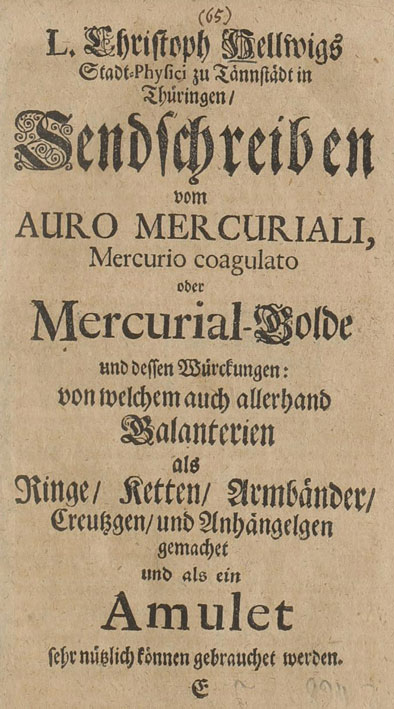
L. Christoph Hellwig,
municipal physician at Tennstädt in Thuringia,
a letter
concerning
Auro Mercuriali,
Mercurio coagulado
that is,
Mercurial Gold,
and its effects:
from which, likewise, all sorts of trinkets such as
rings, chains, bracelets, crosses, and pendants
are made,
and which can be used very profitably as an amulet.
J. N. J.
My Sir, etc.
Since you have written to me and desired that I set down my thoughts on the so-called Auro Mercuriali, or Mercurial Gold, I have therefore resolved to draft this for you here, briefly, and to send it to you as is my duty.
And because this is an amulet which is used outwardly, and is worn either as a ring, or laid on as a plate, or else fashioned ornamentally and hung on, I shall therefore speak here of amulets, and how such things chiefly work, to speak of that alone, because different physicians among them also Theophrastus Paracelsus, likewise Crollius, etc. write about it; therefore it is unnecessary, and it would also become far too lengthy to set forth such things in this letter. I will rather postpone it until an oral conversation.
Now, that mercury, whether crude or prepared in all manner of ways, likewise the mercurial medicines (medicamenta mercurialia), have something special in themselves, and with their spirit-like particles are very penetrating; and that, when they are applied with good reason and caution (as indeed should be done with all medicines), they can successfully drive out many stubborn and bad diseases this is undeniable, and is especially well known to all honest physicians, provided only that, as just said, they are rightly and well prepared, and are used and administered in a proper and not excessive dose, etc.
“For mercury,” says the wise Wierdig in his Medicina Spirituum, “that is, quicksilver (argentum vivum), is nothing but a most penetrating spirit.” And mercury, or quicksilver, has special powers: to cleanse the blood, to thin it, and to resist the plague and other poisonous diseases, as will be seen more fully below.
The very famous so-called “faithful Eckhardt,” in his unworthy DOCTORE, says on p. 29: “Whoever has a severe headache, let him apply the plaster Emplastr. ranar. c. Mercur. in the form of a thaler coin, spread on taffeta, to the temple”; which, he further says, even though on a tender spot, is an outwardly good and harmless remedy.
Now the preparation of the Aurum Mercuriale is carried out in different ways; mine proceeds from mercury, vitriol, green common salt, etc., which pieces are then boiled with vinegar, boiled and stirred, so that it becomes like a fine mush, and the mercury is coagulated; then, having washed it out, press the mercury through leather, and beat the amalgam into plates; then on the next day it looks like lead. Then take curcuma and tutia Alexandrina, mix them, and melt it then it is finished; and see, it can be worked and drawn like the finest gold, and is fit for every kind of work be it for rings, chains, bracelets, pendants, etc.
And if it becomes dirty, one cleans it like other gold with urine, sawdust of wood or bran, etc., until it is clean and bright; then it becomes again very beautiful, as if it came from the goldsmith. And one can wear it day and night, and only rub it dry in the morning, if one keeps it on at night, etc.
I still have another kind, an Aurum Mercuriale, or Mercurial-Gold, to prepare, ready / and known, which is much shorter than the one last mentioned (upon which a man may well spend a couple of days, though not day after day continuously, and the work must be well watched), and indeed so excellent; and this can, within 2 to 3 hours, by mere melting, without special trouble or expense, be prepared even by the pound-weight, as I have more than once happily brought to an end.
Therefore also, when I wish to prepare something of the Aurum Mercuriale, I keep to this latter method, because it is more compendious, and does not have so many long-winded procedures as the former; in strength it yields nothing to the former, but possesses the same. One can also have made from it, just as finely as from the former, gallant ornaments rings, chains, bracelets, pendants because it can likewise be wrought and drawn, and is beautifully pliant, and such as Amuleta against illnesses / use it; one sees how fine (a) gold (it is) / and one can wear it continually.
Who now, in order not to detain my most highly honored gentlemen too long with this, but rather to come to the best purpose for which the Mercurial-Gold is especially useful, (let him know this): Aurum Mercuriale, when (worn) as rings, plates, etc., or otherwise carried on the body, withstands the plague, pestilential and other poisonous contagious diseases; likewise (it avails) against the intermittently recurring fevers that are now raging, and it has in itself a particular magnetic, attractive power, so that it draws to itself all misty, poisonous, evil moistures, and frees the human body from them; it is good against apoplexy (stroke), gout, and contractions; likewise against so-called “all manner of fluxes”; it consumes the superfluous, especially the sharp moistures in the body, when one, namely, (wears) the rings, plates, or Show-pennies (Schau-Pfennige), which are made from Aurum Mercuriale, (if one) puts and fastens (them) on the fingers, arms, thighs, and body, and wears them, or hangs them (on oneself) it is no less good to wear them in dropsy (Wasser-Sucht) and vertigo (Schwind-Sucht), in scabs/crusts (Grinde), rashes/eruption (Rauden), the French disease (Franzosen), cancer, etc.
Crollius, as a world-renowned physician, testifies that this external medicine turns away all poisonous, astral diseases from a man’s body, if one has plates or show-pennies, etc., made from it, and carries them either bare or wrapped in zindel (fine cloth), on a little cord, on the body at the pit of the stomach (Herz-Grube) or elsewhere where and as it is most necessary.
In scurvy (Scorbut), both volatile and fixed, (and in) womb-complaint (Mutter-Beschwehrung) and the diseases arising therefrom, it is likewise a splendid remedy.
In epilepsy, also uterine (uterina), I have not very long ago tried it successfully with a noble lady.
In trembling of the limbs, lameness, convulsions (Convulsionibus), spasm (Krampf), experience has shown me no less the good powers (virtues) (of it), as also in the jaundice (die gelbe Sucht), cachexy (Cachexia), fluor albus of women (Fluore albô mulierum), to say nothing of other successful experiments.
Pope Hadrian IV, who truly lay grievously ill with the plague, was, through the Aurum Mercuriale, happily cured.
The very famous Joh. Agricola also mentions and praises much of this glorious medicine, and brings an example:
“I,” says the said Agricola, “have tried it on a goldsmith; he had burned himself on one thigh, the same (burn) festered for him so badly that for many years he had to keep an open thigh (wound). He complained of this to me; I looked at him and indeed noticed well that a flux had set itself there, and although I drove it away with medicines, it nevertheless came back again.”
I gave him a little piece of the Aurum Mercuriale, and ordered him: he should have only two rings made from it. He had to wear the rings on the toe of the foot, and on the thumb, on the right side; for on the other side was the injury. When he had now worn such rings for a time, the flux dried up, the damage healed of itself, and the man thereafter felt not the least pain any more; which experiment has been highly praised again and again, and has been found, by trial, (to succeed) in many persons.
In particular Agricola still adduces another history, and says:
“A noble, still living lady was in the Steiermark (Styria), who was so plagued by fluxes that for several years she could not go before people, for she not only had great affliction in the head, but also her skin was always like a birch-bark rind; and even if it at times went away, it nevertheless did not last (i.e., it never stayed gone)”.
I had two rings made from the Aurum Mercuriale; she had to wear them; thereby she became well. She asked me for a little piece of this metal, so that she might have a pair of armbands made from it (since one can indeed make such things very beautifully and neatly, as (if they were) made of gold); I gave it to her. Thus it is a splendid medicament, also for great lords, and for women-folk, who are so often plagued by many salty and sharp fluxes.
I, my patron, will relate the following about a living woman-person whom I had in cure, who had a pretty child; she was (troubled) with the salty fluxes in (the) eyes also sorely afflicted, that the tears, which continually ran out of the eyes, bit the skin entirely raw; I cured her with God’s help in not very long time, happily and permanently, although she had been plagued with this evil from youth up, and was then of the age of sixteen to seventeen years; and I likewise had her wear the Aurum Mercuriale outwardly (upon the body). Some years afterward she was married, and has become a pretty little wife, who has no more trouble from the above-mentioned vexation.
To avoid prolixity, I will for the present pass over other good cures (done) by the Aur. Mercur. In particular it is very necessary for those who have many scorbutic moistures in them, and also in the limbs. Whoever is burdened with headache, let him only have a plate made of it, and wear it bound with a little ribbon about the neck, upon the pit of the stomach (Herz-Grube), and he will marvel (at it).
Likewise, whoever is burdened with watery eyes, says a noble and learned physician likewise; moreover, he continues: let one have plates made of it like those for fontanelles (issues), because these will lie on (the body) all the better; one can bind them on the arms, and if they should indeed draw too sharply, one can lay a little cloth in between.
Then he continues: I myself have experienced that such a plate was bound on the arm of a boy, because he had a scorbutic injury on the hand; now when he had scarcely had the plate on his arm for a few hours, and he complained that it itched so much beneath it, (they) therefore took it off to see what it was like; then one found that very many moistures like worms lying there had been drawn out of the fresh skin. Because now in such cases the impurity is drawn out in this way, and attaches itself to the plate, one must cleanse it again.
Johann Rhenan says of it:
“as it were a perfect amulet; by wearing it, not only is pestilential contagion, but also heavenly (celestial) impressions averted.”
Only it must be made rightly / and no deceits must be practiced in the matter.
The excellent Digby also has written much good of the Auro Mercuriali. The following example shall also be set down here:
A preacher had the Mercurial-Gold continually hanging on himself; he once went to a patient, to administer the Holy Supper to him in a hot sickness. When he came to the patient, the man lay in such dreadful heat that a steam/vapor went from him, so that the preacher almost recoiled. When he now comes home, he sees that his Mercurial-Gold (which before had been fair) which that he had worn on himself (had become) all black, and had drawn the poison to itself, and had, by God’s grace, preserved the preacher.
For it is indeed certain that this amulet draws the venenum, or poison, to itself, and thus the human body is freed; but the poison is, in the amulet, dispersed and driven off, as one may read more of this in Sennert and others.
A woman-person, who labored under uterine epilepsy (Epilepsia uterina) and had frightful convulsions besides, has also, not very long ago, been happily cured by me (S. E.).
More praise need not be made of this excellent metal; the deed shows it.
And with this I conclude: you may, my patron, if you still desire (it), ask more of me how I may let come together for anyone who wishes it, 1, 2, 3, 4, and more lots (Loth). One can, like other gold, wear it continually for many years before it wears away, as I then for truly a delicate little ring, worn on the finger for fourteen years and longer, continuously, day and night, (could) have been worn by him still further, had I not lost it some time ago.
If my highly learned gentlemen would have my descriptions as well of the more detailed as of the shorter processes entirely from me, they are also at your service, as I gladly serve everyone according to my ability; and one can make it oneself with little trouble, since it is a true pleasure to make it. One need only give someone the description, and then he cannot err.
What other remarkable cures which, by the use of my vera solutio(n)is auri, which without corrosive (agents) and without fire, with a suitable menstruum, can easily be made by me (I have performed), as I have already reported in two of my published treatises: of which I have, as well In the treatise De verâ Solutione Auri, which Mr. Johann Bietke published at Jena, as also in the treatise on Theriac & Mithridate, in which De Medicinâ Universali is set forth, and (which was) written and published by Mr. Michael Käuffer at Mühlhausen, God be praised, (there are) happy results; therefore I thank God heartily for it, that He, in so short a time since I have owned it (for it will not yet be about three years) has, by God’s grace, rightly found it out (and yet I always seek, by God’s help, to come to it still better); (and that I have) worked thereby such good cures in bad and inveterate diseases, where before so many fine medicaments could do nothing.
Among other things because such were the most notable and very deeply rooted diseases I will for the present set down the following example; and that this is according to truth, anyone can (learn) from the letters written to me from far distant places, may do.
May the Most High yet further give His holy blessing to this medicine, that by it His divine help may be gloriously felt by all who need it; as can be seen from the above-mentioned treatise. Anyone can obtain such a remedy from me; so much gold by weight yields so much of the medicine; and 1 grain of it, taken singly, (costs) 1 groschen. The greatest dose is up to 8 grains. The written directions I give, without further charge, with it, etc.
Now, to come to the example: first a distinguished man from Frankfurt writes to me the following letter, which I shall set down here, insofar as it serves the matter, in order to avoid further prolixity; and he writes among other things:
I report that for some years now I have become of rather weak body, and that through the length of the lingering sickness, at last the Archeus wholly confused/deranged, and therefore my whole body suffers distress, and I know no remedy to make such (a condition) well; since all roots and herbs are too slight, and all minerals are either too crude or corrosive, etc. After I have now labored much and spent (much) on this, yet it is all nothing, etc.
But I have learned from your (published) treatise that you have a Solutio Auri, without fire and without corrosive (agents), etc. Thus:
(1) my whole body is burdened with tough phlegm/slime;
(2) I have constipation, wind, and bloating, together with a wrong nourishment (disorder) in the stomach, so that I think my palate and tongue are (covered with) slime;
(3) my whole body is as though full of fire and burning;
(4) at times my stomach is full of such sharpness that I can think nothing else than that it is pure Scheidewasser (aqua fortis), and it cuts me in the bowels, and there passes per sedes (by stool) from me nothing but tough slime, etc.
Now I would gladly use your Solut. Aur. for six weeks, since next to God I have placed my whole trust and hope in it and its medicine, etc.
So I, in God’s name, sent this patient my Solutio Auri, together with the necessary instruction, by the post; as he then afterward wrote to me several times.
About eight weeks thereafter he wrote the following to me, and desired because it was not difficult for him at all to learn it, and to continue with it yet a while (since it was to him, as it were, a “white way,” and he did not at once attain everything as he desired) that I should also teach him discretion for a modest fee (provided that he meanwhile promised me, in writing, secrecy), (which) he learned sincerely.
But the words in the letter were as follows:
“I report also concerning the condition of my body, that this Solutio Auri, to me has dried up the many moistures, and yet works slowly but well, etc.
On a post-day I received from H., 18 miles beyond Hamburg, the following letter, in which he at once desired to learn it from me; and I likewise sub sigillo silentii (under the seal of silence) without my knowledge and will (ever) to teach it to anyone, (nevertheless) sincerely delivered the description to him; and I still correspond continually with this man and with several others; and when we find out something further, the one faithfully lets the other know it.
Now his first letter to me was thus:
“Although I would myself gladly speak with the gentleman, yet the long journey prevents it (it is about seventy miles), and my condition does not allow it; and because, alas, from youth up (this patient is above forty years old) I have been plagued with the so-called malum hypochondriacum, together with the scurvy (Schardock) raging here in the country (the city lies by the sea), thereby moved to study medicine; and yet, even from my own experience, through unwearied diligence I could scarcely bring about even a small enlightenment; therefore, during my eighteen-year journey, I finally betook myself to the imperial residence city W., under the care for my cure of two princely court-physicians, namely Herr D… and Herr D….
After these likewise had had me for some time with all manner of treatments in the cure, and yet I did not become better, I had to give up their cure also.
Now it stands in my Lord’s Christian disposition to make me doubly happy, namely: first, through the communicating of so precious a medicinal preparation, to free me from the evil with which I have so long been plagued; and no less, (to enable me) to serve my poor suffering neighbor in a Christian manner with it; I will not be ungrateful, etc.
Some time thereafter he wrote to me as follows:
“Kindly inform (me) how far God be praised I have, with the true Solutio Auri, as is well known, progressed, so far as I have experienced in myself the possibility and good operation (of it); inasmuch as I must confess with full truth that no medicine has ever, in my condition already conceived of before this, and (in) the state I have had from youth up wrought such an effect as this; as I have also already experienced that finely filed gold, through a certain menstruum, as well as gold-leaf, can be dissolved. The finely filed silver I have also in work, to see what will come of it; all which I will also report in the future, etc.”
From the world-renowned sea-city H. I received from a certain person the following:
“So, after prayer to God, I have placed my confidence in Mr. Licentiate (Licentiat) to take it on, “I have continually, now for a year and a half, felt dolores in pectore (pains in the chest) and tightness of the breast (oppression); some of the physicians call it pure malum hypochondriacum, some would name it an inclination to phthisis. Therefore I asked for some doses of his powder, together with the manner and dose to use; as I now do not doubt in God’s blessing upon this medicine, but assure (myself) that my lord’s glory will thereby, vivo exemplo meo (by my living example), shine forth all the more here, etc.
I at once sent off some doses, and desired the following answer:
‘I am wholly content through his writing, in which he has pleased to describe his condition to me at length, since I find and see it to agree quite well with my constitution; and I have, in God’s name, begun the use of the medicine begun (it); and I have also, God be thanked, found myself fairly well. Since I still have some powder left of the Sol. Aur., I hope God will let me feel yet further blessing from it, of which I will in due time give the proper report. I also send herewith the two ducats for the medicine, etc.
After this I received from this gentleman G. the following:
“I acknowledge with the most heartfelt thanks the kindness of my Mr. Licentiate, that he has let me enjoy from his aurô resolutô (resolved/dissolved gold) so ample a measure, to the great advantage of my health; and I now find myself God be praised constituted a great deal better; only that now and then the stirrings (Blehungen), especially when I must sit much, cause in pectore passiones (distresses/pains in the chest), yet not always, as it does now, but only when I eat some foods which are not altogether beneficial for me, I have observed.
My Mr. Licentiate, let me be still further commended to his prayers and care.
Some weeks ago I received the following report:
“I praise God for His blessing, and render dutiful thanks to my lord, that through his kindness he has so richly relieved me; I find myself at present God be praised! quite well, only that now and then, when I am preaching, and at night, I still feel some oppression in the breast.
And this is what I wished to inform my highly honored patron of; I will not fail to communicate further news.
Now I would gladly write to my patron yet other examples of the happy use of my Salut. Aur.; only it would be too prolix; and, without God’s dear help, I would record the most remarkable observations thereof and send further (accounts), to send (them), especially when I have gathered together a fair part of them.
Some weeks ago of which I shall yet, together with a few others, make mention I got here into my care a journeyman lad who was quite gone and (as good as) no longer able to keep his life. We forced open his mouth and poured my Sol. Aur. into him with wine; and God helped, so that an hour thereafter he was again fair (well), and the next day was completely healthy.
Some weeks ago a child had strong epileptic convulsions; after the use of the oft-mentioned Solut. Aur., it was, on the second day, again recovered.
Only a few days ago I had a patient who not only had swelling, suppression of urine (suppressio urinae), and anxieties (anxietates), but also had a beginning of hectic fever (Hectica). He is, God be praised, within 8 or 10 days become so perfectly healthy that he can again carry on his field-work; and before that he had, on the other therefore, for five weeks, taken medicines, and yet achieved nothing.
May the Lord of all creatures further lay His blessing in this medicament, that it may be able to serve many more to good use and health.
I had almost forgotten: in the past year I was also consulted by someone from a world-renowned trading city, far from here, and was asked against good payment for some doses of my powder; and I was also asked whether my medicine might do anything in old podagra (gout). Whereupon I sent what I could, and wrote that I had never yet tried it in such an affection, since I had not possessed this arcanum for long; they should try it.
Thereupon, soon after, I received God knows the answer, how he (namely the one who wrote to me) had tried it on several podagric persons who had long labored under gout, which said that they felt an alleviation from it; whereupon he demanded from me the whole process, for a recreation (copy) of it, which I likewise sub sigillô silentii (under the seal of silence) granted him; and after that I received various courteous and thankful letters, as also from earlier and other persons with whom I still correspond; (telling) of their good cures thereby; and (how) God, in such a way, has bestowed on me some patrons and various good things especially also from A. D. T., etc. which I pass over in silence.
Finally I wish all contented well-being, and promise (if the Lord will) in future to write something every month.
Moreover I remain always,
M. H. H.
Tannstädt, the 12th of Aug. 1704.
Most dutifully,
L. C. Hellwig.