The Hermetic North-Star - Der Hermetische Nord-Stern
Listen Audio Book Study the Art with Us Buy me CoffeeThe Hermetic North-Star - Der Hermetische Nord-Stern,
or
faithful instruction
and
guidance,
how to attain
Hermetic mastery;
together with a kind-hearted warning and admonition, how
each person ought first to examine himself well, before he
presumes to submit himself to this so great and secret
science.
in fossa uniti chareignes, (motto as printed)
Published by
J. J. F. Sac. Cæs. Reg. M. C. A., a lover
of the great secret and true wisdom,
together with an appendix,
treating of
eternal wisdom or magic
1771
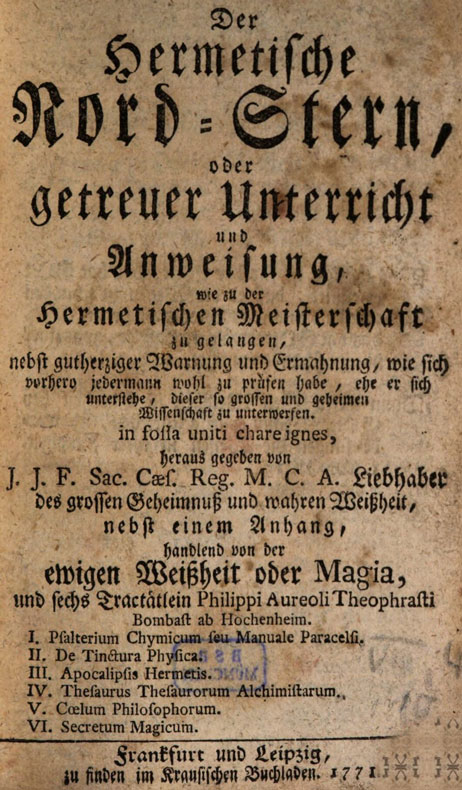
Translated to English from the book:
Der Hermetische Nord-Stern, oder getreuer Unterricht und Anweisung, wie zu der Hermetischen Meisterschaft zu gelangen: nebst gutherziger Warnung und Ermahnung, wie sich vorhero jedermann wohl zu prüfen habe, ehe er sich unterstehe, dieser so grossen und geheimen Wissenschaft zu unterwerfen
What is foolish in the eyes of the world, God has chosen, in order to put the wise to shame; and what is weak in the eyes of the world, God has chosen, in order to put what is strong to shame.
1 Cor. 1:27.
For the wisdom of this world is foolishness with God. For it is written: I will catch the wise in their craftiness.
1 Cor. III:15.
Editor’s Preface
Kind reader, I herewith deliver to you a little treatise, of which I have nothing further to say (for the work itself praises its own master), except that it is among the most upright and most useful.
And since this author not only once, within it, makes mention of eternal Wisdom, but also here and there in brief words makes mention that one should seek and practise the same; and since this also reminded me that in one of my books I have a short discourse concerning it; I have wished to add that here, for the better understanding of the author together with three little treatises of Theophrastus, which have become very rare; concerning one of which the excellent Sendivogius himself speaks thus in his second epistle:
“Paracelsus, whose writings are divine lights; yet if you can find a certain little codicil, called Psalterium Chymicum seu Manuale Paracelsi, you will [find/know] all the mysteries of the highest hidden Cabalae and the secrets proven by natural philosophy, and (so that you may) behold the whole doctrine of the alchemical science therein with open eyes. Moreover, Paracelsus’s Tractatus de Tinctura Physica is not to be neglected. To those two I have also added a third, because the author refers to the latter and names it Apocalipsin Hermetis.
I have taken the aforesaid little treatise from the Imperial Royal Library, mostly using its own preserved wording. I did indeed wish, in its preface and elsewhere, to omit something and also to alter some things, since he defends himself so vehemently against the Medicos (with whom he was at odds at that time); yet because here and there he has intermingled certain secrets, I preferred to leave it as he composed it especially since it concerns no one now living, and because medicine, in general, stands in a different condition in our own time.
Farewell; and make use of all five to your best advantage this I heartily wish you.
Preface
When I first undertook this study, I myself had been troubled by the great number and at the same time the obscurity of the Hermetic authors, when I intended to increase this number still further with yet another obscure book. No this was not my intention; nor was it my aim to reveal this great secret to its possessors through profound and otherwise incomprehensible propositions, parables, enigmas, and hieroglyphs for I could well sit quietly in silence and attend to my own affairs.
Rather, after considering that among an exceedingly great multitude of authors, indeed each had done his best to explain the Philosopher’s Stone in such a way that it nevertheless remained just as hidden as before despite the truth retained therein, except for a few of the more recent ones yet not a single one who had properly shown to the students of Hermes the method and manner, together with the requirements thereof, and had treated it extensively according to the true nature of the matter; and likewise what this great work and mystery is in itself and what it declares of itself thereby much short-sighted and dull minds would have been held back, and right at the outset would have been frightened off by this heavenly shimmer and light so as to escape their misfortune and downfall, and to use their time and money better rather than having to learn the matter only after many years, many labours, together with the ruining of their body and their means; by which some soon came to such a pass that, instead of the Philosophers’ Stone, they were compelled to eat common stones for lack of bread. And this is my intention all the more, since in the main work itself I could write nothing more than others before me have not already written: namely, that I may treat more perfectly the nature of this art its requisite sciences, necessary circumstances, equipment, opportunity, time, the manner of reading philosophical books, and the like in which you will learn and discover just as much and even more than if I had occupied myself at length only with the making of the Stone; for by this very means, as by a master-key, I point out and teach how to understand it in general so that those chosen for it may come to it the sooner, and the others may be led away from it both to their benefit and welfare.
Therefore I have entitled this little tract the Hermetic North Star (for nowadays, through the writings of the philosophers and their many-described labours and paths, matters have come to this: that a lover and seeker of this art finds himself like a sailor upon the wide sea of the world with an unreliable compass, so that he must guide himself more by the North Star than by anything else) so that it may shine upon you in your ways, and at last bring you into the happy harbour, to obtain the Golden Fleece.
Therefore set your sails well, and trim them rightly to the wind that comes from the East and South and carries you toward the West; then turn your rigging about again, catch the wind from the West, and sail toward the East and you will arrive in the desired harbour, if meanwhile, in the twilight, you keep your eye upon my North Star; from there you may then sail out richly laden into all lands: first giving thanks to God for it, then helping the poor, and in general assisting all your brethren and neighbours as much as ever you have opportunity; but above all not forgetting to use such a treasure for the welfare of your soul.
Contents:
First Chapter.
What the Hermetic Mastery (Art) is; and by what various names it is called, and why.
Second Chapter.
What this Work requires of an Artist, and what sort of man he ought to be.
Third Chapter.
Requirements and means, together with time and opportunity, to accomplish it.
Fourth Chapter.
On the reading of the Philosophical–Hermetic books.
Fifth Chapter.
On the Materia Prima, or properly the Secunda, with which the Artist begins the Work.
Sixth Chapter.
On the operations that occur in this philosophical art.
Seventh Chapter.
Repetition of the whole Work.
First Chapter
What the Hermetic Mastery (Art) is; and by what various names it is called, and why?
The Hermetic Mastery is that greatest of all arts and sciences, which comprehends within itself all the other sciences of the seven liberal arts; it is, as it were, their mother, from which they were born. Whoever possesses it has the most perfect knowledge of the three kingdoms of the world. Therefore also Hermes being the forefather of all lovers, as children of this Art (since he left it for us written down upon an emerald stone, so that it might not remain hidden from posterity, and also wrote of it for the best, though in the briefest manner) has been named Trismegistus. And since the Creator cannot be better known than through His creature, it follows that the one who has, of the three kingdoms of the world, possesses the most perfect knowledge, will also recognize God most perfectly in His omnipotence, wisdom, goodness, and righteousness. Through this science the ancient wise heathens likewise came so far, that they acknowledged not only one God, who created men, angels, and all things, but moreover a Trinity namely, recognizing Him as Father, Word, and Holy Spirit; likewise (they acknowledged) an eternal life, the rewarding of virtues and the punishment of vices, together with the finest moral teachings which they have left to us; as may be read in Hermes Trismegistus, Iamblichus, Plato, Pythagoras, Plutarch, Seneca, Cicero, and others.
But as for the idolatry of the heathens, one must know that the wise men had no share in it; for since they represented this Art in hieroglyphs as dragons, serpents, and other animals under lesser “gods” such as Jove, Mercury, Venus, Apollo, Diana, etc., in the manner in which Moses (did) under the Ark, and Solomon under the Temple, in order that thereby some more enlightened persons among the people might (be led) to this science and could attain (to it) in art and wisdom; and through such (images) to God Himself, as to the highest wisdom. But the common populace has in fact made real gods out of these, and has taken the representation for the thing itself, and has remained stuck to it.
It is further the art of bringing forth a thing, as Hermes reports in his Tablet, by means of which one can perform, so to speak, wondrous works in the three kingdoms of the world; and therefore the seekers, pupils, or children of Hermes are called Hermetists, but the art itself (is called) the Hermetic Mastery. Concerning which the wise have at all times made a secret, and therefore it is also called the Great Secret; but besides the Great Secret it is also named the Divine Art, the Royal Art, and the Philosophers’ Stone. Why? I will briefly explain each of these in particular.
The expression “Great Secret” (Mysterium magnum) partly shows of itself what it is; yet one may quite rightly call it the greatest secret, because concerning such a thing, over the whole earth from the beginning of the world until now, nothing greater, nothing nobler, nothing more excellent and more powerful has been found or discovered, nor will be found until the end of the world. This has led the ancient wise men to say that God, besides the human soul, has created nothing nobler; for just as that is immortal, so also such a philosophical Stone is also indestructible. No fire even the most intense can harm it; indeed it is strengthened by it, the longer it remains in such (fire). Yet it truly penetrates all things and overcomes everything, the hardest as well as the most resistant gold as well as the hardest diamond when it is mixed in a proportionate quantity; but when (used) in a smaller quantity it illumines everything, imparts its splendour, and restores it to its purity and perfection in all three kingdoms.
Then, in the vegetable kingdom: if one brings only a few drops into the root of an unfruitful tree, and then seals up the hole again with sealing-wax, it brings forth once more the most splendid fruits, better than it did before; but if it is applied to another good tree, it makes it bring forth fruit two and three times in the year.
In the animal kingdom it heals man not only from all his diseases, but also strengthens all his senses; gives him thereby more than a human understanding, and preserves him healthy until the last moment of his life so that one may rather say he falls asleep than dies. It also prolongs, beyond the ordinary course of life, the years to eighty, a hundred, or even more just as some, though few, wise men have lived to a very great age.
In the mineral kingdom it transforms or rather, in a strong fire, within a few minutes it ripens the imperfect metals into perfect ones, into gold or silver, after it has been fermented.
What further effect it produces in the astral kingdom or spirit-world, it is unnecessary to set down here; for I know that even the above-mentioned common effects are believed by very few, except by the true children of true wisdom much less would they believe such (higher things). Nor is it fitting to lay everything openly before view out of the inmost sanctuary of the temple of wisdom, wherein precisely the wise have had their greatest pleasure and delight, so that transmutation, which among the profane is held to be the greatest thing, is among them held to be the least.
For this reason, therefore because not everyone is worthy to attain it in order to keep such (knowledge) from harm, and also because of the misuse (as anyone who has even a little understanding can easily see from the virtues mentioned above) that could arise from it if it were made common, this science has been kept secret, and written only in such a way as is sufficient for those who have the right, penetrating understanding and are disposed to comprehend such things; and because what has been said is nothing other than great, this has been called the secret science, the great secret, or the secret art.
Now from this little that I have reported of its virtues, you can easily infer its origin, which must be not merely heavenly, but indeed divine; and from this you may already in some measure conclude that truly such a thing does not come from the earth and its products such as plants, minerals, metals, marcasites, stones, salts, earth, etc. which are without power, sap, and life. And for this reason the ancient philosophers did not shrink from calling it the heavenly stone, and the art of preparing it, the divine art.
Not as certain bunglers and copyists of other books because their own brains are empty of true knowledge report in their sophistical works, namely that the philosophers call their stone “divine” only because no one can come to possess it except through divine inspiration or revelation, or through the instruction of a master. No: its origin and essence are so great, so holy, that all wise masters (as will be further seen in what follows, namely in the investigation whether Holy Scripture can rightly be cited in support of this art) have indeed admired its power, yet none has been able to grasp it fully; for the farther and deeper one reflects, the more human understanding loses itself and comes into an infinite expanse, so that one grows dizzy if one lingers there too long. From this you can also, by a like you may already see who he must be that would venture to draw near to this divine light. Knock upon your breast and see whether you already have such a light within you. Examine yourselves well, or I earnestly advise you to keep away from it, unless you would have your whole substance burned up by it; and for this reason both because of its origin and its virtue, and also because by it one attains such knowledge only from a special grace and will of God it is called the Divine Art.
But it is also called the Royal Art: not because it gives as much riches as a kingdom possesses, or because a king in the land, being the richest, could become possessed of it first; but because, among all arts that exist among the children of men, it is the greatest, and therefore rightly deserves the title above all others.
Yet still more properly it has its name because, in the first age of mankind and among their children of that time, some were endowed by God with such talents and gifts, who through their deep speculation and investigation in the book of Nature since then no others existed attained such a wisdom beyond others, especially since at that time their simple and quiet manner of life was very helpful to them in attaining this great secret and art. By means of it they then served the others with counsel and action in such a way that after people observed that among them all there was not a single one so wise and so learned as these they all, in disputes and other difficulties, came to them as to a judge or chief, to obtain their judgment and decision. And since moreover these wise men instructed them and helped them in other matters (both as concerned the maintenance of the body, in the improvement of clothing and food, and as concerned convenience in the building of dwellings and the like), they held such men as their foremost and noblest head, or as the chief person among them, as one who surpassed all others in wisdom, kindness, and helpfulness; and they expressed this with the name King, letting him see tokens of honour and good will in everything he did for them, and thus they dwelt under him as willingly and gladly as under their father, benefactor, and king.
As is then known from the ancient histories: that these wise men, or magi, were also called kings. Thus Mena and Busiris, both magi and kings in Egypt the latter of whom built the great Sun-city, and the city that bore his name, and in it the enormous temple of Isis. Likewise the king and magus Simandus and Sesostris; the latter in turn caused, in the Vulcanic temple at Memphis, the most precious statues made from a certain stone of himself and of his wife to be set up, each thirty cubits high, but those of the children twenty (cubits), as one may see.
The king and wise man, or magus Miris, who built the Labyrinth, and first made an eternal light from the unquenchable Philosophical Oil.
The kings and magi Chemnis and Amasis, who both yet the former especially caused the great pyramids to be seen (built); which they did not only in order to make a name for themselves with posterity, but also so that, in a useful way, they might be able to distribute among the people the gold and silver made by the Philosophers’ Stone or Tincture.
In Arabia, Persia, Syria, Chaldea, etc., there were philosophers and kings together: Haly, Artus, Galud, Geber, and several others, who all alike partly through hieroglyphs, partly through proper expressions, allegories or fables left testimony that they were true possessors of the Hermetic mastery.
As the Holy Scripture also still teaches us concerning such three wise men (or magi) and at the same time kings, who lived in different parts of the world and came to Bethlehem to see and to offer to the very Wisdom incarnate, the Saviour; in which offering they likewise bore witness of their wisdom or (they) laid aside philosophy, in that they offered up the noblest things namely the light or sulphur of the three kingdoms (as, from the vegetable [kingdom], myrrh and frankincense; from the mineral, gold; from the animal, themselves, namely their immortal light or soul) to the heavenly light or radiance of the glory of God, and to the image of His being.
Since, moreover, such wise men or kings were also ascribed to one another in this science, they had their coats of arms made from young tree-bark which they sealed with crystal, which with their philosophical water they could at once soften like dough, and with another (water) just as quickly harden again, (and thus) seal up; after they had pressed upon it their seal, on which they had drawn their whole art in hieroglyphic form so that the other, before he had even broken it open, could recognize not only that it came from one who possessed the Art, but could also at the same time see how far such a one had advanced in it.
From this it is not only clearly evident why it is still to this day called the Royal Art, but also whence and how the first nobility and their coats of arms arose. And since these wise and great men did not always have descendants and children to whom they could pass on such an art (since such a thing cannot be inherited), therefore the descendants have inherited only the title and coat of arms, and have continued it further, without in the least knowing why, in their arms, there is the eagle and lion in a black, white, or red field; the open and closed helm; upon such (a helm) the wings, as also crown and sceptre; the crowns with ten or twelve pointed teeth, as the chymical 🜂 Fire is drawn; the sceptre with a smooth shaft, on the upper end of which sits something like a pestle of a mortar or a stamper; little flags of hole-pierced cloth, like mill-bags, and the like other hieroglyphs and things being found drawn thereon so that it has served for nothing more than to distinguish the age and rank of the family.
Accordingly, some in the times that followed saw from such wise men that the small number of their family (and) in order to draw forth a suitable subjectum is the reason that this great art, so useful to the commonwealth, cannot always be communicated and maintained; so that often such (knowledge) has been lost or hidden for a whole saeculum (an age/century). Therefore, in order to preserve it, some of them in later times established certain societies, and in them admitted nothing but excellent subjects; among whom the most able always included some who possessed the secret science, and founded regular orders, which have become known in the world under various emblems: such as one or two swords laid in a cross, with or without a laurel wreath, as witnesses of the defence of the Christian faith, also the uniting of two fires, the heavenly and the earthly; sometimes (as the emblem) of a pelican sitting on a cross adorned with roses, opening its breast in order to nourish its young with its blood signifying our redemption and the heavenly tincture of souls, and on the other hand also the concentrated tincture by which to colour other imperfect metals. Again, (sometimes) a cross of four fires, drawn Chymicall 🜂 Fire, since the points come together in the middle, and by it the astral, vegetable, animal, and mineral (kingdoms) are understood; the eight corners, however, (signify) the eight beatitudes; sometimes a dove, sometimes an eagle, sometimes steel and stone, etc. of like meaning with the foregoing (emblems) that have endured a long time.
Because they then lacked so little money as they did excellent medicine, they also, in the course of time (for the bringing up of youth, the promotion of the sciences and of the faith, together with the care of the poor) built the most splendid foundations, churches, and hospitals; wherein these praiseworthy knights served with such love of mankind, kindness, gentleness, and humility, that even the lowest persons were ashamed when compared with them, and the wildest tempers were softened together with other great and many deeds and good works, reported in particular. But even of these, through time and war, the core has perished, and only the shells remain the body has vanished, the shadow has remained; and even if some others are still left in the body, yet I have spoken rightly, since they are unknown to the world, even though I know them.
But let no one marvel at this: for as true wise men and philosophers, free from vain honour, fame, and what is called self-love, they have their adornment inwardly, not outwardly. Their good works of mildness, compassion, generosity, and manifold help and what is called love of one’s neighbour they do secretly, unknown, through the third or fourth hand; not desirous of thanks, content with themselves and with their own conviction that they have done good.
O you great men! proceed happily in your undertakings; your praise is therefore not unknown. Behold, the great God sees you the rewarder and that is what is enough for you. He has given it to you; to His honour and to the benefit of His creatures you then rightly employ it.
Now I leave you yourselves to judge: whether an art which has belonged not only to kings, princes, and knights, but also to other great men who have performed such great, such stately, such useful things by it and some still perform them ought not rightly to be a Royal Art?
From what has hitherto been said in the present chapter it also becomes quite clear how wrongly those have acted who have cited the passages of Holy Scripture from the philosophers have cited them back and forth as “abuses,” or have believed them to be useless or superfluous.
Certainly! They are wrong and act most unfairly as they themselves would have to admit, if they had a sufficient understanding of this science. For can one misuse Scripture when one unites it with this divine and royal science, through which one recognizes this and more than those who apply themselves to Scripture alone? as may be seen in the case of the three wise men, who recognized the light from afar and came to seek it, whereas those who were then present and experienced in Scripture did not recognize such a thing.
Have not the philosophers and possessors of this great secret at all times shown themselves to be strong protectors and promoters of the Christian religion as is known of those knights, and as is still to be seen in the institutions of them that exist today? Not to speak of the Crusades against the Saracens and other unbelievers; also of particular persons such as Raimundus Lullius, the philosopher, who gave the King Edward many millions for that purpose others not to be mentioned.
Is it not the case that the Philosophi Hermetici are also called “wise” because of wisdom of which Solomon has written an entire book, and likewise teaches in his Proverbs and Song of Songs; together with Sirach, Esther, Daniel, and John in the Apocalypse and thus cannot be misused?
But in order that I may remove all doubt, that it is not wrong when one cites Holy Scripture as testimony for Hermetic-philosophical science or the great secret here and there: I say outright that it is so closely allied with it that one cannot rightly understand the one, in the ground of true light, without the other. For they flow and come from one fountain! They are like two sisters, born of one Father, their Creator the great God, the faithful God, the almighty God.
These two pure chaste virgins Magia, which is Wisdom, namely active (practical) Christianity; and Caballa, the great secret, or Stone of the Wise are, as it were, two chief pillars or foundation-columns on which the temple of true wisdom rests, and which the Holy Spirit alone enlightens.
How then all the patriarchs, all the prophets from Moses onward to the last (and) all saints have come forth from such! How was anyone great in works and deeds in the world to whom such was unknown? In general, all knowledge, all invention, all art has its source from there.
How then Solomon (that I write truly, and that you may believe such from me) gives testimony of both. For in the Book of Wisdom he says: God has given me to speak wisely, and to think rightly of such a gift of wisdom. Then he is the one who leads upon the way of wisdom and governs the wise; then in his hand are both, as myself and our speech, and thereto all prudence and skill in every kind of business. Then He has given me sure knowledge of all things: that I know how the world was made, and the power of the elements; the beginning, middle, and end of time; how the day increases and decreases, and how the year runs its course; how the stars stand; the nature of tame and wild beasts; how the wind storms, and what men have in mind; many kinds of plants and the power of their roots. I know everything that is hidden for Wisdom, who is the master of all art, teaches me.
For in her is the Spirit who is intelligent, holy, one, manifold, keen, quick, clear, harmless, mobile, pure, bright, gentle, friendly, steadfast, beneficent, kindly, firm, certain, secure. She can do all things; she foresees all things. And Wisdom is the most subtle; she penetrates and passes through everything, so pure is she. She is a fine breath or vapour of the power of God, and a pure outflow of the clarity of the Almighty; therefore nothing defiled is in her. For she is a radiance of the eternal light, and an unspotted mirror of the divine power, and an image of His goodness. And though she is one, she can do all things; and through all generations she pours herself into holy souls, and makes friends of God and prophets. For God loves no one except him in whom Wisdom dwells; for she is fairer than the sun, she shines above the stars, and the day is not to be compared with (her); though upon the day comes the night, yet Wisdom cannot be overcome by wickedness.
Therefore he says in that same chapter:
“I held her dearer than kingdoms and principalities, and I counted riches as nothing in comparison with her. I did not liken to her any precious stone; for all gold in comparison with her is like a little sand, and silver is to be reckoned as clay in comparison with her. I loved her more than health and a fair body, and I chose her for my light; for the brightness and splendour that come from her never pass away.”
Likewise in the eighth chapter:
“Is riches a pleasant thing in life? What is richer than Wisdom, which makes all things? But what is prudence? Who among all is a more skilful master than she? Or has anyone loved righteousness? Her labour is virtue itself. For she teaches temperance, prudence, righteousness, and strength, which are the most useful things in human life. If a man desires to know many things, she can declare both what is past and what is to come; she understands subtle words, and knows how to unravel riddles; she knows signs and wonders beforehand, and how it shall fall out in times and seasons. There is no weariness in dealing with her, nor displeasure in being with her, but delight and joy.”
Then which (things) are her kindred, we have (her) being, and what friends they are, (for) there is rich delight, and endless riches come through the work of their hands, and wisdom through their company and conversation, and a good reputation through their fellowship and speech.
Likewise in his Proverbs:
“Blessed is the man that finds wisdom, and the man that obtains understanding. For the gain of it is better than the gain of bought gold and silver; her fruits are better than the finest gold. She is more precious than pearls, and all that you can desire is not to be compared with her. Long life is in her right hand (as the medicine), and in her left hand riches and honour (as the Stone of the Wise). Her ways are pleasant ways, and all her paths are peace. She is a tree of life to all that lay hold on her, and happy are they that keep her.”
“I love those who love me, and those who seek me early shall find me. Riches and honour are with me; yea, durable riches and righteousness. My fruit is better than gold and precious stones, and my revenue better than choice silver. I walk in the way of righteousness, in the midst of the paths of judgment, that I may cause those who love me to inherit substance, and I will fill their treasures.”
From this, then, I believe I have convinced you enough, that Wisdom, and the Stone of the Wise, not as strangers, but as near kindred. You would have to be willfully blind, since Solomon says there quite plainly that through the work and labour of their hands endless riches came to him; that in her right hand is health and long life, and in her left riches and honour which I could also prove from the other books cited, if I did not wish to speak at too great a length.
Therefore I say further only this: that, as the wise say, gold is easier to make than to destroy. From this it is easy to see that it must have been hard for Moses to destroy the golden calf. Likewise Solomon, as some short-sighted people would have it, did not obtain his astonishing wealth merely from the surrounding kings who all together would not have been in a position to procure so much as David his father left him (as is to be read in First Chronicles, where David speaks thus to his son): “Behold, I have, note well, in my poverty prepared for the house of the Lord one hundred thousand talents (centners) of gold, and a thousand thousand talents (centners) of silver, etc.” Which word “poverty” means, so some will say, that he received it from no one, nor could his kingdom itself ever have brought it forth, but rather from the Stone of the Wise itself, which was known to the father as well as to the son, together with Wisdom.
Since in the first matter I have already been too long-winded, I will add nothing more here as proof of the other (point), or of Wisdom which shines forth even more clearly than the former from the cited passages of Holy Scripture but rather I will only remind those superficial, high-flown, and conceited learned men (who do not shrink from declaring all the miracles of the prophets, both of the Old (Testament) and of the apostles and saints of the New Testament, to be untrue, and from taking the religion of the people to be fables and tailorings and to count it as deceit), that such things happened through the Spirit and power of God, to whom nothing is impossible.
You therefore need not be ashamed to believe them, (namely) what they have left us in Holy Scripture, even if you cannot comprehend it in your sluggish brain: for it is not they, not man, but the Spirit the Holy Spirit who spoke out of them, and God has made His will known to us; which you can see, besides what has been cited above, still further and in abundance from the following texts.
Christ himself says:
“Do not be anxious how or what you shall speak; for it is not you who speak, but the Holy Spirit.”
Then, says Peter, it has never yet been brought forth any prophecy out of human will, but the holy men have spoken of God what the Holy Spirit has given them. And, in sum, applied to the whole discourse, this saying is well to be understood, where Christ says: “Seek first the kingdom of God (Wisdom); the other (the Stone of the Wise) shall also fall to you.”
Since I have lingered a little too long over the foregoing, I will only briefly state why this science is also called the Stone of the Wise, and the Philosophical Stone:
It is called the Stone of the Wise, because such a thing, qua materia, in its inward true worth is recognized by none but a pupil of wisdom; and it is called the Philosophical Stone, because such a stone can be brought to its perfection by no one except a true philosopher or knower of nature.
Understand: if you yourself wish and must attain to it through your own diligence, study, and labour; but if a true Adept, or one who has already accomplished it, and thus belongs to the number of the true Hermetic masters, should come to you and would, like to a child, lead your hand, or not only teach you to cook but even put it into your mouth then you may indeed be no such capable man.
But since you can make no reckoning on the latter, you must be the former namely, a good knower of nature, who does not look at and distinguish things only with the outward sight and understanding as: this is a kind of mineral, that of a metal; this is quartz, that a rock; this is a plant (of herbs or trees); this is a sandy earth, that a mother-earth, clays, bolus, and the like but (who looks) with an inward sight and understanding; as (for example): this mineral quality is more saline, has much of the mercurial, but little of the sulphurous in it. This kind of metal is Saturnine, or has much combustible sulphur, much salt, and little mercurial part. This vegetable has little fixed salt, little sulphurous firmness, but more of the watery or mercurial.
In this manner one must also understand the rest: why this earth is red, that white what they contain in themselves, which is stronger, whence the power (comes), etc. Likewise also in the animal (realm): what are the components of man, and the difference of the members? Of what does the blood consist? How is it transmuted out of the vegetable by the animal spirit, and then again transformed into flesh, bone, skin, hair, etc.? The difference of these from those of beasts, etc. Yes, and in the astral (realm): the course of the stars; the cause and change of the seasons; the effect of the air; why it is more fruitful or balsamic in spring than in “Summer and autumn, and the like.” If, however, thou lackest this, friend! then I pray thee, let it alone; betake thyself unto something else, and thou shalt earn more in one year, than thou wilt ever be able to compass and make by this in thy whole life.
Only think with thyself: if thou understandest not that which lieth under thy feet, which is before thee visible and tangible, how wilt thou then make the invisible, and that which is yet absent and not to be laid hold on, visible and appearing?
Truly, with shuddering do I think on and behold certain people, who otherwise are not void of ability in other matters, and possess some skill; but for this are too weak: yet they will not suffer themselves to be warned, and with force and a certain stubbornness they make themselves miserable, by the scattering of their goods and the losing of their time.
What shall I say then of those smearers, charcoal-burners, and blockheads, who were not able, in lesser arts, to become good masters of their craft yet they would in this great, yea the greatest, and moreover secret, philosophical Art, become great masters?
Not to speak at all of that slothful rabble, who, having learned nothing sound in the world, and being unable to get forward because of their idleness, and having wasted all, would all at once grow rich by this Art, and only quickly make ready gold. O folly, that cannot be greater!
But if ye say: “We will only have a particular, and be well content therewith;” then are ye not a whit the wiser yea, yet more foolish. For the Philosophers say …
They do not indeed tell you plainly how to make the Philosophers’ Stone; but they say this more than clearly enough: that no Particular can exist without the Universal. Yet you would be wiser than they, and not believe them wanting to have a branch before the trunk.
In truth, by just such a swarm this noble Art has, in the world, fallen into contempt and ill repute. For after they have seen that they were deceived through their own foolishness, many of them have not been ashamed to deceive others as well, or at least secretly and openly to mock and revile such an Art.
But was it not also one of the causes that such fellows undertook to learn this greatest science, because none of the Philosophers had truly set forth the loftiness, greatness, understanding, deep learning, and weighty nature of this Art openly? And am I not right, that I therefore show these things at length and indeed from the very first origin in order to remedy this cause?
Therefore I say, in sum and as the conclusion of this chapter: you ought well to consider it, and to take to heart and reflect upon the greatness and importance of this work (which I have treated at length enough); and likewise to measure yourselves your conduct and your ability by it, and to examine well whether you believe yourselves fit for it, or not; which you shall hear further of in the following chapter.
The Second Chapter
What this Work requires of an artist (practitioner), and what manner of man he ought to be
From the circumstances set down above it may in part already be gathered what kind of man this great Art requireth, and how he must be constituted, if he would attain unto it; therefore I will draw the same together briefly, and add what yet is wanting. Make, then, a comparison of the Art with the artist, and the conclusion will flow of itself.
I say therefore, first: it is a great secret; the artist must consequently be secret and close, and indeed this point is not so small as some imagine yea, some even think it wrong that one should conceal it, and, because it is a good thing, not make it public. But they consider not the consequences, which hereof could be nothing else than most harmful, and must needs be so. For the best thing and the greater it is the more harmful it also is when it is abused.
A medicine, though in itself good, and in some wise helpful to the sick; yet if it should be taken all at once and in great quantity when it ought rather to be taken with time and leisure it becometh harmful; and the greater and stronger such a medicine is, the more dangerous it becometh. As the medicaments which are prepared from Mercury, which, in a very small quantity, shows the best and quickest effect; whereas in a larger quantity death also follows. Just so it is with opium, which yet, in a small quantity, restrains pain and unrest.
And would not this great Art be misused, if it were revealed? Ah God! what would come of it.
The world, which already breathes after nothing but God and money, and which so soon as it were discovered would see that it is so easy (although to invent it is the hardest thing of all), and can be made without much cost and circumstance: the world, I say, would fall upon it like a swarm of bees.
Then the great and the lowly would work at it; all other arts and trades would collapse yes, even the plough would be abandoned. There would follow a complete destruction in trade and commerce, and from that, want and misery so much so that we would have to serve ourselves, yes, plough the very bread ourselves which we would eat; and instead of clothing, perhaps be content with a bearskin, like those bear-skinners.
Not to mention all other side circumstances: what calamity, murder, and arson would some great and warlike head cause by means of it? What kind of vicious and riotous life would a luxurious man lead, since he would have a sure means not only to restore again his squandered powers, but also at once to remedy every pressing evil? That man, who through poverty would preserve his salvation, yet through riches go to ruin; and this man, because of his injustice, for whom it would be the better the sooner to come near unto death, would be snatched back again from the same.
To say all in few words: whoever should be presumptuous enough to betray such an Art, would do not much less than what Flamel the Philosopher also relates of that man who wished that all men’s heads stood upon one single neck, so that he might strike them off with one blow of the sword. In truth, such a one would be the very worst, the most unworthy, the most vicious man in the world so that no highway-robber, no incendiary murderer, yea, not the greatest villain that ever the sun shone upon, could be compared with him.
But the best of all is, that God ever keeps His hand upon this great secret and science, and will never permit it. As indeed there are not one example, but many, that not only those who have fully disclosed it, but even those who have let themselves out farther than was fitting, have straightway been punished thereafter as you may assuredly believe such things related by the philosophers, and that they are no mere tales.
Yea, I go yet further, and say that even those who indeed discovered nothing, but made themselves too great and broad with this Art going about with it all too publicly in Projection and the like have come to ruin; and I am assured that even the great Raymundus Lullius and Theophrastus, along with others, would surely have prolonged their lives much longer than they did both having been violently slain if they had behaved more modestly. Especially the latter, who, through his scurrilous writings, contempt, and blasphemies, entered into a war with the physicians and the clergy, and thereby drew so many enemies upon his neck; not considering that this Art is a gift of God, and that without His special grace no human reason can comprehend it. Therefore I ought not to despise those to whom it has not been given, and who, for lack of this great Medicine and mystical faith, may nevertheless be useful and good. Or should there exist no other thing in the world besides our Universal Medicine and Wisdom? Truly, it is at times a matter of wonder how some philosophers themselves have thought so unevenly.
Meanwhile you take yourselves as a mirror in these men; and if you wish not only to preserve this Art, but also happily to possess it, then learn to keep the divine mysteries to yourselves be secretive and consider that, if it had pleased the triune, most good God to reveal such a thing, it would not have remained concealed through so many thousand years; and it could indeed come to pass without you. But if God, through special grace, bestows something upon one person above others, it is only right that one leave it to Him, further to give to whom he will. Seeing this, even the ancient Wise have set, over their Musea, a statua holding a finger upon the mouth in order to remind their disciples always of silence: so you also, keep the Signum Harpocratis ever before your eyes.
Secondly, it is called the Divine Art, because (as has already been said) of its heavenly origin and light, and of its supernatural power and virtue; and also because it is preserved more by God’s mercy than by human endeavour. Consequently you likewise must be godly men, or children of the light that is to say, pious, humble, kind-hearted, quiet, moderate, and lovers of solitude; so that you, furnished with those other virtues, being enemies to the world’s tumult and vain pleasures, may continually apply yourselves to the contemplation of Nature and her operations; and, by constant searching and pondering of the same, with the help of the writings of true philosophers, may at length come so far that you know her not only on the surface, but penetrate to her very centre thence ascending to the highest height and have her inwardly, from the rising to the setting (from noon unto midnight): thus no mystery shall be too great for you to comprehend; the veil shall be drawn aside before your eyes, and you shall be set in such a condition as even to enter into the innermost of the Holy of Holies.
Solomon the Wise long ago wrote it down for you, that the beginning of wisdom is the fear of God: but a vicious man does not fear God, and therefore is nothing less than wise. If, then, you would be wise, you must fear God; and he that fears God cannot be otherwise than virtuous. Therefore it is most necessary that you be virtuous, and lead a godly life, if you would understand and attain the divine Art, this great Secret. And do not imagine that it can be otherwise, or that I write and require too much, or anything superfluous. No believe me, dear children, upon my honesty: neither I, nor any philosopher, ever wrote such things merely for use, or for pastime. Consider it yourselves: can light dwell together with darkness? just as little can the divine Art fall to the share of a vicious man of this be assured.
Thirdly, it is also called the Royal Art: therefore you too must have something in you that is above other men; you must let a great spirit be felt in you, whereby you raise yourselves above others so that, as the sun surpasses all the other stars in brightness, you likewise shine forth before all other men with a certain gravity, uprightness, and settled demeanor. For like readily joins with like.
A great matter befalleth only a great genius. Yet if ye do not at once possess all sublime qualities alike, then must ye strive, and do your utmost therein, to become such by little and little; so shall ye also make yourselves ever more fit to be worthy of such a Royal Art.
Fourthly, it is (and that most commonly) called the Philosophical Art, or the Philosophical Stone; therefore ye also must be philosophi, or at the least devoted to philosophy: which of yourselves ye will perceive to be necessary, that ye may weigh and undertake all things with true understanding.
But I mean the true philosophy, which searcheth all things most subtly, beholdeth the inmost, and seeth and handleth nothing where it cannot render the true cause thereof.
To distinguish it from the common sort, I will, for brevity’s sake, content myself only with alleging a few examples:
The common (philosophy) setteth down in general four Elementa: Water, Earth, Air, Fire. The true (teacheth) that there are no elementa simplicia; for Water hath also Fire, Air, and Earth in it; Earth hath Fire, Air, and Water, and so of the rest; but that they are elementa elementata.
Likewise it is said, that the Vegetable kingdom bringeth its seed with it, each according to its kind; and when such seed is put into the earth and rotteth, then this seed brings forth fruit of its own kind.
The truth is seen in this: that the seed which is sown into the earth is not the true seed (for that is invisible), but only the husk or body, within which hidden inwardly in its centre, as it were in a subtle little point the true seed lies, as a subtle invisible spirit; just as the soul is in the human body. And that this little grain, when it is sown into the earth as into its mother, does not rot; rather, by the moisture and the central fire in the earth, this spirit or seed within the grain is set into motion. Then it unlocks itself, draws to itself nourishment of its own kind, and begins to sprout, to grow green, and to increase as can be clearly seen from this: if one lays a little grain of seed upon an oven, or in some other warm place, so that it becomes warm, and afterwards would sow it, then no fruit would ever come from it; because, although the little grain remains before the eyes entirely in its former weight and shape, the spirit or seed has flown away from it, or has been driven out by the heat, and has left the grain behind like a dead body.
In the animal kingdom (which is however different from the vegetable, in that it does not carry its own seed within itself sufficiently for further generation; but is so ordered by God that from two namely male and female generation is accomplished as a third) they say: in the male there is …
One may already behold the perfect seed in the shape of little Animalculorum, which likewise, by means of Microscopia, may be seen moving in moisture; as though, after the mutual copulation, one or more should creep into an Ovulum of the ovary (Eyerstock), and so the mother should become partaker of one or two fruits: which nevertheless true knowledge perceiveth cannot be.
For if, while I let the seed for the present pass for such as they describe it, I say: why then may not, even as one or two Animalcula, so also four, five, and more of them creep in at once? and so at least two Ovula, one from each Ovario, betake themselves ad uterum; and if then so many Animalcula should get in, what a misfortune would that be for women, if these poor creatures should have to bear, as it were, a thousand children! Truly, they would not be much to be pitied; and yet in such a manner it must needs happen very often.
Moreover I ask, whether these Animalcula creep through the little membrane into the Ovulum? or if not, who sheweth them the way, that they may come in through the small opening of the stalk of the Ovulo, out of which afterward the Corda umbilicalis is made? besides, that then all the other Animalcula must perish, and would have been made in vain! No: God, the wise Creator, maketh nothing in vain; neither is his ordinance so lost.
True knowledge therefore perceiveth from hence, that the seed of the male is not out of Animalculis, but out of a viscous matter, of the subtlest and consisting of the finest and noblest parts of the blood’s moisture, as the house of that invisible animal spirit hidden therein, that is, of the seed; which spirit or seed, in the act of cohabitation, mingling with the female moisture, is opened up and set free from such viscous moisture, and pressing into the ovulum (in which already lies the whole ground-plan of the foetus), quickens it and sets it in motion or two, if more be present.
And it is easier to comprehend how a living spirit, which can penetrate all things, should pass through the little membrane of the ovulum, than that those alleged animalcules, which are already bodies, should do so.
Also, in this manner nothing is lost: for the remaining spirit, or else at another act of cohabitation, unites itself with the woman’s spirit; whereby she then becomes stronger, more vigorous, more stout-hearted, more “ranasirter” (word unclear in the print) in a word, more manly.
This is plainly shown when one makes a comparison between a maiden and a married woman. For where a female person as a maiden was slender, trim, pale, and fearful, she becomes as a wife NB. one who has had a husband for some years strong; the shoulders broaden, she grows plump, gets a livelier look and colour, becomes courageous; so that, whereas before she feared the least thing especially weapons, such as muskets, pistols, or bare blades, etc. and fled from them, she rather herself afterwards might wish to practise themselves in it. Now I ask: whence comes this change, as well of the body as of the mind? Surely not from the burdensome bearing of children and the pains, nor yet from the greater cares. From what else, than from the spirit of the man, who strengthens her spirit whom she from time to time draws to herself as a magnet so that the animalcules could not be kept up for ever. For those that were not for impregnation would all have to perish.
In such a manner, however, one may also understand all the other phenomena among married folk: how love and harmony increase between them; how also the reverence that one gains toward the other becomes one in humour and disposition; and so forth. Note well: where things proceed orderly, in these the saying of Paul likewise holds: “Women shall be saved through childbearing.”
But that they have nevertheless seen animalcules in human semen, I will not dispute with them further; for in all liquors that have stood only a little, one can see animalcules, and indeed in a form that is peculiar to the property of each liquor. But if someone would say they saw such immediately in fresh semen, then I say: no. Rather, they have looked and peered so long, until by means of the air some were first generated; and, in a word, the truth that proceeds from nature is stronger and more unerring than all eyes and glasses.
Likewise in the mineral kingdom: there is much disputing about the generation of metals. Some say it happens through sulphur and quicksilver; others through sulphur and arsenic; others through vitriol, and the like. But the Truth perceiveth that from none of all these doth the true generation of metals proceed; seeing that all such things have been generated from the self-same principle as the metals themselves.
Therefore it goeth back, amid such confused matters and manifold opinions, unto the very first beginning, namely unto the Creation of the world; where it findeth that in the Chaos, when all lay confused one with another, the Spirit of God, which moved upon the waters, began to stir the waters, to separate them, driving the more subtle part upward toward Heaven, and the more gross part downward; from which the Earth then appeared: and likewise from above came the great Lights, which afterward working further one upon another, brought all things in the three kingdoms unto perfection which continueth even unto this hour.
Consequently the true generation in the mineral kingdom cometh to pass thus: that from above the more subtle water (which is Air, wherein is Fire or Sulphur) sinketh down through the pores of the Earth into the deep; and there it mixeth itself with the denser water (which is the more subtle Earth or Salt, and the coarser Fire); and by means of the central Fire, and the correspondence of the upper heavenly bring forth, under the influence of the heavenly bodies, diverse minerals and metals, and bring them to maturity, according as they meet with a pure matrix; of which the purest birth is gold: because the upper pure fire, or fluid gold, meeting with a lower pure fire, or fixed (fire-fast) gold, in a pure earth or quartz within which, by length of time and the working of the central fire, it is changed into a pure fixed gold or fire therefore fire cannot be consumed by fire, as being its like; as one sees in gold.
And in this manner you must, in all particular things of the three kingdoms, judge thoroughly, examine, and know how to state the true cause just as I have here shown in general by certain examples.
But it is not only the natural things and their constituents, together with their origin, growth, perfection, decrease, destruction, usefulness, and virtue, that it is necessary for you to know and consider: but also the things produced by art, their likeness and difference compared with the natural, etc.; by which you will then also (so to speak) attain to the knowledge of supernatural things: for although I myself see and acknowledge all to be natural, since the supernatural has its origin from the natural, yet there are some things which are not possible for every understanding even for the sharpest and most enlightened to comprehend, which things will for the most part be of a mystical and holy kind (as we can see in general from considering Holy Scripture), and therefore by way of distinction from common things may very well be called supernatural or above reason, so that not everyone may grow so bold as to grasp and expound such matters at once with his own understanding, and then bring forth false and erroneous notions, whereby no small number of mistakes and errors arise in the world especially when they are put forward by a man who has otherwise already made himself famous in the world by other sciences, and has gained a following.
This can indeed be proved from Holy Scripture alone: since from the one Book, which contains but one doctrine or faith in itself, more than three hundred doctrines and faiths have arisen.
And that I may make this clear to you by only one example how even learned people mostly fail in this Herr Hasselquist, in his travel description and investigation of the lands of Egypt and Syria, and of their production of various insects, plants, and other rarities, has also (among other things) through false fancy and shallow understanding brought forward that the manna which the Israelites ate in the wilderness at Mount Sinai, and which is said to have fallen from heaven, might be nothing else than that which is commonly accustomed to happen here, namely that, here and there in the air, that moisture is gathered together by means of the elements, thickens, and falls down. An absurd notion! I would not wager much that the author has not first looked at the so-called star-dew (Stern-Thau) which likewise happens here in our country. Had he read and well considered the text, Exod. 16:14, where it says: And when the dew had fallen, and covered the whole ground, behold, there lay something in the wilderness, NB. thin and small, even like a little grain, that is hulled in a mortar-stone like the hoar-frost upon the ground.
So that this “something” must have been dry, and not merely moist or liquid since one may apply to it the name of a little grain, and since the hulling or cleansing is described as being done in a hard instrument, namely a mortar he would have held back from making his thought publicly known, until he had devised something better, or else would have let it remain altogether; all the more so if he had compared the other text, Num. 11:7–8, with the former, where it says: And the manna was like coriander-seed, and to look upon like bdellium; and the people ran to and fro and gathered it, and crushed it with mills and ground it in mortars, and boiled it in pots, and made cakes of it; and its taste was like oil-cakes.
Now I wish the author had come to the thought of trying this himself with his own material what a strange cookery he would have carried out to make a cake from it; and therefore (as regards the taste of an oil) it is no less often mentioned than also in v. 9: that first the dew fell, and only afterwards the manna upon it? Why (v. 18), when it was measured with the omer, did he who had much have nothing left over, and he who had little have no lack? Just as with people of differing stature since the clothing of the tall is not larger than that of the small, being taken according to the measure of the person.
Why (v. 20) did some of it leave it over, so that by morning it was already spoiled, and worms grew in it? Also (v. 21) why, when it became hot, did it melt away in the sun? Could such a thing well happen, if it were that same manna that the author alleges? Or (as others hold) if it was a gum from the trees, which in the sun rather thickens all the more? Of this which is compared to the Word (according to Deut. 8:3) that goes out of the mouth of the Lord he does not wish even once to speak.
Further, he brings in the matter of the locusts that John the Baptist ate: that around the Jordan there grow great locusts, which the people there, out of poverty (and also because of the country), are accustomed to eat. I know for certain that Mr. Haselquist has not seen a single person eat such creatures no more than he himself would have eaten them even in the greatest famine; and the people would rather take refuge in herbs and roots, than to take refuge in those disgusting creatures.
But if the author had reflected on how the Israelites were concerned with the purity of foods indeed, that in the Law or commandment they were bound to eat nothing unclean then he would again (as may be seen above) have perceived how far he misses the mark with what he asserts about the centrum; as may be read throughout the whole 11th chapter of Leviticus, where one may see what is meant by clean and unclean. And, generally speaking, among animals nothing is clean with them except what chews the cud and has cloven hooves so that they do not even eat a hare. Among fish, nothing is clean except what has fins and scales; and for that reason they eat no frog, crab, turtle, and the like. Concerning birds, the exceptions are expressly set down in the said chapter. Of other creeping things, beasts, and insects apart from the locusts there is no mention at all.
From this it is therefore sufficiently clear that the locusts which John ate in the wilderness were not such as the author alleges; otherwise the Jews would rather have felt abhorrence for him as for an unclean man, instead of coming to him in crowds, having themselves baptized by him, and holding him to be a holy man and prophet.
But now it will not be enough that I have refuted the author’s false opinion; rather, for complete proof I ought also to say what, then, is in its place? there I cannot do otherwise, and must confess that it is not for me to do so and it would also be very wrong of me simply to declare outright what Holy Scripture, or the divine Spirit through Moses, did not undertake to do. Let all the philosophi hermetici, to whom this is well known, bear me witness.
Yet, out of love for the true students, I will say this: that the manna, the locusts, and the wild honey which Jonathan ate during the pursuit of the enemy under his father Saul, are all one and the same thing.
This last point is also shown by the text itself (Exod. 16:31): “And it was like coriander-seed and white, or pure, and tasted like a bun/roll with honey”: so that it is an angelic food, as Scripture often reports, and consequently full of power, light, and of the divine Spirit.
Moreover, I draw this conclusion: that it is very unfair to treat such and also other mysteries in histories and descriptions of countries so contemptuously and falsely, to foist them upon the unlearned and curious people of this present corrupted world, and with extraordinary applause; and what is more, to imagine one has grasped wonders, and to exalt the author for his ingenious thoughts no one knows how yet thereby to fall, together with him, into error; to say nothing of other matters from other authors; and now only to mention the Flood: since some, like M. Maupertuis, would have it that a wandering world-body, or a comet, which by its course in a circle passing close by the sun, would of itself be heated, and by so strong an exhalation and approach of our world-body would have caused the Flood; and thus also, once again, by the complete kindling and approach of such a body to ours, our world will be consumed by fire.
How incomparably does Mr. Woodward, an Englishman, think of this in his Geographie Physique, who affirms that both water and fire are already present in our world; and how Holy Scripture, through Moses, and by the Spirit of God in him, reports to us that not only the “breasts of the clouds,” but also the abysses of the earth were opened after which it most perfectly describes the Flood, in a right and true manner, how it came to pass, and also how at the last it will come to pass by fire.
I must break off, since I have already been too long-winded; and I will only remind you further how you may see from what has been set forth, that in investigating such matters one must proceed cautiously, holding one thing against another, so as to discern the truth and to form one’s conclusion.
And so, to close by repeating the whole chapter in a few words, I say: that for this great, secret, royal, philosophical art, there is required a discreet, virtuous, elevated, learned artist; and that he who cannot make these qualities his own will hardly, or not at all, obtain it just as I then the cause of it I believe I have shown sufficiently, so that it cannot at all seem exaggerated.
Third Chapter.
Requirements and means, together with time and opportunity, to carry such a thing out.
Among the requirements and other means for this great Art, one of the most important is that a man be his own master; or, if not, that at the very least he may have the time that is required for it at his own disposal.
For since this Art is of such a nature that you cannot disclose it to any other person, you must therefore put your own hand to the work except for a small helper, whom you have most necessary need of. Yet you must know how to choose him in such a way that he be not harmful to you; and even then you must be exceedingly on your guard against him, if you would have any success at all: namely, that you perform not a single secret operation in his presence, but employ him only for small matters fetching and carrying, keeping up the fire, and the like (u. d. g.), for which even the dullest fellow is good enough. Otherwise you will bring nothing into the world, and it is better to let the work stand over until you find such time.
But even if you are your own masters, yet nevertheless, because of your trade or other household management, for the maintenance of your house and family you cannot devote the whole time to it; consequently either this Art or your household would have to suffer harm. Therefore you do well so as to gain the whole time to hand over your affairs for the present to a friend to manage, or to lease them out to someone for a fixed sum for a couple of years; so that, if in the first year you should fail in some points, you may be the more fortunate in the next, and it may succeed.
But together with time you must also have the proper opportunity; otherwise the former, without the latter, again profits you nothing. For just as you must have time to make the Stone yourself, since you cannot entrust it to anyone else, so you must also have such an opportunity that, through his work, you betray nothing to others an обстоятельие not so small as many may imagine, and much harder than the former.
Yet I know for certain that there have been many among the Adepts whom this circumstance, as it did me, has compelled to put it off for some years. I myself, alas, experienced this latter circumstance: for when I was so fortunate that through earnest prayer, hope and trust in God, and continued study, I at last all at once beheld the light which showed me my error, I had immediately to stop my working, take down my furnaces, and have my many glasses and vessels carried up to the attic; because I then clearly recognized how it was possible, and that it is far too easy, with one furnace and one fire, and in one vessel, to carry out all the operations (such as calcining, distilling, reverberating, imbibing, or dissolving and coagulating, which comes to the same thing); and I had to wait a full six years until I found the opportunity to proceed in a truly philosophical manner.
Yet, since no harm is without some benefit, through this delay I have often and many times made the Stone in my head, and I must confess that, although I understood the whole path according to Nature, I still had one difficulty and another caused for me by the wet way in comparison with the dry about which I believed I could never become certain except through the work itself.
And yet, after three years, by diligent repetition of the writings of the Philosophers, I perceived it so clearly, as if I had already made it; namely, that in truth there is only one (way), with this distinction: that the so-called wet way is shorter, quicker, nobler, and easier, in that (instead of the long and vexatious purification of the earths, and then their subsequent separation again) one extracts the noblest of them by means of its alcohol, and then, as in the dry way, coagulates it in.
I have wanted to tell you this deliberately, so that you may be convinced how deep the Philosophers’ sayings are, and so that you do not, from your first scheme which you form of it, set to work at once in a superficial manner. But to return again to our opportunity: thus it would be best, if it were separated from other people; or at least, if you had a separate entrance, and also a floor and a cellar with it, and if it lay toward sunrise: but if you have nothing of the kind and want to carry on your work among people, then you will have much annoyance from your neighbors, and will also be hindered in the work itself.
So the best thing is, if someone does not have a house of his own, that he take, in the country or in a suburb, a summer building or a small garden-house. It need not be large: an upper and an underground vault with a couple of windows toward sunrise and sunset is sufficient; the main thing depends only on this that you are alone, and can keep your matter secret.
But as little as such a place is, it still makes some expense for one’s upkeep, so that you will recognize from this that even if the material costs nothing, and the instruments little it cannot make a poor or needy man.
Finally I repeat this chapter together with the previous one, and say that a Hermetic pupil, besides the qualities mentioned in the previous chapter, must also have time, opportunity, and means, if he is to attain mastery in any other way.
Happy therefore and again happy is that person and lover of this art in whom all the above circumstances are found! He is truly to be congratulated from the heart. But how few are those, and how small is the number in whom all this is found. Therefore it is also not to be wondered at that so very few are found who attain this Art and possess the Philosophers’ Stone so few that, because of its sheer rarity, the world will scarcely believe that this Stone truly exists; still less, moreover, if to the foregoing one adds the choosing (or election) required for it, and the right matter: for even if a man already has the right matter, he still cannot recognize the inner spirit, what it is like, until the very end. You can indeed see the man, but you cannot see his soul; you see in the dark the lantern, but the light that shines within it whether it is tallow-light or wax-light you do not see.
So too the artist has indeed everything before him earth, water, spirit, oil, salt, and so on yet only at the very last does he first recognize whether he has the blessing or not; and when one considers this, a man’s courage falls away entirely.
Truly! If beginners could foresee such a thing if they could have so sharp an eye that they could also distinguish and recognize every other “look” (appearance) if they could believe all these truths that I have set forth then surely scarcely one out of a thousand lovers would venture to undertake the work, and they would be right in that.
Therefore, in the final conclusion of this chapter I say: whoever finds himself in such doubt, let him ask God that He enlighten him; but not only with the lips or with words, but in spirit and in truth, as Christ himself says: for God is a Spirit, and therefore must also be worshipped in spirit.
Then, if you call upon Wisdom diligently and give your heart to it if you seek it like silver, and dig after it as after treasures then you will understand the fear of the Lord, and find the knowledge of God.
Fourth Chapter.
On the reading of the philosophical–Hermetic books.
Dear children and disciples of Hermes, lovers of the divine mysteries and art: now I begin, in particular, to speak with you since beforehand I have spoken in general, and at length and plainly to everyone, and indeed truly so that those to whom Fortune and Nature have not allotted the aforesaid gifts, abilities, and means, may be able to remain behind, and not force their way into the sanctuary; for the door will not be opened to them, and thus they may apply their few gifts of nature, according to nature, to lesser things with profit since from these higher things they would have only harm.
But you, dear children, can now advance further with me; I will also faithfully lead you onward like a father, with that sincerity and loyalty which I have already begun in the previous chapters and shall continue in the following; in them I will disclose to you many a hidden truth such as, you may believe me on my honor, no philosopher has ventured to do so plainly, and such as I myself could neither have set down nor wished to set down in its proper place without breaking the secrecy which I have nevertheless so highly commended to you. But of you I have this confidence: that you will not only perceive it with your keen understanding and inward eyes, but will also know how to keep it faithfully in your hearts.
Now, as to the reading of the philosophers’ books, I tell you beforehand in general: that after you have chosen the genuine ones (which will again be cited and named by themselves), you should also ascribe to them complete faith and trust yet always taken according to what is naturally possible, and not like others, who, instead of learning from them, would rather correct them and think they know better; as it is otherwise to be taken, since they praise in one page and mock in another: then it goes, “Ah! there he has written plainly, there he speaks well; but here ah there is nothing; there he holds the pen in his hand; or, else he says it only with diligence, etc. and they do not recognize their blindness and their error, so that in this way they can neither learn nor profit anything. For in such a manner they want the author to conform to their mistaken fancy and to their (still) incorrect notion, instead of their notion conforming to the author’s teaching; since, commonly, with regard to what they take to be the case, the opposite is true and what they suppose to be clear is dark, and what is dark with them is found written clearly.
But because they believe their head to be far too learned, they form, without sufficient reading and without the sound foundation obtained from it, at once their own “concepts,” which then must be true; and any philosopher who does not write according to their brain-spinning is not sincere, (is) obscure, or utterly false yes, seducing, and so forth. And they do not think that lies and truth do not mix together, nor understanding and ignorance.
How people like that can I cannot help it, I must call them foolish people how such foolish folk can imagine that a true philosopher can write, in this page, sensibly and truly, in that one nonsensically and falsely; in these leaves honestly and sincerely, and in others deceitfully. In truth! an imposed folly.
You children of the Art, do not on any account make yourselves partakers of this error; rather, if he seems to you in one place clear, sincere, good, but in another not so it does not matter: he is nevertheless no less sincere; only keep to it, and search in such places until you will at last perceive in them that same clarity and truth.
Further, note that you should read the philosophers in our mother tongue, or in that language which you understand best and are skilled in; then you must know that you must not understand them according to the letter, but according to the sense what they wish thereby to indicate to you.
More than that: when you have already come so far that you grasp their meaning, because the principles are already known to you, then under this meaning they have still another hidden one (like Holy Scripture), so that with one manner of speech they say three things at once, all three of which are equally right and true.
See what I disclose to you, and how faithfully I deal with you: few will know this, who nevertheless let themselves dream that they understand the philosophers so well.
For example: they speak of gold, of Mercury, and of its growth. Now everyone knows that in the bowels of the earth, in mines, both grows and comes forth; but they also have their mine above the earth, where their gold and mercury grow and come forth and this in a twofold way: one, as Nature accomplishes it; the other, as the artist accomplishes it. And in this manner they often write, all at once, of two operations at the same time.
So it is certain that, just as Holy Scripture written by the divine Spirit not otherwise than through such a mystical sense, can be understood; so too the true philosophers can no less be grasped note well only through a truly philosophical understanding.
From this you learn how exceedingly necessary it is to read these books in your mother tongue, so that with your understanding you may press rightly and deeply into their meaning, in order to glean the truth from it.
Yet together with this you must also read the philosophers in the language in which they themselves wrote; for no one no one, I say however well he may know the language as much as he pleases, can render a philosopher in such a way that he preserves his whole meaning, except another true philosopher himself; who then either writes himself, or at least comments upon him which latter happens seldom, though indeed often by Sophists.
Moreover, the philosophers have also, with diligence, written one word or another wrongly, and not to little advantage. For example: where it says Subtilisation, another may come upon it and “correct” it properly and make Sublimation, and thereby take away the benefit.
Likewise, where it says (forget not the … Hermetis), another thinks it to be a printer’s error, and in the first word since it is not written out fully changes the e into an i, and so reads Si (or even writes it out), and instead of Sepulchrum Hermetis makes Sigillum Hermetis, and the like more.
Also it then gives and when a word in one language, which at the same time indicates two things, gives a great advantage if it is chosen with diligence yet in the translation into another language it refers only to one; and if, according to this, it concerns precisely the less significant thing, it is again a disadvantage for the learner.
What shall I first say of those who falsely imagine that they understand what is right in this science, and in translating presume to “improve” the author here and there, and to alter whole words?
But I tell you, my children, that you are to consider all their words well; for they have all, without exception, been set down thoughtfully, and many a single word can give you such a light that thereby you may grasp the whole meaning and connection.
Therefore read the philosophers thoughtfully, with reflection and with application to what is possible according to nature, so long and so much until you have, in general, gained a good understanding of the whole work and of the operations that follow one another.
In doing this you will not fail to make extractions, and likewise to draft, as it were, a plan according to which you intend to set your matter in order yet in such a way that you name the material with a mystical name, or mark it with a character, so that, if it is true, it is safe from others; if not, you will not be laughed at by someone into whose hands your notes might happen to come.
Finally I give you yet this counsel also, from which you will draw no small benefit: namely, after you have already gained a fair understanding from the philosophical books, you should then choose and set before yourselves a whole day in which you read through, from beginning to end, with reflection, one philosopher or another, in order in this way to form a right idea of the whole work.
Then, in such a manner, you can recognize whether such an author has described the work in its proper order which few have done or whether he begins in the middle and brings the beginning at the end; or whether he sets the beginning and the end next to each other, but postpones the middle to the last, and so forth; as Trevisanus does in the fourth part of his Practice.
When once you have attained this advantage namely, to recognize this there is no doubt that you will also come to a complete understanding of the whole work and will be fortunate.
But when, through further reading of these books, it seems to you that you can gain no more light, or you believe you have enough, then I advise you to choose one, or at most two, of the same, with whom you can then remain.
Among these I especially commend to you the Philosophical Father-Hermes, but above all the Hermetic Triumph, which latter is a jewel and the crown of all the philosophers; its hieroglyph is also already so clear, as none is found among so many hundreds; moreover, in its little book it says more than ever any philosopher, even in the largest folio volume, has not said. You may believe me in this.
Therefore it is also rightly entitled The Hermetic Triumph not, as the author says, because it so happens that the Stone wins the victory over gold; for the author gives himself too little credit but rather because by his so incomparable, sincere work, which, without much pomp, sets forth the truth, he has at the same time gained the victory over all the philosophers who have ever written.
But in order that you may be more assured of your sufficient reading, and of the knowledge gained from it, it is necessary that you have within yourselves a proof, by which you may recognize it: namely, when you can understand clearly the whole work from the fact that this art is again and again indicated by the philosophers in few words.
For example, when one says: Our art is chiefly nothing other than the union of the upper and the lower waters little and yet much is said, for one who already has a complete understanding of the work.
Or as the philosopher Geber says: that our Stone is nothing else than a stinking spirit and a living water, which we have then called a dry water, united through a natural proportion, and by such a union joined so that it cannot be without the same; to this, then, one should also add the third, by which the work is shortened.
Likewise in another place: that one should cleanse the Stone, by the way of sublimation, to the highest perfection, and afterwards, with rational skill, make the volatile fixed out of it; and thereafter make the fixed volatile, and make the volatile fixed in the fire.
Or, still more briefly: that one should coagulate the purified Stone, then again twice dissolve and coagulate it in its own blood or sulphur.
The incomparable Sendivogius explains it in such a manner several times in the conclusion of his twelve little treatises, and at the end of the twelfth; namely:
“Dissolve a body, whatever one you will, and whatever Nature has brought forth in another manner, separate that from it; cleanse it, and make it clean and cleaner, cooked and cooked; bring raw and raw together, according to the weight of Nature and not of the matter.
Item: ℞ Take of the Air X parts, of living gold or silver 1 part; put all this into a vessel; first cook this air so that it becomes water, and afterwards not-water.
Item: that you dissolve the congealed air, and in the same dissolve the tenth part of gold; seal this, and work with our fire until the air becomes powder; and when you have the world-salt, many colors will appear, etc.
Item, still more clearly: that it is nothing else than our pontic water, which is congealed in the sun and moon, and is drawn from the sun and moon with our chalybs (steel).”
Basil Valentine says it in this way in the Fifth Key: Our matter must at the beginning of our work be well and most highly purified; then it must be opened up and broken apart. When all that has been done, then prepare from it a flying spirit, white as snow, and also a flying spirit, red as blood. Join together these two spirits, which preserve and increase life; give them what they need from Nature for food and drink, and keep them in the marriage-bed of warmth until the perfect birth. And many others speak in such a way.
If you now understand them perfectly well, so that you see the whole art in them good! If not, then I advise you once more: read and study, and work with your head for as long as it takes until no doubt remains for you, or you have not even the slightest difficulty; for I tell you truly that this art cannot be attained by experimenting, if you do not already know beforehand what you intend to accomplish or bring forth.
Along with this I also advise you, for a better understanding of the philosophical writings, that you also, apart from such texts, draw everything to this and refer it to this that you even see and hear nothing where you do not seek to draw some benefit from it by investigating the cause.
For example, you hear certain common proverbs which nevertheless do not fail, at bottom, to hint at high matters such as: “The early hour has gold in its mouth”; “The love of one’s neighbor begins with oneself; one does not go to such a matter with unwashed hands”; nothing is good for the eyes; he who carries everything with him needs nothing; he who does not keep silence has no secret; pearls are not for swine; to know oneself is the greatest science; one will not rub the rooster’s head into its beak, and so forth proverbs which you encounter again and again also in the philosophical books.
So too, when you see many fine buildings, you should not merely look at them, admire them, and let it be good so; rather you should very well consider this or that feature.
For example, the various vessels (vasa) that are found on the great buildings: why are some of them round and low, and surrounded also with rams’ and animals’ heads? others somewhat high, and narrow at the top, from which flames of fire or flowers come forth? which vessels are also remnants of the old style of architecture, together with the poetic figures and deities all of which can procure you no small advantage for your work.
Especially if you can obtain drawings of the ancient temples, which contain very much that is useful such as the Ark of the Covenant with its vessels: the bowl for the liquid offering, the sevenfold lampstand, the vessel with the showbread, and others mysterious things.
Not less the Temple of Solomon, of which you in particular have to take note of the two pillars, the brazen sea, the ten smaller (vessels), the court, and the Holy of Holies.
Our churches too can impart this light to you, as they have to me: why are all of them built facing toward the rising of the sun, in a long oval or square, in the middle of which above there is a round hole, and with two or one tower? in each of them seven steps by the high altar? three doors? the altars three tiers, and so forth. Note well: that they are built in a regular manner indeed, to say it in general, the cause of all this is to be recognized from what is outward and inward.
Then I can assure you myself of the benefit of such investigation which I have gained: in that by mere seeing and contemplating I have obtained as much as by reading and studying indeed even more since by this means I have come upon such secrets as no philosopher mentions at all, or which I at least could not possibly have noticed in their writings, if I had not come upon them in the manner named.
See how faithfully I show you every advantage that I have had, and conceal nothing; rather I lead you along the very path which I have walked without a master, so that if it please the gracious God you too, like me, may attain this holy mystery and divine art even without such a one; which will also happen if you diligently, together with the philosophical books, in true virtuous conduct, also read Holy Scripture by which you can profit in both respects I therefore say once more in conclusion: read much, and think diligently.
Fifth Chapter.
On the Materia Prima, or properly the Secunda, with which the artist begins the work.
The Materia Prima is commonly called that with which the artist begins the work, but improperly. For the Materia Prima is of a diaphanous, pure essence a pure spirit, light, or life which light indeed is found in all sublunary things, yet in most of them very little, in others more, but in one single being most of all; and this very thing is the subject which the philosophers take for their work. From this, as Materia Secunda, the Materia Prima seu universalis is first drawn forth.
But so that you, my children, may learn to understand this better, you must know: that in all individual things there is hidden something more than merely the four elements namely, the aforesaid spirit or light, which is like a seed in its dwelling, has in the fire its resting-place or habitation, and may be called the universal seed of the whole world that which enlivens, preserves, and consumes everything; and the more of it there is found in a thing of the three kingdoms, the nobler it is above others.
This light flows down from above out of the fountain of light, namely the sun, often and the more often the nearer it comes to our pole down into and into the earth, and shares its light with all individual things of the sublunary world: to some more, to others less, according as the receptacle is able to take it into itself and to keep it with it. Hence gold has the most of it in itself above all other minerals and metals something which both its splendor and its durability show. Therefore it is also called the noblest in the mineral kingdom, and the king of the metals.
On the earth all plants take in such light in abundance; and in proportion as the roots, as their receptacle, are stronger and more impregnated with a fixed salt (sale fixo), they draw the more of it to themselves so that some shrubs and trees even give off the superfluous through their bark as a thick sap, which, hardened by the air, becomes a gum or resin, which is full of light or sulphur as one sees in frankincense, myrrh, and others, by the flame and smell when one kindles it.
But of this the wine has the most in itself, and not only what daily comes down from above, but also what rises back up from the earth into the height and there unites with it; so that, so to speak, the vegetable partakes somewhat of the mineral.
Thus I once saw with my own eyes, when I travelled the way toward Upper Hungary, near Tokay, in the wine-mountain called Mada, Tarzal, and Talia, where my host showed me a vine-branch that had been split apart, in which, along its length, such fine threads of gold were to be seen as a spinner can spin into a thread also little grains which were gold-sprinkled. From this it is clearly shown that this flowing light, or volatile gold, was drawn by the vine through the roots up into the height, and had been fixed there by the heat of the sun; from which one may at the same time conclude the goodness of Tokay wine; and if wine is called a king in the vegetable kingdom, then this one is doubly worthy of the title.
In the animal kingdom everything that has life breathes and draws such light to itself; but since the animals are nourished by the plants, they are therefore doubly partakers of this light. Consequently the least noble animal is nobler than the noblest in the vegetable kingdom.
But since man not only also breathes, but moreover is nourished at once by animals and plants, he is threefold partaker of this light, and thus even the least of men is nobler than all animals and vegetables together; and the more a man again has in himself above another man, the more perfect and more exalted he is above such a one also, and (is) as a king over all three kingdoms, and the most perfect, fairest creature of God.
But beyond this, man has within himself a little spark of a divine light itself, from his first father Adam onward, when God breathed life into him. Now if it comes to pass that a man knows how to raise up this light within himself, and to unite it with the divine light in the true flame of love, and thereby to cleanse himself from the clinging earthly (things), so that he, as it were newly born, swings himself toward heaven: then he becomes such a true man and wise one that he rightly deserves the title of a child or man of God; and in such a one there will in truth be nothing left in the world to comprehend which you, my children, may well believe me from your own experience.
Ah God! when yet the children of men if they had better considered the latter, and first learned to understand themselves and their salvation, then the other would also have fallen to them, and God would likewise have opened their eyes to it. But no! quite blind, without religion, without any virtues, they run at this divine mystery, and want to seize it at once with unwashed hands.
This must not surprise you, my children; for I myself know some who would like to be great philosophers, and their whole philosophy consists in this: that they believe absolutely nothing, hold everything to be fables there has been no miracle, no saint, there exists no spirit, neither of good nor of evil, etc. O you foolish simpletons! You should know that by such talk you betray yourselves to a true wise man as utterly stupid ignoramuses; you will certainly be put to shame indeed more foolish than before, since you believed you were foolish, and since you still believe it; yes, they even make themselves great by it, they boast! and what is most lamentable, they even gain approval.
But what does it matter! There are too few wise and true men in our land who contradict them. Therefore, my children, be wiser; do not let yourselves sink so far down that you embrace baseness soon you would scarcely be much better than cattle, and would have to be regarded like them. Rather, when you hear the like of such fellows talking, then say to them: that gold is indeed already incorruptible, without therefore being the noblest creature of the Creator; yes, tell them: that they themselves, by this art, seek an incorruptible, eternal, living fire or tincture, which can indeed destroy all things, but can itself nevermore be destroyed.
I have strayed far too wide in my righteous zeal, so that I cannot refrain from saying that I see what through these false “philosophers” and their false principles, which they also bring into the female sex arises as vice, deceit, injustice, undermining and persecution of one’s neighbor, discord and separation between spouses, siblings, and friends, and many similar evils; yes, whole disorders in nature. Thus the mother will not let her child drink (from her), so that she may not lose her beauty and health partly in order not to be annoyed, and to be able to attend her assemblies and amusements; then the nurse or water must take her place.
O you hard, unmerciful mothers, who act against God’s order and nature! who gave you two breasts, not only so that your person might be adorned and you could proudly display them to vain eyes, but in order that you might do your duty, which even cattle do not fail to do. You ought to be ashamed that, as the noblest and at the same time fairest creature, you must be reminded of your obligation by irrational beasts. Look only at the hen and other animals, which not only one or two, but nurses several young at once: she does not refuse them; indeed, she continues even yet and increases (her milk) if one means to take one away from her. And if the little creature is weakly, yet the young are many, then she whimpers rather for pain than that she herself should forsake them; and even if she should make herself a little free of them, she soon returns again.
But I will tell you and show you that none of the things aforesaid, which you fear, is true. For the great Master-builder of the world has so ordered your frame, that it is by no means harmful to you if you but do your duty yea, oftentimes even useful.
For the superfluous blood which otherwise is lost by you monthly, serves during pregnancy to form the body of your fruit (child); but after the birth that same is turned in the breasts into milk, and that so long as you nurse your child.
See then from this, that you communicate to your children not of that which you yourselves need, but only of the superfluity which otherwise would have been lost from you in vain. Yea, this has often been useful to the mother, as we have examples: when she was sickly, the child has drawn such (ill matter) away from her; and the child, with little crying and with remedies applied, has also been freed from it again.
But from this very thing, O you mothers! you must and ought to be afraid, when you consider that your child, with a wet-nurse, not only (may take in) such uncleannesses (which are not always to be discerned in her), but also NB. which is the chief thing: they drink in their evil disposition and their vices.
Ah! pity them then, when they are grown up and at the same time ill-bred: do not reproach them, and do not cast it up to them that they do not care for you at all, that they seem to have no drop of your blood in them, as though they had been exchanged rather reproach yourselves, who have made this charge, lamentably so, true, by the inhuman withdrawal of that tender love, affection, and dutiful care which Nature has implanted even in the most savage beast.
But not enough! this irrational beast shames them still further.
Instead of having care for their young until they themselves can creep, walk, or fly, and can seek their own food: in that unmerciful manner they drive them out of the house, into the country, or elsewhere, and entrust them to a strange person, who who, I say, ought to have that tenderness, that care, and that watchful eye which she herself, as a mother, does not have: from whom they then often come back crooked, stooping, unable to walk, into the house again.
Ah God! where has our world come to? how far do men yet fall in it! and yet precisely these these want to be more intelligent and enlightened than others; they boast of belonging to the “great world.” Ah, how much happier are you of the little or lowly world, among whom simplicity still prevails. Yes, the former go yet further!
With ill-will, (and if only always in their power, they would try to prevent it) with reluctance, I say, and with fear some of them receive that blessing, their living image, for which the old times, and the virtuous matrons of that age, strove; yes, others, without such a blessing, would not have been held in so good esteem as they.
And why? Because they believe (as was already said) that it is harmful to their beauty and health, and they do not wish to be inconvenienced by it although they see so many worthy women surrounded by ten, twelve, fourteen, and more children, fresh, healthy, and stout.
But they are mistaken here also, as above. True, they do not have the good fortune that these have, and must often experience the opposite; but why? Because, instead of rejoicing in this blessing, and going along gladly until they press the pledge of their tender love into their arms, those women always bear their burden with reluctance and fear, continually fret and worry for their life; and precisely this constant anxiety causes their humors not to circulate so properly in the body, the stomach not to digest so well, consequently the blood to become disordered, and then the body must become weak and sickly (as it is well known that the passions of the mind have great power over the body) and not through the bearing of children.
But if they lived in good courage like those women, without excessive worry, took the matter wholly in a natural way, and united their will with the divine will: then they too, like other women, would become much stronger and healthier, rather than weaker;
…weaker; not only from the bearing of children itself, but because they strengthen their spirit by the spirit of the man, which then, through food and drink, builds for itself a far stronger and more perfect body than it could before; as one clearly sees the difference between a virgin and a woman, and as has already been said more at length in the second chapter on Generation.
Of those who utterly misuse Nature, and wholly reject it, I neither will nor even dare to say a single word.
O you over-anxious and misguided great world! How much happier let me say it once again are those among the little (world), whom you nevertheless laugh at in your heart. Ah! may God graciously set a stop to this.
Let no one take it ill of me that I have strayed so far from my scope. Once I have begun to write, I will not, for your sake you who do not approve my order hold back my thoughts, even though this does not belong to the matter at hand. For you must know that I write out of no self-interest, and therefore let things flow as they come to my pen.
Indeed, at the beginning of the chapters I had thought of nothing less than to mix in such matters; yet it is good and true, and I am just as entitled to teach this or that I have had equal experience of both. Nevertheless you must attribute it to my zeal, which I have for truth and justice. And since it concerns the common good and the peopling (of the land) as concerns this, I wished that someone whose business it is (for it does not belong to me) would write of it, and bring something to the light of day which might go still further, and show that even high-born and princely persons cannot deny their infants the right of Nature; and would also set forth what incomparable people would come to be, if from such high-born persons their tender shoots likewise received their first nourishment from their noble sap.
Indeed! since Nature always strives higher and toward what is more perfect, certainly (I say) the children of such exalted persons would become still fairer, more tender, nobler, higher and finer in understanding; and, in a word, would soon become like earthly angels.
On the other hand he would also have to point out the misfortune that arises from such idle breasts of the mothers (whose little milk-tubes then grow stopped up within), to no small detriment of the human race; in that from such mothers again maidens are born with poorer breasts, who bear yet worse; and so the noble sex is mutilated, so that in the end there will be no difference between male and female sex (as regards the breasts) in such a family. That this is so, one can see from other matters, namely how children brought into the world by their parents turn out.
Ah God! What would I not yet have to say, to the blind world its eyes: since on the one hand they fear to impart the superfluous juice to their children; yet on the other hand they squander that which is needed through much blood-letting throughout the year so lightly, that it is truly irresponsible, especially for those who prescribe it, and who ought to understand it better; for the others it is not so much to be blamed, since they allow themselves to be carried away by the abuse that has crept in.
How easy it would be for me, through God, Nature, and Scripture, to show that it would not at all be necessary to let anyone blood; that God has otherwise already so constructed man, that in the case of an offending disease, through one place or another, Nature can regularly let out from itself a certain quantity of the blood, as it is ordered in the female sex; also in some male persons through bleeding of the nose, the golden vein (hemorrhoids), and the like, which happens now and then.
And that some thousands of centuries have passed, although the people of those times were just as subject to all diseases as we are, and were likewise, as at the present day, freed from them, and yet had not been blood-let; for they were content to see themselves helped through the natural blood-lettings of the insensible exhalation, sweat, urine, stool, evacuations, and the like, which all are also blood.
Has not Moses already taught us that the spirit or life consists in the blood? Now, the more or the stronger the life is, the more powerfully can it resist the disease or the resist death; not to mention that here something particular would yet have to be considered. But it is most irresponsible when one robs a child, which is still in growth, of its balsam.
What would one say of a gardener who, in order to bring a young tree into proper condition, would bore into it in order to deprive it of a part of its sap? Yet lest it not belong here, and I might become too prolix, I will break off from it; for I foresee already in spirit that in these last times, when all learning reaches its highest point, this also will be recognized, together with many other things which until now were hidden, in which I shall then not be mistaken.
Just as I was not mistaken when almost a year beforehand I told my good friends that the Oriental Empire would fall into weapons, as this year has taught us; and also that such a thing will shortly cease entirely, others obtaining their freedom, after which a general peace and faith will follow in the world.
I only wish that men might most earnestly set before themselves the honor of God as their goal, so that blessing and prosperity may richly pour down from above, and that we may the more happily lay aside the hard times and diseases which we shall have to endure until then, until the three sevens are past. Yet of this, enough.
I have previously shown you how the prima materia is present in all things of the three kingdoms, proceeding from the upper, or fourth, conditions; and likewise in which of each of these it is found the most.
Now I must warn you that, in seeking it out, you must be well on your guard, and consider that the philosophers teach that their matter must not yet be specified as though you wished to take a metal, herb, or animal but must still be in the universal state; so that, although it indeed has the qualities of all three kingdoms, yet it is not to be reckoned to any one of them in particular as a definite species, but is a subject where Nature has indeed begun, but has left it lying imperfect. Therefore you may also be superfluously engaged in trying to obtain such a thing out of the elements or out of ethereal beings such as hail, dew, rain, or air, and even the sun’s rays themselves by the attraction of various machines, glasses, mirrors, and the like: to seek to gain it in such ways as the age of man would not suffice for.
But whatever matter you may read of in the philosophers, take it in a natural and philosophical sense namely only so far as they thereby indicate the right one, and how they have wished to proceed with it; not that it is that very thing itself. Thus, you need only remember what they themselves say, namely: that no philosopher, out of many hundreds, has ever named it by its bare name, except only two or three, and that not in the place where one seeks it.
For example, when they therefore put forward Antimonium as their matter, they only mean to indicate by it the qualities of their matter just as antimony is an unripe mineral, a mountain-vapor (a mine-fume), which is not properly to be compared to any metal, although it has in itself the principles of all other metals together; so likewise their matter is a being compounded together in a mineral-and-metallic way, though it is not itself a mineral or metal as such.
Also, just as antimony has all colors in itself, and is volatile, so likewise from their matter which is equally volatile all colors can be brought forth; and for this reason it is named “all in all,” or omnia in uno, or unum in omnia, or “antimony.”
If they call it Vitriolum, they wish such again to be understood in the same way as was said before. For just as vitriol is properly a coagulated metallic water or salt, which can easily be dissolved again by a water, so their matter is of the same nature; for their vitriol has in truth come together from a heavenly and an earthly water into an earth or salt, by means of which earth they can bring forth all colors, just as also happens in common vitriol by calcining.
But when they say that their vitriol is not just any kind, but that which comes from Hungary, then is likewise to be understood of Antimonium; it is not meant to be understood merely geographically, as though in another country so good a vitriol could not be found, but philosophically, because there the sun rises, and they thereby indicate that their vitriol, or salt-earth, is impregnated with the corpuscles of the sun, or with golden water.
Likewise, from common vitriol a solution can be made, or, with strong fire, a white and a red spirit can be driven out, and in the remaining earth a salt one that held the two spirits bound can be obtained. In the same way, all this can also be done from the true matter, if one examines its earth; whence the saying has arisen from such a name:
Visita Interiora Terræ Rectificando Invenies Occultum Lapidem Veramque Medicinam,
which at the same time indicates the whole work.
If they set forth gold or quicksilver as their matter, and say of it that it is not the common kind, but that from such they first make, through opening-up and conversion, their philosophical or living gold and argentum vivum; then this common gold and quicksilver is nevertheless not the metallic, known gold and mercury that comes from the mountains, but they call their still unworked matter simply “gold” and “quicksilver.”
See, out of what a dream and error I draw you. Yet, nevertheless, few will believe it; for I have from two otherwise worthy men, a short time ago, this they wanted to persuade me of it orally; but it was all in vain: the gold had to be and remain so; and he perhaps still torments himself with it today, and the hard metal must and shall yield that, and let itself be handled with something which is nevertheless impossible for it.
The other man, who was skilled in the Oriental languages, and has not been dead quite two years, could not be dissuaded from the Mercurius that comes out of the mountains either. It occurred to him indeed that it was not the philosophical one, but that one must first make it into such; and the saying, in Mercurio est quidquid quaerunt sapientes, was so deeply impressed in his head, that the Mercurius, through his work, went still deeper into his body (for then he trembled very strongly) and perhaps even robbed him of his life before the time.
Consider therefore how cautiously you must be in choosing the matter, and what you have to understand by the philosophers. The few examples that I have here cited are enough for you to judge all the others that you will read in the books. And take note:
So that you may be assured that you have found the true matter: all true philosophical books, without exception however many of them there may be must agree with you. Now, in order to be certain in this point, it is necessary that you read many philosophers, so that it does not go with you as it did with me at the beginning, when since a dozen of them seemed to have written according to my own notion; and after I had for a time labored and troubled myself in vain, I happened upon another author, who at once showed me the contrary something that befell me four times, with different matters, in just as many years. Therefore learn to become wise by other men’s errors; and follow follow, I say and accept the good faithful counsel which I have already given you before; indeed I beg you for this reason: do not work, unless you have a perfect understanding of the Work, or at the least until you know the true matter; for otherwise all your labor is wasted and in vain.
I believe you will recognize my good heart, and how faithfully I mean it with you. But so that you may also know why, it proceeds from a grateful mind toward the most benevolent God, who was merciful to me, and out of grace, without a master, wondrously, and by a special providence, let me know this secret. I say, by a special providence because I learned from such people as themselves knew nothing right; yet since I nevertheless had confidence in them, and at the beginning thought much of them, I took their sayings as oracles, meditated on them at home, searched them out in the books of the philosophers, studied, and at length often saw a light, and recognized what is true beneath them.
And when I on another day I went to them with joy (in order to show them what a teachable pupil they had), I perceived that they themselves did not know what they were saying, nor did they understand their own words in their foundation so that I was rightly astonished at it, and at once held in with my own speech, since I could clearly notice that, if it had been God’s will that they should know it, they would long ago have been able to know it before me, because I received it from them, or at least through them, although without any fault of theirs.
In such a manner there also came into my hands a written book, which had lain thirty years with a townsman; which, however, did not treat of the Stone of the Wise, but of true Wisdom; and it waited for me, as it were, in due order. His son, who was in my service, brought me pieces of it from time to time purely because the content had something of a likeness to what he often heard me speak of at table. From this book, for the first time, the light truly dawned upon me, and I obtained a great desire for divine things, and no less for the diligent reading of divine writings, in that I had the good fortune to understand them in the mystical sense a grace that is granted to very few. Let the great God be highly praised for this.
Through this book I was finally moved to yield myself also to divine wisdom itself, and to take its yoke upon me. But how just as in what was named above I had no master, so I had none here either; and therefore I undertook the Work which I ought not to have done, but which beforehand I could neither know nor perceive; for to do this a man is required for himself alone, even more than in the great secret itself. But I had a large family and household.
Meanwhile I went the way after the prophet Daniel happily for a time, and yet for a further time; but in the third period I committed some errors that struck me back very hard and indeed against my will so that before my people I should not pass for a hypocrite or a saint, or else out of inexperience.
In a word: I held out the three periods bravely, but without seeing an end; and then I could rightly complain with the prophet David: for all my flesh had wasted away, my bones shook from leanness. I was a living death, to which I had already quite willingly resigned myself: to hold out longer, or to desist from it both were danger. And since I had to choose the latter, and committed myself to the mercy of God, behold, then his grace was so great for me (and without any man’s thinking of it, and without outward help, which here has no place) that he led me out of death (as otherwise also in my life thirteen times, by water and land, at home and in war, and has still granted me healthy days; so that from that time it is now the fourth year as I write this, and the running year of the Lord 1769.
Ah, how can I repay thee, Almighty One, for this great benefit! Not better than by now and then, through some tears of joy and gratitude.
And this I have wished to relate here, for your sakes, masters of the divine mystery and wisdom, so that, if ever my book should also come into your hands, and you should wonder at my extraordinary plainness, or even take offense at it, you may know that my heart has been made tender, to have compassion on others also, and to wish them all good; and that no oath and nothing binds me, not to touch at all upon one or another part of the great Work.
Nor have I anyone to give account to, except my Teacher the Teacher of all teachers the most gracious God, to whom be eternal praise, honor, and glory.
Be also without concern that I write too plainly; for I know what way I have gone, and how I have seen the hand of God in all things who can also, before men’s eyes, according to his most holy good pleasure, reveal and conceal it again; except that one would say it quite openly, for which I have not used so much paper, and could have done it already on the first leaf or in the preface. Now to you again, dear children: when you then believe that you have the right matter, and that it has been confirmed by all the philosophers, then let your further concern be that you also learn to understand the operations clearly, which I intend to undertake in the following chapter.
The Sixth Chapter.
Concerning the operations that occur in this philosophical art.
So that you may well comprehend the operations, you must know that the philosophers observe three different times, and pass from one to the other by seven degrees.
In the first, the matter is worked in its crude state; in the second, it is cooked; and in the third, it is purified yet in all three without any foreign addition; rather, everything happens from, in, and through the matter, from the beginning to the end, with one and the same fire, and indeed of the very lowest degree, in a furnace.
And because this is a work of Nature, which for the most part works by itself from the beginning to the end (except that therein you lend it your hand by separating the unclean and its contrary parts, by uniting the pure and uniform ones in due measure and proportion, and by placing it into the vessel suited for it), with the ministration of the proper warmth) you may of yourselves let it occur to you that these operations are not so lofty, artificial, and difficult, but rather plain, simple, and easy just as Nature works in all things altogether simply.
Only consider once, my children, how she brings forth her births in the bowels of the earth: what will you there meet with of artificial furnaces, vessels, and fire? and yet she brings forth so many sorts of things. Her fire therein is moist, and more cool than warm; therefore it also goes very slowly something which we, however, can improve upon above ground. Her furnace is the belly of the earth itself, and her vessel the various stones quartz, etc. in which she shuts up her seed.
Consider her in the vegetable kingdom: what more does she need there, than that one puts the seed into the earth? She receives it, holds it, unites herself with it, and, by supplying it with its nourishment together with wet and dry, or rain and sunshine brings forth from seeds plants and blossoms of manifold colors so fair, until they come to their perfection, etc.
Consider her likewise in the animal kingdom: what more is needed, than that the animal seed come into its proper vessel the mother of the female and have the single warmth thereof; and yet she brings forth so many kinds of animals, of which one is weaker, the other stronger one truly as strong as a lion is, etc. Now, my child, why do you want to cavil so much, when you see that Nature accomplishes such diverse and such great things by a wholly simple way? Truly, if this art were a hundred times harder and more artificial, a hundred persons would sooner attain it than in its simplicity.
Hear me, my child! I will advise you of something. Study yes, study, ponder, devise most diligently and most subtly; but not, as nearly everyone does, upon high, subtle, artificial things: on the furnace described by the philosophers, yet another furnace; on the fire and lamp, yet another; on the vessels, yet other vessels earthen as well as glass of diverse shape and size; on the operations, to add others to them and invent them. Rather, study much more how you may dispense with the furnace, vessel, and manifold operations described by the philosophers, and may understand them all as one furnace, fire, vessel, operation, and matter. Only then, and sooner not, may you dare to trust yourself to understand the philosophers; this is a holy truth.
But so that I leave nothing untouched, and may also keep the faithfulness and goodwill which I have promised you, I must make some remarks to you about it.
Concerning the vessel: that in the end besides that which is earthen and round there is still needed one like an egg-shaped glass; and the first can also be double, for the sake of hastening; Thus there are properly two, and this is to be understood in the principal work. But incidentally, especially when we begin the work, we still need some though slight equipment, both of wood and of other sorts.
Concerning the fire: besides the fire of Nature and the secret fire, we do indeed also need the ordinary fire; but only a few hours at the beginning, somewhat longer toward the end of the first work, and, at the very last after the completion of the same, a melting-fire. Some also use the common fire in order to make their menstrua, which, however, is absolutely not required, since it can also be done with the fire of Nature.
Concerning the matter: it remains one, until the very last, when we take gold or silver for it; but we do not need much of it one or two Quintlein is enough.
Concerning the operation: such remains chiefly one in the second and third part, with little difference from the first.
Concerning the furnace: it is to be understood from the fire; otherwise, however, the principal work remains, and is to be understood as I have reported above. And in this manner, when you direct all your thoughts simply, modestly, and according to Nature, you will get further in one year than with high subtleties in ten years; and yet, by this common and simple way, you will learn to investigate and understand the greatest and highest things so that you will then be greatly amazed, and will yourself recognize that all the high-flying and high-minded learned men look beyond it, or, in short: with one word despite all their many sciences know nothing, see nothing; (i) for the sun has all too bright a light for them, since they want to look straight into its bright shine. But you, who go wholly lowly into it (as it were) and come nearer to this sunlight from afar, and at first look upon it as veiled with clouds you will have the good fortune not only to come ever nearer than all others, but also to reach into its center and greatest splendor; namely, that you become partakers of this Son of the Sun.
But in order rightly to understand how this Son is to be born into the world, you must above all consider the working of the elements how they behave and work into one another. There are four of them; of these two are active, namely 🜂 Fire and 🜁 Air, and two passive, namely 🜄 Water and 🜃 Earth. Now you must unite these two as man and woman, as the cabalistic sign ✡ indicates; and thereafter bring them into a unity or circle that is, into a perfect union.
For the marriage does not take place except between two, which brings forth the third; in which the three principles are found; and if you do this again into man and woman, then through their union you will have the fifth being, and the whole cabalistic art completely namely the number (1.) in the matter or chaos! This is divided into (2.) as of the agent and the patient; by means of whose union the (3.) principles arise, which are separated into the (4.) elements, and again made into man and woman; through union they bring forth the (5.) being. And this, through sixfold cohobation (6.), partly of the liquid; through the (7.) colors upon two or three parts of the dry, together into (8.) or (9.) parts, with one part of the fixed body ☉ Sol, as the (10.) being coagulated brings forth the fixed and most perfect golden sulphur, or stone, which can then have no other name than the Stone of the Wise, or Philosophers’ Stone, or the Son of the Sun.
And see herefrom how the number (1.) is turned through 2. 3. and so forth, until again into (1.) with its (o.) turning; and as often as you thus repeat the turning which you must not begin anew, but only open and shut, or loosen and bind, or coagulate, with the key of David so you always add to it a (o.), or tenfold of its power; so that, when you have brought it the first time through its three times to 1000, the second time 10000, the third time 100000, the fourth time 1,000,000, and so forth, up to millions, trillions, quadrillions, and so onward without end, can bring it and multiply it (and that ever in a shorter time, until finally in three days) after the manner of a grain of wheat, from which a little grain could in time yet sow the whole world. And when you come to this, you will be true masters of reckoning in the Cabala not like the foolish people of today who believe such consists only in figures, and talk much about a cabala, and do not even know, nor take the trouble even to ask, what the word is supposed to mean in German; although even the least of the despised sort would answer them that it signifies nothing else than a divine science or art.
Thus also, although the philosophers write of so many metals, they yet have only two; for if you take away the cross as a sign of the binding from ♄ (Saturn), ♃ (Jupiter), ♂ (Mars), and ♀ (Venus), then only two remain, namely ☉ Sol and ☽ Luna; and these two united make the third, as ☿ Mercury; and then you have all seven, and yet only two. And in this manner it is in a short time made clear, at what so many have stumbled who, in the metals, with astonishing (and) strong melting-fire, with the squandering of much money, and the losing of much time, have lamented and tormented themselves.
Now consider further that gold and silver are already perfect, but our matter must be imperfect, so as not only to make something perfect, but something over-perfect from it; so you see of yourselves that these two noble metals, at the beginning of our work, are not our metals.
Then you may torture it back and forth as you will draw out from gold its soul, as they say, and strike it upon other metals, in whatever manner it may be; or fix upon a lime of imperfect metals, or upon silver; and repeat it as often as you will yet in the end you will not obtain more from them than you took from them at the beginning.
Know therefore that our metals are metals in potency, on account of the fixed fire or tincture contained in them, but are not metals in act; and that the greater or lesser cooking, purification, and the colors of these are what are described by the philosophers under different metals.
Therefore, my children, do not let the many names trouble you; rather, take everything according to what is possible in Nature as you can also observe when the philosophers speak of their calcination, that by it they do not take away from the metals their humidum radicale, but rather increase it; whereas the metals of the laymen always become less.
Note at the same time that those (i.e., the laymen’s) are done with strong fire, but the former neither with coals nor lamps, but with much gentler fire. I cannot understand that so many of you have so very little understanding, since the philosophers tell them such things plainly (as they also measure all other beliefs by them, and work according to them), and yet they need common fire, or various lamps marvelously misdirected. Our fire is so constituted that it is only like lukewarm, and is increased by cold.
Take therefore the true matter though it is twofold, yet from one root and do, as said above: place the agens and patiens, gold and silver, or the red man and his white wife, into a round chamber surrounded with spiritual warmth, and let these two dragons fight with one another until they overcome one another, rot, and out of two become one. From which, as a third, a far mightier animal will come forth into appearance. But first the filth must be diligently washed away, until it becomes beautifully pure like silver.
Then you have the ☉ (the Sun) ☽ (the Moon), or the beginning; namely, that you have made ☽ (the Moon) out of ☉ (the Sun). Now you must also be mindful to find the co, or the end; namely, that you again make ☉ (the Sun) out of ☽ (the Moon). This you will be able to observe fully in the following chapter and in the repetition of the entire Work, so that I do not become too prolix.
Now I have faithfully shown you everything, except for the weight. Take note of the following concerning that: Do you wish to thicken water? then it follows of itself that there must be more earth; and thus you can take three parts earth to one part water. On the other hand, if you wish to thin your earth, then take three parts water and one part earth.
Know moreover that Nature also has her measure (or weight), beyond which you cannot go, nor do too much, however much you may wish though you can indeed do too little. For example: take a glass full of water, put salt into it; it will dissolve for you so that you see nothing of it. You add more and more; and as soon as the water is sufficiently saturated and has taken a certain portion into itself, the water will let the rest of the salt fall to the bottom, and will take no more into itself, even if you still put in ever so much. And in the same manner you must in all things consider Nature, who can teach you best.
Lastly, I commend to you cleanliness in all your works: that your materials should be pure, and properly purified both from their phlegm, as from combustible earth by repeated distilling; and that you handle cautiously what should be your fixed spirits, so that with the phlegm you do not also drive off your spirits, but treat them with gentle fire; and watch when they come like clouds, so that you may catch them apart.
Now nothing remains to me except to wish you good fortune, and the blessing of God, that he may grant it to you; with an earnest request to you, children: that you do not misuse my fatherly love and faithfulness which I have shown you, but may keep by you what I have written here before you, so that to me there may not, that instead of joy, sorrow might arise may God graciously prevent it.
The Seventh Chapter.
Repetition of the whole Work.
Hear, you children of men and lovers of this holy art: what do you labor here in things from and out of the earth in so many minerals and metals? We have only two, which contain all the others in themselves, and come down from above: a heavenly fire is our gold; a heavenly water our silver; and these, united, make our heavenly mercury as the third. We have no more; nor do we need more; and yet in these we nonetheless have all the other seven: Saturnum, Jovem, Martem, Mercurium, Lunam, Venerem & Solem as also, three times repeated, our whole art.
But precisely for this reason of their origin they are living metals, not dead ones like the earthly; for as in these there is light and life, so in those there is darkness and death. How then can you be so foolish as to wish to illuminate or to transmute life and light, or splendor, into other imperfect metals, by seeking and working it in dead and dark metals?
I do not wish to speak at all, not even once, of the vegetable and animal kingdom. For since I previously called you foolish in the mineral (kingdom), I do not know what sort of name I should give you here.
For it is incomprehensible how a man can be so presumptuous as to set his hand to so great, so wise, and holy a Work, and yet not know that the so great, so wise, and most holy God is not a God of disorder, but rather of the most perfect order and harmony in all His works. (And yet they want to make the Stone of the Wise out of vegetables though these exist only for the preservation of the animals or out of animals, which together with the former exist only for the preservation of man; but man alone was created for God, that through His love he might soar up to Him, and after his death obtain the inheritance, and eternally praise and extol Him in His works.)
And yet there are not a few who work in it especially in the latter who do not shrink from working with sweat, spittle, yes even seed, and do not consider that it is God’s order that man preserve his health; but that sweat driven out violently and without need is harmful to man’s nature; and that spittle, which in like manner is produced by itself in quantity, is beneficial for the digestion of the stomach, beneficial; and that seed serves for no other end than to beget its like.
O foolish philosophers yes, criminal ones who would deserve to be punished by the magistrates of a city and locked up in a house of correction, until they were cured of their madness and learned better understanding: why have the wise at all times spoken so much and so greatly of man? Why have they called him Microcosmus, and held him for an eternal creature far different from the animals? And why did they first teach one to know oneself rightly namely one’s fixed being (I mean the immortal soul) and to adorn it beforehand with those virtues
(as even a heathen philosopher already admonishes us, when he says: “Certainly it is so, that our soul is immortal; therefore there is no other way to blessedness than a virtuous and cautious life”) Which are necessary in order to come to such a divine mystery and art lest, instead of finding such a thing, one neglect oneself and ruin oneself eternally.
As again another heathen sage teaches when he says:
“(When the sinful soul has left the body, it falls under the power of darkness, so that henceforth it will be cast from one side to the other into eternal pain.)”
Rather, one should seek to lead a virtuous course of life, in order to increase within yourselves the little spark of the divine light, or of love, so that it may by little and little break forth into a flame, wholly cleanse and renew the body, that ye may possess the everlasting Kingdom; as again the wise Plato speaketh thereof:
(Namely, that when the soul, adorned with divine virtues, shall have left the earthly dwelling of the body, it shall be carried unto that holy and joy-full place, where there is neither labour, nor sorrow, nor sickness, nor old age; but a quiet life, freed from all mischief: it shall be blessed, without any error, ignorance, or fear.)
When therefore ye are come so far in your Philosophy, that ye, as Christians, need not be ashamed before the ancient wise Heathens, and have first rightly learned to understand the Eternal, then shall it be possible for you also to comprehend the Temporal.
Therefore turn your eyes from the earth, and lift them toward heaven; behold the Sun and his Planets well, yet with the eyes of understanding. Study, meditate, and labour in your mind so long, until ye have perfectly taken in the virtue, power, and beneficence of this great body of light, together with its operation and working; that perchance it may shoot a beam of its light upon you that ye may suffer it to shine, by which light ye may also discern the light upon this earth, which dwelleth in darkness (r); whereby ye will straightway understand the Hermetic saying, and that of other Philosophers:
(That which is above is like unto that which is beneath; its Father is the Sun; its Mother the Moon; the Wind hath carried it in his belly.)
And not without cause: for the Wind or Air is as a chariot, by means whereof all good things come down to us from above, such as we have need of. Yet although this good be found in all individuals of the whole world, it is nevertheless not profitable to the Philosopher, save only in one single thing, where he findeth it in abundance namely in our Gold, which hath its origin from three, and is enwrapped in a Saturnine mineral.
If then ye will go to work, ye must know how to free this philosophical gold from its bonds and from the mountain, to separate the pure from the impure, to draw forth the subtle, and to turn back inward again that which is drawn out which ye, if ye have the true knowledge of the matter, will of yourselves easily know how to do.
Yet, because not all know how to deal with minerals, I will, for love of you children of the Hermetic philosophy, indicate something of it.
Take therefore of this Minera Saturnina such a quantity as pleaseth you; yet note, that by reason of the often cleansing you take not too little, for else there might remain unto you far too little; and yet also not too much, whereby you should be hindred from attaining perfectly unto the end of the Work. Put it into a Mortar, (w) bruise and grind it small; pour upon it its own Water; wash and cleanse it most subtilly; let it run through a close Cloth or a Sieve, that you may get forth only its finer inward part. And although you shall have done this with the greatest diligence, yet believe not that you have performed the true opening; but after you have put this pure part into an earthen Vessel, you must commit it for its time unto the Fire of Nature; where then, by the ministration of the outward Fire, its inward Fire, as also its mineral Water, will begin to move, and to work one into another, so that it may at length wholly unbind itself, and let forth that which is within it.
This you shall then perceive, when you shall see your Gold, like a silver Mass, swim upon its Water; from the upper part whereof you must draw off its unclean little Skin that will be upon it, and remove away the Terrestrity that is yet set under the Water upon the bottom of the Vessel; then again [work them] together upon a gentle Fire, through unite it by long grinding, just as one is wont to make a good amalgam; and if, after it has stood a while, you see no uniformity in it, then grind again. And do not let it vex you to do this so long until you have a mass wholly uniform throughout. Then commit it again to the fire, and let God and Nature work; and in due time you will recognize the true union and coagulation by its blackness.
When you have furthermore cleansed this mass to a whiteness, by the secret fire and repeated grinding, then you have brought it into the condition of a golden magnet, so that just as the magnet draws iron to itself this magnet draws its like, namely gold, to itself.
Therefore you must have at hand a quantity of such fluid, fiery gold, which you have previously prepared from the same minera, by means of which you must often dissolve this fixed and thickened gold (as being its like) and coagulate it again; and you must continue with solving, triturating, and coagulating, until such a magnet is sated and will take nothing more the green lion having devoured the red, or the dragon having eaten its tail and by this having become so golden and blood-rich, like a pelican, that it will then reward you richly for your labor, though a long time is required.
Now since, during these operations, some impurities and terrestrialities still get mixed in when these have gotten into it, you must look to that, and bend all your diligence and attention to this end: how you may again free it from all earthly things and superfluities; which you can accomplish either by purifying and bringing it to the highest degree with its own mineral water, or by separating its principles per distillationem (by distillation), since it has already been brought so far that it has become a golden vitriol. From this you will then easily separate its white spirit as well as its red spirit, cleanse them from all phlegm, reunite them with its purified body, and bring the whole into a golden liquor or mercury.
From this you may then once more amalgamate three parts with one part of gold, coagulate it in the Fire of Nature as in the beginning, and let it “run through” the seven planets; and then you will obtain such a fluid and fixed gold, which in heat flows like wax without boiling or swelling, and in cold immediately congeals clear and transparent like a fine gum by means of which you may then proceed further and multiply it according to your pleasure; only, in all things, keep the third, the fifth, and the seventh number in mind, and also, if it please you, the tenth.
Behold: here you have, in compendium, everything that so many philosophers have set down in whole thick books indeed yea, have written volumes; and if this my instruction this North-star will not give you light, and guide you aright, beyond (or more than) the other books of the Philosophers and your own by-ways, then I doubt that you will ever attain thereto, nor that you are even chosen for it.
So much, then, be heartily commended to you, ye true children of Hermes (not to those aforesaid false, brainless, and yet would-be philosophers) from your Father; and may the blessing of the Almighty, in the might of God the Father, in the wisdom of God the Son, and in the goodness of God the Holy Ghost, come upon you, abide with you, and make you blessed, in time and in eternity.
Amen, Amen, Amen.