The Mystery of Nature Naturing and Nature Natured - Naturae Naturantis et Naturatae Misterium
Listen Audio Book Study the Art with Us Buy me CoffeeThe Mystery
of Nature
Naturing and Nature Natured
Exhibited in the Shield of David.
NATURAE
NATURANTIS et NATURATAE
MISTERIUM
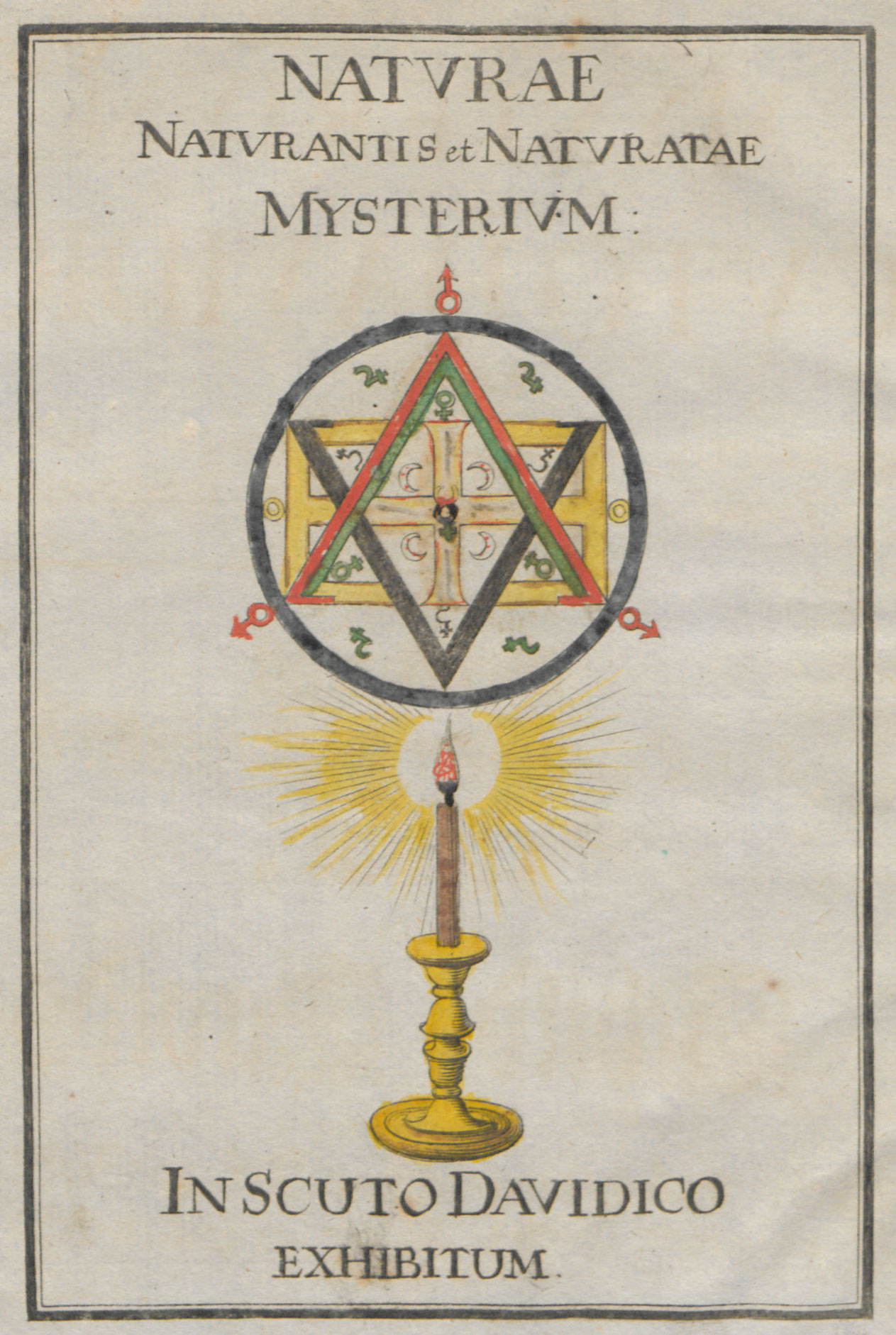
In Scuto Davidico Exhibitvm.
THE MYSTERY
OF NATURE
NATURING AND NATURED,
exhibited in the DAVIDIC SHIELD:
Comprehending the foundations of the more secret Mathematics and Philology, as also of Theology, Physics, and Ethics.
The Secret
of the Creating and Created
Nature;
contained in the Shield of David:
Which includes within itself the grounds of the secret Art of Measuring and Speaking, as also of Divine, Natural, and Moral Doctrine.
Berlenburg
by Johann Jacob Haug,
In the Year 1724.
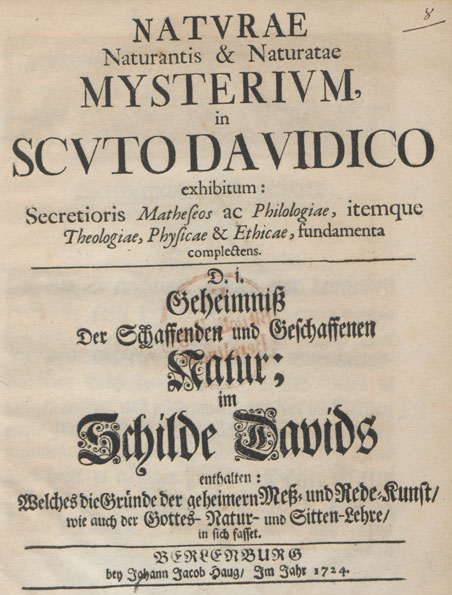
Translated to English from the book:
Naturae Naturantis & Naturatae Mysterium, in Scuto Davidico exhibitum:
Secretioris Matheseos ac Philologiae, itemque Theologiae, Physicae &
Ethicae, fundamenta complectens = D. i. Geheimniß Der Schaffenden und
Geschaffenen Natur; im Schilde Davids enthalten: Welches die Gründe der
geheimern Meß- und Rede-Kunst, wie auch der Gottes- Natur- und
Sitten-Lehre, in sich fasset
Highly esteemed and honored
Reader!
Here there appears before you a writing, which is not so much to be valued according to the small number of its pages, as according to the worthy nature of its contents; and accordingly one may also find here in little something great.
The immediate aim of this present representation is (as the outer title-page itself makes known) directed toward a figure, which for that reason is called the SCUTUM DAVIDICUM - The Shield of David, because among the Jews the tradition is found that the pious and enlightened King David is said to have borne this same figure in his shield as a special hieroglyphic (that is, a figure pointing to a secret interpretation); and therefore it is also by them called in Hebrew Magen David, or, according to their pronunciation, Mogen Dovid (that is, a Shield of David), and is commonly to be found both in their synagogues and elsewhere.
It consists principally of two triangles interlaced with one another, of which one has its point directed upward and the other downward; so that together they represent, as it were, a star of six corners or points, which at the same time appears enclosed within a circular line.
In the middle of it they are accustomed to place the Hebrew symbolic word אמת (Emeth); through whose individual letters they refer to the four Hebrew words:
אתה גבור לעולם אדני
(that is, Thou art mighty forever, O LORD, our God!).
But the Christian Cabalists refer it to the divine Trinity; namely, through the א (Aleph), the unity of the essence; and through the remaining letters מ and ת they are accustomed to signify the threefold unity of the same in one essence.
Thus this very word אמת (Emeth) is by some inscribed upon all the points of this figure; whereas others place only in the uppermost and lowermost point the Hebrew letters י and ה (which together make the word יה), but in the other four points at the sides the four Hebrew letters י ה ו ה (which yield the word יהוה), as it were distributed, so that the words on both sides represent in this manner the abbreviated and the full name of God, Jehovah.
Only it is to be lamented that this figure is shamefully misused by this superstitious people for all kinds of superstitious aids and remedies (for example, for extinguishing fire, for driving away diseases, and for other such things), as is reported by Schikhardo in Tarich Regum Persiae, p. 54; by Wagenseil in Hydraspides, p. 15 ff.; by Saubert in Palaestra Theologico-Philologica, p. 68; and among the more recent writers by the recently deceased highly renowned Rector of the Gymnasium at Frankfurt am Main, Mr. Joh. Jacob Schudt, in his Jewish Curiosities, Book VI, Chapter VI, § 5 ff., p. 75 ff., and in the continuation appended to the same, Chapter VI, p. 18 ff. as also in the highly renowned Bibliotheca Uffenbachiana Manuscripta, published in folio at Frankfurt in the year 1720, column 321 ff., column 371 ff., column 411 ff., one may read more at length, and at the same time see from it how the Jews, according to the various superstitious uses, are accustomed to add other Hebrew inscriptions to the aforesaid figure (for example, when extinguishing fire, the words from 4 Moses XI, verse 2).
Upon which, however, in this place the very least intention is directed; but rather toward something better and purer.
For the present figure differs somewhat, even in outward form, from the Jewish Scutum Davidis, in that here the figure of a Cross appears in the middle, and an enclosing of the figure on both sides by certain secondary lines or strokes (from a particular intention of the author) is to be found.
We therefore leave it undecided in its place whether David (the man after God’s own heart) ever bore such a figure in his shield according to the aforementioned Jewish tradition or not; and we content ourselves that (as the explanation of it here coming to light will sufficiently show) no one will be able to take offense, since he sees at least this figure from a wholly different and special intention, true and worthy of consideration in its nature; and consequently it is not unworthy that a man, advanced in divine mysteries through divine illumination, might employ the same in his shield.
But who the AUTOR may be, from its present arrangement and appended explanation, the present first publisher does not presume fully to assure the reader; yet indeed that person from whose hand he received it intended to assure him that the renowned author who in the year 1702, under the name Ilidori Charisii Logothetae, Philyro-Politani, published in quarto the Theologiae Christianae in Numeris, is to be regarded as the inventor and interpreter thereof.
But just as that learned man, who is said to lie hidden under such a name, has (so far as is known) never publicly wished to acknowledge this writing though it has been commended by many scholars with numerous elogies so this matter also is left here undecided in its place.
And it is at least certain that the present figure belongs among the so-called mystical figures (of which the aforementioned author speaks at the end of the previously cited work and particularly the gentlemen, authors of Observationum Selectarum Halensium, Vol. VI, Observ. XII, p. 105 ff., as also Mr. Jac. Friedr. Reimmann) in the Introduction to the Literary History of the Germans, Vol. III, p. 139, of the highly praised Theologia in Numeris, also wished to give some specimens of it not yet published by him up to that time), may be counted with good right as a particular distinction.
And thus it is hoped that discerning readers will receive the present edition of the same with special pleasure; and that its ingenious inventor (whoever he may be) will not take it amiss.
Immanu-El!
Interpretation and Explanation
of the foregoing
Mystical Figure.
I.
The secret figure which is here presented first of all represents the five principal geometrical figures, namely:
1. the Circle;
2. the Triangle;
3. the Square;
4. the Cube;
5. the Cross;
since all understanding mathematicians will readily confess that all these figures have in mathematics a special preeminence above all others.
II.
Upon closer consideration, however, this figure also exhibits other considerable matters; namely:
the well-known chymical signatures of Fire and Water, likewise of Air and Earth;
the signatures of Sun, Moon, and Stars;
the five vowels and the H, in Latin script and letters.
For the red and green triangle, which has its point directed upward, represents the A; the black triangle, which has its point directed downward, the V; the yellow square, a doubled E; the white cross in the middle, a doubled I; the blue circle, the O.
The E and I together represent a doubled H.
III.
These five vowels with the doubled H constitute the mysterious essential name of God, IEHOVAH; which not without reason consists of these five vowels and of the twofold H; because the same contains within itself the whole mystery of the creating and created nature, according to the seven forms of the eternal Spirit of God, and indeed both according to the properties of wrath, of fire, and of darkness, as also according to the properties of love, of light, and of clarity (according to Isaiah, chapter 45, verses 6–7), and gives each kingdom, according to the center and degrees of its revelation, wonderfully to be recognized.
IV.
To understand this fully, it would indeed here be useful to know what the vowels properly are, and how they are distinguished from all other letters which in the schools are called consonants as self-sounding alike; how their pronunciation is variously formed by the human mouth and tongue; and how they all together are generated not so much by a breathing or blowing, as by a mere sounding or gentle impulse of the spirit of air or of the human breath; and what the proper cause is, that only these five letters of themselves produce an audible sound or tone, whereas the others, without the five vowels, cannot have a pronounceable speech.
But since all this (wherein lies a deep foundation of all languages) does not properly belong to be explained here at length, one will for the present touch only upon what is most necessary.
V.
The A is the principal foundation of all human speech, and as it were the center or middle point of the remaining four vowels; among which it gives to the E and I clarity, and to the O and O and V, however, incline toward darkness from themselves.
In itself the A is neither clear nor dark, but rather indifferent to both; since it equally contains within itself the ground of both, and is not recognized as tending more toward clarity or toward darkness, than when it opens itself according to either property, and through the degrees of its opening wonderfully brings forth the number four out of the number three.
In the contemplation of this, it has the number three within itself, and the number four outside itself; which two numbers together constitute the Sanctum Septenarium, or the holy number seven; and precisely herein lies the mystery of the septiform spirit, or of the sevenfold Spirit; concerning which, according to the guidance of Holy Scripture (Rev. 4; 5:6; Zech. 3:9; 4:10), one also finds among ancient and modern Christian writers various thoughts and considerations.
The number three belongs to the center and stands in the interior; the number four belongs to the periphery and goes outward.
VI.
To speak more clearly: the A therefore has the number three within itself,
1. because it is a ground and beginning of the dark;
2. a ground and beginning of the clear;
3. and a reconciliation of both.
Furthermore, it therefore has the number four outside itself, because it brings forth from itself the other four vowels and opens the progression of the clear and the dark in different degrees.
For when the A inclines toward clarity, then the A is a clear vowel, the E yet clearer, and the I the clearest of all.
But when the A inclines toward darkness, then the A is a dark vowel, the O yet darker, and the V the darkest of all.
Accordingly, the A stands between the other four vowels in the middle; and it is the positive in relation to the comparative and superlative in clarity and darkness, in light and obscurity.
Whoever requires proof of this must attend to the formation of the mouth and the tongue in shaping the clear and dark vowels and their direction of pronunciation; and he will also at the same time perceive the difference, when, by placing the forefinger over the tongue, he pronounces in sequence the vowels A, E, I; and by placing the forefinger under the tongue, he pronounces in sequence the vowels A, O, V; and will observe the various rising or retreating motion of the tongue therein.
VII.
With this now harmonize also the seven principal colors, and the seven metals, as also the seven musical tones, and the seven planets, as the seven ruling spirits of nature.
For although there are only five vowels, nevertheless the Sanctus Septenarius, or the holy number seven, is manifest in them; because the A, through a twofold H or aspiration, as it were extends itself into two different realms.
VIII.
The colors are distinguished according to light and darkness, and according to their different degrees; and yet they proceed from one center, which contains within itself the ground of all colors.
If the light is in progressus, and the light seeks to raise itself out of darkness toward light, then the first degree is the red; from this arises the yellow; and from this the completely white.
But if the light is in regressus, and the darkness seeks to withdraw itself from the light toward darkness, then the first degree is the green; thereafter follows the blue; and after this the completely black.
Yet the highest degree of the colors again ends in the first. For the highest white clarifies itself into red; and the highest black turns itself into green. And whoever reflects somewhat more deeply upon all this will the more easily unite these observations with the secret philosophy and experience of the Chymists.
IX.
Moreover, between green and blue, and again between red and yellow, there is a notable difference: namely, that the two former colors arise from a mixture, but the two latter colors without mixture, through a kind of natural generation.
For through the mixture of the two extreme contrary colors, black and white, the blue arises; and through the mixture of the two middle contrary colors, blue and yellow, there arises green.
On the other hand, red and yellow arise from no mixture, but originate from the natural progression of light; which in its essential generation does not proceed backward, but rather forward.
X.
The red color belongs to Mars and to reddish iron; the green to Venus and to greenish copper; the yellow to the Sun and to yellow-shining gold; the blue to Jupiter and to bluish tin; the white to the Moon and to white silver; the black to Saturn and to blackish lead; the mixed or variegated color to Mercury and to quicksilver, as the seed of all metals.
XI.
In the red, the fire opens itself;
in the yellow, the light;
in the white, clarity.
In the green, however, is the concealment of the light;
in the blue, the shadow;
in the black, darkness.
XII.
In the red is seeking and desiring;
in the yellow is finding and recognizing;
in the white is loving and enjoying.
Conversely, in the green is hoping and waiting;
in the blue is noticing and reflecting;
in the black is renouncing and abstaining.
XIII.
From this it is now to be understood why, in this mysterious figure, the A is red and green, that the V is black, the I white, the E yellow, the O blue, and that the center of this figure, as Mercurius, shows itself with all colors.
XIV.
Whoever carefully considers all this will now somewhat better perceive and understand the most precious essential Name of God, JEHOVAH.
The I (which at the same time contains within itself the gently breathing Jod) stands at the beginning, and after it follows its related E, as the two degrees of clarity.
Thereupon follows the H, as a boundary point between light and darkness.
Further follow the O and the V (which at the same time contain within themselves the blowing Vau) as the two degrees of darkness.
Finally comes the A, in which all vowels terminate as in their principal ground; and it closes itself at last with the H, as with the Spirit of Revelation at the goal of the revealed wonders.
XV.
The A opens the two realms from above out of its angulo centrali (central angle).
The V sets itself opposite the A and opens its dark powers from below out of the depth.
The I, as the bright sign of Jesus, stands crosswise in the middle and is judge between light and darkness, between equal and unequal.
The H comprises both contrary properties and doubles itself in the opening and completion of their operations.
The E inclines from both (namely the right and left) sides toward the I.
The O encloses all and is an abyss of divine wonders according to light and darkness.
Yet all this must be understood not otherwise than according to the clear indication of Holy Scripture (1 John 1:5–7; James 1:16; Psalm 89:12), in its pure and divine perfection, and must not, through false interpretation, be taken in a sense detrimental to the true understanding.
XVI.
Whoever cannot yet see or believe this for him, in abundance, a light is kindled upon a golden candlestick; whereby he may more closely consider and examine this figure, whether he has eyes to see; and may also perceive whether the prefixed title of this figure is rightly fitting or not. For in a kindled light he himself will find it.
And herein indeed consists the true principal foundation of all moral doctrine: that one should seek the light from one stage to another, but flee the darkness from one stage to another; and that light and darkness should not be mingled together upon the path of light, and that to each one should be assigned that which belongs to him according to the law of nature.
XVII.
But that even the Latin script and letters, with the expression of this mystery, this figure correspond so completely: this perhaps has this particular cause; namely, that the unveiling of all hidden things even those which are contained in the name Jehovah, as a summary concept of all vowels and of the foundation of all languages according to Daniel XII, verse 4, until the times of the Imperium Latini vel Romani (the Latin or Roman Empire), have most wisely been reserved by God.
After-Report of the Publisher,
in conclusion.
Thus far extends the interpretation obtained concerning the Scutum Davidicum from its inventor; and every understanding reader will readily have to confess that a great depth of many hidden things is contained therein.
And indeed it is certainly one of the most noteworthy points of the same, that here so clearly it is shown how God, the wise Creator (according to 2 Cor. IV, 6; Gen. I, 2, 3–5), caused the light to shine forth out of darkness; and thus, out of the black, all bright colors take their origin step by step; especially that the red color is the very first, whereby the light emerges from the darkness.
A clear proof of this is found at the breaking of day in the morning redness; as also in the bursting forth and kindling of a formerly hidden, smoldering fire out of a black, dark smoke; not less so in what the chemists call ex Aethiope minerali - from the cinnabar arising ex Aethiope minerali, and from other similar experimentis physicis.
And although indeed among the chemists there are found experiments showing that the white turns into yellow, the yellow into red, or also that silver into gold, and gold at last into an indestructible ruby is transformed: yet this objection has already above (Sp. VIII., as it appears) been thoughtfully addressed by the Author; and indeed the white in the red, as in its first origin and victory over darkness (thus the end in its beginning), is as it were sealed and grounded.
Therefore it is no wonder that (as has been related to the Publisher) the Author of this invention was by some even regarded as an Adept of the most secret Chymistry; which, however, he himself never claimed.
Yet the Author of this invention is also said to have reported how he had been informed by others that formerly in Nürnberg there had been a well-known mechanic named Dein, who worked much in fire, and had particular knowledge of fire, light, and air, as also of the colors and metals, and of their various degrees (gradibus), which with present knowledge almost entirely in agreement; and he had in like manner demonstrated the same by means of a burning light; not to mention that other persons experienced in the secret Chymistry had greatly marveled at the presentation of this figure, and had testified to the Author the conformity of the same with their secret experience.
Accordingly, all this is now left to the further reflection and investigation of those who are understanding; and if the Author should be so fortunate as hereafter to communicate more such truly mystical figures, he will consider himself obliged thereto, and it will be a pleasure to him to serve thereby the curious reader and seeker of secrets still further.
The End.