The Writing of Albert on the Tree of Aristotle
Listen Audio Book Study the Art with Us Buy me CoffeeTHE WRITING OF ALBERT ON THE TREE OF ARISTOTLE
Translated to English from the book:
Theatrum chemicum, praecipuos selectorum auctorum tractatus de chemiae et lapidis philosophici antiquitate, veritate, iure, praestantia, & operationibus, continens: in gratiam verae chemiae, et medicinae chemicae studiosorum ... congestum, et in sex partes seu volumina digestum; singulis voluminibus, suo auctorum et librorum catalogo primis pagellis: rerum vero & verborum indice postremis annexo. Volumen secundum.
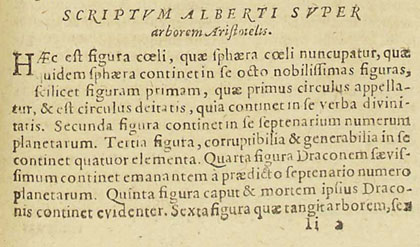
This is the figure of heaven, which is called the sphere of heaven; and this same sphere contains within itself eight most noble figures, namely the first figure, which is called the first circle, and it is the circle of deity, because it contains within itself the words of divinity. The second figure contains within itself the number seven of the planets. The third figure contains within itself the four elements, corruptible and generable. The fourth figure contains the most fierce Dragon proceeding from the aforesaid sevenfold number of the planets. The fifth figure clearly contains the head and death of that Dragon. The sixth figure, which touches the tree, contains six faces, and two animals, namely storks. The seventh figure, which touches the tree with planets, where the letters are white, is called the sixth circle. The eighth figure contains within itself, after the likeness of the brightness of the Sun, the golden tree with its roots, radiant.
The exposition of the first of these figures, namely of the circle of divinity, is this: that therefore we are called by such a name because the names of divinity that is, the titles of sacred Scripture, and the legal and natural laws which are believed infallibly to have proceeded from God are written there in a circle.
The explanation of the second figure, namely of Saturn and the other planets, is this: for Saturn, by his coldness and dryness, forms the Dragon. Jupiter, however, bestows upon the Dragon his heat, digesting it into a certain muddy-appearing substance, which is full of heat and burning; and therefore it does not adhere to that which touches it. Mars, however, by his heat and dryness divides that Dragon and causes it to pass through by cooking. But Sol gathers it together and causes it in some measure to live, because he himself is the father of creatures, and the aforesaid Dragon loves him because of his heat, and tincture, and most sweet odor, which exhales from it. Venus, however, by her heat and dryness, gathered together, disjoins here and there the members of the Dragon, sending through all the joints many punctures as she pierces it, and leaving that Dragon as though dead. But Mercury and Luna, by pouring their moistures upon it, enliven it, because they make it live, run, walk, and change its color into the appearance of blood. And at the beginning it appears black, and in the middle inclining toward whiteness, and in the end the redness inclines into the color of its head.
The declaration of the third figure, of the four corruptible and generable elements, is this: that therefore it is called corruptible and generable, because they are always corrupted and generated, and because they are changed one into another on account of heat and dryness, coldness and moisture. And therefore art and the artificer dispose the matter of those elements, dividing it and joining it one to another, and remove it from their deadly nature; and then their quality is changed: for the hot and moist is nutritive, on account of the heat and moisture which is in it. The cold and dry which were in it, and the cold and moist, are refrigerative for the fevered and curative for the sick; for it opens the eyes of the blind, and the ears of the deaf, and cleanses lepers, and strengthens the nerves, and opens the veins, and causes the dead to rise again.
The fourth figure is of the Dragon proceeding from the aforesaid seven planets, because it proceeds through very and most subtle influences, flowing down into the elements; and then its matter, dispersed in the air, has in the clouds its exalted smoke; then with rainwater and hail it descends again into the earth, is coagulated with it, and makes for itself a new skin. And thus it begins to creep in the caverns of the earth, and always tends downward if nothing hinders it, and it goes on even to the waters of the sea. Thence it emerges, if nothing hinders its course, until it sees the firmament a second time; and from there it is removed and returns to the beginning. Thus it never ceases to move, because it hates the light, and always seeks to hide itself from the rays of the Sun, and therefore it is venomous, and man cannot kill it without a stronger poison.
We call the fifth figure that of its head, and of the death of that Dragon. Its head lives forever, and therefore the head is called glorious life, and the angels serve it. And God placed this image in the paradise of delights, and in it He placed His image and likeness, and there the Dragon fought with the image of God, until he made it fall into death. And therefore God gave such power to that image, that it could kill it above the Dragon. And therefore such an image was set over the serpent, and it is its head, because the whole body follows the head; and that head hates the body, and kills it, beginning at the tail, corroding it with its teeth, until the whole body enters into the head, and remains there forever.
The sixth figure contains six faces and two storks, with their properties appearing there. Of these, the first face, which remains in sublimations, is seen to have the best color. The second, which swims in waters, declines from the first into a diminution of nature. The third, which is in a cave, having the likeness of charcoal, signifies bad digestion with superfluous moisture, and the foul fetidness which is in it. And therefore the skilled artificer ought to wash it with the element of water in the belly of the storks, with fire placed beneath, until the copper is set on fire in the mouth and in the head of the storks, and by the oil it may perform a kind of vomiting, until the black head, bearing the likeness of an Ethiopian, has been well washed and begun to grow white. And he should do this so long, until at last redness appears.
The seventh figure, which is called the sixth circle, whatever circle touches the tree with the figures of the seven planets, where the letters are white it is better to be silent than to speak unwisely about it, because in it remains that most precious secret, the treasure of the wisdom of all philosophers. In it is the transmutation of all corruptible and generable things, of all precious stones.
There are the hidden white treasures innumerable, and no one knows them unless God should wish to reveal them to him. There is found there the double stone, onychinus, carbuncle, topaz, amethyst, beryl, and panther stone; and there is a certain glassy heaven like crystal, ductile like gold. And therefore the kings of the earth carry it upon their heads. Wise women hide it; foolish virgins bear it publicly, because they desire to be despoiled of it. Bishops and religious priests, and nuns, tear it, because this has been commanded them by divine law. Merchants of the earth and farmers do this with olive oil and with ships, and mariners carry it from the East as far as the West; and in the islands that are in the South it flourishes more.
The eighth figure, which we named above, is the golden tree containing seven branches and visible roots. We call that tree the figure of Sol, because glorious kings hold it, and fight on account of it, and many are struck with death. And therefore that great Alexander, emperor, son of Philip, emperor of the Macedonians, found it in his journeys in the farthest regions; and there he found the sepulcher of Hermes, the father of all philosophers, full of all treasures not metallic, but written with golden letters on a tablet of emerald. And that writing is indeed contained in the final books which Galen composed. And he found a certain standing tree, holding from within itself glorious greenness; above it a very beautiful stork was feeding her young, which is called the lunar circle. And there he built golden houses, and established there a fitting end for his journeys.
Let us make an end in our figure of heaven. Let the reader know that such a figure exists more in reality than in appearance.
The End.