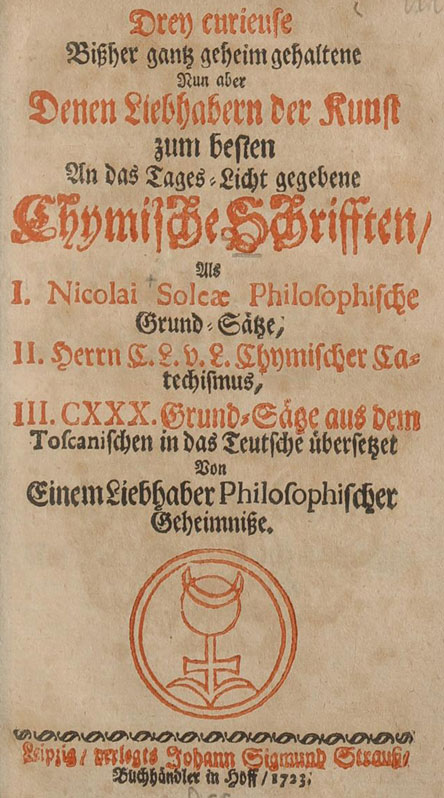
Three curious, hitherto wholly secret, now however for the benefit of the lovers of the Art brought to the light of day
Listen Audio Book Study the Art with Us Buy me CoffeeThree curious,
hitherto wholly secret,
now however
for the benefit of the lovers of the Art
brought to the light of day:
Chymical Writings,
namely:
1. Nicolai Solcae Philosophical Fundamental Principles
2. Mr. C. E. v. L.’s Chymical Catechism
3. One hundred and thirty (CXXX) Fundamental Principles
translated from Tuscan into German,
by a Lover of Philosophical Secrets.
Leipzig, published by Johann Sigmund Gleditsch,
Bookseller at Court, 1723.
Translated to English from the book:
Drey curieuse Bißher gantz geheim gehaltene Nun aber Denen Liebhabern der Kunst zum besten An das Tages-Licht gegebene Chymische Schrifften : Als I. Nicolai Soleae Philosophische Grund-Sätze, II. Herrn C. L. V. L. Chymischer Catechismus, III. CXXX. Grund-Sätze aus dem Toscanischen in das Teutsche übersetzet / Von Einem Liebhaber Philosophischer Geheimniße
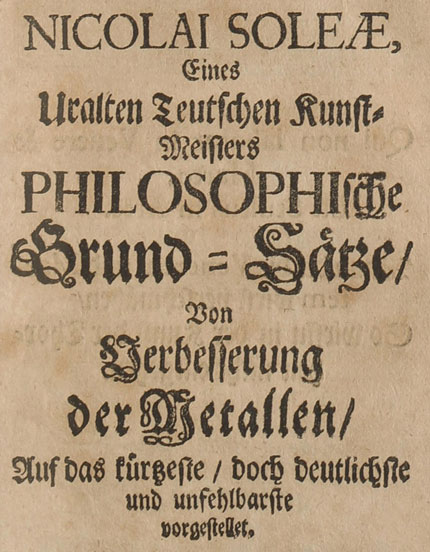
NICOLAI SOLEÆ,
of an ancient German Master of the Art,
Philosophical Fundamental Principles,
concerning the improvement (perfecting) of the metals,
set forth in the briefest, yet clearest and most infallible manner.
Qui non laborat in Venere & Marte, Est Stultus in Arte.
He who does not labor in Venus and Mars is a fool in the Art.
Wann du die Venerem und Martem wirst verschmähen / So wirstu in der Kunst der Thorheit nicht entgehen.
If you despise Venus and Mars, you will not escape folly in the Art.
Philosophical Fundamental Principles
Concerning the improvement (perfecting) of the metals.
1. The root of the metals is a most volatile spirit, brought forth by the power of fire, and yet it partakes as well of water as of fire.
2. This spirit dwells in two metals, namely in ♂ Mars and ♀ Venus, and is the key of the Art.
3. In ♂ Mars and ♀ Venus there is hidden a tincture of gold that extends (penetrates/spreads) exceedingly far.
4. This spirit drawn from ♂ Mars and ♀ Venus is the food and drink of ☉ (the Sun / gold).
5. All metals are generated and preserved by this fiery spirit.
6. The spirit, or Mercurius of the Wise, is not common quicksilver (mercury), but rather the spirit from two metals or salts.
7. This spirit dissolves all metals back into their first essence (their original being).
8. The whole key of the Art lies hidden in it.
9. Its origin is the heavenly water, and its means (medium) is the dew, or sulphurous water.
10. The sulphur of ♀ Venus, together with the salt of ♂ Mars, maintains a very close friendship with this sulphurous water; therefore it is called the Mother of the metals.
11. The spirit, or sulphur, of ♀ Venus has one and the same dwelling with gold.
12. Mars is the man, Venus the woman, after they, through the power of fire, have taken on a volatile form.
13. The Salt of the Wise is our Mercurius and little fountain-spring, which unites itself with gold.
14. This salt dwells in the self-attracting, or magnetic, North Star.
15. This salt is the heaven of the Wise; its spirit dissolves gold and improves (perfects) it.
16. This spirit, “geist,” or water is called a saltpetre, and yet in its nature it is no common saltpetre.
17. This water is called a spirit of ♀ Venus, which loves gold, as a beloved woman loves her dearest.
18. This water of our great sea comprehends the whole Art within itself.
19. The spirit of gold and the water of our sea can, according to their effective (true), in their truly effective, most inward union, can never more be separated for eternity; and indeed this is our great secret.
20. This water is a living water, and is called our Moon, or also our Silver.
21. This dissolving water is our Salt, and the Mercurius of the ancient Wise.
22. Gold is the most perfect of all metals, and the seed of our Art.
23. When gold has been dissolved radically (from the ground up) and perfectly, then it is no longer common gold, but the matter of the Stone.
24. The soul, or sulphur, of gold is called the tincture and our Stone.
25. Whoever knows our water, knows also our Stone, and all might and power is hidden therein.
26. The very finest part of this water is our fire, and it opens up (dissolves) gold.
27. When one has this water, then in the Art one looks further for nothing else.
28. The power of this fiery water is the mother, or our field (soil); but gold is the seed.
29. He who draws the seed from the imperfect metals labors in vain.
30. Imperfect bodies yield an imperfect seed.
31. Yet at times gold is indeed produced from imperfect bodies.
32. But this seed is not the seed of the imperfect, but of the perfect body.
33. The whole essence of gold is dissolved into a seed of the Art.
34. This is the chief work in the Art: to dissolve gold from the ground up (radically).
35. Our dissolving-water is not a Scheide-water (parting acid), nor a Königs-water (aqua regia).
36. The whole work consists in the dissolution of gold, so that it can no longer be changed back into gold again.
37. The Philosophers’ Stone is brought forth out of gold through their Mercurius, and otherwise it is not found in any other metal.
38. Pure gold also brings forth a pure medicine.
39. Therefore, transform gold into the Mercurius of the Wise, and you have the Art.
40. The mineral Mercurius is the vitriol of the Wise; this cannot be produced from the stinking water of the metals.
41. There are two dissolutions in the Art:
1. when the metal is changed into Mercurius;
2. when it is changed into vitriol; from this then arises the Mercurial water is born from it, which is the first root of the universal medicine.
42. The metallic vitriol is a mercurial body; when it is, through its own sulphur, turned into water, it will be the very best medicine.
43. The Mercurius of metals is the vitriol of metals, and conversely again.
44. The magnet of the Wise is the salt of the metals.
45. The soul of the magnet is its own salt, and herein the Art is hidden.
46. The magnet of the Wise is their Mercurius; but it is propagated by the most noble sulphur, which is hidden in our ore.
47. Unite the sulphur with the Mercurius of the Wise, and you have the Mercurial water.
48. From gold and salt our Stone is generated.
49. Azoth, or the vinegar of the Wise, has its origin from the ores and imperfect metals.
50. There is no medicine without gold and silver.
51. The fertilization of the metals is in ♀ Venus; and when this is united with ☉ Sol and ☽ Luna, then our medicine is complete.
52. Each metal has its own seed.
53. When one has the seed, or sulphur, of gold, then gold is necessarily produced.
54. Mercurius is also the sulphur of the metals, and is brought forth by Art.
55. What is sown in our water grows according to its nature; therefore, whoever sows lead will reap lead.
56. A pure Mercurius contains a pure sulphur within itself.
57. The seed of gold is propagated thereby.
58. A volatile thing also begets a volatile thing.
59. That which has no fixed nature nor enduring essence this the volatile will never make fixed.
60. Then like joins itself to like, and Nature loves its own Nature.
61. Our water, or gold-spring (gold-fountain), is transparent like a crystal.
62. This water is a “steamy fog,” wherein gold melts like ice in warm water.
63. Whoever possesses this water is a master of the Art; but where it is lacking, the whole Art is lacking.
64. This is a water from the water, a salt from the salt, a spirit from the spirit, gold from the gold, sulphur from the sulphur yet it is only one thing.
65. This water holds a gold within itself, which makes common gold into water.
66. In this gold is the power and tincture of all metals.
67. Gold is the Stone of the Wise.
68. Gold is our ore, which contains a red sulphur within itself.
69. Gold cannot tinge (impart a tincture) unless it is dissolved.
70. Our water burns (consumes) gold more than a common fire does.
71. Our water is prepared from stones, and is green and sky-blue, and is called the water of our sea.
72. Our water is of a sulphurous power.
73. Two “smokes” (vapours/fumes) are distilled into one water, which is called ours.
74. From it the Mercurius of the metals is born.
75. O thou blessed sour water: through thee the fixed bond of gold, and the sulphur of Mercurius, are dissolved.
76. The metallic–mineral salt is the foundation of the Art.
77. Gold is destroyed by nothing except its mother.
78. The mother of gold, and the first matter thus our Mercurius is of the nature of salts.
79. The seed of gold comes from this water and its spirit.
80. Vitriol has the middle nature of the metals.
81. Vitriol is to be opened with our secret key, if one wishes to obtain its holy spirit.
82. Azoth is the metallic seed.
83. The sulphur, or the fire, of vitriol is itself its own key.
84. Vitriol is the best among all salts.
85. In this salt a white spirit is hidden, which is our sulphur.
86. Our sulphur is hidden in the gold-tree; in iron and copper it cannot be attained, unless the Crocus Martis and Veneris is planted into the gold; for as much gold as is in copper and iron, so much gold-sulphur is also in them; yet in and of themselves iron and copper, as such, are of no use.
87. But in gold is the true tincture of the metals; the other metals, however, as such, are of no use and do not have the tincture.
88. Let one draw the fire out of the salt, i.e. our water, which is nothing other than our vitriol then you have the Art.
89. The first matter has been a flame of fire and a water, wherein all consists.
90. The vitriol of the ore must be converted into a crystalline fire-water, by means of which the sulphur is dissolved.
91. Everything must be salted with fire.
92. He deserves to be called an artist who can transform fire into water.
93. The salt-spirit is the noblest work.
94. Soak (imbibe) the gold with the watery fire, and it will be made living in its powers.
95. Our Mercurius transforms the bodies into a dew.
96. Gold is the purest body and through and through Mercurius.
97. What is killed by means of the Art must also, with the help of the Art, be awakened again to a better life.
98. In place of Mercurius we always understand the vitriolic salt and its spirit.
99. In vitriol are two spirits which love gold; by means of these everything is accomplished.
100. Through the water of our copper, gold and silver are united with one another in our Art.
101. Our water is called heavenly, because it is drawn from a sky-blue stone.
102. The white spirit is the true Mercurius of the Wise, and is the spirit of metals indeed, the beginning of the Art.
103. The spirit of Mercurius with salt and gold gives the medicine.
104. Mars and Venus have the seed of gold in themselves, but still unripe.
105. The true sulphur of the Wise is found in gold.
106. Our antimonial extract is the true Stone of the Wise.
107. All metals are born of minerals; therefore gold and silver too are dissolved by minerals, in order to prepare the medicine.
108. Vitriol can do more than all salts; therefore it is also to be preferred before them.
109. Unite the spirit of gold with the spirit of vitriol, i.e. with the spirit of Mercurius; then you will have the Art of the Wise.
110. Lead becomes gold, and this in turn is called lead again, because from these two our Stone is born.
111. The salt of the perfect bodies is the sulphur of the Wise thus also in the rest.
112. From antimony-glass (Spiess-Glas), by means of the spirit of Mercurius, a great medicine is prepared.
113. Sulphur and Mercurius are our matter, and this is gold and salt.
114. Mercurius is a tree worthy of all honor: whatever is grafted into it is tinctured, and it tinctures with the same.
115. The sulphur of gold is its fire thus it is also to be understood of Venus and Mars.
116. The whole Art is nothing else than that gold and silver be dissolved, so that they cannot be brought back again into their body; and this is the song at the End.
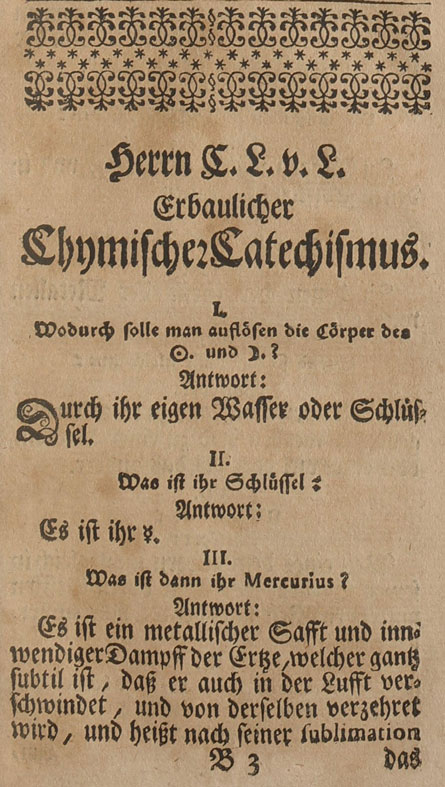
Herrn E. L. v. L.
Edifying
Chymical Catechism.
I.
By what should one dissolve the bodies of the ☉ Sol and ☽ Luna ?
Answer:
Through their own water or key.
II.
What is their key?
Answer:
It is their ☿ Mercury.
III.
What then is their Mercurius?
Answer:
It is a metallic juice and inward vapor of the ore, which is so very subtle that it also vanishes into the air, and is consumed by the same, and after its sublimation is called the Water of the Wise, their spring and fons una, also their fire; for the Philosophers’ Water is a fire.
IV.
Where must one find this water?
Answer:
In mountains and in low places/valleys, and in the larger minerals.
V.
In which minerals?
Answer:
In those in which the spirit of the metals dwells.
VI.
Are they then all equally good?
Answer:
They can indeed all be brought to a tincture and to a medicine, yet one much sooner than another.
VII.
Why is that?
Answer:
Because one is not incorporated/imbued in the same way as another, in its quality, from the upper stars and the upper world, according to their influence.
VIII.
Which, however, among them has the highest virtues and powers from God for tinging (transmuting)?
Answer:
There are indeed many spirits which have the power to open up and to tinge the metals; these then are the spirits of the metals dwelling in the minerals.
IX.
What kinds of minerals are they?
Answer:
There are indeed many of them; for each metal has the other six spiritually within itself; but the best spirits of the ☉ Sol and ☽ Luna dwell in the base minerals, such as cobalt, zinc ores, antimony, granates, bismuth, “Spießglas” (antimony glass), cadmia; these are to be compared most nearly to the highest gold and silver ores, from which a noble water may come, when they are found wholly raw and pure.
X.
Which, then, are the best for our Fontina (spring/fountain) / suited to our fontina?
Answer:
The thinnest (subtlest) and most volatile ore(s) of the minerals, such as lead to the Spiritus Solis and Lunae (spirit of the Sun and of the Moon).
XI.
Do these spirits then have more power to tinge than others?
Answer:
Yes, certainly far more; for as they surpass the others in their fixity corporally, so they also surpass them spiritually.
XII.
In which minerals does one find the Spiritus of the ☉ Sol and ☽ Luna best?
Answer:
If you wish to have our Water or little burning-water (Brönnlein), then see well to it that the spirit of ☉ Sol or ☽ Luna be pure I say pure without mixture of other alien spirits of bodies; and, for ☽ Luna, the best are the raw/pure, cutting, bright, volatile (and the less silver it contains, the better) red-golden ore, which commonly occurs in the gold-cobalt mines.
Secondly, one often finds cobalts which lead (carry) little, indeed almost no ☽ Luna; but if one follows up in those pits/mines, one finds a white, soft, coagulated water, or silver juice, in which, partly formed, certain cobalts are accustomed to grow; it smears like a fat/grease, or is even a subtle amalgama, or like a soft, tender, white “meal”/powdery color. In this juice our water lies hidden, as it were, in white.
When such a juice appears red in a mineral, it indicates the Spiritus Martis; but if green, the Spiritus Veneris; and this spirit is artificially separated from its earth which it has in the body of the earth; and thus, when separated, it is called the pure from the impure by means of sublimation, and in another way by the attraction of silver; and these are the flores and artificial blossoms of the metals, for the stone and tincture, for their solution.
XIII.
How, then, is this spirit driven out, and separated from its coarse earthliness?
Answer:
Take the gold-juice (Gold-Safft), or the liquor-like mineral of the ☽ Luna, put it into its sublimatorium in a sand-capel (sand bath), let it proceed gently for 2 hours, then ever stronger; thus the subtlest spirits rise into the helm (head) set on above, adhere to it, and are to be recognized by their colors of the metals. But the metal must be pounded small or crushed like small beans, so that the spirits can go forth.
Or take the mineral ☉ Sol or ☽ Luna, raw and pure, broken in pieces, or else rubbed quite fine upon a very hard and smooth rubbing-stone, sealed hermetically in a phial; set it into a warm sand-capel (sand bath), and let it come together very gently, somewhat compact; then it clothes itself with a green skin, like a walnut-tree leaf; and this the Wise call the green Dragon of Hermes, the green devouring worm, and the green Lion of Theophrastus, to which its rose-colored blood is drawn out, and to which the green tree-frog is put on.
The whiteness that then grows out from its ribs is the white lily, a water of the Wise, from which their elixir and fontina comes. When this liquor ☉ Solis has thus been over-drawn/covered with green, do not make it too hot; then the green skin will burst, and from it where it has burst our lily will grow out, snow-white like wool. Let it grow as long as it can; then take it out gently with a little golden tongs.
And when you now have enough of it, put it into a phial; let it putrefy in very gentle warmth, and sweat gently, and do not make it too hot for it for one month; then it becomes black and white; this is our fontina, our earth-realm, there sow it, what you wish to harvest, ☉ Sol, or ☽ Luna; let it putrefy again; strike/stir it again with ☉ Sol etc.; let it putrefy again do that as often as you wish.
When it stands in putrefaction, and you see the blackness, then you may be certain of a true solution; this is called the Raven’s Head. When it is dissolved, then it is fixed with its Fermentum Solis: fac fixum volatile, etc. (“make the fixed volatile,” etc.)
Go hence, and learn the lesson;
So hast thou the tincture as a reward.
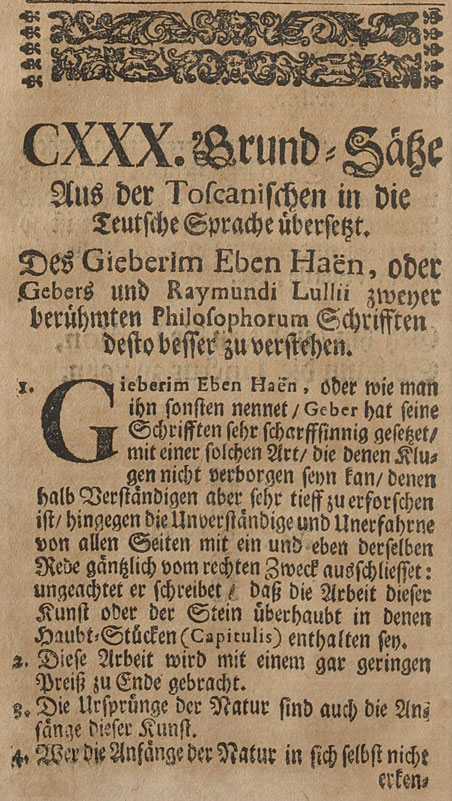
130 Fundamental Propositions
Translated from the Tuscan into the German language.
In order to understand better the writings of Geberim Eben Haën (or Geber) and of Raymundus Lullius, two celebrated philosophers.
1.
Geberim Eben Haën, or as one otherwise calls him, Geber, has set down his writings very subtly, in such a manner that those who can have their eyes not hidden (i.e., who are not blind to it) are nevertheless able to search it out very deeply; whereas the uncomprehending and inexperienced are, on all sides, by one and the same speech of his, entirely shut out from the true purpose: notwithstanding that he writes that the work of this art, or the Stone as a whole, is contained in the chief chapters (Capitulis).
2.
This work is brought to an end with a very small cost.
3.
The beginnings/origins of Nature are also the beginnings of this art.
4.
Whoever does not recognize the beginnings of Nature in himself recognize (them), nor has a soul which can most exactly investigate the beginnings and grounds of Nature, as also the art, the powers which can follow Nature in the properties of their working/effect; such a one will attain no true ground or root of this most secret science. But whoever recognizes the natural beginnings in himself as the cause of our minerals he is near to it. This may be enough as an entrance to the art. Now I go on further.
5. There is a threefold difference of the natural beginnings of the metals: for some are far removed; some somewhat removed, as the middle minerals; but some are immediately near.
6. All metals are generated from sulphur and vitriol.
7. Common sulphur and quicksilver are not the beginnings of the metals.
8. The first matter in this art is called that which comes nearest to metallic nature.
9. Vitriol comes the very nearest to metallic nature, because it is sulphurous, and has in itself a mineral power, so that it may be consumed into metal.
10. The mineral power to generate metals is in the grown/matured sulphur; without it metals can never again be generated.
11. Only those things which have the nature of salt and alum can be dissolved or melted down.
12. From the dissolved vitriol there is made a twofold smoke is released/unbound; and these two vapors are called by the Wise Sulphur and Mercurius.
13. The kinds of sulphur attain in the metals the nearest power of being able to become metallic.
14. From the imperfect metals we obtain various vitriols, both very useful and also necessary.
15. The prepared kinds of sulphur are the most suitable things, in that they transform their subtle vapor into a mercurius, gold, or silver.
16. When the exhaling vapors strike into a certain red earth, they are transformed into common quicksilver.
17. When the twofold vapor, as it penetrates the quartz and rocks or the stone, encounters a sulphur, it dissolves it and continually mixes with it; thereafter, by a gradual “cooking” (digestion) in the ore, it is consumed/changed into a metal.
18. All metals are generated from one and the same matter; the difference among them, however, arises from the difference of the mineral place or site, likewise from different accidents/conditions, as also from the resistance/stubbornness of the matured sulphur and of various kinds of cooking (digestion).
19. All accidents which cling to the fundamental or root matter can be separated from it, when one would make the true elixir, which is an over-perfect metal if one would make it, it must be made from the proper seed of Nature.
20. The elements of the Stone of the Wise have the nature of transforming themselves into a metal, which does not at all befall the elements of other things.
21. Common vitriol is a remote principium or beginning of this art.
22. The beginnings of the art are not in vegetable things, nor animal things, nor in such things as are taken from things of that kind, since they are alienated from the nature of metals.
23. Common sulphur and quicksilver are not the beginnings of Nature; therefore they also cannot be the beginnings of the art.
24. Sulphur alone can generate neither a metal nor the elixir.
25. Whoever can prepare sulphur in such a way that it allows itself to be mixed and united with the metals, he will have the greatest secret of Nature in his hands, and has entered upon the short path of perfection.
26. The elixir is made in two ways: by calcination and solution, and then without lime/alkali and distillation.
27. When Mercurius is united with its sulphurs, it can be thickened and made permanent/fixed.
28. Mercurius is not made permanent by herbs alone.
29. Our Mercurius is a salt, and has the power of the true calx.
30. The mercurius of the metals is, through calcination, made into salt.
31. In metallic bodies there are two kinds of sulphur.
32. Our arsenic partakes of sulphur and of mercurius; therefore one calls it a hermaphrodite; yet by itself alone it cannot generate metal or elixir.
33. Tutia is the white smoke of our Jupiter or zinc; therefore it coats copper with a citron (lemon-yellow) color.
34. Sulphur and mercurius are made permanent/fixed through the transformation into earth, and also made permanent even without this transformation.
35. Sulphur is calcined and washed with its salt and vinegar.
36. Our Jupiter and Saturnus are two salts united together before the distillation.
37. In its preparation, sulphur casts/throws many a little “skin” over itself.
38. Under the name of marcasite Geber speaks of the Stone of the Wise.
39. The vessels for the putrefaction and preparation of sulphur are of one kind, namely flat on the bottom.
40. The beginnings of the art are touched upon in the metals.
41. The elixir and the Stone of the Wise are vegetable, animal, and mercurial.
42. It is necessary that a metallic medicine be found which can transform the imperfect metals into true gold and silver.
43. The metals can be perfectly transformed, one into another.
44. Art (the Art) for the most part surpasses the working of Nature.
45. In one single stone alone consists the whole secret of the Art.
46. In the generation of the metals and of the elixir, sulphur is likened to the male seed; but mercurius to the female monthly blood.
47. The Stone of the Wise has in itself all natural preparation, and everything that is required for perfection.
48. The elixir, the potable gold, the quinta essentia (fifth essence), and the seed are of one and the same matter.
49. Some have supposed that they wished to make the elixir out of common gold.
50. But the elixir cannot be made from common gold, because its sulphur has already come to the last and fixed tincture, and it does not exceed that which was necessary for it. Therefore gold is called perfect and completed, and also cannot, as is necessary, be brought back suitably into the first matter.
51. The fundamental/moist fertility in the other metals is just as strong, incorrupt, and incombustible as that in gold.
52. In the Stone of the Wise, gold and silver are contained according to the degree of their multiplicity and power.
53. By the perfected bodies Geber understands the kinds of prepared sulphur.
54. The gold of the Wise, and potable gold, are the most subtle fundamental sulphur, which is called the soul.
55. The white smoke, which in its belly bears the red smoke, is the truest quinta essentia (fifth essence).
56. The quinta essentia truly has its elemental property within itself.
57. The Wise’s water of life springs from the Stone of the Wise.
58. Sulphur, by means of the fire, sweetens the bitter water.
59. Our heaven must be adorned with our sun and stars.
60. Our quinta essentia is named with various names of harmful and wild beasts, such as a bear, a lion, etc.
61. The waters that make thick and make permanent are two kinds of sulphur, which are indicated under the names Venus and Mars.
62. Under the name of glass, in this art, sulphur is often meant.
63. There is a difference between the thickening of the quinta essentia and the fixed elixir, for they bring forth quite different effects.
64. In potable medicine, a part is held to be animal.
65. In every metal all the metals of the Wise are contained.
66. In this art one must reveal the hidden, and hide the revealed.
67. When it is commanded that one should (make) the bodies to dissolve (them) in a water, then the kinds of sulphur are understood.
68. Besides sulphur and mercurius, the Wise have no other metals.
69. The Art follows Nature in many things.
70. When the red sulphur, like a wine, becomes black in the calcination, it is called the black that is blacker than black.
71. From the blackness up to the whiteness there appear many and various colors in the sulphur.
72. The elixir becomes first black, thereafter white, then citron-yellow, and finally red.
73. The elixir is thickened into the form of an egg.
74. The blackness lasts 40 days.
75. The Ancients have obscured this art with nothing but poetic fables.
76. Under the fable of Hercules and Antaeus they have concealed the preparation of sulphur.
77. The Ancients have said that Jupiter transformed himself into a golden rain, under which fable they conceal the distillation of philosophical gold.
78. Under the eyes of Argus, which were transformed into a peacock’s tail, they have understood our sulphur, which is consumed/changes from one color into another.
79. Under the poem/story of Orpheus they have hidden the sweetness of the quinta essentia and of potable gold.
80. And, as they say of Empedocles, the Ancients have hidden the whole work of this art under the fable of Pyrrha and Deucalion.
81. Under the fable of the Gorgon, who turned all who looked upon her into stone, they have hidden the fixing/making-permanent of the elixir.
82. They have represented the distillation under Jupiter, who transforms himself into an eagle, and with it (as Ganymede) is drawn up into heaven.
83. Under the fable of Daedalus and Icarus they have concealed putrefaction and distillation.
84. They have represented the distillation of philosophical gold when they wrote that one breaks off a golden branch, and in its place another like it grows again.
85. They have also concealed this distillation when they said that Jupiter cut off the testicles of Saturn.
86. The mercurial water is the chariot of Phaëthon.
87. Under armed Minerva they have understood the distilled water, which has with it a part of the most subtle sulphur, which sulphur is called iron. NB.
88. By Vulcan, who pursues Minerva, sulphur is indicated, which follows this water; likewise also its salt in the putrefaction.
89. By the thick cloud with which Jupiter surrounds Io, the little skin which appears in the thickening of the elixir is understood.
90. The black little skins which appear in the calcination of sulphur are the black sails with which Theseus again sailed back to Athens.
91. Under the name of the Flood and the breeding of the animals they have described the distillation and generation of sulphur.
92. By Mars they understood our sulphur; and by Juno the element of the air, and at times also of the earth.
93. By Latona, who was made pregnant by Jupiter on the island Delos, they understood our ♀ Venus, which when it has been put into the philosophical vessel nourishes gold and silver. The preparation of sulphur they have hidden under Vulcan, who, because of his ugly shape, was thrown into the island Lemnos.
94. Atalantos, that is, our most volatile and lightest water, is thickened with the sulphurs and made permanent/fixed.
95. The threads with which Theseus held the Minotaur’s jaws together are sulphur-kinds which, in the garden of Ceres, that is, in our vessel, thicken our mercurial water.
96. By the Phoenix, which continually becomes alive again, they understood the multiplication of the elixir.
97. Under the fable of Demogorgon they have concealed the matter and work of this art.
98. The chaos of the Ancients is our Saturnus.
99. The elixir cannot be made out of silver.
100. The elixir is made from imperfect metals.
101. The imperfect metals are the middle minerals.
102. Some have wished to make the elixir from common lead.
103. Others, however, wished to make it from tin.
104. The elixir is to be made neither from common ♃ Jupiter nor ♄ Saturn, for they are impure at the root.
105. The first order is devoted to the preparation, the second to the fixing/making permanent, but the third to the multiplication of the elixir.
106. Our mercurius is drawn from burnt slags/cinders, by which the multiplication is accomplished.
107. Common copper and iron are, in their root, pure and clean.
108. The elixir must not be made from common copper.
109. Our copper ore is called a Salt of Saturn.
110. Some thought the elixir could not be made from common iron.
111. From Geber and from all philosophers it is further proved that the elixir is made from common iron.
112. The distilling vessel of the mercurius must be like a shallow bowl or small hollow.
113. The elixir is made from common iron, because this, above all metals, has more fixed sulphur, and its spirits are stronger; and because its earthly essence is easily to be separated from it and brought back to the first matter; and because even iron’s prepared mercurius protects its sulphur better before the burning; and because this is an imperfect and is a middle mineral, in which the two outermost things are contained according to their power; and because it is the ore of philosophical gold.
114. The old philosophers, through various riddles and allegories, have made it known that the elixir is compounded from iron.
115. The ancients have called iron a man, who has soul, body, and spirit.
116. Iron is generated in the earth especially by the power of the North-star.
117. The stone which is sold very cheaply is to be reckoned as iron compared with other metals.
118. Iron is called vegetable or wax-like.
119. The elixir is made from the very worst stone.
120. The philosophers’ very worst stone is vegetable, animal, and mineral.
121. The separation of the elements is necessary.
122. The iron cinder/slag or foam which the smiths throw away is the very worst stone of the Wise.
123. The radical moisture of the metals does not burn in △ (fire).
124. From Geber’s writings it is to be proven that the spirits must be sublimed out of the iron-calx.
125. The iron-calx, which by force of the fire has been changed into a glass-like nature of a green or dark sky-blue or sapphire color, is the most powerful stone of the Wise.
126. This glass is the radical moisture of iron; all philosophers testify that the Stone of the Wise does not burn in the fire.
127. Iron is freed from many earthly impurities when it is brought into a glass-like nature.
128. The old philosophers transformed the glass into a metallic nature.
129. Glass is the greatest and worst therefore found and renowned stone.
130. By this Lullius also means, when he speaks: It is necessary for you to have a fine/tender earth; not that which you tread with your feet, but that which floats above your head; take this, seize it, and hold it dear and worthy; thus you will come to the desired.
ENDE.