To the Students of the Hermetic Philosophy
Study the Art with Us Buy me Coffeehttps://www.alchemy-texts.com/book/to-the-students-of-the-hermetic-philosophy/
HERMETICAE PHILOSOPHIAE
STUDIOSIS,
S. D.
To the Students
of the Hermetic Philosophy,
greeting.
Translated from the book:
Chymisches Lust-Gärtlein
In welchem Die Verborgenheit Der Natur und Kunst gepflantzet, Daneben die Materie und Weise Zum Lapide Philosophico zu würcken, Entdecket zu befinden
It has always been held as certain that, within Hermetic philosophy, the work concerning the Lapis Philosophorum the Stone of the Philosophers is the most beautiful of all, and very near to a miracle, both because of the manifold and varied operations, among which human understanding, unless it is enlightened by the highest light, cannot at all find its way.
Next, because of its most noble end, which brings lasting health and abundant welfare. Therefore the sages of this art have brought it forth by figures and enigmatic speeches hidden from the common man, and have thus secured it in a high rock, like a strong castle, to which no one could come unless God the Lord showed him the way to it.
The reasons for hiding this wisdom in such a way were the blasphemies and calumnies against this art and its professors. For the inexperienced and zealous seekers of this art, because they could not arrive at their desired end and obtain this noble art, have raged and stormed against the professors and the art, like desperate madmen, but rather proclaimed them to be deceivers, saying that the art was against Nature indeed, a work of sorcery. Since they work in it to their own great harm, they think to avenge and vindicate themselves by calumnies and blasphemies, because they are wholly blind and without understanding in the matter. Truly I pity them, since, by scolding and slandering others, they reveal their own inability and show that they have been overcome, although they justly suffer their own revenge.
They often strive, with many arguments, to suppress the secret and hidden wisdom, and to eradicate from the root its principia and fundamenta, which are known only to the domestici and familiares the household disciples and intimates but remain wholly hidden from strangers.
These people do not perceive that, while they attack the names of others, they bring their own dishonor to light. They should rather consider within themselves whether they understand what they criticize.
Tell me, has there ever been a person skilled in the art who has publicly published its elements, its manifold operations, and finally the whole process? What Oedipus has faithfully and honestly revealed to them the figures and enigmatic hidden speeches? Or what Sibyl has introduced them into this mystery of the art? How, then, can everything have been revealed to them so that nothing remained hidden?
To these questions they will perhaps answer nothing else than that they rely upon their subtle and sharp ingenium, and that by this they have searched through and found everything or else that they first learned it from some wandering impostor have been led on or rather misled by someone who gave himself out to be a great philosopher, and thus took them in.
Ah, that one must hear this! That people should thus destroy and revile the good reputation, labor, work, and honorable name of the sages. Who can listen patiently to these blind men, who speak so arrogantly and shamelessly of the sun, which they themselves cannot see or behold?
But it is better to regard such abusive words as nothing than to refute or answer them. Let them continue to slander that precious treasure of Nature and Art, which they cannot attain. But I have not undertaken here to defend this art. Our philosophy is pure and innocent, and is worthy of no abuse; for it has been so firmly established by highly renowned, learned, and irrefutable men, and by the experience of many years, that it will surely remain safe and firm against the raging and scolding of babblers.
But because I see that many err in this art, Christian love has moved me, and out of compassion I have wished to make the light shine somewhat out of the dark night, so that what they still had remaining after great and long suspense might not only be preserved, but also receive a good addition.
This small little treatise, lovers of wisdom, I hereby hand over to you, for whom it was written and to whom it is dedicated. But in case this displeases you, and you wish to charge me with not having acted rightly, and with having acted contra fidem silentii “against the pledge of silence” in that I.
A Philosophical Riddle
Brought into German Rhymes
by Filip Zesen von Fürstenau.
The eagle and lion of the sages becomes a griffin
Through the art of the wise folk, so that it encloses him
In a ripe and circular lock. Then he takes six steps
Before he can complete the whole course all around.
The first step begins when, in the two lights,
The great darkness begets itself and makes us fearful;
The second closes with this. The third begins
At the red springtime, when the first man
Shows himself with his horns; indeed, when he shines cheerfully,
Then the fourth comes to an end. And when the sun glows
And enters the house of the lion with a hurried step,
Then the fifth begins; and when she takes her leave,
Then the sixth is complete. Then the griffin’s jaws
Begin to roar and crack so terribly:
“Go on,” he says, “open up for me; my course is now accomplished,
Because the heat of the blood makes me so angry and hot,
So that I may subdue and devour my enemy,
And by Vulcan’s power bring him to my will.
Herewith the game begins. The curly kettle-house
Stands open, and the heat now drives forth with force
Six enemies, who must show themselves to the griffin;
He devours them in an instant, and so begins to grow quiet.
The blood becomes somewhat cool, and is no longer so hot;
Yet anger still heats him, which knows not how to be avoided,
And flames so terribly that it compels Vulcan
To bring eleven times as much upon his stage.
This beast devours them, and then, in a circuit,
Set by a mighty lord, knows how to proceed
As before, round about; indeed, with drink and food
It runs still more swiftly to the work. And when it has consumed them,
It eats a hundred others, and soon Vulcan gives it,
Makes it subject to him, and trains it to obedience.
Thereupon it is again turned by its lord
Into the third ring, and, as before, makes the circle,
So that, according to the number, it subdues and devours a full thousand.
And in this manner it continues, according to the measure of its circuit,
Also laying enemies low.
Therefore the pure sage is truly blessed
Who has always locked this beast within the vessel,
And can so constrain it that he holds in captivity
And under his discipline the griffin’s power and strength:
The strongest Mars, which may rightly be called power,
Indeed so mighty that it can cast down
And set in mortal fear, by a single sign, whatever it wills,
And holds this whole round world in its arms.
Translator Note:
Between this first text and second text is added the book called "Hermetic Arcanum".
The Mystery of the Hermetic Philosophy,
Health to the lovers of the Hermetic Philosophy, etc.
J. C. Chymierastes.
The difference between the living Hermetic philosophy and the dead heathen philosophy is this: the former has been breathed in from nowhere else than from God, the First One, upon those who have devoted themselves to chymy; and therefore it also has no other communicator than the Holy Spirit, the Spirit of Truth, who blows where He wills, and kindles the true light in the hearts of His own. Through this power, at once, all error and darkness are driven out from the root.
The latter, however, was devised by the heathen, who, setting aside and rejecting the pure fountains, imagined from their own fancy the original causes of things, to the great harm of the learned.
And what good and true thing could those people have accomplished or invented, to whom the right and true light the eternal divine Wisdom, Christ, the fountain of all wisdom and understanding never rose nor appeared?
Therefore it is in no way to be wondered at that they produced nothing but useless fictions, and brought to light mere old-wives’ fantastical tales, by which they have so shamefully distorted worthy philosophy that one can no longer perceive in it anything of its noble and natural beauty.
But now one might here make an objection: Hermes, the first and foremost of this philosophy, was also a heathen; indeed, that many years before there had been authors who everywhere advanced and propagated philosophy by their reputation and writings.
But granted that this is so what then?
It is true that our Hermes Trismegistus was born among the heathen people, yet he was especially, and above others, gifted by God the Lord. With his whole life, deeds, and conduct he honored God. He knew God the Father, who communicates His Godhead to His other [Person], and who also had created man. He also knew the Son of God, through whom all things were made, whose high name, like an ineffable wonder, is unknown to men, and even to the angels themselves, who greatly marvel at His birth.
Such a one was our Hermes, who by special divine revelation knew beforehand that the Son of God would come in the flesh, and indeed in the last times, so that He might make pious men eternally blessed.
He it was who taught the mystery of the Holy Trinity both as one essence, and yet in three distinct persons so clearly and plainly, as every understanding person may see from what follows, that it can scarcely be found more clearly. For he says thus:
He was LUMEN INTELLIGENS, that is, “an understanding light,” before the lumen intelligens, and has always been MENS MENTIS lucida, & nihil aliud fuit hujus VERITAS & SPIRITUS omnia continens “clear, and nothing else was the Truth of this and the Spirit containing all things.”
Besides this there is no God, no angel, nor any other being. For He is Lord of all things; He is also a Father and God; all things are under Him and in Him. I beseech You, Word of the Father, which He first spoke when He formed the whole world; I beseech You through the only-begotten Word and Father, which comprehends all things: be gracious to me, be gracious to me.
Now, you sons of Hermes, search and, as it pleases you, search day and night, again and again, in the great books of the heathen philosophers, and with as much diligence as ever you can, whether you find in them things so holy, so God-fearing, indeed so Christian.
Investigate that he was a heathen; I confess it. But our Hermes was such a heathen who recognized God’s almighty power both from the creatures and also from himself, and honored God the Lord as God. I also have no hesitation in adding this: that with his fear of God he has far surpassed many in the present time who merely call themselves Christians; and for the benefits he had received, he thanked, with humble heart and as much as he was able, the fountain-source of all good.
Dear children or sons, hear the teaching from the prophets: whether God the Lord has not also worked and walked among a people, since He says thus: “From the rising of the sun to its setting, My name is great among the heathen.”
And in every place sacrifice is offered to My name, and a pure offering is brought, because My name is great among the heathen, says the LORD of Hosts.
Consider and confess openly whether those were not heathens the Wise Men who came from the East by means of a guiding star and worshipped Christ. You faithful disciples of the right and true wisdom, consider where the other heathens after Hermes took their doctrine and philosophy from, and you will find that they do not ascribe their wisdom to God, but to their own labor and effort.
On the contrary, turn your eyes and look at the beginning of the Living Golden Treatise of the Seven Chapters of the Ancient Father Hermes concerning the Secret of the Physical Stone, and see how God-fearingly he speaks and writes of God the Lord as the giver of this mystery. For Hermes writes:
“In so high an age I did not desist, and spared no labor, until at last I discovered this art and science solely through God’s inspiration, who revealed it to me as His servant.
But to rational beings He granted the power of judging and deciding; yet He left no one an occasion for sinning.
But I, if I did not fear the Day of Judgment or the damnation of the soul on account of revealing this science, would reveal nothing of it, nor tell anyone anything beforehand. Yet nevertheless I have wished to give back to the faithful, as the Author of faith has deemed me worthy to give it.”
Thus far Hermes.
I judge that nothing wiser, or more in agreement with the Christian religion, could have been brought forth. And from this it has come about that all highly enlightened people, and people of high understanding as many as there are or have been have accepted the living, worthy, divine Hermetic philosophy with all their heart, mind, and powers.
But they have wholly and entirely rejected the heathen philosophy as dead and ungodly. And the right, true philosophy: they explain it by writings and books, and make it more understandable.
From all this to confess it sincerely since up to the present day I have read no author who has appeared to me more truthful, purer, or clearer than this one of the Anonymous Philosopher and Alepsius, I have therefore wished to show a favor to the lovers of the Hermetic philosophy, and to bring to light this little work on the Mystery of the Hermetic Philosophy together with the Philosophical Sign-Bearer, according to the author’s own purpose.
Farewell.
Circle of Signs with the Houses
of the Planets.
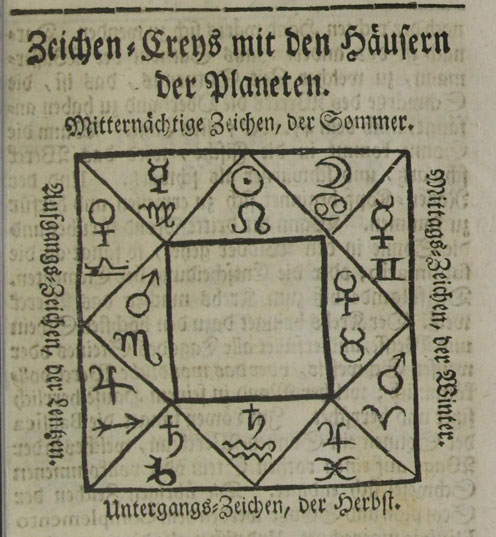
Midnight signs, of summer.
[left side:]
Rising signs, of spring.
[right side:]
Midday signs, of winter.
[bottom:]
Setting signs, of autumn.
This figure is called Signifer Philosophorum, that is, the Sign-Bearer of the Philosophers. To each planet, the ancients assigned two houses, except the Sun and the Moon, each of which has only one house, both near to one another.
In the figure shown, each planet has its own houses within it. The philosophers, in their philosophical work, begin their year from winter, from Capricorn, which is the first house of Saturn, according to turning toward the right hand. After this, the other house of Saturn is Aquarius, at which time Saturn that is, the blackness of the work begins to have the upper hand, after the 45th or 50th day.
When the Sun comes into Pisces, the work becomes black, and blacker than black. And the Raven’s Head begins to show itself and to come forth.
When the third Moon has passed by and the Sun enters Aries, then begins the sublimatio, or the separation of the elements. The following signs, up to Cancer, make the work white. Cancer brings to it the highest brightness and whiteness, and completely fulfills all the days of the Stone, or of the white sulphur, or the lunar work; this Moon sits and rules gloriously in its own house.
In Leo, the basilica of the Sun begins a solar work, which ends in Libra as a red stone or perfect sulphur. The remaining signs, Scorpio and Sagittarius, are reckoned to the completion of the elixir.
And thus the wondrous birth of the sages takes its beginning during the rule of Saturn, and its end and true perfection during the rule of Jupiter.
END.