Here begins the treatise of Micreris to his disciple Mirnefindus.
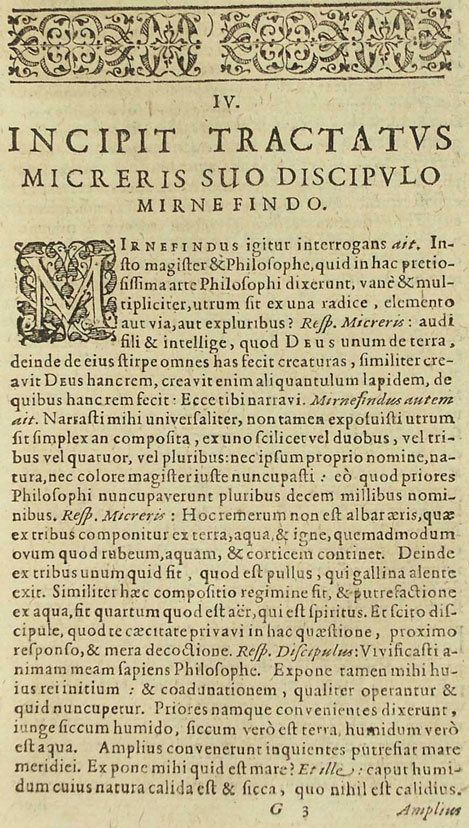
Translated to English from the book:
Theatrum chemicum, praecipuos selectorum auctorum tractatus de chemiae et lapidis philosophici antiquitate, veritate, iure, praestantia, & operationibus, continens: in gratiam verae chemiae, et medicinae chemicae studiosorum ... congestum, et in sex partes seu volumina digestum; singulis voluminibus, suo auctorum et librorum catalogo primis pagellis: rerum vero & verborum indice postremis annexo. Volumen quintum.
Mirnefindus therefore, asking, said: “Tell me, master and philosopher, what have the philosophers said in this most precious art vainly and in many ways whether it is from one root, one element, or one way, or from several?”
Answer of Micreris: “Hear, son, and understand, that God made one thing from the earth, and then from its stock He made all these creatures. In like manner God created this thing; for He created a certain little stone, from which He made this thing. Behold, I have told thee.”
But Mirnefindus said: “You have told me in a general way, yet you have not explained whether it is simple or compounded, namely from one, or two, or three, or four, or more things; nor have you yet named the thing itself by its proper name, nor its nature, nor the color of the magistery, seeing that the earlier philosophers have called it by more than ten thousand names.”
Answer of Micreris: “This remedy is not albareris, which is compounded of three things earth, water, and fire just as an egg contains shell, white, and yolk. Then from those three one thing is made, which is the chick, which comes forth when the hen nourishes it. In like manner this composition is made by regimen, and by putrefaction from water there is made a fourth thing, which is air, which is spirit. And know, disciple, that I have deprived thee of blindness in this question by the previous answer, and by mere decoction.”
Answer of the Disciple: “You have enlivened my soul, wise philosopher. Yet explain to me the beginning of this thing, and its union, how they operate and what it is called. For the earlier philosophers, agreeing together, said: join the dry to the moist; now the dry is earth, and the moist is water. Furthermore, they agreed, saying: let the southern sea be putrefied. Explain to me what the sea is.”
And he said: “The moist head, whose nature is hot and dry, than which nothing is hotter.
And he said: “Explain whether this is an accident or a substance, and whether it is substantiality?”
Answer: “When a grain is cast into the earth and putrefies there, an accident putrefies, not the thing cast in. But what is afterward quickened is not its substantiality, cast in there, but an accident in the thing entering.”
And he: “Tell me then what this putrefaction is that comes about, and by what heat it comes about?”
And he said: “Do you not know that by the heat of the hen’s intention a living cock is made from an egg? In like manner, by the heat of this putrefaction there is made from our egg a living cock, which after putrefaction is generated: magnesia, marchasite, soul, water, butter, shell, sulphur, gold, brass, rust, coloring, and milk. Behold, I have briefly set forth to thee what the ancients concealed.”
And he: “Tell me then, why, when it has reached this end through art, is it called poison and tincture?”
Answer: “When an infant is born, it is called formation until it is perfect, and creature until it is fit for speech and motion; but when it is minimum, so here also this composite, in all four elements, is made perfect by regimen and by art, though very little.”
And he: “Complete for me the benefit, and the gift with which God may reward thee, and explain to me the regimen of this composite and the end of its intention, with what fear of God it should be carried through and tinged.”
Answer: “Take, fearing God, the stones which I told at the beginning of the book, and grind them together, and make a powder of white color, and add the red as leaven into the paste; then add so much water as the Nile gives forth, joining the Egyptian, and there is made the egg of the philosophers, which thereafter hangs in the land of the Persians, and know that the putrefaction of the white does not prevail. Hence the philosophers said: Because the Egyptian earth lacks Persian sulphur.”
And he: “How often is this putrefaction made, and in what order is it to be carried through?”
Answer: “Did not the philosopher Astanus say: Gold ought to be sifted seven times? Behold, I have shown thee that it ought itself to be sifted seven times through its own sieve, which they say is made from cleansed skins and blessed wood. Behold, a sufficient demonstration: let it be sifted seven times. Likewise the philosopher Rosinus does so. And whenever you have received the Egyptian mud, place it in its place until the seven siftings are accomplished, and let there be kindling by day and by night. Then draw it out and grind it and return it to its own place in those instruments in which קודם it had been when it was being cleansed. Then cook it a second time, by day and by night, and make this seven times.”
And he: “Tell me then, after this sifting has been carried out, to what order does it come?”
Answer: “When thou hast drawn out the egg from the putrefaction, if thou shalt see it already deprived of filth by cleansing and washing, it washes, it cleanses, both with unguent and with sublimed water.”
And he (Mirnefindus): “Tell me then: to what end does this compound tend, after it has been washed and cleansed?”
He answers: “Know that by the sun’s rays of the air, and by the moisture of water, trees and herbs and all growing (vegetable) things are nourished. In like manner this egg, from itself, draws forth the life that it has, and powerfully brings forth soul and generation just as warmth (is given) to you, and the spirit of the air, and the moisture of dew, by which miracles will appear. For thus the ancients say: This whole art was not wondrous, until the igneous nature was separated from the fire of the asses of horses and embraced the art; for there a uniting is made, and the whole soul is in it; and afterward, when it has been turned to the green, by imbibition and trituration in the sun, its wonders will appear.
Then it is necessary to put upon each of its four parts two parts, namely, of moisture, and one part of a hot and dry nature, which is called fire the igneous nature. When this is right, therefore mix them by imbibition and with sublimed waters and triturate in the sun until the green that is born appears to thee, which is its soul; which the philosophers have called the green bird, and copper, and sulphur. Concerning this they have treated, because its color is the green of copper; and because it is a mean between heaven and earth; and (it is) the unguent of stones; and the female magnesia which, if the male magnesia finds it, will hold it fast. This also is the spirit of Camsaris, which both heaven and earth need; which sprouts upon the earth, and is kindled like butter. Oh, how like it is to vegetables in green color!
This is that stone: this is the butter of the sun; this is the bark of the sea; this is incombustible sulphur; this is spiritual magnesia; this is moist smoke. This leads spirits and bodies, and makes (the work) easy, so that on the day of judgment they may be united before God something which the philosopher Rosinus not a little proclaimed. For he says: The principal and permanent bodies shall have spirits.
Of this, therefore, they said: This I have safely brought with me: this is the disposition of Hermes; this is the smoke of the philosophers; this is the perfection of this work, without which nothing is done. Concerning which the great Astanus says: Take the egg and strike it with a fiery sword, and separate its soul from its body. This is certainty, because the work is distinguished; the right of its iron is greater after which the eyes of the heart, (once) covered by the covering of the heart, and the light of reason, will appear. It is like a gem-stone, like pure pearls, like white butter, and like milk.
“Therefore draw this out by imbibition in the sun, and by liquefaction which raises it up into heaven. Therefore let this butter and flashing milk be cooked in vessels until something appears to thee; unite (it), imbue (it) with water liquefied in the sun for it is imbued from it, from that which goes out from it and it remains ours.”
And Mirnefindus: “Tell me: from what do greenness and yellowness (citrinity) come forth, and afterward from what do they appear? And what comes forth as rust (reddish-brown), and to what does it tend? And what afterward is operated from it?”
He answers: “You must whiten it until you draw out its spirit, and you must bring darkness upon it, for nothing else whitens except trituration in the sun and washing with sublimed waters.”
And he: “Tell me then about the remaining dregs, and what we do from them and how it is governed; and, after it has been taken away from it, to what does it tend?”
He answers: “Master: I know that that which is extracted from it is the soul; and that the black dregs left behind are the body, in which there is no life; and each of the two has its own proper dominion: for the soul is a subtle thing, which is air; but the body is thick, which is earth. Therefore each of their ‘ones’ must have a regimen and order, until the thick be made thin, and rarefied, and the subtle be incorporated into the body. For in the dregs is what you ask, of which the philosophers have treated, and have been able to give names; and they have concealed its regimen, saying that it is a vile, humble precious thing, which is found with anyone: this is in the altars of the Franks; this is the water of red-bread (bran). Take it, and by a dry fire work it until you draw from it the spirit which you will find in it, which is called the bird of Hermes, which you must guard at the fitting time.
“And take the ash, about which the philosophers have spoken, where they said: do not put vile ashes in the lower place. For in it is the Diadema, which is the permanent ash. Take it and put it into a glass vessel, and cook it with a coal-fire for fifteen days and more, until burning happens to it; and its body becomes coal in color and to the touch. Then, when the spirit has been separated from it, grind that, and give back to it the moisture with which you first made it putrefy; and in that moisture make it dwell until it is burnt. Then they call that ‘coal’; and the moisture is (placed) upon it with two fingers until it flows down and is burnt. This is their gold made by fire in a glass vessel, which a potter’s vessel contains. For it is made as coal, as they say: this is its burning.”
And he: “How does that happen that its beginning is food, and life, and putrefaction brings it out? Then its death and ruin are made by putrefaction?”
Micreris answers: “Do you not see that an infant, while it remains in the womb, has its food and life from there; which, after it is born, if it should not return there, would not live nor remain? Thus putrefaction is made: here is its food, which, if it is taken away, it is deprived of life and essence.”
And he: “Explain therefore to me to what its regimen tends, after it is burned and becomes coal, and what is the end of its finished state?”
He answers: “It is necessary that it be liquefied, made liquid, so that by its bodily nature its substance may be altered, until by dissolution the body, melting away, becomes spiritual and subtle. Then its soul is restored to it, which was its being and life, and it is made subtle like itself; for when, by altering the soul to its own nature, its body has first been altered likewise, then, when they are joined together, its power and usefulness will be made manifest to thee.”
And he: “You have indeed revived my soul, philosopher, by explaining the secret of this arrangement. Tell me therefore in what manner this soul ought to be altered to its own nature, when it becomes spiritual.”
He answers: “When the Creator of creatures has mortified His creatures, afterward, when the souls have been separated from the bodies, He gives back to them their souls, their utility, and their reward. In like manner it is necessary for us to do this to these souls, and to judge them with the most intense penis.”
And he: “Tell me then what, and how, is well done to them, when they are made subtle, and do not yet inhabit their bodies?”
He answers: “It is necessary that they be punished with a very subtle spiritual fire, like the fiery nature itself. For if your body is punished, it is not punished in such a way that the torment reaches it; for it is spiritual, and nothing but the spiritual reaches it.”
And he: “Explain to me how much ought to be made from the soul, and how much from it, that it may be joined to its torment.”
He answers: “It is necessary that from it there be made one and ten, after firmness.”
And he: “Explain then to me what afterward must be done.”
He answers: “It is necessary to join body and soul together equally by weight, and let the igneous nature become equal by trituration, which then grind in clear waters, in the sun, and by imbibition upon the stone. Then, when joining, introduce fire, until the igneous nature has already been separated from the copper, and the body remains; then the dew of nature and of the soul remains, and let the fire burn in imbibition, and do this seven or ten times, with a gentle fire; then draw out what is now made earthy.
“Again impose its nature with the former weight, and if it is diminished, add until the first weight is completed; and grind, and imbibe in the sun for two days; then dry it and in the fire make it burning. Then draw it out and restore to it its igneous nature, and do as before: grind it for six days, and by day do this for thyself. Then extract, namely the body and the soul, between which there is nothing earthly.”
And he: “When this has been done, by what name is it called, and what is its nature? Is it a spiritual thing or a bodily one?”
He answers: “It has now passed beyond the former term, so that it is called neither soul nor body, nor white thing, nor copper, nor by these common names, but since its nature is sulphur and unguent.”
And he: “Is this unguent then combustible or incombustible? For an unguent is burned by fire.”
He answers: Because, as Hippocrates says, this sulphur is not burned; therefore this sulphur is not the sulphur commonly known.
Furthermore, they have already said that sulphur is an unguent, and indeed an unguent is sulphur because it is set against fire; therefore they have distinguished the compound unguent from its simple. Likewise they have said that a very little of the unguent avails much in redness. They also say that the name of unguent is one, but it has two meanings. For there is one extraneous thing, which you must separate from yourself: for it is the corrupted sweat which is cast out. There is also another unguent, which amends the redness; and the blackness too is something extraneous, though it remains with the redness. According to the second unguent which we ought to know, there is sulphur which neither burns nor is burned, which is the treasure of God, and which living silver contains.
And he: “Do you call the dead thing living?”
He answers: “It is already dead, and it matters little whether, after the impediment has been removed, I call it by its soul restored to it.”
And he: “It is known that the soul, before it was mixed with its body, had been dead, and likewise its body, because they did not have life until the spirit was restored; therefore if they live by the spirit, how then, when they are dead, are they worked upon among the living?”
He answers: “Did I not signify to you that they are dead already?”
And he: “You must revive them.”
He answers: “When you introduce them into the cenaculum, you revive them by the nod of God. Place them in two small vessels, and over the fire let them proceed and expand until they are turned into stone. Then introduce them into two vessels, and the igneous nature.”
And he: “How, he says, in the cenaculum are dissolution and the igneous nature repeated? Furthermore, how much of the igneous nature ought to be put into them, which is their life?”
He answers: “This does not have weight in pounds, but it has quantity.”
And he: “And what is the quantity of it?”
He answers: “The igneous nature is placed beneath and on every side, itself situated in the middle; you must cover it with two or three fingers of the igneous nature.”
And he: “How long must this be done?”
He answers: “Until Sehirech is deprived of color, and of its nature and of the color and nature of honey, and until it is clothed with a red color like red gum, or red sulphur, or cinnabar, or vermilion then they live and are deprived of death.”
And he: “In the land of the Persians must this unguent be made, and not among the Egyptians?”
He answers: “Have I not brought back to thee from Astanus and the other philosophers, saying: one ought first to take the earth of Egypt, the bread of Egypt, and to sift it?”
And he: “May God the creator and founder of souls reward thee for me, if thou perfectly expoundest thy benefit to me Cambar which ought must be done, whether it be made perfect or imperfect.”
He answers: “If it is a tinging sulphur and a remaining sulphur, then it is imperfect; for spirits are light and return to the earth.”
And he: “What then must the spirit do, Micreris?”
Answer: “God willing, I shall tell thee.”
“Know that you have it, which in many philosophers, treating of composition, has fallen from their pen.”
And he: “But what finally do we whiten in the composite?”
Answer: “You must do thus: let sericon be in fig-dregs.”
And he: “How ought sericon to be in fig-dregs and be whitened? Do not the philosophers say that the composite must first be whitened, and then made red?”
Answer: “You speak truly: thus it must be made white, and then red; which, if it is not, then when it has been made sericon we shall imbue it with the poison that tinges.”
And he: “When it has been done, why is the red made to fall away?”
Answer: “It is denigrated twice, it is made yellow twice, and it becomes red twice. But the second redness is the tingeing (redness), which is made only after the whitening.”
And he: “Tell me then what sericon is made to fall away from, and what it is like when it is white.”
Answer: “You must whiten half of it, and you must look upon half of its color in the figuring.”
And he: “Complete for me the benefit, and show me this hidden and concealed thing which the philosophers wished to reveal, and in what manner it falls.”
Answer: “The philosophers who concealed this, and in no way wished to tell it, because if thou shouldst command (them) by imperatives and by anathemas, it would forbid this: thus, with a most fatherly demonstration, to set it forth as the others (do), I fear to be anathematized, and lest this work, through me, come to the impious. Know that nothing is ever whitened without boiling. But boiling is the moisture; and if there is no moisture, it will never be whitened.”
And he: “How then must I make this moisture?”
Answer: “It must be cooked with moisture until it dries; then it must be ground and imbibed again.”
And he: “How is this?”
Answer: It must be cooked until it becomes thick and dries. Then let sublimed water be ground (in), and (then comes) the perfect white moon: this is the golden part made thick; but the part of the perfect moon is imbued in the sun, and it thickens; then afterward it dries by heat for a perfect day; then its moisture is given back to it; it is cooked until it dries.
Then it is returned to imbibition and grinding, the perfect and dry moon being restored, and again moisture is to be added; and this is to be repeated in turn, until, God favoring, it is whitened. And note: if, after all these operations and precepts, thou still art ignorant of the whitening, thou wilt lose the hoped-for joy.
“Therefore beware, in working the medicine: for if it is made thin with grinding and the sun, it casts out its dregs and admits foulness, whereby it quickly loses the color and order of gold. Therefore philosophically work, and whiten, and thou hast passed the term in the work itself: blessed art thou. If thou shalt see this, wonder, fear, and terror come upon thee.”
And he: “After the whitening, then what happens?”
Answer: “Know that the regimen of the philosophers is twofold. For one part, which is more difficult, must be governed by moisture and roasting. But the other figure is governed by dryness, dryness being stirred, and by moisture. And this is that greatest thing which they have called the sea of the Indians; but the coagulated thing, and this whole of magnesia, and the like dry thing, is governed by fire. Furthermore, they have also called it the bark of the sea, and its moisture. Behold, I have set forth to thee all the things which the ancients concealed.”
And he: “Surely you have shown it most openly, and have omitted nothing. Yet explain to me this dryness and burning, which in your book you have twice repeated to me, whether they are one thing or two.”
Answer: “I have already shown thee the burning of the bodies, and the mortification of the souls; but I have not spoken of their simultaneous burning, nor in relation to the whitening. For it is necessary that there be one soul from those punished bodies, and that from this burning there afterward be a mortification.”
And he: “Tell me then what difference there is between burning and mortification, and whether they are one or two, and which burning comes first?”
Answer: “I have already told thee that the whole ixir must be burned and mortified, because sericon does not become red, nor does whitening happen without mortification and roasting, nor without burning. Behold, I have now shown thee both mortification and burning, and by distinguishing them from whitening and redness I have separated them from one another.”
And he: “Tell me then whether something should be made separately from them, namely the white of the whitening and the red of the redness, or in what manner?”
Answer: “Did I not tell thee that each one of them is whitened, and afterward becomes red?”
And he: “I have heard this from thee, but you have not shown me how we ought to work it.”
Answer: “Take part of the burnt living silver, with the part of the white body from which the principle of sericon has been drawn forth, and a part, and of sericon two parts; join them together in a narrower vessel, and roast it at the fire, with a gentle fire; then draw it out and imbue it in the sun with purified water; then return it to liquefaction, and close its mouth very firmly. Do this by roasting and imbibing little by little and gradually, until all together are of one color, and, lacking smoke, the things mixed are not separated. For then at last the ixir is perfected. But when you have come to this end, draw it out by liquefaction, and introduce it into an instrument which purges away foulness, and cook it in that until the moisture that is in it is lifted up by imbibition. For that moisture is like the sweat of gold.
Then take water indeed, and living silver burnt together, coagulated, and do thus with the red thing: cook and whiten it by imbibition, and cook it with a glass cover, lest the moisture be separated from it, and that it may thus be congealed, and shut in strongly, lest its moisture dry out from it. But when it has been coagulated, and becomes like the lees of wine, and like old coagulated oil, then warm the residue of the washed bodies, dissolved and dried, with a very intense fire. Then mix the soul with it, namely the clean, shining, and whitened soul, and grind them together, and imbue with purified water in the sun five or six times. Then take from this that which is like the lees of wine, one part, and from the other, namely the washed body, one part; mix those parts together. Then introduce them into the vessel of roasting, whose mouth close firmly, and roast with a gentle fire. Do this continually, roasting and imbibing and closing the mouth, repeating the roasting, and the water with which you imbue it, until the whole proposed work is disclosed. And the more it drinks, the more grind it, until, God granting, you see what you desire.
“I have now told thee the root of this thing, and its foundation, and its regimen, mortification, descent, ascent, union, and separation. Nor have I withdrawn anything from thee that would help thee, nor have I removed from thee the redness, or the whitening, or the ascent or descent, when I have expounded them to thee. Give thanks to God, and act so that He may aid thee.”
And he: “Most freely, since thou hast done me this good, may God reward thee for thy children of philosophy. For now thou hast revived my soul by the light of thy wisdom, and hast prepared for me a smooth road. Yet I ask that thou show me what the philosophers meant when, in their diversity, they spoke in many names. For if this thing is one, why have they multiplied its names?”
He answers: “Indeed, some have called it by the names of seas, fountains, and waters; others truly by the names of trees and vegetables; some by salts and aluminums and dragon-things; others by the names of bodies; and some call it egg and volatile, and say that it is neither moist nor dry, because they say that that thing is like these. And know that the world contains one single name, and not heaven, earth, mountains, seas, waters, men, and animals. In like manner man is called the lesser world, because in him there is the figure of heaven, earth, sun, and moon, both visible above the earth and invisible in form; therefore he is called the lesser world. And so the first philosophers said of this: Adam was created from water falling upon the earth, and he too is the lesser world. For the creation of this thing is like that of man: namely conception, nativity, nourishment, food, life, death, body, and soul. Just as in man there are four different natures joined together, namely heat, cold, moisture, and dryness, of which each the wise have called it by its own proper name; yet its true name is this, properly speaking.
But some say that it is from the likeness of heaven and of the stars; and indeed truly, in it are the names of the seven planets, of which two are lacking in it, and five do not fail in it. But to this thing, when the smoke is raised, they assign the likeness of the seven heavens; but when the dew descends, they call it earth. What is hot they refer to fire, and to the revolution of the belly; what is moist they call by the names of seas and waters, and of the animals of the sea; what they refer, by the heat of its vapor, to a certain greenness, they compare to vegetables and to trees; and what is conjoined and dry, they refer to stones; but what is separated, they refer to sand, and they say it is ash; what is movable, they call volatile; and what is flowing, they call meltable, which is oil. Therefore its names are multiplied: for some refer it to the color of heaven, some to the gall of living silver, some to water, some to auripigment, some to blood, and some to lime.”
And he: “Tell me then, why have they compared it to these things?”
He answers: “Know that no plant, nor any fruit, appears by sprouting unless it is green. In like manner the sprouting of this thing is green; therefore they compared it to a germination, and to water as the cause of its purification. They also compared it to Sehire, because of its blackness, and to pearls, since when it is made into foam, such a bark or froth appears in the sun, and the hidden things of the moon. But when this has been made white, they also compared it to vermilion, to sericon, to the substance of red gum, to hackic, begedi, carina, jamina, and to hyacinth. But this is when it has been made red.”
But Mirnefindus says: “Tell me then why they have called this stone the Nile of Egypt, the sea of the Indians, and the southern sea.”
Answer: “They called it sea and Nile because of its lesser moisture among moist things. And naturally, because the nature of the Nile of Egypt is cold and moist than which nothing is colder and moister therefore it is temperate. But they called it the sea of the Indians because the nature of the Indian sea is hot and moist, and temperate, for in it there is a middle state of dryness. And they called it the southern sea because the nature of the southern sea is hot and dry, than which nothing is drier nor hotter. For in its own moment it is dry.”
And he: “Explain to me then what the work and usefulness of each of those seas is.”
He answers: “The first is the Nile of Egypt, whose uses are more than I can tell. From it come animals, vegetables, and vapors, and by the heat of fire and by its burning it drives out and it says that from them there comes washing, cleansing, purification, and alteration from their natures.
But they called it the southern sea because of the strength of its power and the intensity of its dominion and heat. It is necessary to it, at every moment and time in the beginning, because it is able to putrefy; and in the middle, toward the thing to be dissolved, because it is dissolution. For by the strength of its dominion, toward those things, it is made liquid and whitened.
But they called it the sea of the Indians because of the multitude of its marvels, of its appearances, and of its usefulness, which no tongues can at all describe. For in it are the figures of heaven and earth, of summer, autumn, winter, and spring, and of masculinity and femininity; so that if you name it something spiritual, you do something probable; but if bodily, you speak the truth: if heavenly, you do not lie; if earthly, you judge rightly.
“Therefore the marvels of the Indian sea are more numerous than I can describe, and one of its uses is to moisten the dry and soften the hard, and to join and bind bodies together. Therefore they preferred it to the other seas in complexion, because heaven is joined to earth by it, and because this thing also is compounded and amended by it. Nor indeed is any species of this regimen without need of these three seas. Behold, I have told thee concerning it and their actions and powers.”
And he: “Explain to me then the uses of these seas, from which they arise, and whether they are waters or moisture or air.”
He answers: “If the earlier men had known them to be such, beyond doubt they would have compared them to its action or nature. For if they had praised it, it is because it is like them in nature and in action.”
And he: “Tell me then, since thou hast expounded the three seas, what they are, whatever it is, and what its nature, heat, and description are.”
He answers: “In name indeed they are one, but in nature and in operation they are different, just as milk, unguents, and waters differ in the name of moisture. One of them is more fugitive; another more permanent and stronger; another naturally more capable of combining; another also of more intense heat and dryness.
“But that which corrects this whole matter, and which both reddens and gives life, and coagulates; which also congeals milk, which they have called coagulated; which is airy and moist, by which fire is held; and which the collars of gold are said to possess then it becomes honey, which is the glue of birds. For the thing contains a certain sulphur which is hot and dry, by which the kinds are enclosed and the elements are dissolved, and which is swifter in flight.”
“But the third (they call) combustible sulphur, (and) the kingdom, because it burns by their conjunction, and the more it is heated in the vessel, the more its life is renewed. That too is burning and dry, which by burning they have dried; and the more it is prepared with paste, the more its perfection is repeated because sometimes you call it heavenly, sometimes earthly.”
And he: “Tell me then this vinegar: since two are made, one male and the other female, yet of one nature.”
He answers: “Because this is citrine vinegar and like honey-vinegar: neither honey of dates, nor date-honey-vinegar, nor grape-vinegar; for each disposition has its own property, more than others, and yet it is one name likewise. For indeed, the philosophers say that it is one, and that it is both male and female.”
And he: “Tell me then about this thing: that the philosophers say the fire flees, and the roof kindles, then it descends lower, until it becomes as heaven.”
He answers: “Copper is a body not fleeing, whose name is copper, yet it is not copper. For because of its color, they said, it is the copper of the philosophers. From this, a tinge is not made, until it becomes fleeing.”
And he: “How then does copper become fleeing, and what makes it flee?”
He answers: “Unless you understand how Hermes spoke, you will in no way grasp the reason and understanding of the sublimation of rust; for the meaning of all the books is: the instrument which separates (and) raises up the rust, and raises nothing else.”
And he: “Explain to me then what the instrument is.”
He answers: “Did not Democritus explain to thee that in the igneous nature it is?”
And he: “Explain to me then whether vinegar is one, or two, or three.”
He answers: “There are three vinegars. The first is white wax, which is like the moon; and in it is the wax of the sea. The second is dissolved iron and coal, in an unguent of soapy water; and in it is the hen’s nourishment of its egg, until the chicks come out. The third turns the burnt (thing) into golden water, whose sepeltio (burial) is made through forty nights. Behold, I have expounded to thee the quantity of the burial, of dissolution, and of death.”
And he: “Tell me then whether the corrupting and the correcting are one or two; and whether that which mortifies and vivifies is one or two; and whether spirit and soul, or the body, die.”
He answers: Know that the corrupting and the correcting, the mortifying and the vivifying, are one and in one place; and if the spirit should die, it is necessary that something else vivify it, and that, just as body and soul lack spirit, so it may vivify them.
“Yet because spirit is more subtle than all things, therefore nothing separates and corrupts it, as body and soul are separated and made dead, and afterwards vivified. But spirit does not die.”
And he: “Tell me then whether there is one order of fire and of its natures after these things, or several?”
He answers: “There is not one order, but several. First, therefore, the philosophers have named an order warm and gentle, as the fire of a lamp and the dung of horses. The second indeed is warm with smoke, by roasting. The third also is the fire of coal. The fourth is a smaller flame. The fifth is a moderate one. And the sixth is a most intense flame, between which orders of roasting and sublimation some have placed limits, which experience demonstrates.”
And he: “Tell me then whether fire is the principle of everything, and what is the principle of water, and likewise of air and earth.”
He answers: “Know that earth was first water, then it was turned into stone, and made rocky. But water was first air, then it was made liquid and thickened, and turned into water. But the principle of air was fire; yet fire lacks a principle, the Creator alone excepted. And know that earth is the body of water, but from earth came man. But fire does not cease to be made together with the three elements, by which also the three persist. Therefore you now have this.
“Behold, I have disclosed to thee my purpose most openly. Pray therefore that God may grant thee children, by whose favor thou mayest attain thy purpose; whose name be blessed through all ages. Amen.”
Here ends the Treatise of Micreris.