Treatise on the new observation and true knowledge of mineral waters, and on their qualities and virtues hitherto unknown. And the universal spirit.
Study the Art with Us Buy me CoffeeTREATISE
ON OBSERVATIONS CONCERNING
THE NEW AND TRUE KNOWLEDGE
OF MINERAL WATERS
and of their qualities and virtues previously unknown;
Likewise concerning
THE UNIVERSAL SPIRIT.
By HENRI DE ROCHAS, nobleman and
Lord of Aiglun.
Written in French in the year 1634, but now translated into the Latin tongue.
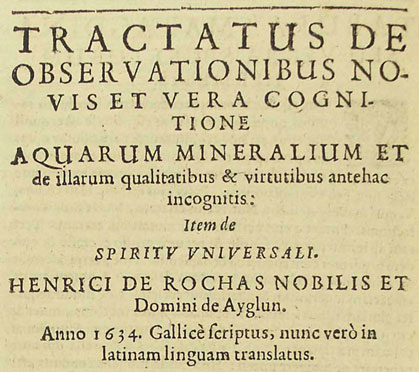
Henri de Rochas, Tractatus de observatio novis et vera cognitione aquarum mineralium et de illarum qualitatibus et virtutibus antehac incognitis. Et es spiritu universale (1634)
Translated to English from the book:
Theatrum chemicum, praecipuos selectorum auctorum tractatus de chemiae et lapidis philosophici antiquitate, veritate, iure, praestantia, & operationibus, continens: in gratiam verae chemiae, et medicinae chemicae studiosorum ... congestum, et in sex partes seu volumina digestum; singulis voluminibus, suo auctorum et librorum catalogo primis pagellis: rerum vero & verborum indice postremis annexo. Volumen sextum.
Contents:
Chapter I. On sulphurous waters
Chapter II. On vitriolic waters
Chapter III. On aluminous waters
Chapter IV. On nitrous waters
Chapter V. On ferruginous waters
Chapter VI. On the universal spirit
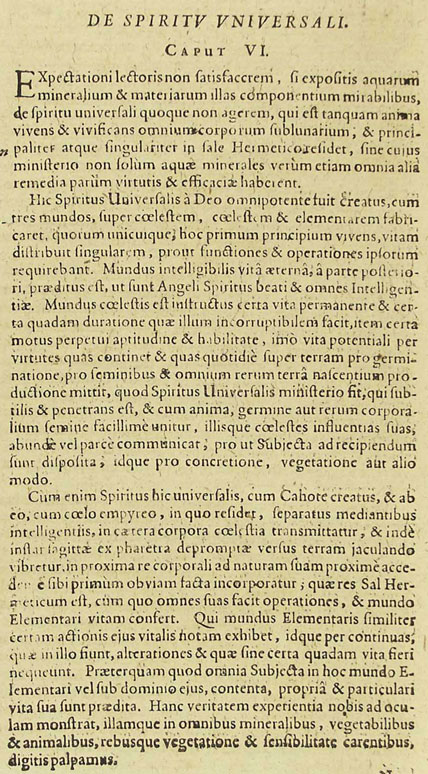
ON THE UNIVERSAL SPIRIT
Chapter VI
Spirit in the Hermetic salt.
Three worlds.
Lest I should fail to satisfy the reader’s expectation, if, after setting forth the marvelous mineral waters and the materials composing them, I should not also treat of the universal spirit, which is as it were the living and life-giving soul of all sublunary bodies, and the principal artificer and singular minister in this whole Hermetic business without whose ministry not only mineral waters but also all other remedies would possess but little virtue and efficacy.
This Universal Spirit was created by Almighty God when He fashioned the three worlds, the supercelestial, the celestial, and the elemental; to each one of which He distributed this first living principle, imparting life to each according to the functions and operations required of them. The intelligible world has eternal life in the highest degree, endowed as it is, and such are the blessed angelic spirits and all intelligences. The celestial world is endowed with a certain permanent life and with a certain duration that makes it incorruptible; likewise with a certain aptitude and fitness for perpetual motion, indeed with a potential life through the powers which it contains and which it daily sends down upon the earth above, for germination, for seeds, and for all things that the earth brings forth or nourishes within the earth, by the ministry of the Universal Spirit, which is very subtle and penetrating, and which, together with the soul, is most easily united with the seed of corporeal things, and communicates to them its celestial influences, abundantly or sparingly, according as the subjects are disposed to receive them, and thus for concretion, vegetation, or in some other manner.
For when this universal spirit, created with Chaos and from it, dwelling in the empyrean heaven, is transmitted by means of the intelligences into the other celestial bodies, and from there, by rays sent forth from their sphere, is hurled downward toward the earth, and approaches the bodies nearest to it according to their nature, it first meets with bodies fit to receive it, namely the Hermetic Salt, with which, as with an instrument, it performs all its operations and bestows life upon the elemental world. This elemental world likewise exhibits a certain note of its vital action, and thus by the continual alterations that take place in it, and which cannot happen without a certain kind of life. Besides this, all subjects in this elemental world that are under its dominion, contained therein, are endowed with their own proper and particular life. Experience has shown this truth to our eyes, and in all minerals, vegetables, and animals, and in things lacking vegetation and sensation, we may almost touch it with our fingers.
For in Nature four changes are observed: the first is from being to not being, and from not being to being. And this occurs either by the destruction of matter or of some subject, and by the creation or destruction, or reduction into nothing, which nevertheless can be done only by the omnipotence of that great Architect. The second change is from cold into hot, and from hot into cold, which takes place in qualities and is called alteration. The third is from great to small, and from small to great, in respect of quantity, and this happens through increase and diminution. To these three is added change or occupation from place to place, which happens by motion; and all these changes presuppose some foundation of life.
For Nature, like a fruitful mother, is spread throughout the whole world, and nourishes it as though in her own bosom, and distributes to each of its members a sufficient portion of life; so that nothing exists in the whole outer world that lacks a soul, since otherwise it would necessarily cease from its actions and attend only to putrefaction. This is the reason why the bodies of animals, which consist of soft and easily yielding matter, feel and grow, and for this reason easily generate their like, because they live by a sensitive and vegetative life.
But plants and other things which sprout, whose spirit is not conjoined and united with matter so soft and yielding, yet receive life from it and grow by a vegetative life, and produce their like by seed or transplantation, though in another manner than animals. Vegetative things have no sensation, because their composition is harder and more solid than that of animals.
As regards minerals, they do not possess an essential life that is either vegetative or sensitive, because of the constriction and density in which their spirit is enclosed; hence they cannot produce their like unless, once their gross impurity has been purged away, they are resolved into the subtlety of prime matter. Then at last, since they are no longer what they were before as to their form, nor have the specific power of generating their like, they do indeed receive alteration and perfection in imperfect bodies, as is made clear by that celebrated Elixir of the Philosophers.
From this, therefore, it follows that the whole universe is endowed with some kind of life, and consequently that each individual thing and species has its own proper life, which nevertheless is such that it partakes of the life of the universal world, in which all invisible seeds are contained and lie hidden. Hence we see very many bodies born without a preceding seed, as are many plants and very many animals, which are produced without the conjunction of male and female.
For although the seeds of plants are visible as far as the grains, yet the seed is invisible and imperceptible, and cannot be discerned except by the eyes of the mind; for the force lies hidden beneath this visible grain hidden away (as in wheat), is nothing other than the universal Spirit in its many forms, which brings about productions even without visible seed, in the generation of eels, mice, dormice, frogs, which have life and motion, though they seem to be produced without copulation; and many other things also, which live not so much by a particular life proper to themselves as by the general life of the universe, by which each thing is animated; this anyone may clearly perceive if he carefully observes clear and pure water filled with vinegar in the bright rays of the sun: for there so great a quantity of tiny worms is seen that it would seem incredible. From this it is manifest that these little creatures have life from that vital principle; and since they are produced by consequence from the universal spirit, which is their efficient cause, they are living beings. Which the Poet recognized when he said:
A spirit within sustains, and through the whole mass infused
Mind stirs the matter.
All sublunary things are nourished by it, and owe to it their perfected constitution. It is a most evident thing that whatever lives, grows, and breathes, is dissolved and dies if the universal spirit fails and departs. Hence it follows that this spirit is the cause of its life, and that everything prepared from it is an essence both simple and subtle, which the chemists call the fifth essence. For it can be separated from bodies, as from matter made coarse, gross, and weighed down by the superfluity of the four elements, by which marvelous powers are wont to be elicited. The power of life and the soul of all things is also more or less diffused, and acquires greater vigor, in proportion as bodies or subjects have drawn in more of this universal spirit and partake more of it, which quickens them and gives them increase up to the greatest magnitude according to the species and determinate form of the thing.
This spirit bestows on some things a purer and less corruptible life, on others one not so pure and more liable to corruption, according to the disposition and capacity of the materials; for which reason the vigor that proceeds from this spirit in all things and in every place is not one and the same, nor uniform, but is distributed in different ways according to the disposition and aptitude of the subjects.
Therefore it must necessarily be concluded that the purer the disposition of matter, generally speaking, the more durable and less corruptible the life it possesses. For since every like is most skillfully and familiarly united with its like, there is no doubt that the power of this celestial spirit enters, penetrates, and incorporates itself more deeply by a certain inclination or analogy into bodies more akin to it, and infuses itself into them more firmly, the purer those bodies are and the less subject to corruption. A most pleasing example is furnished by gold, which among all metals is the purest and most fixed, and therefore partakes more abundantly of the power of the universal spirit and with greater nobility than the other minerals, because the matter of gold is purer, and not so terrestrious and gross as the other minerals; and consequently it is more capable of receiving greater virtue than the other metals, which are worked with much grossness, and for this reason are less fit for producing such excellent effects.
Nevertheless, this universal Spirit has almost as many ways and modes of communicating itself and of incorporating itself into materials by means of Hermetic salt as Nature has instruments fit to intervene in its various operations. Among these, the principal and most frequent are heats and the rays of the sun, the moon, and the influences of the other stars; air, dew, qualities, and other things which are accustomed to concur toward the fruitfulness of the earth, which is the receptacle and sole mother of all those manifold generations and productions.
In this place I ought to begin a discussion on the reason why heat and moisture are the two parts required for generation, and how, by the action of heat in moisture, corruption first occurs, from which generation follows; and how every seed is digested in different wombs, whether in vegetables or in animals; and by what passage the transition and change from one form into another takes place. But to explain all these things, which depend on those natural difficulties, would require writing a great volume, which would now be too laborious and foreign to my purpose.
But although this spirit is sent into things both lower and higher, yet its operations are seen on earth, in which it is more openly manifested. For the earth is like the boundary at which all celestial influences, dew, and other things meet together, which are the instruments for the communication of this spirit. Then too, because the earth is the foundational container, holding within itself the seminal virtue of all things by a certain power and aptitude, which is not common to all elements nor to any other subject. Hence it is that it produces all things that have life, and also preserves and nourishes them.
Moreover, it is said of the earth that it has a twofold exhalation: one of which it retains within itself, but the other it drives outward. From that which it expels, if it is moist, rain, frost, and dew are generated; but if it is dry, winds, thunderclaps, lightning, and other impressions are formed in the air. From the exhalation that the earth encloses within itself, if it is moist, all fusible things are produced, as metals; but if it is dry, everything that does not endure fusion proceeds from it, as stones.
If this exhalation has a fitting temper, all vegetables are begotten from it and receive their nourishment from this spirit, which has so much power in all natural things that it brings all things out from potency into act, changes all things, penetrates, makes hard things soft, and conversely makes soft things hard; it causes all things to grow, nourishes them, and brings them into conformity. And since it is the author of all generation of bodies, it is endowed with a threefold operation, namely of congelation, coagulation, and nourishment.
Likewise, this universal spirit is present in every kind of motion, and communicates itself to all species and materials which draw their virtue from this principle of life, not only with respect to productions and generations, but also with respect to nourishment, while to each individual or species that to which it is suited is applied, and a fitting means is supplied to it for converting that into its own substance, whence nourishment itself depends. This appears chiefly in the fact that from one and the same food a man makes and draws what is suitable for man, a plant what is suitable for a plant, a dog what is suitable for a dog; which does not happen because different and diverse nourishments lie hidden in one and the same food alone, but because that species of animal which receives nourishment is able to assimilate what it takes in, and from it to generate what is like unto itself through the power of this spirit, which gives it life, gives place to its action, and makes it fit for this bodily effect.
Hence it necessarily follows that this spirit becomes corporeal, because it is mingled with bodies, and because bodies receive from it their perfection and power. The acorn is a clear example. For this, having been sown in the earth, would always lie useless there, and would rot there, unless something acting were present to move it and procure its germination. But this agent is nothing other than this spirit, which fosters and quickens this generation by its virtue; and it does so not from the acorn, but from the action of this spirit, which is the beginning, and which raises and strengthens its latent power, continually acting upon its matter until it reaches the size and perfection appointed by nature, and a great tree is formed from the acorn.
If anyone says here that the mass of the acorn is increased and multiplied, he will oppose the truth, because the acorn, just like any other grain, after germination, so declines from what it was that scarcely any trace of it remains. Therefore the oak is not generated by the increase and multiplication of the acorn, nor by the addition or subtraction of the nearby and adjacent earth, because however much earth you may add, it would produce only the quantity of a tree and leaves which is absurd. Therefore, since the things mentioned cannot be the cause of the production and growth of the tree, this effect must altogether be ascribed to the universal spirit, which becomes the body and individual itself. From this source come the procreation, preservation, and growth of all bodies not indeed from gross excrements, for the matter of the spirit is without excrement, which the stomach itself teaches, since it rejects whatever filthy excrements were in the food that had been taken, because the foods, once consumed, after it had drawn nourishment out of them, which was nothing other than that spirit enclosed within the mass of the foods.
Since therefore this spirit is incorporated into some subject very near and fit for incorporation, this is the soul of the body, which is subtle and imperceptible, whose nature is at once corporeal and spiritual, and which is the middle term by which this spirit is united with that matter. Thus the soul resides in the salt of its subject, which salt is the first body into which this spirit is united. This salt is that virgin earth which as yet has produced nothing, into which this spirit incorporates itself. Into this salt all things can be reduced after their destruction. For the principles of composition and resolution are alike. And prime matter is nothing other than that into which some body is ultimately resolved.
The heavens are in perpetual motion, which tends toward some end. This end is not the process of moving from place to place, nor any change of place, but the attainment of some effect by means of that motion. There is a twofold end: one for the thing itself, the other for attaining something else. The end in view, when Plato departed from Greece into Egypt, was to learn wisdom.
The end of his journey was Egypt, to which he was making his way. So likewise the courses of the celestial globes do not have as their sole end the motion and swiftness of moving from place to place, but also the powers and qualities of this spirit, to be transmitted by their influences into sublunary and inferior bodies.
These influences never fail, but are continuous, because the motion from which they arise is circular, always beginning again and ending in itself. This is the reason why the thing into which the influence passes, and what proceeds from it, having a similar nature and quality, receives strength and multiplication without ceasing from its powers.
And therefore, through this influence, which, never ceasing, acts continually and perpetually in bodies here below, the earth becomes the body of all bodies, because all the true qualities of bodies are in bodies, and in these subjects are all capacities and aptitudes, according to the nature of the diverse actions of this spirit, whose properties are to penetrate, to heat, to purge, to separate, to unite, to vivify, to increase, to restore, and to preserve. All these admirable operations are carried out nowhere except in the earth, in which alone all celestial influences terminate, and which are the courses of this spirit; for the earth is the center of the whole universe, and like a point or summit, toward which all the lines of that great surrounding body tend.
Hence it necessarily follows that whatever comes nearest to the center of the earth is more precious and endowed with greater virtue, power, and quality, as are minerals; because after the influences have reached them, they can go no farther, but are fixed there, and by remaining there their power is doubled by reflection of species and thus they are united and bound up with minerals, whence their excellence is increased very greatly, and almost to an infinite power, because it proceeds from incorruptible celestial bodies, which never fail and are without any interruption the channels of this spirit.
Reflection of the influences of the heavens.
The earth what sort it is.
The earth is not an excrement, nor a wholly gross mass. For although its whole body may seem to be excrement, nevertheless within it there is a pure and hidden substance, which, since it is spiritual, could not be a substance without the aid of a body, as appears in all those things which proceed from it, whose seed or matter is pure and invisible. For that thing is contained under the corporeal mass, which is the recipient of the celestial influences, or is as it were a certain vessel in which that spiritual matter exercises these more noble operations. For if the seeds of things remained always buried in that excrementitious earth, nothing would come forth into the light; but the power of the universal spirit draws forth those seeds by its universal vital influence, that is, by the vivification of the species, and distributes to them the nature suitable to each, which, impregnated with this celestial life, nourishes, multiplies, and increases them, through an inexhaustible source of nourishment and growth; and furthermore adorns them with diverse qualities and powers of colors, odors, and tastes, and also equips them with degrees of heat and cold, according to the tendency of each one toward this or that affection of the channels of this spirit. An example of this is found in colors. For Saturn inclines to black, Jupiter to green and sweetness, Mars to red and bitterness, the Sun to yellow, Venus to a white odor.
This spirit alone claims for itself the separating power, that is, the purgative power of separating the pure from the impure, the subtle from the gross, the heavy from the light; by which purgation or separation all things naturally and of their own accord cast off their excrements, which are not of their substance. This separating power is of great advantage to species; for there is nothing in the world in which excrements abound more than natural substance, and whatever we see and touch is nothing other than excrement enveloping that hidden substance.
From what has been said above it is gathered that, since the separating power acts more strongly and more powerfully in minerals than in other bodies, and the universal spirit transmits its marvelous influences more strongly into them, therefore, because of their greater aptitude, permanence, and situation nearer the center, from which indeed their excellence is recognized, it is said that minerals possess a perfect excellence; and likewise that the mineral waters, which are drawn and compounded from them, have such virtues and qualities as are found neither in vegetables nor in animals. This is proved by the rules of nature and by experience, whose testimony in doubtful and problematic matters is wont to be required.
The End.