True Report on the philosophical Athanor and its use and benefit
Study the Art with Us Buy me CoffeeHeinrich Khunrath’s Athanor.
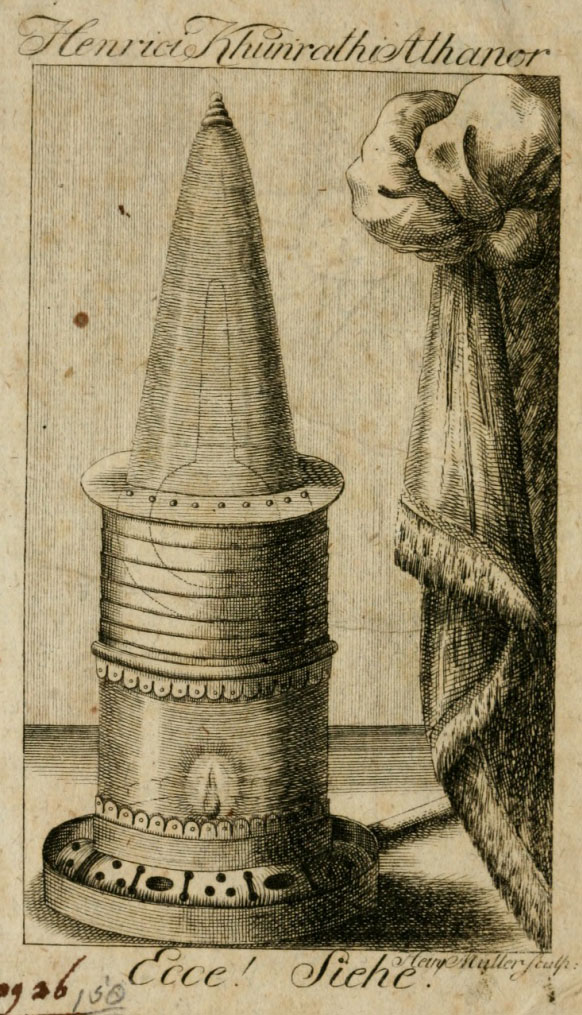
Behold! Look!
heinrich-khunrath-athanor
True Report
on the
philosophical Athanor
and its
use and benefit,
by
Heinrich Khunrath,
Doctor of the healing art (medicine), and faithful lover of divine wisdom.
Because it is exceedingly rare, [this work] following the third edition, printed in the year 1615 at Magdeburg, at the author’s own publishing house has been newly cleansed of German language faults without injuring the meaning, and furnished with a historical preface concerning all his writings, together with the athanor engraved on copper, and (upon request) published.
Leipzig,
at Adam Friedrich Böhmen’s,
1783.

Translated to English from the book:
Wahrhafter Bericht vom philosophischen Athanor, und dessen Gebrauch und Nutzen / von Heinrich Khunrath
True Account of the Philosophical Athanor and its Use and Benefit.
§ 1.
On the utmost necessity of a convenient regulation (governance) of the fire.
How very much, in the natural (according-to-nature) art of alchemy, depends on the proper and necessary regulation of the fire so that the practitioner may conveniently have it in his power to provide, increase, or lessen the degrees of the fire, whether weak or strong, lukewarm, warm, or hot, just as, at different times, the work he has in hand requires and makes necessary this is sufficiently attested by all the teachings and writings of all true chemical philosophers, and moreover also by reason and daily experience. Whoever proceeds to work practically in alchemy, and in this manner truly takes the matter in hand, will perceive it very well for himself; therefore it would be unnecessary to produce a long proof of it, since it is not so clearly understood from words as it can be learned in the work itself, through one’s own manual practice.
§ 2.
On the usefulness of fire in the investigation of nature’s secrets.
Thus it is, and remains, among those skilled and experienced in the chymical art, an indisputable truth, and it is almost beyond words how exceedingly useful fire is and the various use of its different degrees in investigating the secrets of nature; so much so that, in the doctrine of natural things, fire is rightly (and is) called the dissecting knife, by means of which the student/investigator of nature may understand natural things according to a properly set-out method one not consisting merely in words and imagined notions, but also true and essential I say, [a method by which] he may understand natural things, may [thus] understand the plants, animals, minerals, metals, precious stones, other stones, and all other materially and naturally composite things, according to an artful order, as they appear to the eye, and also according to the perception and comprehensibility of the other senses, by resolving them into their particular natural and essential parts, of which they were joined together by God at their first creation, and thereafter have also continually been propagated in a natural manner; and in this way may learn to recognize philosophically their natural beginnings, parts, being, and properties indeed Nature itself.
But you, inexperienced in the light of Nature, merely knowledgeable in Greek and Latin languages, a subtle babbler of pretended words, do not indulge in false imaginings. Nature teaches us, in a manner according to nature and alchemy, through fire to make a true division, and to investigate natural things. With merely dialectical, purely verbal conclusions alone and by themselves, it is jugglery and child’s play.
To wish to investigate, by this means, the truth of many kinds of natural high and deeply hidden secrets, unless they are grounded upon the conclusion of Vulcan, that is, of fire, and as it were animated by it this [method] sets a natural thing before the eyes as it truly and essentially is in its own natural composition. This conclusion is made in a manner according to nature and chymistry, so that it neither recoils from nor fears in the least the objections of sophists, who fashion nothing but elegant words. Fire is absolutely that which orders and directs everything, also in a manner according to nature and chymistry, each in its own way; and especially in this our fiery century it is fitting and must be so, that even the Last Judgment of this world which now stands before the door be more clearly announced by it in a figurative and indicative manner. God, the Wonderful One, indeed teaches us His wisdom and lofty secrets in a wondrous way as well. The art of fire, all manner of skillful practice, and much experience give us the sciences and truths concerning natural things. Dialectic cannot do this; rather, only the exceedingly pure sciences and truths that have been discovered and are actually at hand, in every kind of knowing how to present and treat [these matters] methodically, correctly, and in good order, with great benefit.
§ 3.
Now, since according to the saying of Maria the Prophetess the entire governance of the Art rests upon the moderation of the fire, it follows that, in order that this may be done conveniently and suitably, as already stated, appropriate furnaces must be employed and used; just as the Book “Saturnus” also says that no convenient fire can be produced except only in a furnace suited for it. In this connection it is noteworthy to recall how, on the one hand, the ancient investigators of nature and physicians observed four outward and superficial qualities of natural things, and also embodied and explained these according to four different degrees in the following verses, when they say:
“The first is called that in which it does not rule over the senses;
In the second, with the senses made equal, Nature rejoices;
The third goes beyond, yet harms with tolerance;
The fourth, a destroyer of the senses, knows not how to proceed.”
But whether either the much-experienced, diligent, and industrious alchemical investigators of nature, or Fire-artists among the common, ingenious natural philosophers and physicians or else these aforementioned chymical investigators of nature first gave cause and occasion to observe diligently, in every respect, the four degrees, both of heat and of qualities; about this I do not wish now to quarrel with anyone. Let one be content, and thank God for their mutual, well-intentioned diligence and useful observation.
§ 4.
Thus, for the present, I shall not treat of all and every degree, manner, and kind of fire that must be employed in all sorts of chymical operations upon all kinds of materials; nor shall I speak of all and every chymical furnace, of which I would otherwise have to present far more than a hundred different kinds. Rather, I shall speak only of one such [furnace], which is suitable both for extractions, digestions, depurations, putrefactions, solutions, distillations, coagulations, and fixations of many and diverse materials and substances; and likewise, in the subsequent operation or finishing work of the artificial preparation according to nature of the philosophical Universal Stone, from a saline primaterial substance, and for that very reason from the universal Azoth, or the mercurial water of the sages, it can be applied and employed very usefully and quite conveniently. The earthen “dock” or little knob should be just as one buys such a thing from the potter for a penny one buys it, with which an alchemical charlatan (Ardelio) has long been puffed up, and perhaps even to this very day is now and then puffed up by it; it truly does not do [what is claimed].
§ 5.
On the first, initial treatment or handling of Magnesia in the fire, and its philosophical resolution.
In the first or preparatory work, concerning which the philosophers have left almost nothing, or at least very little that is clear and distinct, recorded in their writings, they treat their universal magnesia right from the outset in such a way that, according to God’s will and blessing, through the aid of simple chymical operations, they free it according to nature and art, in its proper manner, as is fitting and necessary from its bodily bonds of hardness, breaking it up, softening it, loosening it, destroying and dissolving it, so that from it, of itself and for itself, without the addition of any foreign thing by any human being, there may arise its own proper homogeneous, clear, pleasant-tasting liquor or juice indeed a mercurial substance endowed with the Salt of Wisdom or the incombustible Sulphur of Nature or an animated water is produced, artificially separated and derived, which is the first key of the Art; and in this manner one may rightly come to see the beginnings of the Art, and learn to know them well.
Now everything which has not arisen from the Magnesia must not and may not enter into it. Study this well! Harpocrates may forgive me that I have taken my finger from my lips, and out of most heartfelt love toward my neighbour have almost overstepped the bounds of silence. I say that this softening and de-coarsening must take place without the addition of foreign things whether they be acidic, sweet, sharp, or strong waters or powders, or any other materials, call them by whatever names one will by means of subtle chymical art, great diligence, untiring labour, unsparing expense, and gentle patience, within the proper and fitting time belonging thereto, in a few weeks, with the leaving behind of all kinds and manifold different superfluities, lees, and impurities. From such a wondrous opening one obtains its very first, sole true and unique primaterial, unavoidable philosophical key of salt for further opening.
§ 6.
What the Athanor is.
In this first, or preparatory, work, I say, different degrees of fire necessarily must be and are used for which coal, and as circumstances allow also wood, likewise far larger and stronger furnaces than this my Athanor, are required. Therefore this aforementioned artificial Athanor of mine is a furnace in which a constant, continual, uniform fire is maintained, and a furnace for “cooking” (coction); yet it is not serviceable for the heavy and hard initial labours with the Magnesia indicated [earlier], but rather, for this purpose, only for the subsequent further resolutions, separations, and more subtle purifying separations of the Magnesia, until at last it reaches the fully complete, true azothic dissolution and purification consisting in a three-in-one: out of spirit, soul, and body, or Mercury, Sulphur, and Salt, as the three natural primaterial principles of the philosophers.
These subsequent purifications take place in a fairly gentle warmth, since Nature, when it receives such a pleasant, nature-conforming assistance of art, then gladly drives itself forward in its work indeed more willingly than willing and shows itself as it ought.
“For Nature contains Nature; Nature separates Nature, and Nature meeting its own Nature rejoices and is transmuted into other natures.”
Thus the principles of Nature are the beginnings of the Art. Furthermore, this Athanor is chiefly necessary in the second, or finishing work, with the aforementioned primaterial, catholic, saline Azoth, or the sharpest vinegar of the sages, necessary, for which a uniform and continually enduring, convenient gentle warmth is required for a long time something that one can provide and maintain quite well and correctly in this often-mentioned philosophical furnace of mine, the Athanor. Concerning this property of the philosophical Athanor, Raymond Lull speaks in the Testamentum Novissimum, chapter 4, as follows:
“Our furnace is called Athanor, and signifies an ever-lasting fire, because from the beginning to the end of our Stone it yields a fire that is always the same, persisting in one degree, making [things] living and timely (bringing them to their due time). Concerning such a fire one may also read my book, Consilium de Igne, etc., of which mention shall be made further below.”
§ 7.
For the benefit of my sick neighbour who stands in need of help, I will also mention here what the renowned old practising physician Valecus de Tranta, in Book V, chapter 20, p. 253 of his medical practice, writes in these words:
“Without doubt, among the best properties and effects which the Stone of the Philosophers produces in the human body, it has the property and effect of breaking the stone in the kidneys and in the bladder, and of cleansing both of them of it, as Berientis speaks thereof.”
So far Valecus. Therefore the calculous sufferers (those afflicted with stones), who with tartar, sand, gravel, and rending stones in their bodies, kidneys, and bladder are very violently afflicted and tormented by them likewise those suffering from gout of the feet (podagra) and gout of the hands (chiragra), and the like may, under God’s blessing, rightly rejoice in the above-mentioned mercurial [water] animated with the sulphur of Nature, as it is set forth in and from my published writings, and elsewhere here and there, God be praised, sufficiently demonstrated in a philosophical manner: namely, that which is prepared from the catholic Magnesia of the Sages, that is, from the proper and only subject of the Universal Stone of the Philosophers, namely the philosophical water, the spring-fount of the Stone of the Sages, as a singularly powerful saline medicinal key, by which one may also resolve and expel the tartar in the microcosm, that is, in the human being; since they now, God be praised, have it available according to circumstance and in the utmost necessity, and can use it methodically and as a foremost remedy.
This mercurially blessed water is likewise that very thing of which the author of the philosophical writing Apocalypsis Spiritus Secreti (mundi videlicet) “Revelation of the Spirit of Secrets (namely of the world)” speaks called the “Revelation of the Secret Spirit of the World,” thus speaks:
“In the second state, this secret Spirit of the World appears bodily and before the eyes in a watery body, somewhat more beautiful than in the first; for although it still retains certain corruptible aspects, it nevertheless displays its power more fully, is closer to the truth, and is more active in every work; and, in general, it brings help in all illnesses, both hot and cold (because it is of a hidden nature). Above all, it is beneficial to those sick persons who in those whose spirits and vital parts are infected with poison; for it drives such poisons away from the heart. It dissolves the impurities of the lungs without violence, and heals the diseased, putrefying lung without hindering its constant motion. It purifies the blood; and if anything evil is present in the vital parts of the body, it expels it and preserves them from corruption. Drunk three times a day by each patient, it gives good hope, etc.
But patients afflicted with the aforementioned diseases are obliged and bound first of all to give praise, glory, and thanks to God, the Most High Physician, and thereafter to show continual gratitude to the subordinate physician who prepares such a medicine philosophically and communicates it benevolently.
If a physician can heal these diseases and other great evils far more successfully with this primaterial water of the Philosophers’ Stone than with common medicines, then this is his greatest satisfaction especially if he does not allow himself to seek to obtain from it the gold-making tincture.
§ 8.
But someone might object and ask me: do you really know what was last said about the preparation of the Philosopher’s Stone that it can be set up in this Athanor and conveniently worked in it? Have you ever actually produced or prepared the universal stone of the philosophers from the purest, most sharply acting saline Azoth in the furnace indicated?
Answer: Although I have never completely finished the universal stone of the sages in it, nor fully brought it to its highest perfection, I nevertheless know that this is infallibly true because in this artificial furnace of mine the degrees of the fire can be regulated just as well by increasing, diminishing, or maintaining the heat, exactly as the philosophers write of their Athanor: that it should, can, and must be done so in it. For mine, in such philosophical use and benefit, is altogether equal to theirs.
For this sufficiently weighty reason I quite properly call this artificial furnace of mine an Athanor as well, just as the philosophers call theirs, and I regard my present one as equal to theirs. Nor does it hinder anything if my Athanor, in respect of its outward form or shape, perhaps does not entirely agree with one or another of the ancient philosophers’ furnaces because here it is not a matter of the outward form or shape, but rather of its proper philosophical use and benefit.
§ 9.
Different forms of the Athanor among the ancients.
The ancients, in fact, were not all in agreement with one another on this point as can be found quite clearly in Count Bernhard, the chemical philosopher, almost at the end of the third part of his little book on the Hermetic Stone, when he speaks as follows:
“We were in agreement in all things; but some, as far as the manner of the fire is concerned (he calls it the ‘manner’), were not of one and the same opinion although, when one compared it, it was one and the same thing. For the Turba makes them agree, in that it says that the agent must not flee from what follows it, and that the fire can be arranged in various ways, as it ought to be; and yet, in the end, everything is directed toward one single work.”
So far [says] Bernhard.
§ 10.
Since, however, the furnace and the vessel are better learned from direct inspection of the work itself than merely from description as Lucas the Philosopher also reminds us I therefore wish, in God’s name, to begin speaking from the inspection of the work itself. The furnace is finished and ready at my hand; and, as occasion permits, it can also be viewed together with its fittings and accessories.
Here I must note:
When the most ancient philosopher Viattreas, who once drew the admiration of all Greece and Italy upon himself, used to claim that he kept in his house an animal that devoured and consumed itself, the question would be: What is this? Just as it is related of Latace, a magical herb, that the Persian kings formerly gave it to their envoys in place of travel money, whereby they everywhere, in all things, obtained an abundance? Likewise, what was meant by the sack of Fortunatus?
§ 11.
This, then, is the representation of my now frequently mentioned Athanor, or philosophical furnace, in which the fire is kindled artificially in accordance with nature, and as I have previously explained is governed and maintained. I shall now speak of the philosophical fire required in the other operation of the greatest physico-chemical work, with respect to the degrees of heat. The philosophers teach in their writings, as Morienus [says]: “His fire ought to burn evenly without interruption, namely in such a way that it neither diminishes nor is too strong nor too weak; therefore his fire should be even, gentle, caressing, and mildly tempered, remaining uniform throughout the whole time, otherwise damage might arise from it.”
And the master of the book Consilium conjugii de massa solis et lunae, in German, Counsel concerning the marital union of the piece or lump of the Sun and the Moon, in my copy on the 213th leaf [says]: “The proper measure of the fire ought to be even, until the inner fire that is, the invisible fiery little spark of fiery Nature, the Archeus has accomplished its work, as Gratianus also teaches.”
This cited passage is explained very aptly by the philosophical author of the book Clangor buccinae, when he speaks thus: “Necessity requires that the external heat that is, the artificial and material fire be moderately warm, so that it does not surpass the inner heat; namely, so that the inner heat may retain with itself its moisture, which it naturally draws after or together with itself. For if the outer heat were too strong, the greasy moisture, mixed with subtle earthy parts, would fly off because of the excessive heat and would not remain in the body. On the other hand, that which is superfluous, coarse, and harmful must, through the power of gentle digestion [cooking] be continually and gradually purified, separated, and subtilized.” Thus far this author.
And the Turba philosophorum says:
“Avoid an overly strong fire; it must be gentle.”
Likewise Arnold, in his epistolary address to the Neapolitan king, says: “Take note: the fire must be gentle at the beginning of the Work, afterwards moderate, and finally strong namely, it must be increased gradually until the aforesaid Stone becomes white and finally red.”
In the same manner speaks Count Bernhard: “Make a vaporous fire, steadily digesting, constant, not too violent nor boiling, but wholly subtle, damped and enclosed, translucent, clear, surrounding, lively, not burning the matter, penetrating and uniform; and by the true God,” he says, “I have spoken of all the modes of fire, how it ought to proceed.” Thus far Bernhard.
Here I must remark what a certain philosopher says: if the heat of our philosophical external fire attacks the matter too strongly, it presses upon the operation with such force that the vessel may burst into a thousand pieces and this not without danger to the body and life of the practitioner.
§ 12
In precisely the same manner, many others also speak of a gentle and, as it were, caressing or quiet fire, as is found in the riddles of the Wise and in the Wonder-Judgment of Arislei; and likewise as a pious mother would move upon the belly of her child, as is read in Philosophus Senior; also of a febrile warmth, as is seen in the Soliloquium Philosophicum; or in a febrile state, as is again taught by the aforesaid Senior; likewise of a warmth such as exists in a healthy human being.
Some also say, as is written in the Book of the Phoenix, that the fire ought to be like the natural warmth which cooks and digests food in the human stomach; or also like the warmth of a brooding hen when she sits upon her eggs this warmth of the brooding fire they compare to the warmth of the sun when it is in the heavenly Aries. And it should be continuous and always uniform, without increase or decrease, nor should it rest or cease for even a single hour.
All this, they say, can, should, and must take place in their Athanor.
§ 13
All of this now, which has been recounted up to this point, can so I say likewise be conveniently and usefully arranged and accomplished in my own present Athanor, and indeed just as well as in the secret Athanor of other philosophers, however it may have been formed according to their wishes; for which reason mine also may rightly be called an Athanor, just like theirs. One can likewise maintain within it the governance of the fire by degrees and in different ways whether weak, lukewarm, or warm, as one may desire and always equal or uniform; whether it be set to the aforementioned degrees or however one wishes, the fire can always be given uniformly.
Within it one can also, by alternation, possess and artificially maintain the philosophical glass, just as is otherwise customary in the fauler Heiß (gentle putrefactive heat), likewise in the watery or so-called Mary’s bath, in which one can also obtain such a putrefying warmth as in horse dung; likewise in the moist vapor bath, either by itself, upon a brass tripod wrapped with little linen cloths, open and exposed; or else enclosed, within a wooden oak hollow sphere; finally in the dry vapor bath, also upon a tripod.
Yet it may and must also be as various practitioners have their own and differing minds and ways of working set in ash, in saltpeter, in fine or coarse sand, in iron filings, in hammer scale, in slaked or unslaked lime, in calcined vitriol, in melted and afterward pulverized saltpeter, or else also in the mineral sulphur bath, where the glass is held in molten sulphur, and, instead of a copper one, in a strong earthen capsule; thus it can, I say, all be done very well in this my philosophical furnace. At one time I saw that an artist had set some silver ores to mature artificially in an earthen vessel, placed in a capsule full of molten lead, and held it for several weeks by different degrees of fire; he called this the metallic, saturnine, or lead bath. In general, in this furnace, quite according to the teaching of Count Bernhard of Trevis, the worst that is, the gentlest warmth can be the guardian; and thus this alchemical, creeping fiery fox finally also, in a manner conformable to nature, artfully steals what it seeks and is meant to steal.
§. 14.
But so that in the Universal Work of the philosophers that may also occur which Hermes and Morienus teach, when they say:
“The vessel must remain in its furnace unencumbered and unmoved continually, for as long as the entire time of the fermentation of Etheb or of the Sun is completed;” therefore my Athanor has a clear, transparent glass cover, through which one can from the outside look inward and properly see the inserted matter in the prepared philosophical glass and can judge how it reveals itself in the work at every time, without opening the furnace; and because it can be observed while unopened, thereby the inequality and disturbance of the proper degree of heat, and likewise the destruction of the work namely, if it were to cool through opening, or be improperly moved by lifting are, to the greatest advantage, prevented.
§ 15.
In the same manner, the lower part of this Athanor is also made of glass, so that one may not only at night, but at any time, take pleasure in seeing the fire burn from the outside; which is very agreeable and moving to the lovers of the art of fire, since the fire is hidden and still, and therefore excellently incites the philosopher to deep contemplation especially in the stillness of the night and by moonlight of the work that lies in his hands. Of this no one knows except the lover of the Art and the man of understanding, who has in fact experienced it, to judge; and which is well worth noting: here lies hidden a special mys
A secret of natural and supernatural good magic.
§ 16
My invention of this my Athanor has without reporting it for glory, yet to speak truthfully even in this respect something further that is special and useful: namely, that one can strengthen or weaken the degrees of lukewarmness and heat without any alteration, that is, without enlarging or diminishing the wick and the little flame, nor by increasing the fire; because with one and the same flame all the previously described degrees and modes of heat can be maintained and carried out indeed also at one and the same, equal cost. Only this is required: that in the middle part of this furnace, by means of the conveniently placed rings, an elevation or else a lowering be made, as eyesight itself teaches.
I know with certainty that this is a very useful and truly artful manipulation, even if you, scoffer, might value it ever so little. And although once a highly learned, presumptuous critic let himself be heard, to my supposed belittlement, claiming that he had seen this artifice with indicated rings earlier and many times before yet I nevertheless say now and always, just as I also then immediately said straight to his face, in truth, that such a thing, in this furnace, is my own invention, without any other’s prior hint or instruction; whoever else may or may not have had such a thing otherwise.
§ 17
There also belongs to my Athanor a glass, spherical lamp or ampulla, with an incombustible wick, either golden, or else prepared from swan’s down, which compared with many others is in this respect convenient and useful: namely, that it can be so arranged (though only by enlargement) that it burns not merely for one, two, or three days and nights, but likewise for just as many weeks, indeed months, and even longer where necessary, without any new replenishing for the nourishment of the fire, continually and without interruption, in the same flame and degree of heat.
The nourishment of the fire is neither tallow, nor oil, nor wax, nor butter, nor any such fat. And thus the wish of many artisans can now be abundantly fulfilled by this lamp of my truly philosophical Athanor. Just as I have also heard several old, otherwise well-practised artisans express the wish that they might have it in this manner; among others, once also a man in Cologne on the Rhine otherwise well-read, but at that time still little practised in chemical work, I know not how who, for lack of such a highly useful artifice or artificial manipulation, from the supposed philosophical Universal Stone which he had under his hands could not be left unattended for more than six hours, whether by night or by day; just as he also weighed out the coals, which were necessary to burn during so many hours, according to a certain weight (as I myself saw with him), and in addition kept entire sulphur without flux in a small earthen shard upon the heating tube, as a test-sign of the correct degree.
Now let everyone think for himself and consider how unphilosophical this is, and also how burdensome, vexatious, and laboriously wearisome such continual boiling and hurrying must become over time! If he had been a well-practised chemist, as he wished to be regarded and praised for, then he could have easily avoided such hurrying and slovenly boiling altogether by means of a proper chemical Heinz-oven.
§ 18
Along with this, one can also if the greatest necessity requires it, and according to the circumstances of the work at hand travel quite well, or attend to other affairs without neglecting one’s philosophical of the work, or else without handing it over to other people secretly and quietly, whether one is absent or present, to carry it on with a steady and ever-lasting warmth. That is one [advantage].
Secondly, one can from the outside because the upper part of it is transparent, since it is of glass see how far it has burned down, and without shifting or extinguishing it, know when it is necessary, at the right time, to supply it again with the needful nourishment and set it going.
Thirdly, because the little flame of fire, as one first sets it up in the beginning, always remains unmoved and, without sinking or lowering, stays constantly in one place; hence one can have a constant degree of fire and heat which otherwise does not happen when, in the consuming of the fire’s nourishment, the tube/nozzle (as may be seen in many other lamps) sinks down along with the little wick, and little by little keeps settling ever lower; from which then, to the harm of the work in hand, an alteration and irregularity of the heat arises.
§ 19.
Thus the wick too is incombustible, because it is either of gold, or else ex alumine plumoso that is, neatly formed of Federweiß (literally “feather-white,” i.e. a white lead/ceruse).
[Not] with rushes, cotton, spun and raw white silk, which some otherwise very highly es (cut off here) (such) wicks, one can undertake nothing steady/lasting in long operations, because they soon burn up.
§ 20.
It is true that, already eighteen years ago, I knew how to maintain the lamp-fire even without a wick, and in two different kinds of lamps in two different ways: namely, that either on top of the little tube, or else at the front of the lamp, there stood only a guttula (a little drop), or a droplet like a pearl; and when this was lit, a small little flame burned from it. But since that time I have found this present method with lamp and wick far more convenient and more suitable, and therefore I quite properly remain with it.
§ 21.
If one wishes, the lamp can also be prepared and set up in such a way that by means of two, three, or four tubes of the same, 2, 3, or 4 different indicated furnaces can be warmed and regulated at one and the same time; and conversely, one single furnace can in turn if need be be regulated at once strongly or more strongly with 2, 3, or 4 lamps.
§ 22
This Athanor the Artist can also keep in his living-room, upon a table, bench, and the like; in the bedchamber by the bed; or elsewhere in another room and apartment without smoke, offensive vapour, or stench very spacious and convenient, and can keep it cleanly. It also stands upon its metallic base, so that the fire, under God’s protection, may do so much the less harm.
But let no one imagine that this my philosophical Athanor because it is to be used cleanly were therefore reserved only for tender and neat women and maidens, as many a saturnine head may fancy to himself, and foolishly dream about; oh! far from it! As though men also did not love cleanliness, and apply themselves to it; prepare and produce all manner of subtle, fine things; and, wherever it can be (as indeed it also ought to be philosophically), would gladly be rid of, or spared, vapour, smoke, ash, dust, and harmful fumes?
A true Chymist has indeed more and subtler things to prepare than merely aqua fortis, aqua regis, aqua graduationum, and the like partly, and as occasion serves, sophistical things for which the much-praised charcoal-workshop (officina carbonaria) must certainly serve; which nevertheless has its use, benefit, and deserved praise rightly retains its use.
In general, one kind of furnace stands very well beside the other; it is philosophical, and both kinds may and should also not be separated by a faithful pupil of the physico-chymical school.
Therefore let the Sceptic, in order not to betray his ignorance, merely refrain from his untimely and unphilosophical prattle about this matter. Let him first properly learn to recognize what lies hidden behind this my so-called philosophical furnace , which is not only suitable for use at home, but is also very convenient to carry with oneself on journeys, and useful in practice; then he will, it is to be hoped, give somewhat closer attention to it.
§ 23
But so that not everyone, to whom it does not belong to know anything of it, should simply run up and look at what one has in mind in such a form, one may place it in a wooden container or housing, which may likewise have several small little air-holes, have them made and fastened on for that purpose, and close the same up.
It is not necessary that every art-ignorant person yes, at times even an inhuman fellow or otherwise some scoffing fly that finds fault with decent people’s labours, should pry with his nose into the chymical works of the art-loving Philosopher who labours truly according to nature, and then afterwards have his shaggy mouth-chattering about it among his own kind.
§ 24
Behold! Such is my philosophical, or artificial chymical furnace! In it, and by means of its lamp, as I have said before, many artificial extractions can be carried out and completed useful for medicine; namely, of spices, seeds, herbs, metals, etc.
Yet, as is also understood of itself, this is done by means of a suitable and proper menstruum extractivum (extracting menstruum), with digestions and depurations so that, in digestion, they let go their bodily faeces or impurities, sink them to the bottom, and purify or clarify themselves; and separations are to be undertaken namely, the menstruum, whether extractivum or solutivum, by distilling (destillando): by distillation either through the glass-coated retort on the tripod, or out of a coated flask / alembic to separate it gently again over the helm; putrefactions, dissolutions, and solutions of corals, pearls, precious or other stones and metals, each also by means of its proper menstruum, etc.; distillations of waters, such as strength-water, striking-water, spirit of wine, etc.; rectifications of oils, and likewise of all manner of materials namely when they (as every skilled practitioner can easily perceive that it must be so) have already, in the first instance, through chymical preparation, been opened and separated from their coarse body so that afterwards these may, in this philosophical, gentle, and subtle furnace, be finely rectified and subtilized by distillation, without coal-smoke and evil vapours, in one’s room, even upon the table, either for use or for profitable pastime; likewise coagulations of juices and salts from herbs and other things; and finally fixations of various volatile bodies, of spirits and oils.
§ 25
From the aforesaid sufficient causes namely from the usage and benefit described above it becomes clear that this my Athanor is such a furnace and in this the saying of the Philosophers may very well and truly be applied: “One furnace, one vessel, one fire” can be employed namely, for use conveniently and profitably in the other operation or further work of the natural, artful preparation of the philosophical Universal Stone out of Azoth of the Wise; since the inner, invisible warmth of the working power the secret, invisible fire of Nature; indeed the little spark of the catholic light in Azoth, that is, in the most pure Mercury of the Philosophers is, next after God’s will, the true master and agent of the alchemical art; yea, otherwise also, as it were, God’s deputy or steward in natural things: upon whose wink, next after the will of God, by means of the assistance furnished by Art, everything in natural alchemical art depends and is wrought.
Nature works and rules; Art and the artist serve. Nature is that which dissolves, separates, cleanses, joins together, hardens, and makes durable; for, as has been said, the essential fire and light of Nature in Azoth cannot do without the necessary, unavoidable help of the outer fire of glowing heat and flame, in the present Athanor, gently weakly or more strongly steadily and without interruption, according to one’s desire, obtaining it, having it, and maintaining it, and keeping it so long as is fitting.
§ 26
Further: The natural fire is in all natural things, although invisible; and thus our philosophical Stone also has its own invisible fire of Nature within itself. Yet it is, as it were, resting and still, unless it is set in motion by a suitable warmth from without namely either of the elemental fire (understand: coal, oil, butter, wax, tallow), or of the aetheric (namely either pure, undiluted brandy, or else distilled and well-rectified, purely burning spirit of grain). These, while they maintain the flame, are consumed and diminish, for which reason they themselves must also be kept up by fresh addition of their like.
Or else so I say by the outer fire in the unnatural or instrumental fire, which, because it is arranged according to occasion now in this way, now in another, is called the occasioned fire (understand: in a bath, ashes, sand, hammer-stroke / hammer-heat), is not conveniently awakened, or is too much and too strongly beyond the measure of its operation artificially stirred up and forced forth.
Then Nature takes delight to work, in this nature-conformable artificial work, in the warmth so far as it concerns not only the degree but also the essence or being of the same of which, in my Consilio philosophico, that is, philosophical counsel, considerations worthy of attention and counsel concerning and about the secret outer, visible glowing- and flame-fire of the most ancient Magi or Wise Men and other true Philosophers, treated in a philosophical manner at length and in detail.
It is therefore, as has been said:
1. a fire of Nature, which is also called the divine and essential fire.
2. elemental fire.
3. aetheric fire.
4. supernatural fire, so called because it is not a fire of Nature.
Also otherwise there is yet called a fire against Nature, as that of common aqua fortis and others like it.
§ 27
Now one will also easily be able to understand what is meant when the Philosophers say:
“Not Mary’s bath, not ashes, sand, coals, not the artificial furnace, not the government/regimen of the fire, accomplish it in this Art; but the fire of horse-dung and living lime accomplish it;” since they do not properly mean the outwardly perceptible warmth of horse-dung or common lime , but much rather the natural, the warmth of Mercury , of Sulphur and Salt of the catholic or universal Azoth (and also otherwise, according to occasion, of other specified natural things), namely that same invisible inner warming, dissolving, separating, cleansing, joining together, transforming, hardening, and making durable power and warmth of Nature, which they have wished to mean and understand philosophically; that is to say: that the first material and therefore universal Mercurius, or the Azothic water of the Wise (and in it naturally the most secret fire of the Wise), its preparation or elaboration as the other secret of this Art has at all times been kept most hidden from them.
§ 28
Herewith I will now, in the Name of God, conclude this treatise. Let the lover of the Art therefore be satisfied with this, and recognize that I have prepared such a thing for his benefit, and have brought it to light. Thus also the ill-disposed Reichart may set his dishonest calumniating against it, and I ask God, together with me, earnestly for me, that he would let me henceforth be his scourge, that which is a workman’s own trade and craft; thus perhaps, with time, if he earnestly reforms himself, and if God should grant it, I might when there is opportunity of person, time, and place, in some helpful measure although not everything in open print yet either orally, or else in writings, as God may direct, repeat and communicate many more things, not only in natural chymistry, but also in Christian Kabbalah and divine Magic, far more beautifully and profitably.
Concerning this, I have at hand praised be God my Amphitheatrum sapientiae aeternae, truly, Kabbalistic-Christian, magical-Christian, and yet also physico-chymical, which, with God’s help, I intend to bring out in open print; in particular it shall be catalogued.
Naturally, alchemically, and truly philosophically it is spoken by Heinrich Khunrath:
Chochmah–El! Hallelu–IAH! Hallelu–IAH! Hallelu–IAH!
Flee, Devil!
Henricus Khunrath, faithful lover of Theosophy, and Doctor of both Medicines, dwelling for the time being at Magdeburg.
Editor’s Remark:
On the last blank leaf there stands the customary little emblem found with all his writings: an owl with a pair of spectacles, two torches, and two lights, with the inscription:
“What use are torches, lights, and spectacles,
when people do not wish to see?”
But I have thought it superfluous to have that very well-known figure which is also found in the Great Art of the Chymists, Berlin 1771 set here and printed; just as I have also omitted the rhymes found on the title-page:
“Who can then only so rightly say,
that everyone may say thereto, Amen?”
Likewise I have left out the words: “Phy Diabolo” (“Fie on the Devil”).