Thoughts on that ultimate and most perfect work of Nature, and the chief star among earthly things, gold; on its admirable nature, generation, properties, effects, and its relation to the operations of art, illustrated with nobler experiments
Listen Audio Book Study the Art with Us Buy me Coffeehttps://www.alchemy-texts.com/book/ultimate-and-most-perfect-work-of-nature-gold/
Andreas Cassius, Doctor of Hamburg: Thoughts on that ultimate and most perfect work of Nature, and the chief star among earthly things, gold; on its admirable nature, generation, properties, effects, and its relation to the operations of art, illustrated with nobler experiments.
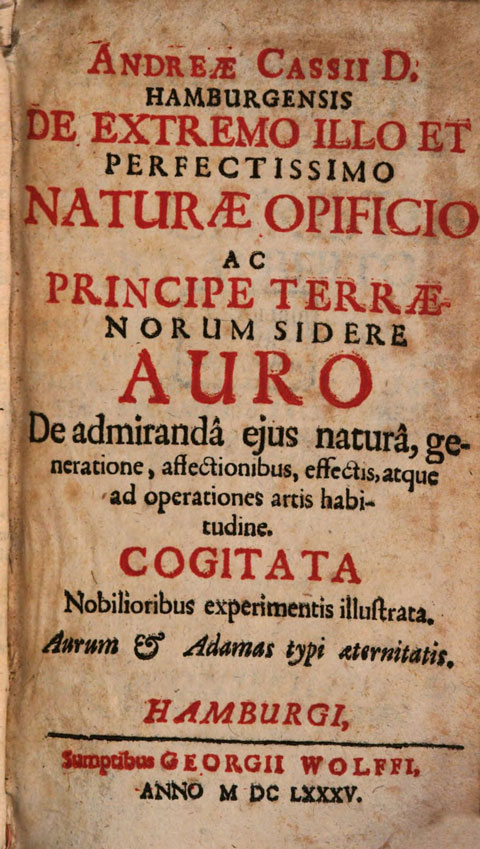
Andreae Cassii D. Hamburgensis De Extremo Illo Et Perfectissimo Naturae Opificio Ac Principe Terraenorum Sidere Auro : De admiranda ejus natura, generatione, affectionibus, effectis, atque ad operationes artis habitudine ; Cogitata Nobilioribus experimentis illustrata
1685
Andreas Cassius
Translator note:
This is not complete book, in the first part of his book he speaks about common Gold, nature, generation, properties, effects - later on he speaks about misochymists and alchemy
Chapter XI.
On Our Gold.
Or, on the matter of the Stone, and the drawing out of the gold-bearing seed.
Thus far many things have been said concerning common gold. Near the end it will also be permitted to recount something concerning our gold, of which our Fathers also have spoken.
Certainly a very sharp complaint, yet in truth also a specious one, is everywhere usually heard from the misochymists concerning that obscure and enigmatic manner of writing used by alchemists.
For whenever they have written about our gold, or about the matter of the Philosophers’ Stone, they seem to have applied themselves deliberately to this: to imitate those Egyptians, or gypsies, wandering here and there through the provinces. For just as those men have been accustomed to foretell the events of life to credulous people, and to weave a catalogue of their future fortune, by muttering various barbarous and un-Solonian words, as if drawn from the lunar sphere; by these words, among the credulous who are eager to foresee their fortunes, they usually do not strive in vain to win admiration, and then, following upon this, to draw out a few little coins.
A similar method seems to have either been borrowed by the alchemists from them, or they from the alchemists, when in describing their Our Gold they have used a certain obsolete, anticomarine grammar, and from it have rejoiced in nothing but horrible, monstrous, and unintelligible terms.
For what evil thing, they say, do brumazar, vyoarchodumia, adech, scindapsus mean? What does the Emerald Tablet of Hermes mean? What Oedipus will solve this riddle? What are meant by the mud of wisdom, the head of the raven, the leaping stag, the ox walking upon the earth, the stinking beast, the lunar lions, the chymical dragon that is stabled in the waters, and many more cruel names of this kind? What do they mean, unless that from the claws and nails of these beasts, and from the inward parts of this chymical brothel, you may recognize them?
Then they go on to ask where those allegories and fables look: concerning the labors of Jason, Hercules, and Cadmus; concerning the Phoenix, the red stag, and the odoriferous wife of that stag, and the blood of twin brothers, and six hundred other worn-out Arabic and Moroccan terms, or terms from some other corner of the world where men indeed speak, but do not understand themselves: chymical words, rotten and decayed, unless perhaps by them you could frighten Pluto himself and drive him to the latrine.
So much so that many have dared to conclude from this that, since they have found neither scientific terms nor any method in those books, the authors proposed their secret not as an art or science, but rather as some chance event of an operation to be awaited by accident; and therefore that they should be read for no other end than to pass the time and cheer the mind, just as we read through Ovid’s Metamorphoses, Apuleius’s Golden Ass, love stories, and other things commonly called romances. For what use would reading such things bring, if they ought not to be understood?
For as soon as, so they go on, the curious reader has opened even one chymical book, he will immediately feel that metaphorical nonsense rush upon him, under a forest of obscure and enigmatic names hidden under names. At first sight he will perceive that the author’s intention was not that he should wish to be understood, but that he wrote only so as not to be understood. For this familiar saying at once cuts off almost all hope for lovers of the art:
“Where we have spoken openly, there we have said nothing.”
And some openly declare that they have written lies where you would believe the truth; indeed, they candidly confess this, and they scarcely ever speak so candidly as when they say such things.
But if by chance you begin to turn over a few pages of the book good God! With how great a variety of names and twists they thrust the matter upon you, that is, their mercury and their sulphur. And if you wish to shake out what thing lies hidden under those names for they exclude common sulphur, and also common mercury, from the work they bring forward a thousand words into the open, describe riddles by riddles, and illustrate metaphors with metaphors. After you have hunted for the meaning in them for a long time, if at last you hope to gather together, from here and there, like the torn limbs of Hippolytus, the scattered pieces and fit them into one body if you wish to join them together, you still do not find one fitting with another, nor do you discover any agreement among them.
For this author wants to walk the dry way; that one, the wet way. One commends air; another, water. You would say that this one wants to swim, the other to fly. One teaches that mercury must be taken up for the work; to another, at least part of mercury is pleasing. To some there is plainly a double mercury and a triple sulphur. One suggests two principles; this one, only one; another, three. The ancients call that “our thing of vile price”; but the crowd of correctors, sharply attacking them, proves that the matter is not everywhere to be found. Do they not at last, by these trifles, lead astray and confuse the investigators of the art?
And if at last you reach the end of the book, they say, and have understood nothing, you throw away the book as still more foolish and absurd; and, struck with grief and repentance, you lament the loss of wasted time. For you believe that you have read dreams, or invented riddles, or the impostures and frauds of cunning men, by which many excellent men have been deprived both of their sciences and of their money.
But where a treatise has seemed to you more sober, the matter of the art has smiled, and the pleasantness of the tale has attracted the mind, nevertheless, at bottom, from that reading you will bring back nothing less than a metaphorical mule: like those who have grown accustomed to dream of golden mountains, but who in their purse have very little indeed.
And this manner of writing, they say, especially flourishes among the alchemists when they speak of Our Gold; just as, in general, you will see nothing occur more frequently or more difficultly in their writings than that tedious word our. They scarcely say three words about their matter without that eternal “our, our” accompanying it: everywhere our gold, our moon, our mercury, our magnesia, our steel, and what is not “ours”? So perhaps that saying of Nostradamus would not unsuitably fit them:
We give our things with words, for our salt is our own;
and when we give words, we give nothing except Nostradamus.
These, more or less, are the complaints and grievances of the misochymists, by which, from one obscure and ambiguous manner of writing among the alchemists, they intend to rob this whole study of the value which it has so far obtained among the curious. Yet it seems that an answer need not be sought very far away to all these objections.
For they should remember that there are two classes of these authors. The first is of those who wrote about that which they possessed, and whose experience they themselves had; these are commonly called Adepts. The second is of those who impose upon themselves and others, and either strive to deceive by design, or at least thrust upon others their own imagined thoughts, which, through the fault of a judgment not sufficiently firm, nevertheless seem true to themselves.
Thus it was altogether necessary that both should use such a manner of writing: the Adepts, so that they might conceal their science; but the foolish, so that they might conceal even what they did not know.
The former, of course, could scarcely have explained themselves in another style, unless they had wished to make their art public to all, and cast it even before the vilest idiots. From this many enormous evils, indeed dangers plainly philosophical, would have had to follow dangers which Philalethes, chapter 9, mentioned on page 29 of his Introïtus, should have feared would follow.
But the foolish, which is laughable, had begun to teach their doctrine in words no less obscure so that the world, of course, might remain ignorant of the same thing which they themselves did not know. Therefore they set forth their false and fictitious arcana by the same emblems and foolish hieroglyphics, such as would have forced laughter even from Heraclitus himself. How their writings are to be recognized, and distinguished from others of a better mark, will be set forth as far as may be permitted in my chymical protocol.
And so, to conclude many things in few words, and thus place the summit upon this whole matter: all the writings of chymists, but of true possessors, can be both false and true false, that is, if you refer them to the capacity and understanding of the reader. From this it cannot be otherwise than that a different sense will result. Therefore, if someone wished to understand the same things literally, they would certainly be most false for him.
But whoever, with a keener judgment, has regard to the relation of things among themselves and to the agreement of the authors, if he has been sufficiently fortunate in this, there is no doubt that for him they will be most true.
Therefore whoever prepares himself for the reading of such books must surely sift all things with the subtle sieve of reason, and must read the authors in such a way that he strives to reduce all opinions to one. Thus, where contradictory things through different respects in which they are set forth, he will reconcile them; where he compares the clear things with the obscure, and these again with those, he will certainly find a wonderful agreement. And with the passage of time he will not doubt that all the philosophers, although they used different terms, nevertheless had one intention.
We, who believe that we have not for too short a time entered among these thorns under the guidance of this method, shall explain, as far as possible, what at last seems to be encountered concerning this stone of offense; and to that gold of all men, which has hitherto been much examined, we shall also add something concerning that gold of the philosophers.
Namely, before all things, one must look to the end which these same men have set before themselves, and which, through that gold of theirs indeed through all those things of theirs they seek to attain with so much care and so much study. It is commonly known, indeed almost to infants, to whom nurses are accustomed to tell such things among the difficulties of sleep, that they have in view the transmutation not of all bodies (such as a certain Midas’s desire, and likewise the ancient fable of the golden-eared ass, invent), but of the more impure metals into the purest, namely gold; that is, so that those metals which differ from gold only by the impurity of their principles, and by the resulting mixture and not-yet-sufficient concentration of those principles, and not by their inward nature, may be penetrated inwardly by something added from outside; that their principles may be opened, stirred into a new motion, as it were fermentative, and through this at last, by the ideal motion of the added thing, as of a plastic and seminal spirit, may come together and be fixed into a fixed, uniform, and perfect density.
To satisfy these conditions, the new transmutative thing that is added must be:
First, most penetrating, so that it does not merely enter the body, but pours itself wholly into the very bond of the principles, separates them, and soon reunites them into a more harmonious and the firmest connection of all.
Second, homogeneous with the nature of metals which it must enter, that is, of a mercurial substance, so that it may enter them radically and, as has been said, may penetrate their innermost parts, not merely gnaw them away or tear them into little pieces.
Third, it must be most fixed, so that in action it does not hastily withdraw or fly away, but endures with them through the whole work of artificial fermentation, and gently concentrates itself with them;
Finally, it will be necessary that this same thing be the opposite, in respect of these qualities, of the mercurial substance of the aforesaid metals, which it must mature and exalt to its perfection. For just as that substance is too fluid, watery, cold, and volatile, so this one, on the contrary, must be most fixed, sharp, or astringent with respect to effect, not taste more earthy, hotter; that is, fixed, subtle, penetrating, not gross, volatile, and impure.
Such a substance, if all things are rightly weighed, is certain, according to the philosophers, to be present in all bodies in some degree. Yet in some it is so small, and in others so scattered, altered, mixed, and hidden, that the lifetime of many men would not suffice even to call forth a very little of it from the multitude of bodies.
On the contrary, it is most probable that in none of all natural bodies does it abound more manifestly than in gold, whose mercurial substance is, beyond dispute, the most perfectly cooked and the purest of all. Nor, however, is this at the same time unknown: that the same substance has there been brought by nature into such compactness, and, if one may speak so, into such corporeity, that, although it is still the most subtle of all things, nevertheless, as if from its same extensibility, it shines forth. Yet it has not reached that degree of perfection that it can serve in place of seed, and can act in the way we said above upon common crude mercury, much less upon that crude and more wild mercury of the other metals.
Hence it indeed enters all metals most deeply and is mixed with them, but because of its nature, which is not yet sufficiently loosened, it cannot yet adhere inwardly to them, nor make something else from them, nor mature them, nor arrange their principles into a harmony like its own. Rather, when those metals are again exposed to the violence of fire and corrosives, they yield, while this, unharmed, returns to its original form.
Is not the conclusion ready from these things: that a spirit ought to act where a body cannot; that what must penetrate a body essentially must itself be a spirit; and that from gold made spiritual that is, from gold whose essence has been opened, made more penetrating, and brought to the highest subtlety the same effect is to be expected which a thick, compact, corporeal thing such as common gold is cannot perform?
Therefore such subtlety and spiritualness must be reconciled to common gold in its mercurial substance; yet in that substance the old fixity, fluidity, and power must remain the power of constricting, so that it may inwardly enter the mercurial substance of metals, as something more homogeneous and kindred to it; may be inwardly connected with the same; may commit the principles into a most perfect structure like its own; and may not be able to fly away in the fire.
This is what all those admonitions of the philosophers mean, by which they constantly exhort us to make spirit from body, and body from spirit. I could confirm this by six hundred and more testimonies of theirs, if I had less regard for time.
This, then, is that gold which the philosophers call their own, which they distinguish from common gold no less justly than a living thing from a dead one, a vigorous body from a corpse. Hence all common metals are called by them dead, while those which they call ours have, as it were, spirit and soul. Hence their exclamation: Why do you seek life among the dead? If you seek to restore the life of metals, there will be need of a metallic life.
And therefore their gold also, which they mark with the word our when they speak of it, is that into which they have introduced a new life either through the loosening of the life bound in gold, or through the life of a new life, or in both ways.
It can be called a fiery spirit, kept in the depth of a certain mercurial nature, which, when stirred up and set free by a philosophical genius, unfolds itself, penetrates, expands, and informs the earthy body of gold.
In one word, clearly and plainly: it is gold subtilized to the highest degree and made penetrating. Hence it is rightly taken by the philosophers, who attribute this to it alone, as the matter nearest to the nature of gold; and it is distinguished from common gold by infinite parasangs. For common gold is gross, compact, and thick, and is mixed with metals only superficially; therefore, as has been said, it easily separates from them again without their being changed at all.
On the contrary, the gold of the philosophers, by the help of a certain spiritual matter, has been radically dissolved, attenuated, more extended, and made more penetrating. Hence it can not only penetrate all bodies by the incredible smallness of its atoms, but especially metals, which are more compact than other bodies, can enter essentially; and it can also alter their density and constantly exercise its fixative virtue in them, and cannot again be gathered back from them unchanged into a compact corporeal mass.
“But truly,” you will say, “in order that we may obtain this our gold, and that common gold may be exalted to that dignity, what counsel or what work is needed? For thus far, you say, how rebellious it has not been, and how every separate line from what has been said up to this point confirms this.”
Indeed it is so. And just as up to this point you can and ought to understand this only concerning ways partly common, partly also otherwise curious, so you will conclude by the same right that I have not yet spoken of all the things which are still lawful to the art, and which, known at least to very few, are kept wrapped in deep silence.
Gold will certainly remain gold, and will not be subdued for eternity, so long as you do not have another nature to join to it, by which it may be destroyed or radically opened. That this is naturally wholly impossible is implied by the divine Spirit himself, when, in 1 Peter 1, he calls gold and silver corruptible.
But what that thing may be from which we can expect this that is certainly a matter of higher inquiry, and one which up to now has sharply exercised the minds of all philosophers; for those who possess it do not reveal it; and those who do not possess it, without reason, grasp at it, labor, and from these different heads have chosen different ways for themselves.
But those who turned their minds to extracting it from gold, and collecting it separately, as though from the remaining mass, truly erred gravely. For the seed of gold is so arranged that it is not contained in a particular place, distinct from the rest of the mass, as in animals and vegetables, but is scattered throughout the whole substance, and may be said to be contained even in the smallest particle.
This gave others occasion to seek that innermost subtilization by which it might be rendered seminal and capable of multiplying itself, by the intervention of some other thing which would inwardly enter it and, by its interposition, extend it.
This intention required a body that was volatile, yet fixable; of a nature very nearly homogeneous with gold, and of qualities not hostile to it. For this reason, they were deceived no less who hoped to accomplish the same thing by sublimations with volatile substances, corrosives, and other things of that kind. For all these things, besides being enormously distant in their nature from the nature of gold, held gold, torn apart superficially only, for some time; because of their volatility yet because of their volatility they departed again for a slight cause.
Therefore mercury came into the minds of others; certainly not altogether unsuitably, for the two bodies are very similar. Mercury is no less incombustible than gold: gold remains wholly in the fire, while mercury wholly departs in the fire. For it is volatile, yet fixed in its center, since it cannot be dissolved into any prior principles, and although it flees the fire, it is not destroyed by it; nor does it wholly resist fixation.
That it is most penetrating is known not only to the common crowd of craftsmen, who daily drive it through thick leather, but also to the more curious, for whom it is established that the same mercury passes even through the densest glass something one may not hope for from the most volatile spirit, for example, spirit of wine.
In weight it is almost equal to gold; it conspires with it so amicably and joins with it so easily that, when heated, it at once unites itself with it and penetrates it, as goldsmiths usefully know. Moreover, goldsmiths daily observe that it extends gold very widely in gilding. Finally, it so subtilizes gold that it very often carries some of it away with itself through leather.
All these things answer so openly to what is sought that there is almost doubt whether anything at all seems to be excluded. Yet common mercury, as such, could not accomplish these things that have so far been set forth, nor could it yet satisfy them, since, being too crude and impure, it seems in many respects to be rather diametrically opposed to gold than fitted to allow one to hope from it for the radical dissolution of the same.
Therefore many counsels arose for catching or obtaining such a mercurial substance as was desired, either from crude mercury subtilized and purified, or from elsewhere. And if anyone should obtain a substance of this kind, such as I have described above most purified, transparent, very heavy, most fixed, which gold would take into itself with so great a friendship, as it were, and would in turn be inwardly taken up most strongly by it truly I would hardly doubt that the palace of the King lay open to him.
But truly, what if we ought to expect that substance, which should render gold seminal and disposed for multiplying itself, and should make our gold out of common gold, from that source from which the seeds of all bodies take their origin that is, from that place where the common matter, certain and as it were universal, is so disposed that, for example, from one seed of millet or mustard, not merely one whole entire body of the plant is born, but, what chiefly concerns this, also so great a multitude and multiplication of new seeds?
What if we should hope for that matter, multiplying itself, from the most subtle, most penetrating, most extensible substance of the world, and again from the substance most capable of active concentration, such as is in light, or is not very unlike it? It is known, at least to the more experienced, that something of this kind lies hidden in all things, and that it can be drawn forth especially from metallic things.
What, I ask briefly, if gold could be brought back to this: if the very point of its magnet could be touched so accurately that it would grant entrance to that etherial spirit, fixed indeed, yet also most subtle, most penetrating, and luminous; and by that spirit, as by a gentle and mild fire, it would be gradually and successively penetrated, dissolved from itself, and changed not into a mercurial liquor, but into a moist, most subtle, seminal substance fit for its own multiplication? Would it not be right to believe that whoever had reached this had found the key of the art, the artificial fire of the philosophers, the magnet of gold, and the true steel of gold?
And with this little account concerning our philosophical gold, and concerning the rest of our things, it has been permitted me to follow our Fathers, no doubt by your pardon, L. B.; meanwhile leaving to each person the complete liberty of reasoning and opinion, the same liberty which we also desire for ourselves. Nor has even one letter of these things been written with the intention that anyone whom that praiseworthy desire for gold drives to pursue that so much celebrated mystery of the philosophers should think that some certain direction has been prescribed to him from them. Rather, they have looked to the nearest soundness of our care, to the destruction of the slaughter of the human body, and always have aimed there; and so, leaving these things behind, let us proceed to those things from which the sacred medical art is accustomed and able to expect benefits from gold and consolations for suffering humanity.
Chapter XII.
On the operations of gold for medical use:
or, on the Sun and Salt.
It is common today, but nevertheless very seditious, and moreover gives the malicious no small occasion for laughing and slandering supplying the division of physicians into a chymical and a Galenic sect. And many men, not unlearned, not only embrace and foster this same faction, but also strive to remove and utterly proscribe from their commonwealth, untimely and unjustly, medicines rightly prepared from minerals by the aid of chymical art.
Whether they are perhaps driven by ancient envy, by which physician envies physician, and thus they like to preserve the truth of that old proverb; or whether some do this, stunned by the deepest ignorance, is uncertain. Yet it seems more credible and the more deeply you inspect the matter, the more certain you become that nothing but a certain sordid envy, and malice allied to it, establishes and supports these quarrels, by which the minds of some are tormented when they see the more prosperous successes of certain others shining forth from their chymical remedies, skillfully and knowingly applied.
For I would think that the judgment of very few is so perverse that they would condemn chymical art, by which alone the way is opened to knowing the principles of things; by which natural bodies are opened, impure things are separated from pure, the innermost life, as it were, is drawn forth and separately displayed; that they would, I say, condemn this as something of little concern to themselves. For those who would do this could truly be said to have spent most wretchedly the time they devoted to the study of this art, and to have chosen and acquired for themselves nothing but the dead head and dry skeleton of the art, while by studious imprudence they have neglected the chief part of Medicine: that part which, after the analysis and synthesis of bodies has been thoroughly handled, is fit to draw out from them the principles of natural affections, and thus also of preternatural ones, and likewise the innermost powers of bodies, and to bring them into the light.
For what if, throughout the whole course of our life, we were to read through all those pagan writers of ancient medical art, even to juice and blood? What if we overcame all grammatical difficulties and disputes over the meaning of words? What if, moreover, we learned all those histories of faculties, temperaments, intemperaments, coctions, putrefactions, and all the scales or degrees of heat, cold, dryness, and humidity? Would certain and stable doctrines and foundations have had to be drawn from all that medley and from that pagan method, suitable for our present time and for the condition of the climate in which we live and could they be constantly applied? Since in these lands the temperaments of men are differently disposed, nor do they experience the same crisis which Hippocrates mentioned in the Coan writings. Therefore they require other pharmacies, and wish to be treated with another, and not slightly different, dose of medicines.
Not to mention that almost every single year a new cohort of diseases emerges, demanding also a new revolution of the method of healing, differing as much as possible from that old useless one as we shall speak at greater length about these things in our treatise on the faithful and unfaithful success of medicines, and shall look to more particular matters.
Therefore, if everything is weighed with an equal balance and with a mind not preoccupied, the reasons of diseases, and the cures to be applied to them, presuppose a certain accurate and real knowledge of natural things. But without the aid of chymical art, by which alone the structures of bodies are opened, not only can these things not be obtained, but neither can the kernels of medicines be drawn out from their husks and dregs. Why, then, this ridiculous separation of Chemistry from Medicine, as of the soul from the body? Is not the simple decoction of herbs an extraction is a certain kind of extraction, and for that reason belongs among chymical operations?
What if whole chymistry itself, which they so much disdain, with its artifices and the anatomy of Vulcan, were removed? To what end, then, would their whole Flora, with all its herbs and roots, be available for the separation of waters, spirits, oils, and resins?
In particular, as regards gold, those left-handed men who, at the mere hearing of chymical medicines, have their intestines rumble, derogate from all medicinal power in it, and pursue it as useless, while others even pursue it as plainly harmful. In the same way, it is not long since Erastus, a German physician, rejected all remedies from metals, especially from gold. Yet here he ought rather to have remembered those things which come to be considered in stones and gems, which he himself nevertheless did not reject from the class of medicines; indeed, he published an entire treatise on the sapphire, and in actual fact approved the virtues of stones.
But how useful to the sick those powders of gems are, and how well mountain crystals and other precious stones are sometimes prescribed by imprudent physicians, experience teaches very well the experience of those who, after they have swallowed them into the stomach, suffer gnawings from them in the intestines, severe dysenteries, slow wasting away, from those little particles and fragments, however finely reduced, yet sharp, angular, and furnished with a very tender edge, which like little darts cut and prick the bowels and intestines, and so ulcerate them that they would a hundred times rather perish by any disease whatever than be torn apart by these superb and precious torments of art. But let this serve those rich men well, who wish their health to be restored to them only through precious formulas of remedies.
Yet the fair-minded reader will easily see here, from the things we write, that not so much has been said to the detriment of pharmacopoeias. Let every medicine, and every decoction, have and keep its own honor there; and those people are equally mad who dream that, all these things being rejected, one ought to rely only on medicines from minerals, and those people are mad who, with a slanderous mouth among the credulous or inexperienced, defame all mineral things as one and the same, even the most harmless and those which in certain cases are altogether to be preferred to more difficult remedies.
But those who reject gold as useless experience alone most excellently refutes, which it would indeed be imprudently bold to wish to deny against so many witnesses and so many express trials concerning its use. Indeed, it is established that from all antiquity down to this very day physicians have not abstained from gold, either whole or intact, in their medicines.
For do not Dioscorides, Pliny, and Avicenna write that the finest filings of refined gold, taken in drink, are of wonderful help to men? Is it not mixed by the same Avicenna into medicines against gout, leprosy, and loss of hair? Likewise, it is praised by the same author in melancholy, sadness, paralysis, pains and trembling of the heart not to mention the things everywhere recounted and asserted, confirmed by the same experience, concerning its virtue and concerning whatever it is that it leaves behind in liquors in which it is quenched.
Indeed, why in all pharmacopoeias up to now, and in what they call dispensatories, have they tolerated so many cephalic and epileptic powders, so many apoplectic waters, to have crude gold mixed into them, when chymistry is so hated by them unless this has been handed down through so many ages, as if from hand to hand, rather for the sake of price than of use, and confirmed by daily experience, can they assert it?
But to reply something to those also who object that gold cannot be radically dissolved, and therefore that no medicinal power is to be hoped for from it, I am pleased, not unfittingly with some others, to ask: why do they wish gold to exert some medicinal virtue only if it has been radically dissolved? Is it so that it may be digested in the stomach? I would scarcely believe it, for every physician knows that medicines are cooked or digested in the stomach if they are healthy; yet something of hidden virtues is more plainly obtained in a closed vessel.
It should not be denied that this is so; but by what foundation do you prove that our stomach takes absolutely nothing from gold, when from its daily foods it draws forth things which by art it is not lawful, with the same method, to draw out from them? Rather this has more to do with the point: that in many things there is a certain power which, although it would be unjust ever to reject it as plainly unsearchable, nevertheless remains, as we say, hidden until now; such things are especially very clearly seen in the actions of specific medicines are very clearly seen, and also in other things which, as our philosophers like to say, act by their whole substance; that is, whose action can in no way be referred to any quality presenting itself to the senses.
Helmont explains these things by irradiations and by such quasi-aspects of medicines, by which they, ministering to our archeus and to the spirits by vital and animal actions, as it were speak to them, calm them when inflamed, and stir them up when sluggish a view which the practice of all learned men follows.
Then it must be especially noted with certain men that it is one thing to separate an inner sulphur from such a most noble metallic concrete as gold which is certainly a matter of higher investigation and another thing to extract or draw forth something, not so difficultly, and sufficiently fitted for exercising such excellent virtues. Although, if someone had obtained the former, it would certainly not be denied that its power is far more excellent.
Nor is it to be doubted that, if gold in this way, that is, radically reduced into a liquor, were taken, then according to the statement of the philosopher Archelaus it would be a treasury of human life, healing the diseases and infirmities of men, and experience would confirm that Lull had spoken rightly: just as the heavenly sun vivifies the universe and the great world by its light and heat, so the earthly sun, which we say is gold, has the power of vivifying the microcosm, which is man.
Indeed, to this ambrosial cup very many, almost countless men, have stretched out their hands, both to pour it out and to drink it; but how unhappily they have spent their labor, and how some thereafter have mocked them, has almost passed into the fables of the common people. That author most rightly and entirely comes back to the true thread of Ariadne: Es sündt; in Latin, in this sense:
There are not lacking those who now sell, and sell dearly, as potable gold, the essences of lute, copper, iron, tartar, and often even a vile menstruum naturally fallen from the air, rainwater, which for some time had been exposed to gold-lime, yet had meanwhile extracted not a straw from it; but because by itself, through digestion, it at last contracted a redness, they pass it off for potable gold. Yet, if after this it is examined accurately, it appears at bottom, as we say, that such extractions of this sort are without such fixed solar sulphur.
This he says as though from a tripod. But truly, not for that reason do all solutions of gold universally go badly, nor do they all lose every virtue and value for the health of the human body. Rather, a certain such solution is known to wiser and more experienced chymists; because of the excellent effects which they have already experienced from it over a long span of time, they have been able to mark it with the name of solar balsam, and to declare it wholly worthy of that particular title.
Yet do not think that this is prepared by corrosives, even though nothing is easier than, by means of a corrosive, to impregnate spirit of wine or spirit of hartshorn with such a solution. But know that, besides the aforesaid corrosives, another menstruum, another salt, and another vegetable sulphur still preserves its nature, by which alone that earthly sun is gently liquefied, and converted into a mild, most red liquor, a true dragon’s blood, by a certain philosophical sublimation alone, with almost no aid of external fire coming to it.
Namely, just as in the metallic kingdom the sun is prince of the metals, so in the vegetable kingdom almost every age has so far decreed an equal dignity to wine. This is the very thing from which that salt that volatile vegetative salt, which is joined so amicably with the analogue of the other kingdom, must be expected.
To this end artisans have placed much labor in volatilizing it. Some tried this by frequent cohobations of the spirit of vinegar and of wine; others studied to sublime it into dry flowers through the air alone; yet both with a wholly vain attempt. Others then, by adding sal ammoniac and likewise oil of tartar, aimed at the same thing, yet acquired nothing except a heterogeneous salt.
At last the best mechanical way of accomplishing this through oils was found. While these oils seize to themselves the acid particles that are sulphureous and amicably joined together with them, the volatile particles, meanwhile released from their bonds and made independent, are freely sublimed. This is most conveniently done, above all, by the following method.
Namely, salt of tartar is joined with radical vinegar. When it has been thoroughly mixed with it and reduced by evaporations of moisture into a honey-like thickness, it is impregnated with oil of turpentine and thoroughly mixed with it. Then it is exposed to the air in a glass with a sufficiently wide opening, being stirred with a rod every morning. In this way the moist air loosens the texture of the salt and the oil likewise acts upon the sulphureous particles.
In this way a certain kind of fermentation arises and completes the volatilization of the salt; yet so that, if meanwhile the salt becomes too moist, its humidity must be moderated by the heat of a furnace; and likewise, if the mass has become too dry, it must again be exposed to the moist air and impregnated with new oil. The regulation of all these things depends on the judgment of the operator, who must add or subtract as it seems best, provided only that it be diligently preserved in continual fermentation, until the oil, with the salt and by means of the air, transfers it into a spirituous body, or a subtilized sap, or a soapy mass.
Thus afterwards is obtained the true balsam of Samech of Paracelsus. If hellebore and opium are fermented with it, there arise most elegant kinds of medicines, celebrated outstandingly elsewhere, which, if rightly administered, furnish an excellent effect in hypochondriac disease, quartan fever, and venereal disease. Then this balsam of Samech, distilled, carries the volatile salt of tartar with it, leaving behind, as the dead head, a black earth.
Thus a volatile salt is born, which, as if from many many things has been so greatly desired up to now. Thus, in the whole family of volatile salts, it easily deserves the principality. Nevertheless, you should expect from it no other powers, apart from those which belong to all volatile salts, however more notable: powers which, although they are so celebrated and almost carried up to heaven with praises, can be no other than that, sometimes, when such salts are skillfully applied, they alter a faulty volatile acid, yet always stir the blood and its serum into motion; and because of their volatility they again escape from the body by evaporations, which they greatly increase.
But if they are combined and fixed, in a most temperate way, with another body, such as gold, then a concrete results from it which not only assists the actions of this salt, indeed, if there is any such action, assists its resolving power excellently, but also remains longer in our body with it, and thus diffuses its healing powers more constantly.
Spirit of wine, cohobated upon this volatile salt, or impregnated with it, not only dissolves whole corals and converts them into a salt, but also from vegetables it extracts most beautiful essences, preserving the color, odor, and taste of the plant.
But if you pour this volatile salt together with the blood of gold, you will have another solar medicine, which acts amicably upon our blood, whose likeness it also bears; it corrects the errors of the animal economy, and sweetens all corrosive and vitriolic acids.
Thus there arises a medicine from the two chief bodies of the earthly kingdoms, the vegetable and the mineral, joined by friendly compacting; one that not only gently irradiates and strengthens the heart and the other members chiefly devoted to vital actions, pacifies, soothes, and removes the disturbances of the archeus and of the whole economy of the spirits governing our body, but also corrects the atrophies born from them in the body of the viscera. So much so that it may rightly be said of it: it preserves present health, strengthens wavering health, restores lost health, drives away diseases, cheers the mind, and removes melancholy.
From these things it follows that there is no kind of disease in which someone could not promise himself all these things from this solar medicine; but as for harm to others it would be unjust to fear any such thing; therefore there is no need to descend minutely to its special uses in special kinds of diseases.
Thus far, then, as has been said, the wiser men among the moderns have found such a path in the external extraction of golden sulphur, with Paracelsus advising it; he seriously urges that, in default of the true liquor alcahest, its substitute is to be sought in circulated salt, and that with this gold and silver are to be rendered potable.
But truly, the wisest men, illuminated by nature, proceed otherwise. For to them a far more secret method is known, and also another wine of the philosophers, for drawing forth and revivifying that enchanted treasure, namely the inner sulphur of gold: that is, by means of a magnet, or a peculiar substance prepared by God in the depth of the mountains, in which a certain particle of that divine element, or that seminal spirit of metals, lies hidden as if enclosed in a capsule; and it must be separated from its heterogeneous things by philosophical ingenuity, so that the metallic salt may be freed in it, which from the air takes to itself its proper and connatural sulphur, just as other salts attract only the water of this world.
With this, therefore, their magnet, hidden in the subtle metallic earth, they collect the rays of the sun and moon and of the other stars, and press out that ethereal, radical metallic moisture, that viscous water in which not only gold, but all sublunary bodies are dissolved.
With this spirit they reduce gold into its first being, and into the first mercurial matter, through its own sulphur, which Hermes calls the flower of gold. By strengthening that same tender mercurial substance with the addition of a new ferment, they cook it into the celestial ruby, or their potable gold; and if the fates call you to it, the great things of nature will be opened to you. But enough concerning this key of theirs.
For the rest, gold also, rightly prepared as fulminating gold, is recommended and used by the most distinguished and celebrated physicians in the treatment of infants, for gently loosening the belly. What some have achieved with those famous golden-mercurial precipitates, when skillfully administered, is not unknown even to moderately curious men not to mention that all apothecaries have been instructed in all their solar bezoaric medicines, and in a certain solar cinnabar also, in which they suppose that some sulphur is at the same time raised up from the amalgam of gold and assumed into the structure of cinnabar. I pass over in silence also that perhaps a sweet liquor may be shown from gold, by which all surgeons may prevent complaints about the malignity of wounds, whether recent or old.
Indeed, to speak briefly: whatever the malicious may yap, chymical medicines, rightly prepared and duly exhibited provided that in their proper place those vegetable medicines are at least not neglected, but that their value is left to all of them have their honor and will continue to have it. And the world will still always produce its men who, endowed equally with intelligence and fairness, administer true chymical remedies where there is need, and where they surpass vegetable ones because of greater power and smaller bulk; who uphold them in their proper value no less, and remove those impostors whose fraudulent wickedness the ignorant and unjust common crowd has grown accustomed rudely to confuse with the most innocent name of chymistry.
Certainly, as for the things which have been said so far there are many things which I not only know and have seen confirmed many times by practice itself, but have also heard from others worthy of trust. The same could be proved concerning many other medicines, both better known and more particular, drawn from these sources, if I wished uselessly to abuse the reader’s time and patience.
These medicines indeed since other potent remedies often, under the supreme yoke of the stomach and intestines, not accustomed to such foreign things, do harm for a long time, and often scarcely even give benefit sometimes accomplish the same effect with a few minute doses. And this is done with no corrosiveness, but only by a most harmless precipitation, elsewhere by a gentle resolution of the humors, or also by the stimulus of the excretory vessels.
Thus I could say much about a certain anti-hydropic and anti-hectic medicine; about a powder against quartans and intermittent fevers, by which alone, without the aid of any other medicine, the febrile matter is precipitated; likewise about a liquor mitigating the pains of gouty persons; and about many more things which, in practice up to now, I have found rarely to disappoint hope, provided that they are called to aid at the proper time, with the proper observations observed.
But now I have spoken more than enough, on the occasion of our nourishing medical art. Yet these are such things as good men will explain well, and which, for readers concerned with their own or another’s health, and at the same time devoted to truth, will, I hope, be at least not tedious, even if they are less necessary.