Hermetic Truth To the seeker of truth - Veritas hermetica veritatem quaerenti
Listen Audio Book Study the Art with Us Buy me CoffeeHermetic Truth
To the seeker of truth
Veritas hermetica veritatem quaerenti
Written by anonymous author
Translated to English by Mitko Janeski
To satisfy your curiosity, and to make you know the difference that exists between the chemistry of today and that of the ancients, we have wished to set down in writing what we have learned from reading the books of the hermetic philosophers concerning the construction of their universal medicine, on the condition that no copy of it be taken; for it is not reasonable that what costs so much time to unravel should be squandered in a few hours upon an infinity of people, the greater part of whom are unworthy of this mystery.
But if you are not phlegmatic enough to listen to everything that is reasonable, and if you desire only an immediate projection, you will gain nothing; and I advise you not to go any further, for one must love this lady for her beauty and her merit, and not for her riches, otherwise one would never enjoy her.
The first clarification of the practical science is in knowing the materials from which the Sages have composed this Divine Elixir. If we name them with their proper names, let it not scandalize you; we shall do nothing unusual, for almost all our masters have done the same. But this is not their greatest mystery.
There is a certain point which serves as an obstacle to the perfect knowledge of nature and to the understanding of their writings, in which this point is clearly noted only by those who know it either through divine revelation or true tradition. And truly, this must not be revealed except by spoken word, and only to those who are born to be children of the science.
Speaking here of the material principles of the physical art, I shall say nothing that I cannot confirm with the authority of the most celebrated philosophers; but I shall speak so openly that one must be blind not to perceive the truth fully naked truth which asks for no ornament and never manifests itself except in simplicity.
Turba Philosophorum.
Whoever bends his back to read our books and devotes himself diligently to them, applying his memory and his mind and giving heed, and is not entangled in vain thoughts, and prays to God like Solomon for wisdom and not for riches to dispense he will reign as king in our kingdom without ceasing, until he dies.
One must not be surprised if so many are attracted by Hermetic philosophy, because it promises everything that man knows how to desire, not only immense riches, but also, together with a long life, perfect health, the complete knowledge of nature, and, in addition to all this, the health of the soul as well. But it is a marvellous thing to see that, in so great a multitude of people of every sort and quality who labour in seeking so great a good, so very few of them are found, who possess it; on the contrary, almost all perish in following its track.
Nevertheless, those who have conversed for some time with such curious people, while preserving their common sense, are in no way astonished at the misfortune of many, because they have observed that there are very few who study nature and who toil to discover the true intention of the philosophers on this particular point.
For if they begin with the reading of good books, they are immediately repelled by their obscurity and by the diversity of the ways which the writers use to hide their mystery from the vulgar; and instead of repeatedly continuing the reading of them, labouring unceasingly with the mind to grasp the true sense of their enigmatic words by comparing them with the operations of nature, they lose heart in this praiseworthy undertaking and, wishing to follow their own fancy, hope to bring the work to an end by chance.
Others, doubting for these same difficulties that they can reach it either by reading or by fortune, persuade themselves so as to give some satisfaction at least to their curiosity that some real transmutation can be made, apart from the Great Work, of lesser importance and consequently easier, and finally fitted to satisfy in a short time the desire that occupies their thoughts, their soul; and, after this, having leafed a little through the authors and picked out some ill-chosen passage that seems to favour the various notions they sketch in their empty heads, in spite of the warnings of the Sages and against the power of nature, they devise operations after their own fashion, which they call particulars or branches of the Great Work.
They become so fixed in their chimerical thoughts that they scarcely draw breath in their labour; yet everything is founded solely upon their vain imaginings, and they never find any solidity in the outcome of their operations. Thus, after having toiled for a good while, they find themselves more ignorant than before, and what is worse for them even more obstinate in their errors, not wishing in the least to believe this truth.
Cosmopolita, Tract on the Three Principles
There is but a single operation, outside of which there is none that is true; and all those are in error who say that there is some true particular outside this one path and natural matter. For one cannot have the branch except from the trunk of the tree, and it is an impossible and foolish thing to wish to produce the branch before the tree; and it is easier to make the Stone itself than the least particular.
Trevisano, in a part of his Philosophy
We knew well that everything outside the Stone was false, and therefore we sought nothing else but the Stone alone, and we knew well that this was the truth.
It is indeed true that many philosophers have written many extravagant and particular works in order to cheat the ignorant and instruct the wise, mixing in among these falsehoods the one true philosophical operation, as Geber has done, who says that he has sown it in various chapters by sending one to consult nature in order to discover it. And of this Trevisanus clearly warns Thomas of Bologna, who interpreted it in his own way, as many others do in theirs.
Trevisanus, epistle to Thomas of Bologna
You must know that Geber, with very great prudence and marvellous artifice, has hidden the truth beneath a veil, mixing many obscurities and falsehoods, which the ignorant immediately believe to be the truth. Yet for all that, speaking philosophically, under these vile words he clearly describes the philosophical truth, wisely and learnedly; and therefore those who are not experienced, and the sophistical ones who do not understand his intention nor know the truth of the matter, interpret it contrary to the good, according to the vulgar exposition or the mere sound of the words.
And thus the said Geber says: If you know it, we have told you something; if you do not know it, we have told you nothing. Therefore, when reading the books of the philosophers, first consider the possibility of things.
Isaac Hollando, who appears to be one of the greatest sophists, after having taught a thousand different operations, thus says:
Isaac Hollando
My son, do not trouble yourself much to do or to begin any one of these works, for six hundred troublesome accidents will befall you, of which we make no mention here; therefore follow the Great Elixir, as your predecessors have done, and by acting in this way you will be able to discover all of nature. And if you do otherwise, you will not be following my advice; and before anything else, work at the Great Work, for in that there is no care, nor toil, nor sleeplessness. The same writer says at the end of the chapter:
“Do not begin any work that is foreign [to it] before having completed the Great Work, and then you may begin whatever you please.”
But let us leave in their own particular sphere all these filthy puffers, who have put aside the thought of the Stone, and everyone else who pays no heed to the books of the philosophers, and let us return to those who cling to the reading of them, boast of understanding them well, and wish to pass for learned men, while there are many ways, they say, to reach it, by carrying out their operations on five or six different materials and in different manners.
It seems to me that these people, with all their study, have learned no more than those who tore themselves to pieces at the very beginning of reading the books and then work no more, but only at random. For of what use is it to them to have studied so much, if they contradict the first truth, which all the philosophers unanimously confirm to us, namely, that there is but one nature, one Philosophical Stone, one matter, one operation, one vessel, one furnace, and one single path.
Hermes, cap. z.
The disposition sought by the philosophers is one and unique.
Cosmopolita, tract on the three principles
Know for a certain fact that this science is not found by chance nor by fortune, but that it rests on a real knowledge; and there is nothing else in all the world but this single matter, with which and from which the philosophers’ stone is prepared.
The Code of Truth, § 36
No one can make our Stone except with our single matter and with our way of governing it; therefore let all foreign words go and keep yourselves to nature. And I tell you that nothing else leads you astray except strange and diverse words, and the methods and so many weights of which they have spoken.
Note, however, that in whatever way they have spoken, nature is one single thing and all are in agreement and say one and the same; but fools take the words just as we say them, without knowing what it is, nor yet for this reason; rather they ought to consider whether our words are reasonable and natural, and if they are reasonable and natural they should accept them; but if they are not reasonable, then they must understand our intention and not cling to the mere wording. But know that we are all agreed about what the thing is that we speak of; therefore understand one [philosopher] by means of another, and take note, for one illumines what another hides, and thus everything is there for him who seeks it well.
Trevisanus, second part of his Philosophy:
I considered where the books agreed the most; then I believed that this was the truth, because they cannot tell the true thing except in one single thing, and thus I found the truth, for where they agree the most, there is the truth, even though one may call it by one name and another by another; nonetheless, in their language it is but a single substance. And I have understood that falsity lies in diversity and not in union, for if it were the truth they would point to only one matter, whatever names and figures they might give it.
Geber, Summa perfectionis, book 1, chapter 7
It is necessary that the artisan have a constant will in working, and that he not imagine trying now one thing and now another, because our art is not perfected in a multitude of things, and there is only one Stone, one medicine, one decoction, in which the whole magistery consists.
Raymond Lull, Theoria, chapter 24
There are few who know how to put our work into practice; and yet there is only one single path, because almost no one walks along the straight road with respect to nature.
Avicenna, says to his son
There is nothing else but a single stone, and one is the operation upon it; with a single fire and a single cooking it is digested in a single vessel, and is successively perfected into sulphur and into a red that is incombustible.
Artefius, fol. 28
There is only one stone, one medicine, one vessel and one regimen, one successive disposition both to the white and to the red.
Morienus
The philosophers have not multiplied the dispositions or operations of this magistery for any other reason or effect than that they might instruct the wise and utterly blind the ignorant; for our magistery has one definite name, and this is suitable to it, and also one disposition and one straight road. And thus, although the philosophers have changed its name in their discourses, nonetheless they have wished to mean only one single thing, one path, and one disposition.
Isaac Hollandus, s. t. c. 4
My son, you must know and understand that there is a certain simple rule of which the philosophers speak marvellously, to which, however, they give many different names, and by all of them they make this great Work known. Those who know it can understand it, and likewise those who understand all their parables and enigmas. And shortly after he says: There is nothing else but a single way of doing, a single thing, a single vessel, a single furnace, one work for the white as for the red.
John A. Mehung
And that the Work is done entire
with one single and useful homogeneous matter,
one single vessel well closed, and in a single furnace
it is contained until it is completed,
and with one single regimen it is carried out.
These fashionable doctors have read all the true authors, they quote them often, and yet in every way they go on working upon different materials and different paths, and this also in order to make it appear that they know more than the books, obstinately and without foundation maintaining that the philosophers have worked differently from one another, and that one did not know the artifice of the other for the completion of the Work.
Fine notion it is, to want to know more than those great men who assure us that they know only a single matter, and only a single path for making the universal medicine, which is that same one which their predecessors have imitated, and they swear that there is no other.
And these new doctors wish to persuade themselves that they know at least half a dozen; from this it is clear that they do not know the good and the true, and that they do not understand the true intention of the wise natural philosophers, but that they walk in darkness and obscurity, and therefore it is dangerous to imitate them; it is better to abandon them in their plurality of operations and to imitate instead all the true philosophers, who have worked only on one and the same matter and in one and the same manner. But to understand what their intention is, it is necessary to read their books with great assiduity.
Geber, Summa perfectionis, ch. 3
“Exert yourself in studying our books, and often repeat our words in your mind, so that by our manner of discoursing you may be able to understand our intention; for in them you will find upon what thing you must found your thought, and with them you will know how to draw yourself away from errors and learn in what way you can imitate nature in the artifice of our celebrated and ingenious Work.”
The same, book 2, chapter 38, in the preface of the Magistery
Let the wise artisan study our books, gathering our true intention that is sown in them, which is not to be divulged to malicious ignorants; and, having gathered it, let him make trial until, by reading and experimenting with a constant and ingenious labour, he arrives at a complete knowledge.
The same, book 10, chapter 7
Do not try to find any sophistical way for some work, but aim only at perfection, because our science is reserved in the power of God, who gives it and takes it away from whom He pleases. He, being glorious and sublime, full of all justice and goodness, would, as a punishment for a sophistical work, deny you the knowledge of the art.
Morienus, fol. 33
Understand well what we have told you, and having understood it, lay it up in your memory, and study often the disposition of this thing according to its order, for continual study will teach you the straight path.
The same Morienus, fol. 38
The wise men who were before us have spoken of many operations, of different weights and different colours, and thus have made them understood by the common people. And yet it is quite true that they have not spoken falsehood, but have spoken as it seemed good to them, in such a manner that they understand one another mutually among themselves while hiding it from others.
Khalid to Morienus
Explain to me what I have long desired to know, but in a way that is easy and clear, so that, for fear of the difficulty of studying this matter, I may not remain eternally in confusion.
Artefius, fol. 131
My son, study courageously, commend yourself to God, read the books with assiduity, for one book enlightens another; think attentively on what we say.
Raymond Lull, Theoria, ch. 220-something
Books are necessary in order to uncover the differing understanding that is found in them, because what one comprehends of another’s doctrine could never be understood except by means of the doctrine of yet another; and thus the doctrine of one opens the doctrine of the other.
Cosmopolita, Perfectio, treatise of Sulphur
Let the diligent reader know that the bees gather honey from poisonous herbs; and if he will compare what he reads with the possibility of nature, he will easily overcome all difficulties, provided he does not grow weary of reading, for one book opens another.
The same, Cosmopolita, Perfectio, treatise of Sulphur
There are many workers, each of whom follows his own whim and looks for a new nature, a new matter, and thus they find a new nothing. And this happens because they try to reach the Magistery not with any foundation, nor through reading the books of the philosophers, but by what they have heard said, and by the recipes of wandering puffers.
Trevisanus in his Philosophy, fol. 15
Flee all false alchemists, and all those who believe them; for if the books have taught you anything good, they will try to take it away from you with their persuasions and false oaths, and will turn you from the straight road. They have nothing whatever on which they can excuse their misconduct, save by saying: “I have done it many times, but just now I have not had the necessary things; if only this or that had been added,” etc.
If you do not flee these liars and wicked men more than the plague, you will never experience anything good in this art.
I had perfectly learned the Stone from the books two years before I put it to the test; but when these mineral alchemists and perfidious thieves came to me, assuring me with their lying oaths of errors most manifest, by most certain experiences, which I also in my folly had sometimes tried at great expense, I could never settle my opinion until I entirely abandoned all these false alchemists and set myself to study more and more in the books, upon this matter; for he who wishes to learn must associate with the wise and not with the ignorant, and the wise with whom one can learn are the books, though they teach with extravagant names and obscure words.
But a man must pay heed to them, and often consider the likelihood of the discourse, and observe the operations which nature has directed in her works.
The same, at the end of the second part of his Philosophy
Finally, those who perfectly understand all the philosophers see very clearly that they agree in everything; but the ignorant, and those who are not children of science, imagine that they contradict one another in all things.
We therefore conclude that one must flee from all the ignorant, and these are those who propose anything other than the Stone, and that one must not put faith in these fashionable doctors who make it their glory to contradict the good books, and this in order to do violence to nature and to persuade people that there are many roads by which to reach the perfection of this art, which in fact consists only in a single truth, upon which all the true philosophers have composed their books for our benefit alone and without any private interest or profit of their own, counselling us to keep to the simple road of nature, which is one and only, never undertaking anything that is contrary to it nor that contradicts the doctrine of these wise imitators, and they warn us first of all that, by making too many glosses, one often lets go of their intention, which is the very same as that of nature; and nature sets more store by a simple doctor of plain water than by all those who dispense so many different recipes, which do far more harm than good.
For this lofty mystery which we strive to discover by so many sublime speculations is contained in what they say, yet they speak of it with such great simplicity that our wits, which always cling to what is difficult, cannot lower themselves to this level, although they do all they can to bring us to it.
Cosmopolita, tract 3
The investigators of nature ought to be such as she is: simple, patient, and constant and, what matters most, devout and God-fearing, and lovers of their neighbour.
The same, Cosmopolita, Perfectio of his Enigma
It is indeed true that, if in this science a great subtlety of wit were necessary, and if the thing were of such a kind as can be considered by the eyes of the common sort, I have met with lofty and subtle minds who have tried to find this thing. But I say to you: be simple, and not too prudent until you have discovered the secret, and after that you will of necessity be accompanied by prudence, and then you will be able to compose infinite books.
The same to the same, book 1 of his Enigma
I warn you that, if you desire to possess this secret, you must before all things pray to God, then love your neighbour, and finally not go imagining such subtle things as nature knows nothing of; but remain, I tell you, in the simple and pure road of nature, for in simplicity it will be easier for you to touch the thing than to see it in subtlety.
The same, also in the Epistle, treatise of the Sun
If you place all your hope in God, if you adore Him and call upon Him, He will open for you the gate of nature, and you will see how she works in the greatest simplicity. And know for certain that nature is most simple and has no delight except in simplicity; and believe me that everything which is most noble in nature is also the easiest and the simplest, because every truth is simple. The Most High God, author of all things, has placed nothing difficult in nature; and therefore, if you wish to be an imitator of nature, I give you this counsel: remain in the simple path of nature, and in it you will find every kind of good.
Trevisano, at the end of the Perf.:
All the other sciences are nothing at all in comparison with it, and it is so easy that, if I were to tell it to you or actually teach it to you, you could hardly believe it or understand it, so easy is it; but there is a little labour required to understand our words and to know the true thought.
The same, at the end of his fil.:
Surely there is not much difficulty in understanding my book, and whoever has good sense, without considering so many fantasies or subtleties I tell you this is not my own opinion nor that of the wise, but the broad and natural road.
Raymond Lull, there:
The wit (intellect) is guided and governed by reason in a middle (moderate) way; and in this present art and science it is therefore not necessary that it be so highly raised and subtle in order to uncover its real being, because it would be changed into fantastical things, about which neither art nor nature cares in any way.
Isaac Hollandus, I, c. 3.
The ancient philosophers have said that our work is a woman’s work and a children’s game; the ignorant cannot understand it, because it is so simple.
Artefius
This work is not of great labor for him who understands it, and it is so easy that with good reason it is called the work of women and the play of children.
Flamel
Which is so simple and easy
that a woman, spinning at the distaff,
will not be hindered in anything
while she works at such an operation.
Let us then remain in natural simplicity, in which we shall without doubt discover a greater quantity of mysteries than in our extravagant subtleties; and, to return to what we have said, just as there is only one nature, so there is only one Philosophical Stone, which can be made only from a single matter, and there is only one preparation and one operation.
It is now necessary to see whether all the philosophers agree that there is one sole matter, one and the same preparation and one and the same operation, for in this art there is but one single and unique truth: Hermes, Geber, Morienus, Senior, Avicenna, Raymond Lull, Isaac Hollandus, Dastin, Norton, Ripley, Giovanni of Mehun, Gio. della Fontana, Augurello, Artefius, Synesius, Flamel, Trevisan, Basil Valentine, the Cosmopolite etc., all the other true philosophers; although they speak in different ways, they have nevertheless written only about one and the same thought. Let us therefore begin to examine each one of them separately, to see what they say; but first it is necessary to say what sort of thing this philosophers’ stone is.
The philosophers’ stone is a universal medicine, by means of which all natural bodies can be healed of their accidental infirmities, and restored and kept in that most perfect temperament which nature seeks in every mineral, vegetable, or animal compound; for it purifies all impure and imperfect metals, setting them in an instant in their highest perfection, which is to make them gold, in accordance with the intention of nature.
It gives vigor to all vegetables, making them produce fruits and flowers much more exquisite and in extraordinary abundance, and brings them to a perfect maturity long before their usual season.
But that alone which ought to give us the desire to possess this precious treasure is the marvellous effects that it produces in human bodies; for it drives out very swiftly from them all the most contrary infirmities, it renews the forces worn out in the most decrepit old age, and keeps for a very long time those who make use of it, in such a way that it is for them a vigorous youth.
And moreover it sharpens the coarsest wits, so that it raises them to the most powerful discourses; and in those who have nothing but an insatiable hunger for gold it makes the Stone produce these last effects.
Trevisano, Preface:
This science cures all ills of every sort, whether bodily or spiritual, in such a way that nature remains free, as I myself before my God! have experienced it in many lepers, in the falling sickness, in dropsical persons, in consumptives, in gouty ones, in apoplectics, in the possessed, in madmen and the furious, and in an infinity of other infirmities, which it would be far too long to recount.
Raymond Lull, Theol. ch. 13:
It preserves all the operations in human nature and restores the forces that have been lost through defect of nature; and, to shorten the discourse, if you have this medicine, you will have in this world a perpetual treasure.
The Doctor, Theol. ch. 53:
There is nothing but a single medicine, which has the power to cure all diseases and bodily infirmities, and to strengthen the spiritual virtues; for all knowledge of medicine must be firmly brought back to the opinion of those who only esteem universality, in which is the gathering of the operative virtues of nature’s discourse.
The same, at the beginning of the practice:
Alchemy is a heavenly part, the most necessary that exists in occult natural philosophy, which makes a science that is not known by many, and teaches how to purge all imperfect precious stones and to heal all human bodies, infirm and sick, restoring them to their true temperament and perfect health, and also to transmute every metallic body into true Moon and then into true Sun, by means of a universal medicinal body, to which all particular medicines are and have been reduced.
Giovanni of Mehun
The scoffers have not known enough
to recognize such a root
and so praiseworthy a medicine,
which cures every illness,
and whoever has it never begs.
The same:
And whoever possesses it in abundance,
how great is his wealth!
With a single ounce and a single grain
he is always rich and always healthy.
The Fountain of the Lovers.
And it heals every sickness:
abscesses, leprosy, and gout;
and in old bodies it puts youth,
and in the young, judgment and joy.
The same:
That is, of all ills the true medicine,
and in effect the finest.
Nicolas Flamel
And from it a young cock will be born,
who with its blood will heal you
before all else of every sickness.
Augurello
The holy man Hermes, first has taught this art divinely, etc., a little later.
This Hermes has done much more, for by teaching a certain doctrine
of giving health to the human body,
administering with his skilful hand
this most powerful and true medicine,
giving relief to the languishing,
he also taught in what way one can for a long time
keep oneself in blooming youth,
full of joy, far from sadness.
Artefius says he lived a thousand years by the grace of God and by the use of this marvellous quintessence.
Finally all the true Philosophers assure us that the Stone has the power to contend with death, and to make us live a very great number of years in perfect health; and moreover, as Trevisan says, this Stone, truly composed, adorns the soul and the body with every virtue. And Flamel attests with many others that it makes a man holy, although before he may have been most wicked, because it is Wisdom itself; and in order to acquire it, one must continually pray to the Father of the universe, profoundly observe the works of nature that He has created, and, as has been said, read continually and with attention the true books of the philosophers whom He has inspired.
The Fountain of the Lovers.
So carefully observe the writings
of our books, where by figures
this science is taught,
which is the flower of wisdom.
Solomon.
Blessed is he who finds wisdom and who abounds in prudence;
the acquiring of her is better than dealing in money,
and her fruits are better than the most pure gold.
She is more precious than all the riches and treasures that are desired,
and they cannot be compared to her.
Length of days is in her right hand,
and in her left riches and glories;
her ways are fair, and all her paths are peaceful.
She is the tree of life to those who take hold of her,
and whoever shall have her will be happy.
The Lord God has founded the earth by wisdom
and has established the heavens by prudence;
the abysses are set forth by His wisdom,
and with the dew the clouds are generated.
My son, see that these things be not cast behind thy back;
observe the law and counsel, and thy soul shall have life, and thy mouth grace; then thou wilt walk securely in thy road, and thy feet will not stumble.
Let us now see whether our Authors are in agreement, and what their intention is according to their general doctrine, and whether it is necessary to take the metallic nature in order to make the Stone. And since every thing, as they say, begets its like, so metal begets and multiplies metal and nothing else.
The Cosmopolite, tract 6:
No thing is born in this world without seed, and the metals truly and really have their own seed.
The same Cosmopolite, tract 12.
If anyone doubts the truth of the art, let him read the ample writings of the Ancient Philosophers, which have been verified by reason and by experience; and of these, as men worthy of faith in their art, one ought to make no difficulty at all in believing. But with him who does not wish to believe, I have learned that it is not fitting to dispute with one who denies the first principles, for the deaf and the dumb do not speak.
But tell me, I pray, what prerogative all the other universal things that have been created would have above the metals, that we should wish to exclude them alone from the universal blessing which the Creator gave to all things shortly after the creation of the world, as Holy Scripture assures us; and why we should wish unjustly to refuse them this seminal virtue. And if we are indeed forced to confess that they have seed, who will be so foolish as not to believe that they can be multiplied from that seed?
The Chymical Art is true in its own being, and nature also is true; but a true craftsman is rarely found; there is a nature, but many operators.
Augurello.
But everyone will easily believe
that the metals live in secret,
and that they have the power and seat of life,
divinely, as from a gift of God.
And a little further on:
And that which brings forth the worthy metals
does not seem to beget its like,
and still less to be endowed with the virtue
of transmuting other things as they do;
this comes from the spirit that gives full life
being hindered by too dull a matter,
and having no strength to show its power
with which nature has richly clothed it.
If human industry and living virtue
do not clear the way for it so that it may live,
and if the craftsman does not strive to extract it
from the coarse matter that covers it.
If we believe that metals have the seed by which they can be multiplied, and that it is necessary to take a metal as the basis and foundation of the Stone, then by natural reason and philosophical authority this metal can be none other than gold; for, for the said reason, there is no other than gold that can have seed, because nature does not give seminal or multiplicative virtue to things except after having brought them to the ultimate perfection of their being.
In the vegetable kingdom, grain does not have the power to multiply itself except after its perfect maturity, nor, in general, do all the other vegetables.
In the animal kingdom, man, although perfectly formed from his birth, does not therefore have the power to generate its like except after many years, which are still lacking to it in order to complete nature’s perfection; and so likewise all the animals do not have the faculty of generating as soon as they are born, but nature sets a certain time to perfect each one in its own being, and after that adds to it the multiplying virtue of its species for an increase of perfection.
Now, since this wise and most simple nature follows the same order in all its works, the same happens in the mineral realm as in the other two: the seven metals are fashioned in one and the same manner and matter, and it was nature’s intention to bring them all to their ultimate perfection, which is golden; but since she has been hindered by various accidents, they have remained imperfect, and therefore one must not look for the seed have remained imperfect, and therefore one must not look for the seed in them, since nature, as has been said, does not give this seminal virtue except to things that are entirely perfect in the three realms or degrees of life.
Thus one must seek the metallic seed only in gold, since it is the sole perfect metal, and in it nature has finished her function with her completed circle; and therefore all the philosophers say that where nature ends, in the perfect metallic bodies, there art must begin to work.
Raymond Lull, Th. ch. 55:
We begin to work with art where nature ceases from her operation.
For it is seen that metals cannot tinge except in so far as their nature extends with the power of the first circulation of their sulphureous nature. Nature, having finished its metallic work only in gold, therefore upon gold alone must this art be begun; and whoever does not believe this truth should not think of the Stone.
Cosmopolita, tract 30.
The Philosophical Stone or Tincture is nothing else than gold digested to its first degree; for vulgar gold is like a herb without seed, and when it comes to maturity it produces the seed, so likewise gold, when it ripens, brings forth its own seed, or rather tincture.
The Cosmopolite here speaks of vulgar gold, and says elsewhere (as also the greater part of the philosophers say) that their gold is not vulgar gold, and that vulgar gold is dead, whereas theirs is living.
Trevisan, 2nd part:
All the books speak in this way. The common bodies which nature has finished only in the mine are dead, and cannot bring imperfection to an end; but if by art we could perfect them seven, ten, or twelve times into gold, then they would tinge to infinity, for then they are penetrating, entering as tingent, and more than perfect, and living in comparison with the vulgar. And thus all the philosophers say that our accomplished gold is more than living, and that our gold is not common gold; and likewise our white silver, which is one and the same thing, is not common silver, because ours are living and the others are dead and have no strength at all.
It must be understood that this gold of the philosophers is living in the common gold, as the celestial and immortal man is in the earthly and mortal man; for all that we see of man with the bodily eyes is not properly the man, but only the prison of the true man, who is celestial and immortal.
The same is also in the common gold, solid and compact, of which the vulgar consider nothing but the outward mass; this is not truly the gold, but it contains within itself the true, philosophical and spiritual gold, which the wise man regards with the eyes of the mind as the most precious treasure of nature, although it is there within without any act and, as it were, dead, being unable to move by reason of the compactness or narrowness in which it is so closely shut up, that is, in the common gold where it is shut up like an enchanted treasure, and from there it can never come out except by the industry of a true philosopher, who perfectly knows nature and knows how to bring what is in potency into act; and this is the only mine in which we must mine, according to the true intention of all the masters, who in this art have never known any other device than to open the prisons, setting them at liberty by the natural road.
This philosophical gold is called the soul or form of gold, the metallic seed, the radical moisture, the unctuosity, the tincture, the fire of nature, the sulphur, the permanent water, and the fixed quicksilver which must be drawn out from the dregs; and, as in his Emerald Tablet, the subtle that must be separated from the gross, that is, from the body and this can be done only by way of its corruption. And therefore the philosophers say that this gold is found only within antimonies and marcasites, and of these we shall speak in their place, because before entering upon practice it is necessary to come to the authorities and see whether our authors have taken vulgar gold as the foundation of the operation, or not, as we propose; and therefore it is to be noted that the metals are male and female.
Raymond Lull, Theor., ch. 6:
All metals are made from one and the same matter, and thus they are of a hermaphrodite complexion. And when the philosophers command us to take gold and silver, or “the perfect bodies” in the plural, they mean gold alone, which contains in itself the white and the red sulphur, as they state most clearly.
Hermes, ch. 4.
O son of the philosophers, there are seven bodies, of which the first is gold, the most perfect of them, the king and the head; and the earth does not corrupt it, nor do combustible things spoil it, nor does water alter it, because its complexion is temperate and its nature is equally ordered in heat, cold and moisture, and in it there is nothing superfluous nor lacking. And therefore the philosophers have preferred and exalted it, saying that gold is among bodies as the sun among the stars, and more shining by reason of its rays, because through it and by the will of God every plant and fruit of the earth is brought to perfection; and thus gold is the ferment of the Elixir, without which it can never be perfected.
The same, at the end of the first [book], ch. 7:
Gold, then, is the most precious Stone, which has no stain at all and is so tempered that neither fire nor water nor air nor earth can corrupt it. It is the universal ferment, rectifying all things by its tempered composition, and it is of a yellow colour, or truly citron-coloured.
Morienus.
The ferment of gold is gold, just as the ferment of dough is dough.
Geber, Summa perfectionis, book [?], chapter 32.
Gold is the most precious of all the metals, and it is a red tincture, because it dyes and transmutes every body, and it is a material that gladdens and preserves the body in youth.
The same author, speaking of those who denied the possibility of the art:
If they say that it is easier to destroy natural things than to compose them, and that according to their opinion we cannot destroy gold except with great difficulty, we answer them that from this one must not conclude the necessity whereby we are obliged to believe that also that to construct it is with greater difficulty; yet from this it is not to be said that it is impossible, that it cannot be constructed.
We ourselves allege the reason for this: because it has a strong composition and a more difficult resolution, and therefore it is destroyed with difficulty; and this is what has made them believe that its construction was impossible, because they have not known its artificial corruption apart from the course of nature. Perhaps they have indeed well recognized that it is of strong composition, but how strong its composition is they have not proved.
Isaac Hollandus, book 3, ch. 389:
Every thing begets its like: a horse produces a horse, and a bird produces a bird; and thus the ancients have found in their wisdom that God, among all inferior things, has created nothing more perfect than gold; for the earth cannot destroy it, nor anything else that is in the world, and it will remain in its state until the Day of Judgment without any diminution.
It is not so with other things, for nothing can subsist for long without decline and without returning to its first matter, except gold alone, so constant is it for the reasons said above. For gold is the most perfect thing of all the things that God has made and created; therefore the ancients are agreed among themselves to take gold, so that with it one may do that for which it has power, that is, to transmute the spirits and the bodies into Moon and into Sun.
And at the end of the same chapter, speaking of the two perfect bodies:
There is nothing at all in the whole world that can be permanent except these bodies; but the philosophers have easily understood that, although nature has worked so powerfully upon them that they can remain in a state of perfection until the Day of Judgment, yet God has not given them such strength that, nature having thus worked upon these bodies, they cannot be destroyed and easily reduced to their first essence, and that they cannot be corrupted.
However, without the artifice of the wise these two bodies will never of themselves draw back and never return to their first matter until the Day of Judgment, when God will bring all things to completion, in the same way that God created Adam immortal, yet did not create Adam so that he could not die.
The same, chapter at the beginning of the first book:
Gold in its interior is silver, and silver in its interior is gold; but the Moon is sick, misshapen, and imperfect, and therefore it is not easy to make the Stone with the Moon so that it may come to perfection. There is thus no need here to make use of it in any way, for that would draw us away from our intention, since in this discourse we shall speak only of the Sun and not of the Moon.
Raymond Lull, bk. 4, ch. 24:
We say that gold is more pleasing to living silver (quicksilver) than any other metal, as the knowledge of its pure nature shows us; by virtue of this our living silver is purely congealed into a very agreeable sulphur.
The same, Theology, on his Theology:
The Sun has greater virtue and a greater instinct of generation, and by reason of its motion it can produce its like more than the Moon or any other planet in the whole course of nature.
The same, Theology, ch. 18:
One cannot pass from black to citron-yellow until it is thoroughly white, because the citron colour is composed of something very white with a little bright red essentially; nor likewise can one pass from citron-yellow to white except from black. Nor can gold be made medicinal silver if it has not first become foul and become corrupted; nor can what is better become worse except by the corruption of the other, and conversely.
Therefore the skilful craftsmen who know how to convert gold into silver know likewise how to transmute silver into gold, because this white sulphur which belongs to silver can become a little somewhat red sulphur for gold by digestion alone, and this is to be understood of the simple fire stirred/moved by the Stone.
The Fountain of Science Lovers
Now I wish to tell you of gold,
which of metals is the treasure;
none of them is more perfected than it
of those that were named above.
The Moon is so likewise, and not otherwise –
of this I make you sure –
there is no metal in the world
in which our mercury abounds.
John A. Mehung
Thus, and in like manner,
of fine gold, which is surely
the pure matter of the Stone,
as the true philosopher says.
The same, answering Nature:
Lady, for your sake I have learned so much,
and from your secrets observed,
that alchemy is a most noble art
and a science more than most true;
and I also say that this red gold
is the true Father he says the Sun
of the Stone and of the Elixir,
from which so great a treasure can issue forth
because it heats, waxes, and fixes,
digests and tinges by art.
Augurello
It is enough, so as not to waste time in vain.
To gather gold, one must sow gold;
therefore, so that with accustomed toil
you may not seek in vain
the origin of gold and its first seed,
this point you must hold for a sure thing:
that, shut up within the gold,
the seed of gold is found.
The same, speaking of the universal spirit.
This spirit wills that all the little trees,
roots and plants, bring forth new fruits,
and that in ample and continual seed
it renew the species of animals.
Likewise this spirit, dearly kept
in blond gold like a restrained stag,
seeks the hand of the polished craftsman
who may loosen it from the snares that hold it,
so that it may become powerful
and rejoice in its natural strength.
This spirit, when one knows how to heat it,
will be recognized a marvellous thing!
for into the gold there will come desirous life,
with the effect of seed, and moreover
from this same gold one will be able to make other gold.
Avicenna
The foundation and principle of this work is the dissolution of the body in the water which the philosophers call corruption or putrefaction, without which the circular transmutation of metals, one into another, cannot be done; for the corruption of the one is the generation of the other, since the principles of generation and of corruption are the same, [and so is] the Philosophers’ Stone from a base thing it is raised into a most precious treasure, that is, from the seed of the Sun placed in the matrix of Mercury by coitus, that is, by the first conjunction; and this is the nearest matter from which it is made.
The Code of Truth, discourse 2:
Know, all you who are seekers of this art, that a true tincture is never made except with our red Stone. Therefore do not destroy your souls or your money, and do not fall into melancholy over your works; and I assure you, and keep this warning as from your Master, that if you do not convert this red stone into white, and then make it again red anew, and in this way make a tincture of tinctures, you will achieve nothing.
And then, discourse 4:
But before these hours have passed, the sun will lose its light and will be, in time [it becomes] red sulphur for the gold, by digestion alone; and this must be understood as by the fire alone, stirred by the Stone.
The Fountain of Lovers.
Now I wish to tell you of gold,
which of the metals is the treasure;
none among those named above
is more perfected than it.
The moon is so also, and it is truly so;
of this I give you assurance:
there is no metal in the world
in which our mercury abounds.
John A. Mehung
So likewise
with fine gold, which is surely
the pure matter of the Stone,
as the true philosopher says.
The same, answering Nature:
Lady, through you I have learned so much,
and from your secrets I have observed
that alchemy is a most noble art
and a science more than most true;
and I also say that this vermilion gold
is the true Father, he says, of the Sun,
of the Stone and of the Elixir,
from which so great a treasure may come forth,
for it warms, waxes, and fixes,
digests, and tinctures by art.
Augurello.
Enough, so as not to waste time in vain.
To reap gold, one must sow barley;
thus, so that with accustomed toil
the origin of gold and its first seed
may not by you be sought in vain,
you must hold this point as certain:
that shut up within the gold is the seed of gold.
The same, speaking of the universal Spirit.
This spirit wills that all little trees,
roots and plants should bring forth new fruits,
and that, in ample and continual seed,
it should renew the species of animals.
Likewise this spirit, dearly kept,
in blond gold, as a stag restrained,
seeks the hand of the polished craftsman
who may loosen it from the snares that hold it,
so that it may render itself powerful
and rejoicing in its natural strength.
And if someone by art boasts
of unbinding it and setting it free,
by knowing how to warm this spirit
he will gain knowledge a marvellous thing!
with the effect of seed,
and moreover from this same gold he will be able to make other gold.
Avicenna
The foundation and principle of this work is the dissolution of the body
in the water which the philosophers call corruption or putrefaction,
without which the circular transmutation of metals one with another
cannot be done, because the corruption of one is the generation of the other,
since the principles of generation and of corruption are the same.
The Philosophers’ Stone, from a vile thing, is exalted into a most precious treasure,
that is, from the seed of the Sun placed in the matrix of Mercury by coitus,
that is, by first conjunction, and this is the nearest matter from which it is made.
The Code of Truth, section 2.
Know, all you who are seekers of this art, that true tincture is never made
except with our Red Stone; therefore do not destroy your souls nor your money,
and do not fall into melancholy over your efforts; and I assure you,
hold this advice as from your Master: that if you do not convert this red stone
into white, and then make it anew red, and in this way make the tincture of tinctures,
you will accomplish nothing, if you do not turn the red stone into white, and then make it red again, and in this way make the tincture of tinctures, you will accomplish nothing.
And then, discourse 4:
But before these hours pass, the sun will lose its light and be darkened, and the moon will do the office of the sun; and then likewise the moon will be darkened and will be changed into blood.
Artephius:
The moisture being brought to its term, that is, our golden body, by reason of the repeated liquefaction in our dissolving water, will be converted and reduced into Sun and fixed Mercury; and in this manner the perfect body of the Sun will take life in this water, and within it will be revivified, will increase and multiply in its own species like other things. For in this water it comes to pass that the body composed of two bodies, of the Sun and of the Moon, swells, putrefies like grain, is impregnated, is raised up, and grows, taking on substance and a living, vegetable nature.
Whoever shall know, then, how to convert the body into white, medicinal silver, will afterwards be able easily to convert with this white gold all the imperfect metals into excellent fine silver.
The same [author] on fol. 12:
Gold does not tinge until its occult spirit has been drawn out and extracted from its belly by our white water.
Trevisano, epistle to Thomas of Bologna
Gold is dissolved artfully with Mercury, to the end that the ripe may aid the green; and thus, by the grace of God, by the decoction of art and the perfection of nature, our composition is brought to maturity. And the reason of this is that, by means of the philosophical art, there is made a gold more perfect, more noble in degree and more sublime, and in less time than by the work of nature.
For nature, without other help, does nothing but cook and digest the Mercury in the bowels of the earth, and this it cannot do in a short time because of the due proportion of the gold or of some other metal. But our art assists the work of nature by mixing with the Mercury the ripe gold, in which the sulphur is most excellently digested, and this in a short time ripens and digests the Mercury to the equal proportion of the gold, subtilizing the Elements; whence it comes that, by art, there follows a marvellous shortening of this natural work.
The same, riddle of his:
I asked him of what colour the King was; he answered me that at first he was clad in a garment of cloth-of-gold, and afterwards he had on a jerkin of black velvet.
The same
When the King has entered the fountain, he first strips himself of his fine golden robe and gives it to his first chamberlain, who is called Saturn.
Basil Valentine, spoken of above:
Take good gold, break it into pieces, and dissolve it as Nature teaches lovers of knowledge, and reduce it to its first principles, as the physician is wont to make the dissection of a human body in order to know its inward parts; and you will find a seed which is the beginning, the middle, and the end of our work.
Seventh Key.
Let the King’s crown be of most pure gold, and if he join to it his chaste bride, the spirit dissolves it and congeals it. O Albert, how brief are thy words and hard to understand, yet all the science is within them. I must dissolve the body of the gold, and by way of solution draw forth the tinging spirit; assuredly from thence will be obtained the “duplicated Mercury” of Trevisanus. The body is not the fine gold, but the tincture that is hidden in it; from that is drawn the duplicated Mercury, the spirit.
Now the veil is partly lifted from before your eyes; you have well understood, Albert, with what I must dissolve the body: with the spirit itself, and with that which most approaches it, Albert. I know the King well, but of the fountain I have no knowledge.
Cosmopolita, § 30
Gold would give fruit and seed, whereby it is multiplied by the industry of a wise and prudent operator who knows how to aid and spur on Nature. But if he should wish to undertake this work without Nature, without doubt he would err; for not only in this art, but also in all things, we can do nothing except help Nature. And this cannot be done by any other means than by fire or by heat.
But since this cannot be effected in a metallic body that is congealed, because the spirits do not appear, it is necessary that first the body be dissolved and that its pores be opened, so that Nature may be able to work. And to know what this solution must be, I wish here to warn the reader that, although there are many sorts of solutions, which are all useless, yet there are in truth none that are genuine save two.
Here I wish to warn the reader that, although there are many kinds of solutions, which are all useless, yet there are in truth only two sorts: of these one is true and natural, and the other violent, under which all the others are comprised. Nature is such that the pores of the body must be opened in our water, so that the seed may be spirit, brought forth and digested, and placed in the matrix. But our water is the heavenly water, which wets not the hands, and is not vulgar, but almost rain-like.
The body is the gold which gives its seed, and the moon not common silver which receives the seed of the gold; and after all is done it is governed by our continual fire for the space of seven months, and sometimes ten.
It seems to me that all the celebrated philosophers declare to us quite clearly that common gold is required as the foundation of the physical Stone, and that they have very plainly explained how in it there resides the philosophical gold; and if we examine all the others, we shall find them of the same opinion without any difference, and we shall say that this philosophical gold cannot be obtained to advantage except from the natural corruption of the body.
And furthermore, that this body cannot naturally be corrupted except by a single matter in the world, fitted by nature to corrupt the body of gold while preserving its species, by means of which it can afterwards carry itself to a new generation, much more noble than the first; for from these new motions of corruption and generation, the intrinsic virtues of the gold multiply to infinity, and thus from its more than abundant perfection it will be able to render all the other imperfect bodies perfect.
This water is like the seed of the fruit of the solar tree; the fruits of this tree cannot decay within anything except in this water, and although this fruit is by its quality marvellous and precious, yet in every way it putrefies in this water, and from this putrefaction there is generated the salamander that endures the fire, whose blood is more precious than all treasures.
Trevisanus, in the aforesaid place.
“There is no other vinegar but ours, nor any other regimen than ours.”
Artefius, fol. 30
This solvent water is the fountain, the Bath of Mary, the fire against nature, the moist fire, the secret fire hidden and invisible, and the most powerful vinegar, of which an ancient philosopher said:
“I prayed the Lord, and He showed me a clear water, which I recognized to be a pure vinegar, altering, penetrating and digesting – vinegar, I say, that penetrates, and an instrument apt to move gold or silver to putrefaction, solution, and reduction into their first matter; and it is the only agent in this by our art, and the only one that can dissolve and make the metallic body crude again while preserving its species.
It is therefore the only fitting and natural way by which we must dissolve the bodies of the Sun and of the Moon, with marvellous and solemn solutions, preserving the species without any destruction, but only changing it into a form and new generation, more noble and better, and in the perfect Stone of the Philosophers, in which their marvellous secret consists.
That matter which alone can corrupt gold while preserving its species is that very same of which Nature made gold immediately and without any other thing; and therefore the philosophers are right in saying that gold is dissolved by itself, and that their Stone is made of one only matter. Nevertheless it is one matter of twofold kind: one part is cooked and the other raw; and in the physical work these two matters must be so perfectly united that they become indivisible and make but one substance. It remains to know what this single matter is, to which the philosophers give so many kinds of names on account of its properties and diverse effects, eyes, since no one can live without it, and every creature uses it invisibly, and also because all things in the world are made from it.
Avicenna.
Here is the Stone, and not a stone without which Nature does nothing at all; and it is called living Mercury, to which the philosophers give so many names that they cannot be counted, on account of the excellence of its nature, and there is no other that serves for the Work.
Morienus.
It is given equally to the poor and to the rich, to the miser and to the generous, to him who walks and to him who stands still; for everything that God has created cannot live without it.
Trevisanus, parable:
Everyone has it before his eyes, but they do not know it.
Cosmopolita, riddle:
It is in every place, and no one can live without it.
The same:
Every creature makes use of it, but invisibly; from it all the things in the world are made, and they live in it.
There is great appearance of truth in believing that we must take the air for the universal matter, because it is everywhere; everyone has it before his eyes and it is not seen, and no one can live without it, and every creature uses it invisibly; and all the aforesaid things cannot be understood otherwise than of the very air which we breathe.
Morienus
Know that it is necessary to receive the air.
Cosmopolita, Epilogue of tract 12:
“Take of the air ten parts” and then he says:
“If you do not know this, and do not know how to cook the air, without any doubt you will go astray, for there lies the matter of the philosophers; for you must take that which is, but which is not seen until it pleases the Artificer.
Do not believe that this Artificer is the alchemist or the philosopher, for that would be to say, properly speaking, that you must take that which is but is not seen until it pleases you. This Artificer is the Mover of all things, and thus he has rightly said: you must take that which is, but which is not seen, that is, the air, until it pleases the Artificer meaning, until it pleases God to render it visible to us and manifest by natural ways.”
Cosmopolite on the element of water
Such is the Distiller, maker of all things, who holds in his hand this still, after the pattern of which all distillations were invented by the philosophers this having, without any doubt, been inspired into men by the same most high and merciful God and who can, whenever it pleases him, extinguish the central fire or break the vessel, and then all things will be finished.
God therefore will distil for us, when it shall please him, by means of the natural vessel, this celestial liquor which the same Cosmopolite calls magnet and steel; and why he so calls it will be told elsewhere.
Cosmopolite, epilogue of book 12
It is our magnet, which above I have called steel. The air begets this magnet, and this magnet begets, or makes visible, our air.
Cosmopolite, preface
I tell you that one must seek a thing which is hidden, that is, the air, as has been said; from it, in a marvellous way, there is made a moisture which dissolves gold without noise or violence, and moreover as gently and naturally as ice is dissolved by warm water. And if you have found this, you have that thing from which gold has been produced by Nature, and from which also all the metals and all things have their origin. Nevertheless there is nothing that is so friendly to it as gold, for in other things there is a certain impurity, and in gold there is none; and therefore it is as a mother to it.
The same, at section 41.
[It] is the first and principal matter of metals, a moisture of the air mingled and this moisture the philosophers have called Mercury, which is governed by the rays of the Sun and of the Moon in the philosophical sea; and the philosophical sea is the air.
Cosmopolita, epil. of book 12, § 4
As the central Sun has its Mother and a crude, perceptible water, so the heavenly Sun has its Mother and a subtle and imperceptible water at the surface of the Earth; the rays unite with the rays and produce flowers and all things.
The same, at §41, §4
In the Spring, when it is come, the Magnesia is formed, attracting into itself a like Mercury from the Air, which gives life to all things by means of the rays of the Sun, the Moon, and the stars.
Raymond Lull, Theorica, ch. 4
“This quicksilver is properly generated from the matter of the air.”
The same, ch. 36
“Note that the influence of natural heat descends from the stars in summer and warms the air, in which everything is contained; and, being warmed, it warms the bodies and dissolves them. Then comes the influence of cold, which condenses the heat of the air in the centre of the body, and then plants begin to grow and sprout; the minerals likewise do the same. And thus it is said that one must leave the matter to the disposition of the stars, so that the heat may retire into its own depth.”
Raymond Lull, Theorica, ch. 4
The first and immediate composition of the elements is vapours, into which vapours all elemental bodies resolve themselves, in order to enter into a new generation. I beg you, understand this well and keep it in memory, for I speak of it generally in order to arrive at the end of that which is sought.
John A. Mehung
If the earth is surrounded
by heavens, with which it is adorned,
receiving their influences
and most pleasant substances,
by which its power is great
and penetrates even to the centre,
and through motions and heats
vapours are generated in the earth,
and thus exhalations are produced.
Of the first compositions
The vapour is cold and moist
when it stands and resides,
and is held back in the earth;
but if it goes within the cloud,
moist and warm it can become.
The other part which remains earthly,
being shut up and enclosed
for a space of time I dispose it
into sulphur, which is its agent,
with its passive, living silver;
then it is a second mixture
from a first composition,
the whole being drawn from the mass
of the four elements, which I gather.
Not speaking save of air and of vapours, we shall be just as much in the dark as the most grudging philosophers have left us; nevertheless this was necessary for the understanding of their writings. And you must further know that they make no difference between the air that we breathe and the elementary, common water, save that of rarefaction and condensation; for when water is rarefied or made subtle, it is first converted into vapour and then again into water.
Therefore, if we must take the air, it is necessary to wait until it is changed from vapour into water; for to wish to draw it by force, or in whatever manner it may be, or to constrain it with certain vessels, as many somewhat coarse operators do, is superfluous and ridiculous, since by the will of the great Artificer Nature, without any violence, in the mildest of the seasons gives that which we strive to obtain in vain and out of season; and it is here that one must clearly discourse and teach the true intention of the philosophers.
Thomas Norton.
Aristeus in the book Turba says that the air is secretly shut up in the water, which upbears the earth by its aerial power. Aristotle lightly puts these words: “When you shall have the water of the air.”
Plato has wisely spoken when he called this water a drop of May-dew; and this is said with reference to alchemy. But the greater part of the authors of the first philosophy say that the air, when condensed, is changed into rain, and the subtilized water is converted into air.
Others say that the month of May is the beginning of the year for taking the water made from air; certain writers add that this water falls from heaven until the sun enters Scorpio. Others warn you that all liquors which cold has touched must be avoided and not used in any way; and the reason is, according to the ancient authors, that the higher air is hindered by the cold.
If the air is nothing else than a subtilized water, as has been said, the dew is without doubt nothing else than the air condensed. Therefore, if the air is that universal matter which is everywhere, without which no one can live and of which every creature makes use invisibly, it cannot be denied that the dew, which is nothing else than the same air condensed, is that universal matter made visible, corporeal and palpable, strongly impregnated with astral virtues, for dissolving gold radically and accomplishing the Great Work.
Straightway it will be said to me that to propose dew for making the Philosopher’s Stone is sheer foolishness, and that there is no appearance that from a little vapour, and from a thing so common and vile, there could be made a thing so solid, so rare, and so precious.
But what do you think dew is? It is not so small a thing as you suppose; and to make you esteem it highly, it is enough to tell you that pearls, which are held in such great value, are made of nothing else than many drops of dew thickened and strongly coagulated by the virtue of the mother-pearl.
But here it is well to say that gold, which is the most noble, the most precious, and the most perfect of all bodies, and, according to Hermes and all the philosophers, the ferment of the universal medicine, is nothing else than a pure dew cooked and digested in the bosom of the rocks by its intrinsic fire, which the philosophers call sulphur, infused by the stars into that matter which they have called Mercury.
I repeat that dew is the universal matter from which all the things of the world are made, foreign to every kind of particular seed and filled with the general one for all the generations of nature.
According to Holy Scripture and philosophy, the first matter of all things is water, and I know of no difference between the water of a well, of a spring, of a river, of the sea, of rain or of dew, as far as to the matter; for all these waters are of one and the same matter, but there is this difference, that some have less virtue than others, and the greater part of these waters are dead waters in respect of the dew, which is a living water; and daily experience makes us clearly know that it is much more excellent and profitable to Nature than all the others, because the dew is a vapour raised without violence by the rays of the sun in the season that is most temperate, which is reduced and converted into air by the providence of Nature, so that, being stripped of all foreign qualities which it may have acquired here below, it may be fit to receive without any contrariety, in this, as it were, aerial womb, all the astral virtues, and chiefly those of the sun; and then afterwards, being in the night condensed by the coldness of the moon, it descends imperceptibly as it had arisen, finally gathering itself again into itself it offers itself to our eyes most abundantly, big with this invisible seed which is the life of all things, and they call it, as we have said, sulphur or celestial fire; and this celestial fire, secretly shut up in the water, is the living gold, and the most precious thing that the philosophers have observed in nature, because it alone has the power to penetrate the pores of common gold and naturally to open this so noble body, wherein it has insensibly shut itself up.
For, its virtue increasing to such a degree that it was able to move within its own matter, over which it had been agitated, it has at last made it so solid and united, with a complete digestion, that it has of itself built a prison in which it is forced to dwell without any activity; and therefore it is said that common gold is dead, although it be most perfect and if Nature, after this perfect digestion of the gold, could give it a new motion by making it green again, she would without any doubt complete the medicine that we wish to make; but she can never do it without the industry of Art, for reasons which are not set down on paper.
Raymond Lully, Theor. ch. 60.
Nature has had the possibility of bringing the metals to a new digestion, so that with another circulation she might have made the Elixir complete, by reason of the hardness and the Mercurial union brought to its term and thickened into the form of metal by the vapour of its sulphur and natural heat, as she has made gold and silver by the virtue of her first circular work, and therefore in this, in such a case we make up for the impotence of nature, softening the hard and dry bodies, helping them with the aid of the same nature, which does not depart from our work; and we dissolve them by putrefactions, until they have returned to the nature of quicksilver, by sublimations of the coarse into a simple reduction from cooked to crude, and a solution of the dry into the moist.
When common gold is thus reduced into its principles in a natural corruption, the philosophers call it an unclean and imperfect body, because it has fallen from its noble temperament by reason of the qualities that are contrary to it, and it is worth less than a rotten horse, if the wise Artificer does not know, by means of nature, how prudently to restore it to the highest degree of perfection, so as to merit the quality of the Elixir. But since here we wish to discourse only of the physical matters, we shall remit [this] to the time of the Work, in the true explanation of the Emerald Tablet and of the seven [operations].
The chapters of Hermes and of the twenty-six most famous naturalist philosophers his followers, of whom we have made a concordance not confused, but so well ordered that each of them will fulfil, in his own particular way, such as he is, and all together they will make a concert fit to satisfy the most delicate ears.
Let us then return to this matter, which we say is the only key that can open the little study of the secrets of nature, into which, however, the mad and the impatient will never enter, because there are hidden subtleties that hinder its effects; and this is not discovered except after long labours, and only by the sons of science about which Flamel speaks to us with a subtle elegance on page 87.
There is no danger that I should teach or write where we hide the keys that can open all the doors of the secrets of nature and turn the earth upside-down.
The same Flamel, ch. 65.
Let no one blame me if he does not easily understand me, for he will be more blameworthy than I, since he is only a beginner in this sacred and secret Science and in the interpretation of the First Agent; and this is the key that opens the door of all the sciences.
Nevertheless he wishes to understand the most subtle conceptions of those very jealous philosophers, which they have written only for those who already know the principles it is not found in any book, for they leave it to God, who reveals it to whom He pleases, or else has it taught by the living voice of a Master through cabalistic tradition, and this happens very rarely.
Let us now see a little what certain indifferent people, who have no thought of the Philosophers’ Stone, say about our matter.
[Il P. Binet Gesuita, nel Saggio delle meraviglie della natura, c. 60.]
It is necessary that I confess my ignorance, for otherwise I should go astray when I consider, on the one hand, the esteem which God and nature have for the dew, and on the other the poverty of this little creature, the dew.
Yet it must needs be a thing of great price, since God speaks of it so highly. I seem to behold the beauty of this ordinary influence.
O how many treasures I see shut up in these little drops, in these small and blessed grains of liquefied crystal! And what do you think, that it is water?
Pray do not believe it; for if Pliny speaks the truth, as I believe, and if the dew takes on the quality of the thing upon which it falls, then that which seems to you water is sugar in the canes of Madeira, wine in the vine, manna upon the fruits, a Muse in the flowers, medicines and remedies in simples, nectar and ambrosia in the fruits of the earth, the milk in the breasts of nature, which nourishes the whole universe.
I do not therefore wish any more to marvel, if God, leaving all the other so beautiful creatures, takes no glory save that of being the Father of the dews, and then afterwards he says:
Is it not the dew which, as it falls in our gardens, embroiders them with a thousand jewels?
Here it makes the rose, there the lilies, lower down the tulips, in another place the violets and an infinity of other flowers. It is the dew that covers the roses with scarlet; it is she who clothes the lilies with innocence, who gives purple to the violets, who enriches all the flowers with gold, with pearls, with silk. Here she is metamorphosed into flowers, there into leaves, then into fruits of endless kinds; she is the chameleon of creatures, dressing herself in the livery of all the rarest things.
But do you also know what the dew is? It seems to me that it is as when a person is sick and has no appetite, capons, chickens, partridges and others are taken, and of these a strong broth is made and a spoonful of it is given to the patient and at once it gives him strength; so, when Nature wishes to draw out the flower of all the rarest creatures, she puts a vapour into the alembic and distils from it a concentrate, and a dew which, as it trickles into the veins of the earth, makes it grow young again, and to restore him to the flower of his age and to a rich springtime; and therefore God sets such store by it, since when He wished to make a banquet for His people in the deserts, it was with the help of the dew, which He converted into manna, and the manna into every sort of food.
Another conference (Th. 3, p. 81).
If Pindar found water so good that he could not discover better eloquence with which to begin its praises, the heavenly water, which is the dew, deserves to be esteemed, inasmuch as it surpasses that by as much as the heaven from which it comes is far from the earth; for the birth or origin of the dew is the heaven from which it distils down here, laden with all ethereal qualities, and this is what gives it qualities that are incommunicable to every other thing, whether it come from a separation of the super-celestial waters, which the Hebrews call Maim in the dual number, to signify the waters above those below; or that it is a quintessence of the heavens, where it has an origin similar to the water which the alchemists distil from bodies placed in their alembics, from which they extract the odour and other qualities, many times even increased in power.
From this it comes that certain theologians try to understand why the manna – which is nothing else but this dew thickened – in the space of forty years, less one month, during which God gave it for the nourishment of His people, had every sort of taste.
For they say that the heaven from which it came, containing eminently, as the equivocal efficient cause, all the forms of things, and concurring down here to the generation of them, God employed it to demonstrate the difference of the qualities of every food; and thus the natural philosophers seem to me to be too coarse are those who want dew to be nothing but a vapour raised from the earth by the heat of the sun, which it has left in the air at its setting, and who say that, having no further sufficient heat, it cannot rise higher than the tips of the grasses because of its subtlety; but its effects show us the contrary, and its subtlety is much greater than that of water.
Proof of this is the experience of those who, exposing to the sun the height of a pike somewhat inclined an eggshell full of dew, make it rise up; which will not happen if it is filled with ordinary water, however much that be rarefied are able to penetrate also much more powerfully than common water; and because of this it whitens with great swiftness everything that is exposed to it, such as cloths, waxes, and other things, and the rains could not do this in three times as long; but its power of penetration is seen also in this, that it dissolves even gold.
Another [passage] in the same conference, ch. 36.
Since all natural things are in perpetual motion, for which this elementary globe gives nourishment in order to make them return to their principles, the dew may be called the beginning and the end of all things, the pearl and the diamond which closes the circular revolution of all nature; for, drawn up on high by the sun from the mass of water and of earth, rarefied into vapour and brought to the last degree of subtlety, it condenses again and returns to the earth, where it serves as a seed to make it fertile, and is transformed upon it into all things, from which it takes the quality to mix itself with it in all things, from which it takes their quality; for since it is nothing else than a quintessence extracted from all bodies, it must needs have, in eminent degree, all their virtues.
Indeed in ancient times the blessing of fathers upon their sons was with dew, since it is the germ of nature and the prime matter of all her goods, and the consummation of all her substance reduced and digested in the second region of the air; just as that same vapour which forms the dew of the morning is that which causes the serenity of the evening. The difference between them is nonetheless so great that, as much as the former is harmful, so much is the other beneficial; for the vapours which come forth from the bosom of the earth, not yet purged of their gross malignant qualities, cause coughs and catarrhs, whereas those of the morning, resolving themselves from an air condensed by the coldness of the night, have in them nothing but sweetness and the benignity of this element.
In the same conference, vol. 4, on the 16th of May 1639.
The discourse being about the Brothers of the Rosy Cross, there was one present in the assembly who, having declared himself to be of their number and, after having spoken on this matter, said:
“Should I dare to go further without breaking the celestial seal, to set Diana wholly naked, and to place the key of nature’s little study in the hands of the common crowd? It may be, for the wise have promised it to us at the decline of the ages wherein we find ourselves: namely, the dew.”
Dew, which is the most powerful solvent of gold among natural, non-corrosive bodies, is nothing else but this thickened light made corporeal; and when it is cooked and digested in its own artisanal vessel in due time, it is the true menstruum of the Red Dragon, that is to say of gold, the true matter of the philosophers.
Of this secret, this company, wishing to leave for posterity in its name signs that cannot be wiped out by time, has preserved this of the brethren of the Rosy Cross; and therefore the blessing of Isaac to Jacob contained nothing but these two substances: de rore coeli et pinguedine terrae (“of the dew of heaven and of the fatness of the earth”).
F. R. C. fratres Roris cocti.
Mayer also has interpreted it in the same way.
Now we shall look at a manuscript which speaks of this without any enigma.
“Increase and multiply, and let every thing produce its like,” said the Lord in His Genesis. Is not this saying sufficiently authentic to show that, creation excepted, everything that is produced comes only from something of the same species, and that there is nothing else that can beget a man but a man, and that a grain of wheat can produce only other grains, provided that the seed of the one and of the other be placed in a suitable matrix?
But since that which is above is similar to that which is below, and that which is above has the multiplying virtue of its species, we must, one may also say that that which is above the earth has such a virtue in itself that all other things possess it, by the common consent of all men.
Now, to wish to take from it this perfection, there is no appearance of reason; since, being esteemed, as to its body, the most perfect of all the productions of nature, if this virtue were denied it, it would be to remove from it the greatest mark of perfection, and to wish that a root should be held in higher esteem than this metal.
And why refuse it that which God Himself has given it as a general faculty, according to what Scripture says, which says that God beheld all the things that He had made, and that they were very good, that is, perfect; and to say that He had not completed also those things which were under the earth would be to wish to take from God His presence in them, of all things.
Therefore the subterranean things have been included in this infinite order, pronounced by the mouth of God; and to wish also to say that, at the act of the creation of the world, all the minerals were created and that none have been born afterwards, is contrary to common experience, since mines are found in the earth in places where apparently there were none some hundreds of years earlier.
We must therefore confess that nature produces them, and that they have this power in themselves of being able to produce their like. Thus, while all things in general are generated within and upon the earth in the same way and manner, it remains for us to consider what this universal matter may be which concurs in the production of all things.
That which gives life is a spirit, and it must be called so, since God, after having created man, breathed into him the spirit of life, thus that which gives life to all things is the universal spirit, or general soul of the world.
Consider the Cosmopolite in his Epilogue, where, after having shown that which is the foundation and maintenance of all things, and that there is nothing in this world of whatever kind it be animal, vegetable, or mineral that can subsist except by its mediation, he describes the birth of man, and says that, being created from earth, he lives by air, because within the air there is a certain hidden nourishment which by night we call dew and by day rarefied water.
This is the water of our sea, and the Eagle that gazes at the Sun, and the Green Lion that is found everywhere in the fields, and that winged Virgin who, before wedding the gold, must have contracted friendship with another, who is her spouse; but this love must be far removed from any suspicion of adultery, for it is with the celestial Sun that she treats of love, yet spiritually; for he sends down to her his influences, and she, being impregnated with them, regains her weight and falls back again, to unite inseparably with all things, so as to show you that this matter is that universal spirit, and that no thing can live without it.
Take away from an animal the air, and at once it remains suffocated; therefore it is not nourishment which is the principal support of animals, since there are some that are found not to eat anything at all; and what then is that which also hinders which are in the woods, is nothing else than the great trees that prevent them from receiving this sweet nectar and this balm of life, which preserves their being and gives to the grains that are in the earth the power to grow and to bear fruit.
And if this were not true, why would the two equinoxes be chosen for sowing the grains, at which time the dew falls in greatest abundance? This dew, being of a spiritual nature, penetrates all bodies even to their inmost part and re-awakens that spirit which is asleep within each grain, to make it bring forth its like; and if it does not meet with some subject that has seed for engendering its like, it produces what it can, as when it clings to stones or to wood it produces there mushrooms, being unable to do better, or else, falling on sand or other earth, it fashions various seeds, and this causes so many sorts of plants and herbs, according to the disposition of the things to which it attaches itself.
And what is the Mercury of the air, if not this water which, being upon the herbs and plants, is clear and white like Mercury? Yet we must believe that it is not for this that it is called Mercury, but because it rises and descends continually, and goes on receiving the will of the gods, which are nothing else than the influence of the stars to confer it upon the inferior things, entering everywhere, even into the very bowels of the earth; and this is represented to us by the serpents which encircle the globe.
This is that water drawn by the rays of the sun and of the moon, as the Cosmopolite says; and it is likewise drawn by the rays of these two planets, while the sun, subtilizing it, lifts it on high with his heat and converts it into air, and the moon sends it back down again with her coldness and condenses it into water.
The greater part of the philosophers have called this the universal matter by its true name, and all of them have hinted at it and described it as far as one can, in order to make it known to us, and they have assured us that there is no other for the perfection of their Stone, which is gold. Nevertheless, men will not deign to believe anything of it, but despise it because it is too common.
Cosmopolite, when he concludes in the fourth [chapter] of the third principle:
“There is nothing but one nature, as much in metals as in other things, but its operation is diverse. There is also, according to Hermes, a universal matter, and thus from this single thing all the things of the world are made.
Nevertheless there are many operators, each of whom follows his own whim: these seek a new nature, a new matter, and therefore they too find a new nothing, because they interpret the writings of the philosophers according to the mere words, and not according to the power of Nature.”
The same Cosmopolite, in his epilogue to the ninth treatise.
The sustenance of life is hidden in the air, which by night we call dew, and by day rarefied water, of which the invisible spirit, when it is congealed, is better than all the universe. O holy and marvellous Nature, who dost not allow the children of the doctrine to go astray.
We ought not to marvel if all the natural philosophers set so great a value upon this matter; we shall have a separate volume, of great consideration, which will prove by Holy Scripture that the dew, of which gold is the least fruit, is the most noble of all sublunary creatures, excepting the rational soul, which comes from on high; and, according to the mythology of the ancients, that it is the true Mercury, son of Jove and of Maia, which takes on every kind of form, and to which the philosophers give all sorts of names.
But if you will not accept these two material principles for the construction of the great Elixir, there is no need to go any further, nor to cite books to your greater advantage in order to persuade you of the truth; and if this light pleases you, and you have the intention of following it, you will see that we shall go very far without stumbling, and the most difficult passes will not delay for us the course of the long journey that we must make by land and by sea, having Nature for our compass; and we shall take for geographical and sea-charts the true reports of twenty pilots, the most practised ones, whom we have so well examined, it will be very easy to see how they have all taken one and the same road in going to the acquisition of this so famous Fleece, which they have gloriously won under the standards and according to the doctrines of the most celebrated Pilot, Hermes Trismegistus.
I mean to say that the concord and union of the hermetic philosophers will make us know not only that gold with the dew are the true principles of the art to which we aspire, but will also teach us the marvellous artifice, though most hidden, by which these principles can be rendered apt and capable of producing an immortal fruit, which may be multiplied to infinity.
The veil that hides this mystery from men being removed, one sees the pure mirror in which all nature reveals itself; for although it appears visibly, it is never palpable of heaven and of earth; there one clearly sees also the origin of all things, and the nature of the elements in the purity in which the Creator created them, which by their motion and reciprocal transmutations generate the three material principles, Salt, Sulphur and Mercury.
Thus one comes to know the production, the life, the progress and the death of all compounds. One notes above all the strength of the celestial influence upon the elementary mass, without which the four first qualities would never have any aptitude one over another; but, being governed by this invisible universal spirit, moderately excited by an external heat until the end of a complete and perfect circulation of the said elements, there is produced in the bowels of the earth a most pure, incorruptible fruit, which knows no other Father than heaven, to which alone it yields obedience.
It is most noteworthy that, with these natural cognitions, one can ascend to those of the Creator and draw as near as human nature can allow; for He already leaves us here a perfect image of His infinite omnipotence, present in every place that animates the universe and all its parts, and He shows us a visible figure of His threefold Divine Unity, otherwise incomprehensible; finally all the things of the world, natural and divine, are revealed to true philosophers in an instant, so marvellous is the supreme Author of nature in His operations.
For those who see purely the centre of physical truth, which is the point of nature, discover a light which is the origin of lights; the books of the wise are open to them, and they can separate from them the quintessence, leaving its impurity to those who seek that. It is most difficult to understand all this, until, submitting oneself to the doctrine of the Masters, one has been introduced into the sanctuary of nature, where there is no longer any need of study.
Turba Philosophorum.
Know, all you investigators of wisdom, that the foundation of this art, on account of which many have perished, is one single thing, stronger and more exalted than all things; yet among the foolish it is the most useless of all things.
It is a most sharp vinegar, which makes pure gold to be spirit; without this vinegar neither whiteness, nor blackness, nor redness can subsist. And know that when it is mixed with the body, it is contained and becomes one with it, and turns it into spirit, and with a spiritual tincture it tinges; and again, remaining invariable, it receives from the tinged body a corporeal tincture which cannot be destroyed.
This vinegar I investigated for a long time; at length, by the nod of the most high God, I beheld one nature which is more powerful and more noble than all natures, and this nature is nothing else than pure water, a most sharp vinegar, and a permanent water, which enlightens all bodies and affords light to all who read our books.
In the same place:
This thing is found everywhere, and it is a stone, and yet not a cheap stone, and nevertheless most precious, because without it nature does not operate; no one can be without it, and all men have it, yet all alike are in need of it. And although it has many names, yet it is called by one name, in which there is no difficulty. Whoever, however, more properly and call it by names that are indeed apt, yet they make that thing obscure and less intelligible; and in truth it has only one name, and this, where it does not profit, is magnificently and significantly named, but where it does profit, it is greatly concealed.
If you say that it is water, you speak the truth; if you deny it to be water, you have not spoken falsely. Do not, therefore, let yourself be deceived by the countless multitude of names, but hold it for certain that it is one single thing to which nothing foreign is added.
Seek, then, its companion, and add nothing alien to it, and do not allow men to multiply names; for if they were not multiplied, children would desire our wisdom.
Cosmopolita, preface in enigmas:
Books treating of this art are without number, yet in scarcely any of them will you find the truth laid open to you to the extent that I have wished to present it for this reason. For when I have talked with many who thought they understood well the writings of the Philosophers, I found that they explained those same writings far more subtly than nature, which is simple, requires. Indeed it has often happened that all my sayings, though true, have seemed to those very wise men cheap and unbelievable; so that when I was insinuating the art to certain persons word for word, they were in no way able to grasp it, not believing that there is water in our sea, and yet they wished to appear philosophers.
Since, then, they were not able to understand my words when spoken by mouth, I do not fear, as other philosophers have feared, that anyone can so easily comprehend them. It is a gift of God, I say.
It is indeed true that, if in the chemical study a subtle and penetrating mind were required, and if the thing itself were such that it could be seen by the eyes of the common people, I have seen their talents quite suited to investigate such matters. But I say to you: be simple, and not over-wise, until you have discovered the secret; once you possess it, prudence will of necessity be present, and then you will not lack the facility of writing infinite books. For it will be far easier for him who is at the center and sees the thing, than for him who walks upon the circumference and has nothing but hearsay.
You have the second matter of all things described most clearly; but I commend to you this precaution, that if you wish to attain to this secret, know that first of all, God must be prayed to; afterwards one’s neighbour must be loved.
Do not picture to yourselves matters so subtle that nature knows nothing of them;
but remain remain, I say on the simple path of nature, for in simplicity you will grasp the thing more quickly than you will be able to see the same thing in subtlety.
Do not, in reading my writings, always cling to the very syllables, but in reading always consider nature and what is possible for her. Before you gird yourselves to the work, first imagine carefully what is being sought, and what the aim and end of your intention is. For it is much better to learn it first with the mind and with imagination than with the hand and with expenses.
And this I tell you: the work does not consist in seeking some unknown thing, hidden, from which it is made, in some marvellous fashion, but in such a moisture as dissolves gold without violence or noise, indeed so gently and naturally, as ice by the help of warm water is melted.
If you have found this, you have the thing from which gold is produced by nature; and although all metals, and indeed all things, have their origin from it, yet nothing is so friendly to it as gold, for upon other things impurity cleaves, but upon gold none; therefore it is to it as a mother.
Raymond Lullius, Codicil, ch. 61.
You must note that one single lesson is the principle of doctrine and the demonstration leading to another; and if you have once in general grasped the way of this investigation, then, by the grace of God pouring in the spirit of understanding, you will likewise be able to attain to all the other sciences. Therefore consider what I say, and search into those things which in this operation are necessary and worthy of praise.
All who labour outside nature are deceived and are deceivers.
Foolish “intelligent” men take the sayings of the Philosophers according to the letter, and find nothing but falsehood; and then they say: “This science is false, for we have tried and found nothing.” Then they are as men in despair, and they despise books and knowledge; and therefore the science despises them, for our science of the hidden things of nature has no enemy but the ignorant.
This stone is slight, and of very little price;
It is despised by fools, but loved the more by the learned.
Hermes
Therefore it is necessary that the man who wishes to be introduced into this our hidden wisdom should cast out from himself the vice of arrogance, and be devout and upright and of deep reason, near to men, of serene countenance, diligent in his greetings, and a guardian of the secrets that are made manifest to him.
Raymond Lullius
Guard therefore that Stone from the giants and tyrants of the world, as we have said above; for they are set upon the wave of the water, and we greatly fear them, since nothing suffices them when they bring upon the people of peace such evil and martyrdom, whereby the whole nation is thrown into confusion.
The same.
Have the preparations well known within yourself, and patience in their long delay; for all the length of time lies in the work of nature, since she works only by little degrees, and the preparations are not brought about except through her, in the fixed periods of the revolving times, just as other things created by nature are perfected.
My son, unless you recognize our preparations, you will never have the treasure prepared for all the elect; and blessed are they who understand it.
Chap. 94. Cosmopolita.
Decoction in all things is perfection; thus nature adds power according to the measure, and brings the true thing to completion, for it is difficult to add anything to what is already compounded, since this would require a very long labour. Therefore we advise that from the superfluous you remove only so much as is needful, or as nature requires. When the superfluities have been taken away, mix: afterwards nature will show what you have sought. You also will know whether nature has well or ill joined the elements.
The same.
Our subject moves before the eyes of the whole world and is not recognized:
O our heaven, O our water, O our mercury, O our salt of nitre, wandering in the sea of the world!
O our vegetable, O our sulphur fixed and volatile, O dead head, or dregs of our sea.
The same.
But that water must be the menstruum of the world, drawn from the sphere of the Moon and rectified so many times that it can calcine the Sun. Here I have wished to uncover everything for you, and if you understand my meaning and not the syllable, I have revealed all things, especially in the first and second work.
Trevisan:
In learning any mechanical art whatever, or any liberal one, six or seven years have to be spent to excess; but in this art, which surpasses all the others as the sun [surpasses] all the stars, no one will wish to persevere for more than five or six months.
The same:
Those superfluities are not from the first composition of Mercury, nor from its natural or proportional homogeneity; and though they may arise from the mixture, yet they do not belong to its proportion, for whatever is of the proportion of the thing is not superfluous.
The same.
I began to draw off the water with diligence, in such wise that there remained in it only a tenth part of it out of its ten parts; and when I tried to draw it off completely, the remainder was very stubborn. Meanwhile, while I was growing weary in this work, some people came in and hindered me from drawing off more.
Dastenius.
Our principle, simple and not mingled, is round; therefore it is a simple body having no angle. Leave, then, the mixed thing, and make use of the more simple, for that is the genus of genera and of forms.
However, since forms are given according to the merit of the matter, it is therefore not fitting to work when nature is not prepared.
But the best method of all, by separation, is to remove the superfluities and to supply what is lacking; for in this way both things whole and things corrupted are recalled to a perfect state. And this indeed is, that from dry things, which in no way agree among themselves, there is produced a very sublime Elixir, when it has received a celestial colour.
Artephius:
“I besought the Lord, and He showed me a shining water, which I recognized to be pure vinegar, altering, penetrating, and digesting.”
The same.
He therefore subjected the composition to purification by our moist fire, that is, by dissolving it and subliming what is pure and white, the dregs and excrements being cast out, which happens of itself, says Arinaban; for in such dissolution and natural sublimation there occurs a loosening of the elements, a cleansing, and a separation of the pure from the impure, so that the pure and white ascends upward, and the impure and the impure and fixed earth remains at the bottom of the water and of the vessel, which is to be poured away and removed, since it has no value at all.
We must receive only the middle, white, flowing substance and decant it, leaving behind the foul earth which remains below, from the grosser part of the water, which is dross and condemned earth, worth nothing and able never to furnish anything good. Thus we are to take that clear matter, white, pure and shining, which alone we ought to receive; and upon this Capharean rock the ship, and the science of the disciples of the philosophers, have often been wrecked and the science of the disciples of the philosophers, as has also happened to me at times.
This comes from the most imprudent conclusion that certain “very wise” men sometimes assert the contrary, namely that nothing is to be removed except this blackness, that is, the nigredo; yet they say and write this only so that they may deceive the unwary, who wish to pluck this golden fleece without a Master, or without untiring reading and prayer to Almighty God.
Know therefore that this separation, division and sublimation is without doubt the key of the whole work.
The same
Do you, then, only make the preparation, and nature will bring it to perfection; for unless nature be hindered and turned aside, she will run her appointed course, both for conception and for birth.
Turba
All investigators of this art, know that you cannot attain to the knowledge and the useful practice of this art unless you are patient and steadfast in spirit.
He, therefore, who is long-suffering will gladly enjoy patience.
Norton
Few great men are of a steadfast mind, because they are headlong, and the work is long; they wish you to do violence to Nature.
In the Great Work, of all men he is farthest away who every day desires to find its end.
If the great work, with all its circumstances, can be completed in three years, the affair is fortunate.
Be long-suffering and gentle, for those who hurry will never see the end; the purification of the tainted matter is long, it deceives many more, namely those who do not believe it.
Greed and knowledge are of discordant kind:
he who desires this art for the sake of the former will not find it,
but he who loves knowledge for its own worth,
and who is steadfast in mind for investigation,
who is patient and does not hasten overmuch.
The same:
This Great Work, in its own kind, is impure and full of danger, as you will find.
The same:
If you had to do everything, as I know from experience,
you would be worn out before you even set about the work.
The work of the Philosophers does not begin
until all things are pure without and within.
We, who seek a very beautiful tincture,
must remove all things that are base and vicious. (ch. 4)
Rosarium
And it is impossible to know this, unless it be known from God
or from a master who teaches it; and know that this is a very long road,
therefore patience and delay are necessary in our magistery.
Riplaeus, Third Gate
The water with which you must revivify the Stone see that you distil it before you work with it. Do this repeatedly by itself alone; from its look you will be able to recognize when it has been cleansed of its filthy dregs, which some are able to multiply with Saturn and with other substances that we reject.
The same:
Distil it, therefore, until it is clean
and subtle, like water as it ought to be,
of a blue colour, shining and bright,
yet at the same time retaining its own form and weight.
With it Hermes moistened his tree,
and in his glass he made it grow up on high,
with many-coloured flowers, after the manner of its own beauties.
Geber
It is necessary that the very craftsman be of steadfast will in the operation, lest he presume to attempt now this, now that; for in the multiplicity of things our art is not brought to perfection. For the Stone is one, the Medicine one, the decoction one, in which the whole magistery consists; to it we add no foreign thing, nor do we diminish anything, save only that in its preparation we remove what is superfluous.
The same.
Yet you must not understand the time to be so short that it could, at the first attempt, be completed in a few days or hours, but rather because, in comparison with the other true sayings of the moderns, and also with regard to the operation, the truth in this way is brought to an end more quickly.
Hence the Philosophers say: “The medicine is long in time, yet it has anticipated its span.” Therefore I say to you that you should endure patiently, lest perhaps you shorten the delay; for a certain haste is on the devil’s side. Therefore, whoever does not have patience should withdraw his hands from the work, for together with haste every natural action has its own motion and time of determination, in which it is brought to completion within a greater or lesser space. For these three things are necessary: patience, delay, and timea, daptation (or adjustment) of the instruments. On investigation, p. 299.
Arnold de Villanova:
Then into this cleansed Mercury put clean bodies.
Aristotle:
A wonderful work: for it has in itself all the things we seek, to which
we add nothing or take anything away, but only remove the
superfluities in the preparation.
Avicenna:
The definition of the science of the secrets of natural philosophy is
the extraction of the water from the earth, and the conversion or
reduction of that same body upon its own properly prepared earth.
This earth, together with its water, putrefies and is washed; and when
it is clean, or has become so, by the help of God the whole
Magistery is guided to its goal.
Morienus:
But know that earth and stone and all such things are useless for the Magistery.
Isaac Hollandus:
From pure water nothing can be separated except pure water; and if the water contains dregs or filth, you can extract them from it by art and make it clean.
The same:
The dregs or earthy matter that is in the water will separate itself from the substance of the water and sink to the bottom, and there remain.
The same:
If there were no dregs in the elements, all things would be perfect, spiritual, and subtle.
Synesius:
My son, know then the natures: the pure and the impure, the clean and the unclean; for no thing can give what it does not have, and because things are and can act only according to their own nature. Therefore use the most perfect and nearest part that you will find, and it will suffice you. Leave therefore the compound, and take the simple, for it is of the quintessence; and thus I warn you that your whole intention be in the decoction of your water, and do not be wearied by the length of the time, otherwise you will draw no fruit from it.
Basil Valentine.
My friend, know that all unclean and leprous bodies are not suited to our work, for their leprosy and uncleanness not only cannot produce anything good, but also prevents that which is fit from being able to produce.
The same.
For the Sages wish for a body that is clean, not stained nor contaminated by the presence of an impure body; for the mixture of foreign things is the leprosy, and that is the destruction of our metals. Let the King’s crown be of most pure gold, and let his chaste spouse be joined to him.
Jean della Fontaine
Now you clearly understand the reason:
the Masculine is well accompanied / well matched.
with the friendly feminine; and when they meet clean and pure,
and are joined one with the other,
they make a most certain generation,
such that it is a most exalted work.
Giovanni of Mehung
Leave the blowers and sophists,
and their diabolical works;
leave the furnaces and various vessels
of these false and perverse blowers.
I beg you first of all
to leave their heat of stabbio (antimony),
which is neither profitable nor good,
nor yet their fire of charcoal.
Leave metals and drugs,
transmute the four elements
into a single species that is transmutable.
into one transmutable species,
which is the most notable manner,
outlined by the philosophers
and little esteemed by the ignorant.
It is like gold in substance
and unlike it in essence.
You shall convert the elements,
and what you seek you shall find.
I mean that you raise the lowest things by sublimation,
and that you make the highest (the sublime ones) low.
Reply which the Chemist makes to Nature:
Since you say, without any qualification,
that it is made from a single thing,
from one sole vessel and from a single substance,
because four make one single essence,
within it is one, and in effect
that which begins is already perfect;
nothing is lacking to its value
save a little heat,
which man administers to it with care.
Then you say, and give to be understood,
insofar as I can understand,
in it lies its perfection;
and its operation cannot
bring itself to an end in so noble a form
if human art does not conform to it.
By “human art” I mean the science
of philosophy and prudence,
which comes with its hands to prepare
the matter, and then to separate
what is superfluous, and to place in a vessel
the compounded yet simple earth,
which is but one with its own water,
and then close the vessel well
over a furnace well suited [to it].
This is all so far as the artifice goes;
man can do nothing more therein,
let him say what he will.
Nicolas Flamel
But it is fitting for us to leave the marc (Marco)
and take the juice that comes from it,
pure and clean – of this I warn you,
so that you may better understand this method.
Augurello:
By these means, the ancients, once intent,
through heavy waves steered their ship into harbour
with favouring breezes; while the slothful,
swimming amid the waves among opposing rocks,
lamented in vain.
Blessed Thomas Aquinas:
I saw and did this by art, nature cooperating; for I took a certain sulphur
which was of a fiery nature, and I transmuted it into pure water,
which by art I again transmuted into air and into water;
and when I wished to transmute it into earth, so that the earth might become purer,
I found a certain red stone, very bright, diaphanous and shining,
and in it I beheld all the forms of the elements,
and even their contrarieties, in that matter of the stone,
I know not by what power, save by its appetite.
Albertus Magnus
For in the works of nature he learned by his own sight that living waters flowed from one and the same source, and that in one region there was gold and in another silver, although the matter was one, but the place in regard to heat was different; therefore the difference of the place of the metal’s purification has produced a difference according to species.
End of the purification of the tainted matter.
Fire: on the outside it is visible, and on the inside invisible.
Earth: on the outside it is visible and fixed, and on the inside invisible and volatile.
Water: on the outside it is volatile, and on the inside it is fixed.
Air: on the outside it is volatile and invisible, and on the inside visible and fixed.
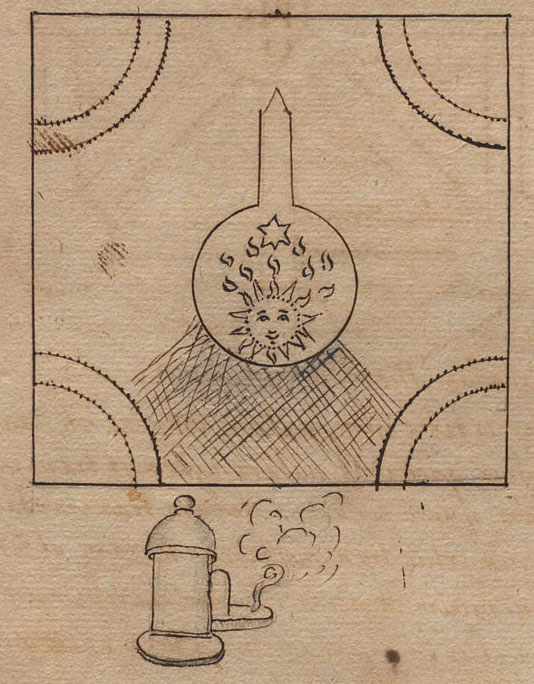
Raymond Lullius, ch. 3
The first radical artificial principle is God, the creator of all things;
the second principle, the exemplar, is moved by God himself, who is called Wisdom;
but the third, succeeding principle, which is the matter created by God, that is, by Wisdom, which is moved by Him, is the primordial element which we call hyle.
This, if you have well understood, we have explained to you: and it is not for you to presume to seek this in its simple species; with it, in that form, we cannot begin our work nor bring it to completion, but we must seek it in a composite species, and purify it and cleanse it by fire, so that it may be pure and clear; and know that the earth which we tread is not a pure element.
Nortone:
The elements are bound together among themselves by bonds by the hand of God,
nor do they depart from one another by any contrivance or by the power of human art.
The same:
Nothing upon the earth has more simplicity than the elements of our Stone.
Therefore, when they are in operation, they obey the constellation most of all.
The Fountain of Lovers:
It was in the time of the month of May,
when one ought to flee sorrow and displeasure,
that I entered into my little grove,
of which Zephyr was the gardener;
and as I passed before the garden
I was not clothed in silk,
but covered with humble cloth,
so as not to appear naked in public;
and, cheering myself with the desire
to drive my displeasure far away,
I heard a melodious song,
of many graceful birds;
then I looked at the gate
of the garden, which was closed.
But as soon as Zephyr perceived my gaze
he straightway opened it,
then at once withdrew again,
showing that he had not done this.
And when I saw this manner,
I drew back a little,
and then I went inside;
and that day I had not eaten,
I was very hungry and thirsty,
and I was carrying some bread with me
which I had kept for a week.
Then I saw a fountain
of very clear, pure and fine water,
which was beneath a tall thornbush;
cheerfully I sat down nearby,
and with the bread I made soup from it,
then I fell asleep after having eaten
in this gracious little grove.
And thinking I was awake,
by a strange event I was left amazed,
for I saw come forth from the fountain,
which was pleasant and wholesome,
seven little streams, which I had not seen,
since I had lain down in that path,
which had soaked me so badly
that I was all over stained by it.
There the water was lost in great quantity;
then I begged a reasonable lady
who was in company,
to tell me the meaning
of the fountain and of the little streams
that are so lovely and fair,
and whose the little garden was,
so well ordered in all its parts.
of trees and fragrant flowers,
watered by running waters,
in such a way that the like of it I never
seemed to have seen; but
she said to me very gently:
“Friend, you shall know how
this matter goes; with great desire
listen to me patiently:
in the fountain there is a thing
that is very nobly enclosed;
whoever should know it well
would love it above all things.
Whoever wished to seek it, and, having found it,
to lay it on the earth
and dry it into fine powder,
then again in its own water dissolve it,
but first they must be separated,
and then the parts joined together.
What the earth would set to rot
in the water which ought to nourish it,
there would be born from it the fruit with double breast;
but if the rottenness were removed,
of which neither she nor her fruit has any care.
The little maiden of whom I speak
is painted in various guises,
for she rises into the air, flying on high,
then descends again, sinking down to the valley,
and in descending she takes on her form.
in the form that nature gives it;
and there is a dragon that has three throats,
hungry and never sated.
Around him everyone turns,
encircling him like a wheel
and pursuing him with fierce hunts.
until the fat one opens its face to him,
staining it and smearing it with glue;
then she squeezes it and eats it,
she brings it forth again in the same way,
and this she does lovingly,
much more powerful than before.
And then he drinks it like apple juice;
thus the little child, in his own fashion,
often drinks and becomes a child again,
so that he truly becomes clearer than crystal
and like talc;
and when he is thus shining
he believes he is devouring his mother,
who has eaten his brother and his father,
even while she suckles him and broods him.
The dragon, fiercest in his own nest,
divides his mother into two parts,
who helps him after this division.
who helps him after this division,
and then he frees her in three mouthfuls
which have seized him in an instant;
then he is the strongest that is in the world,
never is there anyone who can confound him.
Marvelous is he and mighty;
an ounce of it is worth a hundred of fine gold.
It is a fire of such a nature
that it passes through every rottenness
and transmutes it into another substance
when it has come to its own likeness,
and it heals all diseases
abscesses, leprosy, and the gout
and in old bodies it sets youth,
and in the young, sound judgment and gladness.
Such is the miracle of God.
this the Theriac cannot do,
nor anything that is found under heaven,
save that which has been approved
by the ancient prophets
and by doctors of physic.
You must know that this serpent,
of which I spoke to you at first,
is governor of seven little streams,
which are so loving and fair;
thus he wished to figure them,
but in another way I wish to name them:
it is a Stone, noble and worthy,
made by divine science,
in which virtue abounds
more than in a thousand that are in the world.
It is found by Astronomy
and by true philosophy;
it comes from the mountain
where no alien thing is born.
where no foreign thing is born,
that is, one finds that it grows on high
with everything that it needs.
This fountain of worth
is a lady of honour,
who is called Nature,
and she must be greatly honoured,
for by her every thing is made
and by that same is undone.
Knowledge is God’s gift,
which comes by inspiration;
thus is knowledge given by God
and by the same inspired into man;
and with it you learn what is good
in the school of your Master.
but before letter (writing) was seen,
the science was already known
by folk not clerical but inspired,
who ought greatly to be honoured,
for many have found the science
together with divine wisdom;
and still there is God omnipotent
to give it to his true servant
the science, as it pleases Him,
and this displeases many clerics,
saying that no one is sufficient
who has not been a student,
that whoever is not master of arts or Doctor
receives little honour among clerics,
and for this they ought to be blamed,
when they know not how to praise aught else.
But he who truly wished to punish them
would have to take their books away from them;
then knowledge would be lacking
in many clerics, doubt it not already.
I, who am called Nature,
have the earth encompassed
without, within, and in the midst;
in all things I have taken my place
by the command of God the Father.
Of all things I am the mother,
to all I give their virtue.
without me nothing has been
that is found beneath the heaven
which is not governed by me.
But while you understand the reason,
I wish to give you such a gift
with which, if you would do well,
you will be able to gain Paradise,
and in this world great riches,
from which there may come to you nobility,
honour and great lordship,
and every power in your life,
for in joy you will use it;
and many noble deeds you will behold
from this fountain and cavern
which governs all the seven metals;
that they come from it is a clear thing.
But of the fountain I am the mother,
which is sweet as honey,
and among the seven planets of heaven
it is compared, that is, to Saturn.
Jupiter, Mars, and the Moon,
the Sun, Mercury, and Venus –
understand well, now you have come to it:
the seven planets that I have named
we compare, without dispute,
to the seven metals that come from the earth,
for all are made of one matter.
Gold you must take for the Sun,
which is a metal without equal;
Mercury is quicksilver,
which has the governance
of all the seven metals, because it is their mother,
just as it shows itself,
for it can perfect the imperfect,
and afterwards.
Now understand what I shall tell you,
and how I shall declare to you
the fountain of holy Nature.
which you see here nearby in the figure;
if you know how to set Mercury well to work,
as the writing tells,
you will make a Medicine from it,
through which you will then gain Paradise,
with the honour of this world,
where much good abounds.
You must know, by Astronomy
and by true philosophy,
that Mercury, of the seven metals,
is the matter and the principal one;
and by its leaden weight
it remains beneath the earth in a mass,
notwithstanding that it is volatile
and, with the others, very transformable,
and it is found beneath the earth,
just as the dew is,
and then in the air of heaven it rises.
I, Nature, tell you this,
and if then you can understand
and wish to have a medicine from it,
the mercurial one, in its vessel
you shall place it in its little furnace
to make sublimation,
which is from God a noble gift,
which I wish to teach you,
as far as I can and show in figures;
for unless you make body and soul pure
you will not make a good amalgam,
nor yet a good completion.
Therefore apply your judgment,
and understand it if you wish to know it.
and good sense is better than riches.
Take your body, and make it wise,
as others have done, you know it well.
The spirit must be well cleansed,
so that it may be able to be incorporated,
if you wish to make good battle;
for against it, it must be strong,
and if your body cannot destroy it,
then, at that hour, it must die.
Such is the first battle
of Mercury, so strong and fierce.
Therefore you must, without gainsaying,
first make of your body a spirit,
and then incorporate the spirit.
into its body without separating it;
and if you do not know how to do all this,
if you do not begin to do this,
after this conjunction
the operation begins,
which, if you follow it,
you will have the glory of heaven.
But you must know from this book
that I, Nature, reveal to you
that the Mercury of the Sun
is not like the Moon,
because it must always remain white,
in order to make a thing resembling it;
and that which serves for the Sun
must first make itself like unto it, and then,
for it must be rubified;
and this is the first operation.
Now then, clearly understand the reason:
the masculine well accompanies itself
with the feminine in friendly wise;
and when they meet clean and pure,
and the one is coupled with the other,
they make a most certain generation,
so that it is a work most high.
Now we have said a thing
that must briefly be enclosed;
and if you wish to proceed well,
you must make the union of the two,
so that, as married, they may be
in the vessel where their being is;
and afterwards, to separate your matter,
I advise you to arrange it well,
and, to tell you the manner of it,
it is nothing else but dissolution,
which is what you have need of
if you wish to follow the magistery.
It declares the composition of the work
exactly as you must do it,
until each one of them is set apart;
and then, when the earth has thirst
for the water of heaven directly,
since they are all of one nature
and it is right that it be watered,
and by me you will be governed.
Now I have told you without erring,
how your body can take on soul,
and how one must divide it
and separate the one from the other.
but separation, without doubt,
is the key of the whole work;
by fire it is made perfect,
without it the art would be imperfect.
Some say that fire begets nothing
of its own nature but ashes;
but of them I ask pardon –
Nature has entered into the fire,
for if Nature were not in it
never would the fire have heat.
And if you would prove this,
you shall take the sun for witness.
But what need is there of this discourse?
Let us leave it, to speak of other things;
and when I had heard this discourse,
its meaning I wrote within my heart.
the meaning I have written in my heart,
and I said: “Noble lady of honour,
in your grace grant me audience,
and let us return to the seven metals,
of which Mercury is the principal.
Give me a reason for this
with some explanation,
or else I have been tricked by you
in what you have said above;
for you wish that I undo it,
and yet you say it quite absolutely.
I do not know whether you tell it plainly
or whether you speak in parables,
for I do not understand your school.”
Thus Nature replied:
How do you understand the Mercury
that I have named above?
I tell you that it is shut up,
although it often happens
that it goes and comes into many hands.
The Mercury of which I speak to you
is the Mercury of Mercuries,
for which many people set themselves to study,
seeking to find it according to their intention,
for it is not common Mercury,
and without me you cannot find it.
But when you wish to make use of it,
you must be very learned
to arrive at the practice
by which you may obtain
great knowledge of our works.
You must needs know the metals,
otherwise your work will be of no worth;
and, to understand the manner better,
I will tell you where the work is placed,
and also where it begins.
If you are a son of doctrine,
and whoever wishes to attain to it
must needs come to this,
or else the undertaking will be worth nothing,
however much he may do upon it.
And therefore I call it the fountain,
which is so loving and wholesome;
Mercury is the true spring,
which is the cause of its perfection.
Now understand what I shall tell you,
and to reveal it to you I will say but one thing:
that Mercury without equal
you can find in the Sun.
when it is in its great heat,
and when it makes many flowers come forth.
because after the flowers come the fruits.
This point I myself can prove,
and moreover in a hundred ways
which for this fact are very easy;
but this is the beginning,
and therefore I say it to you again:
surely I have not deceived you,
for it has been found to be true.
Putrefaction is to be seen,
from which there will arise a noble treasure;
upon this point the mastery rests,
in which the work is achieved.
And though I have told you before,
here the whole business consists:
in the furnace the order is set,
and you must have one like it,
because the sprout must rot
before it comes forth out of the earth.
Likewise the human seed,
which I set before you as an example,
rots in the woman’s womb,
and becomes blood, then takes on a soul,
but in the form of a creature.
This secret Nature tells you,
for from it there shall be born a thing
that will know more than its master,
to suckle the four children
who already have grown great,
which are called the elements
and are separated one from another.
Now you have five things together,
and each one well resembles the other.
and thus it is a single substance,
all of the same likeness;
there the son must eat the mother.
and then destroy his father.
Flower, milk, fruit, and blood
you must find for me in a pool.
Now consider whence the milk comes,
and what it is fitting to make of the blood;
if you do not know how to consider this,
you waste your labour in working.
Then Nature said:
Do not trouble yourself.
My son, I must teach you
to know the seven metals,
of which Mercury is the principal,
their strengths and infirmities
and their most truthful qualities.
Then you must learn
whence sulphur, salt, and oil come,
of which I remind you,
for you will have need of them again,
and sulphur is very necessary,
which will give you much to do;
and without salt one cannot put into work
anything useful for your undertaking.
Of oil you have great need,
and without it you will do nothing good;
of this you must be mindful
if you wish to attain to the work.
One word I tell you, mark it well,
whereby you will find yourself very content:
one metal in a single vessel
you must place in a little furnace;
this is the Mercury that I show you,
and there is no need of aught else.
But, to shorten the work,
point by point I reveal it to you.
Now I wish to speak to you of gold,
which of metals is the treasure;
none of them is more perfected than it.
of those that I have named above
the Moon is so also, and yet it is not –
of this I give you assurance.
There is no metal in the world
in which our Mercury abounds,
and yet in all seven it is found;
this I have very well proved.
Gold is hot and dry outright,
the Moon is cold by nature.
I told you this in the well-known chapter,
I know not if you remember,
that the work consists of two parts.
I, Nature, reveal it to you:
make your sulphur penetrating,
by fire make it attractive,
and then make it eat the mother;
you will know how to complete the work.
place the mother in the womb of the son,
whom she has brought forth just before;
then it will be called Father and son,
all perfect with two spirits.
In truth it is nothing else
but that which I propose;
and if you add to it
sulphur, salt, and oil, and nothing more,
otherwise, to see the result, your work will be worth nothing,
for the earth cannot bear
any other fruit than what can be sown.
Creature begets creature,
and beast, beast according to its nature;
so it is with all seeds.
Remember this my science,
my son, do not say that it is chatter;
it is necessary that all go up and down, rise and descend.
by a very gracious road,
very delightful and very loving,
our pure and well-ordered water.
it goes just like the dew:
in the air of heaven it makes it rise,
and then gently let it fall
by a most loving path,
which must be well followed;
in the descent that it makes
it brings forth the perfect sulphur,
and if you can come to this point,
without lying you may well say
that of gold you will be able to have on earth
great quantity without falsehood.
For if all the sea were
of metal such as you would wish
copper, quicksilver, lead, or tin
and you were to put upon it a single grain,
it being well heated,
there would arise a vapour
that would cause marvel;
and afterwards this would be retained,
and then, when the smoke should have passed
and all had grown still,
you would find the sea of fine gold
such as no king has in his treasure.
Therefore, look well at the figures
in our books, where by writings
this science is declared,
which is the flower of wisdom.
My name is Gio. della Fontana;
in working I have not lost my toil,
for in the world the work of gold
that I have accomplished is multiplied.
Warning from Nature to the wandering Chemist, by Gio. Mehung:
You think to fix quicksilver,
which is volatile and common;
the metal is not made in this way,
and so you lose what is yours and what is others’.
you will never find anything in it
if you do not enter into my forge,
where I am always hammering and working
metals and earthly ores;
and there you will see the ways
and the matter that I use.
Do not think that I will reveal to you
my secret, which is so precious,
unless first you go to find
the sprout of all metals,
of animals and of vegetables,
which are held in my hands
and kept within the earth:
the one so far as generation,
the other for nourishment.
Metals have nothing but essence;
herbs have being and growth;
beasts have the sensitive power,
which is more than the vegetative;
metals, stones, and pigments
are generated from the elements;
of these I make this mixture
and first composition
here in the womb of the earth.
If you wish to know where I take
the matter, first I open
the little study of my secrets
with subtle and discreet devices,
and I go to seek the true matter
nearest at hand for making ore,
which I take from the bowels
of my four diverse elements,
which is the first seed,
containing a substantive form,
with compounded simplicity,
prepared and well disposed.
to transmute the four into one
under a common general kind;
then I give it so kindly am I
by my art a metallic virtue,
of which are made metals, pure and impure,
some soft, others harder.
I have drawn it from the elements,
with my heaven I have thus shaped it,
which with long time I carry
from the first matter
into proximate and proper matter;
of this I make my ore.
Then I unite sulphur and quicksilver,
which is converted into metal,
but not that sulphur and quicksilver
which you see; never allow that.
He was my master and creator,
who commanded, as author,
that of the universal matter
I, as his handmaid,
should transmute the four elements
by my acts and governances
into one general form
of every mineral kind.
If the earth is surrounded
by the heavens with which it is adorned,
receiving their influences
and most gracious substances,
by which its virtue is great
and penetrates even to the centre,
then, through motions and through heats,
vapours are generated in the earth,
and so they make the exhalations
of the first compositions.
The vapour is cold and moist
when it stays and abides
and is retained in the earth;
but if it goes forth from the cloud,
humid and hot it may be,
the other which remains earthly,
being shut up and enclosed;
for a space of time I dispose it
into sulphur, which is its agent,
with its passive living silver.
Then it is the second mixture
of the first composition.
The whole is drawn from the mass
of the four elements which I gather,
as I have told you here above;
and for your sake I speak of it often,
so that you may not go astray
and that in the practice you be not confused.
Thus my dear Mercury,
of the elements and their matter,
then its sulphur follows it close,
as one single thing, united,
he warms it little by little,
gently, according to its nature;
then the cold becomes endowed with virtue,
and the dry, moist and full of virtue.
Now understand from this and from that:
the moist does not stand without its dry,
nor yet the dry without its moist,
for the one abides with the other
under a primitive kind
which is elemental,
the spirit and the quintessence,
from which our son takes his birth.
Fire brings him forth and nourishes him
in the air, but first he putrefies
in the womb of the virgin earth;
then there comes from it the water, of which little is needed,
which is the first matter,
from which I begin the mine,
the matter with which I work.
stones, metals, trees, grasses,
brute beasts and rational ones –
these are the praiseworthy works
and universal of every thing
that is shut beneath the sky.
I take it, and I do not lie:
from the four elements alone
is the first matter,
Chaos, hyle, and the flesh,
with which I make the King rejoice
and the Queen with all her pomp,
the Knight ever ready and in trim,
and the chamber-maid makes the array.
And the more noble the form is,
so much more nobly do I fashion it.
Know that I have every power
and to sustain every essence,
and set them in motion,
from form into exciting matter.
The wise and prudent man must
consider that such operation,
such virtue and such science
cannot be without the intelligence
of the heavenly bodies in order to give it,
and without their power to conduct it;
otherwise he would be deceived
who wished to practise it without me.
Whence would he take their influence
to infuse such a substance,
how would the union be made
and the true proportion
of no single element bears the sign,
as Avicenna rightly says.
My son, have pity on yourself;
I beg you, think on me,
understand well what I shall say,
for in nothing shall I lie.
See a little, listen now,
and you will clearly see how gold,
which is so noble and precious,
has taken its fair form in heaven
and its good matter in the earth,
and thus the fair gem and stone is made,
such as rubies and diamonds.
All is made from the four elements,
as regards both matter and form.
Heaven impresses the quality
into the element already contained,
from which the strength returns,
made noble by purification
and by long time in perfection.
Thus then, if you do not know how to make
a little lead according to my example,
or some tiny grain,
or of some herb a single tip,
or even less, to work with iron,
how then do you wish to set about heating
to make that which is more noble,
from which ducats and nobles are made?
And if you say, “I do not at all wish
to make gold, but [only] Alchemy,”
I answer you, unknowing one,
that you are more mad than before;
you have not understood what I have said,
for my secret is forbidden to you,
since for that which is done by nature,
is not wrought by the creature;
and besides, if I have made the gold,
of the seven metals the most perfect,
this you could not comprehend:
how darest thou to undertake
to wish to do it with such doings?
that which perfects the imperfect,
and in which I have placed the power
to transmute all the essence
of metals into good and fine gold,
and this is what I keep in the treasury.
Since no one knows how to make gold,
and since this is the treasure
of treasures, incomparable to others,
it is an irreparable error;
for if you cannot carry ten
and you wish to carry a hundred, I tell you
that you weary body and heart,
and while you do so, know its power.
Son, this is all my science,
my lofty knowledge and my power,
which I take from the heavens in simple wise,
and from the simple of the elements.
It is a primitive essence,
and a fifth one in the elemental realm,
which I make by reductions,
with time and circulations,
transmuting the low into high,
the cold and dry into moist and warm,
preserving stone and metal
under its radical moisture,
and with the motion of the heavens
so noble and so precious is it,
and know that the elements
have from the heavens their governances,
the elements obeying, as is fitting,
to their heavenly influence;
and the purer my matter is,
the more I am in the heavens a great mistress.
Do you think that your little furnace,
where earth and water are placed,
and that with your fire and heat,
with your white or red colour,
making of me as you please
to reach your desire,
do you think to move the heaven
and take its influences
to pour them into your ingredients?
Do you think they are organs
that can be made to sing with the fingers?
It is too much to believe, coarse man.
Do you not know that by the motion of heaven,
which has its intelligence here below,
and what it does with its influence,
to give being to all things
I beg you to be willing to believe
that the other things from the high place
proceed from me through the agency of God,
and do not believe that manual art
can be as perfect as what is natural.
In conclusion I tell you,
if you would rightly mark my words,
I do not wish to deceive you:
you cannot communicate
with your artificial fire
the great heat that comes from heaven,
nor with your water, oil, and earth.
will you be able to acquire a matter
that can receive the influence,
so as to give it such a substance;
it is a gift of God given from heaven
to the elements, to whom it best may fall.
preserved in its simple essence
of which none but I has knowledge,
except the one who trusts in me
and who well knows philosophy.
Son, I speak but a single word,
and this the Creator who understands me knows:
that the work is made complete
from one single, base matter,
homogeneous in a single vessel,
well closed and in a single furnace;
in that is contained that which perfects it,
and by regimen alone it is done.
Now behold the generation
of man and his perfection,
where I wholly yield my judgment
and the knowledge that God grants me,
for I know how, from one matter,
to make the human species, not entire.
I fashion only the body,
but so subtly
that neither Plato nor Aristotle
ever understood a jot of it.
Therein I make the hard bones
and the teeth for chewing,
the soft liver and also the flesh,
the cold nerves, the moist brain,
the warm heart where God puts life,
the entrails and all the veins,
arteries full of red blood
the whole from a single quicksilver,
with the acting male sulphur
I make it in the single maternal vessel,
in the womb where the furnace is.
Now, son, if you wish to fashion
and to begin so noble a work
neither ducats nor nobles are needed,
or else only in small quantity;
it is enough that you be at liberty
and in a place that is favourable to you,
so that no one may know your artifice.
Prepare well the matter,
set alone in the powder-chamber,
a single vessel with its water,
well closed within a little furnace;
let it be governed with due regimen
by a heat well tempered,
which will accomplish the action
together with the cold of putrefaction,
for through great frigidity
it will not be able too much to stir it up
nor to resist against such an agent,
so that it may not soon become quicksilver,
and, by an ordered conjunction,
be made one homogeneous thing,
reduced to the first matter.
let your intention be entire,
follow your mother Nature,
and let reason be your nourishment
and philosophy your guide.
And if you do this, I assure you
you will have means and matter
to arrive at this high good,
and with a thing that will cost you little
you will work, provided that you taste
my principles; observe how I work.
And if through your study you know so much
that you know the virtues
of the heavens and their great actions,
of the elements their passions,
and why they are susceptible,
and that your ways are convertible,
and what causes putrefaction,
to generate and to nourish
their essence and substance,
of this you will have knowledge of the art,
though it is enough only
to have good judgment
in the consideration of my works.
Leave blowers and sophistical men
and their diabolical labours;
leave furnaces and diverse vessels
of those false and perverse blowers.
I beg you first of all
to leave their dung-fire,
which is neither profitable nor good,
nor yet the fire of charcoal.
Leave metals and other such means
of transmuting the four elements
into a transmutable species,
which is the most notable matter,
marked out by philosophers
and little esteemed by the ignorant,
like to gold in substance
and unlike to it in essence.
The elements you shall convert,
and what you seek you shall find.
I say that you must sublime the lowest,
and make the most sublime become the lowest.
Reply of the Chemist to Nature:
While, you say, you hear some gloss
that it is made from a single thing,
from one vessel only, from one substance,
because the four make but one essence;
within it is all one, and in effect
that which begins it makes it perfect;
nothing is lacking to its worth
save only a little heat,
which man administers to it with care.
Then you say and give to be understood,
so far as I can comprehend,
that in that lies perfection,
and that its action cannot
bring to an end in so noble a form
unless human art conform itself to it.
By human art I mean the science
of philosophy and prudence,
which comes with its hands to prepare
the matter, and then to separate
the superfluous and place in glass
the compounded yet simple earth,
which is wholly one with its water;
and then to close the vessel well
over a fire well disposed.
This is all, as far as the artifice goes;
anything more man cannot do.
let him do and say what he will;
but when you, who are the operatrix,
enter within the powder-house,
after the preparation
you make the dissolution,
and reduce the salt into water
by way of celestial sublimation.
So wise and honest are you;
in the end you alone do this,
by perfecting imperfect things.
And it is true that all the things
which are enclosed beneath the heaven
are made of the four elements,
and have their just quantity,
in proportion according to nature,
well mingled according to their make,
not indeed all united properly,
but distinctly in their virtues.
chiefly, the matter
of the true and entire Stone
I mean the vermilion quicksilver
and the perfect body that is called the Sun
are four, and each element
is joined inseparably
and mingled in notable ways,
not by human art to be separated;
for all good physicists
and ancient philosophers
have written, and very clearly,
that the element of fire and of air
are shut up and kept enclosed,
the one in water and the other in earth.
The fire is strongly shut up
in the earth, and the air in the water,
and no element can
show its power at all
save in water or in earth;
and there they are strong and wage fierce war,
together, inseparably.
No one can truly
free them from this confinement
except God and you, Lady Nature.
Boldly I can attest this
and physically confirm it,
for the fire there is invisible
and likewise the air imperceptible.
Whoever says that they can be seen
separately has a mind to deceive,
for by arguments quite notable
the elements are inseparable.
And therefore no mixture is made there,
but only an administration
of fair principles of Nature,
which for such a need she provides.
and that which she generates and leaves to us
that is what art must catch in its snare.
Ultimately, and finally,
it is proved that in very truth
no separation is made
of the four elements, in effect,
of the quicksilver and of the sun,
that is, of the gold that is called vermilion,
for making the perfect Stone;
to think so is a tainted error
against the noble art of Chymistry
and profound philosophy.
It is true, without telling a lie
and without swerving from the truth,
that every elemental thing
is nourished by the elements.
Now then, if they are well disposed
and on that supposition composed,
as Nature produces them,
when division comes, then the support is destroyed,
this support is corrupted
which bound all the elements,
and there is no more mingling.
But to separate a thing already made
of the four elements and undo it
is certainly not necessary,
nor ought it to be done,
that the Father who begets the Son
should be destroyed I will not undertake it.
be undone; I do not wish to undertake
that, in so doing, it be destroyed.
But it is enough that it have the generative spirit with the seed,
which the womb of the woman
receives and warmly keeps,
and such spirit truly
is that of the son generated.
Avicenna makes mention of it
when speaking of generation.
So it is likewise
with fine gold, which is surely
the pure matter of the Stone;
as the true philosopher says,
it is the Father who governs all.
Thus it must not be destroyed,
nor corrupted nor separated
from its elements, well purified;
but it is enough that the Sun, the Father,
by breathing forth his spirit, cause it to prosper,
and that he pour in strength and virtue,
and with that spirit give it to the Son
in virtue whereof, in the true Stone
of the philosophers, taken whole,
and with the generative spirit,
the substantial Son is formed.
Lady, from you I have learned so much,
and of your secrets been taught,
that the chymic art is notable
and a science more than true.
And I also say that this vermilion gold
is the true Father, called the Sun,
of the Stone and of the Elixir,
from which so great a treasure may come forth;
for it warms, enkindles and fixes,
digests and tinges by its art,
without any diminution
or any corruption
of that same gold which is the Father,
and his Son greatly prospers.
Now then, it is not fitting for us,
nor is it necessary nor proper,
to undo the unions
which Nature has proportioned,
nor to separate the elements.
so well conjoined and ordered
in right and due quantity,
in complexion and in quality,
of the quicksilver within and without,
and likewise in the perfect body
of the Sun, as has been said;
and it is a sentence and true decree:
if we are ignorant of the science
of Nature and the knowledge
of the mixtures and unions
of these four elements,
we are equally ignorant
of their separations.
I recognize that it is great folly,
in the end loss and melancholy,
to waste time at the furnaces
in quicksilver and strong waters
and in common dissolutions,
and in all mineral things,
in dung-fire and charcoal,
for never is there any good thing there.
Wherefore, Lady, I conclude
that I shall more and more
be attentive to your book
and with all my strength imitate you,
because this is the road and the way
most sure that man can have;
and it is certain that this art
comes to us from you, though late,
not without cause, for its nobility,
the treasure and the loftiness
of this great good and lofty oracle,
which in you is almost a miracle.
Now, Lady, how am I to understand,
so that I may not waste time
under your banner and standard?
since your discourse teaches me
sooner today than tomorrow
I wish to set my hand to the work,
in accordance with your command.
I shall first take
the matter with its agent,
which will make the fair living silver,
and I shall place it in the vessel,
well closed upon the furnace,
surrounded by an enclosure;
and then you, Lady Nature,
will do what you know well how to do,
so as to bring your work to its end,
which is so hidden and profound
that nothing richer is in the world.
Nicolas Flamel – philosophical summary
The dragon figured without wings
is the sulphur: such is the thing,
which never takes its flight
from the fire; this is the first preparation.
The other serpent that bears the wings
is quicksilver, which the wind carries,
and it is of feminine seed,
made of earth and water from the mine,
and therefore it does not dwell in the fire,
indeed it flies away when it sees the hour;
but when there must be seed they are separated,
yet they are alike and well conjoined
by a triumphant Nature
within the belly of Mercury,
who is the first-formed metal,
and it is that which is called
the mother of all the other metals.
Philosophers of mountains and valleys
have called it the flying Dragon,
because a Dragon, when it departs,
is inflamed with its own fire.
it goes into the air, casting little by little
fire and poisonous smoke,
which is a most hateful thing
to look upon in such ugliness.
Just so does Mercury do
when it is upon the common fire,
that is to say upon any fire,
in a vessel very well placed,
and the common fire arranged
to kindle straightway
its natural fire, sharp and keen,
which at the bottom of it lies hidden.
Then, if you wish to contrive
to see something of the truth,
with the common fire called vegetable
it will be kindled with ardour
by Mercury’s fire of nature
of Mercury’s natural fire.
Then, if you are watchful,
you will see it, as it runs, cast into the air
a poisonous smoke,
ill-smelling and malign,
far worse in flame and in poison
than is the feast of a Dragon
fleeing by force from Babylon,
which it encircles for two or three leagues.
Other wise philosophers
have wished to seek so far
that they have figured it in the form
of a flying lion without deformity,
and they have also called it Lion,
because in every region
the lion devours the beasts,
though they be very young,
eating them at his pleasure
whenever he can have them,
save only those that have strength.
against him they set themselves in defence
and withstand with great strength
his fury when he strives,
just as Mercury does.
And, to understand the effect better,
whatever metal you place with him,
with him – mark well these words –
immediately will lose its form,
it will devour and eat
the lion made in such a manner.
But at this point I exhort you:
there are two metals of worth
which surpass him in value
in every perfection;
one is called gold, without pretence,
the other silver – and this no one denies –
and this is well known to everyone.
for if Mercury is in fury
and his fire is kindled in ardour,
he must, by his own working,
take these two perfect metals
and place them in his belly;
together with all that enters there,
he will consume them in nothing.
And, to understand this point well:
they are harder than he is,
and also perfect in their nature.
Mercury is an imperfect metal,
and therefore in him there is not made
a substance of perfection
this, as a true declaration.
vulgar gold comes from Mercury,
and it is a perfect metal, I assure it;
of silver I say the same,
without adducing any other reason,
and likewise the other metals,
imperfect, growing here and there.
they are all generated from him,
and therefore there is no one
of the philosophers who does not say
that it is the mother, without telling a lie,
of all the metals, certainly.
And therefore it surely follows
that as soon as Mercury is formed
there is in him, without anything more,
a doubled metallic substance;
this is clearly shown:
it is all, and first, from the one,
the substance of base Luna,
and afterwards that of the Sun,
which is a metal without equal,
for Mercury, without doubt,
is formed from these two substances.
being in the belly, in spirit,
of the Mercury that I have described;
but soon after nature
has formed that Mercury
from the two spirits aforesaid,
Mercury, without further contradiction,
asks only to form them
all perfect, without deforming them,
and bodily to make them,
without wishing to be rid of them.
And as was said above, fol. 63:
the ore of lead, without doubt,
is not without a fixed part
of gold and of silver, I know it,
and nature has placed this there
as God has permitted;
and this is surely
that which truly multiplies,
and one may, without contradiction,
come thereby to perfection.
and in all its full power,
as I know from experience,
and this for truth I assure you:
that is, not separated
from the mine, but well purified;
for every metal, being in the mine,
is Mercury, so I say,
and it can be multiplied
as much as it has substance
of its Mercury in truth.
Likewise the perfect metal,
which is gold, comes to the same effect;
for when nature has generated
that fair grain, perfect and created,
you may be certain it is from Mercury.
which always, at every hour,
without failing will be nourished,
will increase and will be perfected
in its Mercury, he being there;
and one must wait until
there is some substance
of its Mercury, without doubting,
as the apple does upon the tree.
And I make it known to every man
that Mercury in truth
is the tree – mark well this saying –
of all metals, whether they are perfect
or others that are called imperfect;
yet they cannot have nourishment
save from Mercury alone;
and therefore I say, to reason upon this
and to warn you,
that if you wish to gather the fruit
of Mercury (and I speak of what follows),
and of Luna likewise,
it is necessary that they be separated.
far apart in every way
one from the other, without much delay,
do not think to bring them back
together, nor yet to re-join them
as nature had once done;
of this beforehand I assure you.
But then they go to seek the fruit
upon the tree that belongs to them,
which swells and multiplies
from day to day, until the tree bends;
gladness they have in seeing such a work,
and for this reason they embrace the tree,
without in any way plucking the fruit,
so as to replant it nobly
in another, more fertile soil.
more triumphant and more noble,
and which will give nourishment
in a single day, by good fortune,
to the fruit that in a hundred years it would not have
if it had remained in its first place.
In this way one must understand
that Mercury must be taken,
who is the tree so greatly esteemed,
venerated, named and loved,
having with it the Sun
and the Moon in company,
who are no longer separated
one from the other, but together have
the true fellowship,
then, without delay,
to replant it in another soil,
nearer to the Sun, so that it may gain
from that marvellous benefit,
where the dew is enough for it;
for where it had been planted before,
the wind was incessantly troubling it.
and the cold is in such a manner
that it can bear little fruit,
and it stays so for a long time,
bringing forth only small fruits.
The philosophers have a garden
where the sun, evening and morning,
and day and night and at every hour,
continually makes its dwelling,
with a gentle dew
with which the earth is well watered,
bringing forth the trees and fruits
that are planted and tended there,
and they receive due nourishment
with delightful pasture,
and thus from day to day they ripen,
receiving a most sweet sustenance.
and there they become more powerful
and sturdy, not languishing,
in less than a year or so,
what in ten thousand, we would say,
they would not have done where they were
planted, where the geese used to wander.
And to understand the matter better
I wish to say that one must take them
and then put them in a furnace
over the fire, where it is night and day,
but it must not be a fire of wood
nor of charcoal, but, to know
which fire will be sufficient
must be a clear and shining fire,
no more and no less than the sun.
Of such a fire you shall make provision,
which must not be hotter
nor more burning, without any fault,
but must always keep the same heat.
It is fitting that this rule be noted,
for the vapour and the dew
will defend it from being altered.
the seed of all the metals.
You see that the fruits of plants,
if they have a heat too burning,
without dew, in scant supply,
will remain dry and tight;
the fruits upon the branch will die
or in no perfection
will they in the end arrive.
But if they are nourished with warmth
and with suitable moisture,
they will be fair and triumphant
on the tree where they take their nourishment,
for heat and moisture
are in truth the nourishment
of all the things in the world.
that have life on this I ground myself
such as plants and animals,
and likewise minerals.
The heat of wood and coal,
that is not over-good for them.
Those men take common gold and silver
with the common Mercury,
and then do them so many harms,
tormenting them in such wise
that it seems the lightning carries them off;
and with their foolish fancy,
their abuse and madness,
they think they are making
the Mercury of the philosophers and perfecting it,
but they can never attain it,
and thus they find themselves deceived
as to what is the first matter
of the Stone and its true mine;
they will never come to it,
nor find any good there,
if they do not go upon the mountain.
of the seven where there is no plain,
and from the summit they will look
at the six that they will see from afar;
and on the top of the highest
mountain they will, without fail, recognize
the triumphant Royal herb,
which is called mineral.
Some simple philosophers
call it Saturnine;
but it is fitting to leave the marc
and take the juice that comes from it,
pure and clear – of this I warn you –
to understand this manner better,
for from it you will indeed be able to make
the greater part of your work,
and the true gentle Mercury.
and the true gentle Mercury
of the philosophers, very subtle,
which you will put into the vessel,
and first all the White Work
and likewise the Red;
if you understand my intent,
choose whichever you wish,
and be sure that you will find it,
for in both there is but one practice,
both follow a single road,
that is, that of the sun and of the moon,
which is so easy and simple
that a woman, spinning at the distaff,
will not be inconvenienced at all
when she performs such a work.
Nicolas Flamel:
Explanation of the Hieroglyphs
The book of Abraham the Jew contained three times seven leaves,
for they were thus marked at the top of the page, the seventh of which
was always without writing, in place of which there was painted a little rod
and some serpents devouring one another. On the second seventh, a cross
where a serpent was crucified, and on the last seventh there was painted
a desert in the middle.
in the midst of which many beautiful fountains were flowing,
from which came forth many serpents that were running here and there.
He taught the metallic transmutation in ordinary discourse,
he drew the vessels at the side and noted the colours and all the rest,
except for the first agent, of which no mention was made,
but indeed it was so, as he said, on the 4th and 5th leaves entire.
This he painted and figured with great skill of design,
and although it was very clearly figured and painted,
nonetheless no one would have been able to understand it
if he were not well practised in their manner of writing
and had not greatly studied the books.
Thus the 4th and 5th leaf were without writing,
all filled with fair illuminated figures,
and in about this way, because this work was very neatly done.
First there was painted a youth with wings on his feet, with a twisted rod in his hand and surrounded by two serpents, with which he was striking a crest that covered his head; and it seemed to me, in my judgment, to be the god Mercury of the pagans.
Near him there came running and flying, with open wings, a great old man, who had a clock hanging above his head, and in his hands a scythe like Death, with which, terrible and furious, he wished to cut off Mercury’s feet. On the other side of the fourth leaf there was painted a fine flower on the summit of a very high mountain, which the wind was beating strongly; it had a blue stem, the flowers white and red, the leaves shining like fine gold, and around them Dragons and Gryphons of the North made their nest and dwelling.
On the fifth leaf there was a beautiful rose-bush in bloom in the middle of a lovely garden and on the 5th leaf there was a fair rose-bush in flower in the midst of a fine garden, rising near a hollow oak, at the foot of which there boiled a fountain of very white water, which was going to hurl itself into the abysses, yet nevertheless first it passed through the hands of many peoples who dug the earth seeking it; but because they were blind none of them saw it or knew it, save only a few who knew its weight.
At the last part of the 5th there was a king with a curved sword, who caused, in his presence, by certain soldiers, a great quantity of children to be slain, whose mothers wept at the feet of the cruel soldiers; and the blood of those children was afterwards gathered by other soldiers and placed in a great vessel in which the sun and the moon of heaven came to work.
Further discourse
Master Anselmo, who was a Doctor of Medicine and who studied greatly in this science, said that the first picture represented Time, which consumes everything, and that six years were needed, corresponding to the six written leaves, in order to finish the Stone; and he maintained that then one should turn the hour-glass and no more was required. And when I told him that this was only to show and to teach the first agent, as was said in the book, he answered that this decoction of five or six years was like a second agent. And that truly the first agent was there depicted, and it was the white and heavy water, which without doubt was quicksilver, which could not be fixed nor have its feet cut off, that is, its volatility removed, except by this long decoction in a most pure blood of children.
I found in my book that the philosophers call “blood” the mineral spirit that is inside the metals, and chiefly in the Sun, the Moon, and Mercury, to whose likeness I always looked.
Further discourse
Thus, whoever, having well weighed my words and well known and understood my figures, provided that he knows the first principles and the agent for surely he will not find any trace or doctrine of these in these figures so condensed may bring to an end, in the name of God and to His glory, the Magistery of Hermes.
Further discourse
I desire it to be believed that these figures and explanations are not made for those who have never seen the books of the philosophers and who, being ignorant of the metallic principles, cannot be called children of the science; for if they wish to understand these figures entirely, not knowing the first agent, they deceive themselves without doubt, and will never understand anything of them at all.
Therefore let no one blame me if he does not easily understand me, for he will be more blameworthy than I, since he is no beginner in these sacred and secret interpretations of the first agent, which is the key that opens the doors of every science; nevertheless he wishes to understand the most subtle conceits of the very envious philosophers, which are written only for those who already know these principles, which never are they found written in any book, because they leave it to God, who reveals it to whom He pleases, or else has it taught by a living voice from a master, by cabalistic tradition, and this happens very rarely.
Now, my son for so I may already call you, since I have now come to great old age, and on the other hand perhaps you are a son of the science may God grant you to learn and then to work to His glory; therefore listen to me attentively, but do not go any further if you do not know the principles.
chap. 2.
I fly in the heavens, and yet I have no wings;
without legs, without feet, I walk wherever I please.
I have no arms nor hands, and yet one sees me seize
and break apart the natural forces of two bodies.
I am a virgin and yet I have milk in my breasts;
I am pregnant with a son and cannot give birth,
unless my son with me fulfils his desires,
to draw from my loins the twin seed.
And when I am born I am horrible to look upon,
misshapen, my head a true bear’s face, and so black,
so stinking and bitter that everyone despises me;
but if I am nourished a little with heavenly milk,
I acquire such virtue that afterwards I make myself eternal
in earth, in water, in air, and in fire.
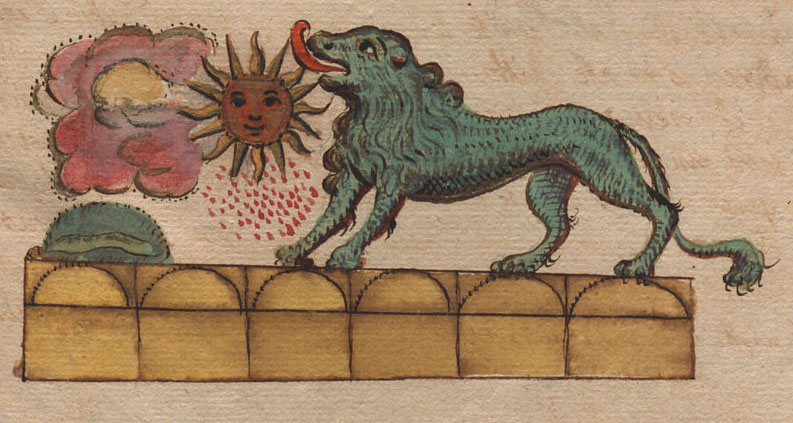
Take the flying spirit,
and draw it into the ray of the sun,
so that it may be gently fixed,
and the fixed may become volatile.
And cook this gently,
and from a part of it make earth,
which you place in the moist
that it may be well moistened;
quickly join the moistened [earth]
and grind it with an amalgam
upon a very hard stone;
then place this in its proper vessel,
so that it may be very well calcined.
Afterwards, soak it with its own milk,
and let it be multiplied inwardly;
then, being fitted in due time,
it is clothed with a white cloak,
and, royally multiplied,
it is reduced to ashes,
to which you give back its own sweat,
until, with a royal diadem,
the King is duly crowned
and, being very easily dissolved,
he enters into the body.
Thus you will have the Stone,
from which you will always rejoice,
as Master Gillotius asserts,
10 April 1620.