The Chymical Writings of Mr. Bernhard, Count of the Marck and Tervis, concerning the Blessed Stone of the Philosophers
Study the Art with Us Buy me Coffeehttps://www.alchemy-texts.com/book/chymical-writings-of-bernhard-count-of-the-marck-and-tervis/
The Chymical Writings of Mr. Bernhard, Count of the Marck and Tervis, concerning the Blessed Stone of the Philosophers
Translated from the Latin into German, and likewise brought to light with the annotations of Mr. D. Joachim Tancken and other learned men, by Caspar Horn.
Bernard Trevisan
Date:
1746
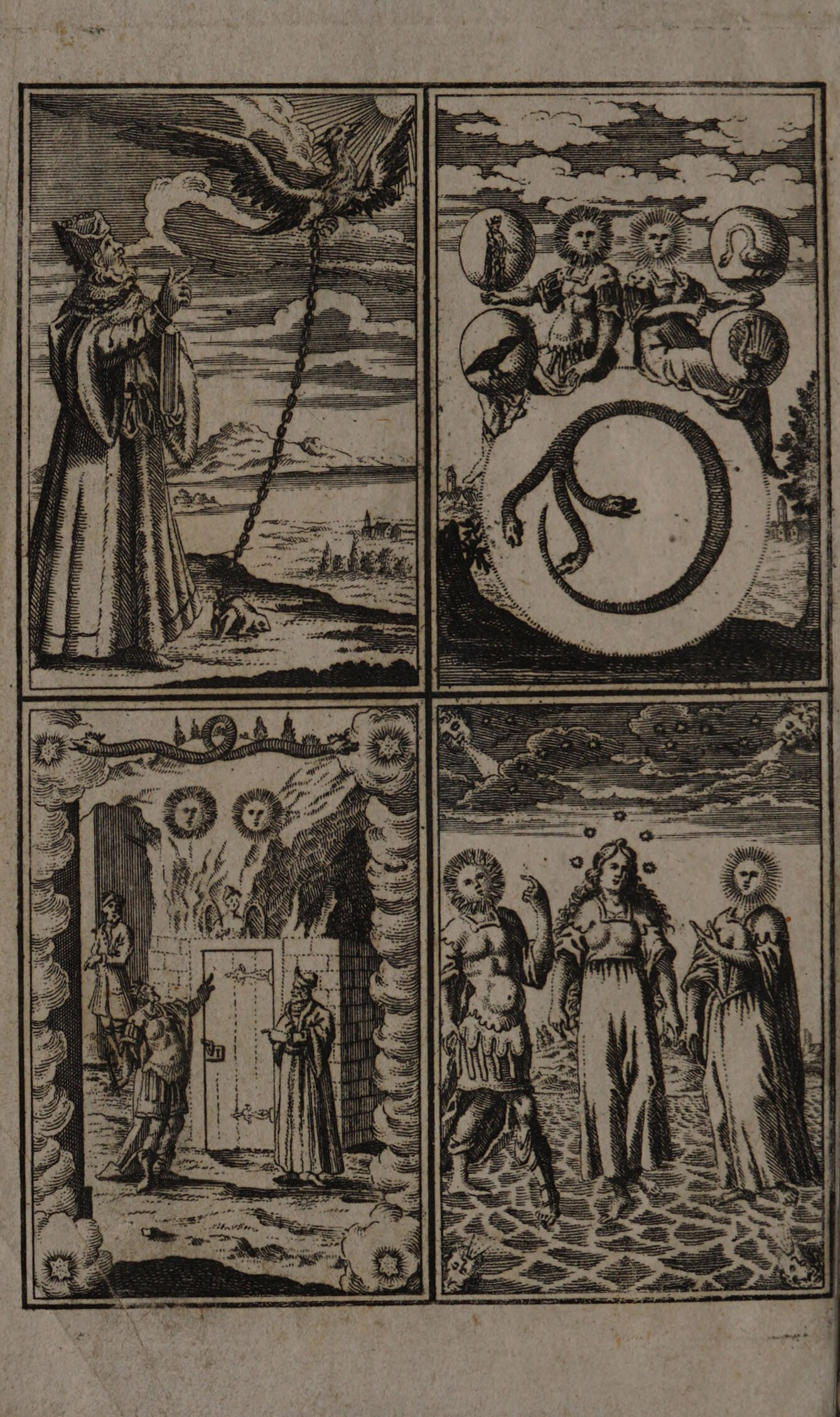
Translated to English by Mitko Janeski
Book name:
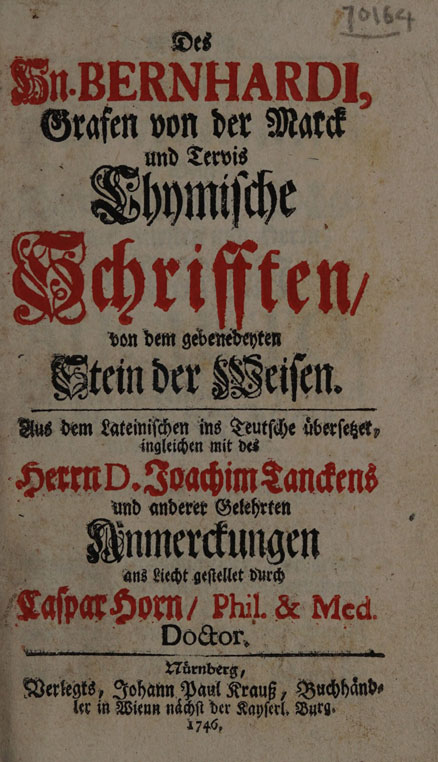
Des Hn. Bernhardi, Grafen von der Marck und Tervis chymische Schrifften von dem gebenedeyten Stein der Weisen / Aus dem Lateinischen ins Teutsche übersetzet ingleichen mit des Herrn D. Joachim Tanckens und anderer Gelehrten Anmerckungen ans Liecht gestellet durch Caspar Horn.
Date: Nürnberg : J.P. Krauss, 1746.
The Chymical Writings of Mr. BERNHARD, Count of the Marck and Tervis, concerning the Blessed Stone of the Philosophers.
Translated from the Latin into German, and likewise brought to light with the annotations of Mr. D. Joachim Tancken and other learned men, by Caspar Horn, Phil. & Med. Doctor.
Nuremberg, published by Johann Paul Krauß, bookseller in Vienna near the Imperial Palace.
1746.
of the
Chymical Writings
of
Mr.
BERNHARD,
Count of the Marck and
Tervis.
1. The learned Dedication of Mr. Caspar Horn, Philos. & Medicin. D. - Doctor of Philosophy and Medicine, Reipubl. Norimbergensis Physici Ordinarii. &c. - Ordinary Physician of the Republic of Nuremberg, etc., to the Most Serene, High-born Prince and Lord, Lord AUGUST, Prince of Anhalt, Count of Ascania, Lord of Zerbst and Bernburg, etc. etc.
2. Mr. Caspar Horn’s Preface to the Art-loving Reader.
3. The Dedication of Mr. Bernhard, Count of the Marck and Tervis, to the Noble and Highly Learned Mr. Thomæ de Bononia - Thomas of Bologna, Gubernatori - Governor in France, etc. etc.
4. Count Bernhard’s Preface to all Lovers of the True Art.
5. Another Preface by Count Bernhard concerning his Writings.
6. First Part of Count Bernhard’s Chymical Writings. Concerning the Inventors of this Art, and those who truly knew and possessed it.
7. Second Part of Count Bernhard’s Chymical Writings. In which it is shown which books he followed in his studies, and what incredible labor, time, and expense were spent upon them before he finally attained the Truth; furthermore, the true foundation of this Art is also treated.
8. Third Part of Bernhard’s Chymical Writings, in which the beginning and root of the Metals are treated, and this from solid grounds and clear proofs and testimonies of the Philosophers.
9. Fourth Part of Bernhard’s Chymical Writings, in which the Practica - Practice of the Philosophical Stone is taught parabolically.
10. Symbolum Bernhardi Comitis Palatini Marcæ Tervigianæ - Symbol of Bernhard, Count Palatine of the Marck of Tervis
11. A separate Treatise of Bernhard, Com. Terv. - Count of Tervis, concerning the Stone of the Wise, translated from Latin into German.
12. Count Bernhard of Tervis’s Epistle and Written Reply concerning the Stone of the Wise, to Mr. Thomam von Bononia - Thomas of Bologna, personal physician to Charles VIII, King of France.
13. A Dialogus - Dialogue concerning the Stone of the Wise, Præceptoris Georgii und Alberti Discipuli - between George the Preceptor and Albert the Disciple, in which the Fourth Part of Count Bernhard concerning the Practica Lapidis Philosophici - Practice of the Philosophical Stone is interpreted and explained.
14. A Short Explanation of the Little Fountain, or Fourth Part of Bernhard, left behind by Alberto Cayer, fratre Ordinis Carmelitarum - Albert Cayer, brother of the Order of Carmelites, of whom it is written that he truly made and possessed the Stone of the Wise.
15. Together with a small Treatise concerning the Two Flowers from which the Stone of the Wise grows.
16. Beginning of the Fourth Book of Bernhard, as it is written in the French language.
17. Epistle of Gallus Eschenreuter, Doctoris et Chymici - Doctor and Chymist, Ordinarii-Physici - Ordinary Physician at Schlettstadt, written to Wilhelm Gratarolum - Wilhelm Gratarolus, etc.
18. Dicta Alani - Sayings of Alanus, that is: Short Doctrinal and Instructional Sayings concerning the Preparation of the Great Stone of the Wise, written and left behind by an ancient Philosopher, Alano de Insulis - Alanus de Insulis, or of Isle in Flanders.
19. Metallurgia - Metallurgy, that is: concerning the Generation and Birth of the Metals, and that from them NB. - note well, alone the Great Stone of the Wise can be made. Described by a learned Philosopho Hermetico - Hermetic Philosopher, and publiciret - published, through Joachimum Tanckium D. - Joachim Tanck, Doctor.
20. German Transcription
To the Most Serene, High-born Prince and Lord, LORD AUGUST, Prince of Anhalt, Count of Ascania, Lord of Zerbst and Bernburg, etc.
My Gracious Prince and Lord.
Most Serene, High-born Prince, Gracious Lord, that the Hermetic Philosophia - Philosophy (whose Objectum - object is a Universal Medicine), first of all to cure and perfect the human, and then the metallic bodies, is a most ancient, true, and highly useful art and science for the human race, is already sufficiently known and understood by Your Princely Grace without any lengthy reminder or multiplication of words on my part; and it has also been splendidly demonstrated and proved by many excellent, highly experienced, and learned men, as, approximately a thousand years ago, by the Arabian Philosopho GEBRO ABENHAEN - philosopher GEBER ABENHAEN, who, so far as is known, was the first to describe the Art, indeed from his own Invention and experience, and to bring it into a certain Methodum - method; and afterwards by his Interprete, M. PETRO BONO FERRARIENSI - interpreter, Master PETRUS BONUS of Ferrara, who lived and wrote three hundred years ago; but in our own times by D. D. ANDREA LIBAVIO, MICHAELE MEJERO, JOH. WOLFGANGO DIENHEIM, GASTONE DULCONE CLAVEO, EWALDO VOGELIO, ROBERTO VALLENSI, RAPHAELE EGLINO ICONIO, MARTINO RULANDO, JOH. CUNRADO GERHARDO, and many others, both with strong and well-founded Rationibus - reasons/arguments, and credible Exemplis - examples.
Yet the chief reason why most people still doubt the Art, or even cry it down as vain and fraudulent and utterly reject it, is that one is so rarely found who possesses it, or, as PETRUS BONUS says, qui actualiter, & per experientiam hanc habeat, cum tamen cujuscunque artis veritas & experientia ad oculum debeat videri - who actually possesses it through experience, although the truth and experience of every art ought nevertheless to be seen with one’s own eyes. There are indeed various reasons why this is so, but in my judgment the following four are the principal and most weighty, namely:
First, Materiæ primæ Hermeticæ recondita nimis & abstrusa ratio - the exceedingly hidden and obscure nature of the Hermetic first matter, because the prima materia Hermetica - Hermetic first matter is so deeply concealed and known to very few. For it is a subtle, invisible, powerful essence and spiritual fire, or fiery Spirit, which from the Spirit of GOD, who moved above the first-created watery Chaos, was communicated and impressed upon both the Elementis - elements, and the Elementatis - things composed from the elements; and even today it is continually fostered and sustained through the continuous influxum Spiritus illius Afflatoris & Animatoris Universi - influx of that Spirit who breathes into and animates the Universe, as TERTULLIANUS calls Him, mediante Sole & astris - by means of the Sun and the stars.
For in the Corpore Solis - Body of the Sun, as Corde Coeli - Heart of Heaven, there is an invisible vivifying Spirit, which is a heavenly Divine fire, incorporated into the earth and all creatures, to each according to its measure, by virtue of which all natural and wonderful things in Nature take place; and through this balsamic property and operation the Vegetabilia - vegetable things/plants become green and blossom, the Mineralia - minerals and Metalla - metals grow, and the Animalia - animals/living creatures live and move, and each has and displays a particular formam, inclinationem - form and inclination, virtue, and property to generate, nourish, heal, and so forth.
And this Spiritus - Spirit is commonly called Ignis Naturæ - Fire of Nature, or Ignis Spiritualis invisibilis - invisible Spiritual Fire, and by the STOICIS τεχνικὸς, artificialis - by the Stoics, τεχνικὸς, artificialis, artificer-like or artistic, not because it is some common burning, consuming, and destroying fire, but, as CICERO lib. 2. de natura Deor. - Cicero, Book 2, On the Nature of the Gods writes very well: Vitalis ac salutaris, qui omnia conservat, alit, auget, sustinet - vital and salutary, which preserves, nourishes, increases, and sustains all things: a vivifying, salutary fire which preserves, nourishes, increases, and brings forth all things. The highly learned LIPSIUS discusses this beautifully in his excellent book Physiologia Stoicorum, lib. 1. diss. 7. & lib. 2. diss. 8. - Physiology of the Stoics, Book 1, dissertation 7, and Book 2, dissertation 8.
And the aforesaid Spiritus - Spirit is twofold: one coagulated and fixed, hidden in the Centro - center of every seed and of the metals; the other Volatile and fugitive, which, in the form of a very subtle volatile Salt, which the Philosophi - Philosophers call sal armoniacum Naturæ, mercuriale - mercurial ammoniacal Salt of Nature, spreads throughout the whole world and everywhere floats in the air as an occultus vitæ cibus - hidden food of life, as SENDIVOGIUS reports, and is drawn toward the lower things.
Hence HERMES, in the Tabula smaragdina - Emerald Tablet, writes that the Wind carried it in its belly, by which he properly understands the moist air. For when the air is dry from great heat of the Sun, it remains in its Esse - being/state of existence and does not descend; but beneficio naturæ humidæ, (ut Hermes vocat) - by the benefit of moist nature, as Hermes calls it, when the air is moist and wet, it is conveyed most strongly to the earth, especially when it rains. Then the rain-water, according to the teaching of SENDIVOGII, receives the aforesaid life-force from the air, carries it to the earth, and joins it with the sale nitro terræ - nitrous salt of the earth, through which the growth and fruitfulness of all things is caused-for all fruitfulness is attributed to Salt, and it is a great error to suppose that all things are nourished and preserved solis dulcibus - by sweet things alone.
And by means of moisture and the power of the Sun’s rays, this Spiritus - Spirit, perpetuâ quadam, rotatione - by a certain perpetual rotation, is circulated both beneath and above the earth, which HERMES indicates by these words: Ascendit a terra in cœlum, iterumque, descendit in terram, & recipit vim superiorum & inferiorum - It ascends from the earth into heaven, and again descends into the earth, and receives the power of the things above and below; that is: this volatile Salt-Spirit ascends from the earth toward Heaven, and from there descends again to the earth, and thereby, circulatione illa naturæ continua - by that continuous circulation of Nature, it receives the power both of the upper and of the lower things.
And these two Spiritus, volatilem & fixum - Spirits, volatile and fixed, the Philosophi - Philosophers have represented by two Dragons, one of which is winged and the other without wings, and both embrace one another mutuis amplexibus - in mutual embraces, thereby signifying that both Spiritus - Spirits must be united together in constitutione rerum naturalium - in the constitution of natural things, since they are found in every mixto, per analysin Chymicam - mixture, through Chymical analysis.
For the Volatile by itself can accomplish nothing toward Generation unless it is united with the fixed, according to the saying HERMETIS - of Hermes: Vis ejus integra est, si versa fuerit in terram - Its power is complete if it is turned into earth; that is, the fugitive Mercurial Spiritus - Spirit is then in its complete power when it is brought into the earth and united with it.
For so long as it floats about in the air and is carried in the belly of the Wind, the work with it is only half complete; but when, after receiving the powers of the upper and lower things, it descends from above into the earth, it moistens itself therein and conceals itself within it, as in a secure dwelling and resting-place.
But since, because of its subtlety and volatility, it finds no permanent resting-place even in bare, rough, porous earth, it seeks its innermost part, namely the central, fixed, unctuous Salt. With this it unites itself as with its Magnet, which is called Chalybs - Steel by SENDIVOGIO, qui invenitur in ventre arietis - which is found in the belly of the Ram; by which he understands the middle of the heavenly Ram, in Spring, when the earth is most strongly impregnated with the sale nitri balsamico - balsamic salt of nitre.
Since this itself had previously also been air, or an airy Salt, which afterwards mingled with the viscous moisture of the earth, one Salt is very easily attracted and received magnetice - magnetically by the other; Sal enim sali, calor calori facile jungitur - for salt is easily joined to salt, and heat to heat, as the aforesaid SENDIVOGIUS philosophizes more fully concerning this.
And from the union of these two, mediante spiritu æthereo - through the mediation of the ethereal spirit, there arises the Humidum radicale - radical moisture, the radical moisture and natural Balsam of all things, qui ex Mercur. & Sulphure, seu humido & calido, constat, & in Sale, seu sicco fundatur - which consists of Mercury and Sulphur, or of the moist and the hot, and is founded in Salt, or the dry, and it is nothing other than an unctuosa, viscosa, oleaginosa & pinguis substantia, citra tamen inflammabilitatem, omnium viventium nutrimentum, omniumque morborum exquisita medicina - unctuous, viscous, oily, and fatty substance, yet without inflammability, the nourishment of all living things and an excellent medicine for all diseases. Therefore it is also called a treasure of the world, nectar vitale seu vivificum - vital or life-giving nectar, humor & liquor vitæ - humor and liquor of life, substantia vitalis - vital substance, balsamus vitæ - balsam of life, benedicta viriditas, quæ cunctas res germinare facit - blessed greenness which causes all things to germinate, and other such names.
And it has for its Father, says HERMES, the Sun, and the Moon for its Mother; for the warmth comes from the dominion of the Sun as the fountain of vivifying heat; the moisture, however, from the dominion of the Moon, quæ humiditatum Domina - which is the Lady of moistures.
This is very finely explained by COELIUS RHODIGINUS lib. 18. cap. 16. - Coelius Rhodiginus, Book 18, chapter 16:
Venus & Luna creduntur fæmineæ qualitatis, ex humoris abundantia, cui dominantur, nam humecta vis in gignendi potestate materiam suggerit: Soli vis tribuitur masculina, caloris potentia, quem excitat, cui insitum sit, humidum excalfaciendo formam inducere, ac excalfactum animare - Venus and the Moon are believed to possess a feminine quality because of the abundance of moisture over which they rule; for in the power of generation the moist force supplies the matter. To the Sun is attributed the masculine power, because of the potency of the heat which it excites, whose inherent property is, by heating the moisture, to induce form and, once heated, to animate it.
That is: to the Moon, as also to the planet Venus, feminine qualities are assigned because of the abundance of moisture over which they rule, for in the generation of natural things moisture supplies the Materiam - matter; but to the Sun the masculine power is attributed, because it causes the heat which warms, informs, and animates the moisture. The earth, however, says HERMES further, is its Nutrix - nurse, its nurse and nourisher.
Postquam enim terra parens ex Jove concepit cœlestis essentiæ seminarium, fovet illud in sinu suo, & nutrit lacte suo, vel pinguedine, quæ nascitur in uberibus terræ, (ut Sendivogius loquitur,) donec ad perfectionem suam pervenerit. Ille conceptus postquam in prolem adultam evasit, manu Philosophi extrahitur ex matrice & utero terræ & in medicinam convertitur - For after Mother Earth has conceived from Jove the seed-bed of the heavenly essence, she cherishes it in her bosom and nourishes it with her milk, or with the fatness which is born in the breasts of the earth, as Sendivogius says, until it reaches its perfection. After this conception has grown into mature offspring, it is extracted by the hand of the Philosopher from the matrix and womb of the earth and converted into medicine.
That is: when the earth has received from the air the heavenly Essence as a noble fruit, it nourishes it, as it were, with its milk or fatty viscous juice, until it comes to its Perfection; then it is taken and extracted by the Philosophum - Philosopher from the body of the earth and made into a Medicine.
When this has happened, and the quinta Essentia balsamica - balsamic Fifth Essence is brought to light through artificial Separation, it appears partly in the form of a white vapor or mist, partly in the form of a beautiful crystalline, easily fusible Salt; for this reason it is called by the Philosophis - Philosophers Salina - Saline, aqua non madefaciens manus - water that does not wet the hands, aqua permanens - permanent water, and other such Synonyma - synonyms and Epitheta - epithets.
And therefore they write:
Sales sint radices operis tui - Let salts be the roots of your work.
And:
qui sine sale operatur, est veluti is, qui sine chorda sagittat - he who works without salt is like one who shoots an arrow without a bowstring.
Nisi enim, ajunt, Deus hoc sal creasset, non perficeretur Elixir, & vanum esset studium alchymicum - For unless, they say, God had created this salt, the Elixir could not be perfected, and the study of alchemy would be vain.
That is: one must have Salt for the Philosophical Work, for he who works without Salt is like an archer who would shoot without a bowstring; and if GOD had not created this Salt, the Elixir could not be made, and thus Alchymia - Alchemy would be a vain Art, which also has its name from Salt, as though one were to say that it is an Art of making Salt fluid. Concerning this CONFESSIO KUNRADI pag. 252. & seqq. - Confession of Kunrad, page 252 and following is very well worth reading.
This balsamic Salt, then, or Salt-Balsam, is Res Una, seu Monas illa Hermetica - the One Thing, or that Hermetic Monad; à qua omnes res natæ fuerunt adaptatione, (συναφείᾳ) hoc est; attractione magnetica, & veluti nexu quodam connubiali, ex vi Græcæ vocis - from which all things were born by adaptation, συναφείᾳ, that is, by magnetic attraction and as though by a certain marital bond, according to the force of the Greek word. This is the One Thing of Hermes, from which all things of the world arise and are preserved. It is the Mercurius mundi, & Philosophorum Catholicus - Mercury of the world and Universal Mercury of the Philosophers, fons Chymicorum Universalis - Universal Fountain of the Chymists, and the true and proper prima materia - first matter of the Universal Medicine.
For, as the excellent Philosophus PETRUS JOHANNES FABER - philosopher PETRUS JOHANNES FABER writes concerning this in his Palladio, whoever wishes to attain to the Arcanis chymicis - Chymical secrets, whether they be vegetable, animal, or Mineral, requires nothing more than one single unctuous, fixed, and permanent Substance, which contains and embraces within itself a pure and fixed Spiritum - Spirit, and which is found in all things after their highest and final purification, but most powerfully in metals, especially in Gold.
This Substance is the one and true treasure of the world, and contains within itself everything precious in Nature. It is the Aurum Hermetis - Gold of Hermes, which carries its own water and Mercurium - Mercury with itself, whereby it is dissolved and can also dissolve common Gold:
Est, uno verbo, purissima, vivacissima & sincerissima substantia; ad ipsius auri exemplar, quæ è re qualibet, etiam in oculis hominum vili atque despectâ, imò è simplici terrâ per ignem & aquam separatâ & defæcata, potest extrahi, & in remedium optimum ac certissimum converti, quemadmodum non malè scribit Guil. Mennens lib. 1. aur. Veller. c. 8. - It is, in a word, a most pure, most living, and most genuine substance, after the pattern of gold itself, which can be extracted from any thing whatsoever, even from one vile and despised in the eyes of men, indeed from simple earth separated and purified by fire and water, and can be converted into the best and most certain remedy, as Guil. Mennens writes not badly in Book 1 of Aur. Veller., chapter 8.
Whoever therefore knows how, by artificial separation, to bring forth this treasure and this Gold, shut up in den innersten recessibus, & quasi corde fœtuum naturæ - in the innermost recesses, and as it were in the heart of Nature’s offspring, and covered with thick shells of darkness, and to bring what is hidden into the light, may truly count himself fortunate and boast that he possesses præsentissimam Panaceam, & summum vitæ humanæ subsidium, imò gloriam totius mundi - a most immediate Panacea and the supreme aid of human life, indeed the glory of the whole world, as HERMES, Fludt, ANONYMUS GALLUS and others testify.
Therefore, when the Philosophi - Philosophers write of the reduction in primam materiam - reduction into the first matter, they do not understand by this the four Elements, as our Count Bernhard discusses at length in his second Part, but rather this very viscous fixed Substance, incombustible in the fire, which commonly, especially in regno Minerali - in the Mineral kingdom, where it is found most powerful and strong, is called Sulphur and Mercurius - Mercury, and which has its foundation and dwelling in Sale fixo, als propria sede & tabernaculo - fixed Salt, as in its own proper seat and tabernacle, as stated above.
Whether, however, everyone who lays claim to this high and subtle Science properly and fundamentally knows such a deeply hidden prima materia - first matter, or whether rather of most Laborants it might be said with BERNHARDO, in his Præfation - Preface, from the great Rosario:
quod transeant ad practicam, sicut asinus ad fœnum, nesciens ad quid porrigat rostrum - that they proceed to practice like an ass to hay, not knowing toward what it stretches out its snout,
is left to intelligent arbitris - judges to judge.
Secondly follows de materia secunda dubitatio - doubt concerning the second matter, namely that few know in what Subjecto - subject the materia prima - first matter lies. For because it is in its Nature spiritual, invisible, and incomprehensible, it must have a corporeal, visible, tangible Subjectum - subject in which it dwells and rests.
And this is the Basis and Foundation of the whole Art. Whoever misses this builds upon sand and gains from it nothing but loss and shame, as GEBER testifies when he says:
Qui operantur in non debitâ materiâ, illi indebite terminantes non possunt ad intentionem suam pervenire. Non enim invenitur in re, quod in illa non est - Those who work upon an improper matter cannot, by arriving at an improper end, attain their intention. For that which is not in a thing cannot be found in it.
Whoever works in a wrong Materia - matter reaches a wrong end and can never arrive at his Intent; for one cannot find in a thing something that is not contained within it.
In this respect, however, the Hermetic Art has a peculiar condition, for all other artes & scientiæ - arts and sciences each have their certain and recognizable Subjectum, sive tractationis, sive operationis - subject, whether of treatment or of operation, but this Art does not. For although they all cry and write with one voice and pen:
Esse in Mercurio, quicquid quærunt sapientes - Whatever the wise seek is in Mercury,
there are nevertheless so many and such various kinds thereof that whoever wishes to select and seize the right one must first of all have good fortune. For they say:
Tot esse Lapides, quot res - There are as many Stones as there are things.
And:
Lapidem esse ubique - The Stone is everywhere.
And ROSINUS writes:
Materiam cum unam dicant Philosophi, plusquam mille legionum nominibus nuncupaverunt: nomine videlicet omnis rei, quæ vel in terra, vel in mari, vel in aëre reperitur - Although the Philosophers say that the Matter is one, they have called it by more than a thousand legions of names, namely by the name of every thing that is found either in the earth, in the sea, or in the air.
That is, although the Philosophi - Philosophers say that the Materia - Matter is only one thing, they nevertheless call it by many thousands of names, namely after every thing that is found in the earth, in the sea, and in the air.
For every thing has its Mercurium - Mercury, unctuous sulphurous radical moisture, and Salt-Balsam-not common quicksilver, shop-sulphur, or table-salt, as the enemies of the Chymists insulse & ridicule - foolishly and ridiculously imagine-although one thing always contains more of it and in greater abundance than another.
When one now asks in what the true Mercurius Philosophorum - Mercury of the Philosophers is found most abundantly, and from what it may most directly and easily be obtained, their mouths are stopped; they put the matter away from themselves and say that it is not fitting to tell anyone, but that one must learn and discover it either ex Divina inspiratione - by Divine inspiration, or amici fidelis communicatione - by the communication of a faithful friend.
Since therefore one can only guess, many entertain the thought that when HERMES says of the Philosophorum Mercurio - Mercury of the Philosophers that the Wind carried it in its belly, it must be taken from the air, especially because SENDIVOGIUS (in Epilogo) - Sendivogius, in the Epilogue expressly writes that the air was the Materia - Matter of the ancient Sages, since the Artist should take a thing which exists but is not seen until the Artist wishes to possess it.
This was also maintained two hundred years ago by the old monk Fr. ULMANNUS, aërem esse nihilum Philosophorum, & primam materiam - that air is the Nothing of the Philosophers and the first matter.
Accordingly they endeavor with special Instruments to capture the air, or, which requires less labor, they take coagulated air, namely May-dew, since, as ALSTEDIUS writes, it is actuated not only by the Sun but also by the Moon and stars at night, animated and blessed with special influentiis - influences, and thereby made participant in the upper and lower powers. lib. 3. Phys. c. 11. - Book 3 of the Physics, chapter 11.
Others prefer rain-water, especially that which comes with lightning and thunder, for this is said to possess a special power because it is impregnated with many sidereal influentiis - influences. And these, when they aim at a Medicine for man, are not altogether wrong, since it was demonstrated above that the Mercurius Philos. volatilis - volatile Mercury of the Philosophers floats in moist and wet air and travels upward and downward as in a vehiculo - vehicle.
Experience also shows that in these two subjectis - subjects an excellent Medicine is to be found, for NOLLIUS writes that he saw in May-dew various Salia - Salts, a lovely sweet Spiritum - Spirit, and a very subtle fragrant Oil which, merely by its odor, strengthened deathly weak sick persons.
Likewise the Spiritus ex sale Roris - Spirit from the salt of Dew extracts from Gold its tincture beautifully yellow, and produces a good aurum potabile - potable Gold.
Also D. JOH. WOLFFGANG DIENHEIM prepared a Universal Medicine from rain-water, by which he earned great fame and money, as appears from his fine little Treatise written on this subject Anno 1610 - in the year 1610. Videatur & WALCHII Commentarius - see also Walchius’s Commentary upon the Little Peasant, pag. 182.
At the right margin: a red handwritten, underlined mark resembling an “M” or “13”.
But whether a metallic Medicine and tincture can also be brought from one or the other, as some maintain and as Processes concerning it exist, and whether they can be specified from their generality upon the Metalla - metals, is left to each person’s experience and investigation.
There have also been some who sought the Universal in Paracelsus’s Nostoch, or liquamine stellarum - liquor of the stars, that is, in star-shot or star-slime; but what they found may be seen in NOLLIO in Phys. Hermet. pag. 273, where among other things he writes that Nobilis quidam strenuus strenuè - a certain energetic nobleman labored energetically therein, but obtained almost nothing, and adds these memorable words:
Extra metallicum regnum qui evagatur, vix tincturam metallicam consequitur - He who wanders outside the metallic kingdom scarcely attains a metallic tincture.
With this agrees what D. MEJERUS, in septimana phil. p. 86, writes:
Extra mineralia, quæ Mercurio participant, non est quærenda metallis salus, nec lapidi subjectum - Outside minerals which partake of Mercury, the salvation of metals is not to be sought, nor the subject of the Stone.
But when Hermes further writes: Vim ejus (nempe Rei unius, seu Mercurii Philosophici) esse integram, si versa fuerit in terram - Its power, namely that of the One Thing or Philosophical Mercury, is complete if it is turned into earth, likewise that the Earth is its nurse, and that one should separate the Fire-or Sal naturæ - Salt of Nature-from the Earth, others conclude from this that the Mercurius Philos. - Philosophical Mercury must lie in the Earth, especially because CORNELIUS AGRIPPA, NOLLIUS, and others write that the Earth is a Universal Receptacle of all upper and lower powers and contains within itself the Spiritum Universi - Spirit of the Universe fixed; whoever knows how to bring it forth possesses the Catholicum antiquorum sapientum remedium - Universal Remedy of the ancient Sages and is the richest man in the world.
This opinion does not contradict the former one. Rather, ALSTEDIUS gives the decision and says that the tincture or Universal Medicine is indeed found in all Corporibus - bodies, but most of all in these two subjectis - subjects, Water and Earth, which are two and one. Whichever of these one takes, one will find both in each.
For every water contains Earth actu - actually/in actuality, and every Earth contains Water, so that Water is never without Earth, nor Earth without Water. By this is not properly meant common water, but the humidam naturam Hermetis - moist nature of Hermes, or radical moisture.
For if one takes a piece of Earth or rock and burns it to ashes or Lime, it yields a Salt. If this is placed upon a glass plate or marble stone and set in a cool place, it resolves into Water, from which it may be seen that Earth contains Water and may be brought into Water.
And this is what ROBERTUS de Fluctibus writes:
Subtile nihil aliud esse, quam grossum, nec grossum nihil aliud, quam subtile. Quod enim grossum est, per attenuationem seu rarefactionem idem erit, quod subtile, & quod est subtile, inspissatione vel condensatione redditur grossum - The subtle is nothing other than the gross, nor is the gross anything other than the subtle. For that which is gross, through attenuation or rarefaction, becomes the same as the subtle; and that which is subtle is rendered gross by thickening or condensation.
If, therefore, someone wished with DREBBELIO to investigate the Nature of Earth and see what kind of misty Spirit, blood-red Soul, and steadfast crystalline Body lies within it, he may have various kinds of Earth; for both May-dew and rain-water, especially that which falls with thunder and lightning, yield post putrefactionem debitam - after due putrefaction a beautiful subtle Earth, concerning which ALSTEDIUS writes thus:
Tonitru exhibet terram & aquam illam, quam supra fecimus medicinæ universalis subjectum. Omnis quidem terra, & omnis aqua habet in se igniculos illos, quos veri Philosophi quærunt; sed unicum datur subjectum, in quo terra & aqua illa maximè est imprægnata - Thunder presents that earth and water which we above made the subject of the universal medicine. Every earth indeed, and every water, contains within itself those little sparks which the true Philosophers seek; but there is given one single subject in which that earth and water are most strongly impregnated.
Ætheris igniculo, qui cornu copiæ habetur - with the little spark of the ether, which is held as a horn of plenty.
But if he would rather take only common, fat Earth, uncleansed of sand and roots, like Joh. Staricius; or a fat clay, loam, or Bolum, like Andr. Ortelius, he may also try it. The red is preferred above all the others and is called Terra Adamica - Adamic Earth and lutum divinum - divine clay, because the first man was formed and created from a red Earth; hence they say that Adam brought the Materia - Matter with him from Paradise.
The best, however, is found near gold mines, huic enim in prima Creatione creditur inditus fuisse spiritus generativus - for it is believed that in the first Creation a generative spirit was implanted in this earth.
The Terra sigillata - sealed Earth, especially that of Striga in Silesia, is also counted among the Adamitic Earths and highly esteemed, because it stands in close relationship to Gold and Silver. Hence it is called Axungia Solis & Lunæ - grease/fat of the Sun and Moon by MONTANO, and sulphur auri resolutum - dissolved sulphur of gold by RAICO, and after its proper præparation - preparation it has the power pleasantly to dissolve and resolve the aforesaid Corpora perfecta - perfect bodies.
To this also belong the German mountains of red clay described by Herrn D. JOH. AGRICOLA Tom. 2. p. 288. One may also consult the Water-Stone of the Wise, written some thirty years ago by JOH. Sibmachern cive Noribergensi - Johann Sibmacher, citizen of Nuremberg, which likewise treats of clay.
D. Heinrich Khunrath calls his Magnesiam Saturninam Catholicam - Universal Saturnine Magnesia-of which he boasts mightily, & in qua synopticè Catholicè inhabitare scribit omnem plenitudinem Naturæ corporaliter - and in which he writes that the entire fullness of Nature dwells bodily, universally and comprehensively-also Limum terræ rubræ - slime of the red earth, and a red Universal Earth, which is no Mineral or Metal but is found above the Earth, yet is precisely that thing from which Nature makes Metalla - metals beneath the Earth, namely from a tough, fat, slimy Earth-water and heaven-salted moisture, as his words run in the Confessione - Confession. Vide quoque, si placet WALCHII Comment. pag. 183. - See also, if you please, Walchius’s Commentary, page 183.
Most, however, since they perceive that the intention of the Philosophers is to improve the Metalla - metals by their lapide - Stone, prefer to seek their subjectum intra terram, in den mineris - subject within the earth, in the mines. For although the lapis - Stone, after its preparation, is supposed to be a General Medicine for all tria regna - three kingdoms, it is nevertheless especially inclined and directed toward the metallic kingdom.
Therefore they desire a Chaos which Nature has brought or determined in the Earth into a metallic Form, but has left imperfect, as is written in the great ROSARIO - Rosary.
And NOLLIUS writes that the Subjectum - Subject, according to its external form and appearance, is found poor and contemptible in the Mineris - mines; he calls it a Catholicum Saturninum subjectum - Universal Saturnine subject, and says, Macrocosmi filium, filium Solis & Lunæ in abstruso Philosophici Saturni regno latere - that the son of the Macrocosm, the son of the Sun and Moon, lies hidden in the concealed kingdom of Philosophical Saturn.
In a similar manner D. MICH. MEIERUS writes, in septiman. philos. pag. 105.:
Chymici, seu Philosophi naturalis est, Mineras tanquam subjecta artis, enucleare, probare, & examinare. VILE autem dicitur subjectum philosophicum, non ut credo, aut res pauci, verum ut Rex extra suum regnum absque ornatu, & res opinione hominum nihili æstimata, & non satis agnita, licet per se preciosissima. Ib. pag. 86. - It belongs to the Chymist, or natural Philosopher, to uncover, test, and examine mines as the subjects of the Art. The philosophical subject, however, is called VILE, not, as I believe, because it is of little worth, but like a King outside his kingdom and without his ornaments, and as a thing esteemed as nothing in the opinion of men and not sufficiently recognized, although in itself most precious. Ibid., page 86.
The famous French Philosophus PETRUS JOH. FABER - philosopher PETRUS JOH. FABER likewise calls his Subjectum - Subject:
Corpus quoddam Minerale, vilissimum, nondum in metallum ullo pacto adhuc effectum, in mineris reperibile, spiritu metallico, & substantiâ fixâ plenum & turgens - a certain most vile mineral Body, not yet in any way made into a metal, found in the mines, full and swollen with metallic spirit and fixed substance;
likewise:
rudem indigestamque molem mineralem, è cujus libris centum vix libra una spiritus puri, & libra altera fixæ substantiæ elici possit. Et in corpusculo totam alchymiam contineri, ait - a crude and undigested mineral mass, from one hundred pounds of which scarcely one pound of pure spirit and another pound of fixed substance can be extracted. And he says that the whole of alchemy is contained in this little body.
And this Corpus - Body, according to his description, has the appearance as though it were a Vitriolum - Vitriol, which he also concedes; but he does not wish common Vitriol to be understood, rather Vitriolum Philosophorum - Vitriol of the Philosophers:
quod est sperma & semen, & principium omnium rerum, etiam ipsius Vitrioli communis & vulgaris: & quia est materia prima cujuscunque rei, nominibus omnium rerum potest efferri, potissimum verò Vitrioli, quod Vitrioli vulgaris aliquas evidentes & palpabiles habeat virtutes - which is the sperm and seed and principle of all things, even of common and vulgar Vitriol itself; and because it is the first matter of every thing, it can be expressed by the names of all things, but especially by that of Vitriol, because it possesses certain evident and tangible virtues of common Vitriol (in Palladii Chymici editione secunda, pag. 153. - in the second edition of Palladium Chymicum, page 153).
On the other hand he writes, in Hydrographo spagiric. l. 3. c. 13. - in the Spagyric Hydrograph, Book 3, chapter 13:
Fontem Chymicorum, seu Mercurium Philosophorum, ex duabus substantiis salis naturam habentibus, ex una tamen & eandem radice ortis, elici debere, &c. - that the Fountain of the Chymists, or Mercury of the Philosophers, must be extracted from two substances having the nature of salt, yet arising from one and the same root, etc.
which appears contrary to the former.
Another eminent Chymist in Sweden, D. JOH. RAICUS, writes that the subjectum, ex quo naturæ tinctura spermatica & universalis possit extrahi - subject from which the spermatic and universal tincture of Nature can be extracted, is:
aquam Mercurialem, ex terra nigra prolectam, seu venam Hermetici fontis, aut Parnassi, quem Pegasus solea ferrea aperuerit, sive astrum nigræ terræ, & cœlum Saturni, quòd omnes fructus metallicos è viscere terræ produxerit. Horum enim semen esse dicitur, de naturâ Vitrioli. Omnia quippe metalla in Vitriolum resolvuntur - a Mercurial water drawn forth from black earth, or the vein of the Hermetic fountain, or of Parnassus, which Pegasus opened with his iron hoof, or the star of the black earth and the heaven of Saturn, because it has produced all metallic fruits from the bowels of the earth. For it is said to be their seed, of the nature of Vitriol. Indeed all metals are resolved into Vitriol.
That this Earth of Raicus is Martial appears also from the fact that he frequently cites this verse:
Ferri in Mercurio est, quicquid quærunt sapientes - Whatever the wise seek is of Iron in Mercury.
And a certain disciple of his has this:
Calcina Martem per suam marchasitam, sine alieni additione, & habebis mineram & venam veram Hermeticam - Calcine Mars by means of its own marcasite, without the addition of anything foreign, and you will have the true Hermetic mine and vein.
Videantur plura in tractatu ipsius de podagra pag. 37. - Let more be seen in his treatise on gout, page 37.
Yet another Chymist in Muscovy, D. ARTHURUS DEE, describes the Materiam - Matter in his Fasciculo Chymico - Chymical Fascicle as:
massa quædam mineralis, coagulata, lucida, rubea, ponderosa, metallo perfecto in proxima potentia, sulphur vivum spermaticum, & Mercurium vivum immaturum multiplicabilem in se continens - a certain mineral mass, coagulated, shining, red, weighty, in the nearest potentiality to perfect metal, containing within itself living spermatic sulphur and immature living Mercury capable of multiplication.
Others prefer something else, and one might well say with FERNELIO:
Opinionibus omnia teneri, desperatam esse cognitionem certi, id tamen sequendum, quodcunque verisimile videatur. lib. 1. de abdit. cap. 7. - Everything is held by opinions; certain knowledge is to be despaired of, yet that should be followed which appears most probable. Book 1, On Hidden Things, chapter 7.
For a better understanding and knowledge of the Matter, it must be observed that the Medicina Philosophorum - Medicine of the Philosophers is twofold.
The one is VERE & simpliciter Universalis - truly and simply Universal, commonly entitled Lapis Catholicus magnus & universalissimus - the Great and Most Universal Catholic Stone. Its Materiam - Matter no Philosophus - Philosopher has ever named by its own proper name, but has only described it indefinite - indefinitely, in the manner just mentioned. Vid. Comm. WALCHII pag. 147. 177. & Confessio Thrasybuli pag. 161. - See Walchius’s Commentary, pages 147 and 177, and the Confession of Thrasybulus, page 161.
The other is VERE, & secundùm quid Universalis - truly, and in a certain respect, Universal, otherwise called Lapis Catholicus parvus - the Small Catholic Stone, and Tinctura Metallica - Metallic Tincture; and this is made from different Matters, which are mentioned partly covertly and partly openly, since Fr. BASILIUS VALENTINUS enumerates several different Lapides - Stones in his Triumphal Chariot, pag. 241.
The former was discovered by HERMES ÆGYPTIUS - Hermes the Egyptian, the latter by GEBER ARABS - Geber the Arab. The Materia - Matter of the former is Sol cœlestis - heavenly Sun; that of the latter Sol terrestris, sive aurum - earthly Sun, or gold.
And each has its Magnet, by virtue of which it is brought de potentia in actum - from potentiality into actuality, and into vim multiplicativam - multiplicative power: the former has the Sal naturæ centrale, seu Mercurium mundi Catholicum - central Salt of Nature, or Universal Mercury of the world; the latter the Mercurium Mineralem - Mineral Mercury.
And whoever does not observe this Distinction will never find his way out of the hemp.
Thus, for example:
1. There is a Tinctura Vitrioli - Tincture of Vitriol, which is prepared either from naturally grown Hungarian Vitriol-although BEGUINUS writes in his TYROCINIO l. 2. c. 4. that this mine, despite being very rich, is not worked at all-or from Vitriolo Martis & Veneris - Vitriol of Mars and Venus, and is highly esteemed and praised by Fr. BASILIO in his secret Testament and other writings, likewise by ISAACO HOLLANDO, in opere Minerali - Isaac Hollandus, in the Mineral Work, and HADRIANO à MYNSICHT, to say nothing of others.
2. Tinctura Saturni - Tincture of Saturn, described by the aforesaid HOLLANDUS and by the Author of the Great and Little Peasant. And this Subjectum - Subject NOLLIUS recommends above all others in various places of his Physica Hermetica, especially pag. 339, where he writes:
si tamen mihi credere cupis, est in plumbo magna medicina. Virtutes Solis & Lunæ potenter in eo continentur, imo sine eo ex auro tincturam veram nunquam obtinebis - if, however, you wish to believe me, there is a great medicine in lead. The virtues of the Sun and Moon are powerfully contained in it; indeed, without it you will never obtain the true tincture from gold.
Videat, cui lubet, pag. 4. 263. 653. 665. 679. - Let whoever wishes consult pages 4, 263, 653, 665, 679.
3. Tinctura Mercurii - Tincture of Mercury, which properly belongs to our present undertaking, and is the true Tinctura Arabum - Tincture of the Arabs, concerning which GEBER ARABS - Geber the Arab, and his adherents, AVICENNA, RHASIS, ARNOLDUS, LULLIUS, BERNHARDUS noster - our Bernhard, and others have written.
For thus says GEBER, lib. 2. summæ, cap. 9. - Geber, Book 2 of the Summa, chapter 9:
Si per solum argentum vivum perficere noveris Magisterium, preciosissimæ perfectionis indagator eris, & ejus quod naturæ vincit opus - If you know how to perfect the Magisterium through quicksilver alone, you will be an investigator of the most precious perfection, and of that which surpasses the work of Nature.
And lib. 1. cap. 52. - Book 1, chapter 52:
Ex solo verò argento vivo facilius & propinquius invenitur & extrahitur Medicina - But from quicksilver alone the Medicine is more easily and more directly found and extracted.
Here, however, there arises no small difference among the Artists as to what kind of argentum vivum - quicksilver/living silver or Mercurius - Mercury this is, whether GEBER means common quicksilver by it or something else. But ARNOLDUS, interpres GEBRI optimus - Arnoldus, the best interpreter of Geber, decides the dispute with one word:
Mercurius nullus sumatur quam Mineralis - Let no Mercury be taken except the Mineral one.
For it is certain that in GEBRO - Geber not the slightest trace is to be found of the present-day Universalists’ Mercurio Catholico - Universal Mercury; rather, his whole meaning concerns the Mercurium Mineralem - Mineral Mercury alone, and no other can be forced from his writings, however one may twist them.
But just as all other Mixta ex subtili & grosso, Spiritu & Corpore constituirt - mixtures are constituted of the subtle and the gross, Spirit and Body, and every thing, as PARACELSUS writes, is constituted together with its impurity, each in its own degree, so also is the Argentum Vivum Minerale - Mineral Quicksilver.
For its Corpus - Body is afflicted with two kinds of impurity, namely an earthy, gross, impure Substance, and a watery, excessive Substance. And although some will not believe this, nevertheless it is so, as GEBER teaches, lib. 2. summ. c. 4. - Book 2 of the Summa, chapter 4.
When, therefore, the aforesaid GEBER says of Argento vivo - quicksilver that it is Perfectivum - perfective, or that the whole Perfection and Art lies within it, and that it is a thing which conquers the fire but is not conquered by fire, but rests amicably therein and rejoices in it, he explains himself elsewhere very clearly and expressly: he does not mean Argentum vivum - quicksilver in its corporeal Nature or in its whole Substance, as it comes impure from the Minera - mine/ore.
For, as ROSARIUS says, in itself it is of no use and brings no benefit, nor does it improve anything, but rather corrupts everything together.
Instead he means that which is brought forth from it by subtle Art, that is, the purest and middle Substance and innermost spiritual Essence, separated from all corrupting impurity, whose property is non comburi, sed ab adustione præservare - not to be burned, but to preserve from burning, and not to flee from the fire but to make fixed and permanent.
And this media Substantia - middle Substance, concerning which all the ancient Philosophi - Philosophers write, but of which the moderns wish to know nothing, is the aqua sicca Philosophorum - dry water of the Philosophers, and that Spiritus - Spirit which brings Gold into its Volatility and animam extrahirt à corporibus perfectis - extracts the soul from perfect bodies, as Clangor buccinæ - The Sounding of the Trumpet says.
And with this agree other true Philosophi - Philosophers, who maintain that quicksilver contains within itself a spiritum viventem & convertentem, qui si de potentia ad actum promoveatur, pro suo illum agnoscunt Philosophi - living and converting spirit, which, if it be advanced from potentiality into actuality, the Philosophers recognize as their own.
And what WALCHIUS de subjecto Universali pag. 179. - Walchius, concerning the Universal subject, page 179 writes-that it is a thing in which the metallic, indeed heavenly, Spiritus - Spirit lies hidden, which gives life to all Creatures, and that it is the Middle Nature-is likewise to be understood of the Media natura GEBRI - Middle Nature of Geber.
But because, as GEBER further testifies, the aforesaid divisio & separatio mediæ substantiæ - division and separation of the middle substance is exceedingly difficult, propter fortem illius mixtionem, & unionem naturalem - because of its strong mixture and natural union, and depends ex subtilissimo artificio - upon the most subtle artifice-for this, as the highest and greatest Secretum - Secret, was most of all concealed by the Ancients, as Clangor again indicates-the majority consider it impossible, says GEBER, and therefore throw away the child together with the bath.
Among these one of the foremost is D. Heinrich Kunrath, in his ampullosa Confessione - bombastic Confession, pag. 110. He cannot bring into his subtle Cerebell - little brain what has just been demonstrated and palpably proved from GEBRO - Geber, but ridicules it most mockingly, utterly rejects it, throws the word “fool” about, and wishes to be much wiser than Princeps Chymicorum GEBER - Geber, Prince of the Chymists, who nevertheless made the Lapidem - Stone with his own hands and saw it with his own eyes, something which Kunrath certainly did not do.
And for this reason the highly learned LIBAVIUS must also suffer much and allow himself to be severely combed through by many, because he went to school among the Arabibus - Arabs and explained and defended their dogmata verissima doctissimè & solidissimè - most true doctrines most learnedly and most solidly.
One would gladly like to know, however, why Mercurius - Mercury, or argentum vivum - quicksilver, has deserved so severe an Ostracismum è Rep. Chymica - ostracism from the Chymical Republic, since it is nevertheless one of the most excellent and wonderful Creatures of GOD, at whose contemplation GEBER broke forth into this beautiful praise:
Laudetur igitur sublimis naturarum DEUS, bene dictus, gloriosus, & altissimus, qui creavit illud, deditque illi substantiam, & substantiæ proprietates, quas non contingit ex rebus ullam in natura possidere &c. lib. 2. summ. cap. 8. - Therefore let the sublime GOD of natures be praised, blessed, glorious, and Most High, who created it and gave it substance, and to the substance properties which it does not fall to any other thing in Nature to possess, etc. Book 2 of the Summa, chapter 8.
That is: therefore let us praise the Most High and Most Blessed GOD, who created it and gave it its Essence, and to that Essence such a property as may be found in no other thing in Nature, whereby through some Art this Perfection and completeness might be brought about which we find within it potentiâ propinquâ - in the nearest potentiality.
For although it is not precisely the true little Bird of Hermetis - Hermes, nor the Mercurius Universalissimus - Most Universal Mercury, upon which the Neoterici - moderns are far too much enamored, it is nevertheless at least a Soboles, propago, & filius - offspring, progeny, and son thereof.
Thus P. J. FABER writes in Hydrographo Spagyr. - the Spagyric Hydrograph that the Mercurius - Mercury or fons Universalis - Universal Fountain is Pater, & causa efficiens, atque materialis, ex qua producitur argentum vivum commune & vulgare - the Father and both the efficient and material cause from which common and vulgar quicksilver is produced.
Ergo - Therefore it will surely participate somewhat de semine paterno - of the paternal seed, cum & in juvencis & in equis, sit Patrum Virtus secundum Horatium - since, according to Horace, the virtue of the fathers is found both in young cattle and in horses.
Its Patron GEBER also gives it this testimony, that it possesses an excellent humidum radicale - radical moisture, and so unctuous and fixed a Substance that it despises all force of fire, quia aut cum tota sui substantia ex igne recedit, aut in igne permanet stans - because either it withdraws from the fire with its entire substance, or remains standing in the fire.
There is also within it a subtle Sal volatile & fixum - volatile and fixed Salt, by virtue of which it has power to penetrate, dissolve, and resolve the Corpora - bodies, cum omnis solutio ex Sale procedat - since every dissolution proceeds from Salt.
What an exceedingly powerful Spiritus - Spirit also lies within it is testified by Keckermannus (lib. 5. Phys. c. 4.) - Keckermannus, Book 5 of the Physics, chapter 4, in these words:
Argentum vivum inter omnia metalla est spirituosissimum, sed ita, ut ista spirituositas, sit fixissima antequam resolvatur: ita ut argentum vivum dici possit mineralis spirituositas copiosissima & compactissima, ante resolutionem - Quicksilver, among all metals, is the most spirituous, but in such a manner that this spirituousness is most fixed before it is dissolved; so that quicksilver may be called the most abundant and compact mineral spirituousness before dissolution.
And the vis fulminatrix - fulminating power in fulminating Gold is properly to be attributed to this Spiritui - Spirit, since Gold is nothing other than a Mercurius perfectissimè coagulatus, teste Bernhardo - Mercury most perfectly coagulated, according to the testimony of Bernhard.
Although according to its external appearance it is considered cold and moist, nevertheless its interior is pure Fire-a Spiritus igneus - fiery Spirit-and precisely that of which they say:
Combure corpora igne fortissimo - Burn the bodies with the strongest fire.
Moreover, it is to be found in all things of the world, if indeed it is as BEGUINUS, RHENANUS, and others write, that from human blood, air, rain-water, herbs, and all Salibus cujuslibet rei - salts of any thing whatsoever, a Mercurius vivus - living Mercury, or running quicksilver, can be made and brought forth.
Since, therefore, the Mercurius Minelis has so many proprietates Mercurii Catholici - properties of the Universal Mercury, why should it not also have its Effecta - effects, at least in regno Minerali - in the Mineral kingdom, toward which it is specified, and thus in the opere minori Arabum - lesser work of the Arabs be able to accomplish something and supply a Medicinam, si non simpliciter, at saltem secundum quid Universalem, vigore spiritibus balsamici, & salis naturæ potenter in eo habitantis - Medicine, if not simply Universal, at least Universal in a certain respect, by the power of the balsamic spirit and the Salt of Nature dwelling powerfully within it?
It appears, however, as though Mercurius - Mercury himself were the cause of his proscription and banishment, because he is so utterly Contumax - stubborn/rebellious, disobedient and refractory, and will not obey and stand at everyone’s command according to their desire.
But when one looks at the matter in the light, the fault belongs much more to those who condemn him.
For if, instead of the monkey-play which they perform with him-as may among other places be seen in filo Ariadnes - Ariadne’s Thread-they knew how to treat him according to Nature, gently and not by violence, they would judge this Subjecto omnis mirabilitatis - Subject of all wonder very differently.
BERNHARDUS in Epistola ad THOMAM, pag. 229. - Bernhardus, in the Epistle to Thomas, page 229 calls those who proceed with him in such a manner, bringing his form from its metallic disposition into another and foreign Form and destroying his metallic moisture, fools; and says that his Proportion requires nothing else in the Philosophical Work than purification and simple, plain Decoction.
But nevertheless, he says, pag. 226, the way of this decoction - decoction is known to very few people. There lies the difficulty; that is precisely the Secretum artis - Secret of the Art, which produces so many blasphemers and revilers of the good Mercurii mineralis - Mineral Mercury, whereby the Art is more hindered than promoted.
Now just as Nature, for the Generation of metals, requires a Mercurial earthy Water and sulphurous Earth together with a tempered heat, so also Art, as the follower of Nature, knows of no other Materia - Matter and heat; there is only a difference in the Modo procedendi - mode of proceeding.
For Nature, without further addition, by herself simply and wonderfully makes Gold from the one quicksilver in the veins of the Earth, though in a very long time.
But our Art assists the Work of Nature by adding to the Mercurio - Mercury mature Gold, in which there is a very highly digested Sulphur which very quickly matures the Mercurium - Mercury, and quickly digests it to the innate Proportion of Gold, from which follows a wonderful shortening of the natural Work.
These are the words of our highly experienced Count in Epist. ad Thom. pag. 228. und 252. - Epistle to Thomas, pages 228 and 252. These are also confirmed and explained by NOLLIUS, lib. 8. Phys. Herm. cap. 3. - Nollius, Book 8 of the Hermetic Physics, chapter 3, and they are taken ex mente Magistri Magistrorum - from the mind of the Master of Masters, as GEBRUM ARNOLDUS - Arnoldus calls Geber, who indeed considers it more artful, as stated above, to make the Magisterium - Magistery from Mercurio - Mercury alone.
Nevertheless, in order to shorten the long time that would be required, he uses an additamentum Citrinantis coloris, qui à Sulphuris fixi mundissimâ perficitur substantiâ - an addition of a citrine-making color, which is perfected from the purest substance of fixed Sulphur, as he speaks lib. 2. summ. cap. 25. - Book 2 of the Summa, chapter 25, or, as he more clearly calls it lib. de investig. Magister. - in the book On the Investigation of the Magistery, a Corpus perfectum attenuatum - attenuated perfect Body.
And thus the Lapis Mineralis - Mineral Stone is made from two Mercurial Substances of one Root, which in a single word are called Rebis, quasi, Res bina - Rebis, as though “a double thing” or “twofold thing.”
From this appears the Consensus - agreement and Concord of these two true Philosophorum - Philosophers and possessors of the Lapidis - Stone, BERNHARDI and GEBRI.
For what GEBER calls mediam naturam - middle nature and lucidissimam & fulgidissimam Mercurii substantiam - the most luminous and most shining substance of Mercury, BERNHARDUS calls a Fontinam, or a pure, limpid, clear little fountain, like fine Silver, of heavenly color.
This becomes evident from what he writes in the fourth Part concerning metals: the fifth are from the Fontina; it is the sixth; from it they have everything that they possess, each its own, as does the King.
But the Additamentum - addition of GEBRI, sive corpus perfectum attenuatum, vel foliatum - or an attenuated or foliated perfect body, is the little piece of fine Indian or Arabian Gold of BERNHARDUS, which he let fall into the Fontin, or the King’s garment of finely beaten Gold which he brings with him into the Fontin, pag. 207.
That this is so is testified first of all by BERNHARDUS himself, as optimus verborum suorum interpres - the best interpreter of his own words, when he expressly says in the Epistle, pag. 250, that in this Art pure Gold and pure Mercurius - Mercury should be set or joined together.
Likewise D. Maierus in symb. aur. mens. pag. 255., where he writes:
BERNHARDUS in artis operibus Mercurium Auro conjungit, nempe patiens agenti, & sic id, quod solvit, cum solvendo uniri, & permanere indivisibiliter, affirmat - Bernhardus, in the operations of the Art, joins Mercury with Gold, namely the passive with the active, and thus affirms that that which dissolves is united with that which is to be dissolved, and remains indivisibly united.
And LIBAVIUS, in an Epistle to D. Schnitzer, sets down these words:
BERNHARDUS res ipsas (nimirum ☉ Sol ☽ Luna & ☿ Mercury) ex naturâ sumit, & elaborat studiosissimè quidem, sed ita, ut in Conjunctionem integras deferant naturas & vires. Rudior quidem hæc via est, & prolixior, quia non facilè solvuntur Corpora in primam materiam: sed ab erroribus & periculo remotior. Quod etiam ISAACUS HOLLANDUS confirmat in opera Minerali - Bernhardus takes the things themselves (namely ☉ Sol - Sun, ☽ Luna - Moon, and ☿ Mercury) from Nature, and indeed works them most diligently, but in such a way that they carry their whole natures and powers into the Conjunction. This way is indeed rougher and longer, because Bodies are not easily dissolved into the first matter, but it is more remote from errors and danger. This ISAACUS HOLLANDUS also confirms in the Mineral Work.
And this the noble THEOB. von Hochheland must also confess when he writes lib. 3. de alch. diffic. - Book 3, On the Difficulties of Alchemy:
Aurum corrumpere ad generationem sub conservatione suæ formæ, hoc opus, hic labor est. Docent itaque quidam, ipsum cum argento vivo, magno artis studio eleborato, commiscere, eo namque modo, nec alio quopiam exaltari potest ultra perfectionem suam naturalem. Sed hoc non pervenit nisi ad artificem sollertissimi ingenii - To corrupt Gold toward generation while preserving its form-this is the work, this is the labor. Therefore some teach that it should be mixed with quicksilver, elaborated with great diligence of the Art, for in this manner, and in no other, it can be exalted beyond its natural perfection. But this is attained only by an Artist of the most ingenious skill.
There lies the real difficulty.
Nor does JOHANN WALCHIUS, who rightly and properly distinguishes the two Lapides - Stones, disapprove of this in his Commentary upon the Little Peasant, pag. 147, where he writes:
Some have worked with Gold and Silver and thereby advanced and strengthened their Work, and thus through the proper Root have come to a good end; this is not to be blamed but praised. And it is found that very many of the Philosophorum - Philosophers, indeed the greater part, proceeded thus, for this is the best and also the shortest Way.
Others, although among the Neotericis - moderns, and indeed also among the Ancients, the smaller part, wished to know nothing of natural Gold and Silver, but carried out their Work with one single Subjecto - Subject, and this is much more artful and ingenious, etc.
And without doubt the highly learned French Philosophus ANONYMUS - anonymous Philosopher, in his Enchiridio Physicæ restitutæ pag. 36. - Handbook of Restored Physics, page 36, aims at this when he writes:
Antiquæ illius massæ confusæ, seu materiæ primæ, specimen aliquod nobis natura reliquit in Aquâ siccâ non madefaciente, quæ ex terræ vomicis, aut etiam lacubus scaturiens, multiplici rerum semine prægnans effluit, tota, calore etiam levissimo, volatilis: Ex qua cum suo masculo copulata, qui intrinseca elementa eruere, & ingeniosè separare, ac iterum conjungere noverit, (igne scilicet, & coctione artificiosâ, non manibus) pretiosissimum Naturæ & Artis arcanum, imò cœlestis essentiæ compendium adeptum se jactet - Nature has left us a certain specimen of that ancient confused mass, or first matter, in a dry Water that does not wet, which, springing from the vomitories of the earth or even from lakes, flows forth pregnant with the manifold seed of things, wholly volatile even with the gentlest heat. From this, when it is coupled with its male, whoever knows how to draw forth the intrinsic elements and skillfully separate them and join them again (namely by fire and artificial cooking, not by hands), may boast that he has attained the most precious secret of Nature and Art, indeed a compendium of the heavenly essence.
I wished to explain this somewhat more extensively for the sake of those who allow themselves to be persuaded that in this Art nothing is to be understood propriè - properly/literally, but everything metaphoricè - metaphorically, and who therefore altogether reject common Gold, Silver, and quicksilver.
Against these I set the beautiful words of ROBERTI TAULADANI, when he writes against JOH. BRACESCHUM, Italum - Joh. Braceschus, the Italian:
Quæ perniciosa opinio, (omnia scilicet in hac arte per metaphoram scripta esse), est illa Charybdis, BRACESCHI, quæ non te solum, sed innumeros alios, hoc mare Chymisticum tractantes, olim pessundedit, & quotidie naufragio perdit. Hæc est illa venenifica Circe, quæ non solum rudes & imperitos, sed multos etiam Apuleios quotidie in asinos mutat. Hæc est illa saga Thessalica, hæc illa Medea, quæ per multos non mediocris doctrinæ viros adeò excæcavit & dementavit, ut formam auri & argenti effectricem aliunde mutuandam esse sibi persuaserint. A quâ pestilenti opinione ut omnes sibi in posterum caveant, tanquam ab inclementissimâ voragine eam ego mihi indicandam esse duxi. Hæc ille. - This pernicious opinion, namely that everything in this Art is written metaphorically, is that Charybdis of Braceschus which formerly overwhelmed not only you but innumerable others navigating this Chymical sea, and daily destroys them by shipwreck. This is that poisonous Circe which daily changes not only the rude and inexperienced, but also many Apuleiuses, into asses. This is that Thessalian sorceress, that Medea, which has so blinded and maddened many men of no mean learning that they persuaded themselves that the form productive of Gold and Silver must be borrowed from elsewhere. That all may henceforth beware of this pestilential opinion as of a most merciless abyss, I have judged that I should point it out. Thus he.
But suppose now that someone knows and recognizes the right and true materiam utriusque Lapidis - matter of both Stones; there nevertheless stands in the way, thirdly, Præparationis legitimæ ignoratio - ignorance of the legitimate preparation.
For, as AURELIUS writes very well:
- neque enim quam debes sumere, magnum
Invenisse adeò est: habilem sed reddere massam
Hoc opus, hic labor est: hic exercentur inanes
Artificum curæ.
- for it is not so great a thing to have found what you ought to take; but to render the mass fit-this is the work, this is the labor: here the vain cares of the Artists are exercised.
That is, the Materia - Matter is easily found, but the Practica - practice and preparation are difficult, since these are not set forth sincerè - sincerely/plainly by any Philosopho - Philosopher.
And here at last the dog is buried in the musk; here the true storm-winds begin, since there are very few who rightly know-because no one wishes to tell them-how a Corpus mixtum - mixed body is to be freed from its bonds, the occultum - hidden thing made manifest, and the pure Astrum - star, or Sal centrale - central Salt, brought forth.
And all Philosophers, both the most ancient and the modern, have concealed the Præparation - Preparation just as highly and diligently, indeed more and more deeply, than the Materiam - Matter itself.
For on this hangs the hinge and the whole foundation of this building; therefore they call it Secretum artis - Secret of the Art, and say:
Omnia tibi revelavimus, excepto Secreto artis, quod nemini licet revelare; Sed attribuimus illud Deo glorioso, qui, cui vult, inspirat, &, cui vult, aufert - We have revealed all things to you except the Secret of the Art, which it is permitted to reveal to no one; but we attribute it to the glorious God, who inspires it into whom He wills and takes it away from whom He wills.
Or, as SENIOR explains it:
Nihil occultaverunt præter Præparationem, quia hæc est difficillima rerum: Unde si invenerunt rem, non habuerunt præparationem: at res non perficitur, nisi cum præparatione - They concealed nothing except the Preparation, because this is the most difficult of things. Hence, even if they found the thing, they did not possess the Preparation; but the thing is not perfected except with the Preparation.
But here, says another, when the Philosophi - Philosophers are questioned, they answer the supplicant:
Committo te Deo - I commend you to God.
That is: they say that they have revealed everything except the Præparation - Preparation, which, as the greatest secret of the Art, no one may reveal, except GOD alone, who gives it to whom He wills, etc. This LULLIUS and others likewise confirm.
And ROBERTUS de FLUCTIBUS also recognizes this when he writes:
Artis non levis est, putamen à rebus, in quibus nobiles balsami delitescunt, removere, atque uniformem invisibilemque essentiam ex eo eximere - It is no slight Art to remove the shell from things in which noble balsams lie hidden, and to extract from it a uniform and invisible essence.
And adds these words:
scio equidem illud faciendum, attamen illud perficere non possum. (de primar. nat. Element. c. 5.) - I know indeed that this must be done, yet I am unable to accomplish it. On the Primary Elements of Nature, chapter 5.
This indeed many others must also confess.
Our HERMES says briefly and well of his Universal Work:
Separabis terram ab igne, subtile à spisso, Suaviter, magno ingenio - You shall separate the earth from the fire, the subtle from the dense, gently, with great ingenuity.
Whoever were such a good Grammarian that he properly understood and could explain the adverbium Suaviter - adverb Suaviter, gently, might pass for a Chymist.
But it requires a magnum ingenium - great ingenuity, since, as the Turba says:
Regimen ejus majus est, quàm ratione comprehendi queat - Its regimen is greater than can be comprehended by reason.
For this reason HERMES requires a Tyronem profundæ rationis - beginner of profound reasoning, since, as GEBER testifies:
hoc non pervenit ad artificem duræ cervicis - this does not come to an Artist of a stiff neck.
Further HERMES says: thus was the world created, whereby he indicates that in this Art one should follow the Work of Creation. But because it would be far too extensive to demonstrate this here, it must be reserved for another Occasion.
For a better understanding of the Seperation Hermetis - Separation of Hermes, however, it must be noted that he indicates two kinds of separation.
The one is performed in the preliminary work, when the impurum à puro - impure from the pure, the gross earthy impurity, is separated from the innermost kernel, and a pure Substance and clear crystalline Salt-or, as the Peasant speaks, the white Lily-juice with its hidden red Sulphure - Sulphur, which two are the Gold and Silver of the Hermeticorum - Hermetists-is brought forth from the impure Chao - Chaos.
And this they call subliming, that is, making subtle and purifying; and it must be done suaviter - gently, gradually and quietly, so that the tinging Spiritus - Spirits are not dissipated.
And this is the foremost and most difficult part of the Art.
Nam hic jacet multa tarditas, & est clavis artis - For here lies much delay, and this is the key of the Art, and one may easily err with the fire and scorch and burn the growing power, as the learned Peasant testifies.
The other occurs in the later work, where again the Subtle is separated à Spisso - from the dense.
For the Materia Secunda - Second Matter, as ISAACUS HOLLANDUS teaches, has two kinds of Feces - dregs/impurities from which it must be cleansed: one in sua crassitie, cum adhuc cruda est - in its grossness, while it is still crude, the other cum exterius intrò, ac interius foràs vertitur - when the exterior is turned inward and the interior outward.
And the latter takes place when the white Dove, or Sal metallorum - Salt of metals, or the One Thing of Hermes, is enclosed in the Ovum Philosophicum - Philosophical Egg and placed in the Athanor.
Then, without any other addition or further intervention by the Artist-except that he, Calorem externum debite administrando - by duly administering the external heat, excites the inner hidden Fire of Nature-Nature completes everything entirely, Sola & simplici coctione - by sole and simple cooking.
Tunc enim lapis seipsum solvit, seipsum purificat, separat, conjungit, perficit, &c. - For then the Stone dissolves itself, purifies itself, separates, conjoins, perfects itself, etc.
And this is to be understood both of the opere minori Arabum - lesser work of the Arabs and of that majori illo Hermetis - greater work of Hermes, namely insofar as the later work, post Conjunctionem - after the Conjunction, is concerned.
But in the preliminary work, which BERNHARDUS briefly touches upon in his Epistle, there is some difference ratione materiæ diversæ - on account of the diversity of the matter.
Everywhere, however, Ignis - Fire must do the chief work as Gubernator - Governor, for this is the whole Art, says BERNHARDUS, just as before him ARNOLDUS, in specul. Alchym. - in the Mirror of Alchemy, wrote:
Scias, quod tota perfectio consistit, in regimine ignis, & ibi jacet totum arcanum. Qui enim regendi ignis modum noverit magisterium perficere valet. Ideò disce cum lento igne regere - Know that the whole perfection consists in the regimen of the fire, and there lies the whole secret. For he who knows the manner of governing the fire is able to perfect the Magistery. Therefore learn to govern with a gentle fire.
And another says:
in regimine ignis omnes ferè erraverunt coçi Alchymistici - in the regimen of the fire almost all Alchemical cooks have erred.
There follows fourthly and lastly, insipientis vulgi deliratio - the madness/delusion of the foolish common people, the folly and lack of judgment of common idiots, who, although they know neither primam - the first nor secundam materiam - second matter, much less the Præparation - Preparation, are nevertheless so presumptuous that with unwashed hands and feet they imagine they can rush into the Sanctuarium Naturæ - Sanctuary of Nature.
And though many a one knows not a single Latin word, and therefore not even a terminum artis - technical term, much less understands the allegorias & parabolas Sapientum - allegories and parables of the Sages, he nevertheless wishes headlong to make the Lapidem - Stone merely because he has read something in a German sophistical and falsified book.
Indeed it comes to this, as the noble Hogheland complains, that even peasants and inquisitive women, just as they otherwise presumptuously meddle with Medicine, wish likewise to know and chatter about the Secret of the Philosophers.
Yet they ought to consider that this Work is called Lapis Philosophorum - Stone of the Philosophers, and not Idiotarum, Rusticorum aut Anicularum - of idiots, peasants, or old women, as ARNOLDUS also writes concerning this in his Speculo - Mirror:
Vide ergò, qualiter Rustici istorum veram cognitionem habere potuerunt, cum sapientes Philosophi vix cognoverint. Oportet enim hominem Divinum esse, & non minus Philosophum - See therefore how peasants could have true knowledge of these things, when wise Philosophers have scarcely known them. For a man must be Divine, and no less a Philosopher.
Therefore says LULLIUS, whoever undertakes this Science and Art and is no Philosophus - Philosopher is a fool.
And to such self-grown and corrupted Alchymists there applies not badly jocosa illa nominis derivatio, quâ quidam fingit, Alchymistam dictum esse ab eo, quod frustratus suo fine, cum sale alkari moestus sit atque tristis - that jocular derivation of the name, by which someone imagines that an Alchymist is so called because, having been frustrated in his aim, he is sorrowful and sad with his alkali salt.
But since our Count Bernhard has described and portrayed such fellows very neatly and properly, I shall leave it at that.
And I trust that thereby, in accordance with my Proposito - purpose, it has been sufficiently demonstrated for what reasons the Hermetic Art is not so common and demonstrable ipso actu - in actual fact/in practice as other Arts, and as one might perhaps wish it to be; namely partly because of its subtlety, elevation, and secrecy, both with regard to the Materiam - Matter and to the Præparation - Preparation; and partly because of the folly and presumption of men, in that everyone, whether it suits or belongs to him or not, wishes to practise and pursue it.
No one attempts to make a garment, or a table and benches, unless he is a tailor or carpenter; why then should everyone wish to make the Lapidem - Stone, which is much more difficult, indeed the most difficult Work beneath the Sun?
Thus LULLIUS writes:
quod potius sit angelicum, quam humanum ad cognitionem hujus divini arcani pervenire - that it is rather angelic than human to arrive at the knowledge of this divine secret.
When such a Fantast thereby becomes a fool, finds, as ARTEFIUS says, pro Lapide Saxum - a rock instead of the Stone, and must depart with a long nose, what fault is that of the noble Art?
Should it therefore be vain and useless, false and fraudulent?
Vulgi certè error & stultitia injuste imputatur arti - Surely the error and stupidity of the common people are unjustly imputed to the Art.
But, Gracious Prince and Lord, the occasion for this somewhat lengthy, yet hopefully not altogether useless Discourse has been given to me by the little book of the late well-born Count BERNHARDI, concerning the Hermetic Philosophia - Philosophy, treating of the Medicinam Universalem - Universal Medicine, which is commonly called the Stone of the Philosophers because, after its Perfection, it is said to resemble a beautiful ruby-stone.
For when I saw and discovered with how many and great erroribus - errors the aforesaid little book had been stained and corrupted, to the great detriment of the Noble Art, I neither could nor ought to refrain from setting my hand to it, and, since no one else had wished to do so, according to my small ability correcting it from the Latin Exemplaribus - exemplars/copies, and presenting this highly enlightened and faithful Philosophum - Philosopher to the Filiis artis - Sons of the Art in his proper and true meaning, which until now has been lacking.
For its further explanation, and for a brief outline of the Hermetic Philosophiae - Philosophy as it is comprehended in the Tabula Smaragdina - Emerald Tablet, I wished to place beforehand, Præfationis Dedicatoriæ loco - in place of a dedicatory preface, that which on this Occasion has simply been recalled bono Tyronum - for the good of beginners.
But that I have ventured to offer and dedicate this Opusculum - little work to Your Princely Grace was caused first of all by my knowledge that Your Princely Grace, following the highly praiseworthy example of many exalted Potentates and Monarchs, both in ancient times and in our own, possess a particular heroic Affection, delight, and love for this truly Princely, indeed Divine Art; that Your Grace takes pleasure in it and delights to investigate the beautiful Wonders of GOD which lie hidden in abstruso rerum centro - in the hidden center of things, and to behold the Sacrarium Naturæ benedictæ, ejusque Majestatem occultam, remoto velo - Sanctuary of blessed Nature and its hidden Majesty, with the veil removed.
This is indeed the chief aim and Finis Ultimus - ultimate end of the Hermetic Art, and not the making of Gold, as the ill-informed and Gold-loving imagine.
Moreover, before all others, the previous old Edition was dedicated and presented to Your Princely Grace, together with Your Lord Brothers, some of whom are now departed in GOD, by Herrn D. JOACHIMO TANCKIO, now thirty-seven years ago, precisely upon Your Princely Grace’s birthday, the 14th of July.
Therefore this newly improved little Work could rightly belong to no one other than Your Princely Grace, and ought anew to be delivered and consecrated to Your gracious Patrocinio - patronage and Protection against the Malevolos - ill-disposed persons and slanderers.
Accordingly my humble petition is directed to Your Princely Grace, that Your Grace may be pleased graciously to recognize and receive this my well-meant intention and insignificant humble Dedication, and steadfastly to be and remain a high and powerful Patron and promoter of this Art against all its Osores & Rosores - haters and detractors.
And with this I commend Your Princely Grace, together with Your Princely Consort and young Lordship, to the enduring care and gracious protection of the Most High, together with a happy, peaceful, long-lasting reign and all Princely prosperity and Success.
My humble person I likewise commend submissively to Your Princely Grace.
Given at Nuremberg, the 1st of March, Anno 1643 - in the year 1643.
E. F. G.
Your most humble and devoted servant,
Caspar Horn/
Philos. & Medicin. D. - Doctor of Philosophy and Medicine
Reipubl. Noribergensis - of the Republic of Nuremberg
Physicus Ordinarius - Ordinary/official physician.
Preface to the Art-Loving Reader.
C. H. D.
It is, Art-loving Reader, that the late Well-born Count Bernhard has ever and always been held and esteemed for a credible, approved, and true Philosophum Hermeticum - Hermetic Philosopher, as one who wrote of the Art not only from hearsay, or from books, but from his own experience and from the true ground of Truth, and indeed much more faithfully and clearly than otherwise anyone; for which reason he also not unjustly is counted inter primæ notæ autores, qui de arcanis physicis, & abstrusâ Philosophiâ acutè & verè disseruerunt - among authors of the first rank, who have discoursed acutely and truly concerning the physical secrets and abstruse Philosophy, and by D. NOLLIO, LIBAVIO, MEIERO, and others is recommended to the Filiis artis - Sons of the Art before all others.
As now this is beyond all doubt, so otherwise certain Dubia - doubts present themselves concerning his Patriam - native country and writings, which with few words must be touched upon and discussed.
For concerning his Patriam - native country, where and in what land he was settled, the different titles make it uncertain, in that in the Latin Exemplari - exemplar of D. GRATAROLI he is now Comes Trevirensis - Count of Trier, now Count of Trebire and Naygen in Germany, which D. CONDEESTANUS approves and holds for correct, but in the German is entitled Count of the Marck and Tervis.
Whether now by this the Marca Trevisana - March of Treviso, or Tarvisian March, which in former years belonged to the Scaligeris - Scaligers, thereafter to the Empire, but today is subjected to the rule of the Venetians, as is to be seen from ZEILERI itinerario - Zeiler’s Itinerary, is to be understood, and whether the same belonged to him, as MEIERUS holds, or where Trebire and Naygen lie, I would rather await report from others than give it myself.
Likewise, concerning the time when he lived, no less error is caused by the year 1453 set in the Dedication to D. THOMAM de BONONIA, CAROLI VIII. Medicum - Dr. Thomas of Bologna, physician of Charles VIII, which does not agree with the government of this King, since the same only 31 years later, namely Anno 1484. - in the year 1484, entered into the government; but it is easy to suppose that the same was set thus ex errore - by error either of the copyist or of the printer, as LIBAVIUS and MEIERUS retain and set the latter year.
Of which indeed little depends, as it gives or takes nothing from the matter, as also this, that THOMAS de Bononia - Thomas of Bologna is once called Gubernator Galliæ - Governor of Gaul/France, the other time Medicus Caroli VIII. - physician of Charles VIII; for these are no Contraria - contradictions, and it is nothing absurd and unheard-of, although a rarum contingens - rare occurrence, that a Medicus - physician has been raised to an eminent Officio politico - political office and dignities.
As concerns his writings, there are present the well-grounded little book concerning the Stone of the Wise, which he himself made four times in his old age, which he dedicated to the aforementioned D. THOMÆ de BONONIA - Dr. Thomas of Bologna, and entitled Veracem Tarvisinum - The Truthful Tarvisian; and then the beautiful Epistle, or Written Reply, which he caused to go to the very same Doctor.
For that this is not of another BERNHARDUS, as LIBAVIUS wrongly thinks, but Unius & ejusdem autoris - of one and the same author, D. TANCKIUS has well proved in his Preface with 5 Rationibus - reasons.
But in this Epistle the first little book, together with the whole Art, is explained in such a clear and detailed manner that D. MEIERUS not unjustly judges of it quod sit omnibus Chemiæ amantibus veluti fax in tenebris, & statua Mercurialis in triviis - that it is to all lovers of Chymistry as a torch in darkness and a Mercurial statue at the crossroads; that it is to all lovers of the Chymical Art as a torch in the dark night and a signpost, and that, as TANCKIUS holds, through diligent reading and consideration of it, the lover of the Art may well sufficiently grasp and lay a ground and foundation from it.
Otherwise there is also under his name a cabalistic explanation of the Symboli Apostolici - Apostles’ Creed, and its comparison with the Lapide Philos. - Philosophers’ Stone, which is extant, and is to be found in Benedicti Figuli Thesaurinella - Benedictus Figulus’s Thesaurinella, as also in Arbore Hermetica - the Hermetic Tree; but because this Scriptum - writing agrees neither with the opinion of BERNHARDUS nor with his stilo - style, it is rightly to be held pro supposititio - as spurious.
That also some, as LIBAVIUS writes, think he made the great Rosarium - Rosary, cannot be, because he himself drew from it the ground of the Art, as he testifies in his second Part.
Further, because his little book concerning the Stone of the Wise is present in three different languages, namely French, Latin, and German, the question is, in which did he write?
To all appearance in French, because he wrote namely to a Frenchman, and the Latin Version was translated from the French by D. WILHELMO GRATAROLO - Dr. Wilhelm Gratarolus, Anno 1567. - in the year 1567.
From where D. GERHARDUS DORNÆUS took his Version, which he published Anno 1583. - in the year 1583, and inscribed Miraculum Chemicum - Chymical Miracle, is unknown to me.
D. MEIERUS also reports that the German was converted into Latin by DOXITES, which however has never come before my eyes.
Otherwise these two Exemplaria - exemplars do not altogether agree quoad verba - as regards the words, although in the materia & rebus - matter and things there is no discrepancy, and when one holds both against one another, one explains the other.
The German Exemplar was obtained by D. MICHAEL TOXITES ex Bibliotheca D. HENRICI WOLFII, Medici olim Noribergensis - from the library of Dr. Heinrich Wolf, formerly physician at Nuremberg, and together with the DICTIS ALANI - Sayings of Alanus caused to be printed at Strasbourg Anno 1574. - in the year 1574, where it was reprinted Anno 1586. und 1601. - in the years 1586 and 1601, and thereafter Anno 1602. - in the year 1602 at Frankfurt am Main, but Anno 1605. - in the year 1605 at Leipzig, curante D. TANCKIO. - under the care of Dr. Tanckius, and Anno 1619. - in the year 1619 there again printed.
But who the Autor - author of this German Exemplar is, is unknown.
For that it was originaliter - originally thus written by BERNHARDUS himself, as MEIERUS thinks, is not to be believed, since it is very false, and in many points wholly contrary to BERNHARDUS’s opinion.
It is therefore rather to be inferred that it was transferiret - transferred/translated from the Latin Version of GRATAROLUS, and indeed by one who understood neither BERNHARDUS nor the Art, and followed more his own head than the Autoris sensui - sense of the author, for otherwise he would not have erred so grossly.
For if I wished to indicate here all Errata tam in dictione, quam in sententia commissa - errors committed both in wording and in meaning, it would become not only much too long, but also too tiresome.
Let the kindest Reader only look at the following places in the Leipzig Edition, namely paginam 44. 104. 118. 122. 126. 127. 134. 136. 142. 144. 145. - pages 44, 104, 118, 122, 126, 127, 134, 136, 142, 144, 145, and the greatest part of the third Book; then he will find how, in part, half and whole periodi - periods/sentences, and many good things, indeed the best kernel, especially pag. 104. - page 104, concerning the viscous radical moisture, have been omitted; in part the principal Dicta Philosophorum - sayings of the Philosophers have been translated wholly wrongly, invertedly, and contrary to sense.
Especially where pag. 144. - page 144, instead of “breaking of the head,” “breaking of the copper” is set, as though therein the best Art consisted, which words have caused much error and harm.
Of the manifold errors occurring in the dictionibus - expressions and words, as “consumption” instead of “error,” “in more” instead of “nevermore,” “amazement,” and very many of the like, I will for this time be silent, since all this will appear more fully ex diligenti collatione - from diligent comparison.
It is therefore greatly to be wondered at that among so many Editors there should have been none who had seen and corrected such evident, palpable Errata - errors and Corruptelas - corruptions, especially the late highly learned and widely renowned Chymicus - Chymist and Professor at Leipzig, D. JOACHIMUS TANCKIUS, who indeed had to confess that defects were to be perceived in the German Exemplar, but nevertheless on that account held a Collation - comparison with the Latin Exemplaria - exemplars for an unnecessary work, since it would have served little, indeed nothing at all, to the matter.
But I thought indeed that it should have been necessary, as the clear sight of the eyes will sufficiently show and testify.
As concerns the other little Treatises which were attached and published by the aforementioned Mr. D. TANCKIUS, they are very good, especially the DIALOGUS - Dialogue, the DICTA ALANI - Sayings of Alanus, and METALLURGIA - Metallurgy, in which not only that which still appears somewhat dark in BERNHARDUS’s writings is made wholly clear, but also the whole Hermetic Philosophia - Philosophy is explained in such a clear and fundamental manner that now, as TANKIUS’s words run, the Disciple of this Art has nothing to put forward, namely that this Art has been prescribed to him too darkly by the Philosophis - Philosophers, if only one were willing to believe it.
The Expositio - Exposition of ALBERTUS MONACHUS - Albert the Monk is indeed rather dark, and appears somewhat contrary to the Dialogist, but an understanding person will easily know how to reconcile it and to select the best.
The small Treatise concerning the Two Flowers does not treat of BERNHARDUS’s Work, but of the great Universal Stone, and concerning it a more extensive account is to be found with the Author of the Great and Little Peasant.
Otherwise these little Treatises, as also the Epistle of BERNHARDUS, had been so falsely and wrongly printed that certainly 200 Errata - errors would not suffice, which have been found and corrected therein.
What use and service such a book could be to one desirous of the Art is not difficult to judge.
For these reasons I was moved to take upon myself that which Mr. D. TANCKIUS ought long ago to have done.
After I had namely for a considerable time been wholly unable to draw any understanding from the German, I finally held against it the Latin Exemplaria - exemplars of GRATAROLUS and DORNÆUS, and after diligent Conferirung - comparison found such a difference that I often regretted the good time which I had spent in vain upon the badly formed German.
Accordingly, for the benefit of the filiis artis - Sons of the Art, I have translated it in the name of GOD and, according to the finding of the matter, translated certain things, especially most of the third Part, wholly anew from the Latin, corrected the manifold errores - errors, and endeavored, as well as I was able, to present this useful little book to everyone in its right and proper understanding.
Since also in the Epistle and the other well-added little Treatises very many defects were found, I likewise corrected them with diligence, and thus wished to produce this excellent Opusculum - little work in publicum - into public view in an entirely new and better form, not doubting that henceforth the lover of the Art will be able to read BERNHARDUS with greater profit than before.
Which then has been done by me for no other end than that, with D. TOXITES in his Preface, I would wish nothing greater than that the Hermetic Medicine might become known and brought into use not only among the Medicis - physicians, but also among all pious Princes and Lords; then the Medici - physicians would have much more praise and honor, and there would be less complaint among everyone, if Medicine were brought into that degree into which it was created by GOD, as HERMES, GEBER, and other Philosophers obtained and used it from GOD’s revelation, through diligent seeking and working.
Then neither Podagra - gout nor leprosy, neither dropsy nor other severe diseases would resist the physician, and GOD would be highly praised in His gifts.
If now with this my indeed insignificant, yet well-meant labor, the favorable, understanding Reader shall be served, I shall have reason to rejoice in it; but in the contrary, unexpected case I shall comfort myself with SALVIANO:
Quòd mens BONI STUDII VOTI, etiam, si effectum non invenerit coepti operis, habeat tamen præmium VOLUNTATIS. - That the intention of a good and zealous purpose, even if it does not find the effect of the work begun, nevertheless has the reward of the WILL.
VALE Lector, & FAVE. - Farewell, Reader, and be favorable.
Count Bernhard’s
To the Noble and Highly Learned Mr. THOMÆ de BONONIA - Thomas of Bologna, Gubernator - Governor in France, Bernhardus - Bernhard, by the Grace of GOD Count of Treßne and Naygen in Germany, wishes happiness and salvation in Christ.
Dear Sir and Friend, if I had anything greater and more precious, I would communicate it to you from a faithful heart. Now, since I have seen and considered the high virtues of this excellent Art, which are not unknown and unfamiliar to you, I have therefore wished to ascribe and dedicate this my work to you, with the friendly request that you would receive it with the same good heart with which I offer it to you, and at the same time be assured that with the presentation of this my work I give you the greatest treasure that has ever been ordained by Almighty GOD, from His good Will, according to the course of Nature. For it is the way to attain to all the Sciences which in general are called Petra Philosophallis - Philosophical Stone.
And you will find in this my little book, little I say according to the words, but great and high in the Substance, that it rightly and perfectly comprehends the whole Science, the beginning and the end. You will find that it is divided into four Parts, and when you have taken in its right understanding, you will know how to judge and pass judgment concerning it.
Fare well.
Given at Treßne, the 12th of May, 1453.
Preface of Count Bernhard to all Lovers of the True Art.
After I had experienced the errors and seductions of the Alchymists and false calumniators, who with their deceits do nothing else than make our worthy Art and Science hated and despised, I have, for the remedying and averting of such evil, wished faithfully to warn all lovers of Truth and upright hearts concerning this, so that they may well take care of their position, and escape the snares and seductions of the deceivers who misuse this noble Art, but on the other hand may find the right roads, according to the indication and guidance of the true Philosophers experienced in the right Art.
It is a common proverb: One may indeed listen to everyone, but to give belief to everyone’s words, without certain Probationes - proofs and evidence, is not advisable. And the Apostle Paul teaches us (a) that we should prove all things, but keep only the good. Likewise Saint John (b) admonishes that one should try the spirits, whether they are of GOD.
(a) 1. Thess. 5. v. 21, (b) 1. Joh. 4. v. 1.
I have wished to introduce these sayings in order to warn everyone against damage and danger which are to be expected from the false Chymists, who go astray and err away from true Nature, so that everyone may more maturely consider the condition of the matter, as I also have done, as will appear from this my book, which I have entitled Veracem Tarvisinum - The Truthful Tarvisian, in which I wish to say and write nothing but the pure Truth.
Everyone shall therefore be admonished to flee and avoid the false fantastical Alchymists as a poisonous drink or harmful pestilence, since such men seek nothing else than to bring good and honest people, who wish and desire to come to our worthy Art, out of goods and possessions, indeed even into Desperation. I have unfortunately often fallen into the hands of such fellows and thought to learn the Art from them, but I could never find two who were of one opinion; rather one spoke of this, another of something else, and they aimed only at how they might snatch my money. One commanded me to labor in dead bodies, another in herbs, the third in aquaforten - strong waters, and so on, in other Sophistries, as will be heard more extensively from my book.
Whoever therefore wishes to work safely and without damage in this Art, let him diligently observe how I conducted myself, through the Grace of GOD, and what I did, after I had left these frivolous rogues, abominable to GOD and the world, and freed myself from them. Then and in such a manner he will be able to attain to the true Art and right Perfection of the exceedingly virtue-rich Philosophical Stone. For there is only one single way to come to it and no more, &c.
Another Preface of Count Bernhard concerning his Book.
Studium, secundum Doctores, amovet ignorantiam, & reducit humanum intellectum ad veram cognitionem & scientiam cujuslibet rei. - Study, according to the Doctors, removes ignorance, and leads the human understanding back to the true knowledge and science of every thing. (Richard. Angelicus in Corrector. fatuor. c. 2.)
That is:
Diligence and labor, as the Philosophi - Philosophers say, take away ignorance, and bring the human understanding to the true knowledge and science of every thing.
This Dictum - saying, which is not new, but for a long time has been held highly and certainly among the learned, I have wished to relate for this reason, so that I might also add my simple Opinion to it.
Although it is indeed and undeniably true that much labor and diligence accomplish something, and without preceding labor little or almost nothing is accomplished, I have nevertheless wished at the same time to show you this, that I, for my person, leaving another to his own head, admit such Dictum - saying to be held high enough, but nevertheless wished at the same time to remind and inform you how every benefit with which man is daily endowed, both bodily and spiritually, proceeds from GOD alone, and outside His Divine Grace no one is able, either by studying or by any other exercise, to assequiren - attain anything good, much less to complete it according to his will.
I would therefore gladly impress upon you, for a Preface, the following Dictum - saying as well-founded, and direct you to it, for it commends and confirms itself excellently not only in all affairs and matters, but especially in Chemia - Chymistry. It reads thus:
Initium sapientiæ timor Domini - The beginning of wisdom is the fear of the Lord; The fear of the LORD is the beginning of Wisdom. (c)
(c) Psal. 3. v. 10. Prov. 9. v. 10. Syr. 1. v. 16.
Such a high and excellent teaching, which everyone should preserve very well and remember every hour, explains from where all wisdom, good, and understanding flow, and it is certainly true: where there is no fear of GOD, there is neither discipline, honesty, nor anything of the like which might have an appearance of Wisdom.
But in order that we may remain silent about all other affairs with which man daily occupies himself, and follow only our Proposito - purpose, in which we wish to have explained why so very many labor in vain in Chemia - Chymistry, with consumption of time, indeed goods and possessions, and all their welfare, and bring it to no right or fortunate end or use? Firstly.
Secondly, how and in what manner one might come to the secret and most excellent Art of Chemia - Chymistry:
Thirdly, what use it has, and how it is to be used?
Now, to meet the first question with a proper answer, you have already to learn from the preceding Dicto - saying that the fault lies only in this, that those who grope after the Art as a blind man after the wall, according to their foolish, unrepentant hearts, do not fear GOD, from whom all Wisdom comes, since He gives it abundantly, but imagine that their foolish way, which they undertake in this matter, must succeed for them, whether it please GOD and He give Wisdom or understanding thereto, or not.
But so that they may also have a punishment for their vice, because they not only strive after neither fear of GOD nor Wisdom, but also go about with such roguish tricks to deceive and cheat people, in such a manner that it can scarcely be related, their labor, work, unrest, and all that they spend upon it must be vain and for nothing, and they must finally miserably and with pain desist from the Art in despair, as GEBER says:
(d) Geber l. 1. c. 7.
(d) Miserrimus cui Deus semper post operis sui atque laboris finem veritatem denegat conspicere. - Most miserable is he to whom God always denies the sight of the truth after the end of his work and labor.
He is indeed a truly miserable man whom GOD never permits, after completed labor, to see the right Truth.
To prove such by Scripture, it goes with them as Solomon says in his Proverbs (e):
(e) Prov. 1. v. 7. & 29. &c.
The fools wish to be foolish, and the mockers take pleasure in mockery, and the impious hate instruction; they will not have the fear of the LORD, will not have counsel, and despise all correction; therefore they shall also eat of the fruits of their conduct and be filled with their own counsel. Therefore that which they desire shall kill them. But if they allowed themselves to be told and took Wisdom to heart, so that they willingly learned, good counsel would preserve them and understanding would guard them.
Since then such a saying fits so exactly all the misconduct which is practised in such an excellent Art by loose, frivolous rogues, who fear neither GOD nor the world, nor allow themselves to be advised or told anything, and not only fits it, but almost explains everything which godless, wicked Vagants, who are not filii doctrinæ, sed æternæ damnationis - sons of doctrine, but of eternal damnation, carry upon their shield, it thereby proves itself why everyone who comes running does not attain to the end and joyful use of such an excellent Art. For, as Solomon further says:
(f) Prov. 2. v. 21.
(f) Nothing helps the wicked, even if they put all their hands together.
If this is so, then it will not help much whatever labor and work they undertake without understanding, and whatever such a man begins must go to pieces. For only the wish of the God-fearing must prosper well, but the presumption of the godless is misfortune.
Thus Beatus AUGUSTINUS - Blessed Augustine also says to such Sophists:
Vos deceptores estis, & sententia Excommunicationis aggravati, cùm vestra opera Elementa falsa sint, & mala. - You are deceivers, and burdened with the sentence of Excommunication, since your works are false and evil Elements.
That is: You are deceivers and worthy of the ban, because your works are nothing but deceit and roguery.
Thus one also sees that such trufatores - deceivers at all times not only live without fear of GOD, but they think that no diligence is needed, and wish, according to their own good pleasure, without any preceding certainty, to force Nature.
Et eam ob causam tot & tam diversa negotia & Sophisticationes ad decipiendum homines adducunt, videlicet res, quae neque naturam dant, nec eam recipiunt: scilicet secundinas, testas ovorum, crines, sanguinem, Basiliscum, vermes, herbas, stercus humanum, & sic de infinitis generibus stercorum, volentes cum pessimis optima perficere. - And for this reason they bring forward so many and such diverse operations and Sophistications for deceiving men, namely things which neither give Nature nor receive it: namely afterbirths, eggshells, hair, blood, Basilisk, worms, herbs, human dung, and likewise infinitely many kinds of dung, wishing with the worst things to perfect the best.
That is: And for this reason they bring forward so many and various Sophistries and tricks, in order to deceive people, namely such things which are neither useful nor conformable to Nature, as there are afterbirth, eggshells, hair, blood, Basilisks, worms, herbs, and all kinds of dung of men and animals, thus undertaking with the worst and vilest things to accomplish the most noble and precious.
But because in all this no Philosophus - Philosopher has ever said anything true, and if they set down something of the kind, this has happened only either because of the color, or some other merely outward indication, so that they might preserve the Art for their children, it is therefore no wonder that such fellows are unable to follow Nature and accomplish anything in this matter.
Nam quae seminaverit homo, haec & metet. Et qui stercus seminat, stercus inveniet. - For what a man has sown, that he will also reap. And he who sows dung will find dung.
That is: For what man sows, that he will reap, and whoever sows dung will find and obtain dung.
Although there are also some who would willingly allow themselves to be brought to the ground, as happened also to me, and nevertheless do not come to it so quickly, this is also not to be wondered at,
(g) Geber, c. 3. & seqq.
for in Geber (g) you will find sufficiently explained and described what the cause is that even those who have studied reasonably and have labor do not always accomplish anything. And this you will find in prima parte libri primi summae perfectionis - the first part of the first book of the Summa of Perfection, where he writes de impedimentis, quibus impediuntur artifices, quo minus verum hujus artis finem adipiscantur - concerning the impediments by which the Artists are hindered from attaining the true end of this Art.
So that it is no longer necessary to relate anything further concerning why so few attain to the excellent Art?
Yet so that you may also not think, because this or that person, even spiritual and secular high Potentates, who have spent and caused much to be spent upon it, have found nothing, that for this reason it is impossible to find.
Thus I must also inform you of the second part, how and in what manner one might or could come to such secret and most excellent Art, which is wholly true.
For since I have not only seen it, but have with my hands made the blessed Stone of the Philosophorum - Philosophers several times, which the ignorant think is impossible, but others think it is so altogether difficult that no one can attain to it, and they turn themselves rather to foreign ways than follow Nature, and thus consume what belongs to them, I, as one whose eyes have been opened, can well show the blind the way, so that such a worthy Art may not be so shamefully weakened by deceivers and Sophists, and so that the children of Truth may have it to use for profit, and not depart from the certain way which Nature holds in all works and Compositions.
But so that you may be informed in all things, you shall first exercise yourself highly in the Theorica - Theory, or speculativa - speculative part, as well as in Practice, and prove your Opinion with certain causes or Rationibus - reasons, likewise with true experience.
Secondly, you shall avoid Sophistical books and their Recepta - recipes. For although in such books there lies in part much good, nevertheless a serpent lies hidden beneath, for those who still have no Fundament - foundation as to how such books shall and must be understood.
And one of such Sophists is especially GEBER, who, although he is to be highly esteemed, nevertheless at the beginning cannot be understood because of the swift Sophistries, cum sibi & intelligenti, non incipientibus scripserit - since he wrote for himself and for one who understands, not for beginners; because he wrote only for himself and for those who understand it, but not for beginners and the inexperienced.
Thereafter RASIS, ARCHELAUS, ALBERTUS MAGNUS are also obscure books, and require very much labor and reflection, and especially they are of no use at all to those who do not have their Fundamenta - foundations, and cannot in any way be understood by them.
Thus also, in Summa - in sum, many other innumerable books which are erroneous, through which nothing is accomplished except that one consumes money and time according to their writing, are to be avoided; for they treat only useless long Sophistical Recepta - recipes, speak of many Regimens of the fire, and other useless work which they themselves neither performed nor knew how to perform, and thus cause, because nothing good is found in the end, that the noble Art, together with those who love it and faithfully adhere to it with good intention, is despised and scorned.
And not only this, but they also bring about that the ignorant think the Philosophers write lies, and have only their Speculation thus, but cannot according to their writing come in actum - into actuality; therefore they say that the Philosophi - Philosophers were deceived through their Imagination, and then wish to deceive others also, which serves to the injury not only of the excellent Art but also of the true Philosophis - Philosophers.
Although it can truthfully be said of no true Philosophi - Philosophers that any one of them ever wrote lies or dealt with deceit, since their name does not show such a thing, and a Philosophus - Philosopher is accustomed to do that from which honor and praise may follow him, and does not set forth dreams or lies which could stand with his natural end, nevertheless they must not be disgraced because of such a lying poet.
Therefore it is especially to be considered what books one reads, whether they are according to Truth or are cited by other Philosophis - Philosophers, and thus approved; for with those let the Judicium - judgment stand, since they understand it better than you, so you go all the more safely and make yourself no doubt.
Thirdly, it will now be proper, when one has proper books, that one not only read them with diligence, but often repeat them, and impress them well upon oneself; likewise at times take counsel with learned fellows who have exercised themselves in the Art or otherwise in the Philosophical Exercitio - exercise, so that the Philosophical dictum - saying which was related right at the beginning may be fulfilled.
For such diligence and Studium - study gives not only much labor, but keeps the man so occupied that he forgets the other affairs because of it, and afterwards works just as diligently as he has read, so that he may prove that which he has read.
Nam qui in legendis libris (dico approbatis) deses extiterit, in præparandis rebus promptus esse non poterit - For he who has been sluggish in reading books, I say approved books, cannot be ready in preparing things.
For whoever will not take care to read good approved books will certainly never be able to advance with the Præparation - Preparation.
If it is thus, that whoever gladly reads also gladly puts into work with the hand that which he has read, such exercise cannot pass without benefit.
Yet one should not think, if one looks at one book today, another tomorrow, and thus the third on another day, that one already knows what it treats of and has devoured it; for such is done by bunglers who properly pursue nothing.
Rather, one should read one thing often and with understanding, and it is better that one good Philosophus - Philosopher be read often and understanding be drawn from him, than twenty superficially.
Nam lectio semel lecta placet, decies repetita placebit. - For a reading read once pleases; repeated ten times it will please.
That is: A book read once is good, but read ten times is still better.
Thus one also finds and sees that commonly those who overturn all books, as a pig all heaps, accomplish nothing very special; for it goes with them as with the dog in Æsop, who saw in the water the shadow of the meat which he carried, snapped after it, and lost the meat together with the shadow.
Thus it is also when someone without understanding turns over books and looks at them outwardly; he loses time, labor, and expense thereby, and such fellows, when they then accomplish nothing, are precisely those who most severely despise the Art.
Quos ars similiter contemnit - whom the Art likewise despises.
They are, however, in return despised by the Art.
Therefore it is, as said, better in the beginning to attach one’s Imagination to one Philosophus - Philosopher who writes according to the Nature of the Metals, and to impress the same upon oneself, so that one may thereby grasp an understanding of how other Philosophi - Philosophers can or should be read, than to rush over everything without understanding.
In this manner one also comes much sooner to the ground and good end than by other ways, especially if one at the same time exercises with the hand, in order to strengthen one’s Opinion and discover the Truth.
Lastly, however, in order to complete our Propositum - purpose, I must show you for what such Art is useful, and how it should be used.
Since it is now known and evident that this Art above others especially teaches one to investigate and know the Natures of the Metals, which man cannot do without in all his doing and work, because nothing can be prepared without Instruments, which are for the greater part made from Metals, who would doubt that this Art, for this cause and use alone, even if no other existed, should be highly esteemed and learned, although such use and employment is to be reckoned almost the least?
For we see that all smelting works, minting works, colors, and ornament of the whole world flow from it, and not only this has its origin from it, but I say without hesitation as certain that no Medicus - physician can be certain of his Art unless he diligently adheres to this Art, since all Distillation, Præparation - Preparation of Medicine, and other secret Philosophical operations which can help Nature more than herbs in such a case, and which are hidden in the Metals, depend upon this Art alone.
For what is a Medicus - physician who does not know the Nature of the Metals?
Have you ever heard of one, or yourself seen one, who cured the serious and swift diseases, such as dropsy, consumption, gout, leprosy, and the like, unless he adhered to this part of Philosophiae - Philosophy, namely Chemia - Chymistry?
But that these diseases can be cured through GOD’s and this Art’s help I may well believe, since I myself, for my person, have not only seen such, but have healed the aforesaid diseases, and very strange defects of men, after I had made the blessed Stone of the Philosophers four times in my old age, which, had I not done it myself, I would not have believed.
But you, if perhaps you have not seen or experienced such, shall believe it as true and entirely certain, that whoever has once prepared the Philosophical Stone, or otherwise can at least help the Nature of the Metals with proper Præparation - Preparation, as there have indeed been more than I, and will be hereafter, will drive away the most painful and dreadful diseases of men.
Therefore this excellent Art is highly and exceedingly useful, and even if one wished only to regard its other Virtutes - virtues, with which it is abundantly filled, one should love it for this alone, because it finally provides those who pursue it with diligence and understanding, I speak nothing of Vagants and deceivers, with temporal and eternal goods.
For when a man comes to the true end, he can provide his life with abundant necessities, serve his neighbor with it, and not become poorer thereby, through which he has not only praise here, but also has to expect from GOD the eternal reward thereof, &c.
Thus the Art also adorns man, when the Composition of the true Stone has been made, with such understanding that man rejoices inwardly over it and with heartfelt desire must thank and praise GOD for such a benefit.
In Summa - in sum, because other Arts are by far not worth this one, since this Art is a special Gift of GOD, and could well compel an evil rogue, if he might rightly see it, to love GOD and desist from his evil life, it is not only very useful, but also should be used for no other purpose than for GOD’s honor and the welfare of one’s neighbor.
Yet I cannot sufficiently relate to you how fervent toward GOD the man who truly possesses it becomes, so that it even grieves me that it should be so neglected, since I see that all trades and occupations, indeed also breadless Arts in comparison with this Art, are pursued with such earnestness and for such a long time, likewise with such great expense, but upon this Art one cannot spend six or seven months, although one follows and runs after other loose trades for twice as many years.
Since then it is so very noble and exceedingly rich an Art, it is also not proper to reveliren - reveal it to the unworthy.
Yet I tell you that whoever GOD opens the eyes of, so that he shall attain to it, and who finally also comprehends it, that man is ashamed of the wanderings which he used therein, for it is so very easy and simple to do that, if I showed it to you, you would scarcely believe it because of the easy way.
Therefore all those who have possessed it have hidden such Art with words, and described and indicated it in so strange a manner, for they everywhere feared that it might be understood too quickly; therefore also their books are so difficult to understand for those who have not attained the ground.
Nam præter naturæ mutationem, impossibile est ipsis secreta Philosophorum ad perfectum finem perpendere: sicuti de his loquitur Philosophus, ubi dicit: Hi transeunt ad practicam, sicut asinus ad foenum, nesciens ad quid porrigat rostrum, nisi quantum sensus exteriores sine intellectu per visum & gustum ad pabula deducunt: sic ipsi asini sine veris principiis, ac studiis fructuosis, ac naturalium cognitione quaerunt opera naturæ perficere, & secretum secretissimum totius Philosophiæ naturalis. - For without the transformation of Nature it is impossible for them to consider the secrets of the Philosophers to a perfect end; as the Philosopher speaks of these, where he says: They pass to practice like an ass to hay, not knowing toward what it stretches its snout, except insofar as the outward senses, without understanding, lead it by sight and taste to the fodder; thus these asses themselves, without true principles, fruitful studies, and knowledge of natural things, seek to perfect the works of Nature and the most secret secret of the whole of natural Philosophy.
That is:
Without alteration of Nature it is impossible to bring the secret Philosophical Work to the desired end, just as an old Philosophus - Philosopher, Rosarius - the Rosary, writes of such foolhardy Laborants: that they proceed to the Practic as an ass to the hay-rack, which does not consider where it stretches its snout, but merely, according to outward sight and taste, without further thought or understanding, hurries to the fodder.
Thus, he says, these two-legged asses also do, who without right ground, earnest Study, and true knowledge of natural things undertake to complete the works of Nature and to attain the most secret Science of the whole Philosophy.
How I might bring you upon the right way has been my Propositum - purpose, and I have shown it to you in part; yet so that I do neither too much nor too little to the matter, and might put dishonor upon the Art, I will write a little book for you, and inform you how it went with me, and how I finally came to the Art with GOD’s help.
If you now read this with diligence, and let such be dear to you as something meant entirely faithfully, then without doubt you will not have had this book without profit, if you follow my counsel.
But if you remain upon your own way, and too late through damage become wise as to which ways you should have undertaken, then blame this upon your lack of understanding and self-will, and leave other people undespised, since they give you no cause for such contempt.
The little book, however, which will follow, I divide into four Parts.
In the first Part I will speak of the discovery of this Art, and of Wise men who likewise as I possessed it and truly knew it.
In the second I will relate which books I worked after, what time and expense were spent upon it for me, and what came from it.
In the third I will speak of the beginning and roots of the Metals, with indication of well-founded Philosophical causes.
In the fourth Part I set down the Practicam - Practice with Parabolical words, yet not so confusedly and inscrutably as the other Philosophi - Philosophers, for I endeavor to indicate the excellent Art to the true Discipulis - Disciples as far as can be permitted, to make causes and ways for them, so that after having employed diligence they may come to the joyful end of the Art, and so that the other unworthy guests, who are not worthy of the Art and are unable to wash even a spoon for it, let alone prepare the Lapidem benedictum - blessed Stone, may not attain to it as well as the filii doctrinæ - Sons of Doctrine.
I therefore tell you that from this my little book, with GOD’s help, through your Speculation, after often and much reading, you will well learn to understand the Practicam - Practice.
For the first three books help greatly thereto and are therefore not to be left out.
I also wholly believe that if through this my Instruction you obtain nothing, you are not worthy of the Art, nor will you accomplish anything in your days.
For as I already have it through GOD’S Grace, so can you obtain it; therefore mark it well.
Therefore let such a book be dear to you, and let it always, together with Divine help and invocation, be the foremost thing for you, then you will not regret your labor, and you will find and yourself be able to judiciren - judge why, as reported in the first, few attain to the Art, and so many run after a jewel, and yet the one who labors most diligently and with counsel takes it away before another. Firstly.
Secondly, in what manner you should have arranged your affairs, so that you might not have gone so many wrong ways, and for so long a time tormented yourself with much dirty work, and dragged yourself about with Sophistical books, Processes, and other juggling, and consumed what was yours.
Lastly, you will yourself well perceive the use of such an excellent Art, and will strongly enough help not only to defend it, but also to conceal it.
May GOD grant to all true lovers who follow the Art without deceit and suffer want over it, that they may, according to the wish of their hearts, be gladdened in their bodies with a fortunate end which may serve for the health of their bodies.
This I wish them not only from the heart, but, as one who has himself experienced what one must bear and endure in such an Art, I have such faithful compassion with them that I would gladly have written it entirely before their noses, how it proceeds, so that one could not err.
But GOD and equity will not permit it because of the unworthy; yet I comfort myself that many good hearts who adhere to the Art with fear of GOD and faithfulness shall, from my writing, come upon the way and with pleasure complete their Propositum - purpose, so that after the discovery of the Art they may recognize GOD’S goodness and mercy, serve their neighbor, praise and thank GOD, and after this life attain eternal blessedness.
May GOD the Father, Son, and Holy Spirit grant this.
Amen.
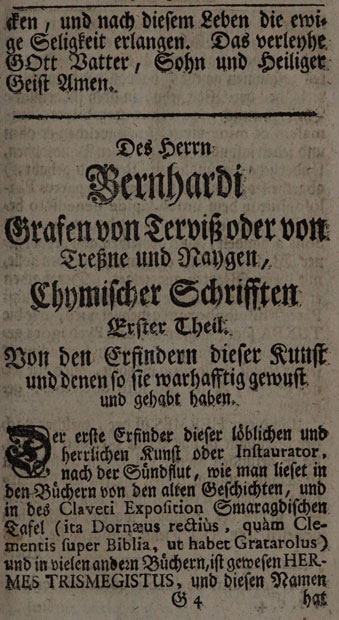
Of Mr.
Bernhard,
Count of Tervis or of
Tresne and Naygen,
Chymical Writings
First Part.
Of the Inventors of this Art
and those who truly knew
and possessed it.
The first inventor of this praiseworthy and excellent Art, or Instaurator - Restorer, after the Flood, as one reads in the books of the ancient histories, and in Clavet’s Exposition of the Emerald Tablet, ita Dornæus rectius, quam Clementis super Biblia, ut habet Gratarolus - thus Dornæus more correctly than “Clementis super Biblia,” as Gratarolus has it, and in many other books, was HERMES TRISMEGISTUS; and he has this name for this reason, for he not only divided everything that is in the world, which has a Materiam - Matter and Formam - Form, and is thus composed of four Elements, of which there are innumerably many parts of the world, into three principal Parts, namely into partem vegetabilem, animalem & mineralem - the vegetable, animal, and mineral part, concerning all and each of which, separately, he had, before all Philosophers, a particularly fundamental understanding, but he comprehended these tres partes Philosophiæ - three parts of Philosophy in the unico lapide benedicto - one blessed Stone, and worked with it at his pleasure in opere Solis - in the work of the Sun, and also indicated in such a hidden manner, with these words, from what it should be made. For this reason he is called, as a beginner and inventor of the Art, Pater Philosophorum - Father of the Philosophers, as the TURBA says that he was before Pythagoras. Accordingly, whoever afterwards became a partaker of his Art is held for his son, & sic pro filio doctrinæ - and thus for a son of the doctrine.
And this HERMES is he who, after the Flood, went into the Valley of Hebron, where he is said to have found seven tablets of marble, and upon these tablets the beginning of the seven liberal Arts is said to have been described by the Wise men who lived before the Flood.
(k) Josephus de duabus columnis scribit. - Josephus writes concerning the two columns.
l. 1. c. 4. - Book 1, chapter 4.
(k) For since they, as Wise men, knew that the Flood should come, or perhaps had learned it from Noah, because he had built upon the Ark for so long a time, they, so that all Wisdom should not perish together with it, engraved these Arts in marble, and these tablets were the foundation of all the liberal Arts.
(l) Hermes junior vixit circa A. M. 2430. - Hermes the younger lived around the year of the world 2430.
(l) Therefore it is quite credible that this Art existed before Moses established the (m) Law by GOD’s command,
(m) Lex data A. M. 2456. - The Law was given in the year of the world 2456.
and that many people afterwards possessed it; for AROS says, in an Epistle to King Messohe, that in the time when the Law was established, this Art was given and revealed to certain children of Israel, in the Wilderness, at Mount Sinai, to prepare the adornment of the Tabernacle, the Sanctuary, and the Ark of the Covenant, together with the Work, as also appears from the Second Book of Moses and Josephus. (n)
(n) Exod. 36. v. 1 Joseph. antiq. l. 3. c. 6.
Although such Art was indeed given by GOD to some without any particular investigation, there are nevertheless some who also found it through investigation of Nature, according to the Will of GOD, without whom no man is able to do anything, and used it with profit. But they wrote nothing concerning it, or, if they described it, their books have perished.
But it does not help us that we know this, nor is it of any use to us except that we know that the Art is right and certain; nevertheless, in honor of this excellent Art, that it is wholly true and right, I will prove it through the following example.
For SUIDAS, a truthful Historiographus - historian, writes that this Art was so common among the Egyptians that because of this Art they became so rich that they frequently resisted the Romans; and after they had, in particular, secretly intended a revolt against the Emperor DIOCLETIANUM - Diocletian, they were severely punished by him on this account, and at that time all books of the Art, as many as could be obtained, were burned, so that they might not enrich themselves again from these books and through the Art, rely upon this, and further resist the Romans.
From which it is sufficiently to be seen that such Art was very much in practice, and is not only true, but contains within itself riches, understanding, and many good virtues.
But, beyond all this, further to prove and demonstrate that such Art is not only true, but also that it is not against GOD, if one does not misuse it, the Prince of Tyre is not punished by the Prophet Ezekiel (o - Ezechiel c. 28.) because he practised such Art, and because by means of it spared his subjects from burdens and taxation, but because he held himself to be so wise, since he could himself make as much Gold and Silver as he needed, that he imagined himself to be equal to GOD.
(p) Hæc ex traditione Rabbinorum. Vid. Meieri Symbola pag. 35. - These things are from the tradition of the Rabbis. See Meier’s Symbola, page 35.
(p) Thus the Prophet punishes in him the Abusum - abuse, and not the right Usum - use which one should make of such an Art.
Likewise the Prophet does not reproach the ancestors of this Prince, who also truly knew such Art, for the right Usum - use, but the contrary, in that he, speaking as in the Person of GOD, says:
Multiplicavi eis argentum, & ipsi fecerunt dolo suo aurum. - I multiplied silver for them, and they made gold by their own craft.
For they raised themselves too highly by means of this Art, and forgot GOD, and also otherwise misused it in many things. From which it is also demonstrated that this Art is true, and in no way, if it is not misused, against GOD.
There were also otherwise some who knew it, such as the PYTONISSA, REBECCA, AMBAGASAR, SALOMON, PHILOMACEDON, THESSARINEUS, and several others.
Nevertheless HERMES, as related, is the first who clearly described with Truth and foundation the blessed Stone of the Philosophers; and his Tablet, which he made concerning this Art, was found many years after his death, by his body, in an old desolate hole, written in Smaragdo - Emerald, which he had lying between his hands, and it reads thus:
Tabula Smaragdina. - Emerald Tablet.
Verum, sine mendacio, certum & verissimum: quod est inferius, est sicut quod est superius, & quod est superius, est sicut quod est inferius, ad perpetranda miracula rei unius. Et sicut omnes res fuerunt ab uno, meditatione unius; Sic omnes res nata fuerunt ab hac una re, adaptatione. Pater ejus est Sol, mater ejus Luna. Portavit illud ventus in ventre suo, nutrix ejus terra est. Pater omnis telesmi totius mundi est hic. Vis ejus integra est, si versa fuerit in terram. Separabis terram ab igne, subtile à spisso, suaviter, cum magno ingenio. Ascendit à terra in cœlum, iterumque descendit in terram, & recipit vim superiorum & inferiorum. Sic habes gloriam totius mundi. Ideo fugiet à te omnis obscuritas. Hic est totius fortitudinis fortitudo fortis, quia vincet omnem rem subtilem, omnemque solidam penetrabit. Sic mundus creatus est. Hinc erunt adaptationes mirabiles, quarum modus hic est. Itaque vocatus sum Hermes Trismegistus, habens tres partes Philosophiæ totius mundi. Completum est, quod dixi, de operatione Solis. - True, without falsehood, certain and most true: that which is below is like that which is above, and that which is above is like that which is below, for accomplishing the miracles of the One Thing. And just as all things were from One, by the meditation of One; so all things were born from this One Thing, by adaptation. Its Father is the Sun, its Mother is the Moon. The Wind carried it in its belly; its nurse is the Earth. Here is the Father of all the perfection of the whole world. Its power is complete if it is turned into Earth. You shall separate the Earth from the Fire, the subtle from the dense, gently, with great ingenuity. It ascends from the Earth into Heaven, and again descends into the Earth, and receives the power of the superior and inferior things. Thus you have the glory of the whole world. Therefore all obscurity will flee from you. This is the strong strength of all strength, because it will overcome every subtle thing and penetrate every solid thing. Thus the world was created. From this there will be wonderful adaptations, the manner of which is here. Therefore I am called Hermes Trismegistus, having the three parts of the Philosophy of the whole world. What I have said concerning the operation of the Sun is completed.
That is in German:
True it is, without lies, certain, and most truly of all, that this which is below is like the upper, and this which is above is like the lower, for accomplishing the Miracles of the One Thing.
And just as all things are created from and out of One through the counsel and command of the One; so all things spring and come from the One Thing through a particular appropriation and Disposition.
The Sun is its Father, and the Moon is its Mother.
The Wind has carried it in its belly.
Its nourisher or wet-nurse is the Earth.
This is the Father of all Perfection of the whole world.
Its power is complete when it is transformed into Earth.
You shall separate the Earth from the Fire, and the Subtle from the Gross, quite gently, through great skill.
It ascends from the Earth into Heaven, and from Heaven again downward to the Earth, and thus gains the power of the Upper and the Lower.
Thus you have the Glory of the whole world.
Therefore all Darkness, poverty and contempt, will depart from you.
This is, of all strength, the strongest strength, for it overcomes every subtle thing and penetrates all dense and thick Bodies.
Thus the world was created.
And from it strange Wonders are worked, of which this is a Model and Example.
And I am therefore called HERMES TRISMEGISTUS, because I have three Parts of the Wisdom of the whole world.
And thus is fulfilled what I have said concerning the Work or Operation of the Sun.
Notæ. - Notes.
This Tablet is described somewhat more briefly in the Latin Exemplars, and indeed in that of D. DORNÆUS with these words:
de Tabula Smaragdina. - concerning the Emerald Tablet.
Verum est, certum & verissimum; - It is true, certain, and most true;
Quod est superius, naturam habet inferioris, & ascendens naturam descendentis. Conjungas unica via dispositioneq; - That which is above has the nature of the lower, and the ascending has the nature of the descending. You shall join by one way and disposition;
Sol rubeus est ejus conjugii pater, & alba Luna mater, tertius succedit, ut gubernator, ignis. Grassum fac subtile, & hoc spissum reddito. Ad hunc modum gloriam habes hujus mundi. - The red Sun is the father of this conjunction, and the white Moon the mother; the third succeeds as governor, Fire. Make the gross subtle, and render this dense. In this manner you have the glory of this world.
Mark: everything that HERMES has said here in this little book, although it is brief, nevertheless these are great and important words, and the whole Art and the whole Work are properly described therein.
After HERMES, PYTHAGORAS, HERMETIS Discipulus - disciple of Hermes, truly possessed the Art, who made the TURBAM PHILOSOPHORUM - Turba of the Philosophers, which by some is called Codex Veritatis - Book of Truth, and not unjustly, for the pure Truth is therein, although rather obscure and for the most part incomprehensible to the reader.
Further, BENDEGID and JESSID possessed it, ARISTOTELES Chemista - Aristotle the Chymist. Likewise PLATO.
AVICENNA also writes very well concerning it, likewise GALENUS, ARABS - Galen the Arab.
Likewise, and indeed most of all, the Art was known to them in Arabia, as to King HALY, who was one of the foremost Astronomis - Astronomers; he taught it to MORIENEM - Morienus, and MORIENES - Morienus taught it to CALID, who was also a King Arabiae - of Arabia.
AROS also possessed it and taught it to his brother NEPHANDIN, or NAFANDRUM.
Likewise SATURNUS knew it, AMILCABER and his sister METRODORA, and very many others, too many to relate all here, who all lived in Arabia.
As perhaps there may still be some there who know and practise it, and without doubt in other lands also there might be found those who adhered to it and had certain knowledge of it.
But what does all this help? Except that, as reported above, we should not doubt that the Art is entirely certain and true.
But that you should investigate from their books, which some of them wrote and brought to light with such strange Figures and Metaphorical words, something which might be useful to you, that is scarcely to be believed.
Nevertheless some excellent Ingenia - intellects are so endowed by GOD that they sometimes attain to it through much labor and long exercise, especially if GOD grants it to them.
But one finds such persons very rarely, and scarcely one among thousands succeeds.
I may also say that, if GOD had not especially given me success toward it, I myself, notwithstanding the great expenses which I spent upon it, would not have been able to attain to it.
For such their books were useful only to their children, or to those to whom they granted it or revealed it, so that it is indeed a Gift of GOD if someone should comprehend the Art from them without their Information.
But because I, through many strange journeys, exercises, and acquaintances, which I had to make with a considerable sum of money, finally obtained the true Art through GOD’s help, I have wished, out of compassion toward the poor fellows who have their Fundamenta artis - foundations of the Art, and who nevertheless, because it is so deeply hidden, must burden themselves, from a good heart, with so much and such great diligent reflection and difficult labor, to compose this little book.
And now there follows in the second Part which books I also overturned and searched through, and what foolish ways I undertook and went in this matter, so that the seekers may avoid these, apply themselves to the Foundation, and may obtain it; for I am only willing to serve, as far as may be permitted, those who almost despair of the Art and yet still have a little spark of a good faithful heart toward it.
For I do not doubt that, if they make use of the counsel of this my little book, sufficient welfare shall follow for them as for others, and they shall become partakers of the Art, and shall not a little rejoice in it and make use of it.
For in this matter I have not followed those who, with their dark and Parabolical writings, mislead those desirous of the Art more than they lead them, make them more doubtful than certain, as ARNOLDUS de VILLA NOVA, Raymundus LULLIUS, Magister Johannes SCOTOS Doctor subtilis - Master John Scotus, the Subtle Doctor, Magister Johannes Guilielmus PARISIENSIS, Magister Johannes MEHUNGIUS, HORTULANUS VERIDICUS, and others have done, who indeed certainly possessed it and lived in France and elsewhere, but left it described wholly obscurely, Metaphorically, and figuratively.
The like has not been done by me, but the right, certain way is shown.
But because all that I have reported and indicated in this first Part, as said, only praises the Art as true, and gives you no further use than that you know who has written concerning it, I therefore rightly hasten to the second Part of this little book, as follows.
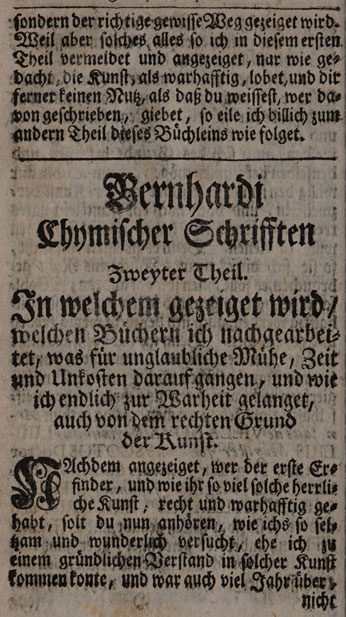
Bernhard’s
Chymical Writings
Second Part.
In which it is shown
which books I worked after, what incredible labor, time
and expense were spent upon it, and how
I finally attained to the Truth,
also concerning the true foundation
of the Art.
After it has been shown who was the first inventor, and how so many truly and truthfully possessed such excellent Art, you shall now hear how strangely and wonderfully I tried it before I could come to a fundamental understanding in such Art; and for many years I was not only an overturner of books, but I even dared to undertake to work after the most difficult Autoribus - Authors that there might be, and those who wished to have particularly sharp Ingenia - intellects. But what benefit I had from it you can well perceive from the following foolish course of mine, which I pursued and here describe.
The first book which I took before me in this Art, and after which I worked without understanding, was Rasis, in which I spent four years of my time and consumed eight hundred Crowns upon it.
Further I worked from the books ARCHELAI Philosophi - of the Philosopher Archelaus, and there I found a Monk; he and I spent five years therein, yet RUPESCISSA and SACROBUSTUS also had to serve us during that time, for which reason we worked in aqua vitæ - water of life, which was rectified thirty times and frequently distilled from its Fecibus - feces. This became so strong that we could find no glass which would hold it; upon this he and I consumed three hundred Crowns.
Afterwards I undertook GEBER, in whom I understood just as much as a goose, and did not take heed that he himself warns, where he says:
Tu autem porrige manum ad dicta nostra, alias in vanum studes - But you, stretch forth your hand to our sayings, otherwise you study in vain,
that is, take good heed of my words, otherwise you will labor in vain.
I merely worked away in his Sophistical Recipes, which are to be understood very differently from their common simple appearance, and I made it blood-sour for myself, not only in the work, but also through much travelling about, so that I might obtain someone who could work after him; for such fellows as were supposed to know something did not come to me, I had to travel after them, and, as you will hear, came to know them only too well.
But it agreed with me as grass with the dog; I found enough deceivers who claimed to understand him, although they understood nothing less; now they made this blue mist for me, then another, and since none of such fellows could endure hardship but had to have enough, during the six years which I spent therein it cost me 2000 Crowns in money. For at that time I did not for a long while think that one who wished rightly to understand him had to be otherwise fitted.
Nam serò sapiunt Phryges - For the Phrygians become wise too late,
for only through damage does one become wise.
But if I had noticed what he himself says in præfatione suæ Summæ - in the preface to his Summa, I would not have needed all this. For thus his words run:
Qui principia naturalia in Philosophia ignoraverit, hic jam multum remotus est ab hac arte: quoniam non habet radicem veram, super quam intentionem suam fundet - Whoever is ignorant of the natural principles in Philosophy is already very far removed from this Art, because he does not have the true root upon which he may found his intention.
That is, whoever does not know the natural beginnings and fundamental causes in Philosophy is still far from this Art, since he has no foundation upon which he may support his opinion and undertaking.
And this became true in me not only in itself, but because I did not understand it, I allowed myself to be persuaded by the deceivers to such an extent that I now also forgot Geber, applied myself to such Sophistical Recipes as the Vagants invented and carried about, and wished with them, as they say, to conjure the Devil. Therefore I undertook it in every manner that could be imagined, with the Solution and Coagulation of all kinds of Salts, such as Salis communis - common Salt, Salis armoniaci - ammoniacal Salt, Salis alcali - alkali Salt, Salis de pinu, al. panis - Salt of pine, alternatively of bread, Salis anatron sive Nitri - Salt of natron or Nitre, Salis Vitri, al. fellis Vitri - Salt of glass, alternatively gall of glass, Salis Tartari - Salt of Tartar, Saracenici - Saracenic, metallici - metallic; and such Solution, Coagulation, and Calcination had to take place more than a hundred times, and I spent two years upon it.
Afterwards I worked with such experienced fellows who knew everything and yet never succeeded in anything, in Vitriol and Aluminibus - Alums, such as alumen rochæ - rock alum, glaciei - ice alum, scissile - fissile alum, plumosum - feather alum, de India - of India; I also tried, with such birds, to poke about in all kinds of Marcasites, and after I did not find the Mineral Stone there, I messed about in blood, urine, human dung, hair, Spermate - sperm, eggs, and other such entirely Sodomitic things, wished to make the Lapidem animalem - Animal Stone from them, and came ever farther away from it.
I divided, or wished to divide, the four Elements in the athanor and through the alembic; I circulated in the Pelican; I distilled per ascensum & descensum - by ascent and descent; rectified, infused, evaporated, calcined, reverberated, sublimed, conjoined; I cast, separated by liquation, and melted, and dealt with other innumerable, wholly deceptive and erroneous Regimens of the Fire, so that I spent many years upon them; and when I had now reached my thirty-eighth year, I was still working in Lapide Vegetabili - the Vegetable Stone, and wished to obtain the Coagulation of Mercurii - Mercury through herbs and animals, so that in three years, while I worked after such unnatural Sophistical Recipes, I consumed, both through myself and through other deceivers who gave advice and assistance thereto, 6000 Crowns.
When this also would not be the way, and nothing would come from it, I began to become faint-hearted, and my heart failed me; nevertheless I fervently prayed to GOD that He would let me experience the right way, and let me see the end of this noble Art, since I heard it praised so highly; and thereby I again gave myself courage.
Meanwhile it happened that a Bailo, or Judge, from my homeland came to me, who likewise sought the Art; he brought me back again to Sal commune - common Salt, and said that he would certainly make the Lapidem - Stone from it. Although I told him how I had previously spent so much time and labor therein in vain, this helped nothing; he knew the right manner, as indeed many a poor fellow undertakes strange Imaginationes - imaginations and works more out of lack of understanding than because of deceit. And I know this because I myself would often, over a thing which I had concluded in my foolish head, have allowed myself to be led into great misfortune, imagining that it could not fail.
On the other hand there are also such thoroughly practised rogues and deceitful villains who intentionally and knowingly undertake every deceit, merely so that they may be maintained and provided for, let him who spends his money upon it come where he may.
And such fellows, like this countryman of mine, know how to screw a bolt into every nut, but cannot be recognized until one speaks with them fundamentally, for they commonly have strange Latin with which they name both the Materiam - Matter and also the manipulations of the work.
Thus when they should call it the Lapidem Philosophorum - Stone of the Philosophers, they say Philapisphorum; when they should say Tinge, their Latin is attingam; instead of solve they say solsa. To work Per descensum - by descent is called by them per desce; to Filter is called in their thieves’ Latin vilgiliren; Tartarus - Tartar is with them Tarter; arsenicum - arsenic is with them assenicum; and Mercurius sublimatus - sublimed Mercury is with them sublimatius; likewise præcipitat - precipitated becomes principitat.
And in Summa - in sum, they put forward many foolish things, and by these alone they may be recognized; for otherwise they can bring forth such infernal words that they are not readily regarded as such deceivers.
But according to our Proposito - purpose, I say that this Judge brought me back again to Sal commune - common Salt; there the knife was stuck, and now it could not fail. Who was more joyful than I, who so gladly wished to know the end?
There the work had to be undertaken from that very hour. Therefore we dissolved such Salt in the air and coagulated it in the Sun, and did many other things which would be too long to relate, for we persisted in such work for a year and a half and accomplished nothing, because we did not work in debita materia - the proper Matter; and therefore what happened to us was right, for the Turba says, Venerabilis congregatio codicis veritatis Gratarolo - the Venerable Assembly of the Code of Truth in Gratarolus, likewise Geber:
Quærere in re, quod in ea non est, hoc stulte proponitur - To seek in a thing that which is not in it is foolishly proposed.
That is, whoever wishes to seek something in a thing in which it is not, acts foolishly.
Since then that which we sought was in no way contained in common Salt, I learned through damage that what the Philosophi - Philosophers say was true:
Qui credit in mendacium, & non secretis Philosophorum, perdit tempus & labores, cum opere - He who believes in a lie and not in the secrets of the Philosophers loses time and labor together with the work.
Whoever believes the lie and not the secrets of the Philosophers loses the time and labor together with the work.
But what shall I say? We worked at this thing vigorously, and because it was supposed to be true, this work had to be begun again often so that we might surely hit upon it; yet notwithstanding the labor that we had, we saw no alteration of its Nature, and therefore we also abandoned this work.
After this we remained together, notwithstanding that we had accomplished nothing, and he who otherwise was my subject in my country, namely this Judge, was my companion in foreign lands; for the Laborants are all cousins, they give one another good words, yet each keeps his thumb in his fist, and when one looks at it by the light, their Art is so excellent that it melts away with the ready snow.
Yet it must be so, for it is the proprium in quarto modo - property in the fourth mode, that one does good to another with food and drink as much as he can, although such ability is quite small, since one sees them dragging themselves about so poorly; but concerning the Art they will not come out with it-there all friendship is at an end.
Although his deceit greatly displeased me, I nevertheless blamed it upon his inability, and could tolerate him well, for otherwise he was very faithful to me.
And it happened, when our work had come to nothing and lay in the basket, that other gentlemen came to us; then the dog was truly caught in the iron. They made such strong waters in which they dissolved fine Gold, Silver, Copper, and all Metals.
And they first dissolved fine Silver in one glass and Mercurium - Mercury in another glass, at one time and with one water, and they left them therein for twelve days; afterwards they poured them together into one glass and said that this was the true Matrimonium - Marriage of the Body and Spirit.
Afterwards they put it upon hot ashes and let it evaporate until one third of the water remained; what remained they put into a Phial and set it in the Sun, afterwards in the air, and said that from it little crystalline stones should shoot forth which would flow like wax, and this would be the Coagulation of the Stone for the white Tincture; and in the same way the red Tincture should also be made from Gold.
And it stood thus for fully two years before the Crystals would shoot; and when they did shoot, we nevertheless in the end found nothing according to our opinion, just as others will never find anything in this manner.
For the Philosophical Conjunction does not proceed in this manner, and nothing foreign must enter into it, as the Turba says:
Nihil extranei opus est ad istum lapidem, per se ipsum enim in materia sua metallica perficitur - Nothing foreign is needed for this Stone, for it is perfected through itself in its own metallic Matter.
Likewise GEBER:
Est enim lapis unus, medicina una, decoctio una, in quo magisterium nostrum consistit, cui non addimus rem extraneam, nec minuimus nisi quod in præparatione ejus superflua removemus. - For there is one Stone, one Medicine, one Decoction, in which our Magistery consists; to it we add no foreign thing, nor do we diminish anything except that in its Preparation we remove what is superfluous.
Item, ibidem: In rerum multitudine ars nostra non consistit - Likewise, in the same place: Our Art does not consist in a multitude of things.
That is: There is only one Stone, one Medicine, one Cooking, in which our whole Work consists; to it we add nothing foreign, nor take anything from it, except that in the Preparation we separate from it the superfluous impurity. Likewise: Our Art does not consist in many different things.
It should also have been united otherwise than thus, so that the agens - agent and patiens - patient might be mixed per minima - through the smallest parts, and afterwards might have been able to generate.
But such Union was not in the Work; since it was not there, it necessarily follows that nothing came from it:
Quoniam separatio agentis & patientis facit necessario, ut non fiat actio & passio, Ergo nec generatio. - Because the separation of the agent and the patient necessarily causes that there be no action and passion, therefore no generation either.
Therefore nothing came from it.
When we also failed in this, I became entirely despondent; yet nothing was at fault except our inconsiderate conduct. We knew neither how to begin nor how to end our Work and labor; therefore of necessity we failed.
Quicunque enim ignorat radices minerarum & simplices & compositas, ignorat principia naturæ: Ergo & artis. Et eam ob causam potius erit Sophista, quam Chemista. - For whoever is ignorant of the roots of the mines, both simple and composite, is ignorant of the principles of Nature; therefore also of the Art. And for this reason he will be rather a Sophist than a Chymist.
For whoever does not know the roots of the Minerals, both the simple and the compounded, does not know the Principia - Principles of Nature, and consequently also not those of the Art, and for this reason he is rather a Sophist than a Chymist.
And this was lacking in all of us; therefore our Work had such an excellent end.
When this also was over, I came alone to a Monk, who was a Doctor named Gotfridus LEURIER, and claimed to have completely devoured the Lapidem Philosophorum - Philosophers’ Stone. He would not allow my companion to remain with me, for the Art was too great, until after much negotiation and earnest entreaty I brought him so far that I was permitted to take my companion with me.
But mark how he proceeded.
You have heard that he claimed to have completely devoured the Art, and that was indeed the whole truth.
For he took 2000 hens’ eggs, which we boiled quite hard in a kettle; afterwards we peeled off the shells and calcined them until they became as white as snow. The white and red we allowed together to putrefy in horse-dung; afterwards we distilled it thirty times, and drew from it a white water and a red oil, each separately.
And in Summa - in sum, we made such strangely foolish things that I am ashamed to write them, and found nothing. We persisted therein for two and a half years, so that out of despondency we wholly and entirely abandoned it; but what the cause was I have related many times.
Yet mark this with it:
Quod nulla res extranea, quæ non ex metallis composita seu orta, potens est ipsa perficere, seu eorum transmutationem facere novam - That no foreign thing which is not composed of or arisen from metals is able to perfect them or to make a new transmutation of them.
That no foreign thing which is not made from or arisen from the Metals is able to make them perfect or to transmute them.
And yet we were such fools and wished wilfully to waste the time together with the labor and expense in vain.
Nothing, however, brought me to this except the great Doctor, for I imagined that he could not lie, and yet he lied more greatly than anyone else had done; for he alone brought me to it with those words when he called it the Universal.
And if he had not done this, I would not have undertaken this work, because I had previously also worked in eggs, as was reported above, though not in this manner.
But because I knew that nothing outside the Universal could be right, for I had learned this through damage, and yet did not know how one should begin the Universal, much less complete it, I allowed myself to be persuaded to it, yet learned through damage that it was nothing.
When now the water went into the mouth of me and my companion, we had to learn to swim; we set ourselves to it and imagined that with our manual work, which we had seen here and there, we would accomplish something.
And I remained at the place, began myself to sublime, made strong Aqua fort - strong water, dissolved and separated the Elementa - Elements, made strange furnaces, and persisted in this my dirty work for six years.
For previously I had indeed caused much to be tried with my money, as related before, but had myself taken nothing into my fist; I always imagined that the deceivers who were around me had withheld something from me.
But that all my Propositum - undertaking was false, and that now also nothing succeeded, no one perceived better than I.
In Summa - in sum, I wished to have the Art by force; neither love nor suffering helped against it, yet, as you will hear, I nevertheless had to wait until GOD granted it to me and wonderfully helped me thereto.
Further we came into acquaintance with a Theologus - Theologian, who was a Protonotarius - Protonotary of Bergen, a very learned man, who undertook to make the Lapidem - Stone solely from Copper-water.
First we distilled the strongest vinegar eight times; afterwards we put the calcined Copper-water into it for three months; afterwards we drew the vinegar from it and poured it again upon the Materiam - Matter which remained at the bottom, and drew it off again.
This we did fifteen times daily for two months, until finally, from the exceedingly strong and sharp smell, I contracted the quartan fever for fully fourteen months and thought that I should die.
We therefore left it standing and found nothing, for we were still not working in the right Materia - Matter, and thus two years passed over us in it.
Afterwards a distinguished learned man told us how the Emperor’s Father Confessor, named Herr Magister Henrich, knew how to make the true Stone.
We went to him and spent fully two hundred Crowns in gifts upon it before we obtained his acquaintance, and finally by strange means, with great joy, we gained an acquaintance with him.
Now we proceeded thus, for he was far too good to have done the dirty work himself.
We took fine Silver and Mercurium - Mercury together, afterwards Sulphur and Oil of Olives, mixed all together, and set it upon a gentle fire in a glass well coated with clay; we stirred it with a wooden spatula and incorporated it well together.
Yet however we treated it, the Materia - Matter would not allow itself to be mixed, although we spent two months upon it.
Therefore we placed it in another clean, well-coated flask, firmly luted, in warm ashes, and held it in a constant gentle fire for a certain time, with the opinion that the Mercurius - Mercury should within fourteen days or three weeks, through the power of the Sulphur and the Lunar Body, transform itself into good fine Silver.
After the time had elapsed he added some Lead to the Materia - Matter in the glass, according to his good pleasure, and caused it with strong fire to melt together into a Massam - mass.
Afterwards we took it out and drove it off upon the Cupel through Saturnum - Saturn, where we were supposed to find our Silver augmented by two thirds.
And because I had put in ten Marks for my portion, but my fellow-partners thirty-two or more, we should, according to his reckoning, have taken out around 130 Marks.
But our reckoning failed us very greatly.
For after the Reduction, from which I nearly died completely and was severely poisoned together with my companions, they obtained from their thirty-two Marks only twelve; I, however, from my ten no more than four again; the rest fell into the well and went away in smoke.
Although this displeased me terribly and exceedingly, I nevertheless did not dare murmur against it, but had to swallow everything, and also let fall the Art in which we had spent two and a half years.
And I became so dismayed concerning this man, to whom I would willingly have entrusted body and life, that I thought of throwing the Art entirely to one side.
Therefore I abandoned everything, went away from the acquaintance of the Father Confessor, and during the time suffered more than four hundred Crowns damage.
For more than two months I could not bear to hear anyone speak of the Art.
Only then did I consider what my friends had advised me and how I now had their enmity; I grieved myself for these reasons to such an extent that I could neither eat nor drink, and also became so thin that everyone, from my appearance, imagined that I had the consumptive fever, Hecticam - hectic fever, upon my neck, or had been poisoned.
But while I thus grieved and tormented myself, and imagined that I would now no longer adhere to the Art, I was nevertheless soon, for the following reason, a thousand times more strongly fastened upon it than before, and could not leave it.
For I thought: it would grieve me that I should have spent my time therein in vain and obtained nothing thereby.
I also considered: you have now spent your young days upon it and therefore made all your friends your enemies; you are now fifty-four, al. 58, years old; you hear and also know certainly that the Art is true and right, notwithstanding that you have sought so much and found nothing; therefore you must bite into a sour apple and must not desist.
Thus I began again to make dirty work, and now wished to force Nature with violence, because through damage I had learned that it must lie in the Metals.
Therefore I prepared one Metal into another, and knew neither manner nor way thereto.
But the cause that I accomplished nothing with this either was that all my doing and leaving was pure foolishness and only great blindness and lack of understanding.
If, however, I had noticed and known what I afterwards experienced, and what the Philosophi - Philosophers write, this disorderly work would certainly have remained undone.
For thus the Philosophi - Philosophers say concerning this point, and among others GEBER:
Habent autem metalla affinitatem magnam ad invicem, non tamen perfectum diminutum perficit, per ejus commixtionem: si enim aurum cum plumbo misceatur, sola fusione, non fit ex hoc plumbo aurum, sed evanescit plumbum ab admixtione, & aduritur, aurum verò in examinatione remanet: similiter & reliqua imperfecta corpora evanescunt. - Metals indeed have a great affinity with one another; nevertheless a perfect body does not perfect an imperfect one through its admixture; for if Gold is mixed with Lead by fusion alone, Gold is not made from this Lead, but the Lead disappears from the admixture and is burned, while the Gold remains in the examination; likewise also the other imperfect bodies disappear.
That is: The Metals indeed have a great and close relationship with one another; nevertheless no Perfect thing can perfect an Imperfect one, although they are mixed together in fusion; for when you cause Gold to flow with Lead and stir them together in the best manner, nevertheless no Gold is made from that Lead, but it flies away in the Assay and burns; the Gold, however, remains upon the Test. The same occurs with all other imperfect Metals.
For the corpora perfecta - perfect bodies, thus simply perfected naturally, are only simply perfect in their first degree; and if they have not through Art become plusquamperfect - more-than-perfect, they can in this manner, through mixture, in no way come to the aid of the imperfect Corporibus - Bodies, for this reason: they have no other Perfection than so much as is necessary to their own Esse - Being and Essence.
Since then none can give to another that which it itself can in no way do without, that which requires help must remain as it is.
As if a man, to compare it grossly, should give his skin to another man; he would then become just as miserable, and much more miserable, than the man who desired it from him; and whoever thus gave away his skin would be regarded more as a Cadaver than as a man.
So also the perfect Corpora - Bodies, if they should communicate their Perfection to the imperfect without any Medium, would be worth nothing and would be just as miserable as the imperfecta corpora - imperfect bodies; although the perfecta corpora - perfect bodies, remaining thus in their natural Perfection, could in no way do this, for they are like dead Bodies.
Further to prove that the imperfecta corpora - imperfect bodies cannot thus be perfected by the Perfectis - Perfect bodies, it is certain that in fusion, or in other Sophistical manipulations, they can in no manner be mixed and united per minima - through the smallest parts, and thus no Nature can succuriren - succor another.
Et, si esset commiscibilis nobilium metallorum perfectio cum imperfectis, non imperfecta cum perfectis perficerentur, sed eorum perfectio cum imperfectis diminueretur. - And if the perfection of the noble metals were miscible with the imperfect, the imperfect would not be perfected with the perfect, but the perfection of the perfect would be diminished with the imperfect.
That is: And even if the perfect noble Metals allowed themselves to be mixed with the imperfect, nevertheless the imperfect would not be perfected with the perfect, but their Perfection would be diminished with the imperfect.
That it also cannot be through fusion alone, or by another Sophistical manner outside our Magisterii - Magistery, very many Philosophi - Philosophers write, as you will find in Pandectis - the Pandects, & libro GALID - and the Book of Galid; likewise in Geber’s Summa, and in opera naturali apud Magistrum DAALIN - in the Natural Work according to Master Daalin, in Arnoldus de VILLA NOVA, in semita errantium à PLATONE conscripta - in the Path of the Erring written by Plato, in the great ROSARIUS, in the little Treatise of EUCLIDES, likewise especially in Speculo Alchymiæ - the Mirror of Alchemy, BACCHONIS c. 3. - Bacon, chapter 3, where it stands thus:
Aurum est corpus perfectum masculinum, sine superfluitate aliqua aut diminutione, & si imperfecta sola liquefactione perficeret, esse Elixir ad rubeum, quod non est. - Gold is a perfect masculine body, without any superfluity or deficiency; and if it perfected imperfect things by mere liquefaction, it would be the Elixir for the Red, which it is not.
Gold is a perfect masculine Corpus, without any superfluity or deficiency, and if it brought the imperfect Metals to Perfection through mere flowing and melting, it would be an Elixir for the Red, which nevertheless it is not.
But if they are attacked through our Art and, by means of it, according to the Philosophical manner, brought so far that they are multiplied tenfold or a hundredfold, and higher, in their Perfection, then it takes its proper course and one finds well what they can do.
For then they have become penetrating, entering, tinging, plusquamperfect - more-than-perfect, and living, respectu vulgarium - in respect of the common ones, as RASIS, ARISTOTELES Chemista - Aristotle the Chymist, AULPHANES in suis pandectis - Aulphanes in his Pandects, and DANIEL 5. cap. suarum Retractionum - Daniel, chapter 5 of his Retractions, say concerning this:
Our complete Gold is more than living.
Likewise: Our Gold and our white Silver are not common Metals, for they are living, but other Metals are dead and have no power, as may clearly be seen in Codice veritatis - the Code of Truth and several others.
After this, however, because I could not remain idle with my companions, notwithstanding how often it had failed for me, we worked, since we had now ourselves learned the manipulations and knew them well, so violently that it cannot be believed and would become far too long to relate here.
And among other things we undertook to amalgamate and multiply, for white and red, and applied ourselves to strange work which I believe could scarcely be imagined more strangely.
However we treated it, nevertheless we never found our Silver or Gold augmented or increased, neither by three parts, two, one, nor half a part.
Therefore we now first undertook to travel still farther, passed through many a country and city, so that with the present and former journeys, on account of the Art, I had now almost travelled around the circle of the world; for I had been crosswise, now here, now there. There could be no place where the Art stirred but I also had to know of it.
I learned of it indeed, but with great damage.
Yet I also had this benefit from it, that I saw many great and powerful cities and many a beautiful country.
For I had now been at Rome, Navarre, in Scotland, Turkey, Greece, Alexandria, Barbary, Persia, Rhodes, throughout France, in almost all cities, in Spain, in the Holy Land and neighboring places; I saw all Italy, Germany, and England; travelled now here, now there, and therefore saw so much making of white and red, so many recepta - recipes and Sophistry, that I am unable to describe it.
For the practice of everyone wherever I came, just as much as my own, was pure monkey-play and wholly erroneous, and I found no one who worked otherwise than in Vegetables, Minerals, Salibus - Salts, aluminibus - Alums, strong Waters, &c.
They distilled, separated the Elements, calcined, dissolved, sublimed, and coagulated the Mercurium - Mercury, and this through herbs, stones, water, oil, fire, smoke; and they dealt with strange vessels.
I saw no one who worked in debita Materia - the proper Matter.
Now this man had one thing, now another something else; one had white, another red Napta - Naphtha; they said they could thereby fix Mercurium - Mercury into Lunam - the Moon/Silver, but they fixed as much as glowing wax fixes, which some also use thereto, and find only nonsense.
There one had a Gradation from Curcuma - Turmeric; another made Lunam - the Moon/Silver into a glass; soon another made black Cinnabar and wished thereby to fix Lunam - the Moon/Silver into Gold.
Now one exerted himself to fix Arsenicum - Arsenic; another cemented Lunam - the Moon/Silver with Sallabrot; soon another’s work was in Tutia - Tutty.
Indeed many a one made such a stench with Sulphur that one’s heart might have broken, and each had a special Sulphur; one man’s had to be red, another’s gray, the third’s black horse-Sulphur, the fourth wished to have blue Sulphur.
But who can remember everything?
Yet I have seen it, and thus found, although I had much labor on that account, as may be imagined, no one from whom I could promise myself anything good.
They all worked, as I saw during that time, in entirely foolish things; now it was supposed to be the Lapis Mineralis - Mineral Stone, now Animalis - Animal Stone, finally Vegetabilis - Vegetable Stone, but it was just as true as it is true that an ass is an Italian hare: although it has long ears, it nevertheless does not run so quickly.
Thus I soon obtained acquaintance with the fellows who knew nothing, but acquaintance with those who possessed the right Lapidem - Stone in those places was impossible for me to acquire, notwithstanding my rank and the much money expended.
So that in Summa - in sum, such journeys which I had here and there cost me more than 10300, Gratar. 13000, Crowns.
Of necessity, if I did not wish to desist from it and lose one thing with another, together with my honorable name, I had to write home, report this to my friends, and sell them a part of my Lordship for eight thousand Guilders, so that I could pay the debt which I had made.
Thus I not only lost the greater part of my Lordship, but also lost the favor of all my friends, was regarded as a frivolous man, remained therefore in Exilio - exile, had little money, for the eight thousand Guilders were bread already eaten, scarcely knew where to turn in or out, now had almost sixty-two years upon my neck, was in torment and pain, bore shame and injury, so that I scarcely dared show myself anywhere.
And in me there became honestly true what Geber again prophesied concerning those who without understanding are Hans in all streets, where he says thus:
Expedit, ut artifex pecuniam suam custodiat, nec præsumptuosus eam vanè distribuat, ne, si artem fortè non invenerit, relinquatur in miseria, paupertate & desperatione: vel ne fortè, cum jam ad finem hujus magisterii per suam indagationem approximaverit, consumtæ sint ipsius expensæ, & verum finem miser ex paupertate relinquat. Sicut qui à principio, cum adhuc artem ignorant, prodigaliter suum thesaurum totum exterminant, & cum jam affines arti fuerint, non habent ulterius, ex quo laborent. Unde duplici tales in mœrore sepeliuntur, quia scilicet & pecuniam suam dissipaverunt in rebus inutilibus & scientiam, quam protinus indagassent nobilissimam amiserunt. Non enim oportet te bona tua consumere, quoniam vili precio (si artis principia non ignoraveris, & ea, quæ tibi tradidimus, rectè intellexeris) ad complementum magisterii pervenies. Si ergò res tuas perdideris, non attendendo nostra monita, quæ tibi in hoc libro aperta & manifesta scripsimus, non nos iniquè corrodas, nec nobis blasphemias injungas, sed tuæ imputa ignorantiæ & præsumptioni, &c. - It is expedient that the Artist preserve his money and not presumptuously distribute it in vain, lest, if perhaps he does not find the Art, he be left in misery, poverty, and desperation; or lest perhaps, when through his investigation he has already approached the end of this Magistery, his expenses are consumed and the miserable man, through poverty, abandons the true end. Thus those who at the beginning, while they are still ignorant of the Art, prodigally destroy their whole treasure, when they have already become close to the Art, no longer have anything from which they may work. Hence such men are buried in a twofold grief, because they have both dissipated their money upon useless things and lost the most noble Science which they would presently have discovered. For you ought not to consume your goods, because at small cost, if you are not ignorant of the principles of the Art and rightly understand those things which we have delivered to you, you will attain to the completion of the Magistery. If therefore you lose your possessions by not attending to our warnings which we have written openly and manifestly to you in this book, do not unjustly gnaw at us, nor impose blasphemies upon us, but impute it to your own ignorance and presumption, &c.
That is: It is good that an Artist keep his money in reserve, and does not from presumption spend it vainly, so that, if the Art should fail him, he does not fall into misery, poverty, and despair; or, if perhaps through diligent investigation he learns the Art and has already come far in it, his expenses do not run out so that from lack and poverty he cannot bring the Work to the desired end.
For many of them at first, when they still know nothing, too freely consume their whole property, and when afterwards they come somewhat nearer to the Art, no longer have enough that they could labor.
From this follows a twofold distress: namely that first they squandered their money upon useless things, and afterwards, when they had attained more knowledge and could effect something fruitful, they must let the noble Art fall from their hands.
For there is no need that you squander your property for the sake of this Art, since with little money, provided that you know the Principia - Principles and foundations of the Art and rightly understand that which I have taught, you may attain to the Preparation of the Magisterii - Magistery, or Lapidis - Stone.
If therefore you have shamefully lost what belongs to you, and have not taken good heed of what I have written to you clearly and plainly enough in this book, then do not wish to lay the fault upon me and therefore disgrace and revile me, but rather impute and reckon it to your ignorance and presumption.
Thus far GEBER.
When now I had spent some time in such pain and almost despaired, nevertheless Almighty GOD, who abandons no one who trusts in Him, comforted me, and finally still gives to those who seek with diligent effort, and besides are of good will to employ the Art to GOD’s honor, that they may come to the joyful end and praise Him for it.
Therefore in such comfort and hope I again slept well, put everything at stake, left my friends, did not come home, travelled again to Rhodes so that no one should know me, and acted like another poor fellow.
With great service and labor I made acquaintance with an ecclesiastical learned man who was supposed to know how properly to make the Stone.
When I now understood this from himself, and no one else at Rhodes knew me except a single well-to-do man who knew of what rank and family I was, but did not know that things went so badly for me and imagined that I otherwise represented myself so miserably in order that I might learn the Art, I went to this same man, who lent me 600 Crowns.
Then I again received courage and worked with the man whose acquaintance I had made.
But mark how we proceeded.
He took his Gold and Silver, both well laminated, and mixed them with the fourth part Mercurii sublimati - of sublimed Mercury, and put them together in horse-dung for fully eleven months.
Afterwards he distilled it with strong fire; there came a water, and Earth remained at the bottom, which we calcined with great fire.
Afterwards we rectified the water which we had distilled downward six more times, and all the Earth which remained behind in each Distillation we added to the first, until the water deposited no more Earth.
And when we had now gathered all the Earth into one vessel or Urinal, we gradually poured the water back again upon the Earth, little by little.
But however much labor we had because of it, the Earth would not take its water back to itself, but always floated above; and thus six months passed while it stood so, and we found no Conjunction or alteration.
Finally we made still greater fire, yet nothing else would come from it.
In Summa - in sum, our labor was again in vain, and labor, expense, and everything was lost; and in this work we spent three years and consumed more than five hundred Crowns.
But it happened, just as one says that nothing is so evil that it is not also good for something, that I remained with this man notwithstanding that we accomplished nothing.
And this happened for the reason that the man had beautiful excellent books which I had never seen before.
And because in all the work, however I began it, I had been able to perceive not the least benefit, I resolved, since I was now old and weary, to let all such dirty work disappear and fall.
But mark what Philosophical books I found with him.
The first was the great ROSARIUS; secondly the opera Raymundi LULLII - works of Raymond Lull, and several others.
But especially I took before me Arnoldum de VILLA NOVA - Arnold of Villanova, and the Book of Proverbs, Gratar. Librum novem verborum - the Book of Nine Words, which MARIA PROPHETISSA - Mary the Prophetess made.
In this studying, which I pursued for six, al. 8, years, I clearly saw that everything I had done before this time was worth nothing.
Likewise I saw in these books, which are good and full of foundation, beautiful excellent Philosophical Rationes - Reasons, to which I had previously, when I worked blindly forward, given no attention so as to direct myself according to them.
So that in Summa - in sum, it had not been possible that according to such a pernicious manner as I had followed I could have come to anything good.
And I myself wondered what the cause could be that a man should remain so completely blinded for such a long time.
Yet truly it was not my fault, but the fault of those who had deceived me in this manner.
From these books, as related, I drew the foundation, considered that which was possible and agreed with Nature, and especially took good heed of the saying Codicis totius veritatis - of the Code of the Whole Truth, which runs thus:
Natura emendatur, nisi in sua natura, natura naturam continet, natura naturam separat, & natura obvians naturæ suæ lætatur, & in alienas transmutatur naturas. - Nature is not improved except in its own Nature; Nature contains Nature; Nature separates Nature; and Nature, meeting its own Nature, rejoices and is transmuted into other Natures.
Nature is not improved except in its own Nature; Nature holds and comprehends Nature; Nature separates Nature; and Nature rejoices in its like Nature and allows itself to be changed into other Nature.
This Philosophical Dictum - saying, together with several others which I now observed and found in the books, instructed me very greatly, so that I visibly noticed all the erroneous ways which I had gone and abandoned them.
Therefore I studied still more diligently, and wished to undertake nothing at all with the hand until I had the right foundation completely.
Thus I did not sleep many a night and pursued the matter very diligently.
I also considered that if in this manner, next to Divine help, I obtained nothing true, no one else would show it to me.
I thought: he who knows it does not tell you, and he who does not know it cannot help you; therefore let all men go in this matter, for every expense which you spend upon anyone is lost.
And for this reason I again put it to fortune, and then diligently observed where the Philosophical books agreed together:
Quia ubi plures concordant, ibi debemus magis adhærere. Gratarol. - Because where several agree, there we ought to adhere more strongly.
That I held for Truth, for they can speak no Truth except only in one thing, since Truth cannot be in many things, but only in one.
And in this manner I came upon the right way.
For where I saw that they aimed most of all at one thing, that was precisely that which I had sought so anxiously; and although one calls it by this name and another by another name, nevertheless it is only one single Substance, and the error lies only in the many and various words and strange Figures, and not in the Concordance.
Therefore, dear Reader, whoever comes upon this my book, do not let such strange writing, which I do not mean for myself but do for your sake, cause you wonder.
For you can at least see from it in what I worked and found nothing, so that you do not begin the same and fall into damage, because an old proverb says:
Felix, quem faciunt aliena pericula cautum - Happy is he whom the dangers of others make cautious.
Through other people’s damage one becomes wise.
But that I have also seen more in this matter than another, since I sought therein for so long and also with such expenses as another would otherwise not have been able to bear, you may well believe me, for I know what I had to endure in the Art from loose people.
Thus I have spent almost my whole life with labor and work, so that I may well say that, in honor of this Art, I have spent upon it as much labor, time, expense, and other things as any one of those who wrote of it parabolically or through Figures.
I have also, as I have shown you, just as much as they perhaps did not, worked in urine, blood, Spermate - sperm, hair, herbs, roots; in Summa - in sum, in mineral, animal, and vegetable Natures, and nevertheless found nothing.
For I was burdened with great anxiety over it.
I cannot think that any one of the Philosophers who writes of it so unintelligibly and figuratè - figuratively experienced more than I.
I could therefore devise it just as strangely as they did, but I will not do it; rather, as far as I am permitted, I will show you the right way.
For I have great compassion with those who come upon such books and know no better, that they should so vexatiously consume their time and labor together with their lives.
And since my Propositum - purpose is now directed toward nothing else than how I might bring upon the right way others who in this matter labor diligently with consumption of their goods and possessions, likewise almost all their welfare, I have wished to relate and show you all this.
I further do you this brotherly love and warning, that you shall diligently take heed of false Chymists who present their matters under the appearance that they mean well with you.
Especially such are those fellows who without rationes Philosophicas - Philosophical reasons say that their matter is true, right, and certain, occupy themselves with roots, herbs, or other Sodomitic Recipes, or at least with such profound things that it is impossible that they may prosper to a good end, because they have no foundation.
And such fellows can wash out many words concerning it; yet when a learned fellow comes behind them who has applied himself to the true Philosophis - Philosophers and knows the foundation, and asks them upon what foundation their things proceed, or how they wish to defend that it must be right in this manner, they say they are not there for Disputing; it is true.
If one does not wish to believe them, they already know others who rejoice at their coming.
In this they do not lie, for such loose fishermen have the boldness and fortune to go straight forward and can advance a thousand times sooner than a poor fellow who deals honestly and undertakes nothing with deceit.
Since the world wishes to be deceived, they imagine themselves just as good, and better than others, to be fit for it, make great oaths, and sometimes snort and boast against one who adheres to the Art out of love, so that he must remain silent before them.
For one must not anger such fellows; they would let the Rhine loose and drown the world, which would indeed be possible.
Just as all their work has foundation and is possible, so also is this possible; for although the Rhine is not large enough for it, nevertheless there is also water in it.
So it is also with the Art of these fellows: if they do not have the Works, nevertheless they have proud, high words which such fellows can give so haughtily that the heart of a poor fellow who has studied, and must hear such high-speakers and remain silent besides, might break.
For only their lying, boastful words are believed, though only by those who understand no better; but the counsel of the poor fellow who does not wash out many words, yet has read and thought much, is worth nothing.
Therefore such treacherous villains swim above and must be more than right, whether it bends or breaks, whether it is true or not.
And such rogue-work passes fully for the deceivers; but when something fails for a poor fellow who studies and seeks the foundation and applies himself to Truth, then he has the Devil in his hair, must be called Master Wiseacre who bridles the horse wrongly, and must pour out the bath which other deceivers have used, and thus comes like hail into the stubble.
Now these honor-forgetting defilers of the land not only have the Art, but also have the secret.
If one wishes to know what they can do, or in what they have worked, or what condition their Sophistical Recipe has, from which one might see whether they are to be trusted or not, they keep the porridge in their mouths, will not make a sound like dogs, scarcely make half-words, and sometimes a word which one wishes to obtain from them must be worth a Guilder.
Yet they are not to be blamed for this, for since their Datum - purpose is directed toward deceiving people, they must indeed keep silent so that they do not betray themselves and their roguery is noticed; for he who is silent does not betray himself.
But further to confirm such deceit, they boast of some learned men from whom they have it, are well feathered, and swear that if they did not communicate it to someone out of faithfulness, no man would ever learn it.
They thereby cause many an honest man to let disappear and fall his good thoughts, which he obtained through reading many good books and through his own diligence, and he attaches himself to such arrogant boasters who should not know two words of Latin, much less anything else, and through such deceit comes into damage, mockery, and disadvantage.
Moreover, when one asks them how they came so easily to the Art, they can show such journeys as did not occur within a year.
Thus, as said, with their roguery they often outrun good honest fellows who have studied and are grounded in their business and only ex inopia - from poverty must postpone the Studium - Study.
They strike down all ways and paths to fortune with slander and flattering words.
They also have the roguish manner that, if they know that some learned fellow may come there who knows of their vice and tricks, they disparage him to such an extent that, as the saying goes, not even a dog would take a piece of bread from him.
Thus they præoccupiren - preoccupy matters beforehand, so that they alone are believed and others are not trusted.
This is then not only a double piece of roguery, but the person who might well have learned something good from an honest fellow and been shown the right ways is moved by such roguish counsel to follow them and to pass behind the faithful counsel of another.
And when their roguish counsel fails, one can sometimes no longer find again the honest people who gave good counsel.
Therefore flee the company of such fellows as the worst poison and pestilence, if you otherwise wish not to suffer damage from them, for one can never learn out such fellows because their rogueries have no end.
That what has now been related is true I know from the fact that such hangman-like thieves have thoroughly dragged me about, and because of such rogues I would almost have departed entirely from the Art and never attained to it.
Ergo experto crede Ruperto - Therefore believe Rupert who has experienced it,
and let this truly be a warning to you.
After I have now related to you that, when I was already over sixty-five years old, I left Sophistry and applied myself to studying and reading good Philosophical books, and afterwards knew how to make the Lapidem - Stone two years before I again began to work, yet because I had not tried it I did not entirely trust myself, such piece-villains as have just been related came in again.
They again made me doubtful, brought me away from my good thoughts with their great oaths, and gave out their beggarly stuff, which I nevertheless knew to be false, for I had tried it in my foolishness, as certain.
Therefore I could never come so far that I could rightly confirm my thoughts until I forcibly rid myself of all Sophists, gave myself ever more and more to studying, drew sufficient foundation from it, and my Propositum - purpose also succeeded for me, GOD be praised, as will follow.
Therefore in faithful good intention I give you this counsel: if you wish to accomplish anything good in the Art, follow the Wise and not the deceivers.
But the Wise through whom one may be taught and not deceived are the good books, notwithstanding that they set it forth under foreign names and dark words.
For you shall know that one will find it in no book, whatever it may be called, in clear and express words, but only in Figures and Parables.
Therefore diligent Disciples must take heed of the possibility of Nature and of the Operationes - Operations which it exercises in its Works, and direct themselves according to these, and not ad sensum verborum similitudinariè prolatorum - according to the sense of words put forth by similitude.
Accordingly I faithfully advise you: leave all Sophistical beggary alone; flee it, and all who adhere to it, as your greatest enemies.
Flee the Sophists’ Sublimation, Separation, Conjunction, Coagulation, Distillation, Preparation, and their other deceits.
Listen to no one who says that there is another Tincture which may bring any benefit than ours.
Let go those who say that there is another Sulphur than ours which is hidden in the Magnesia, and those who wish to extract another argentum vivum - living silver/Mercury from elsewhere than from the red servant, id est, ex auro - that is, from Gold, and another Water besides ours, which is permanent and unites itself with no other thing except with its own Nature, and also wets and dissolves nothing except that which is of the unity of its own metallic Nature.
For there is no other Vinegar than ours, also no other Regimen or other Colors; likewise no other Sublimation, Solution, Coagulation, and Putrefaction than ours, nor another Materia - Matter than ours.
Therefore let all Vitriol and Alum go, all Salia - Salts, atrament, Verdigris, Borax, aquaforts - strong waters, all herbs, animals, beasts, together with everything which may come from them, such as hair, blood, seed, urine, eggs, all stones and minerals, likewise all Metalla - Metals.
Understood thus grossly, crudely, and taken per se, in sua natura - by itself, in its own Nature.
For although from them is the entrance or beginning, and our Materia - Matter, as all Philosophi - Philosophers say, is supposed to be composed ex argento vivo - from living silver/Mercury, and argentum vivum - living silver/Mercury is nothing else than a Metal, or is in no other thing than in the Metals, according to the saying of the Philosophers, such as GEBER, Codex veritatis - Code of Truth, ROSARIUS major - Greater Rosary, ARISTOTELES, PLATO, CALID, MARIA PROPHETISSA, AVICENNA, CONSTANTINUS, ALEXANDER, SERAPION, BENDEGIT, JESSIT, ARNOLDUS de VILLANOVA, the book called Lilium - Lily, DANIEL GRÆCUS, THOMAS de AQUINO, ALBERTUS MAGNUS, SCOTUS, the Epistle SENECÆ - of Seneca which he writes to Aros the King of Arabia and Tunis, MORIENES, EUCLIDES in the 70th chapter of his Retractacionum - Retractions, who all say together, without any Parable, that the Metals are nothing other than:
argentum vivum, gradatim & successive coagulatum per Sulphur, decoctione diuturna - living silver/Mercury, gradually and successively coagulated through Sulphur by long decoction.
Nevertheless, notwithstanding this, these Metalla - Metals are not our Stone so long as they remain in their metallic Form, because it is impossible that one thing simul & semel - simultaneously and at once should have two Formas - Forms, and the Stone is a much more worthy, far better and nobler thing, and is a middle Form between the Metals and Mercurio - Mercury.
Thus one cannot say that the Metals are our Stone, since the metallic Form has not yet been taken away from them by means of Corruption.
Now ARISTOTELES, DEMOCRITUS, and all Philosophi - Philosophers say that one cannot alter the Form of the Metals unless one first reduces them into their first Materiam - Matter.
Therefore there must first take place a Reduction in primam materiam - into the first Matter.
But so that you may learn to understand what in primam materiam reduciren - to reduce into the first Matter means, you shall know that prima materia - first Matter is that thing from which initially a Forma - Form or Being is made.
Thus the first Materia - Matter of a human being is the seed of man and woman, mixed and united through a Medium.
Likewise the first Materia - Matter of the Metals is Mercurius - Mercury and Sulphur, fully cooked through the means of natural heat and made into Metal.
Therefore, if they are to be brought back into their first Materiam - Matter, they must again be made into Mercurio - Mercury and Sulphure - Sulphur.
But the Unwise and Ignorant seek this too deeply, and wish to have the four Elementa - Elements for the first Materiam - Matter of the Metals, because from them all things created by GOD consist.
This indeed is not false insofar as they are Materia prima primæ materiæ - the first Matter of the first Matter, and Mercurius - Mercury and Sulphur, as the prima metallorum materia - first Matter of the Metals, arise from the four Elements.
But properly this cannot be so, for then Mercurius - Mercury and Sulphur would have to be made or brought back entirely anew into the four Elements, and it could happen that they would thus be entirely destroyed, if they did not pass into another Being and Nature, just as if the male and female seed were destroyed and were to return into the four Elements, it could afterwards become another thing.
Thus that which should have become Metals, if it now stood in the four Elements, could just as soon be made by Nature into a tree, an ox, a human being, or something else, according to the pleasure of Nature, for Nature would not yet be bound to generate precisely Metalla - Metals from it.
Therefore the Elementa - Elements must give way in the Operation of Nature and leave their place for the Seed to work, so that when that Seed is now present, the Elements intrudiren - intrude themselves into it, so that when Nature proceeds and operates, they compel themselves, according to the manner of the Seed, now to produce this, now that.
Thus, when Nature has transmuted the four Elements into the first and proper Materiam - Matter, either of man, namely semen Viri & Mulieris - the seed of Man and Woman, or of the Metals, namely Mercurius - Mercury and Sulphur, whatever it thereafter further works in the said Materia - Matter must necessarily become nothing other than that which corresponds to its Seed constituted by Nature.
And thus from the metallic Seed nothing other than a Metal becomes, one good, another worse, according as it is finally formed accidentaliter - accidentally.
Therefore it follows from this that when Nature itself has set the Seed of a thing and is now upon the way that this same thing and no other shall arise from it through its Operation, one should take that same Seed, to which Nature is bound and from which it can make nothing else, for the right primam materiam - first Matter, whether it be the beginning of a Metal, human being, animal, or another thing.
For why? There first is its proper origin; and before, when it had not yet come so far, it might still immediately have become something else.
Therefore it is sought too deeply to choose the four Elementa - Elements for the primam materiam metallorum - first Matter of the Metals, or of another thing.
You therefore need not devise such primam materiam metallorum - first Matter of the Metals so very sharply or fetch it from afar and outfly Nature; you may let it remain Sulphur and Mercurium - Mercury, as indeed the doing and conduct of all true Philosophers is arranged with Nature and not against Nature.
Further to show that the four Elements are not prima materia - first Matter, mark this:
If it were true that the four Elements were prima materia - first Matter, it would follow that human beings and everything which grows, because in arte - in the Art we call primam materiam - first Matter that from which something grows, becomes, or increases, everything that exists, all herbs, Metals, and all wild animals, would have to be nothing other than one thing, and there would be no Difference between them all.
For the Metals, if this were true, would be nothing other than four Elements when brought into primam materiam - first Matter, and thus no thing would be distinguished from another in Generation; each could become from another, which is altogether absurdum - absurd to hear.
Through this it clearly appears that the four Elements, remaining thus, are not the first materia metallorum - Matter of the Metals.
Item - Likewise, if it were true that the Elementa - Elements were prima materia metallorum - first Matter of the Metals, it would follow from this that one could make human beings and other things out of the Metallis - Metals, for human beings are also made from the four Elements.
From this would then arise that everything was left merely to chance and there would be no distinction in Nature; rather, when Nature intended to produce a tree, another animal could just as soon come from it, and the saying of the Philosophers would be brought to nothing where they say:
Omne generans naturaliter generat suum simile. - Every natural generator generates its like.
Every natural thing brings forth its like.
For every thing would then be unable to generate its like, and it would stand upon chance what would yet become; and since everything would come from the four Elements, there would be no need of the birth or insemination of a thing, for there would be no distinction, since everything would come from the four Elements and would be one Substantia - Substance.
That also Sulphur alone, or Mercurius - Mercury alone, is not the prima materia metallorum - first Matter of the Metals appears from this example:
For the seed of the man alone, or the seed of the woman alone, is not the first Materia - Matter of a child, and Nature may indeed, so long as they are alone and separated, make something else from them, such as something monstrous, or a worm-like being, and the like.
But when they are both united with one another so that the power of one has drawn and received the power of the other into itself, then Nature can make no other thing from them than the formam - Form of a child.
For this is the end of the thing and has no other end than that the shape of a child must come from it.
Therefore this Conjunctio - Conjunction or union is called prima materia - first Matter, for such Conjunction afterwards brings the end with it, in that precisely that to which it has conjoined itself and begun finally becomes from it and no other thing.
For Nature through its Operation can introduce no other Formam - Form into the Materiam - Matter than that toward which the Materia - Matter is properly incliniret and disponiret - inclined and disposed.
According to such comparison, neither Sulphur nor Mercurius - Mercury ante conjunctionem - before Conjunction can accomplish anything or become any Metal; but when they are conjoined together, they can likewise become nothing other than Metal.
For this Seed has no other manner or power to generate than a metallic one; but if it is not, as heard, naturally mixed within itself, nothing comes from it either.
Eleganter hanc in rem Egidius de Vadis scribit: Scias fili, quod omne crescens, tum in vegetabilibus, mineralibus, sive animalibus, non educitur de potentia ad actum, nisi per conjunctionem formæ & materiæ, quæ loco masculi & foeminæ capiuntur. - Egidius de Vadis writes elegantly concerning this matter: Know, my son, that everything which grows, whether in Vegetables, Minerals, or Animals, is not brought from potency into act except through the Conjunction of Form and Matter, which are taken in the place of male and female.
Another gross example which explains that the four Elements, remaining thus, cannot be the prima materia metallorum - first Matter of the Metals:
When a man wishes to walk a road and that same man still stands at the crossroads, he is not yet upon the road which he wishes to go any more than upon another.
But when he once steps upon it, keeps to that road and goes forward, he completes his Propositum - purpose and comes to the place to which he desires.
But if he remained standing at the crossroads, he would never come to the place to which he had proposed to travel.
As little as this would happen, so little, and much less, would a Metal come from the four Elements if they remained thus simple and did not step away from the crossroads upon which they stood and set the Seed of the Metal, which is Sulphur and Mercurius - Mercury.
For their power, remaining thus, to generate Metalla - Metals would be nothing; and if they were unable to generate, then they also cannot be the prima materia - first Matter.
Therefore of necessity an alteration must occur, for every thing has its own way and its own Materiam - Matter from which it is generated, not that everything should come from everything.
Nam sit determinatum ex determinato. - For the determinate comes from the determinate.
But that this is true, and every thing must naturally have its beginning, and this does not stand upon chance, but each brings forth its like, and therefore, according to this comparison, Metal also generates Metalla - Metals, follows from this:
For daily experience shows that nothing generates itself from a foreign Nature, but that every thing has its like from which it extends itself and further generates, and no other thing becomes from it.
Thus a horse, if it wishes to multiply itself, must multiply itself with horse-Nature, mutata in spermate unita ex duabus materiis contrariis - changed in seed united from two contrary Matters; and to generate a human being Nature does not use horse-Nature or another Nature, but that of a human being, for every thing has its own Principium - Principle from which it multiplies itself.
You can understand this more clearly from the following.
In the Creation of the world, when GOD created Adam, notwithstanding that he had thus already been created, He gave him no other Creature in which he should multiply himself, and also made the woman from no other thing than from his, Adam’s, own flesh and bone.
Only then did He say, s - Genf. 1.:
Crescite & multiplicamini, ex vestramet scilicet substantia vobis simili. - Increase and multiply, namely from your own Substance similar to yourselves.
Likewise He afterwards said to the others which He had created: Let each bring forth its fruits, multiply itself, and bring forth its like.
From which it visibly follows that GOD is He who made the Seed from the four Elements, and at that same time of Creation the prima materia, hoc est: Virtus generativa - first Matter, that is, generative power, had its beginning.
And it now proceeds thus and produces each thing its like.
Thus nothing more is created from the four Elements which had not already received its primam materiam - first Matter from GOD in the Creation of the world.
For if every thing could be generated without its own proper Seed created by GOD for it, or from one Seed alone, and if the means were that one destroyed a thing, drew from it its four Elements which it had, and made another thing from them which was not formed as it had been before but was wholly altered from its Nature, as a tree into a beast, then GOD would not have created so many and various Creatures and given each Creature its particular Seed, as one sees in all herbs, plants, animals, &c.
Rather He would have created everything confusedly and afterwards left us to reason out what, according to our mighty understanding, we wished further to make from it.
And if this had happened, one should have seen wonderful things, according to how it might chance.
Or the four Elements would always have brought forth and generated the same thing, which would likewise be entirely unreasonable.
Therefore GOD created the different races and many kinds of all Creatures so that each might generate its like.
Thus when GOD wished to preserve Seed in the Flood, He commanded Noah to make the Ark so large that the Seed of every thing which could not remain in the water might enter into it, and after the end of His wrath might again generate as before, and each might multiply itself in its own kind.
He also allowed none to enter alone, but pair and pair, so that herein likewise it was shown how the male or female Seed alone brings nothing forth, and that for the Generation of every thing each must have its like, so that according to GOD’s command the different things created by Him might multiply differently, each according to its own Substance and Being.
If now in your Operation you wish to be clever and will not direct yourself according to such examples, let it fall upon you.
Intelligenti satis dictum. - Enough has been said to one who understands.
That every thing also, as shown, produces its like, I consider Christ our Savior, if He is not too great a witness, nevertheless sufficient for a witness, where He says thus, t - Matth. 7. v. 16.:
Can one also gather grapes from thorns, or figs from thistles? Thus every good tree brings forth good fruits, but a rotten tree brings forth evil fruits.
Therefore truly let that be said to you which I show you here.
But if, because we have Philosophical Materiam - Matter, you wish to have it proved with the Philosophis - Philosophers, then see what ESTROT says; likewise NOSCIUS, who was a King Albaniæ - of Albania, where he speaks thereof in the Turba and says:
Know, from men nothing is born except a man; from birds nothing except birds; from beasts nothing except beasts; for Nature improves and multiplies itself in its like and in no other thing.
And Magister JOHANN de MEHUNG says in his Testament:
Every tree brings forth its fruits: a pear-tree pears, a walnut-tree nuts; thus Metal multiplies Metal and no other thing.
And JOHANNES SCOTUS speaks entirely clearly and plainly when he says:
from argento vivo coagulabili - coagulable living silver/Mercury, and argento vivo sulphureo - sulphurous living silver/Mercury, is made the first Matter of all Metals.
Item - Likewise, GEBER writes, u - Geber; Summæ l. 1. c. 54., in his Summa, who otherwise in many places speaks Sophistically as a very sharp head, for his whole book is exceedingly Sophistical and cannot be understood by simple men or beginners who have no foundation, quite rightly and well concerning this point:
I have searched through everything, tried and experienced much, but I have seen nothing withstand the fire except only the viscosam humiditatem - viscous moisture, which is one root of all Metals.
For the other humiditates - moistures or humidities flee and evaporate from the fire because they are not well united in their homogeneität - homogeneity or conformity.
But the humiditas viscosa - viscous moisture, the fatty, slimy radical moisture, is never consumed in its fire nor separated and divided from its Terra - Earth or any other of its Elements, but either everything remains together or everything goes away together in smoke.
With these words GEBER testifies, w, and concludes that for the precious Stone of the Wise nothing more is needed than the single Substantia Mercurii - Substance of Mercury, purified through Art to the highest degree, penetrating, tinging, fire-resistant, inseparable, and remaining fixed in its Mercuriosität - Mercuriality, or Mercurial Substance.
Then, he says, Mercurius - Mercury allows itself to be conjugated and mixed with the Metals in their innermost parts, radicaliter - radically and fundamentally, destroys their formam - Form, and introduces another and better one, according to the power and color of the Elixir or tinging Medicine.
MORIENES ROMANUS agrees with him when he says:
Mix and cast the Medicine upon the imperfect Bodies,
and states besides that it is nothing other than:
argentum vivum arte exaltatum, super argentum vivum imperfectum - living silver/Mercury exalted by Art, upon imperfect living silver/Mercury,
whereby he clearly and openly teaches that the whole Being is nothing other than:
argentum vivum unitum & fixum, e fixo corpore minerali veniens - living silver/Mercury united and fixed, coming from a fixed mineral Body.
Likewise AROS, who was a great King and an excellent learned man, says:
Our Medicine is made from two things, of one Essence, namely from the union of a Mercurial, fixed and unfixed, spiritual and bodily, cold and moist, warm and dry Nature, and from no other thing can it be made.
For Nature tolerates and endures nothing foreign, and wishes to have nothing except that which is its like; it also allows itself through Art to be forced no higher than that one gives the other the hand, and through Art that is brought forth from Nature which otherwise Nature would have had to leave behind without Art.
With these words he wishes not only to show the Materiam - Matter from which the Metals are generated, but also how Nature, when it works through Art and proceeds in its Operation, does more than may well appear outwardly; yet nothing foreign must be added except what Nature desires.
But it proceeds with this as is explained in the following example.
For Nature cannot do without us in the Art and cannot operate without our help.
A grafting twig broken off in winter is of itself a dead Corpus - Body, and Nature, so long as it is kept thus, can operate nothing further with it.
But when in spring it is grafted upon a trunk which is of its Nature, because the twig also has the nature of a tree, although it cannot be brought entirely into the root or trunk so that it becomes one thing, nevertheless the root of the trunk works and drives Nature into the grafted twig because they are of one Nature.
It brings it forth, and it becomes one thing with the trunk, and then a tree comes from it, and at the time of its Perfection it brings forth fruits of the kind which the twig was, and not the trunk.
From which it clearly follows that although Nature, as related, contains its own Seed within itself, through which it multiplies itself and brings forth its like and no other, nevertheless Nature very often cannot bring its Potentiam - potency into actum - act without the help of our Art.
Yet it also allows itself to be forced no higher than it is by Nature capable of being forced, and only as far as its own power and might implanted by GOD extends.
Therefore in our Operation nothing new must be undertaken, but it must remain as Nature itself wishes to have it and as its power requires.
For it helps nothing, however foolishly one may undertake it; no better tree would come from it, even if one tore oneself apart, than precisely that for which the twig is by Nature fitted and incliniret - inclined.
For Art does nothing and helps nothing except that it brings this same twig, which is Materia secunda - second Matter, à potentia in actum - from potency into act.
But so that we may return again to the Materiam primam - first Matter and explain it still better, Arnoldus says not only what the prima materia metallorum - first Matter of the Metals is, but also what one should undertake with it, for he speaks thus:
Let all your Intention, opinion, and work be to digest and cook the Mercurial Substance; and when through this work it is improved and made more worthy, it will then also improve and make perfect the Corpora - Bodies, which are no other thing than a Mercurial Substance cooked by Nature.
But because one has not only so very many Sententias Philosophorum - sayings of the Philosophers bearing witness in this matter, but it would delay the closing of this little book, I will let it rest further and have directed you to the Philosophos - Philosophers.
Yet I tell you concerning this Proposito - subject in Summa - in sum:
If the Metals are to be generated, their prima materia - first Matter, which is Mercurius - Mercury and Sulphur, as said, must already have been generated by the four Elements and have become Sulphur and Mercurius - Mercury, so that Nature, which does not remain idle and then proceeds further in its Operation, can make nothing other than a Metal from it.
For the prima materia metallorum - first Matter of the Metals does not lie in the four Elementis - Elements, but in the Seed which the four Elementa - Elements have already previously generated, so that a Metal and nothing else must come from it.
And this is the prima materia metallorum - first Matter of the Metals, which the Physici - Natural Philosophers, who investigate everything most sharply, call the secundam Materiam - second Matter.
Thus you have how the prima materia metallorum - first Matter of the Metals is to be understood; you may seek it further among the Philosophis - Philosophers.
Yet in this matter you shall arrange and confirm all your operationes - operations and opiniones - opinions in this manner and no other, so that you do not come farther away from it than toward it.
I therefore tell you in the shortest manner, from the whole foundation, that the prima & proxima materia metallorum - first and nearest Matter of the Metals is nothing other than a twofold or doubled Mercurius - Mercury, and not the four Elements, which are the remotissima - most remote and farthest Matter.
Yet I now leave off speaking further thereof.
Arrige aures Pamphile. - Prick up your ears, Pamphilus.
But you may object to me:
If one wished to alter the Corpora - Bodies, and therefore a Reductio in primam materiam - Reduction into the first Matter had to occur, they would much more fittingly be reduced into the four Elementa - Elements, and then the Sulphur and Mercurius - Mercury, newly made again from those same Elements through Art, would much better exert and exercise their power, so that they could digest without end.
For not only would there be no doubt in such Operation that the Metal was properly destroyed, but it would necessarily follow, since the four Elements would now be entirely simple and properly purified and have nothing further evil with them, that their power would necessarily have been strengthened and improved.
This could not be so in the simple Sulphur and Mercurius - Mercury into which we reduce the Metals.
You would therefore have a doubt concerning the insufficientia præparationis - insufficiency of the Preparation, if they were merely brought into Sulphur and Mercurius - Mercury and not first into the four Elements.
To this I respond and say that in our Magisterio - Magistery we have no need of such Preparation and Reduction into the four Elements, and it is also impossible in this matter to improve Nature.
That this is true follows from this:
For if we possessed this remotum - remote, and not nearest, Principium - Principle, and could do it, we would be able with our Arts to do more than Nature itself and would need Nature not at all, because we could make the Seeds entirely through Art.
For we would merely take before us whatever thing we wished, reduce it into the four Elementa - Elements, and because we could then improve them more than Nature, we would immediately create from the four Elements, without any Seed, animals, trees, human beings, and in Summa - in sum, whatever we wished.
And we would make ourselves equal to GOD, who created Nature, and would do far more than Nature, which first must set the Seed and then generate that toward which the Seed is inclined.
But because, as heard, we would not need that Seed, or if we needed it could ourselves make it, we would immediately make whatever we wished.
This we cannot do.
Therefore such Reduction into the four Elements is useless and impossible, for where Nature ceases, our Art outside the Philosophical Way will accomplish little.
You may also certainly believe this:
If it were of any use and possible that Nature could in this manner be improved, not only would many men apply themselves strongly to other things, but the Medici - Physicians would exert themselves greatly to force herbs so far that, where an herb by Nature had the power to drive away one disease, they would further improve that Nature so that they would not only heal with it the disease which it could naturally otherwise drive away alone, but would desire to make the man alive again if he died from it.
For they would long refuse to be satisfied with Nature, would wish to reason about everywhere, and in this matter be wiser than GOD Himself.
Now this is strongly against the opinion Avicennæ - of Avicenna and Rhasis, for they do not allow that Nature can thus be forced and improved so that it must operate not according to its Course but as we wished to have it.
They also do not wish Medicine to be arranged against Nature, but with Nature, for they say thus:
Medicine is only a helper of Nature, for where Nature is not, it can have no Operation.
Thus if you wished to administer a Laxative to a dead man, you would accomplish nothing, for it would not purge him, notwithstanding whatever Art you applied to it, because Nature does not receive it.
They therefore place Art after Nature and do not wish one to do more with it than its Nature, which GOD has given it, can itself do.
Since then it is thus that where Nature does not work Art must also cease, what does the remaining labor help?
Therefore it is necessary, if Art is to work, that it begin from Nature, and that Nature must create the Materiam - Matter and not Art.
For if Art were to create it, one would need no Nature, since Nature would find nothing of its own Creature and therefore, because nothing of its own was present, could also work nothing; rather Art alone would do it, without another outward thing, without and above Nature.
And thus it appears from many clear and irrefutable grounds that Nature from itself creates and provides the Spermatic Matters, but Art labors and works therein and pursues precisely the end for which Nature created them.
Therefore it is not possible that one can reduce a thing into the four Elements and help Nature in that matter where it cannot be helped.
For not only can the Metals not be brought back into the four Elements, but even if this could happen, they are not improved thereby and have no greater power through such an undertaking.
For our Art can bring them to no better Operation, even if they were reduced into four Elements, than if they were merely made into Sulphur and Mercurius - Mercury.
We also do not undertake such with our Art, but begin with the natural Seed which GOD planted, and help to cultivate it so that it brings forth fruit.
Thus we leave to GOD the honor of creating the Seed from the four Elements.
Then Nature also does with our Art what it should do, because we take the right Materiam - Matter and operate therein.
But those who sow in four Elementis - the four Elements and thus wish to improve the Seed miss the whole heaven.
It would also be more possible, if the Metalla - Metals were reduced into the four Elementa - Elements, that they could never again be made into Metal and would remain destroyed, than that any improvement or Tincture should arise from them.
From all this it follows, and in conclusion, that such work is undertaken in vain and becomes of no use.
And I see that, in the event it were possible and useful that the Metalla - Metals should first be reduced into the four Elementa - Elements, and then be fitted to become Mercurius - Mercury and Sulphur which served for the Art, which are the prima materia metallorum - first Matter of the Metals, as I have said and proved, it would nevertheless be necessary to bring the Corpora - Bodies first into Mercurium - Mercury and Sulphur, then those into the four Elementa - Elements, and then the four Elementa - Elements would have to be made again into Sulphur and Mercurius - Mercury, so that finally a Metal would arise from them.
They would therefore become nothing better, neither in weight, nor in Quality and virtue, nor in Quantity and size, but precisely the former Substance and the former Sulphur and Mercurius - Mercury would remain as they were before the Reduction, since nothing had been added to them through which they might have been exalted and improved.
Therefore to make such a thing would be superfluous labor and pure juggling.
Since it is of no use, let no one burden himself with such labor, and let him be content that the Metalla - Metals need not, according to the opinion of all Philosophers and well-grounded causes, be brought farther than into such primam Materiam - first Matter, namely Sulphur and Mercurius - Mercury, for this, as heard, is sufficient for the beginning and end of the Philosophical Work.
Since then our Art has no need of such labor as we ourselves might wish to make, and is content with the one root of the Metals which Nature has already generated by planting Sulphur and Mercurium - Mercury into the Metals, nothing more is now required than the Conjunction and union of the two things reduced to the metallic Seed.
And therefore our subjectum, seu Corpus metallicum - subject, or metallic Body, is reduced in primam materiam - into the first Matter, so that in the Reduction there may arise a Conjunction of a new Materia - Matter, yet from one and its own proper root, for outside this Reduction the Stone cannot be made.
But especially this our reductio in primam materiam - Reduction into the first Matter is necessary for the reason that, since the Subjecta - Subjects are no longer compact, the two Matters can come to one another’s aid, so that on both sides they improve themselves within themselves and obtain a new Form and power, so that afterwards a new and much better Materia - Matter comes from them than each separately was before the Conjunction.
But those who wish to reduce the Metalla - Metals into the four Elementa - Elements, and say that these are the first Materia - Matter, accomplish nothing else with their Reduction than that they circulate and overturn the Materiam - Matter and bring it from its Form, without any renewal, Exaltation, or attainment of a better Form.
Thus the Reductiones - Reductions of such people are pure fantasy and fools’ work, together with loss of time and expense.
That our Art also is not improved, nor is Nature dealt with according to itself herein, when the Metals are reduced rather to the four Elements than to our Materia - Matter, which is Sulphur and Mercurius - Mercury, and that Art can do nothing where Nature does not operate, I will further prove through Magistrum WILHELMUM von Paris - Master William of Paris, who was a learned man in our Art.
For he touches our Propositum - subject very finely where he says thus:
In the Conception of a child there first occurs a Conjunction of two different Seeds in Quality.
The Quality of one is cold and moist, that of the other hot and dry.
And in the vessel of the mother they are digested through her warmth, and the power and Operation of both Seeds are mixed and increased through the moisture of the blood, which is of one Substance with the female Seed.
When now the operative power of the male Seed comes thereto, the Materia - Matter of the said Mixture is nourished and fed until a middle Substance arises from it which participates in both Natures, without any deficiency or superfluity, and is then fully brought forth until birth.
Therefore, he continues, the Spermata - Seeds are created by Nature and not by Art, which can do nothing in this matter; rather Nature alone conjoins and unites the two Seeds in the mother of the woman.
Yet Art can so far help Nature in its Mixture if the woman keeps herself nicely warm, does not move herself violently, and eats good, healthy, digestible food.
But thereby Art does nothing else than give help to those things which Nature has already created.
From these words you understand not only that he calls the female and male Seeds primam materiam - first Matter, which in the Metals are Sulphur and Mercurius - Mercury, in which the four Elements already are; but you also see that he says Nature creates the Seed and perfects itself.
He does not grant so much to Art that it should make the Seed from the Elements.
Therefore he says that when the four Elements naturally have set the Seed and are in the Seed, since all four Qualities-hot, dry, cold, moist-are therein, and Nature proceeds in its Operation, only then can one come to its aid with Art.
The aforementioned Author says further:
Art is in no way able to create the Seed; rather, when Nature has generated and created the Seed through its power, Art then comes to the aid of the natural powers which are hidden in the Materiis Spermaticis - Spermatic Matters, conjoins and unites them, and brings them forward as a servant of Nature.
For it is clear and evident that Art adds nothing, neither of Form, nor of Matter, nor of power; rather it only helps that which exists but is not yet perfect, so that Nature may nevertheless receive help thereby, and therefore Art also cannot be done without.
Thus it appears from the introduced testimony of this highly renowned man, who was a chief of the Schools at Paris, that Nature creates the Materiam - Matter and Seed and not Art, and that Art does nothing without Nature.
To prove this by an example, you see it in this: it is impossible for a farmer to obtain anything, however he may prepare the field through Art, if he does not throw into the field the Seed already created by Nature.
But when he prepares the field through Art and sows it, Nature operates beside his Art and one helps the other.
Thus it proceeds also in our Art.
Since therefore, as has sufficiently been proved and demonstrated, the Seeds cannot be made by Art, and consequently neither can the Materia - Matter of the Metals, it is impossible for a man through any Art to reduce the four Elements into such a Spermatic Form as may be reductiva, alterativa, aut attractiva - reductive, alterative, or attractive, and may bring the Philosophical Work to its proper Form and Action.
But you might interject and say:
Do not all Philosophi - Philosophers write that the four Elements must necessarily be in our Art?
It is true; and this is their meaning: that in the two metallic Seeds there are the primæ qualitates - first Qualities of the four Elements, namely Heat and Dryness in argento vivo maturo - mature living silver/Mercury, as the male Seed, and Coldness and Moisture in argento vivo crudo & imperfecto - crude and imperfect living silver/Mercury, as in the female Seed.
But not that the four visible Elementa - Elements were actualiter - actually in them, for then they would just as readily be the first Materia - Matter of human beings as of the Metals, and could also through no human Art and skill be altered into the Form of the two Seeds as the first Materia - Matter of the Metals.
As CALID, who was an excellent Philosophus - Philosopher and King in Arabia, expressly teaches with these words:
Know that at the beginning of our Work we need no more than only two Matters, and one sees and handles no more than two, and no more than two enter into our Magisterium, neither at the beginning, middle, nor end.
But in these two Matters are the four Elements virtute - according to their power and Operation.
For in the mature and cooked Seed, as the more worthy, are the two more worthy Elements according to their Qualities, namely Fire and Air; and in the other Seed, crude and immature according to its Nature, are the other two less worthy Elements, namely Water and Earth.
From these words of CALIDUS you can clearly see and understand that in this Art there are no more than two Spermatic Matters from one root, of one Substance and Essence, namely solely from the one Mercurial, Viscous, and dry Substance, which allows itself to be mixed and conjoined with no other thing in the world except with its Body.
Precisely this and nothing else MORIENES intends, who in his book says to you in clear words that which it is entirely necessary for you to mark in this Art:
Make the Hard watery, or into Water, so that the Water may unite itself with it, and put the Fire into the cold Water.
That is as much as to say: unite and mix the male Seed, which is nothing other than a cooked and matured Mercurius - Mercury, continens in se Elementum ignis in digestione - containing within itself the Element of Fire in digestion, with the female Seed, that is, cum aqua viva - with living Water.
x - Vid. Epist. ad Thom. p. 246. - See the Epistle to Thomas, page 246.
And concerning this Propositum - subject INSINDRIUS also says in the TURBA:
Mix the Water with the Fire; then it is a Spermatic Union and is in potentiâ propinquissimâ - in the nearest potency to receive and attain the Perfection of the most noble Stone.
Likewise in Codice Veritatis - the Code of Truth a Philosophus - Philosopher named ASSIMALET says:
y - Vid. Epist. ad Thom. p. 244. - See the Epistle to Thomas, page 244.
Put the red Man with his white Wife into a round chamber, id est, vitrum - that is, a glass, surrounded with gentle constant warmth, and let them remain therein until the red Man changes himself into Philosophical Water and not common Water, that is, into such a Water as has everything that is required for its Perfection.
And that is then the first Materia - Matter of the Stone and nothing else.
For in it is the fixed Nature which fixes it, and the Spiritual Nature which exalts and raises it into the worthy Substance of the noble Stone.
In Summa - in sum, whoever rightly understands the Philosophos - Philosophers sees without spectacles that they agree and correspond with one another in all points.
But the Unwise and Ignorant, who are no filii artis - Sons of the Art, float in the false opinion as though they were entirely contrary to one another, and cannot make it agree in their ox-brains.
Therefore exercise yourself with all diligence and let nothing lie more and higher upon you than that you learn to understand what the Philosophi - Philosophers intended and wished to be understood by their sayings.
Then, when you have drawn understanding and foundation from them, you will yourself see whether I have not already told you the pure Truth.
But since until now I have sufficiently discoursed concerning the prima materia - first Matter of the Metals, and with strong grounds as well as substantial testimonies of the Philosophers proved that it is no other than Sulphur and Mercurius - Mercury, I will now proceed farther.
And for the benefit of those who read my book, so that they may understand what SULPHUR and MERCURIUS are, I will hereafter set down what they are, how the Metals are created in the Earth, and concerning their difference; and this through Rationes - Reasons and Autoritates - Authorities of my teachers the Philosophers, from whom I have completely received and learned the noblest and most worthy Art, according to the Will of my Creator, with whose help I now begin the Third Part of my book, &c.
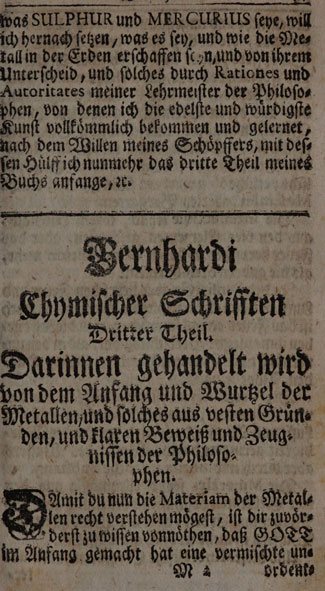
Bernhard’s
Chymical Writings
Third Part.
In which is treated
of the beginning and root of the
Metals, and this from firm grounds, and clear proof and testimonies of the Philosophers.
So that you may now rightly understand the Materiam - Matter of the Metals, it is first necessary for you to know that GOD in the beginning made a mixed, unordered, and unformed Materiam - Matter called CHAOS, which nevertheless, according to the Will of the Creator, was full of many and innumerable Matters and Forms, from which massa confusa - confused mass He afterwards drew out the four Elements, and from their mixture created all kinds of animals, birds, and other different Creatures, so that some of them were Intellectivæ - Intellectual, Understanding; some Sensitivæ - Sensitive, Perceptive; some Vegetativæ - Vegetative, Growing; some Minerales - Mineral, all kinds of mineral species.
The Intellectivæ - Intellectual beings are, according to their body, created from the four Elements, but Fire rules in their Composition more than the other three Elements.
But in the Sensitivis - Sensitive beings Fire and Air rule before the other two Elements, yet the Fire is somewhat weaker, because the Air has equal rule beside it, as in irrational animals, horses, asses, dogs, birds, &c.
The Vegetativæ - Vegetative beings likewise consist of the four Elements, and in them Air and Water prædominiren - predominate, yet the dignity of the Air is diminished through the Water, but that of the Water through a subtle earthy Substance.
The Minerales - Minerals are likewise constituted from the four Elements, but principally from Water and Earth, yet the dignity of the Water is more earthy than watery.
And these Mineral Creatures have different Formas - Forms, and can never be multiplied unless they are again reduced and brought into their first Materiam - Matter, whereas the other Creatures have their own Seed within themselves, in which the power of their Multiplication and Perfection is hidden.
(z - Vid. Epist. ad Thom. p. 246, 254.) - See the Epistle to Thomas, pages 246, 254.
But you shall know that the Metallic Materia - Matter arises and consists solely from the cold and moist crude Mercurius - Mercury, for from it alone Nature makes Metal.
And as I have just said that in all things the four Elements are present, so also in the Mercurius - Mercury which is drawn out from the veins or passages of the Earth are four Elements, namely warmth and moisture, coldness and dryness; but two have the rule, namely coldness and moisture, while the other two, namely heat and dryness, are subjected to the other two.
You shall also be informed that the warmth from which the Metals are generated does not come from the Sun, as some wish, for that warmth would accomplish little there, since the heat of the Sun could not penetrate and work through the Earth into its Centro - Center, where the Metals are; for the Earth is thick and gross, so that the rays of the Sun cannot pass through it.
But their heat is in themselves, because their Materia prima - first Matter has been composed by Nature from the four Elements.
Although it does not dominate at first, nevertheless the motus continuus - continual motion which the Elements have brings it about that the Fire in the Elements of the Matter of the Metals also raises and exalts itself, and thus begins gradatim - gradually, as the most worthy Element, to resist the others, until it finally overcomes them and dominates over the others.
(a - V. Epist. p. 258.) - See the Epistle, page 258.
Therefore their initial Heat is not from the Sun, but it comes from the Reflection and Reverberation of the fiery Sphæren - Spheres which encircle and surround the Air, and also from the continual Motu - Motion and movement of the heavenly Bodies, which make a continual and gentle warmth that one can scarcely perceive or notice.
For if the Sun were the cause of the Mineral warmth, as ARISTOTELES and LULLIUS maintain, then a continual uninterrupted Heat would have to be present daily, because the Earth is surrounded and encompassed by the Sun by night as well as by day, which however is false and erroneous.
For the Sun is neither warm nor cold in itself, but its movement is naturally warm and hot.
Therefore, although the warmth caused by the movement of the heavenly Bodies continually passes into the veins of the Earth, it nevertheless does not heat the Mineras - Mines, as some absurdly maintain and suppose that the Mineræ - Mines are hot.
For if there were any Heat in them, then through such, although slight, yet actuating and operative Heat, the Mercurius - Mercury would be matured into perfect Gold in far fewer than ten years, whereas otherwise this scarcely happens in several hundred or thousand years.
Now since the Earth is also gross, thick, cold, and dry, and the Mineralia - Minerals lie very deep in its Centro - Center, it would follow that before the Heat of the Sun penetrated so far and through to the Minerals, and perfected and matured them, however small such Heat might be, we who must live in the Air would die and burn from that Heat.
For necessarily the Heat would have to be exceedingly great if it were really and actually to penetrate the Earth together with the Water, as the coldest Corpora - Bodies, and without any special diminution and weakening of itself reach and attain to the Mineral places; and in such a manner no Creatures could live upon Earth, but would die and perish from excessive Heat.
Therefore, in order properly to comprehend the GENERATION of the Metals, one must not understand it in that manner, but in a good natural manner thus:
Since the Mercurius - Mercury, as well as the Metalla - Metals, is composed and made from the four Elements, as soon as these move through their own Motum - Motion, the natural warmth of the Mercurii - Mercury is awakened by such movement.
And thus at the same time the Fire together with the Air which are inwardly in the Mercurius - Mercury are moved, and gradually raised and driven upward, because they are more worthy Elements than the Water and Earth of the Mercurii - Mercury.
Nevertheless Moisture and Coldness still dominate and rule in the Mercurius - Mercury.
But because Heat and Dryness are more worthy, more active, and stronger Elements, they undertake to overcome the other two less worthy ones, namely the Coldness and Moisture which dominate in the Mercurius - Mercury.
(a) 1. ♄.
(b) 2. ♃.
(c) 3. ☽.
(d) 4. ♀.
(e) 5. ♂.
(g) 6. ☉.
For the heavenly Motus - Motions stir up and move the other motions of the natural warmths, and in this way through them the four Elements of Mercurii - Mercury, that is, its qualitates internæ - internal qualities, are also moved, so that they struggle and operate with one another without ceasing.
And through length of time the Dryness of Mercurii - Mercury overcomes one degree of its Moisture, and that then becomes Lead.
Thus it proceeds and overcomes another degree of its Moisture, and that becomes Tin.
Afterwards the Heat of Mercurii - Mercury begins to increase and consumes again a part of the Moisture, also Coldness, and thus makes Silver.
When then its Heat further increases, Copper comes from it, following this Iron, and finally, when the Heat strengthens itself still more than before, perfect Gold arises.
And thus it finally follows that the two Qualitates - Qualities, Heat and Dryness, which were at first overcome and subjected to the others, namely Coldness and Moisture, through their power and Motum - Motion again master both Coldness and Moisture and obtain the rule.
Now these two indicated Qualitates - Qualities, namely hot and dry, which had been overcome, when they begin to awaken, are the Fire or Sulphur of which the Philosophi - Philosophers speak.
And the Coldness and Moisture of this same Mercurii - Mercury is the Mercurius - Mercury, not that the Sulphur is something distinct and divided from the Mercurius - Mercury, but it is nothing other than the Heat and Dryness which previously, on account of the Moisture and Coldness of the Mercurii - Mercury, could not dominate.
But when this Sulphur is afterwards digested and matured, it obtains the rule over the aforesaid Qualitates - Qualities, namely Coldness and Moisture, and impresses upon them its powers and virtues.
And according to such different gradibus - degrees of Cooking, according namely as the Mercurius - Mercury is cooked in the Minera - Mine, different Metals are generated.
And to experience this, note that Lead flees when it is to stand long in the Fire for no other cause than because the two Qualitates - Qualities, Coldness and Moisture, of its Mercurii - Mercury have not yet been altered through the contrarias qualitates - contrary qualities, namely Heat and Dryness of its Sulphur, which do not yet rule in it.
For if these ruled, Lead also would be able to endure in the strongest Fire, for this reason: its Mercurius - Mercury would be a pure Fire just as the Fire itself, and therefore it would not flee, but would rejoice in the Fire as in its like and remain standing therein.
Thus all other Metals also flee and evaporate in the Fire, except Gold, yet one more and another less.
This happens because of their Coldness and crude Moisture, and therefore they flee their contrary and cannot endure it, just as every thing in the world by Nature flees that which is contrary to it and rejoices in its like.
But Gold, because it is nothing other than a pure and clean Fire in Mercurio - Mercury, never flees, however great the Fire may be.
And from this you may well understand the Complexion of the Metals and their Mineras - Mines, and what their Ignis - Fire is.
For the SULPHUR is nothing other than a pure clean Fire hidden in the MERCURIO - Mercury, which through long time in the Mineris - Mines is awakened and moved through the Motus - Motions of the heavenly Bodies, and digests and matures the Coldness and Moisture of Mercurii - Mercury, and through different Gradus - Degrees of Cooking and Alteration makes different Metallic Forms.
As has already been mentioned above more fully, the first of these is Saturnus - Saturn, black, somewhat warm and moist; the second JUPITER; the third LUNA; the fourth VENUS; the fifth MARS; the sixth SOL, which is the Perfection of the whole Metallic Nature and a pure Fire, digested and cooked by the Sulphur which is in the Mercurius - Mercury.
From all these things you can now clearly see that this SULPHUR is not something separate outside the Substance Mercurii - Substance of Mercury, nor any common Sulphur.
For if common Sulphur were the Materia - Matter of the Metals, they would not become durable at all, but would, as it does, pass away in the Fire.
But our Sulphur perfects, and does not corrupt or blacken, as all the Philosophi - Philosophers say.
Yet they have called the two ruling Qualitates - Qualities, caliditatem & siccitatem - Heat and Dryness, a Sulphur because they ignite themselves in the Minera - Mine within themselves and through their actual Heat overcome the contrary Qualitates - Qualities.
Thus they have called the Sulphur Mercurii - Sulphur of Mercury only by likeness, because it is hot and dry like common Sulphur, and not re ipsa - in the thing itself, since common Sulphur does not enter into the Metallic Composition.
Therefore I conclude and say that the Metallic Forma - Form is constituted through nothing other than Mercurium - Mercury and its own Sulphur, not a foreign one.
GEBER proves this, where he says:
In the innermost ground of the Nature of Mercurii - Mercury there is a Sulphur which cooks and digests through long continuance of time in the veins of the Mines of the Earth.
And MORIENES and AROS speak still more clearly concerning this thus:
Our Sulphur is not common, but fixed, not volatile, of the Nature of Mercurii - Mercury, incombustible, and from no other foreign thing.
Let us do as Nature, which in the Minera - Mine has no other Materiam - Matter in which it operates and works except solely the clear and pure Mercurial Form and Substance.
For where Mercurius - Mercury is, there also is Sulphur.
Therefore in this our Mercurius - Mercury there is a fixed incombustible Sulphur which completes our Work, and no other than Mercurial Substance is required thereto.
The very same is affirmed by CALID, BENDEGIT, JESSIT, and MARIA PROPHETISSA with these clear words:
Nature makes the Metals from a pure Heat and Dryness of Mercurii - Mercury, which overcome its Coldness and Moisture and alter it, and through its other Essence they become perfect and complete.
And the like is to be found in all the writings of the Philosophorum - Philosophers, without need to introduce everything extensively here.
Therefore those err very greatly who suppose that in the generation of the Metals there must be beside it a particular sulphurous Materia - Matter, since it clearly appears that when Nature works, the Sulphur is enclosed in the Mercurius - Mercury, but it does not dominate until it is altered per motum calidum - through hot motion, and together with it the other qualitates Mercurii - qualities of Mercury.
In this manner Nature now generates by means of this Sulphur, in the passages and veins of the Earth, different Forms of the Metals according to the different gradibus alterationum - degrees of alteration.
Therefore, if we wish to follow Nature, we likewise must take nothing foreign to our Materia - Matter, just as Nature does not.
For our Mercurius - Mercury has in its innermost part a fixed incombustible Mercurial Sulphur, although this does not yet dominate, but rather the Moisture and Coldness of the volatile Mercurii - Mercury, until through the continual Operation of the constant Heat, in which our Mercurius - Mercury is continually held, the fixed Sulphur which is mixed through the whole Substance of the volatile Mercurii - Mercury dominates and overcomes the Moisture and Coldness of Mercurii - Mercury.
And finally the Heat and Dryness of the fixed, as its proper Qualitates - Qualities, begin to dominate over the others.
And according to the gradibus - degrees of these alterationum - alterations and changes of Mercurii - Mercury through its Sulphur, different Metallic Colors are born, neither more nor less than Nature makes in the Mines.
(i - Vid. infra part. 4.) - See below, Part 4.
For the first Color is black, Saturnine; the second white, Jovial; the third Lunar; the fourth Venerian; the fifth Martial; the sixth Solar.
The seventh we lead through our Art one degree higher than Nature does in the Mines, for we make it yet one degree higher in Metallic Perfection and plusquamperfect - more-than-perfect, by bringing it into the highest sanguineous Redness.
Therefore, because it is more than perfect, it makes the other Metals perfect and complete.
For if it were not perfected higher than only to the degree to which Nature has brought and made it, why should we spend so much time and labor upon it, namely nine and a half months, since without any labor or work we could have such a Metallic Corpus - Body already created by Nature?
But as I have said before, the Masculine Body must be made plusquamperfect - more-than-perfect through Art, which is the follower of Nature, so that through its Plusquamperfection - more-than-perfection and overflowing fruitfulness which it has obtained through the Reduction, it can perfect the other imperfect Bodies in weight, Substance, Colors, in the Mineral Root, Seed, and virtue.
It would therefore be great presumption if anyone tried and supposed to complete our Work through other and foreign things where no radicalis commixtio - radical mixture, or mixture in the Root, is to be expected.
For Nature is not emendiret - amended and improved except in its own Nature, as in the Turba says the excellent Master Arisleus, who through his great Science, Understanding, and Wisdom ruled the whole world for sixteen years, of whom one reads in the Chronicle of Solomon that he assembled the Discipulos - Disciples of Pythagoras, who after Hermes was the wisest in the whole world and never spoke any untruth, from which he is also called in some Astronomical books Veridicus - the Truthful.
Therefore our Materia - Matter can be improved in no other way than in its own Nature, which is also confirmed by Parmenides, who first brought me from my Error onto the right way.
From all these related causes it clearly appears that Metallic Nature can improve itself in no other thing than in its own Nature, and in such a manner we can through our Art, which helps Nature so that it operates more strongly, accomplish in a few months as much as Nature can scarcely accomplish in a thousand years.
For in the Minera - Mine there is a very small, indeed almost no Heat, and it must successively be generated and strengthened through the continuum motum - continual motion, until the operative Qualitas - Quality not only brings itself forth in the Materia - Matter, but the Heat of the motus - motion must continuè - continually help until it is entirely perfected.
For this reason so many kinds of Metals are accidentaliter - accidentally generated, according as they can be well or badly cooked.
If also the Heat in the Mines were only moderate or somewhat considerable, the works of Nature would proceed very swiftly.
But for our Work we have a double Heat or Warmth, namely one from the internal Sulphur, the other from the external Fire, of which one helps the other.
Therefore it is also so quickly perfected.
But the Fire is not, as Empedocles and Constantinus wish, of the Substance of the Materia - Matter, so that it should augment and increase the Work.
For it would follow that the Work would have to become heavier and weightier from day to day, which however is not so.
Rather the Fire only helps Nature and governs the Work, and herein consists the whole Art; otherwise we can do nothing thereto.
Ignis non producit formas, quæ non erant, sed educit, quæ latebant, & materiæ visceribus occultabantur. - Fire does not produce Forms which were not there, but brings forth those which lay hidden and were concealed in the bowels of the Matter.
For we indeed see many a strange thing when we try something in the Fire, how it now generates this, now that, which, if it did not come into the Fire, would never appear, and Nature could in eternity not bring such forth without Fire, whatever natural Fire, as EMPEDOCLES says, it might have within itself.
Therefore we must help Nature with Fire and can give it no other help than this.
Therefore know: if the Fire is too weak, one thing does not mix and change with the other; but on the other hand too strong a Fire hinders one thing from being able to move with the other as it should.
Therefore make a vaporous, moderate, constant, digesting Fire, not too violent or boiling, but subtle, airy, enclosed, subdued, surrounding, altering, penetrating, and not burning.
Truly, I have now told you every manner and way of the Fire, how it should proceed.
Therefore consider and repeat often my words piece by piece, since in the government of the Fire lies the whole Art, as is to be seen from all the sayings of the Book of the Whole Truth, Turbæ - of the Turba.
Consider at the same time what the great ROSARIUS says in this respect:
Take care that you do not hasten with your Solution, or desire to bring it into the Work before the due time, for through untimely haste the Conjunction would be hindered.
Therefore let your Fire be fine, gentle, and constant, in the manner in which Nature keeps its Gradus - Degrees, pleasantly and agreeably directing the Body and excluding Coldness.
Item - Likewise concerning this Propositum - matter MARIA PROPHETISSA says:
Strong Fire hinders the Conjunction and colors the white into red like poppies.
And thus you may yourself imagine and conceive the Fire, and learn from the Progress of the Work what you have to do herein, just as I also had to do.
For I did it in horse-dung and nothing came from it.
Then I placed it in a charcoal Fire without a Medium; there my Materia - Matter sublimed itself and was not dissolved.
But after I placed it in such a Fire as I have told you, namely one that was vaporous, digesting, constant, not too strong, subtle, airy, clear, surrounding, enclosed, not burning, altering, circulating, penetrating, single, then it succeeded well and happily for me.
If you are a verus indagator artis - true investigator of the Art, then you understand what I have said here and how the Fire should be constituted.
For, as the TURBA says, the daily experience of the Art will teach you what you will have to do in the government of the Fire.
And in Lumine ARISTOTELIS Chemistæ - the Light of Aristotle the Chymist it stands thus:
The Mercurius - Mercury shall be cooked in a threefold vessel so that the Dryness of the operative Fire or Sulphur may be turned into the vaporous Moisture of the Air which surrounds the Materiam - Matter.
Mark what GEBER and SENECA say:
The Fire does not digest our Materiam - Matter, but its Warmth, which is finely bodily and altering, as in a warm room which through the Air is tempered and moist.
And I have wished to make somewhat more diligent mention of this because the Fire either perfects everything or destroys it.
For as AROS and CALID say, in our whole Work Mercurius - Mercury and Fire are sufficient in the Middle and in the End, but in the Beginning it is not so, for it is not yet our Mercurius - Mercury, which is very good to understand.
And MORIENES says:
Know that our Laton is red, but we have little use of it until it becomes white; and know that our lukewarm Water penetrates it and makes it white as it itself is, and that the moist vaporous Fire works and accomplishes everything.
Item - Likewise BENDEGID, M. JOHAN. MEHUNG, and HALY say:
You who seek day and night and only consume money, lose time, break your heads, and study in so many subtle books, you, I say, I wish out of love and compassion to have reminded, as a father his child, that you now make the red Latonem, aurum - Laton, Gold, white through the white Water which is awakened and lukewarm.
Therefore tear apart all your Philosophical books, leave off so many and various regimina - Regimens and subtleties which are nothing other than breaking of the head, and believe me, then it will go well with you.
For all the related labors and Works are vain and for nothing except what I have now told you, for toward this end aims everything that has ever been written concerning this.
These words are golden words, as you will well recognize if you have understanding.
Item - Likewise Codex omnis Veritatis - the Code of All Truth says:
Make the red white and the white red; that is the whole Art, the Beginning and the End.
But I tell you: if you do not make black, you also will not be able to make white, since Blackness is a beginning of Whiteness and is a certain sign of Putrefaction and Alteration, and that the Body has been penetrated and killed.
For as the Roman Philosophus - Philosopher MORIENES says:
If it does not putrefy and become black, it is not dissolved; but if it is not dissolved and opened, it cannot be penetrated and made white by its Water, whereupon no Mixture, and therefore also no Union, can follow, since this cannot happen without Mixture.
But the Mixture cannot happen without Alteration, and the Alteration not without the Composition or Conjunction.
And through these Gradus - Degrees our Materia - Matter is worked according to the example of Nature, which accomplishes its Operation precisely in this manner and indeed in all points without doing anything less or more, as from my manifold writings and long narration you should almost understand, unless you have no understanding at all.
Concerning further the weight of our Matters and how Nature is accustomed to keep this, one need not trouble oneself so greatly concerning it, since in the Mines it has no weight.
For one needs weight only when one holds two things against one another; but when there is no more than one thing and one Substance, one need not take heed of the weight.
Therefore in this Work one must only take heed of the weight of the Sulphuris - Sulphur which is in the Mercurius - Mercury, for, as I have reported above, the Element of Fire which dominates in the crude Mercurius - Mercury is that which digests and cooks the Materiam - Matter.
Whoever now wishes to be a Philosophus - Philosopher and follower of Nature must take heed of its order and know how much the Element of Fire is more subtle than the others, and how much it can overcome the other three Elements in every Composition.
And therefore the weight is in the first Elementary Composition of the Mercurii - Mercury and nowhere else.
Whoever now wishes rightly to proportion in all things and throughout his whole Work should arrange his weight so that it serves the Matter and is neither too much nor too little.
Therefore mark what Codex Veritatis - the Code of Truth says in this matter:
If you undertake your Conjunction without weight, your Work will proceed slowly, over which you would then become despondent and unwilling.
Item - Likewise Albugazal, the teacher of Plato in the Art, says:
Terrena potencia super sibi resistens, pro resistentia dilata, est actio agentis in ista materia. - The earthy power resisting that which is above it, extended according to the resistance, is the action of the agent in this Matter.
These are golden words indicating the Foundation of the weight, but no one will understand them so easily unless he is experienced in the Art or has learned it from an experienced person.
If you cannot understand it, take counsel with someone who can understand it.
And I would indeed tell it to you more clearly, but I have promised GOD, equity, and the Philosophis - Philosophers that through me neither the weight, nor the Colors, nor the Materia - Matter shall be indicated otherwise than through Parabolical words and similitudes, according to the example of the other Philosophers, as you will afterwards hear in the Fourth Part, in the Practica - Practice.
But I tell you herewith, and testify with my GOD, that all the words therein, without any superfluity or omission, are certain and true.
If you now follow the opinion and custom of the Wise, this my little book which I have written from faithfulness will gladden you, and you will not forget to pray for me.
But since I have now shown and related to you all things as faithfully as can be permitted to be written concerning them, first concerning the inventors of this Art and who possessed it, thereafter concerning the frivolous deceivers, also the unspeakable expenses, together with the almost unbearable Laboribus - Labors which I expended and endured from the eighteenth year of my age until the sixty-fifth before I obtained and attained the Art, I must finally inform you how it went with me to the end.
Therefore I tell you that I was seventy-three years old when I had for the first time completely made the blessed Stone of the Philosophers.
And I do not doubt that I would have attained and come to it much sooner if I had at the beginning possessed the books which I only afterwards obtained.
But because at that time I read nothing but vain false Recipes and misleading books, and was surrounded solely by deceivers and hangman-like rogues, of necessity I had to torment myself with great diligence and labor until I came thereto.
But after through long Study I began to perceive wherein I had failed and how I had undertaken such loose and unfit things, and now knew upon what I should found myself, I allowed two years to pass before I began again to work and make the Lapidem - Stone.
And I did this so that I could confirm my thoughts with certain, sufficient, and well-grounded Rationibus - Reasons, and not, because I was now quite old, make dirty work in vain.
During that time I came to a Barbaro - Barbarian/foreigner, who understood the Art as well as I, indeed better, for he had already made it, and with him I conversed.
And after we had associated with one another for a long time and had only discourse concerning by what similitude the Art could most fittingly be described in the manner of a Parable, it happened by chance that he asked why I insisted so strongly upon this.
I answered: it might happen that, if I now tried this Work myself with my own hand and found it right, I would describe it.
When he now heard and understood that I knew the Art certainly only from much Study and had not yet himself tried it with the hand, and moreover that I intended to describe it, he turned all my words around and undertook to turn me away from the Truth and make me erroneous again.
But because I had grasped the Foundation, I did not allow myself to be turned away, but diligently went without his acquaintance and set myself to the Work.
It succeeded for me, GOD be praised, immediately.
When others now learned of it, there came individually to me about fifteen of them from all places, with whom I afterwards had sufficient acquaintance, for they could præpariren - prepare the Lapidem - Stone just as well as I.
Therefore afterwards we maintained, among other things, great friendship in secret, frequently disputed concerning the Art, and were of one mind in all matters.
But some, so far as the manner and Structure of the Fire is concerned, were not of one opinion, although in the end, when one compared it, it was one thing, for they all aimed at this end: that it had to be made thus, as the Turba says, so that the Volatile does not flee from the following,
id est, ne volatile sublimetur à fixo - that is, so that the volatile is not sublimed away from the fixed,
however the Fire might be made.
For the Fire may be made in many different ways according as it pleases the Artist, and nevertheless at bottom everything is directed toward one Work.
And thus with great difficulty I came to the Lapide - Stone, for which Benefit I thank GOD and surrender myself to Him as the One who bestowed upon me ways, means, and understanding thereto.
To Him be Honor from Eternity to Eternity.
Amen.
But briefly to conclude the Third Part before I begin the Practicam - Practice Parabolically, I say in Summa - in sum:
Our Work is made from one Root and from two Mercurial Substances, taken wholly crude, drawn from the Minera - Mine, pure and clear, joined together and administered through the Fire as the Materia - Matter requires, continually cooked until two become One.
And in this One, when they are mixed, the Corpse is made into Spirit and the Spirit into Corpse.
Afterwards strengthen the Fire until the Fixed holds the unfixed Body in its Color and in its Nature.
For know: when it is well mixed, it overcomes everything and reduces everything into its Nature and into its power, and afterwards tinges a thousand times a thousand, and ten thousand times a thousand.
This you may wholly believe.
It also multiplies itself in power and Quantity, as the highly experienced and truthful PYTHAGORAS and ISINDRICUS in the Codice Veritatis - Code of Truth clearly and openly indicate.
But I have found the Multiplication described in the following books, namely in the great Rosario - Rosary, in Testamento Pythagoræ - the Testament of Pythagoras, in the Turba, Morienes, Avicenna, in the book Albugazal, who was a brother of Bendegid, and in the book Jessit of Constantinople, and perhaps it may be in still more books.
But because I learned it from those, I indicate those to you.
I also knew one who knew how to make the Lapidem - Stone but did not know the Multiplication, and therefore wished to know it from me.
But because I showed him the books which I had, I directed him to them so that he might apply himself all the more diligently to them, for because of my vows it would not have been proper for me to tell it, since I had promised not to tell it openly to any man.
And he accepted this my warning, read and sought, and finally found it also, just as I did.
Therefore there is no doubt that if you have GOD before your eyes, love Him, trust Him, ask Wisdom from Him, and besides will work, you may obtain such a noble Treasure without any intermediary.
For I have now explained to you the whole Speculativam - Speculative part, and concerning the beginning and Generation of the Minerals and Metals, together with their fundamental and natural causes, given sufficient instruction, from which you may sharpen your understanding to see what is black or white, right or false, and make this useful for your Information and secure guidance.
If you now take heed of it, labor diligently, read this my book often and repeat it with understanding, also act according to it, and thus adhere to the Art to the Praise of GOD and the benefit of your neighbor, GOD will bless you and finally also, as happened to me, help you to the most excellent Art.
But if you gape after others, despise my faithful counsel, and follow your foolish head, then my labor which I have undertaken for the benefit of the lovers of this Art, in that I have made and written this little book upon the Foundation of Truth, will be of no use to you.
Now I will also teach the Practicam - Practice, yet with dark words and through a Parable, how I composed the Lapidem - Stone four times before my end, notwithstanding the great age which I had upon my neck.
And I tell you in the highest Truth, which is GOD Himself, that whoever GOD grants the Grace that he obtains this my little book and directs himself according to it with understanding and diligence and works, may come and will come out of all adversity and affliction, and will know how to accomplish the Truth without any defect or deficiency.
For I could not tell it to you more clearly than I have told it, unless I were to point it out and show it entirely with my fingers.
But it is the Will of GOD, as the Turba says everywhere, that one reveal and disclose such Art only to the filiis doctrinæ - Sons of the Doctrine.
Therefore equity will not permit that I indicate it more intelligibly and clearly, for I have already almost done too much.
I also know that if you seek it with diligence, you will through the permission of GOD find such Art from this book, and then you yourself will judiciren - judge and say that I could not have indicated it more clearly than has already been done.
I also know that if you understood the Art as I do and had made the blessed Stone of the Philosophers and were to write concerning it, you would propter levitatem, & tamen nobilitatem artis - because of the easiness, and yet nobility, of the Art, in no way write or indicate it thus clearly, much less more clearly.
But the cause that I have done it is the heartfelt compassion which I bear toward the true filiis doctrinæ - Sons of the Doctrine who, without deceit, make it blood-sour for themselves, for I know what has oppressed me.
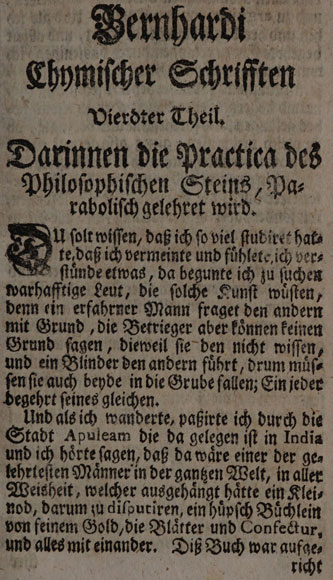
Bernhard’s
Chymical Writings
Fourth Part.
In which the Practica - Practice of the Philosophical Stone is taught Parabolically.
You shall know that I had studied so much that I imagined and felt that I understood something; then I began to seek truthful people who knew such Art, for one experienced man asks another with foundation, but the deceivers can give no foundation, because they do not know it, and one blind man leads the other; therefore they must both fall into the pit. Everyone desires his like.
And as I wandered, I passed through the city Apuleam, which is situated in India, and I heard it said that there was there one of the most learned men in the whole world, in all Wisdom, who had hung out a Jewel for disputing, a handsome little book of fine Gold, the leaves and binding, and everything together.
This book was set up for all who came, in order to dispute concerning it and argue concerning the Art.
And as I went here and there through the city, and always desired to attain Honor through that which I knew, I took upon myself the courage of a brave man and considered within myself that bold and courageous people always attain sooner to something high than fearful and despondent ones, even though they know much.
Thus I went confidently to the Disputation and conducted myself so well that I won the little book, and the same was præsentiret - presented to me by the Faculty of the Philosophers with particular reverence, and all people began to look upon me on account of it.
And because I was weary from studying, I went, to refresh myself somewhat, into the green field, and there found a little Fontin or little Fountain, beautiful and clear, surrounded by a beautiful round Stone, enclosed by an old Oak-tree, and surrounded all around with walls, so that neither cows nor other animals, nor birds, might drink from it or bathe therein.
And I sat down upon the Fontin and considered its beauty, and saw that it was closed above.
And there wandered there a Priest of great age. I asked him: Why is this Fontina thus closed, above, below, and on all sides?
And he was gracious and friendly to me and began thus to say to me:
Sir, you shall know that this Fontina is of wonderful power, more than any other in the whole world, and is prepared solely for the King of the Land, whom it knows well, and he also knows it.
For never does the King pass by but it draws him to itself, and when he enters into it to bathe, he remains therein 282 days.
Then it rejuvenates the King and makes him so strong in powers that there is no man who can overcome him.
This King has caused this Fontin to be enclosed with a round white Stone, as you see, and the Fontin is clear as fine Silver, of heavenly Color.
Afterwards, so that it might be still more strongly guarded, so that horses or wild animals could not come to it, he erected an old hollow Oak-tree, split through the middle, to keep away the Sun and its shine.
Thus, as you see, it is everywhere well enclosed with strong walls, in a beautiful Stone which is clear, and in the half Oak split in the middle.
This happens because the Fontina is of such a wonderful Nature that it would penetrate everything if it were kindled and became angry, and if it were kindled, in the Latin: disappear and flee away from it, we would all be lost.
Then I asked: Have you then seen the King therein?
And he answered me:
Yes, I have seen him go into the Fontinam - Fountain, but I have not seen him come out again in the same manner as when he first went into the Fontinam - Fountain.
And when his Keeper closed him in, one could no longer see him until after one hundred and thirty days; then he began to appear in clear form, and the Doorkeeper who waits upon him continually warms the bath for him, in order to preserve the natural Heat which is hidden in the clear Water, and he warms it day and night without ceasing.
Then I asked him: What Colors does the King have?
And he answered me:
He is at first clothed with golden Cloth, and afterwards has a Doublet of black Velvet, and a Shirt as white as Snow, and Flesh like Blood.
And I asked more concerning this King:
When the King comes to the Fontina, does he also bring great company of foreign and common people with him?
And he answered me pleasantly, smiling:
Certainly, when the King resolves to come thereto, he leaves all his foreign people, and no one enters the Fontinam - Fountain except he, and no one may go thereto except the one who waits upon him, who is a common man, and the commonest in the whole world might be Keeper, for he serves for no other thing than to heat the Bath.
And I asked further:
Is this King its friend, and is it his friend?
And he answered:
They love one another wonderfully, and the Fontina draws the King to itself, but he does not draw it, for it is to him like a Mother.
I asked further:
Of what lineage is the King?
And he said to me:
It is well known that the King was originally made from the Fontina, and from the same he is made as he is, without any other thing.
And I asked again:
Does he keep many Court-servants?
And he said:
No, only 6 persons, who wait for Succession.
If he should once die, they would have the Kingdom just as he does, and therefore they serve him and wait upon him, because they hope for great Good from him.
Then I asked him:
Is he old?
And he said:
He is older than the Fontina is, and is also more mature than any among his subjects.
And I asked:
Why then do his subjects not stab him and bring him to death, since they would have such great Good to hope for from him, especially since he is so old?
And afterwards he answered:
He is indeed old, yet there is none of his subjects who could endure as much Heat and Cold as he, nor so much Rain, Wind, nor other things or labor.
And even if all six put their power together, they are nevertheless able neither collectively nor separately to stab and kill him.
And I asked further:
How then shall they receive his Kingdom, since they cannot have it before his death, and yet cannot kill him?
Then he said to me:
All six were originally created from the Fontina and therefore also have their Good from it just as he does.
But because he is more worthy and excellent than the others, and because of the Love which this Fontina above the others has toward him, as his original Mother, it takes him and draws him to itself, strangles and kills him, and afterwards he rises again through it and becomes alive again.
And from the Substance of his Kingdom, which is in very small parts, each takes his part; and although each receives only a very small Particle, nevertheless he becomes just as rich as he, and one as the other.
And I asked him:
How long then must they wait?
And he began to smile and said thus:
Know that the King alone goes into it, and nothing Foreign, nor anyone of his subjects, may enter the Fontinam - Fountain.
For although it also loves them, they nevertheless do not enter into it, for they have not yet deserved it.
But when the King has entered therein, he first draws off his Coat of beaten Gold and gives it to his first man, who is called Saturnus - Saturn, who keeps it forty, or at the longest forty-two days, once it has come to belong to him.
Afterwards the King takes off his Doublet of beautiful black Velvet and gives it to his second man, who is called Jupiter, who keeps it twenty days.
Afterwards Jupiter, by command of the King, gives it to Lunæ - the Moon, which is the third person, beautiful and shining, who keeps it twenty days.
And thus the King is in his Shirt of Honor, pure and white like Snow or a beautiful Lily.
This he likewise draws off again and gives it to Veneri - Venus, who also keeps it forty days, and afterwards gives it to Marti - Mars, who in the same manner keeps it forty days.
Afterwards Mars, by the Will of GOD, gives it to the yellow and not yet bright Soli - Sun, who keeps it forty days.
Then comes the beautiful blood-red Sol - Sun, who soon takes it and keeps it.
And I asked:
To what does all this serve?
And he said to me:
Then the Fontina opens itself, and as it has given them the Shirt, the Coat, the Doublet of the King, it has at one time given them his sanguine-red, highly colored Flesh to eat, and there they had their Desire.
And I asked him:
Do his subjects then wait until that time, and may they have no Good from him until the End?
And he said to me:
When they have the white Shirt, then four of them may, if they wish, have great ornament, but they have no more than half the Kingdom.
And therefore, for a little advantage, they prefer to wait for the End, so that they may be granted the Crown of their King.
And I asked further:
Does no Medicus - Physician enter, nor anything else?
Then he said:
There is absolutely nothing there except the Keeper who keeps the Balneum Vaporosum - Vaporous Bath in constant Fire.
And I asked him:
Does the Keeper have great labor?
And he said:
He has more labor at the End than at the Beginning, for the Fontina can easily become kindled.
Est enim ignis in fine major. - For the Fire is greater at the End.
And I asked him:
Have people seen it, namely the little Fontin?
And he said to me:
The whole world has it before its eyes and does not know it.
And I asked:
What do they do afterwards?
And he said to me:
If they wish, the six may once more purge the King in the Fontina for three days, and through Continuation of the Fire, in the right Proportion of the Weight, give him again on the first day his black Velvet Doublet, and on the second day his white Shirt, afterwards his sanguineous Flesh.
And I asked him:
To what does this serve?
And he answered me:
GOD makes him ten hundred, thousand, and thus onward ten times more, multiplied.
And I said to him:
I did not understand it.
And he said to me:
I tell you nothing more, for I am tired.
And I also had Appetite to sleep because I had studied much the day before.
Thus I accompanied him as far as his lodging and, with proper thanksgiving, took leave of him.
This old man was so wise that the whole Heaven was obedient to him and everything trembled before him.
Ita DORNÆUS; at Gratarolus rectius: - Thus DORNÆUS; but Gratarolus more correctly:
That all the people of that land were obedient to him and trembled before him, or venerated him.
Afterwards I came again to the Fontina and secretly undertook to open all the locks that were upon it, well guarded, and began to look at my Book which I had won through disputing.
But while I wondered over its shine, which was so very beautiful, and while sitting over it sleep came upon me, it fell from my hands into the Fontinam - Fountain, which made me so unwilling and angry that it was wonderful, for I wished to preserve it for the sake of the praise of the Honor which I had won.
And when I looked into it after it, I lost it entirely from sight.
And because I imagined that it had fallen to the bottom, I began to pfützen - bale out the Fontinam, or scoop out the water of the Fountain.
And I bailed or scooped so well and skillfully that nothing remained of it except the twelfth part with the tenth part.
In the Latin it stands:
that nothing remained except the tenth part with the ten parts.
And I imagined I would scoop it entirely out, but it held itself too firmly together.
But while I worked at it, people came upon me, for which reason I could scoop out no more.
Thus I went away, but before that I had closed all the openings so that they should not notice that I had scooped the Fontin, and also so that they should not take my dear Book from me.
And only then was the Bath in which the King was to bathe warmed.
But I was thrown into Prison for an offence for forty days, and at the end of the forty days I came to see the Fontinam - Fountain and saw black and dark Clouds which lasted a long time.
But briefly, in the end I saw everything that my Heart desired, and had particularly no labor, just as you also will not have if you let this my little Book be dear to you, and keep yourself from all erroneous ways, and arrange all your doing according to the Works and Operations of Nature, which alone one must follow in the Philosophical Work.
For I tell you in the highest Truth:
Whoever uses the counsel of this my Book according to necessity and understands nothing from it must either be unworthy of the Art or entirely have no wit of the senses.
He will never learn to understand it through another, whatever he does.
For in this Parable all the Practica - Practice, the Materia - Matter, the Colors, the Days, the Fire, the Weight, the Regimen, the Disposition, and Continuation are indicated in the very best manner in which I was able to make it.
And I have done this only for this reason: that if our dear GOD opens the eyes of a long-seeking, faithful, diligent Disciple, after his labor, through this my little Book, so that he may also perceive the benefit of such excellent Art, praise, thanks, and honor to GOD in Heaven, and benefit to one’s neighbor, may follow from it.
Thus my little Book is completed through the Grace of the Creator, who may give to all lovers of this Art the power and ability to understand it.
For truly it has not much difficulty to understand, especially for one who has good senses to imagine.
So much Phantasy nor Subtlety, I tell you, is not in one Opinion nor meaning as with the other Philosophers, for it is the true, open, and natural Way, as I have already told you in my Speculativa - Speculative part.
Therefore, my dear friends and children, to whom this my little Book comes, which I have written from my Soul and Heart, because I bear great and exceedingly great compassion toward all those who err in this Art, receive my faithful warning kindly, for I have certainly meant it faithfully and well.
Follow my counsel, and if GOD grants you Grace and Understanding from it, pray to the Almighty for my Soul.
For this my diligence and this my little Book pray enough for your Body and Goods, if only you believe, and flee evil company with their erroneous ways, against which I warn you, as the Devil himself, for you cannot measure the damage which they can cause you in this matter.
Give GOD the Honor, seek and read with diligence, then GOD will visibly bless you and show you the right Way, and let you see with joy the right End of this Art, so that His Name may thereby be blessed and praised.
To Him be Praise, Honor, and all Glory, from Eternity to Eternity.
Amen.
End of the Four Books concerning the Stone of the Wise of Bernhard, to the Most Wise Philosophum - Philosopher, Doctorem Thomam de Bononia - Doctor Thomas of Bologna, Comitem Palatinum - Count Palatine, &c.
SYMBOLUM BERNHARDI
Comitis Palatini Marcæ Trevisianæ - Count Palatine of the March of Treviso.
IN this following Teaching you will find the Knowledge of GOD, of the Holy Trinity, and the Knowledge of the Globe of the Earth; you will also find herein the Riches of your Soul, and the Riches together with all Health of your Body.
I believe in GOD! We should place all our Comfort and Confidence solely in the bare Grace and Mercy of GOD, that He alone can well help us in all Anxiety and Need, and no Creature, however holy it may be.
The Father: and because He is our Father, we believe blessedly that He will gladly help us from the Heart, and will give us Assistance in every Need, and will nevermore forsake us, here nor there.
Almighty: And because He is an Almighty LORD, we believe that He can protect and preserve us from everything that is against us, for He alone is strong enough against our Enemies through His Omnipotence.
A Creator of Heaven and Earth: and since He is also a Creator of Heaven and Earth, we believe that He has every Creature in His Power, so that the same can cause us no Harm without His Fatherly Will; therefore from this Almighty LORD, Father and Creator alone we expect all Goods and eternal Life, for all Things come from Him alone and are given by Him.
For He wishes entirely to grant Himself to us, with all that He is and has, with Heaven and Earth, together with all Creatures, so that they must serve and be useful to us and further us toward eternal Life.
Concerning the earthly Art, which comes from GOD, and He made it through His Word: In the Beginning GOD created Heaven and Earth, and the Earth was waste and empty, and there was Darkness upon the Deep, and the Spirit of GOD moved upon the Water. From the Holy Spirit of GOD everything was created, and everything that He created He also made living, and caused the same also to seed itself and multiply and further preserve itself; and yet in Summa - in sum, everything is Earth, everything that is comprehensible.
But the living Spirit which is in the Earth, and which has come from the living GOD, is a white one of an essential Power; this Power takes to itself good and evil Seed and multiplies it according to its kind. For a living Thing must always work through it, whether good or evil.
And this the Philosophi - Philosophers call the volatile, for it withdraws from △ (🜂 Fire), and the other, which is in the Ground, is fixed; and both come from one Thing, and both must become one Thing. This is then called Q. E., and is the highest Power of the Earth, lapis Philosophorum - Stone of the Philosophers.
Now I set the Earth before the White, which cannot give birth nor multiply itself without the Seed. This is said concerning the Power of the Earth, which is now made permanent and remains permanent, eternally, just as GOD the Father is a permanent Thing above all Things, which is called Heli.
But the Power of this Earth is called Hyle. Thus the Ancients gave it a Name because of its great Virtue, which cannot all be related.
Now further to know and come to the Salvation of our Soul, as Christ says: Man does not live by Bread alone, but by every Word that proceeds from the Mouth of GOD. Matth. cap. 4.
I believe in JEsus Christ His only Son our LORD, who was conceived by the Holy Spirit, born of Mary the pure Virgin:
We believe from the Heart that JEsus Christ is the only-begotten Son of the Father from Eternity, and for our sake took Humanity upon Himself; He was also conceived by the Holy Spirit without anyone’s assistance, and born of the holy and pure Virgin Mary, as of the true natural Mother, and that this Man is truly GOD, as an eternal and inseparable Person, become from GOD and from Man.
He suffered under Pontius Pilate, He was crucified, died, descended into Hell, on the third Day rose again from the Dead, ascended into Heaven, where He sits at the Right Hand of GOD the Almighty Father, from thence He is to come to judge the Living and the Dead.
And that this Son of GOD and Mary, our LORD JEsus Christ, suffered for us poor Sinners, was crucified for us, died, so that through His innocent shedding of Blood He redeemed us from Sins, Death, and the eternal Wrath of GOD; He Himself suffered the anguish of Death and experienced and overcame Hell itself, so that we are reconciled with GOD and have become a Lord over all His Enemies.
We believe that outside this Death of the Son of GOD, neither through Works nor through eternal Glory may we attain GOD’s Grace or Blessedness.
We believe that JEsus Christ, our Brother, rose from Death for the sake of our Righteousness, so that it can no longer harm us; for we confess that we would have had to die the eternal Death if JESUS Christ had not come to our Help and had not taken upon Himself our Sin and Guilt, Curse and eternal Death, as an innocent little Lamb, and paid for us through His Suffering, and become the Curse for us.
We believe that He still daily stands and speaks for us as a faithful and merciful Savior, and Priest and Bishop of our Souls.
We believe that Christ together with GOD governs and fills all Things, and has Power over all Things in Heaven and upon Earth, a LORD over all Lords, a King over all Kings, and over all Creatures in Heaven and upon Earth and under the Earth, over the Dead and Living, over Sin and Righteousness.
This same King and LORD will go before us in our Suffering and Dying, and fight and battle for us, so that together with Him we become a Lord over all our Sin, forever and eternally.
We believe that the Crucified Christ is to come on the Last Day, and to judge and condemn all those who have not believed in Him; but us He will preserve, together with all Believers, from the severe Judgment of Condemnation, and say to us: Come here, you Blessed of My Father, inherit the Kingdom which has been prepared for you from the Beginning of the World.
In this second Part of our Christian Faith, you see how the Godhead had to take the human Race upon itself if He otherwise wished to redeem us; for the Spirit became bodily and took the pure Body from a pure Virgin who had been without every Stain, and she has now borne the Son of GOD, who likewise is pure and never committed any Sin.
If we condemned ones are now to become blessed, an Innocent One must die for the guilty, shed His Blood, and rise again.
Thus understand also concerning the Creation of the Minerals: these are 7 Stars, and there is no more than one perfect one.
If the other 6 are also to become perfect, this must happen through the 7th; he must be killed and brought to nothing, his Blood shed, killed, and rise again from Death to eternal Life; for then he has Power to give Perfection also to the other 6 Stars.
To explain further:
GOD the Father has given to every kind its Seed according to its kind.
The true Seed of the Minerals is the perfect Sun, and no other, and its Terra - Earth, which was mentioned before at the Glory of the Father, where the Seeds are, was in the Beginning just as much one Thing volatile as the other fixed, and He brought them together through Warmth, as other Things.
You shall know that you should add nothing to the Things, nor take anything away, but only separate the Evil from the Good, and the Subtle from the Gross, so that you have the Seed of the Man and the Woman.
Set these two together; this is then called our ☿ Mercury and 🜍 Sulphur.
They will bear many Children according to their Perfection.
You will also see Signs in the Sun and in the Moon: ☉ Sol and ☽ Luna will become black; afterwards ☽ Luna receives her Shine, clear red like a Ruby; then they have Power to make the imperfect Bodies perfect. All that they touch become healthy.
We believe in the Holy Spirit, who with the Father and the Son is a true GOD and proceeds eternally from the Father and the Son, yet in one Divine Being and by Nature a distinct Person.
We believe that through this same Holy Spirit, as a living, eternal Divine Gift, we are awakened from the Dead, freed from Sins, made joyful and comforted, free and secure in Conscience.
For this is our Comfort, when we feel the testimony of this Spirit in our Hearts, that GOD our Father will forgive our Sins and give eternal Life.
In particular we believe that the Holy Spirit helps to bear our Weakness and comforts us with unspeakable Blessing, strengthens us, and enlightens our Hearts to recognize the overflowing Riches of Fatherly Mercy which He has given and bestowed upon us from pure Grace, without any Merit, solely for the sake of Christ, our dear Brother, through whom this is given to us by the Father.
All this the Holy Spirit alone gives us to recognize, and kindles our Heart and enlightens it, that such Gifts come down from above, as Christ has promised us in John:
Whoever believes in Me, as Scripture says, from his Body shall flow Streams of living ▽ Water.
Yes, we also believe one holy Christian Church, which is a Communion of Saints.
We believe that there is a holy Christian Church upon Earth, that is, the Congregation and Number of the Assembly of all Christians, wherein there is one LORD, one Faith, one Spirit, one Baptism, which is JEsus Christ.
Yes, we also believe that this Christian Church is the Christian Body and that Christ is its only Head.
We believe that Christ is the Savior of this His Body and Church, and has given Himself for it so that He might sanctify it, and has cleansed it through the ▽ Water Bath in the Word, so that He might present to Himself a holy Congregation which has no Spot or Wrinkle or anything of the kind, but that it be holy and blameless, a Pillar and Foundation of Truth.
I believe that in this Christianity, wherever it is, there is Forgiveness of Sins, id est - that is, a Kingdom of Grace and the true Indulgence; and outside such Christianity there is no Salvation nor Forgiveness of Sins.
I believe that no one becomes blessed unless he is in this Congregation and Church, planted as a living Member into His Body.
I believe that in this Kingdom there is Forgiveness of Sins not only once, but as often as one desires it.
For Christ is the Hospital-master who does nothing except attend the Sick, help them up, and make them healthy; and as Esaias says in chapter 23: the bruised Reed He will not break, and the smoking Wick He will not extinguish.
I believe that there is a Resurrection of the Flesh, that our Bodies which the Worms eat will rise again as they were before.
For Christ will raise them on the Last Day, according to the wording of His Prophecy where He says:
This is the Will of Him who sent Me: whoever believes in Me has eternal Life, and I will raise him on the Last Day; and whoever eats of My Flesh and drinks of My Blood has eternal Life, and I will raise him on the Last Day.
I believe that after this Life there will be an eternal Life, according to the wording of His Promise where He says:
Truly, truly, I say to you, whoever will keep My Word shall not see Death eternally. Joh. 9.
I, says Christ, am the living Bread which came from Heaven, and whoever shall eat of this Bread shall live in Eternity.
May GOD the Father, Son, and Holy Spirit help us to this.
Amen.
In this third Article or Part of our Sanctification, we perceive the Gifts of the Holy Spirit through which we can become holy and blessed.
For the Holy Spirit returns again to Him from whom He came, namely to the glorified Corpori - Body, that is, JEsus Christ, from GOD the Father, a Creator of Heaven and Earth.
Here mark:
From GOD the Father comes the Son, and from the Father and Son comes the Holy Spirit; and again no one can come to the Son except through the Holy Spirit, and to the Father except through the Son; nevertheless it is one GOD and Being.
And in the same manner it is also to be held with our natural Things.
We have three Things, namely Corpus, Spiritum, & Animam - Body, Spirit, and Soul.
That is our Earth, our purified volatile Stone, our fixed Sulphur.
It is also called our Earth, our Mercurius - Mercury and Sulphur, in the ▽ Water.
You have understood before that in the Earth the Metals are born through Mercurium - Mercury and Sulphur, with the help of Warmth.
Why are they not born in another Element?
Because they are Earths and are made from Earth, in the first Beginning by GOD the LORD; likewise the other two kinds, namely Vegetabilia - Vegetables and Animalia - Animals.
Each is born from the Earth from its Seed, and so must the Earth further preserve and form it, which is clearly evident.
For the Seed has the Power of Life in itself thus: you see what kind of Seed it seizes; it breaks it and unites itself with it, and makes the Seed manifold, as from one little Grain a thousand little Grains.
Thus the Earth has also given a Grain of the same kind, and those little Grains henceforth have likewise the Power of the first Grain.
Thus the Earth is the Bearer who receives the Seed and is called the Woman ☽ Luna, and the Seed is the Begetter of the Earth, which is called ☉ Sol.
For when the two come together, ☽ Luna & ☉ Sol, and are putrefied together, first calcined, then ♎irt (🝞 Sublimation), and the lowest purified, and the highest united with the lowest through itself, I say no more than:
Do not forget the Fontinam - Fountain into which the King goes into the Bath.
This ▽ (▽ Water) is compared with the Holy Spirit.
D D. gel.
You see, when you distill the P. P. geln, and then distill the Earth, and purify the Strength, and the last distilled, al. ♎irt (🝞 Sublimation), Earth, then join them together, putrefy and distill; then the Spirit becomes fixed-like with the Earth, which dissolves all Metals and all Seeds.
For with this last Work you must begin the first, then your Work will become rich.
This I have written to you in the Love of Christ.
If you follow me in the Work and Words, you will obtain from GOD the Holy Trinity the Riches of your Soul and Body, together with all Health.
May GOD grant this to us, the Father and the Son and the Holy Spirit.
Amen.
A Separate TRACT
of Bernhard, Count of Trier.
concerning the Stone of the Wise,
Translated from the Latin into German.
AFTER I had perceived the desire and earnest hope of those who exercise themselves in the Art of Alchymiæ - Alchemy, I have wished in the present Treatise briefly and openly to explain this same Art.
One should therefore first know with what the Art deals; secondly, its Foundation; thirdly, how one should proceed therein; fourthly and lastly, the Extraction or Separation of the Elements. Everyone who understands this well will very easily be able to attain to the Completion of the Art.
The Subjectum - Subject, or that with which this wonderful Art deals, is Gold and Silver, or rather Man and Woman. The Man is warm and dry, but the Woman is cold and moist; and you shall know for certain that our Stone is composed from no other thing, for although most Philosophi - Philosophers name many things, nevertheless they speak of the same things deceptively.
Nevertheless many things are deceptively related by SCOTUS, by HORTULANUS, by S. THOMAS, and CHRISTOPHORUS PARISIENSIS and several others, for other causes, namely that the ignorant may be deceived, for it is not fitting that fools should know our Secret. And this is what I have considered necessary to bring forward for this time concerning the Subjecto - Subject of our Art.
The Foundation of the Art is a Science of the four Qualities, and that at the beginning of the Work Coldness and Moisture have the upper hand. For as SCOTUS says, just as the Sun dries up the superfluity of Water in puddly and marshy places, in precisely such manner our Sulphur, when it is put into its Water or Mercurium - Mercury, gradually consumes and swallows up the same through the help of Fire, and this through the assistance of the one and living GOD, who rules in Trinity.
The Process is nothing other than a contrary Work; for the description of contrary things is one and the same, and if you shall make such likeness twice, you will bring the whole Process to an end.
Further, however, all subtlety consists in the Extraction of the Elements; therefore you must read over that which follows so long until you can grasp and understand it. And know that no one has ever spoken so openly as I in this place, which you will learn from what follows.
Therefore thank the Most High GOD and show yourself thankful toward the friend who has communicated this Treatise to you. You shall also live according to GOD’s Commandment and good Reason, since Divine Wisdom will not come into a godless Soul, nor into a Body subjected to Sins.
The Extraction of the Elements is a Composition of Blackness, Whiteness, Yellowness, and Redness. And know that the Substances must be extracted from their Roots.
But the Root is an assemblage of the Elements, which consists in Sulphur and Mercurio - Mercury, which they call a mixed Lump.
But the Substances which are extracted from the Root are Sulphur and Mercurius - Mercury, which, because they are composed together, are separated from one another and purified, so that afterwards they may all the better be mixed and united with the Body from which they were extracted.
After the Colors shall also have passed away, and that which is above shall have become like that which is below, and that which is below shall have become like that which is above, wonderful things will arise from it.
When this has happened, you have a Triangle in a Quadrangle, and the Fifth which is comprehended in the Four.
Now there still remains the Multiplication, concerning which this is briefly to be noted, namely that the Elixir shall be nourished with the very same things from which it was originally composed.
None among the Philosophis - Philosophers before this has explained this so openly as I have done in this place; and this has happened for two causes, of which the one is because from the beginning to the end of the Work a long time is required, although some Philosophi - Philosophers say that the Stone can be completed in a single day, but some in a single month.
You shall, however, know that they speak figuratively, and that their words must not be understood in this manner.
Nevertheless I speak with SCOTUS and say that the Stone, or perfect Work, can be made in a single year.
The other cause is because human life is short, and man begins to become old before he can grasp and understand what is necessary to be done in the Completion of the Stone.
And therefore I have explained everything here so clearly and openly, so that this so noble Science may not be lost and perish.
Theorica ejusdem. - The Theory of the same.
Make use of the venerable Nature; for the Philosophi - Philosophers have, by their own authority, given different Names to this Work because of the different Colors which appear in its Transformation.
For when it has shown itself under the Form of Water, they have called it Quicksilver, a permanent Water, Lead, a Spirit of the Moon, Spittle, Tin, &c.
And when it has become dry and begins to become white, they have called it Silver, Magnesia, and white Sulphur.
And when it begins to become red, they have called it Gold and Fermentum - Ferment.
But in the Thing itself they are not different, because it is always one single thing, and one and the same Materia - Matter, and everywhere one and the same Nature, to which nothing is added that has not been extracted from it, and that which is most nearly related to it and is of its Property.
And this is certainly true, namely there is only one Stone and one Medicine, and it is a bright and wholesome Water, permanent, pure and clear, of a heavenly Color.
And if the Water did not come to our Medicine, it could neither purify nor improve itself; therefore you would also not attain your Desire.
But that which is improved is the Gold, since without it the Water cannot be improved; for without the Gold and its Shadow the tinging Medicine cannot be born.
Whoever now shall suppose that the Tincture can indeed be made without these two Bodies, namely Gold and Silver, proceeds to the Work as a blind man.
For one Body does not work upon another Body, nor one Spirit upon another.
Also one Form receives no Formation from another, nor one Materia - Matter from another, because a like does not work upon its like nor suffer from it, since one is not more worthy than the other; therefore no Operation can take place between them, because a like has no authority over its like.
But the Body receives an Image from the Spirit, just as the Materia - Matter from the Form, and the Spirit from the Body, since they are thus made and created by GOD that one works upon the other and one suffers from the other.
The Materia - Matter would indeed flow infinitely if the Forma - Form did not restrain and still such flow.
Therefore, because the Corpus - Body is a Forma - Form which performs the Work, it gives the Spirit the Form and retains it, so that henceforth it can no longer flow farther.
Thus the Corpus - Body now tinges the Spiritus - Spirit, and the Spiritus - Spirit penetrates the Corpus - Body, because one Corpus - Body cannot pass through another, but a subtle spiritual Being, which has become hard, passes through the Body and gives it its Color.
And this is the resinous and oily Stone which has its likeness in the Properties and has hidden within itself a spiritual Nature together with the purified Elements.
Therefore the Stone of the Wise must entirely be brought to such a resinous Property through frequent Repetition or Easy-Fusibility, in an easy Flux, so that one dissolves all Elementa - Elements, so that they flow like an Oil.
But when it has become a Stone, it appears like Copper, although it is a spiritual Being, subtle, penetrating, and which tinges or colors all metallic Bodies.
From this you can easily consider that this does not come from the Thickness and Grossness of the Earth, but from a spiritual metallic Being which enters and penetrates.
Therefore one must dissolve the Body into a subtle metallic Spiritum - Spirit, and afterwards harden the same and make it fixed, permanent, and easily fusible, so that it may flow before it can tinge.
For Gold tinges nothing outside itself unless its own Spirit has first been extracted from its Belly and made spiritual.
And know that our Mercurial Water is living and a burning Fire which kills and holds together the Gold more than Fire does.
Therefore the better it is mixed, rubbed, and ground with it, the more it destroys the same, and the living fiery Water becomes all the thinner.
But when three Things are brought into One, in the Form of a thick Substance, then this has within itself a true Tincture which can endure the force of Fire.
Therefore when a Body is thus tinged, then it can again tinge another Corpus - Body and has within itself all Gifts and Properties of a Tincture.
Therefore all those who tinge with Gold and its Shadow, namely with the Poison, that is with Quicksilver, complete our Stone perfectly, which we call the great and perfect Gummi - Gum.
And hold it only for certain that it is not necessary that our Stone or Gummi - Gum lose its first mercurial Nature in the Sublimation of the crude and first Spiritus - Spirit.
For the Oil and Gummi - Gum which belong to this Stone are nothing other than the Elementa - Elements themselves, which, mixed together with the Mercurius - Mercury and united in equal Weight, are enclosed and hardened, and which also allow themselves to be dissolved again and become living, enclosed and bound in the sticky and oily Earth, and inseparably mixed with it.
We should also know that the Gummi - Gum or Oil is first extracted from the Bodies; which, when it is put back again, becomes Spirit until the superfluous Moisture of the Water is changed into Air, by extracting one Element from another through Cooking, until the Form of the Water is changed into the Nature of an Oil, and thus our Stone at the End obtains the Name of Gummi - Gum and Sulphur.
But whoever has now brought the Stone so far that it is to be regarded as a Gummi - Gum which allows itself to be mixed, and allows itself to be mixed with all imperfect Bodies, has in Truth discovered a great Secret of Nature, since this perfect Stone is a Gummi - Gum and Sulphur.
But because this Stone is composed from a Body and Spirit, or from a volatile and fixed, and this happens because no thing in the world can be born and brought to light without these two Substances, namely without Man and Woman, it therefore appears that although these two Substances are not of one and the same Form, nevertheless only one Stone arises from them.
And although they appear and are called two Substances, nevertheless in Truth there is only one single one, namely a Quicksilver.
But this Quicksilver is one part fixed and killed, namely the Masculine, warm, dry, and that which hiddenly gives the Form.
But the other part is volatile and unkilled, which is the Woman, cold and moist.
And from these two Substances the whole can easily be known, and the whole Stone can be perfectly learned.
Therefore, if our Stone consisted only of one Substance, no Operation could take place in it, and likewise it could not suffer from another, for the other would neither touch nor desire nor enter it, just as a Stone and Wood cannot work upon one another because they are of different Materia - Matter, and therefore they cannot in any way be mixed in the least.
And so it is also constituted with all things which differ in Materia - Matter.
Therefore it is certain and evident that it is necessary that the active and the passive be of one and the same kind, but of different Form, just as the Man is different from the Woman.
For although they agree in one and the same kind, nevertheless they have different Operations and different Properties, just like the Materia - Matter and Forma - Form.
For the Materia - Matter suffers, the Forma - Form works and makes the Materia - Matter like itself, and in this manner the Materia - Matter by Nature desires the Formam - Form, as a Woman desires the Man, and a lesser thing the worthier, an impure thing the pure.
Thus also the Argumentum vivum desires the Sulphur, just as the imperfect desires that which makes it perfect.
In the same manner the Body also gladly desires the Spirit, so that it may finally attain to its Perfection.
Therefore learn to know the natural and best Roots with which you shall bring the Materiam - Matter back again into its first Being, so that you may bring your Work to an End.
For this blessed Stone has within itself everything that is necessary for its Perfection, Completion.
Practica Comitis Trevirensis. - Practice of the Count of Trier.
WHEN you shall rightly and well consider the words of the distinguished Philosopher MORIENUS, experienced in Alchimia - Alchemy, who says:
You shall mix Water, Earth, Air, and Fire with one another in proper Weight;
then without doubt you will attain to all the Secrets of this Divine Science.
For firstly, when he says, put into the Water, or putrefy the Earth in Water, this signifies nothing other than an Extraction, a drawing of the Water over the Earth, so long and so often until the Earth comes to Putrefaction and is purified, for otherwise they would not bring forth their Fruit.
Secondly, put together and mix the Air, or when he says, mix the Water and Air, it is nothing other than if he said: mix the now prepared Water with the dissolved Air with Water.
From this judge for yourselves, for you know that the Air is warm and moist, and you have before you the saying of MORIENUS concerning the Dissolution of the Air, the Earth, the Fire, and Water.
Some, when they speak of the Dissolution, say that the Solutio - Solution of the Fire is better, because whatever is dissolved in the Fire passes away into the Air.
And mark that the Fire of the Philosophorum - Philosophers is no other thing than a dissolved and again hardened Air.
You can understand this better from a Similitude, and see that you first have the dissolved and again hardened Air; to this add the Fire.
The Earth shall first be præpariret - prepared, and the Fire solvieret - dissolved, before they are mixed.
The Earth shall also at the same time be placed together with the Fire in a suitable Vessel, and afterwards one shall bring into it the inextinguishable Fire of the Nuts, which, when it descends upon the Earth, swallows it entirely together with its Gummi - Gum and transforms it into its Nature.
Therefore, if you rightly and well consider the Sayings and Teachings of the Wise and understand their hidden Sense, you will attain to all the Secrets of the excellent Art of Alchimia - Alchemy.
To the Triune GOD, the eternal Creator and overflowing Fountain of Grace, and Father of all Wisdom, as Father, Son, and Holy Spirit in one Godhead, be Praise and Honor and Glory and Power from Eternity to Eternity.
Amen.
Of the
Well-born Count
BERNHARD,
of the Marck and Tervis,
detailed
Final Letter
concerning the
Stone of the Wise,
which he
confidentially wrote
to his aforementioned trusted
Friend,
experienced in the Art,
THOMAS of BONONIA,
Physician of CHARLES VIII,
King of France,
formerly published by
D. JOACHIM TANCK,
Now newly translated, and in
many places corrected and improved
by
Caspar Horn, Philosophiae
& Med. Doct. - Doctor of Philosophy and Medicine.
Nuremberg,
Published by Johann Paul Krauß, Bookseller
in Vienna, near the Imperial Palace.
Count Bernhard
of Tervis
Final Letter and
Written Reply,
To Mr. Thomas of Bononia, personal Physician of Charles VIII, King of France.
My greeting and such service as I am able to render be offered to you beforehand, Highly Learned Mr. Doctor, dear Friend, &c.
I give you to know that from Mr. Albreich I have well received your long and extensive writing, together with the Stone of your secret Work, from which I perceived a particular indication of your good friendship toward me.
I have also sufficiently gathered from it, and am now certain, that you have unfailingly directed your high Ingenium - intellect and sharp understanding rightly, and therefore I will all the more gladly answer your Letter.
For some things have been sharply and rightly written by you, which please me well; but some things I will refute, not indeed as though I considered myself to be above you, but I will only, in your honor, pass through them briefly and in Philosophical manner.
For in this, as also in other Arts, it is so constituted that the Practica - Practice and experience must make true the proposed Theoriam - Theory and Speculation.
Since now, dear Mr. Doctor, we cannot be together bodily, let us visit one another through such writings and counter-writings.
Yet you know well that a wise man recognizes and considers a thing according to its true causes.
For what one does not rightly understand afterwards deceives one in Experience.
And whoever wishes to philosophize must have a firm and understanding reflection, if otherwise he wishes rightly to conduct the Work which he has before him to final Perfection and attain thereto.
For that many who wish to work err and fail in this Art comes solely from this, that in their mind they grasp no understanding in the Practica - Practice, whereas they should first have grasped in their mind an understanding of the Work before they undertake it with the hand.
For the Work must follow Nature, and Nature does not allow itself to be forced to follow the Work or Art.
Therefore whoever wishes to accomplish something good should direct his understanding toward recognizing the Property, End, and Nature of a thing; then he may without fear undertake the manual work.
That you are highly understanding in all such things I have been able sufficiently to gather from your writing, since therein you are founded upon Experience and experience.
For, as you rightly write, just as common Water, which according to its Nature is cold and moist, when mixed with the Vegetabilibus - Vegetables, takes to itself other Qualitates - Qualities and Properties, namely those of the things with which it is mixed and cooked, so also Quicksilver, when it is mixed with a related thing, takes to itself other Natures and Properties.
Thus when it is mixed with Gold, it takes to itself the Naturam Solis - Nature of the Sun; with Venere - Venus, the Naturam Veneris - Nature of Venus; with Luna - the Moon, the Property of Lunæ - the Moon; and thus onward with the other Metallic Speciebus - Species.
Therefore the Metallic Species should be cooked in it, and Mercurius - Mercury is their Water.
When it changes itself in them, it takes their alteration to itself, in such a manner that it is turned and transformed according to their kind.
And this Water draws to itself the Nature from the Metallic Species, in the same manner as common Water draws to itself the kind of the Vegetabilibus - Vegetables which are cooked therein, only with this difference: that outwardly in the flowing Mercurio - Mercury its Color is not changed by the dissolving Metallic Species, because the Materia - Matter and the Earth which are together in a certain Proportion in the Water of Mercurii - Mercury are of a very dense Nature, which is not so in other transparent Humoribus - Humors and Waters.
But this Metallic Nature, when it is altered and changed, alters itself, and yet the Color remains outwardly hidden under the Form of Mercurii - Mercury, and the altered Corpus - Body does not outwardly allow itself to be seen in Mercurio - Mercury.
But this has been extensively disputed and proved by you: how common flowing fountain-water is the first Matter and nourishment of the Vegetabilium - Vegetables, and likewise at the same time of all living animals and of the things which move upon Earth.
Therefore if one among all these is cooked in common Water, the Water takes to itself the Property and Power of its Nature.
Hence, although Water in itself is of the highest Coldness, nevertheless when something is decocted in it, it may produce in us a Warmth of the first Degree, as your words run.
Further, nothing produces better nourishment than a Decoctum - Decoction or meat-broth, whether one consumes the broth of the meat or herbs in which they are cooked, or takes the pieces themselves which were cooked in the Water while still moist, or after the cooking merely drinks the Water.
This harms no one, but rather helps and is useful, although beforehand in its common and simple Nature it might have been harmful.
But that it is now no longer harmful comes from this: that this Water or broth is no longer a Water as it was before.
In the same way Quicksilver is also a Materia - Matter of all Metals and is related to the Metals, just as common Water has a relationship and likeness of Nature with the Vegetabilibus - Vegetables and Animalibus - Animals.
Thus Quicksilver also draws to itself the Power of those things which adhere to it and with which it is mixed in the Decoction.
And although it is of the coldest Nature, it may nevertheless become of the hottest Nature in a short time, and in the same manner it may also become of a moderate Nature, yet through entirely subtle Art.
But no Metal adheres to it better than Gold, as you say.
Therefore some hold and conclude that Gold is nothing other than Quicksilver coagulated through the power of Sulphur.
From this, as I understand it, you wish to conclude-and rightly and well-that if one cooks or dissolves Gold in Quicksilver in the proper manner and according to the natural Way of the Art, the Quicksilver should take to itself the natural Properties of Gold.
But nevertheless the Way of this Decoction and Dissolution of Metals is known to very few people.
For the cause or origin of this Dissolution comes from this: namely when the Moisture or Fluidity of Quicksilver is restringirt - restrained, contracted, or made thicker through the thickness of its homogeneæ terræ - homogeneous Earth, that is, such an Earth which has with it, the Quicksilver, such a like Nature and Being that one may receive the other and adhere to it.
And conversely, when the thickness of such a homogeneæ terræ - homogeneous Earth is released from its hard earthy Substance through the Wateriness or Moisture of Mercurii - Mercury.
And in such Solution the Coldness of the Earth must also be tempered through its Water, which is agreeable to it and of like Nature with it.
Yet the Qualitates - Qualities must always remain in their Homogeneitate - Homogeneity, that is, on both sides between the Qualities there must be Water of one and the same Nature.
In this Solution there is a single Dryness, a double Coldness, and a single Moisture, and yet these things are in unequal Proportion toward one another if one considers their maturation and compares it with the anatic proportion, that is, with the condition that in mature and sufficiently cooked Gold the Qualitates - Qualities are contained not in an unequal Proportion, as in this Solution, but in an entirely equal and balanced Proportion.
Thus the solvent differs from the Corpore - Body which is dissolved by it in Proportion and Digestion, which are unequal between them, and not because there were any difference in the Materia - Matter and Waters.
For even if nothing were added to Quicksilver, Nature would nevertheless, without any further Addition, make Gold from Quicksilver by itself, just as Nature simply and wonderfully produces Gold from Quicksilver, as you have wisely spoken of this in your writings.
For to dissolve the Vegetabilia - Vegetables inwardly, common simple Water is used, so that through Art that which was previously coagulated may be dissolved, and give and impart its Power into the Water.
And when a thing is dissolved, that Dissolution happens at the same time with the Coagulation of the Water, and the Coagulation of the Water happens at the same time with the Dissolution of those things.
And conversely the same also happens with the Mineral Water in its Metallic Species and kinds.
Whoever therefore understands the Art and the Secret of Dissolution has come to a right similitude of the Art, namely how the Species must be mixed, and the Natures extracted from the Natures, which lie powerfully hidden within them.
How then can one have found the Truth who destroys the moist or fluid Nature of Quicksilver, as some fools are accustomed to do, who bring Quicksilver and its Speciem - Species or Form from its Metallic Disposition or Dissolution into another and foreign Form, and in their dissolving destroy its Metallic Moisture, separate from it its Proportion, and bring it into another which is a foreign Quality and has no agreement or correspondence with the first Mineral Proportion and Quality?
This Proportion requires nothing other than Purification or Purity and a simple ordinary Decoction.
For example, there are some who corrupt and destroy Quicksilver in all kinds of Salt, Vitriol, and aluminous things, and bring it into another Water than the Nature of Quicksilver.
For the Seed which Nature has wisely made for our good they undertake to perfect and improve by force and by breaking it.
But thereby they undoubtedly destroy and break it so that nothing can come from it.
For we see that in men, animals, and growing things the Seed is made by Nature and not through Art.
Art, however, joins the Seeds together and mixes them, and nevertheless adds nothing to them and takes nothing from them, if one otherwise wishes to generate and bring forth something which is of like Species into a new kind.
If therefore the Materia - Matter is one and the same in Nature and in Art, then one and the same Form may also follow afterwards, and no other.
Therefore, Highly Learned Mr. Doctor, all assertion is false and vain where one teaches that Mercurium - Mercury, which is the Seed, should be altered or changed before the conjunction of the Metallic Specierum - Species with it.
For when it is dried out, it no longer dissolves anything.
What then could it accomplish in dissolving the Metallic Species?
For if it is heated or dried out outside the natural Digestion, it likewise cannot produce even such a slight Heat in the Mineral Species as would amount to a feverish Heat.
And thus absurdly from the cold is made a hot thing, and from the Passivo - Passive, or suffering thing, an Activum - Active, or working thing, from which then great irrecoverable loss and error arise, and the Work comes to nothing.
For example:
Some fools make certain Corrosivas - Corrosives and foreign Waters from the lesser Minerals, into which they cast the Metallic Species and allow them to be eaten away therein, and imagine that thereby the Species have been dissolved with a natural Dissolution.
Yet natural Dissolution requires that the solvent and that which has been dissolved remain together, and that from those two, from the Masculine and Feminine Seed, a new Species or Form should arise.
By the Truth I tell you that no Water dissolves a Metallic Speciem - Species by natural Reduction except only the Water which remains with it according to its Matter and Form, and which may in turn be coagulated by the dissolved Metals.
But this cannot happen with separating waters or other sharp Waters; rather through these the Composita - Compounds are corrupted, and the Corpora - Bodies which one wishes to dissolve are spoiled and destroyed.
To the Corporibus - Bodies in the Solutionibus - Solutions also belongs their Water, which in the Coagulationibus - Coagulations may remain with them.
And to say it once: Mercurius - Mercury is such a Water, and by no means the sharp separating water.
Nor does there belong here, as some fools suppose, a Mercurial, bright, transparent Water.
For if one separates and destroys from Mercurio - Mercury its Homogeneum - Homogeneous thing and like Substance, how can the first Proportio - Proportion of its Feminine Seed remain and be preserved?
For in this manner Mercurius - Mercury will not allow itself to be coagulated with the dissolved Corpore - Body.
Nor will any Species any longer grow from it through Administration of the Art, but an impure and useless thing.
Nevertheless some imagine that they dissolve in such a manner, although they err in Nature and do not dissolve.
For when the separating waters are drawn away from the Corporibus - Bodies, the Corpus - Body still allows itself to be melted as before, and such a Water cannot remain with the Corpus - Body, nor can it be reckoned to it as a Moisture belonging to it in its Root.
The Corpora - Bodies are indeed corroded and eaten away, but not dissolved; and the more they are corroded, the farther they are removed and alienated from the Metallic Species.
Therefore such Solutiones - Solutions have no foundation in the Art for changing the Metals, but are deceptions of Sophists and loose Alchymists who suppose that this worthy Art lies hidden in such things.
They indeed say that they make Solutiones - Solutions, but they will never make the Metallic Species perfectly complete, for they do not remain, as they should according to Nature, in the first Proportion, Species, or Form which the right Water of Mercurii - Mercury leaves remaining in the Metallic Species.
For Mercurius - Mercury is corrumpirt - corrupted or destroyed with them, not in such a manner that it is broken and divided, but alternativè - alternatively, that is, in such a manner that it is changed with them.
For the dissolved Corpora - Bodies which are dissolved in it afterwards can no longer be separated from it as the separating waters and Corrosives can be separated from them.
And then one Species draws the other Species to itself and only hides the other, and one perfectly retains the other hidden within itself.
Thus Gold and Silver, when they are dissolved in it, are retained within it in a hidden manner.
For their Nature lies hidden in Mercurio - Mercury until it begins to run together or become thick again, which thickening or inspissation they, the dissolved Metalla - Metals, bring about and are a secret cause thereof, because they lie hidden within it, Mercurio - Mercury, as dissolved Corpora - Bodies.
And just as Mercurius - Mercury first dissolves the Metalla - Metals and hides them in its Belly, so they in turn coagulate it.
And thus that which was hard becomes soft, and that which was soft becomes hard, yet so that the Species always remains, which Species is nothing other than the Metals and Quicksilver.
Whoever therefore dissolves in this way rather coagulates, and the Metallic Species which are destroyed and joined together take their former Form again through the Decoction of the Art.
And although this Dissolution causes many Colors to appear because the Species lie there as though dead, nevertheless the inward Proportion should always remain whole and unshattered.
Hence also the LORD Christ gives a similitude from the Vegetabilibus - Vegetables, where He says:
Unless the grain of wheat falls into the Earth and dies, it remains alone; but if it dies, it brings forth much Fruit.
Thus it is also with this alterativa corruptione - alterative corruption, or with this destruction, which consists only in alteration, namely that it hides the Form, dissolves the Nature, preserves the Proportiones - Proportions, and changes the Colors from the Beginning to the End.
For when the Water begins to cover the Earth, the black Color begins to hide itself beneath the white Color and to disappear.
And when the Air begins to cover the Water and the Earth, the yellow Color appears, which finally is transformed into a red one when namely the Fire covers the Air, or the remaining three Elements.
And these latter Colors at first hide themselves secretly and remain inwardly in a hidden manner under the Form of a white Spiritus - Spirit in the flowing or fluid Mercurio - Mercury, until they are again made thick into a Powder which is in the Corporibus - Bodies.
For the Soul lies hidden in the Spirit, just as in the thickening of the Spirit the Soul also lies hidden in the Powder or Corpore - Body.
For in the things which are to be altered, Corruption has place, but no separation of the Parts, unless certain superfluous Parts are to be removed as being unfit for Generation.
Therefore a true Master should cleanse his Work well so that the Digestion may proceed all the better.
This may be seen in the previously introduced example of the grain of wheat.
For if one takes one of two little grains and casts it into the Earth, it putrefies and dies and loses its outward Form, yet is not scattered therein, but in its time grows forth and brings forth much Fruit.
This is then called, and is also nothing other than, only a Corruption or laying aside of the Form, and not a destruction and separation of the Materia - Matter.
But if one takes another little grain and casts it into Fire, it is destroyed both in its Materia - Matter and in its Form, and everything is separated, and such a Corruption is wholly unfit for Generation.
Therefore no Water can dissolve the Corpora - Bodies except only the Water which is of their Speciei - Species and which may in turn be made thick by the Corpora - Bodies.
Nor may the Corpora - Bodies in Generation be nourished except with a thing which is their like, through which the Species may be preserved which have been disturbed by the Corpus - Body that is to be transmuted through the Art of this Work.
With the Vegetabilibus - Vegetables, however, it has another meaning, for they draw their nourishment from many Species.
Yet before those Species become nourishment for them, they are first made equal through Dissolution to the Proportion of those things by which they are drawn in for nourishment.
It is therefore to be known that the Dissolutiones - Dissolutions of Metals occur in various ways.
The first is that which is known to fools, as has been said above, and happens through outward things which cannot remain with the dissolved Metals, and which should rather be called a corruption and destruction of the Compositi - Compound than a Solution.
The second Solution is that which happens through the power and force of Fire, which also is no true or proper Solution, but rather a Liquefaction or melting of the Elemental parts bound together.
For the outward heat of the Fire attacks the inward thing in the Composito - Compound and resolves it.
And because this inward Fire dwells in the Air, it also resolves that same Air.
But the resolved Air dwells and lives in the Water, and the Water in the Earth, and the Water dissolves the Earth, so that it melts the Activum & Passivum - Active and Passive, both the suffering and working.
But such melting is no true Dissolution; rather it is a destruction and separation.
For in these are the like-formed and Homogenea Elementa - Homogeneous Elements of a fixed Proportion which is mixed through Digestion, and each is born from the other.
Therefore this happens in the pure Corporibus - Bodies in which the Elemental Natures are fixed and permanent.
Thus the Flame of Fire melts them and brings the whole Compositum - Compound into Flux, but does not separate them.
For the Fire cannot flow unless its substantial Air flows; nor does the Air flow unless the Water is dissolved; nor does the Water flow unless the Earth also flows.
And conversely, as the Earth is dissolved by the Water, so in turn the Water retains and coagulates the Air; and thus, if one ascends again in the same manner, the Air retains the Fire with itself in the Coagulation.
For when the Elementa - Elements which are thus permanent and fixed work together, they make a fridum, as are the Elements Earth and Water; and again Air and Fire work together and with one another toward Dissolution.
But this Solution is called a melting of the Compositi - Compound, and is not properly to be called a Solution, for the Parts which can be separated and which were composed together in the Generation of the Compositum - Compound are herein not separated from one another.
This is unlike the third and true Philosophical Solution, in which the Compositum - Compound is dissolved in the manner mentioned above, and nevertheless its Parts remain unseparated although they are capable of being separated.
And thus the Power and Virtue of the Elements which are best digested are extracted from the things which one dissolves through the solvent and dissolving thing, namely through Quicksilver.
And the gross and thick Parts in this Dissolution take upon themselves a high Subtlety, because the Corpus - Body is transformed into a Spirit, and conversely the Spirit is made into Corpus - Body, and the fixed becomes volatile and the volatile fixed.
For such a Solution is natural and possible to bring about through Art which helps Nature.
And this is the one and necessary Solution in the Philosophical Work, and it can happen or be made through no other thing than solely Quicksilver, with a subtle Proportion, as a good Master who understands the inward Natures and Proportiones - Proportions should arrange the Proportions at the Beginning of the Work.
For these two pieces can make this high Work, beloved Mr. Doctor, and nothing else enters into it except these two: it multiplies and generates; and nothing else besides these, as has been said above concerning this.
Further you also say that Gold, as many people think, is nothing other than Quicksilver naturally coagulated through the force or power of Sulphur, yet in such a manner that none of the Sulphur which coagulated the Gold remains in the Substance of the Gold.
Just as it is with a child in the mother’s womb, where, as Aristotle holds, nothing of the Seed of the Father remains therein, but the Seed of the man merely coagulates the menstrual Blood of the woman.
Thus you also say that when the Quicksilver has been coagulated by the Sulphur, the Forma - Form of Gold is then perfected in it through the power of the heavenly Operation of the Stars and especially of the Sun.
But my opinion is not that one should hold it thus.
For according to the Philosophers one should believe that Gold is nothing other than an Anatizatus Mercurius - anatized Mercury, that is, a Mercurius - Mercury equally digested beneath the Mineral Earth.
And in this manner the Philosophi - Philosophers have also taught that Gold is created when a Sulphur encounters the Mercurius - Mercury and coagulates it through its Operation, by digesting the Mercurius through well-proportioned Warmth and inspissating and making it thick.
Therefore one should know that Gold is at the same time both Sulphur and Mercurius - Mercury, that is, both the coagulating and the coagulated thing.
And nothing else is added to it from elsewhere except only a pure Digestion, Cooking, or Maturation, which increases its Qualitates - Qualities and continually awakens one Element out of another, so that from their Potentia - Potentiality or hidden condition they come into Actum - Act, that is, into manifest appearance or into the Light, so that nothing whatever else is added.
But this Digestion or Maturation is brought into Work by the upper and higher Elements, namely Air and Fire, which indeed at the Beginning are not yet actu - actually visible or present in actuality in Mercurio - Mercury.
But when they are awakened by the outward Warmth and receive help through the same and are digested through their own and natural Warmth, they make the passiva Elementa - passive Elements which are in Mercurio - Mercury actu - actually, that is, clearly visible and not merely potencia - potentially, somewhat more subtle, so that they approach toward Water.
And the Water, in becoming more subtle, approaches toward Air, and Air approaches toward Fire.
And in this proportioned Operation of Nature and Digestion of Mercurii - Mercury, both the Masculine and Feminine Seeds remain together enclosed in their Natures: the Feminine Seed as Earth and Water, but the Masculine Seed as Air and Fire.
The Earth and Water in Gold the Philosophi - Philosophers call Mercurium - Mercury; but the Air and Fire they say are the Sulphur in it.
Nor is there any other Addition inwardly in the Earth, and therefore in Art above the Earth no outward Addition is required to digest and thicken Mercurium - Mercury so that it becomes Gold or another Species.
Therefore the Philosophi - Philosophers have said that Sulphur and Mercurius - Mercury make Gold, that is, its Corporeality, bodily Being, and Permanence.
Therefore it cannot be concluded from this that the outward Warmth prepared through Art, through which the inward proportioned Warmth is raised and helped to digest and mature the less digested and immature Elementa - Elements, Water and Earth, which are in Mercurio - Mercury, is a piece or Part of the Substance of the Compositi - Compound.
For the outward Warmth does not remain inwardly with the Weight or Quality of a thing, nor does it add anything to it.
But the inward proportioned and natural simple Warmth remains with the Quality and Weight of Mercurii - Mercury which has been digested by it, for this Warmth is an inward and essential piece of Mercurii - Mercury itself, and is nothing other than the two powerful and working things in it, Mercurio - Mercury, namely Air and Fire.
Therefore the fools understand the Philosophical saying very wrongly where it is said that Sulphur and Mercurius - Mercury generate Gold.
For, as is known to everyone, just as the two Elementa - Elements Air and Fire are separated or divided from Earth and Water neither in the first Mercurial Composition nor afterwards in the natural Metallic Digestion, so also Sulphur, which is nothing other than Fire and Air, is not separated or divided from Mercurio - Mercury, which is nothing other than Earth and Water.
But whoever holds otherwise concerning this or affirms the contrary is no Natural Philosopher or Philosophus - Philosopher.
For the Digestion of Gold arises and takes place solely from the very first Mercurial Proportion, so that neither under the Earth by Nature nor above the Earth by Art does any further Addition occur to it, as has already been said.
But what has been said until now is not contrary to this: that in this Art pure Gold and pure Mercurius - Mercury should be put together or joined together.
For this happens not for the reason that one might conclude from it as though there were one Sulphur in Gold and another Sulphur in Mercurio - Mercury, or one Mercurius - Mercury in Gold and another in Mercurio - Mercury.
Rather it happens because in Gold there is a more perfect and mature Digestion than in Mercurio - Mercury, and because the Sulphur in Gold is more mature and better digested, and therefore more powerful and more operative than in common Mercurio - Mercury.
Therefore the Philosophi - Philosophers have said that Gold is nothing other than mature Quicksilver.
For in Mercurio - Mercury there are two manifest Actus - Acts, or visible Elements, namely Water and Earth, which are called the Passiva - Passive or suffering Elements.
But the other two Activa - Active or working Elements, namely Air and Fire, are present in Mercurio - Mercury only in a hidden manner.
But, as is well known, when these two, Air and Fire, are brought forth from their hidden condition in pure Mercurio - Mercury so that they begin to operate, namely that they come to proper Digestion and proportioned Decoction, Gold arises from it.
Therefore in Gold the four Elementa - Elements are united together in an equal and anatic Proportion.
And therefore in it, the Gold, the Sulphur is more mature and more operative, namely the Fire and Air, than in Mercurio - Mercury.
For this reason through Art Gold is dissolved with Mercurio - Mercury, so that the Mature may come to the aid of the Immature.
And thus, while Art cooks it and Nature perfects it, through the Grace of GOD the compositio - Composition is completed all the sooner and more quickly.
From these things one may now easily recognize and find the cause why in the Work of Philosophical Art a nobler, more perfect, and higher Gold in its Degrees is made much sooner and in shorter time than can happen through the Work of Nature.
For Nature does nothing else than digest and cook the one Mercurium - Mercury by itself and alone in the veins of the Earth, without any further help or Addition.
Therefore it cannot so quickly attain to the required Proportion and Perfection of Gold or another Metal.
But our Art helps the Work of Nature by adding mature Gold to Mercurio - Mercury, in which there is a very highly digested Sulphur that very quickly matures the Mercurium - Mercury and soon digests it to the anatic and equal Proportion of Gold by continually making the Elementa - Elements of Mercurii - Mercury more subtle.
Therefore from this follows in this Art a truly wonderful shortening of the natural Work.
Accordingly, dear Mr. Doctor, so that I may return to my undertaking, one should not hold, as some err and fail in saying, that the working Masculine Seed is indeed added to the Feminine Seed in Coagulation but after accomplished Coagulation is separated again from it.
For, as is known, in every Generation of a bodily Fruit or child there is activum & passivum - an Active and Passive, a working and suffering.
But both the working and suffering, that is, all four Elementa - Elements, must always remain together; otherwise no Mixture can happen, nor could the Generation of any Fruit be hoped for.
For in every human being, as soon as the Masculine Seed is mixed from the Beginning, it, the Masculine Seed, always remains until the end of human life as an Agens - Agent or working piece with the Feminine Seed.
When it is also poured out or consumed, Nature brings it into growth and again increases for that same man a like-formed Seed in his loins, from which afterwards his like, or his Species, may again be born.
And precisely the same meaning holds with the Feminine Seed in women as has until now been spoken concerning the Masculine Seed in men.
Therefore both Seeds remain and should together be held for the original Agentia and Patientia - Active and Passive things, that is, for the two suffering and working pieces.
Nevertheless the Generation of natural things is of various kinds among naturally mixed and growing things.
For firstly there are the simpliciter mixta - things simply mixed, which are born under the Earth.
We cannot, however, see their Composition with the eyes.
They are born solely from the combined mixture of the compounded Elements, or from their first Resolution.
For they do not become larger through growth and do not increase as the Vegetabilia - Vegetables do.
Rather as much Materia - Matter was mixed together at the Beginning in size and weight, exactly so much of that former Weight is also retained in them after the Composition.
For example:
As much as the Massa - Mass or lump of Mercurial Substance in the veins or passages of the Earth weighs in its Mineral Disposition at the Beginning, just so much Gold in Weight will remain after completed Digestion.
Indeed, rather, because it casts off the refuse and slags from itself, it may well diminish in Weight, and this much sooner than it could increase in Weight and Substance, and for this reason, because it does not take and draw nourishment to itself as the Vegetabilia - Vegetables do.
But in this first and simple natural Mixture there are several Degrees.
The first Degree is nothing further than merely a bare Composition of the four Elements, and there is as yet no alteration or elevation of one Element against another in this first Degree.
Rather it is only a simple and permanent Union of such a Composition, where one Element is balanced with another into one thing.
Of this kind are commonly the Stones created by Nature.
But the second Degree follows upon this first.
For from the just-mentioned Stones the Mineralia - Minerals of which we speak here are born, and here arise the more precious and noble Species which grow under the Earth.
For in these the Operation of the Elements begins, and one begins to transform itself into another.
And yet their Operation is not so actively living and powerful as in the Vegetabilibus - Vegetables or other living things, for they, the Mineral Elements, have no multiplication and sensibility or perceptive Power, as has been said before.
The third Degree contains the precious Stones, for in them there is found a completed and brought-to-an-end Operation, which is accomplished through the power of the joined and mutually operating Elements.
As I have explained this more extensively in my Philosophia - Philosophy, that this third Degree, together with others, is the Middle between the first and second Composition of natural things.
Therefore this is called the second Generation, which contains within itself not the simpliciter mixta - things simply mixed, the things which are easily composed together, but contains within itself the Composition of the Vegetabilium - Vegetables or growths of the Earth, which are divided into many kinds or Impositiones - Impositions, as I have explained according to necessity in my other Book which I sent to you.
For the Vegetabilia - Vegetables and especially the living animals generate and bring forth their like commonly and for the most part from both Seeds, of the male and female, when these are first mixed in Coitu - Coitus and encounter or meet one another.
And in this matter Art follows the Work of Nature in the Generation of Gold.
No one can indeed make human Seed through Art, but through Art one may do this: make man fit or capable so that he can generate his like.
For the living Seeds are digested solely by Nature, in a vegetable or growing manner, in the loins of both parents.
But through Coitum - Coitus the two Seeds of the parents may be mixed in the natural Vessels, understand the mother.
This Coitus is, as it were, the Art through which the natural Seeds are disposed and mixed for the Birth and Generation of a human being.
For example:
The Seed of the man, as the more mature, more perfect, and more operative, is through Art and advantage joined to the Feminine Seed, which is more immature and of a more Passive or suffering kind.
But because the Masculine Seed ipso actu - in actual fact has within itself and contains the working Elementa - Elements, namely Fire and Air, it is therefore more mature and stronger for digesting.
The Seed of the woman, however, has actu - actually, in itself, the less-digesting passiva Elementa - passive Elements, namely Earth and Water, which therefore need Digestion.
When these two are poured into the natural Vessel of the Mother and mixed together, the Activa - Active or working Elements of the Masculine Seed set themselves upon the Seed of the Woman, digest it and make it more mature.
From this a perfect human being is then born in Nature.
And all this happens without Addition of any outward thing, except that the outward Warmth of the Woman awakens the inward proportioned Warmth which is contained in the Man’s Seed and helps it onward.
Thus also our Philosophical Art conducts itself like the Generation of a human being.
For just as in Mercurio - Mercury, from which Nature makes Gold in the Mineral Vessels under the Earth, there happens a natural Conjunction of the two Seeds, Masculine and Feminine, so in our Art there happens an artificial or artful, or like-formed Conjunction of the suffering and working Parts.
For there the working Elements, which have the Name of the Masculine Seed, are united and joined in natural manner with the passivis Elementis - passive Elements, which are as it were a Feminine Seed, yet so that the certain and necessary Proportion of Nature is everywhere carefully observed.
But this Conjunction and Union is called the first Mercurial Digestion, from which the Hidden thing raises itself and comes forth, namely the Masculine Seed from the Feminine.
That is, Air and Fire raise themselves and allow themselves to be seen from Earth and Water by means of a pure Digestion and Subtilization of the Elements.
But to this natural Digestion of the Seeds in Mercurio - Mercury, the sharp-witted Philosophi - Philosophers and Masters, by following Nature, have made another Conjunction and Digestion through entirely sharp and subtle invention.
Therefore their Art has brought forth not merely a simple Gold, but something higher than Gold.
For they have commanded that one unite Gold, in which the operative or stronger Elements are, as the Masculine Seed, with Mercurio - Mercury, in which the Passiva - Passive or suffering Elements are, so that namely the Gold may debite - duly and in its proper manner be dissolved.
And otherwise in such work all outward things are to be left aside; only the outward Warmth should be added, through which the inward natural Heat in Gold is awakened and helped, so that Mercurius - Mercury may be digested and actively matured through powerful Operation.
And just as through Nature the human being is born, so through Art Gold is born.
Yet their Seeds cannot be made through Art, for Art does not know the Mixture and Proportion necessary for the Generation of the Seeds.
Nor does it know the Composition in human beings, nor likewise the first Mixture or Proportion and the cause of those things from which beneath the Earth in Mineral things the Seeds flow forth, where their proper and natural place of Generation is.
All this Art does not know and it is hidden from it.
But Art can do this: namely join together through Art those Seeds which are made by Nature, so that through their conjunction something may be brought forth to be born.
In this both Seeds mixed together remain and continue with one another, although Aristotle, as you write, appears to hold otherwise concerning this.
Accordingly the Masculine Seed, or our Sulphur, does not depart from Mercurii - Mercury after its Coagulation, as some falsely maintain.
Nor does this happen in Mercurio - Mercury chiefly through the power of the Sun, nor are Gold and its Form principally made and completed through the Warmth of the Sun in the Earth, as some hold.
Rather this happens much more through the Power and Motion of the Sun and its Sphæres - Spheres, and, as it were, universally through the Power and Course of the whole Heaven.
For the Rays of the Sun reach only outwardly upon the Earth; they cannot, however, inwardly reach down into its Depth where the Mineral Species are born.
Indeed, neither can the Influence of the Heaven, which happens through the Radios - Rays, reach to those lowest places.
The Motus - Motion and movement of the Elements beneath the Earth indeed first originates from the movement of Heaven, but not from the Radiis - Rays of its Light, nor from its Heat or another Influence outside its movement.
But how this happens, and what the cause is that the things which are under the Earth move in this manner, I hold that this will not be unknown to you, Sir, and therefore I leave it at this for now.
Therefore the Sun is not the principal cause from which the Generation and Form of Gold come, although otherwise they have the same Name.
For just as the Sun, Sol, is hotter than the other Planets, so Gold is also hotter than the other Metals and thus has a like distinction with the Sun.
The other remaining Metals have also received corresponding Names according to comparison with the Planets, from which many fools are deceived.
For they imagine that each Planet in general, and particularly through its own Influence, generates a certain particular Metallic kind or Speciem - Species which corresponds in its Property with that Planet and agrees with it.
But in the things which are born beneath the Earth and those which grow above the Earth, as Vegetabilia - Vegetables, it proceeds in relation to one another and not in one and the same manner, but there is a difference between these two.
For in the Vegetabilibus - Vegetables the Sun is a cause of Generation and Multiplication not only on account of its movement but also on account of its Warmth which proceeds through its Rays and shine.
For the Sun warms both the growths of the Earth and the Earth itself because the Elements through its Radios - Rays reflect themselves and strike hard upon the Earth from above, for the Radii - Rays and shine can indeed reach so far.
For example:
When one descends from the uppermost twelfth Heaven downward, the more and nearer one comes downward, the thicker or less subtle the Orbes - Orbs or star-circles become, as far as the circle of the Moon, beneath which everything that is changeable is contained and enclosed.
And beneath this Circul - Circle begin the Elements from which all things are born through Mixture and again perish.
Therefore beneath the circle of the Moon one indeed finds a subtle and simple Fire, but it is not an entirely pure and clean Fire.
For in things which undergo alteration one never finds a separation of pure and altogether clean Fire.
Likewise the other Elements cannot be found entirely pure in this manner, although in every thing composed of the Elements a simple Fire is found, but mixed with the other simple Elements.
Otherwise there would not be four or more Elements, but only one single Element.
Thus the Radii - Rays, shine, or beams of the Heavens, but especially of the Sun, pass unbroken through all the aforesaid Regiones - Regions until they are reflected farther downward into the Region of Fire because of its thickness when reckoned against the Subtlety of Heaven.
Afterwards when they proceed farther downward into the Sphæram - Sphere of Fire, they reflect the Fire into the Air, which according to its Nature is thicker than the Fire.
And in the same manner, while the Radii - Rays penetrate farther downward in a straight line through the Sphæres - Spheres of Air, they are again reflected in Water, which is of a thicker Nature than Air.
And thus they are again in their manner reflected from the Water, which is moved through them, the Radios - Rays, back into the Air.
This may especially be grasped at the Earth, since it is thicker than all the other Elements.
From such Cooking and Reflection the Elements are moved in an invisible manner, yet not in an imperceptible manner, for we indeed perceive the Heat from the movement of Heaven and continually feel that the uppermost and most subtle Element is reflected into the lower and thicker Element, outwardly as far as the Earth.
And this through the help of the Radiorum - Rays and beams of the Sun which descend straight downward in an even line from above to the lowest place.
But when the movements and Sun-rays are thus reflected, an accidental and contingent Heat is caused from this, although through the Radios - Rays of other Stars other Qualities may occur below, such as a dry or cold one, as is well known from Astronomia - Astronomy.
But this does not happen because the Rays are in themselves of a hot Nature, but in the manner just related they are a cause of that Heat or Warmth.
That this is true is clearly testified by Astronomia - Astronomy and Perspectiva - Optics, from which may be recognized how Generation and heavenly Influence occur in the growths of the Earth and living animals.
But concerning this enough has now been said.
The false Astrologi - Astrologers, however, hold otherwise concerning this and imagine that the Influences have their Operation because the Stars have within themselves such a Power to operate, and that this does not proceed from the Power of Motion.
But this is false and wrong.
For the Radii - Rays of Heaven accomplish and effect nothing above in Heaven from which Heaven afterwards should have its Influence into these lowest earthly things.
For these Radii - Rays cannot reflect themselves in the aforesaid Orbes - Orbs and circles of Heaven, nor can they mix themselves with them as they mix themselves in these Elements.
Not indeed in such a manner that the Radii - Rays make a Compositum - Compound with the Elements, but because the Elements are reflected and mixed through Motion, as has been shown.
But above in Heaven new Impressiones - Impressions and new Qualitates - Qualities cannot have place, although the Radii - Rays in the Elements which they move through Reflection produce and work wonderful Qualities.
Therefore, my dear Mr. Doctor, the Sun is not precisely a particular cause of the Generation of Gold, nor, so far as its Warmth is concerned, of the Vegetabilium - Vegetables and other things which have their growth above the Earth or under it, so that they should be warmed by the Radiis - Rays of the Sun, as I have already shown and as also agrees with Astronomia - Astronomy.
But there is no need to dispute longer concerning this, and therefore I will proceed further to other things.
For from that which has been said until now, whoever gives diligent attention to it can easily understand and find that the Form of Gold is properly and particularly made through the Operation of Sulphur, which digests and coagulates Mercurium - Mercury.
Thus you should also not understand what you have written in your Letter concerning other Stars or other Metals in such a manner.
For what has just been said may in its manner also be understood of each of the other Metals, yet with a difference.
For in the other remaining Metals there is a double or twofold Sulphur.
One is superfluous and can be separated from the Metal so that the Forma - Form of the Metal nevertheless remains.
Thereafter there is in them another Sulphur, that is, an Essential piece of the Metal, and it is so joined to Quicksilver that they cannot be separated from one another.
Even if one wished to separate them, the Metallic Form could then no longer remain.
But the imperfect Sulphurous Metal may be perfected and brought to Perfection through such a Medicine as corrupts and takes away the Form of the Metal and gives it a better Form.
But what is to be held in Philosophical Art concerning such twofold Sulphur, as you write concerning it, you will not take amiss, for the sake of our good friendship, if I prove it with foundation.
This twofold Sulphur in Mercurio - Mercury, which has been coagulated into all kinds of Metal, is not distinguished in such a manner that the one inwardly or essentially belongs to the Generation of the Metals as a real and substantial piece of the Metal while the other Sulphur is assigned to Imperfection.
Rather in every Metallic Species, as well as in Gold and Silver, there is a simple and single Sulphur which is called a Quicksilver from the first Mercurial Composition, as has just been explained in the Generation of Gold.
For Sulphur and Mercurius - Mercury are nothing other than the four Elements disposed in Mercurio - Mercury in such Proportion as this or another Metallic Species requires.
But that which is held for the other Sulphur which should be removed is a Slag and as it were Dregs which the Metals have drawn to themselves in the Coagulation of Mercurii - Mercury.
It is a Superfluity which, as impure and unclean, could not be coagulated in the Digestion of Mercurii - Mercury into the Metallic Form.
For this Superfluity is not Homogenea - Homogeneous, that is, of a like Nature and equal Proportion with Mercurio - Mercury, and therefore is not fitted to be digested and coagulated into a Metal.
But this filth and Slag some Philosophi - Philosophers have called a combustible Sulphur, because it cannot endure in the Assays of the Metals, but disappears or is separated from the Metal in the Form of a Slag.
And concerning this I will give this example:
The Blood in living animals and the Moisture in growths of the Earth have unequal Parts in Coagulation.
For some Parts of the Blood have a fleshy kind or Proportion, and therefore those Parts can become thick and Flesh can be made from them.
They also remain like Flesh and afterwards are called Flesh.
But some Parts are a superfluous Moisture which settles into the pores of perspiration.
These cannot be made thick into the Nature of Flesh and therefore are expelled through Purging or through Sweat and separated from the former good Flesh.
Of such superfluous Moisture one finds much less in people of sanguine Complexion than in the other Complexions.
Thus one may in its manner speak by similitude also of Gold and the other Metallic Speciebus - Species:
namely, according as the Mercurius - Mercury was pure or impure, so in its first Coagulation it drew to itself much or little natural Slag and Superfluity.
Therefore there is an inequality in the Coagulation of Mercurii - Mercury which makes a difference and is a cause why not all Mercurius - Mercury is created into one and the same Metal.
But what is of Mercurio - Mercury in the Metallic Species is called a permanent, everlasting, incombustible thing, in which one cannot be separated from the other.
For although the corpora fixa - fixed Bodies, the permanent Metals Gold and Silver, may through Art be made volatile, they nevertheless remain unseparated in their Elemental Proportion.
But what in Mercurio - Mercury are Slags which it drew to itself at the Beginning and which were mixed with it remain in the Coagulation.
Namely through the Warmth which digests Mercurium - Mercury in its first Composition into a Metallic Species, they are excluded from the pure Mercurial Substance and its like-formed Nature as unrelated, impure, and not Homogenea - Homogeneous, and in the Assays are separated from the Metallic Species.
But this is properly called no Sulphur, but a Slag and outward Superfluity.
For the first Sulphur is nothing other than the pure clean Operation of Air and Fire, which warms, digests, and cooks the Water and Earth which are related and Homogenea - Homogeneous to them in Mercurio - Mercury, and of like Nature and Proportion.
The Slag, however, is that which in the first Composition of Mercurii - Mercury does not belong to its Nature, nor has any Proportion in itself toward the Elements which are composed together in the first Composition of Mercurii - Mercury and should and can be digested into a Metallic Species.
From this it now clearly follows that in the other Metals which are not Gold or Silver there is not a different or manifold Sulphur from that which is in Gold and Silver.
Rather there is only one single, one and the same, simple Sulphur, although in the other imperfect Metals there are more and greater Superfluities than in Gold.
From this it is also found to be true what you say, namely that Gold adheres to Mercurio - Mercury before all other Metals.
This happens and flows from the Purity of them both, Gold and Mercurii - Mercury, because in them there is far less Slag, Dregs, or Superfluity than in the other Metals.
For every thing by Nature desires much more gladly to mix and unite itself with that which is most like its Nature, Substance, and Proportion than with a thing which is not its like.
As is well known, one Water may be easily and quickly mixed with another Water when they are poured together, so that from both only one thing becomes.
But in Gold there is nothing other than pure Mercurius - Mercury.
Therefore because there is very little Slag in it, which is outward to Mercurio - Mercury and, as said, not of its Nature, it needs little explanation that a pure Mercurius - Mercury adheres more easily to Gold and Silver than to the other Metals.
For in the others the quantity and Slag of the Superfluity which is in their coagulated Mercurio - Mercury, or in the Metals, hinders them from so easily mixing with another crude Mercurio - Mercury and adhering to one another.
For this Superfluity, as reported, is not of the first Composition of Mercurii - Mercury, nor does it belong to its Proportion.
It is also not like-formed and Homogenea - Homogeneous to its Nature.
And although it is mixed with Mercurio - Mercury, nevertheless it is not of Mercurial Proportion or Property.
For whatever belongs to the Proportion of a thing is not superfluous.
Therefore such Superfluities cannot be inseparably mixed with Mercurio - Mercury, not only with the Mercurio - Mercury which one wishes to coagulate through Art, but also with Mercurio - Mercury which is already coagulated and to which such Superfluities were joined by Nature in the Minera - Mine into the Species of a Metal.
And this is seen from the fact that such Slags burn in the Assay of Fire and thus separate and remove themselves from the Metals.
What wonder then is it if they hinder natural Mixture and permanent and loving Union in those Metals upon which they accidentally come and to which they have been joined accidentally, whether in a coagulated or another common Mercurio - Mercury?
And precisely for this reason Gold, although it is pure and clean, can be joined, adhere, and remain much more difficultly with an impure, slaggy, waste Mercurio - Mercury, whether it be coagulated or uncoagulated, than with a fine, pure, clean Mercurio - Mercury.
For every simple Nature rejoices that it may harmoniously adhere to another simple Nature in order to become perfect with it, which is like it in the first Nature and has with it an equal and like-formed Elemental Proportion.
But Gold, as shown, is nothing other than a Mercurius - Mercury, yet made native or thick through its own Elemental Digestion and Operation.
Therefore although between Gold and Mercurio - Mercury there is a difference in Maturation, since Gold is more mature than Mercurius - Mercury, nevertheless there is no difference in their Materia - Matter.
Therefore everything which Gold has obtained through the Digestion of Maturation, exactly the same Mercurius - Mercury can also obtain in itself without Addition of any outward thing.
But so that the Work may be accomplished more quickly and proceed more shortly, Art gives Gold to Mercurio - Mercury, as has now been related several times, and provides from two Seeds and accomplishes precisely that and generates precisely that which Nature in the Minera - Mine has created from one single Seed.
Yet in such a manner that in Art and Nature one and the same Materia - Matter is retained and used, which in itself is one thing, although, if one considers the hidden and the manifest, it may be called twofold.
And therefore, just as nothing enters into the first Composition of this Work that is outward to its Nature, so this Work also cannot be multiplied or increased through any thing which is not like it in its first Disposition.
Therefore many err who imagine that the Lapis Philosophorum - Stone of the Philosophers is made from many different things, indeed even from all things, and may also be nourished and fed from all those things instead of the aforesaid Seeds because many Names are nevertheless given to it.
Nor does this Philosophical Work eat or consume into itself anything extraneum - foreign to its Nature, for it does not have such a Nature as the Vegetabilia - Vegetables.
Therefore although in this Lapide Philosophico - Philosophical Stone there are Body, Soul, and Spirit, it is nevertheless not to be understood as though it had such a living Soul as Trees, Plants, and growths.
For this Lapis - Stone, like all other Mineral things, belongs to the first Imposition previously mentioned, and not to the second or a higher Imposition, as has been reported concerning this.
But Trees, growths, and Plants belong to the second Imposition, just as all Sensitiva - Sensitive or perceiving things belong to the third, fourth, and fifth Imposition.
For in these last four Impositionibus - Impositions there is the vegetabilis Natura - vegetative Nature, that is, such a Nature through which the things subjected to it increase in their Growth in size and strength.
For in these things the Elementa - Elements are more subtle than in others, because they are transformed through manifold changes.
Therefore they are also more operative, stronger, and more perfect, although they are nevertheless no more true or permanent in their Mixture, for the Elementa - Elements in them are not of a fixed and permanent Composition but of such a Composition as may easily be resolved.
Therefore they can also have their nourishment in the multiplying manner.
But our Stone, as also all Mineralia - Minerals, belongs to the first Imposition.
For this Lapis - Stone does not grow vegetabiliter - vegetatively, that is, it does not grow in increase and size like an herb.
Rather its nourishment and increase is only an Addition of a thing which is like it in Nature, and does not proceed in a vegetative manner.
For example:
This Lapis Philosophicus - Philosophical Stone, as experience teaches, is increased through the Union of the Feminine Seed, namely Mercurii - Mercury, which is added to it in such a manner as cannot be sensibly perceived, yet it happens through the Digestion of Fire.
For a like thing grasps another like thing, draws it to itself, and makes it like itself through Addition, and not according to the manner of the Vegetabilium - Vegetables.
Therefore through this it becomes heavier in Weight and stronger, more powerful, and more perfect in Power and Virtue.
Nor does the Fire or Warmth increase our Stone as though it were its necessary nourishment.
For the Fire, that outward Fire, is not from its first Composition, understand that of Mercurii - Mercury, but comes from outside and warms it.
For how should the Flame or Fire increase our Stone or make it heavier in itself, since it cannot be fixedly mixed with it so that it remains with it, and therefore does not belong to its first Form or Composition?
Thus there is nothing else which can increase our Stone or nourish it in Generation except only the Feminine Seed, which nourishes it, the Stone, through the Medium of Warmth.
And it does not nourish it as the Vegetabilia - Vegetables are nourished, but this happens through Addition and Mixture.
Whoever therefore multiplies and nourishes in this manner will not fail.
For this multiplying and nourishing thing is transformed precisely into the same Speciem - Species, understand that which it is to multiply.
One may indeed increase the Lapidem - Stone and its Weight with outward things, but this happens outside its Metallic Species, into which those things cannot transform themselves.
For such an increase of Weight happens outside and without Nature.
That is, it does not happen through increase within itself and into its like Species or into the Union of one and the same Species, but is merely an aggregation, accumulation, and accidental Composition of many and various Specierum - Species which in the Assay can again be separated from one another.
But when the Philosophi - Philosophers have said that the Lapis - Stone is made from all things, they have not understood it, as many wrongly interpret it, to mean that the Lapis - Stone should be composed from manifold things unlike one another in their Species and Natures, or, what is still more absurd, as though the Lapis - Stone were increased by outwardly administered Fire because Fire and Flame may through special Art be brought forth from almost all things.
That this, however, is an erroneous opinion is evident from that which has been said before.
But when the Philosophi - Philosophers say that the Lapis - Stone is made from all things, they understand thereby that it is made from the 4 Elements which through proper Digestion are anatisirt - anatized or equalized in proper Proportion toward one another.
From these four Elements everything that is born in the world and again corrupted or passes away is born.
Therefore the Philosophi - Philosophers speak by way of similitude when they say that the Lapis - Stone is made from all things, that is, from all Elements.
For if one among them were killed or broken, then the whole Proportio - Proportion and Species aureitatis - Species of Goldness or Gold-Nature would be lost and destroyed.
And although in the highest and lowest things which admit alteration every thing is mixed, generated, and born from the four Elements either Actu vel Potentia - actually or potentially, visibly or in a hidden manner, nevertheless it cannot properly be said of every such growth or other such thing, but only of our golden Stone or anatized thing, that it is made from all things.
And this chiefly for the reason that in those things which are born not in an anatized manner but otherwise in an equal Proportion of the Elements, not all Elements are at the same time actually operative.
Rather they stand only in an equality of their Operation and Passion or suffering.
For in them certain Elements are present in a hidden manner, whether they are suffering or working Elements, while the others are actually present in them.
But in Lapide Philosophico - the Philosophical Stone, which is a Gold, because it is an anatizing Work of Nature, all four Elementa - Elements, the Activa and Passiva - Active and Passive, working and suffering, are actually and in fact present and remain together in an equalized Proportion.
For the Aureitas - Gold-Nature is nothing other than the four Elements anatized together.
Nevertheless not in such a manner that the same Materia - Matter and Forma - Form are anatized and equalized, but only their Potentia and Actus - Potentiality and Act, that is, their Manifest and Hidden condition.
That is, they are not equalized according to Quantity, size and weight, but according to Quality, Property, Power, and Virtue.
For in Gold the Passive remains permanently in the Active, and conversely the Passivum - Passive or suffering thing does not struggle or resist against the Activum - Active or working thing, and neither rises up against the other any longer.
Nor should it be that the Elementa - Elements are anatica - anatized according to Quantity.
It is not necessary that the Materia - Matter of Fire in Quantity be as much as that of the Element Earth.
For then the Fire with the passiva terra - passive Earth, outside its Nature, would everywhere be in a very unequal Operation, and its Operation would be greater than that of the Earth.
Therefore in Gold there is much more of the heavy and suffering Element, namely according to Materia - Matter or Quantity, and not according to Quality, than of the lighter and more operative.
That is, according to Quantity, there is more Earth in it in respect of great Weight or size than Water; and a greater amount of Water than Air; and a greater Quantity of Air than Fire.
Therefore it is the heaviest among all Metals.
Although therefore in Gold there is an unequal Proportion according to Quantity, nevertheless, reckoned according to the Qualities, Properties, and Operations, there is an equal anatica proportio - anatized Proportion of the Qualities, namely among warm, dry, moist, and cold.
For each of these is in Gold, as has been said concerning this.
But the cause of its heavy Weight is that Earth and Water remain thick and compact together, and the Water is dissolved with its Homogenea - homogeneous or like-formed Earth, for the Water dissolves the Earth which is of like Nature to it.
Item - Likewise a cause of its heavy Weight is that the Elementa - Elements inwardly, in the smallest Parts, are most perfectly mixed together.
For the Water does not permit the Earth to be porous or spongy, both in Gold and in Quicksilver.
But in the other Metals it is not so, because in their Coagulation, in which the Slags as a foreign and rejected Materia - Matter have been mixed by Nature with Mercurii - Mercury into the Metals, small subtle Pori - Pores and as it were invisible sweat-holes are found.
From this comes their lightness, which is nothing other than a deficiency of Materia - Matter and its porosity, just as Heaviness is nothing other than a dense Composition of Materia - Matter.
Therefore if in size, thickness, and Heaviness, if one could thus measure it, there were as much Water as Earth, it would also be equal to the Earth in Weight.
But that Lead is likewise very heavy has as its cause its immature Coagulation, which has not yet cast aside the Slags.
Hence arise the Pori - Pores or little holes, and with it too much of the Pure remains mixed together with the Impure, as in the first crude Quicksilver, in which the Coagulation and Inspissation or thickening are still very weak and slight.
For this reason Lead retains the Weight of that Quicksilver, not because the compact Materia - Matter is as pure as in Gold, but because of the Coagulation and immature Cooking.
Therefore if you do not wish to destroy the Fire and Air in this Work, preserve the Warmth of the Compositi - Compound in its distinct and anatica proportione - anatized Proportion.
But if you do not wish to destroy the Air and Water, preserve the Moisture in this Composito - Compound.
Thus in the same manner also preserve the Water and Earth, or the Earth and Fire.
In this Work the Cold and the Dry must be preserved properly and according to the Art of Philosophy.
For whichever among them is destroyed, the proportioned Form and species aureitatis - Species of Goldness, or the golden Nature and Properties, perish and are lost.
And for this reason the Philosophi - Philosophers say that our Lapis - Stone is made from all things, that is, from all Elements, yet so that the Element whose Operation composes the Lapidem - Stone is inwardly preserved.
Therefore all Elementa - Elements are the inward Principia - Principles or beginnings in potentia, or actu - potentially or actually, of all changeable things which are created, and therefore they are called all things.
Further, dear Mr. Doctor, you must interpret and understand the sayings of the Philosophers according to that which is possible for Nature to do, and not according to the letter as they sound.
For they have with diligence hidden and treated this holy and hidden Art and Secret in Similitudes, under Fables, Riddles, and covered Words, so that the Unlearned, Godless, and Unworthy should not grasp this Art.
Thereafter, so that I may also proceed to the other points of your writing, I indeed understand that the Masterpiece of your Lapidis - Stone is made from Gold.
But I cannot sufficiently orient myself concerning it from your writing because you do not mention the very first origin of its Composition.
Accordingly it is inadvisable to treat more extensively concerning it until you report its Composition and Operation to me more clearly.
But I hold that the Elixir or Lapis Philosophicus - Philosophical Stone does not consist in the signs which appear therein, nor in the Properties of the Flames which are supposed to nourish it, as you ascribe to it and as has now been sufficiently shown.
But because you have sent me a piece of your Work and your Gift of such a secret Work, I have thereby gathered your kind good intention and inclination and also your good Confidence toward me.
Therefore I carefully preserve this Lapidem - Stone as a memorial of your friendship, and when you further inform me concerning it I will write something manifest concerning it.
But that you say that in your Lapide - Stone there are three things, the Body, Soul, and Spirit, which is well known to you as one experienced in the Art and who has labored the things, it is to be known that when the Philosophi - Philosophers said that these three things are in the Lapide - Stone of natural Art, they understood it by Similitude and found it thus in Experience.
For they called the Earth the Body and its Bones, because it, the Earth, draws and astringes the Compositum - Compound together, arrests and holds back the fluid and flowing Elements from their crude Fluidity and Flowingness, in that it, namely the Earth, has the Fire with itself symbolice - symbolically and in hidden relationship in the Dryness.
The Water and Air they called the Spirit, because these Elements moisten and dissolve the Earth.
But the Air and Fire they called the Soul, because these Elements mature and digest the whole Compositum - Compound.
And thus they compared it by Similitude to man.
For in well-complexioned Flesh there must also be Bones which uphold and carry the Body.
And in the same manner there must also be in the Flesh a Life of the Vegetabilium accidentium - vegetative accidents, which has been called its Spirit.
This is contrary to the errors of childish Philosophers who imagined that the vitales spiritus - vital spirits, that is, living spirits of the Blood, were something separated from the composed Body and from the pieces which compose the Body.
Thus there must also be in human Flesh a Soul which in man arranges and directs the natural movements which are outside human understanding, and governs the understanding in him.
But in our Philosophical Stone it must be understood otherwise.
In it Earth receives the Name of the Bones, Water and Air are called the Spirit, and the Soul is in it in no other Form than because it, the Lapis - Stone, contains Air and Fire within itself.
This I well know that you sufficiently understand, yet the Philosophi - Philosophers have divided it thus.
For through the crude Spirit they extracted from the dissolved Corpore - Body the digested Spirit.
There then remained to them a fixed Ash which was still further to be dissolved.
In this they found a bright, thick Fatness, incombustible, which they called the Soul, which gives life, joins together, makes fluid, and unites the Natures.
And just as in the Spirit they separated the Natures from one another, so in the Oil they again joined the same together.
For our Stone does not have a formam formabilem - form capable of being formed, as the vegetativa and sensitiva - vegetative and sensitive things do, but has a formam formatam - formed Form, which Form is nothing other than the Elements themselves.
For the Lapis - Stone is Homogeneus - Homogeneous, of one Nature which is everywhere equal to itself.
But the human Body and that of other animals is not throughout of one equal Nature within itself, for in it one thing differs from another: Bone, Flesh, Blood, Marrow, Hair, Nails, and others.
This is otherwise in Gold, in which everything that is in it is of one single speciei - Species.
Therefore, dear Mr. Doctor, the Philosophi - Philosophers say such things by way of Similitude because of the Administration of Art and Operation of Nature, and not because in the Lapide - Stone there were a Soul or Spirit or Body as a forma formabilis - form capable of being formed, or as it is in men and other animals.
Rather it is only a comparison, as you indeed well know.
Truly I tell you that the Oil which naturally joins the Natures, makes them fluid, and joins them together, and makes for the Medicine an entrance into the other Metals which one wishes to tinge, is not made from another outward thing but solely from the innermost of the Corporis - Body which must be dissolved.
This Oil always retains the Color of the Spirit until it is again made thick or coagulated.
Only then does it put on the Royal Arms, namely Yellowness and the Metallic Form, which it causes to appear to all and each: in Gold the golden Color, but in Silver the silver Color.
This Oil, if it is a dissolved Sol - Sun/Gold, is understood to be inwardly red although outwardly it appears white in the Form of flowing Quicksilver.
But some imagine that they will make an Oil just as precious and powerful as this, and make it from a dried-out and pulverized Mercurio - Mercury, or from the Substance of Tin, or from Corpore Solis - the Body of the Sun/Gold, with Mixture of many and various Specierum - Species.
But they finally find in Experience that they are deceived and that such is useless for our Work.
They can indeed transform the Metallic Species into the Form of an Oil, but they cannot bring them back again into a Metallic Speciem - Species so that the Proportion of the Mixture remains wholly unbroken.
Yet such Oil can be used in Medicine of the human Body because the Species of Gold has been dissolved therein.
Nevertheless it belongs in no way to our Philosophical Work and is unfit and useless for it.
Further, so that I may continue answering your writing, you should, dear Mr. Doctor, mark very well the saying where it is said that the Fire and Azot wash and cleanse the Latonem - Laton.
But the Azot is not crude Quicksilver as it is simply extracted from the Minera - Mine or Ore, but it is the Quicksilver which through the first-mentioned Quicksilver is extracted from the dissolved Corporibus - Bodies or Metallis - Metals, which certainly should be regarded as more mature and better cooked.
Therefore because Laton is an impure Corpus - Body, it is cleansed by this Azot, as you write that you once had this.
And when this our Laton has been washed by Azot, our Medicine is then made, through which every Disease is healed.
Certainly this Azot is made from the Elixir.
For the Elixir is nothing other than a Corpus - Body resolved in its Mercurial Water.
After this Resolution the Azot is extracted from it, that is, a Spiritus animatus - animated Spirit, or a Spirit which has its Soul with it.
But Elixir is so called from the word e, which means “From” or “Out of,” and from the word Lixis, which means a Water, for from the Water all these things are made.
And the Elixir is the second Part in the Philosophical Work, just as Rebis is called the first Part of this same Work.
But the Tincture is the third Part of the Work.
For according as the Materia - Matter of this Composition repeatedly shows itself differently in the Work, so it repeatedly receives other Names.
From this it is clearly to be seen that Azot is not required for the Elixir, for in this Work the Elixir comes before Azot and not conversely, just as Water comes before Oil and the Spirit before the Soul.
For from the Elixir the Azot is extracted, as it were an Oil from Water, and not conversely Water from Oil, as is reported elsewhere.
For example, in Medicine it is thus:
When clear fountain-water is joined with the flesh of a hen through the first and simple Cooking in boiling, from the first Degree of this Cooking there arises a Decoctum - Decoction, a good and perfect broth, namely when the airy and watery Parts of the hen’s flesh have dissolved into the aforesaid Water, notwithstanding that the other Elementa - Elements are also still therein.
But so that the Medicine may become still more powerful and still nobler for restoring Health to the human Body, one pounds the hen’s flesh with the aforesaid Water, or with a Part of that Water with which the flesh was previously altered and changed into a Decoctum - Decoction or broth, and distills it with strong Cooking.
Then from it arises a much nobler and more precious broth which has taken to itself the kind, Nature, and Property of the whole hen’s flesh.
For in this second Decoction not only the moist Parts of the hen’s flesh, but also the hot Parts, that is, the airy or fiery Parts, are dissolved in the broth or Decoctum - Decoction, mixed with it and dissolved.
And thus the whole Power of the hen’s flesh is extracted in such a Decoction into the aforesaid Moisture or Water.
Precisely so it also happens in the Philosophical Work.
For the crude Mineral Spirit, as the Water, is united or joined with its Corpore - Body and dissolves it in the first Decoction.
Then it is called Rebis, for it is composed and put together from two things, namely from the Masculine and Feminine Seed, that is, from the solvent and from that which is dissolved.
Hence come the Versus - Verses:
Res Rebis est bina conjuncta, sed tamen una.
Solvitur ut prima sint, aut Sol aut Spermata Luna. - Rebis is a thing joined from two, yet nevertheless one. Sol and Luna are dissolved so that they may become their first Seeds.
In German:
Rebis is only one single thing,
Yet prepared from two things.
Silver and Gold one dissolves,
So that one may have their first Seed.
But from these two things, when they are both dissolved, the Elixir is made, that is, a tinged Water, as the Verse runs:
Elixir græcè pars dicitur arte secunda,
Lixis nam desunt facta corpora munda. - Elixir is called in Greek the second part in the Art; for the cleansed Bodies are made into Lixis.
In German:
Elixir is commonly called
The second piece known in the Work,
When the beautiful pure Corpora - Bodies
Are beautifully changed into Water.
But from this Elixir, dear Mr. Doctor, as the first Decocto - Decoction or broth of the simple or ordinary Decoction, the Azot is extracted, namely through stronger and repeated Distillation.
This Azot has upon itself the hot Nature of its Corporis - Body from which it is extracted, and retains within itself its Operation, Power, and Virtue, namely an oily Nature which is hot and moist.
For the Azot is Fire and Air actu - actually, in the thing itself or actively.
Although all the other Elementa - Elements are also in it according to their Being by virtue of the Composition.
From the aforementioned Metals there may indeed, through this and another Art, be made all kinds of Medicines for curing the human Body in Diseases.
But they are of no use for the Philosophical Work and do not belong to it in the manner that the Elixir belongs to Azot.
That is, the Spiritus vitalis - vital Spirit, the living Spirit, and the volatile Soul are not transparent or translucent, nor clear and bright like a tear from an eye or another dissolving Spiritus - Spirit, although they are so distinguished in their Degrees that one is of a higher Degree than another.
Thus the Soul is higher in Degree than the crude Spirit, although they are of one and the same Form.
For just as the Soul, before it is again inspissated and made thick, lies hidden under the Form of a dissolved Spirit, for the Soul which has been extracted from the Body always allows itself to be seen like Quicksilver, so afterwards, when the Inspissation or thickening is completed, the Soul and Spirit lie hidden under the Form of the Corporis - Body.
That this is so you have previously seen and experienced in the Powder which was sent to the King whose Medicus - Physician you are.
In this you found the Quicksilver under the Form of Quicksilver.
If in that same thing what remained at the Bottom had been coagulated, it would also have taken upon itself and obtained precisely the Form of that Powder.
But such a Powder has merely the bare Name of a Tincture and is not a Medicine of the Metals, for it is not yet entirely fixed, although it might well serve as a Medicine of the human Body.
But such a Medicine belonging to the human Body is without all doubt surpassed exceedingly highly in all Virtues, both in Metals and in the human Body, by such a Medicine as is entirely fixed and permanent.
This, however, cannot happen in a clear translucent Liquore - Liquor or Moisture.
For if the aforesaid Elixir and Azot, that is, the Soul and Spirit, had or assumed Transparency, it would be an indication that in the Proportion the Earth had let the Water go from itself and the Water had separated itself from the Earth.
This Earth makes the Parts of the Water thick and coagulates them, and in the Elixir and Azot makes an Opacitatem - Opacity, that is, visible thickness, and is a cause that it obtains such a Form as may receive a Metallic Coagulation.
For if the fixed Metallic Species are to be restringirt - restrained, that is, held back from their Fluidity and contracted, there must be something whereby that which is to be restrained may be restrained and contracted, and something which may congeliren - congeal that which is to be coagulated.
And they must work into one another.
But this cannot happen in the aforesaid transparent and clear Water.
With the Vegetabilibus - Vegetables, however, it has another meaning.
For when common transparent simple Water is cooked with them, it becomes thick together with them.
Yet that same Water again withdraws and evaporates from them in Fire, because the Water is not permanently fixed or stable with them in their Composition.
For common Water has in its Composition no Homogeneous Earth which is of its Nature and has been added to it by Nature, as Quicksilver has.
This same Earth is a cause that things which are Homogenea - Homogeneous or of like Nature have a permanent and stable Fixion.
Therefore because visible Water does not have such Earth with it, it cannot be made fixed with the Vegetabilibus - Vegetables as Mercurius - Mercury may be fixed with the Metals.
If Mercurius - Mercury in the Philosophical Work should obtain such a Transparency, then from the aforesaid causes it must necessarily follow that henceforth it could no longer be restrained or contracted.
Nor would it any longer be congelirt - congealed over the Latonem - Laton into a Metallic Species and Proportion, for it no longer has within or with itself its Coagulationem - Coagulation.
That is, the Water no longer has any Earth with it, which is a Mercurial Earth and the first origin and cause of Thickening, Coagulation, and Fixion.
If then this Water must remain thus outside its Metallic Proportion, how can like-formed Metallic Species be generated from this Composition?
Those also err very greatly who imagine that in this manner they may extract a clear, transparent, and translucent Water from Mercurio - Mercury and accomplish many wonders with it.
For suppose they make such a Water, it nevertheless profits nothing toward the Work, neither toward its Nature nor Proportion, nor can it restore and build itself again to its perfect Metallic Species.
For as soon as Mercurius - Mercury is changed from its first Nature, so soon is it also excluded from our Philosophical Work, for it has lost its Spermatic Nature, the Nature of Seed, and its Metallic Nature.
From this it may now be well understood wherein your opinion agrees with the Truth and wherein it again fails, when you say thus:
To make the highest Elixir, as I understand you, one must have a Gummam - Gum in which there is everything necessary to it, which contains within itself the four Elementa - Elements.
And this Gum is a most clear Water, like a tear of an eye, and made spiritual, which makes Gold into a pure Spirit, for one Corpus - Body does not penetrate another Corpus - Body, but there must be a subtle spiritual coagulated Substance which penetrates the Corpus - Body and colors it.
Let it now be thus, dear Mr. Doctor, as you say, namely that the Natures cannot be joined except with a Gum or with an oily thing which is anaticè - equally proportioned and has within itself a spiritual Nature, yet so that the Elementa - Elements are fixed and permanently enclosed therein.
To such an easily flowing Gummosity the whole Lapis Philosophicus - Philosophical Stone is finally brought, so that in easy Flux it displays all the Elementa - Elements and stands there as a Metal and in Metallic Nature, and nevertheless conversely also stands there as a subtle spiritual Substance which penetrates and colors the Metallic Corpora - Bodies.
For when firstly the crude Spirit is sublimed, this Stone has not lost its Form and Speciem - Species, namely precisely the Species of that same Spirit.
Nor does it, when it becomes a perfect great Gum, lose its first Nature.
Therefore the Oil and Gum belong to this Lapide - Stone in no other Form than merely as anatized, equalized, and enclosed Elementa - Elements which allow themselves to be resolved, or which may be resolved, and which united in the viscositate - viscosity and Fatness of the Earth are of an oily Nature, retained together and as it were buried, and so mixed that they can no longer be separated from one another.
For this Oil or Gum is first extracted from the Corpore - Body and introduced into the easily flowing Spirit until the remaining Moisture of the Water is transformed into Air, and thus one Element is awakened from the other through Digestion, and that which previously had a watery Form becomes an oily Nature.
And thus finally the whole Lapis - Stone receives the Name of a Gum and Sulphur.
For this the Philosophus - Philosopher GEBER teaches when, as you write, he says thus:
If anyone can unite and bind our Sulphur with the Metallic Corporibus - Bodies, he has found one of the greatest Secrets and a Way to Perfection.
As though he wished to say:
When someone brings the Corpus - Body so far that it becomes a Gum which allows itself to be mixed with the other imperfect Metals, he has found a great Secret of Nature.
For this Lapis - Stone, when it is perfect and complete, is both a Gum and Sulphur, as has until now been explained.
But you must know that GEBER with great caution and wonderful Artifice has hidden the Truth under a covering, and he puts much dark and false material among it which the Unintelligent at first sight hold for Truth.
Yet among this chaff he speaks hiddenly according to the Philosophical manner and nevertheless describes the Truth openly, Philosophically, and in a highly learned manner.
Therefore when the unlearned and inexperienced Sophists come upon GEBER, who do not understand his mind and Ingenium - intellect or sharpness, they fall upon the common interpretation according to the letter as the words sound in themselves.
For he says thus:
If you know or understand the Art, then we have indeed told you something; but if you do not understand it, then we have told you nothing.
Therefore when you wish to read in the books of the Philosophorum - Philosophers, you must especially look at what is possible for Nature.
It is also sometimes found that some who have written of this Philosophical Art have at times erred, taught badly and unintelligibly, and missed Nature.
This is to be noted concerning ARNOLDUS de Villa nova - Arnold of Villanova, who in the book which he called Rosarium - Rosary wrote thus: that crude Mercurius - Mercury, that is, Quicksilver, which according to its Nature is cold and moist, becomes hot and dry through Sublimation; afterwards when one makes it living again, it becomes warm and moist and like the human Complexion.
What wonder would it then be, someone might say, if Mercurius - Mercury, when conjoined with Gold and added to it, should become of the Nature of Gold?
For Mercurius - Mercury has a Nature which allows itself to be turned and altered, like Mercurius - Mercury in Heaven, which shows itself according to the Planet with which it is conjoined.
But concerning ARNOLDUS, although otherwise he was a Highly Learned and ingenious Doctor, it has the appearance that he wrote more concerning this Art from Experience than that he treated each thing from its fundamental causes.
For when he says that one should sublime the crude Spirit from the lesser saline Minerals, and through this Mercurius - Mercury, which according to its Nature is cold and moist, should become a hot and dry Powder, this nevertheless is of no use to our Philosophical Work.
But let it be that he makes such a Powder from Mercurio - Mercury as he says, which through Sublimation is dried by the saline things and becomes of a hotter Nature.
Nevertheless such Purgationes - Purgations are unfit and worth nothing; indeed they are also harmful for completing our Work.
For although the lesser Mineralia - Minerals have a community with the Metals in their Nature, they have no community with them in their Species and Proportion.
For the lesser and higher Mineralia - Minerals which grow beneath the Earth are indeed of one Imposition and thus also of one Nature, yet they differ from one another in the Proportion of Qualities or Properties and in Form and Species.
Therefore when Mercurius - Mercury is distilled and dried out with the lesser Minerals, its inward Nature is then disturbed from its Proportion, thrown into confusion, and destroyed, and henceforth is unfit to accomplish that which the Feminine Seed should accomplish and produce, and is wholly powerless for the Work of the Metals.
For as soon as Mercurius - Mercury is transformed into the Form of a Powder, unless it happens from its Corpus - Body of Gold or Silver, it immediately has a Drying upon itself which is wholly useless for the Philosophical Work.
Yet I am not against this: that Mercurium - Mercury, when it is waste and unclean, may and should be sublimed or cleansed by simple Salt once or several times, as Philosophical Experience shows and requires, in order to remove from it the outward Mineral Slags and Impurity.
Yet so that the Fluidity or Flowingness and radicale humidum - radical Moisture, or fundamental Moisture of Mercurii - Mercury, that is, its Mercuriosität - Mercuriality, or Mercurial Species and Form, always remain unbroken and undestroyed.
This Mercuriality is of its natural Proportion.
For the Mercurial Form and Shape must remain undisturbed in such a Work, as has been said before, and its outward Form should not be introduced and brought into any dried-out Powder.
For when the outward Form is destroyed, it indicates that the innermost Nature has also been disturbed.
Unless Mercurius - Mercury has been altered and changed through the Form of Generation, as one visibly sees in the Signs which appear in the Work according to the Way of Nature.
For there are certain Sublimationes - Sublimations in which Mercurius - Mercury is sublimed from its own Corporibus - Bodies, which through Amalgamation are joined and mixed with it most exactly and inwardly.
When now it is repeatedly raised from these and again conjoined and united with them, it loses the Superfluity and casts it from itself, and thus is not disturbed in its Nature.
Afterwards, however, it is fit for the Philosophical Work and can powerfully dissolve the Metallic Species.
Yet inwardly it is not altered or changed for the Philosophical Work unless it is altered through the fixa corpora - fixed Bodies which have been dissolved in it.
When it has been made into Powder and dried out, wonders may indeed be accomplished with it in Medicine of the human Body.
But whether it be made into an Oil or Water or remain a Powder, it nevertheless profits nothing toward the Work of the Philosophers.
Therefore let this be a general Rule:
As soon as Mercurius - Mercury is ever made into a Powder, of whatever Form it may be, outside the Nature of the Corporis - Body which is to be dissolved, immediately it is no longer useful for the Philosophical Work.
One indeed finds certain Sophists and deceivers who add to Mercurio - Mercury a Venus, or another Speciem - Species, and make from it a Sophistry.
That is, they give the imperfect Venus a Color, but no natural Color.
They indeed give it an Appearance, but not the right Speciem - Species, that is, the Transmutation or true Transformation.
Just as if someone paints or carves a dead Image in which there is no Life: it indeed has the appearance of a human being, but is therefore no human being.
As great as the difference is between a true human being and a painted Image, just so great is the difference between the Work of the Sophists and the Work of the Philosophers.
Therefore such Sophistical Mixture, although it is Mineral, is not permanent in the Assays of Fire.
For it has not been brought by Nature through Digestion into its Proportion, nor has such Mixture through this Sophistical Art been particularly altered in Decoction.
Therefore this Copper only outwardly has an appearance as though it were tinged, but inwardly it is worth nothing.
Such Sophistical Deception and Recipes must be abandoned, for the Truth of the Art proves that such a Work is Sophistical and false.
But to speak again of ARNOLDUS:
If someone should further say that, as ARNOLDUS, in cleansing Mercurium - Mercury, dries it in its Nature through Sublimation, so also when he makes it living again he again moistens it and makes it warm and moist so that it has become like its Corpore - Body in Nature, as you speak concerning this.
But this, dear Mr. Doctor, takes nothing from the Truth; rather it sets the Error in this natural Art more clearly into the Light.
For as is evident and as the words also state, ARNOLDUS teaches that Mercurius - Mercury which has thus been dried is again made living, warm, and moist through boiling Water into which it is cast, although previously as a Sublimate it was supposed to have been warm and dry.
But what true Philosophus - Philosopher would say that Mercurius - Mercury or another Metal should through simple Water, even if it were warm and boiling, be altered in an inward Property and Nature, or should obtain a natural Moisture from it and thus again become living?
Thus Mercurius - Mercury in this revivification receives nothing new into itself, since common Water neither cooks nor alters it.
For the Water does not enter into Mercurium - Mercury; but that which does not enter into it also alters nothing, for everything which is to be altered must have an entrance into the Mixture.
(a - Geber l. 1. Summ. c. 16. & 23.) - Geber, Book 1 of the Summa, chapters 16 and 23.
Such Water may indeed wash away from Mercurio - Mercury filth floating upon it, but it cannot infuse any Property into it.
For precisely the Nature which Mercurius - Mercury had when it was made into Powder and was killed through Sublimation, precisely the same will it retain when it is made living again.
But I have wished to say this not to the dishonor of ARNOLDUS, but for the sake of Experience and Truth, to which I desire to adhere.
But so that I may, worthy dear Mr. Doctor, make an end of this my Reply, I earnestly ask that what I have written you receive from me kindly and understand in the best sense.
For I have not done it because I wished to refute your opinion, but only for the sake of disputing.
But if I have answered anything which might cause you reflection, receive it kindly in this manner, or let me know again in writing.
I will sufficiently inform you according to my ability, so far as the true Teacher, our LORD JEsus Christ, the Son of GOD, the blessed GOD in Eternity, shall give Grace.
Amen.
Thanks be given to Christ!
Note from translator: This book has already been translated and can be found here:
A dialogue or educational conversation From the Philosopher's Stone - Teacher Georgii and Alberti Disciple
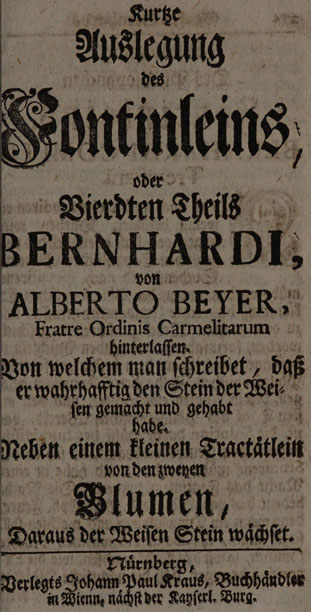
Short
Explanation
of the
Little Fountain,
or
Fourth Part
of BERNHARD,
left behind by
ALBERT BEYER,
Fratre Ordinis Carmelitarum - Brother of the Order of Carmelites.
Of whom it is written that
he truly made and possessed
the Stone of the Wise.
Together with a small Treatise
concerning the two
Flowers,
from which the Stone of the Wise grows.
Nuremberg,
Published by Johann Paul Krauß, Bookseller
in Vienna, near the Imperial Palace.
Explanation
of the Philosophical
Little Fountain
of BERNHARDUS COMES
TREVISANUS - Bernhard, Count of Treviso.
“When after much Studying I refreshed myself a little.”
By this it is indicated that he had finally become weary of the vain Sophistical dirty work, seeking, and speculating after things, and had grasped the right Foundation for Philosophical Knowledge, and had become fit to proceed to the right Work, in order to continue and win the little golden Book.
That is, from the best and finest Philosophical Gold he extracted the Mercurius - Mercury, arranged it in India, and completed the first Part of the Philosophical Work, that is, the Solution through the help of the humid-vaporous Fire.
Thereupon he became weary of studying and in one Night found the little Fountain.
The Night signifies the vaporous and Philosophical Fire; for when a thing is to dissolve and grow, one says: Ah, when the warm Nights come, it will quickly grow, as Experience testifies that the nocturnal Warmth, because it is mixed with the Moisture of Dew, visibly brings forth all things.
Thus Bernhardus also says that in one Night, that is, in the humid warm Fire through which the Solution Mercurii - Solution of Mercury occurred, he found the Fontinam - Fountain.
And he says further that it was surrounded by a white round Stone.
This signifies the Ovum Physicum - Physical Egg, with an old hollow Oak-tree split through the middle, that is, a high oaken sphere cut apart through the middle, within which the Glass is to stand.
This must be full of holes below, but not above, through which the vaporous Fire can work upon the Glass.
And “surrounded with masonry” means the Furnace in which everything stands properly.
He wished gladly to sleep because he was weary from studying, that is, to rest and refresh himself.
And he sat down beside the Fountain to look at it, that is, when the Conjunction was about to begin.
There he sees the Fountain open itself above, that is, the Oleum - Oil begins to be born from the Fountain and begins to gather itself above.
Now everything had been below in the Fountain; thus the lowest has raised itself upward, and the upper has descended downward, and nevertheless it remained enclosed.
This is so that in the ascending and descending the Fountain should not be diminished in its Weight.
Thus he observes upon the Fountain the Motion of ascending and descending, especially the beginning thickening and Oiliness, and afterwards the little vessels and little leaves, which he calls the King in the Bath.
That he further asks the old Priest concerning the condition of the Fountain and of the King, and receives from him this report or answer, understand thus:
Because the Fountain opens itself, the King must indeed have been in the Fountain from the Beginning.
And even when the Fountain has already dried, it nevertheless retains the Name.
And this King in the Fountain is Sulphur hidden in the Mercurio Solis - Mercury of the Sun.
And thus the Fountain, which comes from its Mercurio - Mercury, must of necessity be closed, so that in the Solution nothing may evaporate away which afterwards would be lacking in the Coagulation.
He also indicates the Form of the Fountain: it is clear as fine Silver, of heavenly Colors, having the Mercurial Water.
So that it may become still stronger, that is, when the Solutio Mercurii - Solution of Mercury into its own Water and Fontina - Fountain has occurred and the Coagulation and Fixation begin, the Fire through the oaken Sphere must be strengthened by one Degree, to keep off the Sun and its shine, that is, to preserve the dry Warmth hidden or enclosed in the white Stone.
The wonderful Nature of the Fountain, that if it becomes inflamed and angry it would penetrate everything, signifies that when it becomes fiery-red, this is a Sign of its Perfection and Completion.
But if it were to flee away, that is, if the Glass should break during the Solution while it is still volatilis - volatile and spiritual, we who stood by would all be lost, for it is the greatest and most permanent Poison.
The visible entrance of the King into the Fontinam - Fountain may here be understood in two ways.
Firstly, when the Corpus perfectum Solis - perfect Body of the Sun is made into Mercurius through Mercurium - Mercury, then he enters into his own Fountain, that is, into Mercurium - Mercury.
Secondly, when this Mercurius per se - Mercury by itself is enclosed in the Ovum Physicum - Physical Egg and placed in the vaporous Fire, and begins to dissolve itself into its own Water and Fountain, then such a Transformation occurs that it is never again seen as it was when it entered, for it is dissolved.
Bernhardus speaks here of the entrance in the Middle of the Work, where the King first receives his proper Name and is called Oleum incombustibile, Oleum Solis and unser Aurum, non vulgi - incombustible Oil, Oil of the Sun, and our Gold, not the common Gold.
Likewise the Fountain also first receives its proper Name and is called Aqua perrennis, permanens - perpetual, permanent Water, and our Mercurial Substance, which after Coagulation and Fixation remains Mercurial, penetrating, and spiritual.
When this entrance of the King into the Fontinam - Fountain happens and begins, one can indeed see it, but afterwards no longer, or never again in such Form, for afterwards he does not again become Oil, but becomes much nobler, purer, higher in Power and Virtue.
When the King at the Beginning is placed in the Vessel of the Philosophers and into the Fire, one cannot see him before more than 130 days have passed, when the Conjunction begins after the completed Solution.
Then he begins to appear.
The Doorkeeper, that is, the Laborant - Operator, continually warms the Bath in order to preserve its natural Warmth.
Let no one understand this Bath as the Balneum Mariæ - Bath of Mary, but as the self-subsisting Mercurial Water, which is continually warmed through the airy Warmth of our Fire, so that the Sulphur in Mercurius - Mercury may be excited to its own Operation.
Therefore it must be maintained continually day and night without ceasing, so that it may be renewed at the proper time until it is entirely perfected.
When now the King after one hundred and thirty days from the Beginning of the setting-in, after the Solution, again enters into his Fountain, that is, when the Conjunction is again about to occur, the King is at first clothed with a Cloth of Gold.
That is, the Gold-Oil which floats above its own Water is of a golden and reddish Form, as is also the Mercurial Water which is the Fountain, as clear as Silver, into which he is to enter, for he came from it, so that they may unite.
Therefore as soon as this Union occurs, the King has changed his golden Garment into a black Velvet Doublet in the Putrefaction; after this, into a snow-white Shirt after the Putrefaction, Washing, and Calcination; and the Flesh becomes very highly sanguine-red, that is, at the End of the whole Tincture.
And everything happens in one Vessel, without any defect, perfectly.
How and at what time such Change of the Garment, that is, of the Colors of the King, occurs, has been said in genere - in general; shortly it will be indicated in specie - specifically.
BERNHARDUS says further that nothing foreign or different comes to our Materia - Matter, but only two Mercurial Substances from one Root, which is Mercurius Solis - Mercury of the Sun.
To this he answered smiling: when the King resolves to come thereto, that is, when he is to become Mercurius Solis - Mercury of the Sun, he must first be entirely pure and leaves all his foreign people, and no one comes to the Fountain except he alone.
One also need have no great Labor, except that the Laborant - Operator heats the Bath, that is, properly warms the Mercurium - Mercury through the Regimen of Fimi Equini - horse-dung.
Therefore he does not come to, or into, the Fountain.
He asks further: Are then the King and the Fountain friends?
Answer: They love one another wonderfully.
But the Fountain draws him to itself and he does not draw it, for it dries the Earth.
That is, the Oil, the King, first swims upward, as reported above; afterwards through its Water and Fountain he again falls to the Bottom and then becomes like the other in the right Putrefaction.
For they take upon themselves the Power of the Upper and Lower.
Therefore Bernhardus says: it is to him like a Mother, and it is well known that the King was made from the Fountain, and it has made him such that he is now different from before, that is, from the Beginning when he becomes Mercurius Solis - Mercury of the Sun.
The Fountain is to him like a Mother, for in the Solution it opened itself and the Separation occurred.
Therefore the Conjunction of the King and Queen, that is, Sulphuris in Mercurio - of Sulphur in Mercury, must again occur.
His people are the six Metals, all of which at the Beginning of Nature in the Minera - Mine were created from Mercurio and Sulphure - Mercury and Sulphur, which wait until the King dies, and then obtain the Kingdom just as he does.
For the Nature of the King is so excellent and powerful that in one instant and blink of an eye he can make all Metals like himself.
And he is older than the Fountain, for it came from him.
There he calls that one the King of the Metals from which the Mercurius - Mercury was made.
Firstly, concerning the Mercurium corporis Solis - Mercury of the Body of the Sun; secondly, the Mercurium Philosophicum - Philosophical Mercury, from which Mercurius Solis - Mercury of the Sun comes and is made, that is, Mercurial Water called the Fountain, which is the nearest Materia Lapidis - Matter of the Stone, and not common Gold.
Thus the King is indeed older than the Fountain.
For if no Gold had existed, one could not have brought about any Mercurial Water.
And the King is also more mature than any among his people, for he is the first completed from his own Fontina - Fountain and Water.
Therefore he can also make his people complete and perfect.
Firstly, because he becomes an incombustible Oil which tinges all his Subjects into true Gold.
Secondly, because he becomes a white Tincture and unconquerable.
Thirdly, because he becomes a red Tincture and a perfect Lapis Philosophorum - Stone of the Philosophers.
Who then can overcome him, since he strengthens himself threefold?
Therefore he cannot be stabbed or killed by his Subjects.
And this is the cause that the six, at the Beginning of the Generation of Metals, were all created from the Fontina - Fountain, but not from that which is now in ovo Physico - in the Physical Egg, but from that which long before was in the Minera - Mine.
And therefore from the Mercurio crudo & minerali - crude and mineral Mercury they have all their Good, just as he at the Beginning of his Birth also received from it his Good and Perfection.
But because he has been brought back again in his Perfection and has gone into the Fountain, that is, has become Mercurial Water, and must die therein and rise again from it, since such Fountain draws him to itself, strangles and kills him, and awakens him again from Death, strengthens and rejuvenates him so that no one can overcome him, all this happens in the Putrefaction, in one Glass, as often reported.
Afterwards he comes forth wholly gloriosus - glorious, splendidly adorned and clarified.
And according to the Substance of his Kingdom, that is, when he is perfected to the White or Red, every Subject takes his Part from the King’s Part, which is very small, so that one Part can tinge a thousand.
Thus they come to such Riches as he had in his simple Rule as King of the Metals.
That is, they also become perfect Gold when the Lapis - Stone which tinges them is perfect.
Item - Likewise afterwards one can make from them Mercurium Philosophorum - Mercury of the Philosophers.
Although Nature has worked and generated it in them, nevertheless they cannot come to such an End, nor attain to such Fruitfulness and Glory, without the killing and Resurrection of the King.
Therefore he says thus:
Know that the King alone, without anyone of his people, although the Fountain loves his people, enters into the Fontinam - Fountain, because his people have not yet deserved such entrance.
Firstly, because they are mortal, also frail, sick, and impure.
Secondly, because although they could be purged, they nevertheless are not reduced.
Thirdly, although they were reduced to Mercurius - Mercury, nevertheless it is not of a permanent Being.
Fourthly, in their Mercurial Substance they also have not been subtilized through Solution and brought to such Dignity, because they have come from an impure Seed.
But this King has deserved it, for in his Metallic state he was a perfect King of the Metals, and still more a King through Reduction and Restoration into Mercurium - Mercury, especially through the Solution and Separation through which he has been brought to his highest and most subtle Power and Purification.
Therefore he alone has deserved to immerse and drown himself in the Fontinam - Fountain and to rise again from it.
So long must the Subjects wait.
Namely, when the King, after the Conjunction, first comes into the Fontinam - Fountain, he takes off his Coat beaten from his Gold into leaves, covering everything.
Understand by this not little Gold-leaves, but little vessels and little skins which from the Fountain swim in his own Water before everything is drowned.
And he gives this to Saturnus - Saturn to keep for forty or at the longest forty-two days.
That is, he becomes lead-colored.
This is the first Sign and Color of the Conjunction and Putrefaction, and is prima Materia Lapidis - the first Matter of the Stone.
After this Saturnus - Saturn gives it to Jovi - Jupiter, and Jupiter by command of the King gives it to Lunæ - the Moon, who is his third man, beautifully shining.
And thus the King is then in his Shirt, pure white and clean, and the Lapis perfectus - perfect Stone is made for the White.
Further, Luna - the Moon gives it to Marti - Mars, and afterwards Mars to Veneri - Venus, and Venus to the Sun, through the Will of GOD, yet not bright, to keep until he reaches his Perfection and Tincture.
For then the King comes in his Form very beautiful and highly blood-red, and thus the Sun keeps him.
Here the Gradus - Degrees of the King in his Growth in the Glass are finely delineated: how everything must appear one after another in his Vessel with Colors until Perfection.
And thus one Degree after another continually overcomes the Mercurium Solis - Mercury of the Sun in the Moisture, until it entirely dominates.
Thus the Fountain opens itself, that is, the Fountain which has given him such Degrees one after another, so that he may come to his sanguineous, high, red, colored Flesh, and so that it may remain united with its King in Eternity.
Thus from its acquired Goods and Lapide Philosophorum - Stone of the Philosophers it helps him feed his Subjects, and then they have their Desire.
For they are tinged into Lunam fixam - fixed Moon/Silver until they may become perfect Gold.
Item - Likewise it is to be noted: whoever does not know the right manner of multiplying the Lapidem - Stone in Quantitate - Quantity, which is its Fermentation, will fare badly and lose everything.
Mark the manner thus:
Set one Part of the well-prepared Tincture to a thousand Parts of Gold; give it for three Days and Nights its proper Fire, and this you must try in the Glow of Fire.
Then one Part of this Fermentation tinges a thousand Parts of the other Metals into good permanent Gold.
Question: What do they do afterwards?
Answer:
If they wish, the six may purge the King once more, that is, place him again into his vaporous Fire.
Then again six Colors will appear: black, gray, white, brown, yellow, reddish, and finally red.
This happens in three Months.
Then the red Tincture is wholly perfect and ready to tinge all Metals into Gold.
To what does this serve?
Answer:
GOD makes one, 10, 100, 1000, and afterwards multiplies everything tenfold.
That is, GOD has given to the Artist that after the Fermentation he can multiply the Lapidem - Stone so that one Part, according as he takes little or much, multiplies 1, 10, 100, 1000, 10000, 100000, 1000000, 10000000 Parts.
That is, he never again needs to begin anew from the Beginning, but continually multiplies everything onward without End.
Let this be to you a Treasure from GOD the LORD in this Vale of Misery.
Mark:
auspfüßen - bailing out means drying.
This happens when the King consumes the Queen, that is, until the Moist is consumed by the Dry.
Thus the Fontina - Fountain becomes inflamed and the Lapis - Stone is completed.
Then the tenth Part remains with the Tenth, that is, as much as was first put in by Weight is found again, as also happened to me.
LAUS DEO. - PRAISE TO GOD.
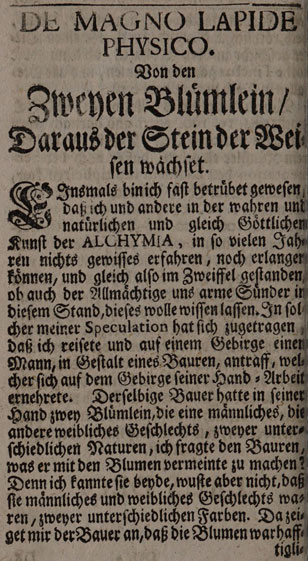
DE MAGNO LAPIDE PHYSICO. - CONCERNING THE GREAT PHYSICAL STONE.
Concerning the
Two Little Flowers,
from which the Stone of the Wise grows.
Once I was greatly troubled that I and others, in the true and natural and likewise Divine Art of ALCHYMIA - ALCHEMY, had in so many years been able neither to experience nor attain anything certain, and had thus stood in doubt whether Almighty GOD would also allow us poor sinners in this state to know this.
In such my Speculation it happened that I travelled and upon a mountain met a man in the Form of a peasant, who maintained himself upon the mountain by the work of his hands.
This same peasant had in his hand two little Flowers, the one of the male, the other of the female sex, of two different Natures.
I asked the peasant what he intended to make with the Flowers?
For I knew them both, but did not know that they were of male and female sex, of two different Colors.
Then the peasant indicated to me that the Flowers truly had within themselves the Primam Materiam - First Matter, from which the great Stone of the Philosophorum - Philosophers is made, and still could be made with the help of GOD.
At this I wondered greatly, that from so humble a growth such a highly important Stone should be made, and through slight Præparation - Preparation.
And still greater was the wonder that the labor should be so simple and slight that a peasant should understand it.
And I rejoiced from the Heart that before my End I had yet seen a man who could possess and understand such a Treasure.
And therefore I took counsel with myself as to how the matter might be approached, so that I might learn from him the right Præparation - Preparation of this Stone, and something more.
But all my thoughts and Speculation finally became anxious, for the matter was so highly important that rightly no one should or can desire it.
Therefore I said to the peasant with sighing:
Blessed is the man to whom GOD Almighty reveals and entrusts such a Secret and Treasure.
Then the peasant said:
If it is GOD’s Will, you may also attain this from GOD.
Only give attention to what is possible to Nature, for the labor is entirely simple, without any toil, and slight.
At this I had to let the matter rest for this time.
At another time, not long afterwards, I again set out upon the journey and went again to the peasant.
I again began, with further circumlocutions, to ask concerning the Flowers, which again lay before the peasant upon the table and had not withered in the hot Summer.
And I said how it could be that from such a simple thing the great Stone of the Philosophorum - Philosophers should be generated.
Then the peasant asked whether I had not read in the writings of the Philosophers, who write that such a Stone could be made from a humble and simple thing known to almost everyone, with very little labor.
Then he said that he would entrust such a great Secret to me.
I should thank GOD for it, assist the poor and needy, and use such a Treasure rightly.
This rejoiced me from the Heart, and I did not know what I should so quickly give as an answer, and said:
I praise GOD, and cannot sufficiently thank Him for such a great Honor.
I was now eager to hear how the matter was to be arranged in the work, and begged the peasant that he would tell me the right Foundation and not mislead me.
Then he said that I would easily be able to judge that it was the right Way to the Art, and whoever misses it would find it impossible to come to this high Treasure and noble Stone.
And he said further:
Have made a Sweat-Bath, which inwardly is guarded all around with Stones and clear Crystals.
And let the Crystals be strongly and well fastened high by old, thick oaken Wood, and make an enclosure so that the hot Sun in the middle of Summer does not shine through the Crystals into the Sweat-Bath.
Around the wooden enclosure make a copper enclosure which lies smoothly against the Wood, as high as the wooden enclosure is, so that no foreign Moisture may come into the Woodwork.
Around this well-fastened Bath let a water-ditch be led.
Into it conduct a spring from a warm Bath, so that in Winter-time it does not freeze and the Water in the ditch always remains open.
Lastly, around this draw a good Wall so that the Bath may be well guarded against accident.
When now all this has been well accomplished with diligence, place therein the one Flower, of the male sex, very finely chopped, washed and again dried, in the middle of the Crystalline Bath.
Close the same very firmly with a Crystalline lid.
Likewise close the copper enclosure firmly with oaken Wood, so that this artificial Sweat-Bath may be well guarded and secure from every foreign Heat and Moisture.
In such a Bath, in constant Warmth, let this noble Flower sweat for up to forty Days without ceasing.
Then you will obtain from this Flower the noblest Odor and the most subtle thing hidden therein.
Nevertheless the Flower will not wither in the Sweat-Bath, and will also retain its Power and Substance, so that notwithstanding the aforesaid Tribulation it will nevertheless still bear its Seed and bring forth Fruit, which is wonderful.
And the peasant said further:
Just as you have done with the Flower of the male sex and dealt with it in the Sweat-Bath, so also do with the Flower of the female sex.
And this likewise will not wither, and nevertheless will give forth its Odor and the most subtle thing from itself.
And after the Sweat-Bath its natural Seed and Fruit will also be gathered from the Flower.
Following this, in the Name of GOD, take one Part of the noble Odor and most subtle thing of the male sex, and ten Parts of the female sex.
Put it again into the Sweat-Bath.
Close it again beforehand entirely well, so that no foreign thing can enter therein.
Then you will see how it first passes into a black Color, and afterwards into wonderful Colors.
There lies the King with the Queen in his Joy, and they unite themselves with one another harmoniously.
Let it stand for its time until the Philosophical Night has passed.
Then you will find the King of all earthly Riches alone, red as a Ruby.
And the Queen has figirt - fixed herself with the King into his Being, and two have become one Body.
And this King, he said, may rightly be called the quintum esse - fifth Being, above which there can be no Riches of the world.
Then I asked further how I should understand that this Stone was to be so exceedingly highly esteemed.
Thereupon the peasant informed me:
If I take one Part of this thus præparirten - prepared Stone and add it to two Parts of the most subtle thing of the Flower of the female sex, and set it again into the Sweat-Bath, then in a short time, after the consumption of all the Colors which again appear, everything will be transformed into the noble and greatest Stone.
And again from two there will become one Body, so that through a Multiplication afterwards an infinite Projection may be made upon all Metals, to transform them into good permanent Gold in great Quantity.
When I heard this, I praised and thanked GOD.
Now I asked further that although I knew the Flower, I nevertheless did not know where they grew in quantity and where he had obtained this Flower.
Then the peasant said to me:
These Flowers grow in different lands and mountains, which he named to me, in very narrow and deep Valleys, so that the Sun from the Beginning of the World had never shone upon them.
Nor had the Snow or Cold of Winter destroyed them.
Nevertheless they were of such lovely and powerful Virtue, and had to be broken off with good skill, as he informed me.
Therefore a Philosophus - Philosopher did not write wrongly when he said that that from which the great Stone of the Philosophers is made is one single Thing, that is, of male and female sex, which are reckoned as one Body.
And it is so common that the poor possess it more than the rich.
This is to be understood that these Flowers are broken off by the poor and carried to the rich for their pleasure in exchange for money.
I asked further who warmed the Sweat-Bath, and whether it also had to be warmed artificially.
Then he laughed and said:
I use for this my peasant-boy, or a goose-herd, or a maid; it is all the same.
For the Furnace for this Sweat-Bath is so formed that they cannot well make the Fire too strong or spoil anything therein.
And nevertheless it remains in a certain constant Warmth which it requires, so that even any hen’s Egg could be hatched therein.
The cause which he reported to me was reasonable.
Lastly I asked whether there were no other Flowers except precisely those which had such great Virtues within themselves.
Then the peasant told me that there were 6 of the male sex of Flowers, and only one of the female sex in the whole world.
These he laid before me.
He said that from every one, if the Female were joined thereto, a Stone of the Philosophers could be made in the aforesaid manner, and each generates its like.
The causes he reported to me extensively, and they also were reasonable.
To the Reader.
Favorable Reader, you will remember how it was previously reported that the four Books of Bernhard were written in the French Language, and from that were first translated into the Latin Language by Gratarolus.
But it has come into my hands that this is supposed to be the Beginning of the Fourth Book in that same Language.
I have therefore also wished to communicate it to you, so that this Work may thus come to light completely.
Vale - Farewell.
J. T. C.
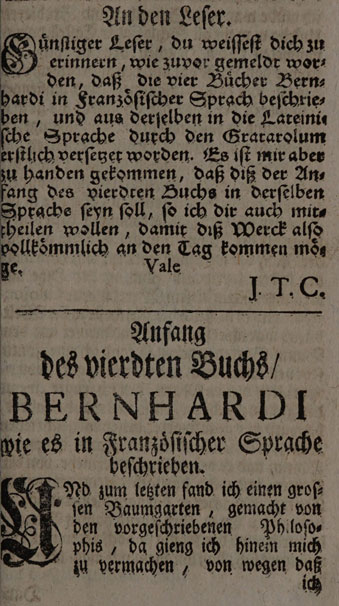
Beginning
of the Fourth Book,
BERNHARD,
as it is written in the French Language.
And at last I found a great orchard made by the aforesaid Philosophers. There I went in to refresh myself because I was weary from writing and studying.
And there was an old castle or Castel, wherein dwelt two Dragons, the one red and heavy of Body, and the other white without Wings.
And they came together and embraced one another in the Heat of the Sun, when it is in Ariete - Aries, and they played together so long until the joined Dragons disappeared and changed together into a black Raven.
These moistened themselves with one another so long until they became white as Snow in the Heat of the Sun, when it comes into Taurum - Taurus, until the Sun came into Leonem - Leo, so that the Raven which had become white became at last red as Blood in the Heat.
And in this Work it changes into a Conjunction, and he called himself the Richest in the World.
At this I was frightened and intended to go out of the Orchard, when I found a Fountain very strongly walled around and guarded by an old Wise Man.
I asked him to whom the Fountain belonged which was so well guarded.
Then it was answered to me:
This aforesaid King, well known in these lands, is from the Fountain, and he never departs from the Fountain, and afterwards is dried by the Fountain, in which he afterwards remains to bathe for 282 days, or ten and a half months.
Through this the King becomes so highly united and rejuvenates himself, so that no one can overcome him.
Therefore the King himself has made the Fountain and rests first in a white, clear, and transparent Stone, and rests therein clear as Luna - the Moon, sky-blue.
And so that no animal should come therein and gnaw the same, a hollow Oak is cut round about through the middle, and this guards it and makes the Heat of the Sun.
And likewise outside around it Venus’ Hat is made, in thick Walls, and the Fountain is well guarded because it is of wonderful Powers and Natures, so that it should not penetrate through and should not open itself from the Heat.
Otherwise we would be entirely lost if it should happen that the Fountain let itself out.
I asked:
Have you seen the King?
Answer:
Yes, I have seen him enter, but after his entrance I saw him no more.
He keeps himself enclosed and does not allow himself to be seen for one hundred and thirty-five days, and afterwards he begins to reveal himself and to appear, white as Snow.
Meanwhile the Doorkeeper serves him and continually warms his Bath in order to preserve his natural Heat hidden in his clear Water, as aforesaid.
This Bath is maintained day and night.
Then I asked him:
What is the King’s clothing?
He answered:
A Coat of beaten Gold, and a Doublet black as Velvet, and his Shirt white as Snow, and his Body sanguine-red as Blood.
Then I asked:
What people accompany the King with him into the Fountain? Are they foreigners or other common people?
And thereupon it was answered to me, laughing thus:
When the King finds in his Counsel that he is to enter therein, he leaves all his people.
There is no one except the Keeper, who also does not enter therein, as the printed Exemplum - copy has it.
And it continues further:
Nota - Note: the fifth are from the Fontina - Fountain.
It is the sixth.
From it they have everything that they have, each his own, as does the King.
Therefore the Fountain draws it to itself and moistens it to death.
Afterwards it appears through that same Kingdom, and each takes his own:
Saturnus - Saturn the Coat of Gold, forty days, etc.
Afterwards, through the desire and Nature of the King, Jupiter the black Doublet also forty days.
Then Jupiter hands the Doublet over to Lunæ - the Moon, who is the third Person, who keeps it 80 days or more.
Afterwards comes the keeping of Martis - Mars, the fourth Person, and under him the White will shine very greatly.
He keeps it 80 days or more.
Afterwards, if there is a good Artist or Philosophus - Philosopher, the King is stripped down to his Shirt, white as Snow, drying without Redness.
Afterwards the King takes off his Shirt and gives it to Veneri - Venus to keep.
She is his fifth Person, who keeps it forty days.
Then she gives it from herself to Soli - the Sun, so that the King becomes entirely naked.
His Body appears more like leprosy, and outwardly sanguine-red as Blood.
I asked:
Who guards all this?
Answer:
And then the Fountain opens.
For just as it has given them the Coat, Doublet, and Shirt, so it gives the Youth his Body, sanguine-red as Blood, to eat.
This is called our Sol Philosophorum - Sun of the Philosophers, and our Medicina - Medicine, verum aurum potabile - true potable Gold, and quinta essentia - Fifth Essence, and the great Elixir, and Aqua vitæ - Water of Life.
And this is their utmost Desire.
A Question:
Do they thus wait for the time?
When they have the white Shirt, four of them make good provision, but it is scarcely yet half the Kingdom.
Therefore they wait a little time for the Crown of their King.
Do no Medici - Physicians or other people camp there?
Only the Keeper who guards it and continually causes the Heat beneath it to follow, without ceasing, and no other things.
Question:
Does this Keeper have much labor?
More at the End than at the Beginning, for the Fountain becomes hotter.
A Question:
Have many people seen it?
The Fountain answers:
All the world has seen it with its eyes, without Recognition.
A Question:
What do they then afterwards?
Answer:
If the six wish to become Kings, then they purge themselves and maintain what belongs thereto.
GOD be praised for His wonderful Gifts and Benefits.
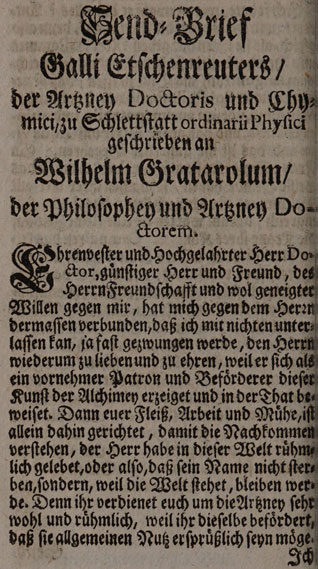
Letter
of Gallus Etschenreuter,
Doctor of Medicine and Chymist, Ordinary Physician at Schlettstadt,
written to
Wilhelm Gratarolus,
Doctor of Philosophy and Medicine.
Honorable and Highly Learned Mr. Doctor, gracious Sir and Friend, your friendship and well-inclined goodwill toward me have so greatly obliged me to you that I can by no means refrain, indeed I am almost compelled, to love and honor you in return, because you have shown yourself and proved in deed to be a distinguished Patron and promoter of this Art of Alchymy.
For your diligence, labor, and effort are directed solely toward this end: that posterity may understand that you lived honorably in this world, or rather that your Name should not die, but remain as long as the world stands.
For you deserve very well and honorably of Medicine, because you promote it so that it may become fruitful for the common benefit.
I will not now mention all the books which you have until now caused to go forth in print for the common benefit, of which indeed there is a considerable heap and number, but will mention only this little book περὶ χυμείας - concerning Chymistry, which you translated from the French Language into Latin and dedicated to me.
Through this you will make for yourself an eternal Name, because you deal so faithfully and well with Medicine, promoting, advancing, increasing, and improving it, and sparing no diligence or labor herein.
For who can pay for this precious Treasure of Medicine through which severe Diseases, which torment men worse than Tyrants and Executioners, are thoroughly cured and healed?
Who would not wish and desire that he might be able to cleanse the imperfect Metals from their Leprosy, bring them to Perfection, and transmute them into true Gold, so that it remains permanent without any falsehood or deception even in the sharpest Assays, in Cæment Regal - Royal Cement, in the Quart, and in Antimonio - Antimony?
Of both these Medicines, that of Man and that of the Metals, this little Book is a brief Extract or Handbook.
At the end of July I wrote to you at Basel through my brother, who is also a Studiosus Medicinæ - Student of Medicine, that I wished to read this little Book of Bernhard and reveal to you its usefulness.
I have now read it, and find that he has written well and clearly enough, and rests upon this: that the Materia - Matter of the Stone of the Wise is a twofold Mercurius - Mercury, one common, and one which is made from the Metals.
When these two are put together and properly cooked, the imperfect Metals can thereby be increased and improved.
Therefore you may find from this what is lacking in this Process:
Firstly, the Beginning: how one should prepare Mercurium - Mercury from the Metals, or take their Mercurium - Mercury from them.
Secondly, in what Weight one should put together and unite both.
Thirdly, whether there is not still lacking a third thing through which these two Mercurii - Mercuries must be coagulated.
For my part, so that I might learn the Truth of this Art, I have prepared not a little Medicine through Fire, such as Oils, Juices, Extracta - Extracts, and simple Essentias - Essences, through which I have accomplished so many Wonders, as GOD knows, such as I had not seen before, and others previously held incredible.
Now while I have occupied myself with Alchymical Medicines, the delight of this Art also moved me to proceed farther, and I almost passed beyond the goal of Medicine.
I dissolved the Metals, such as Saturnum - Saturn/Lead and Lunam - Luna/Silver, and this year attempted to bring them into their primam materiam - first Matter.
And, GOD be praised and glorified, without teacher or instruction I found and prepared the Mercurium Saturni and Lunæ - Mercury of Saturn and of Luna, and I am so certain of this Preparation that no doubt is to be placed upon it.
But what usefulness they give in Medicine some learned Philosophi and Medici - Philosophers and Physicians know very well, and GOD is my witness that chiefly for the sake of Medicine I undertook this Labor.
Nor would I have so readily believed anyone if he had told me that one could bring Silver, which has a fixed and hard Body, into living Quicksilver, had I not seen it and made it with my own hands.
If Mr. Doctor desires to see this μετεμψύχωσιν - transmigration, or Transformation, which scarcely one among a thousand would believe, then, when all the necessary things are prepared, I can in your presence transform Lead or Silver within three hours into living Quicksilver.
And so much concerning the first Point.
As regards the second, the Proportion and Weight of both Mercurii - Mercuries, I cannot indicate it because Bernhardus promised not to disclose this.
The excellent Medicus Fernelius - Physician Fernel writes that the Lapis - Stone or Elixir is made from two things, just as Bread is baked from Flour and Water through Fire.
Just as Water is reckoned in Weight against Flour, in such manner should common Mercurius - Mercury stand toward that which is made from the Metal.
Thus Fernelius writes concerning this.
But it seems to me that there is a better Similitude between Leaven and the whole Dough from which Bread is baked.
Thus in Weight should common Mercurius - Mercury stand toward the Metallic one.
As regards the third, I hold that these two are not sufficient for our Work, for these reasons:
Because of the Holy Trinity, because GOD is Triune, Wood is triune, Metal is triune.
Thus ARISTOTELES posits three beginning things.
The German THEOPHRASTUS visibly proves this, and I myself have seen and experienced such in several different things.
And chiefly this moves me: that distinguished Alchymists have held conversation concerning this, namely when Mercurius - Mercury is coagulated and hardened, and said that one could not bring the same into Flux, nor would it become malleable so that it allowed itself to be hammered.
Whether they understood this concerning common Mercurio - Mercury or that made from Metal has escaped me.
I have indeed personally, as you know, spoken with you concerning the Coagulation Mercurii - Coagulation of Mercury, and in part treated of it in writings, and, when occasion permits, I wish further to confer with you.
This I must confess: that with Gold and Silver Calx I coagulated one Part Mercurii Saturni - of Mercury of Saturn, which was malleable and allowed itself to be cast.
More than this I did not experience at that time.
This third Point cannot be fundamentally understood from BERNHARD.
If you had not set yourself so vehemently against THEOPHRASTUS, who is a particular Ornament and Honor of all Germany, in Chemia δεινὰ φράζοντα - speaking mighty things in Chymistry, who described almost Divine things in Alchymy, then I would immediately openly make known and show to you, and prove from this Author, from which Metals it must be made.
Rather, as indeed it surprises me, you should set yourself against the false Theophrastists, or those who withhold his Books, which are written so clearly and openly, and bury them with themselves.
It is not unknown to you that with ARISTOTELES there is a great difference inter ἐπιστήμην and τὸν πόθον ἐπιστήμης - between knowledge and the desire for knowledge.
Theophrastus teaches in his Books which have until now gone forth in print the right use of Medicine, namely ἐπιστήμην - knowledge, the true Science of Remedies.
Whether you wish it or not, you must confess that these were previously unknown to you, such as against severe maladies, Gout, Dropsy, and Leprosy.
It is more fitting that we love such Persons because of their Art than hate and envy them because of certain human defects and weaknesses.
Go into yourself: if you knew that which THEOPHRASTUS knew, would you reveal it?
You would indeed act against the Juramentum HIPPOCRATIS - Oath of Hippocrates, who does not wish that Medicine be revealed to everyone.
You also know what happened at Bologna: that one was condemned by a Judgment and accused as a traitor to the Fatherland, and also sentenced to the gallows, because for the first time he set up in Germany at Trident the Instrument by which Silk is artfully spun.
The Bolognese, as your Palatium testifies, wished for nothing more dearly than that they might tear off his Head.
And even if you knew the Stone of the Wise, than which, after GOD, there is nothing higher in this world, as Senior writes in Consilio conjugii Solis & Lunæ - in the Counsel concerning the Conjunction of the Sun and Moon, and wished to make it public, you would not be a Son or Disciple of HERMES.
For HERMES wishes these Gifts of GOD to be hidden from all the Unwise and Fools.
MACROBIUS also writes that great secret matters should be obscured and described with hidden words and speeches.
Thus THEOPHRASTUS used Words which are known neither to you nor to me.
And even if one does not understand them, one should not therefore immediately cry them out as lies and fables.
But so that I do not make this writing long, I will briefly report how many things there are from which every thing is born and made.
THEOPHRASTUS writes in Paragrano - Paragranum how it is manifest and clearer than bright Sunshine that all Metalla - Metals do not grow from two things alone, Sulphure and Mercurio - Sulphur and Mercury, but from three, of which the third coagulates the other two and brings them into one Corpus - Body.
And he says that because of Mercurii and Sulphuris - Mercury and Sulphur the Philosophi - Philosophers were deceived and led into error, and as though the Legs had been drawn out and taken from beneath them.
Through this Ignorance many of them were misled, and after they had often brought forth falsely, they brought Alchymy into contempt, so that it acquired an evil Name as though it were a Deceiver.
So much I can understand and gather from the writings of Theophrastus: that he knew the Stone of the Wise and used it in Medicine, and that it is not a fiction or fable-work as the common man holds it to be.
This has moved me, and for this reason I can well allow that this my Letter come into public print, so that not everyone who is inexperienced herein may undertake these matters without understanding, seek this most secret Secretum - Secret and aurem Vellus - Golden Fleece with loss of his Money and Time, and learn through damage.
Therefore someone may first allow himself to be warned and consider what he intends to do and undertake.
I have dissolved and opened Lead, wherein I found an Oil, a Mercurius - Mercury, and an Earth.
Whether this was the Salt or the Spirit of Salt, I do not wish to say with certainty.
I wished to publish this Epistle in print together with BERNHARD’s little Book which you dedicated to me.
I likewise submit this under your Censur - Censure, and if anything has indeed been written too harshly, you may alter it in Philosophical manner, for I can well tolerate that someone corrects and alters my matters.
If now this my opinion should please you, without doubt it will also not displease those who will read this little Book.
And finally this my faithful Admonition and Warning will be agreeable and useful to them when they lay their hands to this Art and take hold of the Coals.
Herewith commended to GOD, and may you remain my gracious Sir and Friend.
Given from my Study-room, the 16th of August, on the Day upon which two years ago I arrived at Schlettstadt and became your Physician, in the year
1567.
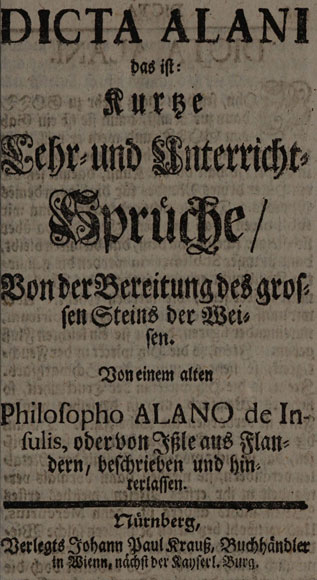
DICTA ALANI
that is:
Short
Teaching and Instructional
Sayings
concerning the Preparation of the great
Stone of the Wise.
Described and left behind by an ancient
Philosopho ALANO de Insulis - Philosopher ALANUS de Insulis, or of Isle in Flanders.
Nuremberg,
Published by Johann Paul Kraus, Bookseller
in Vienna, near the Imperial Palace.
DICTA ALANI.
Son, set your heart more upon GOD than upon the Art, for it is a Gift from GOD, and to whom He wills He communicates it.
Therefore have Rest and Joy in GOD, then you have the Art.
Therefore set a Keeper before your mouth, before the lips of your mouth.
You shall not imagine, when we sublime, that we separate the Part which rises upward from that which remains below, for in our Sublimation the fixed Parts are not raised, but the Parts which are not fixed are raised.
But we must fix the two, namely Corpus and Spiritum - Body and Spirit, with one another, so that they give an easy Flux.
Item - Likewise, when the Heat works in the Moisture, it first appears black in Color.
Item - Likewise, when the Heat works in the Dryness, it appears white in Color, and in this white Color the red Color is hidden.
Therefore the seekers of the Art of Alchymy should know that they cannot alter the Form of the Metals unless they are first transformed into their first Being, which first Being is nothing other than Mercurius - Mercury.
And although among many Artists such Restoration of the Metals into Mercurium - Mercury is considered impossible, nevertheless consider the possibility that the Metals in the Earth have arisen from Mercurio and Sulphur - Mercury and Sulphur.
And because Mercurius - Mercury is an Origin of all Metals, it is possible that the Metals may through it again be brought into Mercurium - Mercury.
For into that from which a thing has its Origin, it is most possible for it to return.
The very first Work in this Art is that we dissolve the dry Stone, Solem or Lunam - Sol or Luna, into Mercurium - Mercury, or that we transform it into its very first Being.
For then the dry Stone is dissolved in it and bound together with it, so that henceforth they never have any separation from one another.
For each works in its like, in such a manner that the Solution of the Corporis - Body happens together with the Coagulation of the Spiritus Mercurii - Spirit of Mercury, and the hardening of the Spiritus or Mercurii - Spirit or Mercury is and happens together with the Dissolution of the Corporis - Body.
And this is then called one Thing, concerning which all the Philosophi - Philosophers speak in their Books of the Philosophers.
There is only one single Thing, which single Thing is solely the bare Mercurius - Mercury, which contains within itself the Property and Nature of all Metals, and is therefore called the Stone of the Wise.
And although it is the single Key of the Metals, it nevertheless has no power of itself alone to color, unless it has first been colored or tinged with the anima Solis vel Lunæ - Soul of Sol or Luna.
For its Spirit does not work in another Spirit, nor its Body in another Body.
Therefore the Art consists solely of the Soul of the Body and of the Spirit, understand Sulphuris and Mercurii - Sulphur and Mercury.
For the Soul of Sulphuris - Sulphur is an Essence of the Body.
Therefore whoever cannot or does not know how to extract the Soul from the Body or Corpore, Sole, or Luna - Body, Sol, or Luna, and afterwards again give the same back in projectione - in Projection of the Bodies, errs entirely.
And this happens in this manner.
The Soul of the Corporis Solis vel Lunæ - Body of Sol or Luna is extracted through the Medium of the Spiritus Mercurii - Spirit of Mercury, and thus the Spiritus Mercurii - Spirit of Mercury is made companion to it, and the Soul is united in like form with the Spirit.
This Union of the Soul and Spirit afterwards takes to itself the Corpus, scil. Veneris vel Jovis - Body, namely of Venus or Jupiter, and receives from it the Life of Perfection.
And then the corpora imperfecta - imperfect Bodies are raised from their Imperfection to Perfection, and this happens only with our Stone.
Our Stone is made solely from one single Thing and solely with one Mastery and Regimen.
For our Water of the Philosophorum - Philosophers dissolves the corpora Solis sive Lunæ - Bodies of Sol or Luna.
For our Water is living and has within itself everything necessary on account of its Perfection.
And wherever it is found, it is called by a thousand Names.
For it is the pure transparent Water in which the Corpora, Sol vel Luna - Bodies, Sol or Luna, dissolve themselves, and in no other thing upon Earth.
And that this is true, hear the Philosophos - Philosophers.
Our Stone, scilicet Corpus Solis vel Lunæ - namely the Body of Sol or Luna, dissolves itself in Spiritu Mercurii - in the Spirit of Mercury, and with the same it coagulates itself.
It blackens itself, whitens and reddens itself, and receives from itself the Soul of Gold or Lunæ - Luna, and marries itself to it.
It fixes itself in the Soul Solis vel Lunæ - of Sol or Luna.
Lucianus Philosophus - Lucianus the Philosopher says:
Our Stone is airy and volatile, in its manifest part cold and moist, and in its hidden part warm and dry.
And the Coldness and Moisture which is in the manifest part is a watery Smoke and a Corruptibility and a Blackness which breaks itself and all other things with it.
And this same Coldness and Moisture flees from the Fire.
And the Warmth and Dryness which is hidden within it is the Gold, or the Oil of the purest Entrance into the Bodies, and does not flee from it.
For the Warmth and Dryness of the Medicine tinges, and nothing else.
Therefore make the Coldness and watery Moisture which is first manifest equal to the Warmth and Dryness which is hidden.
See that they come together and are united together, and that in Being they become one Thing.
Understand that Spiritus Mercurii anima werd, und anima corporis spiritus - the Spirit of Mercury becomes Soul, and the Soul of the Body becomes Spirit.
Then you have Power to tinge and penetrate.
But the Moisture must be destroyed through the Degrees of the Fire, which should be weak and moderate, &c.
But the Stone is made thus:
Take Mercurium - Mercury, for without it Nature has no power to work anywhere, as RHASIS testifies when he says:
Through it alone we can make our Work which overcomes all Nature.
For Mercurius - Mercury is companionable with all Metals and is the single Medium which joins the Tincture.
For truly the Nature of Mercurii - Mercury takes from Gold or Silver only that which is of its Nature, and separates and rejects the rest.
Understand: it leaves the Earth lying and receives the Soul from the Corpus - Body.
For the Soul is like-formed to the Spiritus Mercurii - Spirit of Mercury in every Property.
And then the Stone of the Philosophers becomes the earthly, incomprehensible, natural Stone, and is otherwise called by innumerable Names by the Philosophers.
And the companionable Stone, the more it is cooked, the more it dissolves the Corpus Solis vel Lunæ - Body of Sol or Luna.
And in the Dissolution it is blackened, and the more it dissolves, the more it is dried and whitened.
And after the Whiteness, the more it is cooked, the more it is reddened.
And this without doubt.
Thus our Stone is raised from the vile Thing, d. i. Mercurio - that is, Mercury, into the most precious Treasure.
For Geber says that this happens and is made solely through our Mercurium - Mercury, through our Fire, our Water, our Vinegar.
Understand: the bare Mercurius - Mercury with its Corpore - Body.
Therefore take one Part Mahler, Gold or Silver, or thin beaten Gold or Silver, for the subtler it is, the sooner they become Mercurius - Mercury.
And put it into an Oven Hermetis - Furnace of Hermes, formed as you know.
And add thereto 12 Parts ☿ Mercury optime purgati - Mercury most excellently purified.
And make it into an Amalgama - Amalgam.
And set it, well closed, into dry, calcined Ashes, so that the Ashes can cover all the Materia - Matter.
Then further make a moderate Fire and let it cook continuously until the preceding Sayings are fulfilled which are noted by the Sign.
When it has stood in igne Sapientiæ - in the Fire of Wisdom for one Month of the Philosophers, terrible Blackness will be completed and driven forth.
One raises the other.
Understand: one Color consumes the other until at last one remains.
And this is the Mercurius - Mercury of the Wise and the perfect Blackness.
And if you take to the Corpus - Body three Parts Mercurii - Mercury and one Part Corpus - Body, then you have too little Mercurii - Mercury, so that you cannot putrefy with it for three Months.
Rather the Water Mercurii - Water of Mercury consumes itself sooner into the animam Solis vel Lunæ - Soul of Sol or Luna than it should.
Therefore it is good that at first one takes 12 Parts Mercurii - Mercury and one Part Corpus - Body.
Closed, place it in the Ashes and let it cook thus for three Months.
Then that which is hidden, id est anima - that is, the Soul, becomes manifest, id est, Mercurius wird verborgen - that is, Mercury becomes hidden.
But such Extraction of the Animæ - Soul with the Spiritu Mercurii - Spirit of Mercury does not happen at one time, but many times, always with time, a little at a time, and again a little, until the Work is completed, as is written above.
Thus the Philosophus Senior - Philosopher Senior testifies to us, saying:
The Soul does not go out from the Body at one time, but many times.
And in the Vessel of Dissolution wherein the Corpus - Body dissolves itself, not at one time, but always therein a little, and again a little, according to its Regimen.
Thus you need not imagine that the Dissolution of the Corpus - Body happens at one time, but gradually, as written above in the Sayings of the Philosophers.
Therefore, you Workers of this Art, you should be of a constant Will in your Work, not that for a while you begin to work and try one thing, and another time another.
For the Art is not in the multitude of Species, but in Body and Spirit.
And for a Truth, the Medicine of our Stone is one Thing, one Vessel, one Conjunction, one Regimen.
For the whole Mastery begins with one Thing, scilicet Mercurio - namely Mercury, and ends with one Thing, scilicet Mercurio - namely Mercury.
And although the Philosophi - Philosophers, for the Honor of the Art, put forward many other Ways, such as constant Cooking, Mixture, subliming, grinding, drying, watering, firing, whitening, and reddening, and by however many manners it can and may be named, nevertheless it is only one Regimen which is called Grinding and Cooking.
Mercurius - Mercury grinds all Things; the Fire cooks it to Perfection.
Therefore Rhasis says:
Cook unweariedly, and do not let this trouble you, and do not hurry with it.
Nor think of other vain things, but attend diligently to this until the End.
And Longanus Philosophus - Longanus the Philosopher says:
See that in the Work the Vessel remains constantly closed and has equal constant Warmth, for no thing in the world is perfectly completed and ennobled without constant Warmth.
And when you are in the Work, remember all the Signs which appear in each Cooking.
And see that the Vessel be half in the Ashes and half outside, so that you may look into it every day.
And commonly in forty Days there appears above a Blackness like Pitch, and it is nothing other than the dissolved Corpus - Body.
For whatever becomes spiritual always rises upward, while the earthly remains below.
atque omne leve sursum - and every light thing rises upward,
& omne ponderosum tendit deorsum - and every heavy thing tends downward.
And when the Water has brought the Corpus - Body into an incomprehensible Being and dissolved it ad nigredinem - to Blackness, then the Solution has come forth, and the Tincture is in the Blackness.
Then the four Elementa - Elements are in agreement, so that you have Air in Water and Fire with Earth.
But you shall not believe that the Tincture is extracted at one time, but always a little, every day a Blackness, until through long time it is completed.
And that which dissolves itself with Mercurio - Mercury always places itself above, although there is always more of the lower.
But the Blackness has many thousand Names.
It is called the Fire, the Soul, the Mist, the Raven’s Head.
And the Blackness joins the Spirit with the Body, and such Mist comes through our Calcination, as Avicenna says.
Our Beginning, when Corpus and Spiritus - Body and Spirit are together, is called Calcinatio - Calcination in the setting-in.
And concerning such Calcination the Philosophi - Philosophers give us an Example in Wood.
In green Wood there are three Moistures.
The first protects the Wood from burning.
The second Moisture is rather fatty or oily; this makes the Wood combustible.
And these two are without Odor and combustible in the Fire.
But the third Moisture remains in the Ashes and is fatty, small in quantity, and subtle, with eternal Permanence.
And in this manner we are commanded to calcine our Stone Mercurii - of Mercury with the Corpus - Body, as has just been said concerning Wood.
From this you learn first to await the Blackness, afterwards the Whiteness.
And this Whiteness, if it is digested by itself in our Fire, comes to the highest Permanence.
But the Fires of the Philosophers are set down as only two in their Books, namely a dry and a moist one.
The dry Fire they called the common Fire, which has power to burn every thing.
But the moist Fire they called horse-dung, in whose Moisture the hidden Warmth is retained.
But if the Moisture in it diminishes or is consumed, then the Warmth diminishes.
Concerning this Fire PHIARES Philosophus - Phiares the Philosopher says:
The Property of the Fire of the horse’s belly is that it does not destroy Gold, but increases it through its Moisture, whereas other Fires destroy it through their Dryness.
Therefore Alchidonius Philosophus - Alchidonius the Philosopher says:
Truly our Medicine is to be hidden in the moist horse-dung, which dung is that of the Wise.
TURBA reports that living Silver is our Fire which has power to burn, kill, and break the Corpora - Bodies more than natural Fire.
Calid also testifies to this:
It is truly a Fire which burns all Things to Earth.
Senior also testifies, saying:
Our Water is the Fire which burns Gold more than natural Fire, and our Water is stronger than Fire, for it makes Gold into a Spirit, which natural Fire cannot do.
Although the natural Fire also belongs to the Work.
For then our Water enters into the Body and transforms it into Earth, afterwards into a Powder or Ashes.
And if it does not first become black, then afterwards no Whiteness will follow.
And when the Blackness appears, know that it does not last beyond forty or fifty Days.
And this is the putrefied Corpus - Body.
Accordingly the Putrefaction of the Corporis - Body is the Beginning of the Work.
And it happens with gentle Warmth so that nothing rises upward.
For if anything were to rise, there would be a Separation of Mercurii and Corporis - Mercury and the Body, which must not be.
This continues until Man and Woman, Mercurius and Anima - Mercury and Soul, come together and perfectly come into one Being or Blackness.
This perfect Union of the two Spiritus and Animæ - Spirits and Soul appears above as a certain Sign in the true Dissolution.
O dear Son, therefore have good diligence in Putrefaction.
And the Putrefaction must happen in gentle Warmth, that is, in gentle horse-dung, id est Mercurio - that is, Mercury, through the advancement and help of an outward gentle Warmth.
But that living Silver is the horse-dung is evident per Seniorem Philosophum - through Senior the Philosopher, where he says:
To the dissolved Corpus - Body, which after seven Days is dissolved, every fourth Day the dung, scilicet Mercurius - namely Mercury, is to be renewed.
Understand: added.
And this Renewal is called the Imbibition, Softening, and Dissolution of the hard-bound pores of Gold and Silver, so that we may extract its Soul through our Spirit, scil. Mercurium - namely Mercury.
For a complete Truth, immediately after Putrefaction the pure grows forth into its like, as is evident in every Seed.
When it stands several Days in the Warmth of the Earth, it swells.
And after the swelling, what is pure and good in it grows out from it and is then multiplied a thousandfold.
But the impure disappears entirely.
Therefore we digest our Materia - Matters so that they may swell and so that from them that which is pure may grow and may be multiplied, and the remainder disappear.
Therefore in our Mastery nothing more is necessary than solely the Putrefaction and Dissolution of the Corporis - Body in the Water of the Philosophers.
For unless the grain of the Corpus Solis vel Lunæ - Body of Sol or Luna is dissolved into its very first Being, you labor in vain.
For the Corpus - Body does nothing alone unless it is putrefied.
And it cannot be putrefied except with its Mercurio - Mercury.
For truly every thing, through whatever cause it grows, through that same thing it is destroyed.
And there is nothing so natural as that the bonds by which every thing is bound should be dissolved with the Thing from which it came, scilicet Mercurio - namely Mercury.
But the Ways of Dissolution of the Corporis - Body are many and various.
One happens in the Coldness and Moisture of cellars and sandy places, as with the Aquæ Mercuriales - Mercurial Waters.
The other and best Way happens in dry Heat, as the Aquæ Mercuriales - Mercurial Waters are not made.
But our Water is made in dry Ashes, with a sealed Vessel, and this is the first and best Way.
But the aforesaid first Way is wholly destructive and uncertain.
And this is the cause why the Philosophi - Philosophers say that their Solution of the Corporis - Body is one alone, through which the Dryness of the Body is transformed into Water,
quasi dicant, fac Mercurium per Mercurium sive per aquam Mercurialem - as though they said: make Mercury through Mercury, or through Mercurial Water.
For then the dry Corpus - Body receives the proper Moisture of Mercurii - Mercury and is then called one Thing, to which we add nothing foreign nor take anything from it.
For in it there is altogether no Corruptibility or Deficiency.
But if you intend to turn the Materia - Matters into the Form of cloud-water in a cellar or moist place, then it receives from this a Corruptibility, for the Materia - Matter becomes infected and poisoned by the Moisture.
There are many who speak and understand nothing of the Art and also do not know the Property of the Nature of the Metals, and despise the Art with the words of Aristotelis - Aristotle in the fifth Book Meteororum - of the Meteorology, saying:
The seekers of the Art should know that they cannot transform the Form of the Metals, such as making from Copper Tin, from Lead Iron, Silver, or Gold.
And this is true as they say.
For there will never be a Transformation unless they are first dissolved into their first Materiam - Matter and Being of Mercurial Water, and thus brought into another Being and Form from what they previously were.
Listen to what follows.
Our Mastery breaks the Form of Things, especially in the Bodies.
For we have seen that the Corpora - Bodies have been transformed into living Silver, which to many people is unbelievable and impossible.
This arises from nothing but their lack of understanding.
For they do not know that the Metals were born and came from Mercurio and Sulphur - Mercury and Sulphur.
And since Mercurius - Mercury is an Origin of all Metals, it is possible that with Mercurio - Mercury the Metals may again be transformed into Mercury.
For this I set before you such an Example:
Ice through the Medium of Warmth is transformed again into Water.
Thus the Corpora - Bodies grow and all living Things multiply, as is evident in all Trees, Plants, and Animals.
For from one single Seed there arise a thousand times a thousand, and from one Tree innumerable Branches.
And since the Metals grow and become green from the Earth, it is possible that from them also there may arise Growth and Multiplication without End.
And therefore the Transformation of Things is now sufficiently known and manifest with all possibility.
Therefore the Philosophers say:
Whoever can or knows how to break Gold or Silver so that henceforth it is no longer Gold comes to a great Mastery.
It is easier to destroy the Corpora - Bodies doubly than to transform them.
For it is known that we see Copper take upon itself a golden Color and become Brass.
Lead is made like white Lead and Minium, and from Minium a Glass.
Yet it always remains, and each in its own untransformed Being.
From this the wise and understanding person can well calculate and understand that no Dissolution of the Corporum - Bodies should be or happen except in its own Blood, and no benefit may arise unless the Corpus - Body has first been dissolved.
Which Way you will afterwards undertake very clearly.
Take in the Name of the LORD the very best sublimed Mercurium - Mercury which has been sublimed seven times, and revivify it again through one Part living Calx, and through half as much Tartarum crudum - crude Tartar.
Then it will be well purified.
Or purify it as well as you may and can.
Of this Mercurii - Mercury take three Parts and one Part thin-beaten Gold or Silver, such as painters use.
Put them together in a dissolving dish and grind them together so that an Amalgama - Amalgam arises from it.
When this has happened, add to it nine Parts of the purified Mercurii - Mercury.
And put it into such a Vessel as is well known to you.
And set it in prepared Ashes so that the Ashes go a little above the Vessel.
And give it moderate Warmth and cook it down.
Then the Senex - Old Man sits in the Bath.
Thus leave him in the closed Vessel until the visible Mercurius - Mercury becomes hidden and the hidden Corpus - Body manifest.
And this the Philosophi - Philosophers call Solution and Sublimation and give it also many and manifold Names.
And yet it is only one Work, one Regimen, one Vessel, one Furnace.
And when it stands in moderate Warmth for forty Days, there appears uppermost a Blackness like black Pitch.
This is the Raven’s Head of the Philosophers and the Mercurius - Mercury of the Wise.
With this may Praise and Thanks be given to GOD.
Anno Domini 1512. Per me JOHANNEM GIER, oriundum de Rodenbergen, illo tempore manentem in Colonia. - In the Year of the Lord 1512. By me, JOHANN GIER, originating from Rodenberg, at that time residing in Cologne.
Epitaphium - Epitaph
ALANI,
Quod Cisterciis extare scribit
ALBERTUS CRANZIUS. - Which ALBERTUS CRANZIUS writes exists at Cîteaux.
Hic jacet ALANUS, quem hora brevis tumulavit,
Qui duo, qui septem, qui totum scibile novit. - Here lies ALANUS, whom a brief hour buried, who knew the Two, who knew the Seven, who knew all that can be known.
Vixit in Gallia Ludovici XI. tempore, circa A. C. 1430. - He lived in France in the time of Louis XI, around A.D. 1430.
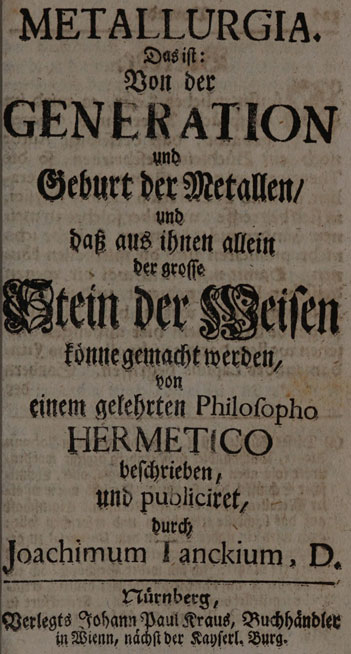
METALLURGIA.
That is:
Concerning the
GENERATION
and
Birth of Metals,
and
that from them alone
the great
Stone of the Wise
can be made,
described by
a learned Philosopho
HERMETICO - Hermetic Philosopher,
and published
by
Joachimus Tanckius, D.
Nuremberg,
Published by Johann Paul Kraus, Bookseller
in Vienna, near the Imperial Palace.
Preface.
Favorable dear Reader, in the Dialogue of Albertus and Georgius it is mentioned that the same Author wrote yet another little Book which contains the Theoricam - Theory concerning the Birth of Minerals, (a) and the Præparation Lapidis Physici - Preparation of the Physical Stone.
But because this has not come into my hands, I have not been able to publish it and communicate it to you.
So that nevertheless you may be served concerning this Defect and helped in this Art, I have wished to append and place here the following little Treatise, in which not only the Foundation of the Lapidis - Stone is contained.
(a) This little Book was published in the year 1706 by Mr. Johann Zieger, Bookseller in Nuremberg, under the following Title:
Mineralogia, or, Chymical Conclusion, that is:
A Short Account of how one should most easily investigate and explore the Nature and Property of all Metals and Minerals;
also a near Way to attain to the Universal is shown and demonstrated;
finally the sparirte - concealed/enigmatic Riddle:
“I am neither Creature nor a Creator, &c.”
is clearly explained in a Philosophical manner,
presented by Theophilus.
in 8vo.
Frankfurt, published by Johann Zieger, Bookseller in Nuremberg,
Anno 1706.
Rather, BERNHARDUS is explained and interpreted therein; indeed, you will also be able to draw and grasp from it a Foundation for your Knowledge, since scarcely anything clearer and more distinct could be written.
No Philosophus - Philosopher gives it to you entirely clearly and openly, for this is forbidden to him.
Nevertheless he often allows something to shine forth, like the Sun through the Clouds, so that an understanding person who diligently reflects upon the matter may well find his way to the meaning and Foundation.
Just as the common man, when the Sun thus casts a glance through the Clouds, can well recognize that the Sun itself is there, so likewise does the Philosophus - Philosopher act, so that the Disciple of this Art may well perceive and recognize the Glantz, & Augustum lumen, lynceis tamen & philosophicis oculis - Splendor and Majestic Light, yet with lynx-like and Philosophical eyes.
Sed ora & labora. Quod sæpe non dat anno, dat una hora - But pray and labor. What often is not granted in a year, one hour grants,
by the Triune Majesty from His immeasurable Treasury of Grace.
Vale Lector, & meum studium - Farewell, Reader, and [favor] my study.
Lips. 20. Julii Anno 1605. - Leipzig, 20 July, in the year 1605.
J. T. D.
Preface
of the AUTHOR.
If I, noble, steadfast, dear Godfather, knew greater and higher Gifts from GOD, besides the Knowledge of His only-begotten Son, true GOD together with the Father and Holy Spirit, and true Man, in the Unity of one undivided Person, our Saviour, Lord, and Redeemer JEsus Christ, revealed to the human Race, and if the same were known to me, I would not conceal it from you, as my dear Godfather.
Consider with what greater intention my mind could show itself toward you than if I ascribe to you the Secrets of Nature, that is, of the whole World, and what GOD with His Holy Finger has created therein, and through His Grace and Mercy has opened to men, and in part to me, according to the Measure of His Divine Will, since this also is the other Means through which GOD is recognized in His eternal Wisdom, Omnipotence, and Goodness.
Therefore I wish to declare and prove these Secrets to you, not only from Nature and Experience itself, but also from the oldest and newer Philosophi - Philosophers, in such a manner that you shall perceive the true Foundation which you asked me to explain.
And although some, and the greater Part of the ancients, who also knew this Secret in the Experientia - Experience, were not found altogether pure and correct in describing the same, nevertheless in their Parabolis - Parables they speak of it experientially in certain places, so that nothing other than mera convenientia - mere agreement with the newer ones is to be seen from it, except that the dear German Philosophus and Medicus - Philosopher and Physician THEOPHRASTUS PARACELSUS, who in explaining the Foundation surpasses the others as far as Day surpasses Night, treated it more briefly and properly than the ancient Wise Men.
But in the Materia and Forma - Matter and Form no difference is found, because all Wise Men and true natural Philosophers illuminated by GOD, who ever have been and still are, or shall be, until the End of the World, in following Nature in their Preparation, agree in one Thing, from which they extracted the hidden principia rerum - principles of things, and brought them to the prædestinirten - predestined End and Perfection, until at last they introduced the noble Formam - Form into its purest Materiam - Matter, and separated both from all Elemental Impurity and Mortality, so that, because of their equal and proportioned Mixture of the Powers and Natures of the four Elements, in Heat, Cold, Moisture, and Dryness, no breaking or Corruption may ever again fall into it in this Time.
And if it stood in the Fire until the End of the World, it would nevertheless be subject neither to burning nor alteration; and if the breaking and destruction of the World had not been ordained and established on account of the Fall of the human Race, it would remain eternally unbreakable.
And this for the reason that this Quinta Essentia - Fifth Essence has been separated and freed from its Elemental Corruption and Superfluity with which it was mixed and surrounded, and brought to the highest Perfection.
Since then the ancient and newer true Philosophi - Philosophers are found diverse and different in the description of Names, but not in re ipsa - in the thing itself, the Discipulus - Disciple of this Scientiae - Science should and must not cling to the sayings and words, but to the possibility of Nature.
For what subtler deception and obscuring of this Divine Science could be conceived and invented than that they all alike, and all unanimously, cry out and write that in two things, namely Sulphure and Argento vivo - Sulphur and Living Silver, the Mother and Materia - Matter both of our Philosophical Stone and of the six Metals should consist, while nevertheless they themselves, in following Nature, have used the third, namely Sal - Salt, to bind and confirm the other two.
As indeed they often mention the foliated Earth in which they sowed the Animam - Soul, and also in their other parabolical writings, where they compare this Work with the Animalibus and vegetabilibus - Animals and Vegetables, and set forth that it consists in Anima, Spiritu & Corpore - Soul, Spirit, and Body, and that the Anima - Soul cannot be united with the Corpore - Body without the Medium of the third, namely the Spiritus - Spirit.
Item - Likewise, do they not write, filling their Books with it, that SOL - Sun is the Father and LUNA - Moon the Mother of our blessed Stone, and that they cannot be united and conjoined without the Seed of both, namely Mercurio - Mercury, indeed they call it the single Medium for conjoining the Tinctures.
They hold firmly, as is fitting and right, to their Rule when they say:
De extremo ad extremum non pervenitur nisi per recta Media. - From one extreme to the other one does not arrive except through the proper Means.
Since then the Middle must be observed in all things, without which nothing right, nor any Conjunction, can be accomplished, this may rightly be called an Aurea Catena - Golden Chain, and it is no wonder that through this not all men, indeed even the most learned Doctores and Perscrutatores - Doctors and Investigators of this Philosophical Science, have been led into Error.
Therefore, after they had begun this Divine Science but in the End did not find what they desired, they held it for a work of Fables.
But when, through Divine Providence, the highly illuminated Doctor and Philosophus - Philosopher THEOPHRASTUS PARACELSUS arose, who learned from the Light of Nature and from Vulcanus - Vulcan, the Truth again came forth to be separated from the false through the Spagyrical Art, so that he rightly, after reading the Ancients with the greatest diligence, wrote the Correctorium - Correction, and commanded that he be followed.
For Experience also shows that everything which is to enter into a Compositum - Compound, both in Nature and in the Spagyrical Art, consists in three, and that always the third causes and binds the other two.
Since then this is so, it follows incontrovertibly that without Knowledge of the Beginning and End of things nothing fundamental can be understood or proved.
Therefore all Philosophi - Philosophers, after they had seen the Effectum ultimum - final Effect of things, knew no greater Praise to attain than to investigate their Causas - Causes and Beginnings.
If now this is to happen, one must diligently and before all things invoke GOD Almighty through JEsus Christ from the Heart for Illumination by His Holy Spirit, that He may open Heart and Understanding to fathom such high Secret and Wisdom, for this is certainly a Gift of GOD.
Afterwards one must earnestly search through and read the Wise Men, and diligently investigate and ask concerning the possibility of the Sayings, together with the Metallic Principiis - Principles and the Preparation of those Materia - Matters, in which the whole Truth of the Work lies, until it pleases GOD to reveal the same to them.
For the Materia - Matter is easily found, but the Practica - Practice with difficulty, and by no Philosophi - Philosophers is it set down sincere - sincerely and purely.
But whoever despises the aforesaid Means and follows his own thoughts, for him it is impossible to bring the Secreta - Secrets to an End.
And it happens to him as to the Ass, the Philosophi - Philosophers say, like the blind man who is led to the Supper and does not know where he stretches or thrusts his mouth.
For this Art is a Secret above every Secret and impossible to find without preceding natural Knowledge of the Phil. - Philosophical Sayings, which explain inwardly and outwardly the Nature and Property of the things which one intends to follow.
Otherwise it would be impossible to follow them if one did not know the inward hidden Secrets of the things, and one would be uncertain in the matter whether one did it rightly, too much, or too little, from which no good End can follow.
But whoever earnestly and diligently asks GOD for Understanding, and diligently studies in the most natural and highest Scientia - Science, and takes hold of the Coals, will certainly come to the blessed End of this Wisdom and rejoice in it, and will not despise that which is commanded to be sought.
For he who seeks finds, says the highest Spagirus - Spagyrist, JEsus CHristus.
Therefore, dear Godfather, set your Trust and Heart upon the aforesaid Foundation, follow this my Reminder, and abandon all Sophistical Experimenta - Experiments.
For although my Person is insignificant, and this writing is composed in the simplest manner, since from me there is sought not great high-flown words and ornate chatter, but simple Truth, nevertheless it will be sufficient to dig beneath the Foundation of this Divine Science.
Nor is GOD a respecter of Persons.
For to whom He loves He gives it while sleeping, because all men bear the Image of GOD, and He has Pleasure in those who fear Him and in all Humility and Lowliness rely upon His gracious Mercy and Goodness.
In His Name I begin to divide this my little Treatise into three Paragraphos - Paragraphs, in which I intend to explain my undertaking.
In the First Part it shall be shown that our Tincture and Arcanum - Secret is to be elicited from nowhere else than from the Metallis - Metals.
In the Second it shall be said from which Metals it may most suitably be extracted.
And in the Third Part, what the Metals are in their first Being and how the same is to be considered, wherein the Practica - Practice shall also be included.
Thus an understanding person will obtain from it what he desires.
That the Metalla - Metals, and no other Thing, contain within themselves this Arcanum Tincturæ - Secret of the Tincture, and why?
Since our Art is a Work of Nature, which before all things should be followed as far as ever possible, it cannot be completed without that Matter which Nature through her Wisdom has brought to light and appointed as the beginning Mother of the six Metals; rather the Matter of the Art, beside which no other is found in the whole World, nor created by GOD for this purpose, shall be solely the one Matter of Nature.
But since the Matter alone is not suited to Form and Generation, but is produced and formed by its own Agent, to which it is predestined, namely into Metallic Generation, so must Art likewise perfect and multiply such Matter with its own Form.
For there is nothing which Nature generates and transmutes by means of a Seed which Art also, by means of that same Seed and by following Nature, cannot compose; but without Nature having gone before, no one can do this except GOD alone, who can create something from nothing, Bread from Stones, and a Woman from a Rib.
Now Nature has for the Generation of the Metals her own and determined Seed, which the ancient Philosophi - Philosophers have placed in Sulphure and Argento vivo - Sulphur and Living Silver, that is, Forma and Materia - Form and Matter, and THEOPHRASTUS GERMANUS has placed in Sulphure, Mercurio, and Sale - Sulphur, Mercury, and Salt.
This Seed contains within itself the nearest Power by which it is brought to the Metallic Nature and Form.
Therefore without the one and Metallic Seed all the work and labor of men is vain.
This should be well retained, for through this Argument innumerable Errors and Sophistications are prevented.
But one thing is to be noted: that Art can never follow Nature in the Remotis - remote things, that is, in the Principiis - Principles from which the aforementioned Seed has grown, such as the four Elementa - Elements, so as to produce the Metallic Seed.
Rather it must elicit and extract those Principia, Materia and Forma - Principles, Matter, and Form from the Metals in which they have been created and left most properly for Art.
Hence RAIMUNDUS LULLIUS and other Philosophers report:
Ubi natura desinit, ibi incipit artifex. - Where Nature ceases, there the Artist begins.
Item - Likewise THEOPHRASTUS says in lib. Mineralium - in the Book of Minerals:
That GOD was the Beginning of all things, and so long as the ultima Materia - ultimate Matter of each thing has not been created, so long the primum semen - first Seed and Beginning of the thing cannot be found through Art.
For Nature completes the Gradum - Degree which she is capable of, and cannot, because her Action is simple and continuously proceeds, pass beyond the common Metallic Disposition.
From there Art takes it and perfects it to its Prædestination and higher Perfection.
This Nature cannot accomplish without the help of Art.
Therefore not in vain are the seven Canonical Rules of the seven Metals cited by THEOPHRASTUS in vexationum libro - in the Book of Vexations, and together with these their relationship, so that no corporeal thing can subsist without the six spiritual, nor the six spiritual without one corporeal.
And he commands with all earnestness that attention be given to the spiritual and metallic state, which Rules are so firmly founded that there is no need to write further concerning them.
The ancient Philosophi - Philosophers likewise confirm this very extensively.
Thus Thomas Aquinas, at the end of tertii Meteororum - the Third Book of the Meteorology, says that the Metalla - Metals can be changed and transmuted into one another because they are natural and alike in their Materia - Matter, being of one Essence.
Therefore Hermes established a Circulation in the Metals, for through the breaking of one it is converted into another.
Item - Likewise RHASIS in lib. Divinitatis - in the Book of Divinity:
You shall know that natural things are so collected and bound together that in every one is every thing, which is comprehended better in the Liquefactivis - liquefiable things, that is, in the Metals, than in other things.
For the inward part of Gold is silver-like, and the inward silver-like part is golden.
For from Silver one elicits Gold, and from Gold Silver.
And in Copper there is potenciâ - potentially Gold and Silver, but not visibly; and in Iron, Lead and Tin; and in these, Silver and Gold.
The same is written by ALBERTUS in 3. lib. de Mineralibus c. 8. - Book III of Minerals, chapter 8, and he says:
EMPEDOCLES, HERMES, and all the other Philosophorum TURBA - Assembly of the Philosophers say that in every Metallum - Metal there are several Species and Metallic Natures, and every Metal is hidden in every other.
Philippus Theophrastus Paracelsus also testifies to this in libro vexation. - in the Book of Vexations, in the first Rule.
Item - Likewise in the same Book he further reminds all Alchymists that true Alchymia - Alchemy, which alone teaches the Art of making Silver and Gold, uses no other Recipe from the five Metalla - Metals which are imperfect, but solely:
from the Metals,
out of the Metals,
through the Metals,
and with the Metals,
the Metals are made perfect.
All Philosophi - Philosophers who otherwise write Truth write this, without exception.
As Bernhardus Trevisianus also testifies in the second Part of his little Book, that our Entrance and Materia - Matter is from the Metallis - Metals.
For our Materia - Matter is to be composed from a Mercurius - Mercury which is found nowhere else except in the Metals themselves.
The same is confirmed at that same place by many Philosophi - Philosophers, who all unanimously testify to it.
Since then Nature cannot be improved except in her own Nature, it follows incontrovertibly that the Metallic Nature cannot, should not, nor may be amended and improved otherwise than in its own Metallic Nature, and in no other Nature.
Thus our Elixir must be from the Principio - Principle, Root, and Metallic Nature, so that the Medicine may be nobler and more precious than the Metalla - Metals, and thus through Art we accomplish in several Months what Nature is scarcely able to do in a thousand Years.
Thus it becomes evident what the Philosophi - Philosophers mean, when they speak of Argento vivo - Living Silver and of dissolving with Liquoribus and Humiditäten - Liquors and Moistures.
They do not understand by this anything drawn from common things, but that which is drawn from the Argento vivo corporum Metallorum - Living Silver of the Bodies of the Metals.
Therefore the Metalla - Metals and their Origin and Materia - Matter are to be carefully observed, which not only among themselves, but also just as the great World has with Man, the little World, have a likeness, and are distinguished only in the Figure and Form of the Physici corporis - Physical Body.
Otherwise, so far as concerns the Essence and Materia Sulphuris, Salis, and Mercurii - Matter of Sulphur, Salt, and Mercury, both Metals and Men partake equally of them.
Therefore in cura - in cure, when like comes to like, wonderful things are experienced both in Men and also in the Transformation of Metals, concerning which more will follow afterwards.
Therefore one should with all diligence consider the magnalia Dei - mighty Works of GOD, and that without this Medicine nothing right can be accomplished either in this Transformation of Metals or in the cure of their Diseases.
For consider: if this old Being and sick Birth of Men, Animals, Flowers, and Herbs, as also of the Metallic Corporen - Bodies, is to be universally restored, renewed, brought into Health and Perfection, and transmuted, this can happen in no other way than through its heavenly perfect Substance and clarified newly-born Being.
This heavenly Power GOD has placed most of all in the Body of the Metals, and in no other things which are of such quickly corruptible Substance.
For show me any Thing or any of the Elementorum - Elements here in this World which is of such strong Composition as the Metalla - Metals, and especially whose radical Moisture does not burn and perish as quickly as other things.
For in Fire the Humidum - Moisture or Mercurius - Mercury of other things flies away in Smoke, and the Sulphur or Oleum - Oil burns, and the Salt remains fixed in the Ashes, separated from the other Elements.
But the Metalla - Metals and their humidum radicale - radical Moisture never separate themselves from their Composito - Compound, but rise upward with their whole Substance.
This is a great indication of their Perfection, and that through their long Digestion in the Veins of the Earth, above all things, in vaporous Mixture, they have been digested, cooked, and mixed together hard, strongly, and firmly in their Homogeneity.
From this a great Secretum - Secret of our Mastery is to be drawn, as ARNOLDUS de Villanova says, through which we are certain that our Materia - Matter is well united and contains within itself everything that we require for our Work.
For our Compositum - Compound proceeds from the Centro Elementorum - Center of the Elements, in which the heavenly Power has most of all been infused, as is evident from this.
For after the Rays of the heavenly Corporum - Bodies influence downward from above into their Center, they find their Retinaculum - Receptacle and holding-place here below in the Earth.
And the Earth, after it feels the Power of the upper Spheres, brings forth all kinds of wonderful growths, namely of the Vegetabilium, Animalium, and Mineralium - Vegetables, Animals, and Minerals.
For through the Motion of all the Spheres, the Elementa - Elements and the Earth are moved and warmed, and through such subtle Warmth are excocted and resolved so that they pass into a Vapor, with which the heavenly Influentia - Influence can unite itself.
And the purer, higher, and clearer in Transparency the Resolutum - resolved thing or Vapor stands, the purer the Compositum - Compound that proceeds from it.
Therefore in the Generation of the Metals, after Nature through her Ingenium - ingenuity, by means of Warmth, raises the most subtle Parts of the Earth into a Vapor and sublimates them to the highest ad perspicuitatis claritatem - clarity of transparency, purifies and makes them exceedingly subtle and prepares them so that in their Clarity they become like the heavenly Substance, then the Radii - Rays and Spirits of the heavenly Corporum - Bodies, through the likeness which they possess toward each other because of Purity and subtle Simplicity, easily, by means of the Mineral Moisture which is of the same Materia - Matter from which the Crystalline and sublimed Earth or Vapor has arisen, because the same is again resolved, impress their Impression and Influence more subtly into such Materiam - Matter.
And they love one another like Man and Woman, and begin to embrace and unite themselves until the heavenly Form has decocted and brought the lowest Materiam - Matter, with which it is now invisibly united and become one Thing, into the Power of its Nature and Metallic Perfection.
But this Cooking and Purification scarcely happens in a hundred Years.
From this is sufficiently evident the difference of the six Metals, namely Saturni, Jovis, Veneris, Martis, Lunæ and Solis - Saturn, Jupiter, Venus, Mars, Luna, and Sol, that this difference is not Materia - Matter, but only Forma - Form, which through the Accidentia - Accidents has been hindered so that it could not operate within them, nor digest them, as in the perfect Corporibus - Bodies.
Hence also, because the humiditas radicalis and Materia Metallorum - radical Moisture and Matter of the Metals stands for so long in its Fumositas and Vapor, Heaven with all the Astris - Stars has increasingly poured into it more wonderful Powers than into other things, because it has worked longer therein, and this is the principal cause thereof.
The same, however, is not found in precious Stones and Gemmis - Gems, because in their first Resolution and Fumositas they were not subjected for so long to the heavenly Obedientiæ - Obedience.
Rather they were quickly hardened and coagulated with their clear, clarified, transparent, sublimed Earth as soon as they entered into their first Fumositas - vaporous condition.
Therefore in their Coagulation and Solidity they in some measure give off their heavenly Powers from themselves.
But this cannot happen in Metallis - Metals in the same way, because before and prior to receiving their Metallic Form they remain for a long Time in Fumositas - vaporous condition and Transformation.
Thus the heavenly Power becomes so entirely united with their humido radicali - radical Moisture that it must retain within itself the Appearance of heavenly Power.
Therefore we cannot bring such heavenly Powers to light while they remain in their Metallic Composition and Form, as with the Gemmis - Gems, unless we unload them of their Compaction and Superfluities and reduce them into their first Matter and humidum radicale - radical Moisture.
And then through Vulcanum - Vulcan bring the same to another Perfection and new Birth.
Then it gives forth its Powers and swiftly transforms all Corpora humana - human Bodies to Health, as also the imperfecta metalla - imperfect Metals to the Perfection of Gold and Silver.
Thus we become partakers of and receive the uppermost heavenly and lowest Elemental Powers.
Therefore HERMES rightly said:
Quod est superius est sicut id, quod est inferius, & quod est inferius, est sicut id, quod est superius, ad perpetranda Miracula unius rei. - That which is above is like that which is below, and that which is below is like that which is above, for accomplishing the Miracles of one Thing.
What could be said more clearly?
For the uppermost incorruptible heavenly Powers rest, as though enclosed, in these lowest natural Corporibus - Bodies, and especially in Metallis - Metals, and through the Spagyrical Art may be opened and extracted.
And these same Powers are called the lower Heaven.
Therefore this Medicine, like Heaven itself, should be incorruptible, penetrating, and of swift Operation, which can act in every Physicum Corpus - Physical Body in no other manner than Heaven itself.
Thus the Medicus and Philosophus - Physician and Philosopher can through his Spagyrical Art handle Heaven with his hands and administer it to the sick human, vegetable, and metallic Corpore - Body and, through Divine Help, bring it to Health and Perfection.
For the incorruptible Spagyrical and Philosophical Cœlum - Heaven in the Metals and great World, and the corruptible Cœlum - Heaven in Man, are of one and the same Substance.
Therefore the incorruptible may increase the Powers of the corruptible, protect it from all Accidentibus - Accidents, drive away the infirmities of the Sick, and as it were restore it newly born.
What higher thing, besides the Knowledge of GOD, could happen to the human Race here in this Vale of Misery than that the lowest and highest Powers should be shown to him in one Medio - Medium and placed into his hands?
There, as from a Centro - Center or Point, he may grasp all Perfectiones - Perfections and bring them into another Birth, and restore Man into the Centrum unitatis - Center of Unity, which is nothing other than the Life from which he himself has fallen, and preserve for him a healthy and long Life.
Item - Likewise, to bring the Metals which are imperfect to Perfection, so that they are found better than natural Gold in all Examinations.
Who can fathom the Cause of such Perfection or heavenly Powers?
No one except GOD alone.
O the Depth of the unspeakable Wisdom of GOD and of His Mercy!
Who would not be struck with awe and fear Him and honor and acknowledge Him as the Almighty, since He has shown us His Divinity so powerfully, not only in restoring eternal Salvation, but also earthly bodily Life, concerning which we now treat?
Has He not previously ordained this Medicine, within which the Arcana - Secrets rest, for Man, so that whatever Man lacks through deficiency of Health and does not possess of the heavenly Powers, he may receive from his Father, the great World, which feeds him like the true Pelican with its own Blood?
For what is the great World other and more than also the little World?
Are not all Healths and Diseases found therein just as in Man, from which he must name and recognize them?
And this Man should know and understand: that he is made from the Limbo terræ - Limbo of the Earth, that is, from the whole World, and that every thing receives its like.
From this it follows that if Man were not made from all Parts of the whole Circle, he could not nor would he be the Microcosmus - Microcosm and little World, nor could he receive the great World and what is within it.
But now everything which he receives from it and takes into himself as nourishment is nothing other than Man himself, except that it is invisible and through the Archeum - Archeus in the Stomach is formed into Flesh, Blood, and Limbs, that is, into the visible human Form.
Therefore he is called Microcosmus - Microcosm, and the World becomes Man himself.
Thus Man is distinguished only, so far as concerns the physicum corpus - physical Body, for the Soul brings its Life with it, in the Figure and Form which he has in the Mother’s Womb.
But fundamentally it is one Figure and one Form, for all human Proportiones, Divisiones, Partes, Membra - Proportions, Divisions, Parts, and Members are in the great World as in Man.
Therefore the outward Member is the support and Medicine of the inward Member, and the Member of Man receives into itself the other Member which the great World possesses and sustains itself by it.
And if it received no Addition from the same, it would fall down and perish.
But because Theophrastus Paracelsus has explained this most extensively in his Paramiric writings, I wish to refer to that as sufficiently investigated.
For my purpose is not to relate the whole Account of the Microcosmi - Microcosm, but only that the Comparison and Anatomi - Anatomy of the Metals, in which, as though in one Centro - Center, all heavenly and Elemental, that is, all the Powers of the World, are most of all contained, may be set against Man.
And from this also the Analogia - Analogy which the Metals have among themselves may be understood, and the Philosophus - Philosopher may have cause to investigate further the natural Secrets and Knowledge, as it is fitting for a true Medico and Philosopho - Physician and Philosopher to know.
Since moreover Nature has been so described and explained by the ancient and modern Philosophers, and especially by the dear man D. Theophrastus, that I consider everyone must have sufficient satisfaction from it, so that nothing can be said or explained which has not previously been written and explained, provided one is illustrirt - illuminated and enlightened by Divine Clarity, without which it is impossible to understand the Scientia - Science and Art.
This one must receive and ask from the pure Grace and Mercy of GOD, in the Name of JEsus Christ, who says:
Seek, and you shall find;
ask, and it shall be given to you;
yet seek first the Kingdom of GOD, and all the rest shall be added unto you.
Thus I hold it sufficiently confirmed with Rationibus - Reasons that it has pleased the Almighty to place such Powers and Mysteria - Mysteries most of all in the Metalla - Metals, and that they cannot be found elsewhere.
It is now my purpose to show further from which Metallis - Metals this Compositum - Compound is to be made, that is, from which the Forma or Fermentum - Form or Ferment, and from which the Materia - Matter, should be taken.
The Second Part.
From which Metallis - Metals this Compositum - Compound is to pass into formam and materiam - Form and Matter.
Experience teaches that every End must reveal its Beginning, as has been touched upon above, and it is found that whatever a thing was in the Beginning, that same it must also be in ultima materia - the ultimate Matter.
As the Philosophi - Philosophers testify, namely that every thing generates its like, and that no perfect Form can be extracted from any thing and brought into Multiplication unless it has first truly been introduced by GOD into the Majora - greater things and is found in actu - in actuality.
This is testified not only by PHILIPPUS THEOPHRASTUS, who says that there is nothing so small which is to become something that can subsist without Form, but also by the Philosophus - Philosopher Aristotle and others who will follow hereafter, that nothing can be born or come into being unless the Form is copulated and joined to the Materiæ - Matter.
For these, they say, are the essential Principia - Principles of every thing that is to be born.
Therefore, if Nature through Art is to make us partakers of this Treasure of the Lapidis Philosophici - Philosophical Stone from the Metallic Nature in which it lies hidden, then she must not lack or be deprived of these two Principiorum - Principles, namely that essential Formæ and Materiæ - Form and Matter, just as she has placed them, as aforesaid, in the Metals.
But before we proceed to the essential Principiis - Principles, I consider it necessary to recognize from which Metallis - Metals it can most nearly be perfected, both in Forma and Materia - Form and Matter.
If this is to be fundamentally demonstrated, then the Goal and End of all Philosophorum and Chemistarum - Philosophers and Chymists must be considered, which is that they endeavor to bring the imperfect Metals to Perfection, so that they become in Actu - actuality and in Truth Silver and Gold.
But to accomplish this is impossible without the true Form of Gold and Silver.
It follows therefore that such Form and Power cannot be elicited from the imperfect Metallis - Metals.
ARNOLDUS de Villanova shows this finely in chapter 8 of the Minoris Rosarii - Lesser Rosary:
Elixir mutans ignobilia metalla in Aurum & Argentum multò magis digestum & mundum esse oportet, quàm sint aurum & argentum. - The Elixir which changes ignoble Metals into Gold and Silver must be much more digested and purified than Gold and Silver themselves.
From this it follows that none among the Metals can enter into the Elixir unless it has first, like Gold and Silver, become pure and cooked like a Spirit and has truly assumed their Formam - Form.
For although the four imperfect Corpora - Bodies, namely Saturnus, Jupiter, Venus, Mars, are equal to Gold and Silver in and with the Materia - Matter, nevertheless in Form they are entirely unlike them, and must first be brought thereto as into the nearest Matter of the Elixir.
For from one Extremum - Extreme to another Extremum - Extreme no entrance is opened without a Medium.
Now the imperfect Corpora - Bodies, because of their Imperfection and Impurity, are farther from the Elixir than Gold.
Therefore before they can be brought thereto they must first be converted into the Medium, that is, Gold and Silver.
But this will not happen, as Plato says, unless Sol and Luna - Sun and Moon, conjoined in one Corpore - Body, are cast upon them.
For although, he says, you can indeed use the other Metals, you do not need them, understand as concerns the Form of the Lapidis - Stone, because from them you cannot obtain the pure and tempered Substance of Sulphuris and Argenti vivi - Sulphur and Living Silver.
And thus it is evident from this Platonic Testimony that from no imperfect Metallum - Metal can our Elixir be formed unless that same Metal, through the Elixir made from the perfectis corporibus - perfect Bodies, is changed into Aurum or Argentum - Gold or Silver.
And PLATO did not say this in vain.
For if the Forma - Form of the golden and silver Elixir could be drawn from Saturno, Jove, Venere, and Marte - Saturn, Jupiter, Venus, and Mars, then truly such golden and silver Form would have to be therein, or else one would have to be able to find in a thing something which was not in that thing.
But that the Forma - Form of Gold and Silver is not in Effectu - actuality and visibly, but only potentia - potentially, in these four imperfect Metallis - Metals, is evident from this:
In every Metal in which the Forma Auri vel Argenti - Form of Gold or Silver is inwardly present in Effectu - actuality and visibly, that same must be Actu Aurum & Argentum - actually Gold and Silver.
Just as everything which partakes of a Man, Animal, Tree, Stone, or another such thing, is also actually a Man, Animal, Tree, or Stone.
For the Forma - Form is that which gives a thing its Esse - Being, so that the thing is what it is, and gives it its Name.
And as soon as the Forma - Form is taken away, it ceases to be what it was before.
Now neither Saturnus, Jupiter, Venus nor Mars is actu Aurum or Argentum - actually Gold or Silver, because they do not possess the Properties of Gold and Silver.
Therefore none of the four has become participant in the Form of Solis or Lunæ - Sol or Luna.
From this it follows without contradiction, so long as GOD maintains Nature, to which He has prescribed an immutable Rule and Goal against which He does not act, that no other thing in the World, whatever it might or could be, is able to inform and generate Solem or Lunam - Sol or Luna, except that one Form of Gold and Silver which is in Gold and Silver itself.
For it is the proper Nature of the Forma Solis - Form of Sol to generate Gold in the Materia Auri - Matter of Gold, that is, in its own Body, in which, as stated above, all the other Metalla - Metals are in general alike.
And the same is to be understood of the Form of Silver, Veneris, Martis, Jovis and Saturni - Venus, Mars, Jupiter, and Saturn.
For every Metallic Spirit or Form generates its like in its Body, that is, in its Materia - Matter or Argento vivo - Living Silver.
Therefore THEOPHRASTUS says in Metamorphosi - in the Metamorphosis, that the Mercurius Metallorum - Mercury of the Metals is subjected to the Metallic Spirits and Tinctures, just as the Woman to the Man, or like Wax into which one may impress whatever one wishes, either a little Woman or a little Man.
Thus if the white Body, or Mercurius metallorum - Mercury of the Metals, receives the Spirit of Gold, it becomes Gold.
If it receives the Spirit of Silver, it becomes Silver.
And thus it is with the other Metallic Spirits of the four imperfect Metals.
Thus Mercurius - Mercury is the Medium through which the aforesaid Spirits come into Operation and are brought forth, as one may further find there.
What could be spoken more clearly than this:
That if one wished to make a Tincture Solis - Tincture of Sol, one should extract it nowhere else than from the Tincture-Fire and Sulphuris Solis - Sulphur of Sol, and unite and regenerate it like the true Firmament with its own or another Metallorum pastâ Materiâ - metallic paste-Matter, or Argento vivo - Living Silver, because this is alike and one in all Metals and is subjected to the six upper Spirits.
I consider that for an understanding person more than enough and very clearly has been said.
And further hereafter it shall also be proved that the Philosophi - Philosophers have gone precisely this and no other Way:
that from the fixed and unfixed Metallic Corpora - Bodies they extracted their Formam and Materiam - Form and Matter by means of a Mercurial Water, and again conjoined them together, and brought them to final Perfection and another new Birth, and fed and watered them in the Fire with the same Materia - Matter until they found an infinite Perfection.
Therefore RAIMUNDUS LULLIUS says in the little Apertorium:
Fermentum Lapidis albi est argentum & rubei Aurum - The Ferment of the white Stone is Silver, and of the red, Gold.
Without these Fermentis - Ferments there is neither Gold nor Silver.
Item - Likewise AVICENNA says that the Sulphur perfectum - perfect Sulphur which we require in our Art is found nowhere upon Earth except as it exists in these two perfectis Metallis - perfect Metals, namely Sol and Luna.
Therefore he says:
Let us prepare these two Corpora - Bodies subtly, so that we may have the Sulphur and Argentum vivum - Living Silver of that same Materia - Matter upon Earth from which Nature makes Gold and Silver beneath the Earth.
For these, he says, are the shining Corpora - Bodies in which are found the tinging Radii - Rays which truly tinge the other Metalla - Metals into White and Red.
Therefore he says further:
If I did not see and find Aurum and Argentum - Gold and Silver to have been created, I would not believe that Alchymia - Alchemy were an Art.
If one asks ARNOLDUS, he gives this Answer:
Fermentum auri Aurum est, & argenti argentum - The Ferment of Gold is Gold, and of Silver, Silver.
And there are no other Fermenta - Ferments upon Earth.
Item - Likewise PLATO also says:
Omni Argento inest Sulphur Album quo egenus, & omni auro inest nostrum Sulphur rubeum. - In every Silver there is a white Sulphur which is lacking, and in every Gold there is our red Sulphur.
JOAN. AUGURELLIUS also says in his Carminibus - Poems:
In Gold are the Seeds of Solis - Sol; in Luna the Seeds of Silver.
And because of their Fullness, since they lie deeply hidden in the Body, they can have no Movement unless they are released from their Bonds and artfully extracted.
Likewise PYTHAGORAS:
Gold gives a golden Color, Silver a silver Color.
Read also RICHARDUS ANGLICUS, who says:
What Man sows, that he harvests.
Therefore if he sows Dung, he will harvest nothing other than Dung.
Therefore sow Gold and Silver, he says, so that they may bear for you golden and silver Fruits, because these alone can accomplish what we seek, and no other thing in the whole World.
MORENES says likewise:
Just as the Fermentum pastæ - Ferment of the dough is a dough, so Fermentum Auri aurum - the Ferment of Gold is Gold.
And thus all Philosophi - Philosophers answer, for it would become too long to relate everything.
For they say generally that every thing produces its like.
For no Sheep forms Men, nor Palm-tree Pomegranates, nor Thistles Grapes, nor Birds Fish; rather each forms its like.
Therefore I wish hereby to have sufficiently proved that both the Elixir rubeum ex Sole - red Elixir from Sol and the Elixir album ex Luna - white Elixir from Luna are to be formed.
But so that I may clearly demonstrate both the Materiam - Matter, that is, the Pastam - Paste or Argentum vivum - Living Silver with which the Sulphur or Fermentum Solis vel Lunæ - Ferment of Sol or Luna is to be made into a paste, which is taken from the four imperfect Metals, and likewise the Formam - Form, which is taken from the two perfect Bodies, hear the words of Lullius in 3. distinctione de quinta essentia - in the third Distinction concerning the Fifth Essence, who says thus:
Saturnus, Jupiter, Mars, Sol, Luna, Venus are the Principia - Principles through which the Artista - Artist recognizes that they are the things or Substantiæ - Substances from which comes that, understand Formam and Materiam - Form and Matter, from which our Lapis - Stone is composed.
But some among them conduct themselves Materialiter - materially and some formaliter - formally.
Those which conduct themselves Materialiter - materially, that is, which are taken for the Materia and Pasta - Matter and Paste, are Saturnus, Jupiter, Mars, Venus.
But those which conduct themselves formaliter - formally, that is, which are taken for the Forma and Fermenta - Form and Ferments, are Sol & Luna - Sol and Luna.
This is reported so that the Artista - Artist may recognize that Saturnus, Jupiter, Mars, & Venus are the Substantiæ - Substances from which comes the Materia - Matter or Argentum vivum - Living Silver, which is to be informed or fermented with Sole and Luna - Sol and Luna in the Substantia - Substance from which is drawn the Forma - Form, through which the aforesaid Materia - Matter or Argentum vivum - Living Silver, understand the Argentum vivum - Living Silver or Matter extracted from Saturno, Jove, Marte, or Venere - Saturn, Jupiter, Mars, or Venus, is informed, so that from the aforesaid Argento vivo - Living Silver or Matter, and from the aforesaid Form, there may arise the third, which is the Stone.
What could again be said more clearly?
But so that I may not remain only with the opinion of Lullius, hear what Janus Lacinius says in his Collectaneis - Collections, chapter 48:
For the Forma auri - Form of Gold separated from the Materia - Matter can accomplish nothing alone, because it cannot reveal its Operationes and Virtutes - Operations and Virtues unless it is conjoined to the Materia - Matter, which is Argentum vivum - Living Silver and the imperfecta Metalla - imperfect Metals, so that a Compositum - Compound may arise from it.
With this agrees GEBER, who writes thus in the Book Fornacum - of Furnaces, chapter 19:
If you desire to perfect both Works, for Red and White, then dissolve both Fermenta - Ferments, understand Sun and Moon, as he said before, per se - by themselves, and preserve them.
And this, namely the dissolved Fermentum - Ferment, is our Argentum vivum - Living Silver drawn from Argento vivo - Living Silver, which we hold pro fermento - for a Ferment.
But the Pastam - Paste which is to be fermented we extract in the usual manner from the imperfectis corporibus - imperfect Bodies.
And in l. investigationis capite 5. - in the Book of Investigation, chapter 5, where he has taught the common Ways of preparing and purifying the four imperfect Corpora - Bodies, he says:
But this Water, that is, this Mercurius - Mercury, is our Stone, and Argentum vivum - Living Silver from Argento vivo - Living Silver, and Sulphur from Sulphure - Sulphur, and such a Corpus - Body as has been made spiritual and volatile, or subtilized and made thin.
This may be improved confortando - by strengthening within it the Elemental Virtutes - Virtues with other prepared things, scil. Sole and Luna - namely Sol and Luna, which are from the origin of its kind, and augmenting the Color, fixationem, pondus - fixation, weight, Flux and Purity, and other things belonging to the perfect Elixir.
This is also confirmed by Johannes Scotus, which BERNHARDUS TREVISIANUS indicates in the second Part of his little Book, where he says that the Argentum vivum - Living Silver, Mercurius volatilis corporis quod scis - the volatile Mercury of the Body which you know, congelabile or coagulabile - capable of being congealed or coagulated, and the Argentum vivum sulphureum - sulphurous Living Silver, Corpus quod scis - the Body which you know, are the prima materia metallorum - first Matter of the Metals.
Item - Likewise AROS, the great King, who was a highly learned Philosophus - Philosopher, says:
Our Medicine is made from two Things of one Essence, that is, from the Mercurial Union of the fixed and unfixed, spirituali and corporali - spiritual and corporeal, of cold and dry, warm and moist Nature, because it can be made from no other Things.
Item - Likewise in the same little Book he says further:
We reduce the Corpus metallicum - Metallic Body into its sperma or primam materiam - Seed or first Matter for this End, that there may occur a Conjunction of a single new Materia - Matter of the same Root.
Without this Reduction the Stone cannot be made.
And one Materia - Matter is added so that these two Materiæ - Matters may help one another forward, and each gives to the other its Power, so that it becomes a more worthy Materia - Matter than it was before when both were still separated and alone.
And what follows there more extensively.
Nature itself also proves this.
For through long Digestion and Alteration she decocts Saturnum, Jovem, Venerem, Martem - Saturn, Jupiter, Venus, and Mars into Lunam or Solem - Luna or Sol, notwithstanding that they are still burdened and surrounded with Superfluity, as indeed one is found to be more digested and pure in degree than another, which is best known to common miners.
How much more, therefore, will they be brought to Perfection when they are unloaded of all Impurities and Superfluities and equalized in the claritate - clarity of heavenly Purity and, as stands above, conjoined with a new Materia - Matter, that is, with the radiis Solis or Lunæ - Rays of Sol or Luna, and brought and decocted to complete Perfection.
Now if the Imperfectum and volatile corpus metallicum - imperfect and volatile Metallic Body is not to be taken for the Materia - Matter or Pasta - Paste, then the aforesaid Rationes - Reasons concerning the relationship of the Metallic Corpora - Bodies which they have among one another, and that one is hidden in the other, as also the seven Canonical Rules of Theophrastus in vexationibus - in the Vexations, and the opinion of all Philosophorum - Philosophers, would have to be false and invented.
For how should the six Spiritual things generate the seventh if the imperfecta - imperfect things could have no access ad perfectionem - to Perfection?
How should one Power come to the help of the other, when Theophrastus and Trevisianus prescribe it as stated above?
How should Nature create a Perfect thing from the Perfect?
Indeed the whole Art and Nature itself would have to fall to the ground.
What would HERMES, a Father of all Philosophers, answer, who established a Circulation in the Metals just as in the Elementis - Elements, so that through the breaking of one the other becomes, just as one Element is changed into another?
Therefore every understanding person can sufficiently perceive what Foundation those have who imagine that it seems impossible that the imperfecta Metalla - imperfect Metals should be taken for the Materia - Matter just as the perfecta corpora - perfect Bodies are taken for the Form of the Stone.
And if they oppose Nature and the Philosophers, what is that other than running with one’s head against the wall?
Do not all Philosophi - Philosophers, who would be too long to enumerate, admonish that one should follow Nature, which proves that every imperfectum metallicum corpus - imperfect Metallic Body stands potentia - potentially toward its following perfectum - perfect one?
For example, Saturnus - Saturn, because it is the first which from the Mother, ☿ Mercury, is produced into a Metallic Corpus - Body, stands potentiâ - potentially toward Jove, Venere, Marte, Luna and Sole - Jupiter, Venus, Mars, Luna and Sol.
And so with the others, that the imperfect can become the others which are above it.
For GOD has given them this Way and Rule, so that Heaven would break sooner than He would allow something contrary to it to happen.
Therefore Count BERNHARDUS TREVISANUS says in the third Part of his little Book from the Foundation of Philosophiæ - Philosophy thus:
We do just as Nature does, because in the Minera - Mine she has no other Materiam - Matter in which she works than puram substantiam und formam mercurialem - pure Substance and Mercurial Form, for such Mercurius - Mercury is the Sulphur.
Likewise in our Mercurio - Mercury there is also this same incombustible and fixed Sulphur, which perfects our Work without any other Thing or Substantiam - Substance.
He testifies to this with the Philosophi - Philosophers Calid, Morienus, Bendegit and others.
As he says further there, although the incorruptible Sulphur mercuriale - Mercurial Sulphur is mixed through the whole Substance of Mercurii - Mercury, nevertheless it does not dominate, but the humiditas u. frigiditas Mercurii volatilis - Moisture and Coldness of volatile Mercury dominate and lie above.
But through the continual Operations of Heat, which without ceasing cooks Mercurium - Mercury, the Sulphur in Mercurio - Mercury begins to overcome the other Qualitates - Qualities, and the Heat and Dryness, which are the Qualities of Sulphuris - Sulphur, begin to dominate and prevail.
And according to the Degree of this Alteration and Transformation of Mercurii - Mercury through its Sulphur, diversi metallische Colores - diverse Metallic Colors arise, neither more nor less than Nature does in the Mineris - Mines.
For the first Color is black, that is ♄ Saturn.
The second is white, that is ♃ Jupiter.
The third is ☽ Lunar.
The fourth is ♀ Venus-like.
The fifth is ♂ Mars-like.
The sixth is ☉ Solar.
The seventh we bring one Degree higher than Nature does in the Minera - Mine, so that it comes into a sanguineous Redness and becomes more than perfect, which alters.
Thus it is sufficiently explained and proved that the Forma or Fermentum - Form or Ferment is to be taken and formed from the two Lights Solis and Lunæ - Sol and Luna, and the Materia or Argentum vivum - Matter or Living Silver from the four imperfect Metals, so that from these the third may arise, namely the Tinctura Philosophorum - Tincture of the Philosophers.
I will now proceed further, according to my previous Promise, to explain what the Metalla - Metals are in their Principio - Principle, and how they are to be considered and brought ad ultimam materiam - to the ultimate Matter, that is, to the new Birth of the Lapidis Philosophici - Philosophical Stone, so that without End it may extend its Perfectiones - Perfections both in Men and in Metallis - Metals.
The Third and Final Part.
In which it is explained what the Metalla - Metals are in their Beginning and Principio - Principle, and how the same are to be considered.
This Point should be well observed and understood, so that no one imagines that this Fermentation and Impasting of the Metals is a corporeal one, but rather a spiritual and metallic Impasting and Mixture, whereby invisibly one Power is admitted into the other, and one may enter with the other into Alteration.
This is testified by both the former and the newer Philosophi - Philosophers, and Nature herself also proves it in her daily Operation, as TREVISANUS in the second Part of his little Book, GEBER in his Summa, chapter 31, where he writes:
De effectibus principiorum naturæ - Concerning the effects of the principles of Nature,
and THEOPHRASTUS PARACELSUS in lib. vexationum - in the Book of Vexations, in the 6th Rule, all say with one mouth:
When Saturnum, Jovem, Venerem, Martem, Lunam, Solem - Saturn, Jupiter, Venus, Mars, Luna, and Sol are mixed in Flux, the perfect Corpora - Bodies, namely Sol and Luna, will not perfect the other imperfect ones, nor increase them into Sol and Luna, but each remains in its own Nature, that is, fixed or volatile.
And this for these reasons:
Because Sol and Luna alone have received from Nature a simple Form, as much as they themselves required in the first Degree of their Nature and Perfection, and therefore cannot communicate Perfection to the imperfect, because they themselves must lack such additional Perfection.
Likewise in this manner the molten Corpora - Bodies can have no Ingressum - Entrance into one another, nor be radically mixed together, as ARNOLDUS de Villa nova, GEBER in the Summa, CALID. in lib. Secret. - in the Book of Secrets, and THEOPHRASTUS in the aforesaid Vexationibus - Vexations write, that the Corpora Metallica - Metallic Bodies, as they are perfected by Nature in the Mineris - Mines, are in themselves dead and cannot perfect the imperfecta Metalla - imperfect Metals.
But in our Magisterio - Mastery, that is, when we, as will be reported hereafter, through our Mastery reduce them into their primam Materiam - first Matter, and from there perfect them further beyond their natural Degree, and make them penetrating and tinging, then they are living, notwithstanding their former Metallic Corporeality and Compaction, and they tinge the imperfect Metals, according to the Degree of their Perfection, into Solem and Lunam - Sol and Luna.
Therefore the spiritual State of the Metals should before all things be well considered.
For concerning the spiritual and Metallic Community and Mixture THEOPHRASTUS says that it is to be known that there is no Separation or Killing of these Spirits.
For they are Spirits which can never be without a Body.
And even if in one hour one were to take the Body from them and kill them a hundred times, they would nevertheless always have another and nobler Body than they had before.
And this is the Transmutation of the Metals, from the poorest and lowest up to the highest and most translucent Royal Degree, that is Sol or Luna, namely Philosophically.
The Comes Trevisianus - Count Trevisan shows this still more clearly in the second Part of his little Book, where he states that our Materia - Matter or Lapis - Stone is to be drawn from the Metallis - Metals, saying:
The Metals, so long as they are still in the Metallic Form, are nevertheless not our Lapis - Stone, because it is impossible for one Materia - Matter to have at one time two Formas - Forms, namely that of the Stone and that of the Metal, since the Lapis - Stone is the Medium between the Metals and Mercurium - Mercury.
Unless first the Metallic Form is taken away from the Metallis - Metals and corrupted.
The German Philosophus - Philosopher THEOPHRASTUS testifies to this still more clearly in his Manual and also in other Books.
After he has shown that this Medicine, which is to renew Man no less than the Metals, is to be made from the Metallis - Metals and their humido radicali - radical Moisture, because they have a great Convenientiam - Agreement with the humano corpore - human Body, he says further:
If one wishes to make the Lapidem - Stone according to its true Nature, one must also take away its superfluitatem - Superfluity, and multiply it, like another thing, in its Concordantia - Agreement, and also transform it.
This is impossible without its Concordantia - Agreement.
For Nature has left it imperfect in this Place, because she has not formed the Lapidem - Stone, but its Materiam - Matter, which is hindered by the Accidentia - Accidents, although these can be separated through Vulcanum - Vulcan, so that it cannot or may not do what the prepared Lapis - Stone is able to do.
And if you wish to set it into its Concordantiam - Agreement, then it must be reduced in primam Materiam - into first Matter, so that the Masculus - Male may act upon the foeminam - Female, and its outermost be turned inward and its innermost outward.
So that both the male and female Seeds, enclosed in their Concordantia - Agreement, may through the Medium of Vulcani - Vulcan be brought to final Perfection, and also raised in gradu - in Degree.
Then the Lapis - Stone may pour its Virtues, as a qualified, tempered, and clarified Being, from itself into the humanum corpus - human Body and also into the Metals, make the same healthy, drive out the sordes per viam expulsionis - impurities by the way of expulsion, and bring and maintain the good Blood in Man per viam attractivam - by the attractive way, in the proper Places.
Thus the Microcosmus - Microcosm, which, as shown above, stands in the Limbo terræ - Limbo of the Earth, formed beneath the Earth, may through this Medicine, as from its Like, namely the Macrocosmo - Macrocosm, from which Man himself is, be radically, not supposedly but properly, brought to Health or maintained therein.
What could be said more clearly than that the Metalla - Metals are to be reduced into their primam Materiam - first Matter and set into their Concordantiam - Agreement?
If the Philosophi - Philosophers had known how to find this in ultima Materia - ultimate Matter, that is, without breaking the Metals, they, as also we, would have spared much toil and labor.
Therefore all Philosophi - Philosophers who speak or write only of the Metallic Materia - Matter, and especially ARISTOTELES and DEMOCRITUS in the Book of Philosophiæ - Philosophy and in the third Book Meteororum - of Meteors; likewise AVICENNA in Mineralibus - On Minerals, and RAIMUNDUS in clavicula sua - in his Little Key, say:
Let the Alchymists rejoice as they will, nevertheless they will not alter the Metalla - Metals unless they reduce the same in primam Materiam - into first Matter.
Although indeed there are certain Gradationes - Gradations from the Oleo Sulphuris - Oil of Sulphur which improve the Metalla and Gemmas - Metals and Gems when they are found to have been digested therein for their proper time, nevertheless this does not belong to this our Work and Magisterio - Mastery, which is transmuted through a particular Labor and new Birth.
For if this our heavenly Medicine is to show its proper Power, it must proceed from the Root and first Materia - Matter of all Metals, as has been sufficiently shown above.
For Nature herself proves this, both in Vegetabilibus, Animalibus, as also Mineralibus - Vegetables, Animals, and Minerals, as may be understood from these.
For, as an Example, if a Tree, Fruit, or Grain is to be brought into Augmentation, the Seed of the Fruits which one wishes to multiply must be sown in the Earth.
Now the Seed in the Earth cannot take to itself its Nutriment and Increase unless it putrefies and is reduced in primam Materiam - into first Matter through the Moisture of the Earth, so that it may unite itself with the liquore terræ - liquor of the Earth and nourish and water the Seed.
For what is the Seed other than the forma - Form, and the Earth other than the Materia - Matter?
These two Extrema - Extremes cannot be nourished or united without the Medium, that is, the Water, so that it may enter into Multiplication.
Now this is nothing other than the Work and Wisdom of the Highest Spagirus - Spagyrist, who created for the Seed which is sown and putrefied an Archeum - Archeus, so that it, like a Smith or Carver, may forge or carve the liquorem terræ - liquor of the Earth into its Form and Shape.
Thus the Former is in the Seed, without whom this could not possibly happen, who from the liquore terræ - liquor of the Earth and Rain can make and multiply Wood, little Stalks, Herbs, and Seeds.
But all must go into primam Materiam - first Matter and Putrefaction, and so onward it is made.
Likewise in Man, as soon as he is born from the Mother’s Womb and formed by GOD into his Form, he also has this Smith and Carver hidden in his Stomach.
This takes that which he receives for Nourishment from the great World, through the gracious Mercy of GOD, for he must sustain himself only through asking for this daily Bread, namely the invisible Cosmum - Cosmos, and can forge it into his visible Image and Microcosmum - Microcosm.
But now the Carver cannot accomplish this unless the Herb, Flesh, and Bread are putrefied in the Stomach by the help of moist Drink and reduced in primam Materiam - into first Matter.
Then the Smith has Power to forge.
And if this does not happen, the Image of Man must perish and decay through lack of the Form which the great World invisibly contains within itself and which he must take from that World into his Stomach.
Then the Archeus takes whatever serves him for carving the Members, Flesh, and Blood of human Form and forges it thereto.
The superfluous refuse he casts out per excrementum - through excrement, for it does not serve for maintaining and multiplying the Form and Members.
Thus we eat ourselves in a daily Bite from the great World, namely our Form, such as Flesh, Blood, Fingers, Feet, Brain, Teeth, and the whole Body, as has been sufficiently reported above.
Likewise the Metals also have their Analogiam - Analogy toward one another and are the great World in which all heavenly and earthly Powers lie hidden.
If these are to be brought into Multiplication and Increase, one must first extract the Seed or Sulphur Solis vel Lunæ - Sulphur of Sol or Luna, which lies very deeply hidden in the Mercurio Solis - Mercury of Sol, like the Grain in the Straw, so that it remains in its proper Flower or Power.
Then sow the same into its own Metallic foliated Earth, and water and moisten it with the Mineral Liquor.
Then the Seed has the Archeum - Archeus and Smith within itself, who forges the Metallic foliated Earth and Mercurial Liquor into Gold and Silver.
But it cannot separate the Superfluity; rather the Artist must separate the same through Vulcanum - Vulcan.
For herein the Increase and Multiplication of the Metals differs from the other two Births.
And thus the things are visibly brought to light which previously, and in the old Life, were only potentiâ - potentially and invisibly hidden.
Therefore it should be well noted that in the middle Corpore - Body, that is, when a thing still stands in the old Life or ultima materia - ultimate Matter, no Virtue or Power is to be expected unless it is brought or reduced in primam materiam - into first Matter.
For example, a Rose: what does one have from it so long as it stands undestroyed and alive, except the good Odor and Taste and Pleasure of Sight?
But in Medicine and in the Power which it is to show in the Arcano or quinta essentia - Secret or Fifth Essence, the Medicus - Physician perceives nothing until it is brought into the new Birth and into its quintam essentiam or Arcanum - Fifth Essence or Secret.
Likewise with Gold and Silver: so long as they are in their Metallic Life and ultima materia - ultimate Matter, they have nothing to do with Disease and the Transmutation of Metals.
But when they are destroyed, reduced in primam materiam - into first Matter, and perfected, then from this springs the new Life, the Arcanum - Secret of the Tincture and quinta essentia - Fifth Essence, wherein the Magnalia - mighty Works, the universal Secrets and the Foundation appear and become manifest in the Work and Cura - Cure which the Medicus - Physician thereby brings to light.
This new Birth and Life is subject to no destruction except only the End in which all things perish.
Therefore this Metallic or middle Life, which holds the Middle between the first and last Matter, must be torn down, killed, and destroyed.
Then are found the Mercurius, Sulphur, and Sal - Mercury, Sulphur, and Salt, which are the prima Materia - first Matter of the Metals and the Subjectum - Subject of the Philosopher, which he knows well and is to lead into their ultimam materiam - ultimate Matter and new Life.
Then in this Medio - Medium and Arcanum - Secret he has visibly comprehended together the Firmamenti, Astrorum & omnes terrenas virtutes - of the Firmament, of the Stars, and all earthly Virtues, and the Light of Nature.
From this may be perceived the Folly of those who imagine that common Gold, either with common Mercury, or Antimonial Mercury, or even with the Metallic Mercuries themselves, insofar as they reduce and retain these in their living and running Mercurial condition through all kinds of simplicia - simple things, should be amalgamated and invisibly conjoined, and thus proceed to the Tinctures and Arcanum - Secret without laying aside the first Life.
This notwithstanding that the Philosophi - Philosophers say that our Mercurius - Mercury is not a living but a coagulated Mercurius - Mercury, concerning which we consider that we have answered them more than sufficiently in the aforesaid indications.
For all Philosophi - Philosophers agree herein and say that the Destruction and Corruption of the one must give birth to the other, and that before the Corruption and Destruction of the old or first Form, nothing can be brought to new Birth and Arcanum - Secret.
Item - Likewise Theophrastus, especially in vexationibus - in the Vexations:
Corruption makes perfect Good, for the Good cannot become manifest before its Concealer, that is, the present visible middle Life of which it has been said, is torn away.
Then the Good will appear free and liberated in its Clarity.
And thereupon he says:
Every Metal is a Concealer of the other six Metals.
And because through the Element of Fire the imperfect things, that is, the imperfect Metalla - Metals in every Corpus - Body, are destroyed, burned, and entirely taken away, then Saturnus, Jupiter, Venus, Mars are destroyed.
But the perfect things, which RAIMUNDUS calls the humidum radicale metallorum - radical Moisture of the Metals, cannot be destroyed by Fire, namely Sol and Luna.
Therefore they must remain in the Fire, &c.
This Point is well worth retaining against those who say that their Materiam primam - first Matter is from such a Mother as has never been in Fire, and compare it with things which are quickly destructible.
Thus, they say, Grain baked in the Oven cannot be sown for Multiplication and Growth.
As though our Metallic Matter were destructible or combustible in Fire, whereas it must be purified through Vulcanum - Vulcan and brought to final Perfection.
For example:
I burn Saturnum - Saturn.
Now it invisibly contains hidden within itself Jovem, Venerem, Martem, Lunam, Solem - Jupiter, Venus, Mars, Luna, and Sol, spiritually.
Now the visible and outermost Corpus Saturni - Body of Saturn, and also the other three imperfect Corpora - Bodies which are spiritually hidden therein together with the two perfect ones, are indeed burned and destroyed.
But the two spiritual and perfect ones, which are the humidum radicale - radical Moisture, I cannot burn.
Rather they remain free and permanent in the Fire, or they fly entirely away with all their Substance, as has been extensively reported above.
Since then, as aforesaid, the Corpora - Bodies must be reduced in primam materiam - into first Matter, it is found in the decomposition and breaking of the Metals that they are Sulphur, Mercurius & Sal - Sulphur, Mercury, and Salt.
It follows that from these they took their Beginning.
For whatever a thing is brought and resolved into through Fire, from that it has arisen.
The ancient Philosophi - Philosophers call this materiam primam - first Matter Sulphur and Mercurium - Mercury, that is, formam and Materiam - Form and Matter.
But they conceal the Medium through which these two are to be conjoined.
Theoph. says, and Experientia - Experience proves it, that Materia prima - first Matter is Sulphur, Sal, Mercurius - Sulphur, Salt, Mercury.
So far as the Truth of our Mastery is concerned, fundamentally it is only one Thing, for the Philosophers must agree in one Thing.
Therefore the one Thing which consists in three must be sought, if otherwise anything is to be accomplished through Art.
For both Art and Nature make use of this.
For of one single Thing there should also be established one single Principium - Principle, since the Variety and manifold Inequality of the outward State cannot be the Beginning of the one Thing.
Therefore the Philosophus - Philosopher should pro fermento - for the Ferment reduce Solem vel Lunam - Sol or Luna in primam materiam - into first Matter.
That is, he should extract their Sulphur, which in Gold lies hidden entirely red like a Carbuncle, and in Silver white, through their Spirit or Mercurium - Mercury, so that it remains white in its Colors, and separate it from its Superfluity in Balneo Maris - in the Bath of Mary.
Then you have the Spirit and Tincture of Gold, which the Philosophers sought so earnestly, and after they found it concealed it with the greatest diligence.
Otherwise pure, clear Gold requires no Preparation except as concerns its Subtilization, so that it may be brought into a spiritual fixed Substance.
As concerns Purity, it was born from the Beginning from entirely pure Mercurio, Sulphure and Sale - Mercury, Sulphur, and Salt.
As Theoph. says in mineralib. - in the Minerals, that Gold is born from the highest, purest, and diaphanous Sulphure, Mercurio and Sale - Sulphur, Mercury, and Salt.
And if the Alchymists could find this Sulphur they should rejoice greatly, for it is the Sulphur Philos. - Sulphur of the Philosophers which comes from Gold.
This is the Scrupel of their universalis - Universal.
The ancient Philosophi - Philosophers indicate the same.
This is the golden little Book whose leaves and cover were of the most beautiful Gold, concerning which Trevis. says that through great laborious Study and diligent Disputation he obtained it and that Philosophiam facultatem - the faculty of Philosophy was presented to him.
For this should not be referred to and understood as common foliated Gold, as some imagine, and invisibly amalgamated with living Mercurio - Mercury, whether communi or Antimonii - common or of Antimony, or another kind, concerning which an account has been given above, thereby to purge and foliate the Gold.
For this requires no such toil and diligent Study, since every Goldsmith or Mint-master knows it, although they are mere laymen.
But the Practica - Practice of this Extraction is set down sincere - sincerely and purely by no Philosopher.
And however diligently they otherwise described the same, they all become silent herein, and this must therefore be investigated in another way than by such methods.
There may also perhaps be many who extract and separate the same through common external things which are not of its Nature.
But so far as our Philosophical Work is concerned, they labor in vain.
For the Philosophers will have nothing foreign in their Work that is not of its own Nature, Proportion, and Property.
Therefore RAIM. LULLIUS, in his Book where he writes de arte intellectiva - concerning the Intellectual Art, says that the solutio individuorum - solution of individuals, that is, of the Metals, should happen under the Conservation of the Specien - Species, whereby the Bond of Unity is preserved.
Therefore if the Species are destroyed, as is evident in the Dissolution of the Sophists, who labor in common Waters which destroy and dissolve Nature, the Form is corrupted and brought into another Property.
Therefore ARNOLDUS Villanovanus wills that our Solutio - Solution should happen solely through Argentum vivum - Living Silver.
For this alone is able to reduce Solem and Lunam - Sol and Luna, understand under the conservation of the Species, ad primam materiam - to first Matter.
And Clangor says:
Dissolve the perfectum Corpus - perfect Body into Mercurium - Mercury.
From this you will have the hidden Power, that is, the Sulphur Philosophicum digestum - digested Philosophical Sulphur, cooked through the Work of Nature, just as it is cooked in the Minera - Mine.
And ROSARIUS says that this Spiritus Mercurialis - Mercurial Spirit is entirely fiery, so that through its Fiery Nature it can dissolve the Corpora - Bodies.
ROGERIUS likewise intends this when he says:
Argentum vivum - Living Silver is the Fire which burns, mortifies, and breaks the Corpora - Bodies.
Therefore this Sulphur should be extracted by nothing other than its like Nature, that is, solely through Aquam Mercurialem - Mercurial Water, and no other external Thing.
And this ARNOLDUS de Villa nova confirms when he says:
There can be no true Solution corporis - Solution of the Body nor Coagulatio Spiritus - Coagulation of the Spirit if in the Distillation there is an outward external Materia - Matter.
And in another Place he says:
When the dissolving Waters are made from the Salibus alminibus - Salts and Alums and from other such things, they have no Community with the Metallis - Metals, and therefore they do not strengthen those Species but rather destroy them.
But the Philosophical Water preserves the Metalla - Metals and reduces them in primam Materiam - into first Matter.
For Mercurius - Mercury alone has this Key within itself, so that it opens and closes.
As the Philosophi - Philosophers say:
Mercurius solutus solvirt, und Mercurius coagulatus coaguliret. - Dissolved Mercury dissolves, and coagulated Mercury coagulates.
This is the single Medium for drawing the Adamicum Mercurium - Adamic Mercury from the perfect Corpore - Body, so that it may be sown in the corporeal and Metallic Philosophical Field, which is subjected to it as the Earth is to Heaven, and be born into new Fruit.
This is the King who alone enters to bathe in the Trevisanian Fontin - Fountain, from which he previously took his Beginning and Being.
This is the Sol Hermetis - Sun of Hermes which is added to its Metallic and white Lunæ - Luna, whom the Mercurial Wind carries in its Belly.
This is the rose-colored Blood of the Lion of the German THEOPHRASTUS, which he commands to be conjoined to the Gluten - Glue of the Eagle.
But here, concerning the Extraction of the sulphurous golden little Book, this should be observed:
That beforehand the Corpus perfectum - perfect Body should be subtilized to the highest degree.
As RAIMUNDUS LULLIUS says, namely that after it has been illuminated, one should first calcine it in Water so that it becomes like an incomprehensibly subtle and partly red Powder, until one uses the other Water thereto.
CLANGOR confirms this when he writes:
Gold and Silver are first calcined with the Water Philosoph. - Philosophical Water, so that the Corpora - Bodies may be opened and become spongy, so that the other Mercurial Water may enter all the better and complete its Work.
This CAL. and other Philosophers also write.
But what belongs as the Philosophical Field to these heavenly Seeds, the Trevisanian Fontin - Fountain to the Royal Bath, likewise what the Gluten - Glue of the Eagle is which is mixed with the rose-colored Lion’s Blood, and what the Hermetic Luna is and from where it is to be taken, we will consider.
For the Philosophers have concealed this even more than the Fermentum - Ferment.
And although it has been expressly indicated above, I will nevertheless repeat it for better Explanation.
It has been stated above that the Mercurius - Mercury and Body of the Metals takes to itself every Spirit or Tincture of the Metals which one places therein.
Now this is the Meaning:
That from and in Saturno - Saturn, within which all Secrets, as Pythagoras indicates, are comprehended, this Fontin - Fountain is best to be sought.
And this for these reasons.
Firstly, because it is the first Planet born from the Metallic Matter, and therefore is still subject to all its Brothers and can receive into itself all their Spirit and become of their Nature.
All Philosophi - Philosophers write that our Mercurius - Mercury should be so constituted that it can bring forth the Fruit of those Metals whose Ferment is sown therein.
Secondly, because it is still a crudum & volatile metallicum corpus - crude and volatile Metallic Body, so that through its Crudity it can bring the fixed fermentum Solis vel Lunæ - Ferment of Sol or Luna ad spiritualitatem - to Spirituality, of whose Nature it is.
For all Philosophi - Philosophers will that in this opere - Work there be a spiritual and Mercurial Nature which brings the whole opus - Work to spiritualitatem and vaporositatem - Spirituality and Vaporousness, without which no true Conjunction can happen, as RAIMUNDUS says in the Book de Arte intellectiva - concerning the Intellectual Art.
And again, there must be a fixed Nature so that it may fix the whole Opus - Work and bring it to Permanence.
This is what they say:
fac fixum volatile & volatile fixum. - Make the fixed volatile and the volatile fixed.
Item:
fac foeminam ascendere super masculum, & masculum super foeminam, & totum habebis magisterium. - Make the female ascend over the male, and the male over the female, and you will have the whole Mastery.
This you can well accept, and especially from the Parabolical Practic of Trevisanus, where he says that the Fontin - Fountain is a Mother to the King and that he is made from it without any other Thing.
Now the Question is:
What is the Mother of the Metals, and from where is she to be taken?
Has this not been clearly indicated in the previous Part of this Treatise?
It has been said that the Materia - Matter is nothing other than Argentum vivum and Sulphur - Living Silver and Sulphur, as the Ancients say, or Sulphur, Mercurius and Sal - Sulphur, Mercury, and Salt, as the well-illuminated THEOPHRASTUS and Experientia - Experience indicate.
These are found nowhere else than in the Metallis - Metals, and nearest to the primæ Materiæ - first Matter in Saturno - Saturn.
For when Saturnus - Saturn has been brought through Sublimation to the highest ad spiritualem claritatem - spiritual Clarity and, like a Crystal, has been purified, is it not then the new Medium inter Mercurium et Metallum - between Mercury and Metal?
Is it not the tempered Substance between the fixed and unfixed, which is then suitable, as the Philosophi - Philosophers will, for making our Work from it?
Indeed does it not truly contain Sulphur, Sol and Mercurium - Sulphur, Sol, and Mercury together invisibly within itself, so that through the help of Gold it can be brought to the high Tincture?
What is it other than the Cœlum Saturni - Heaven of Saturn, that is, all its heavenly Clarity and Powers, which can easily be brought to Permanence?
From this the saying of HERMES becomes clear and manifest:
What is above is like that which is below.
Is this not so, since, as stands above, it is the Mother of Solis and Lunæ - Sol and Luna, from which through long time they are digested and cooked, and therefore are of its own Substance?
What could be said that would not agree with this Materia - Matter?
Indeed Heaven and Earth.
As HERMES says:
If you wish to make our Work, create a new World not from Nothing, but from this Saturnial Juice, which, like the Earth, stands toward the uppermost Firmamental Planet, Spirit, and Tincture.
Why does Theophrastus Paracelsus say:
If you make the Cœlum Saturni - Heaven of Saturn run with Life and set all the Planets therein and let them run until the Cœlum Saturni - Heaven of Saturn disappears, then the heavenly Planets are seen, and that same Body is Sol or Luna Philosophorum - Sol or Luna of the Philosophers.
How can I confirm it better?
What is the Life which makes the Heaven run other than Aqua Mercurialis - Mercurial Water, which, because of its great Heat, since Heat is a Cause of Life, as THEOPHRASTUS indicates in lib. vexationum - in the Book of Vexations, in the 9th Rule concerning Gold, makes the coagulated and crystallized Cœlum Saturni - Heaven of Saturn run?
Read this diligently, and it will agree with all the Philosophi - Philosophers who command that through Mercurium - Mercury, as through the fiery Spiritum - Spirit, the Lapidem - Stone should be opened and the Tincturas - Tinctures extracted.
Thus the true Gluten - Glue of the Eagle comes forth through the opening of the Life or Aqua Mercurii - Water of Mercury, with which the rose-colored Blood is conjoined so that it suffers no further Separation.
Have not all the Philosophi - Philosophers concealed this Conjunction as their highest Secretum - Secret?
One more thing I must mention.
Someone might ask why the separated white Body, or Mercurius - Mercury, should not more fittingly be taken pro Materia Lapidis - for the Matter of the Stone than the aforesaid Cœlum Saturni - Heaven of Saturn.
To this I give, with all the Philosophi - Philosophers, this Answer:
That our Elixir must be made from the Root and Beginning of all Metals, so that it may become higher in Perfection than the Metals.
Besides, because this Materia - Matter, Argentum vivum Saturni - Living Silver of Saturn, is of the same Essence as the Body and Argento vivo Solis - Living Silver of Sol, and moreover has enclosed with itself in profundo - in the depth its Sulphur which causes Perfection, as GEBER says, so that through natural Motion it could have been digested in the Earth into Gold and Silver.
Therefore, when the Sulphur Solis - Sulphur of Sol comes thereto, it comes to its own Body and Mother from which it came.
And thus it can better and more quickly be born a second time than if only the white Body, or Mercurius Solis - Mercury of Sol, were conjoined with its own Sulphur previously separated from it.
Here, however, the Sulphur Solis - Sulphur of Sol comes to the aid of the other Sulphur which in the Mercurio animato and Cœlo Saturni - animated Mercury and Heaven of Saturn does not yet dominate, so that Sulphur may be conjoined with Sulphur, as all Philosophi - Philosophers will.
This clarified Saturnian Mercurius - Mercury is compared to a Tree which still bears its silver and golden Fruit hidden within itself, into which the Sulphur Solis vel Lunæ - Sulphur of Sol or Luna, as its own Plants, may be grafted, so that the Graft may more swiftly be brought to Perfection and Fruit than if it stood by itself alone.
And this natural Manner is inwardly implanted in it, as in other things, that by the Power of the Soul the grafted Shoot does not alter its Nature but remains according to the Nature of the Fruit of that Shoot.
Therefore whatever Fruits one grafts into it, those grow forth.
But this Grafting must happen in Spring, when the Tree does not yet bear Fruits, but still holds them hidden within itself.
Thus with this our golden Tree, concerning which sufficient mention has been made above:
If one grafts into it Shoots of Solis or Lunæ - Sol or Luna, each grows according to its own Nature and brings forth Fruit.
For through the help of Warmth it begins to act and bud, to show Leaves and Blossom, until at last the Fruits come forth through the Operation of Nature and its own Astrum - Star.
For this Materia - Matter, as THEOPHRASTUS says in Thesauro Thesaurorum - in the Treasury of Treasures, is the Astrum nigræ terræ - Star of the black Earth, which drives forth all Metallic Fruits from the Viscere terræ - Womb of the Earth.
Thus an understanding person may sufficiently perceive herein why the Stone of Cold is more fitting and better for the Materia - Matter, Root, and Mother of our Lapidis - Stone than can be taken from the white Body of Solis - Sol.
Now follows further Instruction:
When now the Stone, or Cœlum Saturni - Heaven of Saturn, as the true Lunaria and terra foliata - foliated Earth, has been prepared, dissolve the same in the Fontin - Fountain, in Mercurial Water, in lac virgineum - Virgin’s Milk.
And let your aforesaid little Book fall therein, so that it mixes thoroughly with the little Fountain, in whose Bottom the green Lion lies.
Then set the same thus together into the Balneum - Bath to distill, and distill or draw over as much as it can, so that it remains like a Liquor in fundo - in the Bottom and can rise no more.
Then you have the true Composition and conjunction of the materiæ Lapidis - Matter of the Stone.
But because the Mercurius animatus or Cœlum Saturni - animated Mercury or Heaven of Saturn, as stated above, and as RAIM. LULLIUS writes in the Book called de arte intellectiva - concerning the Intellectual Art, has with itself its own true Sulphur and gradum fixum - fixed Degree, which does not yet dominate over Mercurium - Mercury, and which, as Trevisianus says, perfects and ripens the whole Work, one need only plant therein a little of the little Book, or sulphuris Solis or Lunæ - Sulphur of Sol or Luna, which alone, as the Form of the whole Compositi - Compound, forges or carves it into its own Nature, as previously shown.
Regardless of how much Nature has added to Mercurio - Mercury, one cannot err.
This can well be observed in the Action of Sulphuris Solis - Sulphur of Sol.
Thus the Sulphur in relation to the Body and Mercury will amount only to the tenth Part.
Therefore this should be followed accordingly.
All this is taught extensively by Trevisianus and other Philosophi - Philosophers, and by Nature herself, that a small Part fermenti - of Ferment dissolves a great Dough.
Therefore Trevis. says:
GOD has created one, ten, 100, 1000, 10000, 100000, 1000000, and so onward.
Nature also proves this, which begins from Unity and in the same again ends and concludes in the Work.
This requires close Attention.
For consider, as an Example, the Spirit or Sulphur Solis - Sulphur of Sol.
What is it other than a pure simple Fire and heavenly Water which consists only in itself in Unitate - Unity, which likewise, like the Sun in the great World, requires no other Thing through which it should live, but lives solely from the Power of GOD because of its simple Unity, which is Life itself?
If now this Fire or Sulphur is to transform its own Materiam - Matter through its Power into its fiery Nature and simpliciter - simply, then that same Materia - Matter must become like it in simplicitate secundæ unitatis - simplicity of the second Unity, that is, in denario - the number ten, so that through this Fire, as the Form, it may also bring the Materiam - Matter to Fire and entirely into its Form and simpliciter - simply, and thus come to the second Unity and Perfection, where then nothing shall be lacking which is not also truly Fire and Sulphur.
This must be observed in speciebus individuorum - in the Species of individuals, not only in qualitate - Quality but also in quantitate - Quantity, because no Element can leave the other, but all are inseparably mixed.
This is the Cause and Observance of the Weight, as is experienced and seen in natural Operations.
Namely, the Materia - Matter, which is the Binarius - Two, proceeds from the Form and Unitate - Unity into the second Perfection, the Ternarium - Three, which is a Child of Unity.
Quia omne trinum perfectum - Because every threefold thing is perfect.
Yet not before it arises through the fourth Order of the four Gradus - Degrees into Simplicity and denario - Ten.
That is, in our Work it must through the constant Exercise of Heat be raised through the four Elementa and Gradus - Elements and Degrees and brought to the second Unity and Perfection.
Then its Power is unspeakable, as HERMES shows:
Vis ejus integra est: si versa fuerit in terram. - Its Power is entire if it is turned into Earth.
Thus it happens that it comes to denario - Ten.
For if 1, 2, 3, 4 are taken together, they make 10.
These four Numbers are a Completion of all Numbers, because it always returns again to One, and beyond 10 there is no more simple Number.
Therefore after this Materia - Matter has thus been prepared, it should be enclosed in a glass and clear Vessel, which should be filled only to the third Part, so that nothing can evaporate out.
Then it should be pursued with the first Degree, which should be so hot that one may without Injury hold a Hand in the Ashes and Capellen - Furnace Chamber, until the Blackness together with all kinds of Colors appears and again begins to pass into the true Whiteness.
For upon this the whole Business depends:
That one does not hasten it and burn it.
As the Turba commands:
Honor the King and his Spouse, that they do not burn and fly away in Smoke.
For there are two kinds of White.
Therefore one must guard against increasing the Fire at the first, which is not the true White.
Then the Fire should be raised and somewhat strengthened, so strong that one can barely hold a Hand to it, and yet can endure it.
This should be continued until it is truly white as Snow and fixed.
Then the Queen is born.
Afterwards one must again strengthen the Fire until it becomes yellow, and then still more, until it comes and has come to the perfect highest Redness.
Then the King is crowned with the Crown of his Kingdom and has risen to the new Birth.
Then the Tincture and red Lion are completed, which from three in one Water, as Theoph. says, has proceeded through the Art of Vulcani - Vulcan.
Thus GOD has created and enclosed everything to His eternal Honor in the Trinity.
Est lapis trianus, Metallum trianum, Lignum trianum - The Stone is threefold, the Metal threefold, the Wood threefold,
and likewise of the rest.
The Multiplication of our Lapidis - Stone, as the Philosophi - Philosophers report it in their Books, happens thus:
Not that one requires it in great Quantity, since its Particle could be so small that one would not be able to multiply it, so that its Power and Tincture extends in infinitum - to Infinity.
But this happens when one dissolves the Lapidem - Stone and feeds and waters it with the former Nutriment from which it was made, and again encloses it as before and cooks it to Perfection, all as stands above.
For as often as such Solutio and Fixatio - Solution and Fixation happen, it becomes each time ten times stronger than before in Qualitate, Virtute and Quantitate - Quality, Virtue, and Quantity.
And thus hereby the aforesaid Saying of BERN. TREVIS. is explained, namely that GOD created:
1. 10. 100. 1000. 10000. 100000. 1000000.
But if one wishes to use the same for Metallic Transmutation, one should first cast it upon molten Gold, so that its fiery Nature, which otherwise is unconquerable, may be somewhat extinguished and thus may enter into the Metallic Disposition and Transformation thereof.
All this is known to one experienced therein.
May the dear GOD and Father of our LORD and Saviour JEsus Christ grant His Grace, that this may chiefly tend to His Honor and Praise, and to the Benefit and Welfare of Men and to our Salvation.
Amen.
Anno 1593. - In the year 1593.
DEO Triuno Laus & Gloria. - Praise and Glory to the Triune GOD.
German Transcription
Des Hn. Bernhardi, Grafen von der Marck und Tervis chymische Schrifften von dem gebenedeyten Stein der Weisen
Aus dem Lateinischen ins Teutsche übersetzet ingleichen mit des Herrn D. Joachim Tanckens und anderer Gelehrten Anmerckungen ans Liecht gestellet durch Caspar Horn.
Bernard Trevisan
Date:
1746
Des Hn. BERNHARDI, Grafen von der Marck und Tervis, Chymische Schrifften, von dem gebenedeyten Stein der Weisen.
Aus dem Lateinischen ins Teutsche übersetzet, ingleichen mit des Herrn D. Joachim Tanckens und anderer Gelehrten Anmerckungen ans Liecht gestellet durch Caspar Horn, Phil. & Med. Doctor.
Nürnberg, verlegts Johann Paul Krauß, Buchhändler in Wien nächst der Kayserl. Burg. 1746.
Dem Durchlauchtigen Hochgebornen Fürsten und Herrn, HERRN AUGUSTO, Fürsten zu Anhalt, Grafen zu Ascanien, Herrn zu Zerbst und Bernburg, etc.
Meinem Gnädigen Fürsten und Herrn.
Durchlauchtigster, Hochgeborner Fürst, Gnädiger Herr, daß die Hermetische Philosophia (deren Objectum ist eine Universal-Medicin) zuförderst die Menschliche, sodann die Metallische Cörper zu curiren, und perficiren,) eine uralte, wahrhafftige, dem Menschlichen Geschlecht hochnützliche Kunst und Wissenschafft sey, ist E. F. Gn. ohne mein weitläufftiges Erinnern und Wortmachen, vorhin zur Gnüge bekandt und wissend, auch von vielen fürtrefflichen, hocherfahrnen, und gelehrten Männern, als, vor ungefähr tausend Jahren, von dem Arabischen Philosopho GEBRO ABENHAEN, der die Kunst am ersten, so viel man weiß, und zwar aus eigener Invention und Erfahrung beschrieben, und in einen gewissen Methodum gebracht, und hernach von dessen Interprete, M. PETRO BONO FERRARIENSI, der vor drey hundert Jahren gelebt und geschrieben; Zu unsern Zeiten aber von D. D. ANDREA LIBAVIO, MICHAELE MEJERO, JOH. WOLFGANGO DIENHEIM, GASTONE DULCONE CLAVEO, EWALDO VOGELIO, ROBERTO VALLENSI, RAPHAELE EGLINO ICONIO, MARTINO RULANDO, JOH. CUNRADO GERHARDO, und vielen andern mehr, so wohl mit starcken wolgegründten Rationibus, als glaubwürdigen Exemplis, stattlich dargethan und bewiesen worden. Daß aber dannoch die meisten an der Kunst zweiffeln, oder wol dieselbe als nichtig und betriegerisch ausschreyen, und gantz verwerffen, ist die gröste Ursach, daß so gar selten einer gefunden wird, der sie kan, oder, wie PETRUS BONUS redet, qui actualiter, & per experientiam hanc habeat, cum tamen cujuscunque artis veritas & experientia ad oculum debeat videri. Woher aber solches komme, sind zwar unterschiedliche Ursachen, die nachgesetzten viere aber, meines Erachtens, die fürnemsten und erheblichsten, als nemlich:
Vor Eins, Materiæ primæ Hermeticæ recondita nimis & abstrusa ratio, weil die prima materia Hermetica so tief verborgen, und den wenigsten bekandt ist. Denn es ist dieselbe ein subtiles, unsichtbares, kräfftiges Wesen, und geistliches Feuer, oder feuriger Geist, so von dem Geist GOttes, der über dem ersterschaffenen wässerigen Chaos geschwebet, so wol den Elementis, als Elementatis mitgetheilt und imprimirt worden; und annoch täglich durch continuirlichen influxum Spiritus illius Afflatoris & Animatoris Universi, wie ihn TERTULLIANUS nennet, mediante Sole & astris, fovirt, und erhalten wird. Dann in dem Corpore Solis, als Corde Coeli, ist ein unsichtbarer lebendigmachender Geist, welcher ein himmlisch Göttlich Feuer ist, der Erden und allen Creaturen, jedem nach seiner Maß einverleibt, Krafft dessen alle natürliche, und Wunder-Ding in der Natur, geschehen, und durch dieselbe balsamische Eigenschafft und Wirckung die Vegetabilia grünen und blühen, die Mineralia und Metalla wachsen, und die Animalia leben und schweben, und ein jedes eine besondere formam, inclinationem, Tugend und Eigenschafft, zu generiren, nutritiren, remediren, und so fort an, hat und erweiset.
Und dieser Spiritus wird gemeiniglich Ignis Naturæ, oder Ignis Spiritualis invisibilis, von den STOICIS τεχνικὸς, artificialis, genannt, nicht daß es etwa ein gemeines, brennend, verzehrend, und zerstörend Feuer sey, sondern wie CICERO lib. 2. de natura Deor. sehr wol schreibet: Vitalis ac salutaris, qui omnia conservat, alit, auget, sustinet: Ein lebendigmachend, heilwertiges Feuer, das alles erhält, nähret, mehret und fortbringet, davon der hochgelehrte LIPSIUS schön discurirt in seinem herrlichen Buch, Physiologia Stoicorum, lib. 1. diss. 7. & lib. 2. diss. 8. und ist gedachter Spiritus zweyerley, einer coagulirt und figirt, in dem Centro eines jeden Saamens, und der Metallen, verborgen: Der andere Volatilisch und flüchtig, der in Gestalt eines sehr subtilen flüchtigen Salzes, welches die Philosophi sal armoniacum Naturæ, mercuriale nennen, durch den gantzen Weltkreis sich ausbreitet, und überall in der Lufft, als ein occultus vitæ cibus, wie SENDIVOGIUS meldet, schwebet, und von den Inferioribus zu sich gezogen wird.
Daher schreibt HERMES, in Tabula smaragdina, der Wind hab ihn in seinem Bauche getragen: Wodurch er eigentlich die feuchte Lufft verstehet. Dann, wann die Lufft von grosser Sonnen-Hitz trucken ist, so bleibt er in seinem Esse, und descendiret nicht: Aber beneficio naturæ humidæ, (ut Hermes vocat) wann die Lufft feucht und naß ist, wird er am meisten der Erden zugeführet, und sonderlich wann es regnet, da nimmt das Regen-Wasser, nach des SENDIVOGII Lehr, die ersterwehnte Lebens-Krafft aus der Lufft an sich, führet sie der Erden zu, und conjungirt sie mit dem sale nitro terræ, dardurch dann aller Ding Wachsthum und Fruchtbarkeit verursacht wird, (dann alle Fruchtbarkeit wird dem Saltz zugeschrieben, und ist weit gefehlet, daß alle Ding solis dulcibus nutriirt und conservirt werden) und vermittelst der Nässe, und Krafft der Sonnen-Stralen, wird dieser Spiritus, perpetuâ quadam, rotatione, circulirt so wol unter, als über der Erden, welches HERMES mit diesen Worten andeutet: Ascendit a terra in cœlum, iterumque, descendit in terram, & recipit vim superiorum & inferiorum, das ist: Dieser volatilische Saltz-Geist steiget von der Erden gen Himmel, und von dannen wieder hernieder zu der Erden, und dadurch (circulatione illa naturæ continua) überkommt er die Krafft beydes der Obern und Untern.
Und diese beyde Spiritus, volatilem & fixum, haben die Philosophi durch zween Drachen abgebildet, deren der eine geflügelt, der ander ohne Flügel ist, und sich beyde, mutuis amplexibus, umfangen, damit anzuzeigen, daß beyde Spiritus müssen beysammen vereiniget seyn, in constitutione rerum naturalium, massen sie dann in einem jeden mixto, per analysin Chymicam, gefunden werden.
Dann der Volatilische für sich allein vermag nichts zur Generation, wann er nicht mit dem fixen uniret wird, laut des Spruchs HERMETIS: Vis ejus integra est, si versa fuerit in terram, das ist, der flüchtige Mercurialische Spiritus ist alsdann in seiner völligen Krafft, wann er in die Erden gebracht, und mit derselben vereiniget wird.
Dann so lang er in der Lufft herum schwebet, und in des Windes Bauch getragen wird, ist’s nur ein halbes Werck mit ihm, wann er aber, nach empfangenen Kräfften der obern und untern Dingen, von oben herab sich in die Erde sencket, so befeuchtet er sich in dieselbe, und verbirget sich darinnen, als in einer sichern Wohnung, und Aufenthalt.
Sintemal er aber, wegen seiner subtilität und Flüchtigkeit, auch in der blossen, rauhen, porosischen Erden keinen beständigen Aufenthalt findet, suchet er dero innerstes, nemlich das centralische, fixe unctualische Saltz, mit deme vereiniget er sich, als seinem Magneten, welcher von SENDIVOGIO Chalybs genennet wird, qui invenitur in ventre arietis; dardurch er verstehet das Mittel des himmlischen Widders, im Frühling, da die Erde am meisten mit dem sale nitri balsamico imprægniret ist. Weil dann dasselbe zuvor auch Lufft oder ein lufftiges Saltz gewesen, so sich hernach mit der viscosischen Feuchtigkeit der Erden vermischt; so wird ein Saltz von dem andern magnetice gar leicht attrahirt und angenommen; Sal enim sali, calor calori facile jungitur, wie hievon gemeldter SENDIVOGIUS mit mehrern philosophirt.
Und aus deren beyder Vereinigung, mediante spiritu æthereo, entspringt das Humidum radicale, die Grundfeuchtigkeit, und der natürliche Balsam aller Ding, qui ex Mercur. & Sulphure, seu humido & calido, constat, & in Sale, seu sicco fundatur, und ist nichts anders, dann eine unctuosa, viscosa, oleaginosa & pinguis substantia, citra tamen inflammabilitatem, omnium viventium nutrimentum, omniumque morborum exquisita medicina, daher es auch ein Schatz der Welt, nectar vitale seu vivificum, humor & liquor vitæ, substantia vitalis, balsamus vitæ benedicta viriditas, quæ cunctas res germinare facit, und dergleichen genennet wird.
Und hat zum Vatter, (spricht HERMES) die Sonn und den Mond zur Mutter, dann die Feuchtigkeit kommt von Herrschung der Sonnen, als dem Brunnquell der lebendigmachenden Wärme: Die Feuchtigkeit aber von Herrschung des Monden, quæ humiditatum Domina. Dieses erkläret gar fein COELIUS RHODIGINUS lib. 18. cap. 16. Venus & Luna creduntur fæmineæ qualitatis, ex humoris abundantia, cui dominantur, nam humecta vis in gignendi potestate materiam suggerit: Soli vis tribuitur masculina, caloris potentia, quem excitat, cui insitum sit, humidum excalfaciendo formam inducere, ac excalfactum animare, das ist, dem Monden, wie auch dem Venus-Stern, werden weibliche Qualitäten zugeeignet, von wegen der überflüssigen Feuchtigkeit, darüber sie herrschen, dann in Gebährung der natürlichen Ding gibt die Feuchtigkeit die Materiam: Der Sonnen aber wird die männliche Krafft zugeschrieben, weil sie die Wärme verursacht, welche die Feuchtigkeit erwärmet, informirt, und animirt und seiget. Die Erde aber, sagt HERMES weiter, ist seine Nutrix, Säugamm und Ernährerin.
Postquam enim terra parens ex Jove concepit cœlestis essentiæ seminarium, fovet illud in sinu suo, & nutrit lacte suo, vel pinguedine, quæ nascitur in uberibus terræ, (ut Sendivogius loquitur,) donec ad perfectionem suam pervenerit. Ille conceptus postquam in prolem adultam evasit, manu Philosophi extrahitur ex matrice & utero terræ & in medicinam convertitur: Das ist, wann die Erde von der Lufft die himmlische Essenz, als eine Edle Frucht empfangen, ernähret sie dieselbe gleichsam mit ihrer Milch, oder feisten viscosischen Safft, biß sie zu ihrer Perfection kommt, alsdann wird sie durch den Philosophum von dem Leib der Erden genommen und ausgezogen, und zur Medicin gemacht.
Wann nun solches geschicht, und die quinta Essentia balsamica durch künstliche Separation an Tag gebracht wird, erscheinet sie Theils in Gestalt eines weissen Dampffs oder Nebels, Theils in Gestalt eines schönen Crystallischen, leichtflüssigen Salzes, deswegen sie von den Philosophis genennet wird Salina, aqua non madefaciens manus, aqua permanens, und was dergleichen Synonyma und Epitheta mehr sind.
Und dannenhero schreiben sie: Sales sint radices operis tui. Et: qui sine sale operatur, est veluti is, qui sine chorda sagittat. Nisi enim, ajunt, Deus hoc sal creasset, non perficeretur Elixir, & vanum esset studium alchymicum, das ist, man müsse Saltz haben zu dem Philosophischen Werck, dann wer ohne Saltz arbeitet, sey gleich einem Bogen-Schützen, der ohne Senne schiessen wolle, und wann GOtt dieses Saltz nicht erschaffen hätte, so könnte man das Elixir nicht machen, wäre also die Alchymia eine nichtige Kunst, welche auch ihren Namen vom Saltz hat, gleich als sagte man, es sey eine Kunst flüssig Saltz zu machen. Und hievon ist sehr wol zu lesen CONFESSIO KUNRADI pag. 252. & seqq.
Dieses balsamische Saltz nun oder Saltz-Balsam ist Res Una, seu Monas illa Hermetica; à qua omnes res natæ fuerunt adaptatione, (συναφείᾳ) hoc est; attractione magnetica, & veluti nexu quodam connubiali, ex vi Græcæ vocis: Das ist das Einige Ding Hermetis, davon alle Ding der Welt herkommen, und erhalten werden: Es ist der Mercurius mundi, & Philosophorum Catholicus, fons Chymicorum Universalis; und die wahre eigentliche prima materia der Universal-Medicin.
Dann wie hievon der fürtreffliche Philosophus PETRUS JOHANNES FABER schreibt in seinem Palladio: Wer zu den Arcanis chymicis gelangen will, es seyen derselben gleich vegetabilisch, animalisch, oder Mineralisch, der bedarff nicht mehr dann einer einigen Unctuosischen fixen und bleibenden Substantz, welche in sich einen reinen und fixen Spiritum hält und begreifft, und in allen Dingen gefunden wird, nach ihrer höchsten und letzten Reinigung, am allerkräfftigsten aber in den Metallen, sonderlich im Gold.) Diese Substantz ist der einige und wahre Schatz der Welt, und hält in sich alles, was in der Natur köstlich ist: Es ist das Aurum Hermetis, das sein eigen Wasser und Mercurium mit sich führet, dadurch es solviret wird, und kan auch das gemeine Gold solviren: Est, uno verbo, purissima, vivacissima & sincerissima substantia; ad ipsius auri exemplar, quæ è re qualibet, etiam in oculis hominum vili atque despectâ, imò è simplici terrâ per ignem & aquam separatâ & defæcata, potest extrahi, & in remedium optimum ac certissimum converti, quemadmodum non malè scribit Guil. Mennens lib. 1. aur. Veller. c. 8.
Wer nun diesen Schatz, und dieses Gold, in den innersten recessibus, & quasi corde fœtuum naturæ verschlossen, und mit dicken Schalen der Finsternuß überzogen, weiß durch künstliche Scheidung heraus, und das Verborgene ans Licht zu bringen, der mag sich wol für glückselig schätzen, und sich rühmen, er habe præsentissimam Panaceam, & summum vitæ humanæ subsidium, imò gloriam totius mundi, wie HERMES, Fludt, ANONYMUS GALLUS und andere bezeugen. Wann demnach die Philosophi von der reduction in primam materiam schreiben, verstehen sie nicht die vier Element, massen hievon unser Graf Bernhard in seinem andern Theil weitläufftig disputiret, sondern eben diese viscosische fixe Substantz, im Feuer unverbrennlich, welche gemeiniglich, sonderlich in regno Minerali, allwo sie am kräfftigsten und starcksten zu finden ist, Sulphur und Mercurius genennet wird, und in Sale fixo, als propria sede & tabernaculo, ihr Fundament und Aufenthalt hat, wie zuvor gemeldet.
Ob nun einem jeden, der sich dieser hohen und subtilen Wissenschafft anmasset, solche tieff verborgene prima materia eigentlich und gründlich bekandt sey, oder ob nicht vielmehr von den meisten Laboranten könne mit BERNHARDO, in seiner Præfation, aus dem grossen Rosario, gesagt werden, quod transeant ad practicam, sicut asinus ad fœnum, nesciens ad quid porrigat rostrum; wird verständigen arbitris zu judiciren anheim gegeben.
Hierauff folget fürs ander, de materia secunda dubitatio, daß wenig wissen, in welchem Subjecto die materia prima stecke. Dann weil dieselbe in ihrer Natur spiritualisch, unsichtbar, und unbegreifflich, muß sie ein Corporalisch, sichtbares, begreiffliches Subjectum haben, darinnen sie wohnet, und ruhet. Und dieses ist der gantzen Kunst Basis und Fundament, wer dessen fehlet, der bauet auf den Sand, und hat davon eitel Schad und Schand, wie solches GEBER bezeuget, wann er spricht: Qui operantur in non debitâ materiâ, illi indebite terminantes non possunt ad intentionem suam pervenire. Non enim invenitur in re, quod in illa non est: Wer in einer unrechten Materia arbeitet, der erreicht ein unrecht End, und kan nimmermehr zu seinem Intent gelangen: Dann man kan in keinem Ding etwas finden, das nicht darinnen ist.
Es hat aber dißfalls mit der Hermetischen Kunst eine sonderbare Beschaffenheit, dann andere artes & scientiæ haben eine jedwede ihr gewisses und kenntliches Subjectum, sive tractationis, sive operationis: Diese aber nicht. Dann ob sie wol alle mit einer Stimm und Federn schreyen und schreiben:
Esse in Mercurio, quicquid quærunt sapientes,
So sind doch dessen so viel und mancherley Gattungen, daß wer den rechten ausklauben und erwischen will, voraus gut Glück haben muß. Dann sie sagen: Tot esse Lapides, quot res, Et: Lapidem esse ubique. Und ROSINUS schreibt: Materiam cum unam dicant Philosophi, plusquam mille legionum nominibus nuncupaverunt: nomine videlicet omnis rei, quæ vel in terra, vel in mari, vel in aëre reperitur.
Das ist, obschon die Philosophi sagen, die Materia sey nur ein Ding, so nennen sie es doch mit viel tausend Namen, nemlich, nach einem jeglichen Ding, das in der Erden, im Meer, und in der Lufft ist. Dann ein jedes Ding hat seinen Mercurium, unctuosische sulphurische Grundfeuchtigkeit, und Saltz-Balsam, (nicht gemeines Quecksilber, Krammer-Schwefel, oder Speise-Saltz, wie die Chymisten-Feind insulse & ridicule phantasiren) doch immer eines mehr und häuffiger als das ander.
Wann man nun fraget, worinnen wol der rechte Mercurius Philosophorum am meisten gefunden, und woraus er am nechsten und leichtesten könne überkommen werden? Da ist ihnen das Maul abgehauen, schieben es von sich, und sprechen, es gebühre keinem zu sagen, sondern man müsse es entweder ex Divina inspiratione, oder amici fidelis communicatione erlernen und erfahren.
Weil es dann nur rathens gilt, stecken ihrer viel in diesen Gedancken, wann HERMES von der Philosophorum Mercurio meldet, der Wind hab ihn in seinem Bauch getragen, es müsse derselbe aus der Lufft genommen werden, besonders weil SENDIVOGIUS (in Epilogo) ausdrücklich schreibt, die Lufft sey der alten Weisen Materia, sintemal der Künstler ein Ding nehmen solle, das da ist, aber nicht gesehen wird, biß es der Künstler haben wolle: Welches auch der alte Mönch Fr. ULMANNUS vor 200. Jahren statuiret, aërem esse nihilum Philosophorum, & primam materiam. Bemühen sich demnach durch besondere Instrument die Lufft zu fangen, oder welches nicht so viel Mühe braucht, nehmen die coagulirte Lufft, nemlich den Maien-Thau, als welcher, wie ALSTEDIUS schreibt, nit allein von der Sonnen, sondern auch von Monden und Gestirn bey der Nacht, actuirt, mit sonderbaren influentiis animirt und geseliget, und also der obern und untern Kräfften theilhafftig wird. lib. 3. Phys. c. 11.
Andern beliebet das Regen-Wasser, sonderlich das mit Blitz und Donner kommt, dann diß soll eine besondere Krafft haben, weil es mit vielen siderischen influentiis imprægnirt wird. Und diese, wann sie auf eine Menschen-Arzney zielen, sind nicht unrecht daran, gestalt dann hiebevör erwiesen worden, daß der Mercurius Philos. volatilis in der feuchten und nassen Lufft schwebe, und als in einem vehiculo auf- und abfahre.
Und gibt es die Erfahrung, daß in diesen beyden subjectis eine herrliche Medicin zu finden, massen NOLLIUS schreibt, er habe in dem Maien-Thau gesehen unterschiedliche Salia, einen lieblichen süssen Spiritum, ein sehr subtiles wolriechendes Oel, das allein durch den Geruch todschwache Kran-
Krancke Personen gestärcket. So zeucht auch der Spiritus ex sale Roris dem Gold seine tinctur schön gelb aus, und gibt ein gutes aurum potabile.
Auch hat D. JOH. WOLFFGANG DIENHEIM, aus dem Regen-Wasser eine Universal-Medicin verfertiget, damit er groß Lob und Geld verdient, wie aus seinem davon geschriebenen schönen Tractätlein Anno 1610. erscheinet. Videatur & WALCHII Commentarius über den kleinen Bauern pag. 182.
[Am rechten Rand: eine rote handschriftliche, unterstrichene Marke, einem „M“ oder „13“ ähnlich.]
Ob aber auch eine metallische Medicin und tinctur aus einem oder dem andern zu bringen sey, massen etliche wollen, und Process hievon vorhanden, und ob sie sich von ihrer generalität auf die Metalla specificiren lassen, das stehet zu eines jeden experienz und Erkündigung.
Es sind auch etliche gewesen, die das Universal in des Paracelsi Nostoch, oder liquamine stellarum, das ist, im Stern-Geschoß oder Stern-Buß, gesucht, was sie aber gefunden haben, mag man bey dem NOLLIO in Phys. Hermet. pag. 273. sehen, da er unter andern schreibt, es habe Nobilis quidam strenuus strenuè darinn laborirt, aber soviel als nichts überkommen, und setzt darbey diese merckwürdige Wort: Extra metallicum regnum qui evagatur, vix tincturam metallicam consequitur. Mit welchem übereinstimmet, was D. MEJERUS, in septimana phil. p. 86. schreibet: Extra mineralia, quæ Mercurio participant, non est quærenda metallis salus, nec lapidi subjectum.
Wann aber Hermes ferner schreibt: Vim ejus (nempe Rei unius, seu Mercurii Philosophici) esse integram, si versa fuerit in terram, Item, die Erd sey seine Säugmutter, und man solle das Feuer (oder Sal naturæ) von der Erden scheiden: Schliessen andere dahin, der Mercurius Philos. müsse in der Erden stecken, sonderlich weil CORNELIUS AGRIPPA, NOLLIUS, und andere schreiben, die Erde sey ein Universal-Receptackel aller obern und untern Kräfften, und habe in sich den Spiritum Universi figirt, wer denselben wisse herauszubringen, der habe das Catholicum antiquorum sapientum remedium, und sey der reichste Mensch von der Welt.
Diese Meynung laufft der vorigen nichts zuwider, sondern ALSTEDIUS gibt diesen Ausschlag und spricht: Es sey zwar in allen Corporibus die tinctur oder Universal-Medicin zu finden, jedoch am meisten in diesen beyden subjectis, Wasser und Erden, welche zwey und eins sind. Man nehme nun welches man wolle, so wird man in einem jeden beydes finden. Dann ein jedes Wasser hat in sich actu Erden, und eine jede Erd hat in sich Wasser, und ist also das Wasser nie ohne Erden, und die Erde nie ohne Wasser: Nicht ist zwar eben zu verstehen, das gemeine Wasser, sondern die humidam naturam Hermetis: Oder Grundfeuchtigkeit.
Dann wann man nimmt ein Stück Erden, oder Felsen, brennet dasselbe zu Aschen oder Kalck, so gibt es ein Saltz, dasselbe auf ein Glas-Tafel oder Marmelstein, gethan, und an ein kühles Ort gesetzt, resolviret sich zu Wasser, daraus abzunehmen, daß die Erde Wasser in sich habe, und zu Wasser könne gebracht werden.
Und das ists, was ROBERTUS de Fluctibus schreibt: Subtile nihil aliud esse, quam grossum, nec grossum nihil aliud, quam subtile. Quod enim grossum est, per attenuationem seu rarefactionem idem erit, quod subtile, & quod est subtile, inspissatione vel condensatione redditur grossum.
Wolte demnach einer, mit DREBBELIO, die Natur der Erden versuchen, u. sehen, was für ein neblicher Geist, ein blutrothe Seele, ein standvester Crystallinischer Leib in derselben stecke, so kan er unterschiedliche Erden haben, dann es gibt so wol der Maien-Thau, als das Regen-Wasser, sonderlich das mit Donner und Blitz fällt, post putrefactionem debitam, eine schöne subtile Erde, davon ALSTEDIUS also schreibt:
Tonitru exhibet terram & aquam illam, quam supra fecimus medicinæ universalis subjectum. Omnis quidem terra, & omnis aqua habet in se igniculos illos, quos veri Philosophi quærunt; sed unicum datur subjectum, in quo terra & aqua illa maximè est imprægnata.
Ætheris igniculo, qui cornu copiæ habetur.
Will er aber lieber nur ein gemeines, feistes, von Sand und Wurtzeln ungesäubertes Erdreich nehmen, wie Joh. Staricius; oder einen feisten Thon, Letten oder Bolum, wie Andr. Ortelius, so mag ers auch probiren, und wird der Röthe allen andern vorgezogen, und Terra Adamica und lutum divinum genannt, weil der erste Mensch aus einer rothen Erden formirt und erschaffen worden, daher sie sagen: Adam hab die Materia mit sich aus dem Paradeiß gebracht.
Die beste aber wird bey den Goldbergwercken gefunden, huic enim in prima Creatione creditur inditus fuisse spiritus generativus. Auch wird die Terra sigillata, sonderlich die zu Striga in Schlesien, unter die Adamitischen Erden gezehlet, und hochgehalten, weil sie mit dem Gold und Silber in naher Verwandnuß stehet, daher sie Axungia Solis & Lunæ von MONTANO, von RAICO sulphur auri resolutum, genennt wird, und die Krafft hat, nach ihrer rechten præparation, gemeldte Corpora perfecta lieblich zu solviren und aufzulösen.
Und hieher gehören die Teutschen Berg von dem rothen Thon, vom Herrn D. JOH. AGRICOLA beschrieben Tom. 2. p. 288. Auch mag man besehen den Wasserstein der Weisen, vor etlich dreyßig Jahren von JOH. Sibmachern cive Noribergensi geschrieben, welcher auch von dem Thon handelt. D. Heinrich Khunrath nennet seine Magnesiam Saturninam Catholicam, (damit er mächtig pranget, & in qua synopticè Catholicè inhabitare scribit omnem plenitudinem Naturæ corporaliter) auch Limum terræ rubræ, u. eine rothe Universal-Erd, welche kein Mineral oder Metall sey, sondern über der Erden gefunden werde, sey aber eben dasjenige Ding, daraus die Natur Metalla macht unter der Erden, verstehe aus einem zähen, fetten, schleimigen Erdens-Wasser, und Himmels gesaltzenen Feuchtigkeit, wie seine Worte lauten in Confessione. Vide quoque, si placet WALCHII Comment. pag. 183.
Die meisten aber, weil sie wahrnehmen, daß der Philosophen Intention sey, mit ihrem lapide die Metalla zu verbessern, wollen lieber ihr subjectum intra terram, in den mineris suchen, dann obwohl der lapis nach seiner Bereitung eine General-Medicin seyn soll, auf alle tria regna; so ist doch er insonderheit auf das metallische inclinirt und angesehen. Derowegen wollen sie haben ein Chaos, welches die Natur in der Erden in eine metallische Form gebracht, oder determinirt, aber unvollkommen gelassen, wie im grossen ROSARIO stehet. Und NOLLIUS schreibt, das Subjectum sey, seiner äusserlichen Gestalt und Ansehen nach, schlecht und verächtlich in den Mineris zu finden, heißt es ein Catholicum Saturninum subjectum, und sagt, Macrocosmi filium, filium Solis & Lunæ in abstruso Philosophici Saturni regno latere.
Auf gleichen Schlag schreibt D. MICH. MEIERUS: (in septiman. philos. pag. 105.) Chymici, seu Philosophi naturalis est, Mineras tanquam subjecta artis, enucleare, probare, & examinare. VILE autem dicitur subjectum philosophicum, non ut credo, aut res pauci, verum ut Rex extra suum regnum absque ornatu, & res opinione hominum nihili æstimata, & non satis agnita, licet per se preciosissima. Ib. pag. 86.
Der berühmte Französische Philosophus PETRUS JOH. FABER nennet sein Subjectum auch Corpus quoddam Minerale, vilissimum, nondum in metallum ullo pacto adhuc effectum, in mineris reperibile, spiritu metallico, & substantiâ fixâ plenum & turgens: Item, rudem indigestamque molem mineralem, è cujus libris centum vix libra una spiritus puri, & libra altera fixæ substantiæ elici possit. Et in corpusculo totam alchymiam contineri, ait.
Und hat dieses Corpus, seiner Beschreibung nach, das Ansehen, als ob es ein Vitriolum wär, welches er auch concedirt, will aber nicht das gemeine, sondern Vitriolum Philosophorum verstanden haben, quod est sperma & semen, & principium omnium rerum, etiam ipsius Vitrioli communis & vulgaris: & quia est materia prima cujuscunque rei, nominibus omnium rerum potest efferri, potissimum verò Vitrioli, quod Vitrioli vulgaris aliquas evidentes & palpabiles habeat virtutes (in Palladii Chymici editione secunda, pag. 153.)
Hingegen schreibt er (in Hydrographo spagiric. l. 3. c. 13.) Fontem Chymicorum, seu Mercurium Philosophorum, ex duabus substantiis salis naturam habentibus, ex una tamen & eandem radice ortis, elici debere, &c. Welches dem vorigen zuwider scheinet.
Ein ander vornehmer Chymicus in Schweden, D. JOH. RAICUS schreibt, subjectum, ex quo naturæ tinctura spermatica & universalis possit extrahi, esse aquam Mercurialem, ex terra nigra prolectam, seu venam Hermetici fontis, aut Parnassi, quem Pegasus solea ferrea aperuerit, sive astrum nigræ terræ, & cœlum Saturni, quòd omnes fructus metallicos è viscere terræ produxerit. Horum enim semen esse dicitur, de naturâ Vitrioli. Omnia quippe metalla in Vitriolum resolvuntur. Terram autem istam Raici Martialem esse, vel inde apparet, quod crebrò hunc versum jacet:
Ferri in Mercurio est, quicquid quærunt sapientes.
Et quidam ipsius discipulus hæc habet: Calcina Martem per suam marchasitam, sine alieni additione, & habebis mineram & venam veram Hermeticam. Videantur plura in tractatu ipsius de podagra pag. 37.
Noch ein ander Chymicus in der Moscau, D. ARTHURUS DEE, beschreibt in seinem Fasciculo Chymico die Materiam also, daß sie sey, massa quædam mineralis, coagulata, lucida, rubea, ponderosa, metallo perfecto in proxima potentia, sulphur vivum spermaticum, & Mercurium vivum immaturum multiplicabilem in se continens. Andern gefällt etwas anders, und möchte einer wol mit FERNELIO sagen: Opinionibus omnia teneri, desperatam esse cognitionem certi, id tamen sequendum, quodcunque verisimile videatur. lib. 1. de abdit. cap. 7.
Zum bessern Verstand aber und Erkäntnuß der Materi ist in Acht zu nehmen, daß die Medicina Philosophorum zweyerley sey, die eine VERE & simpliciter Universalis, welche gemeiniglich Lapis Catholicus magnus & universalissimus intitulirt wird. Und dessen Materiam hat kein Philosophus jemals mit seinem eigenen und rechten Namen genennt, sondern nur indefinite, jetzt angeregter massen, beschrieben. Vid. Comm. WALCHII pag. 147. 177. & Confessio Thrasybuli pag. 161.
Die andere VERE, & secundùm quid Universalis, sonsten Lapis Catholicus parvus, und Tinctura Metallica genennet, und diese wird aus unterschiedlichen Materien, die zum Theil verdeckt, zum Theil offenbarlich gemeldet werden, gemacht, gestalt dann Fr. BASILIUS VALENTINUS etliche unterschiedliche Lapides erzehlet, in seinem Triumph-Wagen, pag. 241.
Jene hat HERMES ÆGYPTIUS erfunden, diese GEBER ARABS: Jener Materia ist Sol cœlestis; dieser Sol terrestris, sive aurum. Und hat eine jedwedere ihren Magneten, Krafft dessen sie de potentia in actum, und vim multiplicativam gebracht wird: Jene das Sal naturæ centrale, seu Mercurium mundi Catholicum; Diese den Mercurium Mineralem. Und wer diese Distinction nicht in Acht nimmt, der wird sich nimmermehr aus dem Hanff finden.
So ist nun, zum Exempel, 1. Eine Tinctura Vitrioli, welche entweder aus dem selbstgewachsenen Ungarischen Vitriol, (wiewol BEGUINUS in seinem TYROCINIO l. 2. c. 4. schreibt, daß diß Bergwerck, ungeachtet es sehr reich, gar nicht gebauet werde: Oder aus dem Vitriolo Martis & Veneris laborirt, und von Fr. BASILIO in seinem geheimen Testament, und andern Schrifften, wie auch von ISAACO HOLLANDO, in opere Minerali, und HADRIANO à MYNSICHT, anderer zu geschweigen, hoch æstimirt und gepriesen wird.
2. Tinctura Saturni, welche erstgedachter HOLLANDUS, und der Autor des grossen und kleinen Bauers beschreibet. Und dieses Subjectum recommendirt NOLLIUS vor allen andern, an unterschiedlichen Orten in seiner Physica Hermetica, sonderlich pag. 339. Da er also schreibet: si tamen mihi credere cupis, est in plumbo magna medicina. Virtutes Solis & Lunæ potenter in eo continentur, imo sine eo ex auro tincturam veram nunquam obtinebis. Videat, cui lubet, pag. 4. 263. 653. 665. 679.
3. Tinctura Mercurii, welche eigentlich zu gegenwärtigen unserm Vorhaben gehöret, und ist die rechte Tinctura Arabum, davon GEBER ARABS, und seine Adhærenten, AVICENNA, RHASIS, ARNOLDUS, LULLIUS, BERNHARDUS noster, und andere, geschrieben haben.
Dann also spricht GEBER, lib. 2. summæ, cap. 9. Si per solum argentum vivum perficere noveris Magisterium, preciosissimæ perfectionis indagator eris, & ejus quod naturæ vincit opus & lib. 1. cap. 52. Ex solo verò argento vivo facilius & propinquius invenitur & extrahitur Medicina.
Allhier aber entstehet nicht eine kleine Differenz unter den Artisten, was dieses für ein argentum vivum oder Mercurius sey, ob GEBER den gemeinen, oder sonst etwas anders dardurch verstehe? Aber ARNOLDUS, interpres GEBRI optimus, entscheidet den Streit mit einem Wort.
Mercurius nullus sumatur quam Mineralis.
Dann einmal ist gewiß, daß von der heutigen Universalisten Mercurio Catholico nicht die geringste Spur im GEBRO zu finden, sondern alle seine Meinung gehet allein auf den Mercurium Mineralem, und kan kein anders aus seinen Schrifften erzwungen werden, man drehe es auch wie man wolle. Gleichwie aber alle andere Mixta ex subtili & grosso, Spiritu & Corpore constituirt sind, und ein jegliches Ding, wie PARACELSUS schreibt, beschaffen ist mit seinem Unflat, ein jedes in seinem Grad: Also auch das Argentum Vivum Minerale. Dann dessen Corpus ist mit zweyerley Unreinigkeit behaftet, nemlich mit einer Irdischen, groben, unreinen, und einer Wässerigten, übermäßigen Substantz, und obwol etliche dieses nicht glauben wollen, so ist ihm doch nichts anders, als GEBER lehret. lib. 2. summ. c. 4.
Wann nun erstgenannter GEBER Argento vivo meldet, daß es sey Perfectivum, oder in ihme stecke die gantze Perfection, und Kunst, und dieses sey ein Ding, welches das Feuer überwindet, aber vom Feuer nicht überwunden wird, sondern darinn freundlich ruhet, und sich dessen erfreuet: So erkläret er sich selbst hin und wieder gar deutlich und ausdrücklich, daß Er nicht meine, das Argentum vivum in seiner Corporalischen Natur, oder in seiner gantzen Substantz, wie es also unrein aus der Minera kommt: (Dann wie ROSARIUS sagt: Also vor sich selbst taugt es nichts, und bringet keinen Nutz, verbessert auch nichts, sondern corrumpirt vielmehr alles miteinander,) sondern dasjenige, das durch subtile Kunst aus demselbigen gebracht wird, das ist, die allerreineste und Mittel-Substantz, und innerstes geistliches Wesen, von aller corrumpirenden Unreinigkeit abgesondert, dessen Eigenschafft ist, non comburi, sed ab adustione præservare, und nicht fliehen vom Feuer, sondern fix und beständig machen.
Und diese media Substantia, davon alle alte Philosophi schreiben, die neuen aber nichts wissen wollen, ist aqua sicca Philosophorum, und derjenige Spiritus, der das Gold in seine Volatilität bringet, und animam extrahirt à corporibus perfectis, wie Clangor buccinæ lautet. Und deme stimmen andere wahre Philosophi bey, welche statuiren, daß das Quecksilber in sich habe einen spiritum viventem & convertentem, qui si de potentia ad actum promoveatur, pro suo illum agnoscunt Philosophi.
Und was WALCHIUS de subjecto Universali pag. 179. schreibt: Es sey ein Ding, darinn der metallische, ja Himmlische Spiritus verborgen liegt, welcher allen Creaturen das Leben gibt, und seye die Mittel-Natur; Das ist ebenmässig von der Media natura GEBRI zu verstehen. Dieweil aber, wie GEBER ferner bezeuget, gemeldte divisio & separatio mediæ substantiæ sehr schwer fällt, propter fortem illius mixtionem, & unionem naturalem, und ex subtilissimo artificio dependirt, (wie dann diß, als das allerhöchste und gröste Secretum, am allermeisten von den Alten verborgen worden, massen abermal Clangor bedeutet,) als schätzen es die meisten für unmüglich, sagt GEBER, und schütten deßhalben das Kind mit samt dem Bad hinweg.
Unter denen der Fürnehmsten einer ist D. Heinrich Kunrath in seiner ampullosa Confessione, pag. 110. Der kan dieses, was jetzo dem GEBRO dargethan, und Handgreiflich erwiesen worden, durchaus nicht in sein subtiles Cerebell bringen, sondern verlacht es sehr höhnisch, vernichtets aufs äusserst, wirfft gar mit Narren um sich, und will viel gescheider seyn als Princeps Chymicorum GEBER, der doch den Lapidem mit eigenen Händen gemacht, und mit seinen Augen gesehen, welches er, Kunrath, wol hat bleiben lassen. Und muß deßwegen auch der hochgelehrte LIBAVIUS viel leiden, und von vielen weidlich sich durch die Hechel ziehen lassen, weil er bey den Arabibus in die Schul gangen, und derselben dogmata verissima doctissimè & solidissimè explicirt und defendirt.
Es solte aber einer gern wissen mögen, weswegen wol der Mercurius, oder argentum vivum einen so strengen Ostracismum è Rep. Chymica meritirt, da es doch der herrlichsten und wunderbarsten Creaturen GOttes eine ist, bey dessen Betrachtung GEBER mit diesem schönen Lobspruch heraus gebrochen: Laudetur igitur sublimis naturarum DEUS, bene dictus, gloriosus, & altissimus, qui creavit illud, deditque illi substantiam, & substantiæ proprietates, quas non contingit ex rebus ullam in natura possidere &c. lib. 2. summ. cap. 8.
Das ist, darum laßt uns den Höchsten und Hochgelobten GOtt preisen, der dasselbe geschaffen, und ihme das Wesen, dem Wesen aber solche Eigenschafft gegeben hat, dergleichen man in keinem Dinge der Natur finden mag, daß damit diese Perfection und Vollkommenheit durch einige Kunst möchte zuwegen gebracht werden, welche wir in ihme finden potentiâ propinquâ, in der nechsten Krafft.
Denn ob es wol nicht eben das rechte Vögelein Hermetis ist, und der Mercurius Universalissimus, an deme sich die Neoterici allzu sehr vergaffen, so ist es doch zum wenigsten ein Soboles, propago, & filius desselben, Gestalt denn P. J. FABER in Hydrographo Spagyr. schreibt, daß der Mercurius oder fons Universalis seye Pater, & causa efficiens, atque materialis, ex qua producitur argentum vivum commune & vulgare: Ergo so wirds ja etwas de semine paterno participiren, cum & in juvencis & in equis, sit Patrum Virtus secundum Horatium.
So gibt ihm sein Patron GEBER dieses Zeugnuß, daß es hab ein herrlich humidum radicale, und eine dermaßen unctuosische fixe Substantz, daß es alle Gewalt des Feuers verachte, quia aut cum tota sui substantia ex igne recedit, aut in igne permanet stans. l. d. Auch ist in ihme ein subtiles Sal volatile & fixum, Krafft dessen es Macht hat die Corpora zu penetriren, solviren und aufzulösen, cum omnis solutio ex Sale procedat. Was auch für ein überaus starcker Spiritus in ihm stecke, bezeuget Keckermannus (lib. 5. Phys. c. 4.) mit diesen Worten: Argentum vivum inter omnia metalla est spirituosissimum, sed ita, ut ista spirituositas, sit fixissima antequam resolvatur: ita ut argentum vivum dici possit mineralis spirituositas copiosissima & compactissima, ante resolutionem. Und ist die vis fulminatrix im Schlag-Gold eigentlich diesem Spiritui zuzuschreiben, sintemal das Gold nichts anders ist, als ein Mercurius perfectissimè coagulatus, teste Bernhardo.
Ob es auch wol dem äusserlichen Ansehen nach, kalt und feucht geschätzt wird, so ist doch sein Innerliches ein lauter Feuer (ein Spiritus igneus) und eben dasjenige davon sie sagen: Combure corpora igne fortissimo.
Über das ist es in allen Dingen der Welt zu finden, so anderst dem also, wie BEGUINUS, RHENANUS, und andere schreiben, daß aus dem Menschen-Blut, Lufft, Regenwasser, Kräutern, und allen Salibus cujuslibet rei, ein Mercurius vivus, oder lauffend Quecksilber könne gemacht und gebracht werden.
Weil dann nun der Mercurius Minelis so viel proprietates Mercurii Catholici hat, warum solt er nicht auch desselben Effecta haben? zum wenigsten in regno Minerali, dahin er specificirt ist, und also in opere minori Arabum etwas præstiren, und eine Medicinam, si non simpliciter, at saltem secundum quid Universalem, vigore spiritibus balsamici, & salis naturæ potenter in eo habitantis, suppeditiren können? Es scheinet aber, als ob der Mercurius selber an seiner Proscription und Bandisirung Ursacher wäre, dieweil er nemlich so gar Contumax, ungehorsam und widerspenstig ist, und nicht einem jeden, seinem Begehren nach, pariren und zu Gebot stehen will. Aber wann mans beym Liecht besicht, so ist die Schuld vielmehr derjenigen, so ihn verdammen.
Dann wann sie, an Statt des Affenspiels, das sie mit ihm treiben, (wie unter andern in filo Ariadnes zu sehen) ihn Natur-gemäß, freundlich, und nicht mit Gewalt zu tractiren wüsten, würden sie weit anders von diesem Subjecto omnis mirabilitatis judiciren. BERNHARDUS in Epistola ad THOMAM, pag. 229. heisset diejenigen, die also mit ihm procediren, seine Gestalt aus seiner metallischen Disposition in ein andere und frembde Form bringen, und seine metallische Feuchtigkeit zerstören, Narren, und sagt, daß seine Proportion anders nichts erfordere, in dem Philosophischen Werck, dann allein die Reinigung, und einfache schlechte Decoction. Aber jedoch spricht er, pag. 226. ist der Weg dieser decoction sehr wenig Leute bekandt. Da steckt und hafftet es, das ist eben das Secretum artis, welches so viel Lästerer und Schänder des guten Mercurii mineralis macht, dadurch aber die Kunst mehr gehindert, als befördert wird.
Gleichwie nun die Natur zur Generation der Metallen ein Mercurialisch irdisch Wasser, und Sulphurische Erden, neben einer temperirten Wärme braucht: Also weiß auch die Kunst, als der Natur Nachfolgerin, von keiner andern Materia und Wärme; allein in dem Modo procedendi ist ein Unterschied.
Dann die Natur macht ohne fernern Zusatz, für sich selbsten schlechtlich und wunderbarer Weise, aus dem einigen Quecksilber das Gold, in den Adern der Erden, jedoch in sehr langer Zeit: Unsere Kunst aber thut dem Werck der Natur Hülffe, indem sie dem Mercurio zusetzt das zeitige Gold, in welchem ein sehr hoher digerirter Schweffel ist, der den Mercurium gar bald zeitiget, und ihn bald digerirt zu der anatischen Proportion des Golds, woraus dann ein verwunderliche Abkürtzung des natürlichen Wercks erfolget: Sind Wort unsers hocherfahrnen Grafens, in Epist. ad Thom. pag. 228. und 252. Welche auch NOLLIUS bestätiget und erkläret, lib. 8. Phys. Herm. cap. 3. und sind genommen ex mente Magistri Magistrorum, wie GEBRUM ARNOLDUS titulirt, welcher zwar für künstlicher schätzet, wie vorgemeldet, aus dem alleinigen Mercurio das Magisterium zu machen:
Jedoch aber zu Verkürtzung der langen Zeit, die darzu gehören würde, braucht er ein additamentum Citrinantis coloris, qui à Sulphuris fixi mundissimâ perficitur substantiâ, wie er lib. 2. summ. cap. 25. redet, oder wie ers, lib. de investig. Magister. deutlicher nennet, ein Corpus perfectum attenuatum. Und also wird der Lapis Mineralis aus zweyen Mercurialischen Substantzen, einer Wurtzel, gemacht, die mit einem Wort Rebis, quasi, Res bina genennet werden.
Hieraus erscheinet der Consensus und Concordantz dieser beyden wahrhafftigen Philosophorum, und Possessorum Lapidis, BERNHARDI und GEBRI. Dann was GEBER mediam naturam und lucidissimam & fulgidissimam Mercurii substantiam heisset, das nennet BERNHARDUS eine Fontinam, oder ein reines, lauteres, klares Brünnlein, als fein Silber, von himmlischer Farb: Welches aus dem erhellet, was er im vierten Theil von den Metallen schreibet: Die fünfte sind von der Fontina, sie ist die sechste, von ihr haben sie alles, was sie haben, jeder das Sein, wie der König.
Des GEBRI Additamentum aber, sive corpus perfectum attenuatum, vel foliatum, ist des BERNHARDI Büchlein von feinem Indianischen oder Arabischen Gold, das er in die Fontin fallen lassen, oder des Königs Rock von feinem geschlagenem Golde, den er mit in die Fontin bringet, pag. 207.
Daß diesem also sey, bezeuget zuförderst BERNHARDUS selbst, als optimus verborum suorum interpres, wann er in der Epistel pag. 250. ausdrücklich sagt, daß in dieser Kunst das lautere Gold und der reine Mercurius sollen zusammen gesetzt, oder gefüget werden. Ingleichem D. Maierus in symb. aur. mens. pag. 255. da er also schreibt: BERNHARDUS in artis operibus Mercurium Auro conjungit, nempe patiens agenti, & sic id, quod solvit, cum solvendo uniri, & permanere indivisibiliter, affirmat.
Und LIBAVIUS in einer Epistel an D. Schnitzer, setzt diese Wort: BERNHARDUS res ipsas (nimirum ☉ Sol ☽ Luna & ☿ Mercury) ex naturâ sumit, & elaborat studiosissimè quidem, sed ita, ut in Conjunctionem integras deferant naturas & vires. Rudior quidem hæc via est, & prolixior, quia non facilè solvuntur Corpora in primam materiam: sed ab erroribus & periculo remotior. Quod etiam ISAACUS HOLLANDUS confirmat in opera Minerali.
Und dieses muß auch der Edle THEOB. von Hochheland gestehen, in dem er lib. 3. de alch. diffic. schreibt: Aurum corrumpere ad generationem sub conservatione suæ formæ, hoc opus, hic labor est. Docent itaque quidam, ipsum cum argento vivo, magno artis studio eleborato, commiscere, eo namque modo, nec alio quopiam exaltari potest ultra perfectionem suam naturalem. Sed hoc non pervenit nisi ad artificem sollertissimi ingenii.
Da ligt der Haaß im Pfeffer. Auch improbirt solches nicht JOHANN WALCHIUS, der die beyden Lapides recht und wol unterscheidet, in seinem Commentario über den kleinen Bauern, pag. 147. Da er also schreibet: Etliche sind mit dem Gold und Silber umgangen, und haben dadurch ihr Werck gefördert, und kräfftig gemacht, und sind also durch gebührliche Wurtzel zu gutem Ende kommen, welches nicht zu schelten, sondern zu loben ist, und befände, daß der Philosophorum gar viel, ja der mehrere Theil also procedirt, dann diß der beste, auch der kürzeste Weg ist: Andere, deren gleichwol unter den Neotericis, ja auch unter den Alten, der weniger Theil, haben um das natürliche Gold und Silber nichts wissen wollen, sondern ihr Werck mit einem alleinigen Subjecto ausgeführt, und das ist viel artlicher und künstlicher, etc. Und hieher zielet auch sonder Zweifel der hochgelehrte Französische Philosophus ANONYMUS, in seinem Enchiridio Physicæ restitutæ pag. 36. wann er also schreibet: Antiquæ illius massæ confusæ, seu materiæ primæ, specimen aliquod nobis natura reliquit in Aquâ siccâ non madefaciente, quæ ex terræ vomicis, aut etiam lacubus scaturiens, multiplici rerum semine prægnans effluit, tota, calore etiam levissimo, volatilis: Ex qua cum suo masculo copulata, qui intrinseca elementa eruere, & ingeniosè separare, ac iterum conjungere noverit, (igne scilicet, & coctione artificiosâ, non manibus) pretiosissimum Naturæ & Artis arcanum, imò cœlestis essentiæ compendium adeptum se jactet.
Dieses hab ich etwas weitläufftiger ausführen wollen, um deren willen, die sich bereden lassen, ob müste in dieser Kunst nichts propriè, sondern alles metaphoricè verstanden werden, und derowegen das gemeine Gold, Silber, und Quecksilber allerdings verwerffen. Denen ich entgegen setze die schönen Wort ROBERTI TAULADANI, wann er wider JOH. BRACESCHUM, Italum, also schreibet: Quæ perniciosa opinio, (omnia scilicet in hac arte per metaphoram scripta esse), est illa Charybdis, BRACESCHI, quæ non te solum, sed innumeros alios, hoc mare Chymisticum tractantes, olim pessundedit, & quotidie naufragio perdit. Hæc est illa venenifica Circe, quæ non solum rudes & imperitos, sed multos etiam Apuleios quotidie in asinos mutat. Hæc est illa saga Thessalica, hæc illa Medea, quæ per multos non mediocris doctrinæ viros adeò excæcavit & dementavit, ut formam auri & argenti effectricem aliunde mutuandam esse sibi persuaserint. A quâ pestilenti opinione ut omnes sibi in posterum caveant, tanquam ab inclementissimâ voragine eam ego mihi indicandam esse duxi. Hæc ille.
Gesetzt aber nun, es kenne und wisse einer die rechte wahre materiam utriusque Lapidis, so stehet doch in dem Weg, fürs dritte, Præparationis legitimæ ignoratio. Dann wie AURELIUS sehr wol schreibt:
- neque enim quam debes sumere, magnum
Invenisse adeò est: habilem sed reddere massam
Hoc opus, hic labor est: hic exercentur inanes
Artificum curæ.
Das ist, die Materia wird leicht gefunden, aber die Practica und Bereitung schwerlich, als die bey keinem Philosopho sincerè und lauter gesetzt ist, und da ligt der Hund allererst im Bisem begraben, da gehen dann erst die rechten Sturm-Wind an, sintemal derer sehr wenig sind, die recht wissen, (weil es ihnen niemand sagen will) wie ein Corpus mixtum von seinen Banden erlöset, das occultum manifest gemacht, und das reine Astrum, oder Sal centrale herfür gebracht werden müsse, und haben alle Philosophen, so wol die Uralten als Neuen, die Præparation eben so hoch und fleissig, ja mehr und höher, verborgen, als die Materiam selbst.
Dann an dem ligt das Hefft, und der gantze Grund dieses Gebäues, darum heissen sie es Secretum artis, und sprechen: Omnia tibi revelavimus, excepto Secreto artis, quod nemini licet revelare; Sed attribuimus illud Deo glorioso, qui, cui vult, inspirat, &, cui vult, aufert. Oder wie es SENIOR auslegt: Nihil occultaverunt præter Præparationem, quia hæc est difficillima rerum: Unde si invenerunt rem, non habuerunt præparationem: at res non perficitur, nisi cum præparatione. Sed hic (spricht ein ander) cum rogantur Philosophi, supplicanti respondent, Committo te Deo.
Das ist: Sie sagen, sie haben alles entdeckt, ausser der Præparation, welche als das gröste Geheimnuß der Kunst niemand dörffte offenbaren, als allein GOtt, der es gibt wem er will, etc. Welches ebenmässig LULLIUS und andere bestättigen.
Und erkennet solches auch ROBERTUS de FLUCTIBUS, indem er schreibt: Artis non levis est, putamen à rebus, in quibus nobiles balsami delitescunt, removere, atque uniformem invisibilemque essentiam ex eo eximere; Und setzt dabey diese Wort: scio equidem illud faciendum, attamen illud perficere non possum. (de primar. nat. Element. c. 5.) Welches wol mancher mehr bekennen muß.
Unser HERMES sagt zwar von seinem Universal-Werck kurtz und gut: Separabis terram ab igne, subtile à spisso, Suaviter, magno ingenio.
Wer nun so ein guter Grammaticus wäre, der das adverbium Suaviter recht verstünde, und expliciren könte, der dörffte für einen Chymicum passiren. Aber es gehöret ein magnum ingenium dazu, sintemal, wie die Turba sagt, Regimen ejus majus est, quàm ratione comprehendi queat. Deswegen HERMES einen Tyronem profundæ rationis erfordert. Dieweil, wie GEBER bezeuget, hoc non pervenit ad artificem duræ cervicis.
Ferner spricht HERMES: Also sey die Welt erschaffen worden, womit er andeutet, man solle in dieser Kunst dem Werck der Erschöpffung nachfolgen. Weil aber solches zu demonstriren viel zu weitläufftig seyn würde, muß es auf eine andere Occasion versparet werden.
Zu besserm Verstand aber der Seperation Hermetis ist zu mercken, daß er zweyerley Scheidung andeutet, die eine so verbracht wird in der Vorarbeit, wann das impurum à puro, die grobe irrdische Unreinigkeit von dem innersten Kern separiret und eine reine Substantz und klares Crystallinisches Saltz, oder, wie der Bauer redet, der weisse Lilien-Safft mit seinem verborgenen rothen Sulphure (welche beyde der Hermeticorum Gold und Silber seyn) aus dem unreinen Chao herfürgebracht wird. Und das heissen sie sublimiren, das ist, subtil machen, und reinigen, und muß geschehen suaviter, mehlich und gemachsam, damit die tingirenden Spiritus nicht dissipirt werden. Und das ist das fürnehmste und schwerste Stück in der Kunst. Nam hic jacet multa tarditas, & est clavis artis, und kan leichtlich mit dem Feuer versehen, und die wachsende Krafft adurirt und verbrennt werden, wie der gelehrte Bauer bezeuget.
Die andere geschicht in der Nacharbeit, da erst wider das Subtile à Spisso geschieden wird, dann es hat die Materia Secunda, wie ISAACUS HOLLANDUS lehret, zweyerley Feces, das von sie muß gereiniget werden, eine in sua crassitie, cum adhuc cruda est, die andere, cum exterius intrò, ac interius foràs vertitur. Und die letztere geschicht, wann die weisse Taube oder Sal metallorum, oder das einige Ding Hermetis, in das Ovum Philosophicum beschlossen, und in den Athanor eingesetzet wird, da dann ohne andern Zusatz, und ferner Zuthun des Artisten (ausser daß er, Calorem externum debite administrando, das innere verborgene Natur-Feuer excitirt) die Natur alles vollends ausarbeitet, Sola & simplici coctione. Tunc enim lapis seipsum solvit, seipsum purificat, separat, conjungit, perficit, &c.
Und dieses ist sowohl von dem opere minori Arabum, als majori illo Hermetis zu verstehen, so viel nemlich die Nacharbeit, post Conjunctionem, anlanget: Aber in der Vorarbeit, welche BERNHARDUS im Sendschreiben mit wenigen berühret, ist in etwas ein Unterschied, ratione materiæ diversæ. Es muß aber überall Ignis das beste thun, als Gubernator, dann dieses ist die gantze Kunst, spricht BERNHARDUS, massen auch vor ihm ARNOLDUS, (in specul. Alchym.) geschrieben: Scias, quod tota perfectio consistit, in regimine ignis, & ibi jacet totum arcanum. Qui enim regendi ignis modum noverit magisterium perficere valet. Ideò disce cum lento igne regere. Und ein anderer spricht: in regimine ignis omnes ferè erraverunt coçi Alchymistici.
Folget fürs vierdte und letzte, insipientis vulgi deliratio, die Thorheit und Unbesonnenheit der gemeinen Idioten, welche, ungeachtet sie weder primam noch secundam materiam, vielweniger die Præparation kennen und wissen, dennoch so vermessen seyn, daß sie mit ungewaschenen Händen und Füssen in das Sanctuarium Naturæ vermeynen einzurumpeln, und da mancher kein Lateinisch Wort, und also keinen terminum artis, viel weniger die allegorias & parabolas Sapientum verstehet, will er dannoch über Hals und Kopff den Lapidem machen, wann er nur in einem Teutschen Sophistischen verfälschten Buch etwas gelesen.
Ja es kommt dahin, wie der Edle Hogheland klagt, daß auch die Bauren, und fürwitzigen Weiber, allermaßen sie sich sonsten der Medicin freventlich unterfangen, also von dem Geheimnuß der Philosophen wissen und schwätzen wollen, da sie doch bedenken solten, daß diß Werck heisse Lapis Philosophorum, und nicht Idiotarum, Rusticorum aut Anicularum, massen hievon auch ARNOLDUS in seinem Speculo schreibt: Vide ergò, qualiter Rustici istorum veram cognitionem habere potuerunt, cum sapientes Philosophi vix cognoverint. Oportet enim hominem Divinum esse, & non minus Philosophum.
Derohalben spricht LULLIUS, wer sich dieser Wissenschafft und Kunst anmasset und ist kein Philosophus, der ist ein Narr. Und auf dergleichen selbstgewachsene verdorbene Alchymisten reimet sich nicht übel jocosa illa nominis derivatio, quâ quidam fingit, Alchymistam dictum esse ab eo, quod frustratus suo fine, cum sale alkari moestus sit atque tristis. Aber weil unser Graf Bernhard dergleichen Gesellen sehr artig und eigentlich beschrieben und abgemahlet, lasse ichs hiebey bewenden.
Und will darneben verhoffen, es werde hiemit, meinem Proposito gemäß, gnugsam remonstrirt seyn, aus was Ursachen die Hermetische Kunst nicht so gemein, und ipso actu erweißlich sey, wie andere Kunst, und als man etwan gern haben wolte, nemlich theils von wegen ihrer Subtilität, Hochheit und Heimlichkeit, so wol die Materiam, als die Præparation anlangend: Theils wegen der Leute Thorheit und Vermessenheit, daß ein jeder, dem es nicht gebühret und füget, dieselbe practisiren und treiben will.
Unterstehet sich doch keiner ein Kleid, oder Tisch und Bänck zu machen, er sey dann ein Schneider oder Schreiner: Warum will dann ein jeder den Lapidem machen, das doch viel schwerer, ja das schwerste Werck unter der Sonnen ist? Also daß LULLIUS schreibt, quod potius sit angelicum, quam humanum ad cognitionem hujus divini arcani pervenire.
Wann dann ein solcher Phantast darüber zum Lappen wird, findet, wie ARTEFIUS redet, pro Lapide Saxum, und muß mit der langen Nasen abziehen, was kan die edle Kunst dafür? Solte sie darum nichtig und untüchtig, falsch und betrüglich seyn? Vulgi certè error & stultitia injuste imputatur arti.
Es hat aber, Gnädiger Fürst und Herr, mir zu diesem, zwar etwas weitläufftigen, jedoch verhoffentlich nicht allerdings undienlichen Discurs Anlaß geben des, Weiland Wolgebornen Grafen BERNHARDI, Büchlein von der Hermetischen Philosophia, betreffend die Medicinam Universalem, so gemeiniglich der Stein der Weisen genennt wird, weil sie nach ihrer Perfection, einem schönen Rubinstein gleichen soll.
Dann als ich gesehen und befunden, mit was grossen und vielen erroribus gemeldtes Büchlein, zu grossem Nachtheil der Edlen Kunst, beschmutzt und depravirt gewesen, hab ich nicht unterlassen können, noch sollen, die Hand anzulegen, dasselbe, weil es sonst keiner hat thun mögen, meiner Wenigkeit nach, aus den Lateinischen Exemplaribus zu corrigiren, und diesen hocherleuchten, treuhertzigen Philosophum in seinem rechten und eigentlichen Verstand, daran es biß dato gemangelt, den Filiis artis darzustellen.
Zu dessen mehrer Erläuterung, und der Hermetischen Philosophiae, wie die in der Tabula Smaragdina verfasset ist, kurtzen Entwerffung, ich dasjenige, was bey dieser Occasion einfältig, bono Tyronum, erinnert worden, Præfationis Dedicatoriæ loco, habe præmittiren wollen.
Daß aber solch Opusculum Ew. Fürstl. Gn. zu offeriren und dediciren ich mich erkühnet, hat verursachet zuförderst, weil mir wissend, daß Ew. Fürstl. Gn. nach dem Hochlöblichen Exempel vieler hohen Potentaten und Monarchen, sowohl vor Alters, als zu unsern Zeiten, ein besondere Heroische Affection, Lust und Lieb, zu dieser recht Fürstlichen, ja Göttlichen Kunst, haben, Sich damit belustigen, und die schönen Wunder GOTTES, die in abstruso rerum centro verborgen liegen, zu erforschen, und das Sacrarium Naturæ benedictæ, ejusque Majestatem occultam, remoto velo, zu beschauen, Beliebung tragen, welches dann der Haupt-Zweck, und Finis Ultimus, der Hermetischen Kunst ist, und nicht das Goldmachen, wie die übel informirte und Goldliebende ihnen einbilden.
Weil auch, für andern, die vorige alte Edition E. Fürstl. Gn. neben dero Herren Brüdern, theils GOtt ergeben, vom Herrn D. JOACHIMO TANCKIO, nunmehr vor 37. Jahren, eben an E. Fürstl. Gn. Geburts-Tag, als den 14. Julii zugeschrieben und præsentirt worden: Als hat dieses neuverbesserte Wercklein billig niemand andern, als E. Fürstl. Gn. Person gebühren, und dero gnädigem Patrocinio und Protection wider die Malevolos und Verleumbder aufs neu übergeben und consecrirt werden sollen.
Solchem nach langet an Ew. Fürstl. Gn. mein unterthäniges Bitten, Dieselbigen geruhen, diese meine wohlgemeinte Intention, und geringfügige unterthänige Dedication, in Fürstlichen Gnaden zu vermercken und aufzunehmen, und dieser Kunst, wider alle deroselben Osores & Rosores, hoher und mächtiger Patron und Beförderer beständig zu seyn und bleiben.
Und thue damit Ew. Fürstl. Gnad. zusamt dero Fürstl. Gemahlin, und jungen Herrschafft, in des Allerhöchsten beharrliche Obacht und Gnaden-Schutz, neben glückseliger, friedlicher, langwieriger Regierung, samt allen Fürstlichen Wohlstand und Success, befehlen. Meine wenige Person aber zu Dero Fürstl. Gnaden unterthänig recommendiren, geben in Nürnberg den 1. Martii Anno 1643.
E. F. G.
Unterthäniger Dienstgeflissener
Caspar Horn/
Philos. & Medicin. D.
Reipubl. Noribergensis
Physicus Ordinarius.
Vorrede an den Kunstliebenden Leser.
C. H. D.
Es ist, Kunstliebender Leser, der weiland Wolgeborne Graf Bernhard, je und allwege vor einen glaubwürdigen, approbirten und wahren Philosophum Hermeticum gehalten, und æstimiret worden, als der nicht nur vom hören sagen, oder aus den Büchern, sondern aus selbsteigener Erfahrung und rechtem Wahrheitsgrund, von der Kunst geschrieben, und zwar viel treuhertziger und deutlicher, als sonst keiner, deswegen er auch nicht unbillig inter primæ notæ autores, qui de arcanis physicis, & abstrusâ Philosophiâ acutè & verè disseruerunt, gerechnet, und von D. NOLLIO, LIBAVIO, MEIERO, und andern, den Filiis artis vor allen andern recommandiret wird.
Wie nun solches ausser allem Zweifel, also præsentiren sich sonsten etliche Dubia, sein Patriam und Schrifften betreffend, welche mit wenigen müssen berühret und ventiliret werden.
Denn anreichend sein Patriam, wo und in welchem Land Er seßhafft gewesen, machen die unterschiedliche Titel ungewiß, indem er in dem Lateinischen Exemplari D. GRATAROLI jetzt Comes Trevirensis, jetzt Graf von Trebire und Naygen in Teutschland, welches D. CONDEESTANUS approbirt und vor recht hält, in dem Teutschen aber Graf von der Marck und Tervis, intituliret wird. Ob nun hiedurch die Marca Trevisana oder Tarvisiner Marck, die vor alten Jahren den Scaligeris, hernach dem Reich zuständig gewesen, heutiges Tages aber der Venediger Bottmässigkeit unterworffen ist, (wie aus ZEILERI itinerario zu ersehen,) zu verstehen sey, und ob ihme dieselbe zugehöret, wie MEIERUS dafür hält, oder wo Trebire und Naygen gelegen, will ich lieber von andern Bericht erwarten, als von mir geben.
So bringt nicht weniger der Zeit wegen, wann er gelebt, Irrung, die in der Dedication an D. THOMAM de BONONIA, CAROLI VIII. Medicum gesetzte Jahrzahl 1453, welche mit der Regierung dieses Königs nicht zutrifft, sintemal derselbe erst 31. Jahr hernach, nemlich Anno 1484. in das Regiment getretten, ist aber leicht zu muthmassen, es sey dieselbe ex errore entweder des Schreibers, oder Druckers, also gesetzt worden, wie denn LIBAVIUS und MEIERUS die letztere Jahrzahl behalten und setzen.
Woran zwar wenig gelegen, als welches der Sachen nichts gibt oder nimmt, wie auch dieses, daß THOMAS de Bononia einmal Gubernator Galliæ, das andermal Medicus Caroli VIII. genennet wird, denn das sind keine Contraria, und ist nichts ungereimtes, und unerhörtes, (ob wohl ein rarum contingens,) daß ein Medicus zu einem vornehmen Officio politico und Dignitäten erhoben worden.
Seine Schrifften anlangend, sind vorhanden das wohlgegründe Büchlein von dem Stein der Weisen, den er selbsten in seinem Alter viermal gemacht, welches er erst erwähnten D. THOMÆ de BONONIA dediciret, und Veracem Tarvisinum intituliret hat: Und dann die schöne Epistel, oder Antwort-Schreiben, das er an eben selbigen Doctorn abgehen lassen. Denn daß dieses nicht eines andern BERNHARDI sey, wie LIBAVIUS unrecht meinet, sondern Unius & ejusdem autoris, hat D. TANCKIUS in seiner Vorred mit 5. Rationibus wol bewiesen.
In dieser Epistel aber wird das erste Büchlein, samt der gantzen Kunst dermassen deutlich und ausführlich erkläret, daß davon D. MEIERUS nicht unrecht judiciret, quod sit omnibus Chemiæ amantibus veluti fax in tenebris, & statua Mercurialis in triviis, daß es allen der Chymischen Kunst Liebhabern sey, als eine Fackel in der finstern Nacht und ein Wegscheiden, und daß, wie TANCKIUS dafür hält, durch dessen fleissiges Lesen und Erwägen, der Kunstliebende gnugsamen Grund und Fundament daraus wol fassen und legen könne.
Sonsten ist auch unter seinem Namen eine cabalistische Erklärung des Symboli Apostolici, und dessen Vergleichung mit dem Lapide Philos. am Tage, und in des Benedicti Figuli Thesaurinella, wie auch in Arbore Hermetica zu finden: Weil aber selbiges Scriptum weder mit des BERNHARDI Meinung, noch stilo überein kommt, ists billig pro supposititio zu halten.
Daß auch etliche, wie LIBAVIUS schreibt, meinen, Er habe den grossen Rosarium gemacht, kan nicht seyn, weil er selbsten daraus der Kunst Grund geschöpfft, wie er in seinem andern Theil bezeuget.
Ferner, weil sein Büchlein vom Stein der Weisen, in dreyen unterschiedlichen Sprachen, als Französisch, Lateinisch und Teutsch, vorhanden, ist die Frag, in welcher er geschrieben? Allem Ansehen nach in der Französischen, dieweil er nemlich an einen Franzosen geschrieben, und die Lateinische Version aus dem Französischen von D. WILHELMO GRATAROLO Anno 1567. übersetzet worden. Wo D. GERHARDUS DORNÆUS seine Version, die er Anno 1583. publicirt und Miraculum Chemicum inscribiret, hergenommen, ist mir unwissend. D. MEIERUS meldet auch, es sey das Teutsche von DOXITE ins Latein convertiret worden, welches mir aber nie zu Gesicht kommen.
Sonsten treffen diese beyde Exemplaria nicht allerdings überein, quoad verba, obwol in der materia & rebus keine Discrepanz ist, und wenn man sie beyde gegen einander hält, erkläret eines das ander.
Das Teutsche Exemplar hat D. MICHAEL TOXITES ex Bibliotheca D. HENRICI WOLFII, Medici olim Noribergensis, überkommen, und neben den DICTIS ALANI Anno 1574. zu Straßburg drucken lassen, allda es Anno 1586. und 1601. wieder aufgelegt, und hernach Anno 1602. zu Franckfurt am Mayn, Anno 1605. aber zu Leipzig, curante D. TANCKIO. und Anno 1619. daselbst wiederum gedruckt worden.
Wer aber dieses Teutschen Exemplars Autor sey, ist unbekannt. Denn daß es von BERNHARDO selbst originaliter also geschrieben sey, wie MEIERUS meinet, ist nicht zu glauben, sintemal es sehr falsch, und des BERNHARDI Meinung in vielen Stücken gantz zu wider. Ist demnach vielmehr abzunehmen, daß es aus des GRATAROLI Lateinischen Version transferiret worden, und zwar von einem, der weder den BERNHARDUM, noch die Kunst verstanden, und mehr seinem eigenen Kopff, als des Autoris sensui gefolget, denn sonst würde er nicht so gröblich geirret haben.
Dann wann Ich wolte alle Errata tam in dictione, quam in sententia commissa, allhier anzeigen, würde es nicht allein viel zu lang, sondern auch zu verdrießlich werden. Der gütigste Leser besehe nur folgende Stellen in der Leipziger Edition, als paginam 44. 104. 118. 122. 126. 127. 134. 136. 142. 144. 145. und den grösten Theil des dritten Buchs: So wird er befinden, wie theils halbe und gantze periodi, und viel gutes Dinges, ja der beste Kern, sonderlich pag. 104. von der viscosischen Grundfeuchtigkeit, ausgelassen: Theils die vornehmsten Dicta Philosophorum gantz unrecht, verkehret, und widersinnig, verdolmetscht worden, sonderlich wann pag. 144. für Brechung des Kopffs, gesetzt ist, Brechung des Kupffers, als ob darinn die beste Kunst bestünde, welche Wort viel Irrthum und Schaden verursacht haben, der vielfältigen Fehler in den dictionibus und Worten fürlauffend, als Zehrung für Irrung, in mehr für nimmermehr, Verwunderung, und dergleichen gar viel, vor dißmahl zu geschweigen, massen solches alles ex diligenti collatione mit mehrerm erscheinen wird.
Ist sich demnach höchlich zu verwundern, daß unter so vielen Editorn keiner solle gewesen seyn, der die so scheinbare, handgreifliche Errata, und Corruptelas, gesehen und corrigiret hätte, sonderlich der Weiland Hochgelehrte weitberühmte Chymicus, und Professor zu Leipzig, D. JOACHIMUS TANCKIUS, welcher zwar bekennen müssen, daß in dem Teutschen Exemplar Mängel zu spüren, aber doch derentwegen eine Collation mit den Lateinischen Exemplarien anzustellen vor ein unnöthig Werck gehalten, so wenig, ja gar nichts zur Sachen würde gedienet haben. Ich meinete aber ja, es solte vonnöthen gewesen seyn, massen der klare Augenschein, nugsam geben und bezeugen wird.
Anlangend die andern Tractätlein, so von ehgedachtem Herrn D. TANCKIO mit angehefftet und publiciret worden, sind dieselben sehr gut, sonderlich der DIALOGUS, die DICTA ALANI, und METALLURGIA, darinnen nicht allein, was in BERNHARDI Schrifften noch etwas dunkel scheinet, gantz offenbar gemacht, sondern auch die gantze Hermetische Philosophia dermassen deutlich und gründlich erkläret wird, daß nun (wie TANKII Wort lauten) der Discipel dieser Kunst nichts fürzuwenden hat, es sey ihm diese Kunst zu dunkel von den Philosophis vorgeschrieben, (wann mans nur glauben wolte.)
Es ist zwar die Expositio des ALBERTI MONACHI ziemlich dunkel, und scheinet dem Dialogisten etwas zuwider, aber ein Verständiger wird es leicht zu vergleichen, und das beste auszuklauben wissen.
Das kleine Tractätlein, von den zweyen Blumen, handelt nicht von des BERNHARDI Werck, sondern von dem grossen Universal-Stein, und ist davon bey dem Autore des grossen und kleinen Bauern weitläufftiger Bericht zu finden. Sonsten sind diese Tractätlein, wie auch das Sendschreiben BERNHARDI, so falsch und unrecht gedruckt gewesen, daß gewiß 200. Errata nicht klecken, die darinnen gefunden und corrigirt worden seyn. Was ein solches Buch dem Kunstbegierigen nutzen und dienen könne, ist unschwer zu ermessen.
Aus der Ursachen bin ich bewogen worden, dasjenige, was Herr D. TANCKIUS vorlängst hätte thun sollen, auf mich zu nehmen, nachdem ich nemlich aus dem Teutschen eine geraume Zeit gantz keinen Verstand schöpffen können, hab ich endlich die Lateinischen Exemplaria GRATAROLI und DORNÆI dagegen gehalten, und nach fleissiger Conferirung einen solchen Unterschied befunden, daß mich die gute Zeit, die ich auf das übel-formirte Teutsche vergebens angewendet, zum öfftern gereuet.
Habe demnach, den filiis artis zum besten, es im Namen GOttes übersetzt, und nach Befindung der Sachen, etliches, sonderlich das meiste dritte Theil, gantz vom neuem aus dem Lateinischen vertiret, die vielfältigen errores emendiret, und aufs beste, als ich vermocht, dieses nützliche Büchlein in seinem rechten eigentlichen Verstand männiglich vorzustellen, mich beflissen.
Weil auch in dem Sendschreiben, und andern wolbeygefügten Tractätlein, sich sehr viel Mängel gefunden, hab ich gleichfalls dieselben mit Fleiß corrigiret, und also dieses herrliche Opusculum in einer gantz neuen und bessern Gestalt in publicum produciren wollen, nicht zweifelnd, es werde der Kunstliebende forthin BERNHARDUM mit grossem Nutzen, als hiebevor lesen können.
Welches dann von mir zu keinem andern Ende geschehen, als daß ich mit D. TOXITE (in seiner Vorrede) nichts grössers wünschen wolte, dann daß die Hermetische Medicin nicht allein bey den Medicis, sondern auch bey allen frommen Fürsten und Herren bekandt, und in Brauch gebracht werden möchte, so hätten die Medici vielmehr Lob und Ehr, und wäre bey männiglichen minder Klag, wo man die Medicin in den Grad brächte, darein sie von GOtt erschaffen ist, wie solche HERMES, GEBER, und andere Philosophen aus GOttes Offenbahrung, mit fleissigen Suchen und Arbeiten bekommen und gebraucht haben. Dann würde weder Podagra noch Auffsatz, weder Wassersucht, noch andere schwere Kranckheiten dem Artzt widerstehen, und würde GOtt in seinen Gaben hochgelobet werden.
So nun mit dieser meiner zwar geringfügigen, jedoch wohlgemeinten Arbeit dem günstigen verständigen Leser wird gedienet seyn, werde ich mich dessen zu erfreuen haben, im widrigen unverhofften Fall aber mich dessen mit SALVIANO trösten. Quòd mens BONI STUDII VOTI, etiam, si effectum non invenerit coepti operis, habeat tamen præmium VOLUNTATIS. VALE Lector, & FAVE.
Grafen Bernhards
Dem Edeln und Hochgelehrten Herrn THOMÆ de BONONIA, Gubernator in Franckreich, wünschet Bernhardus, Von GOttes Gnaden Graf von Treßne und Naygen in Teutschland, Glück und Heil in Christo.
Lieber Herr und Freund, wann ich etwas grössers und köstlichers hätte, wolte ichs aus treuem Herzen euch mittheilen. Nun ich dann gesehen und erwogen die hohen Tugenden dieser fürtrefflichen Kunst, die euch nicht unwissend und unbekandt, als hab ich diese meine Arbeit euch wollen zuschreiben und dediciren, mit freundlicher Bitt, ihr wollet solche mit dergleichen guten Herzen aufnehmen, als ich sie euch offerire, und darneben versichert seyn, daß mit Præsentirung dieser meiner Arbeit ich euch den grösten Schatz schencke, der jemals von dem Allmächtigen GOtt, aus seinem guten Willen, nach dem Lauff der Natur, verordnet worden. Denn es ist der Weg zu gelangen zu allen Wissenschafften, welche insgemein Petra Philosophallis genennet werden.
Und ihr werdet in diesem meinem kleinen Büchlein, (kleinen sage ich, den Worten nach, aber grossen und hohen in der Substantz,) befinden, daß es recht vollkommen die gantze Wissenschafft begreiffe, den Anfang und das End. Ihr werdet finden, daß es in vier Theil abgetheilet sey, und so ihr dessen rechten Verstand werdet eingenommen haben, werdet ihr davon zu judiciren und zu urtheilen wissen.
Gehabt euch wol. Gegeben zu Treßne, den 12. Maji, 1453.
Vorrede Grafen Bernhardi an alle der wahren Kunst Liebhaber.
Nachdem ich erfahren die Irrthum und Verführung der Alchymisten, und falschen Calumnianten, welche mit ihren Betriegereyen nichts anders thun, als daß sie unsere werthe Kunst und Wissenschafft verhaßt und veracht machen: Hab ich zu Remedirung und Abwendung solches Unheils, alle Wahrheitsliebende und aufrichtige Herzen deswegen treulich warnen wollen, damit sie ihrer Schantz wol in Acht nehmen, und den Stricken und Verführungen der Betrieger, so diese edle Kunst mißbrauchen, entgehen, hingegen aber die rechte Strassen, nach Anweiß und Anleitung der wahren und in der rechten Kunst erfahrenen Philosophen, treffen möchten.
Es ist ein gemeines Sprüchwort: Man könne zwar einem jeden zuhören, aber eines jeden Worten Glauben zustellen, ohne gewisse Probationes und Beweiß, seye nicht rathsam. Und der Apostel Paulus lehret (a) uns, daß wir alles probiren sollen, aber nur das Gute behalten. Ingleichen vermahnet der Heil. Johannes, (b) daß man die Geister prüfe, ob sie aus GOtt seyn.
(a) 1. Thess. 5. v. 21, (b) 1. Joh. 4. v. 1.
Diese Sprüch hab ich darum einführen wollen, männiglich für Schaden und Gefahr zu warnen, so von den falschen Chymisten, die von der wahren Natur abwegs und irr gehen, zu gewarten seyn, damit ein jeder der Sachen Beschaffenheit reiffer erwege, massen ich auch gethan, als aus diesem meinem Buch, so ich Veracem Tarvisinum intituliret, erscheinen wird, darinnen ich nichts als die lautere Wahrheit sagen und schreiben will.
Soll demnach jederman vermahnet seyn, die falschen Phantastischen Alchymisten, als einen Gift-Tranck oder schädliche Pestilenz, zu fliehen und zu meiden, sintemal solche nichts anders suchen, als daß sie gute und redliche Leute, die zu unserer würdigen Kunst zu kommen wünschen und begehren, um Haab und Gut, ja wol gar in Desperation bringen. Ich bin leider solchen Gesellen zum öfftern in die Hände gerathen, und habe vermeinet, die Kunst von ihnen zu lernen, aber ich habe niemahls zween, so einerley Meinung gewesen wären, antreffen können, sondern einer sagte von diesem, der ander von etwas anders, und trachteten nur dahin, wie sie mein Geld erschnappen möchten. Einer hieß mich in todten Cörpern laboriren, ein ander in Kräutern, der dritte in aquaforten, und so fort an, in andern Sophistereyen, wie aus meinem Buch weitläufftiger wird zu vernehmen seyn.
Wer demnach sicher und ohne Schaden in dieser Kunst arbeiten will, der beobachte fleissig, wie ich mich, durch die Gnade GOttes, verhalten, und was ich gethan, nachdem ich diese leichtfertige, GOtt und der Welt abscheuliche Buben, verlassen, und ihrer mich entäussert: Alsdann und solcher Gestalt wird er zu der wahren Kunst und rechten Perfection des übertugendreichen Philosophischen Steins, gelangen können. Denn es ist nur ein einiger Weg darzu zu kommen und mehr nicht, &c.
Noch eine andere Vorrede Grafens Bernhardi über sein Buch.
Studium, secundum Doctores, amovet ignorantiam, & reducit humanum intellectum ad veram cognitionem & scientiam cujuslibet rei. (Richard. Angelicus in Corrector. fatuor. c. 2.)
Das ist:
Fleiß und Mühe (als die Philosophi sagen) nimmt hinweg die Unwissenheit, und bringt den menschlichen Verstand zu der wahren Erkäntniß und Wissenschafft eines jeglichen Dinges.
Diß Dictum, so nicht neu, sondern lange Zeit unter den Gelehrten für hoch und gewiß gehalten, hab ich der Ursach halben erzehlen wollen, auf daß ich mein einfältige Opinion auch darzu thät.
Ob nun wohl und unlaugbar war, daß viel Mühe und Fleiß etwas ausricht, und ohne vorgehende Mühe wenig oder fast nichts geschafft, hab ich doch darneben dir diß anzeigen wollen, daß ich für meine Person (einem andern lasse ich seinen Kopff) solch Dictum hoch genug zu halten nachgebe, aber gleichwol dich darneben diß erinnern und berichten wollen, wie alle Wolthat, damit der Mensch, beyde Leiblich und Geistlich, alle Tage begabt, allein von GOTT herrühre, und ausserhalb seiner Göttlichen Gnaden vermag niemand, weder mit Studieren, oder sonst ander Ubung, etwas Gutes zu assequiren, vielweniger nach seinem Willen zu vollenden.
Wolte derhalben zu einer Vorred diß nachfolgende Dictum, dir fürgegründet, gern einbilden, und dich darauf weisen, dann es sich nicht allein in allen Händeln und Sachen, sondern fürnemlich in der Chemia nur herrlich selber lobet, und vergewisset. Lautet aber also:
Initium sapientiæ timor Domini; Die Furcht des HErrn ist der Weißheit Anfang. (c)
(c) Psal. 3. v. 10. Prov. 9. v. 10. Syr. 1. v. 16.
Solche hohe treffliche Lehr, welche ein jeder gantz wol bewahren und sich der alle Stunden erinnern soll, erkläret, wo alle Weißheit, Gut und Verstand herfleußt und ist gewiß wahr, wo keine Gottesfurcht, da ist weder Zucht, Erbarkeit, oder desgleichen, welches einen Schein der Weißheit hätte.
Auf daß wir aber aller andern Händel, damit der Mensch täglich umgeht, geschweigen, und nur allein unserm Proposito nachkommen, in welchem wir gern erkläret haben wollen, warum sich doch ihr so gar viel umsonst, mit Verzehrung der Zeit, ja Haabe und Güter, und aller ihrer Wohlfahrt, in der Chemia vergeblich mühen, und dieselbe zu keinem rechten oder glücklichen Ende oder Nutz bringen? Für eins.
Zum andern, wie und welcher Gestalt man doch möcht kommen zu der heimlichen und allerherrlichsten Kunst der Chemia:
Zum dritten, was sie nutze, und wie sie zu gebrauchen?
Nun der ersten Frage mit gebührlicher Antwort zu begegnen, so hast du schon aus dem vorigen Dicto zu lernen, daß es nur allein an dem Mangel, daß diejenigen, so zu der Kunst, als ein Blinder nach der Wand grappet, ihren tollen unbußfertigen Herzen nach, GOTT nicht fürchten, von dem denn alle Weißheit, als der sie überschwenglich giebet, kömmet, besonder vermeinen, es müßte ihnen ihr närrische Weiß, so sie dißfalls fürnehmen, gerathen, es gefalle GOtt, und gebe Weißheit oder Verstand darzu, oder nicht.
Auf daß sie aber ihrer Untugend auch ein Straf hätten, dieweil sie nicht allein keiner Gottesfurcht oder Weißheit sich befleissen, sondern auch mit solchen Bubenstücken die Leut aufzusetzen und zu betriegen umgehen, daß schier nicht zu erzehlen, muß ihr Mühe, Arbeit, Unruh, und alles was sie daran wenden, vergebens und umsonst seyn, und müssen endlich mit Verzweiflung an der Kunst elendiglich und mit Schmerzen ablassen, wie dann GEBER sagt:
(d) Geber l. 1. c. 7.
(d) Miserrimus cui Deus semper post operis sui atque laboris finem veritatem denegat conspicere. Der ist wol ein recht elender Mensch, welchen GOtt niemals nach vollendeter Arbeit die rechte Wahrheit sehen lässet. Solches mit der Schrifft zu beweisen, gehet es ihnen wie Salomon in seinen Sprüchen saget (e):
(e) Prov. 1. v. 7. & 29. &c.
Die Albern wollen alber seyn, und die Spötter haben Lust zur Spötterey, und die Ruchlosen hassen die Lehr, sie wollen des HErrn Furcht nicht haben, wollen des Raths nicht, und lästern alle Straff, so sollen sie auch essen von den Früchten ihres Wesens, und ihres Raths satt werden. Derhalben, das sie gelüstet, soll sie tödten. Liessen sie ihnen aber sagen und Weisheit zu Hertzen gehen, daß sie gerne lerneten, so wird sie guter Rath bewahren, und Verstand wird sie behüten.
Weil dann solcher Spruch also genau auf alle Unart, die in solcher herrlichen Kunst, von losen leichtfertigen Buben, welche weder GOTT noch die Welt fürchten, oder ihnen rathen oder sagen lassen, getrieben, sich nicht allein reimet, besonder schier alles, was heillose, gottlose Vaganten, die nicht filii doctrinæ, sed æternæ damnationis seynd, im Schild führen, erkläret, so beweiset es sich selber, warum ein jeder, so gelauffen kömmt, zu dem Ende und frölichen Nutz solcher herrlichen Kunst nicht kommet. Denn als Salomon ferner sagt:
(f) Prov. 2. v. 21.
(f) Die Bösen hilfft nichts, wenn sie auch alle ihre Hände zusammen thäten. Ist denn solches also, so wirds nicht groß helffen, was ohne Verstand sie für Mühe und Arbeit haben, und muß zu Trümmern gehen, was ein solcher Mensch anfähet. Denn allein des Gottesfürchtigen Wunsch muß wol gerathen, aber des Gottlosen Vermessenheit ist Unglück.
So saget auch Beatus AUGUSTINUS zu solchen Sophisten: Vos deceptores estis, & sententia Excommunicationis aggravati, cùm vestra opera Elementa falsa sint, & mala. Das ist: Ihr seynd Betrieger, und des Bannes würdig, weil eure Werck eitel Betrug und Bubenstück seynd.
So sihet man auch, daß allemal solche trufatores nicht allein ohne Gottesfurcht leben, sondern sie dencken, es bedörffte keines Fleisses, wollen ihrem Gutdüncken nach, ohne einige vorgehende Vergewissung die Natur zwingen.
Et eam ob causam tot & tam diversa negotia & Sophisticationes ad decipiendum homines adducunt, videlicet res, quae neque naturam dant, nec eam recipiunt: scilicet secundinas, testas ovorum, crines, sanguinem, Basiliscum, vermes, herbas, stercus humanum, & sic de infinitis generibus stercorum, volentes cum pessimis optima perficere.
Das ist: Und um solcher Ursach willen bringen sie so viel und mancherley Sophistereyen und Stücklein, die Leut zu betriegen, auf die Bahn, nemlich solche Ding, die der Natur weder zuträglich noch gemäß seyn, als da sind Nachgeburt, Eyerschaalen, Haar, Blut, Basilisken, Würme, Kräuter, und allerley Koht der Menschen und Thieren, unterfangen sich also mit den ärgsten und schlimmsten Sachen die alleredelsten und köstlichsten zu vollbringen.
Weil aber in diesem allen kein Philosophus jemals etwas warhafftiges gesagt, und so sie etwas dergleichen setzen, nur solches entweder der Farb, oder anderer bloßen äusserlicher Anzeigung halben, damit sie die Kunst ihren Kindern vorbehielten, geschehen, so ist doch gar kein Wunder, daß solcher Gesellen der Natur nicht vermögen nachzukommen, und dißfalls etwas auszurichten. Nam quae seminaverit homo, haec & metet. Et qui stercus seminat, stercus inveniet.
Das ist: Denn was der Mensch säet, das wird er erndten, und wer Koth säet, der wird Koth finden, und bekommen.
Ob nun wohl auch etliche seynd, die sich auf Grund gerne liessen, wie mir auch geschehen, und doch so schleunig nicht darzu kommen, so ist solches auch nicht zu verwundern,
(g) Geber, c. 3. & seqq.
denn im Geber (g) wirstu finden genugsam erklärt und beschrieben, was die Ursach sey, daß auch die zimlich studirt und Mühe haben, nicht allzeit was ausrichten. Und solches findestu in prima parte libri primi summae perfectionis, da er de impedimentis, quibus impediuntur artifices, quo minus verum hujus artis finem adipiscantur, schreibet.
Das also nicht ferner etwas noth mehr zu erzehlen, von dem, warum ihr so wenig zu der herrlichen Kunst kommen?
Doch daß du auch nicht denken mögest, weil dieser oder jener, auch wohl Geistliche und Weltliche hohe Potentaten, die viel darauf gewendet und wenden lassen, nichts gefunden, daß es zu finden aus der Ursach unmöglich sey.
So muß ich dich des andern Theils auch berichten, wie und welcher Gestalt man möchte oder könnte zu solcher heimlichen und allerherrlichsten Kunst (die gantz warhafftig) kommen. Dann dieweil ich dieselbige nicht allein gesehen, sondern habe mit meinen Händen den gebenedeÿten Stein der Philosophorum etlichmal gemacht, welches die Unwissenden dencken, es sey unmöglich, die andern aber meynen, es sey so gantz schwer, daß niemand dazu kommen könt, und wenden sich ehe auf fremde Wege, als daß sie der Natur nachfolgeten, verzehren also das Ihre, so kan ich, als der, dem die Augen geöffnet, dem Blinden den Weg wohl zeigen, damit solche würdige Kunst nicht so schändlich durch die Betrieger und Sophisten geschwächt werde, und daß die Kinder der Wahrheit sich der in Nutz zu gebrauchen hätten, und nicht abweichen von dem gewissen Wege, den die Natur hält in allen Wercken und Compositionen.
Auf daß du aber zu allen Dingen informirt werden mögest, solt du erstlich in der Theorica, oder speculativa, sowohl als in der Practick dich hoch üben, und deine Opinion mit gewissen Ursachen oder Rationibus, desgleichen warhafftiger Erfahrung probiren.
Zum andern, solt du Sophistische Bücher und ihre Recepta meiden. Dann obwohl in solchen Büchern eines theils viel gutes Dings, liegt doch eine Schlange darunter verborgen, denen so noch kein Fundament haben, wie solche Bücher sollen und müssen verstanden werden.
Und solcher Sophisten einer ist sonderlich GEBER, welcher, ob er schon hoch zu halten, doch im Anfang um der geschwinden Sophistereyen willen nicht verstanden werden kan, cum sibi & intelligenti, non incipientibus scripserit: dieweil er nur ihme selbsten, und denen die es verstehen, nicht aber den Anfangenden und Unerfahrnen geschrieben.
Hernachmals RASIS, ARCHELAUS, ALBERTUS MAGNUS, sind auch dunckele Bücher, wollen sehr viel Mühe und Nachdenckens haben, und sonderlich nützen sie denen, so ihre Fundamenta nicht haben, gar nicht, und können von ihnen mit nichten verstanden werden. So seynd auch in Summa viel andere unzehlige Bücher, so irrig (damit nichts geschafft, denn daß man das Geld und die Zeit ihrem schreiben nach verzehret) zu meiden, denn sie tractiren nur unnütze lange Sophistische Recepta, sagen von vielen Regimenten des Feuers, und anderer unnützen Arbeit, die sie selber nicht gethan, oder zu thun gewußt, ursachen also, weil nichts gutes im Ende gefunden, daß die edle Kunst, mit samt denen, so sie lieben, und ihr treulicher Wolmeinung anhangen, veracht und verschmähet wird, und nicht allein das, sondern bringen auch diß zu wegen daß die Unwissenden gedencken, die Philosophen schreiben Lügen, und haben nur ihre Speculation also, können aber ihrem Schreiben nach in actum nicht kommen, sagen derhalben, die Philosophi seyn durch ihre Imagination betrogen, wollen also fort andere auch betriegen, welches nicht allein der herrlichen Kunst, sondern den wahren Philosophis zum Nachtheil gedienet. Obs nun wohl keinen rechten Philosophis mit Wahrheit kan nach gesagt werden, daß ihr einer jemals Lügen geschrieben, oder mit Betrug umgangen, dieweil ihr Name solches nicht ausweist, und ein Philosophus diß pflegt zu thun, davon ihm Ehr und Lob erfolgen möge, stellet keine Träum oder Lügen für, die mit seinem natürlichen Ende bestehen könten, so müssen sie doch von wegen eines solchen Lugendichters nicht geschändet werden.
Derwegen sonderlich zu bedencken, was man für Bücher lese, ob sie der Wahrheit gemäß oder von andern Philosophis citirt, und also approbirt werden, denn bey denselbigen lasse das Judicium stehen, die es dann besser als du verstehen, so gehest du desto sicherer, und machst dir kein Zweifel.
Zum dritten, will sich nun gebühren, wenn man rechtschaffene Bücher hat, daß man dieselbige nicht allein mit Fleiß lese, sondern zum öfftern repetire, und ihm wohl einbilde, desgleichen gelehrte Gesellen, so sich in der Kunst oder sonst in dem Philosophischen Exercitio geübet, bisweilen zu Rath nehmen, damit das Philosophische dictum, so von allererst im Anfang erzehlet, erfüllet werde. Denn es gibt solcher Fleiß und Studium nicht allein viel Müh, sondern erhält den Menschen, daß er der andern Händel darob vergißt, und hernach gleich so fleissig arbeitet, als er gelesen, damit er diß, so er gelesen, probire. Nam qui in legendis libris (dico approbatis) deses extiterit, in præparandis rebus promptus esse non poterit: Denn wer ihm nicht wird lassen angelegen seyn gute bewehrte Bücher zu lesen, der wird gewißlich mit der Præparation nimmermehr fort kommen können.
Ist dem also, wer gerne lieset, daß der auch gerne dasjenige so er gelesen, mit der Faust ins Werck setzet, so kan solche Ubung ohne Nutz nicht abgehen. Doch soll man nicht dencken, wenn man ein Buch heut ansiehet, das ander morgen, und also das dritte ein andern Tag, daß man schon wisse, was es tractire, und man habs gefressen, (dann solches thun Hümpler, die keinem Dinge recht nachsetzen,) sondern man soll ein Ding offt und mit Verstand lesen, und ist besser, ein guter Philosophus zum öffternmal gelesen, und daraus Verstand geschöpfft, denn zwantzig oben hin. Nam lectio semel lecta placet, decies repetita placebit. Das ist: Ein Buch einmal gelesen ist gut, aber zehnmal gelesen, ist noch besser.
So find und siehet man auch, daß gemeiniglich die, so alle Bücher, als wie ein Schwein alle Hauffen, umstürmen, nicht viel sonderliches ausrichten, denn es gehet ihm wie dem Hunde bey dem Æsopo, der des Fleisches Schatten, welches er trug im Wasser sahe, darnach schnappt, und das Fleisch mit samt dem Schatten verlohr. Also ist es auch, wenn einer ohne Verstand die Bücher umwendet, und aussen ansieht, der verliehret Zeit, Mühe und Unkosten darüber, und solche Gesellen, wenn sie denn nichts ausrichten, seynd sie eben die, so am härtesten die Kunst verachten. Quos ars similiter contemnit, (h) Werden aber von der Kunst hinwiederum verachtet. Drum ist, wie gesagt, besser im Anfang seine Imagination einem Philosopho, welcher der Metallen Natur gemäß schreibet, nachzuhängen, und denselbigen ihm einbilden, (damit man einen Verstand, wie andere Philosophi können oder sollen gelesen werden, daraus fasse) denn alles mit Unverstand überrumpeln. Man kömmt auch dergestalt viel eher zum Grunde und gutem Ende, als durch andere Weg, sonderlich so man mit der Faust darneben (seine Opinion zu bekräftigen, und die Wahrheit zu erkunden) übet.
Letztlich aber unser Propositum zu vollenden, muß ich dir anzeigen, wozu solche Kunst nützet, und wie sie soll gebrauchet werden. Nachdem nun kund und offenbar, daß allein die Kunst für andern sonderlich die Naturen der Metallen, welche der Mensch in allem seinem Thun und Werck nicht entrathen kan, zu erforschen und zu erkennen lehret, dann es kan nichts ohne Instrument, welche denn aus den Metallen das mehrentheil gemacht, zugericht werden: Wer wolte zweifeln, daß solche Kunst allein der Ursach und Nutz halben (so kein andere vorhanden) nicht hoch zu halten, und gelernet werden solt, dieweil solcher Nutz und Gebrauch schier der geringste zu achten? Denn wir sehen, daß alle Schmelzwerck, Münzwerck, Farben, und Zier der gantzen Welt daraus fliessen, und hat nicht allein diß sein Ursprung daraus, sondern sage ohne Scheu für gewiß, daß kein Medicus seiner Kunst gewiß seyn kan, er hange dann dieser Kunst mit Fleiß an, dieweil alle Distillirung, Præparirung der Medicin, und andere heimliche Philosophische Griffe, die der Natur mehr dann die Kräuter in dem Fall helffen können, und in den Metallen verborgen sind, allein in dieser Kunst hangen.
Denn was ist ein Medicus, der die Natur der Metallen nicht kennet? Hastu auch jemal von einem gehört, oder selber gesehen, der die wichtigen und geschwinden Kranckheiten, als da seynn, Wassersucht, Schwindsucht, Zipperlein, Aussatz und dergleichen, curirt, er sey dann diesem Theil der Philosophiae, als da ist Chemia, angehangen?
Daß aber diese Kranckheiten durch GOttes und dieser Kunst Hülff können curirt werden, darff ich wohl glauben, dieweil ich selber für meine Person solches nicht allein gesehen, sondern hab angeregte Kranckheiten, und gar seltsame Gebrechen der Menschen (nachdem ich den gebenedeÿten Stein der Philosophen in meinem Alter viermal gemacht) geheilet, welches da ichs nicht selber gethan, nicht geglaubet hätte.
Du aber, so du solches vielleicht nicht gesehen, oder erfahren, solt es für warhafftig und gantz gewiß glauben, daß, wer einmal den Philosophischen Stein bereitet, oder sonst der Natur der Metall aufs wenigste mit gebührlicher Præparation helffen kan, (wie ihr wol mehr als ich gewesen, und hinfort seyn werden) daß er die schmerzlichsten und greulichsten Kranckheiten der Menschen vertreiben wird.
Darum diese herrliche Kunst nur hoch und trefflich nutz, solte auch, wann man andere ihre Virtutes, der sie überschwenglich voll ist, nur achten wolt, dieselbige nur allein darum lieben, dieweil sie diejenigen, so ihr mit Fleiß und Verstand (von den Vaganten und Betriegern rede ich nichts) nachsetzen, letzlich mit zeitlichen und ewigen Gütern versorget, denn indem ein Mensch zu dem wahrhafftigen Ende kommet, kan er sein Leben mit überschwenglicher Nothdurfft versorgen, seinem Nechsten darmit dienen, und nicht ärmer werden, dardurch er nicht allein hie Lob, sondern von GOtt die ewige Belohnung darvon zu gewarten, &c.
So zieret auch die Kunst, wenn die Composition des wahrhafftigen Steins gemacht, den Menschen mit solchem Verstand, daß sich der Mensch darüber in sich selbst erfreuet, und mit herzlicher Begier GOtt für solche Wolthat dancken und loben muß.
In Summa weil andere Künste dieser weit nicht werth seynn, dieweil diese Kunst ein sonderliche Gab GOttes ist, und wol einen bösen Buben, der sie recht sehen möcht, zwingen könte, daß er GOtt liebte, und von seinem bösen Leben abstünde; So ist sie nicht allein sehr nutz, sondern sie soll auch zu keinem andern als zu GOttes Ehr und des Nechsten Wohlfahrt gebraucht werden.
Doch kan ich dir nicht genugsam erzehlen, wie inbrünstig gegen GOtt der Mensch, so sie recht hat, nur wird, daß mich gleich jammert, daß sie also vernichtet seyn soll, dieweil ich sehe, daß allen Gewerben und Händeln, ja auch gegen dieser Kunst Brodlosen Künsten, mit solchem Ernst, und so langer Zeit, desgleichen so grossen Unkosten nachgesetzet wird, aber auf diese Kunst man nicht sechs oder sieben Monat wenden mag, da man andern losen Gewerben wol doppelt so viel Jahr nachlebet und laufet.
Dieweil sie dann nun ein so gar Edle und überreiche Kunst ist, will sichs auch nicht gebühren, dieselbe den Unwürdigen zu reveliren. Doch sage ich dir, daß wem GOtt die Augen öffnet, daß er darzu kommen soll, und sie auch letztlich begreiffet, daß derselbe Mensch sich schämet der Umschweiff, die er darinnen gebraucht, denn sie so gar leicht und wol zu thun, daß wo ich dirs wiese, für dem leichten Weg kaum glauben würdest. Darum haben alle, die sie gehabt, solche Kunst mit Worten verborgen, und mit so seltsamer Art describiret und angezeiget, denn sie allerwegen besorget, man verstehe es zu schnell, darum seynd auch solche ihre Bücher denen so schwer zu verstehen, die den Grund nicht erlangt. Nam præter naturæ mutationem, impossibile est ipsis secreta Philosophorum ad perfectum finem perpendere: sicuti de his loquitur Philosophus, ubi dicit: Hi transeunt ad practicam, sicut asinus ad foenum, nesciens ad quid porrigat rostrum, nisi quantum sensus exteriores sine intellectu per visum & gustum ad pabula deducunt: sic ipsi asini sine veris principiis, ac studiis fructuosis, ac naturalium cognitione quaerunt opera naturæ perficere, & secretum secretissimum totius Philosophiæ naturalis.
Das ist:
Ohne Veränderung der Natur ist unmöglich das geheime Philosophische Werck zu gewünschtem Ende zu bringen, massen von dergleichen tollkühnen Laboranten ein alter Philosophus (Rosarius) schreibet: daß sie zu der Practic schreiten, als wie ein Esel zu der Heurippen, der nicht aussinnet, wohin er seinen Rüssel strecket, sondern bloß dem äusserlichen Gesicht und Geschmack nach, ohne weiter Nachdencken oder Verständnuß, dem Futter zueilet: Also, sagt er, thun diese zweybeinichte Esel auch, die da ohne rechten Grund, ernstiges Studiren, und wahrer Erkäntnuß der natürlichen Dingen, sich unterfangen, die Werck der Natur zu vollbringen, und die allergeheimste Wissenschafft der gantzen Philosophey zu erlangen.
Wie ich dich nun auf den rechten Weg brächt, ist mein Propositum gewesen, und hab dirs zum Theil angezeigt, doch daß ich den Sachen nicht zu viel oder zu wenig thue, und der Kunst ein Unehr anlegen möcht, will ich dir ein Büchlein fürschreiben, und dich berichten, wie es mir gangen, und wie ich endlich zu der Kunst mit GOttes Hülff kommen.
Wirst du diß nun mit Fleiß lesen, und dir solches, als gantz treulich gemeinet, lieb seyn lassen, so wirst du sonder Zweifel diß Buch ohne Nutz, so du meinen Rath folgest, nicht gehabt haben. Wirst du aber auf deiner Weise bleiben, und allzuspät mit Schaden weiß werden, welche Wege du hättest vornehmen sollen, so gib diß deinem Unverstand und Muthwillen schuld, und laß andere Leut unveracht, dieweil sie dir zu solcher Verachtung nicht Ursache geben. Solch Büchlein aber, so folgen wird, theilig in vier Theil.
Im ersten Theil will ich sagen von der Erfindung dieser Kunst, und von Weisen, die sie gleichfalls als ich gehabt, und warhafftig gewußt haben.
Im andern will ich erzehlen, welchen Büchern ich nachgearbeitet, was mir für Zeit und Unkosten darauf gangen, und was daraus worden.
Im dritten will ich sagen, von dem Anfang und Wurzeln der Metall, mit Anzeigung gegründeter Philosophischen Ursach.
Im vierdten Theil sez ich die Practicam mit Parabolischen Worten, doch nicht also verwirret, und unerforschlich, als die andern Philosophi, denn ich befleiß mich, die herrliche Kunst den warhafftigen Discipulis, so viel sich leiden will, anzuzeigen, ihnen Ursach und Wege zu machen, damit sie nach gehabtem Fleiß, zum frölichen Ende der Kunst kommen mögen, und daß die andern unwürdigen Gäste, so der Kunst nicht würdig, und vermögen keinen Löffel darzu zu waschen, ich geschweige denn den Lapidem benedictum zu bereiten, nicht sowohl als die filii doctrinæ darzu kommen.
Sag dir derowegen, daß du aus solchem meinem Büchlein, mit GOttes Hülff, durch deine Speculation, nach ofte und viel lesen, die Practicam wohl wirst verstehen lernen. Denn die fördern drey Bücher helffen wohl darzu, sind derohalben nicht ausser zu lassen. Ich glaub auch gänzlich, wenn du durch diese meine Instruction nichts bekommen wirst, daß du der Kunst nicht werth, oder dein Tage etwas ausrichten werdest. Denn wie ichs durch GOTTES Gnade schon habe, so kanstu es bekommen, darum mercke es wohl.
Derhalben laß du dir solch Buch lieb, und stets, nebst Göttlicher Hülffe und Anruffung, das fürnehmste seyn, so wird dich dein Mühe nicht reuen, und wirst finden und selbst judiciren können, warum (wie in der erste vermeldt) wenig zu der Kunst kommen, und also viel um ein Kleinod lauffen und so doch derjenige, so sich am fleissigsten, und mit Rath mühet, dasselb für einen andern wegnimmt. Für eins.
Zum andern, auf was Weise du hättest sollen deine Sachen anstellen, damit du nicht so viel Irrweg gangen, und dich so lange Zeit mit viel Sudelwerck geängstet, und mit Sophistischen Büchern Processen, und ander Gaucklerey, geschlept, und das deine anworden.
Letztlich wirst du den Nutz solcher herrlichen Kunst wol selber spüren, und sie hart genug, nicht allein defendiren, sondern verbergen helffen. GOtt verleihe allen wahren Liebhabern, so ohne Betrug der Kunst nachfolgen, und darüber Noth leiden, daß sie ihres Leibes, nach ihres Herzens Wunsch, mit glückseeligem Ende, das zu ihres Leibs Heyl gereiche, erfreuet werden, das wünsch ich ihnen nicht allein von Herzen, sondern habe, als derjenige, so selbst versucht, was einer in solcher Kunst ertragen und erdulden muß, solches treulich Mitleiden mit ihnen, daß ichs gerne gar für die Nasen geschrieben, wie es zugienge, auf daß man nicht irren könnte. Es wills aber GOtt und die Billigkeit um der Unwürdigen willen nicht leiden, vertröst mich aber, es sollen viel guter Herzen, die mit GOttesfurcht und Treu an der Kunst hangen, aus meinem Schreiben auf den Weg kommen, und mit Lust ihr Propositum vollenden, damit sie nach Erfindung der Kunst, GOTTES Güte und Barmherzigkeit erkennen, ihrem Nechsten dienen, GOTT loben und dancken, und nach diesem Leben die ewige Seligkeit erlangen. Das verleihe GOTT Vatter, Sohn und Heiliger Geist Amen.
Des Herrn
Bernhardi
Grafen von Tervis oder von
Tresne und Naygen,
Chymischer Schrifften
Erster Theil.
Von den Erfindern dieser Kunst
und denen so sie warhafftig gewußt
und gehabt haben.
Der erste Erfinder dieser löblichen und herrlichen Kunst oder Instaurator, nach der Sündflut, wie man lieset in den Büchern von den alten Geschichten, und in des Claveti Exposition Smaragdichen Tafel. (ita Dornæus rectius, quam Clementis super Biblia, ut habet Gratarolus) und in vielen andern Büchern, ist gewesen HERMES TRISMEGISTUS, und diesen Namen hat er daher, denn er hat nicht allein alles das, so in der Welt ist, das eine Materiam und Formam hat, und also aus vier Elementen zusammen gesetzt, darvon denn unzehlich viel Theil der Welt seyn, in drey fürnemliche Theil, nemlich in partem vegetabilem, animalem & mineralem, (von welchen er allen und jeden insonderheit, für allen Philosophen, sonderlichen gründlichen Verstand gehabt,) abgetheilet, sondern hat diese tres partes Philosophiæ in dem unico lapide benedicto begriffen, und seines Gefallens damit in opere Solis gehandelt, auch denselben also verborgener Weise, woraus er gemacht werden solle, mit diesen Worten angezeiget. Derohalben er denn als ein Anheber und Erfinder der Kunst Pater Philosophorum genennet wird, wie die TURBA sagt, daß er vor dem Pythagora gewesen sey. Demnach, welcher hernachmals seiner Kunst theilhafftig worden, wird für seinen Sohn, & sic pro filio doctrinæ, gehalten.
Und dieser HERMES ist der, welcher nach der Sündflut in das Thal Hebron gangen, da er gefunden haben soll sieben Tafeln von Marmor, und in diesen Tafeln soll der Anfang der sieben freyen Künst, von den Weisen, so vor der Sündflut waren, beschrieben gewesen seyn.
(k) Josephus de duabus columnis scribit.
l. 1. c. 4.
(k) Denn nachdem sie, als Weise, gewußt, daß die Sündflut kommen sollte, oder wohl von Noha erfahren, weil er so lange Zeit an der Archen gebauet, haben sie, auf daß nicht alle Weisheit zugleich mit unter gienge, solche Künst in Marmor gehauen, und solche Tafeln seyn gewesen das Fundament aller freyen Künsten.
(l) Hermes junior vixit circa A. M. 2430.
(l) Derohalben wol glaublich, daß diese Kunst gewesen sey, ehe dann Moses das (m) (m) Lex data A. M. 2456. Gesetz aus GOttes Befehl aufgericht, und daß sie viel Leut hernachmals gehabt, denn es sagt AROS, in einer Epistel an den König Messohe, daß in der Zeit, da das Gesetz gestanden, diese Kunst sey gegeben und geoffenbaret etlichen Kindern von Israel, in der Wüsten, am Berge Sinai, die Zierde der Hütten, des Stiffts, und die Lade des Bundes, samt dem Werck zu bereiten, wie auch aus dem andern Buch Mose, und Josepho erscheinet. (n)
(n) Exod. 36. v. 1 Joseph. antiq. l. 3. c. 6.
Ob nun solche Kunst schon etlichen von GOtt, sonder einige Nachforschung, gegeben, so seynd doch etliche, die sie auch durch Erkündigung der Natur, nach dem Willen GOttes, (ohne welchen kein Mensch nichts vermag,) funden, und sich deren mit Nutz gebraucht. Sie haben aber nichts davon geschrieben, oder aber, so sie es beschrieben, sind ihre Bücher umkommen. Damit aber ist uns nichts geholffen, daß wir solches wissen, nutzt uns auch zu nichts, denn daß wir wissen, daß die Kunst recht und gewiß sey, doch will ich dieser herrlichen Kunst zu Ehren, daß sie gantz warhafftig und recht, durch folgend Exempel beweisen. Denn es schreibt SUIDAS, ein warhafftiger Historiographus, daß diese Kunst bey den Egyptiern so gemein gewesen, daß sie von wegen solcher Kunst so reich worden, daß sie den Römern zum öfftermal Widerstand gethan, und nachdem sie sonderlich wider den Kaiser DIOCLETIANUM eine heimliche Aufruhr vor hatten, sind sie von ihme hefftig darum gestrafft, und zur selben Zeit alle Bücher der Kunst so viel man deren hat können zuwegen bringen, verbrannt worden, auf daß sie sich nicht wider aus diesen Büchern, und durch die Kunst bereicherten, sich darauf verliessen, und den Römern ferner widerstehen möchten.
Aus welchem denn genugsam zu bescheinen, daß solche Kunst nur sehr im Schwang gangen, und nicht allein wahr ist, sondern Reichthum, Verstand und viel guter Tugend in sich beschleußt. Über das alles aber noch ferner zu beweisen und darzuthun, daß solche Kunst nicht allein wahr, sondern auch, daß sie wider GOtt (so man sie nicht mißbraucht,) nicht ist, so wird bey dem Propheten Ezechiel (o - Ezechiel c. 28.) der Fürst Tyri nicht derohalben gestrafft, daß er solche Kunst trieb, und wegen derselben seiner Unterthanen mit Beschwerung und Schatzung schonete, sondern daß er sich so weise hielte, dieweil er Gold und Silber, so viel ihm noth, selber machen konnte, daß er sich GOtt gleich zu seyn vermeinete.
(p) Hæc ex traditione Rabbinorum. Vid. Meieri Symbola pag. 35.
(p) Strafft also der Prophet an ihm den Abusum, und nicht den rechten Usum, welchen einer zu solcher Kunst brauchen soll. So exprobriret der Prophet auch nicht an dieses Fürsten Voreltern, die denn auch solche Kunst warhafftig gewußt, den rechten Usum, sondern das Widerspiel, indem, da er, als in GOttes Person, redet und saget: Multiplicavi eis argentum, & ipsi fecerunt dolo suo aurum.
Denn sie sich mit dieser Kunst zu hoch erhoben, und GOttes vergessen, auch deren sonst in vielen Dingen mißbraucht. Aus welchem auch dargethan, daß diese Kunst warhafftig, und keines Weges, so man ihr nicht mißbrauche, wider GOtt ist. So sind auch etliche sonst, die sie gewußt, als die PYTONISSA, REBECCA, AMBAGASAR, SALOMON, PHILOMACEDON, THESSARINEUS, und andere mehr.
Doch ist HERMES, wie erzehlt, der erste, der mit Wahrheit und Grund den gebenedeÿten Stein der Philosophen klärlich beschrieben, und seine Tafel, so er von dieser Kunst gemacht, ist in einem alten wüsten Loch, von etlichen viel Jahren nach seinem Tod, bey seinem Cörper, in Smaragdo geschrieben, funden worden, die er zwischen seinen Händen liegen gehabt, und lautet also:
Tabula Smaragdina.
Verum, sine mendacio, certum & verissimum: quod est inferius, est sicut quod est superius, & quod est superius, est sicut quod est inferius, ad perpetranda miracula rei unius. Et sicut omnes res fuerunt ab uno, meditatione unius; Sic omnes res nata fuerunt ab hac una re, adaptatione. Pater ejus est Sol, mater ejus Luna. Portavit illud ventus in ventre suo, nutrix ejus terra est. Pater omnis telesmi totius mundi est hic. Vis ejus integra est, si versa fuerit in terram. Separabis terram ab igne, subtile à spisso, suaviter, cum magno ingenio. Ascendit à terra in cœlum, iterumque descendit in terram, & recipit vim superiorum & inferiorum. Sic habes gloriam totius mundi. Ideo fugiet à te omnis obscuritas. Hic est totius fortitudinis fortitudo fortis, quia vincet omnem rem subtilem, omnemque solidam penetrabit. Sic mundus creatus est. Hinc erunt adaptationes mirabiles, quarum modus hic est. Itaque vocatus sum Hermes Trismegistus, habens tres partes Philosophiæ totius mundi. Completum est, quod dixi, de operatione Solis.
Das ist auf Teutsch:
Wahr ist, sonder Lügen, gewiß, und auf das allerwarhafftigste, das diß so unten ist, ist gleich dem obern, und diß so oben ist, ist gleich dem untern, zu vollbringen die Mirackel des Einigen Dinges. Und gleichwie alle Ding von und aus Einem sind geschaffen durch den Rathschluß, und Gebot des Einigen; Also entspriessen und kommen alle Ding von dem Einigen Ding durch eine sonderbare Zueignung und Disposition. Die Sonn ist sein Vater, und der Mond ist seine Mutter. Der Wind hat es in seinem Bauch getragen. Seine Ernährerin oder Säugamm ist die Erde. Dieser ist der Vater aller Perfection der gantzen Welt. Seine Krafft ist vollkommen, wen es verwandelt wird in Erde. Du solt das Erdreich vom Feuer scheiden, und das Subtile vom Groben, gantz lieblich, durch eine grosse Geschicklichkeit. Es steiget von der Erd in Himmel, und vom Himmel wieder herunter auf die Erden, und gewinnt also die Krafft des Obern und des Untern. Also hast du die Herrlichkeit der gantzen Welt. Derohalben wird von dir weichen alle Dunckelheit (Armuth und Verachtung) diß ist von aller Stärke die stärckeste Starck, denn es überwindet alle subtile, und durchdringet alle dichte und dicke Cörper. Also ist die Welt erschaffen. Und von ihm werden selzame Wunder gewürcket, deren diß ein Model und Exempel ist. Und bin darum HERMES TRISMEGISTUS genannt, dieweil ich habe drey Theil der Weißheit der gantzen Welt. Und also ist erfüllet, was ich gesagt habe von dem Werck oder Würckung der Sonnen.
Notæ.
Diese Tafel wird in den Lateinischen Exemplarien etwas kürzer beschrieben, und zwar in des D. DORNÆI mit diesen Worten:
de Tabula Smaragdina.
Verum est, certum & verissimum;
Quod est superius, naturam habet inferioris, & ascendens naturam descendentis. Conjungas unica via dispositioneq;
Sol rubeus est ejus conjugii pater, & alba Luna mater, tertius succedit, ut gubernator, ignis. Grassum fac subtile, & hoc spissum reddito. Ad hunc modum gloriam habes hujus mundi.)
Merck, alles was HERMES hie gesagt in diesem Büchlein, obs wohl kurtze, nichts desto weniger seynd es grosse und wichtige Wort, und die gantze Kunst und das gantze Werck ist eigentlich darinnen beschrieben.
Hernachmals nach HERMETE hat die Kunst warhafftig gehabt PYTHAGORAS, des HERMETIS Discipulus, welcher die TURBAM PHILOSOPHORUM gemacht, die von etlichen Codex Veritatis (ein Buch der Wahrheit) genennet wird, und nicht unbillig, denn die lautere Warheit ist darinnen, obwohl zimlich dunckel, und dem Lesenden meistentheils unverständlich. Ferner hat sie gehabt BENDEGID und JESSID, ARISTOTELES Chemista. Item PLATO. So schreibet AVICENNA gantz wohl darvon, Item GALENUS, ARABS. Deßgleichen, und zwar am allermeisten, ist die Kunst in Arabia ihr bekant gewesen, als dem König HALY, der da war von den obersten Astronomis einer, der hat sie gelehret MORIENEM, und MORIENES lehret sie CALID, der auch ein König Arabiae war. Auch hat sie gehabt AROS, und sie gelehret seinen Bruder NEPHANDIN, (oder NAFANDRUM.) Item es hat sie gewußt SATURNUS, AMILCABER, und seine Schwester METRODORA, und sehr viel andere mehr, so allhier nicht alle zu erzehlen, die alle in Arabien gewohnet. Wie ihr denn vielleicht noch seynn, die sie können und üben, und sonder Zweifel in andern Ländern auch möchten gefunden werden, die ihr anhiengen, und deren gewisse Wissenschaft hätten. Was hilfft aber dieses alles? denn daß, wie oben gemeldt, wir nicht zweiffeln, die Kunst sey gantz gewiß und wahr.
Daß du aber aus ihren Büchern, so ihr eins theils geschrieben, und mit so seltsamen Figuren, und Methaphorischen Worten an Tag gegeben, etwas, das dir nutzen möchte, erforschen soltest, das ist schier nicht zu glauben. Doch seynd etliche herrliche Ingenia von GOtt dermassen begabet, daß sie bisweilen durch viel Mühe und langer Ubung dazu kommen, sonderlich so es ihnen GOTT gönnet. Man findet aber gar selten derselbigen, und geräth unter tausenden kaum einem. Mag auch sagen, wo mir GOtt nicht sonderlich Gedeyen darzu geben hätte, daß ich, unangesehen der schweren Unkosten, die ich darauf gewendet, selber nicht vermocht darzuzukommen: denn allein ihren Kindern, oder wem sie es gegönnet, oder offenbahret, sind solche ihre Bücher nutz gewesen, daß es nun eine GOttes Gab, so einer die Kunst, ohne ihre Information, daraus begreiffen soll.
Dieweil ich aber durch viel wunderliche Reise, Ubung und Kundschafft, die ich mit einer stattlichen Summa Geldes machen müssen, letztlich durch Gottes Hülffe, die warhafftige Kunst bekommen, hab ich aus Mitleyden gegen die armen Gesellen, so ihre Fundamenta artis haben, und sie doch, weils so hart verborgen und sich mit so viel und grossen emsigen Nachdencken, und schwere Mühe, aus gutem Hertzen, beladen müssen, diß Büchlein stellen wollen.
Und folget nun im andern Theil, welche Bücher ich auch umgestümmet habe, und was ich dißfalls für närrische Wege fürgenommen und gangen, damit die Suchende solche vermeiden, und sich des Grunds befleissen, und denselben bekommen mögen, denn ich bin nur willig denjenigen, so schier an der Kunst verzweiffeln, und doch noch ein Füncklein gutes treues Hertzens darzu haben, so viel sich leiden will, zu dienen. Denn es zweiffelt mir nicht, so sie sich dieses meines Büchleins Raht gebrauchen, es solle ihnen sowohl andern, Wohlfahrt genug erfolgen, und sollen der Kunst theilhafftig werden, auch sich der nicht wenig freuen und gebrauchen.
Denn ich habe dißfalls nicht nachgefolget denjenigen, die mit ihren dunckelen und Parabolischen Schriften die Kunstbegierigen mehr verführen als führen, mehr zweiffelhafftig als gewiß machen, als da gethan Arnoldus de VILLA NOVA, Raymundus LULLIUS, Magister Johannes SCOTOS Doctor subtilis, Magister Johannes Guilielmus PARISIENSIS, Magister Johannes MEHUNGIUS, HORTULANUS VERIDICUS, und andere, so sie zwar gewiß gehabt, und in Franckreich und anderswo gewohnet, aber gantz dunckel, Metaphorisch und figürlich beschrieben hinterlassen, dergleichen von mir nicht beschehen, sondern der richtige gewisse Weg gezeiget wird. Weil aber solches alles so ich in diesem ersten Theil vermeldet und angezeiget, nur wie gedacht, die Kunst, als warhafftig, lobet, und dir ferner keinen Nutz, als daß du weissest, wer davon geschrieben, giebet, so eile ich billig zum andern Theil dieses Büchleins wie folget.
Bernhardi
Chymischer Schrifften
Zweyter Theil.
In welchem gezeiget wird,
welchen Büchern ich nachgearbeitet, was für unglaubliche Mühe, Zeit
und Unkosten darauf gangen, und wie
ich endlich zur Warheit gelanget,
auch von dem rechten Grund
der Kunst.
Nachdem angezeiget, wer der erste Erfinder, und wie ihr so viel solche herrliche Kunst, recht und warhafftig gehabt, solt du nun anhören, wie ichs so seltsam und wunderlich versucht, ehe ich zu einen gründlichen Verstand in solcher Kunst kommen konte, und war auch viel Jahr über nicht allein ein Bücher Umstürmer, sondern ich dörffte mich noch wohl unterstehen, bey schweresten Autoribus, so seyn möchten, und sonderliche spitzige Ingenia haben wollen, nach zu arbeiten. Was ich aber für Nutz gehabt, kanst du aus folgendem meinem Narrengang, den ich getrieben, und allhie beschreibe, wohl mercken.
Das erste Buch, so ich in dieser Kunst für mich genommen, und demselbigen ohne Verstand nachgearbeitet, war Rasis, darinnen ich vier Jahr meine Zeit zubrachte, und verzehrte darüber achthundert Cronen.
Ferner arbeitete ich aus den Büchern ARCHELAI Philosophi, und da fand ich einen Münch, derselbe und ich brachte fünff Jahr darinnen zu, doch mußte der RUPESCISSA und SACROBUSTUS auf die Zeit auch mit herhalten, derhalben wir in aqua vitæ, das dreyßigmal rectificiret, und zum öfftern von seinen Fecibus distilliret, arbeiten. Solches wurde so starck, daß wir kein Glaß finden konnten, welches diß halten wolte, darüber verzehrte er und ich dreyhundert Cronen.
Hernachmals unterstunde ich mich des GEBERS, in welchem ich eben so viel verstund als eine Ganß, hatte nicht Acht, daß er selber warnet, da er spricht: Tu autem porrige manum ad dicta nostra, alias in vanum studes, (das ist, hab wohl acht auf meine Wort, sonst wirst du dich umsonst bemühen) arbeitete nur in Tag in seinen Sophistischen Recepten, die da viel anders, als nach dem gemeinen schlechten Ansehen, wollen verstanden seyn, ließ mirs blutsauer werden, nicht in der Arbeit allein, sondern auch mit viel Umreisen, damit ich jemand bekommen möchte, der ihm nacharbeiten könnte, denn solche Gesellen, so etwas wissen sollten, kamen zu mir nicht, ich mußte ihnen nachreisen, und sie nur hart genug, wie du hören wirst, kennen.
Es bekam mir aber wie dem Hunde das Gras, funde Betrieger genug, die ihn verstehen wollten, da sie doch nichts weniger verstunden, die machten mir jetzt diesen, bald jenen blauen Dunst, und nachdem solcher Gesellen keiner leiden, sondern genug haben mußte, gestunde michs am Geld in den sechs Jahren, die ich darinnen zubrachte, in 2000. Cronen. Denn ich dachte dieselbe Zeit lange nicht, daß einer anders müste geschicket seyn, der ihn recht verstehen wolte.
Nam serò sapiunt Phryges, (dann mit Schaden wird man erst klug) hätte ich aber gemerckt, was er selber sagt in præfatione suæ Summæ, so hätte ich dieses alles nicht bedörfft. Dann also lauten seine Wort: Qui principia naturalia in Philosophia ignoraverit, hic jam multum remotus est ab hac arte: quoniam non habet radicem veram, super quam intentionem suam fundet, (das ist, welcher die natürlichen Anfangs-Ding und Grund-Ursachen in der Philosophen nicht weiß, der ist noch weit von dieser Kunst, sintemal er keinen Grund hat, darauf er seine Meinung und Vorhaben stützet.)
Und solches wurde an mir nicht allein wahr, sondern ich ließ mich durch die Betrieger, weil ichs nicht verstund, dahin bereden, daß ich nun auch des Gebers vergaß, legte mich auf solche Sophistische Recept, so die Vaganten erdichteten und umtrugen, wolte mit denen, (wie man sagt) den Teuffel bannen, darum nahm ichs auf allerley Weise, als erdacht werden könte, für mit Solvirung und Coagulirung allerley Saltzen, als des Salis communis, Salis armoniaci, Salis alcali, Salis de pinu, (al. panis) Salis anatron sive Nitri, Salis Vitri, (al. fellis Vitri) Salis Tartari, Saracenici, metallici; und solche Solvirung, Coagulirung und Calcinirung, muste mehr denn hundertmal geschehen, und brachte damit zu zwey Jahr.
Hernachmals arbeitete ich mit solchen erfahrnen Gesellen, die es alles wusten, und ihnen doch nie nichts gerieth, im Vitriol und Aluminibus, als da seyn alumen rochæ, glaciei, scissile, plumosum, de India; versuchte mich auch mit solchen Vögeln zu stöhren in allerley Marcasiten, und nachdem ich den Mineralischen Stein allda nicht fand, sudelte ich im Blut, Harn, Menschenkoth, Haaren, Spermate, Eyern, und andern dergleichen nur gar Sodomitischen Dingen, wolte den Lapidem animalem daraus machen, kam immer weiter davon.
Ich zertheilete, oder wolte zertheilen die vier Element, im athanor, und durch den Helm, ich circulirte im Pellican, ich distillirte per ascensum & descensum, rectificirte, infundirte, evaporirte, calcinirte, reverberirte, sublimirte, conjungirte, ich gosse, ich seigerte und schmelzte, und gieng mit andern unzehlichen, gantz trüglichen und irrigen Regimenten des Feuers um, daß ich darüber viel Jahre wegbrachte, und da ich das acht und dreyßigste Jahr nun erreichte, arbeitete ich noch in Lapide Vegetabili, wollte die Coagulation des Mercurii durch Kräuter und Thier haben, also daß ich in 3. Jahren, weil ich solchen unnätürlichen Sophistischen Recepten nacharbeitete, verzehret so wohl durch mich, als auch andere Betrieger, die Rath und That darzu gaben, 6000. Cronen.
Da diß nun auch der Weg nicht seyn, und nichts draus werden wolte, begunte ich zaghafft zu werden, und das Hertz entfiel mir, jedoch bat ich GOTT inbrünstig, er wolte mich doch den rechten Weg erfahren, und das Ende dieser edlen Kunst, weil ich sie so hoch loben hörte, sehen lassen, machte mir darüber selber wieder ein Hertz.
Indem begab sichs, daß ein Bailo oder Richter aus meiner Heimat zu mir kam, welcher auch die Kunst suchte, der brachte mich wieder auf das Sal commune, sagte, er wolte den Lapidem gewiß daraus machen. Denn ob ich ihme schon erzehlte, wie ich vor darinnen so viel Zeit und Arbeit vergebens zugebracht, halff doch nichts dafür, er wuste die rechte Weise, wie denn mancher armer Gesell mehr aus Unverstand, als Betrugs halber seltsame Imaginationes und Arbeit fürnimmt. Und solches weiß ich darum, denn ich selber hätte mich oft über einem Dinge, das ich in meinem tollen Kopf schloß, in groß Unglück führen lassen, vermeinend, es möchte nicht fehlen.
Wiederum seynd auch solche abgeführte Schelmen und betriegliche Bößwichter, die aus Vorsatz allen Betrug wissentlich vornehmen, damit sie nur unterhalten und versorget werden, es komme einer, der sein Geld drauf wendet, wohin er wolle. Und solche Gesellen die wissen, wie dieser mein Landsmann, einer jeden Nuß einen Bolz einzuschrauben, können aber nicht eher, als wenn man mit ihnen von Grund redet, erkannt werden, denn sie haben gemeiniglich seltsam Latein, damit sie beydes die Materiam und auch die Handgriffe der Arbeit nennen. Als wenn sie den Lapidem Philosophorum nennen sollen, sagen sie Philapisphorum, wenn sie sollen sagen Tinge, heißt ihr Latein attingam, sagen pro solve solsa. Per descensum treiben heißt bey ihnen per desce, Filtriren heißt auf ihr Rothwelsch-Latein vilgiliren Tartarus heißt bey ihnen der Tarter, arsenicum heißt bey ihnen assenicum, und Mercurius sublimatus heißt bey ihnen sublimatius, Item præcipitat principitat, und in Summa viel närrische Ding geben sie für, und allein aus demselben seynd sie zu erkennen, denn sonsten können sie solche hölische Wort fürbringen, daß sie nicht wohl für solche Betrieger angesehen werden. Aber unserm Proposito nach, sag ich, daß dieser Richter mich wieder auf das Sal commune bracht, allda stack das Messer, und konte nun nicht fehlen, wer war frölicher als ich, der das End gern gewußt? Allda muste von Stund an die Arbeit vorgenommen werden. Derhalben solvirten wir solch Saltz in der Lufft, und coagulirtens in der Sonnen, und thäten viel andere Ding, die zu lang wären zu erzehlen, denn wir verharreten in solcher Arbeit anderthalb Jahr, und richteten nichts aus, denn wir arbeiteten nicht in debita materia, und geschah uns derhalben recht, denn es sagt die Turba, (Venerabilis congregatio codicis veritatis Gratarolo) Item Geber: Quærere in re, quod in ea non est, hoc stulte proponitur, (das ist, wer etwas suchen will in einem Ding, darinnen es nicht ist, der handelt thörlich.) Weil denn in dem gemeinen Saltz dasjenige, das wir suchten, mit nichten stecket, wurde ich mit Schaden innen, daß Warheit war, da die Philosophi sagen: Qui credit in mendacium, & non secretis Philosophorum, perdit tempus & labores, cum opere, (wer der Lügen glaubet, und nicht den Geheimnüssen der Philosophen, der verlieret die Zeit und Mühe, samt dem Werck.) Was soll ich aber sagen? wir liessens tapfer in dem Stück umgehen, und dieweil es wahr seyn solte, muste diß Werck öfft wieder angefangen werden, damit wirs ja treffen möchten, doch unangesehen der Mühe, die wir hatten, sahen wir keine Veränderung seiner Natur, darum verliessen wir diß Werck auch.
Nach solchem hielten wir uns zusammen, unangesehen, daß wir nichts ausgerichtet hatten, und der sonsten mein Unterthan in meinem Lande war, nemlich dieser Richter, der war in fremden Landen mein Gesell: Denn die Laboranten seynd alle Vettern, geben einander gute Wort, doch behält jeder den Daumen in der Faust, und wenn mans beym Licht besiehet, so ist ihre Kunst so trefflich, daß sie mit dem fertigen Schnee zerschmeltzt. Doch muß es also seyn, denn es ist das proprium in quarto modo, daß einer den andern mit Essen und Trincken wohlthut, so viel er vermag, (wiewol solch Vermögen gantz gering, dieweil man sie also ärmlich siehet herzötteln) aber mit der Kunst wollen sie nicht heraus, allda ist alle Freundschafft aus.
Ob mich nun wol sein Betrug hart verdroß, gab ichs doch seinem Unvermögen schuld, und mocht ihn wol leiden, denn er war mir sonst sehr treu. Und es fügt sich, da unser Arbeit ausgegangen, und im Korb lage, daß andere Herren zu uns kamen, da lag der Hund erst im Eisen, dieselben machten so starcke Wasser, darinnen sie fein Gold, Silber, Kupffer und alle Metall solvirten. Und sie solvirten in einem Glas von ersten fein Silber, und in einem andern Glas Mercurium, auf eine Zeit, und mit einem Wasser, und sie liessens darinnen 12. Tage, darnach gossen sie es zusammen in ein Glas, und sprachen, das wäre das wahre Matrimonium des Leibs und Geists, darnach thäten sie es auf heisse Aschen, liessens biß auf den dritten Theil des Wassers evaporiren, das Hinterbliebene thäten sie in eine Phiol, und setzens an die Sonne, hernach in die Lufft und sagten, von dannen solten kleine Crystallensteinlein schiessen, die flössen wie Wachs, und solches wäre des Steins Coagulation zur weissen Tinctur, und also solte auch die rothe Tinctur von Gold gemacht werden. Und es stund also wohl 2. Jahr, ehe die Crystallen schiessen wolten, und da sie schossen, funden wir doch im Ende nichts nach unserer Meinung, wie denn auch dergestalt andere nimmermehr was finden werden. Denn die Philosophische Conjunction gehet dergestalt nicht zu, und muß nichts fremdes hinein kommen, wie die Turba sagt: Nihil extranei opus est ad istum lapidem, per se ipsum enim in materia sua metallica perficitur, (es ist nichts fremdes vonnöthen zu diesem Stein, sondern er wird durch sich selbst in seiner Metallischen Materia perficirt.) Deßgleichen GEBER: Est enim lapis unus, medicina una, decoctio una, in quo magisterium nostrum consistit, cui non addimus rem extraneam, nec minuimus nisi quod in præparatione ejus superflua removemus. Item, ibidem: In rerum multitudine ars nostra non consistit (Das ist: Es ist nur ein Stein, eine Medicin, eine Kochung, darinnen unser gantzes Werck bestehet, dem wir nichts fremdes zusetzen, auch nichts benehmen, ohne daß wir in der Bereitung die überflüssige Unreinigkeit davon scheiden, Item: Unser Kunst bestehet nicht in vielen unterschiedlichen Dingen.) So hätte es auch anders als also unitet seyn sollen, damit das agens und patiens per minima misciret werden, und hernachmals generiren hätte mögen. Aber solche Union war in dem Werck nicht, weil sie denn nicht da war, da folget auch aus Noth, daß nichts daraus wurde, Quoniam separatio agentis & patientis facit necessario, ut non fiat actio & passio, Ergo nec generatio. Wurde derohalben auch nichts daraus.
Da wir nun des auch fehleten, wurde ich gantz verzagt, doch war nichts schuld, als unser unbesonnenen Wesen, wusten unser Werck und Arbeit weder anzufangen noch zu enden, darum wir auch nothhalben fehleten. Quicunque enim ignorat radices minerarum & simplices & compositas, ignorat principia naturæ: Ergo & artis. Et eam ob causam potius erit Sophista, quam Chemista, (Denn wer nicht kennet die Wurtzeln der Mineren, beydes die Einfachen als die Zusammengefügten, der weiß auch nicht die Principia der Natur, und also auch nicht der Kunst, und derentwegen ist er vielmehr ein Sophist, als ein Chymist.)
Und das mangelte uns allen, darum hatte unser Werck so herrliches Ende.
Da nun das auch fürüber, kam ich allein zu einem Münch, der war ein Doctor mit Namen Gotfridus LEURIER, wolte den Lapidem Philosophorum gar gefressen haben, wolte meinen Gesellen nicht bey mir haben, denn die Kunst war zu groß, biß ich ihn nach grosser Unterhandlung und hefftiger Bitt dahin vermocht, daß ich meinen Gesellen dorffte zu mir nehmen. Merck aber, wie er ihm thät. Du hast gehöret, daß er die Kunst wolte gar gefressen haben, und das war also die gantze Warheit. Denn er nahm 2000. Hüner-Eyer, die sotten wir in einem Kessel gar hart, darnach schäleten wir die Schalen herab, und calcinirten die so lang, biß sie so weiß wurden, als der Schnee, das Weisse und Rothe liessen wir zusammen im Pferd-Mist putrificiren, darnach distillirten wirs dreißigmal, zogen daraus ein weiß Wasser und ein rothes Oel, jedes besonders. Und in Summa, wir machten so seltsam närrisch Ding, welches ich mich schäme zu schreiben, und funden nichts, verharreten darinnen dritthalb Jahr, also, daß wirs aus Verzagtheit gantz und gar verliessen, was aber die Ursach war, hab ich zum öffternmal erzehlet. Doch mercke diß darbey: Quod nulla res extranea, quæ non ex metallis composita seu orta, potens est ipsa perficere, seu eorum transmutationem facere novam, daß kein fremd Ding, was nicht von den Metallen gemacht oder herkommen, vermöge dieselben vollkommen zu machen, oder zu transmutiren. Und wir waren doch solche Narren, und wolten muthwillig die Zeit mit samt der Mühe und Unkosten vergeblich umbringen. Doch brachte mich nichts darzu, als der grosse Doctor, denn ich vermeinte, er könte nicht lügen, und log doch sehrer denn sonst keiner gethan, denn er allein brachte mich mit denen Worten darauf, da er das Universal nennet, und wenn er solches nicht gethan, hätte ich diese Arbeit nicht vorgenommen, dieweil ich zuvor auch in Eyern gearbeitet, wie oben gemeldt worden, jedoch nicht dergestalt. Weil ich aber wuste, daß nichts ausserhalb des Universals recht seyn muste, (denn ich habs mit Schaden erfahren,) und ich wuste doch nicht, wie man das Universal anfangen, viel weniger vollenden solte, ließ ich mich darzu bereden, erfuhr doch mit Schaden, daß es nichts war.
Da nun mir und meinem Gesellen das Wasser in das Maul gienge, musten wir schwimmen lernen, machten uns selber darüber, und vermeinten, wir wolten mit unserer Handarbeit, die wir hin und wieder gesehen, etwas ausrichten. Und ich blieb an dem Ort, hub an selber zu sublimiren, machte starcke Aqua fort, dissolvirete und schied die Elementa, machte selzame Oefen, und verharrete in solchem meinem Sudelwerck sechs Jahr, denn ich hatte zuvor wol viel auf mein Geld versuchen lassen, wie vor erzehlet, aber selber nichts in die Faust genommen, meinte immer, die Betrieger so um mich wären, hätten mir etwas behalten, daß aber all mein Propositum falsch, und nun auch nichts gerieth, wurd niemand besser gewahr, als ich. In Summa, ich wolte die Kunst mit Gewalt haben, da halff weder Lieb noch Leid für, muste doch gleichwol, wie du hören wirst, harren, biß mirs GOtt gönnet, und mir wunderbahrlicher Weise darzu halff.
Ferner kamen wir in Kundschafft eines Theologi, der war ein Protonotarius von Bergen, gar ein gelehrter Mann, der unterstund sich zu machen den Lapidem allein aus Kupffer-Wasser, und erstlich distillirten wir den stärckesten Essig achtmal, darnach thäten wir das Kupffer-Wasser calcinirt hinein, drey Monat, hernach zogen wir den Essig davon, und gossen ihn wieder auf die Materiam, so am Boden blieb, und zogens wieder ab, das thäten wir täglich fünffzehenmal, zwey Monat durch, biß ich endlich, von dem überaus starcken und scharffen Geruch, das Quartan-Fieber wol vierzehen Monat bekam, und meinet, ich solt gestorben seyn, liessens derhalben stehen, und funden nichts, denn wir arbeiteten noch nicht in rechter Materia, giengen also darüber weg zwey Jahr.
Darnach sagte uns ein vornehmer gelehrter Mann, wie des Käisers Beicht-Vatter, mit Namen Herr Magister Henrich, den warhafftigen Stein wüste zu machen. Zu dem fügten wir uns, und verehrten wol zwey hundert Cronen darüber, ehe wir seine Kundschafft bekamen, und letztlich erlangten wir durch seltsame Mittel mit grosser Freude eine Kundschafft.
Nun thäten wir also, (denn er war viel zu gut, daß er hätte sudlen sollen,) wir nahmen fein Silber und Mercurium zusammen, darnach Schwefel, und Oel von Oliven, mischten das alles zusammen, und satzten es auf ein lind Feuer, in einem mit Leimen wol beschlagenen Glas, rührten es mit einer hölzernen Spatel, und incorporirten es wol miteinander, doch wie wir ihn thäten, wolte sich die Materia nicht mengen lassen, ob wir wol zweyen Monat darmit zubrachten, satzten es derohalben in einem andern reinen wolbeschlagenen Kolben, vest verlutiret, in warme Aschen, hielten es in stetem linden Feuer eine gewisse Zeit, in der Meinung, es solte sich der Mercurius innerhalb vierzehen Tagen oder drehen Wochen, durch Krafft des Schwefels und des Lunarischen Cörpers in gut fein Silber verwandeln.
Nach verflossener Zeit setzte er der Materi im Glas etwas von Bley zu, nach seinem Gutdüncken, und ließ es mit starckem Feuer zusammen in eine Massam schmelzen. Darnach nahmen wir es heraus, und trieben es auf der Capel durch Saturnum ab, da solten wir unser Silber um zwey drittheil augmentirt finden, und weil ich für meine Portion zehen Marck, meine Mitconsorten aber zwey und dreyßig, oder darüber, eingelegt, hatten wir bey 130. Marck, seinem Ausschneiden nach, ausnehmen sollen. Es fehlte uns aber unserer Rechnung sehr weit. Denn nach der Reduction, davon ich schier gar gestorben, und mich hart neben meinen Gesellen, vergifftet, bekam sie von ihren 32. Marcken nur zwölf; ich aber von meinen zehen nicht mehr dann viere wieder, das Übrige fiel im Brunnen, gieng im Rauch weg.
Ob michs nun wol gar grausam hefftig verdroß, so dorfft ich doch nicht mucken dagegen, mußte alles verschmertzen, und ließ die Kunst, darinnen wir dritthalb Jahr zubracht, auch fallen, und wurde ob diesem Mann, dem ich wol Leib und Leben vertrauet, also bestürtzt, daß ich gedachte die Kunst gar an ein Ort zu schlagen. Verließ derhalben alles, gieng des Beicht-Vatters Kundschafft müßig, und that mir in der Zeit über vier hundert Cronen Schaden, kunt länger als zween Monat von der Kunst nicht reden hören, bedachte erst, was mir meine Freunde gerathen, und wie ich nun ihre Feindschaft hätte, grämmete mich aus solcher Ursachen dermassen, daß ich weder essen noch trincken konte, wurde auch so mager, daß jederman an meiner Gestalt vermeinete, ich hätte das schwind-süchtige Fieber (Hecticam) am Halse, oder es wäre mir mit Gift vergeben worden.
Als ich mich aber also grämet und ängstet, und vermeinet, der Kunst nun nicht mehr anzuhangen, wurde ich doch bald wieder aus folgender Ursach, noch tausendmal hefftiger darauf verpicht, als zuvor, und kunte davon nicht ablassen, denn (gedachte ich) es wurde mich reuen, daß ich umsonst meine Zeit darinnen hätte zubringen sollen, und nichts darbey erjagen. So bedachte ich auch, hast du nun deine junge Tage darüber zubracht, und derohalben dir alle deine Freund zu Feinden gemacht, bist nun vier und funffzig (al. 58.) Jahr alt, hörest und weissest auch gewiß, daß die Kunst warhafftig und gerecht ist, unangesehen, daß du so viel gesucht, und nichts funden, so must du in einen sauren Apffel beissen, must nicht ablassen. Hub also wieder an zu sudeln, und wolte die Natur nun mit Gewalt zwingen, dieweil ich mit Schaden erfahren, daß es in Metallen stecken müste.
Bereitete derohalben ein Metall in das ander, wuste weder Weise noch Wege darzu. Daß ich aber mit diesem auch nichts ausrichtete, war dieses die Ursach, dann all mein Thun und Lassen war lauter Narrentand, und nur hefftige Blindheit und Unverstand, hätte ich aber gemerckt und gewußt, was ich hernachmals erfuhr, und die Philosophi schreiben, diese unordentliche Arbeit solte wol dahinden blieben seyn. Dann also sagen die Philosophi in dem Punct, und unter andern GEBER: Habent autem metalla affinitatem magnam ad invicem, non tamen perfectum diminutum perficit, per ejus commixtionem: si enim aurum cum plumbo misceatur, sola fusione, non fit ex hoc plumbo aurum, sed evanescit plumbum ab admixtione, & aduritur, aurum verò in examinatione remanet: similiter & reliqua imperfecta corpora evanescunt. (Das ist, es haben zwar die Metall eine grosse und nahe Verwandtnuß zwischen einander, jedoch kan kein Vollkommenes ein Unvollkommenes perficiren, ob sie schon miteinander im Fluß vermischet werden, denn wenn du das Gold mit Bley fliessen lässest, und rührests aufs beste durch einander, wird doch aus demselben Bley kein Gold, sondern es fleucht im Probieren davon, und verbrennet, das Gold aber bleibt auf dem Test; Dergleichen thun alle andere unvollkommene Metall.
Denn die corpora perfecta, also die schlecht natürlich perficirt, seynd nur schlecht in ihrem ersten Grad perfect, und wenn sie durch Kunst nicht plusquamperfect worden, können sie auch den imperfecten Corporibus dergestalt (durch Mischung) keines Weges zu Hülff kommen, aus der Ursachen, denn sie haben keine andere Perfection, als so viel ihnen zu ihrem Esse und Wesen, vonnöthen ist. So denn keines dem andern geben mag, welches es selbsten mit nichten entrathen kan, so muß dasjenige, welches der Hülff bedürfftig also bleiben. Als wenn ein Mensch (auf daß ichs grob vergleiche) einem andern Menschen seine Haut geben solte, so würde er ja so armselig, und viel armseliger als der Mensch, welcher es von ihm begehret, und wer also seine Haut weggebe, wäre mehr für ein Cadaver als einen Menschen anzuschauen. Also auch die perfecten Corpora, so sie ihre Perfection den imperfecten, sonder einige Mittel, mittheilen solten, wären nichts werth, und ja so armselig, als die imperfecta corpora, wie wol die perfecta corpora, also bleibend in ihrer natürlichen Perfection, solches keines Weges thun könnten, denn sie seyn als todte Cörper.
Noch ferner dieses zu beweisen, daß die imperfecta corpora, von den Perfectis also nicht perficirt werden mögen, so ist gewiß, daß im Fluß, oder in andern Sophistischen Griffen, sie keinerley Gestalt können per minima misciret und uniret werden, und also kan auch keine Natur der andern succuriren. Et, si esset commiscibilis nobilium metallorum perfectio cum imperfectis, non imperfecta cum perfectis perficerentur, sed eorum perfectio cum imperfectis diminueretur. (Das ist, und ob schon die vollkommenen edlen Metall sich mit den unvollkommenen vermischen liessen, so würden doch die unvollkommenen mit den vollkommenen nicht perficiret, sondern deren Vollkommenheit würde mit den unvollkommenen geringert.) Daß es auch im Fluß allein, oder auf andere Sophistische Weise, ausserhalb unsers Magisterii, nicht seyn kan, da schreiben sehr viel Philosophi davon, wie du denn wirst finden in Pandectis, & libro GALID, Item in der Summa Gebers, und in opera naturali apud Magistrum DAALIN, im Arnoldo de VILLA NOVA, in semita errantium à PLATONE conscripta, im grossen ROSARIO, in dem kleinen Tractat EUCLIDIS, Item, sonderlich im Speculo Alchymiæ, (BACCHONIS c. 3.) da es denn also stehet: Aurum est corpus perfectum masculinum, sine superfluitate aliqua aut diminutione, & si imperfecta sola liquefactione perficeret, esse Elixir ad rubeum, quod non est. (Das Gold ist ein vollkommen Männlich Corpus, ohne einigen Uberfluß oder Abgang, und so es die vollkommenen Metall durch das bloße Fliessen und Schmelzen zur Vollkommenheit bringen thäte, wäre es ein Elixir auf roth, welches es doch nicht ist.
So sie aber durch unsere Kunst angegriffen, und vermittels derselben, nach Philosophischer Art, so weit gebracht, daß sie zehen- oder hundertfältig, und höher, in ihrer Perfection multipliciret werden, als dann hat es seine Wege, und findet sich wol, was sie können. Denn alsdann sind sie durchdringend, eingehend, tingirend, plusquamperfect, und lebendig worden, respectu vulgarium, massen hievon sagen RASIS ARISTOTELES Chemista, AULPHANES in suis pandectis, und DANIEL 5. cap. suarum Retractionum: Unser complet Gold, ist mehr als lebendig. Item: Unser Gold und unser weisses Silber sind nicht gemeine Metall, denn sie sind lebendig, andere Metall aber sind tod, und haben keine Krafft, als im Codice veritatis, und andern mehr, klärlich zu ersehen.
Nach diesem aber, dieweil ich mit meinen Gesellen nicht feyern konte, hind angesetzt, wie offt mirs umgeschlagen war, arbeiteten wir (dieweil wir nun die Handgriff selbst gelernet, und wol kunten) so hefftig, daß nicht geglaubet werden kan, und viel zu lang werden wolt, allhie zu erzehlen. Und unter andern nahmen wir uns für zu amalgamiren und multipliciren, auf weiß und roth, und legten uns auf selzame Arbeit, die ich glaub kaum selzamer zu erdencken seyn, wie wir ihm aber thäten, funden wir doch nimmermehr unser Silber oder Gold augmentiret oder vermehret, weder mit dreyen, zweyen, einem, oder halben Theil.
Derhalben nahmen wir uns nun erst für noch ferner zu reisen, durchzogen manch Land und Stadt, also, daß ich mit den jetzigen und vorigen Reisen, der Kunst halben, nun schier den Kreis der Welt umzogen, denn ich war Creußweiß, jetzt hie, jetzt dort, gewesen, da muste kein Ort seyn, da Kunst sich rühret, ich muste auch darvon wissen, erfuhr es auch, aber mit grossem Schaden. Doch hatte ich den Nutz auch davon, daß ich viel grosser und gewaltiger Städt, und manches schönes Land besahe. Denn ich war nun gewesen zu Rom, Navarra, in Schottland, Türckey, Griechenland, Alexandria, Barbaria, Persia, Rhodis, in gantz Franckreich, schier allen Städten, in Hispanien, zum heiligen Lande, und benachbarten Orten, besahe gantz Italiam, Teutschland und Engeland, zog jetzt hie, jetzt dorthin, sahe derwegen so viel weiß und roth machen, so viel recepta und Sophisterey, daß ichs nicht vermag anzuzeigen, denn es war jedermanns Thun, wo ich nur hin kam, so wol als das meine, lauter Affenspiel, und gantz irrig, und funden niemand, der anders arbeitet, als in Vegetabilien, in Mineralien, in Salibus, aluminibus, starcken Wassern, &c. Sie distillirten, separirten die Element, calcinirten, solvirten, sie sublimirten und coagulirten den Mercurium und solches durch Kräuter, Stein, Wasser, Oel, Feuer, Rauch, und mit seltsamen Geschirren giengen sie um, sahe niemand der in debita Materia arbeitete. Jetzt hatte der diß, jetzt jener ein anders, da hatte der weisse, der andere rothe Napta, sagten, sie könnten den Mercurium damit zu Lunam figiren, figirten aber so viel, als Glüwachs figiret, welches auch etliche darzu brauchen, und finden einen Quarck.
Da hatte einer eine Gradation von Curcuma, der ander machte Lunam zu einem Glaß, bald machte aber ein ander schwartzen Zinober, wollte die Lunam damit zu Gold figiren, jetzt befliß sich einer den Arsenicum zu figiren, jener cementirte die Lunam mit Sallabrot, bald war eines andern Arbeit in der Tutia: Ja mancher machte einen Gestanck mit Schweffel, daß einem das Hertz hätte mögen zerbrechen, und ein jeder hatte sonderlichen Schweffel, des einen muste seyn rother, des andern grauer, des dritten schwartzer Roß-Schweffel, der vierdte wolte blauen Schweffel haben. Wer kans aber alles mercken? Doch hab ichs gesehen, fand also, ob ich schon viel Mühe, wie zu dencken, deßhalben hätte, niemand, des ich mich einiges gutes zu vertrösten. Sie arbeiteten alle, wie ich dieselbige Zeit über sahe, in gantz närrischen Dingen, jetzt solt es der Lapis Mineralis, jetzt Animalis, letztlich der Vegetabilis seyn, war aber gleich so wahr, als da wahr ist, daß ein Esel ein Welscher Hase ist, ob er schon lange Ohren hat, so laufft er doch nicht so geschwind.
Daß ich also der Gesellen, so nichts wusten, Kundschafft bald bekam, aber derer, so den rechten Lapidem dero Orten hatten, Kundschafft war mir, unangesehen meines Standes, und viel ausgelegten Geldes, nicht möglich zu erwerben.
Daß in Summa mir auf solche Reisen, so ich hin und wieder gehabt, mehr als 10300. (Gratar. 13000.) Cronen lieffen, muste nothhalben, wolt ich nicht davon lassen, und eines mit dem andern, neben meinem ehrlichen Namen, verlieren, nach Haus schreiben, meinen Freunden solches vermelden, und ihnen ein Theil meiner Herrschafft um acht tausend Gulden verkauffen, damit ich die Schuld, so ich gemacht, ablegen konte, daß ich also nicht allein das mehrer Theil um meine Herrschafft kam, sondern verlohr auch aller meiner Freunde Hulde, wurde für einen leichtfertigen Mann angesehen, blieb also im Exilio, hatte wenig Gelds, denn die acht tausend Gulden waren vorgegessen Brod, wuste schier nicht, wo aus oder ein, hatte nun fast bey 62. Jahr auf dem Halse, war in Marter und Pein, trug Schand und Nachtheil, also, daß ich mich fast nirgend dorffte sehen lassen, und wurde an mir redlich wahr, was abermals Geber prophezeyet denen, so ohne Verstand Hans in allen Gassen seyn, da er also saget:
Expedit, ut artifex pecuniam suam custodiat, nec præsumptuosus eam vanè distribuat, ne, si artem fortè non invenerit, relinquatur in miseria, paupertate & desperatione: vel ne fortè, cum jam ad finem hujus magisterii per suam indagationem approximaverit, consumtæ sint ipsius expensæ, & verum finem miser ex paupertate relinquat. Sicut qui à principio, cum adhuc artem ignorant, prodigaliter suum thesaurum totum exterminant, & cum jam affines arti fuerint, non habent ulterius, ex quo laborent. Unde duplici tales in mœrore sepeliuntur, quia scilicet & pecuniam suam dissipaverunt in rebus inutilibus & scientiam, quam protinus indagassent nobilissimam amiserunt. Non enim oportet te bona tua consumere, quoniam vili precio (si artis principia non ignoraveris, & ea, quæ tibi tradidimus, rectè intellexeris) ad complementum magisterii pervenies. Si ergò res tuas perdideris, non attendendo nostra monita, quæ tibi in hoc libro aperta & manifesta scripsimus, non nos iniquè corrodas, nec nobis blasphemias injungas, sed tuæ imputa ignorantiæ & præsumptioni, &c.
Das ist: Es ist gut, daß ein Künstler sein Geld zu Rath halte, und nicht aus Vermessenheit dasselbe vergeblich spendire, damit er nicht so ihme die Kunst fehlen solte, im Elend, Armuth und Verzweifflung gerathe, oder, so er vielleicht durch fleissiges Nachforschen die Kunst erlernet, und schon weit darinnen kommen, ihme die Unkosten zerrinnen, daß er aus Mangel und Armuth das Werck nicht zu gewünschtem Ende bringen möge. Gestalt dann ihrer viel Anfangs, da sie noch nichts wissen, allzufreygebig ihr gantzes Vermögen verzehren, und wenn sie hernach der Kunst etwas näher kommen, nicht mehr so viel haben, daß sie laboriren könnten. Woraus denn eine zweyfache Kümmernuß erfolget, daß sie nemlich zu erst ihr Geld mit unnützen Dingen verspildet, und hernach, da sie mehr Wissenschafft erlanget, und etwas fruchtbarlichs effectuiren könnten, die edle Kunst aus den Händen lassen müssen. Denn es ist ohne Noth, daß du dieser Kunst wegen dein Gut verschwenden, sintemal du mit geringem Geld, (so fern du anders die Principia und Gründe der Kunst weissest, und dasjenige, was ich gelehret, recht verstehest,) zu des Magisterii, oder Lapidis, Bereitung gelangen magst. Wenn du demnach schändlich um das Deinige kommen, und nicht in gute Obacht genommen wirst haben, was ich dir in diesem Buch klar und deutlich genug geschrieben: so wollest du mir die Schuld nur nicht zumessen, und mich deswegen schänden und schmähen, sondern es vielmehr deiner Unwissenheit und Vermessenheit imputiren und zurechnen. Biß hieher GEBER.
„Da ich nun in solchem Schmertzen etliche Zeit zubrachte, und schier verzweiffelte, tröstet mich doch der allmächtige GOTT, der denn niemand verläßt, so auf ihn trauet, und giebet noch letztlich denen, so mit emsigen Fleiß suchen, und darneben eines guten Willens seyn, die Kunst zu GOttes Ehr anzulegen, daß sie zum frölichen Ende kommen, und ihn dafür loben mögen. Derhalben in solchem Trost und Hoffnung schlieff ich wieder wohl, setzet alles in die Schantz, verließ meine Freunde, kam nicht zu Hauß, zog um deswillen, daß mich niemand kennen solte, wieder nach Rhodis, und thät wie ein ander armer Gesell, machte mir, mit grossem Dienst und Mühe, Kundschafft eines Geistlichen gelehrten Mannes, der solte den Stein rechtschaffen zu machen wissen. Da ich nun solches selbst von ihm verstund, und niemand sonst zu Rhodis mich kennet, als ein einziger wohlhabender Mann, der da wuste wes Standes und Geschlechts ich war, wuste aber nicht, daß mirs so übel gienge, und vermeinet, ich stelle mich sonst, daß ich die Kunst erführ, so erbärmlich, gieng ich zu demselben Manne, der liehe mir 600. Cronen, da empfieng ich wieder ein Hertz, arbeitete mit dem Manne, zu dem ich Kundschafft gemacht. Merck aber wie wir ihm thäten.
Er nahm sein Gold und Silber, beyde wohl laminiret, und menget sie mit dem vierdten Theil Mercurii sublimati, und thät es zusammen in einen Pferdmist, wohl eilff Monat, darnach distilliret ers mit starckem Feuer, da kam ein Wasser, und am Boden bliebe Erden, die calcinirten wir mit grossem Feuer; darnach rectificirten wir das Wasser, so wir herab distilliret, noch sechsmal, und alle Erden, die in einer jeden Distillation zuruck blieb, thäten wir zu der ersten, biß das Wasser keine Erden mehr setzte. Und da wir nun alle die Erden versammlet hatten in ein Geschirr oder Urinal, gossen wir das Wasser allgemach eintzlich wieder auf die Erden, aber wie wir deshalben Arbeit hätten, wolte die Erden ihr Wasser nicht wieder zu sich nehmen, sondern allezeit schwam sie oben, und es verliefen also sechs Monat, daß also stund, und wir funden keine Conjunction oder Veränderung, machten letztlich noch grosser Feuer, doch wolte nichts anders daraus werden. In Summa unser Arbeit war aber umsonst, und war Mühe, Unkosten, und alles verlohren, und an dieser Arbeit brachten wir drey Jahr zu, verzehrten mehr als fünfhundert Cronen.
Es fügte sich aber, gleichwie man saget, es sey nichts so böse, es sey auch zu etwas gut, daß ich bey diesem Mann, unangesehen, daß wir nichts ausrichteten, verharret, und solches geschah aus der Ursachen, denn der Mann hatte schöne treffliche Bücher, die ich zuvor nie gesehen, und weil ich einigen Nutz aller Arbeit, ich fiengs an wie ich wolte, hatte im wenigsten spühren können, nahm ich mir für, solch Sudelwerck alles, weil ich nun alt und verdrossen, schwinden und fallen zu lassen.
Merck aber, was ich für Philosophische Bücher bey ihm fand, das war erstlich der grosse ROSARIUS, zum andern die opera Raymundi LULLII, und andere mehr; sonderlich aber nahm ich mir für Arnoldum de VILLA NOVA, und das Buch der Spruchwörter, (Gratar. Librum novem verborum) welches gemacht MARIA PROPHETISSA. In solchem studiren nun, welches ich sechs (al. 8.) Jahr trieb, sahe ich klärlich, was ich vor dieser Zeit gemacht hatte, daß es alles nichts werth war. Desgleichen sahe ich in diesen Büchern, die da gut, und voll Grundes seyn, schöne herrliche Philosophische Rationes, auf welche ich zuvor, da ich in den Tag arbeitet, nicht Achtung geben, daß ich mich darnach gericht hätte, daß in Summa
nicht möglich gewesen, daß ich solcher heillosen Weise nach, die ich gehabt, hätte zu etwas Gutes kommen können. Und nahm mich gleich selbst wunder, was doch die Ursache seyn müßte, daß ein Mensch so eine lange Zeit so gar müßte verblendt seyn. Doch war es warlich nicht meine Schuld, sondern derjenigen, so mich also auffsetzten.
Aus diesen Büchern, wie erzehlet, schöpfft ich den Grund, dachte dem, was möglich wär, und mit der Natur überein käme, nach, sonderlich nahm ich wohl in Acht den Spruch Codicis totius veritatis, welcher also lautet:
Natura emendatur, nisi in sua natura, natura naturam continet, natura naturam separat, & natura obvians naturæ suæ lætatur, & in alienas transmutatur naturas.
(Die Natur wird nicht verbessert, als in ihrer eigenen Natur, die Natur hält und begreifft die Natur, die Natur scheidet die Natur, und die Natur freuet sich ihrer gleichen Natur, und läßt sich verändern in andere Natur.)
Diß Philosophische Dictum, samt andern mehr, die ich nun observiret, und in den Büchern fand, unterweiset mich nun sehr, daß ich alle irrige Wege, die ich gangen, Augenscheinlich mercket, und dieselben verließ, darum studiret ich noch fleißiger, wolte gar nichts mit der Faust mehr fürnehmen, ich hätte denn den rechten Grund gar, schlieff also manche Nacht nicht, und gieng dem Handel nur gar fleißig nach, bedachte
auch, da ich dergestalt nichts warhafftiges, nechst Göttlicher Hülffe, bekäme, daß mir es niemand sonst weisen würde, dachte, wer es weiß, sagt es dir nicht, und ders nicht weiß, kan dir nicht helffen, darum laß alle Menschen dißfalls fahren, es ist alle Unkost, so du auf jemand wendest, verlohren. Und aus der Ursach, stelt ichs abermal aufs Glück, sahe als denn fleißig auf diß, wo die Philosophische Bücher zusammen traffen, (Quia ubi plures concordant, ibi debemus magis adhærere. Gratarol.) dasselbe hielt ich für Warheit, denn sie können keine Warheit sagen, als nur in einem Dinge, sintemal die Warheit nicht in vielen, sondern nur in einem seyn kan. Und auf solche Weise bin ich auf den rechten Weg kommen: Denn wo ich sahe, daß sie am allermeisten auf ein Ding zielten, das war eben dasjenige, das ich so ängstiglich gesucht hatte, und ob es wohl einer mit diesem, ein ander mit einem andern Namen nennet, so ists doch nur eine einige Substanz, und ist der Irrthum nur in den vielen und mancherleyen Worten, und seltsamen Figuren, und nicht in der Concordanz.
Darum lieber Leser, wer da über diß mein Buch kommt, laß dich solch seltsam Schreiben, welches ich nicht meinet, sondern deinethalben thue, nicht verwundern, denn du kanst ja aufs wenigste daraus ersehen, worinn ich gearbeitet, und nichts gefunden, daß du dasselbe nicht anfahest, und in Schaden gedehest, dieweil ein alt Sprichwort: Felix, quem faciunt aliena pericula cautum, durch ander Leute Schaden wird man klug.) Daß ich aber auch mehr als ein ander, (der ich so lange darinnen, auch mit solchen Unkosten, die ein ander sonst nicht vermocht, gesucht,) auch dißfalls gesehen, magst du mir wohl glauben, denn ich weiß, was ich in der Kunst hab müssen von losen Leuten aufnehmen.
Hab also schier mein gantzes Leben mit Mühe und Arbeit zubracht, daß ich wohl sagen mag, ich habe dieser Kunst zu Ehren ja so viel Mühe, Zeit, Unkosten, und anders darauf gewendet, als irgend einer, so parabolisch, oder durch Figuren davon geschrieben, hab auch, wie ich dir angezeiget, so wohl, als sie vielleicht nicht gethan haben, in Harn, Blut, Spermate, Haaren, Kräutern, Wurtzeln: In Summa, in mineralischen, animalischen und vegetabilischen Naturen gearbeitet, und doch nichts funden, denn ich bin mit grosser Angst darüber beladen gewesen, kan nicht dencken, daß der Philosophen einer, der also unverständlich und figuratè davon schreibet, mehr erfahren hab, als ich, könte es derhalben wohl so selzam erdencken, als sie, wills aber nicht thun, sondern, so viel ich leiden will, dir den rechten Weg zeigen, denn ich trage groß Mitleiden mit denen, so über solche Bücher kommen, und es nicht besser wissen, daß sie so verdrießlich ihre Zeit und Mühe, neben ihrem Leben, verzehren sollen. Und nachdem mein Propositum nunmals auf nichts anders gericht, denn wie ich andere, so sich dißfalls emsig mit Verzehrung ihrer Haab und Güter, desgleichen fast aller ihrer Wohlfahrt, bemühen, auf rechten Weg brächte, hab ich dir solches alles erzehlen und anzeigen wollen.
Thue dir noch ferner diese Brüderliche Lieb und Warnung, daß du auf falsche Chymisten, die ihre Sachen unter dem Schein, als meineten sie es gut mit dir, darthun, fleißig Achtung haben sollst.
Sonderlich sind die solche Gesellen, die ohne rationes Philosophicas sagen, ihr Sach sey wahr, recht und gewiß, tragen sich mit Wurtzeln, Kräutern, oder sonst Sodomitischen Recepten, oder aufs wenigste mit tieffen, so nicht möglich, daß zu gutem Ende, dieweil es keinen Grund hat, gedeihen mag, und solche Gesellen können viel davon waschen, doch wenn ein gelehrter Gesell hinter sie kommt, der den wahren Philosophis ist obgelegen, und Grund weiß, und fragt sie aus was Grund ihre Sachen gehen, oder wie sie es defendiren wollen, daß es also recht seyn müste, sagen sie, sie sind um Disputiren willen nicht da, es sey wahr; wolle man ihnen nicht glauben, so wissen sie schon andere, so ihre Zukunfft erfreuet. Daran sie denn nicht lügen, denn solche lose Fischer haben die Kühnheit und das Glück gerade zu zugehen, und können tausendmal ehe fort, als ein armer Gesell, der aufrichtig handelt, und mit Betrug nichts fürnimmt. Weil denn die Welt will betrogen seyn, düncken sie sich gleich gut, und besser als andere, darzu zu seyn, thun grosse Schwür, und bisweilen schnarchen und pochen sie mit einem, der aus Liebe der Kunst anhänget, daß er für ihnen schweigen muß, denn solche Gesellen darf man nicht erzürnen, sie liessen in Rhein, und ersäufften die Welt, das denn wol möglich wäre. Wie aber alle ihre Arbeit Grund hat, und möglich ist, also ist diß auch möglich, denn obwohl der Rhein nicht groß genug darzu, so ist doch auch Wasser darinnen: Also ists mit dieser Gesellen Kunst auch, seynds die Werck nicht, so seynds doch stolze, hohe Wort, die solche Gesellen so höhnisch geben können, daß einem armen Gesellen, der studiret, und solche Hochsprecher hören, und darzu stillschweigen muß, das Hertz brechen möchte.
Dann allein ihren verlogenen, rühmräthigen Worten wird geglaubet, doch von denen, die es nicht besser verstehen, aber deß armen Gesellen Rath, der nicht viel wäscht, doch viel gelesen und denckt, gilt nichts, darum schwimmen solche verrätherische Bößwichter oben, und müssen recht über recht haben, es biege oder breche, es sey wahr oder nicht, und solche Bubenstück gehen den Betrügern für voll hinaus, wenns aber einem armen Gesellen, der studiret, und den Grund sucht, und sich der Warheit befleisset, umschlägt, der hat alsdann den Teuffel in Haaren, muß Meister Klügel heissen, ders Pferd unrecht zäumet, und muß das Bad, so andere Betrieger gebraucht, ausgiessen, kommt also wie der Hagel in die Stuppeln.
Nun haben die Ehrvergessene Landbeschmeisser nicht allein die Art, sondern haben auch den Fund, wenn man wissen will, was sie können, oder worinnen sie gearbeitet, oder wie ihr Sophistisch Recept ein Gelegenheit hat, daraus man sehen möcht, ob ihnen zu trauen oder nicht, so behalten sie den Brey im Maul, wollen nicht heraus mucken wie die Hunde, machen kaum halbe Wörter, und muß bisweilen ein Wort, so man von ihnen haben will, einen Gulden gelten. Doch seynd sie darum nicht zu verdencken, denn weil ihr Datum die Leut aufzusetzen gerichtet, müssen sie so wol schweigen, auf daß sie sich selber nicht verrathen, und ihr Bubenstück gemercket wird, denn der da schweiget, verräth sich nicht.
Solchen Betrug aber noch ferner zu bestätigen, rühmen sie irgend gelehrte Leut, von denen sie es haben, sind wol gefiedert, und schwören, wo sie es einem aus Treu nicht mittheilen, so solt es kein Mensch erfahren, verursachen also manchen ehrlichen Mann, daß er wol seine gute Gedancken, die er durch viel guter Bücher lesen, und sein selbst Fleiß bekommen, schwinden und fallen läßt, und hanget solchen Hochdunckeln, die nicht zwey Wort Latein, ich geschweig was anders können solten, an, und kommt von solchem Betrug also in Schaden, Spott und Nachtheil.
Zum Uberfluß, wann man sie fraget, wie sie so leicht zu der Kunst kommen seyn, so können sie solche Reisse weisen, die über ein Jahr nicht gefallen, verlauffen also, wie gesagt, mit ihren Bubenstücken zum öfftern guten ehrlichen Gesellen, die studieret, und ihres Handels fundiret seyn, und allein ex inopia das Studium postponiren müssen, alle Wege und Stege zum Glück, stossen sie mit Nachrede und Liebkosen zu Boden, haben auch noch wol die Schelmsweise an sich, wenn sie wissen, da irgend ein gelehrter Gesell hinkommen mag, der um ihre Untugend und Laurenstück weiß, so verkleineren sie denselben dermassen, daß, wie man sagt, nicht ein Hund ein Stück Brods von ihm nähme, præoccupiren also, daß ihnen allein geglaubet, und andern nicht getrauet wird.
Solches ist dann nicht allein ein doppel Schelmenstück, sondern es wird derjenige, der wol von einem ehrlichen Gesellen etwas Guts erfahren, und auf rechte Wege gewiesen wäre worden, mit solchen Schelmräthen dahin bewogen, daß ihnen nachgelebet, und hinter eines andern treuen Rath hingangen wird, und man kan denn, so ihr Schelmrath umschlägt, bißweilen die ehrlichen Leut, so wohl rathen, nicht wieder antreffen.
Darum fliehe solcher Gesellen Gemeinschaft als das ärgste Gift und Pestilenz, wilt du anders nicht Schaden davon haben, denn man kan solche Gesellen nicht auslernen, weil ihre Bubenstück kein End haben. Daß aber solches, so jetzt erzehlet, wahr sey, weiß ich aus dem, daß mich solche Henckermessige Diebe nur tapffer herum geruckt, und wär solcher Buben halben schier gar von der Kunst, und nimmermehr darzu kommen. Ergo experto crede Ruperto, und laß dir solches ja eine Warnung seyn.
Nachdem ich dir nun erzehlet, daß ich von der Sophisterey, als ich über 65. Jahr schon alt gewesen, gelassen, und mich auf das Studieren und Lesen guter Philosophischer Bücher begeben hatte, und wuste hernach zwey Jahr, ehe ich wieder anfieng zu arbeiten, den Lapidem zu machen, doch weil ichs nicht versucht hatte, trauete ich mir selber nicht allerding: So kamen doch solche Stückbößwichter, als jetzt erzehlet, mit ein, die machten mir wieder einen Zweifel, brachten mich von der guten Gedancken, mit ihren hohen Schwüren, und gaben ihre Betteley, die ich doch wuste falsch seyn, (denn ich hatte sie in meiner Narrheit versucht) für gewiß aus, darum konte ich nimmermehr darzu kommen, daß ich meine Gedancken recht hätte confirmiren können, biß so lang, daß ich mich aller Sophisten mit Gewalt entschlug, gab mich je mehr und mehr auf das Studiren, schöpfet daraus Grunds genug, und gerieth mir auch, GOtt Lob, mein Propositum, als folgen wird.
Darum geb ich dir in treuer Wolmeinung diesen Rath, daß wo du etwas in der Kunst Gutes schaffen wilt, so folge den Weisen, und nicht den Betrügern. Die Weisen aber, dadurch man gelehrt, und nicht betrogen werden mag, seynd die guten Bücher, ungeacht sie es darstellen in fremden Namen und tunckelen Worten. Denn du solt wissen, daß mans in keinem Buch, es heisse wie es wolle, mit klaren und ausgedrückten Worten finden wird, sondern allein in Figuren und Parabolen. Derohalben müssen fleissige Discipel Acht geben auf die Möglichkeit der Natur, und auf die Operationes, so dieselbe in ihren Wercken übet, und sich derselben nachrichten, und nicht ad sensum verborum similitudinariè prolatorum.
Diesemnach rathe ich dir treulich, laß alle Sophistische Betteley bleiben, fleuch dieselbige, und alle so ihr anhangen, als deiner höchsten Feind, fleuch der Sophisten Sublimation, Separation, Conjunction, Coagulirung, Distillirung, Präparirung, und andere ihre Betrügereyen. Höre keinen, der da sagt, daß eine andere Tinctur sey, die einigen Nutzen möge bringen, denn die unsere; laß fahren die da sagen, daß ein ander Sulphur sey denn der unsere, so in der Magnesia verborgen, und die da ein ander argentum vivum wollen anderswoher extrahiren als aus dem rothen Knecht, (id est, ex auro,) und ein ander Wasser, ausser dem unsern, welches bleibend ist, und sich mit keinem andern Ding vereiniget, als mit seiner eigenen Natur, auch nichts netzet und dissolviret, ohne das was von der Einigkeit seiner eigenen Metallischen Natur ist. Denn es ist kein ander Essig, dann der unsere, auch kein ander Regiment, oder andere Farben, ingleichen keine andere Sublimation, Solution, Coagulation und Putrefaction, dann die unsere, noch eine andere Materia, dann die unsere. Laß demnach alle Vitriol und Alaun, alle Salia, atrament, Spangrün, Borras, aquaforts, alle Kräuter, Thier, Bestien, samt allem das von ihnen kommen mag, als Haar, Blut, Saamen, Harn, Eyer, alle Stein und Mineralien, ingleichem alle Metalla fahren. (Bestehe also grob, rohe, und per se, in sua natura genommen.)
Denn ob wol von ihnen der Eingang oder Anfang ist, und unsere Materia, als alle Philosophi sagen, soll componirt seyn ex argento vivo, das argentum vivum aber nichts anders ist, als ein Metall, oder in keinem andern Ding, als in den Metallen, nach Aussage der Philosophen, als da sind GEBER, Codex veritatis, ROSARIUS major, ARISTOTELES, PLATO, CALID, MARIA PROPHETISSA, AVICENNA, CONSTANTINUS, ALEXANDER, SERAPION, BENDEGIT, JESSIT, ARNOLDUS de VILLANOVA, das Buch Lilium genannt, DANIEL GRÆCUS, THOMAS de AQUINO, ALBERTUS MAGNUS, SCOTUS, die Epistel SENECÆ, die er schreibet an Aros den König von Arabia und Tunis, MORIENES, EUCLIDES im 70. Cap. seiner Retractacionum, welche alle mit einander sagen, sonder alle Parabel, daß die Metall nichts anders seyn, denn argentum vivum, gradatim & successive coagulatum per Sulphur, decoctione diuturna. Jedoch, ungeachtet dessen, seynd diese Metalla nicht unser Stein, so lang sie in ihrer Metallischen Form bleiben, dieweil unmüglich ist, daß ein Ding, simul & semel, zwo Formas habe, und der Stein viel ein würdiger, weit besser und edler Ding, und eine Mittelform ist zwischen den Metallen und dem Mercurio. Also kan man nicht sagen, daß die Metall unser Stein seyn, sintemal ihnen die Metallische Form, vermittels der Corruption, noch nicht benommen.
Nun sagen ARISTOTELES, DEMOCRITUS, und alle Philosophi, daß man die Form der Metallen nicht ändern könne, man reducire sie denn zuvor in ihre erste Materiam: Darum muß zuvor eine Reduction in primam materiam geschehen.
Auf daß du aber verstehen lernest, was in primam materiam reduciren heisse, so solt du wissen, daß prima materia sey dasjenige Ding, daraus anfänglich eine Forma oder Wesen gemacht ist. Als die erste Materia eines Menschen, ist der Saame von Mann und Weib, durch Mittel vermischt und vereiniget. Also auch die erste Materia der Metallen seyn Mercurius und Sulphur, durch Mittel natürlicher Hitz vollgekocht, und zu Metall gemacht, darum, sollen sie wieder in ihre erste Materiam gebracht werden, so müssen sie wieder zu Mercurio und Sulphure gemacht werden.
Die Unweisen aber und Ignoranten suchen solches zu tieff, wollen die vier Elementa für die erste Materiam der Metallen haben, dieweil aus denen alle von GOtt erschaffene Dinge bestehen, welches zwar nicht ohne ist, so fern sie seyn Materia prima primæ materiæ und der Mercurius und Sulphur, als die prima metallorum materia, aus den vier Elementen herkommen. Eigentlich aber kan solches nicht seyn, denn es müsten der Mercurius und Sulphur gar aufs ein Neues zu den vier Elementen wieder gemacht oder gebracht werden, und könnte geschehen, daß sie also gantz zerstöret, wo nicht in ein ander Wesen und Natur kommen möchten, so wol, als wenn der Männliche und Weibliche Saamen zerstöret würde, und in die vier Element wieder kommen solte, zu einem andern Ding hernachmals werden könte. Möchte also dasjenige, so zu Metallen hätte werden sollen, so es nun in den vier Elementen stunde, eben so bald von der Natur zu einem Baum, Ochsen oder Menschen, oder etwas anders, der Natur Belieben nach, gemacht werden, denn die Natur wär noch nicht verbunden eben Metalla daraus zu generiren. Müssen derhalben die Elementa in der Operation der Natur weichen, und ihr Raum lassen den Saamen zu wircken, daß, wenn derselbige Saamen nun vorhanden, sich die Element darein intrudiren, auf daß, wenn die Natur fortfähret und operiret, sie sich selbst zwingen, des Saamens Art nach, jetzt diß, jetzt jenes zu produciren. Also, wenn nun die Natur die vier Element in die erste und eigentliche Materiam, entweder des Menschen, als da ist, semen Viri & Mulieris, oder der Metallen, als da ist, Mercurius und Sulphur, transmutiret hat, was sie alsdann weiter in besagte Materiam wircket, muß nothwendig nichts anders daraus werden, als diß, welches seinem Saamen, von der Natur beschaffen, correspondiret, und also wird aus dem Metallischen Saamen nichts anders als ein Metall, das eine gut, das andere schlechter, nachdem es denn accidentaliter vollend formirt wird.
Darum folget aus dem, wann nun die Natur eines Dinges Saamen selber gesetzt, und ist nun auf dem Weg, daß dasselbige Ding, und kein anders, durch ihre Operation, daraus werden soll, daß man denselbigen Saamen, daran die Natur gebunden, und nichts anders daraus machen kan, für die rechte primam materiam nehme, es sey nun eines Metalls, Menschens, Thiers, oder andern Dings, Anfang. Denn warum? Da ist erstlich sein rechter Ursprung, und zuvor, da es noch nicht so weit kommen, hätte es noch wohl zu was anders immediate werden mögen.
Drum ist es zu tieff gesuchet, die vier Elementa für die primam materiam metallorum, oder eines andern Dinges, zu erwehlen. Darffst derhalben solche primam materiam metallorum so gar scharff nicht aussinnen, oder weit herholen, und die Natur überflügeln, magst es Sulphur und Mercurium bleiben lassen, wie denn auch aller wahren Philosophen Thun und Lassen mit der Natur, und nicht wider die Natur, angestelt.
Noch ferner zu bescheinen, daß die vier Element prima materia nicht seyn, so merck diß, wenn es wahr wäre, daß die vier Element prima materia wären, so folgete, daß die Menschen, und alles was wüchse, (dieweil wir in arte das primam materiam nennen, davon etwas wächst, wird, oder zunimmt,) alles was wäre, alle Kräuter, Metall, und alle wilde Thier, nichts anders als ein Ding seyn müsten, und wäre keine Differenz zwischen denen allen.
Denn die Metallen, wenn diß wahr wäre, wären nichts anders als vier Elementa, wenn sie in primam materiam gebracht, und wäre also kein Ding von dem andern in der Generation unterschieden, könte ein jedes aus dem andern werden, welches gar absurdum zu hören.
Dardurch denn klärlich erscheinet, daß die vier Element, also bleibend, nicht seynd die erste materia metallorum.
Item, wenn es wahr, daß die Elementa prima materia metallorum wären, so würde daraus folgen, daß man aus den Metallis Menschen, und anders machen könte, denn die Menschen sind auch von den vier Elementen gemacht. Daraus denn diß entstünde, daß alles nur auf den Gerathwol gewidmet, und wäre kein Unterscheid in der Natur, sondern wenn die Natur vermeinte einen Baum zu produciren, könte gleich so bald ein ander Thier draus werden, und wurde der Philosophen Spruch zu nichte, da sie also sagen: Omne generans naturaliter generat suum simile. (Ein jegliches natürliches Ding gebieret seines gleichen.)
Denn es würde ein jegliches Ding seines gleichen nicht generiren können, und es stünde auf Glück, was noch werden würde, und dieweil es alles aus den vier Elementen würde, so dürffte man keiner Geburt oder Besamung eines Dinges, denn es hätte keinen Unterscheid, denn alles würde aus den vier Elementen, und wäre eine Substantia.
Daß auch der Sulphur allein, oder der Mercurius allein, nicht die prima materia metallorum sey, erhellet aus diesem Exempel: Denn der Saamen des Mannes allein, oder der Saamen des Weibes allein, seynd nicht die erste Materia eines Kindes, und die Natur mag wohl, so lang sie allein und separiret seyn, was anders daraus machen, als etwas monstrosisch, oder ein wurmiges Wesen, und dergleichen. Aber wenn sie beyde miteinander vereiniget seyn, daß eines des andern Krafft in sich gezogen und gefasset; Alsdann kan die Natur kein ander Ding drauß machen, als die formam eines Kindes, dann diß ist das Ende des Dinges, und hat kein ander Ende, als daß eine Gestalt eines Kindes daraus werden muß. Darum heißt diese Conjunctio oder Vereinigung prima materia, denn solche Conjunction bringet hernach das Ende mit sich, in dem, daß eben diß, darzu es sich conjungiret und angefangen, endlich, und kein anders draus wird, denn die Natur kan durch ihre Operation keine andere Formam in die Materiam einführen, als die, zu welcher die Materia eigentlich incliniret und disponiret ist.
Solcher Vergleichnuß nach können auch weder Sulphur oder Mercurius, ante conjunctionem nichts schaffen und zu keinem Metall werden, wenn sie aber zusammen conjungiret, können sie auch nichts anders als Metall werden: Denn dieser Saame hat keine andere Art oder Macht zu generiren, als Metallische, so er aber nicht, wie gehört, in sich selber natürlich vermischt ist, wird auch nichts daraus.
Eleganter hanc in rem Egidius de Vadis scribit: Scias fili, quod omne crescens, tum in vegetabilibus, mineralibus, sive animalibus, non educitur de potentia ad actum, nisi per conjunctionem formæ & materiæ, quæ loco masculi & foeminæ capiuntur.
Ein ander grob Exempel, welches erkläret, daß die 4. Element, also bleibend, die prima materia metallorum nit seyn können. Wenn ein Mensch will einen Weg wandeln, und derselbige Mensch stehet noch auf dem Wegscheide, so ist er noch nicht ehe auf dem Weg, den er gehen will, als ein ander; aber wenn er einmal drauff tritt, hält denselben Weg innen und gehet fort, so vollbringt er sein Propositum, und kommt an das Ort, dahin er begehret: So er aber auf dem Scheidweg stehen blieb, käme er an das Ort, da er ihm hätte fürgesetzt hinzureisen, nimmermehr. So wenig nun das gescheh, so wenig und viel weniger würde aus den vier Elementen ein Metall, wenn sie also simpel blieben, und nicht von den Wegscheiden, darauf sie stunden, abtretten, und den Saamen des Metalls, welcher ist Sulphur und Mercurius, setzten, denn ihre Krafft wäre, also bleibend, Metalla zu generiren, nichtig, wo sie nun nicht vermöchten zu generiren, so muß es auch die prima materia nicht seyn. Darum muß nothhalben eine Veränderung geschehen, denn ein jedes Ding hat seinen eigenen Weg, und seine eigene Materiam, davon sichs generiret, nicht daß ein jedes aus jedem werde. Nam sit determinatum ex determinato. Daß aber solches wahr, und ein jedes Ding natürlicher Weis seinen Anfang haben müsse, und solches nicht auf dem Gerathwol stehe, sondern ein jedes seines gleichen herfürbringe, und also dieser Vergleichung nach, Metall auch Metalla gedächte, folget aus diesem: Denn es gibt die tägliche Erfahrung, daß nichts von einer fremden Natur sich generiret, sondern daß ein jedes Ding seines gleichen hat, darvon es sich ausbreitet, und ferner generirt, und wird aus demselben kein ander Ding. Als ein Pferd, wenn sichs vermehren will, muß sichs mit Pferdes-Natur vermehren mutata in spermate unita ex duabus materiis contrariis, und zu generiren einen Menschen braucht die Natur nicht Pferdes-Natur, oder andere, sondern eines Menschen, denn ein jedes Ding hat sein eigen Principium, davon sichs mehret.
Solches kanst du aus dem klärlicher verstehen, denn in der Schöpfung der Welt, als GOtt Adam schaffet, gab er ihm, unangesehen, daß er also zuvor geschaffen war, kein andere Creatur zu, darinnen er sich vermehren solt, machet auch aus keinem andern Ding das Weib, als aus seinem, des Adams, eigenen Fleisch und Bein, alsdenn erst sagte er (s - Genf. 1.): Crescite & multiplicamini, ex vestramet scilicet substantia vobis simili. Desgleichen sagte er hernach zu dem andern, so er geschaffen: Ein jedes bringe seine Früchte, vermehre sich, und bringe seines gleichen. Aus welchem augenscheinlich folget, daß GOtt der ist, der aus den vier Elementen den Saamen gemacht, und zur selben Zeit der Schöpfung hat die prima materia, hoc est: Virtus generativa, sich angefangen, und fährt nun also fort, produciret ein jedes seines gleichen, wird also nichts mehr aus den vier Elementen geschaffen, das nicht seine primam materiam allbereit von GOtt in der Schöpfung der Welt empfangen hätte. Denn wenn ein jedes Ding ohne seinen eigenen rechtmässigen, von GOtt darzu beschaffenen Saamen, oder aus einem allein, könte generirt werden, und wäre das Mittel, daß man ein Ding zerstörete, und seine vier Element, die es hätte, daraus zöge, und ein anders daraus machte, welches nicht also gestaltet, als zuvor gewesen, sondern gar alteriret wurde von seiner Natur, als ein Baum zu einer Bestie: so hätte GOtt nicht so viel und mancherley Creaturen geschaffen, und einem jeden Geschöpf seinen besondern Saamen gegeben, wie man in allen Kräutern, Gewächsen, Thieren, &c. siehet; sondern hätte confuse alles erschaffen, und uns darnach lassen klügeln, was wir nach unserm gewaltigen Verstand ferner daraus hätten machen wollen, und wenn diß geschehen, solte einer Wunderding gesehen haben, wie wohl, wie es treffen würden: Oder, es hätten die vier Element alleweg einerley herfürgebracht und generiret, welches denn gantz ungereimet wäre. Derowegen hätte GOtt aller Creaturen unterschiedliche Geschlecht und mancherley Art erschaffen, auf daß ein jedes seines gleichen generiren könte. Also da GOtt Saamen wolte in der Sündflut erhalten, hieß er Noah die Archen so groß machen, auf daß eines jeden Dinges Saamen, so im Wasser nicht bleiben kunte, hineingienge, und nach Ende seines Zorns wieder wie zuvor generiren, und jedes in seiner Art sich vermehren kunte; ließ auch keines allein hinein, sondern paar und paar, daß also in diesem auch angezeiget, wie der Männliche oder Weibliche Saame allein nichts fortbringe, und daß zu eines jeden Dinges Generation ein jedes seines gleichen haben müsse, damit nach dem Befehl GOttes, die von ihm erschaffene unterschiedliche Ding sich unterschiedlich vermehreten, ein jedweders nach seiner eigenen Substanz und Wesen. Wilt du nun in deiner Operation klügel seyn wollen, und dich nach solchen Exempeln nicht richten, so gehe es an dir ab. Intelligenti satis dictum.
Daß auch ein jedes Ding, wie angezeiget, seines gleichen producire, achte ich, Christus unser Heyland, wo der nicht zu viel, sey es doch genug zu einem Zeugen, da er also sagt (t - Matth. 7. v. 16.): Kan man auch Trauben lesen von den Dörnen, oder Feigen von den Disteln; Also ein jeglicher guter Baum bringt gute Früchte, aber ein fauler Baum bringt böse Früchte.
Darum laß dir ja gesagt seyn, was ich dir allhier anzeige. Wilt du es aber, weil wir Philosophische Materiam haben, mit den Philosophis probirt haben, so besihe, was sagt ESTROT, Item NOSCIUS, welcher war ein König Albaniæ, da er in der Turba davon redet, und spricht: Wisse, von Menschen wird nichts gebohren denn ein Mensch, von Vögeln nichts als Vögel, von Bestien nichts als Bestien, denn die Natur verbeßert und vermehret sich in ihres gleichen, und in keinem andern Ding. Und Magister JOHANN de MEHUNG sagt in seinem Testament: Ein jeder Baum bringt seine Früchte, ein Birnbaum Birn, Nußbaum Nüsse, also Metall multipliciret Metall und kein ander Ding. Und JOHANNES SCOTUS redet gar hell und deutlich, wenn er spricht: aus argento vivo coagulabili, und argento vivo sulphureo werde die erste Materia aller Metallen.
Item es schreibt GEBER, (u - Geber; Summæ l. 1. c. 54.) in seiner Summa, (welcher sonst an vielen Orten, als gar ein spitziger Kopff Sophistisch redet, denn sein gantz Buch ist trefflich Sophistisch, kan von schlechten oder Anfangenden, die keinen Grund haben, nicht verstanden werden,) gar recht und wohl auf diesen Schlag: Ich hab alles perscrutiret, viel versucht und erfahren, hab aber nichts im Feuer bestehen gesehen, denn allein die viscosam humiditatem, welche eine Wurtzel ist aller Metallen. Denn die andern humiditates oder Feuchtigkeiten fliehen, und verrauchen vom Feuer, dieweil sie nicht wohl unirt seyn in ihrer homogeneität oder Gleichförmigkeit: Aber die humiditas viscosa, (die fette, schleimige Grund-Feuchtigkeit, wird in seinem Feuer nimmermehr verzehret, noch von seiner Terra, oder irgend einem andern seinen Element separiret und geschieden, sondern es bleibt entweder alles beyeinander, oder gehet alles miteinander im Rauch hinweg. Mit diesen Worten bezeugt GEBER, (w) und schleußt dahin, daß zu dem köstlichen Stein der Weisen mehr nichts vonnöthen sey, als die einige Substantia Mercurii, durch die Kunst aufs höchste gereiniget, durchdringend, tingirend, Feuerbeständig, unzertrennlich, und in seiner Mercuriosität oder Mercurialischen Substanz, vest bleibend. Alsdann (spricht Er,) läßt sich der Mercurius mit den Metallen in ihren innersten, radicaliter und gründlich conjugiren und vermischen, zerstöret derenselben formam, und führet eine andere und bessere hinein, nach der Krafft und Farb des Elixirs, oder der tingirenden Medicin.
Mit ihme stimmet Morienes Romanus überein, wenn er sagt: Mischet, und werffet die Medicin auf die unvollkommenen Cörper, und meldet darneben, daß es nichts anders sey, als argentum vivum arte exaltatum, super argentum vivum imperfectum, damit er denn klar und offenbarlich lehret, daß das gantze Wesen nichts anders sey, als argentum vivum unitum & fixum, e fixo corpore minerali veniens.
Ingleichen spricht AROS, der ein grosser König, und trefflicher gelehrter Mann gewesen: Unser Medicin ist gemacht von zweyen Dingen, einer Essenz, nemlich aus Vereinigung einer Mercurialischen, fixen und unfixen, Geistlichen und Leiblichen, kalten und feuchten, warmen und trucknen Natur, und von keinem andern Ding kan es gemacht werden: Denn es duldet und verträgt die Natur nichts fremdes, will auch nichts haben, als was ihres gleichen ist, läßt sich durch Kunst nicht höher zwingen, als daß eines dem andern die Hand reichet, und wird durch Kunst von der Natur herfürbracht, welches sonsten die Natur hätte müssen ohne Kunst dahinden lassen. Will mit diesen Worten nicht allein die Materiam, davon die Metall generiret werden, anzeigen, sondern auch wie die Natur, so durch Kunst wircket und fort operiret, mehr thut, als sich wohl äusserlich ansehen läßt, doch muß nichts fremdes, als was die Natur begehrt, darzukommen.
Es gehet aber damit zu, wie in folgendem Exempel erkläret wird. (Denn es kan die Natur unser nicht entrahten in der Kunst, und kan ohne unsere Hülffe nicht operiren.) Ein Belzreiß, im Winter abgebrochen, ist von sich selber ein todt Corpus, und kan die Natur, so lang es also behalten wird, damit weiter nichts operiren: Da es aber im Frühling auf einen Stamm gepfropffet wird, der da seiner Natur ist, dieweil das Reiß auch Baumes Art, obs schon nicht in die Wurtzel oder Stamm gantz und gar gebracht werden kan, daß es ein Ding wird, so wircket doch die Wurzel des Stammes, und treibet die Natur an dem eingepflanzten Reißlein, dieweil sie einer Natur seynd, bringet es fort, und wird mit dem Stammen ein Ding, und alsdann wird ein Baum daraus, und bringet zur Zeit seiner Perfection die Früchte, welcher Art das Reißlein, und nicht der Stamm gewesen.
Aus welchem klärlich erfolget, obschon die Natur ihren eigenen Saamen, wie erzehlt bey sich beschlossen, dardurch sie sich vermehret, und ihres gleichen, und kein anders, herfürbringet, daß gleichwol zum öfftern die Natur ihre Potentiam ohn Hülff unserer Kunst in actum nicht bringen kan. Doch läßt sie sich auch nicht höher zwingen, als sie von Natur zu zwingen ist, und so weit sich ihre eigene von GOTT eingepflanzte Krafft und Macht selbst erstrecket. Darum muß in unserer Operation nichts Neues fürgenommen werden, sondern es bleibe also, wie es die Natur selber haben, und ihre Krafft erfordern will. Dann es hilft nichts, wenn mans noch so närrisch damit fürnehme, würde kein besserer Baum daraus, wenn man sich gleich zerrisse, als eben der ist, darzu das Reißlein von Natur geschickt und incliniret, denn die Kunst thut nichts, hilft auch nichts, als daß sie dasselbe Reißlein, welches ist Materia secunda, à potentia in actum bringet.
Auf daß wir aber wieder auf die Materiam primam kommen, und dieselbe noch besser erklären, so saget Arnoldus nicht allein, was die prima materia metallorum sey, sondern auch, was man damit fürnehmen solle, denn er spricht also: Alle deine Intention, Meinung und Arbeit sey zu digeriren und zu kochen, die Mercurialische Substanz, und so sie durch diese Arbeit verbessert, und würdiger gemacht ist, wird sie alsdann auch verbessern und vollkommen machen die Corpora, die kein ander Ding sind, als eine von Natur gekochte Mercurialische Substanz.
Weil man aber nicht allein so gar viel Sententias Philosophorum, dißfalls zeugende, hat, sondern er will sich verweilen, diß Büchlein zu schliessen, will ichs ferner beruhen lassen, und dich an die Philosophos gewiesen haben. Doch sag ich dir von diesem Proposito in einer Summa: sollen die Metall generiret werden, so muß ihre prima materia, welche ist, Mercurius und Sulphur, wie gesagt, allbereit von den vier Elementen generiret, und zu Sulphur und Mercurio worden seyn, damit die Natur, welche nicht feyert, und alsdann ferner operiret, nichts anders, als ein Metall, daraus machen kan, denn die prima materia metallorum nicht in den vier Elementis, sondern in dem Saamen, den die vier Elementa schon zuvor, daß ein Metall und nichts anders daraus werden muß, generiret, stecket, und ist die prima materia metallorum, welche die Physici, so alles aufs schärffste suchen, die secundam Materiam nennen.
Also hast du, wie die prima materia metallorum zu verstehen sey, magst ihn ferner bey den Philosophis nachsuchen. Doch solt du dißfalls auf diese Weise, und nicht anders, alle deine operationes und opiniones anstellen, und confirmiren, damit du nicht weiter davon, als darzu kommest. Sag dir derwegen aufs kürtzest, aus gantzem Grunde, daß die prima & proxima materia metallorum nichts anders ist, denn ein zweyfacher oder gedoppelter Mercurius, und nicht die vier Element, als welche die remotissima und weiteste Materia seyn. Doch laß ichs nun ferner davon zu reden bewenden, Arrige aures Pamphile.
Du magst mir aber fürwerffen: So man die Corpora alteriren wollt, und es müste derhalben eine Reductio in primam materiam geschehen, daß sie viel füglicher in die vier Elementa reduciret würden, und alsdann der Sulphur und Mercurius, so wiederum aus denselben Elementen auf ein Neues durch Kunst gemacht, viel besser würde seine Krafft exseriren und üben, damit er könte ohne End digeriren: Denn es wäre nicht allein kein Zweifel in solcher Operation, daß das Metall recht destruiret, sondern müste folgen, weil die vier Element, so nun gar simpel und recht gereiniget, und fer-ner nichts böses bey sich hätten, daß aus Noth ihre Krafft gestärcket und verbessert worden, welches in dem schlechten Sulphure und Mercurio, darein wir die Metall reduciren, nicht seyn könte; hättest derhalben einen Zweifel, als in der insufficientia præparationis, so sie schlecht zu Sulphur und Mercurium, und nicht zuvor in die vier Element gebracht würden.
Darauf respondir und sag ich diß, daß solcher Præparation und Reduction in die vier Element, wir in unserm Magisterio nicht bedörffen, und ist auch unmöglich, dißfalls die Natur zu verbessern. Daß aber solches wahr sey, folget aus dem: Denn so wir diß remotum, und nicht näheste Principium hätten, und köntens thun, so würden wir mit unsern Künsten mehr, als die Natur selber, thun können, und dörfften der Natur gar nichts, weil wir die Saamen allerdings durch Kunst machen könten, denn wir nehmten nur schlecht ein Ding für uns, welches wir wolten, reducirten das in die vier Elementa, und weil wir denn dieselben verbessern könten mehr als die Natur, so schafften wir ohn einigen Saamen, alsobald, aus den vier Elementen, Thier, Bäum, Menschen, und in Summa was wir haben wolten, und gleichten uns GOTT, der die Natur geschaffen, thätens der Natur weit bevor, die erst muß den Saamen setzen und alsdenn generiren, worzu der Saamen incliniret, weil wir aber denselben Saamen, wie gehört, nicht dürffen, oder, da wir ihn bedürfften, selbst machen könnten, so machten wir alsobald, was wir wolten: Dasselbe können wir nun nicht thun, darum ist solche Reduction in die vier Element unnüz und unmüglich, denn wo die Natur aufhöret, da wird unser Kunst, ausserhalb des Philosophischen Wegs, nicht viel schaffen.
Du magst auch diß gewiß glauben, wenn es etwas nüz und müglich wäre, daß dieser Gestalt die Natur verbessert werden könte, daß sich nicht allein viel Menschen anderer Ding, sondern die Medici hart befleissen würden, die Kräutlein dahin zu zwingen, daß, wo ein Kraut von Natur die Macht eine Kranckheit zu vertreiben hätte, sie dieselbe Natur weiter verbessern würden, daß sie nicht allein die Kranckheit, die es natürlicher Weiß sonst allein vertreiben könnt, darmit heilen wolten, sondern den Menschen, so er daran stürbe, wieder lebendig zu machen begehrten, denn sie liessen sich an der Natur lang nicht sättigen, wolten umher klügeln, und dißfalls klüger als GOtt selber seyn.
Nun ist solches starck wider die Meinung Avicennæ und Rhasis, denn sie geben nicht zu, daß die Natur also könne gezwungen und gebessert werden, daß sie nicht nach ihrem Lauff, sondern wie wirs haben wolten, operiren müste. Wollen auch nicht, daß die Medicin wider die Natur, sondern mit der Natur angestellet werde, denn sie sagen also: Die Medicin ist nur eine Gehülffin der Natur, denn wo die Natur nicht ist, mag sie keine Wirckung haben.
Als wenn du ein Laxatiff einem Todten beybringen woltest, so würdest du nichts richten, denn es laxirete nicht, unangesehen, was du für Kunst darauf wendest, dieweil es die Natur nicht annimmt. Setzen also die Kunst der Natur nach, und wollen nicht, daß man mehr damit thue, als ihre Natur, so ihr GOtt gegeben, an ihm selber thun kan. So denn nun also, wo die Natur nicht wircket, daß die Kunst auch aufhören muß, was hilfft denn die übrige Mühe? Darum ist vonnöthen, wo Kunst wircken soll? daß sie von der Natur anfange, und daß die Natur die Materiam schaffen muß, und nicht die Kunst, denn so es die Kunst schaffen solte, dörffte man keiner Natur, als welche nichts ihres Geschöpffs finden, und also, weil nichts von dem ihrigen vorhanden, auch nichts wircken würde können, sondern die Kunst würde es allein thun, ohne ein ander äusserlich Ding, ohne und über die Natur.
Und also erscheinet aus vielen klaren und unwidertreiblichen Gründen, daß die Natur, aus ihr selbst, die Spermatischen Materien schaffe und darreiche, die Kunst aber darinnen laborire und wircke, und eben dem Zweck nachgehe, darzu sie die Natur geschaffen.
Darum ist es nicht möglich, daß man ein Ding in die vier Element reduciren, und der Natur in dem Fall helffen kan, da ihr nicht zu helffen ist. Denn es können die Metall in die vier Element nicht allein nicht wiederbracht werden, sondern sie sind auch nichts, so es geschehen könte, damit verbessert, haben durch solch Vornehmen keine grössere Krafft. Denn unsere Kunst kan sie zu keiner bessern Operation, ob sie schon in vier Element reducirt würden, damit bringen, als wenn sie nur zu Sulphure und Mercurio gemacht seyn. Wir unterstehen uns auch solches mit unserer Kunst nicht, sondern heben an dem natürlichen Saamen an, den GOtt gepflanzet, und helffen den erbauen, daß er Frucht bringet, lassen also GOtt den Saamen aus den vier Elementen zu schaffen, die Ehre, so thut auch die Natur bey unserer Kunst, was sie thun soll, dieweil wir die rechte Materiam fürnehmen, und darinn operiren.
Jene aber, so in vier Elementis säen, und also den Saamen verbessern wollen, fehlen des gantzen Himmels, wär auch müglicher, wenn die Metalla in die vier Elementa reduciret würden, daß sie gar zu keinem Metall könten gemacht werden, und zerstöret blieben, als daß einige Verbesserung oder Tinctur daraus werden solte. Aus welchem allen folget, und zu schliessen, daß solche Arbeit vergeblich fürgenommen, und nichts nutz wird. Und ich seh, im Fall, da es möglich wäre, und nützet, daß die Metalla erstlich in die vier Elementa reduciret würden, und denn geschickt würden, Mercurius und Sulphur zu werden, die zu der Kunst dieneten, welche seynd die prima materia metallorum, als ich gesaget und probiret habe: So wäre doch vonnöthen, zu bringen, die Corpora erstlich in Mercurium und Sulphur, dann dieselben in die vier Elementa, und alsdenn müsten die vier Elementa wieder zu Sulphure und Mercurio gemacht werden, daß endlich ein Metall daraus würde, würden also nichts bessers, weder im Gewicht, noch in der Qualität und Tugend, noch in der Quantität und Grösse, sondern es bliebe eben die vorige Substanz, und der vorige Sulphur und Mercurius, wie sie vor der Reduction gewesen, weil ihnen nichts zugesetzt worden, dadurch sie hätten exaltiret, und verbessert werden mögen, darum wäre solch Ding zu machen übrige Arbeit, und eine lautere Gauckeley. Weils denn nichts nütze, so belade sich keiner mit solcher Mühe, und lasse ihm lieb seyn, daß die Metalla nicht weiter, aller Philosophischen Meinung, und gegründeten Ursachen nach, als in solche primam Materiam, als da ist, Sulphur und Mercurius, dörffen gebracht werden, denn solches ist, wie gehört, genug zum Anfang und Ende des Philosophischen Werckes.
Weil denn unser Kunst solcher Mühe, die wir uns selber machen wolten, nicht behufft, und sie sich genügen läßt an der einigen Wurzel der Metall, so die Natur allbereit generiret hat, indem daß sie Sulphur und Mercurium in die Metall gepflanzet; So wird nunmals nichts mehr darzu erfordert, denn der zweyer Ding so zu den Metallischen Saamen reduciret, Conjunction und Vereinigung. Und wird darum unser subjectum, seu Corpus metallicum, in primam materiam reduciret, damit das in der Reduction eine Conjunction werde einer neuen Materia, doch von einer, und ihrer selbst eigenen Wurtzel, denn ausserhalb dieser Reduction mag der Stein nicht gemacht werden. Sonderlich aber ist diese unsere reductio in primam materiam aus der Ursach vonnöthen, dieweil die Subjecta nicht mehr compact, können die zwo Materien eine der andern zu Hülff kommen, also daß sie sich von beyden Theilen in sich selbst verbessern, und eine neue Form und Krafft erlangen, daß hernach eine neue, und viel bessere Materia daraus wird, als zuvor eine jede besonder war, vor der Conjunction.
Die aber, so die Metalla in die vier Elementa reduciret haben wollen, und sagen, dieselbige sey die erste Materia, schaffen anders nichts mit ihrer Reduction, als daß sie die Materiam circuliren und umbrechen, und von ihrer Form bringen, ohne einige Verneuerung, Exaltation, und Erlangung einer bessern Form. Seynd also die Reductiones solcher Leut lauter Phantasie und Narrenwerck, neben Verlierung der Zeit und Unkosten.
Daß auch unser Kunst nicht verbessert, oder der Natur hierin gemäß gehandelt werde, wenn die Metall vielmehr zu den vier Elementen, als zu unser Materia, die da ist Sulphur und Mercurius, reducirt worden, und daß die Kunst, da die Natur nicht operiret, nichts kan, will ich ferner probiren durch Magistrum WILHELMUM von Paris, der ein gelehrter Mann gewesen in unser Kunst, denn er rühret unser Propositum gar fein, da er also sagt: In der Conception eines Kindes geschicht erstlich eine Conjunction zweyer unterschiedlicher Saamen in der Qualität, des einen Qualität ist kalt und feucht, des andern heiß und trucken, und in dem Vaß der Mutter werden sie, durch deroselben Wärme, digerirt, und wird beyde Saamen Krafft und Wirckung vermischt und vermehret durch die Feuchtigkeit des Bluts, welches einerley Substantz ist mit dem Weiblichen Saamen: Wenn nun die wirckende Krafft des Männlichen Saamens darzu kommt, so wird die Materia besagter Mixtion nutrit und genähret, biß eine Mittel-Substantz daraus wird, die von beyderley Natur participiret, ohne einigen Mangel oder Uberfluß, und wird dann vollends biß zur Geburt gebracht.
Derowegen (spricht er weiter) werden die Spermata von der Natur erschaffen und nicht von der Kunst, welche dißfalls nichts vermag, sondern die Natur allein conjungirt und vereiniget die beyde Saamen in der Mutter des Weibs. Doch kan die Kunst der Natur so weit helffen in ihrer Mixtion, wenn sich das Weib fein warm hält, sich nicht hart moviret, und gute, gesunde, verdauliche Speiß isset, damit aber thut sie anders nichts, als daß sie denen Dingen, so von der Natur allbereit geschaffen, Hülffe leistet.
Aus diesen Worten verstehest du nicht allein, daß er primam materiam nennet Weiblichen und Männlichen Saamen, welcher in den Metallen Sulphur und Mercurius ist, darinnen denn schon die vier Element seyn: sondern siehest auch, daß er saget, die Natur beschafft den Saamen, und perficirt sich selber. Gibt der Kunst nicht so viel zu, daß sie aus den Elementen den Saamen machen solte, saget derwegen, wenn die vier Element natürlicher Weiß den Saamen gesetzt, und in dem Saamen seyn, dieweil alle vier Qualitäten, als heiß, trucken, kalt, feucht, darinnen seyn, und die Natur fähret fort zu operiren, daß man ihr alsdann erst mit Kunst kan zu Hülff kommen.
Gedachter Autor sagt ferner: Die Kunst vermag keines Weges den Saamen zu schaffen, sondern wenn die Natur den Saamen durch ihre Krafft hat generiret und geschaffen, alsdenn kommt die Kunst den natürlichen Kräfften, die in den Materiis Spermaticis verborgen, zu Hülff, conjungiret und vereiniget dieselben, und bringet sie fort, als eine Dienerin der Natur, denn es ist klar und offenbar, daß die Kunst nichts darzuthut, weder von Form, noch von Materi, noch von Krafft, sondern sie hilfft nur allein dem, das da ist, aber noch nicht perfect ist, damit der Natur gleichwol dardurch Hülff geschehe, kan derwegen auch nicht entrathen werden. Also erhellet aus dieses hochberühmten Mannes, der ein Obrister der Schulen zu Paris gewesen, eingeführtem Zeugnuß, daß die Natur die Materiam und den Saamen schaffe, und nicht die Kunst, und daß die Kunst nichts thue, ohne die Natur. Solches durch ein Exempel zu beweisen, so siehest du diß an dem, daß einem Bauersmann unmöglich eines Dinges zu bekommen; er richte denn gleich den Acker zu, wie er kan, durch Kunst, wo er nicht den Saamen, von der Natur allbereit erschaffen, in den Acker wirfft. Wenn er aber den Acker durch Kunst zurichtet, und den besäet, so operiret die Natur neben seiner Kunst, und hilfft eines dem andern; Also gehet es auch in unserer Kunst zu.
Weil demnach, wie zur Gnüge bewiesen und dargethan worden, die Saamen von der Kunst nicht können gemacht werden, und also auch die Materia der Metallen nicht; So ists einem Menschen unmöglich, durch irgend eine Kunst die vier Element in eine solche Spermatische Form zu reduciren, die da sey reductiva, alterativa, aut attractiva, und das Philosophische Werck zu seiner gebührlichen Form und Action bringen möge.
Du möchtest aber einstreuen und sagen: Schreiben doch alle Philosophi, daß die vier Element nothwendig in unserer Kunst seyn müssen; Ist wahr und diß ihre Meinung, daß in den beyden Metallischen Saamen der vier Elementen primæ qualitates seyen, als nemlich, die Hitz und Trockene in argento vivo maturo, als dem Männlichen Saamen, und die Kält und Feuchte in argento vivo crudo & imperfecto, als in dem Weiblichen Saamen; Nicht aber, daß die vier sichtbaren Elementa actualiter in denselben wären, denn also wären sie eben so bald die erste Materia der Menschen, als der Metallen, könnten auch durch keine menschliche Kunst und Geschicklichkeit alteriret werden, zu der Form der zweyen Saamen, als der ersten Materia der Metallen, massen ausdrücklich lehret Calid, der ein vortrefflicher Philosophus, und König in Arabia gewesen, mit diesen Worten: Wisse, daß wir, im Anfang unsers Wercks, mehr nicht dann nur zweyer Materien bedörffen, und man siehet und greiffet mehr nicht als zwey, und gehen nicht mehr in unser Magisterium als zwey, weder im Anfang, Mittel oder Ende, in diesen zweyen Materien aber seynd die vier Element virtute, (ihrer Krafft und Wirckung nach,) denn in dem zeitigen und gekochten Saamen, als dem Würdigern, seynd die zwey würdigsten Element, ihren Qualitäten nach, nemlich Feuer und Lufft, und in dem andern, seiner Natur nach, rohen und unzeitigen Saamen, seyn die andern zwey unwürdigere Element, nemlich Wasser und Erde.
Aus welchen des CALIDUS Worten du klärlich sehen und verstehen kanst, daß in dieser Kunst
nicht mehr, dann zwey Spermatische Materien seyen, von einer Wurtzel einerley Substantz und Essentz, nemlich allein von der einigen Mercurialischen, Viscosischen und truckenen Substantz, welche sich mit keinem andern Ding der Welt vermischen und conjungiren läßt, als mit ihrem Cörper.
Eben dieses und kein anders will MORIENES, der in seinem Buch mit klaren Worten die saget, daß dir zu mercken gantz noth ist in dieser Kunst: Mache das Harte wässerich, (oder zu Wasser) damit das Wasser sich mit ihm vereinige, und thue das Feuer ins kalte Wasser; Das ist so viel gesagt, vereinige und vermische den männlichen Saamen, (welcher nichts anders ist als ein gekochter und gezeitigter Mercurius, continens in se Elementum ignis in digestione) mit dem weiblichen Saamen, das ist, cum aqua viva, mit lebendigem Wasser. (x - Vid. Epist. ad Thom. p. 246.) Und auf diß Propositum sagt auch Insindrius in TURBA: mische das Wasser mit dem Feuer, dann ists eine Spermatische Vereinigung, und ist in potentiâ propinquissimâ zu empfangen und zu erlangen die Perfection des edelsten Steins.
So sagt auch wieder in Codice Veritatis ein Philosophus, mit Namen ASSIMALET: (y - Vid. Epist. ad Thom. p. 244.) Thut den röthen Mann, mit seinem weissen Weibe, in eine runde Kammer, (id est, vitrum) umgeben mit linder steter Wärm, und laß sie so lang darinnen, biß der rothe Mann sich verkehre in Philosophisch Wasser, und nicht gemeines, das ist, in ein solch Wasser, das da hat alles, was erfordert wird zu seiner Perfection. Und das ist alsdann die erste Materia des Steins, und nichts anders. Denn in ihme ist die fixe Natur, die es figiret, und die Spiritualische Natur, die es exaltiret und erhöhet in die würdige Substantz des edlen Steins.
In Summa, wer die Philosophos recht verstehet, der siehet ohne Brillen, daß sie in allen Stücken überein und zusammenstimmen, aber die Unweisen und Ignoranten, so keine filii artis seyn, schweben in dem falschen Wahn, ob wären sie gantz widereinander, und können es in ihrem Ochsen-Hirn nicht zusammen reimen. Darum übe dich mit allem Fleiß, und laß dir nichts mehr und höher anliegen, denn daß du verstehen lernest, was die Philosophi mit ihren Sprüchen gemeinet und verstanden haben wollen; Alsdann, wenn du Verstand und Grund geschöpffet, wirst du selber sehen, ob ich dir nicht die lautere Wahrheit allbereit gesagt habe.
Nachdem ich aber bißhero zur Gnüge von der Metallen prima materia discuriret, und mit steiffen Gründen, auch stattlichen Zeugnissen der Philosophen bewiesen, daß dieselbe keine andere sey, als Sulphur und Mercurius, will ich jetzt weiter fortschreiten, und zu Nutz deren, die mein Buch lesen, damit sie verstehen mögen
was SULPHUR und MERCURIUS seye, will ich hernach setzen, was es sey, und wie die Metall in der Erden erschaffen seyn, und von ihrem Unterschied, und solches durch Rationes und Autoritates meiner Lehrmeister der Philosophen, von denen ich die edelste und würdigste Kunst vollkömmlich bekommen und gelernet, nach dem Willen meines Schöpffers, mit dessen Hülff ich nunmehr das dritte Theil meines Buchs anfange, &c.
Bernhardi
Chymischer Schrifften
Dritter Theil.
Darinnen gehandelt wird
von dem Anfang und Wurtzel der
Metallen, und solches aus vesten Gründen, und klaren Beweiß und Zeugnissen der Philosophen.
Damit du nun die Materiam der Metallen recht verstehen mögest, ist dir zuvörderst zu wissen vonnöthen, daß GOTT im Anfang gemacht hat eine vermischte unordentliche und ungestalte Materiam CHAOS genannt, die doch, nach dem Willen des Schöpffers, vieler und unzehlicher Materien und Formen voll war, aus welcher massa confusa er hernach die vier Element ausgezogen, und aus deren Vermischung allerley Thier, Vögel, und andere unterschiedliche Creaturen erschaffen, daß deren etliche wären Intellectivæ, Verständige; etliche Sensitivæ, Empfindliche; etliche Vegetativæ, Wachsende; etliche Minerales, allerley Bergarten.
Die Intellectivæ seynd, ihrem Leib nach, aus den vier Elementen geschaffen, aber das Feuer herrschet in deren Composition mehr, als die andern drey Element.
In den Sensitivis aber herrschen Feuer und Lufft, vor den andern zweyen Elementen, doch ist das Feuer etwas schwächer, weil die Lufft neben ihme gleiche Herrschung hat, als in den unvernünfftigen Thieren, Pferden, Eseln, Hunden, Vögeln, &c.
Die Vegetativæ bestehen gleichfalls aus den vier Elementen, und prædominiren in ihnen Lufft und Wasser, doch wird des Lufftes Würdigkeit geringert durchs Wasser, des Wassers aber durch eine subtile irrdische Substantz.
Die Minerales seynd ebenmäßig aus den vier Elementen beschaffen, vornemlich aber aus Wasser und Erden, aber die Würdigkeit des Wassers ist mehr irrdisch als wässerich.
Und diese Mineralische Creaturen haben unterschiedliche Formas, und können nimmermehr multiplicirt werden, es sey dann, daß sie wieder in ihre erste Materiam reduciret und gebracht werden, da hingegen die andern Creaturen ihren eigenen Saamen in ihnen selbsten haben, in welchen die Krafft ihrer Multiplication und Vollkommenheit verborgen ist.
(z - Vid. Epist. ad Thom. p. 246, 254.)
Du solt aber wissen, daß die Metallische Materia entstehet und bestehet allein aus dem kalten und feuchten rohen Mercurio, denn aus ihm allein macht die Natur Metall, und wie ich jetzt gesagt hab, daß in allen Dingen die vier Element seyn, also sind auch in dem Mercurio, der aus den Adern oder Gängen der Erden heraus gezogen wird, vier Element, nemlich Wärme und Feuchte, Kälte und Trockne, zwey aber haben die Herrschaft, nemlich Kälte und Feuchte, die andern zwey aber, als Hitze und Trockne, seynd den andern beyden unterworffen.
Auch solt du dich berichten lassen, daß die Wärme, davon die Metallen generiret werden, nicht von der Sonnen, wie etliche wollen, herkomme, denn dieselbige Wärme würde allda nicht viel schaffen, sintemal der Sonnen Hitz durch die Erden, in deren Centro die Metallen seynd, nicht penetriren und wircken könte, denn die Erde ist dick und grob, daß der Sonnen Strahlen nicht dardurch kommen können, ihre Hitz aber ist in ihnen selbst, weil ihre Materia prima von der Natur aus den vier Elementen componiret ist. Ob sie nun wohl in der erst nicht dominiret, so thut doch der motus continuus, den die Element haben, diß darzu, daß sich das Feuer in den Elementen der Materi der Metallen auch erhebt und ersteiget, und fahret also gradatim an, als das würdigste Element, den andern zu widerstehen, biß es dieselbige letztlich überwind, und über die andern dominirt.
(a - V. Epist. p. 258.) Darum ist ihre anfängliche Hitze nicht von der Sonnen, sondern sie kommt von der Reflexion und Reverberation der feurigen Sphæren, welche die Lufft umcirckelt und umgiebet und auch von dem stetigen Motu und Bewegung der himmlischen Cörper, welche eine stete und linde Wärme machen, die man kaum empfinden oder mercken kan. Denn so die Sonn solte Ursach seyn der Mineralischen Wärm, (wie ARISTOTELES und LULLIUS vorgeben) so müste täglich eine stete continuirliche Hitze vorhanden seyn, weil die Erde von der Sonnen so wol bey Nacht, als beym Tage umlauffen und umfangen wird, welches aber falsch und irrig.
Denn die Sonn ist weder warm noch kalt, an ihr selber, ihre Bewegung aber ist natürlich warm und heiß. Derowegen ob schon die Wärme, so von der Bewegung der himmlischen Cörper verursacht wird, stetig in die Adern der Erden gehet, so erhitzet sie doch die Mineras nicht, (wie etliche ungereimt vorgeben, und meinen die Mineræ seyn hitzig) denn wenn in denselben einige Hitze wäre, so würde durch solche, obschon geringe, jedoch actuirende und wirckende Hitz, der Mercurius in weit wenigern als zehen Jahren, zu vollkommenen Gold gezeitiget werden, welches sonst kaum in etlichen hundert oder tausend Jahren geschicht.
Nun auch das Erdreich grob, dick, kalt und trucken, und die Mineralia sehr tieff in dessen Centro stecken, so würde folgen, daß, ehe denn die Hitz der Sonnen biß dahin, und zu den Mineralien durchdringet, dieselben perficiren und zeitigen thäte, wie klein auch solche Hitz seyn möchte, wir, die wir in der Lufft leben müssen, von derselben Hitz stürben und verbrennten.
Denn es würde nothwendig die Hitz überaus groß seyn müssen, wenn sie die Erden samt dem Wasser, als die kältesten Corpora, realiter und wircklich durchdringen, und ohne ihren sonderbaren Abgang und Schwächung, zu den Mineralischen Stellen reichen und gelangen solte, und dergestalt würden keine Creaturen leben mögen auf Erden, sondern von übermäßiger Hitz sterben und verderben.
Derowegen die GENERATION der Metallen eigentlich zu fassen, muß man solches nicht dergestalt, sondern auf gut natürlich also verstehen: Demnach der Mercurius, so wol als die Metalla von den vier Elementen componiret und gemacht ist, so wird, so bald dieselben durch ihren eigenen Motum sich bewegen, von solcher Bewegung die natürliche Wärme des Mercurii erweckt, und werden also zugleich das Feuer samt der Lufft so innerlich in dem Mercurio sind beweget, und allgemach erhebt, und in die Höhe getrieben, weil sie würdigere Element sind, als das Wasser und die Erde Mercurii: Jedoch dominiren und herrschen noch die Feuchte und Kälte im Mercurio. Weil aber die Hitze und Trockene würdigere, thätigere und kräfftigere Element seyn, unterstehen sie sich die andern beyde minder würdige, nemlich die Kälte und Feuchte, so in dem Mercurio dominiren, zu überwinden.
(a) 1. ♄.
(b) 2. ♃.
(c) 3. ☽.
(d) 4. ♀.
(e) 5. ♂.
(g) 6. ☉.
Denn die himmlischen Motus erregen und bewegen die andern Motus der natürlichen Wärmen, und auf solchen Weg werden durch sie auch des Mercurii vier Element, das ist, seine qualitates internæ, bewegt, daß sie miteinander kämpffen und operiren ohn Unterlaß, und durch die Länge der Zeit überwindet die Truckenheit Mercurii einen Grad seiner Feuchtigkeit, und das wird dann Bley: (b) Also fähret sie fort, überwindet noch einen Grad seiner Feuchtigkeit, und das wird Zinn. (c) Heernach beginnt sich die Hitz des Mercurii zu mehren, und verzehret wieder einen Theil Feuchtigkeit, auch Kälte, und macht also Silber, (d) wann denn seine Hitz sich weiter mehret, so wird daraus Kupffer, (e) folgendes Eisen (f) und endlich, wann sich die Hitz aber mehr als zuvor stärcket, wird perfect Gold. (g) Und also folget letztlich, daß die zwey Qualitates, Hitz und Trockne, die da erstlich überwunden, und den andern, als der Kälte und Feuchte unterworffen waren, durch ihre Krafft und Motum, so sie haben, beyde Kälte und Feuchte wieder bemächtigen, und die Herrschaft erhalten.
Nun diese zwo angezeigte Qualitates, als heiß und trucken, die überwunden waren, wenn sie beginnen zu erwachen, seynd sie das Feuer oder Schwefel, davon die Philosophi reden, und die Kälte und Feuchte desselben Mercurii ist der Mercurius, (h - Vid. Epist. ad Thom. p. 243.) nicht daß der Schwefel etwas von dem Mercurio unterschieden und zertheilet sey; sondern es ist nichts anders als die Hitz und Trockne, welche wegen der Feuchte und Kälte des Mercurii zuvorher nicht dominiren können. Wenn aber dieser Schwefel hernach digeriret und gezeitiget wird, überkommt er die Herrschaft über die vorgemeldte Qualitates, als die Kälte und Feuchte, und imprimiret denen seine Kräffte und Tugenden.
Und nach solchen unterschiedlichen gradibus der Kochung, (nachdem nemlich der Mercurius in der Minera gekochet wird) werden unterschiedliche Metall generiret. Und das zu erfahren mercke, das Bley fleuche, so lang es lang im Feuer stehen soll, keiner andern Ursachen wegen, als weil die zwey Qualitates, Kälte und Feuchte, seines Mercurii noch nicht sind alteriret worden, durch die contrarias qualitates, nemlich Hitz und Truckenheit seines Schweffels, welche in ihme noch nicht herrschen. Denn wenn diese herrschten, würde das Bley auch im stärckesten Feuer bestehen können, Ursach, sein Mercurius wäre ein lauter Feuer, so wohl als das Feuer selbst, darum würde er nicht fliehen, sondern des Feuers, als seines gleichen, sich freuen, und in demselben stehen bleiben.
So fliehen auch alle andere Metall, und verrauchen im Feuer, ausser dem Gold, doch eines mehr, das ander weniger, das geschicht ihrer Kälte und rohen Feuchtigkeit halber, darum fliehen sie ihr Widerwärtiges, und können es nicht vertragen, gestalt dann ein jedes Ding in der Welt von Natur dasjenige fleucht, was ihme zuwider ist, und erfreuet sich seines gleichen. Das Gold aber, weil es nichts anders als ein lauter und reines Feuer im Mercurio ist, fleucht nimmermehr, wie groß auch das Feuer ist.
Und hieraus magst du wohl verstehen die Complexion der Metallen, und deren Mineras, und was ihr Ignis seye. Denn der SULPHUR ist nichts anders als ein pur lauter Feuer, im MERCURIO verborgen, welches durch lange Zeit in den Mineris erwecket und beweget wird, durch die Motus der himmlischen Cörper, und des Mercurii Kälte und Feuchte digeriret und gezeitiget, und durch unterschiedliche Gradus der Kochung und Alterirung, zu unterschiedlichen Metallischen Formen machet: Massen oben bereits mit mehrern angeregt worden, deren die erste ist Saturnus, schwartz, etwas warm und feucht, die andere JUPITER, die dritte LUNA, die vierdte VENUS, die fünffte MARS, die sechste SOL, welches die Perfection ist der gantzen Metallischen Natur, und ein pur Feuer, von dem Schwefel, der in dem Mercurio ist, digeriret und gekocht.
Aus welchen allen du nun klärlich sehen kanst, daß dieser SULPHUR nicht sey etwas absonderliches, ausserhalb der Substanz Mercurii, auch kein gemeiner Sulphur: denn so der gemeine Sulphur die Materia der Metallen wäre, so würden sie gar nicht beständig werden, sondern würden, wie auch, im Feuer weggehen; unser Sulphur aber perficiret, und corrumpiret oder schwärzet nicht, wie alle Philosophi sagen. Doch haben sie die beyden herrschenden Qualitates, caliditatem & siccitatem, einen Sulphur genennt, weil sie sich in der Minera in sich selbst entzünden, und durch ihre würckliche Hitz die widrige Qualitates überwinden, haben also den Sulphur Mercurii nur Gleichnußweise also genannt, weil er hitzig und trucken ist, wie der gemeine Schweffel, und nicht re ipsa, sintemal dieser nicht eingehet in die Metallische Composition.
Darum schliesse ich, und sage, daß die Metallische Forma durch nichts anders sey beschaffen, als durch den Mercurium und seinen Sulphur, nicht frembden. Solches beweist GEBER, da er sagt: In dem innersten Grund der Natur des Mercurii ist ein Sulphur, der da kochet und digeriret, durch lange Verharrung der Zeit, in den Adern der Mineren der Erden. Und noch klärlicher reden hievon Morienes und Aros, also: Unser Sulphur ist nicht gemeiner, sondern fix, nicht flüchtig, von des Mercurii Natur, unverbrennlich, und von keinem andern frembden Ding.
Laßt uns thun wie die Natur, welche in der Minera keine andere Materiam hat, in welche sie operiret und arbeitet, ohn allein die klare und reine Mercurialische Form und Substantz. Denn wo Mercurius ist, da ist auch Sulphur. Ist demnach in diesem unserm Mercurio ein fixer unverbrennlicher Schweffel, der unser Werck vollbringet, und wird keine andere, als Mercurialische Substantz, darzu erfordert.
Eben dieses bejahen CALID, BENDEGIT, JESSIT, und MARIA PROPHETISSA, mit diesen klaren Worten: Die Natur macht die Metallen aus einer reinen Hitz und Truckenheit Mercurii, welche seine Kälte und Feuchte überwinden, und ihn alteriren, und durch seine andere Essenz werden sie perfect und vollkommen. Und dergleichen ist in aller Philosophorum Schrifften zu finden, ohne Noth alles weitläufftig hier einzuführen.
Irren demnach diejenigen sehr weit, welche meinen, es müsse in Gebährung der Metallen eine besondere schweffeliche Materia darbey seyn, sintemal klärlich erscheinet, daß wenn die Natur würcket, der Sulphur in dem Mercurio eingeschlossen sey, aber er dominiret nicht ehe, biß er per motum calidum alteriret wird, und mit ihme zugleich die andern qualitates Mercurii. Auf solche Weise nun generiret die Natur vermittels dieses Sulphurs, in den Gängen und Adern der Erden, unterschiedliche Formen der Metallen, nach den unterschiedlichen gradibus alterationum.
Derhalben wollen wir der Natur nachfolgen, so müssen wir auch nichts fremdes zu unserer Materia, sowohl als die Natur, nehmen, denn unser Mercurius hat in seinem innersten fixen unverbrennlichen Mercurialischen Schweffel, wiewohl der noch nicht dominiret, sondern vielmehr die Feuchtigkeit und Kälte des flüchtigen Mercurii; so lang, biß durch continuirliche Würckung der steten Hitz, darinn unser Mercurius continuirlich gehalten wird, der fixe Sulphur, der durch die gantze Substantz des flüchtigen Mercurii vermischet ist, dominiret, und des Mercurii Feuchtigkeit und Kälte überwindet, und endlich die Hitze und Truckenheit des fixen, als dessen eigentliche Qualitates, beginnen über die andern zu dominiren.
Und nach den gradibus dieser alterationum und Veränderungen des Mercurii durch seinen Sulphur, werden unterschiedliche Metallische Farben gebohren, nicht mehr oder weniger als die Natur macht in den Mineren. (i - Vid. infra part. 4.) Denn die erste Farb ist schwartz, Saturnisch, die andere weiß, Jovialisch, die dritte Lunarisch, die vierdte Venerisch, die fünffte Martialisch, die sechste Solarisch; die siebende leiten wir durch unsere Kunst einen Grad höher, als die Natur thut in den Mineren, denn wir machen es noch einen Grad höher in Metallischer Perfection, und plusquamperfect, indem wir es in die höchste sanguinische Röthe bringen, dannenhero weil es mehr dann vollkommen ist, macht es die andere Metall perfect und vollkommen.
Denn wenn es nicht höher perficirt würde, als nur in dem Grad, dahin es die Natur gebracht und gemacht hat, was dörfften wir so viel Zeit und Mühe darauf wenden, nemlich zehendhalb Monat? weil wir ohne alle Mühe und Arbeit ein solch Metallisch Corpus, von der Natur allbereit erschaffen, haben könnten. Aber wie ich zuvor gesagt, muß der Männliche Cörper plusquamperfect gemacht werden durch die Kunst, so der Natur Nachfolgerin ist, damit er durch seine Plusquamperfection und überschwengliche Fruchtbarkeit, die er durch die Reduction überkommen, die andern unvollkommenen Cörper perficiren könne, im Gewicht, Substantz, Farben, in der Mineralischen Wurtzel, Saamen und Tugend.
Wäre derhalben eine grosse Vermessenheit, wenn einer versuchte und vermeinte, unser Werck zu vollbringen durch andere und frembde Ding, da keine radicalis commixtio, oder Vermischung in der Wurzel, zu gewarten. Denn die Natur wird nicht emendiret und verbessert, dann in ihrer eigenen Natur, als da sagt in der Turba der fürtreffliche Meister Arisleus, der durch seine grosse Wissenschafft, Verstand und Weißheit, sechzehen Jahr die gantze Welt regieret hat, von dem man in der Chronic Salomonis lieset, daß er des Pythagoræ Discipulos versammlet hab, welcher nach dem Hermete der Allerweiseste in der gantzen Welt gewesen, und niemahls keine Unwarheit geredt hat, daher er auch in etlichen Astronomischen Büchern Veridicus, der Warhafftige, genennet wird.
Derowegen kan unsere Materia nicht anders, als in ihrer eigenen Natur, verbessert werden, welches auch Parmenides bestättiget, der mich am ersten von meinem Irrthum auf den rechten Weg gebracht hat. Aus diesen allen erzehlten Ursachen erscheinet klärlich, daß die Metallische Natur sich in keinem andern Ding verbessern könne, denn in ihrer eigenen Natur, und solcher Gestalt können wir durch unsere Kunst, die der Natur hilfft, daß sie desto stärcker operiret, in wenig Monaten so viel verrichten, als die Natur kaum in tausend Jahren zu thun vermag.
Denn in der Minera ist gar eine kleine, ja fast keine Hitz, und muß successive durch den continuum motum generiret und gestärcket werden, biß die wirckende Qualitas sich nicht allein herfürthue in der Materia, sondern die Hitze des motus muß continuè helffen, biß sie gantz und gar perficirt werde, aus welcher Ursachen denn so mancherley Metallen accidentaliter, nachdem sie wohl oder übel können gekocht werden, sich generiren.
So auch die Hitz in den Mineren nur mittelmäßig, oder etwas zimlich wäre, würden die Werck der Natur gar geschwind von statten gehen. Aber zu unserm Werck haben wir eine doppelte Hitz oder Wärme, nemlich eine von dem innerlichen Sulphure, die andere von dem äusserlichen Feuer, deren eine der andern hilfft, darum es auch so bald perficiret wird.
Es ist aber das Feuer nicht, (wie Empedocles und Constantinus wollen) von der Substantz der Materi, daß es das Werck augmentiren und vermehren solte, denn es würde folgen, daß das Werck von Tage zu Tage müste schwerer und wichtiger werden, welches aber nicht ist: Sondern das Feuer hilfft nur der Natur und regieret das Werck, und bestehet hierinn die gantze Kunst, anders können wir nichts dabey thun.
(Ignis non producit formas, quæ non erant, sed educit, quæ latebant, & materiæ visceribus occultabantur.)
Denn wir sehen ja manch seltsam Ding, wenn wir etwas im Feuer versuchen, wie es jetzt dieses, jetzt jenes generiret, welches, da es nicht ins Feuer käme, nimmermehr erschiene, und die Natur könte solcher in Ewigkeit ohne Feuer nicht herfürbringen, was es auch für natürlich Feuer, wie EMPEDOCLES saget, in sich hätte. Darum müssen wir der Natur mit dem Feuer helffen, und können ihme keine andere Hülffe, als diese thun. Derohalben wisse, so das Feuer zu schwach, daß eines sich nicht mit dem andern vermischet und verändert; so verhindert hingegen allzustarck Feuer, daß sich eines mit dem andern, wie es seyn soll, nicht bewegen kan.
Darum mache ein vaporisch, sittig, stetig, digerirend Feuer, nicht zu gewaltig oder aufwallend, sondern subtil, lüfftig, beschlossen, gedämpfft, umgebend, alterirend, penetrirend und nicht verbrennend. Fürwar ich hab dir jetzt gesagt alle Weise und Manier des Feuers, wie es zugehen soll, darum betrachte und wiederhole offt meine Wort von Stück zu Stück, sintemal an der Regierung des Feuers die gantze Kunst liegt, wie zu sehen aus allen Sprüchen des Buchs der gantzen Warheit, (Turbæ) Bedenck zugleich, was der grosse ROSARIUS auf diesen Schlag sagt: Hütet euch, daß ihr mit eurer Solution nicht eilet, oder dieselbe vor der gebührlichen Zeit ins Werck zu richten begehret, denn durch unzeitiges Eilen würde die Conjunction verhindert werden, derowegen sey euer Feuer fein lind und stet, auf die Weise, wie die Natur ihre Gradus hält, den Cörper lieblich und annehmlich, dirigirend, und die Kälte ausschließend. Item auf diß Propositum sagt MARIA PROPHETISSA: Starck Feuer verhindert die Conjunction und färbet das weisse in roth, wie die Klapperrosen, und also magst du dir selber das Feuer imaginiren und einbilden, und aus dem Progress des Wercks erlernen, was dir hierinnen zu thun sey, wie ich auch habe thun müssen. Denn ich habs gethan in Pferds-Mist, und es ward nichts daraus, denn hab ichs in Kohlen-Feuer, ohne Mittel, gesetzt, da hat sich meine Materia sublimiret und nicht solviret.
Nachdem ichs aber in ein solch Feuer gesetzt, wie ich dir gesagt habe, das da nemlich war vaporisch, digerirend, stetig, nicht zu starck, subtil, lüfftig, hell, umgebend, beschlossen, nicht verbrennend, alterirend, circulirend, durchdringend, einig, dann ists mir wohl und glücklich gerathen.
Bist du ein verus indagator artis, so verstehest du, was ich allhier gesagt habe; und wie das Feuer solle beschaffen seyn; denn, wie die TURBA sagt, die tägliche Erfahrung der Kunst wird dich lehren, was in Regierung des Feuers dir zu thun seyn werde. Und in Lumine ARISTOTELIS Chemistæ stehet also: Der Mercurius soll in einem dreyfachen Geschirr gekocht werden, damit die Truckenheit des wirckenden Feuers, oder Schwefels, verkehret werde in die vaporische Feuchte der Lufft, welche die Materiam umgibet. Merck was GEBER sagt, und SENECA: Das Feuer digerirt unsere Materiam nicht, sondern seine Wärme, die fein leiblich und alterirend ist, wie in einer warmen Stuben, die durch die Lufft temperiret und feucht ist. Und hievon habe ich etwas fleißiger Meldung thun wollen, weil das Feuer alles entweder perficiret, oder destruiret. Denn wie AROS und CALID sagen, so ist in unserm gantzen Werck Mercurius und Feuer genug im Mittel und im Ende, aber im Anfang ist es nicht also, denn es ist noch nicht unser Mercurius, welches gar gut zu verstehen.
Und MORIENES spricht: Wisset, daß unser Laton ist roth, aber wir habens kleinen Nutzen, biß daß er weiß werde, und wisset, daß unser lau Wasser ihn durchdringet und weiß macht, wie es selbsten ist, und daß das feuchte vaporische Feuer alles wircke und verrichte.
Item es sagt BENDEGID, M. JOHAN. MEHUNG, und HALY: Euch, die ihr Tag und Nacht suchet, und verzehret nur Geld, verlieret die Zeit, zerbrecht die Köpffe, und studiret in so viel subtilen Büchern, euch, sag ich, will ich aus Lieb und Mitleiden erinnert haben, wie ein Vatter sein Kind, daß ihr nun weiß machet den rothen Latonem (aurum) durch das weisse Wasser, das erwecket und lau ist.
Derhalben zerreisset alle eure Philosophische Bücher, unterlasset so viel und mancherley regimina u. Subtilitäten, welche nichts anders seyn, denn Zerbrechung des Kopffs, und glaubt mir, so wirds euch wol gehen, denn es sind alle erzehlte Arbeiten und Werck vergeblich und umsonst, ausser dem, was ich euch jetzt gesagt habe, denn auf diesen Zweck zielet alles, was jemals hievon ist geschrieben worden. Diese Wort sind güldene Wort, wie du, so du einen Verstand hast, wol erkennen wirst. Item, es sagt Codex omnis Veritatis: Machet das rothe weiß, und das weisse roth, das ist die gantze Kunst, der Anfang und das End.
Ich sage dir aber, wo du nicht wirst schwartz machen, wirst du auch nicht können weiß machen, sintemal die Schwärtze ist ein Anfang der Weisse, und ist ein gewisses Zeichen der Putrefaction und Alteration, und daß der Leib penetriret und getödtet sey. Denn wie der Römische Philosophus MORIENES spricht: So es nicht faulet und schwartz wird, so wird es nicht dissolviret, so es aber nicht dissolviret und aufgeschlossen wird, kan es von seinem Wasser nicht penetriret und weiß gemachet werden, worauf denn keine Vermischung, und also auch keine Vereinigung, erfolgen kan, sintemal diese nicht geschehen mag ohne Vermischung.
Die Vermischung aber kan nicht geschehen ohne Alteration, und die Alteration nicht ohne die Composition oder Conjunction. Und durch diese Gradus wird unsere Materia gearbeitet, nach dem Exempel der Natur, welche eben auf solche Manier ihre Wirckung verbringet, und zwar in allen Stücken, sonder einig minder oder mehr zu thun, wie du aus meinen vielfältigen Schreiben und langer Erzehlung fast verstehen soltest, du hättest denn gar keinen Verstand.
Anlangend ferner das Gewicht unser Materien, und wie die Natur solches pflege zu halten, darff man sich deswegen so sehr nicht bekümmern, sintemal es in den Mineren kein Gewicht hat. Denn man darff nicht eher Gewicht, als wenn man zwey gegen einander hält, aber wenn da nicht mehr ist, denn ein Ding, und eine Substantz, so darff man auf das Gewicht nicht Achtung geben.
Darum muß man in diesem Werck nur Achtung geben auf das Gewicht des Sulphuris, welcher im Mercurio ist, denn, wie ich droben gemeldet, das Element des Feuers, das im rohen Mercurio dominiret, ist dasjenige, das die Materiam digeriret und kocht.
Wer nun ein Philosophus und Nachfolger der Natur seyn will, muß Achtung geben auf derselben Ordnung, und wissen, wie viel das Element des Feuers subtiler ist, dann die andern, und wie viel es kan in einer jeden Composition der andern dreyen Elementen überwinden. Und darum ist das Gewicht in der ersten Elementischen Composition des Mercurii, und nirgend anders.
Welcher nun will in allen, und durch all sein Werck recht proportioniren, soll sein Gewicht anstellen, daß der Materie nutzet, und weder zu viel oder zu wenig sey. Derohalben merck, was Codex Veritatis dißfalls saget: Werdet ihr eure Conjunction ohne Gewicht vornehmen, so wird euer Werck langsam von statten gehen, worüber ihr denn verzagt und unwillig werden würdet. Item es sagt Albugazal des Platonis Lehrmeister in der Kunst: Terrena potencia super sibi resistens, pro resistentia dilata, est actio agentis in ista materia.
Welches güldene Wort seyn, andeutend das Fundament des Gewichts, wird sie aber keiner so leicht verstehen, er sey denn der Kunst erfahren, oder hab es von einem Erfahrenen gelernet; kanst du es nicht verstehen, so nimm jemand, der es verstehen kan, zu rath, und ich wolt dirs auch wol deutlicher sagen, aber ich habe es GOtt, der Billigkeit, und den Philosophis gelobt, daß durch mich weder das Gewicht, noch die Farben, noch die Materia, anders als durch Parabolische Wort und Gleichnuß sollen angezeigt werden, nach dem Exempel anderer Philosophen, wie du hernach im vierdten Theil, in der Practica, vernehmen wirst.
Sage dir aber hiemit, und bezeuge mit meinem GOtt, daß alle Wort, sonder einigen Uberfluß oder Abbruch, darinnen gewiß und wahr seyn: So du nun der Meinung und Gewohnheit der Weisen folgen wirst, wird dich solch mein Büchlein, das ich aus Treue geschrieben, erfreuen, und wirst für mich zu bitten nicht vergessen.
Nachdem ich dir aber nun alle Dinge, so viel sich davon zu schreiben leiden will, auf das treulichste angezeigt, und Erzehlung gethan, erstlich von den Erfindern dieser Kunst, und wer sie gehabt, darnach von den leichtfertigen Betriegern, auch unsäglichen Unkosten, neben denen fast unerträglichen Laboribus, welche ich von dem achtzehenden Jahr meines Alters, biß in das fünff und sechzigste angewendet und ausgestanden, ehe ich die Kunst überkommen und erlanget: So muß ich dich vollend berichten, wie mirs biß zu End damit ergangen.
Darum sag ich dir, daß ich drey und siebenzig Jahr alt gewesen, da ich das erstemal den gebenedeyten Stein der Philosophen fertig gemacht hatte, und zweiffelt mir nicht, ich wolte viel eher darzu gelanget und kommen seyn, wenn ich alsbald im Anfang die Bücher gehabt hätte, die ich hernach erst überkommen. Weil ich aber damals nichts als eitle falsche Recept, und verführische Bücher lase, auch mit lauter Betriegern und Henckermäßigen Buben besezt war, muste ich mich Nothhalben mit grossem Fleiß und Mühe ängstigen, biß ich darzu kam.
Nachdem ich aber durch langes Studiren zu mercken begunte, woran mirs gefehlet, und wie ich so lose und ungeschickte Dinge vorgehabt hatte, und wuste nun, worauf ich gründen solte, ließ ich zwey Jahr fürüber gehen, ehe ich anfieng wieder zu arbeiten, und den Lapidem zu machen, und solches thät ich darum, auf daß ich meine Gedancken mit gewissen, genugsamen und gegründeten Rationibus confirmiren konte, und nicht, weil ich nun gar alt, umsonst sudeln möchte. In der Zeit kam ich zu einem Barbaro, der die Kunst sowohl verstund, als ich, auch besser, denn er hatte sie schon gemacht, mit dem conversiret ich. Und da wir nun lang mit einander umgangen, und nur davon Unterredung hatten, durch was Gleichnuß die Kunst am füglichsten könte Parabels-weise beschrieben werden, so trugs sichs ohngefehr zu, daß er fraget, warum ich doch eben so hart auf das bringe. Ich antwortete: es möchte sich zutragen, wenn ich nun diß Werck selber mit der Faust versuchte, und recht befinde, daß ich es beschriebe. Da er nun höret und verstund, daß ich nur aus vielem Studiren die Kunst gewiß wüste, und solches noch nicht selber mit der Hand versucht, zu dem, daß ich sie gedachte zu beschreiben, so verkehret er mir alle Wort, und unterstunde sich von der Warheit mich abwendig und wieder irrig zu machen.
Weil ich aber Grund gefasset, ließ ich mich nicht abwenden, sondern gieng mit Fleiß seiner Kundschafft müßig, und machte mich über das Werck, das gerieth mir, GOtt Lob! alsobald. Da es nun andere innen wurden, funden sich all einzlich ihr bey funfzehen zu mir, von allen Orten, mit denen ich hernachmals Kundschafft genug hatte, denn sie konten den Lapidem so wohl, als ich, praepariren, darum hielten wir hernach unter andern in geheim grosse Freundschafft, disputireten zum öfftern von der Kunst, und waren aller Ding einig in allen Sachen; aber etliche waren, so viel die Manier und Structur des Feuers anlanget, nicht einerley Meinung, wiewohl im End, da man es conferiret, es ein Ding war, denn sie giengen alle auf diesen Zweck, daß es also muste gemacht werden, wie Turba sagt, daß das Flüchtige nicht entfliehe von dem Nachfolgenden, (id est, ne volatile sublimetur à fixo) es würde gleich das Feuer gemacht wie man wolte, denn das Feuer läßt sich auf mancherley Weise machen, nachdem es dem Künstler beliebet, und ist doch im Grund alles auf ein Werck gerichtet.
Und also bin ich mit grosser Beschwerde zu dem Lapide kommen, für welche Wohlthat ich GOtt dancke, und mich ihme, als der mir Weiß, Wege und Mittel darzu bescheret, ergebe, ihme sey Ehre von Ewigkeit zu Ewigkeit, Amen.
Kürtzlich aber zu beschliessen das dritte Theil, ehe ich die Practicam Parabolisch anfange, sag ich in einer Summa: Unser Werck wird gemacht von einer Wurtzel, und von zweyen Mercurialischen Substanzen, genommen, gantz rohe, gezogen aus der Minera, rein und lauter zusammen gefügt, und administrirt durchs Feuer, wie es die Materia erfordert, stetig gekocht, biß zwey werden Eins, und in diesem Einem, wenn sie gemischt seyn, ist der Leichnam zum Geist gemacht, und der Geist zum Leichnam, darnach stärcke das Feuer, biß daß das Fixe halte den unfixen Cörper in seiner Farb, und in seiner Natur. Denn wisse, wenn es wohl gemischet ist, so überwindet es alles, und reduciret alles in seine Natur, und in seine Krafft, und tingiret hernachmals tausend mal tausend, und zehen tausend mal tausend, solches magst du gäntzlich glauben.
Es multipliciret sich auch in der Krafft und Quantität, wie der hocherfahrne und warhafftige PYTHAGORAS und ISINDRICUS in dem Codice Veritatis gantz klärlich und öffentlich anzeigen. Ich habe aber die Multiplication in folgenden Büchern beschrieben funden, nemlich im grossen Rosario, in Testamento Pythagoræ, in Turba, Moriene, Avicenna, in dem Buch Albugazal, der ein Bruder Bendegid war, und in dem Buch Jessit von Constantinopel, und vielleicht in andern Büchern mehr mag sie seyn, doch weil ich es aus denen erfahren, zeige ich dir die an.
Ich habe auch einen gekennet, der wuste den Lapidem zu machen, aber die Multiplication wuste er nicht, wolte es derohalben von mir wissen, weil er aber die Bücher, die ich hatte, weiset ich ihn darauf, daß er denselben desto fleissiger obliege, denn mir wolte es meiner Gelübde halben nicht ziemen zu sagen, weil ichs beredt keinen Menschen öffentlich zu sagen, und solche meine Warnung nahm er an, lase und suchte, und fande es letztlich auch, so wol als ich.
Derohalben ist kein Zweifel, wo du GOtt vor Augen hast, ihn liebest, ihme vertrauest, von ihme Weisheit bittest, und darneben arbeiten wirst, daß du solchen edlen Schatz ohn alles Mittel bekommen magst, denn ich habe dir nunmehr die gantze Speculativam erkläret, und von dem Anfang und Generation der Mineralien, und Metallen, samt deren gründlichen und natürlichen Ursachen, genugsame Unterweisung gethan, woraus du deinen Verstand acuieren magst, zu sehen was schwartz oder weiß, recht oder falsch sey, und dir solches zu deiner Information, und sichern Nachricht zu nutz machen.
Wirst du nun Acht darauf haben, dich emsig bemühen, diß mein Buch zum öfftern lesen, und mit Verstand repetiren, auch darnach handeln, und also der Kunst, GOtt zu Lob, und Nutz des Nechsten, anhangen, so wird dich GOtt segnen, und dir auch endlich sowohl als mir geschehen, zu der allerherrlichsten Kunst helffen. Wirst du aber andern nachgaffen, meinen treuen Rath verachten, und deinem tollen Kopff folgen, so wird dir meine Arbeit, so ich den Liebhabern dieser Kunst zu Nutz fürgenommen, indem ich diß Büchlein mit Grund der Warheit gemacht, und geschrieben, nichts nutz seyn.
Nun will ich auch die Practicam lehren, jedoch mit dunckeln Worten, und durch eine Parabel, wie ich den Lapidem viermal componiret hab vor meinem Ende, unangesehen meines grossen Alters, das ich auf den Hals gehabt. Und sage dir in der höchsten Warheit, die GOtt selber ist, daß welchem GOtt die Gnade verleihet, daß er diß mein Büchlein bekommt, und sich darnach mit Verstand und Fleiß richtet, und arbeitet, daß der kommen mag und seyn wird aus aller Widerwärtigkeit und Betrübnuß, und wird wissen die Warheit ohne einigen defect und Mangel zu vollbringen, denn ich könte dirs nicht klärlicher sagen, als ich dirs gesagt, ich wolte es denn gar mit Fingern zeigen und weisen.
Es ist aber der Wille GOttes, wie die Turba allenthalben sagt, daß man solche Kunst nur den filiis doctrinæ revelire und offenbahre. Darum will es die Billigkeit nicht leiden, daß ichs verständlicher und klärlicher anzeige, denn ich ihm schon bald zu viel gethan.
Ich weiß auch, wenn du es mit Fleiß suchest, daß du solche Kunst durch Zulassung GOttes, aus diesem Buch finden wirst, und alsdenn wirst du selber judiciren und sagen, daß ich dirs nicht klärlicher hätte anzeigen können, dann allbereit geschehen.
Ich weiß auch, wenn du die Kunst also verstündest, als ich, und hättest den gebenedeiten Stein der Philosophen gemacht, und soltest davon schreiben, so würdest du propter levitatem, & tamen nobilitatem artis, dieses keines Wegs also klärlich, geschweig denn klärlicher, schreiben oder anzeigen.
Daß ichs aber gethan, ist die Ursach das herzliche Mitleiden, das ich zu den wahren filiis doctrinæ die es ihnen ohne Betrug, Blut-sauer werden lassen, trage, denn ich weiß, was mich gedruckt.
Bernhardi
Chymischer Schrifften
Vierdter Theil.
Darinnen die Practica des Philosophischen Steins, Parabolisch gelehret wird.
Du solt wissen, daß ich so viel studiret hatte, daß ich vermeinte und fühlete, ich verstünde etwas, da begunte ich zu suchen warhafftige Leut, die solche Kunst wüsten, denn ein erfahrner Mann fraget den andern mit Grund, die Betrieger aber können keinen Grund sagen, dieweil sie den nicht wissen, und ein Blinder den andern führt, drum müssen sie auch beyde in die Grube fallen; Ein jeder begehrt seines gleichen.
Und als ich wanderte, passirte ich durch die Stadt Apuleam die da gelegen ist in India und ich hörte sagen, daß da wäre einer der gelehrtesten Männer in der gantzen Welt, in aller Weißheit, welcher ausgehängt hätte ein Kleinod, darum zu disputiren, ein hübsch Büchlein von feinem Gold, die Blätter und Confectur, und alles mit einander. Diß Buch war aufgericht allen Kommenden darum zu disputiren, und zu arguiren von der Kunst. Und als ich hin und her durch die Stadt gieng, und allzeit begehrte Ehr zu erlangen, durch dasjenige, so ich wuste, nahm ich mir ein Gemüth von einem tapffern Mann, und bedachte bey mir selbst, daß kühne und beherzte Leute allezeit eher zu etwas hohes gelangen, als forchtsame und verzagte, ob sie gleich viel wissen: gieng also getrost zu der Disputation und hielte mich so wol, daß ich das Büchlein gewann, und wurde mir dasselbe præsentiret durch die Facultät der Philosophen, mit sonderbarer Ehrerbietung, und alle Menschen begunten mich darum anzuschauen:
Und weil ich müde war von Studieren, gieng ich, mich etwas zu erlustigen, ins grüne Feld, und fand allda ein Fontinlein oder Brünnlein, schön und klar, umgeben mit einen schönen runden Stein, umzogen mit einem alten Eichbaum, und gerings um mit Mauren umfangen, damit die Kühe, noch andere Thier, auch Gevögel nicht daraus trincken, oder darinnen badeten, und ich setzte mich auf die Fontin, und betrachtete seine Schönheit, und sahe, daß sie oben beschlossen war.
Und es wandert allda ein Priester von grossem Alter, denselben fragt ich, warum ist diese Fontina also beschlossen, oben, unten, und zu allen Seiten? Und er war mir gnädig und freundlich, und fieng an also zu mir zu sagen: Herr, ihr solt wissen, daß diese Fontina ist von wunderlicher Krafft, mehr denn ein andere in der gantzen Welt, und ist bereitet allein für den König des Landes, den sie wohl kennet, und er auch sie, denn nimmermehr gehet der König fürüber, sie zeucht ihn zu sich, und wenn er sich darein begibt zu baden, bleibt er darinnen 282. Tage, so verjüngert sie dann den König, und macht ihn so starck an Kräfften, daß kein Mensch ist, der ihn überwinden kan.
Dieser König hat diese Fontin lassen beschliessen mit einem runden weissen Stein, wie ihr sehet, und die Fontin ist klar, als fein Silber, von himmlischer Farb. Darnach, daß sie noch stärcker verwahret würde, daß die Pferde, noch wilde Thier nicht darzu könnten, hat er aufgericht einen alten holen Eichbaum, durch die Mitte gespalten, zu verhüten die Sonne und ihren Schein. Also, wie ihr sehet, daß es allenthalben mit starcken Mauren wol beschlossen, in einen schönen Stein, der klar, und in der halben Eichen in der mitten zerspalten / das geschicht darum, daß die Fontina ist von solcher wunderlichen Natur, daß sie alles würde durchdringen, wo sie entzündet und zornig würde, und wo sie würde entzündet, (im Latein: verschwinden und davon fliehe) wären wir alle verlohren.
Da fraget ich, habt ihr denn den König darinnen gesehen? Und er antwortet mir: Ja ich hab ihn gesehen in die Fontinam gehen, aber ich hab ihn nicht gesehen also wieder heraus gehen, als er in die Fontinam erstlich gangen ist, und da sein Hüter ihn beschloß, mocht man ihn nicht mehr sehen, biß über hundert und dreyßig Tage, alsdenn begunt er zu erscheinen in klarer Gestalt, und der Thürhüter, der sein wartet, erwärmet ihm das Bad stetiglich, damit zu bewähren die natürliche Hitz, welche in dem klaren Wasser verborgen ist, und er erwärmet es Tag und Nacht, ohne Aufhören.
Da fragt ich ihn / was für Farben ist der König? Und er antwortet mir: Er ist gekleidet mit güldenen Tuche am ersten, und hat darnach ein Wammes von schwartzem Sammet, und ein Hembd so weiß als der Schnee, und Fleisch wie ein Blut.
Und ich fragte mehr von diesem König: Wenn der König zu der Fontina kommt, bringt er auch grosse Gesellschafft von fremden und schlechten Volck mit sich? Und er antwortet mir lieblich, schmutzlächlend: Sicherlich, wenn der König ihm vorsetzt, darzu zukommen, so läßt er alles sein fremdes Volck, und kommt keiner in die Fontinam, als er, und keiner darff darzu gehen, denn der allein, der sein wartet, das ein schlechter Mann ist, und der allerschlechtest auf der gantzen Welt möcht Hüter seyn, denn er dienet zu keinem andern Ding, als das Bad zu heitzen.
Und ich fragte weiter: Ist dieser König ihr Freund, und sie seine Freundin? Und Er antwortet: Sie lieben sich wunderlich unter einander, und die Fontina zeucht den König zu sich, aber er nicht sie, denn sie ist ihm wie eine Mutter.
Ich fragte ferner: Von was Geschlecht ist der König? Und er sagt mir, man weiß wohl, daß der König anfänglich von der Fontina gemacht ist, und aus derselben ist er also gemacht, wie er ist ohn einig ander Ding. Und ich fraget wieder, hält er viel Hof-Diener? Und er saget: Nein, nur 6. Personen, die da auf Succession warten, möcht er einmal sterben, hätten sie das Königreich so wol als er und also dienet sie ihm, und warten ihm auf, denn sie hoffen groß Gut von ihm.
Da fragt ich ihn: Ist er alt? Und er saget: Er ist älter denn die Fontina ist, und ist auch zeitiger denn keiner unter seinen Unterthanen. Und ich fraget, warum denn ihn seine Unterthanen nicht erstechen, und zum Tod brächten, dieweil sie so groß Gut von ihm zu hoffen hätten, sonderlich weil er so alt wäre? Und nachmals antwortet er: Er ist wol alt, noch ist keiner seiner Unterthanen, der so viel Hitz und Kälte vertragen könte, als er, auch nicht so viel Regen, Wind, noch andere Dinge, oder Arbeit. Und ob schon alle sechs ihre Krafft zusammen thäten, so vermögen sie doch weder insgesamt, noch insonderheit, ihn zu erstechen und zu tödten.
Und ich fragte weiter: Wie sollen sie denn sein Königreich empfahen, weil sie dasselbe nicht eher haben können, als nach seinem Tod, und aber sie ihn nicht tödten können? Da sagt er mir: Sie seynd alle sechs von der Fontina erstlich geschaffen, und haben daher auch ihr Gut, so wol als er, aber weil er würdiger und herrlicher ist, als die andern, und aus Lieb, die vor andern diese Fontina zu ihm hat, als seine anfängliche Mutter, so nimmt sie ihn, und zeucht ihn zu sich, erwürget und tödtet ihn, und darnach stehet er wieder durch sie auf, und wird wieder lebendig, und von der Substanz seines Königreichs, das da ist in sehr kleinen Theilen, nimmt ein jeder sein Theil, und ob schon ein jeglicher gar einen kleinen Partickel bekommt, so wird er doch eben so reich als er, und einer wie der ander.
Und ich fragte ihn: Wie lang müssen sie denn warten? Und er begunt zu schmuzeln, und sagte also: Wisse daß der König allein darein gehet, und kein Frembdes, noch jemand seiner Unterthanen, mag gehen in die Fontinam, denn obwohl dieselbe sie auch lieb hat, kommen sie doch nicht darein, denn sie habens noch nicht verdienet.
Wenn aber der König darein kommen, zeucht Er erstlich seinen Rock aus, von seinem geschlagenen Gold, und gibt ihm seinen ersten Mann, der da heißt Saturnus, der verwahret ihn vierzig, oder zum längsten zwey und vierzig Tag, wenn er ihm nun einmal gehört. Darnach thut der König sein Wammes aus, von schönen schwartzen Sammet, und gibt es seinem andern Mann, der da Jupiter heißt, der verwahret ihn zwanzig Tag. Darnach der Jupiter, durch das Gebot des Königs, gibt es der Lunæ, welche die dritte Person ist, schön und blinckend, die verwahrets zwanzig Tag. Und also ist der König in seinem Ehren-Hembd, rein und weiß, wie der Schnee, oder eine schöne Lilien, das zeucht er gleichfalls wieder aus, und gibts der Veneri, die verwahrets auch vierzig Tag, und gibts hernach dem Marti, der es gleicher Weiß verwahret vierzig Tag, hernach der Mars, durch den Willen GOttes, gibts der gelben, und noch nicht hellen Soli, die verwahret es vierzig Tag, alsdann kommt die schöne Blut-rothe Sol, die es bald nimmt, und verwahrets. Und ich fragte: Worzu dienet diß alles? Und Er sagte mir: Alsdenn öffnet sich die Fontina, und als sie ihnen gegeben hat das Hembde, den Rock, das Wammes des Königes, hat sie auf einmahl mit einander sein sanguin-roth hochgefärbtes Fleisch ihnen zu essen geben, und da hatten sie ihr Begierd.
Und ich fragte ihn, warten seine Unterthanen denn biß zu der Zeit, und mögen kein Gut von ihm haben, biß ans End? Und Er sagte zu mir: Wenn sie haben das weisse Hembd, denn so mögen vier aus ihnen, wenn sie wollen, grosse Zier haben, aber sie haben nicht mehr als das halbe Königreich, und also um ein wenig Vortheils erwarten sie lieber das Ende, damit sie mögen gewähret werden der Krone ihres Königes.
Und ich fragte ferner: Kommt kein Medicus hinein, noch sonst etwas? Da sagt Er: Allerdings ist da nichts, denn allein der Hüter, der das Balneum Vaporosum in stetem Feuer hält. Und ich fragte ihn: Hat der Hüter grosse Arbeit? Und er saget: Er hat mehr Arbeit in dem Ende, dann im Anfang, denn die Fontina kan sich leicht entzünden. (Est enim ignis in fine major.) Und ich fragte ihn: Habens die Leut gesehen? (nemlich das Fontinlein) Und er saget zu mir: Die gantze Welt hat es für ihren Augen und kennets nicht. Und ich fragte: Was thun sie darnach? und er sagt zu mir: Wo sie wollen, mögen die sechs den König noch einmal in der Fontina drey Tage lang, purgiren, und durch Continuirung des Feuers, in rechter Proportion des Gewichts, ihme den ersten Tag wieder geben sein schwartz sammetes Wammes, und den andern Tag sein weisses Hembd, darnach sein sanguinisch Fleisch. Und ich fraget ihn: Worzu dienet diß? Und Er antwortet mir: GOtt macht ihn zehen hundert, tausend / und also fort zehen mal mehr, multiplicirt. Und ich sagte ihm: Ich verstünde es nicht.
Und er saget zu mir, ich sage dir nichts mehr, denn ich bin müde. Und ich hatte auch Appetit zu schlaffen, weil ich den Tag zuvor viel studiret hatte, begleitet ihn also biß zu seiner Herberge, und nahm, mit gebührlicher Dancksagung von ihm Abschied. Dieser Alte war so weise, daß der gantze Himel ihm gehorsam war, und alles für ihm zitterte. (Ita DORNÆUS; at Gratarolus rectius: Daß alle Leut desselben Landes ihme gehorsam waren, und für ihm zitterten, oder ihn venerirten :) Darnach kam ich wieder zu der Fontina, und unterfieng mich heimlich aufzuthun alle Schlösser, die daran waren, wol verwahret, und begunt mein Buch / das ich mit Disputiren gewonnen hatte, zu beschauen, indem ich aber über seinen Schein, der so gar schön war, mich verwundert, und mir darüber sitzend ein Schlaff zugieng, fiel es mir aus den Händen in die Fontinam, welches mich denn so unwillig und zornig machte, daß es wunder war, denn ich wolte es verwahren um Lob willen meiner Ehren, die ich gewonnen hätte, und da ich ihme nach / hinein sahe, verlohr ichs aus dem Gesicht mit einander, und weil ich vermeinte, es wäre zu Boden gefallen, fieng ich an, die Fontinam zu pfützen (oder das Wasser der Fontin auszuschöpffen,) und ich pfützet oder schöpffet so wol und künstlich, daß nichts davon blieb, denn das zwölffte Theil mit dem zehenden Theil, (im Lateinischen stehet: daß nichts blieb, denn das zehende Theil mit den zehen Theilen,) und ich vermeinete es gar auszuschöpffen, aber es hielt sich zu vest zusammen.
Weil ich aber daran arbeitet, überkamen mich Leute, aus welcher Ursach ich nichts mehr ausschöpffen kunte, gieng also hinweg, zuvor aber hatte ich beschlossen alle die Oeffnungen, damit sie nicht mercketen, daß ich die Fontin geschöpffet hätte, auch daß sie mir mein liebes Buch nicht nehmen. Und alsdann erst war das Bad, darinnen der König solte baden, eingewärmet.
Ich aber ward um einer Missethat willen ins Gefängnus geworffen vierzig Tage, und am Ende der vierzig Tage kam ich, die Fontinam zu besehen, und sahe schwartze und dunckele Wolcken, die währeten lange Zeit. Aber kürtzlich sahe ich im Ende alles, was mein Hertz begehret, und hätte sonderlich keine Arbeit, wie du auch nicht haben wirst, so du dir diß mein Büchlein lässest lieb seyn, und dich aller irrigen Weg enthältst, und alle dein Thun, nach den Wercken und Würckungen der Natur (als welcher allein man, im Philosophischen Werck, nachgehen muß,) anstellest.
Denn ich sage dir in höchster Warheit, welcher sich dieses meines Buchs Rath nach Nothdurfft gebraucht, und daraus nichts verstehet, oder aber der Kunst unwerth, oder gantz und gar keinen Witz der Sinne haben muß, wirds nimmermehr durch andere verstehen lernen, was er auch thut.
Denn in dieser Parabel ist alle Practica, die Materia, die Farben, die Tage, das Feuer, das Gewicht, das Regiment, die Disposition und Continuirung, zum allerbesten, als ich es vermochte zu machen, angezeigt. Und habe solches nur deßhalben gethan, daß, wo unser lieber GOtt einen lang suchenden, treuen, fleißigen Discipul, nach seiner Mühe, die Augen, durch diß mein Büchlein, eröffnet, damit er den Nutzen solcher herrlichen Kunst auch spühren möchte, GOtt im Himmel Lob, Danck, Ehr, und dem Nächsten Nutzen daraus erfolge.
Also ist mein Büchlein vollendet, durch die Gnade des Schöpffers, der da wolle geben allen Liebhabern dieser Kunst, die Krafft und Macht solches zu verstehen, denn fürwar es hat nicht viel Beschwernis zu verstehen, sonderlich einem, der gute Sinne hat zu imaginiren. So viel Phantasey noch Subtilheit, ich sag dirs, sind nicht in einer Opinion, noch Meinung, als der andern Philosophen, denn es ist der wahre, offene, und natürliche Weg, wie ich dir schon gesagt habe in meiner Speculativa.
Darum meine liebe Freund und Kinder, zu wem diß mein Büchlein kommt, welches ich aus meiner Seel und Herzen geschrieben, dieweil ich groß und übergroß Mitleiden, mit allen Irrenden in dieser Kunst trage, wollet meine treue Warnung, in Güte, denn ich es gewiß treu und gut gemeinet, aufnehmen, meinem Rath folgen, und da euch GOtt Gnad und Verstand daraus verleihet, den Allmächtigen für meine Seele bitten, denn dieser mein Fleiß, und diß mein Büchlein, bittet genug für euren Cörper und Gut, allein daß ihr glaubt, und böse Gesellschaft, mit ihren Irrwegen, dafür ich euch warne, als den Teuffel selbst, fliehet, denn ihr vermöcht den Schaden, so sie euch dißfalls zufügen, nicht ermessen.
Gebet GOtt die Ehr, sucht und leset mit Fleiß, so wird GOtt euch zusehens segnen, und euch den rechten Weg zeigen, und das rechte End dieser Kunst mit Freuden sehen lassen, damit sein Name dadurch gebenedeyet und gepreiset werde. Ihm sey Lob, Ehr, und aller Preiß, von Ewigkeit zu Ewigkeit, Amen.
Ende der vier Bücher vom Stein der Weisen Bernhardi, an den Hochweisen Philosophum, Doctorem Thomam de Bononia, Comitem Palatinum, &c.
SYMBOLUM BERNHARDI
Comitis Palatini Marcæ Trevisianæ,
IN dieser folgenden Lehr wirst du finden, die Erkäntnuß GOttes der H. Dreyfaltigkeit, und die Erkäntnuß der Kugel der Erden, auch wirst du hierinnen finden den Reichthum deiner Seelen, und den Reichthum mit aller Gesundheit deines Leibs.
Ich glaube an GOtt! wir sollen allen unsern Trost und Zuversicht allein in die blosse Gnad und Barmhertzigkeit GOttes setzen, daß uns derselb allein wohl helffen kan, in aller Angst und Noth, und kein Creatur, sie sey wie heilig sie wolle.
Den Vatter, und dieweil er unser Vatter ist, so glauben wir seliglich, daß er uns von Herzen gern helffen will, und uns Beystand in aller Noth thun will, und uns nimmermehr verlassen werde, hie noch dort.
Allmächtigen: Und dieweil er ein Allmächtiger HERR ist, so glauben wir, daß er uns kan beschirmen, und erhalten, für allem dem, das wider uns ist, dann er allein unsern Feinden starck genug ist durch seine Allmächtigkeit.
Ein Schöpffer Himmels und der Erden: und so er auch ein Schöpffer des Himmels und der Erden ist, so glauben wir, daß er alle Creatur in seiner Gewalt habe, daß uns dieselbe keinen Schaden zufügen kan, ohn seinen väterlichen Willen, darum seynd wir allein von diesem Allmächtigen HERRN, Vatter und Schöpffer, gewärtig aller Güter und ewiges Leben, dann alle Ding von ihm allein kommen, und gegeben werden.
Dann er will sich gänzlich gar uns gewehren, mit allem das er ist und hat, mit Himmel und Erden, samt allen Creaturen, daß sie uns dienen und nutz seyn müssen und uns fördern zum ewigen Leben.
Von der irrdischen Kunst, welche von GOtt herkommet, und hat sie durch sein Wort gemacht, im Anfang schuff GOtt Himmel und Erden, und die Erde war wüste und leer, und es war finster auf der Tieffe, und der Geist GOttes schwebte auf dem Wasser, von den H. Geist GOttes war alles erschaffen, und alles das er erschaffen hat, das hat er auch lebendig gemacht, und daß sich auch dasselbige besamet und vermehret, und weiter erhält, und ist doch in Summa alles Erden, alles was begreifflich ist, aber der lebendige Geist welcher in der Erden ist, und von dem lebendigen GOtt kommen ist, eine weisse einer wesentlichen Krafft, dieselbe Krafft, nimmt an sich guten und bösen Saamen, und vermehret den nach seiner Art. Dann ein lebendig Ding muß immer dadurch würcken, es sey gut oder böß. Und das heissen die Philosophi das flüchtige, dann es weicht vom △ (🜂 Fire) und das andere, das im Grund ist, das ist fix, und kommen beyde von einem Ding, und müssen beyde ein Ding werden, das heißt dann Q. E. und ist die höchste Krafft der Erden lapis Philosophorum. Nun setz ich die Erden vor das Weisse, welches nicht gebähren kan, noch sich vermehren, ohn den Saamen, das ist gesagt von der Krafft der Erden, welche nun ist beständig gemacht, und bleibt beständig, ewig gleich als GOTT der Vatter ein beständig Ding ist über alle Ding, das da heißt Heli: Aber die Krafft dieser Erden heißt Hyle. Also haben ihm die Alten einen Namen geben, um seiner grossen Tugend willen, die nicht alle zu erzählen ist.
Nun weiter zu erkennen und zu kommen zu unser Seelen Heyl, wie Christus spricht: der Mensch lebet nicht allein vom Brod, sondern von einem jeden Wort, das da aus dem Munde GOttes gehet. Matth. cap. 4.
Ich glaub an JEsum Christum seinen einigen Sohn unsern HErrn, der empfangen ist von dem H. Geist, gebohren von Maria der reinen Jungfrauen: Wir glauben von Hertzen, daß JEsus Christus sey, des Vatters eingeborner Sohn von Ewigkeit, und hat um unser willen die Menschheit an sich genommen, er ist auch von dem H. Geist ohn jemands Zuthun empfangen, und von der heiligen und reinen Jungfrauen Maria, als von der rechten natürlichen Mutter geborn, und daß solcher Mensch sey warhafftig GOtt, als ein ewig und unzertrennlich Person, aus GOtt und aus Menschen worden.
Er hat gelitten unter Pontio Pilato, er ist gecreuziget, gestorben, niedergefahren zu der Höllen, am dritten Tag wieder auferstanden von den Todten, auffuhr zu Himmel, da sitzet Er zur Rechten GOttes deß Allmächtigen Vatters, von dannen Er zukünfftig ist, zu richten die Lebendigen und die Todten.
Und daß solcher GOttes und Mariä Sohn unser HErr JEsus Christus, habe für uns arme Sünder gelitten, sey für uns gecreuziget, gestorben, damit er uns von den Sünden, Tod, und ewigen Zorn GOttes, durch sein unschuldiges Blutvergiessen, erlöset hat, der des Todtes Angst selbst erlitten, und die Höll selber empfunden, und überwunden hat, auch daß wir mit GOtt versöhnet, und aller seiner Feinde ein HErr worden. Wir glauben, daß ausserhalb diesem Sterben des Sohns GOttes, weder mit Wercken noch mit ewiger Herrlichkeit, wir GOttes Gnad oder Seeligkeit erlangen mögen.
Wir glauben, daß JEsus Christus, unser Bruder vom Tod erstanden, um unser Gerechtigkeit willen, daß er uns nicht mehr schaden kan, dann wir bekennen, daß wir des ewigen Todtes sterben müßten, wo JESUS CHristus nicht zu Hülff kommen wäre, und unsere Sünd und Schuld, Vermaledeyung und ewigen
Tod, als ein unschuldiges Lämmlein, auf sich genommen hätte, und für uns durch sein Leiden bezahlt, und für uns die Vermaledeyung worden wäre.
Wir glauben, daß er noch täglich stehe und für uns rede, als ein treuer und barmhertziger Heyland, und Priester und Bischoff unserer Seelen.
Wir glauben, daß Christus mit GOTT zugleich alle Dinge regieret und erfüllet, und aller Dinge gewaltig sey im Himmel und auf Erden, ein HERR über alle Herren, ein König über alle König, und über alle Creaturen im Himmel und auf Erden, und unter der Erden, über das Tode und Lebendige, über Sünd und Gerechtigkeit, derselbige König und HERR, wird uns fürgehen in unserm Leyden und Sterben, und für uns streiten und kämpffen, damit wir samt ihm ein Herr werden, über alle unsere Sünd, immer und ewiglich.
Wir glauben, daß der Gecreuzigte Christus zukünfftig ist am Jüngsten Tag, und alle die zu richten und zu verdammen, so nicht an ihn geglaubt haben, uns aber werde er behüten mit allen Glaubigen vor dem gestrengen Urtheil der Verdammnuß, und zu uns sagen, kommt her ihr Gebenedeyte meines Vatters, ererbt das Reich das euch bereitet ist von Anbegin der Welt.
In diesem andern Theil unsers Christlichen Glaubens, siehest du, wie daß die Gottheit hat müssen das menschliche Geschlecht an sich nehmen, so er anders uns wollen erlösen, dann der Geist ist cörperlich worden, und hat den reinen Cörper genommen von einer reinen Jungfrau, die ohn allen Mackel ist gewesen, und sie hat nun gebohren den Sohn GOttes, welcher auch rein ist, und nie kein Sünd gethan hat: Sollen wir Verdammten nun seelig werden, so muß ein Unschuldiger vor die Schuldigen sterben, sein Blut vergiessen, und wieder auferstehen.
Also verstehe auch von der Schöpffung der Mineren, das seynd 7. Sternen, und ist nicht mehr dann ein vollkommener, sollen die andern 6. auch vollkommen werden, das muß geschehen durch den 7. der muß getödtet und zu nicht gemacht werden, sein Blut vergossen, getödtet, und auferstehen vom Tod zum ewigen Leben, dann so hat er Macht den andern 6. Sternen auch die Vollkommenheit zu geben. Weiter auszulegen: GOTT der Vatter hat einem jeden Geschlecht seinen Saamen geben, nach seiner Art, der rechte Saamen der Mineren ist die vollkommene Sonn, und anders keiner, und sein Terra, welche vorbemeldt bey der Herrlichkeit des Vatters, da die Saamen seynd, im Anfang so wol ein Ding flüchtig, als das ander fix, gewesen, und er sie durch die Wärme zusammen gebracht, als andere Dinge; du solt wissen, daß du den Dingen nichts solt zuthun, auch nichts abnehmen, sondern allein scheide das Böse vom Guten, und das Subtile vom Groben, also daß du hast den Saamen des Mannes und der Frauen, die zwey setze zusammen, das heißt dann unser ☿ Mercury und 🜍 Sulphur, die werden viel Kinder gebähren, nach ihrer Vollkommenheit, du wirst auch sehen Zeichen an der Sonn und an dem Mond, ☉ Sol und ☽ Luna werden schwartz, darnach bekommt die ☽ Luna ihren Schein klar roth, als ein Rubin, denn haben sie Macht die unvollkommene Cörper vollkommen zu machen, alle die sie anrühren, werden gesund.
Wir glauben an den Heil. Geist, der mit dem Vatter und dem Sohn ein warhafftiger GOTT ist, und vom Vatter und Sohn ewiglich kommt, doch in einem Göttlichen Wesen und von Natur eine unterschiedliche Person. Wir glauben, daß wir durch denselben H. Geist, als eine lebendige, ewige Göttliche Gabe, vom Todten auferwecket, von Sünden befreyet, und frölich und getröst, frey und sicher im Gewissen gemacht, dann das ist unser Trost, so wir solches Geistes Zeugnuß in unsern Herzen empfinden, daß GOtt unser Vatter will unsere Sünde vergeben, und das ewige Leben schenken. Insonderheit glauben wir, daß der Heil. Geist helffe unsere Schwachheit tragen, und tröste uns mit unaussprechlichem Segen, stärckt uns, und erleuchtet unsere Herzen, zu erkennen die überschwengliche Reichthum Vätterlicher Barmherzigkeit, die Er uns geben und geschenckt hat, aus lauter Gnad, ohn alle Verdienst, allein um Christi, unsers lieben Bruders willen, durch welchen uns solches vom Vatter geschenckt wird. Dieses alles gibt uns der H. Geist allein zu erkennen, und zündet unser Herz an, und erleuchtets, daß solche Gaben von oben herab kommen, wie uns Christus verheissen hat, in Johanne: Wer an mich glaubt, wie die Schrifft sagt, von des Leib werden Ströme des lebendigen ▽ fliessen.
Ja auch glauben wir eine heilige Christliche Kirchen, welche ist eine Gemeinschaft der Heiligen. Wir glauben, daß eine heilige Christliche Kirch sey auf Erden, das ist, die Gemeine und Zahl der Versammlung aller Christen, darinn ein HErr, ein Glaub, ein Geist, eine Tauff ist, welches ist JEsus Christus. Ja wir glauben auch, daß diese Christliche Kirch sey der Christliche Leib, und Christus sey ihr einiges Haupt. Wir glauben, daß Christus dieses seines Leibs und Kirchen Heyland sey, und hab sich selbst vor sie gegeben, auf daß er sie heiligte, und habe sie gereiniget durch das ▽ Bad im Wort, auf daß er sey ihm selbst dargestellet eine heilige Gemein, die da nicht habe einen Flecken oder Runtzel, oder des etwas, sondern daß sie heilig sey, und unsträflich ein Pfeiler und Grundvest der Warheit.
Ich glaub, daß in dieser Christenheit und wo sie ist, Vergebung der Sünden sey, id est, ein Königreich der Gnaden, und das rechte Ablaß, und ausserhalb solcher Christenheit, ist kein Heyl, noch Vergebung der Sünden.
Ich glaube, daß niemand seelig werde, er sey dann in dieser Gemein und Kirchen, als ein lebendig Glied an seinen Leib, eingepflantzet.
Ich glaub, daß in diesem Reich nicht allein einmal Vergebung der Sünden sey, sondern so offt mans begehret. Dann Christus ist der Spitalmeister, der nichts thut, denn der Krancken wartet, ihnen aufhilfft und gesund machet, und wie Esaias am 23. sagt: das zerstossene Rohr wird er nicht zubrechen, und das glimmende Docht wird nicht auslöschen.
Ich glaub, daß da sey eine Auferstehung des Fleisches, daß unsere Cörper, welche da die Würm fressen, werden wieder auferstehen, wie sie zuvor gewesen seyn, dann Christus wird sie am Jüngsten Tag auferwecken, nach laut seiner Weissagung, da er spricht, das ist der Will des der mich gesand hat, wer glaubt an mich, der hat das ewige Leben, und ich werde ihn auferwecken am Jüngsten Tag, und wer von meinem Fleisch isset, und von meinem Blut trincket, der hat das ewig Leben, und ich werde ihn am jüngsten Tag auferwecken.
Ich glaub, daß nach diesem Leben ein ewigs Leben seyn wird, nach laut seiner Zusagung, da er spricht: Warlich, warlich ich sage euch, wer mein Wort wird halten, der wird den Tod nicht sehen ewiglich, Joh. 9. Ich, spricht Christus, bin das lebendige Brod, das vom Himmel kommen, und wer von diesem Brod essen wird, der wird leben in Ewigkeit, das helffe uns GOtt der Vatter, Sohn und Heiliger Geist, Amen.
In diesem dritten Artickel oder Theil unser Heiligung, empfinden wir die Gaben des Heiligen Geistes, dadurch wir heilig und seelig werden können. Dann der Heilige Geist fähret wieder zu dem, von dem er kommen ist, als nemlich zu dem glorificirten Corpori, das ist, JEsus Christus, von GOtt dem Vatter, ein Schöpffer Himmels und der Erden. Hie mercke, von GOtt Vatter kommet der Sohn, und vom Vatter und Sohn kommet der Heilige Geist, und wiederum kan keiner zum Sohn kommen, dann durch den Heil. Geist, und zum Vatter, dann durch den Sohn, doch ist es ein GOtt und Wesen.
Und zu gleicher Weis ists auch mit unsern natürlichen Dingen zu halten. Wir haben drey Ding, als Corpus, Spiritum, & Animam, das ist unser Erde, unser gereinigter, flüchtiger Stein, unser fixer Sulphur. Es wird auch genennet unser Erde, unser Mercurius und Sulphur (im ▽) du hast zuvor verstanden, daß in der Erd gebohren werden die Metallen, durch den Mercurium und Sulphur, mit Hülff der Wärm. Warum werden sie nicht in einem andern Element gebohren? Darum, sie seynd Erden, und seyn von Erden gemacht, im ersten Anfang von GOtt dem HErrn, auch die andern zwey Geschlecht, als Vegetabilia und Animalia. Ein jedes wird gebohren aus der Erden von seinem Saamen, auch so muß die Erd weiter erhalten und formiren, das klarlich am Tag ist. Dann der Saame hat die Krafft des Lebens in ihm also, ihr sehet was sie für Saamen ergreifft, den zubricht sie und vereiniget sich mit ihm, und macht den Saamen mannigfältig, als aus einem Körnlein tausend Körnlein. Also hat auch die Erde gegeben ein Korn desselbigen Geschlechts, und dieselbige Körnlein haben forthin gleich die Krafft des ersten Korns, also ist die Erde die Gebährerin, die den Saamen empfängt und heißt die Frau ☽ Luna und der Saame ist der Erden Gebährer, das heißt ☉ Sol; dann so die zwey zusammen kommen ☽ Luna & ☉ Sol und werden miteinander putrificirt/erst calcinirt, denn ♎irt (🝞 Sublimation), und das unterst gereiniget, und das oberst mit dem untersten durch sich vereiniget, ich sage nicht mehr, dann Fontinam vergiß nicht, in welche der König gehet ins Bad, dieses ▽ (▽ Water) ist vergleicht bey dem H. Geist, D D. gel. du sihest, so du distillirest den P. P. geln, und denn distillirst die Erden, und reinigest die Stärcke, und die letzt distillirt (al. ♎irt) (🝞 Sublimation) Erden, dann füge sie zusammen, putreficir und distillir, so wird der Geist fixlecht, mit der Erden, die löst auf alle Metall, und alle Saamen, denn mit dieser letzten Arbeit must du die erste anfangen, so wird dein Werck reich. Solches hab ich dir geschrieben in der Liebe Christi. So du mir folgest in dem Werck und Worten, so wirst du erlangen, von GOtt der Heil. Dreyfaltigkeit den Reichthum deiner Seelen und Leibs, mit aller Gesundheit. Das wolle uns GOtt gönnen, der Vatter und der Sohn, und Heiliger Geist, Amen.
Ein absonderlicher
TRACTAT
Bernhardi, Comitis Trevirensis.
vom Stein der Weisen/
Aus dem Latein ins Teutsche übersetzet.
NAchdem ich das Verlangen und sehnliches Hoffen derer, die in der Kunst der Alchymiæ sich üben, vernommen, habe ich in gegenwärtigem Tractat kürtzlich und öffentlich dieselbe Kunst erklären wollen.
Soll man demnach erstlich wissen, womit die Kunst umgehe: Fürs ander, derselben Fundament: Drittens, wie man darinn verfahren solle: Zum vierdten und letzten die Ausziehung oder Scheidung der Elementen. Ein jeder der dieses wol verstehet, wird gar leichtlich zur Vollendung der Kunst gelangen können.
Das Subjectum oder dasselbe, womit diese wunderbare Kunst umgehet, ist Gold und Silber, oder vielmehr Mann und Weib. Der Mann ist warm und trocken, das Weib aber ist kalt und feucht, und das solt du vor gewiß wissen, daß unser Stein von keinem andern Dinge werde zusammen gesetzet, denn ob wol die meisten Philosophi viele Dinge nennen, so reden sie doch von denselben verführisch.
Nichts desto weniger werden von SCOTO, vom HORTULANO, von S. THOMA, und CHRISTOPHORO PARISIENSE und andern mehr, viel Dinge verführisch erzehlet um andere Ursachen willen, nemlich, daß die Unwissenden mögen betrogen werden, dann es will sich nicht gebühren, daß die Narren unser Geheimniß wissen. Und das ists, das ich vom Subjecto unser Kunst für dißmal beyzubringen nöthig erachtet.
Das Fundament der Kunst ist eine Wissenschaft der vier Qualitäten, und daß im Anfang des Wercks die Kälte und Feuchtigkeit die Oberhand haben. Dann wie der SCOTUS spricht, gleichwie die Sonne die Überflüßigkeit des Wassers in pfützigen und morastigen Oertern vertrücknet; eben auf sothane Weise unser Schwefel, wann er in sein Wasser oder Mercurium gethan wird, verzehret und verschlinget er dasselbe allgemach durch Hülffe des Feuers und dasselbe durch Beystand des einigen und lebendigen GOttes, der in Dreyfaltigkeit regieret.
Der Process ist nichts anders, als ein widerwärtiges Werck: dann die Beschreibung widerwärtiger Dinge ist einerley, und so du solche Gleichheit zweymal wirst machen, wirst du den gantzen Process zu Ende bringen.
Ferner aber bestehet alle Scharffsinnigkeit in Ausziehung der Elementen, darum must du dieses, was folget, so lang überlesen, biß du es fassen und verstehen könnest: und wisse, daß niemand jemahls so öffentlich geredet, als ich an diesen Orte, welches du aus folgenden erfahren wirst. Dancke derowegen dem höchsten GOtt und bezeige dich danckbar gegen den Freund, der dir diesen Tractat mitgetheilet hat: Du solt auch leben nach GOttes Gebot und guter Vernunfft, sintemahl in eine gottlose Seele die Göttliche Weißheit nicht kommen wird, noch in einen Leib der Sünden unterworffen.
Die Ausziehung der Elementen ist eine Zusammensetzung der Schwärtze, der Weisse, der Gelbe und Röthe. Und wisse, daß die Substantien aus deren Wurzeln müssen ausgezogen werden. Die Wurzel aber ist eine Versammlung der Elementen, so da bestehet im Schwefel und Mercurio, welches sie einen vermischten Klumpen nennen. Die Substantien aber, so aus der Wurzel ausgezogen werden, sind Schwefel und Mercurius, welche weil sie zusammen gesetzet sind, werden sie von einander geschieden und gereiniget, damit sie desto besser hernachmahls können vermischet, und mit dem Cörper, aus welchem sie ausgezogen sind, vereiniget werden.
Nachdem auch die Farben werden vergangen seyn, und das was oben ist, wird geworden seyn, wie das was unten ist, und dasselbe so unten ist, wird geworden seyn, wie das so oben ist, werden Wunderdinge daraus entstehen. Wann das geschehen, so hast du eine Triangul in Quadrangul, und das fünfte, welches in vieren begriffen wird.
Nun ist noch hinterstellig die Vermehrung, wovon dieses kürzlich zu mercken ist, nemlich das Elixir soll eben mit denen Dingen, davon es anfänglich zusammen gesetzet, ernehret werden. Keiner unter den Philosophis hat vor diesen, so öffentlich dieses erklähret, als ich an diesen Ort gethan: und dasselbe ist geschehen um zwo Ursachen willen, deren die eine ist, weil vom Anfang biß zum Ende des Wercks eine lange Zeit erfordert wird, wiewohl etliche Philosophi sagen, daß der Stein könne in einem eintzigen Tag verfertiget werden, etliche aber in einem eintzigen Monat. Du solt aber wissen, daß sie figürlicher Weise reden, und daß ihre Wort auf solche Weise nicht müssen verstanden werden. Nichts destoweniger rede ich mit dem SCOTO und sage, daß der Stein oder vollkommene Werck in einem eintzigen Jahre könne gemacht werden.
Die andere Ursache ist, weil das menschliche Leben kurtz ist, und der Mensch beginnet alt zu werden, eh er etwas begreiffen und verstehen könne, was in Verfertigung des Steins zu thun nöthig sey. Und deswegen hab ich allhie alles so deutlich und öffentlich erklähret, damit diese so edle Wissenschaft nicht möge verlohren werden und untergehen.
Theorica ejusdem.
Gebrauchet der Ehrwürdigen Natur: dann die Philosophi haben aus eigener Macht unterschiedliche Nahmen diesem Wercke gegeben, wegen der unterschiedlichen Farben, so in seiner Verwandlung erscheinen. Dann wann es unter der Gestalt des Wassers sich sehen lassen, haben sie es genennet Quecksilber, ein bleibend Wasser, Bley, einen Geist des Mondes, Speichel, Zinn, &c. Und wann es trocken worden/ und beginnet weiß zu werden, haben sie es genennet Silber Magnesia und weissen Sulphur. Und wann es beginnet roth zu werden, haben sie es genennet Gold und Fermentum. Aber in dem Dinge selbst sind sie nicht unterschieden, weil dasselbe allezeit ein einiges alleine ist, und einerley Materia und allerwege einerley Natur, darzu nichts gethan wird, das nicht von ihr ausgezogen sey, und dasselbe so ihr am nächsten verwandt und von ihrer Eigenschafft ist.
Und dieses ist gewißlich wahr, nehmlich es ist nur ein Stein, und eine Medicin, und ist ein lichtes und heiles Wasser, beständig, rein und klar, einer himmlischen Farbe. Und wann das Wasser nicht zu unser Medicin käme, so könte sie sich nicht reinigen noch bessern, daher würdest du auch dein Begehren nicht erlangen. Dasjenige aber, so da verbessert, ist das Gold, sintemal ohne dasselbe das Wasser nicht kan verbessert werden, dann ohne das Gold und seinen Schatten kan die tingirende Artzney nicht gebohren werden. Wer da nun wird meynen, es könne die Tinctur wol gemacht werden, ohne diese beyden Cörper, nehmlich Gold und Silber, der schreitet zum Wercke als ein Blinder.
Dann ein Cörper wircket nicht in den andern Cörper, noch ein Geist in den andern. Auch nimmt eine Form von der andern keine Bildung an, noch eine Materia von der andern, weil ein gleiches in sein gleiches nicht wircket noch von ihm leidet: alldieweil eines nicht würdiger ist, als das ander, daher auch keine Wirckung zwischen ihnen seyn kan, weil ein gleiches seinem gleichen nicht zu gebieten hat: sondern der Cörper nimmt ein Bilde vom Geist an, gleichwie die Materia von der Form, und der Geist vom Cörper, massen sie also von GOtt gemacht und geschaffen sind, daß eins ins ander wircke, und eins vom andern leide. Es würde zwar die Materia unendlich fliessen, wann nicht die Forma solchen Fluß aufhielte und stillte. Deswegen weil das Corpus ist eine Forma, die das Werck anrichtet, als gibt es dem Geiste die Form und behält denselben, daß es hinführo nicht weiter fliessen könne.
So tingiret nun das Corpus den Spiritum, und der Spiritus durchdringet das Corpus, weil ein Corpus das ander nicht durchgehen kan, sondern ein subtiles geistliches Wesen, so hart geworden, durchgehet den Leib und gibt ihm seine Farbe. Und das ist der hartzigte und öhlichte Stein, der seine Gleichheit hat in den Eigenschafften, und hat in sich eine geistliche Natur verborgen, samt den gereinigten Elementen. Muß demnach der Stein der Weisen gänzlich zu einer solchen hartzigten Eigenschafft durch die öfftere Wiederholung oder Leichtflüßigkeit gebracht werden in einem leichten Flusse, daß man alle Elementa auflöse, daß sie fliessen als ein Oel. Wann er aber zum Stein worden, scheinet er als Kupffer, da er doch ein geistliches Wesen ist, subtil, durchdringend, und der alle metallische Cörper tingiret oder färbet.
Daher kanst du leichtlich erachten, daß dieses nicht herkomme von der Dicke und Grobheit der Erden, sondern von einem geistlichen, metallischen Wesen, das eingehet und durchdringet.
Darum muß man den Cörper auflösen in einen subtilen metallischen Spiritum, und darnach denselben härten und fix machen, beständig und leichtflüßig, daß er ehe fliessen als tingiren könne. Dann das Gold färbet nichts ohne sich selbst, es sey dann, daß sein eigener Geist zuvor aus seinem Bauche ausgezogen werde, und spiritualisch gemacht sey.
Und wisse daß unser Mercurial-Wasser lebendig sey, und ein verbrennend Feuer, so da tödtet und zusammen hält das Gold vielmehr als das Feuer. Darum dann auch je besser es mithin vermischet, gerieben und gemahlen wird, desto mehr zerstöret es dasselbe, und das lebendige feurige Wasser wird desto dünner.
Wann nun aber drey Dinge in Eins gebracht sind, in Gestalt einer dicken Substanz, so hat solches in sich eine wahre Tinctur, welche des Feuers Gewalt ertragen kan.
Wann derowegen ein Cörper also tingiret ist, alsdann kan er ein ander Corpus wieder tingiren, und hat in sich alle Gaben und Eigenschafften einer Tinctur. Daher alle diejenigen, welche mit dem Golde und seinem Schatten tingiren, nemlich mit dem Gifft, das ist mit Quecksilber, die verfertigen unsern Stein perfect, welchen wir nennen das grosse und perfecte Gummi.
Und halte nur gewiß dafür, daß es nicht nöthig sey, daß unser Stein oder Gummi seine erste mercurialische Natur verliere in der Sublimation, des rohen und ersten Spiritus: Dann das Oel und Gummi, so diesem Stein angehören, sind nichts anders, als die Elementa selbst, so zugleich mit dem Mercurio vermischet, und in gleichem Gewicht vereiniget, eingeschlossen und hart geworden sind, die sich auch lassen wieder auflösen, und werden lebendig, in der kläberichten und ölichen Erden verschlossen und gebunden, und mit derselben unzertrennlich vermischet.
Wir sollen auch wissen, daß das Gummi oder Oel aus den Cörpern erstlich gezogen sey, welches, wann es wieder eingesetzet, wird es zum Geist, biß daß die überflüssige Feuchtigkeit des Wassers in Lufft verwandelt werde, indem man ein Element aus dem andern extrahirt durch Kochung, biß die Gestalt des Wassers in die Natur eines Oels verkehret werde, und also erlanget unser Stein am Ende den Namen eines Gummi und Schwefels.
Wer aber nun den Stein so weit gebracht hat, daß er, als ein Gummi, so sich vermischen läßt, anzusehen ist, und mit allen imperfecten Cörpern sich vermischen lasse, derselbe hat in Wahrheit ein grosses Geheimnuß der Natur erfunden, sintemal derselbe vollkommene Stein ist ein Gummi und Sulphur.
Weil aber dieser Stein von einem Leibe und Geist, oder von einem flüchtigen und fixen wird zusammen gesetzet, und dasselbe darum geschicht, weil kein Ding in der Welt kan gebohren und ans Licht gebracht werden, ohne diese zwo Substantien, nemlich ohne Mann und Weib: erhellet dannenhero, daß obwohl diese zwo Substantien nicht einerley Gestalt sind, doch nur ein Stein daraus entstehe: und wiewol sie scheinen und genennet werden zwo Substantien, ists doch in der Wahrheit nur eine einige, nemlich ein Quecksilber.
Aber dieses Quecksilber ist ein Theil fix und getodtet, nemlich der Männliche warm, trocken und der verborgen die Form gibt: Der ander Theil aber ist flüchtig und ungetodtet, welcher ist das Weib, kalt und feuchte, und aus diesen zwo Substantien kan das gantze leichtlich erkannt, und der gantze Stein vollkommen erlernet werden.
Derowegen wann unser Stein nur von einer Substantz bestünde, so könte in ihm keine Wirckung geschehen, und hinwieder könte er auch vom andern nicht leiden, dann es würde das andere nicht berühren noch begehren, noch eingehen, gleichwie ein Stein und ein Holtz können nicht in einander wircken, weil sie von unterschiedlicher Materia sind, und daher können sie keines weges im geringsten nicht vermischet werden; wie es dann auch eine Beschaffenheit hat mit allen Dingen, die in der Materia unterschieden sind.
Derowegen ist gewiß und offenbar, daß es nöthig sey: daß das würckende und Leidende sey einerley Geschlechtes, aber unterschiedlicher Gestalt, gleich wie der Mann unterschieden ist von der Frauen. Dann ob sie schon in einerley Geschlecht überein kommen, nichts destoweniger haben sie doch unterschiedliche Würckungen, und unterschiedliche Eigenschafften, gleich wie die Materia und Forma. Dann die Materia leidet, die Forma wircket und machet ihr die Materiam gleich, und auf solche Weiß begehret die Materia von Natur die Formam, wie ein Weib den Mann begehret, und ein gering Ding das wehrere, ein unreines das reine: Also auch das Argumentum vivum begehret den Schwefel, gleich wie das unvollkommene dasselbe so vollkommen machet: Gleicher Gestalt begehret der Leib auch gern den Geist, damit er endlich könne zu seiner Vollkommenheit gelangen.
Lerne derowegen die natürlichen und besten Wurtzeln kennen, mit welchen du die Materiam solt wieder zurücke in ihr erstes Wesen bringen, damit du dein Werck mögest zu Ende richten. Dann dieser gebenedeyter Stein hat in sich alles was zu seiner Vollkommenheit ( Verfertigung ) nöthig ist.
Practica Comitis Trevirensis.
WEnn du des vornehmen und in der Alchimia erfahrnen Philosophi MORIENI Worte recht und wohl betrachten wirst, der da spricht: Du solt Wasser, Erd, Lufft und Feuer in gebührlichem Gewicht mit einander vermischen; so wirst du sonder Zweifel zu allen dieser Göttlichen Wissenschafft Geheimnissen gelangen.
Denn erstlich, wann er spricht, setze in das Wasser, oder purreficire die Erde in Wasser, solches bedeüt nichts anders, als eine Extraction, Ausziehung des Wassers über die Erde, so lange und so offte, biß die Erde zur Fäule komme und gereiniget werde, dann sonsten würden sie ihre Frucht nicht bringen.
Zum andern, setze zusammen, und vermische die Lufft, oder wann er spricht, mische das Wasser und Lufft, ist nichts anders, als sagte er, vermische das jetzt bereitete Wasser mit der aufgelöseten Lufft mit Wasser. Hieraus urtheilet ihr selbst, dann ihr wisset, daß die Lufft sey warm und feucht, und habet für euch den Spruch MORIENI, von Auflösung der Lufft, der Erden, des Feuers und Wassers. Etliche wann sie reden von der Auflösung, sagen sie, die Solutio des Feuers sey besser, aldieweil was im Feuer aufgelöset wird, dasselbe zergehet in der Lufft. Und mercke, daß der Philosophorum Feuer kein ander Ding sey, als eine aufgelösete und wieder gehärtete Lufft.
Dieses könnet ihr aus einer Gleichniß besser begreiffen, und sehet, daß ihr erstlich habet die aufgelösete und wieder hart gemachte Lufft, darzu thut das Feuer: die Erde soll zuvor præpariret, und das Feuer solvieret seyn, ehe sie vermischet werden.
Die Erde soll auch zugleich mit dem Feuer in ein bequem Geschirr gesetzet werden, und darnach soll man darzu hinein bringen das unauslöschliche Feuer der Nüsse, welches, wann es auf die Erden herunter steiget, verschlinget es sie gantz mit ihrem Gummi, und verwandelt sie in seine Natur. Derowegen so ihr die Sprüche und Lehren der Weisen recht und wohl betrachten, und deren verborgenen Sinn werdet verstehen, so werdet ihr zu allen Geheimnissen der vortrefflichen Kunst der Alchimia kommen.
Dem DreyEinigen GOTT, dem ewigen Schöpffer, und überfliessenden Brunn der Gnaden, und Vatter aller Weißheit, als Vatter, Sohn, und H. Geist in einer Gottheit, sey Lob, und Ehr, und Preiß, und Gewalt von Ewigkeit zu Ewigkeit,
Amen.
Des
Wohlgebohrnen Grafen
BERNHARDI,
von der Marck und Terviß,
ausführliches
End-Schreiben
vom
Stein der Weisen/
welches er
an vorerwähnten seinen vertrauten,
und in der Kunst erfahrnen
Freund
THOMAM von BONONIA,
CAROLI des VIII.
Königs in Franckreich, Medicum,
vertraulich geschrieben,
ehedessen von
D. JOACHIMO TANCKIO
publiciret,
Anjetzo von neuem übersetzet, und an
vielen Orten corrigiret und verbessert
durch
Caspar Horn / Philosophiae
& Med. Doct.
Nürnberg,
Verlegts, Johann Paul Krauß, Buchhändler
in Wienn, nächst der Kayserl. Burg.
Grafen Bernhardi
von Terviß
End-Brief und Ant-
wort-Schreiben/
An Herrn Thomam von Bononia, des Königs in Franckreich Caroli VIII. Leib-Artzten.
MEin Gruß und müglich geleistene Dienst seyn euch bevor, Hochgelehrter Herr Doctor, lieber Freund, &c. Ich gebe euch zu wissen, daß ich von Herrn Albreich habe euer lang und weitläufftig Schreiben, samt den Stein eures geheimen Wercks, wol empfangen, daraus ich eine sonderliche Anzeigung eurer guten Freundschafft gegen mir gespüret, auch habe ich daraus genugsam abgenommen, und bin nunmehr gewiß, daß ihr euer hohes Ingenium und scharffen Verstand unfehlbar gerichtet habet, darum ich dann desto lieber auf euren Brief antworten will: Dann etliches von euch scharff und recht geschrieben, so ich mir wolgefallen lasse, etliches aber will ich widerlegen, nicht zwar, als ich mich über euch zu seyn gedüncken lasse, sondern will allein euch zu Ehren kurtz und Philosophischer Weise hindurch gehen. Dann es in dieser, wie auch in andern Künsten, also beschaffen, daß die Practica und Erfahrung muß die vorgehabte Theoriam und Speculation waar machen.
Weil wir nun, lieber Herr Doctor, mit dem Leib beysammen nicht seyn können, wollen wir einander mit solchen Schrifften und Gegen-Schrifften besuchen. Doch wisset ihr wol, daß ein weiser Mann ein Ding erkennet und betrachtet nach seinen wahren Ursachen. Dann was man nicht recht verstehet, das betrieget einen hernach in der Experientz. Und wer philosophiren will, muß haben ein steiffes und verständiges Nachdencken, will er anderst das Werck so er vor hat, recht zur endlichen Vollkommenheit führen, und dahin kommen. Dann daß ihrer viel, die da arbeiten wollen, in dieser Kunst irren und fehlen, das kömmt ihnen allein daher, daß sie in ihrem Gemüth keinen Verstand in der Practica fassen, da sie zuvor solten in ihrem Gemüth einen Verstand des Wercks gefasset haben, ehe dann sie es mit der Hand angreiffen.
Dann einmal so muß das Werck der Natur folgen, und lässet sich die Natur nicht zwingen, dem Werck oder der Kunst nachzufolgen. Darum wer etwas guts ausrichten will, der richte sein Verstand dahin, daß er eines Dinges Eigenschafft, Endschafft, und Natur erkenne, alsdann mag er ohne Furcht die Handarbeit angreiffen. Daß aber ihr in solchen allen hoch verständig, das habe ich aus eurem Schreiben genugsam abnehmen mögen, dieweil ihr darinnen als auf die Experientz und Erfahrenheit gegründet. Dann wie ihr recht schreibet, gleichwie das gemeine Wasser, das seiner Natur nach kalt und feucht ist, so es mit den Vegetabilibus vermischet wird, nimmt es andere Qualitates und Eigenschafften an sich, nemlich derer Ding, mit welchem es vermischet und gekocht wird, also auch das Quecksilber, so es mit einem verwandten Dinge vermischet wird, nimmt es andere Naturen und Eigenschafften an sich. Als wann es mit dem Gold vermischet wird, nimmt es an sich die Natur Solis, bey der Venere die Natur Veneris, bey der Luna die Eigenschafft Lunæ, und also fort mit andern Metallischen Speciebus.
Darum sollen die Metallische Species in ihm gekocht werden, und ist der Mercurius ihr Wasser, wann er sich in ihnen verändert, nimmt er ihre Veränderung an, solcher gestalt, daß er verkehret und verwandelt wird, nach ihrer Art. Und dieses Wasser ziehet von den Metallischen Speciebus die Natur an sich, gleicher gestalt wie ein gemein Wasser, von den Vegetabilibus, die darinnen gekocht werden, deren Art an sich ziehet, allein mit dem Unterschied, daß auswendig in dem fließigen Mercurio durch die dissolvirende Metallische Species sein Farb ihm nicht geändert wird, dieweil die Materi und die Erden, so in gewisser Proportion in dem Wasser des Mercurii beysammen, sehr dicker Natur sind, welches in andern durchsichtigen Humoribus und Wassern nicht also ist. Aber diese Metallische Natur/ wenn sie alterirt und verändert wird, so alterirt sie sich, und ist doch die Farb auswendig verborgen, unter der Gestalt des Mercurii und lässet sich äusserlich das veränderte Corpus im Mercurio nicht sehen.
Dieses aber ist von euch weitläufftig disputirt und bewiesen worden, wie das gemeine fliessende Brunnen-Wasser die erste Materie und Nahrung sey der Vegetabilium und also auch zugleich aller lebendigen Thieren, und deren Dingen so sich auf Erden bewegen. Darum dann so derer eins unter diesen allen in dem gemeinen Wasser gekocht wird, so nimmt das Wasser an sich die Eigenschafft und Krafft ihrer Natur, dahero obgleich wol das Wasser an ihm selbst der höchsten Kälte ist, jedoch, wann man etliches in ihme abkochet, so mag es eine Wärme des ersten Grads in uns wircken, wie dann eure Wort lauten. Ferner ist nichts, das besser Nahrung schaffet, denn ein Decoct oder eine Fleischbrühe, oder so man die Brühe vom Fleisch oder Kräutern, in denen sie gekocht werden, geneust, oder so man die Stück selbst, die in dem Wasser gekocht worden, also feucht einnimmt, oder so man nach dem Kochen nur schlechtlich das Wasser trincket, dieses schadet niemand, sondern vielmehr hilfft es und ist nützlich, ob es gleichwol zuvor in seiner gemeinen und schlechten Natur hätt schädlich seyn mögen, daß es aber jetzo nicht mehr schädlich, kommt daher, dieweil dieses Wasser oder Brühe nicht mehr ein Wasser ist, wie es zuvor war.
Zu gleicherweiß ist auch das Quecksilber ein Materia aller Metallen, und ist den Metallen verwandt, gleichwie das gemeine Wasser eine Verwandtschafft und Gleichheit der Natur hat mit den Vegetabilibus und Animalibus, es zeucht auch also das Quecksilber an sich die Krafft derer Dinge, so ihm anhangen, und mit denen es in der Decoction vermischet wird, und ob es gleichwol der allerkältesten Natur ist, mag es doch der allerhitzigsten Natur werden in kurtzer Zeit, und ebenermassen kan es auch mittelmässiger Natur werden, doch durch gantz subtile Kunst.
Es hänget ihm aber kein Metall besser an, als das Gold, (wie ihr saget) dahero es etliche dafür halten und schliessen, das Gold seye nichts anders als ein Quecksilber, so durch die Krafft des Schwefels coagulirt sey: Aus dem wollet ihr schliessen, wie ich erachte, und zwar recht und wol, daß so man das Gold in Quecksilber koche oder dissolvire gebührlicher Weise, und nach dem natürlichen Weg der Kunst, so solle das Quecksilber die natürliche Eigenschafften des Goldes an sich nehmen. Aber jedoch ist der Weg dieser Decoction, und Auflösung der Metallen, sehr wenig Leuten bekandt, dann die Ursach oder der Ursprung dieser Dissolution kömmt daher, wann nemlich die Feuchtigkeit oder Läufftigkeit des Quecksilbers restringirt, zusammen gezogen, oder dicker gemacht wird, durch die Dicke seiner homogeneæ terræ, das ist eine solche Erden, die mit ihme ( dem Quecksilber ) eine solche gleiche Natur und Wesen hat, daß eine das andere annehmen, und ihme anhangen möge, und also auch wieder hingegen, so die Dicke einer solchen homogeneæ terræ durch die Wässrigkeit oder Feuchtigkeit des Mercurii von seiner harten irdischen Substantz entlassen wird, und muß in solcher Solution auch die Kälte der Erden temperirt werden durch sein Wasser, die ihr annehmlich, und mit ihr einer gleichen Natur sey, und müssen doch immerdar die Qualitates in ihrer Homogeneitate verbleiben, das ist, es muß zu beyden Theilen zwischen den Qualitäten einerley Wasser in der Natur seyn. In derselben Solution ist eine einfache Trockne, und ein zweyfache Kälte, und eine einfache Feuchtigkeit, und sind doch solche Ding in ungleicher Proportion gegeneinander, so man ihre Zeitung ansiehet, und dieselbige hält gegen der anatischen Proportion, das ist, gegen dem, daß in dem zeitigen und genugsamen gekochten Gold, die Qualitates nicht, (wie in dieser Solution) in ungleicher, sondern in gantz gleich instehender Proportion begriffen sind. So ist nun das solvirende, von dem Corpore, das von ihm solvirt wird, unterschieden in der Proportion und Digestion (die zwischen ihnen ungleich ist) und nicht daß in der Materi und Wassern ein Unterschied wäre. Dann ob man gleich dem Quecksilber nichts zusetzte, so machte doch die Natur, ohne fernern Zusatz, aus dem Quecksilber für sich selbsten ein Gold, wie dann die Natur, schlechtlich und wunderbarlicher Weiß aus dem Quecksilber das Gold erzeuget, wie ihr dann weißlich in euren Schreiben hiervon geredt. Dann die Vegetabilia innerlich zu dissolviren, gebraucht man das gemein schlecht Wasser darzu, damit also durch Kunst, was zuvor coagulirt gewesen, dissolvirt werde, und sein Krafft in das Wasser gebe, und austheile, und wenn ein Ding dissolvirt wird, so geschicht dieselbige Dissolution zumal mit der Coagulation des Wassers, und des Wassers Coagulation geschicht, zumal mit der Dissolution derselbigen Dingen. Und also wieder hingegen eben auch gehet es also zu, mit dem mineralischen Wasser, in seinen Metallischen Speciebus und Gattungen.
Welcher nun verstehet die Kunst, und das Geheimnuß der Dissolution, der ist zu einem rechten Gleichniß der Kunst kommen, nemlich wie man die Species muß vermischen, und die Naturen aus den Naturen ausziehen, welche kräfftiglich in ihnen verborgen liegen. Wie kan dann einer die Warheit gefunden haben, der die feuchte oder flüßige Natur des Quecksilbers zerstöret, wie dann etliche Narren zu thun pflegen, welche das Quecksilber und sein Speciem oder Gestalt, aus seiner Metallischen Disposition oder Dissolution in ein ander und fremde Form bringen, und zerstören in ihrem dissolviren seine metallische Feuchtigkeit, und trennen ihm seine Proportion, und bringen sie in ein andere, welche eine fremde Qualität ist, und mit der ersten mineralischen Proportion und Qualität sich nichts schicket oder reimet, welche Proportion anders nichts erfordert, denn allein die Reinigung oder Reinigkeit, und eine einfache schlechte Decoction. Als zum Exempel: Also sind etliche, die das Quecksilber in allerley Saltz, Vitriol, und Alaunischen Dingen verschänden und zerstören, und bringen es in ein ander Wasser, dann die Natur des Quecksilbers ist.
Dann den Saamen, welchen die Natur weißlich, und uns zu gut gemacht hat, unterwinden sie sich vollkommen zu machen, und zu verbessern, durch Gewalt, und durch Zerbrechung desselben, hierdurch zerstören und zerbrechen sie es aber ohne Zweifel, daß nichts daraus werden kan. Dann wir sehen, daß in den Menschen, Vieh und wachsenden Dingen, der Saame von der Natur gemacht wird, und nicht durch die Kunst. Die Kunst aber füget die Saamen zusammen, und vermischet dieselbigen, und setzet ihnen doch nichts zu, nimmt auch von ihnen nichts hind an, so man anders etwas, so eine gleiche Species zu einem neuen Geschlecht sey, erzeugen und gebähren will.
Wann dann gleiche und einerley Materia, bey der Natur, und bey der Kunst ist und bestehet, so mag alsdann auch ein gleiche und einerley Form hernach folgen, und andere nicht.
Derowegen, Hochgelahrter Herr Doctor, ist alles Fürgeben falsch und nichtig, da man lehret den Mercurium zu alteriren, oder zu verändern, welcher der Saame ist, vor der Zusammenfügung der Metallischen Specierum mit ihme, dann wann er ausgetrucknet ist, so dissolvirt er nichts mehr, was soll er dann ausrichten mögen, die Metallische Species zu dissolviren? Dann so er erhitzet, oder ausgetrucknet wird, ausser der natürlichen Digestion, so mag er zumal auch nicht eine solche schlechte Wärme schaffen, in den Mineralischen Speciebus, wie nur eine Febrische Hitze seyn solle, und wird also ungereimter Weise aus dem kalten ein hitziges, und aus dem Passivo, oder Leidenden ein Activum, oder Wirckendes gemacht, aus dem dann grosser unwiederbringlicher Verlust, und Irrthum entspringet, und das Werck zu nichte wird, zum Exempel:
Etliche Thoren machen aus den geringern Mineralien etliche Corrosivas und fremde Wasser, in welche sie die Metallische Species werffen, und sie darinnen zerfressen lassen, und meinen, es seyn hierdurch die Species, mit einer natürlichen Dissolution dissolvirt worden, da doch die natürliche Dissolution erfordert, daß das solvirende, und das man solvirt hat, beysammen bleiben, und aus denselbigen beyden, aus dem Männlichen und Weiblichen Saamen, eine neue Species, oder Gestalt entspringen solle. Bey der Warheit sage ich euch, daß kein Wasser, auf natürliche Reduction, eine Metallische Speciem dissolvirt, dann allein das Wasser, welches seiner Materi und Form halben bey ihm bleibet, und daß von den solvirten Metallen hinwieder mag coagulirt werden, welches aber mit den Scheidewassern, oder andern scharffen Wassern, nicht geschehen mag, sondern mit denselben werden die Composita vielmehr geschändet, und die Corpora, so man dissolviren will, verderbet und verwüstet.
Es gehöret auch zu den Corporibus, in den Solutionibus sein Wasser, welches in den Coagulationibus bey ihnen nicht verbleiben mag, und damit ich es einmahl sage, so ist der Mercurius ein solch Wasser, und gar nicht das scharffe Scheidewasser, es gehöret hieher auch nicht (wie etliche Narren dafür halten) ein Mercurialisch, helles, durchsichtiges Wasser. Dann wann man dem Mercurio sein Homogeneum und gleiche Substantz zertrennet und zerstöret, wie kan die erste Proportio seines Weiblichen Saamens bestehen und erhalten werden? Dann auf solche Weise wird sich der Mercurius nicht mit dem dissolvirten Corpore coaguliren lassen, es wird auch kein Species mehr, durch Administration der Kunst, daraus erwachsen, sondern ein unreines und unnützliches Ding. Dennoch vermeinen etliche, sie solviren auf solche Weis, da sie doch in der Natur irren, und nicht solviren, dann wann man von den Corporibus die Scheidwasser abziehet, so läßt sich das Corpus noch schmelzen, wie zuvor, und kan ein solch Wasser bey dem Corpore nicht bleiben, kan ihm auch für eine Feuchtigkeit, die ihm in seiner Wurzel zugehöret, nicht gerechnet werden. Die Corpora werden zwar corrodirt und zufressen, aber nicht solvirt, und je mehr sie corrodirt werden, je weiter sie von der Metallischen Specie entwendet und entfremdet werden.
Darum haben dergleichen Solutiones keinen Grund in der Kunst, die Metallen zu verändern, sondern sind Betriegereyen der Sophisten, und losen Alchimisten, die da vermeinen, in solchen Dingen liege diese würdige Kunst verborgen. Sie sagen gleichwol, sie machen Solutiones, aber sie werden die Metallische Species nimmermehr perfect vollkommen machen, dann sie bleiben nicht, wie es der Natur nach seyn solte, bey der ersten Proportion, Specie, oder Gestalt, welche das rechte Wasser des Mercurii in den Metallischen Speciebus bleiben lässet. Dann der Mercurius wird mit ihnen corrumpirt oder zerstöret, nicht auf eine solche Weise, daß er zerbrochen und zertheilet würde, sondern alternativè, das ist solcher Gestalt, daß er mit ihnen verändert wird, dann die dissolvirte Corpora, so in ihme aufgelöset, die lassen sich hernach von ihme nicht mehr scheiden, wie sich die Scheidwasser und Corrosiven von ihnen scheiden lassen, und es ziehet alsdann ein Species die andere Speciem an, und verbirget nur die ander, und behält eine die ander verborgener Weis vollkömmlich in sich, wie dann das Gold und Silber, wann sie in ihme dissolvirt werden, verborgener Weise in ihm behalten werden. Dann ihr Natur lieget in dem Mercurio so lange verborgen, biß er anfähet sich zusammen zu rinnen, oder wieder dick zu werden, welches in spissiren oder dick werden, sie (die solvirte Metalla) verschaffen, und dessen ein heimlich Ursach sind, dieweil sie in ihm, dem Mercurio. (als dissolvirte Corpora) verborgen liegen. Und gleichwie erstlich der Mercurius die Metalla dissolvirt, und sie in seinem Bauch verbirget, also coaguliren sie hingegen ihn auch, und also was hart gewesen, das wird weich, und was weich gewesen, das wird hart, doch daß die Species immerdar bleibet, welche Species dann anders nichts ist, dann die Metallen, und das Quecksilber.
Wer nun also dissolvirt, der coagulirt vielmehr, und die Metallische Species, so verstöret und zusammen gefüget sind, die nehmen durch die Decoction der Kunst die vorige Form wieder an sich. Und obwohl diese Dissolution macht, daß mancherley Farben erscheinen, darum daß die Species gleichsam, als ob sie todt, da liegen bleiben, so solle doch die innerliche Proportion immerdar gantz und unzerrüttet bleiben.
Daher auch der HErr Christus ein Gleichniß von den Vegetabilibus gibt, da er saget: Es sey dann daß das Weitzen-Korn in die Erden falle und ersterbe, so bleibts allein, wo es aber erstirbet, so bringet es viel Frücht: Also ists auch beschaffen mit dieser alterativa corruptione, oder mit dieser Zerstörung, die allein in der Veränderung bestehet, daß sie nemlich verbirget die Form, dissolvirt die Natur, und behält die Proportiones, und verändert die Farben von Anfang biß zum Ende.
Dann so das Wasser die Erden anfähet zu bedecken, so fähet an die schwartze Farbe sich unter die weisse Farbe zu verbergen, und zu verlieren, und wann die Lufft beginnet zu bedecken das Wasser, und die Erden, so erscheinet die gelbe Farbe, welche zuletzt in ein rothe verwandelt wird, wann nemlich das Feuer die Lufft, oder die übrige drey Element, bedecket.
Und diese letzte Farben verbergen sich Anfangs heimlich, und bleiben verborgener Weis inwendig, unter der Gestalt eines weissen Spiritus, in dem fliessenden oder läufftigen Mercurio, biß sie wieder dick gemacht werden, zu einem Pulver, welches ist in den Corporibus, dann die Seele lieget in dem Geist verborgen, gleichwie auch in der Dickmachung des Geistes die Seele verborgen lieget in dem Pulver oder Corpore.
Dann in den Dingen, die man verändern soll, hat die Corruption statt, aber keine Zertrennung der Theil. Es wäre dann, daß man etliche überflüssige Theil hinweg schaffen solte, als die zur Gebährung untüglich seyn, darum dann ein rechter Meister sein Werck wohl reinigen soll, damit sich die Digestion desto besser schicke. Das mag man in dem vorangezogenen Exempel von dem Weitzen-Korn sehen: Dann so man unter zweyen Körnlein das eine nimmt, und wirfft es in die Erden, so verfaulet und erstirbet es, und verleuret seine auswendige Form, und wird darinnen nicht zerstreuet, sondern in seiner Zeit wächset es herfür, und bringet viel Frücht, dieses wird dann genennet, und ist auch nichts anders, dann allein eine Corruption oder Ablegung der Form, und nicht ein Zerstörung und Zertrennung der Materi, so man aber ein anders Körnlein nimmt, und wirfft es in ein Feuer, so wird es beydes an seiner Materi und an seiner Form zerstöret, und wird alles zertrennet, und ist eine solche Corruption zu der Gebährung gantz untüchtig.
Derowegen mag kein Wasser die Corpora dissolviren, dann allein das Wasser, welches seiner Speciei ist, und daß hinwiederum von den Corporibus möge dick gemacht werden, es mögen auch die Corpora in der Generation nicht nutrirt werden, denn allein mit einem Ding das ihres gleichen ist, dadurch die Species mögen erhalten werden, welche von dem Corpore, das zu transmutiren ist, zustöret seyn worden, durch die Kunst dieses Wercks. Mit den Vegetabilibus aber hat es gleichwohl eine andere Meinung, dann dieselbigen aus mancherley Speciebus ihre Nahrung anziehen. Jedoch ehe dieselbige Species ihnen zur Nahrung werden, so werden sie zuvor durch eine Dissolution gleich gemacht der Proportion deren Dingen, von denen sie zur Nahrung angezogen werden.
So ist nun zu wissen, daß die Dissolutiones der Metallen auf mancherley Weise sich begeben, die erste ist die, so den Narren bekandt, wie droben gesagt worden, und geschicht mit äusserlichen Dingen, die bey den solvirten Metallen nicht verbleiben können, welche vielmehr ein Verschändung und Verderbung des Compositi, denn eine Solution heissen solle.
Die andere Solution ist, welche durch Macht und Gewalt des Feuers geschicht, welche auch kein warhafftige, oder eigentliche Solution ist, sondern ist vielmehr eine Liquefaction oder Schmeltzung der Elementischen zusammen gebundenen Theil. Dann die äusserliche Brunst des Feuers greifft das innerliche in dem Composito an, und resolvirt dasselbige, und dieweil dasselbige innerliche Feuer in der Lufft wohnet, so resolvirt es auch dieselbige Lufft, die resolvirte Lufft aber wohnet und lebet im Wasser, und das Wasser in der Erden, und das Wasser solvirt die Erden, also, daß es das Activum und Passivum, beydes das Leidende und Wirckende schmeltzet, solche Schmeltzung aber ist kein warhaffte Dissolution, sondern ist eine Zerstörung und Zertrennung.
Dann in selbigen sind die gleich förmige und Homogenea Elementa von einer fixen Proportion, die aus der Digestion vermischet ist, und ist je eines aus dem andern hergebohren, darum geschicht solches in den reinen Corporibus, in welchen die Elementische Naturen fix und beständig sind, darum so schmeltzet sie die Flam des Feuers, und bringt das gantz Compositum in Fluß, zertrennet sie aber nicht, denn das Feuer kan nicht fliessen, es fließ denn seine substantialische Lufft, auch fleusset die Lufft nicht, es werde denn das Wasser solvirt, auch fleusset das Wasser nicht, es flieste denn auch die Erden, und also hinwiederum, wie die Erde von dem Wasser solvirt wird, also hingegen behält und coagulirt das Wasser die Lufft, und also, da man zu gleicher Weiß wiederum herauffsteiget, behält die Lufft das Feuer bey sich in der Coagulation.
Dann wenn die Elementa so beständiger und fixer sind, sämmtlich wircken, so machen sie ein fridum, als da sind die Elementa Erden und Wasser, und wiederum wircken die Lufft und das Feuer zusammen, und mit einander, zu der Dissolution.
Aber diese Solution heisset eine Schmeltzung des Compositi, und ist eigentlich keine Solution zu nennen, dann die Theil, die sich scheiden lassen; und in der Generation des compositi zusammen gesetzet seyn, werden hierinnen nicht von einander geschieden, als wie in der dritten und warhafftigen philosophischen Solution geschicht, in welcher das Compositum auf obgemeldte Weise dissolvirt wird, und bleiben gleichwohl die Theile desselben ungeschieden, ob sie sich gleichwol scheiden lassen, und wird also die Krafft und Tugend derer Elementen, so am allerbesten digerirt sind, ausgezogen, von denen Dingen, die man dissolvirt durch das solvirende und auflösende, nemlich durch das Quecksilber, und die grobe und dicke Theil nehmen in dieser Dissolution an sich eine hohe Subtiligkeit, dieweil das Corpus in einen Geist verwandelt wird, und hingegen der Geist zum Corpus gemacht, und das fix flüchtig, und das flüchtig fix wird.
Dann eine solche Solution ist natürlich, und müglich zu Wege zu bringen, durch die Kunst, die der Natur hilfft, und dieses ist die einige und nothwendige Solution in dem Philosophischen Werck, und sie kan durch kein ander Ding geschehen oder gemacht werden, dann einig und allein durch das Quecksilber, mit einer scharffsinnigen Proportion, wie dann ein guter Meister, der die innerlichen Naturen und Proportiones verstehet, zu Anfang des Wercks die Proportiones anstellen solle. Dann dieses hohe Werck können diese zwey Stücke machen, (geliebter Herr Doctor,) und gehet nichts anders darein, dann diese zwey: multiplicirt und generirt: auch sonst nichts anders, dann diese, wie hiervon droben gesagt worden.
Ferner sagt ihr auch, daß das Gold, wie viel Leute meinen, nichts anders sey, als ein Quecksilber, welches natürlicher Weiß, durch die Gewalt oder durch die Krafft des Schwefels, coagulirt worden, doch also, daß in der Substanz des Goldes nicht verbleibe von dem Schwefel / welcher das Gold coaguliret hat. Gleich als wie es mit einem Kinde in Mutter-Leib beschaffen sey, da wie Aristoteles dafür hält, von dem Saamen des Vatters nichts dabey bleibet, sondern der Saame des Mannes coagulirt allein das menstrualische Geblüt des Weibes, also auch saget ihr, wenn das Queck-Silber von dem Schwefel coagulirt sey, so wird alsdenn die Forma des Goldes in ihm perficirt, durch die Krafft der himmlischen Wirckung des Gestirns, und sonderlich der Sonnen. Aber meine Meinung ist nicht, daß man hiervon also halten solle.
Dann der Philosophen nach solle man glauben, das Gold sey anders nichts, dann ein Anatizatus Mercurius, das ist ein Mercurius der gleichlich unter der Mineralischen Erden digerirt sey, und solchermassen haben auch die Philosophi gelehret, daß das Gold geschaffen werde, wann den Mercurium ein Sulphur antrifft, der ihn coagulirt durch seine Wirckung, indem er den Mercurium durch wol proportionirte Wärme digerirt, und inspissirt und dicke machet. Darum soll man wissen, daß das Gold beydes zumal oder zugleich Schwefel und Mercurius, das ist, zumal das coagulierende, und das coagulirte Ding, und kömmt nichts anders woher ihme zu, als allein eine reine Digestion, Kochung oder Zeitigung, welche vermehret seine Qualitates und erwecket immer ein Element aus dem andern, daß sie aus ihrer Potentia oder Verborgenheit, in den Actum, das ist, in den offenbahren Augenschein, oder an das Licht herfür kommen, also, daß nichts überall sonsten hinzugethan wird.
Diese Digestion oder Zeitigung aber die wird ins Werck herfürgebracht, von den obern und hohen Elementen, nemlich von Lufft und Feuer, welche zwar Anfangs noch nicht actu sichtbar, oder in der That im Mercurio sind, wann sie aber durch die äusserliche Wärm erwecket werden, und sie durch selbige Hülff empfinden, und durch eigene und natürliche Wärm digerirt werden, so machen sie die passiva Elementa, so in dem Mercurio sind actu, das ist, also klar sichtig, und nicht nur potencia, etwas subtiler, daß sie sich gegen dem Wasser nähern, und das Wasser nähret sich, indem es subtiler wird, gegen der Lufft, und die Lufft nähret sich gegen dem Feuer, und in dieser proportionirten Wirckung der Natur, und des Mercurii Digestion, bleiben beyde der Männliche und Weibliche Saamen beyeinander in ihren Naturen verschlossen, der Weibliche Saamen zwar, als Erden und Wasser, der Männliche Saamen aber, als Lufft und Feuer. Die Erden und das Wasser zwar in dem Gold nennen die Philosophi den Mercurium, die Lufft und das Feuer aber sagen sie, sey der Schwefel in ihme.
Es ist auch sonsten kein anderer Zusatz zu innerst in der Erden, und darum wird auch in der Kunst, ob der Erden, kein äusserlicher Zusatz erfordert, den Mercurium zu digeriren und dick zu machen, daß er Gold oder eine andere Species werde. Darum haben die Philosophi gesaget, der Schwefel und Mercurius machen das Gold, das ist, sein Corporalität, leiblich Wesen und Beständigkeit.
Derowegen mag hieraus nicht geschlossen werden, daß die äusserliche und durch Kunst zugerichtete Wärm (durch welche die innerliche proportionirte Wärm aufgebracht und ihr geholffen wird, die minder digerirte und unzeitigen Elementa, Wasser und Erden, so in dem Mercurio seyn, zu digeriren und zu zeitigen) ein Stück oder Theil sey von der Substanz des Compositi. Dann die äusserliche Wärme bleibet nicht inwendig bey eines Dinges Gewicht oder Qualität, thut auch nichts zu demselben hinzu. Die inwendige proportionirte und natürliche einfache Wärme aber, die bleibet bey der Qualität und Gewicht des Mercurii, welcher von demselben digerirt ist worden, dann dieselbe Wärme ist ein innerliche, und ein essential-wesentlich Stück des Mercurii selbsten, und ist nemlich anders nichts, als die zwey kräftige und wirkende in ihme (im Mercurio) die Lufft und das Feuer.
Darum verstehen die Narren den Philosophischen Spruch sehr unrecht, da gesagt wird, daß der Schwefel und Mercurius das Gold erzeugen. Dann (wie männiglich bewußt) gleichwie die zwey Elementa Lufft und Feuer, weder in der ersten Mercurialischen Composition, noch hernach in der natürlichen Metallischen Digestion, von der Erden und Wasser abgeschieden oder getrennet werden, eben auch also wird der Schwefel, welcher nichts anders ist als Feuer und Lufft, nicht abgeschieden oder getrennet von dem Mercurio, welcher nichts anders ist als Erd und Wasser, so aber einer es hiervon anders hält, oder das Widerspiel bestätiget, der ist kein Naturkündiger oder Philosophus.
Dann die Digestion des Goldes wird und geschicht allein aus der allerersten Mercurialischen Proportion, daß weder unter der Erden, von der Natur, noch auf der Erden von der Kunst derselben ein ferner Zusatz geschicht, wie allbereit gesaget worden. Dem aber, wie bißhero gesaget, ist nicht zuwider, daß in dieser Kunst das lauter Gold, und der reine Mercurius sollen zusammen gesetzt oder zusammen gefüget werden.
Dann dieses geschicht nicht der Ursachen, daß man dahero schliessen wolt, als ob ein ander Schwefel im Gold, und ein ander Schwefel in dem Mercurio, oder ein ander Mercurius im Golde, denn in dem Mercurio wäre, sondern es geschicht darum, dieweil in dem Golde ein vollkommener und zeitiger Digestion ist, dann in dem Mercurio, und dieweil der Schwefel im Golde zeitiger und besser digerirt, und demnach kräftiger und wircklicher ist, dann in dem gemeinen Mercurio. Derohalben die Philosophi gesprochen, es sey das Gold anders nichts als ein zeitiges Quecksilber.
Dann in dem Mercurio sind zwey offenbahre Actus, oder sichtige Elementa, nemlich Wasser und Erden, welche die Passiva oder leidende Elementa heissen: Die andern zwey Activa, oder würckende Elementa aber, nemlich Lufft und Feuer, die sind allein verborgener Weiß in dem Mercurio. Aber, wie man wohl weiß, wenn diese zwey die Lufft und das Feuer, in dem reinen Mercurio, aus ihrer Verborgenheit herfür gebracht werden, daß sie anfangen zu wircken, nemlich, daß sie zu gebührender Digestion und proportionirter Abkochung kommen, so wird ein Gold daraus. Darum sind in dem Gold die vier Elementa in einer verglichenen und Anatischen Proportion zusammen vereiniget, und ist derowegen in ihme (dem Golde) der Schwefel zeitiger und wircklicher, nemlich das Feuer und die Lufft, dann im Mercurio.
Derhalben und der Ursach wird durch die Kunst das Gold mit dem Mercurio dissolvirt, damit man dem Unzeitigen zu Hülff komme mit dem Zeitigen, und wird also indem es die Kunst kochet, und die Natur es perficirt, durch die Gnad GOttes die compositio desto schneller und bälder vollbracht.
Aus diesen kan man nun leichtlich die Ursach erkennen und finden, warum in dem Werck der Philosophischen Kunst viel bälder und in kürtzer Zeit ein edlers, vollkommenners und höhers Gold in seinen Graden gemacht werde, dann durch das Werck der Natur geschehen kan.
Dann die Natur that anders nichts, als daß sie den einigen Mercurium, für sich selbst und allein, in den Adern der Erden, ohne einige fernere Hülff oder Zusatz, digerirt und kochet, darum sie nicht so bald zu der erforderten Proportion und Perfection des Goldes, oder eines andern Metalls, gereichen mag. Unser Kunst aber thut dem Werck der Natur Hülff, indem sie dem Mercurio zusetzet das zeitige Gold, in welchem ein sehr hoher digerirter Schwefel ist, der den Mercurium gar bald zeitiget, und ihn bald digerirt zu der Anatischen und verglichenen Proportion des Goldes, dardurch daß er die Elementa des Mercurii immer subtiler machet.
Darum folget hieraus in dieser Kunst eine recht wunderliche Abkürtzung des natürlichen Wercks. Demnach, lieber Herr Doctor, damit ich wieder zu meinem Vornehmen trette, soll man nicht dafür halten, inmassen etliche irren und fehlen, die da sagen, daß der würckende Männliche Saame in der Coagulation dem Weiblichen Saamen zwar zugeschlagen, nach verrichter Coagulation, aber wieder davon geschieden werde.
Dann wie bekannt, so ist in einer jeden Generation einer Leibes-Frucht oder Kindes activum & passivum, ein Würckendes und Leidendes. Es muß aber beydes das Würckende und das Leidende, das ist, alle vier Elementa beysammen allezeit bleiben, sonst kan keine Vermischung geschehen, wäre auch keine Gebährung einiger Frucht zu hoffen.
Denn in einem jeden Menschen, so bald der Männliche Saame von Anfang vermischet wird, so bleibet er, der Männliche Saame, jederzeit bis ans Ende des Menschlichen Lebens, als ein Agens oder wirckendes Stück bey dem Weiblichen Saamen, wenn er auch ausgegossen oder verzehret wird, so bringet ihn die Natur in das Wachsen, vermehret recht demselbigen Menschen wiederum einen solchen gleichförmigen Saamen in seinen Lenden, aus dem hernach wiederum seines gleichen, oder seine Species, mag gebohren werden.
Und eben auch eine solche Meinung hat es mit dem Weiblichen Saamen in den Weibsbildern, wie bißhero von dem Männlichen Saamen in den Manns-Personen geredet worden, darum bestehen die beyde Saamen, und sollen sämtlich für die ursprüngliche Agentia und Patientia, das ist, für die zwey Leidende und würckende Stück gehalten werden.
Gleichwohl ist die Gebährung der natürlichen Ding mancherley Art der natürlich-vermischten und wachsenden Dingen unterschieden. Dann erstlich sind die simpliciter mixta, welche unter der Erden gebohren werden. Wir können aber ihre Zusammensetzung nicht mit Augen ansehen, sie werden aber gebohren allein aus der Zusammen-Vermischung der zusammengesetzten Elementen, oder aus ihrer ersten Resolution, dann sie werden nicht im Wachsen grösser, und nehmen nicht zu, wie die Vegetabilia, sondern so viel zu Anfangs (an Grösse und Gewicht) der Materi zusammen gemischet worden, eben so viel desselbigen vorigen Gewichts wird auch bey ihnen nach der Composition behalten. Als zum Exempel: So viel Anfangs die Massa oder Klumpen der Mercurialischen Substanz in den Adern oder Gängen der Erden, in seiner Mineralischen Disposition wieget, so viel wird auch nach vollendeter Digestion, Gold am Gewichte bleiben, ja vielmehr kan es sich, deßwegen weil es den Wust und Schlacken von sich schlägt, wohl am Gewicht verringern, und solches viel eher denn daß es sich möchte am Gewicht und Substanz vermehren, und das der Ursachen, dieweil es nicht wie die Vegetabilia Nahrung an sich nimmt und ziehet; es ist aber in dieser ersten und einfachen natürlichen Vermischung mancherley Grad.
Der erste Grad ist nichts weiters, dann allein eine bloße Zusammensetzung der vier Elementen, und ist noch keine Veränderung oder Erhebung eines Elements gegen dem andern im selbigen ersten Grad, sondern ist allein ein schlecht und beharrliche Vereinigung einer solchen Composition, da ein Element gegen dem andern in ein Stück sich vergleichet, solcher Gattung sind in gemein die Stein von der Natur geschaffen.
Der andere Grad aber folget auf diesen ersten, dann aus den jetzt-gesagten Steinen werden die Mineralia (von denen wir hier reden,) gebohren, und hier entspringen die köstlichere und edler Species, so unter der Erden wachsen. Dann in demselbigen fähet an die Wirckung der Elementen, und daß eins sich anfähet in das ander zu verwandeln, und ist gleichwohl ihre Wirckung nicht so würcklich lebendig und kräfftig, wie in den Vegetabilibus oder andern lebendigen Dingen, dann sie (die Mineralischen Element) haben keine Vermehrung und Empfindlichkeit, oder fühlende Krafft, wie zuvor gesaget worden.
Der dritte Grad hält in sich die edle Gesteine, dann in ihnen befindet sich ein vollführte und zu End gebrachte Wirckung, welche durch Krafft der zusammengefügten, und gegeneinander würckenden Elementen, gefertiget werden, wie ich diß in meiner Philosophia weitläufftiger erkläret habe, daß dieser dritte Grad samt andern sey das Mittel zwischen der ersten und andern Composition der natürlichen Dingen, darum heisset das die andere Gebährung, welche in sich begreiffet nicht die simpliciter mixta, die Ding so leichtlich zusammen componirt sind, sondern begreifft in sich die Composition der Vegetabilium oder der Erdgewächsen, welche in vielerley Geschlecht oder Impositiones ausgetheilet werden, wie ich in meinem andern Buch, so ich euch zugeschickt, nach Nothdurfft ausgelegt habe.
Dann die Vegetabilia und vornehmlich die lebendigen Thier die zeugen und gebähren ihres gleichen gemeiniglich und allermeist von beyden Saamen, des Männlein und Weibleins, wann erstlich dieselbigen in dem Coitu vermischet werden, und einander begegnen, oder antreffen, und in diesem Stück folget die Kunst in der Gebährung des Goldes dem Werck der Natur nach. Niemand kan zwar den menschlichen Saamen durch Kunst machen, das kan man aber durch Kunst thun, daß man den Menschen geschickt oder tauglich machet, daß er seines gleichen erzeugen kan.
Dann die lebendigen Saamen werden allein von der Natur (auf eine vegetabilische oder wachsende Weiß in den Lenden der beyden Eltern digeriret, man kan aber die beyde Saamen der Eltern in den natürlichen Gefässen (verstehe die Mutter) vermischen durch den Coitum, derselbige Coitus ist gleichsam als die Kunst, durch welche die natürlichen Saamen zu der Geburt und Erzeugung eines Menschen disponirt und vermischet werden.
Zum Exempel: Der Saamen des Mannes, als der zeitiger, vollkommener und würcklicher ist, wird durch Kunst und Vortheil beygefüget dem weiblichen Saamen, welcher unzeitiger und mehr passivischer oder leidender Art ist, weil aber der Männliche Saame ipso actu also paar und an ihm selbst die würckliche Elementa als da sind Feuer und Lufft in sich hat und beschleust, ist er derwegen zum digeriren zeitiger und kräfftiger, der Saame aber des Weibes hat actu, (also paar und an ihm selbst) die minder digerirende passiva Elementa, als da sind Erd und Wasser in sich, welche deswegen der Digestion bedörffen. Wann nun diese beyde in das natürliche Gefäß der Mutter eingegossen, und zusammen vermischet werden, so machen sich die Activa oder würckende Elementa des Männlichen Saamens über den Saamen des Weibes, digeriren denselben und machen ihn zeitiger, aus dem dann ein vollkommener Mensch in der Natur gebohren wird, und das geschicht alles, ohne Zuthun eines einigen äusserlichen Dinges, nur allein daß die äusserliche Wärme des Weibes erwecket die innerliche proportionirte Wärm, die in den Mannes Saamen stecket, und hilfft derselbigen fort:
Also auch verhält sich unsere Philosophische Kunst, gleich der Gebährung eines Menschen, dann gleichwie in dem Mercurio (aus welchem die Natur in dem Mineralischen Gefässen unter der Erden das Gold machet) eine natürliche Zusammenfügung geschicht, der beyden Saamen des Männlichen und Weiblichen: Also geschicht in unser Kunst eine artificial oder künstliche, oder gleichförmige Zusammenfügung der leidenden und würckenden Theil.
Dann da werden die würckende Elementa, welche den Nahmen des Männlichen Saamens haben, mit den passivis oder leidenden Elementis, welche gleichsam ein Weiblicher Saame sind, natürlicher Weise vereiniget und zusammen gefüget, doch also, daß die gewisse und nothwendige Proportion der Natur allenthalben wol in Achtung genommen werde.
Diese Conjunction und Vereinigung aber wird genannt die erste Mercurialische Digestion, aus derer sich das Verborgene erhebet und herfür kommt, nemlich der Männliche Saame von dem Weiblichen, das ist, es erhebet sich, und läßt sich sehen die Lufft und Feuer aus der Erden und Wasser, durch Mittel einer reinen Digestion und Subtilmachung der Element.
Aber diese natürliche Digestion aber der Saamen in dem Mercurio haben die scharffsinnigen Philosophi und Meister, indem sie der Natur nachgefolget, noch eine andere Conjunction und Digestion, durch gantz scharff und subtil Erfindung gemacht, darum sie dann ihre Kunst nicht nur schlechtlich ein Gold, sondern ein höhers dann ein Gold herfür gebracht.
Dann sie haben befohlen, daß man das Gold, (in welchem die würckliche oder kräfftigere Elementa sind) als den Männlichen Saamen, mit dem Mercurio, in welchem die Passiva oder leidende Elementa sind, vereinige, damit nemlich das Gold debite, und auf seine gebührende Weise dissolvirt werde, und sonsten in solchen hindan gethan werden alle äusserliche Dinge, ohn allein soll die äusserliche Wärme darzu gethan werden, durch welche die inwendige natürliche Hitze das Gold erwecket, und derselben geholffen werde, damit der Mercurius möge digerirt, und active, durch starcke Wirckung gezeitiget werden, und gleich als wie durch die Natur der Mensch gebohren wird, also wird durch die Kunst das Gold gebohren, und können doch ihr Saamen durch Kunst nicht gemacht werden, dann die Kunst weiß die Vermischung und Proportion nicht, die zu Erzeugung der Saamen nothwendig sind; sie weiß auch die Composition in den Menschen nicht, auch desgleichen die erste Vermischung oder Proportion, und die Ursache deren Dingen, aus welchen unter der Erden in Mineralischen Dingen die Saamen herfliessen, da ihr eigentlicher und natürlicher Ort zu ihrer Gebährung ist, dieses weiß die Kunst alles nicht, und ist ihr verborgen.
Das kan aber die Kunst wircken, daß sie nemlich dieselbigen Saamen, so von der Natur gemacht werden, durch Kunst zusammen füget, damit aus ihnen, durch das Zusammensetzen etwas zu gebähren, herfür gebracht werde, in welche beyde Saamen zumal vermischt, bey einander verbleiben und verharren, ob gleichwol Aristoteles, wie ihr schreibet, das Ansehen hat, als ob er anders hievon halte.
Demnach so weichet der Männliche Saamen, oder unser Schwefel nach der Coagulation des Mercurii nicht von ihm hindan, wie etliche fälschlich fürgeben, daß solches also in dem Mercurio allermeist durch die Krafft der Sonnen geschehe, und werde vornehmlich das Gold und sein Form durch der Sonnen Wärme in der Erden gemacht und vollbracht, wie es etliche dafür halten, da doch solches vielmehr geschicht durch Krafft und Bewegung der Sonnen, und ihrer Sphæren, und gleichsam allgemein durch Krafft und Lauff des gantzen Himmels. Dann die Strahlen der Sonnen reichen nur auswendig auf das Erdreich, sie mögen aber nicht inwendig, biß in sein Tieffe hinab reichen, in welcher die Mineralischen Species gebohren werden, ja es kan auch die Influenz des Himmels, die durch die Radios oder Strahlen geschicht, biß an dieselbige unterste Orte nicht gereichen.
Es kommt zwar der Motus und Bewegung der Elementen unter der Erden zu allererst her von der Bewegung des Himmels, aber nicht von den Radiis seines Liechts, auch nicht aus seiner Hitze, oder einer andern Influenz, ausserhalb seiner Bewegung, wie aber solches zugehe, und was die Ursach sey, daß sich die Ding, so unter der Erden sind, solcher Gestalt bewegen, das halte ich dafür, es werde dem Herrn nicht unbewußt seyn, darum ich es anjetzo dabey bleiben laß. Darum ist die Sonne nicht die fürnehmste Ursach, aus der des Goldes Gebährung und Form komme, ob sie gleichwol sonsten einerley Namen haben.
Dann wie die Sonn (Sol) hitziger ist als die andern Planeten, also ist auch das Gold hitziger dann die andern Metall, und hat also mit der Sonnen gleichförmigen Unterschied. Die andere übrigen Metallen haben auch, nach Vergleichung mit den Planeten, gleichförmige Namen bekommen, aus welchen viel Narren betrogen werden. Dann sie meinen, es gebähre ein jeder Planet in gemein, und insonderheit durch sein eigene Influenz, eine gewisse besondere Metallische Art oder Speciem, die denselben Planeten durch sein Eigenschafft sich vergleiche, und mit ihme überein komme. In denen Dingen aber, so unter der Erden gebohren werden, und ob der Erden, (als vegetabilia) wachsen, gehet es auf einander, und nicht auf einerley Weiß zu, sondern ist zwischen diesen beyden ein Unterscheid.
Denn in den Vegetabilibus ist die Sonn eine Ursach der Gebährung und Vermehrung, nicht allein wegen ihrer Bewegung, sondern auch wegen ihrer Wärme, die durch ihre Strahlen und Schein hergehet. Dann die Sonn erwärmet beydes, die Erdgewächs, und die Erden selbst, dieweil die Element durch ihre Radios und Strahlen sich reflectiren, und hart antreffen obenher auf der Erden, dann biß dahin können die Radii oder Strahlen und Schein gar wol reichen.
Als zum Exempel, dann wann man vom obersten zwölfften Himmel unter sich absteiget, je mehr und näher man herab kommet, je dicker oder je weniger subtil die Orbes oder Sternkreiß werden, biß an den Kreiß des Mondes, unter welchen alles, was veränderlich ist, eingefasset und eingeschlossen ist, und fahren unter demselben Circul an die Elementen, daraus alle Ding durch die Vermischung gebohren werden, und wieder untergehe.
Darum findet man gleichwohl unter dem Kreiß des Monds ein subtiles und einfaches Feuer, es ist aber nicht gar ein reines und lauters Feuer, dann in den Dingen, die sich verändern findet man nimmermehr ein Abscheiden lauter, und allerdings reines Feuer, wie auch andere Elementen solchergestalt ganz lauter nicht mögen gefunden werden, ob gleichwohl in einem jeden Dinge, das von denen Elementen zusammen gesetzt ist, ein einfachs Feuer, aber mit dem andern einfachen Element vermischet, gefunden wird, sonsten wären nicht vier oder mehr Element, sondern es wäre nur ein einziges Element.
So gehen nun die Radii, Schein oder Strahlen der Himmeln, sonderlich aber der Sonnen, unzerbrochen, durch die obgemeldte Regiones alle, biß sie besser hinunter reflectiret in die Region des Feuers, wegen seiner Dicke, gegen der Subtilität des Himmels zu rechnen. Darnach wann sie weiter fort unter sich in die Sphæram des Feuers reichen, so reflectiren sie das Feuer in die Lufft, so seiner Natur nach dicker ist, als das Feuer.
Und zu gleicher Weis, indem die Radii durch eine gerade Linie weiter unter sich dringen, durch die Sphæren der Lufft, werden sie in dem Wasser, welches dickerer Natur ist, denn die Lufft, wieder reflectiret, und also werden sie wieder auf seine Weis vom Wasser, so durch sie (die Radios) beweget werden, wiederum in den Lufft reflectiret, welches sonderlich an der Erden, als die dicker ist, als alle andere Elementen greiflich kan abgenommen werden. Aus solcher Kochung und Reflexion werden die Elementen bewegt auf eine unsichtbare Weiß, aber nicht auf ein unvernehmliche Weiß, dann wir empfinden je die Hitze, aus der Bewegung des Himmels, und fühlen das immerdar, daß das oberste und subtileste Element sich reflectiret in das unter und dicker Element, biß auswendig auf der Erden, und dieses durch Hülff der Radiorum und Strahlen der Sonnen, so gerad durch ebne Linie von oben biß zu unterst hernieder fahren.
Wann aber die Bewegungen und Sonnen-Strahlen sich also reflectiren, so wird hieraus ein accidentalische und zufällige Hitz verursachet, ob gleich etwa durch die Radios anderer Sternen andere Qualitäten hienieden sich ereignen, als etwan ein truckene oder kalte, wie man aus der Astronomia wol weiß. Das geschicht aber nicht daher, als ob die Strahlen an ihnen selbst hitziger Natur wären, sondern sie seynd jetzterzehlter massen ein Ursach derselben Hitz oder Wärm.
Daß aber dieses wahr sey, das bezeuget sich klar aus der Astronomia und der Perspectiva. Aus denen zu erkennen, wie die Gebährung und himmlischen Einfluß sich begeben in den Erdgewächsen und lebendigen Thieren: Von dem aber sey jetzo genug gesaget. Die falsche Astrologi aber halten hiervon ein anders, und meinen, die Influenzen haben ihre Wirkung, daß die Gestirn in ihnen selbsten eine solche Krafft zu wircken hätten, und solches nicht aus Krafft der Bewegung her gienge, das ist aber falsch und unrecht. Dann die Radii des Himmels, die schaffen und richten ja nichts aus, oben in dem Himel, daß aus denselbigen hernach der Himmel seinen Einfluß in diese unterste irrdische Dinge hätte. Dann dieselbige Radii können sich in die gedachte Orbes und Himmels-Kreis nicht reflectiren, können sich auch mit ihnen nicht vermischen, wie sie sich in diesen Elementen vermischen, nicht zwar dergestalt, daß die Radii mit den Elementen ein Compositum machten, sondern dieweil sich die Element durch die Bewegung reflectiren, und vermischen, wie angezeigt worden. Droben aber in dem Himmel mögen die neue Impressiones und neue Qualitates nicht statt haben, ob gleichwol die Radii in den Elementen, so sie bewegen, durch die Reflexion, wunderliche Qualitates schaffen und wircken.
Darum mein lieber Herr Doctor, ist die Sonn nicht eben ein besonder Ursach der Gebährung des Goldes, auch nicht, so viel sein Wärme belanget, der Vegetabilium und ander Ding, so ob der Erden oder unter derselbigen ihr Gewächs haben, daß sie von den Radiis der Sonnen solten erwärmet werden, wie ich schon angezeigt habe, und solches auch mit der Astronomia überein stimmet. Es ist aber ohne Noth hievon länger zu disputiren, darum will ich ferner zu andern Dingen fortschreiten. Dann aus dem, das bißher gesagt ist, kan man, wer fleißige Acht drauf gibt, leichtlich verstehen und befinden, daß die Form des Goldes eigentlich und insonderheit durch die Würckung des Schwefels, der den Mercurium digerirt und coagulirt, ausgemacht werde. So sollet ihr auch das, wie ihr in eurem Brief geschrieben, von andern Gestirn oder von andern Metallen nicht also verstehen: Denn was jetzt gesagt ist, das mag auf seine Weis auch von einem jeden der andern Metallen verstanden werden, doch mit Unterschied, dieweil in den andern übrigen Metallen, ein gedoppelter oder zweyerley Schwefel ist, der eine ist überflüßig, und kan von dem Metall geschieden werden, daß die Forma des Metalls gleichwohl bleibet.
Darnach ist in ihnen ein anderer Schweffel, das ist ein Essential-Stück des Metalls, und ist dem Quecksilber also beygefüget, daß sie nicht von einander mögen geschieden werden, da man sie auch scheiden wolte, so möchte doch die Metallische Form alsdann nicht mehr bestehen, es mag aber das unvollkommene Sulphurisch Metall perficirt und zur Vollkommenheit gebracht werden, durch eine solche Medicin, welche des Metalls Form corrumpirt und hinnimmet, und ihm ein besser Form gibt.
Was aber in der Philosophischen Kunst von solchem zweyfachen Schweffel, wie ihr davon schreibt, zu halten, das wollet ihr, mit Grund zu erweisen, um unserer guten Freundschafft willen, nicht verargen. Dieser zweyfache Schweffel in dem Mercurio, der zu allerley Metall coagulirt ist worden, ist nicht dergestalt unterschieden, daß er inwendig, oder essentialischer Weise zu der Gebährung der Metallen gehörete, als ein realisch und substantial-Stück des Metalls, der ander Schweffel aber der Imperfection zugemessen werde, sondern in einer jeden Metallischen Specie, sowohl als im Golde und Silber, ist einfacher und einiger Schweffel, welcher genennt wird ein Quecksilber aus der ersten Mercurialischen Composition, wie jetzt schon in der Generation des Golds erklärt worden, dann der Schweffel und Mercurius sind nichts anders, als die vier Elementen, in dem Mercurio auf solche Proportion disponirt, wie es dann diese oder eine andere Metallische Species erfordert.
Dasjenige aber, das man für den andern Schweffel hält, der hinweg gethan soll werden, ist ein Schlacken, und gleichsam als die Heffen, welche die Metallen in der Coagulation, des Mercurii an sich gezogen, und ist eine Überflüßigkeit, welche als unrein, und unsauber in der Digestion des Mercurii zu der Metallischen Form nicht hat mögen coagulirt werden.
Dann dieselbe Überflüßigkeit ist nicht Homogenea, das ist, eine gleichförmige Natur, und einer gleichen Proportion mit dem Mercurio, darum sie nicht geschickt ist darzu, daß sie möchte zu einem Metall digerirt und coagulirt werden. Diesen Unrath und Schlacken aber, haben etliche Philosophi ein verbrennlichen Schweffel genennet, denn er mag in den Proben der Metallen nicht bestehen, sondern er verschwind, oder wird von dem Metall in Form einer Schlacken abgeschieden. Und dessen will ich dis Exempel geben: Das Blut in den lebendigen Thieren, und die Feuchtigkeit in den Erd-Gewächsen, haben ungleiche Theil in der Coagulation, denn etliche Theil des Geblüts, die haben ein fleischliche Art oder Proportion, darum können selbige Theil dicker werden, und ein Fleisch aus ihnen gemacht werden, und bleiben auch dem Fleisch gleichförmig, werden auch hernach ein Fleisch genennt. Etliche Theil aber sind ein überflüssige Feuchtigkeit, die sich in die Schweiß-Löcher setzen, die mögen nicht zu Fleisch-Natur dick gemacht werden, darum werden sie durch Purganz, oder durch den Schweiß ausgetrieben, und von dem ersten guten Fleische hinweg geschieden, solcher überflüssiger Feuchtigkeit aber, findet man viel weniger in denen Leuten, die sanguinischer Complexion sind, denn in den andern Complexionen.
Also mag man auf sein Art, auch Gleichnusweis von dem Gold, und von den andern Metallischen Speciebus reden, daß nemlich, nachdem der Mercurius rein und unrein gewesen, also hat er auch in seiner ersten Coagulation, viel oder wenig natürliche Schlacken, und Uberflüssigkeit angezogen, darum so ist ein Ungleichheit in des Mercurii Coagulation, welche ein Unterschied machet, und ein Ursach ist, daß nicht aller Mercurius zu einerley Metall geschaffen wird, was aber vom Mercurio da ist, in den Metallischen Speciebus, das heisset ein bleibend immerwährend unverbrennlich Ding, da sich eins von dem andern nicht scheiden lässet. Dann obwol die corpora fixa, die beständig Metall, Gold und Silber, durch Kunst mögen volatilisch gemacht werden, so bleiben sie doch in ihrer Elementischen Proportion ungeschieden. Was aber im Mercurio Schlacken sind, die er zu Anfangs an sich gezogen, und mit ihm vermischet worden, die bleiben in der Coagulation, nemlich durch die Wärme, welche den Mercurium in seiner ersten Composition zu einem Metallischen Specie digeriret, werden demnach von der reinen Mercurialischen Substanz, und seiner gleichförmigen Natur, als unverwandt, unreines, und nicht Homogenea, ausgeschlossen, und in den Proben von den Metallischen Speciebus abgeschieden, dieses aber heisset eigentlich kein Schwefel, sondern ein Schlacken, und äusserliche Uberflüssigkeit.
Dann der erste Schwefel ist nichts anders, als die pur lauter Wirckung des Luffts und Feuers, welche das Wasser und die Erden, so ihnen in dem Mercurio verwandt, und Homogenea, und gleicher Natur und Proportion sind, erwärmet, digeriret und kochet.
Die Schlacken aber ist das, welches in der ersten Composition des Mercurii zu seiner Natur nicht gehört, hat auch keine Proportion in sich gegen den Elementen, die in der ersten Composition des Mercurii zusammen gesetzt, und zu einer Metallischen Specie digerirt werden sollen, und mögen.
Aus diesem folget nun klärlich, daß in den andern Metallen, die nicht Gold oder Silber sind, nicht unterschieden oder mehrerley Schweffel sey, dann in dem Gold und Silber ist, sondern es ist nur ein einiger, einerley, und einfacher Schweffel, obgleich in den andern unvollkommenen Metallen mehr und grössere Uberflüssigkeiten seyn, dann in dem Golde. Aus dem auch sich erfindet, daß es wahr ist, was ihr saget, daß nemlich das Gold vor allen andern Metallen dem Mercurio anhanget, das geschicht und fleußt her aus der Reinigung ihrer beyder, des Goldes und des Mercurii, dieweil in ihnen viel weniger Schlacken, Heffen, oder Uberflüssigkeit ist, denn in den andern Metallen.
Dann ein jedes Ding begehrt von Natur sich viel lieber zu vermischen, und zu vereinigen mit dem / das seiner Natur, Substanz, und Proportion, am gleichesten, dann mit einem Ding, das nicht seines gleichen ist, wie man dann wol weiß, gleich als wie ein Wasser, mit einem andern Wasser leichtlich und bald, da mans zusammen geußt, also mag vermischet werden, daß aus beyden nur ein Ding wird.
Es ist aber im Golde anders nichts, dann lauter Mercurius, darum denn, dieweil gar wenig Schlacken in ihm, (welche dem Mercurio äußerlich, und wie gesaget, nicht seiner Natur sind) so gebrauchs nicht viel Noth, daß ein reiner Mercurius dem Gold und Silber leichtlicher anhange, dann den andern Metallen, in welchen die Viele und Schlacken der Uberflüßigkeit, welche in ihrem coagulirten Mercurio, oder in den Metallen ist, verhindert, daß sie mit einem andern rohen Mercurio, sich so leicht nicht vermischen, und einander anhangen mögen. Dann dieselbige Uberflüßigkeit, wie gemeldt, ist nicht von der ersten Composition des Mercurii, gehört auch nicht zu seiner Proportion, ist auch nicht seiner Natur gleichförmig, und Homogenea, und ob sie gleichwol mit dem Mercurio vermischt werden, so ist sie dennoch nicht Mercurialischer Proportion oder Eigenschafft.
Dann was zu eines Dings Proportion gehöret, das ist nicht überflüßig, darum können solche Uberflüßigkeiten mit dem Mercurio nicht unzertrennlich vermischt werden, nicht allein mit dem Mercurio, so man durch die Kunst coaguliren will, sondern auch mit dem Mercurio, so also paar schon coaguliret, und solchen Uberflüßigkeiten von der Natur in der Minera, in eines Metalls Specie beygefüget ist, und das sihet man daher, dieweil solche Schlacken in der Probe des Feuers verbrennen, und sich also selbst von den Metallen scheiden und absondern. Was soll es dann ein Wunder seyn, wann sie die natürliche Vermischung, beharrliche und liebende Vereinigung, verhindern in denjenigen Metallen, über welche sie ohngefehr kommen, und ihnen zufälliger Weiß zugeschlagen worden, es sey gleich in einem coagulirten oder in einem andern gemeinen Mercurio, und eben um dieser Ursachen willen, kan das Gold, ob es gleich lauter und rein ist, viel schwerlicher zugefüget werden, anhangen und verbleiben, bey einem unreinen, schlackichten und wüsten Mercurio, es sey gleich derselbige coagulirt oder nicht coagulirt, dann bey einem feinen, reinen lautern Mercurio. Dann eine jede einfältige simplex-Natur die erfreuet sich, daß sie möge vereinbarlich anhangen einer andern einfältigen Natur, mit ihr vollkommen zu werden, welche ihr in der ersten Natur gleich, und mit ihr eine gleiche einförmige, oder gleichförmige Elementische Proportion hat, das Gold aber wie angezeigt, ist nichts anders dann ein Mercurius, doch durch seine eigene Elementische Digestion, und Würckung, gediegen oder dick gemacht worden. Derowegen obgleich wol unter dem Gold und dem Mercurio in der Zeitigung ein Unterschied, dann das Gold ist zeitiger denn der Mercurius, so ist doch in ihrer Materia kein Unterschied.
Darum alles was das Gold durch die Digestion der Zeitigung bekommen, eben dasselbige kan auch der Mercurius an ihm selbst, ohne Zusatz einiges äusserliches Dings, bekommen. Auf daß aber das Werck desto geschwinder vollbracht werde, und desto kürtzer zugehe, so gibt die Kunst dem Mercurio das Gold zu, wie jetzo etlichmal erzehlet und aus zweyen Saamen verschafft, und richtet sie eben das aus, und gebieret eben das, welches die Natur in der Minera aus einem einigen Saamen geschaffen hat, doch solcher gestalt, daß in der Kunst und Natur einerley Materia behalten und gebrauchet werde, die in ihr selbsten ein Ding sey, ob sie gleich, wenn man das verborgene, und das offenbar ansiehet, zweyerley heissen mag. Und darum, wie in diesem Werck seiner ersten Composition nichts eingehet, das seiner Natur äußerlich wäre, also mag auch dieses Werck nicht multiplicirt oder vermehret werden, durch irgend ein Ding, welches nicht in seiner ersten Disposition gleich ist.
Darum irren derer viel, welche da meinen, der Lapis Philosophorum werde aus vielerley, ja auch wol aus allen Dingen gemacht, möge auch aus denselbigen Dingen allen ernehret, und genähret werden, an statt der vorgenannten Saamen, weil demselben gleichwol vielerley Namen gegeben werden. Es frißet oder verzehret auch dieses Philosophische Werck nichts in sich, das seiner Natur äußerlich (extraneum) ist, denn es hat nicht eine Natur an sich, wie die Vegetabilia, (Erdgewächse.) Darum obwol gleichwol in diesem Lapide Philosophico Leib, Seel und Geist ist, so ist es doch nicht zu verstehen, als ob er ein solche lebendige Seel hätte, wie die Bäum, Pflanzen und Gewächse. Dann dieser Lapis gleichwie auch alle andere Mineralische Ding, gehören in die erste Imposition, derer hievor gedacht worden, und nicht in die andere oder in eine höhere Imposition wie hiervon gemeldet. Die Bäum aber, Gewächs, und Pflanzen, die gehören in die ander Imposition, wie denn alle Sensitiva, oder empfindende Ding gehören in die dritte, vierdte, und 5te Imposition, denn in diesen letzten vieren Impositionibus ist die vegetabilis Natura, das ist, eine solche Natur, dadurch die Ding, so ihr unterworffen, in ihrer Wachsung an der Grösse und Stärcke zunehmen. Dann in diesen Dingen sind die Elementa subtiler, denn in andern, dieweil sie durch vielfältige Veränderungen verwandelt werden, darum sind sie auch wircklicher, kräfftiger und perfecter, ob sie gleichwol in ihrer Vermischung nichts desto warhafftiger oder beständiger seyn, dann die Elementa sind in ihnen nicht einer fixen und beständigen Composition, sondern einer solchen Composition, die sich leichtlich resolviren lässet, darum so können sie auch ihre Nahrung auf die vermehrende Art haben.
Unser Stein aber, wie auch alle Mineralia gehören in die erste Imposition, dann dieser Lapis wächset nicht vegetabiliter, das ist, er wächset nicht in die Mehrung und Grösse wie ein Kraut, sondern sein Nahrung und Mehrung ist, nur ein Zusetzen eines Dings, so ihm in der Natur gleich ist, und gehet nicht auf vegetabilische Weise zu. Zum Exempel, dieser Lapis Philosophicus wie es die Erfahrung lehret, wird gemehret durch Vereinigung des Weiblichen Saamens, nemlich des Mercurii, der ihme zugesetzet wird, auf solche Weise, die man nicht sensibiliter vernehmen kan, doch geschichts durch die Digestion des Feuers. Dann ein gleiches Ding ergreiffet ein anders gleiches Ding, zeucht es zu sich, und macht solches ihm gleich, durch das Zusetzen, und nicht nach Art der Vegetabilium, darum wird es hierdurch am Gewicht schwerer, und an der Krafft und Tugend stärcker, kräfftiger und vollkommener, auch mehret das Feuer oder die Wärme unsern Stein nicht, als ob es seine nothwendige Nahrung wäre. Dann das Feuer, derselbe das äußerlich Feuer, ist nicht von seiner, verstehe des Mercurii, ersten Composition, sondern kommt von außen zu, und erwärmet ihn, dann wie soll die Flamme oder das Feuer unsern Stein vermehren, oder ihn schwerer machen an ihm selbst, so es doch mit ihm nicht fix vermischet werden kan, daß es bey ihm verbleibe, und gehöret also nicht in seine erste Form noch Composition.
So ist nun nichts anders, daß unser Stein vermehren, oder in der Gebährung nehren möge, dann nur der Weibliche Saame, welcher ihn (den Stein) durch Mittel der Wärme ernehret, und nehret ihn nicht zwar wie die Vegetabilien ernehret werden, sondern diß geschicht durch den Zusatz und Vermischung. Wer nun also multiplicirt und nutrit, der wird nicht fehlen, dann dieses multiplicirende, und nehrende Ding, das wird verkehret eben in dieselbige Speciem, verstehe, die es multipliciren solle. Es kan zwar einer wol den Lapidem und sein Gewicht mit äußerlichen Dingen vermehren, aber das geschehe ausser seiner Metallischen Specie, die sich zu ihme nicht kan verkehren. Dann eine solche Vermehrung des Gewichts geschicht ausser und ohne die Natur, das ist, es geschicht nicht mit Vermehrung in ihm selbst und seine gleiche Speciem, oder in die Vereinigung einerley Speciei, sondern es ist nur eine Zusammenstümmlung, Häuffung und accidentalische Composition, viel und mancherley Specierum, die in der Prob wieder voneinander können geschieden werden.
Wann aber die Philosophi gesagt haben, daß der Lapis gemacht werde aus allen Dingen, haben sie es nicht, wie wohl ihrer viel es unrecht auslegen, dahin verstanden, daß der Lapis aus mancherley Dingen, die einander in ihrer Specie und Naturen ungleich, componirt sollen werde, oder welches noch ungereimter, als ob der Lapis mit auswendigem administrirten Feuer vermehret würde, in Ansehung, daß das Feuer und die Flamm fast aus allen Dingen, durch sonderliche Kunst, kan herfür gebracht werden. Daß aber solches ein irriger Wahn, ist offenbar aus dem jenigen, so hievor gesagt worden.
Wann aber die Philosophi sagen, daß der Lapis aus allen Dingen gemacht werde, verstehen sie es dahin, daß er gemacht werde, von den 4. Elementen, welche durch gebürliche Digestion, in gebürender Proportion gegeneinander anatisirt oder verglichen sind. Aus diesen vier Elementen wird gebohren, alles das so in der Welt gebohren, und wieder corrumpiret wird, oder abgehet, darum so reden die Philosophi das in Gleichnißweise, wenn sie sagen, daß der Lapis aus allen Dingen gemacht werde, das ist aus allen Elementen.
Dann so eines unter ihnen getödtet oder zerbrochen würde, so wer die gantze Proports, und Species der Aureitet oder Goldnatur verlohren und zerstöret. Und ob gleichwol in den höchsten und niedrigsten Dingen, so Veränderung annehmen, ein jedes aus den vier Elementen, entweder Actu vel Potentia, augenscheinlich oder verborgener Weise vermischet, generiret und gebohren wird, so mag er doch nicht von einem jeden solchen Gewächs, oder andern dergleichen, sondern allein von unserm güldenen Stein, oder anatizirten Dinge, eigentlich gesaget werden, daß er aus allen Dingen gemacht werde, und das fürnemlich aus der Ursach, dieweil in denen Dingen, so nicht anatizirter Weiß, sondern sonst in einer gleichen Proportion der Elementen gebohren werden, in denselben sind nicht alle Elementen zugleich würcklich, sondern stehen allein in einer Vergleichung ihrer Wirckung und Passion oder Leidens, dann in ihnen sind etliche Element verborgener Weiß, sie seynd gleich leidend oder würckende Element, die andern aber befinden sich würcklich in ihnen. Aber im Lapide Philosophico, welcher ein Gold ist, weil er ein anatizirendes Werck der Natur ist, sind alle vier Elementa, die Activa und Passiva, würckende und leidende, würcklich und in der That, und bleiben beysammen in einer verglichenen Proportion.
Dann die Aureität oder Gold-Natur ist nichts anders, dann die vier Elementen, die miteinander anatisirt sind, gleichwol nicht dergestalt, daß dieselbige Materia und Forma anatisiret und verglichen wären, sondern allein ihre Potentia und Actus, das ist, ihr Offenbahres und Verborgenes, das ist, sie sind nicht verglichen nach der Quantität, (nach der Grösse und Gewicht) sondern in der Qualität, Eigenschafft, Krafft, und Tugend, dergestalt, daß Würckende übertrifft oder überschreitet das Leidende, nicht in seiner Würckung, und hingegen, so übertrifft das Leidende auch das Würckende, nicht in dem daß es mehr leidet, denn jenes würcket, dann es ist ein gleiche Proportion und Maß in dem Golde, oder in unserer Medicin, darinn ist ein gedoppelte Wärm, eine gedoppelte Feuchte, ein gedoppelte Kälte, und ein gedoppelte Truckene, und diese alle sind darinnen in den Actu actionis, daß sie warhafftig würckend sind, und zumal auch Actu passionis, das ist, daß sie zumal auch in selbiger Proportion leidende Element seynd, nemlich das Feuer, die Lufft, das Wasser, und die Erden, wie hievon gesagt ist. Diese aber alle heissen Anatica, und verglichen in der Qualität, und nicht in der Quantität, dann sie stehen gegen einander über, daß sie zugleich gegen einander activa & passiva, leidende oder würckende seyn, und darum mögen sie auch beständig bey einander bey dem Golde bleiben.
Dann in dem Gold bestehet das Leidende beharrlich in dem Würckenden, und hingegen streitet und widersetzet sich das Passivum oder Leidende nicht gegen dem Activo, das ist, Würckenden, und lehnet sich keines mehr gegen dem andern auf. Es soll auch nicht seyn, daß die Elementa anatica wären, nach der Quantität.
Daß die Materi des Feuers in der Quantität so viel seyn müsse, als des Elements Erden ist. Dann alsdann wäre das Feuer mit der passiva terra oder Erden (außer seiner Natur) allerseits in einer sehr ungleichen Würckung, und wäre grösser dann die Würckung der Erden.
Darum ist in dem Golde vielmehr von dem schweren und leidenden Element, nemlich, von der Materi oder Quantität, und nicht von der Qualität von der leichtern und würcklichern, das ist, der Quantität, nach zu rechnen, ist mehr Erden, der vielen Schwere oder Grösse nach, in ihm, dann das Wasser: Und ist eine grössere Menge des Wassers, dann des Luffts, und eine grössere Quantität des Luffts, dann des Feuers, darum ist es das schwerste unter allen Metallen.
Ob nun gleichwohl im Golde der Quantität nach ein ungleiche Proportion, so ist doch dieselbige nach den Qualitäten, Eigenschafften und Würckungen zu rechnen, eine gleiche anatica proportio der Qualitäten, nemlich unter warmen, trucknen, feuchten und kalten. Dann jedes derselben ist in dem Golde, wie hievon gesaget worden. Seines schweren Gewichts aber ist die Ursache, dieweil die Erde und das Wasser dick und gediegen bey einander bleiben, und sich das Wasser mit seiner Homogenea, oder gleichförmigen Erden solviret, denn das Wasser solviret die Erden, welche ihres gleichen Natur ist.
Item ist auch seines schweren Gewichts eine Ursach, dieweil die Elementa inwendig, in den allerkleinesten Theilen, aufs allerbeste, zusammen vermischt seyn, denn das Wasser gibt nicht zu, daß die Erden löchericht oder schwämmicht sey, sowohl im Golde, als auch im Quecksilber. In den andern Metallen aber ist es nicht also, dieweil in ihrer Coagulation, in welcher die Schlacken, als ein fremde und ausgeworffene Materi, von der Natur des Mercurii den Metallen vermischt worden, sich kleine, subtile Pori, und gleichsam unsichtbare Schweiß-Löchlein finden. Daher kommt ihnen ihr Leichte, welche nichts anders ist, als eine Ermanglung an der Materi, und desselben Löchrigkeit, wie dann die Schwäre nichts anders ist, dann eine dichte Zusammensetzung der Materi. Darum wann an der Größe, Dicke und Schwäre, so mans also messen könnte, des Wassers so viel wäre, als der Erden, so würde es auch der Erden an dem Gewicht gleich seyn. Daß aber das Bley auch sehr schwer ist, dessen ist die Ursach sein unzeitige Coagulation, welche die Schlacken noch nicht beysseits weggeworffen hat, daher erfolgen die Pori, oder kleinen Löchlein, und bleibet bey ihme zu viel das Reine bey dem Unreinen zusammen vermischt, als in dem ersten rohen Quecksilber, in welchem die Coagulation und Inspissation, oder Dichtwerdung noch gar schwach und schlecht ist, von deßwegen, so behält das Bley das Gewichte desselben Quecksilbers, nicht daß die gediegene Materi so rein wäre, wie in dem Golde, sondern wegen der Coagulation, und unzeitigen Kochung.
Darum wilt du in diesem Wercke das Feuer und die Lufft nicht zerstören, so behalte die Wärm des Compositi, in seiner unterschiedlichen und anatica proportione. Wilt du aber die Lufft und das Wasser nicht zerstören, so erhalt die Feuchtigkeit in diesem Composito, also zu gleicher Weiß erhalte auch das Wasser und die Erden, oder die Erden und Feuer; in diesem Werck muß man also gebührlich, und nach Kunst der Philosophie, das Kalte und das Truckene erhalten.
Dann welches unter ihnen zerstöret wird, so gehet die proportionirte Form, und species aureitatis, oder die goldische Natur und Eigenschafften, zu Grunde und dahin. Und um deßwillen sagen die Philosophi, daß aus allen Dingen, das ist, aus allen Elementen unser Lapis gemacht werde, doch daß das Element, dessen Wirckung den Lapidem componiret, innerlicher Weiß behalten werde, darum sind alle Elementa die inwendige Principia, oder Anfang in potentia, oder actu aller veränderlichen Dingen die geschaffen werden, und darum werden sie genennet, alle Ding. Ferners müsset ihr lieber Herr Doctor, die Sprüch der Philosophen auslegen, und verstehen nach dem, was der Natur zu thun möglich ist, und nicht dem Buchstaben nach, wie sie lauten. Dann sie haben diese heilige und verborgene Kunst, und Geheimnissen mit Fleiß in Gleichnissen, unter den Fabeln, Rätseln, und verdeckten Worten, verborgen und gehandelt, damit die Unglehrten, Gottlosen und Unwürdige, diese Kunst nicht ergreiffen.
Hernacher daß ich auch zu den andern Punkten eures Schreibens fortrücke, so verstehe ich gleichwohl, daß das Meisterstück eures Lapidis zwar sey aus dem Golde gemacht, kan mich aber darein aus eurem Schreiben nicht genugsam richten, dieweil ihr den allerersten Ursprung seiner Composition nicht meldet, demnach ist es Unrath weitläuftiger davon zu handeln, biß ihr mich seine Composition und Operation klärlicher berichtet. Ich halte aber dafür, daß das Elixir, oder der Lapis Philosophicus nicht stehe in den Zeichen, die darinn erscheinen, auch nicht aus den Eigenschafften der Flammen, die es nehren sollten, wie ihr ihm zuschreibet, und jetzt genugsam angezeigt worden. Weil ihr aber ein Stück eures Wercks, und euer Gab eines solchen geheimen Wercks mir zugesendt, also hab ich aus selbigem euer gutherzige Wohlmeinung und Neigung, auch euer gut Vertrauen gegen mir abgenommen, darum behalte ich denselben Lapidem zum Gedächtnis euerer Freundschafft fleißig auf, und will von denselben, so ihr mich von ihme ferner berichten werdet, etwas offenbarliches schreiben. Daß ihr aber saget, in eurem Lapide seyn drey Ding, der Leib, die Seel und der Geist, welches euch als einem der Kunst erfahrnen, und der die Sachen laborirt, wohl bewußt, ist zu wissen, daß die Philosophi, wenn sie gesaget, daß diese drey Ding in dem Lapide der natürlichen Kunst seyn, in Gleichnißweise verstanden, und in der Erfahrung also befunden.
Dann die Erden haben sie genannt den Leib und seine Gebein, dann sie, die Erden, zeucht und astringirt das Compositum zusammen, verstellt und hält hinter sich, die flüßige und läuffige Elementa, von ihrer rohen Flüßigkeit und Läuffigkeit, indem daß sie, nemlich die Erden, das Feuer symbolice und in verborgener Verwandtschaft in der Trunckenheit bey sich hat. Das Wasser und die Lufft haben sie den Geist genennt, dann diese Elementa die feuchtigen und dissolviren die Erden. Die Lufft aber und das Feuer haben sie die Seel genennt, dann diese Elementa die zeitigen und digeriren das gantze Compositum. Und also haben sie es Gleichnißweise dem Menschen verglichen.
Dann in einem wohl complexionirten Fleische müssen auch Beine seyn, die den Leib aufhalten und tragen, und gleicherweiß muß in dem Fleisch auch ein Leben seyn der Vegetabilium accidentium, welche sein Geist genennt worden. Welches den Irrthumen der Kindischen Philosophen zuwider ist, welche gemeinet, es seyn die vitales spiritus, das ist, lebendige Geister des Geblüts, etwas abgescheidenes, von dem componirten Leib, und von den Stücken, die den Leib componiren. Also muß auch in dem Menschlichen Fleisch ein Seel seyn, welche in dem Menschen die natürliche Bewegungen, so ausserhalb des Menschlichen Verstandes seyn, anrichte und dirigire, und den Verstand in ihm regiere.
Aber in unserm Philosophischen Stein muß mans anders verstehen, in welchem die Erden den Namen der Gebein bekommt, das Wasser und Lufft aber heissen der Geist, und ist die Seel anderer Gestalt nicht in ihm, allein dieweil er (der Lapis) Lufft und Feuer in sich begreifft, welches ich wol weiß, daß ihr es genugsam verstehet, doch habens die Philosophi also ausgetheilet.
Dann durch den rohen Geist haben sie von dem solvirten Corpore oder Leib, den digerirten Geist ausgezogen, da ist ihnen noch verblieben ein fix Aschen, die noch ferner zu dissolviren war. In derselbigen haben sie gefunden eine lichte, dicke Feistigkeit unverbrennlich, welches sie die Seel haben genennet, welche machet lebendig, füget zusammen, machet flüssig, und vereiniget die Naturen, und wie sie in dem Geist haben die Naturen von einander geschieden, also haben sie dieselbigen in dem Oel wieder zusammen gefüget. Denn unser Stein hat nicht ein formam formabilem, wie die vegetativa und sensitiva, sondern hat ein formam formatam, welche forma ist anders nichts, dann die Elementa selbst, dann der Lapis ist Homogeneus, einer Natur die ihr selbst allenthalben gleich ist. Der Menschliche Leib aber, und anderer Thier, ist nicht alles in ihm selber einer gleichlichen Natur, dann in ihme ist je eines von dem andern unterschieden, Bein, Fleisch, Blut, Marck, Haar, Nägel und anders. Welches anders ist in dem Golde, in welchem alles was in ihm ist, einer einigen speciei ist.
Darum lieber Herr Doctor, so sagen solches die Philosophi in Gleichniß-weise, von wegen der Administration der Kunst, und Wirckung der Natur, und nicht darum, als ob in dem Lapide ein Seel oder ein Geist, oder ein Leib, wie ein forma formabilis, oder wie es in den Menschen und andern Thieren ist, sondern es ist nur ein Vergleichung, wie ihr dann wohl wisset. Warlich ich sage euch, daß das Oel, welches die Naturen natürlicher Weise jungiret, flüssig macht, und zusammen füget, und der Medicin den Eingang in die andere Metallen, so man tingiren will, macht, wird nicht aus einem andern äusserlichen Dinge gemacht, sondern allein aus dem inwendigsten des Corporis, das man dissolviren muß, dasselbige Oel behält die Farb des Geists jederzeit, bis es wiederum dick gemacht wird, oder zusammendicket, alsdann zeucht es erst die Königlichen Waffen an, nemlich die Gilbe, und die Metallische Form, welche sie allen und jeden erscheinen lässet, im Gold aber die Goldische Farb, im Silber aber die Silber-Farb. Dasselbige Oel, so es ein dissolvirtes Sol ist, versteht sich, daß es inwendig roth sey, ob es gleichwohl auswendig weiß scheinet, in der Form eines flüssigen Quecksilbers. Etliche aber meinen, sie wollen eben so ein köstlich und kräftig Oel machen, als dieses ist, und machen es aus einem ausgetruckneten und pulverisirten Mercurio, oder aus der Substanz des Zinns, oder aus dem Corpore Solis, mit Vermischung mancherley und vieler Specierum. Aber sie befinden endlich in der Erfahrung, daß sie betrogen seynd, und solches zu unserm Werck unnützlich seyn.
Sie können zwar die Metallische Species wohl in die Gestalt eines Oels verkehren, aber sie wieder in eine Metallische Speciem zu bringen, daß die Proportion der Vermischung ganz unzerbrochen bleibe, können sie nicht. Doch kan solches Oel in die Artzney des menschlichen Leibes gebraucht werden, dieweil die Species des Goldes darinnen solvirt worden, doch gehöret es allerdings nicht zu unserm Philosophischen Werck und ist darzu untauglich und unnütze. Ferners, auf daß ich weiter auf euer Schreiben antworte, sollet ihr lieber Herr Doctor gar wohl mercken den Spruch, der da gesaget wird, daß das Feuer und der Azot den Latonem abwaschen und reinigen. Der Azot aber ist nicht ein rohes Quecksilber, wie es schlechtlich aus der Minera oder Erz ausgezogen wird, sondern es ist das Quecksilber, welches durch das erste gedachte Quecksilber, aus den dissolvirten Corporibus oder Metallis, ausgezogen wird, welches ja freylich frühzeitiger und besser gekocht, geachtet werden soll. Darum sintemal der Laton ein unreines Corpus ist, so wird es von diesem Azot gereiniget, wie ihr dann schreibet, daß ihr dieses einmal gehabt habet, und wann dieser unser Laton, durch den Azot abgewaschen ist, so wird unser Medicin alsdann gemacht, daß durch sie alle Kranckheit geheilet werde.
Gewißlich, so wird dieser Azot aus dem Elixir gemacht, dann das Elixir ist anders nichts als ein Corpus, das in seinem Mercurialischen Wasser resolviret ist, nach welcher Resolution wird aus ihme ausgezogen der Azot, das ist ein Spiritus animatus oder ein Geist der sein Seel bey sich hat. Es wird aber das Elixir also genannt, von dem Wort e, das heisset Von oder Aus und von dem Wort Lixis, das heisset ein Wasser, denn aus dem Wasser werden alle diese Dinge gemacht, und das Elixir ist das ander Theil, in dem Philosophischen Werck, gleich als wie das Rebis, der erste Theil desselbigen Wercks genannt wird, die Tinctur aber ist der dritte Theil des Wercks, dann wie sich die Materia dieser Composition, je und je, anders und anders im Werck erzeiget, also bekommt sie auch je und je allweg andere Namen.
Daraus klärlich zu sehen, daß der Azot zu dem Elixir nicht erfordert werde, denn in diesem Werck, gehet das Elixir vor dem Azot her, und nicht hingegen, gleichwie das Wasser vor dem Oel, und der Geist vor der Seel hergehet, denn aus dem Elixir wird der Azot heraus gezogen, gleichsam als ein Oel aus dem Wasser, und nicht hingegen das Wasser aus dem Oel, wie anderswo gemeldet wird.
Als zum Exempel, in der Artzney ists also: da ein klar Brunnen Wasser mit dem Fleisch eines Huns, durch die erste und schlechte Kochung, in dem Sieden zusammengefüget wird, und wird also aus dem ersten Grad dieser Kochung ein Decoctum eine gute und perfecte Brühe, wann sich nemlich die lüfftige und wässerichte Theil des Hünerfleischs in das vorgemeldte Wasser dissolviret haben, unangesehen, daß auch noch andere Elementa darinnen sind, aber auf daß die Artzney noch kräfftiger werde und noch edler, die Gesundheit dem menschlichen Leibe wieder zu geben, so zerstösset man das Hünerfleisch mit dem gemeldten Wasser, oder mit einem Theil desselben, mit welchem zuvor das Fleisch zu einem Decocto oder Brühe ist alterirt und verändert worde, und distillirts mit starcker Kochung, so wird aus demselbigen viel ein edlere und köstlichere Brühe, welche die Art, Natur und Eigenschafft des gantzen Hünerfleischs an sich hat, dann in dieser andern Decoction werden nicht nur die feuchte Theil des Hünerfleisches, sondern auch die hitzige Theil, das ist, der lüfftige oder feurige, in der Brühe oder in das Decoctum zerlassen, mit demselbigen vermischet und solviret, und wird also die ganze Krafft des Hünerfleischs in einer solchen Decoction in die vorgemeldte Feuchtigkeit oder Wasser ausgezogen. Eben also geschiehet es auch in dem Philosophischen Werck, dann der rohe Mineralische Geist, als das Wasser wird vereiniget oder zugefüget mit seinem Corpore, und solvirt dasselbige in der ersten Decoction, alsdenn wird es ein Rebis geheissen, dann es wird componiret und zusammen gesetzet aus zweyen Dingen, nemlich, aus dem Männlichen und Weiblichen Saamen, das ist, aus dem solvirenden, und aus dem das man solviret, daher die Versus kommen:
Res Rebis est bina conjuncta, sed tamen una.
Solvitur ut prima sint, aut Sol aut Spermata Luna.
Zu Teutsch,
Rebis ein einig Ding nur ist,
Doch aus zweyen Dingen zugerüst.
Silber und Gold solvirt man ab,
Daß man ihren ersten Saamen hab.
Aus diesen zweyen Dingen aber, so sie sämtlich dissolviret werden, wird das Elixir gemacht, das ist, ein tingirtes Wasser, wie der Vers lautet:
Elixir græcè pars dicitur arte secunda,
Lixis nam desunt facta corpora munda.
Zu Teutsch.
Elixir wird insgemein genannt,
Das ander Stück im Werck bekandt.
Indem die schöne Corpora rein,
Zu Wasser schön verkehret seyn.
Aber aus diesem Elixir, lieber Herr Doctor, als dem ersten Decocto oder Brüh der einfachen oder schlechten Decoction, wird der Azot ausgezogen, nemlich durch stärckere und wiederholte Distillation. Dieser Azot hat an sich die hitzige Natur seines Corporis aus dem er ausgezogen wird, und behält sein Wirckung, Krafft und Tugend in sich, nemlich eine ölige Natur, welche da ist hitzig und feucht, denn der Azot ist Feuer und Lufft actu in der That selber, oder wircklich: Ob gleichwol alle andere Elementa auch in ihme sind nach ihrem Wesen, vermög der Composition.
Aus den jetzo genannten Metallen aber können zwar durch diese und ein andere Kunst, allerley Artzneyen, den menschlichen Leib in Kranckheiten zu curiren gemacht werden, sie taugen aber nichts zu dem Philosophischen Werck, und gehören nicht also dazu, wie das Elixir zu dem Azot gehöret, das ist, der Spiritus vitalis, (der lebendige Geist) und die flüchtige Seele sind nicht durchsichtig oder durchscheinend, auch nicht klar und hell, wie ein Zähr aus einem Auge, oder sonst ein solvirender Spiritus, ob sie gleich in ihren Graden also unterschieden, daß je eins eines höhern Grads ist, als das ander, als die Seel ist höher im Grad, als der rohe Geist, ob sie gleich einerley Form sind. Denn gleich als wenn die Seel, ehe dann sie wieder inspissirt und dick gemacht wird, verborgen liegt unter der Gestalt eines dissolvirten Geistes (dann die Seel, so sich aus dem Leibe ausgezogen, lässet sich immerdar sehen wie ein Quecksilber) also hernach, wenn die Inspissation die Dickmachung vollbracht ist, so liegen die Seel und der Geist verborgen unter der Gestalt des Corporis.
Daß diesem also sey, das habt ihr vor diesem gesehen und erfahret an dem Pulver, welches dem Könige (dessen Medicus ihr seyd) zugeschicket worden, in demselbigen habt ihr das Quecksilber unter der Gestalt des Quecksilbers befunden, wann in demselbigen das, so am Boden geblieben, coagulirt wär worden, so hätte es eben die Gestalt desselben Pulvers auch an sich genommen und überkommen, ein solch Pulver aber hat allein den bloßen Nahmen einer Tinctur, und ist nicht ein Medicin der Metallen, denn es ist noch nicht ganz fix, ob es gleichwol zu einer Artzney des menschlichen Leibes wol dienen möchte. Aber eine solche Medicin dem menschlichen Leibe zugehörig, übertrifft ohn allen Zweifel in allen Tugenden eine solche Medicin sehr hoch, beydes in den Metallen und menschlichen Leib, welche ganz fix, und beständig ist, welches aber in einem klaren durchleuchtenden Liquore oder Feuchtigkeit nicht geschehen kan. Dann wann das vorgemeldte Elixir und Azot, das ist, die Seel und der Geist ein Durchsichtigkeit an sich hätten, oder annehmen, so wäre es ein Anzeigen, daß in der Proporz die Erde das Wasser hätte von sich gelassen, und das Wasser sich hätte abgeschieden von der Erden, welche Erden die Theil des Wassers dick gemacht, und coagulirt, und in dem Elixir und Azot ein Opacitatem, das ist, sichtige Dicke gemacht hat, und ein Ursach ist, daß es ein solche Form bekommen, die eine Metallische Coagulation hat annehmen mögen, dann sollen die fixen Metallischen Species restringirt, das ist, von ihrer Läufftigkeit hinderhalten, und angezogen werden, so muß etwas da seyn, dadurch dasjenige, so zu restringiren, möge restringirt und zusammen gezogen werden, und etwas das da möge congeliren, das, so zu coaguliren ist, und müssen ineinander würcken, dasselbige kan aber in vorgemeldten durchsichtigen und klaren Wasser nicht geschehen.
In den Vegetabilibus aber hat es ein anderes Meinung, dann da das gemeine durchsichtige schlechte Wasser mit ihnen gekocht wird, so wird es zugleich mit ihnen dick gemacht, jedoch weicht und dampfft dasselbige Wasser im Feuer wieder von ihnen, dann das Wasser ist mit ihnen in ihrer Composition nicht bleibend fix, oder beständig, denn das gemeine Wasser hat in seiner Composition keine Homogenische Erden, die seiner Natur, und ihm von der Natur zugesetzt wäre, wie das Quecksilber, dieselbige Erden ist eine Ursach, daß die Ding, so Homogenea, oder einer gleichförmigen Natur sind, ein bleibende und standhaffte Fixion haben.
Darum weil das sichtig Wasser solche Erden nicht bey sich hat, so kan es auch nicht mit den Vegetabilibus fix gemacht werden, als wie der Mercurius mit den Metallen mag fix gemacht werden. Wann nur der Mercurius in dem Philosophischen Werck so ein Durchsichtigkeit bekommen, so muß aus gesagten Ursachen nothwendig folgen, daß er forthin nicht möge wieder restringirt, oder zusammengezogen werden, wird auch nicht mehr über den Latonem zu einer Metallischen Specie und Proportion congelirt werden, denn er hat vorhin nicht mehr in sich, oder bey sich sein Coagulationem, das ist, das Wasser hat kein Erden mehr bey sich, welche ein Mercurialische Erden ist, und der erste Ursprung und Ursach der Dickmachung, der Coagulation und der Fixion. So dann nun dieses Wasser also aus seiner Metallischen Proporz bleiben soll und muß, wie kan man gleichförmige Metallische Species aus dieser Composition erzeugen? Es irren auch diese sehr weit, welche vermeinen solcher Weise ein klares durchsichtiges und durchscheinendes Wasser aus dem Mercurio auszuziehen, und viel Wunders damit auszurichten.
Dann gesetzt, sie machen ein solches Wasser, so nützet es doch nichts zu dem Werck, weder zu seiner Natur und Proporz, es kan sich auch nicht wiederbringen, und erbauen zu seiner vollkommenen Metallischen Specie. Dann so bald der Mercurius von seiner ersten Natur verkehret wird, so bald ist er auch von unserm Philosophischen Werck ausgeschlossen, denn er hat seine spermatische Natur (des Saamens) und sein Metallische Natur verlohren. Aus diesem ist nun gut abzunehmen, worinn euer Meinung mit der Wahrheit überein stimme, worinn sie auch wiederum fehle, indem ihr also saget: Das höchste Elixir zu machen, (wie ich vermeine) muß man haben eine Gummam, in welcher da sey alles das ihme vonnöthen ist, welche in sich schliesse die vier Elementa, und dieselbige Gumma ist ein allerklarstes Wasser, wie ein Zäher eines Augs, und geistlich gemacht, welche das Gold zu einem lautern Geist machet, denn ein Corpus durchdringet ein ander Corpus nicht, sondern es muß seyn ein subtile geistliche congelirte Substanz, welche das Corpus durchdringet, und färbet.
Dem sey nun also, lieber Herr Doctor, wie ihr saget, daß nemlich die Naturen nicht mögen zusammen gefüget werden, dann allein mit einer Gumma, oder mit einem ölichen Ding, das anaticè, (gleichlich) proportionirt ist, und ein geistliche Natur in sich hat, doch daß die Elementa fix und beständig darinnen verschlossen seyen, zu einer solchen leichtflüssigen Gummosität wird zuletzt der gantze Lapis Philosophicus gebracht, daß er in dem leichten Fluß alle Elementa erzeiget, und stehet da als ein Metall, und in Metallischer Natur, und stehet doch hinwiederum auch da, als ein subtile geistliche Substanz, welche die Metallische Corpora durchdringet und färbet. Dann indem erstlich der rohe Geist sublimirt wird, hat dieser Stein sein Gestalt und Speciem, nemlich eben die Speciem desselbigen Geistes nicht verlohren, er verleuret auch, indem er ein vollkommene grosse Gumma wird, seine erste Natur nicht, darum gehören das Oel und die Gumma nicht anderer Gestalt zu diesem Lapide, dann allein als anaticirte verglichene und zusammen geschlossene Elementa, die sich resolviren lassen, oder die man resolviren kan, und in der viscositate, und Fettigkeit der Erden vereiniget, einer ölichen Natur seynd, beysammen behalten, und gleichsam begraben, und also vermischet, daß sie nicht mehr mögen von einander gescheiden werden, dann dieses Oel oder Gumma, wird erstlich aus dem Corpore ausgezogen, und so lang in den leichtflüssigen Geist eingeführet, biß die übrige Feuchtigkeit des Wassers in die Luft verkehret werde, und also ein Element aus dem andern, durch die Digestion erwecket werde, und das, welches zuvor eine wässerige Form hatte, eine öliche Natur werde, und also empfähet zuletzt der gantze Lapis den Namen einer Gumma, und eines Schwefels. Dann dieses lehret der Philosophus GEBER, da er, wie ihr schreibet, also sagt: So jemand unseren Schwefel vereinigen und verbinden kan mit den metallischen Corporibus, der hat der grösten Heimlichkeiten eine, und einen Weg zu der Perfection gefunden. Gleichsam als wolte er sagen, wann einer das Corpus dahin bringet, daß es ein Gumma werde, welches sich mit den andern unvollkommenen Metallen vermischen lässet, der hat ein groß Geheimniß der Natur gefunden. Dann dieser Lapis, wann er perfect und vollkommen, ist beydes ein Gumma und Schweffel, wie bißhero erkläret worden.
Ihr müsset aber wissen, daß der GEBER mit grosser Fürsichtigkeit und wunderbarem Kunst-Stück die Warheit unter der Deck verborgen hat, und er machet viel Dunckels und Falsches drunter, welches die Unverständigen des ersten Anblicks für ein Warheit halten, jedoch unter diesen Spreuern redet er verborgen, nach Philosophischer Weise, und beschreibet doch die Warheit offenbarlich, Philosophisch und hochgelehrter Weise. Darum wann die ungelehrten und unerfahrnen Sophisten hinter den GEBER kommen, die sein Gemüth und Ingenium oder Scharffsinnigkeit nicht verstehen, so fallen sie auf die gemeine Auslegung dem Buchstaben nach, wie die Wort an ihren selbsten lauten, denn er saget also: Wenn du die Kunst weist oder verstehest, so haben wir dir wohl etwas gesagt, so du es aber nicht verstehest, so haben wir dir nichts gesagt. Darum wann ihr in der Philosophorum Büchern lesen wollet, müsset ihr sonderlich auf das sehen, was der Natur möglich sey. Es befindet sich auch wohl etwa, daß etliche so von dieser Philosophischen Kunst geschrieben, zu Zeiten geirret, übel und mißverständig gelehret, und der Natur verfehlet haben, als da ist von dem ARNOLDO de Villa nova zu mercken, welcher in dem Buch, das er Rosarium genennet, also geschrieben, daß der rohe Mercurius, das ist, das Quecksilber, welches seiner Natur nach kalt und feucht ist, durch die Sublimation heiß und trucken werde, darnach wann man ihn wieder lebendig macht, so werde er warm und feucht, und der menschlichen Complexion gleich. Was wäre es dann Wunder, möchte einer sagen, so er, der Mercurius mit dem Gold conjungirt und dem zugefügt wird, daß er des Goldes Natur werde? Dann der Mercurius hat eine Natur, die sich lässet verkehren und verändern: Als wie der Mercurius im Himmel, welcher sich also erzeiget, nachdem der Planet ist, welchem er conjungirt ist.
Den ARNOLDUM aber belangend, ob er gleichwol sonsten ein Hochgelehrter und sinnreicher Doctor gewesen, hat es doch das Ansehen, als hab er von dieser Kunst mehr geschrieben aus der Erfahrung, dann daß er ein jedes Ding aus seinen gründlichen Ursachen tractiret hätte, dann daß er sagt, daß man den rohen Geist, von den geringen salzischen Mineralien soll aufsublimiren, und hierdurch der Mercurius, der seiner Natur nach kalt und feucht ist, ein hitzig und trocken Pulver werde, so ist doch dasselbige unserm Philosophischen Werck nichts nutz. Dem sey aber also, daß er ein solch Pulver aus dem Mercurio mache, wie er sagt, welches durch die Sublimation, von den salzigen Dingen getrucknet, und heisser Natur werde, so sind doch solche Purgationes untüchtig und nichts werth, ja sind auch schädlich zu unserm Werck zu vollbringen. Denn ob gleichwohl die geringere Mineralia mit den Metallen in ihrer Natur ein Gemeinschafft haben, so haben sie mit ihnen keine Gemeinschafft in ihrer Specie und Proportion. Denn es sind gleichwohl die ringere und höhere Mineralia, so unter der Erden wachsen, einerley Imposition, und also auch einerley Natur, doch seynd sie von einander unterschieden, in der Proportion in Qualitäten oder Eigenschafften, und in der Form und Specie.
Darum wenn der Mercurius mit den geringern Mineralien, distillirt und ausgetrucknet wird, so wird alsdann sein inwendige Natur aus ihrer Proportion zerrüttet, durch einander geworffen, und zerstöret, und ist forthin untauglich, daß er verrichte, was der Weibliche Saame verrichten und schaffen soll, und ist zu dem Werck der Metallen ganz unkräfftig. Denn so bald der Mercurius in die Gestalt eines Pulvers verkehret wird, es geschehe denn von seinem Corpore des Goldes, oder des Silbers, alsbald hat er eine Austrucknung an sich, die zu dem Philosophischen Werck ganz unnützlich ist. Doch bin ich nicht darwider, daß man den Mercurium, wann er wüst und unsauber ist, könne und solle durch schlecht Saltz, einmal oder etlich, wie es die Philosophische Erfahrung ausweiset und erfordert, sublimiren oder reinigen, die äußerliche Mineralische Schlacken und Unreinigkeit von ihm abzuthun, doch also, daß die Flüßigkeit oder Läuffigkeit, und radicale humidum, oder gründliche Feuchtigkeit des Mercurii, das ist sein Mercuriosität, oder Mercurialische Species, und Gestalt, immerdar unzerbrochen und unzerstöret stehen bleibe, welche Mercuriosität ist von seiner natürlichen Proportion. Denn es muß die Mercurialische Form und Gestalt, in solchem Werck unzerrüttet bleiben, wie hievor gesagt, und soll seine äußerliche Form in kein ausgetrucknet Pulver eingeführt und gebracht werden.
Dann wann die äußerliche Gestalt zerstöret ist, zeiget sie an, daß auch die innerste Natur zerrüttet sey. Es wäre dann, daß der Mercurius durch die Form der Generation verändert und alterirt wäre, wie man augenscheinlich siehet in den Zeichen, die in dem Werck, nach dem Weg der Natur, erscheinen. Dann es sind etliche Sublimationes, daß der Mercurius von seinen eigenen Corporibus sublimirt wird, welche mit ihm durch das Amalgamiren, auf das allergenaußt, und inwendigst zusammen gefügt und vermischt werden, wann er nun von denselbigen zum öfftermal erhebt, und mit ihnen wieder conjungiret und vereiniget wird, so verleuret er die Überflüßigkeit, und wirfft sie von sich, und wird also in seiner Natur nicht zerrüttet, hernacher aber taugt er zu dem Philosophischen Werck, und kan die Metallische Species, kräfftiglich solviren, doch wird er inwendig nicht zu dem Philosophischen Werck verändert oder alterirt, es sey dann, daß er alterirt werde durch die fixa corpora, die ihm solvirt sind worden. Wenn er zu Pulver gemacht, und ausgetrucknet worden ist, so mögen zwar Wunder mit ihm in der Artzney des menschlichen Leibes ausgericht werden. Es werde aber gleich zu einem Oel oder Wasser gemacht, oder bleibe ein Pulver, so taugt es doch nichts zu dem Werck der Philosophen. Darum soll das ein allgemeine Regel seyn, daß, so bald der Mercurius immer mehr zu einem Pulver gemacht werde, waserley Gestalt es auch sey, ausserhalb der Natur des Corporis, das da zu dissolviren ist, alsobald ist er zu dem Philosophischen Werck nichts mehr nützlich.
Man findet gleichwohl etliche Sophisten und Betrieger, welche dem Mercurio eine Venus, oder andere Speciem zusetzen, und machen daraus ein Sophisterey, das ist, sie geben der imperfecten Venus eine Farbe, aber keine natürliche Farbe, sondern sie geben ihm wohl ein Schein, aber nicht die rechte Speciem, das ist, die Transmutation, oder warhaffte Verwandlung. Gleich als wenn einer ein todtes Bild mahlet oder schnitzet, in dem kein Leben ist, das hat wohl das Ansehen eines Menschen, es ist aber darum kein Mensch, so groß nun ein Unterschied ist, unter einem rechten Menschen und gemahltem Bilde, ein so grosser Unterschied ist auch zwischen der Sophisten Arbeit, und zwischen dem Werck der Philosophen. Darum auch solche Sophistische Vermischung, ob sie gleichwohl Mineralisch ist, in den Proben des Feuers nicht beständig ist. Denn es ist nicht von der Natur durch die Digestion in sein proporz gezogen, so ist auch solche Vermischung, durch diese Sophistische Kunst in der Decoction nichts sonderlichs verändert worden. Darum hat dasselbige Kupffer allein auswendig ein Ansehen, als wer es tingirt, inwendig aber ist es nichts werth. Dieselbige Sophistische Betriegerey und Recepten muß man fahren lassen, denn die Warheit der Kunst beweiset, daß ein Werck Sophistisch und falsch sey.
Aber von dem ARNOLDO wieder zu reden, so jemand woll ferners sagen, daß wie der ARNOLDUS, indem er den Mercurium gereiniget, ihn durch die Sublimation in seiner Natur trucknet, daß er ihn auch also, indem er ihn wieder lebendig gemacht, wieder gefeuchtet, warm und feucht gemacht, daß er seinem Corpori in der Natur gleichförmig worden, wie ihr davon redet. Dieses aber, lieber Herr Doctor, benimmt der Warheit nichts, sondern stellet den Irrthum in dieser natürlichen Kunst vielmehr an das Licht. Dann wie offenbar, und es die Wort auch geben, so lehret ARNOLDUS, daß der Mercurius, der also getrucknet, durch ein siedend Wasser in das er geworffen wird, wieder lebendig, und warm, und feucht gemacht werde, so er doch zuvor, als ein Sublimat, warm und trucken solte gewesen seyn. Aber welcher rechte Philosophus wolte sagen, daß der Mercurius oder ein ander Metall, durch das schlechte Wasser, ob es gleich warm und siedend wäre, solte in einer inwendigen Eigenschaft und Natur verändert werden, oder solte eine natürliche Feuchtigkeit davon bekommen, und also wieder lebendig werden.
So bekömmt nun der Mercurius in dieser Lebendigmachung nichts neues an sich, sintemahl das gemeine Wasser ihn weder kochet noch verändert, dann das Wasser gehet nicht in den Mercurium, was aber nicht hinein gehet, das verändert auch nichts, dann alles was soll verändert werden, das muß in die Vermischung ein Eingang haben. (a - Geber l. 1. Summ. c. 16. & 23.) Ein solch Wasser kan gleichwohl ein oben schwimmenden Unrath von dem Mercurio abwaschen, aber es kan ihme keine Eigenschaft eingiessen: Dann eben die Natur, die der Mercurius gehabt hat, als er zu Pulver gemacht, und durch die Sublimation ist getödtet worden, eben dieselbige wird er auch an sich behalten, wenn er wieder lebendig gemacht wird. Dieses will ich aber dem ARNOLDO nicht zu Unehren, sondern der Erfahrung und Wahrheit, ob derer ich zu halten begehre, zu gutem geredt haben. Damit ich aber, würdiger lieber Herr Doctor, ein Ende dieser meiner Antwort mache, bitte ich fleißig, was ich geschrieben, das wolt ihr gutherzig von mir annehmen, und in besten verstehen, denn ichs nicht gethan, daß ich euch wolte eure Meinung widerlegen, sondern nur um disputirens willen, so ich aber hätte geantwortet, daß euch Nachdenckens machen möchte, so nehmt es also gütlich auf, oder lasset michs in Schrifften wider wissen, will ich euch genugsam berichten, meinem Vermögen nach, so viel der warhaffte Lehrer, unser HERR JEsus Christus, der Sohn GOttes, der gebenedeyte GOTT in Ewigkeit Gnade geben wird,
Amen.
Danck sey Christo gesaget!
Kurze
Auslegung
des
Fontinleins,
oder
Vierdten Theils
BERNHARDI,
von
ALBERTO BEYER,
Fratre Ordinis Carmelitarum
hinterlassen.
Von welchem man schreibet, daß
er wahrhafftig den Stein der Wei-
sen gemacht und gehabt
habe.
Neben einem kleinen Tractätlein
von den zweyen
Blumen,
Daraus der Weisen Stein wächset.
Nürnberg,
Verlegts Johann Paul Krauß, Buchhändler
in Wienn, nächst der Kayserl. Burg.
Auslegung
Des Philosophischen
Fontinleins.
BERNHARDI COMITIS
Trevisani.
Als ich mich nach vielen Studiren ein wenig befühlet. Darbey wird angezeiget, daß er endlich des vergeblichen Sophistischen Sudelns, Suchens und nach speculierens, müde worden, und zu der Philosophischen Erkäntnuß das rechte Fundament gefasset, und zu dem rechten Werck zu schreiten geschickt worden, fortzufahren, das gülden Büchlein zu gewinnen, das ist, aus dem besten und feinesten Philosophischen Golde den Mercurium gezogen, den in Indien eingerichtet, und den ersten Theil des Philosophischen Wercks, das ist, die Solution durch Hülff des humidisch-vaporischen Feuers verbracht, da sey er des Studirens müde worden, und habe in einer Nacht das Fontinlein funden. Die Nacht bedeutet das vaporische und Philosoph. Feuer, denn wenn ein Ding solviren und wachsen soll, saget man, ey, wann die warmen Nächte kommen, so wird es fluchs wachsen, wie die Experienz bezeuget, daß die nächtliche Wärme weil sie mit Feuchtigkeit des Thaues vermenget, gleich sichtbarlich alle Dinge herfürbringet. Also sagt Bernhardus auch, daß er in einer Nacht, das ist, in den humidischen warmen Feuer, dadurch die Solution Mercurii geschehen, die Fontinam habe gefunden.
Und sagt weiter, sie sey umgeben mit einem weissen runden Stein, solches bedeüt das Ovum Physicum, mit einem alten holen Eichbaum in der mitten zerspalten, das ist, eine hohe eichene Kugel, in der Mitten von einander geschnitten, darinnen das Glaß stehen soll, die muß unten voller Löcher seyn, und oben nicht, dardurch das vaporische Feuer zum Glaß wircken kan, und ummauert, das ist, der Ofen darinn alles ordentlich stehet. Er hätte gerne geschlaffen, weil er vom Studiren müde gewesen, das ist, ruhen und sich erquicken, und er setzte sich bey die Fontin zu schauen, das ist, wenn die Conjunction angehen würde, da siehet er die Fontin sich oben aufthun, das ist, das Oleum aus der Fontin sich zu gebären, daß es sich oben auf begint zu sammelen. Nun ist alles unten in der Fontin gewesen, also hat sich das unterste hinauf, und das oberste herunter gelassen, und war nichts desto weniger beschlossen, welches darum ist, damit in dem Auf- und Niedersteigen, die Fontin in ihrem Gewicht nicht gemindert würde, und siehet also auf der Fontin Bewegung, des Auf- und Niedersteigens, sonderlich der angehenden Dichtung und Olietät, und folgendes die Fäselein und Blätlein, welche er nennet den König im Bade.
Daß er weiter den alten Priester fraget von der Fontin Gelegenheit und des Königs, und dessen Bericht hierauf oder Antwort bekömmt, verstehe also. Weil sich die Fontin aufthut, so muß ja von Anfang der König in der Fontin gewesen seyn, und wenn die Fontin schon vertrocknet, so behält sie dennoch den Nahmen, und dieser König in der Fontin, das ist, Sulphur in dem Mercurio Solis verborgen, und muß also die Fontin welche aus ihrem Mercurio kömmt, Noth halber verschlossen seyn, damit in der Solution nichts verrieche, welches darnach in der Coagulation mangeln würde. Zeiget auch an die Gestalt der Fontin, sie sey klar als fein Silber, von himmlischen Farben, hat das Mercurialische Wasser, damit sie noch stärcker werde, das ist, wenn die Solutio Mercurii in sein eigen Wasser und Fontina geschehen, und die Coagulation und Fixation angehet, so muß das Feuer durch die eichene Kugel einen Grad gestärcket werden, zu verhüten die Sonne und ihren Schein, das ist, zu erhalten die truckene Wärme in dem weissen Steine verborgen oder verschlossen. Die wunderbare Natur der Fontin, wann sie sich entzündet und zürnet, daß sie alles würde durchbringen, bedeüt, wenn sie feuerroth wird, welches ein Zeichen ihrer Perfection und Vollkommenheit, wo sie aber würde entfliehen, das ist, da das Glaß würde zubrechen, in der Solution da sie noch volatilis und spiritualisch ist, wären wir alle verlohren, die dabey stünden, denn es das grösseste und beständigste Gifft ist. Das sichtbarliche Eingehe des Königes in die Fontinam, mag allhier auf zweyerley Weise verstanden werden, erstlich, wann das Corpus perfectum Solis zum Mercurio gemacht wird, (per Mercurium) so gehet er in sein eigene Fontin, das ist, in Mercurium. Zum andern, wann dieser Mercurius per se in das Ovum Physicum verschlossen wird, und in das vaporische Feuer gesetzt, und sich in sein eigen Wasser und Fontin, zu solviren beginnet, denn geschicht solche Veränderung, daß er nimmer so gesehen wird, als er eingehet, denn er wird solviret.
Bernhardus redet allhier vom Eingehen in Mittel des Wercks, da denn der König allererst seinen rechten Nahmen bekömmt, und heißt Oleum incombustibile, Oleum Solis und unser Aurum, non vulgi, desgleichen bekömmt auch die Fontin erst ihren rechten Nahmen, und heißt Aqua perrennis, permanens, und unser Mercurialische Substantz, welches nach der Coagulation und Fixation Mercurialisch, durchdringend und geistlich bleibet. Wann dieses Eingehen des Königes in die Fontinam geschicht und angehet, kan man wol sehen, aber hernach nicht, oder nimmermehr in solcher Gestalt wiederum, denn er hernach nicht wiederum zu Oel wird, sondern viel edler, reiner, höher an Krafft und Tugend. Wann der König im Anfang in das Vaß der Philosophen und Feuer gesetzt wird, kan man ihn nicht ehe sehen denn über 130. Tagen, da denn die Conjunction nach der geschehenen Solution angehet, alsdenn fähet er an zu erscheinen. Der Thorhüter, das ist, der Laborant erwärmet das Bad stetig zu bewahren seine natürliche Wärme. Diß Bad halte niemand vor das Balneum Mariæ, sondern vor das selbstständige Mercurial-Wasser, welches durch die lüfftige Wärme unsers Feuers stetig erwärmet wird, auf daß der Sulphur in Mercurius angereitzet werde, zu seiner selbst Wirckung, darum muß es stetig Tag und Nacht ohne Aufhören gehalten werden, daß es zu gebührlicher Zeit renovirt werde, biß es gänzlich perficiret ist.
Wenn nun der König nach hundert und dreyßig Tagen, von Anfang der Einsetzung nach der Solution wieder in seine Fontin eingehe, das ist, die Conjunction wieder geschehen will, so ist der König bekleidet mit einem güldenen Tuch, am ersten, das ist, das Gold-Oel, das oben über seinen eigenen Wasser schwimmet, ist güldener und röthlicher Gestalt auch Mercurial-Wasser, welches die Fontin ist, so klar wie Silber, darinnen soll er eingehen, denn er ist daraus kommen, damit sie sich vereinigen. Darum so bald diese Vereinigung geschicht, so hat der König sein güldenes Kleid verändert in ein schwarzes sammetes Wammes, in der Putrefaction nach derselbigen, in ein schneeweisses Hemde, nach der Putrefaction, Abwaschung und Calcinirung, und das Fleisch sehr hoch sanguinisch roth, das ist am Ende der gantzen Tinctur. Und geschicht alles in einem Vaß, ohn allen Mangel vollkommenlich, wie und zu was Zeit solche Veränderung des Kleides, das ist, der Farben des Königes geschehen, ist in genere gesaget, bald wird es in specie angezeiget.
BERNHARDUS saget weiter, daß zu unser Materia nichts fremdes noch anders, denn nur zwo Mercurialische Substantzen, aus einer Wurtzel, welcher ist Mercurius Solis komme. Darauf schmußlachende geantwortet, wann der König ihme darzuzukommen vorgesetzt, das ist, wenn er Mercurius Solis werden soll, muß er zuvor gantz rein seyn, und läßt er all sein fremdes Volck, und kömt keiner, denn er, zur Fontin.
Man darf auch keine grosse Arbeit haben, denn nur der Laborant das Bad zu erhitzen, das ist, den Mercurium durch Regierung des Fimi Equini zeitig zu erwärmen, darum kömt er nicht zu, oder in die Fontin. Fraget ferner, seyn dann der König und die Fontina befreundet? Antwort sie lieben sich untereinander wunderbahrlich. Aber die Fontin zeucht ihn zu sich und er sie nicht, denn sie trucknet die Erden, das ist, das Oel, der König schwimmet erstlich empor, wie oben gemeldet ist, darnach fällt er durch sein Wasser und Fontin wieder zu Grunde, und wird denn dem andern gleich in der rechten Putrefaction, denn sie nehmen des obersten und untersten Gewalt an sich, darum sagt Bernhardus, sie ist ihme wie eine Mutter, und man weiß wol, daß der König von der Fontin gemacht ist, und sie hat ihn also gemacht, daß er nun anders ist dann zuvor, das ist im Anfang, da er zu Mercurio Solis wird.
Die Fontin ist ihme wie eine Mutter, denn in der Solution hat sie sich aufgethan, und ist die Separation geschehen, darum muß die Conjunction des Königs und der Königin, das ist Sulphuris in Mercurio wieder geschehen.
Sein Volck seyn die sechs Metallen, so alle im Anfang der Natur in der Minera von Mercurio und Sulphure geschaffen seynd, welche verharren, biß der König stirbet, und sie das Königreich so wol kriegen als er. Denn des Königes Natur ist so fürtrefflich und mächtig, daß er in einem Huy und Augenblick, ihme alle Metallen kan gleich machen.
Und er ist älter denn die Fontin, dann sie ist von ihme worden, da nennet er das einen König der Metallen, daraus der Mercurius worden, erstlich belangende den Mercurium corporis Solis, zum andern den Mercurium Philosophicum, daraus dann Mercurius Solis kömt und gemacht wird, das ist, Mercurial-Wasser, die Fontin genannt, welches ist die nächste Materia Lapidis, und nicht gemein Gold, so ist ja der König älter als die Fontin, denn, wenn kein Gold da gewesen wäre, so hätte man ja kein Mercurial-Wasser können zuweg bringen, und der König ist auch zeitiger als keiner unter seinen Volck, denn er ist der erste, aus seiner eigenen Fontina und Wasser vollbracht, darum er auch sein Volck vollkommen machen und perficiren kan, darum daß er erstlichen zu einem unverbrennlichen Oel wird, welches alle seine Unterthanen in wahrhafftig Gold tingiret, zum andern, daß er eine weisse Tinctur wird, und unüberwindlich, zum dritten, daß er eine rothe Tinctur wird, und ein perfecter Lapis Philosophorum. Wer kan ihn denn überwinden, dieweil er sich dreyfältig stärckt? Derhalben ist er von seinen Unterthanen nicht zu erstechen, noch zu tödten, und ist diß die Ursach, daß die sechs, im Anfang der Gebährung der Metallen, alle seynd von der Fontina, (aber nicht von der, die jetzt in ovo Physico ist, sondern die vorlängst in der Minera gewesen ist,) geschaffen, und daher aus dem Mercurio crudo & minerali alle ihr Gut haben, also wol, als er im Anfang seiner Geburt, daher auch sein Gut und Perfection empfangen hat.
Weil er aber in seiner Perfection wieder zurücke bracht ist, und in die Fontin gangen, das ist, Mercurial-Wasser worden, und darin sterben, und daraus wieder auferstehen muß, wie ihn denn solch Fontina zu sich zeucht, ihn erwürget und tödtet, und vom Tod wieder auferweckt, stärcket und erjüngert, daß ihn niemand überwinden kan, dieses geschicht alles in der Putrefaction, in einem Glaß, wie oft gemeldt, darnach gehet er herfür gantz gloriosus, herrlich gezieret und clarificirt, und nach der Substanz seines Königreichs, das ist, so er zum weissen oder rothen perfect ist, so nimt ein jeder Unterthan seinen Theil von des Königes Theil, welches sehr klein ist, also daß ein Theil tausend tingiren kan. Also kommen sie zu solchem Reichthum, als er hatte in seiner schlechten Regierung, als ein König der Metallen, das ist, sie werden auch vollkommen Gold, wenn der Lapis, der sie tingiret, perfect ist.
Item hernach kan man aus ihnen Mercurium Philosophorum machen, welchen obschon die Natur in ihnen gewircket und generiret, so können sie doch zu solchem Ende nicht kommen, noch zu solcher Fruchtbarkeit, und Herrlichkeit gereichen ohne die Tödtung und Auferstehung des Königes. Darum saget er also, wisse daß der König alleine, ohne jemand seines Volcks, (wiewol daß die Fontina sein Volck lieb hat,) nur eingehet in die Fontinam, weil sein Volck solchen Eingang noch nicht verdienet hat.
Erstlich weil sie sterblich, auch gebrechlich, kranck und unrein seyn: Zum andern weil sie, ob sie schon könnten purgiret werden, doch nicht reducirt seyn: Zum dritten, ob sie schon zum Mercurio reducirt würden, so ist er doch nicht von einem beständigen Wesen: Zum vierdten, so seynd sie in ihrer Mercurialischen Substanz auch nicht durch die Solution subtiliret, und zu solcher Dignität bracht, weil sie von einem unreinen Saamen kommen seyn.
Aber dieser König hat es verdienet, denn er ist in seiner Metallkeit ein König der Metallen perfect gewesen, und noch mehr ein König durch die Reduction und Widerbringung in Mercurium, allermeist durch die Solution und Separation, dadurch er zu seiner höchsten und subtilesten Krafft und Reinigung bracht ist, darum hat er alleine verdienet in die Fontinam sich zu immergiren, und zu ersäuffen, und daraus wieder auferstehen, so lange müssen die Unterthanen warten, nemlich, wann der König erstlich nach der Conjunction in die Fontinam kommen, sein Rock von seinem Golde geschlagen in Blätter alles bedeckt, austhut, das ist, verstehe nicht Gold-Blätlein, sondern Fäßlein und Häutlein, die aus der Fontina in seinem eigenen Wasser schwimmen, ehe denn alles ertrincket und giebt den dem Saturno zu verwahren 40. oder 42. Tag aufs längste, das ist, er wird Bleyfarb, das ist das erste Zeichen und Farbe der Conjunction und Putrefaction, und ist prima Materia Lapidis.
Nach diesem giebts der Saturnus dem Jovi und Jupiter durch das Gebot des Königs giebt er es der Lunæ, die da ist sein dritter Mann schön blinkende, und also ist denn der König in seinem Hemde pur weiß und rein, und ist der Lapis perfectus zum weissen gemacht.
Ferner, so giebt es Luna dem Marti, und darnach Mars der Veneri, und Venus der Sonnen, durch den Willen GOttes, jedoch nicht klar, zu verwahren, biß er seine Vollkommenheit und Tinctur erreicht. Denn so kommt der König in seiner Gestalt sehr schön und hoch Blutroth, und also verwahret die Sonn ihn-Allhier seyn die Gradus des Königs in seiner Wachsung im Glase fein abgezeichnet wie alles nacheinander in seinen Faß mit Farben biß zur Vollkommenheit erscheinen muß, und thut also immer nach einander ein Grad dem andern in der Feuchtigkeit den Mercurium Solis überwinden, biß er gänzlich dominiret, also öffnet sich die Fontina, das ist, die ihme solche Gradus nach einander gegeben hat, damit er zu seinem sanguinischen, hohen, rothen, gefärbten Fleisch kommen möge, und sie mit ihrem Könige in Ewigkeit vereiniget bleiben möge.
Also hilfft sie ihme von ihren erworbenen Gütern und Lapide Philosophorum seine Unterthanen speisen, so haben sie alsdenn ihr Begehren. Denn sie werden tingirt in Lunam fixam, biß sie mögen perfect Gold werden. Item zu mercken, wer den rechten Griff nicht weiß, den Lapidem in Quantitate zu multipliciren, welches ist seine Fermentation, der wird übel bestehen und alles verliehren. Den Griff merck also, setze ein Theil der wohlbereiteten Tinctur zu tausend Theil Gold, gieb ihme drey Tag und Nacht sein gebührendes Feuer, und solches must du versuchen in Feuers-Glut, alsden tingirt dieser Fermentation ein Theil tausend Theil der andern Metallen, in gut beständig Gold.
Frag, was thun sie darnach? Antwort, wo sie wollen, mögen die sechs den König noch einmal purgiren, das ist, wiederum in sein vaporisch Feuer setzen. So werden wiederum sechs Farben, als schwarz, grau, weiß, braun, gelb, röthlich, und letztlichen roth erscheinen. Dieses geschicht in drey Monaten, alsdenn ist die rothe Tinctur gantz vollkommen, und alle Metallen in Gold zu tingiren bereit.
Worzu dienet dieses? Antwort: GOTT macht eins, 10. 100. 1000. und darnach zehen mal alles multipliciret. Das ist, GOtt hat dem Künstler eingeben, daß er nach der Fermentation den Lapidem multipliciren kan, daß alsdann ein Theil, darnach er wenig oder viel nimmt 1. 10. 100. 1000. 10000. 100000. 1000000. 10000000. Theil alles multipliciret, das ist, nimmer wieder von forne aufs neue anfahen darff, sondern alles fort und fort multipliciret, ohne Ende. Das laß von GOtt dem HErrn ein Schatz seyn in diesem Jammerthal.
Merck, auspfüßen heißt trucknen, das geschicht, wann der König die Königin verzehret, das ist, biß das Feuchte vom Truckenen verzehret wird. Also entzündet sich die Fontina, und wird der Lapis vollbracht, alsdenn bleibet der zehende Theil mit dem Zehenden, das ist, also viel als am Gewichte erstlich ist eingesetzt worden, findet sich wiederum, wie denn auch mir widerfahren ist.
LAUS DEO.
DE MAGNO LAPIDE
PHYSICO.
Von den
Zweyen Blümlein /
Daraus der Stein der Weisen wächst.
Einsmals bin ich fast betrübet gewesen, daß ich und andere in der wahren und natürlichen und gleich Göttlichen Kunst der ALCHYMIA, in so vielen Jahren nichts gewisses erfahren, noch erlangen können, und gleich also im Zweifel gestanden, ob auch der Allmächtige uns arme Sünder in diesem Stand, dieses wolle wissen lassen. In solcher meiner Speculation hat sich zugetragen, daß ich reisete und auf einem Gebirge einen Mann, in Gestalt eines Bauern, antraff, welcher sich auf dem Gebirge seiner Hand-Arbeit ernehrete.
Derselbige Bauer hatte in seiner Hand zwey Blümlein, die eine männliches, die andere weibliches Geschlechts, zweyer unterschiedlichen Naturen, ich fragte den Bauern, was er mit den Blumen vermeinte zu machen? Denn ich kannte sie beyde, wuste aber nicht, daß sie männliches und weibliches Geschlechts waren, zweyer unterschiedlichen Farben. Da zeiget mir der Bauer an, daß die Blumen wahrhafftiglichen die Primam Materiam in sich hätten, daraus der grosse Stein der Philosophorum gemacht wird, und noch mit der Hülff GOttes gemacht werden könte.
Dessen verwundert ich mich sehr, daß so aus einem geringen Gewächse so ein hochwichtiger Stein, und durch geringe Præparation, gemacht werden solte, und noch grösser war die Verwunderung, daß die Arbeit so schlecht und gering wäre, daß sie ein Bauer verstehen solte, und erfreuet mich von Hertzen, daß ich noch vor meinem Ende einen Mann gesehen, der einen solchen Schatz haben und verstehen könte, und gienge derhalben mit mir zu Rath, wie die Sache anzugreiffen seyn möchte, damit ich von diesem Steine die rechte Præparation, und etwas mehr, erfahren möchte, aber alle meine Gedanken und Speculation war endlich sorgfältig, dann die Sache war so hochwichtig, die billig niemand begehren soll noch kan. Derowegen ich zum Bauren mit Seufftzen sagete: Selig ist der Mensch, dem GOtt der Allmächtige ein solch Geheimnuß und Schatz offenbaret und vertrauet. Darauf saget der Bauer: ist es GOttes Wille, so möget ihr von GOtt solches auch erlangen, gebet nur Achtung darauf, was der Natur möglich ist, dann die Arbeit ist gar schlecht, und ohne alle Mühe und gering. Dabey muß ich es auf dißmal beruhen lassen.
Auf eine andere Zeit, nicht lang hernach, machte ich mich wieder auf die Reise, und verfügte mich wieder zum Bauren, begunt wieder mit weitern Umschweiffen von den Blumen zu fragen, die dann wieder vor den Bauren auf dem Tische lagen, und in dem heissen Sommer nicht verwelcket waren, und sagte, wie es doch seyn könte, daß aus solchem schlechten Dinge der grosse Stein der Philosophorum erzeuget werden solte. Da fraget der Bauer, ob ich nicht in der Philosophen Schrifften gelesen hätte, die da schreiben, daß solcher Stein aus einem geringen, und fast jederman bekannten schlechten Dinge, mit gar geringer Mühe, gemacht werden könte, so wolte er mir solche grosse Geheimnuß vertrauen, ich solte GOtt darum dancken, den Armen und Dürfftigen beystehen, und solchen Schatz recht gebrauchen. Das erfreuet mich von Hertzen, und wuste nicht, was ich so bald zur Antwort geben solte, und saget, ich lobe GOtt, und kan auch für ein solche grosse Verehrung ihme nicht gnugsam dancken. Ich war nun begierlich zu vernehmen, wie doch die Sache mit der Arbeit anzustellen, und bat den Bauren, daß er mir den rechten Grund vermelden, und mich nicht verführen wolte. Darauf sagte er, ich würde leichtlich urtheilen können, daß es der rechte Weg zur Kunst sey, und wer den fehlet, dem wäre unmöglich zu diesem hohen Schatz und dem edlen Stein zu kommen und sagte darauf ferner: Laßt machen ein Schweiß Bad, das inwendig mit Steinen und klaren Crystallen um und um verwahret sey. Und die Crystallen laßt von alten, dicken, eichenen Holtz hoch und wohl befestigen, und einen Umzug machen, damit die heisse Sonne mitten im Sommer durch die Crystallen nicht in das Schweißbad scheinet.
Um den hölzernen Umzug machet einen kupffernen Umzug, der glatt am Holtze anliege, so hoch als der hölzerne Umzug ist, damit keine fremde Nässe in das Holtzwerck kommen mag, um solches wohl befestigtes Bad lasset einen Wasser-Graben führen, darein führet eine Quelle von einem warmen Bade, damit es in Winters-Zeit nicht erfriere, und das Wasser im Graben stetes offen sey. Letzlichen, um solches ziehet eine gute Mauer, damit das Bad vor dem Unfall wohl bewahret sey; wenn nun solches alles mit Fleiß wol verrichtet ist, so leget die eine Blum darein, männlichen Geschlechts, gar subtil gehackt, gewaschen und wieder getrucknet, mitten in das Crystallische Bad, beschliesset dasselbe mit einem Crystallenen Deckel gar veste zu, gleichfalls beschliesset auch den kupffernen Umzug mit eichenem Holtz vest, damit diß künstliche Schweißbad vor aller fremder Hitz und Feuchtigkeit wohl verwahret und sicher sey.
In solchem Bade, in stäter Wärme, lasset dieselbe edele Blume schwitzen, biß in die vierzig Tage, ohne Aufhören, so werdet ihr von solcher Blume bekommen den alleredelsten Geruch, und das subtilste, das darinnen verborgen ist, jedoch wird die Blume im Schweißbade nicht verwelcken, und auch ihre Krafft und Substantz behalten, daß sie ungeacht obgemelder Tribulation noch gleichwohl ihren Saamen tragen, und Früchte bringen wird, welches zu verwundern ist. Und saget der Bauer ferner, gleichwie ihr mit der Blume männliches Geschlechts gethan habt, und im Schweiß-Bad damit umgangen, also thut auch mit der Blume weibliches Geschlechts, und die wird gleichfalls nicht verwelcken, und doch ihren Geruch und das allersubtilest von sich geben, und nach dem Schweiß-Bade wird von der Blume auch ihr natürlicher Saame und Frucht gesammlet werden.
Folgends so nehmet im Nahmen GOttes von dem edlen Geruch und allersubtilsten des männlichen Geschlechts ein Theil, und von dem Weiblichen Geschlecht zehen Theil, thut es wieder in das Schweißbad, verschliesset es wieder zuvor gantz wol, damit niemand frembdes darein gehen kan, so werdet ihr sehen, wie es sich erstlich in eine schwarze Farbe, und hernach in wunderliche Farben begiebt, da liegt der König mit der Königin in seiner Freude, und vereinigen sich miteinander einmüthiglich, lasset es stehen seine Zeit, biß die Philosophische Nacht fürüber ist, so werdet ihr den König aller irrdischen Reichthümer roth als ein Rubin, allein finden, und die Königin hat sich mit dem König in sein Wesen figirt, und seynd zwey worden ein Leib, und dieser König, saget er, mag das rechte quintum esse genannt werden, über den kein Reichthum der Welt seyn kan. Da fraget ich weiter, wie ich, das verstehen solte, daß dieser Stein so trefflich hoch zu achten sey, darauf berichtet mich der Bauer, wenn ich dieses also präparirten Steins nehme ein Theil, und thue das zu des allersubtilesten von der Blumen weiblichen Geschlechts zwey Theil, und setze es wieder in das Schweiß-Bad, so wird es sich alles in wenig Zeit, nach Verzehrung aller Farben, die wiederum erscheinen, in den edlen und grösten Stein verkehren, und werden wiederum aus zweyen ein Leib, daß also durch eine Multiplication, hernacher eine unendliche Projection gethan werden kan, auf alle Metallen, dieselbige in gut beständig Gold zu verkehren, in grosser Menge.
Als ich das vernahm, da lobet und dancket ich GOtt. Nun fragte ich weiter, ob ich wol die Blume kennete, so wüste ich doch nicht, wo sie in der Menge wüchsen, und wo er diese Blume bekommen hätte, da sagte mir der Bauer, diese Blumen wachsen in unterschiedlichen Landen und Gebirgen, die er mir nannte, in sehr engen und tieffen Thälern, also daß die Sonne von Anfang der Welt auf sie nicht geschienen, hätte auch des Winters Schnee oder Kälte sie nicht verderbet, gleichwol so lieblicher und kräftiger Tugend wären, und mit guter Geschicklichkeit, wie er mich berichtet, abgebrochen werden müsten. Darum ein Philosophus nicht unrecht geschrieben, da er sagte, daß davon der grosse Stein der Philosophen gemacht würde, sey ein einiges Ding, das ist, männliches und weibliches Geschlechts, die vor einen Leib gerechnet werden, und so gemein, daß es auch die Armen mehr, als die Reichen haben, das ist zu verstehen, daß diese Blumen durch die Armen abgebrochen, und den Reichen zu ihrer Lust ums Geld zugetragen werden. Ich fragte weiter, wer das Schweißbad wärmete, ob es auch künstlich gewärmet werden müßte? da lachet er und sprach, ich brauche darzu meinen Bauern-Knecht, oder einen Gänß-Hirten, oder eine Magd, ist gleich eins, denn der Ofen zu diesem Schweißbade seye also formiret, daß sie das Feuer nicht wol zu starck machen, oder etwas darinn verderben können, und bleibet gleichwol in einer gewissen stäten Wärme, die es bedarf, daß auch einer jeden Hennen Ey darinnen ausgebrütet werden möchte, die Ursach, so er mich berichtet, war vernünfftig.
Letztlich fragte ich, ob denn sonsten keine Blumen wären, denn eben die, die solche grosse Tugenden in sich hätten, da saget mir der Bauer, daß der männlichen Blumen Geschlechts 6. wären, und nur einerley auf der gantzen Welt weiblichen Geschlechts; die legte er mir für, sagte, es könnte aus einem jeglichen, wenn das Weibliche darzu käme, ein Stein der Philosophen, obgehörter Gestalt gemacht werden, und ein jeder zeuget seines gleichen, die Ursachen berichtet er mich ausführlich, die waren auch vernünfftig.
An den Leser.
Günstiger Leser, du weisset dich zu erinnern, wie zuvor gemeldet worden, daß die vier Bücher Bernhardi in Französischer Sprach beschrieben, und aus derselben in die Lateinische Sprache durch den Gratarolum erstlich versetzet worden. Es ist mir aber zu handen gekommen, daß diß der Anfang des vierdten Buchs in derselben Sprache seyn soll, so ich dir auch mittheilen wollen, damit diß Werck also vollkömmlich an den Tag kommen möge.
Vale
J. T. C.
Anfang
des vierdten Buchs/
BERNHARDI
wie es in Französischer Sprache
beschrieben.
Und zum letzten fand ich einen grossen Baumgarten gemacht von den vorgeschriebenen Philosophis da gieng ich hinein mich zu vermachen von wegen daß ich müde war vom Schreiben und Studieren. Und da war ein alt Schloß oder Castel, darinn wohneten zween Drachen, der eine roth und schwer von Leichnam, und der andere weiß ohne Flügel, und kamen zusammen, und umfiengen einander in der Hitze der Sonnen, als sie ist in Ariete und sie spielten zusammen so lange, biß sich die zusamm gefügte Drachen verlohren, und sich veränderten zusammen in einen schwarzen Raben welche sich befeuchteten miteinander so lange biß sie weiß worden, als Schnee in der Hitze der Sonnen, als sie kömmt in Taurum, so lange biß die Sonne kam in Leonem, also daß der Rab, der weiß war worden, war roth worden, in dem letzten, als Blut, in der Hitze und verändert sich in diesem Werck in eine Conjunction, und er hieß sich der Reicheste in der Welt / darob war ich erschrocken, und meinet aus dem Baum-Garten zu gehen, so fand ich eine Fontin sehr vest ummauert, und war bewahret von einem alten weisen Mann, den ich fragte, weme die Fontin zugehöret, die so wol war bewahret, da ward mir geantwortet, dieser vorgeschrieben König, in diesen Landen wol bekandt, ist von der Fontin, und er vergehet nimmermehr von der Fontin, und wird darnach getrucknet von der Fontin, in welcher er darnach bleibet in ihr zu baden 282. Tage, oder zehend halben Monat, dadurch wird der König so hoch vereiniget, und erjüngert sich, daß ihn niemand mag überwinden.
Darum hat der König die Fontin selber gemacht, und rastet erstlich in einem weissen, klaren und durchleuchtigen Stein, und rastet darinnen klar als Luna Himmelblau, und damit daß kein Thier darein soll kommen und dasselbige benagen, so ist eine hole Eichen rund um geschnitten durch das Mittel, und das verwahret, und machet die Hitze der Sonnen, und desgleichen draussen um ist Venus Hut vermachet, in dick Mauren, und die Fontin ist wol bewahret, darum, daß sie von wunderbahrlichen Kräfften und Naturen ist, daß sie nicht durch penetrire, und sich nicht entschliesse von der Hitze, anders wären wir ganz und gar verlohren, wäre es Sache, daß die Fontin ausliesse. Ich fragte, habt ihr den König gesehen? Antwort: ja ich habe ihn gesehen eingehen, aber ich habe ihn nach seinem Eingang nicht mehr gesehen, er behält sich beschlossen und läst sich nicht sehen, hundert und fünff und dreissig Tage, und darnach hebet er an, sich zu offenbahren und zu erscheinen, weiß als Schnee, unterdessen der Pförtner ihm dienet, und wärmet ihm sein Bad beständiglich, um seine natürliche Hitze zu bewahren, verborgen in seinem klaren Wasser, wie vorgeschrieben ist, welches Bad wird unterhalten Tag und Nacht.
Da fragte ich ihn, wie ist des Königs Kleid? antwortet er, ein gülden geschlagener Rock, und ein Wammes schwarz als ein Sammet, und sein Hemde weiß als Schnee, und sein Leichnam sanguinroth als Blut.
Da fragte ich, was vor Leute geleiten den König mit ihm in die Fontin, seynd sie frembd oder ander gemein Volck? und darauf wird mir geantwortet also lachend: als der König findet in seinem Rath darein zu kommen, läßt er all sein Volck, das ist niemand dann der Hüter, der kommt auch nicht hinein, (wie das gedruckte Exemplar hat, und folget weiter) Nota die fünffte seyn von der Fontina. Sie ist die sechste, von ihr haben sie alles, so sie haben, jeder das seine, wie der König, darum ziehet sie die Fontin nach ihr, und befeuchtet sie zu tode, darnach erscheinet sie durch dasselbige Königreich, und nimmt jeder das seine, der Saturnus den Rock von Golde, vierzig Tage etc. Darnach durch die Begierde und Natur des Königes, Jupiter das Wammes schwarz auch vierzig Tage, dann so übergiebet das Wammes Jupiter der Lunæ, die ist die dritte Person die bewahret es 80. Tage oder mehr, darnach ist die Bewahrung Martis, die vierdte Person, und wird unter ihm sehr blincken der Weise, die verwahret es 80. Tage oder mehr, darnach ein guter Artist oder Philosophus ist, so wird der König entblößet bis auf sein Hemde, weiß als Schnee, truckende ohne Röthe, darnach thut der König sein Hemde aus, und giebt es zu bewahren Veneri, die ist seine fünffte Person, die das bewahret vierzig Tage, denn giebet sie es von ihr der Soli, also daß der König gar nackend wird, siehet sein Cörper mehr wie Aussatz, und aussen wie sanguinroth als Blut.
Ich fragte, wer verwahret diß alles? Antwort: und dann gehet die Fontin auf, denn also gleich, als sie ihnen hat geben Rock, Wammes und Hemde, so giebt sie den Jüngling sein Leichnam sanguinroth als Blut zu essen, das ist geheissen unser Sol Philosophorum, und unsere Medicina, verum aurum potabile, und quinta essentia, und das grosse Elixir und Aqua vitæ und das ist ihr äusserstes Begehren.
Ein Frag: Erwarten sie also der Zeit? wenn sie das weisse Hemde haben, so machen ihrer vier gut Geschirr, es ist aber noch kaum das halbe Königreich, darum warten sie eine kleine Zeit auf die Krone ihres Königes. Campairen das keine Medici oder andere Leute? allein nur der Hüter, so es verwahret, und machet darunter die Hitze beständiglich nachfolgen, ohne aufhörende andere Dinge.
Frag: Hat dieser Wächter viel Arbeit? mehr im Ende, dann in dem Anfang, dann die Fontin wird heisser.
Ein Frag: Haben ihn viel Leute gesehen? Die Fontin antwortet: alle die Welt hat es mit Augen gesehen, ohne Erkenntniß.
Ein Frag: Was thun sie denn hernach? Antwort: wollen die sechs König werden, so purgiren sie sich und unterhalten was darzu gehöret.
GOtt seye gelobet um seine wunderbarliche Gaben und Gutthaten.
Send-Brief
Galli Etschenreuters,
der Artzney Doctoris und Chymici, zu Schlettstatt ordinarii Physici
geschrieben an
Wilhelm Gratarolum,
der Philosophey und Artzney Doctorem.
Ehrenvester und Hochgelahrter Herr Doctor, günstiger Herr und Freund, des Herrn Freundschafft und wol geneigter Willen gegen mir, hat mich gegen dem Herrn dermassen verbunden, daß ich mit nichten unterlassen kan, ja fast gezwungen werde, den Herrn wiederum zu lieben und zu ehren, weil er sich als ein vornehmer Patron und Beförderer dieser Kunst der Alchimey erzeiget und in der That beweiset. Dann euer Fleiß, Arbeit und Mühe, ist allein dahin gerichtet, damit die Nachkommen verstehen, der Herr habe in dieser Welt rühmlich gelebet, oder also, daß sein Name nicht sterben, sondern, weil die Welt stehet, bleiben werde. Denn ihr verdienet euch um die Artzney sehr wohl und rühmlich, weil ihr dieselbe befördert, daß sie allgemeinen Nutz ersprießlich seyn möge.
Ich will jetzo nicht gedencken der Bücher aller, so ihr dem gemeinen Nutz zum besten bißhero in Druck habt ausgehen lassen, derer zwar ein zimlicher Hauffen und Anzahl ist, sondern nur allein dieses Büchleins περὶ χυμείας von der Alchimey gedencken, so ihr aus der Frantzösischen Sprache ins Latein übersetzet u. mir zugeschrieben, daß ihr hiedurch euch einen ewigen Nahmen machen werdet, indem ihrs so getreulich und wol mit der Medicin, dieselbe befördert, promovirt, mehret, bessert, und hierinn kein Fleiß noch Mühe spahret.
Denn wer kan diesen köstlichen Schatz der Artzney bezahlen, dadurch die hefftigen Kranckheiten, so den Menschen ärger dann Tyrannen und Hencker plagen, zu Grund curirt und geheilet werden? wer wolt ihm nicht wünschen und begehren, daß er möge die unvollkommenen Metallen von ihrem Aussatz reinigen können, zur Vollkommenheit sie bringen, und sie in wahres Gold übersetzen, so ihn auch den schärffesten Proben, im Cæment Regal, in der Quart, und Antimonio, ohn alle Falsch und Betrug beständig bleibe? dieser beyden, des Menschen und der Metallen Artzneyen, ist dieses kleine Büchlein ein kurtzer Auszug oder Handbüchlein.
Ich hab im Ausgang des Julii an den Herrn durch meinen Bruder, so auch ein Studiosus Medicinæ ist, nach Basel geschrieben, daß ich diß Büchlein des Bernhardi lesen wolle, und euch den Nutz desselben entdeckten. Habe solches nun gelesen, und befinde, daß er wol und deutlich genug geschrieben, und darauf beruhe, daß die Materia des Steins der Weisen sey ein zweyfacher Mercurius, ein gemeiner, und so aus den Metallen gemacht wird, wann diese beyde zusammen gesetzt, und gebührlich gekochet, so können die unvollkommenen Metallen dadurch vermehret und verbessert werden. Befindet ihr derwegen hieraus, was in diesem Proceß mangelt, nemlich, erstlich der Anfang, wie man den Mercurium aus den Metallen zurichten solle, oder ihnen ihren Mercurium nehmen. Zum andern, in welchem Gewichte man sie beyde solle zusammen setzen und vereinigen. Zum dritten ob nicht noch das dritte mangelt, dadurch diese beyde Mercurii coagulirt werden müssen.
Ich zwar, damit ich die Wahrheit dieser Kunst erfahren möge, habe nicht wenig Arzney durch Feuer bereitet, als Oel, Säfte, Extracta, und schlechte Essentias gemacht, dadurch ich so viel Wunder mit ausgerichtet, wie GOtt bewußt, so ich zuvor nicht gesehen, und andere zuvor es unglaublich gehalten haben.
Indem ich nun mit den Alchymistischen Arzneyen umgangen bin, so hat mich die Lust dieser Kunst auch bewogen, daß ich weiter gegangen, und fast das Ziel der Arzney überschritten, habe die Metallen aufgelöset, als Saturnum und Lunam, und sie in ihre primam materiam zu bringen diß Jahr versuchet, und, GOtt sey Lob und Preiß, ohne Lehrmeister und Unterricht den Mercurium Saturni und Lunæ gefunden und bereitet, bin auch dieser Bereitung gar gewiß, daß kein Zweifel darauf zu setzen. Was aber dieselben vor Nutz in der Arzney geben, das wissen etliche gelehrte Philosophi und Medici gar wol, und GOtt ist mein Zeuge, daß ich vornemlich der Arzney halben diese Arbeit auf mich genommen habe. Ich hätte auch jemand nicht so leicht Glauben geben, wenn ers mir gesaget, daß man das Silber, so ein vesten und harten Leib hat, zu lebendigen Quecksilber bringen könnte, wann ichs nicht gesehen und mit meinen Händen gemacht hätte. Wann der Herr Doctor begehret diese μετεμψύχωσιν oder Veränderung zu sehen, (so wol unter tausend kaum einer glauben wird,) so kan ich in euer Gegenwart, wann die Sachen alle darzu bereit, das Bley oder Silber innerhalb drey Stunden in lebendig Quecksilber verwandeln. Und so viel von dem ersten Punct.
Was zum andern belanget die Proportion und das Gewicht beyder Mercurii, dasselbige kan ich nicht anzeigen, weil der Bernhardus solches nicht zu melden zugesagt hat. Der vortreffliche Medicus Fernelius schreibet, daß der Lapis oder das Elixir werde aus zweyen Dingen gemacht, als wie das Brod aus Mehl und Wasser durchs Feuer gebacken wird. Gleichwie nun das Wasser im Gewicht gegen dem Mehl gerechnet wird. Solcher massen soll seyn der gemeine Mercurius, gegen dem, so aus dem Metall gemacht wird. So schreibet hiervon Fernelius: Mich bedüncket aber, daß ein besser Gleichniß seyn unter dem Sauerteig, und gantzen Teig, daraus das Brod gebacken wird. Also soll im Gewichte der gemeine Mercurius gegen dem Metallischen seyn.
Was das dritte belanget, so halt ichs dafür, daß diese beyde zu unserm Werck nicht genugsam seyn, aus diesen Ursachen, wegen der Heiligen Dreyeinigkeit, daß GOtt Dreyeinig, das Holtz dreyeinig, das Metall dreyeinig, so setzet ARISTOTELES drey anfangende Dinge, der Teutsche THEOPHRASTUS beweiset solches augenscheinlich, und ich habe solche in etlichen unterschiedlichen Dingen selbst gesehen und erfahren. Und vornemlich thut mich dis bewegen, daß vornehme Alchymisten hiervon Unterredung gehalten, wann der Mercurius coaguliret und gehärtet werde, daß sie sageten, man könne denselben in den Fluß nicht bringen, er würde auch nicht schmeidig, daß er sich hämmern liesse, ob sie diß nun von gemeinem Mercurio, oder der aus Metall gemacht wird, verstanden, ist mir ausgefallen. Ich habe zwar persönlich, wie euch bewust, von der Coagulation Mercurii mit euch geredet, zum Theil in Schrifften davon gehandelt, und will, wann es die Gelegenheit geben wird, ferner mit euch conferiren. Solches muß ich bekennen, daß ich mit Gold und Silber, Kalch, ein Theil Mercurii Saturni coagulirt habe, so schmeidig gewesen, und sich giessen lassen, mehr habe ich zu derselben Zeit nicht erfahren.
Diesen dritten Punct kan man aus dem BERNHARDO nicht gründlich verstehen. Wann ihr euch nicht wider den THEOPHRASTUM, so des gantzen Teutschlandes ein besonderer Zier und Ehre ist, in Chemia δεινὰ φράζοντα, so in der Alchymia fast Göttlich Ding beschrieben, so hefftig gesetzet, so wollt ich euch alsobald offenbar machen, und zu erkennen geben, und aus diesem Autore beweisen, aus welchem Metallen er müsse gemacht werden. Vielmehr solt ihr, wie es mich denn Wunder nimmt, euch wider die falschen Theophrastisten legen, oder dieselbigen, so seine Bücher, so klar und offenbar geschrieben sind, hinterhalten, und sie bey sich vergraben. Es ist euch nicht unbewust, daß bey dem ARISTOTELE ein grosser Unterschied ist, inter ἐπιστήμην und τὸν πόθον ἐπιστήμης, der Theophrastus lehret in seinen Büchern, die bißhero in Druck ausgegangen, den rechten Brauch der Artzney, nemlich ἐπιστήμην, die wahre Wissenschaft der Hülffs-Mittel, ihr wolt oder nicht, so müsset ihr bekennen, daß sie euch zuvor unbekannt gewesen seyn, als wider den schweren Gebrechen, Zipperlein, Wassersucht und Aussatz. Billiger geschichts, daß wir solche Personen wegen der Kunst lieben, als wegen etlicher menschlichen Gebrechen und Schwachheit sie hassen und neiden. Gehet in euch selbst, wann ihr diß, so THEOPHRASTUS gewust, wissen soltet, wollet ihr es offenbaren? Ihr thätet ja wider das Juramentum HIPPOCRATIS, der nicht will, daß man die Medicin jedermann offenbahren soll. So wisset ihr, was sich zu Bononien hat zugetragen, daß einer durch ein Urtheil verdammet, und als ein Verräther des Vatterlandes beschuldiget, auch zum Galgen beurtheilet worden, weil er zum erstenmal das Instrument, dadurch die Seiden künstlich gesponnen wird, in Teutschland zu Trident angerichtet hat. Die Bononier, wie ihr Palatium bezeuget, haben nichts liebers gewünschet, denn daß sie seinen Kopff weggerissen hätten.
Und wenn ihr gleich den Stein der Weisen wüsset, (dessen nichts höhers nach GOtt in dieser Welt ist, wie der Senior schreibet, in Consilio conjugii Solis & Lunæ,) und wollet denselben offenbar machen; so wäret ihr nicht des HERMETIS Sohn oder Discipel. Denn HERMES will, daß man diese Gaben GOttes vor allen Unweisen und Narren verbergen soll. Es schreibet auch der MACROBIUS, daß man grosse geheime Sachen mit verborgenen Worten und Reden verdunckeln, und beschreiben soll. Also hat THEOPHRASTUS Wörter gebraucht, so weder euch, noch mir bekant seyn, und wann man gleich dieselben nicht verstehet, so soll man sie nicht alsbald für Lügen und Fabeln ausschreyen. Damit aber ich diß Schreiben nicht lang mache, so will ich kürtzlich berichten, wie viel Dinge seyn, daraus ein jedes gebohren und gemacht ist.
Es schreibet THEOPHRASTUS in Paragrano, wie es offenbar und heller als der klare Sonnenschein sey, daß alle Metalla nicht aus zweyen, als Sulphure und Mercurio, allein wachsen, sondern aus dreyen, welches dritte die beyde coagulirt, und in ein Corpus bringet, und saget, daß wegen des Mercurii und Sulphuris die Philosophi betrogen, irrig worden, und ihnen gleich die Beine ausgezogen und genommen worden. Durch diese Unwissenheit seyn ihr viel verführet worden, und nachdem sie oftmals fehl gebühret, haben sie die Alchimey veracht gemacht, daß sie einen bösen Namen bekommen, als wäre sie eine Betriegerin. So viel kan ich aus des Theophrasti Schrifften verstehen und abnehmen, daß er den Stein der Weisen gewußt, und in der Medicin gebraucht, und nicht sey ein Gedicht oder Fabelwerck, wie es der gemeine Mann dafür hält.
Dieses hat mich bewogen, und derwegen wol leiden kan, daß dieser mein Brief in öffentlichen Druck komme, damit nicht ein jeder, so hierin nicht erfahren, unverständiger Massen dieser Sachen sich unterfange, diß geheimste Secretum und aurem Vellus, mit Verlust seines Geldes und der Zeit, suche, und mit Schaden erfahre. Mag derwegen einer zuvor sich erinnern lassen, und zusehen, was er thun und vornehmen will. Ich habe das Bley solvirt und aufgeschlossen, darinn ich gefunden ein Oel, einen Mercurium, und eine Erden, ob nun solches das Saltz oder der Saltzgeist gewesen, das will ich nicht gewiß sagen. Diese Epistel habe ich mit des BERNHARDI Büchlein durch den öffentlichen Druck publiciren wollen, so ihr mir zugeschrieben, gebe dieses gleich mit unter euer Censur, und wann ja etwas zu hart geschrieben, so wollet ihr solches Philosophischer Weise ändern, dann ich wohl leiden kan, daß einer meine Sachen verbessert und ändert.
Wann nun diese meine Meinung euch gefallen möcht, so wird sonder Zweifel sie auch nicht mißgefallen denen, so diß Büchlein lesen werden. Und wird ihnen letztlich diese meine treue Admonition und Warnung angenehm und nützlich seyn, wann sie in dieser Kunst die Hände anlegen, und die Kohlen angreiffen werden. Hiermit GOtt befohlen, und wollet mein günstiger Herr und Freund seyn.
Gegeben aus meiner Studier-Stuben, den 16. Augusti, an dem Tage, da ich vor zwey Jahren zu Schletstadt ankommen, und ihr Medicus worden, im Jahr
1567.
DICTA ALANI
das ist:
Kurze
Lehr- und Unterrichts-
Sprüche
Von der Bereitung des grossen
Steins der Weisen.
Von einem alten
Philosopho ALANO de Insulis, oder von Isle aus Flandern, beschrieben und hinterlassen.
Nürnberg,
Verlegts Johann Paul Kraus, Buchhändler
in Wienn, nächst der Kayserl. Burg.
DICTA ALANI.
Sohn, setz dein Herz mehr zu GOTT, dann zur Kunst, dann sie ist ein Gab von GOTT, und wem er will, dem theilt er sie mit, darum hab Ruhe und Freude in GOTT, so hast du die Kunst, darum setz dir ein Hüter deines Mundes für die Lippen deines Mundes. Du solt nicht gedencken, wann wir sublimiren, daß wir den Theil, der da über sich steiget, scheide von dem, das da unten bleibt, dann in unser Sublimation werden die gefigirten Theil nicht erhebt, sondern die Theil, die nicht figiret seyn, die werden erhebt. Aber wir müssen die zwey, als Corpus und Spiritum, miteinander figiren, damit sie ein leichten Fluß geben.
Item, so die Hitz wirckt in der Feuchtigkeit, so siehet es zum ersten Schwarzfarb. Item, so die Hitz wirckt in der Truckenheit, so siehet es Weißfarb, und in derselben weissen Farb ist verborgen die rothe Farb. Darum die Sucher der Kunst der Alchimey sollen wissen, daß sie nicht mögen die Gestalt der Metallen verändern, sie werden dann vormals verwandelt in ihr erstes Wesen, welches erstes Wesen nichts anders ist, denn Mercurius. Und wiewohl bey vielen Künstlern solche Wiederbringung der Metall in Mercurium unmöglich geacht wird. So bedenckt doch die Möglichkeit, daß die Metall in der Erden worden seyn aus Mercurio und Schweffel. Und dieweil dann Mercurius ist ein Ursprung aller Metall, so ist möglich, daß die Metall damit wieder werden bracht in Mercurium. Dann von was Dings ein Ding ein Ursprung hat, in das ist es am allermöglichsten wieder zu kommen.
Das allererste Werck in dieser Kunst ist, daß wir auflösen den trucknen Stein Solem oder Lunam zu Mercurio, oder daß wir es verkehren in ihr allererst Wesen, denn alsdann so wird der trucken Stein in ihm solvieret, und mit ihm zusammen gebunden, daß sie kein Scheidung von einander hinfür nimmer haben, dann es wircket ein jeglicher in seinem Mitgleichen, dergestalt, wann die Solution des Corporis geschicht mit der Coagulation des Spiritus Mercurii, und die Härtung des Spiritus oder Mercurii ist und geschicht mit der Auflösung des Corporis, und das wird denn genennt ein Ding, davon alle Philosophi sagen in ihren Büchern der Philosophen.
Es ist nur ein einiges Ding, welches einiges Ding allein der bloß Mercurius ist, der in ihm hält die Eigenschafft und Natur aller Metall, und wird deshalben genennt der Stein der Weisen, und wiewohl er ist der einig Schlüssel der Metall, so hat er doch von ihm selbst nichts Macht zu färben allein, er werde dann vorhin gefärbt oder tingirt mit der anima Solis vel Lunæ, dann sein Geist wirckt nicht in einem andern Geist, noch sein Leib in andern Leib, darum so bestehet die Kunst allein aus der Seel des Leibes und des Geistes, versteh Sulphuris und Mercurii, dann die Seel Sulphuris ist ein Wesen des Leibs, und darum, welcher nicht kan oder weiß, auszuziehen die Seel vom Leib oder Corpore, Sole, oder Luna und nachmals dieselbig wieder kan geben in projectione der Cörper, der irret allerdings. Und das geschicht dieser Weiß.
Die Seel des Corporis Solis vel Lunæ, wird ausgezogen durch das Mittel des Geistes Mercurii, und also wird der Geist Mercurii geseliget, und die Seel wird mit dem Geist gleichförmig vereiniget, welche Vereinigung der Seel und des Geistes nachmals das Corpus, scil. Veneris vel Jovis, zu ihm nimmt, und empfähet davon das Leben der Vollkommenheit, und alsdann so werden die corpora imperfecta auferweckt von ihrer Unvollkommenheit zu der Vollkommenheit, und das geschicht nur mit unserm Stein.
Unser Stein der wird gemacht allein aus einem einigen Ding, und allein mit einer Meisterschafft und Regierung, denn unser Wasser der Philosophorum löset auf die corpora Solis sive Lunæ, dann unser Wasser lebendig ist, und hat in ihm aller Ding Nothdürfftigkeit, von wegen seiner Vollkommenheit, und wo das gefunden wird, so wird es mit tausend Nahmen genennt, dann es ist das rein durchscheinend Wasser, in welchem sich die Corpora, Sol vel Luna zerlassen, und in seinem andern Ding auf Erden, und daß solches wahr sey, hör die Philosophos.
Unser Stein, scilicet Corpus Solis vel Lunæ dissolvirt sich im Spiritu Mercurii, und mit demselbigen congelirt er sich selbst, er schwärzt sich selbst, er weisset und röthet sich selbst, und empfähet von ihm selbst die Seel des Goldes, oder Lunæ, und vermählet sich selbst zu ihm, er figiret sich selbst in der Seel Solis vel Lunæ.
Lucianus Philosophus spricht: Unser Stein ist lüfftig und flüchtig, in seinen Offenbaren kalt und feucht, und in seiner Verborgenheit warm und trucken, und die Kälte und Feuchtigkeit, die da ist in dem Offenbaren, ist ein wässerichter Rauch und ein Zerstörlichkeit, und ein Schwärz die sich selbst zerbricht, und alle andere Dinge mit ihm, und dieselbige Kälte und Feuchtigkeit fleucht vom Feuer, und die Wärm und Truckenheit, die in ihm verborgen, ist das Gold, oder das Oele der reinesten Eingehung in die Leiber, und ist nicht davon fliehend, dann die Wärm und Truckenheit der Arzney tingiret, und nichts anders. Darum so macht, daß die Kälte und die wässerige Feuchtigkeit, die vor offenbar ist, gleich sey der Wärm und Truckenheit, die da ist verborgen, schau daß das zusammen komme, und zusammen vereiniget werde, und daß es im Wesen ein Ding werde, verstehe, daß Spiritus Mercurii anima werd, und anima corporis spiritus, so hast du Macht zu tingiren und penetriren, aber die Feuchtigkeit muß durch die Grad des Feuers zerstört werden, das da schwach und mäßig sey &c.
Der Stein aber wird also: Nimm Mercurium, dann ohn ihn hat die Natur nicht Macht zu arbeiten überall, als RHASIS bezeuget, da er sagt: Allein durch ihn mögen wir unser Werck machen, das alle Natur überwindet, dann der Mercurius ist gesellig allen Metallen, und ist allein das einig Mittel, daß da zufüget die Tinctur. Dann fürwar die Natur des Mercurii nimmt allein aus dem Gold oder Silber immer das zu ihm, das da ist seiner Natur, und das andere sondert es ab, und verschmähts, verstehe, die Erden läßt es liegen, und die Seel empfähet es aus dem Corpus, dann die Seel ist gleichförmig dem Geist Mercurii mit aller Eigenschaft, und dann so wird der Stein der Philosophen der irrdisch, der unbegreifflich, der natürliche Stein, und sonst mit unzählbaren Nahmen genennt von den Philosophen. Und der gesellige Stein, je mehr er gekocht wird, je mehr solviret er das Corpus Solis vel Lunæ, und in der Auflösung wird er geschwärzt, und je mehr er solviret, je mehr wird er getrucknet und geweist, und nach der Weisse, je mehr er gekocht wird, je mehr wird er geröth, und diß ohn Zweifel.
Also wird unser Stein aus dem schnöden Ding, d. i. Mercurio aufgehoben, in dem allerkostbarlichsten Schaz. Dann Geber spricht, das geschicht und wird allein durch unsern Mercurium, durch unser Feuer, unser Wasser, unsern Essig, verstehe den blossen Mercurium, mit seinem Corpore. Nimm demnach ein Theil Mahler, Gold oder Silber, oder dünn geschlagen Gold oder Silber, dann je mehr es subtil ist, je ehe sie zu Mercurio werden, und thue es in ein Ofen Hermetis, also formiret, wie du weist, und thue darzu hinein 12. Theil ☿ Mercury optime purgati, und machs zu einem Amalgama, und setz es ein, wol vermacht in eine truckene gedörrte Aschen, daß die Aschen die Materien alle bedecken kan, und dann weiter mach ein mäßig Feuer, und laß an und an, also kochen, so lang, biß die fördern Sprüch erfüllet werden, die da bey dem Zeichen vermerckt werden: So es in igne Sapientiæ gestanden hat, auf ein Monat der Philosophen, so werden vollbracht und vertreibt grausame Schwärz, erhebt eins das ander, verstehe, es verzehret ein Farb die andere, so lang, biß auf die Letzt eine bleibt, und das ist der Weisen Mercurius, und die vollkommene Schwärz. Und ob du zu dem Corpore nimmst drey Theil Mercurii, und ein Theil Corpus, so hast du des Mercurii zu wenig, also, daß du nicht 3. Monat damit putrificiren kanst, sondern das Wasser Mercurii verzehret sich eher in die animam Solis vel Lunæ, dann so es seyn soll, darum so ist wol gut, daß man des ersten nehm 12. Theil Mercurii, und ein Theil Corpus vermacht, setz in die Aschen, und laß also kochen, drey Monat, so wird das verborgen ist, id est anima, offenbar, id est, Mercurius wird verborgen. Aber solche Ausziehung der Animæ mit dem Spiritu Mercurii geschicht nicht zu einem mal, sondern zu mehrmalen, allweg mit der Zeit je ein wenig, und aber ein wenig, also lang, biß die Arbeit vollbracht wird, wie oben geschrieben stehet.
Also bezeuget uns der Philosophus Senior, sprechend: Es geht die Seel nicht zu einem mal aus dem Leib, sondern zu vielmalen, und in den Gefäß der Auflösung, darinn sich das Corpus solviret, nicht zu einemmal, sondern allweg darinn ein wenig, und aber ein wenig, nach seiner Regierung. Also darfft du nicht wähnen, daß zu einemmal die Auflösung des Corpus geschehe, sondern mit der Weil, wie oben geschrieben steht in den Sprüchen der Philosophen.
Derhalben ihr Arbeiter dieser Kunst, solt ihr seyn eines stäten Willens in eurem Werck, nicht daß ihr ein Weil das, das andermaal aber das anfahet zu arbeiten, und zu versuchen. Dann die Kunst ist nicht in der Meng der Specien, sondern in Leib und Geist. Und für ein Wahrheit, so ist die Medicin unsers Steins ein Ding, ein Gefäß, ein Zusammenfügung, ein Regierung, dann alle Meisterschafft mit einem Ding angeht, scilicet Mercurio, und mit einem Ding geendet wird, scilicet Mercurio. Und wiewohl die Philosophi zu Ehr der Kunst viel andere Weg fürgeben, als stäte Kochung, Vermischung, sublimiren, zerreiben, trucknen, wässeren, feuren, weissen und röthen, und mit wie viel Manieren es kan und mag genennet werden: So ist es doch nur eine Regierung, die da genennt wird, die Zerreibung und Kochung. Der Mercurius zerreibet alle Ding, so kocht das Feuer es zu der Vollkommenheit. Darum spricht Rhasis, koch unverdrossen, und laß dich das nicht verdrießen, und nicht eile damit, gedenck auch nicht an andere vergebliche Ding, sondern wart dem mit Fleiß biß zum End aus.
Und Longanus Philosophus spricht, schau, daß im Werck das Gefäß stätig beschlossen sey, und gleich stäte Wärme hab, dann kein Ding in der Welt wird ohn stäte Wärm vollkommen vollbracht, und edler, und so du in der Arbeit bist, alle Zeichen die in einer jeglichen Kochung erscheinen, der sey eingedenck, und schau, daß das Gefäß halber sey in der Aschen, und halber heraußen, auf daß du alle Tag darein mögest sehen. Und gewöhnlich in vierzig Tagen, so erscheint oben auf eine Schwärz, als ein Pech, und ist nichts anders dann das aufgelöst Corpus, dann was geistlich wird, das schwingt sich alleweg über sich, und das irrdisch bleibt unten, atque omne leve sursum, alle leichte Ding steigen über sich, & omne ponderosum tendit deorsum, und alle schwere Ding bleiben unten. Und so das Wasser das Corpus in ein unbegreiffliches Wesen hat bracht, und solviret ad nigredinem, so ist herfür die Solution, und die Tinctur in der Schwärz, so seyn die vier Elementa überein, also daß du hast Lufft im Wasser, und das Feuer mit der Erden. Aber du solt nicht glauben, daß die Tinctur zu einen mal wird ausgezogen, sondern allweg ein wenig, alle Tag ein Schwärz, so lang bis es mit der langen Zeit vollendet wird, und was sich mit dem Mercurio solviret, das legt sich allweg über sich, wie wohl des untern allweg mehr ist. Die Schwärz aber hat viel tausend Nahmen, sie heißt das Feuer, die Seel, der Nebel, das Rabenhaupt, und die Schwärz füget zusammen den Geist mit dem Leib, und solcher Nebel kommt durch unser Calcination, als Avicenna saget.
Unser Anfang, so Corpus und Spiritus bey einander ist, wird in der Einsetzung geheissen Calcinatio. Und an solcher Calcinirung geben uns die Philosophi Exempel an den Hölzern, in welchen noch grünen Hölzern seyn drey Feuchtigkeiten, die erste behüt das Holtz vor der Verbrennung, die ander Feuchtigkeit ist fast feist oder ölig, solche macht das Holtz brennend, und die zwey seyn ohn Geruch, und verbrennlich im Feuer, aber die dritte Feuchtigkeit bleibt in der Aschen, und die ist feist, wenig und subtil, mit einer ewigen Beständigkeit. Und in solcher Weise wird uns gebotten, unsern Stein Mercurii mit dem Corpus zu calciniren, als jetzt von den Hölzern gesagt ist, daraus lernest du zu erwarten, erstlich die Schwärz, nachmals die Weisse, welche Weisse so sie für sich digeriret wird in unserm Feuer, kömmt zu der allerhöchsten Beständigkeit.
Der Philosophen Feuer aber, werden nur zwey in ihren Büchern gesetzet, als ein truckenes und feuchtes, das trucken Feuer haben sie genennt das gemeine Feuer, das ein jegliches Ding hat Macht zu verbrennen, aber das feuchte Feuer haben sie genennt den Roßmist, in welches Feuchtigkeit die verborgen Wärm behalten wird. So aber darinn abnimmt oder verzehrt wird die Feuchte, so nimmt ab die Wärm. Von diesem Feuer sagt PHIARES der Philosophus: Des Feuers des Roßbauchs Eigenschafft ist, daß es das Gold nicht zerstört, sondern mehret, durch seine Feuchtigkeit, da andere Feuer dasselbe zerstören durch ihre Truckenheit. Darum spricht Alchidonius Philosophus: Fürwar unser Medicin die ist zu verbergen in dem feuchten Roßmist, welcher Mist der Weisen ist.
TURBA meldet, daß das lebendig Silber sey unser Feuer, das da Macht hab die Corpora mehr zu verbrennen, zu tödten und zu zerbrechen, dann das natürliche Feuer. Das bezeuget darauf Calid: Es ist fürwar ein Feuer, das alle Ding verbrennt zu Erden. Das bezeuget auch Senior, sprechend: Unser Wasser ist das Feuer, daß das Gold mehr verbrennt, dann das natürliche Feuer, und unser Wasser ist stärcker dann das Feuer, dann es macht das Gold zu einem Geist, das das natürliche Feuer nicht thun mag, wiewohl das natürlich auch zu dem Werck gehört, dann alsdann so gehet unser Wasser in den Leib, und verkehret es zu Erden, darnach in ein Pulver, oder Aschen, und ob es zu erst nicht schwartz wird, so wird auch hernach kein Weisse erfolgen, und so die Schwärz erscheinet, so wisset, daß sie über vierzig oder funffzig Tag nicht während ist, und das ist das putrificirt Corpus.
Ist demnach die Fäulung des Corporis der Anfang des Wercks, und die geschicht mit linder Wärm auf das, daß nichts nicht aufsteige, dann so etwas aufstieg, so würde eine Absonderung der Mercurii und Corporis, das nicht seyn soll, so lang und viel, biß Mann und Weib, Mercurius und Anima, zu Hauffen kommen, und vollkommenlich zu einander in ein Wesen oder Schwärz seyn kommen, welche vollkommene Vereinigung der zweyer Spiritus und Animæ, oben auf als ein gewiß Zeichen erscheinet in der währen Auflösung. O lieber Sohn, darum hab guten Fleiß in der Fäulung, und die Fäulung muß geschehen in linder Wärm, das ist in linden Roßmist, id est Mercurio, durch Beförderung und Hülff einer äußerlichen linden Wärm.
Daß aber das lebendig Silber sey der Roßmist, ist offenbar, per Seniorem Philosophum, da er spricht: Dem solvirten Corpori, das nach sieben Tagen ist aufgelöst, ist allweg über den vierdten Tag der Mist, scilicet Mercurius, zu verneuren, versteh zuzusetzen, und diß Verneuren heißt die Imbibirung, Weichmachung und Solvirung, der hart zusammen gebundenen Schweiß-Löcher des Golds und des Silbers, auf daß wir mögen ausziehen sein Seel durch unsern Geist, scil. Mercurium.
Für eine gantze Warheit, zu Hand nach der Fäulung, so wächst das rein herfür in seines gleiche, als offenbar ist an einem jeglichen Kern, so er stehet etlich Tag in der Wärme der Erden, so geschwillt er, und nach der Geschwellung, was rein und gut ist in ihm, das wächst aus ihm heraus, und wird dann tausendfältig gemehret, aber das Unreine, das verschwindet gantz, darum so digeriren wir unser Materien, auf daß sie geschwelle, und daß aus ihr mög wachsen, das da rein ist, und mög gemehret werden, und das übrig verschwind. Darum ist in unser Meisterschafft nichts mehr noth, denn allein die Fäulung und Solvirung des Corporis, in dem Wasser der Philosophen.
Dann es sey dann, daß das Korn des Corpus Solis vel Lunæ, werd aufgelöset in sein allererst Wesen, sonst arbeitest umsonst, dann das Corpus thut nichts allein, es sey dann gefäult, und es mag nicht gefäult werden, denn mit seinem Mercurio, dann fürwar ein jegliches Ding, durch was Ursach es wächst, durch dasselbige wirds zerstört, und es nicht so natürlich, dann daß einem jeglichen Ding werden aufgelöst seine Band, damit es gebunden ist, mit dem Ding, davon es her ist kommen, scilicet Mercurio.
Der Weg aber der Auflösung des Corporis seyn viel und mancherley, einer geschicht in der Kälten und Feuchte der Keller, und sandigen Stätten, als die Aquæ Mercuriales. Der ander und best Weg geschicht in truckener Hitze, als die Aquæ Mercuriales nicht werden. Unser Wasser aber wird gemacht in der truckenen Aschen, mit vermachten Gefäß, und ist der allererst und beste Weg, aber der vor gemeldte erste Weg ist gantz verderblich, und unsicher. Und ist das die Ursach, wann die Philosophi sprechen, daß ihr Solution des Corporis sey ein einige, dadurch die Truckenheit des Corporis verkehret werd zu Wasser, quasi dicant, fac Mercurium per Mercurium sive per aquam Mercurialem, dann alsdann so empfäht das trucken Corpus die eigen Feuchtigkeit des Mercurii, und wird denn genannt ein Ding, dem wir nichts mehr frembdes zusetzen noch dannen her nehmen, dann in ihm ist gantz und gar kein Zerstörlichkeit noch Mangel.
So du aber die Materien vermeinest zu kehren in die Gestalt des Wassers der Wolcken, in dem Keller oder feuchten Statt, so empfäht es davon ein Zerstörlichkeit, dann die Materie wird mit der Feuchtigkeit inficiret, und vergifft durch die Feuchtigkeit.
Viel seyn die da reden und nichts verstehen von der Kunst, und wissen auch nicht die Eigenschafft der Natur der Metallen, und verachten die Kunst mit den Worten Aristotelis, im fünfften Buch Meteororum sprechend: Die Sucher der Kunst sollen wissen, daß sie die Gestalt der Metallen nicht mögen verkehren, als aus Kupffer, Zien, aus Bley, Eisen, Silber oder Gold zu machen, und das ist wahr als sie sagen, denn es wird ewiglich kein Verkehrung, sie werden dann vormals solvirt in ihr erste Materiam und Wesen des Mercurialischen Wassers, und also in ein ander Wesen und Gestalt gebracht, als sie vormals gewesen seyn. Hört zu was hernach folget.
Unser Meisterschafft zerbricht die Gestalt der Dinge allermeist in den Cörpern, dann wir haben gesehen, daß die Corpora seyn verkehret worden zu lebendigem Silber, daß bey viel Menschen unglaublich und unmöglich ist, machet nichts dann ihr Unverstand, dann sie wissen nicht, daß die Metall gebohren worden und herkommen seyn vom Mercurio und Schwefel. Und sodann Mercurius ist ein Ursprung aller Metall, so ist möglich, daß mit dem Mercurio die Metall wiederum zu Mercurio verkehret werden. Deß setz ich dir ein solch Exempel: Daß das Eiß durch Mittel der Wärm verkehret wird wiederum zu Wasser.
Also die Corpora wachsen, und mehren sich alle lebendige Ding, als offenbar ist an allen Bäumen und Pflanzen, und Thieren, dann aus einem einigen Kern werden wol tausend mal tausend, und aus einem Baum unzahlbare Aeste. Und sodann die Metall aus der Erden wachsen und grünen, so ist möglich, daß aus ihnen auch mög werden eine Wachsung und Mehrung ohn Ende, und darum so ist die Verkehrung der Ding nun genugsam kund und offenbar, mit aller Möglichkeit, darum sprechen die Philosophen.
Welcher das Gold oder Silber kan oder weiß zu zerbrechen, daß es fürbaß kein Gold mehr ist, der kommt zu einer grossen Meisterschafft. Es ist leichter die Corpora zweyfältiglich zerstören, dann verkehren. Dann wissentlich ist, daß wir sehen, daß das Kupffer an sich nimmt ein Goldfarb, und wird Messing, den Bley macht man wie Bleyweiß und Mening, und aus der Mening ein Glaß, so bleibts doch allweg, und ein jegliches in seinem eigenen unverkehrten Wesen, daß der weiß, verständig nun wol aus kan und mag rechnen, daß keine Auflösung der Corporum nicht soll seyn, noch geschehen, dann in seinem eigenen Blut, und kein Nutz nicht mag werden, erlanget das Corpus sey dann vormals aufgelöst, welchen Weg du hernach gar klarlich vornehmen wirst.
Nimm in den Namen des HErrn den allerbesten sublimirten Mercurium, der zu sieben mal gesublimiret sey, und revificir ihn wiederum durch ein Theil lebendig Kalck, und durch halb so schwer Tartarum crudum, so wird er wol purgiret, oder purgir den auf das best als du magst und kanst. Desselben Mercurii nimm drey Theil, und ein Theil dünn geschlagen Gold oder Silber, das die Mahler nützen, thu es zusammen in ein Solvir-Schaal, und mahls durch einander, daß ein Amalgama daraus wird, so das geschehen ist, so setz ihm zu neun Theil des purgirten Mercurii, und thus in solch Gefäß, als dir wohl wissend ist, und setz in ein gesotten Aschen, also daß die Aschen ein wenig über das Gefäß gehe, und gib ihm mässige Wärm, und siede ein, so sitzt der Senex im Bad, also laß ihn in verschlossenem Gefäß, biß der sichtig Mercurius verborgen wird, und das verborgen Corpus offenbar, und das heissen die Philosophi die Solution und Sublimation, und geben ihm auch viel und manigfaltige Namen, und ist doch nur ein Arbeit, ein Regiment, ein Gefäß, ein Ofen, und so es in der mässigen Wärm steht, die vierzig Tag, so erscheint zu oberst eine Schwärz als ein schwarzes Pech, das ist der Philosophen Rabenhaupt, und der Weisen Mercurius.
Damit sey GOTT Lob und Danck gesaget. Anno Domini 1512. Per me JOHANNEM GIER, oriundum de Rodenbergen, illo tempore manentem in Colonia.
Epitaphium
ALANI,
Quod Cisterciis extare scribit
ALBERTUS CRANZIUS.
Hic jacet ALANUS, quem hora brevis tumulavit,
Qui duo, qui septem, qui totum scibile novit.
Vixit in Gallia Ludovici XI. tempore, circa A. C. 1430.
METALLURGIA.
Das ist:
Von der
GENERATION
und
Geburt der Metallen/
und
daß aus ihnen allein
der grosse
Stein der Weisen
könne gemacht werden/
von
einem gelehrten Philosopho
HERMETICO
beschrieben/
und publiciret/
durch
Joachimum Tanckium, D.
Nürnberg/
Verlegts Johann Paul Kraus, Buchhändler
in Wien, nächst der Kayserl. Burg.
Vorrede.
Günstiger lieber Leser, es wird im Gespräch Alberti und Georgi gedacht, daß derselbige Autor noch ein Büchlein geschrieben, so die Theoricam von der Geburt der Mineralien, (a) und Præparation Lapidis Physici, in sich begreiffe; weil aber solches zu meinen Händen nicht kommen, so habe ichs nicht publiciren und dir mittheilen können. Damit nun gleichwol dir wegen desselben Defects gedienet, und in dieser Kunst geholffen werde, habe ich dieses folgende Tractätlein hier anhengen und setzen wollen, darinn nicht allein das Fundament des Lapidis begriffen.
(a) Dieses Büchlein ist A. 1706. durch Herrn Johann Zieger, Buchhändler in Nürnberg verlegt worden, unter folgenden Titul: Mineralogia, oder, Chymischer Schluß, das ist: Kurtzer Bericht, wie man aller Metallen und Mineralien Natur und Eigenschafft auf das leichteste ergründigen und erforschen solle: auch wird ein naher Weg zu dem Universal zu gelangen gewiesen und dargethan: Zuletzt wird das sparirte Räthsel: Ich bin weder Geschöpff noch ein Schöpffer &c. auf Philosophische Art deutlich erkläret, vorgestellet von Theophilo. in 8. Franckfurt in Verlegung Joh. Ziegers, Buchhändlers in Nürnberg, Anno 1706.
Sondern der BERNHARDUS erklärt und ausgelegt wird, ja du wirst auch deiner Wissenschaft einen Grund daraus schöpffen und fassen können, sintemal fast nichts klarlichers und deutlicheres könnte geschrieben werden. Gantz klar und helle gibt es dir kein Philosophus an den Tag, dann es ihm verboten, doch läßt er oftmals, wie die Sonne durch die Wolcken, etwas herfürblicken, daß ein Verständiger, so der Sachen fleissig nachdencket, auf den Verstand und Grund sich wohl finden kan.
Gleichwie der gemeine Mann, wenn die Sonne also durch die Wolcken einen Blick thut, wohl erkennen kan, daß eben die Sonne da ist: Also macht es der Philosophus auch, daß der Discipul dieser Kunst, Glantz, & Augustum lumen, lynceis tamen & philosophicis oculis, wohl ermessen und erkennen kan. Sed ora & labora. Quod sæpe non dat anno, dat una hora, die Dreyeinige Majestät aus seinem unermeßlichen Gnaden-Schatz. Vale Lector, & meum studium, Lips. 20. Julii Anno 1605.
J. T. D.
Vorrede
des AUTHORIS.
Wann ich, Edler, Vester, lieber Gevatter, grössere und höhere Gaben von GOtt, neben der Erkäntniß seines eingebohrnen Sohns, wahren GOtt, mit samt dem Vatter und H. Geist, und wahren Menschen, in Einigkeit einer unzertrennten Persohn, unsers Seligmachers, Herrn und Heilands JEsu Christi, dem Menschlichen Geschlecht, geoffenbaret, wüste, und mir dasselbige kündig wäre, so wolte ich solches euch, als meinem lieben Gevattern nicht verbergen.
Bedencket mit was mehrer Meinung sich mein Gemüth gegen euch erzeigen könnte, denn so ich euch die Geheimniß der Naturen, das ist, der gantzen Welt, und was GOtt mit seinem H. Finger darinne geschaffen, und durch seine Gnade und Barmhertzigkeit den Menschen, und mir zum Theil, nach den Maaß seines Göttlichen Willens eröfnet zuschreibe, weil auch diß ist das andere Mittel, dadurch GOtt in seiner ewigen Weißheit, Allmächtigkeit und Gütigkeit erkant wird.
Will derowegen euch diese Geheimniß nicht allein aus der Natur und Experientz selbst, sondern auch aus den ältesten und neue Philosophis dermassen declariren und erweisen, daß ihr den rechten Grund, so ihr von mir zu erklären gebeten, vernehmen sollet. Und obwol etliche, und der mehrer Theil der alten, so diß Geheimniß in der Experientia, auch gewust, in Beschreibung desselbigen, nicht allerdings lauter und recht erfunden, so reden sie doch, in ihren Parabolis an etlichen Enden davon erfahrentlich, also daß anders nichts daraus, denn mera convenientia, mit den neuen zu ersehen ist, allein daß der teutsche theure Philosophus und Medicus THEOPHRASTUS PARACELSUS (welcher den andern in Erklärung des Grundes so weit als der Tag der Nacht vorgehet) solches kürtzer und eigentlicher, denn die alten Weisen, tractiret;
In der Materia und Forma aber wird kein Unterschied gefunden, dieweil alle Weisen, und wahre von GOtt erleuchte Naturkündiger, so jemahls gewest und noch seyn, oder seyn werden, biß an das Ende der Welt, indem sie in ihrer Präparation der Natur gefolget, in einem Ding übereinkommen, aus welchem sie die verborgene principia rerum extrahirt, und zum praedestinirten Ende und Perfection deduciret, biß daß sie endlich die edele Formam in ihre allerreineste Materiam introduciret, und beyde von aller Elementischer Unreinigkeit und Tödlichkeit geschieden haben, daß (wegen ihrer gleichen und proportionirten Vermischung, der Krafft und Naturen der vier Elementen, in Hitze, Kälte, Feuchte und Truckene) nimmermehr in dieser Zeit, eine Zerbrechung oder Corruption darein fallen mag, und so es biß ans Ende der Welt im Feuer stund, würde es doch keiner Verbrennung, noch Veränderung unterworffen seyn, und da die Zerbrechung und Untergang der Welt, wegen des Falls menschlichen Geschlechts nicht geordnet und gesetzt, solts ewig unzerbrüchlich bleiben. Und das der Ursachen, dieweil diese Quinta Essentia von ihrer Elementischen Corruption und Uberflüssigkeit, darmit sie vermenget und umfangen, abgeschieden, entladen, und in die höchste Vollkommenheit gebracht worden ist.
Nachdem denn die Alten und Neuen wahren Philosophi in Beschreibung der Nahmen, und nicht in re ipsa divers und unterschieden erfunden werden, so soll und muß der Discipulus dieser Scientiae nicht an den Sprüchen und Worten, sondern an Möglichkeit der Natur hafften. Denn was möchte vor ein subtilere Verführung, und Vertunckelung dieser Göttlichen Scienz erdacht und erfunden werden, dann daß sie alle gleich, und alle einhelliglich schreyen und schreiben, daß in zweyen, nemlich Sulphure und Argento vivo, die Mutter und Materia sowohl unsers Philosophischen Steins, als auch der sechs Metallen, bestehen solle, da sie doch selbst in Folgung der Naturen das dritte, nemlich das Sal, die andern zwey zu binden, und zu confirmiren gebraucht haben, wie sie denn offtmals der folirten Erden, darinnen sie die Animam gesäet, gedencken, auch in andern ihren parabolischen Schrifften, da sie diß Werck den Animalibus und vegetabilibus vergleichen, und setzen, daß es bestehe in Anima, Spiritu & Corpore, und daß die Anima mit dem Corpore ohne Mittel des dritten, nemlich des Spiritus nicht könne vereiniget werden.
Item, schreiben sie nicht mit Verfüllung ihrer Bücher, daß SOL ein Vatter, und LUNA die Mutter unsers gebenedeyten Steines, ohne ihrer beyder Saame, nemlich dem Mercurio nicht könne vereiniget und conjungiret werden, ja nennen ihn das einige Mittel, die Tincturen zu conjungiren. Sie halten vest (wie billig und recht) an ihrer Regul, da sie sprechen: De extremo ad extremum non pervenitur nisi per recta Media. Dieweil dann das Mittel in allen zu halten, ohne welches nichts rechtes, noch keine Conjunction zu verrichten; so ist diß billig eine Aurea Catena wohl zu nennen, und kein Wunder, daß nicht alle Menschen, ja auch die allergelehrtesten Doctores und Perscrutatores dieser Philosophischen Scientz, dadurch in Irrsal geführet worden.
Derowegen, nachdem sie diese Göttliche Wissenschaft angefangen, aber im Ende ihr Begehren nicht gefunde, haben sie dieselben vor ein Fabel werck gehalten. Da aber durch Göttliche Vorsehung der hocherleuchte Doctor und Philosophus THEOPHRASTUS PARACELSUS, so aus dem Liecht der Natur, und aus dem Vulcano gelernet, erstanden, ist wiederum die Warheit vom falschen, durch die spagirische Kunst zu scheiden, herfürkommen, also daß er billich, nachdem er mit höchstem Fleiß die Alten durchlesen, das Correctorium geschrieben, und ihme zu folgen befohlen, wie solches denn auch die Erfahrenheit aufweiset, daß alles, so in ein Compositum gehen soll, so wohl in der Natur, als in der spagirischen Kunst, in dreyen bestehet, und daß allwege das dritte die andern zwey ursachet und bindet. Dieweil dann dieses also, folget unwidersprechlich, daß ohne Erkäntnuß der Dingen Anfang und Ende nichts grundliches kan verstanden noch erwiesen werden. Haben derwegen alle Philosophi, nachdem sie den Effectum ultimum der Dingen gesehen, kein größers Lob wissen zu erlangen, dann derselben Causas und Anfänge zu perscrutiren.
Soll nun solches geschehen, so muß man fleissig und vor allen Dingen GOtt den Allmächtigen, durch JEsum Christum, um Erleuchtung seines H. Geistes von Hertzen anruffen, daß er Hertz und Verstand eröffnen wolle, solche hohe Geheimniß und Weißheit zu ergründen, dann das ist gewiß eine Gabe GOttes. Darnach die Weisen mit Ernst durchsuchen und lesen, und die Möglichkeit der Sprüche mit samt den Metallischen Principiis und Bereitung derselben Materien (darinnen dann die gantze Warheit des Wercks gelegen) fleissig nachforschen, und fragen, biß so lang es GOtt gefallen, ihnen dasselbe zu eröffnen. Dann die Materia wird leichtlich gefunden, aber die Practica schwerlich, und bey keinen Philosophis sincere und lauter gesetzet. Wer aber gedachte Mittel verachtet, und seinen eigenen Gedancken folget, dem ists unmöglich, die Secreta zum Ende zu bringen, und gehet ihm als dem Esel, die Philosophi sagen, wie der Blind zum Abendmahl geführet wird, und weiß nicht, wohin er seinen Mund recket oder stosset. Dann diese Kunst ist eine Heimlichkeit über alle Heimlichkeit, und unmöglich zu finden, ohne vorgehende natürliche Erkäntniß der Phil. Sprüche, welche der Dingen Natur und Eigenschafft, darinn man zu folgen Vorhabens, innerlich und äusserlich erkläret.
Sonst wäre es unmöglich denselbigen zu folgen, so man nicht die inwendige verborgene Heimlichkeiten der Dingen erkennete, und man wäre der Sachen ungewiß, ob man ihme recht, zu viel oder zu wenig thäte, daraus denn kein gut End folgen kan. Welcher aber mit Ernst und Fleiß von GOtt um Verständniß bittet, und fleissig studiret in der allernatürlichsten und höchsten Scientia, und die Kohlen angreifft, der wird gewißlich zum glückseligen Ende dieser Weißheit kommen, und sich derselben erfreuen, und nicht verachten das befohlen wird zu suchen. Dann der da suchet, der findet, spricht der oberste Spagirus JEsus CHristus.
Derwegen setzet, lieber Gevatter, euer Vertrauen und Hertz, in obgemeldten Grund, und folget dieser meiner Erinnerung, und verlasset alle Sophistische Experimenta. Dann obwol meine Persohn gering, so diß Schreiben aufs einfältigste (dieweil grosse hochtrabende Wort und zierlich Geschwätz von mir nicht, sondern die einfältige Wahrheit gesuchet ist,) gestellet: So wird es doch genugsam seyn, das Fundament dieser Göttlichen Scienz zu untergraben. So ist auch GOtt kein Anseher der Persohn. Denn wem er liebe, dem giebt ers schlaffend, denn alle Menschen das Bildnuß GOttes tragen, und hat einen Wohlgefallen, an denen die ihn fürchten, und sich in aller Demut und Niedrigkeit auf seine gnädige Barmhertzigkeit und Gütigkeit verlassen. In welches Nahmen ich anfange, diß mein Tractätlein in drey Paragraphos zu theilen, in welchen ich mein Vornehmen zu erklären Vorhabens bin.
Im Ersten Theil soll angezeiget werden, daß unser Tinctur und Arcanum, anders woher nicht, als aus den Metallis, soll eliciret werden.
Zum Andern soll gesagt werden, aus welchen Metallen es am füglichsten zu ziehen sey.
Und im Dritten Theil, was die Metall in ihren ersten Wesen seyn, und wie dasselbe soll betrachtet werden, darinn dann die Practica mit unterlauffen soll. Also daß ein Verständiger sein Begehren daraus haben wird.
Daß die Metalla, und kein ander Ding, diß Arcanum Tincturæ in sich haben, und warum?
Dieweil unsere Kunst ein Werck der Natur ist, der vor allen Dingen, so viel immer möglich, soll gefolgt werden, so kan sie ohn dieselbe Materie, welche sie durch ihre Weißheit an Tag geben, und zu einer ansahenden Mutter der sechs Metallen gesetzt, nicht vollbracht werden, sondern die Materia der Kunst (neben welcher in der gantzen Welt kein ander gefunden, noch darzu von GOtt erschaffen) soll seyn allein die einige Materia der Natur.
Nachdem sich aber die Materia allein zur Form und Generation nicht schicket, sondern von seinem eigenen Agente, darzu es prædestinirt, nemlich, in die Metallische Generation produciret und geformiret wird, so muß die Kunst, ingleichen solche Materiam mit seiner eigenen Form perficiren und multipliciren.
Denn nichts ist, daß die Natur vermittelst eines Saamens generirt und transmutirt, daß auch nicht die Kunst durch Mittel desselbigen Saamens, indeme sie der Natur folget, vermag zu componiren, aber ohne vorgehende Natur vermag solches niemand, denn allein GOtt, der aus nichts etwas, aus Steinen Brod, und aus einer Rippen ein Weib schaffen kan. Nun hat aber die Natur zu der Gebärung der Metallen ihren eigenen und determinirten Saamen, (welchen die alten Philosophi in Sulphure und Argento vivo, das ist, Forma und Materia, und THEOPHRASTUS GERMANUS in Sulphure, Mercurio, und Sale zu seyn gesetzet hat) welcher die nechste Krafft in sich beschlossen hat, daß er zu der Metallischen Natur und Form contentirt wird. Derowegen ohne den einigen und Metallischen Saamen aller Menschen Werck und Arbeit vergeblich ist, welches wohl zu behalten, dann durch diß Argument werden unzehliche Irrungen und Sophisticationes verhütet.
Aber eins ist zu mercken, daß die Kunst nimmermehr in den Remotis, das ist, in den Principiis, daraus gedachter Saamen gewachsen ist (als da seyn die vier Elementa) zum Metallischen Saamen zu produciren, der Naturen folgen kan, sondern muß dieselbe Principia, Materia und Forma, aus den Metallen, darinnen sie sind geschaffen, und der Kunst am allerrechsten verlassen: eliciren und ausziehen. Dahero RAIMUNDUS LULLIUS, und andere Phil. melden: Ubi natura desinit, ibi incipit artifex.
Item THEOPHRASTUS in lib. Mineralium saget: Daß GOtt aller Dingen Anfang gewesen ist, und so lange die ultima Materia eines jeglichen Dinges nicht geschaffen, also lang kan durch Kunst des Dinges primum semen und Anfang nicht gefunden werden. Dann die Natur vollbringet ihren Gradum, den sie vermag, und kan denselben (dieweil ihre Action schlecht und einfältig continuirt) über die gemeine Metallische Disposition nicht übergehen, von dannen nimmt es die Kunst, und perficiret es zu seiner Prædestination und hoher Perfection: diß vermag die Natur ohne Hülffe der Kunst, nicht zu vollbringen. Darum werden nicht vergeblich von THEOPHRASTO in vexationum libro angezogen die sieben Canonische Regeln der sieben Metallen, und da beneben ihre Verwandtschafft, also daß auch kein leibliches, ohne die sechs geistliche, und die sechs geistliche, ohne ein leibliches nicht bestehen können, und befiehlet mit allem Ernst, die geistliche und metallische Statt in Acht zu nehmen, welche Regeln dermassen gegründet seyn, daß nicht noth ist weiter davon zu schreiben.
Dieses bestätigen die alten Philosophi imgleichen gar ausführlich, als Thomas Aquinas im Ende tertii Meteororum, der saget, die Metalla können unter einander verändert und transmutirt werden, dieweil sie natürlich, und in ihrer Materia gleich, eines Wesens sind. Darum hat Hermes eine Circulation in den Metallen gesetzt, dann durch Zerbrechung eines, wird es in das ander convertirt. Item, RHASIS in lib. Divinitatis: Du solt wissen, daß die natürliche Ding also zusammen colligirt und verbunden sind, daß in einem jeglichen ein jeglichs Ding sey, welches in den Liquefactivis, (das ist, in den Metallis,) besser dann in den andern Dingen begriffen wird. Dann das innere des Goldes ist silberisch, und das innere silberische ist güldisch, dann man von Silber Gold, und vom Gold Silber elicirt, und im Kupffer ist potenciâ Gold und Silber, aber nicht sichtiglich und in dem Eisen Bley und Zien, und in diesen Silber und Gold. Dasselbige schreibet ALBERTUS 3. lib. de Mineralibus c. 8. und saget: EMPEDOCLES, HERMES, und alle andere Philosophorum TURBA sagen, in einem jeglichem Metallo sind mehr Species und Metallische Naturen, und ein jegliches Metall ist in einem jeglichen verborgen.
Das bezeuget auch Philippus Theophrastus Paracelsus in libro vexation. in der ersten Regel. Item, im selbigen Buch erinnert er weiter alle Alchymisten, daß die wahre Alchymia, die allein von einer Kunst lehret, Silber und Gold zu machen, von den fünff Metallis, die unvollkommen sind, sich keines andern Recepts gebrauche, sondern allein von den Metallen, aus den Metallen, durch die Metallen, und mit den Metallen, werden die Metallen vollkommen gemacht. Solches schreiben alle Philosophi, keinen ausgenommen, die sonst Wahrheit schreiben. Wie denn auch Bernhardus Trevisianus bezeuget, im andern Theil seines Büchleins, daß unser Eingang und Materia sey aus den Metallis, denn unsere Materia soll aus einem Mercurio (welcher anderswo nirgends, denn in den Metallis selbst gefunden wird,) componiret werden, dasselbige wird auch am selbigen Ort mit vielen Philosophis, welche alle solches einhellig bezeugen, confirmiret. Dieweil denn die Natur nicht gebessert werden kan, denn in ihrer eigenen Natur, so folget unwidersprechlich, daß die Metallische Natur anders nicht könne, solle, oder möge emendiret und gebessert werden, dann in ihrer Metallischen, und in keiner andern Natur. Dann also muß unser Elixir von dem Principio, Wurzel und Metallischen Natur seyn, auf daß die Medicin edler und kostbarlicher sey, dann die Metalla, und machen also durch die Kunst in etlichen Monaten, das die Natur genaulich in tausend Jahren zu thun vermag.
Allso wird offenbar, was die Philosophi, (wann sie reden von dem Argento vivo, und anderm dissolviren) mit den Liquoribus, und Humiditäten vermeinen, nicht verstehen sie solches, was von gemeinen Dingen, sondern von dem Argento vivo corporum Metallorum, gezogen wird. Derhalben die Metalla, und derselben Ursprung und Materia, wol in Acht zu haben, welche nicht allein unter sich, sondern auch wie die grosse Welt mit dem Menschen, als der kleinen Welt eine Gleichheit habe, und sind allein in der Figur und Form des Physici corporis unterschieden. Sonst so viel das Wesen und Materia Sulphuris, Salis, und Mercurii betrifft, seynd ihrer beyde Metallen und Menschen gleich theilhafftig. Derwegen in cura, wann gleich zu gleichen kömmt, so wol in Menschen, als auch in der Verwandelung der Metallen, Wunder erfahren wird, darvon hernach weiter. Derwegen soll man mit allem Fleiß die magnalia Dei bedencken, und daß auch ohne diese Medicin, sowol in dieser Verwandelung der Metallen, als auch in cura der ihren Kranckheiten, nichts rechts kan verrichtet werden. Dann gedencket, soll diß alte Wesen, und krancke Geburt der Menschen, Thieren, Blumen, und Kräutern, wie auch der Metallischen Corporen, universaliter restaurirt, renovirt, in die Gesundheit und Perfection gebracht und transmutirt werden, daß solches anders nicht, denn durch seine himmlische vollkommene Substanz und clarificirtes neugebohrnes Wesen geschehen soll. Welche himmlische Krafft GOtt am meisten in den Leib der Metallen, und in kein ander Ding, so bald zerbrechlicher Substanz seyn, gelegt hat.
Dann zeiget mir einiges Ding oder Elementorum allhier auf dieser Welt, daß solcher starcker Composition sey als die Metalla, und sonderlich ihre radicalische Humidität verbrennet und vergehet, wie andere Ding, nicht alsobald. Dann im Feuer jener Humidum oder Mercurius im Rauch wegfleugt, und der Sulphur oder Oleum verbrennet, und das Saltz bleibet in der Aschen fix, von den andern Elementen abgesondert, liegen. Die Metalla aber und ihr humidum radicale scheiden sich nimmer von ihrem Composito, sondern fliegen empor mit ihrer gantzer Substantz, welches ein grosse Anzeigung ist ihrer Perfection, und daß sie durch ihre lange Digestion, in den Adern des Erdreichs, über alles, in vaporischer Vermischung, hart, starck und veste in ihrer Homogeneität digerirt, gekochet, und zusammen vermischet seyn. Hieraus ist ein grosses Secretum unser Meisterschafft zu schöpffen, wie ARNOLDUS de Villanova, sagt, dadurch wir gewiß sind, daß unsere Materia wol vereiniget, und alles was wir zu unserm Werck bedörffen, in sich hat.
Dann unser Compositum gehet aus dem Centro Elementorum darinne die himmlische Krafft am allermeisten influiret ist, wie solches hieraus offenbar. Denn nachdem die Strahlen der himmlische Corporum von oben herab in ihr Centrum influiren, so finden sie ihr Retinaculum und Behältniß hierunten in der Erden, welche, nachdem sie die Krafft der obern Sphären empfindet, bringet sie heraus allerhand wunderbarliche Gewächs, nemlich der Vegetabilium, Animalium, und Mineralium.
Dann durch Bewegung der gantzen Sphaeren, werden die Elementa und das Erdreich beweget und erwärmet, und durch solche subtile Wärme excoquiret und resolviret, daß sichs in einen Dampff begiebet, damit sich die himmlische Influentia mit demselbigen vereinigen kan, und je reiner, höher und klärer in der Perspicuität das Resolutum oder der Dampff stehet, je reiner Compositum herfür gehet. Derowegen in Gebärung der Metallen, nachdem die Natur durch ihr Ingenium, vermittelst der Wärme, des Erdreichs subtilste Theil in einen Dampff erhebet, und aufs höchste ad perspicuitatis claritatem sublimirt, reiniget und gar subtilirt und zubereit, daß sie mit ihrer Klarheit der himmlischen Substanz gleich wird, so haben die Radii und Geister der himmlischen Corporum durch ihre Gleichheit, die sie Reinigkeit und subtiler Einfalt halben gegeneinander haben, leichtlich (vermittelst der Mineralischen Feuchtigkeit, so von derselbigen Materia ist, daraus dann die Crystallische und sublimirte Erden oder Dampff geworden, weil dieselbe wieder resolviret) und subtiler ihre Impression und Einfluß in solche Materiam, und lieben sich in einander, wie Mann und Weib, und fahen sich an zu hertzen, und sich vereinigen, biß die himmlische Form die unterste Materiam, damit sie nunmehr unsichtbarlich vereiniget, und ein Ding worden, in ihrer Natur Krafft, und Metallische Perfection gebracht und decoquiret hat.
Diese Kochung und Reinigung geschicht aber kaum in hundert Jahren. Daraus dann genugsam offenbar der Unterschied der sechs Metallen, als Saturni, Jovis, Veneris, Martis, Lunæ und Solis, daß derselbe nicht sey Materia, sondern allein forma, welche durch die Accidentia verhindert worden, daß sie darinne nicht, als in den perfecten Corporibus, zu wircken, noch dieselbe zu digeriren vermocht.
Dahero dann auch, dieweil die humiditas radicalis, und Materia Metallorum, so lange in ihrer Fumosität und vapore stehet, der Himmel mit allen Astris, je mehr und mehr auch wunderbarlichere Kräfften, dann in andere Ding, dieweil sie länger darinne gearbeitet, eingegossen hat, welches dann ist die vornehmste Ursach derselbigen. Dasselbige aber in Edelgesteinen und Gemmis, dieweil sie der himmlischen Obedientiæ in ihrer anfänglicher Resolution und Fumosität nicht so lange unterworffen gewesen, nicht zu finden ist. Sondern sind bald mit ihrer klaren clarificirten und durchscheinenden sublimirten Erden, so sie in ihr erst Fumosität gehet, erstarret und coaguliret worden, drum sie dann in ihrer Coagulation und Festigkeit ihre himmlische Kräfften etlicher massen von sich geben.
Dieses aber kan in metallis also nicht geschehen, dieweil sie ehe und bevor sie ihre metallische Form bekommen, lange Zeit in der Fumosität und Veränderung stehen, so wird die himmlische Krafft gantz zu matt mit ihrem humido radicali vereiniget, daß es den Schein himmlische Krafft in sich behalten muß, derowegen wir solche himmlische Kräfften nicht an Tag bringen können, daß sie in ihrer Metallischen Composition und Form bleiben, gleich den Gemmis, es sey dann, daß wir sie ihrer Compaction und Uberflüssigkeiten entladen, und reduciren sie in ihre erste Materie, und humidum radicale, und bringen dieselbe, dann durch den Vulcanum zur andern Perfection und neuen Geburt, alsdenn gibt es seine Kräfften von sich, und verwandelt geschwind alle Corpora humana zur Gesundheit, wie auch die imperfecta metalla zur Vollkommenheit Goldes und Silbers. Also werden wir theilhafftig und bekommen die oberste himmlische und unterste Elementische Kräfften, darum HERMES recht gesaget: Quod est superius est sicut id, quod est inferius, & quod est inferius, est sicut id, quod est superius, ad perpetranda Miracula unius rei.
Was könnte klärer gesagt werden? dann daß die oberste unzerbrechliche himmlische Kräfften gleich als verschlossen, in diesen untersten, natürlichen Corporibus und vornehmlich in Metallis ruhen, und durch die spagirische Kunst aufgeschlossen, und heraus gezogen werden können, und daß dieselben Kräfften der unterste Himmel genannt werden. Derowegen soll diese Medicin gleich wie der Himmel unzerbrüchlich durchgehend, und geschwinder Würckung seyn, die nicht anders als der Himmel selbst, ein in jegliches Physicum Corpus wircken kan.
Also kan der Medicus und Philosophus durch seine spagirische Kunst, den Himmel mit den Händen tractiren, und den Krancken menschlichen, vegetabilischen, metallischen corpori administriren, und durch Göttliche Hülff zur Gesundheit und Perfection bringen, dann der unzerbrüchliche spagirische und Philosophische Cœlum in den Metallis und grossen Welt, und der zerbrechliche Cœlum im Menschen sind einer selbsten Substantz. Derowegen der unzerbrechliche dem zerbrechlichen seine Kräfften mehren, und von allen Accidentibus beschützen, und der Krancken Gebrechlichkeiten vertreiben, und gleichsam ein neu gebohrnes restituiren kan.
Was könnte dem menschlichen Geschlechte, nebst dem Erkäntniß GOttes, allhier in diesem Jammerthal höher widerfahren, denn daß ihme die unterste und oberste Kräfften in einem Medio gezeiget, und in die Hände gegeben werden? da er, gleich als aus einen Centro oder Puncten, alle Perfectiones ergreiffen, und in die andere Geburt führen kan, und den Menschen in das Centrum unitatis (welches anderst nichts ist dann das Leben, daraus er selbst gefallen ist) wiederum einsetzen, und ihm ein gesundes langes Leben erhalten kan. Item, die Metall, so unvollkommen sind, zur Vollkommenheit führen, daß sie besser als natürlich Gold in allen Examinirungen gerecht befunden werden, wer kan die Ursach solcher perfection oder himmlischen Kräfften ergründen? niemand denn GOtt allein. O des Abgrundes der unaussprechlichen Weißheit GOttes und seiner Barmhertzigkeit, wer wolte nicht erschröcken und sich für ihm fürchten, und ihn, als den Allmächtigen, ehren, erkennen, dieweil er uns seine Gottheit, nicht allein an Erstattung des ewigen Seligen, sondern des irrdischen leiblichen Lebens, darvon wir jetzo handeln, so gewaltig erzeiget hat. Hat er nicht diese Medicin darinnen die Arcana ruhen, dem Menschen zuvor verordnet, also was der Mensch aus Mangel der Gesundheit nicht ist, und an den himmlischen Kräfften nicht hat, daß er es von seinem Vatter, der grossen Welt empfähet, und speiset dieselbigen, gleich den rechten Pelican, mit seinem eigenen Blut.
Dann was ist die grosse Welt anders und mehr, dann auch die kleine Welt? werden nicht alle Gesundheiten und Kranckheiten darinn, gleich im Menschen gefunden, daraus er sie nennen und erkennen muß? und das soll ein Mensch wissen und verstehen, daß er aus dem Limbo terræ, das ist, der gantzen Welt gemacht ist, und daß ein jegliches Ding seines gleichen annimmt. Daraus denn folget, wenn der Mensch nun nicht gemacht wäre aus allen Stücken des gantzen Kreiß, so könnte noch vermöchte er nicht seyn der Microcosmus und kleine Welt, er möchte auch die grosse Welt, und was in derselben ist, nicht annehmen.
Nun aber alles, was er aus ihr empfähet, und in Speisung an sich nimmt, dasselbe ist anders nichts dann der Mensch selbst, allein daß es unsichtbar, und durch den Archeum im Magen zu Fleisch, Blut und Gliedern, das ist, in die sichtliche menschliche Form gebildet wird. Darum wird er Microcosmus und die Welt wird der Mensch selbst, also ist der Mensch allein unterschieden (was physicum corpus belanget, dann die Seele bringet ihr Leben mit ihr) in der Figur und Form, so er im MutterLeib hat, aber im Grunde ist es eine Figur und eine Form, dann alle menschliche Proportiones, Divisiones, Partes, Membra, sind in der grossen Welt, wie im Menschen.
Derowegen ist das äussere Glied des innerlichen Glieds, Aufhaltung und Artzney, und des Menschen Glied nimmt das ander Glied, das die grosse Welt hat, an sich, und erhält sich desselbigen, und so es von demselbigen keine Zusatzung empfienge, solte es darniederfallen und vergehen. Dieweil aber Theophrastus Paracelsus diß aufs aller ausführlichste in Paramirischen Schrifften erkläret, will ich mich dahin, als genugsam ergründ, bezogen haben.
Dann mein Vornehmen nicht ist allen Bericht des Microcosmi zu erzählen, sondern allein, damit die Vergleichung und Anatomi der Metallen (darinnen dann gleich in einem Centro alle himmlische und Elementische, das ist, aller Welt Kräfften am meisten begriffen sind) gegen den Menschen vorgehalten werde, und daraus auch die Analogia so die Metall untereinander haben, verstanden werde, und der Philosophus der natürlichen Heimlichkeiten, und Wissenschafft, wie es dann einem wahren Medico und Philosopho zu wissen gebühret, weiter nach zu gründen Ursach habe. Dieweil ohne das die Natur bey den alten und neuen Philosoph, und sonderlich bey dem theuren Mann D. Theophrasto dermassen beschrieben und erkläret, daß ich erachte, daß jedermänniglich ein Genügen daran haben muß, also daß nichts gesaget noch erkläret kan werden, das nicht vorhin geschrieben, und erkläret worden, so man durch die Göttliche Klarheit (ohne welche die Scientia und Kunst zu verstehen unmöglich) illustrirt und erleuchtet wird, welches man aus lauter Gnade und Barmhertzigkeit GOttes, im Nahmen JEsu Christi empfangen und bitten muß, welcher spricht, suchet, so werdet ihr finden, bittet, so wird euch gegeben, doch suchet zum ersten das Reich GOttes, so wird euch das ander alles zufallen.
Also halt ich genugsam mit Rationibus bestätiget seyn, daß es dem Allmächtigen gefallen, solche Kräfften, und Mysteria am meisten in die Metalla zu legen, und daß anderswo solches nicht gefunden werden kan. So ist nun mein Vornehmen, weiter anzuzeigen, aus welchen Metallis dis Compositum das ist, aus welchem die Forma oder Fermentum und aus welchem die Materia genommen werden solle.
Der andere Theil.
Aus welchen Metallis diß Compositum in formam und materiam gehen soll.
Die Erfahrenheit lehret, daß ein jegliches Ende seinen Anfang erzeigen muß, wie dasselbe oben berührt worden, und befindet, was es im Anfang gewesen ist, daß es solches auch in ultima materia seyn muß, wie solches die Philosophi bezeugen, daß nemlich ein jegliches seines gleichen gebähre, und daß keine vollkommene Form von einigem Ding extrahiret, und in die Mehrung könne geführet werden, wann sie nicht vorhin in der Warheit von GOtt in die Majora eingeführet, und in actu gefunden wird, wie solches nicht allein PHILIPPUS THEOPHRASTUS bezeuget, und saget, daß nichts so klein ist, welches etwas werden soll, das ohne Form bestehen mag, sondern auch der Philosophus Aristoteles und andere, die hernach folgen werden, daß nichts gebohren oder werden kan, es sey denn die Form der Materiæ copuliret und zugefügt, dann diß, sagen sie, seyn die wesentliche Principia eines jeglichen Dinges, das gebohren werden soll.
Derowegen so die Natur durch Kunst uns dieses Schatzes Lapidis Philosophici aus der Metallischen Natur, darinnen er verborgen ruhet, theilhafftig machen soll, so muß sie solcher zweyer Principiorum, nemlich, derselbigen wesentlichen Formæ und Materiæ, wie sie dieselbe, als obgesaget, in die Metallen geleget hat, nicht mangeln und entbehren.
Ehe und bevor aber wir zu den wesentlichen Principiis schreiten, erachte ich nöthig zu erkennen, aus welchen Metallis es am nechsten, so wol in der Forma als Materia zu perficiren sey. Soll solches im Grund dargethan werden, so muß angesehen werden das Ziel und Ende aller Philosophorum und Chemistarum, welches ist, daß sie sich bemühen, die unvollkommene Metalle zur Vollkommenheit zu bringen, daß sie in Actu und in der Warheit Silber und Gold sind, solches aber zu vollbringen, unmüglich ist, ohne die wahre Form des Goldes und Silbers. Folget derowegen, daß von den unvollkommenen Metallis solche Form und Krafft nicht könne elicirt werden, wie dieses ARNOLDUS de Villanova im 8. Cap. Minoris Rosarii fein anzeiget: Elixir mutans ignobilia metalla in Aurum & Argentum multò magis digestum & mundum esse oportet, quàm sint aurum & argentum. Das ist, daß Elixir, welches die unvollkommene Metalla in Gold und Silber verwandeln soll, muß mehr und viel höher, dann das Gold und Silber, digeriret und gereiniget seyn. Daraus dann folget, daß keines unter den Metallen in das Elixir zu kommen vermag, es sey dann zuvor wie das Gold und Silber, gleich dem Geist, rein, und gekocht, und habe warhafftig ihre Formam angezogen.
Denn obwol die vier unvollkommene Corpora, als Saturnus, Jupiter, Venus, Mars, mit und in der Materia, dem Gold und Silber gleich seyn, so sind sie doch in der Form ihnen gar ungleich, und müsten erstlich darzu, als in die nechste Materi des Elixirs, gebracht werden, wie dann von einem Extremo zum andern Extremo kein Zugang eröffnet ist, ohne ein Mittel. Nun seyn die unvollkommene Corpora, wegen ihrer Unvollkommenheit und Unsauberkeit, weiter von dem Elixir, dann das Gold, derwegen müssen sie, ehe sie dahin können gebracht werden, zuvor in das Medium, das ist Gold und Silber convertirt werden, dieses wird aber nicht geschehen, wie Plato saget, es werde dann Sol und Luna, in einem Corpore conjungiret, darauf geworffen, dann ob du wohl, spricht er, die andern Metallen gebrauchen kanst, so bedarffst derselben nicht, (verstehe was die Form des Lapidis belanget) dieweil du aus ihnen die reine und temperirte Substanz des Sulphuris und Argenti vivi nicht haben magst.
Und ist also offenbar aus diesem Platonischen Zeugnuß, daß aus keinem unvollkommenen Metallo unser Elixir könne formiret werden, es sey dann, daß dasselbige Metall durch das Elixir aus den perfectis corporibus gemacht, in Aurum oder Argentum mutiret werde. Und hat solches PLATO nicht vergeblich gesprochen. Dann so die Forma des güldenen und silbernen Elixirs aus Saturno, Jove, Venere, und Marte könne gezogen werden, so müßte in der Warheit solche güldische und silberische Form darinn seyn, oder aber man müßte in einem Ding etwas finden können, das da in einem Ding nicht wäre.
Daß aber die Forma des Goldes und Silbers in Effectu und sichtiglich, (sondern allein potentia) in diesen vier unvollkommenen Metallis nicht ist, wird daher offenbar, dieweil in einem jeglichen Metall, da die Forma Auri vel Argenti in Effectu und sichtiglich innen ist, dasselbige muß Actu Aurum & Argentum seyn.
Gleichwie ein jegliches, so eines Menschen, Thieres, Baums, Steins und anders dergleichen theilhafftig ist, auch ein Mensch, Thier, Baum und Stein ist, Actu. Dann die Forma ist dasjenige, welches dem Dinge sein Esse gibt, daß es das Ding ist, was es ist, und bringet ihm den Namen, und so bald die Forma hinweg genommen wird, höret es auf zu seyn, was es vorhin war.
Nun ist weder Saturnus, Jupiter, Venus noch Mars, actu Aurum oder Argentum, dieweil sie nicht haben die Eigenschafften des Goldes und Silbers, derhalben ist keines von den Vieren der Form des Solis oder Lunæ theilhafftig worden, woraus dann ohne Widerrede folget, so lang GOtt die Natur, welcher er eine unveränderliche Regel und Ziel (darwider er nicht thut,) vorgeschrieben, erhält, daß kein ander Ding in der Welt, was das auch immer seyn könte oder möchte, vermöge Solem oder Lunam zu informiren und zu gebähren, als dieselbige einige Form des Goldes und Silbers, so im Golde und Silber ist. Dann es der Forma Solis eigentliche Art ist, in der Materia Auri, das ist, in seinem eigenen Leib (darinn alle andere Metalla, wie oben stehet, insgemein gleich sind,) Gold zu gebähren, und also mit der Form des Silbers, Veneris, Martis, Jovis und Saturni, zu verstehen ist.
Dann ein jeglich Metall Geist oder Form gebiert in seinem Leibe, das ist, in seiner Materia oder Argento vivo seines Gleichen. Darum saget THEOPHRASTUS in Metamorphosi, daß der Mercurius Metallorum den metallischen Geistern und Tincturen unterworffen sey, gleich das Weib dem Mann, oder wie ein Wachs, daß man darein tuncken mag, was man will, entweder ein Weiblein oder ein Männlein. Also nimmt der weisse Leib oder Mercurius metallorum an sich den Geist des Goldes, so wirds Gold. Nimmt es an sich den Geist des Silbers, so wird es Silber, und also hält es sich mit den andern metallischen Geistern der vieren unvollkommenen Metallen. Ist also der Mercurius das Mittel, dadurch obgedachte Geister in die Wirckung kommen, und geführet werden, wie man weiter daselbst findet. Was wäre doch klärlicher geredt dann dieses, daß, wann man eine Tinctur Solis machen wollte, daß man das anders nirgends, dann aus dem Tinctur-Feuer und Sulphuris Sols ziehen, und gleichwie das wahre Firmament, mit seiner eigenen oder anderen Metallorum pastâ Materiâ, oder Argento vivo (dieweil sie in allen Metallen gleich und einig, und den sechs Oberngeistern unterworffen ist,) vereinigen und wieder gebähren soll.
Ich erachte, es sey einem Verständigen mehr als zu viel und zu klar geredt, wie dann auch weiter hernachher soll bewiesen werden, daß die Philosophi eben diesen und keinen andern Weg gegangen seyn, dann daß sie aus den fixen und unfixen metallischen Corporibus ihre Formam und Materiam, vermittelst eines Mercurialischen Wassers, ausgezogen, und wieder zusammen conjungiret, und zu endlicher Perfection, und anderer neuen Geburt geführet haben, und so lange im Feuer mit derselben Materien gespeiset und geträncket, biß sie eine unendliche Perfection gefunden haben.
Darum saget RAIMUNDUS LULLIUS im kleinen Apertorio: Fermentum Lapidis albi est argentum & rubei Aurum, ohne welchen Fermentis wird weder Gold oder Silber. Item, AVICENNA saget, daß Sulphur perfectum, welches wir in unser Kunst bedörffen, wird auf Erden nirgends gefunden, ohn welches bestehet in diesen zweyen perfectis Metallis, nemlich Sole und Luna. Darum saget er, bereiten wir diese zwey Corpora subtilig, auf daß wir haben das Sulphur und Argentum vivum von derselbigen Materia auf Erden, davon die Natur Gold und Silber macht unter der Erden, dann diß, spricht er, seynd die leuchtende Corpora, darinnen die tingirende Radii, die andern Metalla warhafftig in Weiß und Roth zu tingiren, gefunden werden. Derohalben sagt er weiter, wann ich nicht sehe und befinde Aurum und Argentum geschaffen zu seyn, so glaubte ich nicht, daß die Alchymia ein Kunst wäre. So man ARNOLDUM anspricht, giebt er diese Antwort: Fermentum auri Aurum est, & argenti argentum, und es sind keine andere Fermenta auf Erden.
Item PLATO aber saget auch: Omni Argento inest Sulphur Album quo egenus, & omni auro inest nostrum Sulphur rubeum.
Es saget auch JOAN. AUGURELLIUS in seinen Carminibus. Im Gold sind die Saamen des Solis, in Luna die Saamen des Silbers, und können ihrer Völligkeit halben, dieweil sie tieff in den Cörper verborgen liegen, keine Bewegung haben, sie werden dann ihrer Banden erlöset, und Kunstreich heraus gezogen.
Also auch PYTHAGORAS, Gold giebt eine Gold, Silber eine Silber-Farbe. Durchleset auch den RICHARDUM ANGLICUM der sagt, was der Mensch säet, das erndet er, derhalben so er einen Dreck säet, so wird er anders nichts dann einen Dreck erndten, säe derhalben Gold und Silber, saget er, auf daß sie dir güldene und silberne Früchte tragen, dieweil sie diß allein, was wir suchen, verrichten mögen, und kein ander Ding der gantzen Welt. MORENES saget dergleichen also, gleichwie das Fermentum pastæ eine pasta ist, also ist Fermentum Auri aurum und also antworten alle Philosophi, weil es zu lang fallen würde, alles zu referiren. Denn da sprechen sie insgemein, daß ein jeglich Ding seines gleichen producire, dieweil kein Schaaf Menschen, noch Palmen Granat Aepffel, noch Disteln Trauben, noch die Vögel Fisch formiren oder gebähren, sondern ein jegliches formirt seines gleichen. Derowegen ich hiermit genugsam erwiesen haben will, daß beyde, das Elixir rubeum ex Sole, und Elixir album ex Luna zu formiren seynd.
Damit ich aber so wol die Materiam, das ist, die Pastam oder Argentum vivum darmit der Sulphur oder Fermentum Solis vel Lunæ zu impastiren ist, so aus den vier unvollkommenen, ingleichen die Formam, so aus den zweyen perfecten Cörpern genommen werden, illustrirt erweise, so vernehmet die Wort Lullii in 3. distinctione de quinta essentia, welcher also saget: Saturnus, Jupiter, Mars, Sol, Luna, Venus, seynd die Principia, durch welche der Artista erkennet, daß es die Ding oder Substantiæ seynd, von welchem das kommt, (verstehe, formam und materiam) daraus unser Lapis componiret wird. Aber etliche unter ihnen halten sich Materialiter und etliche formaliter. Welche sich halten Materialiter, (das ist, welche vor die Materia und Pasta genommen werden) seynd Saturnus, Jupiter, Mars, Venus, welche sich aber halten formaliter (das ist, welche vor die Forma und Fermenta genommen werden) seynd Sol & Luna. Diß wird vermeldt, auf daß der Artista erkenne, Saturnus, Jupiter, Mars, & Venus seyn die Substantiæ, aus welchen kommt die Materia oder Argentum vivum, welches informiret oder fermentiret soll werden mit Sole und Luna in der Substantia, aus welchen gezogen wird die Forma, durch welche besagte Materia oder Argentum vivum (verstehet das Argentum vivum oder die Materi aus Saturno, Jove, Marte oder Venere extrahiret,) informiret wird, auf daß aus gemeldtem Argento vivo oder Materi, und aus besagter Form, entspriesse das dritte, welches ist der Stein. Was könte abermals klärers gesaget werden?
Damit ich aber nicht allein an der Meinung Lullii bleibe, so höret was Janus Lacinius in seinen Collectaneis im 48. Cap. saget: Dann die Forma auri, von der Materi separiret, allein nichts vermag, dieweil sie ihre Operationes und Tugenden nicht offenbahren kan, sie werde denn der Materi (welche ist das Argentum vivum und die imperfecta Metalla) auf daß ein Compositum daraus werde, conjungiret. Hiermit stimmet ein GEBER, der im Buch Fornacum im 19. Cap. also schreibet: So du aber beyde Arbeit auf roth und weiß zu perficiren begehrest, so solvir beyde Fermenta (verstehe Sonn und Mond, wie er zuvor gesaget) per se und behalts, und das ist (nemlich das solvirte Fermentum) unser Argentum vivum vom Argento vivo gezogen, welches wir halten pro fermento die pastam aber, so fermentiret werden soll, extrahiren wir auf gewöhnliche Weiß aus den imperfectis corporibus.
Und in l. investigationis capite 5. da er von den gemeinen Wegen, die vier unvollkommene Corpora zu præpariren und reinigen, gelehret, sagt er. Diß Wasser aber (das ist, dieser Mercurius) ist unser Stein, und Argentum vivum vom Argento vivo, und Sulphur vom Sulphure und ein solch Corpus das spiritualisch und flüchtig, oder subtilirt und dünn gemacht worden, welches verbessert werden kan confortando in ihme die Elementische Virtutes mit andern præparirten Dingen (scil. Sole und Luna,) welche sind aus dem Herkommen seines Geschlechts, und augmentirende die Farbe fixationem, pondus, Fluß und Reinigkeit, und anders mehr zu dem perfecten Elixir gehörend.
Dieses wird auch durch den Johannem Scotum, welches BERNHARDUS TREVISIANUS in seinem andern Theil seines Büchleins anzeiget, bestätiget, da er saget, daß das Argentum vivum (Mercurius volatilis corporis quod scis) congelabile oder coagulabile, und das Argentum vivum sulphureum, (Corpus quod scis) sind die prima materia metallorum. Item AROS der grosse König, welcher ein hochgelehrter Philosophus gewesen, spricht, unser Medicin ist gemacht aus zweyen Dingen einer Essenz, das ist, aus Mercurialischen Vereinigung des fixen und unfixen, spirituali und corporali, kalter und truckner, warmer und feuchter Natur, dieweil es aus keinen andern Dingen gemacht werden kan.
Item in selbigen Büchlein saget er weiter, wir reduciren das Corpus metallicum in sein sperma oder primam materiam zu dem Ende, auf daß geschehe eine Conjunction einiger neue Materie derselben Wurzel, ohne welche Reduction der Stein nicht kan gemacht werden, und wird eine Materia addirt, auf daß also diese zwey Materien einander forthelffen, und eine jegliche gibt der andern ihre Krafft, damit es eine würdigere Materia werde, als es vorhin war, als sie beyde noch geschieden und allein waren, und was daselbst ausführlicher mehr folget.
So beweist auch solches die Natur selbst, dann sie durch lange Digestion und Alteration Saturnum, Jovem, Venerem, Martem, in Lunam oder Solem decoquirt, unangesehen, daß sie noch mit Uberflüssigkeit beladen und umfangen seyn, wie dann eines vor dem andern mehr digest, und rein in numeris befunden würde, welches den gemeinen Bergleuten am besten bekannt ist. Wie viel desto mehr werden sie zur Perfection gebracht, wann sie aller Unreinigkeiten und Superfluitäten entladen und in claritate der himmlischen Reinigkeit vergleichet, und wie oben stehet, mit einer neuen Materien, das ist, mit den radiis Solis oder Lunæ conjungiret, und zu völliger Perfection gebracht und decoquiret werden.
Wenn nun nicht das Imperfectum und volatile corpus metallicum vor die Materia oder pasta genommen werden soll, so müsten auch obangenommene Rationes vom Verwandtschafften der metallischen Corporen, so sie untereinander haben, und daß eines im andern verborgen sey, wie auch die sieben Canonischen Regeln Theophrasti in vexationibus, und aller Philosophorum Meinung, falsch und erlogen seyn. Denn wie sollen die sechs Geistlichen den siebenden gebähren, wann die imperfecta ad perfectionem keinen Zugang haben könnten? Wie solte eine Krafft der andern zu Hülffe kommen? da Theophrastus und Trevisianus vorschreiben, als obstehet. Wie solte die Natur aus dem vollkommenen ein vollkommenes schaffen? Ja, es müste die gantze Kunst und die Natur selbst zu Boden fallen, was würde HERMES ein Vatter aller Philosophen antworten? welcher in den Metallen eine Circulation, gleich in den Elementis setzet, daß durch Zerbrechung eines das ander werde, gleich einem Element in das ander verändert wird.
Derowegen ein jeglicher verständiger genugsam abnehmen kan, was Grund dieselbigen führen, welche vermeinen, daß es unmüglich scheinet zu seyn, daß die imperfecta Metalla nicht vor die Materia gleichwie die perfecta corpora vor die Form des Steins sollen genommen werden, und wann sie sich der Natur und Philos. widersetzen, was ist das anders, als mit dem Kopff wider die Wand lauffen?
Ermahnen nicht alle Philos. (welche zu erzählen zu lang würden) daß man der Natur folgen soll, welche beweiset, daß jegliches imperfectum metallicum corpus in potentia sich hält zu seinem folgenden perfecto. Als zum Exempel, der Saturnus dieweil er das erste ist, das aus der Mutter (☿ Mercury) zum Metallischen corpus produciret ist, hält er sich potentiâ zu Jove, Venere, Marte, Luna und Sole, also vom andern, daß das unvollkommen zu den andern, die über ihn seyn, werden kan. Denn GOtt hat denselben den Weg der Richtschnur geben, also auch, daß ehe der Himmel zerbreche, ehe er etwas darwider geschehen ließ.
Darum saget der Graf BERNHARDUS TREVISANUS im dritten Theil seines Büchleins aus den Grund der Philosophiæ also: wir thun gleichwie die Natur, dieweil dieselbe in der Minera keine andere Materiam hat, darinnen sie wircket, denn puram substantiam und formam mercurialem, dann solcher Mercurius, der ist der Sulphur.
Also auch in unserm Mercurio ist auch derselbige unverbrennliche und fixe Sulphur, welche unser Werck ohn einige ander Ding oder substantiam perficiret. Dieses bezeuget er mit den Philosophis, Calid, Moriene, Bendegit und andern, wie er daselbst weiter saget, daß, wiewol der unzerbrechliche Sulphur mercuriale durch die gantze Substantz des Mercurii gemischet sey, so dominire er doch nicht, sondern die humiditas u. frigiditas des Mercurii volatilis dominiren, und liegen oben, aber aus stetigen Wirckungen der Hitze, so ohne Aufhören den Mercurium kochet, fahe der Sulphur im Mercurio die andern Qualitates an zu überwinden, und die Hitze und Trockne, so des Sulphuris Qualität seynd, fahen an zu dominiren und obzuliegen, und nach Grad dieser Alteration und Veränderung des Mercurii durch seinen Sulphur, werden diversi metallische Colores, nicht mehr noch weniger, dann die Natur thut in den Mineris.
Dann die erste Farbe ist schwartz, das ist ♄ Saturn, die ander weiß, das ist ♃ Jupiter, die dritte ☽ Lunarisch, die vierdte ♀ Venerisch, die fünffte ♂ Marslisch, die sechste ☉ Solrisch, die siebende bringen wir einen Grad höher, dann die Natur in der Minera thut, also daß es komme in eine sanguinische Röthe, und mehr als perfect, welches alterirt.
Ist also genugsam erkläret und bewiesen, daß die Forma oder Fermentum aus den zweyen Liechtern Solis und Lunæ, und die Materia oder Argentum vivum aus den vier unvollkommenen sollen genommen und formiret werden, auf daß daraus das dritte erspriesse, nemlich die Tinctura Philosophorum. Will nun weiter, meinem vorigen Verheiß nach, erfolgen zu erklären, was die Metalla in ihrem Principio sind, und wie dieselbe betrachtet, und ad ultimam materiam, das ist, zur neuen Geburt des Lapidis Philosophici sollen gebracht werden, also, daß es ohne Ende seine Perfectiones, sowohl in Menschen als auch in Metallis, erstrecken kan.
Der dritte und letzte Theil.
Darinnen erkläret wird, was die Metalla in ihrem Anfang und Principio seynd, und wie dieselbe betrachtet werden sollen.
Es soll dieser Punct wohl observirt und verstanden werden, nicht daß jemand vermeine, daß diese Fermentation und Impastirung der Metallen eine leibliche, sondern eine geistliche und metallische Impastirung und Vermischung sey, damit unscheinbarlich eine Krafft in die andere eingelassen werde, und sich eine mit der andern in die Alteration ergeben könne. Dieses bezeugen beyde die vorige und neue Philosophi, und beweiset solches auch die Natur in täglicher Wirckung selbst, wie TREVISANUS im andern Theil seines Büchleins, GEBER in seiner Summa im 31. Cap. da er schreibet: De effectibus principiorum naturæ, und THEOPHRASTUS PARACELSUS in lib. vexationum in der 6. Regel, alle mit einem Munde also sagen: Wann man im Fluß vermischet Saturnum, Jovem, Venerem, Martem, Lunam, Solem, so werden die vollkommene Corpora, als Sol und Luna die andern unvollkommenen nicht perficiren, und zu Sol und Luna vermehren, sondern ein jedes bleibet in seiner Natur, das ist, beständig oder flüchtig.
Und das dieser Ursachen halber, dieweil Sol und Luna allein eine einfältige Form von der Natur, so viel sie vor sich selbst, im ersten Grad ihrer Natur und Perfection bedürften, überkommen haben, und derowegen keine Perfection unvollkommen, dieweil sie derselben selbst mangeln müssen, mittheilen können.
So können auch auf solche Weise die geflossene Corpora in einander keinen Ingressum haben, noch radicaliter zusammen vermischet werden, wie ARNOLDUS de Villa nova, GEBER in Summa und CALID. in lib. Secret. und THEOPHRASTUS in vorigen Vexationibus schreiben, daß die Corpora Metallica, wie sie von der Natur in den Mineris perficiret, vor sich todt sind, und können die imperfecta Metalla nicht perficiren.
Aber in unserem Magisterio, das ist, wann wir dieselbe (wie hernach berichtet wird,) durch unsere Meisterschafft, in ihre primam Materiam, und von dannen, über ihren natürlichen Grad nicht mehr also perficiren, und machen sie durchdringlich und tingirend, so sind sie lebendig, unangesehen ihrer vorigen metallischen Corporalität, und Compaction, und tingiren die unvollkommene Metall, die nach Grad ihrer Perfection, in Solem und Lunam. Darum soll die geistliche Statt der Metallen vor allen Dingen wohl betracht werden, dann von der geistlichen und metallischen Gemeinschaft und Vermischung saget THEOPHRASTUS, ist zu wissen, daß keine Scheidung noch Tödtung derselbigen Geister ist.
Denn es sind Geister, die nimmer ohne Leib mögen seyn, und ob man ihnen in einer Stunde 100. mal den Leib nehme, und sie tödtet, so hätten sie doch allwege einen andern und edelern Leib, den sie vorhin gehabt haben, und diß ist die Ubersezung der Metall, von dem schlechtesten und wenigsten biß auf den höchsten und Durchleuchtigsten Königlichen Grad, das ist Sol oder Luna, nemlich Philosophisch.
Solches zeiget weiter der Comes Trevisianus im andern Theil seines Büchleins klärlich an, da er vermeldet, daß aus den Metallis unsere Materia oder Lapis zu ziehen sey, indem er saget: Es sind doch die Metalla, so lange sie noch in der metallischen Form sind, nicht unser Lapis, dieweil es unmöglich ist, daß eine Materia auf einmal zwo Formas, (nemlich Lapidis und Metalli) habe, dieweil der Lapis das Mittel ist zwischen den Metallen und Mercurium. Es werde dann den Metallis zuvor die metallische Form benommen und corrumpiret. Dieses zeuget der Teutsche Philosophus THEOPHRASTUS in seinem Manual, auch in andern Büchern, noch klärlicher an, nachdem er angezeiget, daß diese Medicin (welche den Menschen nicht minder dann die Metallen verneuern soll aus den Metallis, und ihren humido radicali, sodan eine grosse Convenientiam mit dem humano corpore haben, zu machen sey:) saget er weiter, daß wann man den Lapidem von seiner rechten Art machen will, man ihn seine superfluitatem auch benehmen, und ihn so wol als ein ander Ding in seiner Concordantia multipliciren, und auch mutiren solle, welches ohne seine Concordantia zu geschehen unmöglich, dann die Natur habe ihn an diesem Ort unvollkommen gelassen, dieweil sie nicht den Lapidem, sondern seine Materiam (welche durch die Accidentia, so doch durch den Vulcanum können abgesondert werden, impediret wird, daß sie nicht thun kan oder mag, was der præparirte Lapis zu thun vermag) geformiret hat, und so du ihn wilst in sein Concordantiam stellen, so muß er in primam Materiam reduciret werden, damit der Masculus in foeminam agiren könne, und sein äusserstes hinein, und sein innerstes heraus gewandt werde, damit sich beyde männlich und weibliche Saamen, in ihrer Concordantia verschlossen, durch Mittel des Vulcani zu endlicher Perfection gebracht, auch in gradu erhöhen, und der Lapis seine Tugenden, als ein qualificirt, temperirt, und clarificirt Wesen, von sich in das humanum corpus, und auch in die Metallen eingiessen könne, dasselbige gesund machen, die sordes per viam expulsionis austreiben, und das gute Geblüte im Menschen, per viam attractivam, an gebührliche Oerter bringen und erhalten, daß der Microcosmus, welcher (wie oben angezeiget) im Limbo terræ stehet, unter der Erden formirt, mit dieser Medicin, als von seines Gleichen (nemlich dem Macrocosmo, daraus der Mensch selbst ist) radicaliter, nicht vermeintlich sondern eigentlich zu der Gesundheit bracht, oder in derselben erhalten werde.
Was möchte deutlicher gesagt werden, daß die Metalla in ihre primam Materiam zu reduciren, und in ihre Concordantiam zu setzen seyn? Wenn die Philosophi solches in ultima Materia, das ist, ohne Zerbrechung der Metallen hätten zu finden wissen, würden sie, wie auch wir, viel Mühe und Arbeit erspahret haben. Darum alle Philosophi, welche nur von der metallischen Materia reden oder schreiben, und sonderlich ARISTOTELES und DEMOCRITUS im Buch der Philosophiæ, und im dritten Buch Meteororum. Item AVICENNA in Mineralibus, und RAIMUNDUS in clavicula sua sagen: die Alchymisten erfreuen sich wie sie wollen, so werden sie doch die Metalla nicht verändern, sie reduciren dann dieselbige in primam Materiam. Ob nun wohl etliche Gradationes aus dem Oleo Sulphuris, so die Metalla und Gemmas verbessern, wann sie darinne auf ihre Zeit digeriret befunden werden, so ist doch solches zu diesen unserm Werck und Magisterio, so aus besonderer Arbeit und neuer Geburt transmutiret, nicht gehörig. Dann da diese unsere himmlische Medicin ihre gebührende Krafft erzeigen soll, so muß sie aus der Wurtzel und ersten Materia aller Metallen gehen, wie oben genugsam angezeiget worden, dann solches beweiset die Natur selbst, so wol in den Vegetabilibus, Animalibus, als auch Mineralibus, wie aus diesen zu vernehmen.
Dann, zum Exempel, ein Baum, Frucht, oder Korn, so es soll in die Augmentation gebracht werden, so muß der Saamen der Früchte, so man mehren will, in die Erde gesäet werden, nun kan der Saamen in der Erden sein Nutriment und Mehrung zu sich nicht nehmen, er zerfaule denn, und werde in primam Materiam reduciret, durch die Feuchtigkeit der Erden, auf daß er sich mit dem liquore terræ vereinigen könne, und den Saamen speisen und träncken, denn was ist der Saamen anders, dann die forma, und die Erden, dann die Materia? Welche beyde Extrema ohne das Mittel, das ist, das Wasser, nicht können nutriirt werden oder vereiniget, daß es in die Mehrung gienge.
Nun ist es anders nichts, als des Obersten Spagiri Werck und Weißheit, welcher dem Saamen, der da gesäet und zerfaulet ist, einen Archeum geschaffen, daß er, als ein Schmid oder Schnitzler den Liquorem terræ in seine Form und Gestalt schmiedet oder schnitzet. Also ist der Formirer im Saamen, ohne welchen solches zu geschehen unmöglich, welcher aus dem liquore terræ und Regen, Holtz, Stänglein, Kräuter und Saamen machen und mehren kan, aber alles muß in primam Materiam und Fäulung gehen, und also fort an wird es gemacht.
Also dergleichen im Menschen, so bald er von Mutterleib gebohrn, und in seine Form von GOtt gebildet worden, so hat er auch diesen Schmied und Schnitzer in seinem Magen verborgen, welcher dasjenige, so er zur Nahrung von der grossen Welt, aus der gnädigen Barmhertzigkeit GOttes, (denn er sich nur durch das Bitten dieses täglichen Brods erhalten muß) zu sich nimmt, als den unsichtigtlichen Cosmum, in seine sichtliche Bildnuß und Microcosmum schmieden kan.
Aber nun vermag solches der Schnitzer nicht, das Kraut, Fleisch und Brod werde dann durch Hülff des feuchtigen Trancks im Magen zerfaulet, und in primam Materiam reduciret, alsdann hat der Schmid Gewalt zu schmieden, und so solches nicht geschicht, muß das Bildnuß des Menschen vergehen und zerfallen, aus Gebresten der Form, so die grosse Welt unsichtigtlich in sich hat, und er von derselben Welt in seinen Magen nehmen muß, das dann der Archeus, was ihm zur Schnitzung der Glieder, Fleisch und Blut menschlicher Form dienet, nimmt, und darzu schmiedet. Das überflüssige Geschmißte wirfft er per excrementum hinaus, dann es dienet nicht zu Erhaltung und Mehrung der Form und Glieder. Also essen wir uns selbst in einem täglichen Biß aus der grossen Welt, nemlich unser Form, als Fleisch, Blut, Finger, Fuß, Hirn, Zähne und den gantzen Leib, wie oben davon genugsam Meldung geschehen.
Dergleichen haben auch die Metallen ihre Analogiam gegen einander, und sind die grosse Welt, darinnen alle himmlische und irrdische Kräfften verborgen ruhen. Sollen dieselbige in die Multiplication und Mehrung gebracht werden, so muß man zuvor den Saamen oder Sulphur Solis vel Lunæ, welcher in dem Mercurio Solis, gleich das Korn im Stroh, gar tieff verborgen liegt, erstlichen heraus ziehen, also daß er in seiner gebührenden Blüt oder Krafft bleibe, und denselben als dann in seine eigene metallische folirte Erden säen, und mit dem mineralischen Liquore begiessen und anfeuchten, so hat der Saame den Archeum und Schmied in sich, welcher die metallische folirte Erden, und Mercurialischen Liquorem zu Gold und Silber schmiedet. Aber die Uberflüssigkeit kan er nicht absondern, sondern dieselbigen soll der Künstler durch den Vulcanum separiren. Dann hierinnen ist die Mehrung und Multiplication der Metallen, von den andern zweyen Geburten unterschieden. Und werden also augenscheinlich die Dinge an Tag gebracht, die vorhin, und im alten Leben, allein potentiâ, und unsichtigtlich verborgen waren. Derwegen soll man wol mercken, daß im Mittel Corpore, das ist, wann ein Ding noch im alten Leben, oder ultima materia stehet, keine Tugend noch Krafft zu gewarten sey, man bringe oder reducir es dann in primam materiam.
Dann zum Exempel eine Rose, was hat man von ihr, so lange sie unzerstöret und im Leben stehet, anders, als den guten Geruch und Geschmack und Belustigung des Gesichts, aber in der Artzney und Krafft, so sie im Arcano oder quinta essentia erzeigen soll, empfindet der Medicus nichts, biß so lang sie in die neue Geburt, und in ihr quintam essentiam oder Arcanum gebracht wird. Also dergleichen im Gold und Silber, so lange sie in ihrem Metallischem Leben, und ultima materia sind, haben sie mit der Kranckheit und Transmutation der Metallen nichts zu schaffen.
Wann man sie aber zerstöret, und in primam materiam reduciret und perficiret, so entspringet daraus das neue Leben, der Tinctur Arcanum und quinta essentia darinnen die Magnalia und Allheimlichkeiten und Grund, im Werck und Cura (so der Medicus hierdurch an Tag bringet) erscheinen, und offenbar werden, welche neue Geburt und Leben keinen Theil als allein dem Ende in dem alle Ding zergehen, unterworffen ist. Darum muß solches Metallisch oder Mittel-Leben, (welches zwischen der ersten und letzten Materi das Mittel hält,) abgerissen, getödtet, und destruirt werden, so befinden sich der Mercurius, Sulphur, und Sol, welche sind der Metallen prima Materia und des Philosophi subjectum, die er wol erkennet, und in ihr ultimam materiam und neues Leben führen soll, so hat er zu diesem Medio und Arcano des Firmamenti, Astrorum & omnes terrenas virtutes, und das Licht der Natur, sichtiglich zusammen gefaßt.
Hieraus ist abzunehmen derjenigen Thorheit, so vermeinen, das schlechte Gold entweder mit dem gemeinen, oder Antimonialischen, ja auch mit dem Metallischen Mercuriis selbst (so weit sie dieselbe in ihre lebendige und lauffende Mercuriosität durch allerley simplicia reduciren, und behalten) zu amalgamiren, und unsichtbarlich zu conjungiren, und also zu den Tincturen und Arcanum ohne Ablegung des ersten Lebens, unangesehen daß die Philosophi sagen, daß unser Mercurius kein lebendiger, sondern ein coagulirter Mercurius sey, schreiten wollen, wie wir dann dieselbe in obgedachten Anzeigungen mehr als genugsam wollen beantwortet haben.
Denn alle Philosophi kommen hierinn überein und sagen, daß die Destruction und Verderbung des einen das ander gebähren muß, und daß vor der Verderbung und Zerstörung der alten oder ersten Form, nichts könne zur neuen Geburt und Arcanum gebracht werden. Item Theop. insonderheit in vexationibus: Verderbung machet vollkommenes Gut, dann das Gut mag nicht offenbahr werden vor seinen Verberger, das ist das gegenwärtige, sichtliche Mittel-Leben, darvon gesaget ist, muß abgerissen werden, so wird das Gut ledig frey mit seiner Klarheit erscheinen. Und saget darauf, ein jegliches Metall ist ein Verberger der andern 6. Metallen.
Und dieweil aber durch das Element des Feuers die unvollkommene Ding (das ist, die unvollkommene Metalla, in einen jeglichen Corpore) zerstöret, verbrennet, und gar hingenommen werden, alsdann sind Saturnus, Jupiter, Venus, Mars aber die vollkommene (welche RAIMUND nennet das humidum radicale metallorum) mögen nicht von dem Feuer zerstöret werden, als da sind Sol und Luna darum müssen sie im Feuer bleiben, &c.
Dieser Punct ist wol behaltens werth, gegen diejenigen, welche ihre Materiam primam aus einer solchen Mutter zu seyn sprechen, die keinmal im Feuer gewesen sey, und vergleichen es den bald zerbrüchlichen Dingen, als, das Korn sprechen sie, im Ofen gebacken, könne zur Multiplication und wachsen nicht gesäet werden. Gleich als wäre unser metallische Materi im Feuer zerbrechlich, oder verbrennlich, da sie doch durch den Vulcanum geläubert, und zur endlichen Perfection gebracht werden muß. Dann zum Exempel / ich verbrenne Saturnum, nun hat derselbige unsichtigtlich in sich verborgen den Jovem, Venerem, Martem, Lunam, Solem, geistlich, nun verbrennt und verdirbt wol das sichtliche und äußerste Corpus Saturni, und die andern drey unvollkommene Corpora, so mit sammt den zweyen perfecten geistlich darinnen verborgen seyn, aber die zwey geistliche und vollkommene (welches das humidum radicale ist,) kan ich nicht verbrennen, sondern bleiben frey und beständig im Feuer, oder sie fliegen gar mit aller Substanz darvon, wie dann diß ausführlich hieroben vermeldet worden.
Dieweil dann wie obgedacht, die Corpora in primam materiam reduciret werden müssen, so befindet sich in der Zerlegung und Brechung der Metallen, daß sie sind Sulphur, Mercurius & Sal, so folget, daß sie daraus ihren Anfang genommen haben, dann ein jegliches, darein es durch das Feuer gebracht und resolviret wird, daraus ist es geworden. Diese materiam primam nennen die alten Philosophi Sulphur und Mercurium, das ist, formam und Materiam, aber das Mittel, damit die beyde zu conjungiren seyn, verschweigen sie.
Theoph. saget, und die Experientia beweiset es, daß Materia prima sey Sulphur, Sal, Mercurius. So viel nun die Warheit unser Meisterschafft betrifft, so ist es im Grund nur ein Ding, dann die Philos. in einem Ding nur übereinkommen muß. Derowegen muß das einige Ding, welches in dreyen bestehet, gesucht werden, so anders etwas durch Kunst soll ausgerichtet werden, dann beyde Kunst und Natur dieses sich gebrauchen, dann eines selbst einigen Dinges soll auch ein einiges Principium statuiret werden, dieweil die Varietät und mancherley Ungleichheit des äusserlichen Standes nicht des einigen Dinges Anfang seyn kan.
Derohalben soll der Philosophus pro fermento Solem vel Lunam in primam materiam reduciren, das ist, ihren Sulphur, welcher im Gold gantz roth, wie ein Carfunckel, und in dem Silber weiß verborgen liegt, durch ihrem Geist oder Mercurium, also, daß er in seinen Farben weiß liegen bleibet, extrahiren, und von seiner Uberflüssigkeit, in Balneo Maris absondern, alsdann habet ihr den Geist und Tinctur des Goldes, welches die Philos. so strenge gesucht, und nachdem sie denselbigen gefunden, aufs fleißigste verborgen haben.
Sonst darff das pur lauter Gold keiner Præparation, dan allein was seine Subtilirung angehet, damit es in eine geistlich fixe Substanz gebracht werde: Was die Reinigkeit angehet, ist es von Anfang aus gantz reinem Mercurio, Sulphure und Sale gebohren, wie Theoph. saget in mineralib. daß das Gold gebohren sey aus dem allerhöchsten lautersten und diaphinirten Sulphure, Mercurio und Sale, und daß nichts seyn möge und so die Alchymisten diesen Sulphur möchten finden, solten sie sich hoch erfreuen, dann es ist der Sulphur Philos. so aus dem Golde wird. Diß ist der Scrupel ihres universalis, diß zeigen die alten Philosophi gleicher massen an. Diß ist das güldene Büchlein, welches Blätter und Decke von dem schönsten Golde (davon Trevis. saget, daß ers mit grossen mühseeligen Studieren und fleißigen Disputiren überkommen hab, und ihme Philosophiam facultatem præsentiret worden) gewesen.
Dann diß nicht auf gemeines folirtes Gold soll gezogen und verstanden werden, wie etliche vermeinen, und dasselbige mit den lebendigen Mercurio, entweder communi oder Antimonii oder andern, darvon oben Bericht geschehen, unsichtbarlich amalgamiren, dadurch das Gold zu purgiren und foliren, dann diß darff solcher Mühe und fleißigen Studierens nicht, dann es weiß es ein jeglicher Goldschmied oder Müntzmeister, so doch gleich Layen sind.
Aber die Practica dieser Extraction wird von keinem Philos. sincere und lauter gesetzt, und wie fleißig sie sonst dasselbe beschrieben, so verstummen sie doch alle hierinne, und muß diesem wol anders, dann auf solche Wege, nachgegründet werden. Es mögen auch wol vielleicht derselbigen viel seyn, so denselbigen durch gemeine äusserliche Dinge, so nicht seiner Natur sind, extrahiren und abscheiden, aber so viel unser Philosoph. Werck angehet, bemühen sie sich vergeblich, dann die Philosoph. wollen nichts frembdes in ihr Werck haben, daß nichts von seiner selbigen Naturen Proportion und Eigenschafft sey. Darum RAIM. LULLIUS in seinem Buch, da er schreibt de arte intellectiva saget, daß die solutio individuorum (das ist, der Metallen) geschehen solle unter der Conservation der Specien, dadurch das Band der Einigkeit erhalten wird. Darum so die Species destruirt werden, (wie solches in der Sophisten Dissolution, welche sich bemühen in den gemeinen Wassern, so die Natur destruiren und dissolviren, offenbar ist,) so wird die Form corrumpiret, und in ein andere Proprietät gebracht.
Daher will ARNOLDUS Villanovanus, daß unsere Solutio geschehe allein durch Argentum vivum, denn dasselbe vermag allein Solem und Lunam (verstehe unter der specien conservation) ad primam materiam zu redigiren, und Clangor saget, solviret das perfectum Corpus in Mercurium, daher werdet ihr haben die verborgene Krafft, das ist, den Sulphur Philosophicum digestum, und durch das Werck der Naturen gekochet, gleichwie es in der Minera gekochet ist. Und saget ROSARIUS, daß dieser Spiritus Mercurialis sey gantz feurig / daß er durch seine Feurigkeit die Corpora solviren kan. Dasselbe will auch ROGERIUS sagen: Argentum vivum ist das Feuer, welches die Corpora verbrennet, mortificirt und zerbricht. Derowegen soll dieser Sulphur anders nicht, dann durch seines gleichen Naturen, das ist, durch das Aquam Mercurialem allein, und kein anders auswendiges Ding ausgezogen werden. Und dasselbe bestätiget ARNOLDUS de Villa nova, da er saget: Es kan keine wahre Solution corporis noch Coagulatio Spiritus seyn, so in der Distillation eine äusserliche auswendige Materia wäre. Und an einem andern Ort saget er: Da die solvirende Wasser aus den Salibus alminibus und aus andern dergleichen gemacht werden, haben sie keine Gemeinschaft mit den Metallis, und derwegen confortiren sie dieselbigen Species nicht, sondern verderben sie vielmehr, aber das Philosophische Wasser erhält die Metalla, und reducirt sie in primam Materiam.
Dann der Mercurius allein diesen Schlüssel in ihm selbst hat, also daß er auf- und zuschleußt, wie die Philosophi sagen, daß der Mercurius solutus solvirt, und Mercurius coagulatus coaguliret. Diß ist das einige Mittel den Adamicum Mercurium aus dem perfecten Corpore zu ziehen, daß er in den corporalischen und metallischen Philosophischen Acker, welcher ihm gleich die Erden den Himmel unterworffen ist, gesäet, zur neuen Frucht gebohren werde.
Diß ist der König, welcher allein in die Trevisanische Fontin, daraus er zuvor seinen Anfang und Wesen genommen, zu baden eingehet: Diß ist das Sol Hermetis, das seiner Metallischen und weissen Lunæ zugefüget wird, welche der Mercurialische Wind im Bauch trägt, diß ist des Teutschen THEOPHRASTI Löwen Rosenfarbes Blut, welches er dem Adlers Gluten zu conjungiren befihlet. Aber allhier wegen der Ausziehung des sulphurischen güldenen Büchleins soll diß observiret werden, daß zuvor das Corpus perfectum aufs höchste subtiliret werde, wie RAIMUNDUS LULLIUS saget: daß nemlich, nachdem es luminirt ist, man es erstlich im Wasser calcinire, daß es werde wie ein unbegreifflich subtiles, und zum Theil rothes Pulver, biß man das ander Wasser darzu brauchet.
Dieses bestätiget CLANGOR, da er schreibet: Gold und Silber werden erstlich mit dem Wasser Philosoph. calciniret, auf daß die Corpora eröffnet, und schwammlicht werden, daß das ander Mercurial-Wasser desto besser könne eingehen, seine Arbeit zu vollbringen, diß schreibet CAL. und andere Philosophen mehr.
Was aber nun der Philosophische Acker zu diesen himmlischen Saamen gehörig, die Trevisanische Fontin zu dem Königlichen Bade gehörig. Item das Gluten des Adlers, welches mit des rosenfarben Löwen-Blut vermischt, und die Hermetische Luna sey, und woraus die zu nehmen, wollen wir betrachten, dann dieses die Philosophi mehr als das Fermentum verborgen haben, und wiewohl es ausdrücklich oben angezeiget, so will ich es doch besserer Erklärung halben wiederholen.
Oben ist angezogen, daß der Mercurius und Leib der Metallen einen jeglichen Geist oder Tinctur der Metallen, den man darein setzet, an sich nehme. So ist nun diß der Verstand, daß nemlich aus und in dem Saturno (darinnen alle Geheimniß, wie Pythagoras anzeiget, begriffen ist,) diese Fontin am besten zu suchen sey, und das der Ursachen. Erstlichen, dieweil er der erste Planet, so aus der metallischen Materie gebohren, und derowegen seinen Brüdern noch allen unterworffen ist, und aller ihrer Geist zu sich fassen, und ihrer Natur werden kan. Diß schreiben alle Philosophi, daß unser Mercurius dermaßen soll gestalt seyn, daß derer Metallen Frucht, welcher ferment darein gesäet wird, bringen könne.
Zum andern, dieweil er noch ein crudum & volatile metallicum corpus ist, daß er das fixe fermentum Solis vel Lunæ durch seine Crudität ad spiritualitatem, derer Natur er ist, bringen könne, denn alle Philosophi wollen, daß in diesem opere spiritualische und Mercurialische Natur sey, die das gantze opus spiritualitatem und vaporositatem, ohne welche keine rechte Conjunction, wie RAIMUNDUS im Buch de Arte intellectiva saget, geschehen kan, bringe, und herwiederum eine fixe Natur, damit es das gantze Opus figiren und zur Beständigkeit führen kan. Das ists, daß sie sprechen, fac fixum volatile & volatile fixum. Item fac foeminam ascendere super masculum, & masculum super foeminam, & totum habebis magisterium. Dieses könnet ihr wohl annehmen, und insonderheit aus der Parabolischen Practic des Trevisani, da er saget, daß die Fontin dem König eine Mutter, und daß er ohne einiges ander Ding daraus gemacht sey. Nun ist die Frag, was der Metallen Mutter, und woraus sie zu nehmen sey? Ist nicht im vorigen Theil dieses Tractats solches klärlich angezeiget?
Daß die Materia anders nichts sey, ist gesaget, als Argentum vivum und Sulphur, wie die Alten sagen, oder Sulphur, Mercurius und Sal, wie der wohlerleuchtete THEOPHRASTUS und die Experientia anzeiget, welche anderswo nirgend, dann in den Metallis und der primæ Materiæ am allernächsten im Saturno zu finden ist. Dann wann der Saturnus aufs höchste ad spiritualem claritatem, und gleichwie ein Crystall, durch die Sublimation gebracht und purgiret ist, ist er alsdann nicht das neue Mittel inter Mercurium und Metallum? Ist es nicht die temperirte Substanz zwischen dem fixen und unfixen? welche dann bequem ist, wie die Philosophi wollen, unser Werck daraus zu machen. Ja hat es nicht warhafftig den Sulphur, Sol und Mercurium zusammen in sich unsichtbarlich verfasset, daß er durch Hülff des Goldes zur hohen Tinctur kan gebracht werden? Was ist es anders als der Himmel Saturni, das ist, alle seine himmlische Klarheit und Kräfften, welches leichtlich zur Beständigkeit kan geführet werden? Hieraus wird klar und offenbar der Spruch HERMETIS, was oben ist, ist gleich dem was unten ist. Ist dem nicht also, dieweil es, wie oben stehet, des Solis und Lunæ Mutter ist, daraus er durch lange Zeit digeriret und gekocht, und derowegen seiner eigenen Substanz ist. Was könte gesagt werden, das mit dieser Materia nicht überein käme? Ja Himmel und Erden: Wie HERMES saget, willst du unser Werck machen, so schaffe eine neue Welt nicht aus nichts, sondern aus diesem Saturnialischen Safft, welcher, gleich der Erden, gegen dem obersten Firmamentischen Planeten, Geist und Tinctur sich hält.
Warum saget Theophrastus Paracelsus? so du den Himmel Saturni mit dem Leben lauffen machest, und setzest die Planeten alle darein, und lauffen lässest, bis der Himmel Saturni verschwind, daß alsdann die himmlische Planeten gesehen, und daß derselbe Leib sey Sol oder Luna Philosophorum. Wie kan ich es besser bestätigen? Was ist das Leben anders, so den Himmel lauffen macht, als Aqua Mercurialis, welches wegen seiner grossen Hitze (dieweil die Hitze eine Ursach des Lebens ist, wie THEOPHRASTUS in lib. vexationum in der 9. Regel vom Gold anzeiget) den coagulirten und Crystallinisirten Himmel Saturni lauffen macht. Leset dieses mit Fleiß, so wird es mit allen Philosophis überein stimmen, welche gebieten, daß man durch den Mercurium, als durch den feurigen Spiritum, den Lapidem aufschliessen, und die Tincturas extrahiren soll. Also gehet das rechte Adlers Gluten durch Aufschliessung des Lebens oder Aqua Mercurii herfür, damit das Rosenfarbe Blut ihm conjungiret wird, daß es keine Scheidung mehr leidet. Haben nicht alle Philosophi diese Conjunction vor ihr höchstes Secretum verborgen?
Noch eines muß ich melden, es möchte einer fragen, warum nicht der weisse Leib, oder Mercurius abgeschieden ist, billiger genommen werde, pro Materia Lapidis, als obgedachter Himmel Saturni? Darauf gebe ich mit allen Philosophis diese Antwort: Daß unser Elixir gemacht seyn muß, aus der Wurzel und Anfang aller Metallen, auf daß dasselbe höher werde in der Perfection als die Metallen. Darneben, dieweil diese Materia, Argentum vivum Saturni mit dem Leib und Argento vivo Solis gleich eines Wesens ist, und über dem noch seinen Sulphur, der die Perfection verursachet, in profundo, wie GEBER saget, verschlossen bey sich hat, also daß es durch natürliche Bewegung hätte im Erdreich zu Gold und Silber digeriret werden können, derwegen so der Sulphur Solis darzu kömmt, so kömmt er zu seinem eigenen Leibe und Mutter, daraus er kommen, Und kan also besser und zum andernmal bald gebohrnen werden, als wann nur allein der weisse Leib, oder Mercurius Solis, mit seinen eigenen Sulphure, so zuvor von ihme abgeschieden, conjungiret worden. Hier aber kömmt der Sulphur Solis, dem andern Sulphuri, so in dem Mercurio animato, und Cœlo Saturni noch nicht dominiret, zu Hülff, daß Sulphur mit Sulphure, wie alle Philosophi wollen, conjungiret werde. Dieser ist dieser clarificirte Saturnische Mercurius einem Baum vergleichet, der noch seine silberne und güldene Frucht verborgen in sich trägt, darein gleich der Sulphur Solis vel Lunæ, als seine eigene Pflanzen, können eingepfropffet werden, damit derselbe Pfropff geschwinder, als wann er vor sich allein stünde, könnte zur Vollkommenheit und Früchten gebracht werden. Und diese natürliche Art ist ihme inniglichen, wie andern Dingen, eingeschaffen, daß aus Krafft der Seelen das Pfropff-Reißlein seine Natur nicht verändert, sondern bey desselbigen Reißleins Früchte Art bleibet, darum welcherley Früchte man darein pfropffet, die wachsen herfür. Dieses Pfropffen muß aber geschehen im Frühling, wann der Baum noch keine Früchte träget, sondern dieselbe noch in sich verborgen hält.
Also mit diesem unsern güldenen Baum, davon oben genugsam Meldung geschehen, so man Solis oder Lunæ Reißlein darein pfropffet, so wächst ein jegliches nach seiner Art, und bringet Frucht, wie er denn durch Hülff der Wärme beginnt zu agiren und zu knopffen, die Blätter und Blüth zu erzeigen, biß endlich die Früchte durch der Natur Wirkung und sein eigen Astrum heraus kommen, dann diese Materi, wie THEOPHRASTUS, in Thesauro Thesaurorum saget, ist das Astrum nigræ terræ, daß alle metallische Früchte aus dem Viscere terræ herfür treibet. Also kan ein Verständiger genugsam abnehmen, darinn der Stein der Kälte ist fügliger und besser vor die Materia, Wurzel, und Mutter unsers Lapidis, als aus dem weissen Leib Solis genommen werden kan.
Folget nun weiter Bericht: Wann nun der Stein, oder Himmel Saturni als die rechte Lunaria und terra foliata zubereitet, so solviret dieselbe in die Fontin, in Mercurial-Wasser, in lac virgineum, und lasset euer obgedachtes Büchlein darein fallen, also daß es sich durchaus mit den Fontinlein, in welches Grund der grüne Löw liegt, vermischt, und setzet dasselbige dann also zusammen ins Balneum zu pfüßen, und pfüßet oder distilliret so viel es kan herüber, daß es wie ein Liquor in fundo bleibet, und nicht mehr steigen kan, so habt ihr die wahre Composition und Zusammensetzung der materiæ Lapidis. Dieweil aber der Mercurius animatus oder Cœlum Saturni wie obstehet, und RAIM. LULLIUS im Buch genannt, de arte intellectiva schreibet, sein eigen wahren Sulphur und gradum fixum so noch nicht über den Mercurium dominiret, bey sich hat, (welcher wie Trevisianus saget, das gantze Werck perficirt, und zeitiget) so darff man nur ein wenig des Büchleins, oder sulphuris Solis oder Lunæ, welcher allein, als die Form des gantzen Compositi, in seine Natur (wie vor angezeiget) schmiedet oder schnitzet, darein pflantzen, unangesehen, wie viel die Natur dem Mercurio zugesetzt, so kan man nicht irren, das wol in der Action des Sulphuris Solis kan observirt werden, also wird sich des Sulphuris gegen dem Leib und Mercurio allein das zehende Theil befinden, derowegen diesem also gefolget werden soll.
Welches alles ausführlich Trevisianus und andere Philosophi, und die Natur selbst lehret, daß ein klein Theil fermenti solviret einen grossen Teig. Darum saget Trevis: GOtt habe geschaffen ein, zehen, 100. 1000. 10000. 100000. 1000000. und also fortan. Diß beweiset auch die Natur, welche von der Unität anfähet, und in derselbigen im Werck wieder endet und beschleust, das wol Aufmerckens bedarff.
Dann sehet an zum Exempel den Geist, oder Sulphur Solis, was ist er anders, als ein reines einfältiges Feuer, und himmlisch Wasser, das nur in sich selbst in Unitate bestehet, welches auch gleich der Sonnen in der grossen Welt, keines andern Dinges bedarff, dadurch es leben solte, sondern lebet allein aus der Krafft GOttes, wegen seiner einfältigen Unität, welche das Leben selbst ist. Soll nun diß Feuer oder Sulphur seine eigene Materiam von seiner Krafft in seine feurige Natur und simpliciter verändern, so muß dieselbige Materia in simplicitate secundæ unitatis, das ist, in denario ihme gleich werden, auf daß sie durch diß Feuer, als die Form, die Materiam auch zu Feuer, und zumal in seine Form und simpliciter bringen könne, und also zur andern Unität und Perfection kommen, da dann nichts mangeln soll, das nicht auch warhafftig Feuer und Sulphur wäre.
Diß muß in speciebus individuorum nicht allein in qualitate, sondern auch in quantitate observirt werden, dieweil kein Element das ander verlassen kan, sondern alle unscheidbarlich vermischet sind, diß ist die Ursach und Haltung des Gewichts, wie solches in natürlichen Wirckungen erfahren und gesehen wird, daß nemlich die Materi, welches ist der Binarius von der Form und unitate in die ander Perfection den Ternarium (welcher ein Kind der Unität ist) gehet, Quia omne trinum perfectum, doch nicht ehe, es erstehe dann durch die vierte Ordnung der vier Gradus, in der simplicität und Denario, das ist, es muß in unserm Werck durch die stetige Ubung der Hitz, durch die vier Elementa und Gradus erhöhet, und zur andern Unität und Perfection gebracht werden, alsdann so ist seine Krafft unaussprechlich, wie HERMES zeiget, Vis ejus integra est: si versa fuerit in terram. Also geschichts, daß es zum Denario kommt, dann so 1. 2. 3. 4. zusammen genommen werden, machen sie 10. welche vier Zahlen ein Vollbringung sind aller Zahlen, dieweil es immerdar wieder zu einem kommt, und über 10. ist keine einfältige Zahl mehr.
Derhalben nachdem diese Materi also zubereitet, soll sie in ein gläsern und klares Gefäß (das nur den dritten Theil erfüllen soll) geschlossen werden, auf daß nichts heraus verrauchen könne, und alsdann mit dem ersten Grad (der also heiß sey, daß man ohne Verletzung eine Hand in der Aschen und Capellen halten kan) so weit verfolget, biß daß die Schwärze samt allerley Farben erscheine, und wieder anfange sich zur wahren Weisse zu begeben.
Dann hier ist der ganze Handel an gelegen, daß man es nicht übereile und verbrenne, wie die Turba befiehlet: Ehret den König und sein Gemahl, daß sie nicht verbrennen, und im Rauch wegfliegen. Dann es sind zweyerley weisse, darum muß man sich in der ersten, welche nicht die wahre weisse ist, zu augmentiren verhüten, alsdann soll das Feuer erhöhet, und ein wenig gestärckt werden, also starck, daß man genau sich eine Hand daran, und doch erleiden kan. Diß soll so lange continuiret werden, biß es warhafftig wie ein Schnee weiß und fix sey, so ist dann die Königin gebohren.
Darnach muß man abermals das Feuer stärcken, biß es gelb wird, und dann noch mehr, biß daß es zur vollkommenen höchsten Röthe kommt, und kommen ist. So ist der König mit der Kron seines Reiches gekrönet, und zur neuen Geburt gestiegen. Alsdann ist verfertiget die Tinctur und rothe Löw, welcher von dreyen in einem Wasser, wie Theoph. saget, durch des Vulcani Kunst ausgegangen ist. Also hat GOtt alles zu seinen ewigen Ehren, in der Dreyeinigkeit erschaffen und beschlossen. Est lapis trianus, Metallum trianum, Lignum trianum und also vom andern.
Die Multiplication unsers Lapidis wie die Philosophi solches in ihren Büchern vermelden, geschicht also, nicht daß man dieselbige in der viele bedarff, dieweil sein Particul so klein davon seyn könte, daß man nicht vermöchte zu mehren, also daß seine Krafft und Tinctur sich in infinitum erstrecket. Solches geschicht aber, wann man den Lapidem solviret, und mit vorigem Nutriment daraus er gemacht, speiset und träncket, und wieder wie vor einschleust, und zur Perfection kochet, alles wie oben stehet. Dann so offt solche Solutio und Fixatio geschicht, so wird er immerdar in Qualitate, Virtute und Quantitate zehenmal stärcker als vorhin, und also hiermit der obgedachte Spruch BERN. TREVIS. erkläret, nemlich daß GOtt geschaffen 1. 10. 100. 1000. 10000. 100000. 1000000.
So man aber denselbigen zur Metallischen Transmutation gebrauchen will, soll man ihn erstlich auf geflossen Gold werffen, damit seine feurige Natur, die sonst unbezwinglich ist, ein wenig extinguiert, und sich also in die Metallische Disposition und derselben Verwandlung ergeben kan. Dieses ist alles einem Erfahrnen erkundig.
Der liebe GOtt und Vatter unsers HErrn und Heylandes JEsu Christi wolle seine Gnade verleihen, daß diß vornehmlich gereiche zu seinen Ehren und Lob, und der Menschen Nutz & Wolstand und unserer Seeligkeit, Amen.
Anno 1593.
DEO Triuno Laus & Gloria.
des
Herrn
BERNHARDI,
Grafen von der Marck und
Tervis,
Chymischer Schrifften.
I.
Herrn Caspar Horns, Philos. & Medicin. D. Reipubl. Norimbergensis Physici Ordinarii. &c. Gelehrte Dedication an dem Durchl. Hochgebornen Fürsten und Herrn, Herrn AUGUST, Fürsten zu Anhalt, Grafen zu Ascanien, Herrn zu Zerbst und Bernburg etc. etc.
II.
Herrn Caspar Horns, Vorrede an den Kunstliebenden Leser.
III.
Herrn Bernhards Grafen von der Marck und Tervis Dedication an den Edlen und Hochgelehrten Herrn Thomæ de Bononia Gubernatori in Franckreich etc. etc.
IV.
Herrn Grafen Bernhards Vorrede an alle der wahren Kunst Liebhabere.
V.
Noch eine andere Vorrede Graf Bernhards über seine Schrifften.
VI.
Herrn Graf Bernhards Chymischer Schrifften erster Theil. Von den Erfindern dieser Kunst, und denen so sie wahrhafftig gewußt und gehabt haben. pag. 1
VII.
Herrn Graf Bernh. Chymischer Schrifften 2. Theil. Darinnen angezeiget wird, welchen Büchern Er nachgearbeitet, und was für unglaubliche Mühe, Zeit und Unkosten darauf gegangen, ehe Er endlich die Wahrheit erlanget, ferner wird auch von dem rechten Grund dieser Kunst gehandelt. 12
VIII.
Bernhardi Chymischer Schrifften 3. Theil, darinnen gehandelt wird von dem Anfang und Wurzel der Metallen, und solches aus festen Gründen, und klaren Beweiß und Zeugnüssen der Philosophen. 77
IX.
Bernhardi Chymischer Schrifften, 4. Theil, darinnen die Practica des Philosophischen Steins, Parabolisch gelehret wird. 103
X.
Symbolum Bernhardi Comitis Palatini
Marcæ Tervigianæ, pag. 114
XI.
Ein absonderlicher Tractat Bernhardi Com. Terv. vom Stein der Weisen, aus dem Lateinischen ins Teutsche übersetzet. 125
XII.
Grafen Bernhardi von Tervis Send-Brief und Antwort-Schreiben vom Stein der Weisen, an Herrn Thomam von Bononia des Königs in Franckreich Caroli VIII. Leib-Artzten. 137
XIII.
Ein Dialogus vom Stein der Weisen, Præceptoris Georgii und Alberti Discipuli, darinnen der 4. Theil des Grafen Bernhardi, von der Practica Lapidis Philosophici ausgelegt und erklähret wird. 212
XIV.
Kurtze Auslegung des Fontinleins oder 4. Theil Bernhardi, von Alberto Cayer, fratre Ordinis Carmelitarum hinterlassen, von welchem man schreibet, daß er wahrhafftig den Stein der Weisen gemacht und gehabt habe. 273
Neben einen kleinen Tractätlein von den zweyen Blumen, daraus der Weisen Stein wächst. 286
XV.
Anfang des vierdten Buchs Bernhardi, wie es in Französischer Sprache beschrieben. 293
XVI.
Send-Brief Galli Eschenreuters, der Artzen Doctoris und Chymici zu Schletstadt Ordinarii-Physici geschrieben an Wilhelm Gratarolum &c. 298
XVII.
Dicta Alani, das ist: Kurtze Lehr - und Unterricht-Sprüche, von der Bereitung des grossen Steins der Weisen, von einem alten Philosoph. Alano de Insulis oder von Isle aus Flandern, beschrieben und hinterlassen. 307
Metallurgia, das ist: von der Generation und Geburt der Metallen, und daß aus ihnen NB. allein der grosse Stein der Weisen könne gemacht werden. Von einem gelehrten Philosopho Hermetico beschrieben, und publiciret, durch Joachimum Tanckium D. 325