CRATER HERMETIS
A dialogue of Ludovico Lazzarelli, Christian Poet, addressed to King Ferdinand, entitled Crater Hermetis - The Bowl of Hermes.
Hermes Trismegistus; Ficino, Marsilio (translator); Lefèvre d'Étaples (editor)
Complete Hermetica (1505 Paris Edition)
Pimander, Asclepius, Crater Hermetis
Paris · Anonymous (attributed to Hermes Trismegistus) c. 2nd-3rd century CE
Published 1505
Theological dialogues attributed to the mythical sage Hermes Trismegistus.
Translated into Latin by Marsilio Ficino and edited by Jacques Lefèvre d'Étaples, the text presents a synthesis of Neoplatonic philosophy, Egyptian tradition, and early Christian theology.
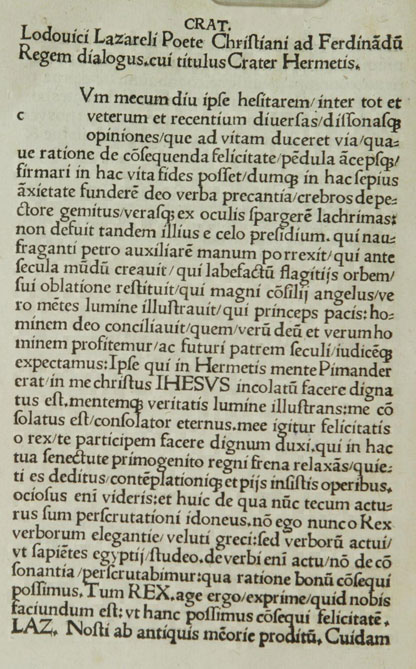
While I myself had long been hesitating, amid so many diverse and discordant opinions both of the ancients and of the moderns, as to what way might lead to life, and by what method a wavering and perplexed faith concerning the attainment of happiness might be strengthened in this life; and while, in this anxiety, I often poured forth to God words of prayer, frequent groans from my breast, and true tears from my eyes, at last the aid of Him from heaven was not lacking.
He who stretched forth a helping hand to Peter when he was sinking; who before the ages created the world; who restored by the offering of Himself the world ruined by wicked deeds; who, the Angel of Great Counsel, illuminated minds with the true light; who, the Prince of Peace, reconciled man to God; whom we profess to be true God and true man, and whom we await as the Father of the age to come and as Judge.
He Himself, who in the mind of Hermes was Pimander, Christ Jesus, deigned to make His dwelling in me; and, illuminating my mind with the light of truth, He, the eternal Comforter, comforted me.
Therefore, O King, I thought it fitting to make you a participant in my happiness, you who, in this your old age, have handed over the reins of the kingdom to your firstborn, are devoted to repose and contemplation, and apply yourself to pious works. For you seem to be at leisure, and well suited to this investigation concerning which I am now going to converse with you.
For now, O King, I devote myself not to elegance of words, as did the Greeks, but to the action of words, as did the wise men of Egypt. For we shall investigate the action of the word, not its harmonious sound, and by what method we may be able to attain the good.
Then the KING: Come then, explain what we must do so that we may be able to attain this happiness.
LAZZARELLI: You know what has been handed down to memory by the ancients. To a certain man who asked what the way to happiness was, the Delphic Apollo is said to have replied: “If you know yourself”; and upon the front of his temple was inscribed: “Know thyself.”
KING: Therefore you assert that the Delphic Apollo is to be believed.
LAZZARELLI: Not always, but when he expresses things consonant with truth. For he uttered many true things in his oracles; and if you go through Porphyry in his Philosophy of Oracles, you will discover with certainty that this is so. But, passing over the rest, I shall immediately bring forward here the oracle which he uttered concerning the blessed life. I could present it written in Greek verse, but, striving for brevity, I shall express it in Latin:
That way is exceedingly hard, and closed by narrow gates,
Which opens life to us and grants us the blessed life.
Nor indeed can it easily be related in any words,
Or explained, whither that path leads.
Before all others, those who drink the fair waters
Of the Nile first began to hand it down; from them
Next came this care to the Phoenicians and Assyrians;
But far above them the renowned Hebrew nation
Knew it and received it as something known.
Is there anything of truth in this oracle?
KING: So it seems. But tell me, I ask you: did the Egyptians taste anything of the truth?
LAZZARELLI: They not only tasted it, but were almost filled to excess with it. But, passing over the others, what shall I say concerning Hermes? Having searched through every path of wisdom, he left to posterity monuments concerning true wisdom which, although small in discourse, are nevertheless immense in their meanings.
From him, as some conjecture, wisdom migrated to the Hebrews. For they think that Moses the Hebrew, who was born among the Egyptians, transferred it from Egypt to the Hebrews through the Pentateuch; and in the Acts of the Apostles we read that he was most thoroughly instructed in all the learning of the Egyptians.
KING: You are a Hermetist, as I see, Lazzarelli; for you certainly raise this man with such praises that no one could have been wiser.
LAZZARELLI: I am a Christian, O King, and I am not ashamed at the same time to be a Hermetist. For if you consider his teachings, you will affirm that they do not differ from Christian doctrine.
This is that man, O excellent King, whom the ancient poets said was born of Maia, interpreter of the gods, god of eloquence, inventor of the lyre, and accomplished in many offices. From him all ancient theology drew its origin.
For, to say nothing of the many books of his which have perished, what more divine thing can be found than those little books which we have in our hands? In them he expressed himself concerning the Trinity of God so perfectly that whoever understands him may rejoice that he has found the truth.
Therefore I wish this discourse of ours to be called The Crater of Hermes. For whatever we shall investigate here concerning true happiness, we shall draw both from the doctrine of the Gospel and from the precepts of Hermes.
KING: Continue, then, for I burn with desire to understand that which you have already promised to set forth. For since I too am a Christian, I hope at the same time to become, together with you, a Hermetist.
LAZZARELLI: Only ask, O King, what you desire first to hear now.
KING: We must hasten to the matter itself, putting aside superfluous things. Tell me, therefore, by what method I am able to know myself.
LAZZARELLI: To Hermes when he asked this, Pimander replied: “Embrace me with your mind, and I shall instruct you in all the things that you desire.”
Truth itself also said: “Without me you can do nothing.”
And it is also said by the Prophet: “In your light we shall see light.”
Therefore, in order that He may illuminate us, we shall first pray to God, at the beginning of all things. This indeed was long ago commanded by the ancients; but that it ought especially to be done in theology was commanded by Dionysius the Areopagite, in the first book which he published On the Divine Names.
Since, therefore, we must here discourse upon the mysteries of theology, we shall begin by praying. But you, be present and favor our minds, while I invoke God thus:
You who sit above the Cherubim,
You who dwell upon the highest throne,
And You who dwell in the heavens
Judge all things rightly;
To You I now direct my prayers,
With word and submissive heart.
Unconquered God of Hosts,
Father of divine beings and men,
Incline Your gracious ears hither;
Do not, I beg, remove far away
The rays of Your splendor.
You are King, You are the God of Israel;
Descend, and fill this Your house
With radiant light.
Make it a worthy dwelling-place;
Purge away the darkness; drive
The Tartarean corruption from me.
Cleanse this image completely.
As vapor is drawn up by the Sun,
As the magnet draws steel,
So may I be carried away by Your flames.
Join Yourself to me, Father;
Soon may I be wholly drawn to You,
And at once be made one.
As the Moon shines
With the gleaming rays drawn from the Sun,
So may I glow with Your countenance.
Take away the Tree of Good and Evil;
Recall my wandering feet.
May I be nourished from the Tree of Life,
So that with You I may enjoy
Inviolable and eternal Good,
And may I never be removed from the right path;
Nay, may I wholly enjoy You.
You who alone are good, the Good
Apart from which nothing is good,
Grant that by Your light
I may behold Your light,
And may bring it back to Your own.
My impiety terrifies me,
But Your mercy is greater.
It cries: “Do not fear; come!
I am here, justifying the wicked,
Having compassion upon the human race,
Taking away the burdens of sin.”
The only salvation is to know God;
This alone is justification,
And the only step toward the heavens.
“Behold, you are My son,
In whom I am well pleased;
Dare, and judge all things.
Behold, I give you My words,
Which make new suns
And renew the vast sea.
Let the clouds obey you;
Let the fishes and birds together
Tremble at your voice.
Establish the starry houses;
Construct the pillars of the earth.
Let Zion proclaim you Lord,
And the mountains Sinai and Tabor,
And the swift waters of the Jordan;
Let us bear witness that you are begotten of God.
Behold, soon My Kingdom comes;
With Christ as leader, rule;
He who sanctifies the remaining saints.”
Alas, should your lot dishearten you,
Let steadfast faith suffice,
Which wisdom binds together.
I shall rejoice in my Lord,
Who has established His servant
As king upon the throne of David.
The prayer has now been made. You, therefore, most excellent King, repeat what you now desire to have explained by me.
KING: This prayer of yours, so filled with sacred sayings, has so drawn away my mind that I first desire to understand many things spoken by you in it.
LAZZARELLI: When we have reached the end of the discourse which we have begun, you will clearly understand both these things and many others besides. But now let us continue with what we have undertaken. And in order that you may be recalled to it, I shall repeat what was touched upon above.
But lest I seem to have taken my beginning from the oracle of Apollo rather than from the doctrine of Hermes, understand it thus.
When all things had been created in the beginning, Hermes asserts that God exclaimed in this manner:
“Sprout forth, grow, propagate, all my seeds and works.
You, moreover, to whom a portion of Mind has been granted,
recognize your own race,
and consider your immortal nature;
know that the love of the body is the cause of death.”
This corresponds to the teaching of Moses in the Book of Genesis. For in these words of Hermes are contained both the Tree of Life, in which we live, and the Tree of the Knowledge of Good and Evil, which brings destruction upon us; and its principal command-as is readily apparent-is that we should know ourselves.
KING: I have now been brought back to the question which I had asked. First of all, I desire to be taught by you, if it is possible, what the Tree of Life was, and what the Tree of the Knowledge of Good and Evil was.
For concerning this, either almost no explanation at all, or else an obscure one, is found among the sacred Doctors. So much so that I am astonished that that upon which the entire ruin of our race depends, and through which the whole tradition of the Sacred Scriptures was founded, should remain altogether unknown, should remain entirely undefined. I add that that commandment given in Adam, in whom by origin we were, is transmitted by descent into us, his race, so that the same danger of disobedience hangs over us. For what we do not know, we cannot avoid.
For we read in the sacred writings that that tree, like the other trees, was corporeal. But of what kind of tree it was, we do not read; nor do we read that, even after the transgression, that commandment was ever revoked.
LAZZARELLI: But I, O King, have read a statement of Philo of Alexandria, in the second book On Agriculture, contrary to that former opinion which you mentioned. It is as follows:
“Consequent upon what has been said is the cultivation of the plants of Paradise. For it is said: The Lord planted a Paradise in Eden toward the east, and there He placed the man whom He had formed. To suppose, therefore, that these were vines, olive trees, pomegranate trees, or other similar trees, is great and incurable foolishness.”
Now this Philo was a Hebrew, and a most wise man; and, as Jerome asserts in his book On Illustrious Men, he lived in the time of the Apostles and was dear through familiarity to Peter, prince of the Apostles, and to Mark the Evangelist. And all his investigation concerning the first philosophy is established upon the oracles of the Sacred Scriptures.
But since, O King, you compel me to investigate this matter, which has been left undefined by the divine utterances-for in matters concerning divine things human consideration is often deceived-we shall follow this rule in this matter and in the others: we wish whatever is asserted by us to be accepted only insofar as it is approved by the Church and the assembly of the faithful.
For if Plato, in the Laws, commanded that nothing should be altered among those things which had been received from Delphi, or Dodona, or Ammon, or certain ancient utterances asserted through visions and inspirations of the gods, how much less should those things be altered which have been handed down to us through the Prophets and the elect of the true God-indeed, through Jesus Himself, true God and true man ought we to alter them?
For Plato also warns in the Timaeus that it is impossible not to have faith in those whom he calls sons of the gods, even though their discourse is confirmed neither by necessary arguments nor by probable reasons. How much more, therefore, ought an uncorrupted and unwavering faith to be placed in the oracles of Jesus Himself, true God, and in the precepts of His Prophets and His elect.
KING: Add also, if it pleases you, that since we possess very many good things from God through the Church and its ministers, it is right that we subject all our words and works to it.
But now, Lazzarelli, proceed and carry out what you intend.
LAZZARELLI: You have very often heard-and, I believe, have read in the sacred oracles, O King-that God created all things for man, but man for Himself.
KING: We have often heard it and read it.
LAZZARELLI: Since, therefore, God created man for Himself, so that he might obey the divine will, He implanted in him a portion of the divine Intellect, so that through its reasoning he might contemplate the Divinity; and by contemplating, might draw to himself the substantial rays of divine splendor, from which he might at once acquire both Wisdom and everlasting Life.
This, by a parable suited to contemplatives, was called by Moses the Tree of Life.
KING: Therefore, Lazzarelli, you assert that the Tree of Life is the contemplation of divine things and Wisdom.
LAZZARELLI: So indeed I think-or rather, I do not doubt it.
KING: What benefit, then, besides the happiness of the soul, came to man from this contemplation?
LAZZARELLI: Not a small one, O King. For besides the happiness of the soul, which comes through Wisdom, man constituted himself a pure and worthy temple in which the Spirit of God might dwell, and he possessed the most radiant angels of God as companions.
By reason of this, he would perpetually have escaped, by a divine gift, the death which he would otherwise have incurred by nature; and whatever he desired and wished for, he would immediately attain, and other things besides these, very many other good things would come to him, which may be understood from what is asserted in the sacred books.
KING: These things were immense, O Lazzarelli, and to be desired by everyone. But since through tasting of the Tree of the Knowledge of Good and Evil we lost those things, as is related in the sacred oracles, I now desire to hear what that destructive tree was.
LAZZARELLI: Once you truly understand what the Tree of Life is, you can easily understand for yourself what the Tree of the Knowledge of Good and Evil is; for when one of two contraries has been explained, the other also becomes clear.
KING: I perceive it by a certain conjecture, but I expect to understand it more clearly from you.
LAZZARELLI: Hear, then. Just as the love, contemplation, and wisdom of divine things is the Tree of Life, so the affection for and investigation of perishable and material things may be called the Tree of the Knowledge of Good and Evil.
KING: This does not sufficiently satisfy my mind. For it is difficult for me to believe, nor can I in any way give credence to the idea that God forbade us to consider the things which He Himself created. For there is no craftsman who forbids his own work to be seen, considered, and loved. And it is exceedingly difficult for me to believe that perhaps from such contemplation man incurred death.
LAZZARELLI: God the Craftsman did not forbid, O King, His works to be contemplated; rather, He forbade us to remain fixed upon them and to desire them as the supreme end.
Thus also the ancients said that the heavens, the Sun, the Moon, the stars, the elements, and even certain animals were gods.
But the Almighty wills and commands that all these things should be considered through reasoning in such a way that, as though by certain steps, our mind may at last be reflected back toward Him, and that in the end the human mind may always find rest in the contemplation of Divinity.
For, as the Apostle says:
“The invisible things of God, from the creation of the world, are clearly perceived through the things that have been made, being understood; His eternal power also and divinity.”
And Hermes says:
“Finally, when you wish to behold God, look upward behold the Sun, my son; observe the courses of the Moon; look up at the order of the remaining stars.”
Dionysius holds the same opinion in the book On the Divine Names, when he says:
“Perhaps we shall say this truly: that we know God not from His own nature-for that indeed is unknown and surpasses all reason and sense-but from the most orderly disposition of all creatures, produced by Him and displaying certain images and likenesses of His divine exemplars; and by a path and an order, according to our powers, we ascend toward that which transcends all things.”
In this manner, therefore, the supreme Craftsman wished those things which were made by Him to be contemplated by us, and thus the fitting order will be preserved. For, as we mentioned at the beginning, the Most High created all things for man, but man for Himself.
KING: Now I understand you, and I assent to this assertion of yours. But I should like you, if you have any, to bring forward some testimonies of the wise, so that what you have asserted may adhere more firmly to my mind.
LAZZARELLI: We indeed have many testimonies wrapped in parables; but if I should proceed to recount them all, perhaps I would weary you, and while I was speaking the setting Sun would fail me. Nevertheless, we shall bring forward some.
KING: So it must be done, as the time, the place, and the pressing affairs of those awaiting us demand. For we ought, like shepherds over a flock, to fix our eyes upon our subjects, so that they may be governed as well and rightly as possible, if we wish to please God who has set us over them.
Nevertheless, I would not have you cut off those things which are necessary to know for happiness; for we shall put all other things after this matter.
LAZZARELLI: Solomon says thus in the Proverbs concerning Divine Wisdom:
“She is a Tree of Life to those who lay hold of her, and those who hold her fast are blessed.”
And Solomon calls her the woman of our youth, saying thus in the Proverbs:
“Let your fountain be blessed, and rejoice with the woman of your youth.”
For from the beginning, just as a man is joined to his wife, so man, joined to Divine Wisdom, born to everlasting life, delighted in her.
And he likewise says:
“Say to Wisdom: You are my sister, and Call prudence your friend, that she may guard you from the strange woman, and from the foreign woman who makes her words so sweet.”
And elsewhere he speaks thus:
“That you may be delivered from the foreign woman and from the strange woman, who softens her words, and has abandoned the guide of her youth and forgotten the covenant of her God. For her house is inclined toward death, and her paths toward Hell.”
And there likewise it is written that Wisdom built herself a house, hewed out seven columns, sacrificed victims, mixed wine, and set forth a table, and spoke thus:
“Come, eat my bread, and drink the wine which I have mixed for you. Leave infancy and live.”
And a little further below:
“A foolish and clamorous woman, full of enticements and knowing absolutely nothing, sits at the doors of her house, upon a seat in a high place of the city, that she may call those who pass along the way and proceed upon their journey: ‘Whoever is a little one, let him turn aside to me.’
And to the foolish she said: ‘Stolen waters are sweeter, and hidden bread is more pleasant.’
And he did not know that giants are there, and that her guests are in the depths of Hell. For he who joins himself to her shall descend into Hell; but he who withdraws from her shall be saved.”
Therefore Solomon calls Divine Wisdom the Tree of Life and the woman of our youth; but the prudence of the flesh and the contemplation of material things he calls a foolish woman, clamorous, full of enticements, knowing absolutely nothing, a strange harlot and an adulteress.
Hence the Apostle, admonishing us, cries:
“If you live according to the flesh, you shall die; but if by the Spirit you mortify the deeds of the flesh, you shall live.”
And Hermes teaches that the love of the body will be the cause of death.
For he who embraces the body through the error of love wanders in darkness, receiving the evils of death.
Therefore this Wisdom, which Solomon represents as having built a house and strengthened it with columns, is the love and contemplation of divine things, and is the woman of our youth, whom Moses declares to be the Tree of Life.
And therefore she is said to have cried out:
“Leave infancy, and live.”
But the foolish and clamorous woman, who is introduced in the parable as standing in a high place of the city and crying openly to everyone, is the meditation upon created and material things, the prudence of the flesh, the adulterous and strange harlot, concerning whom the Apostle says:
“The prudence of the flesh is foolishness before God.”
And by Moses she is called the Tree of the Knowledge of Good and Evil. And therefore it was said to Adam concerning it:
“On whatever day you eat of it, you shall surely die.”
And whoever joins himself to her shall descend into Hell.
And in the Psalms it is said:
“For behold, those who remove themselves far from You shall perish; You have destroyed all who fornicate away from You.”
KING: Quite suitably do you apply the testimonies of the Scriptures to your former proposition. Therefore I am confirmed in it and no longer reject it. But I would like to understand, if it is permitted, what the stolen waters and the hidden bread are, and why the foolish woman is said to stand at the doors of her house crying openly to everyone.
LAZZARELLI: I would very gladly explain this as far as I can; but we are wandering too far from what we began.
KING: Not at all. Proceed rather with greater confidence, for we are at leisure; and do not let the crowd of those perhaps waiting for you disturb you, for tomorrow they will receive their dispatch. And after we have digressed a little farther, we shall return more quickly to what we began. Explain, therefore, what I have asked.
LAZZARELLI: Solomon admonishes us in the Proverbs to persevere in Divine Wisdom, with these words:
“Drink water from your own cistern, and the streams of your own well.”
If, therefore, Divine Wisdom is our woman and our cistern, then, if we go to the strange woman, she will provide us with stolen waters and hidden bread.
For adulteries are called thefts.
The water of our own cistern is the understanding of Divine Wisdom; but by stolen water is prefigured the understanding of carnal prudence.
Elsewhere, however, he signifies both of these by wine.
But the wine of Divine Wisdom is that which the Messiah supplies to us, concerning which Zechariah speaks thus:
“For what is His good, and what is His beauty, except the grain of the elect and the wine bringing forth virgins?”
For through this we are made virgins, and, not defiled with women, we shall follow the Lamb wherever He goes, and we alone shall be able to sing the hymn, as John affirmed in the mysteries of the Apocalypse.
But from the wine of the other woman the Apostle forbids us in this manner:
“Do not become drunk with wine, in which there is lust.”
For just as through the wine of Wisdom we are made chaste virgins-for chaste is the generation of those who seek the Lord-so through the foreign wine we are made adulterers and fornicators.
She is therefore said to cry out at the doors of her house because the prudence of the flesh is ambitious, and although it knows absolutely nothing, it desires to appear learned and to be so regarded. Therefore it cries openly and disputes through the streets, fortified with the winding arguments of sophisms.
But he who speaks sophistically is hateful and shall be defrauded in every matter. Grace has not been given to him by the Lord, for he has been deprived of all Wisdom, as is read in Ecclesiasticus.
But, I beg you, O King, let us not wander any farther; rather let us return to what we began. For I burn, most excellent King, to reveal to you at the end of our discourse the greatest of secrets, which is the ultimate fruit of the Tree of Life, and so perfect that in this life there is nothing further that man could desire.
KING: That is indeed a very great thing, and one which I greatly desire to hear. But since only a little remains in this inquiry, let us not leave it incomplete. Rather, explain who those giants are who are with the harlot, and what those women are with whom the virgins are not defiled.
LAZZARELLI: Those who follow Divine Wisdom are called pygmies, that is, little ones.
Jerome interpreted this in this manner: “pygmies in the knowledge of the Lord,” or “those who know the Lord,” concerning whom the Savior speaks:
“Suffer the little children to come unto Me, for of such is the Kingdom of Heaven.”
And in the Psalms it is said:
“The declaration of Your words gives light, and gives understanding to the little ones.”
but in the contrary sense, the Giants are those who apply themselves to material things.
Therefore it is said in the Proverbs:
“A man who has wandered from the way of doctrine shall dwell in the assembly of the Giants.”
These are those who built the towers of Babel; these are those who, piling mountains upon mountains, are said by the poets to have aspired to the heavenly kingdom, and who at last, crushed beneath the mountains, perished.
Concerning them it is said in Ecclesiasticus:
“The ancient Giants did not obtain pardon for their sins, who were destroyed because they trusted in their own strength.”
And Isaiah says:
“O Lord our God, other lords besides You have possessed us; only in You let us remember Your name. Let the dead not live; let the Giants not rise again. Therefore You have visited and destroyed them, and have utterly destroyed all memory of them.”
Therefore they are represented as serpent-footed, because, cleaving to sensible and material things, they crawl only through the lowest things and are unable to fly upward to divine things, believing only so much to be true as is approved by the persuasions of the senses.
KING: I now assent indeed. Not only do I truly understand what the Giants are and why they are serpent-footed, but a way has also been opened to me whereby I may understand that fiction of the poet Hesiod concerning the woman Pandora, who, sent as a gift by Jupiter, opened the jar, from which all good things flew away, while Elpis, that is, Hope, alone remained upon the lips of the jar.
For what else is Pandora, whose name signifies “the gift of all,” than the knowledge of material and sensible things? Opening the jar of our mind and dwelling within it, she caused all good things to fly away, while only Elpis, that is, Hope, remained.
For continually we hope that good things will come to us, yet never do we attain the things hoped for; for through her we are estranged from the Tree of Life.
LAZZARELLI: You interpret rightly, O King, although in my Fasti I once seemed to sing the contrary in this manner:
Not from the jar of Epimetheus, when its covering was removed,
but Eve, credulous toward the serpent, gave the evil.
For there I did not assert that by way of explanation, but at that time I wished to allude to the fiction of Hesiod.
KING: I truly cannot sufficiently wonder how the fictions of the poets correspond to theological truth.
LAZZARELLI: Cease wondering, O King. For Hermes also, the prince of ancient theology, wished theological truth to be wrapped in such fictions.
And as to why fables are now everywhere asserted concerning him, Hermes himself, foreseeing what was to come, complains prophetically in this manner:
“O Egypt, Egypt, of your religions only fables will survive, and these will seem incredible to your descendants; only words engraved upon stones will remain, recounting your pious deeds.”
The sacred theologians of the Christian religion also-those whom they call Prophets-made use of poetic fictions in this same manner.
You will discover that this is so if at some time you read through the oracles of the Prophets. Concerning these, Dionysius, near the beginning of the Celestial Hierarchy, speaks in this manner:
We must beware lest, being ourselves led astray by the error of the common people, we should everywhere suppose that the celestial spirits, endowed with a divine form, actually possess many feet and many faces;
or that they are formed according to the stupidity of oxen or the ferocity of lions;
or fashioned in the likeness of eagles with curved beaks;
or represented with the hairy plumage of birds;
or that we should foolishly begin to imagine above the heavens certain fiery wheels and material seats necessary for the repose of the Supreme Divinity;
or variously colored horses, armed attendants and commanders, and other things of this kind, which are most sacredly handed down to us under an evident and expressive variety of signs.
For theology makes abundant use of poetic fictions in order to describe those spirits, being well aware-as we have said-of the weakness of the human mind.
And, most benevolently providing for it a way proper and familiar to it, by which it may be carried upward toward higher things, theology lays down in the Sacred Scriptures, according to the capacity of the human mind, paths of ascent of this kind.
Thus far Dionysius, and Rabbi Moses the Egyptian, in the book whose name is Malachim, seems to signify the same thing when he says:
“The reward than which none is more sublime, and the good after which there is no other good,”
which indeed all the Prophets desired, Sacred Scripture calls by many names: namely, the Mind of God, the Tabernacle of God, His Holy Place, the Holy Mountain, the Court of God, the Temple of God, the House of God, the Gate of God. The Doctors, however, call it the Banquet, and also the Age to Come.
According to this, Pythagoras himself, Empedocles, Parmenides, and Heraclitus spoke in fables concerning the gods.
But when our soul-as the same Dionysius asserts-is moved through spiritual activities toward intelligible things, the senses together with sensible things are then superfluous.
I think you have also read somewhere whence they say poetry took its origin: namely, that the ancient wise men, just as they wished temples of the gods to be built more august than human dwellings, so likewise they judged that the discourse in which hymns and praises of the gods were sung should be more elevated than ordinary speech.
And thus they say that poetry was invented, in which truth indeed lies hidden, although it is covered over with the colors of fables.
KING: We have both often heard this and read it among the ancients. And so sweet, pleasant, and clear is this discourse of ours today that-although the Sun is standing upon those friendly brothers, and the day has grown sufficiently long in the last temperate part of spring-nevertheless even the shortness of winter would seem too narrow to me.
But come now: since you have explained who the Giants are, tell me also in what manner those women whom we mentioned are to be understood.
LAZZARELLI: The women with whom those who follow the Lamb are not defiled are the flattering persuasions of the senses and their various affections.
These Moses, in the Book of Genesis, calls the daughters of men, unto whom the sons of God, or Angels, went in.
These daughters the human soul finds when, departing from the Monad itself, it is scattered into innumerable parts.
As Philo asserts, it gives birth with great pain; for it brings forth false forms and false colors, and through the eyes she gives birth to desires, and through the ears to the blandishments of voices.
Thus, surrounded and oppressed by a multitude of daughters, the soul is overwhelmed; and then the sons of God, or Angels, go in unto them.
For so long as the pure rays of Wisdom shine brightly into the soul, through which we behold God and His powers, no lying messenger enters into thought; rather, all those wandering outside are kept away at the places of purification.
But when, through departure from that One, the light of the mind is dulled and rendered weaker, those who hasten toward the place of darkness come together with effeminate and broken passions, which Moses called the daughters of men.
These, however, generate for themselves and not for God; but we are commanded to generate for God and not for ourselves. Thus Abraham begot his son Isaac for God, not for himself, being prepared to offer him to God as a burnt offering.
But Adam, abandoning the Tree of Life, that is, the contemplation of the Monad, and descending to the Tree of the Knowledge of Good and Evil, that is, to the pursuit of sensible things, begot many daughters. And thus, having fallen from justice and dignity, he incurred the destruction of death.
Hence Moses declares that God spoke concerning him in this manner:
“Behold, Adam has become as one of us, knowing good and evil.”
And in the Psalms it is said:
“Man, when he was in honor, did not understand; he was compared to senseless beasts and became like them.”
And Hermes, in the Pimander, says:
“But when man had contemplated in his Father the generation of all things, he himself also wished to create; whence he fell from the contemplation of the Father into the sphere of generation.”
And the same Hermes says a little afterward:
“Man stood above the Harmony; but having fallen into the Harmony, he became its servant.”
KING: Beyond what can be believed, this interpretation of yours is pleasing to me. For although many pious and excellent interpretations are given, this one, as it seems to me, is the soul of the Scriptures; and there has arisen in me a great desire to question you concerning many things. But refrain, lest we wander too far from what we began.
LAZZARELLI: We must refrain, O pious King, if we desire to reach the end of our first intention. For, like the Lernaean Hydra, in this present discourse, when one head has been cut off, several others spring up and grow in its place. For here too there is room for questioning: what is Adam, what is Eve, what is the serpent, and what are many other things of this kind? But, passing over all these, let us return, if you please, to the point from which we digressed.
KING: So indeed it must be done, provided only that you first explain this one thing: namely, in what manner death came upon man after tasting of the Tree of the Knowledge of Good and Evil.
LAZZARELLI: As far as it can be explained, hear it, O King.
When man was a luminous temple, in which the Lord Himself dwelt, by whose presence-through grace indeed, not by nature, for he was composed of discordant elements-he obtained immortality, the Divine Splendor dwelling within him imposed peace upon the elements.
But when, through transgression, that Light, being offended, withdrew, darkness entered into the place of Light, and thus the luminous temple of virtues became a dwelling-place of darkness.
From this, not only were the reins loosened to the discord of the elements, but that discord was also driven toward destruction by unclean powers.
Then came innumerable diseases; then old age arose.
Hence it is related by Moses that, shortly after the transgression, men lived for a very long time.
But when, with the passing of time, transgression was heaped upon transgression, darkness driving them onward, life was indeed shortened.
Concerning this, Moses asserts that God said:
“My Spirit shall not remain with man forever, because he is flesh; and his days shall be one hundred and twenty years.”
But now, O King-alas for miserable mortals!-the life of man has been so greatly shortened that scarcely anyone reaches his hundredth year.
Indeed, Even us-alas, miserable as we are-the companions of darkness inhabit throughout our whole life; nor could the remedy of circumcision free us.
Baptism indeed, with the priest breathing upon us and saying,
“Come out of him, unclean spirit, and give place to the Holy Spirit,”
delivers us from the unclean powers; nevertheless, through the act of sin they enter again, and almost violently drag, seize, and compel us toward every kind of wickedness.
Foreseeing this, Hermes cries out prophetically in this manner:
“There shall come a lamentable departure of the gods from men. Only the harmful angels will remain, who, mingling with humanity and laying hands upon the wretched, will compel them to every audacious evil-to wars, robberies, and all things that are contrary to the nature of souls.”
KING: Will man perhaps at some time return to his first happiness?
LAZZARELLI: When Christ Jesus was speaking of everlasting life, and many unbelievers were scandalized and went away backward, Truth itself, speaking through itself, said:
“Does this scandalize you, if the Son of Man is to return where He had been before?”
And Rabbi Joseph, in the Sepher Zohar, that is, the Book of Splendor, asserts thus:
“Destruction would have been wholly absent from us if Adam had not sinned. But because he listened to the serpent, he brought upon himself, his children, grandchildren, and descendants the death of both natures. Because of this fault, generation remained imperfect, and it does not have its consummation until the coming of King Messiah. Then the stain of so great a disobedience and intemperance will vanish, and men will return to the first nature toward which the Divine Mind had intended them.”
Therefore man, as I think, will return to the original good things. But meanwhile we, exceedingly unhappy, bear both the crime of the first man and the burdens of our own crimes.
KING: Human misery is therefore greatly to be lamented, because that which in us had been original through the deed of Adam, and as it were formless, has through our own operations been made actual.
KING: For every day we all feed upon the forbidden tree. There is no one who looks toward God, no one who seeks Him, no one-as the Prophet says-not even one.
LAZZARELLI: This is greatly to be lamented, as you say, and worthy of true tears and of sorrowful complaint. Therefore, I beseech you, while I lament in this manner, attend for a little while:
With what varied pursuits do fruitless labors
Entangle men, when God has been forsaken!
They are forgetful of their own beauty,
Which formerly they possessed by the gift of the Father.
The divine image, raised within them toward heaven,
Bent downward, they defile beneath Tartarean shadow.
They regard the slanting shadow as their parent,
Nor do they remember the nurturing Light
Which truly begot them and was their nurse.
They have fallen from the dignity of Mind.
Now not even one practices what is good;
No one is devout in mind, no one seeks God.
No one honors his lawful Parent.
But all have given themselves
To the vain images and vanity of the flesh.
And all, bound within the Babylonian city,
Have abandoned the City of Holiness.
And when they have drunk the wine of the harlot,
They refuse to give their embrace to the Virgin.
The Virgin Zion cries aloud, seeking her own,
Mourning like a widow, and forsaken:
“Why, enticed by the flattering mouth
Of the vain harlot, abandoning better things,
Have you subjected your necks beneath the foot of Death?
Alas, recognize the deadly poison
Which lies hidden beneath this honey-sweet comb.
That shameless woman offers you pure wine.
Making you thieves and adulterers,
She drives you toward hidden snares,
And lies in wait for you even unto cruel death.
Her companions are the savage Giants,
Who heap up death, build Babel,
And devise wars against the stars.
But at last they are struck down by the three-forked fire,
And together are plunged into the deep abyss.
Behold, the beginning is sweet; the end is bitter.
Now recall yourselves to me,
Of whom I am the mother and companion of the marriage-bed,
I who nourished you at the breast with milk.
Behold, I mingle the wines of purity,
Which make pious, virginal disciples
And holy ministers of God,
To be placed upon the throne
Of the Kingdom which is hastening.
Let these be our final teachings;
I pray you, hold them firmly in your mind.
Obtaining light in the Light of Christ,
Keep your light away from the foul light.
But though she cry again and again and again,
And, like a mother, offer her loving breasts
Full to you, each one remains with a deaf ear
And does not draw his steps backward.
Like a pig he lies wallowing in the mire,
And quenches his thirst from the filthy marsh,
Refusing to drink the clear waters.
But now, most excellent King, we have reached the end of this lament. If you remember, recall now what you asked me at the beginning of our discourse.
KING: I remember, and it remains firmly fixed in my mind. For it was said that knowledge of oneself opens the way to happiness. But I now perceive that I understand, how we may be able to know ourselves.
LAZZARELLI: Attend, then. For just as we cannot recognize that which is seen in a mirror or in a shadowy image unless we first know from what it proceeds and what it represents, so likewise, unless we know God, we can in no way know ourselves.
For these things are joined to one another in such a way that, if one is unknown, the other also is unknown. For we are the image of God, as has been handed down in the sacred oracles.
And although many contend that “to be made according to the image” and “to be the image” are different, nevertheless I judge them to signify the same thing.
KING: Bring forward some testimony for this, if you have any.
LAZZARELLI: You command me to wander too far from what we began. When we have scarcely returned to the road, you command us to wander away again.
Yet it is fitting for you to assent even to my bare discourse, if you wish to understand the mystery which I am about to bring forth. For a long time I have considered these things within myself; what I had thoroughly considered, I arranged; and what I had arranged, I finally stored up in the treasury of my mind.
As is commonly said, the learner ought to be trusting.
KING: I certainly believe you. But the more I hear your discourse strengthened by the testimonies of the ancients, the more abundantly my mind is nourished. When you have finished this one point, we shall immediately turn our steps back to the road.
LAZZARELLI: Philo, in the second book On Agriculture, explaining that saying of Moses,
“Let us make man according to our image and likeness,”
speaks thus:
“But the great Moses compared the human species to no created thing; rather, he said that it itself is the image of the divine and invisible God.”
And Paul, writing to the Corinthians, says:
“A man indeed ought not to cover his head, because he is the image and glory of God.”
Since, therefore, Moses and Paul spoke through the Holy Spirit, and the Holy Spirit cannot disagree with Himself, and since Moses said “according to the image,” while Paul said that man is the image of God, without doubt they intended to signify the same thing.
We must also bring forward what Hermes asserts in the Pimander:
“The Father of all things, The Intellect, existing as Life and Light, begot man similar to Himself, and rejoiced over him as over a son.”
And elsewhere, speaking of God, he says thus:
“Whose name is every name; whose nature is every nature.”
If, therefore, all nature is the image of God, much more is man, for whose sake all things were made.
KING: I now think it right to pass over things which are very well known and rather to return to that concerning which our questioning proceeded. For it seems difficult, and beyond the powers of the human mind, that God can be known, since Truth itself says:
“No one knows the Son except the Father, and no one knows the Father except the Son, and he to whom the Son shall wish to reveal Him.”
LAZZARELLI: This discourse of yours, O King, is a certain response to what was said above: namely, that unless we know God, we cannot know ourselves.
But you, on the contrary, strengthened by sacred authority, assert that God cannot be known.
I, however, now sit not as a poet upon the tripod of the Muse, so that, bereft of mind, I might freely pour forth whatever flows into me; but, as becomes a Christian, wandering daily through the groves and shadows of Mount Zion, and through sunny Tempe, I have been so instructed by divine precepts that whatever I am about to relate here before you, I have first come to know through reason and manifest experience together.
For I am not unaware that nothing of those things which we perceive by the senses can be affirmed absolutely of God.
For whatever human understanding defines must necessarily fall beneath the infinite God.
Therefore I do not here teach that we ought to know God in such a way that we discern what He is in His separation from created things, what He is in the complete enclosure of Himself within Himself, or what He is in that utmost and solitary withdrawal into the most profound recess and darkness of His Divinity, or what His substance is.
For this is exceedingly difficult-indeed, impossible-because the human intellect cannot ascend so far.
For Plato, when he attempted, beyond the powers of the human mind, to behold the ineffable God through contemplation of the excellence of God, fell into a pernicious and deadly error, namely, asserting that God does not mingle with men.
For if this were so, unhappy human nature, abandoned under the power of darkness, would waste away.
But the whole of our Christian profession is contrary to this. For we profess God incarnate, communicated to us, and joined with us.
Therefore we ought to know God in the manner in which Dionysius, in the book On the Divine Names, instructed:
“For all divine things,” he says, “and those things which have been unfolded and made manifest to us, are known only through participations.”
But what those things are in their own principle and in their own proper seat, no sense reaches, no substance penetrates, nor any knowledge.
Finally, whether we call that hidden Supersubstantial reality God, or Life, or Substance, or Light, or Word, we understand nothing other than the participations and powers emanating from Him into us, through which we are taken up into God, and which grant to us either substance, life, or wisdom.
For there are very many divine things-as the same Dionysius asserts in the Ecclesiastical Hierarchy-which, although unknown to men, have most worthy causes known to the more excellent orders.
Likewise, many things are hidden even from those supreme substances, which are manifest to the one God alone.
For there have been established degrees and limits of human knowledge, which we are unable to pass beyond.
KING: What you relate is indeed true; but I should like you to teach me in what manner we ought to know God.
LAZZARELLI: Since God is, above every intellect, incomprehensible-as Dionysius testifies in the Mystical Theology-above every discourse ineffable, above every position and removal, above every affirmation and negation, we must firmly believe, and simply profess that God is one in Trinity and three in Unity: Father, Son, and Holy Spirit.
In this matter even the doctors of the Hebrews agree with us, as is read in Bereshit Rabbah, from Rabbi Moses Adera:
God is called the Beginning of all things, Light, Eternity, and Holy-that is, the Father.
God is One, the Profundity, Wisdom, the Fountain from which all things were made; and He who was begotten or went forth, and is called the First Principle, is called Ben, which is interpreted “Son of God”; the Root of the Heart and the Perfection of the Will, or one Will belonging to both; and He is called the Congregation of the Vision of God.
And all are of the same perfection, and are one with one another; nor do they differ from one another, but all are One.
Consider how openly, by these words, the Divine Trinity is asserted.
Nevertheless, certain of the Hebrews, either surrounded by ignorance or driven by malice, most obstinately deny the Trinity in divine matters.
But we ought to hold it most firmly if we wish to follow Truth and attain immortality. And it is necessary for us to believe all those things concerning the Divinity which have been established and defined by the holy Fathers through the canons.
If we wished now to recount them, we should prolong our discourse excessively. But what will make us fit and most suitably disposed for receiving the mystery which I am bringing forth in my mind is this: that we meditate upon the fact that God is the cause of all things and the Creator of all things, and that He created all things after Himself for the sake of the divine and principal living creature, namely man himself.
For, as Hermes says, when God formed man, delighting in His own form, He granted all His works for human use, and revealed Himself to man alone among living creatures.
Therefore the Prophet, struck with admiration, exclaims:
“Lord, what is man, that You have made Yourself known to him? Or the son of man, that You regard him?”
So greatly did God magnify man that He descended from eternity into time and, taking upon Himself the garment of flesh, God became man.
Therefore God magnified man, the work of His own hands, for he was worthy to be magnified. For that supreme Craftsman does not fail to know at what value His own workmanship ought to be esteemed.
For just as heaven, by its image and its light, accomplishes those things which the power of fire does not accomplish by its natural quality, so God, through **His image-that is, man-**accomplishes those things which the world itself cannot accomplish by its own innate power.
Thus Moses, thus Joshua, thus Elijah, thus the other Prophets and Saints of God were illustrious through the greatest powers.
KING: You speak exceedingly well. But come, I ask you, tell me: what is the soul of man?
LAZZARELLI: I shall not now answer according to the opinion of Aristotle, that it is the form of an organic body; nor according to the various opinions of the philosophers, that it is an essence, or a self-moving number, or a harmony, or an Idea, or a function of the five senses conspiring together, or a subtle spirit diffused throughout the whole body, or a vapor, or a spark of stellar essence, or a spirit concreted with the body, or a spirit inserted into atoms, or fire, or air, or water, or blood; or that it consists of some one essence, or of earth and fire together, or of earth and water, or of air and fire.
Perhaps indeed these things, according to various modes of proportion and when suitably transferred, are true.
But I, according to what I have discovered and hold as certain, shall answer you, illustrious King, according to the Hebrew Mekubalim, or Kabbalists:
the soul of man is the Light of God.
Or, according to the opinion of Philo, also in the book On Agriculture:
the soul of man was made according to the image of the Word, the Cause of causes, the First Exemplar, and was fashioned from the substance of God and by His seal, whose character is the Eternal Word.
Or I shall answer you definitively in the very same words by which Pimander answered Hermes:
“That which in you sees and hears is the Word of the Lord, the Mind, however, is God the Father. For they are not separated from one another; their union is Life.”
KING: These things are indeed wonderful.
LAZZARELLI: Truly so. And you will discover that they are so when you understand this whole discourse of mine clearly and perfectly.
KING: I certainly hope so, and desire it greatly. But continue further.
LAZZARELLI: I would indeed, most excellent King. Consider within yourself: from what has been said before, you will perceive in what manner these things are joined with one another, so that from the knowledge of God you may descend to the knowledge of yourself.
For thus, discovering the excellence of your own substance, you will certainly not neglect yourself, nor cast yourself away, nor prostrate yourself in the mire; but you will rise out from the body, from yourself, and from all sensible things, and, freely, absolutely, and purely transcending them, you will fly upward to the supersubstantial and most luminous Darkness, where God dwells.
You will bring yourself into the number of the Powers, and, received among the Powers, you will enjoy God; and thereafter, propagating divine offspring, you will propagate for God, not for yourself. For it is always necessary that like should be generated from its like.
KING: Thus indeed I strive, and I shall strive diligently.
LAZZARELLI: But I, O pious King, in order that you may remain steadfast in this sacred work which you have undertaken, shall diligently admonish you-not in the manner in which priests admonish the people when ashes have been placed upon them:
“Remember, man, that you are ashes, and into ashes you shall return.”
For they admonish the outer and worldly man, and, as though he were a servant, compel him by fear toward good works.
But you, as the inner and substantial man, and as a son of God, I shall entice with a certain immense love by these words of Hermes:
“Remember, man, remember: because God the Father is Light and Life, from whom man was born. If, therefore, you understand yourself to be composed of Light and Life, you shall ascend again to Light and Life.”
KING: I am wholly transformed today by your words, O Lazzarelli. I wholly pass beyond myself; I wholly abandon myself; I feel myself being renewed, just as Glaucus at Anthedon in Euboea, after tasting the wondrous herb, perceived himself to be changed into the nature of a sea-divinity-as I used to hear in fables when I was a boy.
LAZZARELLI: This transformation of ours is excellent, O KING: when, little by little, regenerated by the Divine Light, we pass over into true men.
For the true man, says Hermes, is either superior to the inhabitants of heaven, or at least obtains an equal lot with them.
KING: Who, then, can rightly be called a true man?
LAZZARELLI: He who does not disturb the divine order, and who attains the end for which he was created-such as Abraham was.
Concerning him it is said in the book which the Hebrews call Abuda Zara, that in the fifty-second year of his age, in the city of Arana, as a true man and observer of true worship and true observance, he began to teach concerning worship, and continued teaching for eight successive years.
Dionysius, writing to Gaius the worshipper, speaks thus concerning our Lord JESUS:
“We do not discern JESUS according to human reason; for He is not merely man, since one who were merely man could not be Supersubstantial; rather, He is the true Man.”
It is necessary, therefore, O King, to attain this truth through frequent wonderings, prayers, praises, and contemplations, by continually occupying oneself with divine things concerning the Divine.
And in order that men might attain this more suitably, Hermes says that the Muses descended to mankind.
Turn hither, therefore, O King, all the powers of your Muses which you may have learned from Pontano or from some other poet, and apply hither the strength of your own genius.
Pray, wonder, praise, contemplate the Divinity.
For in this manner you will be suitably prepared for the greatest and deifying secret of the Mystery, which-provided God be present-I am about to disclose.
For, as Hermes says, heaven and all the heavenly beings also delight in these things.
KING: I shall do as you advise, so that the deifying ray of the Omnipotent may flow into us; and we pray that we may be found chastely and holily disposed.
LAZZARELLI: Be present, then, with the whole affection of your mind while I sing this hymn of contemplation. Attend, therefore, and receive both the words and their meaning with intent meditation.
KING: Proceed. We are present with you, and with all the powers of our mind intent, we await the hymn.
LAZZARELLI:
Come, my mind, contemplate
Now the greatest wonders:
Who made all things from nothing?
The Word alone of God the Father.
Blessed be
The Word of the Father.
Utter all praises
To the Word.
Who gave to heaven the shining torches
In their eternal courses,
That the changes of things might vary?
Mind alone, arising from God.
Therefore let Pimander
Be blessed,
The image of Mind.
O mind, sing of Mind.
Who made this shining Sun
An image of sacred Light,
Establishing the degrees of inquiry?
Light alone flowing from the Father.
Blessed be
The nurturing Light of the Father.
O my light,
Sing the Mother-Light.
Who ordained the Moon and the other
Stars of heaven to receive
Their borrowed radiance from the Sun?
God, who gives light to the rest.
Blessed be
The Source of Light.
Let every star
Sing hymns.
Who turns the various globes
Of heaven, commands their courses,
And from there restores them again in turn?
God alone, the Craftsman of the world.
Blessed be
The Creator of the world.
All things of heaven,
Speak forth praises.
Who indeed sets life in motion
In corporeal compounds? And who
Gave life also to incorporeal beings?
God, who is Life to all the rest.
Blessed be
The Life of the Father.
Let all living things
Bring forth rejoicing.
Who, setting man above
All living creatures, commands him
To raise his eyes toward heaven?
The Father who begot us.
Blessed be
He who begot us.
Let every race utter
A hymn of song.
Who, when voice was given to others,
Gave Mind and Word to man,
The true image of the Father?
He who is the Mind and Word of the Father.
Blessed be
Word and Mind.
These two established
The world.
Who, although He fills all things,
Raises man alone,
Absorbs him and transforms him into God?
Our Spirit-bearing God.
Blessed be
The life-giving Spirit.
Let us sing of Him
Who fills the world.
Who purifies us from corporeal corruption
By His sacred breath,
Dwelling within the human species-
God who dwells in the holy one.
Blessed be
He whose temples we are.
Sing praises,
O company of the pious.
Who, when the first man
Wandered through pathless places,
Set him upon the straight way?
The Son born of the Virgin.
Blessed be
He who was born of the Virgin.
O man, sing
Odes to the offspring of the Virgin.
Who, when men had again defiled
The sacred Image,
Offers His hand that He may raise it up?
The Holy, the Just, and Israel.
Blessed, therefore, be
The Redeemer,
Who by His death
Redeemed those who were shut in.
Who, when all things had become old
And covered over with foul decay,
Restored the whole anew?
The sole omnipotent Mind of God.
Blessed be
The Mind of the Father.
Let all ages utter
Resounding hymns.
Who, behold, at last restored us,
Fallen, to the illustrious throne,
Subjecting all things to the Son?
The Counsel of the Most High Father.
Therefore arise,
O my mind,
Made sluggish by the flesh;
Break your chains.
What will you give to your rightful Father?
What, O my mind, to the Son?
What will you give to the Holy Spirit?
Sweet-sounding measures of praise.
Blessed be
He who moves all things,
Yet Himself is all things:
Three and One.
Thus far we have contemplated; but now, what remains I have been inflamed with an immense love toward God by this hymn of yours, which has exalted man with such great praises. And I am not only inflamed with love, but am also almost placed outside myself through astonishment, just as is accustomed to happen to those who chance to encounter the torpedo-fish.
For such has your hymn appeared: one which has proceeded not, as they say, by the inspiration of the Muses, but by the divine power of the Word of God. What wonder, then, if it inflames the mind, if it calls it forth, if it carries it outside itself?
LAZZARELLI: Care must therefore be taken henceforth that such love may persevere, take root, and increase day by day. For this very love, turning inferior things toward superior things, unites and connects them mutually.
But contemplation first arouses love; love afterward turns the human mind toward God.
And when it has thus been turned, it is formed by God in such a way that, resuming the vigor innate within itself-which it had lost through affection for material things-and acting with its entire power, it performs things more wonderful and greater than the very nature of heaven itself.
KING: We must therefore persist in Divine Love, as you advise. But tell me, I ask you: what works can the human mind, thus formed, perform?
LAZZARELLI: You ask prudently, most excellent King; for what a man does not know, he will never perform rightly.
Therefore now be present with the whole attention of your mind, so that you who, remaining in the body, have been established as King by God, may also, flying forth from the body through separation and surrounded by spiritual light, persevere as king in perpetual dominion.
We are now in the vestibule of the Darkness in which God dwells.
Attend, therefore, so that, being unencumbered, you may be able to enter into the most luminous Darkness of God.
KING: I am indeed attentive, desiring nothing greater than that you might perhaps lead me into it.
LAZZARELLI: We must, O King, before all other things, first understand that God is fecund, since He is the Author and Begetter of all things.
Therefore Hermes calls Him most completely filled with the fecundity of both sexes.
Orpheus, moreover, sings that He is both male and female. And that you may believe more firmly that this is so, hear Him Himself speaking thus through Isaiah:
“Shall I, who cause others to give birth, not Myself give birth? Shall I, who grant generation to others, be barren?” says the Lord your God.
The divine Dionysius likewise says in On the Divine Names that, since Love pre-existed supereminently in the Good, it did not permit the Good to remain unfruitful in itself, but moved it to operation, through that excellence which generates all things.
KING: I would by no means deny that it is as you relate. But, O Lazzarelli, from this recognition of divine fecundity, what principal thing shall we finally attain?
LAZZARELLI: You shall now hear, most excellent King. Once this fecundity of God has been understood and recognized, you must next understand that, since man is the glory and image of God, he has been endowed by God with the fecundity of both sexes, as Hermes says.
KING: Everyone has learned this through manifest experience; and indeed we perceive not only man, but all the other animals as well, to be fruitful. For if it were otherwise, their kinds would not have endured throughout so many ages.
LAZZARELLI: Everyone understands that, as you say; but what we are now undertaking, almost everyone is ignorant of.
KING: What is that? Come, explain it quickly, for I am exceedingly eager to hear it, and my mind bears delay with difficulty.
LAZZARELLI: My discourse is by no means about that fecundity of the body which you mention, but about that fecundity which belongs to the Mind, and which also overflows through the body.
KING: What, then, is this fecundity of the Mind?
LAZZARELLI: Now apply your whole understanding to my discourse, lest perhaps the things which are about to be said immediately vanish away.
KING: I shall attend as far as my powers permit; but you, continue your words.
LAZZARELLI: Since the human Mind is the image of the First Mind, it has received from that Mind not only fecundity, but also immortality.
Therefore Hermes asserted that Mind and Word are of the same worth as immortality. For if anyone should use these in that which is fitting, he judged that such a person would in no way differ from the immortals; indeed, he finally affirmed that through these he would be brought into the choirs of the blessed.
For these two, O King, joined together with one another, bring forth divine offspring.
KING: I would by no means doubt this to be true, O Lazzarelli, if perhaps you mean that the sciences and good arts are the offspring of the Mind-things first conceived by the Mind, then brought forth through the Word into the external senses as though to birth, and preserved in writings for posterity.
LAZZARELLI: The sciences and good arts are indeed propagations of the Mind, but they are produced by a kind of homonymous generation. I, however, am speaking here of a univocal and, so to speak, syngeneous generation of the Mind, in which that which is begotten is of the same kind as its begetter.
For in univocal generation, like is always produced from like.
KING: What is this, I beg you? Do not keep me in suspense any longer with your discourse.
LAZZARELLI: Consider now, O KING: if the body possesses such great power that it can produce a body like itself, what could prevent the Mind from generating Mind, since Mind is more excellent than body?
KING: Perhaps, O Lazzarelli, you maintain that the mind of the one begotten is produced from the mind of the begetter.
LAZZARELLI: Our discourse is not now concerned with that matter, but with that generation of Mind which Hermes revealed to Asclepius. When it had been revealed to him, Asclepius, carried into ecstasy and an exceeding of the mind, exclaimed that he was profoundly overwhelmed by the incredible greatness of the matter, and declared that he thought that man most blessed who had attained so great a gift.
KING: There is no need, Lazzarelli, for you to stretch my mind with so great a circumlocution of words. For, like a cask filled too full and having no vent, I am almost bursting from excessive tension as I try to digest quickly what you are imparting.
LAZZARELLI: Behold, O good King, beloved of God, I perceive that I must deal with you in this manner-not as one struck by the Socratic daemon, but by the Spirit of JESUS Christ, who dwells in His worshippers.
Behold, we have been called to the highest happiness of the soul.
Behold, now the delights of Paradise are opened to us; the heavenly city is revealed; access lies open to the mountain, to the tabernacle, to the court of God.
Behold, the Kingdom of Israel-which the poets call the Golden Age-for which Christ Jesus taught His disciples to pray, is set before our eyes.
The six days of works and labors have passed; the rest of the Sabbath has dawned, and Truth and Wisdom hasten to meet us.
Behold, from the innermost sanctuary of Wisdom the treasure of immortality is dug forth for us.
Behold nectar, behold ambrosia, behold manna, behold the Victim, behold the Supper of the Lamb, toward which the birds of heaven hasten.
He shall feed us as fellow-guests and guests.
Henceforth the Tree of Life shall be to us as the fragrance of ointment; our mind shall labor no longer, nor shall it be wearied.
Therefore, driven by divine power, I bring forth a hymn concerning Divine Generation. Be present with me with all the powers of your mind; for thus you shall become a participant in the ineffable Mystery.
KING: Behold, I stand prepared in mind and ears, and I direct my whole self toward it with all my powers.
LAZZARELLI:
To what place, filled with You,
O Father, do You carry me away?
Is this that place
To which the pious old Enoch,
Who pleased You, was carried,
While following Your footsteps?
Or are these the heights
Of Mount Horeb or Sinai?
Where You showed Yourself,
Or where horned Moses hid himself,
That he might give the people
The sacred ordinances
Of the ancient Law?
Or is this the holy river
In which the Word-begotten Son of God
Dipped Himself,
That He might purify the body?
Or perhaps rather
Is this the holy Mount Tabor,
Upon which Man shone forth in such a manner
That He surpassed the light-bearing wheels of the Sun?
Behold, within, His garment
Is whiter than snow.
Behold, above Him appeared
A cloud still whiter.
From which Your voice thundered forth,
proclaiming Him Your offspring; hence, in His appointed time,
clothed-as fate ordained-in a bodily dwelling,
that He might redeem the human race.
Behold, love bursts within me-or rather, a divine frenzy,
conceived from Your countenance which irradiates me,
which gladly opens to me secrets,
only lately known, and even the heavens.
Now I undertake nothing humble or slight;
nothing mortal indeed, nor anything small, do I sing,
but something remarkable to many minds, something new,
and unsung by another lyre.
That which was forbidden to the ancients,
and which formerly it was scarcely permitted
to utter even in parables,
You now grant me leave to bring forth in naked verses,
so that men may become teachable.
For thus it is sung in the sacred oracles:
“For in the last times, O Father,
You shall be manifest to all;
then Your teachable and pious men
shall reign.”
Behold, now I begin. Let all things,
mute in silence, listen with inclined ears
to my sounds, pregnant with Divine Speech.
Behold, I touch the lyre with my fingers.
This surely is a new novelty among novelties,
and something greater than all wonders:
that man should discover the nature of God,
and, being wise, should make that very nature.
For just as God, the Lord and Begetter,
by generating produces the celestial Angels,
who are the forms of things, the heads of all things,
the exemplars and first principles,
so the true man makes divine souls,
whom the Atlantid calls gods upon earth.
They rejoice to live near to man,
and rejoice in the good of man.
These give prophetic dreams and bring aid
in the afflictions of men,
and bring evils upon the impious.
They give glorious rewards to the pious;
thus the gods fulfill
the command of the Father.
These are the disciples,
these are the servants of God,
whom the World-Maker made Apostles,
gods upon earth, whom He greatly exalted
by sense bestowed from above.
These restrain the various dangers of fate
and drive far away the destruction of diseases.
Through these the prophetic words are fulfilled.
These make the Word of God.
Therefore the Begetter has now given to man
a Mind very like Himself,
and also Word,
so that, being like the gods,
he may bring forth gods,
and fulfill the commands of the Father.
Exceedingly blessed is he
who has come to know the gifts of his own lot
and has willingly brought them to perfection.
For he is to be numbered among the gods,
nor is he inferior to the gods above.
Have you understood what has been revealed by the inspiration of God?
This indeed may rightly be called the Secret of Secrets, just as in the Sacred Oracles we read “Sabbath of Sabbaths,” “Holy of Holies,” and “Song of Songs.”
For I have been persuaded of it not only by the authority of the wise and by arguments, but certainly I have also known it through experience.
And if you do not desist, you too shall know it fittingly.
But once again I beseech you: that which has flowed from the pure fountain of Truth, keep shut within the innermost recesses of your mind, lest anyone unbelieving, inexperienced, or lest any unbelieving, inexperienced, or unlearned person should hear it.
KING: What you advise must certainly be done. For if they say that the Eleusinian goddesses were angered against Eumenius the philosopher, a seeker into hidden things, because he had divulged the Eleusinian sacred rites to the common people, much more is it right to believe that the supreme Craftsman of all things would be angered if the secrets of His mysteries were everywhere made public.
For He Himself also forbade His pearls to be cast before swine.
But what shall I say now, O Lazzarelli? I am so overwhelmed at once by love, wonder, and joy that, placed almost outside myself in an ecstasy of mind, I scarcely know where I am.
LAZZARELLI: No wonder, most fortunate King. For if the novelty of any thing, however small, alters the senses, much more and far more excellently does this very matter produce such an effect, since by its extraordinary sublimity it not only strikes the senses, but even beats back and utterly stupefies the very gaze of the mind.
KING: I should now like you to explain, O Lazzarelli, if perhaps you know, which of the wise, whether ancient or more recent, have treated concerning this matter.
LAZZARELLI: Since only very few from the beginning have attained so great a gift, so also only a few have been able to treat of it. For no one can worthily teach that which he does not know.
KING: But who are these few?
LAZZARELLI: I shall briefly enumerate those whom I know.
First of all, Hermes. Throughout all his dialogues which are now extant, he teaches concerning this matter obscurely; but in the dialogue addressed to Asclepius, which is entitled On the Divine Will, he relates it much more openly.
The teachers of the Hebrews likewise assert that Enoch, in a certain book of his, made mention of the Superior and the Inferior King, and that for him who united the two, joy from above was prepared every day. In my judgment, this is nothing other than the mystery of this secret.
Abraham also, in the book called Zepher Izira, that is, The Book of Formation, teaches that new men are formed in this manner: namely, that one must go into a desert mountain where beasts of burden do not graze, and from the midst of which Adamah, that is, red and virgin earth, must be dug out; afterward from it man is to be formed, and throughout his members the elements of the letters are to be properly arranged.
This, in my judgment, is to be understood in the following manner.
The desert mountains are the divine sages. They are called deserted because they are despised by the common people, according to that saying of Wisdom:
“We fools esteemed their life to be madness.”
And Hermes says that he who dedicates himself to this Wisdom neither pleases the common people, nor do the common people please him. At last he is thought to be mad and is received with laughter; sometimes such men are even held in hatred, afflicted with insults, and deprived of life.
Likewise in Plato’s Phaedrus we have this:
“Separated from human pursuits and adhering to the Divine, he is reproached by the multitude as though he were beside himself; but that he is filled with God escapes the multitude.”
The beasts of burden, however, according to the interpretation of Philo, are the bodily senses, which he enumerates as seven.
These beasts do not graze upon the mountains, because the divine sages are not enticed by the persuasions of the senses.
But Adamah, that is, the red and virgin earth, is the very mind of the wise, which has been made virginal through the wine of the Messiah, which brings forth virgins.
From this earth, therefore, the new man is formed, and is given life through the mystical arrangement of the letters throughout his members.
For Divine Generation is most sacredly consummated through the mystical formation of words, which are composed from the elements of letters.
For this reason these mountains must be approached for Divine Formation, because only the minds of the wise are capable of Divine Generation.
In this manner, therefore, Abraham, in my judgment, preserved so great a Mystery enigmatically for posterity.
But long before all others, our Lord JESUS Christ, the true Messiah, both commanded it in words and fulfilled it in deed, just as Asaph had prophesied concerning Him, saying:
“I shall open my mouth in parables; I shall speak propositions from the beginning.”
And, as it is written in the book Bereshit Rabbah by Rabbi Moses Ader, when a certain dispute concerning sacred matters had arisen among the Talmudists, and Rabbi Amiona, on the authority of Enoch, had recalled this secret, Rabbi Symeon is said to have wept most bitterly and finally to have said:
“This is the Divine Will, which does not wish this to be revealed to any generation until the King Messiah shall come, who will give liberty to reveal these secrets.”
Before all others, therefore, as we have said, Christ JESUS revealed this mystery.
But the time is near when, at a certain fullness of time, He will manifest it more openly, and that which He Himself said will be fulfilled:
“I have other sheep which are not of this fold; them also I must bring, and then there shall be one fold and one shepherd.”
Throughout all the sacred books of both the Old and New Testaments, something concerning this may be extracted, though indeed only with very great difficulty.
But apart from those whom I have mentioned, O most excellent King, I do not remember ever having read anyone who related this matter either openly or under a veil.
KING: If nothing in this is contrary to the Divine Will, I should like you to reveal in what order, and by what operation, so great a work is accomplished.
LAZZARELLI: This also, with the help of God, I desire to accomplish, so that the whole Divine Work may have its consummation.
For this matter is divine, august, and royal, and is fitting for you, a heroic and pious King.
For if the kings of the Persians in former times-as Plato records-were instructed in the worship of the gods, namely in the Magic of Zoroaster, how much more ought Christian kings to be instructed in the sincere, pure, and true worship which turns them away from adulterated worship!
But now, O King, the Sun is already declining toward the western Ocean, and in that which you ask many conditions must be observed. If I proceed to relate them, a discourse considerably longer than that which has already passed will grow from it, and the night will overtake us before many more things can be said.
Add to this that the mind, both from the length of the present discourse and from the magnitude and difficulty of the matter, is now so weary that it longs for rest. Let us therefore defer this to another time, and to a more secluded and solitary place, imitating the wise men of the Hebrews.
For concerning that passage in the Book of Genesis:
“And Abraham gave all that he possessed to Isaac; but to the sons of his concubines he gave gifts,”
the Kabbalists explain it in this manner: what was given to the sons of the concubines was scemoth steltoma, that is, “names of impurity,” namely the magical art.
But what was given to Isaac consisted of certain divine secrets, which-because they were revealed from mouth to mouth-they call Kabbalah.
This name has begun in our own time to become known among certain persons; nevertheless, its operation, with the exception of one person only, remains completely hidden from everyone.
But you, O blessed King, preserve in a faithful and remembering mind the things which we have said, and at the present conclusion of our discourse give thanks to God, who has called us to so great a gift.
KING: This is your part, O Lazzarelli, you who excel in grace and eloquence.
LAZZARELLI: Since you command it, I shall do so, O King. But in this act of thanksgiving I shall use not my own words, but those of JESUS Christ, so that our prayer may be more acceptable to God Himself and more sacred.
KING: Do as you please.
LAZZARELLI: I give thanks to You, Lord JESUS Christ, because:
“You have hidden these things from the prudent and the wise, and have revealed them to little ones.”
But it seems fitting to me, O King, that just as we have conducted almost this entire day’s discourse, so also we should bring our discourse to an end with some hymn of thanksgiving, especially in this matter.
For no one can ever sufficiently fulfill in words the praise that is owed to God.
I shall therefore praise Christ JESUS under the name of Pimander, which is interpreted by Hermes as both Mind and Word of Divine Power.
But you, O King, favor me with your attention, and together with me, bowed down and suppliant, adore the Author of all things, the Word Himself.
KING: We are already bowed down, our knees bent, our hands joined and stretched forth; we wait for you to begin speaking.
Pimander, radiant Light, Word of the Father,
Mind sprung wholly from eternity,
You are the Maker and Origin of all things.
Praise to You, virtue, honor, and triumph;
Glory and kingdom, beauty and power.
You, with winding fold, roll beneath Your feet;
After the manner of a serpent You press down and dissolve
The dreadful shadows, roaring with tumult.
Praise to You, virtue, honor, and triumph;
Glory and kingdom, beauty and power.
You also, as a bird warms its eggs,
Warm moist Nature with the heat of Your words;
And from thence the elements also emanate.
Praise to You, virtue, honor, and triumph;
Glory and kingdom, beauty and power.
You accomplish every work in all things;
Whatever enjoys life-whether in fire,
Air, earth, or sea-you bring forth.
Praise to You, virtue, honor, and triumph;
Glory and kingdom, beauty and power.
You command the race of men to be joined
To the Divine Light, and bind it to Yourself.
You turn the days and dissolve the darkness.
Praise to You, virtue, honor, and triumph;
Glory and kingdom, beauty and power.
When man had lost his powers,
You recall him to the stars, wholly joined
To the Son of the Virgin, and made flesh.
Praise to You, virtue, honor, and triumph;
Glory and kingdom, beauty and power.
Behold, when again he had fallen,
Among human limbs You are seen again as the ancient seers foretold.
Praise to You, virtue, honor, and triumph;
Glory and kingdom, beauty and power.
As it is read in the ancient oracles:
Great and small alike shall be wise;
The world shall have no need
Of continual admonition.
Praise to You, virtue, honor, and triumph;
Glory and kingdom, beauty and power.
But the days allotted to works pass away;
The seventh rest shall come upon the earth-
Behold, Mind is joined to man.
Praise to You, virtue, honor, and triumph;
Glory and kingdom, beauty and power.
Everyone shall utter words with a divine mouth;
The world shall resound with the praises of the heavenly ones;
The gods shall together be present frequently upon earth.
Praise to You, virtue, honor, and triumph;
Glory and kingdom, beauty and power.
All things shall rise again
Into their first form.
Behold, the Kingdom of God-
Which You now command to be invoked by prayer-
Hastens to come.
Praise to You, virtue, honor, and triumph;
Glory and kingdom, beauty and power.
Those two shall together become one fold;
Behold, one Shepherd rules it
And leads it to health-giving pastures
Where the grass is soft.
Praise to You, virtue, honor, and triumph;
Glory and kingdom, beauty and power.
Then everywhere they shall drink
The living streams.
There the wolf shall not harm,
Nor shall the lion injure;
No thorn shall tear
The white fleece.
Praise to You, virtue, honor, and triumph,
Glory and kingdom, beauty and power.
When this thanksgiving had been completed, the King, made more vigorous by the disputation and more cheerful in mind, withdrew into the inner apartments of the royal palace, praying that another day, with the rising of the Sun, might bring things similar to these.
Lazzarelli, however, having saluted the King with reverence, as was fitting, and promising his service for another day, departed, the night now being far advanced.
Colophon
Here ends the Crater of Hermes, added to the Pimander and Asclepius of Mercury Trismegistus.
At Paris, in the workshop of Henri Estienne, with Johannes Solidus of Kraków and Volgacius Pratensis acting as correctors and removing the errors from the workshop,
in the year of our Lord and Savior 1505,
on the Calends of April - 1 April.