The Key of the Hermetic Cabinet - La clef du cabinet hermetique
Study the Art with Us Buy me Coffeehttps://www.alchemy-texts.com/book/la-clef-du-cabinet-hermetique/
THE KEY OF THE HERMETIC CABINET - LA CLEF DU CABINET HERMÉTIQUE
A new English translation of the anonymous French alchemical manuscript (New York Public Library, Manuscripts and Archives Division, MssCol 36; digitized as NYPL Digital Collections 5beb86c0-6a7d-0131-25f2-58d385a7b928). Translated 23 Nov 2026 from a new letter-faithful transcription of the manuscript; no published edition or translation was consulted.
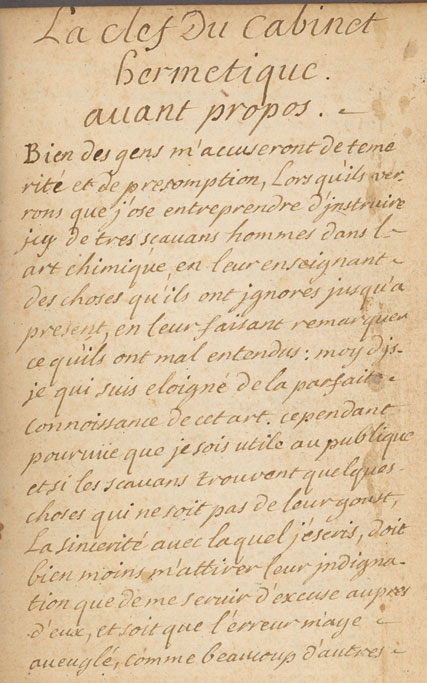
THE MANUSCRIPT
- Date and place. It was written after 1689, since it cites Limojon de Saint-Didier's Triomphe hermétique (Amsterdam 1689; same pagination in 1710) by page, and the Escalier des sages (1689). It is in a French 18th-century hand.
- Provenance.
- It was bought in Paris in 1869 by Albert H. Gallatin (flyleaf).
- An end-leaf note reads "75 feuillets / 150 pages. m.s / M.r Desaint / Medecin". The count fits this volume exactly.
- Fulcanelli quotes the Clef from a copy "made from the original belonging to M. Desaint, physician, rue Hiacinthe in Paris". He does so once in Les Demeures philosophales and three times in Le Mystère des cathédrales. His text follows two of this manuscript's corrections, but his page numbers differ.
- So this volume is most probably Desaint's "original", from which Fulcanelli's copy descends. It is itself a scribal copy, not the author's autograph: there are eye-skips and misreadings, such as "Aristotte" for the Triomphe's "Artiste".
- Contents.
- title and foreword;
- Part 1, five chapters (matter in general and in particular; the elements; the operations in general, "twelve operations" called keys);
- Part 2, "the particular operations necessary for the practice", seven chapters ending "This is the end of the first Work … end of this work";
- a table (index) of 22 pages.
- Sources. About a seventh of the text, and more than a third of pp. 80–116, is copied from the Triomphe hermétique, often without acknowledgement. The practical recipes (the earth, the seven washings, the oak vessel, the vinegar, the salt, the bain-marie, the matrass) come from elsewhere. "Chermeze" in the manuscript is Hermes (the Triomphe's "Cum viderem …" [English: “When I saw …”]).
THE KEY OF THE HERMETIC CABINET
Foreword
Many people will accuse me of rashness and presumption when they see that I dare to undertake to instruct here men very learned in the chemical art, teaching them things they have not known until now and pointing out what they have misunderstood: I, I say, who am far from a perfect knowledge of this art. However, provided that I am useful to the public, and if the learned find some things not to their taste, the sincerity with which I write ought far less to draw their indignation upon me than to serve as my excuse with them. And whether error has blinded me, as it has many others, or whether a sure labour has led me to the truth, it is always quite certain that many people will gain this advantage: in future they will withdraw from the useless expense they incur in fruitless labours, and from the loss of time, which ought to be so precious and so dear to them with regard to their salvation, and which ought to be the principal occupation of Christians. "Seek first the kingdom of God, and all things will succeed for you," says the Lord in the Gospel.
The method I have set myself for performing so excellent a work is quite different from the one the others have followed on this road, so slippery, which leads so many people to the precipice.
I have as my guarantors the great men who have written on this science, and above all the famous Hermes, although he has written little to us about it, since we have very few of his writings. But in these few words he nevertheless teaches us the whole secret of this great work, and one may say that this treatise is only an explanation, or a commentary, on his Emerald Tablet, in which all the mysteries of this admirable art are enclosed. That is why I entitle it The Key of the Hermetic Cabinet.
This treatise also teaches you a means of understanding the philosophers, who have hidden this divine art under parables and signs, and under such varied names, to conceal it from the ignorant and the unworthy.
Chapter One. Of the Matter in General
That there are few people who have understood how the stone of the philosophers is made, and that they will never understand it unless God, by a singular grace, reveals it to them, or some philosophers do. For who could imagine that what men have sought with such eagerness for so long is nevertheless enclosed in a matter that they tread underfoot and throw into the streets, that they always have before their eyes, that is found in refuse and in dunghills?
This is what ought to confound the pride of men, who despise things they ought to esteem, and who honour and respect what is nothing in its origin. The gold that shines before their eyes dazzles them; they make it their idol, and it often costs them great care and great anxiety to acquire it, even at the expense of their eternal salvation. If they knew the matter of which it is made, they would perhaps not have so high an idea of it, and would be obliged to admit that the fashion and all the splendour of this world pass away, and that it is nothing, in the judgement of the Prophet King: "all flesh is but dung."
Scripture compares glass with gold, although glass is made only of ash. "Remember, man, that thou art but ash."
The philosophers therefore had reason to hide these mysteries from the eyes of those who esteem things only by the uses they have given them. For if they knew, or if someone revealed to them openly, the matter that God has been pleased to hide in the things that seem useful to them, they would no longer esteem them.
The matter is one in its principle, since nature acts only by the same principles; it differs only in species and in form. For example, the food a man takes changes and converts into the substance of the man. The same food that serves as nourishment for man can change into the substance of an animal, a substance far nobler than the matter on which it feeds. So it is with the stone of the philosophers: although the matter is vile, it is changed by art into a perfection much nobler than the subject from which it draws its matter.
The philosophers have used two ways to arrive at so great a secret. The 1st concerns art, and nature has little part in it. In the 2nd it is nature that does the work, and art only helps her. The one is difficult and costly; this other is easy and of little cost. It is this one that I treat, and the one that almost all the Ancients followed.
Most of those who have written followed this way, among others Artephius, Zachaire, Trevisan, Flamel and several others. The 1st was unknown to them; or at least, if they knew it, they published the latter under the name of the former. This is very difficult to unravel in reading the philosophers, since they often put these two ways together to perplex their readers.
Philalethes, who is among the most recent writers, warns us not to be misled. As for these ways, though they differ in their operation, with regard to the subject the philosophers used, the matter is always one and the same.
The science of alchemy has led to the finding of still other, different ways. For the philosophers have invented other means, shorter than nature could manage, for the perfection and transmutation of metals.
The Cosmopolite points out some of them to us. He says there are some who know how to change iron into copper; that from Jupiter they make mercury; that from Saturn they have made silver. And he says that if they knew how to join to these transmutations the nature of the sun, they would make a thing more precious than gold itself.
These are trees which, though wild, can take grafts of solar and lunar trees, and in this way improvements and transmutations can be made; which trees ⟨bear⟩ fruits conforming to the solar and lunar species. That is to say: to imperfect metals, after reducing them into their first principles and purifying them, one can join the vegetative soul, by a single way known to the philosophers, and not by the one the vulgar philosophers imagine, with which they often deceive many people who do not recognise their ignorance.
Our matter is enclosed in impure bodies. These bodies must be corrupted: not with a leprous corruption that destroys everything, but with a corruption that leads to generation, from death to life, and which, by a glorious resurrection, brings forth that son of the sun who must be given to his father and made to re-enter his mother's womb; that is to say, joined to that fixed and permanent body. The living will raise the dead, and these 2 bodies, animated by one and the same spirit, will produce children like their father and their mother. That is all that can be said of the matter in general.
Chapter 2. Of the Matter in Particular
It is an unctuous moisture enclosed in all the beings of nature, a viscous and sticky matter. It hides deep in the centre of the elements and unites them so closely that it is impossible to separate them without one single means, known to the philosophers. It covers itself with the mantle of the elements, and they have no power over it, not even fire, however violent it may be, since it is fixed and unalterable by nature. That is why the philosophers say it is permanent in the fire. It is the proximate matter of their stone. This is what made Basil Valentine say these admirable words: ⟦"Seek," he says, "in the bowels of the earth: you will find there our hidden stone and the true medicine." It is the 1st matter of the metals, which are more or less perfect according as it is joined to more or less perfect matters. If it is joined to a pure matter, it forms gold; if less pure, it forms silver; if more impure still, it forms lead; and so of the others. It is the dry moisture of Geber, which does not wet the hands.
Now this matter, though very fixed in its nature, is easily volatilised by means of the elements that serve it as a vehicle. It unfolds itself and joins with them without altering its nature, in the manner of fire, which is mixed in all beings and is always fire when it is brought from potency into act; or as the sun, which spreads its influences over the whole earth and is always the sun. That is why it is susceptible to the impressions of the elements and to the influences of the stars, which it attracts and retains. It is the magnet and the steel of the sages.
It rises from the earth to heaven and descends from heaven to earth, and fills itself with the influences of heaven, and chiefly of the great luminary. It serves for the multiplication and generation of all beings. It is by ⟨its⟩ means that they receive their actions and their motion. Animals receive life through it, and so does everything animate in nature. Man himself cannot do without it: it sustains his life and his motion. It performs in nature the function of the female, receiving from heaven and the stars, and chiefly from the sun, which is the male, action and motion. It is like the sperm, the womb that receives the masculine seed. It makes the marriage between heaven and earth. It is this that encloses the hidden fire of the sages, without which the Artist cannot reach the end; and we treat of it in a chapter of its own. [margin: see pp. 29, 30 and 99, and chapter 3 also.]
From these two sperms is formed the matter of the mercury of the philosophers. That is why the great Hermes tells us these admirable words: "The sun is its father and the moon its mother; the air carries it in its belly," which is its womb and receptacle. The Cosmopolite says that it is found in the belly of the Ram, signifying by the Ram the beginning of spring, when the sun enters that celestial sign; this is the renewal of the spirit which then animates the whole of nature. It is this seed, cast into the sea of the Sages, which is our air, that gives all fruitfulness to our stone. It is this seed that they know how to extract by means unknown to the vulgar chymists, and know how to join to a pure sulphur. They call this seed quicksilver. That is why they say their stone is composed of quicksilver and a pure sulphur; they give the first the name of moon and the second that of sun. These are the 2 great luminaries that you must extract from the stone.
The commerce of heaven and earth is perfectly well described in the Cosmopolite, and by a comparison he points out to you plainly what the philosopher must do. The philosopher must be the imitator of nature, which God formed thus, having joined heaven with earth, which has its stars, namely sun and moon. And Our Master tells us that all that is above is like all that is below. Likewise the philosopher must join heaven with earth; he must draw from the Chaos, that is to say from his subject, the luminaries; separate the light from the darkness, and by the union of the spirit make of it a perfect whole, imitating in this God in the Creation of the world. It is in this last respect that our art is called a divine art.
Having drawn out these luminaries and these elements, and having stripped them of their grossness and their earthiness, they make of them a homogeneous whole and a compound they call Elixir. It contains the strength of heaven and earth, which Hermes calls the strength of strengths, which brings everything from potency into act; and all this power is reduced into a little powder. That is why one must not be astonished if it produces such great effects, both for health and for the perfecting of imperfect metals. For this divine powder has the virtue of purifying the elements of man and putting them in their natural balance, the disturbance of which is the proximate cause of destruction.
We shall treat its virtues, which are innumerable, in a chapter expressly devoted to them. It produces no lesser effects on metals: from imperfect it makes them perfect. The design of Nature was to make them perfect and to make them gold; but having been hindered in her operation, and being unable to reach her end, she made of them imperfect metals, not gold. And what Nature does in a great number of years, the philosopher does in a few hours.
Thus there is nothing more worthy of man's occupation than to work at this divine work or research, since through this science he can acquire health and riches. It ought to be preferred to all other sciences, except that of the salvation of his soul, which ought to be his principal occupation. "Seek first," says the Lord in his Gospel, "the Kingdom of Heaven, and all will be given you besides."
One may say further that this science is divine, because only God gives it. He taught it to Moses, to his sister Aaron, to the patriarchs and their descendants, and to Solomon, who had a perfect knowledge of it; and it was preserved down to the time of Ezra, who rebuilt the Temple after the Captivity of Babylon. Shem, one of the sons of Noah, had had it painted on columns that were found after the Flood; Shem had learnt it from Adam; it was by its means that they lived so long. It has been preserved and communicated cabalistically to certain Jews.
So there is none but God, and a friend to whom God has inspired it, who can communicate it to you. If you have this good fortune, keep it as a precious treasure; but above all do not communicate it to the unworthy, for you would draw upon yourself the curse of God, who would punish you with nothing less than a sudden death, ⟨or⟩ would put you into the hands of the powers, who would make you perish in a prison.
As for the possession of the stone of the philosophers, it is not so difficult as most people imagine. It is Nature that acts, and she always acts certainly, by certain principles, unless she meets certain obstacles in her path. But if you know how to remove these obstacles, she will infallibly arrive at her end and at the term God has prescribed for her.
It is true that, as for the particular matter, it is impossible for man to determine it. God by his power has determined all the beings of nature to make such and such a form. Thus man can create nothing, and Solomon says that there is nothing new under heaven. God imposed this law on all nature, to make and multiply each ⟨according to⟩ its kind, by his great word Fiat [English: “Let it be”]. This law is enclosed in each seed, which follows it inviolably, and each being obeys this law, as we say every day in our Pater [English: “Father”; here, the Lord’s Prayer]: Fiat voluntas tua sicut in cœlo et in terra [Thy will be done, on earth as it is in heaven].
The philosopher therefore claims to do nothing of himself, and cannot determine any being to make such a species, for that would be a kind of creation, which is reserved to the Sovereign Creator of the Universe. But he makes use of the general matter, which he brings from potency into act, and which he knows how to extract from imperfect things, separating it from the imperfect matters and from the grossness and impurities that kept it from being able to act; so as to render it, imperfect as it was, more than perfect, and of a perfection able to perfect each thing according to its kind. In vegetables, for example, it makes them grow in less time, and they bear their fruits in greater abundance. In minerals, it transmutes metals into gold stronger in colour than common gold. In man, it purifies his humours and puts them in perfect balance; it sustains and preserves that celestial fire which makes his life, his motion and his action; it communicates that incombustible oil and that radical humour to the heart, where life and motion reside. Thus it is not difficult to understand that it procures a long life.
As for the subject, I shall tell you, as the philosophers do, that it is everywhere, since nature is its subject and general matter; but they have, however, a particular one, which encloses everything necessary to accomplish this great work. For whoever wished to work indiscriminately on all the subjects of Nature, life would not be long enough to finish. Each mixed body requires different labours. Some are too remote from the matter of which they compose their stone, and from the particular matter, which is the proximate matter; and their fire, without which they can do nothing, would be still harder to find. The mixtures and the weights of nature are unknown to him; and because of the long labours and the expense he would be obliged to undertake, he would be forced to abandon the work.
As for our subject, the expense is modest, and the Triomphe hermétique says that it does not exceed the sum of ten sols to have ⟨the⟩ subject of ⟨the⟩ matter for making the Work. This subject appears in a very vile form, which makes it contemptible in the eyes of men, although it encloses a precious treasure. It is covered with some rags; but under these rags you will soon see with your own eyes the shining gold, the celestial colour of the rainbow: signs that will make known to you what it contains and what it is capable of. In the 2nd operation you will see the light come out of the darkness and out of its chaos; you will see the two luminaries, which will make the dry appear; and Saturn adorned with a black robe, the black Dragon, in a few days; you will see the spirit become body; you will see Diana; you will see the two mountains from which flows the precious stream that comes out of the stone, clearer than crystal; and finally the 1st elements, from which the philosophers form their mercuries and their quicksilver. You will see all these operations without putting your hands to them. It is this subject that the father hides from his son and the son from his father; there is none but God and a friend who can reveal it.
Chapter 3. Of the Preparation of the Elements and of their Separation in General
I shall tell you first, in general, that the preparation of our elements is not properly a separation, but rather a depuration of the spiritual principles that compose our stone, and that nature has a larger part in it than the Artist. Do the philosophers not tell you that their stone sublimes, dissolves, becomes pregnant, coagulates and fixes itself of itself? [margin: nota.] [English: “take note”] Do we not see in animals and in men that, with the foods that descend into the stomach, no separation of substance takes place, and that everything is reduced into one homogeneous substance, under a form we call chyle, except for some excrements that separate from it?
The same thing happens in our stone. We separate nothing from the substances and principles of the stone; and what appears imperfect, gross and unclean we change into a matter more subtle, more perfect and more capable of receiving the spiritual principles. This is done by means of our fire, which we know how to introduce into our matter. It is this fire, which is not drawn from the matter, as Pontanus says, that changes all that is gross, imperfect and unclean into a being and a substance more purified, more subtle and more perfect.
It is true that in this depuration some faeces separate, which are excrements accidental to the matter and form no part of its nature. So it is not called a true separation, since the principles always remain united and conjoined. The lees that separate from wine are no part of the wine, although they come from the matter that composes the wine. In the growth of metals we see no sensible separation; nature therefore subtilises itself, transforms itself into other, more perfect forms, disengaging itself by degrees, and purifies itself of itself more and more by the action of its internal fire, until it has arrived at its term of perfection.
We do the same thing in our Work. It is true, nevertheless, that we separate some substances, chiefly in the first and second work; but this separation of substances is not a true separation of principles, as the vulgar chymists imagine, who do not understand the meaning of the philosophers. For each substance they separate contains the others. The water distilled from a plant contains all the virtue of the plant; and although what remains at the bottom of the vessel is separated from the distilled water and appears in another form, it contains the same virtues and the same principles as the distilled water. When, therefore, the philosophers speak of the separation of the elements, it is not an essential separation of principles but a separation of substances, which they name by the name of element, or first substances: the most subtle, and the most disengaged from the matter, they call air and fire; and the grossest, earths and water; by analogy with the nature of the elements. This is properly what is meant by separating the subtle from the thick, as Hermes says.
It is therefore wrongly that many imagine that by the term "elements" we mean the common elements. For it would be a kind of creation if man, by mixing them, could form anything. God created all things in number, weight and measure. Thus the philosopher adds nothing to the perfection of what God has made; he neither forms nor creates anything.
In the 1st work, it is true, one separates some substances, to reunite them after its disengagement; but as regards the principles and the luminaries, they separate of themselves. It is nature that does it, without the Artist putting his hand to it, to make of them a compound, which is a mixtion, an assemblage, or rather a union of these same principles under one form. Under this form are enclosed two spiritual substances, which they call by the names of air and fire, and which are invisible, and two corporeal ones, which are water and earth, and which are visible; and this compound they call "stone".
In the second work, or second depuration, it is the Artist who makes this separation; and it is to this work that one must apply all they say of the operations, and all the terms of distillation, sublimation, coagulation and the like that they use, which mean nothing but a more perfect sublimation, more disengaged from the matter. This is done no differently from what is done in ordinary chymistry, which teaches us that to purify a matter one must draw from it the salt, the sulphur and the mercury, separate the faeces from it, and join the three principles together to make of them a liquor and a more perfect substance. We do the same thing in the second work, where they are always the same principles and the same substances.
These substances, reunited, appear in the form of a water, which they call quicksilver; and the earth they call sulphur. So they say their stone is composed of sulphur and quicksilver. Others give the water the name of moon and the earth the name of sulphur, and use several other terms, which we shall explain in a particular chapter; but one must not cling to the diversity of names.
The Cosmopolite says that the composition of this water is very hidden; the philosophers hardly speak of it, and if they do, it is only to describe its power and virtues. That is why he says further that it is rare, since it makes the whole compound of the Work. We shall speak of it more particularly in its place.
They say this water takes its origin from the air, [margin: see p. 70] in accordance with what the great Hermes says, that the air carries it in its belly; and the author of the Escalier des Sages says: "our philosophical Child takes birth in the air." That is why our water has the power to give life to the earth, that is, to put the soul back into its body, which is done at the end of the 1st work. ⟦But this is done in the 2nd, which they confuse with the first.
Other philosophers say that it must be taken at the hour of its birth, that is to say, in the place of its birth. [margin: v]
This air is the one we seek, from which we compose our water and our fire. It is not at all the air and the fire that we feel and breathe. It is into this water that we introduce this fire: we make peace between the enemies; we make water and fire friends. This is what the same author, cited at the 3rd degree, says: ⟦"It is," he says, "that our water is the key of the Work; it contains the Spirit and the soul of the stone. The earth, or the body, or the sulphur, is our ⟨brass⟩, and our ⟨brass⟩ is our gold. But not every sulphur is our ⟨brass⟩, nor is common gold our gold, although they are brothers from the same womb, coming from the same mother and the same father."
Chapter 4. Of the Elements in Particular and of their Preparation
As for the matter from which we draw our elements, I have already told you that it is found everywhere, but that the philosophers had a particular subject from which they drew them. You will find them infallibly, and most proximately, in the metals, and several philosophers have found them there and made the Work from them; but that method is more difficult, because their barriers must be opened by a means known to few people. We shall describe this work in another treatise. In the demi-minerals and in the vegetables it is almost impossible, the matter being too remote: one would always have to reduce it and join it to the metallic nature, which would be too long a labour.
Having found the subject disengaged from the matter that surrounds them and hides it from the sight of men, take them at the moment of their birth, that is to say, in the place of their birth; and if, as Virgil says, the gods are favourable to you, then, once you have discovered one, the other will soon appear to you. Seek them in the sun and in the moon, where they are alive; seek them in the air, which encloses them; and when you have found them (that is to say, by meditation, as the great Hermes says), see to it that they appear to the eyes; give them garments suited to their nature; put them into the womb. For if you put them back into impure matters you will corrupt them, and they will produce for you only useless and pernicious abortions.
They must therefore be stripped of the impure bodies that surround them; and it is to help you in this practice that we are willing to give you the means, reserving nevertheless what it is not permitted to say, and still less to write. Yet I shall speak to you more clearly than any philosopher has done, provided you have some knowledge of this Work and know its subject.
You will find the rest; and [I write] to share it with a few friends who will know themselves capable of working at this Work. That is why I explain it no more clearly; I could do it more obscurely if I were writing for the public, chiefly when it comes to entering into the practice.
I could make use of metaphors, hieroglyphs, enigmatic figures, parables, similitudes, comparisons, supposition, and other devices that I could have invented, as the philosophers my confrères have done. Under these veils they have hidden the mysteries of this great work of nature from the eyes of the unworthy, while the eyes of true philosophers perceive them very well through these veils. That is why they say one must have the eyes of a lynx to see through them, that one must draw back the curtain, that one must not stop at the letter but at the sense of the thing; not at the sound of the words but at what they signify.
So it is with the knowledge of the principles. One must not cling to their outside; one must penetrate to the inside; one must strip them of their rags and separate the bark from them, to ⟨give⟩ them royal garments: that is to say, make them white as the moon and resplendent as the sun; take from them all obscurities; make the light come out of the darkness, in order to reconcile what is most opposed; join the moist with the dry, fire with water, hot with cold; draw air from water and water from air; make earth into water, and again from water make earth; make earth into air, and from air make earth; render the fixed volatile and the volatile fixed; dissolve and coagulate. All this seems paradoxes and antitheses to those who have no knowledge of it; yet these are very true words, as you will be persuaded after reading this treatise, and I explain them in particular in this chapter.
I shall avoid all the terms under which the philosophers have hidden this admirable work, having written it to serve me as a memorial and an agenda, so that I may apply myself to it when God in his mercy has procured me the occasion, and in order to instruct the one to whom I shall leave this writing by testament. It is the only property I possess, not having had until now the means to work at it and to apply myself to it entirely; for this labour demands entire application, and lawsuits and domestic affairs have always prevented me. For as to the expense, it is very modest, and that should be no obstacle.
The application one may give to it is a natural labour of man, which does not exceed his strength. It is not contrary to salvation, because its principal aim is to relieve the poor, to deliver them from their miseries and their sickness, and to glorify God by founding religious houses and hospitals, by building temples to the honour of God, and by founding sacrifices and prayers for the relief of one's soul. It is useful to the state and to the homeland, by giving the powers the means to raise armies for the defence of the State.
It is therefore a great wrong to persecute those who apply themselves to this Art; and those who hold no office in the commonwealth, who are neither merchants nor artisans, and who have reasonable means, ought to apply themselves to it rather than lead a soft and idle life and amuse themselves with trifles and things unworthy of the application of an honest man.
Chapter 5. Of the Operations in General
There are 12 of them, which are so many keys to open the doors of our Hermetic Cabinet and of our philosophical subject. These operations are Calcination, trituration, dissolution, sublimation, inhumation, lotion, conjunction, fixation and nutrition.
Calcination, for our Work, is not a violent operation done by the violence of fire, as the vulgar chymists believe. It is properly a drying of the matter, by which we wish to strip it of its phlegmatic moisture; and this is done by a moderate fire. There is a physical calcination of nature, in which the Artist does not put his hands: the matter calcines itself, which happens in the middle and at the end of the Work. In the middle, when the black begins to appear, when the sun is eclipsed and the body of the sun puts itself under the moon (the philosophers understand me well); or in its life, when of the Coagulation and of the fixation.
Under Calcination is included rubification, which is a kind of sublimation of the white body of the moon, which by this operation, when the fire is increased by one degree, becomes red.
Trituration is an operation that almost always precedes calcination. One must grind our matter. When I speak here of "our matter" in the operations, ⟦one must always understand the body of the stone, or the subject of which the body is formed; this is said ⟨for⟩ [blank] the operations.⟧ To grind our matter is not to grind it in a mortar, that is to say, to reduce the matter into small parts; nature does it in the Work, without the hands of the Artist.
It is when the earth begins to sublime and mixes with the other elements. This is done also in the dissolution of the philosophical subject, when it is melted in the water and divides like ice melting in hot water, or rather like a piece of quicklime which, thrown into water, breaks up of itself and divides almost into atoms. This is the 3rd preparation we give to our subject.
Dissolution is the same as is ordinarily understood, namely the reduction of a body into water, except that it is done somewhat differently in our magistery and in our Work: it is not done all at once, but by repeated lotion. The whole matter is reduced into water, except for some faeces and sediments, when the said solvent is sufficiently filled with the earthy parts. It is in this operation that, as the fiery parts mix with the water, fire becomes water and joins with air, and air becomes water; and this they properly call a conversion of elements. It is a mixture of fiery, watery, airy and earthy parts, which always keep their natures of air, fire, water and earth, and which occupy larger spaces among themselves by the interposition of water and air, which make them spread out and fill a greater volume. It is this conversion that makes the commerce of heaven with earth in the great world, as in our divine Work.
The hand of the Artist is necessary in this operation; nature performs this dissolution when the earth changes into water. It is in this operation, the philosophers say, that the stone dissolves itself. It is properly this operation that is the key which opens the seven gates of our Hermetic Cabinet, for at each dissolution a gate opens; this gate, once open, gives entry into the 2nd, from the 2nd into the 3rd, and so on to the 7th gate, which gives you the 2 luminaries, which are the beginning, as we say below; and this is done by repeated dissolutions.
But this dissolution does not take place unless calcination has preceded it. This operation is the most essential of the Work; for, as Bernard says, everything depends on dissolving and coagulating everything; for the Calcination of the philosophers is properly a coagulation. This is what Philalethes says: to make the union of our natures, a homogeneous water is needed, for which the way is prepared by the Calcination that has preceded, a drying having taken place beforehand. This dissolution, he says, is properly nothing but a reduction into atoms of the water with the earth, through the sieve of nature, which is the air; and the atoms are finer and more subtle.
Sublimation is an operation by which we purify our subject more and more, disengaging the elements from their earthiness and their maternal impurities, making the earthy parts rise to the upper part of the vessel by the action of our fire aided by the fire of nature; and by this means the earth receives the virtue of the upper elements.
That is what we call sublimation, because the earth acquires a more powerful and more sublime virtue. This is also called giving wings to the earth and rendering the fixed volatile.
Philalethes describes this sublimation admirably: in the sublimation that takes place, he says, the body then communicates its fixity to the water, and the water imparts its volatility to the body. But not all the water rises; a part remains with the body at the bottom of the vessel. If you consider this operation often and attentively, you will observe that the body boils and sifts itself in the water that remains below; and that by means of this same water, which pierces and opens the rest of the body, and by this circulation, the water becoming more subtle, it at last draws out the soul of the sun gently and without violence.
Now this sublimation is quite opposed to that of the chymists, who by the violence of the fire render a matter subtle by making it rise in aludels. Our aludels and our vessels are the elements. That is why we have no need of so many vessels and so many alembics; we speak of them in a particular chapter. That is what we understand by sublimation. Distillation is often confused with the term sublimation, because the body or the earth, in subliming, distils, passing through the filter of nature, which is the air; and the air, coagulating, forms drops, and these drops resolve into water, which is what happens in our distillation. The air is the head of the alembic of nature. The receiver is the water, and the cucurbit is the earth. So you see that we have no need of so many alembics and so many vessels. We do, however, need a kind of alembic to separate the spirit from the water and to dephlegm it (this is the white spirit), and to draw the solar spirit from our body, which are our two first luminaries, and the white mercury and the citrine mercury, which we set aside; we speak of them in the practice and in the particular operations.
Inhumation is a most essential operation in the Work. It consists in giving back to the earth its moisture, in making it corporeal from spiritual: the volatile becomes fixed, and with a fixity all the more perfect the more often this operation is repeated. This is done by reiterated imbibition, moistening the earth until it has drunk up all its water. It is also by this operation that the black is whitened and the Raven's head is cut off. It is by it too that the earth is sublimed and given wings, helped by sublimation and distillation; for the operations are done one by means of another, and have a very great connexion. That is why the philosophers are right to say that all these operations follow one upon another, and yet are done by one and the same operation and in the same vessel. This operation is done chiefly at the end of the Work, and Philalethes speaks of it in these terms:
"Cook the matter, then, continually, with a fire that is proper to it, so that in your vessel you see a dew rise, and a kind of mist, which will fall back unceasingly in drops, day and night. By this circulation the mercury rises all ⟨alone, just as⟩ it is in its first nature, and the body remains below at the bottom of the vessel, likewise in its first nature, until, after a fairly long time, the body begins to retain a little water. Thus the body and the water have each come to share in the degrees of the qualities that each has separately: that is to say, the body communicates its fixity to the water, and the water imparts its volatility to the body." Then he adds: "Thus, through the mediation of the soul, the spirit is reconciled with the body; they unite, both of them, in the black colour."
Lotion is an operation by which we whiten the black body of the gold by reiterated imbibition of its water, from which it was drawn. As we whiten this black, we call it washing or lotion. That is why some philosophers have said that their work was women's work, because they whiten. It is used only when the Stone is at the black in the first and second Work; for in the third ⟨the whitening is done otherwise⟩. One must not confuse what is said by the authors who divide the Stone into only two Works.
We give a fuller explanation of it: consult the chapter where we treat of it.
Conjunction is a union of two substances that we mix together. The substances are the white mercury and the red mercury, which we join together to make the animated mercury; and the citrine mercury of the first preparation, from which we draw our two luminaries, sun and moon, which, reuniting of themselves without the hand of the Artist, appear under a white body. This is the white gold of Philalethes and the lunaria [English: lunar herb (an alchemical name here)] of the philosophers, which some of them describe when they say that the female then mounts upon the male. These two bodies, put to putrefaction, change into a black body; then occurs the philosophers' eclipse of the sun, like that of the sun of the great world, which happens by the interposition of the moon before the sun: the same thing happens in our little philosophical world. We perform this operation again when we join the moon to the body of the sun, when the Raven's head must be cut off and the black body of the gold whitened. This is the first marriage and the first conjunction of the male and the female, in the last Work of the first part. This conjunction takes place again, still more perfectly; but nature does it without the help of the Artist.
Putrefaction. By this operation we do not mean a leprous putrefaction that destroys everything, but only a putrefaction that tends to generation; it is rather a mortification of the lunar and solar substances, from which mortification we form our luminaries after due digestion by a suitable fire. The luminaries begin to come out of their chaos and their eclipse; the body of the sun begins to coagulate in black atoms on the surface of the water. This is what Philalethes means by the little ravens that come out of their nests; and one must take good care that they do not go back in, taking care to catch them deftly. It is in this sense that the philosophers say to take our luminaries at the time of their birth. "And it is then," says Philalethes, "that the fire must be well governed, and not pushed in such a way that you exhaust the water and the earth, which has sunk down, has none of it at all; and [one must] prevent the young of the ravens from going back into their nests once they have come out of them" (these are the little black atoms that appear on the surface of the water), "and also [take care] that, for want of heat, the earth be [not] suffocated and drowned by too much water."
Coagulation, Fixation and Nutrition belong particularly to the second part of the Work, which is multiplication, of which we treat in a chapter.
Part Two
Of the Particular Operations Which Are Absolutely Necessary for the Practice
Foreword.
We have said in the preceding chapters all that was necessary for the knowledge of the principles of the Stone and of the theory; now we are going to enter into the practice.
This is the dark forest of which Philalethes and Poliphilus speak, which must be penetrated, and in which so many people go astray without a good guide to show them a straight road and give them the means of getting out. This is the maze of Daedalus, the labyrinth with seven gates described by the poets, from which one cannot get out without Ariadne's thread. This is the stormy sea, where there are so many reefs, where so many people are shipwrecked, unless they have an expert pilot. In short, it is this practice that the philosophers have most hidden in their writings, and which they have mixed with so many figures, enigmas, metaphors, similitudes, suppositions, contrarieties and even [such] expressions that it is impossible to understand them without the help of a good Artist or a good master. For when they seem to speak of it most clearly, it is then that they are least sincere; and when they speak most obscurely, it is then that they tell you the truth. They have proceeded thus, as I have already told you and pointed out, in order to hide our science from the ignorant and from people incapable of possessing it, leaving it to the ordering of divine Providence to inspire it in whomever it pleases.
Some have followed another method: they have supposed nothing and figured nothing, but they have mixed up the operations in such a way that one can easily confuse one operation with another, so that what suits the one does not suit the other. They describe the beginning as what must be the end, and often the end they put at the beginning, which causes no small confusion of mind in the reading of their writings. It is Philalethes who, of all the philosophers, has most followed this manner of writing, in which he mixes the distinct operations so adroitly, and sews them together so well, that he seems to be speaking of one and the same operation, [until] one knows how to break up the weave. Yet it is this philosopher who speaks most sincerely: he is honest enough to warn the reader not to be put on a false scent. It is this philosopher who has entered further into the practice than any other, and who has written last. That is why I quote him often, and more than the others; but he has applied himself particularly to describing the mineral Stone, which he calls the difficult one, whose matter is gold and common mercury. As for this one, which is that of the Ancients and which is the easier, which is made without common mercury or common gold, and which is that of the Ancients, of it he speaks little; he nevertheless mixes some operations ⟨of⟩ the mineral [Stone] into the Stone of the moderns, which belongs with that of the Ancients.
When I speak of the philosophers, I mean the true ones. There are several who pass for philosophers who never were, and who never knew the Stone, although they have written of it to appear learned in this art. One must beware of them, for they are capable of making you leave the right road. Still more must one avoid reading certain manuscripts that they call "processes", in which they describe everything point by point. That is what you will never see in a true philosopher. But these sorts of authors risk nothing: only he who works with them, or according to their method, loses his time and his money. It is particularly to pull you out of this bad pass that I have made this treatise, so that you may distinguish the false brethren from the true, so that, finding and recognising a true Adept, he may guide you and teach you whatever may trouble you in the practice; and you must form a partnership with him.
It is, then, to help you on this thorny road, and to resolve all the difficulties that might prevent you from reaching the desired end, that I have made this writing. I shall not tell you things point by point, so that you have nothing left to discover: that is not permitted me. I must leave you something to do; it is not just that what has cost so much toil, and even expense, to arrive at this great secret of nature, you should have without some toil and some labours. I make use of no supposition nor similitude, but only of some figurative expressions. In short, I tell you the pure truth, which I hide only by a little veil, clear enough for you to see through its thickness.
To give some order, then, to a matter which the philosophers have affected to write of without order, I divide the Stone, or our work, which is also commonly called the magistery, into two parts, which the authors call the first and the second Work.
The first concerns the whole composition of the Stone and its perfection up to the fermentation.
The second comprises all the operations that must be done for the second and last perfection of the Stone. I divide it otherwise for the greater clarification of the first part.
This first part I shall divide into three different orders, following the division of Geber, that great King of the Arabs, who wrote of it most learnedly. The first I call, as he does, the medicine or Work of the first order. I say everything that belongs to this order and to this Work, so as not to confuse what belongs to the first and give it to the second and the third, or the reverse; and these I divide into as many chapters, which is of no small consequence for the understanding of the writings of the philosophers and for the practice of our divine Work.
Chapter 1
Of the Extraction of the Tinctures.
After drawing our matter from its mine, you will wash it well to remove its impurities, and after washing it you will let it fall by settling and come to rest at the bottom of the water; you will dry it and calcine it, and when it is well calcined, pulverised and ground into small particles, you will set it aside.
You must have a good large quantity of it, because it contains much matter but little spirit. For it is from this one and only matter that we draw all that is necessary for the Work, by a linear way.
A certain philosopher describes this operation perfectly well in these terms. He says that after the waters of the universal Flood had run off, the Ark came to rest on the mountain of Armenia. "Climb," he says, "onto this mountain; there you will find a muddy earth, from which will come a stream of admirable virtue"; and he adds: "If you do not understand me, you are not philosophers, and you never will be."
This philosopher is right to speak thus. For in this operation there must first be a flood of water, after which the Ark rests on the mountain, which is our matter and our subject. One must penetrate and pass through this mountain to make this stream come out of it, a water of incomparable virtue. It is from this water that our luminaries come, as you will see hereafter.
It was after the flood of water that the Ark rested on this mountain of Armenia; likewise it is after frequent and reiterated ablutions of our earth that we draw from it ⟨the⟩ axunge and all the unctuousness, which is the proximate matter of the Stone, ⟨from which⟩ we strike the stone and the Rock with the rod of Aaron to make flow from it this living water, fit for the health of spirits and bodies. And impure as it still is, its mere use cures several diseases, as ⟨has been⟩ found by experience. And if you let the water that covered this mountain flow away gently, you will see with your eyes the Ark of the Lord ⟦that is to say, the sun and the gold, in its first being, will shine visibly before your eyes⟧ and the sign of peace, that is, the rainbow, will gleam with all its colours.
But to make these lotions and ablutions, do not think that it is with the common water of fountains and rivers. The water that we use has quite other virtues. It is a water that contains all the virtues of heaven and earth; that is why it is the general dissolvent of all nature. It opens the barriers, and it is this water that opens all the doors of our Hermetic and Royal Cabinet, in which our King and our Queen are shut up. It is also their bath; they wash themselves in it.
It is the Fountain of Trevisan, where the King strips off his purple mantle to clothe himself in a black garment, which he gives to Saturn (♄). This philosopher's expression is admirable: by the birth of the Raven he describes to us this colour, so necessary in the Work and so much to be desired.
It is true that this water is difficult to obtain. That is what made the Cosmopolite say in his enigma that it was rare in the island; but he indicates to you the time for gathering it by this figure. He says that the meadows of this island were enamelled with a thousand flowers, and that in these meadows sheep and oxen were grazing, kept by two young shepherds. By this enigma he means to make us note that this water must be gathered in spring, when the sun passes through the three celestial signs ♈ ♉ ♊. The sheep signify the sign of the Ram, the oxen the sign of the Bull, and the two shepherds the sign of the Twins, which is depicted as two young children. These meadows enamelled with a thousand flowers mark the quality of this water, which contains innumerable virtues.
This author indicates it more particularly in these words: ⟦"It is not like the water that falls from the clouds, but it has all the appearance of it." In another place he describes it under the name of steel and of magnet; for it is truly a magnet, which attracts to itself all the influences of heaven, of the sun, the moon and the stars, to communicate them to the earth. He says that this steel is found in Aries, which again marks the beginning of spring, when the sun passes through the sign of ♈.
You cannot have this water except by means of our earth, which attracts it to itself in the same way as the water of a tree or plant is attracted by its roots. That is why they need frequent waterings; likewise we shall be able to have this water only by frequent, reiterated waterings, by which waterings the earth, being entirely filled with water, has it as if by lotion. We wash it, then, several times, and in this lotion it gives all its virtue to the water, not the first time but the seventh. For we have said that our Cabinet had seven figurative gates; and [they are passed] by these seven lotions, for the King and the Queen come out of it only by this means.
Chapter 2
Of the Separation of the Elements
It is impossible to make a true separation of the elements in our Work unless putrefaction has preceded it. It is by means of this operation that nature strips itself of all its impurities, because there is in our principles, says Philalethes, much superfluity of a different nature, which can never be made pure enough.
Arnald says, chap. 6, that our Stone is divided into four elements, so that it may be further subtilised and better purified by separating from its faeces, and so that afterwards it may be joined more strongly. For whatever is born, or is being born, must first have rotted, like the grain of wheat, which must be cast into the earth and rot before it takes any other form. This is the order established in nature.
[margin: vertical line from here to "Flamel and Pontanus"] It is this dung fire, so necessary for the production of the fruits of the earth. It is this axle of d'Espagnet that turns the wheel of nature; this fire that must be introduced into the matrix, and which does all the wonders that are observed in our Work, of which I have spoken; and this first agent, which Flamel and Pontanus describe admirably well, saying that it is aqueous, aerial, igneous and terrestrial, and that he compares it to the three humours of our body, saying that it is phlegmatic, choleric and melancholic. Trevisan says much the same thing, saying that it is vaporous, surrounding, digesting, not burning. All this indicates to us this fire of putrefaction, partaking of the four qualities: of cold, of hot, of salt [sic, for dry] and of moist. He also says that it partakes of sulphur and that it is quicksilver. It is by means of this fire, which does not come from the matter but is taken from elsewhere, and which will complete the whole work without the laying-on of the Artist's hands; for it putrefies, corrupts, and engenders and perfects what is impure and imperfect; it makes appear the principal colours of the Work, which are black, white and red; it changes, cooks and digests the raw matter, by means of which the Stone is multiplied. This is the Key of the philosophers, which they have never taught.
¶ This Work, then, is accomplished in a short time by means of this fire, and without the help of the Artist, because it putrefies, corrupts, regenerates and perfects itself of itself, as has already been explained above; and moreover it makes the three colours appear, which are black, white and red; and by means of our fire the medicine is cooked, digested, changed and multiplied, when raw matter is added to it in quantity and quality. It is the first and proper agent.
This fire is found in dung; that is why it gives fertility to the earth, by corrupting and putrefying the seeds. That is why it is called dung fire.
Flamel gives us a fairly exact picture of it in the figures of Abraham the Jew, depicted in the Bibliothèque chymique: he depicts for us an old hollow oak from which a fountain springs, and with the same water a gardener waters the plants and flowers of a flower-bed. The old oak, which is hollow, signifies the cask, which is made of oak wood, in which one must corrupt the water that he keeps for watering the plants; this is much better than raw water.
The philosophers have many other fires, which I shall explain in their proper place and order. The secret of this operation is to know the appointed time of this putrefaction; for you must take great care that it does not pass into leprous and vermicular putrefaction, for your whole Work would be destroyed.
If the matter is not also corrupted and mortified, you will not be able to extract our elements and our principles; and to help you in this difficulty I shall give you signs by which to recognise it.
Some philosophers have also indicated them. Moriens says that some acidity must be noticed in it, and that it must have some smell of the sepulchre. Philalethes says that it must appear like fishes' eyes, that is, small bubbles on the surface, and that it should seem to foam; for this is a sign that the matter is fermenting and boiling. This fermentation is very long, and great patience is needed, because it is done by our secret fire, which is the only agent, as the author of the Guerre des Chevaliers says, which can open, sublime, putrefy; and this fire, he adds, is a celestial water which performs the solution, the animation and the purification of the Stone.
Now this is the place to disclose one of the great mysteries of this art, which the philosophers have hidden, without which vessel you cannot carry out this putrefaction and purification of our elements; just as one could not ⟨make⟩ wine without its having boiled in the cask. Now as the cask is made of oak wood, so the vessel must be of the wood of an old oak, turned round on the inside like a half-globe, with very thick, squared rims; failing this, a barrel, [and] another like it to cover it. Nearly all the philosophers have spoken of this vessel, absolutely necessary for this operation. Trevisan says that the fountain which is to be the King's bath was close by, at the foot of an oak. Philalethes describes it by the fable of the serpent Python, which Cadmus pierced through and through against a hollow oak. Flamel tells the same fable on this subject, and says that one must pay attention to this word "oak". "Our oak," says Abraham the Jew, who shows the thing more precisely by the figure reported by Flamel in the Bibliothèque chymique: there you see an old oak from which water flows, with which the gardener waters the plants of a flower-bed; [the water] issues from the trunk of an old oak. There are two flowers and roses above, one white and the other red, which signify that it is our water that contains the white and the red, the sun and the moon; this also signifies that it is from these two substances that we make our wine, signified by the cask.
There is a figure in the book of the Twelve Keys which represents this same operation and the vessel in which it is done. It is a cask from which there issues a great smoke, which signifies the fermentation and ebullition of this water; and this smoke ends at a window, where [margin: see p. 29] one sees the sky, in which are painted ⟨the sun⟩ and the ⟨moon⟩, which signify the origin of this water and the virtues it contains. It is our mercurial vinegar, which descends from heaven to earth and rises from earth to heaven.
Of the Extraction of the Two Luminaries, Gold and Mercury.
First this vinegar must be distilled; it is not of great use, so to speak. You will put it into a glass alembic fitted with its head and its receiver; you will distil at first with a slow fire, and when nothing more distils you will pour back onto the faeces the water that has distilled into the receiver; then you will begin the distillation again. If at the same fire nothing more distils, you will increase the fire a little, and you will continue at this same degree until nothing more rises to the top of the alembic. Then put back what has distilled into the alembic, and begin the distillation again, and do as above, increasing the fire in proportion as you wish to make the water rise. You will do the first in the bain-marie, the second in ashes, and the third in a sand fire. And when nothing more rises by the sand fire, you will let the vessel cool, and having poured off by decantation the water that is in the cucurbit, you will take the faeces that are at the bottom and calcine them to whiteness. Then you will set your water aside, and distil it by a small retort. This water is the white and lunar spirit, with which the red spirit is drawn from the white earth. Then it will be tinged red while digesting, or yellow citrine, in the bain-marie ⟦for this white earth contains the red spirit and the salt⟧. When it has this colour, pour off by decantation the water, which you will set aside; then [add] fresh distilled water. After calcining and reverberating the earth, ⟨you⟩ will put new distilled vinegar on the matter that is in the retort, until it tinges no more. Then drive it over through the retort: first a white spirit will pass, then a red spirit, which will be tinged by reiterated cohobation with the aforesaid distilled vinegar. And when the vinegar takes no more tincture ⟦after you have given it the sand fire⟧ — this operation will give you the red mercury and the citrine mercury⟧.
You will take what remains at the bottom of the retort, and put it in the furnace of the small reverberatory for twenty-four hours; and when it is well reverberated, white and perfectly ground, you will put this matter into a small glass vessel and pour four fingers' depth of distilled vinegar on it; then, having stopped the vessel, you will put it in the bain-marie for eight days, at the end of which you will pour off the vinegar by decantation, taking good care not to disturb the bottom. Then you will put in new vinegar and do as the first time, and pour off the said vinegar by decantation; after that you will throw away the faeces as useless.
Then you will evaporate the said vinegars at a slow fire, and you will find at the bottom of the vessel a salt that has admirable virtues. And if ⟨you⟩ wish to make it still more perfect, you will repeat the same operation as before, and your salt will be white as crystal. This salt is the body of the moon, which serves for the work at the white and for the composition of the mercury of the philosophers, as is said in chapter 2 ⟨see p. 10⟩.
You will put this precious salt into a small matrass; it will dissolve when you pour on it the white spirit distilled by the retort; and you will put it in the bain-marie for eight days. Then, pouring the whole off by decantation and rejecting the faeces, you will have the mercury of the moon and the white spirit. This is Diana, the female who is still a virgin, not yet having suffered the embraces of the male: the living moon.
You will join together the white mercury and the red mercury: two parts of the white mercury to one part of the red mercury. This liquor, thus mixed, is called the first elixir, from which the luminaries are drawn in the manner given below. These are nothing but the spirits, and those that follow the spirits are the bodies.
The authors who have spoken of this operation are, first, Penot, who speaks of it under the preparation of his marcassite, in a letter written in Latin, where he warns not to take literally what he says of it; for first, he says, one must meditate well on what the philosophers say in their books, and one must not take what they say word for word, but must take its sense.
¶ That is why let each one apply himself and strive to discover what the philosophers mean, and to interpret the sense of their words and not their words themselves. One must, then, study them well, go deeply into them and meditate on them in such a way as to be able to understand them: this is the only means of attaining their science.
You will find many of these operations in Isaac Hollandus, if you know how to separate from them the false operations that he mixes into his extraction of honey and sugar and his little herb of solar dew; if you know how to take from it, like the bee, the true honey and the true dew, and if you know what he means by these words honey, solar herb and sugar (which is no small difficulty), and if you can distinguish the true operations from the false, together with all the useless vessels which the philosophers say they use in order to hide their operations from false philosophers and common chymists. For the authors who speak most clearly are those whom one must take good care not to follow to the letter. He is nevertheless the one of all the philosophers who enters furthest into the practice of the operations.
Arnald of Villanova is also a philosopher who writes in this manner: he seems to give the operations literally. Geber, Raymond Lull and Ripley have followed almost the same method. One must read the philosophers with a grain of salt.
Basil Valentine is moreover very prolix in his Twelve Keys, which gives a great deal of trouble at the beginning. It is better to apply oneself to reading those who write the whole Work through in few words, and to apply oneself to knowing the principles of this great work before setting hand to the Work, so as to have certain rules from the principles, to know and distinguish what the philosophers say that is true and false. It is to help you in this practice that I first gave you the principles, which must serve you as guides to bring you out of this labyrinth and give you lights to illuminate you, so that you cannot go astray in this dark forest, and may come out of this darkness. This is what I wished to warn you of before passing on to the rest of the other operations.
Philalethes says that these operations are the labours of Hercules; that one must try the others, which are much easier, because nature has a greater part in them than art; because, he says (this is what made the famous author of the Secret hermétique say that this first labour is a labour of Hercules), because there is in our principles much heterogeneous superfluity, that is, of a different nature, which can never be made sufficiently pure to serve for our work, and which must absolutely be removed before one can draw the menstrual blood of our prostitute, that is to say, of our mercury. Not that a woman cannot do this work, provided she makes it her principal work. But once one has the mercury of the philosophers all prepared, then one has found rest.
One can, he says, find elsewhere our matter and our philosophical gold, in an impure and imperfect matter, in one week. This is our way, which is easy but rare, God having reserved it for the poor and for the good people who are held in contempt. It is this one that we describe; the other, more difficult, is the mineral way. Both these two ways are true, because it is only one and the same manner of acting at the end, although they are different at the beginning; for our sun is not common gold ⟨and yet it is in common gold⟩; but this way of seeking it is the longer, and besides, it will still not be as powerful or as excellent as that which nature has left us and, as it were, put into our hands. And yet, turning the Wheel for a third time, you will find the same in both; but this one is done in seven months, and it is the easier, and the other in a year and a half, and that is the mineral Stone.
Know, then, that in reading the books of the most sincere philosophers one meets only this one difficulty: that all of them, every one, put one on a false scent in the regimen alone, and when they speak of one work, they mix in the regimen and practice of the other.
Chapter 3
Of the Extraction of the Bodies of the Two Luminaries, Sun and Moon.
There is nothing so hidden in the philosophers as this operation, which is followed by several others, and of which they have very little spoken, although the perfection of our mercury depends on it. The most sincere, such as Artephius, Trevisan and Flamel, have passed over in silence these operations, which they have suppressed; and those who have spoken of them have done so so confusedly that without an inspiration from heaven, or without the help of a friend, it is impossible to get out of this labyrinth.
[margin: vertical line beside the following passage, to "this conjunction"] These operations consist in the separation and purification of our mercury, which is done by a perfect dissolution, and glorification and purification of the body from which it takes its birth, and by the union of the soul with the body of the pure sun, that is to say, of the moon with the body of the sun, of which the spirit is the only bond that effects this conjunction. This is the end and aim of these operations, which end in the generation of a new substance, nobler than the first, of which the mercury of the philosophers is made.
The whole secret of these operations consists in separating the body of the moon from that of the sun, enclosed in the red tincture which we called the red spirit [margin: see p. 74] in the preceding chapter, and where we have taught ⟨you⟩ the means of drawing it. You will put this red spirit, or solar (☉) tincture, into a flat vessel with a fairly wide bottom, which you will cover with a kind of glass cap that closes the vessel exactly; and having luted the joints with a suitable lute, you will add in this vessel twice as much white spirit, which you will first put in the bain-marie for eight days, as Arnald of Villanova advises in his Rosary, because, he says, in this distillation only the parts of the water penetrate and are subtilised, which happens almost without heat. ⟦And it is the subtlest parts of the matter that are reduced into a nature like simple water in the vessel; and as for the earth, which contains the fire and the air, as they are attached to grosser parts, there is need of an ash fire. The Rosary, chapter seven.
This distillation is done without an alembic and in the same vessel; the separation of the earth and the water is made without the Artist's laying his hands on it. When the eight days are past, and when you see that the red ⟨is going to⟩ begin to darken, you will change the fire and put on an ash fire, without letting your matter cool. You will open your vessel from time to time; when you see a black ash, like a subtle earth, floating on the surface of the water, you will skim it off in the way one skims the cream from milk. This is the comparison that Philalethes gives of it when he says, "our sun, coagulating in the manner of flowers and cream of milk"; and "this Sulphur must float above the waters in the manner of a subtle earth or ash." This subtle earth is the fixed sulphur and the dead body that must be animated by giving it its soul, being shut up in its sepulchre, signifying thereby its blackness.
Aristeus, a very learned philosopher, describes this operation admirably for us in his third enigma, in these terms: "It is a root that is preserved with its green juice, full of strength and of its own moisture, and suited to the solar nature; after that it is put into the vessel, where it is purified until its spirit or saline root appears by the liquid and tingeing lotion, which must all be taken with the body, without the faeces and the gross parts that remain." By the red tincture that he draws from this root he teaches the first tincture, which must be further rectified and clarified; and from this last, which is our spirit, the faeces must be separated; and this separation is done by exposing this tincture to the sun, or to a fire like that of the sun. Then he adds that there is enclosed in this body and black earth a fusible and pure substance, which can be drawn out only with much labour and skill.
Arnald of Villanova, in chap. 4, again describes this operation in these terms: "It is then that this black earth is the body of the matter; being dissolved, take it all and put it to digest in a temperate heat, so that it may putrefy and digest more easily, during a philosophical month, that is to say thirty days, and make it cook at a gentle fire so that the whole evaporates and is subtilised." And he adds: "because the heat, acting on the first moisture, [produces] the blackness, which blackness is the raven's head." But the principle of our Work is to dissolve our Stone in the mercurial water.
Now you cannot have this mercurial water, which we call the lunaria [English: lunar herb (an alchemical name here)], except by the separation of this black earth. It is then that this black earth is the body of the sun, and the water is the body of the moon. This water and this black earth must be set apart, and must afterwards be joined, as we shall teach in the following chapter [margin: see p. 89], says the Triomphe hermétique, page 110 [margin: page 11]. "You may have noticed that in the principal operations of the art there are always two things that produce one, and of these two things one takes the place of the male and the other of the female; the one is the body, the other the spirit, or the male and his female; the body and the spirit are nothing other than the body and the blood; and these two things are of one and the same nature and of one species, so that the solution of the body in its own blood is the solution of the male by the female [margin: see p. 108], as we shall say hereafter." These words are taken from …the author of the War of the Knights. I wished to point this out to you because these words fit these operations precisely. You must also know, as the Hermetic Triumph says on page 109, that the general intention of our art is to purify exactly and to subtilize a matter that is of itself unclean and gross, and that to reach this end several operations are required, which are properly only one and the same operation continued in different ways. In this operation it is not properly a separation, but rather a conversion, as the Hermetic Triumph says.
This operation is also precisely indicated, in these terms, in the little treatise of Aristotle which is found in the Ars aurifera [English: The Gold-Making Art], and which he says he took from Avicenna:
[struck through: It is necessary to take this when] When you see the blackness appear on the surface of the water, [margin: see p. 81] gather it up skilfully, and be assured that your stone is partly dissolved; pass it all through a linen cloth, and what remains, cook it again, and repeat until the whole comes to blackness on the fire of the first degree, hot and moist. If you make a stronger fire, the blackness will turn into redness, which proves that it will be burnt. That is why, if you govern your fire well according to the art, you will find the raven's head, which is the blackness.
Care must be taken, as this black ash forms and separates, to set it apart; then put your vessel back in the bain-marie and continue thus until the red no longer yields any. The sign you will have of this is that the water will become white.
After drying this black earth, which was set apart, over a slow fire, you will put it into a cucurbit or a matrass, and you will pour over it the white water, or the Lunary described above, and you will set these two substances on the fire of putrefaction for one philosophical month, as Avicenna says, as quoted in the little treatise of Aristotle: "Take," he says, "what is dissolved, put it in a cucurbit and pour over it the black powder that you gathered before; shut it up in the alembic, which you will then set on a slow fire for one philosophical month, so that it may be the more corrupted and putrefied."
CHAPTER 4
Of the Conversion of the Elements and the Conjunction of the Two Luminaries, the Moon and the Sun
When the time of this putrefaction is completed, you will fit its head and the receiver to the cucurbit; you will distil over a very slow fire for fear of burning the tinctures, which would change the black body into a red, and that would be the sign that it was burnt. This must be carefully avoided, as Aristotle warns us in his little treatise on the stone of the philosophers: "Close your vessel," he says, "for fear that what you have put into it should evaporate, and [keep it so] for eight philosophical months, and have it distil gently, and take good care not to burn the tincture with too great a fire." Rhazes also says that the secret of this operation consists in preparing subtly, and that if the tincture is burnt, the Artist must expect no good result from it.
Arnald of Villanova, chapter 8, says the same thing, and [adds that one must] put the whole back into digestion, should that happen, and begin the operations again.
He advises using the dung fire for this, that is to say, a vaporous and moist fire.
To perform this operation properly, which consists in whitening this raven and which is also called ablution and inhumation, you must distil all the water in the said bath, and you will find a black earth at the bottom of the cucurbit. After distilling to dryness, you will water it gently and imbibe it with its own distilled water, then dry it; then you will give it the same water to drink again, a little at a time. For if you did otherwise [margin: an arrow-like stroke pointing at this line] and put in too much water, you would put out the fire of the said earth, or you would dissolve it too quickly. You will make it drink as much water as it can drink. Now by repeated waterings and distillations the earth will whiten. Avicenna says that at the seventh distillation it will be white and clear as crystal, by which he ⟨means⟩ the second operation, which follows this one. For in that one it is only white; then the sal ammoniac, or the salt nitre of the Cosmopolite, is drawn out with the lunar spirit to extract the mercury of the philosophers, as we shall say below; [so he is] confusing the two operations together. Continue the fire gently, then, and set a receiver to receive the water that comes out. What distils first is the phlegmatic water, which is never pure; next the fire comes, with the air that is mixed with it (keep them together until you divide them); and what remains at the bottom is the burnt, dry earth. Thus you have the four elements separated into parts, but not yet purified. The first element that comes out is the water, pure, cold and moist by nature, which must be distilled seven times, and it will be very fine, clear and white as crystal.
There are yet other philosophers who mix these two operations together.
Arnald of Villanova likewise confuses these two operations, making one of the two, when he describes it in these terms: that all the earths and faeces which come from the separations of the elements and of the principles must be joined to the black earth. He adds further, of the water which has been distilled seven times, that it too must be divided into seven [parts], and these put one after the other upon the earth, because it is the mercury of the philosophers. Thus, if one does not know the principles of our science, it is easy to be deceived by reading the books of these philosophers, because they often join different operations together and often intermingle false ones, to hide their sciences from the ignorant.
The author of the Combat of the Knights points out to us very learnedly, and in a palpable manner, in the book of the Hermetic Triumph, page 132, in these words: "After the sage Aristotle has made a spring of living water flow from the stone, has pressed out the juice of the vine of the philosophers, and has made their wine ⟦this is the liquor which he put in the hollow of the oak, from which he drew the wine⟧, he must note that this homogeneous substance, which appears in the form of water ⟦that is to say, when it is separated from the black⟧, contains ⟦nevertheless in potency⟧ three different substances and three natural principles of all bodies, salt, sulphur and mercury, which contains the spirit, the soul and the body. That is why it is said that our stone has spirit, body and soul; and although they appear pure and perfectly united together, they are far from being so yet. For when by by distillation we draw off the water, which is mixed with the soul and the spirit, the Body remains at the bottom of the vessel like a dead and feculent black earth. But, as Pontanus says, everything superfluous, unclean and feculent stays at the bottom; in the end the whole substance of the Compound is perfected by the action of our fire. Then he adds that the Children of the science must not be ignorant that the fire and the sulphur are hidden in the centre of the earth, or of this black earth, which must be washed with its spirit, that is to say, more exactly, with the lunar body, which is the white spirit with its whitening, in order to extract from it, as the same author adds, the Balm, the fixed salt, which is the blood of our stone. From it is formed, as we teach below, the mercury of the philosophers and the dissolvent of the perfect bodies of the sun and the moon, for the white as well as for the red. This is confirmed by Arnald of Villanova in chapter 8: [margin: see pp.
29 and 70] "This water, which has been distilled seven times, you will put one of the seven parts of it upon this precious earth, or this fixed salt, because it is the mercury of the philosophers, and it is what makes the marriage, and it is this water that washes the laton; and the spirit which has dissolved the body of the sun will serve only for the red"; taking good care not to confuse them together. This is what Arnald of Villanova gives us to understand in the same place cited: you will proceed with the red water in the same way as you have done with the white water, because it is the same method that must be observed and it produces the same effect, except that this white water serves to make the white, and the red to make the red. Do not mix these two waters together, then, for you would lose your work; and it is thus that you will be sure [of success], by observing what has just been said.
By these operations you have the moon joined to the Body of the sun, which make only one body. This earth is called by the philosophers by several names, such as arsenic, their venom, their foliated earth, because it is as if in leaves; from it are drawn the fixed salt, the sal ammoniac and the sublimated mercury, to make the mercury of the philosophers. We shall teach you how to make it in the following chapter, in which consists the great secret of this art.
CHAPTER 5
Of the Mercury of the Philosophers
This is the place to speak of that admirable water of which the philosophers tell so many virtues, and which they call by pre-eminence their mercury. They have hidden its Composition by an infinity of terms known only to true philosophers, by allegories, by similitudes and by a thousand borrowed names, and under terms not only equivocal but even opposed, which seems an astonishing Contrariety to those who are not initiated into our philosophical mysteries. What obliges them to proceed in this way is that, once one has arrived at the means of making this water, the labour is much less than in the preceding operations. It still has, however, some impurities which must be separated, and it must still pass through the degrees before it comes to its perfection, so that the perfect Elixir may be made of it.
This water is the Key and the masterpiece of the Hermetic philosophy, since by it their great Work, which they call their stone, is begun, perfected and finally completed. The great Hermes speaks of its properties and virtues only with an Exclamation, which he describes without saying a word of how it is made or of what it is drawn from: ⟦O blessed watery form, because it dissolves all the Elements⟧. He says further: the elements of the stone can be dissolved only by this wholly divine water, through a proportioned digestion and putrefaction.
Artephius, Flamel, the Trevisan, and there is hardly a single one of them who has not passed over its preparation in silence, although it is the most important thing. For it is this water that performs the sublimation of the stone and the conversion of the principles and of the elements, as the author of the Combats of the Knights [margin: see p. 67] points out: it makes water from earth, air from water and fire from air, and by this way our mercury can be made and prepared.
The Hermetic Triumph, page 130, says that it is in this water that there is contained the sacred fire of the sages, [margin: see pp. 29 and 30, and also page 99; chapter 7 too.] which is consequently the only instrument that can perform this Sublimation. I have described this fire to you, and I have revealed to you this powerful agent [margin: see p. 67] which performs all the marvels of this art. If you have not understood it, you must pray God to enlighten you; for the knowledge of this secret, says the author of the Hermetic Triumph, is rather a gift of Heaven than a light acquired by reasoning. It is by means of this fire, which is enclosed in this water and our mercury, that it dissolves the stone, says the author of the Hermetic Triumph, naturally and without violence, and makes it resolve into water in the great sea of the sages, by the dissolution that is made of the rays of the sun and the moon, which is the vine of the sages, their rectified water of life and their very sharp vinegar.
It is therefore the most important of all the operations of our practice; and as it is the labyrinth in which the disciple of our Art infallibly remains without being able to find a happy way out, I shall enlarge a little more than the philosophers have done, who speak so confusedly of this water that without an inspiration from Heaven it is not possible to understand it.
You see from this that there is nothing so rare and so precious as this liquor, which they have hidden under a thousand different names. Some call it their water of life, the waters, the water of Diana, the great Lunary, the water of quicksilver, our mercury, our incombustible oil, which congeals like ice in the cold and liquefies like butter in the heat. Hermes calls it the foliated earth, or the earth of leaves, for the matter from which it is drawn is all foliated; in a word, the very clear fountain of which the Count of Trevisan makes mention. And the Hermetic Triumph, page 144, [says] that it is, in short, the great Alkahest, which radically dissolves the perfect metals; it is the true permanent water, which after dissolving them unites inseparably with them and increases their weight and their tincture.
I am sure that you, who are the true Children of the science, will receive very great satisfaction from the elucidation of these hidden mysteries, which concern the separation and purification of the principles of our mercury. In the preceding chapter I touched upon the preparation ⟨of the⟩ grosser [parts] of it, and upon the matter of which and from which it takes ⟨its⟩ origins. In this chapter the elements are more spiritual and freed from matter; I shall therefore follow in order everything that concerns the purification of this divine water, and I shall follow in order everything that depends on it up to its entire perfection; and I shall add to it all that the most famous authors have said most precisely, and very confusedly.
Now, as the intention of the sages is to give gold more perfection than it has received from nature, and to give it the virtue of multiplying itself, so as to make of it their universal medicine, on this principle it is evident that common gold is not their gold, since it is finished and cannot acquire a greater perfection. This is what the Hermetic Triumph says in the dialogue of the stone with common gold: "Gold," it says, "is a perfect metal, which because of its perfection cannot be pushed to a more perfect degree. So that, in whatever manner one may work with gold, even if one knows how to extract its colour and its tincture, the Artist will never make more gold from it, nor ever tinge a greater quantity of metal." Raymond Lull says: what is to be made better must not be perfect, because in what is perfect there is nothing to change, and one would sooner destroy its nature.
There is, says Geber, in the depth of our mercury a sulphur which cooks it and digests it. It is this sulphur which is their living gold, which gives life even to common gold, which makes it vegetate and multiply by means of our water, and which forms and accomplishes our great Work, which they commonly call the philosophers' stone.
It must be noted in passing that the term "stone" is taken in several different senses of the Work; which makes Geber say that there are three stones, which are the three medicines answering to the three degrees of perfection of the Work, so that the stone of the first order is the matter of the philosophers, perfectly purified and reduced to a pure mercurial substance. The stone of the second order is the same matter cooked, digested and fixed into incombustible sulphur. The stone of the third order is this same matter fermented, multiplied, and brought to the final perfection of a fixed, permanent and tinging tincture.
To know what the philosophers mean by their gold, one must know that there are three Kinds of gold. The first is an astral gold, which is produced by the light and Rays of the sun, of which its body is the centre. It is an igneous substance and a continual Emanation of solar corpuscles, which fill the whole universe and mingle in all mixed bodies. The second is an elemental gold, the purest part of the fixed sulphur enclosed in the depth of the Elements; and every mixed body encloses a grain of this precious gold, which is multiplied by this Astral gold, of which it is the magnet, and which forms the gold of the philosophers. When this gold has been perfectly calcined and exalted, that is to say reduced to a salt as white as snow, it then has a great sympathy with this Astral gold, whence it is visibly its magnet. The third is the metallic and common gold, which is a body without soul and can be brought to life only by our living gold, or by means of our magistery.
Likewise, to know what the philosophers mean by their mercury, one must know that there are three kinds of it. The first is a spiritual, aerial substance, partaking of a little sulphur; it is of the Nature of air, which is its vehicle. That is why it flies off at the least heat. It communicates life and generative force to sublunary things; it carries a fire fermentative in seeds? There is a philosopher who names it the lunatic Vulcan. By the second they understand a homogeneous substance formed by the union of two bodies which destroy each other, acting on one another like the male and the female, or like body and spirit; from this results a substance which has all the dispositions necessary to be procreated by art and by nature, [and] to rise from perfection to perfection up to the sovereign degree. The third kind is the metallic and common mercury, which can become the mercury of the philosophers when it is joined to the one and only mercury of the metals, in the form of a raw sperm not yet ripe. For it holds in itself the virtue of tinging and perfecting the metals, because it was formerly gold and silver in potency, as the Cosmopolite says. It is called hermaphrodite because it contains in its own belly its male and its female; being digested to a pure and fixed whiteness, it becomes silver, and being pushed to redness, it afterwards becomes gold.
CHAPTER 6
Of the Separation and Purification of the Principles of Our Mercury in General
I do not doubt that the true Children of the science will receive great satisfaction from the elucidation of these hidden mysteries. This separation and this purification of the principles which compose our mercury consists in general in a perfect dissolution and sublimation of the body of the moon, from which it takes its birth, and in the intimate union of the soul with its body, of which the spirit is the only bond that makes this union and this conjunction, from which there results a substance infinitely nobler than the first.
I have already taught you the principal operations of our divine art. You have seen that it is always two things which produce one; [margin: see p. 85] that of these two things one takes the place of the male and the other of the female, one is the body and the other the spirit; that the male and this female are nothing other than the body and the spirit; and, in the expression of particular philosophers, the body is the blood, or the menstruum [English: solvent]. You have also seen that these two things are of the same nature and drawn from one same root, [margin: see pp. 81, 82 and what follows] so that the solution of the body in its own blood, that it is the solution of the body in its own blood: it is the solution of the body which is the white body, or [the body] of the moon, which the philosophers call white gold; it is the solution of the male by the female, for the white body contains the red; or of the body by its spirit.
Now this solution will not succeed for you, as the author of the Hermetic Triumph excellently remarks, without the conjunction of the female. "It is," he says, "in their reciprocal embraces that they are confounded and changed into one another. In vain," he says, "would you have opened and sublimated the body of the stone" (that is, the white earth, which is the earth from which you drew this precious salt) "if you did not make it marry the wife whom nature has destined for it." She is that spirit from which the body, or this salt, takes its first origin. This precious salt dissolves like ice at the least heat of the fire. Now this precious salt, which he calls body, is made by the continual effusion of its own blood, which is its natural menstruum [English: solvent], with which it unites so closely and so intimately that they make only one and the same substance. It is this substance which is the proximate matter from which the mercury of the philosophers is formed, as we shall say in the following chapter.
The whole secret, then, consists in this: after washing this dead and black earth and cutting off the raven's head, [margin: see pp. 44 and 45] as we have taught, you must not throw this earth away; for the fire and the sulphur are hidden in this earth, which must be washed, says the Author of the Hermetic Triumph, with its spirit, to extract from it the Balm, the fixed salt, which is the blood of our stone. This operation is accomplished only after a suitable digestion and by a slow distillation. This is confirmed by Hermes: by means of the watery soul we must obtain the sulphurous form. This is done by our vinegar, by mixing it with the said vinegar, for it dissolves in it while composing it, and ⟨it⟩ becomes very clear and very sovereign.
The Cosmopolite has taught the way to do it in few words. He says: "After purging your elements, see that the fire and the water become friends; which you will do thus, by pouring onto the earth the spirit that was drawn from it." And the author of the Hermetic Triumph adds, on page 134: "which you will do by watering the earth with its own water; for the Body must be dissolved by the water, and the earth penetrated by its moisture, to engender our son of the sun, which is our mercury."
This mercury is formed from the union of these two substances, of which one is the spirit and the salt is the body. It is the volatile and the fixed joined together, which are nevertheless of the same nature and embrace like the male and the female; and, rising together imperceptibly, they appear at the top of the vessel in the manner of a Crystalline salt, which melts and reduces itself to water of its own accord. And then it is as different from its first liquid form as, the Hermetic Triumph remarks on page 135, spirit of wine exactly rectified and sharpened with its salt is different from the wine from which it was drawn. Hermes says that it is this water which we most need in our Work, and which comes out of this stone. The philosophers Hide this operation by mixing it with the preceding ones. That is why the wise Artist must take care here; and I should have been deceived myself had I not taken good care. The Author of the Hermetic Triumph, who is the clearest on these operations, joins the one we have just spoken of with the one in which the white spirit and the red spirit are drawn.
The Triumph further describes this operation in these terms: "If you do not whiten these feculent and black faeces, to separate from them the white sulphur, the sal ammoniac of the sages, which is their chaste Diana who washes herself in the bath,"
This whole mystery is nothing but the extraction of the fixed salt, in which consists the whole strength of our mercury. The water which rises by distillation carries with it a part of this igneous salt, so that the infusion of the water upon the body, repeated several times, impregnates, fattens and fertilizes our mercury and makes it fit to be fixed; that is to say, it produces the mercury and the water which Composes this dry water. It is from this salt that the mercury of the philosophers is formed, when it is joined with the dry water and radical moisture of the bodies of the sun and the moon. It is the salt nitre of the Cosmopolite, which reduces itself to water, which composes this admirable salt nitre, which, being joined to the radical moisture, forms our mercury, which is called the water of nitre: ⟦aqua salis nitri de terra nostra in qua est unda viva⟧ [water of the salt of nitre from our earth, in which is the living wave]. So the philosophers teach, particularly in the following chapter.
CHAPTER 7
Of the Composition of the Great Dissolvent and of the Mercury of the Philosophers
Since I speak only to you, true disciples of Hermes, I wish to reveal to you a secret which you will not find entire in the books of the philosophers. Some have contented themselves with saying that from their liquors two mercuries are made, as the Hermetic Triumph remarks on page 141, the one white and the other red, whose use Flamel particularly notes: saying that one must use the citrine mercury for the imbibitions to the red, and consequently the white mercury [for the white]. As other philosophers say, the white mercury is the bath of the moon and the red mercury the bath of the sun; the white mercury is the Lunary and the red mercury is the very sharp vinegar, as the Hermetic Triumph says.
This operation is precisely indicated by the author of the Hermetic Triumph, page 14: "Nourish," he says, "these two mercuries with a flesh of their own kind, the blood of the slaughtered innocents"; that is to say, the spirits of the bodies are the bath in which gold and the moon go to bathe themselves.
The Cosmopolite says the same thing in other terms: "Our old man will swallow up gold and silver, and both will be consumed ⟨after⟩ their death." The old man, as the Hermetic Triumph explains, is our mercury, since he is the first matter of the metals, which is the dry water of Geber and the unctuous moisture, which is the proximate matter of our stone, which Contains the sulphur and the mercury of the sages: both the white sulphur, which is extracted from the body of the moon, and the sulphur which encloses the red body, which Contains all that is necessary to the Work and which is called the animated mercury and the double mercury, and by others rebis [English: the twofold thing], which never loses its virtue when shut up in a bottle of very white glass, as the Hermetic Triumph says, page 144.
You see from this the merit of this precious liquor, to which the philosophers give a thousand different names. It is the water of life of the sages, the water of Diana, the great Lunary; it is our mercury, our incombustible oil, which congeals in the cold and liquefies in the heat. Hermes calls it the earth of leaves; it is the fountain of the Count of Trevisan; it is the great alkahest, says the Triumph, which radically dissolves the metals; it is the true permanent water, which dissolves the perfect bodies and unites them inseparably with them, and increases their weight and their tincture.
Philalethes describes this operation a little differently. "Our animated mercury," he says, "although purified, is not yet coagulated, but ⟨is⟩ still volatile; it is not yet perfect until it leaves no faeces or residue in the vessel. Then this philosophical salt is called an undigested sun, which is not yet ripe. It is their living moon; it is the true and first being of gold, being still volatile, and the field in which the sun is sown. That is why the first philosophers," he says, "[found that] by this means the fixed was made volatile, the hard made soft, the coagulated dissolved; that is why they put the two things together, shut them up in a vessel of glass and set them on the fire." And in another place he says further: "You must know that our Work requires a true change of Nature, which cannot be done unless the final union of two natures, that is, of the fixed and the volatile, is made; and they can be completed only in the form of water. For there is no union of bodies, but only a grinding together; for only spirits can truly unite together."
That is why, for the union of our mercuries, a metallic, homogeneous water is needed. The way is prepared for it by the Calcination which has preceded, and which is done beforehand by a drying that is properly a dissolution, or reduction into atoms, of the water with the earth through the sieve of nature; that is to say, the atoms of the water are more loosened and more subtilized than the water requires and than is necessary, so that the earth may receive the fermentative [virtue] of the water.
The Triumph says it still more positively: "Reduce," it says, "the whole Compound to water, and make a perfect union of the volatile and the fixed. The water which rises by distillation carries with it a part of this igneous salt, so that the effusion of the water upon the body, repeated several times, impregnates, fattens and fertilizes our mercury and makes it fit to be fixed, which is the aim and term of the second Work."
This operation, though already fairly perfect, [margin: what must be done after the sun has been dissolved by the mercury.] has not yet acquired its last and perfect purification. That is why you are to put it in a matrass of suitable size, such that three quarters of it are empty, and whose neck must be at least eight inches high. That done, stop the mouth of the matrass and set it in ashes which rise at least a finger above the matter. In this state you will make your matters Circulate for one philosophical month, so that they unite well together. And in the Conjunction of these two substances ⟨there⟩ will be a Combat, and you will see in this vessel fumes, clouds and mists rising and falling, which proceed from the sulphur and the foam of these two dragons, which Fight and devour each other until of the two there is made only one. Then Calm and Serenity appear in the vessel, and the sea of the philosophers is wholly tranquil, through the ceasing of the winds and storms which the fury of our two combatants had stirred up there, and after the sea has killed the serpent Python which wished to devour it.
Chermeze indicates this operation to us in these terms: "When I see all the thickness of the water harden, and ⟨I⟩ see it perceptibly begin to come to this state, then I shall rejoice; then I shall be sure of having found what I was seeking."
When it is in this state, draw the water off from the matrass without disturbing the bottom, by inclination or by a strip of cloth, and [struck through: put it and] put it in a retort of suitable size, to rectify it for the last time on a sand fire by Degrees. If, however, some faeces remained in the retort after the distillation, you must cohobate and distil as many times as needed until nothing remains and everything passes into the receiver. Then you will have the perfect mercury of gold; you will do the same with the perfect mercury of the moon.
This is the end of the first Work, which many Authors confuse with the second, mixing the operations which concern the first, or, passing over the first, making the second their first; which gives much trouble to Novices and Beginners.
In short, you are now persuaded that from a vile subject we draw a precious liquor, formed of a very subtle and volatile spirit and of a very fixed oil, which, being reunited one with the other, embrace never to leave each other again. Thus the Body, taking back its spirit, becomes immortal and glorious like it.
The sages have expressed all this to us by a serpent biting its tail, with which they have adorned the caduceus of Mercury.
Flamel represents the same thing to us by two Dragons devouring each other, in his hieroglyphic figures. They wish to make us understand that their mercury is drawn from two substances of one same root, of which one is fixed and the other volatile, one corporeal and the other spiritual. Some philosophers call it the milk of the virgin and the child that is drawn from its mother's womb. The spirit that we draw is the milk, or the son, of this virgin mother, and the salt, or fixed oil, is the mother of this same son. And others say that the son must re-enter his mother's womb, which signifies to us the union and philosophical marriage of these two substances. That is why, after having drawn by the spirit the fixed salt of which we have spoken, [margin: see p. 113] and having sufficiently purified them, we unite them together, so that, the conjunction of this body with this spirit being made, there results from it the universal dissolvent and the mercury of the philosophers.
As to its Origin, I pointed out to you at the beginning of this work that it came from Heaven and from the influences of the stars; that it was a spirit which descended imperceptibly from Heaven to earth, and that it was that universal spirit which regenerates in the virginal entrails of the earth, which the philosophers bring to light, and that they make this phoenix be reborn in its ashes. We have also said [margin: see p. —] that it draws all its strength and virtue from that invisible spirit which the air carries in its belly, to make great with child the earth, which is the female, which joins itself to the sulphur, which is the male; and from the Concourse of these two substances there results the prolific seed, of which the earth is the matrix and the magnet. So says the great Hermes in his Emerald Tablet, which was found in his sepulchre after the Flood, in the valley of Hebron: "The sun is its father," he says, "and the moon its mother, and it is carried by the winds into the bosom of the earth, as into the maternal arms of its nurse," there to hide itself from our eyes, until the industry of the sage makes it appear by bringing it out, with the help of fire, from the subject in which it is hidden, as we have taught.
It is therefore this same spirit which descends from Heaven above into the centre of the earth, where it Begins to Coagulate by the virtue of its hermaphrodite salt, which is its magnet, which the philosophers call their steel, because it continually attracts this spirit and retains it by coagulating it. It is this salt, impregnated with the Celestial virtue, which must be drawn out with great industry, As Hermes says: "You will separate subtly and skilfully the earth from the ⟨secret⟩ fire, and, with great ingenuity and gently, from the thick." But take care not to stifle the fire of this earth with the waters of the flood. It is this King who descends from Heaven; it is the soul which must be restored to its body, which is to raise it again.
These are his words. It is the divine water, and the King descended from Heaven, who calls the soul back to its Body and gives it life once more, from the death in which it was. By this you see that this spiritual and invisible quintessence is now made visible and corporeal. It is this son of the lily who is reborn from his mother's womb by distillation. It is also this son whom the industrious Artist knows how to draw from his mother's womb, and who afterwards makes his mother fruitful; and by this means she engenders children to infinity. That is why the sages make Mercury say: "The mother who engendered me has been engendered by me"; and through this spiritual son she is also ceaselessly able to regenerate this son and reproduce him. You then have all the elements fixed and at rest, fit to undergo the great digestion. For want of this, many, not having made this peace and wishing to begin a long digestion, [found that] the elements divided and rarefied, their vessels broke, and they lost all their work, although they were working on the true matter.
End of this Work.
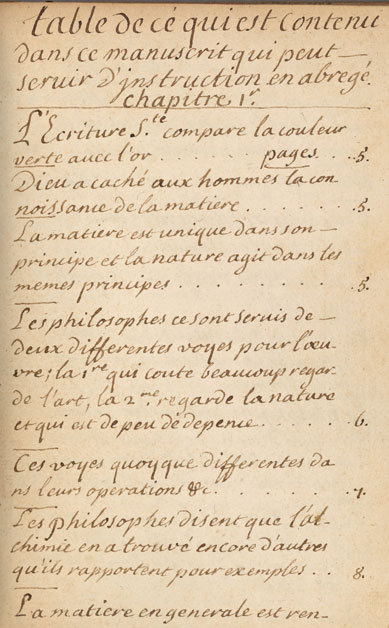
The Table
The table occupies MS pp. 129–150 (images 135–156) and carries no page numbers of its own. Each entry gives a summary, then leader dots and the page of the text, here set as a two-column table. Chapter headings are retained as entries. Entries split across page breaks are joined where the continuation is clear, and repeated column headers are consolidated. Lines lost through the cropping of the photographs are marked [line lost]. The page numbers refer to the manuscript's own pagination of the treatise (MS p. = image − 6).
TABLE OF WHAT IS CONTAINED IN THIS MANUSCRIPT, WHICH CAN SERVE AS AN ABRIDGED INSTRUCTION
-----------------------------------------------------------------------------------------
| Entry | Page |
|---|---|
| Chapter 1 | |
| Holy Scripture compares the green colour with gold | pages 5 |
| God has hidden the knowledge of the matter from men | 5 |
| The matter is one in its principle, and nature acts in the same principles | 5 |
| The philosophers have used two different ways for the Work: the first, which costs much, concerns art; the second concerns nature and is of little expense | 6 |
| These ways, though different in their operations, etc. | 7 |
| The philosophers say that alchemy has found still others, which they give as examples | 8 |
| Matter in general is enclosed in impure bodies. | page 9 |
| Chapter 2 | |
| Matter in particular is an unctuous moisture; it hides in the centre of the elements; fire has no power over it | 10 |
| Remark to be made on the 12th page | 12 |
| This matter, though fixed, is volatilized by the Elements | 11 |
| This matter contains the fire of the sages | 13 |
| The time to gather it; and the matter of the mercury is formed from two sperms | 13 |
| The philosopher must imitate nature, which God formed for the commerce of Heaven and earth, imitating God in the creation of the ♁ [world] | 14 |
| The philosopher draws from these two luminaries and from these Elements all the earthly things; they make of them a Compound, or an Elixir | 15 |
| God gives this science to whom he pleases | 17 |
| It is not difficult for man to have the stone, but it is impossible for him to determine the matter | page 18 |
| The matter is found everywhere | 20 |
| The expense of the Work is modest, and the subject of the matter is vile, though precious | 21 |
| Chapter 3. Of the preparation of the elements and of their separation in general | 22 |
| Nothing of the matter is changed, and what appears impure is changed into something purer, which is the fire of Pontanus. Note the rest well. | 23 |
| A kind of separation of substance in the first and ⟨the⟩ second Work | 25 |
| God created all things by number, weight and measure | 26 |
| In the first Work there is some separation, which nature makes; and in the second it is the Artist who separates it | 27 |
| The substances united together form a water called quicksilver | 28 |
| This water is very hidden; its origin comes from the air; it must be taken at the hour of its birth | 29 |
| It is the water and the fire of the philosophers; it is into this water that they introduce their fire, which agrees with the water, and which is the key of the Work | page 30 |
| Chapter 4. Of the Elements in particular and of their preparations | 30 |
| The matter is found everywhere, but the philosophers have a particular subject | 30 |
| The Subject must be taken at the moment and in the place of its birth, by meditation | 32 |
| They must be stripped of impure bodies | 32 |
| One must not cling to the words, but to the sense of the thing and to what they signify | 33 |
| One must not cling to the exterior of the principles but to their interior, and join the moist with the dry, the fire with the water, the hot with the cold | 34 |
| This labour does not exceed the strength of man | 35 |
| Chapter 5. Of the operations in general | |
| There are twelve general operations, which are as many keys to open the gate⟨s⟩ of the Hermetic Cabinet | 37 |
| The Calcination of the Work is not done by fire; the matter calcines itself | 37 |
| Rubification is included under calcination; trituration almost always precedes Calcination | 38 |
| To grind the matter: it is nature that does it and reduces it to powder | 38 |
| This trituration is done when the earth begins to sublime, which is the third preparation given to the Subject | 39 |
| Dissolution is the reduction of a body to water by repeated washing; the whole matter is reduced to water; it is this fire that is converted into water | 39 |
| It is in this operation that the stone dissolves itself; the hand of the artist is necessary to this dissolution | 40 |
| This operation is the key of the seven gates: the first gives entry to the second, the second gives it to the third, and so on up to the seventh | 41 |
| This dissolution precedes calcination, which is the most essential [operation] of the Work | 41 |
| Sublimation is a purification of the subject which rejects the maternal impurities, in which the body is sifted; and by this means the water, becoming more subtle, attracts to itself the soul of the sun | 4⟨3⟩ |
| One does not need so many vessels; the vessels are the elements | 43 |
| Distillation is often confused with the term sublimation. Note the rest. | ⟨4⟩3 |
| The white spirit and the solar spirit of our body, which are the two first luminaries, the white mercury and the red mercury | 44 |
| Inhumation is an essential operation in the Work: it is to make the earth spiritual and, from spiritual, to make it corporeal; to make the volatile fixed and to make the fixed more perfect | 44 |
| It is by this operation that one whitens the black and cuts off the raven's head | 45 |
| To see, by a continual fire, a dew rise in the vessel, and a kind of mist, which fall back incessantly night and day | 45 |
| The Body communicates its fixity to the water, and the water communicates its volatility to the body | 46 |
| Lotion is to whiten the black body by repeated imbibition of its own water, from which it was drawn, for the first and second Work; but for the third Work, see page 62; the seven gates, pages 40 and 41, and 44. | 46 |
| The union of the ⟨two⟩ mercuries, white and red, which are two substances, to make the animated mercury and the citrine mercury of the first operation | 47 |
| This operation is also performed to join the moon to the body of the sun; it is the union of the male and the female, of the last Work of the first part | 48 |
| Putrefaction is the generation of the lunar and solar substances from which the luminaries proceed. These are the little Ravens who come out of their nests, and who must be prevented from entering them | 48 |
| This is the time when the fire must be well governed, the matter not allowed to dry out entirely, and the little Ravens prevented from returning to their nests, which are little atoms | 49 |
| Coagulation, fixation and nutrition concern the second part of the Work, which is multiplication. See page 102. | |
| Second Part: of the operations in particular, necessary for the Practice | 50 |
| Beware of how the philosophers write, for they confuse and misplace the operations: what should be at the beginning they put at the end, and the end at the beginning | 52 |
| The stone is made in two sorts of ways | 53 |
| The author of this book says that he means to speak of the Work of the ancients, and he forbids the reading of certain manuscripts called "processes" | 53 |
| He warns that he will not tell things point by point; that he uses neither supposition nor similitude, but some figurative expressions and some little veils, easy to unfold | 55 |
| The author divides the work into two parts: the first concerns the composition of the stone and its perfection up to fermentation; the second comprises all the operations that must be performed for the second and last perfection of the stone. Remark to be made on this division | 55; 56 |
| Chapter 1. Of the Extraction of the Work | |
| After drawing the matter from the mine, one must necessarily make a good provision of this water, because it contains much matter but little Spirit | 57 |
| Note the following articles. | |
| The repeated ablutions of this water upon the earth, which changes into an unctuous milk, become the life of the matter of the stone | 58 |
| This water contains all the virtues of Heaven and earth; it is the dissolvent of nature, in which the King and the Queen bathe | 59 |
| The time to gather this water is in spring, in the three signs of the Ram, the Bull and the Twins | 60 |
| This water is a magnet which attracts to itself all the influences of Heaven, of the sun, of the moon and of the stars, to communicate them to the earth | page 61 |
| This water can be had only by means of the earth | 61 |
| This water, after several repeated washings upon the earth, purifies it; and the earth gives all its virtue to the water, not at the first but at the seventh washing | 62 |
| Chapter 2. Of the separation of the Elements | |
| Nature strips itself of all its impurities by the operation performed in the separation of the Elements, because of the many superfluities and different natures that are in the principles; this is done by putrefaction | 62 |
| The grain of wheat cast into the earth, which rots there, is given as an example | 63 |
| It is this dung fire that must be purified and introduced into the matrix, which is watery, aerial, igneous and earthy | 63 |
| This fire partakes of the four qualities, of cold [line lost] sulphur too, and it is a quicksilver | 64 |
| This fire, which does not come from the matter, will complete the whole work, and perfects what is impure and ⟨im⟩perfect; it makes the three colours appear, the black, the white and the red | 64 |
| This fire is found in the dung, which corrupts and putrefies the seeds and gives fertility to the earth | 65 |
| This fire is that water which comes out of the fountain that is in a hollow oak. This old hollow oak is the vessel, which must be of oak, in which the water it holds must be corrupted | 66 |
| There are other fires: see pages 71 and 94. | |
| The Secret of the operation of this fire is to Know the fixed time of this putrefaction | 66 |
| Neither the Elements nor the principles can be extracted unless the matter has first been corrupted as well | 66 |
| The putrefaction appears good when there is found in this watery fire some acidity, a smell of the sepulchre | 67 |
| Philalethes says that there must appear on the surface of the water little bubbles like fishes' eyes | page 67 |
| This water, which is the Secret fire and the agent which boils and ferments in the putrefaction | 67 |
| Mysterious Secret of the philosophers, hidden, concerning the vessel | 68 |
| Make your remarks well on the articles before and after. | |
| The vessel which encloses that of the matter must be of oak wood | 68 |
| The old oak is taken there for the universal matter, from whose trunk come two flowers, one white, the other red, which are the two substances from which we draw our fire | 69 |
| Of the extraction of the two luminaries, gold and mercury, that is to say, the operation of these two substances which they call mercurial vinegar | 70 |
| Way of making the salt of the philosophers by means of the operation above, which is called the body of the moon, which serves for the work to the white and for the composition of the mercury of the philosophers | page 63 |
| To join the two mercuries, white and red, together, called Elixir, spirit. Do not stop at the words of the philosophers, but at the sense of their words | 74 |
| The distinction one must make, and know how to recognize, between the true operations and the false, and not put one matter for another | 75 |
| The author advises attaching oneself rather to the philosophers who have written little, and to the certain rules of the principles | 76 and 77 |
| This work can easily be done by the hands of a woman | 78 |
| The matter can be found in an impure [one] and in one week. God has reserved it for the poor | 78 |
| The two ways are true; nevertheless that of the poor is the more excellent. The one is done in seven months and the other in eighteen months | 78 |
| Beware of the false lead which the philosophers give in the regimen of the one and the other practice | 79 |
| Chapter 3. Of the extraction of the bodies of the two luminaries, sun and moon | |
| Nothing is so hidden as the operation of the extraction of the two luminaries, sun and moon; it is impossible to guess it without a divine inspiration, or a friend who tells it to you | 80 |
| These operations consist in dissolving and purifying the matter well by the union of the soul with the body, of which the Spirit is the only bond that performs this conjunction | 80 |
| The separation of the body of the moon from that of the sun, which is enclosed in the red tincture, by adding to it twice as much white spirit | 81 |
| The separation of the earth, which contains the fire and the air, is done by removing the water from the earth | 82 |
| A black ash, which is like a subtle earth floating on the surface of the water, which must be gathered, which is like cream on milk, which is a fixed sulphur, which is also a root with its sap full of strength, which is purified until its spirit of salt appears | page 81 and 82 |
| The first tincture must also be rectified and Clarified; and from the last, which is the spirit, the faeces must be separated | 83 |
| When the black earth is dissolved, it must be taken to be digested, putrefied and cooked until it is subtilized | 84 |
| This earth ⟨or⟩ stone dissolves in the lunar mercurial water, which cannot be had without separating it from the black earth | 85 |
| In the principal operations [margin: the three principles] it is always two things which produce another, and of these two things one takes the place of the male and the other of the female | 85 |
| This operation is properly only a separation | 86 |
| If the fire of the first degree, hot, is pushed too far, the blackness will turn into red and will be burnt | 87 |
| One must continue to set the black ash apart until no more red comes, which will happen when the water becomes white | 87 |
| [line lost] black powder, to make it corrupt and putrefy | 88 |
| Chapter 4. Of the conversion of the Elements and the conjunction of the two luminaries, the moon and the Sun | 88 |
| The tinctures, which would change the black body into a burnt red, must be distilled for eight months on a small fire | 89 |
| Way of distilling this black earth with its water in the bain-marie to whiten it | 90 |
| The Salt of the earth, which will be white after the seventh distillation, is drawn by the second operation, with the lunar spirit, to extract the mercury of the philosophers | 91 |
| The first Element that comes out is the pure water, cold and moist, which must be distilled seven times | 91 |
| Take good care not to mix the earths and the faeces, and the water of the first operation, with that of the second | 92 |
| Remarks on the Author of the Combats of the Knights | 93 |
| The liquor which comes out of the hollow of the oak, which is a homogeneous substance and which [line lost] -parated from the black, contains three different substances and three natural principles: Salt, Sulphur and mercury | 93 |
| The fire and the Sulphur are hidden in the centre of the black earth, which must be washed to extract from it the fixed salt which forms the mercury of the philosophers | 94 |
| This water, which has been distilled seven times: one of the seven [parts] of it must be put upon this fixed salt | 95 |
| and the same method must be observed for the red water as you have done for the white water | 95 |
| Chapter 5. Of the purification and separation of the principles of the mercury of the philosophers | 96 |
| This Water is the key and the head of the Hermetic Work, because it begins it and finishes it | 97 |
| The philosophers have all hidden the preparation of this water | 98 |
| The Hermetic Triumph says that this water is the sacred fire of the sages and the only instrument for the sublimation | 99 |
| [line lost] … of the fire and of the water; the chapter on the water is page 56. | |
| If you do not Understand these things, pray God to enlighten you | 99 |
| It is this fire, enclosed in this water which is our mercury, that it dissolves the stone naturally and without violence | 99 |
| The different names that the philosophers have given to this so precious water | 100 |
| The virtue which must be given to gold of multiplying itself, to make of it the universal medicine | 102 |
| The living Sulphur of gold, which gives life even to Common gold, which makes it vegetate and multiply | 103 |
| The term "stone" is given in several different senses, as in three sorts of order | 104 |
| Three sorts of gold of the philosophers | 104 |
| Three kinds of mercury | 105 |
| Remark to be made on the three orders of the stone, on the three sorts of gold and on the three kinds of mercury. | |
| Chapter 6. Of the separation and purification [line lost?] … philosophers, which consists in a perfect dissolution and sublimation | 107 |
| The solution of the white body, or of the moon, called white gold | 108 |
| The solution cannot be made without the conjunction of the female with the male, which is the precious salt | 109 |
| This precious salt, called body, is made by a continual effusion of its own blood, which is a natural menstruum [English: solvent] | 109 |
| The dead earth, in which the fire and the sulphur are hidden and which must be washed, must ⟨not⟩ be thrown away | 110 |
| To try to obtain, by means of the watery soul, the sulphurous form, which is done by our vinegar | 110 |
| To water the earth with its own water, and [see] that it is penetrated by its moisture, to engender the mercury | 111 |
| The mercury is formed from the union of these two substances, of which one is the Spirit and the Salt is the body | 111 |
| Remark to be made so as not to be [line lost] … for the philosophers hide it | 11[2?] |
| This whole mystery is nothing but the extraction of the fixed salt, which produces the mercury, and the water which composes this dry water | 113 |
| Chapter 7 | |
| The Composition of the great dissolvent and of the mercury of the philosophers is made from their liquors; they make two mercuries of them, the white for the Bath of the moon and the red for the Bath of the Sun | 114 |
| The Cosmopolite says the same thing, saying: our old man will swallow up gold and silver, etc. | 115 |
| Several different names that the philosophers give to this precious liquor | 116 |
| This precious liquor is the first Being of gold, the field in which the Sun is sown; that the fixed was made volatile, etc. | 117 |
| A metallic, homogeneous water is therefore needed, for which the way is prepared by the Calcination which has [line lost?] … which is properly a reduction into atoms through the sieve of nature | 118 |
| What must be done after the sun has been dissolved by the mercury | 119 |
| The Combat of the two dragons, which devour each other until of the two there is made only one | 120 |
| Chermeze says that one must see the thickness of the water harden in order to rejoice | 120 |
| Take care at the end of the first Work to perfect the mercury | 121 |
| The mercury is drawn from two substances which come from one single and only root; one is fixed and the other volatile | 122 |
| Many names given to this mercury | 123 |
| After drawing these two substances by means of the fixed salt, there results the universal Dissolvent and the mercury of the philosophers | 123 |
| [line lost] … the invisible Spirit, to make great with child the earth, which is the female, which joins itself to the male, which is the sulphur. And from the Concourse of these two substances comes the prolific seed | 124 |
| The Emerald Tablet of the great Hermes, which was found in his sepulchre, in the valley of Hebron, after the flood | 124 |
| This same Spirit descends from Heaven into the centre of the earth, where it begins to coagulate by the virtue of its hermaphrodite salt, which is its magnet | 125 |
End of the table.